Article

Solubility of Auroselenide in Hydrothermal Solutions (Thermodynamic Modeling) and Conditions for AuSe(s) Formation in Natural Processes


by
Galina A. Palyanova
1,*,
Tatiana V. Beliaeva
1,
Olga L. Gaskova
1,
Nadezhda D. Tolstykh
1 and
Nikolay S. Bortnikov
2
1
Sobolev Institute of Geology and Mineralogy, Siberian Branch of Russian Academy of Sciences, Koptyuga Ave., 3, Novosibirsk 630090, Russia
2
Institute of Geology of Ore Deposits, Petrography, Mineralogy, and Geochemistry, Russian Academy of Sciences, Staromonetny, 35, Moscow 119017, Russia
*
Author to whom correspondence should be addressed.
Minerals 2026, 16(6), 562; https://doi.org/10.3390/min16060562
Submission received: 18 April 2026 / Revised: 18 May 2026 / Accepted: 20 May 2026 / Published: 22 May 2026
(This article belongs to the Special Issue Gold Deposits: From Primary to Placers and Tailings After Mining)

Abstract

We used thermodynamic modeling methods to calculate the stability of auroselenide AuSe(s) in hydrothermal solutions at different temperatures (25–350 °C), pressures (1–165 bar), salinities (0–5 m NaCl), and acidity–alkalinity (0.00001–0.1 m HCl or NaOH). Gold selenide dissolves congruently in near-neutral solutions. In acidic chloride solutions, AuSe(s) dissolves incongruently to form selenium Se(s,l), and in alkaline solutions, to form gold Au(s). Gold selenide has a low solubility at temperatures of 25–200 °C. With increasing temperature, the solubility of AuSe(s) increases and at 350 °C the concentration of dissolved gold in highly acidic solutions (without NaCl) reaches 10−6 m, while in near-neutral and alkaline solutions, it varies from 2·10−7 to 6·10−7 m. At concentrations of NaCl and HCl higher than 0.01 m, the solubility of AuSe(s) increases by half an order of magnitude owing to the formation of gold chloride complexes. In low acidic, near-neutral, and alkaline solutions, gold hydroxocomplex is predominant. We constructed diagrams for the Au–Se–H2O system at various temperatures (25, 100, 200 and 300 °C), which show the stability fields of AuSe(s), Au(s) + AuSe(s), Se(s,l) + AuSe(s) and Au(s) on lg ƒO2–pH. Gold chalcogenides are characteristic minerals of epithermal deposits. The relationships of auroselenide with native selenium and native gold and other minerals in the Au-Ag ores of the Gaching ore occurrence (Kamchatka Peninsula, Russia) and the Bleïda Far West Au-Pd deposit (Morocco) were studied. It was revealed that auroselenide occurs in the peripheral parts of native gold grains, and, less often, in the form of inclusions and intergrowths with other gold chalcogenides in the core of native gold grains. The presence of solidified microdroplets of composition ranging from Te0.97Se0.03 to Te0.71Se0.28S0.01 and Se0.58Te0.41S0.01 in the ore minerals at these and other golddeposits suggests participation of chalcogens existing at temperatures of 217–449 °C. The formation of auroselenide and other gold chalcogenides is likely with a decrease in temperature and neutralization of highly acidic or highly alkaline solutions, or with the participation of melts or chalcogen gas particles. The results of thermodynamic calculations are confirmed by the data on the composition of mineral associations with auroselenide from gold deposits. The presence of auroselenide in the ores from Au-Ag epithermal and other gold deposits with Au–Se–Te–S mineralization is predicted.

1. Introduction

To carry out physico-chemical calculations in a wide range of T and P in hydrothermal systems containing gold, thermodynamic data for all minerals and particles of this metal dissolved in water are necessary [1,2,3,4,5]. Of the 39 gold minerals [6] registered in the MMA 2025 database [7], thermodynamic constants at standard conditions are available for a small number of them, limiting modeling in systems containing gold. In 2023, a new gold mineral, auroselenide (AuSe(s)), discovered at the Gaching ore occurrence of the Maletoyvayam deposit (Kamchatka Peninsula, Russia) was registered [8]. Two synthetic polymorphs of gold selenide (α-AuSe and β-AuSe), synthesized more than 50 years ago, were thoroughly studied using various methods [9,10,11,12,13,14,15,16,17,18,19,20,21], etc. Although thermodynamic data for AuSe(s) were known much earlier [15,22,23,24] than the auroselenide mineral was discovered [8], ΔƒG°298, according to various sources, ranges considerably, and the problem of their coordination is still relevant.
Selenium and gold are extremely important elements in modern technologies [25,26]. Selenium has photosensitivity and semiconductor properties and is used in the electronics industry [27]. Gold is a unique metal used in a wide variety of fields, from jewelry and finances to space technology and medicine [28]. Gold selenide has unique electrical properties, which is of potential interest for future technologies [21,29,30,31].
The genesis of auroselenide and other gold chalcogenides in natural processes has been poorly studied. It is important to know the behavior of selenium and gold in fluids, since it is necessary to understand the stability of sulfides, selenides and tellurides in gold ore hydrothermal deposits [32]. Earlier, Simon and his co-authors [33,34] calculated the thermodynamic constants of reactions to construct the lg fSe2–lg fS2 (lg fTe2, lg fO2) and lg fSe2–T diagrams and determined selenium fugacity, required for the formation of AuSe(s). They predicted the presence of gold selenide in mineral associations with other selenides (clockmannite CuSe, ashavalite FeSe, clausthalite PbSe, timannite HgSe, and guanajuatite Bi2(Se,S)3). Similar calculations were performed in [35] for the associations of AuSe(s) with sulfides and selenides of mercury, antimony, and silver (HgSe, HgS, Sb2Se3, Sb2S3, Ag2Se, Ag2S). Eremin et al. (2025) [36] estimated the values of the standard Gibbs energies of formation for the minerals of the Ag-Au-Se-Te system, using additive elemental contributions, carried out calculations of thermodynamic equilibria at 25 °C, and concluded that at particular contents of chalcogen, native gold and native selenium cannot form paragenesis, as gold selenide is a more stable phase.
The aim of this work is to prepare an overview of the thermodynamic data of AuSe(s), to perform thermodynamic calculations of the solubility of gold selenide in the solutions of varying alkalinity with the concentration of NaCl (0; 0.01, 0.1 and 1 m) in the temperature range of 25–350 °C and to substantiate the physico-chemical conditions of the formation of auroselenide at changing parameters of the water–rock system. One of the tasks is to predict its presence in the ores of other gold deposits on the basis of the previous data obtained in [8,37,38,39,40,41] and new results of the study of mineral associations with auroselenide at the Maletoyvayam Au–Ag deposit (Kamchatka Peninsula, Russia) and the Bleïda Far West Au-Pd deposit (Anti Atlas, Morocco).

2. Methods of Research

Thermodynamic modeling: Two methodological approaches were used: method of minimizing thermodynamic potentials and method of equilibrium constants. The first is based on the mathematical apparatus of convex programming, a method for minimizing thermodynamic potentials; the second is based on the formalism of reaction equations and their equilibrium constants. Thermodynamic calculations of the stoichiometric and non-stoichiometric solubility of AuSe(s) at different temperatures (25–350 °C), pressures (1–165 bar), salinities (0–5 m NaCl), and acidity–alkalinity (0.00001–0.1 m HCl or NaOH) were performed with the help of Gibbs potential minimization method, using the MSU “HCh” software package [42]. The physico-chemical system included 6 chemical elements (independent components: H-O-Na-Cl-Au-Se; 3 solid phases (Au(s), Se(s), AuSe(s)), liquid selenium (Se(l)) and 35 possible particles in an aqueous solution, including gold ions and complexes. The Debye–Hückel (DH) electrostatic model for activity coefficients of electrically charged aqueous species is used in “HCh” and some other programs (Equations 8, 9 in [4]). This model is a built-in function in calculations for highly mineralized solutions (up to 5 m at elevated temperatures).
The method of Garrels and Christ (1968) [43] was used to calculate the mineral equilibria with auroselenide and to build diagrams in lgƒO2–pH coordinates for the temperature range of 25–300 °C and saturated vapor pressures (1–86 bar). The calculations were performed for two values of Se activity (10−6 and 10−8 m), while Au activity was set to be constant (10−8 m).
Mineralogical research was performed using an Olympus BX51 optical microscope (Institute of Geology and Mineralogy SB RAS, Novosibirsk, Russia). Chemical analyses of minerals were carried out at the Analytical Center for Multi-Element and Isotope Research of the V.S. Sobolev Institute of Geology and Mineralogy of the Russian Academy of Sciences, using a MIRA 3 LMU scanning electron microscope (Tescan Orsay Holding, Brno, Czech Republic) equipped with an AZtec Energy XMax-50 X-ray dispersion spectrometer (EDS) (Oxford Instruments Nanoanalysis, Oxford, UK) (analysts Karmanov N.S. and Khlestov M.V.). Survey parameters: Accelerating voltage was 20 kV, probe current was 1 nA, spectrum acquisition time was 60 s (total spectral area ~100 countings), K series for Fe, Cu, As and L series for Pd, Ag, Sb, Au, Hg. Pure metals (Fe, Cu, Pd, Ag, Au) and synthesized compounds InAs (for As) and HgTe (for Hg) were used as standards. The detection limits (wt.%) were: 0.1 Fe; 0.15 Cu; 0.25 Pd, Ag, Sb; 0.3 As; 0.6 Au and 0.8 Hg. The error in determining the main components with a content of more than 10 wt.% was no higher than 1 rel.%, and with a component content of 2–10 wt. %, no more than 6–8 rel.%.

3. Results

3.1. Thermodynamic Modeling

3.1.1. Initial Thermodynamic Data

Gibbs free energies (GT) of solid phases, water and gas particles were calculated using data taken from various sources. The standard thermodynamic properties of the main particles of selenic (HSeO4, SeO42−) and selenious (H2SeO3(aq), HSeO3, SeO32−) acids were borrowed from the SUPCRT98 database [44], and those for H2Se(aq) and HSe from [45]. The initial thermodynamic data of the (Au+) ion, gold hydroxocomplex (AuOH(aq)), and chloride complexes were borrowed from [46,47]. The initial thermodynamic constants for gases O2(g) and H2(g) were taken from the SUPCRT98 database [44], and those for Se2(g) from [48]. The solid phases in the system are represented by gold selenide (AuSe(s)), gold (Au(s)) and selenium (Se(s)). Selenium is also represented by the liquid phase Se(l) at temperatures above 221 °C. The standard thermodynamic characteristics ΔƒG°, ΔƒH°, S° and the coefficients of the heat capacity equation at T = 298.15 K (p = 1 bar) for Au(s) were borrowed from [49], and those for Se(s,l) from [50].
Thermodynamic data of AuSe(s) are reported in several works [15,23,24,36,50,51] (Table 1). The spread of published values of ΔƒG°(AuSe-α,β) ranges from −2.8 to −9.6 kJ/mol (Figure 1). The highest values of enthalpy and Gibbs free energy were obtained by the EMF method [15,51] and they agree with each other within the experimental error and do not vary significantly. In the reference books [23,24], lower values of thermodynamic quantities are reported. The difference in Gibbs free energy (ΔƒG°) is 5 kJ/mol. The Gibbs energy values from [15,51] show good agreement with the reference data from [23]. The Gibbs free energy of formation for auroselenide, calculated using additive contributions of elements [36], is significantly lower than all previously reported values. The values for the enthalpy of formation of AuSe(s) significantly vary in different literary sources (Table 1), with the maximum difference of about 6 kJ/mol. The most complete thermodynamic data with the coefficients of the heat capacity equation (a and b) are reported in [23]. We use GT values for AuSe(s), calculated from this source because EMF-based experimental data carry more weight and occupy an intermediate position (Figure 1).
Table 2 shows the main chemical reactions with the formation of auroselenide, equilibrium constants, and formulas for calculating lg ƒO2, which were used to construct lg ƒO2–pH diagrams.

3.1.2. Congruent Solubility of AuSe(s)

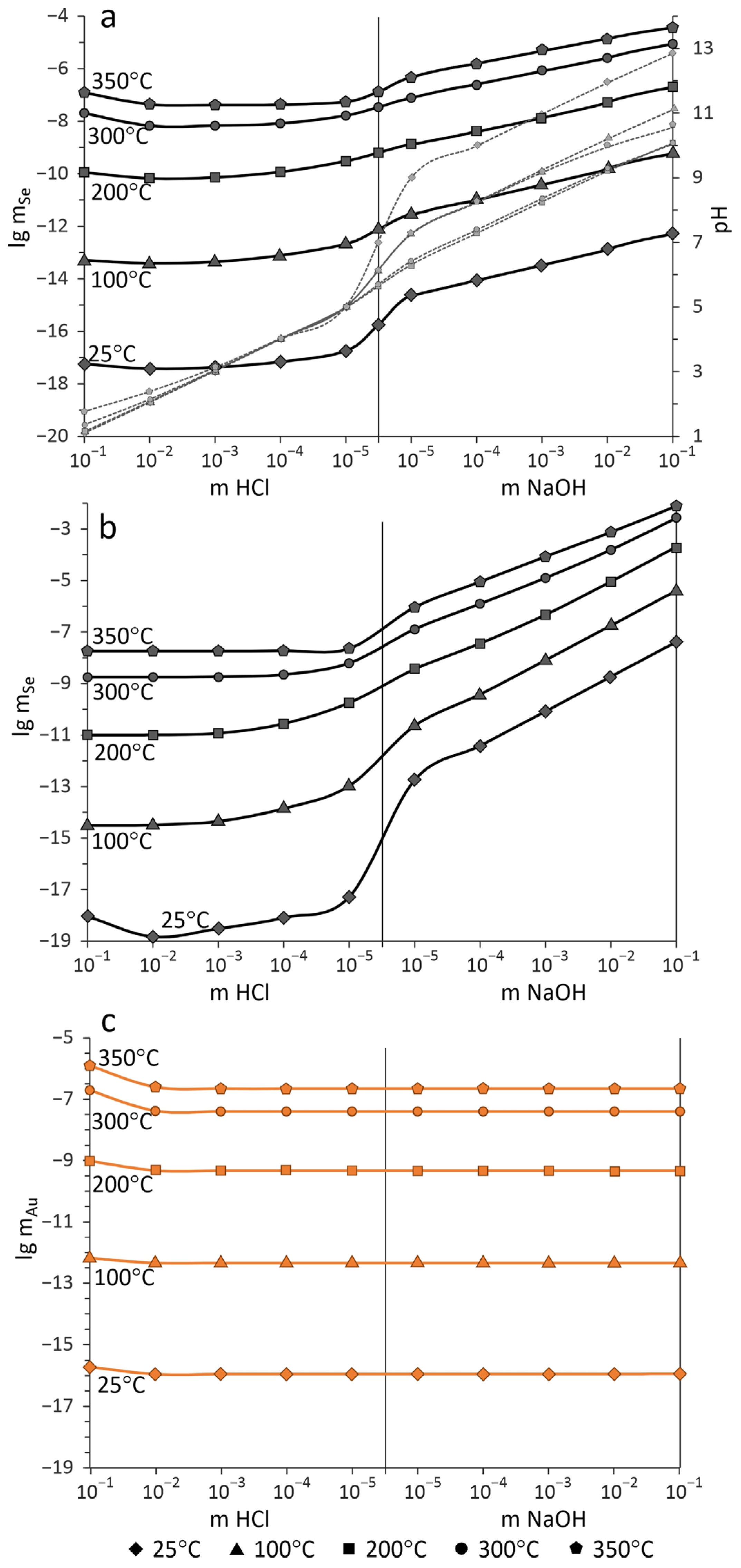
According to the type of dependence of solubility on acidity–alkalinity (lg S–pH) [53], the congruent solubility of AuSe(s) in aqueous solutions for 25, 100, 200, 300 and 350 °C (1–165 bar) and specified concentrations of HCl and NaOH from 0.00001 to 0.1 m corresponds to the second type (higher in alkaline solutions) (Figure 2a): it is the lowest in acidic solutions (with the exception of highly acidic solutions), while in alkaline solutions, it increases by 2–5 orders of magnitude. At 350 °C, the concentrations of gold and selenium in acidic solutions reach 1.2·10−7 m at 0.1 m HCl (pH = 1.8) and 5.4·10−8 m at 0.00001 m HCl (pH = 5) compared to 3.7·10−5 m in the alkaline solution of 0.1 m NaOH (pH = 10.6). The solubility of auroselenide decreases by 8–11 orders of magnitude with decreasing temperature. At 25 °C, the concentrations of gold and selenium in the solution are 5.6·10−18 m at 0.1 m HCl (pH = 1.09) and 1.7·10−17 at 0.00001 m HCl (pH = 5) compared with 5·10−13 m at 0.1 m NaOH (pH = 12.9). At 200 °C, the minimum solubility of auroselenide reaches 6.5·10−11 m at 0.01 m HCl (pH = 2.1); the maximum is 2·10−7 m at 0.1m NaOH (pH = 10.1). The results of thermodynamic calculations revealed a low stoichiometric solubility of AuSe(s) in acidic solutions at temperatures of 25–200 °C.
Additional calculations of auroselenide solubility in water were performed with different data of ΔfG° for AuSe(s) (see Table 1 and Figure 1). The extreme values of ΔfG° are expressed in congruent solubility AuSe(s) as follows: 2.7·10−16 mAu [51] to 8.9·10−17 mAu [24], and 1.74·10−16 mAu from [23]. The difference in ΔfG° values for AuSe does not have a significant effect on the solubility in solution. Additive contribution data from [36] can be used when other data are unavailable. Data obtained from the experiments using the EMF method are more accurate.
To evaluate the effect of each element on the total solubility of auroselenide, the individual solubilities of each element were calculated separately. Figure 2b shows the solubility of selenium Se(s,l) in the absence of gold in aqueous solutions of different acidity–alkalinity for 25, 100, 200, 300 and 350 °C (1–165 bar) in the Se–Cl–O–H system. The solubility of selenium is of the same type (2nd) as AuSe(s), and it is probably this element that to a greater extent determines the solubility of gold selenide. Selenium concentrations increase dramatically in the solution when alkalinity increases. For example, its solubility reaches 2·10−4 m at 200 °C when NaOH concentrations equal 0.1 m, compared to 10−11 m at HCl concentrations equal to 0.1 m and 2·10−10 m at HCl concentrations equal 0.0001 m. With increasing temperature, the solubility of selenium increases at a concentration of 0.1 m NaOH from 4.1·10−8 m at 25 °C to 7.7·10−3 m at 350 °C, and in acidic solutions from 1.1·10−19 m (0.1 m HCl) at 25 °C to 1.8·10−8 m at 350 °C. The solubility of selenium is affected by the temperature and high alkalinity of the solutions.
The dependence of the solubility of gold (in the absence of selenium) on the acidity–alkalinity of solutions (Figure 2b) is of the first type, i.e., a weak dependence on pH [53]. The solubility of the noble metal is ≈4.7·10−10 m at 200 °C at concentrations of NaOH < 0.1 m and HCl < 0.01 m and increases to 9.8·10−10 m at concentrations of HCl = 0.1 m. The solubility of gold increases with increasing temperature from ≈10−16 m at 25 °C and reaches ≈2·10−7 m at 350 °C. The highest solubility ≥1.3·10−6 m is typical of highly acidic solutions with HCl ≥ 0.1 m at 350 °C. Temperature is a more significant factor than pH, affecting the solubility of gold in the Au–Cl–O–H system.

3.1.3. Incongruent Solubility of AuSe(s)

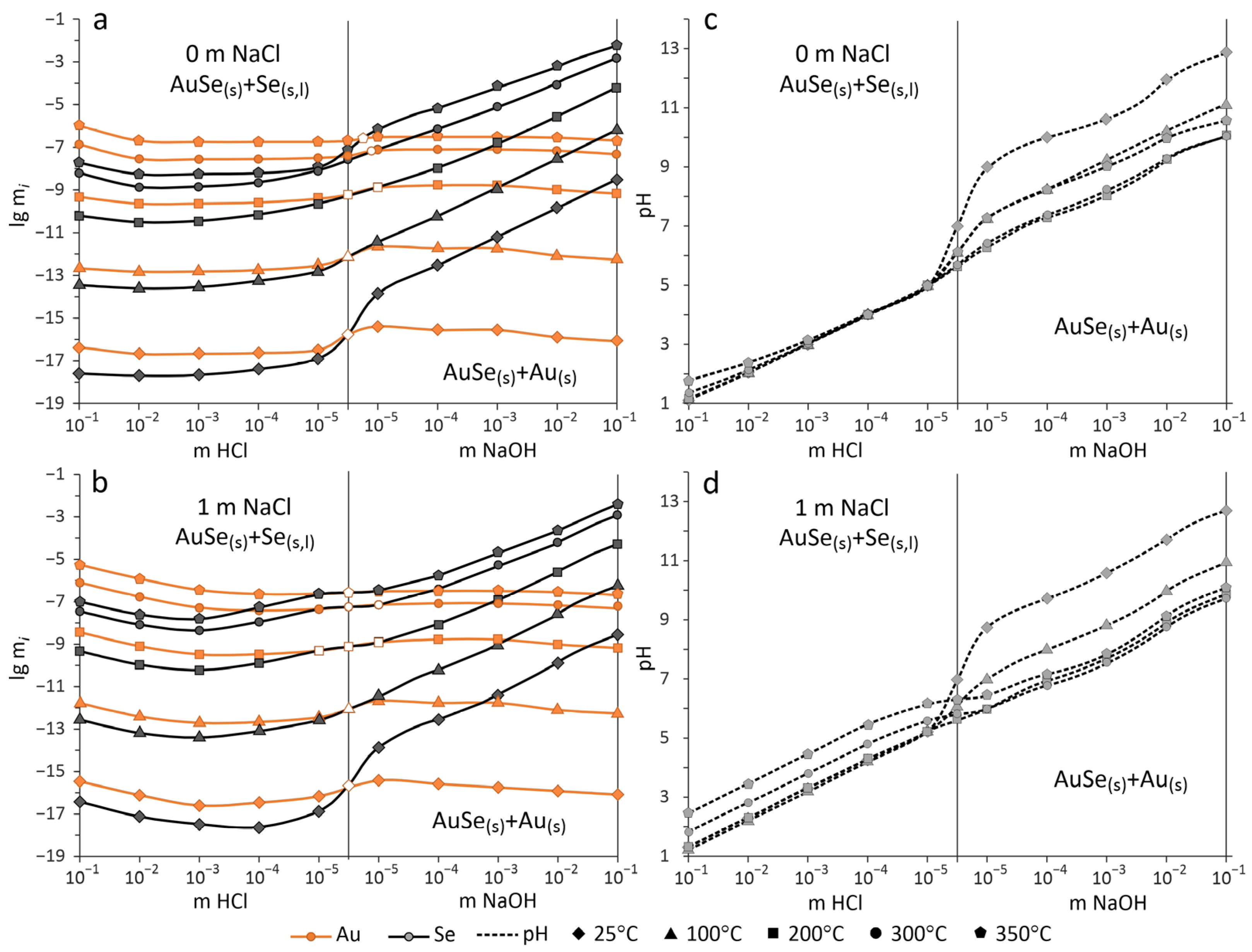
Figure 3 shows the incongruent solubility of AuSe(s) in solutions with and without NaCl (0 and 1 m) and HCl or NaOH from 0.00001 to 0.1 m for a temperature range of 25–350 °C and pressures of 1–165 bar. Auroselenide dissolves incongruently to form selenium Se(s,l) in acidic chloride solutions and to form gold Au(s) in alkaline solutions. At a temperature of 300–350 °C, liquid selenium Se(s,l) is formed (melting point of Se is 221 °C). Auroselenide AuSe(s) dissolves congruently at a temperature of 25–350 °C in near–neutral solutions (Figure 3a). Addition of NaCl up to 1 m to pure H2O leads to an increase in this field in the whole temperature range under study (Figure 3b). Gold concentrations in the solution (mAu) are higher than the concentrations of selenium (mSe) when auroselenide with Se(s,l) is stable. Conversely, mAu becomes lower than mSe, when AuSe(s) with Au(s) is stable. In the case of the congruent solubility of AuSe(s), the concentrations of gold and selenium in the solution are equal.
In acidic solutions with HCl (pH 1–5) without NaCl at 25–200 °C when selenium Se(s) appears, and at pH > 6 when gold Au(s) appears, the concentrations of gold and selenium in solutions are <<10−6 m (Figure 3a) and they are considered geochemically insignificant for the transfer of elements. At 350 °C, the expected increase in the concentrations of elements occurs in highly acidic solutions (0.1 m HCl, pH = 1.76—Figure 3b): up to 1.1·10−6 m for gold and up to 1.9·10−8 m for selenium in near-neutral (0.00001 m HCl, pH = 5) and alkaline (0.1 m NaOH, pH = 8) solutions up to 1.8·10−7 and 2.1·10−7 m for Au and up to 1.2·10−8 and 6·10−3 m for Se (Figure 3a). It is worth noting that liquid selenium Se(l) is formed: 8·10−5 g at pH = 1.76 (0.1 m HCl) and 1.4·10−5 g at pH = 5 (0.00001 m HCl) upon the interaction of one mole of AuSe(s) with the solution. In the most alkaline solution at a concentration of 0.1 m NaOH (without NaCl) at 350 °C, the amount of precipitating gold is 1.2 g. Considering that it is deposited from each kg of the interacted solution, then, operating on a geological scale, 1.2 kg of gold can be deposited from each ton of solution. At lower concentrations of NaOH 0.001 m (pH = 8.36–9.11) (without NaCl) and temperatures of 350–300 °C, sufficiently high quantities of precipitating gold are also observed, with 2.5–1.4 g. At a temperature of 25 °C, the amount of gold precipitating from 1 ton of such a solution decreases to 3.5·10−4 g.
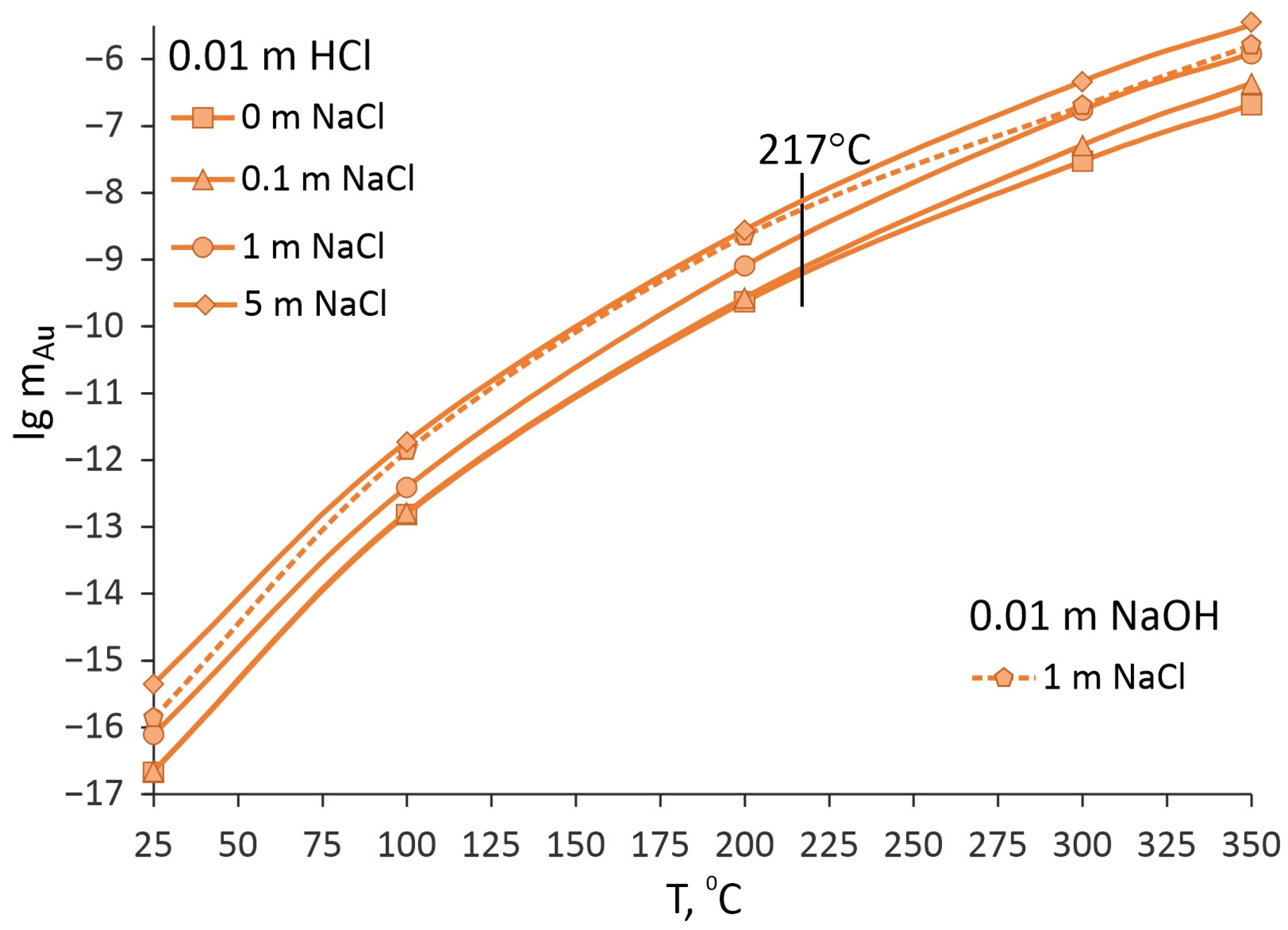
Figure 4 demonstrates incongruent solubility of AuSe(s) in solutions with different concentrations of NaCl (from 0 to 5 m) for acidic (0.01 m HCl) and alkaline solutions (0.01 m NaOH) in the temperature range of 25–350 °C. The solubility of AuSe(s) increases by half an order of magnitude at NaCl concentrations above 0.1 m in highly acidic solutions (0.01 m HCl) in the whole temperature range (Figure 4). In weakly acidic, near-neutral, and alkaline solutions, the concentration of NaCl does not affect the solubility of AuSe(s).
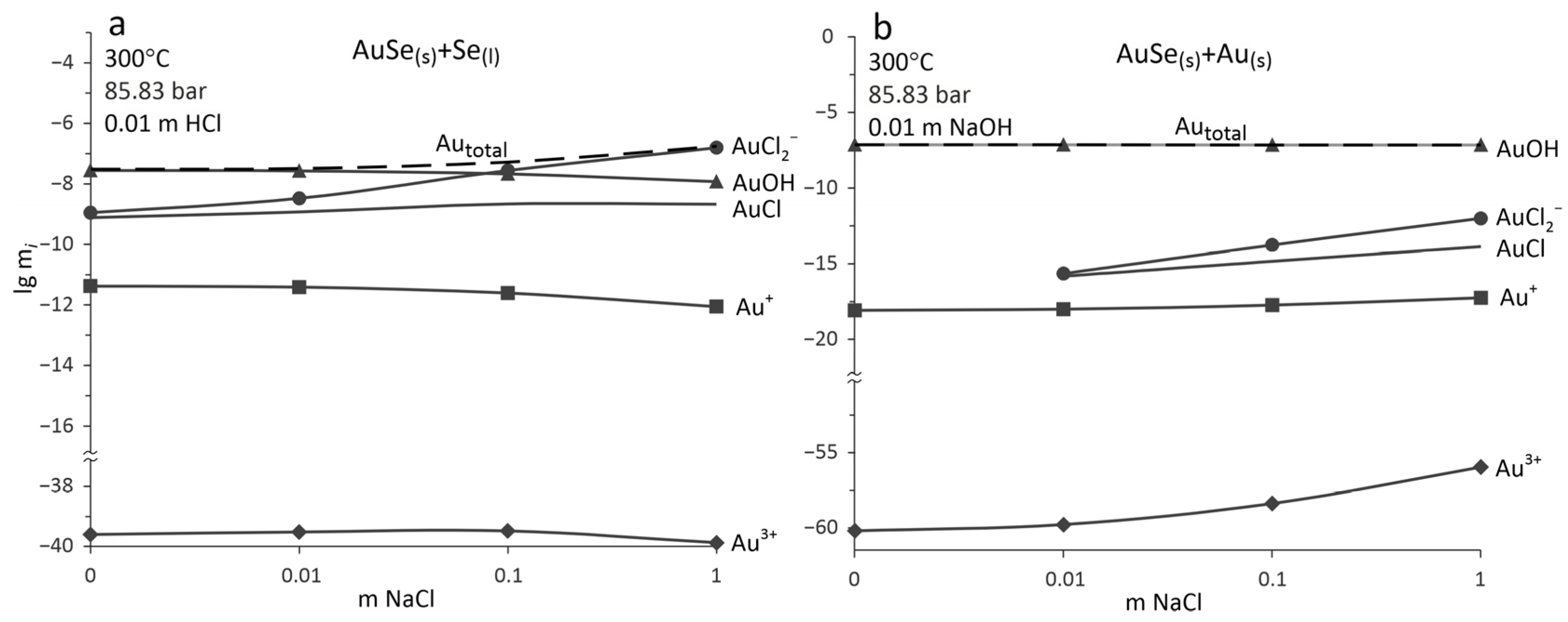
Figure 5 shows the contribution of gold complexes to the solubility of auroselenide in acidic (0.01 m HCl) and alkaline (0.01 m NaOH) solutions with NaCl concentrations of 0 and 1 m at 300 °C (pressure 86 bar). In solutions without NaCl at 350 °C in a highly acidic field (pH = 1.76), the main form of gold transfer is AuCl2, since the acidity was set to 0.1 m HCl (Figure 3a). However, in the pH range of 2.38–6.25, this is AuOH0.
In 1 m NaCl solutions at 300 °C and in acidic solutions with a pH of 2.41, AuCl2 is also the main form of gold transfer; at pH 4.4, the chloro- and hydroxocomplex make an equal contribution, but further up to pH 6.25, AuOH0 prevails again. At concentrations of NaCl and HCl above 0.01 m, the solubility of auroselenide increases by half an order of magnitude owing to gold chloride complexes. In acidic, near-neutral, and alkaline solutions, the gold hydroxocomplex predominates, regardless of the amount of NaCl.
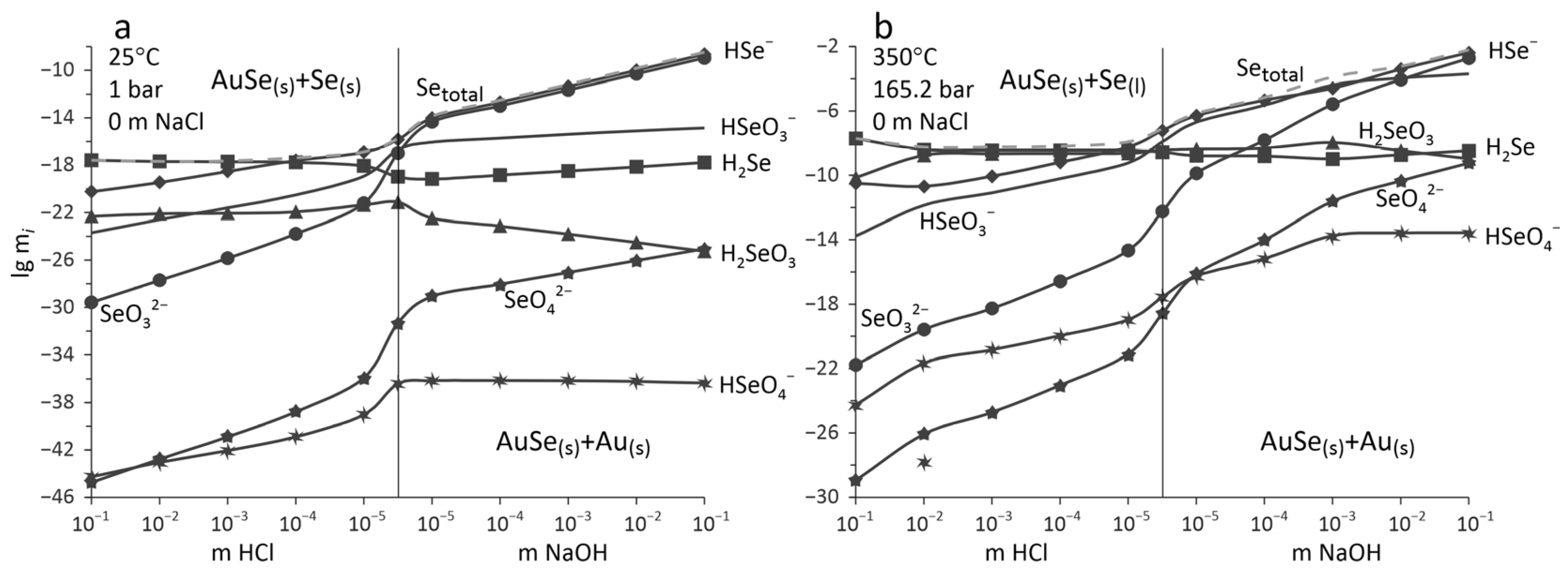
The most intriguing question for alkaline conditions is the reason for the sharply increasing concentration of selenium with increasing temperature and alkalinity. Figure 6 shows the concentrations of dissolved forms of selenium in an aqueous solution without NaCl as a function of pH during its interaction with auroselenide for 25 and 350 °C.
At 25 °C, the main form is H2Se in acidic solutions; when alkalinity increases, HSe and SeO32− dominate in highly alkaline solutions (Figure 6a). At a temperature of 350 °C in acidic solutions, the main two forms are H2Se and H2SeO3, and in alkaline solutions they are HSe and HSeO3, and in highly alkaline solutions SeO32− is present in them (Figure 6b). These forms of dissociated acids provide a high mobility of selenium at two degrees of its oxidation.

3.1.4. Diagrams lg ƒO2–pH

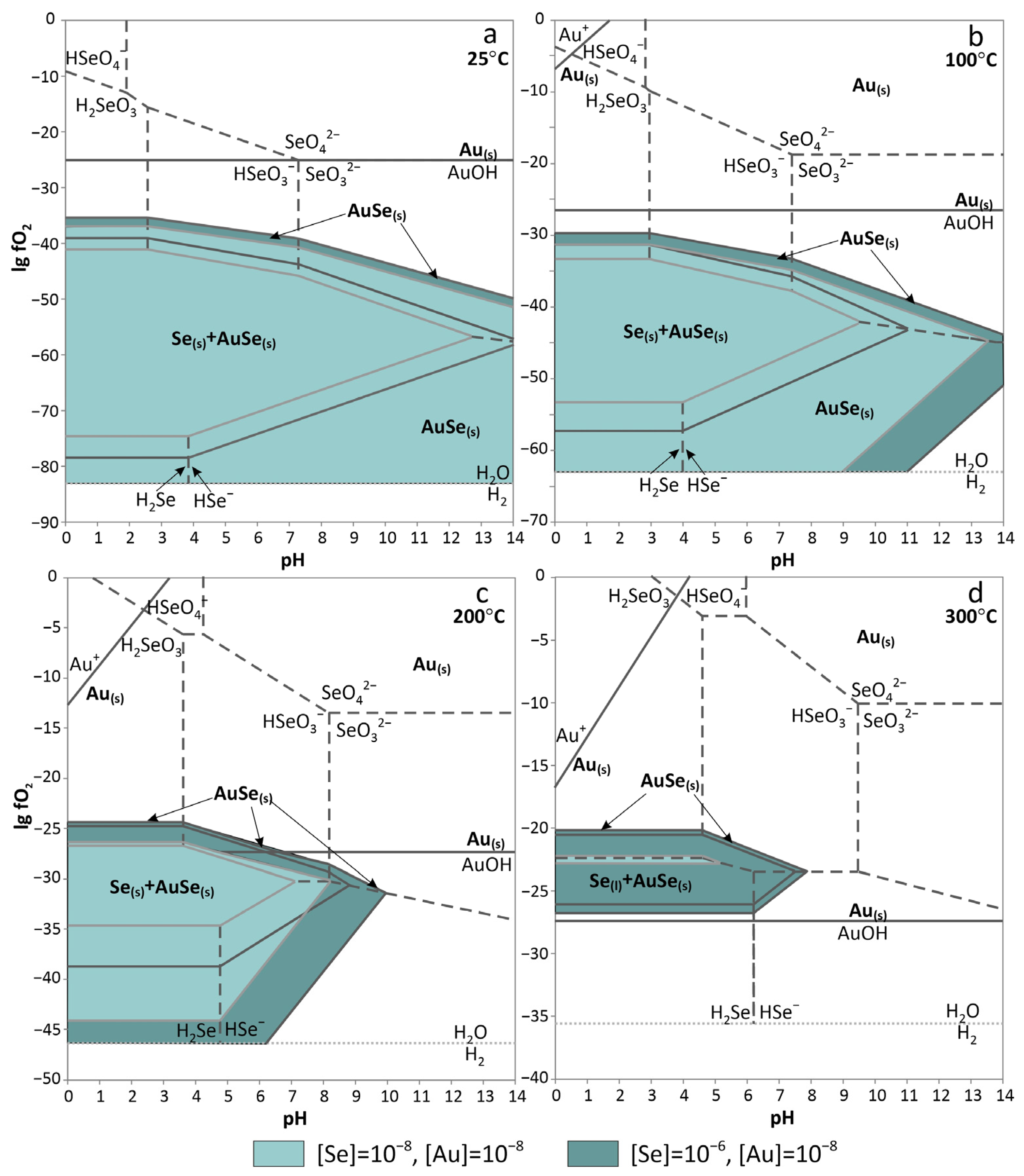
Figure 7 shows lg ƒO2–pH diagrams for the Au–Se–H2O system for temperatures of 25–300 °C and saturated vapor pressure (1–86 bar). Calculations were performed for two values of selenium activity (10−6 and 10−8 m), while the activity of gold was set constant (10−8 m). The stability field of auroselenide is wider than that of native selenium in terms of both pH and ƒO2, and completely overlaps it. With a decrease in selenium activity in solution from 10−6 to 10−8 m, the AuSe(s) and Se(s) stability field decreases, while the AuSe(s) field increases (Figure 7).
With a decrease in temperature from 300 to 25 °C, the stability fields of gold selenide and associated native selenium expand, shifting towards a more reducing environment and alkalinity of the solution (Figure 7). At low temperatures, the formation of auroselenide occurs with the participation of solutions with a hydroxocomplex of gold (AuOH0), and with an increase in temperature above 200 °C, with the participation of reactions with native gold. At a temperature of 300 °C, auroselenide is formed at ƒO2 = 10−27–10−20 and pH < 8, at 200 °C ƒO2 = 10−52–10−25 and pH < 10, at 100 °C ƒO2 < 10−30 and pH < 14, and at 25 °C ƒO2 < 10−35 and pH < 14. The stability field of gold lies in a more oxidizing environment compared to auroselenide.
With a decrease in the temperature and alkalinity of the solutions, the association of auroselenide and native gold becomes less probable, whereas the association of auroselenide with native selenium becomes more stable, and the stability field of only auroselenide expands at given selected values of Se and Au activities. According to the T–lg fO2–pH diagrams (Figure 7), at 25 and 100 °C, the auroselenide stability fields cover a wider fO2–pH range than at 200 and 300 °C. However, the specified selenium and gold concentrations in the aqueous solution exceed the values obtained in solubility calculations by several orders of magnitude (Figure 2 and Figure 3). Lower concentrations of these elements will contribute to a reduction in the auroselenide stability region in the lg fO2–pH range at lower temperatures. A decrease in temperature, changes in redox potential, pH, and gold and selenium content in fluids are the most effective factors for auroselenide formation.

3.2. Mineral Associations of Auroselenide

3.2.1. Gaching Ore Occurrence

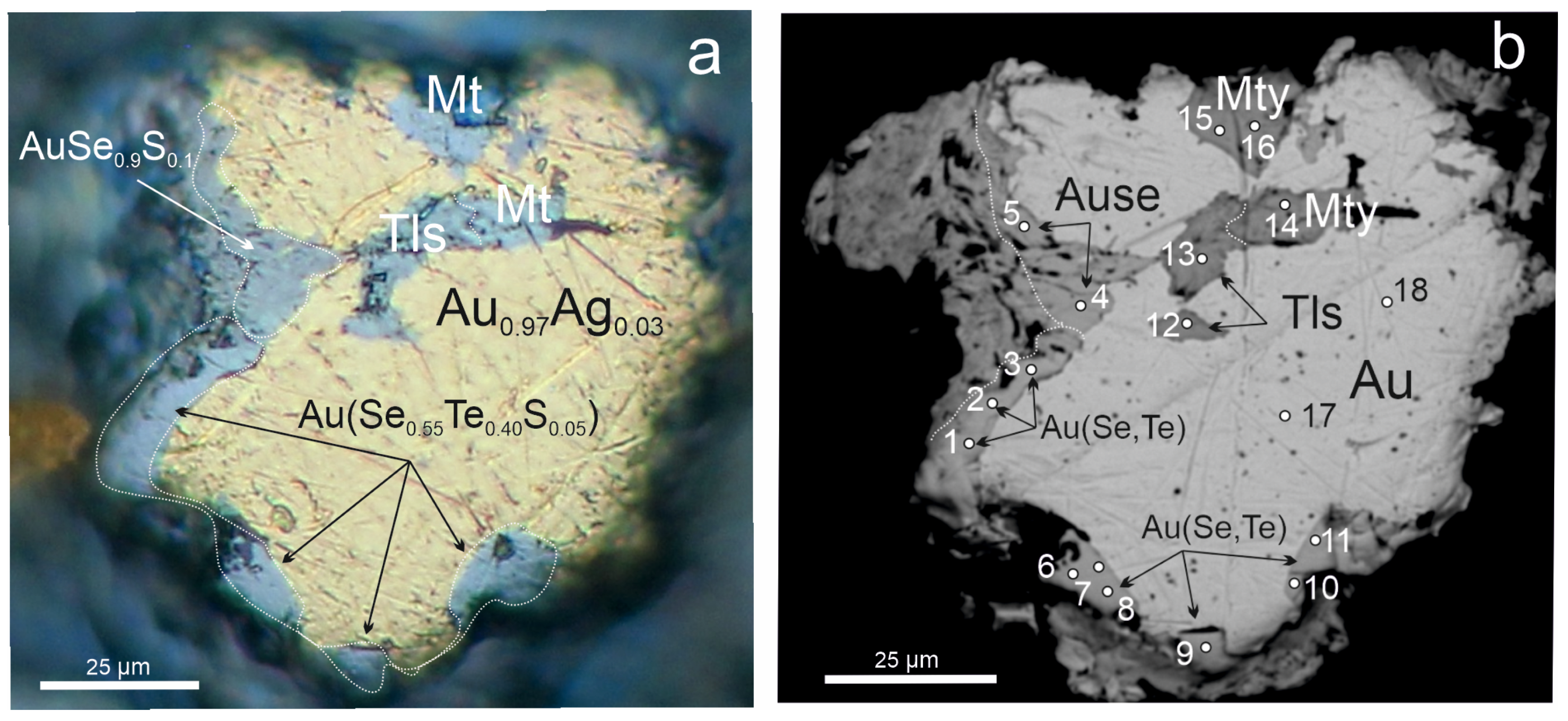
In the Gaching ore occurrence of the Maletoyvayam deposit (Kamchatka Peninsula, Russia), auroselenide occurs in intergrowth with the minerals of the maletoyvayamite–tolstykhite series present in native gold [8,37]. In association with auroselenide, the following minerals were identified earlier: pyrite, calaverite, fischesserite, gachingite, minerals of the tetrahedrite group (stibiogoldfieldite, its As-analog, tennantite-(Cu) and tetrahedrite-(Zn)), tripugiite, minerals of the famatinite–lusonite and selenium–telluric series, paraguanahuatite, petrovskaite, souchekite and timannite [8]. The optical photos in Figure 8 show the relationship of auroselenide with native gold and maletoyvayamite [37]. Gold chalcogenides—auroselenide and maletoyvayamite—replace native gold and are located in the peripheral parts of its grains.
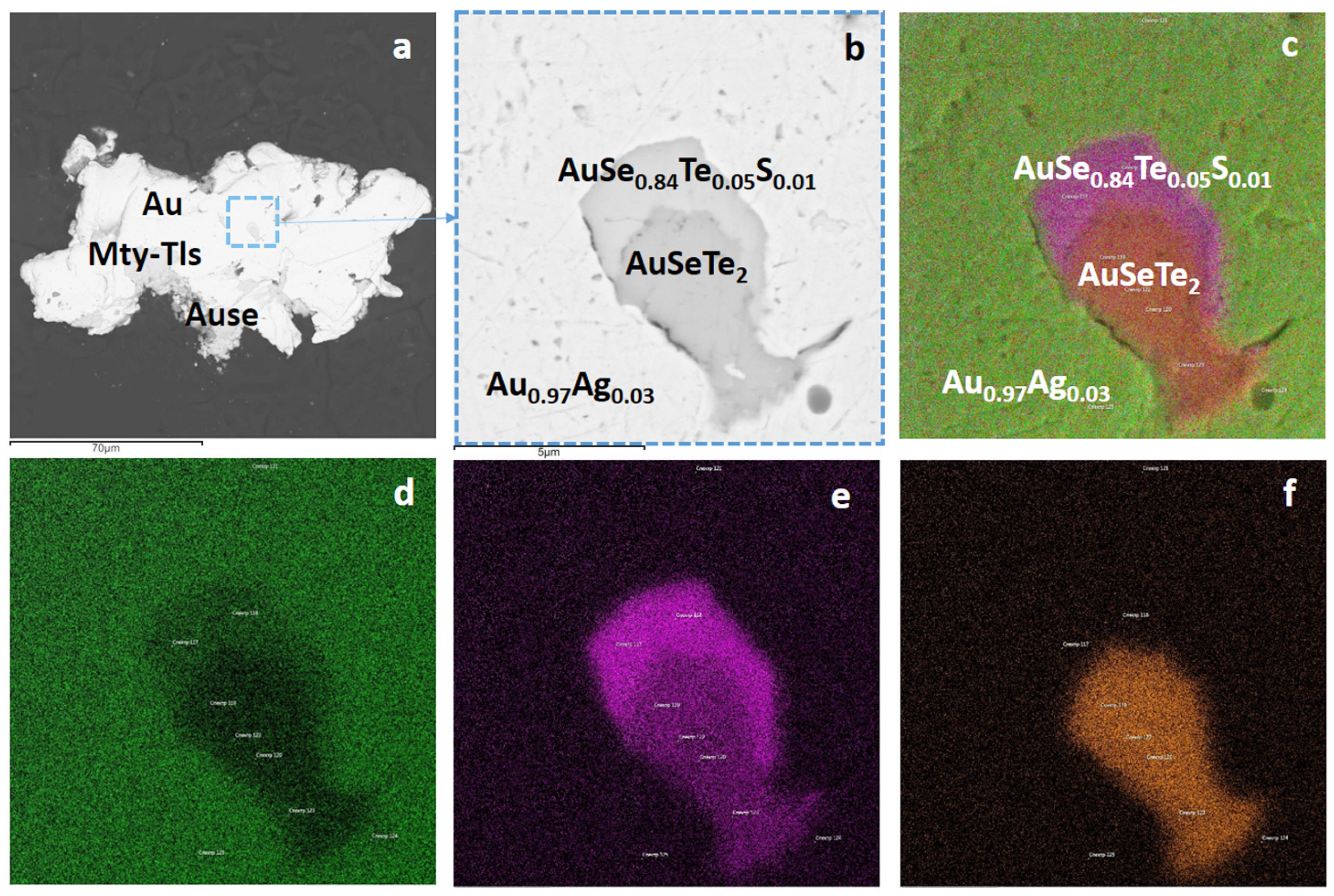
Our additional studies using the electron-probe microanalysis (EPMA) identified auroselenide inclusions in intergrowth with the AuSeTe2 phase, which is compositionally similar to maletoyvayamite, in native gold (Figure 9). The occurrence of gold chalcogenides in the peripheral parts of native gold grains suggests their later deposition. The presence of these mineral phases in the core of the gold particle indicates a simultaneous formation of gold chalcogenides with native gold and the possibility of their formation at earlier high-temperature stages.

3.2.2. Bleïda Far West Au-Pd Deposit

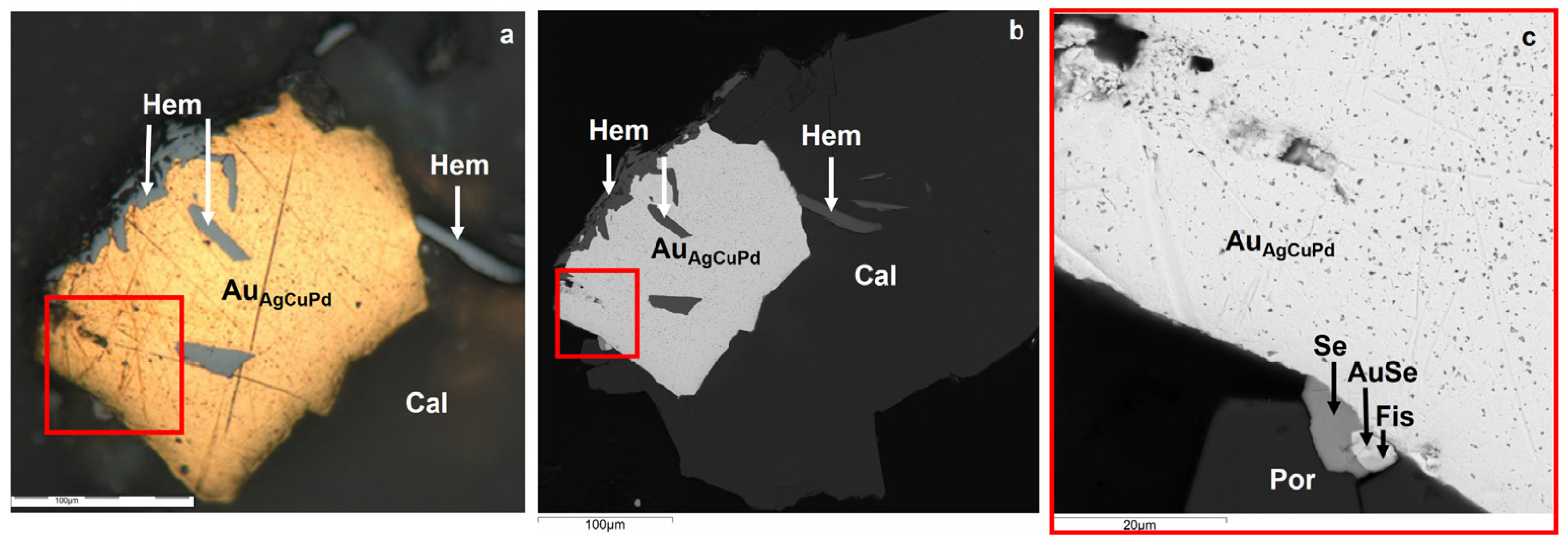
At the Bleïda Far West Au-Pd deposit [41] auroselenide AuSe is intergrown with native gold, native selenium, fischesserite, portlandite, and calcite in a chlorite–hematite salband of a thin calcite vein (Figure 10). It is noteworthy that native gold from this deposit contains impurities of silver, cuprum and palladium. The presence of calcite, portlandite, and hematite indicates a high alkalinity of solutions and oxidizing conditions.

4. Discussion

According to the data of the discoverers of auroselenide [38,39], the formation of this mineral implies special conditions: an abundant source of gold and selenium deposited from acidic solutions in a highly oxidizing environment. It is known that crystallization of gold and silver selenides is regulated by the high ratio H2Se/H2S in solid solutions or fSe2/fS2 [35,38,54,55,56,57]. The formation of selenide is promoted by the high values of pH and fO2 [34,55,56]. The calculations by Kolova and coauthors [58] showed that the AuSe phase is formed at lg ƒSe2 > −14 in association with silver sulfoselenides at temperatures of 100–300 °C, according to data from [35], at lg ƒSe2 > −8.5 at 200 °C in association with HgSe, HgS, Sb2Se3, Sb2Se3, Ag2Se, and Ag2S.
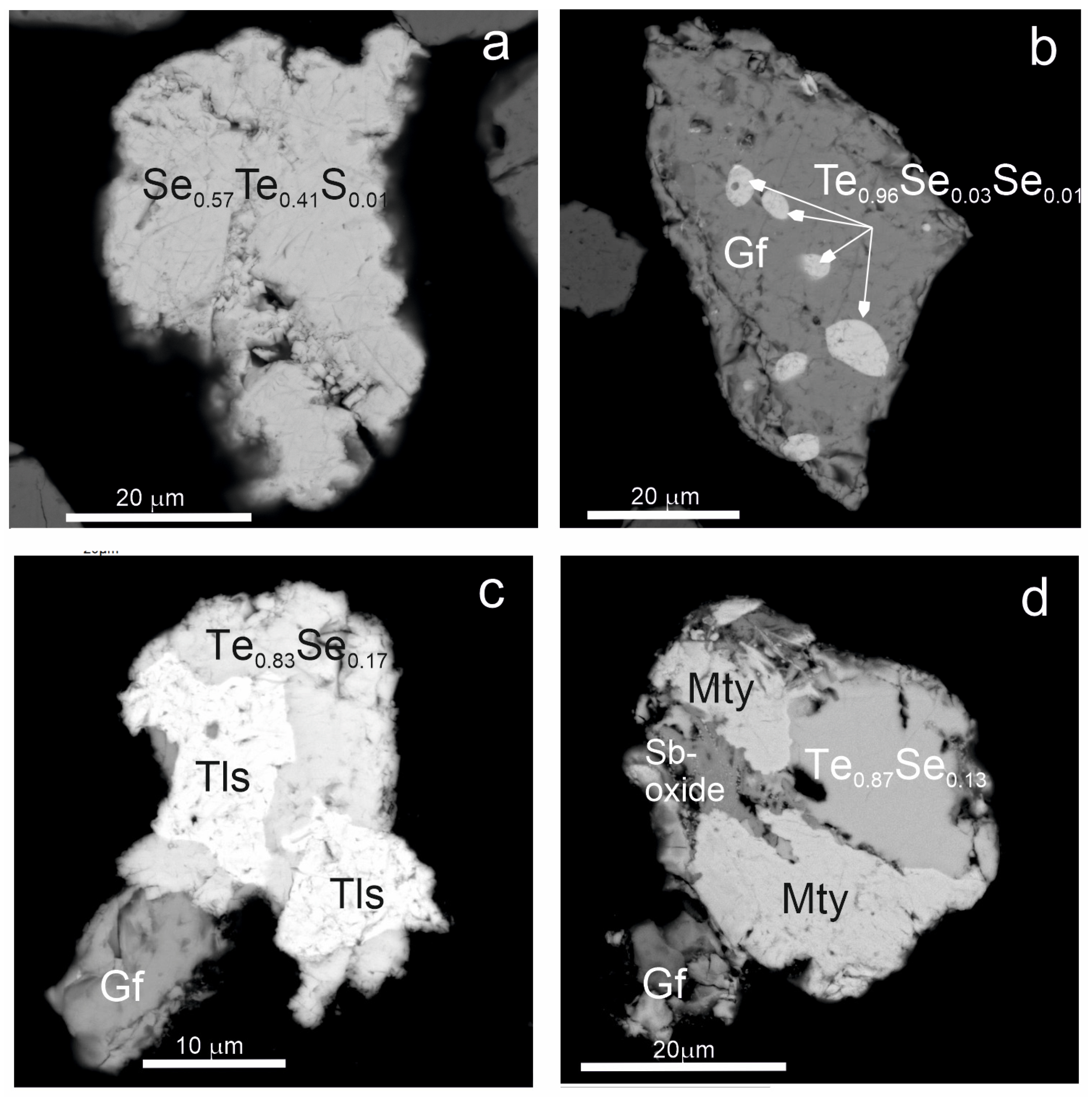
The results of our thermodynamic calculations indicate a probable paragenesis of auroselenide with native gold or with native selenium. Such associations are confirmed by the data from the studies of the mineral composition of Au-Ag ores from the Gaching ore occurrence of the Maletoyvayam deposit (Kamchatka Peninsula, Russia) and the Bleïda Far West Au-Pd deposit (Morocco). Solidified Se, Te, and Se, Te, S droplets in the form of individual grains, inclusions, and intergrowths with gold chalcogenides (tolstykhite and maletoyvayamite) and goldfieldite (Figure 11) were found in the samples from the Gaching ore occurrence [8].
Their composition covers the area from Te0.97Se0.03 to Te0.71Se0.28S0.01 and Se0.58Te0.41S0.01. The presence of rounded solidified inclusions of liquid chalcogens or their mixtures indicates that the formation of Au-Se-Te-S mineralization, including auroselenide, could have occurred at higher temperatures. In the case that sulfur is predominant in the solidified chalcogen droplets, the deposition temperatures of gold chalcogenides are likely to be above 113 °C (melting point of sulfur). When the amount of selenium or tellurium is greater than that of sulfur in the melt, the temperature can be above 221 °C (melting point of Se), but below 449.5 °C (melting point of Te). The presence of Se, Te, and Se, Te, S phases in the mineral associations of gold deposits is an indicative sign of the presence of gold chalcogenides.
The conditions of formation of auroselenide and its mineral associations at the Bleïda Far West deposit (Morocco) and Maletoyvayam (Kamchatka Peninsula, Russia) deposits differ. According to the results of the study of fluid inclusions in quartz and calcite, the conditions of ore formation at the Bleïda Far West occur in the temperature range from 384 to 75 °C and a high salt concentration of 17–30 wt.% NaCl [41]. The concentration of the main salt components of inclusion solutions was estimated at 3.5 wt. % for NaCl and 26 wt.% for CaCl2. The predominance of NaCl and CaCl2 in the composition of Bleïda fluids indicates a possible involvement of basin brines in ore formation. The results of thermodynamic calculations showed that the paragenesis of native selenium and auroselenide is stable in acidic and near-neutral solutions. The presence of calcite, portlandite, and hematite in the association indicates the evolution of the pH of solutions from acidic to alkaline under oxidizing conditions. The formation of auroselenide is also probable when native gold interacts with sublimates or chalcogen gases during the separation of volatiles in the process of magma degassing.
The study of fluid inclusions in Au-Ag quartz from the Maletoyvayam deposit [59] showed lower concentrations of NaCl in fluids, no higher than 4.3 wt. %, and temperatures of 255–135 °C. KCl, as well as that Na2CO3 and K2CO3 are present in the composition of primary fluid inclusions [59]. The presence of solidified droplets of chalcogens of various compositions (Se, Te and Se, Te, S) in the ore samples from the Maletoyvayam deposit also confirms the formation of Au-Se mineralization with participation of high-temperature acid solutions. The formation of auroselenide implies special conditions: an abundant source of Au and Se deposited from acidic solutions in a highly oxidizing environment [38,39]. Tolstykh et al. (2022) [60] shows that fluid inclusions contain high concentrations (20 rel.%.) of organic compounds (different hydrocarbons). The organic acids can also play an important role in gold transport.
Minerals of the Te–Se–S series are present in the ores of many epithermal Au–Ag deposits [61,62,63,64,65], etc. Recently, considerable amounts of minerals of the Te–Se(S) series—native selenium with an admixture of sulfur, tellurium selenium, and telluric selenium—were identified in the samples from the Ozernovskoe epithermal Au–Te–Se deposit (Kamchatka Peninsula, Russia) [66]. Maletoyvayamite (Au3Se4Te6) is also present in the ores of this deposit and forms small inclusions in tellurium selenium together with a rare copper chalcogenide, bambollaite (Cu1−x(Se, S, Te)2), while fischesserite replaces maletoyvayamite grains and, in turn, is replaced by tellurite and emmonsite, native gold, native selenium and naumannite.
The presence of selenides is regulated by H2Se/H2S in aqueous fluids [35]: at low values of this ratio, Se is replaced by S in minerals, as it was observed at the LS type deposits. An increase in this ratio is possible only at high pH and fO2 (HS type) leading to formation of the selenides: Au–S complexes are successively replaced by Au–S–Se and Au–Se, forming gold–selenide parageneses and leaving hydrocarbon marks in fluid inclusions. Auroselenide can be formed at very high fSe2/fS2 [54].
The presence of S,Te-containing compounds in the ore-forming system can change the stability of gold selenide relative to gold tellurides/sulfides, and this is a limitation of this study. The effect of the presence of S and Te in the system requires more complex calculations and taking account of a large number of solid phases and particles dissolved in aqueous solutions. Depending on the fugacity of O2, S2, and Te2, not only gold tellurides and sulfides will be more stable, but solid solutions of gold chalcogenides—sulfoselenides, selenotellurides, and sulfotellurides—as well. It is difficult to summarize the effective factors controlling gold solubility since there are too many variables that show different effects on gold solubility, such as temperature, pressure, pH, redox state, and chlorides, sulfur, selenium, tellurium concentrations and other elements. Therefore, quantifying the correlations between ore-forming conditions and gold solubility is a problem worth studying and thermodynamic modeling.
Gold chalcogenides may occur in the ores of many gold deposits with Au-Se-Te-S mineralization. Their presence should be taken into account when using modern technologies for processing ores from Au-Ag, Au-Se, Au-Te, and Au-Pd deposits. Insoluble or poorly soluble gold minerals may be one of the most common reasons for the low resistance of sulfide ores [67]. Modeling of natural systems with gold must be conducted with due regard for the presence of other precious metal minerals and potential conditions of their formation during the origin of gold mineralization. Further work on the evaluation of thermodynamic data and calculations on the joint solubility of gold minerals in the presence of chalcogens (Se, Te, S) is of current interest.

5. Conclusions

(1) Auroselenide AuSe(s) dissolves in acidic chloride solutions to form elemental selenium Se(s,l), and in alkaline solutions to form Au(s). Gold selenide is characterized by a low solubility of AuSe(s) at temperatures of 25–200 °C. With increasing temperature and solution acidity, solubility increases, and at 350 °C, gold concentrations in highly acidic solutions reach their highest values.
(2) At NaCl and HCl concentrations above 0.01 m auroselenide solubility increases by half an order of magnitude due to gold chloride complexes. In weakly acidic, near-neutral, and alkaline solutions, the gold hydroxocomplex predominates, regardless of the NaCl content.
(3) The formation of auroselenide is possible at Au-Ag epithermal and other gold deposits with Au-Se-Te-S mineralization. Depending on the composition of the ore-forming system, associations of auroselenide with other chalcogenides will be stable.

Author Contributions

G.A.P. made substantial contributions to the conception of the work and wrote the paper. O.L.G. and T.V.B. performed the thermodynamic calculations. G.A.P. and N.D.T. studied the mineral associations in the ore samples and analyzed the compositions of minerals. G.A.P., T.V.B., and N.S.B. contributed to interpretations and editing. Visualization, T.V.B., G.A.P., and N.D.T.; Supervision, N.S.B. and G.A.P. All authors have read and agreed to the published version of the manuscript.

Funding

This study was financially supported by the Ministry of Education and Science of the Russian Federation for the project “Ore-bearing magmas and fluids: geological and physico-chemical conditions of generation as a key to forecasting hydrothermal deposits of rare, non-ferrous and precious metals” (Project No. 13.1902.24.44, Agreement 075-15-2024-641).

Data Availability Statement

The original contributions presented in this study are included in the article. Further inquiries can be directed to the corresponding author.

Acknowledgments

We are grateful to Karmanov N.S. and Khlestov M.V. for their help in conducting the research using the electron-probe microanalysis Our thanks to Reviewers for constructive comments, which much helped to improve the quality of the manuscript.

Conflicts of Interest

The authors declare no conflicts of interest.

References

  1. Pal’yanova, G. Physicochemical modeling of the coupled behavior of gold and silver in hydrothermal processes: Gold fineness, Au/Ag ratios and their possible implications. Chem. Geol. 2008, 255, 399–413. [Google Scholar] [CrossRef] [Scilit]
  2. Vikentyev, I.; Vikent’eva, O.; Tyukova, E.; Nikolsky, M.; Ivanova, J.; Sidorova, N.; Tonkacheev, D.; Abramova, V.; Blokov, V.; Spirina, A.; et al. Noble Metal Speciations in Hydrothermal Sulphides. Minerals 2021, 11, 488. [Google Scholar] [CrossRef] [Scilit]
  3. Pokrovski, G.S.; Desmaele, E.; Laskar, C.; Bazarkina, E.F.; Testemale, D.; Hazemann, J.-L.; Vuilleumier, R.; Seitsonen, A.P.; Ferlat, G.; Saitta, A.M. Gold speciation in hydrothermal fluids revealed by in situ high energy resolution X-ray absorption spectroscopy. Am. Mineral. 2022, 107, 369–376. [Google Scholar] [CrossRef] [Scilit]
  4. Pokrovski, G.S. Thermodynamic modeling of hydrothermal ore deposit formation. Ore Geol. Rev. 2025, 178, 106436. [Google Scholar] [CrossRef] [Scilit]
  5. Liang, Y.; Ge, H.F.; Pei, Q.M.; Huang, H.N.; Hoshino, K. 3D plotting of gold solubility and gold fineness: Quantitative analysis of ore-forming conditions in hydrothermal gold deposits. Lithosphere 2023, 2023, 1. [Google Scholar] [CrossRef] [Scilit]
  6. Palyanova, G.A. Gold and silver minerals in sulfide ore. Geol. Ore Depos. 2020, 62, 383–406. [Google Scholar] [CrossRef] [Scilit]
  7. Available online: http://www.rruff.info/ima (accessed on 1 March 2026).
  8. Tolstykh, N.; Kasatkin, A.; Nestola, F.; Vymazalová, A.; Agakhanov, A.; Palyanova, G.; Korolyuk, V. Auroselenide, AuSe, a new mineral from Maletoyvayam deposit, Kamchatka peninsula, Russia. Mineral. Mag. 2023, 87, 284–291. [Google Scholar] [CrossRef] [Scilit]
  9. Cranton, G.E.; Heyding, R.D. The gold/selenium system and some gold selenotellurides. Canad. J. Chem. 1968, 46, 2637–2640. [Google Scholar] [CrossRef] [Scilit]
  10. Cretier, J.E.; Wiegers, G.A. The crystal structure of the beta form of gold selenide, β-AuSe. Mat. Res. Bull. 1973, 8, 1427–1430. [Google Scholar] [CrossRef] [Scilit]
  11. Rabenau, A.; Schulz, H. The crystal structures of α-AuSe and β-AuSe. Less J. Common Met. 1976, 48, 89–101. [Google Scholar] [CrossRef] [Scilit]
  12. Ettema, A.R.H.F.; Stegink, T.A.; Haas, C. The valence of Au in AuTe2 and AuSe studied by X-ray absorption spectroscopy. Solid State Commun. 1994, 90, 211–213. [Google Scholar] [CrossRef] [Scilit]
  13. Lee, W.; Jung, D. Electronic structure study of gold selenides. Bull. Korean Chem. Soc. 1999, 20, 147–150. [Google Scholar]
  14. Wagner, F.E.; Palade, P.; Friedl, J.; Filoti, G.; Wang, N. 197Au Mössbauer study of gold selenide, AuSe. J. Phys. Conf. Ser. 2010, 217, 012039. [Google Scholar] [CrossRef] [Scilit]
  15. Feng, D.; Taskinen, P. Thermodynamic stability of AuSe at temperature from 400 K to 700 K by a solid state galvanic cell. J. Chem. Thermodyn. 2014, 71, 98–102. [Google Scholar] [CrossRef] [Scilit]
  16. Palyanova, G.A.; Seryotkin, Y.V.; Kokh, K.A.; Bakakin, V.V. Isomorphism and solid solutions among Ag- and Au-selenides. J. Solid State Chem. 2016, 241, 157–163. [Google Scholar] [CrossRef] [Scilit]
  17. Palyanova, G.A.; Seryotkin, Y.V.; Kokh, K.A.; Bakakin, V.V. Sulfur–selenium isomorphous substitution in the AgAu(Se,S) series. J. Alloys Comp. 2016, 664, 385–391. [Google Scholar] [CrossRef] [Scilit]
  18. Palyanova, G.A.; Tolstykh, N.D.; Zinina, V.Y.; Koh, K.A.; Seretkin, Y.V.; Bortnikov, N.S. Synthetic gold chalcogenides in the Au-Te-Se-S system and their natural analogs. Dokl. Earth Sci. 2019, 487, 929–934. [Google Scholar] [CrossRef] [Scilit]
  19. Palyanova, G.; Mikhlin, Y.; Zinina, V.; Kokh, K.; Seryotkin, Y.; Zhuravkova, T. New gold chalcogenides in the Au-Te-Se-S system. J. Phys. Chem. Solids. 2020, 138, 109276. [Google Scholar] [CrossRef] [Scilit]
  20. Palyanova, G.; Beliaeva, T.; Kokh, K.; Seryotkin, Y.; Moroz, T.; Tolstykh, N. Characterization of synthetic and natural gold chalcogenides by electron microprobe analysis, X-ray powder diffraction and Raman spectroscopic methods. J. Raman Spectrosc. Methods 2022, 53, 1012–1022. [Google Scholar] [CrossRef] [Scilit]
  21. Machogo, F.E.L.; Mthimunye, M.; Sithole, K.R.K.; Tetyana, P.; Phao, N.; Ngubeni, G.N.; Mlambo, M.; Mduli, P.S.; Shumbula, P.M.; Moloto, N. Elucidating the structural properties of gold selenide nanostructures. New J. Chem. 2019, 43, 5773. [Google Scholar] [CrossRef] [Scilit]
  22. Mills, K.C. Thermodynamic Data for Inorganic Sulfides, Selenides, and Tellurides; Butterworths: London, UK, 1974; p. 845. [Google Scholar]
  23. Knacke, O.; Kubaschewski, O.; Hesselmann, K. Thermochemical Properties of Inorganic Substances, 2nd ed.; Springer: Berlin, Germany, 1991. [Google Scholar]
  24. Barin, I. Thermochemical Data of Pure Substances, 3rd ed.; VCH: Weinheim, Germany, 1995. [Google Scholar]
  25. Bortnikov, N.S.; Volkov, A.V.; Galyamov, A.L.; Vykentiev, I.V.; Lalomov, A.V.; Murashov, K.Y. Fundamental problems of development of the mineral-resource base of high-tech industry and energy of Russia. Geol. Ore Depos. 2022, 64, 313–328. [Google Scholar] [CrossRef] [Scilit]
  26. Bortnikov, N.S.; Volkov, A.V.; Savva, N.E.; Prokofiev, V.Y.; Kolova, E.E.; Dolomanova-Topol’, A.A.; Galyamov, A.L.; Murashov, K.Y. Epithermal Au–Ag–Se–Te deposits of the Chukchi Peninsula (Arctic zone of Russia): Metallogeny, mineral assemblages, and fluid regime. Rus. Geol. Geoph. 2022, 63, 435–457. [Google Scholar] [CrossRef] [Scilit]
  27. Mirzavaliev, D.B.; Karshiboev, S.B.; Nemenenok, B.M. Modern technologies and environmental safety in selenium processing. Univers. Tech. Sci. Electron. Sci. J. 2025, 132, 11–14. (In Russian) [Google Scholar] [CrossRef] [Scilit]
  28. Available online: https://aurumtrade.ru/stati/gde-primenyaetsa-zoloto/ (accessed on 21 March 2026).
  29. Available online: https://materials.springer.com/substance/944303/gold%20monoselenide (accessed on 25 March 2026).
  30. Mikhlin, Y.L.; Pal'yanova, G.A.; Tomashevich, Y.V.; Vishnyakova, E.A.; Vorobyev, S.A.; Kokh, K.A. XPS and Ag L3 -edge XANES characterization of silver and silver–gold sulfoselenides. J. Phys. Chem. Sol. 2018, 116, 292–298. [Google Scholar] [CrossRef] [Scilit]
  31. Chen, Q.-Y.; Zhao, B.-R.; Zhao, Y.-F.; Yang, H.; Xiong, K.; He, Y. Tuning the electronic and optical properties of the novel monolayer noble-transition-metal dichalcogenides semiconductor β-AuSe via strain: A computational investigation. Nanomaterials 2022, 12, 1272. [Google Scholar] [CrossRef] [Scilit]
  32. Xu, W.; Fan, H.; Hu, F.; Santosh, M.; Yang, K.; Lan, T.; Wen, B. Gold mineralization in the Guilaizhuang deposit, southwestern Shandong Province, China: Insights from phase relations among sulfides, tellurides, selenides and oxides. Ore Geol. Rev. 2014, 56, 276–291. [Google Scholar] [CrossRef] [Scilit]
  33. Simon, G.; Essene, E.J. Phase relations among selenides, sulfides, tellurides, and oxides: I. Thermodynamic properties and calculated equilibria. Econ. Geol. 1996, 91, 1183–1208. [Google Scholar] [CrossRef] [Scilit]
  34. Simon, G.; Kesler, S.E.; Essene, E.J. Phase relations among selenides, sulfides, tellurides and oxides: II. Applications to selenide-bearing ore deposits. Econ. Geol. 1997, 92, 468–484. [Google Scholar] [CrossRef] [Scilit]
  35. Yuningsih, E.T.; Matsueda, H.; Rosana, M.F. Diagnostic Genesis Features of Au-Ag selenide-telluride mineralization of western Java deposits. Indones. J. Geosci. 2016, 3, 67–76. [Google Scholar] [CrossRef] [Scilit]
  36. Eremin, O.V.; Yurgenson, G.A.; Epova, E.S. Thermodynamic equilibria in the Ag–Au–Se–Te system at 25 °C and atmospheric pressure. Russ. J. Phys. Chem. 2025, 99, 1736–1739. [Google Scholar] [CrossRef] [Scilit]
  37. Tolstykh, N.; Shapovalova, M.; Podlipsky, M. Au-Ag-Se-Te-S Mineralization in the Maletoyvayam High-Sulfidation Epithermal Deposit, Kamchatka Peninsula. Minerals 2023, 13, 420. [Google Scholar] [CrossRef] [Scilit]
  38. Tolstykh, N.; Vymazalova, A.; Tuhy, M.; Shapovalova, M. Conditions of formation of Au-Se-Te mineralization in the Gaching ore occurrence (Maletoyvayam ore field), Kamchatka, Russia. Mineral. Mag. 2018, 82, 649–674. [Google Scholar] [CrossRef] [Scilit]
  39. Tolstykh, N.; Palyanova, G.; Bobrova, O.; Sidorov, E. Mustard gold of the Gaching ore occurrence (Maletoyvayam deposit, Kamchatka, Russia). Minerals 2019, 9, 489. [Google Scholar] [CrossRef] [Scilit]
  40. Tolstykh, N.D.; Tuhy, M.; Vymazalova, A.; Laufek, F.; Plášil, F. Gachingite, Au(Te1-xSex) 0.2 ≈ x ≤ 0.5, a new mineral from Maletoyvayam deposit, Kamchatka peninsula, Russia. Mineral. Mag. 2022, 86, 205–231. [Google Scholar] [CrossRef] [Scilit]
  41. Kalinin, Y.A.; Borovikov, A.A.; Maacha, L.; Zuhair, M.; Palyanova, G.A.; Zhitova, L.M. Au-Pd mineralization and ore-forming fluids of the Bleïda Far West deposit (Anti-Atlas, Morocco). Geol. Ore Depos. 2022, 64, s237–s256. [Google Scholar] [CrossRef] [Scilit]
  42. Shvarov, Y.V. HCh: New potentialities for the thermodynamic simulation of geochemical systems offered by windows. Geochem. Int. 2008, 46, 834–839. [Google Scholar] [CrossRef] [Scilit]
  43. Garrels, R.Ì.; Christ, C.L. Solutions, Minerals, and Equilibria; Mir: Moscow, Russia, 1968; 368p. (In Russian) [Google Scholar]
  44. Shock, E.L.; Sassani, D.C.; Willis, M.; Sverjensky, D.A. Inorganic species in geologic fluids: Correlations among standard molal thermodynamic properties of aqueous ions and hydroxide complexes. Geochim. Cosmochim. Acta. 1997, 61, 907–950. [Google Scholar] [CrossRef] [Scilit]
  45. Akinfiev, N.N.; Tagirov, B.R. Selenium impact on silver transportation and sedimentation by hydrothermal solutions: Thermodynamic description of the Ag-Se-S-Cl-OH system. Geol. Ore Depos. 2006, 48, 402–413. [Google Scholar] [CrossRef] [Scilit]
  46. Akinfiev, N.N.; Zotov, A.V. Thermodynamic description of chloride, hydrosulfide, and hydroxocomplexes of Ag(I), Cu(I), and Au(I) at temperatures of 25–500 °C and 1–2000 bars pressures. Geochem. Int. 2001, 39, 990–1006. [Google Scholar]
  47. Tagirov, B.R.; Akinfiev, N.N.; Zotov, A.V. Gold(I) complexation in chloride hydrothermal fluids. Geol. Ore Depos. 2024, 66, 581–597. [Google Scholar] [CrossRef] [Scilit]
  48. Yokokawa, H. Tables of thermodynamic properties of inorganic compounds. J. Natl. Chem. Lab. Ind. 1988, 83, 27–118. [Google Scholar]
  49. Robie, R.A.; Hemingway, B.S. Thermodynamic Properties of Minerals and Related Substancies of 298.15K and 1 Bar (105 Pascals) Pressure and at Higher Temperatures; United States Goverment Printing Office: Washington, DC, USA, 1995; p. 461. [Google Scholar]
  50. Olin, A.; Noläng, B.; Öhman, L.-O.; Osadchii, E.G.; Rosén, E. Chemical Thermodynamics of Selenium; Elsevier: Amsterdam, The Netherlands, 2005; Volume 7, p. 209. [Google Scholar]
  51. Echmaeva, E.A.; Osadchii, E.G. Determination of the thermodynamic properties of compounds in the Ag-Au-Se and Ag-Au-Te systems by the EMF method. Geol. Ore Depos. 2009, 51, 247–258. [Google Scholar] [CrossRef] [Scilit]
  52. Helgeson, H.C.; Delany, J.M.; Nesbitt, H.W.; Bird, D.K. Summary and critique of the thermodynamic properties of rock-forming minerals. Am. J. Sci. 1978, 278A, 1–229. [Google Scholar]
  53. Azimov, P.Y.; Bushmin, S.A. Solubility of minerals of metamorphic and metasomatic rocks in hydrothermal solutions of varying acidity: Thermodynamic modeling at 400–800 °C and 1–5 kbar. Geochem. Int. 2007, 45, 1210–1234. [Google Scholar] [CrossRef] [Scilit]
  54. Huston, D.L.; Sieb, S.H.; Suterb, G.F. Selenium theoretical and its importance to the study of ore genesis: The basis and its application to volcanic-hosted massive sulfide deposits using pixeprobe analysis. Nucl. Instrum. Methods Phys. Res. 1995, 104, 476–480. [Google Scholar] [CrossRef] [Scilit]
  55. Zhuravkova, T.V.; Palyanova, G.A.; Kravtsova, R.G. Physicochemical formation conditions of silver sulfoselenides at the Rogovik deposit, northeastern Russia. Geol. Ore Depos. 2015, 57, 313–330. [Google Scholar] [CrossRef] [Scilit]
  56. Beliaeva, T.V.; Kolova, E.E.; Savva, N.E.; Glukhov, A.N.; Palyanova, G.A.; Bortnikov, N.S. Mineral composition and physicochemical conditions of formation of the Pepenveem epithermal Au–Ag deposit (Chukchi Peninsula). Russ. Geol. Geophys. 2022, 63, 265–278. [Google Scholar] [CrossRef] [Scilit]
  57. Beliaeva, T.V.; Palyanova, G.A. Silver sulfides and selenides in ores from Au–Ag epithermal deposits of the Okhotsk—Chukotka volcanic belt. Geol. Ore Depos. 2023, 65, 72–105. [Google Scholar] [CrossRef] [Scilit]
  58. Kolova, E.E.; Savva, N.E.; Zhuravkova, T.V.; Glukhov, A.N.; Palyanova, G.A. Au-Ag-S-Se-Cl-Br mineralization at the Corrida deposit (Russia) and physicochemical conditions of ore formation. Minerals 2021, 11, 144. [Google Scholar] [CrossRef] [Scilit]
  59. Sidorov, E.G.; Borovikov, A.A.; Tolstykh, N.D.; Bukhanova, D.S.; Palyanova, G.A.; Chubarov, V.M. Gold mineralization at the Maletoyvayam Deposit (Koryak Highland, Russia) and physicochemical conditions of its formation. Minerals 2020, 10, 1093. [Google Scholar] [CrossRef] [Scilit]
  60. Tolstykh, N.D.; Bortnikov, N.S.; Shapovalova, M.O.; Shaparenko, E.O. The role of hydrocarbons in the formation of epithermal gold–silver deposits in Kamchatka, Russia. Dokl. Earth Sci. 2022, 507, 994–1000. [Google Scholar] [CrossRef] [Scilit]
  61. Savva, N.E.; Pal’yanova, G.A.; Byankin, M.A. The problem of genesis of gold and silver sulfides and selenides in the Kupol deposit (Chukot Peninsula, Russia). Russ. Geol. Geophys. 2012, 53, 457–466. [Google Scholar] [CrossRef] [Scilit]
  62. Yuningsih, E.T.; Matsueda, H. Genesis and origin of Te–bearing gold–silver–base metal mineralization of Arinem deposit, western Java, Indonesia. J. Mineral. Petrol. Sci. 2014, 109, 49–61. [Google Scholar] [CrossRef] [Scilit]
  63. Yuningsih, E.T.; Matsueda, H.; Syafrie, I. Ore–microscopy and geochemistry of gold–silver telluride mineralization in southwestern Hokkaido, Japan. J. Mineral. Petrol. Sci. 2018, 113, 293–309. [Google Scholar] [CrossRef] [Scilit]
  64. Plotinskaya, O.Y.; Kovalenker, V.A.; Seltmann, R.; Stanley, C.J. Te and Se mineralogy of the high-sulfidation Kochbulak and Kairagach epithermal gold telluride deposits (Kurama Ridge, Middle Tien Shan, Uzbekistan). Mineral. Petrol. 2006, 87, 187–207. [Google Scholar] [CrossRef] [Scilit]
  65. Bortnikov, N.S.; Tolstykh, N.D. Epithermal deposits of Kamchatka, Russia. Geol. Ore Depos. 2023, 65, S124–S152. [Google Scholar] [CrossRef] [Scilit]
  66. Kudaeva, S.S.; Kozlov, V.V.; Skilskaya, E.D.; Sergeeva, A.V.; Tolstykh, N.D.; Shkilev, I.A. New type of gold-bearing mineralization at the Ozernovskoe Au–Te–Se epithermal deposit (central Kamchatka, Russia). Geol. Ore Depos. 2024, 66, 547–569. [Google Scholar] [CrossRef] [Scilit]
  67. Goodall, W.R.; Scales, P.J. An overview of the advantages and disadvantages of the determination of gold mineralogy by automated mineralogy. Miner. Eng. 2007, 20, 506–517. [Google Scholar] [CrossRef] [Scilit]
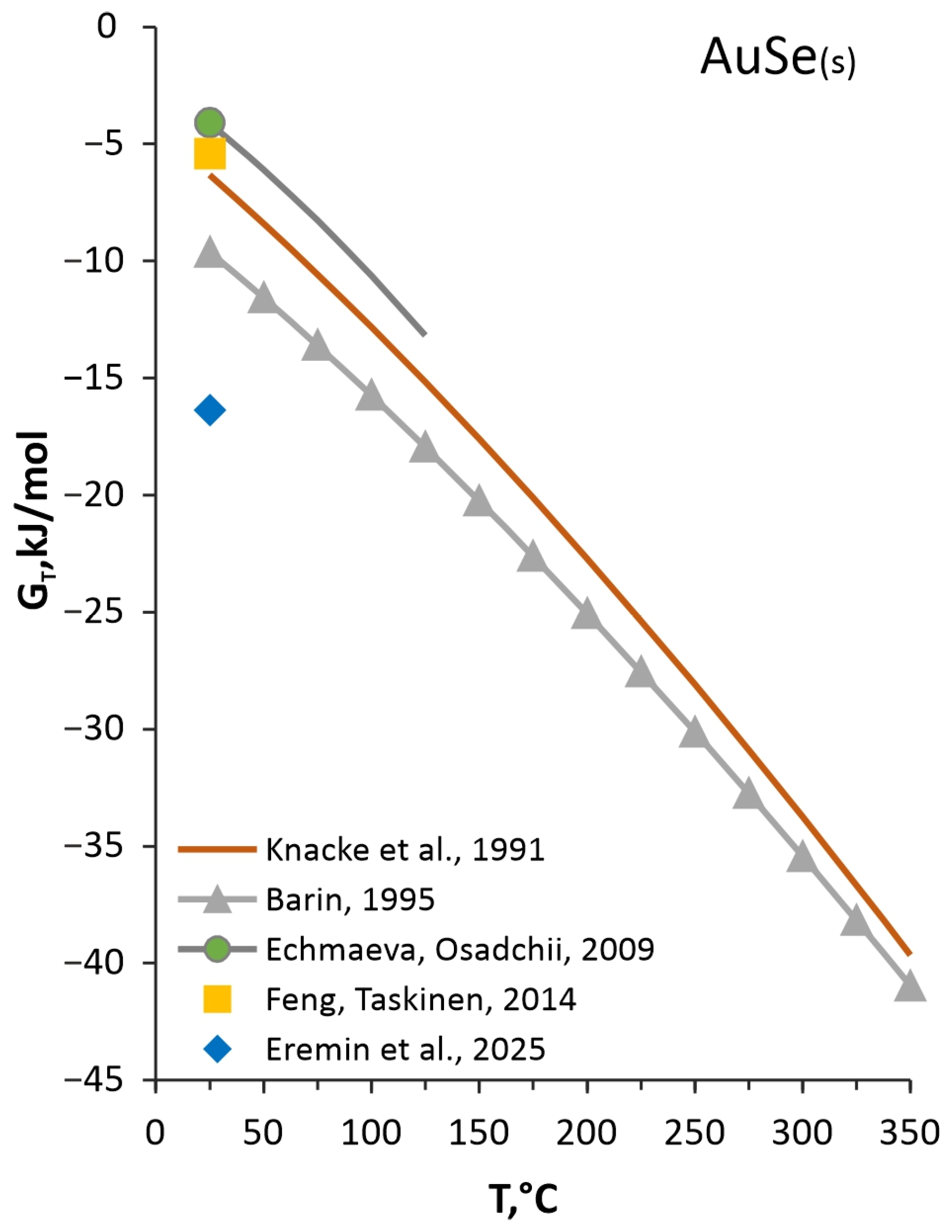
Figure 1. GT vs. T graph for AuSe(s), calculated on the basis of data from various sources: [15,23,24,36,51].
Minerals 16 00562 g001
Figure 2. Congruent solubility of AuSe(s) as a function of temperature and set concentrations of HCl and NaOH (a) and the solubility of selenium (b) and gold (c) for similar conditions. The dotted lines show the pH values of the solutions (a).
Minerals 16 00562 g002
Figure 3. Incongruent solubility of AuSe(s) with the formation of Se(s,l) and Au(s) in aqueous (a) and 1 m NaCl solutions (b) and the pH of these solutions (c,d) depending on the temperature and specified concentrations of HCl and NaOH. White (unshaded) dots are congruent solubility of AuSe(s) (without the formation of Se(s,l) and Au(s)).
Minerals 16 00562 g003
Figure 4. Incongruent solubility of AuSe(s) with Se(s,l) and Au(s) in solutions with concentrations of NaCl (0, 0.1, 1 and 5 m) and HCl or NaOH equal 0.01 m for the temperature range of 25–350 °C (saturated vapor pressure).
Minerals 16 00562 g004
Figure 5. Concentrations of gold complexes at the solubility of AuSe(s) in 1 m NaCl and NaCl-free solutions of different acidity and alkalinity at a temperature of 300 °C (saturated vapor pressure): (a) 0.01 m HCl, (b) 0.01 m NaOH. The dashed line is the total concentration of gold (Autotal) in solutions.
Minerals 16 00562 g005
Figure 6. Concentrations of dissolved forms of selenium in an aqueous solution (without NaCl) of different acidity and alkalinity when it interacts with AuSe(s) for temperatures of 25 (a) and 350 °C (b). The dashed line is the total concentration of dissolved forms of selenium (Setotal).
Minerals 16 00562 g006
Figure 7. lg ƒO2–pH diagrams of stability fields of minerals in the Au–Se–H2O system at 25 °C (a), 100 °C (b), 200 °C (c) and 300 °C (d) (saturated vapor pressure) and activities of selenium in solutions of 10−6 and 10−8 m and activities of gold in solution of 10−8 m. Solid line is the stability field of solid phases; dotted line is that of particles in the solution.
Minerals 16 00562 g007
Figure 8. Optical photos in reflected light (a) and BSE images of grains of native gold (Au) replaced by auroselenide and Te-containing auroselenide (Se, Te) in association with minerals of maletoyvayamite–tolstykhite (Mty-Tls) solid solutions (b). The Gaching ore occurrence.
Minerals 16 00562 g008
Figure 9. Intergrowths of auroselenide (Ause) with the mineral phase of AuSeTe2 composition in native gold (Au). (a) The image in the backscattered electrons of a native gold grain; (b) the image in the backscattered electrons of a fragment of this grain; (c) the total map of the distribution of elements; (df) the distribution maps of Au (d), Se (e) and Te (f) in the characteristic rays.
Minerals 16 00562 g009
Figure 10. Optical photo in reflected light (a) and BSE images of native gold grains in a chlorite–hematite salband with a thin calcite vein (b,c). (c) An enlarged fragment of the polished section, circled with a red line, containing auroselenide AuSe in the intergrowth with native selenium, fischesserite (Ag3AuSe2), portlandite (Ca(OH)2) and calcite. Native gold is Au with impurities of Ag, Cu, Pd (indicated in fine print).
Minerals 16 00562 g010
Figure 11. BSE images of Se, Te, and Se, Te, S solid phases in mineral associations in the form of individual grains (a), drop-shaped inclusions (b), and intergrowths with goldfieldite (Gf, Cu12(Te, Sb, As)4S13,) and gold chalcogenides: tolstykhite (Tls, Au3Te6S4) (c) and maletoyvayamite (Mty, Au3Te6Se4) (d).
Minerals 16 00562 g011
Table 1. Standard thermodynamic properties of solid phases of the Au-Se system from various sources. The data used in the calculations are highlighted in bold.
FormulaΔƒG°, kJ/
mol
ΔƒH°, kJ/
mol
S0,
J/(mol·
K)
Cp, J/
(mol·
K)
Cp = a + bT + cT−2 + dT2 + … + gT−0.5Ref.
ab × 103c × 10−5d × 106g × 10−1
Native gold, Au(s)0047.405-23.6815.1880--[52] (298–958 K)
- “ -- “ -47.321-- “ -- “ -- “ ---[48] (298–1336 K)
0047.4925.3241.968−17.696-11.232−21.606[49] (298–1336 K)
Native selenium, Se(s)0042.443-13.80736.819---[48] (298–490 K)
0042.27 ±
0.05
25.06−451.89676.69−23.024−0.044586.95[49] (298–494 K)
0042.25825.376-----[24] (298–493 K)
0042.09
±0.33
25.09
±0.30
24.8011.286−0.8719.927-[50] (298–500 K)
52.408−49.766-0.326-[50] (494–1000 K)
Auroselenide, AuSe(s)−6.330−9.00880.75150.16041.8427.907---[23] (298–673 K)
−9.626−13.80775.73050.161-----[24] (298–673 K)
-−7.980.8------[50]
−4.107
± 1.296
−8.361 ±
1.832
75.49 ± 3.55------[51] (298–405.4 K)
−5.43
± 0.56
−8.77
± 1.31
78.15
± 2.14
------[15] (400–700 K)
−16.4--------[36]
Table 2. Equations of reactions with the formation of AuSe(s) in the Au–Se–H2O system and calculated values of lg KT at temperatures of 25–300 °C and saturated vapor pressures and equations for calculating lg ƒO2.
Equations of Reactionslg K at Different T (°C)lg ƒO2=
25100200300
1AuSe(s) + H2O = H2Se + 0.5O2(g) + Au0(s)−46.415−35.449−25.885−19.3972lg K − 2lg mH2Se
2AuSe(s) +H2O = HSe + H+ + 0.5O2(g) + Au0(s)−50.264−39.370−30.658−25.6092lg K − 2lg mHSe + 2pH
3AuSe(s) + H2O + O2(g) = H2SeO3 + Au0(s)32.00024.52118.23414.207−lg K + lg mH2SeO3
4AuSe(s) + H2O + O2(g) = HSeO3 + H+ +Au0(s)29.42721.56714.6309.596−lg K + lg mHSeO3 − pH
5AuSe(s) + H2O + O2(g) = SeO32− + 2H+ + Au0(s)22.14114.1596.4670.117−lg K + lg mSeO3 2− − 2 × pH
62AuSe(s) + 3H2O = 2H2Se + 0.5O2(g) + 2AuOH−96.332−73.616−54.077−41.0942lg K − 4 × lg mH2Se − 4 × lg mAu
72AuSe(s) + 3H2O = 2HSe + 2H+ + 0.5O2(g) + 2AuOH−104.030−81.459−63.622−53.5172 lg K − 4 × lg mHSe − 4 × lg mAu + 4pH
82AuSe(s) + 3H2O + 2.5O2(g) = 2H2SeO3 + 2AuOH60.49746.32334.16226.115(−lg K + 2 × lg mH2SeO3 + 2 × lg mAu)/2.5
92AuSe(s) + 3H2O + 2.5O2(g) = 2HSeO3 + 2H+ + 2AuOH55.35140.41626.95416.892(−lg K + 2 × lg mHSeO3+ 2 × lg mAu − 2 × pH)/2.5
102AuSe(s) + 3H2O + 2.5O2(g) = 2SeO32− + 4H+ + 2AuOH40.78025.59910.627−2.066(−lg K + 2 × lg mSeO32− + 2 × lg mAu − 4 × pH)/2.5
Disclaimer/Publisher’s Note: The statements, opinions and data contained in all publications are solely those of the individual author(s) and contributor(s) and not of MDPI and/or the editor(s). MDPI and/or the editor(s) disclaim responsibility for any injury to people or property resulting from any ideas, methods, instructions or products referred to in the content.