Article

Wettability and Interfacial Water Structure of Serpentine Polymorphs: A Molecular Dynamics and Contact Angle Study


1
School of Resources and Safety Engineering, University of Science and Technology Beijing, Beijing 100083, China
2
School of Minerals Processing and Bioengineering, Central South University, Changsha 410083, China
3
State Key Laboratory of Mineral Processing, Beijing 102628, China
4
China-Mongolia Belt and Road Joint Laboratory of Mineral Processing Technology, Academy of Science and Technology, Hohhot 010000, China
*
Author to whom correspondence should be addressed.
Minerals 2026, 16(6), 559; https://doi.org/10.3390/min16060559
Submission received: 21 April 2026 / Revised: 14 May 2026 / Accepted: 20 May 2026 / Published: 22 May 2026

Abstract

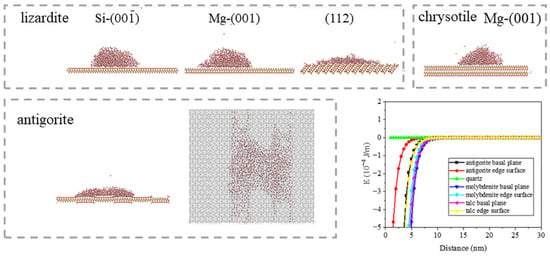
Serpentine group minerals, including lizardite, antigorite, and chrysotile, are common gangue minerals in nickel sulfide ores, and exhibit complex and often unexpected wettability that adversely affects flotation efficiency. However, how these serpentine polymorphs differ in surface hydrophobicity is still not well known, making it difficult to explain their distinct flotation behaviors. In this work, molecular dynamics (MD) simulations and experimental contact angle measurements are used to investigate the wettability of the three main serpentine polymorphs. MD simulation results reveal that the contact angles of the lizardite Si–(00 1 ¯ ) surface and Mg–(001) are 78.6° and 71.1°, respectively. Chrysotile exposes the Mg–(001) surface, with a contact angle of 74.9°. The water droplet on the antigorite surface is spread along the SiOH region. Even the Mg–OH-terminated octahedral surfaces of the three serpentine polymorphs can exhibit hydrophobicity, depending on hydroxyl orientation and oxygen bonding configuration. Contact angle measurements show that antigorite (001) is moderately hydrophobic at about 40°, while (020) is highly hydrophilic at about 10°. The combination of Derjaguin–Landau–Verwey–Overbeek (DLVO) theory and hydrophobic interactions between antigorite and air bubbles produces a net attractive force, enabling particle–bubble adhesion. This work provides new insights for controlling serpentine behavior during flotation of copper–nickel ores hosted in ultramafic rocks.

Graphical Abstract

1. Introduction

The serpentine group includes lizardite, antigorite, and chrysotile [1]. It is a typical magnesium phyllosilicate with a 1:1 layered structure composed of alternating tetrahedral SiO4 sheets and octahedral Mg(OH)2-like sheets. The edge surfaces are typically terminated by exposed siloxane (Si–O–Si) and Mg–OH surface [2]. Lizardite [3,4] and antigorite exhibit platy sheet structures, whereas chrysotile forms rolled nanotubes [5,6]. Due to their shared geological origin from the hydration of olivine and pyroxene in Ni-bearing ultramafic rocks, serpentine minerals frequently occur as fine-grained intergrowths with pentlandite, chalcopyrite, and other valuable sulfide minerals [7,8]. This close mineralogical association complicates the flotation separation of sulfide minerals [9,10,11].
The presence of serpentine significantly impairs nickel sulfide flotation performance, resulting in high magnesium content in the sulfide concentrate and low nickel recovery. First, fine serpentine particles can adhere onto sulfide surfaces via electrostatic and van der Waals forces, a phenomenon known as slime coating, which reduces floatability of pentlandite and chalcopyrite [12,13,14]. However, this mechanism alone cannot explain why serpentine itself is recovered to the concentrate during flotation. Second, serpentine increases pulp viscosity due to its plate-like or fibrous morphology, leading to entrainment into the concentrate [15,16]. Moreover, this does not account for the effect of varying particle hydrophobicity on their movement and retention in the three-phase froth [17,18,19].
Notably, the wettability of serpentine’s surface and its natural floatability remains poorly understood, hindering rational control of its flotation behavior. The wettability of clay minerals varies significantly with differences in surface structure and chemical composition. For instance, talc exhibits strong hydrophobicity due to its siloxane basal surface [20,21]. Pyrophyllite has an ideal Tetrahedral–Octahedral–Tetrahedral (TOT) structure and, without lattice substitution, shows a water contact angle above 70°. Molecular dynamics simulations reveal that 5% Al substitution for Si reduces the contact angle to ~30° [22]. Muscovite, which shares the TOT structure with 25% tetrahedral Al substitution charge-balanced by interlayer K+, is fully wetted by water [23]. Kaolinite, a dioctahedral 1:1 aluminosilicate, shows pronounced wettability anisotropy because its two surfaces parallel to the (001) plane have distinct chemical terminations [24]. The siloxane basal surface, terminated by basal oxygen atoms from the [SiO4] sheet, is hydrophobic, while the hydroxylated octahedral surface, exposed through Al–OH groups from the [AlO6] sheet, is hydrophilic [25].
Little systematic work has addressed how these atomic-scale surface features govern the differences in wettability among serpentine faces. Numerous studies identify two types of surface hydrophobicity. The first is intrinsic, due to weak water–surface interactions typically observed on surfaces terminated with nonpolar groups such as –CF3 or –CH3, as in graphite and paraffin [26,27]. The second arises from the interfacial water structure: strong solid–water attraction forms an ordered water layer that acts as a hydrophobic barrier [28,29,30], a behavior highly dependent on interfacial water ordering [31,32]. For instance, Pt (100) and Pt (111) exhibit this type of hydrophobicity, with the first water layer serving as the hydrophobic interface; contact angles range from 30° to 50° [33,34,35]. By analogy, serpentine’s wetting behavior may be governed by interfacial water structuring despite its vertically oriented Mg–OH surface, which is typically hydrophilic. This complexity is further illustrated by kaolinite, whose octahedral surface features mixed Al–OH orientations (some flat, others tilted) [36]. Moreover, the cleavage surfaces of the three serpentine polymorphs also exhibit structural differences.
This study integrates molecular dynamics (MD) simulations with experimental contact angle measurements to investigate the wettability and interfacial water structure of cleavage surfaces of lizardite, antigorite, and chrysotile. Particular attention is given to the effects of Mg–OH orientation and atomic-scale structural characteristics on surface wettability. The study aims to provide fundamental insights into the relationship between surface structure, interfacial water organization, and wettability of serpentine minerals, thereby contributing to a better understanding of their potential influence on flotation behavior during nickel ore processing.

2. Materials and Methods

2.1. Structural Optimization

The initial atomic structures for the serpentine polymorphs were constructed based on the following ICDD (International Centre for Diffraction Data, PDF-4+ 2019) reference patterns: lizardite (ICDD/PDF No. 04-021-0360), antigorite (ICDD/PDF No. 04-015-2964), and chrysotile (ICDD/PDF No. 01-077-5040). The serpentine surface structures were optimized using CASTEP in Materials Studio 2020 with density functional theory. The plane-wave cutoff energy for the serpentine cell was set to 600 eV. Calculations employed the DFT-D method for dispersion corrections and ultrasoft pseudopotentials with valence configurations: Mg (3s2), O (2s22p4), Si (3s23p2), and H (1s1). Geometry optimization used the BFGS algorithm with the following convergence criteria: SCF tolerance of 2.0 × 10⁻⁶ eV/atom, maximum displacement of 0.0001 nm, force threshold of 0.03 eV/Å, stress limit of 0.05 GPa, and total energy change below 1.0 × 10⁻⁵ eV/atom [21].
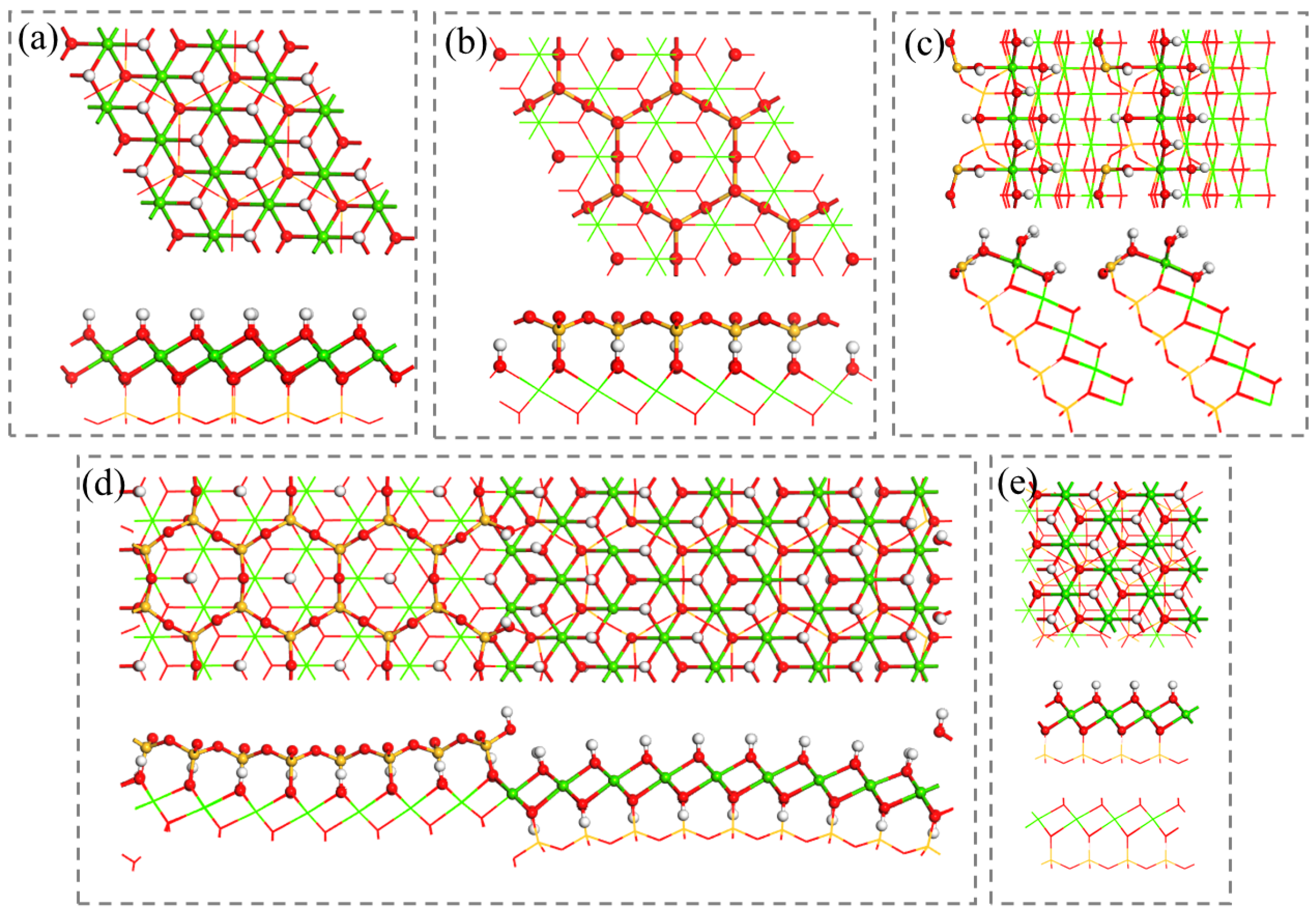
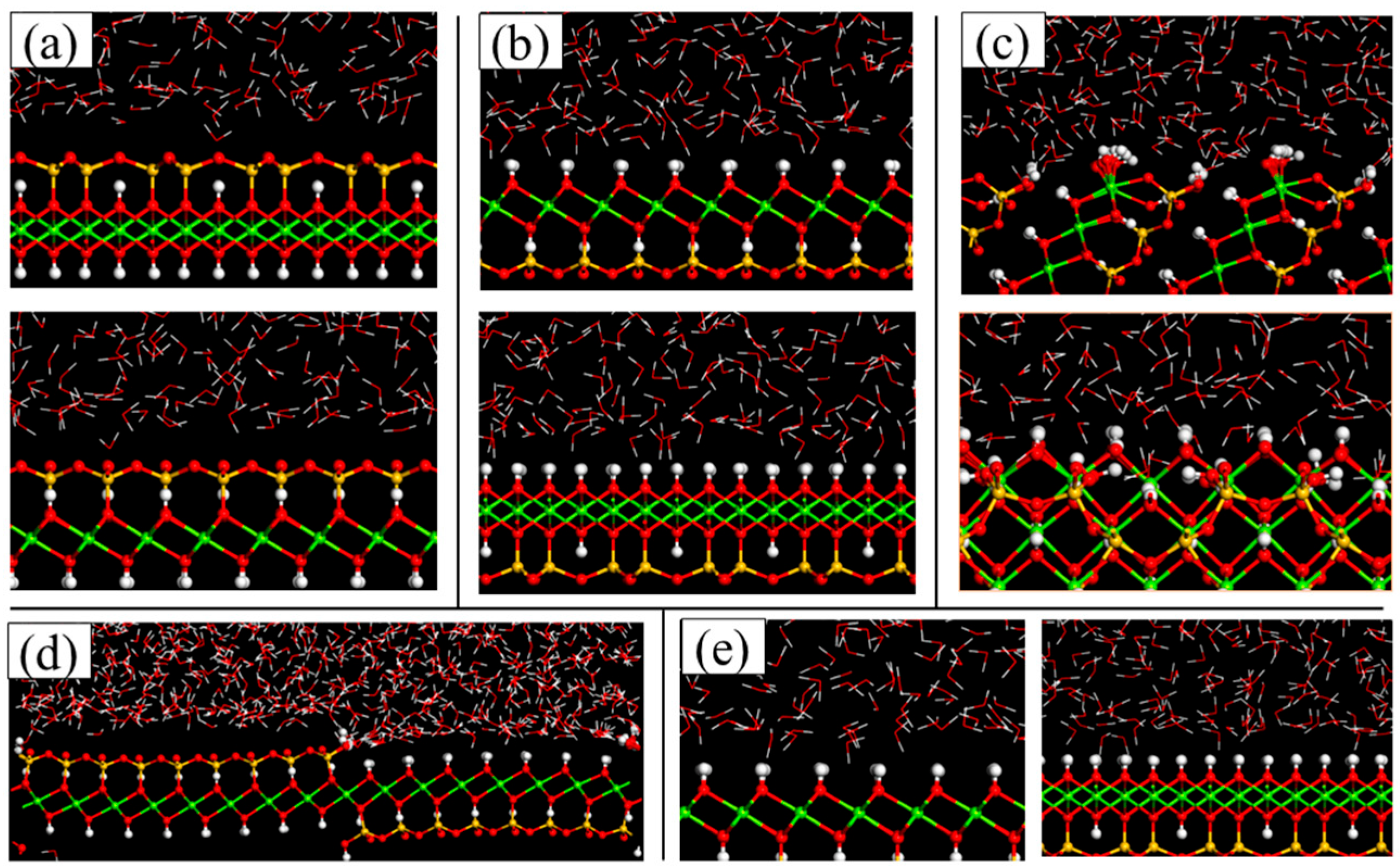
Figure 1 presents the atomic structures of the serpentine polymorph surfaces used in this study, including both top and side views. Figure 1a shows three distinct surfaces of lizardite: the naturally cleaved siloxane-terminated Si–(00 1 ¯ ) surface, the Mg–OH-terminated Mg–(001) surface, and the fractured (112) surface. Figure 1b shows that antigorite has only one naturally cleaved surface, the (001) surface, which consists of three distinct regions: siloxane, Mg–OH, and Si–OH. Figure 1c presents the surface of chrysotile. It should be noted that chrysotile has a fibrous tubular structure with a diameter of 21 to 37 nm [37], formed by rolled Tetrahedral–Octahedral (TO) layers, which differs markedly from the planar structures of lizardite and antigorite. To enable feasible first principles calculations while maintaining physical relevance, the tubular geometry was approximated by a periodic crystal model. This approach follows the common practice for clay minerals, where slab models with 4 to 6 atomic layers are typically sufficient to achieve convergence of surface properties.

2.2. Molecular Dynamics Simulation

MD simulations were performed using the Forcite module in Materials Studio 2020 with the COMPASS III force field which has been widely applied in simulations of hydrous mineral systems and interfacial water structures [38,39]. The surface model was periodically replicated in space to achieve the desired crystal surface dimensions. A total of 900 water molecules were introduced to ensure complete coverage of the mineral surface and to establish a sufficiently thick water layer for interfacial analysis. Partial atomic charges of −0.84 e and +0.42 e were assigned to oxygen and hydrogen atoms of water, respectively, while atomic charges for the mineral crystal were determined using the charge equilibration (Qeq) method. MD simulations were performed in the canonical (NVT) ensemble at 298 K and 0 GPa, utilizing the Andersen thermostat. A time step of 1 fs was adopted, and the total duration was 600 ps. The final 200 ps of the trajectory were used for analysis.
In the calculation of water molecular number density, the surface normal of the mineral was defined as the Z-axis, with the mineral surface positioned at Z = 0. Water molecules are distributed along the positive Z-direction, and their Z-coordinates represent the distance from the mineral surface.
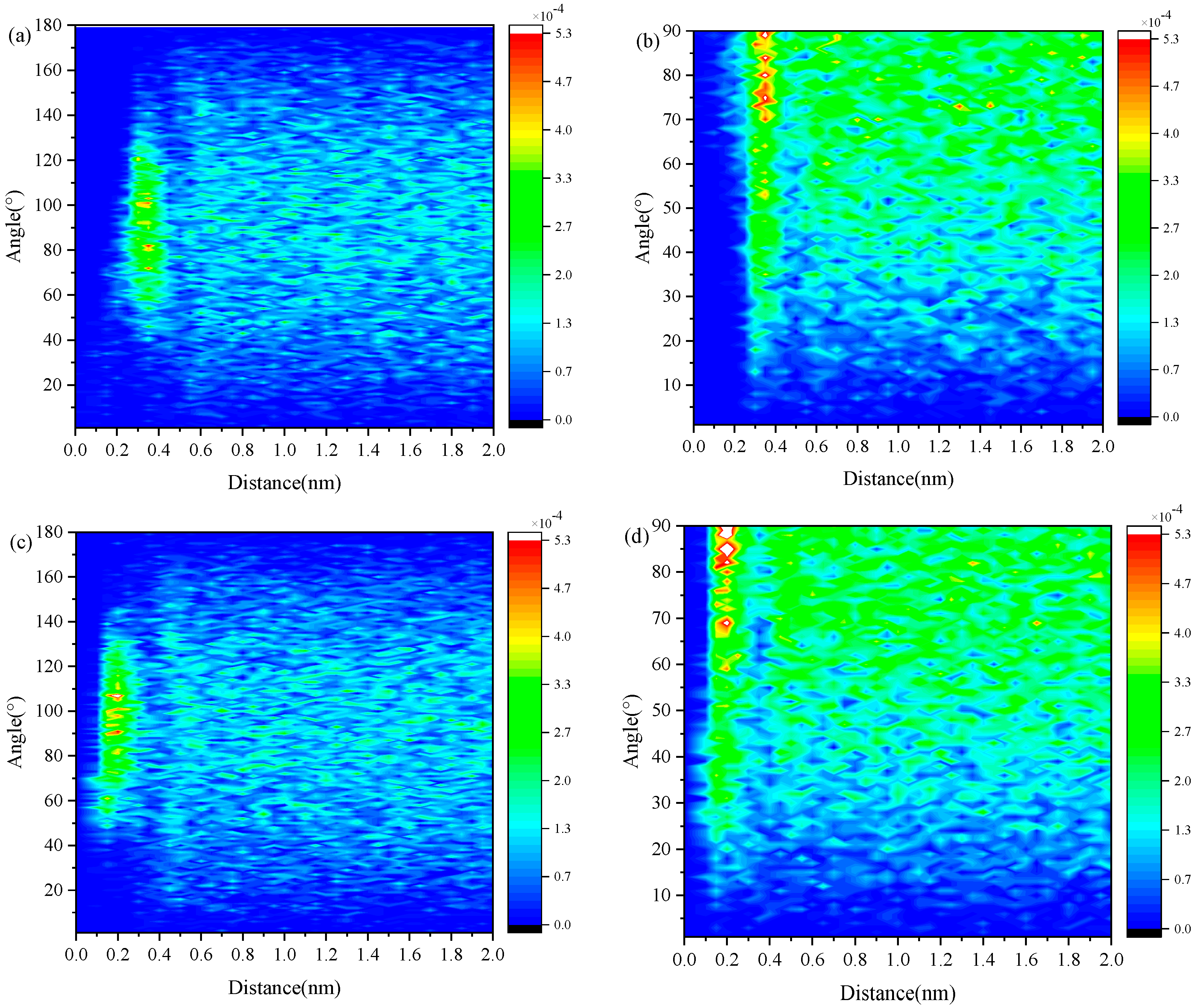
The orientation of water molecules is characterized by the distribution of two angles, α and β. Here, angle α is defined as the angle between the dipole moment vector of water and the surface normal vector of the crystal, while angle β represents the angle between the H–H bisector of the water molecule and the surface normal vector.

2.3. Calculation Method for Simulated Contact Angle

Using the aforementioned computational parameters, a water droplet consisting of 1000 molecules was placed onto the mineral surface. The initial configuration was first subjected to energy minimization. Subsequently, MD simulations were carried out in the NVT ensemble at 298 K and 0 GPa, employing the Andersen thermostat with a time step of 1 fs. To ensure that the system reached equilibrium, a total simulation time of 600 ps was performed [40]. The final 200 ps of the simulation trajectory were collected for analysis, with configurations sampled at 50 ps intervals.
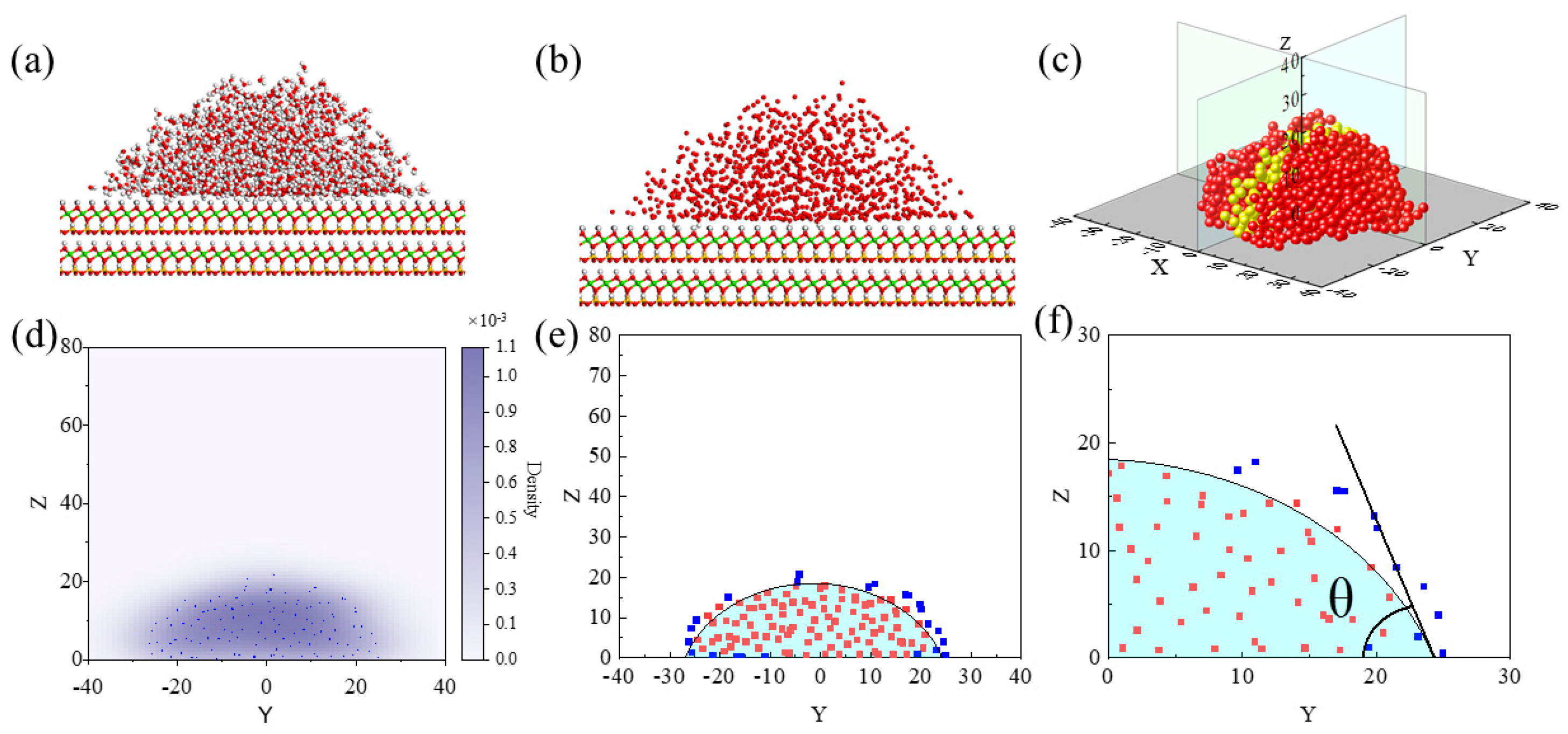
The contact angle was calculated from each sampled configuration, and the average value was taken as the equilibrium contact angle under the given conditions. The calculation was carried out according to the following steps: (1) Water molecule localization: Oxygen atom positions were recorded to represent molecular coordinates (Figure 2a,b). (2) Coordinate system reconstruction: A best-fit circle was fitted to the oxygen projections in the X–Y plane; its center became the origin of a new frame aligned with the mineral surface (X–Y plane), with Z normal to the surface (Figure 2c). (3) Slicing: a thin slice parallel to the YZ plane was extracted at the median X-coordinate of all water molecules, retaining molecules within it (Figure 2c). (4) Kernel density estimation: A continuous water density field was generated from the slice (Figure 2d). (5) Contact angle determination: The liquid–vapor interface was defined at a density threshold of 500 kg/m3, consistent with previous molecular dynamics studies on nanoscale contact angle calculations; a circular arc was fitted to this contour, and the contact angle was measured between the tangent at the three-phase line and the solid surface (Figure 2e,f).

2.4. Contact Angle Measurement

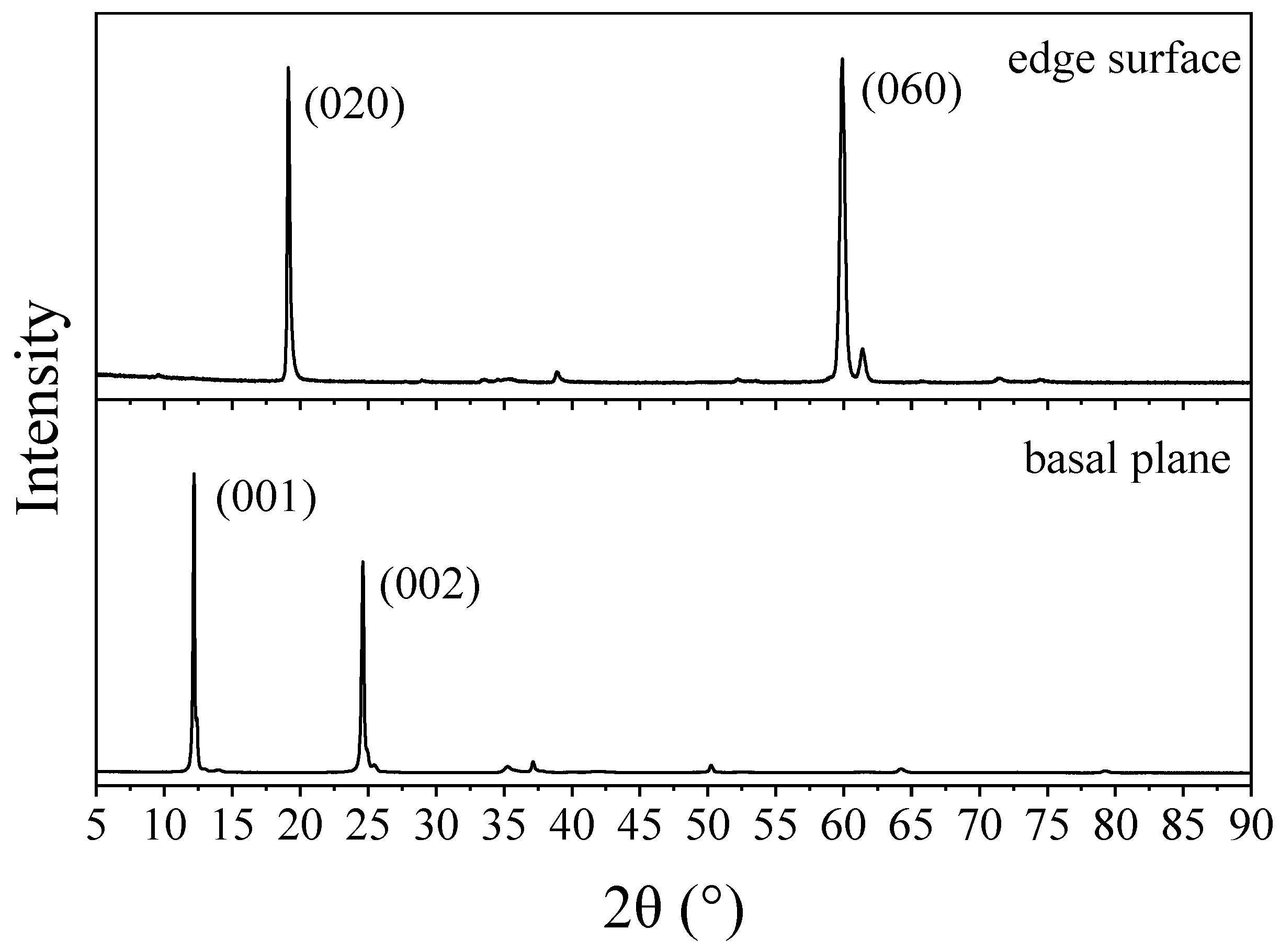
The antigorite pure minerals used in this study were purchased from Hu’s Ornamental Stone Shop, Guilin, China. X-ray diffraction (XRD, Panalytical, Almelo, The Netherlands) analysis was conducted using a Cu Kα radiation source (λ = 1.5406 Å) operated at 40 kV and 40 mA over a 2θ range of 5–90°. XRD patterns indicate high mineral purity of the antigorite samples. Electron Probe Microanalyzer (EPMA, JEOL, Ltd., Tokyo, Janpan) measurements atom contents of 56.41% Mg, 41.31% Si, 1.32% Al and 0.96% Fe. These values closely match the theoretical composition of ideal antigorite [Mg48Si34O85(OH)62], confirming the high purity of antigorite. The antigorite crystal was cleaved or cut along the target crystallographic plane to obtain flat surfaces. The (001) surface, obtained as a natural cleavage plane by hand fracturing. The (010) surface was polished stepwise using silicon carbide abrasive papers with grit sizes of 180, 400, 800, 1200, and 2000, where the 2000 grit paper corresponds to an abrasive particle size of approximately 2 μm. The surface orientation of the cleaved samples was then verified by XRD to confirm the intended crystallographic plane, as shown in Figure 3. The contact angle measurement was conducted by using a contact angle meter (JY-82C, Chengde Dingsheng testing equipment Co., Chengde, China). Prior to contact angle measurements, antigorite samples were immersed in aqueous solutions of specified pH and stirred for 2 min. The pH of the aqueous solutions was adjusted using dilute HCl or NaOH. After treatment, the samples were immediately removed, washed by DI water for 5 s, and gently dried with high-purity nitrogen gas. Then contact angle measurements were carried out.

2.5. Zeta Potential Measurement

Zeta potential measurements on antigorite were carried out using a zeta potential analyzer (zetasizer Nano ZS90, Malvern Instruments Ltd., Worcestershire, UK). A dilute mineral suspension was prepared by adding 0.04 g of antigorite powder to 40 mL KCl (0.001 mol/L) background electrolyte. The pH was adjusted and measured. After sedimentation for 5 min, the supernatant liquid was sucked out and used for measurement.

3. Result and Discussion

3.1. Interfacial Water Structure at Serpentine Polymorph Surfaces

3.1.1. Density Profiles of Interfacial Water

To better understand water–serpentine interactions, this work systematically investigates the microscopic structure and ordering of interfacial water, with a focus on molecular orientation and H-bonding networks. The interfacial water of lizardite Si–(00 1 ¯ ), Mg–(001), and (112) surfaces are shown in Figure 4a–c. Water molecules are found at considerable distances from the lizardite surface and do not exhibit any notable ordering or arrangement on the surface. Figure 4d,e present the interfacial water structures for antigorite and chrysotile, respectively. It is evident that water molecules tend to aggregate significantly in the SiOH regions. Furthermore, it is observed that the arrangement of water molecules on the chrysotile Mg–(001) surface resembles that on the lizardite Mg–(001) surface.
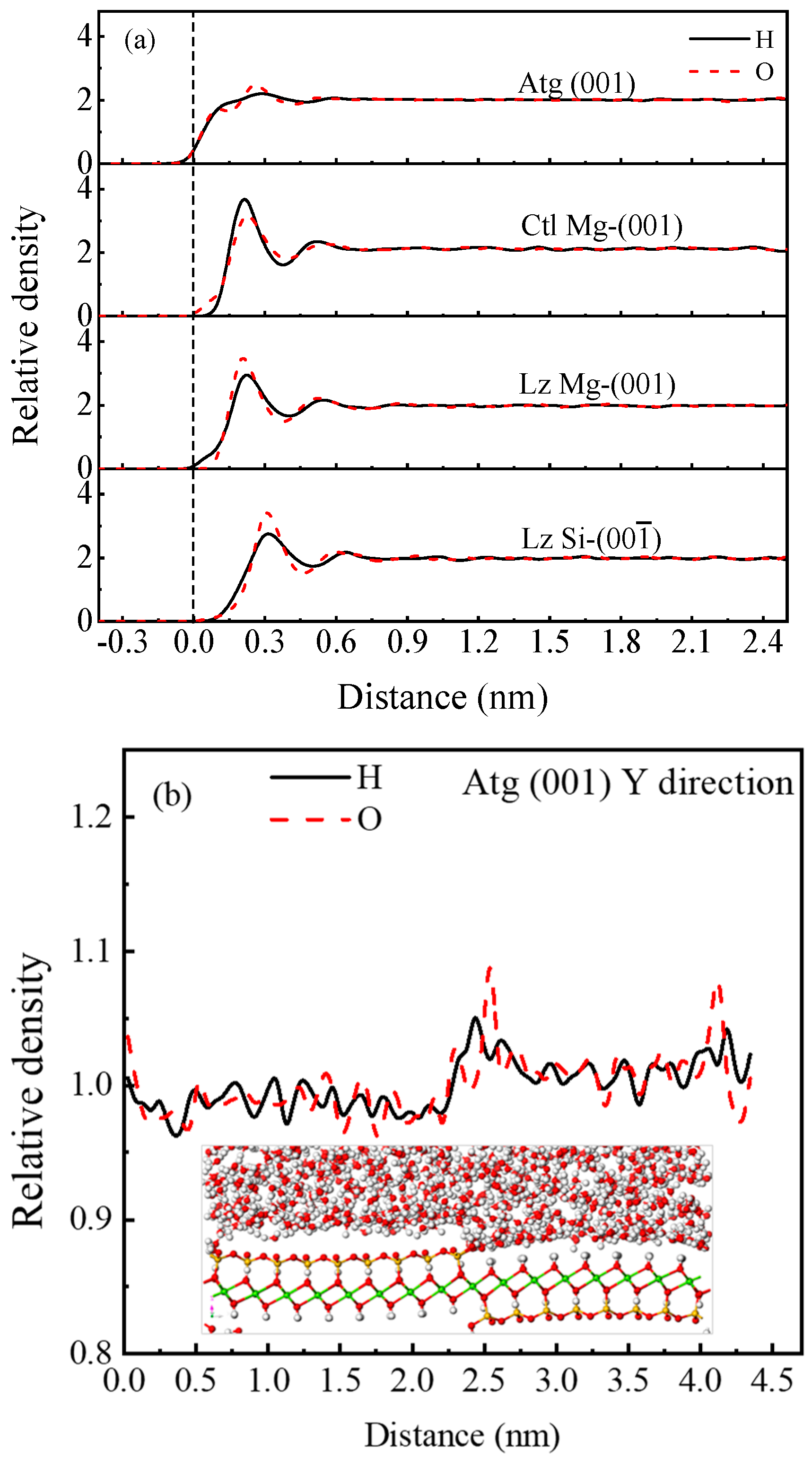
The relative number density profiles (defined as the local particle number density normalized by the bulk number density) of oxygen and hydrogen atoms in interfacial water on the surfaces of lizardite, antigorite, and chrysotile surfaces are shown in Figure 5a as a function of the Z-coordinate. The first peak in the relative density profile of either oxygen or hydrogen is identified as the primary hydration peak, indicating a region where the local atomic concentration exceeds that of bulk water. The position at which the relative density begins to rise from zero provides further insight into the thickness and structure of the primary hydration layer. Given that the center of mass of a water molecule closely coincides with that of its oxygen atom, the oxygen position is used as a proxy for the molecular location.
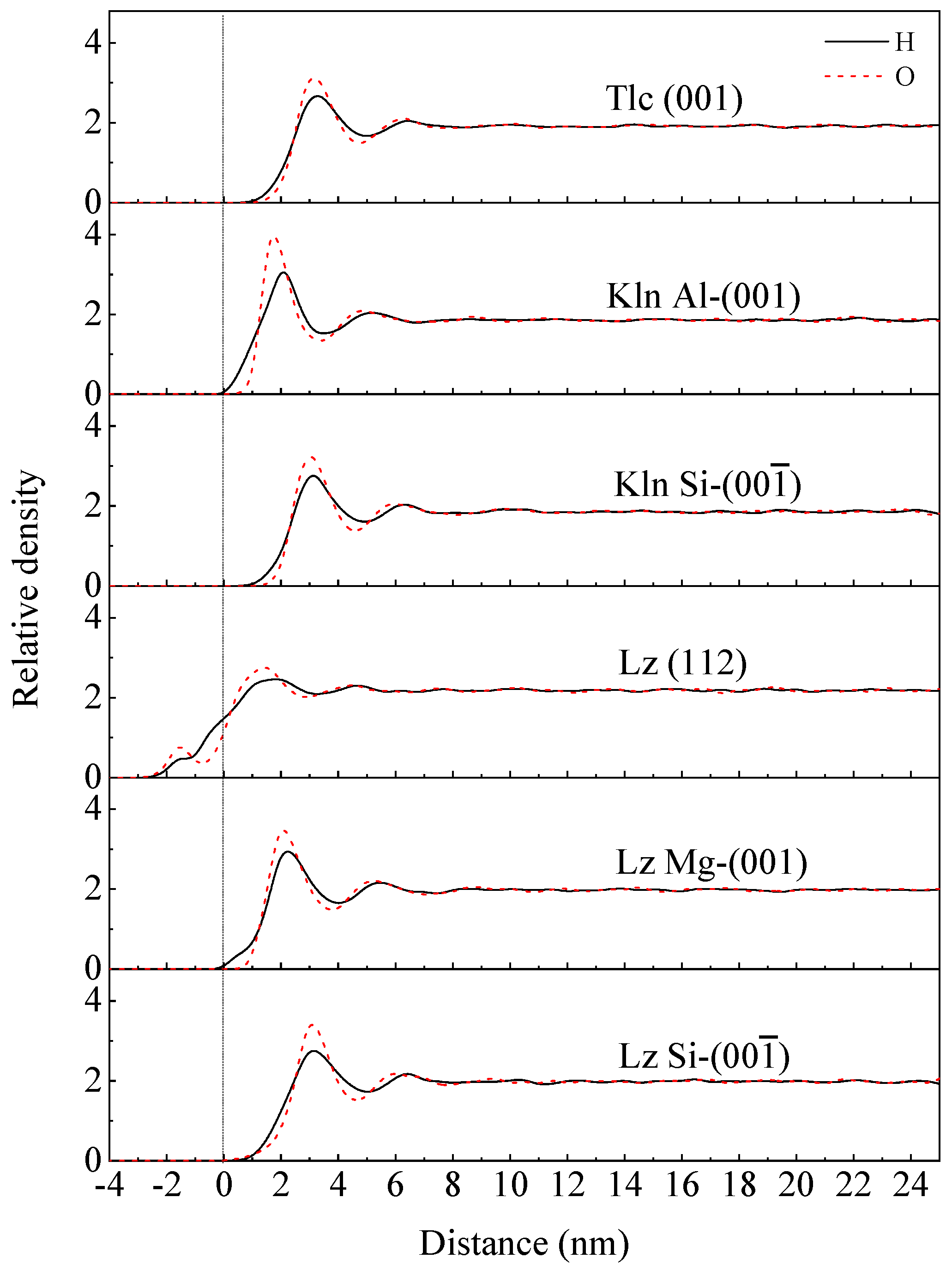
On the lizardite Si (001) surface, oxygen and hydrogen density peaks appear at about 0.30 nm and 0.60 nm from the interface, distances larger than the typical O–H hydrogen bond length in water (~2.8 Å), indicating weak water–surface interactions. Moreover, hydrogen exhibits slightly higher density than oxygen closer to the surface. The water density distribution on the Mg–(001) surface is similar to that on Si–(00 1 ¯ ), but the primary peaks for both oxygen and hydrogen occur at ~0.20 nm, indicating somewhat stronger water–surface interactions on the Mg–(001) face compared to the Si–(00 1 ¯ ) face.
The nearly equal spacing between successive maxima in the water density profile at the lizardite–water interface clearly reflects the dominance of the “excluded volume” or “hard-wall” effect. Within this region, the first layer of water molecules experiences spatial confinement due to collisions with neighboring molecules, thereby defining an excluded volume that restricts further molecular penetration [41]. The resulting interfacial water structure resembles that observed in two canonical model systems: hard-sphere fluids near a solid wall and Lennard–Jones fluids adjacent to a Lennard–Jones surface [23].
A “hard-wall” surface typically lacks specific interaction sites and exhibits only weak, non-directional interactions with the adsorbed water molecules. The absence of strong, site-specific interactions at the molecular scale is considered the microscopic origin of macroscopic hydrophobicity. The stronger the hydrophobicity of the substrate, the weaker its influence on the structuring of interfacial water. Consequently, both the Si–(00 1 ¯ ) and Mg–(001) surfaces of lizardite are classified as hydrophobic, indicating that the water on these surfaces is physisorbed rather than chemically bound.
On the chrysotile Mg–(001) surface, the density peaks of both hydrogen and oxygen atoms occur at approximately 0.21 nm, closely matching those observed on the lizardite Mg–(001) surface. However, below 0.1 nm, the oxygen atoms of interfacial water exhibit a higher density than hydrogen atoms on the chrysotile Mg–(001) surface, whereas the opposite trend is observed on the lizardite Mg–(001) surface. The comparable spatial distributions of hydrogen and oxygen on the lizardite and chrysotile Mg–(001) surface suggest that water molecules lack a preferred orientation, indicating weak interactions between the surface and water molecules.
The situation for antigorite is more complex. Its (001) surface comprises three distinct types of regions, and the planar-averaged density profiles represent an average over these heterogeneous domains. Consequently, no pronounced peaks are observed in the hydrogen or oxygen density distributions. Nevertheless, two weak features corresponding to the siloxane and Mg–OH regions can still be discerned, with hydrogen and oxygen peaks located at similar heights.
To resolve this heterogeneity, number density distributions perpendicular to the XZ plane of antigorite were further analyzed. The number density distribution perpendicular to the XZ plane of antigorite (i.e., along the Y-direction) is shown in Figure 5b. As shown in the corresponding figure, significantly enhanced densities of both hydrogen and oxygen atoms are observed in the vicinity of SiOH groups, indicating pronounced accumulation of water molecules in these regions. Moreover, hydrogen atoms of water are found closer to the oxygen atoms of surface SiOH groups, while oxygen atoms of water are positioned nearer to the hydrogen atoms of SiOH, suggesting the formation of hydrogen bonds between interfacial water molecules and surface hydroxyl groups.

3.1.2. Molecular Orientation of Water on Lizardite

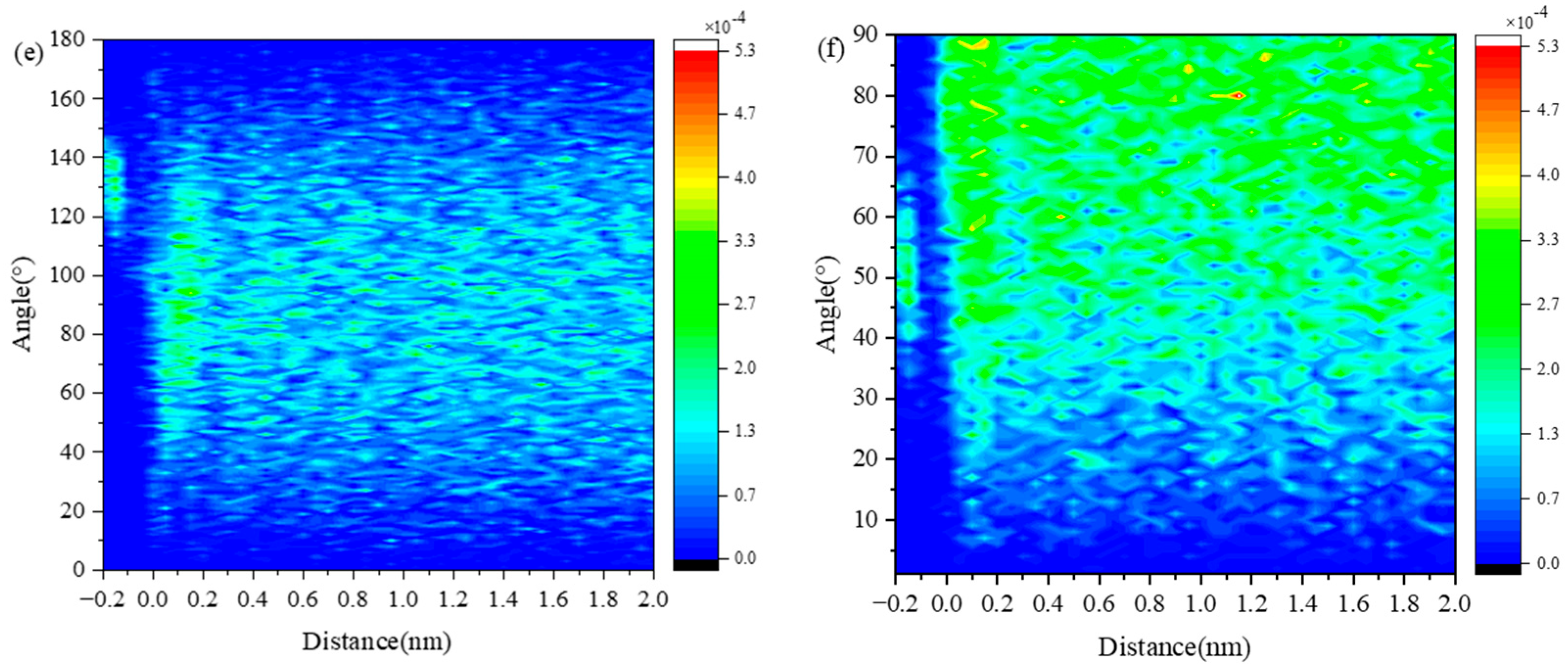
Figure 6 depict the distributions of water dipole moments and hydrogen positions on the Si–(00 1 ¯ ), Mg–(001), and (112) surfaces of lizardite, respectively. As shown in Figure 6, water molecules on the lizardite Si–(00 1 ¯ ) surface are predominantly distributed at distances between 0.2 nm and 0.3 nm from the surface, with negligible population within 0.2 nm. The α exhibits enhanced density in the range of 70° to 120°, with maxima centered at approximately 80° and 100°. The β displays a pronounced concentration between 50° and 90°.
The combined orientational analysis indicates that, for the majority of interfacial water molecules, the H–H vector is oriented nearly parallel to the crystal surface, and the molecular plane forms only a small inclination relative to the surface, implying that water molecules lie almost flat on the surface, with the oxygen atom positioned slightly farther away than the hydrogen atoms.
This orientation, consistent with the interfacial hydrogen and oxygen number density profiles, may be associated with weak hydrogen-bonding interactions between surface oxygen atoms and adsorbed water molecules. In contrast, bulk water molecules exhibit broader, more isotropic orientational distributions of both the dipole moment and H–H vector, reflecting their near-random arrangement in the disordered liquid phase.
The orientational distributions of α and β on the lizardite Mg–(001) surface are shown in Figure 6c,d. Water molecules are predominantly located between 0.15 nm and 0.25 nm from the surface, with dipole orientations concentrated in the range of 90–110°, indicating that most molecules in the first hydration layer have their dipoles slightly tilted toward the surface. The β angles are mainly distributed between 65° and 90°, suggesting that the H–H vectors are nearly parallel to the surface. This configuration is attributed to the relatively weak hydrogen-bonding interaction between surface hydroxyl or coordinated hydrogen atoms and adsorbed water molecules. In contrast, water molecules in layers farther from the surface exhibit significantly broader and more isotropic orientational distributions, indicative of diminished surface influence and a transition toward bulk-like behavior.
The orientational distributions of α and β on the lizardite (112) surface are shown in Figure 6e,f. Due to the corrugated topography of this surface, the outermost atomic layer is defined as the origin of the z-axis, allowing water adsorption even in the negative-z region. A distinct water layer appears from −0.2 to 0 nm, where dipole angles range from 120° to 140° and β angles from 40° to 60°, showing that water molecules tilt with oxygen atoms facing the surface. This orientation implies a surface-directed dipole and suggests hydrogen bonding between water oxygen and surface hydroxyl hydrogens. A second hydration layer appears between 0 and 0.3 nm, where water molecules lie predominantly parallel to the surface. These molecules interact strongly with the hydroxylated surface via multiple hydrogen bonds involving both oxygen and hydrogen atoms.
The above analysis of the three lizardite surfaces reveals that the two basal cleavage planes, Si–(00 1 ¯ ) and Mg–(001), exhibit relatively weak interactions with water molecules, whereas the hydroxylated edge surface shows stronger water affinity. It is reasonable to infer that the corresponding cleavage surfaces of chrysotile and antigorite possess similar interfacial characteristics to those of lizardite.

3.1.3. Comparison of Density Profiles Between Lizardite and Related Clay Minerals

Numerous studies have established that the Si–(00 1 ¯ ) surfaces of kaolinite and talc exhibit strong hydrophobicity. Figure 7 shows the density profiles of water molecules along the z-axis at the surfaces of lizardite, kaolinite, and talc. A comparative analysis of interfacial water structures shows oscillatory density profiles normal to the surface. For kaolinite and talc, water molecule density peaks at ~0.31 nm and ~0.33 nm, respectively, with a secondary peak near 0.60 nm. In contrast, on the kaolinite Al–(001) surface, oxygen and hydrogen atoms of water reach their primary density maxima at 0.16 nm and 0.20 nm, respectively, indicating distinct interaction strengths between surface atoms and the two water sites. This ordered arrangement reflects stronger water–surface interactions on kaolinite Al–(001) than those observed on lizardite Mg–(001).
On the lizardite (112) surface, water molecules are found beneath the outermost atomic layer, a feature attributed to the corrugated surface topography and indicative of enhanced water–surface affinity. In contrast, on the lizardite Si–(00 1 ¯ ) and Mg–(001) surfaces, similar oxygen and hydrogen distributions and a lack of preferred molecular orientation indicate weak, non-specific water–surface interactions. By comparison, water molecules at the (112) surface exhibit a defined orientational order, signifying stronger interfacial coupling. The positions and shapes of the density peaks thus reflect mineral surface atomic structure, where stable hydrogen bonds between surface functional groups and water molecules extend their influence into the adjacent liquid phase.

3.2. Wettability of Serpentine Polymorph Surfaces

3.2.1. MD Simulation of Contact Angle

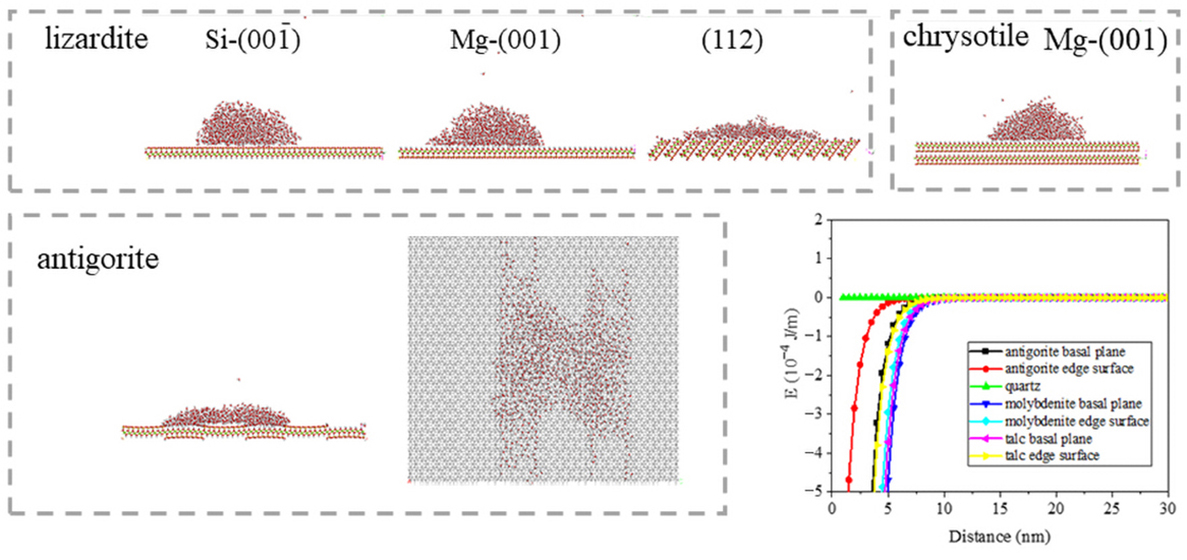
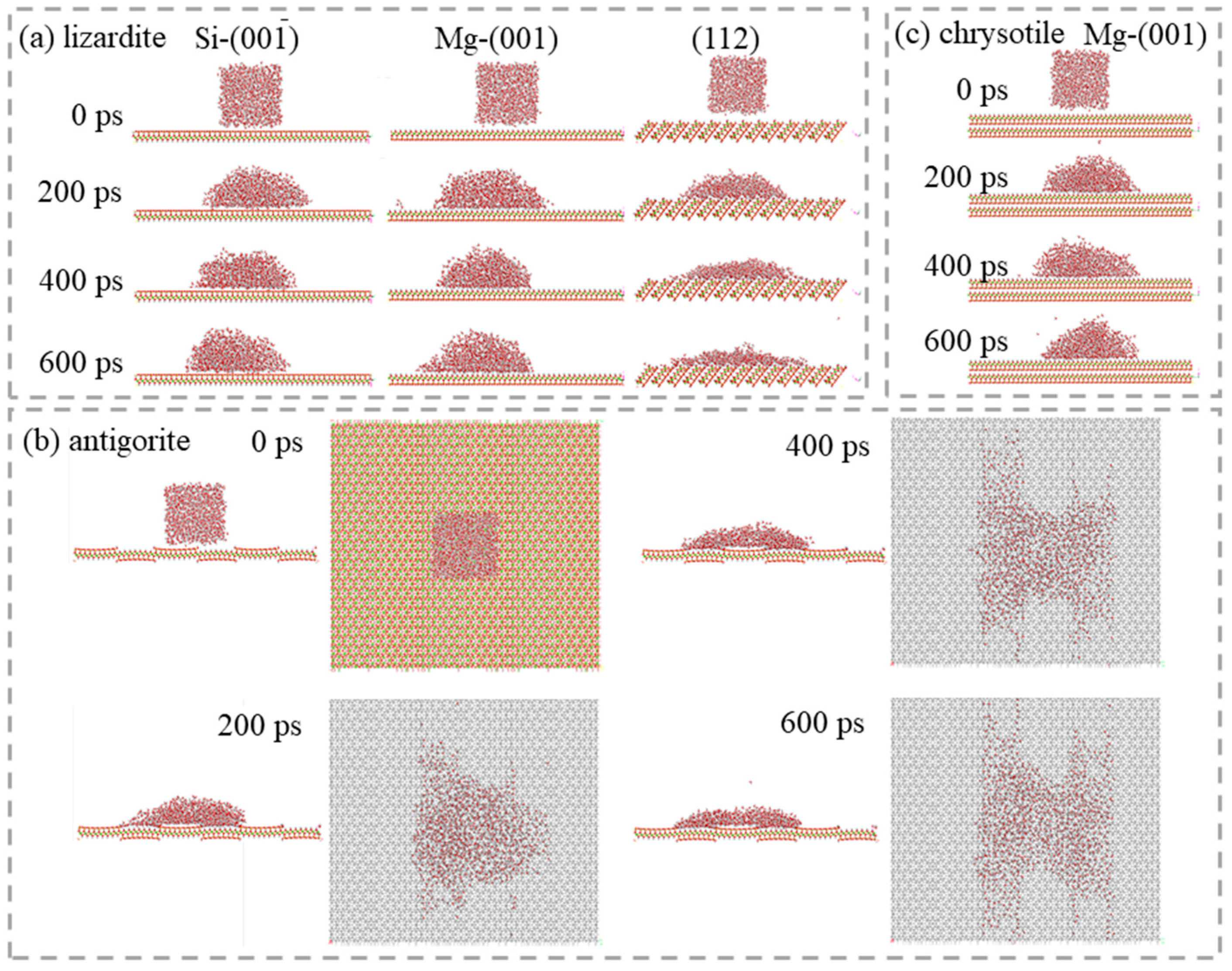
Figure 8a shows the time evolution of water droplets on lizardite Si–(00 1 ¯ ), Mg–(001), and (112) surfaces. Simulated contact angles are listed in Table 1. The system equilibrates by approximately 400 ps, with equilibrium contact angles of 78.6°, 71.1°, and 25.7°, respectively. The relatively high contact angles on the Si–(00 1 ¯ ) and Mg–(001) surfaces indicate hydrophobic character, with Si–(00 1 ¯ ) being notably more hydrophobic, whereas the low contact angle on the (112) surface reflects its hydrophilicity.
Figure 8b shows the time evolution of a water droplet on the (001) surface of antigorite. The system reaches a quasi-equilibrium state by approximately 400 ps. In the [010] direction, the droplet spreads across ~1.5 unit cells but stops at siloxane region, indicating poor wettability of the siloxane region. A distinct vacuum-like gap is observed between the water and both the Si and Mg area, confirming weak interaction. At equilibrium, water preferentially spreads along the SiOH edges in the [010] direction. These hydrophilic SiOH sites originate from hydrolysis of undercoordinated Si–O bonds, rendering the edges highly wettable.
The contact angle of chrysotile is shown in Figure 8c. In its tubular structure, Mg–O octahedra occupy the outer surface while Si–O tetrahedra are confined to the inner side, so the exposed surface is predominantly Mg–(001). This face is structurally similar to the Mg–(001) surface of lizardite and exhibits a contact angle of approximately 74.9°. The comparable wettability can be attributed to their similar surface atomic arrangements and Mg–OH exposure, which result in weak water–surface interactions and limited ordering of interfacial water molecules.
In summary, contact angle simulations (excluding surface dissolution effects) show that lizardite and chrysotile exhibit moderate hydrophobicity, with contact angles of approximately 70–80°. In contrast, antigorite exhibits relatively lower hydrophobicity due to the coexistence of siloxane regions and hydrophilic SiOH sites generated by partial Si–O bond breakage. These surface structural differences govern the interfacial water organization and ultimately determine the wettability behavior of the serpentine polymorphs.

3.2.2. Comparison of Contact Angles Between Lizardite and Related Clay Minerals

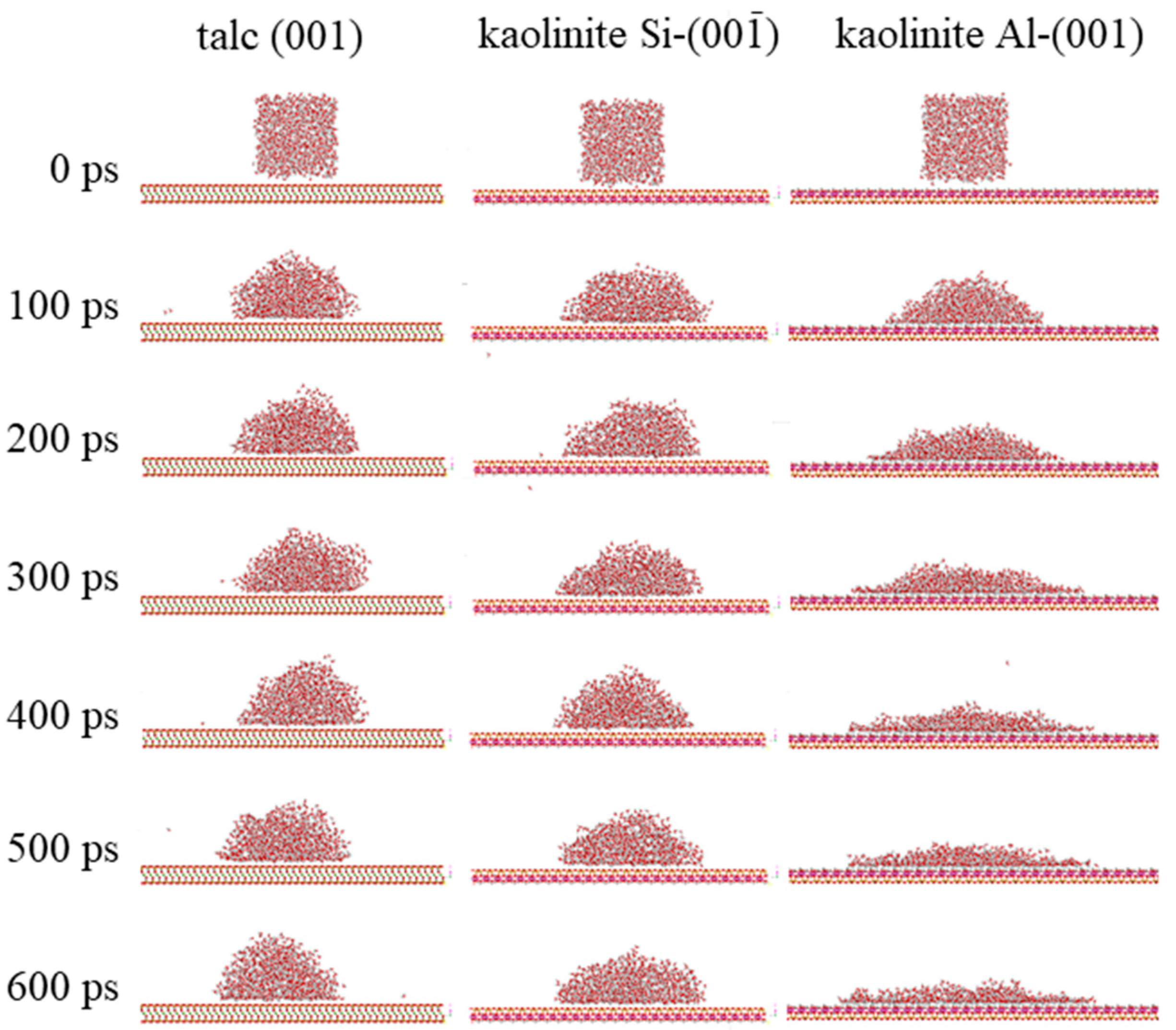
Figure 9 illustrates the behavior of water droplets on the (001) surfaces of talc and kaolinite. The specific contact angles derived from these behaviors are provided in Table 2. The talc (001) surface is inherently hydrophobic and the simulated contact angle reaches 92.7°. The contact angle on the Si–(00 1 ¯ ) of kaolinite is 78.4°, while that on the Al–(001) is only 11.3°.
Lizardite Mg–(001) and kaolinite Al–(001) both feature surface hydroxyl groups bonded to metal cations (Mg or Al), yet exhibit markedly different wettability. While kaolinite Al–(001) is highly hydrophilic (contact angle 1.3°), lizardite Mg–(001) shows significantly higher hydrophobicity (contact angle 71.1°). This difference stems from distinct hydroxyl orientations and H-bonding capabilities. On relaxed kaolinite Al–(001), hydroxyls are oriented both perpendicular and parallel to the surface, enabling strong dual H–bonds with water (Os⋯Hw and Hs⋯Ow). Besides, the hydroxyl oxygen at the surface is coordinated to two Al atoms and one H atom. In contrast, lizardite Mg–(001) has vertically aligned hydroxyls with outward-facing H atoms, allowing only weak Ow⋯Hs hydrogen bonds, and the hydroxyl oxygen is coordinated to three Mg atoms and one H atom. Surface O atoms cannot accept H-bonds.
Studies show that surface wettability is governed by chemical composition and the microscopic structure. In particular, strongly bound and highly ordered water monolayers can suppress further hydrogen bonding with bulk water, thereby enhancing apparent hydrophobicity. This behavior is supported by experimental and simulation studies. Ohler et al. [29] reported contact angles of 32°–34° on TiO2 surfaces covered by approximately two water monolayers. Similarly, Rotenberg et al. [20] observed a contact angle of about 50° in simulations of a modified talc surface with a tightly adsorbed water monolayer. Together, these findings demonstrate that macroscopic wettability depends critically oxygen bonding configuration, not merely on surface chemistry.

3.3. Contact Angle and Bubble–Antigorite Interaction Forces

This section characterizes antigorite surface wettability by measuring contact angles on different crystallographic planes and quantifying hydrophobic and Derjaguin–Landau–Verwey–Overbeek (DLVO) interactions with air bubbles as shown in Figure 10. Surface wettability directly reflects mineral floatability. In contrast, direct contact angle measurements are challenging for lizardite due to the scarcity of sufficiently large and pure single crystals, and for chrysotile because its fibrous morphology hinders the preparation of flat surfaces. Antigorite, however, possesses a periodically structured (001) cleavage plane that inherently exposes both siloxane and Mg–OH regions. This single, naturally occurring cleavage face eliminates the need for facet identification and offers a distinct advantage for reliable contact angle measurement.
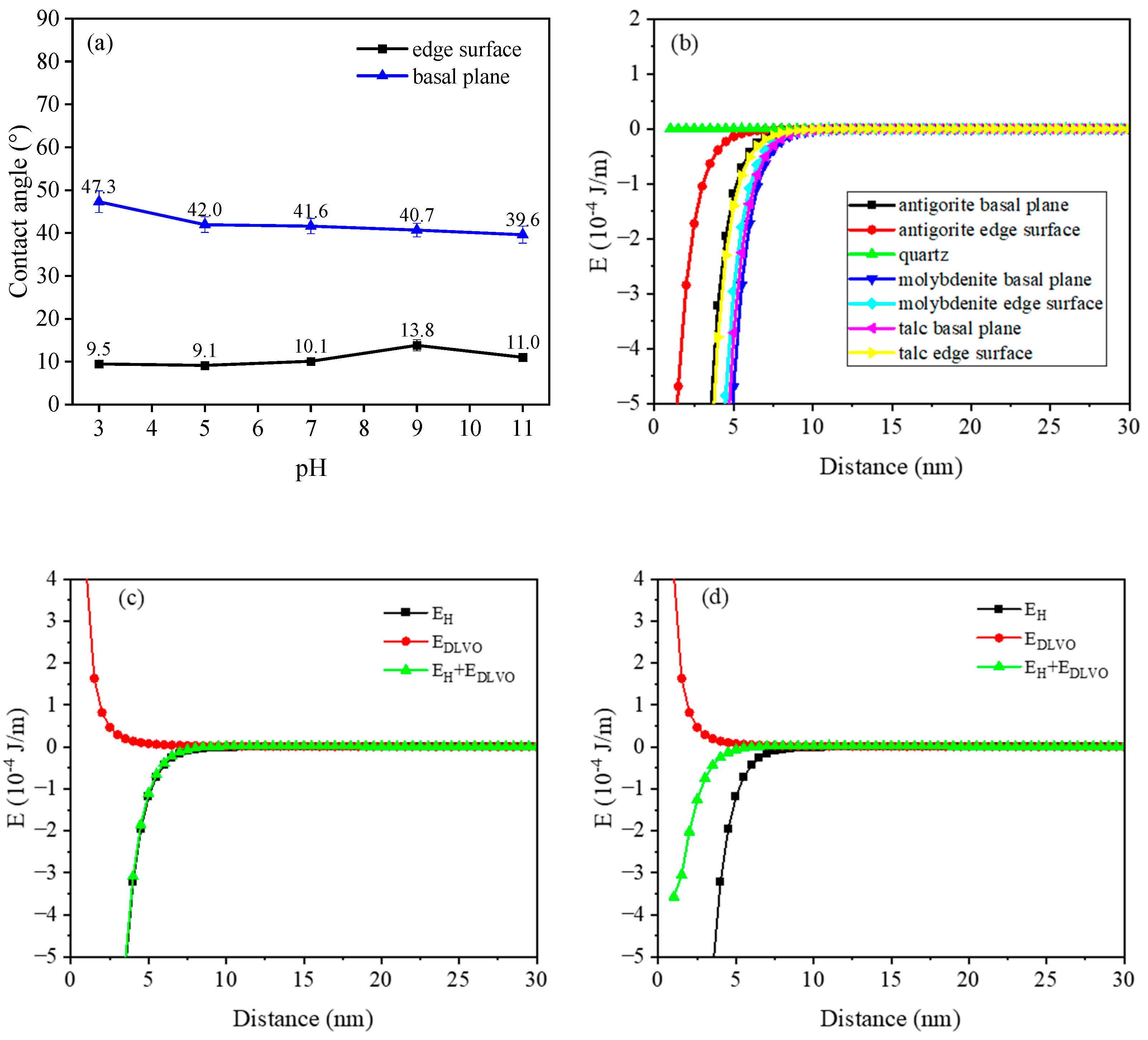
Figure 10a shows the contact angles of various antigorite surfaces: the basal plane exhibits a contact angle of about 40°, whereas the edge surface shows a significantly lower value of about 10°. The moderate hydrophobicity of the antigorite basal plane arises from a balance between intrinsically hydrophobic Si–O–Si and Mg–OH domains and localized hydrophilic sites formed by partial Si–O bond cleavage. The balance between these hydrophobic and hydrophilic components results in an overall contact angle of ~40°. This is consistent with molecular dynamics simulations, confirming the moderately hydrophobic nature of the antigorite basal plane.
To illustrate the hydrophobic interaction between antigorite and air bubble, the hydrophobic forces for several minerals with varying hydrophobicity was compared. Shi et al. [42] used atomic force microscopy to establish a relationship between the areal hydrophobic interaction energy EH and the water contact angle θ, as expressed in Equation (1):
E H = γ 1 cos θ e H h 0
where γ is the surface tension of water and h0 is the decay length, typically ranging from 0.8 to 1.0 nm. The contact angles of water on the mineral surfaces are listed in Table 3, and the corresponding hydrophobic interaction energies are plotted in Figure 10b.
Since quartz is fully hydrophilic with a contact angle near zero, its hydrophobic interaction with air bubbles is negligible. In contrast, the antigorite basal plane exhibits a measurable hydrophobic force, comparable to that of typical hydrophobic minerals such as talc and molybdenite. The edge plane of antigorite shows an intermediate hydrophobic interaction—stronger than quartz but weaker than talc or molybdenite.
Figure 10c,d shows the hydrophobic and DLVO interaction energies between antigorite and air bubbles. For the basal plane, the net interaction (sum of DLVO and hydrophobic forces) is attractive and nearly coincides with the hydrophobic interaction curve, indicating that the hydrophobic force dominates over the DLVO force. In contrast, the edge plane exhibits a much weaker net attraction due to partial cancellation between the smaller hydrophobic force and repulsive DLVO contributions. This indicates that antigorite, especially its basal plane, are likely to attach to bubbles in flotation processes. However, in aqueous flotation systems, Mg in serpentine dissolves more readily than Si, degrading Mg-OH surfaces and reducing hydrophobicity, contributing to serpentine’s poorer floatability compared to talc.

4. Conclusions

The adsorption behavior, surface wettability, and contact angle of water on the serpentine surface were studied. Molecular dynamics simulations show that both siloxane tetrahedral and hydroxyl octahedral surfaces of the three serpentine minerals are hydrophobic, with contact angles ranging from approximately 70° to 80°. Water molecules form weak H–bonds with the naturally cleaved siloxane surface and Mg–OH surface of the three serpentines. Mg–(001) surface wettability is governed not only by chemical composition but also by the microscopic arrangement and oxygen bonding configuration.
The contact angles of the lizardite Si–(00 1 ¯ ) surface and Mg–(001) are 78.6° and 71.1°, respectively. Chrysotile exposes the Mg–(001) surface, with a contact angle of 74.9°. The water droplet on antigorite surface is spread along the SiOH region. However, water molecules cannot spread from SiOH to siloxane and Mg–OH regions. Experiments show that the antigorite (001) surface has a contact angle of 41.6° and exhibits moderate hydrophobicity, whereas the (020) surface has a contact angle of 10.1°. The combined DLVO and hydrophobic interactions between antigorite and air bubbles result in a net attractive force, enabling particle–bubble adhesion.

Author Contributions

Conceptualization, Z.P. and F.J.; Methodology, Q.W.; Validation, Q.W.; Investigation, Z.P., G.L. and J.Q.; Resources, F.J. and Z.L.; Data curation, Q.W.; Writing—original draft, Z.P.; Writing—review & editing, G.L.; Supervision, W.Q.; Project administration, W.Q.; Funding acquisition, Z.L. and Z.P. All authors have read and agreed to the published version of the manuscript.

Funding

This work was supported by the National Key Research and Development Program of China (2022YFC2905003), Open Foundation of State Key Laboratory of Mineral Processing (BGRIMM-KJSKL-2026-19), and Postdoctoral Fellowship Program of CPSF (GZC20251238).

Data Availability Statement

The original contributions presented in this study are included in the article. Further inquiries can be directed to the corresponding author.

Conflicts of Interest

The authors declare no conflict of interest.

References

  1. Whittaker, E.J.W.; Zussman, J. The Characterization of Serpentine Minerals by X-Ray Diffraction. Mineral. Mag. J. Mineral. Soc. 1956, 31, 107–126. [Google Scholar] [CrossRef]
  2. Wang, Z.; Xiang, Y.; Wang, D.; Xu, L.; Xing, Y.; Gao, Z.; Sun, W.; Xie, L. Facet-Dependent Charge Density of Serpentine: Nanoscopic Implications for Aggregation and Entrainment of Fine Particles. Langmuir 2023, 39, 19027–19036. [Google Scholar] [CrossRef]
  3. Laurora, A.; Brigatti, M.F.; Malferrari, D.; Galli, E.; Rossi, A.; Ferrari, M. The Crystal Chemistry of Lizardite-1T from Northern Apennines Ophiolites near Modena, Italy. Can. Mineral. 2011, 49, 1045–1054. [Google Scholar] [CrossRef]
  4. Guggenheim, S.; Zhan, W. Effect of Temperature on the Structures of Lizardite-1 T and Lizardite-2H1. Can. Mineral. 1998, 36, 1587–1594. [Google Scholar]
  5. Titulaer, M.K.; Van Miltenburg, J.C.; Jansen, J.B.H.; Geus, J.W. Characterization of Tubular Chrysotile by Thermoporometry,Nitrogen Sorption, Drifts, and TEM. Clays Clay Miner. 1993, 41, 496–513. [Google Scholar] [CrossRef]
  6. Lourenço, M.P.; De Oliveira, C.; Oliveira, A.F.; Guimarães, L.; Duarte, H.A. Structural, Electronic, and Mechanical Properties of Single-Walled Chrysotile Nanotube Models. J. Phys. Chem. C 2012, 116, 9405–9411. [Google Scholar] [CrossRef]
  7. Lin, Q.; Sun, L.; Cao, Y.; Guo, Y.; Liang, M.; Lu, B.; Su, X.; Sun, W. Stepwise Separation of Highly Altered Copper-Nickel Sulfide Ores Utilizing Structural Characteristics and Magnetic Response for Enhanced Recovery. Sep. Purif. Technol. 2026, 382, 135893. [Google Scholar] [CrossRef]
  8. Lu, X.; Dipple, G.M.; Pawlik, M. A Surface Charge Approach to Characterize Serpentine Reactivity for Carbon Mineralization. Appl. Clay Sci. 2025, 270, 107777. [Google Scholar] [CrossRef]
  9. Yang, B.; Liu, J.; Wang, L.; Ai, G.; Ren, S. Enhanced Collection of Chalcopyrite by Styrene-Butyl Acrylate Polymer Nanospheres in the Presence of Serpentine. Colloids Surf. A Physicochem. Eng. Asp. 2022, 640, 128408. [Google Scholar] [CrossRef]
  10. Fu, L.; Jiao, F.; Wei, Q.; Zhang, Z.; Gong, P.; Fan, C.; Wei, T. Application of a Novel Nanoparticle Collector in the Flotation Separation of Serpentine-Containing Pyrrhotite. Miner. Eng. 2026, 235, 109792. [Google Scholar] [CrossRef]
  11. Wani, O.B.; Manzoor, S.; Molaei, N.; Shoaib, M.; Khan, S.; Zeng, H.; Bobicki, E.R. Beneficiation of Nickel from Ultramafic Ores: Using Sodium Citrate as a Green Processing Reagent. Resour. Conserv. Recycl. 2022, 186, 106496. [Google Scholar] [CrossRef]
  12. Edwards, C.R.; Kipkie, W.B.; Agar, G.E. The Effect of Slime Coating of the Serpentine Minerals, Chrysotile and Lizardite, on Pentlandite Flotation. Int. J. Miner. Process. 1980, 7, 33–42. [Google Scholar] [CrossRef]
  13. Liu, C.; Zhang, W.; Song, S.; Li, H. Effects of Lizardite on Pentlandite Flotation at Different PH: Implications for the Role of Particle-Particle Interaction. Miner. Eng. 2019, 132, 8–13. [Google Scholar] [CrossRef]
  14. Cao, J.; Tian, X.D.; Luo, Y.C.; Hu, X.Q.; Xu, P.F. The Effect of Graphene Oxide on the Slime Coatings of Serpentine in the Flotation of Pentlandite. Colloids Surf. A Physicochem. Eng. Asp. 2017, 522, 621–627. [Google Scholar] [CrossRef]
  15. Gao, Y.; Zhang, G.; Wang, M.; Liu, D. The Critical Role of Pulp Density on Flotation Separation of Nickel-Copper Sulfide from Fine Serpentine. Minerals 2018, 8, 317. [Google Scholar] [CrossRef]
  16. Patra, P.; Bhambhani, T.; Nagaraj, D.R.; Somasundaran, P. Impact of Pulp Rheological Behavior on Selective Separation of Ni Minerals from Fibrous Serpentine Ores. Colloids Surf. A Physicochem. Eng. Asp. 2012, 411, 24–26. [Google Scholar] [CrossRef]
  17. Kruglyakov, P.M.; Elaneva, S.I.; Vilkova, N.G. About Mechanism of Foam Stabilization by Solid Particles. Adv. Colloid Interface Sci. 2011, 165, 108–116. [Google Scholar] [CrossRef] [PubMed]
  18. Amani, P.; Miller, R.; Javadi, A.; Firouzi, M. Pickering Foams and Parameters Influencing Their Characteristics. Adv. Colloid Interface Sci. 2022, 301, 102606. [Google Scholar] [CrossRef]
  19. Hunter, T.N.; Pugh, R.J.; Franks, G.V.; Jameson, G.J. The Role of Particles in Stabilising Foams and Emulsions. Adv. Colloid Interface Sci. 2008, 137, 57–81. [Google Scholar] [CrossRef]
  20. Rotenberg, B.; Patel, A.J.; Chandler, D. Molecular Explanation for Why Talc Surfaces Can Be Both Hydrophilic and Hydrophobic. J. Am. Chem. Soc. 2011, 133, 20521–20527. [Google Scholar] [CrossRef]
  21. Luo, Y.; Ou, L.; Chen, J.; Zhou, H.; Yin, C.; Yang, H. Insights into the Adsorption Mechanism of Water at Different Coverage Rates on Talc (Mg3Si4O10(OH)2) (001) Basal Surface: A First-Principles Study. J. Mol. Liq. 2022, 363, 119879. [Google Scholar] [CrossRef]
  22. Johnston, C.T.; Santagata, M.; Sasar, M. Physical and Chemical Properties of Layered Clay Mineral Particle Surfaces. Dev. Clay Sci. 2022, 10, 125–167. [Google Scholar] [CrossRef]
  23. Wang, J.; Kalinichev, A.G.; Kirkpatrick, R.J. Effects of Substrate Structure and Composition on the Structure, Dynamics, and Energetics of Water at Mineral Surfaces: A Molecular Dynamics Modeling Study. Geochim. Cosmochim. Acta 2006, 70, 562–582. [Google Scholar] [CrossRef]
  24. Solc, R.; Gerzabek, M.H.; Lischka, H.; Tunega, D. Wettability of Kaolinite (001) Surfaces—Molecular Dynamic Study. Geoderma 2011, 169, 47–54. [Google Scholar] [CrossRef]
  25. Chen, J.; Min, F.; Liu, L.; Liu, C. Mechanism Research on Surface Hydration of Kaolinite, Insights from DFT and MD Simulations. Appl. Surf. Sci. 2019, 476, 6–15. [Google Scholar] [CrossRef]
  26. Huang, C.; Xu, F.; Sun, Y. Effects of Morphology, Tension and Vibration on Wettability of Graphene: A Molecular Dynamics Study. Comput. Mater. Sci. 2017, 139, 216–224. [Google Scholar] [CrossRef]
  27. Li, C.; Xu, M.; Xing, Y.; Zhang, H.; Peuker, U.A. Efficient Separation of Fine Coal Assisted by Surface Nanobubbles. Sep. Purif. Technol. 2020, 249, 117163. [Google Scholar] [CrossRef]
  28. Wang, C.; Lu, H.; Wang, Z.; Xiu, P.; Zhou, B.; Zuo, G.; Wan, R.; Hu, J.; Fang, H. Stable Liquid Water Droplet on a Water Monolayer Formed at Room Temperature on Ionic Model Substrates. Phys. Rev. Lett. 2009, 103, 137801. [Google Scholar] [CrossRef]
  29. Ohler, B.; Langel, W. Molecular Dynamics Simulations on the Interface between Titanium Dioxide and Water Droplets: A New Model for the Contact Angle. J. Phys. Chem. C 2009, 113, 10189–10197. [Google Scholar] [CrossRef]
  30. Zhou, G.; Li, L.; Peng, K.; Wang, X.; Yang, Z. Wettability Transition on Graphyne-Coated Au(111) Substrates with Different Pore Sizes: The Role of Interfacial Hydrogen Bonds. J. Phys. Chem. C 2021, 125, 7971–7979. [Google Scholar] [CrossRef]
  31. Zhou, G.; Huang, L. A Review of Recent Advances in Computational and Experimental Analysis of First Adsorbed Water Layer on Solid Substrate. Mol. Simul. 2020, 47, 925–941. [Google Scholar] [CrossRef]
  32. Kimmel, G.A.; Petrik, N.G.; Dohnálek, Z.; Kay, B.D. Crystalline Ice Growth on Pt(111): Observation of a Hydrophobic Water Monolayer. Phys. Rev. Lett. 2005, 95, 166102. [Google Scholar] [CrossRef]
  33. Kimmel, G.A.; Petrik, N.G.; Dohnálek, Z.; Kay, B.D. Crystalline Ice Growth on Pt(111) and Pd(111): Nonwetting Growth on a Hydrophobic Water Monolayer. J. Chem. Phys. 2007, 126, 114702. [Google Scholar] [CrossRef]
  34. Limmer, D.T.; Willard, A.P.; Madden, P.; Chandler, D. Hydration of Metal Surfaces Can Be Dynamically Heterogeneous and Hydrophobic. Proc. Natl. Acad. Sci. USA 2013, 110, 4200–4205. [Google Scholar] [CrossRef]
  35. Erb, R.A. Wettability of Metals under Continuous Condensing Conditions. J. Phys. Chem. 1965, 69, 1306–1309. [Google Scholar] [CrossRef]
  36. Yonghua, H. Quantum Chemistry Study on the Surface Properties and Dispersion of Kaolinite and Montmorillonite. Ph.D. Thesis, China University of Mining & Technology, Beijing, China, 2017. [Google Scholar]
  37. Cortez, B.A.; Machado-Santelli, G.M. Chrysotile Effects on Human Lung Cell Carcinoma in Culture: 3-D Reconstruction and DNA Quantification by Image Analysis. BMC Cancer 2008, 8, 181. [Google Scholar] [CrossRef] [PubMed]
  38. Jiang, B.; Ji, B.; Yuan, L.; Yu, C.; Ren, B.; Zhou, G.; Zheng, Y.; Tao, W.; Zhu, Y. Effect of Surfactant Liquid Temperature on Wettability of Bituminous Coal: An Experimental and Molecular Dynamics Simulation Study. J. Mol. Liq. 2023, 386, 122527. [Google Scholar] [CrossRef]
  39. Jia, B.; Zuo, X.; Xian, C.; Huang, Z.; Chen, X. Advances in Molecular Dynamics Simulations of Wettability and Interfacial Behaviors in Oil Reservoirs. J. Mol. Liq. 2025, 437, 128372. [Google Scholar] [CrossRef]
  40. Zhang, S.; Feng, Q.; Wen, S.; Xian, Y.; Liu, J.; Liang, G. Flotation Separation of Chalcopyrite from Molybdenite with Sodium Thioglycolate: Mechanistic Insights from Experiments and MD Simulations. Sep. Purif. Technol. 2024, 342, 126958. [Google Scholar] [CrossRef]
  41. Yang, H. Theory Model of Biomacromolecule Through the Nanopore Including the Effect of Electrolyte and Excluded Volume. Ph.D. Thesis, Southeast University, Nanjing, China, 2014. [Google Scholar]
  42. Shi, C.; Cui, X.; Xie, L.; Liu, Q.; Chan, D.Y.C.; Israelachvili, J.N.; Zeng, H. Measuring Forces and Spatiotemporal Evolution of Thin Water Films between an Air Bubble and Solid Surfaces of Different Hydrophobicity. ACS Nano 2015, 9, 95–104. [Google Scholar] [CrossRef]
Figure 1. Surface of three serpentine polymorphs: (a) lizardite Si–(00 1 ¯ ), (b) lizardite Mg–(001), (c) lizardite (112), (d) antigorite (001) and (e) chrysotile Mg–(001) (green–Mg, red–O, yellow–Si, white–H).
Minerals 16 00559 g001
Figure 2. Procedure for contact angle calculation: (a,b) water droplet configurations; (c) coordinate reconstruction and slicing; (d) water density distribution; (e) liquid–vapor interface fitting; and (f) contact angle determination. In panels (a) and (b), green–Mg, red–O, yellow–Si, white–H. In panel (c), red spheres represent water molecules, while yellow spheres indicate water molecules located on the slicing plane. In panels (e) and (f), red and blue points represent water molecules inside and outside the fitted circle, respectively.
Minerals 16 00559 g002
Figure 3. XRD of the (001) basal plane and (020) edge surface of antigorite.
Minerals 16 00559 g003
Figure 4. Water structure of three serpentine interfaces: (a) lizardite Si–(00 1 ¯ ); (b) lizardite Mg–(001); (c) lizardite (112); (d) antigorite (001); and (e) chrysotile Mg–(001).
Minerals 16 00559 g004
Figure 5. Density profiles of water molecules at three serpentine (001) surfaces along the z–axis (a) and at antigorite (001) surface y–axis (b). (Lz: lizardite, Atg: antigorite, Ctl: chrysotile).
Minerals 16 00559 g005
Figure 6. The orientation distribution of water dipole moment (angle α) and hydrogen position (angle β) at lizardite surface: (a) α at Si–(00 1 ¯ ) surface, (b) β at Si–(00 1 ¯ ) surface, (c) α at Mg–(001) surface, (d) β at Mg–(001) surface, (e) α at (112) surface, (f) β at (112) surface.
Minerals 16 00559 g006aMinerals 16 00559 g006b
Figure 7. Density profiles of water molecules at selected lizardite (Lz), kaolinite (Kln), and talc (Tlc) surfaces along the z-axis.
Minerals 16 00559 g007
Figure 8. Surface contact angle of (a) lizardite, (b) antigorite, and (c) chrysotile. Different viewing angles and rendering colors were adopted to improve visualization clarity.
Minerals 16 00559 g008
Figure 9. Surface contact angles of talc and kaolinite.
Minerals 16 00559 g009
Figure 10. (a) Contact angle of different antigorite surfaces, (b) hydrophobic interaction energies with distance between minerals and gas bubbles, (c) hydrophobic interaction energy and DLVO interaction energy between basal plane and air bubbles (at pH = 9.0, zeta potential: antigorite −1 mV bubble: −20 mV) at pH = 9.0, (d) hydrophobic interaction energy and DLVO interaction energy between edge surface and air bubbles.
Minerals 16 00559 g010
Table 1. Contact angles of the three serpentine surfaces from molecular dynamics simulations.
MineralSurfaceContact Angles (°)Standard Deviation
lizarditeSi–(00 1 ¯ )78.62.7
Mg–(001)71.11.2
(112)25.70.4
antigorite(001)Spread along the [010] direction
chrysotileMg–(001)74.91.6
Table 2. Contact angles of different surfaces of serpentine, kaolinite, and talc.
MineralSurfaceContact Angles (°)Standard Deviation
lizarditeSi–(00 1 ¯ )78.62.7
Mg–(001)71.11.2
(112)25.70.4
kaoliniteSi–(00 1 ¯ )78.42.1
Al–(001)11.30.6
talc(001)92.74.2
Table 3. Contact angles of water on several mineral surfaces.
Mineral SurfacesContact Angles (°)cosθγ(1 − cosθ)
The basal plane of antigorite40.700.7617.61
The edge surface of antigorite13.800.972.10
Quartz0.001.000.00
The basal plane of molybdenite87.470.0469.59
The edge surface of molybdenite66.470.4043.74
The basal plane of talc75.900.2455.06
The edge surface of talc44.300.7220.70
Disclaimer/Publisher’s Note: The statements, opinions and data contained in all publications are solely those of the individual author(s) and contributor(s) and not of MDPI and/or the editor(s). MDPI and/or the editor(s) disclaim responsibility for any injury to people or property resulting from any ideas, methods, instructions or products referred to in the content.