Article

Jurassic–Cretaceous Boundary Silicic Volcanism and Paleo-Pacific Slab Rollback in Eastern Guangdong, Southeast China: Evidence from Zircon U–Pb–Hf Isotopes and Trace Elements


1
School of Chemical and Environmental Engineering, School of Materials Science and Engineering, Hanshan Normal University, Chaozhou 521041, China
2
State Key Laboratory of Critical Mineral Research and Exploration, Institute of Geochemistry, Chinese Academy of Sciences, Guiyang 550081, China
3
University of Chinese Academy of Sciences, Beijing 100049, China
*
Authors to whom correspondence should be addressed.
Minerals 2026, 16(5), 550; https://doi.org/10.3390/min16050550
Submission received: 1 April 2026 / Revised: 7 May 2026 / Accepted: 16 May 2026 / Published: 19 May 2026
(This article belongs to the Section Mineral Geochemistry and Geochronology)

Abstract

Late Jurassic–Early Cretaceous silicic volcanism is widespread along the Southeast China continental margin, yet the timing, magma plumbing, and geodynamic drivers of individual volcanic centers remain debated. Here, we integrate whole-rock geochemistry with zircon U–Pb geochronology, zircon trace elements, and in situ zircon Lu–Hf isotopes for high-silica rhyolites from the Bijiashan volcanic complex, eastern Guangdong, to constrain magmatic evolution and its link to Paleo-Pacific subduction dynamics. LA–ICP–MS zircon U–Pb analyses were used to define two dominant crystallization populations: 145.4 ± 1.2 Ma (n = 14; MSWD = 1.7) for sample BJS-18 and 141.4 ± 1.3 Ma (n = 14; MSWD = 1.6) for sample BJS-27, yielding dominant zircon U–Pb age populations of 141.1–145.4 Ma, thereby constraining the timing of the main silicic volcanism (magma crystallization immediately preceding eruption) to the Jurassic–Cretaceous boundary. Minor older peaks at 157.0 ± 1.6 Ma (BJS-18) and 153.1 ± 1.5 Ma (BJS-27) suggest antecrystic or inherited components from a long-lived trans-crustal magmatic system. Whole-rock data indicate subalkaline, high-K calc-alkaline rhyolitic affinities, with apparent peraluminous signatures affected by post-magmatic alkali mobility. The rhyolites are characterized by pronounced negative Eu anomalies (Eu/Eu* = 0.085–0.395), low Sr contents (5.9–29.0 ppm), and arc-like trace-element signatures with Nb–Ta–Ti depletions. Zircon trace elements indicate crystallization temperatures of 608–842 °C and redox states from ΔFMQ = −3.90 to +1.71, with syneruptive grains clustering near FMQ ± 1 and xenocrystic grains systematically more reduced and hotter, implying vertically and temporally zoned magma storage. Zircon εHf(t) values (−7.4 to −0.9) and Mesoproterozoic TDM2 ages (1.18–1.66 Ga) indicate substantial reworking of ancient Cathaysian crust. In contrast, the relatively radiogenic upper εHf(t) values and the occurrence of mafic lithic fragments suggest limited juvenile or mantle-derived input into the crust-dominated magmatic system. Together with tectonic discrimination diagrams indicating a continental arc affinity, these results support Early Cretaceous arc-related silicic magmatism during a regional transition from compression to extension, plausibly linked to Paleo-Pacific slab rollback beneath Southeast China.

1. Introduction

Volcanic rocks provide key windows into deep crust–mantle processes and the tectonic evolution of active continental margins because their timing, geochemistry, and isotopic signatures can directly archive changes in subduction dynamics and lithospheric architecture [1,2]. Eastern Guangdong, located along the southeastern China coastal margin, represents an important segment of the Paleo-Pacific convergent system, where voluminous Mesozoic volcanic and plutonic rocks are widely exposed [3,4,5,6]. These magmatic products not only record the interplay between slab-driven magmatism and continental crustal evolution but are also spatially associated with regional W–Sn and polymetallic mineralization, making this area a prime natural laboratory for linking volcanism, petrogenesis, and tectonics [7,8,9,10,11,12].
Previous studies have indicated that the Mesozoic volcanic suites in eastern Guangdong are dominated by high-silica rhyolites and intermediate–felsic volcanic rocks that commonly display arc-like geochemical affinities, which have been widely interpreted to reflect Paleo-Pacific subduction beneath the Eurasian margin [1,2,5,6,13]. Zircon U–Pb geochronology and zircon Hf isotopes have been increasingly used to constrain eruption timing and magma sources in the Southeast China coastal volcanic belt [14,15,16]. However, several issues remain debated for eastern Guangdong: (i) whether multi-stage magmatism corresponds to distinct tectonic events, (ii) how geochemical and isotopic signatures reflect temporal changes in magma source regions, and (iii) how silicic volcanism is coupled to deeper geodynamic processes during Paleo-Pacific subduction and the accompanying tectonic transition along the Southeast China margin [3,4,6,7,17]. Resolving these questions is essential for reconstructing the Mesozoic tectono-magmatic evolution of South China and for evaluating the mechanisms linking slab behavior to continental-margin magmatism.
In this study, we investigate high-silica volcanic rocks from the Bijiashan volcanic complex in eastern Guangdong using an integrated dataset of petrography, whole-rock geochemistry, zircon LA–ICP–MS U–Pb geochronology, zircon trace elements, and in situ zircon Lu–Hf isotopes. The aims are to (1) constrain the timing and episodicity of silicic volcanism, (2) evaluate magma source characteristics and differentiation processes, and (3) clarify the tectonic setting of Bijiashan volcanism within the framework of Paleo-Pacific subduction and the Late Mesozoic tectonic transition along the Southeast China margin.

2. Geological Setting and Sample Description

2.1. Regional Tectonic Setting

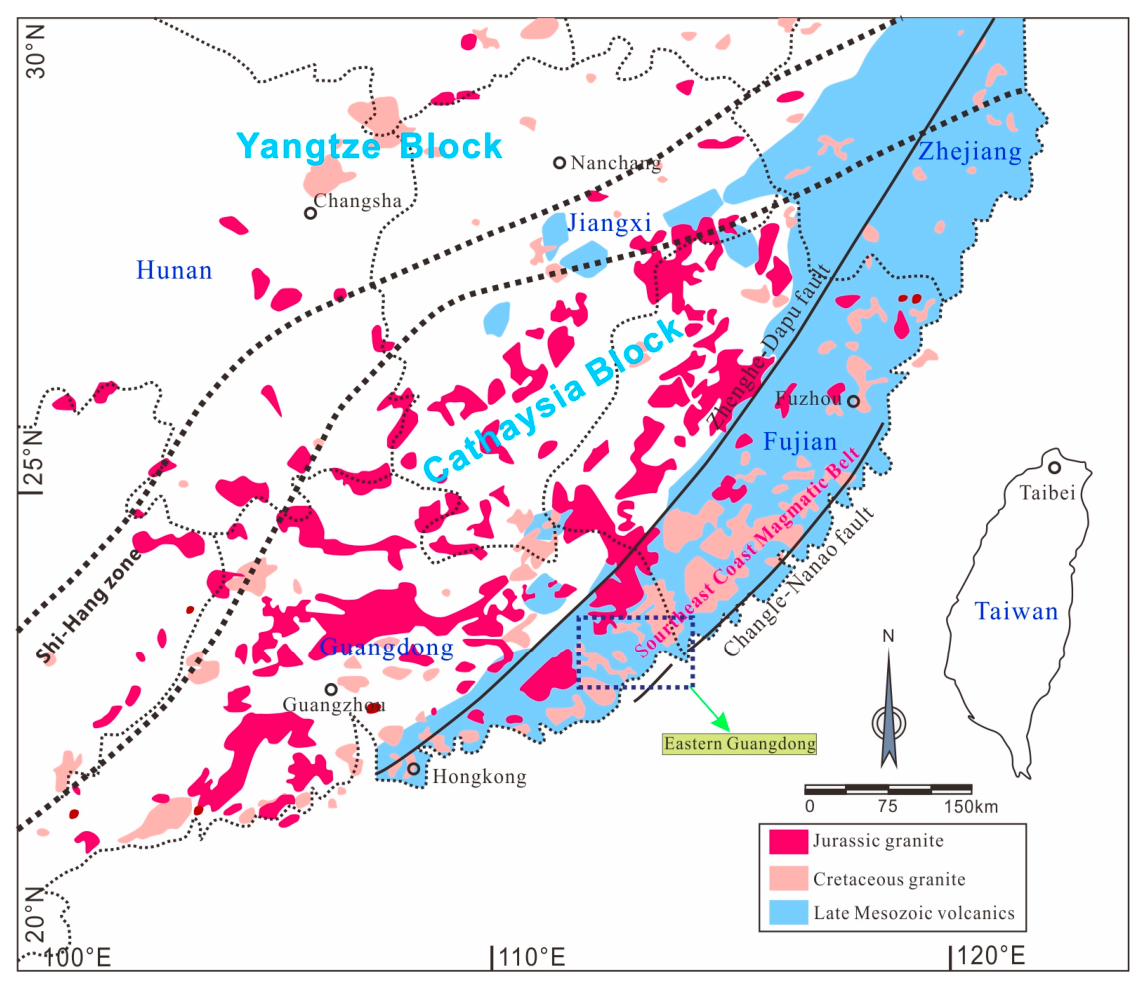
Eastern Guangdong lies along the southeastern margin of the South China Block (Cathaysia domain). It forms the southwestern segment of the northeast-trending coastal magmatic belt of Southeast China (see Figure 1). Regional Mesozoic tectono-magmatic evolution has been widely linked to Paleo-Pacific subduction beneath the Eurasian margin, during which voluminous volcanic and plutonic rocks were emplaced and later associated with significant W–Sn polymetallic mineralization along the coastal metallogenic belt [3,4,6,7,8,9,10,11,12,17]. Geochronological constraints from representative Jurassic volcanic sections in eastern Guangdong indicate episodic volcanism, with major pulses at ~192–183 Ma, ~177–163 Ma, and ~162–156 Ma; zircon Hf isotopes suggest dominant reworking of an ancient crustal basement with variable juvenile input through time, interpreted as an early-stage response to Paleo-Pacific subduction [5]. Toward the Late Jurassic–Early Cretaceous transition, multiple studies of ore-related granitoid–porphyry systems and associated W–Sn mineralization have identified a prominent magmatic–metallogenic pulse at ~145–130 Ma (e.g., Jinkeng, Taoxihu, Sanjiaowo, and Lianhuashan), which has commonly been attributed to a regional shift from a subduction-dominated arc regime to an intra-arc/back-arc extension in response to changes in slab geometry and kinematics, including retreat/rollback and lithospheric thinning [3,4,6,7,8,10,11,12,17]. The regional distribution of Jurassic–Cretaceous granitoids and late Mesozoic volcanic rocks and the location of eastern Guangdong are shown in Figure 1.

2.2. Bijiashan Geological Overview and Sample Context

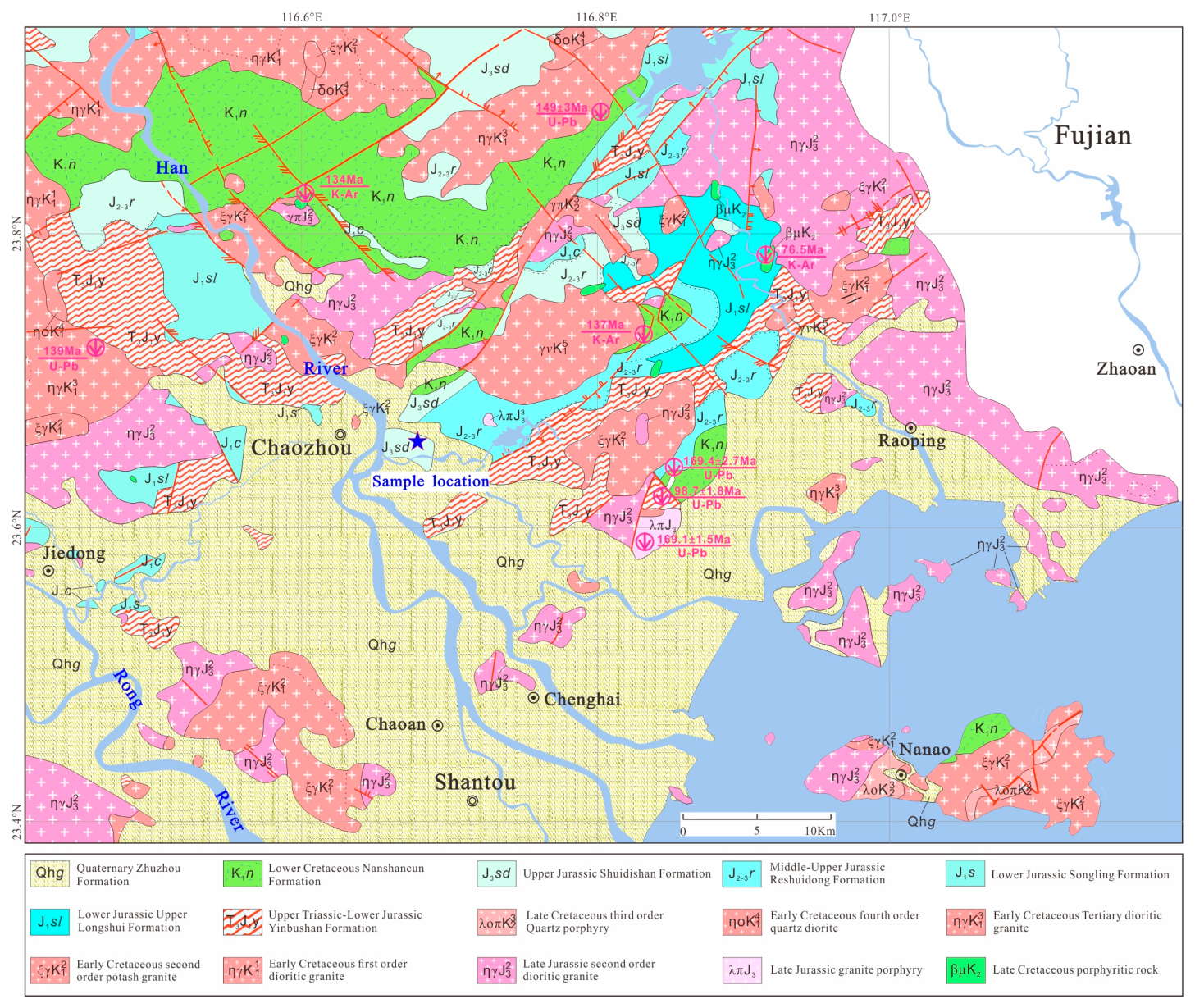
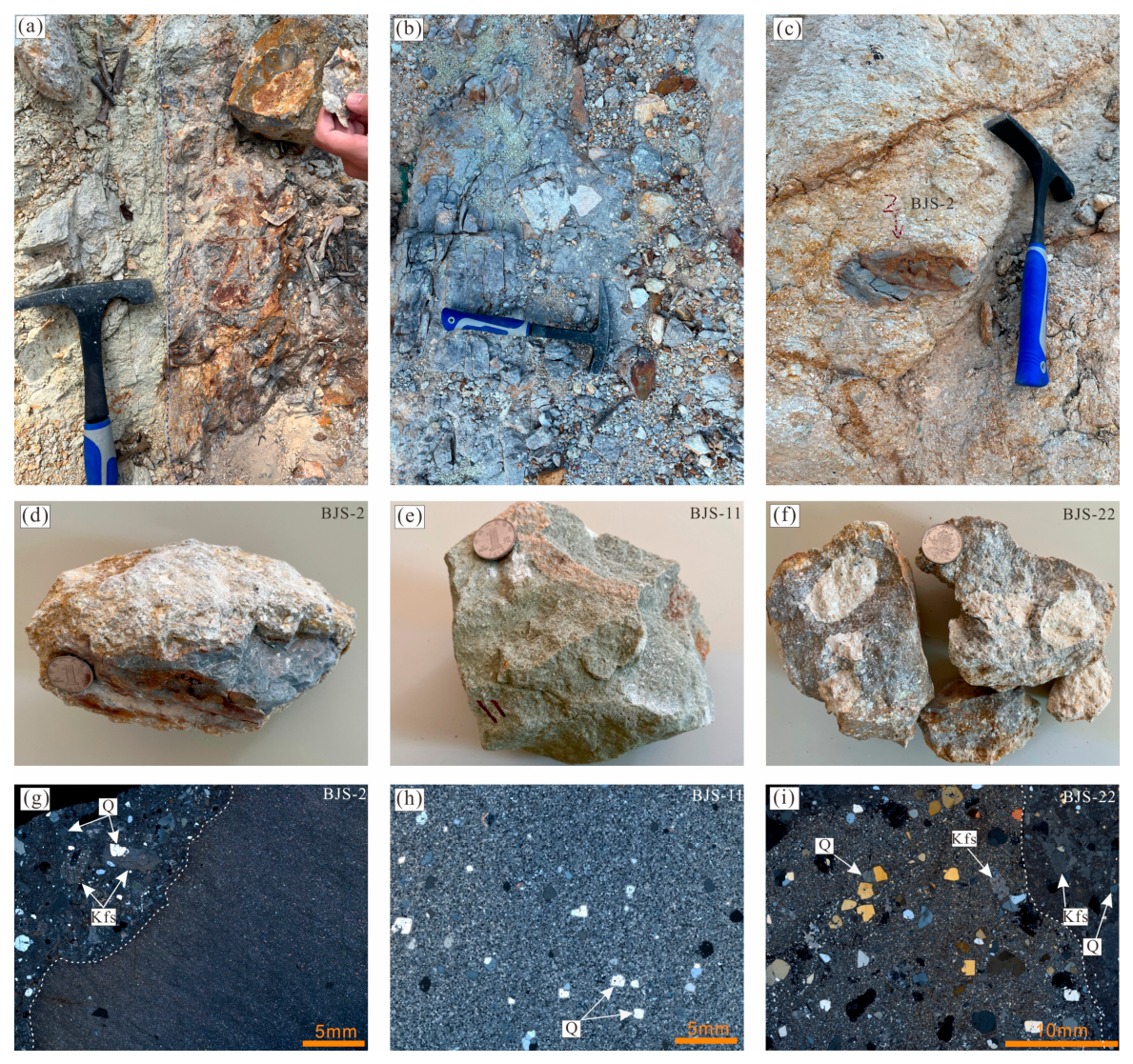
The Bijiashan volcanic area is located in the Chaozhou–Raoping region of eastern Guangdong (see Figure 2), where Jurassic volcano/sedimentary strata are intruded by Late Jurassic to Cretaceous granitoids and porphyritic rocks. The main exposed units include the Lower Jurassic Songling Formation (J1s) and Longshui Formation (J1sl), Middle–Upper Jurassic Reshuidong Formation (J23r), and Upper Jurassic Shuidishan Formation (J3sd), with scattered Early Cretaceous Nanshancun Formation (K1n) and widespread Quaternary cover (Qhg) in the lowlands (see Figure 2). Intrusive rocks include Late Jurassic intermediate to felsic granitoids and granite porphyry (λπJ3), as well as Early Cretaceous granitoids dominated by potassic granite (ξγK1). Volcanic strata and intrusions define an overall northeast-trending corridor that parallels major northeast-striking faults, indicating structural control on magma ascent and emplacement (see Figure 2). The volcanic succession is dominated by high-silica felsic rocks and can be summarized as basal welded tuff, middle rhyolite interbedded with tuff, and upper rhyolitic pyroclastic rocks. The sampling sites (starred in Figure 2) lie within the J3sd-dominated belt and close to Early Cretaceous potassic granite (ξγK1) intrusions. Representative field relationships, hand specimens, and photomicrographs are presented in Figure 3, which summarizes the main lithofacies and petrographic features of the sampled units. These observations provide the geological basis for the analytical work described below.

2.3. Petrography

The studied volcanic rocks are generally light gray to gray-green in hand specimen and commonly show massive to weakly foliated textures. In the field and thin section, the Bijiashan high-silica rhyolites are characterized by flow banding/flow foliation and autobrecciated breccia–massive facies (Figure 3a–c). Some samples contain angular to subangular lithic and crystal fragments embedded in a fine-grained felsic matrix, consistent with rhyolitic pyroclastic or volcaniclastic textures (Figure 3d–f). Locally, mafic lithic fragments with sharp boundaries against the felsic matrix are observed, particularly in BJS-2 and BJS-4, whereas the matrix and felsic breccia clasts are compositionally similar (Figure 3c,d,g). These mafic lithic fragments are dark gray to gray-green, fine-grained, and texturally distinct from the surrounding felsic matrix; however, their detailed mineral assemblages are difficult to determine because of fine grain size and alteration. Therefore, they are described here as mafic volcanic lithic fragments based on their field appearance, sharp contacts with the felsic matrix, and distinct whole-rock geochemical characteristics. Clast–matrix contacts are sharp to irregular, and the felsic clasts are dominated by quartz- and K-feldspar-bearing fragments. These features provide field and petrographic evidence for proximal volcanic facies and local open-system magma transport.
Under the microscope, the rocks are characterized by abundant quartz and K-feldspar crystals or crystal fragments set in a microcrystalline to cryptocrystalline felsic groundmass (Figure 3g–i). Quartz occurs as subhedral to anhedral grains and angular fragments, whereas K-feldspar is present as subhedral crystals or broken crystal fragments. The matrix locally displays fine-grained felsic aggregates and weak flow- or welding-related fabrics. Some samples show evidence of post-magmatic alteration, including secondary quartz enrichment, sericitization of feldspar, and local iron-oxide staining. These features indicate that the samples preserve primary volcanic or pyroclastic textures but have experienced variable post-magmatic alteration, which must be considered when interpreting whole-rock major-element compositions.

3. Analytical Methods

3.1. Zircon LA–ICP–MS In Situ U–Pb Dating and Trace Element Analysis

Zircons were separated from crushed samples using conventional heavy liquid and magnetic methods. Euhedral, inclusion-free grains without visible fractures were handpicked under a binocular microscope, mounted in epoxy together with reference materials, and polished to expose approximately half of each grain. Transmitted/reflected light microscopy and SEM cathodoluminescence (SEM–CL) imaging were used to identify crack-free, inclusion-free, and well-zoned domains for analysis.
Zircon U–Pb dating and trace element analyses were conducted at Wuhan SampleSolution Analytical Technology Co., Ltd. (Wuhan, China). Instrument configuration and analytical procedures followed [19]. A GeolasPro laser ablation system (COMPexPro 102 ArF 193 nm excimer laser with a MicroLas optical system) was coupled to an Agilent 7900 ICP–MS. Helium served as the carrier gas and argon as the make-up gas; the two gases were mixed via a T-junction upstream of the ICP. A signal-smoothing device was used to improve signal stability [20]. Analyses were performed using a 32 μm spot size and a 5 Hz repetition rate.
Zircon 91500 and NIST SRM 610 glass were employed as external standards for instrumental drift/mass bias correction and elemental fractionation calibration [21]. Each time-resolved analysis included 20–30 s of background acquisition, followed by 50 s of ablation signal. Off-line data reduction processes (background subtraction, drift correction, trace element concentration calculation, U–Pb isotope ratio determination, and age computation) were carried out using ICPMSDataCal [19,22]. Concordia plots and weighted mean ages were produced using Isoplot/Ex ver. 3 [23].

3.2. Zircon Lu–Hf Isotopic Analysis

In situ zircon Lu–Hf isotopic analyses were performed at Wuhan SampleSolution Analytical Technology Co., Ltd. (Wuhan, China) using LA–MC–ICP–MS. The laser system was a Geolas HD (Coherent, Germany), coupled to a Neptune Plus MC–ICP–MS (Thermo Fisher Scientific, Germany). A signal-smoothing device was applied to enhance signal stability and improve analytical precision [20]. Helium was used as the carrier gas, and a small amount of N2 was introduced downstream of the ablation cell to enhance Hf sensitivity [24]. The Neptune Plus employed a high-performance cone assembly; prior work has indicated that, relative to standard cones, the X-skimmer + Jet-sample cone combination with the addition of N2 increases sensitivity to Hf, Yb, and Lu by factors of 5.3, 4.0, and 2.4, respectively. Laser ablation was conducted in single-spot mode with a fixed spot size of 44 μm and energy density of ~7.0 J/cm2. Detailed operating conditions are given in [24].
Accurate zircon Hf isotope measurement by LA–MC–ICP–MS requires correction for isobaric interferences of 176Yb and 176Lu on 176Hf. Because the Yb mass fractionation factor (βYb) can vary over time and βYb derived from solution analyses is not directly applicable to laser ablation zircon measurements [25], βYb was determined in real time for each zircon analysis and used for interference correction. The ratios 179Hf/177Hf = 0.7325 and 173Yb/171Yb = 1.132685 [26] were used to calculate βHf and βYb. The value 176Yb/173Yb = 0.79639 [26] was employed to correct the 176Yb contribution at mass 176, and 176Lu/175Lu = 0.02656 [27] was used to correct the relatively minor 176Lu interference. Given the similar physicochemical behavior of Yb and Lu, βYb was applied to correct Lu mass fractionation. Off-line processing (signal selection, mass bias correction, and interference correction) was performed using ICPMSDataCal [19].
To evaluate data quality, Plešovice, 91500, and GJ-1 zircon standards were analyzed together with unknowns. Plešovice was used as the primary external standard, whereas 91500 and GJ-1 served as secondary standards to monitor accuracy. The external precision (2SD) values for Plešovice, 91500, and GJ-1 were better than 0.000020, and the measured values agreed with the recommended values, within analytical uncertainties. The Temora 2 zircon standard was additionally analyzed to monitor analyses of zircons with high Yb/Hf ratios. Recommended values for these standards are given in [28].

3.3. Whole-Rock Major and Trace Element Analyses

Major elements, trace elements, and rare earth elements (REE) were analyzed for 23 whole-rock samples at ALS Chemex (Guangzhou) Co., Ltd. (Guangzhou, China) Major elements were determined by X-ray fluorescence spectrometry (ME-XRF26) using a PANalytical PW2424 XRF spectrometer. Analytical precision and accuracy were assessed using reference materials NCSDC73303 and SARM-4, with both being better than 5%.
Trace elements and REE were measured by ICP–MS, following ME-MS61r (four-acid digestion) and ME-MS81g (fusion) protocols. Instrumentation included an Agilent 5110 ICP–OES and an Agilent 7900 ICP–MS. Reference materials MRGeo08 and OREAS-100a were used for quality control, and analytical precision and accuracy were better than 10%.

3.4. Data Screening and Alteration Assessment

Because alkalis and some major oxides can be mobilized during post-magmatic alteration, whole-rock data were screened before petrogenetic interpretation. Loss on ignition (LOI), Na2O contents, K2O/Na2O ratios, and the chemical index of alteration (CIA) were used to evaluate alteration effects. Major-element data were recalculated on an anhydrous basis before plotting in the TAS and related major-element diagrams. LOI was excluded, and the remaining major oxides were normalized to 100 wt.% before plotting. However, the TAS diagram was used only for preliminary nomenclature because it is sensitive to alkali mobility.
Samples with high CIA values, very low Na2O contents, and anomalously high SiO2 contents were considered to have experienced variable silicification and alkali loss. Therefore, petrogenetic and tectonic interpretations in this study are based primarily on relatively immobile element systematics, especially the Nb/Y–Zr/TiO2 classification framework [29], together with REE patterns, HFSE ratios, and zircon U–Pb–Hf–trace element data, rather than on major-element classification alone.

4. Results

4.1. Zircon U–Pb Geochronology

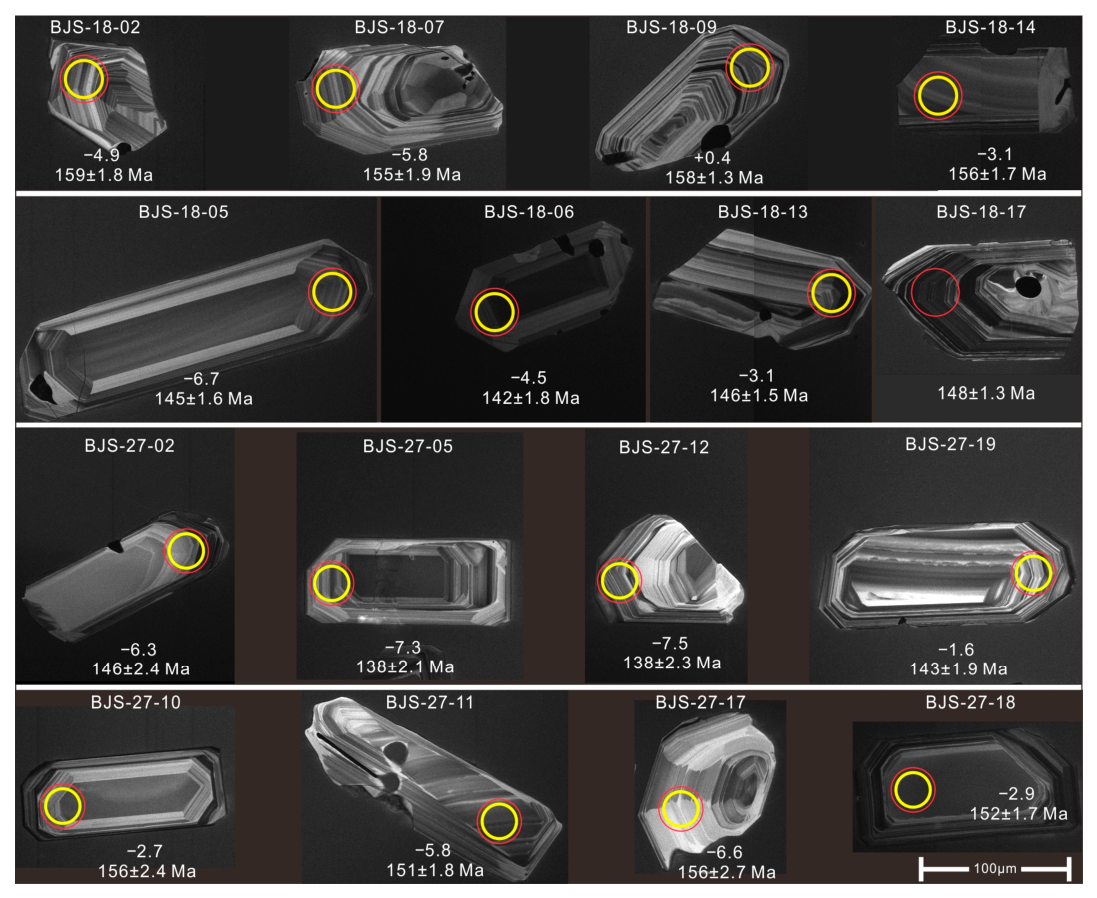
Volcanic rock samples used for zircon U–Pb dating were collected from the Bijiashan area, Chaozhou City, eastern Guangdong. The sample IDs used herein are BJS-18 (23°39′43″ N, 116°39′36″ E) and BJS-27 (23°39′43″ N, 116°39′38″ E). Zircons from both samples were colorless to transparent and mostly euhedral, with length-to-width ratios of ~3.75:1 to 2:1. Cathodoluminescence (CL) images showed well-developed oscillatory zoning typical of magmatic zircon growth (see Figure 4). Zircon Th contents ranged from 69.7 to 789 ppm, U contents from 135 to 1775 ppm, and Th/U ratios from 0.27 to 0.73 (mean 0.67); most analyses yielded Th/U > 0.4, consistent with a magmatic origin [30,31,32]. A total of 20 zircon grains were analyzed for each sample, and the analytical results are listed in Table S1.
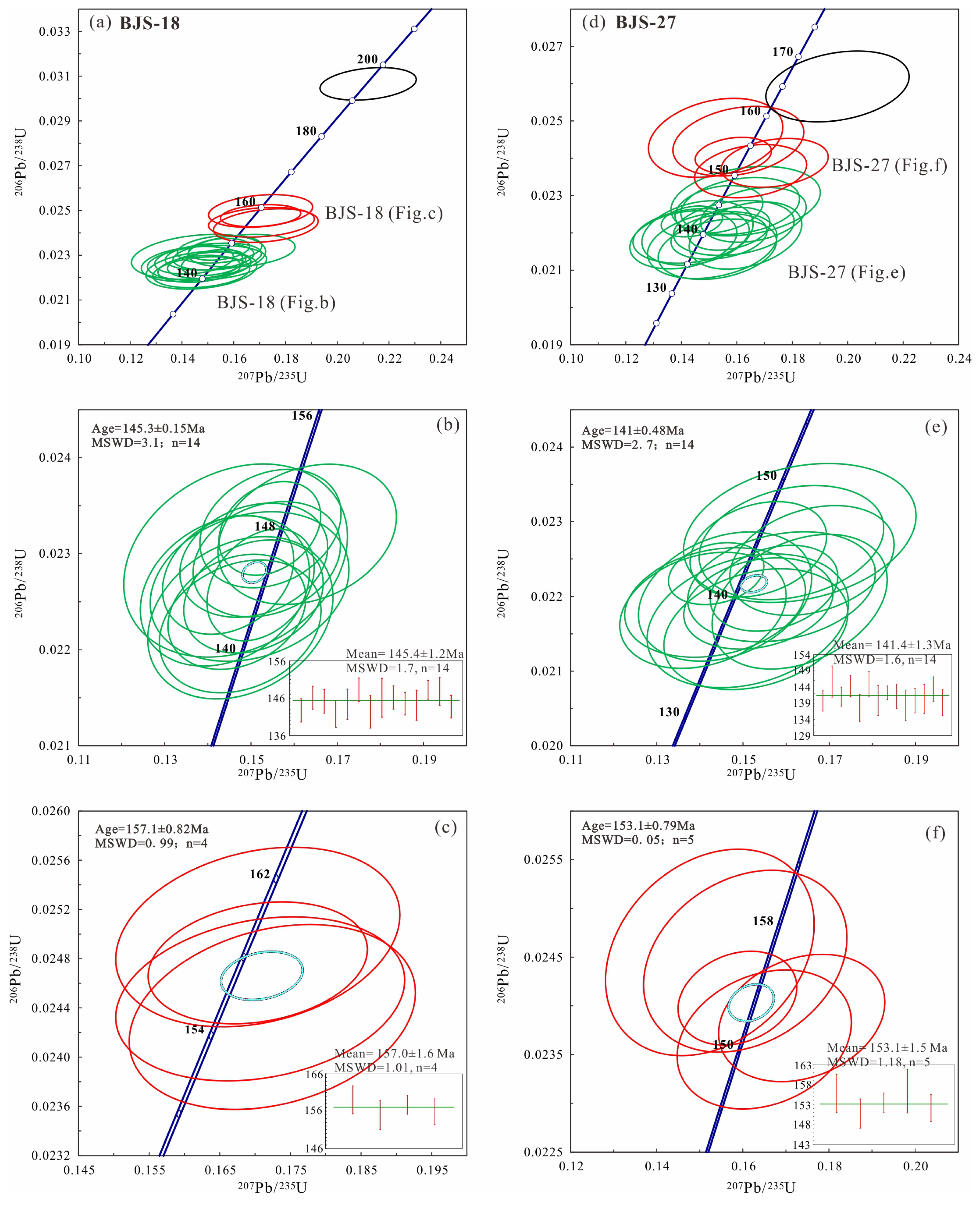
For sample BJS-18, 20 analyses defined two main age groups, except for one grain that yielded an older age of ~195 Ma (see Figure 5a). The dominant population yielded a weighted mean 206Pb/238U age of 145.4 ± 1.2 Ma (n = 14; MSWD = 1.7; see Figure 5b), whereas a subordinate population gave 157.0 ± 1.6 Ma (n = 4; MSWD = 1.01; see Figure 5c). For sample BJS-27, 20 analyses also defined two age groups, except for one grain that yielded an older age of ~165 Ma (see Figure 5d). The dominant population yielded a weighted mean 206Pb/238U age of 141.4 ± 1.3 Ma (n = 14; MSWD = 1.6; Figure 5e). The slightly elevated MSWD indicates minor age dispersion within this population, which may reflect subtle Pb loss, incorporation of antecrystic zircon components, or open-system processes within a long-lived magma reservoir. Therefore, this age is interpreted as the dominant zircon crystallization population rather than an instantaneous eruption age. The subordinate population yielded a weighted mean 206Pb/238U age of 153.1 ± 1.5 Ma (n = 5; MSWD = 1.18; Figure 5f).

4.2. Zircon Trace Elements

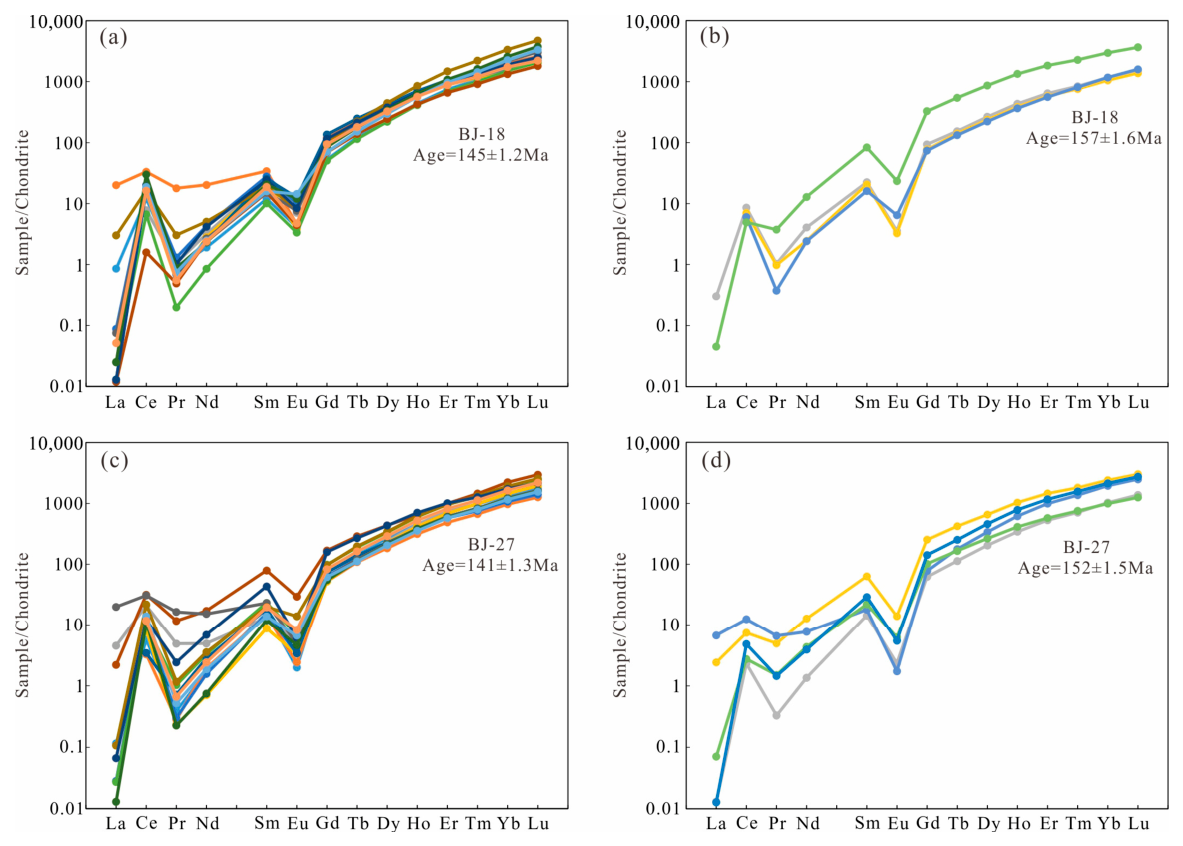
Zircon trace element data are listed in Table S2. Hereafter, “syneruptive (autocrystic) zircons” refer to grains belonging to the dominant Early Cretaceous U–Pb age populations (141–145 Ma) with magmatic CL oscillatory zoning, interpreted to have crystallized in the eruptible magma shortly before eruption, whereas “inherited/xenocrystic zircons” refer to the older zircon populations (~153–157 Ma) occurring as texturally magmatic grains incorporated into the host rhyolites, representing antecrysts or inherited components. On the CI-chondrite–normalized diagrams (see Figure 6a–d), both syneruptive and xenocrystic zircon populations show typical LREE-depleted and HREE-enriched patterns, with curves rising from Sm toward Er–Lu. All zircons displayed a positive Ce anomaly and a moderate to strong negative Eu anomaly. Overall Eu/Eu* values ranged from 0.047 to 0.423. Syneruptive zircons yielded Eu/Eu* = 0.069–0.423 in BJS-18 (median 0.16) and 0.058–0.311 in BJS-27 (median 0.15), whereas xenocrystic grains showed systematically lower Eu/Eu* values of 0.076–0.186 in BJS-18 (median 0.11) and 0.047–0.131 in BJS-27 (median 0.084).
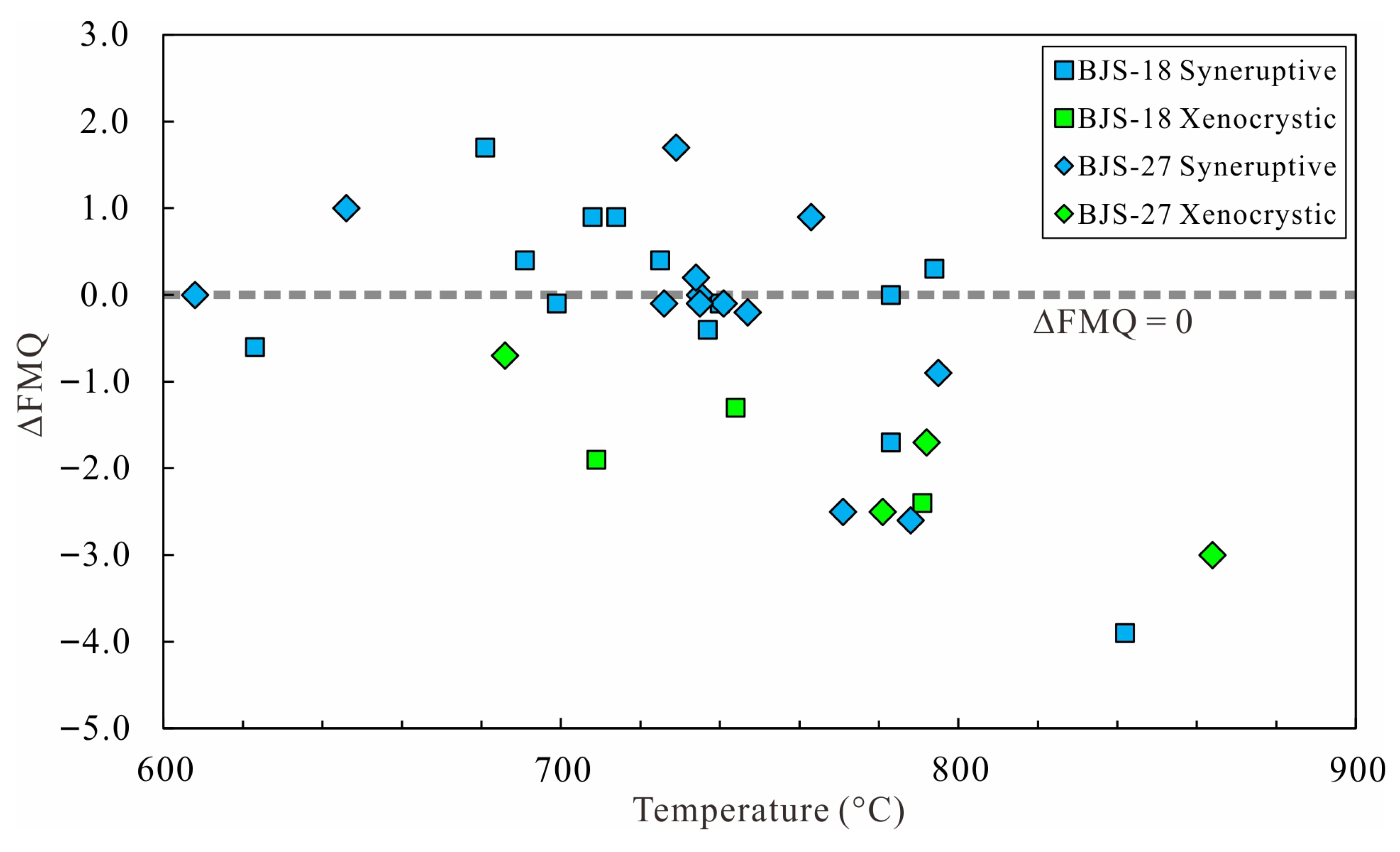
High field strength and radioactive elements were enriched in both zircon groups (Y = 654–2605 ppm; Hf = 9046–13,458 ppm; U = 115–1775 ppm). Ti contents ranged from 1.1 to 18.6 ppm. Using the Ti-in-zircon thermometer found in [34] with αSiO2 = 1 and αTiO2 = 0.6, the crystallization temperatures calculated were 623–842 °C for the syneruptive zircons in BJS-18 (median 719 °C) and 608–795 °C for the syneruptive zircons in BJS-27 (median 735 °C). The xenocrystic zircons yielded higher temperatures of 709–791 °C in BJS-18 (median 739 °C) and 686–864 °C in BJS-27 (median 781 °C).
The overall redox conditions estimated using ΔFMQ = 3.998·log10[Ce/√(U·Ti)] + 2.284 [35] ranged from −3.90 to +1.71. The syneruptive grains spanned −3.90 to +1.71 in BJS-18 (median −0.01) and −2.61 to +1.66 in BJS-27 (median −0.06), whereas the xenocrystic grains shifted to more reduced values of −2.36 to −1.01 in BJS-18 (median −1.61) and −3.12 to −0.72 in BJS-27 (median −2.51). The relationship between zircon crystallization temperature and calculated ΔFMQ is shown in Figure 7. Although some overlap exists, xenocrystic zircons generally record lower ΔFMQ values than syneruptive zircons at comparable temperature ranges, suggesting relatively more reduced crystallization conditions for the inherited or captured zircon populations. Overall, the REE patterns within each group were broadly parallel, while the xenocrystic grains showed lower Eu/Eu*, higher Ti-in-zircon temperatures, and lower ΔFMQ than did the syneruptive zircons (see Figure 6a–d and Figure 7; Table S2).

4.3. Zircon Lu–Hf Isotopes

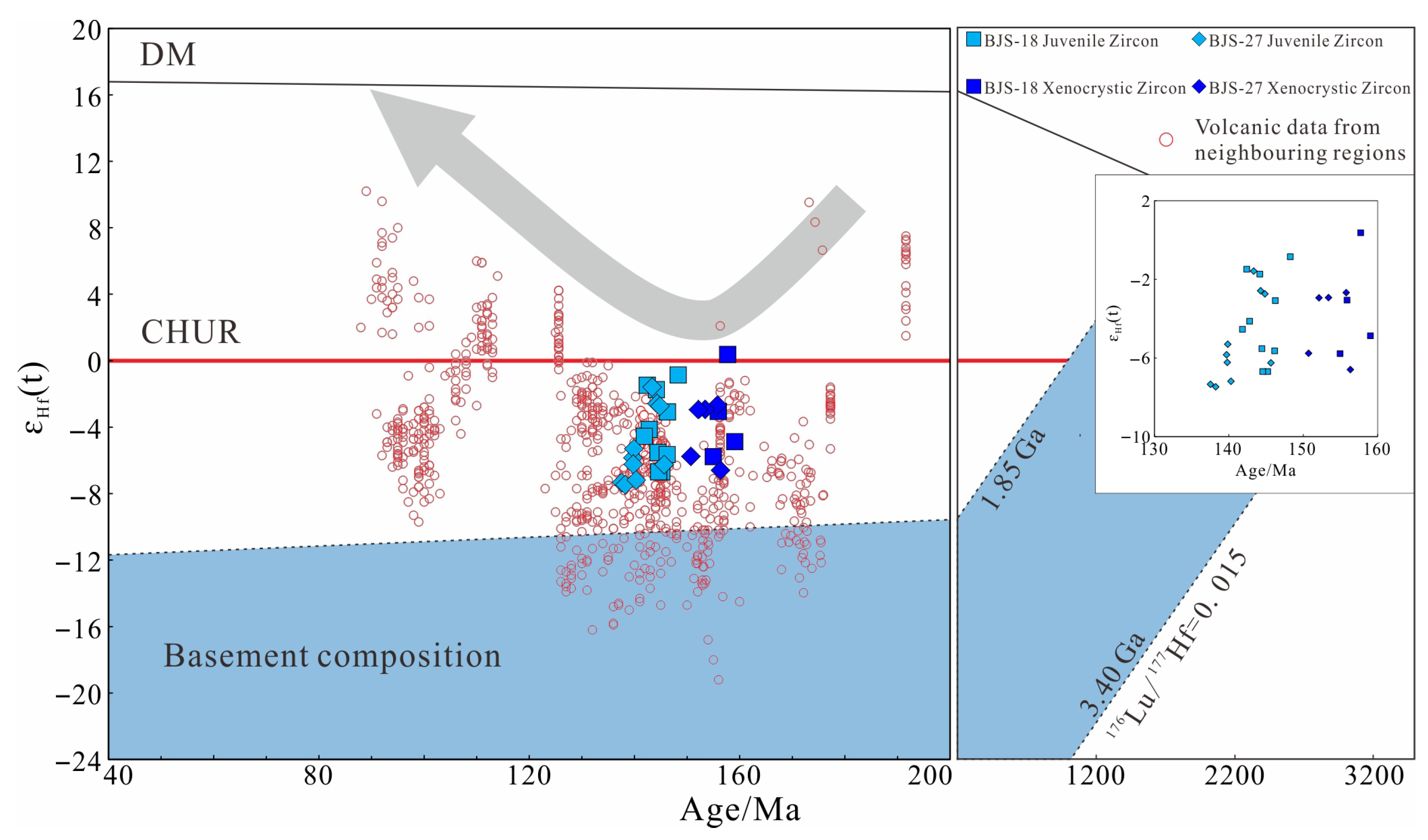
Zircon Hf isotope data are listed in Table S3. Magmatic (autocrystic) zircons from BJS-18 (U–Pb age group at ~145.4 Ma) yielded εHf(t) = −6.7 to −0.9, with TDM1 = 863–1091 Ma and TDM2 = 1251–1617 Ma. Coexisting inherited/xenocrystic grains (~157.1 Ma) showed εHf(t) = −5.7 to +0.4, with TDM1 = 798–1033 Ma and TDM2 = 1180–1565 Ma. For BJS-27, magmatic zircons (~141 Ma) yielded εHf(t) = −7.4 to −2.8, with TDM1 = 863–1092 Ma and TDM2 = 1294–1659 Ma. Inherited/xenocrystic zircons (~152–153 Ma) yielded εHf(t) = −6.7 to −1.6, with TDM1 = 915–1072 Ma and TDM2 = 1373–1622 Ma. All analyses had very low 176Lu/177Hf (0.00058–0.00185) and fLu/Hf ≈ −0.98 to −0.94, indicating negligible post-crystallization radiogenic ingrowth and robust preservation of initial Hf isotopic compositions [15,36]. A plot of εHf(t) versus individual zircon U–Pb ages shows that both the dominant Early Cretaceous zircon populations and the subordinate Late Jurassic populations mainly have negative εHf(t) values. The older populations at ca. 155–159 Ma and 151–156 Ma broadly overlap with the younger populations at ca. 138–148 Ma in Hf isotopic composition. No clear monotonic shift toward either more radiogenic or more unradiogenic εHf(t) values is observed from ca. 157 Ma to ca. 141 Ma.

4.4. Whole-Rock Major and Trace Elements

Whole-rock major and trace element data for 23 volcanic rock samples are presented in Table S4. The samples had high SiO2 contents of 75.39–90.02 wt.% (mean ~80.9 wt.%). Al2O3 ranged from 5.52 to 15.46 wt.%, total Fe as Fe2O3 from 0.60 to 1.57 wt.%, and MgO and CaO were consistently low (generally < 0.15 wt.%). Na2O was extremely low (0.01–0.04 wt.%), whereas K2O ranged from 1.33 to 3.97 wt.%, resulting in K2O/Na2O ratios >> 1. Loss on ignition (LOI) varied from 1.23 to 3.15 wt.%.
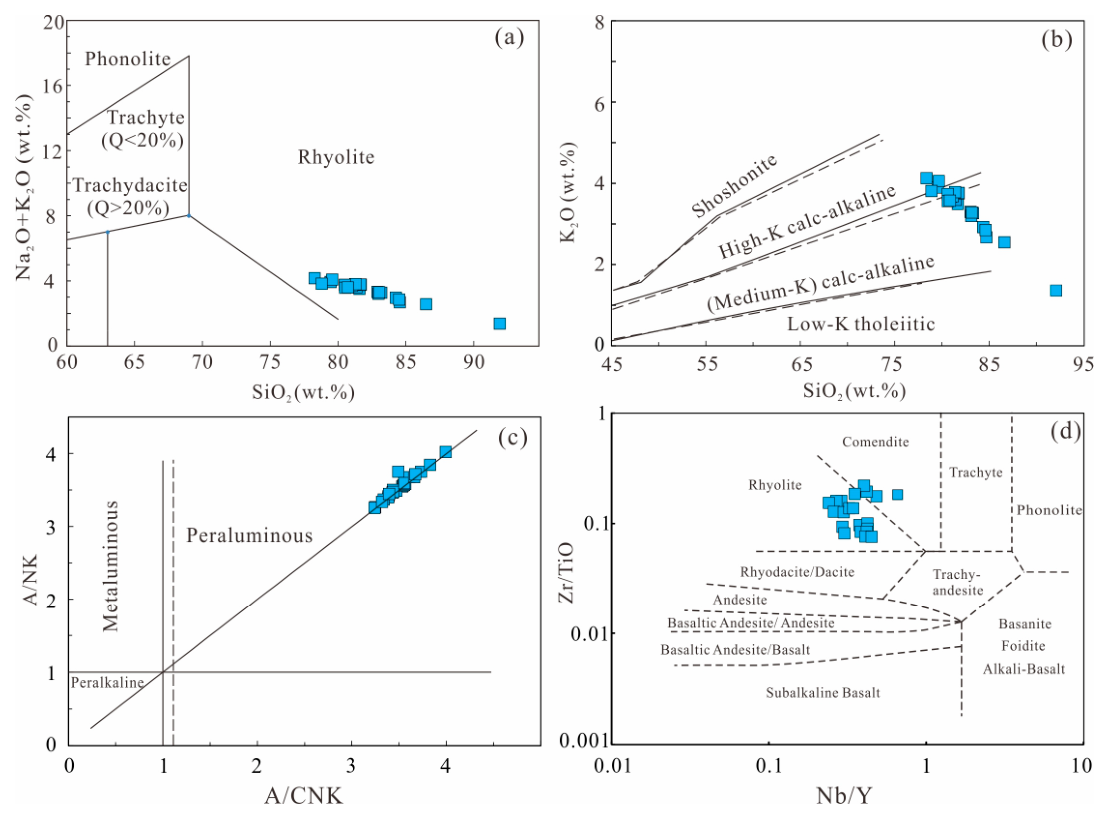
All samples yield high CIA values (76.45–80.02), and Na2O is ≤0.02 wt.% in 20 of the 23 samples. The highest SiO2 values (>85 wt.%) are associated with very low Na2O contents and high CIA values. In view of these features, major-element classification diagrams are presented as descriptive references, whereas rock-type classification and subsequent petrogenetic interpretation are evaluated mainly using relatively immobile element systematics, together with REE, HFSE, and zircon-based constraints. On the classification diagrams (see Figure 8), the samples plot in the rhyolite field on the TAS diagram (Figure 8a) and fall within the high-K calc-alkaline field on the K2O–SiO2 diagram (Figure 8b). Shand indices indicate apparent peraluminous compositions, with A/CNK > 1 and A/NK > 1 (see Figure 8c). However, because Na2O and CaO are extremely low and CIA values are high, these indices are treated as descriptive features rather than as direct evidence for primary magma affinity. The Winchester–Floyd Nb/Y–Zr/TiO2 diagram (Figure 8d), which is based on relatively immobile elements, independently supports a rhyolitic affinity. Most samples plot in the rhyolite field with Nb/Y < 1 and Zr/TiO2 ≈ 0.05–0.12, without extending into the trachyte/phonolite or peralkaline rhyolite (comendite) fields.
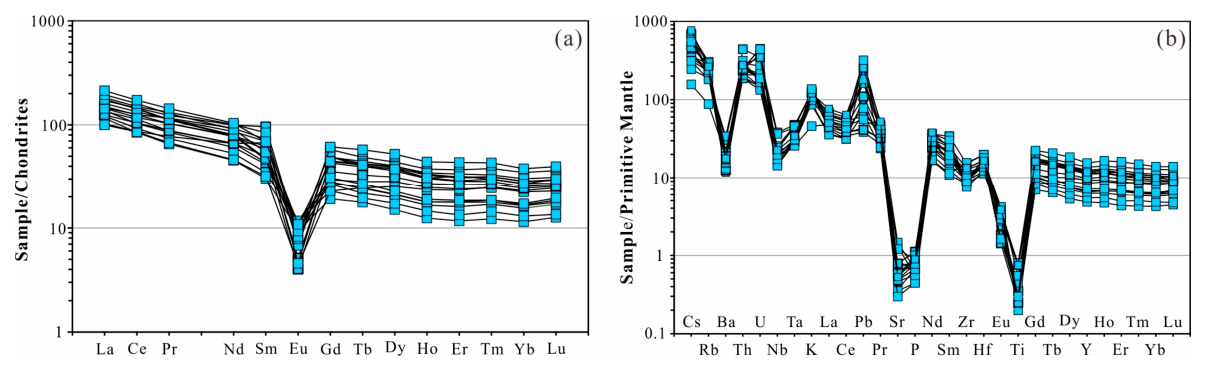
Because BJS-2 and BJS-4 are geochemically distinct lithic volcanic breccia fragments rather than representative high-silica rhyolites, they are excluded from the REE patterns and trace-element coupling diagrams in Figure 9 and Figure 10. Chondrite-normalized REE patterns (see Figure 9a) showed generally moderate to strong LREE enrichment, with relatively flat to slightly depleted HREE segments. (La/Yb) N ranged from 0.15 to 10.97 (mean ~7.2). All samples displayed clear negative Eu anomalies (Eu/Eu* = 0.085–0.395), whereas Ce anomalies were minor (Ce/Ce* = 0.97–1.07). (Gd/Yb) N ranged from 0.97 to 2.16, indicating variable MREE–HREE fractionation.
Trace element data showed enrichment in large ion lithophile elements (LILE), with Rb = 52.5–194.5 ppm and Ba = 77.1–224 ppm, but pronounced depletion in Sr (5.9–29.0 ppm). High field strength elements (HFSE) were moderately to strongly enriched, including Zr = 79–253 ppm, Hf = 3.20–6.80 ppm, Nb = 9.4–29.8 ppm, and Ta = 0.94–1.76 ppm, whereas transition metals (V, Cr, Co, Ni) were generally low. Primitive-mantle–normalized multi-element patterns (see Figure 9b) showed enrichment in LILE (e.g., Rb, Th, U, K) and depletion in Nb, Ta, P, and Ti, with prominent negative Nb–Ta and Ti anomalies.

5. Discussion

This section integrates zircon U–Pb geochronology, whole-rock immobile element systematics, zircon trace element constraints, and zircon Lu–Hf isotopes to address the key questions raised in the Introduction: (i) the timing of Bijiashan silicic volcanism within the Mesozoic volcanic cycles of South China, (ii) dominant processes controlling rhyolite generation and differentiation (fractional crystallization vs. source effects and crustal contamination), (iii) architecture and storage conditions of the silicic magma system, and (iv) tectonic setting and geodynamic driver(s) of volcanism along the Southeast China margin during Paleo-Pacific subduction.

5.1. Formation Age of the Bijiashan High-Silica Volcanic Rocks

To place the Bijiashan rhyolites into the regional tectono-magmatic framework of South China, we first evaluated their eruption timing against the established Mesozoic volcanic cycles and chronostratigraphy of volcanic formations in eastern Guangdong. Based on the volcanic assemblages, spatiotemporal distribution patterns, regional unconformities, tectonic settings, and associated metallogenic types, Mesozoic volcanism in South China has been subdivided into four volcanic cycles: Cycle I (Early Jurassic, 200–170 Ma), Cycle II (Middle–Late Jurassic, 165–145 Ma), Cycle III (early Early Cretaceous, 145–115 Ma), and Cycle IV (late Early Cretaceous–Late Cretaceous, 115–85 Ma) [44,45]. In eastern Guangdong, systematic geochronological and petrogenetic investigations of representative Jurassic volcanic successions constrained the formation ages of the Songling Formation (192–183 Ma), Jilingwan Formation (177–163 Ma), and Gaojiping Group (162–156 Ma). Moreover, the upper age limit of the Gaojiping volcanism has been suggested to extend to 145 Ma or even 139 Ma [5,46]. In regional geological mapping, the Bijiashan high-silica rhyolites were assigned to the Upper Jurassic Shuidishan Formation of the Gaojiping Group [47].
Eastern Guangdong is located at the southwestern segment of the Southeast China coastal volcanic belt, where Jurassic volcanic rocks are among the most extensively exposed and volumetrically significant in Southeast China [5]. The region also hosts numerous W–Sn polymetallic deposits closely related to volcanic–subvolcanic activity; therefore, the geochronology and petrogenesis of volcanic rocks have attracted increasing attention over the past decade [7,8,9,10,11,12,17]. In this study, zircon U–Pb dating of the Bijiashan high-silica rhyolites yielded a dominant crystallization population of 141.1–145.4 Ma, indicating volcanism occurred across the Jurassic–Cretaceous boundary (~145 Ma). In addition to the main population, subordinate age peaked at 153.1 ± 0.79 Ma and 157.1 ± 1.01 Ma, recording Late Jurassic magmatic activity. These older ages most likely represent antecrysts crystallized during earlier pulses within a long-lived, recharge-driven trans-crustal magmatic system (TCMS), and subsequently remobilized into the eruptible melt during later recharge and re-equilibration; alternatively, they may reflect inherited zircons incorporated during AFC processes through assimilation of wall rocks or pre-existing granitoids. Rare older zircon ages of ~195 Ma (BJS-18) and ~165 Ma (BJS-27) occur as isolated grains and are not interpreted as separate eruptive events. They are more likely inherited or captured antecrystic/xenocrystic zircons from earlier Jurassic magmatic rocks or wall-rock components. Their ages broadly correspond to Early Jurassic and Middle–Late Jurassic magmatic activity in eastern Guangdong, suggesting limited recycling of older zircon components during magma evolution.
Therefore, the Bijiashan rhyolites provide a precisely dated silicic pulse at the J/K boundary, and their subordinate Late Jurassic zircon components indicate multi-stage magma assembly, directly addressing the timing and episodicity question highlighted in the Introduction.

5.2. Petrogenesis

The petrogenesis of the Bijiashan high-silica rhyolites must be evaluated with caution because the whole-rock major-element data record variable post-magmatic modification. As shown in Section 4.4, several samples have extremely high SiO2 contents, very low Na2O contents, and high CIA values, indicating that silicification and alkali mobility affected the major-element compositions. Therefore, TAS classification and A/CNK values are not used here as primary evidence for magma source or granite type. Instead, the following discussion emphasizes relatively immobile trace elements, REE systematics, HFSE ratios, zircon trace-element compositions, and zircon Lu–Hf isotopes. In particular, the apparent peraluminous character shown by the A/NK–A/CNK diagram is interpreted cautiously, because Na2O and CaO loss may artificially increase A/CNK values. Thus, the high A/CNK values are not taken as evidence for a primary peraluminous or S-type magma.
We next assessed whether the Bijiashan high-silica rhyolites primarily reflected: (a) crust-dominated melt generation and shallow differentiation or (b) high-pressure source effects such as garnet-bearing residues (adakitic affinity), as this distinction bears directly on the tectonic interpretation. Late Jurassic, Early Cretaceous, and Late Cretaceous volcanic episodes in South China show pronounced differences in lithological associations and isotopic compositions. Volcanic rocks of Cycle II (Late Jurassic) and Cycle III (early Early Cretaceous) are dominated by high-K calc-alkaline series and andesite–rhyolite assemblages, with locally developed bimodal suites during the Early Cretaceous. Their Sr–Nd–Hf isotopic compositions are relatively enriched, implying a dominant crustal source with limited mantle involvement. In contrast, Cycle IV (Late Cretaceous) volcanism is mainly calc-alkaline with minor alkaline rocks and is commonly bimodal; corresponding Sr–Nd–Hf isotopes are more depleted, suggesting stronger inputs from depleted mantle components [44,45].
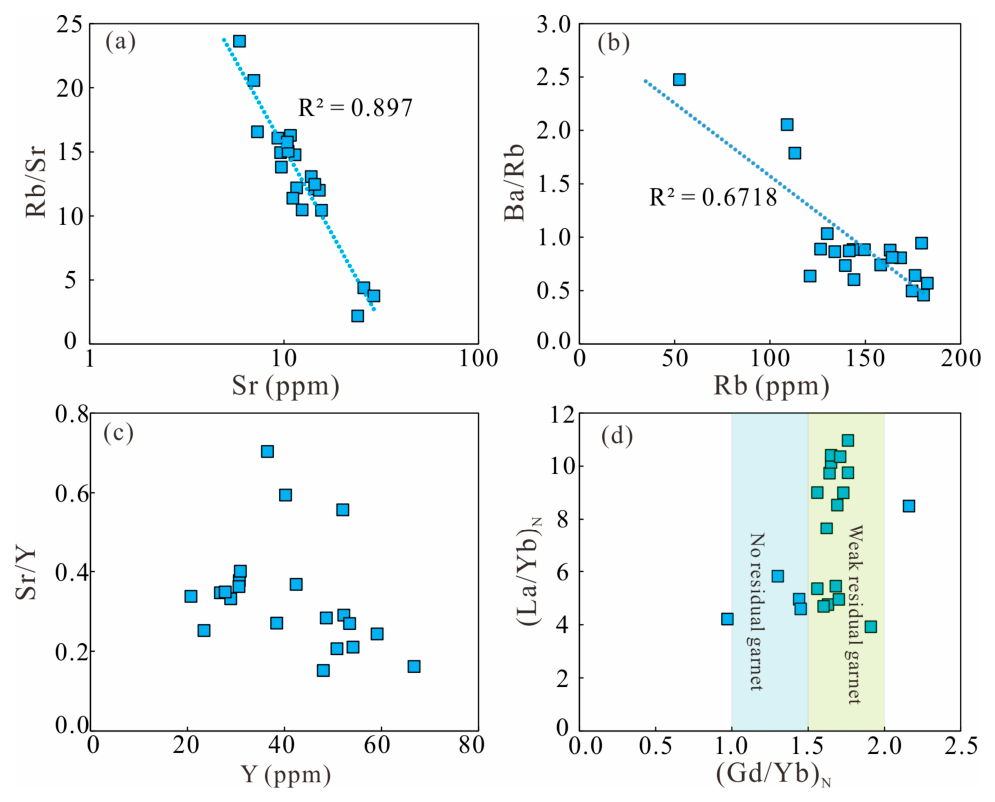
Major-element variations also provide descriptive evidence for differentiation. The samples show a positive K2O–SiO2 trend and decreasing Al2O3 with increasing SiO2, which are broadly consistent with progressive felsic differentiation and feldspar involvement. However, because Na2O and CaO are extremely low and CIA values are high, these major-element trends may have been modified by post-magmatic alteration and are therefore used only as supporting evidence. Coupled trace element relationships (Rb/Sr–Sr and Ba/Rb–Rb) indicate that the Bijiashan high-silica rhyolites experienced intense fractional crystallization dominated by plagioclase + K-feldspar; with progressive differentiation, Sr and Ba decrease systematically, whereas Rb becomes enriched, resulting in markedly increased Rb/Sr and decreasing Ba/Rb [41] (see Figure 10a,b). The pronounced negative Eu anomaly in REE patterns (Eu/Eu* ≈ 0.10–0.30) provides independent support for extensive feldspar fractionation [33,47] (see Figure 9a).
The samples showed mean values of (La/Yb) N ≈ 5–11 and (Gd/Yb) N ≈ 1–2, together with low Sr/Y (<1) and moderate Y (see Figure 10c,d). These features indicate that garnet was not a major residual phase and magma evolution predominantly occurred under mid- to upper-crustal conditions, consistent with non-adakitic characteristics [42,43]. Collectively, the immobile- and REE-based constraints suggest that the Bijiashan rhyolites most likely originated from crust-dominated, high-K calc-alkaline felsic melts and subsequently evolved in a shallow magma reservoir through staged fractional crystallization dominated by feldspars. This interpretation is supported by Sr–Ba depletion, Rb enrichment, and pronounced negative Eu anomalies. Minor fractionation of accessory phases such as Fe–Ti oxides, apatite, and zircon is inferred from HFSE and REE systematics, rather than from direct petrographic identification in all samples [2,48].
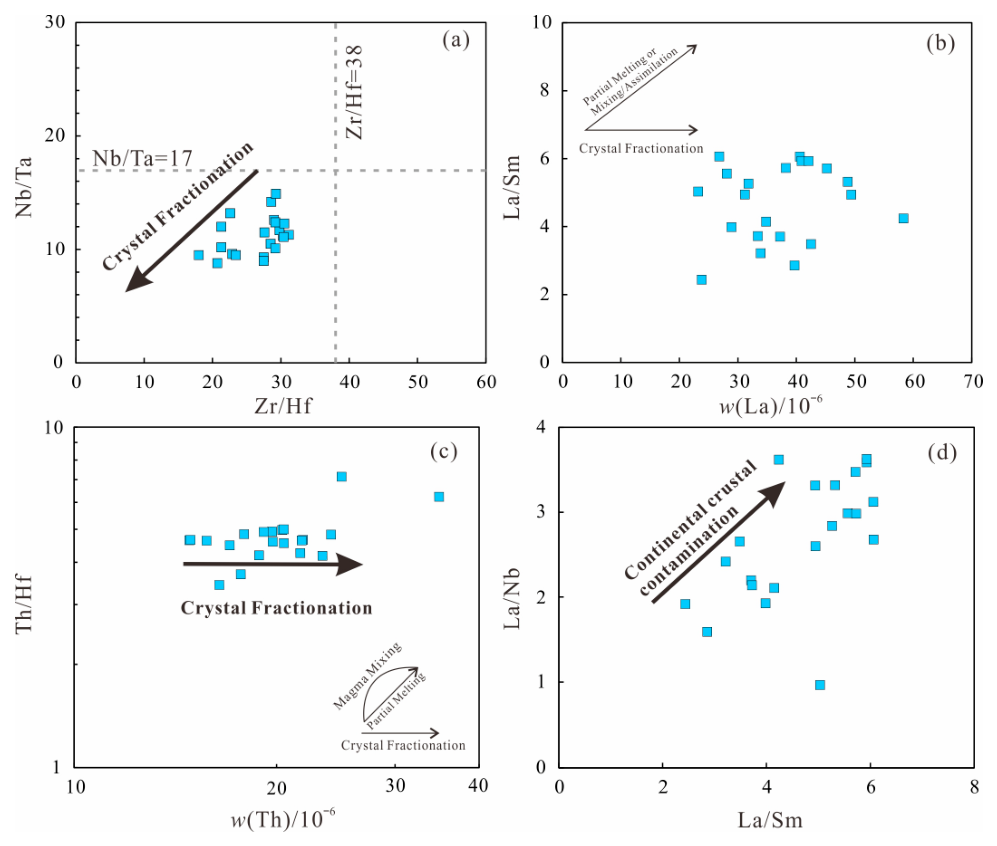
Additional constraints are provided by the Nb/Ta–Zr/Hf, La–La/Sm, and Th–Th/Hf diagrams (Figure 11a–c). The Nb/Ta and Zr/Hf ratios show moderate variation but do not define a distinct mantle-like or strongly peralkaline differentiation trend (Figure 11a), suggesting that the Bijiashan high-silica rhyolites mainly evolved within a crust-dominated felsic magmatic system. Although the data are scattered, the overall La–La/Sm distribution is broadly compatible with shallow-level fractional crystallization rather than requiring a major shift in magma source composition (Figure 11b). Similarly, Th increases while Th/Hf remains relatively stable in most samples (Figure 11c), suggesting that internal differentiation may have played an important role. The possible involvement of accessory phases, such as titanite, monazite, apatite, and zircon, is inferred from trace-element systematics rather than from direct petrographic identification in all samples [49,50].
Strongly incompatible element ratios sensitive to crustal interaction further constrained the evolutionary process. The samples yielded Th/Ta = 11.0–23.6 (mean = 15.9), which was substantially higher than typical lower-crust values (~2–3) and within or above common middle–upper crust ranges (>10), suggesting possible interaction with middle–upper crustal materials during magma ascent and storage [55,56]. Together with the positive covariation between La/Sm and La/Nb (Figure 11d), these data support a model in which fractionation-dominated evolution was accompanied by crustal assimilation and/or an increased proportion of crust-derived melts. This inference is consistent with the strong negative Eu anomalies and low Sr/Y ratios discussed above, indicating that crust-dominated felsic melts evolved in a mid–upper crustal magma reservoir through intense fractional crystallization, with possible local crustal interaction. This interpretation is also consistent with the field context described in Section 2.2, where the sampled volcanic rocks occur within a fault-controlled volcanic–plutonic corridor close to Early Cretaceous granitoid intrusions and locally contain lithic fragments and clast–matrix textures.
Zircon Lu–Hf isotopes provide robust constraints on magma sources. Zircons from two Bijiashan high-silica rhyolite samples yielded εHf(t) = −7.4 to −0.9 and two-stage model ages (TDM2) = 1180–1659 Ma (Figure 12). Zircon is a common and resistant accessory mineral widely used for U–Pb dating, and its high Hf contents, very low 176Lu/177Hf (commonly < 0.002), and high closure temperature allow it to largely preserve initial Hf isotopic compositions, making it a powerful tracer of source characteristics and crust–mantle interaction [14,15]. These zircon εHf(t) values and Mesoproterozoic TDM2 ages indicate substantial reworking of ancient Cathaysian crust. However, the εHf(t) values are not sufficiently unradiogenic to indicate derivation from purely ancient crust. The relatively radiogenic upper end of the range, together with the MORB/WPB-like mafic lithic fragments BJS-2 and BJS-4, suggests limited juvenile or mantle-derived input into the crust-dominated magmatic system.
In summary, considering the combined evidence from immobile element trends (Figure 10 and Figure 11), the REE systematics, including strong Eu depletion (Figure 9a), non-adakitic signatures (low Sr/Y and modest (Gd/Yb)N; Figure 10c,d), and predominantly negative εHf(t) values (Figure 12), support a crust-dominated felsic melt that underwent intense shallow-level feldspar-controlled fractionation with limited but detectable middle–upper crustal contamination, thereby constraining the magma source and evolutionary pathway proposed in the Introduction.

5.3. Eruption Processes and Magma Storage: Constraints on Plumbing Architecture from Facies and Zircon Thermometry–Oxybarometry

Based on the field and petrographic observations described in Section 2.2 and Section 2.3, the flow banding/flow foliation, autobrecciated breccia–massive facies, and local mafic lithic fragments suggest proximal shallow-conduit autobrecciation or syn-eruptive fragmentation. Combined with zircon-based thermometry and oxybarometry, these features support an open, multi-conduit silicic magma system, consistent with classical volcanic facies interpretations for proximal silicic successions [64].
Whole-rock geochemistry (low Sr and Ba; pronounced negative Eu anomalies), together with (Gd/Yb) N ≈ 1–1.7, Sr/Y < 1, and a moderate Y, indicates that magma storage and differentiation occurred in a shallow mid–upper crustal reservoir rather than a high-pressure thickened crust channel. Such low-pressure, high-viscosity silicic magmas readily concentrate volatiles and are favorable for explosive eruptions (e.g., ash fall and pyroclastic density currents) [2].
Regionally, Late Jurassic–Early Cretaceous magmatism along the South China coastal margin was controlled by Paleo-Pacific subduction and underwent an Early Cretaceous tectonic transition from compression to extension (slab rollback and/or changes in slab geometry). Rift–fault systems provided pathways and space for bimodal volcanism and open magma transport [3,4,6,17].
Zircon trace elements further constrained reservoir stratification and pre- to syn-eruptive conditions. Syneruptive zircons and xenocrystic/inherited zircons showed broadly parallel CI-normalized REE patterns, yet xenocrystic grains exhibited stronger Eu depletion, higher Ti in-zircon temperatures, and lower ΔFMQ values, indicating crystallization in a deeper (or earlier), hotter, and more reduced reservoir. In contrast, syneruptive zircons recorded shallower conditions closer to FMQ. This systematic contrast supports a vertically and temporally zoned plumbing system in which an extensional regime promoted open conduits, and mafic recharge/thermal–volatile perturbations likely triggered the explosive eruption of shallow high-silica melts [34,35].
These observations are consistent with an open, vertically zoned plumbing system in which deeper, hotter, and more reduced reservoirs supplied crystals and heat, whereas the shallow reservoir approached FMQ conditions prior to eruption; such a configuration is compatible with recharge-driven remobilization and provides the process-level mechanism required for the tectonic interpretation developed below.

5.4. Tectonic Setting

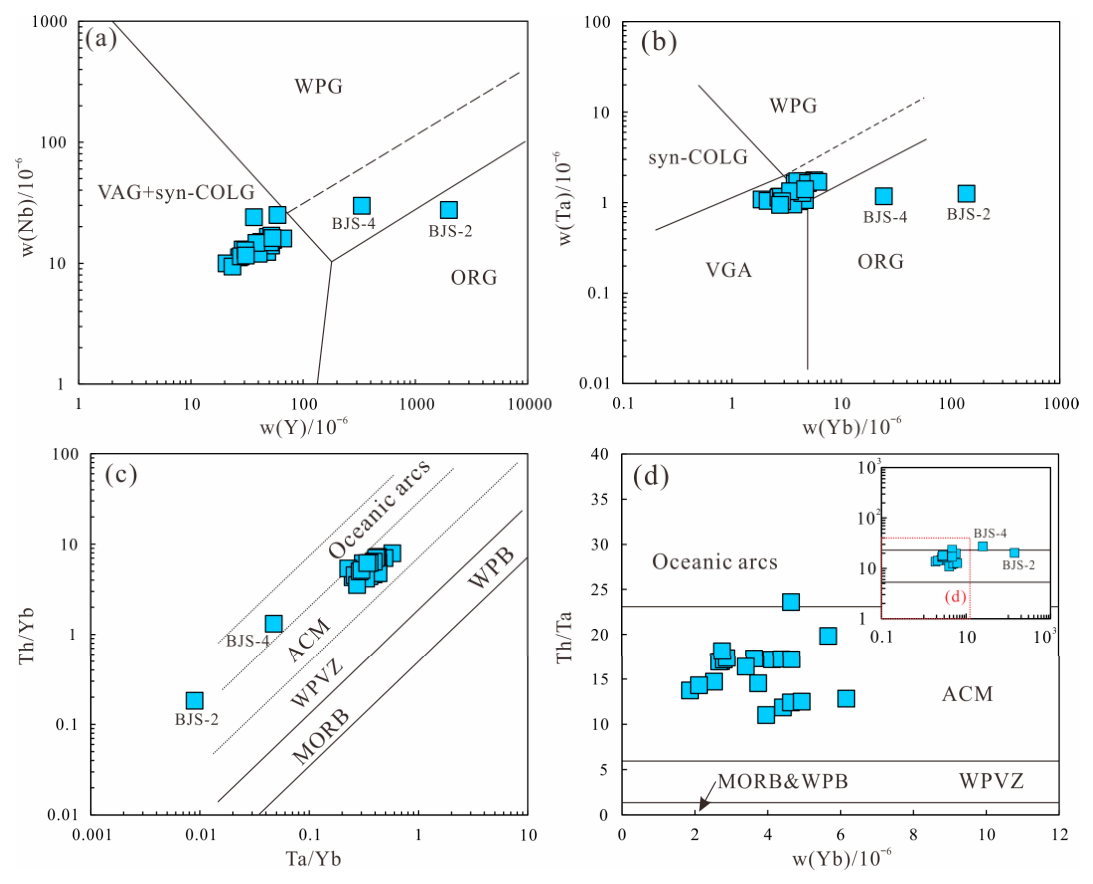
The tectonic affinity of the Bijiashan rhyolites was most directly constrained by their arc-like trace element fingerprints and consistent results of multiple discrimination diagrams (see Figure 13), indicating a subduction-related active continental margin setting. During the Late Jurassic–Early Cretaceous, eastern Guangdong was part of an active continental margin controlled by Paleo-Pacific subduction and experienced a regional transition from compression to extension. Specifically, ~200–165 Ma can be interpreted as post-orogenic intracontinental extension, with basalt–rhyolite bimodal volcanism developing in rift systems [3,6]. From 165 to 145 Ma, the margin entered a transition stage from peak compression toward extension, characterized by moderate-scale calc-alkaline volcanic–plutonic activity [3,6]. From 145 to 115 Ma, rollback/tearing-related strong extension, lithospheric thinning, and elevated heat flow promoted large-volume high-K calc-alkaline felsic volcanism and granitoid magmatism [3,4,17,57,65]. From 115 to 85 Ma, the system evolved into a post-orogenic stage with weakened and eastward-migrating magmatism and locally alkaline/peralkaline intrusions [6,17,57,65]. Overall, the tectonic background of eastern Guangdong can be summarized as a subduction-related continental arc that evolved into an intra-arc/back-arc extensional regime in the Early Cretaceous, allowing coeval crust-derived silicic and mantle-derived mafic melts to be generated and intermittently released [2,3] (see Figure 13).
Multiple tectonic discrimination diagrams consistently assigned the Bijiashan high-silica rhyolites (excluding the mafic lithic fragments BJS-2 and BJS-4) to an arc-related setting (see Figure 13). Across different diagram systems, the samples clustered within VAG/syn-COLG and ACM/island arc-related fields and remained systematically distant from WPG/ORG and MORB/WPB trends, indicating formation in a subduction-related active continental margin affinity rather than intraplate or ridge environments [1,2,13] (see Figure 13). At comparable Ta/Yb (or Yb), the samples showed elevated Th/Yb and Th/Ta, reflecting the first-order subduction fingerprint of LILE–Th enrichment coupled with Nb–Ta depletion; this pattern is consistent with the continental arc to syn-collisional discrimination framework [1,2] (see Figure 13). However, the VAG/ACM affinity should be interpreted as a geochemical signature rather than as direct evidence for a purely compressional regime at the time of eruption. In evolved continental-margin settings, arc-like Nb–Ta–Ti depletion may also be inherited from crustal sources previously modified by subduction-related fluids or melts. Thus, the Bijiashan rhyolites most likely record remelting of subduction-modified Cathaysian crust during the Jurassic–Cretaceous transition, while retaining inherited arc-like trace-element signatures.
This tectonic interpretation is also temporally compatible with the regional transition from compression/shortening to extension/thinning during Early Cretaceous slab rollback along the Southeast China margin [3,6]. Given that the Bijiashan eruption ages (~141–145 Ma) overlap the onset of the Early Cretaceous compression-to-extension transition, the continental arc affinity inferred from Figure 13 is most plausibly expressed under an intra-arc to back arc extensional regime, consistent with slab rollback–related lithospheric thinning proposed for Paleo-Pacific subduction. Although slab break-off may also induce asthenospheric upwelling and mafic underplating, the widespread and diachronous Late Mesozoic magmatism along the Southeast China margin is more consistent with progressive Paleo-Pacific slab rollback or slab tearing than with a short-lived break-off event alone. The geochemically MORB/WPB-like mafic volcanic lithic fragments (BJS-2 and BJS-4) likely record localized extensional mafic activity and open conduits during, or slightly prior to, rhyolitic eruption; importantly, they do not alter the dominant continental-arc affinity indicated by the rhyolites (Figure 13). Regional coeval mafic magmatism, represented by the ca. 145 Ma Tuanshanbei dolerite dikes with alkaline basaltic affinities, further supports Early Cretaceous lithospheric thinning and mantle-derived input during the initial rollback-related extensional stage [66]. Thus, the MORB/WPB-like mafic lithics are best viewed as a local manifestation of extensional mafic activity that provided thermal and volatile perturbations to the silicic reservoir, reinforcing rather than contradicting the rollback-linked extensional framework. Together with the regional Tuanshanbei dolerite record, these mafic components suggest that limited mantle-derived input or heat supply accompanied crust-dominated silicic magmatism during rollback-related extension. For regional comparisons and end-member compositions, we adopted the mantle reference and normalization parameters of [33,55]. For MORB reference compositions and their regional variability, see [67].
At the regional scale, the Bijiashan volcanic area is located within the Southeast Coast Magmatic Belt and close to major NE-trending coastal fault systems, including the Zhenghe–Dapu and Changle–Nanào faults (Figure 1). The spatial association between Late Mesozoic volcanic–plutonic rocks and these NE-trending structures suggests that strike-slip/extensional fault systems provided pathways for magma ascent and accommodation space for volcanic basin development. At the local scale, the volcanic rocks and associated granitoids in the Chaozhou–Raoping area are also aligned along NE-trending faults (Figure 2), linking shallow crustal magma emplacement to the regional rollback-related extensional framework. Therefore, the Bijiashan rhyolites record J/K-boundary silicic magmatism in an active continental margin that was transitioning into intra-arc/back arc extension, consistent with an asynchronous Paleo-Pacific slab rollback model for the Southeast China margin [57]. Their arc-like geochemical fingerprints, MORB/WPB-like mafic lithic fragments, regional coeval mafic magmatism, and fault-controlled volcanic–plutonic distribution together support a rollback-related extensional framework.

6. Conclusions

  • Zircon U–Pb geochronology constrains the dominant crystallization populations of the Bijiashan high-silica rhyolites to 145.4 ± 1.2 Ma for BJS-18 and 141.1 ± 1.3 Ma for BJS-27, indicating that the main silicic magmatism occurred near the Jurassic–Cretaceous boundary. Subordinate Late Jurassic zircon populations at 157.1 ± 1.01 Ma and 153.1 ± 0.79 Ma record earlier magmatic components, most plausibly reflecting antecryst recycling within a long-lived trans-crustal magmatic system, although inheritance during assimilation–fractional crystallization processes cannot be excluded. Rare older zircon grains of ~195 Ma and ~165 Ma further suggest limited recycling of earlier Jurassic zircon components during magma evolution.
  • Whole-rock and zircon geochemical data indicate that the Bijiashan rhyolites experienced substantial crustal reworking and shallow-level feldspar-dominated fractional crystallization. Although some major-element compositions were modified by post-magmatic silicification and alkali mobility, relatively immobile trace elements, REE patterns, and zircon-based constraints support a rhyolitic affinity and a non-adakitic evolutionary trend. Systematic Sr–Ba depletion, Rb enrichment, pronounced negative Eu anomalies, and low Sr/Y ratios indicate extensive plagioclase + K-feldspar fractionation in the mid–upper crust without a major garnet-bearing residual phase. Zircon εHf(t) values of −7.4 to −0.9 and TDM2 ages of 1.18–1.66 Ga indicate substantial reworking of Mesoproterozoic Cathaysian crust, with limited juvenile or mantle-derived input.
  • The Bijiashan rhyolites are best interpreted as products of subduction-related continental-margin silicic magmatism along the Southeast China coastal belt. Their Jurassic–Cretaceous boundary timing, arc-like trace-element signatures, and regional correlation with Early Cretaceous magmatism indicate formation during a transition from compression to intra-arc/back-arc extension. This tectono-magmatic framework is most consistent with progressive Paleo-Pacific slab rollback beneath Southeast China, which promoted lithospheric thinning, mantle-derived heat input, and remelting of crustal sources while preserving inherited arc-like geochemical signatures.

Supplementary Materials

The following supporting information can be downloaded at https://www.mdpi.com/article/10.3390/min16050550/s1. Table S1: Results of U-Pb zircon age from the rock bodies in the Bijiashan; Table S2: Results of trace elements (ppm) in zircons from the rock bodies in the Bijiashan area; Table S3: Zircon Lu-Hf isotopic compositions of the Bijiashan; Table S4: Results of whole-rock major (wt.%) and trace (ppm) elements from the rock bodies in the Bijiashan.

Author Contributions

Conceptualization, Y.L. and H.Q.; methodology, Y.L. and H.Q.; software, Y.L.; validation, Y.L., L.W. and H.Q.; formal analysis, Y.L.; investigation, Y.L., L.W., W.H. and W.L.; resources, H.Q.; data curation, Y.L. and L.W.; writing—original draft preparation, Y.L.; writing—review and editing, Y.L., L.W., W.H., W.L. and H.Q.; visualization, Y.L. and W.H.; supervision, H.Q.; project administration, Y.L.; funding acquisition, Y.L. All authors have read and agreed to the published version of the manuscript.

Funding

This research was funded by the Project of Educational Commission of Guangdong Province of China (grant number: 2023KCXTD023) and the Project of Key Laboratory of General Universities in Guangdong Province (grant number: 2023KSYS007).

Data Availability Statement

The original contributions presented in this study are included in the article/Supplementary Materials. Further inquiries can be directed to the corresponding author.

Acknowledgments

The authors thank Wuhan SampleSolution Analytical Technology Co., Ltd. (Wuhan, China) for assistance with zircon LA–ICP–MS U–Pb geochronology and trace-element analyses, and for in situ zircon Lu–Hf isotope measurements. We also acknowledge Aoshi Analytical Testing (Guangzhou) Co., Ltd. (Guangzhou, China) for whole-rock major-, trace-, and rare earth element analyses. We appreciate the technical support of the laboratory staff during sample preparation, instrumental operation, and data acquisition. The authors also thank Rebecca Stout for professional English-language editing and polishing of the manuscript. During the preparation of this manuscript, the authors used ChatGPT-5.5 (OpenAI, latest ‘Thinking’ version as of May 2026) for language polishing and formatting of references and citations. The authors reviewed and edited the output and took full responsibility for the content of this publication.

Conflicts of Interest

The authors declare no conflicts of interest. The funders had no role in the design of the study; in the collection, analyses, or interpretation of data; in the writing of the manuscript; or in the decision to publish the results.

References

  1. Pearce, J.A.; Harris, N.B.W.; Tindle, A.G. Trace element discrimination diagrams for the tectonic interpretation of granitic rocks. J. Petrol. 1984, 25, 956–983. [Google Scholar] [CrossRef]
  2. Pearce, J.A.; Peate, D.W. Tectonic implications of the composition of volcanic arc magmas. Annu. Rev. Earth Planet. Sci. 1995, 23, 251–285. [Google Scholar] [CrossRef]
  3. Li, X.H.; Li, W.X.; Wang, X.C.; Li, Q.L.; Liu, Y.; Tang, G.Q. Cretaceous tectonic evolution of South China: A preliminary synthesis. Earth-Sci. Rev. 2014, 134, 98–136. [Google Scholar] [CrossRef]
  4. Li, Z.X.; Li, X.H. Formation of the 1300-km-wide intracontinental orogen and post-orogenic magmatic province in Mesozoic South China: A flat-slab subduction model. Geology 2007, 35, 179–182. [Google Scholar] [CrossRef]
  5. Yue, X.H.; Liu, L.; Zhang, Z.G.; Zhao, Z.X.; Sun, J.; Zhao, Y. Petrogenesis of the Jurassic representative volcanic rocks in eastern Guangdong: Response to the early stage of the Paleo-Pacific subduction. Geol. J. China Univ. 2022, 28, 199–210. [Google Scholar] [CrossRef]
  6. Zhou, X.M.; Li, W.X. Origin of Late Mesozoic igneous rocks in Southeastern China: Implications for lithosphere subduction and underplating of mafic magmas. Tectonophysics 2000, 326, 269–287. [Google Scholar] [CrossRef]
  7. Liu, P. Geological characteristics and tectonic setting of Early Cretaceous Sn (W) deposits in the SE China coastal metallogenic belt and exploration implications. Acta Petrol. Sin. 2021, 37, 683–697, (In Chinese with English abstract). [Google Scholar]
  8. Liu, P.; Mao, J.W.; Pirajno, F. Ore genesis and geodynamic setting of the Lianhuashan porphyry tungsten deposit, eastern Guangdong Province, SE China: Constraints from muscovite 40Ar−39Ar and zircon U-Pb dating and Hf isotopes. Miner. Depos. 2018, 53, 905–924. [Google Scholar] [CrossRef]
  9. Qiu, Z.W.; Li, S.S.; Yan, Q.H.; Wang, H.; Wei, X.P.; Li, P.; Wang, L.M.; Bu, A. Late Jurassic Sn metallogeny in eastern Guangdong, SE China coast: Evidence from geochronology, geochemistry and Sr-Nd-Hf-S isotopes of the Dadaoshan Sn deposit. Ore Geol. Rev. 2017, 83, 63–83. [Google Scholar] [CrossRef]
  10. Qiu, Z.W.; Yan, Q.H.; Li, S.S.; Wang, H.; Wei, X.P.; Li, P.; Wang, L.M.; Bu, A. Highly fractionated Early Cretaceous I-type granites and related Sn polymetallic mineralization in the Jinkeng deposit, eastern Guangdong, SE China: Constraints from geochronology, geochemistry, and Hf isotopes. Ore Geol. Rev. 2017, 88, 718–738. [Google Scholar] [CrossRef]
  11. Yan, Q.H.; Li, S.S.; Qiu, Z.W.; Wang, H.; Wei, X.P.; Li, P.; Dong, R.; Zhang, X.Y. Geochronology, geochemistry and Sr-Nd-Hf-S-Pb isotopes of the Early Cretaceous Taoxihu Sn deposit and related granitoids, SE China. Ore Geol. Rev. 2017, 89, 350–368. [Google Scholar] [CrossRef]
  12. Yan, Q.H.; Wang, H.; Qiu, Z.W.; Wei, X.P.; Li, S.S.; Li, P.; Dong, R.; Zhang, X.Y.; Zhou, K. Origin of Early Cretaceous A-type granite and related Sn mineralization in the Sanjiaowo deposit, eastern Guangdong, SE China and its tectonic implication. Ore Geol. Rev. 2018, 93, 60–80. [Google Scholar] [CrossRef]
  13. Wood, D.A. The application of a Th-Hf-Ta diagram to problems of tectonomagmatic classification and to establishing the nature of crustal contamination of basaltic lavas of the British Tertiary Volcanic Province. Earth Planet. Sci. Lett. 1980, 50, 11–30. [Google Scholar] [CrossRef]
  14. Griffin, W.L.; Pearson, N.J.; Belousova, E.; Jackson, S.E.; van Achterbergh, E.; O’Reilly, S.Y.; Shee, S.R. The Hf isotope composition of cratonic mantle: LAM-MC-ICPMS analysis of zircon megacrysts in kimberlites. Geochim. Cosmochim. Acta 2000, 64, 133–147. [Google Scholar] [CrossRef]
  15. Wu, F.Y.; Li, X.H.; Zheng, Y.F.; Gao, S. Lu-Hf isotopic systematics and their applications in petrology. Acta Petrol. 2007, 2, 185–220. [Google Scholar]
  16. Xu, X.S.; O’Reilly, S.Y.; Griffin, W.L.; Wang, X.L.; Pearson, N.J.; He, Z.Y. The crust of Cathaysia: Age, assembly and reworking of two terranes. Precambrian Res. 2007, 158, 51–78. [Google Scholar] [CrossRef]
  17. Jiang, Y.H.; Wang, G.C.; Liu, Z.; Ni, C.Y.; Qing, L.; Zhang, Q. Repeated slab advance-retreat of the Palaeo-Pacific plate underneath SE China. Int. Geol. Rev. 2015, 57, 472–491. [Google Scholar] [CrossRef]
  18. Zhou, X.M.; Sun, T.; Shen, W.Z.; Shu, L.S.; Niu, Y.L. Petrogenesis of Mesozoic granitoids and volcanic rocks in south China: A response to tectonic evolution. Episodes 2006, 29, 26–33. [Google Scholar] [CrossRef]
  19. Liu, Y.; Hu, Z.; Zong, K.; Gao, C.; Gao, S.; Xu, J.; Chen, H. Reappraisement and refinement of zircon U-Pb isotope and trace element analyses by LA-ICP-MS. Chin. Sci. Bull. 2010, 55, 1535–1546. [Google Scholar] [CrossRef]
  20. Hu, Z.C.; Zhang, W.; Liu, Y.S.; Gao, S.; Li, M.; Zong, K.Q.; Chen, H.H.; Hu, S.H. “Wave” signal-smoothing and mercury-removing device for laser ablation quadrupole and multiple collector ICPMS analysis: Application to lead isotope analysis. Anal. Chem. 2015, 87, 1152–1157. [Google Scholar] [CrossRef]
  21. Hu, Z.C.; Li, X.H.; Luo, T.; Zhang, W.; Crowley, J.; Li, Q.L.; Ling, X.X.; Yang, C.; Li, Y.; Feng, L.P.; et al. Tanz zircon megacrysts: A new zircon reference material for the microbeam determination of U–Pb ages and Zr–O isotopes. J. Anal. At. Spectrom. 2021, 36, 2715–2734. [Google Scholar] [CrossRef]
  22. Liu, Y.S.; Hu, Z.C.; Gao, S.; Günther, D.; Xu, J.; Gao, C.G.; Chen, H.H. In situ analysis of major and trace elements of anhydrous minerals by LA-ICP-MS without applying an internal standard. Chem. Geol. 2008, 257, 34–43. [Google Scholar] [CrossRef]
  23. Ludwig, K.R. ISOPLOT 3.00: A Geochronological Toolkit for Microsoft Excel; Berkeley Geochronology Center: Berkeley, CA, USA, 2003; 39p. [Google Scholar]
  24. Hu, Z.C.; Liu, Y.S.; Gao, S.; Liu, W.G.; Zhang, W.; Tong, X.R.; Lin, L.; Zong, K.Q.; Li, M.; Chen, H.H.; et al. Improved in situ Hf isotope ratio analysis of zircon using newly designed X skimmer cone and jet sample cone in combination with the addition of nitrogen by laser ablation multiple collector ICP-MS. J. Anal. At. Spectrom. 2012, 27, 1391–1399. [Google Scholar] [CrossRef]
  25. Woodhead, J.D.; Hergt, J.M.; Shelley, M.; Eggins, S.; Kemp, R. Zircon Hf-isotope analysis with an excimer laser, depth profiling, ablation of complex geometries, and concomitant age estimation. Chem. Geol. 2004, 209, 121–135. [Google Scholar] [CrossRef]
  26. Fisher, C.M.; Vervoort, J.D.; Hanchar, J.M. Guidelines for reporting zircon Hf isotopic data by LA-MC-ICPMS and potential pitfalls in the interpretation of these data. Chem. Geol. 2014, 363, 125–133. [Google Scholar] [CrossRef]
  27. Blichert-Toft, J.; Albarède, F. The Lu-Hf isotope geochemistry of chondrites and the evolution of the mantle-crust system. Earth Planet. Sci. Lett. 1997, 148, 243–258. [Google Scholar] [CrossRef]
  28. Zhang, W.; Hu, Z.C. Estimation of isotopic reference values for pure materials and geological reference materials. At. Spectrosc. 2020, 41, 93–102. [Google Scholar] [CrossRef]
  29. Winchester, J.A.; Floyd, P.A. Geochemical discrimination of different magma series and their differentiation products using immobile elements. Chem. Geol. 1977, 20, 325–343. [Google Scholar] [CrossRef]
  30. Belousova, E.A.; Griffin, W.L.; O’Reilly, S.Y.; Fisher, N.I. Igneous zircon: Trace element composition as an indicator of source rock type. Contrib. Mineral. Petrol. 2002, 143, 602–622. [Google Scholar] [CrossRef]
  31. Hoskin, P.W.O.; Schaltegger, U. The composition of zircon and igneous and metamorphic petrogenesis. Rev. Mineral. Geochem. 2003, 53, 27–62. [Google Scholar] [CrossRef]
  32. Wu, Y.B.; Zheng, Y.F. Genesis of zircon and its constraints on interpretation of U-Pb age. Chin. Sci. Bull. 2004, 49, 1554–1569. [Google Scholar] [CrossRef]
  33. Sun, S.S.; McDonough, W.F. Chemical and isotopic systematics of oceanic basalts: Implications for mantle composition and processes. In Magmatism in the Ocean Basins; Saunders, A.D., Norry, M.J., Eds.; Geological Society Special Publication: London, UK, 1989; Volume 42, pp. 313–345. [Google Scholar] [CrossRef]
  34. Ferry, J.M.; Watson, E.B. New thermodynamic models and revised calibrations for the Ti-in-zircon and Zr-in-rutile thermometers. Contrib. Mineral. Petrol. 2007, 154, 429–437. [Google Scholar] [CrossRef]
  35. Loucks, R.R.; Fiorentini, M.L.; Henríquez, G.J. New magmatic oxybarometer using trace elements in zircon. J. Petrol. 2020, 61, egaa034. [Google Scholar] [CrossRef]
  36. Cherniak, D.J.; Hanchar, J.M.; Watson, E.B. Rare-earth diffusion in zircon. Chem. Geol. 1997, 134, 289–301. [Google Scholar] [CrossRef]
  37. Middlemost, E.A.K. Naming materials in the magma/igneous rock system. Earth-Sci. Rev. 1994, 37, 215–224. [Google Scholar] [CrossRef]
  38. Peccerillo, A.; Taylor, S.R. Geochemistry of Eocene calc-alkaline volcanic rocks from the Kastamonu area, northern Turkey. Contrib. Mineral. Petrol. 1976, 58, 63–81. [Google Scholar] [CrossRef]
  39. Maniar, P.D.; Piccoli, P.M. Tectonic discrimination of granitoids. Geol. Soc. Am. Bull. 1989, 101, 635–643. [Google Scholar] [CrossRef]
  40. Lang, M.D.; Zhang, Z.C.; Chen, Z.; Cheng, Z.G.; Santosh, M.; Kusky, T.M. Classification and nomenclature of volcanic rocks using immobile elements: A novel approach based on big data analysis. Lithos 2023, 454, 107274. [Google Scholar] [CrossRef]
  41. Rollinson, H.R. Using Geochemical Data: Evaluation, Presentation, Interpretation; Longman Scientific & Technical: Harlow, UK, 1993. [Google Scholar]
  42. Defant, M.J.; Drummond, M.S. Derivation of some modern arc magmas by melting of young subducted lithosphere. Nature 1990, 347, 662–665. [Google Scholar] [CrossRef]
  43. Martin, H.; Smithies, R.H.; Rapp, R.; Moyen, J.F.; Champion, D. An overview of adakite, TTG, and sanukitoid: Relationships and some implications for crustal evolution. Lithos 2005, 79, 1–24. [Google Scholar] [CrossRef]
  44. Cao, M.X.; Chu, P.L.; Duan, Z.; Yu, M.G.; Chen, R.; Fan, F.P.; Xing, G.F. Spatial-temporal evolution and controversy of the Mesozoic volcanism in South China. Geol. Rev. 2020, 66, 795–812, (In Chinese with English abstract). [Google Scholar]
  45. Yu, M.G.; Hong, W.T.; Yang, Z.L.; Duan, Z.; Chu, P.L.; Chen, R.; Cao, M.X. Classification of Yanshanian volcanic cycles and the related mineralization in the coastal area of southeastern China. Geol. Bull. China 2021, 40, 845–863, (In Chinese with English abstract). [Google Scholar]
  46. Guo, F.; Fan, W.M.; Li, C.W.; Zhao, L.; Li, H.X.; Yang, J.H. Multi-stage crust-mantle interaction in SE China: Temporal, thermal and compositional constraints from the Mesozoic felsic volcanic rocks in eastern Guangdong-Fujian provinces. Lithos 2012, 150, 62–84. [Google Scholar] [CrossRef]
  47. Guangdong Geological Survey. Geological Map of Guangdong Province, Hongkong and Macao Special Administrative Region, the People’s Republic of China, 1:500,000; Geological Publishing House: Beijing, China, 2017.
  48. Watson, E.B.; Harrison, T.M. Zircon saturation revisited: Temperature and composition effects in a variety of crustal magma types. Earth Planet. Sci. Lett. 1983, 64, 295–304. [Google Scholar] [CrossRef]
  49. Bea, F. Residence of REE, Y, Th and U in granites and crustal protoliths: Implications for the chemistry of crustal melts. J. Petrol. 1996, 37, 521–552. [Google Scholar] [CrossRef]
  50. Hayden, L.A.; Watson, E.B.; Wark, D.A. A thermobarometer for sphene (titanite). Contrib. Mineral. Petrol. 2008, 155, 529–540. [Google Scholar] [CrossRef]
  51. Wu, F.Y.; Liu, X.C.; Ji, W.Q.; Wang, J.M.; Yang, L. Highly fractionated granites: Recognition and research. Sci. China Earth Sci. 2017, 60, 1201–1219. [Google Scholar] [CrossRef]
  52. Fu, Y.H.; Li, D.P.; Yang, X.M.; Chen, N. Geochronology and geochemistry of volcanic rocks from the Upper Jurassic to Lower Cretaceous Xiadu Formation in Yong’an, Fujian Province. J. Chengdu Univ. Technol. (Sci. Technol. Ed.) 2025, 52, 315–329. [Google Scholar]
  53. Xie, F.Q.; Wu, J.H.; Sun, Y.H.; Wang, L.D.; Wu, J.Z.; Jia, W.J. Permian to Triassic tectonic evolution of the Alxa Tectonic Belt, NW China: Constraints from petrogenesis and geochronology of felsic intrusions. Lithos 2021, 384–385, 105980. [Google Scholar] [CrossRef]
  54. Shi, H.Z.; Li, Y.C.; Huang, H.X.; Liu, H.; Huang, Y.; Li, G.M.; Zhang, L.K.; Ma, D.F.; Li, Y.B. Genesis of early Cretaceous Meiriqiecuo Formation volcanic rocks in the Duolong ore concentration area, southern margin of Qiangtang, Tibet, China. J. Chengdu Univ. Technol. (Sci. Technol. Ed.) 2019, 46, 421–434. (In Chinese) [Google Scholar]
  55. Rudnick, R.L.; Gao, S. Composition of the continental crust. In Treatise on Geochemistry; Holland, H.D., Turekian, K.K., Eds.; Elsevier: Amsterdam, The Netherlands, 2003; Volume 3, pp. 1–64. [Google Scholar]
  56. Taylor, S.R.; McLennan, S.M. Planetary Crusts: Their Composition, Origin and Evolution; Cambridge University Press: Cambridge, UK, 2009. [Google Scholar]
  57. Liu, L.; Xu, X.S.; Xia, Y. Asynchronizing paleo-Pacific slab rollback beneath SE China: Insights from the episodic Late Mesozoic volcanism. Gondwana Res. 2016, 37, 397–407. [Google Scholar] [CrossRef]
  58. Wong, J.; Sun, M.; Xing, G.F.; Li, X.H.; Zhao, G.C.; Wong, K.; Yuan, C.; Xia, X.P.; Li, L.M.; Wu, F.Y. Geochemical and zircon U–Pb and Hf isotopic study of the Baijuhuajian metaluminous A-type granite: Extension at 125–100 Ma and its tectonic significance for South China. Lithos 2009, 112, 289–305. [Google Scholar] [CrossRef]
  59. Liu, P.; Cheng, Y.B.; Wang, X.Y.; Zhang, X.; Gao, F.Y.; Liao, Z.G. Zircon U-Pb geochronology and characteristics of Hf isotope from the Taoziwó Sn deposit in eastern Guangdong Province and their significance. Acta Petrol. Mineral. 2015, 34, 620–636. [Google Scholar]
  60. Qiu, Z.W.; Wang, H.; Yan, Q.H.; Li, S.S.; Wang, L.M.; Bu, A.; Wei, X.P.; Li, P.; Mu, S.L. Zircon U-Pb Geochronology, Geochemistry and Lu-Hf Isotopes of Granite Porphyry in Taoxihu Tin Polymetallic Deposit, Guangdong Province, SE China and its Geological Significance. Geotecton. Metallog. 2017, 41, 516–532. [Google Scholar] [CrossRef]
  61. Qiu, Z.W.; Wang, H.; Yan, Q.H.; Li, S.S.; Wang, L.M.; Bu, A.; Mu, S.L.; Li, P.; Wei, X.P. Zircon U-Pb geochronology and Lu-Hf isotopic composition of quartz porphyry in the Changpu Sn polymetallic deposit, Guangdong Province, SE China and their geological significance. Geochimica 2016, 45, 374–386. [Google Scholar] [CrossRef]
  62. Yan, Q.H.; Wang, H.; Qiu, Z.W.; Wang, M.; Mu, S.L.; Wang, L.M.; Bu, A.; Wang, S.M.; Li, S.S.; Wei, X.P.; et al. Zircon and Cassiterite U-Pb Ages and Lu-Hf Isotopic Compositions of Tashan Tin-bearing Porphyry in Guangdong Province, SE China and its Geological Significance. Geotecton. Metallog. 2018, 42, 718–731. [Google Scholar] [CrossRef]
  63. Zhang, Z.T.; Ke, C.H.; Xu, L.G.; Ma, S.X.; Chen, M.H.; Ye, H.S.; Pan, Y.F. Zircon and cassiterite U-Pb geochronology and Nd-Hf isotope geochemistry of Tiekeng’ao Fe-Sn polymetallic deposit in eastern Guangdong and its geological significance. Miner. Depos. 2022, 41, 543–566. [Google Scholar] [CrossRef]
  64. Fisher, R.V.; Schmincke, H.U. Pyroclastic Rocks; Springer: Berlin/Heidelberg, Germany, 1984. [Google Scholar]
  65. Chu, Y.; Lin, W.; Faure, M.; Xue, Z.H.; Ji, W.B.; Feng, Z.T. Cretaceous episodic extension in the South China Block, East Asia: Evidence from the Yuechengling massif of central South China. Tectonics 2019, 38, 3675–3702. [Google Scholar] [CrossRef]
  66. Wang, C.; Wei, H.; Liu, Q.; Yang, Z. Early Cretaceous metasomatized lithospheric mantle beneath the Central Jiangnan Orogen in South China: Geochemical and Sr–Nd isotope evidence from the Tuanshanbei dolerite. Acta Geol. Sin. Engl. Ed. 2024, 98, 602–616. [Google Scholar] [CrossRef]
  67. Arevalo, R., Jr.; McDonough, W.F. Chemical variations and regional diversity observed in MORB. Chem. Geol. 2010, 271, 70–85. [Google Scholar] [CrossRef]
Figure 1. Simplified tectonic framework of Southeast China showing the distribution of Jurassic–Cretaceous granitoids and late Mesozoic volcanic rocks and the location of eastern Guangdong [18].
Minerals 16 00550 g001
Figure 2. Geological map of the Chaozhou–Raoping area (eastern Guangdong), showing Jurassic–Cretaceous strata and intrusions, major faults, and sample locations.
Minerals 16 00550 g002
Figure 3. Field photographs, hand specimens, and photomicrographs of the Bijiashan volcanic rocks. (ac) Field occurrences showing flow banding/flow foliation, autobrecciated facies, and mafic lithic fragments enclosed within felsic volcanic rocks; (df) hand specimens of representative samples displaying massive to weakly foliated textures and angular to subangular felsic lithic fragments; (gi) photomicrographs showing clast–matrix relationships, fine-grained felsic matrix, and quartz (Q)- and K-feldspar (Kfs)-bearing clasts. Dotted lines indicate representative clast boundaries.
Minerals 16 00550 g003
Figure 4. CL images, U–Pb ages, and Hf isotope values of typical zircons from the Bijiashan rhyolitic volcanic rocks in eastern Guangdong. Red circles indicate U–Pb dating spots, and yellow circles show Hf isotope analysis locations.
Minerals 16 00550 g004
Figure 5. Zircon U–Pb concordia diagram and 206Pb/238U weighted average age for Bijiashan volcanic rocks in eastern Guangdong. (a) Concordia plot for sample BJS-18 showing dominant and subordinate age populations; (b) weighted mean 206Pb/238U age for the dominant population of BJS-18; (c) weighted mean 206Pb/238U age for the subordinate population of BJS-18; (d) concordia plot for sample BJS-27 showing dominant and subordinate age populations; (e) weighted mean 206Pb/238U age for the dominant population of BJS-27; (f) weighted mean 206Pb/238U age for the subordinate population of BJS-27.
Minerals 16 00550 g005
Figure 6. Chondrite-normalized REE patterns for zircons from the Bijiashan (normalization values after [33]). (a) Patterns for syneruptive zircons from sample BJS-18 (Age = 145 ± 1.2 Ma); (b) patterns for xenocrystic zircons from sample BJS-18 (Age = 157 ± 1.6 Ma); (c) patterns for syneruptive zircons from sample BJS-27 (Age = 141 ± 1.3 Ma); (d) patterns for xenocrystic zircons from sample BJS-27 (Age = 152 ± 1.5 Ma).
Minerals 16 00550 g006
Figure 7. Temperature versus oxygen fugacity for syneruptive and xenocrystic zircons from BJS-18 and BJS-27. Temperatures were calculated using the Ti-in-zircon thermometer, and oxygen fugacity is expressed as ΔFMQ. The horizontal dashed line marks ΔFMQ = 0.
Minerals 16 00550 g007
Figure 8. Classification and series discrimination diagrams for the Bijiashan volcanic rocks: (a) TAS diagram [37]; (b) K2O vs. SiO2 diagram [38]; (c) Shand diagram [39]; and (d) Winchester–Floyd immobile-element diagram [29,40]. Major-element data in panels (ac) were recalculated on an anhydrous basis before plotting, with LOI excluded and the remaining oxides normalized to 100 wt.%. Given the high CIA values and very low Na2O contents of most samples, panels (ac) are used only as descriptive references for major-element systematics. In particular, the apparent peraluminous compositions shown in panel (c) are not interpreted as evidence for a primary peraluminous or S-type magma. Rock-type classification and petrogenetic interpretation are primarily based on the immobile-element systematics shown in panel (d).
Minerals 16 00550 g008
Figure 9. (a) Chondrite-normalized REE patterns and (b) primitive-mantle-normalized trace element spider diagram for the Bijiashan high-silica rhyolites in eastern Guangdong. BJS-2 and BJS-4 are excluded because they represent geochemically distinct lithic volcanic breccia fragments rather than the main high-silica rhyolite suite. Normalizing values were obtained from [33].
Minerals 16 00550 g009
Figure 10. Trace-element coupling diagrams for the Bijiashan high-silica rhyolites, illustrating fractional crystallization trends and constraints on residual phases: (a) Rb/Sr vs. Sr; (b) Ba/Rb vs. Rb; (c) Sr/Y vs. Y; and (d) (La/Yb) N vs. (Gd/Yb) N. BJS-2 and BJS-4 are excluded because they are geochemically distinct lithic fragments and are not representative of the high-silica rhyolitic magma. The shaded fields in (d) are based on the criteria of [41] and the non-adakitic/adakitic discrimination framework [42,43].
Minerals 16 00550 g010
Figure 11. Trace element discrimination diagrams for the Bijiashan high-silica rhyolites, showing magma differentiation and crustal contamination trends: (a) Nb/Ta vs. Zr/Hf; (b) La/Sm vs. w(La); (c) Th/Hf vs. w(Th); and (d) La/Nb vs. La/Sm. The base diagrams in (ad) were modified after [51,52,53], and [54], respectively.
Minerals 16 00550 g011
Figure 12. Zircon εHf(t) versus U–Pb age diagram for the Bijiashan high-silica rhyolites and Jurassic–Cretaceous volcanic rocks from eastern Guangdong and Fujian, compared with Cathaysia basement compositions. The inset shows εHf(t) versus individual zircon U–Pb ages for the Bijiashan samples. Comparative volcanic data are compiled from [5,9,10,11,12,57,58,59,60,61,62,63]; basement compositions are from [16].
Minerals 16 00550 g012
Figure 13. Trace element tectonic discrimination diagrams for the Bijiashan rhyolites: (a) Nb vs. Y; (b) Ta vs. Yb; (c) Th/Yb vs. Ta/Yb; and (d) Th/Ta vs. w(Yb) (inset shows an enlarged view of the low-w(Yb) region). Mafic lithic fragments (BJS-2 and BJS-4) are highlighted. Note: VAG is volcanic-arc granite; syn-COLG is syn-collisional granite; WPG is within-plate granite; ORG is ocean ridge granite; ACM is active continental margin; WPVZ is within-plate volcanic zone; MORB is mid-ocean ridge basalt; and WPB is within-plate basalt. Diagrams follow [1,2,13].
Minerals 16 00550 g013
Disclaimer/Publisher’s Note: The statements, opinions and data contained in all publications are solely those of the individual author(s) and contributor(s) and not of MDPI and/or the editor(s). MDPI and/or the editor(s) disclaim responsibility for any injury to people or property resulting from any ideas, methods, instructions or products referred to in the content.