Article

Kaymaz (Eskişehir, Türkiye) Gold Deposit: The Role of Granite and Tectonism on Gold Mineralization in Listvenite Rock

Department of Geological Engineering, Hacettepe University, 06800 Ankara, Türkiye
*
Author to whom correspondence should be addressed.
Minerals 2026, 16(5), 516; https://doi.org/10.3390/min16050516
Submission received: 28 March 2026 / Revised: 23 April 2026 / Accepted: 27 April 2026 / Published: 13 May 2026
(This article belongs to the Section Mineral Deposits)

Abstract

Gold-enriched silica-listvenite rock from the Kaymaz Gold Deposit (KGD) was investigated to determine the effect of regional tectonism and Eocene granite intrusion on gold mineralization. The questions “is granite a heat–fluid source or a lithologic barrier?” and “how does regional tectonism affect gold mineralization?” remain unclear. This study aims to clarify these questions via field studies, core sample observations, petrography, ore microscopy, scanning electron microscopy (SEM), XRD, and fluid inclusion analyses; these methods were applied to samples collected from four different sites within the KGD (1—Damdamca, 2—Karakaya, 3—Mermerlik, and 4—Kızılağıl). The highest-grade gold mineralization is present in the listvenite rock in the fault-controlled contact zone between serpentinite and granite, whereas granite hosts minor gold and silver enrichments near the contact. The orientations of contacts are compatible with the NW-SE-trending Eskişehir fault zone in Karakaya and the NE-SW-trending tear faults in Damdamca. Listvenite is silica-rich and has high iron oxy-hydroxide content, while granite is argilized and silicified along the contact with listvenite. Native gold grains were found between the quartz minerals of listvenite and granite. The adsorption of gold by goethite ± lepidocrocite has been observed in the listvenite samples of Mermerlik. Chromite, Ni-sulfide minerals, pyrite, arsenopyrite, galena, native silver, acanthite, iodargyrite, and goethite ± lepidocrocite are the other detected ore minerals. Secondary Cr-Fe-Mn oxide minerals were detected in a granite sample via SEM analyses. The data indicates that listvenitization-causing fluid partially remobilized these metals along with Au and reprecipitated them in the granite during mineralization. The homogenization temperatures (Th) (°C) of fluid inclusions vary between 116 and 393 °C, and the Th (°C) distribution indicates multi-phase mineralization. The Th (°C) values of listvenite and silicified granite are quite similar, which indicates that the same hydrothermal fluid circulated in both lithologies. The low salinity values (1.2–5.4%) indicate that the hydrothermal fluid was derived predominantly from meteoric water. The liquid–vapor ratios of inclusions and quartz textures indicate non-boiling conditions. Gold enrichment in the KGD developed in relation to the circulation of hydrothermal fluids along the faults. The KGD shows typical fluid inclusions, alteration properties, and mineral paragenesis of low-sulfidation-type epithermal deposits. Our study data indicates that meteoric water-rich hydrothermal fluid circulated along the fault zones, dissolved Au and other related elements from the serpentinite, and reprecipitated in the listvenite-altered granite. Granite acts as an impermeable barrier, leading to the circulation of hydrothermal fluids through the contact. Supergene activities affect the mineralization in both Mermerlik and Kızılağıl. No evidence indicating the magmatic origin of gold mineralization was observed.

1. Introduction

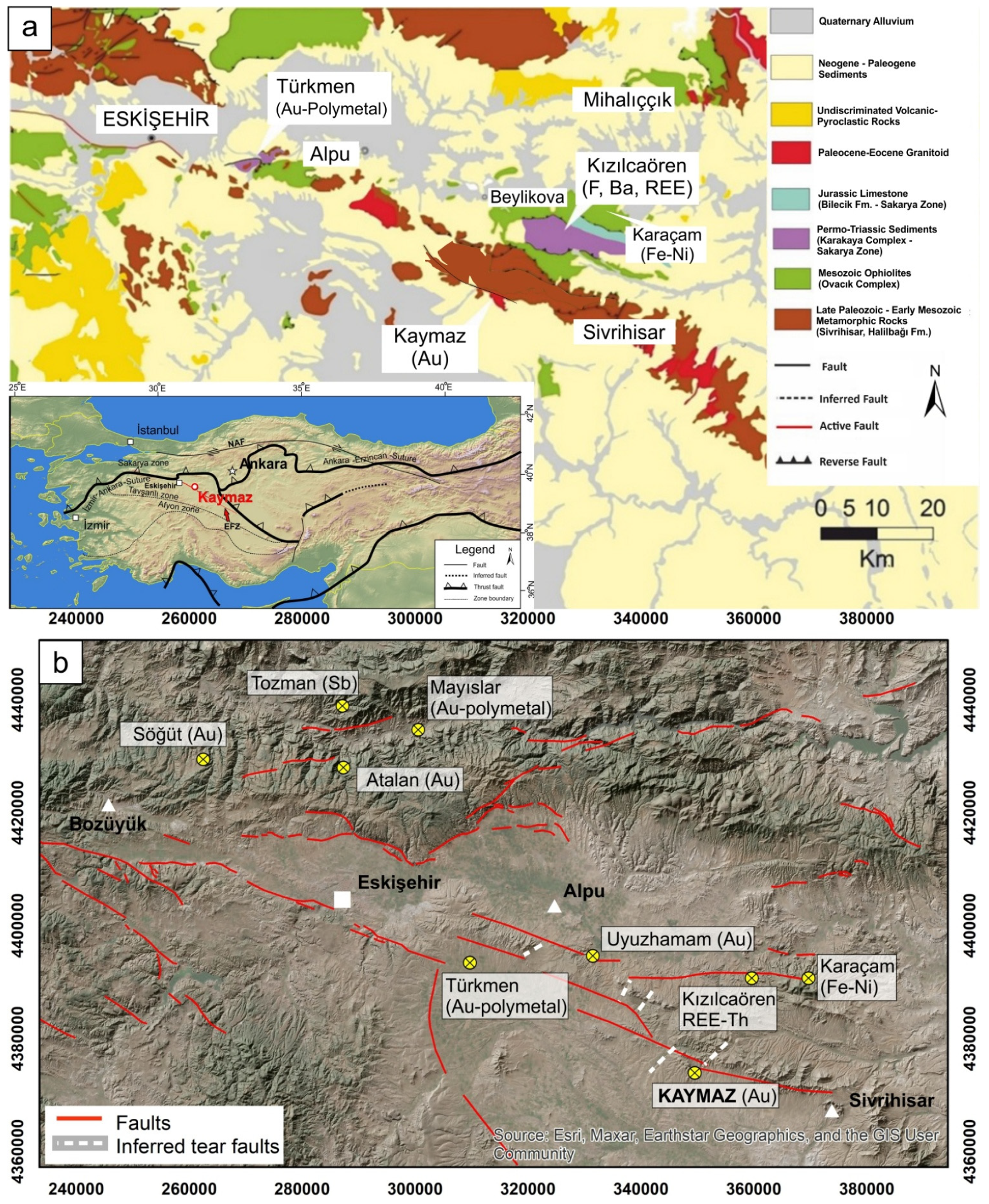
The Kaymaz Gold Deposit (KGD) in Türkiye is a significant gold deposit, with a one-million-ounce gold reserve and an average grade of 3.93 ppm, and has been operating at four sites since 2011 (1—Damdamca, 2—Karakaya, 3—Mermerlik, and 4—Kızılağıl). Gold mineralization occurred within listvenite rocks, granite, and ± schists. The KGD is located within the Eskişehir fault zone and in the city of Kaymaz, Eskişehir. In addition to the KGD, the Eskişehir fault zone hosts several types of mineralizations (Figure 1b). Mayıslar [1] and the recently discovered Atalan, Uyuzhamam, are the other listvenite-related gold mineralizations within the Eskişehir fault zone.
Many studies have investigated the geological features and mineralization properties of listvenite-related gold deposits worldwide [2,3,4,5,6,7,8,9,10,11,12,13,14,15,16]. Türkiye has many occurrences of listvenite [17,18,19,20,21,22]. The KGD has been studied in detail by Yavuz [23], Yavuz et al. [24] (geology, mineral chemistry, and fluid inclusions); Toygar [25] (geochemistry, δ18O and δ34S isotopes, and fluid inclusion) Turan [26] (geology, mineralogy, and fluid inclusions); and Turan and Diker [27] (mineralogy and remote sensing). Some of these studies suggest that the ore-forming fluid in the KGD was magmatic in origin.
Granitic magmatism is accepted as being responsible for the formation of most productive listvenite-related gold deposits [8,28,29,30,31,32]. For example, in the South Eastern Desert district (Egypt), Zoheir [33] noted that the presence of granite bodies within transpression zones is correlated with higher Au grades compared to other areas where granite intrusion is not observed. Al Hakim et al. [15] suggested that dacite extrusion may have been the heat source for late-stage mineralization in the Timburu Goldfield because mineralization and alteration are common in the vicinity. While there are several theories addressing the role of granitoids and other magmatic rocks in listvenite in the literature, the KGD is an important deposit for investigating the role of granite in gold mineralization, particularly where it occurs at the granite contact within the Eskişehir fault zone. The existence of core samples taken from contacts and gold-mineralized zones, the exposure of these contacts due to mining activities, and knowledge of the ore body’s shape and orientation made the KGD a significant case for analyzing the effect of magmatic rocks on listvenite-related gold deposits. The results of previous studies suggesting magmatic origins [24,25] are contentious in light of both our data and data from previous studies.
In this study, we focus on the contact relationships and element exchanges between listvenite and granite. We address the question of whether granite serves as a heat source or generates hydrothermal fluids, causing gold mineralization. Using the literature, our data, and observations, we suggest a mechanism for gold mineralization. The alteration types and orientations of ore bodies and deformations occurring in the rocks were investigated. Fluid inclusion analyses were applied to determine whether the ore-forming fluid’s origin is magmatic or from another source, and whether the fluid inclusion properties of listvenite and granite (silicified) are similar or differ from each other. SEM-EDS was also used to observe the properties of gold mineralization and other mineralizations that occurred during hydrothermal activity affecting the granite and serpentinite.
This study may help inform exploration strategies by considering the effects of intrusions and contributing data to the literature on their role in gold mineralization within listvenite rocks.
Figure 1. (a) Simplified geological map of Kaymaz and surrounding areas (modified from [34]). (b) Faults, inferred tear faults (modified from [35,36,37]) and the locations of mineralizations in the vicinity (Figure 1a,b).
Minerals 16 00516 g001

2. Regional Geology

2.1. Tectonostratigraphy

The KGD is in the Tavşanlı Zone defined by Okay [38]. The Tavşanlı Zone is an east–west trending metamorphic belt that is 50–60 km wide and approximately 250 km long at the southern margin of the İzmir–Ankara–Erzincan Suture Zone (Figure 1a). The zone is surrounded by the Sakarya Zone in the north, the Bornova Flysch Zone in the west, and the Afyon Zone in the south. Okay [38] divided the generalized stratigraphy of the Tavşanlı Zone into four basic units: 1—Orhaneli Group (metamorphic units), 2—ophiolitic melange, 3—ophiolitic series, and 4—Eocene sediments and granitoids. The Sivrihisar Formation and Halilbağı Formation, metamorphic basement units in the study area, are the equivalents of the Orhaneli Group.
The Sivrihisar Formation consists of mica schists and marbles. The Halilbağı Formation consists of metabasite, metachert, and marbles [39]. David and Whitney [40], studying the Sivrihisar, Kaymaz, and Halilbağı regions, defined the region as the Sivrihisar Massif and identified eclogite- and blueschist-facies metasedimentary and metabasaltic rocks. The P-T conditions of metamorphic facies are as follows: 26 kb–500 °C lawsonite eclogite; 18 kb–600 °C epidote eclogite, 12 kb–380 °C lawsonite blueschist, and 15–16 kb 480–500 °C lawsonite epidote blueschist. Davis and Whitney [40] reported that the two facies coexist at depths and temperatures sufficient to create metamorphism and in the primary phases of outcropping related to the similarity of the primary chemistry, lineation, and foliation orientations of the eclogite and blueschist facies. According to the Rb/Sr and Ar/Ar geochronology on phengite crystallization, which post-dates the peak of HP-LT, metamorphism occurred at 79.7 ± 1.6 to 82.8 ± 1.7 Ma [41]. Okay [39] suggested that the metamorphics were probably outcropped in the Maastrichtian.
The metamorphic basement rocks are tectonically overlain by the Ovacık Complex [42], an ophiolitic melange comprising ultramafic rocks, metabasalts, and marine sedimentary units. Okay [39] suggests that the Anatolian Ophiolite, which occurs throughout IAESZ, tectonically overlies the Ovacık Complex. In some parts of the Tavşanlı Zone, the Anatolian Ophiolite is in contact with the metamorphic basement rocks, as the Ovacık Complex is absent.
Eocene granitoids intrude into the metamorphics, melange, and ophiolites. Eocene granitoids are represented by Kaymaz Granite in the study area. Shin et al. [43] dated the Kaymaz Granite 42.5 ± 2.2 and 33.3 ± 1.2 Ma (U-Pb on Zircon) and Shin et al. [43] noted the high silicification and sericitization in Kaymaz Granite.
Eocene shallow marine clastics and Middle-Late Miocene clastic and carbonate rocks overlie all units with a stratigraphic contact [39].

2.2. Tectonism

A significant tectonic structure, the İnönü-Eskişehir Fault System, extending from Uludağ (Bursa) in the west to Cihanbeyli (Konya) in the southeast [44], has subsegments in the study area. The segment of the fault system at the northwest of Kaymaz Gold Mine is called the Kaymaz-Bardakçı Fault, and the segment running from the north of the mine to the east is called Paşakadın Fault [37]. There is no consensus about the age and the characteristics of the EFZ. The Eskişehir Fault has been an active fault since the Pliocene [45] or Pleistocene [46] and has lateral and vertical movements, which can be observed on the marbles near the Damdamca site. However, it could not be determined which type of movement occurred before the other. There are different opinions in the literature about the type of fault. Ocakoğlu [45] reported that the fault was predominantly a normal fault and had a minor right-lateral component. According to Selçuk and Gökten [37], Paşakadın Fault is a strike-slip fault with a N85°W-trending, 65°SW-dipping fault. The authors detected fault lines inclined up to 85 degrees on the Paşakadın Fault, and reported that the Paşakadın Fault first moved as a normal fault and then as a right-lateral strike-slip fault.

3. Ore Deposit Geology

The metamorphic units of the Tavşanlı Zone, the Kaymaz Granite, serpentinites, and listvenites are the outcropping lithologies in the vicinity of the KGD. Listvenites are the main host rocks for gold mineralization in Damdamca, Karakaya, and Mermerlik, whereas the major sites for Au mineralization are Damdamca and Karakaya, where Au is also enriched in the granite units. Silicification and argilization are the alteration types observed in granite and listvenite. The degree of alteration decreases in the granite according to the distance to the fault-controlled contact zone between listvenite and granite. Although metamorphic rocks are accepted as host rocks in the Kızılağıl site, we present observations indicating that listvenite contacts metamorphic rocks or a listvenite host rock exists (see Section 3.4).

3.1. Damdamca Site

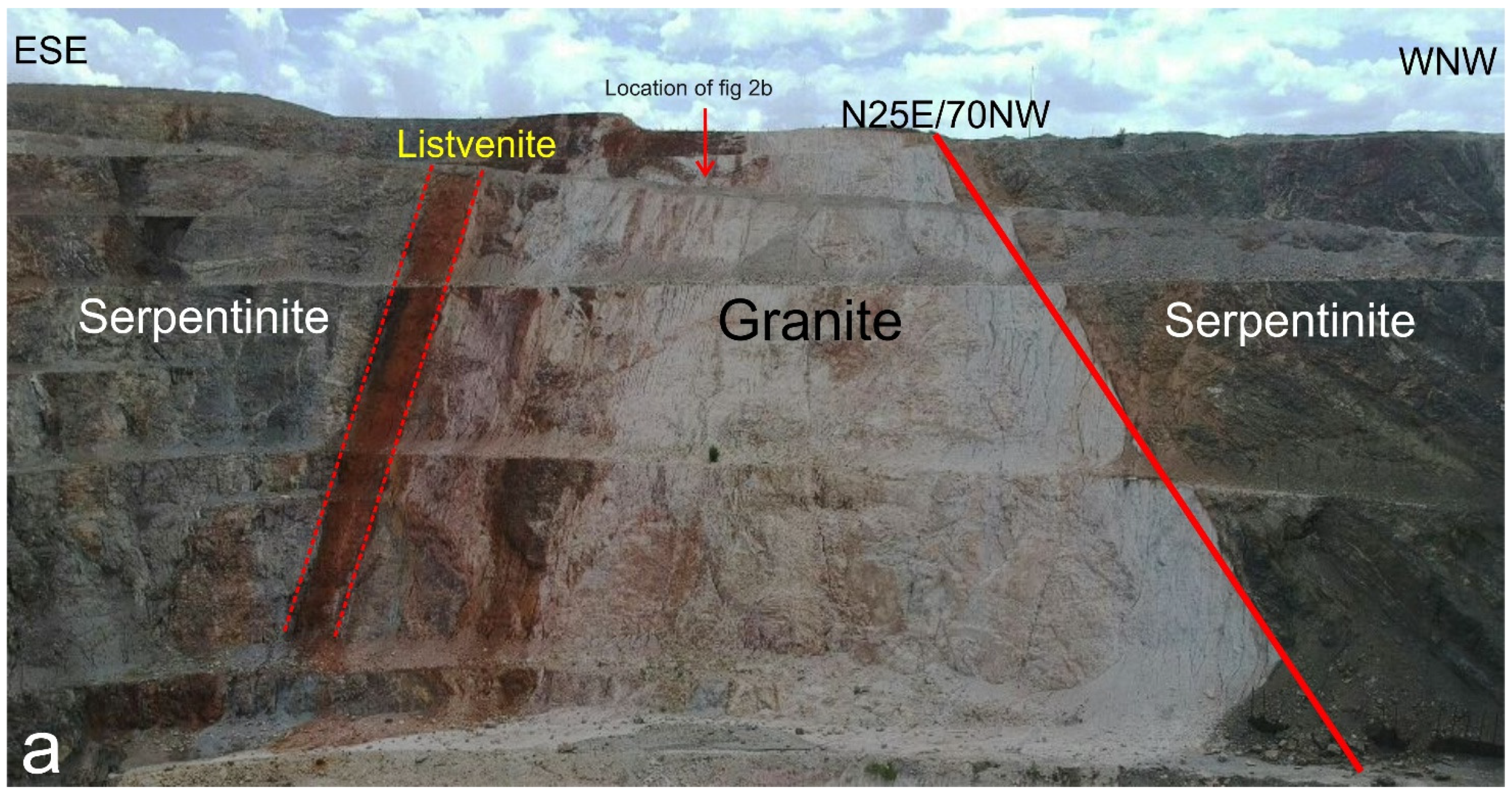
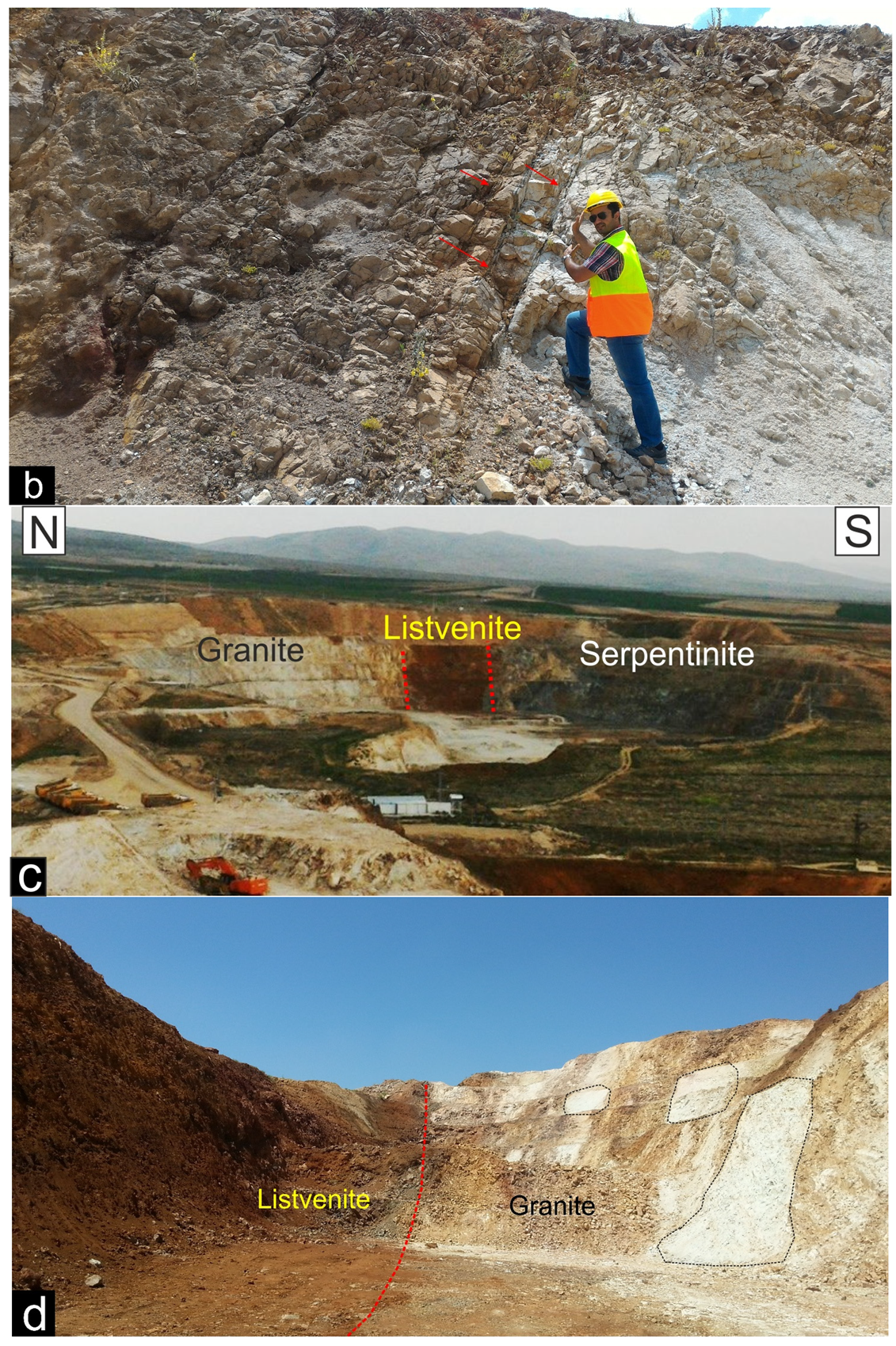
Damdamca was the KGD’s first operated site, and mining activity ended in 2014. Mineralization occurs within silica- and iron hydroxide-rich listvenite rock, which is in contact with granite (Figure 2a). The contact west of the granite with the serpentinite is tectonic. The orientation of the fault plane is N25E, and the dip direction is NW, with a dip angle of 70°. Data such as fault lines and chatter marks indicate that the movement of the fault could not be detected because the high argilization affected the fault plane. The direction of the ore zone in the eastern part of the granite is approximately the same as the fault plane (N25E), and the dip direction is the opposite. This direction is also parallel to the estimated tear faults of the Eskişehir Fault System. Fractures and cracks that are approximately parallel to the ore body have been observed in the granite, near the ore zone (Figure 2b).

3.2. Karakaya Site

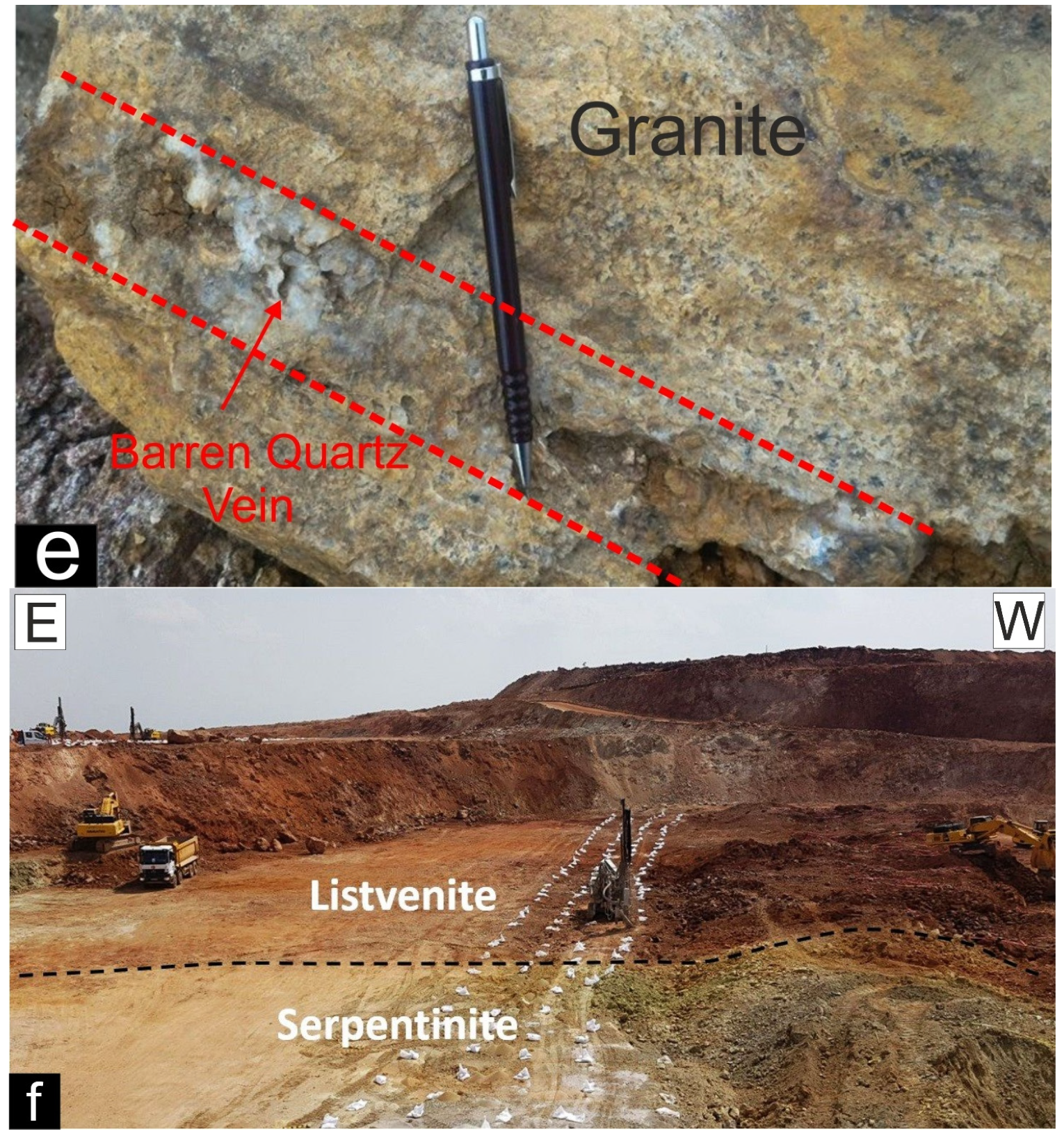
Karakaya is the main ore zone of the KGD for gold mineralization. The listvenitization of serpentinite occurs in the fault-controlled contact zone of granite (Figure 2c), and the highest gold grades are measured in the listvenite. The straight and sharp geometry of the contact indicates that it is a tectonic contact. The ore body is approximately 1.5 km long and trends NW-SE, parallel to the Eskişehir Fault. The listvenite is rich in silica and distinguished by its red-brown color from iron hydroxide. The granite is argilized near the contact with the listvenite (Figure 2d). There are up to 5 cm thick barren quartz veins that occur in the granite (Figure 2e).

3.3. Mermerlik Site

Gold mineralization occurs within the listvenite, approximately 60 m thick, at the Mermerlik site. Unlike Karakaya and Damdamca, there is no granite occurrence in this site. The listvenite has the same mineralogical properties as other sites and hence is rich in silica and iron hydroxide. The listvenitized serpentine-grade contact trends E-W, almost parallel to the serpentinite–listvenite–granite contact in the main zone (Karakaya) (Figure 2f). The listvenite tectonically overlies metamorphic basement units, including schist and marbles. The drill core samples are brecciated near the contact of listvenite and metamorphics (Hole ID KM28, 60–70 m depth). There is a significant amount of silver enrichment (up to 11.4 ppm) in the silicified parts of schists. Unlike the listvenite rock, the gold content of silver-enriched schists is under detection limits.

3.4. Kızılağıl Site

Kızılağıl is a site operated for a couple of months in 2015, before the start of our study. The relatively small and shallow-lying ore body led to easy operation of all of the economic reserves. According to Yavuz [23] and Toygar [25], the wall rock of gold mineralization is schist. The recoveries of the core samples are very low. The rigid parts of the samples are completely silicified, and any metamorphic texture cannot be detected. However, the occurrence of chromite in the gold-mineralized sample, which is discussed in the Section 5., indicates the presence of ultramafic rocks and that gold mineralization does not extend into the metamorphic units at depths greater than approximately 15 m. The wall rock may be listvenite, the same as at other sites. However, gold mineralization may have occurred at a contact between listvenite and schist.

4. Materials and Methods

Fifty-one core samples were collected from drill holes in Damdamca (1 drill hole), Karakaya (1 drill hole), Kızılağıl (3 drill holes), and Mermerlik (4 drill holes) during logging. The lithologies, depth, and Au-Ag content data are listed in Table 1. In addition to the core samples, 1 field sample from the Damdamca site and 9 field samples from the Karakaya site were taken.
Thin sections and polished sections were prepared at the Ore Microscopy Laboratory, Hacettepe University (HU), and examined using a Leica 2500 DMP microscope for the petrography and ore microscopy studies. SEM (scanning electron microscopy) analyses were carried out via a Carl Zeiss EVO 50 EP electron microscope (HU) (ZEISS, Oberkochen, Germany) and integrated Bruker-Axs Xflash 3001 SDD (Silicon Drift) (Bruker Corporation, Berlin, Germany). For EDS (energy-dispersive spectroscopy) analyses, ES (secondary electron) and BSD (backscattered electron) electron detectors were used for imaging. The settings of the device were as follows: acceleration voltage = 15 kV, beam current = 10–30 pA, spot diameter = 1– 3 µm, and working distance = 10 mm. During the microanalyses, the beam current increased to 5–10 nA and the working distance was approximately 10 mm.
Chemical analysis data indicating the metal content were supplied by Türk Gold (Ankara, Türkiye). After dissolving the ground samples with HNO3 + 3HCl, the metal contents of the samples were measured via an atomic absorption spectroscopy device (AASAgilent 240 FS, Agilent Technologies, Santa Clara, CA, USA) with a 0.01 ppm detection limit for Au and Ag.
Fluid inclusion studies were carried out on quartz minerals from core samples and a surface sample. All samples representing the mineralization were examined at both macro- and micro-s for their suitability for fluid inclusion analysis and 5 samples were deemed suitable for analysis. Fluid inclusion analyses of the primary inclusions of quartz minerals were carried out at the HU Mineral Deposits-Ore Microscopy Laboratory and the Laboratory of Mineralogy-Petrography Research Coordination Department of the General Directorate of Mineral Research and Exploration (MTA). Linkam motorized MDSG 600 (MTA) and Linkam THMS 600 (HU) (Linkam Scientific Instruments, Redhill, UK) stages are used as the heating and cooling systems. In both laboratories, the heating and cooling tables were mounted on the Leica DM 2500 M model microscope (Leica Microsystems, Wetzlar, Germany). Magnifications of 20× and 50× were used for examinations. Temperatures ranged from −196 °C to 600 °C on Linkam stages. For the microthermometric measurements, the heating rate ranged from 25 to 40 °C/minute, and the cooling rate ranged from 5 to 20 °C/minute. Liquid nitrogen (N2) is used in cooling processes. The salinity values of two-phase (liquid + gas) inclusions in microthermometric analyses were calculated via the equation given by Bodnar [47]. The gas/liquid ratio was calculated via pixel counting of the imaged fluid inclusions.
The powdered samples were analyzed with a Rigaku D/2200 X-ray diffraction (XRD) device (Rigaku, Tokyo, Japan) (Cu Kα, 40 kV, 30 mA, 2°/min, scanning speed, 2ϴ = 2–50° and 70°) from the geological engineering department of HU for the determination of argillic minerals. The internal standard method of Gündoğdu [48] was used to calculate the proportion of minerals.

5. Results

5.1. Macro-Observations of Core Samples

In the KGD, an important part of high-grade gold mineralization occurs at a contact between serpentinite and granite. Alteration of granite and the listvenitization of serpentinite overprint the primary relationship between these rocks. Therefore, macro-scale observations are more important, as both lithologies have the same secondary mineral assemblages.
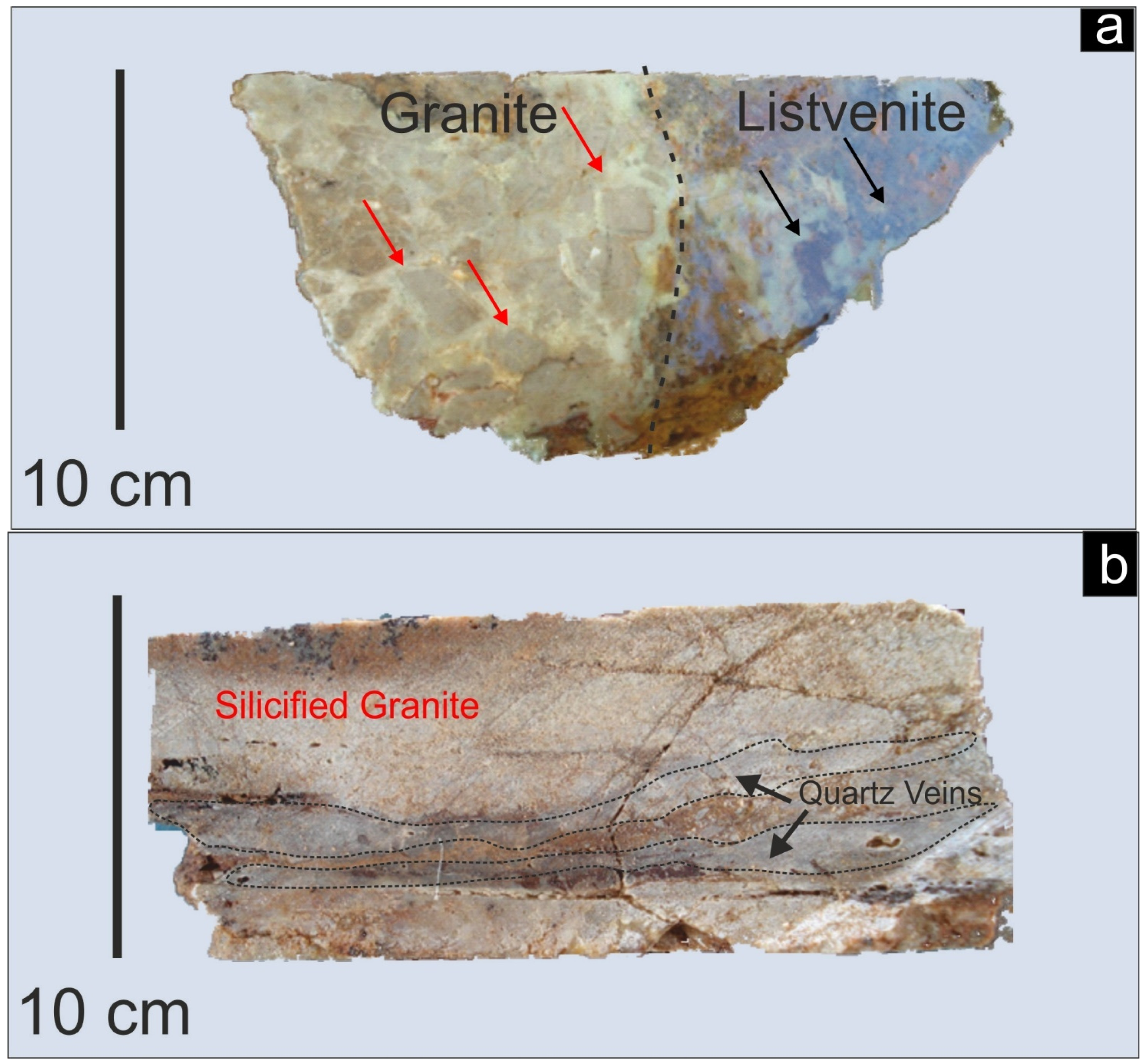
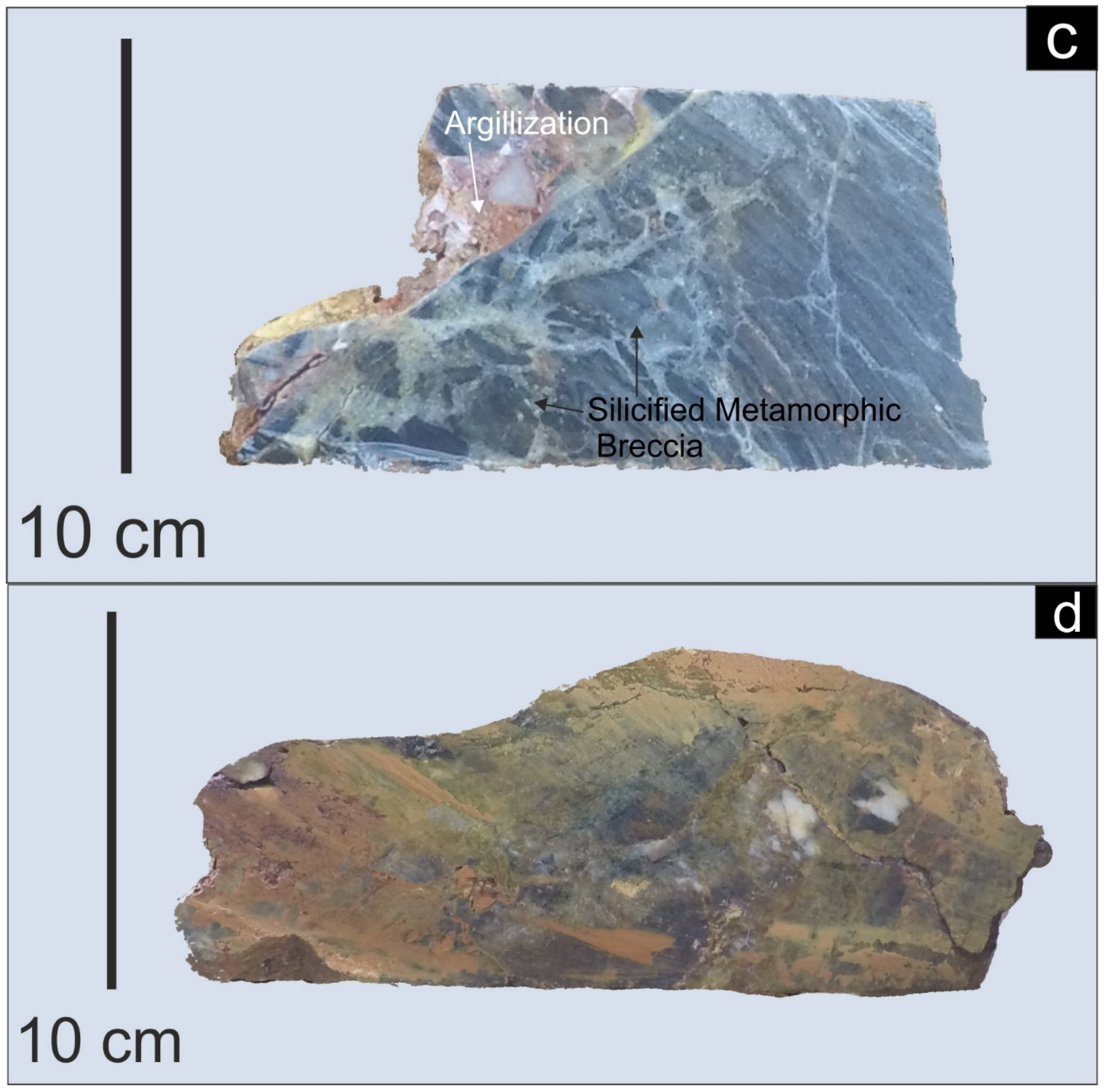
Sample KYM-10 was taken from the Damdamca site (Figure 3a; depth of sample is 72.5–72.6 m) and contains 0.5 ppm Au and 6 ppm Ag. The sample has a brecciated texture and includes granite clasts (red arrows) and listvenite clasts (black arrows) in a silicified matrix. KYM 30 is a silicified granite sample from Karakaya (Figure 3b, 61.9–62 m depth). The 2.5 ppm gold-containing sample has quartz veins and iron hydroxide mineralization between the veins. KM 51-6, the silicified schist sample with a high Ag content (11.4 ppm), was collected from Mermerlik (Figure 3c, 78.5–78.6 m depth). The Au content of the sample is under the detection limit, and the sample has lost its primary metamorphic texture because of brecciation. Brecciated and silicified core samples were also taken from Kızılağıl. Although the primary lithology could not be identified, some of these samples had similar appearances to listvenites at the other sites. KZ 158-1, shown in Figure 3d, is the sample containing the chromite mineral mentioned in Section 3.4. The sample contains 5.1 ppm Au and was taken from a depth of 10–10.1 m.

5.2. Petrography and Ore Microscopy

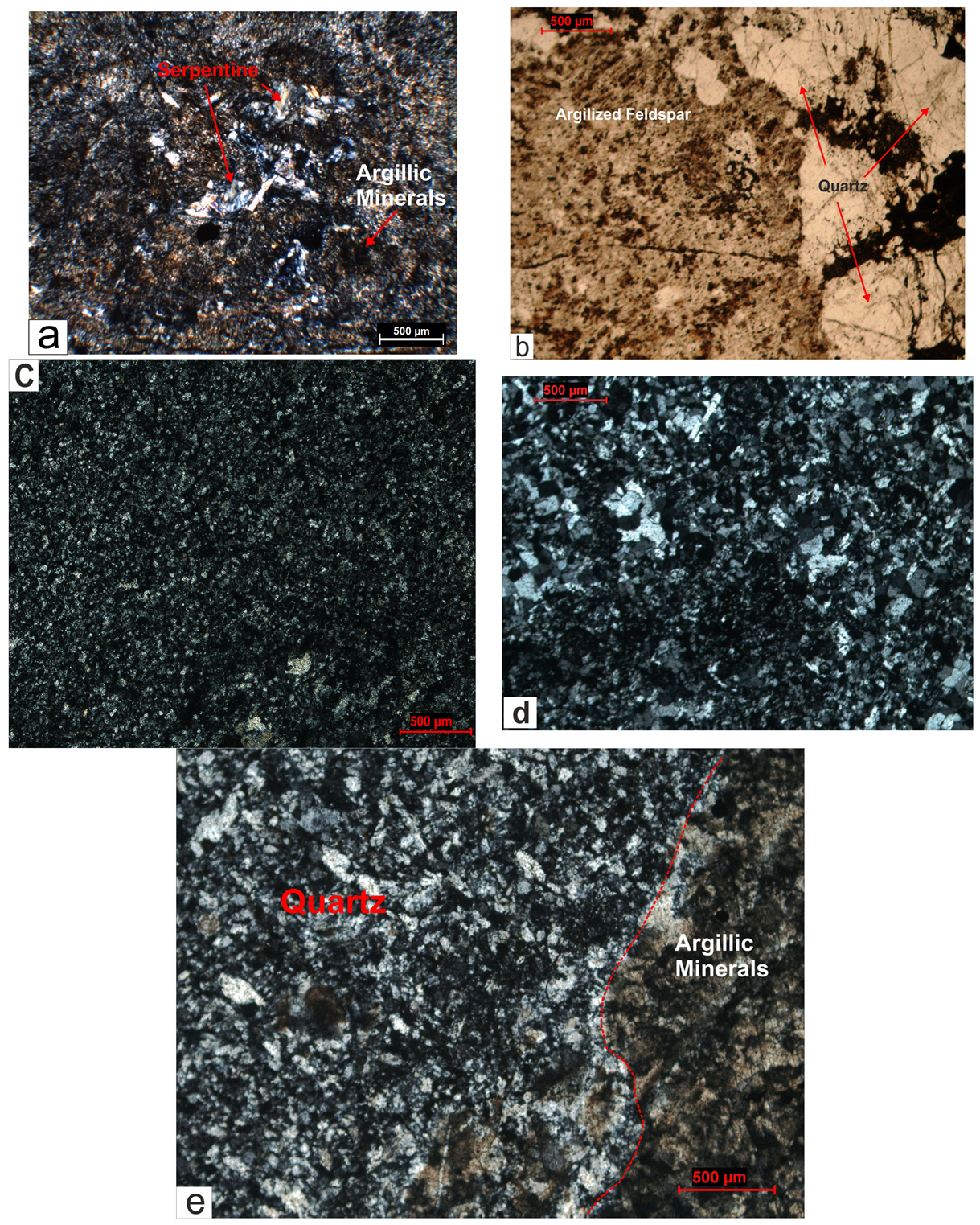
Petrographic studies were carried out to describe mineral assemblages and alteration properties of listvenite, granite, and schist samples. The granite and serpentinite relatively away from the listvenite-granite contact are also argilized (Figure 4a,b). Primary minerals of serpentinite have completely disappeared during listvenitization. The major alteration type is silicification for all types of rocks. Some samples contain more than 90% microcrystalline quartz with massive texture (Figure 4c,d). Argilization occurs in the granite, especially near the contact with listvenite, but rarely in listvenite alone (Figure 4e). Two of the argilized granite samples and a listvenite sample have been analyzed for whole-rock and argillic mineral determination. The mineral proportions of the granite samples, calculated with the method of Gündoğdu [48], are given in Table 2. The proportions of listvenite samples cannot be calculated according to Gündoğdu [48] because the sample contains minerals such as goethite with an unknown reflectance value.
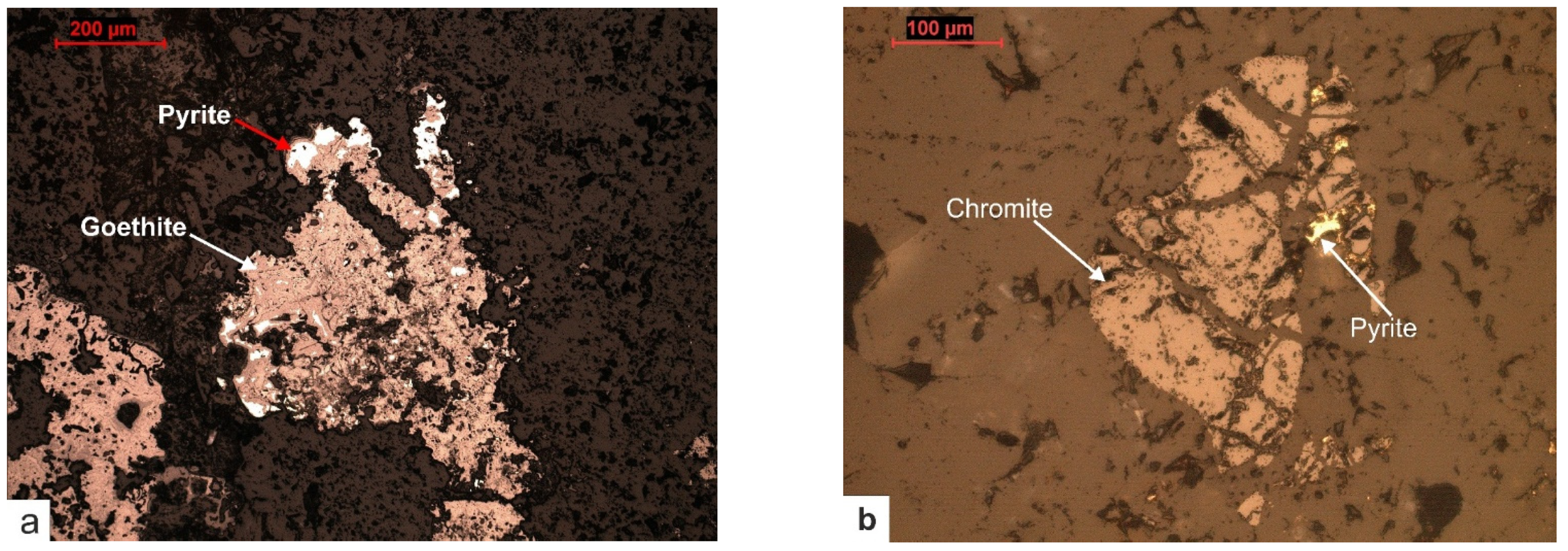
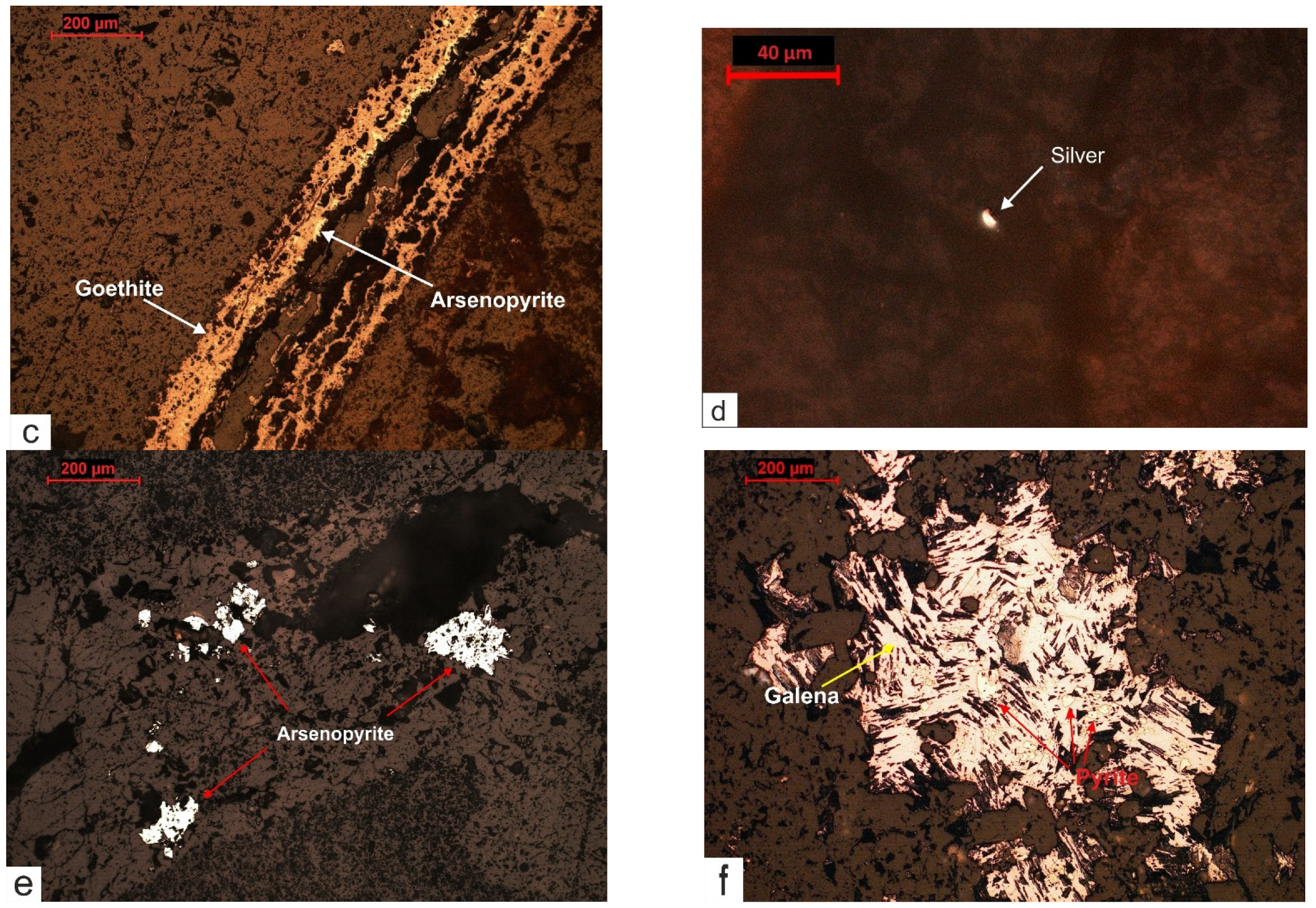
The opaque minerals identified in the listvenite samples are chromite, pyrite, arsenopyrite, galena, goethite ± lepidocrocite, and native silver via ore microscopy studies. Gold minerals could not be detected under a microscope because of their fine-grained nature and because they are indistinguishable from sulfide minerals at such a small size. SEM-EDS analyses were performed to detect gold minerals, as detailed in Section 5.3. Most pyrite and arsenopyrite minerals were replaced by goethite ± lepidocrocite (Figure 5a). The chromite minerals belonging to the primary serpentinite are highly deformed (Figure 5b). In addition to replacement textures, the goethite ± lepidocrocite can be found as veinlets and space-filling material in both listvenite and granite samples (Figure 5c). Native silver grains were observed in quartz veins (Figure 5d) and silica matrix within the core sample taken from the Kızılağıl site. The sample has chromite minerals as well. Pyrite and arsenopyrite minerals can be found as non-oxidized forms (Figure 5e). Galena has been observed with pyrite inclusions in a listvenite sample taken from the granite–listvenite contact of the Karakaya site (core sample Figure 5f).

5.3. SEM-EDS Analyses

Owing to the small size of gold and silver minerals, further SEM analyses were necessary to investigate the relationship between the ore and gang minerals. In addition to the opaque minerals observed via ore microscopy, barite (BaSO4), iodargyrite (AgI), acanthite (Ag2S), and Ni-sulfide minerals were detected. The accessory minerals brabantit (CaTh(PO4)2), rutile (TiO2) with thorium oxide inclusions, and uraninite (UO2) are detected in the KYM 30 granite sample, and monazite ((Ce,La,Th)PO4) in the KZ158-1 (schist?) sample.
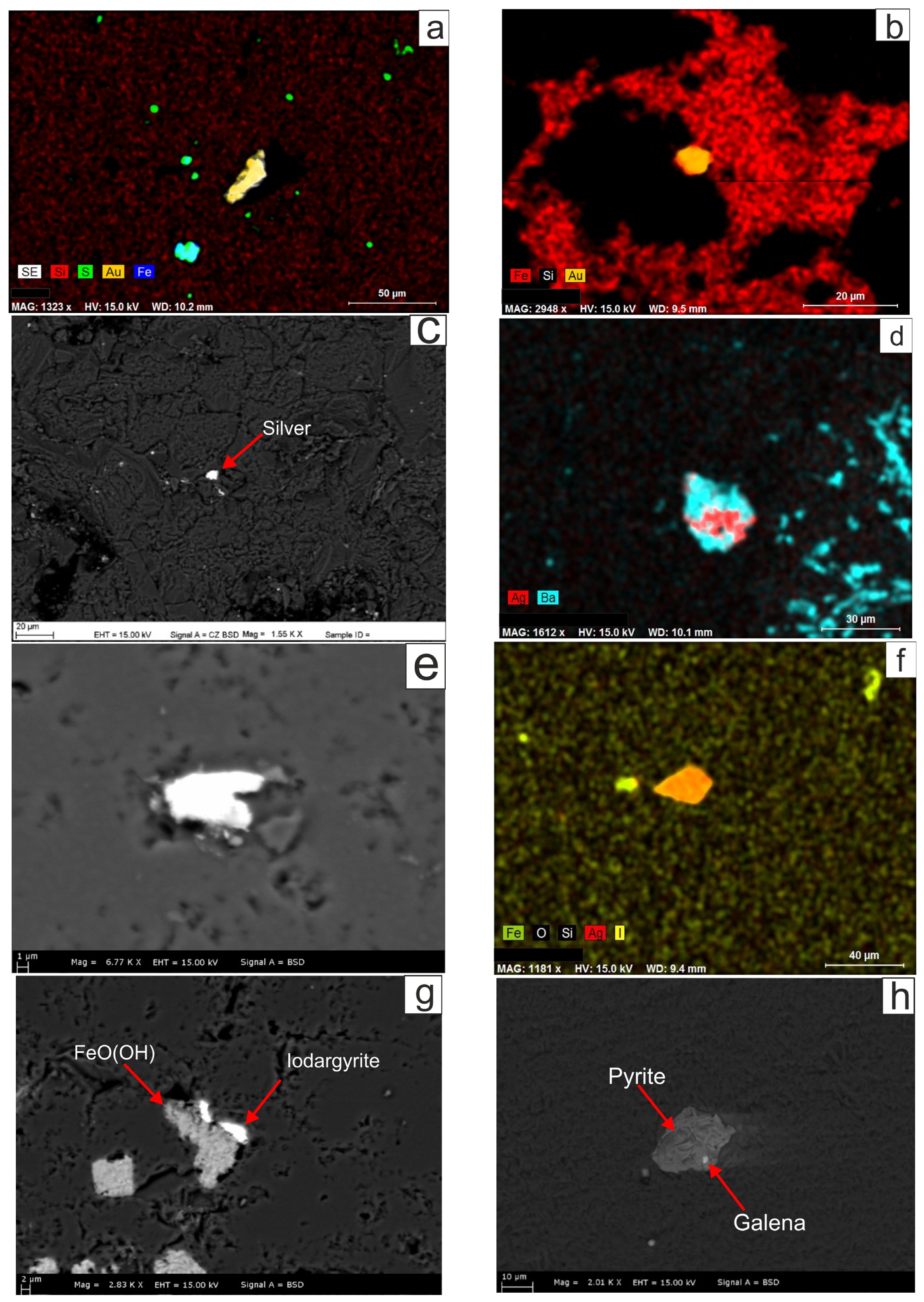
Native gold minerals belonging to the listvenite and granite samples from the Karakaya and Damdamca sites were found between quartz minerals and are generally smaller than 10 µm in grain size, rarely reaching 25 µm (Figure 6a). In the listvenite samples of the Mermerlik site, native gold grains are adsorbed in goethite ± lepidocrocite (Figure 6b).
Silver in the KGD was found in its native form and as acanthite and iodargyrite. Native silver and acanthite were found in the same sample (KYM 23, listvenite) in different textures. As native silver grains were found between quartz minerals, like gold, acanthites were found to be interlocked with barite crystals (Figure 6c,d). Iodargyrite and chromite were detected in KZ 158-1, the Kızılağıl (schist?) sample (Figure 6e–g). Most of the iodargyrite minerals were adsorbed by goethite ± lepidocrocite, and a grain was detected between quartz minerals. Galena was usually observed between quartz minerals. In a listvenite sample taken from the listvenite-granite contact, galena was found as an inclusion in a pyrite grain (Figure 6h).
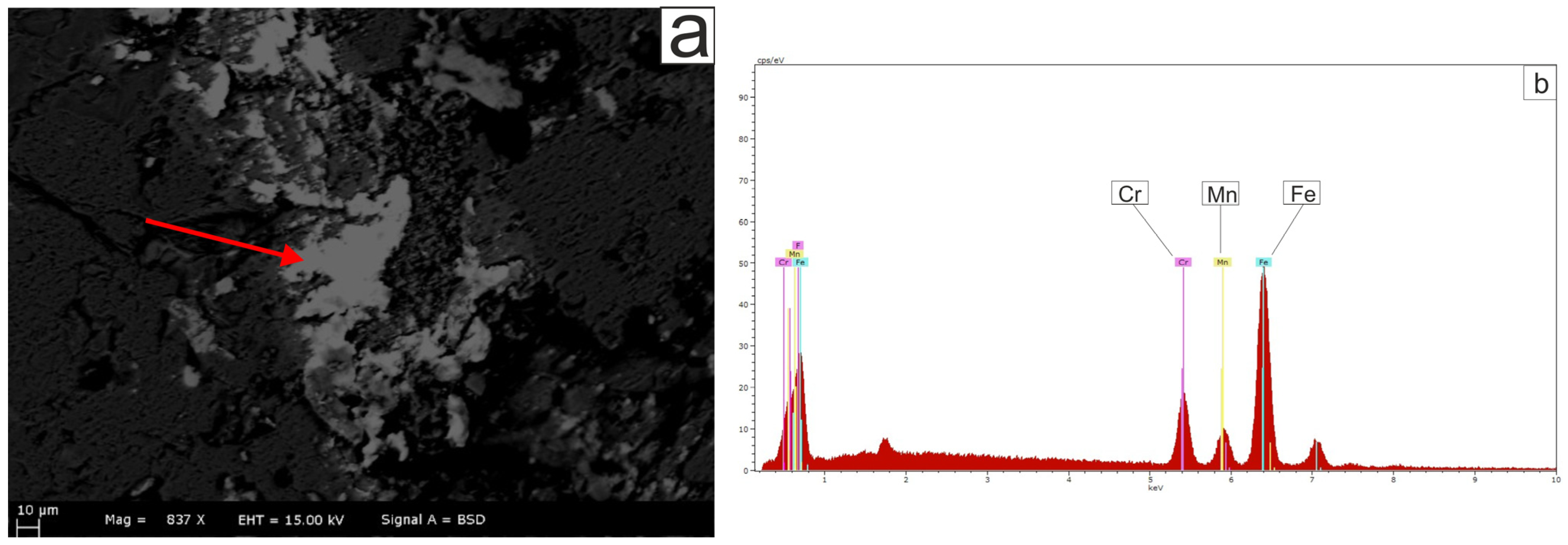
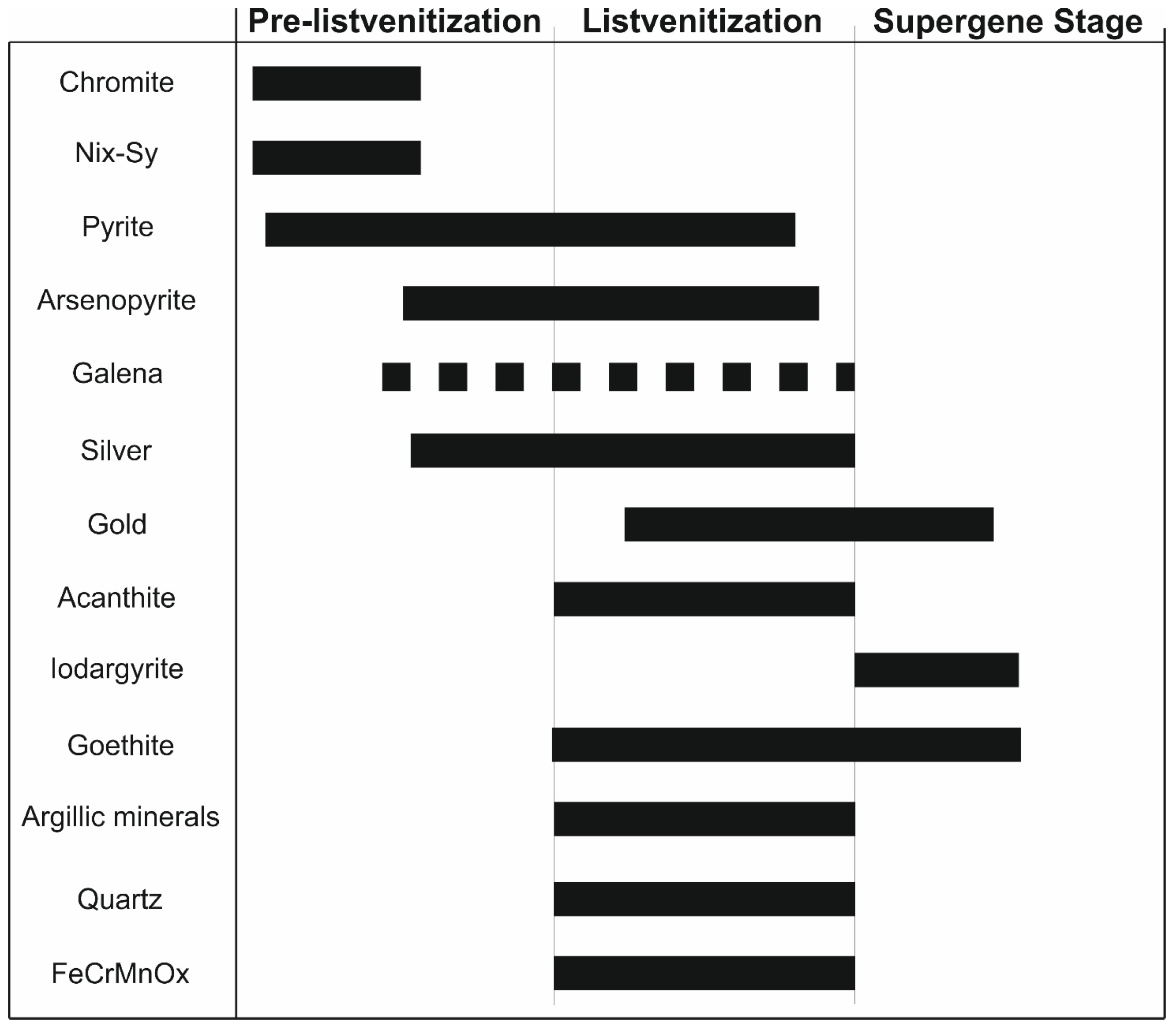
In a granite sample (KYM 32) from the Karakaya site, Fe-Cr-Mn oxide minerals, which were not expected to be found, were observed (Figure 7a,b). A simplified paragenetic sequence of detected minerals via ore microscopy and SEM-EDS analyses was created and is shown in Figure 8.

5.4. Fluid Inclusions Analyses

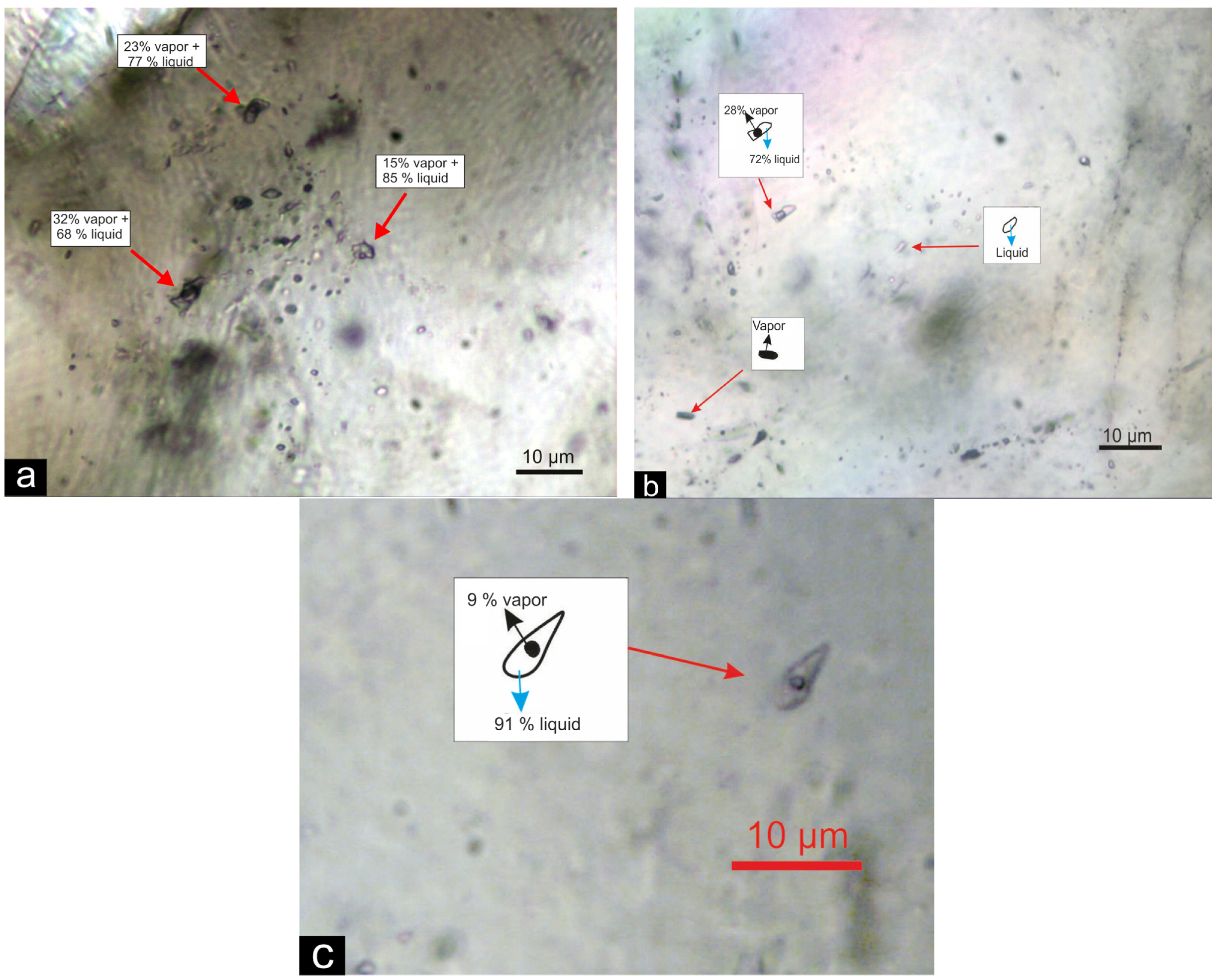
Fluid inclusion analyses were carried out on the primary inclusions of quartz minerals in five samples. The measured Th (°C) values, numbers of measurements, salinity equivalents (wt%), Au-Ag contents, lithologies, and the site descriptions of samples are given in Table 3. Liquid-, liquid + vapor-, and vapor-containing inclusions were detected in all the samples (Figure 9a,b). The amount of liquid phase in the two-phase (liquid + gas) inclusions is greater than the amount of gas phase. No other gas types, such as CO2 and CH4, were detected except for H2O vapor. Most of the liquid + vapor containing primary inclusions are smaller than 10 µm. The KYM 14 listvenite sample has two different shapes of fluid inclusions, more angular (Figure 9b) and more ellipsoidal (Figure 9c) with respect to each other. As the Th (°C) of ellipsoidal inclusions varies between 103 and 184, the angular inclusions varied between 331 and 342 Th (°C) (Table 3, KYM 14 sample).
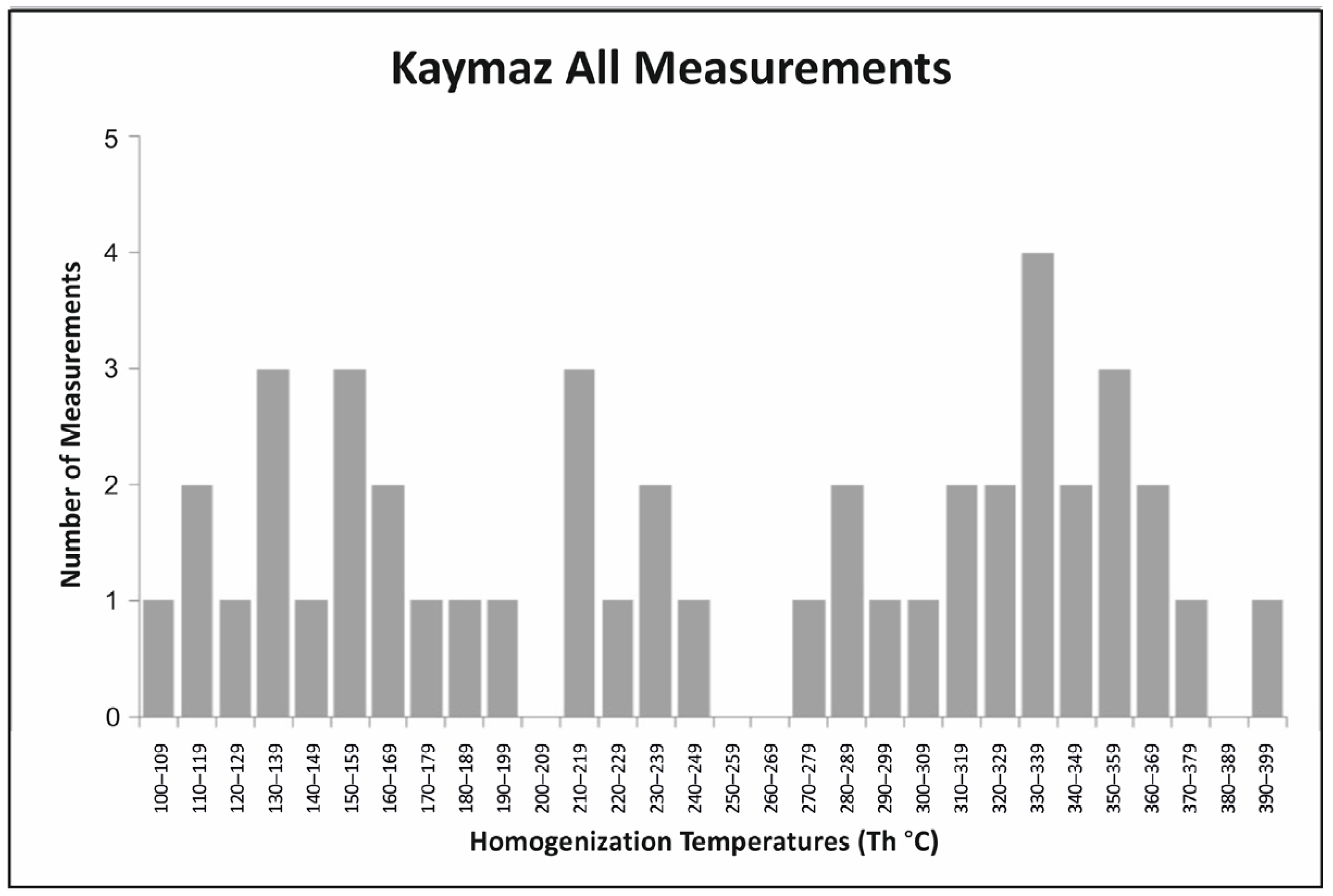
All Th (°C) values of fluid inclusions are presented in a single histogram (Figure 10). Three different phase distributions are observed. The first of these is between 110 and 169 °C, the second is between 210 and 239 °C, and the third is between 310 and 369 °C. Measurements between 110 and 169 °C and 210–239 °C represent fluid inclusion hosted by quartz from listvenites and silicified granites belonging to the main zone, whereas the measurements between 310 and 369 °C mostly represent the Kızılağıl field. The temperatures measured above 300 °C in the main ore zone and the inclusions exhibited different morphological characteristics. Salinity (% NaCl equivalent) measurements were performed with two samples. The values vary between 1.2 and 3.4% for the KKB 6 sample, which is a granite sample taken from Karakaya (main zone), and for the KZ 158-1 sample from the Kızılağıl field, the values vary between 3.9% and 5.4%.

6. Discussion

6.1. Alteration Properties and the Type of Listvenite

Our petrographic studies indicate that the dominant alteration type is silicification for both granite and listvenite (primally serpentinite). Kaolinite and illite are argillic minerals that were detected via XRD analyses at different proportions in altered granite samples from the same site (Damdamca). Smectite and kaolinite were found in the argillized part of the listvenite. These argillic minerals indicate different temperatures for argillic alteration. As kaolinite and smectite occur <200 °C, illite occurs between 220 and 350 °C [49]. The temperature differences in samples taken from the same zone of granite over a relatively short distance might be the result of different phases of hydrothermal activity occurring in the tectonic contacts. XRD data from Turan and Diker [27] indicate the same alteration properties in the KDG. Oxide results from Toygar [25] also show high SiO2 in listvenite samples from the KGD (~80% in average of 27 samples, and more than 90% for 13 samples). The CaO and MgO contents of the listvenite samples are generally lower than 1% in the same study.
Cr-bearing mica (fuchsite, Cr-sericite) and a small amount of sulfides generally occur near or within major faults and shear zones [2,50,51,52]. According to Halls and Zhao [52], although only rocks containing fuchsite–quartz–carbonate assemblages fit the type description given by Rose [53], most altered mafic-ultramafic rocks are named listvenite. In recent studies, Aftabi and Zarrinkoub [4], Boskabadi et al. [9], Abdel-Karim et al. [16] and Gahlan et al. [54] proposed listvenite classification according to the carbonate-silica composition (1—silica–carbonate, 2—carbonate, and 3—silica-listvenite). According to this classification, the KGD fits into the silica-listvenite group because of its high silica content and differs from most of the other listvenite-related gold deposits with its minor carbonate content.

6.2. The Contact Relationship of Listvenite and Granite

The Eocene Kaymaz Granite intruded into the metamorphic basement rocks and serpentinites in the generalized tectonostratigraphy of the Tavşanlı Zone. However, in the Kaymaz vicinity, later tectonic activities overprint the primary intrusive contact. Much evidence indicates that the contact between serpentinite and granite is tectonic in the KGD.
  • The ore body of the Karakaya site developed parallel to the Eskişehir Fault, and has a straight orientation (Figure 2c,d).
  • The ore body at the Damdamca site developed parallel to the possible tear faults of the Eskişehir Fault, and a fault plane was observed between serpentinite and granite; the ore body has the same orientation as the fault plane, and the dip direction of the ore body is in the opposite direction (Figure 2a).
  • At the Damdamca site, there are cracks and joints parallel to the ore body in the granite (Figure 2b). This evidence indicates that the granite and serpentinite were already brecciated before a fluid, causing silicification and listvenitization to circulate through the contact between these rocks. In particular, the angular shape of the granite breccia indicates that these are tectonic breccias (Figure 3a).
  • The occurrence of Fe-Cr-Mn oxide in a granite sample supports the suggestion that a fluid circulated through a fault-controlled contact and dissolved the Cr and other related elements [6,55], and reprecipitated in the granite.

6.3. Fluid Inclusions

The measured Th (°C) values of fluid inclusions vary between 116 and 393 °C. The salinity equivalents of the measured inclusions are between 1.2 and 5.4%. There is no significant difference in Th (°C) and salinity equivalents depending on the rock type. In particular, the KYM 14 listvenite sample and the KYM 32 granite sample have quite similar Th (°C) values. The fluid inclusion data suggest that the same fluid caused gold mineralization, which affected granite and serpentinite and led to listvenitization of serpentinite and silicification ± argilization of granite. According to the distribution of Th (°C) measurements, there are at least three different phases (100–210, 220–250, 280–390 °C). This observation is supported by the different morphologies of inclusions in the same sample and the occurrence of silver with different mineral types and between different gang minerals. In the listvenite sample KYM 23, silver occurs as native silver between quartz and acanthite with barite.
The liquid–vapor ratio of two-phase inclusions was observed as fluid-rich for all inclusions. The absence of vapor-rich inclusions together with liquid-rich inclusions indicates non-boiling conditions [56,57]. In addition, the massive quartz textures indicate non-boiling conditions [57].
In epithermal systems, Th (°C) varies between 100 and 300 °C and may reach up to 450 °C. For low sulfidation type epithermal systems, the salinity range is 0 to 14 wt% NaCl, generally around <5 wt% [56]. The fluid inclusion results of the KGD indicate a low-sulfidation type epithermal system. Low salinity values are also compatible with meteoric water sources. In addition to fluid inclusion properties, the KGD represents the metal paragenesis accompanying Au (Ag: Native silver + acanthite, As: arsenopyrite) of low sulfidation type epithermal systems [58]. The existence of different types of argillic alteration in the granite supports the multi-phase fluid activity.
Previous studies in KGD have also reported fluid inclusion results [23,24,25] measured on quartz minerals. The Th (°C) of Toygar [25] varies between 200 and 420, and salinity equivalents vary from 3.9 to 9.6%. Yavuz [23] and Yavuz et al. [24] suggested 240–390 Th (°C), and 0.3–14% salinity equivalents. As quartz is a common rock-forming mineral and/or there are quartz veins without gold content in the granite and silver enrichment in metamorphic rocks without correlation with gold in the Mermerlik site, the sampling methodology becomes more substantial. Yavuz [23] and Toygar [25] mentioned that the core samples chosen for fluid inclusion studies were not suitable for analysis in both studies, and the sampling methodology, lithologies, and the mineralization properties of the analyzed samples were not described. Even though Yavuz [23] mentioned non-boiling conditions, Yavuz et al. [24] suggested boiling conditions on the basis of the same data.

6.4. δ18O and δ34S Isotope Data of the Previous Studies

The δ18O and δ34S isotopes of the KGD studied by Toygar [25], and the data referenced by Yavuz et al. [24] to suggest the magmatic origin of mineralization. Toygar [25] used pyrite minerals from two core samples collected from the KDG (hole ID = KZ 286) for δ34S isotope analyses. The samples are not petrographically described in the study. According to the log data of Türk Gold Corp. Ankara, Turkey, the sample lithologies are schist (217.6 m depth) and granite (244.8 m depth). Therefore, it is difficult to accept that the samples represent the pyrite minerals accompanying the gold mineralization, as the listvenite is the wall rock. ‰ −2.6, (217.6 m) and ‰ −4.7 (244.8 m) values are obtained from the samples.
Toygar [25] suggested that these values indicate that sulfur in the area is granitic rock (Kaymaz granite), according to the classification of Rollinson [59]. However, the values are also compatible with marine sediments, freshwater, and volcanic H2S (only ‰ -4.7), in the same classification. The quartz minerals of nine samples taken from the listvenite rock and quartz veins of the KGD were used for δ18O analyses by Toygar [25]. The δ18O values of samples vary between 21.5 and 31.7‰, which indicates many possibilities for the occurrence of high δ18O content, such as boiling, metamorphic sources, and δ18O exchange between marine water and sediments [25 and references therein]. However, none of these possibilities are compatible with the fluid inclusion data discussed in Section 6.3.
Gahlan et al. [54] mentioned that the sources of the hydrothermal fluids that drive listvenitization remain unclear and noted that the stable isotope data may not be sufficient to identify the source of the fluid. They summarized the source of hydrothermal fluids as follows: (1) mantle-derived CO2-bearing fluids during near-ridge oceanic crust, (2) meteoric and metamorphic hydrothermal fluids penetrating through tectonic fractures during or even after exhumation to upper crustal levels, and (3) a combination of these two sources, according to the stable isotope data of the references therein. In addition to these sources, Zoheir and Lehmann [2] suggested that circulating, magmatic, dilute aqueous–carbonic fluids leached gold and isotopically light sulfur from the ophiolitic sequence in the Barramiya Gold Mine (Egypt) according to their δ34S data. However, they also noted that the source of δ34S values may be fairly well mixed with different sulfur components.
As a summary of the δ18O and δ34S isotope data of the KGD and the other isotope data of listvenite rocks in the literature, the source of the fluids that cause listvenitization is still controversial and cannot unambiguously be defined by isotope data alone. Furthermore, the isotope data do not agree with the fluid inclusion results, which instead indicate that meteoric water dominated the hydrothermal solution. In addition, the isotope data in the literature for listvenite rocks do not indicate any direct evidence for the source of the hydrothermal fluid. In the relevant studies referenced above, many other data were combined with stable isotope data for further interpretations.

6.5. Mineralization Process

The approach indicating that the origin of gold, in mineralizations defined as listvenite-related gold deposits, is mafic-ultramafic rocks has been discussed in various studies [4,6,16,31,60]. Belogub et al. [8] reported that for economic-scale mineralization, large rock masses need to be repeatedly developed by hydrothermal activities or the addition of different gold-bearing mechanisms. Qiu and Zhu [6] mentioned that Cr-spinel and Co- and Ni-bearing sulfide minerals may decompose during shearing in the Sayi Gold deposit, China. Emam and Zoheir [55] reported that the occurrence of Cr-chlorite, fuchsite, and Fe-Mg-bearing carbonate in silicified wall rock implies Cr mobilization by CO2-rich hydrothermal fluids in their study in the southeastern desert of Egypt. CO2-rich fluids are responsible for carbonatization of serpentinites [32]. In the KGD, the carbonate minerals are rare, and in our fluid inclusion studies, CO2 (gas) was not observed. This was similar to the process in the southeastern desert of Egypt, but with a different CO2 content in the fluid. In KGD, with the decomposition of Fe-Cr-Mn-containing minerals in serpentinite, the dissolved elements (Fe-Cr-Mn) may reprecipitate in the granite in oxide form. This study might be the first to detect that the mobilized Cr and other related elements are precipitated in a different lithology rather than listvenite. The fluid causing the mobilization of these elements may also dissolve the Au and the correlated elements from the serpentinite during listvenitization.
Qiu and Zhu [6] proposed a mechanism for the enrichment of gold in listvenite as follows: Gold may concentrate in Ni-Fe sulfide or arsenide in the mantle during early magmatic processes [61]. Gold decomposed from these phases as a result of later leaching activities may be incorporated in the magnetite and secondary sulfide minerals that crystallize during serpentinization [62]. Finally, the gold in the decomposed magnetite is released during listvenitization. Based on this mechanism, Qiu and Zhu [6] explained the absence of magnetite in the study areas as the complete dissolution of the magnetite in serpentinite during listvenitization. Magnetite was not observed in the listvenite rock of the KGD. Most likely, the widespread occurrence of goethite± lepidocrocite is related to the oxidation of magnetite and other Fe-bearing sulfide minerals during listvenitization. Therefore, the approach suggesting the source of the gold in KGD is serpentinite is supported by the occurrence of Fe-Cr-Mn oxide and the lack of magnetite. The source of gold in KGD is discussed by Yavuz et al. [24]. Yavuz et al. [24] suggested that the source of gold is Kaymaz granite on the basis of correlations among the elements (Au, As, Ni, Cr, and Co). However, the assessment is not supported by any data. The assessment does not answer the question of “how did mineralization occur at the Kızılağıl and Mermerlik sites while the granite or a structure allowing fluid migration from the granite to the serpentinite at these sites is absent?”. The authors also suggested that the Kaymaz granite might provide a heat source for the fluids causing metal precipitation along the fault zones. The earliest tectonic activity on the Eskişehir Fault occurred in the Pliocene [45]. Therefore, there was a large time gap, and Eocene granite cannot be a heat source. Our data and observations indicate that the mineralization occurred along the segments of the Eskişehir Fault. The ore deposits related to the circulation of hydrothermal fluids in the fault zones were discussed in many studies [63,64,65]. Like the KGD, an impermeable barrier of phyllosilicate-rich rocks leading fluid circulation along the fault zone model suggested by Reynolds and Lister [66] is suitable for controlling the fluid circulation along the Mont-Blanc detachment fault (West Alps) [63]. Furthermore, Dall’Asta et al. [67] noted that quartz-rich rocks seal faults, decrease permeability, and prevent further flow of fluids. This suggestion may explain the listvenitization boundary dimensions of the serpentinite KGD.
Supergene activity, indicating textures and minerals, was also observed in the KGD. The gold grains adsorbed on goethite ± lepidocrocite have been detected in Kızılağıl and Mermerlik samples. The occurrence of iodargyrite is related to the presence of saline-halide-rich ground waters in oxide deposits [68].

7. Conclusions

  • The main mineralization zone of the KGD developed concurrently with and/or after tectonic activities of the Eskişehir Fault. The gold mineralization developed in the fault-controlled contact zone of granite and listvenite (previously serpentinite) in the Karakaya and Damdamca sites and the fault zone developed in the serpentinite of the Mermerlik site.
  • The probable source of gold is serpentinite. CO2-poor meteoric water-dominated fluid may have led to mineralization.
  • Although granite has also been altered, since mineralization has been observed in the contact within the listvenite, it is thought that the granite acts as a lithological barrier because of its low permeability and massive structural properties, leading to the circulation of hydrothermal fluid, causing mineralization through the contact.
  • The homogenization temperatures and salinity values of fluid inclusions indicate a low-sulfidation-type epithermal system. The distribution of Th (°C) shows that there are three different phases of hydrothermal fluids. The liquid–vapor ratio of fluid inclusions (liquid rich) and quartz textures of enriched samples indicate non-boiling conditions of hydrothermal fluid.
  • Supergene activities are important for economic enrichment during mineralization in the Kızılağıl and Mermerlik fields. The silver enrichment within metamorphic units (Mermerlik site) may involve different mineralization processes, with the exception of gold mineralization in listvenite and granite.

Author Contributions

Conceptualization, T.İ.T. and Y.G.; methodology, T.İ.T. and Y.G.; software,T.İ.T.; validation,T.İ.T. and Y.G.; formal analysis, T.İ.T.; investigation, T.İ.T.; resources, T.İ.T.; data curation, Y.G.; writing—original draft preparation, T.İ.T.; writing—review and editing, Y.G.; visualization, T.İ.T.; supervision, Y.G.; project administration, Y.G.; funding acquisition, T.İ.T. All authors have read and agreed to the published version of the manuscript.

Funding

This research received no external funding.

Data Availability Statement

All data generated and analyzed during this study are included in this published article.

Acknowledgments

We acknowledge the Geology Department of Kaymaz Gold Mine (Türk Gold Corp.) for providing samples and sharing geochemical analyses of metal content. Furthermore, the authors would like to thank Erman Özsayın for his contributions to tectonic research, Caner Diker for software support, and editor(s) and anonymous reviewers for their constructive reviews.

Conflicts of Interest

The authors declare no conflict of interest.

References

  1. Parlak, B.; Sayılı, İ.S. Mayıslar Sahası (Sarıcakaya-Eskişehir) Polimetal Cevherleşmeleri Alterasyon Zonları İçindeki Kuvars ve Kalsitlerde Sıvı Kapanım Verileri. Türkiye Jeol. Bülteni 2012, 55, 111–136. [Google Scholar]
  2. Zoheir, B.; Lehmann, B. Listvenite–lode association at the Barramiya gold mine, Eastern Desert, Egypt. Ore Geol. Rev. 2011, 39, 101–115. [Google Scholar] [CrossRef]
  3. Rajendran, S.; Nasir, S.; Kusky, T.M.; Ghulam, A.; Gabr, S.; El-Ghali, M.A. Detection of hydrothermal mineralized zones associated with listwaenites in Central Oman using ASTER data. Ore Geol. Rev. 2013, 53, 470–488. [Google Scholar] [CrossRef]
  4. Aftabi, A.; Zarrinkoub, M.H. Petrogeochemistry of listvenite association in metaophiolites of Sahlabad region, eastern Iran: Implications for possible epigenetic Cu–Au ore exploration in metaophiolites. Lithos 2013, 156, 186–203. [Google Scholar] [CrossRef]
  5. Falk, E.S.; Kelemen, P.B. Geochemistry and petrology of listvenite in the Samail ophiolite, Sultanate of Oman: Complete carbonation of peridotite during ophiolite emplacement. Geochim. Cosmochim. Acta 2015, 160, 70–90. [Google Scholar] [CrossRef]
  6. Qiu, T.; Zhu, Y. Geology and geochemistry of listwaenite-related gold mineralization in the Sayi gold deposit, Xinjiang, NW China. Ore Geol. Rev. 2015, 70, 61–79. [Google Scholar] [CrossRef]
  7. Qiu, T.; Zhu, Y. Listwaenite in the Sartohay ophiolitic mélange (Xinjiang, China): A genetic model based on petrology, U-Pb chronology and trace element geochemistry. Lithos 2018, 302, 427–446. [Google Scholar] [CrossRef]
  8. Belogub, E.V.; Melekestseva, I.Y.; Novoselov, K.A.; Zabotina, M.V.; Tret’YAkov, G.A.; Zaykov, V.V.; Yuminov, A.M. Listvenite-related gold deposits of the South Urals (Russia): A review. Ore Geol. Rev. 2017, 85, 247–270. [Google Scholar] [CrossRef]
  9. Boskabadi, A.; Pitcairn, I.K.; Leybourne, M.I.; Teagle, D.A.; Cooper, M.J.; Hadizadeh, H.; Bezenjani, R.N.; Bagherzadeh, R.M. Carbonation of ophiolitic ultramafic rocks: Listvenite formation in the Late Cretaceous ophiolites of eastern Iran. Lithos 2020, 352, 105307. [Google Scholar] [CrossRef]
  10. Moussa, H.E.; Azer, M.K.; El Maaty, M.A.A.; Maurice, A.E.; Yanni, N.N.; Akarish, A.I.; Elnazer, A.A.; Elsagheer, M.A. Carbonation of Neoproterozoic mantle section and formation of gold-bearing listvenite in the Northern Nubian Shield. Lithos 2021, 406, 106525. [Google Scholar] [CrossRef]
  11. Hamdy, M.M.; El Saeed, R.L.; Abdelwahab, W. Gold-bearing listwaenites in ophiolitic ultramafics from the Eastern Desert of Egypt: Subduction zone-related alteration of Neoproterozoic mantle? J. Afr. Earth Sci. 2022, 193, 104574. [Google Scholar] [CrossRef]
  12. Alshehri, F.; Azer, M.K.; Asimow, P.D.; Abuamarah, B.A. Gold and sulfide-bearing listvenite in the mantle section of the Tays ophiolite in the Arabian Shield, Saudi Arabia. Geochemistry 2024, 84, 126081. [Google Scholar] [CrossRef]
  13. Kluza, K.; Pršek, J.; Mederski, S. Mineralogy and Geochemistry of Listvenite-Hosted Ni–Fe Sulfide Paragenesis—A Case Study from Janjevo and Melenica Listvenite Occurrences (Kosovo). Minerals 2024, 14, 1008. [Google Scholar] [CrossRef]
  14. Mederski, S.; Pršek, J.; Dimitrova, D. Distribution of In, Sn, Ga, Ge, and other critical metals in sulfide ores from epithermal listvenite-associated Badovc Pb–Zn–Sb–Ni deposit (Kosovo): Insights from mineralogy and geochemistry. Ore Geol. Rev. 2024, 164, 105824. [Google Scholar] [CrossRef]
  15. Al Hakim, A.Y.; Dijkstra, A.H.; Melcher, F.; Erlandsson, V.B.; Feichter, M. Tracing metal sources in orogenic gold deposits of the Timburu Goldfield, Meratus, Indonesia: A geochemical and statistical approach. J. Asian Earth Sci. 2025, 285, 106561. [Google Scholar] [CrossRef]
  16. Abdel-Karim, A.-A.M.; El-Shafei, S.A.; Azer, M.K. Listvenitization of Ophiolitic Serpentinites and Related Gold Mineralization in the Neoproterozoic Nubian Shield of Egypt, in Gold Deposits in Egypt: Geology, Settings, Types, Genesis and Spatiotemporal Distribution; Springer: Berlin/Heidelberg, Germany, 2025; pp. 323–352. [Google Scholar]
  17. Aydal, D. Gold-bearing listwaenites in the Araç Massif, Kastamonu, Turkey. Terra Nova 1990, 2, 43–52. [Google Scholar] [CrossRef]
  18. Genç, Y. Mineralogisch-Petrographische, Geologische und Geochemische Untersuchung des Quecksilbervorkommens von Narman-Erzurum (Türkei); Ruprecht-Karls-Universität: Heidelberg, Germany, 1992. [Google Scholar]
  19. Sukru, K.; Kadioglu, Y. Mineralogy, geochemistry and precious metal content of Karacakaya (Yunusemre-Eskisehir) listwaenites. Ofioliti 1996, 21, 125–130. [Google Scholar]
  20. Uçurum, A. Listwaenites in Turkey: Perspectives on formation and precious metal concentration with reference to occurrences in east-central Anatolia. Ofioliti 2000, 25, 15–29. [Google Scholar]
  21. Sarifakioglu, E. Geochemistry and origin of listwaenites within the Northern Branch of Neo-Tethyan ophiolites, Turkey. J. Afr. Earth Sci. 2023, 197, 104748. [Google Scholar] [CrossRef]
  22. Çelik, Ö.F.; Çörtük, R.M.; Özkan, M.; Davies, J.H.; Marzoli, A.; Sherlock, S.C.; Risplendente, A.; Halton, A.M.; Perrot, M.G. New evidence for the presence of the Inner Tauride Ocean: Lithological, geochronological and PT correlations with the Tavşanlı and Afyon zones of Central Anatolia (Türkiye). Lithos 2023, 462, 107409. [Google Scholar] [CrossRef]
  23. Yavuz, H. Properties of Kaymaz Listvenitic Gold Deposit and an Approach to Genesis of Kaymaz (Eskişehir) Gold Deposit; Dokuz Eylül University: İzmir, Türkiye, 2013; p. 110. [Google Scholar]
  24. Yavuz, H.; Demir, Y.; Kasapçı, C.; Uysal, I.; Helvacı, C. Geology and genesis of the Silica-Listwaenite hosted Kaymaz gold deposit, Eskişehir, NW-Turkey: Implications from fluid inclusions and pyrite chemistry. J. Asian Earth Sci. X 2022, 8, 100104. [Google Scholar] [CrossRef]
  25. Toygar, Ö. Geochemical and Isotopic Constrains on the Origin of Kaymaz (Eskisehir) Gold Deposit; Osman Gazi University: Eskişehir, Türkiye, 2014; p. 116. [Google Scholar]
  26. Turan, T.İ. Comparison of Geological Properties of Kaymaz (Eskişehir) and Himmetdede (Kayseri) Gold Deposits; Hacettepe University: Ankara, Türkiye, 2018; p. 157. [Google Scholar]
  27. Turan, T.İ.; Diker, C. Remote sensing of Listvenite rock for Kaymaz Gold Deposit, Eskişehir-Türkiye. J. Geochem. Explor. 2022, 243, 107110. [Google Scholar] [CrossRef]
  28. Sazonov, V. Gold-Bearing Metasomatic Associations in Fold Belts; Institute of Geology and Geochemistry, Ural Branch of the Russian Academy of Sciences: Yekaterinburg, Russia, 1998; p. 181. (In Russian) [Google Scholar]
  29. Likhoidov, G.; Plyusnina, L.; Shcheka, Z.A. The behavior of gold during listvenitization: Experimental and theoretical simulation. In Doklady Earth Sciences; Springer Nature: Berlin/Heidelberg, Germany, 2007. [Google Scholar]
  30. Abdel-Karim, A.-A.M.; Ali, S.; El-Shafei, S.A. Mineral chemistry and geochemistry of ophiolitic metaultramafics from Um Halham and Fawakhir, Central Eastern Desert, Egypt. Int. J. Earth Sci. 2018, 107, 2337–2355. [Google Scholar] [CrossRef]
  31. Abdel-Karim, A.-A.M.; El-Shafei, S.A.; Azer, M.K. The Neoproterozoic ophiolitic ultramafic rocks in Eastern Desert of Egypt: Implications for petrogenesis and metasomatic processes. Int. Geol. Rev. 2021, 63, 208–232. [Google Scholar] [CrossRef]
  32. Abdel-Karim, A.A.M.; El-Shafei, S.A. Mineralogy and chemical aspects of some ophiolitic metaultramafics, central Eastern Desert, Egypt: Evidences from Chromites, Sulphides and gangues. Geol. J. 2018, 53, 580–599. [Google Scholar] [CrossRef]
  33. Zoheir, B. Transpressional zones in ophiolitic mélange terranes: Potential exploration targets for gold in the South Eastern Desert, Egypt. J. Geochem. Explor. 2011, 111, 23–38. [Google Scholar] [CrossRef]
  34. Akbaş, B.; Akdeniz, N.; Aksay, A.; Altun, I.E.; Balcı, V.; Bilginer, E.; Bilgiç, T.; Duru, M.; Ercan, T.; Gedik, İ.; et al. 1:500.000 Scaled Geological Map of Turkey; MTA (General Directorate of Mineral Research and Exploration) Publication: Ankara, Türkiye, 2011. [Google Scholar]
  35. Emre, Ö.; Duman, T.Y.; Özalp, S. 1:250.000 Ölçekli Türkiye Diri Fay Haritası Serisi, Eskişehir (NJ 36-1) Paftası; Seri No: 15; MTA (General Directorate of Mineral Research and Exploration) Publication: Ankara, Türkiye, 2011. [Google Scholar]
  36. Emre, Ö.; Duman, T.Y.; Özalp, S.; Elmacı, H.; Olgun, Ş.; ve Şaroğlu, F. 1/250.000 Ölçekli Türkiye Diri Fay Haritası; MTA (General Directorate of Mineral Research and Exploration) Publication: Ankara, Türkiye, 2013. [Google Scholar]
  37. Selçuk, A.; Gökten, Y.E. Neotectonic characteristics of the İnönü-Eskişehir Fault System in the Kaymaz (Eskişehir) Region: Influence on the development of the Mahmudiye-Çifteler-Emirdağ Basin. Turk. J. Earth Sci. 2012, 21, 521–545. [Google Scholar] [CrossRef]
  38. Okay, A.I. Distribution and characteristics of the north-west Turkish blueschists. Geol. Soc. Lond. Spec. Publ. 1984, 17, 455–466. [Google Scholar] [CrossRef]
  39. Okay, A.I. Tavşanli Zonu: Anatolid-Torid Bloku’nun Dalma-Batmaya Uğramiş Kuzey Ucu. Maden Tetk. Ve Aram. Derg. 2011, 142, 195–226. [Google Scholar]
  40. Davis, P.B.; Whitney, D. Petrogenesis of lawsonite and epidote eclogite and blueschist, Sivrihisar Massif, Turkey. J. Metamorph. Geol. 2006, 24, 823–849. [Google Scholar] [CrossRef]
  41. Sherlock, S.; Kelley, S.; Inger, S.; Harris, N.; Okay, A. 40Ar-39Ar and Rb-Sr geochronology of high-pressure metamorphism and exhumation history of the Tavsanli Zone, NW Turkey. Contrib. Mineral. Petrol. 1999, 137, 46–58. [Google Scholar] [CrossRef]
  42. Kaya, O. Tavşanlı Yöresi’Ofiolit’Sorununun Ana Çizgileri. Türkiye Jeol. Bülteni 1972, 15, 26–108. [Google Scholar]
  43. Shin, T.A.; Catlos, E.J.; Jacob, L.; Black, K. Relationships between very high pressure subduction complex assemblages and intrusive granitoids in the Tavşanlı Zone, Sivrihisar Massif, central Anatolia. Tectonophysics 2013, 595, 183–197. [Google Scholar] [CrossRef]
  44. Oezsayin, E.; Dirik, K. Quaternary activity of the Cihanbeyli and Yeniceoba fault zones: İnönü-Eskişehir fault system, Central Anatolia. Turk. J. Earth Sci. 2007, 16, 471–492. [Google Scholar]
  45. Ocakoğlu, F. A re-evaluation of the Eskişehir Fault Zone as a recent extensional structure in NW Turkey. J. Asian Earth Sci. 2007, 31, 91–103. [Google Scholar] [CrossRef]
  46. Altunel, E.; Barka, A. Eskişehir fay zonimun İnönü-Sultandere arasında neotektonik aktivitesi. Geol. Bull. Turk. 1998, 41, 41–52. [Google Scholar]
  47. Bodnar, R. Revised equation and table for determining the freezing point depression of H2O-NaCl solutions. Geochim. Cosmochim. Acta 1993, 57, 683–684. [Google Scholar] [CrossRef]
  48. Gündoğdu, M.N. Geological, Mineralogical and Geochemical Investigation of the Bigadiç Neogene Volcano-Sedimentary Basin; Hacettepe University: Ankara, Türkiye, 1982. [Google Scholar]
  49. Fulignati, P. Clay Minerals in Hydrothermal Systems. Minerals 2020, 10, 919. [Google Scholar] [CrossRef]
  50. Buisson, G.; Leblanc, M. Gold in carbonatized ultramafic rocks from ophiolite complexes. Econ. Geol. 1985, 80, 2028–2029. [Google Scholar] [CrossRef]
  51. Ash, C.; Arksey, R. The listwanite-lode gold association in British Columbia. Geol. Fieldwork 1989, 1990, 359. [Google Scholar]
  52. Halls, C.; Zhao, R. Listvenite and related rocks: Perspectives on terminology and mineralogy with reference to an occurrence at Cregganbaun, Co. Mayo, Republic of Ireland. Miner. Depos. 1995, 30, 303–313. [Google Scholar] [CrossRef]
  53. Rose, G. Mineralogisch-Geognostische Reise nach dem Ural, dem Altai un dem Kaspischen Meere: Bd. Reise nach dem Mördlichen Ural und dem Altai; Verlag der Sanderschen Buchandlung (CW Eichhoff): Berlin, Germany, 1837; Volume 1. [Google Scholar]
  54. Gahlan, H.A.; Azer, M.K.; Asimow, P.D.; Al-Kahtany, K.M. Petrogenesis of gold-bearing listvenites from the carbonatized mantle section of the Neoproterozoic Ess ophiolite, Western Arabian Shield, Saudi Arabia. Lithos 2020, 372, 105679. [Google Scholar] [CrossRef]
  55. Emam, A.; Zoheir, B. Au and Cr mobilization through metasomatism: Microchemical evidence from ore-bearing listvenite, South Eastern Desert of Egypt. J. Geochem. Explor. 2013, 125, 34–45. [Google Scholar] [CrossRef]
  56. Bodnar, R.; Lecumberri-Sanchez, P.; Moncada, D.; Steele-MacInnis, M. 13.5–Fluid inclusions in hydrothermal ore deposits. Treatise Geochem. 2014, 13, 119–142. [Google Scholar]
  57. Moncada, D.; Mutchler, S.; Nieto, A.; Reynolds, T.; Rimstidt, J.; Bodnar, R. Mineral textures and fluid inclusion petrography of the epithermal Ag–Au deposits at Guanajuato, Mexico: Application to exploration. J. Geochem. Explor. 2012, 114, 20–35. [Google Scholar] [CrossRef]
  58. Hedenquist, J.W.; Arribas, A.; Gonzalez-Urien, E. Exploration for Epithermal Gold Deposits; GeoScienceWorld: McLean, VA, USA, 2000. [Google Scholar]
  59. Rollinson Hugh, R. Using Geochemical Data: Evolution, Presentation; Interpretation: London, UK, 1993; pp. 133–141. [Google Scholar]
  60. Harraz, H.Z. A genetic model for a mesothermal Au deposit: Evidence from fluid inclusions and stable isotopic studies at El Sid Gold Mine, Eastern Desert, Egypt. J. Afr. Earth Sci. 2000, 30, 267–282. [Google Scholar] [CrossRef]
  61. Lorand, J.P.; Pinet, M. L’orcelite des peridotites de Beni Bousera (Maroc), Ronda (Espagne), Table Mountain et Blow-Me-Down Mountain (Terre-Neuve) et du Pinde Septentrional (Grece). Can. Mineral. 1984, 22, 553–560. [Google Scholar]
  62. Buisson, G.; Leblanc, M. Gold in mantle peridotites from Upper Proterozoic ophiolites in Arabia, Mali, and Morocco. Econ. Geol. 1987, 82, 2091–2097. [Google Scholar] [CrossRef]
  63. Dall’Asta, N.; Manatschal, G.; Hoareau, G. Linking mineral deposits to crustal necking: Insights from the Western Alps. Miner. Depos. 2024, 59, 773–793. [Google Scholar] [CrossRef]
  64. Bedeaux, P.; Pilote, P.; Daigneault, R.; Rafini, S. Synthesis of the structural evolution and associated gold mineralization of the Cadillac Fault, Abitibi, Canada. Ore Geol. Rev. 2017, 82, 49–69. [Google Scholar] [CrossRef]
  65. Tian, Z.; Liu, F.; Xiao, W.; Wang, H.; Zhu, Z.; Wang, D. Structure-controlled mineralization resulted from Paleoproterozoic orogenesis in the Dahenglu Cu-Co deposit, NE China. Ore Geol. Rev. 2024, 165, 105893. [Google Scholar] [CrossRef]
  66. Reynolds, S.J.; Lister, G.S. Structural aspects of fluid-rock interactions in detachment zones. Geology 1987, 15, 362–366. [Google Scholar] [CrossRef]
  67. Dall’Asta, N.; Hoareau, G.; Manatschal, G.; Centrella, S.; Denèle, Y.; Ribes, C.; Kalifi, A. Structural and petrological characteristics of a Jurassic detachment fault from the Mont-Blanc massif (Col du Bonhomme area, France). J. Struct. Geol. 2022, 159, 104593. [Google Scholar] [CrossRef]
  68. Andreu, E.; Torró, L.; Proenza, J.; Domenech, C.; García-Casco, A.; de Benavent, C.V.; Chavez, C.; Espaillat, J.; Lewis, J. Weathering profile of the Cerro de Maimón VMS deposit (Dominican Republic): Textures, mineralogy, gossan evolution and mobility of gold and silver. Ore Geol. Rev. 2015, 65, 165–179. [Google Scholar] [CrossRef]
Figure 2. Field photographs showing (a) the contacts of ore zone (listvenite), serpentinite and granite, and fault plane between serpentinites and granite at the Damdamca site; (b) cracks parallel to ore body developed in the granite; (c) the ore zone, altered granite, and serpentinite at the Karakaya site; (d) argilization of granite near the listvenite contact at the Karakaya site (high-argilized zones are in black lined polygons); (e) barren quartz veins, developed in the granite (Karakaya site); (f) E-W-trending serpentinite–listvenite contact at the Mermerlik site.
Minerals 16 00516 g002aMinerals 16 00516 g002bMinerals 16 00516 g002c
Figure 3. Core sample photographs showing (a) silicified granite breccia and listvenite contact from the Damdamca site; (b) silicified granite sample with quartz veins; (c) silicified-brecciated metamorphic rock enriched with silver without gold from the Mermerlik site; (d) sample taken from the Kızılağıl site, which contains 5.1 ppm Au and chromite minerals.
Minerals 16 00516 g003aMinerals 16 00516 g003b
Figure 4. Micro-photographs showing (a) serpentinite with argillic alteration (crossed-polarized) (Karakaya site); (b) granite with argillic alteration (Karakaya site); (c) microcrystalline quartz minerals with massive texture from silicified granite sample (crossed-polarized) (Damdamca site); (d) silicification on listvenite (crossed-polarized) (Mermerlik site); (e) listvenite with silicification and argilization (crossed-polarized) (Mermerlik site).
Minerals 16 00516 g004
Figure 5. Microphotographs showing (a) replacement of pyrite minerals by goethite ± lepidocrocite; (b) deformed chromite with pyrite minerals; (c) goethite ± lepidocrocite vein with arsenopyrite; (d) native silver grain detected in the quartz vein; (e) arsenopyrite minerals of listvenite sample; (f) galena minerals with pyrite inclusions.
Minerals 16 00516 g005aMinerals 16 00516 g005b
Figure 6. SEM images and EDS maps: (a) native gold is between quartz minerals detected in a sample the Damdamca site; (b) native gold is adsorbed by goethite ± lepidocrocite in a sample taken from the Mermerlik site; (c) native silver (red arrow) was detected between quartz minerals; (d) acanthite and baryte minerals were detected in the same sample with native silver in Figure 5c; the sample belongs to Karakaya site; (e) the chromite (red arrow) and (f) iodargyrite between quartz minerals from the sample of the Kızılağıl site; (g) iodargyrite adsorbed by goethite± lepidocrocite; (h) galena inclusion in a pyrite grain.
Minerals 16 00516 g006
Figure 7. Fe-Cr-Mn oxide mineral detected in the granite sample from Karakaya site: (a) SEM photograph (red arrow), (b) element spectrum.
Minerals 16 00516 g007
Figure 8. Simplified paragenetic sequence of KGD based on the time of listvenitization. (Dashed line symbolizes the minerals for which no direct evidence was found for occurrence time, straight lines symbolize the minerals for which occurrence time was detected via microscopy or based on general mineralogical knowledge).
Minerals 16 00516 g008
Figure 9. (a) Liquid-rich two-phase (liquid + vapor) fluid inclusions of KKB6 granite sample, (b) single-phase (vapor, liquid) and two-phase (liquid + vapor) fluid inclusions of KYM 14 listvenite sample, (c) two-phase (liquid + vapor) fluid inclusions with ellipsoidal shape of KYM 14 listvenite sample.
Minerals 16 00516 g009
Figure 10. The histogram of all of the measured homogenization temperatures of KDG samples.
Minerals 16 00516 g010
Table 1. The depth, Au-Ag contents, and lithologies of core samples taken from the KGD.
Sample IDSite Depth (m)LithologyAu (ppm)Ag (ppm)Sample IDSite Depth (m)LithologyAu (ppm)Ag (ppm)
KYM8Damdamca65–65.1Graniteunder d.l.under d.l.KM28-4Mermerlik43.7–43.8Listvenite6.622.90
KYM9Damdamca70.6–70.7Listvenite1.507.00KM28-5Mermerlik59.2–59.3Listvenite1.021.80
KYM10Damdamca72.5–72.6Listvenite0.506.00KM41-1Mermerlik39.4–39.5Listvenite1.024.00
KYM11Damdamca72.7–72.8Listvenite0.506.00KM41-2Mermerlik41.3–41.4Listvenite8.467.80
KYM12Damdamca82–82.1Listvenite1.136.00KM41-3Mermerlik43.6–43.7Listveniteunder d.l.7.30
KYM13Damdamca84.9–85Listvenite1.704.00KM41-4Mermerlik90.4–90.5Schistunder d.l.2.70
KYM14Damdamca90.2–90.3Listvenite6.458.00KM41-5Mermerlik99–99.1Schistunder d.l.0.90
KYM15Damdamca96.7–96.8Granite0.20under d.l.KM51-1Mermerlik22.1–22.2Listveniteunder d.l.under d.l.
KYM16Damdamca99.7–99.8Graniteunder d.l.under d.l.KM51-2Mermerlik34–34.1Listvenite4.103.20
KYM20Karakaya71–71.1Listvenite2.2011.32KM51-3Mermerlik36.3–36.4Listvenite2.575.50
KYM21Karakaya75.1–75.2Listvenite5.506.62KM51-4Mermerlik66.8–66.9Schist0.052.60
KYM22Karakaya89–89.1Listvenite1.471.90KM51-5Mermerlik67.3–67.4Schistunder d.l.4.20
KYM23Karakaya99.1–99.2Listvenite0.3016.62KM51-6Mermerlik78.5–78.6Schistunder d.l.11.40
KYM24Karakaya107.1–107.2Listvenite0.4328.97KZ154-1Kızılağıl3.0–3.1Schist?1.025.50
KYM25Karakaya114.5–114.6Graniteunder d.l.1.33KZ154-2Kızılağıl4.5–4.6Schist?4.523.90
KYM26Karakaya114.9–115Graniteunder d.l.1.33KZ154-3Kızılağıl6.1–6.2Schist?7.214.00
KYM27Karakaya117.5–117.6Graniteunder d.l.0.27KZ154-4Kızılağıl13–13.1Schist?under d.l.6.50
KYM28Karakaya121.6–121.7Granite<d.l.0.38KZ154-5Kızılağıl21.5–21.6Schist?0.171.80
KYM29Karakaya49.5–49.6GraniteNo dataNo dataKZ158-1Kızılağıl10.0–10.1Schist?5.1013.80
KYM30Karakaya61.9–62Granite2.501.03KZ158-2Kızılağıl11.2–11.3Schist?2.234.00
KYM31Karakaya66.7–66.8Listvenite0.2014.79KZ203-1Kızılağıl10.5–10.6Schist?0.739.43
KYM32Karakaya124.2–124.3Graniteunder d.l.0.81KZ203-2Kızılağıl13.5–13.6Schist?0.312.46
KYM33Karakaya121–121.1Graniteunder d.l.0.38KZ203-3Kızılağıl13.7–13.8Schist?5.356.60
KM28-1Mermerlik25.9–26.0Listveniteunder d.l.under d.l.KZ203-4Kızılağıl30.6–30.7Schist?0.441.09
KM28-2Mermerlik40.8–40.9Listvenite0.625.20KZ203-5Kızılağıl32.8–32.9Schist?under d.l.3.30
KM28-3Mermerlik43.3–43.4Listvenite2.362.30
Table 2. Whole rock and argillic mineral result of the samples analyzed by XRD.
Sample IDWhole Rock AnalysesArgillic Minerals
Kaymaz (Granite) Field Sample of DamdamcaQuartz 40%, Calcite 6%,
Argillic Minerals 54%
Kaolinite 95%, Illite 5%
KYM 15 (Granite) Core Sample of DamdamcaQuartz 60%, Mica minerals %7
Argillic Minerals 33%
Illite 59%, Kaolinite 41%
Kaymaz (Listvenite) Field Sample of MermerlikQuartz + Goethite + Argillic MineralsSmectite
Kaolinite
Table 3. The lithology, gold and silver contents, Th (°C), salinities, and descriptions of the samples that were studied for fluid inclusions.
Sample IDLithologyAu (ppm)
Ag (ppm)
Th (°C), (Number of Measurements) Description
KYM 9Listvenite1.5
7
116, (1)-Core sample of Damdamca, depth = 70.6 m
KYM 14Listvenite6.4
8
103–184, (11)
331–342, (2)
-Core sample of
Damdamca
depth = 90.2 m
KZ 158-1(Schist?)5.1
13.8
271–393, (16)3.9–5.4Core sample of Kızılağıl,
depth = 10 m
KYM 32GraniteUnder detection limit
0.8
134–168, (3)
372, (1)
-Core sample of Karakaya,
depth = 124.2 m
KKB 6GraniteNo data200–285, (9)
353–368, (2)
1.2–3.7Field sample from the contact of listvenite-granite in Karakaya
Disclaimer/Publisher’s Note: The statements, opinions and data contained in all publications are solely those of the individual author(s) and contributor(s) and not of MDPI and/or the editor(s). MDPI and/or the editor(s) disclaim responsibility for any injury to people or property resulting from any ideas, methods, instructions or products referred to in the content.