The Mineralogy and Geochemistry of Volcanogenic Massive Sulfides and Their Contribution to Human Evolution: Past, Present and Future


Abstract
1. Introduction
2. Characteristics of VMS


3. VMS Classification Schemes

| [75] | [1] | [3] | [4] | [86] | Other Sub-Types | Major Commodities |
|---|---|---|---|---|---|---|
| Kuroko- type | Bimodal- Siliciclastic | Felsic– Siliciclastic | Felsic | Siliciclastic–Felsic | Iberian Pyrite Belt-type | Zn-Pb-Cu±(Au, Ag) |
| Bimodal-Felsic | Bimodal-Felsic | Bimodal-Felsic | Zn-Pb-Cu±(Au, Ag) | |||
| Bimodal-Mafic | Bimodal-Mafic | Bimodal-Mafic | Bimodal-Mafic | Ural-type, Noranda-type | Cu-Zn-Pb±(Au, Ag) | |
| Besshi- type | Mafic–Siliciclastic | Pelitic–Mafic | Siliciclastic–Mafic | Outokumpu-type | Cu±(Co, Zn, Ni) | |
| Cyprus- type | Mafic | Mafic | Mafic | Mafic–Ultramafic | Atlantic-type (Ultramafic) | Cu-Zn±Au |
4. Ore Mineralogy
4.1. Hypogene Ore
4.2. Supergene Ore
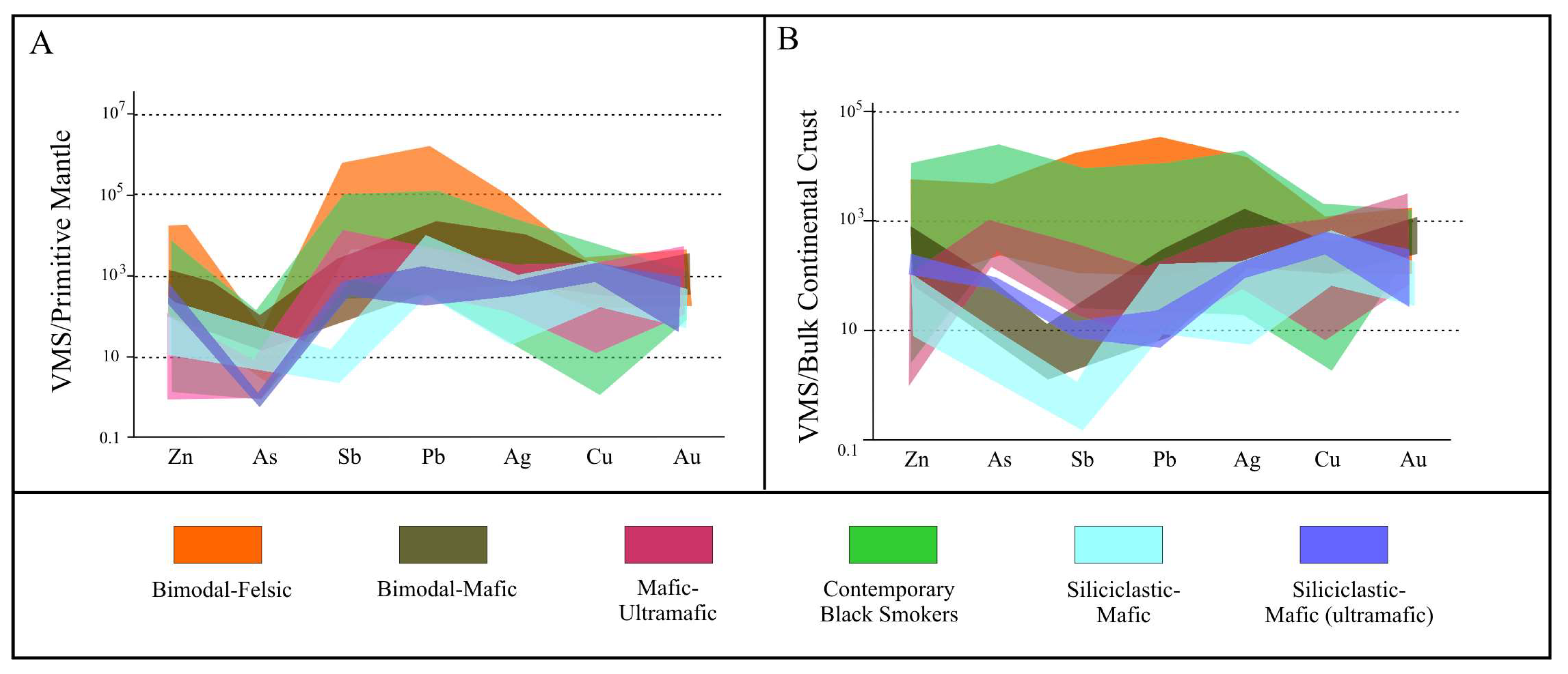
5. VMS Geochemistry
5.1. Host-Rock Volcanism, Composition and Geochemistry
- It acts as heat source for the development of convection systems after mixing, in various ratios, of cold percolating seawater with upwelling hot magmatic fluids [133];
- It confines hydrothermal circulation of the metal-bearing fluids within limited-space zones, particularly along high-angle fault systems characterizing extensional and spreading centers, thereby leading to the deposition of massive sulfides at or near the seafloor;
- It may function as a source of metals, although in most cases, the host lithologies where the hydrothermal fluids circulate through tend to play the most important role in the geochemistry of the sulfide ores deposited [68].
5.2. Stable and Radiogenic Isotopes in VMS
5.3. Chemical Composition of Ore Phases

| Deposit Name | Region | VMS Type | Cu | Zn | Pb | Sn | Reference | |||||||||
|---|---|---|---|---|---|---|---|---|---|---|---|---|---|---|---|---|
| Hokuroku district | Honsu, Japan | Bimodal-Felsic | 1.23 | 41.20 | 1.58 | [107] | ||||||||||
| Hokuroku district | Honsu, Japan | Bimodal-Felsic | 8.85 | 0.77 | 0.28 | [107] | ||||||||||
| Hokuroku district | Honsu, Japan | Bimodal-Felsic | 2.01 | 2.06 | [107] | |||||||||||
| Bisha Deposit | Western Nakfa Terrane, Eritrea | Bimodal-Felsic | 0.99 | 5.72 | 0.2 | 0.0006 | [161] | |||||||||
| Talgan | South Urals, Russia | Bimodal-Felsic | 3.2 | 3.6 | 0.45 | [97] | ||||||||||
| Oktyabrskoye | South Urals, Russia | Bimodal-Felsic | 4.16 | 2 | 0.1 | [97] | ||||||||||
| Tash-Tau | South Urals, Russia | Bimodal-Felsic | 6.8 | 2.1 | 0.25 | [97] | ||||||||||
| Alexandrinskoye | South Urals, Russia | Bimodal-Felsic | 2.7 | 4.6 | 0.52 | [97] | ||||||||||
| Safyanovskoye | Central Urals, Russia | Bimodal-Felsic | 2.2 | 0.7 | 0.13 | [97] | ||||||||||
| North Knoll | Iheya Ridge, Okinawa Trough, Japan | Bimodal-Felsic | 2.54 | 31.1 | 20.2 | [162] | ||||||||||
| North Knoll | Iheya Ridge, Okinawa Trough, Japan | Bimodal-Felsic | 4.63 | 36.3 | 11.7 | [162] | ||||||||||
| North Knoll | Iheya Ridge, Okinawa Trough, Japan | Bimodal-Felsic | 3.46 | 33.8 | 10.9 | [162] | ||||||||||
| North Knoll | Iheya Ridge, Okinawa Trough, Japan | Bimodal-Felsic | 1.26 | 36.5 | 9.14 | [162] | ||||||||||
| North Knoll | Iheya Ridge, Okinawa Trough, Japan | Bimodal-Felsic | 3.23 | 25.9 | 13.9 | [162] | ||||||||||
| North Knoll | Iheya Ridge, Okinawa Trough, Japan | Bimodal-Felsic | 3.06 | 24.5 | 15.4 | [162] | ||||||||||
| Sultanovskoye | South Urals, Russia | Bimodal-Mafic | 1.4 | 0.7 | 0.009 | [97] | ||||||||||
| Yubileynoye | South Urals, Russia | Bimodal-Mafic | 1.4 | 1 | [97] | |||||||||||
| Yaman Kasy | South Urals, Russia | Bimodal-Mafic | 2.6 | 5.6 | 0.03 | [97] | ||||||||||
| Uzelga | South Urals, Russia | Bimodal-Mafic | 1.3 | 2.6 | 0.15 | [97] | ||||||||||
| Molodezhnoye | South Urals, Russia | Bimodal-Mafic | 2.1 | 3.3 | 0.17 | [97] | ||||||||||
| Valentonskoye | North Urals, Russia | Bimodal-Mafic | 2.4 | 3.2 | 0.24 | [97] | ||||||||||
| Othrys | Thessaly, Greece | Mafic–Ultramafic | 1.8 | 0.12 | [159] | |||||||||||
| Mathiati | Cyprus | Mafic–Ultramafic | 0.2 | 0.26 | [159] | |||||||||||
| Skouriotissa—Apliki | Solea Graben, Cyprus | Mafic–Ultramafic | 0.18 | [163] | ||||||||||||
| Kokkinoyia—Agrokipia | Mitsero Graben, Cyprus | Mafic–Ultramafic | 0.08 | [163] | ||||||||||||
| Buribay | South Urals, Russia | Mafic–Ultramafic | 3.5 | 0.5 | [97] | |||||||||||
| Sheikh-Ali | Iran | Mafic–Ultramafic | 3.5 | 0.08 | [164] | |||||||||||
| Sheikh-Ali | Iran | Mafic–Ultramafic | 4.8 | 0.007 | [164] | |||||||||||
| Sheikh-Ali | Iran | Mafic–Ultramafic | 0.043 | 0.052 | [164] | |||||||||||
| Sheikh-Ali | Iran | Mafic–Ultramafic | 4.2 | 0.2 | [164] | |||||||||||
| Sheikh-Ali | Iran | Mafic–Ultramafic | 1.54 | 0.48 | [164] | |||||||||||
| Pacific Ocean | NE Pacific Ridge | Modern black smokers | 4.8 | 0.54 | [50,165] | |||||||||||
| Endeavour Segment (Slab A SZ-FTWZ) | Juan de Fuca Ridge | Modern black smokers | 0.1 | 3.43 | 1.14 | [29] | ||||||||||
| Endeavour Segment (Slab E SZ-FTWZ) | Juan de Fuca Ridge | Modern black smokers | 0.39 | 8.8 | 1.26 | [29] | ||||||||||
| Brothers Volcano (sample 57DR-1E) | Southern Kermadec Arc, New Zealand | Modern black smokers | 0.21 | 26.6 | 0.5 | 0.0005 | [166] | |||||||||
| Brothers Volcano (sample 52DR-10) | Southern Kermadec Arc, New Zealand | Modern black smokers | 0.0059 | 0.0085 | 0.0091 | 0.0001 | [166] | |||||||||
| Central Bransfield Strait (Hook Ridge) | Antarctica | Modern black smokers | 4.5 | 18.5 | 2.6 | [167] | ||||||||||
| Semenov-3 Hydrothermal Field | Mid-Atlantic Ridge | Modern black smokers | 0.075 | 0.0203 | 0.0072 | 0.0002 | [168] | |||||||||
| Semenov-3 Hydrothermal Field | Mid-Atlantic Ridge | Modern black smokers | 0.1745 | 0.0257 | 0.0085 | 0.0003 | [168] | |||||||||
| Karchiga Deposit (Central) | Rudny Altai, Siberia | Siliciclastic–Mafic | 2.68 | 0.2 | 0.01 | [63] | ||||||||||
| Karchiga Deposit (Northeastern) | Rudny Altai, Siberia | Siliciclastic–Mafic | 2.44 | 0.83 | [63] | |||||||||||
| Ermioni | Argolis, Greece | Siliciclastic–Mafic | 4.8 | 0.15 | 0.02 | [62] | ||||||||||
| Ermioni | Argolis, Greece | Siliciclastic–Mafic | 3.08 | 0.09 | [62] | |||||||||||
| Ermioni | Argolis, Greece | Siliciclastic–Mafic | 0.72 | 0.6 | 0.14 | 0.02 | [62] | |||||||||
| Outokumpu | Finland | Siliciclastic–Mafic (Ultramafic) | 3.8 | 1.07 | 0.005 | 0.013 | [95] | |||||||||
| Vuonos | Finland | Siliciclastic–Mafic (Ultramafic) | 2.45 | 1.6 | 0.015 | 0.014 | [95] | |||||||||
| Aznalcóllar–Los Frailes (Massive sulfides) | IPB, Spain | Siliciclastic–Felsic (IPB) | 0.3 | 3.8 | 2.1 | 0.01 | [87,169,170] | |||||||||
| Neves-Corvo | IPB, Portugal | Siliciclastic–Felsic (IPB) | 2.1 | 1.2 | 0.12 | [87,171] | ||||||||||
| Neves-Corvo | IPB, Portugal | Siliciclastic–Felsic (IPB) | 1.3 | 2.9 | 0.12 | [87] | ||||||||||
| Dergamysh | South Urals, Russia | Ultramafic (Atlantic) | 1.3 | 0.3 | [97] | |||||||||||
| Deposit name | Co | Cd | Ni | Bi | Mo | Se | Au | Ag | As | Sb | Hg | Tl | Te | Ga | Ge | Reference |
| Hokuroku District | 1910 | 8.5 | 319 | 0.5 | 137 | 169 | 0.1 | 58 | [107] | |||||||
| Hokuroku District | 45 | 152 | 122 | 1.6 | 160 | 5890 | 35 | 6.5 | [107] | |||||||
| Hokuroku District | 103 | 26 | 14 | 0.2 | 317 | 22,900 | 1.0 | 12 | [107] | |||||||
| Bisha Deposit | 113.8 | 176.5 | 5.5 | 0.7 | 47.5 | 704 | 28.3 | 5.5 | 8.1 | [161] | ||||||
| Talgan | 15 | 1.7 | 44 | 10 | [97] | |||||||||||
| Oktyabrskoye | 30 | 2.4 | 24 | 22 | [97] | |||||||||||
| Tash-Tau | 4 | 58 | 5 | [97] | ||||||||||||
| Alexandrinskoye | 8 | 1.1 | 37 | 39 | [97] | |||||||||||
| Safyanovskoye | 60 | 0.5 | 20 | 9.2 | [97] | |||||||||||
| North Knoll | 0.69 | 690 | 296 | 1000 | 0.81 | [162] | ||||||||||
| North Knoll | 1.75 | 349 | 3620 | 1150 | 15.1 | [162] | ||||||||||
| North Knoll | 1.59 | 286 | 3840 | 2870 | 19.9 | [162] | ||||||||||
| North Knoll | 0.96 | 310 | 548 | 197 | 0.25 | [162] | ||||||||||
| North Knoll | 1.04 | 290 | 943 | 239 | 3.57 | [162] | ||||||||||
| North Knoll | 1.34 | 865 | 1100 | 1360 | 6.3 | [162] | ||||||||||
| Sultanovskoye | 52 | 1.1 | 128 | 38 | [97] | |||||||||||
| Yubileynoye | 50 | 1.6 | 18 | 30 | [97] | |||||||||||
| Yaman Kasy | 22 | 3.3 | 34 | 325 | [97] | |||||||||||
| Uzelga | 110 | 1.8 | 34 | 101 | [97] | |||||||||||
| Molodezhnoye | 82 | 1.6 | 46 | 89 | [97] | |||||||||||
| Valentonskoye | 22 | 1.72 | 26 | 28 | [97] | |||||||||||
| Othrys | 50 | 5 | 0.26 | [159] | ||||||||||||
| Mathiati | 54 | 33 | 20 | 0.8 | 4 | [159] | ||||||||||
| Skouriotissa—Apliki | 299 | 1.7 | 662 | 0.5 | 119 | 3.2 | 8.6 | [163] | ||||||||
| Kokkinoyia—Agrokipia | 116 | 3.2 | 47 | 0.3 | 671 | 52 | 5.4 | [163] | ||||||||
| Buribay | 0.03 | 50 | 5.5 | 20 | [97] | |||||||||||
| Sheikh-Ali | 256 | 19 | 0.42 | 34 | [164] | |||||||||||
| Sheikh-Ali | 24 | 37 | 0.44 | 28 | [164] | |||||||||||
| Sheikh-Ali | 147 | 23 | 0.18 | 10 | [164] | |||||||||||
| Sheikh-Ali | 266 | 31 | 0.18 | 16 | [164] | |||||||||||
| Sheikh-Ali | 224 | 24 | 0.25 | 21 | [164] | |||||||||||
| Pacific Ocean | 200 | 114 | 0.8 | 105 | 620 | 32 | [50,165] | |||||||||
| Endeavour Segment (Slab A SZ-FTWZ) | 2 | 29 | 139 | 33 | 259 | 670 | 142 | 142 | [29] | |||||||
| Endeavour Segment (Slab E SZ-FTWZ) | 1 | 189 | 159 | 51 | 173 | 1020 | 125 | 167 | [29] | |||||||
| Brothers Volcano (sample 57DR-1E) | 590 | 0.5 | 55 | 1.43 | 430 | 2660 | 215 | 42 | 150 | 0.3 | 0.2 | [166] | ||||
| Brothers Volcano (sample 52DR-10) | 750 | 1.6 | 5 | 10 | 0.7 | 1630 | 169 | 4 | 80 | 3.2 | [166] | |||||
| Central Bransfield Strait (Hook Ridge) | 0.5 | 7600 | 573 | 57 | [167] | |||||||||||
| Semenov-3 Hydrothermal Field | 24 | 0.47 | 13 | 0.12 | 30 | 38 | 148 | 2.09 | 6.31 | 0.08 | 0.39 | 0.11 | [168] | |||
| Semenov-3 Hydrothermal Field | 38 | 0.94 | 12 | 0.43 | 37 | 44 | 123 | 2.45 | 5.69 | 0.76 | 0.39 | 0.06 | [168] | |||
| Karchiga Deposit (Central) | 280 | 100 | 8.5 | 7.2 | 57 | 0.12 | 6.7 | [63] | ||||||||
| Karchiga Deposit (Northeastern) | 140 | 65 | 9.7 | 5.1 | 63 | 0.3 | 7.1 | [63] | ||||||||
| Ermioni | 0.1 | 0.01 | 0.03 | 0.55 | 15 | 0.03 | [62] | |||||||||
| Ermioni | 0.09 | 0.02 | 0.43 | 7 | 0.02 | [62] | ||||||||||
| Ermioni | 0.54 | 0.01 | 0.2 | 0.61 | [62] | |||||||||||
| Outokumpu | 2400 | 28.6 | 1200 | 0.72 | 19 | 24.2 | 0.8 | 8.9 | 81.6 | 2.34 | [95] | |||||
| Vuonos | 1500 | 33.5 | 1300 | 0.65 | 17 | 6.6 | 0.1 | 11 | 74.4 | 1.84 | [95] | |||||
| Aznalcóllar–Los Frailes (Massive sulfides) | 0.4 | 60 | [87,169,170] | |||||||||||||
| Neves-Corvo | [87,171] | |||||||||||||||
| Neves-Corvo | [87] | |||||||||||||||
| Dergamysh | 0.25 | 54 | 2 | 12 | 16 | [97] | ||||||||||
6. Fossilized Versus Modern VMS Deposits
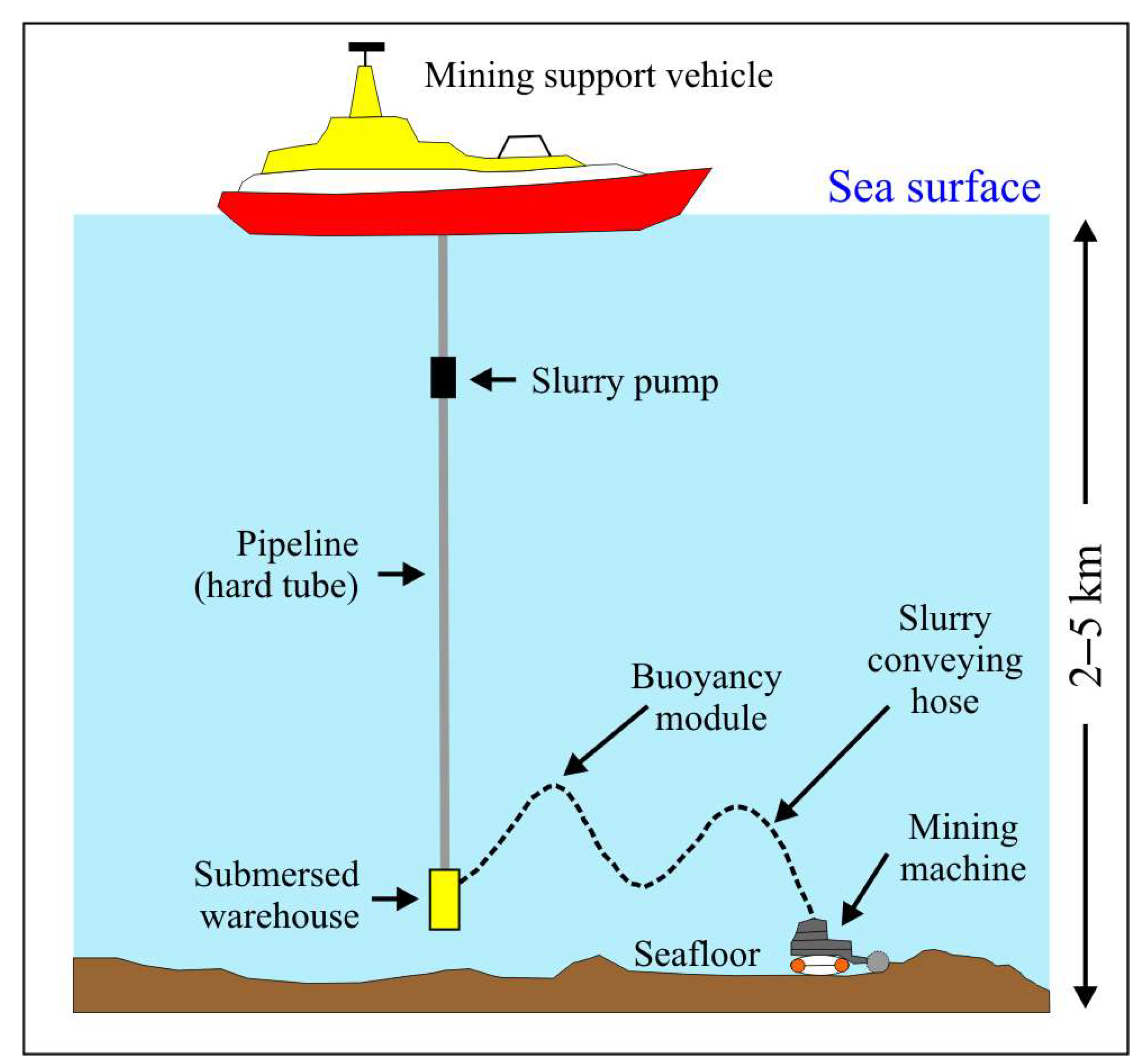
7. VMS Prospecting and Future Exploitation Technologies
- The mining machine that extracts the resources from the seafloor and also performs desilting and crushing of the collected material (slurry);
- The slurry-conveying hose that transports the slurry to the submersed warehouse where it is collected. A buoyancy module is attached to the conveying hose providing the mining machine with the ability to move around within a certain range. The submersed warehouse is usually located a few tens of meters above the sea floor;
- A hard tube (pipeline) connects the submerged warehouse with the mining support vehicle on the sea surface. A slurry pump is attached to the pipeline with objective of transporting the slurry to the support vehicle.
8. VMS in Human History and Future Perspectives
9. Conclusions
- They may form in geotectonic settings characterizing both convergent and divergent margins, with the only common features among all VMS types being the spatial and/or temporal relation with submarine volcanism and the massive ore texture, regardless of ore mineralogy and geochemistry;
- Their formation has been occurring since the Paleoarchean (3.55 Ga) and continues to this day in active settings (e.g., black smokers), indicating that the geological processes leading to their formation will also carry on in the future;
- Despite the importance of magma at depth that acts either as a heat source and/or as a source of metals, the host rock lithology and geochemistry play the most important role in the mineralogy and mineral chemistry of the massive sulfide ores deposited;
- Although the various VMS types may point to different geotectonic regimes, a very small number of sulfide phases, such as pyrite, pyrrhotite, chalcopyrite, galena and sphalerite, characterize the main ore mineralogy;
- Due to subtle differences in the setting of VMS formation, the ore geochemistry, including precious and critical metals, may vary within a great range;
- Despite the exploitation of VMS since antiquity, primarily for their base and precious metal content, they are also significant sources of critical and strategic metals highly sought after in recent years, including Co, Ni, Ga, Ge, In, Bi, As, Sb, Se, Mo, Cd, Sn, Hg, Tl and Bi;
- The importance of VMS is not exhausted in terrestrial deposits exploited in the past and present, or in new deposits discovered on land. During the last 60 years, exploration of the oceans has revealed the presence of massive sulfides on the ocean floor (SMS), especially along plate margins, verifying the increased potential of VMS as sources of critical metals that could cover the world’s continuously increasing demands;
- Significant differences characterize fossilized and modern VMS in terms of spatial development, texture and ore mineralogy, features that are largely obscured or destroyed in fossilized VMS. Therefore, specific approaches are required in the development of ore processing methodologies and DSM in order to fully exploit the potential of modern (active and inactive) VMS deposits;
- It is more than clear that VMS will continue to play a crucial role in the future evolution of mankind, not only for base and precious metals, but also towards strategic and critical metals.
Funding
Data Availability Statement
Conflicts of Interest
References
- Barrie, C.T.; Hannington, M.D. Introduction: Classification of VMS deposits based on host rock composition. In Volcanic-Associated Massive Sulfide Deposits: Processes and Examples in Modern and Ancient Settings; Barrie, C.T., Hannington, M.D., Eds.; The Society of Economic Geologists (SEG): Littleton, CO, USA, 1999. [Google Scholar]
- Hannington, M.D.; Poulsen, K.H.; Thompson, J.F.H.; Sillitoe, R.H. Volcanogenic gold in the massive sulfide environment. In Volcanic-Associated Massive Sulfide Deposits—Processes and Examples in Modern and Ancient Settings; Barrie, C.T., Hannington, M.D., Eds.; The Society of Economic Geologists (SEG): Littleton, CO, USA, 1999; pp. 325–356. [Google Scholar]
- Galley, A.G.; Hannington, M.D.; Jonasson, I.R. Volcanogenic massive sulphide deposits. In Mineral Deposits of Canada: A Synthesis of Major Deposit-Types, District Metallogeny, the Evolution of Geological Provinces, and Exploration Methods; Goodfellow, W.D., Ed.; Geological Association of Canada, Mineral Deposits Division: St. John’s, NL, Canada, 2007; pp. 141–161. [Google Scholar]
- Mosier, D.L.; Berger, V.I.; Singer, D.A. Volcanogenic Massive Sulfide Deposits of the World: Database and Grade and Tonnage Models; U.S. Geological Survey: Preston, VA, USA, 2009; U.S. Geological Survey Open-File Report 2009-1034, Report: iv; 46 p. Available online: https://pubs.usgs.gov/of/2009/1034/ (accessed on 15 January 2026).
- Koski, R.A.; Mosier, D.L. Deposit type and associated commodities. In Volcanogenic Massive Sulfide Occurrence Model; Shanks, W.C.P., III, Thurston, R., Eds.; U.S. Geological Survey Scientific Investigations Report 2010–5070–C; U.S. Geological Survey: Preston, VA, USA, 2012; Chapter 2; pp. 13–21. [Google Scholar]
- Shanks, W.C.P., III. Historical evolution of descriptive and genetic knowledge and concepts. In Volcanogenic Massive Sulfide Occurrence Model; Shanks, W.C.P., III, Thurston, R., Eds.; U.S. Geological Survey Scientific Investigations Report 2010–5070–C; U.S. Geological Survey: Preston, VA, USA, 2012; Chapter 3; pp. 23–32. [Google Scholar]
- Hutchinson, R.W. Volcanogenic sulfide deposits and their metallogenic significance. Econ. Geol. 1973, 68, 1223–1246. [Google Scholar] [CrossRef]
- Leistel, J.M.; Marcoux, E.; Thiéblemont, D.; Quesada, C.; Sánchez, A.; Almodóvar, G.R.; Pascual, E.; Sáez, R. The volcanic-hosted massive sulphide deposits of the Iberian Pyrite Belt, Review and preface to the Thematic Issue. Miner. Depos. 1998, 33, 2–30. [Google Scholar] [CrossRef]
- Franklin, J.M.; Hannington, M.D. Volcanogenic massive sulfides through time. In Proceedings of the Annual Meeting of Geological Society of America, Denver, CO, USA, 27–30 October 2002. [Google Scholar]
- Gibson, H.L.; Allen, R.L.; Riverin, G.; Lane, T.E. The VMS model: Advances and application to exploration targeting. In Proceedings of the Exploration 07: 5th Decennial International Conference on Mineral Exploration, Toronto, ON, Canada, 9–12 September 2007; pp. 717–730. [Google Scholar]
- Pirajno, F.; Seltmann, R.; Yang, Y. A review of mineral systems and associated tectonic settings of northern Xinjiang, NW China. Geosci. Front. 2011, 2, 157–185. [Google Scholar] [CrossRef]
- Piercey, S. The setting, style and role of magmatism in the formation of volcanogenic massive sulfide deposits. Miner. Depos. 2011, 46, 449–471. [Google Scholar] [CrossRef]
- Shanks, W.C.P., III; Thurston, R. Volcanogenic Massive Sulfide Occurrence Model; U.S. Geological Survey Scientific Investigations Report 2010–5070–C; U.S. Geological Survey: Preston, VA, USA, 2012; 345p. [Google Scholar]
- Ross, P.-S.; Mercier-Langevin, P. The volcanic setting of VMS and SMS deposits: A review. Geosci. Can. 2014, 41, 365–377. [Google Scholar] [CrossRef]
- Martin-Izard, A.; Arias, D.; Arias, M.; Gumiel, P.; Sanderson, D.J.; Castañon, C.; Sanchez, J. Ore deposit types and tectonic evolution of the Iberian Pyrite Belt: From transtensional basins and magmatism to transpression and inversion tectonics. Ore Geol. Rev. 2016, 79, 254–267. [Google Scholar] [CrossRef]
- Hollis, S.P.; Yeats, C.J.; Wyche, S.; Barnes, S.J.; Ivanic, T.J.; Belford, S.M.; Davidson, G.J.; Roache, A.J.; Wingate, M.T.D. A review of volcanic-hosted massive sulfide (VHMS) mineralization in the Archaean Yilgarn Craton, Western Australia: Tectonic, stratigraphic and geochemical associations. Precamb. Res. 2019, 260, 113–135. [Google Scholar] [CrossRef]
- Leach, D.L.; Sangster, D.F.; Kelley, K.D.; Large, R.R.; Garven, G.; Allen, C.R.; Gutzmer, J.; Walters, S. Sediment-hosted lead-zinc deposits—A global perspective. In Economic Geology: 100th Anniversary Volume; Hedenquist, J.W., Thompson, J.F.H., Goldfarb, R.J., Richards, J.P., Eds.; Economic Geology Publishing Co: Lancaster, PA, USA, 2005; pp. 561–608. [Google Scholar] [CrossRef]
- Ashton, J.H.; Andrew, C.J.; Hitzman, M.W. Irish-type Zn-Pb deposits—What are they and can we find more? In Irish-Type Deposits Around the World; Andrew, C.J., Hitzman, M.W., Stanley, G., Eds.; Irish Association for Economic Geology: Dublin, Ireland, 2023; pp. 95–146. [Google Scholar] [CrossRef]
- Spry, P.G.; Teale, G.S.; Steadman, J.A. Classification of Broken Hill-Type Pb-Zn-Ag Deposits: A Refinement. Eos Transactions AGU, v.90, 2009, 22, Joint Assembly Supplement 2009, Abstract, V21A-01. Available online: https://ui.adsabs.harvard.edu/abs/2009AGUSM.V21A..02S (accessed on 15 January 2026).
- Spry, P.G.; Teale, G.S. A classification of Broken Hill-type deposits: A critical review. Ore Geol. Rev. 2021, 130, 103935. [Google Scholar] [CrossRef]
- Emmons, W.H. Some regionally metamorphosed ore deposits and the so-called segregated veins. Econ. Geol. 1909, 4, 755–781. [Google Scholar] [CrossRef]
- Oftedahl, C. A theory of exhalative-sedimentary ores. Geol. Föreningens I Stockh. Förhandlingar 1958, 80, 1–19. [Google Scholar] [CrossRef]
- Stanton, R.L. Mineralogical features and possible mode of emplacement of the Brunswick Mining and Smelting orebodies, Gloucester County, New Brunswick. Can. Inst. Min. Metall. Trans. 1959, 62, 631–643. [Google Scholar]
- Dunham, K.C. Neptunist concepts in ore genesis. Econ. Geol. 1964, 59, 1–21. [Google Scholar] [CrossRef]
- Boschen, R.E.; Rowden, A.A.; Clark, M.R.; Gardner, J.P.A. Mining of deep-sea seafloor massive sulfides: A review of the deposits, their benthic communities, impacts from mining, regulatory frameworks and management strategies. Ocean Coast. Manag. 2013, 84, 54–67. [Google Scholar] [CrossRef]
- Rona, P.A. Hydrothermal mineralization at slow-spreading centers: Red Sea, Atlantic Ocean and Indian Ocean. Mar. Min. 1985, 5, 117–145. [Google Scholar]
- Rona, P.A.; Klinkhammer, G.; Nelsen, T.A.; Trefry, J.H.; Elderfield, H. Black smokers, massive sulfides and vent biota at the Mid-Atlantic Ridge. Nature 1986, 321, 33–37. [Google Scholar] [CrossRef]
- Rona, P.A. The changing vision of marine minerals. Ore Geol. Rev. 2008, 33, 618–666. [Google Scholar] [CrossRef]
- Kristall, B.; Kelley, D.S.; Hannington, M.D.; Delaney, J.R. Growth history of a diffusely venting sulfide structure from the Juan de Fuca Ridge: A petrological and geochemical study. Geochem. Geophys. Geosyst. 2006, 7, 7. [Google Scholar] [CrossRef]
- Parmentier, E.M.; Spooner, E.T.C. A theoretical study of hydrothermal convection and the origin of the ophiolitic sulphide ore deposits of Cyprus. Earth Planet Sci. Lett. 1978, 40, 33–44. [Google Scholar] [CrossRef]
- Cathles, L.M. Fluid flow and ore genesis of hydrothermal ore deposits. Econ. Geol. 1981, 424–457. [Google Scholar]
- Cathles, L.M. An analysis of the hydrothermal system responsible for massive sulfide deposition in the Hokuroku Basin of Japan. In The Kuroko and Related Volcanogenic Massive Sulfide Deposits; Ohmoto, H., Skinner, B.J., Eds.; Economic Geology 1983, Monograph 5; Society of Economic Geologists: Littleton, CO, USA, 1983; pp. 439–487. [Google Scholar]
- Cathles, L.M. A capless 350 °C flow zone model to explain megaplumes, salinity variations, and high-temperature veins in ridge axis hydrothermal systems. Econ. Geol. 1993, 88, 1977–1999. [Google Scholar] [CrossRef]
- Barrie, C.T.; Cathles, L.M.; Erendi, A.E. Finite element, heat flow and fluid-flow computer simulations forf a deep ultramafic sill model for the Giant Kidd Creek volcanic-associated massive sulfide deposit, Abitibi Subprovince, Canada. In The Giant Kidd Creek Volcanogenic Massive Sulfide Deposit, Western Abitibi Subprovince, Canada; Hannington, M.D., Barrie, C.T., Eds.; Economic Geology 1999, Monograph 10; Society of Economic Geologists: Littleton, CO, USA, 1999; pp. 201–219. [Google Scholar]
- Jupp, T.; Schultz, A. A thermodynamic explanation for black smoker temperatures. Nature 2000, 403, 880–883. [Google Scholar] [CrossRef] [PubMed]
- Schardt, C.; Cooke, D.R.; Gemmell, J.B.; Large, R.R. Geochemical modeling of the zoned footwall alteration pipe, Hellyer Volcanic-Hosted Massive Sulfide deposit, Western Tasmania, Australia. Econ. Geol. 2001, 96, 1037–1054. [Google Scholar] [PubMed]
- Schardt, C.; Yang, J.; Large, R.R. Numerical heat and fluid flow modeling of the Panorama volcanic-hosted massive sulfide district, Western Australia. Econ. Geol. 2005, 100, 547–566. [Google Scholar] [CrossRef]
- Schardt, C.; Large, R.R.; Yang, J. Controls on heat flow, fluid migration, and massive sulfide formation of an off-axis hydrothermal system-the Lau basin perspective. Am. J. Sci. 2006, 306, 103–134. [Google Scholar] [CrossRef]
- Yang, J. Influence of normal faults and basement topography on ridge-flank hydrothermal fluid circulation. Geophys. J. Int. 2002, 151, 83–87. [Google Scholar] [CrossRef]
- Schardt, C.; Large, R.R. New insights into the genesis of volcanic-hosted massive sulfide deposits on the seafloor from numerical modeling studies. Ore Geol. Rev. 2009, 35, 333–351. [Google Scholar] [CrossRef]
- Salama, L.; Mouguina, E.M.; El Bachari, E.; Rddad, L.; Outhounjite, M.; Essaoudi, M.; Maacha, L.; Zouchair, M. Numerical heat and fluid flow modeling of the Hercynian Draa Sfar polymetallic (Zn-Pb-Cu) massive sulfide deposit, Central Jbilets, Morocco. Arab. J. Geosci. 2018, 11, 785. [Google Scholar] [CrossRef]
- Pierre, S.; Gysi, A.P.; Monecke, T. Fluid chemistry of mid-ocean ridge hydrothermal vents: A comparison between numerical modeling and vent geochemical data. Geofluids 2018, 2018, 1389379. [Google Scholar] [CrossRef]
- Fuchs, S.; Hannington, M.D.; Petersen, S. Divining gold in seafloor polymetallic massive sulfide systems. Miner. Depos. 2019, 54, 789–820. [Google Scholar] [CrossRef]
- Tombros, S.F.; Triantafyllidis, S.; Kokkalas, S.; Fitros, M.; Zhai, D.; Papavasiliou, J.; Spiliopoulou, A.; Kappis, K.; Skliros, V.; Perraki, M. Hydraulic-Thermodynamic Modeling of the upper Cretaceous “Mafic-Pelitic” Ermioni VMS deposit, Greece. Ore Geol. Rev. 2022, 148, 105039. [Google Scholar] [CrossRef]
- Schulz, K.J. Regional Environment. In Volcanogenic Massive Sulfide Occurrence Model; Shanks, W.C.P., III, Thurston, R., Eds.; Scientific Investigations Report, 2010–5070–C; USGS: Reston, VA, USA, 2012; Chapter 4; pp. 37–60. [Google Scholar]
- Morgan, L.A.; Schulz, K.J. Physical volcanology of volcanogenic massive sulfide deposits. In Volcanogenic Massive Sulfide Occurrence Model; Shanks, W.C.P., III, Thurston, R., Eds.; Scientific Investigations Report, 2010–5070–C; USGS: Reston, VA, USA, 2012; Chapter 5; pp. 65–95. [Google Scholar]
- Boström, K.; Peterson, M.N.A. Precipitates from hydrothermal exhalations on the East Pacific Rise. Econ. Geol. 1966, 61, 1258–1265. [Google Scholar] [CrossRef]
- Hannington, M.D.; Jonasson, I.R.; Herzig, P.M.; Petersen, S. Physical and chemical processes of seafloor mineralization at midocean ridges. In Seafloor Hydrothermal Systems: Physical, Chemical, Biological and Geological Interactions; Humphris, S.E., Zierenberg, R.A., Mullineaux, L.S., Thomson, R.E., Eds.; Geophysical Monograph 91; American Geophysical Union: Washington, DC, USA, 1995; pp. 115–157. [Google Scholar]
- Herzig, P.M.; Hannington, M.D. Polymetallic massive sulfides at the modern seafloor: A review. Ore Geol. Rev. 1995, 10, 95–115. [Google Scholar] [CrossRef]
- Hannington, M.D.; Galley, A.G.; Herzig, P.M.; Petersen, S. Comparison of the TAG mound and stockwork complex with Cyprus type massive sulfide deposits. In Proceedings of the Ocean Drilling Program, Scientific Results; Ocean Drilling Program: College Station, TX, USA, 1998; Volume 158, pp. 389–415. [Google Scholar]
- Doyle, M.G.; Allen, R.L. Subsea-floor replacement in volcanic-hosted massive sulfide deposits. Ore Geol. Rev. 2003, 23, 183–222. [Google Scholar] [CrossRef]
- Hannington, M.D.; de Ronde, C.E.J.; Petersen, S. Sea-floor tectonics and submarine hydrothermal systems. In Economic Geology 100th Anniversary Volume 1905–2005; Hedenquist, J.W., Thompson, J.F.H., Goldfarb, R.J., Richards, J.P., Eds.; Society of Economic Geologists: Littleton, CO, USA, 2005; pp. 111–141. [Google Scholar]
- Ohmoto, H. Formation of volcanogenic massive sulfide deposits: The Kuroko perspective. Ore Geol. Rev. 1996, 10, 135–177. [Google Scholar] [CrossRef]
- Franklin, J.M.; Gibson, H.L.; Jonasson, I.R.; Galley, A.G. Volcanogenic Massive Sulfide Deposits. In Economic Geology 100th Anniversary Volume 1905–2005; Hedenquist, J.W., Thompson, J.F.H., Goldfarb, R.J., Richards, J.P., Eds.; Society of Economic Geologists: Littleton, CO, USA, 2005; pp. 523–560. [Google Scholar]
- Lydon, J.W. Volcanogenic massive sulphide deposits Part 1: A descriptive model. Geosc. Can. 1984, 11, 195–202. [Google Scholar]
- Koski, R.A. Hypogene ore characteristics in volcanogenic massive sulfide occurrence model. In Volcanogenic Massive Sulfide Occurrence Model; Shanks, W.C.P., III, Thurston, R., Eds.; Scientific Investigations Report, 2010–5070–C; USGS: Reston, VA, USA, 2012; Chapter 8; pp. 137–143. [Google Scholar]
- Sato, T. Distribution and Geological Setting of the Kuroko Deposits. Soc. Min. Geol. Jpn. 1974, 6, 11–18. [Google Scholar]
- Franklin, J.M.; Lydon, J.W.; Sangster, D.M. Volcanic-associated Massive Sulfide Deposits. Econ. Geol. 1981, 485–627. [Google Scholar]
- Slack, J.F. Physical Description of Deposit, Introduction. In Volcanogenic Massive Sulfide Occurrence Model; Shanks, W.C.P., III, Thurston, R., Eds.; Scientific Investigations Report, 2010–5070–C; USGS: Reston, VA, USA, 2012; Chapter 6; pp. 105–111. [Google Scholar]
- Tornos, F.; Peter, J.M.; Allen, R.; Conde, C. Controls on the sitting and style of volcanogenic massive sulphide deposits. Ore Geol. Rev. 2015, 68, 142–163. [Google Scholar] [CrossRef]
- Sangster, D. Quantitative characteristics of volcanogenic massive sulphide deposits I. Metal content and size distribution of massive sulphide deposits in volcanic centers. CIM Bull. 1980, 73, 74–81. [Google Scholar]
- Triantafyllidis, S.; Tombros, F.S.; Zhai, D.; Kokkalas, S. The Upper Cretaceous Ermioni VMS Deposit, Argolis Peninsula, Peloponnese, Greece: Type, genesis, and geotectonic setting. Ore Geol. Rev. 2021, 138, 104403. [Google Scholar] [CrossRef]
- Lobanov, K.V.; Gaskov, I.V. The Karchiga copper massive sulfide deposit in the high-grade metamorphosed rocks of the Kurchum block: Geologic structure, formation, and metamorphism (Rudny Altai). Rus. Geol. Geoph. 2012, 53, 77–91. [Google Scholar] [CrossRef]
- Triantafyllidis, S.S.; Tombros, S.F. Deciphering the Evolution of Adjacent Volcanogenic Massive Sulfide (VMS) Systems Based on Radiogenic and Stable Isotopes, the Case of Ermioni, Argolis Peninsula, Ne Peloponnese, Greece. Minerals 2023, 13, 474. [Google Scholar] [CrossRef]
- Carvalho, J.R.S.; Relvas, J.M.R.S.; Pinto, A.M.M.; Frenzel, M.; Krause, J.; Gutzmer, J.; Pacheco, N.; Fonseca, R.; Santos, S.; Caetano, P.; et al. Indium and selenium distribution in the Neves-Corvo deposit, Iberian Pyrite Belt, Portugal. Mineral. Mag. 2018, 82, S5–S41. [Google Scholar] [CrossRef]
- Prokin, V.A.; Buslaev, F.P. Massive copper–zinc deposits in the Urals. Ore Geol. Rev. 1999, 1, 1–69. [Google Scholar]
- Sawkins, F.J. Metal Deposits in Relation to Plate Tectonics, 2nd ed.; Springer: New York, NY, USA, 1990; p. 461. [Google Scholar]
- Torró, L.; Proenza, J.A.; Melgarejo, J.C.; Alfonso, P.; Farré de Pablo, J.; Colomer, J.M.; Garćia-Casco, A.; Gubern, A.; Gallardo, E.; Cazanas, X.; et al. Mineralogy, geochemistry and sulfur isotope characterization of Cerro de Maimón (Dominican Republic), San Fernando and Antonio (Cuba) lower Cretaceous VMS deposits: Formation during subduction initiation of the proto-Caribbean lithosphere within a fore-arc. Ore Geol. Rev. 2016, 72, 794–817. [Google Scholar] [CrossRef]
- Agangi, A.; Nogo Retnaningtyas Bunga Naen, G.; Nopeia, M.; Amini, H.; Takahashi, R.; Manalo, P. Kuroko Deposits of NE Japan: The Product of High-Temperature, Shallow Felsic Volcanism in a Deepening Continental Rift. Terra Nova 2025, 37, 361–453. [Google Scholar] [CrossRef]
- Piercey, S.J. Lithogeochemistry of volcanic rocks associated with volcanogenic massive sulphide deposits and applications to exploration. In Submarine Volcanism and Mineralization: Modern Through Ancient; Cousens, B., Piercey, S.J., Eds.; Geological Association of Canada: Quebec City, QC, Canada, 2008; pp. 15–40. [Google Scholar]
- Ridley, W.I. Petrology of associated igneous rocks. In Volcanogenic Massive Sulfide Occurrence Model; Shanks, W.C.P., III, Thurston, R., Eds.; Scientific Investigations Report, 2010–5070–C; USGS: Reston, VA, USA, 2012; Chapter 15; pp. 231–256. [Google Scholar]
- Hou, Z.; Wang, L.; Khin, Z.; Mo, X.; Wang, M.; Li, D.; Pan, G. Post-collisional crustal extension setting and VHMS mineralization in the Jinshajiang orogenic belt, southwestern China. Ore Geol. Rev. 2003, 22, 177–199. [Google Scholar] [CrossRef]
- Huston, D.L.; Stevens, B.; Southgate, P.N.; Muhling, P.; Wyborn, L. Australian Zn-Pb-Ag Ore-Forming Systems: A Review and Analysis. Econ. Geol. 2006, 101, 1117–1157. [Google Scholar] [CrossRef]
- Höy, T. Volcanogenic massive sulphide deposits in British Columbia. In Ore Deposits, Tectonics and Metallogeny in the Canadian Cordillera; British Columbia Geological Survey Branch Paper 1991–4; Ministry of Energy, Mines and Petroleum Resources: Pretoria, South Africa, 1991; pp. 89–124. [Google Scholar]
- Cox, D.P.; Singer, D.A. Mineral Deposit Models. In U.S. Geological Survey, Bull. 1693; U.S. Geological Survey: Preston, VA, USA, 1986; 379p. [Google Scholar]
- Sawkins, F.J. Massive sulphide deposits in relation to geotectonics. In Metallogeny and Plate Tectonics; Strong, D.F., Ed.; Special Paper 14; Geological Association of Canada: Quebec City, QC, Canada, 1976; pp. 221–240. [Google Scholar]
- Constantinou, G.; Govett, G.J.S. Geology, geochemistry, and genesis of Cyprus sulfide deposits. Econ. Geol. 1973, 68, 843–858. [Google Scholar] [CrossRef]
- Mosier, D.L.; Singer, D.A.; Salem, B.B. Geologic and Grade-Tonnage Information on Volcanic-Hosted Copper-Zinc Lead Massive Sulfide Deposits; Open File Report 83–89; United States Geological Survey: Reston, VA, USA, 1983; 77p. [Google Scholar]
- Ishihara, S. Geology of the Kuroko Deposits. Soc. Min. Geol. Jpn. 1974, 6, 1–437. [Google Scholar]
- Hutchinson, R.W.; Spence, C.D.; Franklin, J.M. Precambrian Sulfide Deposits; H.S. Robinson Memorial Volume; Franklin, J.M., Ed.; Geological Association of Canada Special Paper 25; Geological Association of Canada, Dept. of Earth Sciences, University of Waterloo: Waterloo, ON, Canada, 1982; 791p. [Google Scholar]
- Ohmoto, H.; Skinner, B.J. The Kuroko and related volcanogenic massive sulfide deposits. Econ. Geol. 1983, 1–604. [Google Scholar]
- Kanehira, K.; Tatsumi, T. Bedded cupriferous iron sulphide deposits in Japan, a review. In Volcanism and Ore Genesis; Tatsumi, T., Ed.; University of Tokyo Press: Tokyo, Japan, 1970; pp. 51–76. [Google Scholar]
- Yamada, K.; Sudo, S.; Sato, T.; Fujii, N.; Sawa, T.; Hatori, H.; Satoh, H.; Aikawa, T. Mineral Resources Inventory and Evaluation System (MINES); Geological Survey of Japan Report no. 260; Geological Survey of Japan: Tsukuba, Japan, 1980; 35p. [Google Scholar]
- Klau, W.; Large, D.E. Submarine exhalative Cu-Pb-Zn deposits: A discussion of their classification and metallogenesis. Geol. Jahrb. 1980, 40, 13–58. [Google Scholar]
- Fox, J.S. Besshi-type volcanogenic sulfide deposits—A review. CIM Bull. 1984, 77, 57–68. [Google Scholar]
- Shanks, W.C.P., III; Koski, R.A. Introduction in volcanogenic massive sulfide occurrence model. In Volcanogenic Massive Sulfide Occurrence Model; Shanks, W.C.P., III, Thurston, R., Eds.; Scientific Investigations Report, 2010–5070–C; USGS: Reston, VA, USA, 2012; Chapter 1; pp. 5–8. [Google Scholar]
- Tornos, F. Environment of formation and styles of volcanogenic massive sulfides: The Iberian Pyrite Belt. Ore Geol. Rev. 2006, 28, 259–307. [Google Scholar] [CrossRef]
- Barriga, F.J.A.S.; Carvalho, D.; Ribeiro, A. Introduction to Iberian Pyrite Belt. In Geology and VMS Deposits of the Iberian Pyrite Belt; Barriga, F.J.A.S., Carvalho, D., Eds.; Society of Economic Geologists, Neves Corvo Field Conference 1997, Guidebook Series; Society of Economic Geologists: Littleton, CO, USA, 1997; Volume 27, 20p. [Google Scholar]
- Piercey, S.; Peter, J.M.; Herrington, R.J. Zn-rich Volcanogenic Massive Sulphide (VMS) Deposits. In Current Perspectives on Zinc Deposits; Archibald, S., Piercey, S., Eds.; Irish Association for Economic Geology: Dublin, Ireland, 2015; pp. 37–57. [Google Scholar]
- Mäkinen, E. Keksintöjen Kirja—Vuoriteollisuus ja Metallien Valmistus; WSOY: Porvoo, Finland, 1933; 547p. (In Finish) [Google Scholar]
- Parkkinen, J. An outline of the history of exploration and mining in the Outokumpu district. In Research and Exploration—Where Do They Meet?, Proceedings of the 4th Biennial SGA Meeting, Turku, Finland, 11–13 August 1997; Loukola-Ruskeeniemi, K., Sorjonen-Ward, P., Eds.; Excursion Guidebook A4: Ore Deposits in Eastern Finland; Guide 42; Geological Survey of Finland: Espoo, Finland, 1997. [Google Scholar]
- Kontinen, A.; Peltonen, P.; Huhma, H. Description and Genetic Modelling of the Outokumpu-Type Rock Assemblage and Associated Sulphide Deposits. Final Technical Report for GEOMEX J.V. Workpackage “Geology”. 2006. Available online: https://www.mindat.org/reference.php?id=16147767 (accessed on 15 January 2026).
- Monecke, T.; Gibson, H.L.; Goutier, J. Volcanogenic massive sulfide deposits of the Noranda camp. In Archean Base and Precious Metal Deposits, Southern Abitibi Greenstone Belt, Canada; Monecke, T., Mercier-Langevin, P., Dubé, B., Eds.; The Society of Economic Geologists (SEG): Littleton, CO, USA, 2018; Volume 19, pp. 169–224. [Google Scholar]
- Piercey, S.J.; Hinchey, J.G.; Sparkes, G.W. Volcanogenic massive sulfide (VMS) deposits of the Dunnage Zone of the Newfoundland Appalachians: Setting, styles, key advances, and future research. Can. J. Earth Sci. 2023, 60, 1104–1142. [Google Scholar] [CrossRef]
- Patten, C.G.C.; Coltat, R.; Junge, M.; Peilod, A.; Ulrich, M.; Manatschal, G.; Kolb, J. Ultramafic-hosted volcanogenic massive sulfide deposits: An overlooked sub-class of VMS deposit forming in complex tectonic environments. Earth Sci. Rev. 2022, 224, 103891. [Google Scholar] [CrossRef]
- Herrington, R.; Maslennikov, V.; Zaykov, V.; Seravkin, I.; Kaosarev, A.; Buschmann, B.; Orgeval, J.J.; Holland, N.; Tesalina, S.; Nimis, P.; et al. Classification of VMS deposits: Lessons from the South Uralides. Ore Geol. Rev. 2005, 27, 203–237. [Google Scholar] [CrossRef]
- Maslennikov, V.V.; Maslennikova, S.P.; Large, R.R.; Danyushwvsky, L.V.; Herrington, R.J.; Ayupova, N.R.; Zaykov, V.V.; Laein, A.Y.; Melekestseva, L.Y.; Tessalina, S.G. Chimneys in Paleozoic massive sulfide mounds of the Urals VMS deposits: Mineral and trace element comparison with modern black, grey, white and clear smokers. Ore Geol. Rev. 2017, 85, 64–106. [Google Scholar] [CrossRef]
- Sillitoe, R.H.; Hannington, M.D.; Thompson, J.F.H. High sulfidation deposits in the volcanogenic massive sulfide environment. Econ. Geol. 1996, 91, 204–212. [Google Scholar] [CrossRef]
- Gemmell, J.C.; Petersen, S.; Monecke, T.; Hannington, M.D.; Lackschewitz, K.; Augustin, N.; Gibson, H.; Perrin, K.; Sharpe, R.; Simpson, K. High to Intermediate Sulfidation, Shallow Marine, Sulfide Mineralization in the South-Eastern Tyrrhenian Sea, Italy. In Proceedings of the Smart Science for Exploration and Mining, Tenth Biennial SGA Meeting, Townsville, Australia, 17–20 August 2009; pp. 438–440. [Google Scholar]
- Kevrekidis, E.; Triantafyllidis, S.S.; Tombros, S.F.; Kokkalas, S.; Papavasiliou, J.; Kappis, K.; Papageorgiou, K.; Koukouvelas, I.; Fitros, M.; Zouzias, D.; et al. Revisiting the Concealed Zn-Pb±(Ag,Ge) VMS-Style Ore Deposit, Molai, Southeastern Peloponnese, Greece. Minerals 2024, 14, 885. [Google Scholar] [CrossRef]
- Roth, T.; Thompson, J.F.H.; Barrett, T.J. The precious metal-rich Eskay Creek deposit, northwestern British Columbia. In Volcanic-Associated Massive Sulfide Deposits—Processes and Examples in Modern and Ancient Settings; Barrie, C.T., Hannington, M.D., Eds.; Reviews in Economic Geology; Society of Economic Geologists, Inc.: Littleton, CO, USA, 1999; Volume 8, pp. 357–373. [Google Scholar]
- Sack, R.O.; Ebel, D.S. Thermochemistry of sulfide mineral solutions. Rev. Mineral. Geochem. 2006, 61, 265–364. [Google Scholar] [CrossRef]
- Fontboté, L.; Kouzmanov, K.; Chiaradia, M.; Pokrovski, G.S. Sulfide Minerals in Hydrothermal Deposits. Elements 2017, 13, 97–103. [Google Scholar] [CrossRef]
- Pokrovski, G.S.; Borisova, A.Y.; Bychkov, A.Y. Speciation and transport of metals and metalloids in geological vapors. Rev. Mineral. Geochem. 2013, 76, 165–218. [Google Scholar] [CrossRef]
- Gu, L.; Zheng, Y.; Tang, X.; Zaw, K.; Della-Pasque, F.; Wu, C.; Tian, Z.; Lu, J.; Ni, P.; Li, X.; et al. Copper, gold and silver enrichment in ore mylonites within massive sulphide orebodies at Hongtoushan VHMS deposit, N.E. China. Ore Geol. Rev. 2007, 30, 1–29. [Google Scholar] [CrossRef]
- Fouquet, Y.; Stackelberg, U.; Charlou, J.L.; Erzinger, J.; Herzig, P.M.; Mühe, R.; Wiedicke, M. Metallogenesis in back-arc environments: The Lau basin example. Econ. Geol. 1993, 88, 2154–2181. [Google Scholar] [CrossRef]
- Glasby, G.P.; Iizasa, K.; Hannington, M.; Kubota, H.; Notsu, K. Mineralogy and composition of Kuroko deposits from the northeastern hohsu and their possible modern analogues from the Izu-ogasawara (Bonin) arc south of Japan: Implications for mode of formation. Ore Geol. Rev. 2008, 34, 547–560. [Google Scholar] [CrossRef]
- Gilgen, S.A.; Diamond, L.W.; Mercolli, I.; Al-Tobi, K.; Maidment, D.W.; Close, R.; Al-Towaya, A. Volcanostratigraphic controls on the occurrence of massive sulfide deposits in the semail ophiolite, Oman. Econ. Geol. 2014, 109, 1585–1610. [Google Scholar] [CrossRef]
- Relvas, J.M.R.S.; Barriga, J.A.S.; Ferreira, A.; Noiva, P.C.; Pacheco, N.; Barriga, G. Hydrothermal alteration and mineralization in the Neves-Corvo volcanic-hosted massive sulfide deposit, Portugal—Part I. Geology, mineralogy, and geochemistry. Econ. Geol. 2006, 101, 753–790. [Google Scholar] [CrossRef]
- Hennigh, Q.; Hutchinson, R.W. Cassiterite at Kidd Creek—An example of volcanogenic mas sive sulfide-hosted tin mineralization. In The Giant Kidd Creek Volcanogenic Massive Sulfide Deposit, Western Abitibi Subprovince, Canada; Hannington, M.D., Barrie, C.T., Eds.; Economic Geology Monograph 10; Society of Economic Geologists: Littleton, CO, USA, 1999; pp. 431–440. [Google Scholar]
- Velasco, F.; Herrero, J.M.; Suárez, S.; Yusta, I.; Alvaro, A.; Tornos, F. Supergene features and evolution of gossans capping massive sulphide deposits in the Iberian Pyrite Belt. Ore Geol. Rev. 2013, 53, 181–203. [Google Scholar] [CrossRef]
- Taylor, B.E.; Wheeler, M.C.; Nordstrom, D.K. Stable isotope geochemistry of acid mine drainage: Experimental oxidation of pyrite. Geochim. Cosmochim. Acta 1984, 48, 2669–2678. [Google Scholar] [CrossRef]
- Salomons, W. Environmental impact of metals derived from mining activities: Processes, predictions, prevention. J. Geochem. Explor. 1995, 52, 5–23. [Google Scholar] [CrossRef]
- Denimal, S.; Tribovillard, N.; Barbecot, F.; Dever, L. Leaching of coal-mine tips (Nord-Pas-de-Calais coal basin, France) and sulphate transfer to the chalk aquifer: Example of acid mine drainage in the buffered environment. Environ. Geol. 2002, 42, 966–981. [Google Scholar] [CrossRef]
- Walton-Day, K. Geochemistry and processes that attenuate acid mine drainage in wetlands. In The Environmental Geochemistry of Mineral Deposits. Part A: Processes, Techniques, and Health Issues; Plumlee, G.S., Logsdon, M.J., Eds.; Reviews in Economic Geology; Society of Economic Geologists, Inc.: Littleton, CO, USA, 1999; Volume 6, pp. 215–228. [Google Scholar]
- Newbrough, P.; Gammons, C.H. An experimental study of water-rock interaction and acid rock drainage in the Butte mining district, Montana. Environ. Geol. 2002, 41, 705–719. [Google Scholar]
- Courtin-Nomade, A.; Bril, H.; Neel, C.; Lenain, J.-F. Arsenic in iron cements developed within tailings of a former metalliferous mine-Enguiales, Aveyron, France. Appl. Geochem. 2003, 18, 395–408. [Google Scholar] [CrossRef]
- Fukushi, K.; Sasaki, M.; Sato, T.; Yanase, N.; Amano, H.; Ikeda, H. A natural attenuation of arsenic in drainage from an abandoned arsenic mine dump. Appl. Geochem. 2003, 18, 1267–1278. [Google Scholar] [CrossRef]
- Andrew, R.L. Supergene alteration and gossan textures of base metal ores in southern Africa. Miner. Sci. Eng. 1980, 12, 192–215. [Google Scholar]
- Boyle, D.R. Oxidation of Massive Sulfide Deposits in the Bathurst Mining Camp, New Brunswick. In Environmental Geochemistry of Sulfide Oxidation; Alpers, C.N., Blowes, D.W., Eds.; American Chemical Society Symposium Series; American Chemical Society: Washington, DC, USA, 1994; Volume 550, pp. 535–550. [Google Scholar]
- Williams, P.A. Oxide Zone Geochemistry; Ellis Harwood: New York, NY, USA, 1990; 286p. [Google Scholar]
- Koski, R.A. Supergene Ore and Gangue Characteristics. In Volcanogenic Massive Sulfide Occurrence Model; Shanks, W.C.P., III, Thurston, R., Eds.; Scientific Investigations Report, 2010–5070–C; USGS: Reston, VA, USA, 2012; Chapter 12; pp. 184–189. [Google Scholar]
- Ridley, W.I. Weathering Processes. In Volcanogenic Massive Sulfide Occurrence Model; Shanks, W.C.P., III, Thurston, R., Eds.; Scientific Investigations Report, 2010–5070–C; USGS: Reston, VA, USA, 2012; Chapter 13; pp. 195–201. [Google Scholar]
- Andrew, R.L. Short Course in Evaluation of Gossans in Mineral Exploration; ADIMB: Brasilia, Brazil, 2000; 57p. [Google Scholar]
- Smith, K.S. Metal sorption on mineral surfaces: An overview with examples relating to mineral deposits. In The Environmental Geochemistry of Mineral Deposits. Part A: Processes, Techniques, and Health Issues; Plumlee, G.S., Logsdon, M.J., Eds.; Reviews in Economic Geology; Society of Economic Geologists, Inc.: Littleton, CO, USA; Volume 6, pp. 161–182.
- Smith, S.K.; Huyck, H.L.O. An overview of the abundance, relative mobility, bioavailability, and human toxicity of metals. In The Environmental Geochemistry of Mineral Deposits. Part A: Processes, Techniques, and Health Issues; Plumlee, G.S., Logsdon, M.J., Eds.; Reviews in Economic Geology; Society of Economic Geologists, Inc.: Littleton, CO, USA, 1999; Volume 6, pp. 29–70. [Google Scholar]
- Chávez, W.X. Supergene oxidation of copper deposits: Zoning and distribution of copper oxide minerals. Soc. Econ. Geol. Newsl. 2000, 41, 10–21. [Google Scholar] [CrossRef]
- DeMatties, T. Effects of paleoweathering and supergene activity on volcanogenic massive sulfide (VMS) mineralization in the Penokean Volcanic Belt, northern Wisconsin, Michigan and east-central Minnesota, USA: Implications for future exploration. Ore Geol. Rev. 2018, 95, 216–237. [Google Scholar] [CrossRef]
- Boyle, D.R. Supergene base metals and precious metals. In Geology of Canadian Mineral Deposit Types; Eckstrand, O.R., Sinclair, W.D., Thorpe, R.I., Eds.; Geology of Canada, 8; Monograph; Geological Survey of Canada: Ottawa, ON, Canada, 1996; pp. 92–108. [Google Scholar]
- Andreu, E.; Torró, L.; Proenza, J.A.; Domenech, C.; García-Casco, A.; Villanova de Benavent, C.; Chavez, C.; Espaillat, J.; Lewis, J.F. Weathering profile of the Cerro de Maimón VMS deposit (Dominican Republic): Textures, mineralogy, gossan evolution and mobility of gold and silver. Ore Geol. Rev. 2015, 65, 165–179. [Google Scholar] [CrossRef]
- Barrie, C.T.; Abdalla, M.A.F.; Hammer, R.D. Volcanogenic Massive Sulphide–Oxide Gold Deposits of the Nubian Shield in Northeast Africa. In Mineral Deposits of North Africa; Bouabdellah, M., Slack, J.F., Eds.; Mineral Resource Reviews; Springer: Cham, Switzerland, 2016. [Google Scholar] [CrossRef]
- Rothenberg, B.; Blanco Freijeiro, A. Ancient copper mining and smelting at Chinflon (Huelva, SW Spain). Br. Mus. Occas. Pap. 1980, 20, 41–56. [Google Scholar]
- Spooner, E.T.C.; Fyfe, W.S. Sub-sea-floor metamorphism, heat and mass transfer. Contrib. Mineral. Pet. 1973, 42, 287–304. [Google Scholar] [CrossRef]
- van Staal, C.R.; Winchester, J.A.; Bédard, J.H. Geochemical variations in Middle Ordovician volcanic rocks of the northern Miramichi Highlands and their tectonic significance. Can. J. Earth Sci. 1991, 28, 1031–1049. [Google Scholar] [CrossRef]
- Goodfellow, W.D.; Cecile, M.P.; Leybourne, M.I. Geochemistry, petrogenesis, and tectonic setting of lower paleozoic alkalic and potassic volcanic rocks, Northern Canadian Cordillera Miogeocline. Can. J. Earth Sci. 1995, 32, 1236–1254. [Google Scholar] [CrossRef]
- Shinjo, R.; Chung, S.-L.; Kato, Y.; Kimura, M. Geochemical and Sr-Nd isotopic characteristics of volcanic rocks from the Okinawa Trough and Ryukyu Arc; implications for the evolution of a young, intracontinental back arc basin. J. Geophys. Res. B Solid Earth Planet 1999, 104, 591–610. [Google Scholar] [CrossRef]
- Mitjavila, J.; Martí, J.; Soriano, C. Magmatic Evolution and Tectonic Setting of the Iberian Pyrite Belt Volcanism. J. Petrol. 1997, 38, 727–755. [Google Scholar] [CrossRef]
- Thiéblemont, D.; Pascual, E.; Stein, G. Magmatism in the Iberian Pyrite Belt: Petrological constraints on a metallogenic model. Miner. Depos. 1998, 33, 98–110. [Google Scholar] [CrossRef]
- Rosa, D.R.N.; Inverno, C.M.C.; Oliveira, V.M.J.; Rosa, C.J.P. Geochemistry and Geothermometry of volcanic rocks from Serra Branca, Iberian Pyrite Belt, Portugal. Gondwana Res. 2006, 10, 328–339. [Google Scholar] [CrossRef]
- Schwarz-Schampera, U.; Terblanche, H.; Oberthür, T. Volcanic-hosted massive sulfide deposits in the Murchison greenstone belt, South Africa. Miner. Depos. 2010, 45, 113–145. [Google Scholar] [CrossRef]
- Lodge, R.W.D.; Gibson, H.L.; Stott, G.M.; Franklin, J.M.; Hamilton, M.A. Geodynamic Reconstruction of the Winston Lake Greenstone Belt and VMS Deposits: New Trace Element Geochemistry and U-Pb Geochronology. Econ. Geol. 2014, 109, 1291–1313. [Google Scholar] [CrossRef]
- Rogers, R.; Ross, P.-S.; Goutier, J.; Mercier-Langevin, P. Using physical volcanology, chemical stratigraphy, and pyrite geochemistry for volcanogenic massive sulfide exploration: An example from the Blake River Group, Abitibi Greenstone Belt. Econ. Geol. 2014, 109, 61–88. [Google Scholar] [CrossRef]
- Buschette, M.J.; Piercey, S.J. Hydrothermal alteration and lithogeochemistry of the Boundary volcanogenic massive sulphide deposit, central Newfoundland, Canada. Can. J. Earth Sci. 2016, 53, 506–527. [Google Scholar] [CrossRef]
- Bailie, R.; Gutzmer, J.; Strauss, H.; Stucken, E.; McClung, C. Sulfur isotope characteristics of metamorphosed Zn-Cu volcanogenic massive sulfides in the Areachap Group, Northern Cape Province, South Africa. Miner. Depos. 2010, 45, 481–496. [Google Scholar] [CrossRef]
- Lobanov, K.V.; Yakubchuk, A.; Creaser, R.A. Besshi-type VMS deposits of the Rudny Altai (Central Asia). Econ. Geol. 2014, 109, 1403–1430. [Google Scholar] [CrossRef]
- Hoefs, J. Stable Isotope Geochemistry, 6th ed.; Springer: Berlin/Heidelberg, Germany, 2009; 285p. [Google Scholar]
- Mousivand, F.; Rastad, E.; Meffre, S.; Peter, J.M.; Mohajjel, M.; Zaw, K.; Emami, M.H. Age and tectonic setting of the Bavanat Cu–Zn–Ag Besshi-type volcanogenic massive sulfide deposit, southern Iran. Miner. Depos. 2012, 47, 911–931. [Google Scholar] [CrossRef]
- Hawke, M.L.; Meffre, S.; Stein, H.; Hilliard, P.; Large, R. Geochronology of the DeGrussa volcanic-hosted massive sulphide deposit and associated mineralisation of the Yerrida, Bryah and Padbury Basins, Western Australia. Precambr. Res. 2015, 267, 250–284. [Google Scholar] [CrossRef]
- Stein, H.J.; Morgan, J.W.; Scherstén, A. Re–Os dating of low-level highly-radiogenic (LLHR) sulfides: The Harnäs gold deposit, southwest Sweden records continental scale tectonic events. Econ. Geol. 2000, 95, 1657–1671. [Google Scholar] [CrossRef]
- Yang, J.-H.; Zhou, X.-H. Rb–Sr, Sm–Nd and Pb isotope systematics of pyrite: Implications for the age and genesis of lode gold deposits. Geology 2001, 29, 711–714. [Google Scholar] [CrossRef]
- Nozaki, T.; Kato, Y.; Suzuki, K. Re–Os geochronology of the Iimori Besshi-type massive sulfide deposit in the Sanbagawa metamorphic belt, Japan. Geochim. Cosmochim. Acta 2010, 74, 4322–4331. [Google Scholar] [CrossRef]
- Pirajno, F.; Chen, Y.; Li, N.; Li, C.; Zhou, L. Besshi-type mineral systems in the Palaeoproterozoic Bryah Rift-Basin, Capricorn Orogen, Western Australia: Implications for tectonic setting and geodynamic evolution. Geosci. Front. 2016, 7, 345–357. [Google Scholar] [CrossRef]
- Wills, B.A.; Napier-Munn, T. Wills’ Mineral Processing Technology. In An Introduction to the Practical Aspects of Ore Treatment and Mineral Recovery, 7th ed.; Elsevier Science & Technology Books; Butterworth-Heinemann: Oxford, UK, 2006; 456p. [Google Scholar]
- Mercier-Langevin, P.; Hannington, M.D.; Dubé, B.; Bécu, V. The gold content of volcanogenic massive sulfide deposits. Miner. Depos. 2011, 46, 509–539. [Google Scholar] [CrossRef]
- Mercier-Langevin, P.; Hannington, M.D.; Dubé, B.; Piercey, S.J.; Peter, J.M.; Pehrsson, S.J. Precious metal enrichment processes in volcanogenic massive sulphide deposits—A summary of key features, with an emphasis on TIGI-4 research contributions. In Targeted Geoscience Initiative 4: Contributions to the Understanding of Volcanogenic Massive Sulphide Deposit Genesis and Exploration Methods Development; Peter, J.M., Mercier-Langevin, P., Eds.; Open File 7853; Geological Survey of Canada: Ottawa, ON, Canada, 2015; pp. 117–130. [Google Scholar]
- Goodenough, K.M. Verplanck and Hitzman: Rare earth and critical elements in ore deposits. Miner. Depos. 2017, 52, 129–130. [Google Scholar] [CrossRef]
- Müller, D.; Groves, D.I.; Santosh, M.; Yang, C.-X. Critical metals: Their mineral systems and exploration. Geosyst. Geoenviron. 2025, 4, 100323. [Google Scholar] [CrossRef]
- Yesares, L.; Pina, R.; González-Jiménez, J.M.; Sáez, R.; de Almodovar, G.R.; Fanlo, I.; Pons, J.M.; Vega, R. Distribution of critical metals in evolving pyrite from massive sulfide ores of the Iberian Pyrite Belt. Ore Geol. Rev. 2023, 153, 105275. [Google Scholar] [CrossRef]
- Economou-Eliopoulos, M.; Eliopoulos, D.G.; Chryssoulis, S. A comparison of high-Au massive sulfide ores hosted in ophiolite complexes of the Balkan Peninsula with modern analogues: Genetic significance. Ore Geol. Rev. 2008, 33, 81–100. [Google Scholar] [CrossRef]
- Peltonen, P.; Kontinen, A.; Huhma, H.; Kuronen, U. Outokumpu revisited: New mineral deposit model for the mantle peridotite-associated Cu-Co-Zn-Ni-Ag-Au sulphide deposit. Ore Geol. Rev. 2008, 33, 559–617. [Google Scholar] [CrossRef]
- Barrie, C.T.; Nielsen, F.W.; Aussant, C.H. The Bisha Volcanic-Associated Massive Sulfide Deposit, Western Nafka Terrane, Eritrea. Econ. Geol. 2007, 102, 717–738. [Google Scholar] [CrossRef]
- Ueno, H.; Hamasaki, H.; Murakawa, Y.; Kitazono, S.; Takeda, T. Ore and gangue minerals of sulfide chimneys from the North Knoll, Iheya Ridge, Okinawa Trough, Japan. JAMSTEC Deep-Sea Res. 2003, 22, 49–62. [Google Scholar]
- Martin, A.J.; Keith, M.; McDonald, I.; Haase, K.M.; McFall, K.A.; Klemd, R.; MacLeod, C.J. Trace element systematics and ore-forming processes in mafic VMS deposits: Evidence from the Troodos ophiolite, Cyprus. Ore Geol. Rev. 2019, 106, 205–225. [Google Scholar] [CrossRef]
- Rastad, E.; Monazami Miralipour, A.; Momenzadeh, M. Sheikh-Ali Copper Deposit, A Cyprus-type VMS Deposit in Southeast Iran. J. Sci. Islam. Repub. Iran 2002, 13, 51–63. [Google Scholar]
- Halbach, P.; Blum, N.; Münch, U.; Plüger, W.; Garbe-Schönberg, D.; Zimmer, M. Formation and decay of a modern massive sulfide deposit in the Indian Ocean. Miner. Depos. 1998, 33, 302–309. [Google Scholar] [CrossRef]
- de Ronde, C.E.J.; Hannington, M.D.; Stoffers, P.; Wright, I.C.; Ditchburn, R.G.; Reyes, A.G.; Baker, E.T.; Massoth, G.J.; Lupton, J.E.; Walker, S.L.; et al. Evolution of a Submarine Magmatic-Hydrothermal System: Brothers Volcano, Southern Kermadec Arc, New Zealand. Econ. Geol. 2005, 100, 1097–1133. [Google Scholar] [CrossRef]
- Petersen, S.; Herzig, P.M.; Schwarz-Schampera, U.; Hannington, M.D.; Jonason, I.R. Hydrothermal precipitates associated with bimodal volcanism in the Central Bransfield Strait, Antarctica. Miner. Depos. 2004, 39, 358–379. [Google Scholar] [CrossRef]
- Melekestseva, I.; Maslennikov, V.V.; Safina, N.P.; Nimis, P.; Maslennikova, S.; Beltenev, V.; Rozhdestvenskaya, I.; Danyushevsky, L.; Large, R.; Artemyev, D.; et al. Sulfide Breccias from the Semenov-3 Hydrothermal Field, Mid-Atlantic Ridge: Authigenic Mineral Formation and Trace Element Pattern. Minerals 2018, 8, 321. [Google Scholar] [CrossRef]
- Pons, J.M.; Agmalm, G.; Maestre, A. Modelo de zonación de Cu, Pb, Zn y Ag en el yacimiento de sulfuros masivos polimetálicos “Los Frailes”. Su aplicación en la realización de un modelo de bloques zonado. Boletín Geológico Min. 1996, 107, 663–672. [Google Scholar]
- Fernández, J.M. Stratigraphic and structural integration of the Aznalcollar–Los Frailes ore deposits. In Proceedings of the GEODE Workshop Massive Sulphide Deposits in the Iberian Pyrite Belt: New Advances and Comparison with Equivalent Systems, Aracena, Spain, 1–5 October 2001; Tornos, F., Pascual, E., Sáez, R., Hidalgo, R., Eds.; pp. 18–19. [Google Scholar]
- Relvas, J. Geology and Metallogeny at the Neves Corvo Deposit. Doctoral Thesis, University of Lisbon, Lisbon, Portugal, 2000; 319p. [Google Scholar]
- Barnes, S.J. Chalcophile elements. In Encyclopedia of Geochemistry. A Comprehensive Reference Source on the Chemistry of the Earth; White, W.M., Casey, W.H., Marty, B., Yurimoto, H., Eds.; Springer International Publishing AG: Cham, Switzerland, 2018; pp. 229–233. [Google Scholar]
- Taylor, S.R.; McLennan, S.M. The Continental Crust: Its Composition and Evolution; Blackwell Scientific Publications: Oxford, UK, 1985; 312p. [Google Scholar]
- Sun, S.S.; McDonough, W.F. Chemical and isotopic systematics of oceanic basalts: Implications for mantle composition and processes. In Magmatism in the Ocean Basins; Saunders, A.D., Norry, M.J., Eds.; Special Publication 42; Geological Society: London, UK, 1989; pp. 313–345. [Google Scholar]
- Joachum, K.P.; Hofmann, A.W.; Seufert, H.M. Tin in mantle derived rocks: Constraints on Earth evolution. Geochim. Cosmochim. Acta 1993, 57, 3585–3595. [Google Scholar] [CrossRef]
- Wolf, R.; Anders, E. Moon and Earth: Compositional differences inferred from siderophiles, volatiles, and alkalis in basalts. Geochim. Cosmochim. Acta 1980, 44, 2111–2124. [Google Scholar] [CrossRef]
- Hofmann, A.W. Chemical differentiation of the Earth: The relationship between mantle, continental crust and oceanic crust. Earth Planet. Sci. Lett. 1988, 90, 297–314. [Google Scholar] [CrossRef]
- Cook, N.J.; Ciobanu, C.L.; Pring, A.; Skinner, W.; Shimizu, M.; Danyushevsky, L.; Saini-Eidukat, B.; Melcher, F. Trace and minor elements in sphalerite: A LA-ICPMS study. Geochim. Cosmochim. Acta 2009, 73, 4761–4791. [Google Scholar] [CrossRef]
- Yu, P.P.; Zheng, Y. Pb-Zn-Cu accumulation from seafloor sedimentation to metamorphism: Constraints from ore textures coupled with elemental and isotopic geochemistry of the Tiemurt in Chinese Altay Orogen, NW China. Gondwana Res. 2019, 72, 65–82. [Google Scholar] [CrossRef]
- Yu, P.P.; Zheng, Y.; Wang, C.M. Trace elemental and sulfur-lead isotopic variations in metamorphosed volcanogenic massive sulfide (VMS) mineralization systems: An example from the Keketale Pb-Zn(-Ag) deposit, NW China. Ore Geol. Rev. 2020, 125, 103685. [Google Scholar] [CrossRef]
- Nopeia, M.; Takahashi, R.; Agangi, A.; Manalo, P.; Sato, H. Replacement of Ores Recorded by Textures and Chemical Compositions of Sphalerite: An Example from the Furutobe Kuroko Deposit, Akita, Japan. Geol. J. 2025, 0, 1–25. [Google Scholar] [CrossRef]
- Grammatikopoulos, T.A.; Valeyev, O.; Roth, T. Compositional variationin Hg-bearing sphalerite from the polymetallic Eskay Creek deposit, British Columbia, Canada. Chem. Erde 2006, 66, 307–314. [Google Scholar] [CrossRef]
- Murao, S.; Sie, S.H.; Suter, G.F. Distribution of rare metals in kuroko-type ore: A PIXERPROBE study. Nucl. Instrum. Methods Phys. Res. B 1996, 109, 627–632. [Google Scholar] [CrossRef]
- Zheng, Y.; Zhang, L.; Chen, Y.J.; Hollings, P.; Chen, H.Y. Metamorphosed Pb-Zn-(Ag) ores of the Keketale VMS deposit, NW China: Evidence from ore textures, fluid inclusions, geochronology and pyrite compositions. Ore Geol. Rev. 2013, 54, 167–180. [Google Scholar] [CrossRef]
- Yang, B.; Liu, J.; Shi, X.; Zhang, H.; Wang, X.; Wu, Y.; Fang, X. Mineralogy and sulfur isotope characteristics of metalliferous sediments from the Tanguin hydrothermal field, in the southern Okinawa Trough. Ore Geol. Rev. 2020, 120, 103464. [Google Scholar] [CrossRef]
- Maslennikov, V.V.; Cherkashov, G.; Artemyev, D.A.; Firstova, A.; Large, R.R.; Tseluyko, A.; Kotlyarov, V. Pyrite Varieties at Pobeda Hydrothermal Fields, Mid-Atlantic Ridge 17°07′–17°08′ N: LA-ICP-MS Data Deciphering. Minerals 2020, 10, 622. [Google Scholar] [CrossRef]
- Palero, F.J.; Both, R.A.; Arribas, A.; Boyce, A.J.; Mangas, J.; Martin-Izard, A. Geology and Metallogenic Evolution of the Polymetallic Deposits of the Alcudia Valley Mineral Field, Eastern Sierra Morena, Spain. Econ. Geol. 2003, 98, 577–605. [Google Scholar] [CrossRef]
- de Oliveira, D.P.S.; Rosa, D.; Matos, J.X.; Guimarães, F.; Figueiredo, M.O.; Silva, T. Indium in the Lagoa Salgada Orebody, Iberian Pyrite Belt, Portugal. In Proceedings of the 10th Biennial SGA Meeting of the Society for Geology Applied to Mineral Deposits: “Smart Science for Exploration and Mining”, Townsville, Australia, 17–20 August 2009. [Google Scholar]
- Slack, J.F.; Shanks, W.C., III; Karl, S.M.; Gemery, P.A.; Bittenbender, P.E.; Ridley, W.I. Geochemical and Sulfur-Isotopic Signatures of Volcanogenic Massive Sulfide Deposits on Prince of Wales Island and Vicinity, Southeastern Alaska. In Studies by the U.S. Geological Survey in Alaska, 2005; U.S. Geological Survey Professional Paper 1732–C; U.S. Geological Survey: Preston, VA, USA, 2007; 37p. [Google Scholar]
- Scotney, P.M.; Roberts, S.; Herrington, R.J.; Boyce, A.J.; Burgess, R. The development of volcanic hosted massive sulfide and barite–gold orebodies on Wetar Island, Indonesia. Miner. Depos. 2005, 40, 76–99. [Google Scholar] [CrossRef]
- Agangi, A.; Manalo, P.C.; Takahashi, R.; Veeravinantanakul, A.; Elburg, M.A. Magmatic evolution and metal systematics of back-arc volcanic rocks of north-east Japan and implications for deposition of massive sulphide Kuroko ores. Contrib. Mineral. Petrol. 2022, 177, 115. [Google Scholar] [CrossRef]
- Dusel-Bacon, C. Petrology of metamorphic rocks associated with volcanogenic massive sulfide deposits. In Volcanogenic Massive Sulfide Occurrence Model; Shanks, W.C.P., III, Thurston, R., Eds.; U.S. Geological Survey Scientific Investigations Report 2010–5070–C; U.S. Geological Survey: Preston, VA, USA, 2012; Chapter 17; pp. 277–288. [Google Scholar]
- Inverno, C.M.C.; Solomon, M.; Barton, M.D.; Foden, J. The Cu Stockwork and Massive Sulfide Ore of the Feitais Volcanic-Hosted Massive Sulfide Deposit, Aljustrel, Iberian Pyrite Belt, Portugal: A Mineralogical, Fluid Inclusion, and Isotopic Investigation. Econ. Geol. 2008, 103, 241–267. [Google Scholar] [CrossRef]
- Anderson, M.O.; Hannington, M.D.; McConaghy, T.F.; Jamieson, J.W.; Anders, M.; Wienkenjohann, H.; Strauss, H.; Hansteen, T.; Petersen, S. Mineralization and Aalteration of a Modern Seafloor Massive Sulfide Deposit Hosted in Mafic Volcaniclastic Rocks. Econ. Geol. 2019, 114, 857–896. [Google Scholar] [CrossRef]
- Almodóvar, G.R.; Yesares, L.; Sáez, R.; Toscano, M.; González, F.; Pons, J.M. Massive Sulfide Ores in the Iberian Pyrite Belt: Mineralogical and Textural Evolution. Minerals 2019, 9, 653. [Google Scholar] [CrossRef]
- Abdioglu, E.; Arslan, M.; Kadir, S.; Temizel, I. Alteration mineralogy, lithochemistry and stable isotope geochemistry of the Murgul (Artvin, NE Turkey) volcanic hosted massive sulfide deposit: Implications for the alteration age and ore forming fluids. Ore Geol. Rev. 2015, 66, 219–242. [Google Scholar] [CrossRef]
- Hayman, P.C.; Hull, S.E.; Cas, R.A.F.; Summerhayes, E.; Amelin, Y.; Ivanic, T.J.; Price, D. A new period of volcanogenic massive sulfide formation in the Yilgarn: A volcanological study of the ca 2.76 Ga Hollandaire VMS deposit, Yilgarn Craton, Western Australia. Aust. J. Earth Sci. 2015, 62, 189–210. [Google Scholar] [CrossRef]
- Belford, S.M.; Davidson, G.J.; McPhie, J.; Large, R.R. Architecture of the Neoarchean Jaguar VHMS deposit, Western Australia: Implications for prospectivity and the presence of depositional breaks. Precambrian Res. 2015, 260, 136–160. [Google Scholar] [CrossRef]
- Sharma, R. Deep-sea mining and the water column: An introduction. In Deep-Sea Mining and the Water Column: Advances, Monitoring and Related Issues; Springer Nature: Cham, Switzerland, 2024. [Google Scholar]
- Zhang, Q.; Chen, X.; Luan, L.; Sha, F.; Liu, X. Technology and equipment of deep-sea mining: State of the art and perspectives. Earth Energy Sci. 2025, 1, 65–84. [Google Scholar] [CrossRef]
- Miller, A.R.; Densmore, C.D.; Degens, E.T.; Hathaway, J.C.; Manheim, F.T.; McFarlin, P.F.; Pocklington, R.; Jokela, A. Hot brines and recent iron deposits in deeps of the Red Sea. Geochim. Cosmochim. Acta 1966, 3, 341–350. [Google Scholar] [CrossRef]
- Spiess, F.N.; Macdonald, K.C.; Atwater, T.; Ballard, R.; Carranza, A.; Cordoba, D.; Cox, C.; Garcia, V.D.; Francheteau, J.; Guerrero, J.; et al. East Pacific Rise: Hot springs and geophysical experiments. Science 1980, 207, 1421–1433. [Google Scholar] [CrossRef] [PubMed]
- Both, R.; Crook, K.; Taylor, B.; Brogan, S.; Chappell, B.; Frankel, E.; Liu, L.; Sinton, J.; Tiffin, D. Hydrothermal chimneys and associated fauna in the Manus Back-Arc Basin, Papua New Guinea. EOS Trans. Am. Geophys. Union 1986, 67, 489–490. [Google Scholar] [CrossRef]
- Hannington, M.D.; Barrie, C.T.; Bleeker, W. The Giant Kidd Creek Volcanogenic Massive Sulfide Deposit, Western Abitibi Subprovince, Canada: Preface and introduction. In The Giant Kidd Creek Volcanogenic Massive Sulfide Deposit, Western Abitibi Sub-province, Canada; Hannington, M.D., Barrie, C.T., Eds.; The Economic Geology Monograph; Society of Economic Geologists: Littleton, CO, USA, 1999; pp. 1–30. [Google Scholar]
- Hannington, M.D.; Jamieson, J.; Monecke, T.; Petersen, S.; Beaulieu, S. The abundance of seafloor massive sulfide deposits. Geology 2011, 39, 1155–1158. [Google Scholar] [CrossRef]
- Mero, J.L. The Mineral Resources of the Sea; Elsevier Publishing Company: Amsterdam, The Netherlands, 1970; 312p. [Google Scholar]
- Mero, J.L. Economic aspects of nodule mining. In Marine Manganese Deposits; Glasby, G.P., Ed.; Elsevier: Amsterdam, The Netherlands, 1977; pp. 327–355. [Google Scholar]
- Masuda, Y.; Cruickshank, M.J.; Mero, J.L. Continuous bucket-line dredging at 12,000 feet. In Proceedings of the 3rd Annual Offshore Technology Conference, Houston, TX, USA, 19–21 April 1971. OTC-1410. [Google Scholar]
- Wu, Q.; Yang, J.; Guo, X.; Liu, L.; Lu, W.; Lu, H. Experimental study on dynamic responses of a deep-sea mining system. Ocean Eng. 2022, 248, 110675. [Google Scholar] [CrossRef]
- Bath, A.R. Deep sea mining technology: Recent developments and future projects. In Proceedings of the Annual Offshore Technology Conference, Houston, TX, USA, 1–5 May 1989; OTC: New York, NY, USA, 1989; pp. 333–340. [Google Scholar] [CrossRef]
- Chen, W.; Xu, H.-L.; Peng, N.; Yang, F.-Q.; Lin, P. Linkage characteristics of deep-sea mining lifting system. Ocean Eng. 2021, 233, 109074. [Google Scholar] [CrossRef]
- Sun, L.; Zhu, X.; Li, B.; Ai, S. Coupled dynamic analysis of deep-sea mining support vessel with dynamic positioning. Mar. Georesour. Geotechnol. 2017, 36, 841–852. [Google Scholar] [CrossRef]
- International Seabed Authority. Decision of the Assembly of the International Seabed Authority Relating to the Regulations on Prospecting and Exploration for Polymetallic Sulphides in the Area; International Seabed Authority, Ed.; ISBA-16A-12Rev1; International Seabed Authority: Kingston, Jamaica, 2010. [Google Scholar]
- Hein, J.R.; Mizell, K. Deep-Ocean Polymetallic Nodules and Cobalt-Rich Ferromanganese Crusts in the Global Ocean: New Sources for Critical Metals. In The United Nations Convention on the Law of the Sea, Part XI Regime and the International Seabed Authority: A Twenty-Five Year Journey; Herrera, A.A., Nordquist, M.H., Eds.; Brill Nijhoff: Leiden, The Netherlands, 2022; pp. 177–197. [Google Scholar]
- Hoagland, P.; Beaulieu, S.; Tivey, M.A.; Eggert, R.G.; German, C.; Glowka, L.; Lin, J. Deep-sea mining of seafloor massive sulfides. Mar. Policy 2010, 34, 728–732. [Google Scholar] [CrossRef]
- Gwyther, D. Environmental Impact Statement, Solwara 1 Project; Main Report Coffey Natural Systems; Nautilus Minerals Niugini Limited: Brisbane, Australia, 2008. [Google Scholar]
- Ruíz Taboada, A.; Montero-Ruíz, I. The oldest metallurgy in Western Europe. Antiquity 1999, 73, 897–903. [Google Scholar] [CrossRef]
- Roberts, B. Creating traditions and shaping technologies: Understanding the earliest metal objects and metal production in Western Europe. World Archaeol. 2008, 40, 354–372. [Google Scholar] [CrossRef]
- Dini, A.; Rielli, A.; Di Giuseppe, P.; Ruggieri, G.; Boschi, C. The Ophiolite-Hosted Cu-Zn VMS Deposits of Tuscany (Italy). Minerals 2024, 14, 273. [Google Scholar] [CrossRef]
- Pearce, M. The Copper Age—A History of the Concept. J. World Prehist. 2019, 32, 229–250. [Google Scholar] [CrossRef]
- Radivojević, M.; Rehren, T.; Pernicka, E.; Šljivar, D.; Brauns, M.; Borić, D. On the origins of extractive metallurgy: New evidence from Europe. J. Archaeol. Sci. 2010, 37, 2775–2787. [Google Scholar] [CrossRef]
- Childe, V.G. The Bronze Age; 2011 Reprint; Cambridge University Press: Cambridge, UK, 1930; 272p. [Google Scholar]
- Waldbaum, J.C. From bronze to iron: The transition from the bronze age to the iron age in the Eastern Mediterranean. In Studies in Mediterranean Archaeology; Aström: Göteborg, Sweden, 1978; 106p. [Google Scholar]
- Chiarantini, L.; Benvenuti, M.; Costagliola, P.; Dini, A.; Firmati, M.; Guideri, S.; Villa, I.M.; Corretti, A. Copper metallurgy in ancient Etruria (southern Tuscany, Italy) at the Bronze-Iron Age transition: A lead isotope provenance study. J. Archaeol. Sci. 2018, 19, 11–23. [Google Scholar] [CrossRef]
- Sáez, R.; González, F.; Donaire, T.; Toscano, M.; Yesares, L.; de Almodóvar, G.R.; Moreno, C. Updating Geological Information about the Metallogenesis of the Iberian Pyrite Belt. Minerals 2024, 14, 860. [Google Scholar] [CrossRef]
- Montero Ruiz, I.; Orejas, A. Minas, metales reciclados y monedas. Abastecimiento de cobre entre el Imperio romano y la Antigüedad tardía. Mélanges Casa Velázquez 2018, 48, 111–135. [Google Scholar] [CrossRef]
- Bruce, J.L. Appendix V: Antiquities in the mines of Cyprus. In The Swedish Cyprus Expedition: Finds and Results of the Excavations in Cyprus 1927–1931 Volume III; Gjerstad, E., Lindros, J., Sjoqvist, E., Westholm, A., Eds.; Swedish Cyprus Expedition: Stockholm, Sweden, 1937; pp. 639–671. [Google Scholar]
- Schaeffer, C.F.A. Enkomi—Alasia. Nouvelles Missions en Chypre, 1946–1950; Librairie C. Klincksieck: Paris, France, 1952. [Google Scholar]
- Kassianidou, V. Metallurgy and metalwork in Enkomi: The early phases. In Eastern Mediterranean Metallurgy and Metalwork in the Second Millennium BC; Kassianidou, V., Papasavvas, G., Eds.; Oxbow Books: Oxford, UK, 2012; pp. 94–106. [Google Scholar]
- Kassianidou, V. Metallurgy and metalwork in Enkomi—Revisiting Porphyrios Dikaios’ excavations. In Ancient Cyprus Today: Museum Collections and New Research; Bourogiannis, G., Muhlenbock, C., Eds.; SIMA Pocket-Book 184; Åström Editions: Uppsala, Sweden, 2016; pp. 79–90. [Google Scholar]
- Sdralia, A.M.; Kassianidou, V.; Rehran, T. Late Roman copper smelting inj Polis Chrysochous, Cyprus. J. Archaeol. Sci. 2023, 48, 103889. [Google Scholar] [CrossRef]
- Nef, J.U. Chapter X—Mining and Metallurgy in Medieval Civilisation. In The Cambridge Economic History of Europe from the Decline of the Roman Empire; Miller, E., Postan, C., Postan, M.M., Eds.; Cambridge University Press: Cambridge, UK, 1987; pp. 691–761. [Google Scholar]
- Matos, J.X.; Pereira, Z.; Rosa, C.J.P.; Rosa, D.R.N.; Olivéira, J.T.; Relvas, J.M.R.S. Late Strunian age: A key time frame for VMS deposit exploration in the Iberian Pyrite Belt. In Proceedings of the 11th SGA Biennial Meeting, Antofagasta, Chile, 26–29 September 2011; Society for Geology Applied to Mineral Deposits: Antofagasta, Chile, 2011; pp. 790–792. [Google Scholar]


| Major Phases | Minor Phases | Trace Phases | |||
|---|---|---|---|---|---|
| Pyrite | FeS2 | Marcasite | FeS2 | Acanthite | AgS2 |
| Chalcopyrite | CuFeS2 | Cobaltite | (Co, Fe)AsS | Argentite | AgS2 |
| Sphalerite | ZnS | Tennantite | Cu12As4S13 | Bismuth | Bi |
| Galena | PbS | Tetrahedrite | Cu12Sb4S13 | Bismuthinite | Bi2S3 |
| Pyrrhotite | Fe1-xS | Magnetite | Fe3O4 | Bornite | Cu5FeS4 |
| Arsenopyrite | FeAsS | Cubanite | CuFe2S3 | ||
| Wurtzite | ZnS | Bulangerite | Pb5Sb4S11 | ||
| Bournonite | PbCuSbS3 | ||||
| Bravoite | (Fe, Ni, Co)S2 | ||||
| Cassiterite | SnO2 | ||||
| Cinnabar | HgS | ||||
| Realgar | AsS | ||||
| Freibergite | (Ag, Cu)12(Sb, As)4S13 | ||||
| Hawleyite | CdS | ||||
| Greenockite | CdS | ||||
| Germanite | Cu3(Ge, Fe)(S, As)4 | ||||
| Millerite | NiS | ||||
| Pyrargirite | Ag3SbS3 | ||||
| Pentlandite | (Fe, Ni)9S8 | ||||
| Electrum | (Au, Ag, Cu) | ||||
| Native silver | Ag | ||||
| Stannite | Cu2FeSnS4 | ||||
| Stibnite | Sb2S3 | ||||
| Native gold | Au | ||||
| Au-Ag-Bi tellurides | |||||
| VMS type | Major | Minor | Trace | ||
| Siliciclastic–Felsic | sp, py, gn | cp, tnt, tt, mr, as, sn | Electrum (Au-Ag±Cu alloy), native Ag | ||
| Bimodal-Felsic | py, sp, gn | cp, tnt, tt, mr, as | Electrum (Au-Ag±Cu alloy), native Ag | ||
| Bimodal-Mafic | py, cp, sp | po, mt, gn | Electrum (Au-Ag±Cu alloy), native Ag | ||
| Siliciclastic–Mafic | py, cp | sp, po, mt, co | ha, pt, ml | ||
| Mafic–Ultramafic | py, cp | sp, po, mt | |||
| Abundant | Chemical Formula | Scarce | Chemical Formula |
|---|---|---|---|
| Hematite | Fe2O3 | Ktenasite | (Cu, Zn)5(SO4)2(OH)6 × 6H2O |
| Goethite | Fe(OH)3 | Rosasite | (Cu, Zn)2(CO3)(OH)2 |
| Jarosite | KFe3(SO4)2(OH)6 | Schwertmannite | Fe16O16(OH)12(SO4)2 |
| Hydrocerussite | Pb(CO3)2(OH)2 | ||
| Common | Chemical Formula | Osarizawaite | Pb(Al, Cu)3(SO4)2(OH)2 |
| Hydronium jarosite | (K, H3O)Fe3(SO4)2(OH)6 | Beudantite | PbFe3(AsO4)(SO4)(OH)6 |
| Plumbojarosite | PbFe6(SO4)4(OH)12 | Beaverite | Pb(Cu, Fe)3(SO4)2(OH)6 |
| Argentojarosite | AgFe3(SO4)2(OH)6 | Linarite | PbCu(SO4)(OH)2 |
| Anglesite | PbSO4 | Chalcanthite | CuSO4 × 5H2O |
| Cerussite | PbCO3 | Wroewolfeite | Cu4(SO4)(OH)6 × 2H2O |
| Smithsonite | ZnCO3 | Antlerite | Cu3(SO4)(OH)4 |
| Azurite | Cu3(CO3)2(OH)2 | Pyromorphite | Pb5(PO4)3Cl |
| Malachite | Cu2(CO3)(OH)2 | Melanterite | FeSO4 × 7H2O |
| Atakamite | Cu2Cl(OH)3 | Rozenite | FeSO4 × 4H2O |
| Covellite | CuS | Scorodite | FeAsO4 × 2H2O |
| Chalcocite | Cu2S | Bukovskyite | Fe2(AsO4)(SO4)(OH) × 7H2O |
| Cuprite | Cu2O | Butlerite | FeSO4(OH) × 2H2O |
| Copper | Cu0 | ||
| Gold | Au0 | ||
| Silver | Ag0 | Detrital | Chemical Formula |
| Electrum | Au-Ag-Cu alloy | Cassiterite | SnO2 |
| Gypsum | CaSO4 × 2H2O |
| Element | Primitive Mantle | Bulk Continental Crust [173] |
|---|---|---|
| Zn (ppm) | 50 [173] | 80 |
| Sn (ppm) | 0.12 [174,175] | 2.5 |
| Mo (ppm) | 0.063 [176] | 1 |
| As (ppm) | 100 [176] | 1 |
| Sb (ppm) | 0.005 [176] | 0.2 |
| Pb (ppm) | 0.175 [177] | 8 |
| Bi (ppb) | 10 [173] | 60 |
| Cd (ppb) | 40 [173] | 98 |
| Se (ppm) | 0.04 [174,175] | 0.05 |
| Ag (ppb) | 19 [176] | 80 |
| Cu (ppm) | 28 [177] | 75 |
| Au (ppb) | 1.3 [173] | 3 |
| Ni (ppm) | 2080 [177] | 105 |
| Co (ppm) | 104 [177] | 29 |
| Ga (ppm) | 4 [174,175] | 18 |
| Location | Region | Type | Phase | Analytical Method | Reference | |||||
|---|---|---|---|---|---|---|---|---|---|---|
| Okinawa | Japan | Bimodal-Felsic | Pyrite | EPMA | [183] | |||||
| Okinawa | Japan | Bimodal-Felsic | Sphalerite | EPMA | [183] | |||||
| Okinawa | Japan | Bimodal-Felsic | Orpiment | EPMA | [183] | |||||
| Keketale (sample 10kk-13-1) | NW China | Bimodal-Felsic | Pyrite (massive) | LA-ICP-MS | [184] | |||||
| Keketale (sample 10kk-H-1-1) | NW China | Bimodal-Felsic | Pyrite (massive) | LA-ICP-MS | [184] | |||||
| Keketale (sample kk-09-4-1) | NW China | Bimodal-Felsic | Pyrite (vein) | LA-ICP-MS | [184] | |||||
| Keketale (sample kk-09-1-1) | NW China | Bimodal-Felsic | Pyrite (vein) | LA-ICP-MS | [184] | |||||
| Cerro Maimon | Dominican Republic | Bimodal-Mafic | Sphalerite | EPMA | [68] | |||||
| Cerro Maimon | Dominican Republic | Bimodal-Mafic | Tennantie | EPMA | [68] | |||||
| San Fernando (upper stratiform) | Cuba | Bimodal-Mafic | Sphalerite | EPMA | [68] | |||||
| San Fernando (upper stratiform) | Cuba | Bimodal-Mafic | Tennantite | EPMA | [68] | |||||
| San Fernando (upper stratiform) | Cuba | Bimodal-Mafic | Tetrahedrite | EPMA | [68] | |||||
| Tanguin Hydrothermal Field | Southern Okinawa Trough, China | Contemporary Black Smokers | Sphalerite (TVG11-2 av.) | EPMA | [185] | |||||
| Tanguin Hydrothermal Field | Southern Okinawa Trough, China | Contemporary Black Smokers | Sphalerite (ROV11-2 av.) | EPMA | [185] | |||||
| Tanguin Hydrothermal Field | Southern Okinawa Trough, China | Contemporary Black Smokers | Pyrite (TVG11-2 av.) | EPMA | [185] | |||||
| Tanguin Hydrothermal field | Southern Okinawa Trough, China | Contemporary Black Smokers | Pyrite (ROV11-2 av.) | EPMA | [185] | |||||
| Pobeda Hydrothermal Fields | Mid-Atlantic Ridge | Contemporary Black Smokers | Pyrite | LA-ICP-MS | [186] | |||||
| Pobeda Hydrothermal Fields | Mid-Atlantic Ridge | Contemporary Black Smokers | Pyrite | LA-ICP-MS | [186] | |||||
| Pobeda Hydrothermal Fields | Mid-Atlantic Ridge | Contemporary Black Smokers | Pyrite | LA-ICP-MS | [186] | |||||
| Pobeda Hydrothermal Fields | Mid-Atlantic Ridge | Contemporary Black Smokers | Isocubanite + chalcopyrite | LA-ICP-MS | [186] | |||||
| Pobeda Hydrothermal Fields | Mid-Atlantic Ridge | Contemporary Black Smokers | Isocubanite + chalcopyrite | LA-ICP-MS | [186] | |||||
| Pobeda Hydrothermal Fields | Mid-Atlantic Ridge | Contemporary Black Smokers | Wurtzite | LA-ICP-MS | [186] | |||||
| Pobeda Hydrothermal Fields | Mid-Atlantic Ridge | Contemporary Black Smokers | Pyrrhotite | LA-ICP-MS | [186] | |||||
| Karchiga | Rudny Altai, Siberia | Pelitic–Mafic (Besshi) | Pyrite | EPMA | [63] | |||||
| Karchiga | Rudny Altai, Siberia | Pelitic–Mafic (Besshi) | Pyrite | EPMA | [63] | |||||
| Karchiga | Rudny Altai, Siberia | Pelitic–Mafic (Besshi) | Pyrite | EPMA | [63] | |||||
| Karchiga | Rudny Altai, Siberia | Pelitic–Mafic (Besshi) | Pyrrhotite | EPMA | [63] | |||||
| Karchiga | Rudny Altai, Siberia | Pelitic–Mafic (Besshi) | Chalcopyrite | EPMA | [63] | |||||
| Karchiga | Rudny Altai, Siberia | Pelitic–Mafic (Besshi) | Sphalerite | EPMA | [63] | |||||
| Karchiga | Rudny Altai, Siberia | Pelitic–Mafic (Besshi) | Magnetite | EPMA | [63] | |||||
| Ermioni | Argolis, Greece | Pelitic–Mafic (Besshi) | Pyrite | EPMA | [62] | |||||
| Ermioni | Argolis, Greece | Pelitic–Mafic (Besshi) | Pyrite | EPMA | [62] | |||||
| Ermioni | Argolis, Greece | Pelitic–Mafic (Besshi) | Pyrite | EPMA | [62] | |||||
| Ermioni | Argolis, Greece | Pelitic–Mafic (Besshi) | Chalcopyrite | EPMA | [62] | |||||
| Ermioni | Argolis, Greece | Pelitic–Mafic (Besshi) | Chalcopyrite | EPMA | [62] | |||||
| Alcudia Valley Mineral Field | Eastern Sierra Morena, Spain | Siliciclastic–Felsic (IPB) | Galena (Type B) | XRF (concentrates) | [187] | |||||
| Alcudia Valley Mineral Field | Eastern Sierra Morena, Spain | Siliciclastic–Felsic (IPB) | Galena (Type C) | XRF (concentrates) | [187] | |||||
| Alcudia Valley Mineral Field | Eastern Sierra Morena, Spain | Siliciclastic–Felsic (IPB) | Galena (Type D) | XRF (concentrates) | [187] | |||||
| Alcudia Valley Mineral Field | Eastern Sierra Morena, Spain | Siliciclastic–Felsic (IPB) | Sphalerite (Type B) | XRF (concentrates) | [187] | |||||
| Alcudia Valley Mineral Field | Eastern Sierra Morena, Spain | Siliciclastic–Felsic (IPB) | Sphalerite (Type C) | XRF (concentrates) | [187] | |||||
| Alcudia Valley Mineral Field | Eastern Sierra Morena, Spain | Siliciclastic–Felsic (IPB) | Sphalerite (Type D) | XRF (concentrates) | [187] | |||||
| Lagoa Salgada | IPB, Portugal | Siliciclastic–Felsic (IPB) | Pyrite (LS5-155.7) | EPMA | [188] | |||||
| Lagoa Salgada | IPB, Portugal | Siliciclastic–Felsic (IPB) | Tetrahedrite (LS1-441.5) | EPMA | [188] | |||||
| Lagoa Salgada | IPB, Portugal | Siliciclastic–Felsic (IPB) | Sphalerite (LS4-172.7-9) | EPMA | [188] | |||||
| Wales Group | Prince of Wales Island, Alaska | Unclassified | Pyrite | LA-ICP-MS | [189] | |||||
| Wales Group | Prince of Wales Island, Alaska | Unclassified | Sphalerite | LA-ICP-MS | [189] | |||||
| Wales Group | Prince of Wales Island, Alaska | Unclassified | Chalcopyrite | LA-ICP-MS | [189] | |||||
| Moira Sound unit | Prince of Wales Island, Alaska | Unclassified | Pyrite | LA-ICP-MS | [189] | |||||
| Moira Sound unit | Prince of Wales Island, Alaska | Unclassified | Sphalerite | LA-ICP-MS | [189] | |||||
| Moira Sound unit | Prince of Wales Island, Alaska | Unclassified | Chalcopyrite | LA-ICP-MS | [189] | |||||
| Barrier Islands | Prince of Wales Island, Alaska | Unclassified | Pyrite | LA-ICP-MS | [189] | |||||
| Kali Kuning-Lerokies orebodies | Wetar Island, Indonesia | Unclassified | Pyrite | EPMA | [190] | |||||
| Kali Kuning-Lerokies orebodies | Wetar Island, Indonesia | Unclassified | Pyrite | EPMA | [190] | |||||
| Kali Kuning-Lerokies orebodies | Wetar Island, Indonesia | Unclassified | Galena | EPMA | [190] | |||||
| Kali Kuning-Lerokies orebodies | Wetar Island, Indonesia | Unclassified | Sphalerite | EPMA | [190] | |||||
| Kali Kuning-Lerokies orebodies | Wetar Island, Indonesia | Unclassified | Chalcopyrite | EPMA | [190] | |||||
| Kali Kuning-Lerokies orebodies | Wetar Island, Indonesia | Unclassified | Tennantite | EPMA | [190] | |||||
| Kali Kuning-Lerokies orebodies | Wetar Island, Indonesia | Unclassified | Tetrahedrite | EPMA | [190] | |||||
| Location | Cd | Co | Ni | Bi | Mo | Se | Au | Ag | As | Reference |
| Okinawa | 5.7 | 9.7 | 321 | 21 | [183] | |||||
| Okinawa | 4010 | 10.9 | 59 | [183] | ||||||
| Okinawa | 926 | [183] | ||||||||
| Keketale (sample 10kk-13-1) | 0.02 | 255.72 | 21.09 | 0.01 | 3.4 | 0.02 | 120 | [184] | ||
| Keketale (sample 10kk-H-1-1) | 0.01 | 90.6 | 14.37 | 0.01 | 2.82 | 0.01 | 1159 | [184] | ||
| Keketale (sample kk-09-4-1) | 0.02 | 60.45 | 8.67 | 0.01 | 2.37 | 0.01 | 0.54 | 628.4 | [184] | |
| Keketale (sample kk-09-1-1) | 0.02 | 222.63 | 24.74 | 0.02 | 2.64 | 0.04 | 0.92 | 842.7 | [184] | |
| Cerro Maimon | 4100 | 900 | 100 | 300 | 100 | [68] | ||||
| Cerro Maimon | 1900 | 2700 | [68] | |||||||
| San Fernando (upper stratiform) | 700 | 200 | 400 | 100 | 100 | [68] | ||||
| San Fernando (upper stratiform) | 4300 | 8500 | [68] | |||||||
| San Fernando (upper stratiform) | 3700 | 48,300 | 38,600 | [68] | ||||||
| Tanguin Hydrothermal Field | 270 | 240 | 20 | 90 | 20 | 50 | [185] | |||
| Tanguin Hydrothermal Field | 140 | 150 | 40 | 160 | 10 | 10 | [185] | |||
| Tanguin Hydrothermal Field | 590 | 80 | 30 | 200 | 60 | 530 | [185] | |||
| Tanguin Hydrothermal Field | 700 | 180 | 160 | 110 | 60 | 310 | [185] | |||
| Pobeda Hydrothermal Fields | 1 | 2489 | 171 | 4 | 35 | 108 | 0.2 | 5.6 | 61 | [186] |
| Pobeda Hydrothermal Fields | 4.4 | 1012 | 55 | 1.4 | 86 | 53 | 0.3 | 17 | 205 | [186] |
| Pobeda Hydrothermal Fields | 0.8 | 921 | 50 | 1 | 59 | 52 | 11 | 107 | [186] | |
| Pobeda Hydrothermal Fields | 19 | 1754 | 56 | 3.3 | 218 | 20 | 2.2 | [186] | ||
| Pobeda Hydrothermal Fields | 9.3 | 1954 | 65 | 3.8 | 41 | 700 | 0.3 | 10 | 15 | [186] |
| Pobeda Hydrothermal Fields | 837 | 439 | 6.4 | 9.3 | 16 | 0.4 | 15 | 74 | [186] | |
| Pobeda Hydrothermal Fields | 0.7 | 0.3 | 7.5 | 0.3 | 8 | 3.2 | 0.2 | 5.7 | 12 | [186] |
| Karchiga | 100 | 1100 | 200 | 100 | [63] | |||||
| Karchiga | 1900 | [63] | ||||||||
| Karchiga | 100 | 3500 | 100 | 100 | [63] | |||||
| Karchiga | 100 | 800 | 200 | 200 | [63] | |||||
| Karchiga | 100 | 200 | 300 | [63] | ||||||
| Karchiga | 3700 | 1100 | 800 | 800 | [63] | |||||
| Karchiga | 100 | [63] | ||||||||
| Ermioni | 500 | 100 | 100 | [62] | ||||||
| Ermioni | 200 | 100 | 200 | 300 | 900 | [62] | ||||
| Ermioni | 600 | 200 | 200 | 300 | [62] | |||||
| Ermioni | 200 | 100 | 100 | [62] | ||||||
| Ermioni | 100 | 100 | [62] | |||||||
| Alcudia Valley Mineral Field | 20.8 | 3.5 | 21.5 | 352 | 0.012 | 425 | [187] | |||
| Alcudia Valley Mineral Field | 8.5 | 3 | 1.5 | 79 | 0.008 | 480 | 18.3 | [187] | ||
| Alcudia Valley Mineral Field | 28.6 | 0.8 | 3.1 | 28.4 | 0.03 | 436 | 0.8 | [187] | ||
| Alcudia Valley Mineral Field | 1300 | 446 | 29.3 | 41.3 | [187] | |||||
| Alcudia Valley Mineral Field | 735 | 361 | 27.2 | 16.2 | [187] | |||||
| Alcudia Valley Mineral Field | 2372 | 216 | 16.5 | 25.7 | [187] | |||||
| Lagoa Salgada | 520 | 170 | 410 | [188] | ||||||
| Lagoa Salgada | 740 | 1620 | 2360 | [188] | ||||||
| Lagoa Salgada | 3440 | 340 | [188] | |||||||
| Wales Group | 1.07 | 203 | 34.5 | 0.02 | 2.9 | 48 | 0.77 | 124 | [189] | |
| Wales Group | 1465 | 4.56 | 8.44 | 0.09 | 15.4 | 311 | 12.7 | 25.9 | [189] | |
| Wales Group | 9.86 | 1.34 | 12.4 | 0.13 | 3.36 | 239 | 14.9 | 10.7 | [189] | |
| Moira Sound unit | 0.95 | 21.6 | 288 | 0.06 | 88.8 | 34.1 | 2.53 | 20.8 | [189] | |
| Moira Sound unit | 1928 | 9.7 | 6.85 | 0.65 | 5.68 | 14.6 | 17.7 | 15 | [189] | |
| Moira Sound unit | 8.79 | 0.56 | 6.81 | 0.46 | 13.3 | 258 | 9.23 | 46.8 | [189] | |
| Barrier Islands | 1.11 | 46 | 132 | 0.02 | 12.4 | 45.8 | 2.67 | 1979 | [189] | |
| Kali Kuning-Lerokies orebodies | 400 | 67,100 | [190] | |||||||
| Kali Kuning-Lerokies orebodies | 3800 | 1900 | [190] | |||||||
| Kali Kuning-Lerokies orebodies | 100 | 2600 | 700 | [190] | ||||||
| Kali Kuning-Lerokies orebodies | 300 | [190] | ||||||||
| Kali Kuning-Lerokies orebodies | 1000 | [190] | ||||||||
| Kali Kuning-Lerokies orebodies | 700 | 1300 | 500 | [190] | ||||||
| Kali Kuning-Lerokies orebodies | 500 | 100 | 70,200 | [190] | ||||||
| Location | Sb | Te | Hg | Sn | In | Ga | Ge | Tl | Reference | |
| Okinawa | 10.4 | 11.8 | [183] | |||||||
| Okinawa | 5.5 | 19 | 744 | 16.3 | 12.9 | [183] | ||||
| Okinawa | 181 | 254 | [183] | |||||||
| Keketale (sample 10kk-13-1) | 6.76 | [184] | ||||||||
| Keketale (sample 10kk-H-1-1) | 0.01 | [184] | ||||||||
| Keketale (sample kk-09-4-1) | 1.52 | [184] | ||||||||
| Keketale (sample kk-09-1-1) | 5.16 | [184] | ||||||||
| Cerro Maimon | 800 | 300 | [68] | |||||||
| Cerro Maimon | 6200 | 17,300 | [68] | |||||||
| San Fernando (upper stratiform) | 200 | 300 | 3600 | [68] | ||||||
| San Fernando (upper stratiform) | 37,600 | 700 | [68] | |||||||
| San Fernando (upper stratiform) | [68] | |||||||||
| Tanguin Hydrothermal Field | 50 | 100 | 30 | [185] | ||||||
| Tanguin Hydrothermal Field | 80 | 240 | 80 | [185] | ||||||
| Tanguin Hydrothermal Field | 10 | 50 | 80 | [185] | ||||||
| Tanguin Hydrothermal Field | 30 | 40 | 30 | [185] | ||||||
| Pobeda Hydrothermal Fields | 1.9 | 2 | 0.9 | 1.7 | [186] | |||||
| Pobeda Hydrothermal Fields | 8.2 | 0.8 | 1.6 | 5.8 | [186] | |||||
| Pobeda Hydrothermal Fields | 4.2 | 0.6 | 0.8 | 2.2 | [186] | |||||
| Pobeda Hydrothermal Fields | 0.3 | 11.4 | 3.9 | 0.1 | [186] | |||||
| Pobeda Hydrothermal Fields | 1.3 | 33 | 26 | 2 | [186] | |||||
| Pobeda Hydrothermal Fields | 196 | 0.4 | 54 | 0.3 | [186] | |||||
| Pobeda Hydrothermal Fields | 0.2 | 1 | 3.3 | 0.7 | [186] | |||||
| Karchiga | [63] | |||||||||
| Karchiga | [63] | |||||||||
| Karchiga | [63] | |||||||||
| Karchiga | [63] | |||||||||
| Karchiga | [63] | |||||||||
| Karchiga | [63] | |||||||||
| Karchiga | [63] | |||||||||
| Ermioni | [62] | |||||||||
| Ermioni | 100 | [62] | ||||||||
| Ermioni | [62] | |||||||||
| Ermioni | 2900 | [62] | ||||||||
| Ermioni | [62] | |||||||||
| Alcudia Valley Mineral Field | 553 | 34 | [187] | |||||||
| Alcudia Valley Mineral Field | 942 | 15.7 | [187] | |||||||
| Alcudia Valley Mineral Field | 809 | 17.1 | [187] | |||||||
| Alcudia Valley Mineral Field | 88.8 | 27.2 | 76 | 46 | 16.2 | [187] | ||||
| Alcudia Valley Mineral Field | 66 | 8.5 | 2.3 | 5 | 54 | [187] | ||||
| Alcudia Valley Mineral Field | 65.5 | 12.7 | 16.8 | 4.2 | 18.8 | [187] | ||||
| Lagoa Salgada | 80 | [188] | ||||||||
| Lagoa Salgada | 1160 | 100 | [188] | |||||||
| Lagoa Salgada | 90 | 270 | [188] | |||||||
| Wales Group | 0.39 | 1.2 | 0.67 | 0.73 | 0.11 | 0.08 | [189] | |||
| Wales Group | 3.43 | 3.97 | 71.5 | 11.3 | 29.2 | 0.87 | [189] | |||
| Wales Group | 2.11 | 2.61 | 2.16 | 16.9 | 21.3 | 0.49 | [189] | |||
| Moira Sound unit | 0.38 | 0.48 | 0.34 | 0.42 | 0.16 | 0.09 | [189] | |||
| Moira Sound unit | 0.65 | 1.49 | 29.2 | 5.93 | 54.5 | 0.18 | [189] | |||
| Moira Sound unit | 3.3 | 8.17 | 1.28 | 4.48 | 42.8 | 1.44 | [189] | |||
| Barrier Islands | 39.2 | 0.68 | 2.21 | 0.96 | 0.11 | 46.4 | [189] | |||
| Kali Kuning-Lerokies orebodies | [190] | |||||||||
| Kali Kuning-Lerokies orebodies | [190] | |||||||||
| Kali Kuning-Lerokies orebodies | 13,100 | [190] | ||||||||
| Kali Kuning-Lerokies orebodies | 300 | 600 | [190] | |||||||
| Kali Kuning-Lerokies orebodies | 1200 | 1400 | [190] | |||||||
| Kali Kuning-Lerokies orebodies | 39,500 | [190] | ||||||||
| Kali Kuning-Lerokies orebodies | [190] | |||||||||
Disclaimer/Publisher’s Note: The statements, opinions and data contained in all publications are solely those of the individual author(s) and contributor(s) and not of MDPI and/or the editor(s). MDPI and/or the editor(s) disclaim responsibility for any injury to people or property resulting from any ideas, methods, instructions or products referred to in the content. |
© 2026 by the author. Licensee MDPI, Basel, Switzerland. This article is an open access article distributed under the terms and conditions of the Creative Commons Attribution (CC BY) license.
Share and Cite
Triantafyllidis, S.S. The Mineralogy and Geochemistry of Volcanogenic Massive Sulfides and Their Contribution to Human Evolution: Past, Present and Future. Minerals 2026, 16, 486. https://doi.org/10.3390/min16050486
Triantafyllidis SS. The Mineralogy and Geochemistry of Volcanogenic Massive Sulfides and Their Contribution to Human Evolution: Past, Present and Future. Minerals. 2026; 16(5):486. https://doi.org/10.3390/min16050486
Chicago/Turabian StyleTriantafyllidis, Stavros Savvas. 2026. "The Mineralogy and Geochemistry of Volcanogenic Massive Sulfides and Their Contribution to Human Evolution: Past, Present and Future" Minerals 16, no. 5: 486. https://doi.org/10.3390/min16050486
APA StyleTriantafyllidis, S. S. (2026). The Mineralogy and Geochemistry of Volcanogenic Massive Sulfides and Their Contribution to Human Evolution: Past, Present and Future. Minerals, 16(5), 486. https://doi.org/10.3390/min16050486