1. Introduction
Mining and metallurgical wastes are increasingly recognized as strategic secondary sources of critical raw materials (CRMs) in the context of the European Union Critical Raw Materials Act (2023) [
1] and the growing demand for secure and diversified mineral supply chains. Numerous studies have demonstrated the presence of cobalt, nickel, copper, rare earth elements, and other strategic commodities in tailings, metallurgical residues, and process sludges [
2]. Large-scale inventories, such as the USGS national survey of CRMs in mine wastes [
3], highlight the need for systematic geochemical datasets to support circular-economy strategies [
4].
Mining waste represents one of the largest industrial waste streams globally [
5,
6], and its volume continues to increase as ore grades decline and mineral demand rises. In the European Union, mining residues accounted for 26.2% of all waste generated in 2018, making them the second-largest waste stream after construction and demolition debris [
1]. Globally, approximately 150 billion tons of rock are extracted annually, generating around 13 billion tons of sludge and 12.7 billion tons of tailings [
7]. These materials represent both a significant environmental liability—due to risks of acid mine drainage, soil contamination, and erosion [
8,
9,
10]—and a potentially valuable secondary resource for metal recovery.
Although many European mining wastes are classified as inert or non-hazardous, numerous facilities contain sulphide-rich deposits with elevated concentrations of metals and sulphates [
10]. Spain, with more than 7000 inventoried waste deposits [
11], hosts extensive volumes of flotation sludges, metallurgical residues, and tailings. These deposits, historically managed with limited environmental control, are now receiving renewed attention because their metal concentrations may approach those of primary ores [
1]. Across Europe, more than 500 waste facilities are estimated to contain substantial quantities of valuable metals derived mainly from Cu–Pb–Zn–Ni sulphide ore processing [
10].
In this context, the recovery of CRMs from mining and metallurgical wastes is gaining increasing strategic importance, particularly given the long development times for new mining projects—often exceeding 15 years between discovery and production [
12]. Consequently, secondary sources such as legacy tailings, mine spoils, and metallurgical residues are increasingly considered key components of future mineral supply strategies. A wide range of technologies has been explored for CRM recovery, including flotation [
1], magnetic separation [
13], density- and size-based separation [
14], pyrometallurgy [
15], hydrometallurgy [
16], and bioleaching [
17]. However, the strong mineralogical heterogeneity, fine particle size, and chemical complexity of these wastes require site-specific approaches tailored to local geological and geochemical conditions [
18,
19].
Despite these advances, significant knowledge gaps remain. Many studies are restricted to individual sites, lack statistically representative sampling, or do not integrate geostatistical approaches capable of quantifying variability across multiple waste categories. While broader frameworks have emphasized the geopolitical and economic importance of waste valorisation [
20], relatively few studies provide quantitative and statistically robust assessments linking CRM occurrence, mineralogical controls, and recovery potential within a unified framework.
The aim of this study is to address these gaps by applying an integrated mineralogical, geochemical, and geostatistical approach to nine mining and metallurgical waste categories from the Cartagena–La Unión Mining District (SE Spain). Specifically, this study (i) quantifies CRM concentrations, (ii) evaluates mineralogical and geochemical controls, (iii) identifies priority waste types for potential reprocessing, and (iv) proposes a reproducible framework applicable to other European mining districts.
2. Materials and Methods
2.1. Study Area
The study was conducted in the Cartagena–La Unión Mining District (CUMD), SE Spain, a ~100 km
2 region characterized by semi-arid Mediterranean conditions, with mean annual precipitation of 290 mm and an average temperature of 17 °C [
21,
22]. The district hosts stratiform Pb–Zn–Fe sulphide mineralization accompanied by gossans, stockworks, and vein-type systems, and constitutes one of the most historically exploited polymetallic regions in Europe [
23].
The studied waste materials originate from different historical mining periods, mainly spanning from the late 19th century to the late 20th century, reflecting changes in mining, beneficiation, and metallurgical practices. Some deposits correspond to early mining activities, whereas others are related to more recent operations or have been subject to reworking and weathering processes.
2.2. Waste Typology and Sampling Strategy
Nine categories of mining and metallurgical wastes were selected based on the classification proposed by [
22], covering the full range of residues generated during historical open-pit mining, flotation, gravity concentration, and smelting activities: (1) open pit spoils, (2) post-flotation waste (on land), (3) post-flotation waste (on sea), (4) gravity concentration spoils, (5) mine spoils, (6) false gossan, (7) pre-concentration waste, (8) molten slag, and (9) well borings.
Table 1 summarizes the main characteristics of each waste type. Samples within each category were collected from multiple deposits and mining sites across the Cartagena–La Unión Mining District, ensuring that no category is represented by a single location. This sampling strategy was designed to capture spatial variability and avoid bias associated with site-specific conditions.
A total of 79 composite samples were collected following a standardized and reproducible protocol. Each composite sample consisted of 5–8 increments collected from the upper 0–50 cm of exposed waste surfaces, selected to ensure representativeness and avoid recent disturbances. Field QA/QC procedures included duplicate samples every 10 samples and pre-cleaning of tools to minimize cross-contamination.
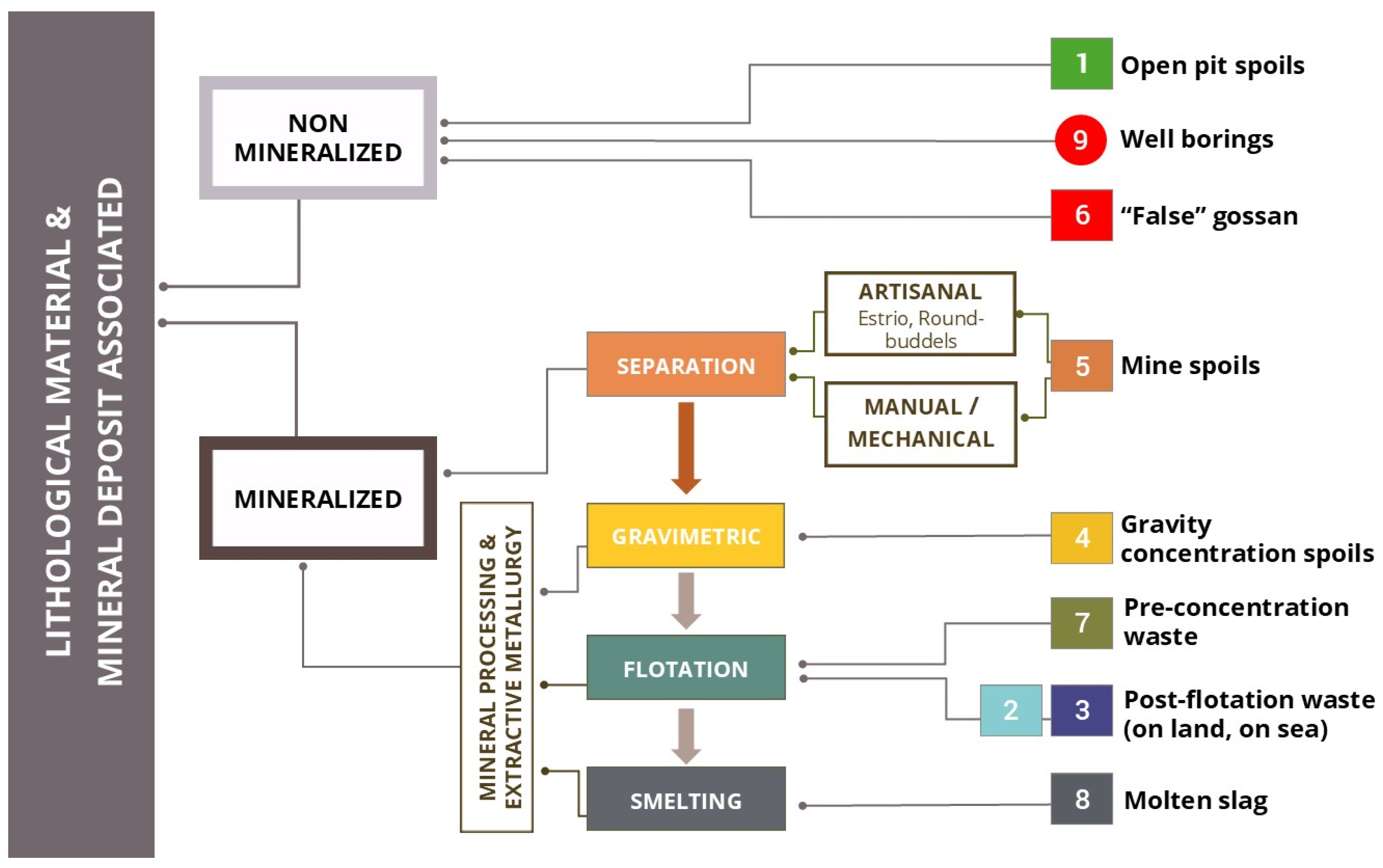
These wastes were generated from the lithological materials of the CUMD, shaped by the specific industrial processes to which they were subjected during exploitation [
22], as illustrated in the diagram in
Figure 1.
2.3. Sample Preparation Methodology
In the laboratory, samples were air-dried at temperatures below 40 °C to preserve mineralogical integrity, manually disaggregated, and homogenized. The material was then reduced using a riffle splitter to obtain a representative subsample of 200–300 g.
Subsamples were prepared for mineralogical (XRD and SEM–EDS) and chemical analyses (XRF and ICP–MS). This standardized preparation procedure minimizes particle-size bias, reduces heterogeneity, and ensures analytical comparability across all waste categories (
Figure 1,
Table 1).
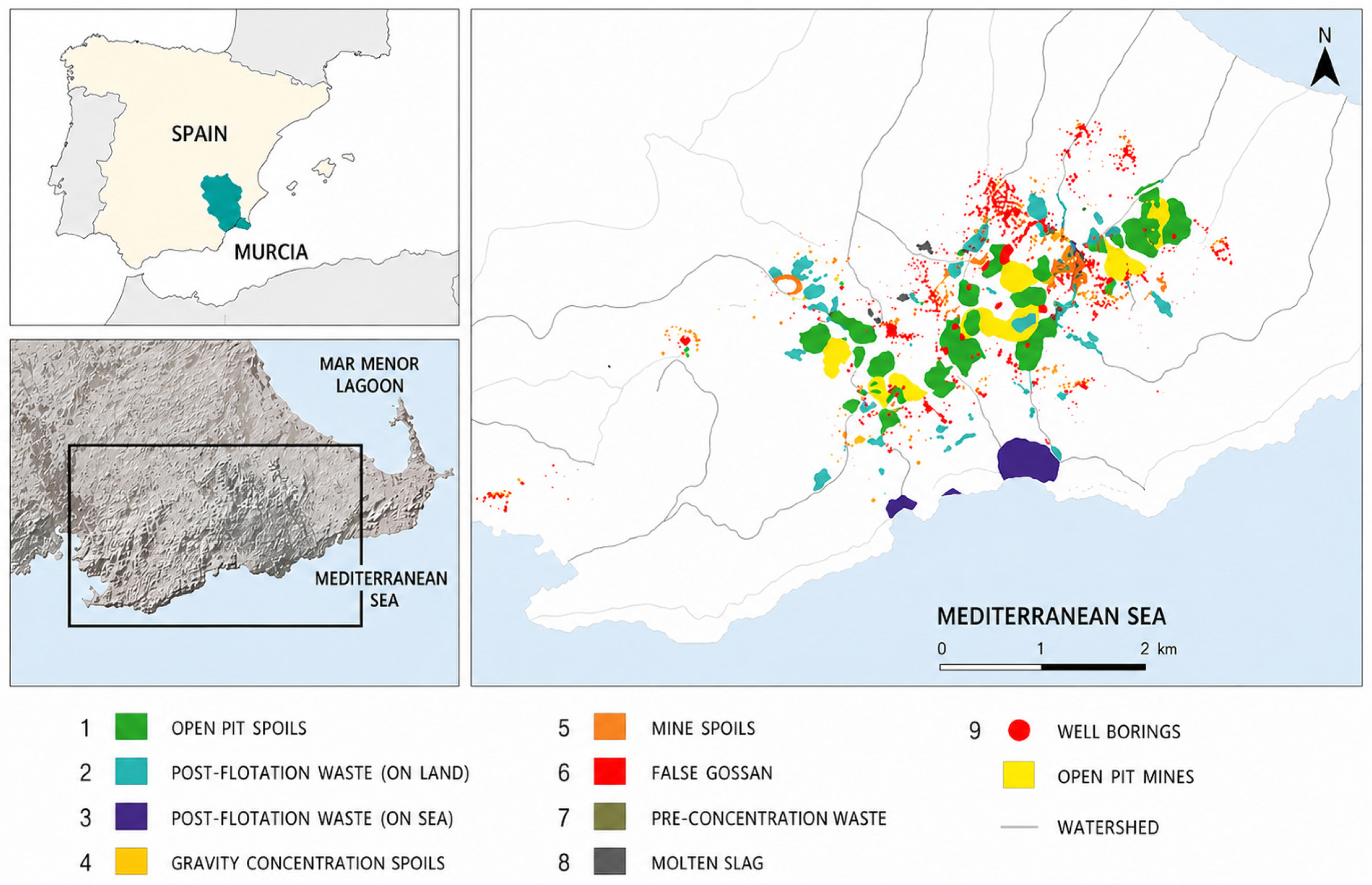
Figure 1.
Spatial distribution of mining and metallurgical waste types in the Cartagena–La Unión Mining District (SE Spain), including location maps and detailed cartographic representation of the study area [
21,
22]. Colors and numbers (1–9) correspond to the classification of waste types defined in
Table 1 and to the process-based scheme presented in
Figure 2.
Figure 1.
Spatial distribution of mining and metallurgical waste types in the Cartagena–La Unión Mining District (SE Spain), including location maps and detailed cartographic representation of the study area [
21,
22]. Colors and numbers (1–9) correspond to the classification of waste types defined in
Table 1 and to the process-based scheme presented in
Figure 2.
Figure 2.
Simplified flow diagram of the waste generated from lithological material according to the industrial process it has undergone. The diagram illustrates the main pathways from non-mineralized and mineralized materials through separation and metallurgical processes, including gravimetric concentration, flotation, and smelting. Colors correspond to the waste categories defined in
Figure 1, and numbers indicate the classification of waste types as listed in
Table 1.
Figure 2.
Simplified flow diagram of the waste generated from lithological material according to the industrial process it has undergone. The diagram illustrates the main pathways from non-mineralized and mineralized materials through separation and metallurgical processes, including gravimetric concentration, flotation, and smelting. Colors correspond to the waste categories defined in
Figure 1, and numbers indicate the classification of waste types as listed in
Table 1.
2.4. Physical–Chemical Characterization
pH measurements were performed on <2 mm fractions using a 1:2.5 solid-to-deionized-water ratio, following the [
23] standard. Solids density was measured using a helium pycnometer [
24], while dry bulk density was determined according to the [
25] geotechnical standard.
2.5. Mineralogical Composition
X-ray diffraction (XRD) analyses were performed on <63 μm powdered samples using a Bruker D8 Advance diffractometer (CuKα radiation, λ = 1.5406 Å, 40 kV, 30 mA). Diffractograms were recorded over a 5–70° 2θ range, with a step size of 0.02° and a counting time of 1 s per step. Phase identification was carried out using the ICDD PDF-4+ database, and quantitative analyses were based on the relative intensity ratio (RIR) method.
Scanning Electron Microscopy coupled with Energy-Dispersive Spectroscopy (SEM–EDS) was used as a complementary technique to support mineralogical interpretation. Analyses were performed using a Zeiss instrument (ZEISS Group, Oberkochen, Germany) operating at 15 kV, with backscattered electron (BSE) and secondary electron (SE) imaging modes. Point analyses were quantified using ZAF-corrected EDS software (SmartEDS, version 6, ZEISS Group, Oberkochen, Germany).
SEM–EDS observations were consistent with the mineralogical phases identified by XRD and were used to validate mineralogical and geochemical interpretations, particularly for accessory phases and textural relationships.
2.6. Chemical Composition
The bulk chemical composition of the samples was determined using XRF and ICP–MS. Major elements (Si, Al, Fe, Mg, Ca, K, Na, Ti, Mn, and P) were quantified by wavelength-dispersive XRF on fused glass beads to ensure matrix homogenization and minimize mineralogical effects on analytical response. Trace and critical elements (e.g., Co, Ni, Cu, Zn, Ga, Nb, Y, and REEs) were analysed by ICP–MS following acid digestion using a HF–HNO3–HClO4 mixture in closed Teflon vessels and microwave-assisted heating to guarantee complete dissolution of refractory silicates and oxide phases. Analytical precision and accuracy were better than 5% RSD for most analysed elements, as validated through routine measurements of certified reference materials (CRMs). Sulphur content was determined by LECO combustion analysis, given its significance for evaluating sulphide abundance and the acid-generating potential of the waste materials.
2.7. Geostatistical Analysis
Geostatistical and multivariate analyses were applied to characterize data variability and identify geochemical controls on element distribution.
Descriptive statistics (mean, median, standard deviation, and coefficient of variation) were computed to assess data variability. Normality tests (Shapiro–Wilk and Anderson–Darling) were applied to evaluate distributional behaviour.
To improve normality and reduce skewness, a Box–Cox transformation was applied where appropriate:
where x is the original data and λ is the transformation parameter.
The Median Absolute Deviation (MAD) was used as a robust measure of variability:
Prior to multivariate analysis, all variables were standardized using z-score normalization. Principal Component Analysis (PCA) was applied to reduce dataset dimensionality and identify geochemical associations. A Varimax rotation was used to improve interpretability by maximizing variance of squared loadings.
For spatial analysis, experimental semivariograms were constructed using both omnidirectional and directional approaches. Spherical, exponential, and Gaussian models were fitted, with model selection based on leave-one-out cross-validation.
The bulk chemical composition is presented in oxide form together with loss on ignition (LOI) for descriptive purposes. However, multivariate analyses were performed on the original elemental dataset. The conversion to oxide form represents a linear transformation and does not significantly affect statistical relationships after standardization. LOI was not included in the PCA.
3. Results
3.1. Physical-Chemical Characterization of Mining and Metallurgical Waste
The nine mining and metallurgical waste types defined in
Section 2 exhibit pronounced physical–chemical heterogeneity resulting from differences in ore mineralogy, processing history, and post-depositional weathering intensity [
22].
Table 2 summarizes the pH and density ranges obtained for each category. Although mean values provide a useful summary, those corresponding to waste types with a limited number of samples (
n ≤ 3) should be interpreted with caution, as they may not fully capture intra-category variability.
pH values show a broad range from strongly acidic conditions (pH ≈ 2.0) in gravity concentration residues to near-neutral to slightly alkaline conditions (pH ≈ 8.0) in gossan materials. This variation reflects differences in sulphide content, oxidation state, and buffering capacity. Acidic conditions (pH ≤ 3) are typical of residues rich in pyrite and secondary Fe-sulphates, whereas near-neutral values occur in carbonate-bearing materials with effective buffering capacity [
8,
9,
10].
Solids density also shows significant variability (2.6–3.8 g·cm−3), reflecting differences in mineralogical composition, including silicates, sulphates, oxides, and metallurgical phases. Slag samples display the highest densities, consistent with Fe-rich and smelting-derived phases, whereas gossan and mine spoils show lower densities due to the dominance of goethite and weathered silicate minerals.
Post-flotation tailings deposited in marine environments exhibit the widest pH variability (2.3–7.5), reflecting intense weathering, high sulphide reactivity, and prolonged exposure to marine aerosols. Fine-grained (<1 mm) textures favour rapid oxidation and acid generation, whereas mixing with carbonate fragments locally promotes neutralization processes [
8,
9].
In contrast, mine spoils and gossan materials exhibit higher pH values and moderate densities, indicating advanced oxidation stages and effective buffering by carbonates and Fe oxyhydroxides. Gravity concentration residues, which retain higher proportions of primary sulphides, show persistently acidic behaviour.
Collectively, these results indicate that the CUMD wastes form a highly heterogeneous multi-material system in which pH and density variations are controlled by the combined effects of primary mineralogy, processing history, and weathering processes. These parameters play a key role in controlling metal mobility, secondary mineral formation, and the spatial distribution of critical raw materials discussed in subsequent sections.
3.2. Mineralogical Characterization
The mineralogical composition of the nine waste types (
Table 3) reflects the complex interaction between primary ore assemblages, mineral processing techniques, and long-term weathering under semi-arid Mediterranean conditions [
22,
26]. Mineral identification was performed using quantitative X-ray diffraction (XRD), complemented by scanning electron microscopy coupled with energy-dispersive spectroscopy (SEM–EDS). These complementary techniques enabled the identification of both major mineral phases and fine-grained accessory minerals, as well as the verification of textural relationships and secondary mineral associations relevant for critical raw material (CRM) retention.
The reported values correspond to mean mineral contents, while variability within each waste type reflects differences in source material, processing history, and degree of alteration. This variability is consistent with the inherently heterogeneous nature of mining and metallurgical wastes.
Silicates. Silicate minerals constitute the dominant phase assemblage across most waste types, ranging from 50 to 98 wt.%. Quartz, feldspars, muscovite, chlorite, and clinochlore are widely distributed and reflect the strong lithological control of the host rocks. High proportions of silicates in open-pit spoils and gravity concentration residues indicate limited upgrading during early mechanical processing stages. The occurrence of kaolinite and talc in several samples reflects hydrothermal alteration and supergene weathering processes typical of polymetallic sulphide districts.
Oxides. Oxide minerals occur in proportions between 1 and 19 wt.% and include hematite, magnetite, goethite, and Fe–Mn oxyhydroxides. These phases originate both from primary mineralization and from the oxidative weathering of sulphides. Goethite-rich materials, particularly in mine spoils and gossan deposits, exhibit a high capacity for metal scavenging and play a key role in controlling CRM mobility and retention [
8,
9,
10]. The presence of cassiterite (SnO
2) and magnesioferrite in selected samples indicates the contribution of high-temperature metallurgical residues.
Sulphates. Secondary sulphates are abundant in several waste categories (up to 20 wt.%), especially in oxidized mine spoils. Jarosite-group minerals (plumbojarosite, natrojarosite, and hydronium jarosite), together with gypsum, anglesite, and beaverite, indicate advanced sulphide oxidation under acidic conditions. Their formation is consistent with prolonged exposure to meteoric waters and the semi-arid climatic conditions of the study area [
21,
22]. These phases play a critical role in the immobilization of elements such as Pb, Zn, As, and other trace components.
Carbonates. Carbonate minerals range from 0 to 32 wt.% and include calcite, dolomite, smithsonite, and cerussite. Their presence indicates effective buffering of acid-generating reactions and the development of supergene Pb–Zn enrichment zones. Carbonate-rich domains correspond to neutralization fronts, explaining the higher pH values observed in
Section 3.1.
Sulphides. Residual sulphides (0–4 wt.%) persist mainly as pyrite, sphalerite, and galena. These are particularly preserved in post-flotation tailings deposited in marine environments, where anoxic and saturated conditions limit oxidation. In contrast, terrestrial tailings show significantly lower sulphide contents due to prolonged exposure to atmospheric oxygen. Despite their relatively low abundance, these sulphides remain the primary carriers of Cu, Ni, Co, Zn, As, and Sb.
Interpretation and link to CRM distribution. The mineralogical dataset confirms that the Cartagena–La Unión mining wastes form a highly heterogeneous multi-mineral system in which CRM distribution is controlled by several key mineralogical hosts. Silicate phases (Al–Si-rich minerals) are associated with the retention of Ga, Nb, and Y; Fe–Mn oxyhydroxides act as major sinks for As, Sb, V, and REE proxies through adsorption processes; jarosite-group sulphates and related secondary phases host Pb, Zn, Cu, As, and Sb under acidic conditions; and residual sulphides represent the primary sources of base metals such as Cu, Ni, Co, and Zn. These mineralogical controls provide the fundamental framework for interpreting the geochemical patterns observed in subsequent statistical and multivariate analyses.
3.3. Bulk Chemical Composition and CRM Distribution
The chemical composition of the nine mining and metallurgical waste types (
Table 4) reflects the combined influence of primary ore mineralogy, beneficiation processes, metallurgical treatment, and secondary weathering processes. In agreement with the format adopted in
Table 4, bulk compositions are expressed as major oxides (wt.%) together with loss on ignition (LOI), whereas trace and critical elements are presented separately in
Table 5. The observed compositional variability is closely linked to waste typology, mineralogical hosts, and post-depositional alteration processes [
22,
26].
The major components are predominantly SiO
2, Al
2O
3, and Fe
2O
3, although their relative abundance varies markedly among waste categories. SiO
2 reaches maximum values of 78.09 wt.% in open-pit spoils and remains high in several waste groups, reflecting the abundance of quartz, feldspars, muscovite, and chlorite identified in
Section 3.2. Al
2O
3 attains values up to 23.18 wt.% in mine spoils and is mainly associated with clay minerals, micas, feldspars, and aluminosilicate alteration products. MgO and CaO are locally enriched in carbonate-bearing materials and Mg-rich silicates, whereas TiO
2 occurs consistently at low concentrations (≤1.02 wt.%), reflecting its association with resistant Ti-bearing silicates and oxide phases.
Fe2O3 is one of the dominant constituents in several waste categories and, in some residues, represents the principal oxide fraction. Mean values range from 24.87 wt.% in open-pit spoils to 62.94 wt.% in pre-concentration waste, with maxima exceeding 70 wt.% in selected samples. This enrichment reflects the abundance of goethite, hematite, jarosite-group minerals, ferruginous secondary phases, and residual Fe-bearing sulphides.
SO
3 exhibits significant concentrations, particularly in gravity concentration spoils (mean 8.17 wt.%; maximum 15.23 wt.%) and post-flotation land deposits (mean 7.79 wt.%), indicating the widespread occurrence of secondary sulphates such as gypsum, plumbojarosite, hydronium jarosite, and natrojarosite formed during sulphide oxidation under supergene conditions [
22,
26].
P2O5, MnO, and other minor oxides occur at lower concentrations and are related to accessory phosphate minerals, Fe–Mn oxides, and lithogenic detrital inputs. LOI values range from 0.60 to 10.02 wt.% and mainly reflect the presence of structurally bound water, hydroxides, hydrated sulphates, minor organic matter, and carbonate decomposition during ignition. The highest LOI values occur in strongly weathered and sulphate-rich materials, consistent with intense secondary alteration.
Trace metals and critical raw materials (CRMs), as defined under the European Critical Raw Materials Act (2023) [
1], are present across multiple waste categories (
Table 5). Cobalt and nickel typically occur in the range of 0.004–0.02 wt.% and are associated with Fe–Mn oxyhydroxides, secondary sulphates, and silicate matrices. Copper and zinc display significant variability, with locally elevated concentrations in flotation-derived residues, reflecting the presence of residual sulphides and their oxidation products. Gallium, niobium, and yttrium, although generally present at low concentrations (<0.12 wt.%), are consistently detected and are mainly associated with fine-grained silicates, Fe oxyhydroxides, and secondary sulphate phases. Barium and cerium occur more sporadically, reflecting contributions from accessory minerals such as barite and REE-bearing phases, as well as adsorption onto Fe–Mn oxides.
Metalloids such as arsenic and antimony show strong spatial variability, consistent with their association with sulphide minerals (e.g., arsenopyrite and tetrahedrite–tennantite) and secondary sulphate phases. Elevated As concentrations in specific samples indicate advanced sulphide oxidation, followed by remobilization under acidic conditions and subsequent retention by Fe–Mn oxyhydroxides [
8,
9,
10].
A notable geochemical anomaly is observed for Co in sample B-EM23 (open-pit spoil), where concentrations are significantly higher than in the rest of the dataset. This enrichment correlates with the high abundance of hydronium jarosite (~37 wt.%) and subordinate goethite (~3 wt.%). Jarosite-group minerals are well-known sinks for divalent and trivalent metals, facilitating the incorporation and retention of Co, Ni, Zn, and Ga during advanced stages of sulphide oxidation [
26,
27]. The absence of metallurgical processing in this material likely preserves this geochemical signature, enhancing its distinctiveness.
Overall, the chemical dataset indicates that waste composition is controlled by the combined effects of primary mineralization and secondary geochemical processes. Primary ore assemblages (Pb–Zn–Fe sulphides and silicate gangue) define baseline concentrations of major and base metals, whereas secondary processes such as oxidation, dissolution–precipitation, and adsorption redistribute elements into oxyhydroxides, carbonates, and sulphates. This dual control explains the coexistence of a silicate-dominated matrix with localized enrichments in base metals and CRM proxies, providing the geochemical basis for the statistical and spatial analyses presented in subsequent sections.
3.4. Statistical Analyses
The statistical analysis reveals a well-defined geochemical structuring across the different waste types, reflecting the combined influence of primary mineralization, processing history, and secondary weathering processes.
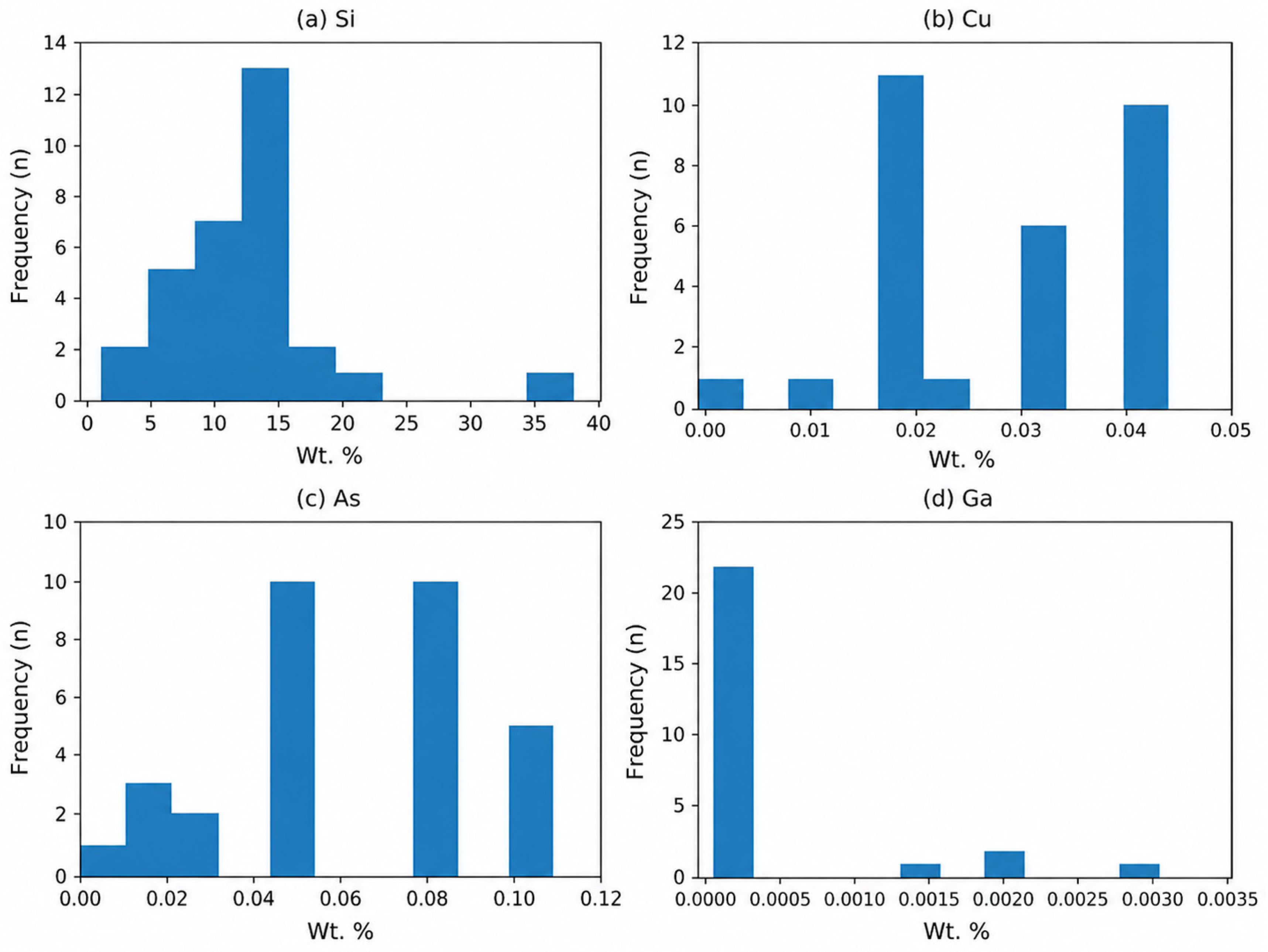
To illustrate the statistical distribution of the dataset, histograms of representative elements (Si, Cu, As, and Ga) were constructed (
Figure 3). These elements were selected to represent the main geochemical controls identified in this study, including lithogenic inputs, sulphide mineralization, and secondary adsorption processes.
Silicon (Si) exhibits a broad distribution, reflecting the heterogeneous contribution of silicate-rich materials and the variability of lithological sources across the different waste types. In contrast, Cu shows a more clustered distribution, with values concentrated within a relatively narrow range, indicating strong control by mineral processing and sulphide-derived phases.
Arsenic (As) displays a markedly skewed distribution with pronounced high-value tails, indicating localized enrichment associated with sulphide oxidation and secondary mineral formation. This behaviour highlights the presence of extreme values and supports the application of transformation techniques, such as the Box–Cox transformation, to improve data normality prior to multivariate analysis.
Gallium (Ga) exhibits a discontinuous distribution characterized by a high proportion of low or near-zero values, reflecting its selective enrichment and complex geochemical behaviour. This pattern is consistent with its association with secondary phases, particularly Fe–Mn oxyhydroxides, as identified in the PCA.
These distribution patterns confirm the non-normal nature of the dataset and justify the use of robust statistical measures, such as the Median Absolute Deviation (MAD), together with data transformation and standardization prior to multivariate analysis.
Correlation analysis indicates consistent associations between key elements, particularly among Cu–As–Sb and Fe–Mn-related trace elements, suggesting common mineralogical hosts and shared geochemical behaviour. These relationships are consistent with sulphide-derived phases and secondary Fe–Mn oxyhydroxides described in
Section 3.2, which act as major sinks for trace elements through adsorption and co-precipitation processes [
28,
29].
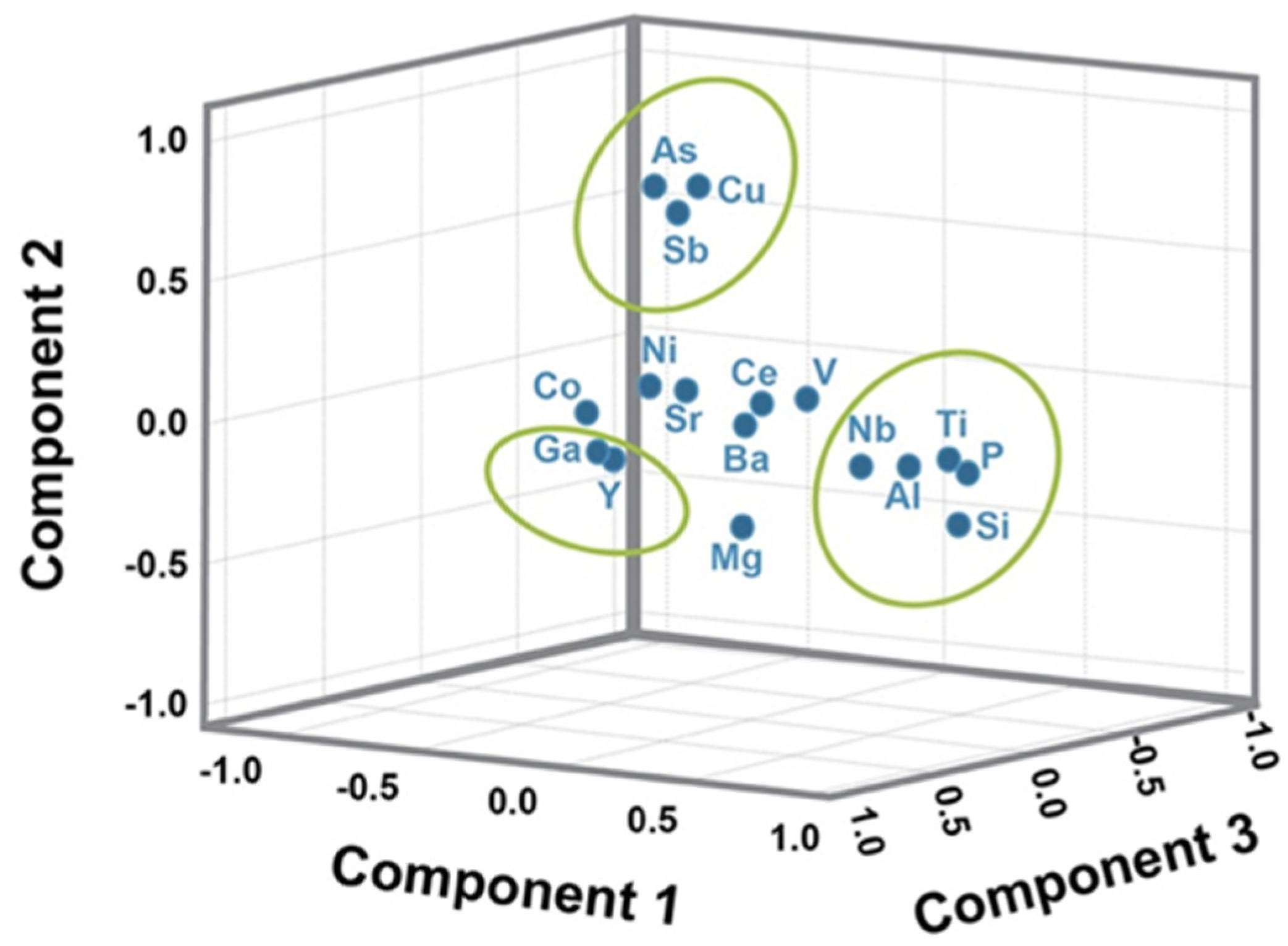
Principal Component Analysis (PCA) further supports these patterns by identifying distinct geochemical associations corresponding to lithogenic, sulphide-derived, and secondary oxidation–adsorption processes (
Table 6,
Figure 4). The first components explain a substantial proportion of the total variance, indicating that a limited number of dominant processes control element distribution. PCA has been widely applied in geochemical studies to identify underlying controls in complex environmental datasets [
29,
30].
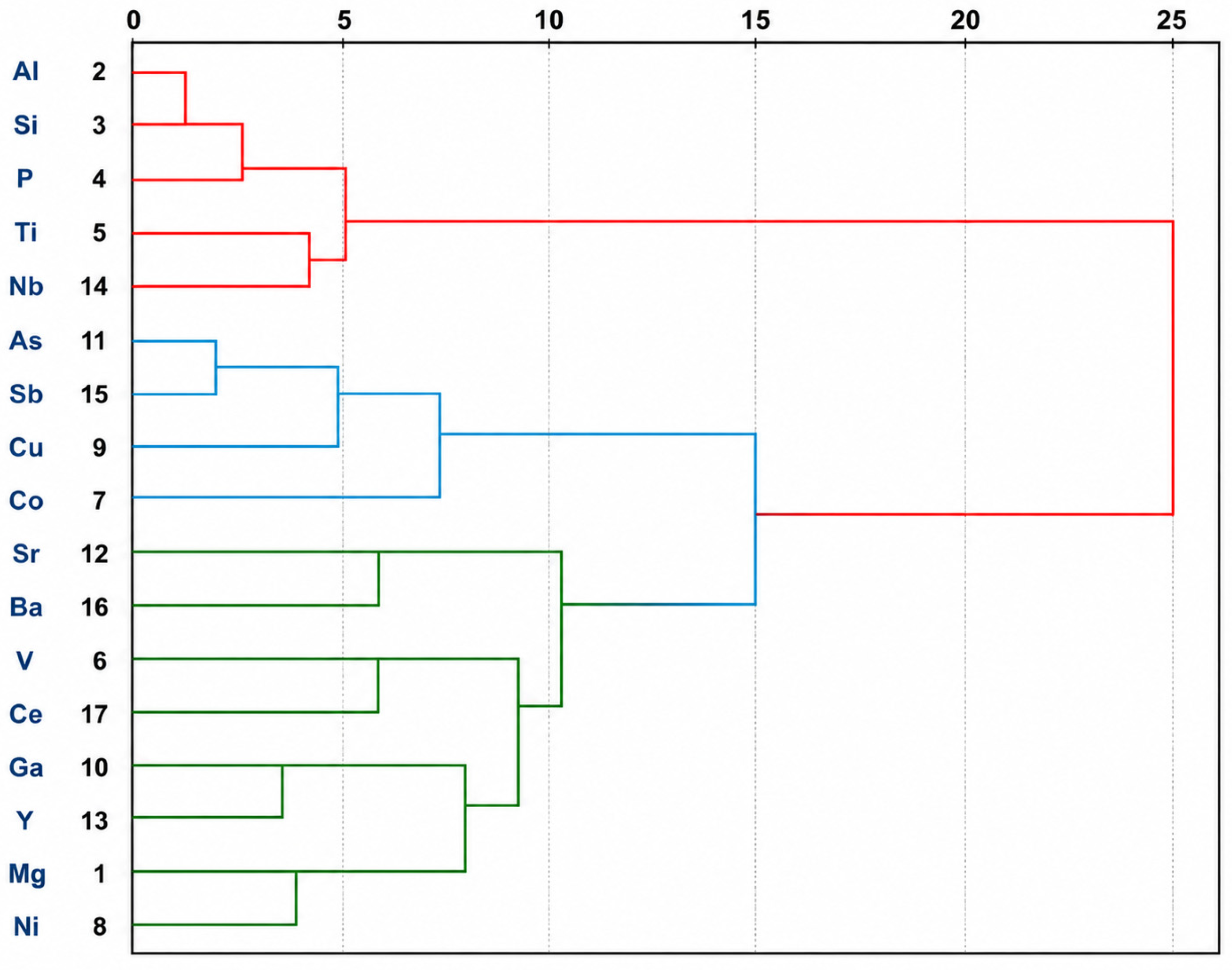
Hierarchical Cluster Analysis (HCA) groups samples according to their geochemical affinity, broadly corresponding to different waste types and processing histories. These clusters reflect variations in mineralogical composition and degrees of alteration, reinforcing the interpretation of multiple geochemical controls [
29].
The statistical results demonstrate that the distribution of critical raw materials is governed by the combined effects of lithological factors, sulphide mineralization, and secondary oxidation–adsorption processes. Similar patterns of compositional variability and heterogeneity have been reported in mine-waste systems, where geochemical distributions are controlled by depositional processes, mineralogical composition, and weathering intensity [
31,
32,
33].
3.5. Correlation Matrix
The correlation matrix reveals well-defined associations between elements, reflecting common mineralogical hosts and shared geochemical behaviour across the different waste types.
Strong positive correlations are observed among Cu, As, and Sb, indicating their close association with sulphide-derived phases and their oxidation products. This grouping is consistent with the presence of primary sulphide minerals and secondary sulphates identified in
Section 3.2. Similarly, significant correlations between Fe, Mn, and several trace elements highlight the key role of Fe–Mn oxyhydroxides as major geochemical sinks controlling the retention and redistribution of metals through adsorption and co-precipitation processes.
In contrast, elements such as Al, Si, and Ti show consistent positive correlations, reflecting their lithogenic origin and association with silicate mineral phases. These elements exhibit limited correlation with sulphide-related components, indicating a clear separation between lithogenic and metalliferous geochemical domains within the waste materials.
Other elements display weaker or more variable correlations, suggesting partial decoupling driven by secondary processes such as weathering, dissolution–precipitation reactions, and adsorption onto secondary mineral phases. This variability reflects the complex post-depositional evolution of the waste deposits and the superposition of multiple geochemical processes.
The correlation structure supports a multi-process control on element distribution, dominated by lithogenic inputs, sulphide mineralization, and secondary oxidation–adsorption processes. These relationships are consistent with the mineralogical observations described in
Section 3.2 and provide the basis for the multivariate associations identified in the PCA (
Section 3.6).
3.6. Principal Component Analysis (PCA)
Principal Component Analysis (PCA) was performed to identify the main geochemical associations within the dataset (
Table 7,
Figure 4). A Varimax rotation was applied to improve interpretability by maximizing the variance of squared loadings within each component, thereby enhancing the separation of variables into distinct groups. This orthogonal rotation reduces overlap between components and facilitates a clearer identification of geochemical associations and underlying processes. In this study, the application of Varimax rotation enables the discrimination between lithogenic, sulphide-derived, and secondary oxidation–adsorption controls, leading to a more robust and geologically meaningful interpretation of the PCA results [
24,
29].
The PCA results show that the first three principal components account for most of the total variance (75%), indicating that geochemical variability is controlled by a limited number of dominant processes (
Table 7). Higher-order components (PC4–PC7), which explain only a minor proportion of the variance, are interpreted with caution as they likely represent residual variability rather than meaningful geochemical controls.
The first principal component (PC1) is characterized by strong positive loadings of Al, Si, Ti, and Nb, reflecting a lithogenic control associated with silicate mineral phases. This component represents the influence of the host-rock composition on the waste materials.
The second principal component (PC2) shows high loadings of Cu, As, and Sb, indicating a sulphide-derived association linked to primary mineralization and its oxidation products. This component reflects the contribution of metalliferous sulphide phases and their subsequent geochemical transformation.
The third principal component (PC3) is mainly associated with Ga and Y, suggesting a strong influence of Fe–Mn oxyhydroxides and secondary adsorption processes. Although Fe and Mn are key constituents of these phases, their loadings are distributed across multiple components, reflecting their complex geochemical behaviour. In contrast, cobalt (Co) exhibits a partially decoupled behaviour in the PCA space. This can be explained by its multi-source geochemical affinity, as Co may be associated with primary sulphide phases, secondary sulphates (e.g., jarosite-group minerals), and Fe–Mn oxyhydroxides. This results in a more dispersed distribution and prevents a strict grouping with Ga and Y.
The PCA biplot (
Figure 4) provides a clear visualization of the relationships between samples and elemental loadings. Samples are distributed according to their dominant geochemical signatures, showing a clear separation along PC1 and PC2. The projection of variables indicates that elements grouped in the same direction are positively correlated and share common mineralogical hosts, whereas opposite directions reflect contrasting geochemical behaviours, in agreement with the correlation matrix (
Section 3.5).
Distinct geochemical domains can be identified in the biplot. Samples enriched in lithogenic elements (Al–Si–Ti) cluster along the positive side of PC1, reflecting a strong silicate control. In contrast, samples associated with sulphide-derived elements (Cu–As–Sb) are grouped along PC2, indicating the influence of primary mineralization and oxidation processes. A third domain, related to Fe–Mn oxyhydroxides, occupies an intermediate or orthogonal position, reflecting secondary adsorption processes and metal redistribution.
Overall, the PCA results demonstrate that the distribution of critical raw materials in the studied wastes is controlled by the combined influence of lithogenic inputs, sulphide mineralization, and secondary oxidation–adsorption processes, in agreement with the correlation analysis (
Section 3.5) and mineralogical observations (
Section 3.2).
3.7. Hierarchical Clusters
Hierarchical Cluster Analysis (HCA) was performed to classify the 79 samples into geochemically coherent groups. The analysis was conducted using z-score standardized variables, Euclidean distance, and Ward’s minimum variance method, which is well suited for multielement geochemical datasets as it produces compact and internally homogeneous clusters. Cluster robustness was assessed using the cophenetic correlation coefficient (0.86), indicating a good representation of the data structure.
Three major clusters were identified (
Figure 5), each corresponding to distinct mineralogical and geochemical signatures consistent with the waste typology and processing history of the Cartagena–La Unión district.
Cluster 1 comprises silicate-dominated lithogenic materials, including mine spoils, gossan, and mixed silicate-rich residues. These samples are characterized by high concentrations of Al, Si, Ti, Nb, and Y, and low contents of Cu, As, and Sb. The mineralogical assemblage is dominated by quartz, feldspars, muscovite, chlorite, and clay minerals such as kaolinite and talc. This group reflects materials largely controlled by host-rock composition and advanced weathering, with limited influence of sulphide mineralization. Its geochemical signature closely corresponds to PCA Component 1, confirming a dominant lithogenic control and the retention of high field strength elements (HFSE) in silicate matrices and associated oxides.
Cluster 2 groups sulphide-derived and metalliferous residues, including flotation tailings, slag-related materials, and pre-concentration wastes. These samples are enriched in Cu, As, Sb, Co, Ni, and other chalcophile elements. The mineralogical assemblage includes residual sulphides (e.g., pyrite, chalcopyrite, galena, sphalerite), together with secondary phases such as jarosite-group minerals and Fe–Mn oxyhydroxides. This group reflects environments strongly influenced by sulphide mineralization and subsequent oxidation processes, including dissolution–precipitation and co-precipitation reactions. The strong correspondence with PCA Component 2 highlights this group as the most relevant in terms of critical raw material (CRM) enrichment and recovery potential.
Cluster 3 represents oxidized transitional materials, including partially weathered flotation tailings and carbonate-influenced residues. These samples show intermediate concentrations of Mg, Ca, Zn, Ga, Y, and locally Co, together with moderate levels of As and Sb. The mineralogical composition includes calcite, dolomite, smithsonite, cerussite, gypsum, jarosite, and Fe–Mn oxyhydroxides. This group reflects systems affected by neutralization processes and secondary mineral formation, where adsorption onto Fe–Mn phases plays a key role in trace element retention. The association of Ga and Y is consistent with PCA Component 3, supporting their linkage to secondary adsorption mechanisms.
4. Discussion
4.1. Quantitative Comparison Between Residues and Typical World Ore Grade
To evaluate the potential of the Cartagena–La Unión mining and metallurgical wastes as secondary raw-material resources, metal concentrations were systematically compared with representative global ore grades reported by the USGS (2022–2023) and recent international compilations of production and cut-off grades [
3,
18,
34,
35,
36,
37,
38,
39,
40,
41]. This comparison provides a robust benchmarking framework to assess the relative resource significance of the studied wastes in the context of both primary deposits and reprocessing operations.
For each element, mean, median, and maximum concentrations across the nine waste categories were normalized to wt.% to ensure consistency. The results demonstrate that several elements reach concentrations comparable to, or approaching, those of economically exploited ores and secondary resources.
Gallium (Ga) exhibits concentrations of up to 0.12 wt.%, significantly exceeding typical values reported for primary Ga sources (generally <0.01 wt.%). This enrichment highlights the strong potential of these residues as unconventional Ga resources. Similarly, yttrium (Y) and niobium (Nb) occur within the lower range of exploitable deposits (0.005–0.03 wt.%), supporting their relevance as secondary sources, particularly in fine-grained and oxide-rich materials.
Cobalt (Co) concentrations (0.004–0.02 wt.%) approach the lower bound of typical ore grades (0.01–0.10 wt.%). Although generally below primary deposit levels, these values fall within the range reported for tailings reprocessing and secondary recovery operations, reinforcing their potential economic relevance under optimized processing conditions.
Base metals such as Cu and Zn remain below typical primary ore grades (Cu: 0.3–1.0 wt.%; Zn: 3–10 wt.%), yet their concentrations are comparable to those currently processed in low-grade tailings reprocessing projects. This suggests that, while not viable as standalone targets, these elements may contribute significantly as by-products within integrated recovery flowsheets.
Elevated concentrations of As and Sb (0.02–0.6 wt.%) reflect the abundance of sulphosalt and sulphide-derived mineral phases. Although not primary economic targets, these elements represent both a potential resource and a critical metallurgical and environmental constraint that must be addressed in any recovery strategy.
The observed enrichment patterns are consistent with the geochemical controls identified in
Section 3.4,
Section 3.5,
Section 3.6 and
Section 3.7, where lithogenic inputs, sulphide mineralization, and secondary adsorption processes—particularly onto Fe–Mn oxyhydroxides—govern element distribution. The preferential association of Ga, Y, and Nb with fine-grained and secondary mineral phases explains their relative enrichment in specific waste types.
Overall, the comparison demonstrates that several waste categories contain concentrations of critical raw materials (CRMs) that are competitive within the context of secondary resource development. While most elements occur at sub-economic levels relative to primary deposits, their concentrations fall within ranges currently considered viable for reprocessing under favourable technological and economic conditions.
These results position the Cartagena–La Unión mining district as a promising secondary resource system, aligned with the objectives of the European Critical Raw Materials Act (2023) [
1], which promotes the recovery of strategic elements from unconventional sources [
1].
4.2. Economic Potential of CRMs in the CUMD
The economic potential of critical raw materials (CRMs) in the Cartagena–La Unión Mining District (CUMD) was evaluated by integrating concentration data, mineralogical controls, conceptual recovery pathways, and indicative market values. Although a full techno-economic assessment is beyond the scope of this study, this analysis provides a robust framework for assessing the relative economic relevance of Co, Ga, Nb, and Y as CRM proxies.
The studied residues exhibit concentrations of several CRMs that approach or exceed typical grades reported for secondary resources [
36,
37,
38,
39]. Gallium (0.008–0.12 wt.%) shows particularly significant enrichment, exceeding typical concentrations of primary Ga sources and comparable to those reported in Zn-processing residues and bauxite-derived materials. Yttrium (0.005–0.030 wt.%) and niobium (0.005–0.025 wt.%) occur within the lower range of exploitable secondary deposits, while cobalt (0.004–0.020 wt.%) approaches cut-off grades reported for tailings reprocessing in Cu–Co systems.
These concentration ranges are consistent with the geochemical patterns identified in
Section 3.4,
Section 3.5,
Section 3.6 and
Section 3.7, where CRM enrichment is controlled by lithogenic inputs, sulphide mineralization, and secondary adsorption processes. In particular, the association of Ga, Nb, and Y with Fe–Mn oxyhydroxides and fine-grained silicate phases suggests preferential concentration in reactive secondary mineral assemblages, which are favourable for hydrometallurgical extraction.
The mineralogical framework described in
Section 3.2 indicates that hydrometallurgical routes—such as acid leaching, selective precipitation, and solvent extraction—are more suitable than pyrometallurgical approaches for CRM recovery in the CUMD. Cobalt exhibits a more complex behaviour due to its multi-phase association with sulphides, secondary sulphates (e.g., jarosite-group minerals), and Fe–Mn oxyhydroxides, which may require selective or staged extraction strategies.
Based on representative market values (LME and USGS averages for 2023–2024) [
37], Ga represents the highest-value element, followed by Co, Nb, and Y. Despite relatively low bulk concentrations compared to primary ores, conceptual recovery efficiencies in the range of 30–60% indicate that the potential metal value per tonne of residue may be significant, particularly when integrated into multi-metal recovery flowsheets.
The integration of geochemical, mineralogical, and spatial data (
Section 3.6 and
Section 3.7) indicates that the highest CRM potential is associated with: (i) post-flotation tailings, particularly marine deposits enriched in Ga–Y–Nb, (ii) oxidized pre-concentration residues enriched in Co and Ga, and (iii) transitional sulphate–carbonate materials exhibiting favourable leaching behaviour. In contrast, mine spoils and false gossan materials show lower CRM concentrations and limited standalone economic potential, although they may contribute within blending or bulk processing strategies.
Several constraints must be considered. Elevated concentrations of As and Sb represent both environmental and metallurgical challenges, requiring careful management in processing schemes. In addition, fine-grained textures and heterogeneous mineralogy may reduce recovery efficiency and necessitate pre-treatment steps such as classification or attrition.
Despite these limitations, the large volume of residues, the enrichment of CRMs in reactive secondary phases, and the compatibility with hydrometallurgical processing routes highlight the strategic potential of the CUMD as a secondary resource system. The recovery of CRMs from these wastes is fully aligned with the objectives of the European Critical Raw Materials Act (2023) [
1], which promotes the development of domestic supply chains based on unconventional resources [
1,
41].
Taken together, these results demonstrate that, while not all waste types are economically viable as standalone resources, the combination of metal concentrations, mineralogical controls, and recoverability supports a realistic and scalable potential for CRM-oriented reprocessing based on integrated multi-metal recovery strategies.
5. Conclusions
This study provides the first comprehensive and integrated mineralogical, geochemical, and geostatistical evaluation of 17 critical raw materials (CRMs) across nine mining and metallurgical waste types from the Cartagena–La Unión Mining District (SE Spain). The results demonstrate that CRM distribution is governed by three robust and consistent geochemical associations: (i) a lithogenic silicate–oxide system (Al–Si–P–Ti–Nb), (ii) a sulphide-derived metalliferous association (Cu–As–Sb), and (iii) an oxidation–adsorption system dominated by Ga and Y. The strong agreement between correlation analysis, PCA, and hierarchical clustering confirms the internal consistency and reliability of these geochemical controls.
Several waste categories, particularly terrestrial flotation tailings, gossan materials, and pre-concentration residues, exhibit enrichment in key CRMs such as Ga, Y, Nb, and Co, with concentrations comparable to those reported in secondary CRM resources worldwide. Mineralogical evidence indicates that CRM retention is controlled by silicates, Fe–Mn oxyhydroxides, and jarosite–sulphate assemblages, highlighting the suitability of hydrometallurgical approaches for potential recovery.
Although average grades are generally lower than those of primary deposits, the large volumes of accumulated waste and the presence of coherent enrichment patterns demonstrate that the Cartagena–La Unión district represents a significant secondary CRM reservoir. The consistent association of Y with Fe–Mn oxyhydroxides further suggests that the potential for rare earth element (REE) recovery may be underestimated and warrants further investigation.
From a strategic perspective, these findings support the role of legacy mining wastes as viable unconventional resources, fully aligned with the objectives of the European Critical Raw Materials Act (2023) [
1]. The integration of mineralogical, geochemical, and statistical approaches presented in this study provides a transferable and reproducible framework for the evaluation of CRM potential in mining waste systems at both regional and international scales.
Overall, this work demonstrates that mining and metallurgical wastes can transition from environmental liabilities to strategic resource systems, supporting the development of circular economy approaches and enhancing the resilience of critical raw material supply chains.