Article

Geochemical Behavior of Zr, Hf, and Rare Earth Elements in Water and Associated Suspended Solids and Sediments Under Reducing Conditions


1
Istituto Nazionale di Geofisica e Vulcanologia, Sezione Osservatorio Etneo, 95125 Catania, Italy
2
DiSTeM, Università degli Studi di Palermo, 90123 Palermo, Italy
3
Istituto Nazionale di Geofisica e Vulcanologia, Sezione Palermo, 90146 Palermo, Italy
*
Author to whom correspondence should be addressed.
Minerals 2026, 16(5), 452; https://doi.org/10.3390/min16050452
Submission received: 20 March 2026 / Revised: 21 April 2026 / Accepted: 22 April 2026 / Published: 27 April 2026
(This article belongs to the Section Mineral Geochemistry and Geochronology)

Abstract

This study investigates the geochemical behavior and transport mechanisms of Rare Earth Elements (REEs), Yttrium (Y), Zirconium (Zr), and Hafnium (Hf) in three natural water systems under reducing conditions: the Santa Barbara and Occhio dell’Abisso mud volcanoes and a sulphureous spring at Villafranca Sicula. A comprehensive fractionation approach was applied to isolate the truly dissolved fraction (TDF < 10 kDa), the colloidal fraction (10 kDa < CF < 450 nm), the suspended particulate matter (SPM > 450 nm), and the associated bottom sediments. Analytical results reveal that REE distribution is significantly influenced by redox conditions and solid–liquid interface processes. The absence of negative Cerium (Ce) anomalies and the presence of pronounced positive Europium (Eu) anomalies in the Santa Barbara and Occhio dell’Abisso waters suggest strongly reducing environments where Eu2+ stability is enhanced. Shale-normalized patterns indicate that, while SPM and sediment fractions often exhibit Middle REE (MREE) enrichment, linked to Mn-bearing and Fe-oxyhydroxide phases, the dissolved phase reflects dissolution processes governed by a non-CHARAC (CHarge-and-RAdius-Controlled) behavior. Furthermore, the study highlights a significant decoupling in the Zr/Hf and Y/Ho pairs. While these pairs remain coherent during magmatic processes, they undergo mutual fractionation in aqueous systems due to differential reactivity toward colloidal surfaces and organic ligands. Specifically, Zr/Hf ratios in the colloidal and dissolved fractions deviate from chondritic values, driven by the preferential scavenging of Hf onto mineral surfaces. These findings underscore the utility of REE and Zr-Hf systematics as high-resolution tracers for reconstructing water–rock interaction processes and elemental cycling in complex hydrological environments.

1. Introduction

Transport in natural waters represents one of the primary components of the exogenous cycle of chemical elements, together with sorption, complexation, and dissolution/precipitation. Regarding Rare Earth Elements (REEs), defined as elements belonging to the lanthanide series plus Yttrium, as detailed below, the role of transport has been extensively investigated over the last four decades [1,2,3]. These studies have highlighted the strong affinity of REEs for solid surfaces, albeit varying across the series from La to Lu [4,5,6,7,8,9,10].
This affinity for various types of surfaces in contact with the aqueous phase is also characteristic of Zirconium (Zr) and Hafnium (Hf), whose reactivity differs slightly during interface processes [11,12,13,14,15,16]. Consequently, the interaction of Zr and Hf in the aqueous phase with certain contact surfaces can lead to their mutual fractionation. This observation contrasts with the well-documented geochemical coherence that characterizes Zr and Hf during magmatic crystallization processes [17].
Studies focusing on the geochemical behavior of REEs in natural waters have demonstrated the importance of variations in salinity, pH, and redox conditions in determining the fate, distribution, and fractionation of elements along the La–Lu series. Similar studies concerning the behavior of Zr and Hf have been conducted, although they are significantly rarer [16,18,19,20,21,22,23]. Previous studies have shown that REE transport in continental waters commonly occurs within the colloidal phase [8,10,24,25,26,27,28].
Furthermore, they have demonstrated that changes in ionic strength play a key role in determining REE partitioning between the dissolved phase, suspended particles, and sediments, thereby influencing the transport of elements from continents to the sea [16,21,25,28,29,30,31,32,33,34,35,36,37].
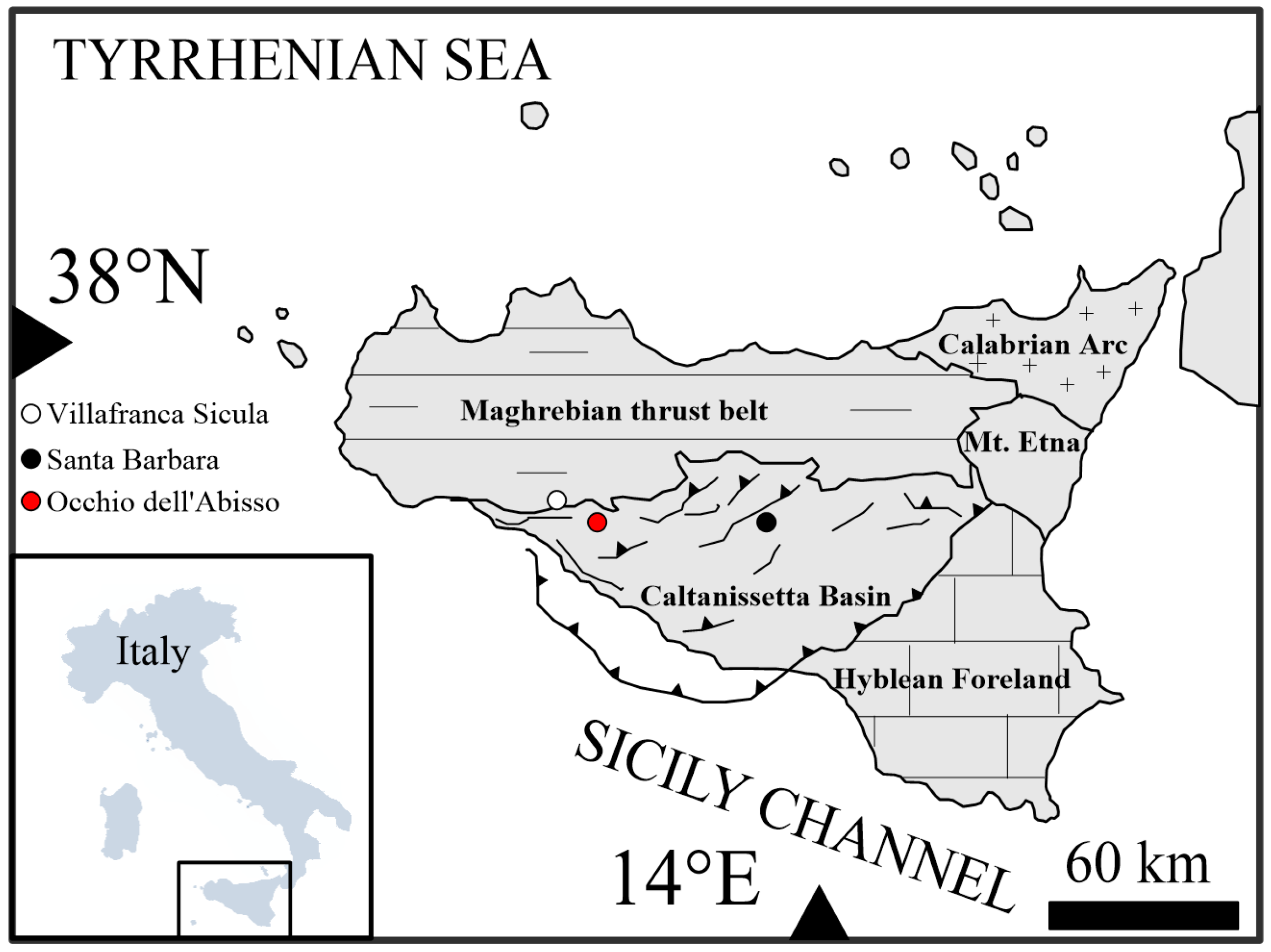
The aim of this study is to contribute to the body of knowledge regarding the behavior of Zr, Hf, and REEs in natural waters characterized by reducing conditions. To this end, three natural water sources in Sicily, Italy, were studied: mud volcano fluids at Caltanissetta (S. Barbara) and Cianciana (Occhio dell’Abisso), and a sulphureous spring at Villafranca Sicula (Figure 1). In these samples, the dissolved fraction, defined as the combination of the colloidal fraction and the truly dissolved fraction, was separated from the suspended particulate matter and the bottom sediment, where present.

2. Geochemistry of REEs

The REEs constitute a coherent group of transition elements, typically including Scandium (Sc) and Yttrium (Y) due to their analogous chemical behavior. Their fundamental electronic configuration, [Xe]4fn6s25d1, is characterized by the progressive filling of the 4f orbital, which remains shielded and does not significantly alter the valence shell. Consequently, the chemical reactivity of the series remains remarkably consistent from Lanthanum (La) to Lutetium (Lu), representing a unique phenomenon in nature [38]. Despite this general uniformity, subtle variations in the occupancy of the 4f orbital allow for the classification of REEs into three distinct subgroups, based on atomic weight: Light (LREE: La–Pm), Medium (MREE: Sm–Dy), and Heavy (HREE: Ho–Lu).
A critical factor influencing their geochemical distribution is the “lanthanide contraction,” a phenomenon resulting from the limited ability of 4f electrons to shield the nuclear charge. This leads to a progressive decrease in the trivalent ionic radii, ranging from 1.22 Å (La) to 0.86 Å (Lu) [39]. This contraction determines the coordination sites REEs can occupy in crystalline phases, typically nine-fold for lighter elements (La to Gd) and eight-fold for heavier ones (Gd to Lu), while also enabling their dispersion as trace or ultra-trace elements within the mineral lattices of other metallic elements [39].
Geochemically, REE behavior is bifurcated into two distinct regimes at high and low temperature. High-temperature magmatic processes are governed by “CHarge-and-RAdius-Controlled” (CHARAC) mechanisms, where mineral crystallization and trace element partitioning are strictly determined by the energetic constraints of crystal lattices, as described by Goldschmidt’s rules and formalized by the Lattice Strain Model (see Ref. [40] for details). Conversely, aqueous systems and environmental interactions are defined as “non-CHARAC” processes, where physical constraints of the lattice strain are absent, and the electronic configuration becomes the primary driver of species reactivity [17]. In the hydrosphere, REEs primarily exist as stable carbonate ([REECO3]+) or dicarbonate ([REE(CO3)2]) complexes, though high organic activity can favor complexes with organic ligands [41].
Furthermore, specific elements like Cerium (Ce) and Europium (Eu) exhibit anomalous behavior due to redox sensitivity; Ce can oxidize to Ce4+, forming insoluble CeO2 in aqueous phases, while Eu can reduce to Eu2+ in magmatic environments. To accurately interpret these signals, concentrations must be normalized to reference materials to eliminate the Oddo–Harkins effect, due to the naturally higher abundance of elements with even atomic numbers than their immediate neighbors with odd atomic numbers, which causes a zigzag pattern in natural abundances [42]. This is effectively accomplished by calculating the normalized REE concentrations ([REE]sn) based on the following equation:
[ R E E ] s n = R E E s a [ R E E ] r e f
where [REE]sa represents the analytical concentration of a given REE measured in the sample, and the denominator represents the concentration of the same element in the reference material [42].
The resulting normalized patterns allow for the identification of specific anomalies, such as anthropogenic Gadolinium (Gd) inputs, hydrothermal Europium (Eu) contributions, or redox-driven Cerium (Ce) fluctuations, making REEs premier tools for investigating complex water–rock interactions at the solid–fluid interface.

3. Geochemistry Behavior of Zr and Hf

Traditionally, Zr and Hf have been viewed as geochemical “twins” because their nearly identical ionic radii and charges lead to synchronized behavior in magmatic rocks and meteorites. This consistency defines the Bulk Silicate Earth (BSE) signature, where the Zr/Hf molar ratio remains within a narrow range of 70 to 78 [43]. However, this coherence breaks down in aqueous environments. Deviations are notably observed in peraluminous igneous rocks [17,44] and reach extremes in the open ocean, where ratios can climb as high as 600 [45].
In transitional environments, like the Hudson River estuary, research by Godfrey et al. [20,21] demonstrated that the Zr/Hf ratio increases from the chondritic value up to 110, as in seawater. This decoupling is attributed to Zr being more easily released from re-suspended particles than Hf, which is removed from the water column at a faster rate, due to its higher surface affinity [27,46,47]. Furthermore, Schmidt et al. [11] noted that marine iron and manganese oxyhydroxides exhibit lower Zr/Hf ratios than their parent seawater, due to the higher hydrolyzing attitude of Zr with respect to Hf.
These findings suggest that the behavior of the Zr–Hf pair in natural waters is not merely a function of charge and radius, but is governed by complex interactions involving pH, ionic strength, organic complexation, and the presence of colloidal phases. Despite the historical difficulty of measuring these elements at ultratrace levels, recent studies have begun to map their behavior across diverse settings, including acidic volcanic waters [12], hypersaline brines from the Dead Sea Fault [48], and lake waters [13]. This current research, which includes data on river waters interacting with evaporite minerals, seeks to provide a comprehensive understanding of the physical and chemical processes that drive Zr and Hf fractionation in continental water systems.

4. Geological Setting

Sicily serves as a critical junction within the Alpine collisional belt along the tectonic boundary between Africa and Europe, effectively linking the African Maghrebides in the west and southwest to the Calabrian and Apennine systems in the east and northeast [49,50]. The island’s complex geological architecture is defined by three primary structural components. In the southeastern region, the Hyblean Plateau foreland consists of Triassic–Liassic platform and scarp basin carbonates, which are subsequently draped by Jurassic–Eocene pelagic carbonates and Tertiary clastic deposits from an open-shelf environment. To the north of this foreland lies a northwest-dipping foredeep characterized by Plio–Pleistocene sequences of marly limestones, silty mudstones, and sandy clays that rest upon Messinian evaporites.
The third major element is a sophisticated orogenic chain composed of multiple imbricate units arranged in a thrust pile that verges toward the east and southeast. This chain includes the Calabro–Peloritani Units of northeastern Sicily, comprising Hercynian crystalline basements with Mesozoic terrigenous covers, and the Sicilian Maghrebian Units, which are characterized by Meso–Cenozoic siliceous rocks alongside various platform and pelagic carbonate successions. These structural units are tectonically capped by a roof thrust consisting of Oligo–Miocene turbidites, Miocene glauconitic calcarenites, or Lower Pleistocene deposits that have been deformed and detached from their original substratum [49]. While the Maghrebian Units are prominently exposed throughout the northern mountains of Trapani, Palermo, and the Madonie, as well as the western sectors of the island, the southern and central regions are instead defined by Cretaceous to Lower Pleistocene clastic–terrigenous sediments and extensive Messinian evaporite deposits.

5. Materials and Methods

The investigated samples consist of water and related sediments from the mud volcanoes of Contrada Santa Barbara, in the municipality of Caltanissetta (Lat. 37°29′47.2″ N–Long. 14°05′26.7″ E), and Occhio dell’Abisso, in the municipality of Cianciana (Lat. 37°28′56.1″ N–Long. 13°23′28.4″ E). A third sample (water only) was collected from a sulphureous spring in the municipality of Villafranca Sicula (AG) (Lat. 37°34′44.7″ N–Long. 13°16′31.2″ E) (Figure 1).
The Eh, pH, temperature and electric conductivity of water were measured directly in the field with an ORION 250+ meter. Eh measurements were carried out with an Eh oxytrode Pt probe (Hamilton™, Bonaduz, Switzerland), using a reference standard solution buffer at 0.475 ±0.005 V. The accuracy of determinations was ±0.01 V for Eh, ±0.1 for pH, ±0.1 °C for temperature, and 1% for EC.
An aliquot corresponding to 0.1 L of water was collected at each site for HCO3 analysis. This determination was carried out by titration with HCl, using methyl orange as an indicator. Two additional 50 mL aliquots were collected and filtered in situ through a 0.45 μm Nucleopore™ membrane and stored in plastic bottles for major ion determination. One aliquot was acidified with HNO3 for cation determination using a Dionex (Thermo Fisher Scientific, Waltham, MA, USA) CS-12A column, while the second aliquot was left unacidified for anion determination using a Dionex AS14A column. The analyses were carried out at the geochemical laboratories of the Istituto Nazionale di Geofisica e Vulcanologia (INGV) in Palermo, with an analytical error for major ion determination of ±5%.
Five liters of water was collected at each sampling site for Zr, Hf and REE lab determinations using previously acid-cleaned polyethylene bottles. Two liters were filtered through 450 nm sterile filter membrane (CHM™ cellulose acetate filter). One liter was acidified with 1% ultra-pure HNO3 solution to attain pH ≈ 2, and then stored in a polyethylene bottle for dissolved fraction (DF) determinations. The other liter, not acidified, was used for separating the colloidal (CF) from the truly dissolved (TDF) fraction by ultrafiltration. The filter was stored and later used for suspended particulate matter (SPM) determination.
A quantity of 0.005 L of aqua regia was added to the CF sample and left to react for 24 h, then diluted 1:5 with MilliQ ultrapure water prior to analysis.
The ultra-filtration procedure was carried out in the lab with a VIVAFLOW 50R® (Sartorius Stedim Biotech GmbH, Göttingen, Germany) cross-flow filtration cassette manifold (molecular weight cut-off 10 kDa), with a 50 cm2 filter surface area and filters made by regenerated cellulose.
In detail, the choice of collecting the 10 kDa colloid fraction was made since this coarser fraction usually concentrates Zr, REE and other trace elements relative to the “light” 1 kDa fraction, with which transition metals are usually associated [51].
After the ultra-filtration, 1% ultra-pure HNO3 solution was added to the sample to attain pH ≈ 2 and then stored for further analytical steps, starting with the enrichment of Zr, Hf and REE for the determination of their concentrations in the DF and TDF, according to the Fe(OH)3 co-precipitation method reported by Ref. [52]. This method was used in order to increase the concentration of the investigated elements, since they are often in concentrations below the instrumental detection limit, and to eliminate the instrumental issues due to the aqueous solution characterized by high TDS values.
The enrichment factor (EF) of this technique is about 33.3 times for each sample, and the treatment was performed for a total volume of 1000 mL ± 0.005 mL. An Fe standard solution (1000 ± 5 mg mL−1), 1% FeCl3 ultrapure solution (Plasma HIQU, CHEM LAB solution 1.000 μg/mL Fe3+) and 25% NH4OH solution were added to previously filtered (Millipore membranes with 450 nm porosity) and acidified (HNO3 to attain pH = 2) water samples to obtain a pH ranging between 8.0 and 8.5 in order to co-precipitate lanthanides onto solid Fe(OH)3. The obtained solutions were capped and stirred for two hours to allow for the homogenization and the further precipitation of Fe-hydroxide as a gelatinous flake. After 48 h, the precipitates were matured and ready for further steps: filtration, dissolution in 5 mL 6M HCl and final dilution 1:5 with ultrapure water for a final enrichment factor (EF) of 33.3 times for each sample and further analysis via ICP-MS.
The analyses of SPM and sediments were carried out by adopting the four-step sequential extraction proposed by Koschinsky and Halbach [53]:
Step 1 (labile fraction): An aliquot of 1 g of powdered sample was added to 30 mL of an acetic acid solution (1 M) and buffered with Na acetate at room temperature for 5 h. The solution was filtered through a 0.45 μm membrane filter, the residual sediment was washed and the filtered solution was brought up to a final volume of 50 mL.
Step 2 (easily reducible fraction): 175 mL of a prepared solution of 0.1 M hydroxylamine hydrochloride (pH 2) was added to the residue of step 1 and stirred for 24 h at 25 °C. The final solution was treated as in Step 1, and the final volume of the filtrate was 200 mL.
Step 3 (moderately reducible fraction): The solid residue from Step 2 was treated with 175 mL 0.2 M oxalic acid and buffered with ammonia oxalate (3.5 pH), and the mixture was stirred at 25 °C for 12 h.
Step 4 (residual silicate fraction): The final residue from the previous steps was totally digested in Teflon bombs at 180 °C for 12 h, with a solution of 3 mL of 48% HF, 3 mL of 37% HCl and 1 mL of 65% HNO3. After digestion, the solution was filtered and Millipore water was added for a final volume of 50 mL.
The obtained solutions from each procedure were suitably diluted and analyzed by quadrupole-ICP-MS (Agilent 7500 ce, Agilent Technologies Japan Ltd., Tokyo, Japan) equipped with an Octopole Reaction System (ORS) to reduce molecular interferences on the masses investigated. All reagents used in the procedures were at least of analytical-grade purity.
In order to assess possible interferences of BaO+ on Eu+ mass, the entire calibration procedure was performed with calibration solutions with a Ba/Eu weight ratio of 10,000. Furthermore, during the entire analytical session, in order to evaluate the accuracy of analysis, certified reference waters (Spectrapure Standards, Oslo, Norway) containing both elements at 2 different concentrations—0.5 ppb of Eu and 50 ppb of Ba in SPSSW1, and 2.5 ppb of Eu and 250 ppb of Ba in SPSSW2—were repeatedly analyzed, and the results were always within ±10% for both elements. Following the procedures of Refs. [54,55], Zr, Hf and REE concentrations in CF were assessed as the difference between their dissolved and truly dissolved concentrations.
All chemicals used during laboratory manipulations were of ultra-pure grade. Ultra-pure water (resistivity of 18.2 Ω cm) was obtained from a Millipore Milli-Q Integral 5 Water Purification System. Nitric acid 65% (w/w), ammonia and hydrochloric acid were purchased from VWR International. The calibration routine was done on selected isotopes for each element, with 11 calibration points prepared daily in 10 mL polyethylene tubes by dilution with 2% nitric acid and 1% hydrochloric solution that was analyzed as 0 level (blank solution). Element contents in the analyzed samples were calculated using the spectrometer software (ICP Mass Hunter, version B.01.01, Agilent Technologies Japan Ltd., Tokyo, Japan). The sensitivity variations were monitored by 108Rh, 115In and 185Re, with 10 µg/L concentration as the internal standard added directly online. All labware was made of polyethylene, polypropylene or Teflon, and the calibration of all volumetric equipment was performed. A calibrated E42-B balance (Gibertini, Novate Milanese, Italy) was used to weigh all samples and standards. pH measurements were carried out with a HI 991300 pH meter (Hanna Instruments, Ronchi Di Villafranca Padovana, Italy).
All the analytical results are reported in Table 1 and Table 2. To determine the equilibrium aqueous speciation of REEs, Visual MINTEQ software (Version 3.1) was used for the DF. REE concentrations were normalized to PAAS (Post Archean Australian Shale [56]), which is the best reference material for describing surface processes such as those investigated in the present study.

6. Results

6.1. Dissolved Fraction < 450 nm (DF)

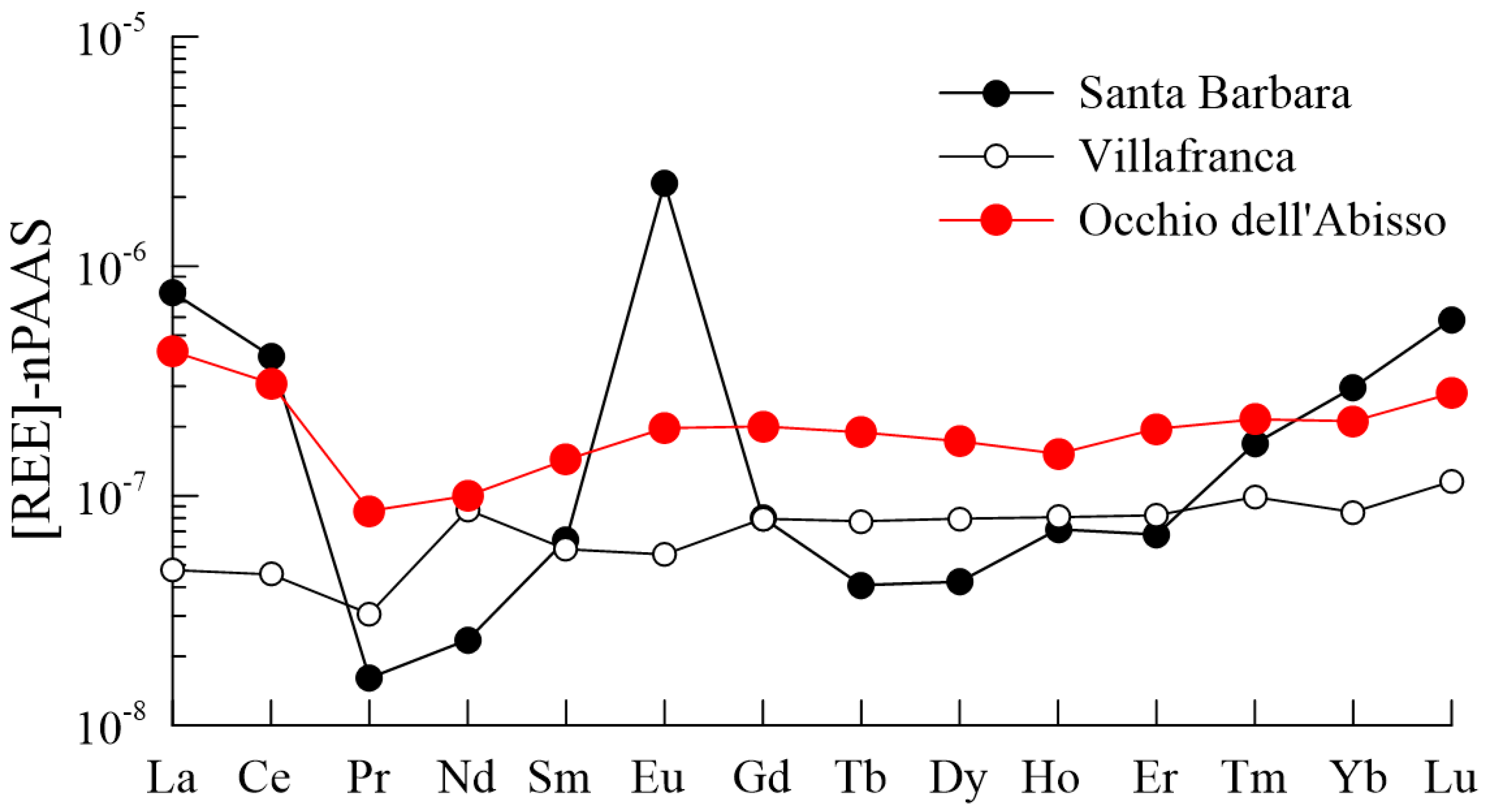
The analytical concentrations of Rare Earth Elements (REEs), Zr, and Hf in the investigated waters are presented in Table 2. The analytes exhibit higher concentrations within the dissolved fraction of the aqueous samples collected from S. Barbara and Occhio dell’Abisso. Conversely, the concentrations in the equivalent fraction from the Villafranca Sicula spring are approximately quasi-one order of magnitude lower. When comparing the cumulative REE concentrations (∑REE, including Y), the discrepancy between the mud volcano waters and the Villafranca Sicula spring is less pronounced, suggesting that the fractionation patterns across the REE series differ among the three sites.
REE shale-normalized patterns are illustrated in Figure 2, which shows that the REE distribution varies significantly across the three samples. Samples from Santa Barbara and Occhio dell’Abisso exhibit a marked enrichment in Light Rare Earth Elements (LREEs), specifically La and Ce, followed by a depletion in Pr. This is succeeded by a slight enrichment in Middle Rare Earth Elements (MREEs) and a progressive increase in normalized concentrations toward the Heavy Rare Earth Elements (HREEs). Moreover, the Santa Barbara mud volcano water displays a prominent positive Europium anomaly (Eu/Eu* = 31.8), whereas this feature is only incipient in the Occhio dell’Abisso sample (Eu/Eu* = 1.2). The REE pattern of Villafranca Sicula is more conservative, characterized by a slight depletion in La and Ce and a sharp decrease in normalized Pr. The subsequent pattern remains relatively sub-horizontal along the series. This trend is quantified by the (Lu/Sm)n ratio, which is approximately 1.8 at Villafranca Sicula, significantly lower than the ratios calculated for the other two aqueous systems.
In the investigated samples, the Y/Ho ratio shows a high variability, ranging from a minimum of 27.1, recorded in the Santa Barbara mud volcano waters, to a maximum of 51.98, observed in the Villafranca Sicula spring. This variability is mainly due to the very different Y concentrations.

6.2. Truly Dissolved Fraction (TDF < 10 kDa)

The cross-flow filtration was successfully performed only for the S. Barbara and Villafranca Sicula waters. At Occhio dell’Abisso, technical constraints, likely associated with the high concentration of suspended sulfur, prevented the execution of adequate ultrafiltration. Consistent with the DF analyses, the two aqueous systems exhibit different concentrations even within the truly dissolved fraction (TDF); specifically, the total REE concentration at Villafranca Sicula is approximately 10% of that measured at Santa Barbara.
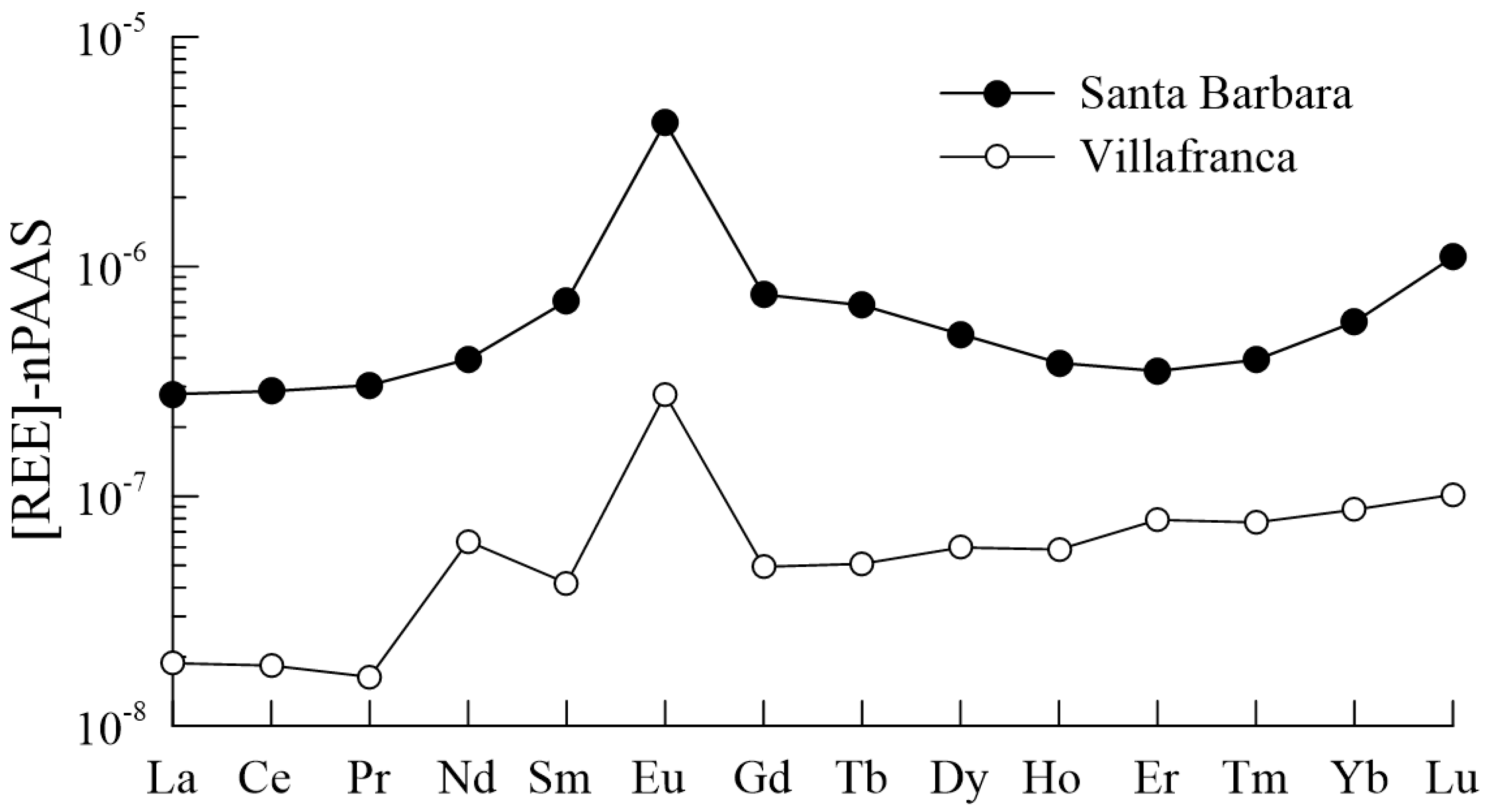
This marked quantitative difference is less apparent when evaluating the PAAS-normalized fractionation patterns (Figure 3). Figure 3 illustrates that the TDF of both waters shares similar geochemical signatures, characterized by a positive Europium anomaly (Eu/Eu* ≈ 5.8−6.1), the absence of a Cerium anomaly, and a general trend of increasing normalized concentrations with increasing atomic number. The primary divergence lies in the MREE enrichment observed in the Santa Barbara pattern, which is absent in the Villafranca Sicula sample.
The TDF concentrations of Y and Ho in the S. Barbara and Villafranca Sicula waters yield Y/Ho ratios of 29.1 and 36.1, respectively. The ratio observed in the truly dissolved fraction of S. Barbara is nearly identical to its DF counterpart, whereas for Villafranca Sicula, the TDF Y/Ho ratio deviates significantly from the value recorded in the DF.

6.3. Colloidal Fraction (10 kDa < CF < 450 nm)

The composition of the colloidal fraction (CF) was investigated in the aqueous samples collected from the Santa Barbara mud volcano and the Villafranca Sicula spring. In the Santa Barbara sample, REE concentrations are lower in the CF compared to the truly dissolved fraction (TDF), whereas the inverse relationship is observed at Villafranca Sicula. Similarly, Y concentrations are lower in the CF than in the TDF at Santa Barbara, but higher at Villafranca Sicula. Consequently, the Y/Ho ratios exhibit slight variations: at Santa Barbara, the ratio remains close to the characteristic signature found in crustal rocks and meteorites, while at Villafranca Sicula, it reaches a value of 77.6.
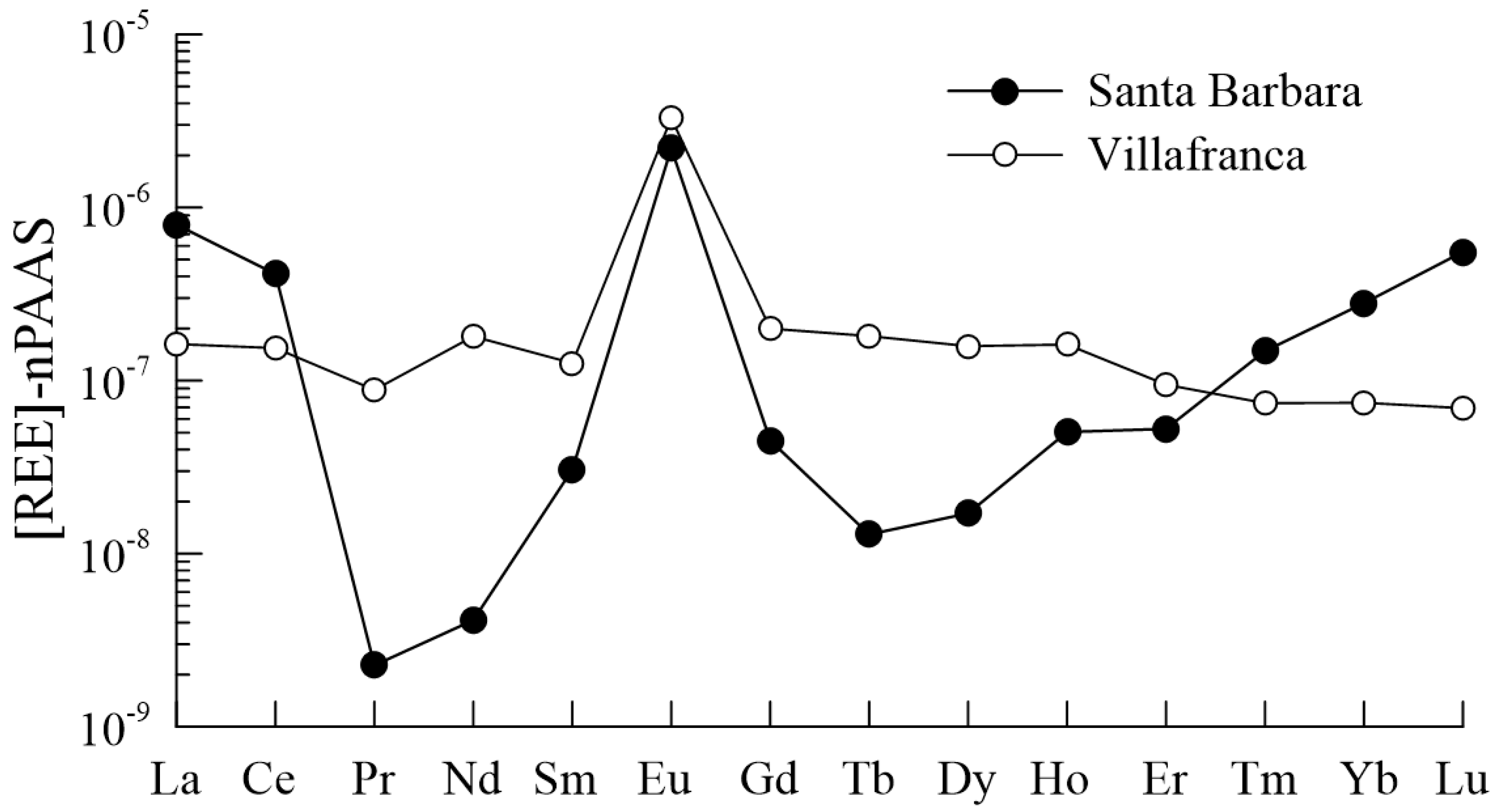
The distribution of PAAS-normalized REE concentrations in the colloidal fraction (Figure 4) of the Santa Barbara water closely mirrors that observed in the dissolved fraction (DF). An enrichment in La and Ce is followed by a depletion in Pr and Nd, a prominent positive Europium anomaly, and a progressively increasing trend in normalized concentrations across the REE series. At Villafranca Sicula, the PAAS-normalized REE pattern is relatively regular, displaying a slight downward trend from La to Lu. A positive Europium anomaly is also present in this sample.
The concentrations of Zr and Hf in the colloidal fraction are lower at S. Barbara (0.79 and 0.05 μg/L, respectively) compared to Villafranca Sicula (278.56 and 4.97 μg/L, respectively). The differential fractionation between Zr and Hf at the two sites results in a Zr/Hf ratio that is lower than the characteristic lithogenic signature at S. Barbara and higher than this baseline at Villafranca Sicula.

6.4. Suspended Particulate Matter (SMP > 0.45 μm)

The concentrations of REE, Zr, and Hf measured in the suspended particulate matter (SPM) fraction of the investigated waters are presented in Table 2. The observed values indicate that REEs are enriched in the SPM relative to the dissolved fraction (DF), an effect that is particularly pronounced in the waters associated with the Santa Barbara mud volcano. The Y/Ho fractionation is slightly more accentuated than that typically observed in rocks. Consequently, the Y/Ho mass ratios at S. Barbara and Occhio dell’Abisso are relatively similar, remaining slightly above the value of 30 (w/w).
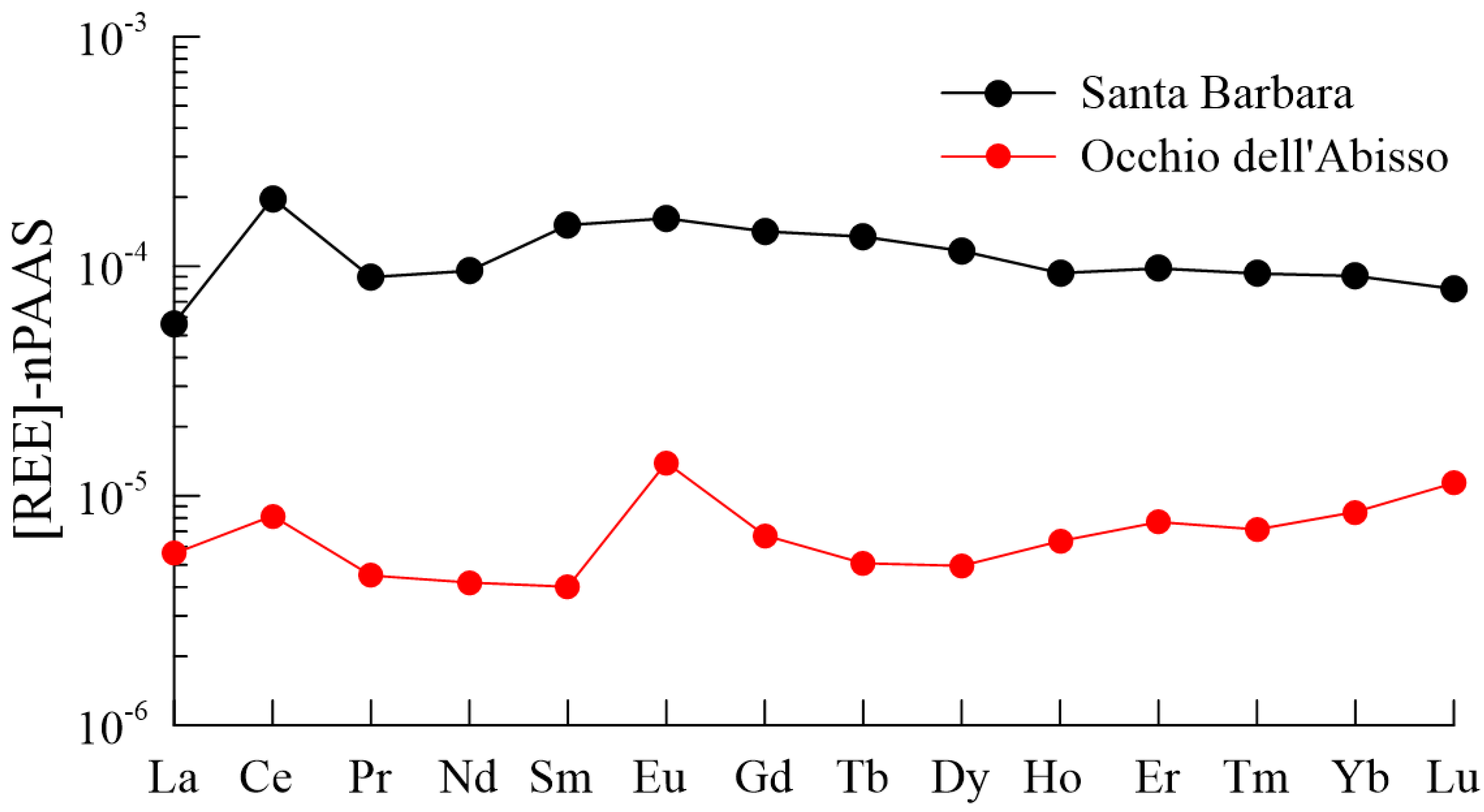
The PAAS-normalized REE concentrations in the suspended particulate matter of the Santa Barbara water result in a distantly symmetrical pattern, characterized by a slight enrichment of MREEs relative to both LREEs and HREEs (Figure 5).
The symmetry of the pattern is interrupted by a positive Ce anomaly. In contrast, the PAAS-normalized REE distribution in the suspended particulate matter (SPM) collected from the Occhio dell’Abisso site exhibits a slightly decreasing trend from La to Sm, followed by a progressive increase from Eu onwards. In this sample as well, the suspended particulate matter shows a preferential enrichment of Ce relative to La and Pr.
The Zr and Hf concentrations measured in the suspended fractions are the highest recorded among all examined samples. This is consistent with the strongly lithogenic nature of these two elements, and the presence of a significant lithic component within the suspended particulate matter of the investigated waters. Consequently, the Zr/Hf ratios measured in both suspended fractions fall within the characteristic range of crustal rocks and meteorites [57].

6.5. Sediments

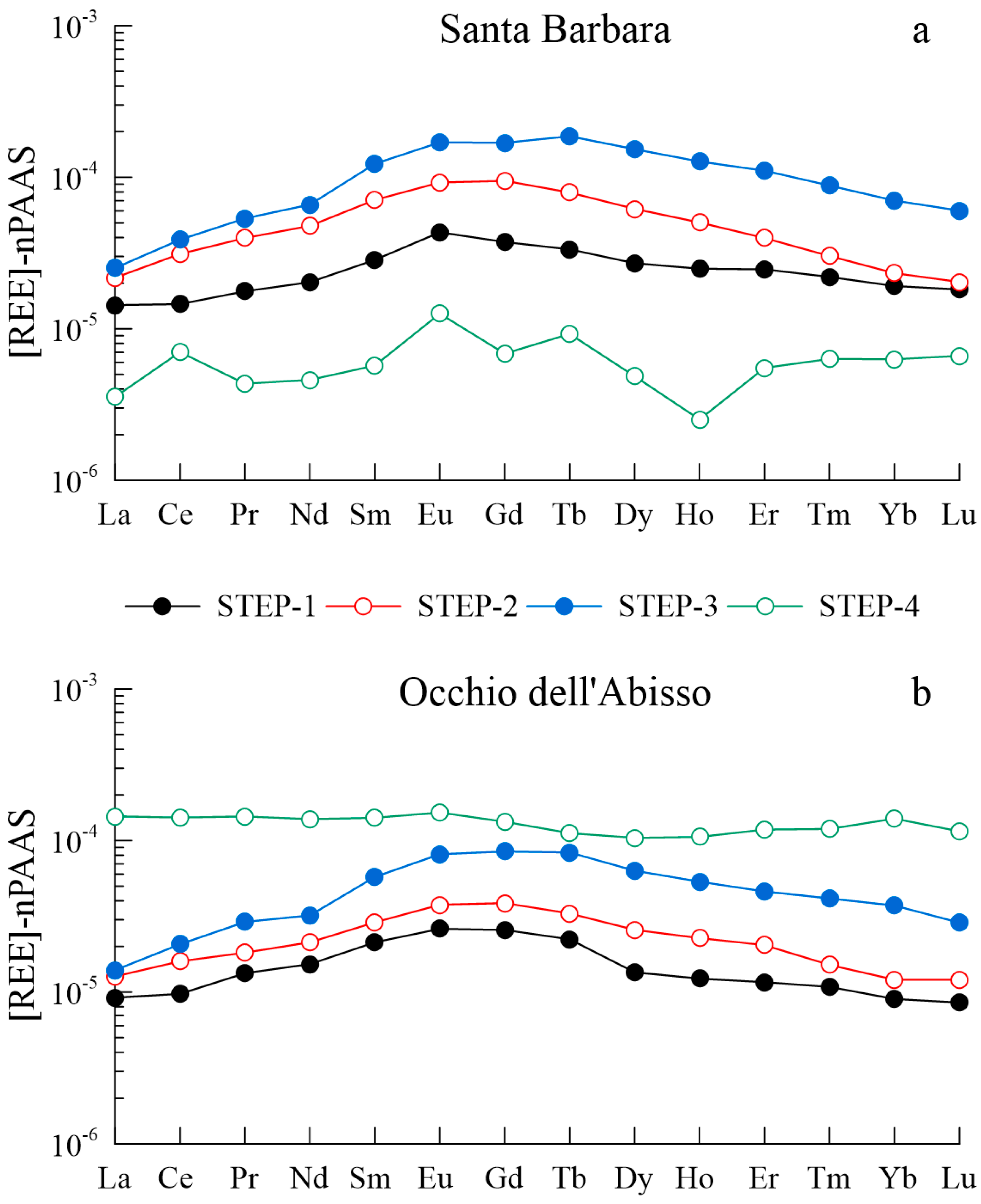
Selective dissolution performed on the sediments, associated with the water collected from S. Barbara and Occhio dell’Abisso mud volcanoes, has allowed for the discrimination of the elemental fraction associated with the labile component of the sediment (Step 1), from the moderately reducible (Step 2), the strongly oxidizable (Step 3), and the residual silicate fraction (Step 4).
Figure 6 indicates that the two sediment samples exhibit a different REE distribution across their respective fractions. At Santa Barbara, the labile fraction (Step 1) concentrates only 4088 ppb of REEs, followed by the moderately reducible fraction (Step 2) at 8375 ppb. The maximum REE concentration of 13,020 ppb is associated with the strongly oxidizable fraction (Step 3), while the detrital fraction (Step 4) shows the lowest concentration at 1166 ppb.
In the Occhio dell’Abisso sediment, the REE content in the first three steps is lower than that observed in the Santa Barbara sediment. Instead, the REEs are predominantly associated with the residual fraction (Step 4), with concentrations exceeding 27,000 ppb.
Significant variations between the two samples and their internal fractions are also observed in the Y/Ho ratios. In Step 1 and Step 2 of both samples, the ratio remains consistently at values moderately higher than those typical of crustal rocks. However, the Y/Ho ratio drops to approximately 25 in Step 3 and undergoes further shifts in Step 4.
The sediment associated with the Santa Barbara water exhibits significant MREE fractionation, which is particularly pronounced in the easily and moderately oxidizable fractions (Figure 6). This enrichment is less evident in the labile fraction, where a slight positive Europium anomaly is noted (Eu/Eu* = 1.2), and largely disappears in the detrital fraction. In the latter, a distinct positive Eu anomaly is present (Eu/Eu* = 2), while the residual REE pattern is relatively flat.
Similarly, the sediment from Occhio dell’Abisso shows a clear MREE fractionation in the first three fractions. In contrast, the detrital fraction is characterized by an absence of fractionation across the series from La to Lu, resulting in a flat pattern.
The behavior of Zr and Hf in the sediment is marked by their limited fractionation, especially in the Santa Barbara samples. Here, the Zr/Hf ratio is below 5.5 in the labile and easily reducible fractions, where it reaches a minimum of 1.5. In the third fraction, the ratio increases but remains consistently below the characteristic range for lithic rocks. This threshold is only reached or slightly exceeded in the detrital fraction of the sample. In the sediment collected from Occhio dell’Abisso, the trend of the Zr/Hf ratios mirrors the aforementioned behavior. The only difference is the Zr/Hf fractionation observed in the second fraction, which is similar to that shown in the third fraction.

7. Discussion

A summary of the key outcomes of our results is presented in Table 3 and will be explored across the two following subsections.

7.1. Behavior of REE, Zr and Hf in DF, CF, TDF and SPM

The REE distribution in the dissolved fraction of the investigated waters exhibits a generally increasing trend along the series, with varying degrees of LREE and Eu enrichment. The absence of negative Ce anomalies (Ce/Ce* < 0.9), and the pronounced positive Europium anomaly in the Santa Barbara water, suggest that the conditions of these fluids are insufficient to stabilize Ce as the oxidized species CeO2. Consequently, significant fractionation of this species as a suspended solid or within the sediment does not occur [1].
This hypothesis is corroborated by the normalized REE patterns in the suspended particulate matter (SPM) collected at Santa Barbara (Eh = −57 mV), where the positive Ce anomaly is more significant than that found at Occhio dell’Abisso (Eh = −420 mV). As highlighted by Bau (1999) [58], the occurrence of a positive Ce anomaly within the particulate phase in the Santa Barbara waters may represent a localized phenomenon driven by specific redox dynamics, in particular, a rapid oxidative scavenging of Cerium onto newly formed Fe-oxyhydroxides.
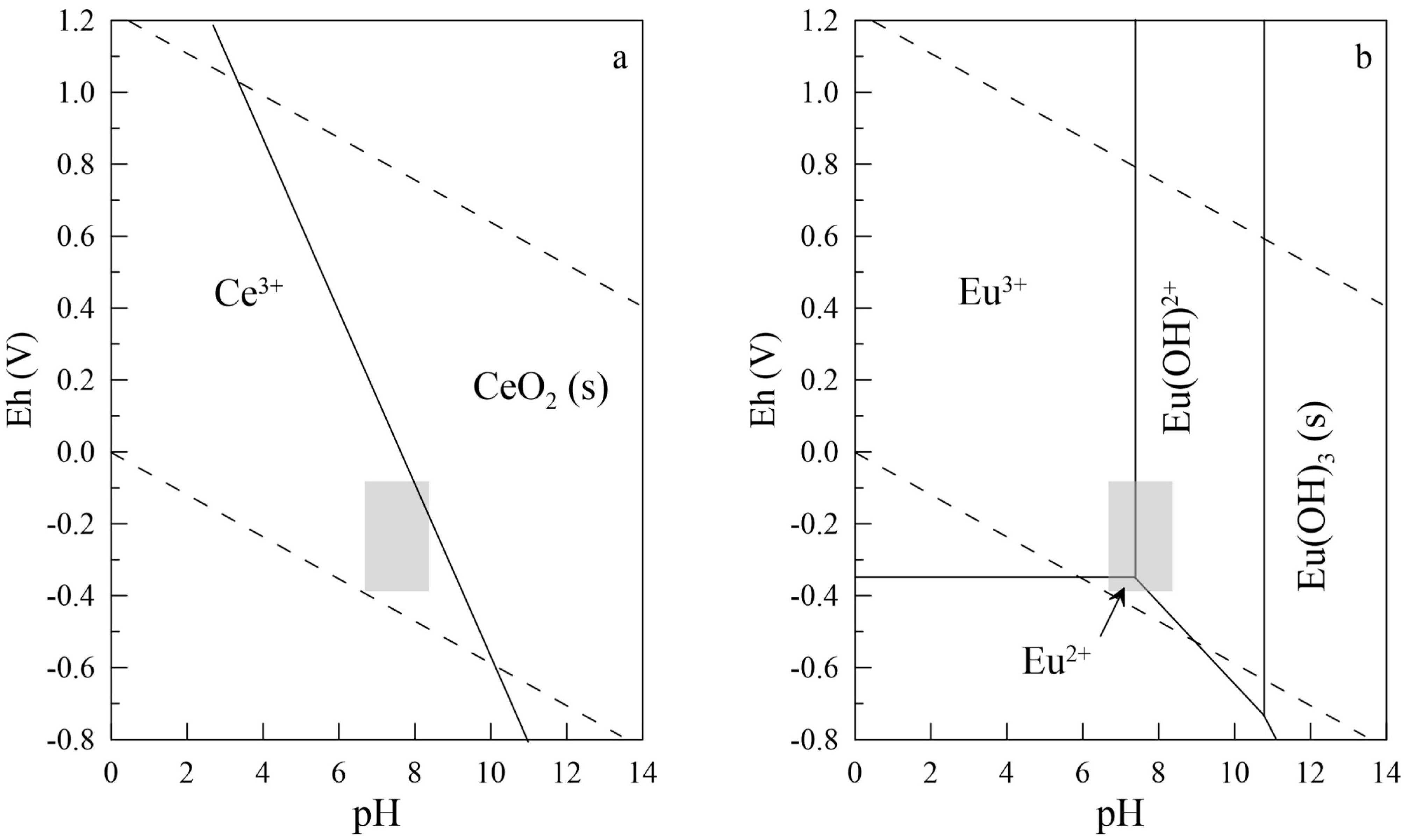
By plotting the Eh and pH values recorded in the studied samples onto a Ce Eh–pH (Pourbaix) diagram based on the LLNL database [59], it is observed that the representative interval of these waters falls near the boundary between the Ce3+ and Ce4+ stability fields (Figure 7a).
On the other hand, the frequently observed positive Eu anomalies can only be partially explained by the strongly reducing conditions of the investigated aquifers. While such conditions would justify higher stability in the dissolved phase for Eu(II) complexes compared to their trivalent neighbors, Sm and Gd [60], the Eh−pH (Pourbaix) diagram specifically for Eu (Figure 7b) shows that the samples fall within a region where both Eu(II) and Eu(III) species coexist. The remarkably high positive Eu anomaly observed in the Santa Barbara waters (Eu/Eu* = 31.8) suggests that the reductive stabilization of Eu(II) may be further intensified by non-equilibrium processes. While reducing conditions facilitate the existence of divalent Europium, organic complexation likely plays a synergistic role; humic substances and organic ligands have been shown to preferentially stabilize Eu(II) or modify REE fractionation patterns in organic-rich anoxic basins [25]. Furthermore, kinetic effects cannot be overlooked. As suggested by Bau [58], the rate of REE exchange between particulate and dissolved phases is often governed by the surface chemistry of Fe-oxyhydroxides. In this context, a kinetic lag in the re-oxidation or scavenging of Eu could amplify the signal beyond standard thermodynamic equilibrium predictions, effectively trapping the anomaly in the dissolved phase.
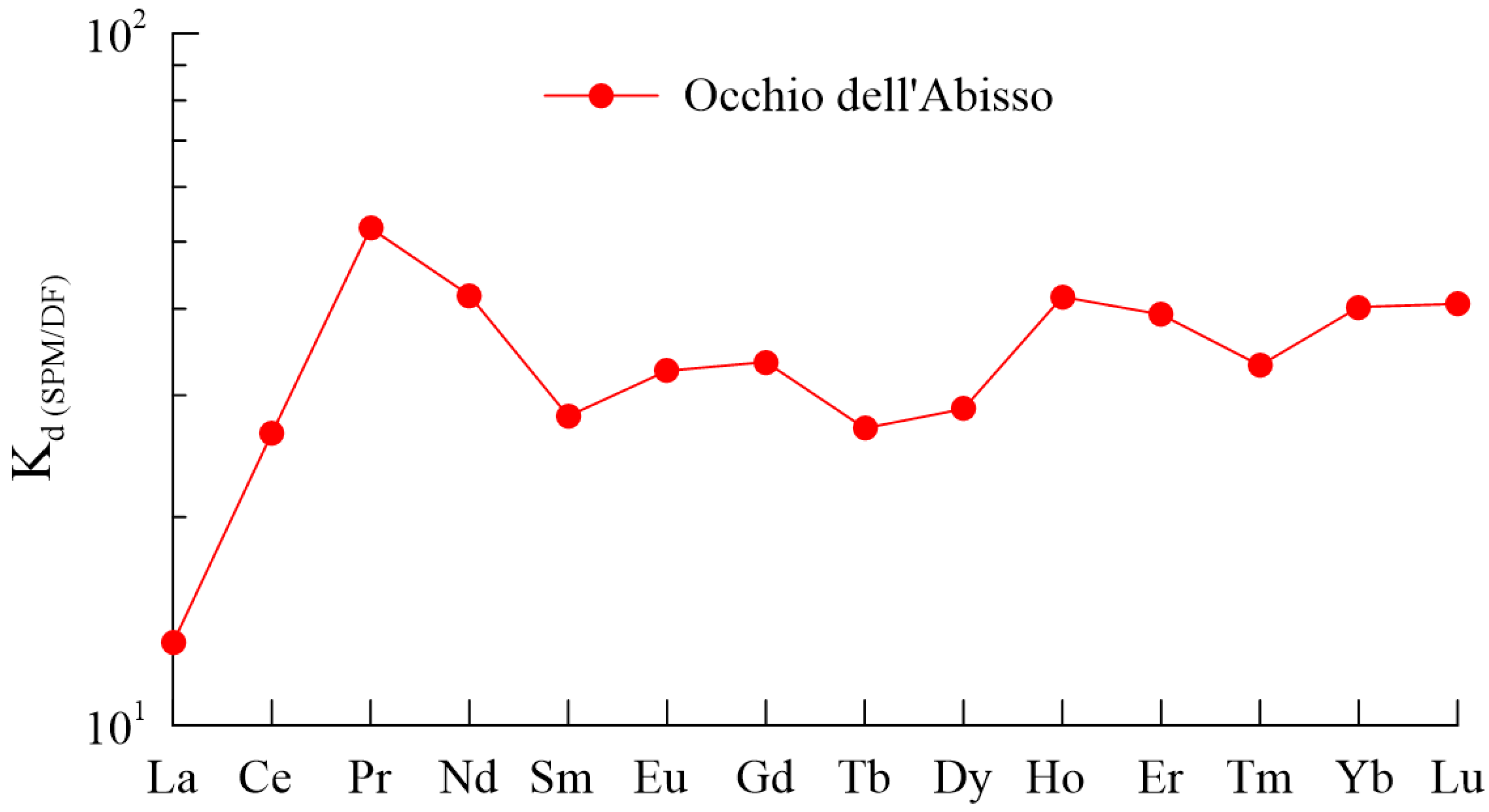
A comparison between the REE concentrations in the dissolved fraction and the suspended particulate matter from the Occhio dell’Abisso water allows for the calculation of the apparent distribution coefficient (Kd) for elements from La to Lu, based on the following relationship:
K d = [ R E E ] i S P M [ R E E ] i D F
where the numerator represents the concentration of the i-th REE measured in the suspended particulate matter and the denominator represents its concentration in the dissolved phase. The resulting trend of Kd values is illustrated in Figure 8.
The figure depicts an increasing trend of the values along the series, with relative maxima at Pr, Gd, Ho and Lu. These peaks result from the subdivision of the pattern into curvilinear segments for the element groups Gd-Tb-Dy-Ho and Er-Tm-Yb-Lu. When these curve segments, known as tetrads, assume an upward concave shape, it suggests that the trend of the REE distribution coefficients is the result of a dissolution process [17]. Consequently, in this case, the REE carrier in the Occhio dell’Abisso water is the suspended material, whose dissolution serves as the reservoir for the aqueous phase.
As previously observed in Figure 3 and Figure 4, Eu anomalies are a phenomenon related to the affinity of this element for aqueous solutions or colloids. Excluding that the Eu excess, responsible for the observed positive anomalies, is not an instrumental artifact (e.g., isobaric interferences on masses 151Eu and 153Eu), this evidence warrants further investigation to clarify its geochemical significance.
The Y/Ho mass ratios measured in the waters are consistent with those typical of lithogenic products, suggesting that the origin of the elements should be attributed to dissolution processes, which are not accompanied by re-precipitation during the formation of authigenic phases. Indeed, the different reactivity of Y relative to Ho on the surfaces of newly formed minerals, or the differential involvement of these two elements during the crystallization of these phases, would induce Y-Ho fractionation [42,61,62,63].
Only at Villafranca Sicula the Y/Ho ratio in the colloidal fraction exceed the chondritic signature, suggesting a higher reactivity of Y compared to Ho on the surface of these products. The recognized tendency of Y to be more reactive toward humic acids [64] suggests that it may constitute a significant component of the colloidal fraction.
The Zr/Hf ratios are sub-chondritic, with the exception of the Occhio dell’Abisso sample. This effect is driven by the influence of colloids within the dissolved fraction at Villafranca Sicula and Santa Barbara. In the case of Occhio dell’Abisso, the presence of a Zr/Hf ratio significantly higher than the chondritic signature appears to be the result of Zr-Hf fractionation, occurring during the dissolution of suspended particulate matter, which preferentially releases Zr over Hf into the coexisting aqueous phase. Moreover, as already observed by Zuddas et al. [16], the Zr/Hf ratio is influenced by the pH of the solutions, with a maximum of 232 at pH 8.34 at Occhio dell’Abisso and a minimum of 13 at pH 6.93 at Villafranca Sicula.
Since the speciation of Zr and Hf is dominated by hydroxo-complexes under the pH and chemical conditions characteristic of the investigated waters [65], and since Hf is stable as [Hf(H2O)3(OH)5] while Zr remains as [Zr(H2O)4(OH)4]0, the Coulombic interactions between colloidal surfaces and dissolved species result in a higher reactivity of Hf toward these surfaces. This mechanism leads to the preferential enrichment of Zr in the aqueous phase [14,48,66].
Moreover, in natural hydrothermal systems, the enrichment of trace elements like Zr and Hf is often more a reflection of colloid transport than true thermodynamic solubility. As already observed by Zuddas et al. [16], the colloidal fraction, which comprises Fe-oxyhydroxides, carbonate, and clay minerals, can act as a primary vector for these elements, as concentrations of Zr and Hf in this fraction have been measured to be much higher (at least in Santa Barbara) than those in the truly dissolved fraction.
Instead of being ruled solely by solubility, the distribution and apparent enrichment of these elements are heavily influenced by the morphological and electrical properties of authigenic mineral surfaces formed during water–rock interaction. For example, the preferential removal of hafnium onto colloidal aggregates or mineral surfaces like halite and Fe–Mn oxyhydroxides can result in variable zirconium/hafnium ratios that deviate from the expected signatures of interacting rocks [64]. Even biological factors, such as microbial activity and the presence of extracellular polymeric substances, can enhance the scavenging of dissolved metal species onto mineral surfaces, creating enrichment patterns that are driven by surface complexation rather than the saturation limits of the fluid itself [14,64,67,68].
Results from the calculation of aqueous speciation in the DF indicate that [REE(CO3)]+is the dominant complex ion in all the sites, followed by [REE(OH)]2+ at Santa Barbara, [REE(CO3)2] at Villafranca and [REE(SO4)]+ at Occhio dell’Abisso. As already observed by Zuddas et al. [16], carbonate ligands are the most abundant in solution close to neutrality, which is the case for Santa Barbara and Villafranca Sicula. The presence of sulphate ions as a relevant ligand at Occhio dell’Abisso is likely due to the presence of H2S, which is oxidized to SO4 (sulphureous water).
The complexation of REE is a complicated process governed by a multitude of factors, like pH, salinity, and ionic strength, as well as by the morphological and electrical properties of newly formed authigenic minerals, such as Fe-oxyhydroxides, clay minerals, and carbonates [64].

7.2. Behavior of REE, Zr and Hf in Sediments

The geochemical behavior of REEs in the sediments exhibits a general tendency toward MREE fractionation in Steps 1, 2, and 3. Conversely, the residual detrital fraction of the sediments shows a poorly fractionated pattern, which is characteristic of upper crustal rocks and sediments [55]. Furthermore, the distinct nature of the two examined sediments is highlighted by the absolute REE concentrations: these are highest in the sediment sample associated with Occhio dell’Abisso and lowest in the Santa Barbara mud volcanoes.
Analytical results from the Santa Barbara and Occhio dell’Abisso sediments indicate a significant MREE fractionation (enrichment from Sm to Er) in the Step 1 labile fraction, representative of exchangeable cations and Ca carbonate fraction [53]. This bulge pattern is a hallmark of specific sedimentary interactions, and this behavior is consistent with the carbonate nature of the sediment fraction represented in this step, where preferential enrichment in REEs from Sm to Er has been observed globally in marine carbonates and microbialites. This enrichment involvers the mechanism of interaction between porewater and carbonate surfaces. Experimental studies on (REE, Y) uptake by calcite suggest a fast uptake mechanism, through either (REE, Y)2(CO3)3 precipitation or direct adsorption onto calcite planes [69].
The stability of these complexes during contact with soil solutions or sediments is dictated by hydrological changes [69]; in the context of Sicilian mud volcanoes, the upward migration of CO2-rich fluids through Messinian evaporites and Plio-Pleistocene carbonates facilitates the formation of authigenic carbonate phases that selectively trap intermediate rare earth elements (MREEs).
The MREEs are also enriched in the labile fraction of river sediments under varying ionic strength conditions, demonstrating that MREEs are among the elements with the highest affinity for surface interactions across the series from La to Lu [49]. When fluids with high ionic strength (like those interacting with Messinian evaporites) interact with terrigenous sediments, the MREE-enriched organic or oxide coatings are partially mobilized into the labile pool.
Both Step 2 and Step 3 represent sediment fractions associated with oxidizable phases [53]. Specifically, the hydroxylamine attack dissolves Mn-bearing phases, while the oxalic buffer leaches and complexes Fe. In both instances, MREE enrichment has been previously documented during the experimental synthesis of MnO2 [70,71] and Fe-oxyhydroxides [72].
The REE distribution in the residual fraction, particularly in the case of Occhio dell’Abisso, demonstrates that it is composed of detrital or authigenic silicate phases. These materials are typically enriched in LREEs because they formed during the final stages of magmatic differentiation (e.g., quartz and feldspars) or at the expense of the latter in sedimentary environments (e.g., clay minerals). Consequently, they reflect the general incompatible behavior that characterizes REEs during primary crystallization [61].

8. Conclusions

This study provides a comprehensive characterization of the geochemical behavior and transport mechanisms of REE, Zr and Hf within complex natural hydrological systems under reducing conditions. By employing a high-resolution fractionation approach, we successfully partitioned these elements across the truly dissolved, colloidal, suspended particulate, and sedimentary phases, offering new insights into the interfacial processes governing their cycling.
Decoupling of geochemical twins: while the Zr/Hf and Y/Ho pairs typically exhibit coherent behavior during magmatic processes, this study underscores their significant decoupling in aqueous environments. The Zr/Hf ratio, in particular, deviates from chondritic values due to the higher surface affinity of Hf, which is preferentially scavenged onto colloidal surfaces (such as Fe-oxyhydroxides and organic ligands), leading to a relative enrichment of Zr in the dissolved phase.
Our results indicate that the colloidal fraction acts as a critical vector for the transport of trace elements, often concentrating Zr, Hf, and REEs at levels significantly higher than the truly dissolved fraction. Furthermore, the analysis of SPM and distribution coefficients (Kd) suggests that the aqueous REE distribution in systems like Occhio dell’Abisso is primarily driven by the dissolution of suspended solids rather than thermodynamic solubility limits alone.
Sedimentary Reservoir Dynamics: Sequential extractions of bottom sediments revealed that Middle REE (MREE) enrichment is closely associated with labile, Mn-bearing, and Fe-oxyhydroxide phases. In contrast, the residual silicate fraction remains poorly fractionated, reflecting the lithogenic signature of the host rock.
These results suggest the significant potential of specific chemical tracers, such as REE, Zr, and Hf, to characterize the mechanisms governing processes at the interface between different particle size fractions of matter within geomaterials.
To our knowledge, these data represent the first instance of a detailed investigation into the partitioning of these elements across the dissolved fractions, colloids, SPM, and the most geochemically significant fractions of the associated sediment.
Due to the high industrial interest of critical raw materials, including REEs, the improvement of knowledge about their geochemical cycle is of pivotal importance.

Author Contributions

Conceptualization, M.C. and V.C.; methodology, F.S., A.M., T.C. and L.B.; validation, M.C., V.C., F.S. and Y.O.; formal analysis, M.C., F.S., Y.O. and V.C.; investigation, M.C., F.S., Y.O., A.M. and T.C.; data curation, M.C., F.S., A.M. and T.C.; writing—original draft preparation, M.C.; writing—review and editing, M.C., F.S., Y.O. and L.B.; supervision, M.C. All authors have read and agreed to the published version of the manuscript.

Funding

This research received no external funding.

Data Availability Statement

Data are contained within the article.

Acknowledgments

The authors are very grateful to Yongjie Lin, and other three anonymous reviewers for their careful and dedicated job of critical revision of the manuscript.

Conflicts of Interest

The authors declare no conflicts of interest.

Abbreviations

The following abbreviations are used in this manuscript:
REEsRare Earth Elements
LREEsLight Rare Earth Elements
MREEsMiddle Rare Earth Elements
HREEsHigh Rare Earth Elements
DFDissolved Fraction
TDFTruly Dissolved Fraction
CFColloidal Fraction
SPMSuspended Particulate Matter

References

  1. Elderfield, H.; Greaves, M.J. The rare earth elements in seawater. Nature 1982, 296, 214–219. [Google Scholar] [CrossRef]
  2. Elderfield, H. On understanding sediment geochemistry. Appl. Geochem. 1988, 3, 110. [Google Scholar] [CrossRef]
  3. Elderfield, H.; Upstill-Goddard, R.; Sholkovitz, E.R. The rare earth elements in rivers, estuaries, and coastal seas and their significance to the composition of ocean waters. Geochim. Cosmochim. Acta 1990, 54, 971–991. [Google Scholar] [CrossRef]
  4. Goldstein, S.J.; Jacobsen, S.B. Rare earth elements in river waters. Earth Planet. Sci. Lett. 1988, 89, 35–47. [Google Scholar] [CrossRef]
  5. Sholkovitz, E.R.; Elderfield, H. Cycling of dissolved rare earth elements in Chesapeake Bay. Glob. Biogeochem. Cycles 1988, 2, 157–176. [Google Scholar] [CrossRef]
  6. Sholkovitz, E.R.; Landing, W.M.; Lewis, B.L. Ocean particle chemistry: The fractionation of rare-earth elements between suspended particles and seawater. Geochim. Cosmochim. Acta 1994, 58, 1567–1579. [Google Scholar] [CrossRef]
  7. Sholkovitz, E.R. Chemical evolution of rare-earth elements: Fractionation between colloidal and solution phases of filtered river water. Earth Planet. Sci. Lett. 1992, 114, 77–84. [Google Scholar] [CrossRef]
  8. Lawrence, M.G.; Kamber, B.S. The behaviour of the rare earth elements during estuarine mixing-revisited. Mar. Chem. 2006, 100, 147–161. [Google Scholar] [CrossRef]
  9. Rousseau, T.C.C.; Sonke, J.E.; Chmeleff, J.; Van Beek, P.; Souhaut, M.; Boaventura, G.; Seyler, P.; Jeandel, C. Rapid neodymium release to marine waters from lithogenic sediments in the Amazon estuary. Nat. Commun. 2015, 6, 7592. [Google Scholar] [CrossRef] [PubMed]
  10. Merschel, G.; Bau, M.; Dantas, E.L. Contrasting impact of organic and inorganic nanoparticles and colloids on the behavior of particle-reactive elements in tropical estuaries: An experimental study. Geochim. Cosmochim. Acta 2017, 197, 1–13. [Google Scholar] [CrossRef]
  11. Schmidt, K.; Bau, M.; Hein, J.R.; Koschinsky, A. Fractionation of the geochemical twins Zr-Hf and Nb-Ta during scavenging from seawater by hydrogenetic ferromanganese crusts. Geochim. Cosmochim. Acta 2014, 140, 468–487. [Google Scholar] [CrossRef]
  12. Inguaggiato, C.; Censi, P.; Zuddas, P.; Londono, J.M.; Chacon, Z.; Alzate, D.; Brusca, L.; D’Alessandro, W. Geochemistry of REE, Zr and Hf in a wide range of pH and water composition: The Nevado del Ruiz volcano-hydrothermal system (Colombia). Chem. Geol. 2015, 417, 125–133. [Google Scholar] [CrossRef]
  13. Inguaggiato, C.; Censi, P.; Zuddas, P.; D’Alessandro, W.; Brusca, L.; Pecoraino, G.; Bellomo, S. Zirconium-hafnium and rare earth element signatures discriminating the effect of atmospheric fallout from hydrothermal input in volcanic lake water. Chem. Geol. 2016, 433, 1–11. [Google Scholar] [CrossRef]
  14. Censi, P.; Cangemi, M.; Brusca, L.; Madonia, P.; Saiano, F.; Zuddas, P. The behavior of rare-earth elements, Zr and Hf during biologically-mediated deposition of silica-stromatolites and carbonate-rich microbial mats. Gondwana Res. 2015, 27, 209–215. [Google Scholar] [CrossRef]
  15. Censi, P.; Inguaggiato, C.; Chiavetta, S.; Schembri, C.; Sposito, F.; Censi, V.; Zuddas, P. The behaviour of zirconium, hafnium and rare earth elements during the crystallisation of halite and other salt minerals. Chem. Geol. 2017, 453, 80–91. [Google Scholar] [CrossRef]
  16. Zuddas, P.; Censi, P.; Inguaggiato, C.; Sposito, F. The behaviour of zirconium and hafnium during water-rock interaction. Appl. Geochem. 2018, 94, 46–52. [Google Scholar] [CrossRef]
  17. Bau, M. Controls on the fractionation of isovalent trace elements in magmatic and aqueous systems: Evidence from Y/Ho, Zr/Hf, and lanthanide tetrad effect. Contrib. Mineral. Petrol. 1996, 123, 323–333. [Google Scholar] [CrossRef]
  18. McKelvey, B.A.; Orians, K.J. Dissolved zirconium in the North Pacific Ocean. Geochim. Cosmochim. Acta 1993, 57, 3801–3805. [Google Scholar] [CrossRef]
  19. McKelvey, B.A.; Orians, K.J. The determination of dissolved zirconium and hafnium from seawater using isotope dilution inductively coupled plasma mass spectrometry. Mar. Chem. 1998, 60, 245–255. [Google Scholar] [CrossRef]
  20. Godfrey, L.V.; White, W.M.; Salters, V.J.M. Dissolved zirconium and hafnium distributions across a shelf break in the northeastern Atlantic Ocean. Geochim. Cosmochim. Acta 1996, 60, 3995–4006. [Google Scholar] [CrossRef]
  21. Godfrey, L.V.; Field, M.P.; Sherrell, R.M. Estuarine distributions of Zr, Hf, and Ag in the Hudson River and the implications for their continental and anthropogenic sources to seawater. Geochem. Geophys. Geosyst. 2008, 9, Q12007. [Google Scholar] [CrossRef]
  22. Firdaus, M.L.; Minami, T.; Norisuye, K.; Sohrin, Y. Strong elemental fractionation of Zr-Hf and Nb-Ta across the Pacific Ocean. Nat. Geosci. 2011, 4, 227–230. [Google Scholar] [CrossRef]
  23. Frank, M. Oceanography chemical twins, separated. Nat. Geosci. 2011, 4, 220–221. [Google Scholar] [CrossRef]
  24. Sholkovitz, E.R. The geochemistry of rare-earth elements in the Amazon River estuary. Geochim. Cosmochim. Acta 1993, 57, 2181–2190. [Google Scholar] [CrossRef]
  25. Sholkovitz, E.R. The aquatic chemistry of rare earth elements in rivers and estuaries. Aquat. Geochem. 1995, 1, 1–34. [Google Scholar] [CrossRef]
  26. Cidu, R.; Frau, F. Influence of the fine-particle load in Mediterranean rivers and streams on the distribution of trace elements in filtered and not filtered aqueous fractions. Appl. Geochem. 2009, 24, 611–623. [Google Scholar] [CrossRef]
  27. Tepe, N.; Bau, M. Distribution of rare earth elements and other high field strength elements in glacial meltwaters and sediments from the western Greenland Ice Sheet: Evidence for different sources of particles and nanoparticles. Chem. Geol. 2014, 412, 59–68. [Google Scholar] [CrossRef]
  28. Johannesson, K.H.; Palmore, C.D.; Fackrell, J.; Prouty, N.G.; Swarzenski, P.W.; Chevis, D.A.; Telfeyan, K.; White, C.D.; Burdige, D.J. Rare earth element behavior during groundwater–seawater mixing along the Kona Coast of Hawaii. Geochim. Cosmochim. Acta 2017, 198, 229–258. [Google Scholar] [CrossRef]
  29. Elbaz-Poulichet, F.; Dupuy, C. Behaviour of rare earth elements at the freshwater-seawater interface of two acid mine rivers: The Tinto and Odiel (Andalucia, Spain). Appl. Geochem. 1999, 14, 1063–1072. [Google Scholar] [CrossRef]
  30. Sholkovitz, E.; Szymczak, R. The estuarine chemistry of rare earth elements: Comparison of the Amazon, Fly, Sepik and the Gulf of Papua systems. Earth Planet. Sci. Lett. 2000, 179, 299–309. [Google Scholar] [CrossRef]
  31. Nozaki, Y.; Lerche, D.; Alibo, D.S.; Snidvongs, A. The estuarine geochemistry of rare earth elements and indium in the Chao Phraya River, Thailand. Geochim. Cosmochim. Acta 2000, 64, 3983–3994. [Google Scholar] [CrossRef]
  32. Hannigan, R.E.; Sholkovitz, E.R. The development of middle rare earth element enrichments in freshwaters: Weathering of phosphate minerals. Chem. Geol. 2001, 175, 495–508. [Google Scholar] [CrossRef]
  33. Barroux, G.; Sonke, J.E.; Boaventura, G.; Viers, J.; Godderis, Y.; Bonnet, M.P.; Sondag, F.; Gardoll, S.; Lagane, C.; Seyler, P. Seasonal dissolved rare earth element dynamics of the Amazon River main stem, its tributaries, and the Curuai floodplain. Geochem. Geophys. Geosyst. 2006, 7, Q12005. [Google Scholar]
  34. Censi, P.; Sprovieri, M.; Saiano, F.; Di Geronimo, S.I.; Larocca, D.; Placenti, F. The behavior of REEs in Thailand’s Mae Klong estuary: Suggestions from the Y/Ho ratios and lanthanide tetrad effects. Estuar. Coast. Shelf Sci. 2007, 71, 569–579. [Google Scholar] [CrossRef]
  35. Censi, P.; Zuddas, P.; Randazzo, L.A.; Saiano, F.; Mazzola, S.; Aricò, P.; Cuttitta, A.; Punturo, R. Influence of dissolved organic matter on rare earth elements and yttrium distributions in coastal waters. Chem. Ecol. 2010, 26, 123–135. [Google Scholar] [CrossRef]
  36. Kulaksiz, S.; Bau, M. Rare earth elements in the Rhine River, Germany: First case of anthropogenic lanthanum as a dissolved microcontaminant in the hydrosphere. Environ. Int. 2011, 37, 973–979. [Google Scholar] [CrossRef] [PubMed]
  37. Kulaksiz, S.; Bau, M. Contrasting behaviour of anthropogenic gadolinium and natural rare earth elements in estuaries and the gadolinium input into the North Sea. Earth Planet. Sci. Lett. 2007, 260, 361–371. [Google Scholar] [CrossRef]
  38. Cotton, S. Lanthanide and Actinide Chemistry; Wiley: Hoboken, NJ, USA, 2006. [Google Scholar]
  39. Shannon, R.D. Revised effective ionic radii and systematic studies of interatomic distances in halides and chalcogenides. Acta Crystallogr. Sect. A 1976, 32, 751–767. [Google Scholar] [CrossRef]
  40. Wood, B.J.; Blundy, J.D. Trace element partitioning: The influences of ionic radius, cation charge, pressure, and temperature. In Treatise on Geochemistry, 2nd ed.; Holland, H.D., Turekian, K.K., Eds.; Elsevier: Oxford, UK, 2014; pp. 421–448. [Google Scholar]
  41. Byrne, R.H.; Sholkovitz, E.R. Marine chemistry and geochemistry of the lanthanides. In Handbook on the Physics and Chemistry of Rare Earths; Elsevier: Amsterdam, The Netherlands, 1996; pp. 497–593. [Google Scholar]
  42. Alibo, D.S.; Nozaki, Y. Rare earth elements in seawater: Particle association, shale-normalization, and Ce oxidation. Geochim. Cosmochim. Acta 1999, 63, 363–372. [Google Scholar]
  43. Münker, C.; Pfänder, J.; Weyer, S.; Büchl, A.; Kleine, T.; Mezger, K. Evolution of planetary cores and the Earth–moon system from Nb/Ta systematics. Science 2003, 301, 84–87. [Google Scholar] [CrossRef]
  44. Irber, W. The lanthanide tetrad effect and its correlation with K/Rb, Eu/Eu*, Sr/Eu, Y/Ho, and Zr/Hf of evolving peraluminous granite suites. Geochim. Cosmochim. Acta 1999, 63, 489–508. [Google Scholar] [CrossRef]
  45. Firdaus, M.L.; Norisuye, K.; Nakagawa, Y.; Nakatsuka, S.; Sohrin, Y. Dissolved and labile particulate Zr, Hf, Nb, Ta, Mo and W in the western North Pacific Ocean. J. Oceanogr. 2008, 64, 247–257. [Google Scholar] [CrossRef]
  46. Bau, M.; Koschinsky, A. Hafnium and neodymium isotopes in seawater and in ferromanganese crusts: The “element perspective”. Earth Planet. Sci. Lett. 2006, 241, 952–961. [Google Scholar] [CrossRef]
  47. Kraemer, D.; Kopf, S.; Bau, M. Oxidative mobilization of cerium and uranium and enhanced release of “immobile” high field strength elements from igneous rocks in the presence of the biogenic siderophore desferrioxamine B. Geochim. Cosmochim. Acta 2015, 165, 263–279. [Google Scholar] [CrossRef]
  48. Censi, P.; Raso, M.; Yechieli, Y.; Ginat, H.; Saiano, F.; Zuddas, P.; Brusca, L.; D’Alessandro, W.; Inguaggiato, C. Geochemistry of Zr, Hf, and REE in a wide spectrum of Eh and water composition: The case of Dead Sea Fault system (Israel). Geochem. Geophys. Geosyst. 2017, 18, 844–857. [Google Scholar] [CrossRef]
  49. Catalano, R.; Di Stefano, P.; Sulli, A.; Vitale, F.P. Paleogeography and structure of the central Mediterranean: Sicily and its offshore area. Tectonophysics 1996, 260, 291–323. [Google Scholar] [CrossRef]
  50. Avellone, G.; Barchi, M.R.; Catalano, R.; Gasparo Morticelli, M.; Sulli, A. Interference between shallow and deep-seated structures in the Sicilian fold and thrust belt, Italy. J. Geol. Soc. 2010, 167, 109–126. [Google Scholar] [CrossRef]
  51. Lyvén, B.; Hassellöv, M.; Turner, D.R.; Haraldsson, C.; Andersson, K. Competition between iron- and carbon-based colloidal carriers for trace metals in a freshwater-seawater mixing zone. Geochim. Cosmochim. Acta 2003, 67, 3791–3802. [Google Scholar] [CrossRef]
  52. Raso, M.; Censi, P.; Saiano, F. Simultaneous determinations of zirconium, hafnium, yttrium and lanthanides in seawater according to a co-precipitation technique onto iron-hydroxide. Talanta 2013, 116, 1085–1090. [Google Scholar] [CrossRef] [PubMed]
  53. Koschinsky, A.; Halbach, P. Sequential leaching of marine ferromanganese precipitates: Genetic implications. Geochim. Cosmochim. Acta 1995, 59, 5113–5132. [Google Scholar] [CrossRef]
  54. Schlosser, C.; Croot, P.L. Application of cross-flow filtration for determining the solubility of iron species in open ocean seawater. Limnol. Oceanogr. Methods 2008, 6, 630–642. [Google Scholar] [CrossRef]
  55. Kulaksız, S.; Bau, M. Anthropogenic dissolved and colloid/nanoparticle-bound samarium, lanthanum and gadolinium in the Rhine River and the impending destruction of the natural rare earth element distribution in rivers. Earth Planet. Sci. Lett. 2013, 362, 43–50. [Google Scholar] [CrossRef]
  56. Taylor, S.R.; McLennan, S.M. The geochemical evolution of the continental crust. Rev. Geophys. 1995, 33, 241–265. [Google Scholar] [CrossRef]
  57. Jochum, K.P.; Seufert, H.M.; Spettel, B.; Palme, H. The solar-system abundances of Nb, Ta, and Y, and the relative abundances of refractory lithophile elements in differentiated planetary bodies. Geochim. Cosmochim. Acta 1986, 50, 1173–1183. [Google Scholar] [CrossRef]
  58. Bau, M. Scavenging of dissolved yttrium and rare earths by precipitating iron oxyhydroxide: Experimental evidence for Ce oxidation, Y-Ho fractionation, and lanthanide tetrad effect. Geochim. Cosmochim. Acta 1999, 63, 67–77. [Google Scholar] [CrossRef]
  59. Takedo, N. Atlas of Eh-pH Diagrams. Intercomparison of Thermodynamic Databases. Geological Survey of Japan, Open File No.419. National Institute of Advanced Industrial Science and Technology Research Center for Deep Geological Environments Naoto TAKENO, May 2005. Available online: https://www.nrc.gov/docs/ML1808/ML18089A638.pdf (accessed on 19 March 2026).
  60. Sverjensky, D.A. Europium redox equilibria in aqueous solution. Earth Planet. Sci. Lett. 1984, 67, 70–78. [Google Scholar] [CrossRef]
  61. Bau, M.; Dulski, P. Comparative study of yttrium and rare-earth element behaviours in fluorine-rich hydrothermal fluids. Contrib. Mineral. Petrol. 1995, 119, 213–223. [Google Scholar] [CrossRef]
  62. Qu, C.; Liu, G.; Zhao, Y. Experimental study on the fractionation of yttrium from holmium during the coprecipitation with calcium carbonates in seawater solutions. Geochem. J. 2009, 43, 403–414. [Google Scholar] [CrossRef][Green Version]
  63. Qu, C.L.; Lu, B.; Liu, G. Enrichment of lanthanides in aragonite. J. Rare Earth. 2009, 27, 1062–1065. [Google Scholar] [CrossRef]
  64. Takahashi, Y.; Tada, A.; Shimizu, H. Distribution pattern of rare earth ions between water and montmorillonite and its relation to the sorbed species of the ions. Anal. Sci. 2004, 20, 1301–1306. [Google Scholar] [CrossRef]
  65. Byrne, R.H. Inorganic speciation of dissolved elements in seawater: The influence of pH on concentration ratios. Geochem. Trans. 2002, 3, 11–16. [Google Scholar] [CrossRef]
  66. Bau, M.; Koschinsky, A. Oxidative scavenging of cerium on hydrous Fe oxide: Evidence from the distribution of rare earth elements and yttrium between Fe oxides and Mn oxides in hydrogenetic ferromanganese crusts. Geochem. J. 2009, 43, 37–47. [Google Scholar] [CrossRef]
  67. Censi, P.; Zuddas, P.; Caracausi, A.; Sortino, F.; Cangemi, M.; Piazzese, D.; Censi, V.; Falcone, E. Anomalous Behavior of Zirconium and Hafnium in Volcanic Fumarolic Fluids. Geophys. Res. Lett. 2021, 49, e2021GL094674. [Google Scholar] [CrossRef]
  68. Sasmaz, A.; Zuddas, P.; Cangemi, M.; Piazzese, D.; Ozek, G.; Venturi, M.; Censi, P. Elements in neutral-alkaline waters: Case study of Lake Van hydrothermal system, Turkey. J. Geochem. Explor. 2021, 226, 106784. [Google Scholar] [CrossRef]
  69. Laveuf, C.; Cornu, S.; Guilherme, L.R.G.; Guerin, A.; Juillot, F. The impact of redox conditions on the rare earth element signature of redoximorphic features in a soil sequence developed from limestone. Geoderma 2012, 170, 25–38. [Google Scholar] [CrossRef]
  70. Ohta, A.; Kagi, H.; Nomura, M.; Tsuno, H.; Kawabe, I. Coordination study of rare earth elements on Fe oxyhydroxide and Mn dioxides: Part II. Correspondence of structural change to irregular variations of partitioning coefficients and tetrad effect variations appearing in interatomic distances. Am. Mineral. 2009, 94, 476–486. [Google Scholar] [CrossRef]
  71. Ohta, A.; Kawabe, I. REE(III) adsorption onto Mn dioxide (delta-MnO2) and Fe oxyhydroxide: Ce(III) oxidation by delta-MnO2. Geochim. Cosmochim. Acta 2001, 65, 695–703. [Google Scholar] [CrossRef]
  72. Bau, M.; Usui, A.; Pracejus, B.; Mita, N.; Kanai, Y.; Irber, W.; Dulski, P. Geochemistry of low-temperature water-rock interaction: Evidence from natural waters, andesite, and iron-oxyhydroxide precipitates at Nishiki-numa iron-spring, Hokkaido, Japan. Chem. Geol. 1998, 151, 293–307. [Google Scholar] [CrossRef]
Figure 1. Structural setting of Sicily with location of sampling sites: Santa Barbara (black circle), Villafranca Sicula (white circle), and Occhio dell’Abisso (red circle), in Sicily.
Minerals 16 00452 g001
Figure 2. Shale-normalized REE pattern in dissolved fraction (DF).
Minerals 16 00452 g002
Figure 3. Shale-normalized REE pattern in truly dissolved fraction (TDF).
Minerals 16 00452 g003
Figure 4. Shale-normalized REE pattern in colloid (CF).
Minerals 16 00452 g004
Figure 5. Shale-normalized REE pattern in suspended particulate matter (SPM).
Minerals 16 00452 g005
Figure 6. Shale-normalized REE pattern in fractions extracted from sediments: (a) at Santa Barbara and (b) At Occhio dell’Abisso.
Minerals 16 00452 g006
Figure 7. Eh–pH (Pourbaix) diagram showing the Ce (a) and Eu (b) system at 25 °C and 1 atm total pressure. The gray square represents the stability field of the studied sample.
Minerals 16 00452 g007
Figure 8. Kd of REE pattern in Occhio dell’Abisso.
Minerals 16 00452 g008
Table 1. Summary of field and laboratory parameters. pH, Eh, major ion concentrations; “nd” is not determined.
Santa BarbaraOcchio dell’AbissoVillafranca Sicula
pH7.558.346.93
Eh (mV)−0.06−0.4−420
Li (mg L−1)0.215n.d.n.d.
Na (mg L−1)25537120.95
K (mg L−1)1.421.090.278
Mg (mg L−1)9.9520.10.203
Ca (mg L−1)6.5616.10.191
F ((mg L−1)n.d.n.d.0.701
Cl (mg L−1)50921410.5
Br (mg L−1)0.412n.d.n.d.
SO4 (mg L−1)n.d.1891.34
T.A. (mg L−1)7.474128
Table 2. Rare Earth Elements, Zr and Hf concentration, ΣREE, and Zr/Hf and Y/Ho ratios of the studied samples, and analytical error (%).
DF (ng L−1) LaCePrNdSmEuGdTbDyHoErTmYbLuYHfZrΣREEZr/HfY/Ho
Santa Barbra 29.432.40.140.80.362.480.370.030.200.070.190.070.840.251.920.050.8869.516.827.13
Villafranca 1.83.620.272.950.320.060.370.060.370.080.230.040.240.054.160.273.4714.613.051.98
Occhio dell’Abisso 16.324.60.763.40.800.210.930.150.810.150.560.090.600.126.720.3785.4956.223244.47
CF (ng L1) LaCePrNdSmEuGdTbDyHoErTmYbLuYHfZrΣREEZr/HfY/Ho
Santa Barbara 30.3632.860.020.140.172.370.210.010.080.050.150.060.790.241.450.050.7969.015.829.00
Villafranca 6.2112.260.786.10.73.540.930.140.740.160.270.030.210.0312.414.9727844.556.0577.56
TDF (ng L1) LaCePrNdSmEuGdTbDyHoErTmYbLuYHfZrΣREEZr/HfY/Ho
Santa Barbara 10.6422.822.6913.403.934.583.520.532.380.381.000.161.620.4810.990.062.6979.141.829.14
Villafranca 0.721.460.142.160.230.300.230.040.280.060.220.030.250.042.100.061.668.329.436.06
SPM
(μg Kg1)
LaCePrNdSmEuGdTbDyHoErTmYbLuYHfZrΣREEZr/HfY/Ho
Santa Barbara 215615,728792323783917466110454692.627937.6255634.520382918111,09126,97438.122.02
Occhio dell’Abisso 21465139.7142.022.36.9331.33.923.26.321.92.924.04.92231053120141729.735.50
Sediment
(μg Kg1)
stepLaCePrNdSmEuGdTbDyHoErTmYbLuYHfZrΣREEZr/HfY/Ho
Santa Barbara1547115815668915846.817425.912724.770.48.9154.07.868400.3601.8640885.1734.03
28302482351162039399.744261.428949.911312.265.78.8215581.081.6283761.5031.25
39613082472223868118478714471712631535.719826.13054151320513,02121.224.27
4135.755938.3156.031.713.631.97.1622.82.5015.72.5617.82.871323733143,071116938.352.81
Occhio dell’Abisso1350177411751811828.212017.363.212.233.14.425.43.694312.5619.126177.435.47
2484126916072116040.718025.612022.558.16.134.05.227931.2636.2408228.735.25
35331645256108631987.739564.6295653.013116.810512.4132385.82441632428.524.95
4551311,2821272469578416562086.648810533648.339349.820072876109,32127,84538.019.17
Analytical error 4.69.60.30.85.40.50.21.64.51.91.73.42.22.30.62.21.7
Table 3. Conceptual summary of the main outcomes of the present study.
PhaseZr-Hf BehaviorREE BehaviorControlling Factors
Dissolved Fraction (DF)Decoupled behavior, wide range of Zr/Hf ratio values with respect to chondritic reference valueLREE and Eu enrichment; absence of negative Ce/Ce* anomaliespH, Eh and processes at the solid–liquid interface
Colloidal Fraction (CF)Acts as a primary carrier removing preferentially Hf by surface affinityConcentrations often higher than the TDF; positive Eu/Eu* anomaliesElectrical properties of authigenic mineral surfaces (Fe-hydroxides) and their affinity for organic ligands
Truly Dissolved Fraction (TDF)Very low concentrations (especially in S. Barbara); weak preference of Zr with respect to HfConcentrations lower than the colloidal fraction; positive Eu/Eu* anomalies and no Ce/Ce* anomaliesDissolution governed by “non-CHARAC” behavior; influence of organic ligands and stability of the reduced species
Suspended Particulate Matter (SPM)Strongly lithogenic affinity with ratio values within the range of crustal rocksHigher concentration compared to the dissolved phase and presence of positive Ce/Ce* anomaliesDissolution of suspended solids and rapid oxidative scavenging
Labile—Step 1Limited fractionation, characterized by sub-chondritic ratio valuesSelective and preferential MREE enrichmentPorewater–carbonate interaction; formation of authigenic carbonate phases
Easily Reducible—Step 2Very low Zr/Hf ratio values, with the lowest value in Santa BarbaraMarked MREE enrichmentSelective dissolution of manganese-bearing phases (Mn-bearing)
Moderately Reducible—Step 3Zr/Hf ratio values higher than other sediment fractions but below crustal valuesMREE enrichment; sub-chondritic Y/Ho ratio valuesLeaching and complexation of iron oxyhydroxides (Fe-oxyhydroxides)
Residual—Step 4Weakly subchondritic; typical crustal rock Zr/Hf valuesNone or weakly fractionated pattern, reflecting the lithogenic signature of the host rockDetrital mineralogy; silicate phases formed by magmatic differentiation
Disclaimer/Publisher’s Note: The statements, opinions and data contained in all publications are solely those of the individual author(s) and contributor(s) and not of MDPI and/or the editor(s). MDPI and/or the editor(s) disclaim responsibility for any injury to people or property resulting from any ideas, methods, instructions or products referred to in the content.