


Abstract
This study investigates sodium polyacrylate (NaPA) as a rheology modifier and selective depressant in the flotation of Cu2+-activated kaolin–chalcopyrite under industrial water (IW) and seawater (SW) conditions. The work addresses a critical gap in saline systems: how an anionic polymer simultaneously influences clay activation, sulfide floatability, aggregate dispersion, and pulp rheology by varying the medium’s ionic composition. Microflotation, zeta potential, adsorption, yield strength, and Focused Beam Reflectance Measurement (FBRM) assays were used to establish structure–property–response relationships. In IW, Cu2+ strongly promoted NaPA adsorption onto both minerals, shifting them toward more negative potentials and significantly reducing selectivity: kaolin recovery decreased from 86.5% to 40.0% at 50 ppm NaPA. In comparison, chalcopyrite recovery fell below 30% at 100 ppm NaPA. In SW, NaPA maintained its depressant effect on kaolin without affecting chalcopyrite flotation, which remained above 90%. This behavior is consistent with reduced polymer adsorption at high ionic strength, where ionic shielding and coiling limit its interaction with chalcopyrite but allow sufficient adsorption onto kaolin to inhibit the collector’s action. Rheological and FBRM results support this interpretation, showing a decrease in yield strength and aggregate size after NaPA addition, with a more pronounced effect in IW than in SW.
1. Introduction
The mineral flotation process, currently the most widely used concentration method in the mining industry, faces increasingly significant challenges, primarily due to the growing mineralogical complexity of available resources, which threatens the sector’s sustainability. In particular, the progressive depletion of high-grade deposits has led to a greater reliance on low-grade ores with high clay content. Clays adversely affect flotation due to their mineralogical and structural properties and their high specific surface area [1,2]. These effects include froth instability, heterocoagulation with valuable minerals, increased reagent consumption, unwanted mechanical entrainment, and increased pulp viscosity, which reduces both recovery and the grade of the final concentrate [3,4,5]. Additionally, they exhibit a high capacity to adsorb metal ions [6,7] and can be activated in the presence of copper ions (Cu2+) [8], which may be present in process water due to the dissolution of sulfide minerals. Consequently, the floatability of the clays increases, which can lead to their recovery in the froth and, therefore, contamination of the concentrate.
One strategy to mitigate these effects involves adding rheology modifiers and dispersants that reduce interactions between clay particles and valuable minerals and alter the suspension’s rheological properties. Traditionally, natural polysaccharides, such as carboxymethylcellulose and guar gum, as well as other biopolymers, have been used to stabilize fine particles through steric and/or electrostatic repulsion mechanisms [9,10,11,12,13]. Li et al. [14] demonstrated that the stability and viscosity reduction in kaolin suspensions depend on the combined action of electrostatic repulsion and steric hindrance, which is governed by the density of carboxylate groups and polymer adsorption. These results show that polyacrylates can significantly modify surface charge and aggregation tendency, providing a relevant physicochemical framework for the present study. In flotation, however, clays can be activated by Cu2+ and become hydrophobic, necessitating reagents that reverse this activation without affecting the valuable minerals.
In this context, sodium polyacrylate (NaPA) is a promising candidate, as its cation-dependent adsorption and rheology-modifying ability could mitigate the floatability of activated clays in industrial or seawater (SW), while maintaining selectivity towards chalcopyrite [15]. Du et al. [16] demonstrated that high-charge phosphates, such as P2O74−, P3O105−, and linear polyphosphates, can drastically reduce the yield stress of bentonites by increasing the negative charge density and weakening the edge–face interactions responsible for the formation of gel networks. Their Cryo-SEM images revealed that these additives produce more open microstructures, characterized by larger cells and lower connectivity, resulting in highly dispersed, low-viscosity suspensions. This behavior underscores the importance of adsorption and double-layer modification mechanisms in clays, particularly in sulfide flotation, where Cu2+ can activate minerals such as kaolin, thereby enhancing their floatability.
Unlike multivalent polyphosphates, whose performance depends on their charge and stereochemistry, our study evaluates NaPA as a dispersant that simultaneously modulates the surface charge, aggregation, and rheological properties of activated clays, even under high-ionic-strength conditions such as seawater. Labanda and Llorens [17] demonstrated that NaPA effectively adsorbs onto Laponite-type clays, significantly increasing the negative surface charge and weakening the edge–face interactions responsible for gelation. Their results show a substantial reduction in viscosity and a gel-to-sol transition as NaPA concentration increases, attributable to electrostatic repulsion and steric hindrance introduced by the polymer. This behavior is highly relevant to our study, as it confirms NaPA’s ability to disperse cohesive colloidal structures and modify rheology in systems where attractive interactions dominate, as in Cu2+-activated clays in saline media. Additionally, relevant evidence from sulfide systems allows us to understand the behavior of polycarboxylated polymers in the presence of Cu2+ ions. Wei et al. [18] demonstrated that polyaspartic acid, an anionic polyelectrolyte structurally similar to NaPA, preferentially adsorbs onto Cu2+-activated sphalerite surfaces, forming polymer–Cu2+ complexes that inhibit collector adsorption and generate highly selective depression, while the chalcopyrite maintains its floatability. This mechanism, based on the polymer’s greater affinity for cationic sites generated by copper activation, is directly relevant to the present study, as it suggests that polycarboxylates can exhibit metal-activated selectivity. However, these studies have focused mainly on systems composed solely of sulfide minerals, without considering the presence of clays or the effect of the medium’s ionic composition, which constitutes a key knowledge gap addressed in this work.
Liu and Peng [19] demonstrated that the performance of anionic dispersants is strongly dependent on the ionic strength of the medium, showing that small doses of lignosulfonate can disperse clays and improve flotation only in low-salinity water, while in saline media, the compression of the double layer prevents the generation of sufficient electrostatic repulsion to avoid slime coating. Their study shows that at high ionicity, polymers can adsorb more strongly onto mineral surfaces, making them hydrophilic and affecting floatability even when a certain degree of dispersion is achieved. This sensitivity to ionic composition is directly relevant to our work, in which NaPA is evaluated as a depressant and rheological modifier in systems containing Cu2+ and seawater, where the mechanisms of adsorption, repulsion, and selectivity undergo drastic changes compared to low-ionic-strength systems.
The use of seawater or recycled water with high ionic concentration has become a key alternative in the face of water scarcity, especially in arid zones such as northern Chile, southern Peru, and Australia [20,21]. However, in saline environments, the compression of the electrical double layer neutralizes the electrostatic repulsion mechanisms induced by dispersants, thus limiting their effectiveness. Robles et al. [22] demonstrated that the addition of low-molecular-weight NaPA to kaolin pulps in seawater reduces the strength of particle bonds through steric stabilization, thereby considerably decreasing the rheological parameters. Subsequently, Jeldres et al. [23] demonstrated that NaPA significantly improves the dispersion of clay-rich tailings in seawater, exponentially reducing yield stress and weakening flocculated networks even under strong double-layer compression. Although the increase in zeta potential is slight, the study showed that stabilization is primarily due to a steric–electrostatic mechanism, in which adsorbed chains generate sufficient repulsion to disaggregate particles and shift the size distribution toward finer fractions. These results are relevant to our work, as they confirm that NaPA maintains its effectiveness in highly saline media and can modulate the rheology and surface aggregation of clays, even when attractive interactions dominate in seawater.
Despite recent advances in understanding the behavior of anionic dispersants in saline media, critical gaps remain that limit their efficient application in sulfide flotation. There are no studies that comprehensively evaluate how NaPA interacts simultaneously with clays and sulfide minerals under cationic activation conditions, nor how these interactions change as salinity increases from low-salinity waters to highly ionic matrices such as seawater. Furthermore, literature lacks mechanistic analyses that quantitatively link polymer adsorption to changes in surface charge, rheology, and aggregate breakdown, as observed using in situ techniques such as Focused Beam Reflectance Measurement (FBRM), thereby preventing the establishment of robust cause-and-effect relationships regarding the reagent’s selectivity. In this context, the present study aims to systematically evaluate the effect of NaPA on the floatability, surface electrochemistry, adsorption, rheological behavior, and structure of Cu2+-activated kaolin and chalcopyrite aggregates, and to compare their performance in both industrial water (IW) and SW. This approach enables us to advance toward a mechanistic understanding of NaPA–Cu2+–mineral interactions and determine the conditions under which NaPA acts as a selective clay depressant, without compromising chalcopyrite recovery. This provides novel and relevant evidence for optimizing flotation circuits operating in high-salinity environments.
2. Materials and Methods
2.1. Materials
Kaolin and chalcopyrite particles obtained from Ward’s Science were used. The mineralogical composition of each sample was determined by X-ray diffraction (XRD) using a Bruker D8 Advance diffractometer (Bruker, Billerica, MA, USA) and the ICDD (International Center for Diffraction Data) powder diffraction database. Quantitative phase analysis was performed using DIFFRAC.TOPAS (TOPAS 5.0, BRUKER AXS GmbH, Karlsruhe, Germany), which enabled the identification and quantification of the crystalline phases present in the samples.
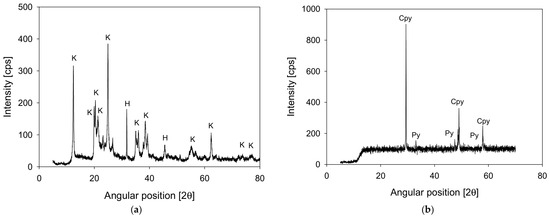
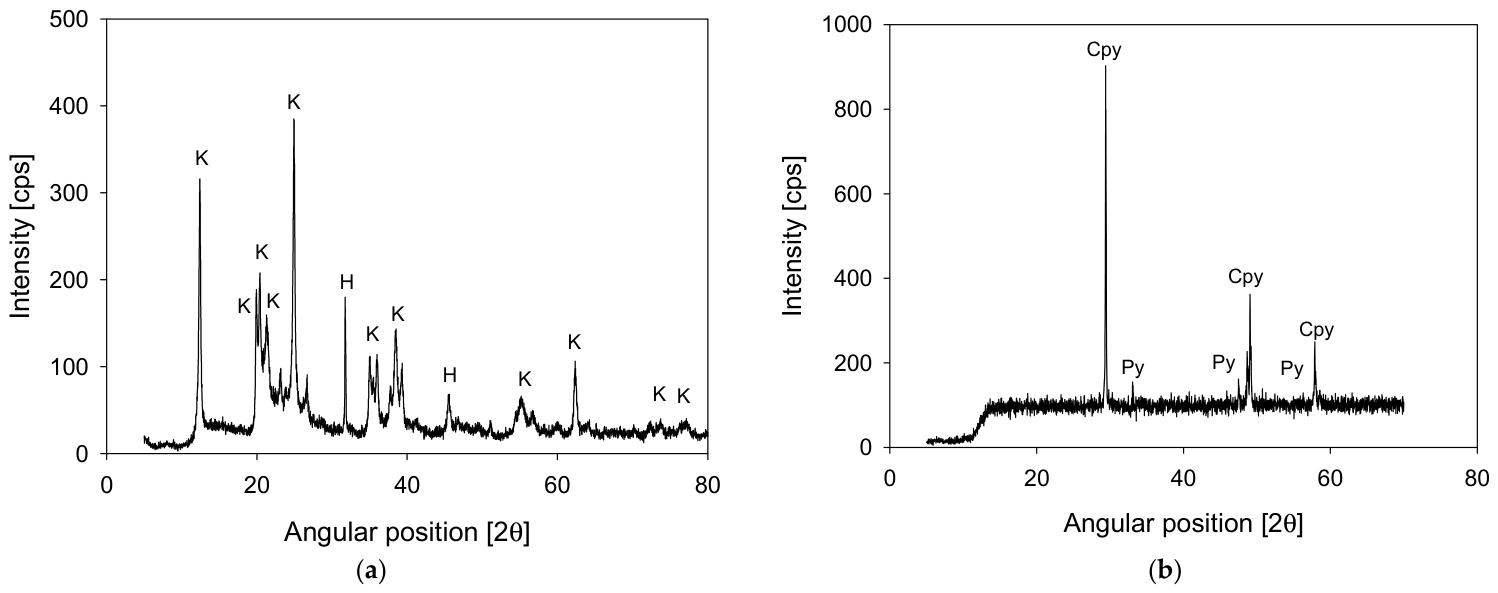
The spectra obtained revealed that kaolin is composed of 84% by weight of kaolinite (Al2Si2O5(OH)4) and 16% by weight of halloysite (Al2Si2O5(OH)4·2H2O) (Figure 1a).
Figure 1.
X-ray diffractogram (XRD) of the kaolin (a) and chalcopyrite (b) used in the study.
In the case of chalcopyrite, the corresponding X-ray spectrum (Figure 1b) revealed that this phase is predominant, with a concentration of 91.3%, while the remaining 8.7% corresponds to pyrite. The volume-weighted particle size distribution (VWS) of kaolin was determined using a Microtrac S3500 laser diffraction analyzer (Verder Scientific, Newtown, PA, USA). Chalcopyrite samples were ground to a size between 38 and 74 µm (−74 + 38 µm) using an RM 200 mortar mill (Retsch GmbH, Haan, Germany). The fractions were purified using a magnetic separator to remove ferromagnetic impurities, followed by desliming to remove ultrafine particles. Finally, the samples were washed with acetone and distilled water to remove any organic contaminants introduced during handling and preparation.
To standardize and ensure the replicability of the tests under consistent conditions, the use of synthetically prepared SW, with its main components added, was proposed. The SW was prepared according to the ionic species specified in ASTM D1141. The composition of SW, used to simulate ion concentrations and emulate seawater, is detailed in Table 1. The salts used were of high purity and supplied by Merck.
Table 1.
Chemical composition of seawater.
The IW was prepared at concentrations of 0.01 M NaCl and 0.005 M CaCl2, representing a controlled simplification of the typical conditions of recycled water from the flotation process, characterized by low salinity and moderate ionic strength [24,25]. Dissolved copper was incorporated into the suspensions by adding analytical-grade copper sulfate pentahydrate (CuSO4·5H2O), purchased from Sigma-Aldrich (Taufkirchen, Germany). pH adjustment was performed using analytical-grade sodium hydroxide and hydrochloric acid solutions (Merck, Darmstadt, Germany). pH measurements were carried out using a Hanna HI 991,003 m equipped with a combined Ag/AgCl electrode (model HI 1297 D).
In the microflotation tests, MATCOL D-103 (Mathiesen, Santiago, Chile) was used as the collector. This thiocarbamate collector belongs to the family of sulfide collectors widely used in the flotation of metal sulfides. This type of collector has recently been used in studies of kaolin activation in the presence of copper ions [8]. Additionally, methyl isobutyl carbinol (MIBC, C6H14O) is used as a frother (Cytec-Solvay, Santiago, Chile), and NaPA is used as a depressant and modifier of the suspension’s rheological properties (Sigma-Aldrich, Santiago, Chile). Spectroscopic analysis of the collector and NaPA was performed using Fourier transform infrared spectroscopy (FTIR) on a PerkinElmer instrument (Santiago, Chile), with spectra recorded over the 4000–400 cm−1 range.
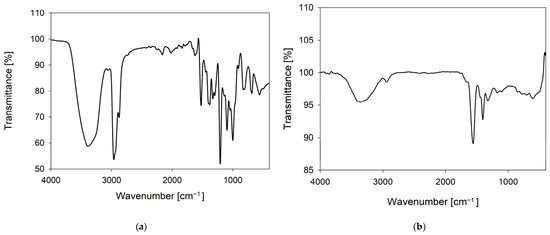
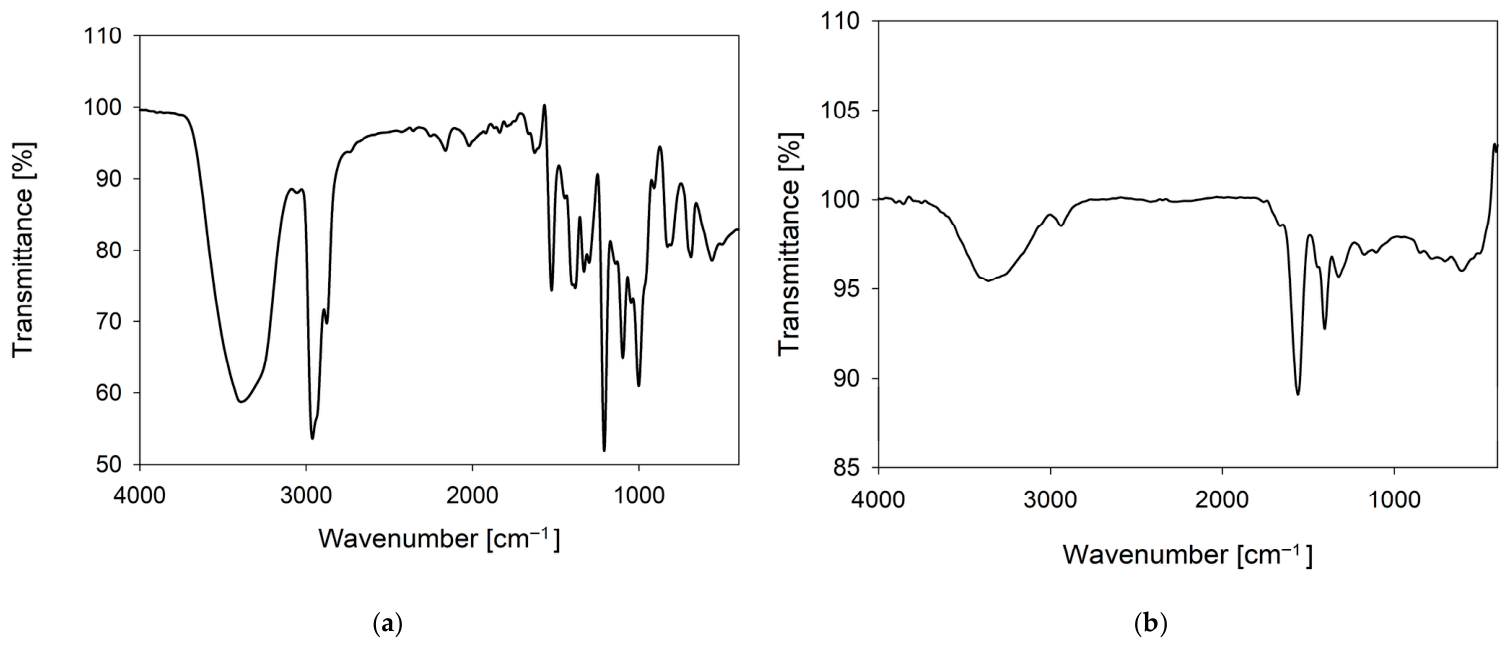
The spectrum obtained from the collector (Figure 2a) shows a broad band between 3300 and 3400 cm−1, attributable to stretching vibrations of the N–H or –OH groups, possibly related to residual moisture or polar groups present in the molecule. The intense signals at 2950 and 2870 cm−1 correspond to methyl C–H vibrations. In the middle region of the spectrum, a pronounced band is observed around 1050 cm−1, attributed to C=S or C–S stretching modes. Bands are also present in the 1250–1350 cm−1 range, corresponding to the C–N stretching vibration. The coexistence of these signals confirms the presence of the O–C(=S)–N functional group, characteristic of thionocarbamate type collector.
Figure 2.
Fourier-transform infrared spectroscopy (FTIR) of MATCOL 103 (a) and NaPA (b).
The spectrum obtained from NaPA (Figure 2b) shows a broad, intense band centered at approximately 3400 cm−1, corresponding to the O–H stretching mode and attributable to both terminal hydroxyl groups and adsorbed water molecules. Weak signals associated with C–H stretching of the aliphatic –CH2 and –CH3 groups present in the polymer chain are observed in the 2950–2850 cm−1 region. The most significant bands appear at 1550 cm−1 and 1410 cm−1, corresponding to the asymmetric and symmetric stretching of the carboxylate group (COO−), respectively.
2.2. Micro Flotation Tests
The suspensions were prepared using 2 g of mineral, either kaolin or chalcopyrite, as appropriate, and 150 mL of the corresponding aqueous medium, IW or SW, in a beaker under constant magnetic stirring. The pH of the suspension was adjusted to the specified value and held for one minute to stabilize. Subsequently, NaPA was added, and after one minute, the collecting reagents, MATCOL D-103, and the frother, methyl isobutyl carbinol (MIBC), were added at the experimentally determined concentrations. The resulting mixture was kept in contact with the mineral particles for three minutes.
The suspensions were then poured into a 150 mL Partridge-Smith cell operated at an airflow rate of 20 cm3/min, and flotation was performed for 3 min. The resulting froth was removed every five seconds. The pulp volume was kept constant by continuously adding a solution of the same chemical composition as the initial solution. Cu2+ ions were previously added to the corresponding water to evaluate their role as a mineral activator. A Cu2+ ion concentration of 0.0005 M (32 mg/L of Cu2+) was considered, which is within the range of concentrations commonly used in mineral activation studies [26,27]. After flotation, the floated and non-floated fractions were filtered, dried at 60 °C, and weighed to determine the mineral recovery.
2.3. Zeta Potential Measurement
The zeta potential was determined to assess the particle surface charge under saline conditions relevant to adsorption mechanisms, polymer bridging, and colloidal stability. Suspensions of 1% by weight were prepared and adjusted to a fixed pH. Before measurements, each suspension was gently stirred for 10 min to ensure homogeneous dispersion. Measurements were performed by electrophoretic light scattering using a Litesizer 500 (Anton Paar, Graz, Austria) with an Omega cell. Data acquisition and processing were performed using Kalliope software (version 3.8.2), which applied the Smoluchowski approximation with a Henry function value of 1.5 to convert electrophoretic mobility to zeta potential.
To minimize errors resulting from transient settling or agglomeration, samples were loaded immediately after mixing and visually inspected to confirm the absence of bubbles or large aggregates. For each material, triplicate measurements were performed on freshly prepared suspensions; the reported values are averages, with standard deviations typically less than 5%.
2.4. Adsorption Density Test
For the adsorption tests, 2 g of powdered mineral was placed in a glass container, and the volume was adjusted to 100 mL by adding the corresponding NaPA solutions and the selected water type. The resulting suspensions were continuously stirred at 25 °C for 5 min. Subsequently, the mixtures were filtered through 1 µm filter paper, and the residual polymer concentration in the supernatant was determined by total organic carbon (TOC) analysis.
To quantify the reagent concentration using TOC, NaPA solutions of different concentrations were prepared in advance, and their total organic carbon content was measured. A calibration curve was constructed from these data, with the slope corresponding to the organic carbon fraction of the reagent. In this study, the slope obtained was 0.2226, indicating that 1 g of NaPA contains 0.2226 g of total organic carbon (TOC).
2.5. Yield Stress Measurement
Kaolin suspensions were prepared at 40 wt% solids using both IW and SW in the presence of Cu(II) (0.0005 M) at pH 7. These conditions represent an extreme rheological scenario dominated by clays, allowing the dispersant’s efficiency to be evaluated under conditions where the system’s rheological properties become more critical. The NaPA concentration was evaluated over the range 0 to 1000 g/t. Yield strength was determined using the vane-in-cup configuration with the stress–strain method. Measurements were performed using an Anton Paar MCR 102 rheometer (ANAMIN Group, Santiago, Chile), and the data were analyzed with Rheocompass™ Light software (ANAMIN Group, Santiago, Chile). The vane diameter was 2.2 cm, and the cup diameter was 4.2 cm.
2.6. Aggregate Characterization
The conditioning of the kaolin suspensions was carried out in a 1 L cylindrical reactor with an internal diameter of 100 mm, equipped with an 80 mm-diameter turbine impeller mounted at the end of a 4 mm-diameter vertical shaft. The impeller base was positioned 20 mm below the vessel bottom to ensure adequate particle suspension. For each test, 285 mL of liquid phase (water plus collector solution) and 15 g of kaolin were used. After one minute of stirring, NaPA was added at a concentration of 100 ppm, resulting in a pulp with a solids content of 5% by weight. The suspension was initially stirred at 600 rpm for 15 min to ensure complete particle dispersion before adding the reagent. The stirring speed was then reduced to 200 rpm, and after one minute, the collector was added. The evolution of the string size was recorded over three minutes.
Aggregate size monitoring was performed using a FBRM system, model Particle Track E25 (Mettler Toledo, OH, USA). This equipment consists of a processing unit connected to a 19 mm diameter probe, installed vertically inside the reactor, positioned 10 mm above the impeller and 20 mm from the axis of rotation. The FBRM technique is based on detecting a rotating laser beam passing through a 14-mm-diameter sapphire window at the probe’s end. The beam, traveling at 2 m/s, captures suspended particles during agitation. The backscattering time of each particle is multiplied by the scan speed to obtain the string length. This enables real-time acquisition of the string-length distribution for each measurement interval. For the analysis of the results, both unweighted and square-weighted distributions were considered. The average string length was calculated from these distributions, using an acquisition interval of 2 s. These results are useful for identifying trends in aggregation or dispersion processes induced by the addition of the dispersant and the chemical conditions of the medium.
3. Results and Discussions
This section presents the experimental findings that support the study’s hypothesis. First, the electrokinetic and surface responses are analyzed, with emphasis on the zeta potential and adsorption density of NaPA on kaolin and chalcopyrite. The effects of salinity and Cu2+ ions on the surface response of both minerals are also evaluated. Subsequently, flotation behavior is examined using microflotation tests to determine the depressant effect of NaPA on both mineral phases in different aqueous media. Finally, the rheological results (yield stress) and the in situ evolution of aggregate size, obtained by FBRM, are presented to evaluate the dispersive effect of NaPA on particles in different aqueous media.
The tests were carried out at pH 7 because it is within the range of highest clay activation according to a recent study [8].
3.1. Effect of NaPA Dose on Zeta Potential
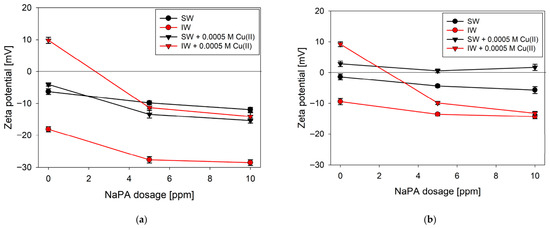
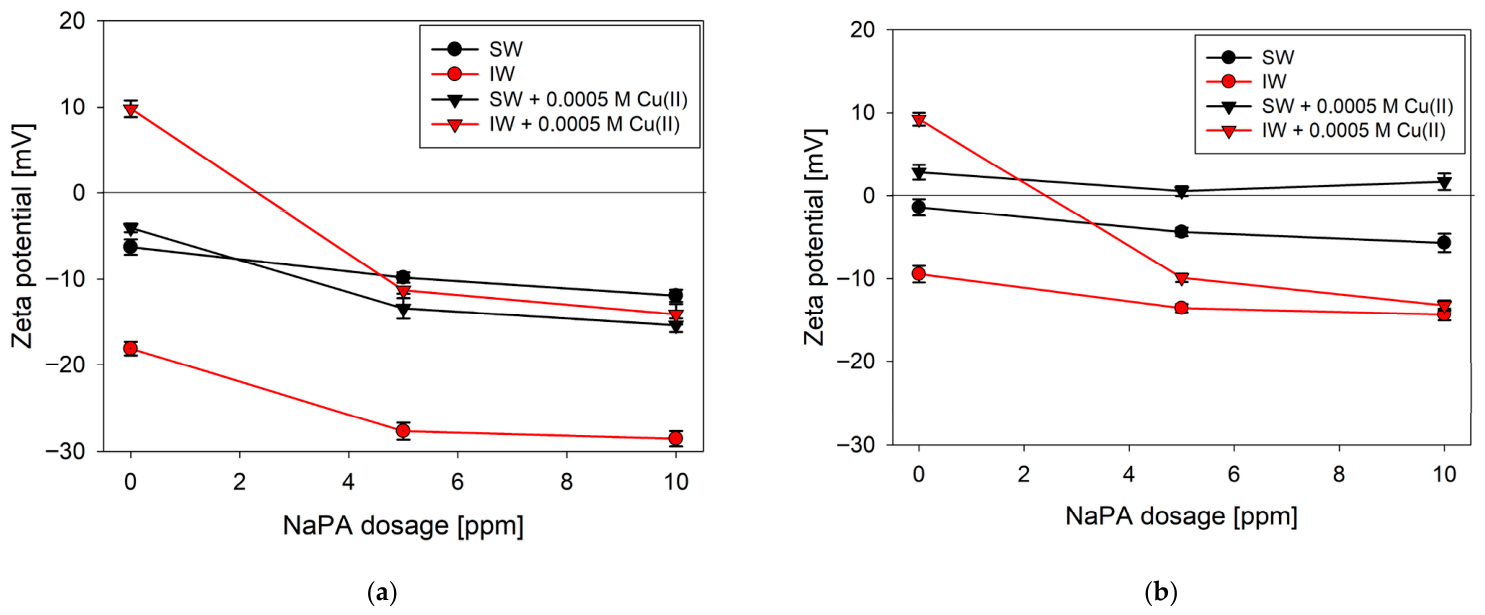
Figure 3 shows the effect of NaPA dosage on the zeta potential of kaolin (Figure 3a) and chalcopyrite (Figure 3b), using IW and SW, both in the absence and presence of Cu2+ (0.0005 M). In IW without Cu2+ and in the absence of NaPA, kaolin exhibited a zeta potential of −18.1 mV, which reversed to +9.8 mV after the addition of 0.0005 M Cu2+, reflecting the cationic activation of the surface mediating the specific copper adsorption. In SW, the magnitude of the zeta potential decreased to −6.2 mV due to the compression of the electrical double layer. In the presence of Cu2+, the potential decreased slightly to −4.0 mV, indicating cationic adsorption limited by the high ionic strength.
Figure 3.
Zeta potential of kaolin (a) and chalcopyrite (b) vs. dose of NaPA using seawater (SW), industrial water (IW), seawater + 0.0005 M Cu(II), and IW + 0.0005 M Cu(II) at pH 7.
The slight change in zeta potential in SW is explained by the high ionic strength of the medium, which creates a strongly shielded environment and reduces the sensitivity of the zeta potential to chemical variations or the adsorption of metal species. Furthermore, the cations present in seawater compete with Cu2+ for coordination sites on the surface, reducing the amount of copper effectively adsorbed. These results are consistent with a recent study [8].
The addition of NaPA resulted in a trend toward more negative values in all media, confirming the adsorption of the anionic polymer. This effect was more pronounced in the presence of Cu2+. In IW, the zeta potential decreased from −18.1 mV to −28.5 mV in the absence of Cu2+ ions and from +9.8 mV to −14.1 mV in the presence of Cu2+. This drastic change indicates greater polymer coverage on the Cu2+-activated surface, thereby reversing the surface charge and increasing the electrostatic repulsion between particles, as previously demonstrated by Labanda and Llorens [17]. In SW, the magnitude of the change was smaller due to ionic shielding (from −6.2 mV to −11.9 mV without Cu2+ and from −4.0 mV to −15.4 mV with Cu2+), although the trend confirms the effective adsorption of NaPA.
Furthermore, chalcopyrite exhibited a zeta potential of −9.5 mV in IW without Cu2+, which reversed to +9.2 mV after the incorporation of Cu2+, confirming the adsorption of these metallic species at the mineral’s surface sites. In SW, the potential was −1.4 mV and varied minimally with Cu2+, reflecting adsorption restricted by cationic competition in the medium, as observed in kaolin. The addition of NaPA did not significantly alter the zeta potential in most systems, except in IW + Cu2+, where a pronounced change in zeta potential was recorded (from +9.2 mV to −13.2 mV at 10 ppm NaPA).
3.2. Adsorption Density of NaPA on Mineral Surfaces
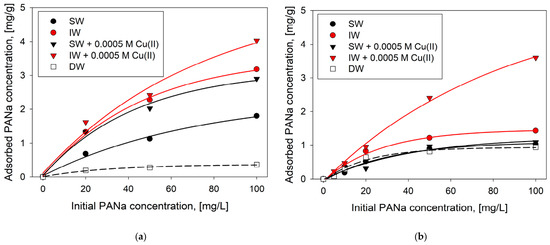
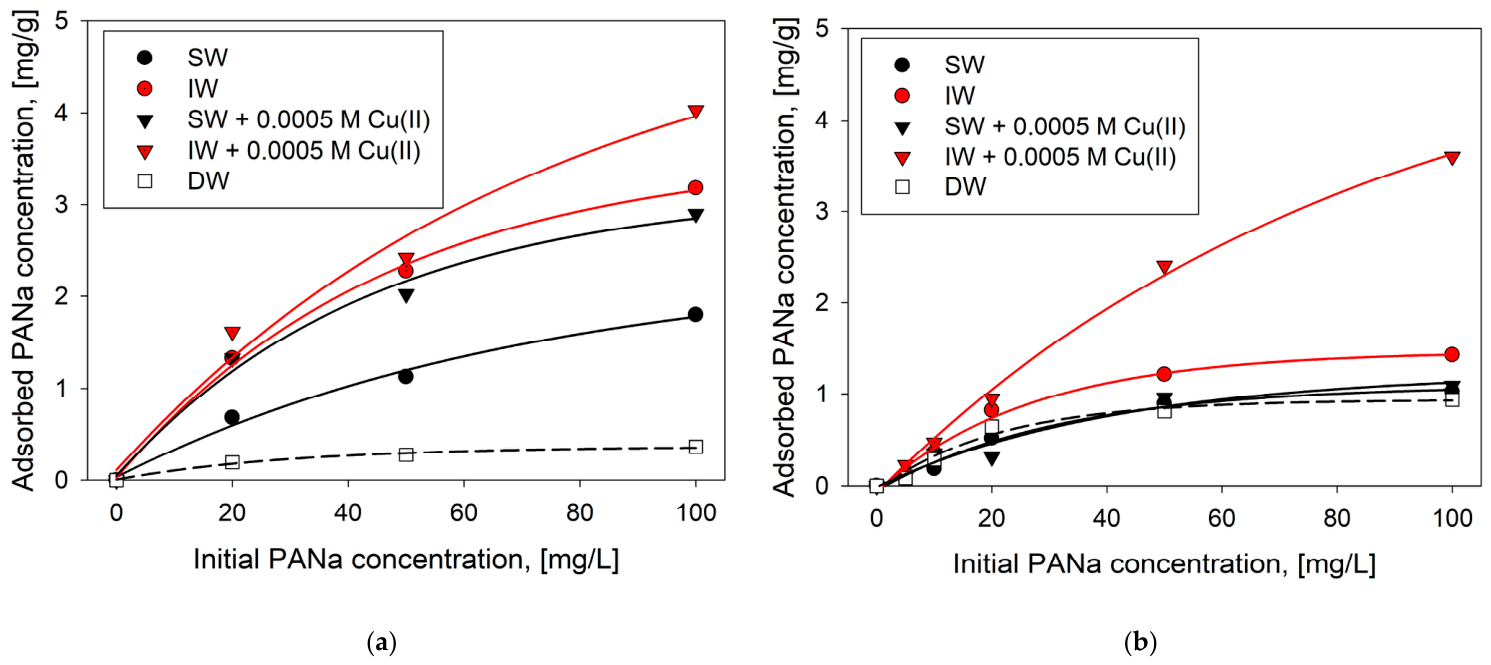
Figure 4 shows the influence of copper ions on the adsorption density of NaPA on kaolin particles (Figure 4a) and chalcopyrite particles (Figure 4b), using IW and SW, in the presence and absence of copper ions. Distilled water (DW), free of additional ions, was added to complement the analysis.
Figure 4.
Adsorption density of sodium polyacrylate (NaPA) on kaolin (a) and chalcopyrite (b) surfaces using seawater (SW) and industrial water (IW), in the absence and presence of Cu(II) ions (0.0005 M), and distilled water (DW) in the absence of Cu(II), at pH 7.
For kaolin, NaPA adsorption in DW is practically nil. This behavior is consistent with the electrostatic nature of the system, since both the basal faces of kaolin and the carboxylate (–COO−) groups of the polyacrylate carry a negative charge in the pH range studied, generating a strong electrostatic repulsion that limits the interaction between the polymer and the mineral surface.
The highest adsorption is observed in IW, reaching approximately 3.18 mg/g with a reagent dosage of 100 mg/L. This increase can be attributed to the presence of cations (Na+, Mg2+, Ca2+), which reduce the negative kaolin zeta potential by compressing the electrical double layer and neutralizing surface charges.
In SW, the adsorption density decreases to approximately 1.8 mg/g with 100 mg/L of NaPA. This behavior reflects the competition between two mechanisms: on the one hand, the high ionic strength reduces the electrostatic repulsion between the reagent and the mineral surface; on the other hand, the abundance of counterions causes partial neutralization of the carboxylate groups (–COO−) and a conformational contraction of the polymer chains (“coil collapse”), which decreases the number of active sites available for adsorption. This behavior has been confirmed by recent simulations and experiments, which show that high salinity induces the collapse of NaPA chains, reducing their adsorption capacity on negatively charged minerals [28].
The presence of Cu2+ ions significantly increased NaPA adsorption across all evaluated aqueous media. In IW, the adsorption increased from 3.18 to 4.03 mg/g, and in SW, from 1.8 to 2.9 mg/g, using a reagent dosage of 100 ppm.
Several studies have demonstrated that polyacrylate can interact with the kaolin surface through multiple mechanisms, including hydrogen bonding between the polymer’s carboxylate groups and the clay’s hydroxyl groups, as well as electrostatic interactions with aluminol sites present at the particle edges [29]. Additionally, Cu2+ ions adsorbed on the mineral surface promote the formation of Cu2+–polymer complexes, thereby increasing NaPA’s affinity for the solid surface. This complexation mechanism between metal cations and carboxylate groups has been reported for various anionic polyelectrolytes in mineral–polymer systems [30,31].
Taken together, these mechanisms explain why NaPA can remain strongly adsorbed on the kaolin surface under the different conditions evaluated.
The behavior observed on the chalcopyrite surface differed markedly from that recorded for kaolin. In the absence of Cu2+ ions, NaPA adsorption reached values of 0.94 mg/g in DW, 1.42 mg/g in IW, and 1.03 mg/g in SW, with a reagent dosage of 100 mg L−1. However, in the presence of Cu2+ ions, adsorption in IW increased considerably, reaching 3.6 mg/g. The formation of copper-active sites on the mineral surface favors polymer interaction through complexation of carboxylate groups (–COO−) with coordinated Cu2+ metal centers on the surface. This behavior is consistent with observations reported in systems involving chalcocite, where anionic copolymers have been shown to exhibit a strong affinity for Cu(II)-activated surfaces. In these systems, partial oxidation of Cu2S generates Cu(II) species on the surface that act as electropositive sites, facilitating the adsorption of anionic polymers through complexation with carboxylate groups [32].
In contrast, in seawater, the adsorption density remained virtually unchanged compared to the copper-free condition.
Unlike kaolin, chalcopyrite lacks natural active sites that enable interaction with NaPA. Therefore, for the reagent to adsorb onto chalcopyrite, a minimum concentration of Cu2+ ions previously adsorbed onto the mineral surface is required. Under conditions where surface coverage of Cu2+ is limited—as occurs in seawater due to competition with other cations present in solution—the chalcopyrite surface maintains a lower density of cationic sites. Combined with the polymer’s conformational shrinkage induced by high ionic strength, this effect reduces polyacrylate adsorption and, consequently, its depressant effect.
3.3. Impact of NaPA on Floatability
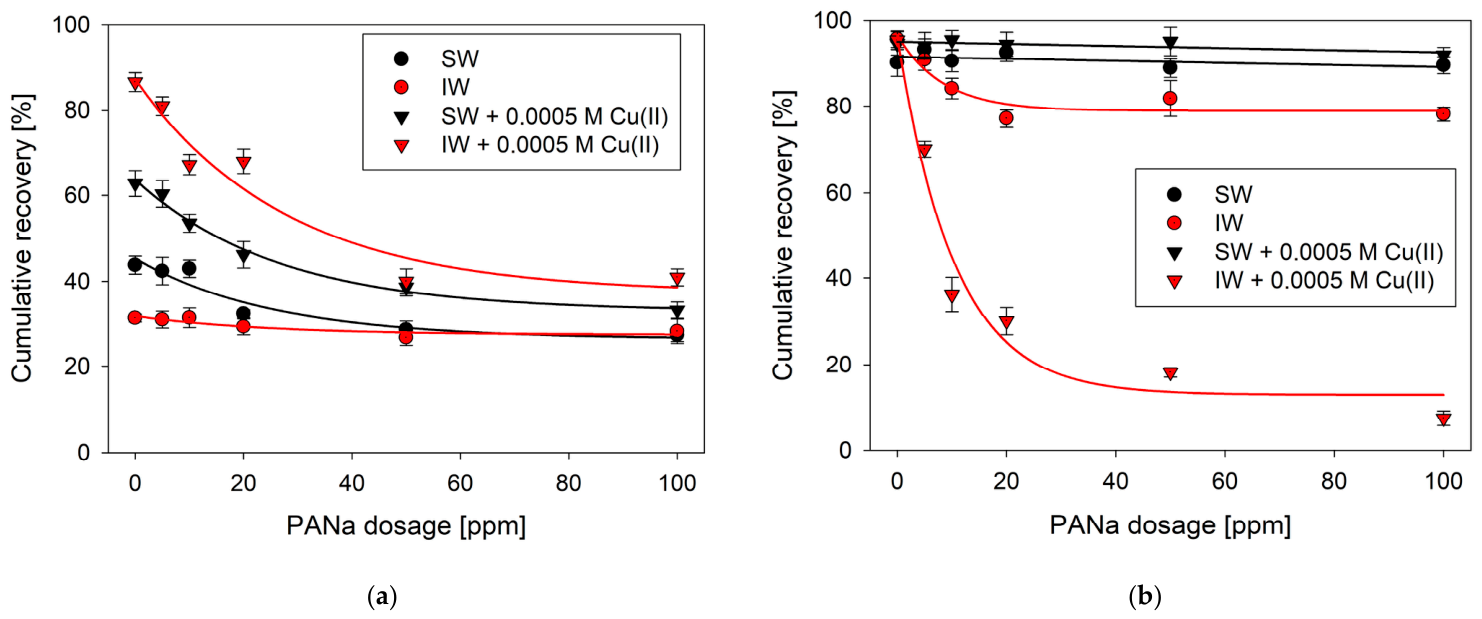
Figure 5 shows the effect of NaPA on the recovery of kaolin (Figure 5a) and chalcopyrite (Figure 5b) at a fixed dose of 100 ppm thiocarbamate collector, using different aqueous media: SW, IW, SW with 0.0005 M Cu(II), and IW with 0.0005 M Cu(II).
Figure 5.
Impact of NaPA dosage on kaolin (a) and chalcopyrite (b) recovery using seawater (SW) and industrial water (IW) in the absence and presence (0.0005 M) of Cu(II) ions, 100 ppm collector at pH 7.
In the case of kaolin, in the absence of NaPA, a marked activation effect by Cu2+ ions is observed, especially in IW, where the recovery increases from 31.4% to 86.5%. In SW, this increase is more moderate: in the absence of copper, the recovery reaches 43.8%, while in the presence of Cu2+ it increases to 62.8%. This behavior is attributed to the specific adsorption of Cu2+, primarily at the aluminol sites of kaolin [33,34], especially in low-ionic-strength media. This generates active surface sites that favor collector adsorption and, consequently, clay flotation.
The incorporation of NaPA has a depressant effect on kaolin, especially under activation conditions. In IW with Cu2+, recovery decreases from approximately 86.5% to 40.0% with only 50 ppm of NaPA, while in SW with Cu2+ it decreases from approximately 62.8% to 33.3% at the same dosage. This effect is attributed to increased NaPA adsorption, which generates a highly hydrophilic anionic surface layer that inhibits collector adsorption. In the absence of Cu2+, the lowest recovery is observed in IW (31.4%), even without NaPA, suggesting that flotation is primarily due to the mechanical entrainment of fine particles, along with limited adsorption by the collector [8].
In contrast, chalcopyrite exhibits a clearly different behavior. In SW, recovery remains high (>90%) in both the absence and presence of Cu2+, even at increasing NaPA doses up to 100 ppm. This behavior is explained by the low adsorption of NaPA onto the chalcopyrite surface in seawater (Figure 4b). However, in IW with Cu2+, recovery decreases markedly as NaPA dose increases, reaching values below 30% at 100 ppm.
These results are consistent with those observed in Figure 3 and Figure 4, where conditions favoring polyacrylate adsorption—whether through cationic activation or reduction in electrostatic repulsion—are associated with a significant decrease in kaolin floatability and an increase in the zeta potential negativity. Taken together, these results confirm that the presence of Cu2+ not only modifies the mineral’s surface charge but also promotes polymer adsorption, reinforcing its depressant effect in media with different ionic compositions.
3.4. Average Chord Length Analysis
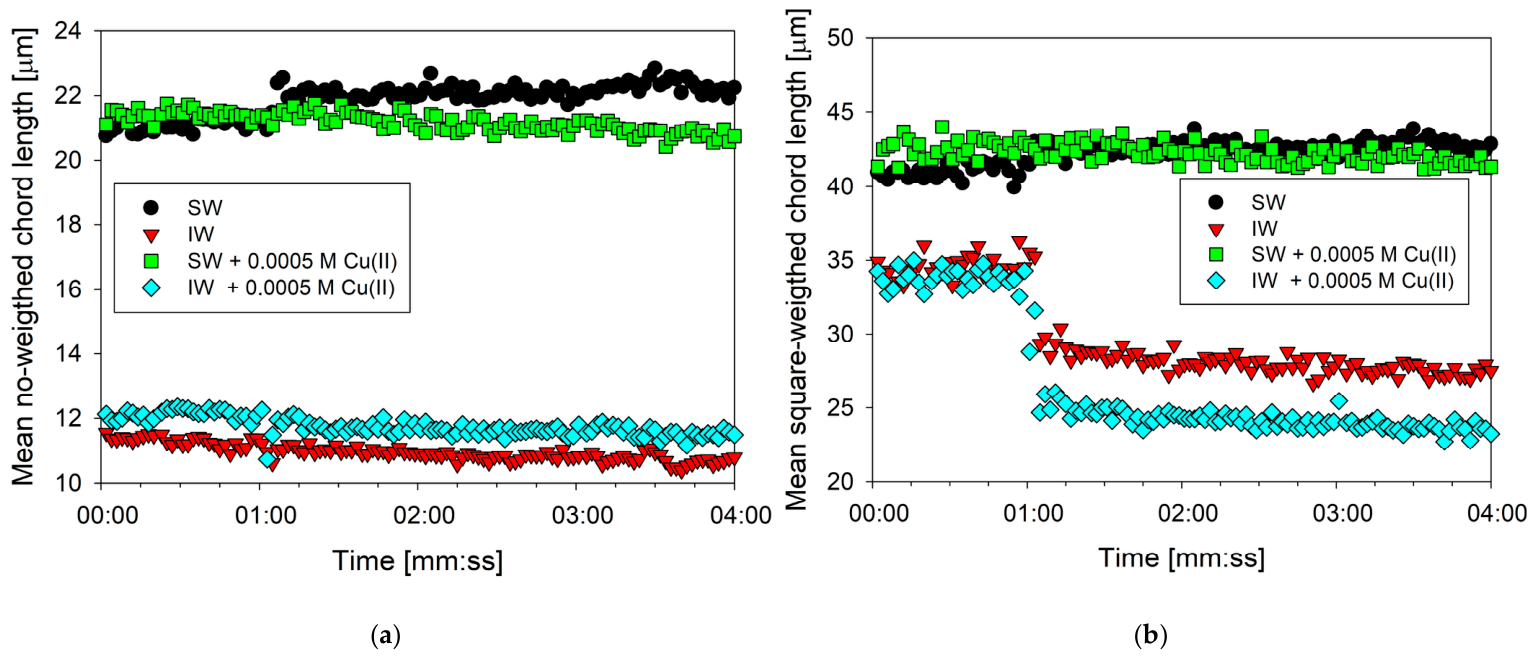
Figure 6 shows the evolution of the mean chord length of kaolin particles with mixing time, using SW and IW, in the presence and absence of 0.0005 M copper ions at pH 7. Figure 6a corresponds to the mean non-weighted chord length (more sensitive to the fine fraction). In contrast, Figure 6b presents the mean square-weighted chord length, which more accurately represents the contribution of larger particles.
Figure 6.
Evolution of the non-weighted (a) and square-weighted (b) mean chord length of the kaolin suspension, using industrial water (IW) and seawater (SW), in the presence and absence of 0.0005 M copper ions, at pH 7. In total, 100 ppm of NaPA was added after 1 min.
In Figure 6a, it can be observed that, after the addition of the dispersant (t = 60 s), there is a more marked decrease in the mean non-weighted chord length in the IW system with Cu(II), which reduces from 15 µm to 13.8 µm. In the case of seawater with Cu(II), the size decreased slightly from 12.4 to 11.8 µm. Under the other conditions, the changes were marginal, indicating less dispersing effect.
Figure 6b confirms this trend: in IW + Cu(II), the mean square-weighted chord length decreased from 30 µm to approximately 28 µm, indicating effective dispersion of the larger aggregates. This result is consistent with the previously discussed adsorption trends, which showed that NaPA is more effective in IW when copper ions are present.
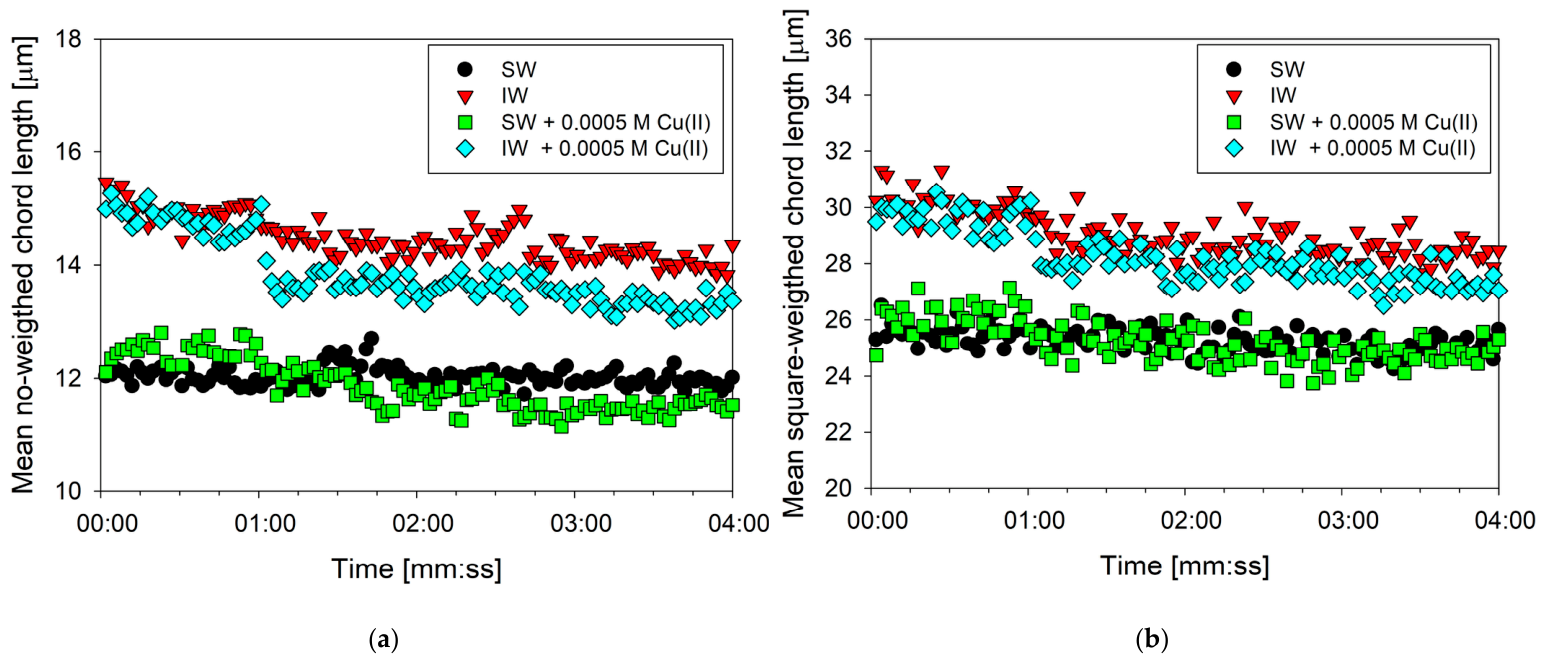
Figure 7 shows the evolution of the average chord length of chalcopyrite particles under the same experimental conditions (SW, IW, SW + Cu(II), and IW + Cu(II)) at pH 7. Figure 7a presents the mean non-weighted chord length, and Figure 7b presents the mean square-weighted chord length.
Figure 7.
Evolution of the unweighted (a) and square-weighted (b) average chord size of the chalcopyrite suspension, using industrial water (IW) and seawater (SW), in the presence and absence of 0.0005 M copper ions, at pH 7. In total, 100 ppm of NaPA was added after 1 min.
In Figure 7a, no significant change in the mean non-weighted chord length of the chalcopyrite particles is observed after the addition of the dispersant, regardless of the type of water used. This result suggests that the dispersant has a limited effect on the finest particle fraction. On the other hand, Figure 7b reveals a clear decrease in the mean square-weighted chord length after the addition of the dispersant, particularly in the system with IW. In the presence of Cu2+ ions, it decreased from approximately 35 µm to 25 µm; in the absence of Cu2 ions, it decreased from 35 µm to 30 µm. This behavior suggests that the dispersant was more effective at dispersing larger aggregates under low-salinity conditions and in the presence of copper ions.
3.5. Impact of NaPA on the Yield Stress of Kaolin Suspensions
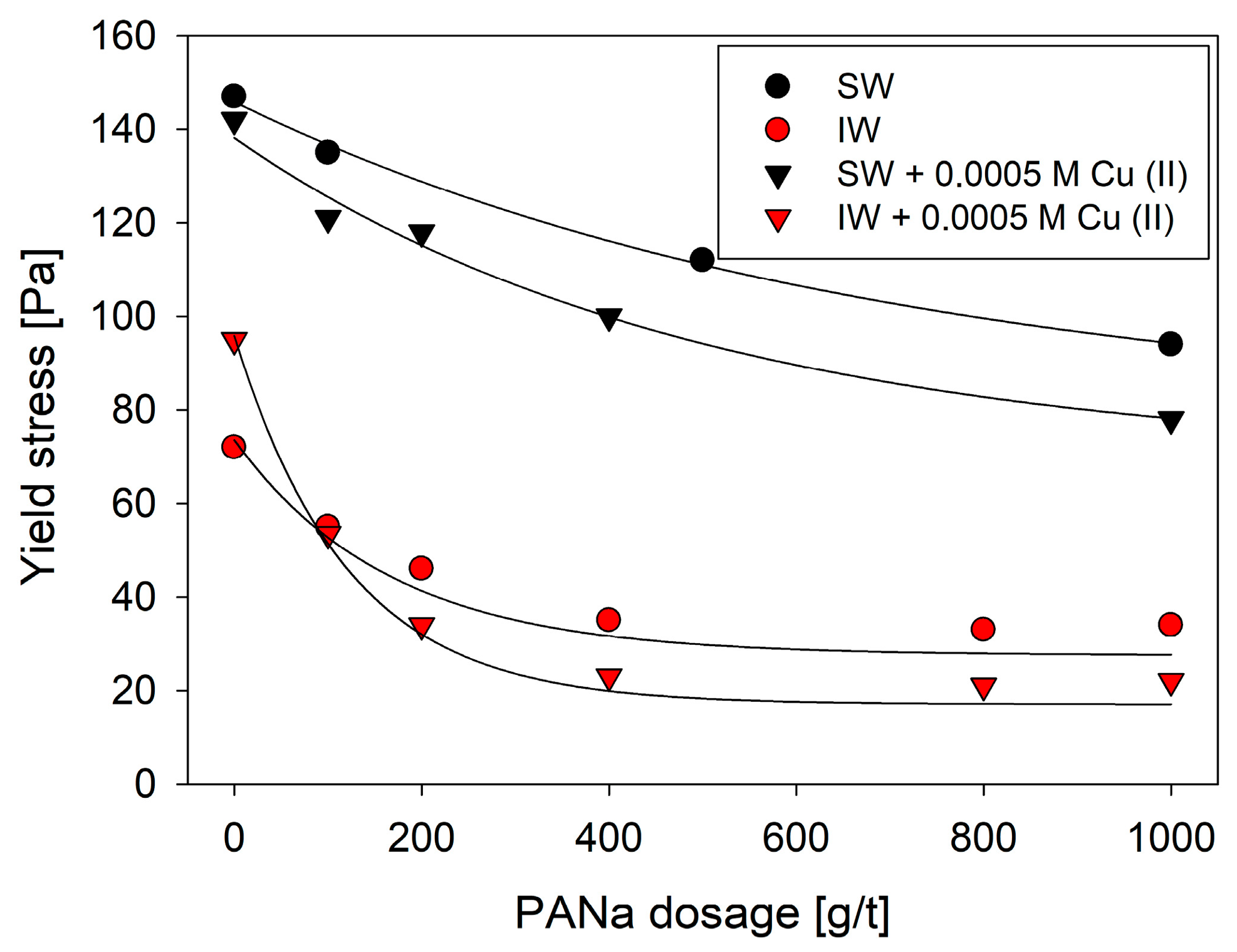
Figure 8 shows the yield stress variation in kaolin suspensions (40% w/w) as a function of NaPA dosage for different water types: SW and IW, in the presence or absence of 0.0005 M copper sulfate (CuSO4). Only a clay suspension was analyzed, as clays are the minerals that contribute most to the rheological properties.
Figure 8.
Impact of NaPA dosage on yield stress of 40% solid kaolin suspension, using seawater (SW) and industrial water (IW), in the absence and presence (0.0005 M) of Cu(II) ions.
In the absence of NaPA, the suspension prepared in IW exhibited a yield stress of 72 Pa, which increased to 95 Pa upon the addition of 0.0005 M Cu2+ ions. In seawater, the yield stress was considerably higher (147 Pa) due to the high ionic strength and the presence of divalent cations (Ca2+, Mg2+) that compress the electrical double layer and promote the aggregation of kaolin particles. In this medium, the addition of Cu2+ did not produce a significant change, with values remaining close to 142 Pa.
In the presence of NaPA, a progressive decrease in yield stress was observed across all cases as polymer dosage increased, indicating improved dispersion of fine particles and reduced interparticle attractive forces. This behavior aligns with that reported by Robles et al. [22], who demonstrated that low-molecular-weight NaPA acts predominantly through steric stabilization mechanisms, reducing viscosity and yield stress in kaolin suspensions in seawater.
In IW, yield stress decreased from 95 Pa to 23 Pa in the presence of Cu2+ and from 72 Pa to 35 Pa in its absence as the NaPA dosage increased to 400 g t−1. In seawater, the reduction was less pronounced: it decreased from 147 Pa to 94 Pa without copper and from 142 Pa to 78 Pa with Cu2+ when using 1000 g t−1 of NaPA. Although the polymer’s efficiency is lower in high-salinity media, the observed decrease demonstrates its ability to maintain particle dispersion through steric and electrosteric repulsion, even under conditions of strong double-layer compression.
3.6. Discussion
The results obtained allow us to propose a mechanistic interpretation that links the medium’s chemistry, Cu2− mediated surface activation by Cu2+, NaPA adsorption, and the system’s rheological and floatability responses.
First, the presence of Cu2+ promotes the formation of cationic sites on mineral surfaces, thereby increasing their affinity for anionic species. This effect is particularly relevant in industrial water, where the lower ionic strength favors the specific adsorption of Cu2+ onto the minerals. In contrast, in seawater, the high concentration of competing cations limits the effective coverage of Cu2+ on the mineral surfaces, reducing the density of active sites available for interaction with the polymer.
In this context, NaPA adsorption is strongly influenced by both surface activation and the ionic composition of the medium. In industrial water, the combination of Cu2+-activated surfaces and reduced ionic competition favors high polymer adsorption onto both minerals, resulting in significant changes in zeta potential and greater surface coverage. Conversely, in seawater, ionic shielding and conformational shrinkage of the polymer chains limit NaPA’s interaction with mineral surfaces, particularly with chalcopyrite, where the availability of active sites is lower.
These differences in adsorption are reflected in the electrokinetic response, where the shift in the zeta potential toward more negative values confirms the polymer’s interaction with the mineral surfaces, although with reduced sensitivity in high-ionic-strength media. However, beyond the change in zeta potential, the rheological and FBRM results indicate that NaPA adsorption disrupts interparticle networks and disperses aggregates, leading to a decrease in yield strength and aggregate size, especially under conditions of more pronounced adsorption.
Finally, the floatability response can be rationalized as a direct consequence of these processes. In industrial water, high NaPA adsorption on both surfaces forms a hydrophilic layer that inhibits collector adsorption, reducing the floatability of both kaolin and chalcopyrite and, therefore, the system’s selectivity. In contrast, in seawater, the polymer’s limited adsorption effectively suppresses kaolin floatability while maintaining chalcopyrite floatability.
4. Conclusions
This study demonstrates that the performance of NaPA in Cu2+-activated kaolin–chalcopyrite systems is governed by the interplay among water chemistry, polymer adsorption, and surface activation. The results show that Cu2+ increases NaPA adsorption by generating cationic sites on the surface, thereby favoring the formation of polymer–metal complexes and increasing surface coverage. In industrial water, this effect extends to both kaolin and chalcopyrite, reducing selectivity by inhibiting collector adsorption on both minerals. In contrast, in seawater, the high ionic strength limits polymer adsorption through ionic shielding and conformational shrinkage of the chains, thereby reducing interactions with chalcopyrite while maintaining sufficient affinity for kaolin to suppress its floatability.
The integration of electrokinetic, adsorption, rheological, and FBRM results supports a coherent mechanism in which NaPA adsorption modifies surface charge, weakens interparticle networks, and promotes aggregate dispersion, thereby controlling the flotation response. These findings highlight a fundamental trade-off between adsorption intensity and selectivity, where greater polymer–surface interaction does not necessarily lead to improved separation.
From an operational perspective, the results indicate that seawater is a favorable medium for harnessing the selective action of NaPA in clay-rich systems under Cu2+ activation. Future studies should extend this analysis to more complex mineralogical systems and evaluate their behavior under dynamic conditions and at an industrial scale.
Author Contributions
Conceptualization, M.J.; methodology, M.J. and E.P.; validation, L.A.C. and R.I.J.; formal analysis, M.J.; resources, L.A.C. and R.I.J.; writing—original draft preparation, M.J.; writing—review and editing, E.P., R.I.J. and L.A.C.; supervision, R.I.J. and L.A.C.; project administration, R.I.J. and L.A.C.; funding acquisition, R.I.J. and L.A.C. All authors have read and agreed to the published version of the manuscript.
Funding
This research was funded by ANILLO Project ACT210027, Project ANID/AFB230001 and Project CIA250010 ANID.
Institutional Review Board Statement
Not applicable.
Data Availability Statement
The original contributions presented in this study are included in the article. Further inquiries can be directed to the corresponding authors.
Acknowledgments
The authors acknowledge the support of the ANILLO Project ACT210027. Ricardo I. Jeldres and Luis Cisternas thank Project ANID/AFB230001 and Project CIA250010 ANID. Matías Jeldres acknowledges the infrastructure and support provided by the Doctoral Program in Mineral Process Engineering at the Universidad de Antofagasta.
Conflicts of Interest
The authors declare no conflicts of interest.
References
- Jeldres, R.I.; Uribe, L.; Cisternas, L.A.; Gutierrez, L.; Leiva, W.H.; Valenzuela, J. The effect of clay minerals on the process of flotation of copper ores—A critical review. Appl. Clay Sci. 2019, 170, 57–69. [Google Scholar] [CrossRef] [Scilit]
- Chen, X.; Peng, Y. Managing clay minerals in froth flotation—A critical review. Miner. Process. Extr. Metall. Rev. 2018, 39, 289–307. [Google Scholar] [CrossRef] [Scilit]
- Zhang, M.; Peng, Y. Effect of clay minerals on pulp rheology and the flotation of copper and gold minerals. Miner. Eng. 2015, 70, 8–13. [Google Scholar] [CrossRef] [Scilit]
- Edwards, C.R.; Kipkie, W.B.; Agar, G.E. The effect of slime coatings of the serpentine minerals, chrysotile and lizardite, on pentlandite flotation. Int. J. Miner. Process. 1980, 7, 33–42. [Google Scholar] [CrossRef] [Scilit]
- Zhao, S.; Peng, Y. The oxidation of copper sulfide minerals during grinding and their interactions with clay particles. Powder Technol. 2012, 230, 112–117. [Google Scholar] [CrossRef] [Scilit]
- Yavuz, Ö.; Altunkaynak, Y.; Güzel, F. Removal of copper, nickel, cobalt and manganese from aqueous solution by kaolinite. Water Res. 2003, 37, 948–952. [Google Scholar] [CrossRef] [Scilit]
- Alkan, M.; Kalay, B.; Doǧan, M.; Demirbaş, Ö. Removal of copper ions from aqueous solutions by kaolinite and batch design. J. Hazard. Mater. 2008, 153, 867–876. [Google Scholar] [CrossRef] [Scilit]
- Jeldres, M.; Cisternas, L.A.; Jeldres, R.I. Role of copper ions in kaolinite and chalcopyrite flotation: Influence of water chemistry and ionic strength. Miner. Eng. 2026, 242, 110190. [Google Scholar] [CrossRef] [Scilit]
- Pawlik, M.; Laskowski, J.S.; Ansari, A. Effect of carboxymethyl cellulose and ionic strength on stability of mineral suspensions in potash ore flotation systems. J. Colloid Interface Sci. 2003, 260, 251–258. [Google Scholar] [CrossRef] [Scilit] [PubMed]
- Pawlik, M.; Laskowski, J.S. Stabilization of mineral suspensions by Guar gum in potash ore flotation systems. Can. J. Chem. Eng. 2006, 84, 532–538. [Google Scholar] [CrossRef] [Scilit]
- Fan, M.; Hobert, A. Fundamentals and Applications of Green Modifiers for Froth Flotation. Min. Metall. Explor. 2022, 39, 39–48. [Google Scholar] [CrossRef] [Scilit]
- Valdivieso, A.L.; López, A.A.S.; Song, S.; Martínez, H.A.G.; Almada, S.L. Dextrin as a Regulator for the Selective Flotation of Chalcopyrite, Galena and Pyrite. Can. Metall. Q. 2007, 46, 301–310. [Google Scholar] [CrossRef]
- Valdivieso, A.L.; Cervantes, T.C.; Song, S.; Cabrera, A.R.; Laskowski, J.S. Dextrin as a non-toxic depressant for pyrite in flotation with xanthates as collector. Miner. Eng. 2004, 17, 1001–1006. [Google Scholar] [CrossRef] [Scilit]
- Li, Y.; Zhang, Y.; Zheng, J.; Guo, H.; Yang, C.; Li, Z.; Lu, M. Dispersion and rheological properties of concentrated kaolin suspensions with polycarboxylate copolymers bearing comb-like side chains. J. Eur. Ceram. Soc. 2014, 34, 137–146. [Google Scholar] [CrossRef] [Scilit]
- Cai, J.; Jia, X.; Ma, Y.; Pei, B.; Ibrahim, A.M.; Su, C.; Shen, P.; Liu, D. Separation of copper-sulfur using sodium polyacrylate as pyrite depressant in acidic pulp: Floatability and adsorption studies. Miner. Eng. 2022, 188, 107815. [Google Scholar] [CrossRef] [Scilit]
- Du, M.; Liu, J.; Clode, P.; Leong, Y.K. Microstructure and rheology of bentonite slurries containing multiple-charge phosphate-based additives. Appl. Clay Sci. 2019, 169, 120–128. [Google Scholar] [CrossRef] [Scilit]
- Labanda, J.; Llorens, J. Influence of sodium polyacrylate on the rheology of aqueous Laponite dispersions. J. Colloid Interface Sci. 2005, 289, 86–93. [Google Scholar] [CrossRef] [Scilit]
- Wei, Q.; Jiao, F.; Dong, L.; Liu, X.; Qin, W. Selective depression of copper-activated sphalerite by polyaspartic acid during chalcopyrite flotation. Trans. Nonferrous Met. Soc. China 2021, 31, 1784–1795. [Google Scholar] [CrossRef] [Scilit]
- Liu, D.; Peng, Y. Understanding different roles of lignosulfonate in dispersing clay minerals in coal flotation using deionised water and saline water. Fuel 2015, 142, 235–242. [Google Scholar] [CrossRef] [Scilit]
- Cisternas, L.A.; Gálvez, E.D. The use of seawater in mining. Miner. Process. Extr. Metall. Rev. 2018, 39, 18–33. [Google Scholar] [CrossRef] [Scilit]
- Laskowski, J.S.; Castro, S.; Gutierrez, L. Flotation in Seawater. Min. Metall. Explor. 2018, 36, 89–98. [Google Scholar] [CrossRef] [Scilit]
- Robles, P.; Piceros, E.; Leiva, W.H.; Valenzuela, J.; Toro, N.; Jeldres, R.I. Analysis of sodium polyacrylate as a rheological modifier for kaolin suspensions in seawater. Appl. Clay Sci. 2019, 183, 105328. [Google Scholar] [CrossRef] [Scilit]
- Jeldres, M.; Robles, P.; Toledo, P.G.; Saldaña, M.; Quezada, L.; Jeldres, R.I. Improved dispersion of clay-rich tailings in seawater using sodium polyacrylate. Colloids Surf. A Physicochem. Eng. Asp. 2021, 612, 126015. [Google Scholar] [CrossRef] [Scilit]
- Mate, E.D.; Botero, Y.L.; Robles, P.; Cisternas, L.A.; Jeldres, R.I. Functional PS-DVB-CTAB-PAX Nanocollectors to Promote Selective Fine-Particle Chalcopyrite Flotation. Minerals 2025, 15, 1201. [Google Scholar] [CrossRef] [Scilit]
- Nieto, S.; Piceros, E.; Reyes, E.; Ramos, J.; Robles, P.; Jeldres, R. Structural Analysis of Aggregates in Clayey Tailings Treated with Coagulant and Flocculant. Minerals 2025, 15, 627. [Google Scholar] [CrossRef] [Scilit]
- Liu, Y.; Tong, X.; Xie, R.Q.; Xie, X.; Song, Q.; Fan, P.Q. Activation of quartz flotation by Cu2+, Ni2+ in the sodium ethylxanthogenate (EX) system. Physicochem. Probl. Miner. Process. 2023, 59, 166368. [Google Scholar] [CrossRef] [Scilit]
- Yang, B.; Tong, X.; Lan, Z.; Cui, Y.; Xie, X. Influence of the Interaction between Sphalerite and Pyrite on the Copper Activation of Sphalerite. Minerals 2018, 8, 16. [Google Scholar] [CrossRef] [Scilit]
- Ramos, J.J.; Nieto, S.; Quezada, G.R.; Leiva, W.; Robles, P.; Betancourt, F.; Jeldres, R.I. Rheological Behavior of Clay Tailings in the Presence of Divalent Cations and Sodium Polyacrylate: Insights from Molecular Dynamics Simulations. Polymers 2024, 16, 3091. [Google Scholar] [CrossRef] [Scilit]
- Demir, F. Experimental studies on the desorption of adsorbed sodium poly(acrylic acid) from crude kaolin particles. Appl. Clay Sci. 2015, 105–106, 41–47. [Google Scholar] [CrossRef] [Scilit]
- Ennigrou, D.J.; Ali, M.B.S.; Dhahbi, M.; Ferid, M. Removal of heavy metals from aqueous solution by polyacrylic acid enhanced ultrafiltration. Desalination Water Treat. 2015, 56, 2682–2688. [Google Scholar] [CrossRef] [Scilit]
- Zhang, H.; Cui, R. Separation of Copper and Nickel Metal Ions from Electroplating Wastewater by Ultrafiltration with Tartaric Acid and Sodium Citrate Reinforced Sodium Polyacrylate Complexation. Membranes 2024, 14, 240. [Google Scholar] [CrossRef] [Scilit] [PubMed]
- He, M.; Addai-Mensah, J.; Beattie, D. The influence of polymeric dispersants on sericite–chalcocite particle interactions in aqueous media. Chem. Eng. J. 2009, 152, 471–479. [Google Scholar] [CrossRef] [Scilit]
- Im, S.B. Surface complexation models for copper(II) adsorption on kaolinite. Environ. Eng. Res. 2003, 8, 91–97. [Google Scholar] [CrossRef] [Scilit]
- Peacock, C.L.; Sherman, D.M. Surface complexation model for multisite adsorption of copper(II) onto kaolinite. Geochim. Cosmochim. Acta 2005, 69, 3733–3745. [Google Scholar] [CrossRef] [Scilit]

Disclaimer/Publisher’s Note: The statements, opinions and data contained in all publications are solely those of the individual author(s) and contributor(s) and not of MDPI and/or the editor(s). MDPI and/or the editor(s) disclaim responsibility for any injury to people or property resulting from any ideas, methods, instructions or products referred to in the content. |
© 2026 by the authors. Licensee MDPI, Basel, Switzerland. This article is an open access article distributed under the terms and conditions of the Creative Commons Attribution (CC BY) license.