Article

Provenance Analysis of Marine–Continental Transitional Sediments Using Integrated Geochemistry and Detrital Zircon U–Pb Data: A Case Study from the Lower Permian Shanxi Formation, Southern North China Basin


1
State Key Laboratory of Continental Shale Oil, Beijing 100083, China
2
Key Laboratory of Unconventional Oil & Gas, China Geological Survey, Beijing 100083, China
3
Oil and Gas Survey, China Geological Survey, Beijing 100083, China
*
Author to whom correspondence should be addressed.
Minerals 2026, 16(4), 415; https://doi.org/10.3390/min16040415
Submission received: 5 March 2026 / Revised: 4 April 2026 / Accepted: 7 April 2026 / Published: 17 April 2026

Abstract

The reliability of bulk geochemical proxies for provenance analysis in heterogeneous clastic systems remains a critical yet underexplored issue. This study investigates the Lower Permian Shanxi Formation in the Southern North China Basin (SNCB) using an integrated approach combining major and trace element geochemistry, rare earth elements (REEs), and detrital zircon U–Pb geochronology. The results show that major element compositions have been significantly modified by diagenetic processes in tidal flat environments, limiting their applicability in tectonic discrimination. In contrast, immobile trace elements and REE patterns provide more robust constraints on source rock composition, suggesting predominantly felsic upper continental crustal sources. Detrital zircon age spectra reveal two dominant populations at 290–440 Ma and 1800–2500 Ma, indicating mixed provenance from the North Qinling Region (NQR) and the North China Craton (NCC). However, the application of classical discrimination diagrams is challenged by lithological heterogeneity, as the mixed presence of sandstone, sandy mudstone, and mudstone introduces compositional bias. Spatial variations among wells suggest differential contributions from continental island arc and active continental margin, likely controlled by paleogeographic configuration and sediment transport pathways. This study emphasizes the necessity of multi-proxy integration for reliable provenance reconstruction in complex sedimentary systems.

1. Introduction

The Southern North China Basin (SNCB) has been the focus of exploration for more than seven decades, resulting in successive discoveries of oil and gas fields, as well as coal deposits, in the Kaifeng Depression–Taikang Uplift and the Huaibei Uplift, which collectively highlight abundant fossil fuels in the basin [1,2,3]. The Shanxi Formation, a Permian tectonic unit of the marine–continental transitional facies within northern China, is characterized by widespread oil and gas shows and is regarded as a primary target for both conventional and unconventional hydrocarbon exploration [1,2,3,4]. The Shanxi Formation in the SNCB consists of continuously distributed fine-grained sandstones, mudstones, and coal-bearing sequences, which form favorable source rock–reservoir–cap rock assemblages, establishing this formation as a zone with great potential for hydrocarbon exploration [1,2,3,4,5,6,7,8,9,10]. Provenance determines the initial mineralogical composition of sediments [11]. Furthermore, such analysis allows for the identification of regional tectonic settings and paleoenvironments. Together, these insights help clarify basin-scale tectonic evolution [12]
In China, provenance analysis has focused primarily on individual lithologies such as sandstone or mudstone at present [13,14,15,16,17,18]. Some researchers investigated the provenance of the Ti element of Permian coals along the southern margin of the North China Craton (NCC) using trace elements and REE analyses [19]. Some researchers examined the provenance of the Shanxi Formation in the Ordos Basin by using trace elements, REE geochemistry and zircon U-Pb dating [20,21,22,23]. Research on the provenance of sandstones in the Shanxi Formation within the southeastern Ordos Basin emphasized heavy-mineral assemblages and REE geochemistry [24]. Overall, the provenance of fine-grained sediments is frequently analyzed using trace elements and REEs [25,26], while research on sandstones typically integrates light- and heavy-mineral assemblages with data from trace elements and REEs.
The Shanxi Formation in the study area exhibits a tidal flat sedimentary system of marine–continental transitional sediments and is characterized by frequent thin interbeds of mudstones and sandy mudstones [27,28,29]. The quantitative provenance analysis of the SNCB is yet to be conducted. Additionally, limited wells in this formation lead to restricted coring intervals, and the heterogeneous lithological alternation underscores the need for diverse sampling for provenance research. Therefore, this study prioritized extensive sampling across all available sandstone, mudstone (mudstones, sandy mudstones, and carbonaceous mudstones) cored intervals. Based on previous studies on sedimentary facies and depositional models, this study aims to address the following key scientific questions: (1) How reliable are bulk geochemical proxies for provenance analysis in heterogeneous clastic systems? (2) What are the main provenance sources of the Shanxi Formation in the SNCB? (3) How do different proxies (major elements, trace elements, REEs, and detrital zircon U–Pb data) compare in their ability to constrain tectonic setting and sediment sources? Importantly, this study emphasizes that no single geochemical proxy is sufficient for provenance interpretation in heterogeneous clastic systems, and that robust conclusions must rely on converging evidence from multiple independent datasets.

2. Regional Geological Characteristics

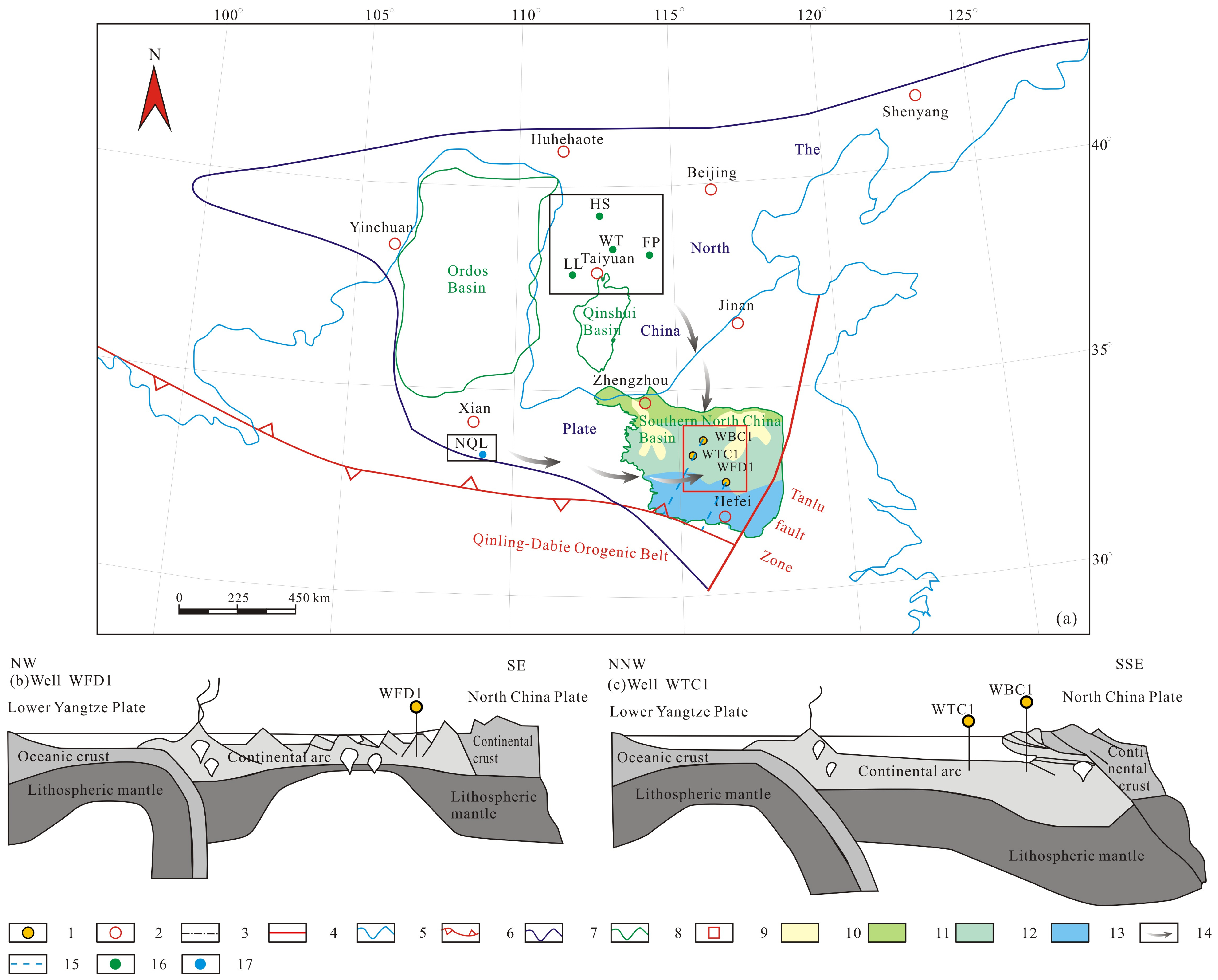
The SNCB is located in the southeastern portion of the NCC and exhibits a tectonic framework of three depressions and two uplifts (Figure 1a,b). From north to south, it comprises five second-order tectonic units: the Kaifeng Depression, the Taikang–Huaibei Uplift, the Zhoukou Depression, the Changshan Uplift, and the Xinyang–Hefei Depression (Figure 1a). Numerous Mesozoic–Cenozoic depressions have developed in the basin, formed by multiple superimpositions of basin prototypes on a nearly E–W-trending basement structure. The basin extends roughly parallel to the Qinling–Dabie Orogenic Belt and represents a Mesozoic–Cenozoic extensional basin developed on the stable (NCC) [30]. The tectonic units were formed during the Mesozoic–Cenozoic tectonic movement and do not affect the deposition of the Shanxi Formation [30]. Tectonically, the study area is situated in the northeastern part of the Zhoukou Depression, bounded by the Taikang Uplift to the north, the Huaibei Uplift (west of the Tan–Lu Fault Zone) to the east, and the Changshan Uplift to the south (Figure 1b).
The study area is characterized by a tidal flat sedimentary system. Sedimentary facies include (1) sand flats dominated by sandstone, indicative of high-energy hydrodynamic conditions; (2) mixed flats composed of thin interbeds of fine sandstone and mudstone or mixtures of sandstone and silty mudstone, reflecting moderate-energy hydrodynamic environments; (3) mud flats primarily consisting of mudstone and silty mudstone, formed under low-energy hydrodynamic conditions; and (4) peat flats distinguished by coal seam development [9] (Figure 1c,d).

3. Methodology and Sample Preparation

All analytical procedures, including major and trace element determinations, rare earth element (REE) analysis, and detrital Zircon U-Pb dating, were conducted at the National Key Laboratory of Deep Oil and Gas, China University of Petroleum (East China).

3.1. Major Element, Trace Elements, and REE Analysis

Seventeen conventional core samples of the WTC-1, WBC-1, and WFD 1 wells were analyzed. The samples included sandstones, sandy mudstones, and mudstones. The samples’ preparation included:(1) removal of surface contaminants, (2) ultrasonic cleaning with deionized water, (3) oven drying at 55 °C for 48 h, and (4) pulverization using an agate mortar to a mesh particle size of <200 mesh. Major element concentrations were determined by inductively coupled plasma optical emission spectrometry (Agilent 5110 ICP-OES, made by Agilent Technologies Inc., Santa Clara, CA, USA) with an analytical precision better than 2% RSD.
Seventeen conventional core samples of the WTC-1, WBC-1, and WFD 1 wells were analyzed, following identical preparation procedures as for the major element analysis. Trace elements and REEs were quantified using inductively coupled plasma–mass spectrometry (Agilent 7700x ICP-MS, made by Agilent Technologies Inc., Santa Clara, CA, USA). Rhodium internal standardization and USGS reference materials (AGV-2, GSP-2) ensured measurement accuracy within 5% for most elements. Since the research area is in underexplored regions, chondrite was selected as the standard reference material. We calculate the REE data using Herrman (1970) chondrite standard to analyze the tectonic background of key wells.
Given the heterogeneous lithology (sandstone, sandy mudstone, and mudstone), elemental compositions may be influenced by grain size and mineralogical effects. Therefore, all geochemical interpretations in this study are conducted with caution and are cross-validated using multiple independent proxies.

3.2. Detrital Zircon U-Pb Dating

Four sandstone conventional core samples of the WTC-1 and WFD 1 wells were analyzed. Detrital Zircon U-Pb ratios and age calculations were processed using the ICPMS Data Cal 7.5 software. The reported uncertainties represent 1σ for single-spot analyses, with weighted mean ages quoted at 2σ confidence levels. For ancient zircons (>1000 Ma) exhibiting potential Pb-loss, 207Pb/206Pb ages were preferentially adopted due to their relative immunity to recent Pb diffusion compared with 206Pb/238U ages. This approach maintained consistency with concordant age systematics in Proterozoic–Archean detrital populations.
Four samples were analyzed with more than twenty data points, and more than ten points could be used. More than 90% of the analyzed zircon samples had a concordance of greater than 90%. Three samples were from the WFD-1 well, including one mudstone sample and two sandstone samples. One sandstone sample was from the WTC-1 well. The mudstone yielded 10 valid concordant U-Pb data points. The three sandstone samples yielded 14, 11, and 11 valid concordant U-Pb data points, respectively. The CL images of zircons show that most samples were rounded to subrounded, with lengths between 60 and 100 μm, indicating prolonged and multicycle transport. Based on internal structural characteristics, two main types of zircons can be identified: The first had well-developed oscillatory zoning and euhedral crystals, suggesting a magmatic origin, and the second type lacked zoning and had a homogeneous internal structure, likely representing ancient recycled zircons.
This study adopted a multi-proxy validation framework, integrating bulk geochemistry with detrital zircon geochronology to improve the robustness of provenance interpretations.

4. Results

4.1. Characteristics of Major Elements and Trace Elements

In the clastics from key wells, SiO2 predominated in the major element association, with contents ranging from 49.91% to 65.38%. Al2O3 ranked second in the association, with contents from 11.61% to 25.90%, followed by Fe2O3, which had relatively high contents, varying from 1.21% to 15.35%. Additionally, MgO, CaO, Na2O, K2O, MnO, P2O5, and TiO2 were present in significantly lower abundance, between 0.00% and 524.%. Overall, except for SiO2, Al2O3, and Fe2O3, all major elements occurred only in minor proportions. LOI was among the major elements, with contents ranging from 4.41% to 15.37% (Table 1).
Four trace elements (i.e., Sc, Zr, Co, and Th) were systematically selected for discriminating tectonic settings based on their geochemical sensitivity to provenance [31,32]. In the clastics from key wells, Sc in the trace element contents ranged from 7.75 × 10⁻⁶ to 26.5 × 10⁻⁶. Zr in the trace element contents ranged from 54.8 × 10⁻⁶ to 382 × 10−6. Zr showed the highest average value in WBC-1 (289.71 × 10⁻⁶), much higher than in WTC-1 (254 × 10−6) and WFD-1 (112.09 × 10⁻⁶). Co in the trace element contents ranged from 4.18 × 10⁻⁶ to 43.6 × 10⁻⁶. Th in the trace element contents ranged from 3.50 × 10⁻⁶ to 18.10 × 10⁻⁶. Sc, Co, and Th were relatively consistent among the three wells (Table 1).

4.2. Characteristics of REEs

The analytical results from the key wells indicate that the total REE (ΣREE) contents ranged from 124.30 × 10⁻⁶ to 374.26 × 10⁻⁶ in the study area: from 209.53 to 340.36 × 10⁻⁶ in the WTC-1 well, from 44.12 to 372.04 × 10⁻⁶ in the WBC-1 well, and from 137.89 to 374.26 × 10⁻⁶ in the WFD-1 well. The negative Eu anomalies (δEu) ranged from 0.17 to 0.61 in the study area: from 0.18 to 0.31 in the WTC-1 well, from 0.17 to 0.61 in the WBC-1 well, and from 0.18 to 0.32 in the WFD-1 well. The positive Ce anomalies (δCe) ranged from 2.02 to 4.48 in the study area: from 2.78 to 4.48 in the WTC-1 well, from 2.02 to 3.42 in the WBC-1 well, and from 2.56 to 3.20 in the WFD-1 well. The La/Yb ratios ranged from 13.32 to 29.35 in the study area: from 18.31 to 26.54 in the WTC-1 well, from 16.97 to 29.35 in the WBC-1 well, and from 13.32 to 20.00 in the WFD-1 well (Table 2).

4.3. Detrital Zircon U-Pb Characteristics

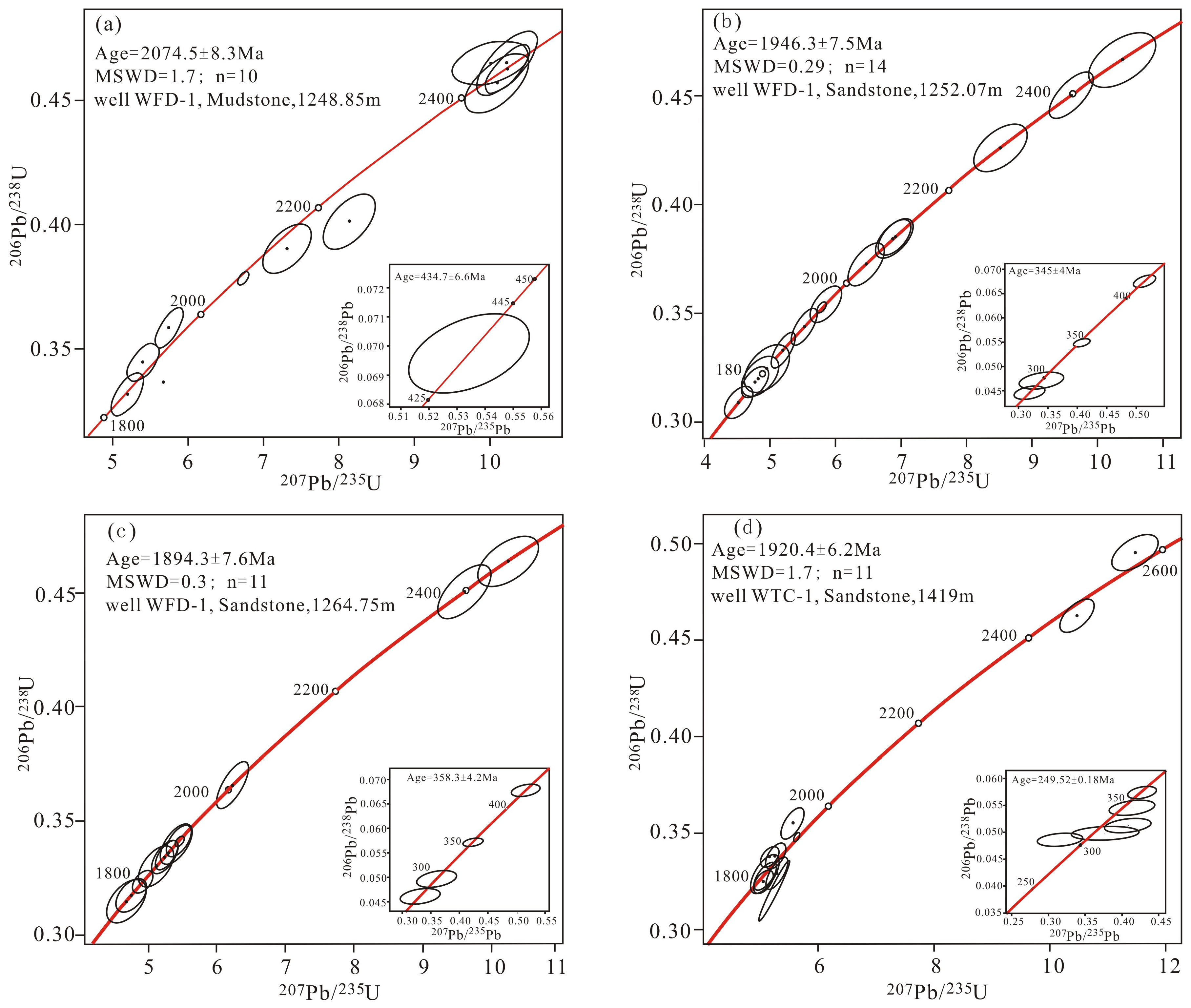
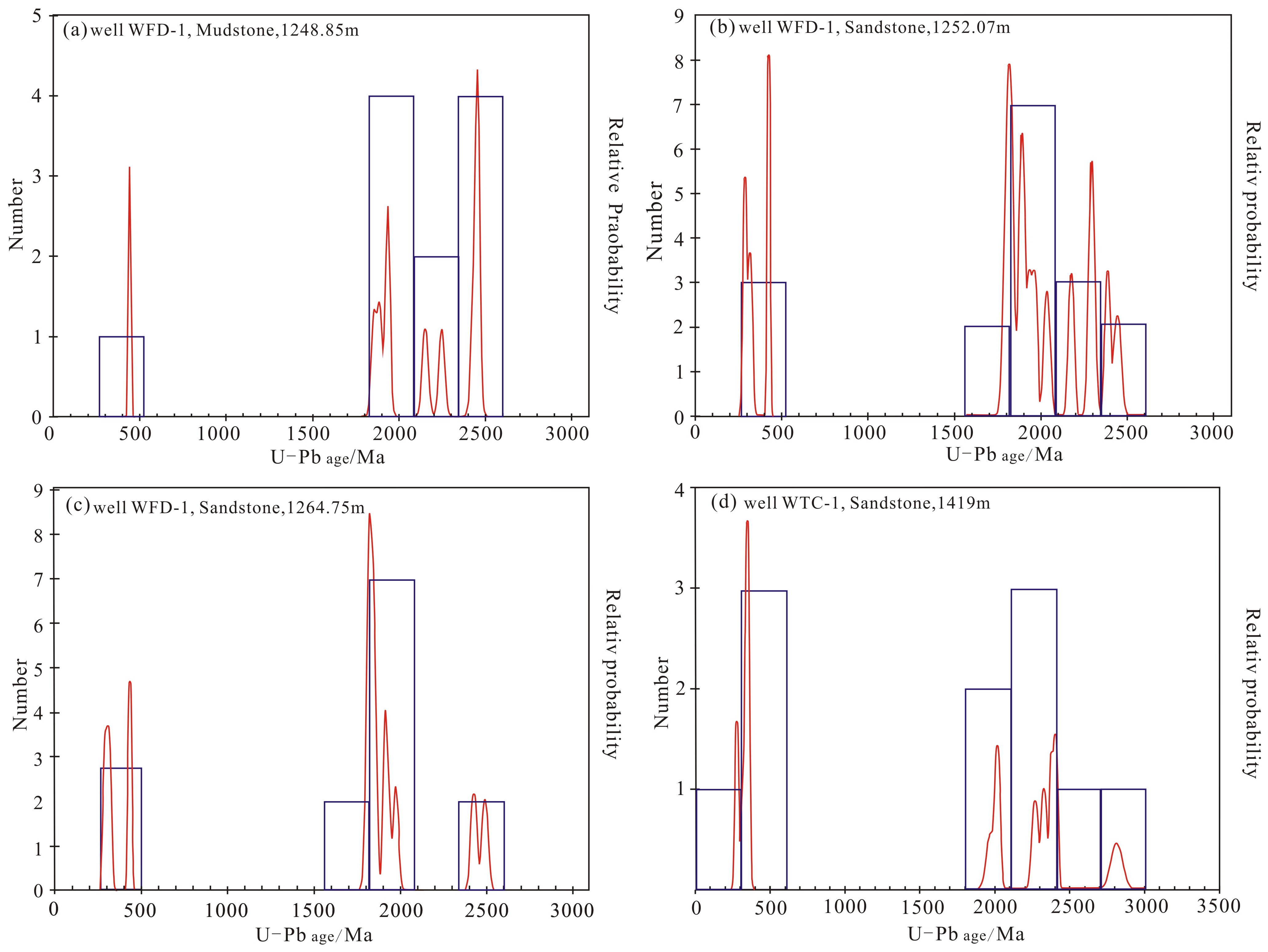
The detrital zircon U-Pb dating results of clastics from the study area revealed two dominant age peaks for the provenance of the Shanxi Formation: 290–440 Ma and 1800–2500 Ma. The first peak can be further subdivided into (1) the Late Paleozoic (290–390 Ma), corresponding to Hercynian tectonic activity, and (2) the Early Paleozoic (400–440 Ma), associated with Caledonian tectonic activity [21]. In the WFD-1 well, zircon grains of these ages occurred at the following depths: (1) one grain at 1248.2 m within the sandstones of the Shanxi Formation; (2) three grains at 1252.07 m; and (3) three grains at 1264.75 m. Additionally, four grains were identified at a depth of 1419 m in the WTC 1 well (Figure 2 and Figure 3).
The second peak, spanning 1800–2500 Ma, corresponds to the Precambrian zircon sources and can be further subdivided into two intervals: 1800–2300 Ma and 2300–25,000 Ma. The first interval is widely distributed across the NCC and its northern margin, reflecting early magmatic–metamorphic events at around 2500 Ma associated with crustal accretion and cratonization of the NCC. The second interval (1800–2300 Ma) aligns with the Lüliang tectonic event, a major episode of crustal reworking within the NCC [21]. Zircon grains of these ages are distributed at the following depths: (1) 10 grains at 1248.85 m in the sandstones of the Shanxi Formation in the WFD-1 well; (2) 14 grains at 1252.07 m in the WFD-1 well; (3) 11 grains at 1264.75 m in the WFD-1 well; and (4) 11 grains at 1419 m in the WTC-1 well (Figure 2 and Figure 3).

5. Discussion

In heterogeneous sedimentary systems such as tidal flat environments, the reliability of different geochemical proxies varies significantly. Therefore, this study adopted a hierarchical evaluation framework, in which major elements, trace elements, REEs, and detrital zircon data were assessed based on their relative stability and interpretive robustness.

5.1. Provenance Discrimination via Major Element Ratio Diagrams

Given that tidal flat sediments in the study area have experienced varying degrees of diagenetic alteration, major element compositions may not fully preserve primary provenance signatures. Therefore, the results derived from major-element-based discrimination diagrams should be treated with caution and are only used as supplementary constraints in this study.
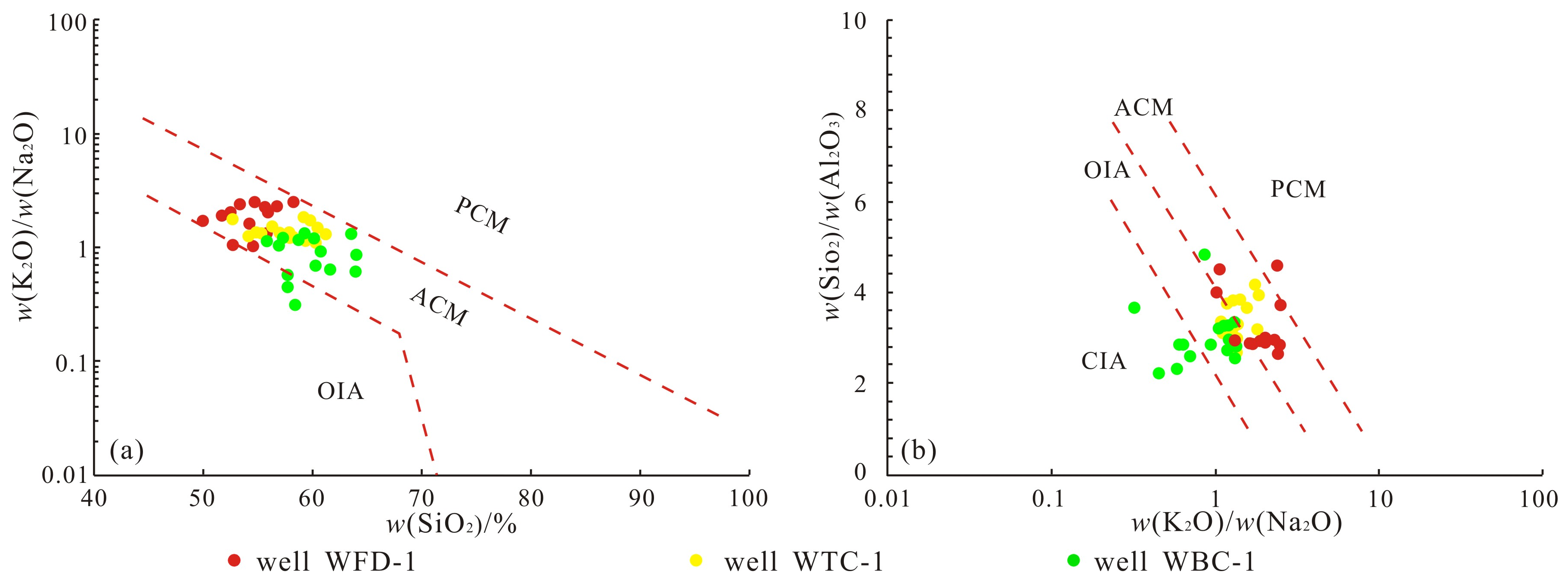
The geotectonic setting for the formation of clastics in the Shanxi Formation was assessed by projecting oxide mass fractions and their ratios onto bivariate discriminant diagrams (Figure 4). For clastics in the WFD-1 well and the WTC 1 well, the SiO2 vs. K2O/Na2O and SiO2/Al2O3 vs. K2O/Na2O diagrams mainly suggest provenance areas of the active continental margin (Figure 4). For clastics in the WBC-1 well, the SiO2 vs. K2O/Na2O diagram indicates provenance areas of the active continental margin and oceanic island arc, whereas the SiO2/Al2O3 vs. K2O/Na2O diagram reflects provenance areas of the oceanic island arc and the continental island arc [32] (Figure 4).
Although major elements are displayed in conventional discrimination diagrams for completeness, they are not used to derive primary tectonic interpretations in this study. Instead, they serve mainly as a comparative reference to illustrate the effects of diagenetic modification. All in all, the major element ratio suggests that the tectonic settings in provenance areas are dominated by the active continental margin and continental island arc, with less development of the passive continental margin and oceanic island arc.

5.2. Provenance Discrimination via Normalized Trace Element Diagrams

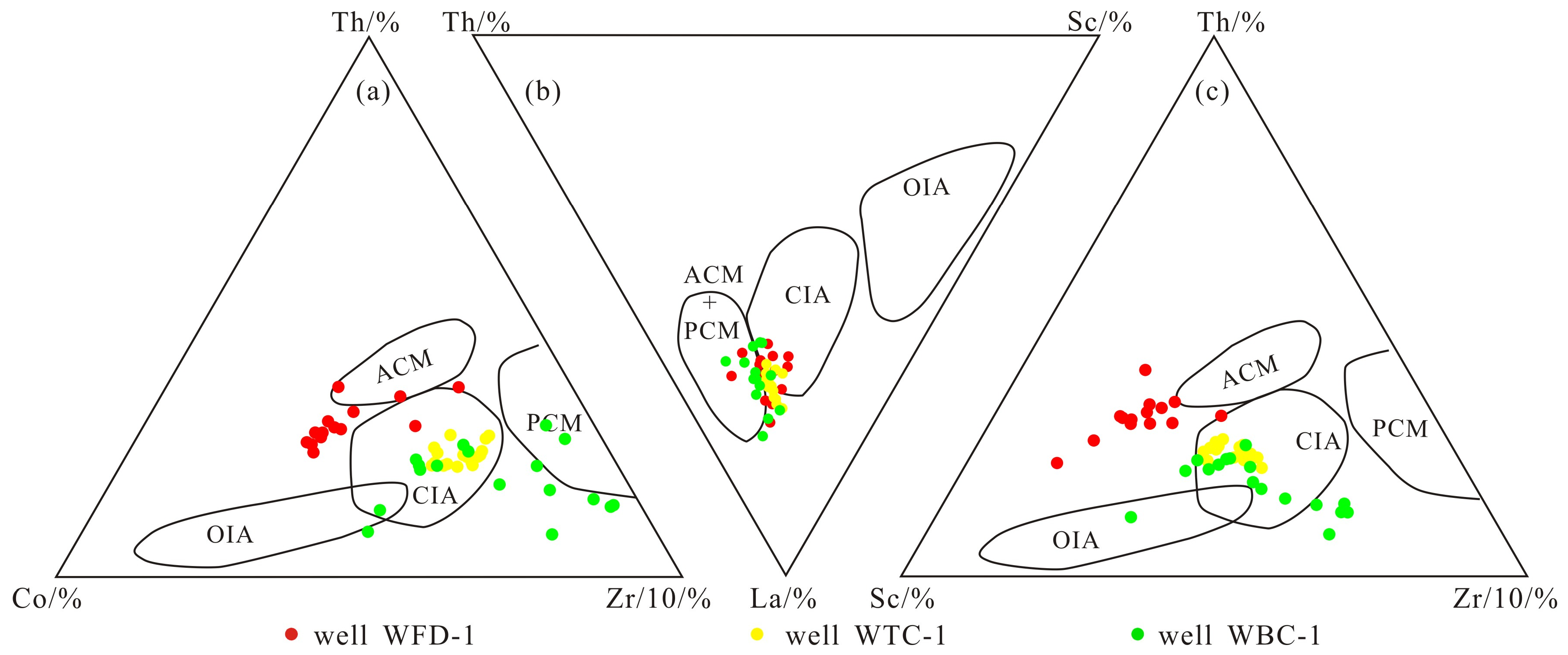
The relationships between trace element composition and plate tectonic environments indicate that the tectonic settings of sedimentary provenance areas can be categorized into four types: active continental margin, passive continental margin, continental island arc, and oceanic island arc. These types were discriminated using the Th-Co-Zr/10 La-Th-Sc and Th-Sc-Zr/10 ternary diagrams, according to the method proposed by [31,32,33]. Samples from the Shanxi Formation predominantly fell within the continental island arc zone (Figure 5).
Samples from the WFD-1 well were plotted near the active continental margin and continental island arc transition zone, while those from the WTC-1 well primarily occupied the continental island arc zone. Samples from the WBC-1 well were primarily distributed in the continental island arc zone, with a few falling within the oceanic island arc and passive continental margin zones. These results suggest complex tectonic settings in provenance areas, dominated by the sedimentary environments of continental island arc and active continental margin.
These discrimination diagrams are interpreted only as first-order approximations. Their reliability is limited by lithological heterogeneity and grain-size effects, and, therefore, they are not used independently but are integrated with REE- and zircon-based evidence.

5.3. Provenance Discrimination via Normalized REE Diagrams

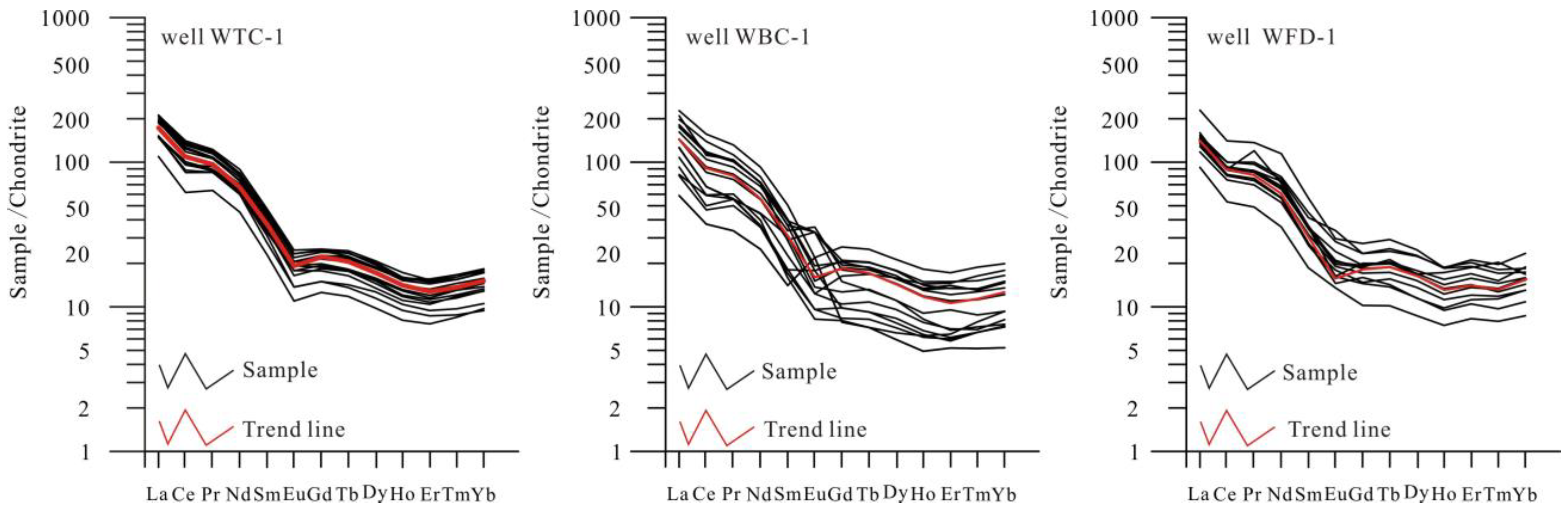
The REE distribution patterns of clastics in the Shanxi Formation were compared with those from distinct tectonic settings [35]. The negative Eu anomalies (δEu averages: 0.23, 0.29, and 0.24 for the WTC-1, WBC-1, and WFD-1 wells, respectively) indicate that the clastics originated from granitic provenance areas and were deposited under oxidizing conditions. Meanwhile, positive Ce anomalies (δCe averages: 3.19, 2.94, and 3.00 for the WTC-1, WBC-1, and WFD-1 wells, respectively) further confirm an oxygen-rich sedimentary environment. The La/Yb ratios (averages: 20.37, 21.10, and 16.00 for the WTC-1, WBC-1, and WFD-1 wells, respectively) are consistent with felsic source contributions. The ΣREE distribution patterns in the study area show a gentle rightward trend (Figure 6), characterized by light REE (ΣLREE) enrichment. This result aligns with the ΣREE patterns previously reported for the Shanxi Formation in the Ordos Basin [32] (Figure 6).
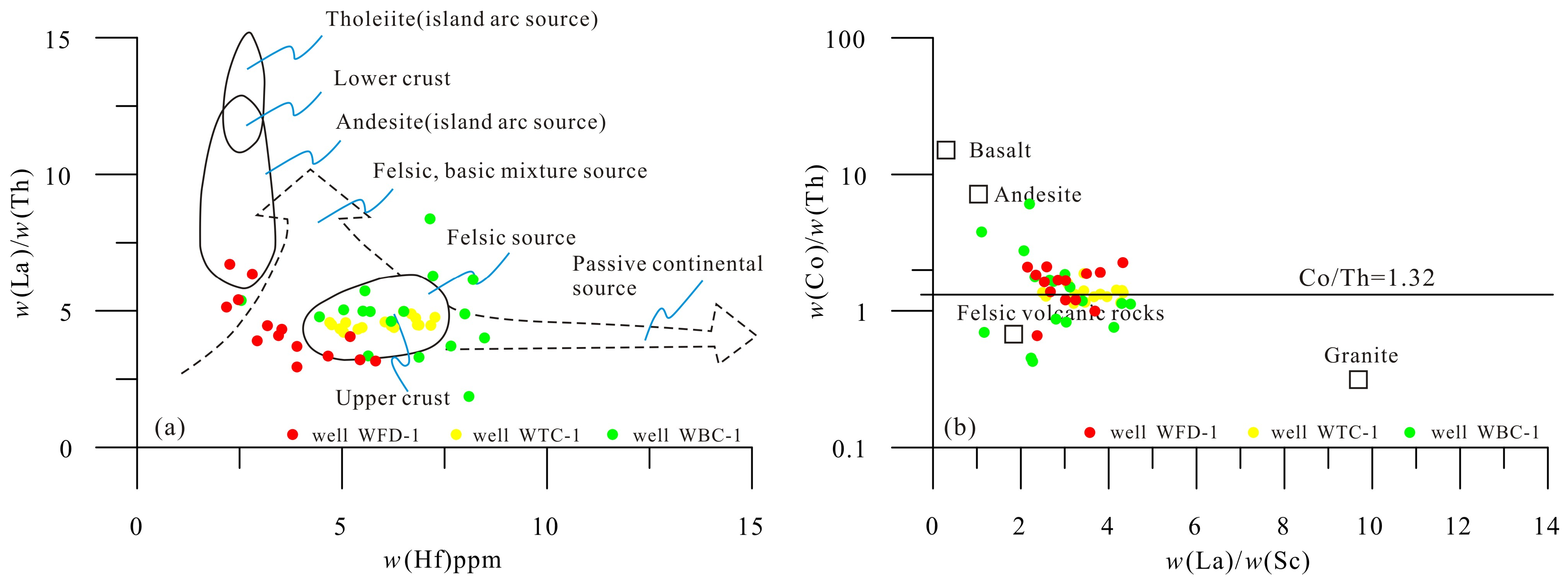
Based on the contents and ratios of stable trace elements, the La/Th–Hf and La/Sc–Co/Th discriminant diagrams for source rocks were plotted to analyze the tectonic settings and source rock characteristics of provenance areas. The clastics in the Shanxi Formation in key wells in northern Anhui predominantly reflected a felsic source, along with a mafic contribution, clustering near the zone of average upper-crust composition. The clastics in the study area displayed relatively stable Co/Th ratios of around 1.32, suggesting that felsic volcanic rocks are the primary source rocks. Moreover, the Hf-La-Th discriminant diagram was employed to discriminate the tectonic settings of various provenance areas. Most sandstone samples fell within the felsic to intermediate felsic zones [36] (Figure 7).
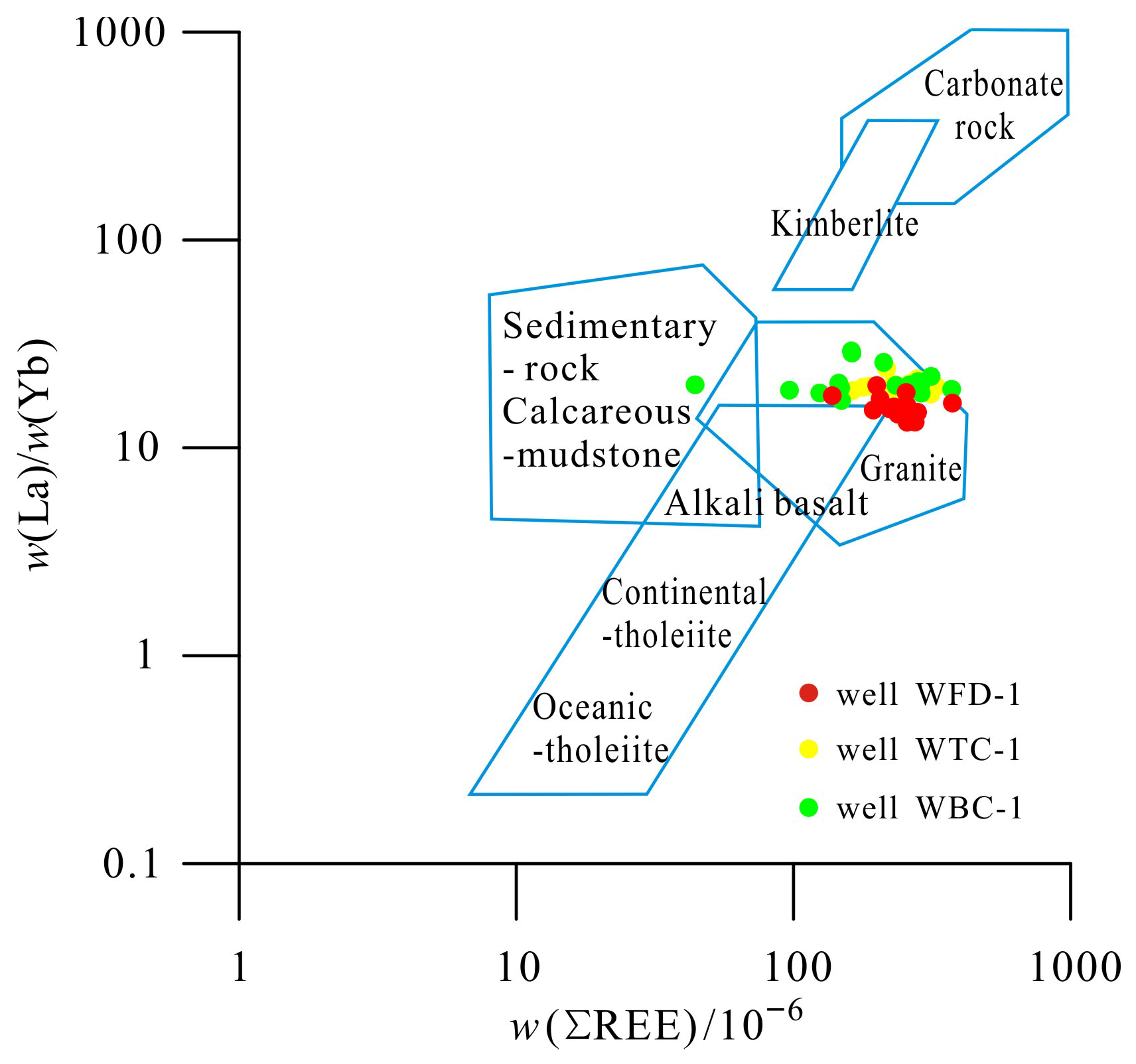
In this discriminant diagram, the clastics in the Shanxi Formation in the WTC-1, WBC-1, and WFD-1 wells were predominantly plotted within the granite zone, with a few samples falling in the overlapping part of the calcareous mudstone zones (Figure 8) [32]. This result suggests a relatively single provenance of the Shanxi Formation in the northern Anhui region, with granitoids possibly serving as parent rocks. The source rocks of the clastics in the Shanxi Formation originate predominantly from the upper crust.

5.4. Provenance Discrimination Using Detrital Zircon U-Pb

The Late Paleozoic zircon ages ranging from 290 Ma to 390 Ma correspond to the Hercynian magmatism, with the zircons possibly originating from the collision-related intrusions in the North Qinling Region (NQR) [21]. The Early Paleozoic zircon ages ranging from 400 Ma to 440 Ma reflect the Caledonian tectonic activity. The Caledonian granites that occur widely as bedrocks in the NQR have ages ranging from 400 Ma to 507 Ma [21]. These granites formed in an island arc setting of the Middle Ordovician to Late Silurian active continental margin. Notably, the Early Paleozoic detrital zircon U-Pb ages from the NCC have been widely recognized as a provenance indicator of the Qinling–Dabie orogenic belt along the southern margin of the block [37,38,39,40,41,42].
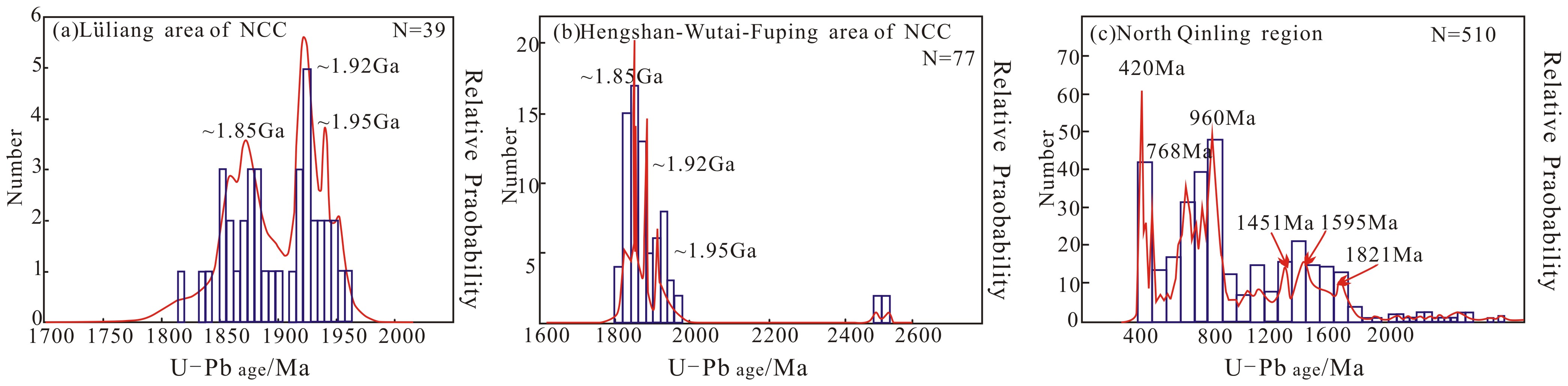
The second peak ages of the provenance of the Shanxi Formation, ranging from 1800 Ma to 2500 Ma, correspond to the Precambrian zircon sources. Specifically, ages ranging from 1800 Ma to 2300 Ma correspond to the Lüliang tectonic event, representing a series of geological events associated with continental breakup, including intracontinental orogeny from the formation to closure of the rift of the NCC. The Lüliang area and Hengshan–Wutai–Fuping area are in the middle of the NCC (Figure 9). This finding suggests that the NCC provided detritus aged 2500–1800 Ma for both its interior and periphery during the Paleoproterozoic. Additionally, ages of around 2500 Ma and 1800 Ma are also identified in the metasedimentary rocks of the Kuanping Group in the NQR, indicating that the Precambrian zircons in the study area might also originate from the NQR [43,44,45,46,47] (Figure 9 and Figure 10). Detrital zircons with ages ranging from 2300 Ma to 2500 Ma are widely found across the NCC and its northern margin. The early-stage magmatic–metamorphic events in the NCC occurred at about 2500 Ma, corresponding to the crustal accretion and cratonization of the NCC. The detrital zircon ages are associated with the two age ranges (2100–1800 Ma and 2800–2500 Ma) of detrital zircons from the Late Paleozoic Ordovician strata [48]. This correspondence indicates that the detrital zircons with both age ranges might also originate from the recycling of pre-Late Paleozoic siliciclastic sedimentary rocks in the NCC. Moreover, it reflects the activation and reconstruction of the NCC during the Paleoproterozoic, indicating that the cratonization of the NCC had been completed by the Paleoproterozoic [21].
Overall, the sediments of the Shanxi Formation in the study area originate from both the NQR and the NCC.

5.5. Tectonic Setting and Provenance Areas

The study area is situated along the southern margin of the NCC. The distance between the WBC-1 well and the WTC-1 well is 60 km, the distance between the WTC-1 well and the WFD-1 well is 120 km, and the distance between the WBC-1 well and the WFD-1 well is 200 km. Due to the long distance between each well, there may be very different source materials, which lead to variations in their sediment provenance. Differences in provenance interpretation among the WTC-1, WBC-1, and WFD-1 wells are supported by variations in detrital zircon age spectra and subtle shifts in trace element ratios. For example, well WFD-1 shows relatively stronger contributions from active continental margin signatures, whereas wells WTC-1 and WBC-1 exhibit more pronounced continental island arc characteristics. Furthermore, the differences in detrital zircon age spectra, particularly in the relative proportions of Paleozoic versus Precambrian populations, also show the provenance differentiation among the wells. Since the NCC itself serves as a potential source of sediments along the passive continental margin, the WBC-1 well, located landward, shows minor sediments from the uplifted ancient passive continental margin. Sediments from the continental island arc struggled to migrate across the back-arc basin to reach the study area.
However, during the deposition of the Shanxi Formation, the uplifted continental island arc in the WTC-1 and WBC-1 well areas had already been connected to the NCC, followed by arc–continent collision. As a result, the uplifted continental island arc serves as the primary provenance area of the study area. The samples formed during the deposition of the Shanxi Formation typically exhibited the characteristics of sedimentary recycling, likely resulting from the denudation and subsequent recycling of early-stage sediments during the uplift of orogenic belts. The evidence for sedimentary recycling is inferred from the coexistence of Precambrian zircon age populations (1800–2500 Ma) and Paleozoic age peaks (290–440 Ma), suggesting multiple cycles of erosion and redeposition. In addition, the overlap between detrital zircon age spectra and known ages of pre-existing sedimentary units in the NCC supports recycling of older clastic sequences. In contrast, the WFD-1 well, located to the west of the WBC-1 and WTC-1 wells and farther from the NQR, did not undergo arc–continent collision, with uplifted active continental margin sediments serving as provenance areas (Figure 10).

5.6. Applicability and Limitations of Geochemical Proxies

Unlike conventional provenance studies focusing on single lithologies, this study involves mixed lithologies (sandstone, sandy mudstone, and mudstone), which introduces significant uncertainty into bulk geochemical interpretations.
Major element compositions are susceptible to post-depositional modification, particularly under tidal flat conditions characterized by strong diagenesis and fluid interaction. As a result, major-element-based discrimination diagrams may not reliably reflect primary provenance signals in such environments.
In contrast, immobile trace elements (e.g., Th, Sc, and Zr) and REEs exhibit relatively higher resistance to diagenetic alteration and, therefore, provide more robust constraints on source rock composition and tectonic setting.
However, classical discrimination diagrams (e.g., Th–Sc–Zr/10 and La–Th–Sc) were established primarily based on graywacke systems. Although there are some studies of marine–continental transitional sandstone and shale in paleoenvironments, their direct application to fine-grained or mixed sediments without lithological filtering may lead to biased interpretations. Compared with major elements, REEs are generally more resistant to post-depositional alteration and, therefore, provide more reliable constraints on source rock composition.
Detrital zircon U–Pb geochronology provides an independent and more reliable provenance constraint. In this study, zircon age spectra effectively validate the dual-source model (NCC + NQR), highlighting the importance of integrating mineral-scale data with bulk geochemistry.
Therefore, this study demonstrates that (1) bulk geochemical proxies remain useful but must be applied with strict lithological and diagenetic constraints; (2) multi-proxy integration is essential for provenance analysis in heterogeneous clastic systems; and (3) detrital zircon data serve as a critical benchmark for validating geochemical interpretations. Therefore, the interpretations presented in this study should be considered within the constraints of data availability, lithological heterogeneity, and proxy-specific limitations. This study highlights the necessity of a cautious, multi-proxy approach when applying bulk geochemical methods to complex sedimentary systems.

6. Conclusions

(1) The major and trace element analysis results of clastics in the Shanxi Formation suggest that the provenance areas of the study area feature sedimentary environments of active continental margins and continental island arcs.
(2) The REE analysis results of clastics in the Shanxi Formation indicate that most sandstones were derived from a felsic provenance area, with granitoids possibly serving as parent rocks. This finding indicates that the source rocks of the clastics in the Shanxi Formation originate primarily from the upper crust.
(3) Analyses of major elements, trace elements, REEs, and detrital zircon U-Pb isotopes indicate that the study area has a tectonic setting of the Andean-type continental margin. The sediments in the study area originate predominantly from an uplifted continental island arc, with minor contributions from an uplifted active continental margin and an uplifted ancient passive continental margin.
(4) The Lower Permian Shanxi Formation in this study has provenance areas consisting of the NQR and the NCC.

Author Contributions

Conceptualization, D.Z.; methodology, R.C. and E.L.; formal analysis, E.L. and D.S.; investigation, E.L.; resources, D.Z. and D.M.; data curation, Q.X.; writing—original draft preparation, E.L. and P.Q.; writing—review and editing, E.L. and D.S.; visualization, E.L.; supervision, D.S.; project administration, T.G.; funding acquisition, T.G. All authors have read and agreed to the published version of the manuscript.

Funding

This research was funded by the China Geological Survey Project (grant numbers: “DD20240053” and “DD20242060”) and the National Science and Technology Major Project (2025ZD1400701-06).

Data Availability Statement

The data will be made available upon request.

Acknowledgments

We appreciate the valuable comments from the editors and anonymous reviewers. We appreciate the samples from the “Cores and Samples Center of Nature Resources”.

Conflicts of Interest

The authors declare that they have no known competing financial interests or personal relationships that could have appeared to influence the work reported in this paper.

References

  1. Quan, S.; Rao, D.; Kong, F.; Liu, S.; Jiang, Y. Potential Analysis of the Upper Paleozoic Hydrocarbon Resources in the Zhoukou Depression. Pet. Geol. Exp. 2002, 26, 562–568, (In Chinese with English Abstract). [Google Scholar]
  2. Sun, X.; Zhang, M.; Long, S.; Hao, F.; Liu, P.; Liu, C. Overthrust Tectonic in Northern Qinling-Dabie Orogenic Belt and Basin Controlling Faults in Zhoukou Depression and Hefei Basin. Oil Gas Geol. 2004, 25, 191–198. [Google Scholar] [CrossRef]
  3. Guo, X.; Wang, R.; Shen, B.; Wang, G.; Wan, C.; Wang, Q. Geological characteristics, resource potential, and development direction of shale gas in China. Pet. Explor. Dev. 2025, 52, 17–32. [Google Scholar] [CrossRef] [Scilit]
  4. Hu, Z.; Zhou, X.; Zhu, J. Hydrocarbon Generation Potential of Upper Paleozoic in Eastern Part of North China. Pet. Explor. Dev. 2006, 35, 697–701, (In Chinese with English Abstract). [Google Scholar]
  5. Kuang, H.; Liu, Y.; Peng, X.; Yang, F.; Chen, M.; Cen, C.; Peng, N.; Li, J.; Wang, X.; Mu, P.; et al. Sedimentary and Tectonic Features and Proto-Basin of Early Cretaceous Tanzhuang-Shenqiu Sag, Zhoukou Depression, in Southern Area of North China Craton. Geol. Rev. 2009, 55, 801–813. [Google Scholar] [CrossRef]
  6. Cao, G.; Xu, G.; Lin, Y.; Yang, Q. Geometry Characteristics of Pre-mesozoic Basin of Eastern Part of North China. J. Henan Polytech. Univ. (Nat. Sci.) 2013, 32, 46–51. [Google Scholar] [CrossRef]
  7. Chen, Q.; Li, P.; Wei, X.; Chen, C.; Dang, W.; Nie, H.; Zhang, J. Methane sorption capacity evaluation of Permian shale with fewer organic matter-hosted pores in the Southern North China Basin. Arab. J. Geosci. 2025, 18, 232. [Google Scholar] [CrossRef] [Scilit]
  8. Liu, E.; Liu, C.; Shi, D.; Zhu, D.; Xu, Q.; Wang, Y. Characterization and Control of Pore Structural Heterogeneity for Low-Thermal-Maturity Shale: A Case Study of the Shanxi Formation in the Northeast Zhoukou Depression, Southern North China Basin. Front. Earth Sci. 2022, 10, 943935. [Google Scholar] [CrossRef] [Scilit]
  9. Liu, E.; Liu, C.; Shi, D.; Wang, Y.; Zhu, D.; Xu, Q. Characterization and controlling factors of pore structural heterogeneity of mudstone: A case of upper Paleozoic in northeast Zhoukou Depression, Southern North China Basin. J. Cent. S. Univ. (Sci. Technol.) 2022, 53, 3773–3790. [Google Scholar] [CrossRef]
  10. Chen, L.; Jiang, Z.; Liu, Q.; Jiang, S.; Lu, K.; Tan, J.; Gao, F. Mechanism of shale gas occurrence: Insights from comparative study on pore structures of marine and lacustrine shales. Mar. Pet. Geol. 2019, 104, 200–216. [Google Scholar] [CrossRef] [Scilit]
  11. Liu, E.; Shi, D.; Wang, Y.; Xu, Q.; Wang, B.; Yang, P.; Jiang, C.; Zhang, J. Sequence Stratigraphic Framework and Sedimentary Model of Shanxi Formation in Northeast Zhoukou Depression of the North China Plate. China Geol. 2020, 4, 575–590. [Google Scholar] [CrossRef] [Scilit]
  12. Zhao, H.; Liu, C. Approaches and Prospects of Provenance Analysis. Acta Seimentologica Sin. 2003, 21, 409–415, (In Chinese with English Abstract). [Google Scholar]
  13. Zhang, Y.; Zhang, G.; Sun, F. The Earliest Clastic Sediments of the Xiong’er Group: Implications for the Early Mesoproterozoic Sediment Source System of the Southern North China Craton. Minerals 2023, 13, 971. [Google Scholar] [CrossRef] [Scilit]
  14. Wang, P.; Ju, Y.; Li, G.; Jiang, S.; Zhang, J.; Xiao, L.; Wang, W.; Gao, J. Destruction of the southern part of the North China Craton and its relationship with enrichment of shale gas in coal measures. Sci. China Earth Sci. 2025, 68, 3250–3267. [Google Scholar] [CrossRef] [Scilit]
  15. Zhang, Y.; Jin, X.; Qiao, P.; Li, B.; Hong, Y.; Chen, Y.; Lu, G.; Du, Y.; Shi, Z. Petrological and Geochemical Constraints on Sedimentary Provenance of the Fuxian Formation (Lower Jurassic) Sandstones in the Northeastern Ordos Basin. Acta Petrol. Sin. 2023, 41, 1414–1429. [Google Scholar] [CrossRef]
  16. Chen, Q.; Li, P.; Wei, X.; Chen, C.; Dang, W.; Nie, H.; Zhang, J. Mineralogy and geochemistry of shale from Shanxi Formation, Southern North China Basin: Implication for organic matter accumulation. Unconv. Resour. 2025, 6, 100151. [Google Scholar] [CrossRef] [Scilit]
  17. Zhang, H.; Wang, Y.; Chen, H.; Zhu, Y.; Yang, J.; Zhang, Y.; Dou, K.; Wang, Z. Study on Sedimentary Environment and Organic Matter Enrichment Model of Carboniferous-Permian Marine-Continental Transitional Shale in Northern Margin of North China Basin. Energies 2024, 17, 1780. [Google Scholar] [CrossRef] [Scilit]
  18. Wang, Y.; Cheng, X.; Fan, K.; Huo, Z.; Wei, L. The Paleoenvironment and Mechanisms of Organic Matter Enrichment of Shale in the Permian Taiyuan and Shanxi Formations in the Southern North China Basin. J. Mar. Sci. Eng. 2023, 11, 992. [Google Scholar] [CrossRef] [Scilit]
  19. Yuan, D.; Bian, J.; Liu, Z.; Zhang, L.; Pan, S. Occurrence characteristics and main control mechanism of trace elements in Early Permian coal in the southern margin of North China Plate. Bull. Geol. Sci. Technol. 2023, 42, 138–149. [Google Scholar] [CrossRef]
  20. Tian, W. Sedimentary System Study of Permian Shanxi Formation in South-Eastern of Ordos Basin. Ph.D. Thesis, Northwest University, Xi’an, China, 2016. (In Chinese with English Abstract). [Google Scholar]
  21. Li, D.; Liu, L.; Wang, Z.; Hu, C.; Chen, H.; Zhu, S.; Zhang, R.; Zhao, F. Tectono-sedimentary patterns of multiple interacting source-to-sink systems of the Permian Shanxi Formation, Ordos Basin, China: Insights from sedimentology and detrital zircon U-Pb geochronology. Mar. Pet. Geol. 2024, 168, 107034. [Google Scholar] [CrossRef] [Scilit]
  22. Yang, C.; Sun, J.; Li, Z.; Qi, Y.; Ye, K.; Zhang, J.; Wang, Z. Carboniferous-Permian provenance shift in the southeastern Ordos Basin: Tracing early-stage uplift-erosion history of the western Qinling-Dabie orogen. Acta Geochim. 2025, 44, 945–961. [Google Scholar] [CrossRef] [Scilit]
  23. Li, G.; Qin, Y.; Shen, J. Geochemical characteristics of the Upper Paleozoic coal series shale in the Linxing area, Ordos Basin, China: Implications for paleoenvironment, provenance, and tectonic setting. Arab. J. Geosci. 2021, 14, 197. [Google Scholar] [CrossRef] [Scilit]
  24. Wang, X.; Zhou, J. Provenance system and sedimentary evolution model of the second Member of Lower Permian Shanxi Fromation in the southeastern Ordos Basin. Nat. Gas Ind. 2017, 37, 9–17. [Google Scholar] [CrossRef]
  25. Li, B.; Wen, X.; Li, G. High-Resolution Sequence Stratigraphic Analysis of the Carboniferous and Permian in North China Platform. Earth Sci. Front. 1999, 6, 81–93, (In Chinese with English Abstract). [Google Scholar]
  26. Omietimi, E.; Lenhardt, N.; Yang, R.; Götz, A.; Bumby, A.; Edegbai, J. Geochemistry of the Late Cretaceous to Paleogene sedimentary deposits of the SW Anambra Basin (Nigeria): Implications for provenance, tectonic conditions, and hydrothermal influence. J. Afr. Earth Sci. 2024, 219, 105399. [Google Scholar] [CrossRef] [Scilit]
  27. Dong, D.; Shao, Y.; Li, M. Study on Coal Accumulation Law of Late Carboniferous Early Permian Coal bearing Rock Series in North China Platform. Coal Sci. Technol. 2017, 45, 175–181. [Google Scholar] [CrossRef]
  28. Shao, L.; Fielding, C.; Mu, G.; Lu, J.; Zhang, P.; Li, Y.; Wang, Y.; Shao, Y.; Wen, H. Coal Accumulation Patterns and Paleoclimates in a Carboniferous–Permian Cratonic Basin, North China. In Field Trip Guidebook on Chinese Sedimentary Geology; Science Press Beijing: Beijing, China, 2024; pp. 231–357. [Google Scholar] [CrossRef] [Scilit]
  29. Chu, A.; Zheng, L.; Liu, M.; Cheng, S.; Zhou, X. Geochemistry of Rare Earth Elements in the Deeply-buried Shanxi Formation Coal Seam of the Huainan Coalfield. Acta Sedimentol. Sin. 2020, 38, 257–265. [Google Scholar] [CrossRef]
  30. Li, W.; Chen, J.; Shao, L. Sedimentary Facies and Framework of the Lower Cretaceous Strata in the Zhoukou Depression. Sediment. Facies Paleogeogr. 1996, 16, 43–50, (In Chinese with English Abstract). [Google Scholar]
  31. Bhatia, M.; Crook, K. Trace element characteristics of graywackes and tectonic setting discrimination of sedimentary basins. Contrib. Mineral. Petrol. 1986, 92, 181–193. [Google Scholar] [CrossRef] [Scilit]
  32. Tan, J.; Jiang, Y.; Li, X.; Ji, C.; Gu, Y.; Wang, Z. Paleoenvironment of marine-continental transitional shales in the lower Permian Shanxi formation, southeastern Ordos Basin, China. Energy Geosci. 2024, 5, 100261. [Google Scholar] [CrossRef] [Scilit]
  33. Amireh, B.; Mahmoud, W.; Saffarini, G.; Jarrar, G. Fractionation of the major, trace, and rare Earth elements of the NE Gondwana Fortunian Salab Formation of Jordan controlled by provenance, chemical weathering, and hydraulic sorting. Ital. J. Geosci. 2025, 144, 93–120. [Google Scholar] [CrossRef] [Scilit]
  34. Luo, T.; Zhou, L. Discussion on the Southern Boundary of the Permian Shihezi Formation in the Ordos Basin. Geol. J. China Univ. 2014, 20, 139–150. [Google Scholar] [CrossRef]
  35. Zeng, T.; Tang, L.; Wang, H.; Santosh, M.; Sheng, Y. The Paleoproterozoic Zhaigou banded iron formation in the Fuping Complex, North China Craton: Geochemistry, geochronology and implications for genesis and tectonic setting. Ore Geol. Rev. 2023, 154, 105314. [Google Scholar] [CrossRef] [Scilit]
  36. Floyd, P.A.; Winchester, J.A.; Park, R.G. Geochemistry and tectonic setting of Lewisian clastic metasediments from the Early Proterozoic Loch Maree Group of Gairloch, NW Scotland. Precambrian Res. 1989, 45, 203–214. [Google Scholar] [CrossRef] [Scilit]
  37. Zhang, Z.; Zhou, T.; Li, D.; Wang, H.; Du, B.; Zhao, D.C.; Zhang, Y.F.; Zhang, C.; Li, Z.C.; Chen, N.; et al. Geochemistry, Detrital Zircon U-Pb Geochronology, and Lu-Hf Isotopes of the Metasedimentary Rocks (Xinghongpu Formation, Late Devonian) in the Central South Qinling Orogenic Belt: Implications for Provenance and Tectonics. Minerals 2023, 13, 768. [Google Scholar] [CrossRef] [Scilit]
  38. Bodet, F.; Schärer, U. Evolution of the SE-Asian continent from U-Pb and Hf isotopes in single grains of zircon and baddeleyite from large rivers. Geochim. Cosmochim. Acta 2000, 64, 2067–2091. [Google Scholar] [CrossRef] [Scilit]
  39. Li, R.; Li, S.; Jin, F.; Wan, Y.; Zhang, S. Provenance of Carboniferous sedimentary rocks in the northern margin of Dabie Mountains, central China and the tectonic significance: Constraints from trace elements, mineral chemistry and SHRIMP dating of zircons. Sediment. Geol. 2004, 166, 245–264. [Google Scholar] [CrossRef] [Scilit]
  40. Li, R.; Wan, Y.; Cheng, Z.; Zhou, J.; Li, S.; Jin, F.; Meng, Q.; Li, Z.; Jiang, M. Provenance of Jurassic sediments in the Hefei Basin, east-central China and the contribution of high-pressure and ultrahigh-pressure metamorphic rocks from the Dabie Shan. Earth Planet. Sci. Lett. 2005, 231, 279–294. [Google Scholar] [CrossRef] [Scilit]
  41. Li, R.; Wan, Y.; Cheng, Z.; Zhou, J.; Xu, Y.; Li, Z.; Jiang, M. The Dabie Orogen as the early Jurassic sedimentary provenance: Constraints from the detrital zircon SHRIMP U-Pb dating. Sci. China Ser. D Earth Sci. 2005, 48, 145–155. [Google Scholar] [CrossRef] [Scilit]
  42. Li, R.; Meng, Q.; Li, S. Coupling of the Jurassic and Carboniferous basins with the orogens in the Dabie Shan and adjacent area: Constraints from sedimentary record. Acta Petrol. Sin. 2005, 21, 1133–1143. [Google Scholar] [CrossRef]
  43. Lu, C.; Qian, J.; Yin, C.; Gao, P.; Guo, M.; Zhang, W. Ultrahigh temperature metamorphism recorded in the Lüliang Complex, Trans-North China Orogen: P–T–t evolution and heating mechanism. Precambrian Res. 2022, 383, 106900. [Google Scholar] [CrossRef] [Scilit]
  44. Wang, H.; Chen, D.; Ren, Y.; Zhu, X.; Gong, X. The relationship between the North Qinling Belt and the North China Craton: Constrains from zircon U-Pb geochronology and metamorphism of metaclastic rocks from the Kuanping Complex. Acta Petrol. Sin. 2021, 37, 1489–1507. [Google Scholar] [CrossRef] [Scilit]
  45. Zhao, Y.; Yang, W.; Zhu, J.; Fu, Q. Late Permian to Early Triassic tectonic uplift of the Qinling Orogenic Belt inresponse to initial collision of the North and South China blocks: A sediment provenance analysis. Palaeogeogr. Palaeoclimatol. Palaeoecol. 2025, 679, 113303. [Google Scholar] [CrossRef] [Scilit]
  46. Yang, W.; Fu, Q.; Zhu, J. Collisional orogeny processes in the Qinling Orogenic Belt during the Late Permian to Early Triassic: Evidence from detrital zircon geochronology in the south of North China. Geochemistry 2025, 85, 126247. [Google Scholar] [CrossRef] [Scilit]
  47. Dong, Y.; Santosh, M. Tectonic architecture and multiple orogeny of the Qinling Orogenic Belt, Central China. Gondwana Res. 2016, 29, 1–40. [Google Scholar] [CrossRef] [Scilit]
  48. Darby, B.; Gehrels, G. Detrital zircon reference for the North China block. J. Asian Earth Sci. 2006, 26, 637–648. [Google Scholar] [CrossRef] [Scilit]
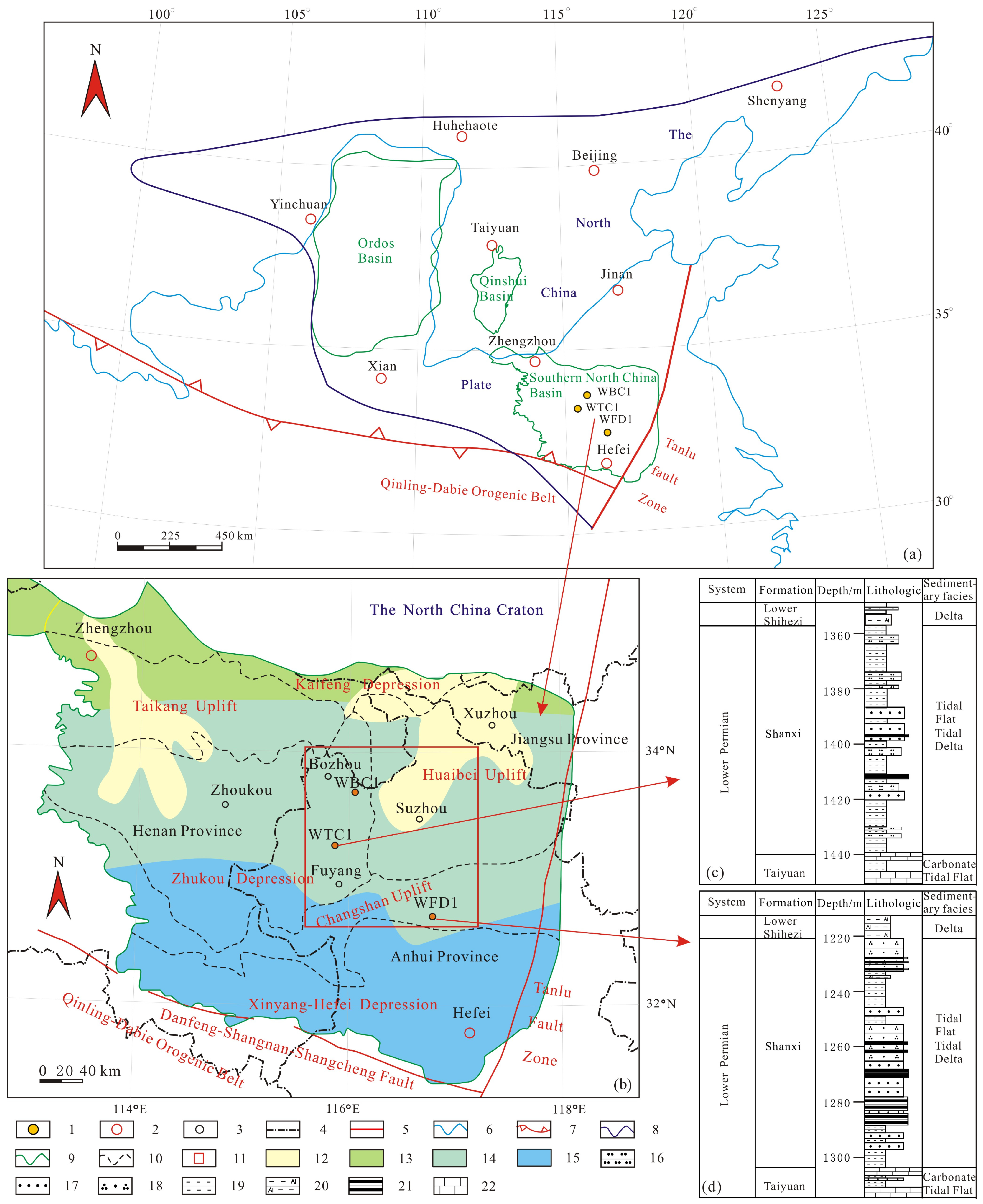
Figure 1. Geological structure outline map of the SNCB [12,17]. (a) The location of the SNCB in the NCC; (b) geological structure outline map of the SNCB; (c) description of Shanxi Formation in well WTC-1; (d) description of Shanxi Formation in well WFD-1. 1—well location; 2—provincial city; 3—prefecture-level city; 4—provincial boundary; 5—fault; 6—coastline and river; 7—plate tectonic boundary (oceanic extinction zone); 8—the NCC boundary; 9—basin boundary; 10—secondary tectonic unit boundary; 11—the study area; 12—tidal delta (Permian); 13—tidal delta plain (Permian); 14—tidal delta front (including delta flat) (Permian); 15—lagoon (Permian); 16—siltstone; 17—sandstone; 18—quartzose sandstone; 19—mudstone; 20—aluminous mudstone; 21—coal; 22—limestone.
Minerals 16 00415 g001
Figure 2. Concordia plots detrital zircons with >90% of the Shanxi Formation. (a) mudstone form well WFD-1, 1248.85 m; (b) sandstone form well WFD-1, 1252.07 m; (c) sandstone form well WFD-1, 1264.75 m; (d) sandstone form well WTC-1, 1419 m.
Minerals 16 00415 g002
Figure 3. Frequency distribution of 207Pb/206Pb ages of detrital zircons with >90% of the Shanxi Formation.
Minerals 16 00415 g003
Figure 4. Major element ratio diagrams of the structural background in the source area of key wells in the Shanxi Formation [32,33,34]. (a) The SiO2 vs. K2O/Na2O graphical method; (b) the SiO2/Al2O3 vs. K2O/Na2O graphical method. PCM—passive continental margin; ACM—active continental margin; OIA—oceanic island arc; CIA—continental island arc.
Minerals 16 00415 g004
Figure 5. Identification of the structural background in the source area of key wells in the Shanxi Formation [31,32,33]. (a) Th-Co-Zr/10, (b) La-Th-Sc, and (c) Th-SC-Zr/10. PCM—passive continental margin; ACM—active continental margin; OIA—oceanic island arc; CIA—continental island arc.
Minerals 16 00415 g005
Figure 6. Distribution map of rare earth elements in the tectonic background of key wells in the Shanxi Formation [33,34,35].
Minerals 16 00415 g006
Figure 7. Rare earth element source identification diagram of key wells of the Shanxi Formation. (a) the La/Th-Hf graphical method; (b) the Co/Th-La/Sc graphical method [36].
Minerals 16 00415 g007
Figure 8. Clastic rock La/Yb-∑REE source identification diagram of key wells in the Shanxi Formation [32].
Minerals 16 00415 g008
Figure 9. Histograms of metamorphic zircon ages from the NCC and the NQR. (a) The Lüliang area; (b) the Hengshan–Wutai–Fuping area; (c) the NQR [21,42,43,44,45,46,47,48].
Minerals 16 00415 g009
Figure 10. Provenance areas and sedimentary structural background of the Shanxi Formation in the research area. (a) The location of SNCB in the North China Carton; (b) stratigraphic column of Shanxi Formation in WTC-1 well; (c) description of Shanxi Formation in WFD-1 well. 1—well location; 2—provincial city; 3—provincial boundary; 4—fault; 5—coastline and river; 6—plate tectonic boundary (oceanic extinction zone); 7—the NCC boundary; 8—basin boundary; 9—the study area; 10—tidal delta (Permian); 11—tidal delta plain (Permian); 12—tidal delta front (include delta flat) (Permian); 13—lagoon (Permian); 14—provenance; 15—profile; 16—the locations of histogram samples for the NCC; 17—the locations of histogram samples for the NQR.
Minerals 16 00415 g010
Table 1. Clastic rock main element and trace element data from key wells in the Shanxi Formation.
WellNo.Major Elements/%Trace Elements/10−6
SiO2Al2O3Fe2O3MgOCaONa2OK2OMnOP2O5TiO2LOIScZrCoTh
WTC 1157.08 17.30 5.31 1.21 1.56 2.00 2.72 0.12 0.16 0.83 11.72 15.10 25514.9011.70
259.2414.997.781.14 1.80 1.51 2.80 0.12 0.14 0.82 9.66 26.50 24713.509.90
361.2616.005.441.07 1.25 2.09 2.72 0.08 0.14 0.92 9.03 15.50 31515.8013.70
459.3119.293.980.99 0.48 2.43 2.73 0.04 0.11 0.92 9.71 11.20 28213.9010.20
560.6315.895.251.17 2.39 1.98 2.85 0.11 0.13 0.82 8.78 15.90 29814.6013.40
660.4515.695.231.17 2.56 2.02 2.87 0.11 0.14 0.82 8.95 19.50 27415.3011.60
759.7815.785.11.05 2.67 2.00 2.37 0.09 0.13 0.78 10.26 20.80 25915.4012.00
860.4217.863.80.90 0.95 2.10 2.29 0.12 0.12 0.90 10.55 14.40 26116.3010.80
959.8514.347.671.22 2.01 1.25 2.16 0.21 0.15 0.70 10.44 13.60 20615.509.60
1052.7416.477.861.35 1.15 1.38 2.49 0.24 0.18 0.77 15.37 14.60 19119.5010.30
1158.2218.653.780.96 0.41 2.00 2.51 0.07 0.15 0.92 12.32 9.52 22917.609.10
1257.9020.623.371.30 0.30 2.30 2.80 0.08 0.12 0.92 10.29 12.00 1938.559.80
1357.8017.724.551.23 1.40 2.10 2.88 0.08 0.21 0.80 11.24 15.60 29014.9012.50
1455.4118.445.481.36 1.51 2.16 2.88 0.11 0.24 0.82 11.60 14.50 24019.4013.70
1554.1619.445.251.42 1.43 2.45 3.12 0.15 0.23 0.84 11.51 18.40 24119.0014.00
1654.9020.314.741.311.15 2.42 3.26 0.12 0.24 0.84 10.70 20.10 25019.7014.00
1756.2615.295.631.643.47 1.83 2.85 0.12 0.17 0.65 12.10 16.60 28712.4010.40
WBC 1157.7924.625.570.520.323.081.790.030.090.945.24 10.10 3704.406.30
257.7825.904.270.410.303.441.570.020.100.935.29 9.77 3826.147.40
363.9722.322.710.360.293.041.870.020.100.934.41 8.38 3294.185.50
460.6821.206.241.170.302.482.340.030.120.994.45 14.90 3309.018.00
561.5921.505.420.990.342.601.690.040.130.954.75 12.50 37911.704.20
660.3223.234.570.480.282.942.040.050.101.044.95 12.00 34943.607.10
759.3623.271.210.420.223.284.330.010.091.006.82 17.90 3085.2612.30
860.2120.341.370.360.222.953.600.010.080.8410.02 18.00 2555.4312.00
955.8917.159.561.991.832.362.890.150.290.737.17 18.60 24620.9011.20
1055.8416.999.452.041.932.532.890.150.270.717.20 18.90 23017.0010.30
1158.4915.915.233.423.854.621.480.090.170.356.39 17.10 11613.403.50
1257.0017.786.142.441.413.173.410.060.200.637.75 20.00 20217.309.70
1357.4520.756.311.700.392.603.150.130.210.896.41 16.90 28816.6014.60
1463.5518.884.251.410.442.393.150.040.240.954.70 20.60 35610.3011.80
1558.7721.534.331.590.422.953.500.060.170.895.79 17.10 25013.9011.70
1659.4721.213.911.660.442.813.820.040.140.835.68 23.80 26523.2013.70
1764.0313.284.311.593.012.662.300.030.140.638.01 14.70 27012.008.00
WFD 1143.4311.6120.624.094.660.671.600.380.431.2411.27 21.00 67.113.507.32
254.7319.337.241.891.171.042.580.120.830.3610.71 14.90 81.715.909.68
355.9718.686.091.851.391.402.830.120.780.2910.61 15.80 97.217.6010.40
462.2621.462.210.830.280.344.320.011.030.097.17 19.90 18218.1018.10
549.9117.3813.142.231.701.252.160.260.810.4310.73 20.50 90.620.909.89
654.3218.618.161.941.311.432.320.190.850.3910.49 16.60 10222.3010.50
756.7519.055.672.271.611.242.870.060.780.489.22 15.50 10319.2015.90
865.3819.151.891.040.190.874.170.0041.110.146.06 21.60 194.310.7016.20
952.5318.236.452.321.401.322.680.090.730.3313.92 17.50 12619.4014.00
1052.6911.6415.351.404.041.231.320.060.400.7011.18 7.75 54.811.105.75
1161.8616.242.010.960.220.393.670.011.230.1013.31 14.70 206.718.0014.90
1255.8718.805.662.211.071.982.630.050.820.2710.64 14.20 11519.5011.60
1354.7113.687.72.35.242.172.210.160.720.6310.48 11.20 82.317.407.63
1455.718.936.151.881.871.212.770.100.660.6510.08 12.80 86.515.407.63
1551.717.548.781.931.771.252.340.120.840.5313.20 16.90 110.317.3011.63
1658.2415.567.691.871.951.152.890.1010.780.59.27 15.40 103.716.9011.82
1750.3418.9310.011.951.861.182.870.090.730.4111.6314.60102.3615.8010.63
Table 2. Clastic rock rare earth element data from key wells in the Shanxi Formation/10−6.
WellNo.YLaCePrNdSmEuGdTbDyHoErTmYbLuδEuδCe
WTC 1128.3055.30104.0011.6042.307.281.906.260.935.020.992.590.452.890.460.283.11
224.4049.2090.5010.3036.306.221.805.310.804.150.812.260.382.460.390.313.04
334.2066.20126.0014.2051.909.322.207.631.135.881.173.150.523.210.520.263.13
425.5048.5085.2010.5038.306.591.705.360.844.470.872.390.402.520.390.282.89
530.3056.00153.0012.3043.407.681.606.750.974.950.962.560.452.810.450.224.48
629.2051.1098.5011.2039.806.821.505.880.914.810.922.520.432.650.430.243.16
728.4053.40101.0011.4040.306.791.606.160.884.700.922.440.402.620.410.253.12
825.9047.3091.7010.4037.806.581.305.500.824.180.812.190.392.440.390.223.18
924.0041.6080.708.8332.105.741.305.090.763.930.772.020.332.030.330.243.20
1027.6048.1094.8010.7039.306.871.405.820.884.500.862.260.382.450.390.223.22
1124.4051.6087.1011.0040.307.241.305.740.864.420.822.150.342.140.360.202.78
1219.5047.5082.7010.2036.506.231.004.640.683.560.691.820.291.790.290.182.87
1335.9060.60119.0013.0047.108.201.506.991.085.701.133.180.513.310.520.203.23
1437.0062.40125.0013.9050.209.211.707.661.186.111.163.110.513.310.510.203.28
1536.8065.20129.0014.2051.509.371.807.551.156.161.183.210.543.360.520.213.25
1637.0067.50132.0014.7053.509.541.807.771.226.441.263.220.553.310.550.213.21
1734.4061.30116.0012.9044.307.821.506.911.035.221.032.780.482.990.470.203.13
WBC 116.6811.7013.401.555.021.230.501.210.211.090.200.570.090.580.090.412.02
216.5029.6047.006.6526.606.191.003.930.663.440.601.450.241.440.220.202.59
313.7034.5055.807.2323.803.170.602.490.362.050.461.360.261.770.300.212.67
433.8067.00105.0012.5042.805.740.905.060.844.901.053.060.543.400.610.172.64
514.3025.8044.006.0121.303.410.702.580.412.220.451.260.221.400.240.232.77
618.0026.3055.406.7026.304.530.903.240.542.970.571.480.231.550.250.233.36
714.9040.5063.806.7121.903.640.703.050.462.400.471.220.221.380.210.212.70
815.8040.1063.606.6421.703.611.303.040.462.580.501.290.221.400.220.392.72
934.0055.80108.0012.1043.507.872.406.511.025.491.032.810.442.840.450.333.18
1031.5051.8098.3011.1040.707.352.406.040.945.100.952.550.422.570.410.363.13
1111.8018.8035.104.0315.002.811.602.430.361.840.361.090.170.990.170.613.07
1227.6046.3087.209.9236.406.732.605.580.854.500.872.310.372.310.370.423.10
1343.7072.60147.0015.8055.4010.101.608.041.256.591.333.610.623.780.620.183.33
1434.7057.60110.0012.4043.507.941.306.421.015.541.093.140.503.130.500.183.14
1528.8058.10111.0012.3043.307.281.105.800.904.890.982.950.432.780.450.173.15
1629.2063.10131.0013.5047.508.071.406.310.934.830.962.830.442.850.450.193.42
1721.6045.8079.909.1133.105.802.404.640.653.440.662.000.291.770.290.462.91
WFD 1143.6049.1094.3011.6045.708.272.467.251.267.021.354.000.563.300.490.323.11
222.4037.7070.908.3631.605.461.314.580.784.220.822.530.392.470.380.263.08
322.6044.9082.909.7636.406.351.395.300.874.710.892.860.432.910.410.243.03
441.2073.30132.0016.4068.7011.302.168.501.467.681.364.430.654.450.670.222.94
528.8044.0085.0010.4040.307.061.766.020.995.271.043.310.483.020.450.273.13
624.1042.9083.8010.5041.106.901.535.700.945.080.982.990.422.720.400.243.14
737.6046.7093.9012.0047.608.992.067.241.216.941.374.250.603.500.480.253.20
834.2051.1083.8014.4042.906.931.445.831.065.221.263.930.673.190.450.232.56
926.7046.7085.7010.2039.007.071.196.201.005.090.952.950.442.990.460.183.01
1015.6029.5050.005.8821.403.720.993.170.512.690.541.740.261.650.240.292.83
1136.5047.7087.2010.5044.307.271.495.981.025.521.133.560.503.580.620.223.00
1219.3042.8077.409.2534.205.531.064.950.713.550.722.350.382.480.380.202.97
1329.2048.4089.9011.4045.807.851.836.631.075.230.982.970.412.610.380.253.01
1419.1041.2075.708.9533.805.321.184.490.693.570.692.200.322.060.320.243.02
1530.2650.3288.8911.6745.238.001.656.230.955.630.883.550.473.320.520.232.87
1626.7442.3185.0010.8340.576.581.615.320.924.941.213.210.482.820.380.273.20
1729.0145.8281.649.6436.806.321.455.821.064.770.782.740.452.630.370.242.94
Disclaimer/Publisher’s Note: The statements, opinions and data contained in all publications are solely those of the individual author(s) and contributor(s) and not of MDPI and/or the editor(s). MDPI and/or the editor(s) disclaim responsibility for any injury to people or property resulting from any ideas, methods, instructions or products referred to in the content.