Article

Mineralogy, Geochemistry, and Geochronology of Hydrothermal and Magmatic Apatites in the Xiangshan Ore Field, South China: Implications for U-Pb-Zn Polymetallic Mineralization

1
School of Earth and Planetary Sciences, East China University of Technology, Nanchang 330013, China
2
270 Geology Team of Nuclear Industry, Nanchang 330200, China
*
Author to whom correspondence should be addressed.
Minerals 2026, 16(4), 389; https://doi.org/10.3390/min16040389
Submission received: 6 March 2026 / Revised: 1 April 2026 / Accepted: 5 April 2026 / Published: 7 April 2026
(This article belongs to the Special Issue Geochemical Exploration for Critical Mineral Resources, 2nd Edition)

Abstract

The timing of uranium mineralization in the Xiangshan ore field has long been controversial. Although various geochronometers have been applied by previous researchers, including pyrite Rb-Sr, mica Ar-Ar, and fluorite Sm-Nd, the results remain inconsistent and inconclusive. In recent years, the discovery of abundant Pb-Zn veins in the deeper parts of the Xiangshan ore field has further complicated the interpretation of its metallogenic history. In this study, abundant vein-type hydrothermal apatites closely associated with U-Pb-Zn polymetallic mineralization were identified in both uranium and Pb-Zn ore veins. Combined major-element Electron Probe Microprobe Analysis (EPMA), Laser Ablation-Inductively Coupled Plasma-Mass Spectrometry (LA-ICP-MS) U-Pb dating, and trace-element analysis were conducted on these apatite grains. The results suggest a mineralization age of 130.9 ± 1.1 Ma for the Shannan uranium deposit, which is consistent with the previously reported apatite U-Pb age of 131.3 ± 7.2 Ma from the Zoujiashan uranium deposit and coincides with the main pulse of volcanic-intrusive activity in the Xiangshan ore field (133–137 Ma). The deep Niutoushan Pb-Zn deposit suggests a younger mineralization age of 124.5 ± 1.3 Ma, which is consistent with a thermal event age of 125.6 Ma determined by zircon fission-track dating and the zircon LA-ICP-MS U-Pb age of late-stage granite porphyry (125.4 ± 1.0 Ma). These ages may constrain the timing of U-Pb-Zn polymetallic mineralization in the Xiangshan ore field. Both magmatic and hydrothermal apatites are classified as fluorapatite and exhibit similar chondrite-normalized rare earth element (REE) patterns. Compared with magmatic apatites, hydrothermal apatites are characterized by elevated Th, U, Ca, and Sr contents, depletion in light rare earth elements (LREEs), Mn, and Na, and distinctly lower Th/U ratios. On major-element variation diagrams, magmatic and hydrothermal apatites define coherent trends but display clear compositional differences related to their formation stages. Apatites from uranium ore veins show strongly negative Eu anomalies and weakly positive Ce anomalies, similar to magmatic apatites. In contrast, apatites from Pb-Zn ore veins display positive Eu anomalies and weakly negative Ce anomalies, with lower Mn and Ga contents and higher SO3 contents relative to both magmatic apatites and hydrothermal apatites from uranium ore veins. These features indicate that the ore-forming fluids during Pb-Zn mineralization were characterized by significantly higher oxygen fugacity than those during uranium mineralization and magmatism. Combined with published Sr isotopic data for the Xiangshan ore field, we propose that both uranium and Pb-Zn mineralization were genetically linked to the prolonged magmatic evolution of the deep volcanic-intrusive complex. The subsequent incursion of meteoric water modified the physicochemical conditions of the ore-forming system, particularly during the formation of the Pb-Zn mineralization.

1. Introduction

Gangue minerals offer key insights into the metallogenic conditions and processes of hydrothermal deposits. Hydrothermal fluids forming gangue minerals are widely interpreted to have been near equilibrium with ore minerals during mineralization [1]. Apatite associated with uranium minerals occurs in various uranium deposits worldwide, such as the Guangshigou pegmatite-type uranium deposit in the North Qinling Orogen, China [2,3], the Ordos sandstone-type uranium deposit in northern China [4], the Gaudeanmus leucogranite-type uranium deposit in the Gaudeanmus area, Namibia [5,6], the Coles Hill igneous complex-type uranium deposit in Virginia, USA [7], the Olympic Dam Breccia Complex-type Cu-Au-U-Ag deposit in the eastern Gawler Craton, South Australia [8], and the Wangmushan gold deposit in the Zhenghe region of the Southeast China Volcanic Belt [9]. Owing to its high stability across diverse geological settings, apatite can record and preserve primary magmatic-hydrothermal information [10,11]. Thus, it is widely used to constrain petrogenetic and metallogenic processes [12].
However, late-stage magmatic intrusions, fluid activities, or metamorphism post-diagenesis present major challenges for determining the genesis of isolated apatite grains. Such determinations usually require the integration of multiple petrological and mineralogical lines of evidence, but acquiring these data at the single-grain scale is technically demanding. Consequently, it remains difficult to accurately distinguish between magmatic, hydrothermal, and metamorphic apatites [13,14]. A chronological study of the Voisey’s Bay troctolite intrusion in Labrador, Canada [15] found that the U-Pb isotopic age of apatites was 30 Ma younger than that of baddeleyite. The apatite age may either be a result of the resetting of the U-Pb isotopic system triggered by syenite intrusion, or reflect the closure of the isotopic system during regional cooling and fluid circulation cessation. The Xiangshan ore field in Jiangxi Province is a globally representative concentration area of volcanic-type uranium deposits and plays a key role in uranium resource research. As of 2023, its total identified uranium resources amounted to approximately 27,400 t [16]. For a long time, the timing of mineralization remains debated, which has limited the development of genetic models for uranium mineralization. Uraninite is the most reliable mineral for constraining the mineralization age of uranium deposits. Nevertheless, uraninite in the Xiangshan ore field occurs mainly as poorly crystalline micro-aggregates. Combined with the effects of frequent and intense late-stage hydrothermal overprinting and tectonic activity, the U-Pb isotopic system of uraninite has been severely disturbed by open-system behavior, resulting in highly scattered apparent ages. To overcome the difficulties in distinguishing different types of apatite, this study employs systematic petrographic observations, back-scattered electron (BSE) imaging, electron probe microanalysis (EPMA), LA-ICP-MS U-Pb dating, and trace element analysis to accurately identify and compare the syn-mineralization vein-type hydrothermal apatite and the magmatic apatite from the host rocks.
In recent years, substantial Pb-Zn ore veins have been successively discovered during deep exploration in the Xiangshan ore field, establishing a unique metallogenic system characterized by U-Pb-Zn polymetallic mineralization. This discovery has undoubtedly reshaped the metallogenic processes of the Xiangshan ore field. This study identifies apatite veins associated with U-Pb-Zn polymetallic mineralization in both shallow uranium orebodies and deep Pb-Zn orebodies of the Xiangshan ore field that display typical hydrothermal characteristics. Based on these observations, this study presents petrogenetic and metallogenic chronological investigations, together with major and trace element analyses, of magmatic and hydrothermal apatites from host rocks and ore veins, using EPMA, LA-ICP-MS, and BSE imaging. This study contributes to constraining the metallogenic sequence, clarifying the material sources, and deciphering the geodynamic mechanisms of mineralization in the Xiangshan ore field.

2. Geological Setting

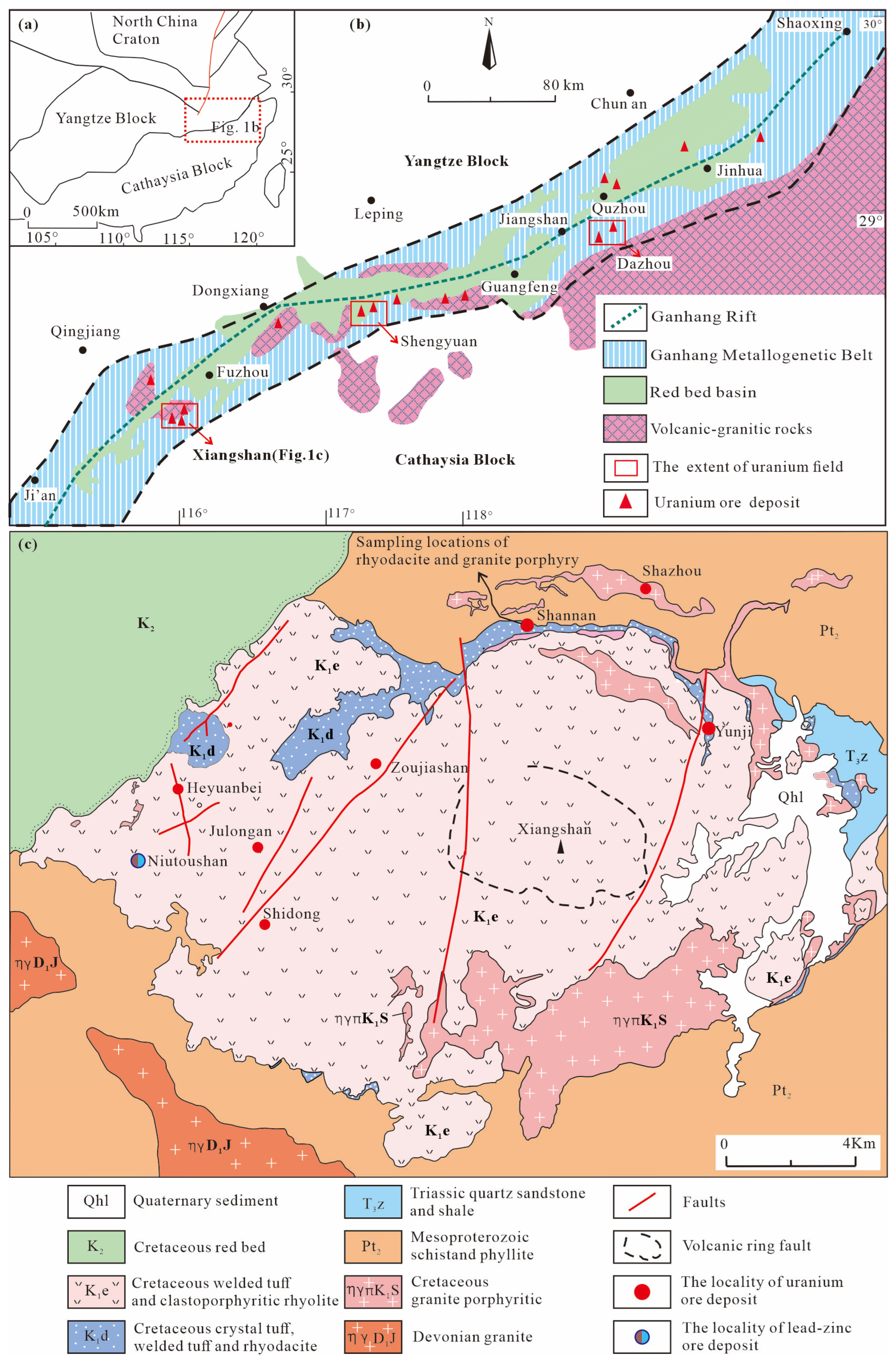
Volcanic-related uranium deposits in South China are primarily hosted within the Ganzhou-Hangzhou Metallogenic (Volcanic) Belt (GHMB; Figure 1b) [17,18]. The GHMB consists of a series of volcanic basins (e.g., Xiangshan, Shengyuan, Dazhou, and Xinlu), which are dominated by Early Cretaceous felsic volcanic rocks. These volcanic rocks are widely regarded as genetically linked to the Mesozoic subduction of the Pacific Plate beneath the Eurasian Plate [19,20,21]. Adjacent to these Cretaceous volcanic basins is a chain of Early Cretaceous–Early Cenozoic intracontinental red-bed basins (Figure 1b; [22]). In addition to uranium, the GHMB is also rich in other mineral resources, including copper, gold, silver, lead, zinc, and molybdenum [23,24,25].
Tectonically, the Xiangshan ore field is located on the southern margin of the suture zone between the Yangtze and Cathaysia Blocks [18]. It lies on the southeastern side of the Suichuan-Dexing Fault and the southwestern end of the GHMB (Figure 1b; [22,26]). The Xiangshan area experienced two major volcanic-intrusive cycles, corresponding to the Daguding Formation and the Ehuling Formation, respectively, with a total thickness exceeding 2000 m. The Daguding Formation is mainly composed of rhyodacite, minor rhyolitic welded tuff, and intercalated clastic sedimentary rocks, whereas the Ehuling Formation is dominated by porphyritic lava with a small amount of welded tuff. Subsequently, subvolcanic rocks (granitic porphyry) intruded the pre-existing strata (Figure 1c). The emplacement ages of the volcanic-intrusive complex in the Xiangshan ore field are concentrated between 145 and 130 Ma [20,27,28]. The basement of the Xiangshan volcanic basin is primarily composed of Neoproterozoic schist and amphibolite [29]. The northeastern and northwestern parts of the ore field are covered by Late Cretaceous red beds, which are commonly associated with marl, gypsum, and halite [30].
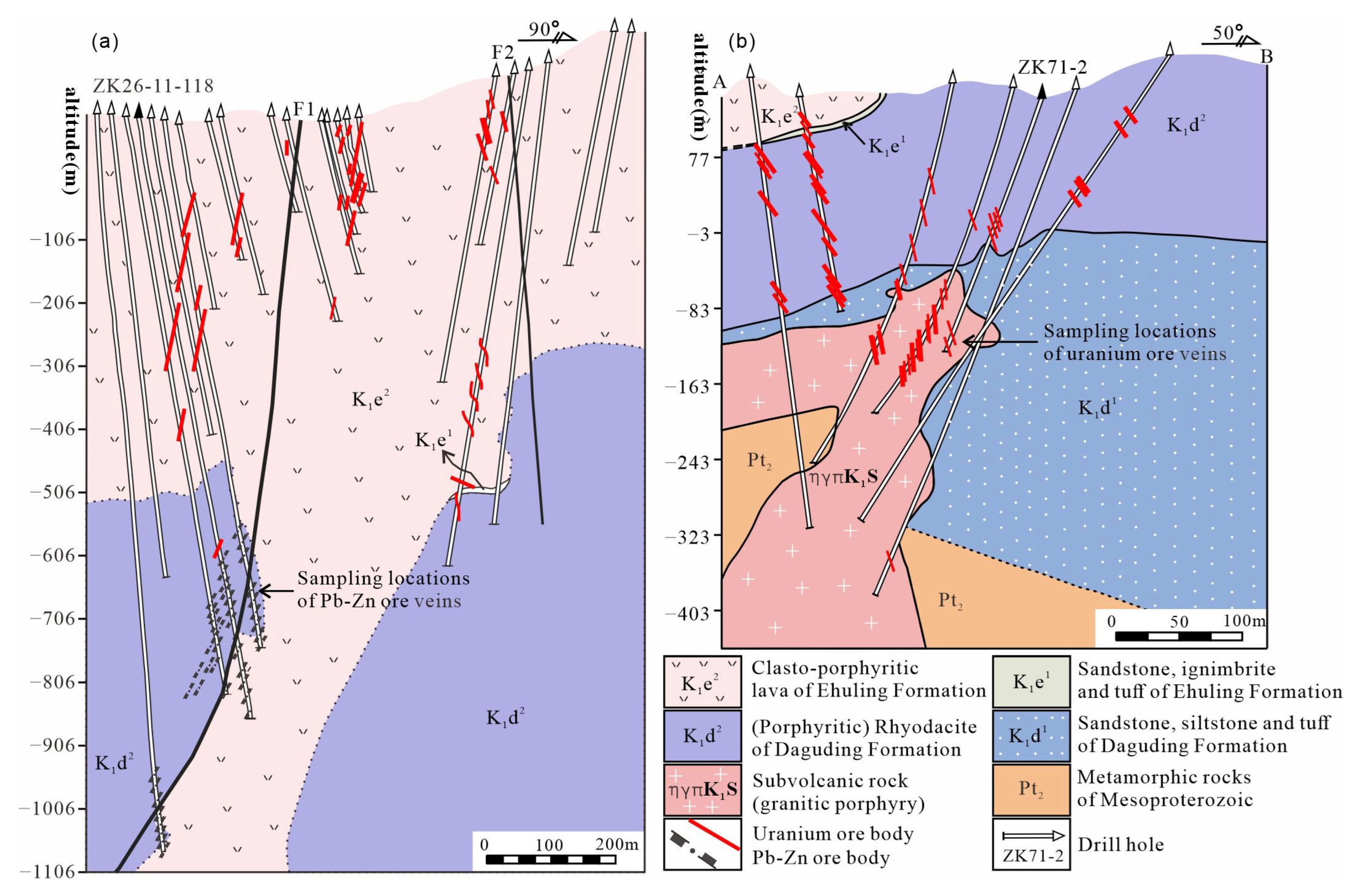
The Xiangshan ore field contains over 27,400 tons of U3O8 down to a depth of 1.5 km, with an average grade of 0.1–0.3 wt% U [16]. In the past two decades, uranium resources have increased in the deeper and peripheral areas of the ore field [16]. Dozens of uranium deposits and anomalies, mainly concentrated in the northern and western parts of the volcanic basin, have been discovered and intermittently mined for sixty years. The geology of the ore field has been extensively documented in previous studies [31,32,33] and is only briefly summarized herein. Known uranium deposits are primarily distributed at the intersections of NE-trending faults, EW-trending basement faults, nappe structures, and volcanic-related ring structures [34,35,36]. Uranium deposits in the western part of the ore field, including Zoujiashan, Julongan, and Heyuanbei, are mainly hosted within porphyritic lava and rhyodacite (Figure 2a,b), whereas those in the northern part, such as Shannan uranium deposit, are predominantly hosted in granitic porphyry (Figure 2b). Ore bodies typically occur as groups of steep veins with significant variations in size, ranging from several tens of meters to 300 m in length (Figure 2; [30]).
Figure 1. (a) Simplified tectonic map of South China showing the location of the Gan-Hang Metallogenic Belt. (b) Enlarged geological map of the Gan-Hang Metallogenic Belt (modified from [22]), with its location indicated by the red box in (a). (c) Simplified geological map of the Xiangshan uranium ore field, Jiangxi Province, South China, showing the location of the major ore deposits (modified from [37]).
Minerals 16 00389 g001
Figure 2. Representative sketch drilling cross-sections of the Niutoushan drilling (a) and Shannan (b) ore deposit (modified from [38]).
Minerals 16 00389 g002
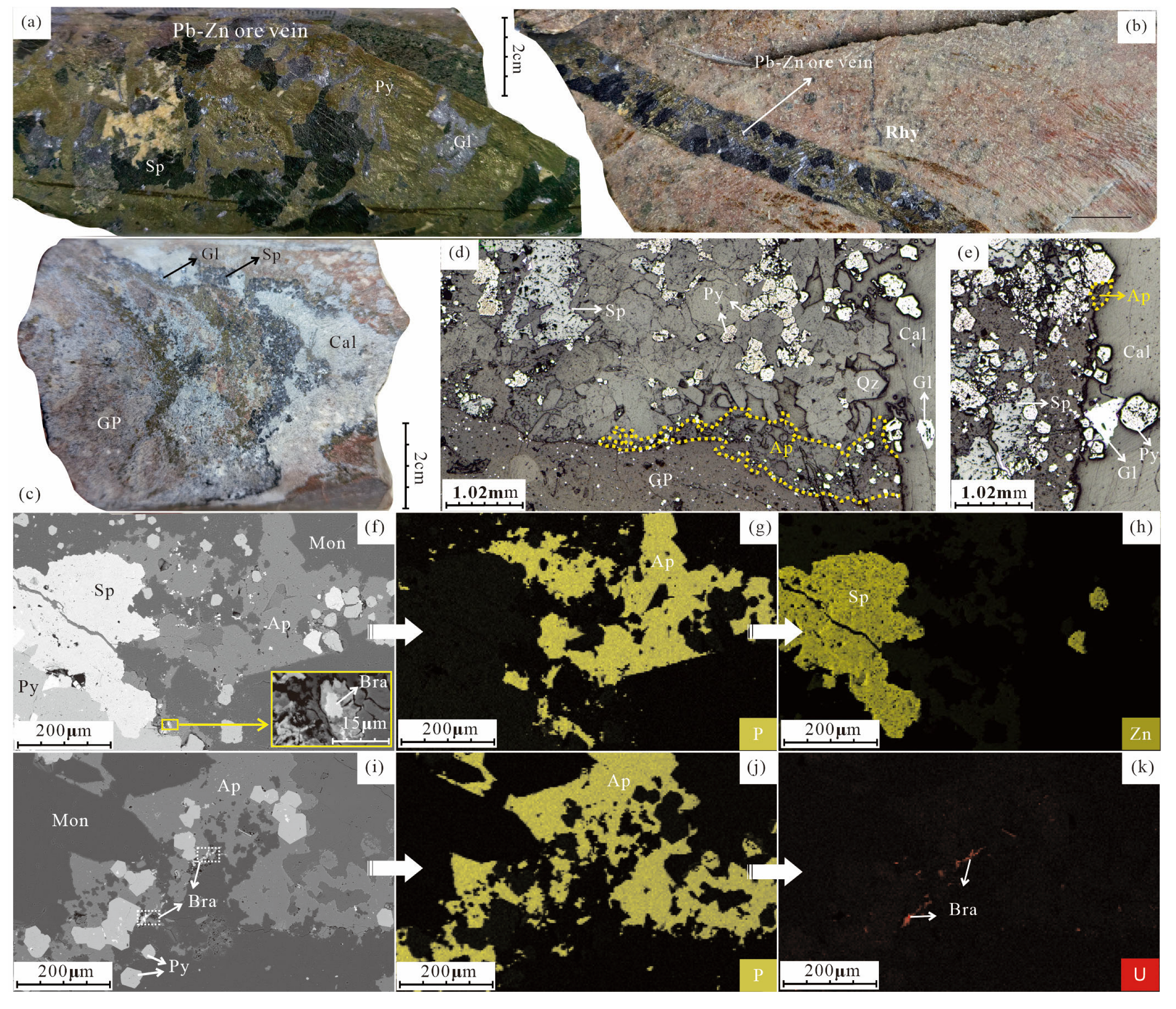
To date, Pb-Zn (Ag, Cu) mineralization in the Xiangshan ore field is mainly developed in the Niutoushan area in the western part of the ore field, all identified in relatively deep drilling intervals. This Pb-Zn polymetallic mineralization occurs beneath the uranium mineralization and is predominantly distributed along the NNW-trending Heyuanbei-Xiaobei Fault and its adjacent secondary structures (Figure 2b). The ore veins generally strike parallel to the Heyuanbei-Xiaobei Fault, with a dip direction of 250–260° and a dip angle of 60–65°. Polymetallic ore veins are mainly hosted in the porphyritic rhyolite of the Upper Member of the Ehuling Formation and the rhyodacite of the Upper Member of the Daguding Formation (Figure 3a,b). Minor occurrences are observed in the crystal tuff of the Lower Member of the Ehuling Formation, the argillaceous siltstone of the Lower Member of the Daguding Formation (Figure 3d), and Mesoproterozoic metamorphic rocks (Figure 3e). Ore bodies occur in veins and disseminated forms, with vein thickness ranging from several millimeters to centimeters (Figure 3b–e), and locally forming high-grade ore veins of 0.5–2 m in thickness.
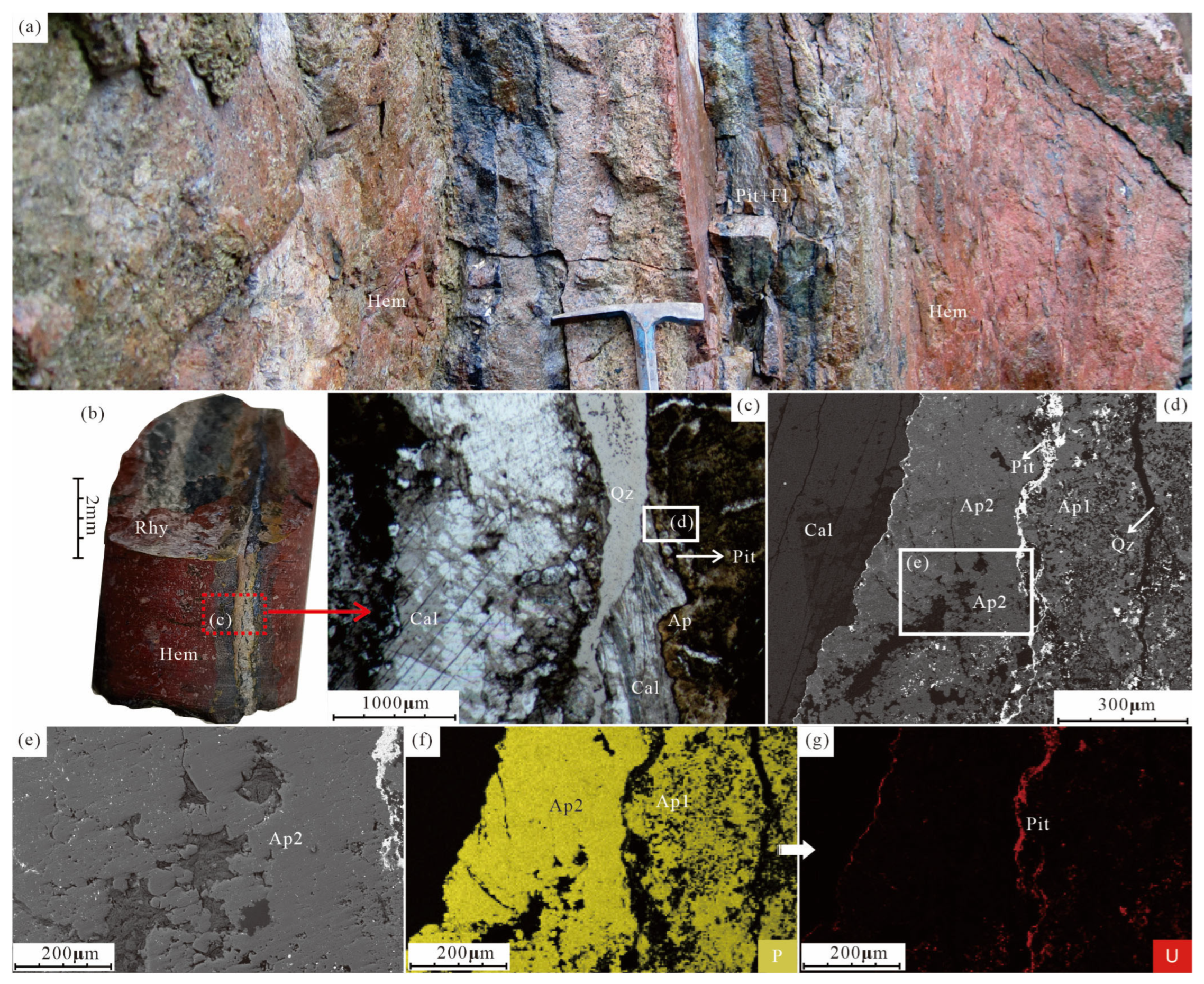
Figure 3. Core photos and micro-geological characteristic photos of uranium ore veins in the Shannan deposit in the Xiangshan ore field. (a) Hydrothermal alteration features in the uranium mineralization zone; (b) Uranium ore veins cross-cutting hematitized rhyodacite; (c) Uranium-bearing calcite, apatite and quartz veins (under plane-polarized light); (d) Two generations of apatite veins: early-stage apatite (Ap1, adjacent to the wall rock) with fine-grained texture and high impurity content, and late-stage apatite (Ap2, adjacent to the vein center, serving as the target area for hydrothermal apatite sampling in this uranium ore vein study) with coarse-grained texture and clean surface (BSE); (e) Crystal morphology of late-stage apatite (BSE); (f) BSE X-ray distribution maps of P for uranium ore veins; (g) BSE X-ray distribution maps of U for uranium ore veins. Ap—Apatite; Cal—Calcite; Fl—Fluorite; Hem—Hematite; Pit—Pitchblende; Qz—Quartz; Rhy—Rhyodacite.
Minerals 16 00389 g003

3. Sample Description and Analytical Methods

The hydrothermal apatites investigated in this study were collected from two distinct horizons: the shallow zone of Drillhole ZK71-2 in the Shannan uranium deposit, at an elevation of approximately −3 m (above the Yellow Sea datum), and the deep zone of Drillhole ZK26-11-118 in the Niutoushan Pb-Zn deposit, at an elevation of approximately −806 m (above the Yellow Sea datum). By comparison, magmatic apatites were obtained from surface outcrops and underground drifts of the Shannan uranium deposit, including rhyodacite and granite porphyry.

3.1. LA-ICP-MS U-Pb Dating of Apatite

Apatite U-Pb dating was performed at the State Key Laboratory of Nuclear Resources and Environment (SKLNRE) in China, using an Analytikjena M90 quadrupole ICP-MS (Analytik Jena AG, Jena, Germany) coupled with a 193 nm NWR193 Ar-F excimer laser system. Factors correcting for downhole fractionation, instrument drift, and mass bias related to apatite Pb/U ratios were calculated using the matrix-matched primary reference material MAD2 (ID-TIMS age: 474.25 ± 0.41 Ma; [39,40]). Otter Lake apatites (913 ± 7 Ma; [41,42]) and 401 apatites (530.3 ± 1.5 Ma; [43]) were employed as secondary standards to monitor data quality. Detailed analytical procedures for LA-ICP-MS apatite U-Pb isotopic measurements are provided in [44,45]. Data reduction followed the method outlined by [46], with an additional correction for minor common Pb in the primary standard using the 207Pb-based approach proposed by [42]. Offline data processing—including sample and blank signal selection, instrumental sensitivity drift correction, calculation of elemental concentrations, U-Pb isotopic ratios, and ages—was conducted using the Isoclock software 2.0 package [47].

3.2. Major Element Analysis of Apatite

Major elements of apatite grains were determined using a JEOL JXA-8530F electron microprobe analyzer (EMPA, JEOL Ltd., Tokyo, Japan) at the SKLNRE. The analyses were conducted under the following operating conditions: an accelerating voltage of 15 kV, a beam current of 20 nA, and a beam diameter of 5 μm. The reference standards employed for calibration were as follows: jadeite for Na, olivine for Mg, kaersutite for Al, quartz for Si, apatite for Ca, F, P, and S, magnetite for Fe, bustamite for Mn, Sr-Ba niobate for Sr, Y-Al garnet for Y, monazite for Ce and Nd, synthetic Eu phosphate for Eu, and tugtupite for Cl. Analytical precision was typically better than 1 wt% for elements with concentrations greater than 1 wt%, and better than 10 wt% for elements with concentrations greater than 0.1 wt%. A relatively large analytical spot size (5 μm) was adopted to reduce beam density and thereby minimize halogen migration during analysis. For F determination, the LDE1 diffracting crystal characterized by higher count rates compared to the conventional TAP crystal—was used. Additionally, fluorine was analyzed first to avoid beam over-exposure and subsequent halogen migration [48]. Nevertheless, minor excess fluorine was detected in the measurements, which is likely attributed to time- and crystal orientation-dependent variations in X-ray intensities, as well as third-order overlap of P Kα on F Kα [48,49]. All major element analytical data are presented in Tables S1–S4.

3.3. Trace Element Analysis of Apatite

In situ trace element analyses of apatites were performed using a 193 nm Coherent ComPex Pro laser ablation (LA) system coupled to an Agilent 7900 Q-ICPMS (quadrupole inductively coupled plasma mass spectrometer, Agilent Technologies, Inc., Santa Clara, CA, USA) at the SKLNRE. NIST 612 and 610 glass standards, along with USGS reference glasses (BIR-1G, BCR-2Ga, and BHVO-2G), were analyzed repeatedly after every ten apatite samples to monitor analytical stability and accuracy. Both standards and samples were ablated under identical operating parameters: a spot size of 44 or 32 μm, a repetition rate of 6 Hz, and an energy density of 3.5 J/cm2. Calcium (Ca) was used as the internal standard, with its concentrations determined by electron microprobe analyzer (EMPA) measurements. Off-line data processing—including the determination of sample and background signals, drift calibration, and calculation of trace element concentrations—was conducted using the ICPMSDataCal software 11.0 package [50]. Each time-resolved ablation spectrum was carefully inspected, and segments affected by inclusions or glass contaminants were excluded from the final data calculation. Analytical accuracy, evaluated by the relative difference between the measured values and the recommended values of secondary reference materials, was better than 0–15% (relative) for most trace elements, except for Sn, which exhibited a relative difference of 0–40%. All trace element analytical data are presented in Tables S5–S8.

4. Results

4.1. Apatite Morphology

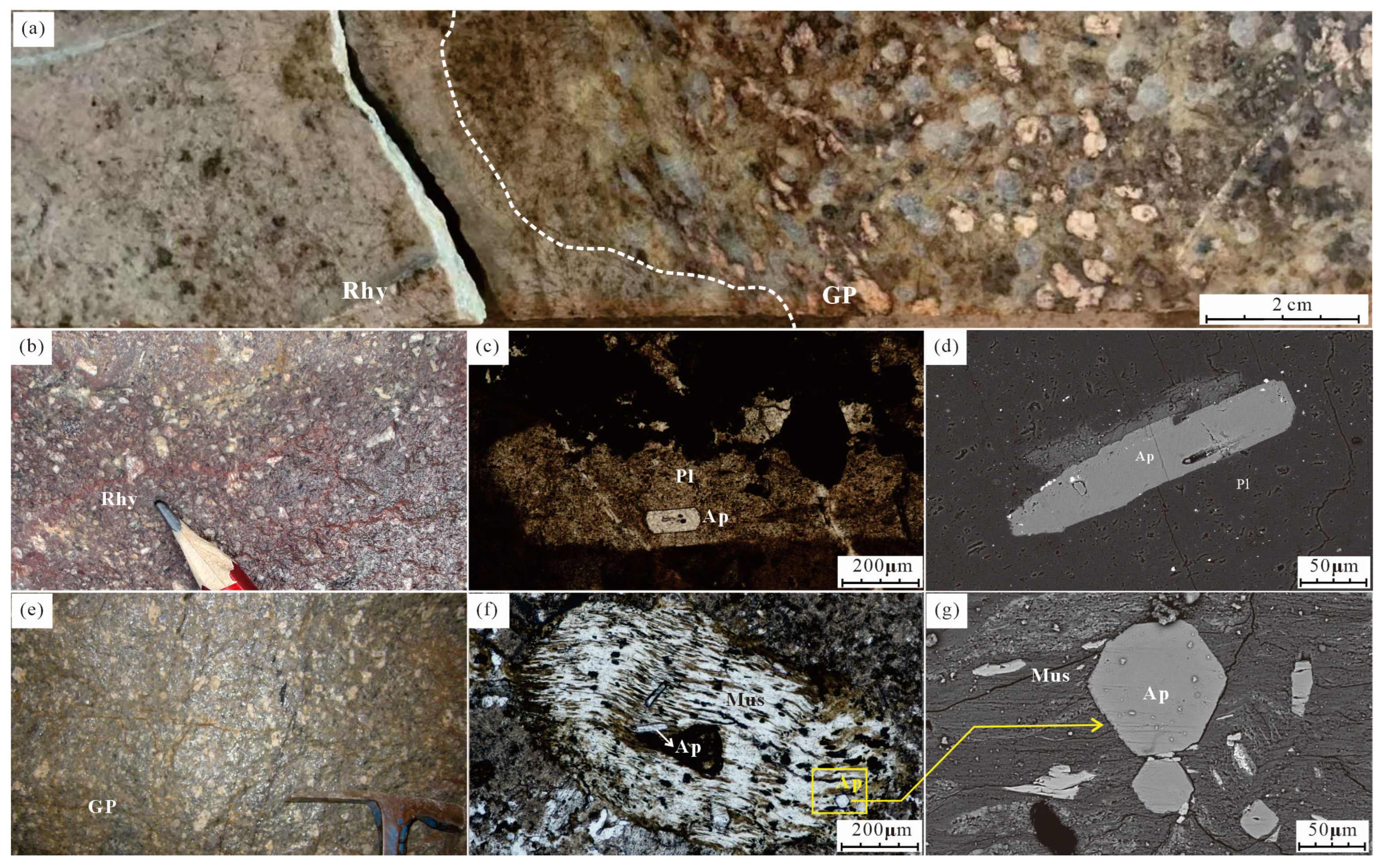
All apatite samples were analyzed using thick polished sections with a thickness of ~300 μm. Prior to conducting EPMA and LA-ICP-MS U-Pb analyses on apatite grains, representative domains free of fractures and fluid inclusion interference were first selected through microscopic observation. Subsequently, back-scattered electron (BSE) images were acquired to clarify the internal structures of these minerals. The BSE images of apatites (Figure 3, Figure 4 and Figure 5) show relatively homogeneous textures, without obvious zoning features or post-formation alteration. Based on the clarified internal mineral structures, appropriate analytical spots were selected for U-Pb isotopic dating as well as major and trace element analyses.
The host rock of the uranium orebodies is rhyodacite, which exhibits obvious hematitization alteration and typical characteristics of hydrothermal metasomatism. Within the ore veins, a variety of gangue minerals—including apatite, pyrite, chlorite, fluorite, and calcite—can be observed, with occasional galena and sphalerite (Figure 3). In contrast to the host rocks of the uranium orebodies, the wall rocks adjacent to the Pb-Zn ore veins display weak alteration and lack distinct hydrothermal metasomatism features.
In the Pb-Zn ore veins, gangue minerals such as pyrite, apatite, quartz, sericite, calcite, and chlorite are present, with occasional uranium minerals (Figure 4). In the U-Pb-Zn polymetallic orebodies, hydrothermal apatites occur in a vein-like form. The width of apatite veins in uranium orebodies can reach 0.3 mm, whereas that in Pb-Zn orebodies can reach 1 mm. These hydrothermal apatite veins enclose uranium or Pb-Zn minerals and are mostly distributed parallel to quartz veins and calcite veins, with no cross-cutting relationships observed among them.
The crystal grains near the central part of the veins are relatively coarse, allowing clear observation of crystal interfaces. Under the microscope, the cross-sections of magmatic apatites mostly exhibit hexagonal crystal forms, while the longitudinal sections present acicular, tabular, or hexagonal prismatic morphologies (Figure 5). Most of these apatites are enclosed in plagioclase or muscovite. Specifically, the size of apatites in rhyodacite is approximately 0.13 mm × 0.027 mm, and that in granite porphyry is about 0.25 mm × 0.035 mm.

4.2. Apatite Geochronology

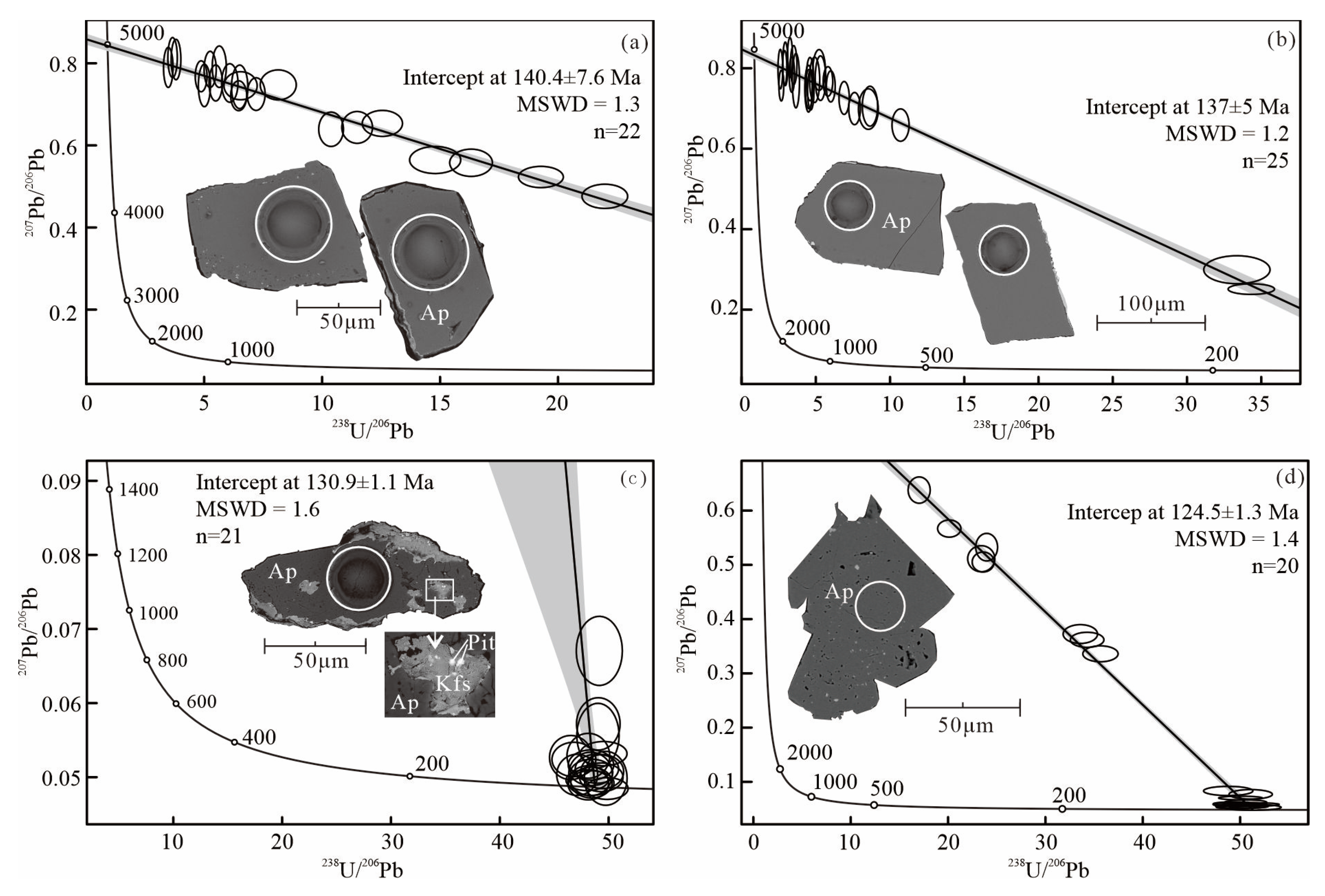
As illustrated by the LA-ICP-MS U-Pb isotopic dating results of apatites from the Xiangshan ore field (Tables S9–S12), the U-Pb isotopic data for both magmatic apatites (collected from rhyodacite and granite porphyry) and hydrothermal apatites (sampled from uranium and Pb-Zn ore veins) are reliable. The U contents of these apatites are as follows: 5.66–62.10 ppm for magmatic apatites from rhyodacite, 3.68–293.33 ppm for magmatic apatites from granite porphyry, 634.12–6698.97 ppm for hydrothermal apatites from uranium ore veins, and 479.58–2920.17 ppm for hydrothermal apatites from Pb-Zn ore veins. The two apatite samples from the granite porphyry exhibit high U contents (>275 ppm) but yield consistent U-Pb ages (ca. 137 Ma) with the other 23 low-U apatite grains, indicating they crystallized synchronously. The variation in U contents primarily reflects local compositional heterogeneity within the magma chamber.
All apatites exhibit relatively high U contents, which ensures the presence of sufficient radiogenic Pb in the analyzed grains—a critical prerequisite for the reliable determination of apatite crystallization ages. On the Tera-Wasser burg diagrams, the analytical spots of apatites from the four groups of rock samples are all tightly clustered, yielding the following lower intercept ages: 140.4 ± 7.6 Ma (MSWD = 1.3, n = 22) (Figure 6a); 137.0 ± 5.0 Ma (MSWD = 1.1, n = 25) (Figure 6b); 130.9 ± 1.1 Ma (MSWD = 1.6, n = 21) (Figure 6c); and 124.5 ± 1.3 Ma (MSWD = 1.4, n = 20) (Figure 6d), respectively.
It is noteworthy that the Pb-Zn mineralization age obtained in this study (124.5 ± 1.3 Ma) is consistent with the hydrothermal event age of 126.8 ± 2.0 Ma from the Wadi Ras Abda area, Egypt [51]. This period also marks a critical phase of tectono-magmatic activity globally: the North American Cordillera recorded large-scale thrusting during the Early Cretaceous (ca. 140–110 Ma; [52]), and the Coast Mountains batholith experienced a high magmatic flux at 120–100 Ma [53]. Concurrently, South China reached the peak of its second-stage Cretaceous volcanism (125–115 Ma; [54]), while the North China Craton was at the climax of its destruction (ca. 125 Ma; [55]). The near-synchronism of these events across different continents suggests that ca. 125 Ma represents a widespread tectono-hydrothermal episode. The near-synchronism of these events across different continents indicates that the late Early Cretaceous may represent a period of enhanced global tectono-thermal activity.

4.3. Trace and REEs of Apatite

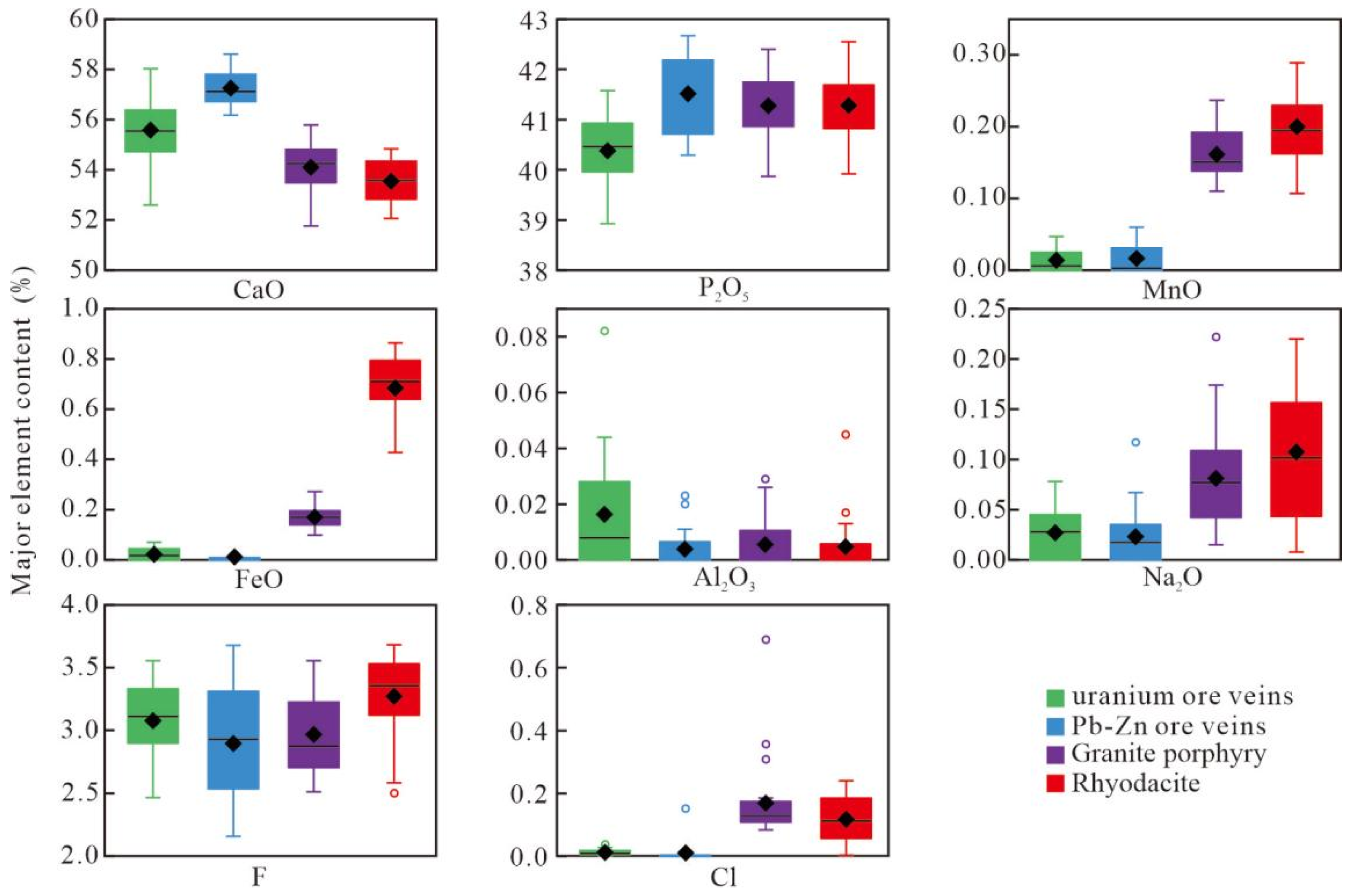
The major element compositions of apatites, analyzed by EPMA, are presented in Tables S1–S4. For apatites from rhyodacite, the major element contents are as follows: CaO = 52.06–54.83 wt%, P2O5 = 39.92–42.55 wt%, MnO = 0.11–0.29 wt%, FeO = 0.43–0.86 wt%, Al2O3 = 0.00–0.05 wt%, Na2O = 0.01–0.22 wt%, F = 2.50–3.68 wt%, and Cl = 0.00–0.24 wt%. Apatites from granite porphyry exhibit the following major element ranges: CaO = 51.76–55.78 wt%, P2O5 = 39.87–42.40 wt%, MnO = 0.11–0.24 wt%, FeO = 0.10–0.27 wt%, Al2O3 = 0.00–0.03 wt%, Na2O = 0.02–0.22 wt%, F = 2.51–3.56 wt%, and Cl = 0.08–0.69 wt%.
Hydrothermal apatites from uranium ore veins have the following major element compositions: CaO = 52.60–58.02 wt%, P2O5 = 38.93–41.58 wt%, MnO = 0.00–0.05 wt%, FeO = 0.00–0.07 wt%, Al2O3 = 0.00–0.08 wt%, Na2O = 0.00–0.08 wt%, F = 2.46–3.56 wt%, and Cl = 0.00–0.04 wt%. In contrast, hydrothermal apatites from Pb-Zn ore veins show the following major element ranges: CaO = 56.17–58.60 wt%, P2O5 = 40.29–42.67 wt%, MnO = 0.00–0.06 wt%, FeO = 0.00–0.02 wt%, Al2O3 = 0.00–0.02 wt%, Na2O = 0.00–0.12 wt%, F = 2.16–3.68 wt%, and Cl = 0.00–0.15 wt%. These major elements are clearly illustrated in the box plots (Figure 7).
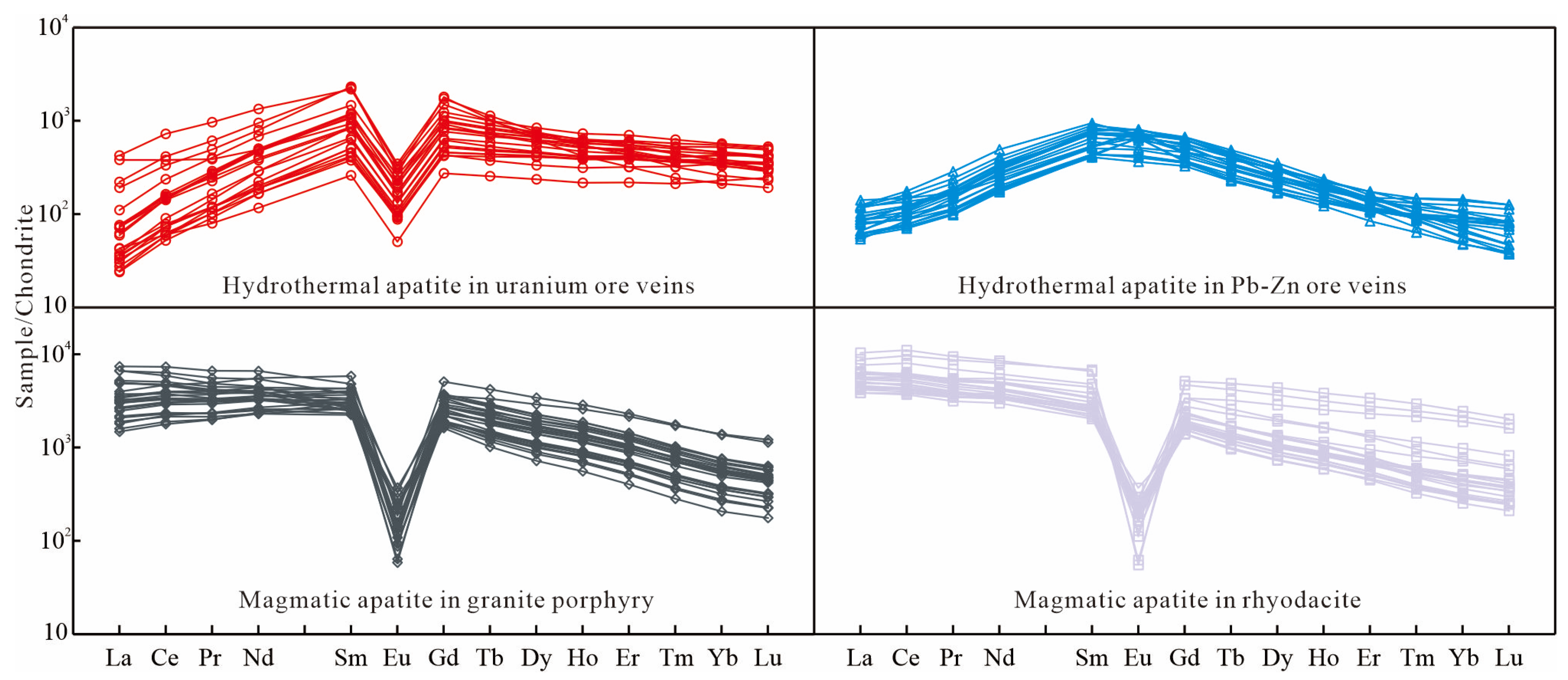
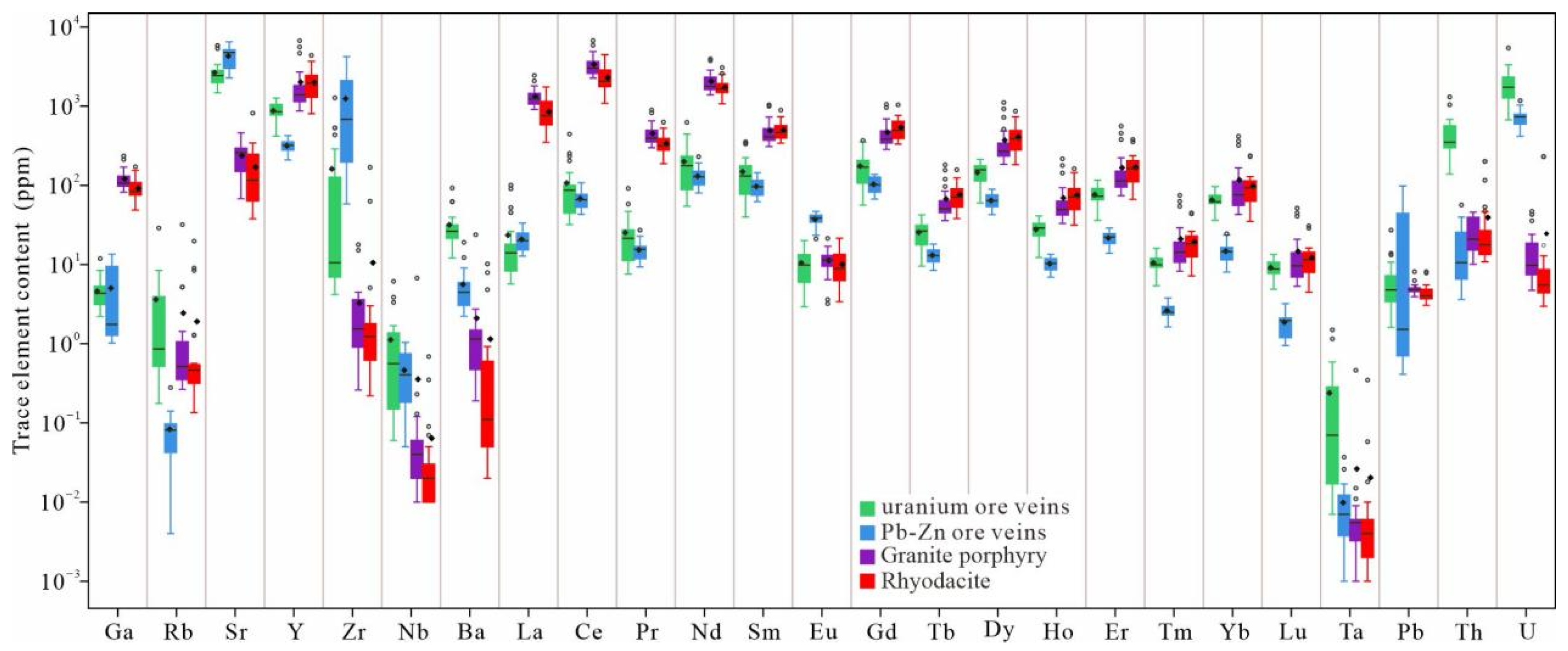
The trace element compositions of apatites, determined by LA-ICP-MS, are listed in Tables S5–S8. Hydrothermal apatites from uranium ore veins have total rare earth element (ΣREE) contents of 376–2318 ppm, light REE to heavy REE (LREE/HREE, Light Rare Earth Elements/Heavy Rare Earth Elements) ratios of 0.50–2.29, Eu anomalies (δEu) of 0.13–0.26, Ce anomalies (δCe) of 0.99–1.16, Th contents of 139–1307 ppm, U contents of 671–5433 ppm, and Th/U ratios of 0.11–0.43. Hydrothermal apatites from Pb-Zn ore veins exhibit ΣREE contents of 402–861 ppm, LREE/HREE ratios of 1.39–2.06, δEu values of 0.87–1.67, δCe values of 0.88–0.99, Th contents of 4–57 ppm, U contents of 416–1176 ppm, and Th/U ratios of 0.01–0.08.
Magmatic apatites from rhyodacite have relatively high ΣREE contents (5857–18,199 ppm), with LREE/HREE ratios of 3.71–9.25, δEu values of 0.01–0.22, δCe values of 1.04–1.12, Th contents of 10–46 ppm, U contents of 5–47 ppm, and Th/U ratios of 0.98–4.02. Magmatic apatites from granite porphyry show ΣREE contents of 4351–12,272 ppm, LREE/HREE ratios of 1.94–11.68, δEu values of 0.02–0.14, δCe values of 1.04–1.09, Th contents of 11–201 ppm, U contents of 3–232 ppm, and Th/U ratios of 0.87–6.61. These trace elements are clearly illustrated in the box plot (Figure 8).
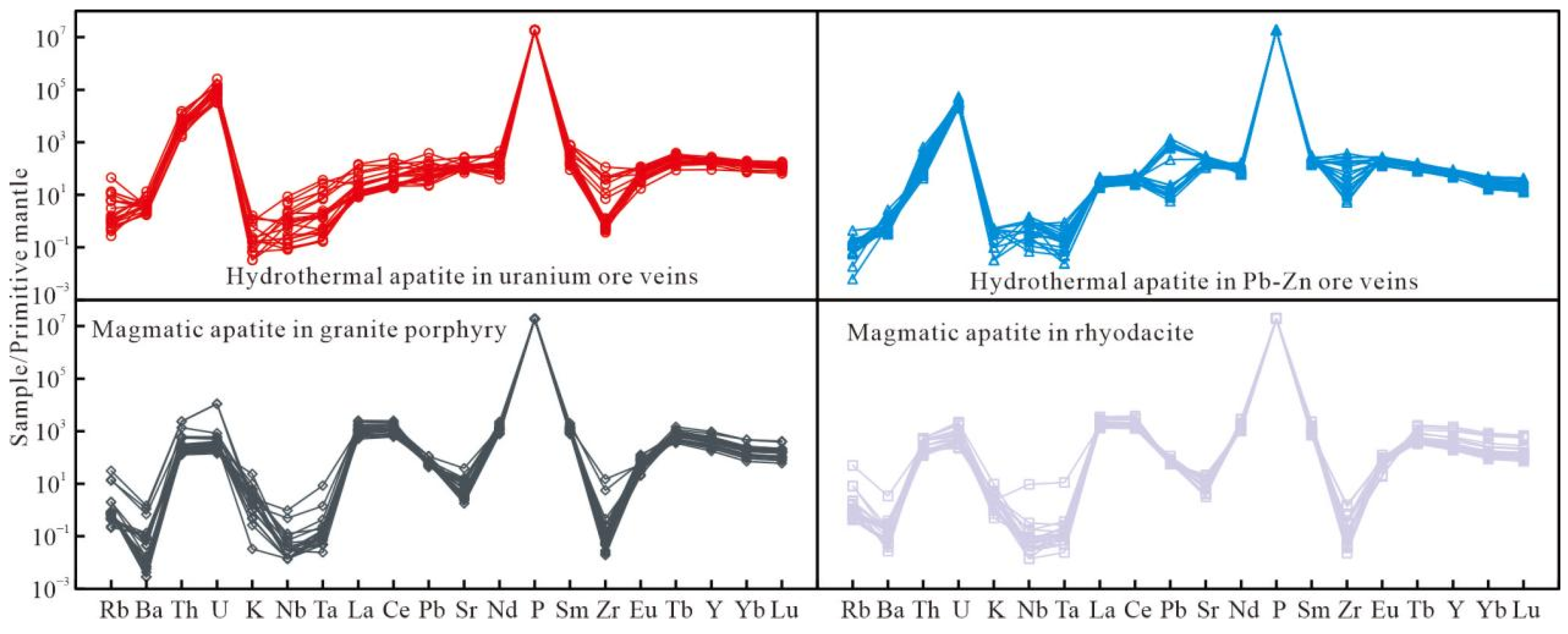
On the trace element spider diagrams and chondrite-normalized REE distribution patterns (Figure 9 and Figure 10), magmatic apatites from rhyodacite and granite porphyry display high compositional similarity to hydrothermal apatites from uranium and Pb-Zn ore veins. This similarity indicates that the geochemical characteristics of the hydrothermal apatites are derived from the same parent magma as the magmatic apatites, suggesting that the two types of apatites are comagmatic in origin [56].

5. Discussion

5.1. Timing of U-Pb-Zn Polymetallic Mineralization

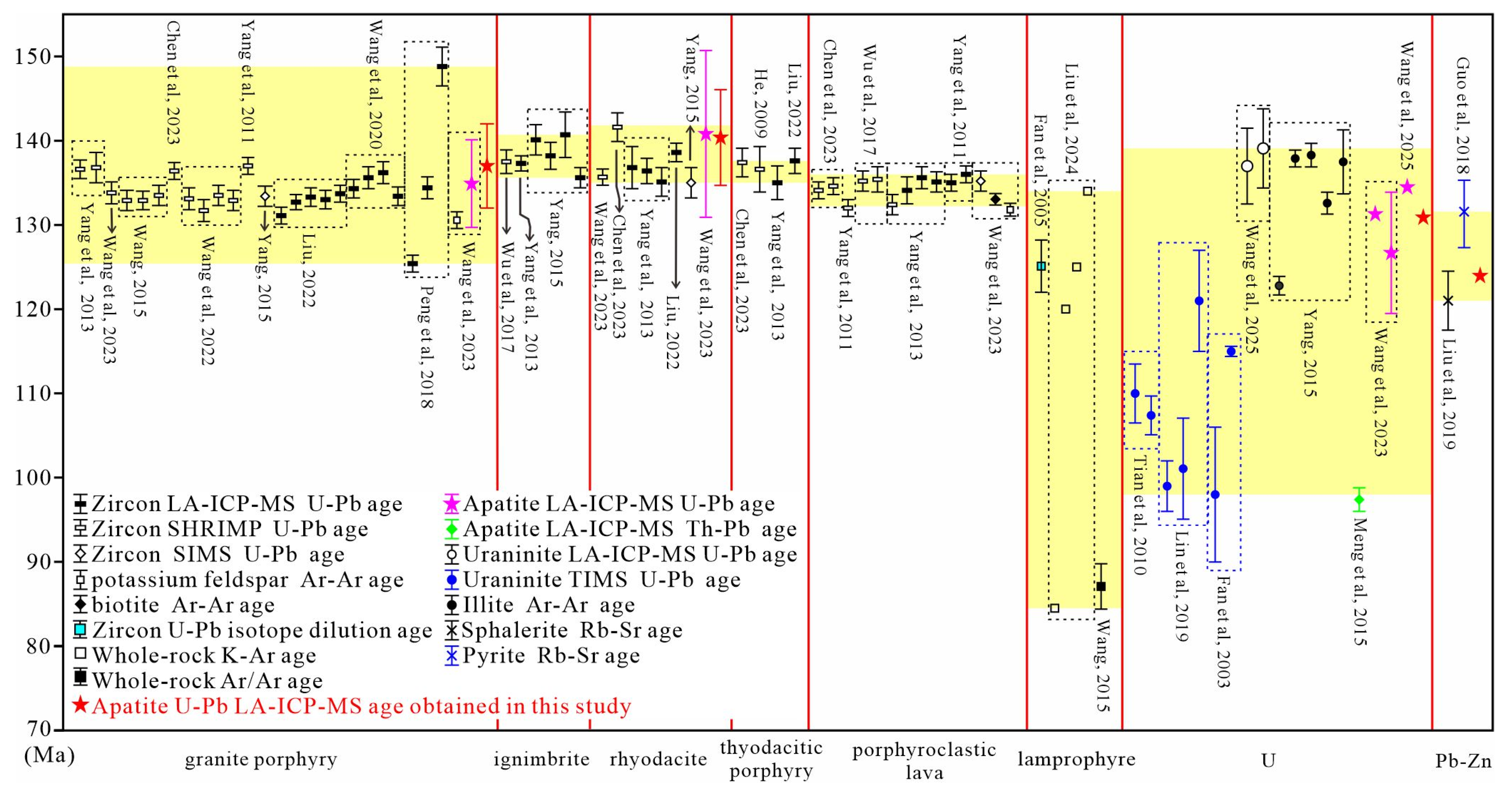
As illustrated in Figure 11, Early Cretaceous volcanic activity in the Xiangshan ore field, occurred as a continuous eruptive episode, initiating at ca. 141 Ma and terminating at ca. 132 Ma. The emplacement ages of the deep-seated granite porphyry can be divided into three distinct stages: 125 Ma, 133–137 Ma, and 148 Ma. This indicates that Yanshanian magmatic activity in the Xiangshan region persisted over a prolonged interval, providing favorable conditions for subsequent mineralization. The interval of 133–137 Ma corresponds to the peak period of magmatic activity, characterized by the largest magmatic volume.
In hydrothermal uranium deposits, pitchblende or uraninite, as the principal ore minerals, represent the most direct and reliable targets for geochronology, because their crystallization ages directly record the timing of uranium mineralization [75,76,77,78]. Numerous previous studies have attempted to constrain the mineralization age of the Xiangshan uranium deposit using U-Pb isotopic dating of uranium minerals [33,70,79,80]. However, due to the instability of the U-Pb isotopic system in uraninite [78] and its inherent compositional and textural features in the Xiangshan district, the model and conventional ages of uranium minerals from different orebodies show considerable heterogeneity, generally ranging from 120 Ma to 85 Ma (Figure 11). Two main factors account for this behavior: First, uraninite typically occurs as poorly crystalline aggregates composed of fine grains, and is commonly intergrown with Pb-bearing sulfides such as galena and pyrite, which severely hinders the separation of high-purity uraninite separates. Second, frequent and intense post-ore hydrothermal overprinting and tectonic activity prevented primary uranium minerals from remaining in a closed system after mineralization [26,37,81].
Uranium mineralization ages of 132.6 ± 1.3 Ma and 122.8 ± 1.1 Ma were obtained by 40Ar−39Ar dating of sericite closely associated with uranium minerals [82]. However, the extremely fine grain size and poor crystallinity of clay minerals [80], combined with multiple episodes of late thermal overprinting in Xiangshan, compromised the reliability of these results [83]. Zircon fission-track dating was applied to constrain post-volcanic intrusive thermal events, identifying four groups of metallogenic thermal event ages: 125.6–119.8 Ma, 113.8–106.1 Ma, 100.0–86.7 Ma, and 78.6–66.4 Ma [37]. Nevertheless, this method cannot easily distinguish the primary uranium mineralization age from other hydrothermal events, such as deep Pb-Zn mineralization [2].
For the age of deep Pb-Zn mineralization, Rb-Sr isochron dating was performed on pyrite associated with Pb-Zn polymetallic mineralization and yielded an age of 131.3 ± 4.0 Ma [74]. However, pyrite can form during pre-ore, syn-ore, and post-ore stages, and single grains commonly show multiple generations of overgrowth, making it difficult to confidently link this age to main-stage Pb-Zn mineralization. Rb-Sr isochron dating was also conducted on sphalerite from the same Pb-Zn polymetallic zone and obtained a mineralization age of 121.0 ± 3.5 Ma [73]. A significant discrepancy thus exists between these two age determinations.
Petrographic observations demonstrate that the hydrothermal apatites dated in this study co-precipitated with uranium minerals. Therefore, the LA-ICP-MS U-Pb ages of apatites can robustly constrain the timing of U-Pb-Zn polymetallic mineralization. Compared with the poorly crystalline, Pb-loss-prone uraninite in the Xiangshan ore field, apatites are much more resistant to resetting by subsequent low-temperature thermal events. Accordingly, apatite U-Pb geochronology provides a robust means to constrain the precise timing of U-Pb-Zn mineralization.
In this study, hydrothermal apatite veins from the Shannan uranium deposit yield a LA-ICP-MS U-Pb age of 130.9 ± 1.1 Ma. This age is consistent with the hydrothermal apatite U-Pb age of 131.3 ± 7.2 Ma for the Zoujiashan uranium deposit and coincides with the most intense phase of volcanic-intrusive activity (133–137 Ma) in the Xiangshan ore field [45]. However, significant differences exist in mineralization and alteration characteristics between the eastern and western deposits of the Xiangshan orefield [84,85]. Uranium deposits in the western part of the orefield, such as Zoujiashan, Shannan and Shazhou, are generally characterized by acidic mineralization assemblages including U-fluorite, U-hematite and U-chlorite types. In contrast, uranium deposits in the eastern part, such as Shazhou and Julong’an, typically develop alkaline mineralization assemblages including U-albite and U-calcite types. Therefore, the apatite age obtained in this study cannot represent the formation age of all uranium deposits in the Xiangshan orefield. Furthermore, Hydrothermal apatites from the Niutoushan Pb-Zn vein yield an age of 124.5 ± 1.3 Ma. This age is consistent with the 125.6 Ma thermal event identified by zircon fission-track dating [37] and the age of the youngest granite porphyry (125 Ma; [64]), thus representing the timing of Pb-Zn mineralization in the Xiangshan ore field.
Taken together, these apatite U-Pb ages support a two-stage metallogenic evolution for the Xiangshan ore field, with early uranium mineralization at ca. 131 Ma and subsequent Pb-Zn mineralization at ca. 124 Ma. Nevertheless, given the diversity of mineralization styles present in the ore field, the ages reported in this study do not fully capture the entire mineralization history. Establishing a comprehensive chronological framework for the different mineralization styles in the Xiangshan ore field will require future validation and supplementation using other isotopic systems.

5.2. Nature and Sources of Ore-Forming Fluids for U-Pb-Zn Polymetallic Mineralization

Apatite possesses a crystal structure with high capacity for incorporating a wide range of elements; its trace elements (e.g., Mn, Sr, Y, REE, U, Th) and halogens are therefore valuable tracers for deciphering magmatic-hydrothermal evolutionary processes [86,87]. Apatite formed by metasomatic or metamorphic processes typically exhibits low rare earth element (REE) contents, particularly for light rare earth elements (LREEs: La, Ce, Pr, Nd, Sm), which is attributed to dissolution and reprecipitation by hydrothermal fluids and melts [87,88].
In porphyry Cu deposits of British Columbia, Canada, and the Black Mountain deposit, Philippines, hydrothermal apatites display significantly lower concentrations of Mn, Na, Cl, and REEs compared to magmatic apatites. These elemental contents decrease further from the early potassic alteration stage to the late sericitic alteration stage [10,86]. For the Ningwu iron oxide-apatite (IOA)-type Fe deposit in Anhui Province, China, intense fluid alteration resulted in hydrothermal apatites having distinctly lower Cl, Mg, Na, S, Si, Th, U, and REE + Y contents relative to magmatic apatites [89]. In the Zhuxi skarn W deposit in Jiangxi Province, China, altered apatites are characterized by middle rare earth element (MREE) depletion, low Th/U ratios, and high Y/Ho ratios [90].
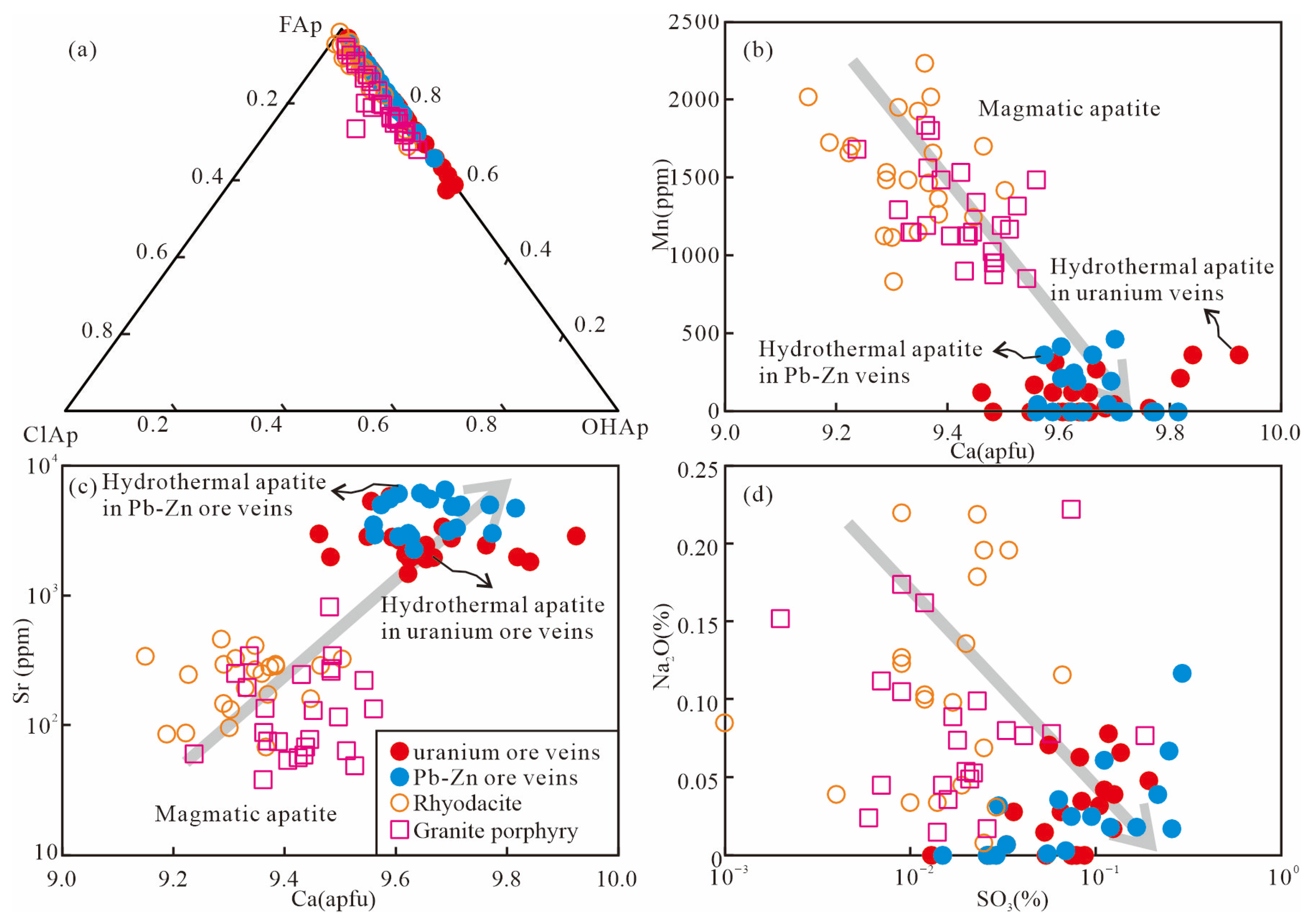
In the Xiangshan ore field, magmatic and hydrothermal apatites exhibit trace element characteristics analogous to those of the aforementioned deposits. Most trace element contents (e.g., Mn, Cl, ΣREE, Y, Ga, Ce, Ho, Th/U) are lower in hydrothermal apatites than in magmatic apatites. In contrast, Y/Ho ratios and contents of SO3, Ba, Nb, Sr, and U are relatively higher in hydrothermal apatites.
Magmatic and hydrothermal apatites in the Xiangshan ore field exhibit high-F characteristics (Figure 12a) and are classified as fluorapatite. Magmatic apatites contain relatively low but variable Cl contents, corresponding to a high-F, Cl-bearing type, whereas hydrothermal apatites have extremely low Cl contents, representing an F-rich, Cl-poor type. This feature indicates that both types of apatites originated from the same F-enriched parental magma source and share a genetic link [90,91]. The relatively higher Cl contents in magmatic apatites suggest their formation during the main magma crystallization stage, when Cl remained enriched in the melt and could be incorporated into early-crystallizing apatites. The wide range of Cl contents reflects heterogeneity in local Cl concentrations within the magma chamber [92]. In contrast, the extremely low Cl contents in hydrothermal apatites indicate precipitation from a system in which Cl had been strongly depleted or fractionated [93,94,95,96].
Additionally, hydrothermal apatites generally exhibit high Ca and Sr contents but relatively low Mn concentrations (Figure 12b,c). Apatites formed during metasomatic processes (e.g., late-stage fluid alteration in granites) typically display trace-element signatures characterized by low REEs, high Ca, F, and Sr [97]. Meanwhile, in hydrothermal systems, Mn may be preferentially partitioned into coexisting carbonate minerals, or its enrichment in newly formed apatites may be limited by the chemical nature of the fluid itself, resulting in lower Mn contents in hydrothermal apatites [98]. Integrating these features, the composition of Xiangshan hydrothermal apatites can be interpreted as the product of dissolution-reprecipitation of early magmatic apatites by Ca- and Sr-rich hydrothermal fluids: hydrothermal fluids derived from magmatic differentiation extracted Ca and Sr from wall rocks, and during reaction with early magmatic apatites, they removed elements such as Mn while incorporating Ca and Sr into the apatite crystal lattices, thus forming chemically purer apatites enriched in Ca and Sr.
Notably, hydrothermal apatites also exhibit relatively higher SO3 and lower Na2O contents (Figure 12d). The increase in SO3 may be related to elevated sulfate activity in the hydrothermal fluid, reflecting sulfur enrichment or increased oxidation state during the hydrothermal stage of magma evolution [99]. During metasomatic alteration of apatites, Na is preferentially removed from the apatite-fluid system [100]. These characteristics further support the interpretation that hydrothermal apatites are not independently formed phases, but instead represent the product of hydrothermal alteration of pre-existing magmatic apatites. Their high-F signature was inherited from the parental magma, whereas variations in SO3 and Na2O record the distinctive geochemical conditions of the hydrothermal environment.
Apatites in volcanic rocks from El Chichón (southern Mexico) and Pinatubo (Philippines) were studied, revealing that SO3 contents in apatites increase with increasing oxygen fugacity, ranging from 0.04 wt% under reducing conditions [FMQ, fayalite-magnetite-quartz] to 1–2.6 wt% under oxidizing conditions [MTH, magnetite-hematite] [101]. In the Xiangshan ore field, SO3 contents exhibit the clear increasing trend from magmatic apatites, through hydrothermal apatites in uranium ore veins, to hydrothermal apatites in Pb-Zn ore veins (Figure 12d).
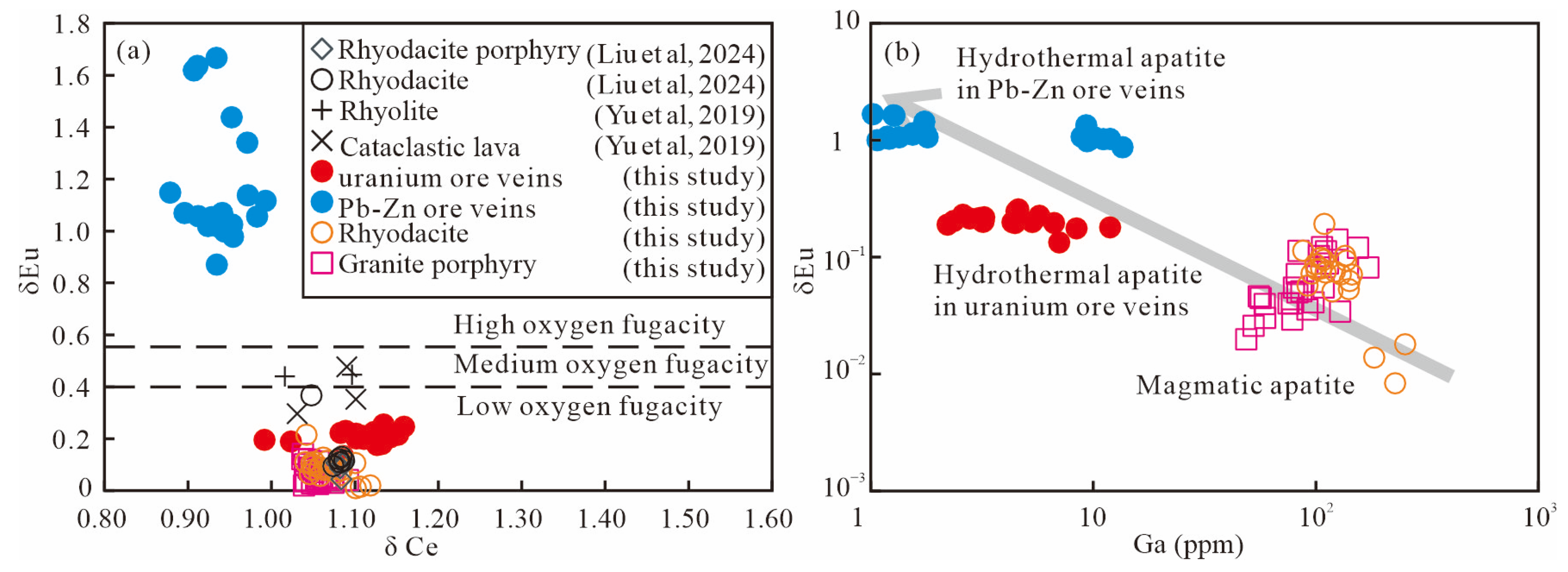
Due to factors such as ionic radius and valence state, Eu2+, Ce3+, Mn2+, and Ga2+ preferentially enter the apatite lattice [102]. Consequently, under identical temperature, pressure, and element concentration conditions in magma, apatite crystallizing from oxidized magma exhibits lower Mn and Ga contents, as well as positive Eu anomalies and negative Ce anomalies, compared to apatite crystallizing from reduced magma [12,103].
Magmatic apatites from both rhyodacite and granite porphyry in the Xiangshan ore field display strongly negative Eu anomalies (δEu = 0.01–0.22 and 0.02–0.14, respectively) and weakly positive Ce anomalies (δCe = 1.04–1.12 and 1.04–1.07, respectively). Hydrothermal apatites from uranium ore veins exhibit strongly negative Eu anomalies (δEu = 0.13–0.26) that are less pronounced than those of magmatic apatites, along with weakly positive Ce anomalies (δCe = 0.99–1.16), which are similar to those of magmatic apatites, indicating that hydrothermal apatites in uranium ore veins inherited the evolutionary characteristics of the host rocks.
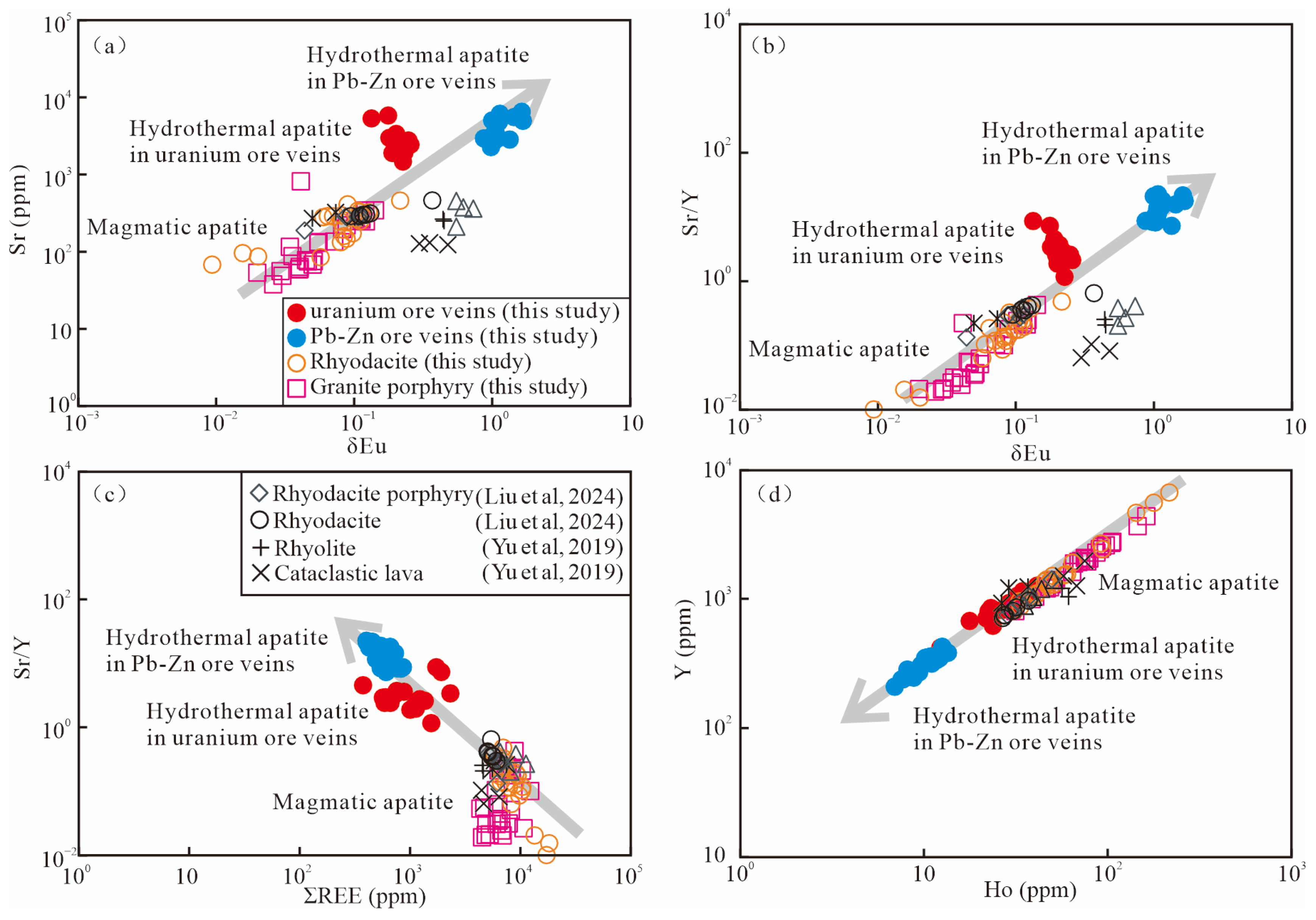
In contrast, apatites from Pb-Zn ore veins display weakly positive Eu anomalies (δEu = 0.87–1.67) and weakly negative Ce anomalies (δCe = 0.88–0.97), which are significantly different from the other apatite types. Magmatic and hydrothermal apatites exhibit a negative correlation in the δEu vs. δCe diagram (Figure 13a), suggesting a common origin for all four apatite types. The Pb-Zn mineralization likely formed under relatively high oxygen fugacity [12], which may indicate that late-stage hydrothermal fluids reacted with plagioclase to release Eu2+, or that ore-forming fluids mixed with meteoric water or formation water. Such fluids derived from wall rocks are typically oxidizing, leading to the oxidation of Eu2+ to Eu3+. As a result, the incorporation of Eu3+ into apatite increased, while Ce3+ contents decreased.
The Mn and Ga contents of hydrothermal apatites from Pb-Zn ore veins are lower than those of both hydrothermal apatites from uranium ore veins and magmatic apatites. Conversely, SO3 contents are progressively higher in hydrothermal apatites from Pb-Zn ore veins compared to that from uranium ore veins and magmatic apatites. This indicates that the oxygen fugacity of the fluid during the Pb-Zn mineralization stage was significantly higher than that during uranium mineralization and in the magma of the volcanic-intrusive complex.
In the major and trace element diagrams of apatites from the Xiangshan ore field (Mn vs. Ca (Figure 12b), Sr vs. Ca (Figure 12c), SO3 vs. Na2O (Figure 12d), Ga vs. δEu (Figure 13b), Sr vs. δEu (Figure 14a), Sr/Y vs. δEu (Figure 14b), Sr/Y vs. ΣREE (Figure 14c), Y vs. Ho (Figure 14d)), elemental contents exhibit clear correlations and staged evolutionary trends from magmatic apatites, through hydrothermal apatites in uranium ore veins, to hydrothermal apatites in Pb-Zn ore veins. This further confirms a common source for magmatic and hydrothermal apatites.
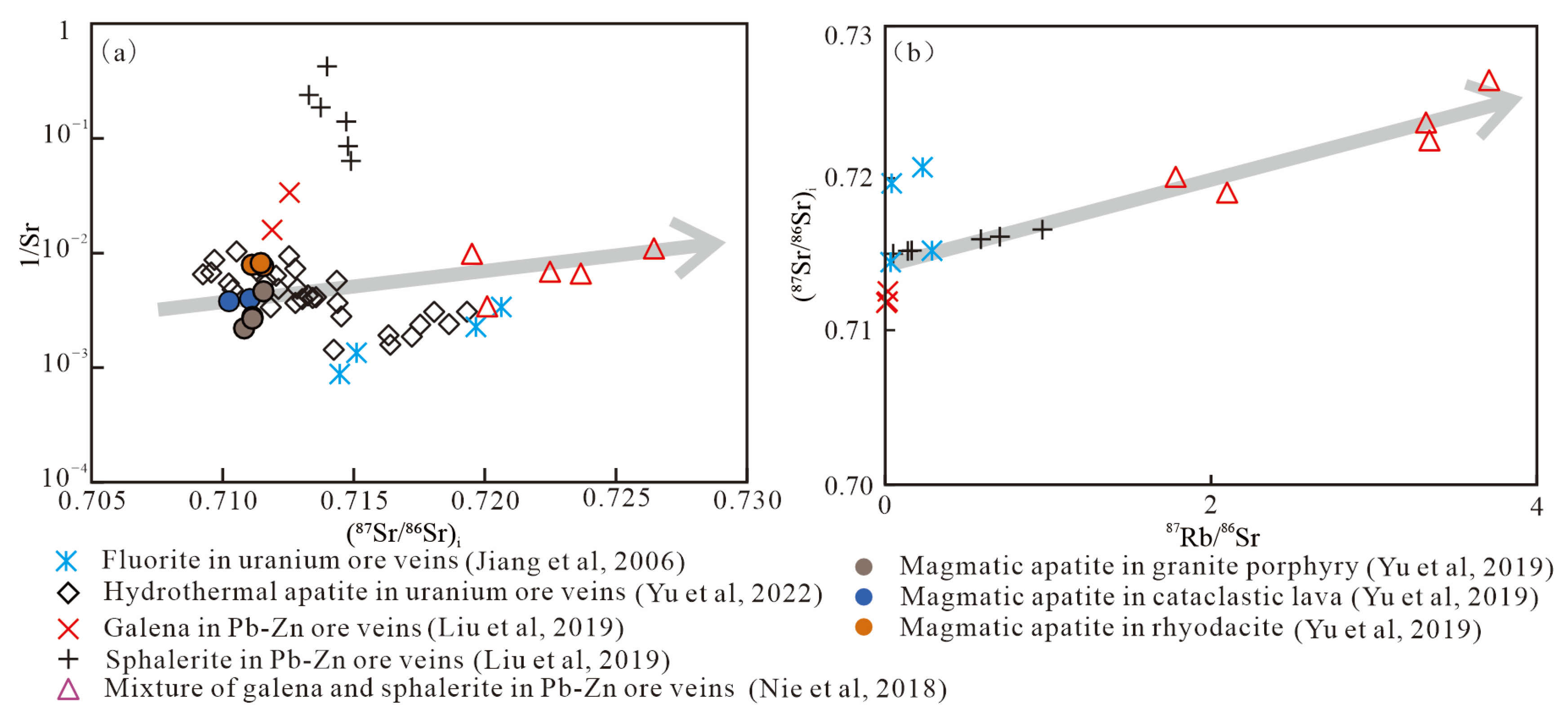
Based on the diagenetic and mineralization ages established in previous studies, this paper recalculates initial 87Sr/86Sr ratios ((87Sr/86Sr)i) based on the respective diagenetic and mineralization ages: 132 Ma for wall rocks, 130 Ma for uranium mineralization, and 124 Ma for Pb-Zn mineralization. Hydrothermal minerals associated with uranium mineralization, primarily hydrothermal apatite and fluorite, yield (87Sr/86Sr)i values ranging from 0.709246 to 0.719318 and 0.714461 to 0.720625, respectively [30,106]. This range shows substantial overlap with the Sr isotopic compositions of apatites from host volcanic-intrusive complex in the district, including rhyolite (0.710242–0.711037), granite porphyry (0.710822–0.711552), and porphyroclastic lava (0.711121–0.711546) [105]. This feature strongly indicates that Sr in uranium ore-forming fluids was primarily inherited from the host volcanic-intrusive rock system, suggesting a consanguineous relationship between ore-forming materials and wall rocks.
Samples related to Pb-Zn mineralization, including sphalerite, galena, and bulk Pb-Zn ores, exhibit higher and significantly more dispersed (87Sr/86Sr)i values. Sphalerite shows 87Sr/86Sr ratios between 0.713286 and 0.714895, galena between 0.711885 and 0.712550 [73], while bulk Pb-Zn ores reach even higher values of 0.719047 to 0.726448 [107]. These maximum values are notably higher than those of wall rocks and uranium mineralization samples. Furthermore, the wide range of Sr contents in Pb-Zn samples (2.35–291 ppm) suggests a non-uniform source for Pb-Zn ore-forming materials, possibly related to the incursion of radiogenic Sr-rich meteoric water during the late mineralization stage.
Correlations are observed among host volcanic-intrusive rocks and sulfides from uranium and Pb-Zn ores in (87Sr/86Sr)i vs. 1/Sr (Figure 15a) and 87Rb/86Sr vs. (87Sr/86Sr)i (Figure 15b) diagrams. This implies that both uranium and Pb-Zn mineralization were sourced from the deep-seated volcanic-intrusive complex, and the subsequent involvement of meteoric water altered the ore-forming environment of Pb-Zn deposits.
In addition, fine platy-columnar, subhedral to euhedral brannerite has been identified in the Pb-Zn ore veins at depths exceeding −600 m in the Xiangshan ore field. It occurs in association with galena, sphalerite, pyrite, and other sulfides, further indicating the deep-source consanguinity between uranium and Pb-Zn polymetallic mineralization.
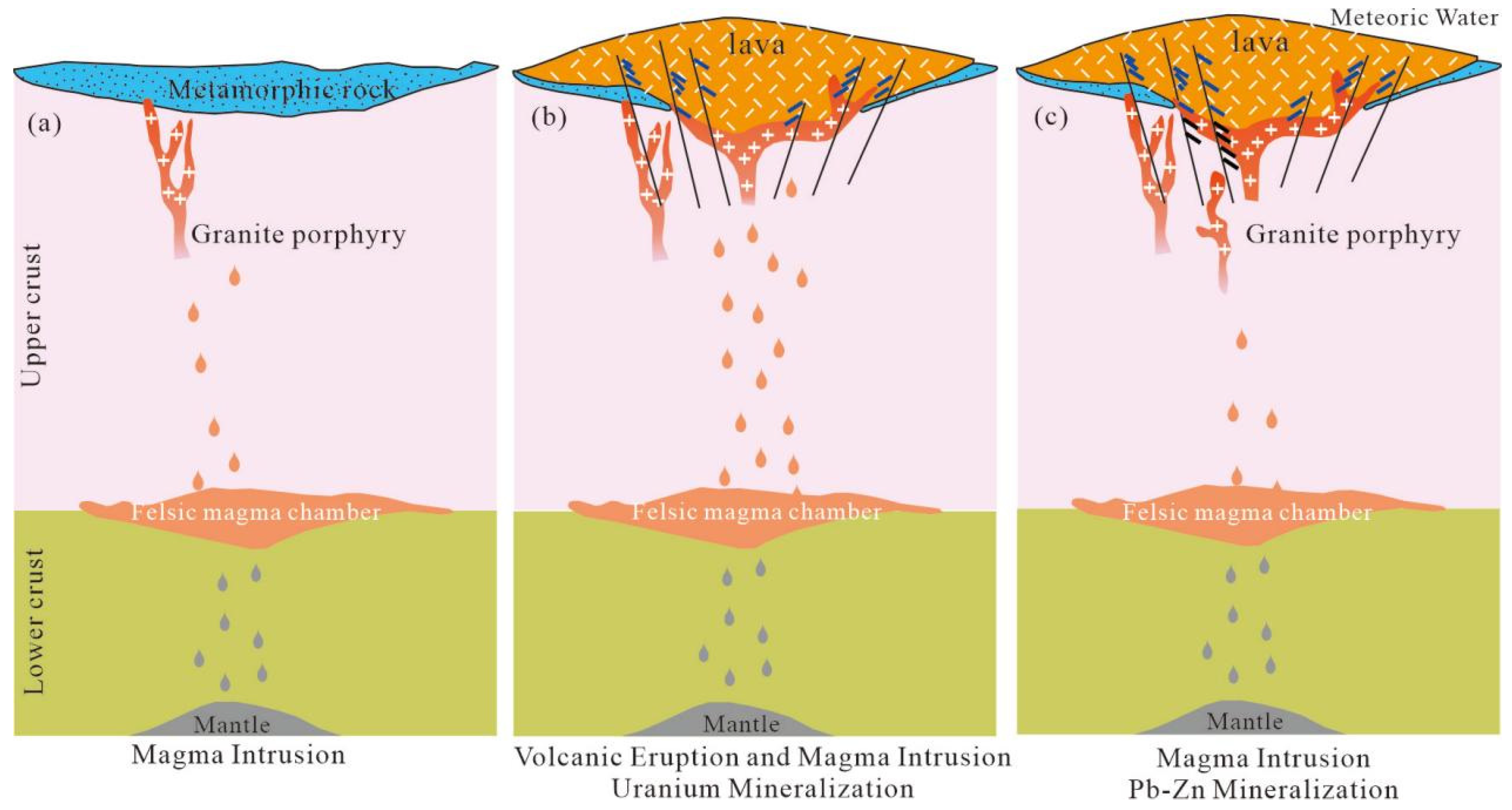
In summary, uranium and Pb-Zn mineralization in the Xiangshan ore field exhibits a clear two-stage temporal evolution, with ages concentrated at ca. 131 Ma and 124 Ma, respectively. The early stage was dominated by uranium mineralization, while the late stage evolved into Pb-Zn dominated mineralization. These mineralization ages are highly consistent with the timing of volcanic-intrusive activity in the Xiangshan ore field. The strong correlation in major and trace element variations between hydrothermal and magmatic apatites indicates that ore-forming materials for uranium and Pb-Zn were primarily derived from materials carried and enriched by granitic magmas of the deep-seated volcanic-intrusive complex during its prolonged evolution (Figure 16).

6. Conclusions

This study systematically integrated LA-ICP-MS U-Pb geochronology, EPMA major element analysis, and in situ trace element analysis to investigate magmatic and hydrothermal apatites from the Xiangshan ore field, South China. The results effectively resolve the long-standing controversy over the timing of U-Pb-Zn polymetallic mineralization and clarify the metallogenic processes, yielding the following key conclusions:
(1)
Precise geochronological constraints suggest a three-stage emplacement history of the volcanic-intrusive complex in the Xiangshan ore field: magmatic apatites from rhyodacite yield a crystallization age of 140.4 ± 7.6 Ma (MSWD = 1.3, n = 22), while those from granite porphyry give an age of 137.0 ± 5.0 Ma (MSWD = 1.1, n = 25), corresponding to the peak magmatic pulse (133–137 Ma). Hydrothermal apatites co-precipitated with uranium minerals in the Shannan deposit indicate the uranium mineralization age of 130.9 ± 1.1 Ma (MSWD = 1.6, n = 21), consistent with the previously reported apatite U-Pb age from the Zoujiashan uranium deposit. In contrast, hydrothermal apatites from the deep Niutoushan Pb-Zn deposit yield an inferred younger mineralization age of 124.5 ± 1.3 Ma (MSWD = 1.4, n = 20), which is synchronous with the 125.6 Ma zircon fission-track thermal event and the 125.4 ± 1.0 Ma age of late-stage granite porphyry, supporting a two-stage metallogenic evolution based on apatite U-Pb geochronology.
(2)
Geochemical inheritance and differentiation are evident between magmatic and hydrothermal apatites: both types are classified as fluorapatite and exhibit similar chondrite-normalized REE patterns, reflecting a common felsic parental magma source. Compared to magmatic apatites, hydrothermal apatites are characterized by elevated Ca, Sr, and U contents, depleted Mn, Na, and LREEs, and lower Th/U ratios, which result from dissolution-reprecipitation of magmatic apatites by hydrothermal fluids. Distinctly, apatites from uranium ore veins show strongly negative Eu anomalies (δEu = 0.13–0.26) and weakly positive Ce anomalies (δCe = 0.99–1.16), while those from Pb-Zn ore veins display positive Eu anomalies (δEu = 0.87–1.67) and weakly negative Ce anomalies (δCe = 0.88–0.99), coupled with higher SO3 contents and lower Mn and Ga contents, indicating significantly higher oxygen fugacity during Pb-Zn mineralization.
(3)
Ore-forming fluid evolution and material sources are constrained by Sr isotopes and elemental geochemistry: uranium mineralization fluids were primarily derived from magmatic differentiation, with Sr isotopic compositions ((87Sr/86Sr)i = 0.709246–0.719318) overlapping with those of the host volcanic-intrusive complex. In contrast, Pb-Zn mineralization fluids represent a mixture of magmatic fluids and meteoric water, as evidenced by more dispersed Sr isotopic ratios ((87Sr/86Sr)i = 0.711885–0.726448) and elevated radiogenic Sr contents. The progressive increase in SO3 and decrease in Cl and Mn from magmatic to hydrothermal apatites record the evolving physicochemical conditions of the ore-forming system.
This study demonstrates that apatite serves as a robust petrogenetic and metallogenic tracer, providing precise constraints on the timing, material sources, and fluid evolution of U-Pb-Zn polymetallic mineralization in volcanic-related ore fields. The established two-stage metallogenic model, featuring magmatic hydrothermal uranium mineralization followed by meteoric water-modified Pb-Zn mineralization, offers a valuable reference for exploring deep polymetallic resources in the Gan-Hang Metallogenic Belt and similar volcanic-intrusive complexes worldwide.

Supplementary Materials

The following supporting information can be downloaded at: https://www.mdpi.com/article/10.3390/min16040389/s1, Table S1: Electron Microprobe Analyses of hydrothermal apatites from uranium ore veins in the Xiangshan uranium ore field: Samples from Drillhole ZK71-2 in the Shannan deposit (wt%); Table S2: Electron Microprobe Analyses of hydrothermal apatites from Pb-Zn ore veins in the Xiangshan uranium ore field: Samples from Drillhole ZK26-11-118 in the Niutoushan deposit (wt%); Table S3: Electron Microprobe Analyses of magmatic apatites from rhyodacite in the Xiangshan uranium ore field: Samples from surface and underground drifts in the Shannan uranium deposit (wt%); Table S4: Electron Microprobe Analyses of magmatic apatites from granite porphyry in the Xiangshan uranium ore field: Samples from surface and underground drifts in the Shannan uranium deposit (wt%); Table S5: LA-ICP-MS trace element data for hydrothermal apatites from uranium ore in Xiangshan uranium ore field: Samples from Drillhole ZK71-2 in the Shannan deposit (ppm); Table S6: LA-ICP-MS trace element data for hydrothermal apatites from Pb-Zn ore in Xiangshan uranium ore field: Samples from Drillhole ZK26-11-118 in the Niutoushan deposit (ppm); Table S7: LA-ICP-MS trace element data for magmatic apatites from rhyodacite in Xiangshan uranium ore field: Samples from surface and underground drifts in the Shannan uranium deposit (ppm); Table S8: LA-ICP-MS trace element data for magmatic apatites from granite porphyry in Xiangshan uranium ore field: Samples from surface and underground drifts in the Shannan uranium deposit (ppm); Table S9: LA-ICP-MS U-Pb isotopic compositions of hydrothermal apatites from uranium ore veins in the Xiangshan uranium ore field: Samples from Drillhole ZK71-2 in the Shannan deposit; Table S10: LA-ICP-MS U-Pb isotopic compositions of hydrothermal apatites from Pb-Zn ore veins in the Xiangshan uranium ore field: Samples from Drillhole ZK26-11-118 in the Niutoushan deposit; Table S11: LA-ICP-MS U-Pb isotopic compositions of magmatic apatites from rhyodacite in the Xiangshan uranium ore field: Samples from surface and underground drifts in the Shannan uranium deposit; Table S12: LA-ICP-MS U-Pb isotopic compositions of magmatic apatites from granite porphyry in the Xiangshan uranium ore field: Samples from surface and underground drifts in the Shannan uranium deposit.

Author Contributions

Conceptualization, Q.Y.; Methodology, Q.Y.; Software, H.J.; Investigation, Y.Y.; Resources, F.G. and Y.W.; Data curation, Y.L. and Y.Y.; Writing—original draft, Q.Y. and Y.L.; Visualization, Y.L. and H.J.; Supervision, F.G.; Project administration, F.G.; Funding acquisition, Y.W. All authors have read and agreed to the published version of the manuscript.

Funding

This research was supported by the National Natural Science Foundation of China (No. 42472130), Major Project of Natural Science Foundation of Jiangxi Province (No. 20242BAB27002), and Scientific Research Development Foundation Project of East China University of Technology (Nos. K20240017, K20240018).

Data Availability Statement

The original contributions presented in this study are included in the article/Supplementary Material. Further inquiries can be directed to the corresponding authors.

Conflicts of Interest

The authors declare no conflict of interest.

References

  1. Barnes, H.L. Geochemistry of Hydrothermal Ore Deposits; John Wiley & Sons: Hoboken, NJ, USA, 1997. [Google Scholar]
  2. Guo, G.L.; Bonnetti, C.; Zhang, Z.S.; Li, G.L.; Yan, Z.B.; Wu, J.H.; Wu, Y.; Liu, X.D.; Wu, B. SIMS U-Pb Dating of Uraninite from the Guangshigou Uranium Deposit: Constraints on the Paleozoic Pegmatite-Type Uranium Mineralization in North Qinling Orogen, China. Minerals 2021, 11, 402. [Google Scholar] [CrossRef]
  3. Ren, Y.S.; Yang, X.Y.; Wang, G.J. Study on the complex magmatic and hydrothermal metallogenic processes in the giant Huayangchuan uranium (U)-polymetallic ore district: Constraints from geochemical and geochronological evidences. Ore Geol. Rev. 2023, 163, 105724. [Google Scholar] [CrossRef]
  4. Chen, Y.; Li, J.G.; Miao, P.S.; Chen, L.L.; Zhao, H.L.; Wang, C.; Yang, J. Relationship between the tectono-thermal events and sandstone-type uranium mineralization in the southwestern Ordos Basin, Northern China: Insights from apatite and zircon fission track analyses. Ore Geol. Rev. 2022, 143, 104792. [Google Scholar] [CrossRef]
  5. Osterhus, L.; Jung, S.; Berndt, J.; Hauff, F. Geochronology, geochemistry and Nd, Sr and Pb isotopes of syn-orogenic granodiorites and granites (Damara orogen, Namibia)—Arc-related plutonism or melting of mafic crustal sources? Lithos 2014, 200–201, 386–401. [Google Scholar] [CrossRef]
  6. Fan, H.H.; Chen, J.Y.; Wang, S.; Wang, S.Y.; Zhao, J.Y.; Gu, D.Z.; Meng, Y.N. Genesis and Uranium Sources of Leucogranite-hosted Uranium Deposits in the Gaudeanmus Area, Central Damara Belt, Namibia: Study of Element and Nd Isotope Geochemistry. Acta Geol. Sin.-Engl. Ed. 2017, 91, 2126–2137. [Google Scholar] [CrossRef]
  7. Hall, S.M.; Beard, J.S.; Bodnar, R.J.; Neymark, L.A.; Paces, J.B.; Johnson, C.A.; Breit, G.N.; Zielinski, R.A.; Aylor, G.J., Jr. The Coles Hill uranium deposit, Virginia, USA: Geology, geochemistry, and genetic model. Econ. Geol. 2022, 117, 273–302. [Google Scholar] [CrossRef]
  8. Krneta, S.; Ciobanu, C.L.; Cook, N.J.; Ehrig, K.; Kontonikas−Charos, A. Apatite at Olympic Dam, South Australia: A petrogenetic tool. Lithos 2016, 262, 470–485. [Google Scholar] [CrossRef]
  9. Fan, M.S.; Pan, J.Y.; Ni, P.; Wu, X.W.; Yuan, Q.Y.; Lin, Y.H.; Dou, H.R.; Li, Z.H.; Chi, Z.; Cheng, Z.L.; et al. Newly recognized Jurassic magmatic-hydrothermal gold mineralization at Wangmushan, South China: Geochronological and geochemical constraints. Ore Geol. Rev. 2026, 191, 107189. [Google Scholar] [CrossRef]
  10. Bouzari, F.; Hart, C.J.R.; Bissig, T.; Barker, S. Hydrothermal alteration revealed by apatite luminescence and chemistry: A potential indicator mineral for exploring covered porphyry copper deposits. Econ. Geol. 2016, 111, 1397–1410. [Google Scholar] [CrossRef]
  11. Kharkongor, M.; Glorie, S.; Abersteiner, A.; Dare, S.; Kirkland, C.; Chew, D.; Mulde, J.; Gilbert, S. Apatite in situ Lu-Hf and U-Pb geochronology in layered mafic intrusions. Geochim. Cosmochim. Acta 2025, 404, 234–256. [Google Scholar] [CrossRef]
  12. Pan, L.C.; Hu, R.Z.; Wang, X.S.; Bi, X.W.; Zhu, J.J.; Li, C. Apatite trace element and halogen compositions as petrogenetic-metallogenic indicators: Examples from four granite plutons in the Sanjiang region, SW China. Lithos 2016, 254–255, 118–130. [Google Scholar] [CrossRef]
  13. Chew, D.M.; Spikings, R.A. Geochronology and Thermochronology Using Apatite: Time and Temperature, Lower Crust to Surface. Elements 2015, 11, 189–194. [Google Scholar] [CrossRef]
  14. Chen, H.J.; Sun, X.M.; Li, D.F.; Yin, R.; Tong, Z.D.; Wu, Z.W.; Fu, Y.; Liu, Q.F.; Chen, X.; Yi, J.Z.; et al. In situ apatite U-Pb dating for the ophiolite-hosted Nianzha orogenic gold deposit, Southern Tibet. Ore Geol. Rev. 2022, 144, 104811. [Google Scholar] [CrossRef]
  15. Amelin, Y.; Lee, D.; Halliday, A.; Pidgeon, R. Nature of the Earth’s earliest crust from hafnium isotopes in single detrital zircons. Nature 1999, 399, 252–255. [Google Scholar] [CrossRef]
  16. OECD/NEA-IAEA. Uranium 2024: Resources, Production and Demand. In OECD NEA-IAEA Report; OECD Publishing: Paris, France, 2025. [Google Scholar]
  17. Cai, Y.Q.; Zhang, J.D.; Li, Z.Y.; Guo, Q.Y.; Song, J.Y.; Fan, H.H.; Liu, W.S.; Qi, F.C.; Zhang, M.L. Outline of Uranium Resources Characteristics and Metallogenetic Regularity in China. Acta Geol. Sin. 2015, 89, 1051–1069, (In Chinese with English abstract). [Google Scholar]
  18. Zhang, C.; Cai, Y.Q.; Dong, Q.; Xu, H. Cretaceous-Neogene basin control on the formation of uranium deposits in South China: Evidence from geology, mineralization ages, and H-O isotopes. Int. Geol. Rev. 2020, 62, 263–310. [Google Scholar] [CrossRef]
  19. Zhou, X.M.; Sun, T.; Shen, W.Z.; Shu, L.S.; Niu, Y.L. Petrogenesis of Mesozoic granitoids and volcanic rocks in South China: A response to tectonic evolution. Episodes 2006, 29, 26–33. [Google Scholar] [CrossRef]
  20. Yang, S.Y.; Jiang, S.Y.; Jiang, Y.H.; Zhao, K.D.; Fan, H.H. Geochemical, zircon U-Pb dating and Sr-Nd-Hf isotopic constraints on the age and petrogenesis of an Early Cretaceous volcanic-intrusive complex at Xiangshan, Southeast China. Mineral. Petrol. 2011, 101, 21–48. [Google Scholar] [CrossRef]
  21. Yang, S.Y.; Jiang, S.Y.; Zhao, K.D.; Jing, Y.H.; Ling, H.F.; Luo, L. Geochronology, geochemistry and tectonic significance of two Early Cretaceous A-type granites in the Gan-Hang Belt, Southeast China. Lithos 2012, 150, 155–170. [Google Scholar] [CrossRef]
  22. Yu, X.Q.; Wu, G.G.; Shu, L.S.; Yan, T.Z.; Zhang, D.; Di, Y.J. The cretaceous tectonism of the Gan-Hang Tectonic Belt, southeastern China. Earth Sci. Front. 2006, 13, 31–43, (In Chinese with English abstract). [Google Scholar]
  23. Mao, J.W.; Pirajno, F.; Cook, N. Mesozoic metallogeny in East China and corresponding geodynamic settings-an introduction to the special issue. Ore Geol. Rev. 2011, 43, 1–7. [Google Scholar] [CrossRef]
  24. Qin, K.Z.; Zhai, M.G.; Li, G.M.; Zhao, J.X.; Zeng, Q.D.; Gao, J.; Xiao, W.J.; Li, J.L.; Sun, S. Links of collage orogenesis of multiblocks and crust evolution to characteristic metallogeneses in China. Acta Petrol. Sin. 2017, 33, 305–325, (In Chinese with English abstract). [Google Scholar]
  25. Qin, K.Z.; Zhao, J.X.; He, C.T.; Shi, R.Z. Discovery of the Qongjiagang giant lithium pegmatite deposit in the Himalaya, Tibet, China. Acta Petrol. Sin. 2021, 37, 3277–3286, (In Chinese with English abstract). [Google Scholar]
  26. Gilder, S.A.; Gill, J.; Coe, R.S.; Zhao, X.; Liu, Z.; Wang, G.; Yuan, K.; Liu, W.; Kuang, G.; Wu, H. Isotopic and paleomagnetic constraints on the Mesozoic tectonic evolution of South China. J. Geophys. Res. Solid Earth 1996, 101, 16137–16154. [Google Scholar] [CrossRef]
  27. Chen, Z.L.; Han, F.S.; Yang, N.; Wang, Y. Topographic erosive diversities of the Xiangshan uranium orefield and its implications for preservation: Evidence from fission track dating of apatite. Chin. J. Geophys. 2012, 55, 2371–2384, (In Chinese with English abstract). [Google Scholar]
  28. Wang, Y.J.; Nie, J.T.; Lin, J.R.; Wang, H.Z. Geochronology and geochemistry of the felsic-intermediate dikes from Xiangshan uranium ore field, South China: Implications for petrogenesis, tectonic setting and uranium mineralization. Mineral. Petrol. 2022, 116, 287–310. [Google Scholar] [CrossRef]
  29. Hu, G.R.; Zhang, B.Y.; Yu, R.L. A study on Sm-Nd and Rb-Sr isochron ages of the Central Jiangxi Metamorphic Belt. Geol. Rev. 1999, 45, 129–134, (In Chinese with English abstract). [Google Scholar]
  30. Jiang, Y.H.; Ling, H.F.; Jiang, S.Y.; Shen, W.Z.; Fan, H.H.; Ni, P. Trace element and Sr-Nd isotope geochemistry of fluorite from the Xiangshan uranium deposit, Southeast China. Econ. Geol. 2006, 101, 1613–1622. [Google Scholar] [CrossRef]
  31. Hu, R.Z.; Burnard, P.G.; Bi, X.W.; Zhou, M.F.; Peng, J.T.; Su, W.C.; Zhao, J.H. Mantle-derived gaseous components in ore-forming fluids of the Xiangshan uranium deposit, Jiangxi Province, China: Evidence from He, Ar and C isotopes. Chem. Geol. 2009, 266, 86–95. [Google Scholar] [CrossRef]
  32. Guo, F.S.; Li, Z.H.; Deng, T.; Qu, M.M.; Zhou, W.P.; Huang, Q.Y.; Shang, P.; Zhang, C.Y.; Yan, Z.B. Key factors controlling volcanic-related uranium mineralization in the Xiangshan basin, Jiangxi Province, South China: A review. Ore Geol. Rev. 2020, 122, 103517. [Google Scholar] [CrossRef]
  33. Bonnetti, C.; Liu, X.D.; Cuney, M.; Mercadier, J.; Riegler, T.; Yu, C. Evolution of the uranium mineralisation in the Zoujiashan deposit, Xiangshan ore field: Implications for the genesis of volcanic-related hydrothermal U deposits in South China. Ore Geol. Rev. 2020, 122, 103514. [Google Scholar] [CrossRef]
  34. Qiu, A.J. Tectonic-magmatic evolution of Xiangshan in Jiangxi and the formation of rich uranium deposits. Geol. Rev. 1999, 45, 761–762, (In Chinese with English abstract). [Google Scholar]
  35. Deng, J.; Yu, H.; Chen, H.; Du, Z.; Yang, H.; Li, H.; Guo, F. Ore-controlling structures of the Xiangshan volcanic basin, SE China: Revealed from three-dimensional inversion of magnetotelluric data. Ore Geol. Rev. 2020, 127, 103807. [Google Scholar] [CrossRef]
  36. Yu, H.; Deng, J.; Tang, B.; Egbert, G.; Chen, H. Electrical image of magmatic system beneath the Xiangshan volcanogenic uranium deposit, Southeast China: Linking magmatic evolution and uranium metallogenesis. Geology 2023, 51, 870–874. [Google Scholar] [CrossRef]
  37. Lin, J.R.; Hu, Z.H.; Wang, Y.J.; Zhang, S.; Tao, Y. Ore-forming age and thermal history of uranium-polymetallic mineralization at Xiangshan uranium orefield. Acta Petrol. Sin. 2019, 35, 193–198, (In Chinese with English abstract). [Google Scholar]
  38. CNG (China Nuclear Geology); BRIUG (Beijing Research Institute of Uranium Geology). The Research and Evaluation of the Volcanic-Related Uranium Deposits in China; China National Nuclear Corporation: Beijing, China, 2010; pp. 814–935. (In Chinese) [Google Scholar]
  39. Thomson, S.N.; Gehrels, G.E.; Ruiz, J.; Buchwaldt, R. Routine low-damage apatite U-Pb dating using laser ablation multicollector ICPMS. Geochem. Geophys. Geosyst. 2012, 13, Q0AA21. [Google Scholar] [CrossRef]
  40. Cochrane, R.; Spikings, R.A.; Chew, D.; Wotzlaw, J.F.; Chiaradia, M.; Tyrrell, S.; Van der Lelij, R. High temperature (>350℃) thermochronology and mechanisms of Pb loss in apatite. Geochim. Cosmochim. Acta 2014, 127, 39–56. [Google Scholar] [CrossRef]
  41. Barfod, G.H.; Krogstad, E.J.; Frei, R.; Albarède, F. Lu-Hf and PbSL geochronology of apatites from Proterozoic terranes: A first look at Lu-Hf isotopic closure in metamorphic apatite. Geochim. Cosmochim. Acta 2005, 69, 1847–1859. [Google Scholar] [CrossRef]
  42. Chew, D.M.; Petrus, J.A.; Kamber, B.S. U-Pb LA-ICP-MS dating using accessory mineral standards with variable common Pb. Chem. Geol. 2014, 363, 185–199. [Google Scholar] [CrossRef]
  43. Thompson, J.; Meffre, S.; Maas, R.; Kamenetsky, V.; Kamenetsky, M.; Goemann, K.; Ehrig, K.; Danyushevsky, L. Matrix effects in Pb/U measurements during LA-ICP-MS analysis of the mineral apatite. J. Anal. At. Spectrom. 2016, 31, 1206–1215. [Google Scholar] [CrossRef]
  44. Li, W.; Xie, G.Q.; Mao, J.W.; Cook, N.J.; Wei, H.T.; Ji, Y.H.; Fu, B. Precise age constraints for the Woxi Au-Sb-W deposit, South China. Econ. Geol. 2023, 118, 509–518. [Google Scholar] [CrossRef]
  45. Wang, Y.J.; Fan, H.H.; Qin, K.Z.; Evans, N.J.; Zhang, C.; Zou, X.Y.; Pang, Y.Q.; Zhang, H. Mineralization age of the Xiangshan uranium ore field, South China redefined by hydrothermal apatite U-Pb geochronology. Ore Geol. Rev. 2023, 160, 105586. [Google Scholar] [CrossRef]
  46. Meffre, S.; Large, R.R.; Scott, R.; Woodhead, J.; Chang, Z.S.; Gilbert, S.E.; Danyushevsky, L.V.; Maslennikov, V.; Hergt, J.M. Age and pyrite Pb-isotopic composition of the giant Sukhoi Log sediment-hosted gold deposit, Russia. Geochim. Cosmochim. Acta 2008, 72, 2377–2391. [Google Scholar] [CrossRef]
  47. Liu, G.Q.; Zhao, K.D.; Ulrich, T.; Chen, W.; Zhang, D.; Li, Q.; Zhao, H.D.; Zhang, R.Q.; Xia, F. Isoclock: A free and novel routine for common Pb correction in U-Th-Pb data reduction of LA-ICP-MS analysis. J. Anal. At. Spectrom. 2023, 38, 2007–2018. [Google Scholar] [CrossRef]
  48. Yang, S.Y.; Jiang, S.Y.; Mao, Q.; Chen, Z.Y.; Rao, C.; Li, X.L.; Li, W.C.; Yang, W.Q.; He, P.L.; Li, X. Electron Probe Microanalysis in Geosciences: Analytical Procedures and Recent Advances. At. Spectrosc. 2022, 43, 186–200. [Google Scholar] [CrossRef]
  49. Decrée, S.; Savolainen, M.; Mercadier, J.; Debaille, V.; Höhn, S.; Frimmel, H.; Baele, J.M. Geochemical and spectroscopic investigation of apatite in the Siilinjärvi carbonatite complex: Keys to understanding apatite forming processes and assessing potential for rare earth elements. Appl. Geochem. 2021, 123, 104778. [Google Scholar] [CrossRef]
  50. Liu, Y.S.; Hu, Z.C.; Gao, S.; Gunther, D.; Xu, J.; Gao, C.G.; Chen, H.H. In situ analysis of major and trace elements of anhydrous minerals by LA-ICP-MS without applying an internal standard. Chem. Geol. 2008, 257, 34–43. [Google Scholar] [CrossRef]
  51. Abdel Gawad, A.E.; Skublov, S.G.; Levashova, E.V.; Ghoneim, M.M. Geochemistry and U–Pb age dating of zircon as a petrogenetic tool for magmatic and hydrothermal processes in Wadi Ras Abda syenogranite, Eastern Desert, Egypt. Arab. J. Sci. Eng. 2022, 47, 7351–7365. [Google Scholar] [CrossRef]
  52. DeCelles, P.G. Late Jurassic to Eocene evolution of the Cordilleran thrust belt and foreland basin system, western U.S.A. Am. J. Sci. 2004, 304, 105–168. [Google Scholar] [CrossRef]
  53. Gehrels, G.; Rusmore, M.; Woodsworth, G.; Crawford, M.; Andronicos, C.; Hollister, L.; Patchett, J.; Ducea, M.; Butler, R.; Klepeis, K.; et al. U-Th-Pb geochronology of the Coast Mountains batholith in north-coastal British Columbia: Constraints on age and tectonic evolution. Geol. Soc. Am. Bull. 2009, 121, 1341–1361. [Google Scholar] [CrossRef]
  54. Liu, L.; Yang, J.H.; Kang, L.F.; Zhong, H.; Zhang, X.C. The long-lived transcrustal magmatic systems of Southeast China in response to paleo-Pacific plate subduction, recorded by the Cretaceous volcanic sequences in southeastern Zhejiang Province. Geol. Soc. Am. Bull. 2023, 135, 1091–1108. [Google Scholar] [CrossRef]
  55. Zhou, Z.H.; Meng, Q.R.; Zhu, R.X.; Wang, M. Spatiotemporal evolution of the Jehol Biota: Responses to the North China craton destruction in the Early Cretaceous. Proc. Natl. Acad. Sci. USA 2021, 118, e2107859118. [Google Scholar] [CrossRef]
  56. Qu, H.Y.; Rowland, J.; Mao, J.W.; Belousov, I.; Orovan, E.; Rowe, M.; Zhong, S.H.; Wang, Y.T. Geochronology and mineral geochemistry of apatite and zircon in the Hutouya Skarn deposit, East Kunlun Mountains, NW China. Miner. Petrol. 2026, 181, 18. [Google Scholar] [CrossRef]
  57. Sun, S.-s.; McDonough, W.F. Chemical and isotopic systematics of oceanic basalts: Implications for mantle composition and processes. Geol. Soc. Lond. Spec. Publ. 1989, 42, 313–345. [Google Scholar] [CrossRef]
  58. Yang, S.Y.; Jiang, S.Y.; Zhao, K.D.; Jiang, Y.H.; Ling, H.F.; Chen, P.R. Timing and geological implications of volcanic rocks from the Ruyiting section, Xiangshan uranium ore field, Jiangxi Province, SE China. Acta Petrol. Sin. 2013, 29, 4362–4372, (In Chinese with English abstract). [Google Scholar]
  59. Wang, Y.J. Characteristics of Xiangshan Granite Porphyry and Intermediate-Mafic Dikes and Their Relationship with Uranium Mineralization. Master’s Thesis, Beijing Research Institute of Uranium Geology, Beijing, China, 2015. (In Chinese) [Google Scholar]
  60. Chen, Z.L.; Wang, Y.; Zhou, Y.G.; Han, F.B.; Wang, P.A.; Gong, H.L.; Shao, F.; Tang, X.S.; Xu, J.S. SHRIMP U-Pb dating of zircons from volcanic-intrusive complexes in the Xiangshan uranium orefield, Jiangxi Province, and its geological implications. Geol. China 2013, 40, 217–231, (In Chinese with English abstract). [Google Scholar]
  61. Yang, Q.K. Genesis of the Volcanic-Intrusive Complex and Metallogenesis of Uranium Polymetallic in the Xiangshan Orefield of Jiangxi Province. Ph.D. Dissertation, China University of Geosciences (Beijing), Beijing, China, 2015. (In Chinese with English abstract). [Google Scholar]
  62. Liu, L. Magmatic Evolution Sequence and Ore-Control of Porphyry in Xiangshan Uranium Orefield, Jiangxi Province. Ph.D. Dissertation, East China University of Technology, Nanchang, China, 2022. (In Chinese with English abstract). [Google Scholar]
  63. Wang, L.L.; Zhang, S.M.; Xu, X.; Zhang, X.; Ruan, X.Y.; Lan, D.C.; Wu, Z.C.; Qi, J.W. LA-ICP-MS zircon U-Pb dating and genetic types of uranium-bearing granite porphyry in northern Xiangshan orefield, Jiangxi Province. Geol. Bull. China 2020, 39, 62–79, (In Chinese with English abstract). [Google Scholar]
  64. Peng, Z.Y.; Chen, W.F.; Mao, Y.F.; Fang, Q.C.; Tang, X.S.; Ling, H.F. Multiple Episodes of the Yanshanian Magmatism in Xiangshan Uranium Ore-field, Jiangxi. Geol. Rev. 2018, 64, 1413–1437, (In Chinese with English abstract). [Google Scholar]
  65. Wu, J.H.; Lao, Y.J.; Xie, G.F.; Zhang, J.Y.; Wu, R.G.; Nie, F.J. Stratigraphy and geochronology of the volcanic rocks in the Xiangshan uranium orefield, Jiangxi Province and its geological implications. Geol. China 2017, 44, 974–992, (In Chinese with English abstract). [Google Scholar]
  66. He, G.S.; Dai, M.Z.; Li, J.F.; Cao, S.S.; Xia, B.; Xu, D.R.; Li, W.Q.; Yang, Z.Q. SHRIMP Zircon U-Pb Dating and Its Geological Implication for the Xiangshan Porphyric Dacite-Rhyolitic. Geotecton. Metallog. 2009, 33, 299–303, (In Chinese with English abstract). [Google Scholar]
  67. Fan, H.H.; Wang, D.Z.; Shen, W.Z.; Liu, C.S.; Wang, X.; Ling, H.F. Formation age of the intermediate-basic dikes and volcanic-intrusive complex in Xiangshan, Jiangxi Province. Geol. Rev. 2005, 51, 86–91, (In Chinese with English abstract). [Google Scholar]
  68. Liu, L.; Zhang, S.M.; Rao, Z.H.; Zhang, X.; Xia, Y.C.; Wan, K.; Ouyang, J.Y.; Wu, Z.C. Geochronology, geochemistry of lamprophyre and evidence of mantle fluid in the western part of Xiangshan uranium orefield. Geol. China 2024, 51, 898–911, (In Chinese with English abstract). [Google Scholar]
  69. Tian, J.Y.; Hu, R.Z.; Su, W.C.; Zhang, G.Q.; Shang, P.Q. Ore U-Pb isochron ages and metallogenic tectonic setting of No. 661 uranium deposit. Miner. Deposits 2010, 29, 452–460, (In Chinese with English abstract). [Google Scholar]
  70. Fan, H.H.; Ling, H.F.; Wang, D.Z.; Liu, C.S.; Shen, W.Z.; Jiang, Y.H. Study on the metallogenetic mechanism of Xiangshan uranium ore-field. Uran. Geol. 2003, 19, 208–213, (In Chinese with English abstract). [Google Scholar]
  71. Wang, Y.J.; Qin, K.Z.; Fan, H.H.; Pang, Y.Q. Assessing the robustness of uraninite U-Pb chronometer in complex hydrothermal uranium ore systems: Insights from Xiangshan volcanic-related uranium ore field, South China. Chem. Geol. 2025, 695, 123058. [Google Scholar] [CrossRef]
  72. Meng, Y.N.; Fan, H.H.; Wang, F.G. Chronological study of uranium and thorium minerals from the Zoujiashan deposit in the Xiangshan ore field, Jiangxi Province. Acta Geol. Sin. 2015, 89, 18–21. (In Chinese) [Google Scholar]
  73. Liu, J.G.; Li, Z.Y.; Nie, J.T.; Zhang, W.L.; Wang, Y.J.; Tian, M.M. The timing and ore-forming fluid evolution of deep polymetalic mineralization in western Xiangshan uranium ore field, South China: Constraints from Rb-Sr isotope systematics. Acta Petrol. Sin. 2019, 35, 2787–2800, (In Chinese with English abstract). [Google Scholar]
  74. Guo, J.; Li, Z.Y.; Nie, J.T.; Huang, Z.Z.; Wang, J.; Lai, C.K. Genesis of Pb-Zn Mineralization Beneath the Xiangshan Uranium Orefield, South China: Constraints from H-O-S-Pb Isotopes and Rb-Sr Dating. Resour. Geol. 2018, 68, 275–286. [Google Scholar] [CrossRef]
  75. Fayek, M.; Harrison, M.T.; Ewing, R.C.; Grove, M.; Coath, C.D. O and Pb isotopic analyses of uranium minerals by ion microprobe and U-Pb ages from the Cigar Lake deposit. Chem. Geol. 2002, 185, 205–225. [Google Scholar] [CrossRef]
  76. Cuney, M.; Kyser, K. Recent and not-so-recent developments in uranium deposits and implications for exploration. Mineral. Assoc. Can. Short Course Ser. 2008, 39, 23–55. [Google Scholar]
  77. Luo, J.C.; Hu, R.Z.; Mostafa, F.; Li, C.S.; Bi, X.W.; Yassir, A.; Chen, Y.W. In-situ SIMS uraninite U-Pb dating and genesis of the Xianshi granite-hosted uranium deposit, South China. Ore Geol. Rev. 2015, 65, 968–978. [Google Scholar] [CrossRef]
  78. Luo, J.C.; Shi, S.H.; Chen, Y.W.; Tian, J.J. Review on dating of uranium mineralization. Acta Petrol. Sin. 2019, 35, 589–605, (In Chinese with English abstract). [Google Scholar]
  79. Chen, F.R.; Shen, W.Z.; Wang, D.Z.; Liu, C.S. Isotopic geochemistry of uranium ore field no. 1220 and the implication to ore genesis. Geotecton. Metallog. 1990, 14, 69–77, (In Chinese with English abstract). [Google Scholar]
  80. Li, Z.Y.; Huang, Z.Z.; Li, X.Z.; Zhang, Y.Y.; Zhang, J.D. Pyrogenesis and Uranium Metallogeny at Xiangshan Volcanic Basin; Geological Publishing House: Beijing, China, 2014; pp. 1–324, (In Chinese with English abstract). [Google Scholar]
  81. Chen, Y.W.; Bi, X.W.; Hu, R.Z.; Dong, S.H. Element geochemistry, mineralogy, geochronology and zircon Hf isotope of the Luxi and Xiazhuang granites in Guangdong province, China: Implications for U mineralization. Lithos 2012, 150, 119–134. [Google Scholar] [CrossRef]
  82. Yang, Q.K.; Guo, F.S.; Zhou, W.P.; Qu, H.J. Geochronology and metallogenic model of the Xiangshan U-Pb-Zn deposits, Southern Jiangxi, China. Earth Sci. Front. 2017, 24, 283–298, (In Chinese with English abstract). [Google Scholar]
  83. Foland, K.A.; Hubacher, F.A.; Arehart, G.B. 40Ar/39Ar dating of very fine-grained samples: An encapsulated-vial procedure to overcome the problem of 39Ar recoil loss. Chem. Geol. 1992, 102, 269–276. [Google Scholar] [CrossRef]
  84. Cui, J.Q.; Yang, S.Y.; Jiang, S.Y.; Wang, H.; Zhang, R.-X.; Tang, X.-S.; Yan, Y.-J. The role of uranyl complex decomposition and redox conditions in the precipitation of hydrothermal uranium deposits: Insights from chlorite mineralogy and geochemistry in the Shazhou uranium deposit, Xiangshan, SE China. Bulletin 2024, 136, 388–402. [Google Scholar] [CrossRef]
  85. Yu, X.; Su, X.B.; Wang, Z.; Hou, Z.Y.; Li, B.P.; Deng, T.; Yan, Z.B. Genesis of the Xiangshan Uranium Ore Field: Implications from Tescan Integrated Mineral Analyzer and Micro-X-Ray Fluorescence Mapping and Thermodynamic Modeling. Minerals 2025, 15, 5. [Google Scholar] [CrossRef]
  86. Cao, M.J.; Evans, N.J.; Hollings, P.; Cooke, D.R.; McInnes, B.I.A.; Qin, K.Z. Apatite texture, composition and O-Sr-Nd isotopic signatures record magmatic and hydrothermal fluid characteristics at the Black Mountain porphyry deposit, Philippines. Econ. Geol. 2021, 116, 1189–1207. [Google Scholar]
  87. O’Sullivan, G.; Chew, D.; Kenny, G.; Henrichs, I.; Mulligan, D. The trace element composition of apatite and its application to detrital provenance studies. Earth Sci. Rev. 2020, 201, 103044. [Google Scholar] [CrossRef]
  88. Broom-Fendley, S.; Styles, M.T.; Appleton, J.D.; Gunn, G.; Wall, F. Evidence for dissolution-reprecipitation of apatite and preferential LREE mobility in carbonatite-derived late-stage hydrothermal processes. Am. Mineral. 2016, 101, 596–611. [Google Scholar] [CrossRef]
  89. Zeng, L.P.; Zhao, X.F.; Li, X.C.; Hu, H.; McFarlane, C. In situ elemental and isotopic analysis of fluorapatite from the Taocun magnetite-apatite deposit, Eastern China: Constraints on fluid metasomatism. Am. Mineral. 2016, 101, 2468–2483. [Google Scholar] [CrossRef]
  90. Zhang, X.N.; Pan, J.Y.; Lehmann, B.; Li, J.X.; Yin, S.; Ouyang, Y.P.; Wu, B.; Fu, J.L.; Zhang, Y.; Sun, Y.; et al. Diagnostic REE patterns of magmatic and hydrothermal apatite in the Zhuxi tungsten skarn deposit, China. J. Geochem. Explor. 2023, 252, 107271. [Google Scholar] [CrossRef]
  91. Pan, Y.; Fleet, M.E. Compositions of the Apatite-Group Minerals: Substitution Mechanisms and Controlling Factors. Rev. Mineral. Geochem. 2002, 48, 13–49. [Google Scholar] [CrossRef]
  92. Chu, M.F.; Wang, K.L.; Griffin, W.L.; Chung, S.L.; O’Reilly, S.Y.; Pearson, N.J.; Iizuka, Y. Apatite Composition: Tracing Petrogenetic Processes in Transhimalayan Granitoids. J. Petrol. 2009, 50, 1829–1855. [Google Scholar] [CrossRef]
  93. Codeço, M.S.; Gleeson, S.A.; Barrote, V.; Harlov, D.; Kusebauch, C.; Koch-Müller, M.; Relvas, J.M.R.S.; Schleicher, A.M.; Schmidt, C.; Stammeier, J.A.; et al. Textural, mineralogical, and geochemical evidence for apatite metasomatism and REE mobility within the Corvo orebody at the Neves Corvo Cu-Zn-Pb(-Sn) deposit (Iberian Pyrite Belt). Mineral. Deposita 2025, 60, 1277–1295. [Google Scholar] [CrossRef]
  94. Webster, J.D.; Piccoli, P.M. Magmatic Apatite: A Powerful, Yet Deceptive, Mineral. Elements 2015, 11, 177–182. [Google Scholar] [CrossRef]
  95. Boudreau, A.E. The Stillwater Complex, Montana—Overview and the significance of volatiles. Mineral. Mag. 2016, 80, 585–637. [Google Scholar] [CrossRef]
  96. Harlov, D.E.; Förster, H.J.; Schmidt, C. High P-T experimental metasomatism of a fluorapatite with significant britholite and fluorellestadite components: Implications for LREE mobility during granulite-facies metamorphism. Mineral. Mag. 2003, 67, 61–72. [Google Scholar] [CrossRef]
  97. Chakhmouradian, A.R.; Reguir, E.P.; Zaitsev, A.N.; Couëslan, C.; Xu, C.; Kynický, J.; Mumin, A.H.; Yang, P. Apatite in carbonatitic rocks: Compositional variation, zoning, element partitioning and petrogenetic significance. Lithos 2017, 274, 188–213. [Google Scholar] [CrossRef]
  98. Piccoli, P.M.; Candela, P.A. Apatite in Igneous Systems. Rev. Mineral. Geochem. 2002, 48, 255–292. [Google Scholar] [CrossRef]
  99. Zhao, J.X.; Qin, K.Z.; Evans, N.J.; Li, G.M.; Shi, R.Z. Volatile components and magma-metal sources at the Sharang porphyry Mo deposit, Tibet. Ore Geol. Rev. 2020, 126, 103779. [Google Scholar] [CrossRef]
  100. Harlov, D.E. Apatite: A fingerprint for metasomatic processes. Elements 2015, 11, 171–176. [Google Scholar] [CrossRef]
  101. Peng, G.Y.; Luhr, J.F.; McGee, J.J. Factors controlling sulfur concentrations in volcanic apatite. Am. Mineral. 1997, 82, 1210–1224. [Google Scholar] [CrossRef]
  102. Belousova, E.A.; Griffin, W.L.; O’Reilly, S.Y.; Fisher, N.I. Apatite as an indicator mineral for mineral exploration: Trace-element compositions and their relationship to host rock type. J. Geochem. Explor. 2002, 76, 45–69. [Google Scholar] [CrossRef]
  103. Gao, X.; Yang, L.Q.; Wang, C.G.; He, W.Y.; Bao, X.S.; Zhang, S.Y. Halogens and trace elements of apatite from Late Mesozoic and Cenozoic porphyry Cu-Mo-Au deposits in SE Tibet, China: Constraints on magmatic fertility and granitoid petrogenesis. J. Asian Earth Sci. 2020, 203, 104552. [Google Scholar] [CrossRef]
  104. Liu, L.; Zhang, S.M.; Zhang, X.; Chen, Y. Chemical characteristics of zircon and apatite minerals of two types of rhyodacites in Xiangshan, Jiangxi Province and their geological significance. J. East China Univ. Technol. (Nat. Sci.) 2024, 47, 521–537, (In Chinese with English abstract). [Google Scholar]
  105. Yu, Z.Q.; Chen, W.F.; Chen, P.R.; Wang, K.X.; Fang, Q.C.; Tang, X.S.; Ling, H.F. Chemical composition and Sr isotopes of apatite in the Xiangshan A-type volcanic-intrusive complex, Southeast China: New insight into petrogenesis. J. Asian Earth Sci. 2019, 172, 66–82. [Google Scholar] [CrossRef]
  106. Yu, Z.Q.; Ling, H.F.; Chen, P.R.; Chen, W.F.; Fang, Q.C.; Mavrogenes, J. In situ elemental and Sr-Nd isotopic compositions of hydrothermal apatite from the Shazhou U deposit in the Xiangshan complex: Implications for the origins of ore-forming fluids of volcanic related U deposits in South China. J. Asian Earth Sci. 2022, 233, 105230. [Google Scholar] [CrossRef]
  107. Nie, J.T.; Li, Z.Y.; Wang, J.; Guo, J.; Lin, J.R.; Huang, Z.Z.; Li, X.Z.; Tian, M.M.; Liu, J.G.; Si, Z.F. Isotopic feature and provenance of Pb-Zn mineralization ores of the scientific drilling in Xiangshan ore field. Uran. Geol. 2018, 34, 353–359, (In Chinese with English abstract). [Google Scholar]
Figure 4. Core photos and micro-geological characteristic photos of deep Pb-Zn ore veins for Niutoushan Drill Hole in the Xiangshan ore field. (a,b) Characteristics of Pb-Zn Mineralization; (c) Galena and sphalerite occurring paragenetically as veins cross-cutting granite porphyry; (d,e) Paragenetic veins of sphalerite, galena, pyrite, quartz, calcite and apatite (under plane-polarized light); (f) Apatite veins paragenetic with sphalerite and pyrite, with brannerite (BSE); (g) BSE X-ray elemental distribution map of P for Pb-Zn ore veins; (h) BSE X-ray elemental distribution map of Zn forPb-Zn ore veins; (i) Pb-Zn ore veins showing brannerite, apatite, montmorillonite and pyrite (BSE); (j) BSE X-ray elemental distribution map of P for Pb-Zn ore veins; (k) BSE X-ray elemental distribution map of U for Pb-Zn ore veins. Ap—Apatite; Bra—Brannerite; Cal—Calcite; Gl—Galena; GP—Granite Porphyry; Mon—Montmorillonite; Py—Pyrite; Qz—Quartz; Rhy—Rhyodacite; Sp—Sphalerite.
Minerals 16 00389 g004
Figure 5. Field photos and micro-geological characteristic images of rhyodacite and granite porphyry in the Xiangshan ore field. (a) Contact Zone Characteristics between Rhyolite and Granite Porphyry; (b) Field photograph of rhyodacite; (c) Apatite enclosed in plagioclase within rhyodacite (under plane-polarized light); (d) Morphology of apatite in rhyodacite (BSE); (e) Field photograph of granite porphyry; (f) Apatite enclosed in muscovite within granite porphyry (under cross-polarized light); (g) Morphology of apatite in granite porphyry (BSE). Ap—Apatite; GP—Granite Porphyry; Mus—Muscovite; Pl—Plagioclase; Rhy—Rhyodacite.
Minerals 16 00389 g005
Figure 6. LA-ICP-MS U-Pb concordia diagrams for the apatites from the Shannan and Niutoushan ore deposit. (a) Magmatic apatite in rhyodacite; (b) Magmatic apatite in granite porphyry; (c) Hydrothermal apatite in uranium ore veins; (d) Hydrothermal apatite in Pb-Zn ore veins.
Minerals 16 00389 g006
Figure 7. Box plots of major element contents for magmatic and hydrothermal apatites from the Xiangshan ore field.
Minerals 16 00389 g007
Figure 8. Box plots of trace element contents for magmatic and hydrothermal apatites from the Xiangshan ore field.
Minerals 16 00389 g008
Figure 9. Chondrite-normalized REE patterns of magmatic and hydrothermal apatites for Xiangshan ore field. Normalizing values for REE are from [57].
Minerals 16 00389 g009
Figure 10. Primitive mantle-normalized trace element spider diagram of magmatic and hydrothermal apatites for Xiangshan ore field.
Minerals 16 00389 g010
Figure 11. Formation ages of volcano-intrusive complex and U, Pb-Zn polymetallic orebody in Xiangshan ore field. All age data are cited from Yang et al., 2011 [20]; Wang et al., 2022 [28]; Lin et al., 2019 [37]; Wang et al., 2023 [45]; Yang et al., 2013 [58]; Wang, 2015 [59]; Chen et al., 2013 [60]; Yang, 2015 [61]; Liu, 2022 [62]; Wang et al., 2020 [63]; Peng et al., 2018 [64]; Wu et al., 2017 [65]; He et al, 2009 [66]; Fan et al., 2005 [67]; Liu et al., 2024 [68]; Tian et al., 2010 [69]; Fan et al., 2003 [70]; Wang et al., 2025 [71]; Meng et al., 2015 [72]; Liu et al., 2019 [73]; Guo et al., 2018 [74].
Minerals 16 00389 g011
Figure 12. Selected element plots, illustrating EPMA data of apatite samples. (a) F–Cl–OH ternary diagram based on F–Cl–OH atomic proportions in apatite; (b) Ca versus Mn; (c) Ca versus Sr; (d) SO3 versus Na2O.
Minerals 16 00389 g012
Figure 13. Selected element plots, illustrating LA-ICP-MS data of apatite samples. (a) δEu versus δCe; (b) δEu versus Ga. The cited data are from Liu et al., 2024 [104]; Yu et al., 2019 [105].
Minerals 16 00389 g013
Figure 14. Selected element plots, illustrating LA-ICP-MS data of apatite samples. (a) Sr versus δEu; (b) Sr/Y versus δEu; (c) Sr/Y versus ∑REE; (d) Y versus Ho. The cited data are from Liu et al., 2024 [104]; Yu et al., 2019 [105].
Minerals 16 00389 g014
Figure 15. Sr isotope composition of uranium polymetallic mineralization and in the Xiangshan ore field. (a) 1/Sr versus initial 87Sr/86Sr; (b) initial 87Sr/86Sr versus 87Rb/86Sr.The cited data are from Jiang et al, 2006 [30]; Liu et al, 2019 [73]; Yu et al, 2019 [105]; Yu et al, 2022 [106]; Nie et al, 2018 [107].
Minerals 16 00389 g015
Figure 16. Magma and U-Pb-Zn polymetallic evolution model of the Xiangshan Ore Field.
Minerals 16 00389 g016
Disclaimer/Publisher’s Note: The statements, opinions and data contained in all publications are solely those of the individual author(s) and contributor(s) and not of MDPI and/or the editor(s). MDPI and/or the editor(s) disclaim responsibility for any injury to people or property resulting from any ideas, methods, instructions or products referred to in the content.