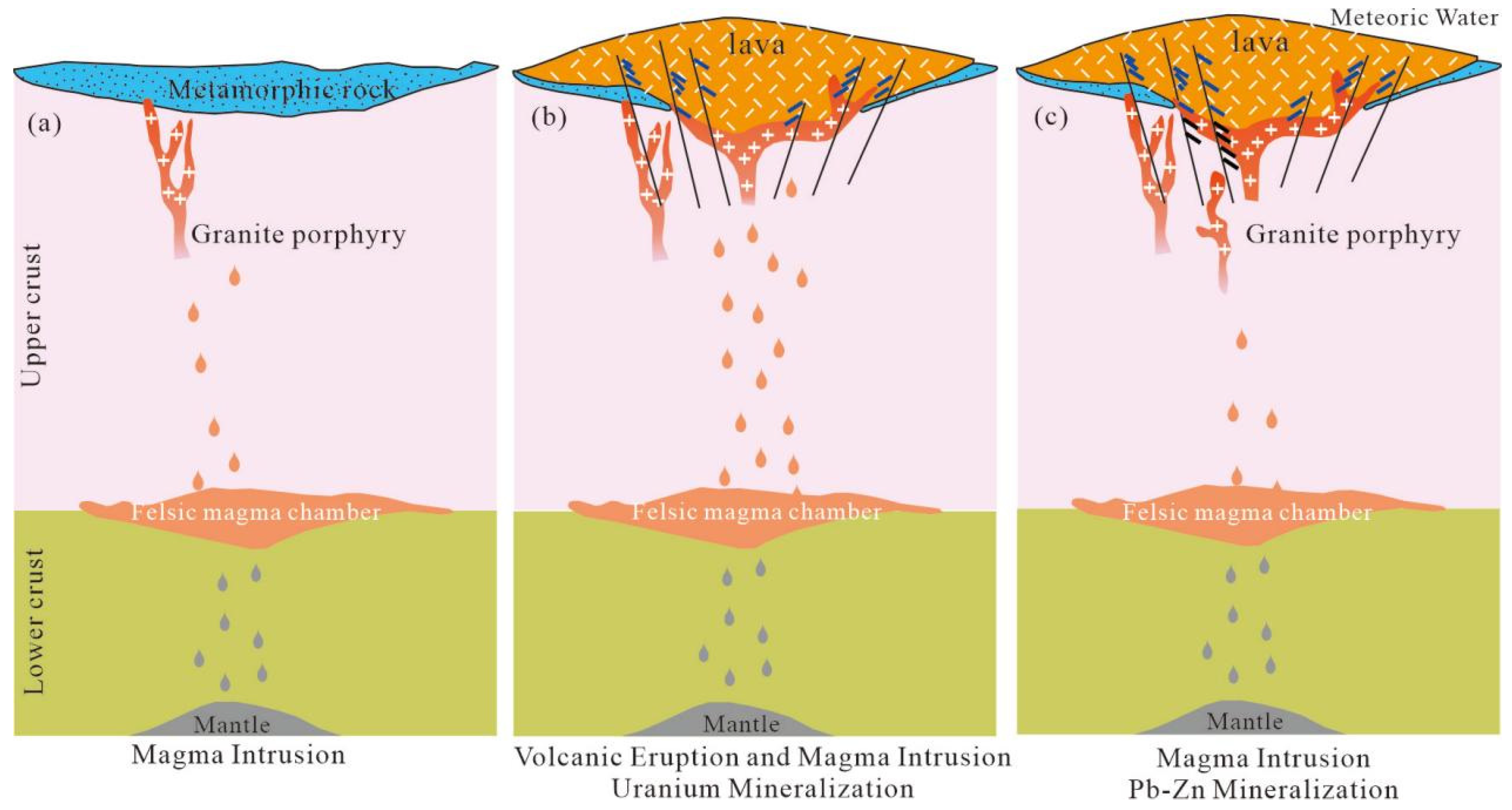
Mineralogy, Geochemistry, and Geochronology of Hydrothermal and Magmatic Apatites in the Xiangshan Ore Field, South China: Implications for U-Pb-Zn Polymetallic Mineralization

Abstract
1. Introduction
2. Geological Setting


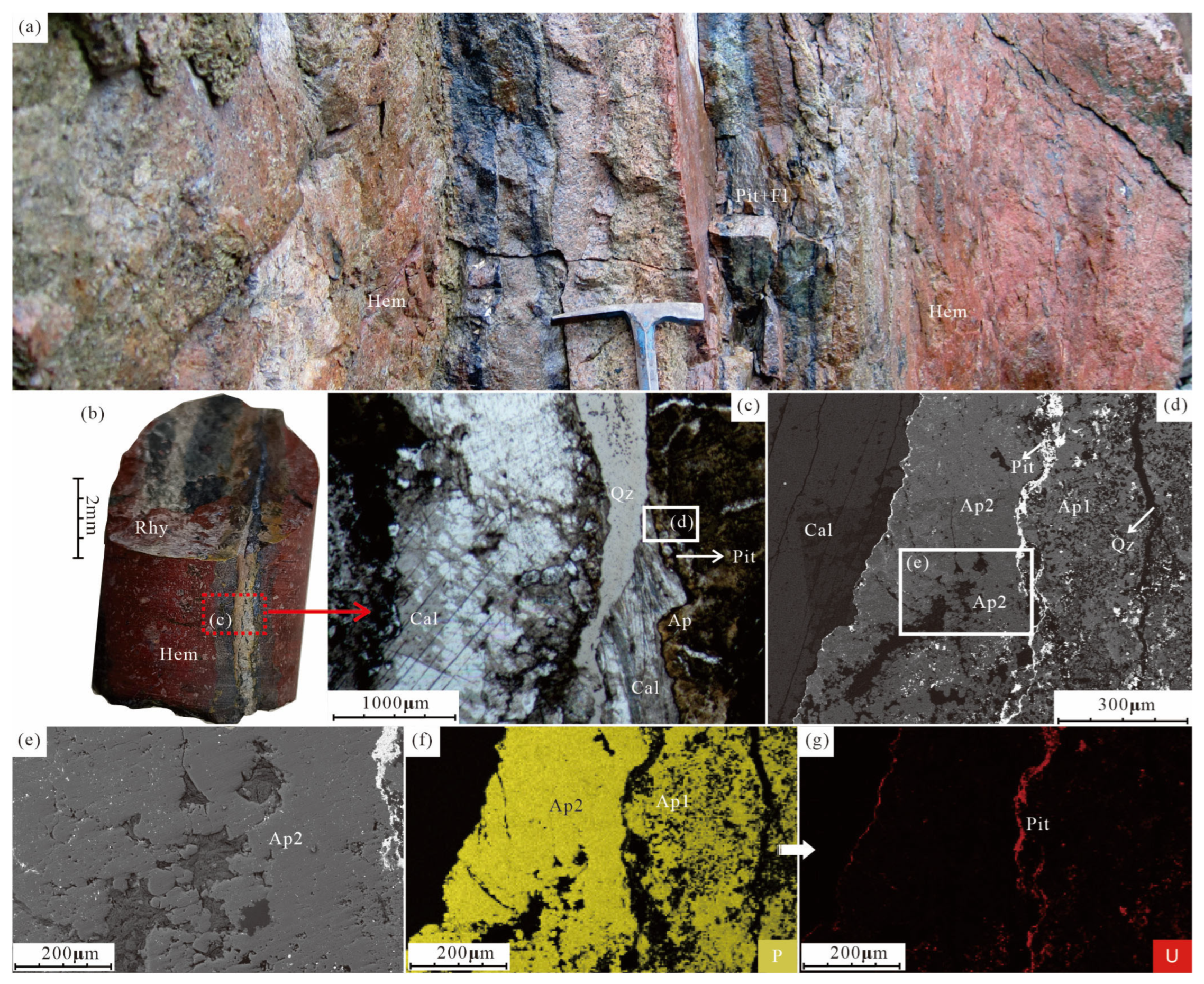
3. Sample Description and Analytical Methods
3.1. LA-ICP-MS U-Pb Dating of Apatite
3.2. Major Element Analysis of Apatite
3.3. Trace Element Analysis of Apatite
4. Results
4.1. Apatite Morphology
4.2. Apatite Geochronology
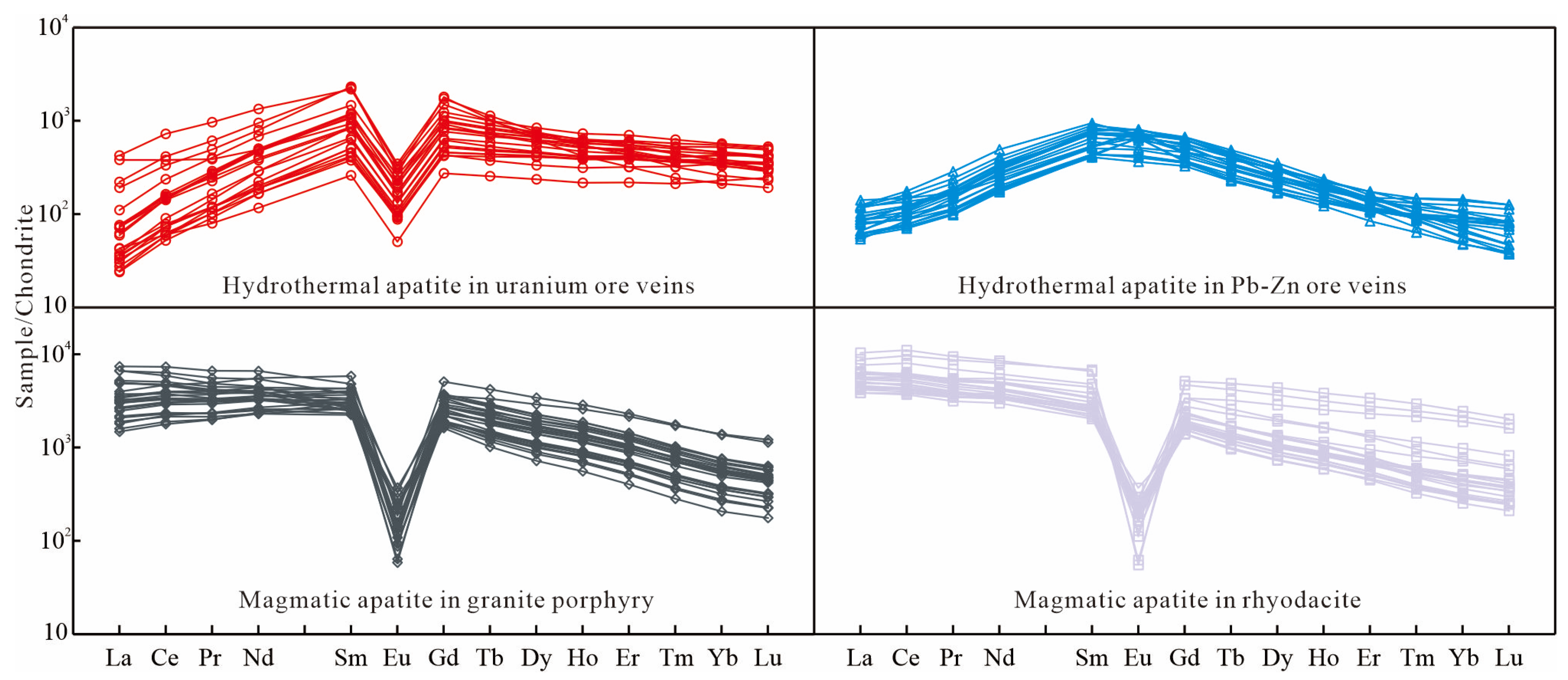
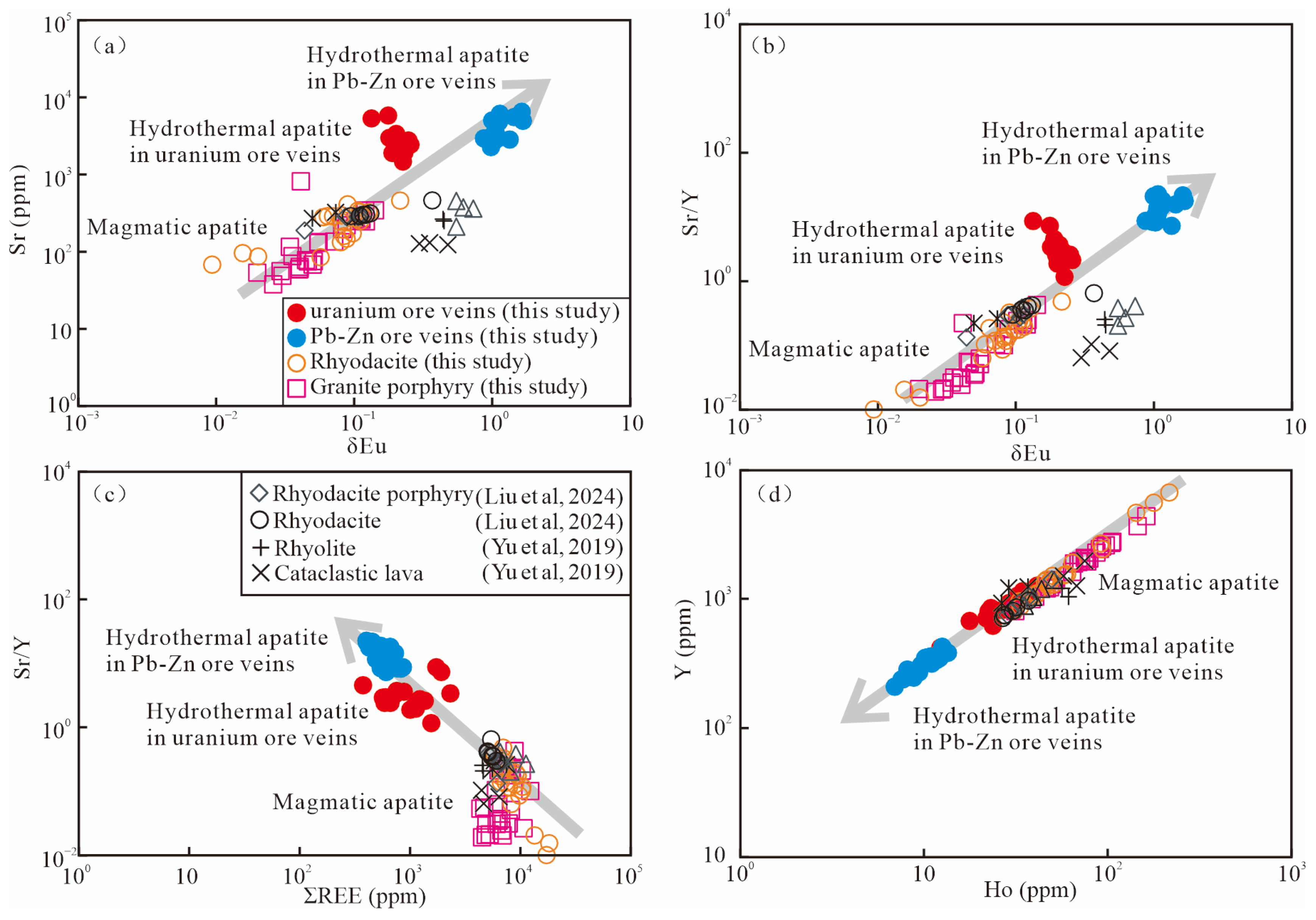
4.3. Trace and REEs of Apatite
5. Discussion
5.1. Timing of U-Pb-Zn Polymetallic Mineralization
5.2. Nature and Sources of Ore-Forming Fluids for U-Pb-Zn Polymetallic Mineralization
6. Conclusions
- (1)
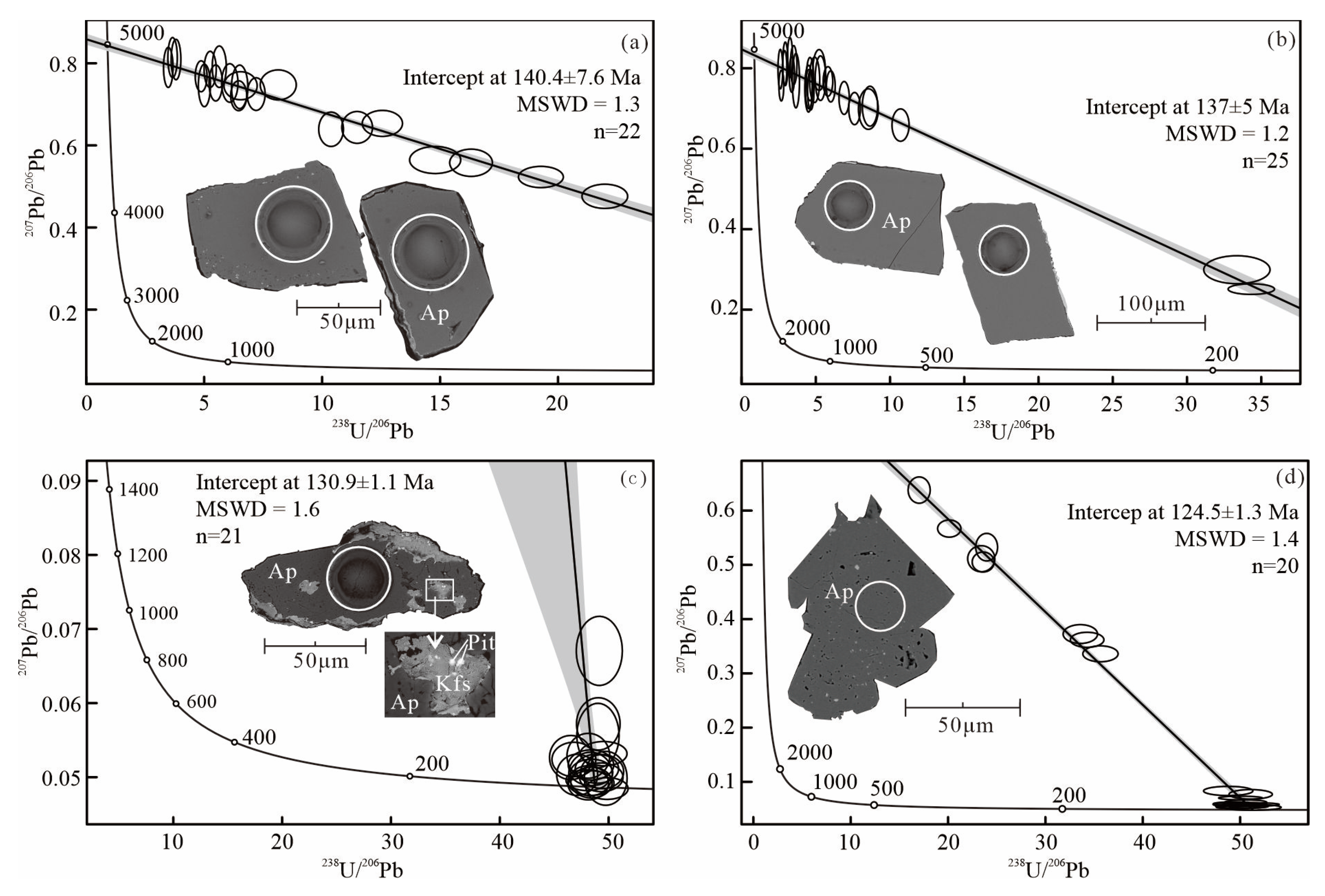
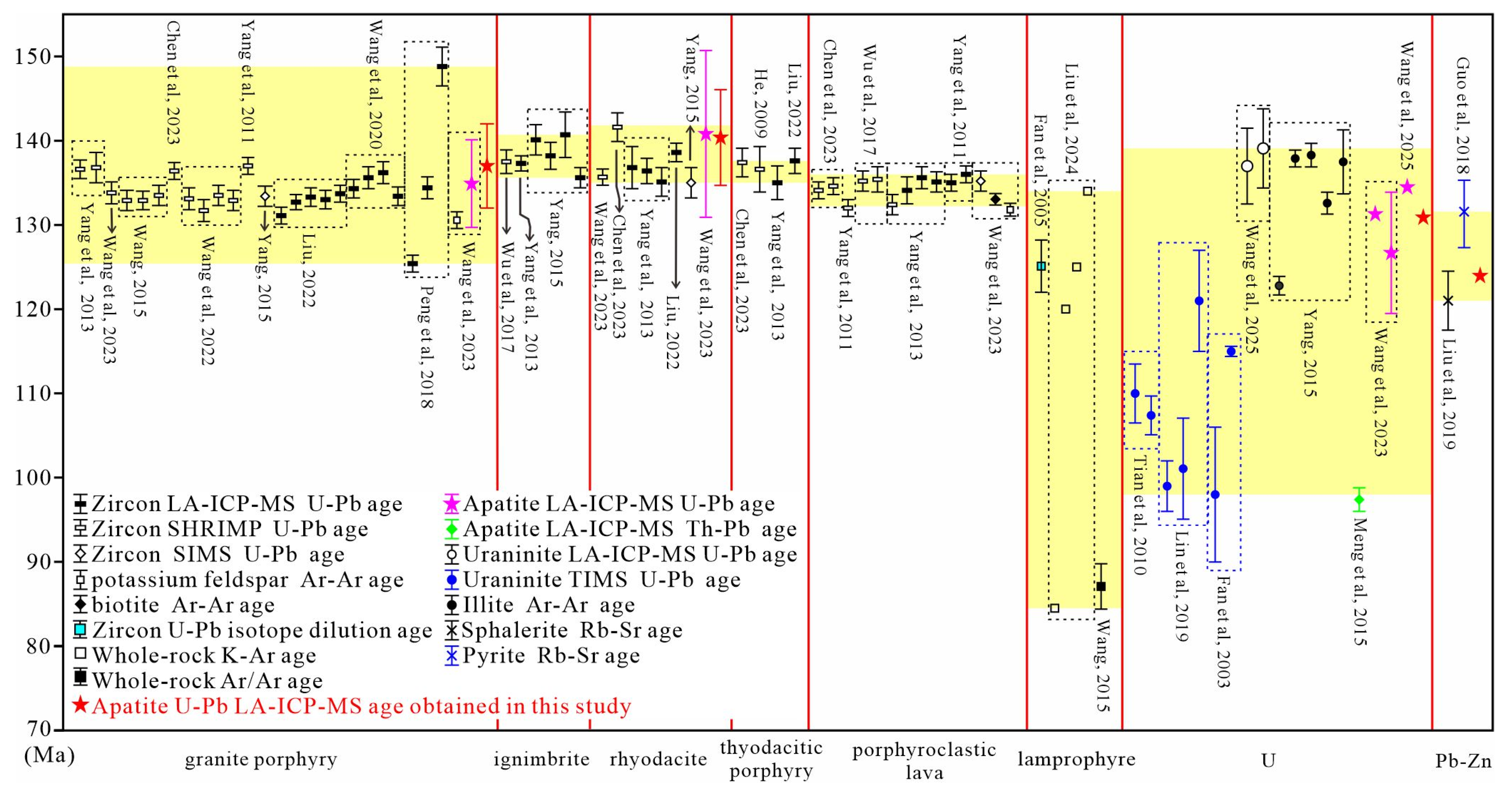
- Precise geochronological constraints suggest a three-stage emplacement history of the volcanic-intrusive complex in the Xiangshan ore field: magmatic apatites from rhyodacite yield a crystallization age of 140.4 ± 7.6 Ma (MSWD = 1.3, n = 22), while those from granite porphyry give an age of 137.0 ± 5.0 Ma (MSWD = 1.1, n = 25), corresponding to the peak magmatic pulse (133–137 Ma). Hydrothermal apatites co-precipitated with uranium minerals in the Shannan deposit indicate the uranium mineralization age of 130.9 ± 1.1 Ma (MSWD = 1.6, n = 21), consistent with the previously reported apatite U-Pb age from the Zoujiashan uranium deposit. In contrast, hydrothermal apatites from the deep Niutoushan Pb-Zn deposit yield an inferred younger mineralization age of 124.5 ± 1.3 Ma (MSWD = 1.4, n = 20), which is synchronous with the 125.6 Ma zircon fission-track thermal event and the 125.4 ± 1.0 Ma age of late-stage granite porphyry, supporting a two-stage metallogenic evolution based on apatite U-Pb geochronology.
- (2)
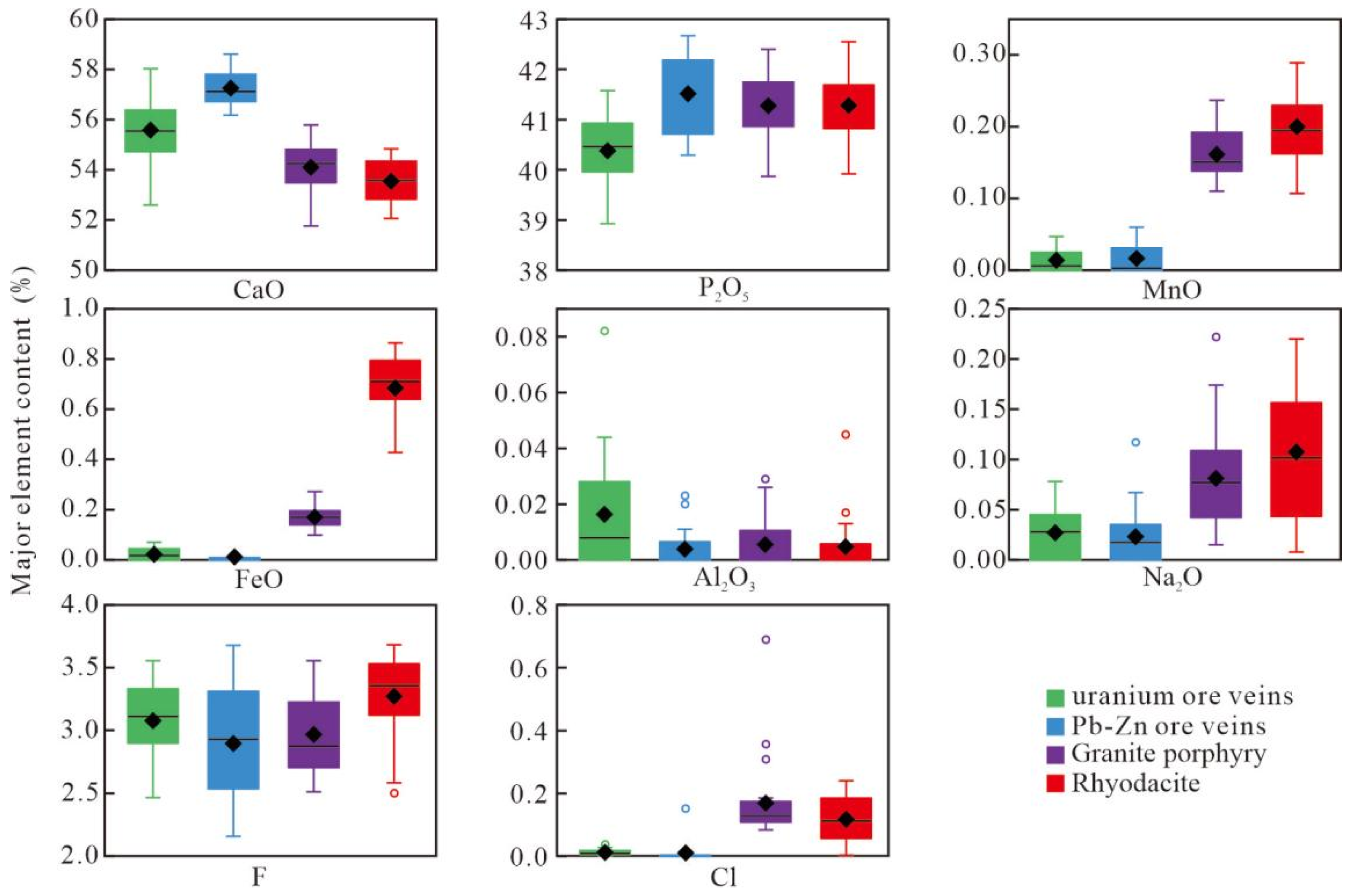
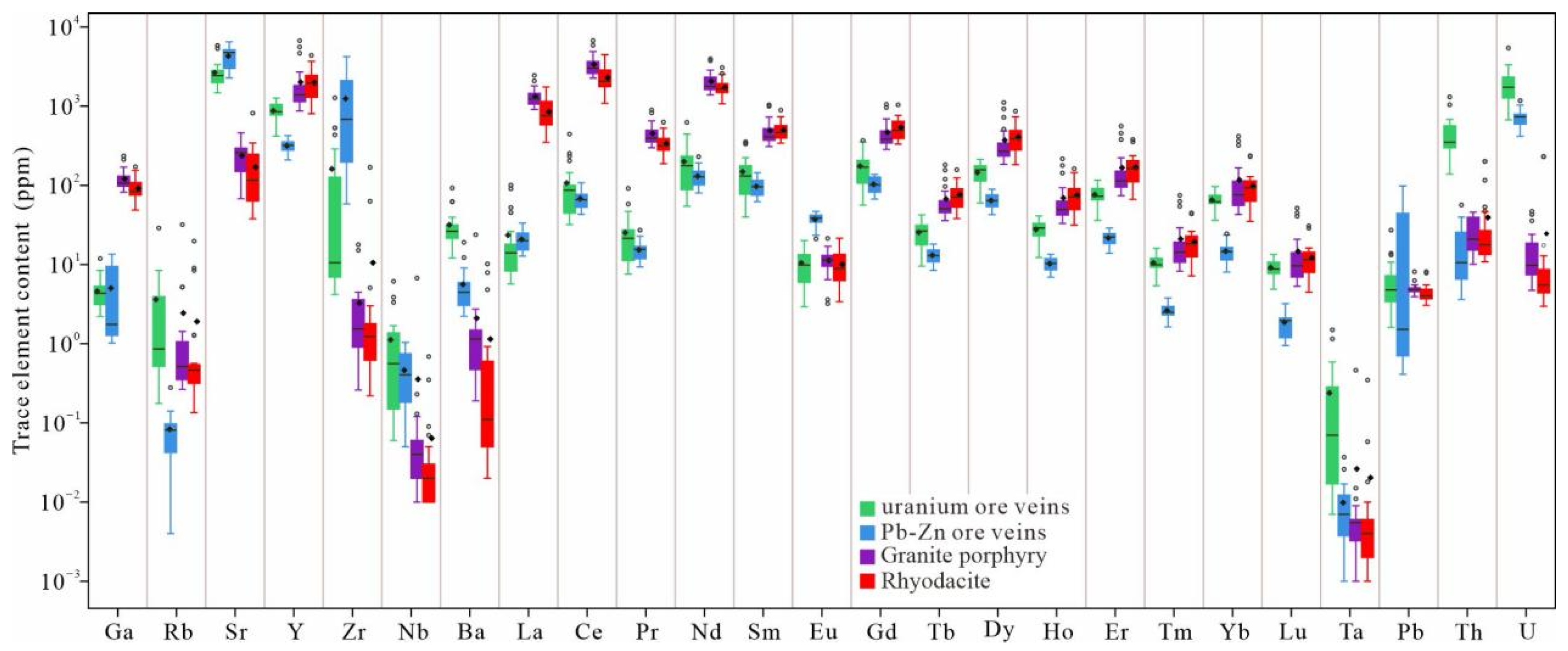
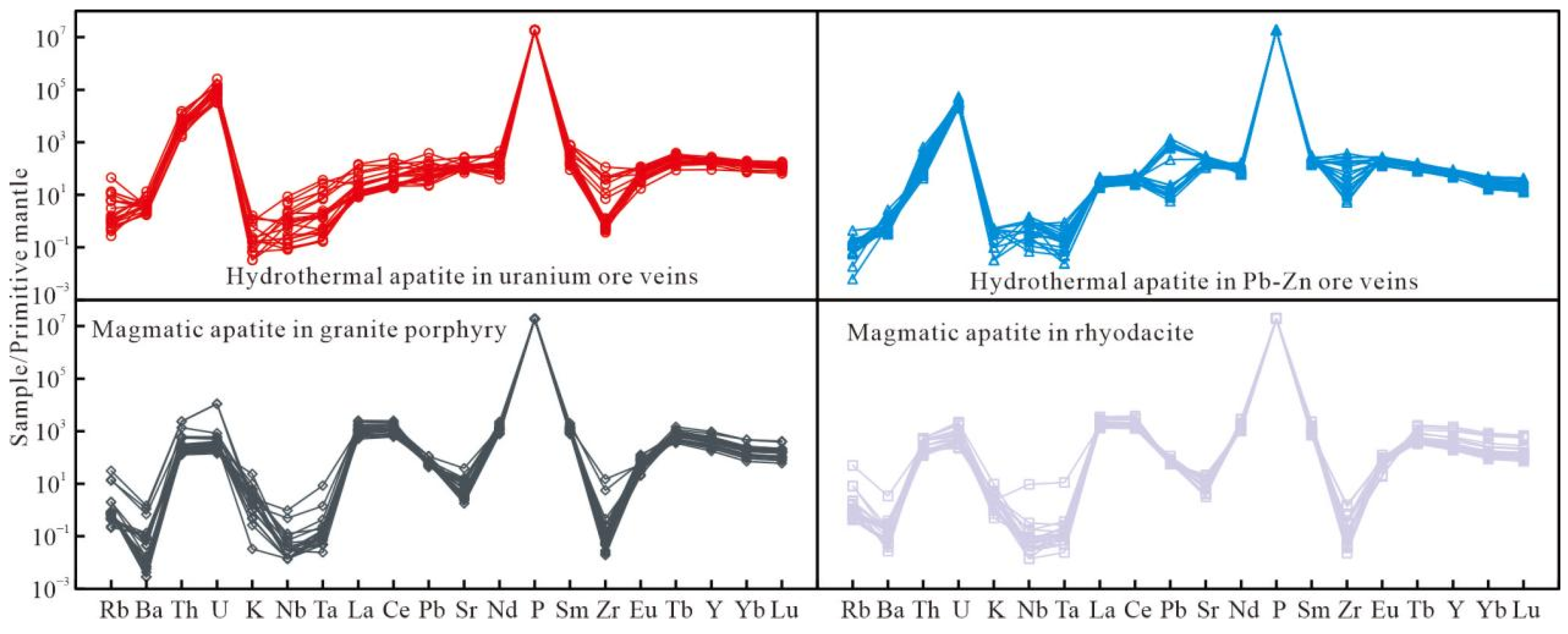
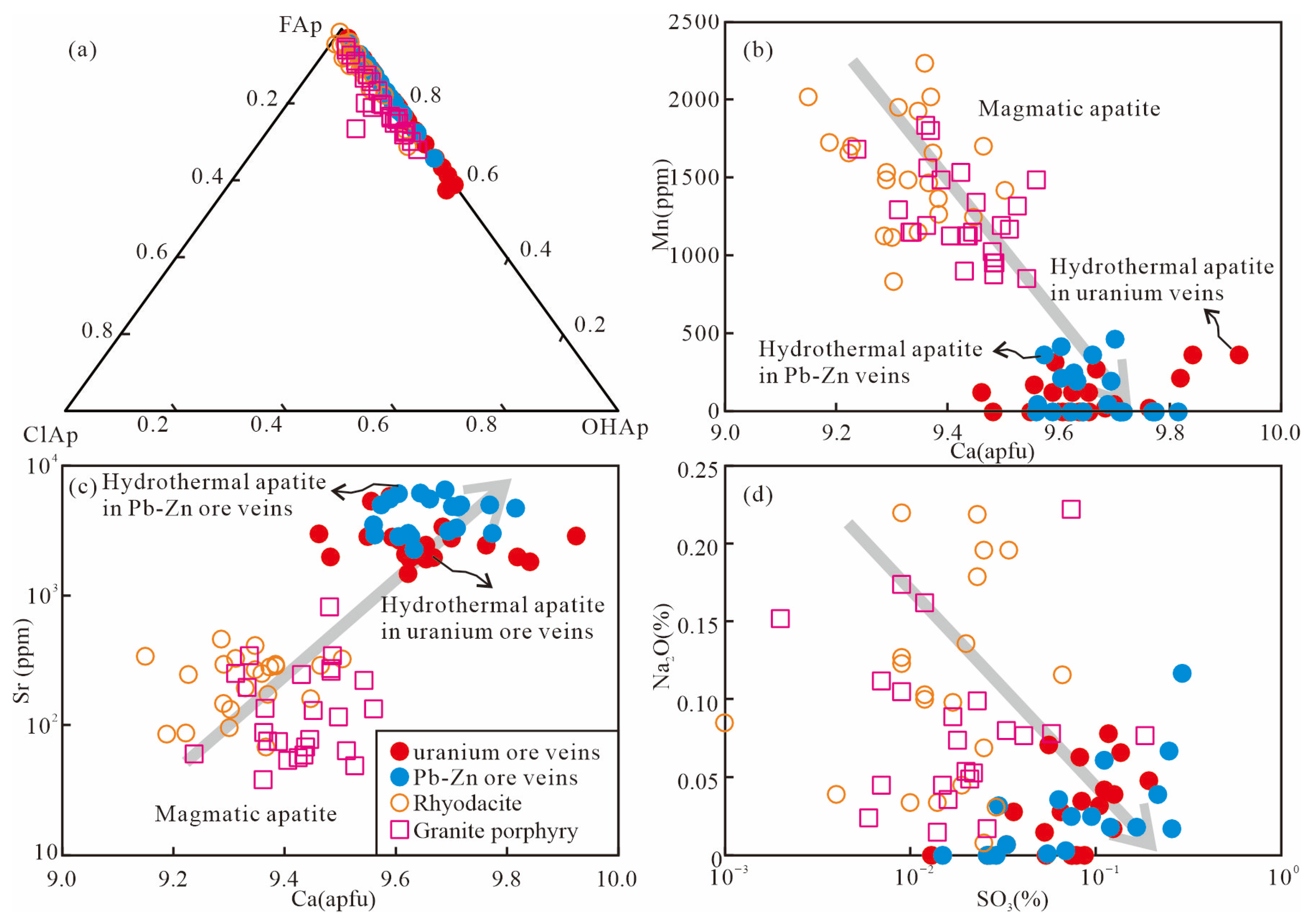
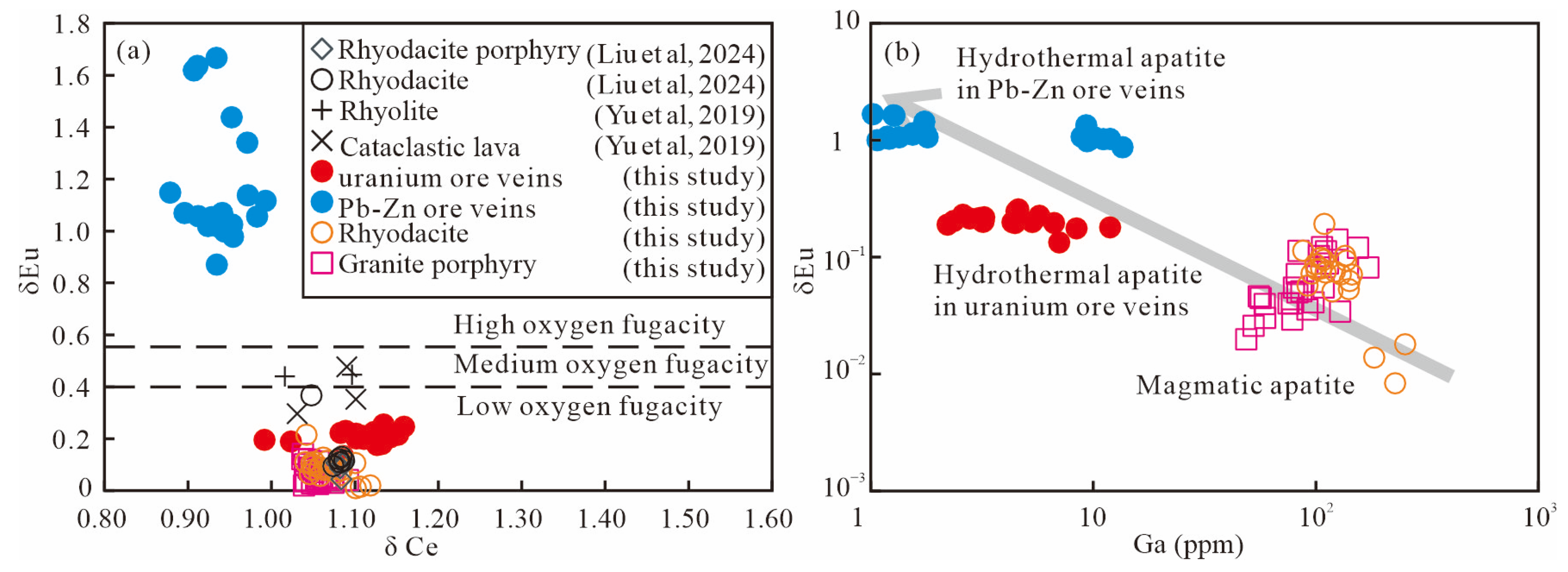
- Geochemical inheritance and differentiation are evident between magmatic and hydrothermal apatites: both types are classified as fluorapatite and exhibit similar chondrite-normalized REE patterns, reflecting a common felsic parental magma source. Compared to magmatic apatites, hydrothermal apatites are characterized by elevated Ca, Sr, and U contents, depleted Mn, Na, and LREEs, and lower Th/U ratios, which result from dissolution-reprecipitation of magmatic apatites by hydrothermal fluids. Distinctly, apatites from uranium ore veins show strongly negative Eu anomalies (δEu = 0.13–0.26) and weakly positive Ce anomalies (δCe = 0.99–1.16), while those from Pb-Zn ore veins display positive Eu anomalies (δEu = 0.87–1.67) and weakly negative Ce anomalies (δCe = 0.88–0.99), coupled with higher SO3 contents and lower Mn and Ga contents, indicating significantly higher oxygen fugacity during Pb-Zn mineralization.
- (3)
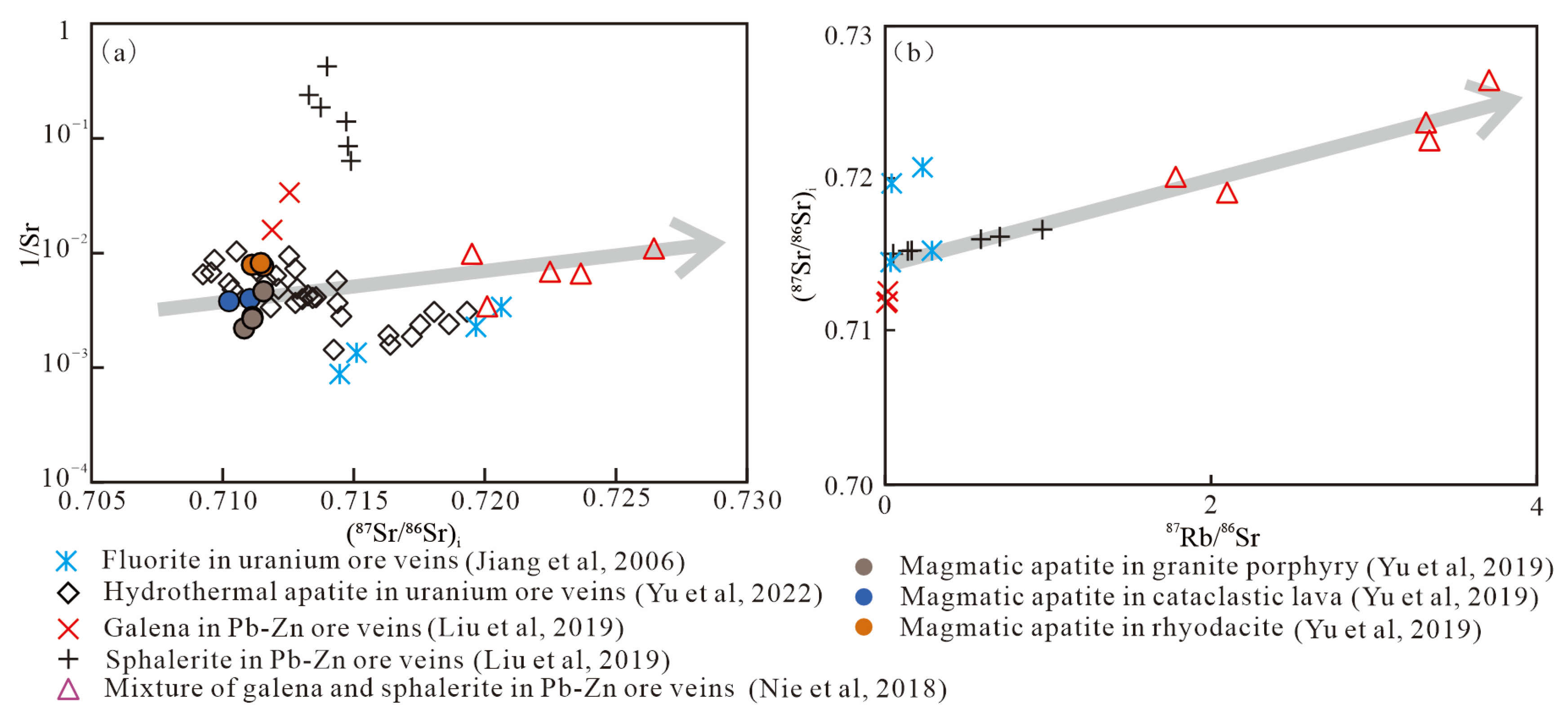
- Ore-forming fluid evolution and material sources are constrained by Sr isotopes and elemental geochemistry: uranium mineralization fluids were primarily derived from magmatic differentiation, with Sr isotopic compositions ((87Sr/86Sr)i = 0.709246–0.719318) overlapping with those of the host volcanic-intrusive complex. In contrast, Pb-Zn mineralization fluids represent a mixture of magmatic fluids and meteoric water, as evidenced by more dispersed Sr isotopic ratios ((87Sr/86Sr)i = 0.711885–0.726448) and elevated radiogenic Sr contents. The progressive increase in SO3 and decrease in Cl and Mn from magmatic to hydrothermal apatites record the evolving physicochemical conditions of the ore-forming system.
Supplementary Materials
Author Contributions
Funding
Data Availability Statement
Conflicts of Interest
References
- Barnes, H.L. Geochemistry of Hydrothermal Ore Deposits; John Wiley & Sons: Hoboken, NJ, USA, 1997. [Google Scholar]
- Guo, G.L.; Bonnetti, C.; Zhang, Z.S.; Li, G.L.; Yan, Z.B.; Wu, J.H.; Wu, Y.; Liu, X.D.; Wu, B. SIMS U-Pb Dating of Uraninite from the Guangshigou Uranium Deposit: Constraints on the Paleozoic Pegmatite-Type Uranium Mineralization in North Qinling Orogen, China. Minerals 2021, 11, 402. [Google Scholar] [CrossRef] [Scilit]
- Ren, Y.S.; Yang, X.Y.; Wang, G.J. Study on the complex magmatic and hydrothermal metallogenic processes in the giant Huayangchuan uranium (U)-polymetallic ore district: Constraints from geochemical and geochronological evidences. Ore Geol. Rev. 2023, 163, 105724. [Google Scholar] [CrossRef] [Scilit]
- Chen, Y.; Li, J.G.; Miao, P.S.; Chen, L.L.; Zhao, H.L.; Wang, C.; Yang, J. Relationship between the tectono-thermal events and sandstone-type uranium mineralization in the southwestern Ordos Basin, Northern China: Insights from apatite and zircon fission track analyses. Ore Geol. Rev. 2022, 143, 104792. [Google Scholar] [CrossRef] [Scilit]
- Osterhus, L.; Jung, S.; Berndt, J.; Hauff, F. Geochronology, geochemistry and Nd, Sr and Pb isotopes of syn-orogenic granodiorites and granites (Damara orogen, Namibia)—Arc-related plutonism or melting of mafic crustal sources? Lithos 2014, 200–201, 386–401. [Google Scholar] [CrossRef] [Scilit]
- Fan, H.H.; Chen, J.Y.; Wang, S.; Wang, S.Y.; Zhao, J.Y.; Gu, D.Z.; Meng, Y.N. Genesis and Uranium Sources of Leucogranite-hosted Uranium Deposits in the Gaudeanmus Area, Central Damara Belt, Namibia: Study of Element and Nd Isotope Geochemistry. Acta Geol. Sin.-Engl. Ed. 2017, 91, 2126–2137. [Google Scholar] [CrossRef] [Scilit]
- Hall, S.M.; Beard, J.S.; Bodnar, R.J.; Neymark, L.A.; Paces, J.B.; Johnson, C.A.; Breit, G.N.; Zielinski, R.A.; Aylor, G.J., Jr. The Coles Hill uranium deposit, Virginia, USA: Geology, geochemistry, and genetic model. Econ. Geol. 2022, 117, 273–302. [Google Scholar] [CrossRef] [Scilit]
- Krneta, S.; Ciobanu, C.L.; Cook, N.J.; Ehrig, K.; Kontonikas−Charos, A. Apatite at Olympic Dam, South Australia: A petrogenetic tool. Lithos 2016, 262, 470–485. [Google Scholar] [CrossRef] [Scilit]
- Fan, M.S.; Pan, J.Y.; Ni, P.; Wu, X.W.; Yuan, Q.Y.; Lin, Y.H.; Dou, H.R.; Li, Z.H.; Chi, Z.; Cheng, Z.L.; et al. Newly recognized Jurassic magmatic-hydrothermal gold mineralization at Wangmushan, South China: Geochronological and geochemical constraints. Ore Geol. Rev. 2026, 191, 107189. [Google Scholar] [CrossRef] [Scilit]
- Bouzari, F.; Hart, C.J.R.; Bissig, T.; Barker, S. Hydrothermal alteration revealed by apatite luminescence and chemistry: A potential indicator mineral for exploring covered porphyry copper deposits. Econ. Geol. 2016, 111, 1397–1410. [Google Scholar] [CrossRef] [Scilit]
- Kharkongor, M.; Glorie, S.; Abersteiner, A.; Dare, S.; Kirkland, C.; Chew, D.; Mulde, J.; Gilbert, S. Apatite in situ Lu-Hf and U-Pb geochronology in layered mafic intrusions. Geochim. Cosmochim. Acta 2025, 404, 234–256. [Google Scholar] [CrossRef] [Scilit]
- Pan, L.C.; Hu, R.Z.; Wang, X.S.; Bi, X.W.; Zhu, J.J.; Li, C. Apatite trace element and halogen compositions as petrogenetic-metallogenic indicators: Examples from four granite plutons in the Sanjiang region, SW China. Lithos 2016, 254–255, 118–130. [Google Scholar] [CrossRef] [Scilit]
- Chew, D.M.; Spikings, R.A. Geochronology and Thermochronology Using Apatite: Time and Temperature, Lower Crust to Surface. Elements 2015, 11, 189–194. [Google Scholar] [CrossRef] [Scilit]
- Chen, H.J.; Sun, X.M.; Li, D.F.; Yin, R.; Tong, Z.D.; Wu, Z.W.; Fu, Y.; Liu, Q.F.; Chen, X.; Yi, J.Z.; et al. In situ apatite U-Pb dating for the ophiolite-hosted Nianzha orogenic gold deposit, Southern Tibet. Ore Geol. Rev. 2022, 144, 104811. [Google Scholar] [CrossRef] [Scilit]
- Amelin, Y.; Lee, D.; Halliday, A.; Pidgeon, R. Nature of the Earth’s earliest crust from hafnium isotopes in single detrital zircons. Nature 1999, 399, 252–255. [Google Scholar] [CrossRef] [Scilit]
- OECD/NEA-IAEA. Uranium 2024: Resources, Production and Demand. In OECD NEA-IAEA Report; OECD Publishing: Paris, France, 2025. [Google Scholar]
- Cai, Y.Q.; Zhang, J.D.; Li, Z.Y.; Guo, Q.Y.; Song, J.Y.; Fan, H.H.; Liu, W.S.; Qi, F.C.; Zhang, M.L. Outline of Uranium Resources Characteristics and Metallogenetic Regularity in China. Acta Geol. Sin. 2015, 89, 1051–1069, (In Chinese with English abstract). [Google Scholar]
- Zhang, C.; Cai, Y.Q.; Dong, Q.; Xu, H. Cretaceous-Neogene basin control on the formation of uranium deposits in South China: Evidence from geology, mineralization ages, and H-O isotopes. Int. Geol. Rev. 2020, 62, 263–310. [Google Scholar] [CrossRef] [Scilit]
- Zhou, X.M.; Sun, T.; Shen, W.Z.; Shu, L.S.; Niu, Y.L. Petrogenesis of Mesozoic granitoids and volcanic rocks in South China: A response to tectonic evolution. Episodes 2006, 29, 26–33. [Google Scholar] [CrossRef] [Scilit]
- Yang, S.Y.; Jiang, S.Y.; Jiang, Y.H.; Zhao, K.D.; Fan, H.H. Geochemical, zircon U-Pb dating and Sr-Nd-Hf isotopic constraints on the age and petrogenesis of an Early Cretaceous volcanic-intrusive complex at Xiangshan, Southeast China. Mineral. Petrol. 2011, 101, 21–48. [Google Scholar] [CrossRef] [Scilit]
- Yang, S.Y.; Jiang, S.Y.; Zhao, K.D.; Jing, Y.H.; Ling, H.F.; Luo, L. Geochronology, geochemistry and tectonic significance of two Early Cretaceous A-type granites in the Gan-Hang Belt, Southeast China. Lithos 2012, 150, 155–170. [Google Scholar] [CrossRef] [Scilit]
- Yu, X.Q.; Wu, G.G.; Shu, L.S.; Yan, T.Z.; Zhang, D.; Di, Y.J. The cretaceous tectonism of the Gan-Hang Tectonic Belt, southeastern China. Earth Sci. Front. 2006, 13, 31–43, (In Chinese with English abstract). [Google Scholar]
- Mao, J.W.; Pirajno, F.; Cook, N. Mesozoic metallogeny in East China and corresponding geodynamic settings-an introduction to the special issue. Ore Geol. Rev. 2011, 43, 1–7. [Google Scholar] [CrossRef] [Scilit]
- Qin, K.Z.; Zhai, M.G.; Li, G.M.; Zhao, J.X.; Zeng, Q.D.; Gao, J.; Xiao, W.J.; Li, J.L.; Sun, S. Links of collage orogenesis of multiblocks and crust evolution to characteristic metallogeneses in China. Acta Petrol. Sin. 2017, 33, 305–325, (In Chinese with English abstract). [Google Scholar]
- Qin, K.Z.; Zhao, J.X.; He, C.T.; Shi, R.Z. Discovery of the Qongjiagang giant lithium pegmatite deposit in the Himalaya, Tibet, China. Acta Petrol. Sin. 2021, 37, 3277–3286, (In Chinese with English abstract). [Google Scholar]
- Gilder, S.A.; Gill, J.; Coe, R.S.; Zhao, X.; Liu, Z.; Wang, G.; Yuan, K.; Liu, W.; Kuang, G.; Wu, H. Isotopic and paleomagnetic constraints on the Mesozoic tectonic evolution of South China. J. Geophys. Res. Solid Earth 1996, 101, 16137–16154. [Google Scholar] [CrossRef] [Scilit]
- Chen, Z.L.; Han, F.S.; Yang, N.; Wang, Y. Topographic erosive diversities of the Xiangshan uranium orefield and its implications for preservation: Evidence from fission track dating of apatite. Chin. J. Geophys. 2012, 55, 2371–2384, (In Chinese with English abstract). [Google Scholar]
- Wang, Y.J.; Nie, J.T.; Lin, J.R.; Wang, H.Z. Geochronology and geochemistry of the felsic-intermediate dikes from Xiangshan uranium ore field, South China: Implications for petrogenesis, tectonic setting and uranium mineralization. Mineral. Petrol. 2022, 116, 287–310. [Google Scholar] [CrossRef] [Scilit]
- Hu, G.R.; Zhang, B.Y.; Yu, R.L. A study on Sm-Nd and Rb-Sr isochron ages of the Central Jiangxi Metamorphic Belt. Geol. Rev. 1999, 45, 129–134, (In Chinese with English abstract). [Google Scholar]
- Jiang, Y.H.; Ling, H.F.; Jiang, S.Y.; Shen, W.Z.; Fan, H.H.; Ni, P. Trace element and Sr-Nd isotope geochemistry of fluorite from the Xiangshan uranium deposit, Southeast China. Econ. Geol. 2006, 101, 1613–1622. [Google Scholar] [CrossRef] [Scilit]
- Hu, R.Z.; Burnard, P.G.; Bi, X.W.; Zhou, M.F.; Peng, J.T.; Su, W.C.; Zhao, J.H. Mantle-derived gaseous components in ore-forming fluids of the Xiangshan uranium deposit, Jiangxi Province, China: Evidence from He, Ar and C isotopes. Chem. Geol. 2009, 266, 86–95. [Google Scholar] [CrossRef] [Scilit]
- Guo, F.S.; Li, Z.H.; Deng, T.; Qu, M.M.; Zhou, W.P.; Huang, Q.Y.; Shang, P.; Zhang, C.Y.; Yan, Z.B. Key factors controlling volcanic-related uranium mineralization in the Xiangshan basin, Jiangxi Province, South China: A review. Ore Geol. Rev. 2020, 122, 103517. [Google Scholar] [CrossRef] [Scilit]
- Bonnetti, C.; Liu, X.D.; Cuney, M.; Mercadier, J.; Riegler, T.; Yu, C. Evolution of the uranium mineralisation in the Zoujiashan deposit, Xiangshan ore field: Implications for the genesis of volcanic-related hydrothermal U deposits in South China. Ore Geol. Rev. 2020, 122, 103514. [Google Scholar] [CrossRef] [Scilit]
- Qiu, A.J. Tectonic-magmatic evolution of Xiangshan in Jiangxi and the formation of rich uranium deposits. Geol. Rev. 1999, 45, 761–762, (In Chinese with English abstract). [Google Scholar]
- Deng, J.; Yu, H.; Chen, H.; Du, Z.; Yang, H.; Li, H.; Guo, F. Ore-controlling structures of the Xiangshan volcanic basin, SE China: Revealed from three-dimensional inversion of magnetotelluric data. Ore Geol. Rev. 2020, 127, 103807. [Google Scholar] [CrossRef] [Scilit]
- Yu, H.; Deng, J.; Tang, B.; Egbert, G.; Chen, H. Electrical image of magmatic system beneath the Xiangshan volcanogenic uranium deposit, Southeast China: Linking magmatic evolution and uranium metallogenesis. Geology 2023, 51, 870–874. [Google Scholar] [CrossRef] [Scilit]
- Lin, J.R.; Hu, Z.H.; Wang, Y.J.; Zhang, S.; Tao, Y. Ore-forming age and thermal history of uranium-polymetallic mineralization at Xiangshan uranium orefield. Acta Petrol. Sin. 2019, 35, 193–198, (In Chinese with English abstract). [Google Scholar]
- CNG (China Nuclear Geology); BRIUG (Beijing Research Institute of Uranium Geology). The Research and Evaluation of the Volcanic-Related Uranium Deposits in China; China National Nuclear Corporation: Beijing, China, 2010; pp. 814–935. (In Chinese) [Google Scholar]
- Thomson, S.N.; Gehrels, G.E.; Ruiz, J.; Buchwaldt, R. Routine low-damage apatite U-Pb dating using laser ablation multicollector ICPMS. Geochem. Geophys. Geosyst. 2012, 13, Q0AA21. [Google Scholar] [CrossRef] [Scilit]
- Cochrane, R.; Spikings, R.A.; Chew, D.; Wotzlaw, J.F.; Chiaradia, M.; Tyrrell, S.; Van der Lelij, R. High temperature (>350℃) thermochronology and mechanisms of Pb loss in apatite. Geochim. Cosmochim. Acta 2014, 127, 39–56. [Google Scholar] [CrossRef] [Scilit]
- Barfod, G.H.; Krogstad, E.J.; Frei, R.; Albarède, F. Lu-Hf and PbSL geochronology of apatites from Proterozoic terranes: A first look at Lu-Hf isotopic closure in metamorphic apatite. Geochim. Cosmochim. Acta 2005, 69, 1847–1859. [Google Scholar] [CrossRef] [Scilit]
- Chew, D.M.; Petrus, J.A.; Kamber, B.S. U-Pb LA-ICP-MS dating using accessory mineral standards with variable common Pb. Chem. Geol. 2014, 363, 185–199. [Google Scholar] [CrossRef] [Scilit]
- Thompson, J.; Meffre, S.; Maas, R.; Kamenetsky, V.; Kamenetsky, M.; Goemann, K.; Ehrig, K.; Danyushevsky, L. Matrix effects in Pb/U measurements during LA-ICP-MS analysis of the mineral apatite. J. Anal. At. Spectrom. 2016, 31, 1206–1215. [Google Scholar] [CrossRef] [Scilit]
- Li, W.; Xie, G.Q.; Mao, J.W.; Cook, N.J.; Wei, H.T.; Ji, Y.H.; Fu, B. Precise age constraints for the Woxi Au-Sb-W deposit, South China. Econ. Geol. 2023, 118, 509–518. [Google Scholar] [CrossRef] [Scilit]
- Wang, Y.J.; Fan, H.H.; Qin, K.Z.; Evans, N.J.; Zhang, C.; Zou, X.Y.; Pang, Y.Q.; Zhang, H. Mineralization age of the Xiangshan uranium ore field, South China redefined by hydrothermal apatite U-Pb geochronology. Ore Geol. Rev. 2023, 160, 105586. [Google Scholar] [CrossRef] [Scilit]
- Meffre, S.; Large, R.R.; Scott, R.; Woodhead, J.; Chang, Z.S.; Gilbert, S.E.; Danyushevsky, L.V.; Maslennikov, V.; Hergt, J.M. Age and pyrite Pb-isotopic composition of the giant Sukhoi Log sediment-hosted gold deposit, Russia. Geochim. Cosmochim. Acta 2008, 72, 2377–2391. [Google Scholar] [CrossRef] [Scilit]
- Liu, G.Q.; Zhao, K.D.; Ulrich, T.; Chen, W.; Zhang, D.; Li, Q.; Zhao, H.D.; Zhang, R.Q.; Xia, F. Isoclock: A free and novel routine for common Pb correction in U-Th-Pb data reduction of LA-ICP-MS analysis. J. Anal. At. Spectrom. 2023, 38, 2007–2018. [Google Scholar] [CrossRef] [Scilit]
- Yang, S.Y.; Jiang, S.Y.; Mao, Q.; Chen, Z.Y.; Rao, C.; Li, X.L.; Li, W.C.; Yang, W.Q.; He, P.L.; Li, X. Electron Probe Microanalysis in Geosciences: Analytical Procedures and Recent Advances. At. Spectrosc. 2022, 43, 186–200. [Google Scholar] [CrossRef] [Scilit]
- Decrée, S.; Savolainen, M.; Mercadier, J.; Debaille, V.; Höhn, S.; Frimmel, H.; Baele, J.M. Geochemical and spectroscopic investigation of apatite in the Siilinjärvi carbonatite complex: Keys to understanding apatite forming processes and assessing potential for rare earth elements. Appl. Geochem. 2021, 123, 104778. [Google Scholar] [CrossRef] [Scilit]
- Liu, Y.S.; Hu, Z.C.; Gao, S.; Gunther, D.; Xu, J.; Gao, C.G.; Chen, H.H. In situ analysis of major and trace elements of anhydrous minerals by LA-ICP-MS without applying an internal standard. Chem. Geol. 2008, 257, 34–43. [Google Scholar] [CrossRef] [Scilit]
- Abdel Gawad, A.E.; Skublov, S.G.; Levashova, E.V.; Ghoneim, M.M. Geochemistry and U–Pb age dating of zircon as a petrogenetic tool for magmatic and hydrothermal processes in Wadi Ras Abda syenogranite, Eastern Desert, Egypt. Arab. J. Sci. Eng. 2022, 47, 7351–7365. [Google Scholar] [CrossRef] [Scilit]
- DeCelles, P.G. Late Jurassic to Eocene evolution of the Cordilleran thrust belt and foreland basin system, western U.S.A. Am. J. Sci. 2004, 304, 105–168. [Google Scholar] [CrossRef] [Scilit]
- Gehrels, G.; Rusmore, M.; Woodsworth, G.; Crawford, M.; Andronicos, C.; Hollister, L.; Patchett, J.; Ducea, M.; Butler, R.; Klepeis, K.; et al. U-Th-Pb geochronology of the Coast Mountains batholith in north-coastal British Columbia: Constraints on age and tectonic evolution. Geol. Soc. Am. Bull. 2009, 121, 1341–1361. [Google Scholar] [CrossRef] [Scilit]
- Liu, L.; Yang, J.H.; Kang, L.F.; Zhong, H.; Zhang, X.C. The long-lived transcrustal magmatic systems of Southeast China in response to paleo-Pacific plate subduction, recorded by the Cretaceous volcanic sequences in southeastern Zhejiang Province. Geol. Soc. Am. Bull. 2023, 135, 1091–1108. [Google Scholar] [CrossRef] [Scilit]
- Zhou, Z.H.; Meng, Q.R.; Zhu, R.X.; Wang, M. Spatiotemporal evolution of the Jehol Biota: Responses to the North China craton destruction in the Early Cretaceous. Proc. Natl. Acad. Sci. USA 2021, 118, e2107859118. [Google Scholar] [CrossRef] [Scilit]
- Qu, H.Y.; Rowland, J.; Mao, J.W.; Belousov, I.; Orovan, E.; Rowe, M.; Zhong, S.H.; Wang, Y.T. Geochronology and mineral geochemistry of apatite and zircon in the Hutouya Skarn deposit, East Kunlun Mountains, NW China. Miner. Petrol. 2026, 181, 18. [Google Scholar] [CrossRef] [Scilit]
- Sun, S.-s.; McDonough, W.F. Chemical and isotopic systematics of oceanic basalts: Implications for mantle composition and processes. Geol. Soc. Lond. Spec. Publ. 1989, 42, 313–345. [Google Scholar] [CrossRef] [Scilit]
- Yang, S.Y.; Jiang, S.Y.; Zhao, K.D.; Jiang, Y.H.; Ling, H.F.; Chen, P.R. Timing and geological implications of volcanic rocks from the Ruyiting section, Xiangshan uranium ore field, Jiangxi Province, SE China. Acta Petrol. Sin. 2013, 29, 4362–4372, (In Chinese with English abstract). [Google Scholar]
- Wang, Y.J. Characteristics of Xiangshan Granite Porphyry and Intermediate-Mafic Dikes and Their Relationship with Uranium Mineralization. Master’s Thesis, Beijing Research Institute of Uranium Geology, Beijing, China, 2015. (In Chinese) [Google Scholar]
- Chen, Z.L.; Wang, Y.; Zhou, Y.G.; Han, F.B.; Wang, P.A.; Gong, H.L.; Shao, F.; Tang, X.S.; Xu, J.S. SHRIMP U-Pb dating of zircons from volcanic-intrusive complexes in the Xiangshan uranium orefield, Jiangxi Province, and its geological implications. Geol. China 2013, 40, 217–231, (In Chinese with English abstract). [Google Scholar]
- Yang, Q.K. Genesis of the Volcanic-Intrusive Complex and Metallogenesis of Uranium Polymetallic in the Xiangshan Orefield of Jiangxi Province. Ph.D. Dissertation, China University of Geosciences (Beijing), Beijing, China, 2015. (In Chinese with English abstract). [Google Scholar]
- Liu, L. Magmatic Evolution Sequence and Ore-Control of Porphyry in Xiangshan Uranium Orefield, Jiangxi Province. Ph.D. Dissertation, East China University of Technology, Nanchang, China, 2022. (In Chinese with English abstract). [Google Scholar]
- Wang, L.L.; Zhang, S.M.; Xu, X.; Zhang, X.; Ruan, X.Y.; Lan, D.C.; Wu, Z.C.; Qi, J.W. LA-ICP-MS zircon U-Pb dating and genetic types of uranium-bearing granite porphyry in northern Xiangshan orefield, Jiangxi Province. Geol. Bull. China 2020, 39, 62–79, (In Chinese with English abstract). [Google Scholar]
- Peng, Z.Y.; Chen, W.F.; Mao, Y.F.; Fang, Q.C.; Tang, X.S.; Ling, H.F. Multiple Episodes of the Yanshanian Magmatism in Xiangshan Uranium Ore-field, Jiangxi. Geol. Rev. 2018, 64, 1413–1437, (In Chinese with English abstract). [Google Scholar]
- Wu, J.H.; Lao, Y.J.; Xie, G.F.; Zhang, J.Y.; Wu, R.G.; Nie, F.J. Stratigraphy and geochronology of the volcanic rocks in the Xiangshan uranium orefield, Jiangxi Province and its geological implications. Geol. China 2017, 44, 974–992, (In Chinese with English abstract). [Google Scholar]
- He, G.S.; Dai, M.Z.; Li, J.F.; Cao, S.S.; Xia, B.; Xu, D.R.; Li, W.Q.; Yang, Z.Q. SHRIMP Zircon U-Pb Dating and Its Geological Implication for the Xiangshan Porphyric Dacite-Rhyolitic. Geotecton. Metallog. 2009, 33, 299–303, (In Chinese with English abstract). [Google Scholar]
- Fan, H.H.; Wang, D.Z.; Shen, W.Z.; Liu, C.S.; Wang, X.; Ling, H.F. Formation age of the intermediate-basic dikes and volcanic-intrusive complex in Xiangshan, Jiangxi Province. Geol. Rev. 2005, 51, 86–91, (In Chinese with English abstract). [Google Scholar]
- Liu, L.; Zhang, S.M.; Rao, Z.H.; Zhang, X.; Xia, Y.C.; Wan, K.; Ouyang, J.Y.; Wu, Z.C. Geochronology, geochemistry of lamprophyre and evidence of mantle fluid in the western part of Xiangshan uranium orefield. Geol. China 2024, 51, 898–911, (In Chinese with English abstract). [Google Scholar]
- Tian, J.Y.; Hu, R.Z.; Su, W.C.; Zhang, G.Q.; Shang, P.Q. Ore U-Pb isochron ages and metallogenic tectonic setting of No. 661 uranium deposit. Miner. Deposits 2010, 29, 452–460, (In Chinese with English abstract). [Google Scholar]
- Fan, H.H.; Ling, H.F.; Wang, D.Z.; Liu, C.S.; Shen, W.Z.; Jiang, Y.H. Study on the metallogenetic mechanism of Xiangshan uranium ore-field. Uran. Geol. 2003, 19, 208–213, (In Chinese with English abstract). [Google Scholar]
- Wang, Y.J.; Qin, K.Z.; Fan, H.H.; Pang, Y.Q. Assessing the robustness of uraninite U-Pb chronometer in complex hydrothermal uranium ore systems: Insights from Xiangshan volcanic-related uranium ore field, South China. Chem. Geol. 2025, 695, 123058. [Google Scholar] [CrossRef] [Scilit]
- Meng, Y.N.; Fan, H.H.; Wang, F.G. Chronological study of uranium and thorium minerals from the Zoujiashan deposit in the Xiangshan ore field, Jiangxi Province. Acta Geol. Sin. 2015, 89, 18–21. (In Chinese) [Google Scholar]
- Liu, J.G.; Li, Z.Y.; Nie, J.T.; Zhang, W.L.; Wang, Y.J.; Tian, M.M. The timing and ore-forming fluid evolution of deep polymetalic mineralization in western Xiangshan uranium ore field, South China: Constraints from Rb-Sr isotope systematics. Acta Petrol. Sin. 2019, 35, 2787–2800, (In Chinese with English abstract). [Google Scholar]
- Guo, J.; Li, Z.Y.; Nie, J.T.; Huang, Z.Z.; Wang, J.; Lai, C.K. Genesis of Pb-Zn Mineralization Beneath the Xiangshan Uranium Orefield, South China: Constraints from H-O-S-Pb Isotopes and Rb-Sr Dating. Resour. Geol. 2018, 68, 275–286. [Google Scholar] [CrossRef] [Scilit]
- Fayek, M.; Harrison, M.T.; Ewing, R.C.; Grove, M.; Coath, C.D. O and Pb isotopic analyses of uranium minerals by ion microprobe and U-Pb ages from the Cigar Lake deposit. Chem. Geol. 2002, 185, 205–225. [Google Scholar] [CrossRef] [Scilit]
- Cuney, M.; Kyser, K. Recent and not-so-recent developments in uranium deposits and implications for exploration. Mineral. Assoc. Can. Short Course Ser. 2008, 39, 23–55. [Google Scholar]
- Luo, J.C.; Hu, R.Z.; Mostafa, F.; Li, C.S.; Bi, X.W.; Yassir, A.; Chen, Y.W. In-situ SIMS uraninite U-Pb dating and genesis of the Xianshi granite-hosted uranium deposit, South China. Ore Geol. Rev. 2015, 65, 968–978. [Google Scholar] [CrossRef] [Scilit]
- Luo, J.C.; Shi, S.H.; Chen, Y.W.; Tian, J.J. Review on dating of uranium mineralization. Acta Petrol. Sin. 2019, 35, 589–605, (In Chinese with English abstract). [Google Scholar]
- Chen, F.R.; Shen, W.Z.; Wang, D.Z.; Liu, C.S. Isotopic geochemistry of uranium ore field no. 1220 and the implication to ore genesis. Geotecton. Metallog. 1990, 14, 69–77, (In Chinese with English abstract). [Google Scholar]
- Li, Z.Y.; Huang, Z.Z.; Li, X.Z.; Zhang, Y.Y.; Zhang, J.D. Pyrogenesis and Uranium Metallogeny at Xiangshan Volcanic Basin; Geological Publishing House: Beijing, China, 2014; pp. 1–324, (In Chinese with English abstract). [Google Scholar]
- Chen, Y.W.; Bi, X.W.; Hu, R.Z.; Dong, S.H. Element geochemistry, mineralogy, geochronology and zircon Hf isotope of the Luxi and Xiazhuang granites in Guangdong province, China: Implications for U mineralization. Lithos 2012, 150, 119–134. [Google Scholar] [CrossRef] [Scilit]
- Yang, Q.K.; Guo, F.S.; Zhou, W.P.; Qu, H.J. Geochronology and metallogenic model of the Xiangshan U-Pb-Zn deposits, Southern Jiangxi, China. Earth Sci. Front. 2017, 24, 283–298, (In Chinese with English abstract). [Google Scholar]
- Foland, K.A.; Hubacher, F.A.; Arehart, G.B. 40Ar/39Ar dating of very fine-grained samples: An encapsulated-vial procedure to overcome the problem of 39Ar recoil loss. Chem. Geol. 1992, 102, 269–276. [Google Scholar] [CrossRef] [Scilit]
- Cui, J.Q.; Yang, S.Y.; Jiang, S.Y.; Wang, H.; Zhang, R.-X.; Tang, X.-S.; Yan, Y.-J. The role of uranyl complex decomposition and redox conditions in the precipitation of hydrothermal uranium deposits: Insights from chlorite mineralogy and geochemistry in the Shazhou uranium deposit, Xiangshan, SE China. Bulletin 2024, 136, 388–402. [Google Scholar] [CrossRef] [Scilit]
- Yu, X.; Su, X.B.; Wang, Z.; Hou, Z.Y.; Li, B.P.; Deng, T.; Yan, Z.B. Genesis of the Xiangshan Uranium Ore Field: Implications from Tescan Integrated Mineral Analyzer and Micro-X-Ray Fluorescence Mapping and Thermodynamic Modeling. Minerals 2025, 15, 5. [Google Scholar] [CrossRef] [Scilit]
- Cao, M.J.; Evans, N.J.; Hollings, P.; Cooke, D.R.; McInnes, B.I.A.; Qin, K.Z. Apatite texture, composition and O-Sr-Nd isotopic signatures record magmatic and hydrothermal fluid characteristics at the Black Mountain porphyry deposit, Philippines. Econ. Geol. 2021, 116, 1189–1207. [Google Scholar]
- O’Sullivan, G.; Chew, D.; Kenny, G.; Henrichs, I.; Mulligan, D. The trace element composition of apatite and its application to detrital provenance studies. Earth Sci. Rev. 2020, 201, 103044. [Google Scholar] [CrossRef] [Scilit]
- Broom-Fendley, S.; Styles, M.T.; Appleton, J.D.; Gunn, G.; Wall, F. Evidence for dissolution-reprecipitation of apatite and preferential LREE mobility in carbonatite-derived late-stage hydrothermal processes. Am. Mineral. 2016, 101, 596–611. [Google Scholar] [CrossRef] [Scilit]
- Zeng, L.P.; Zhao, X.F.; Li, X.C.; Hu, H.; McFarlane, C. In situ elemental and isotopic analysis of fluorapatite from the Taocun magnetite-apatite deposit, Eastern China: Constraints on fluid metasomatism. Am. Mineral. 2016, 101, 2468–2483. [Google Scholar] [CrossRef] [Scilit]
- Zhang, X.N.; Pan, J.Y.; Lehmann, B.; Li, J.X.; Yin, S.; Ouyang, Y.P.; Wu, B.; Fu, J.L.; Zhang, Y.; Sun, Y.; et al. Diagnostic REE patterns of magmatic and hydrothermal apatite in the Zhuxi tungsten skarn deposit, China. J. Geochem. Explor. 2023, 252, 107271. [Google Scholar] [CrossRef] [Scilit]
- Pan, Y.; Fleet, M.E. Compositions of the Apatite-Group Minerals: Substitution Mechanisms and Controlling Factors. Rev. Mineral. Geochem. 2002, 48, 13–49. [Google Scholar] [CrossRef] [Scilit]
- Chu, M.F.; Wang, K.L.; Griffin, W.L.; Chung, S.L.; O’Reilly, S.Y.; Pearson, N.J.; Iizuka, Y. Apatite Composition: Tracing Petrogenetic Processes in Transhimalayan Granitoids. J. Petrol. 2009, 50, 1829–1855. [Google Scholar] [CrossRef] [Scilit]
- Codeço, M.S.; Gleeson, S.A.; Barrote, V.; Harlov, D.; Kusebauch, C.; Koch-Müller, M.; Relvas, J.M.R.S.; Schleicher, A.M.; Schmidt, C.; Stammeier, J.A.; et al. Textural, mineralogical, and geochemical evidence for apatite metasomatism and REE mobility within the Corvo orebody at the Neves Corvo Cu-Zn-Pb(-Sn) deposit (Iberian Pyrite Belt). Mineral. Deposita 2025, 60, 1277–1295. [Google Scholar] [CrossRef] [Scilit]
- Webster, J.D.; Piccoli, P.M. Magmatic Apatite: A Powerful, Yet Deceptive, Mineral. Elements 2015, 11, 177–182. [Google Scholar] [CrossRef] [Scilit]
- Boudreau, A.E. The Stillwater Complex, Montana—Overview and the significance of volatiles. Mineral. Mag. 2016, 80, 585–637. [Google Scholar] [CrossRef] [Scilit]
- Harlov, D.E.; Förster, H.J.; Schmidt, C. High P-T experimental metasomatism of a fluorapatite with significant britholite and fluorellestadite components: Implications for LREE mobility during granulite-facies metamorphism. Mineral. Mag. 2003, 67, 61–72. [Google Scholar] [CrossRef] [Scilit]
- Chakhmouradian, A.R.; Reguir, E.P.; Zaitsev, A.N.; Couëslan, C.; Xu, C.; Kynický, J.; Mumin, A.H.; Yang, P. Apatite in carbonatitic rocks: Compositional variation, zoning, element partitioning and petrogenetic significance. Lithos 2017, 274, 188–213. [Google Scholar] [CrossRef] [Scilit]
- Piccoli, P.M.; Candela, P.A. Apatite in Igneous Systems. Rev. Mineral. Geochem. 2002, 48, 255–292. [Google Scholar] [CrossRef] [Scilit]
- Zhao, J.X.; Qin, K.Z.; Evans, N.J.; Li, G.M.; Shi, R.Z. Volatile components and magma-metal sources at the Sharang porphyry Mo deposit, Tibet. Ore Geol. Rev. 2020, 126, 103779. [Google Scholar] [CrossRef] [Scilit]
- Harlov, D.E. Apatite: A fingerprint for metasomatic processes. Elements 2015, 11, 171–176. [Google Scholar] [CrossRef] [Scilit]
- Peng, G.Y.; Luhr, J.F.; McGee, J.J. Factors controlling sulfur concentrations in volcanic apatite. Am. Mineral. 1997, 82, 1210–1224. [Google Scholar] [CrossRef] [Scilit]
- Belousova, E.A.; Griffin, W.L.; O’Reilly, S.Y.; Fisher, N.I. Apatite as an indicator mineral for mineral exploration: Trace-element compositions and their relationship to host rock type. J. Geochem. Explor. 2002, 76, 45–69. [Google Scholar] [CrossRef] [Scilit]
- Gao, X.; Yang, L.Q.; Wang, C.G.; He, W.Y.; Bao, X.S.; Zhang, S.Y. Halogens and trace elements of apatite from Late Mesozoic and Cenozoic porphyry Cu-Mo-Au deposits in SE Tibet, China: Constraints on magmatic fertility and granitoid petrogenesis. J. Asian Earth Sci. 2020, 203, 104552. [Google Scholar] [CrossRef] [Scilit]
- Liu, L.; Zhang, S.M.; Zhang, X.; Chen, Y. Chemical characteristics of zircon and apatite minerals of two types of rhyodacites in Xiangshan, Jiangxi Province and their geological significance. J. East China Univ. Technol. (Nat. Sci.) 2024, 47, 521–537, (In Chinese with English abstract). [Google Scholar]
- Yu, Z.Q.; Chen, W.F.; Chen, P.R.; Wang, K.X.; Fang, Q.C.; Tang, X.S.; Ling, H.F. Chemical composition and Sr isotopes of apatite in the Xiangshan A-type volcanic-intrusive complex, Southeast China: New insight into petrogenesis. J. Asian Earth Sci. 2019, 172, 66–82. [Google Scholar] [CrossRef] [Scilit]
- Yu, Z.Q.; Ling, H.F.; Chen, P.R.; Chen, W.F.; Fang, Q.C.; Mavrogenes, J. In situ elemental and Sr-Nd isotopic compositions of hydrothermal apatite from the Shazhou U deposit in the Xiangshan complex: Implications for the origins of ore-forming fluids of volcanic related U deposits in South China. J. Asian Earth Sci. 2022, 233, 105230. [Google Scholar] [CrossRef] [Scilit]
- Nie, J.T.; Li, Z.Y.; Wang, J.; Guo, J.; Lin, J.R.; Huang, Z.Z.; Li, X.Z.; Tian, M.M.; Liu, J.G.; Si, Z.F. Isotopic feature and provenance of Pb-Zn mineralization ores of the scientific drilling in Xiangshan ore field. Uran. Geol. 2018, 34, 353–359, (In Chinese with English abstract). [Google Scholar]






Disclaimer/Publisher’s Note: The statements, opinions and data contained in all publications are solely those of the individual author(s) and contributor(s) and not of MDPI and/or the editor(s). MDPI and/or the editor(s) disclaim responsibility for any injury to people or property resulting from any ideas, methods, instructions or products referred to in the content. |
© 2026 by the authors. Licensee MDPI, Basel, Switzerland. This article is an open access article distributed under the terms and conditions of the Creative Commons Attribution (CC BY) license.
Share and Cite
Yang, Q.; Liu, Y.; Guo, F.; Jiang, H.; Yan, Y.; Wang, Y. Mineralogy, Geochemistry, and Geochronology of Hydrothermal and Magmatic Apatites in the Xiangshan Ore Field, South China: Implications for U-Pb-Zn Polymetallic Mineralization. Minerals 2026, 16, 389. https://doi.org/10.3390/min16040389
Yang Q, Liu Y, Guo F, Jiang H, Yan Y, Wang Y. Mineralogy, Geochemistry, and Geochronology of Hydrothermal and Magmatic Apatites in the Xiangshan Ore Field, South China: Implications for U-Pb-Zn Polymetallic Mineralization. Minerals. 2026; 16(4):389. https://doi.org/10.3390/min16040389
Chicago/Turabian StyleYang, Qingkun, Yubin Liu, Fusheng Guo, Hao Jiang, Yongjie Yan, and Yun Wang. 2026. "Mineralogy, Geochemistry, and Geochronology of Hydrothermal and Magmatic Apatites in the Xiangshan Ore Field, South China: Implications for U-Pb-Zn Polymetallic Mineralization" Minerals 16, no. 4: 389. https://doi.org/10.3390/min16040389
APA StyleYang, Q., Liu, Y., Guo, F., Jiang, H., Yan, Y., & Wang, Y. (2026). Mineralogy, Geochemistry, and Geochronology of Hydrothermal and Magmatic Apatites in the Xiangshan Ore Field, South China: Implications for U-Pb-Zn Polymetallic Mineralization. Minerals, 16(4), 389. https://doi.org/10.3390/min16040389