Article

Decoding the Middle Tonian Tectonic Evolution of the Jiangnan Orogen, South China: Integrated Constraints from Volcano-Sedimentary and Magmatic Records of the Fanjingshan Region

1
Guizhou Geological Survey, Guizhou Provincial Bureau of Geology and Mineral Resources, Guiyang 550081, China
2
College of Resources and Environmental Engineering, Guizhou University, Guiyang 550025, China
3
Guizhou Central Laboratory of Geology and Mineral Resources, Guizhou Provincial Bureau of Geology and Mineral Resources, Guiyang 550018, China
4
Fanjingshan World Natural Heritage Administration, Tongren 554400, China
*
Author to whom correspondence should be addressed.
Minerals 2026, 16(3), 334; https://doi.org/10.3390/min16030334
Submission received: 24 December 2025 / Revised: 6 February 2026 / Accepted: 23 February 2026 / Published: 21 March 2026

Abstract

The Middle Tonian tectonic setting of the Jiangnan Orogen, South China, remains intensely debated, and is centered on two competing models: subduction–collision versus mantle plume. This study addresses this critical knowledge gap through an integrated, multi-proxy investigation of the Middle Tonian Fanjingshan Group. This region preserves a continuous volcano-sedimentary and magmatic record, offering key insights into the orogen’s full lifecycle. To test these hypotheses, we employed a synthesis of geological survey, sediment provenance analysis, detrital zircon U-Pb geochronology of clastic rocks to determine sediment provenance and basin evolution, and petrogenetic study of coeval magmatic suites (pillow lava, mafic–ultramafic sills, and granitoids) to evaluate their magmatic processes and tectonic setting. Analysis of 1736 detrital zircon U-Pb ages from Middle Tonian strata reveals a four-stage provenance evolution: (1) SW Yangtze sources in a passive margin basin before 870 Ma; (2) bidirectional sources in an 870–835 Ma arc-derived basin; (3) syn-collisional detritus during 835–820 Ma amalgamation; and (4) post-collisional and northern Yangtze inputs in an 800 Ma rifting basin. Geochemical data from ~845–840 Ma basalts and coeval sills reveal calc-alkaline affinities and marked subduction-fluid signatures. Their calculated mantle potential temperature (1404 °C) is significantly lower than that expected for plume-derived melts (1570 °C), which is consistent with melting in a subduction-modified mantle wedge, supporting a continental rear-arc basin setting. The ~845–832 Ma mafic–ultramafic sills exhibit symmetrical geochemical zoning and two-stage emplacement, recording sustained magma recharge in the rear-arc basin. Furthermore, the ~830 Ma Fanjingshan granite is identified as a crust-derived, syn-collisional S-type granite. Synthesizing these findings, we demonstrate that the sedimentary and magmatic records collectively point to plate margin setting. A four-stage tectonic model is suggested: (1) pre-870 Ma passive margin without significant magmatic activity; (2) 870–835 Ma continental arc development at an active continental margin; (3) 835–820 Ma Yangtze–Cathaysia collision; and (4) post-820 Ma post-orogenic rifting. This work provides a robust regional case study, demonstrating that integrating records of deep magmatic processes with coeval shifts in sedimentary provenance and basin architecture is essential to reconstruct the complete evolution of ancient orogens.

1. Introduction

Subduction zones and mantle plumes represent two fundamental tectonic systems that govern crust–mantle material cycling and continental evolution on Earth, exhibiting both distinct characteristics and profound interconnections. As the primary sites of slab-driven cold downwellings, subduction zones are pivotal for understanding crustal recycling, continental growth, and the driving forces of plate tectonics [1,2,3]. In contrast, mantle plumes, originating as deep-seated thermochemical upwellings, play a central role in continental fragmentation, large-scale magmatism, and supercontinent cycles. Although they differ in their energy sources (gravitational potential vs. thermal buoyancy), spatial scales, and surface expressions, together they constitute integral components of Earth’s internal convection system and engage in complex interactions [4]. For instance, mantle plumes can thermally weaken and precondition the lithosphere for subduction initiation, while the sinking of subducted slabs may regulate or even trigger the ascent of deep-seated plumes. This interplay often results in an overprinting of magmatic and sedimentary signals in ancient geological records, making it challenging to unequivocally discriminate the dominant tectonic setting [5,6]. Consequently, accurately reconstructing the complete evolutionary history of ancient orogens necessitates a research approach that is capable of effectively discriminating and synthetically interpreting the dual records of subduction- and plume-related processes.
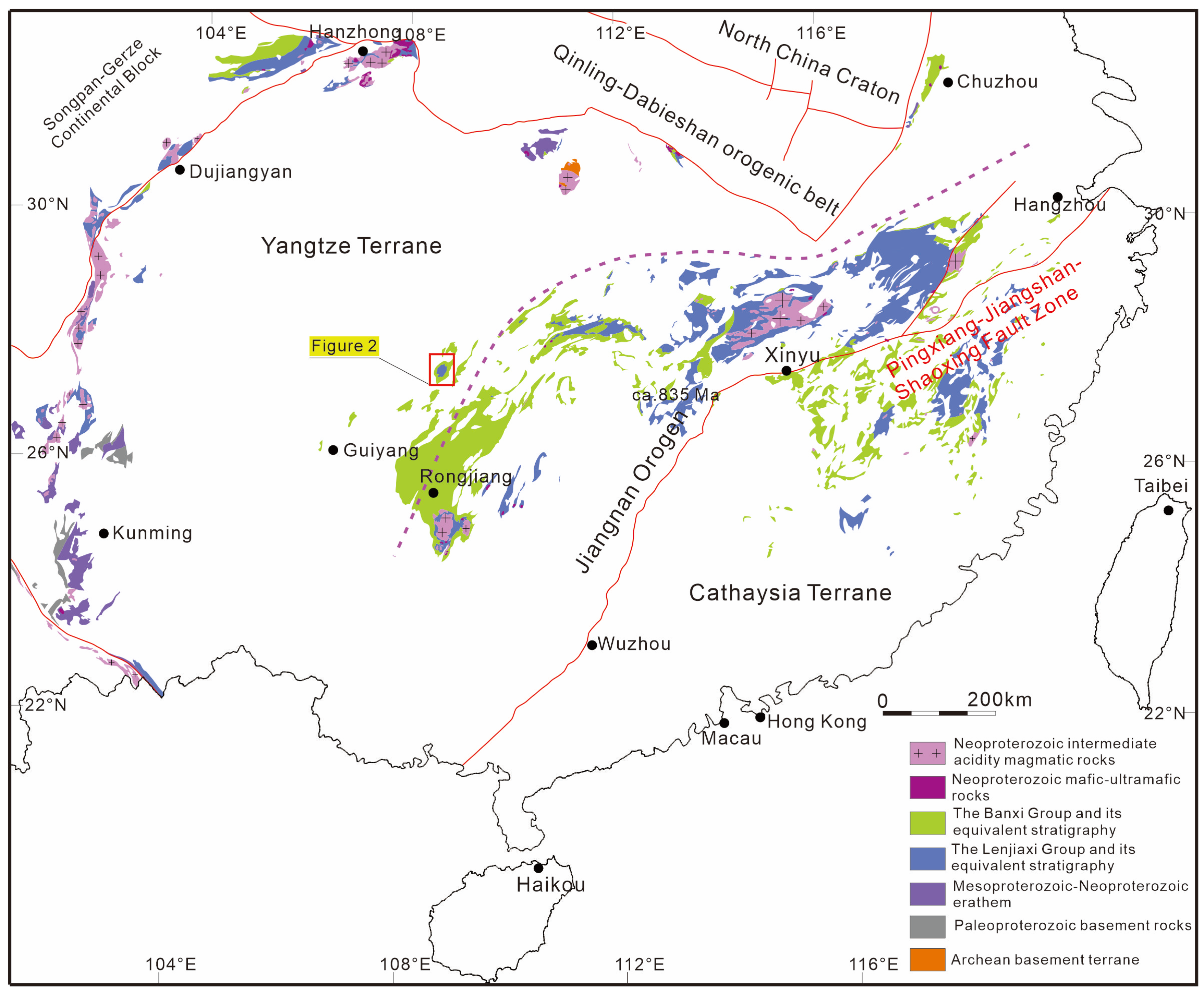
The Neoproterozoic Jiangnan Orogen in South China, formed by the amalgamation of the Yangtze and Cathaysia terranes (Figure 1) [7], represents a critical archive for such an investigation and for understanding the evolution of the Rodinia supercontinent [8,9,10]. However, the Middle Tonian tectonic setting of this orogen is highly controversial, with interpretations divided between a mantle plume model [11,12] and various protracted subduction–collision scenarios [13,14,15]. Resolving this controversy is essential for deciphering the regional crustal evolution and its connection to the Rodinia supercontinent.
The Fanjingshan Group, located in the southwestern part of the Jiangnan Orogen, preserves a continuous Middle Tonian volcano-sedimentary sequence and thus holds the key to this debate [9,16,17]. Despite its importance, fundamental controversies persist, including: (1) the timing of the final Yangtze–Cathaysia collision (~880 Ma vs. ~830 Ma or later) [9,10,11,12,13]; (2) the nature of the concomitant sedimentary basin (arc-related extension vs. continental rift) [9,14,15]; and (3) the origin of diagnostic magmatic suites like high-Mg basalts, which have been attributed to either plume activity or subduction-modified mantle melting [9,18,19,20,21,22,23,24]. Crucially, the genetic relationships between mafic sills and volcanic rocks, their exact emplacement ages, and their petrogenetic evolution within a convergent margin framework remain poorly constrained [25,26,27,28].
Therefore, a systematic, multidisciplinary study of the Fanjingshan region is not only critical for clarifying longstanding regional tectonic debates, but also represents a necessary step toward constructing a self-consistent, global model of subduction-to-collision processes, thereby offering a pivotal regional case study.

2. Geological Setting of the Fanjingshan Region

2.1. Stratigraphy and Magmatic Assemblage

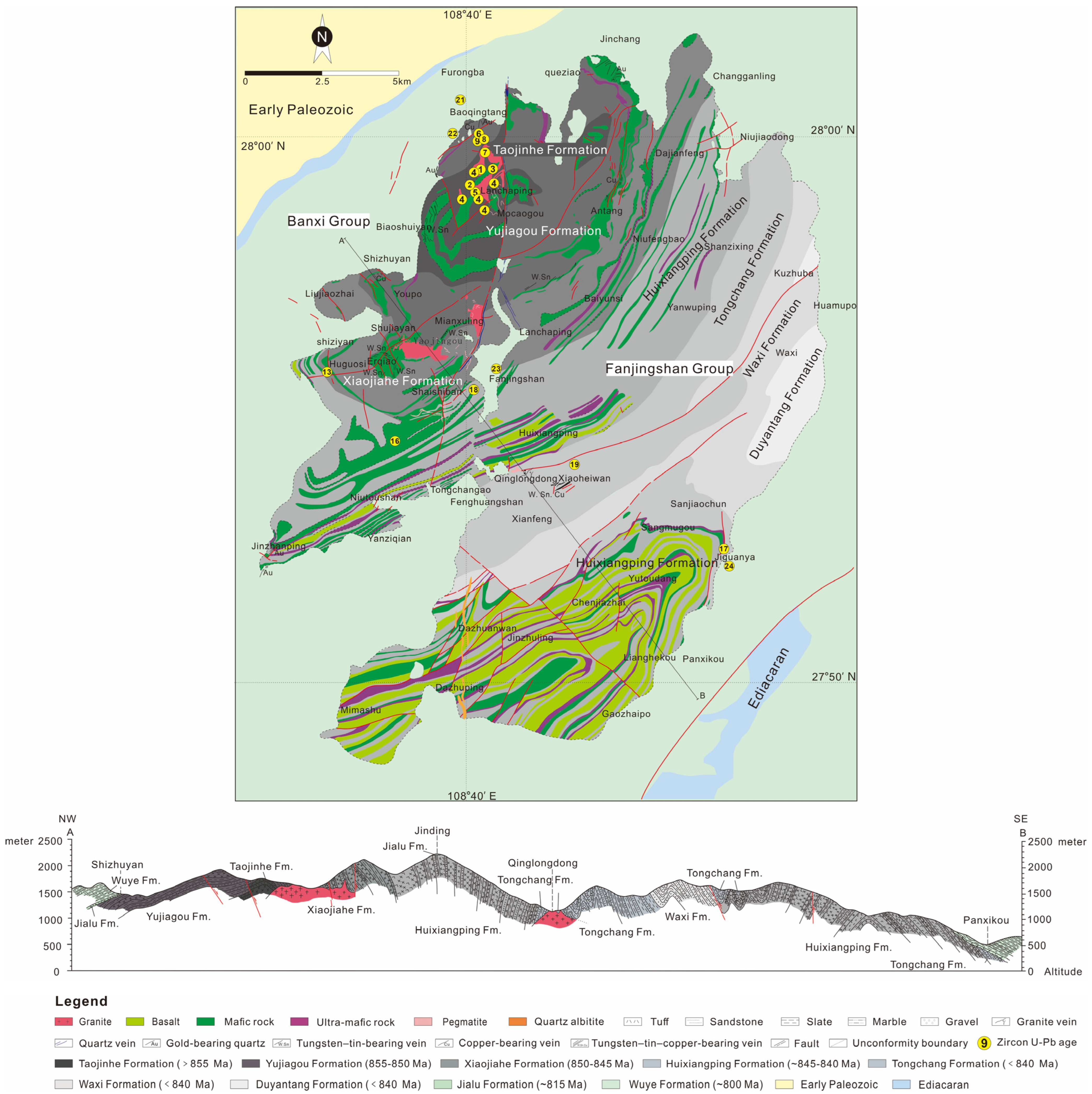
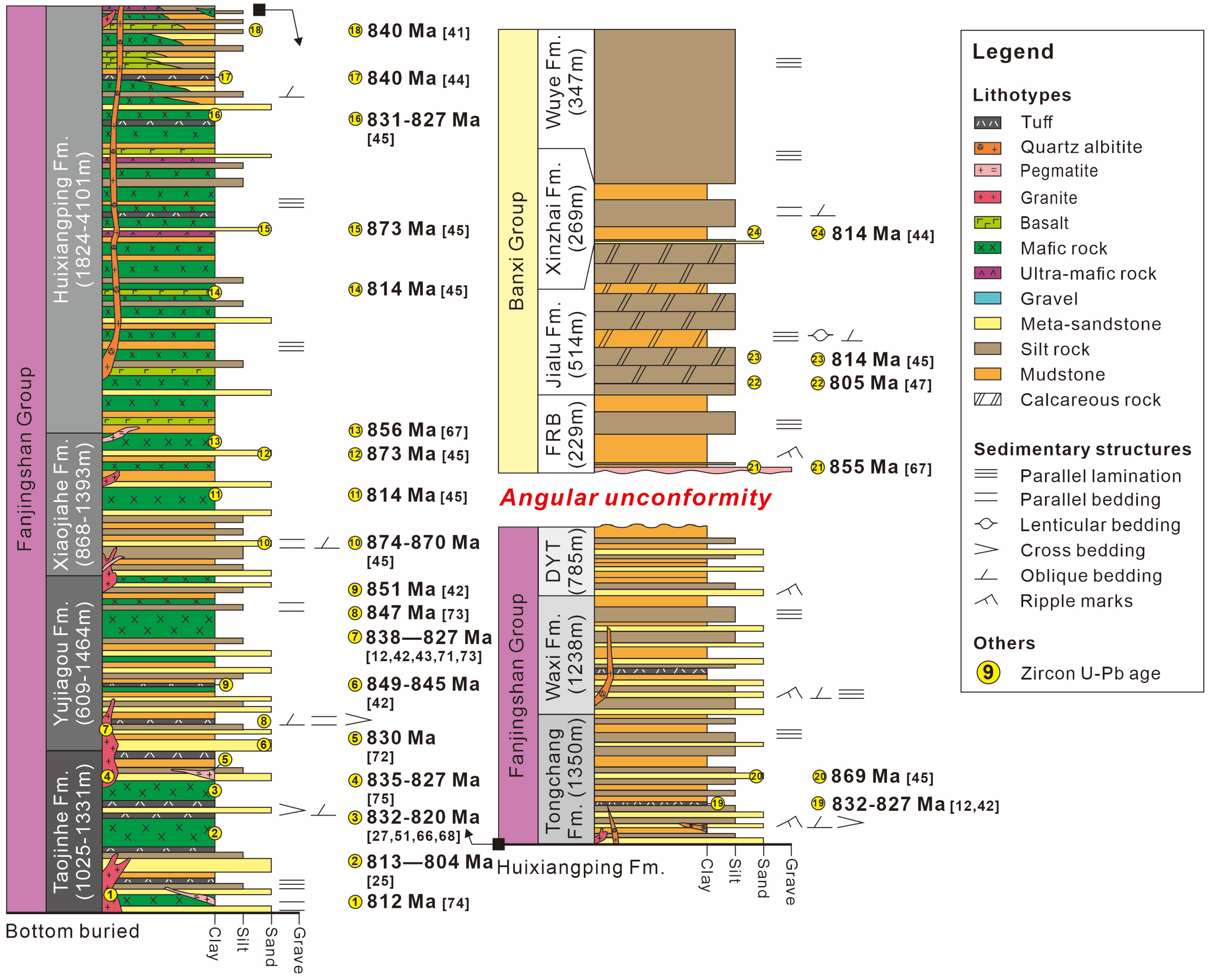
The Middle Tonian strata in the study region primarily comprise the Fanjingshan and Banxi groups, which are separated by an angular unconformity. Structurally, the Fanjingshan Group constitutes the core of a large domal anticline, which is in turn surrounded by outcrops of the Banxi Group (Figure 2). This major angular unconformity marks a significant tectonic hiatus. The tectonic event responsible for this angular unconformity is regionally referred to as the Wuling Orogeny, the timing and geodynamic nature of which are central to this study [29,30]. The lithostratigraphic sequence of the Fanjingshan Group, in ascending order, comprises the Taojinhe, Yujiagou, Xiaojiahe, Huixiangping, Tongchang, Waxi, and Duyantang Formations, which are in conformable contact with each other. The Taojinhe Formation consists of meta-tuff and meta-siltstone, intercalated with layered meta-mafic–ultramafic intrusive rocks. The overlying Yujiagou Formation is composed of meta-siltstone, meta-fine sandstone, and slate, and also contains layered meta-mafic intrusions. The Xiaojiahe Formation is dominated by meta-siltstone and slate, with interlayered meta-mafic–ultramafic intrusive rocks. A distinctive unit, the Huixiangping Formation, is characterized by abundant thick meta-basaltic lavas and layered mafic–ultramafic intrusions within a sequence of meta-tuffaceous siltstone and chlorite–sericite slate [31]. The Tongchang Formation consists mainly of meta-sandstone and tuffaceous meta-sandstone. The Waxi Formation comprises meta-siltstone, meta-sandstone, meta-quartz crystal tuff, and sericite slate. The uppermost Duyantang Formation exhibits interbedded meta-sandstone, meta-siltstone, silty sericite slate, and sericite slate. The Banxi Group in this region is incompletely exposed. The accessible succession, in ascending order, comprises the Furongba, Jialu, and Hongzixi Formations, which are in conformable contact with each other. The lowermost Furongba Formation rests with an angular unconformity on the underlying Fanjingshan Group and consists predominantly of basal conglomerate, meta-sandy conglomerate, and meta-sandstone. The overlying Jialu Formation is characterized by calcareous slate and calcareous phyllite, intercalated with layered meta-mafic intrusive bodies. The overlying Xinzhai Formation is primarily composed of light gray to gray-white, thick-bedded meta-quartz sandstone, meta-feldspathic lithic sandstone, and siltstone. The sequence grades upward into the Wuye Formation, which is dominated by dark gray, gray-green slate, silty slate, and carbonaceous slate, characterized by well-developed slaty cleavage (Figure 3) [32].
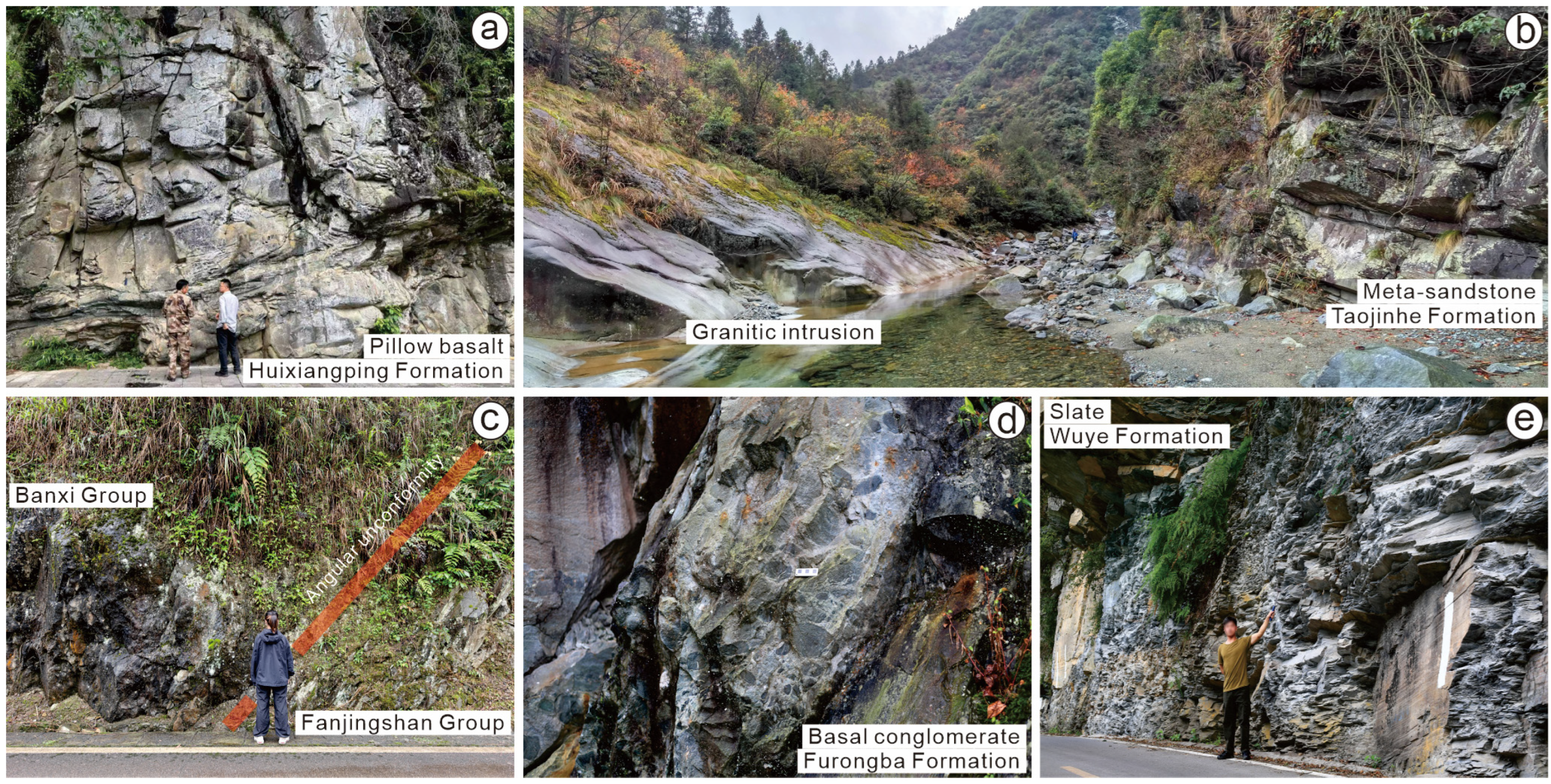
Magmatic rocks within the Fanjingshan region, which are all of Middle Tonian age and exposed within the Fanjingshan Group, include basalt, mafic–ultramafic intrusive rocks, and granite (Figure 4). The basalts, interlayered with sedimentary rocks from the Huixiangping Formation, are exposed in Fanjingshan. Regionally, the presence of pillow basalts allows for the correlation of the Fanjingshan Group with the Lengjiaxi and Sibao groups exposed in the Guizhou, Hunan, and Guangxi provinces [31,33]. The mafic–ultramafic intrusions, consisting of peridotite, diabase, and gabbro-diabase, are emplaced within the Fanjingshan Group. The granitic rocks are primarily ultra-acidic, peraluminous granite, accompanied by granitic pegmatite, albitite, and felsic lithologies [32].

2.2. Polyphase Tectonic Architecture

The Fanjingshan region preserves a complex geological architecture resulting from multiple phases of tectonic activity. The structural grain is predominantly oriented from NNE to NE and is characterized by an Alpine-type duplex fold assemblage [32,34]. A series of major regional unconformities records significant tectonic events, including the Wuling, Guangxi (Kwangsian), Indosinian, Yanshanian, and Himalayan movements. These key discontinuities comprise the angular unconformity between the Banxi Group and the underlying Fanjingshan Group; the parallel unconformity between the Nanhua and Qingbaikou systems; the parallel to low-angle unconformity beneath the Devonian; the parallel unconformity beneath the Permian; the angular unconformity beneath the Upper Cretaceous; and the angular unconformity beneath the Neogene.
Within the Fanjingshan region, unconformities are concentrated along the outcrop belt of the Furongba Formation, tracing a ring-like pattern through localities such as Banjiujing, Xiapingshuo, Shizhuyan, Huguosi, Jinzhanping, Mimashu, Bagan, Hongzixi, and Jinchang, with minor occurrences near Jinding. Critical angular unconformity contacts are documented at several sites. At Xiapingshuo (the northern limb of the Fanjingshan domal anticline), the Furongba Formation (Banxi Group) unconformably overlies the Yujiagou Formation (Fanjingshan Group). At Duyantang (the eastern limb of the Fanjingshan domal anticline), the Furongba Formation (Banxi Group) unconformably overlies the Duyantang Formation (Fanjingshan Group) (Figure 4). At the Huguosi locality (the western limb of the Fanjingshan domal anticline), the Furongba Formation unconformably overlies the Xiaojiahe Formation, marked by a thin basal conglomerate containing granite clasts. Finally, at Jinding (the core of the Fanjingshan anticline), the Jialu Formation (Banxi Group) unconformably overlies the Xiaojiahe and Huixiangping Formations (Fanjingshan Group) [31,32].

3. Data Synthesis and Analytical Framework

3.1. Nature of the Study and Data Sources

This study is a synthesis and reinterpretation based exclusively on previously published data. We conducted a systematic literature review to compile a comprehensive dataset of field observations, stratigraphy, geochronology (primarily zircon U-Pb ages), and whole-rock geochemistry from the Middle Tonian Jiangnan Orogen, with a focus on the Fanjingshan region. The compiled data were critically evaluated and integrated to test the competing tectonic models for the Middle Tonian period.

3.2. Data Compilation and Evaluation

To ensure the robustness and internal consistency of our synthesis, the compiled data underwent rigorous screening. Priority was given to samples with well-constrained stratigraphic context and complete analytical datasets. This evaluation considered the reliability of the reported analytical techniques (e.g., LA-ICP-MS, SHRIMP) and the coherence of data from independent studies for key geological units. All cited geochronological data were standardized for inter-study comparison and are interpreted within their stated analytical uncertainties.

3.3. Interpretative Methodology

Our tectonic reconstruction employs a multi-proxy correlative approach. It integrates: (1) chronostratigraphic constraints from volcanic tuff layers and detrital zircon populations; (2) provenance analysis using detrital zircon U-Pb age spectra and trace-element signatures [35]; and (3) the petrogenetic and tectonic discrimination of igneous rocks through geochemical and isotopic proxies [36,37,38,39,40]. The core of our model lies in establishing a stagewise correlation between magmatic petrogenesis and coeval changes in sedimentary basin evolution, as recorded by stratigraphic architecture and provenance shifts.

4. Results

4.1. Revised Chronostratigraphy and Sedimentary Provenance of the Fanjingshan Group

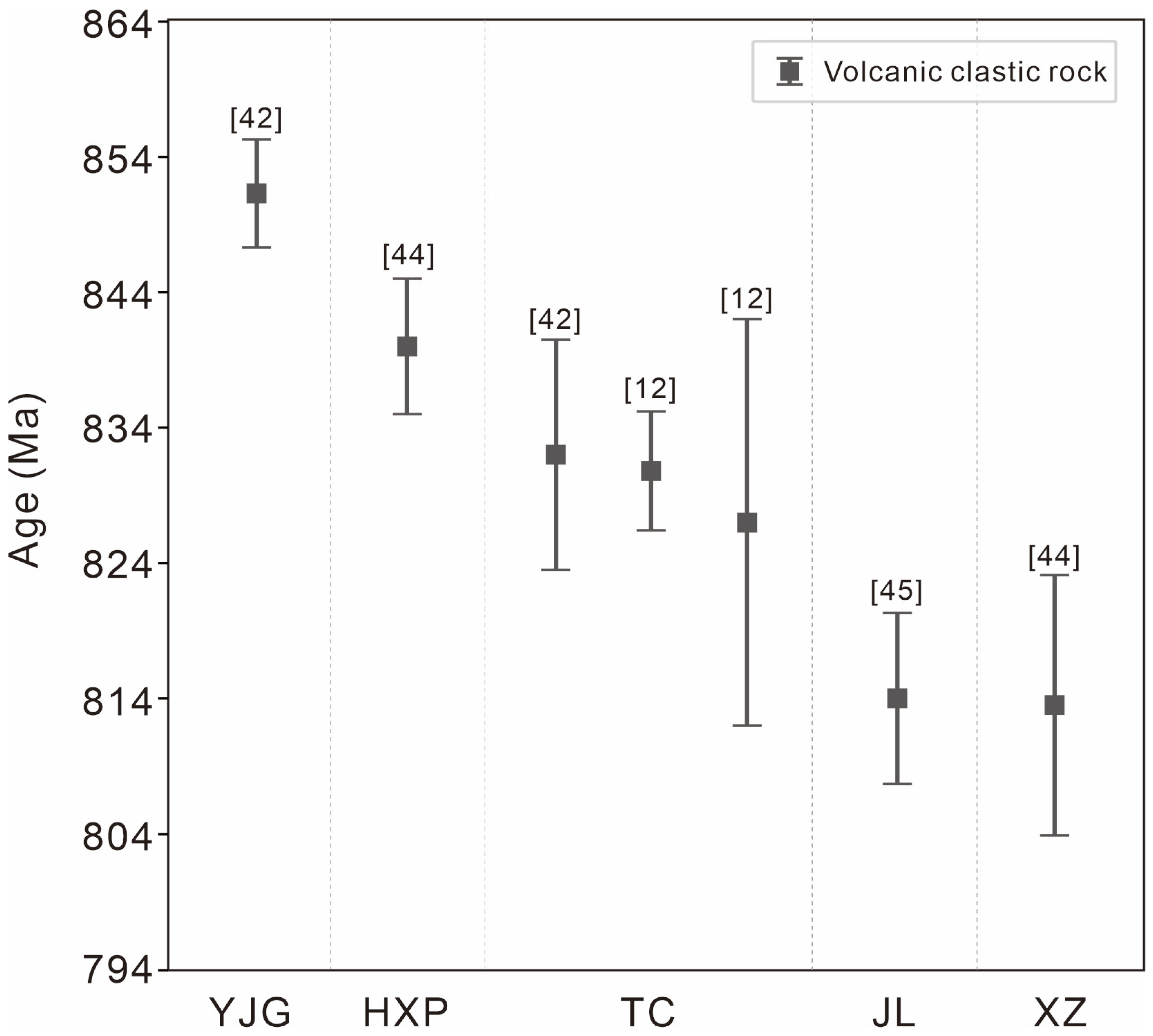
Recent detrital zircon studies from the western Jiangnan Orogen constrain the depositional age of the Fanjingshan Group and its equivalents to approximately 870–824 Ma [12,16,41,42,43,44,45,46]. Tighter chronostratigraphic constraints are provided by U-Pb ages of intercalated volcaniclastic rocks and tuffs (Figure 5): the Yujiagou Formation tuff at 851 ± 4 Ma (MSWD = 1.5, n = 20) [42]; the upper volcanic agglomerates and tuffs of the Huixiangping Formation at 840 ± 11 Ma (MSWD = 0.86, n = 12) [41] and 840 ± 5 Ma (MSWD = 1.5, n = 17) [44], respectively; and the Tongchang Formation tuff at 832.0 ± 8.5 Ma (MSWD = 6.5, n = 11) [42]. Field investigations confirm that basalt is exclusively exposed within the Huixiangping Formation [31,32]. Combining this with the ~840 Ma tuff ages at the top of the formation dates the cessation of basaltic volcanism to circa 840 Ma [41,44,47].
However, reconstructing a definitive stratigraphic sequence for this region is challenged by its complex tectonic overprint from multiple orogenic events, which introduces significant uncertainty. This complexity is exemplified by the analysis of a meta-sandstone sample from the Taoshulin area, traditionally mapped as the basal Taojinhe Formation [32,34]. As this sample was inferred to be the substrate for the overlying Yujiagou Formation, its detrital zircon record was expected to be older, or to at least yield similar ages [48]. Contrary to this expectation, the sample not only yields a maximum depositional age that is younger than the Yujiagou Formation [47], but it also indicates a local, rather than distal, sediment source. Furthermore, it carries a subduction-related zircon geochemical signature that contrasts with the extensional setting inferred for the Yujiagou Formation [33].
By integrating the well-constrained tuff ages with constraints from detrital zircon maximum depositional ages (Figure 6) [16,45,49,50,51,52,53], the revised lithostratigraphic sequence for the Fanjingshan basement and cover is established as follows: Taojinhe Formation (>855 Ma) → Yujiagou Formation (855–850 Ma) → Xiaojiahe Formation (850–845 Ma) → Huixiangping Formation (845–840 Ma) → Tongchang/Waxi/Duyantang Formations (<840 Ma) → Furongba Formation (>815 Ma) → Jialu Formation (~815 Ma) → Xinzhai Formation (~810 Ma) → Wuye Formation (~800 Ma). These chronological constraints provide a revised framework for the temporal evolution of the Fanjingshan and Banxi groups.
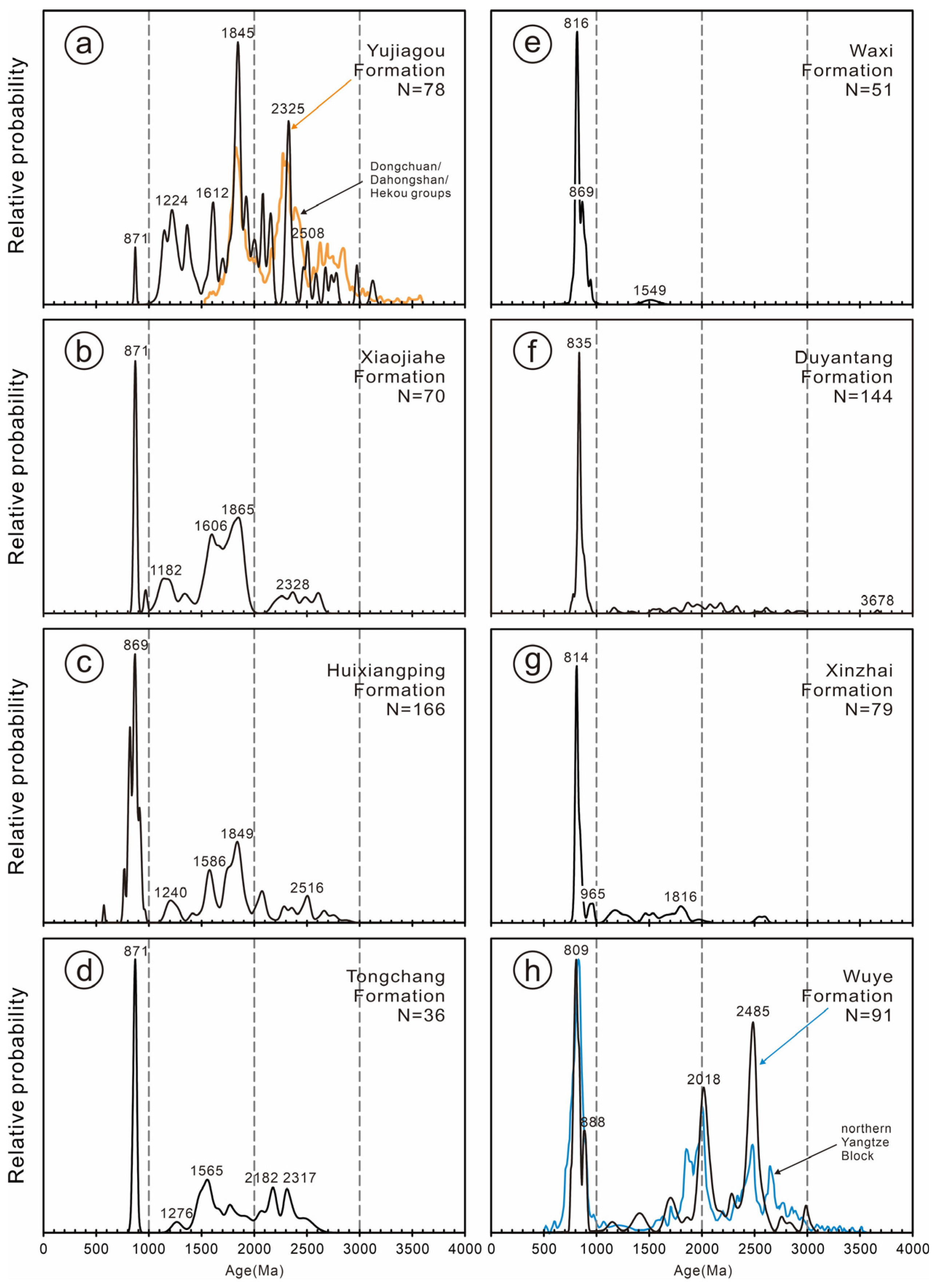
Detrital zircon U-Pb age spectra from the Fanjingshan and overlying Banxi groups document a clear progression in dominant provenance signatures through time (Figure 6). The Yujiagou Formation is characterized by prominent Paleoproterozoic age peaks between ~1.85 and 2.0 Ga (Figure 6a), which correlate with those of the Dongchuan, Dahongshan, and Hekou groups along the southwestern Yangtze Terrane margin (Figure 6a) [50,51,52]. In contrast, the overlying Xiaojiahe and Huixiangping Formations are dominated by a single, major Middle Tonian peak at ~870 Ma (Figure 6b,c) [45,49]. The Duyantang Formation exhibits a principal Middle Tonian peak at ~835 Ma (Figure 6f) [16,49]. For the overlying Banxi Group, the detrital zircon spectrum of the Xinzhai Formation is dominated by a prominent Middle Tonian peak at ~815 Ma (Figure 6g) [16]. The Wuye Formation displays a similar dominant Middle Tonian peak at ~809 Ma, but is distinguished by the addition of two significant Paleoproterozoic zircon age peaks (Figure 6h) [49], which match the signature of the northern Yangtze Terrane basement [53]. These detrital zircon U-Pb data document a clear progression in the dominant age signatures of the clastic-dominated sedimentary strata through time.

4.2. Geochemistry and Mantle Potential Temperatures of the 840 Ma Fanjingshan Basalt

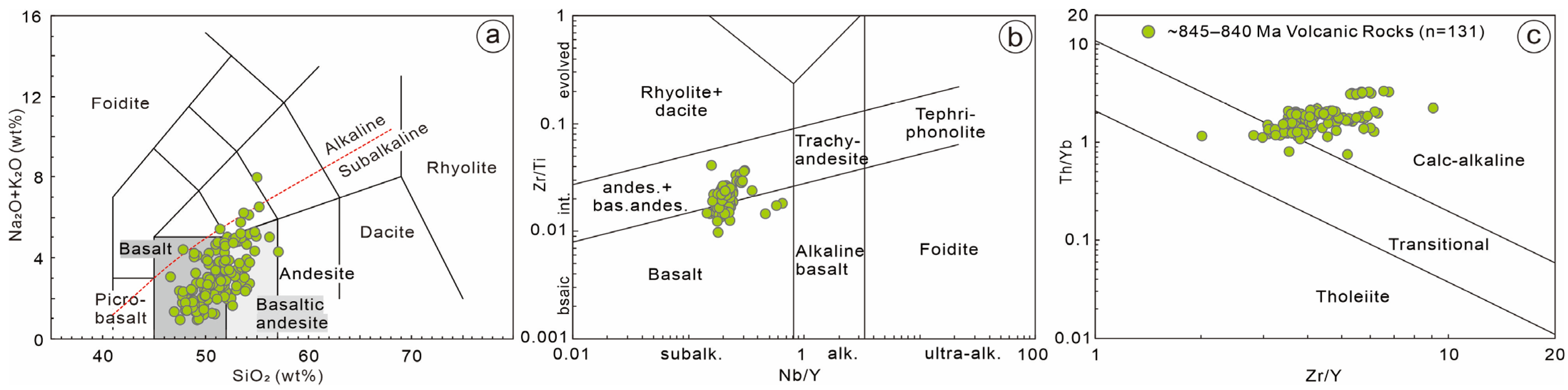
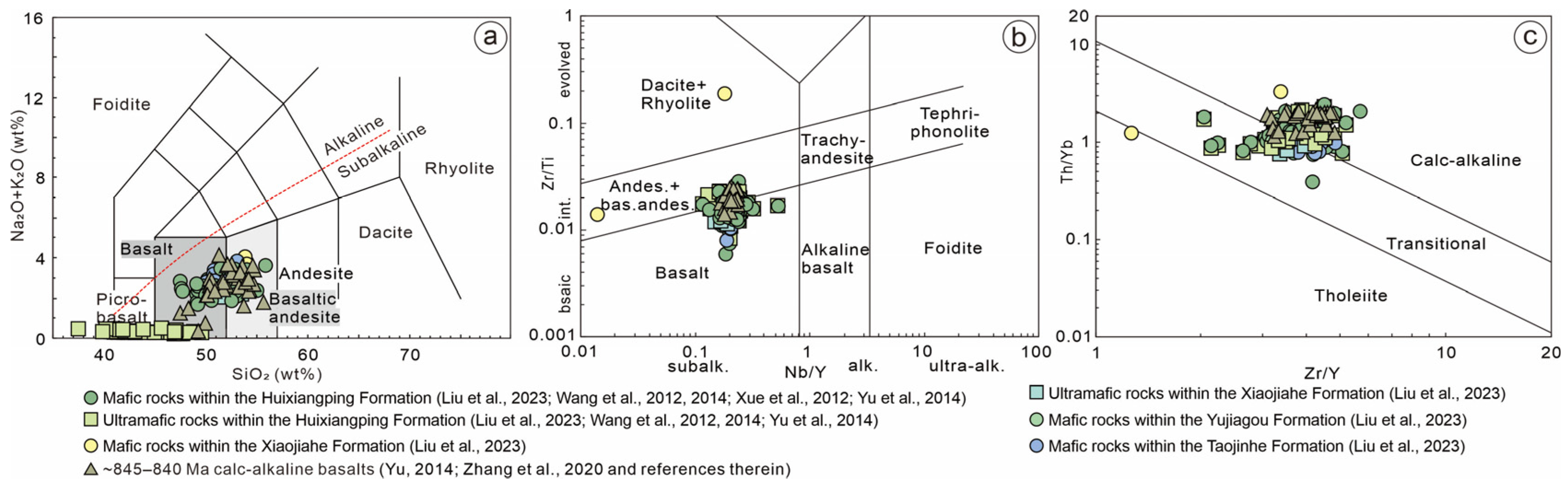
As previously noted, the Huixiangping Formation was deposited between 845 and 840 Ma, accompanied by intense basaltic eruptions [16,41,44]. Whole-rock data for these basaltic rocks show moderate SiO2 (48.2–54.3 wt%) and MgO (5.33–9.88 wt%) contents, with Mg# values ranging from 51 to 70. They are characterized by high Al2O3 (13.4–15.8 wt%) and CaO (7.65–11.4 wt%), and low TiO2 (0.54–0.92 wt%) and total alkalis (1.39–3.86 wt%) [54]. On the total alkali versus silica (TAS) diagram [36], these rocks are predominantly plotted within the subalkaline field (Figure 7a). Further classification using immobile trace element ratios (e.g., Zr/Ti vs. Nb/Y) [37,38] identifies them as basalts and basaltic andesites, with a trend towards calc-alkaline compositions (Figure 7b,c) [39,54].
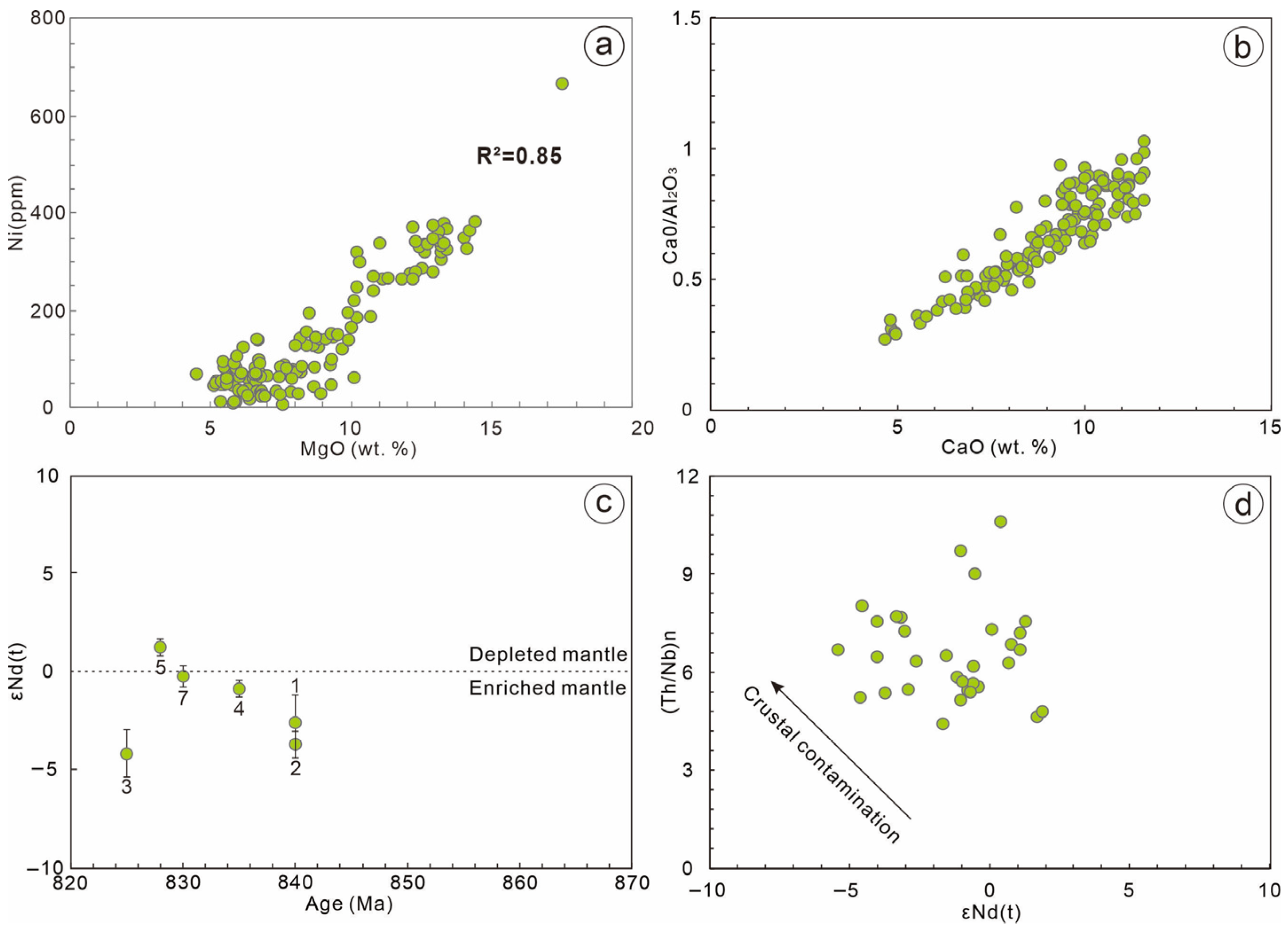
Geochemical data show that the ~845–840 Ma volcanic rocks possess compositional features that are indicative of a primitive magma origin, including high Mg# values and elevated contents of Cr, Ni, and Co [55,56]. The data show a strong positive correlation between MgO and Ni (Figure 8a), which is coincident with the observed presence of olivine phenocrysts and their subsequent fractional crystallization. A positive correlation is also observed between CaO and CaO/Al2O3 (Figure 8b). In contrast, within the dataset, no clear correlation is observed between Al2O3 and CaO. To assess the influence of crustal processes, trace-element ratios and Nd isotopic compositions were examined [56,57]. For the ~845–840 Ma volcanic rocks, the data plot shows no significant correlation between εNd(t) and these trace-element ratios (Figure 8c,d) [54].
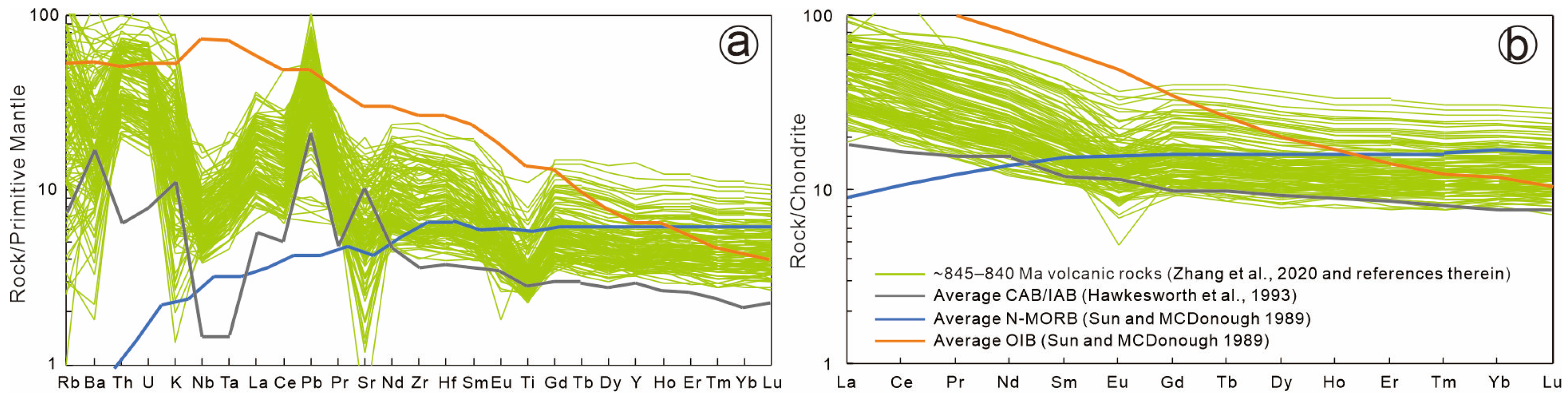
Primitive mantle-normalized trace element patterns (Figure 9a) [40,54,58] are characterized by enrichment in large-ion lithophile elements (LILEs, e.g., Rb, Ba, and Th) and light rare earth elements (LREEs), alongside pronounced negative anomalies in high-field-strength elements (HFSEs) such as Nb, Ta, and Ti. Corresponding chondrite-normalized REE patterns (Figure 9b) [40,54,58] show significant LREE enrichment, relative to heavy REEs (HREEs), with generally flat HREE segments. No pronounced negative Eu anomalies are discernible in the plotted patterns.
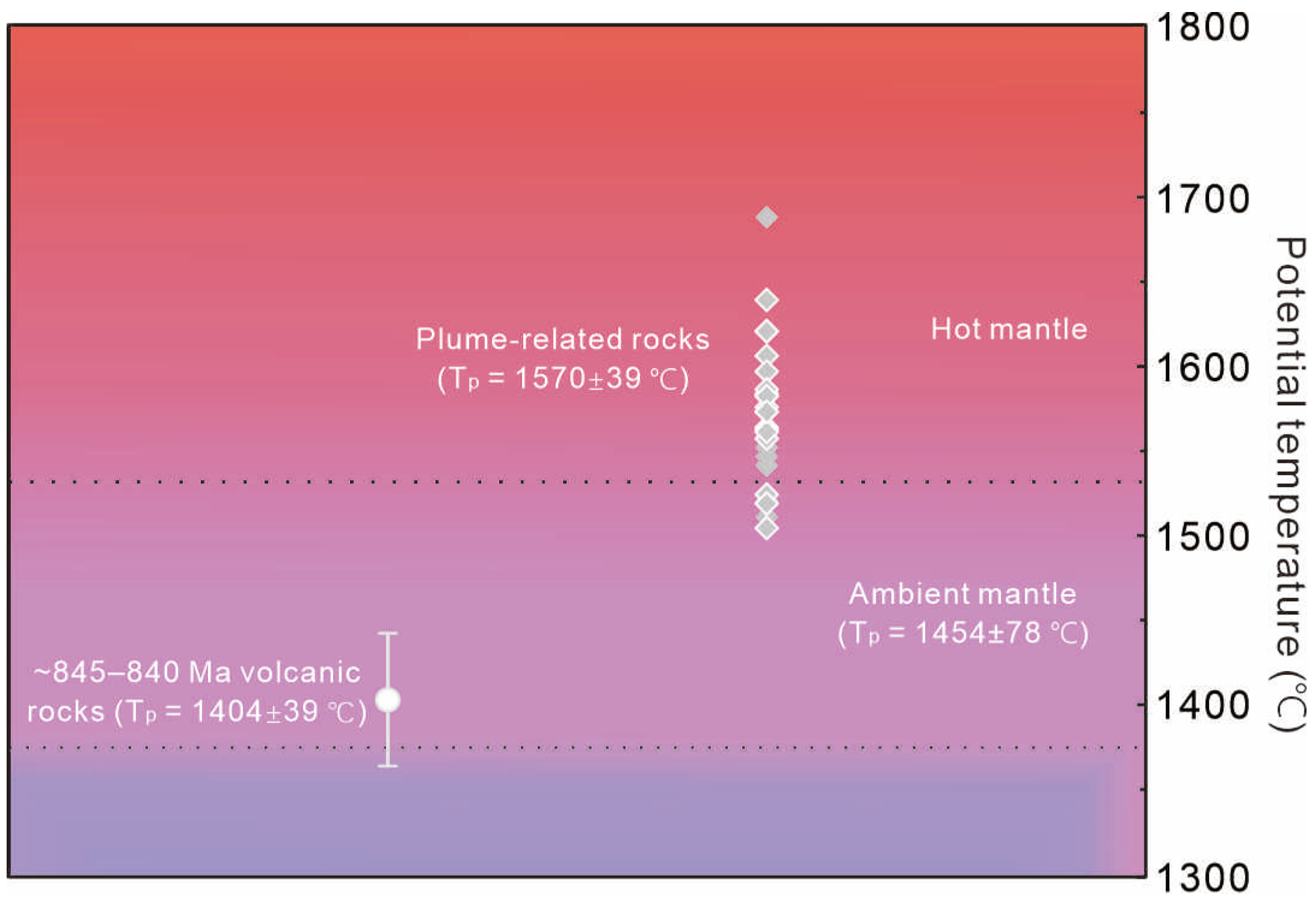
Based on primary magma compositions estimated from the whole-rock geochemical data [55], mantle potential temperatures (Tp) were calculated for the magma’s potential to the ~845–840 Ma volcanic rocks using well-established olivine–liquid thermobarometers [59,60]. The results, compiled in Figure 9, yield Tp values ranging from approximately 1380 to 1420 °C, with a mean value of ~1404 °C (Figure 10) [54,61,62,63,64].

4.3. Geochemistry, Two-Stage Emplacement, and Internal Differentiation of the Fanjingshan Mafic–Ultramafic Sills

Mafic–ultramafic sills are laterally extensive, layered intrusions typically emplaced in sedimentary basins, volcanic rifts, oceanic islands, or the lower crust [65]. Conforming to this architectural style, the Fanjingshan sills are primarily formed by long-distance lateral transport of magma and intrude the lower part of the group (Taojinhe to Huixiangping Formations) [31,32], with minor mafic bodies present in the overlying Tongchang Formation (Figure 2). Geological investigations of the Fanjingshan Group indicate that clastic rock-dominated sedimentary basins facilitated the long-distance lateral transport and emplacement of such magmas [66]. Geochemically, these intrusions are subalkaline, with compositions equivalent to calc-alkaline basalts, basaltic andesites, and picritic basalts, closely resembling the composition of the Fanjingshan basalts (Figure 11) [36,37,38,39,54,66,67,68,69,70].
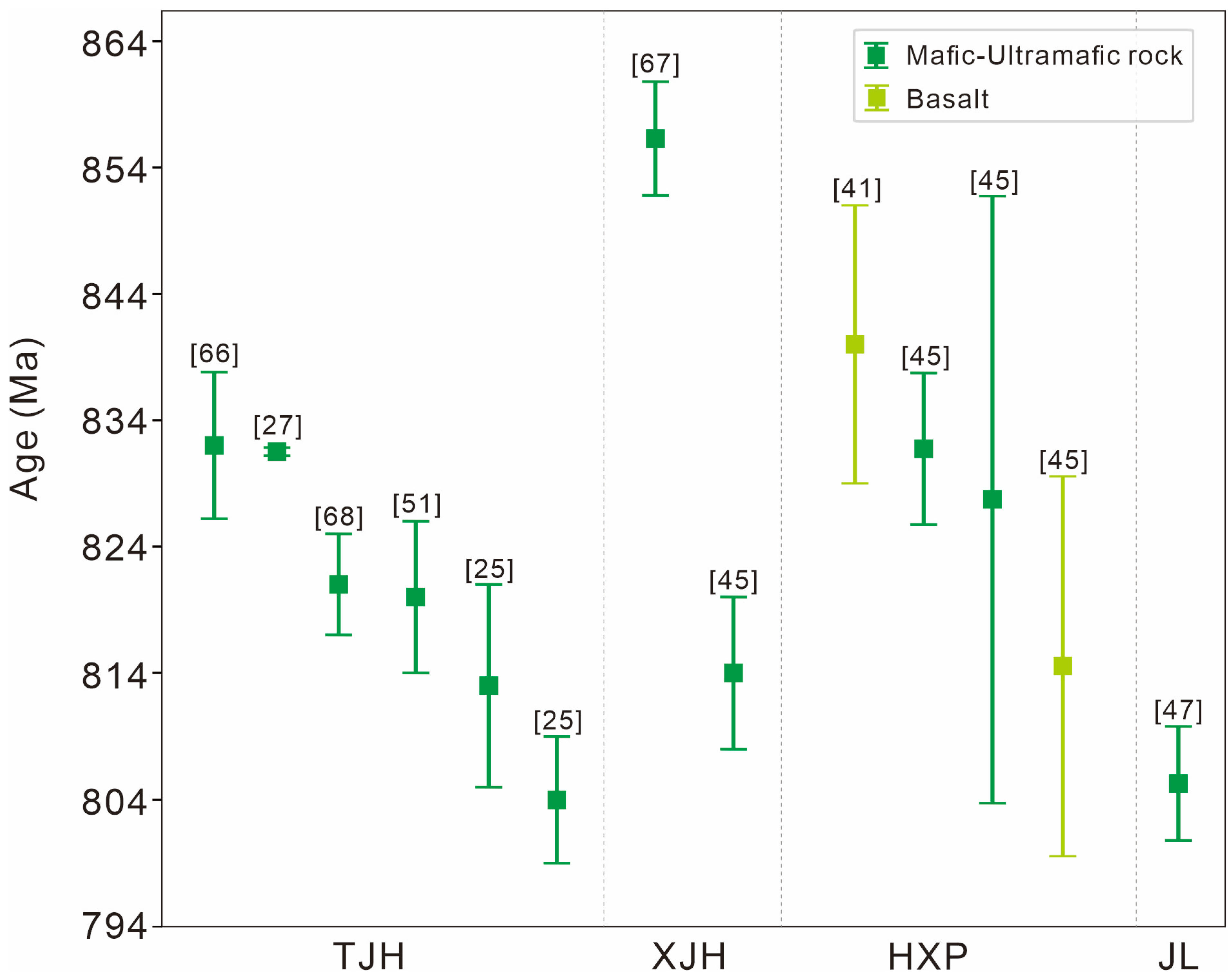
While available geochronological data constrain the emplacement of these intrusions to a broad interval between 856 and 804 Ma (Figure 12) [25,27,42,45,47,66,68,69], comprehensive geological, geochemical, and chronological evidence points to at least two distinct episodes of magmatism in the Fanjingshan region. The earlier episode, broadly coeval with the eruption of the 845 to 840 Ma basalts [16,44], yielded compositionally similar magmas. A distinct, younger intrusive phase is evidenced by minor intrusions in the overlying Tongchang Formation and precise zircon U-Pb dating of the gabbros in the Taojinhe Formation—yielding 832 ± 5.8 Ma (LA-ICP-MS) [66] and 832 ± 0.3 Ma (ID-TIMS) [27]. Similarly, mafic intrusions within the Huixiangping Formation return a statistically identical age of 831 ± 6 Ma [45]. Crucially, this younger phase postdates the earlier magmatic event by approximately 8 Ma, firmly corroborating the episodic emplacement of these sills [16,44].
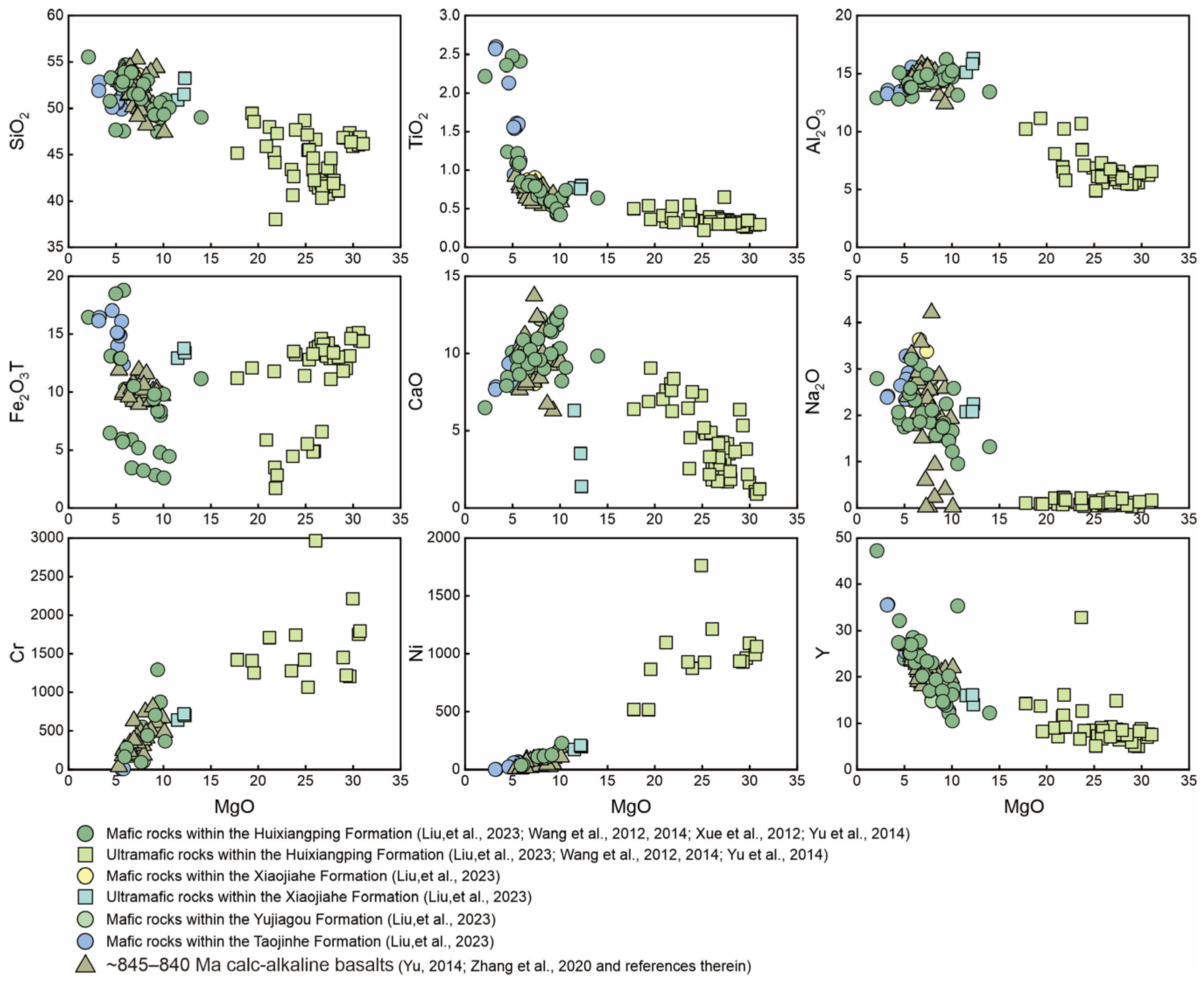
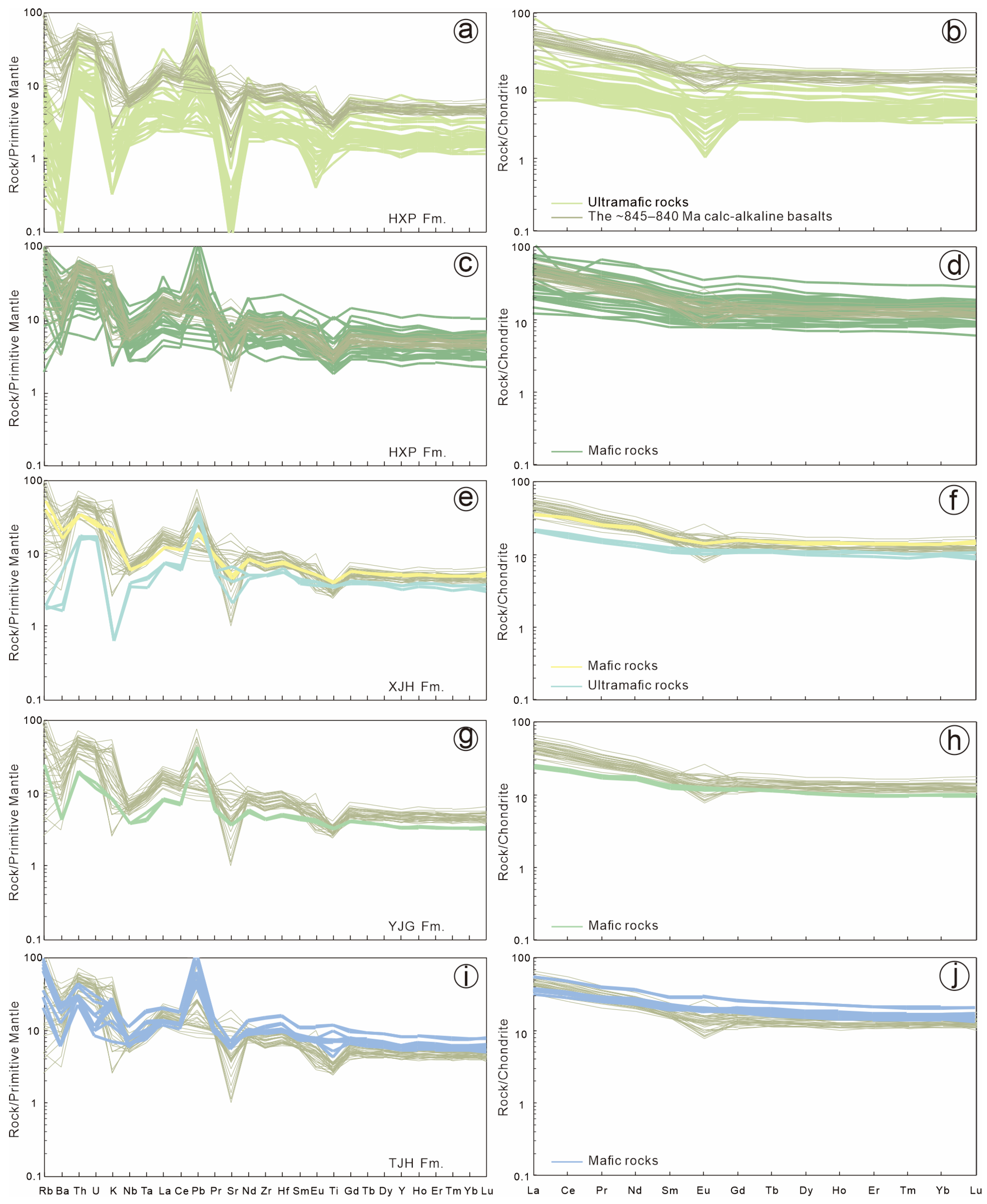
Whole-rock geochemical analyses reveal distinct compositional variations within the intrusive suite [66]. As expected for such fractionated sequences, the ultramafic rocks exhibit higher Cr and Ni concentrations, coupled with lower SiO2, Al2O3, CaO, and Na2O contents compared to their mafic counterparts (Figure 13). Regarding trace elements, the suite generally displays low total rare earth element (∑REE) abundances [66]. Furthermore, primitive mantle-normalized trace element patterns for the mafic rocks [40] show slight negative anomalies in Nb, Ta, and Eu [66]. Stratigraphically, the average ∑REE contents of the mafic intrusions within the Huixiangping, Xiaojiahe, and Yujiagou Formations (~38–65 ppm) are comparable to both one another and the coeval basalts. In contrast, those intruding on the Taojinhe Formation yield slightly more elevated values (~69 ppm) [66].
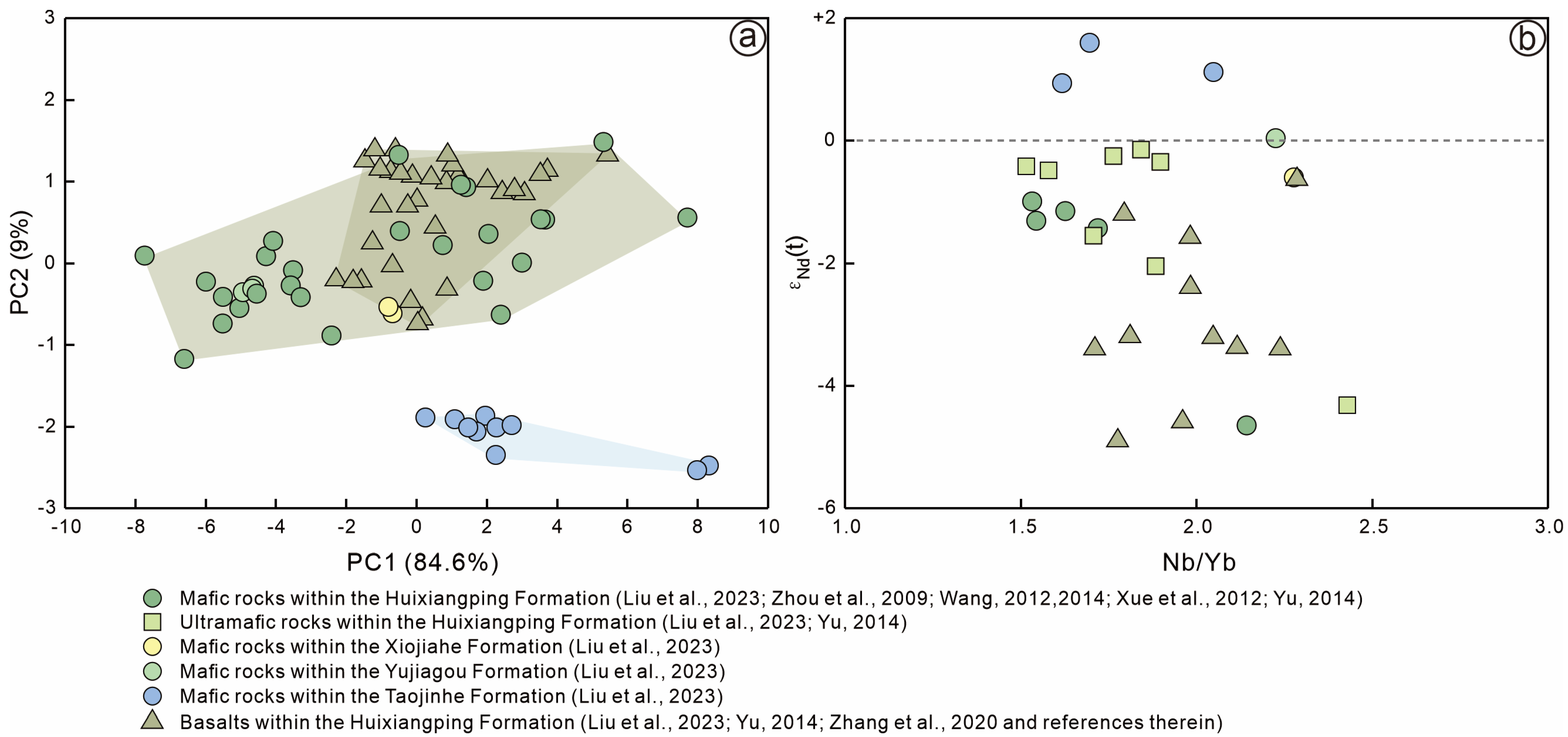
Principal component analysis of selected trace elements discriminates the geochemical signatures of mafic rocks from the Huixiangping, Xiaojiahe, and Yujiagou Formations from those of the Taojinhe Formation (Figure 14a) [45,54,67,68,69,70]. Specifically, rocks from the former group exhibit negative εNd(t) values and, on primitive mantle-normalized diagrams [40], pronounced negative Nb-Ti anomalies. In contrast, those from the Taojinhe Formation show positive εNd(t) values and lack such anomalies (Figure 14b and Figure 15).
Detailed vertical geochemical transects highlight systematic internal differentiation within individual sills. For instance, a thoroughly documented sill in the Huixiangping Formation displays a distinct “M-type” compositional profile. Its core consists of ultramafic cumulates enriched in Mg#, Cr, and Ni but depleted in SiO2 and Al2O3, which gradually transition outward into more evolved, fractionated mafic margins [66]. This distribution reflects a two-step in situ crystallization process: an initial phase where crystallization at the floor and roof yields progressively primitive compositions inwards, followed by uninterrupted, closed-system fractionation that concentrates more evolved melts toward the center [66].

4.4. Geochemistry, Highly Fractionated Nature, and Crustal Source of the ~830 Ma Fanjingshan Granites

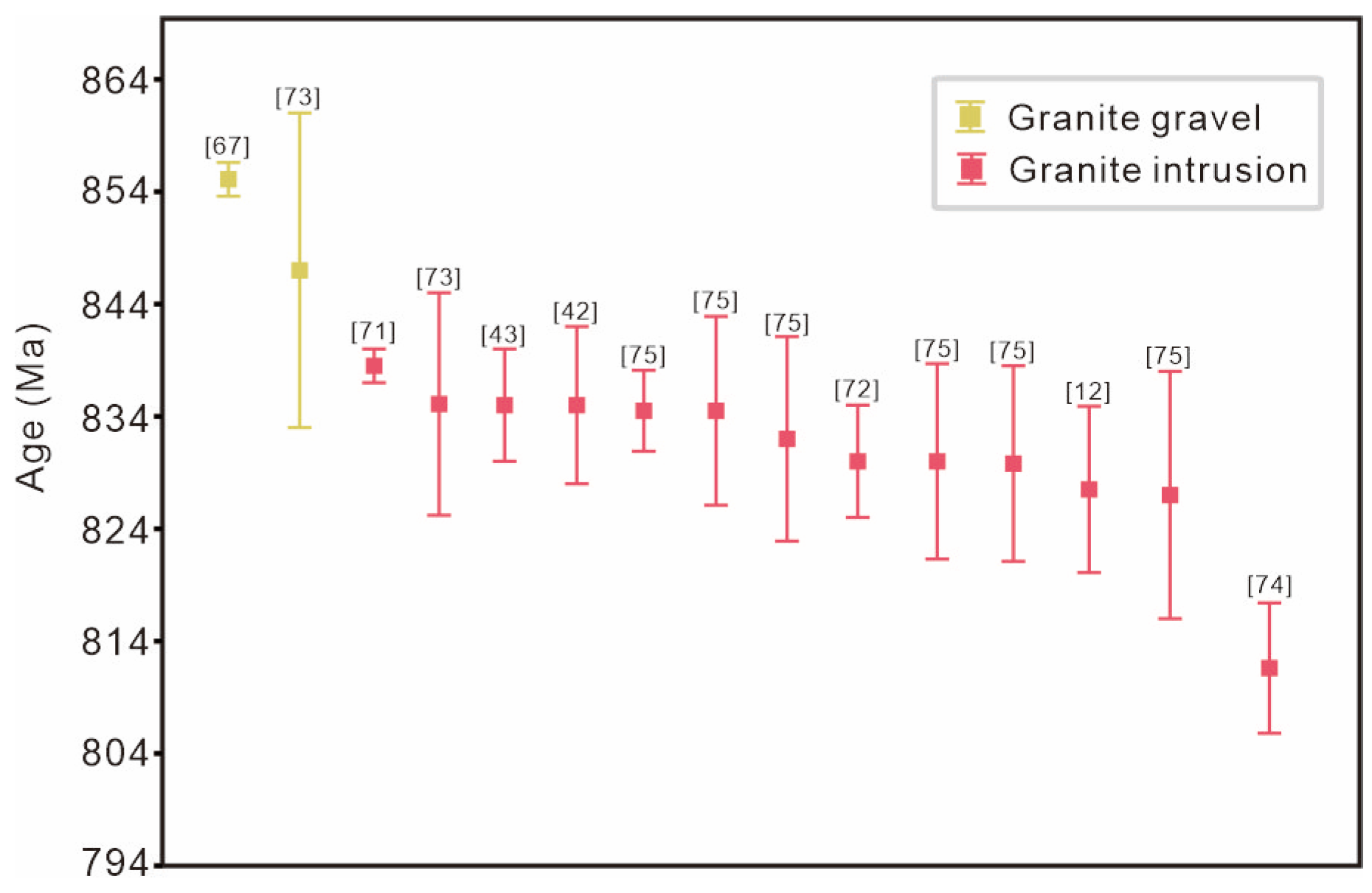
Field occurrences and geochronological evidence indicate that granitic magmatism in the Fanjingshan region occurred in two distinct episodes (Figure 16) [12,42,43,67,71,72,73,74,75]. The earlier episode is evidenced by two-mica granitic gravels within the basal layer of the Yujiagou Formation, yielding zircon and apatite U–Pb ages of 849 ± 9 Ma and 852 ± 7 Ma, respectively [73]. The subsequent, more voluminous episode is represented by the extensively exposed Taoshulin tourmaline-muscovite granite (Figure 16), which has been consistently dated at ~830 Ma.
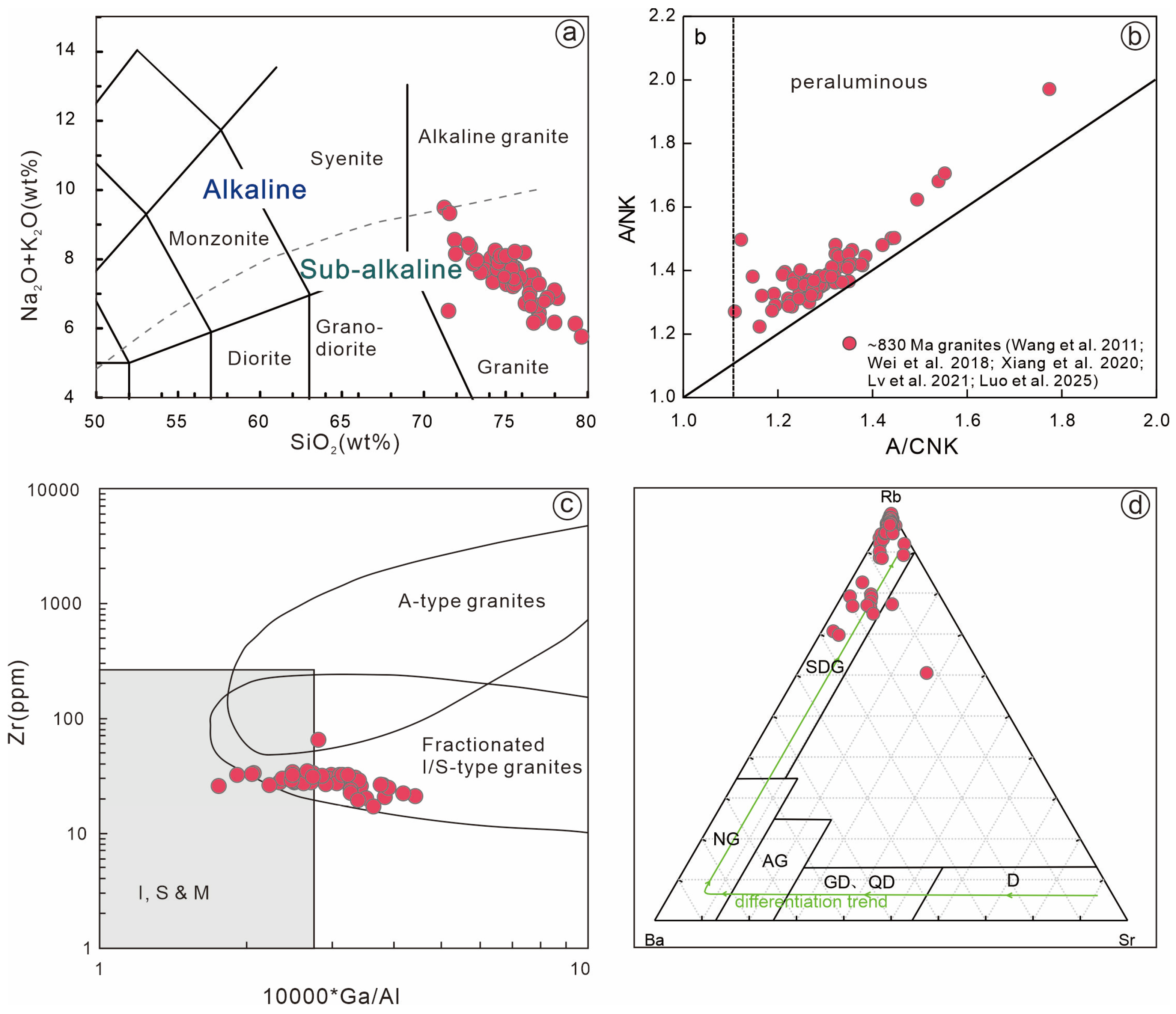
The ~830 Ma Fanjingshan granite is characterized by a subalkaline, peraluminous nature (A/CNK > 1.1), and is plotted within the granite field on the TAS diagram (Figure 17) [36,71,72,73,75,76,77,78,79]. These rocks exhibit high SiO2 (73.6–77.4 wt%) and Al2O3 (12.8–14.2 wt%) contents, accompanied by low MgO (0.01–0.10 wt%) and Fe2O3T (0.88–1.22 wt%) [73]. On a Rb-Ba-Sr ternary diagram (Figure 17d), the samples are plotted within the field of highly fractionated granites, which is consistent with their high Rb/Sr and low Ba/Rb ratios [73].
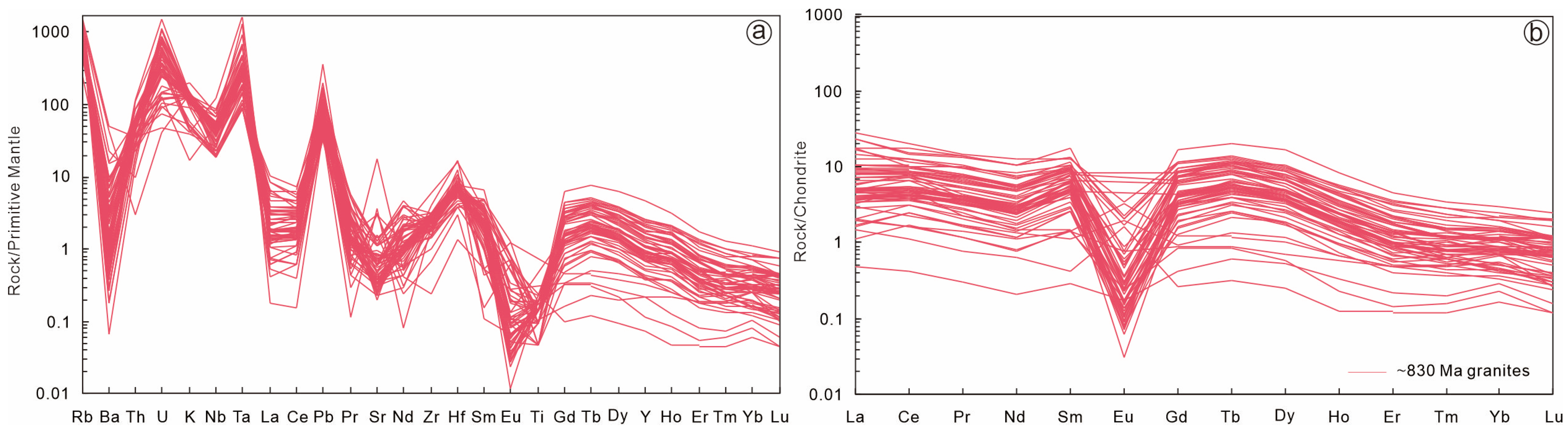
On chondrite-normalized REE diagrams, these granites exhibit a distinctive ‘seagull’ pattern, characterized by depletion in both light and heavy REEs ((La/Yb)N = 3.95–7.17) and extremely negative Eu anomalies (δEu < 0.02) (Figure 18a), which are indicative of a high degree of fractional crystallization. Their primitive mantle-normalized trace element patterns show pronounced depletion in Ba, Nb, and Eu, alongside enrichment in Rb, Th, and U (Figure 18b). Furthermore, a notable lanthanide tetrad effect (TE1,3 = 0.98–1.24) and low Nb/Ta ratios (≤4) reflect an intense magmatic–hydrothermal interaction during the final stages of differentiation [80].
These geochemical signatures are consistent with their isotopic composition: zircon Hf isotopic analyses yield negative εHf(t) values with Paleoproterozoic Hf model ages (1.7–2.2 Ga) [73], and zircon saturation thermometry indicates crystallization temperatures of 646–676 °C [73], suggesting that these highly differentiated S-type granites were derived from the partial melting of Paleoproterozoic metasedimentary basement rocks [73].

5. Discussion

5.1. The Middle Tonian Magmatic Record Archives a Complete Tectonic Cycle from Subduction to Collision

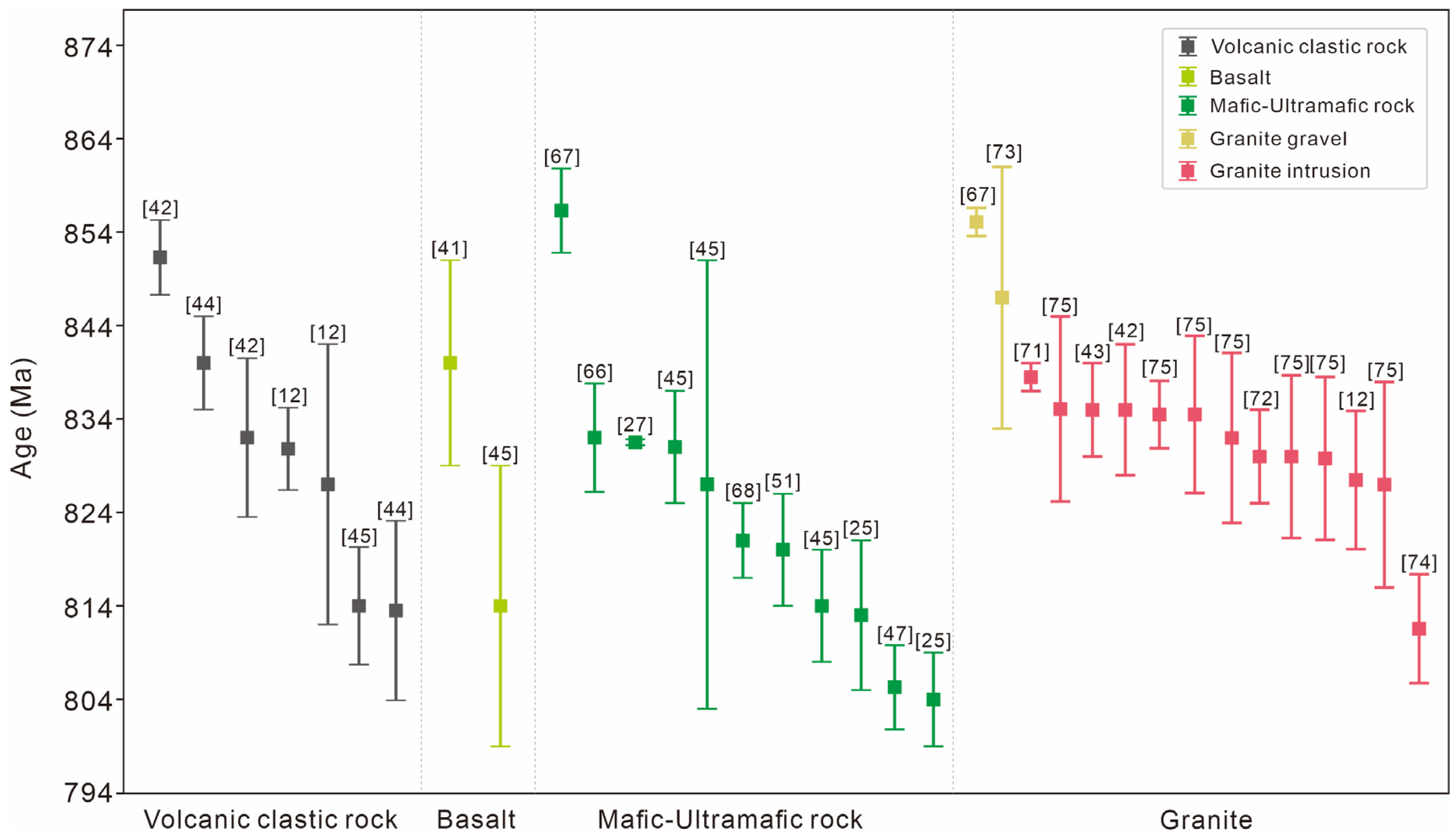
The Middle Tonian magmatic record of the Fanjingshan region constitutes a coherent flare-up event (Figure 19) within an evolving active continental margin. Integration of its geochronology and petrogenesis allows for this magmatic sequence to be interpreted as a complete tectonic cycle [22,24].
The petrogenesis of each magmatic suite provides a discrete record of deep crust–mantle processes. Notably, the widespread ~870 Ma magmatism, evidenced by the dominant ~870 Ma detrital zircon peak in the Xiaojiahe and Huixiangping Formations (Figure 6b,c) [45,49], marks a fundamental tectonic transition along the Yangtze Terrane since 870 Ma. This transition represents a shift from a passive margin lacking a coeval magmatic record to an active margin dominated by mantle input, signifying the onset of a prolonged subduction system [16]. Recognizing this event as the initiation of subduction-related magmatism provides a key constraint, which is consistent with regional studies that re-evaluate the tectonic setting of the western Jiangnan Orogen.
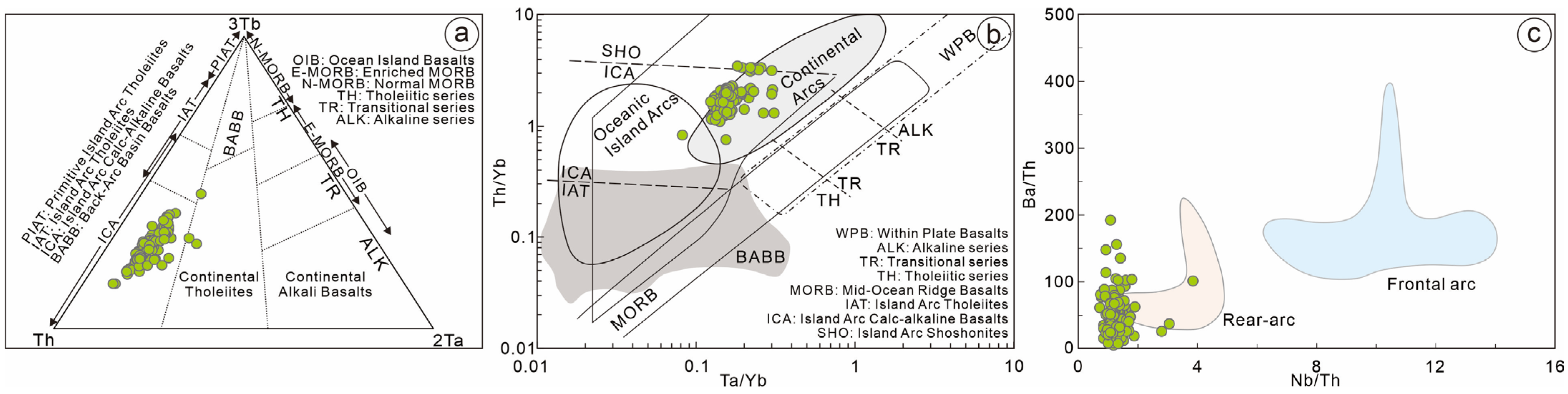
The ~845–840 Ma calc-alkaline basalts and basaltic andesites (Figure 7) are characterized by diagnostic subduction zone geochemical signatures [60,81,82,83], including pronounced negative Nb-Ta-Ti anomalies and enrichment in fluid-mobile elements (Figure 9a). Their arc-type trace element signatures, protracted eruption duration, and limited areal extent [54] are inconsistent with the massive, rapid magmatism that is typical of mantle plumes. Their calculated mantle potential temperatures (mean Tp ~1404 °C, Figure 10) [54] are ~166 °C lower than the Tp expected for plume-derived melts [61,62,63]. This Tp is consistent with melting in a subduction-modified mantle wedge, particularly during slab roll-back [54]. Tectonic discrimination diagrams (Figure 20) [84,85,86,87,88,89], coupled with their low εNd(t) values (Figure 8c) [86], the presence of ~1.7 Ga zircon xenocrysts [90] correlative with Paleoproterozoic strata on the Yangtze Terrane margin [51], and the lack of a pronounced negative Eu anomaly, support a continental arc setting. The lack of a frontal-arc magmatic suite, combined with enriched REE patterns (Figure 9) and the provenance shift from cratonic to arc-dominated (see Section 5.2), recorded in synchronous strata, confirms that these magmas did not originate in a frontal-arc. Regional syntheses confirm that the high-Mg rocks in the Jiangnan Orogen are compositionally akin to picrites formed in subduction zones, not komatiites formed by mantle plume [23]. Furthermore, their low Nb/La ratios (average ~0.44) preclude an uncontaminated intraplate (plume) mantle source (Nb/La > 1) and are diagnostic of a subduction-modified reservoir [54]. Therefore, the integration of an arc-related magmatic assemblage (picrite–basalt–andesite–dacite–rhyolite) [22,24,45,91,92], ophiolitic remnants [18,90,93,94], and metamorphic events [30] supports formation in a continental arc setting.
The mafic–ultramafic sills offer further petrogenetic constraints that reinforce a multi-stage arc setting. A clear geochemical and isotopic contrast is observed (Figure 14a): sills within the Huixiangping, Xiaojiahe, and Yujiagou Formations resemble the ~840 Ma arc basalts (with negative εNd(t) and marked Nb-Ti anomalies), suggesting that the rising asthenosphere generates primitive mafic magmas that either erupt as seafloor/rift-related basalts or intrude on the sedimentary sequence (Taojinhe to Huixiangping Formations) as layered sills at this stage, whereas the temporally later sills within the Taojinhe Formation (~832 Ma) possess positive εNd(t) values and lack these anomalies (Figure 14b and Figure 15). This distinction supports a two-stage emplacement model [66], wherein the first stage (~845–840 Ma) involved magmas that experienced considerable crustal contamination during ascent through newly formed conduits [66,95]. Subsequently, the second-stage (~832 Ma) magmas appear to have exploited the first-stage magmatic conduits, minimizing further assimilation [96,97]. This record of discrete, compositionally distinct magmatic pulses over a ~10–15 Ma interval aligns with the prolonged, episodic magmatism expected in an active subduction system. Further evidence comes from the internal structure of these sills. The “M-type” vertical geochemical profile documented within a Huixiangping Formation sill points to sustained magma recharge and in situ differentiation within a large, tabular intrusion [66]. The development of such a profile necessitates a stable, extensional environment where a magma body can undergo prolonged fractionation—conditions that are emblematic of a continental rear-arc basin during slab rollback. Therefore, both the multi-stage emplacement history and the internal architecture of the sills corroborate a tectonic setting dominated by long-lived subduction and concomitant upper-plate extension.
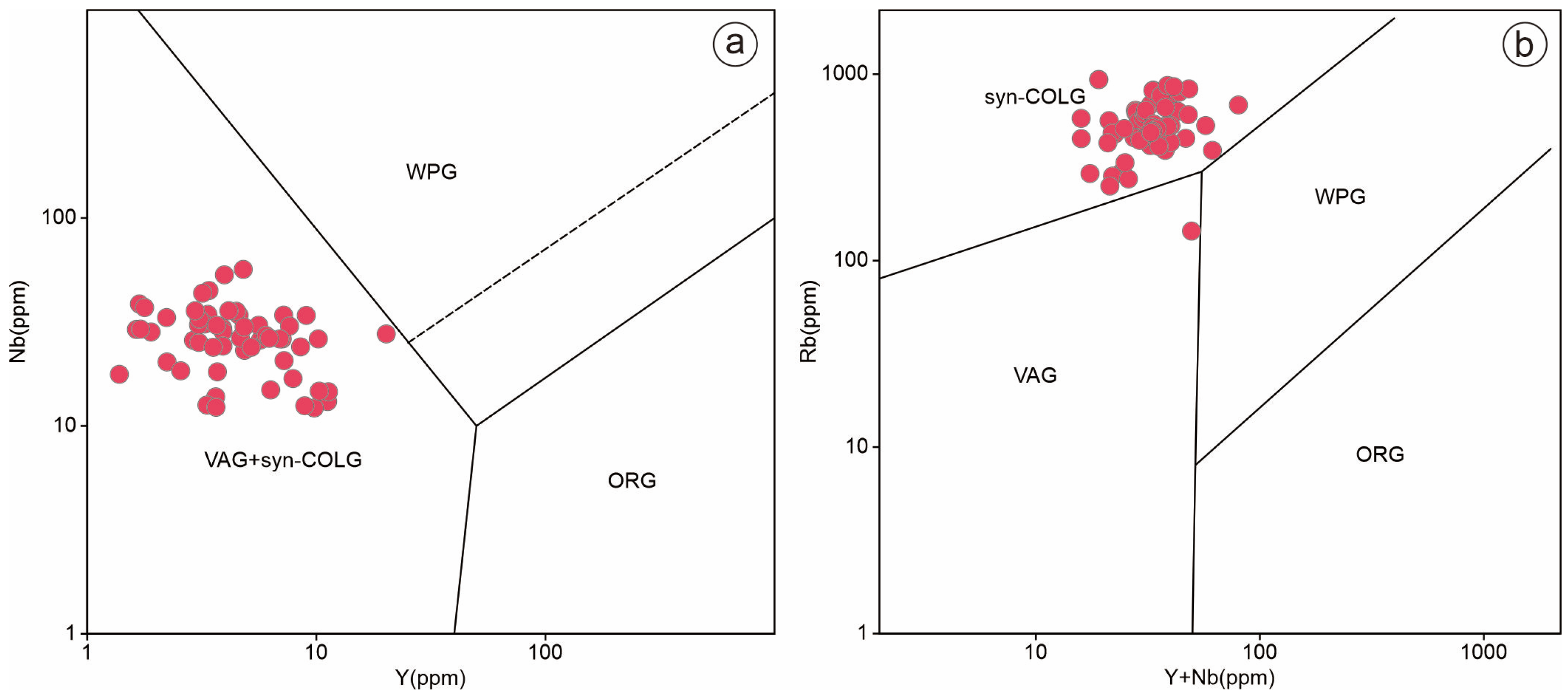
The ~830 Ma interval represents another crucial time for the Fanjingshan region, as this stage is characterized not only by the episodic re-injection of mafic magmas but also by the generation of peraluminous S-type granites. This granite has a high SiO2 content and a peraluminous A/CNK ratio (>1.1), aligning with S-type characteristics, as definitively illustrated by its position within the S-type field on the 10,000 × Ga/Al vs. Zr discrimination diagram (Figure 17c) [77,78]. The S-type signature is further distinguished from other granite types. Unlike A-type granites, which are typically metaluminous with high Ga/Al ratios and enriched in high-field-strength elements [77], the Fanjingshan granite is strongly peraluminous, possesses low Ga/Al, and shows marked depletion in Nb and Ta (Figure 18) [73]. The strongly peraluminous character (A/CNK > 1.1) and muscovite-bearing assemblage are diagnostic for identifying these rocks as S-type granites derived from metasedimentary sources [74,98,99], distinguishing them from I-type granites. These features necessitate the partial melting of ancient metasedimentary crust under conditions of significant crustal thickening. This shift from predominant mantle input to significant crustal involvement reflects the thermal maturation of the crust during the waning stages of the magmatic cycle. The geochemical signatures of this granite—including high Rb/Sr, low Ba/Rb, and an extreme negative Eu anomaly—indicate low-pressure, water-present crustal anatexis [100,101,102], collectively supporting a syn-collisional origin, as further confirmed by its placement in syn-collisional fields on tectonic discrimination diagrams (Figure 21) [103]. The ~830 Ma crystallization age of this granite therefore provides a direct petrological chronometer for the syn-collisional phase of the orogeny. Regional syntheses integrating such S-type granites constrain the major collisional event (Wuling Orogeny) to ~835–820 Ma [16,24]. This robust petrogenetic record of crustal thickening and compressional tectonics therefore provides positive evidence for a subduction–collision model during this interval.
In essence, the Fanjingshan magmatic assembly—comprising arc volcanics, coeval mafic sills, and syn-collisional granites—archives a complete geodynamic cycle spanning from subduction-driven extension to terminal collisional orogeny. It establishes a definitive temporal and petrogenetic framework for the Neoproterozoic crustal evolution of the Yangtze Terrane.

5.2. The Middle Tonian Sedimentary Archive of the Tectonic Transition from Convergence to Collision and Extension

Complementary to the magmatic record, the sedimentary sequences of the Fanjingshan and Banxi groups provide another independent archive of the orogenic cycle. Their provenance evolution and basin architecture are examined here to constrain the timing and nature of the tectonic shift from an active margin to collisional orogenesis.
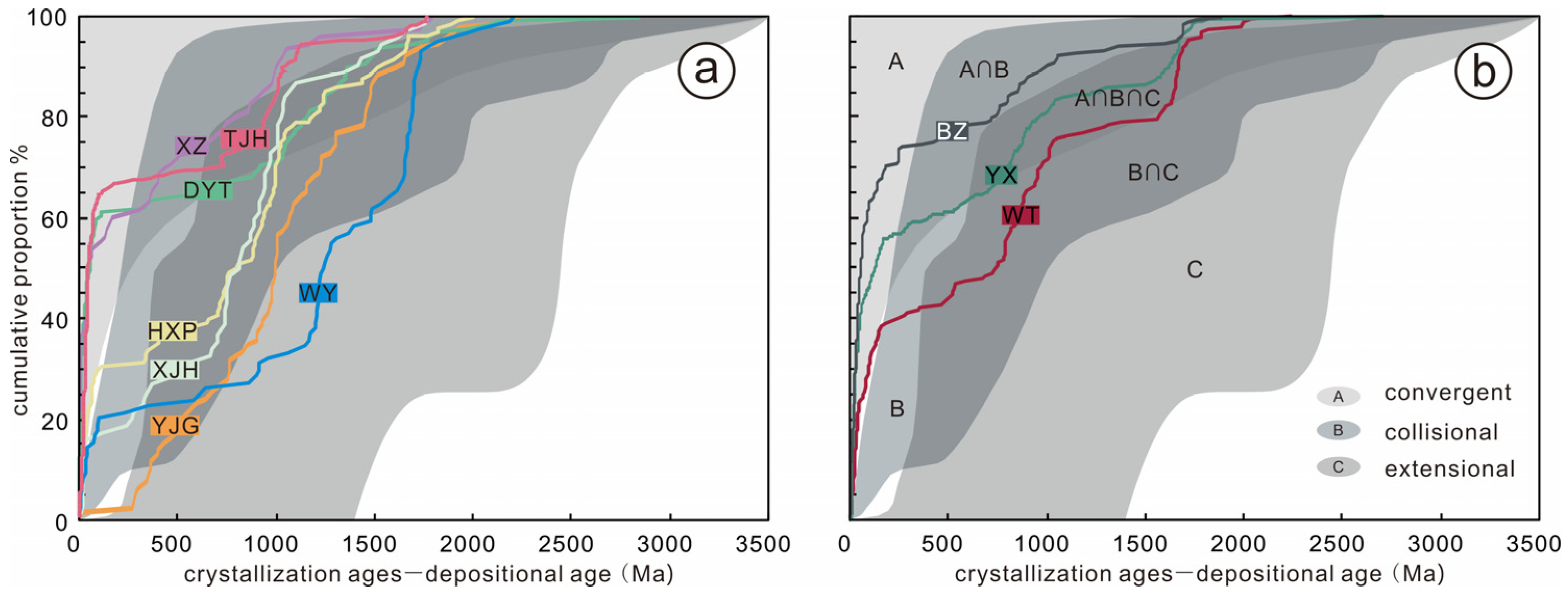
The most compelling record of this tectonic shift is preserved in the systematic provenance evolution archived within the detrital zircon U-Pb age spectra of successive formations (Figure 6). The Yujiagou Formation, characterized by prominent Paleoproterozoic age peaks between ~1.85 and 2.0 Ga (Figure 6a), was sourced from the ancient Yangtze Terrane basement, with its age spectrum correlating with Precambrian strata along the southwestern Yangtze Terrane margin [51,52]. This ancient cratonic provenance is consistent with deposition within a passive continental margin setting [16]. A definitive transformation is recorded in the overlying Xiaojiahe and Huixiangping Formations, where the provenance becomes overwhelmingly dominated by a pronounced ~870 Ma peak. This signifies a sudden, massive influx of detritus from the newly established continental arc. This geochemical signature is diagnostic of the widespread ~870 Ma magmatism in the western Jiangnan Orogen [13,19,45,49,104] and marks a clear transition from a passive to an active margin [16]. The cumulative proportion curves (Figure 22) [104] quantify this stark shift from ancient recycled sediments to a proximal arc source. This singular arc-derived signature, combined with coeval within-basin calc-alkaline volcanism, indicates deposition in a continental rear-arc basin [54].
Subsequently, the Duyantang Formation exhibits a sharp transition to a dominant, unimodal ~835 Ma zircon peak (Figure 6f). This distinctive pattern is consistently observed in equivalent strata across the western Jiangnan Orogen (e.g., the Yuxi and Baizhu Formations [16]), where it is interpreted as a regional signature of rapid exhumation and erosion that directly records the syn-collisional phase. The ~835 Ma age correlates precisely with locally emplaced syn-kinematic igneous rocks within the Fanjingshan Group, including diabase [27,45] and S-type granites [12,43,71], and is contemporaneous with gabbro-pyroxenite bodies in the adjacent Sibao Group [13,105]. This linkage is further supported by zircon trace-element signatures that are indicative of a syn-collisional, crustal-derived source [16,17,35]. Therefore, the detrital zircon record documents a profound provenance turnover toward the erosion of locally emplaced, syn-collisional igneous rocks, indicating focused uplift and denudation within the evolving foreland basin during the Wuling Orogeny.
Following the Wuling Orogeny, the Banxi Group exhibits a provenance shift recorded by the Furongba Formation basal conglomerates. These conglomerates directly overlie an angular unconformity and contain diverse clasts (phyllites, meta-sandstones, mafic–ultramafic rocks, and granite) that are petrographically identical to the underlying Fanjingshan Group [31,32]. A unimodal ~835 Ma detrital zircon peak further confirms this linkage [52], reflecting the rapid uplift and erosion of the Fanjingshan Group during terminal orogenesis [16]. This direct erosional derivation provides definitive physical evidence for the unroofing of the pre-collisional arc and the transition into a post-orogenic sedimentary regime.
The following Xinzhai Formation exhibits a provenance shift, dominated by a ~815 Ma peak, with the detrital zircon peak sourced from widespread post-collisional magmatic rocks [25,45,46,106]. The overlying Wuye Formation retains this primary source but incorporates an additional component, as evidenced by two Paleoproterozoic zircon age peaks (Figure 6h) that match the signature of metamorphosed sedimentary rocks on the northern Yangtze Terrane margin [53]. Thus, the Wuye Formation detritus was sourced jointly from both the post-collisional assemblages of the western Jiangnan Orogen and the ancient northern Yangtze Terrane basement [16,17]. This compelling evidence of bidirectional mixing reflects a fundamental reorganization of regional paleogeography, which is potentially related to post-orogenic extension and the unroofing of the craton margin [107].
The sustained shifts in provenance and depositional environments synthesized above are not stochastic but faithfully mirror the holistic geodynamic evolution of the sedimentary basin. The systematic evolution from ancient cratonic basement detritus, through dominant juvenile magmatic arc components, to mixed syn- to post-collisional sources directly tracks the changing geodynamic drivers governing the sedimentary basin: it commences with subduction-driven convergence [54], progressing to collisional crustal thickening [29,30] and terminating in post-orogenic collapse and lithospheric extension [79,108,109] (Figure 22).The major angular unconformity separating the tightly folded Fanjingshan Group from the sub-horizontal Banxi Group represents a prolonged period of regional deformation, uplift, and denudation. This unconformity directly records the Wuling Orogeny, the mountain-building event driven by the Yangtze–Cathaysia collision [29,30]. Consequently, this unconformity is interpreted to mark the fundamental tectonic transition from extension (pre-orogenic rear-arc basin, i.e., the deposition of the Fanjingshan Group) [54] to compression (syn-orogenic folding and uplift) and ultimately back to extension (post-orogenic rifting, i.e., the deposition of the Banxi Group into the nascent Nanhua rift basin) [79,108,109]. This cyclic evolution is evidenced by the contrasting stratigraphic packages and structural styles across the unconformity [16]. Thus, it serves as a physical archive of the kinematic switch from a pre-collisional extensional basin to a syn-collisional orogen and finally to a post-orogenic extensional regime. Collectively, the provenance evolution and stratigraphic architecture presented above document a comprehensive tectonic cycle. This sedimentary-derived cycle independently confirms and is mutually reinforcing with the tectonic evolution inferred from magmatic data.

5.3. A Four-Stage Tectonic Model for the Middle Tonian Evolution of the Western Jiangnan Orogen

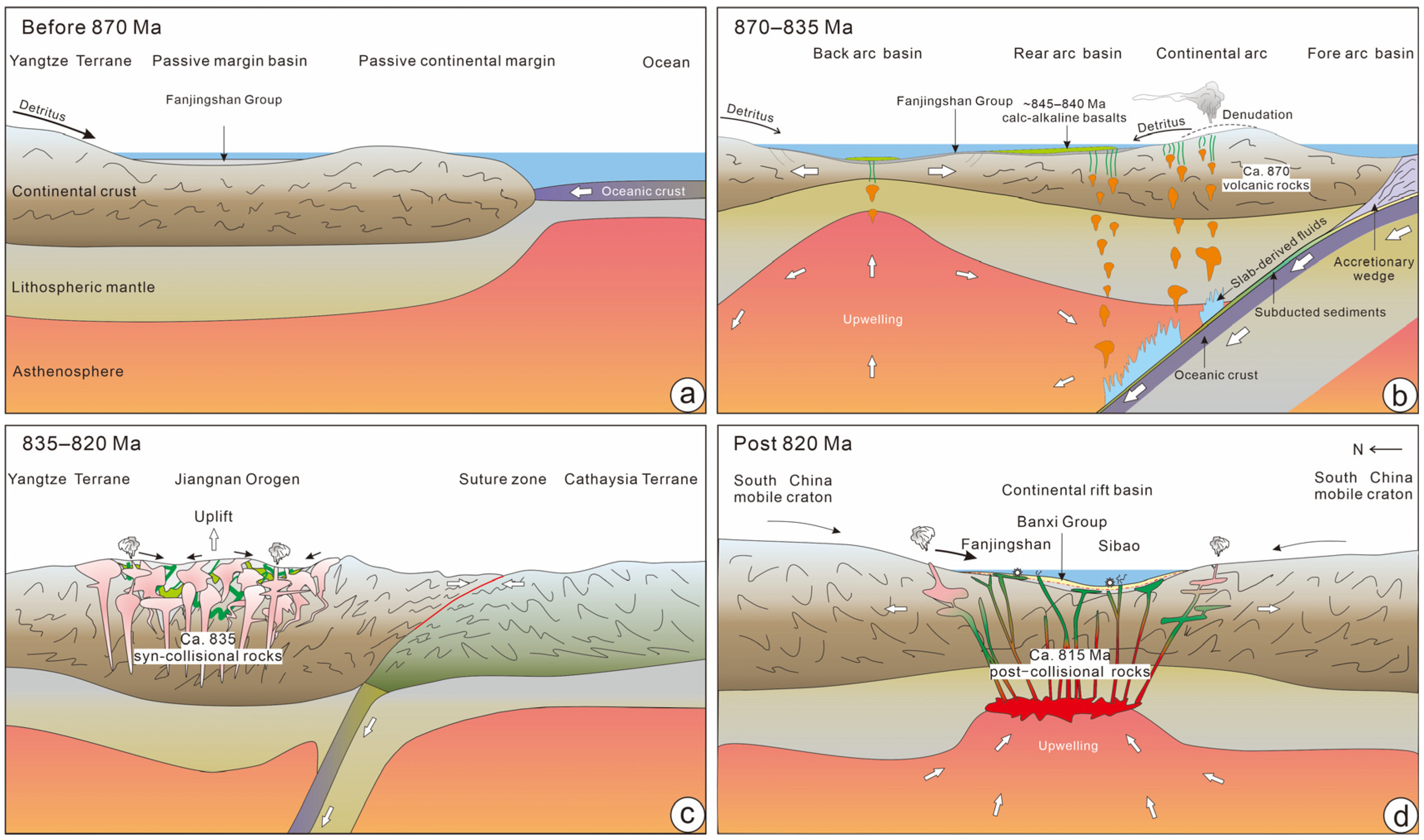
Integrating the magmatic and sedimentary records synthesized above, we propose a four-stage tectonic model that chronicles the holistic orogenic cycle of the western Jiangnan Orogen (Figure 23):
(1)
Stage 1 (Pre–~870 Ma): Passive margin initiation. The early Tonian history was dominated by lithospheric stretching and thermal subsidence along the Yangtze Terrane margin. This setting facilitated the deposition of the mature, quartzose Yujiagou Formation, sourced exclusively from the ancient cratonic basement [16]. The overall sedimentary architecture and lack of coeval magmatism are diagnostic of a stable passive continental margin.
(2)
Stage 2 (~870–835 Ma): Active margin and rear-arc extension. After 870 Ma, the sustained northwestward subduction beneath the Yangtze Terrane triggered widespread arc magmatism. During this stage, the basin transitioned into a rear-arc extensional setting [54]. This phase was uniquely characterized by a diagnostic magmatic suite: the eruption of ~845–840 Ma calc-alkaline basalts, the protracted emplacement of mafic–ultramafic sills (until ~832 Ma), and the overwhelming influx of juvenile arc detritus into the Xiaojiahe and Huixiangping Formations. This reflects a period of high heat flow and lithospheric thinning within the upper plate.
(3)
Stage 3 (~835–820 Ma): Continental collision and orogeny. The terminal Yangtze–Cathaysia collision [29,30] drove intense crustal thickening and anatexis, producing peraluminous S-type granites at 830 Ma [12,24,43,71,106]. This petrogenetic pivot from mantle-derived to crust-derived magmatism was accompanied by regional folding and uplift. The structural hallmark of this stage is the regional angular unconformity, which records the rapid exhumation of the Fanjingshan Group and a unimodal ~835 Ma provenance signature in the Duyantang Formation.
(4)
Stage 4 (Post-~820 Ma): Post-orogenic collapse and rifting. Following the Wuling Orogeny, the region transitioned into a post-orogenic extensional regime. Lithospheric delamination or collapse initiated the Nanhua Rift [79,108,109]. This stage is documented by the basal conglomerates of the Furongba Formation and the subsequent ~815–800 Ma deposition of the Banxi Group (e.g., Xinzhai and Wuye Formations). The bidirectional mixing of post-collisional magmatic sources and ancient northern Yangtze basement of the Wuye Formation reflects a fundamental paleogeographic reorganization during the initial breakup of the orogen.
This coherent model reconciles diverse geological records and delineates a protracted subduction–collision–extension evolution, providing a robust regional framework for understanding the Middle Tonian tectonic history of South China.

6. Conclusions

This study deciphers the Jiangnan Orogen’s evolution by integrating magmatic and sedimentary archives in the Fanjingshan region. Key findings include: (1) ~845–840 Ma calc-alkaline basalts with subduction signatures confirm a continental rear-arc setting. (2) The Wuling Orogeny (~835–820 Ma) is marked by S-type granites and a regional angular unconformity, reflecting the crustal thickening and uplift. (3) The post-orogenic transition (post-820 Ma) is unequivocally recorded by basal conglomerates of the Furongba Formation and a bidirectional provenance shift within the Banxi Group, signaling the initiation of the Nanhua Rift. (4) We propose a four-stage lifecycle: passive margin (pre-870 Ma), active margin (~870–835 Ma), collisional orogeny (~835–820 Ma), and post-orogenic rifting (post-820 Ma). This study documents the transition from orogenic consolidation to post-collisional extension, marking South China’s distinct geodynamic trajectory during the broader assembly and subsequent disassembly of the Rodinia supercontinent.

Author Contributions

Conceptualization, J.Z.; Methodology, Y.D., J.Z. and J.C.; Formal analysis, Y.D., J.Z. and T.Y.; Investigation, Y.D., J.Z., T.Y., T.Z., J.C. and L.S.; Resources, J.Z., and L.S.; Data curation, Y.D. and T.Z.; Writing—original draft, Y.D.; Writing—review and editing, J.Z. and J.C. All authors have read and agreed to the published version of the manuscript.

Funding

This research was funded by the National Natural Science Foundation of China (Grants 41603039, 41963006, 42363006) and the Chinese Central Forestry and Grassland Ecological Protection and Restoration Fund (QCZH [2025] No. 43).

Data Availability Statement

The data presented in this study are available in the cited references. All datasets were compiled from previously published research and are properly acknowledged.

Acknowledgments

Constructive comments from reviewers greatly improved the manuscript. Special thanks are extended to the Fanjingshan National Nature Reserve Administration of Guizhou Province for facilitating the field investigations.

Conflicts of Interest

The authors declare no conflicts of interest.

References

  1. National Natural Science Foundation of China; Chinese Academy of Sciences (Eds.) Plate Subduction Zones; Science Press: Beijing, China, 2022; (In Chinese with English abstract). [Google Scholar]
  2. Stern, R.J. Subduction zones. Rev. Geophys. 2002, 40, 1012. [Google Scholar] [CrossRef]
  3. Zheng, Y.F. Subduction zone geochemistry. Geosci. Front. 2019, 10, 1223–1254. [Google Scholar] [CrossRef]
  4. Chen, L.; Wang, X.; Liang, X.; Wan, B.; Liu, L. Subduction tectonics vs. mantle plume tectonics: A discussion on the driving forces of plate motions. Sci. China Earth Sci. 2020, 63, 459–475. [Google Scholar] [CrossRef]
  5. Bebout, G.E. Metamorphic chemical geodynamics of subduction zones. Earth Planet. Sci. Lett. 2007, 260, 373–393. [Google Scholar] [CrossRef]
  6. Zhen, Y.F.; Chen, R.X.; Xu, Z.; Zhang, S.B. The transport of water in subduction zones. China Earth Sci. 2016, 59, 651–681, (In Chinese with English abstract). [Google Scholar] [CrossRef]
  7. Algeo, T.J.; Huan, L. Are South China and North China “Blocks” or “Cratons”? Palaeogeogr. Palaeoclimatol. Palaeoecol. 2026, 683, 113464. [Google Scholar] [CrossRef]
  8. Zheng, Y.F. Plate subduction and Earth system science. Natl. Sci. Rev. 2022, 9, nwac100. [Google Scholar]
  9. Yao, J.L.; Cawood, P.A.; Shu, L.S.; Zhao, G.C. Jiangnan Orogen, South China: A ~970–820 Ma Rodinia margin accretionary belt. Earth-Sci. Rev. 2019, 196, 102872. [Google Scholar] [CrossRef]
  10. Li, Z.X.; Li, X.H.; Zhou, H.W.; Kinny, P.D. Grenvillian continental collision in South China: New SHRIMP U–Pb zircon results and implications for the configuration of Rodinia. Geology 2002, 30, 163–166. [Google Scholar] [CrossRef]
  11. Li, Z.X.; Wartho, J.A.; Occhipinti, S.; Zhang, C.L.; Li, X.H.; Wang, J.; Bao, C.M. Early history of the eastern Sibao orogen (South China) during the assembly of Rodinia: New mica 40Ar/39Ar dating and SHRIMP U–Pb detrital zircon provenance constraints. Precambrian Res. 2007, 159, 79–94. [Google Scholar] [CrossRef]
  12. Zhao, J.H.; Zhou, M.F.; Yan, D.P.; Zheng, J.P.; Li, J.W. Reappraisal of the ages of Neoproterozoic strata in South China: No connection with the Grenvillian orogeny. Geology 2011, 39, 299–302. [Google Scholar] [CrossRef]
  13. Lin, M.S.; Peng, S.B.; Jiang, X.F.; Polat, A.; Kusky, T.; Wang, Q.; Deng, H. Geochemistry, petrogenesis and tectonic setting of Neoproterozoic mafic–ultramafic rocks from the western Jiangnan orogen, South China. Gondwana Res. 2016, 35, 338–356. [Google Scholar] [CrossRef]
  14. Zhou, M.F.; Yan, D.P.; Kennedy, A.K.; Li, Y.Q.; Ding, J. SHRIMP U-Pb zircon geochronological and geochemical evidence for Neoproterozoic arc-magmatism along the western margin of the Yangtze Block, South China. Earth Planet. Sci. Lett. 2002, 196, 51–67. [Google Scholar] [CrossRef]
  15. Zhao, J.H.; Zhou, M.F. Neoproterozoic adakitic plutons in the northern margin of the Yangtze Block, China: Partial melting of a thickened lower crust and implications for secular crustal evolution. Lithos 2008, 104, 231–248. [Google Scholar] [CrossRef]
  16. Zhang, J.W.; Ye, T.P.; Dai, Y.R.; Chen, J.S.; Zhang, H.; Dai, C.G.; Yuan, G.H.; Jiang, K.Y. Provenance and tectonic setting transition as recorded in the Neoproterozoic strata, western Jiangnan Orogen: Implications for South China within Rodinia. Geosci. Front. 2019, 10, 1823–1839. [Google Scholar] [CrossRef]
  17. Dai, Y.R. Research on the Provenance and Structural Setting of Neoproterozoic Sandstones from the Western Jiangnan Orogen, Guizhou Province. Ph.D. Thesis, China University of Geosciences (Wuhan), Wuhan, China, 2018. (In Chinese with English abstract). [Google Scholar]
  18. Li, W.X.; Li, X.H. Adakitic granites within the NE Jiangxi ophiolites, South China: Geochemical and Nd isotopic evidence. Precambrian Res. 2003, 122, 20–44. [Google Scholar] [CrossRef]
  19. Wang, X.C.; Li, X.H.; Li, W.X.; Li, Z.X. Ca. 825 Ma komatiitic basalts in South China: First evidence for >1500 °C mantle melts by a Rodinian mantle plume. Geology 2007, 35, 1103–1106. [Google Scholar] [CrossRef]
  20. Wang, X.C.; Li, X.H.; Li, W.X.; Li, Z.X. Variable involvements of mantle plumes in the genesis of mid–Neoproterozoic basaltic rocks in South China: A review. Gondwana Res. 2009, 15, 381–395. [Google Scholar] [CrossRef]
  21. Wu, T.; Wang, X.C.; Li, X.W.; Wilde, S.A.; Tian, L.; Pang, C.J.; Li, J. The 825 Ma Yiyang high–MgO basalts of central South China: Insights from Os–Hf–Nd data. Chem. Geol. 2019, 502, 107–121. [Google Scholar] [CrossRef]
  22. Xia, Y.; Xu, X.; Niu, Y.; Liu, L. Neoproterozoic amalgamation between Yangtze and Cathaysia blocks: The magmatism in various tectonic settings and continent-arc-continent collision. Precambrian Res. 2018, 309, 56–87. [Google Scholar] [CrossRef]
  23. Zhao, J.H.; Zhou, M.F. Neoproterozoic high-Mg basalts formed by melting of ambient mantle in South China. Precambrian Res. 2013, 233, 193–205. [Google Scholar] [CrossRef]
  24. Yao, J.L.; Shu, L.S.; Santosh, M. Neoproterozoic arc-trench system and breakup of the South China Craton: Constraints from N-MORB type and arc related mafic rocks, and anorogenic granite in the Jiangnan orogenic belt. Precambrian Res. 2014, 247, 187–207. [Google Scholar] [CrossRef]
  25. Wang, M.; Dai, C.G.; Chen, J.S.; Wang, X.H.; Ma, H.Z. Neoproterozoic geochronologic framework of magmatism in Fanjingshan area and its tectonic implications. Geol. China 2016, 43, 843–856, (In Chinese with English abstract). [Google Scholar]
  26. Huang, S.; Wang, W. Origin of the Fanjingshan mafic-ultramafic rocks, Western Jiangnan Orogen, South China: Implications for PGE fractionation and mineralization. J. Earth Sci. 2019, 30, 258–271. [Google Scholar] [CrossRef]
  27. Fu, H.; Zhang, S.; Conden, D.J.; Xian, H. Secular change of true polar wander over the past billion years. Sci. Adv. 2022, 8, eabo2753. [Google Scholar] [CrossRef]
  28. Gong, J.; Wang, Z.; Wang, D.; Qin, X. A discussion on genesis, provenance and U-Pb ages of the zircons from ultrabasic-basic rocks: A case study in western Jiangnan orogenic belt. Geol. Rev. 2020, 66, 1536–1554, (In Chinese with English abstract). [Google Scholar]
  29. Zhang, Y.Z.; Wang, Y.J.; Zhang, Y.H.; Zhang, A.M. Neoproterozoic assembly of the Yangtze and Cathaysia blocks: Evidence from the cangshuipu group and associated rocks along the central jiangnan orogen, south China. Precambrian Res. 2015, 269, 18–30. [Google Scholar] [CrossRef]
  30. Wang, J.Q.; Shu, L.S.; Santosh, M. U-Pb and Lu-Hf isotopes of detrital zircon grains from Neoproterozoic sedimentary rocks in the central Jiangnan Orogen, South China: Implications for Precambrian crustal evolution. Precambrian Res. 2017, 294, 175–188. [Google Scholar] [CrossRef]
  31. GGS (Guizhou Geological Survey). Regional Geology of China, Guizhou Province; Geological Publishing House: Beijing, China, 2017; (In Chinese with English abstract). [Google Scholar]
  32. Guizhou Regional Geological Survey Team, Guizhou, China. 1:50,000 Regional Geological Survey Report of Fanjingshan Area. Unpublished work. 1974. (In Chinese)
  33. Dai, Y.R.; Chen, J.S.; Zhang, J.W.; Li, H.B.; Liu, W.P.; Wang, K. Comparative Application of Detrital Zircon U-Pb Dating for Stratigraphic Delineation: The “Taojinhe Formation” of the Neoproterozoic Fanjingshan Group as an Example. Acta Sedimentol. Sin. 2024, 42, 2006–2019, (In Chinese with English abstract). [Google Scholar]
  34. Guizhou Geological Survey. Fanjingshan, Dewang, Jiangkou, Kaide Regional Geological Survey Report, People’s Republic of China 1:50,000; Guizhou Geological Survey: Guiyang, China, 2013. (In Chinese) [Google Scholar]
  35. Belousova, E.A.; Walters, S.; Griffin, W.L.; O’Reilly, S.Y.; Fisher, N.I. Igneous zircon: Trace-element composition as indicator of source rock type. Contrib. Mineral. Petrol. 2002, 143, 602–622. [Google Scholar] [CrossRef]
  36. Le Bas, M.J.; Le Maitre, R.W.; Streckeisen, A.; Zanettin, B. A chemical classification of volcanic rocks based on the total alkali-silica diagram. J. Petrol. 1986, 27, 745–750. [Google Scholar] [CrossRef]
  37. Winchester, J.A.; Floyd, P.A. Geochemical discrimination of different magma series and their differentiation products using immobile elements. Chem. Geol. 1977, 20, 325–343. [Google Scholar] [CrossRef]
  38. Pearce, J.A. A user’s guide to basalt discrimination diagrams. In Trace Element Geochemistry of Volcanic Rocks: Applications for Massive Sulphide Exploration; Wyman, D.A., Ed.; Geological Association of Canada, Short Course Notes 12: St. John’s, NL, Canada, 1996; pp. 79–113. [Google Scholar]
  39. Ross, P.S.; Bédard, J.H. Magmatic affinity of modern and ancient subalkaline volcanic rocks determined from trace-element discriminant diagrams. Can. J. Earth Sci. 2009, 46, 823–839. [Google Scholar] [CrossRef]
  40. Sun, S.S.; McDonough, W.F. Chemical and isotopic systematics of oceanic basalts: Implications for mantle composition and processes. In Magmatism in the Ocean Basins; Saunders, A.D., Norry, M.J., Eds.; Geological Society, London, Special Publications: London, UK, 1989; Volume 42, pp. 313–345. [Google Scholar]
  41. Zhang, C.H.; Gao, L.Z.; Shi, X.Y.; Han, Y.; Liu, Y.M. SHRIMP age of the volcanic rock from the Fanjingshan Group and its chronostratigraphic significances. Earth Sci. Front. 2014, 21, 139–143, (In Chinese with English abstract). [Google Scholar]
  42. Wang, M.; Dai, C.G.; Wang, X.H.; Chen, J.S.; Ma, H.Z.; Peng, C.L.; Yang, K.D. Sedimentation age of the Fanjingshan Group in east Guizhou province: Evidence from in-situ zircon LA-ICP-MS U-Pb dating. Acta Petrol. Mineral. 2012, 31, 843–857, (In Chinese with English abstract). [Google Scholar]
  43. Gao, L.Z.; Dai, C.G.; Liu, Y.X.; Wang, M.; Wang, X.H.; Chen, J.S.; Ding, X.Z. Zircon SHRIMP U-Pb dating of the tuffaceous bed of Xiajiang Group in Guizhou Province and its stratigraphic implication. Geol. China 2010, 37, 1071–1080, (In Chinese with English abstract). [Google Scholar]
  44. Gao, L.Z.; Chen, J.S.; Dai, C.G.; Ding, X.Z.; Wang, X.H.; Liu, Y.X.; Wang, M.; Zhang, H. SHRIMP zircon U-Pb dating of tuff in Fanjingshan Group and Xiajiang Group from Guizhou and Hunan Provinces and its stratigraphic implications. Geol. Bull. China 2014, 33, 949–959, (In Chinese with English abstract). [Google Scholar]
  45. Zhou, J.C.; Wang, X.L.; Qiu, J.S. Geochronology of Neoproterozoic mafic rocks and sandstones from northeastern Guizhou, South China: Coeval arc magmatism and sedimentation. Precambrian Res. 2009, 170, 27–42. [Google Scholar] [CrossRef]
  46. Yang, C.; Li, X.H.; Wang, X.C.; Lan, Z. Mid-Neoproterozoic angular unconformity in the Yangtze Block revisited: Insights from detrital zircon U-Pb age and Hf-O isotopes. Precambrian Res. 2015, 266, 165–178. [Google Scholar] [CrossRef]
  47. Dai, Y.R.; Zhang, J.W.; Peng, S.B.; Ye, T.P.; Wang, M.; Dai, C.G.; Zhang, H.; Chen, J.S. Geochronologic sequence of Neoproterozoic Tonian Magmatism in Fanjingshan area, Guizhou Province. Geol. Bull. China 2019, 38, 360–370, (In Chinese with English abstract). [Google Scholar]
  48. Dickinson, W.R.; Gehrels, G.E. Use of U–Pb ages of detrital zircons to infer maximum depositional ages of strata: A test against a Colorado Plateau Mesozoic database. Earth Planet. Sci. Lett. 2009, 288, 115–125. [Google Scholar] [CrossRef]
  49. Wang, L.J.; Griffin, W.L.; Yu, J.H.; O’Reilly, S.Y. Precambrian crustal evolution of the Yangtze Block tracked by detrital zircons from Neoproterozoic sedimentary rocks. Precambrian Res. 2010, 177, 131–144. [Google Scholar] [CrossRef]
  50. Wang, W.; Zhou, M.F.; Yan, D.P.; Li, J.W. Depositional age, provenance, and tectonic setting of the Neoproterozoic Sibao Group, southeastern Yangtze Block, South China. Precambrian Res. 2012, 192–195, 107–124. [Google Scholar] [CrossRef]
  51. Wang, W.; Zhou, M.F. Provenance and tectonic setting of the paleo- to Mesoproterozoic dongchuan group in the southwestern Yangtze block, south China: Implication for the breakup of the supercontinent Columbia. Tectonophysics 2014, 610, 110–127. [Google Scholar] [CrossRef]
  52. Wang, W.; Zhao, H.J.; Zhou, M.F.; Pandit, M.K.; Zheng, J.P. Depositional age, provenance characteristics and tectonic setting of the Meso- and Neoproterozoic sequences in SE Yangtze Block, China: Implications on Proterozoic supercontinent reconstructions. Precambrian Res. 2018, 309, 231–247. [Google Scholar] [CrossRef]
  53. Cao, H.; Li, S.; Zhao, S.; Yu, S.; Li, X.; Somerville, I.D. Detrital zircon geochronology of Neoproterozoic to early Paleozoic sedimentary rocks in the North Qinling Orogenic Belt: Implications for the tectonic evolution of the Kuanping Ocean. Precambrian Res. 2016, 279, 1–16. [Google Scholar] [CrossRef]
  54. Zhang, J.W.; Liao, M.Y.; Santosh, M.; Yang, Z.Q.; Zhang, Y.; Dai, Y.R. Middle Tonian calc-alkaline picrites, basalts, and basaltic andesites from the Jiangnan Orogen: Evidence for rear-arc magmatism. Precambrian Res. 2020, 350, 105943. [Google Scholar] [CrossRef]
  55. Frey, F.A.; Green, D.H.; Roy, S.D. Integrated models of basalt petrogenesis: A study of quartz tholeiites to olivine melilitites from southeastern Australia utilizing. J. Petrol. 1978, 19, 463–513. [Google Scholar] [CrossRef]
  56. Rudnick, R.; Gao, S. Composition of the continental crust. Treatise Geochem. 2003, 3, 1217–1232. [Google Scholar]
  57. Xia, L.Q. The geochemical criteria to distinguish continental basalts from arc related ones. Earth-Sci. Rev. 2014, 139, 195–212. [Google Scholar] [CrossRef]
  58. Hawkesworth, C.J.; Gallagher, K.; Hergt, J.M.; McDermott, F. Trace element fractionation processes in the generation of island arc basalts. Philos. Trans. R. Soc. London. Ser. A Phys. Eng. Sci. 1993, 342, 179–191. [Google Scholar] [CrossRef]
  59. Lee, C.T.A.; Luffi, P.; Plank, T.; Dalton, H.; Leeman, W.P. Constraints on the depths and temperatures of basaltic magma generation on Earth and other terrestrial planets using new thermobarometers for mafic magmas. Earth Planet. Sci. Lett. 2009, 279, 20–33. [Google Scholar] [CrossRef]
  60. Le Bas, M.J. IUGS reclassification of the high-Mg and picritic volcanic rocks. J. Petrol. 2000, 41, 1467–1470. [Google Scholar] [CrossRef]
  61. Putirka, K. Excess temperatures at ocean islands: Implications for mantle layering and convection. Geology 2008, 36, 283–286. [Google Scholar] [CrossRef]
  62. Heinonen, J.S.; Jennings, E.S.; Riley, T.R. Crystallisation temperatures of the most Mg-rich magmas of the Karoo LIP on the basis of Al-in-olivine thermometry. Chem. Geol. 2015, 411, 26–35. [Google Scholar] [CrossRef]
  63. Shellnutt, J.G.; Pham, T.T. Mantle potential temperature estimates and primary melt compositions of the low-Ti emeishan flood basalt. Front. Earth Sci. 2018, 6, 67. [Google Scholar] [CrossRef]
  64. Putirka, K.D.; Perfit, M.; Ryerson, F.J.; Jackson, M.G. Ambient and excess mantle temperatures, olivine thermometry, and active vs. passive upwelling. Chem. Geol. 2007, 241, 177–206. [Google Scholar] [CrossRef]
  65. Galerne, C.Y.; Neumann, E.R.; Aarnes, I.; Planke, S. Magmatic differentiation processes in saucer-shaped sills: Evidence from the Golden Valley Sill in the Karoo Basin, South Africa. Geosphere 2010, 6, 163–188. [Google Scholar] [CrossRef]
  66. Liu, W.P.; Zhang, Y.; Zhang, J.W.; Fayek, M.; Li, H.B.; Wang, K.; Dai, Y.R.; Li, P. Two-stage emplacement mechanism and symmetrical differentiation process of mafic-ultramafic sills in an arc setting: A case study of the Middle Tonian rock assemblage from the Fanjingshan area. Lithos 2023, 446–447, 107108. [Google Scholar] [CrossRef]
  67. Wang, M. The Neoproterozoic Magmatism and Tectonic Implications, the Fanjingshan Mt., Northeast Guizhou Province. Ph.D. Thesis, China University of Geosciences, Beijing, China, 2012. [Google Scholar]
  68. Xue, H.M.; Ma, F.; Song, Y.Q. Mafic-ultramafic rocks from the Fanjingshan region, southwestern margin of the Jiangnan orogenic belt: Ages, geochemical characteristics and tectonic setting. Acta Petrol. Sin. 2012, 28, 3015–3030, (In Chinese with English abstract). [Google Scholar]
  69. Wang, W.; Zhao, J.H.; Zhou, M.F.; Yang, S.H.; Chen, F.K. Neoproterozoic Mafic-Ultramafic Intrusions from the Fanjingshan Region, South China: Implications for Subduction-Related Magmatism in the Jiangnan Fold Belt. J. Geol. 2014, 122, 455–473. [Google Scholar] [CrossRef]
  70. Yu, L. Petrogenesis and Geochronology of the Neoproterozoic Mafic-Ultramafic Rocks from Fanjingshan Group in Eastern Guizhou and Its Tectonic Implications. Master’s Thesis, China University of Geosciences, Beijing, China, 2014. [Google Scholar]
  71. Wang, M.; Dai, C.G.; Wang, X.H.; Chen, J.S.; Ma, H.Z. In-situ zircon geochronology and Hf isotope of muscovite-bearing leucogranites from Fanjingshan, Guizhou Province, and constraints on continental growth of the Southern China block. Earth Sci. Front. 2011, 18, 213–223, (In Chinese with English abstract). [Google Scholar]
  72. Xiang, L.; Wang, R.; Romer, R.L.; Che, X.; Hu, H.; Xie, L.; Tian, E. Neoproterozoic Nb-Ta-W-Sn bearing tourmaline leucogranite in the western part of Jiangnan Orogen: Implications for episodic mineralization in South China. Lithos 2020, 360–361, 105450. [Google Scholar] [CrossRef]
  73. Luo, J.C.; Zhang, J.W.; Shu, X.J.; Tang, Y.W.; Dai, Y.R.; Liu, W.P.; Chen, X.C.; Zhang, T.T. Neoproterozoic W-Sn mineralization in the western Jiangnan Orogen, South China: Insights from the Fanjingshan S-type granites. J. Geochem. Explor. 2025, 270, 107660. [Google Scholar] [CrossRef]
  74. Jiang, X.Y.; Guo, J.; Zhu, W.G.; Luo, J.C.; Jiang, K.N. Petrogenesis of the Neoproterozoic Fanjingshan leucogranite associated with W–Sn mineralization: Insights from U–Pb ages and geochemistry. Precambrian Res. 2024, 403, 107301. [Google Scholar] [CrossRef]
  75. Lv, Z.H.; Chen, J.; Zhang, H.; Tang, Y. Petrogenesis of Neoproterozoic rare metal granite-pegmatite suite in Jiangnan Orogen and its implications for rare metal mineralization of peraluminous rock in South China. Ore Geol. Rev. 2021, 128, 103923. [Google Scholar] [CrossRef]
  76. El Bouseily, A.M.; El Sokkary, A.A. The relation between Rb, Ba and Sr in granitic rocks. Chem. Geol. 1975, 16, 207–219. [Google Scholar] [CrossRef]
  77. Whalen, J.B.; Currie, K.L.; Chappell, B.W. A-type granites: Geochemical characteristics, discrimination and petrogenesis. Contrib. Mineral. Petrol. 1987, 95, 407–419. [Google Scholar] [CrossRef]
  78. Wu, F.Y.; Liu, X.C.; Ji, W.Q.; Wang, J.M.; Yang, L. Highly fractionated granites: Recognition and research. Sci. China Earth Sci. 2017, 60, 1201–1219. [Google Scholar] [CrossRef]
  79. Wei, S.D.; Liu, H.; Zhao, J.H. Tectonic evolution of the western Jiangnan Orogen: Constraints from the Neoproterozoic igneous rocks in the Fanjingshan region. Precambrian Res. 2018, 318, 89–102. [Google Scholar] [CrossRef]
  80. Irber, W. The lanthanide tetrad effect and its correlation with K/Rb, Eu/Eu*, Sr/Eu, Y/Ho, and Zr/Hf of evolving peraluminous granite suites. Geochim. Cosmochim. Acta 1999, 63, 489–508. [Google Scholar] [CrossRef]
  81. Milidragovic, D.; Chapman, J.B.; Bichlmaier, S.; Canil, D.; Zagorevski, A. H2O-driven generation of picritic melts in the Middle to Late Triassic Stuhini arc of the Stikine terrane, British Columbia, Canada. Earth Planet. Sci. Lett. 2016, 454, 65–77. [Google Scholar] [CrossRef]
  82. Bénard, A.; Arculus, R.J.; Nebel, O.; Ionov, D.A.; McAlpine, S.R.B. Silica-enriched mantle sources of subalkaline picrite-boninite-andesite island arc magmas. Geochim. Cosmochim. Acta 2017, 199, 287–303. [Google Scholar] [CrossRef]
  83. Clarke, D.B.; Beutel, E.K. Davis Strait Paleocene picrites: Products of a plume or plates? Earth-Sci. Rev. 2020, 206, 102770. [Google Scholar] [CrossRef]
  84. Cabanis, P.B.; Thiéblemont, D. La discrimination des tholéiites continentals et des basalts arrière-arc. Proposition d’un nouveau diagramme, le triangle Th-3Tb-2Ta. Bull. Société Géologique Fr. 1988, IV, 927–935. [Google Scholar] [CrossRef]
  85. Pearce, J.A. Trace element characteristics of lavas from destructive plate boundaries. In Andesites; Thorpe, R.S., Ed.; John Wiley and Sons: New York, NY, USA, 1982; pp. 525–548. [Google Scholar]
  86. Xia, L.Q.; Li, X.M. Basalt geochemistry as a diagnostic indicator of tectonic setting. Gondwana Res. 2019, 65, 43–67. [Google Scholar] [CrossRef]
  87. Yang, J.; Wang, J.R.; Zhang, Q.; Chen, W.F.; Pan, Z.J.; Jiao, S.T.; Wang, S.H. Back-arc basin basalt (BABB) data mining: Comparison with MORB and IAB. Adv. Earth Sci. 2016, 31, 66–77, (In Chinese with English abstract). [Google Scholar]
  88. Elburg, A.M.; van-Bergen, M.J.; Hoogewerff, J.; Foden, J.; Vroon, P.; ZulkarnainIskandar, I.; Nasution-Asnawir, A. Geochemical trends across an arc-continent collision zone; Magma sources and slab-wedge transfer processes below the Pantar Strait volcanoes, Indonesia. Geochem. Cosmochim. Acta 2002, 66, 2771–2789. [Google Scholar] [CrossRef]
  89. Manikyamba, P.D.C.; Ganguly, S.; Santosh, M.; Khelen, A. Neoarchean arc-juvenile back-arc magmatism in eastern Dharwar Craton, India: Geochemical fingerprints from the basalts of Kadiri greenstone belt. Precambrian Res. 2015, 258, 1–23. [Google Scholar] [CrossRef]
  90. Sun, Z.M.; Wang, X.L.; Qi, L.; Zhang, F.F.; Wang, D.; Li, J.Y.; Yu, M.G.; Shu, X.J. Formation of the Neoproterozoic ophiolites in southern China: New constraints from trace element and PGE geochemistry and Os isotopes. Precambrian Res. 2018, 309, 88–101. [Google Scholar] [CrossRef]
  91. Zhang, Y.Z.; Wang, Y.J. Early Neoproterozoic (~840Ma) arc magmatism: Geochronological and geochemical constraints on the metabasites in the Central Jiangnan Orogen. Precambrian Res. 2016, 275, 1–17. [Google Scholar] [CrossRef]
  92. Zhang, Y.Z.; Wang, Y.J.; Fan, W.M.; Zhang, A.M.; Ma, L.Y. Geochronological and geochemical constraints on the metasomatised source for the Neoproterozoic (~825 Ma) high-mg volcanic rocks from the Cangshuipu area (Hunan Province) along the Jiangnan domain and their tectonic implications. Precambr. Res. 2012, 220–221, 139–157. [Google Scholar] [CrossRef]
  93. Zhang, S.B.; Wu, R.X.; Zheng, Y.F. Neoproterozoic continental accretion in South China: Geochemical evidence from the Fuchuan ophiolite in the Jiangnan orogen. Precambrian Res. 2012, 220–221, 45–64. [Google Scholar] [CrossRef]
  94. Zhang, C.L.; Santosh, M.; Zou, H.B.; Li, H.K.; Huang, W.C. The fuchuan ophiolite in jiangnan orogen: Geochemistry, zircon U-Pb geochronology, Hf isotope and implications for the Neoproterozoic assembly of South China. Lithos 2013, 179, 263–274. [Google Scholar] [CrossRef]
  95. Serov, P.A. Paleoproterozoic Pt-Pd Fedorovo-Pansky and Cu-Ni-Cr Monchegorsk Ore complexes: Age, metamorphism, and crustal contamination according to Sm-Nd data. Minerals 2021, 11, 1410. [Google Scholar] [CrossRef]
  96. Galerne, C.Y.; Neumann, E.R.; Planke, S. Emplacement mechanisms of sill complexes: Information from the geochemical architecture of the Golden Valley Sill Complex, South Africa. J. Volcanol. Geotherm. Res. 2008, 177, 425–440. [Google Scholar] [CrossRef]
  97. Coetzee, A.; Kisters, A.; Chevallier, L. Sill complexes in the Karoo LIP: Emplacement controls and regional implications. J. Afr. Earth Sci. 2019, 158, 103517. [Google Scholar] [CrossRef]
  98. Chappell, B.W. Two contrasting granite types. Pac. Geol. 1974, 8, 173–174. [Google Scholar]
  99. Chappell, B.W.; White, A.J.R.; Williams, I.S.; Wyborn, D.; Wyborn, L.A.I. Lachlan Fold Belt granites revisited: High- and low-temperature granites and their implications. Aust. J. Earth Sci. 2000, 47, 123–138. [Google Scholar] [CrossRef]
  100. White, A.J.R.; Chappell, B.W. Some supracrustal (S-type) granites of the Lachlan Fold Belt. Earth Environ. Sci. Trans. R. Soc. Edinb. 1988, 79, 169–181. [Google Scholar] [CrossRef]
  101. Patiño-Douce, A.E. Experimental generation of hybrid silicic melts by reaction of high-Al basalt with metamorphic rocks. J. Geophys. Res. Solid Earth 1995, 100, 15623–15639. [Google Scholar] [CrossRef]
  102. Sylvester, P.J. Post-collisional strongly peraluminous granites. Lithos 1998, 45, 29–44. [Google Scholar] [CrossRef]
  103. Pearce, J.A.; Harris, N.B.W.; Tindle, A.G. Trace Element Discrimination Diagrams for the Tectonic Interpretation of Granitic Rocks. J. Petrol. 1984, 25, 956–983. [Google Scholar] [CrossRef]
  104. Cawood, P.A.; Hawkesworth, C.J.; Dhuime, B. Detrital zircon record and tectonic setting. Geology 2012, 40, 875–878. [Google Scholar] [CrossRef]
  105. Chen, X.; Wang, X.L.; Wang, D.; Shu, X.J. Contrasting mantle-crust melting processes within orogenic belts: Implications from two episodes of mafic magmatism in the western segment of the Neoproterozoic Jiangnan Orogen in South China. Precambrian Res. 2018, 309, 123–137. [Google Scholar] [CrossRef]
  106. Wang, X.L.; Zhou, J.C.; Qiu, J.S.; Zhang, W.L.; Liu, X.M.; Zhang, G.L. LA-ICP-MS U-Pb zircon geochronology of the Neoproterozoic igneous rocks from Northern Guangxi, South China: Implications for tectonic evolution. Precambrian Res. 2006, 145, 111–130. [Google Scholar] [CrossRef]
  107. Nie, J.; Horton, B.K.; Saylor, J.E.; Mora, A.; Mange, M.; Garzione, C.N.; Basu, A.; Moreno, C.J.; Caballero, V.; Parra, M. Integrated provenance analysis of a convergent retroarc foreland system: U-Pb ages, heavy minerals, Nd isotopes, and sandstone compositions of the Middle Magdalena Valley basin, northern Andes, Colombia. Earth-Sci. Rev. 2013, 110, 111–126. [Google Scholar] [CrossRef]
  108. Wang, Y.J.; Zhang, Y.Z.; Cawood, P.A.; Zhou, Y.Z.; Zhang, F.F.; Yang, X.; Cui, X. Early Neoproterozoic assembly and subsequent rifting in South China: Revealed from mafic and ultramafic rocks, central Jiangnan Orogen. Precambrian Res. 2019, 331, 105–367. [Google Scholar] [CrossRef]
  109. Zheng, Y.F.; Wu, R.X.; Wu, Y.B.; Zhang, S.B.; Yuan, H.L.; Wu, F.Y. Rift melting of juvenile arc-derived crust: Geochemical evidence from Neoproterozoic volcanic and granitic rocks in the Jiangnan Orogen, South China. Precambr. Res. 2008, 163, 351–383. [Google Scholar] [CrossRef]
Figure 1. Simplified geological map of major tectonic units in the South China mobile Craton [7].
Minerals 16 00334 g001
Figure 2. Geological map and geological profile of Fanjingshan region.
Minerals 16 00334 g002
Figure 3. Composite stratigraphic column of the Middle Tonian Fanjingshan and Banxi groups.
Minerals 16 00334 g003
Figure 4. Representative field photographs from the Fanjingshan region. (a) Pillow basalt of the Huixiangping Formation, Fanjingshan Group; (b) granite (left) intruding into the Taojinhe Formation meta-sandstone (right), Fanjingshan Group; (c) angular unconformity between the Fanjingshan and Banxi groups at the Duyantang area; (d) basal conglomerate of the Furongba Formation, Banxi Group at the Duyantang area; and (e) slate of the Wuye Formation, Banxi Group at Ziwei Town.
Minerals 16 00334 g004
Figure 5. Zircon U-Pb age spectrum for volcaniclastic rocks in the Fanjingshan region. YJG = Yujiagou Formation; HXP = Huixiangping Formation; TC = Tongchang Formation; JL = Jialu Formation; and XZ = Xinzhai Formation. Data are sourced from [12,42,44,45].
Minerals 16 00334 g005
Figure 6. Detrital zircon U-Pb age spectra for the Middle Tonian strata in the Fanjingshan region. Histograms and cumulative proportion curves are shown for the following formations: (a) Yujiagou, (b) Xiaojiahe, (c) Huixiangping, (d) Tongchang, (e) Waxi, and (f) Duyantang formations of the Fanjingshan Group, and the (g) Xinzhai and (h) Wuye formations of the Banxi Group. Data sources: (a,g) from reference [16]; (b,d) from reference [45]; (c) from references [45,49]; (e) from reference [49]; (f) from references [16,49]; and (h) from reference [49]. Comparative spectra: In (a), the spectrum for the southwestern Yangtze Terrane basement (orange line) is compiled from references [50,51,52]. In (h), the spectrum for the northern Yangtze Terrane basement (blue line) is from [53].
Minerals 16 00334 g006
Figure 7. Geochemical classification of the Middle Tonian basalts from the Jiangnan Orogen. (a) Total alkali–silica diagram. The dashed line distinguishes the alkaline and sub-alkaline volcanic rock series [36]; (b) Zr/Ti vs. Nb/Y classification diagram [37,38]. (c) Th/Yb vs. Zr/Y classification diagram [39]. Data are sourced from [54] and citations therein.
Minerals 16 00334 g007
Figure 8. Geochemical variations and isotopic compositions of the ~845–840 Ma volcanic rocks. (a) Ni–MgO, (b) CaO/Al2O3–CaO, (c) εNd(t)–Age, and (d) (Th/Nb)N–εNd(t) diagrams. Data are sourced from [54] and citations therein.
Minerals 16 00334 g008
Figure 9. Chondrite and primitive mantle-normalized trace element diagrams for basaltic samples from the Jiangnan Orogen. (a) Primitive mantle-normalized trace element diagrams; (b) Chondrite-normalized REE patterns. Reference curves for N-MORB, OIB, and CAB are from [40,58]. Data are sourced from [54] and citations therein.
Minerals 16 00334 g009
Figure 10. Comparison of the average mantle potential temperature (Tp) of the ~845–840 Ma volcanic rocks in the Jiangnan Orogen (data are sourced from [54]) with plume-related rocks worldwide (data from [61,62,63]). The range for global mid-ocean ridge basalts (MORB, 1350–1550 °C) is indicated by dashed lines [64].
Minerals 16 00334 g010
Figure 11. Geochemical classification diagrams for the Middle Tonian mafic–ultramafic sills in the Fanjingshan Group. (a) Total alkali–silica (TAS) classification diagram [36], with the dashed line separating the alkaline and sub-alkaline series; (b) Zr/Ti vs. Nb/Y classification diagram [37,38]. (c) Th/Yb vs. Zr/Y diagram [39]. Data are sourced from [54,66,67,68,69,70] and citation is therein. Triangle symbols represent data for the ca. 845–840 Ma mafic lava derived from references [54,70]. Note: The sample plotting within the dacite/rhyolite field in (b) is interpreted as a highly evolved endmember of the suite, reflecting extreme fractionation, rather than a separate felsic magmatic event.
Minerals 16 00334 g011
Figure 12. Zircon U-Pb age spectrum for mafic–ultramafic rocks in the Fanjingshan region. TJH = Taojinhe Formation; XJH = Xiaojiahe Formation; HXP = Huixiangping Formation; and JL = Jialu Formation. Data are sourced from [25,27,41,45,47,66,67,68].
Minerals 16 00334 g012
Figure 13. Major-element evidence for crystal fractionation in the Fanjingshan mafic suite. Harker diagrams illustrate fractionation trends dominated by olivine and clinopyroxene separation. Data are sourced from [54,66,67,68,69,70] and citations therein.
Minerals 16 00334 g013
Figure 14. Two-stage mafic magmatism in the Fanjingshan Group. (a) Principal component analysis showing the geochemical distinction of mafic rocks from the Huixiangping, Xiaojiahe, and Yujiagou Formations versus the Taojinhe Formation; (b) Nb/Yb vs. εNd(t) variation illustrating the contrasting source characteristics between the two magmatic stages. The dotted horizontal line in (b) denotes the chondritic uniform reservoir (CHUR) reference line (εNd(t) = 0). Data are sourced from [45,54,66,67,68,69,70].
Minerals 16 00334 g014
Figure 15. Geochemical evolution of mafic–ultramafic rocks in the Fanjingshan Group. Primitive mantle-normalized trace element and chondrite-normalized REE patterns are shown for successive stratigraphic units: (a,b) ultramafic cumulates (Huixiangping Formation); (c,d) mafic rocks (Huixiangping Formation); (e,f) mafic–ultramafic rocks (Xiaojiahe Formation); (g,h) mafic rocks (Yujiagou Formation); and (i,j) mafic rocks (Taojinhe Formation). Different colored lines denote different lithology types within the respective formations. Data are sourced from [54,66] and citations therein.
Minerals 16 00334 g015
Figure 16. Zircon U-Pb age spectrum for Fanjingshan granite. Data are sourced from [12,42,43,67,71,72,73,74,75].
Minerals 16 00334 g016
Figure 17. Geochemical diagrams for the Middle Tonian granites in the Fanjingshan region. (a) TAS diagram [36]; (b) A/NK vs. A/CNK diagram; (c) 10,000 × Ga/Al vs. Zr diagram [77,78]; and (d) Rb-Ba-Sr ternary diagram [76]. SDG = highly differentiated granite; NG = normal granite; AG = anomalous granite; GD = granodiorite; and D = diorite. Data are sourced from [71,72,73,75,79].
Minerals 16 00334 g017
Figure 18. Geochemical diagrams for the Taoshulin granite in the Fanjingshan region, (a) primitive mantle-normalized trace element diagram and (b) chondrite-normalized REE patterns. The normalizing values for the chondrite and primitive mantle are from [40]. Data are sourced from [71,72,73,75,79].
Minerals 16 00334 g018
Figure 19. Compilation of zircon U-Pb ages for magmatic rocks in the Fanjingshan region. Data are sourced from [12,25,27,41,42,43,44,45,47,51,66,67,68,71,72,73,74,75].
Minerals 16 00334 g019
Figure 20. Tectonic discrimination diagrams of the Fanjingshan basalts, collectively indicating a continental rear-arc basin setting. (a) 3Tb-Th-2Ta discrimination [84], where samples plot within the field of the island arc calc-alkaline basalts; (b) Th/Yb vs. Ta/Yb discrimination [85,86,87], where samples plot within the field of continental arcs; (c) Ba/Th vs. Nb/Th discrimination between rear-arc and frontal-arc basalts [88,89], where samples plot within the field of rear-arc setting. Data are sourced from [54] and citations therein.
Minerals 16 00334 g020
Figure 21. Tectonic discrimination of the Fanjingshan granite, based on trace element compositions. (a) Y-Nb, and (b) (Y + Nb)-Rb diagrams [103]. VAG = volcanic arc granite, syn-COLG = syn-collisional granite, WPG = within-plate granite, and ORG = ocean ridge granite. The dashed line represents the upper compositional boundary for ORG from anomalous ridge segments. The data sources are the same as in Figure 17.
Minerals 16 00334 g021
Figure 22. Cumulative proportion curves illustrating the time lag between detrital zircon crystallization ages and the depositional age of their host sedimentary sequences. (a) Samples from the Fanjingshan region, and (b) samples from the Sibao region. These curves show the cumulative percentage of zircon grains with crystallization ages older than the depositional age of the host sequence by a given time interval. The methodology for constructing these curves follows that of reference [104]. Abbreviations of formations: DYT = Duyantang, WY = Wuye, WT = Wentong, YX = Yuxi, and BZ = Baizhu; other abbreviations are the same as in Figure 5 and Figure 12. Data are sourced from [16] and citations therein.
Minerals 16 00334 g022
Figure 23. Proposed tectonic model for the evolution of the western Jiangnan Orogen. (a) Pre-870 Ma passive margin stage: characterized by stable sedimentation sourced primarily from the ancient cratonic basement of the southwestern Yangtze Terrane; (b) Ca. 870–835 Ma rear-arc basin stage: bidirectional sediment sources from the nascent southern arc and the southwestern Yangtze Terrane. Note the pulse of calc-alkaline basaltic volcanism at ca. 840 Ma across the Jiangnan Orogen; (c) Ca. 835–820 Ma collisional uplift stage: represents the peak of the Wuling Orogeny, widespread folding and crustal thickening resulted in a regional sedimentation hiatus and the formation of a major angular unconformity; and (d) post-820 Ma continental rifting stage: initiation of the Nanhua Rift, characterized by post-orogenic extension and lithospheric collapse. Sedimentation was sourced jointly from post-collisional magmatic rocks and the old debris from the northern Yangtze Terrane. This figure is modified from reference [16].
Minerals 16 00334 g023
Disclaimer/Publisher’s Note: The statements, opinions and data contained in all publications are solely those of the individual author(s) and contributor(s) and not of MDPI and/or the editor(s). MDPI and/or the editor(s) disclaim responsibility for any injury to people or property resulting from any ideas, methods, instructions or products referred to in the content.