


Abstract
Late Early Jurassic continental arc magmatism in the northern Greater Khingan Range enables the investigation of complicated tectonic processes associated with the subduction and closure of the Mongol–Okhotsk Ocean. To further clarify the timing, genesis, and geodynamic mechanisms driving the magmatic activity during this period, the present study addresses these critical questions by integrating zircon U–Pb geochronological, geochemical, and isotopic analyses of a wide variety of igneous rocks, including gabbro, gabbro-diorite, granodiorite, porphyritic monzogranite, and biotite-bearing monzogranite from the Fushan region. Zircon U–Pb geochronology constrains the timing of magmatic activity to 184–179 Ma, coinciding with active subduction phases. Geochemical data reveal arc-like signatures characterized by enrichment in light rare-earth elements (LREEs) and large-ion lithophile elements (LILEs), together with pronounced depletion in high field strength elements (HFSEs). A comprehensive analysis of geochemical and Sr–Nd–Hf isotopic signatures suggests that the mafic rocks originated from an enriched lithospheric mantle modified by subduction-related fluids and sediment-derived melts. By contrast, the granodiorite and porphyritic monzonite exhibit adakitic characteristics, indicating partial melting of the thickened Mesoproterozoic lower crust with contributions from mantle-derived or newly formed crustal material. The biotite-bearing monzogranite, with its pronounced Eu anomaly and lower zircon saturation temperatures, reflects advanced magmatic differentiation from a shallower source. These findings indicate extensive crust–mantle interactions during the southward subduction of the Mongol–Okhotsk Ocean, driven by high-angle subduction and slab rollback.
1. Introduction
The Central Asian Orogenic Belt (CAOB) is one of the largest and longest-lived accretionary orogens on Earth, and its tectonic evolution has been the subject of numerous international syntheses [1,2]. The ancient Pacific Ocean and the Mongol–Okhotsk crustal system played significant roles in shaping the formation and evolution of the CAOB. This influence extended to the Mesozoic tectonic evolution and geodynamic processes of the Greater Xing’an Range. Additionally, the system affected the Mesozoic crustal evolution of eastern Russia, central Mongolia, and northeastern China, while also contributing to the formation of numerous large and medium-sized mineral deposits [3,4,5,6,7,8,9]. Clarifying the ancient Pacific Ocean and the Mongol–Okhotsk crustal system is integral to unravelling the geological complexities of the CAOB [7,10,11,12]. It is also crucial for the genesis analysis and prospecting work of mineral deposits in the region. Since the Devonian, the Mongol–Okhotsk Ocean (MOO) has subducted northward beneath the southern margin of the Siberian continental shelf [13,14,15]. This process evolved into bidirectional subduction during the Carboniferous [7,11,16,17]. Subsequently, its closure followed a distinctive “scissor-like” pattern, progressing from west to east and culminating in the formation of the Mongol–Okhotsk Suture Zone, which extends from central Mongolia to the Russian Far East [18,19,20,21].
Despite extensive research and pioneering plate tectonic frameworks established for the MOO [22,23,24,25,26], the tectonic evolution of MOO, especially its subduction mode and closure time, has always been a subject of controversy. In terms of subduction model, it has been suggested that the southward subduction experienced a transition from low-angle to high-angle subduction during the Early to Late Triassic [3,27]. Alternative models propose either persistent low-angle [4] or flat subduction during the Early Jurassic [6]. Northward subduction models, supported by tomographic imaging of slab remnants beneath Siberia [18,19] and paleomagnetic constraints from the Siberian margin [28], imply that the MOO was consumed primarily beneath the Siberian continent. Bidirectional subduction has also been proposed based on the symmetrical distribution of accretionary complexes and magmatic arcs on both sides of the suture zone [7,11,16,17], but the timing and duration of opposing subduction polarity remain poorly constrained. Thus, despite multiple lines of evidence, the subduction polarity of the MOO remains vigorously debated, and each model carries its own strengths and limitations. In terms of closure time, some scholars propose synchronous closure of the eastern and western segments in the Late Jurassic to Early Cretaceous, influenced by bidirectional subduction or the unique morphology of the continental margin [29]. Some scholars consider that the scissor-type closure pattern suggests that the western segment closed earlier [24,30], during the Late Triassic. By contrast, closure of the eastern segment has been attributed to the Early to Middle Jurassic [30] or Late Jurassic to Early Cretaceous [31,32]. However, the tectonic affinity of the Erguna block, a key component of the MOO system, remains debated. Recent paleomagnetic data suggest that the Erguna block may have been proximal to Siberia as early as the Ediacaran–Early Cambrian (~560–525 Ma), challenging the traditional view that it was part of the Amuria microcontinent. This has significant implications for understanding the early opening and subsequent evolution of the MOO [33].
Mafic magmatic rocks are a feature of nearly all stages of the Wilson orogenic cycle within the realm of plate tectonics [34]. Their diverse volumetric, geometric, and compositional traits tend to reflect the thermal and compositional variations of potential mantle sources and hence attest to their contrasting behavior toward distinct tectonic triggers [34]. They are critical to understanding the thermal structure of subduction zones and material cycling in the mantle wedge [35]. In addition, continental magmatic arcs, such as those formed during the MOO’s subduction, hold key information on crust–mantle interactions and crustal evolution [34,36]. The Fukeshan area in the Erguna block is located approximately 100 km south of the Mongol–Okhotsk suture zone and contains well-preserved Mesozoic mafic and granitic arc magmatic rocks, making it an ideal region to study subduction dynamics and related crustal processes. This study conducts a comprehensive investigation of representative mafic magmatic rocks and granite rocks in the Fukeshan area, including petrography, geochemistry, U–Pb isotopic chronology, Sr–Nd isotopes, and zircon Hf isotopes. The manuscript aims to further constrain the subduction mode and closure pattern of the MOO, provide new insights into its southward subduction and slab rollback processes during the Late Jurassic, and elucidate the petrogenesis and tectonic setting of the continental magmatic arc at the northern margin of the Erguna block.
2. Geological Setting
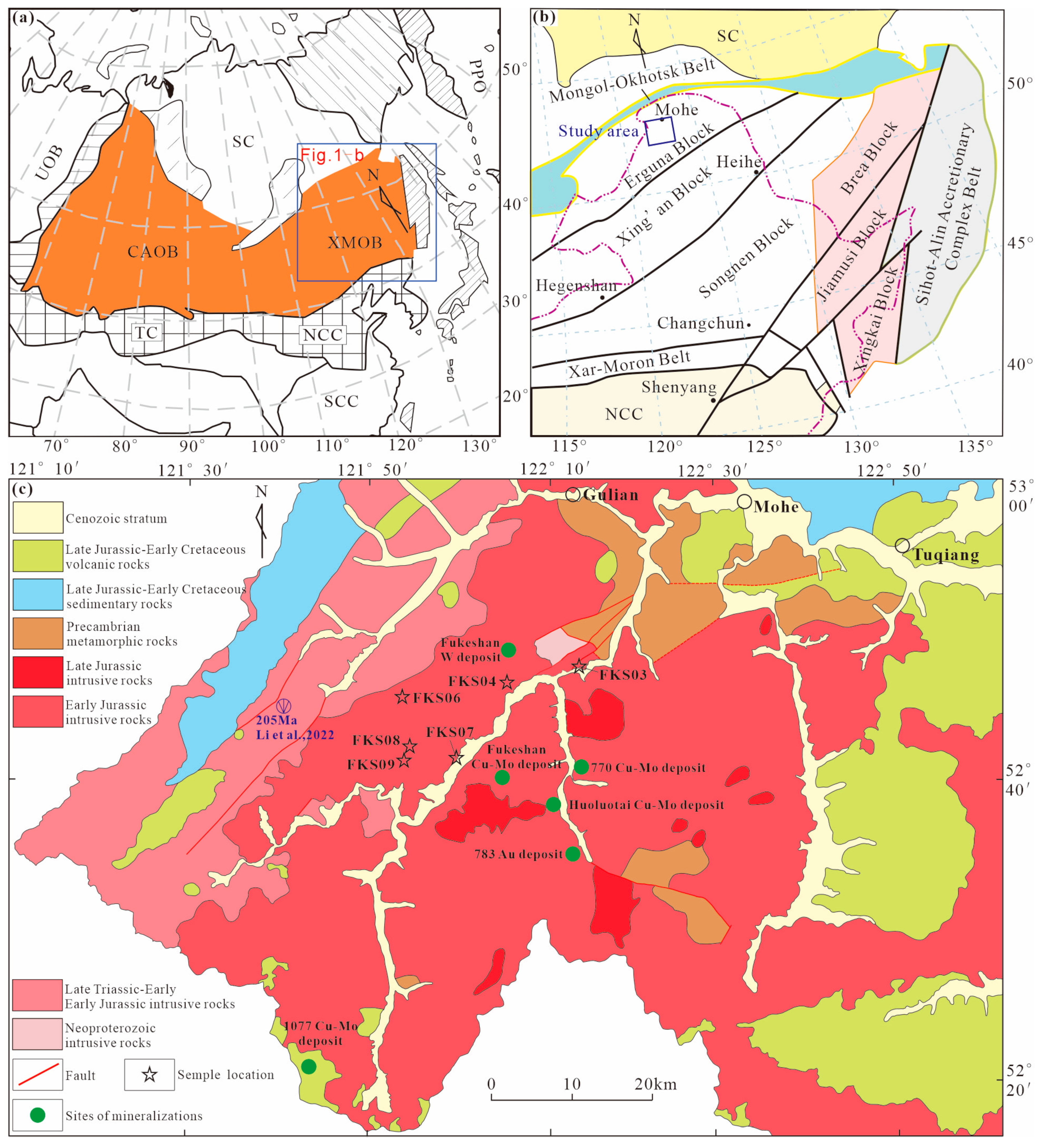
The Erguna block is located in the Greater Khingan Range, which is located in the eastern section of the Central Asian Orogenic Belt (CAOB), bounded by the Siberian Craton to the north, the North China Craton to the south, and the Pacific Plate to the east (Figure 1a). This region consists of several micro-continental blocks, including the Erguna block, Xing’an block, Songnen–Zhangguangcai Ridge block, Jiamusi block, and Xingkai block (Figure 1b). Over geological time (from the Proterozoic to the Cenozoic), the region underwent tectonic superposition and transformation influenced by the ancient Asian Ocean system, the Mongol–Okhotsk tectonic system, and the Pacific tectonic system [37,38,39,40]. During the contraction of rift basins and the ancient Asian Ocean basin, these blocks, including the Erguna block, converged along an active margin, forming a collision orogenic belt characterized by accretionary complex structures.
Figure 1.
Geological sketch map of Fukeshan area. (a) Tectonic framework of the Central Asian Orogenic Belt, modified after ref. [41]; (b) Tectonic sketch map of Northeast China, modified after ref. [42]. (c) Simplified geological map of the Fukeshan area showing sample locations. UOB—Urra Orogenic Belt; CAOB—Central Asian Orogenic Belt; XMOB—Xing’an Mongolian Orogenic Belt; SC—Siberian Craton; TC—Tarim Craton; NCC—North China Craton; SCC—South China Craton; PPO—Paleo Pacific Ocean.
The study area is located at the northeastern margin of the Erguna block, close to the Mongol–Okhotsk suture zone (Figure 1b). This area encompasses strata spanning the Proterozoic, Mesozoic, and Cenozoic eras (Figure 1c), with structural controls predominantly oriented along a northeast (NE) trend. The Proterozoic strata are represented by the poorly exposed Neoproterozoic metamorphic complex of the Xinhua Dukuo group. Mesozoic strata include the Middle Jurassic clastic rock series of the Xiufeng Formation and the Late Jurassic continental volcanic formations. The Cenozoic is represented by Quaternary sediments.
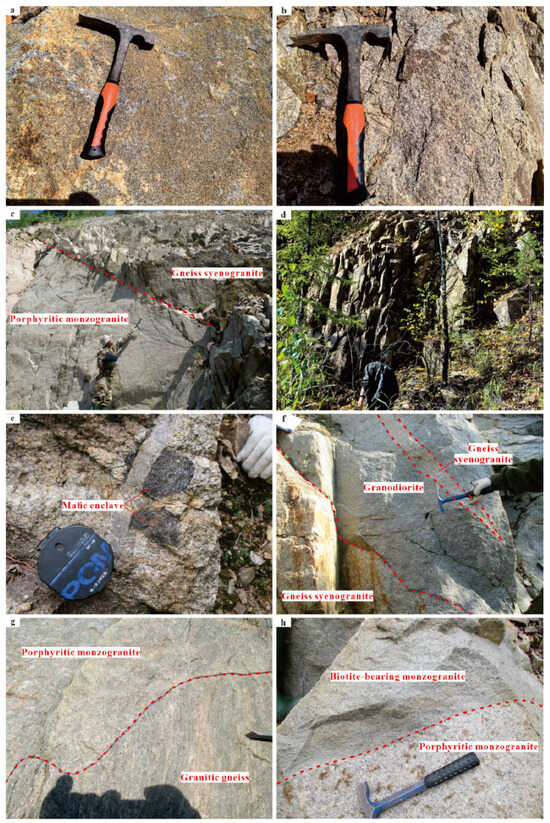
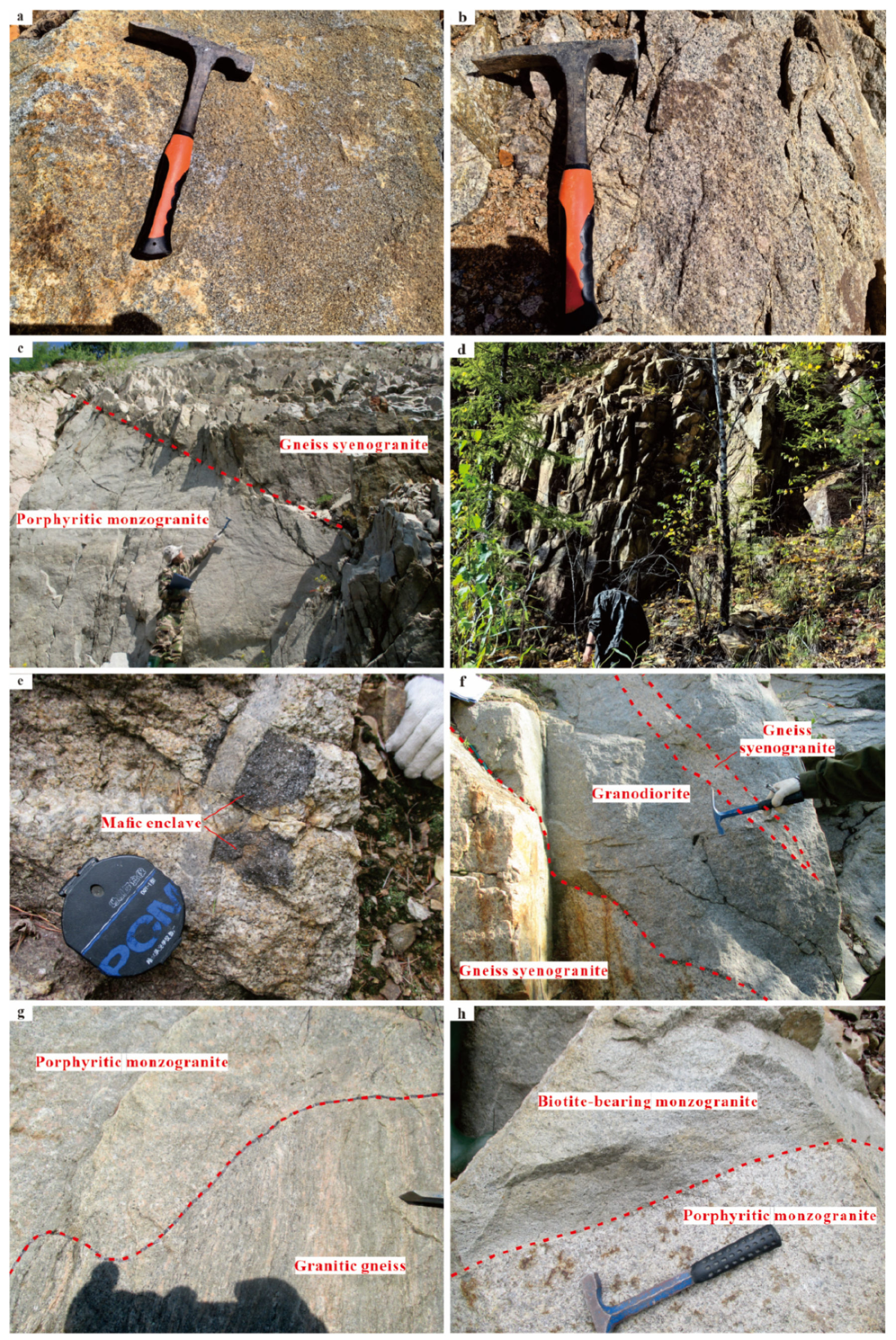
Magmatic rocks are extensively distributed throughout the study area, exhibiting a predominant northeast (NE) orientation. Mesozoic intrusive rocks that serve as the research subjects are more extensive and typically form batholiths that intrude into older metamorphic complexes. The Mesozoic intrusive rocks can be categorized into three distinct stages: (1) Late Triassic Stage: Characterized by NE-trending intrusive belts dominated by gabbro, diorite, granodiorite, and (gneissic) syenogranite. Among them, gabbro and diorite are the products of co-genetic evolution under the background of the southward subduction of the Mongol–Okhotsk Ocean [43]. (2) Early–Middle Jurassic Stage: Features widespread intrusions into Late Triassic rocks, comprising medium- to coarse-grained monzogranite [4], along with gabbro, gabbro-diorite, granodiorite, porphyritic monzogranite, and biotite-bearing monzogranite (Figure 2). They intrude into Late Triassic intrusive rocks and neoproterozoic intrusive rocks (Figure 2). (3) Late Jurassic Stage: Features discontinuous NE-trending intrusions primarily consisting of quartz diorite porphyry, quartz monzonite, granodiorite porphyry, and syenogranite. These intrusions typically manifest as stock-like bodies emplaced within older geological units [4,6].
Figure 2.
Typical filed rock outcrops photos from intrusive rocks of Fukeshan area. (a) Field characteristics of gabbro (FKS06); (b) Field characteristics of granodiorite (FKS08); (c) Field characteristics of porphyritic granite (FKS03); (d) Field characteristics of biotite granite (FKS07); (e) mafic inclusions in granite diorite; (f) Late Jurassic granite diorite, intruding Late Triassic–Early Jurassic granulite; (g) Late Jurassic porphyritic monzogranite intruding Neoproterozoic granitic gneiss (FKS03); (h) Late Jurassic biotitic monzogranite in contact with porphyritic monzogranite. Dashed lines indicate lithological boundaries.
3. Petrography
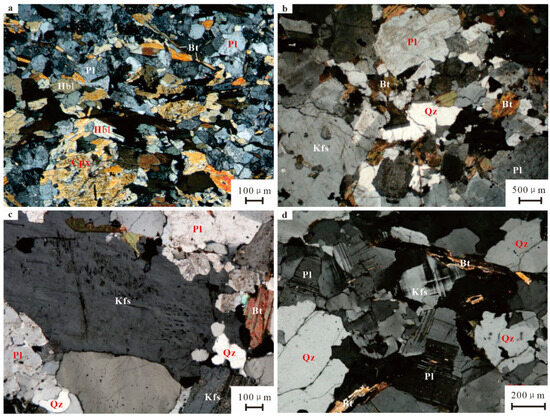
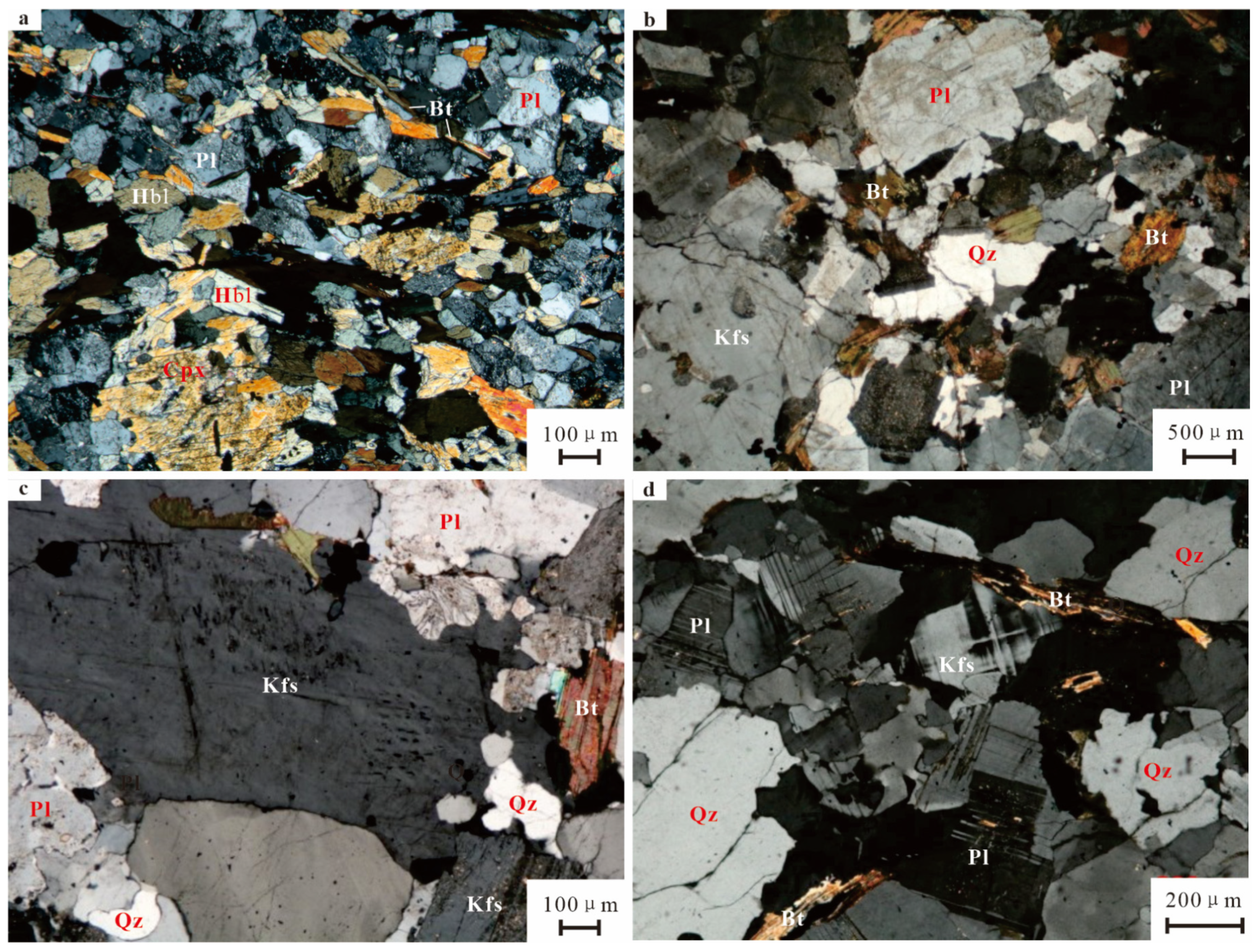
This study focuses on the Early–Middle Jurassic intrusive rocks (stage2), for which representative samples include both mafic and granitic rocks from the study area, with a total of 13 samples collected (Figure 1c), including gabbro, gabbro-diorite, granodiorite, porphyritic monzogranite, and biotite-bearing monzogranite. The gabbro (FKS06) is a fine-grained gneissic rock (Figure 3a), comprising plagioclase (60%, 0.2–1.2 mm), hornblende (30%, 0.2–1.6 mm), pyroxene (8%, 0.2–2.0 mm), and biotite (2%, 0.1–0.5 mm). The microgranular granodiorite (FKS08) (Figure 3b) exhibits a medium-grained massive texture, dominated by microcline (20%, 0.8–5 mm), plagioclase (40%, 0.4–2.5 mm), quartz (25%, 0.3–3.8 mm), and biotite (15%, 0.4–1.3 mm). The porphyritic monzogranite (FKS03) (Figure 3c) features a porphyritic texture with alkali feldspar (40%, 0.2–6.0 mm), plagioclase (35%, 0.2–4.0 mm), quartz (23%, 0.15–1.6 mm), and accessory biotite (2%, 0.1–0.4). The biotite-bearing monzogranite (FKS07) (Figure 3d) is a medium-grained massive granite containing perthite (30%, 0.1–1.2 mm), plagioclase (25%, 0.15–2.5 mm), quartz (30%, 0.1–1.9 mm), biotite (13%, 0.2–2 mm), and minor garnet (2%, 0.3–2 mm). These samples provide critical insights into the magmatic processes and regional tectonic evolution during this key geological interval.
Figure 3.
Typical photomicrographs of intrusive rocks from the Fukeshan area. (a) Gabbro (FKS06); (b) granodiorite (FKS08); (c) porphyritic monzogranite (FKS03); (d) biotitic granite (FKS07); Cpx—Clinopyroxene; Hbl—Hornblende; Kfs—Potash feldspar; Pl—Plagioclase; Bt—Biotite; Qz—Quartz.
4. Analytical Techniques
4.1. Zircon LA-ICP-MS U–Pb Analysis
Representative samples were analyzed at the Hebei Provincial Regional Geological Mineral Survey Institute, where zircon separation and cathodoluminescence (CL) imaging were conducted. U–Pb isotopic dating was carried out at Wuhan Sample Solution Analytical Technology Co., Ltd. (Wuhan, China), following the procedures outlined by ref. [44]. Analyses were performed using a GeolasPro laser ablation system (equipped with a COMPexPro 102 ArF 193 nm excimer laser, Coherent, Inc., Santa Clara, CA, USA) and a MicroLas optical system (Göttingen, Germany), coupled with an Agilent 7900 ICP-MS (Agilent Technologies, Santa Clara, CA, USA). The laser ablation utilized a 32 µm beam spot size with a frequency of 5 Hz. External standards for isotopic and trace element fractionation correction included zircon standard 91500 [45] and glass standard NIST610 [46]. Data acquisition involved time-resolved sequences of 20–30 s of blank signal collection followed by 50 s of sample signal collection. Offline data processing was conducted using ICPMSDataCal software (version 11.4) for blank subtraction, drift correction, and calculations of element content, U–Pb isotopic ratios, and zircon ages. U–Pb concordia diagrams and weighted mean age calculations were generated using Isoplot/Ex_ver3 software (version 4.15) [47]. Analytical precision was verified using GJ-1 and Plesovice zircon standards, with the GJ-1 grains yielding a weighted mean 206Pb/238U age of 601.1 ± 1.1 Ma (2SD), consistent with the recommended values, and the Plesovice zircon grains producing a weighted mean 206Pb/238U age of 337.6 ± 0.71 Ma (2SD, n = 16), aligning with the recommended age of 337.13 ± 0.37 Ma (2SD). These results confirmed the reliability of the analytical methods and provided a robust foundation for interpreting the U–Pb isotopic ages of the studied zircon samples.
4.2. Whole-Rock Sr–Nd Isotope Analyses
Whole-rock Sr–Nd isotope ratios were measured using a Neptune Plus MC-ICP-MS (Thermo Fisher Scientific, Bremen, Germany) at Wuhan Sample Solution Analytical Technology Co., Ltd. The experimental process involved analyzing seven samples between two Sr isotope standards [48] and seven samples between two Nd isotope standards [49]. All analytical data were processed using the professional isotope data processing software “Iso-Compass” (version 1.0) [50]. Repeated analysis for NBS-987 gave an average 87Sr/86Sr = 0.710244 ± 0.000007 (n = 5, 2SD). Repeated analysis for GSB gave an average 143Nd/144Nd = 0.512438 ± 0.000009 (n = 9, 2SD), which were in good agreement with the recommended 87Sr/86Sr age of 0.710248 and 143Nd/144Nd age of 0.512438.
4.3. Zircon Hf Isotopic Analysis
Hf isotope analyses were performed on selected zircon spots from samples FKS03, FKS07, and FKS08, which were previously dated for U–Pb isotopes. These analyses were conducted in situ at Wuhan Sample Solution Analytical Technology Co., Ltd. using a Geolas HD laser ablation system (Coherent, Inc., Santa Clara, CA, USA) coupled with a Neptune Plus MC-ICP-MS (Thermo Fisher Scientific, Bremen, Germany). Helium was used as the carrier gas, and nitrogen was introduced post-ablation to enhance sensitivity. A signal-smoothing device was employed to stabilize signals and improve isotope ratio precision. The laser spot size was fixed at 44 µm, with an energy density of approximately 10 J/cm2. The GJ-1 zircon standard was used for external standardization and yielded a weighted mean value of 0.282003 ± 0.000013 (2σ, n = 4), which was in good agreement with the recommended 176Hf/177Hf age of 0.282009. For detailed instrument operating conditions and analytical methods, see ref. [51].
4.4. Major Oxides and Trace Elements Analysis
Whole-rock major and trace element analyses were performed at Wuhan Sample Solution Analytical Technology Co., Ltd. Fresh, unweathered samples were cleaned, dried, and ground to 200 mesh after coarse crushing. Major element compositions were determined using a ZSX Primus II wavelength dispersive X-ray fluorescence spectrometer (XRF) (Rigaku Corporation, Tokyo, Japan), with a relative standard deviation (RSD) below 2%. Trace element concentrations were analyzed using an Agilent 7700e ICP-MS (Agilent Technologies, Santa Clara, CA, USA), with an analytical precision of less than 10%.
5. Results
5.1. Zircon U–Pb Chronology
U–Pb geochronological analyses were conducted on 71 representative zircon grains extracted from late Early Jurassic gabbro, granodiorite, porphyritic monzogranite, and biotite-bearing monzogranite samples collected from the Fukeshan area (Table 1). The detailed analytical data and calculation results are summarized as follows.
Table 1.
Zircon U–Pb data and ages.
5.1.1. Mafic Rocks
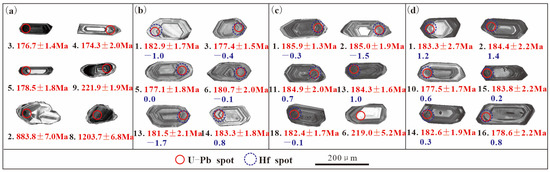
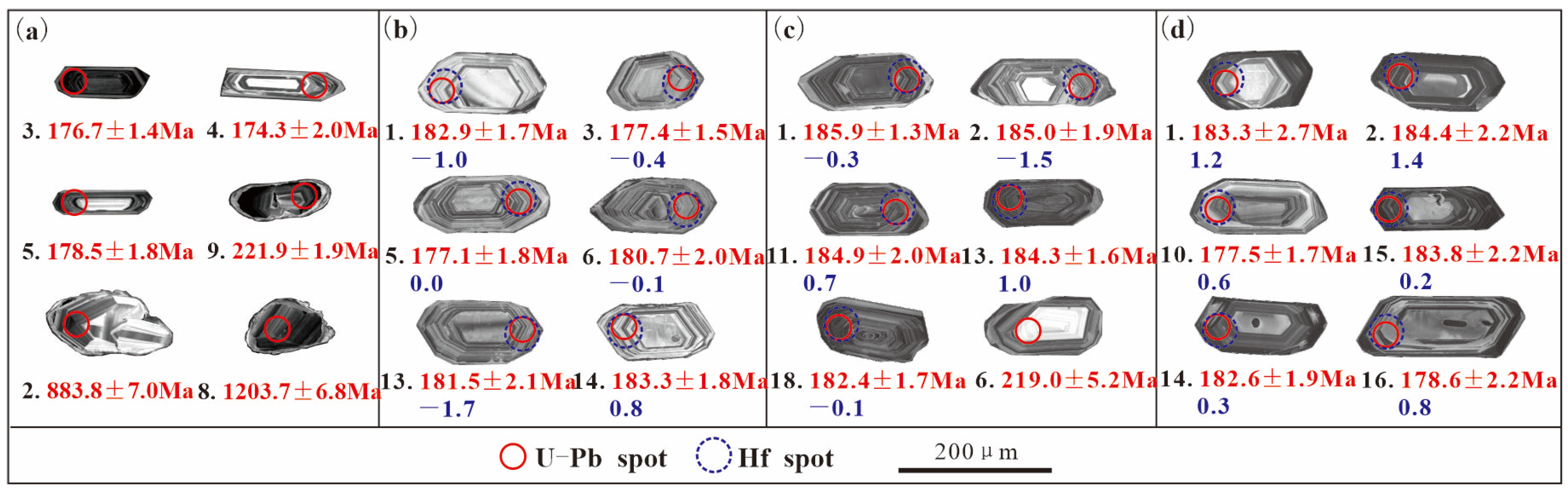
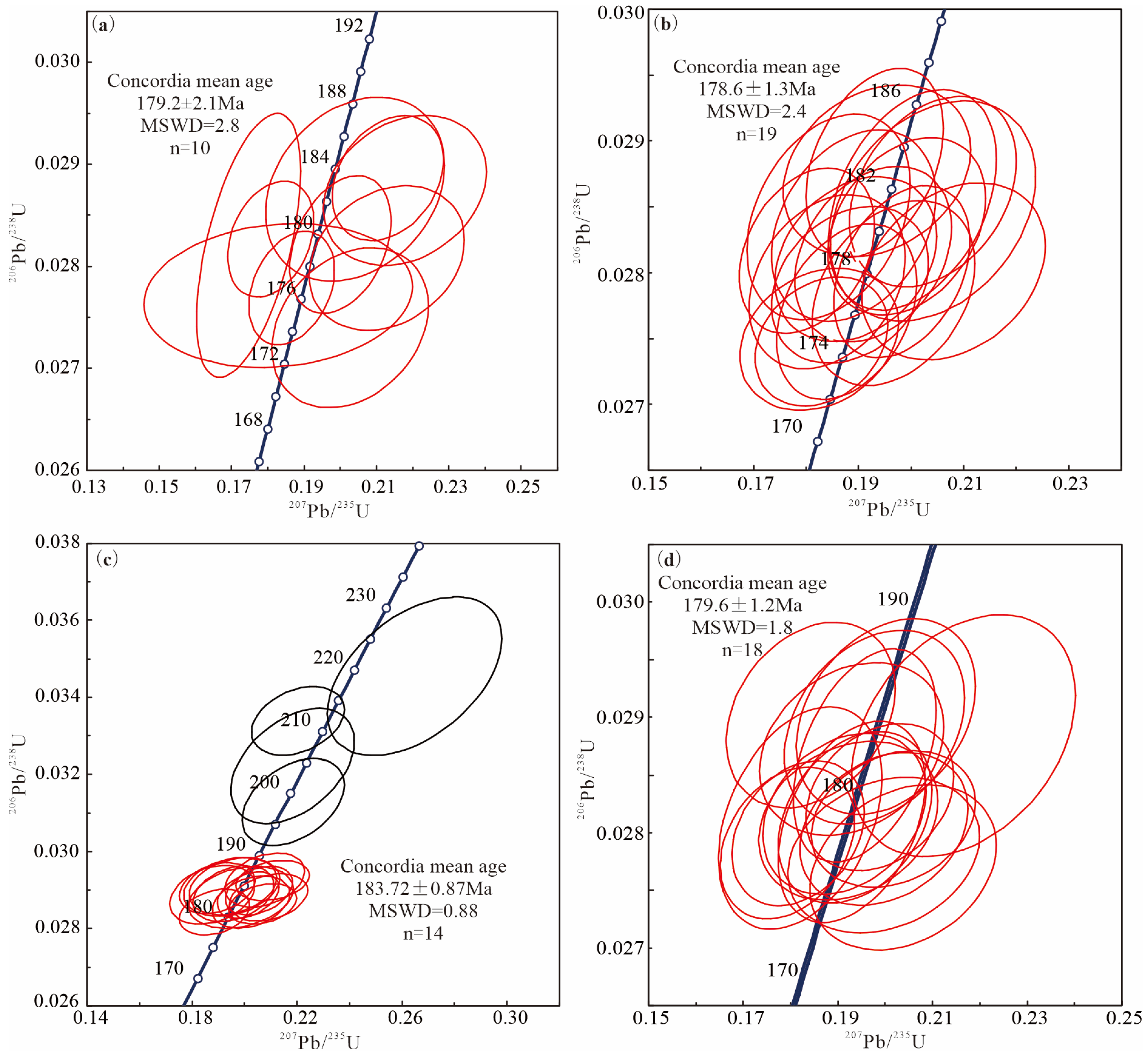
Gabbro (FKS06): Despite the rarity of zircon grains in the gabbro sample, extensive mineral separation efforts yielded only ~10 concordant spots suitable for age calculation. In cathodoluminescence (CL) images, the zircons from this sample exhibit long or short columnar shapes with axial ratios ranging from 5:1 to 1.2:1 and grain sizes of 100–180 μm. The zircons display clear rhythmic banding and core–mantle structures (Figure 4a). Among the 16 test points, the Th and U contents range from 416 × 10−6 to 876 × 10−6 and 790 × 10−6 to 986 × 10−6, respectively, with Th/U ratios of 0.5–1.6, indicating magmatic origins. The ten 206Pb/238U spots on ten zircon grains yield a weighted mean age of 179.2 ± 2.1 Ma (MSWD = 2.8), representing the rock’s formation in the late Early Jurassic (Figure 5a). Six other zircons exhibit older 206Pb/238U ages of 221.9–212.4 Ma, 883.8–834.9 Ma, and 1203.7 Ma, associated with Late Triassic, Neoproterozoic, and Middle Mesoproterozoic magmatic activities, respectively.
Figure 4.
Cathodeluminescence (CL) images of the analyzed zircon from different intrusive rocks in the Fukeshan area. (a) Gabbro (FKS06); (b) granodiorite (FKS08); (c) porphyritic monzogranite (FKS03); (d) biotite-bearing monzogranite (FKS07). Black numbers indicate sample numbers; red numbers denote zircon U-Pb ages; dark blue numbers represent Hf isotope ages.
Figure 5.
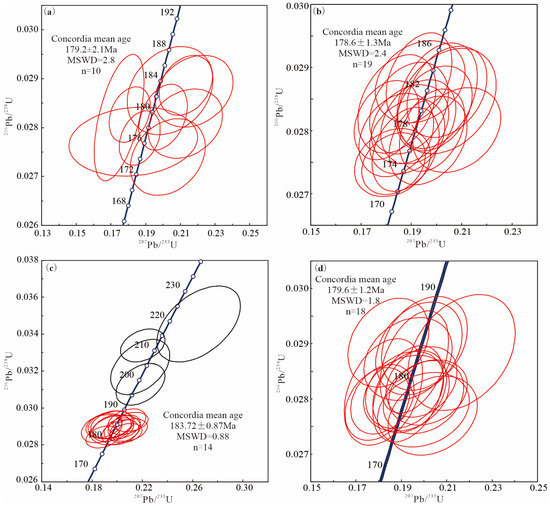
U–Pb concordia diagrams from intrusive rocks of the Fukeshan area. (a) Gabbro (FKS06); (b) granodiorite (FKS08); (c) porphyritic monzogranite (FKS03); (d) biotite-bearing monzogranite (FKS07).
5.1.2. Granitoid Rocks
In contrast to the gabbro, the zircon grains in this sample are abundant and readily recovered.
Granodiorite (FKS08): The zircons from this sample are predominantly short columnar shapes, with axial ratios of 2:1 to 1.2:1 and grain sizes of 100–200 μm (Figure 4b). Rhythmic banding and core–mantle structures are evident. Among the 19 analyzed test points, the Th and U contents range from 161 × 10−6 to 743 × 10−6 and 303 × 10−6 to 630 × 10−6, respectively, with Th/U ratios of 0.5–1.4, typical of magmatic zircons. The 206Pb/238U ages range from 183.3 to 174.8 Ma, with a weighted mean age of 178.6 ± 1.3 Ma (MSWD = 2.4), corresponding to the late Early Jurassic (Figure 5b).
Porphyritic monzogranite (FKS03): In CL images, the zircons from this sample appear as short to long columnar shapes, with axial ratios of 1.2:1 to 4:1 and grain sizes of 100–200 μm (Figure 4c). Rhythmic banding and core–mantle structures are common, while some zircons display corroded cores, indicative of inherited or captured origins. Among the 18 test points, the Th and U contents range from 105 × 10−6 to 950 × 10−6 and 253 × 10−6 to 894 × 10−6, respectively, with Th/U ratios of 0.3–0.9, consistent with magmatic origins. Fourteen zircons yield 206Pb/238U ages ranging from 186 to 180.8 Ma, with a weighted mean age of 183.72 ± 0.87 Ma (MSWD = 0.88), indicating crystallization during the late Early Jurassic. Four other zircons analyzed in their cores yield older 206Pb/238U ages of 219–198.6 Ma, corresponding to Late Triassic to Early Jurassic magmatic activity (Figure 5c).
Biotite-bearing monzogranite (FKS07): The zircons from this sample exhibit short to long columnar shapes, with axial ratios of 2:1 to 4:1 and grain sizes of 120–200 μm (Figure 4d). Rhythmic banding and core–mantle structures are prominent, and some zircons show signs of corrosion, indicating inheritance or capture. Among the 18 test points, the Th and U contents range from 80 × 10−6 to 490 × 10−6 and 257 × 10−6 to 587 × 10−6, respectively, with Th/U ratios of 0.3–1.1, characteristic of magmatic zircons. The 206Pb/238U ages range from 184.4 to 176.2 Ma, with a weighted mean age of 179.6 ± 1.2 Ma (MSWD = 1.8), reflecting the crystallization age in the late Early Jurassic (Figure 5d).
5.2. Major Oxides
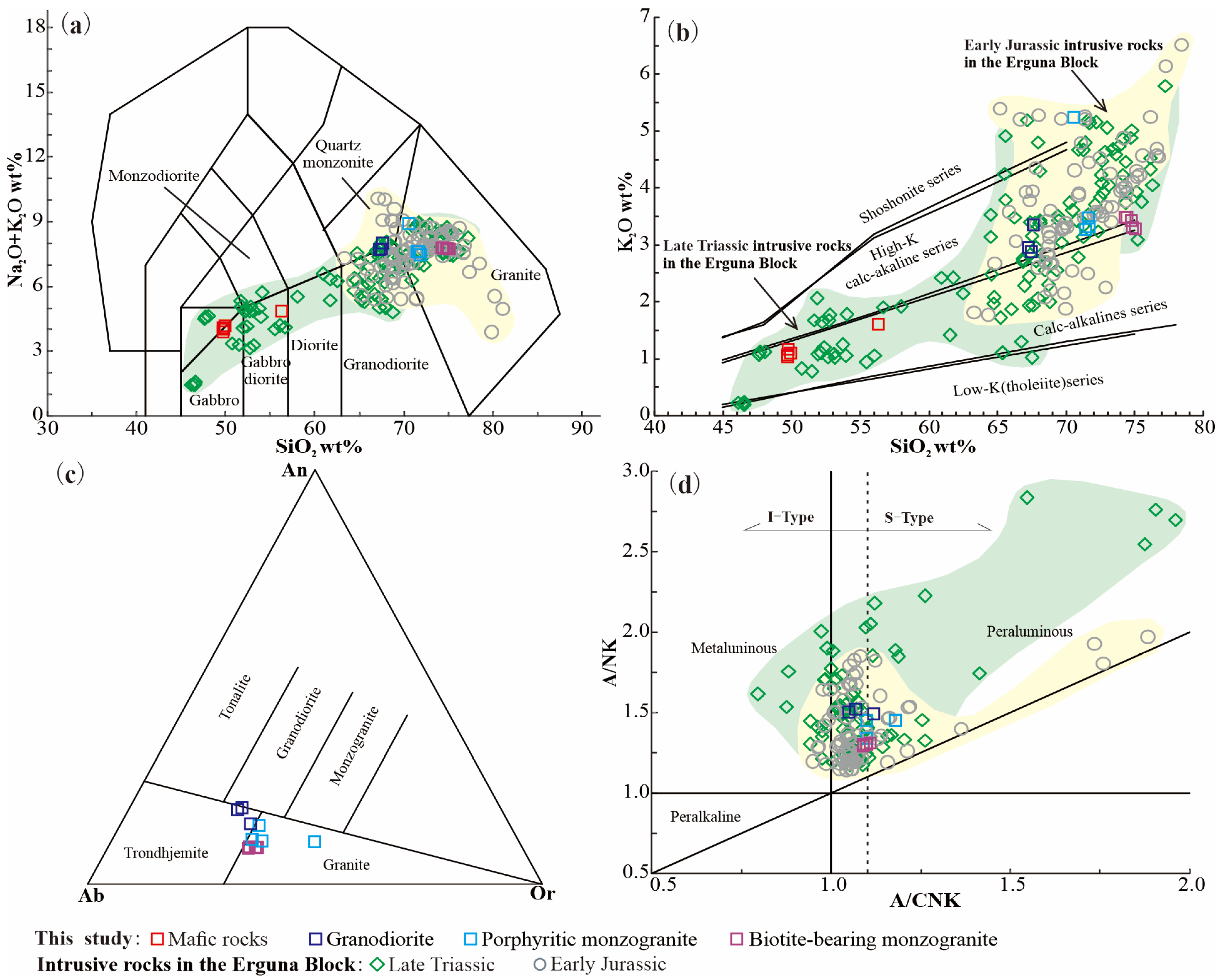
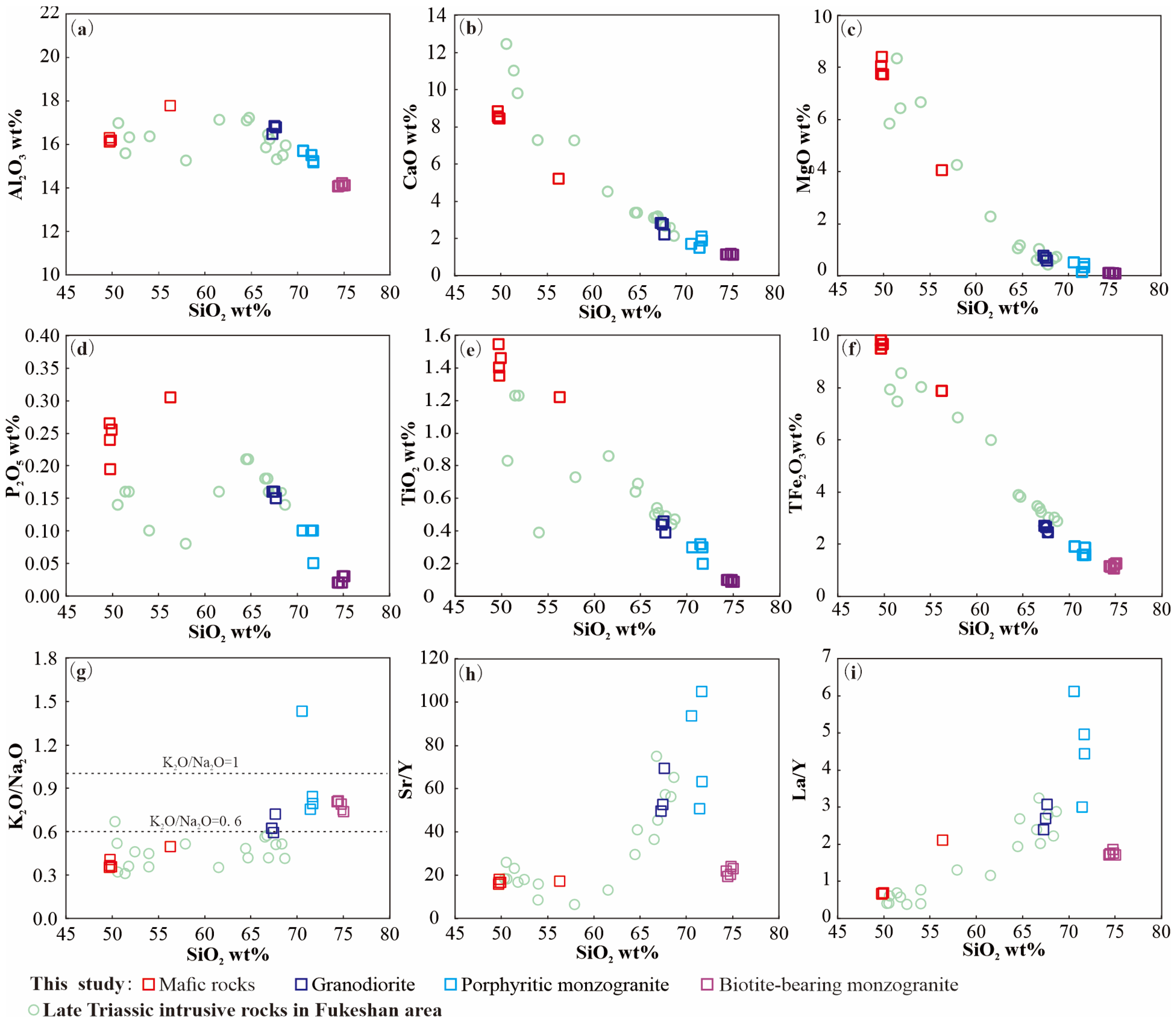
Seventeen rock samples were analyzed for their major element compositions (Table 2). The elemental variation characteristics of gabbro, gabbro-diorite, granodiorite, porphyritic monzogranite, and biotite-bearing monzogranite are detailed as follows (Figure 6 and Figure 7).
Table 2.
Major oxides (wt%), trace elements and rare-earth elements (ppm) compositions of intrusive rocks in Fukeshan area.
Figure 6.
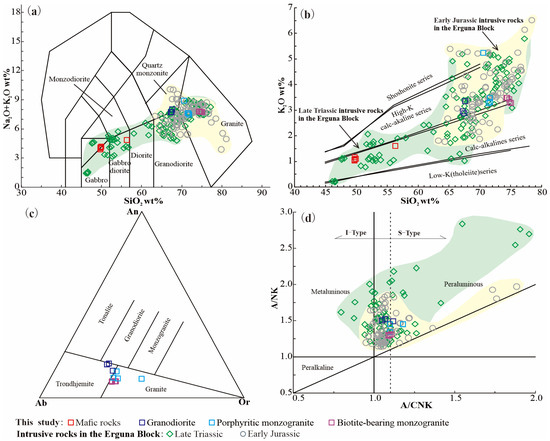
Major element diagrams for the volcanic rock from intrusive rocks of Fukeshan area. (a) Total alkalis against silica diagram, modiffed after ref. [52]; (b) Ab–An–Or diagram for granite classification, modiffed after ref. [53]; (c) Silica–alkali diagram for granite classification, modiffed after ref. [54]; (d) A/CNK–A/NK diagram of granite. The major element data of intrusive rocks in the Erguna Block (after ref. [4,6,11,43,55,56,57,58,59,60,61]) are listed in Supplementary Table S1.
Figure 7.
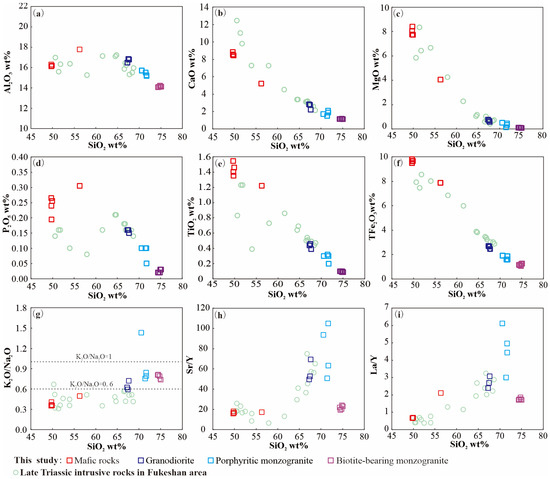
Harker diagram of some major oxides and trace elements vs. SiO2 from intrusive rocks of Fukeshan area. (a) Al2O3 vs. SiO2; (b) CaO vs. SiO2; (c) MgO vs. SiO2; (d) P2O5 vs. SiO2; (e) TiO vs. SiO2; (f) TFe2O3 vs. SiO2; (g) (K2O/Na2O) vs. SiO2; (h) (Sr/Y) vs. SiO2; (i) (La/Y) vs. SiO2.
5.2.1. Mafic Rocks
The major element compositions of the mafic samples are characterized by SiO2 (49.72–56.3 wt%), Al2O3 (16.1–17.78 wt%), CaO (5.22–8.85 wt%), MgO (4.05–8.4 wt%), and TiO2 (1.22–1.54 wt%). The Rittman index (δ) ranges from 1.67 to 2.24, classifying them as calc-alkaline rocks. The Na2O/K2O ratios (2.02–2.83) reflect sodium enrichment. (Na2O + K2O) increases with the increase in SiO (Figure 6a), identifying them as high-potassium calc-alkaline series (Figure 6b).
5.2.2. Granitoid Rocks
The granodiorite samples exhibit SiO2 (67.29–67.66 wt%), Al2O3 (16.49–16.84 wt%), and MgO (0.57–0.77 wt%). The total alkali content (Na2O + K2O) ranges from 7.68 to 7.99 wt%, and the Rittman index (δ) is 2.43–2.59, classifying them as calc-alkaline rocks. The A/CNK ratio (1.05–1.12) suggests that these rocks are in transition between peraluminous and strongly peraluminous compositions (Figure 6d). The differentiation index (DI) ranges from 80.1 to 82.8, and Mg# values are between 32 and 36, having an extremely high degree of differentiation. The K2O/Na2O ratio (0.60–0.72) indicates relative potassium enrichment. All three samples plot in the transition zone between quartz diorite and granodiorite (Figure 6a,b), further classifying them as high-potassium calc-alkaline series (Figure 6b).
The porphyritic monzogranite samples have components of SiO2 (70.88–71.71 wt%), Al2O3 (15.17–15.71 wt%), and MgO (0.14–0.50 wt%). The total alkali content (Na2O + K2O) ranges from 7.49 to 8.9 wt%, with a Rittman index (δ) of 1.95–2.87, classifying them as calc-alkaline rocks. The differentiation index (DI) ranges from 86.2 to 88.0, and Mg# values range from 15 to 34, having an extremely high degree of differentiation. The K2O/Na2O ratio (0.76–1.43) indicates relative potassium enrichment. The A/CNK ratio (1.10–1.18) suggests that the rocks are strongly peraluminous (Figure 6d). In the (Na2O + K2O)–SiO2 diagram, all samples plot in the granite field (Figure 6a,b).
The biotite-bearing monzogranite samples are characterized by SiO2 (74.35–75.08 wt%), Al2O3 (14.06–14.21 wt%), and MgO (0.08–0.10 wt%). The total alkali content (Na2O + K2O) ranges from 7.72 to 7.79 wt%, with a Rittman index (δ) of 1.88–1.94, classifying them as calc-alkaline rocks. The DI ranges from 91.2 to 91.4, and Mg# values range from 11 to 15, reflecting a high degree of differentiation. The K2O/Na2O ratios (0.74–0.81) indicate relative potassium enrichment. In the (Na2O + K2O)–SiO2 diagram, all samples plot in the granite field (Figure 6a), classified as high-potassium calc-alkaline to calc-alkaline transitional rocks (Figure 6b). The A/CNK ratio (1.09–1.11) suggests a transition between peraluminous and strongly peraluminous compositions (Figure 6d).
5.3. Trace Elements
The trace element compositions of the studied rock samples revealed significant geochemical variations between different lithologies.
5.3.1. Mafic Rocks
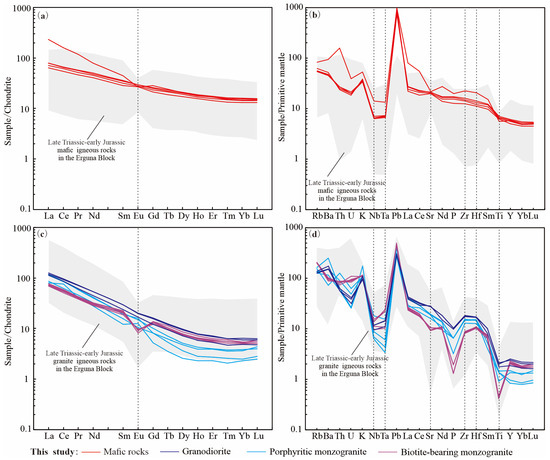
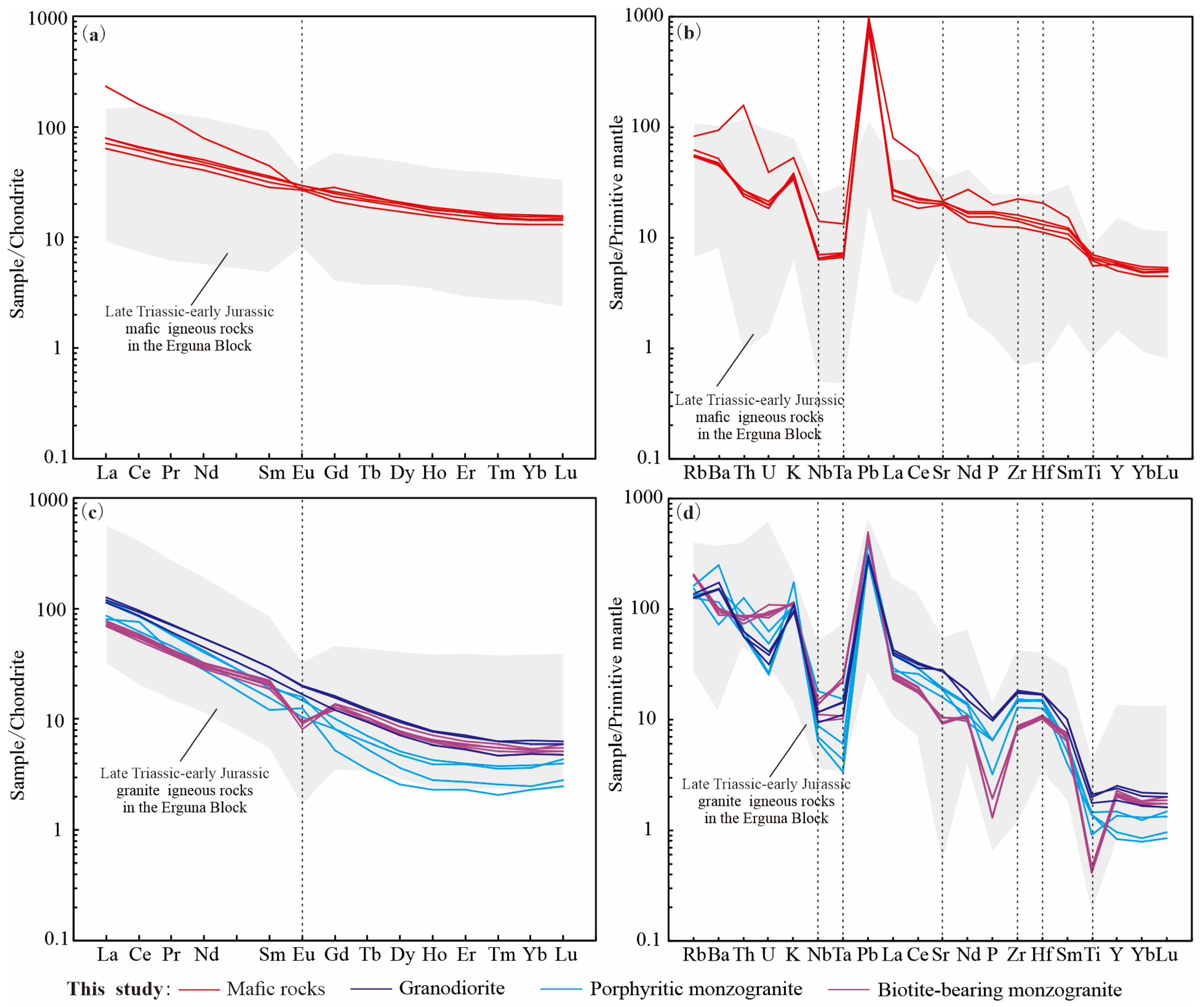
The total rare-earth element (REE) content of the mafic samples ranges from 92.9 × 10⁻⁶ to 229 × 10−6, with an average of 130 × 10−6. The light-to-heavy rare-earth element ratio (LREEs/HREEs) varies between 5.04 and 11.0, while the (La/Yb)N ratio ranges from 4.87 to 16.2, indicating relative enrichment in LREEs. The δEu values range from 0.75 to 1.09, reflecting a slight negative or no Eu anomaly. In the chondrite-normalized REE diagram (Figure 8a) and primitive mantle-normalized spider diagram (Figure 8b), the samples display enrichment in LREEs, Pb, and LILEs, along with depletion in HFSEs and HREEs.
Figure 8.
Chondrite-normalized rare-earth element patterns and primitive mantle-normalized trace element spider diagrams from intrusive rocks of Fukeshan area (modiffed after refs. [62,63]), (a) Mafic rocks from the Fukeshan area and Late Triassic–Early Jurassic mafic igneous rocks from the Erguna Block; (b) mafic rocks from the Fukeshan area and Late Triassic–Early Jurassic mafic igneous rocks from the Erguna Block; (c) granitoid rocks from the Fukeshan area and Late Triassic–Early Jurassic granitic rocks from the Erguna Block; (d) granitoid rocks from the Fukeshan area and Late Triassic–Early Jurassic granitic rocks from the Erguna Block. The rare element and trace element data of intrusive rocks in the Erguna Block (after ref. [4,6,11,43,55,56,57,58,59,60,61]) are listed in Supplementary Table S1.
5.3.2. Granitoid Rocks
The granodiorite samples have total REE contents ranging from 117 × 10−6 to 135 × 10−6, with an average of 128 × 10−6. The LREEs/HREEs ratios range between 13.2 and 16.0, while the (La/Yb)N ratios are between 18.4 and 23.0, indicating pronounced differentiation between LREEs and HREEs. The δEu values range from 0.91 to 0.98, showing a weak negative Eu anomaly. These patterns suggest enrichment in LREEs and LILEs, similar to typical arc magmas (Figure 8c,d).
The total REE content of the porphyritic monzogranite samples varies from 85.4 × 10⁻⁶ to 113 × 10−6, with an average of 99 × 10−6. The LREEs/HREEs ratios range between 16.9 and 29.5, while the (La/Yb)N ratios span from 18.4 to 45.8, indicating significant differentiation between LREEs and HREEs. The δEu values range from 0.92 to 1.57, suggesting no significant Eu anomaly. In trace element diagrams, these samples show enrichment in LREEs, Pb, Zr, Hf, and LILEs. They are depleted in HFSEs and HREEs (Figure 8c,d).
The biotite-bearing monzogranite samples have total REE contents ranging from 74.5 × 10⁻⁶ to 84.5 × 10⁻⁶, with an average of 79.5 × 10⁻⁶, which is slightly lower than that of the porphyritic monzogranite. The LREEs/HREEs ratios range from 9.47 to 9.87, while (La/Yb)N ratios vary between 13.4 and 14.8, indicating moderate differentiation between LREEs and HREEs. The δEu values range from 0.46 to 0.62, reflecting a pronounced negative Eu anomaly. Similar to other samples, the biotite-bearing monzogranite exhibits enrichment in LREEs, Pb, Zr, Hf, and LILEs, with depletion in HFSEs and HREEs, which is consistent with the geochemical characteristics of arc magmas (Figure 8c,d).
The geochemical characteristics of granitoid rocks are marked by elevated abundances of LREEs and LILEs, coupled with depleted abundances of HFSEs and HREEs. This elemental pattern is characteristic of arc-related volcanic magma sources.
5.4. Whole-Rock Sr–Nd Isotope
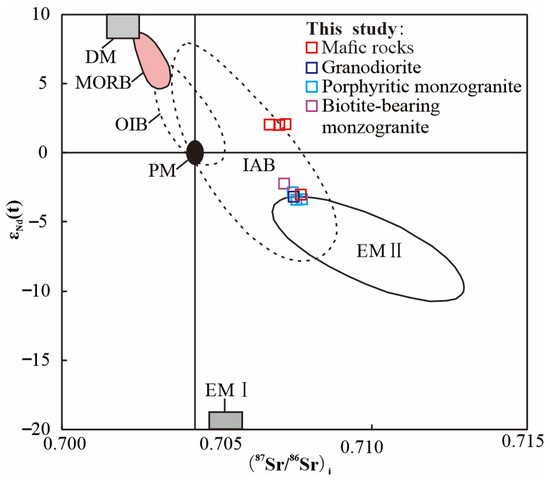
The results of the whole-rock Sr–Nd isotopic analyses for the late Early Jurassic intrusive rocks from the Fukeshan area are presented in Table 3 and Figure 9.
Table 3.
Sr–Nd isotopic compositions from intrusive rocks of Fukeshan area.
Figure 9.
Sr–Nd isotopic diagram of the intrusive rocks of the Fukeshan area (modiffed after [64]). EMI and EMII represent two types of mantle end-members [65].
5.4.1. Mafic Rocks
The mafic rocks exhibit 87Sr/86Sr ratios ranging from 0.707297 to 0.708578 and 143Nd/144Nd ratios between 0.512380 and 0.512679. Initial 87Sr/86Sr values ((87Sr/86Sr)i) range from 0.706704 to 0.70772, with εNd(t) values varying between −3.4 and 2.0. The Nd two-stage model ages (TDM2) are between 798 and 1213 Ma, suggesting that the source material for these rocks was formed during the Neoproterozoic to Mesoproterozoic eras.
5.4.2. Granitoid Rocks
The granitoid rocks exhibit 87Sr/86Sr ratios ranging from 0.70851 to 0.711506 and 143Nd/144Nd ratios ranging from 0.512337 to 0.512449. The initial 87Sr/86Sr values ((87Sr/86Sr)i) range from 0.707163 to 0.707735, with εNd(t) values between −3.4 and −2.3. The Nd two-stage model ages (TDM2) range from 1149 to 1245 Ma, indicating a Mesoproterozoic origin for the source materials.
5.5. Zircon Hf Isotope
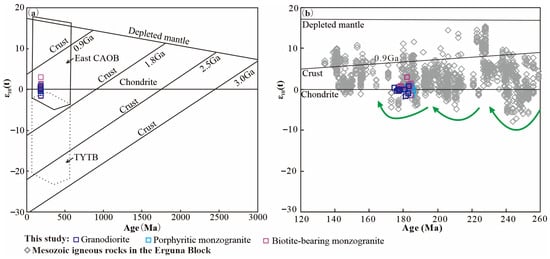
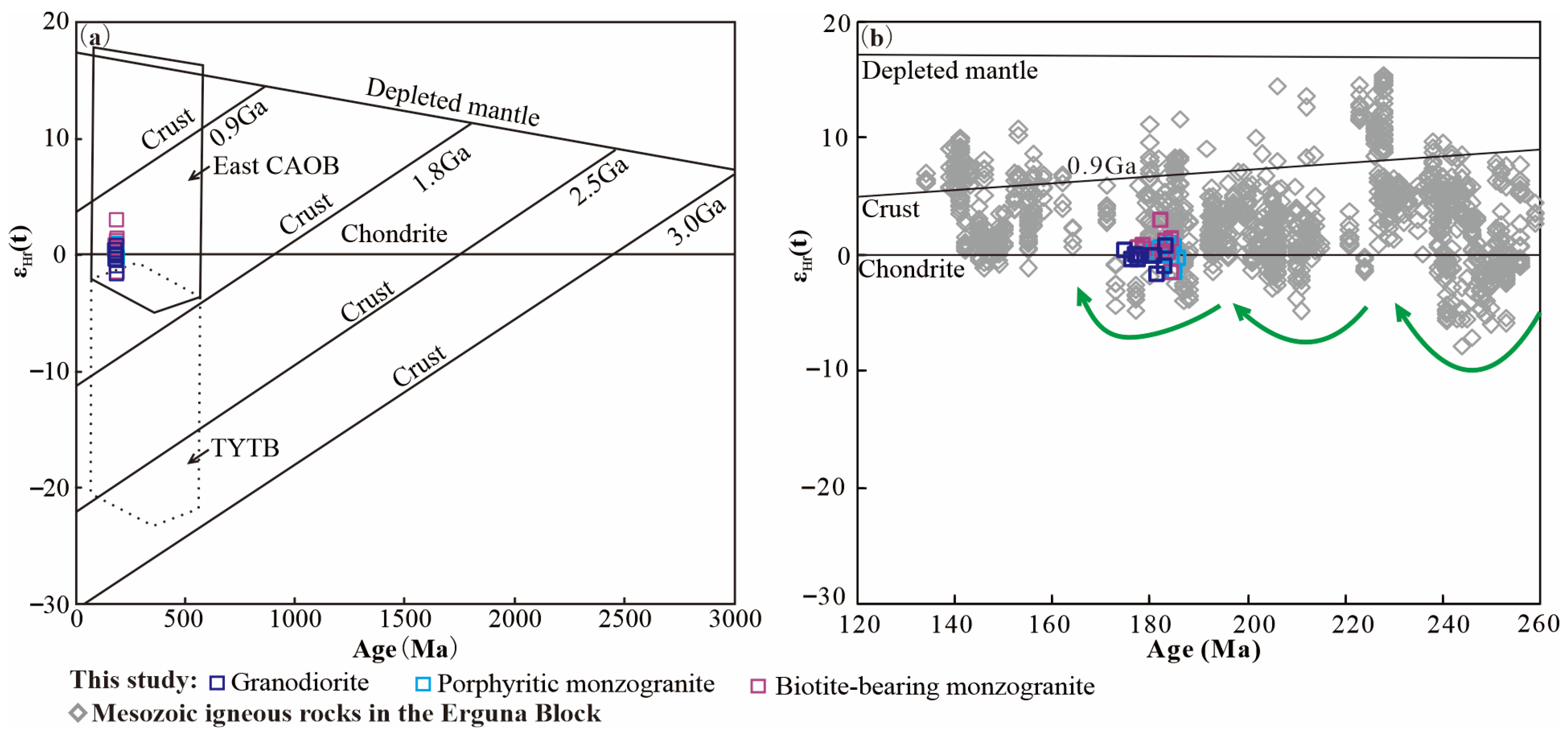
The zircon Lu–Hf isotopic results for the late Early Jurassic intrusive rocks from the Fukeshan area are summarized in Table 4 and illustrated in Figure 10.
Table 4.
Zircon Lu–Hf isotopic data.
Figure 10.
εHf(t) vs. U–Pb age diagram from intrusive rocks of Fukeshan area (modiffed after [69]). (a) Correlations between zircon εHf(t) value and age; (b) Detailed plot of zircon εHf(t) value against age. Abbreviations: CAOB, Central Asian Orogenic Belt; YFTB, Yanshan Fold and Thrust Belt. The Hf data of intrusive rocks in the Erguna Block (after ref. [4,6,11,56,57,58,59,60,61,70,71,72,73,74,75,76,77,78,79,80]) are listed in Supplementary Table S2.
Granodiorite: The zircons from the granodiorite samples exhibit εHf(t) values ranging from −1.7 to 0.8, with an average of −0.3. The zircon two-stage model ages (TDM2) range from 1331 to 1176 Ma, corresponding to Mesoproterozoic crustal sources. Porphyritic Monzogranite: In the porphyritic monzogranite, the zircon εHf(t) values range from −1.5 to 1, with an average of 0.1. The zircon two-stage model ages (TDM2) range from 1325 to 1166 Ma, indicating contributions from Mesoproterozoic crustal materials. Biotite-bearing monzogranite: The zircons from the biotite-bearing monzogranite show εHf(t) values ranging from −1.5 to 3, with an average of 0.6. The zircon two-stage model ages (TDM2) range from 1323 to 1034 Ma, suggesting a dominant Mesoproterozoic crustal contribution with potential minor mantle input.
6. Discussion
6.1. Intrusion Ages
The continental arc-type magmatic rocks within the study area were dominated by granitic rocks, primarily occurring as batholiths, with fewer intermediate-basic intrusions, representing significant products of early Mesozoic magmatic activity in the Erguna block. This was consistent with the situation that Mesozoic intrusions were extensively developed in the Erguna block [11,80,81]. These rocks were significantly enriched in LREEs and LILEs but depleted in HFSEs, characteristic of calc-alkaline magmatism in subduction zones in the northern Greater Xing’an Range [11,21,27,80,81,82,83,84,85,86]. The zircon U–Pb ages from the granitic rocks constrained the timing of felsic magmatism, while those from the mafic rocks recorded the age of coeval mantle-derived mafic magmatism [11,43,61,81,84].
The analyzed zircons exhibited distinct characteristics of magmatic zircons, including rhythmic zoning and high Th/U ratios, confirming that the obtained ages represented the timing of crystallization. Zircon U–Pb dating yielded crystallization ages of 179 ± 2.1 Ma for the gabbro, 178.6 ± 1.3 Ma for the granodiorite, 183.72 ± 0.87 Ma for the porphyritic monzogranite, and 179.6 ± 1.2 Ma for the biotite-bearing monzogranite. These ages placed the studied rocks in the late Early Jurassic. The late Early Jurassic continental arc-type magmatic rocks within the study area represent significant products of early Mesozoic magmatic activity in the Erguna block.
6.2. Genesis and Magma Source
6.2.1. Mafic Rocks
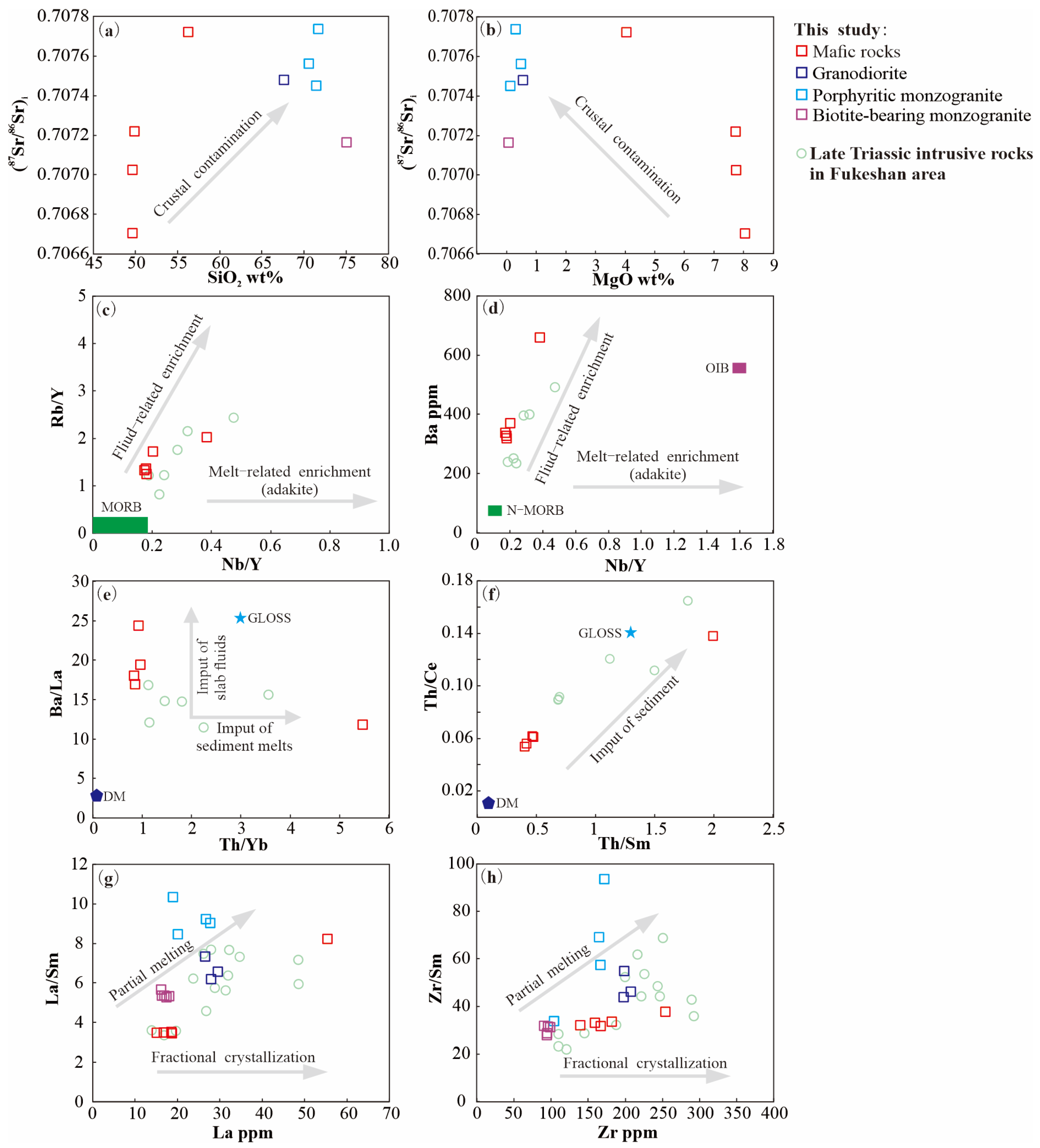
The mafic rocks from the Fukeshan area exhibited whole-rock εNd(t) values of −3.0 to 2.0, suggesting a heterogeneous mantle source metasomatized by subduction-related components [87]. Their MgO (4.05–8.40 wt%), Mg# (51–63), Cr (41.9–420 ppm), and Ni (16.7–109 ppm) contents were lower than those of primary mantle melts [88], indicating fractional crystallization during ascent. Trace element characteristics showed enrichment in LREEs, Pb, and LILEs, with depletion in HFSEs and HREEs (Figure 8a,b), consistent with island arc basalt (IAB) signatures [34,89]. These features indicated formation through partial melting of the lithospheric mantle metasomatized by fluids and melts from the subducting slab [11,43,81,84,90]. Relatively stable (87Sr/86Sr)i and εNd(t) values, combined with moderate SiO2 and MgO contents (Figure 11a,b), indicated minimal crustal contamination.
The positive correlations between Rb/Y, Ba, and Nb/Y (Figure 11c,d) further supported slab-fluid metasomatism of an enriched mantle source [91]. Th/Yb versus Ba/La and Th/Sm versus Th/Ce relationships (Figure 11e,f) also suggested sediment involvement in mantle metasomatism [92]. Inherited zircons with Neoproterozoic and Mesoproterozoic ages, consistent with the Erguna block basement, corroborated terrigenous sediment input from the subducting MOO slab [81]. In summary, these mafic rocks formed through partial melting of a metasomatized mantle wedge, with subsequent fractional crystallization during magma ascent (Figure 11g,h).
Figure 11.
Diagrams of genetic types of intrusive rocks from Fukeshan area. (a) (87Sr/86Sr)i vs. SiO2; (b) (87Sr/86Sr)i vs. MgO; (c) (Rb/Y) vs. (Nb/Y) and (d) Ba vs. (Nb/Y), modiffed after ref. [91], (e) (Ba/La) vs. (Th/Yb), modiffed after ref. [93]; (f) (Th/Ce) vs. (Th/Sm), modiffed after ref. [92]; (g) La/Sm vs. La, modiffed after ref. [94]; (h) Zr vs. Zr/Sm. Global subducting sediment (GLOSS) compositions are from ref. [95].
6.2.2. Granite
The late Early Jurassic granites exhibited 87Sr/86Sr ratios of 0.70851–0.711506, εNd(t) values of −3.4 to −2.3, and TDM2 ages of 1245–1149 Ma, indicating significant ancient crustal contributions. The zircon εHf(t) values (−1.7 to 0.8) and TDM2 ages (1331–1034 Ma) supported involvement of Mesoproterozoic crustal material with minor mantle input [96] (Figure 9 and Figure 10). The geochemical patterns (Figure 8c,d) suggested that the granodiorites and porphyritic monzogranites shared a common magma source, mainly Mesoproterozoic crust and evolutionary history. By contrast, the biotite-bearing monzogranite displayed distinct negative Eu anomalies, U enrichment, and lower zircon saturation temperatures (749–752 °C vs. 780–803 °C), suggesting a shallower source. Their slightly higher εHf(t) values indicated greater mantle contribution. These findings revealed complex crust–mantle interactions along the northern Erguna block margin during the late Early Jurassic.
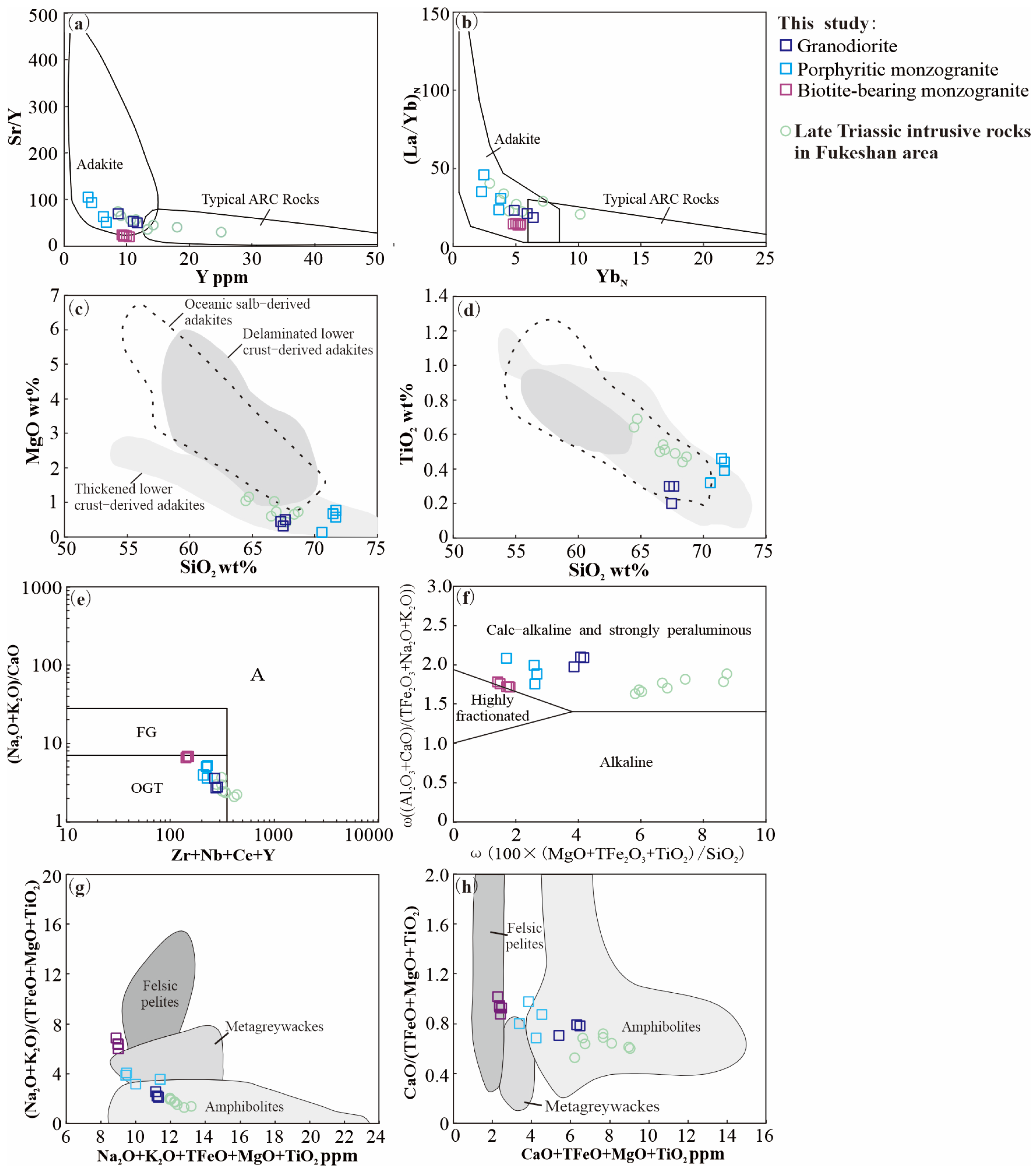
6.2.3. Granodiorite and Porphyritic Monzogranite
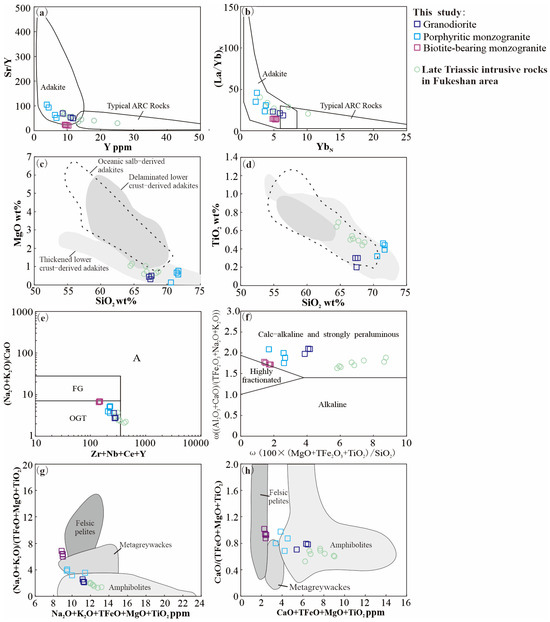
The granodiorites and porphyritic monzogranites displayed adakitic characteristics [97,98] (Figure 12a,b): high SiO2 (67.29–71.71 wt%, >56 wt%), Sr (341–600 ppm, with one sample slightly below 400 ppm), Sr/Y (49.6–105, >20), and (La/Yb)N (18.4–45.8, >10), with low HREEs and Y (3.80–11.7 ppm, <18 ppm), and weak or absent negative Eu anomalies. Their low MgO (0.14–0.77 wt%) and Mg# (14–34) (Figure 12c,d), together with low Cr and Ni contents, pointed to partial melting of the thickened lower crust rather than subducted oceanic slab [99]. This interpretation was supported by their Na2O/K2O ratios (0.7–1.68), which were lower than typical slab-melt adakites (2.5–6.5) [100], and their relatively high K2O contents (2.88–5.24 wt%). The absence of negative correlations between Al2O3 and SiO2 or positive Sr/Y–SiO2 trends (Figure 7a,h,i) argued against fractional crystallization of basaltic magma [101,102]. Decreasing MgO with increasing (87Sr/86Sr)i and SiO2 (Figure 11a,b) suggested minor crustal contamination during ascent. Collectively, results indicated that these adakitic rocks formed primarily through partial melting of the thickened lower crust, with limited crustal contamination during magma ascent.
Figure 12.
Diagrams of genetic types of intrusive rocks from Fukeshan area. (a) Sr/Y vs. Y and (b) (La/Yb)N vs. YbN diagram (modified from [97]), where N means normalized to chondrite [62]; (c) MgO vs. SiO2 and (d) TiO2 vs. SiO2 diagram (modified from ref. [103]); (e) (Zr + Nb + Ce + Y) − (K2O + Na2O)/CaO diagram (modiffed after ref. [104]); (f) (Al2O3 + CaO)/(FeOT + Na2O + K2O) vs. 100(MgO + FeOT + TiO2)/SiO2 diagram (modiffed after ref. [105]); (g) (Na2O + K2O + TFeO + MgO + TiO2) vs. ((Na2O + K2O)/(TFeO + MgO + TiO2)) and (h) (CaO + TFeO + MgO + TiO2) vs. (CaO/(TFeO + MgO + TiO2)) diagrams (modiffed after ref. [106]).
6.2.4. Biotite-Bearing Monzogranite
The biotite-bearing monzogranite was characterized by high SiO2; elevated alkalis and Rb; low MgO, CaO, Cr, Ni, and Co; and depletions in Ba, Nb, Ta, Sr, P, and Ti; with a pronounced negative Eu anomaly. These features aligned partially with A-type granites [107] and high-silica granites [108,109]. However, 10,000 × Ga/Al values (2.3–2.4) and the Zr contents (90.7–99.0 ppm) were lower than those of typical A-type granites, and the TZr values (745–752 °C) were comparable to those of I-type granites, indicating a highly differentiated I-type affinity. The rock plotted in the transition zone between common and highly differentiated granites (Figure 12e,f), with low Zr/Hf (~29.1 vs. continental crust 35.7 [110]) and Nb/U (~4.7 vs. upper crust 4.4 [110]) ratios. This interpretation was supported by its geochemical signatures, which reflected a felsic pelitic source (Figure 12g,h). These features, combined with depletion in Sr, Eu, and Ba, indicated significant fractional crystallization of plagioclase and biotite from a dominantly crustal source with a relatively high degree of magma differentiation.
6.3. Tectonic Setting and Geodynamic Significance
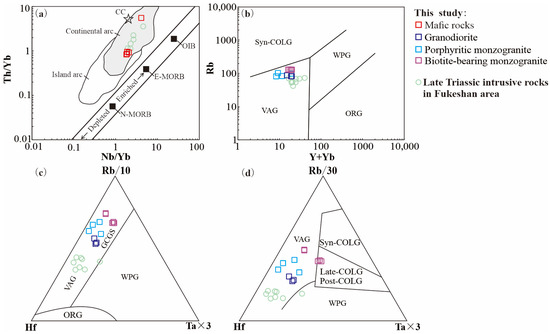
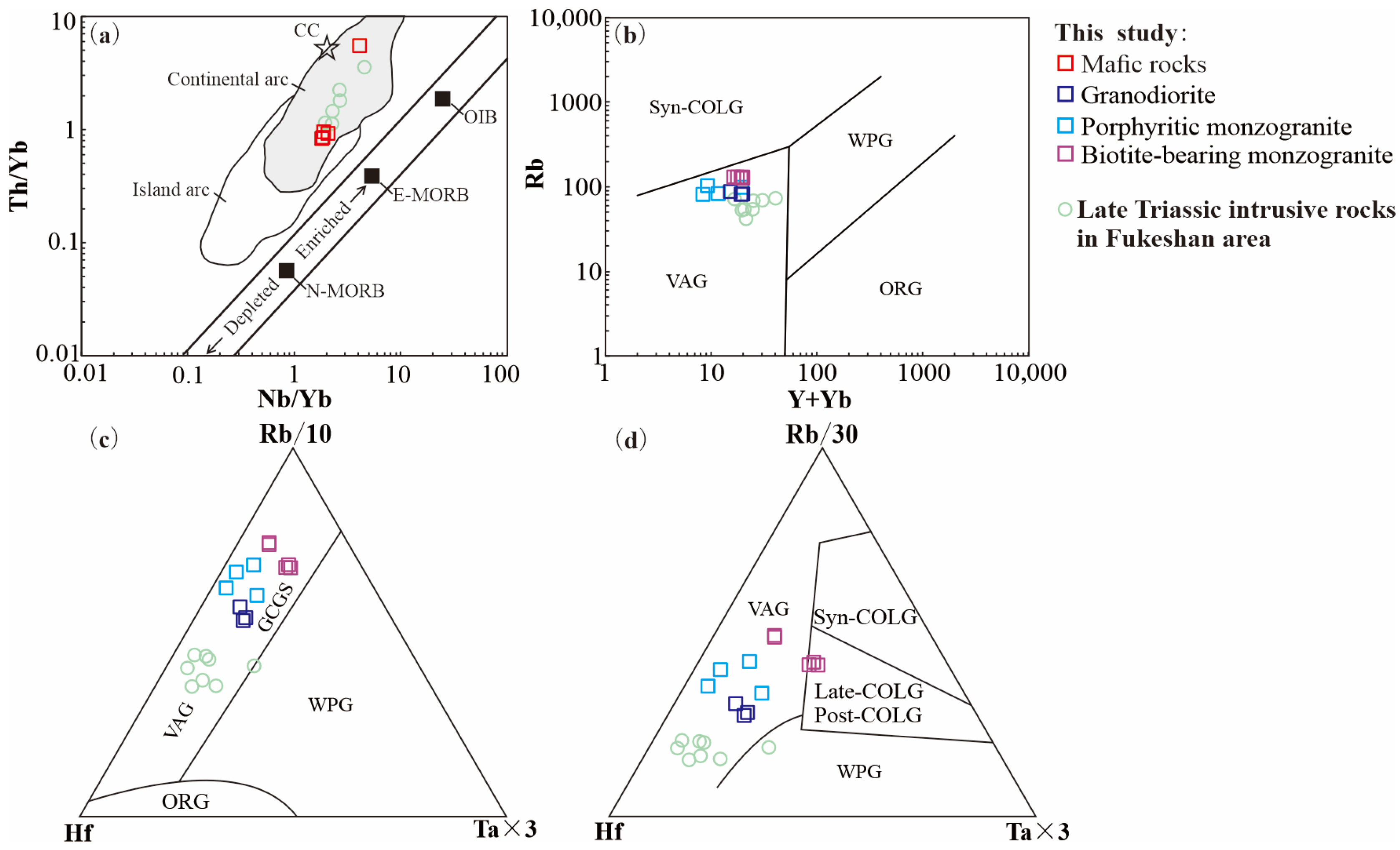
In the Fukeshan area, magmatism during the Late Triassic and late Early Jurassic is represented by typical continental arc magmatic rocks distributed parallel to the MOO subduction zone (Figure 13). These rocks showed enrichment in LREEs and LILEs and depletion in HFSEs, typical of calc-alkaline magmatism in a subduction zone setting [11,27,43,83,84]. The Late Triassic intrusions, characterized by tholeiitic to calc-alkaline and adakitic compositions, exhibited enrichment in LREEs and LILEs and depletion in HFSEs. These features, combined with their spatial distribution, suggested southward subduction of the MOO slab [43]. By contrast, the late Early Jurassic rocks showed a progression from calc-alkaline to high-potassium calc-alkaline compositions, with increasing peraluminosity, differentiation intensity, and crustal maturity. This magmatic evolution likely reflects a transition from ocean–continent subduction to continent–continent collision (Figure 13c,d).
Figure 13.
(a) Nb/Yb vs. Th/Yb diagrams, modiffed after ref. [111]; (b) Rb vs. (Y + Nb) diagrams, modiffed after ref. [112]; (c,d) Hf–Rb–Ta triangle diagram, modiffed after ref. [113]. VAG = volcanic arc granites; WPG = within-plate granites; Syn-COLG = syn-collision granites; Post-COLG = post-collision granites.
Slab rollback has been widely recognized as a key geodynamic process in subduction zones, driving upper plate extension, arc migration, and enhanced crust–mantle interactions [114,115,116]. Theoretical and analog modeling studies have demonstrated that slab rollback occurs when the subducting slab’s sinking velocity exceeds the convergence rate, leading to trench retreat and toroidal flow in the mantle wedge [115,117]. This process induces upwelling of asthenospheric material, promotes melting of the metasomatized mantle wedge, and generates distinct temporal–spatial variations in arc magmatism [116].
From a temporal perspective, subduction processes at convergent margins can be divided into early and late stages [118]. During the early stage, low-angle subduction leads to crustal thickening through stacking, often without significant arc magmatism [119]. In the late stage, high-angle subduction and slab rollback enhance crust–mantle interactions, inducing partial melting of the mantle wedge and crust to produce mafic and felsic arc magmas [120]. In the Fukeshan area, there were decreased εHf(t) values, which indicated extensive crust–mantle interactions. In addition, the εHf(t) values of Mesozoic intrusive rocks in the Erguna block showed distinct positive and negative peaks during the Late Triassic and late Early Jurassic (Figure 10b). Continuous subduction caused crustal thickening and facilitated mixing between crustal materials and mantle-derived magmas, leading to reduced εHf(t) values, reflecting intense crust–mantle interactions linked to slab rollback in the late stage [27].
The Late Triassic magmatic rocks in the Fukeshan area exhibited typical features of continental arc magmatism, likely related to high-angle subduction during slab rollback in the late subduction stage. By contrast, the late Early Jurassic magmatic rocks displayed high-K calc-alkaline and peraluminous characteristics, consistent with further slab rollback. This two-stage magmatic evolution, with progressively more evolved compositions, matches the predicted consequences of sustained rollback, where continued trench retreat allows for greater crustal assimilation and differentiation [114,117]. These observations indicated that MOO subduction continued until approximately 179 Ma, transitioning to collision and closure between the Early and Middle Jurassic [20,30].
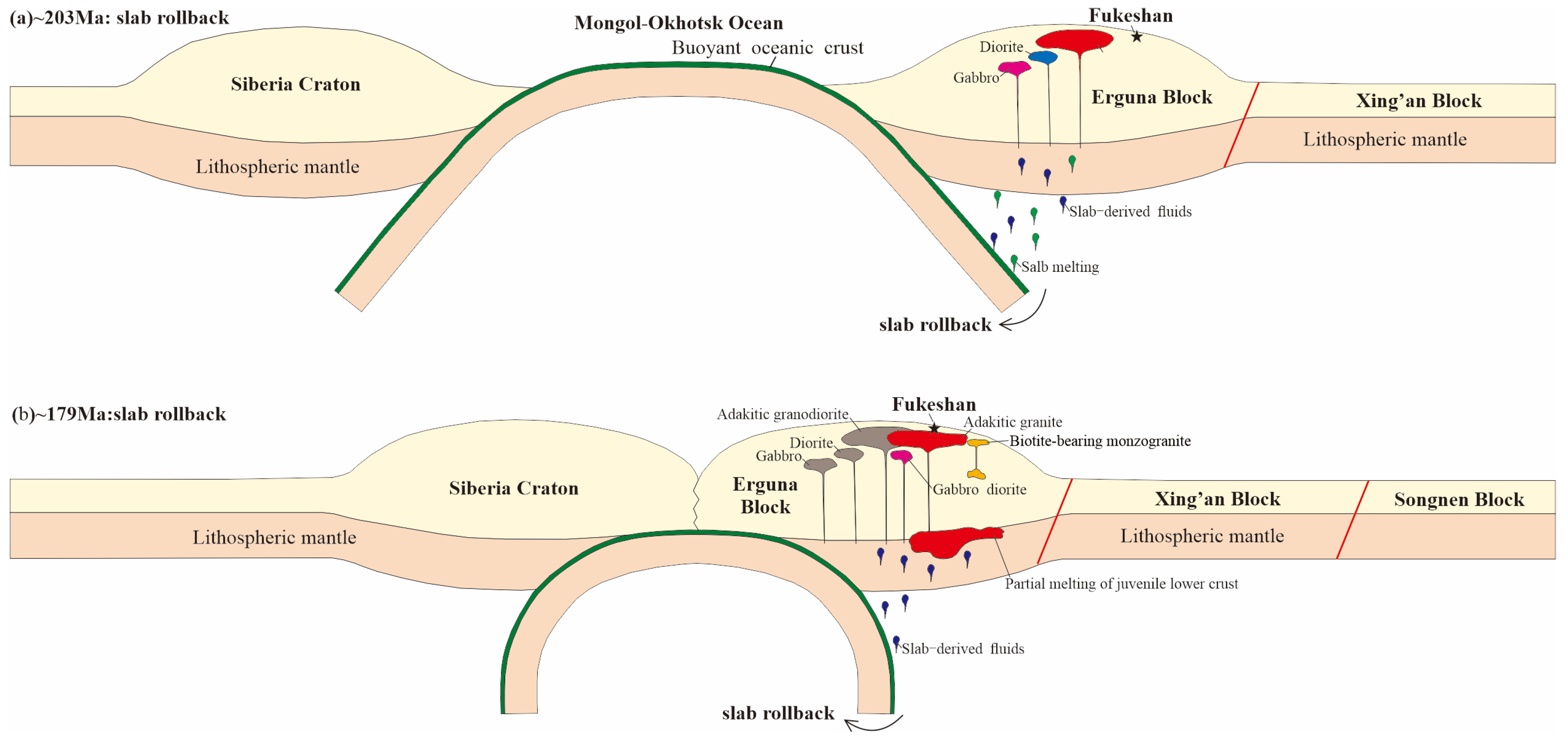
In summary, the MOO experienced two major slab rollback events during the Late Triassic and late Early Jurassic, driving complex crust–mantle evolution along the northern margin of the Erguna block (Figure 14). Fluids and sediments from the subducted slab metasomatized the mantle wedge, triggering partial melting and the generation of mantle-derived magmas. These magmas underplated the thickened crust, inducing partial melting of crustal materials and producing two phases of continental magmatic arcs. The arcs migrated spatially from northwest to southeast, evolving in geochemical composition and reflecting the transition from subduction to collision. This process provides valuable insights into crustal growth, deep crust–mantle interactions, and the evolution of continental margins during MOO subduction and closure.
Figure 14.
Schematic geodynamic model showing the tectonic setting and crust–mantle processes in the Fukeshan area of the northern Great Xing’an Range during the Late Triassic and the late Early Jurassic. (a) Late Triassic; (b) late Early Jurassic.
7. Conclusions
This study investigated late Early Jurassic magmatic rocks in the Fukeshan area of the northern Greater Khingan Range, providing critical insights into the tectonic evolution associated with the southward subduction of the Mongol–Okhotsk Ocean (MOO). The following key conclusions are drawn:
- (1)
- The magmatic rocks consist of gabbro, gabbro-diorite, granodiorite, porphyritic monzogranite, and biotite-bearing monzogranite, exhibiting typical continental arc characteristics.
- (2)
- The geochemical and isotopic data indicate that the mafic rocks were derived from partial melting of the lithospheric mantle, metasomatized by slab-derived fluids and sediment melts.
- (3)
- The granodiorite and porphyritic monzogranites, showing adakitic signatures, originated from the melting of a thickened lower crust. By contrast, the biotite-bearing monzogranites reflect a highly differentiated magma source derived from the middle to upper crust.
- (4)
- LA-ICP-MS zircon U–Pb dating reveals that the magmatic activity occurred between 183 and 179 Ma, coinciding with the active southward subduction of the MOO. This marks the final stage of subduction-related magmatism before transitioning into a syn-collisional regime during the Middle Jurassic.
- (5)
- The study highlights the role of high-angle subduction and slab rollback in driving extensive crust–mantle interactions. These processes include mantle wedge melting, magma underplating, and partial melting of crustal materials, resulting in the evolution of the continental magmatic arc.
- (6)
- The transition from arc magmatism to post-collisional tectonics marks the eventual closure of the MOO, contributing to crustal growth and tectonic reorganization in the region.
Supplementary Materials
The following supporting information can be downloaded at: https://www.mdpi.com/article/10.3390/min16030305/s1, Table S1: Major (wt.%) and trace element data (ppm) for the Late Triassic–Early Jurassic intrusions in the Erguna Massif; Table S2: Zircon Hf isotopic data from the intrusives rocks in the Erguna Block.
Author Contributions
Conceptualization, W.L. and Z.L.; methodology, W.L.; software, W.L.; validation, M.A.; formal analysis, Z.L. and M.A.; investigation, W.L.; data curation, Z.C.; writing—original draft preparation, W.L. and Z.L.; writing—review and editing, W.L. and C.L.; visualization, Z.C.; supervision, Z.L. and Z.C.; project administration, Z.C.; funding acquisition, W.L. All authors have read and agreed to the published version of the manuscript.
Funding
This work was financially supported by Heilongjiang Provincial Natural Science Foundation of China (LH2023D027), Northeast Geological S&T Innovation Center of China Geological Survey (QCJJ2022-8), and Heilongjiang Research Project of Land and Resources (DZKC-GY-2018003).
Data Availability Statement
The original contributions presented in this study are included in the article and Supplementary Materials. Further inquiries can be directed to the corresponding author (Zhanlong Li, 15244686754@163.com).
Conflicts of Interest
Wenlong Li, Chenglu Li, and Zhaoxun Cheng are employees of the Heilongjiang Institute of Natural Resources. Zhanlong Li is an employee of The Fifth Geological Exploration Institute of Heilongjiang Province. Masroor Alam is an employee of the Department of Earth Sciences, Karakoram International University. The remaining authors declare that the research was conducted in the absence of any commercial or financial relationships that could be construed as a potential conflict of interest.
References
- Windley, B.F.; Alexeiev, D.; Xiao, W.J.; Kröner, A.; Badarch, G. Tectonic models for accretion of the Central Asian Orogenic Belt. J. Geol. Soc. 2007, 164, 31–47. [Google Scholar] [CrossRef] [Scilit]
- Cawood, P.A.; Kröner, A.; Collins, W.J.; Kusky, T.M.; Mooney, W.D.; Windley, B.F. Accretionary orogens through Earth history. Geol. Soc. Lond. Spec. Publ. 2009, 318, 1–36. [Google Scholar] [CrossRef] [Scilit]
- Mao, J.W.; Pirajno, F.; Lehmann, B.; Luo, M.C.; Berzina, A. Distribution of porphyry deposits in the eurasian continent and their corresponding tectonic settings. J. Asian Earth Sci. 2014, 79, 576–584. [Google Scholar] [CrossRef] [Scilit]
- Deng, C.Z.; Sun, D.Y.; Han, J.S.; Chen, H.Y.; Li, G.H.; Xiao, B.; Li, R.C.; Feng, Y.Z.; Li, C.L.; Lu, S. Late-stage southwards subduction of the Mongol-Okhotsk oceanic slab and implications for porphyry Cu-Mo mineralization: Constraints from igneous rocks associated with the Fukeshan deposit, NE China. Lithos 2019, 326, 341–357. [Google Scholar] [CrossRef] [Scilit]
- Sheldrick, T.; Barry, T.L.; Millar, I.L.; Barfod, D.N.; Halton, A.M.; Smith, D.J. Evidence for southward subduction of the Mongol-Okhotsk oceanic plate: Implications from Mesozoic adakitic lavas from Mongolia. Gondwana Res. 2020, 79, 140–156. [Google Scholar] [CrossRef] [Scilit]
- Sun, Y.G.; Li, B.L.; Zhao, Z.H.; Sun, F.Y.; Ding, Q.F.; Chen, X.S.; Li, J.B.; Qian, Y.; Li, Y.J. Age and petrogenesis of late Mesozoic intrusions in the Huoluotai porphyry Cu-(Mo) deposit, northeast China: Implications for regional tectonic evolution. Geosci. Front. 2022, 13, 317–338. [Google Scholar] [CrossRef] [Scilit]
- Wang, T.; Tong, Y.; Xiao, W.J.; Guo, L.; Windley, B.F.; Donskaya, T.; Li, S.; Tserendas, N.; Zhang, J.J. Rollback, scissor-like closure of the Mongol-Okhotsk Ocean and formation of an orocline:magmatic migration based on a large archive of age data. Natl. Sci. Rev. 2022, 9, 167–178. [Google Scholar] [CrossRef] [Scilit]
- Kan, J.; Qin, K.Z.; Wang, L.; Hui, K.X.; Han, R.; Evans Noreen, J.; Meng, Z.J. Paleozoic and Mesozoic magmatism in the Gaodi porphyry Mo-Cu deposit: Implications for the evolution of the Mongol-Okhotsk Ocean in the northern Great Xing’an Range, NE China. Gondwana Res. 2023, 124, 77–99. [Google Scholar] [CrossRef] [Scilit]
- Peng, H.; Jiao, Y.Q.; Fu, X.F.; Wu, L.Q.; Guo, X.D.; Wang, Q.S.; Liu, C. Provenance and uranium source tracing for uranium-bearing series in the south of Songliao Basin: Evidence from zircon U–Pb chronology and lithogeochemistry. J. Geochem. Explor. 2025, 272, 107703. [Google Scholar] [CrossRef] [Scilit]
- Cogné, J.P.; Kravchinsky, V.A.; Halim, N.; Hankard, F. Late Jurassic-Early Cretaceous closure of the Mongol-Okhotsk ocean demonstrated by new Mesozoic palaeomagnetic results from the Trans-Bakal area (SE Siberia). Geophys. J. R. Astron. Soc. 2005, 163, 813–832. [Google Scholar] [CrossRef] [Scilit]
- Tang, J.; Xu, W.L.; Wang, F.; Zhao, S.; Wang, W. Early Mesozoic southward subduction history of the Mongol-Okhotsk oceanic plate: Evidence from geochronology and geochemistry of Early Mesozoic intrusive rocks in the Erguna Massif, NE China. Gondwana Res. 2016, 21, 218–240. [Google Scholar] [CrossRef] [Scilit]
- Zhu, M.S.; Pastor-Galán, D.; Smit, M.A.; Sanchir, D.; Zhang, F.Q.; Liu, C.H.; Luo, Y.; Miao, L.C. The beginning of a Wilson cycle inan accretionary orogen: The Mongol–Okhotsk Ocean opened assisted by a Devonian mantle plume. Geophys. Res. Lett. 2024, 51, e2024GL109028. [Google Scholar] [CrossRef] [Scilit]
- Donskaya, T.V.; Gladkochub, D.P.; Mazukabzov, A.M.; Ivanov, A.V. Late Paleozoic-Mesozoic subductionrelated magmatism at the southern margin of the Siberian continent and the 150 million-year history of the Mongol-Okhotsk Ocean. J. Asian Earth Sci. 2013, 62, 79–97. [Google Scholar] [CrossRef] [Scilit]
- Ruppen, D.; Knaf, A.; Bussien, D.; Winkler, W.; Chimedtseren, A.; von Quadt, A. Restoring the Silurian to Carboniferous northern active continental margin of the Mongol–Okhotsk Ocean in Mongolia: Hangay–Hentey accretionary wedge and seamount collision. Gondwana Res. 2014, 25, 1517–1534. [Google Scholar] [CrossRef] [Scilit]
- Safonova, I.Y.; Santosh, M. Accretionary complexes in the Asia-Pacific region: Tracing archives of ocean plate stratigraphy and tracking mantle plumes. Gondwana Res. 2014, 25, 126–158. [Google Scholar] [CrossRef] [Scilit]
- Bussien, D.; Gombojav, N.; Winkler, W.; von Quadt, A. The Mongol–Okhotsk Belt in Mongolia—An appraisal of the geodynamic development by the study of sandstone provenance and detrital zircons. Tectonophysics 2011, 510, 132–150. [Google Scholar] [CrossRef] [Scilit]
- Zhu, M.S.; Miao, L.C.; Zhang, F.Q.; Ganbat, A.; Baatar, M.; Anaad, C.; Yang, S.H.; Wang, Z.L. Carboniferous magmatic records of central Mongolia and its implications for the southward subduction of the Mongol–Okhotsk Ocean. Int. Geol. Rev. 2023, 65, 823–842. [Google Scholar] [CrossRef] [Scilit]
- van der Voo, R.; van Hinsbergen, D.J.J.; Domeier, M.; Spakman, W.; Torsvik, T.H. Latest Jurassic–earliest Cretaceous closure of the Mongol-Okhotsk Ocean: A paleomagnetic and seismological-tomographic analysis. In Late Jurassic Margin of Laurasia: A Record of Faulting Accommodating Plate Rotation; Anderson, T.H., Didenko, A.N., Johnson, C.L., Khanchuk, A.I., MacDonald, J.H., Eds.; Geological Society of America Special Paper 513; Geological Society of America: Boulder, CO, USA, 2015; pp. 589–606. [Google Scholar]
- van der Meer, D.G.; van Hinsbergen, D.J.J.; Spakman, W. Atlas of the Underworld: Slab remnants in the mantle, their sinking history, and a new outlook on lower mantle viscosity. Tectonophysics 2018, 723, 309–448. [Google Scholar] [CrossRef] [Scilit]
- Sorokin, A.A.; Zaika, V.A.; Kovach, V.P.; Kotov, A.B.; Xu, W.; Yang, H. Timing of closure of the eastern Mongol-Okhotsk Ocean: Constraints from U–Pb and Hf isotopic data of detrital zircons from metasediments along the Dzhagdy Transect. Gondwana Res. 2020, 81, 58–78. [Google Scholar] [CrossRef] [Scilit]
- Zhao, P.; Appel, E.; Deng, C.; Xu, B. Bending of the westernMongolian blocks initiated the Late Triassic closure of the Mongol-Okhotsk Ocean and formation of the Tuva-Mongol Orocline. Tectonics 2023, 42, e2022TC007475. [Google Scholar] [CrossRef] [Scilit]
- Natal’in, B.A. History and modes of Mesozoic accretion in Southeastern Russia. Island Arc 1993, 2, 15–34. [Google Scholar] [CrossRef] [Scilit]
- Parfenov, L.M.; Popeko, L.I.; Tomurtogoo, O. Problems of tectonics of the Mongol-Okhotsk orogenic belt. Tikhookeanskaya Geologiya 1999, 18, 24–43. [Google Scholar]
- Badarch, G.; Cunningham, W.D.; Windley, B.F. A new terrane subdivision for Mongolia: Implications for the Phanerozoic crustal growth of Central Asia. J. Asian Earth Sci. 2002, 21, 87–110. [Google Scholar] [CrossRef] [Scilit]
- Tomurtogoo, O.; Windley, B.F.; Kröner, A.; Badarch, G.; Liu, D.Y. Zircon age and occurrence of the Adaatsag ophiolite and Muron shear zone, central Mongolia: Constraints on the evolution of the Mongol–Okhotsk ocean, suture and orogen. J. Geol. Soc. 2005, 162, 125–134. [Google Scholar] [CrossRef] [Scilit]
- Kelty, T.K.; Yin, A.; Dash, B.; Gehrels, G.E.; Ribeiro, A.E. Detrital-zircon geochronology of Paleozoic sedimentary rocks in the Hangay–Hentey basin, north-central Mongolia: Implications for the tectonic evolution of the Mongol–Okhotsk Ocean in central Asia. Tectonophysics 2008, 451, 290–311. [Google Scholar] [CrossRef] [Scilit]
- Li, Y.; Xu, W.L.; Li, Y.; Pei, F.P.; Wang, F.; Sun, C.Y. Geochronology and geochemistry of Mesozoic intrusive rocks in the Xing’an Massif of NE China: Implications for the evolution and spatial extent of the Mongol–Okhotsk tectonic regime. Lithos 2018, 304, 57–73. [Google Scholar] [CrossRef] [Scilit]
- Metelkin, D.V.; Vernikovsky, V.A.; Kazansky, A.Y.; Wingate, M.T.D. Late Mesozoic tectonics of Central Asia based on paleomagnetic evidence. Gondwana Res. 2010, 18, 400–419. [Google Scholar] [CrossRef] [Scilit]
- Arzhannikova, A.V.; Demonterova, E.I.; Jolivet, M.; Mikheeva, E.A.; Ivanov, A.V.; Arzhannikov, S.G.; Khubanov, V.B.; Kamenetsky, V.S. Segmental closure of the Mongol-Okhotsk Ocean: Insight from detrital geochronology in the East Transbaikalia Basin. Geosci. Front. 2022, 13, 101254. [Google Scholar] [CrossRef] [Scilit]
- Yi, Z.; Liu, Y.; Meert, J.G. A true polar wander trigger for the Great Jurassic East Asian Aridification. Geology 2019, 47, 1112–1116. [Google Scholar] [CrossRef] [Scilit]
- Guo, Z.X.; Yang, Y.T.; Zyabrev, S.V.; Hou, Z.H. Tectonostratigraphic evolution of the Mohe-Upper Amur Basin reflects the final closure of the Mongol-Okhotsk Ocean in the latest Jurassic-earliest Cretaceous. J. Asian Earth Sci. 2017, 145, 494–511. [Google Scholar] [CrossRef] [Scilit]
- Chen, L.; Liang, C.; Neubauer, F.; Liu, Y.; Zhang, Q.; Song, Z. Sedimentary processes and deformation styles of the Mesozoicsedimentary succession in the northern margin of the Mohe basin, NE China: Constraints on the final closure of the Mongol-Okhotsk Ocean. J. Asian Earth Sci. 2022, 232, 105052. [Google Scholar] [CrossRef] [Scilit]
- Gordienko, I.V.; Metelkin, D.V.; Vetluzhskikh, L.I.; Mikhaltsov, N.E.; Kulakov, E.V. New palaeomagnetic data from Argun terrane. Testing its association with Amuria and the Mongol–Okhotsk Ocean. Geophys. J. Int. 2018, 213, 1463–1477. [Google Scholar] [CrossRef] [Scilit]
- Zheng, Y.F. Subduction zone geochemistry. Geosci. Front. 2019, 10, 1223–1254. [Google Scholar] [CrossRef] [Scilit]
- Zheng, Y.F.; Xu, Z.; Chen, L.; Dai, L.Q.; Zhao, Z.F. Chemical geodynamics of mafic magmatism above subduction zones. J. Asian Earth Sci. 2020, 194, 104185. [Google Scholar] [CrossRef] [Scilit]
- Ducea, M.N.; Saleeby, J.B.; Bergantz, G. The architecture, chemistry, and evolution of continental magmatic arcs. Annu. Rev. Earth Planet. Sci. 2015, 43, 299–331. [Google Scholar] [CrossRef] [Scilit]
- Liu, Y.J.; Li, W.M.; Feng, Z.Q.; Wen, Q.B.; Neubauer, F.; Liang, C.Y. A review of the Paleozoic tectonics in the eastern part of Central Asian Orogenic Belt. Gondwana Res. 2017, 43, 123–148. [Google Scholar] [CrossRef] [Scilit]
- Zhou, J.B.; Wilde, S.A.; Wilde, S.A.; Han, J. Nature and assembly of microcontinental blocks within the Paleo Asian Ocean. Earth Sci. Rev. 2018, 186, 76–93. [Google Scholar] [CrossRef] [Scilit]
- Xu, W.L.; Sun, J.Y.; Tang, J.; Luan, J.J.; Wang, F. Basement Nature and Tectonic Evolution of the Xing’an-Mongolian Orogenic Belt. Earth Sci. 2019, 44, 1620–1646, (In Chinese with English abstract). [Google Scholar]
- Yang, X.P.; Zhong, H.; Yang, Y.J.; Jiang, B.; Qian, C.; Ma, Y.F.; Zhang, C. Research progress on the subduction-accretion complex: Reconstruction of the tectonic framework of the Great Xing’an Range. Earth Sci. Front. 2022, 29, 94–114, (In Chinese with English abstract). [Google Scholar]
- Zhou, J.B.; Wilde, S.A.; Zhao, G.C.; Zhang, X.Z.; Zheng, C.Q.; Wang, H.; Zeng, W.S. Pan-African metamorphic and magmatic rocks of the Khanka Massif, NE China: Further evidence regarding their affinity. Geol. Mag. 2010, 147, 737–749. [Google Scholar] [CrossRef] [Scilit]
- Zhou, J.B.; Han, J.; Zhao, G.C. The emplacement time of the Hegenshan ophiolite: Constraints from theunconformably overlying Paleozoic strata. Tectonophysics 2015, 662, 398–415. [Google Scholar] [CrossRef] [Scilit]
- Li, W.L.; Yang, X.P.; Qian, C.; Li, C.L.; Lv, M.Q.; Cheng, Z.X.; Wang, L.J. Composition of the Fukeshan magmatic arc in the northern Great Xing’ an Range:Constraints on the southward subduction of the Mongol-Okhotsk oceanic plate. Earth Sci. Front. 2022, 29, 146–163, (In Chinese with English abstract). [Google Scholar]
- Zong, K.Q.; Klemd, R.; Yuan, Y.; He, Z.Y.; Guo, J.L.; Shi, X.L.; Liu, Y.S.; Hu, Z.C.; Zhang, Z.M. The assembly of Rodinia: The correlation of early Neoproterozoic (ca. 900 Ma) high-grade metamorphism and continental arc formation in the southern Beishan Orogen, southern Central Asian Orogenic Belt (CAOB). Precambrian Res. 2017, 290, 32–48. [Google Scholar] [CrossRef] [Scilit]
- Goolaerts, A.; Mattielli, N.; de Jong, J.; Weis, D.; Scoates, J.S. Hf and Lu isotopic reference values for the zircon standard 91500 by MC-ICP-MS. Chem. Geol. 2004, 206, 1–9. [Google Scholar] [CrossRef] [Scilit]
- Pearce, N.J.G.; Perkins, W.T.; Westgate, J.A.; Gorton, M.P.; Jackson, S.E.; Neal, C.R.; Chenery, S.P. A compilation of new and published major and trace element data for NIST SRM 610 and NIST SRM 612 glass reference materials. Geostand. Newsl. 1997, 21, 115–144. [Google Scholar] [CrossRef] [Scilit]
- Ludwig, K.R. ISOPLOT 3.00: A Geochronological Toolkit for Microsoft Excel; Berkeley Geochronology Center: Berkeley, CA, USA, 2023; p. 39. [Google Scholar]
- Moore, L.J.; Murphy, T.J.; Barnes, I.L.; Paulsen, P.J. Absolute isotopic abundance ratios and atomic weight of a reference sample of strontium. J. Res. Natl. Bur. Stand. 1982, 87, 1–8. [Google Scholar] [CrossRef] [Scilit]
- Tanaka, T.; Togashi, S.; Kamioka, H.; Amakawa, H.; Kagami, H.; Hamamoto, T.; Yuhara, M.; Orihashi, Y.; Yoneda, S.; Shimizu, H.; et al. JNdi-1: A neodymium isotopic reference in consistency with LaJolla neodymium. Chem. Geol. 2000, 168, 279–281. [Google Scholar] [CrossRef] [Scilit]
- Zhang, W.; Hu, Z.C. Estimation of isotopic reference values for pure materials and geological reference materials. At. Spectrosc. 2020, 41, 93–102. [Google Scholar] [CrossRef] [Scilit]
- Hu, Z.C.; Liu, Y.S.; Gao, S.; Liu, W.; Yang, L.; Zhang, W.; Tong, X.; Lin, L.; Zong, K.Q.; Li, M.; et al. Improved in situ Hf isotope ratio analysis of zircon using newly designed X skimmer cone and Jet sample cone in combination with the addition of nitrogen by laser ablation multiple collector ICP-MS. J. Anal. At. Spectrom. 2012, 27, 1391–1399. [Google Scholar] [CrossRef] [Scilit]
- Middlemost, E.A.K. Naming materials in the magma igneous rock system. Earth-Sci. Rev. 1994, 37, 215–224. [Google Scholar] [CrossRef] [Scilit]
- O’Conner, J.T. A classification of quartz-rich igneous rocks based on feldspar ratios. Geol. Surv. Prof. Pap. 1965, 525B, B79–B84. [Google Scholar]
- Maitre, R.W.; Streckeisen, A.; Zanettin, B.; Le Bas, M.J.; Bonin, B.; Bateman, P. Igneous Rocks: A Classification and Glossary of Terms; Cambridge University Press: Cambridge, UK, 2005; p. 252. [Google Scholar]
- Kang, Y.J.; She, H.Q.; Lai, Y.; Wang, Z.Q.; Li, J.W.; Zhang, Z.H.; Xiang, A.P.; Jiang, Z.S. Evolution of Middle-Late Triassic granitic intrusions from the Badaguan Cu-Mo deposit, Inner Mongolia: Constraints from zircon U-Pb dating, geochemistry and Hf isotopes. Ore Geol. Rev. 2018, 95, 195–215. [Google Scholar] [CrossRef] [Scilit]
- Mi, K.F.; Liu, Z.J.; Li, C.F.; Liu, R.B.; Wang, J.P.; Peng, R.M. Origin of the Badaguan porphyry Cu-Mo deposit, Inner Mongolia, northeast China: Constraints from geology, isotope geochemistry and geochronology. Ore Geol. Rev. 2017, 81, 154–172. [Google Scholar] [CrossRef] [Scilit]
- Li, L.; Sun, F.Y.; Li, B.L.; Xu, Q.L.; Zhang, Y.J.; Qian, Y. Early Mesozoic Southward Subduction of the Eastern Mongol-Okhotsk Oceanic Plate: Evidence from Zircon U-Pb-Hf Isotopes and Whole-rock Geochemistry of Triassic Granitic Rocks in the Mohe Area, NE China. Resour. Geol. 2016, 66, 386–403. [Google Scholar] [CrossRef] [Scilit]
- Zhang, F.F.; Wang, Y.H.; Liu, J.J.; Wang, J.P.; Zhao, C.B.; Song, Z.W. Origin of the Wunugetushan porphyry Cu-Mo deposit, Inner Mongolia, NE China: Constraints from geology, geochronology, geochemistry, and isotopic compositions. J. Asian Earth Sci. 2016, 117, 208–224. [Google Scholar] [CrossRef] [Scilit]
- Sun, D.Y.; Gou, J.; Wang, T.H.; Ren, Y.S.; Liu, Y.J.; Guo, H.Y.; Liu, X.M.; Hu, Z.C. Geochronological and geochemical constraints on the Erguna massif basement, NE China—Subduction history of the Mongol–Okhotsk oceanic crust. Int. Geol. Rev. 2013, 55, 1801–1816. [Google Scholar] [CrossRef] [Scilit]
- Chen, Z.G.; Zhang, L.C.; Lu, B.Z.; Li, Z.L.; Wu, H.Y.; Xiang, P.; Huang, S.W. Geochronology and geochemistry of the Taipingchuan copper–molybdenum deposit in Inner Mongolia, and its geological significances. Acta Petrol. Sin. 2010, 26, 1437–1449, (In Chinese with English abstract). [Google Scholar] [CrossRef] [Scilit]
- Mao, A.Q.; Sun, D.Y.; Gou, J.; Yang, D.G.; Zheng, H. Late Palaeozoic–Early Mesozoic southward subduction of the Mongol–Okhotsk oceanic slab: Geochronological, geochemical, and Hf isotopic evidence from intrusive rocks in the Erguna Massif (NE China). Int. Geol. Rev. 2021, 63, 1262–1287. [Google Scholar] [CrossRef] [Scilit]
- Boynton, W.V. Chapter 3—Cosmochemistry of the Rare Earth Elements: Meteorite Studies. Dev. Geochem. 1984, 2, 63–114. [Google Scholar]
- Sun, S.S.; Mcdonough, W.F. Chemical and isotopic systematics of ocean basalts: Implications for mantle composition and processes, in Magmatism in the Ocean Basins. Geol. Soc. Spec. Publ. 1989, 423, 313–345. [Google Scholar] [CrossRef] [Scilit]
- Vervoort, J.D.; Patchett, P.J.; Blichert-Toft, J.; Albarede, F. Relationships between Lu-Hf and Sm-Nb isotopic systems in the global sedimentary system. Earth Planet. Sci. Lett. 1999, 168, 79–99. [Google Scholar] [CrossRef] [Scilit]
- Hou, Z.Q.; Zhang, H.; Pan, X.; Yang, Z. Porphyry Cu (-Mo-Au) deposits related to melting of thickened mafic lower crust: Examples from the eastern Tethyan metallogenic domain. Ore Geol. Rev. 2011, 39, 21–45. [Google Scholar] [CrossRef] [Scilit]
- Blichert-Toft, J.; Albarède, F. The Lu-Hf isotope geochemistry of chondrites and the evolution of the mantle-crust system. Earth Planet. Sci. Lett. 1997, 148, 243–258. [Google Scholar] [CrossRef] [Scilit]
- Griffin, W.L.; Pearson, N.J.; Belousova, E.; Jackson, S.R.; van Achterbergh, E.; O’Reilly, S.Y.; Shee, S.R. The Hf isotope composition of cratonic mantle: LAM-MC-ICPMS analysis of zircon megacrysts in kimberlites. Geochim. Cosmochim. Acta 2000, 64, 133–147. [Google Scholar] [CrossRef] [Scilit]
- Patchett, P.J.; Vervoort, J.D.; Söderlund, U.; Salters, V.J.M. Lu-Hf and Sm-Nd isotopic systematics in chondrites and their constraints on the Lu-Hf properties of the Earth. Earth Planet. Sci. Lett. 2004, 222, 29–41. [Google Scholar] [CrossRef] [Scilit]
- Yang, J.H.; Wu, F.Y.; Shao, J.; Simon, A.W.; Xie, L.W.; Liu, X.M. Constraints on the timing of uplift of the Yanshan Fold and Thrust Belt, North China. Earth Planet. Sci. Lett. 2006, 246, 336–352. [Google Scholar] [CrossRef] [Scilit]
- Gou, J.; Sun, D.Y.; Hou, X.G.; Yang, D.G. Geochronology, geochemistry, and zircon Hf isotopes of the late Permian–early Triassic Wuma intrusions in the Erguna Block, northeast China: Petrogenesis and implications for tectonic setting and crustal growth. Geol. J. 2018, 53, 1906–1920. [Google Scholar] [CrossRef] [Scilit]
- Li, Y.; Xu, W.L.; Wang, F.; Tang, J.; Zhao, S.; Guo, P. Geochronology and geochemistry of Late Paleozoic–Early Mesozoic igneous rocks of the Erguna Massif, NE China: Implications for the early evolution of the Mongol–Okhotsk tectonic regime. J. Asian Earth Sci. 2017, 144, 205–224. [Google Scholar] [CrossRef] [Scilit]
- Zhao, P.; Xu, B.; Jahn, B. The Mongol–Okhotsk Ocean subduction-related Permian peraluminous granites in northeastern Mongolia: Constraints from zircon U-Pb ages, whole-rock elemental and Sr-Nd-Hf isotopic compositions. J. Asian Earth Sci. 2017, 144, 225–242. [Google Scholar] [CrossRef] [Scilit]
- Sun, C.Y.; Tang, J.; Xu, W.L.; Li, Y.; Zhao, S. Crustal accretion and reworking processes of micro-continental massifs within orogenic belt: A case study of the Erguna Massif, NE China. Sci. China Earth Sci. 2017, 60, 1256–1267. [Google Scholar] [CrossRef] [Scilit]
- Wang, W.; Tang, J.; Xu, W.L.; Wang, F. Geochronology and geochemistry of Early Jurassic volcanic rocks in the Erguna Massif, northeast China: Petrogenesis and implications for the tectonic evolution of the Mongol–Okhotsk suture belt. Lithos 2015, 218–219, 71–86. [Google Scholar] [CrossRef] [Scilit]
- Tang, J.; Xu, W.L.; Wang, F.; Zhao, S.; Li, Y. Geochronology, geochemistry, and deformation history of late Jurassic–Early Cretaceous intrusive rocks in the Erguna Massif, NE China: Constraints on the late Mesozoic tectonic evolution of the Mongol–Okhotsk orogenic belt. Tectonophysics 2015, 658, 91–110. [Google Scholar] [CrossRef] [Scilit]
- Wang, Y.H.; Zhao, C.B.; Zhang, F.F.; Liu, J.J.; Wang, J.P.; Peng, R.M.; Liu, B. SIMS zircon U-Pb and molybdenite Re–Os geochronology, Hf isotope, and whole-rock geochemistry of the Wunugetushan porphyry Cu–Mo deposit and granitoids in NE China and their geological significance. Gondwana Res. 2015, 28, 1228–1245. [Google Scholar] [CrossRef] [Scilit]
- Tang, J.; Xu, W.L.; Wang, F.; Wang, W.; Xu, M.J.; Zhang, Y.H. Geochronology and geochemistry of Early–Middle Triassic magmatism in the Erguna Massif, NE China: Constraints on the tectonic evolution of the Mongol–Okhotsk Ocean. Lithos 2014, 184, 1–16. [Google Scholar] [CrossRef] [Scilit]
- Gou, J.; Sun, D.Y.; Ren, Y.S.; Liu, Y.J.; Zhang, S.Y.; Fu, C.L.; Wang, T.H.; Wu, P.G.; Liu, X.M. Petrogenesis and geodynamic setting of Neoproterozoic and Late Paleozoic magmatism in the Manzhouli-Erguna area of Inner Mongolia, China: Geochronological, geochemical and Hf isotopic evidence. J. Asian Earth Sci. 2013, 67–68, 114–137. [Google Scholar] [CrossRef] [Scilit]
- Sun, D.Y.; Gou, J.; Ren, Y.S.; Fu, C.L.; Wang, X.; Liu, X.M. Zircon U-Pb dating and study on geochemistry of volcanic rocks in Manitu Formation from southern Manchuria, Inner Mongolia. Acta Petrol. Sin. 2011, 27, 3083–3094. [Google Scholar]
- Sun, C.Y.; Xu, W.L.; Cawood, P.A.; Tang, J.; Zhao, S.; Li, Y.; Zhang, X.M. Crustal growth and reworking: A case study from the Erguna Massif, eastern Central Asian Orogenic Belt. Sci. Rep. 2019, 9, 17671. [Google Scholar] [CrossRef] [Scilit] [PubMed]
- Tang, J.; Xu, W.L.; Wang, F.; Li, Y.; Sun, C.Y.; Xiong, S.; Wang, D.R. Temporal variations in the geochemistry of Mesozoic mafic–intermediate volcanic rocks in the northern Great Xing’an Range, Northeast China, and implications for deep lithospheric mantle processes. Lithos 2022, 422–423, 106721. [Google Scholar] [CrossRef] [Scilit]
- Liu, H.C.; Li, Y.L.; He, H.Y.; Huangfu, P.P.; Liu, Y.Z. Two phase southward subduction of the Mongol-Okhotsk oceanic plate constrained by Permian-Jurassic granitoids in the Erguna and Xing’an massifs (NE China). Lithos 2018, 304–307, 347–361. [Google Scholar] [CrossRef] [Scilit]
- Sorokin, A.A.; Zaika, V.A.; Kudryashov, N.M. Timing of formationand tectonic setting of Paleozoic granitoids in the eastern Mongol-Okhotsk Belt:Constraints from geochemical, U-Pb, and Hf isotopedata. Lithos 2021, 388–389, 106086. [Google Scholar]
- Yang, Z.L.; Zhang, X.H.; Yuan, L.L. Tectonic timeline in the Mongol-Okhotsk oceanic regime: Insights from early Jurassic and early cretaceous mafic-intermediate dyke swarms in central Inner Mongolia, North China. Lithos 2022, 414–415, 106636. [Google Scholar] [CrossRef] [Scilit]
- Shi, L.; Ju, N.; Feng, Y.; Zheng, C.; Wu, Y.; Liu, X. Petrogenesis and Tectonic Setting of the Early and Middle Jurassic Granitoids in the Chaihe Area, Central Great Xing’an Range, NE China. Minerals 2023, 13, 917. [Google Scholar] [CrossRef] [Scilit]
- Liu, J.; Liu, C.; Deng, J.; Luo, Z.; He, G.; Liu, Q. Igneous Records of Mongolia–Okhotsk Ocean Subduction: Evidence from Granitoids in the Greater Khingan Mountains. Minerals 2023, 13, 493. [Google Scholar] [CrossRef] [Scilit]
- Zindler, A.; Hart, S. Chemical Geodynamics. Annu. Rev. Earth Planet. Sci. 1986, 14, 493–571. [Google Scholar] [CrossRef]
- Litvak, V.D.; Poma, S. Geochemistry of mafic Paleocene volcanic rocks in the Valle del Cura region: Implications for the petrogenesis of primary mantle-derived melts over the Pampean flat-slab. J. South Am. Earth Sci. 2010, 29, 705–716. [Google Scholar] [CrossRef] [Scilit]
- Rustioni, G.; Audetat, A.; Kepple, H. The composition of subduction zone fluids and the origin of the trace element enrichment in arc magmas. Contrib. Mineral. Petrol. 2021, 176, 51. [Google Scholar] [CrossRef] [Scilit]
- Zhao, C.; Qin, K.Z.; Song, G.X.; Li, G.M.; Mao, J.W. The Triassic Duobaoshan appinite-granite suite, NE China: Implications for a water-fluxed lithospheric mantle and an extensional setting related to the subduction of the Mongol-Okhotsk Ocean. Lithos 2021, 394–395, 106169. [Google Scholar] [CrossRef] [Scilit]
- Kepezhinskas, P.; McDermott, F.; Defant, M.J.; Hochstaedter, A.; Drummond, M.S. Trace element and Sr–Nd–Pb isotopic constraints on a three-component model of Kamchatka Arc petrogenesis. Geochim. Cosmochim. Acta 1997, 61, 577–600. [Google Scholar] [CrossRef] [Scilit]
- Zhu, Y.; Lai, S.C.; Qin, J.F.; Zhu, R.Z.; Liu, M.; Zhang, F.Y.; Zhang, Z.Z.; Yang, H. Genesis of ca. 850–835 Ma high-Mg# diorites in the western Yangtze Block, South China: Implications for mantle metasomatism under the subduction process. Precambrian Res. 2020, 343, 105738. [Google Scholar] [CrossRef] [Scilit]
- Hanyu, T.; Tatsumi, Y.; Nakai, S.; Chang, Q.; Miyazaki, T.; Sato, K.; Tani, K.; Shibata, T.; Yoshida, T. Contribution of slab melting and slab dehydration to magmatism in the NE Japan arc for the last 25 Myr: Constraints from geochemistry. Geochem. Geophys. Geosyst. 2006, 7, Q08002. [Google Scholar] [CrossRef] [Scilit]
- Allègre, C.J.; Minster, J.F. Quantitative models of trace element behavior in magmatic processes. Earth Planet. Sci. Lett. 1978, 38, 1–25. [Google Scholar] [CrossRef] [Scilit]
- Plank, T.; Langmuir, C.H. The chemical composition of subducting sediment and its consequences for the crust and mantle. Chem. Geol. 1998, 145, 325–394. [Google Scholar] [CrossRef] [Scilit]
- Cao, H.H.; Xu, W.L.; Pei, F.P.; Wang, Z.W.; Wang, F.; Wang, Z.J. Zircon U-Pb geochronology and petrogenesis of the Late Paleozoic-Early Mesozoic intrusive rocks in the eastern segment of the northern margin of the North China Block. Lithos 2013, 170–171, 191–207. [Google Scholar] [CrossRef] [Scilit]
- Defant, M.J.; Drummond, M.S. Derivation of some modern arc magmas by melting of young subducted lithosphere. Nature 1990, 347, 662–665. [Google Scholar] [CrossRef] [Scilit]
- Martin, H.; Smithies, R.H.; Rapp, R.; Moyen, J.F.; Champion, D. An overview of adakite, tonalite–trondhjemite–granodiorite (TTG), and sanukitoid: Relationships and some implications for crustal evolution. Lithos 2005, 79, 1–24. [Google Scholar] [CrossRef] [Scilit]
- Kay, R.W.; Kay, S.M. Andean adakites: Three ways to make them. Acta Petrol. Sin. 2022, 18, 303–311, (In Chinese with English abstract). [Google Scholar]
- Sajona, F.G.; Maury, R.C.; Pubellier, M.; Leterrier, J.; Bellon, H.; Cotten, J. Magmatic source enrichment by slab-derived melts in a young post-collision setting, central Mindanao (Philippines). Lithos 2000, 54, 173–206. [Google Scholar] [CrossRef] [Scilit]
- Macpherson, C.G.; Dreher, S.T.; Thirlwall, M.F. Adakites without slab melting: High pressure differentiation of island arc magma, Mindanao, the Philippines. Earth Planet. Sci. Lett. 2006, 243, 581–593. [Google Scholar] [CrossRef] [Scilit]
- Xu, W.; Weinberg, R.F.; Tian, S.H.; Hou, Z.Q.; Yang, Z.S.; Chen, L.; Lai, F. K-Rich Adakite-Like Rocks in Central Tibet: Fractional Crystallization of a Hydrous, Alkaline Primitive Melt. Geophys. Res. Lett. 2023, 50, e2022GL099887. [Google Scholar] [CrossRef] [Scilit]
- Wang, Q.; Hao, L.L.; Zhang, X.Z.; Zhou, J.S.; Wang, J.; Li, Q.W.; Ma, L.; Zhang, L.; Qi, Y.; Tang, G.J.; et al. Adakitic rocks at convergent plate boundaries: Compositions and petrogenesis. Sci. China (Earth Sci.) 2020, 63, 1992–2016. [Google Scholar] [CrossRef] [Scilit]
- Whalen, J.B.; Currie, K.L.; Chappell, B.W. A-type granites-geochemical characteristics, discrimination and petrogenesis. Contrib. Mineral. Petrol. 1987, 95, 407–419. [Google Scholar] [CrossRef] [Scilit]
- Sylvester, P.J. Post-collisional alkaline granites. J. Geol. 1989, 97, 261–280. [Google Scholar] [CrossRef] [Scilit]
- Patiño Douce, A.E. What do experiments tell us about the relative contributions of crust and mantle to the origin of granitic magmas? Geol. Soc. Lond. Spec. Publ. 1999, 168, 55–75. [Google Scholar] [CrossRef] [Scilit]
- Pitcher, W.S. The Nature and Origin of Granite; Chapman & Hall: London, UK, 1993; pp. 193–291. [Google Scholar]
- Glazner, A.F.; Coleman, D.S.; Bartley, J.M. The tenuous connection between high-silica rhyolites and granodiorite plutons. Geology 2008, 36, 183–186. [Google Scholar] [CrossRef] [Scilit]
- Wu, F.Y.; Liu, X.C.; Liu, Z.C.; Wang, R.C.; Xie, L.; Wang, J.M.; Ji, W.Q.; Yang, L.; Liu, C.; Khanal, G.P.; et al. Highly fractionated Himalayan leucogranites and associated rare-metal mineralization. Lithos 2020, 352/353, 105319. [Google Scholar] [CrossRef] [Scilit]
- Rudnick, R.L.; Gao, S. Composition of the Continental Crust. In Treatise on Geochemistry; Elsevier: Amsterdam, The Netherlands, 2003; Volume 3, pp. 1–64. [Google Scholar]
- Pearce, J.A. Geochemical fingerprinting of oceanic basalts with implications for the classification of ophiolites and search for Archean oceanic crust. Lithos 2008, 100, 14–48. [Google Scholar] [CrossRef] [Scilit]
- Pearce, J. Sources and settings of granitic rocks. Episodes 1996, 19, 120–125. [Google Scholar] [CrossRef] [Scilit]
- Harris, N.B.W.; Pearce, J.A.; Tindle, A.G. Geochemical characteristics of collision-zone magmatism. Geol. Soc. Lond. Spec. Publ. 1986, 19, 67–81. [Google Scholar] [CrossRef] [Scilit]
- Garfunkel, Z.; Anderson, C.A.; Schubert, G. Mantle circulation and the lateral migration of subducted slabs. J. Geophys. Res. 1986, 91, 7205–7223. [Google Scholar] [CrossRef] [Scilit]
- Schellart, W.P. Kinematics of subduction and subduction-induced flow in the upper mantle. J. Geophys. Res. 2004, 109, B07401. [Google Scholar] [CrossRef] [Scilit]
- Schellart, W.P. Overriding plate shortening and extension above subduction zones: A parametric study to explain formation of the Andes Mountains. Geol. Soc. Am. Bull. 2008, 120, 1441–1454. [Google Scholar] [CrossRef] [Scilit]
- Schellart, W.P. Subduction dynamics and overriding plate deformation. Earth-Sci. Rev. 2024, 253, 104755. [Google Scholar] [CrossRef] [Scilit]
- Zheng, Y.F.; Chen, Y.X.; Chen, R.X.; Dai, L.Q. Tectonic evolution of convergent plate margins and its geological effects. Sci. China (Earth Sci.) 2022, 65, 1247–1276. [Google Scholar] [CrossRef] [Scilit]
- Zheng, Y.F.; Chen, R.X. Regional metamorphism at extreme conditions: Implications for orogeny at convergent plate margins. J. Asian. Earth. Sci. 2017, 145, 46–73. [Google Scholar] [CrossRef] [Scilit]
- Zheng, Y.F.; Gao, P. The production of granitic magmas through crustal anatexis at convergent plate boundaries. Lithos 2021, 402–403, 106232. [Google Scholar] [CrossRef] [Scilit]

Disclaimer/Publisher’s Note: The statements, opinions and data contained in all publications are solely those of the individual author(s) and contributor(s) and not of MDPI and/or the editor(s). MDPI and/or the editor(s) disclaim responsibility for any injury to people or property resulting from any ideas, methods, instructions or products referred to in the content. |
© 2026 by the authors. Licensee MDPI, Basel, Switzerland. This article is an open access article distributed under the terms and conditions of the Creative Commons Attribution (CC BY) license.