Article

Metallogenic Mechanism of Decratonic Gold Deposit: Geochemical Evidence from Dongbaligou Gold Deposit and Its Ore-Forming Intrusions in Southern Jilin


1
College of Earth Sciences, Jilin University, Changchun 130061, China
2
Development and Research Center, China Geological Survey, Beijing 100037, China
*
Author to whom correspondence should be addressed.
Minerals 2026, 16(3), 235; https://doi.org/10.3390/min16030235
Submission received: 30 December 2025 / Revised: 3 February 2026 / Accepted: 11 February 2026 / Published: 26 February 2026
(This article belongs to the Section Mineral Geochemistry and Geochronology)

Abstract

This text systematically investigates the Laotudingzi monzogranite (a gold-hosting intrusion) and the Dongbaligou gold ore deposit in the Laoling gold ore belt through comprehensive geochronological, whole-rock geochemical (macroelement and microelement), strontium-neodymium-lead-hafnium isotopic and in situ sulfur-lead isotopic analysis of pyrite, combined with hydrogen-oxygen isotopic studies of hydrothermal quartz. The results demonstrate a significant Early–Middle Jurassic magmatic-mineralization event in southern Jilin Province (Ji’nan). The gold mine is structurally controlled by detachment fractures within the Laoling metamorphic core complex, which developed in an extended environment. The metallogenic materials are primarily derived from adakitic magma, supporting a “decratonic-type” genetic model. By integrating geochronological, geochemical, and isotopic datasets from the ore-related intrusions and gold deposits, as well as fluid inclusion characteristics, we elucidate the metallogenic mechanism linking Jurassic gold mineralization to subduction-related cratonic destruction. The process involved lower crustal thickening induced by Paleo-Pacific Plate subduction, lithospheric destabilization via gravitational foundering and delamination, and syn-extensional magmatism that sourced ore-forming fluids during cratonic lithosphere thinning. This work establishes a genetic framework connecting plate subduction, lithospheric removal, and gold endowment in convergent margin settings.

1. Introduction

The North China Craton (NCC) is a principal gold ore-forming province within the circum-Pacific Ring of Fire subduction zone. It is surrounded by several late Mesozoic gold deposit districts along its eastern margin, including ore concentration areas of eastern Shandong, eastern Liaoning, and southern Jilin [1,2,3,4,5,6]. Previous exploration has been conducted on the genesis of these deposits, with the understanding of their genetic classification evolving from an initial focus on the ore-hosting rocks to the sources of ore fluids and the tectonic setting. In the early period, these gold deposits were usually classified as mesothermal hydrothermal veins, and greenstone belts associated with granite, according to the orebody attitudes of these gold ore deposits and the area of metamorphic basic rocks mainly concentrated in the banded distribution in the NCC [7,8]. However, as research into these deposit districts has deepened, new perspectives on their genesis have been formed [9]. We propose that the formation of the gold ore deposit of eastern Shandong is associated with the retreat of the Paleo-Pacific Plate, which induced the delamination of the lower earth crust with increased thickness and the underlying lithospheric mantle in the Jiaodong region. This process led to intensive crust–mantle interactions, leading to the gold ore deposits of eastern Shandong being classified as orogenic-type ore deposits. Zhai [10] posited that the gold ore deposits of eastern Shandong are non-orogenic-type, intra-continental gold mineralization. Mao [11] suggests that large-scale metallogenic events in northern China occurred in three peak periods around 200–160 Ma, 140 Ma, and 120 Ma. The 200–160 Ma period was characterized primarily by magmatic–hydrothermal ore-forming associated with the localized extension of the lithosphere of great thickness. Around 140 Ma, mineralization was associated with porphyry–skarn deposits related to deep-seated granitic rocks. The 120 Ma period witnessed mineralization with significant involvement of mantle-derived fluids during rapid lithospheric thinning. Zhu [6,12] proposed that the Early Cretaceous gold ore deposits in the North China Craton are not orogenic but are rather decratonic. The mineralization is related to the lithosphere thinning and the structural-magmatic movement induced by the subduction of the Paleo-Pacific Plate during the Mesozoic era in the North China Craton. The gold deposits formed within an extensional tectonic setting during the Early Cretaceous, with the ore fluids primarily originating from magmatic activities associated with the craton destruction. Previous research on the genetic mechanism of gold ore deposit districts in the circum-Pacific subduction zone has predominantly focused on the Jiaodong area, with relatively less attention paid to the Ji’nan gold deposit district. This district is commonly believed to share the same era and tectonic setting as the gold ore deposit district of eastern Shandong. But, there are differences in metallogenic stages between the Jin’an gold deposit district and Jiaodong gold deposit district, especially in the Early–Middle Jurassic gold mineralization associated with the compressive tectonic setting. At present, there is insufficient attention and research on this stage of mineralization. Thus, its mineralization specificity and the deep interior dynamic mechanism of how the Paleo-Pacific Plate underthrusting constrains mineralization have not been investigated thoroughly.
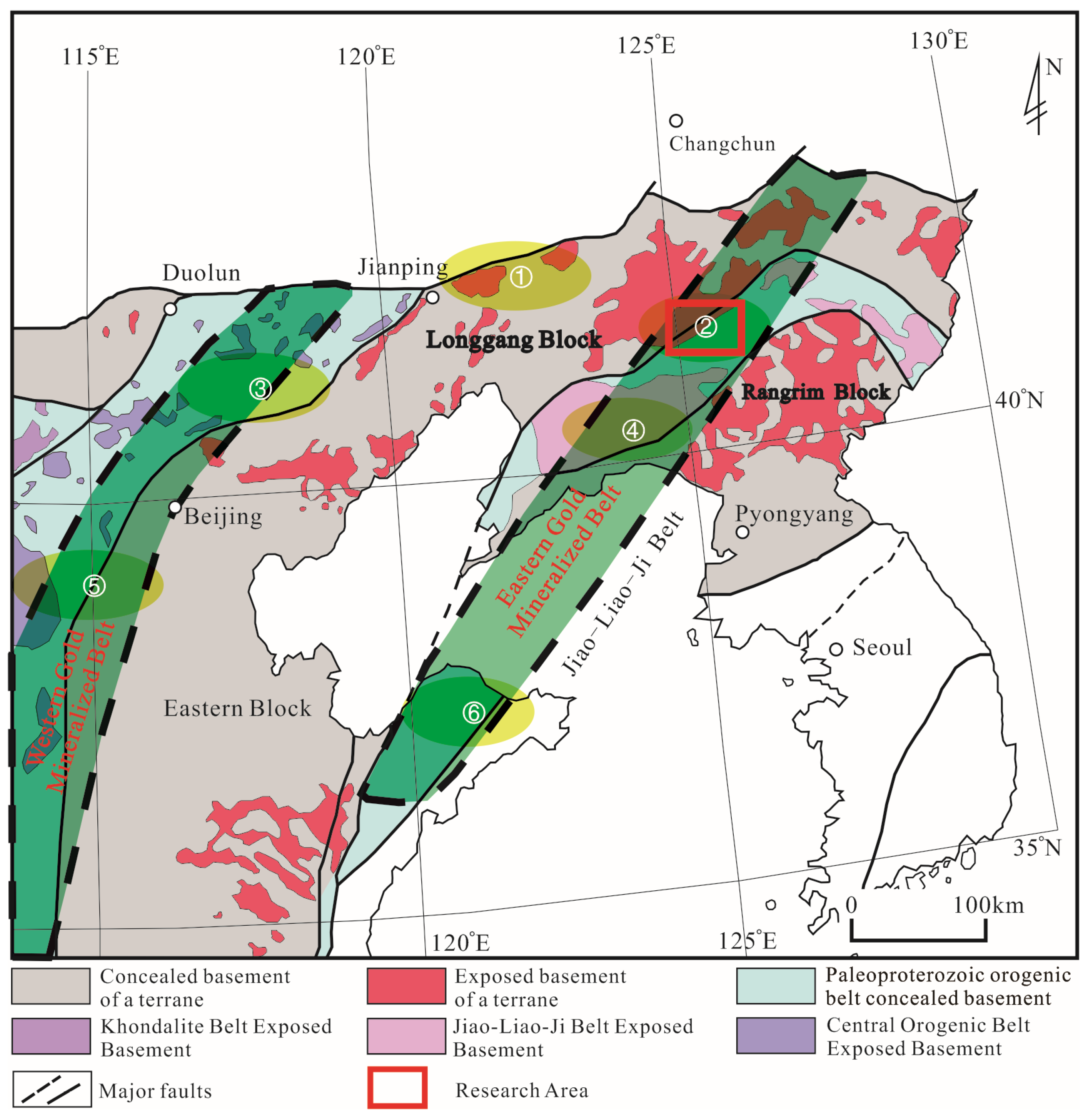
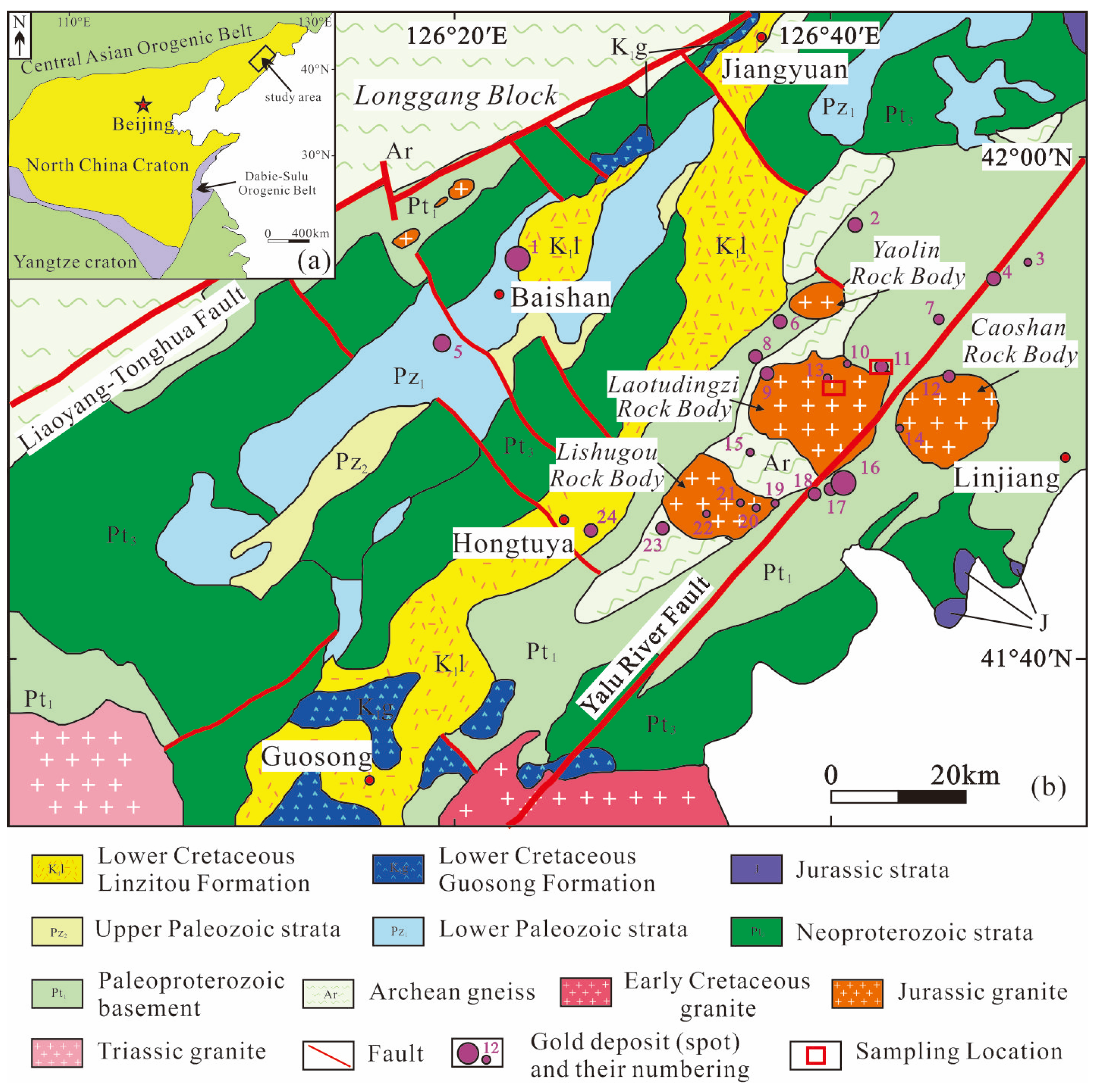
The Ji’nan gold ore deposit district is located in the northeastern area of the gold ore-forming province in the circum-Pacific subduction zone of China, encompassing several significant gold ore deposits, such as the Haigou, Jiapigou, and Laoling gold belts (Figure 1). Within the Laoling belt, favorable mineralization conditions have resulted in a widespread distribution of gold ore deposits. In addition to the large-scale deposits of Huanggoushan and Banmiaozi, 15 small and medium-sized gold deposits and 11 gold occurrences exist (Figure 2). The exposed Mesozoic granites in the Laoling area cover approximately a fifth of the entire region, including the Laotudingzi, Lishugou, Caoshan, and Yaolin plutons. Gold deposits are predominantly distributed around these Mesozoic plutons, with the highest concentration found along the periphery of the Laotudingzi pluton, which hosts several large gold deposits, such as Xiaoshireren, Wudaoyangcha, and Baligou. Gold ore deposits are predominantly occurrences in the fault structures of the Archaean terrane surrounding the outer contact zones of the plutons, and some are found within granitic bodies, such as the Wudaoyangcha gold ore deposit and the Laotudingzi gold occurrence. Varying degrees of research have been conducted on the ore-forming epoch, geological characteristics, and genetic mechanisms of gold ore deposits in the studied area. Notably, the Banmiaozi and Huangou Mountain gold deposits have been extensively researched, and the prevailing views on their genesis include classifications such as the medium temperature hydrothermal vein type [13,14,15], epithermal type [16], orogenic type [17,18], and decratonic type [19]. The significant divergence regarding the genesis of these gold deposits arises because their ore-forming fluids exhibit characteristics indicative of a magmatic or mantle-derived devolatilization origin [20], suggesting an association with magmatic activities related to cratonic destruction. This contrasts markedly with orogenic gold deposits, whose ore-forming fluids are predominantly derived from devolatilization during regional metamorphism. However, in terms of metallogenic age and tectonic setting, these gold deposits formed under a compressional tectonic regime during the Early to Middle Jurassic, which differs from the craton destruction-type gold deposits in the Jiaodong region of China, which formed in an extensional setting during the Early Cretaceous [12]. This study focuses on the Baligou gold deposit within the Laoling gold-polymetallic metallogenic belt in southern Jilin Province, as well as the metallogenically associated Laotudingzi granite intrusion. The objective is to investigate the geodynamic mechanisms of magmatic activity and mineralization through integrated studies including geochronology of rock formation and mineralization, whole-rock geochemistry, Sr-Nd-Pb-Hf isotopic analyses of rocks, and in situ H-O isotopic analyses of quartz and Pb-S isotopic analyses of pyrite from the ores. This paper innovatively proposes that, under the compressional tectonic setting induced by the subduction of the Paleo-Pacific Plate during the Early to Middle Jurassic, cratonic destruction—triggered by the gravitational instability and delamination of thickened lower crust and lithosphere—may represent one of the key geodynamic mechanisms for the formation of decratonic type gold deposits.

2. Regional Geological Setting

The North China Craton is one of the largest cratons on the Eurasian continent, comprising three main parts: the eastern block, the central orogenic belt, and the western block [23,24]. The eastern and western blocks underwent a continental collision during the Paleoproterozoic (18.5–19.5 Ga), ultimately forming the unified basement of the North China Craton [25,26]. The eastern block comprises the Anshan–Ji’nan Archaean terrane (also known as the block of Longgang) in the north, the southern Liaoning–Langlin Archaean terrane in the south, and the intervening Liaoji active belt [27]. The Ji’nan gold district is located in the Laoling uplift zone in the middle part of the Liaoji active belt. The Liaoji active belt stretches from Dandong in Liaoning province, through Huanren in Liaoning province and Baishan in Jilin province, to Komdok in North Korea, spanning approximately 450 km in length and 50–100 km in width. This belt is an important gold and polymetallic metallogenic zone for both China and North Korea. It underwent rifting and evolution during the Paleoproterozoic, during which it received a substantial sedimentation of continental crustal material [21,22]. Some researchers propose the existence of the ‘Liaoji Ocean’ [28], which closed in the late Paleoproterozoic, forming the Jiao–Liao–Ji belt. In the Paleozoic, it experienced the evolution and closure of the Paleo–Asian Ocean, as well as the superimposed transformation of the Meso-Cenozoic circum-Pacific tectonic system [29,30,31]. The exposed Longgang block in the northwestern part of the Liaoji active belt primarily comprises Archaean TTG, supracrustal rocks, and crust-derived granites [32,33]. The Langlin block in the Southeast is mainly composed of gneiss and supracrustal rocks such as Archean Paleoproterozoic tonalitic granitic gneiss. Mesozoic granites, including alkaline rocks, are extensively developed within the Langlin block and can be subdivided into three distinct phases: Triassic, Jurassic, and Cretaceous [27]. The rocks exposed primarily due to the Liaoji active belt are mainly the volcanic–sedimentary sequences of the Paleoproterozoic era Laoling Group, as well as the Liaoji granite [34,35]; concurrently, the region also exposes a Neoproterozoic–Paleozoic sedimentary cover, Mesozoic fault basin sediments, and Mesozoic granitic rocks distributed along the NE-striking Yalu River fault. The Yanshanian magmatic rocks are primarily divided into two episodes: the Early-to-Middle Jurassic and the Early Cretaceous. The Early-to-Middle Jurassic granitic intrusive rocks, such as the Laotudingzi, Lishugou, Caoshan, Yaolin, Badaogou, Xinlu, Tuodaogou, and Xingfu granitic magmatic intrusive bodies, are the most extensively developed. The crystallization ages of the magmatic zircons are concentrated within 181–159 Ma [36,37,38,39,40,41,42]. Apart from scattered intrusive bodies such as the Erdaogou pluton, Early Cretaceous magmatism mainly manifests in intermediate to acidic volcanic eruptions, forming the Guosong Formation and Linzitou Formation volcanic rocks. The crystallization ages of the magmatic zircons from these volcanic rocks are concentrated within 133–122 Ma [19,36,38,43,44,45]. The substrate folding of the Liaoji active belt is formed by the metamorphism and deformation of the Paleoproterozoic Laoling Group, resulting in fold structures. The largest basement fold in the area is the Laoling anticlinorium. Guan [14] suggests that the Laoling anticlinorium is anchored by Archaean geological bodies and Early–Middle Jurassic intrusions at its core, with the Laoling Group’s shallow metamorphic rock series being the overlying layer and the detachment faults in between forming the metamorphic core complex; according to the study, the metamorphic core complex structure controls the formation and output of hydrothermal vein-type gold deposits. The mainly fault tectonics in the region are the northeast-striking and northwest-striking faults of the Pacific margin fault system, followed by the WE striking faults in the Paleo-Asian fault system. Among them, the largest northeast-striking fault in the area is the Yalu River fault, with the area west of Linjiang characterized primarily by northeast strikes and secondarily by northwest strikes. The largest ore-controlling tectonic structure in the region is the ‘S’-shaped brittle ductile fracture zone in Huanggoushan, which extends through the middle section of the Laoling mountain range, with an overall trend of northeast (NE) 10°–30°, extending over 40 km. This fracture zone is nearly parallel to the Yalu River major fault, separated by a distance of 5–10 km; a series of gold and lead–zinc deposits and ore spots are distributed within this ‘S’-shaped fracture zone, which makes it the largest ore-controlling structure in the area. The ore-hosting structures are primarily the secondary northeast-striking fractures within the ‘S’-shaped fracture zone.

3. Geological Characteristics of Rock Bodies and Deposits

3.1. Laotudingzi Monzogranite

The Laoling Metamorphic Core Complex comprises four granitic bodies, namely Lishugou, Caoshan, Laotudingzi, and Yaolin, which exhibit irregular circular or elliptical shapes (Figure 2). The Laotudingzi body is located at the core of the Laoling metamorphic nucleus complex, with gold deposits of Taojingou, Wudaoyangcha, Baligou, Yinzigou, and Niejiagou surrounding its periphery, as well as numerous gold occurrences; this indicates a close relation with gold deposit formation [14]. The rock type of the Laotudingzi body is biotite monzogranite, which is produced as a stock and covers an area of approximately 61 km2 [38]. The contact zone between the granitic body and the Laoling Group develops hornfels and hornfelsed schist, with the widest part spanning up to 1 km.
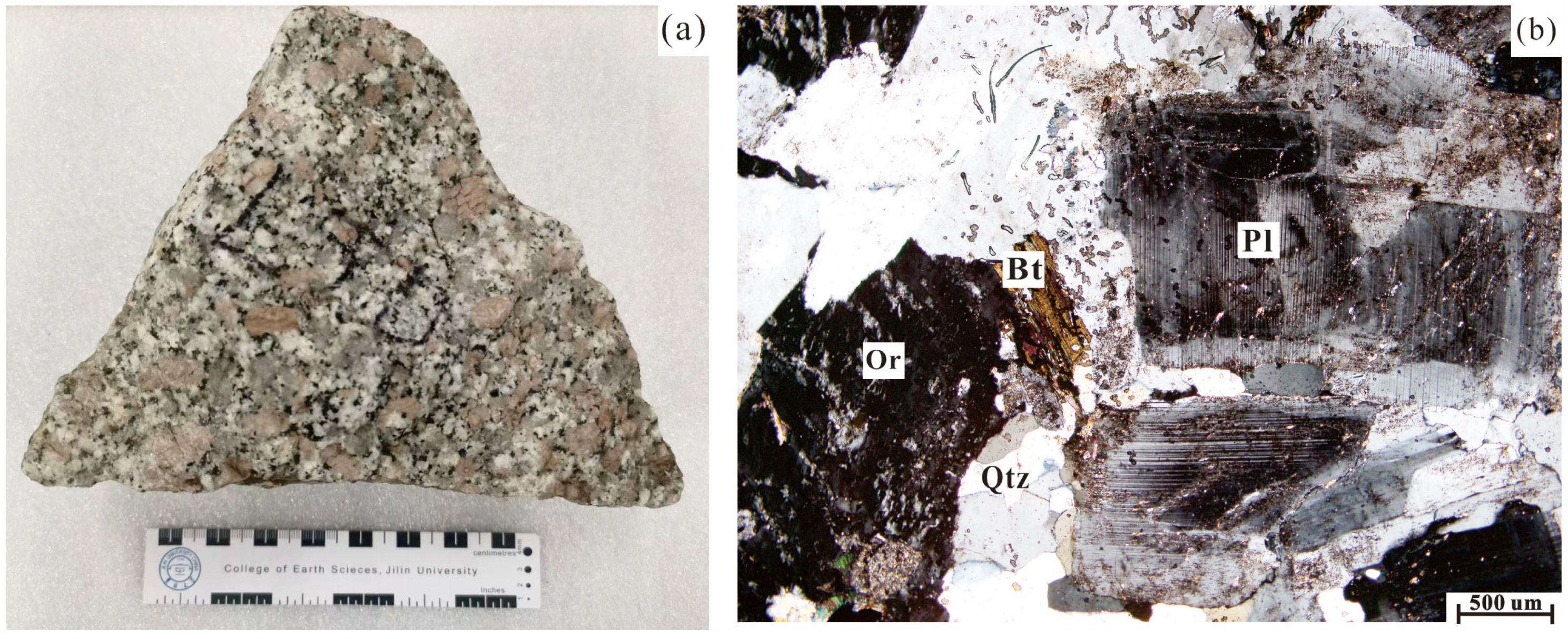
The rock surface is a flesh-red color when weathered and a light grey to light flesh-red color when fresh, featuring a porphyritic texture with a massive structure (Figure 3a). The phenocrysts are primarily microcline (mostly euhedral), have grain diameters of 10–25 mm, and constitute ~15% of the rock. They exhibit cross-hatched twins under a microscope. The groundmass comprises medium to fine-grained subhedral granular structures, and the main mineral constituents include plagioclase, alkali feldspar, quartz, and biotite, with hornblende occasionally observed. Accessory minerals include magnetite, apatite, and zircon. The plagioclase crystals are predominantly semi-idiomorphic tabular in shape, feature grain sizes of 1–5 mm, and constitute approximately 25% of the rock. Polysynthetic twins are well-developed within these crystals. The microcline crystals are semi-idiomorphic tabular or irregular granular in form, also display grain sizes of 1–5 mm, and represent ~20% of the rock’s composition. The quartz exists as xenomorphic or irregularly shaped grains with sizes of 0.5–3 mm, exhibits undulatory extinction, and constitutes approximately 25% of the rock’s volume. The biotite is present in idiomorphic to semi-idiomorphic flaky forms, shows grain sizes of 3–10 mm, and accounts for ~10% of the rock’s mass (Figure 3b).

3.2. Dongbaligou Gold Deposit

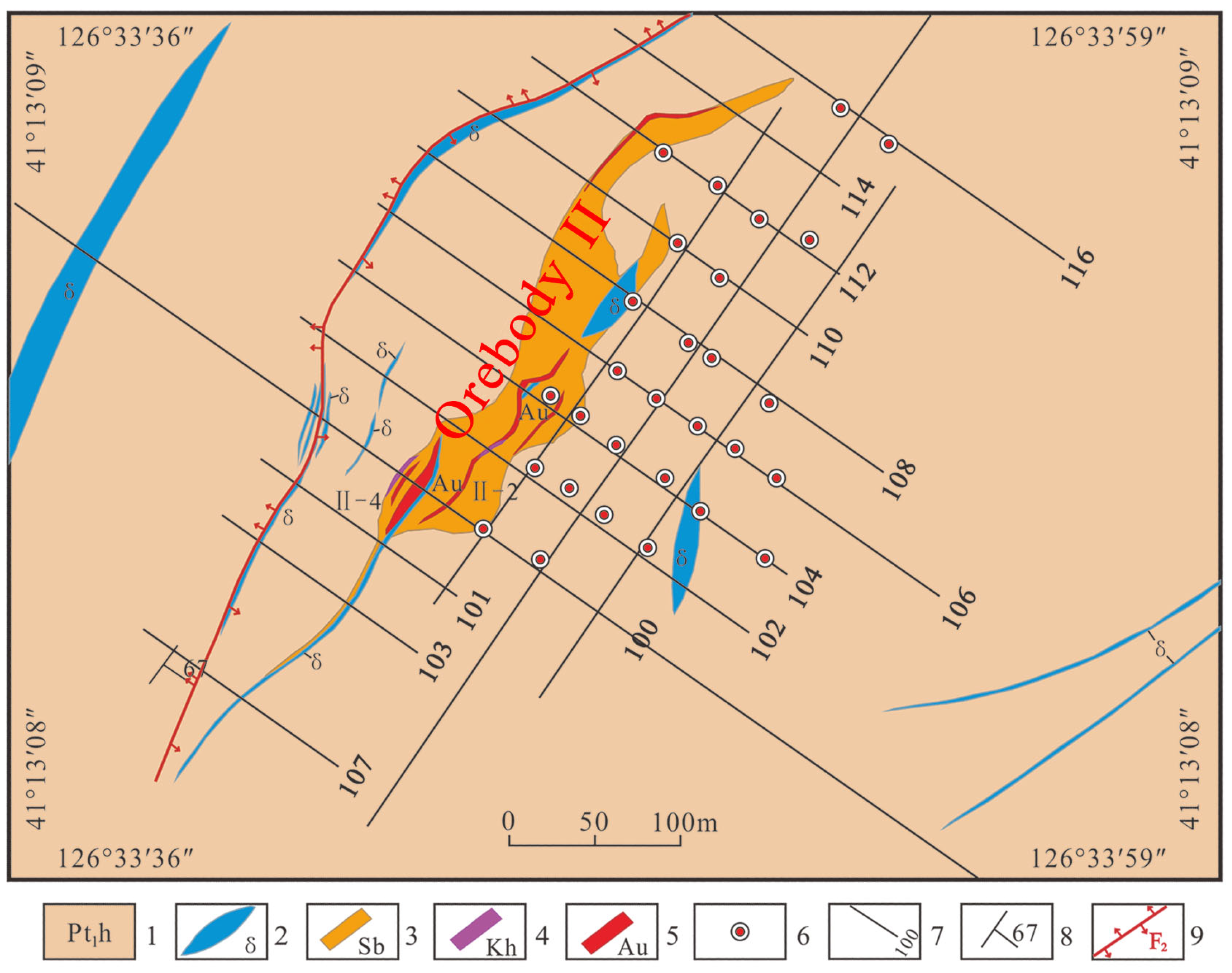
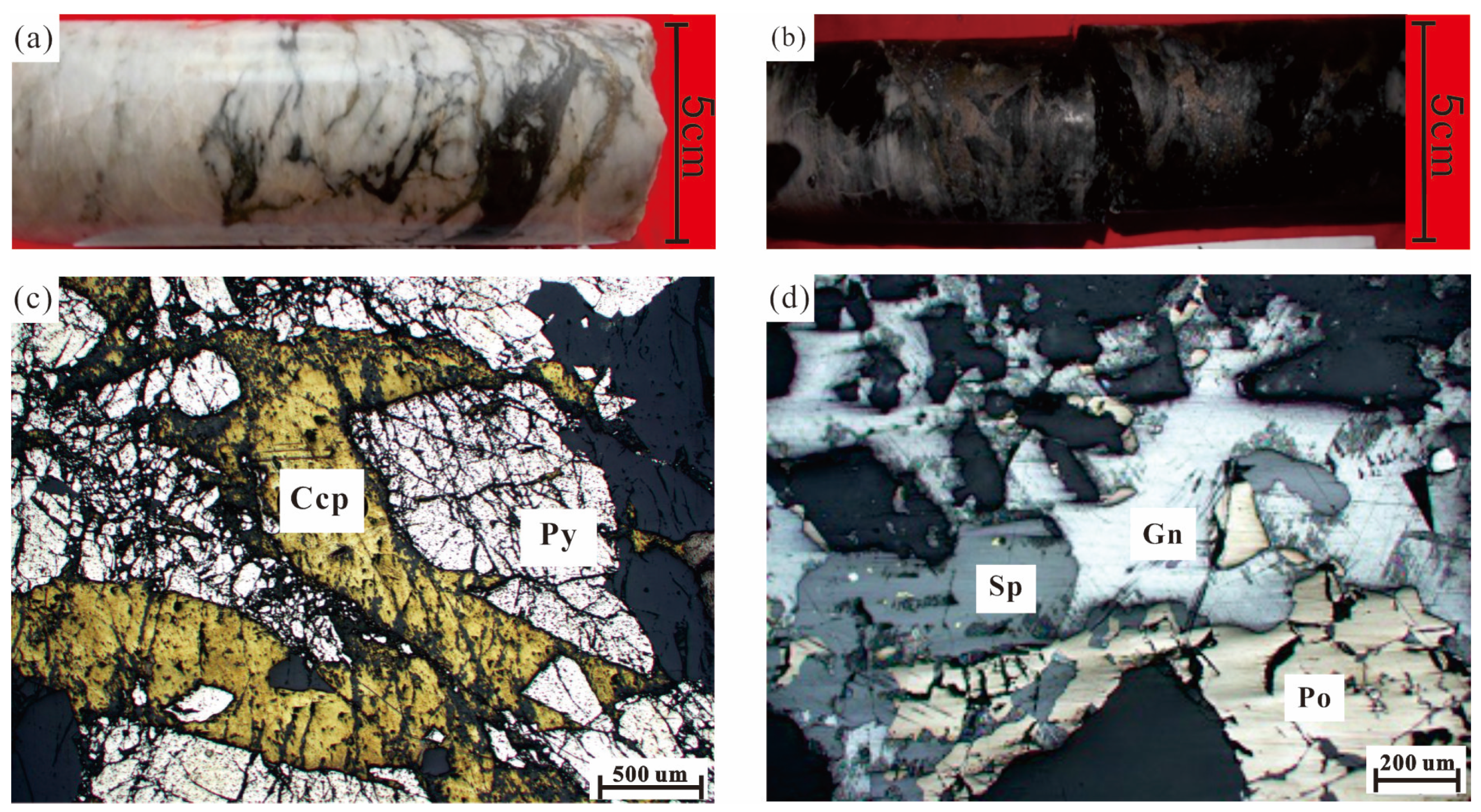
The Dongbaligou gold deposit is situated within the Paleoproterozoic Laoling Group’s outer contact zone, between the Laotudingzi monzogranite and the Caoshan biotite granite bodies. The primary geological units exposed in the mining area are the lower lithological section of the Huashan Formation and the middle lithological section of the Zhenzhumen Formation. The mineralized bodies are predominantly hosted within the phyllitic two-mica schist of the Huashan Formation, with localized occurrences of silicified marble lenses and brecciated siliceous marble. The distribution of intrusive rocks in the area includes the Archaean TTG suite, the Jurassic Laotudingzi pluton, and the Caoshan pluton, which are characterized by porphyritic biotite monzogranite and porphyritic biotite granite, respectively. The mining area is also characterized by the development of various dikes, including diorite, diorite porphyrite, and quartz veins (Figure 4). According to Ren [46], gold deposits are hosted within the northeast-trending fault structures on the southeastern wing of the Laoling metamorphic core complex, with the ore bodies being controlled by ductile–brittle tectonic structures. The ductile fault, located on the ‘S’-shaped fault zone on the side of the Huashan Formation in the contact zone with the Zhenzhumen Formation within the gold mining area, evolved from an early coaxial thrust deep fault; the brittle fault, which formed after the ductile fault, developed on the basis of the ductile fault, forming an overall ductile–brittle superimposed fracture structure. The NE-trending F1 and F2 fault structures are secondary structures within the regional S-shaped fault zone. The fault zone is characterized by widespread rock cataclasis and mylonitization, accompanied by significant plastic deformation. The structural activity has induced secondary fractures in the hanging wall, with widths varying from 50 to 500 m. The Dongbaligou gold deposit is located within this secondary fracture zone, which serves as the primary ore-controlling structure in the mining area. Two ore belts have been identified in the mining area, namely Orebody I and II of the Dongbaligou gold deposit. Orebody II is the principal mineralization belt, with a strike of NE 35°, a dip of 125°, and a dip angle of 45°–65°. The overall length of the belt exceeds 240 m, with the width at the widest point reaching 30 m. This big orebody contains four small orebodies (II-1, II-2, II-3, and II-4), among which orebodyII-4 is the main ore body. The gold (Au) grade of these ore bodies ranges from 1.01 to 35.22 ppm, with an average grade of 7.37 ppm. The alteration is primarily silicification, followed by chloritization and epidotization, whereas carbonatization is not well-developed. The main types of mineralization include pyrrhotite mineralization and pyritization. The ore types are mainly pyrite brecciated altered rock, with a minority of quartz vein-type pyrite ore intercalated locally. Gold ore primarily forms through the silicification and sulfuration of phyllitic two-mica schist. The mineralization is mainly disseminated and spotted (magnetic) pyrrhotite. Based on the sequence of mineral formation, three stages of mineralization can be identified: ① the quartz–pyrrhotite stage, ② the polymetallic sulfide stage, and ③ the quartz–carbonate stage. The content of metallic minerals in the ore is relatively low, with the main metallic minerals being pyrrhotite, pyrite, arsenopyrite, galena, sphalerite, and chalcopyrite (Figure 5a–d). The non-metallic minerals mainly include biotite, quartz, plagioclase, chlorite, and calcite.

4. Samples and Analytical Methods

For this study, monzonitic granite was collected from the Laotudingzi massif for major-element and trace-element analyses, zircon LA-ICP-MS U-Pb dating, Lu-Hf isotopic testing, and Sr-Nd-Pb-Hf isotopic testing. Additionally, hydrothermal zircon LA-ICP-MS U-Pb dating was conducted on gold ore samples from Dongbaligou, micro-area in situ S-Pb isotopic testing was conducted on pyrite, and H-O isotopic testing was performed on the fluid inclusions in quartz.
Major-element and trace-element analyses: The major elements were analyzed using an XRF-1500 X-ray fluorescence spectrometer (Shimadzu Corporation in Kyoto City, Japan), with an analytical precision better than 1%. Rare earth elements (REE) and trace elements (Nb, Ta, Zr, Hf, Th, Ba) were digested by alkali fusion and determined using a Finnigan-MAT ELEMENT double-focusing inductively coupled plasma mass spectrometer (ICP-MS), achieving an analytical precision better than 5%.
Zircon LA-ICP-MS U-Pb dating: Zircon separation, mounting, and cathodoluminescence (CL) image acquisition were conducted at Langfang Yuheng Mineral and Rock Technology Service Co., Ltd. in Langfang City, Hebei Province, China. LA-ICP-MS zircon U-Pb dating was performed at the Key Laboratory of Northeast Asia Mineral Resources Evaluation, Ministry of Natural Resources. The analyses utilized a GeoLas Pro 193 nm ArF excimer laser system coupled with an Agilent 7500a ICP-MS (Agilent Technologies in Santa Clara, CA, USA). Data were acquired in peak-hopping mode with single-spot ablation, using helium as the carrier gas for ablated material, argon as the make-up gas, and nitrogen as a sensitivity enhancement gas. The international standard zircon 91500 served as the external standard for age calibration, standard zircon PLE was used as a monitoring blind sample, and NIST610 was employed as the external standard for element content calibration, with 29Si as the internal standard for element calibration. Analytical conditions included a beam diameter of 32 μm, laser repetition rate of 7 Hz, and signal acquisition time of 40 s. Data processing was carried out using the Glitter software (Version 4.0), while zircon concordia diagrams and weighted mean age calculations were performed with the Isoplot program.
Isotopic analysis of Sr-Nd-Pb-Hf: The Sr-Nd-Pb-Hf isotopic separation and testing were conducted at the laboratory of Kehui Testing (Tianjin) Technology Co., Ltd. in Tianjin, China. The isotopic compositions of Sr and Nd were measured using a Neptune plus MC-ICP-MS (Thermo Fisher Scientific in Waltham, MA 02451, USA). Instrumental fractionation corrections for Sr isotopes were performed using an exponential equation, calibrated with 88Sr/86Sr = 8.375209; for Nd isotopes, the correction was performed using an exponential equation with 146Nd/144Nd = 0.7219. The Pb isotopic composition was determined using a Neptune plus MC-ICP-MS (Thermo Fisher Scientific), with the isotopic ratios normalized based on an exponential equation with 203Tl/205Tl = 0.418922. The Hf isotopic analysis was performed in a Class 1000 laboratory environment, specifically on a Class 100 workbench. The Neptune Plus MC-ICP-MS (Thermo Fisher Scientific) was utilized to analyze the Hf isotopic compositions. Corrections for mass interference from 176Lu and 176Yb on 176Hf were performed using the ratios 176Lu/175Lu = 0.02658 and 176Yb/173Yb = 0.796218, respectively. Exponential mass discrimination corrections for the Hf isotopic ratios were performed using 179Hf/177Hf = 0.7325, while those for the Yb isotopic ratios were performed using 173Yb/172Yb = 1.35274. Additionally, the stability of the 176Hf/177Hf ratio was assessed in line with an in-house standard, GSB-Hf.
In situ S-Pb isotope analysis of pyrite: The in situ sulfur and lead isotope analysis of pyrite was completed at Kehui Testing (Tianjin) Technology Co., Ltd. The in situ sulfur analysis was performed using a Neptune Plus MC-ICP-MS and a RESOlution SE 193 nm solid-state laser ablation system (both from Thermo Fisher Scientific). During the analysis, sulfide samples similar to the matrix of the target sample were used as standards for mass discrimination correction, which was performed using the standard–sample–standard cross-over method. Data processing was conducted using the Iso-Compass professional isotope-data-processing software program, with an analytical precision (1σ) of approximately ±0.1‰. The in situ micro-area Pb isotope testing was conducted using a GeoLas HD laser ablation system (Coherent in Santa Clara, CA, USA) and a Neptune Plus MC-ICP-MS (Thermo Fisher Scientific). The MASS-1 and Sph-HYLM (an internal laboratory sphalerite standard sample) sulfide standards were utilized to determine the mass fractionation relationships for T1 and Pb. The Sph-HYLM sphalerite standard sample typically achieves a precision within ±0.2‰ for isotopic ratios of 208Pb/204Pb, 207Pb/204Pb, and 206Pb/204Pb, with an external precision below 0.4‰ (2σ). All analytical data were processed using Iso-Compass.
The hydrogen and oxygen isotope analyses of quartz fluid inclusions were conducted at the Analytical and Testing Center of the Beijing Research Institute of Uranium Geology, Nuclear Industry. A Thermo Fisher MAT-251 high-precision gas isotope ratio mass spectrometer was employed for the measurements. Oxygen isotope composition was determined following the BrF5 Fluorination Method for Oxygen Isotope Analysis of Silicate and Oxide Minerals. After separation of impurities such as SiF4 and BrF3 from the generated oxygen using a combined cold trap system, purified oxygen was reacted with a carbon rod at 700 °C under platinum catalysis. The resulting CO2 gas was collected and analyzed by mass spectrometry, with an analytical precision better than ±0.2‰. Hydrogen isotope analysis was performed according to the Zinc Reduction Method for Hydrogen Isotope Analysis of Water. Fluid inclusions were decrepitated under vacuum to release water, which was then reduced with zinc to produce hydrogen gas for mass spectrometric measurement. The analytical precision for hydrogen isotopes is better than ±2‰. All results were calibrated relative to the Standard Mean Ocean Water (SMOW).

5. Results

5.1. Zircon LA-ICP-MS U-Pb Age

5.1.1. Laotudingzi Pluton

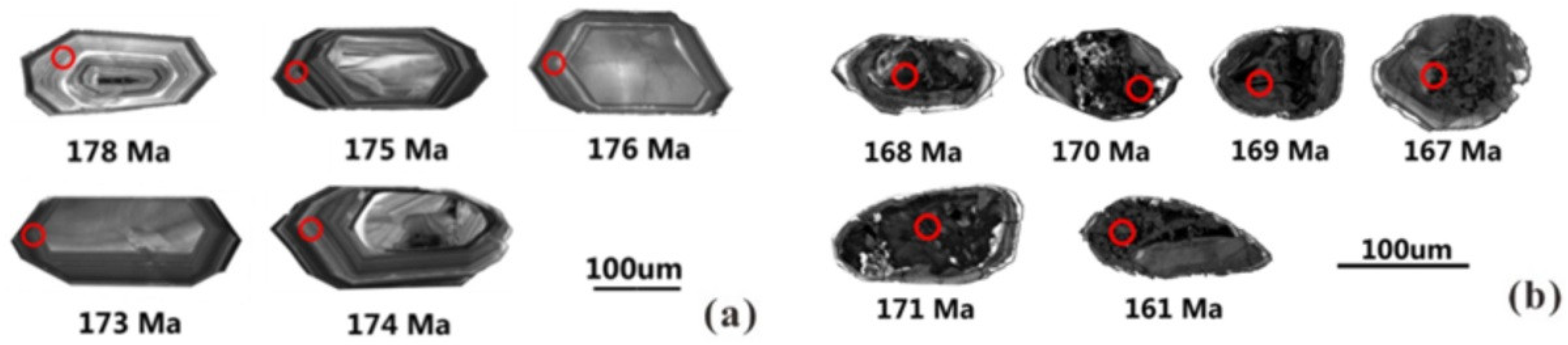
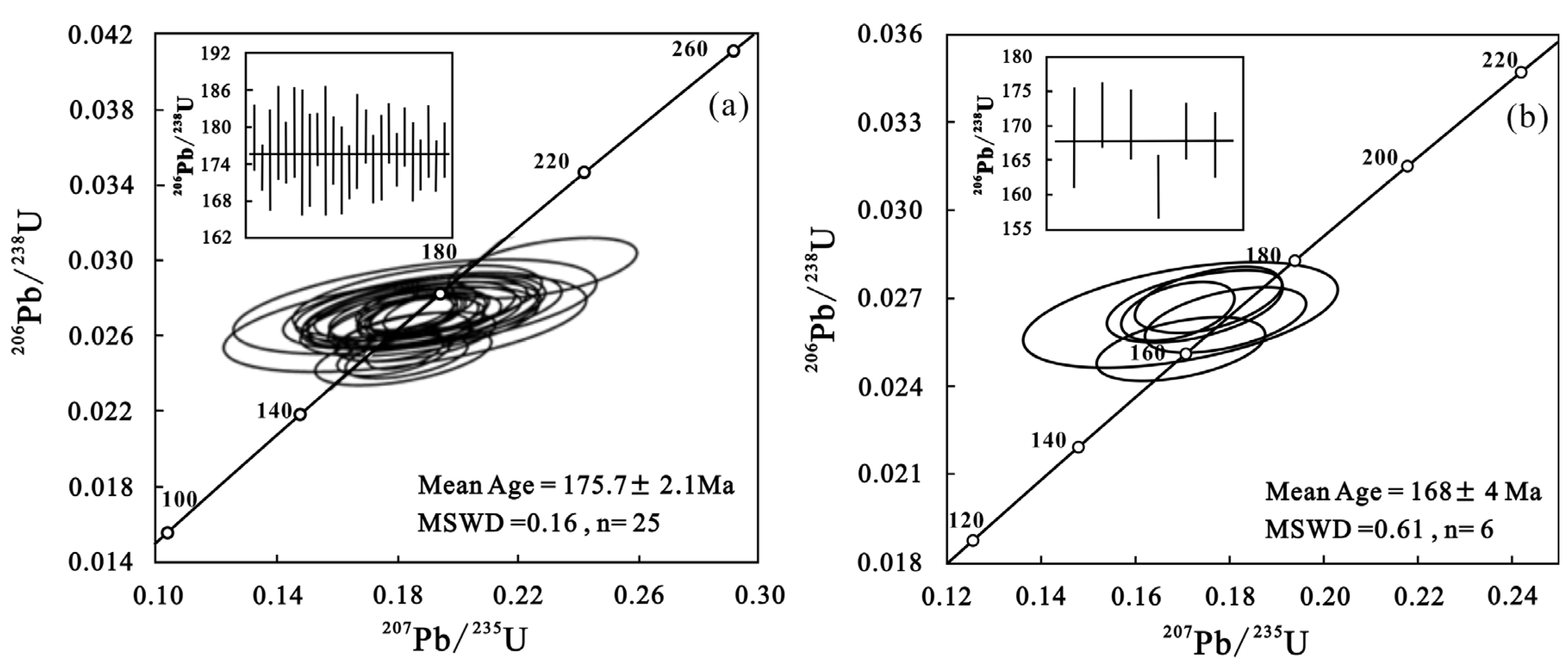
Most zircons exhibit an idiomorphic short-prismatic to prismatic habit, with a minority displaying incomplete crystal edges and pyramids; under a binocular microscope, they are mostly transparent, with grain sizes of 0.1–0.2 mm and a length-to-width ratio between 1:1 and 3:1. CL images (Figure 6a) reveal well-developed oscillatory zoning structures in the zircons, characteristic of magmatic origins. Table 1 presents the LA-ICP-MS U-Pb dating results for 25 zircons from the Laotudingzi pluton. The content of the radioactive element Th is 129–620 ppm, with the average being 301 ppm; the content of U is 173–911 ppm, with an average of 527 ppm, which indicates high concentrations. The Th/U ratio is 0.41–1.58, with the average being 0.61; this value, being greater than 0.4, is characteristic of typical magmatic crystallization zircons. The surface ages, calculated based on the ratio of 206Pb/238U, are 173–179 Ma. The dating data points for the samples predominantly fall above the concordia line (Figure 7a), indicating a relatively high concordance. The weighted mean age is determined to be 175.7 ± 2.1 Ma, which represents the diagenetic age of the rock. This age suggests that the Laotudingzi monzogranite intruded during the early Late Jurassic.

5.1.2. Mineralized Quartz Vein Hydrothermally Altered Zircon from the Dongbaligou Deposit

Zircon is generally considered to crystallize under high-temperature conditions and is a highly stable mineral. However, it is susceptible to alteration, modification, and dissolution under hydrothermal conditions, with the formation of ‘hydrothermal zircon’ also possible in certain cases [47,48,49]. Hydrothermal zircon refers to zircon that has undergone hydrothermal fluid metasomatism, dissolution–reprecipitation, exsolution adjustment, overgrowth, or direct crystallization from hydrothermal fluids. Hydrothermal zircon exhibits visibly different mineral structures; CL characteristics; and Th, U, and Th/U ratios from those of magmatic zircon.
Among the mineralized quartz veins, six hydrothermal zircons were selected. These zircon grains exhibit a semi-automorphous to xenomorphic shape, with indistinct crystal edges and an elliptical form. Under a binocular microscope, they appear translucent, with colors ranging from dark brown to light brownish-red. The grain size is 0.1–0.15 mm, with a length-to-width ratio between 1:1 and 3:1. Microscopic CL images (Figure 6b) reveal that these zircons lack oscillatory zoning and do not exhibit indistinct rhythmic zoning. The internal structure appears as porous, metasomatic, or filled veins; alternatively, it can be sponge-like, zoned, or structureless, which is characteristic of hydrothermal zircon morphology [50]. These features indicate the formation or modification of zircons in a hydrothermal environment, reflecting their interaction with hydrothermal fluids. The zircon LA-ICP-MS U-Pb dating results presented in Table 1 show Th/U ratios of 0.12–0.92; these values are characteristic of typical hydrothermally altered zircons. The dating data for the six zircons show surface ages of 161–171 Ma based on the ratio of 206Pb/238U. The dating data points for the samples predominantly fall above the concordia line (Figure 7b), which indicates a relatively high concordance. The weighted mean age is determined to be 168 ± 4 Ma; this represents the formation age of the ore deposit, suggesting that the Dongbaligou gold deposit formed in the early Middle Jurassic.

5.2. Rock Geochemistry

5.2.1. Major Elements

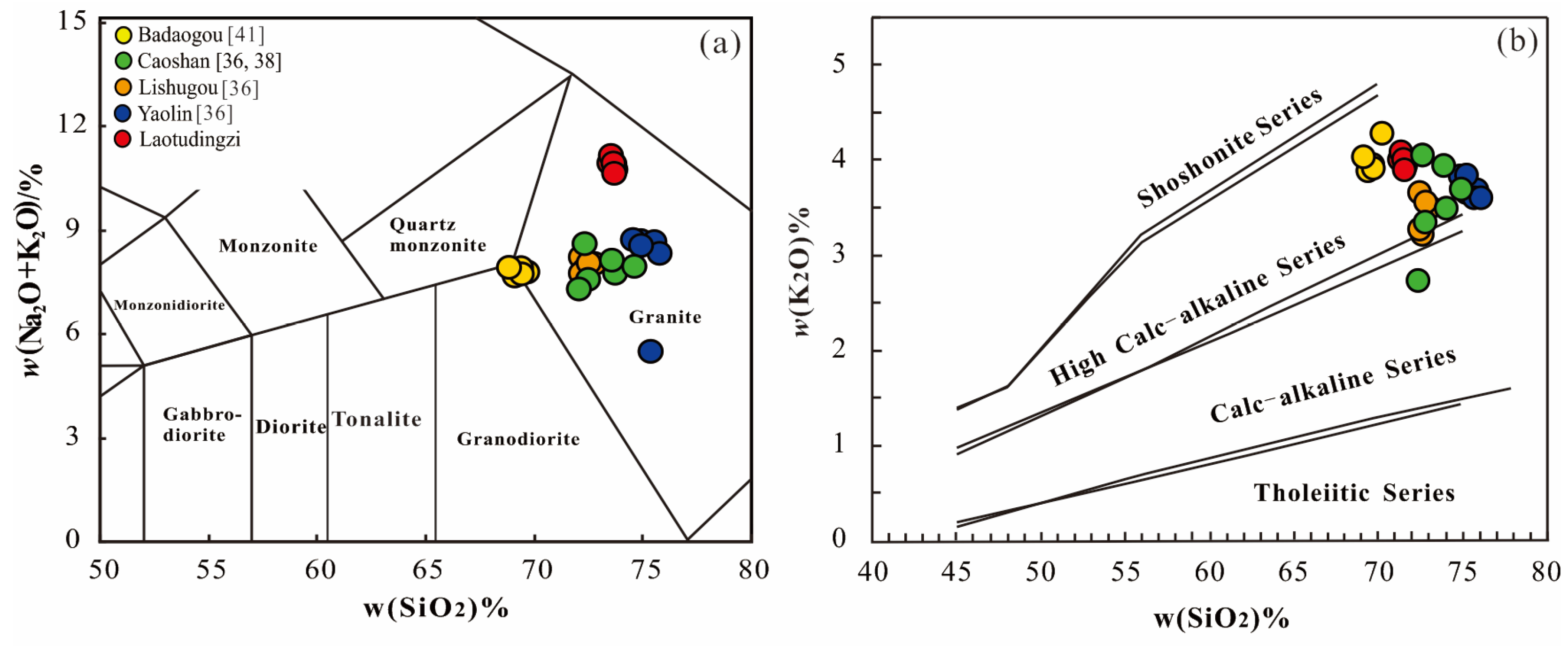
Table 2 lists the results of the whole-rock major element analysis for the Laotudingzi monzogranite samples. The rock has a high SiO2 content of 71.29%–71.59%, with the average being 71.5%, which classifies it as an acidic rock. The Al2O3 content is also high, being 14.62%–14.95% with an average of 14.81%. The A/CNK ratio is 1.00–1.04, which indicates a weakly peraluminous rock. The contents of FeOT (1.58%–1.77%) and MgO (0.54%–0.61 wt%) are low, while that of Mg# is 36.0–39.2. The total alkali content, expressed as Na2O + K2O, is 7.77%–7.92%, with the average being 7.85%. The K2O/Na2O ratio is 1.01–1.06, with the average being 1.04, which indicates slight potassium enrichment. The alkalinity ratio is 2.69–2.80, while Rittmann’s combination index (σ43) is 2.11–2.20; as these values are less than 3.3, the rock is classified as calc-alkaline. In the Tas classification diagram (Figure 8a), the projected points fall within the granite field. In the SiO2–K2O diagram (Figure 8b), all sample points fall within the high-potassium calc-alkaline series range.

5.2.2. Trace Elements

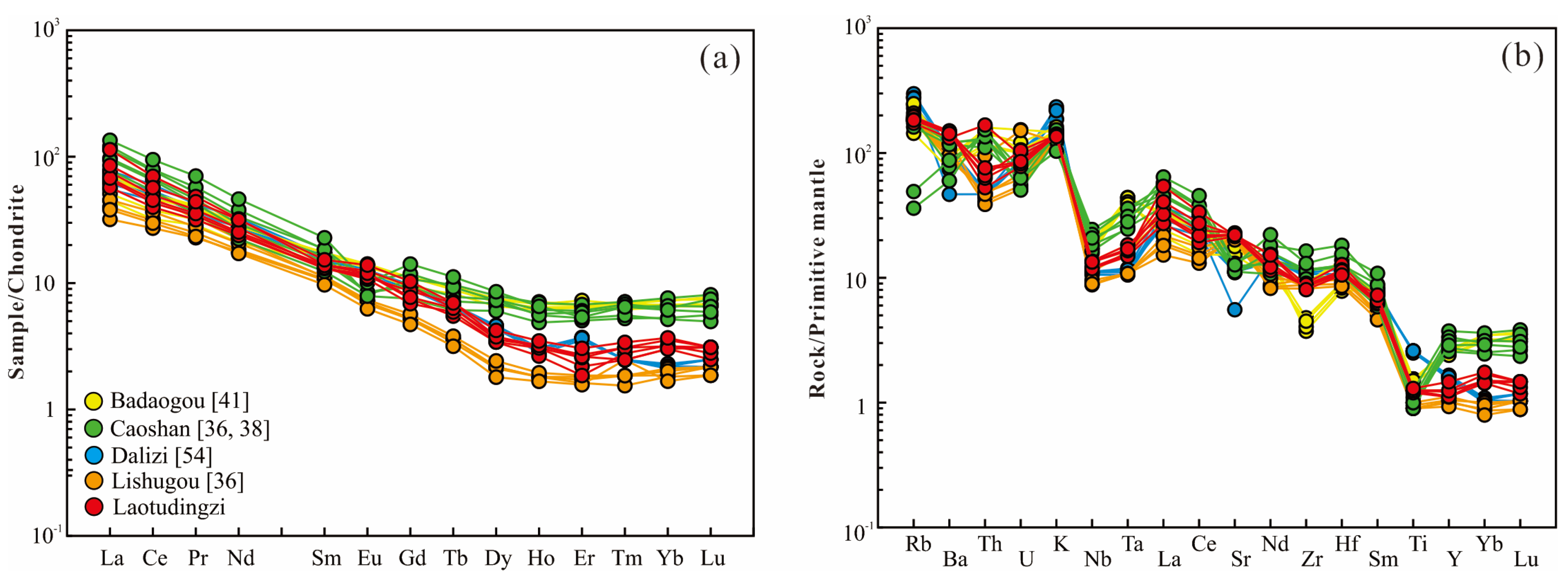
The total REE (∑REE) content in the rock is 76.01–126.08 ppm (Table 2), with light REEs (LREEs) accounting for 71.42–120.53 ppm and heavy REEs (HREEs) constituting 4.59–6.23 ppm. The LREE/HREE and (La/Yb)N ratios are 15.56–21.72 and 17.85–36.04, respectively. A clear fractionation is observed between LREEs and HREEs, and the distribution curve has a steeply right-inclined pattern (Figure 9a), which suggests that garnet is a residual phase in the magma source. Eu/Eu* is 1.07–1.14, indicating a weak positive anomaly, which implies a higher degree of melting of plagioclase in the source region. Ce/Ce* is 0.85–0.88, indicating a weak negative anomaly, which suggests that the rock was formed in a more oxidizing environment. Based on the spider diagram of trace elements (Figure 9b), the rock exhibits enrichment in elements such as Rb, Ba, K, P, and Ti, whereas Nb, Ta, and Ce appear depleted. The contents of mafic-compatible elements, namely Co (2.94–4.05 ppm), Ni (1.87–3.14 ppm), and Cr (3.88–4.84 ppm), are relatively low, which suggests that pyroxene is a residual phase in the source region. The rock exhibits a ‘high Sr–low Yb’ granitic characteristic, with an Sr content of 428–458 ppm (>400 ppm) and a Yb content of 0.63–0.77 ppm (<2 ppm). As Sr and Yb are primarily enriched in plagioclase and garnet, respectively, the ‘high Sr–low Yb’ signature of the rock also indicates that plagioclase is a melted phase in the magma source region and that garnet is a residual phase.

5.3. Strontium-Neodymium-Lead-Hafnium Isotopes

The strontium-neodymium-lead-hafnium isotopic composition analysis was conducted on five granite samples. Table 3 presents the results of the Sr-Nd isotope testing. The (87Sr/86Sr)i ratios of the granites are 0.70711–0.70721, with an average of 0.70716. The 143Nd/144Nd ratios are 0.512059–0.512071, with a mean value of 0.512067. The εNd(t) values range from −9.01 to −8.56, with an average of −8.82. The one-stage model age (TDM1) is 1295–1415 Ma, and the two-stage model age (TDM2) is 1660–1696 Ma. Table 3 presents the Hf isotope test results for the granite samples. The 176Hf/177Hf ratios are 0.28507–0.282523, with an average of 0.282518. The εHf(t) values range from −5.58 to −5.01, with an average of −5.15. TDM1 and TDM2 are 1004–1027 Ma and 1535–1573 Ma, respectively. Table 3 lists the Pb isotope data. Based on the measured Pb isotope ratios, the characteristic parameters of the source region (μ, ω, Th/U, Δα, Δβ, and Δγ) were calculated using the Geokit software tool. The specific data are as follows: The 206Pb/204Pb ratios of the granites are 17.557–17.596, with an average of 17.569 and a variation of 0.039; the 207Pb/204Pb ratios are 15.592–15.594, with an average of 15.593 and a variation of 0.002; the 208Pb/204Pb ratios are 37.726–37.767, with an average of 37.754 and a variation of 0.041. The values of μ, ω, Th/U, Δα, Δβ, and Δγ are as follows: μ is 8.59–8.63, with an average of 8.60; ω is 33.68–33.85, with an average of 33.79; Th/U is 3.79–3.81, with an average of 3.80; Δα is 24.36–26.64, with an average of 25.08; Δβ is 17.57–17.68, with an average of 17.61; and Δγ is 14.28–15.36, with an average of 15.02.

5.4. Pyrite Sulfur-Lead Isotopes and Quartz Hydrogen-Oxygen Isotopes

5.4.1. Pyrite Sulfur-Lead Isotopes

Table 4 presents the in situ lead isotopic analysis results for the pyrite. The 206Pb/204Pb ratios are 16.170–16.223, with an average of 16.184 and a variation of 0.053. The 207Pb/204Pb ratios are 15.465–15.525, with an average of 15.487 and a variation of 0.06. The 208Pb/204Pb ratios are 37.879–38.024, with an average of 37.936 and a variation of 0.145. The ranges of μ, ω, Th/U, Δα, Δβ, and Δγ are 7.15–7.20, 34.31–34.90, 4.64–4.69, −53.40 to −56.47, 9.26–13.21, and 18.42–22.32, respectively, with the average values being 7.16, 34.55, 4.67, −55.69, 10.68, and 19.97, respectively. Table 4 lists the corresponding in situ sulfur isotope analysis results. The δ34SV-CDT values are 3.52‰–4.10‰, with an average of 3.876‰ and a variation of 0.58‰.

5.4.2. Quartz Hydrogen-Oxygen Isotopes

The analysis and testing results for the H-O isotopes from the quartz vein are presented in Table 4. The δDV-SMOW values of the fluid inclusions in the quartz range from −103.9‰ to −99.5‰, with an average of −101.66‰, while the δ18OV-SMOW values range from −7.4‰ to −6.5‰, with an average of −7.04‰.

6. Discussion

6.1. Age of Petrogenesis and Mineralization

6.1.1. Age of Petrogenesis

The weighted average U-Pb isotope age of the zircon from the Laotudingzi monzogranite was found to be 175.7 ± 2.1 Ma, which indicates that the intrusion of the rock body occurred at the end of the Early Jurassic. The Mesozoic granitic magmatic activity in the Jilin–Eastern Liaodong Peninsula can be divided into three stages: Triassic (233–212 Ma), Jurassic (180–153 Ma), and Early Cretaceous (131–117 Ma). The Triassic–Jurassic granites are mainly distributed in the eastern part of the NCC, while the Early Cretaceous granites are well-developed throughout the region [55]. Recently, a set of Early-to-Middle Jurassic granite bodies was identified in the southeastern Jilin–Liaodong region. For instance, the zircon U-Pb age is 172.25 ± 0.97 Ma for the Gaoling monzogranite in the Yanbian area of Jilin [56], 172.25 ± 0.97 Ma for the Badaogou gold deposit-derived monzogranite [41], 165.0 ± 3.3 Ma for the Wulong gold deposit-derived Wulong granite [57], 170–177 Ma for the Xiaoheishan rock body in Liaodong [58], and 174 Ma for the Huangjintun monzogranite in Qingyuan [59]. Within the Ji’nan metallogenic belt, exposed plutons other than the Laotudingzi monzogranite include the Lishugou pluton, Caoshan pluton, and Yaolin pluton. The age of the Lishugou pluton is 173 ± 10 Ma [39], the zircon U-Pb age of the Caoshan pluton is 180.64 ± 0.81 Ma [38], and the monazite age of the Yaolin pluton is 176 ± 7 Ma. The emplacement ages of the aforementioned plutons, which are mainly distributed in the Ji’nan-Liaodong area, are concentrated within 165–180 Ma. This indicates that a significant tectono-magmatic event occurred along the eastern margin of the NCC between the late Early Jurassic and the early Middle Jurassic. The intrusive bodies are temporally and spatially associated with gold deposits, which suggests that the gold mineralization in some parts of the Ji’nan–Liaodong area is a response to the aforementioned tectono-magmatic event.

6.1.2. Age of Gold Mineralization

Zhu [12] reports that the gold mineralization age of the North China gold deposits is mainly concentrated within 120–130 Ma. However, the gold mineralization ages calculated from the Ji’nan region differ from those of the Jiaodong gold deposits, being primarily concentrated in the Early-to-Middle Jurassic, followed by the Early Cretaceous. The Jia’pigou gold deposit has an Rb-Sr isochron age of 177.7 Ma [60]. The Liupiyegou gold deposit has an 40Ar/39Ar age of 190.28 ± 0.30 Ma [14]. The Erdaodianzi gold deposit has an age of 199.8 ± 2.4 Ma [61]. The Guanma gold deposit has a K-Ar age of 193.6 Ma [62]. The zircons from the ore-bearing pluton of the Lanjia gold mine yield an LA-ICP-MS U-Pb weighted average age of 170.21 ± 0.73 Ma [63]. The Wangqing Ciweigou gold deposit has an 40Ar/39Ar age of approximately 178.3 ± 1 Ma, which corresponds to the Middle Jurassic [14]. For the Laoling gold metallogenic belt, mineralization age data have not been published for any gold deposits other than the Huanggoushan and Nancha gold mines. The strong alteration rock from the Huanggoushan gold mine has a K-Ar age of 104 Ma [64], and the sericite from the Nancha gold mine has an 40Ar/39Ar age of 170.1 Ma [65]. Due to the low content of isotopic measurements such as 40Ar/39Ar, Rb-Sr, and Re-Os in pyrite and other sulfides in the ore deposit, the methods as mentioned above cannot be utilized for chronological studies. In this study, six hydrothermal zircons were identified in the mineralized quartz vein, with a weighted average age of 168 ± 4 Ma. This age represents the formation age of the ore deposit, indicating that the Baligou gold deposit formed in the early Middle Jurassic. The lag of mineralization age behind the emplacement age of the Laotudingzi granite intrusion may be attributed to the following reasons: (1) For a large-scale granite pluton such as Laotudingzi, complete cooling and solidification typically require several million years [66,67]; (2) The ore-forming fluids are predominantly derived from exsolved magmatic hydrothermal fluids during the late stages of magmatic evolution, whose formation should postdate the age of the coeval magma; (3) The solidification temperature of granitic rocks generally exceeds 600 °C, whereas the precipitation temperature of exsolved ore-forming fluids typically ranges from 200 to 300 °C. The medium- to coarse-grained texture of the Laotudingzi granite indicates a relatively deep emplacement depth. At such depths, the cooling of ore-forming fluids and subsequent mineralization represent a protracted geological process, which may sometimes be facilitated by the influx of meteoric water and can often span several million years [68]. Hydrothermally altered zircons may primarily record the timing of late-stage hydrothermal mineralization. According to [67], statistics from coeval magmatic gold deposits in China reveal a time gap between magmatism and mineralization ranging from 0 to 16 Ma, with a mean value of 7.0 Ma. The zircon age difference between the Laotudingzi granite pluton and the Baligou gold deposit is 6.7 Ma, which is slightly lower than the mean magmatic-mineralization time gap of 7.0 Ma reported in their study.

6.2. Nature of Magma Source Area and Petrogenesis

6.2.1. Strontium-Neodymium-Lead-Hafnium Isotopic Evidence

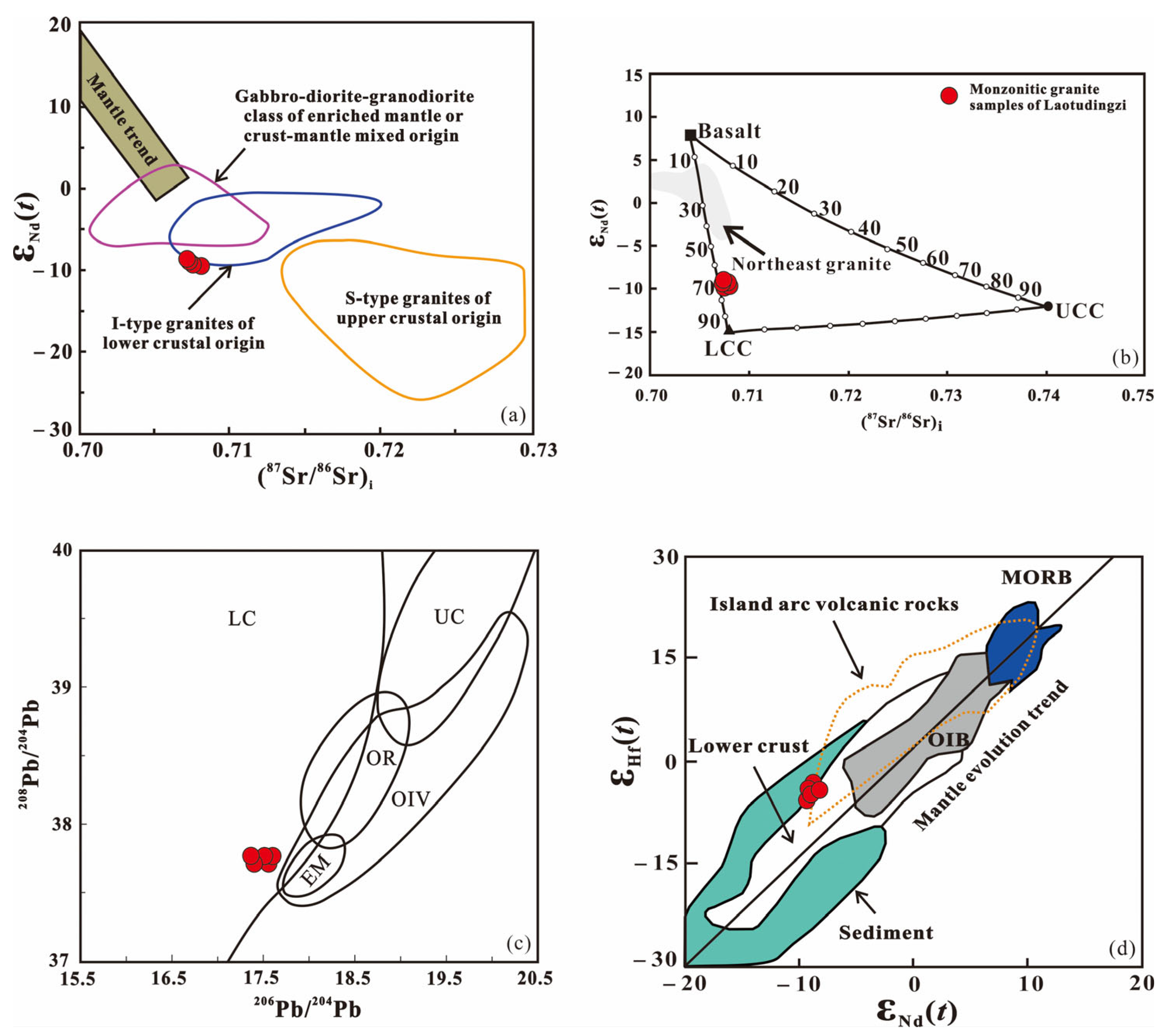
In the monzogranite, the strontium-neodymium isotopic composition is characterized by (87Sr/86Sr)i ratios of 0.70711–0.70721 and εNd(t) values of −9.01 to −8.56, with relatively homogeneous isotopic compositions and low dispersion; this implies that the magma source region’s material composition is relatively uniform. In the (87Sr/86Sr)i-εNd(t) diagram (Figure 10a), the sample points are located at the margin of the I-type granite region derived from the lower crust, adjacent to magmatic rocks originating from an enriched mantle or formed by crust–mantle mixing. This indicates that the magma source primarily comprises mafic lower crustal materials, with possible minor contributions from the upper crust. In the binary mixing model diagram of (87Sr/86Sr)i-εNd(t) (Figure 10b), the sample points are situated on and near the evolution line between basalt and the lower crust, which indicates that the source region comprises approximately 32% basaltic rocks and 68% lower crustal materials. Under normal circumstances, granites of crustal origin have higher 207Pb/204Pb ratios (>15.6), fall above the orogenic belt evolution line on the Pb isotope tectonic pattern diagram, and are mainly formed from lower crustal rocks. Crustal–mantle mixed-source granites have 207Pb/204Pb ratios of less than 15.6 and are located below the orogenic belt evolution line on the Pb isotope tectonic pattern diagram, which indicates that its formation might have been influenced by materials from the mantle. The 207Pb/204Pb ratios of the Laotudingzi monzogranite are 15.592–15.594, slightly below 15.6, which suggests that its formation may have been influenced by materials from the mantle. In the 206Pb/204Pb–208Pb/204Pb isotope diagram (Figure 10c), the sample points are located within the lower crust region but close to the mantle source area; in the εHf(t)–εNd(t) diagram for rocks (Figure 10d), the sample points are situated within the lower crustal region. According to the findings of Sun [40], the zircon Hf isotope sample data points of the monzogranite fall between the crustal Hf isotope evolution lines of 1.8–2.5 Ga. Considering the strontium-neodymium-lead-hafnium isotopic characteristics collectively, the magma source region is primarily composed of ancient mafic lower crustal materials.

6.2.2. Geochemical Evidence

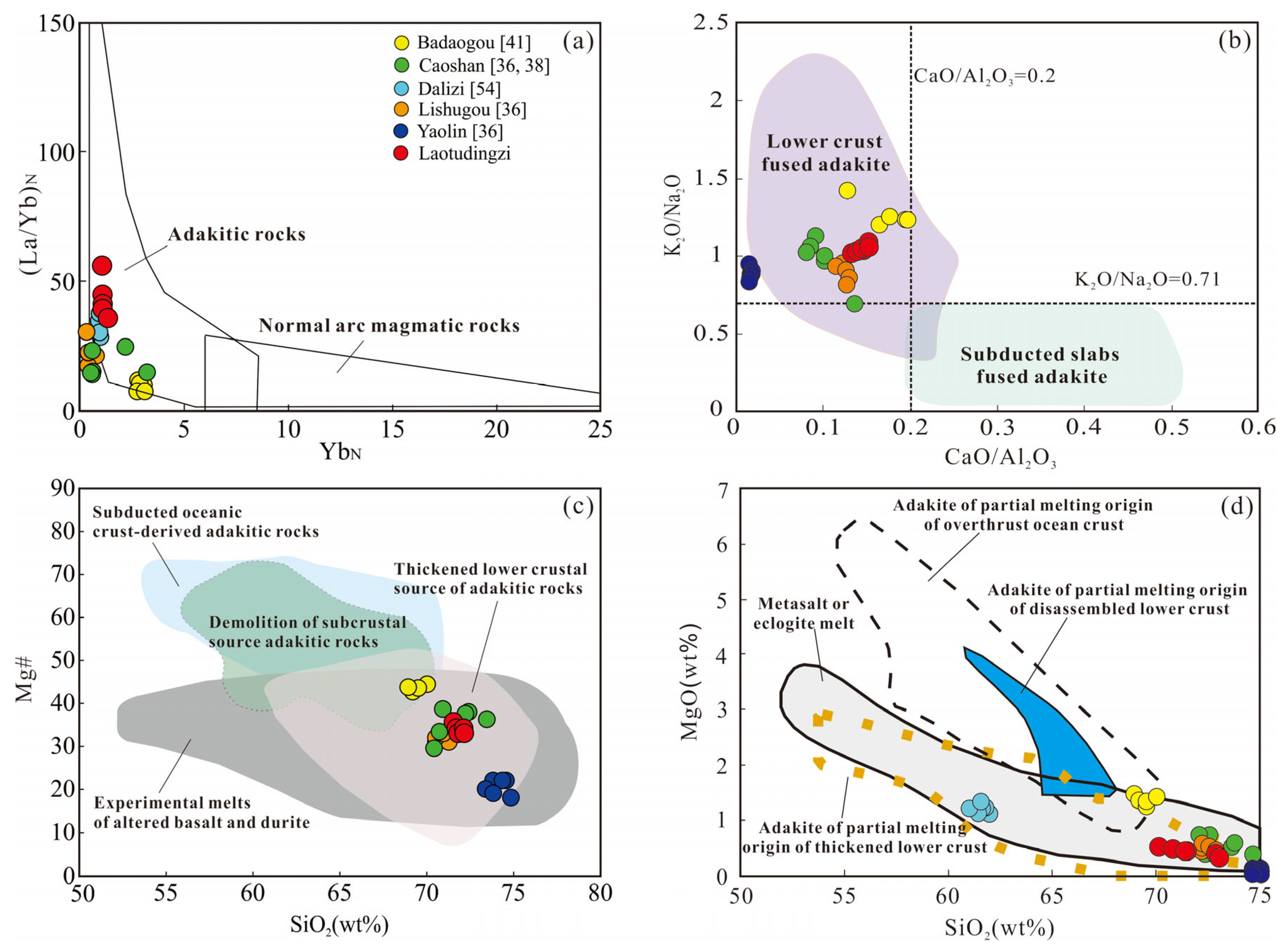
The Laotudingzi monzogranite exhibits a high silicon content (SiO2 > 71%), aluminum enrichment (Al2O3 > 14%), and a low magnesium content (MgO < 1%), with either no Eu anomaly or a slight positive Eu anomaly. It is significantly enriched in large-ion lithophile elements, such as Rb, Ba, Sr, and K, and is depleted in high-field-strength elements (HFSEs) and HREEs. The granite has high Sr (Sr > 400 ppm) and low Yb (Yb < 1 ppm) contents, with a Sr/Y ratio of 69.89–92.87 (>20) and a high (La/Yb)N ratio of 23.83. These chemical characteristics are indicative of adakite-like rocks [71,72]. In the Sr/Y-Y diagram, the sample points fall within the adakite field (Figure 11a). Adakite typically refers to intermediate-acid igneous rocks formed by the partial melting of subducted oceanic crust [71], also known as ‘O-type’ adakites [73]. Other igneous rocks with adakite-like geochemical composition characteristics are called adakitic rocks [42,74]. In the CaO/Al2O3–K2O/Na2O diagram (Figure 11b), the sample points are located within the lower crust-derived adakitic rock region. Three primary models have been developed to explain the genesis of crustal-derived adakitic rocks: (1) small proportion melting of the lower earth crust with increased thickness [75]; (2) small proportion melting of the delaminated lower earth crust [76,77]; and (3) mixing and mingling of crustal magma and mantle-derived magma [74,78]. Considering that the small proportion melting of both the delaminated lower earth crust and thickened lower earth crust may involve mantle-derived magma, they can be categorized into the first two classes mentioned above. Adakites formed by the small proportion melting of the lower earth crust with increased thickness are referred to as ‘C-type’ adakites [73].
The Laotudingzi monzogranite has a Na2O/K2O ratio of 0.93–0.99 and a Mg# of 36.0–39.2, which are significantly lower than the corresponding values for O-type adakites (Na2O/K2O > 2 and Mg# > 45). Instead, it shares chemical composition characteristics with C-type adakites, which have a Na2O/K2O ratio of approximately 1, a lower Mg#, and a higher K content [73]. As all adakitic rocks formed by the partial melting of delaminated lower crust have a high Mg# (>45) and high Cr, Co, and Ni contents [76], the low Mg# and low Cr, Co, and Ni contents of the Laotudingzi monzogranite exclude the possibility of it having been formed by the partial melting of the delaminated lower crust. In the SiO2–MgO (Figure 11c) and SiO2–Mg# diagrams (Figure 11d), the sample points are all located within the region representing adakitic rocks derived from the partial melting of the thickened lower crust. Some scholars suggest that underplated mantle-derived basaltic magmas can generate similar adakitic geochemical signatures through intense assimilation of crustal materials coupled with fractional crystallization (AFC processes). However, Sr-Nd-Pb-Hf isotopic tracers in such adakitic rocks typically exhibit a strong mantle affinity. The underplating of mantle-derived basaltic magmas generally occurs in post-orogenic extensional settings associated with delamination of thickened lower crust [73,79]. Lower crustal delamination leads to a tectonic transition from compressional during collision to extensional during post-collision. During this stage, hot asthenospheric mantle material upwells and undergoes decompression-induced partial melting, and the resulting mantle-derived magmas ascend to underplate near the crust–mantle boundary or within the lower crust [79]. Moreover, adakitic rocks formed via this mechanism do not necessarily exhibit the characteristic high Sr (Sr > 400 ppm) and low Yb (Yb < 1 ppm) geochemical signatures.
Sr-Nd-Pb-Hf isotopic tracing of the Laotudingzi monzogranite indicates that its material source is primarily ancient basaltic lower crust. Additionally, its formation occurred in an early to Middle Jurassic compressional tectonic setting during the initial subduction of the Paleo-Pacific Plate, making an origin involving underplated mantle-derived basaltic magmas leading to crust–mantle magma mixing or AFC processes less likely. Ma [80], comparing Phanerozoic adakitic rocks from different tectonic regions in the Chinese mainland, found that intracontinental adakitic rocks in collisional orogenic belts may originate from partial melting of thickened/delaminated lower crust, whereas intraplate adakitic rocks (e.g., in the North China and Yangtze cratons) are primarily controlled by the chemical composition of the source region. If the ancient basaltic lower crustal source is inherently enriched in Sr and depleted in Y and HREE (heavy rare earth elements), partial melting under normal crustal thickness (<40 km) can still produce melts with high Sr/Y ratios [80]. First, in the early to Middle Jurassic, under the tectonic setting of Paleo-Pacific Plate subduction, the Laoling area in southern Jilin was located on the northeastern margin of the North China Craton. The Laotudingzi monzogranite within this region belongs to intracontinental adakitic rocks in a collisional orogenic belt. Furthermore, for an ancient basaltic lower crust with normal thickness (<40 km) that is enriched in Sr and depleted in Y, partial melting cannot occur without the underplating of mantle-derived basaltic magmas. Such underplating typically occurs in extensional tectonic settings, such as those involving lower crustal delamination. However, in the compressional setting of early to Middle Jurassic Paleo-Pacific Plate subduction, this process was likely unfeasible.
Integrating the formation age, Sr-Nd-Pb-Hf isotopic signatures, and petrogeochemical characteristics of the Laotudingzi monzogranite, this study concludes that the Laotudingzi monzogranite is a C-type adakite formed by partial melting of thickened lower crust under the compressional tectonic setting of early to Middle Jurassic Paleo-Pacific Plate subduction.
Figure 11. Adakite discrimination diagram. (a) (La/Yb)N–YbN diagram (after [71]) for monzogranite; (b) CaO/Al2O3–K2O/Na2O diagram and (c) SiO2–Mg# diagram (after [81]) for monzogranite; (d) SiO2–MgO diagram (after [82]) for monzogranite. (the cited previous research data are from [36,38,41,54]).
Minerals 16 00235 g011

6.3. Structural Background of Petrogenesis and Ore Formation

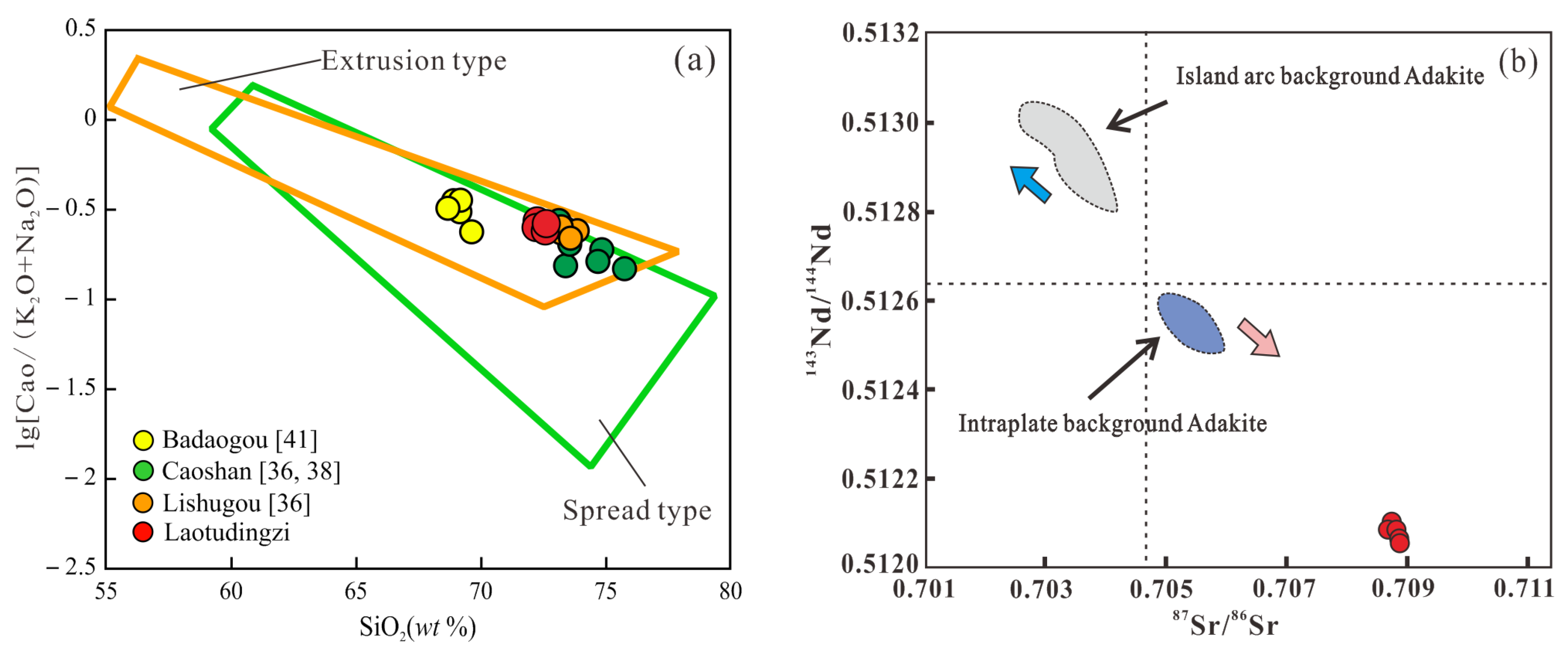
Previous studies suggest that the presence of a large-scale NNE-trending calc-alkaline magmatic rock belt in the Northeast region signifies the occurrence of the early to middle Jurassic subduction of the Paleo-Pacific Plate [31]. As the tectono-magmatic activity related to the subduction of the Paleo-Pacific Plate lags behind the subduction timing, it can be inferred that the initiation of subduction of the Paleo-Pacific Plate beneath the North China and South Korea Plates occurred in the beginning of the early Jurassic. In terms of tectonic setting, the early to middle Jurassic magmatic activity in eastern North China is associated with the subduction of the Paleo-Pacific Plate in a regionally compressed continental arc environment [83]. In the SiO2-lg[CaO/K2O + Na2O] diagram (Figure 12a) of the Early to Middle Jurassic granites from the southern Jilin Province, such as Laotudingzi monzogranite, the rock samples are predominantly located within the compressional zone. This indicates that the early to middle Jurassic magmatic rocks in the southern Jilin Province were formed in a setting of compression associated with the subduction of the Paleo-Pacific Plate. However, it is necessary to further determine whether the magma formed in a continental arc environment or a within-plate environment. The adakitic rocks in the southern Jilin region are enriched in LREEs anddepleted in HREEs and HFSEs such as Nb and Ta, which have the characteristics of magmatic rocks formed in an active continental margin arc setting. However, in the discrimination diagram of the tectonic settings of adakitic rocks based on 143Nd/144Nd-87Sr/86Sr ratios (Figure 12b), the Laotudingzi monzogranite samples exhibit trends indicative of within-plate adakites, which are significantly distinct from those of island arc adakites [84]. This indicates that the Early to Middle Jurassic adakitic rocks in southern Jilin Province were formed in the structural background where the underthrusting and compression about the Paleo-Pacific Plate led to continental–continental collision orogeny and thickening of the intraplate crust and lithosphere mantle. In summary, the Laotudingzi monzogranite that developed during the Early to Middle Jurassic in the southern Jilin region is associated with intense compression and an orogenic tectonic setting caused by the subduction of the Paleo-Pacific Plate.
Guan [14] proposed that the Laoling area is a metamorphic core complex with Archean geological units and Early–Middle Jurassic intrusive bodies (such as Laotudingzi, Lishugou, Caoshan, and Yaolin) as the core, overlain by the Laoling Group low-grade metamorphic rock series, separated by a detachment fault (Figure 2). It was suggested that the metamorphic core complex and detachment fault structure control the formation and occurrence of hydrothermal vein-type gold deposits. Song [85] referred to this as a thermal doming-extension structure and a thermal doming-extension metallogenic system. Among these, the Laotudingzi monzogranite intrusive body, located within the Laoling metamorphic core complex, is a syn-tectonic granite. The genetic mechanism of this metamorphic core complex structure is closely related to the Early–Middle Jurassic syn-tectonic intrusions, such as the Laotudingzi granite, resulting from mantle upwelling, rapid magma emplacement, and uplift leading to crustal extension and the formation of the metamorphic core complex structure. The substantial heat generated by magmatic activity caused basement reactivation, thermal doming and upwarping, and lateral dynamic metamorphic expansion of the basement rocks, representing the thermal doming-extension model for metamorphic core complexes [85,86]. Among these processes, mantle upwelling and rapid magma emplacement may be related to the delamination of thickened lower crust. The Laotudingzi monzogranite intrusive body exhibits characteristics of C-type adakite, which is an indicator of initial thinning of thickened crust, suggesting the presence of lower crustal delamination [79]. Lower crustal delamination leads to deep mantle upwelling, rapid magma emplacement, and the formation of shallow metamorphic core complex structures. According to the research findings of Ren [46], the ductile fault is located within the ‘S‘-shaped fault zone on the Huashan Formation side of the contact zone between the Huashan Formation and the Zhenzhumen Formation in the gold ore district, and evolved from an early coaxial thrust deep fault. Brittle faults formed later than the ductile faults and developed on the basis of the ductile faults, collectively forming a ductile–brittle superimposed fault structure. The early coaxial thrust deep fault may be related to the compressional setting associated with the emplacement of the Laotudingzi magmatic intrusive body, while the brittle faults are related to extensional tectonic activity caused by lower crustal delamination, thermal doming associated with Laotudingzi rock body emplacement, etc. The Dongbaligou gold ore bodies are hosted within the NE-trending fault structures on the southeastern flank of the Laoling metamorphic core complex and are controlled by brittle faults superimposed upon the pre-existing ductile fault structures. In summary, the Laotudingzi monzogranite intrusive body formed in a compressional tectonic setting during the Early Jurassic, while the Dongbaligou gold deposit formed in a local extensional tectonic environment resulting from lower crustal delamination, magma emplacement, and rapid crustal uplift.
Figure 12. (a) SiO2-lg[CaO/K2O + Na2O] diagram and (b) 143Nd/144Nd-87Sr/86Sr ratios diagram (after [87]) illustrating tectonic settings of trace elements for the monzogranite from Laotudingzi (the cited previous research data are from [36,38,41]). (The blue and pink arrows represent the trends of their respective backgrounds, while the dotted lines serve as a reference line depicting the isotopic ratios of a homogeneous mantle.)
Minerals 16 00235 g012

6.4. Genesis and Mechanism of Ore Formation

6.4.1. Ore Deposit Genesis

(1)
Tectonic control nature of ore deposit
The Dongbaligou gold deposit is located in the fault structure within the outer contact zone of the Paleoproterozoic Laoling Group between the Laotudingzi monzogranite and the Caoshan biotite granite pluton. The main regional tectonic control structure is the slip-tectonic nature of the Huanggoushan ‘S’-shaped ductile–brittle fault zone [14], which mainly comprises mylonite, phyllonite, cataclasite, and breccia. According to the characteristics of its structural rocks, the formation of this fault zone can be divided into three periods: ① the deep ductile compressional activity that formed the mylonite class, ② the extensional tectonic activity period that produced tensional structural breccias, during which quartz veins were intruded, and ③ the period of compressive–shear tectonic activity that produced a set of mylonite–phyllonitic cataclasite. This phase of tectonic deformation is exclusively observed within the regional S-shaped fault zone, with no significant effects on secondary ore-bearing structures or quartz veins. The ore-hosting structures consist of the NE-trending F1 and F2 faults. Fault F1 is situated near the contact between the Huashan Formation and the Zhenzhumen Formation of the Laoling Group, striking 23° and dipping 113°, and serves as the principal ore-controlling structure in the mining area. Fault F2 occurs within the phyllitic two-mica schist layer of the Huashan Formation, extending over 2000 m in length and 10–20 m in width, with a strike of 35° and a dip of 125°, forming an approximate 10° wedge-shaped angle with F1. The fault zone exhibits intense rock fragmentation, pervasive mylonitization, and distinct plastic deformation, with widths ranging from 50 to 500 m, and functions as the primary ore-hosting structure. The ore (mineralized) bodies are formed through hydrothermal alteration and infilling of structurally fragmented mylonitized rocks. The described evolutionary characteristics of the ore-controlling and ore-hosting structures indicate that the mineralization-related structures underwent a transformation from a compressional, through an extensional, and back to a compressional tectonic setting. This progression corresponds to the thermal doming–extension during the Early–Middle Jurassic and the regional compression during the Middle–Late Jurassic, respectively.
(2)
Properties of ore fluid
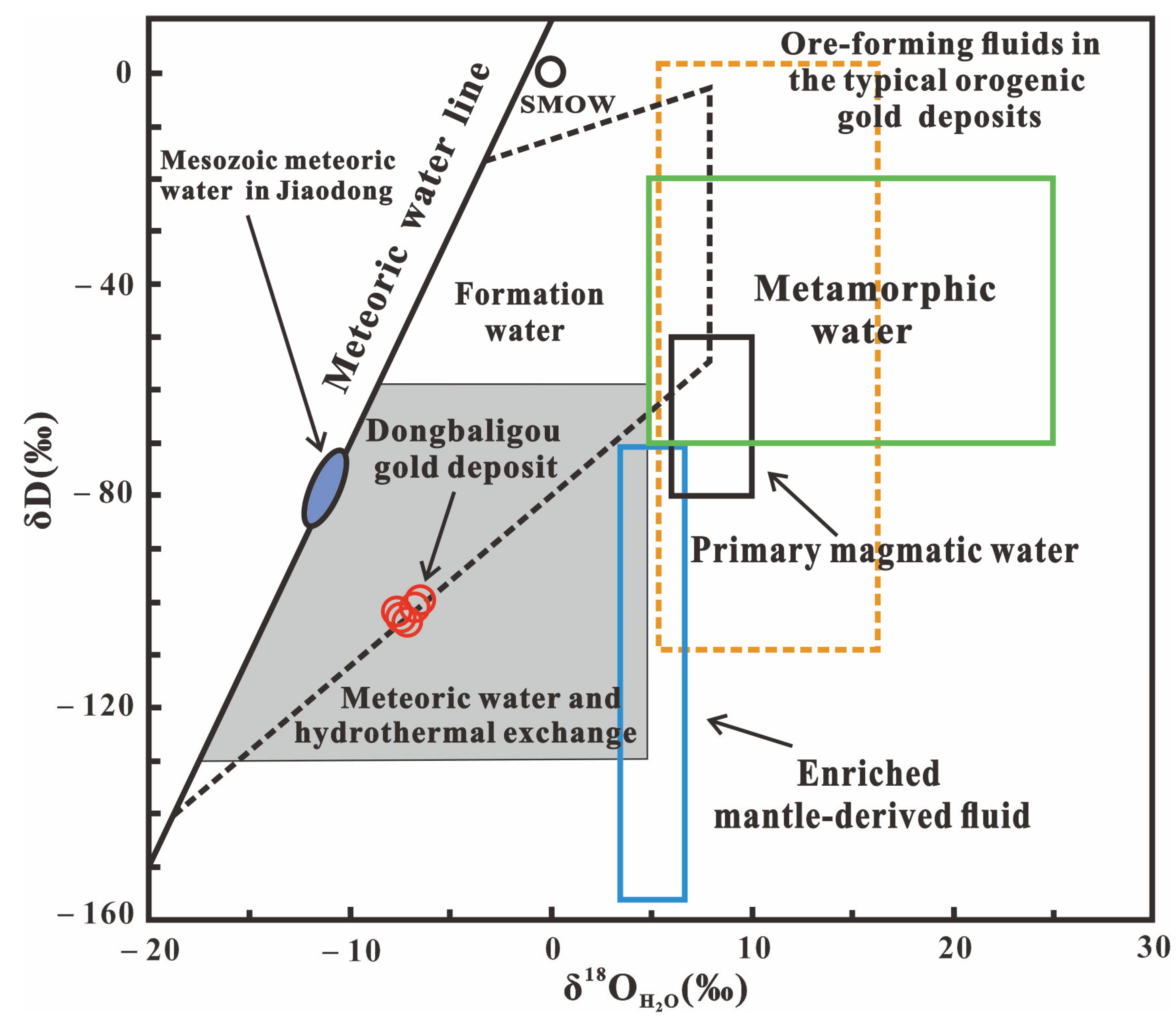
Sun [40] estimated the chemical composition based on the coexisting sphalerite and pyrrhotite minerals and determined that the temperature during the main ore-forming period was 347.5 °C ±. In the late stage of ore formation, the homogenization temperature of quartz fluid inclusions was 194–207.5 °C. The ore-forming fluid exhibited low salinity (5.41%–6.3% NaCleqv), low density (0.90–0.92 g/cm3), and high sulfur fugacity (fs2 ≈ 10−6 bar). In this study, laser Raman spectroscopic analysis was conducted on the fluid inclusions within the quartz veins. Scanning of the gaseous components within the fluid inclusions revealed that the quartz inclusions exhibit similar linear distribution characteristics, with peaks for H2O and CO2, which indicate that the ore-forming fluid belongs to the H2O–CO2 system. The source of ore-forming fluids can be determined based on the isotopic composition of water preserved in mineral fluid inclusions [88]. In this study, we conducted H-O isotope tests and analyses on fluid inclusions from the ore-forming stage of quartz (Figure 13). The water in the ore-forming fluid contains relatively low amounts of the δD and δ18O isotopes. Based on the δ18O‰–δD‰ diagram regarding the features of ore fluids, the samples correspond to a mixture of atmospheric precipitation, magmatic water, and formation water. A more distinct feature of the hydrogen-oxygen isotopes is the lower δD‰ values, which suggest the involvement of enriched mantle fluids.
(3)
Source of ore-forming materials
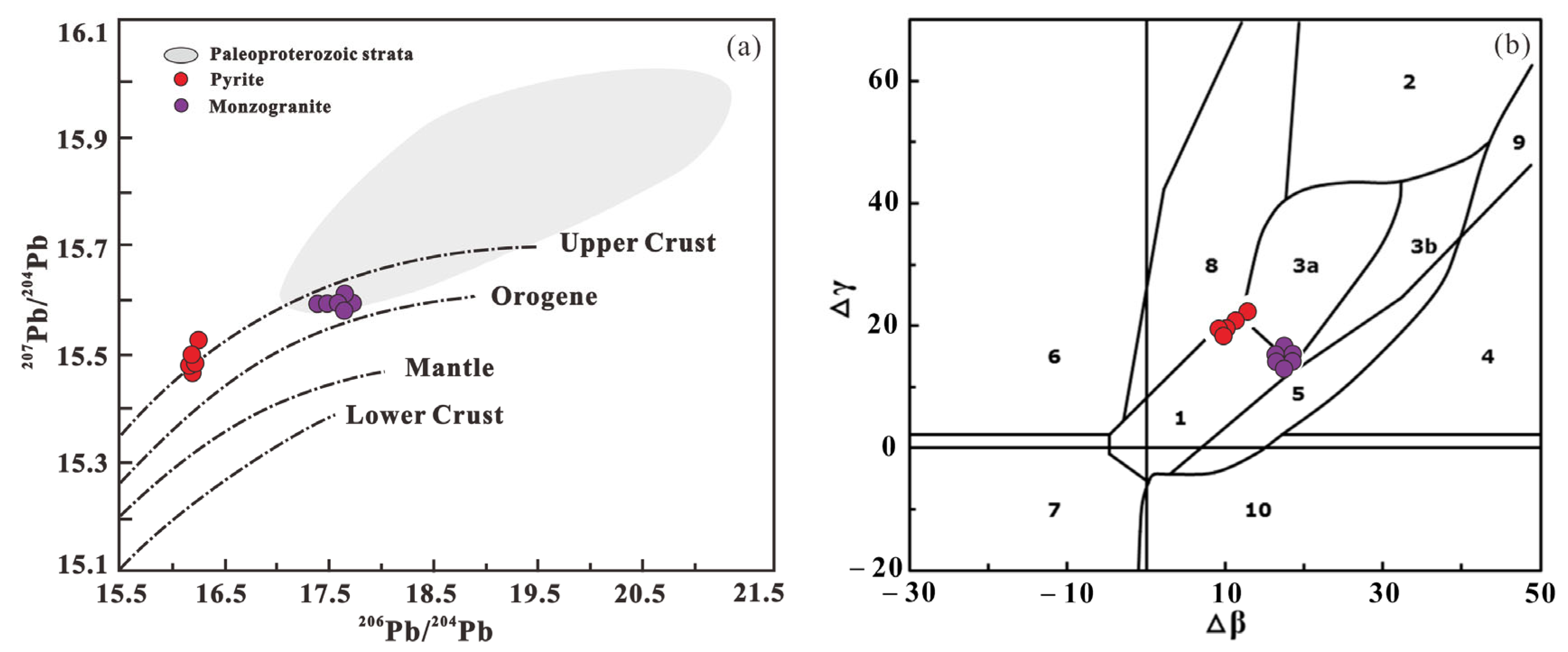
The results of in situ S isotopic analysis reveal that the δ34S values are concentrated within 3.52‰–4.10‰, with an average of 3.88‰ (Table 4). The low data dispersion suggests a singular source of sulfur. The slight positive deviation of δ34S from the meteoritic value indicates a mantle-derived/magmatic sulfur source. In contrast, the δ34S values of the sulfides in the adjacent Huanggoushan gold deposit and the Nancha gold mine are 6.6‰ and −0.487‰, respectively [91]. Furthermore, the δ34S values for the wall rocks of Huanggoushan and Nancha are 14.84‰ and 13.29‰, respectively [14], which also suggests that the sulfur in the mineralizing material originates from a mantle source or granitic magma rather than the surrounding rock strata. The Pb isotope source characteristics of minerals, denoted by μ and ω values, are indicative of the provenance of Pb and other metallogenic elements within mineralizing fluids and can be used to trace the nature of the source region. It is generally accepted that if μ > 9.58, the Pb is derived from upper crustal rocks; if μ < 9.58 and ω > 41.86, the Pb is sourced from lower crustal rocks or crustal magma; and if μ < 9.58 and ω < 31.84, the metallogenic elements, including Pb, originate from the upper mantle [92]. The in situ lead isotopic characteristics of the pyrite from the Dongbaligou gold deposit are as follows: μ is 7.15–7.20 (<9.58), and ω is 34.31–34.90 (>31.48 but <41.86). These values indicate that the Pb and other metallogenic elements in the deposit originated from both the crust and the mantle. With respect to the Pb isotope source characteristics of the Laotudingzi granite (Table 4), these values and their variation ranges are not significantly different, which suggests a close relationship between the Pb source and the magmatic activity of the Laotudingzi granite. In the 207Pb/204Pb–206Pb/204Pb tectonic environment discrimination diagram [73] (Figure 14a), the samples are located on the upper crustal evolution line. In the Δγ–Δβ genetic classification diagram (Figure 14b), the samples are distributed within the region representing subduction-related lead (magmatic activity) as a mixture of upper crust and mantle, and these positions are close to those of the Pb isotope samples from the Laotudingzi monzogranite, suggesting that Pb and other metallogenic elements were likely derived from the magmatic activity of the Laotudingzi monzogranite, which originated from the partial melting of the lower crust. The above study indicates that in the Baligou gold deposit, the ore-forming fluids comprise a mixture of magmatic water, meteoric water, and formation water, with contributions from enriched mantle fluids. The sulfur isotopes exhibit small positive values and low dispersion, reflecting a relatively homogeneous source primarily derived from magmatic activities such as the Laotudingzi monzogranite. In contrast, the lead (Pb) sources are more complex; besides magmatic contributions, Pb from crustal sources, including Paleoproterozoic wall rock strata, accounts for a significant proportion.
(4)
Comprehensive analysis of ore deposit genesis
The classification and delineation of the genesis of gold deposits have significant implications that can guide the investigation of regional metallogenic patterns and further exploration and prospecting efforts. As no unified scheme for the classification of gold deposits exists, previous researchers have classified gold deposits from various perspectives. For instance, industrial classifications based on mineralization and occurrence include quartz-vein, altered-rock, and fine disseminated deposits. Categorizations based on metallogenic processes and material sources include magmatic hydrothermal deposits, volcanic hydrothermal deposits, sedimentary metamorphic deposits, metamorphic hydrothermal deposits, and underground brine leaching deposits (China Mineral Geology, Gold Volume, 2024). Classifications based on the metallogenic temperature, depth, and sulfur valence state also exist. With ongoing research on the tectonic settings of gold mineralization, the genetic classification of gold deposits based on their tectonic settings has become a central focus. According to the tectonic settings of ore formation, gold deposits can be classified as orogenic deposits formed in a compressional orogeny environment [95] and craton destruction-type deposits formed in an extensional tectonic setting [12]. Chen [96] posits that orogenic gold deposits form within the context of convergent plate tectonics associated with orogeny. Zhu [12] suggests that the orogenic gold mineralization process may not necessarily be related to the accretionary/collisional orogeny during cratonization; instead, the mineralization structures are primarily compressional or transpressional deformation, while the mineralizing fluids predominantly originate from the exsolution of volatiles during regional metamorphism, with the metamorphic fluid being mainly crustal-derived [95,97]. The essential distinction between craton destruction-type gold deposits and orogenic gold deposits lies in the fact that craton destruction-type deposits form within an extensional tectonic setting, with the mineralizing fluids and metallogenic materials being associated primarily with magmatic activity related to craton destruction.
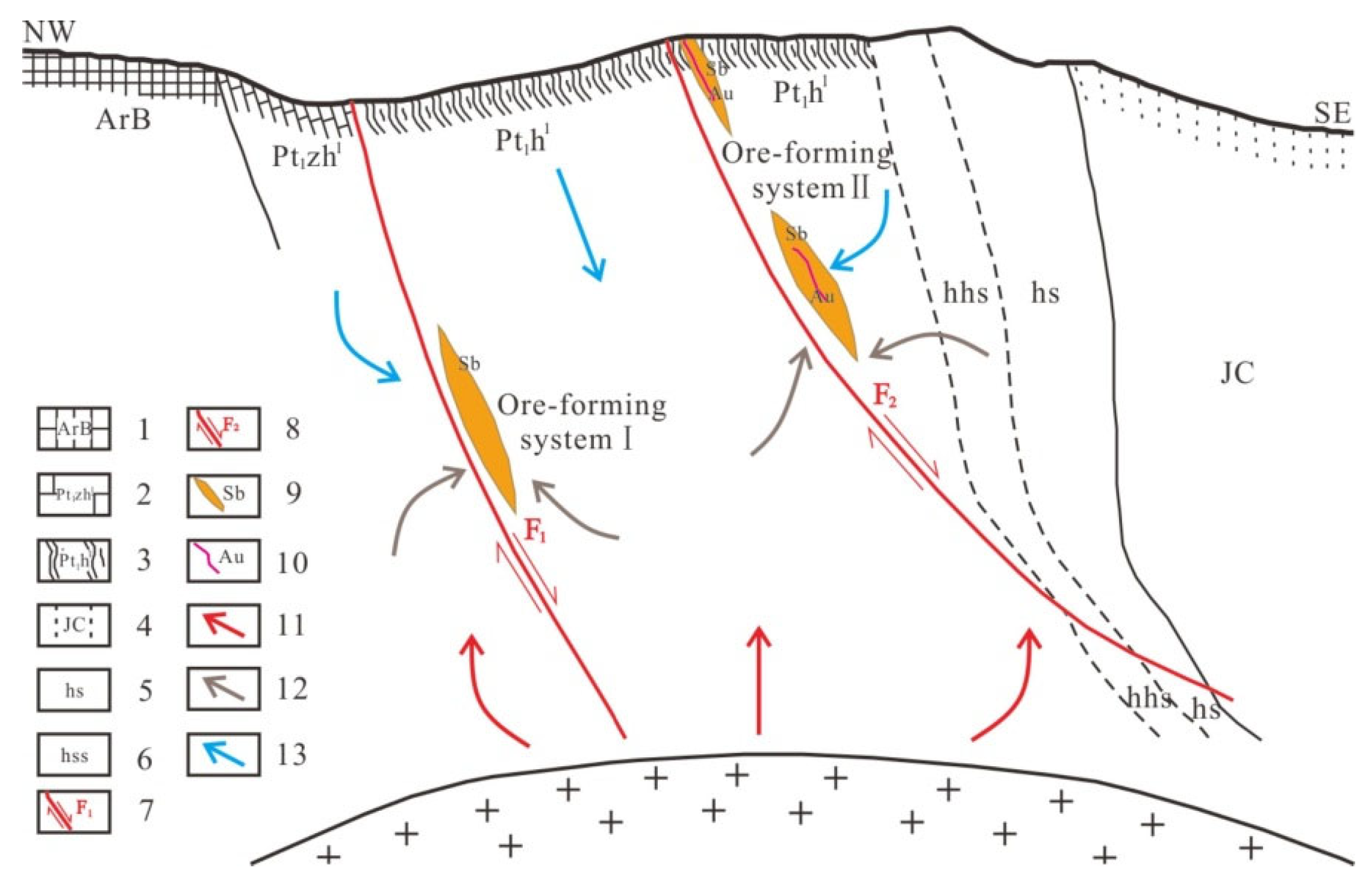
Whether the gold deposits in the Laoling metallogenic belt are orogenic or decratonic is currently the subject of substantial debate. Zhu [12] posited that the Early Cretaceous gold deposits in the Ji’nan area are of the craton-destruction type. However, because the gold mineralization ages determined from the Laoling metallogenic belt predominantly indicate the Middle Jurassic, which corresponds to a tectonic setting involving the subduction and compression of the Paleo-Pacific Plate, some scholars, such as Sun [40] and Ren [46], consider these gold deposits to be of orogenic origin. In this study, building upon previous research, we gained new insights into the genesis of the ore deposits through an integrated investigation of their regional metallogenic geological background, geological characteristics, and isotopic geochemical compositions (Figure 15). The Dongbaligou gold deposit is regionally controlled by the ‘S’-shaped ductile–brittle fault zone in Huanggoushan, which possesses characteristics of a slip detachment fault [14] and exhibits polyphase activity. The tensional structural breccias of this period are filled with quartz veins. The ore-bearing structures, faults F1 and F2, show two main phases of structural activity: the early phase formed under a compressive-torsional regime and is characterized by mylonitized Huashan Group phyllonitic schists, whereas the late phase formed under an extensional regime and is characterized by cataclastic breccias. Gold mineralization occurs within quartz veins that fill the cataclastic breccias and within the mineralized, altered cataclastic breccias. Therefore, the gold ore bodies of the deposit are situated within a fault structural system formed under an extensional tectonic background. In the Dongbaligou gold deposit, the predominant alteration is silicification, followed by chloritization and epidotization, with carbonate alteration being underdeveloped. As orogenic gold deposits are primarily derived from metamorphic fluids, the decomposition of crustal carbonates and the hydrolysis of organic carbon during metamorphism can produce significant amounts of CO2 [12], leading to the formation of carbonate minerals in mineralized geological bodies. The scarcity of carbonate minerals in the Dongbaligou gold deposit distinctly sets it apart from orogenic gold deposits, which typically exhibit carbonate development. The hydrogen-oxygen isotopic sample data points of the quartz fluid inclusions are located between regions of meteoric water, formation water, magmatic water, and enriched mantle fluid water, far from the typical water region for orogenic gold deposits. Additionally, the lower δD values indicate the involvement of mantle-derived mineralizing fluids. The in situ S isotope composition of pyrite, with δ34S values of 3.52‰–4.10‰, supports a mantle-magmatic origin. The Pb isotope composition shows that the deposit is primarily derived from the crust but that its formation is closely related to magmatic activity. According to the properties of the ore-forming structures, the mineralization and alteration characteristics, the features of the mineralizing fluid, and the in situ sulfur-lead isotopic tracing of the pyrite, the Dongbaligou gold ore deposit is concluded to be of the decratonic type.

6.4.2. Tectonic Dynamic Mechanism of Decratonic Type Gold Deposit

After the Yanshanian period, influenced by the subduction, rollback, and retreat of the Paleo-Pacific Plate towards the China continent, the upper mantle experienced non-steady-state flow, which altered the properties of the lithospheric mantle. This resulted in the destabilization of the NCC, known as decratonic type, with the peak periods of destruction and reformation in the eastern and central regions being around ~125 Ma. The mechanisms of decratonic type are diverse, including delamination, thermal erosion, melt–peridotite reactions, and crust–mantle interactions [12,98,99,100,101]. The destruction of the NCC has been accompanied by a large-scale tectono-magmatic activity and mineralization event; the resulting gold deposits produced by craton destruction are referred to as decratonic type deposits. The ore-forming age of the NCC’s gold deposits is mainly the Early Cretaceous, which coincides with the peak period of craton destruction. These gold deposits are characterized by explosive ore formation and exhibit significant differences in geological, fluid, and geochemical characteristics compared with typical orogenic gold deposits [12]. The gold deposits in the Ji’nan area, particularly within the Laoling polymetallic mineral belt, are predominantly formed during the Early-to-Middle Jurassic period, which corresponds to a tectonic background involving the subduction and compression of the Paleo-Pacific Plate that led to the orogeny. However, these gold deposits exhibit geochemical characteristics associated with decratonic type gold deposits. This is because, although the Dongbaligou gold deposit formed under a regionally compressional tectonic setting during the Early–Middle Jurassic, the delamination of thickened lower crust led to mantle upwelling and rapid magma emplacement, resulting in the development of a metamorphic core complex—a thermal doming–extensional structure. This created a locally extensional tectonic environment. Consequently, its genesis should be classified as “decratonic type gold deposits” related to lower crustal delamination.
The underthrusting of the Paleo-Pacific Plate towards the China continent began in the Early–Middle Jurassic [31,83,102], with the direction being northwestward and the average subduction rate estimated to be within 10 cm/a [103,104]. During the Early Cretaceous, the NCC likely experienced a brief period of low-angle subduction and possibly even flat-slab subduction [105,106,107,108]. The total distance from the Japan Trench, where the Pacific Plate subducts, to the Ji’nan gold deposit area is approximately 1500 km. Thus, the subduction would require more than 15 Ma to reach the study area. Moreover, the formation of rocks and minerals that directly originate from the subducting oceanic crust is expected to lag considerably behind the actual subduction. Hence, it is inferred that during the Early Jurassic period, around 175 Ma, the subducting oceanic slab had not yet reached the Ji’nan area. The geological and geochemical characteristics of the Laotudingzi pluton (Lishugou, Caoshan, and Yaolin plutons) indicate that its petrogenesis is related to the partial melting of the thickened lower crust. Therefore, the tectonic and magmatic activities and mineralization of the Ji’nan Laoling metallogenic belt around 175 Ma occurred against a backdrop of compression with local extension caused by the sinking of the thickened lower crust and the lithospheric mantle.
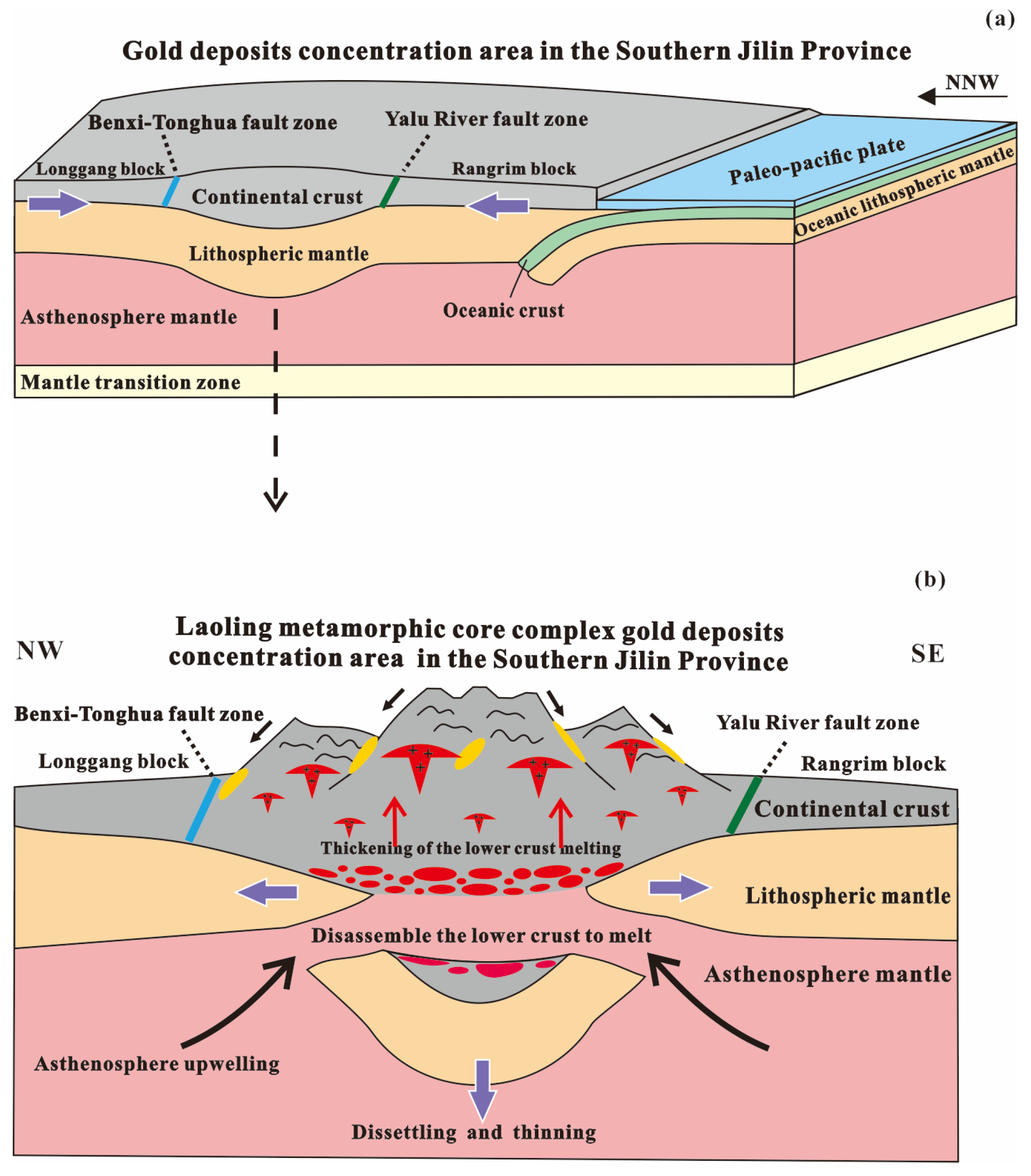
During the subduction of the Paleo-Pacific Plate towards the China continent, the Laoling and other regions within the Liaoji Active Belt experienced compression, leading to vertical thickening of the crust, surface uplift-derived plateaus, and downward bulging of the thickened lower crust. As the lower crust continued to thicken and the lithospheric mantle was compressed, deformation or fractures occurred within the lower crust and lithospheric mantle (Figure 16a). The horizontal shear stress generated by the horizontal flow of the upwelling asthenosphere beneath the lithosphere [109] intensified the structural deformation and the expansion of fracture structures within the thickened lower crust and lithospheric mantle, providing the tectonic conditions necessary for delamination. The lower crust is typically basaltic in composition (amphibolite), and its density is lower than that of the lithospheric mantle; these properties prevent it from delaminating and entering the asthenospheric mantle [110]. Under high temperature and pressure, the thickened lower crust transforms into eclogite facies, which increases its density. Some intermediate-felsic eclogite facies rocks undergo partial melting, generating adakitic magma, which causes the residual rocks to transform into more basaltic eclogites; this increases their density further until it exceeds that of the underlying lithospheric mantle, which creates the gravitational conditions for delamination. Under the continuous subduction of the Paleo-Pacific Plate towards the China continent, around 175 Ma, the thickened lower crust reached the structural and gravitational conditions necessary for delamination; thus, parts of the lower crust and lithospheric mantle were delaminated. Concurrently, the asthenospheric mantle surged upwards, causing the overlying thickened crust to undergo extensional metamorphism and extensional magmatic activity. This produced a local extensional tectonic setting in the Laoling area, leading to the formation of the Laoling metamorphic core complex and detachment faults. Meanwhile, the upwelling asthenosphere heated the thickened lower crust, generating gold-bearing adakitic magma that intruded and created an extensional orogeny; this orogeny was superimposed on the continental intraplate accretion or collisional orogeny [111,112], thereby creating a local extensional tectonic setting. In the uplifted shallow crust, ‘S-type’ detachment structures such as Huanggoushan formed, along with the Laoling metamorphic core complex. The lower crust in southern Jilin exhibits elevated Au concentrations, with supracrustal rocks of Archean age showing particularly high Au abundances (>30 × 10−9)—10 to 100 times the crustal Clarke value [113]. During low-degree partial melting that generates adakitic magmas and associated intrusive activities triggering extensional orogeny, moderately incompatible elements such as gold [114,115] preferentially partition into the melt, leading to the initial enrichment of Au in adakitic magmas. Most researchers consider high oxygen fugacity (fO2) a critical factor controlling the metallogenic potential of adakitic rocks. Under high fO2 conditions, sulfide instability causes Au to behave similarly to incompatible elements during magmatic processes, facilitating its progressive enrichment in the melt [116]. Elevated oxygen fugacity also promotes the dissolution of Au-bearing sulfides in the source rocks, releasing Au into the magma. During magmatic crystallization, high fO2 inhibits the combination of S and Fe to form sulfides such as pyrite, favoring the retention of Au in the melt and subsequent migration into post-magmatic hydrothermal fluids—conditions conducive to gold deposit formation. The dissolution of magnetite in lower crustal rocks releases substantial Fe3+, and the concomitant oxygen release contributes to high fO2 in the resulting melts. Meanwhile, the melting of marine sedimentary layers in the lower crust introduces significant amounts of Cl and SO42− into the magma, which are crucial for the enrichment and transport of gold. Among these, the incorporation of SO42− and other high-valence sulfur species plays a particularly important role in mineralization. Sulfur acts as a key redox buffer: as SO42− is reduced to species such as [H(SO3)] or (HS), gold and other elements form complexes like [Au(HS)2], enabling efficient extraction and transport. Upon intrusion into the upper crust, Au-rich adakitic magma experiences a rapid pressure drop, triggering fluid exsolution. Due to its moderate incompatibility and affinity for mineralizing agents such as Fe, S, Si, and Cl, gold preferentially partitions into the exsolved fluid, leading to its further enrichment and the formation of Au-bearing post-magmatic hydrothermal fluids. These magma-derived hydrothermal fluids migrated along the extensional tectonic system formed during the rifting orogeny, specifically within the metamorphic core complexes along the detachment faults. Simultaneously, the heat provided by the magma intrusion drove extensive circulation of crustal fluids, leading to the leaching of gold from the crust by the formation water and meteoric water. Ultimately, the gold-bearing hydrothermal fluids derived from magma mixed with the formation water and meteoric water, causing the precipitation of gold-bearing fluids. This produced gold-enriched quartz veins or altered rock-type gold deposits via the filling or metasomatic replacement of fractured wall rocks within the detachment fault zone (Figure 16b).

7. Conclusions

(1)
The Laoling gold multiment ore belt in the Ji’nan region exposes the Laotudingzi magmatic body, which exhibits a zircon Uranium-Lead weighted average age of 175.7 ± 2.1 Ma, representing an Early Jurassic intrusive age. A group of hydrothermal zircons identified in the vein quartz of the Dongbaligou gold ore deposit yielded a Uranium-Lead weighted average age of 168 ± 4 Ma. Because the ore-forming era of the gold ore deposit usually lags behind the age of the ore-forming intrusion, it is considered that the Dongbaligou gold ore deposit is genetically associated with the Laotudingzi monzonitic granite. Considering this together with the metallogenic ages of regional granitic rocks and gold deposits, a significant magmatic activity and gold mineralization event is believed to have occurred in the Ji’nan area within the Early–Middle Jurassic period.
(2)
The Laotudingzi monzogranite in the Ji’nan area exhibits geochemical characteristics typical of C-type adakitic plutons. Strontium-neodymium-lead-hafnium isotopic tracing indicates that its magma originated from the small proportion melting of the lower earth crust with increased thickness.
(3)
The quartz hydrogen-oxygen constitution of the Dongbaligou gold ore deposit indicates that the ore fluid is a mixture of magma water, construction water, and meteoric water. The in situ sulfur-lead isotopic constitutions of the pyrite suggest that the S mainly originated from magmatic origin, while Pb has both crustal and magmatic sources. The genesis genetically linked to the magmatic activity of the crustal-derived Laotudingzi monzogranite.
(4)
The Laotudingzi monzogranite intrusion formed in an Early Jurassic tectonic setting characterized by the subduction and compression of the Paleo-Pacific Plate beneath the Eurasian continent. The East Baligou gold deposit developed in a local extensional environment associated with thermal doming and extension resulting from the delamination of thickened lower crust.
(5)
The formation of the East Baligou gold ore bodies is closely related to tectono-magmatic activities triggered by lower crustal delamination. Both the ore-forming fluids and materials were predominantly derived from magmatic activities, with no significant contribution from devolatilization fluids during metamorphism. The deposit is genetically classified as a “craton destruction-type” mineralization.

Author Contributions

Conceptualization, J.S.; Formal analysis, J.S.; Writing—original draft, J.S.; Funding acquisition, X.Y.; Project administration, X.Y.; Resources. X.Y.; Supervision, Z.X.; Writing—review and editing, Z.X.; Data curation, K.C.; Software, K.C.; Methodology, K.C.; Investigation, Z.W.; Validation, Z.W.; Visualization. Z.W. All authors have read and agreed to the published version of the manuscript.

Funding

This research was financially supported by the project of the China Geological Survey. [Strategic Mineral Exploration Action Deployment Research and Rapid Verification Technology Demonstration (grant DD20230052) and the Dynamic Assessment and Deployment Research of Strategic Mineral Exploration Action (grant DD20230349)].

Data Availability Statement

The authors declare that the data supporting the findings of this study are available within the paper. Should any raw data files be needed in another format, they are available from the corresponding author upon reasonable request.

Conflicts of Interest

The authors declare that they have no known competing financial interests or personal relationships that could have appeared to influence the work reported in this paper.

References

  1. Deng, J.; Wang, C.; Bagas, L.; John, E.; Carranza, M.; Lu, Y. Cretaceous-Cenozoic tectonic history of the Jiaojia Fault and gold mineralization in the Jiaodong Peninsula, China: Constraints from zircon U-Pb, illite K-Ar, and apatite fission track thermochronometry. Miner. Depos. 2015, 50, 987. [Google Scholar] [CrossRef]
  2. Fan, H.R.; Zhai, M.G.; Xie, Y.H.; Yang, J.H. Ore-forming fluids associated with granite-hosted gold mineralization at the Sanshandao deposit, Jiaodong gold province, China. Miner. Depos. 2003, 38, 739–750. [Google Scholar] [CrossRef]
  3. Mao, J.; Goldfarb, R.J.; Zhang, Z.; Xu, W.; Qiu, Y.; Deng, J. Gold deposits in the Xiaoqinling-Xiong’ershan region, Qinling Mountains, central China. Miner. Depos. 2002, 37, 306–325. [Google Scholar] [CrossRef]
  4. Song, M.C.; Li, S.Z.; Santosh, M.; Zhao, S.J.; Yu, S.; Yi, P.H.; Cui, S.X.; Lv, G.X.; Xu, J.X.; Song, Y.X.; et al. Types, characteristics and metallogenesis of gold deposits in the Jiaodong Peninsula, eastern North China Craton. Ore Geol. Rev. 2015, 65, 612–625. [Google Scholar] [CrossRef]
  5. Yang, J.H.; Zhou, X.H. Rb-Sr, Sm-Nd, and Pb isotope systematics of pyrite: Implications for the age and genesis of lode gold deposits. Geology 2001, 29, 711–714. [Google Scholar] [CrossRef]
  6. Zhu, R.X.; Sun, W.D. The big mantle wedge and decratonic gold deposits. Sci. China Earth Sci. 2021, 51, 1444–1456. [Google Scholar] [CrossRef]
  7. Qiu, Z.J.; Fan, H.R.; Cong, P.Z.; Liu, X.; Yang, K.F. Recent progress in the study of ore-forming processes of orogenic gold deposits. Miner. Depos. 2015, 34, 21–38. [Google Scholar]
  8. Shen, B.F.; Li, J.J.; Zhai, A.M.; Cao, X.L. The characteristics of the green belt regenerated gold deposits related with granite in the middle north margin of North China Block. Prog. Precambrian Res. 2001, 24, 129–144. [Google Scholar]
  9. Jiang, S.Y.; Dai, B.Z.; Jiang, Y.H.; Zhao, H.X.; Hou, M.L. Jiaodong and Xiaoqinling: Two orogenic gold province formed in different tectonic setting. Acta Petrol. Sin. 2009, 25, 2727–2738. [Google Scholar]
  10. Zhai, M.G.; Fan, H.R.; Yang, J.H.; Miao, L.C. Large-scale district of gold deposites in east Shandong: Anorogenic metallogenesis. Earth Sci. Front. 2004, 11, 85–98. [Google Scholar]
  11. Mao, J.W.; Xie, G.Q.; Zhang, Z.H.; Li, X.F.; Wang, Y.T.; Zhang, C.Q.; Li, Y.F. Mesozoic large-scale metallogenic pulses in North China and corresponding geodynamic settings. Acta Petrol. Sin. 2005, 21, 169–188. [Google Scholar]
  12. Zhu, R.X.; Fan, H.R.; Li, J.W.; Meng, Q.R.; Li, S.R.; Zeng, Q.D. Decratonic gold deposits. Sci. China Earth Sci. 2015, 58, 1523–1537. [Google Scholar] [CrossRef]
  13. Feng, G.; Zhang, M.; Gao, M.Z.; Wang, Y.C.; Wang, K.Y. Research on geological characteristics and fluid inclusions of Banmiaozi gold deposit in Jilin Province. Gold 2016, 37, 13–17. [Google Scholar]
  14. Guan, J. Study on Metallogenetic Law of Precious and Non Ferrousdeposits in the Southeast Part of Jilin Province. Ph.D. Thesis, Jilin University, Changchun, China, 2004. [Google Scholar]
  15. Zhou, X.B.; Li, J.F.; Wang, K.Y.; Liang, Y.M.; Zhang, M.; Wei, L.M.; Wang, Z.G. Geochemical characteristics of ore-forming fluid in Huanggoushan gold deposit, Jilin Province. Earth Sci. 2016, 41, 121–130. [Google Scholar]
  16. Su, X.J.; Zang, X.Y. Geological characteristics and genetic analysis of Banmiaozi gold deposit in Baishan City, Jilin Province. Contrib. Mineral. Petrol. 2010, 25, 326–330. [Google Scholar]
  17. Liu, W.X.; Man, Y.L.; Wang, X.C. Geology and genesis of the Jinying gold deposit in Jilin Province. Geol. Res. 2009, 18, 279–283. [Google Scholar]
  18. Zhang, J.Z. Study on Genesis and Geological and Geochemical Characteristics of Banmiaozi Gold Deposit in Baishan City, Jilin Province. Ph.D. Thesis, Jilin University, Changchun, China, 2015. [Google Scholar]
  19. Chen, Y.S.; Dong, X.J.; Liu, Z.H.; Jia, Z.Y.; Yu, X.F.; Wu, Y.S.; Wang, H.J. Metallogenic mechanism of decratonic gold deposit: Evidence from diorite porphyrite and fluid inclusions, H-O-S isotope composition of barite in Banmiaozi gold deposit, southern Jilin Provinc. Acta Petrol. Sin. 2020, 36, 2537–2557. [Google Scholar]
  20. Wang, C. Metallogenesis of Gold Deposit in Laoling Metallogenic Belt, Jilin Province. Ph.D. Thesis, Jilin University, Changchun, China, 2023. [Google Scholar]
  21. Zhao, G.C.; Cawood, P.A.; Li, S.Z.; Wilde, S.A.; Sun, M.; Zhang, J.; He, Y.H.; Yin, C.Q. Amalgamation of the North China Craton: Key issues and discussion. Precambrian Res. 2012, 222, 55–76. [Google Scholar] [CrossRef]
  22. Zhao, G.; Sun, M.; Wilde, S.A.; Sanzhong, L. Late Archean to Paleoproterozoic evolution of the North China Craton: Key issues revisited. Precambrian Res. 2005, 136, 177–202. [Google Scholar] [CrossRef]
  23. Zhai, M.G.; Peng, P. Paleoproterozoic events in the North China Craton. Acta Petrol. Sin. 2007, 23, 2665–2682. [Google Scholar]
  24. Zhao, G.; Sun, M.; Wilde, S.A.; Li, S. Assembly, accretion and breakup of the Paleo-Mesoproterozoic Columbia Supercontinent: Records in the North China Craton. Gondwana Res. 2003, 6, 417–434. [Google Scholar] [CrossRef]
  25. Li, S.Z.; Zhao, G.C.; Sun, M. Paleoproterozoic amalgamation of the North China Craton and the assembly of the Columbia supercontinent. Chin. Sci. Bull. 2016, 61, 919–925. (In Chinese) [Google Scholar] [CrossRef]
  26. Zhao, G.; Zhai, M. Lithotectonic elements of Precambrian basement in the North China Craton: Review and tectonic implications. Gondwana Res. 2013, 23, 1207–1240. [Google Scholar] [CrossRef]
  27. Wu, F.Y.; Li, Q.L.; Yang, Z.H.; Jin, Z.N.; Han, L.Y. Crustal growth and evolution of the Rangnim Massif, northern Korean Peninsula. Acta Petrol. Sin. 2016, 32, 2933–2947. [Google Scholar]
  28. Li, X.M. Metallogenesis and Mineral Prospecting Assessment of Borate Deposits in Eastern Liaoning-Southern Jilin Borate Ore Belt, Northeast China. Ph.D. Thesis, Jilin University, Changchun, China, 2009. [Google Scholar]
  29. Li, Z.; Chen, B.; Wei, C.; Wang, C.; Han, W. Provenance and tectonic setting of the Paleoproterozoic metasedimentary rocks from the Liaohe Group, Jiao-Liao-Ji Belt, North China Craton: Insights from detrital zircon U-Pb geochronology, whole-rock Sm-Nd isotopes, and geochemistry. Asian Earth Sci. 2015, 111, 711–732. [Google Scholar] [CrossRef]
  30. Wu, F.Y.; Sun, D.Y.; Ge, W.C.; Zhang, Y.B.; Grant, M.L.; Wilde, S.A.; Jahn, B.M. Geochronology of the Phanerozoic granitoids in northeastern China. J. Asian Earth Sci. 2011, 41, 1–30. [Google Scholar] [CrossRef]
  31. Xu, W.L.; Wang, F.; Pei, F.P.; Meng, E.; Tang, J.; Xu, M.J.; Wang, W. Mesozoic tectonic regimes and regional ore-forming background in NE China: Constraints from spatial and temporal variations of Mesozoic volcanic rock associations. Acta Petrol. Sin. 2013, 29, 339–353. [Google Scholar]
  32. Li, P.C.; Dong, X.J.; Liu, Z.H.; Zhao, Q.Y.; Shi, Q.; Li, C.H.; Li, T.Y. Petrogenesis and tectonic implication of the mafic dykes and its host TTG gneisses from Tianqiao area in southern Jilin Province. Acta Petrol. Sin. 2018, 34, 1581–1598. [Google Scholar]
  33. Wan, Y.S.; Liu, D.Y.; Dong, C.Y.; Xie, H.Q.; Kröner, A.; Ma, M.Z.; Liu, S.J.; Xie, S.W.; Ren, P. Formation and evolution of Archean continental crust of the North China Craton. In Precambrian Geology of China; Springer: Berlin/Heidelberg, Germany, 2015; pp. 59–136. [Google Scholar]
  34. Li, S.; Zhao, G. SHRIMP U-Pb zircon geochronology of the Liaoji granitoids: Constraints on the evolution of the Paleoproterozoic Jiao-Liao-Ji Belt in the eastern block of the North China Craton. Precambrian Res. 2007, 158, 1–16. [Google Scholar] [CrossRef]
  35. Zhao, G.C. Metamorphic evolution ofmajor tectonic units in the basement ofthe North China Craton: Key issues and discussion. Acta Petrol. Sin. 2009, 25, 1772–1792. [Google Scholar]
  36. Chen, Y.S.; Liu, Z.H.; Guan, Q.B.; Wan, L.; Liu, J.; Gao, T.Y. Mesozoic tectonic transition of the northeastern North China Craton: Evidence from adakitic rocks in southeastern Jilin Province, China. Int. Geol. Rev. 2023, 65, 1–20. [Google Scholar] [CrossRef]
  37. Gao, T.Y.; Liu, Z.H.; Guan, Q.B.; Li, P.C.; Chen, Y.S. LA-ICP-MS zircon U-Pb dating, geochemical characteristics and tectonic significance of Xinlu granodiorite porphyry in Baishan area, Jilin Province. Glob. Geol. 2019, 38, 80–93. [Google Scholar]
  38. Qin, Y. Geochronological Constraints on the Tectonic Evolution of the Liao-Ji Paleoproterozoic Rift Zone. Ph.D. Thesis, Jilin University, Changchun, China, 2013. [Google Scholar]
  39. Sun, D.Y.; Wu, F.Y.; Lu, X.P. CHIME dating and its application for Mesozoic granites of Huanggoushan, Jilin Province. Geochimica 2005, 34, 1–10. [Google Scholar]
  40. Sun, J.D. Geological and Geochemical Characteristics and Genesis of Baligou Gold Deposit in Linjiang City, Jilin Province. Ph.D. Thesis, Jilin University, Changchun, China, 2018. [Google Scholar]
  41. Tian, L.D.; Sun, F.Y.; Wang, L.; Liu, J.L.; Wu, Q. Geochemistry, Hf isotopes and petrogenesis of Badaogou monzonotic granites from Linjiang, Jilin Province. Earth Sci. 2018, 43, 436–448. [Google Scholar]
  42. Zhang, S.; Zhu, G.; Liu, C.; Li, Y.; Su, N.; Xiao, S. Episodicity of stress state in an overriding plate: Evidence from the Yalu River Fault Zone, east China. Gondwana Res. 2019, 71, 150–178. [Google Scholar] [CrossRef]
  43. Cui, B.; Wang, L.; Sun, F.Y.; Liu, J.L.; Zhang, J.N.; Lu, Y.H.; Sun, Q. Zircon U-Pb geochronology, geochemistry and geological significance of Toudaogou granite in Nancha Gold District, Jilin Province. Gold 2021, 42, 9–16. [Google Scholar]
  44. Pei, F.P.; Xu, W.L.; Yang, D.B.; Yu, Y.; Meng, E.; Zhao, Q.G. Petrogenesis of late Mesozoic granitoids in southern Jilin Province, northeastern China: Geochronological, geochemical, and Sr-Nd-Pb isotopic evidence. Lithos 2011, 125, 27–39. [Google Scholar] [CrossRef]
  45. Zhou, H. Petrogenesis of Early Cretaceous Volcanic Rocks of the Southern Jilin Province and Liaodong Peninsula: Constraints from Elemental and Sr-Nd-Pb Isotope Geochemistry. Ph.D. Thesis, Jilin University, Changchun, China, 2021. [Google Scholar]
  46. Ren, L.M.; Li, X.P. Geological features and metallogenic genesis of Dongbaligou gold deposit in Linjiang City, Jilin Province. Jilin Geol. 2022, 3, 1–10. [Google Scholar]
  47. Dubińska, E.; Bylina, P.; Kozłowski, A.; Dörr, W.; Nejbert, K.; Schastok, J.; Kulicki, C. U-Pb dating of serpentinization: Hydrothermal zircon from a metasomatic rodingite shell (Sudetic ophiolite, SW Poland). Chem. Geol. 2004, 203, 183–203. [Google Scholar] [CrossRef]
  48. Geisler, T.; Rashwan, A.A.; Rahn, M.K.W.; Poller, U.; Zwingmann, H.; Pidgeon, R.T.; Schleicher, H.; Tomaschek, F. Low-temperature hydrothermal alteration of natural metamict zircons from the Eastern Desert, Egypt. Mineral. Mag. 2003, 67, 485–508. [Google Scholar] [CrossRef]
  49. Rayner, N.; Stern, R.A.; Carr, S.D. Grain-scale variations in trace element composition of fluid-altered zircon, Acasta Gneiss Complex, northwestern Canada. Contrib. Mineral. Petrol. 2005, 148, 721–734. [Google Scholar] [CrossRef]
  50. Li, C.M. A review on the Minerageny and situ microanalytical dating techniques of zircons. Geol. Surv. Res. 2009, 33, 161–174. [Google Scholar]
  51. Middlemost, E.A. Naming materials in the magma/igneous rock system. Earth Sci. Rev. 1994, 37, 215–224. [Google Scholar] [CrossRef]
  52. Peccerillo, A.; Taylor, S.R. Geochemistry of Eocene calc-alkaline volcanic rocks from the Kastamonu area, northern Turkey. Contrib. Mineral. Petrol. 1976, 58, 63–81. [Google Scholar] [CrossRef]
  53. Sun, S.S.; McDonough, W.F. Chemical and isotopic systematics of oceanic basalts: Implications for mantle composition and processes. Geol. Soc. Lond. Spec. Publ. 1989, 42, 313–345. [Google Scholar] [CrossRef]
  54. Ye, L.N. Research of Precambrian Sedimentary Exhalative Metallogenesis in Eastern Jilin Province; Jilin University: Changchun, China, 2021. [Google Scholar]
  55. Wu, F.Y.; Yang, J.H.; Liu, X.M. Geochronological framework of the Mesozoic granitic magmatism in the Liaodong Peninsula, Northeast China. Geol. J. China Univ. 2005, 11, 305–317. [Google Scholar]
  56. Zhang, C. The Mesozoic Tectonic Evolution of Yanbian Area in the Eastern Segment of Northern Margin of the North China Block. Ph.D. Thesis, Jilin University, Changchun, China, 2014. [Google Scholar]
  57. Yang, F.C.; Song, Y.H.; Yang, J.L.; Shen, X.; Gu, Y.C. SHRIMP U-Pb age and geochemical characteristics of granites in Wulong-Sidaogou gold deposit, east Liaoning. Geotecton. Metallog. 2018, 42, 940–954. [Google Scholar]
  58. Yang, J.H.; Wu, F.Y.; Liu, X.M.; Xie, L.W.; Yang, Y.H. Petrogenesis and geological significance of the Jurassic Xiaoheishan Pluton in the Liaodong Peninsula, east China: In-situ zircon U-Pb dating and Hf isotopic analysis. Bull. Mineral. Petrol. Geochem. 2007, 26, 29–43. [Google Scholar]
  59. Wang, G.W.; Sun, G.S.; Yu, C.; He, X.; Jin, R.X.; Zhao, T.X.; Liu, C.X.; Zhan, N.C. Zircon U-Pb geochronology, petrogeochemistry and petrogenesis of adamellite in Huangniling area, eastern Liaoning. Glob. Geol. 2018, 37, 1033–1046. [Google Scholar]
  60. Li, B.L. Study on the Tectonics, Magmatic Events and Their Control on Gold Ore Formation in the Jiapigou Area, Jilin Province. Ph.D. Thesis, Jilin University, Changchun, China, 2001. [Google Scholar]
  61. Wang, Z.G. Study on Metallogenesis of Mesozoic Endogenetic Metal Deposits in the Eastern Part of Jilin Province. Ph.D. Thesis, Jilin University, Changchun, China, 2012. [Google Scholar]
  62. Zhu, Q.; Li, Z.T.; Wang, E.D.; Zhao, C.J. The adakite late Triassic Nanloushan Formation and Guanma gold deposit in central Jilin Province. Geol. Resour. 2004, 03, 137–142. [Google Scholar]
  63. Wen, S. Study on Genesis and Metallogenic Prognosis of Lanjia Gold Deposit, Jiin Province. Ph.D. Thesis, Jilin University, Changchun, China, 2013. [Google Scholar]
  64. Liu, H.W.; Xing, S.W.; Zhou, Y.C. The metallogenic model of the porphyry-hydrothermal gold-mutiple metallogenic deposits in south Jilin Province. Geol. Prospect. 2002, 38, 28–32. [Google Scholar]
  65. Chai, P. Ore Genesis and Metallogenetic Mechanism of Hydrothermal Gold Deposits from East-Liaoning and South-Jilin Area. Ph.D. Thesis, Jilin University, Changchun, China, 2016. [Google Scholar]
  66. Ma, C.Q.; Yang, K.G.; Tang, Z.H.; Li, Z.T. Magma Dynamics of Granitoids; China University of Geosciences Press: Wuhan, China, 1994; pp. 97–99. [Google Scholar]
  67. Tan, J.; Wei, J.H.; Tan, W.J.; Guo, D.Z. Statistic study of diagenesis- mineralization time gap for comagmatic gold deposits. Geol. Rev. 2006, 52, 9. [Google Scholar]
  68. Wei, J.H.; Li, Z.D.; Zhao, Y.X.; Lu, J.P. Evidences from characteristic compositions of fluid in clusions and altered rocks for fluid/rock interaction: As exemplitied by the Wulong gold deposit. Acta Mineral. Sin. 2001, 21, 710-706. [Google Scholar]
  69. Wu, F.Y.; Li, X.H.; Zheng, Y.F.; Gao, S. Lu-Hf isotopic systematics and their applications in petrology. Acta Petrol. Sin. 2007, 23, 185–220. [Google Scholar]
  70. Zartman, R.E.; Doe, B.R. Plumbotectonics-the model. Tectonophysics 1981, 75, 135–162. [Google Scholar] [CrossRef]
  71. Defant, M.J.; Drummond, M.S. Derivation of some modern arc magmas by melting of young subducted lithosphere. Nature 1990, 347, 662–665. [Google Scholar] [CrossRef]
  72. Defant, M.J.; Kepezhinskas, P. Adakites: Some variations on a theme. Acta Petrol. Sin. 2002, 18, 129–142. [Google Scholar]
  73. Zhang, Q.; Wang, Y.; Qian, Q.; Yang, J.H.; Wang, Y.L.; Zhao, T.P.; Guo, G.J. The characteristics and tectonic-metallogenic significances of the adakites in Yanshan period from eastern China. Acta Petrol. Sin. 2001, 17, 236–244. [Google Scholar]
  74. Xu, J.F.; Wu, J.B.; Wang, Q.; Chen, J.L.; Cao, K. Research advances of adakites and adakitic rocks in China. Bull. Mineral. Petrol. Geochem. 2014, 33, 6–13. [Google Scholar]
  75. Zhang, Q. Adakite research: Retrospect and prospect. Geol. China 2008, 35, 32–39. [Google Scholar]
  76. Gao, S.; Rudnick, R.L.; Yuan, H.L.; Liu, X.M.; Liu, Y.S.; Xu, W.L.; Ling, W.L.; Ayers, J.; Wang, X.C.; Wang, Q.H. Recycling lower continental crust in the North China craton. Nature 2004, 432, 892–897. [Google Scholar] [CrossRef] [PubMed]
  77. Xu, J.F.; Shinjo, R.; Defant, M.J.; Wang, Q.; Rapp, R.P. Origin of Mesozoic adakitic intrusive rocks in the Ningzhen area of east China: Partial melting of delaminated lower continental crust? Geology 2002, 30, 1111–1114. [Google Scholar] [CrossRef]
  78. Guo, F.; Nakamuru, E.; Fan, W.; Kobayoshi, K.; Li, C. Generation of Palaeocene adakitic andesites by magma mixing; Yanji Area, NE China. J. Petrol. 2007, 48, 661–692. [Google Scholar] [CrossRef]
  79. Wu, Z.Z.; Chen, Y.; Liang, X.H. The current situation and tendency of research on adakite. Contrib. Geol. Miner. Resour. Res. 2005, 20, 204–208. [Google Scholar]
  80. Ma, Q.; Zheng, J.P.; Xu, Y.G.; Griffin, W.L. On the origin of C-type adakites. J. Jilin Univ. (Earth Sci. Ed.) 2015, 175. [Google Scholar]
  81. Chu, X.L. Mesozoic Porphyry Copper Mineralization in the Eastern Continental Margin of Jilin and Heilongjiang Province. Ph.D. Thesis, Jilin University, Changchun, China, 2022. [Google Scholar]
  82. Wang, Q.; Wyman, D.A.; Xu, J.F.; Zhao, Z.H.; Jian, P.; Xiong, X.L.; Bao, Z.W.; Li, C.F.; Bai, Z.H. Petrogenesis of Cretaceous adakitic and shoshonitic igneous rocks in the Luzong area, Anhui Province (eastern China): Implications for geodynamics and Cu–Au mineralization. Lithos 2006, 89, 424–446. [Google Scholar] [CrossRef]
  83. Yang, J.H.; Xu, L.; Sun, J.F.; Zeng, Q.D.; Zhao, Y.N.; Wang, H.; Zhu, Y.S. Geodynamics of decratonization and related magmatism and mineralization in the North China Craton. Sci. China Earth Sci. 2021, 51, 1401–1419. [Google Scholar] [CrossRef]
  84. Kay, R.W. A leutian magnesian andesites: Melts from subducted Pacific Ocean crust. J. Volcanol. Geotherm. Res. 1978, 4, 117–132. [Google Scholar] [CrossRef]
  85. Song, M.C.; Song, Y.X.; Li, J.; Liu, H.B.; Li, J.; Dong, L.L.; He, C.Y.; Wang, R.S. Thermal doming-extension metallogenic system of Jiaodong type gold deposits. Acta Petrol. Sin. 2023, 39, 1241–1260. [Google Scholar] [CrossRef]
  86. Zheng, Y.; Wang, Y.; Liu, R.; Shao, J. Sliding-thrusting tectonics caused by thermal uplift in the Yunmeng mountains, Beijing, China. J. Struct. Geol. 1988, 10, 135–144. [Google Scholar] [CrossRef]
  87. Brown, G.C. Calc-alkaline intrusive rocks: Their diversity, evolution, and relation to volcanic arcs. In Andesites; Orogenic Andesites and Related Rocks; John Wiley & Sons: Hoboken, NJ, USA, 1982; pp. 437–461. [Google Scholar]
  88. Richardson, C.K.; Rye, R.O.; Wasserman, M.D. The chemical and thermal evolution of the fluids in the Cave-in-Rock fluorspar district, Illinois; stable isotope systematics at the Deardorff Mine. Econ. Geol. 1988, 83, 765–783. [Google Scholar] [CrossRef]
  89. Taylor, H.P. Oxygen and hydrogen isotope relationships in hydrothermal mineral deposits. In Geochemistry of Hydrothermal Ore Deposits; Holt, Rinehart and Winston: New York, NY, USA, 1979; pp. 109–142. [Google Scholar]
  90. Du, F.G.; Jiang, Y.H.; Qing, L.; Ni, C.Y. H-O, He-Ar and Sr-Nd-Pb isotopic constraints on the sources of ore-forming fluids and ore-forming materials in the Xiadian gold deposit, Jiaodong. Geol. J. China Univ. 2019, 25, 686. [Google Scholar]
  91. Zhao, Y.M.; Wang, K.Y.; Cao, X.L.; Zhao, Y.Q. A study on the geologic features and geochemistry of the Huanggoushan and Nacha gold deposits western Jilin Province. Jilin Geol. 1993, 12, 57–65. [Google Scholar]
  92. Kamona, A.F.; Lévêque, J.; Friedrich, G.; Haack, U. Lead isotopes of the carbonate-hosted Kabwe, Tsumeb, and Kipushi Pb-Zn-Cu sulphide deposits in relation to Pan African orogenesis in the Damaran-Lufilian fold belt of Central Africa. Miner. Depos. 1999, 34, 273–283. [Google Scholar] [CrossRef]
  93. Zhu, B.Q. Isotope System Theory and Application in Earth Sciences: A Discussion on the Evolution of the Chinese Continental Crust and Mantle; Beijing Science Press: Beijing, China, 1998; 330p. [Google Scholar]
  94. Li, Y. Ore Genesis and Tectonic Setting of Xiaohongshilazi Lead-Zinc Deposit in Panshi Area, Jilin Province. Master’s Thesis, Jilin University, Changchun, China, 2017; pp. 1–58. [Google Scholar]
  95. Groves, D.I.; Goldfarb, R.J.; Gebre-Mariam, M.; Hagemann, S.G.; Robert, F. Orogenic gold deposits: A proposed classification in the context of their crustal distribution and relationship to other gold deposit types. Ore Geol. Rev. 1998, 13, 7–27. [Google Scholar] [CrossRef]
  96. Chen, Y.J. The development of continental collision metallogeny and its application. Acta Petrol. Sin. 2013, 29, 1–17. [Google Scholar]
  97. Goldfarb, R.J.; Groves, D.I.; Gardoll, S. Orogenic gold and geologic time: A global synthesis. Ore Geol. Rev. 2001, 18, 1–75. [Google Scholar] [CrossRef]
  98. Wu, F.Y.; Xu, Y.G.; Gao, S.; Zheng, J.P. Lithospheric thinning and destruction of the North China Craton. Acta Petrol. Sin. 2008, 24, 1145–1174. [Google Scholar]
  99. Wu, F.Y.; Xu, Y.G.; Zhu, R.X.; Zhang, G.W. Thinning and destruction of the cratonic lithosphere: A global perspective. Sci. China Earth Sci. 2014, 44, 2358–2372. [Google Scholar] [CrossRef]
  100. Zhai, M.G.; Fan, Q.C.; Zhang, H.F.; Sui, J.L. Lower crust processes during the lithosphere thinning in eastern China: Magma underplating, replacement and delamination. Acta Petrol. Sin. 2005, 21, 1509–1526. [Google Scholar]
  101. Zhu, R.X.; Yang, J.H.; Wu, F.Y. Timing of destruction of the North China Craton. Lithos 2012, 149, 51–60. [Google Scholar] [CrossRef]
  102. Zhu, R.X.; Xu, Y.G. The subduction of the west Pacific plate and the destruction of the North China Craton. Sci. China Earth Sci. 2019, 49, 1346–1356. [Google Scholar] [CrossRef]
  103. Müller, R.D.; Sdrolias, M.; Gaina, C.; Steinberger, B.; Heine, C. Long-term sea-level fluctuations driven by ocean basin dynamics. Science 2008, 319, 1357–1362. [Google Scholar] [CrossRef] [PubMed]
  104. Seton, M.; Müller, R.D.; Zahirovic, S.; Gaina, C.; Torsvik, T.; Shephard, G.; Talsma, A.; Gurnis, M.; Turner, M.; Maus, S.; et al. Global continental and ocean basin reconstructions since 200 Ma. Earth Sci. Rev. 2012, 113, 212–270. [Google Scholar] [CrossRef]
  105. Ling, M.X.; Liu, Y.L.; Williams, I.S.; Teng, F.Z.; Yang, X.Y.; Ding, X.; Wei, G.J.; Xie, L.H.; Deng, W.F.; Sun, W.D. Formation of the world‘s largest REE deposit through protracted fluxing of carbonatite by subduction-derived fluids. Sci. Rep. 2013, 3, 1776. [Google Scholar] [CrossRef]
  106. Wu, K.; Ling, M.X.; Sun, W.; Guo, J.; Zhang, C.C. Major transition of continental basalts in the Early Cretaceous: Implications for the destruction of the North China Craton. Chem. Geol. 2017, 470, 93–106. [Google Scholar] [CrossRef]
  107. Zhang, Z.K.; Ling, M.X.; Lin, W.; Sun, M.; Sun, W. “Yanshanian movement” induced by the westward subduction of the paleo-Pacific plate. Solid Earth Sci. 2020, 5, 103–114. [Google Scholar] [CrossRef]
  108. Zheng, Y.F.; Xu, Z.; Zhao, Z.F.; Dai, L.Q. Mesozoic mafic magmatism in North China: Implications for thinning and destruction of cratonic lithosphere. Sci. China Earth Sci. 2018, 48, 379–414. [Google Scholar] [CrossRef]
  109. Xu, Y.G. Roles of thermo-mechanic and chemical erosion in continental lithospheric thinning. Bull. Mineral. Petrol. Geochem. 1999, 18, 3–7. [Google Scholar]
  110. Zhang, Q.; Jin, W.J.; Wang, Y.L.; Li, C.D.; Wang, Y.; Jia, X.Q. Block modeling and segmentally iterative ray tracing in complex 3D media. Acta Petrol. Sin. 2006, 22, 265–276. [Google Scholar]
  111. Zheng, Y.F.; Chen, R.X. Regional metamorphism at extreme conditions: Implications for orogeny at convergent plate margins. Asian Earth Sci. 2017, 145, 46–73. [Google Scholar] [CrossRef]
  112. Zheng, Y.F.; Chen, Y.X.; Chen, R.X.; Dai, L.Q. Tectonic evolution of convergent plate margins and its geological effects. Sci. China Earth Sci. 2022, 65, 1213–1242. [Google Scholar] [CrossRef]
  113. Li, B.Y.; Yang, Z.Y.; Wang, Y.F. Geological characteristics and genesisof Huanggoushan and Banmiaozi gold deposits in Laoling metallogenic belt of southern Jilin. Glob. Geol. 2010, 29, 392–399. [Google Scholar]
  114. McDonough, W.F.; Sun, S.S. The composition of the Earth. Chem. Geol. 1995, 120, 223–253. [Google Scholar] [CrossRef]
  115. Sun, W.; Arculus, R.J.; Kamenetsky, V.S.; Binns, R.A. Release of gold-bearing fluids in convergent margin magmas prompted by magnetite crystallization. Nature 2004, 431, 975–978. [Google Scholar] [CrossRef]
  116. Xiong, X.L.; Cai, Z.Y.; Niu, H.C.; Chen, Y.B.; Wang, Q.; Zhao, Z.H.; Wu, J.H. The Late Paleozoic adakites in eastern Tianshan area and their metallogenetic significance. Acta Petrol. Sin. 2005, 21, 967–976. [Google Scholar]
Figure 1. Division of basement tectonic units in northeastern NCC and distribution map of gold mineralization zones (modified from [12,21,22]). (1) Chifeng–Chaoyang ore concentration area; (2) Ji’nan ore concentration area; (3) Jibei–Jidong ore concentration area; (4) Liaodong ore concentration area; (5) Central Section Taihang Mountain ore concentration area; (6) Jiaodong ore concentration area.
Minerals 16 00235 g001
Figure 2. Geotectonic location of the study area (a) and map of sampling locations and distribution of gold deposits (occurrences) in the surrounding area (b). (1) Jinying Gold Deposit; (2) Tianqiao Gold Deposit; (3) Erdaoyangcha Gold Occurrence; (4) Laosandui Gold Deposit; (5) Liujiabaozi-Langdonggou Gold Deposit; (6) Shigao Gully Gold Deposit; (7) Taojin Gully Gold Occurrence; (8) Xiaoshiren Gold Deposit; (9) Wudaoyangcha Gold Deposit; (10) Ganfanpen Gold Occurrence; (11) Baligou Gold Deposit; (12) Dongbaligou Gold Deposit; (13) Laotudingzi Gold Occurrence; (14) Shansonggang Gold Occurrence; (15) Yinzigou Gold Occurrence; (16) Huangou Mountain Gold Deposit; (17) Gaoligou Gold Deposit; (18) Cuicao Gold Deposit; (19) Lazigou Gold Occurrence; (20) Dashongshu Gold Occurrence; (21) Handao Gold Occurrence; (22) Hengluling Gold Occurrence; (23) Daqinggou Gold Deposit; (24) Shuangdinggou Gold Deposit.
Minerals 16 00235 g002
Figure 3. (a) Hand specimen and (b) photomicrograph of monzogranite from Laotudungzi. Abbreviations: Bt, biotite; Or, orthoclase; Qtz, quartz; Pl, plagioclase.
Minerals 16 00235 g003
Figure 4. Dongbaligou gold deposit planar geological map (modified from Jilin Provincial Institute of Exploration Geophysics [46]). (1) Paleoproterozoic Laoling Group Huashan Formation; (2) diorite vein; (3) silicified altered rock vein; (4) gold mineralization body; (5) gold orebody; (6) drilling location of mineral occurrence; (7) actual surveyed exploration line position and numbering; (8) attitude; (9) reverse fault.
Minerals 16 00235 g004
Figure 5. (a,b) Gold mine core and (c,d) microscope images of metal minerals from Dongbaligou gold deposit. (c) Iron ore (Py) with a crushed structure and cracks filled with chalcopyrite (Ccp). (d) Galena (Gn), metasomatic sphalerite (Sp), and pyrrhotite (Po).
Minerals 16 00235 g005
Figure 6. CL images of (a) monzogranite magmatic zircon from Laotudingzi and (b) hydrothermally altered zircon from the Dongbaligou gold deposit. The red circles indicate the locations of laser ablation on the zircon.
Minerals 16 00235 g006
Figure 7. LA-ICP-MS U-Pb age concordia diagrams of (a) monzogranite magmatic zircon and (b) hydrothermal zircon.
Minerals 16 00235 g007
Figure 8. (a) Tas classification diagram (modified from [51]) and (b) SiO2–K2O diagram (modified from [52]) of monzogranite (the cited previous research data are from [36,38,41]).
Minerals 16 00235 g008
Figure 9. (a) Chondrite-normalized REE patterns of monzogranite and (b) primitive mantle-normalized spider diagram (modified from [53]) of magmatic rocks from Laotudingzi (the cited previous research data are from [36,38,41,54]).
Minerals 16 00235 g009
Figure 10. Sr-Nd-Pb-Hf isotopic diagrams of monzogranite from Laotudingzi (ad) are after [69,70], respectively. EM: mantle; LC: lower crust; UC: upper crust; OR: orogenic belts; OIV: ocean island volcanic rocks.
Minerals 16 00235 g010
Figure 13. δ18OH2O–δ18D diagram of ore-forming fluids in the Dongbaligou gold deposit [modified from [89]. The range of ore-forming fluids in the typical orogenic gold deposits from [12], the range of enriched mantle-derived fluid and, the range of Mesozoic meteoric water in Jiaodong from [90].
Minerals 16 00235 g013
Figure 14. Pb isotopic diagrams of the Dongbaligou gold deposit. (a) 207Pb/204Pb–206Pb/204Pb growth curve (after [73]); (b) Δγ–Δβ genetic classification diagram of Pb isotopes (after [93]). (1) Mantle-derived Pb; (2) upper crustal Pb; (3) subduction-zone Pb mixed with upper crustal and mantle-derived Pb (3a: magmatism; 3b: sedimentation); (4) chemically deposited Pb; (5) hydrothermal Pb; (6) medium-deep metamorphic Pb; (7) Pb in the deep metamorphic lower crust; (8) Pb in orogenic belts; (9) Pb in the upper crust of old shale; (10) demetamorphic Pb. Data are from [94].
Minerals 16 00235 g014
Figure 15. Ore-forming model of the Dongbaligou gold deposit. (1) Archaean craton; (2) Paleoproterozoic Zhenzhumen Formation; (3) Paleoproterozoic Huashan Formation; (4) Jurassic granite; (5) hornfel; (6) hornfelsic schist; (7) ‘S’-shaped principal fault zone; (8) parallel subsidiary fault zone; (9) Zone II of mineralization and alteration; (10) gold ore body; (11) migration direction of ore-forming hydrothermal fluid; (12) migration direction of formation water; (13) migration direction of precipitation.
Minerals 16 00235 g015
Figure 16. Metallogenic mechanism map of decratonic-type gold deposit in the Ji’nan area. (a) Schematic diagram of crustal and lithospheric mantle thickening in a compressional tectonic setting resulting from oceanic crust subduction. (b) Schematic diagram of petrogenesis and mineralization in a local extensional tectonic setting triggered by lower crust and lithospheric mantle delamination.
Minerals 16 00235 g016
Table 1. LA-ICP-MS zircon U-Pb isotopic analysis of monzogranite magmatic zircon from Laotudingzi and hydrothermally altered zircon from the Dongbaligou deposit.
Sample ThUTh/U207Pb/206Pb207Pb/235U206Pb/238U207Pb/206Pb207Pb/235U206Pb/238U
(×10−6)RatioRatioRatioAgeAgeAge
(Ma)(Ma)(Ma)
LD013978900.450.0500.0050.1860.0180.0260.001192211173151785
LD026209010.690.0500.0020.1870.0080.0270.0011899317471734
LD032544970.510.0510.0070.1870.0260.0270.001231302174221797
LD041291750.740.0500.0080.1880.0310.0270.001191348175261758
LD051744200.410.0500.0070.1880.0260.0270.001195301175221798
LD062134490.470.0490.0040.1860.0130.0280.001150160173111765
LD073405460.620.0490.0110.1860.0400.0280.0021444491733417610
LD082033910.520.0500.0110.1830.0400.0270.0021734541703417611
LD092615310.490.0500.0070.1900.0260.0270.001207300176221758
LD103147600.410.0490.0030.1850.0100.0270.00117111817381784
LD112634170.630.0500.0050.1830.0170.0270.001177211171151766
LD122004180.480.0500.0070.1890.0260.0270.001217294176221737
LD133896360.610.0480.0070.1870.0270.0280.001121321174231788
LD142454970.490.0490.0030.1840.0100.0270.00115412117281734
LD156015511.090.0500.0030.1870.0100.0270.00117712717491794
LD162655280.500.0490.0050.1840.0180.0270.001146215171151736
LD173292091.580.0490.0070.1850.0250.0280.001131302172221757
LD184219110.460.0500.0040.1870.0130.0270.001200160174111795
LD191381730.800.0480.0030.1840.0110.0270.00111913417191754
LD202044710.430.0500.0040.1880.0140.0270.001195169175121785
LD211893770.500.0490.0060.1860.0220.0270.001152263173191746
LD224757610.620.0480.0020.1830.0080.0250.00111910717071744
LD232385770.410.0500.0050.1860.0190.0270.001191226173161786
LD243294510.730.0490.0030.1860.0100.0270.00116612517391744
LD253286320.520.0500.0040.1790.0120.0250.001177157167111765
BL-135020940.170.0460.0060.1700.0220.0260.00123297159191687
BL-2105829990.350.0470.0030.1750.0100.0270.0015913816491715
BL-331325500.120.0470.0030.1730.0120.0270.00141168162111705
BL-456620620.270.0490.0030.1700.0120.0250.001128159159101615
BL-5127313860.920.0460.0020.1690.0080.0270.001311115971694
BL-6113020720.550.0500.0030.1790.0110.0260.001171146167101675
Table 2. Chemical compositions of major elements (%), REEs, and trace elements (ppm) in monzogranite from Laotudingzi and the Dongbaligou gold deposit.
BLG-Y1BLG-Y2BLG-Y3BLG-Y4BLG-Y5BLG-Y6Average
SiO271.2971.3871.6571.5971.5371.5871.50
TiO20.250.240.250.250.250.260.25
Al2O314.8314.9514.8314.6214.9414.7114.81
FeO0.980.920.980.991.021.020.99
Fe2O30.670.860.810.870.790.80.80
CaO2.282.32.192.062.161.952.16
MgO0.560.610.540.610.60.580.58
K2O4.024.13.954.014.023.914.00
Na2O3.813.823.843.893.863.863.85
MnO0.040.030.030.040.040.040.04
P2O50.080.080.080.080.080.090.08
LOS0.330.350.340.410.340.380.36
Total99.1499.6499.4999.4299.6399.1899.41
K2O + Na2O7.837.927.797.97.887.777.85
K2O/Na2O1.06 1.07 1.03 1.03 1.04 1.01 1.04
FeOT1.58 1.69 1.71 1.77 1.73 1.74 1.71
M#38.739.236. 038.138.237.337.7
La35.220.217.723.421.026.423.98
Ce56.534.932.240.336.646.041.09
Pr5.904.153.874.624.335.374.71
Nd19.314.714.316.315.219.016.45
Sm2.712.542.562.582.692.982.68
Eu0.920.860.790.820.881.020.88
Gd2.441.951.782.242.002.672.18
Tb0.300.260.280.330.300.330.30
Dy1.151.101.101.221.211.361.19
Ho0.230.220.190.220.230.250.23
Er0.570.460.390.540.550.640.53
Tm0.100.080.090.100.080.110.09
Yb0.660.630.670.740.630.770.68
Lu0.100.080.090.100.100.100.09
∑REE126.0882.1376.0193.5185.810795.08
LREE120.5377.3571.4288.0280.7100.7789.79
HREE5.554.784.595.495.16.235.29
LREE/HREE21.72 16.18 15.56 16.03 15.82 16.17 16.97
(La/Yb)N36.0421.6717.8521.3722.5223.1723.83
(GdN/Yb)N3.00 2.51 2.15 2.45 2.57 2.81 2.60
δEu1.071.141.071.021.111.081.08
δCe0.850.850.880.860.860.870.86
Y5.254.774.815.405.346.315.31
Rb114112104117111110111.30
Sr435443428458445441441.53
Ba993958870985944944948.97
V27.726.530.030.530.927.928.90
Cr4.844.524.254.024.283.884.30
Co3.154.053.113.382.943.123.29
Ni2.332.032.132.691.873.142.37
Nb7.967.977.818.828.988.858.40
Ta0.580.570.550.610.680.630.60
Th4.225.0313.45.875.276.086.64
U1.561.761.921.642.091.711.78
Zr91.589.595.189.292.684.490.39
Hf3.113.023.583.253.182.953.18
Zr/Hf29.42 29.64 26.56 27.45 29.12 28.61 28.42
Nb/Ta13.72 13.98 14.20 14.46 13.21 14.05 14.00
Sr/Y82.86 92.87 88.98 84.81 83.33 69.89 83.15
M# represents the magnesium index [M# = 100 × Mg2+/ (Mg2+ + Fe2+)].
Table 3. Sr-Nd-Pb-Hf isotopic data of monzogranite from Laotudingzi.
SampleLD-1LD-2LD-3LD-4LD-5Sample.LD-1LD-2LD-3LD-4LD-5
87Sr/86Sr0.70889 0.70888 0.70889 0.70887 0.70887206Pb/204Pb17.59617.57417.5617.55717.558
143Nd/144Nd0.51206 0.51207 0.51207 0.51207 0.51207207Pb/204Pb15.59415.59315.59215.59215.592
(87Sr/86Sr)i0.70721 0.70716 0.70721 0.70712 0.70712208Pb/204Pb37.76737.7637.75437.72637.763
εSr(t)41.440.741.440.140μ8.638.618.598.598.59
εNd(t)−9.01−8.87−8.84−8.56−8.81ω33.8533.8233.7933.6833.83
176Hf/177Hf0.28251 0.28252 0.28252 0.28252 0.28252Δα26.6425.424.5624.3624.45
εHf(0)−9.39−8.86−9.08−8.8−8.84Δβ17.6817.6317.5717.5817.58
εHf(t)−5.58−5.04−5.29−5.01−5.04Δγ15.3615.1915.0214.2815.27
Table 4. S-Pb isotopic data of pyrite and H-O isotopic data of quartz vein from the Dongbaligou gold deposit.
Sample BL-1BL-2BL-3BL-4BL-5Average Sample BL-1BL-2BL-3BL-4BL-5Average
206Pb/204Pb16.18 16.18 16.17 16.22 16.17 16.18 Δα−56.14−56.18−56.47−53.40−56.24−55.69
0.015 0.003 0.056 0.029 0.033 0.027 Δβ9.7210.839.2613.2110.3610.68
207Pb/204Pb15.47 15.49 15.47 15.53 15.48 15.49 Δγ18.4220.1419.422.3219.5819.97
0.014 0.005 0.059 0.030 0.026 0.027 δ34S(‰)3.524.103.724.103.943.88
208Pb/204Pb37.88 37.94 37.92 38.02 37.92 37.94 δD(‰)−100−101−102−104−103−102
0.036 0.017 0.125 0.078 0.067 0.065 δ18O(‰)−6.5−6.9−7.4−7.1−7.3−7.0
Disclaimer/Publisher’s Note: The statements, opinions and data contained in all publications are solely those of the individual author(s) and contributor(s) and not of MDPI and/or the editor(s). MDPI and/or the editor(s) disclaim responsibility for any injury to people or property resulting from any ideas, methods, instructions or products referred to in the content.