Stepwise Recovery of Valuable Metals from Spent Lithium-Ion Batteries Through In Situ Thermal Reduction and Selective Leaching


Abstract
1. Introduction
2. Materials and Methods
2.1. Materials and Reagents
2.2. Experimental Process
2.2.1. In Situ Thermal Reduction
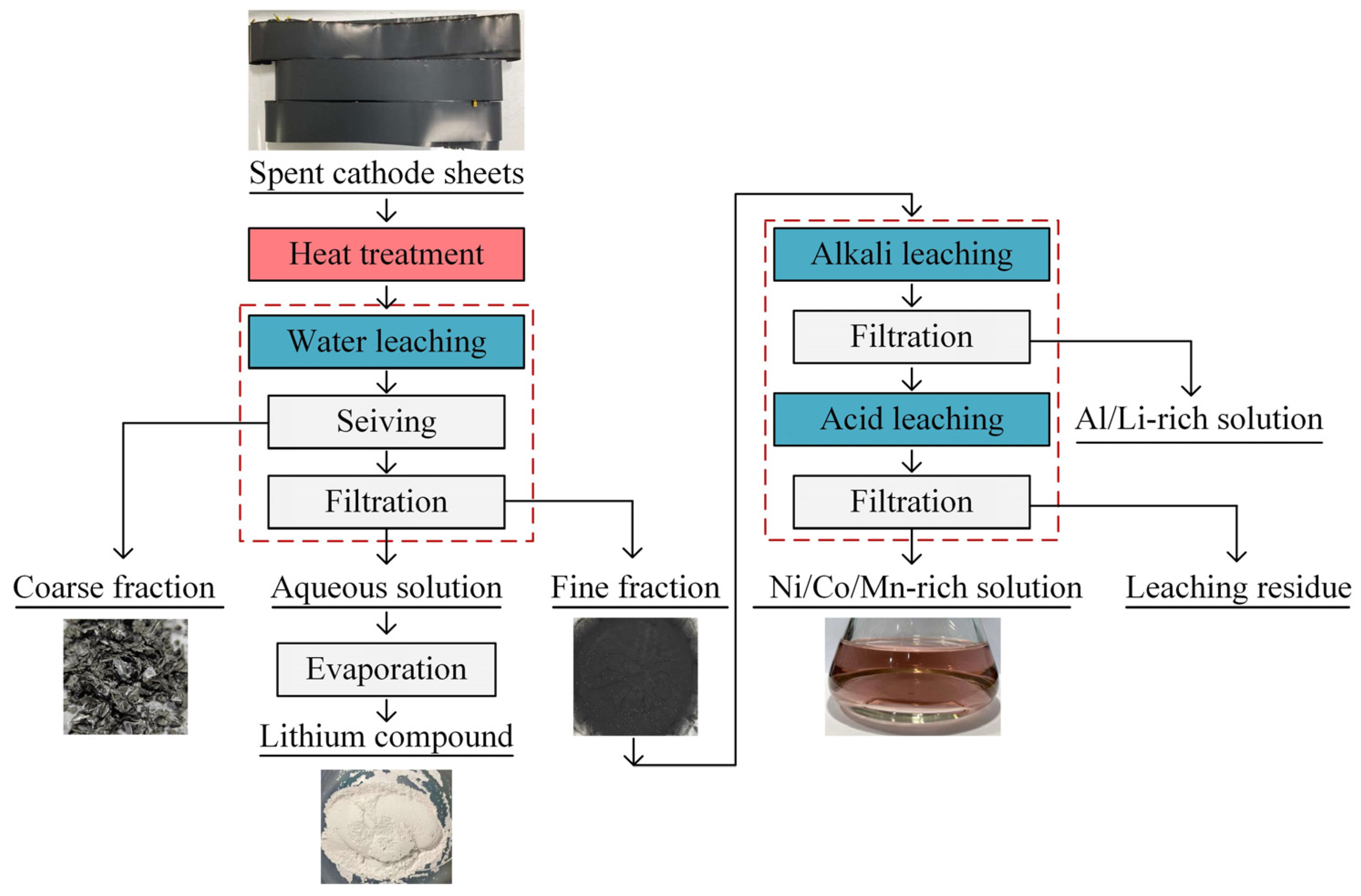
2.2.2. Water Leaching and Separation
2.2.3. Alkaline–Acid Leaching
2.3. Analytical Methods
3. Results and Discussion
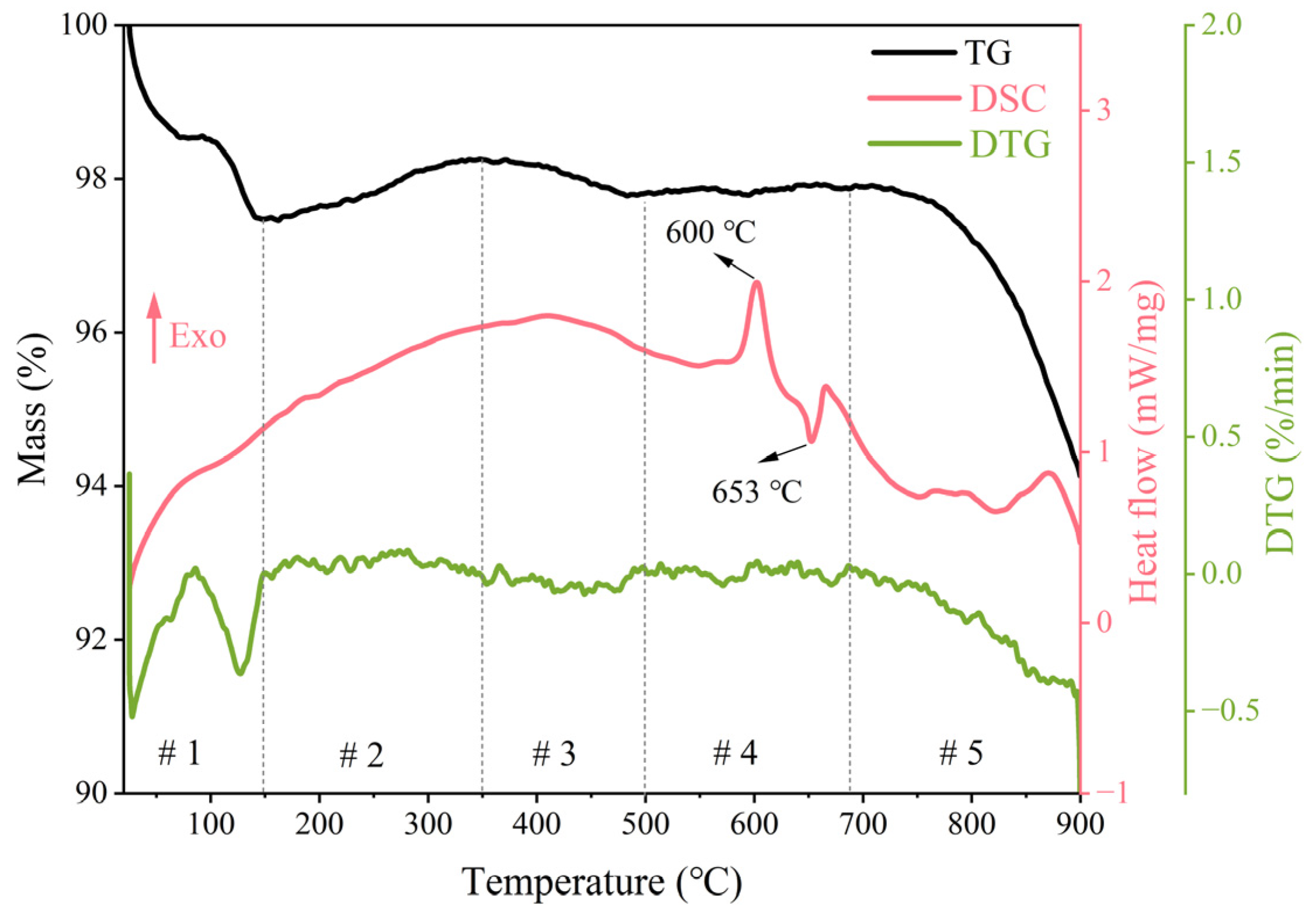
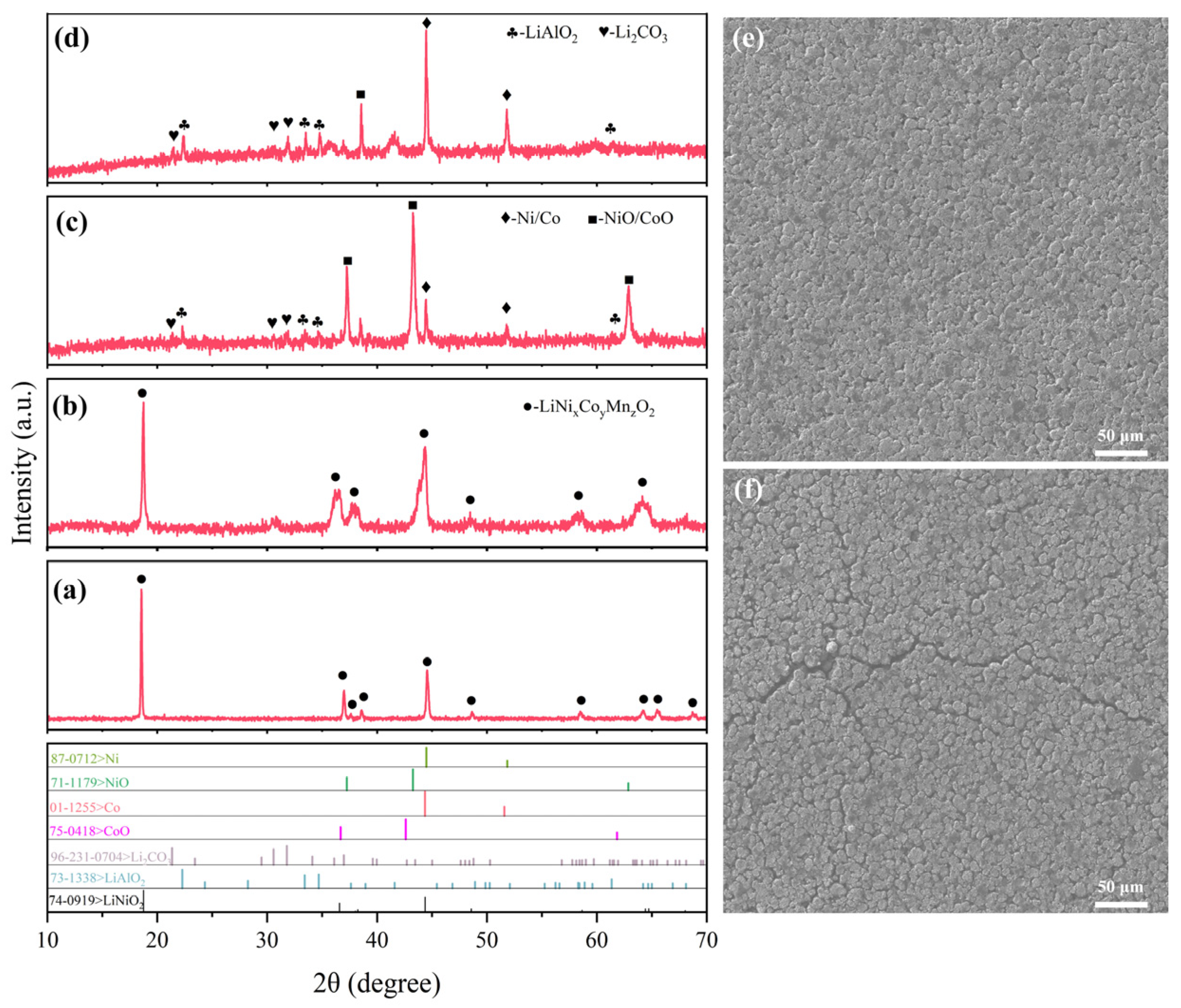
3.1. Thermogravimetric and Phase Transition Analysis of Spent Cathode Sheets
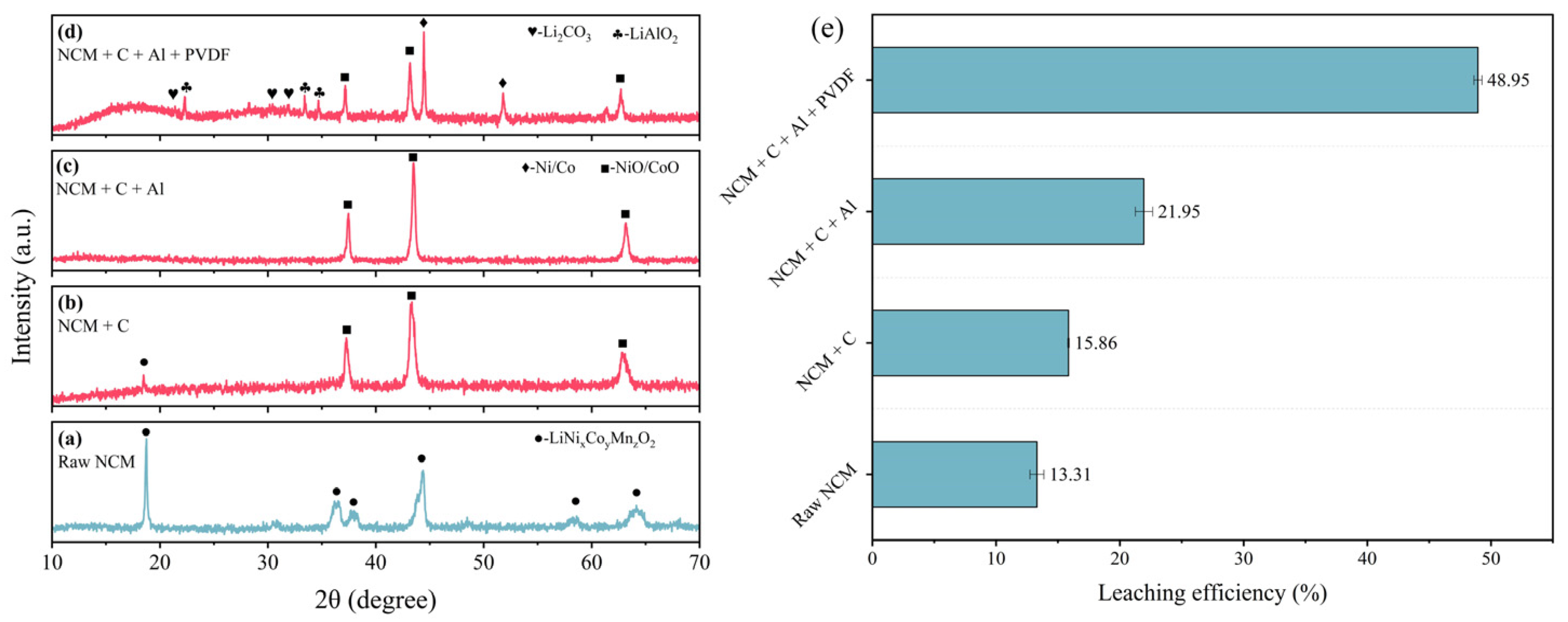
3.2. Roles of Different In Situ Components in Thermal Reduction
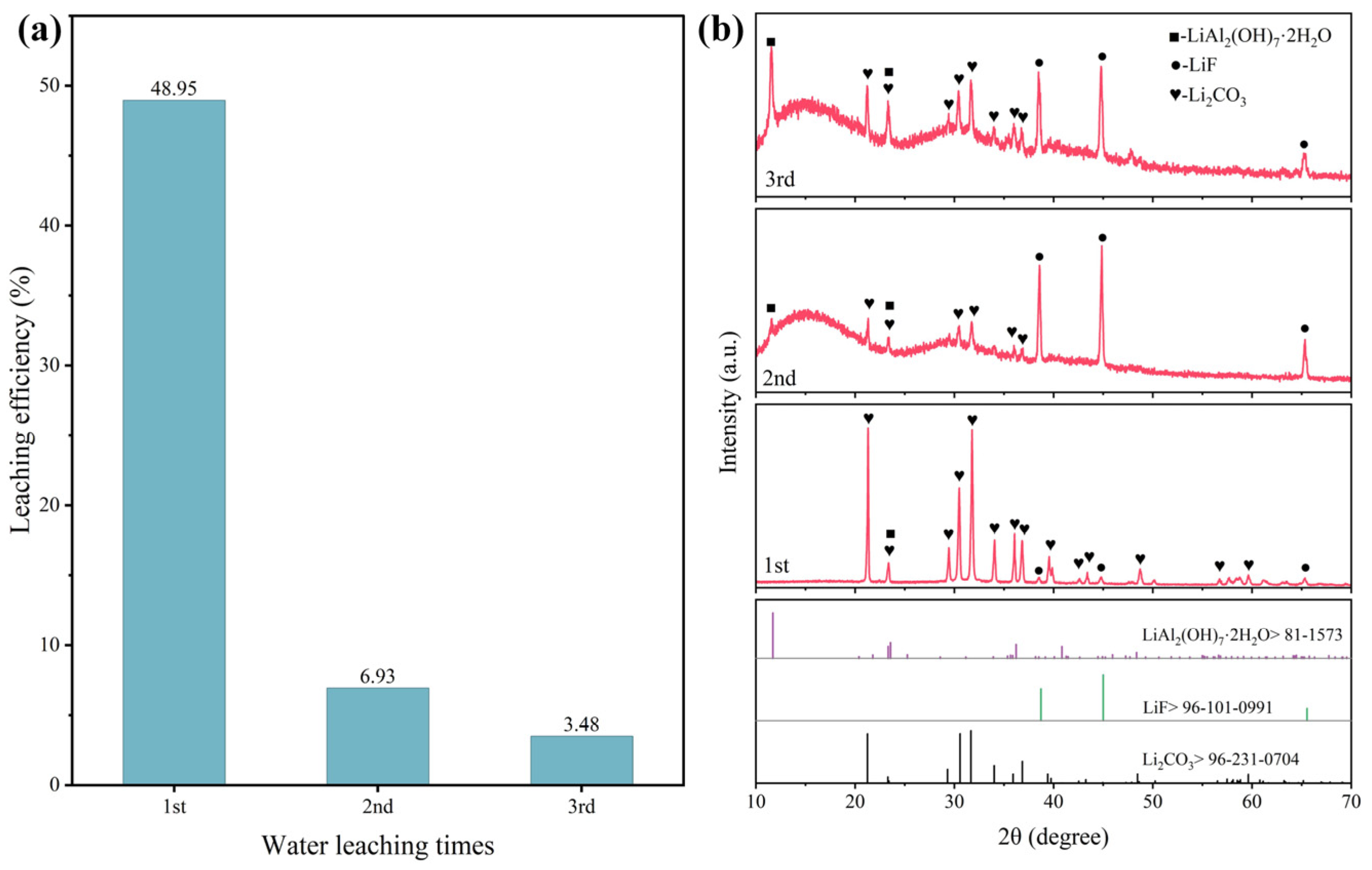
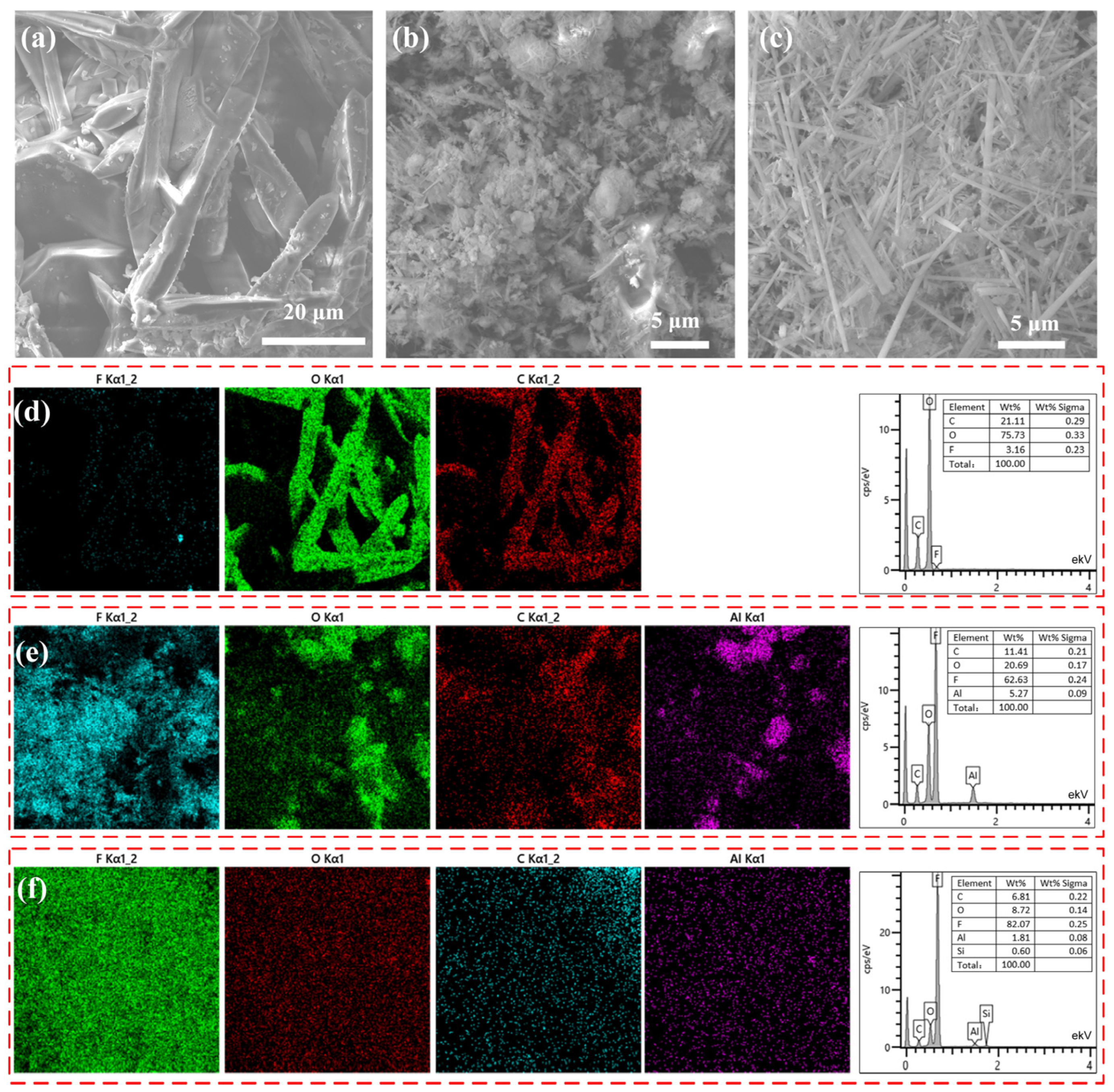
3.3. Lithium Leaching Behavior and Product Separation
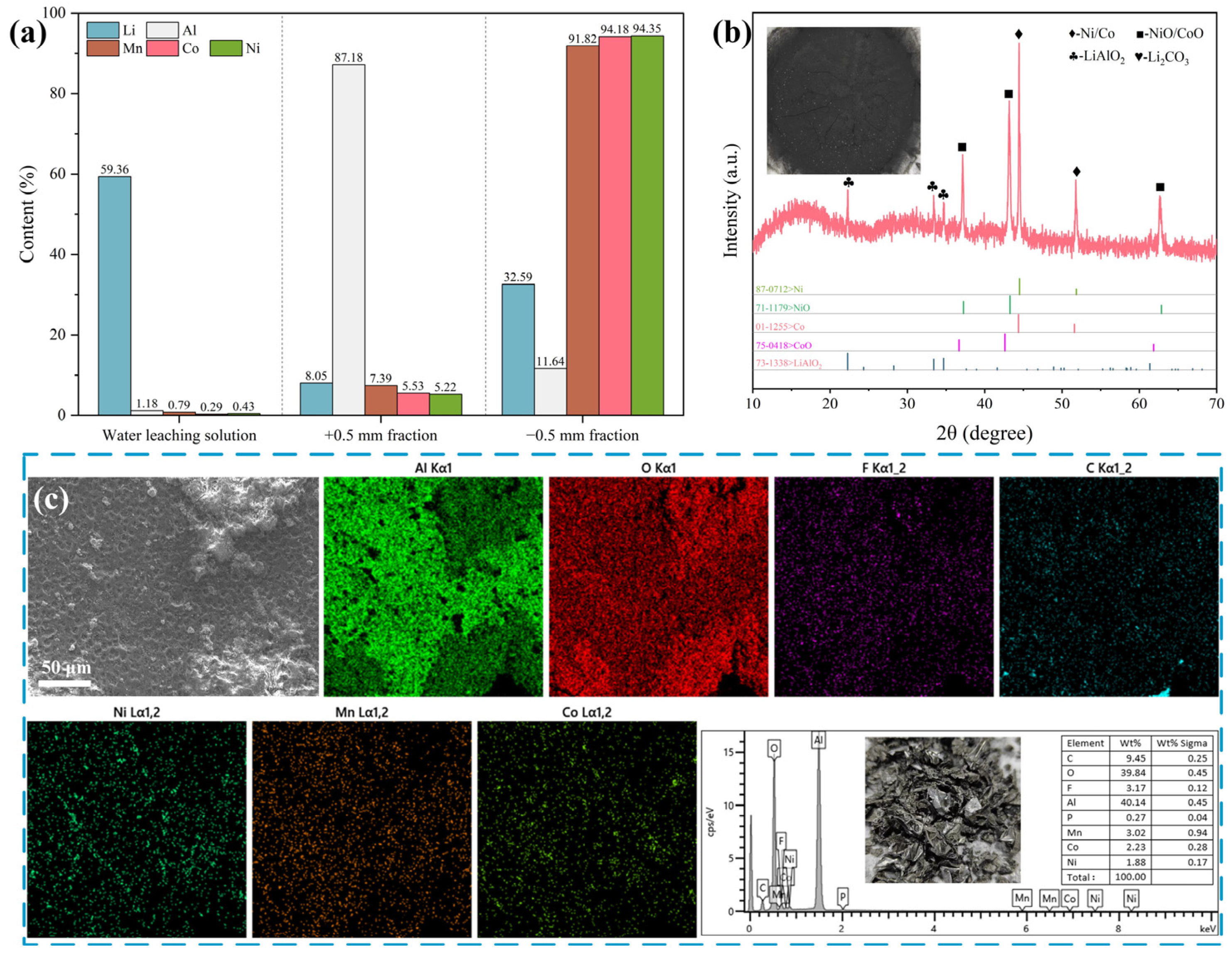
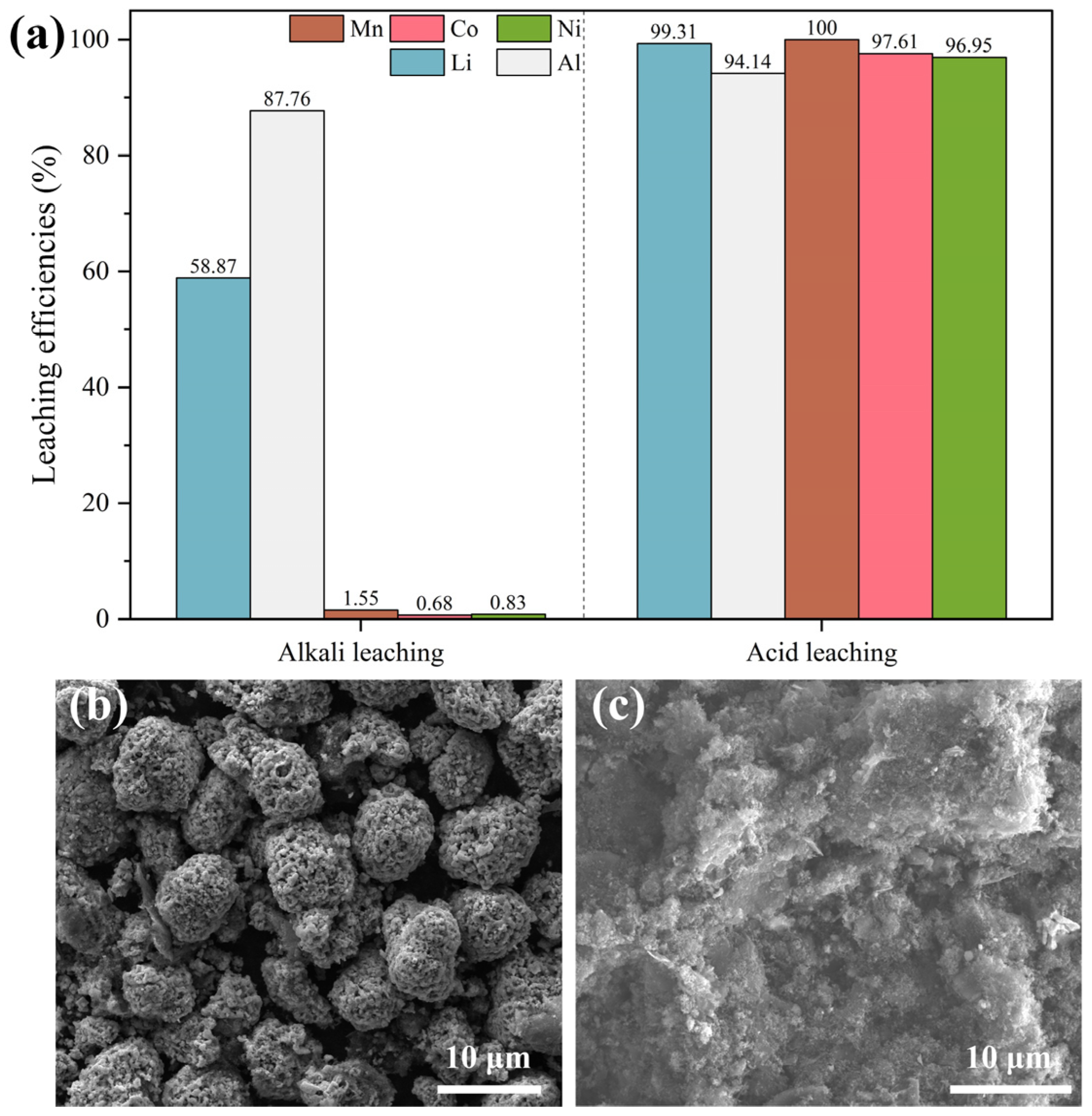
3.4. Metal Recovery from the −0.5 mm Fine Fraction
4. Conclusions
- (1)
- The internal components of the cathode sheet effectively drive thermal reduction without external reagents. Solid carbon and Al foil participate in cathode structure collapse, reducing transition metals, and most critically, gaseous products from PVDF decomposition are indispensable for extracting lithium as water-soluble Li2CO3, creating the foundation for selective recovery.
- (2)
- The formation of Li2CO3 enabled its preferential separation via simple water leaching, which avoided the fine dust generation of dry crushing and achieved in situ detachment of cathode materials. Under optimal conditions, a one-step water leaching achieved 48.95% Li leaching efficiency while leaving over 99% of the transition metals in the solid residue.
- (3)
- A three-stage water leaching process achieved a cumulative lithium recovery of 59.36%. Subsequent wet sieving efficiently separated the products into a Li-rich solution, an Al-rich coarse fraction, and nickel, cobalt, and a transition-metal-enriched fine powder (−0.5 mm, >91% of Ni, Co, Mn), facilitating targeted downstream processing.
- (4)
- A two-step alkali–acid leaching process effectively recovered metals from the fine fraction. Notably, the acid leaching step required no external reductant, benefiting from the pre-reduction during in situ thermal treatment, and achieved high leaching efficiencies of 96.95% Ni, 97.61% Co, 100% Mn, and 99.31% Li from the alkali-treated residue.
- (5)
- Based on the complete mass balance analysis, the integrated process achieved overall recoveries of 91.86% for Li, 91.93% for Ni, 92.23% for Co, and 92.61% for Mn from the combined leachate streams. Additionally, 87.18% of Al was concentrated in the coarse fraction for subsequent recovery, with minimal residual metals (<3%) remaining in the final solid residue.
Author Contributions
Funding
Data Availability Statement
Conflicts of Interest
References
- Du, K.; Ang, E.H.; Wu, X.; Liu, Y. Progresses in Sustainable Recycling Technology of Spent Lithium-Ion Batteries. Energy Environ. Mater. 2022, 5, 1012–1036. [Google Scholar] [CrossRef]
- Qiao, Y.; Zhao, H.; Shen, Y.; Li, L.; Rao, Z.; Shao, G.; Lei, Y. Recycling of Graphite Anode from Spent Lithium-Ion Batteries: Advances and Perspectives. EcoMat 2023, 5, e12321. [Google Scholar] [CrossRef]
- Kasri, M.A.; Mohd Halizan, M.Z.; Harun, I.; Bahrudin, F.I.; Daud, N.; Aizamddin, M.F.; Amira Shaffee, S.N.; Rahman, N.A.; Shafiee, S.A.; Mahat, M.M. Addressing Preliminary Challenges in Upscaling the Recovery of Lithium from Spent Lithium Ion Batteries by the Electrochemical Method: A Review. RSC Adv. 2024, 14, 15515–15541. [Google Scholar] [CrossRef] [PubMed]
- Zheng, X.; Zhu, Z.; Lin, X.; Zhang, Y.; He, Y.; Cao, H.; Sun, Z. Green Industrial Processes—Review A Mini-Review on Metal Recycling from Spent Lithium Ion Batteries. Engineering 2018, 4, 361–370. [Google Scholar] [CrossRef]
- Harper, G.; Sommerville, R.; Kendrick, E.; Driscoll, L.; Slater, P.; Stolkin, R.; Walton, A.; Christensen, P.; Heidrich, O.; Lambert, S.; et al. Recycling Lithium-Ion Batteries from Electric Vehicles. Nature 2019, 575, 75–86. [Google Scholar] [CrossRef]
- Urbańska, W. Recovery of Co, Li, and Ni from Spent Li-Ion Batteries by the Inorganic and/or Organic Reducer Assisted Leaching Method. Minerals 2020, 10, 555. [Google Scholar] [CrossRef]
- Zhang, G.; He, Y.; Wang, H.; Feng, Y.; Xie, W.; Zhu, X. Removal of Organics by Pyrolysis for Enhancing Liberation and Flotation Behavior of Electrode Materials Derived from Spent Lithium-Ion Batteries. ACS Sustain. Chem. Eng. 2020, 8, 2205–2214. [Google Scholar] [CrossRef]
- Liu, P.; Mi, X.; Zhao, H.; Cai, L.; Luo, F.; Liu, C.; Wang, Z.; Deng, C.; He, J.; Zeng, G.; et al. Effects of Incineration and Pyrolysis on Removal of Organics and Liberation of Cathode Active Materials Derived from Spent Ternary Lithium-Ion Batteries. Waste Manag. 2023, 169, 342–350. [Google Scholar] [CrossRef]
- Fu, Y.; He, Y.; Li, J.; Qu, L.; Yang, Y.; Guo, X.; Xie, W. Improved Hydrometallurgical Extraction of Valuable Metals from Spent Lithium-Ion Batteries via a Closed-Loop Process. J. Alloys Compd. 2020, 847, 156489. [Google Scholar] [CrossRef]
- Yu, J.; Li, J.; Zhang, S.; Wei, F.; Liu, Y.; Li, J. Mechanochemical Upcycling of Spent LiCoO2 to New LiNi0.80Co0.15Al0.05O2 Battery: An Atom Economy Strategy. Proc. Natl. Acad. Sci. USA 2023, 120, e2217698120. [Google Scholar] [CrossRef]
- Pan, C.; Shen, Y. Pyrometallurgical Recycling of Spent Lithium-Ion Batteries from Conventional Roasting to Synergistic Pyrolysis with Organic Wastes. J. Energy Chem. 2023, 85, 547–561. [Google Scholar] [CrossRef]
- Lu, Q.; Jiang, H.; Xie, W.; Zhang, G.; He, Y.; Duan, C.; Zhang, J.; Yu, Z. Improvement of Leaching Efficiency of Cathode Material of Spent LiNixCoyMnzO2 Lithium-Ion Battery by the in-Situ Thermal Reduction. Physicochem. Probl. Miner. Process. 2021, 57, 70–82. [Google Scholar] [CrossRef]
- Zhang, G.; Yuan, X.; He, Y.; Wang, H.; Xie, W.; Zhang, T. Organics Removal Combined with in Situ Thermal-Reduction for Enhancing the Liberation and Metallurgy Efficiency of LiCoO2 Derived from Spent Lithium-Ion Batteries. Waste Manag. 2020, 115, 113–120. [Google Scholar] [CrossRef] [PubMed]
- Jiang, H.; Li, Z.; Xie, W.; Zhang, G.; Yu, Z.; Lu, Q.; He, Y. Study on the Thermal Reduction Effect of Organic Components in Spent Ternary Lithium Battery Cathode Active Materials. Waste Manag. 2022, 148, 33–42. [Google Scholar] [CrossRef] [PubMed]
- Yue, Y.; Wei, S.; Yongjie, B.; Chenyang, Z.; Shaole, S.; Yuehua, H. Recovering Valuable Metals from Spent Lithium Ion Battery via a Combination of Reduction Thermal Treatment and Facile Acid Leaching. ACS Sustain. Chem. Eng. 2018, 6, 10445–10453. [Google Scholar] [CrossRef]
- Lin, S.; Chu, B.; Xie, W.; Jiang, H.; Li, Z.; Wang, S.; Zhang, T.; Xiaolu, S.; Ge, L. Analysis of Thermal Reduction of Mixture of Organic Components on Cathode Materials of Spent Ternary Lithium-Ion Battery. J. Phys. Chem. C 2024, 128, 6788–6799. [Google Scholar] [CrossRef]
- Wang, W.; Zhang, Y.; Liu, X.; Xu, S. A Simplified Process for Recovery of Li and Co from Spent LiCoO2 Cathode Using Al Foil as the in Situ Reductant. ACS Sustain. Chem. Eng. 2019, 7, 12222−12230. [Google Scholar] [CrossRef]
- Hou, W.; Huang, X.; Tang, R.; Min, Y.; Xu, Q.; Hu, Z.; Shi, P. Repurposing of Spent Lithium-Ion Battery Separator as a Green Reductant for Efficiently Refining the Cathode Metals. Waste Manag. 2023, 155, 129–136. [Google Scholar] [CrossRef]
- Yuan, X.; Jiang, T.; Duan, C.; He, Y.; Wang, H.; Zhang, G. Multiple Components Synergistic Separation and High-Efficiency Lithium Extraction from Spent Lithium Ion Battery. Process Saf. Environ. Prot. 2025, 197, 107038. [Google Scholar] [CrossRef]
- Wei, N.; He, Y.; Zhang, G.; Li, J.; Feng, Y.; Li, J.; Zhang, F. Recycling Valuable Metals from Spent Cathode Material by In-Situ Thermal Reduction Combined with Electrochemical Leaching. J. Environ. Chem. Eng. 2024, 12, 114080. [Google Scholar] [CrossRef]
- Wei, N.; He, Y.; Zhang, G.; Li, J.; Su, P. A Sustainable Strategy for Recovering Spent Cathode Materials Based on In-Situ Thermal Reduction and Electrically Driven Leaching. Sep. Purif. Technol. 2025, 354, 129543. [Google Scholar] [CrossRef]
- Zhang, G.; Yuan, X.; Tay, C.Y.; He, Y.; Wang, H.; Duan, C. Selective Recycling of Lithium from Spent Lithium-Ion Batteries by Carbothermal Reduction Combined with Multistage Leaching. Sep. Purif. Technol. 2023, 314, 123555. [Google Scholar] [CrossRef]
- Shoaei, A.; Firoozi, S. Recovery of Lithium, Cobalt and Nickel from the Spent NMC Li-Ion Battery by Reduction Roasting, Selective Leaching and Precipitation. Waste Manag. 2025, 200, 114749. [Google Scholar] [CrossRef] [PubMed]
- Zhang, G.; Du, Z.; He, Y.; Wang, H.; Xie, W.; Zhang, T. A Sustainable Process for the Recovery of Anode and Cathode Materials Derived from Spent Lithium-Ion Batteries. Sustainability 2019, 11, 2363. [Google Scholar] [CrossRef]
- Zhang, G.; He, Y.; Feng, Y.; Wang, H.; Zhu, X. Pyrolysis-Ultrasonic-Assisted Flotation Technology for Recovering Graphite and LiCoO2 from Spent Lithium-Ion Batteries. ACS Sustain. Chem. Eng. 2018, 6, 10896−10904. [Google Scholar] [CrossRef]
- Wei, N.; He, Y.; Zhang, G.; Feng, Y.; Li, J.; Lu, Q.; Fu, Y. Recycling of Valuable Metals from Spent Lithium-Ion Batteries by Self-Supplied Reductant Roasting. J. Environ. Manag. 2023, 329, 117107. [Google Scholar] [CrossRef]
- Zhang, G.; Jiang, T.; He, Y.; Wang, H.; Yuan, X. Pre-Separation Combined with Reduction Roasting for High-Quality Recovery of Graphite and Lithium from Spent Lithium Ion Batteries. Waste Manag. 2024, 187, 244–251. [Google Scholar] [CrossRef]
- Wei, N.; He, Y.; Zhang, G.; Li, J.; Zhang, F. Recycling and Separation of Valuable Metals from Spent Cathode Sheets by Single-Step Electrochemical Strategy. Separations 2025, 12, 178. [Google Scholar] [CrossRef]



| Element | Li | Mn | Co | Ni | Al |
|---|---|---|---|---|---|
| Content | 5.19 | 15.06 | 16.29 | 17.44 | 5.58 |
| Stream | Li | Ni | Co | Mn | Al |
|---|---|---|---|---|---|
| Input (spent cathode sheet) | 100 | 100 | 100 | 100 | 100 |
| Outputs: | |||||
| (1) Li-rich solution | 59.36 | 0.43 | 0.29 | 0.79 | 1.18 |
| (2) Al-rich coarse fraction | 8.05 | 5.22 | 5.53 | 7.39 | 87.18 |
| (3) Alkaline leachate | 19.19 | 0.78 | 0.64 | 1.42 | 10.22 |
| (4) Acid leachate | 13.31 | 90.71 | 91.3 | 90.4 | 1.34 |
| (5) Final residue | 0.09 | 2.85 | 2.24 | 0 | 0.08 |
| Total recovery (sum of leachates) | 91.86 | 91.93 | 92.23 | 92.61 | 12.74 |
Disclaimer/Publisher’s Note: The statements, opinions and data contained in all publications are solely those of the individual author(s) and contributor(s) and not of MDPI and/or the editor(s). MDPI and/or the editor(s) disclaim responsibility for any injury to people or property resulting from any ideas, methods, instructions or products referred to in the content. |
© 2026 by the authors. Licensee MDPI, Basel, Switzerland. This article is an open access article distributed under the terms and conditions of the Creative Commons Attribution (CC BY) license.
Share and Cite
Xu, J.; Yang, Y.; Zuo, W.; Liu, J.; Wei, N. Stepwise Recovery of Valuable Metals from Spent Lithium-Ion Batteries Through In Situ Thermal Reduction and Selective Leaching. Minerals 2026, 16, 236. https://doi.org/10.3390/min16030236
Xu J, Yang Y, Zuo W, Liu J, Wei N. Stepwise Recovery of Valuable Metals from Spent Lithium-Ion Batteries Through In Situ Thermal Reduction and Selective Leaching. Minerals. 2026; 16(3):236. https://doi.org/10.3390/min16030236
Chicago/Turabian StyleXu, Jingwei, Yun Yang, Weiran Zuo, Jinyan Liu, and Neng Wei. 2026. "Stepwise Recovery of Valuable Metals from Spent Lithium-Ion Batteries Through In Situ Thermal Reduction and Selective Leaching" Minerals 16, no. 3: 236. https://doi.org/10.3390/min16030236
APA StyleXu, J., Yang, Y., Zuo, W., Liu, J., & Wei, N. (2026). Stepwise Recovery of Valuable Metals from Spent Lithium-Ion Batteries Through In Situ Thermal Reduction and Selective Leaching. Minerals, 16(3), 236. https://doi.org/10.3390/min16030236