
Next Article in Journal
A Coarse-Grained Nepheline from Nephton, Canada: Structural Variations to 926 °C
Next Article in Special Issue
Magmatic–Hydrothermal Origin of Co Mineralization in the Qibaoshan Deposit, South China: Evidence from Deposit Geology, Mineralogy and In Situ S Isotope
Previous Article in Journal
Manganobadalovite, NaNaMn(MgFe3+)(AsO4)3, a New Alluaudite-Group Mineral from the Tolbachik Volcano, Kamchatka, Russia
Previous Article in Special Issue
An Efficient Zircon Separation Method Based on Acid Leaching and Automated Mineral Recognition: A Case Study of Xiugugabu Diabase
 
 
Due to scheduled maintenance work on our servers, there may be short service disruptions on this website between 11:00 and 12:00 CEST on March 28th.
Article

Predictive Modelling of Lithium Mineral Grades from Chemical Assays for Geometallurgical Applications

1
Centre for Minerals Research, Department of Chemical Engineering, University of Cape Town, Rondebosch 7700, South Africa
2
School of Geosciences, University of the Witwatersrand, Johannesburg 2000, South Africa
*
Author to whom correspondence should be addressed.
Minerals 2026, 16(2), 139; https://doi.org/10.3390/min16020139
Submission received: 3 December 2025 / Revised: 16 January 2026 / Accepted: 23 January 2026 / Published: 28 January 2026
(This article belongs to the Special Issue Critical Metal Minerals, 2nd Edition)

Abstract

Routine chemical assays, which are more readily available than direct mineralogical analyses, offer a rapid and cost-efficient approach of estimating mineral grades for geometallurgical modelling. This paper addresses the prediction of ore minerology from chemical assays for lithium-bearing pegmatites by implementing and comparing two element-to-mineral conversion (EMC) approaches: (1) mass balance techniques using two calculation variants and (2) machine learning methods (MLM). Both routines of the mass balance approach achieved satisfactory R2 values exceeding 0.8, although calculation routine 1 was unable to automatically differentiate between the two lithium-bearing phases (spodumene and cookeite). Of the eight algorithms applied for the MLM approach, the top three performing models achieved R2 values greater than 0.6 for both training and testing datasets, with slightly lower error evaluation metrics compared to the mass balance approach. Based on data accuracy requirements across the Mine Value Chain, the mass balance approach is suitable for the feasibility and operational stages, while the MLM approach meets the minimum data accuracy requirements of the scoping and pre-feasibility stages. However, it should be noted that the mass balance approach is limited to deposits with simple mineral assemblages while the MLM approach can handle deposits with greater elemental overlap among minerals.

1. Introduction

1.1. Background

Lithium, along with other critical metals, is instrumental for the global transition to a carbon-free future due to its essential function in low-carbon technologies. The demand for lithium has been accelerated by the advent of electric vehicles, which has transformed the automotive industry and has been the main driver behind the demand for lithium-ion batteries [1,2]. Compared with competing battery technologies, lithium-ion batteries provide advantages such as longer operational life cycles, higher energy densities, and greater power output [3].
Despite the growing interest in unconventional lithium deposits such as rare metal granites [4] and volcano-sedimentary deposits [5], lithium is predominantly sourced from two main deposit types: pegmatites and brines. Both deposits are significant sources of lithium, but differ in their geological formation, extraction, and economic viability. Historically, brine deposits were the main source of lithium [6,7]. However, lithium pegmatites currently account for about 60% of global lithium production [8]. Therefore, understanding the properties of hard rock deposits such as pegmatites is crucial for efficient and profitable value extraction.
Effective metal extraction from pegmatites and other hard rock deposits requires a detailed understanding of ore variability across micro, meso, and macro scales. The quantification of ore variability has become increasingly important due to an overall decline in valuable metal grades [9] and increasing orebody complexity. Geometallurgy is a multi-disciplinary approach that links ore variability with ore processing performance [10], aiming to effectively manage the ore body through predictive models of processing behaviour and risk mitigation strategies. It incorporates geological, mineralogical, metallurgical, and mine planning information [11] to support decision-making, increase project value, and build project resilience [12]. The initial application of geometallurgy relies on the upfront quantification of primary ore properties such as elemental grades, mineral grades, and texture, which is crucial for efficient ore management [13].
Chemical and mineralogical characteristics not only govern the requirements for the liberation of valuable minerals as well as the method of mineral separation and valuable metal recovery [14] but can also serve as geometallurgical proxies for the prediction of mineral processing performance. By characterising the spatial variability of an ore body, the risks linked to this variability (e.g., reduced material recovery [15]) can be mitigated through more informed process design decisions. Some examples of these risks include inadequate liberation (both to concentrate valuable minerals which results in loss of valuable mineral recovery and/or removal of deleterious minerals which decreases concentrate quality); unanticipated loss of value due to inadequately quantified ore feed variance; processing circuits that are either over- or under-designed; and extra costs associated with obtaining unnecessary and underutilised equipment [16]. Given the time and cost constraints of traditional techniques used to quantify mineralogical characteristics, this study investigates alternative data analytical approaches for estimating mineral grades directly from chemical assays. These data-driven methods are gaining increasing traction in the geosciences as promising complements, and in some cases practical alternatives, to conventional modelling strategies because they can efficiently accommodate large datasets and repetitive tasks [17].

1.2. Techniques for Quantification of Lithium Mineral Grades

The earliest methods of quantifying mineral grades involved using optical microscopy point-counting methods [18,19], which are time-consuming and dependent on operator expertise. Furthermore, these manual methods carry a high degree of uncertainty as they cannot produce enough high-confidence data points within practical timeframes. This limits their suitability for developing robust and detailed geological models since these methods do not effectively capture the mineralogical and textural complexity of the ore body [20].
Advances in scanning electron microscopy (SEM) and Quantitative X-ray Diffraction (QXRD) technologies have enabled more efficient and detailed mineralogical analysis. SEM-based technologies, including Quantitative Evaluation of Minerals by Scanning Electron Microscopy (QEMSCAN), Mineral Liberation Analysis (MLA), TESCAN Integrated Mineral Analyser (TIMA-X), and the Bruker Automated Mineral Identification and Classification System (AMICS), are fundamental in process mineralogy—offering mineral grade analysis (including trace minerals) and detailed textural analysis such as liberation, grain size distribution, and mineral associations [21]. In contrast, XRD provides rapid, direct mineral identification of crystalline phases [22,23] without detailed textural information. While it is appropriate for the quantification of major minerals, minerals present at less than ~5 wt.% have large errors when quantified by XRD [24]. Although auto-SEM techniques offer high-resolution mineral mapping, they are limited in detecting lithium due to its low fluorescence yield [25]. The identification of lithium-bearing phases like spodumene is often inferred indirectly using elemental associations and backscattered electron (BSE) grey levels, as well as Si/Al ratios. Ideal spodumene has a Si/Al ratio of ~2, compared to ~3 in feldspars, which also contain K, Na, and Ca [26].
To overcome these limitations, SEM-based techniques are often coupled with supplementary analytical methods such as QXRD, Raman spectroscopy, or Laser Ablation Inductively Coupled Plasma Mass Spectrometry (LA-ICP-MS), which can decrease the errors associated with the measurement of lithium minerals. Raman spectroscopy is emerging as a viable tool for identifying lithium minerals due to its speed, non-destructive nature, and the limited sample preparation required [27]. Raman has been used both in the laboratory and in field exploration of pegmatites using portable technologies [28]. However, the lithium mineral cookeite (a late-stage hydrothermal alteration product of spodumene) lacks distinctive Raman spectra on the RRUFF database [29] compared to other lithium minerals such as spodumene, lepidolite, and amblygonite. LA-ICP-MS offers precise in situ quantification of trace elements and light elements such as lithium [30]. It has been used extensively to measure lithium concentrations of micas from pegmatites [31,32]. However, sourcing study-specific standards for LA-ICP-MS can be challenging, often requiring the development of in-house standards. The successful analysis of lithium minerals involves a combination of techniques: Raman spectroscopy for positive identification where grades are below the detection limit of XRD; SEM-EDS/WDS or EPMA and LA-ICP-MS for quantification of mineral chemistry; and auto-SEM techniques with QXRD for mineral grade quantification.
Once the baseline ore characterisation has been established, data analytical methods using element to mineral conversion (EMC) offer a time and cost-efficient way of estimating mineral grades for future work. EMC is the process of converting bulk chemistry data into mineral grades using known mineral chemistry. In this study, two types of EMC methods were investigated, namely mass balance methods and data-driven methods employing machine learning methods (MLM).
Chemical mass balance techniques are based on the fundamental principle that the mineral grades (X) multiplied by the chemistry of the minerals (A) is equivalent to the bulk rock chemistry (b) [33,34]. It involves creating a balance between the total mass of elements in the sample and the mass of each element in all the minerals present as expressed in Equation (1).
A × X = b ; a 11 a 1 n a n 1 a n m × x 1 x n = b 1 b n
EMC mass balance routine 1 involves the assignment of elements to minerals for the mineral grade calculation, with each element assigned only once. The assignment of elements to minerals occurs in user-defined calculation rounds, and the developed routine depends on the number of available elements and the mineral grades to be calculated. Consequently, these routines are tailored to the specific ore under study and are not easily transferable to other ore types. EMC mass balance routine 2 is based on a Microsoft Excel spreadsheet tool developed by Herrmann and Berry [35], “MINSQ”, which calculates mineral grades simultaneously using all available elements in a single calculation round. A key advantage of this method is its flexibility, as it avoids the rigid constraints of direct element-to-mineral assignments. However, in the absence of the assignment of elements and specification of calculation rounds, user intervention in the solution process is limited, and the algorithm tends to give more weight to input datasets with greater variability.
The MLM approach may be advantageous in the prediction of mineral grades due to its ability to identify and model complex, non-linear relationships often inherent to geological and mineralogical datasets. The machine learning algorithms investigated in this study along with their general performance characteristics are summarised in Table 1. MLM studies specifically related to mineralogy have primarily focused on classification of mineralogy and mineralogical classes [17,36], the prediction of quantitative mineralogical properties for specific minerals [37,38], and the mapping of mineralogy using data that are not readily available in many mining projects, such as drill core images [39] and micro-XRF scans [40,41]. Research employing MLM for mineral grade prediction from chemical assay datasets is still limited. Existing studies largely concentrate on the prediction of selected minerals only [42,43] and do not provide systematic comparisons across a range of machine learning algorithms [44]. Furthermore, a comprehensive comparison of converting readily available chemical assays to mineral grades by comparison of mass balance techniques with MLM has not yet been addressed. This study is intended as a prototype evaluation of EMC under data-limited conditions typical of early-stage geometallurgical studies.

2. Materials and Methods

2.1. Sample Description and Initial Sample Preparation

Thirty-three samples were selected from an assay database consisting of 868 samples across seventeen boreholes for two geologically proximate pegmatites from an ongoing exploration project in southern Africa. Samples were selected for further investigation based on the logged lithologies, accompanying photographs, and 44 element geochemical assays. Geochemical analysis was conducted by UIS Analytical Services in Johannesburg, employing inductively coupled plasma optical emission spectrometry (ICP-OES) for the determination of major elements and ICP-MS for trace element analysis. Care was taken during sample selection to ensure the samples accurately represented variations in grade, geological location, and logged mineralogy [53].
The samples were received as −1 mm material with an average mass of 250 g. These were further split into representative 4 g aliquots using a rotary splitter for mineralogical analysis by XRD and QEMSCAN. In addition to the thirty-three bulk samples, five quarter core samples were chosen from one of the two pegmatites representing spodumene of varying degrees of alteration. Segments of the quarter core were prepared as polished sections for microscopy analysis [53].

2.2. Analytical Techniques

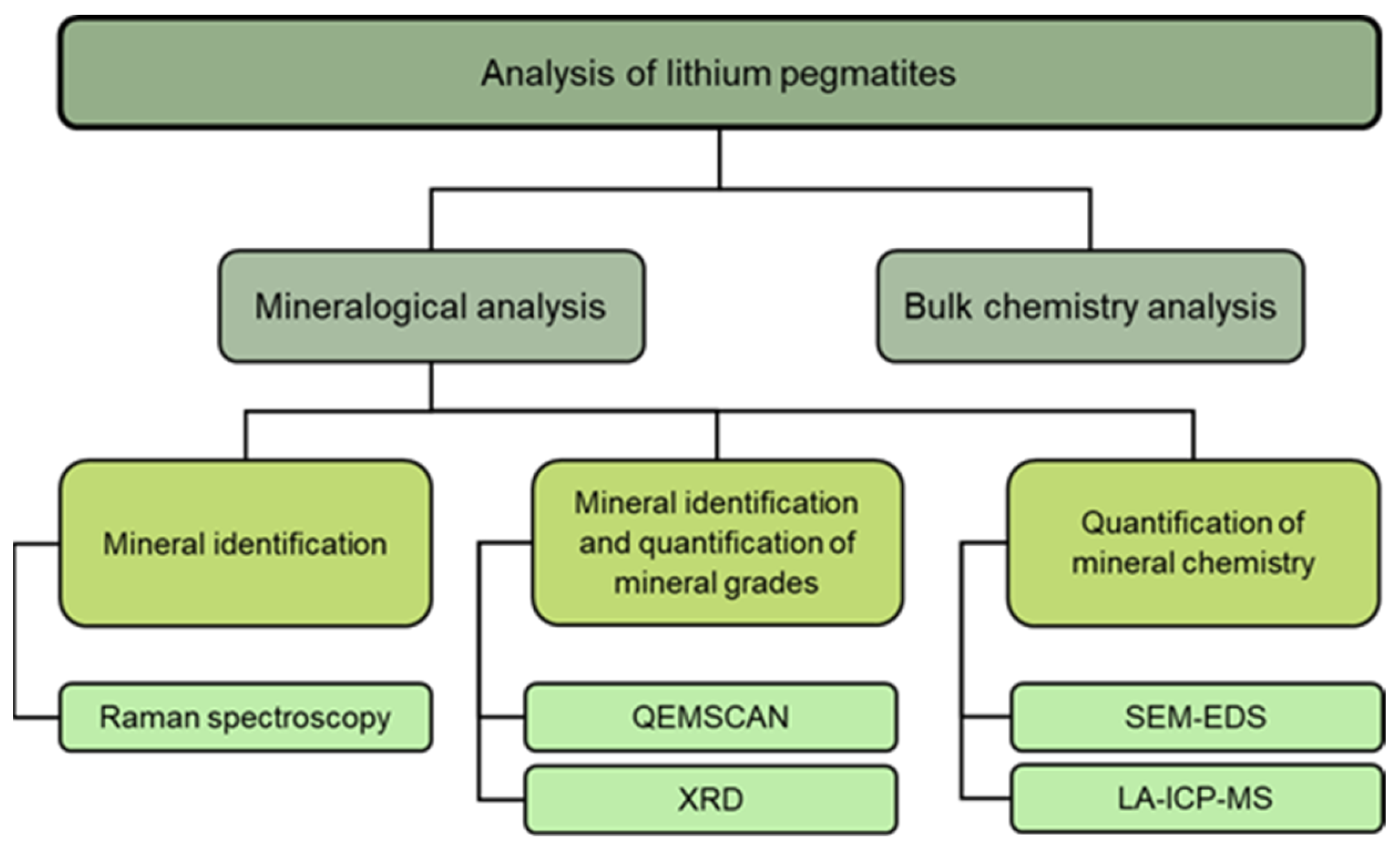
This study employed various analytical techniques for the characterisation of the lithium-bearing pegmatites as summarised in Figure 1: Raman spectroscopy, QEMSCAN, XRD, SEM-EDS, and LA-ICP-MS.
For analysis by QEMSCAN, vertical sections of the 33 samples were prepared to minimise the settling of dense particles. Preparation of vertical sections involves mixing each 4 g aliquot with carbon prior to placement in 30 mm moulds with resin. For each sample, two 30 mm blocks were made. QEMSCAN analysis was performed using a QEMSCAN 650F instrument (FEI, Eindhoven, The Netherlands) operating at 25 kV and 10 nA. Data processing was performed using iDiscover software™ (version 5.3). Despite its limitation to detect lithium, the presence of lithium-bearing minerals such as spodumene and cookeite were inferred by the expected elemental composition of these minerals. For spodumene specifically, the BSE grey level in addition to the Si/Al ratio was used for its classification. Mineralogical classification by QEMSCAN is constrained by particle-scale textural information and multi-element compositional rules and is therefore not derived directly from chemical assays.
Sample preparation for XRD analysis involved micronising each 4 g aliquot using a McCrone Micronising mill (Retsch, Johannesburg, South Africa) which allowed for size reduction of the sample with minimal damage to mineral crystal structure. XRD analysis was performed by XRD Analytical & Consulting (Pretoria, South Africa) using an Aeris benchtop diffractometer (Malvern Panalytical, Almelo, The Netherlands). Raw data received from XRD Analytical & Consulting was processed using the Bruker EVA software (version 3.0) for phase identification. Mineral phases were then quantified by Rietveld refinement using the Bruker TOPAS software (version 5).
Raman spectroscopy was used as a supplementary technique to positively identify the lithium-bearing minerals spodumene and cookeite, as identified by XRD and QEMSCAN. Analysis by Raman spectroscopy was performed on samples inferred to have lithium-bearing minerals such as spodumene, amblygonite, or cookeite by QEMSCAN and/or XRD. The analysis was performed using a WITec Alpha300 confocal Raman microscope (WITec, Ulm, Germany) for positive mineral identification. Each spectrum was acquired using the 50× objective lens with the 532 nm excitation laser module. Each spectrum was collected at 50 mW, with 15 accumulations per measurement and an accumulation time of 5 s. Measured spectrums were compared to reference spectrums on the RRUFF database (Figure S1).
SEM-EDS analysis was performed using a ZEISS EVO SEM (ZEISS, Oberkochen, Germany) to generate mineral chemistry information. Prepared thin sections were coated with a carbon coat of 15 microns. BSE images also provided qualitative textural information. The SEM-EDS analytical beam conditions for analysis were 20 kV accelerating voltage, −19.5 nA specimen current, 8.5 mm working distance, and 10 s counting times. For the standardisation of measured elements, the following mineral standards were used: Na (Jadeite), Si (Albite), Al (Gahnite), Sn (Tin), P (Apatite), Ca (Calcite), Mn (Rhodonite), K (Sanidine), and Mg (Periclase).
LA-ICP-MS was used to quantify the concentration of lithium in the relevant minerals. This analysis was performed on QEMSCAN mounts containing sufficiently large grains of cookeite and spodumene. LA-ICP-MS analysis was conducted using a RESOlution 193 nm excimer laser system (Resonetics, Australian Scientific Instruments, Canberra, Australia) in a mixed argon–helium atmosphere, with the ablated material transported to an iCAP RQ ICP-MS (Thermo Fisher Scientific, Johannesburg, South Africa) via argon carrier gas. The laser parameters included a 64 µm spot size, a 10 Hz repetition rate, and 4.7 J/cm2 energy, with each ablation lasting 30 s (on-peak) and 30 s (off-peak). An in-house reference material was prepared by fusing the AMIS0663 Pegmatite BR powdered standard into a glass disk using sodium tetraborate flux. XRF analysis confirmed its major elements and LA-ICP-MS determined a Li content of 2283 ppm, compared to 466 ppm Li in the NIST SRM 610 glass. Internal calibration was based on Si, using values from previous SEM measurements of the NIST610 glass. External calibration utilized both NIST SRM 610 and the AMIS0663 Pegmatite BR glass disk, with measurements taken every 20 unknown samples. Data processing was carried out using LadR software (version 1.1.07), with interferences corrected and calibrated against reference standards.
Before applying any EMC methods, confidence in the data was established by comparing the measured bulk chemistry with the back-calculated chemistry derived from mineral grade analysis using conventional techniques (Figure S2). The mineral grades determined by QEMSCAN were also validated by comparison with mineral grades determined by QXRD (Figure S3). Ensuring the validity and reliability of the mineral grade data is critical, as it forms the basis for the predictions generated by all EMC approaches.

2.3. Workflows for Predicting Mineral Grades

2.3.1. EMC Using the Mass Balance Approach

This method was implemented using the ‘solver’ function in Microsoft Excel. For calculation routine 1, each mineral was assigned an element for its grade calculation. Routines were set up to calculate minerals sequentially, accounting for the calculation of residual elements in each round. Elements can only be assigned to minerals once, making it difficult for such an approach to differentiate between minerals that share a similar chemistry and thus an overlap in the assigned element, i.e., cookeite and spodumene. Two different routines were designed and each routine calculated either spodumene or cookeite (Table 2), as specified. This means that the user must define which routine to apply, dependent on which lithium mineral is assumed to be present.
For calculation routine 2, mineral grades were calculated simultaneously and not in sequential calculation rounds, according to the Excel spreadsheet (“MINSQ”) methodology as described by Herrmann and Berry [35].

2.3.2. EMC Using the MLM Approach

This method was developed and implemented using Python (version 3.8.13), a programming language supported by non-proprietary, freely available software packages. In this study, Anaconda’s Jupyter Notebook (version 6.4.10) was used.
There are four main steps for implementing the workflow for the utilisation of machine learning algorithms for mineral grade predictions: (1) Data preparation, (2) Feature scaling, (3) Train–test split, and (4) Hyperparameter optimisation (Figure 2).
Data preparation involved importing the primary input dataset and ensuring that all loaded data is in the same unit of measurement. The primary input dataset comprised the bulk chemical assays, mineral chemistry, and mineral grades for the 33 bulk samples. The bulk assays and mineral chemistry were imported as elemental concentrations for each sample along with the relevant mineral chemistry. Accordingly, mineral grades used as target variables represent independently constrained mineralogical observations rather than direct transformations of the bulk chemical assays.
Step 2 of the workflow involved scaling the input features. Feature scaling was performed using the min-max scalar, transforming them to the range [0, 1] by Equation (2):
x = x x m i n x max X m i n
where x represents the scaled value, x is the original value, x m i n is the minimum value for the input feature, and x m a x is the maximum value for the input feature. Feature scaling scales all input features to the same scale and ensures that no single input feature has a disproportionate influence on the outcome of model predictions. This is particularly crucial for models like SVR, KNN and MLP, where the range of data can significantly impact model performance.
The dataset was split into training and testing sets in an 80:20 ratio. Xtrain and Ytrain represent the training data, while Xtest and Ytest represent the testing data. This ensures that the model is trained on one portion of the data and validated on a separate, unseen portion. For reproducibility, the random state was set to 42. A grid search was performed to optimise the hyperparameters for each regression model, which resulted in the listed hyperparameter grids for each model (Table 3). Tuning of the hyperparameters ensures that the optimal model with the lowest error and highest accuracy in predicting mineral grades from chemical assays is selected.

2.4. Evaluation of Accuracy and Predictive Uncertainty

The metrics used to evaluate the performance of the EMC approaches include the coefficient of determination (R2), the root mean squared error (RMSE), the mean absolute error (MAE), and the median absolute error (MAD). The R2 value served as the metric for evaluation of accuracy. The calculation and associated interpretations of these error evaluation metrics have been summarised in Table S1.
For evaluation of prediction uncertainty, 90% confidence intervals were calculated using the bootstrap residual analysis method [54], where the confidence interval represents the uncertainty in the model’s average prediction across all samples. Given the limited sample size typical of mineralogical datasets, bootstrapping was used to mitigate the effects of sparse data and incomplete distributional information, enabling a reliable, non-parametric assessment of prediction uncertainty. Further details on confidence interval calculation and implications are provided in Supplementary Material S2. Classification of calculated prediction uncertainty was based on, and adapted from, criteria as defined in Dominy et al. [12].

3. Results

3.1. Characterisation of Lithium Pegmatites

This section characterises the lithium pegmatites to establish their fundamental mineralogical and geochemical properties and to generate the relevant datasets required for the prediction of mineral grades (X), using measured mineral chemistry (A) and bulk geochemical data (b). Additionally, this section highlights important characteristics of the pegmatites in terms of their post-magmatic processes and how this has influenced the observed mineralogy, as this will provide insights into the applicability of the methodology to other ores with similar mineralogy.

3.1.1. Mineralogical and Textural Characteristics

The two pegmatite bodies examined in this study are primarily composed of quartz, albite, orthoclase, muscovite-phengite, and lithium-bearing minerals such as spodumene and cookeite, along with minor apatite, cassiterite, and Ta-Nb-bearing minerals [53]. These pegmatites feature large grain sizes, typical of this rock type, ranging from 10 to 100 mm. The mineralogical composition of the pegmatites examined in this study is similar to other pegmatites such as the Tanco pegmatite deposit in Canada [55] and the Greenbushes pegmatite deposit in Australia [56] which are classified as Lithium–caesium–tantalum (LCT) pegmatites where spodumene has also been identified as the dominant lithium-bearing mineral. However, the degree of alteration observed in this study suggests a highly evolved hydrothermal overprint [57]. Extensive hydrothermal alteration of these pegmatites is further supported by the presence of cookeite, a product of late-stage hydrothermal alteration [29].
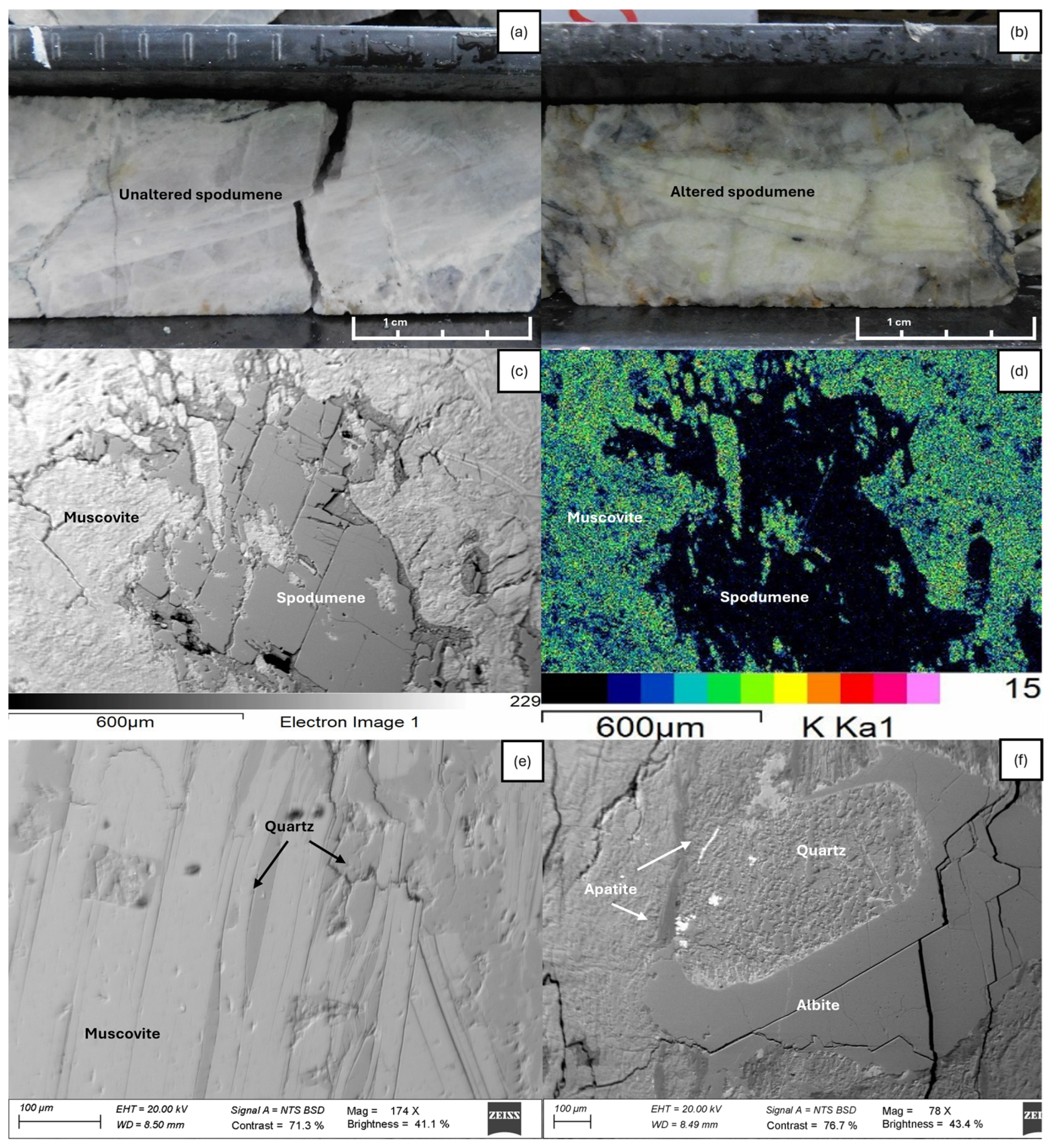
The hydrothermal overprint of these pegmatites is evidenced by the alteration of spodumene. The alteration of spodumene varies from relatively fresh to highly altered, as indicated by the colour transition from light grey for unaltered spodumene (Figure 3a) to light yellow for altered spodumene (Figure 3b). An increase in the degree of spodumene alteration was consistent with the decrease in the physical mineral hardness as determined by steel nail scratch-testing during core logging. As spodumene alters to muscovite, distinct lattice-like textures, replacement features, and intergrowths are observed, with muscovite often displaying relic spodumene grain shapes (Figure 3c). Alteration mostly occurs along the boundaries of spodumene grains, with some alteration occurring along spodumene cleavages and grain fractures (Figure 3c). Rapid SEM-EDS measurements along with the K wt.% elemental map (Figure 3d) positively identified the alteration product as muscovite (and not K-feldspar or lepidolite) due to its similar SiO2 and Al2O3 concentrations, which is typical of a muscovite composition.
The muscovite produced by spodumene alteration contrasts with the primary muscovite, which displays characteristic lath-like forms and occurs in association with quartz (Figure 3e). Other alteration textures observed include the alteration of albite which is marked by dissolution and reprecipitation textures as it is replaced by quartz (Figure 3f). Apatite, a primary accessory phase, is present as irregular crystal shapes in quartz and within veinlets throughout the samples (Figure 3f).
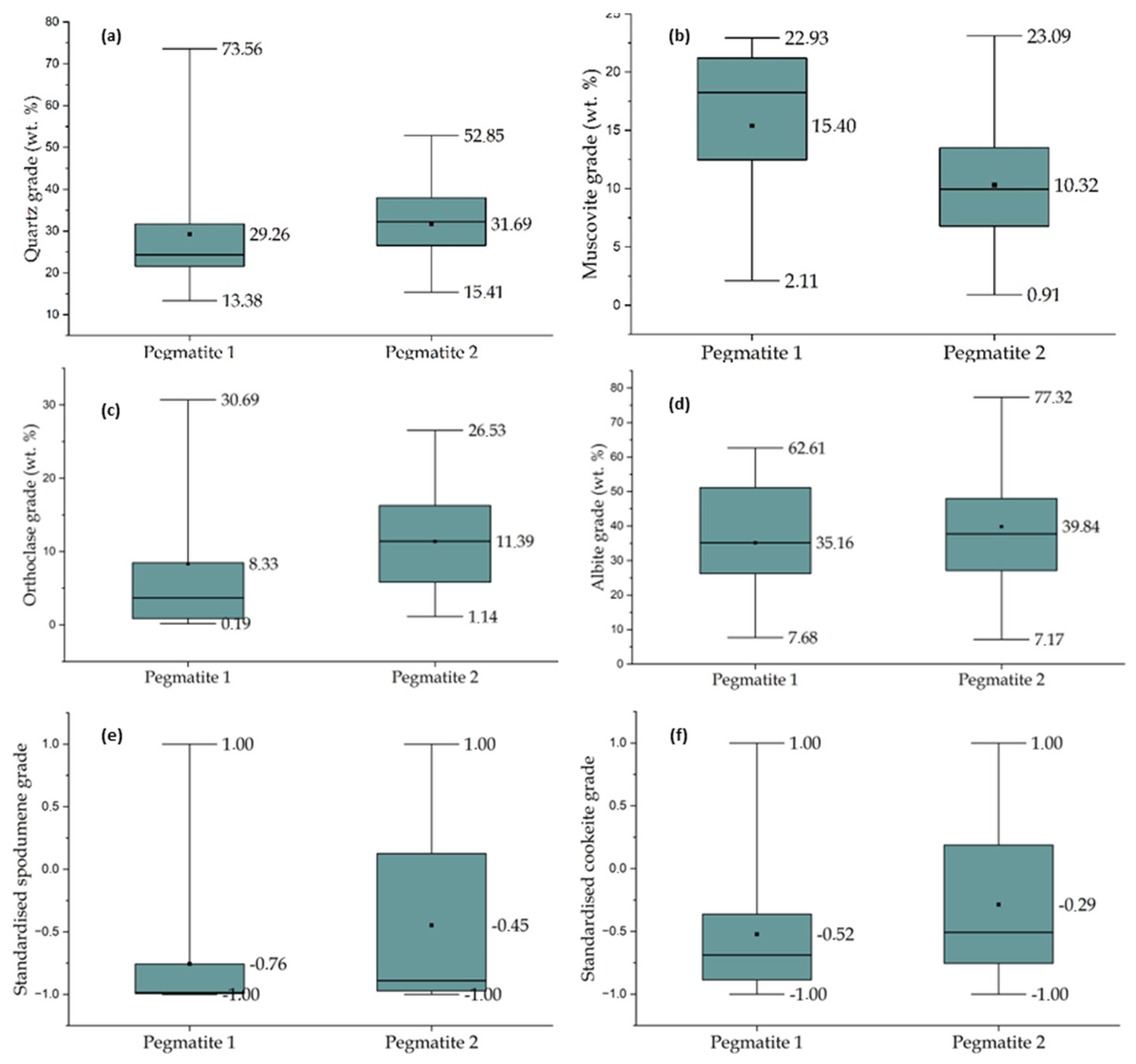
The main gangue mineral grades do not differ significantly between the two pegmatites. The pegmatite bodies showed similar average quartz grades of 29.3 wt.% for Pegmatite 1 and 31.7 wt.% for Pegmatite 2 (Figure 4a). Both pegmatites shared similar minimum quartz grade values (13.4 wt.% for Pegmatite 1, compared to 15.4 wt.% for Pegmatite 2). In comparison, Pegmatite 1 had a significantly higher maximum quartz grade value (73.6 wt.%), due to one sample being quartz dominated.
Notable differences in muscovite grade were observed between the pegmatites. Pegmatite 1 displayed greater variability and higher average muscovite grades, despite both pegmatites having similar minimum (~1%–2%) and maximum (~23%) values (Figure 4b). This may indicate more intense hydrothermal alteration in Pegmatite 1, where spodumene has been replaced by fine-grained muscovite.
In both pegmatites, albite is the dominant feldspar (Figure 4c,d). Average orthoclase grades were 8.3 wt.% in Pegmatite 1 and 11.4 wt.% in Pegmatite 2, compared to significantly higher albite contents of 35.2 wt.% and 39.8 wt.%, respectively. The prevalence of albite aligns with the highly fractionated nature of LCT pegmatites.
Lithium-bearing mineral grades were significantly lower than those of quartz, albite, orthoclase, and muscovite. Most samples contained either spodumene or cookeite as the primary lithium host, though some exhibited similar proportions of both. The presence of cookeite (a late-stage hydrothermal alteration product) supports the interpretation of hydrothermal overprinting in the analysed pegmatites. Pegmatite 2 contained higher average normalised grades of both cookeite and spodumene compared to Pegmatite 1 (Figure 4e,f). While cookeite typically forms through the alteration of spodumene [58], direct textural evidence of that transformation was not observed for the samples analysed in this study.

3.1.2. Mineral Chemistry

Mineral chemical analyses were performed on spodumene, cookeite, muscovite, orthoclase, and albite. The mineral chemistry measured for spodumene was close to its stoichiometric composition with measured averages of 64.1 wt.% SiO2, 27.4 wt.% Al2O3, and 7.1 wt.% Li2O (Table 4). The lithium concentration measured by LA-ICP-MS was slightly lower than the expected ideal concentration of 8.0 wt.%. Spodumene does not typically exhibit significant chemical variability [59] and where incorporations of Fe, Mn, or Ti occur, it is generally low and does not affect its overall chemistry. The analysed spodumene had low FeO concentrations (average of 0.1 wt.%), indicating minimal iron substitution in the crystal structure through the substitution of Fe for Al [60]. Variable FeO content of the analysed spodumene crystals may suggest variable fractionation and host rock interactions. The relatively low total oxide sum for spodumene (98.6 wt.% when accounting for the addition of measured Li2O) suggests microscopic inclusions of hydrous minerals [59]. There were two main hydrous phases identified within these pegmatites: cookeite and muscovite.
Cookeite was identified by SEM-EDS by its significantly lower K2O and higher Al2O3 compared to muscovite (Table 4). By LA-ICP-MS analysis, cookeite had a measured Li2O concentration of 3.2 wt.%, compared to a stoichiometric concentration of 2.9 wt.%.
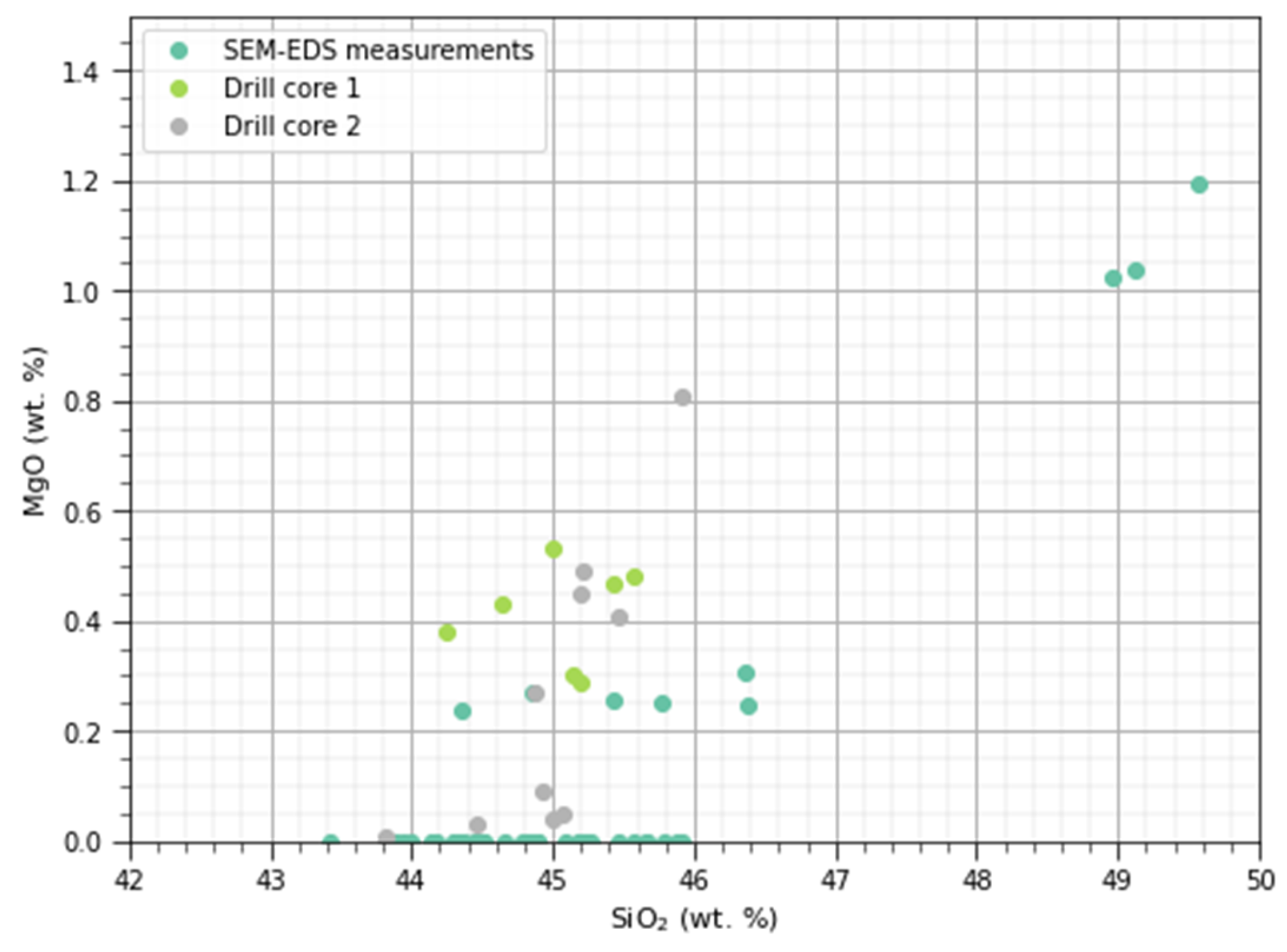
Muscovite showed fairly consistent SiO2, Al2O3, and K2O concentrations (Table 4). However, in terms of its MgO concentration, muscovite showed the most significant compositional variability of all analysed minerals. A standard deviation of 0.5%, compared to an average of 0.2 wt.% MgO (i.e., relative standard deviation over 200%) is indicative of the highly variable MgO contents of the measured muscovite (Figure 5). Most of the muscovite showed MgO concentrations of less than 1.5 wt.% (Figure 5), which is consistent with the highly evolved nature of LCT pegmatites. For example, research on the Carolina Lithium Prospect, USA reported muscovite with MgO concentrations below 1.1 wt.% [61].
Mineral chemistry analysis of the feldspars was consistent and did not show significant variability. From the analysis, the feldspars present are the two end-members: orthoclase (KAlSi3O8) and albite (NaAlSi3O8).

3.2. Prediction of Mineral Grades Using EMC

This section evaluates the results generated by the two EMC approaches, mass balance and MLM, according to the error and uncertainty metrics as described in Section 2.4. The limited sample size reflects the practical realities of mineralogical data acquisition—typical for early-stage geometallurgical studies. Consequently, the results presented here should be interpreted as a baseline against which model performance is expected to improve as additional data becomes available.

3.2.1. EMC Using the Mass Balance Approach

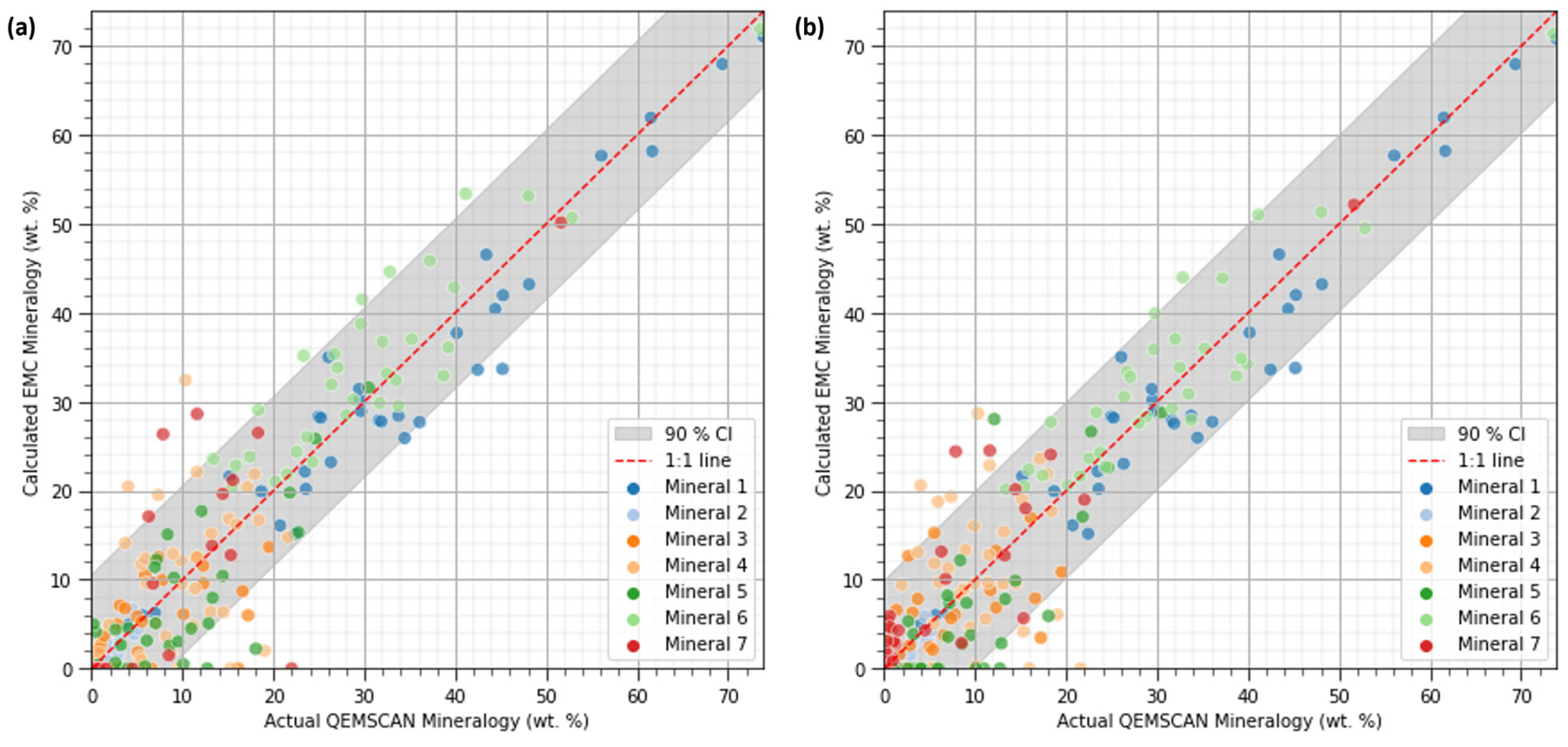
The main limitation of the first calculation routine of EMC as a mass balance approach was that the lithium minerals, spodumene and cookeite, could not be automatically differentiated on account of having the same element assignment. Overall, the first calculation routine produced reasonably good results. Although an impressive R2 of 0.859 was achieved, it had a high RMSE of 5.745 (Table 5), suggesting notable differences between the actual mineral grades and the calculated mineral grades (Figure 6a). This routine of the mass balance approach showed high degrees of prediction certainty, with 90.48% of the data falling within the 90% confidence interval.
EMC mass balance routine 2 produced similar results to routine 1 (Figure 6b). The main advantage of this calculation routine was that cookeite and spodumene were automatically differentiated in the simultaneous solution of mineral grades. However, when constraints are not explicitly defined, as in the setup of calculation rounds in Routine 1, the developed solution inherently assigns greater weight to minerals with higher variance, which represents a notable limitation of this approach. For example, this calculation routine produced 0 wt.% orthoclase for some samples where orthoclase was known to be present. This was particularly the case for samples where muscovite was the dominant potassium-bearing phase, which shares significant chemical overlap with orthoclase. Despite this noted limitation, this calculation routine produced slightly improved results from calculation routine 1, with an R2 of 0.867 and an RMSE of 5.588 (Table 6). Furthermore, 90.04% of the data was predicted with 90% certainty (Table 5) (Figure 6b).

3.2.2. EMC Using the MLM Approach

This section evaluates the performance of eight machine learning algorithms tested in the MLM approach to predict mineral grades based on chemical assays. The performance of each model is summarised in Table 6.
The comparative analysis of tree-based models (Random Forest, Extra Trees, AdaBoost, and Gradient Boosting) showed distinct differences in their capacity to generalise beyond the training data. These models demonstrated strong performance during model training. However, their testing results indicated varying degrees of overfitting.
Among the tree-based models, Random Forest achieved the most balanced results, despite an overall decline in performance. The model showed a good training fit (RMSE = 2.923; R2 = 0.835) and moderate generalisation (testing RMSE = 5.815; R2 = 0.481). The similar training and testing MAD values (1.196 and 3.564) further indicate consistent predictive behaviour.
Extra Trees regression showed strong training performance with an RMSE of 0.000 and R2 of 1.000, indicating a perfectly fitted model. However, on the testing set, the RMSE increases to 6.604 and the R2 decreases significantly to 0.345, suggesting strong overfitting. The MAD values of 0.000 (training) and 4.658 (testing) further points to the model’s difficulty in generalising to unseen data.
AdaBoost and Gradient Boosting achieved near-perfect performance on the training data (R2 = 0.974 and 1.000, respectively) but experienced declines in the testing dataset performance (R2 = 0.425 and 0.536, respectively). There was a notable increase in the training to testing RMSE values for both models: 1.053 to 5.811 for the AdaBoost model and 0.048 to 4.998 for the Gradient Boosting model. The MAD values also reflect this difference in training and testing performance, with 0.632 (training) and 3.743 (testing) for the AdaBoost model and 0.013 (training) and 2.714 (testing) for the Gradient Boosting model.
The KNN model served as a non-ensemble baseline method and consistently underperformed relative to the tree-based methods. The KNN model performed poorly with a training RMSE of 4.829 and a high testing RMSE of 6.184. Its lower R2 scores (0.541 for training; 0.376 for testing) are likely due to its reliance on local proximity rather than learning global data structures. KNN models may struggle with generalisation, particularly with high dimensional data or when the data distribution is complex [63].
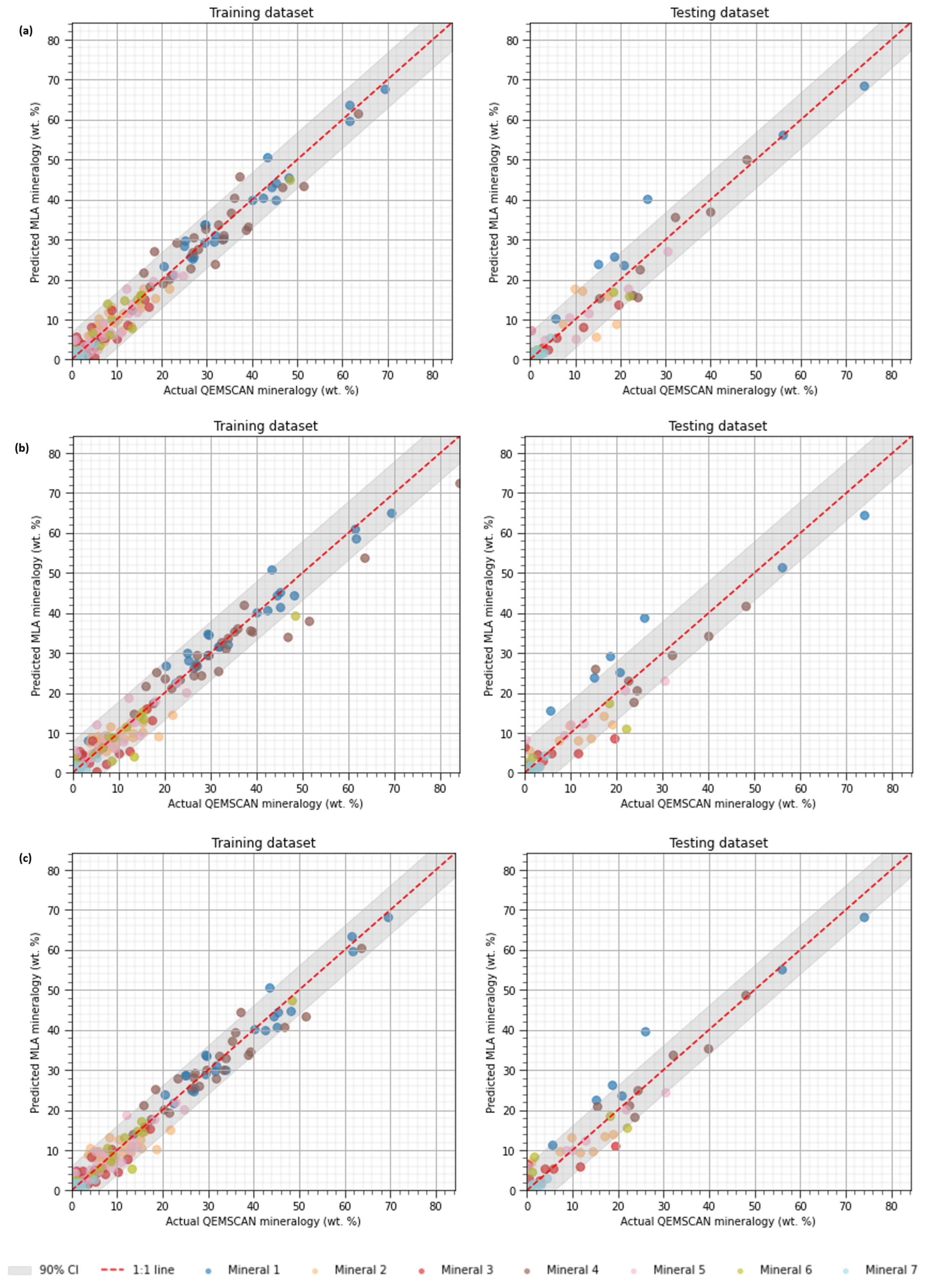
Of the eight algorithms applied for the predictive modelling of mineral grades, three had the best performance overall with a R2 > 0.6 for both the training and testing sets: Linear Regression, SVR, and MLP. The results generated by these models are indicated in parity plots, comparing the actual mineral grades to the predicted mineral grades (Figure 7).
Linear Regression was the only parametric model applied in this study and was used as a baseline benchmark to contextualise the performance of more complex non-linear models. It is interesting to note that it was one of the best-performing models (Figure 7a). As a simpler model, it showed decent performance with a training RMSE of 2.601 and R2 of 0.804, indicating that the model captures the general trends in the training data. While it was able to capture some linear trends, it failed to model more complex relationships in the mineralogical data, as indicated by its prediction performance to unseen data (testing R2 of 0.612 and RMSE of 4.206). Although the model’s predictive capability declined on unseen data, the MAD values only rose from 1.770 (training) to 2.967 (testing), indicating relatively stable performance.
Among the evaluated non-parametric algorithms, Support Vector Regression (SVR) and Multi-Layer Perceptron (MLP) demonstrated the strongest generalisation capabilities, achieving the highest testing R2 scores and the lowest associated error metrics. SVR shows good performance (Figure 7b), particularly in the training set, with an RMSE of 3.087 and R2 of 0.754, indicating that the model can fit the training data well (Figure 7b). The testing set performance, with an RMSE of 4.913 and R2 of 0.618, shows that SVR generalises reasonably well, but there is a performance drop-off. The MAD values of 1.286 (training) and 3.538 (testing) show some variability in predictions, but the ability of SVR to handle non-linear relationships is evident.
The MLP model showed strong performance, especially on the training set, where the RMSE is 2.576 and the R2 value is 0.762, indicating a decent fit. On the testing set, the model’s performance drops slightly, with an RMSE of 3.916 and R2 of 0.691. This discrepancy between training and testing datasets suggests that while MLP generalizes reasonably well, some overfitting is present. Notably, the MAD only increased from 1.561 to 2.309, suggesting strong consistency in its predictions.
Furthermore, in terms of prediction certainty, the top three performing algorithms had only ~82% of their testing data fall within the calculated 90% confidence interval (Table 7), indicating substantial residual error and uncertainty.

4. Discussion

The mass balance approach achieved comparatively higher R2 values, but is methodologically rigid and only works well for deposits with a simple mineral assemblage. For application of the mass balance approach, a deposit is considered to have a simple mineral assemblage when elements can be uniquely assigned to minerals for their grade calculation, posing a major limitation of this approach. For the addressed deposit, calculation routine 1 had limited applicability on account of multiple lithium minerals being present—a result of the hydrothermal alteration of these pegmatites. When there is significant chemical overlap between minerals, reliably distinguishing between them becomes challenging. In this study, quantifying the individual grades of the lithium-bearing phases (spodumene and cookeite) was essential due to their different properties and processing responses. Spodumene is primarily beneficiated by dense media separation [64], while leaching is used for cookeite [65]. The sequential element assignment approach used was unable to distinguish between cookeite and spodumene, highlighting a key limitation of the developed EMC routines for calculation routine 1. Mg was used to calculate muscovite grades based on a fixed average composition applied uniformly across all samples. However, the significant variability in Mg content within muscovite may have compromised the accuracy of these calculations, as the fixed composition did not reflect the true compositional diversity observed in the samples. However, the assignment of Mg for the calculation of muscovite grades is what ensured its differentiation from orthoclase, with which it shares significant chemical overlap. Routine 2 of the mass balance approach (in which mineral grades were solved simultaneously with no specification of calculation rounds) was able to automatically differentiate between lithium-bearing phases, but assigned more significance to minerals with a higher degree of variance. This was evidenced by some samples reporting to have zero orthoclase when dominated by muscovite as the K-bearing phases, where orthoclase was known to be present.
Conversely, the MLM approach was able to differentiate between the two lithium-bearing phases (compared to mass balance routine 1) and proved more adaptable in handling the compositional nuances associated with alteration of lithium-bearing pegmatites for the limited samples addressed in this study. The inclusion of more complex models, in addition to Linear Regression (which served as the baseline), was to assess the potential value added in the presence of elemental overlap among mineral phases. Tree-based methods were prone to overfitting and demonstrated imbalanced performance, as evidenced by their strong performance during model training contrasting with a notable decline in their performance during model testing. This disparity between the training and testing performance of these models indicates substantial overfitting, where the models likely captured noise and overly specific patterns in the training set that do not transfer well to unseen data. Noise sensitivity is known as a key related issue of AdaBoost algorithm. Previous works have shown that AdaBoost is prone to overfitting in dealing with noisy datasets [48]. The observed overfitting for several ensemble methods under data-limited conditions highlights the importance of interpreting high training accuracy with caution in small mineralogical datasets. As a non-ensemble method, KNN’s poor performance could be attributed to its reliance on local proximity rather than learning global data structures, as well as its generalisation limitations when presented with high dimensionality data with complex distributions.
Linear Regression, SVR, and MLP delivered the most balanced performance of the eight algorithms tested, with R2 values exceeding 0.6 on both training and testing datasets. Linear Regression, as a parametric method, is useful for baseline modelling and interpretability in geosciences, but may underperform where non-linear patterns dominate in the dataset. SVR, particularly when coupled with a radial basis function (RBF) kernel, excels at modelling high-dimensional, non-linear patterns through its margin-based optimisation and embedded regularisation, which mitigate overfitting even in the presence of noisy data. Similarly, the MLP model, which consists of interconnected layers of neurons with non-linear activation functions, can learn intricate dependencies and feature interactions—capabilities essential for accurately modelling mineralogical phenomena driven by multivariate geochemical processes [66]. The balanced performance of SVR and MLP, therefore, underscores their robustness and adaptability in domains characterised by complex feature spaces and non-linear interdependencies, making them particularly well-suited for applications in mineral grade prediction. Thus, these algorithms were able to capture the subtle compositional variation arising from pegmatite evolution and overprint by hydrothermal alteration. For example, the alteration of spodumene to cookeite produces complexities that are effectively captured by data-driven methods.
Given the results obtained from the MLM approach and its demonstrated ability to accommodate elemental overlap between minerals, particularly by distinguishing between lithium-bearing phases, the utility of the mass balance approach (routine 1) for generating mineral grade information may be called into question. While mass balance techniques are less adaptable and offer lower resolution in mineral grade estimation, they remain valuable for simpler mineral assemblages or as a preliminary screening tool, particularly due to their minimal computational requirements. A further comparative advantage of the MLM approach is its adaptability: hyperparameter tuning could be applied to observe differences in the predicted grades whereas the mass balance approach (routine 1) would require setting up entirely different routines and re-applying them to the dataset to effectively evaluate how the change in routine design would affect the overall result.
According to the data accuracy requirements for various stages of the life of a mine, as described by Dominy et al. [12], the mass balance approach had sufficiently high calculated R2 values (with 0.859 and 0.867 for routines 1 and 2) and low associated prediction uncertainty, suggesting that the outputs generated by this approach are applicable for the feasibility and operational stages of a mine (Table 8). However, a notable limitation of this approach is its applicability to deposits with simple mineral assemblages.
The mineral grades estimated from the more adaptable MLM approach may be applicable to the scoping and pre-feasibility stages of the Mine Value Chain on account of its calculated error metrics and prediction uncertainty. A notable advantage of this approach is its ability to accommodate for high mineralogical variability and the more efficient adaptability of the methodology when compared to setting up calculation rounds as in EMC mass balance routine 1.

5. Conclusions and Recommendations

This study presented a prototype evaluation of EMC under data-limited conditions (typical of early-stage geometallurgical studies) and demonstrated that predictive models for minerals grades in lithium-bearing pegmatites can be effectively developed by integrating chemical assays and mineralogical data. The developed workflow significantly reducing the time and cost associated with traditional methods such as automated SEM-EDS (QEMSCAN) and XRD. The characterisation of the two geographically proximate lithium-bearing pegmatites indicated extensive alteration, as evidenced by the presence of cookeite and the alteration of spodumene to muscovite.
Two primary approaches were examined in implementing EMC: mass balance techniques and a suite of machine learning algorithms. While the mass balance approach achieved respectable R2 values exceeding 0.8, lithium-bearing phases (spodumene and cookeite) could not be automatically differentiated in calculation routine 1 in which elements are sequentially assigned to minerals for their calculation. This points to a notable limitation of this approach: the number of elements limits the number of minerals that can be calculated. Although calculation routine 2 was not characterised by this limitation, its statistical limitations, as amplified by the lack of user-defined calculation rounds and calculation constraints, should be carefully considered.
Conversely, the MLM approach proved more adaptable in handling the compositional nuances associated with the alteration of these lithium-bearing pegmatites, as evidenced by its comparatively lower error evaluation metrics. The overall adaptability of this approach suggests it may be more widely applicable to other deposits with complex mineral assemblages, subject to adequate data volumes and validation. Of the eight machine algorithms tested, three models produced R2 values exceeding 0.6: Linear Regression, SVR, and MLP. The MLP model had the best predictive performance overall with the highest R2 values (0.762 and 0.691, for training and testing, respectively) and, being classified as a non-parametric model, like SVR, is advantageous in modelling complex, non-linear patterns often inherent to geological and mineralogical data.
The performance of models in the MLM approach would benefit from expanded datasets, not only in terms of increasing the number of samples but also the incorporation of multi-scale analyses (e.g., grain size distribution, liberation, etc.) to improve mineralogical representativeness and reduce model uncertainty. Furthermore, hyperparameter tuning is recommended to refine predictive accuracy and mitigate overfitting. The convergence of bulk chemical assays and advanced analytical techniques constitutes a robust and efficient strategy for quantifying mineral grades in lithium pegmatites. These predictive models hold considerable promise in guiding geometallurgical decisions by increasing ore body knowledge based on readily available chemical assay data. This may allow stakeholders to anticipate metallurgical challenges due to mineralogical variability and reduce uncertainties in mine design.
Future work will investigate the application of Global Sensitivity Analysis to better quantify the influence of interacting geochemical variables on model predictions and to further improve the robustness of machine learning models as larger datasets become available.

Supplementary Materials

The following supporting information can be downloaded at: https://www.mdpi.com/article/10.3390/min16020139/s1, Supplementary Material S1: Figure S1: Line plot confirming the presence of spodumene using Raman spectroscopy for a selected QEMSCAN sample block; Figure S2: Parity plot illustrating the back-calculated QEMSCAN bulk chemistry vs. measured bulk chemistry for validation of QEMSCAN mineral grades; Figure S3: Parity plot for comparison of mineral grades determined by XRD and QEMSCAN, illustrating the agreement between the two analytical techniques; Table S1: Summary of calculation and interpretation of error evaluation metrics used to assess model performance; Supplementary Material S2: Mathematical background for calculation of 90% confidence intervals using Bootstrap Residual Analysis.

Author Contributions

I.C.: methodology, formal analysis, writing—original draft and revision, data curation; S.B.: methodology, writing—review and editing; M.B.: conceptualisation, formal analysis, writing—review and editing; G.N.: conceptualisation, methodology, formal analysis, writing—review and editing. All authors have read and agreed to the published version of the manuscript.

Funding

This work is based on research supported in part by the National Research Foundation of South Africa (Grant UID 140996).

Data Availability Statement

The datasets presented in this article are not readily available because of confidentiality constraints by a third-party mining company. As future work, the authors will explore the publication of synthetic datasets that preserve key statistical and compositional characteristics to facilitate broader methodological benchmarking. Further inquiries can be directed to the corresponding author.

Acknowledgments

The support of the collaborative mining company is acknowledged for providing access to their drilling database as well as hosting the authors on-site in developing a greater understanding of the physical ore characteristics, both through field visits and observation of drill cores. Furthermore, the authors also acknowledge that any opinions, findings, and conclusions or recommendations expressed in this publication are those of the authors only.

Conflicts of Interest

The authors declare no conflict of interest.

Abbreviations

The following abbreviations are used in this manuscript:
AMICSAutomated Mineral Identification and Classification System
EDSEnergy dispersive x-ray spectroscopy
EMCElement to mineral conversion
ICP-OESInductively Coupled Plasma Optical Emission Spectrometry
KNNK nearest neighbour
LA-ICP-MSLaser Ablation Inductively Coupled Plasma Mass Spectrometry
LCTLithium–caesium–tantalum
MADMedian absolute error
MAEMean absolute error
MLAMineral Liberation Analysis
MLMMachine learning methods
MLPMulti-Layer Perceptron
QEMSCANQuantitative Evaluation of Minerals by Scanning Electron Microscopy
QXRDQuantitative X-ray Diffraction
RMSERoot mean squared error
SEMScanning electron microscopy
SVRSupport Vector Regression
TIMA-XTESCAN Integrated Mineral Analyser
XRFX-ray fluorescence

References

  1. Crabtree, G. The Coming Electric Vehicle Transformation: A Future Electric Transportation Market Will Depend on Battery Innovation. Science 2019, 366, 422–424. [Google Scholar] [CrossRef]
  2. Masias, A.; Marcicki, J.; Paxton, W.A. Opportunities and Challenges of Lithium Ion Batteries in Automotive Applications. ACS Energy Lett. 2021, 6, 621–630. [Google Scholar] [CrossRef]
  3. Diouf, B.; Pode, R. Potential of Lithium-Ion Batteries in Renewable Energy. Renew. Energy 2015, 76, 375–380. [Google Scholar] [CrossRef]
  4. Demuesy, B. Development of a Process for the Recovery of Tin, Niobium and Tantalum from Unconventional Lithium Deposits: A Case Study on the Beauvoir Granite (Allier, France). Ph.D. Thesis, University of Lorraine, Nancy, France, 2025. [Google Scholar]
  5. Benson, T.R.; Coble, M.A.; Dilles, J.H. Hydrothermal Enrichment of Lithium in Intracaldera Illite-Bearing Claystones. Sci. Adv. 2023, 9, eadh8183. [Google Scholar] [CrossRef] [PubMed]
  6. Kavanagh, L.; Keohane, J.; Cabellos, G.G.; Lloyd, A.; Cleary, J. Global Lithium Sources-Industrial Use and Future in the Electric Vehicle Industry: A Review. Resources 2018, 7, 57. [Google Scholar] [CrossRef]
  7. Heredia, F.; Martinez, A.L.; Surraco Urtubey, V. The Importance of Lithium for Achieving a Low-Carbon Future: Overview of the Lithium Extraction in the ‘Lithium Triangle’. J. Energy Nat. Resour. Law 2020, 38, 213–236. [Google Scholar] [CrossRef]
  8. Goodenough, K.M.; Shaw, R.A.; Borst, A.M.; Nex, P.A.M.; Kinnaird, J.A.; van Lichtervelde, M.; Essaifi, A.; Koopmans, L.; Deady, E.A. Lithium Pegmatites in Africa: A Review. Econ. Geol. 2025, 120, 513–539. [Google Scholar] [CrossRef]
  9. Mudd, G.M. An Analysis of Historic Production Trends in Australian Base Metal Mining. Ore Geol. Rev. 2007, 32, 227–261. [Google Scholar] [CrossRef]
  10. Lishchuk, V.; Pettersson, M. The Mechanisms of Decision-Making When Applying Geometallurgical Approach to the Mining Industry. Miner. Econ. 2021, 34, 71–80. [Google Scholar] [CrossRef]
  11. Mu, Y.; Salas, J.C. Data-Driven Synthesis of a Geometallurgical Model for a Copper Deposit. Processes 2023, 11, 1775. [Google Scholar] [CrossRef]
  12. Dominy, S.C.; O’connor, L.; Parbhakar-Fox, A.; Glass, H.J.; Purevgerel, S. Geometallurgy—A Route to More Resilient Mine Operations. Minerals 2018, 8, 560. [Google Scholar] [CrossRef]
  13. Fandrich, R.; Gu, Y.; Burrows, D.; Moeller, K. Modern SEM-Based Mineral Liberation Analysis. Int. J. Min. Process. 2007, 84, 310–320. [Google Scholar] [CrossRef]
  14. Bicak, O. A Technique to Determine Ore Variability in a Sulphide Ore. Miner. Eng. 2019, 142, 105927. [Google Scholar] [CrossRef]
  15. Michaux, S.; O’connor, L. How to Set Up and Develop a Geometallurgical Program; Geological Survey of Finland: Espoo, Finland, 2020.
  16. Lotter, N.O.; Baum, W.; Reeves, S.; Arrué, C.; Bradshaw, D.J. The Business Value of Best Practice Process Mineralogy. Min. Eng. 2018, 116, 226–238. [Google Scholar] [CrossRef]
  17. da Silva, G.F.; Ferreira, M.V.; Costa, I.S.L.; Bernardes, R.B.; Mota, C.E.M.; Cuadros Jiménez, F.A. Qmin—A Machine Learning-Based Application for Processing and Analysis of Mineral Chemistry Data. Comput. Geosci. 2021, 157, 104949. [Google Scholar] [CrossRef]
  18. Ingersoll, R.V.; Bullard, T.F.; Ford, R.L.; Grimm, J.P.; Pickle, J.D.; Sares, S.W. The Effect of Grain Size on Detrital Models: A Test of the Gazz-Dickinson Point-Counting Method 1. J. Sediment. Petrol. 1984, 54, 103–116. [Google Scholar]
  19. Nirasawa, M.; Minato, Y.; Yagishita, K. Two Point-Counting Methods for Modal Analyses of Holocene Sands: Their Comparison and Evaluation. J. Sedimentol. Soc. Jpn. 1998, 48, 85–93. [Google Scholar] [CrossRef]
  20. Gottlieb, P.; Wilkie, G.; Sutherland, D.; Ho-Tun, E.; Suthers, S.; Perera, K.; Jenkins, B.; Spencer, S.; Butcher, A.; Rayner, J. Using Quantitative Electron Microscopy for Process Mineralogy Applications. J. Miner. Met. Mater. Soc. 2000, 52, 24–25. [Google Scholar] [CrossRef]
  21. Guanira, K.; Valente, T.M.; Ríos, C.A.; Castellanos, O.M.; Salazar, L.; Lattanzi, D.; Jaime, P. Methodological Approach for Mineralogical Characterization of Tailings from a Cu(Au,Ag) Skarn Type Deposit Using QEMSCAN (Quantitative Evaluation of Minerals by Scanning Electron Microscopy). J. Geochem. Explor. 2020, 209, 106439. [Google Scholar] [CrossRef]
  22. Pownceby, M.I.; MacRae, C.M.; Wilson, N.C. Mineral Characterisation by EPMA Mapping. Min. Eng. 2007, 20, 444–451. [Google Scholar] [CrossRef]
  23. Bunaciu, A.A.; Udriştioiu, E.G.; Aboul-Enein, H.Y. X-Ray Diffraction: Instrumentation and Applications. Crit. Rev. Anal. Chem. 2015, 45, 289–299. [Google Scholar] [CrossRef]
  24. Berry, R.; Hunt, J.; McKnight, S. Estimating Mineralogy in Bulk Samples. In Proceedings of the The First AUSIMM International Geometallurgy Conference, Brisbane, Australia, 5–7 September 2011. [Google Scholar]
  25. Mulwanda, J. Extraction of Lithium from Lepidolite and Spodumene. Ph.D. Thesis, Murdoch University, Murdoch, Australia, 2021. [Google Scholar]
  26. Fosu, A.Y.; Kanari, N.; Bartier, D.; Hodge, H.; Vaughan, J.; Chagnes, A. Physico-Chemical Characteristics of Spodumene Concentrate and Its Thermal Transformations. Materials 2021, 14, 7423. [Google Scholar] [CrossRef] [PubMed]
  27. Guimarães, D.; Monteiro, C.; Teixeira, J.; Lopes, T.; Capela, D.; Dias, F.; Lima, A.; Jorge, P.A.; Silva, N.A. Unsupervised and interpretable discrimination of lithium-bearing minerals with Raman spectroscopy imaging. Heliyon 2024, 10, e35632. [Google Scholar] [CrossRef] [PubMed]
  28. Perring, S.; Brand, N. Rapid Field Identification of LCT Pegmatite Mineralogy: Application of Portable Raman Spectroscopy. ASEG Ext. Abstr. 2019, 2019, 1–3. [Google Scholar] [CrossRef]
  29. Ding, X.; Li, J.; Chou, I.M.; Chen, Z.; Li, S. Raman Spectroscopic Identification of Cookeite in the Crystal-Rich Inclusions in Spodumene from the Jiajika Lithium Pegmatite Deposit, China, and Its Geological Implications. Eur. J. Mineral. 2020, 32, 67–75. [Google Scholar] [CrossRef]
  30. Sindern, S. Analysis of Rare Earth Elements in Rock and Mineral Samples by ICP-MS and LA-ICP-MS. Phys. Sci. Rev. 2017, 2, 20160066. [Google Scholar] [CrossRef]
  31. Lichtervelde, M.; Grégoire, M.; Linnen, R.L.; Béziat, D.; Salvi, S. Trace Element Geochemistry by Laser Ablation ICP-MS of Micas Associated with Ta Mineralization in the Tanco Pegmatite, Manitoba, Canada. Contrib. Mineral. Petrol. 2008, 155, 791–806. [Google Scholar] [CrossRef]
  32. Breiter, K.; Vaňková, M.; Galiová, M.V.; Korbelová, Z.; Kanický, V. Lithium and Trace-Element Concentrations in Trioctahedral Micas from Granites of Different Geochemical Types Measured via Laser Ablation ICP-MS. Mineral. Mag. 2017, 81, 15–33. [Google Scholar] [CrossRef]
  33. Whiten, B. Calculation of Mineral Composition from Chemical Assays. Miner. Process. Extr. Metall. Rev. 2008, 29, 83–97. [Google Scholar] [CrossRef]
  34. Silva, C.M.; Sørensen, B.E.; Aasly, K.; Ellefmo, S.L. Geometallurgical Approach to the Element-to-Mineral Conversion for the Nabbaren Nepheline Syenite Deposit. Minerals 2018, 8, 325. [Google Scholar] [CrossRef]
  35. Herrmann, W.; Berry, R.F. MINSQ-a Least Squares Spreadsheet Method for Calculating Mineral Proportions from Whole Rock Major Element Analyses. Geochem. Explor. Environ. Anal. 2002, 2, 361–368. [Google Scholar]
  36. Ji, S.; Huang, F.; Wang, S.; Gupta, P.; Seyfried, W.; Zhang, H.; Chu, X.; Cao, W.; Zhou, J.Z. Identifying Serpentine Minerals by Their Chemical Compositions with Machine Learning. Am. Mineral. 2024, 109, 315–324. [Google Scholar] [CrossRef]
  37. Kalashnikov, A.O.; Pakhomovsky, Y.A.; Bazai, A.V.; Mikhailova, J.A.; Konopleva, N.G. Rock-Chemistry-to-Mineral-Properties Conversion: Machine Learning Approach. Ore Geol. Rev. 2021, 136, 104292. [Google Scholar] [CrossRef]
  38. Wang, L.; Su, C.; Wang, L.Q.; Zhang Zhou, J.; Xia, Q.K.; Wang, Q.Y. Refined Estimation of Li in Mica by a Machine Learning Method. Am. Mineral. 2022, 107, 1034–1044. [Google Scholar] [CrossRef]
  39. Koch, P.H.; Lund, C.; Rosenkranz, J. Automated Drill Core Mineralogical Characterization Method for Texture Classification and Modal Mineralogy Estimation for Geometallurgy. Min. Eng. 2019, 136, 99–109. [Google Scholar] [CrossRef]
  40. Barker, R.D.; Barker, S.L.L.; Cracknell, M.J.; Stock, E.D.; Holmes, G. Quantitative Mineral Mapping of Drill Core Surfaces II: Long-Wave Infrared Mineral Characterization Using ΜXRF and Machine Learning. Econ. Geol. 2021, 116, 821–836. [Google Scholar] [CrossRef]
  41. Battalgazy, N.; Valenta, R.; Gow, P.; Spier, C.; Forbes, G. Addressing Geological Challenges in Mineral Resource Estimation: A Comparative Study of Deep Learning and Traditional Techniques. Minerals 2023, 13, 982. [Google Scholar] [CrossRef]
  42. Blannin, R.; Frenzel, M.; Gutzmer, J.; Dresden-Rossendorf, H.-Z. Predictive Modelling of Mineralogical and Textural Properties of Tailings Using Geochemical Data. In Proceedings of the 16th SGA Biennial Meeting, Rotorua, New Zealand, 28–31 May 2022. [Google Scholar]
  43. Price, W.; Molifie, A.; Pillay, K.; Moses, K.; Lipton, I.; Greenhill, P.; Torres, L.; Spathelf, P.; Becker, M. Modelling Sphalerite Mineral Chemistry—Towards a Geometallurgical Model for Gamsberg North. In Proceedings of the Geometallurgy Conference 2023, Stellenbosch, South Africa, 5–6 September; The Southern African Institute of Mining and Metallurgy: Stellebosch, South Africa, 2023. [Google Scholar]
  44. Mena Silva, C.A.; Ellefmo, S.L.; Sandøy, R.; Sørensen, B.E.; Aasly, K. A Neural Network Approach for Spatial Variation Assessment—A Nepheline Syenite Case Study. Miner. Eng. 2020, 149, 106178. [Google Scholar] [CrossRef]
  45. Fernández-Delgado, M.; Sirsat, M.S.; Cernadas, E.; Alawadi, S.; Barro, S.; Febrero-Bande, M. An Extensive Experimental Survey of Regression Methods. Neural Netw. 2019, 111, 11–34. [Google Scholar] [CrossRef]
  46. Jadhav, P.; Patil, V.; Gore, S. A Comparative Study of Linear Regression and Regression Tree. SSRN Electron. J. 2020. [Google Scholar] [CrossRef]
  47. Breiman, L. Random Forests. Mach. Learn. 2001, 45, 5–32. [Google Scholar] [CrossRef]
  48. Cao, J.; Kwong, S.; Wang, R. A Noise-Detection Based AdaBoost Algorithm for Mislabeled Data. Pattern Recognit. 2012, 45, 4451–4465. [Google Scholar] [CrossRef]
  49. Tsirikoglou, P.; Abraham, S.; Contino, F.; Lacor, C.; Ghorbaniasl, G. A Hyperparameters Selection Technique for Support Vector Regression Models. Appl. Soft Comput. J. 2017, 61, 139–148. [Google Scholar] [CrossRef]
  50. Sifaou, H.; Kammoun, A.; Alouini, M.-S. A Precise Performance Analysis of Support Vector Regression. In Proceedings of the The 38th International Conference on Machine Learning, Vienna, Austria, 18–24 July 2021. [Google Scholar]
  51. Song, Y.; Liang, J.; Lu, J.; Zhao, X. An Efficient Instance Selection Algorithm for k Nearest Neighbor Regression. Neurocomputing 2017, 251, 26–34. [Google Scholar] [CrossRef]
  52. Wang, Z.; Fan, F.; Si, Y. An Improved K-Nearest Neighbor Classifier Based on Z-Distance. In Proceedings of the 2023 IEEE International Conference on Sensors, Electronics and Computer Engineering, ICSECE 2023, Wuhan, China, 22–24 December 2023; Institute of Electrical and Electronics Engineers Inc.: Jinzhou, China, 2023. [Google Scholar]
  53. Cupido, I.; Burness, S.; Becker, M.; Nwaila, G. Predictive Modelling of Lithium Mineral Grades Using Data Analytics and Chemical Assay Data. In Proceedings of the MEI Process Mineralogy Conference, Cape Town, South Africa, 11–13 November 2024; Minerals Engineering International (MEI): Cape Town, South Africa, 2024. [Google Scholar]
  54. Efron, B. Bootstrap Methods: Another Look at the Jackknife. Ann. Stat. 1979, 7, 1–26. [Google Scholar] [CrossRef]
  55. London, D. Ore-Forming Processes within Granitic Pegmatites. Ore Geol. Rev. 2018, 101, 349–383. [Google Scholar] [CrossRef]
  56. Phelps-Barber, Z.; Trench, A.; Groves, D.I. Recent Pegmatite-Hosted Spodumene Discoveries in Western Australia: Insights for Lithium Exploration in Australia and Globally. Appl. Earth Sci. Trans. Inst. Min. Metall. 2022, 131, 100–113. [Google Scholar] [CrossRef]
  57. Shaw, R.A.; Goodenough, K.M.; Deady, E.; Nex, P.; Ruzvidzo, B.; Rushton, J.C.; Mounteney, I. The Magmatic-Hydrothermal Transition in Lithium Pegmatites: Petrographic and Geochemical Characteristics from the Kamativi Area, Zimbabwe. Can. Mineral. 2022, 60, 957–987. [Google Scholar] [CrossRef]
  58. Bobos, I.; Vieillard, P.; Charoy, B.; Noronha, F. Alteration of Spodumene to Cookeite and Its Pressure and Temperature Stability Conditions in Li-Bearing Aplite-Pegmatites from Northern Portugal. Clays Clay Min. 2007, 55, 295–310. [Google Scholar] [CrossRef]
  59. Charoy, B.; Lhote, F. The Crystal Chemistry of Spodumene in Some Granitic Aplite Pegmatite in Northern Portugal. Can. Mineral. 1992, 30, 639–651. [Google Scholar]
  60. Filip, J.; Novák, M.; Beran, A.; Zbořil, R. Crystal Chemistry and OH Defect Concentrations in Spodumene from Different Granitic Pegmatites. Phys. Chem. Min. 2006, 32, 733–746. [Google Scholar] [CrossRef]
  61. Wise, M.A.; Harmon, R.S.; Curry, A.; Jennings, M.; Grimac, Z.; Khashchevskaya, D. Handheld LIBS for Li Exploration: An Example from the Carolina Tin-Spodumene Belt, USA. Minerals 2022, 12, 77. [Google Scholar] [CrossRef]
  62. Harmon, R.S.; Wise, M.A.; Curry, A.C.; Mistele, J.S.; Mason, M.S.; Grimac, Z. Rapid analysis of muscovites on a lithium pegmatite prospect by handheld LIBS. Minerals 2023, 13, 697. [Google Scholar] [CrossRef]
  63. Halder, R.K.; Uddin, M.N.; Uddin, M.A.; Aryal, S.; Khraisat, A. Enhancing K-Nearest Neighbor Algorithm: A Comprehensive Review and Performance Analysis of Modifications. J. Big Data 2024, 11, 113. [Google Scholar] [CrossRef]
  64. Kundu, T.; Rath, S.S.; Das, S.K.; Parhi, P.K.; Angadi, S.I. Recovery of Lithium from Spodumene-Bearing Pegmatites: A Comprehensive Review on Geological Reserves, Beneficiation, and Extraction. Powder Technol. 2023, 415, 118142. [Google Scholar] [CrossRef]
  65. Han, D.; Peng, Z.; Song, E.; Shen, L. Leaching Behavior of Lithium-Rich Beneficiation Tailings in Caustic Solution. JOM 2022, 74, 1027–1034. [Google Scholar] [CrossRef]
  66. Zuo, R. Machine Learning of Mineralization-Related Geochemical Anomalies: A Review of Potential Methods. Nat. Resour. Res. 2017, 26, 457–464. [Google Scholar] [CrossRef]
Figure 1. Analytical techniques used for the characterisation of lithium-bearing pegmatites in this study.
Minerals 16 00139 g001
Figure 2. Workflow for implementing the MLM approach for mineral grade predictions.
Minerals 16 00139 g002
Figure 3. (a) Drill core photograph of light grey unaltered spodumene, (b) drill core photograph of light yellow altered spodumene, (c) BSE image illustrating alteration of spodumene to fine-grained muscovite, (d) potassium (K) elemental heatmap of the area shown in Figure 3c, illustrating the relative concentration of K associated with muscovite, formed as an alteration product of spodumene, and (e) SEM photograph of muscovite and quartz and (f) replacement of albite by quartz. Apatite occurs within veinlets and as irregularly shaped individual crystals.
Minerals 16 00139 g003
Figure 4. Box and whisker plots illustrating the comparative mineral grade variability for Pegmatite 1 and Pegmatite 2 of (a) quartz, (b) muscovite, (c) orthoclase, (d) albite, (e) normalised spodumene grades, and (f) normalised cookeite grades. Lithium mineral grades (spodumene and cookeite) were normalised using min-max normalisation for data confidentiality when visualising data, but the actual mineral grades were used as input for all data analytical techniques. All reported mineral grades have been determined by QEMSCAN.
Minerals 16 00139 g004
Figure 5. MgO versus SiO2 concentrations for muscovite as measured by SEM-EDS in this study compared to muscovite analysed for two drill cores in the Carolina Lithium Prospect (USA) (Harmon et al. [62]).
Minerals 16 00139 g005
Figure 6. Comparison of calculated mineral grades by EMC as a mass balance approach for (a) calculation routine 1 and (b) calculation routine 2, with the measured mineral grades as determined by QEMSCAN. Confidence intervals represent 90% prediction certainty.
Minerals 16 00139 g006
Figure 7. Performance characteristics for the top three best performing models (a) Linear Regression, (b) SVR, and (c) MLP. Confidence intervals represent 90% prediction certainty.
Minerals 16 00139 g007
Table 1. General performance characteristics of the eight machine learning algorithms applied in this study.
TypeAlgorithmPerformance CharacteristicsReferences
ParametricLinear RegressionAssumes linear relationships between features and targets. Fast training, even on large datasets. [45,46]
Non-ParametricTree-Based Methods (Random Forest, Extra Trees, Boosting (i.e., AdaBoost and Gradient Boosting)Adapts well to non-linear relationships; works best with larger datasets. May overfit smaller datasets if not tuned. Moderate RMSE, especially on testing data. Tuning the number of trees, maximum depth, and minimum samples per leaf is critical to balance performance versus overfitting and computational cost.[47,48]
Non-ParametricSupport Vector
Regressor (SVR)
Flexible with kernel options (linear, RBF, poly); adjusts to both linear and complex patterns depending on kernel choice. Shows balanced performance with moderate test RMSE. Training can become slow with very large datasets, especially for non-linear kernels. Choice of kernel and hyperparameters greatly impact performance.[49,50]
Non-ParametricK-Nearest
Neighbours (KNN)
Good for capturing non-linear relationships; sensitive to dataset size and may struggle with sparse data. Moderate to high RMSE on test due to sensitivity to noise. Minimal training time but can be slower at prediction (because it must search through the data at inference time). Sensitive to the choice of k (number of neighbours) and distance metric. KNN can overfit if k is too small.[51,52]
Non-ParametricMulti-Layer
Perceptron (MLP)
Can capture both linear and non-linear relationships; performs well with sufficient data and careful tuning. Balanced training and testing performance with moderate RMSE. Computational demands can increase significantly with the number of hidden layers and neurons. [44]
Table 2. Design of EMC routines 1 and 2. Routine 1 was designed to calculate the grade of spodumene and routine 2 was designed to calculate the grade of cookeite.
Routine 1Routine 2
RoundAssigned ElementMineral CalculatedAssigned ElementMineral Calculated
1PApatitePApatite
2NaAlbiteNaAlbite
3MgMuscoviteMgMuscovite
4KOrthoclaseKOrthoclase
5LiSpodumeneAlCookeite
6SiQuartzSiQuartz
Table 3. Hyperparameter range for each of the eight machine learning algorithms.
AlgorithmParameter Range
Linear Regressionfit_intercept: [True, False]
Random Forestn_estimators: [100, 200, 500]; max_depth: [10, 20, None]; min_samples_split: [2, 5, 10]; min_samples_leaf: [1, 2, 4]; max_features: [‘sqrt’, ‘log2’]; bootstrap: [True, False]
Adaboostn_estimators: [50, 100, 200, 500]; learning_rate: [0.001, 0.01, 0.1, 1, 10]; loss: [‘linear’, ‘square’, ‘exponential]
Extra Treesn_estimators: [100, 200, 500]; max_depth: [10, 20, 30, None]; min_samples_split: [2, 5, 10]; min_samples_leaf: [1, 2, 4]; max_features: [‘sqrt’, ‘log2’]; bootstrap: [True, False]
Gradient Boostingn_estimators: [100, 200, 500]; learning_rate: [0.001, 0.01, 0.1, 0.2, 1]; max_depth: [3, 5, 10, None]; min_samples_split: [2, 5, 10]; min_samples_leaf: [1, 2, 4]
SVRkernel: [‘linear’, ‘rbf’, ‘poly’, ‘sigmoid’]; C: [0.1, 1, 10, 100]; gamma: [‘scale’, ‘auto’, 0.001, 0.01, 0.1]
KNNn_neighbors: [1, 3, 5, 7, 10]; weights: [‘uniform’, ‘distance’]; algorithm: [‘auto’, ‘ball_tree’, ‘kd_tree’, ‘brute’]; p: [1, 2]
MLPhidden_layer_sizes: [(50,), (100,), (50, 50), (100, 50, 50)]; activation: [‘tanh’, ‘relu’, ‘logistic’]; solver: [‘adam’, ‘sgd’]; alpha: [0.0001, 0.001, 0.01]; learning_rate: [‘constant’, ‘invscaling’, ‘adaptive’]; max_iter: [1000, 2000]
Table 4. Mineral chemistry of spodumene, orthoclase, muscovite, cookeite, and albite. All minerals were measured using SEM-EDS, and LA-ICP-MS was used to measure lithium in spodumene and cookeite. * Number of analyses = 58, ** Number of analyses = 6, -: Not measured.
MineralNo. of Analyses SiO2Al2O3FeOCaOMgONa2OK2OLi2OTotal
Spodumene27Ave.64.127.40.1----7.1 *98.6
Std. dev.0.30.30.1----0.2
Orthoclase8Ave.65.619.0---0.315.4-100.3
Std. dev.1.20.7---0.40.5-
Muscovite62Ave.45.838.60.40.00.20.610.0-95.5
Std. dev.2.31.90.20.00.50.20.6-
Cookeite7Ave.42.643.40.10.00.80.03.23.2 **93.4
Std. dev.1.81.90.10.00.20.00.10.2
Albite27Ave.68.319.7---11.80.0-99.9
Std. dev.1.90.9---0.70.1-
Table 5. Error metrics and quantification of prediction uncertainty for EMC mass balance approach.
Mass Balance
Calculation Routine
Error MetricsPrediction Uncertainty
RMSEMAER2MADPercentage Data Within 90% CI (%)Error (%)Uncertainty Classification
Routine 15.7453.9180.8592.42090.489.52Low
Routine 25.5883.9320.8672.84790.049.96
Table 6. Summary of error evaluation metrics for each of the eight applied machine learning algorithms. The top three performing models are indicated in bold italics.
Machine Learning
Algorithm
Training RMSETraining MAETraining R2Training MADTesting RMSETesting MAETesting R2Testing MAD
Linear
regression
2.6012.0940.8041.7704.2063.4250.6122.967
Random Forest2.9231.8250.8351.1965.8154.5180.4813.564
Adaboost1.0530.7660.9740.6325.8114.4760.4253.743
Extra Trees0.0000.0001.0000.0006.6045.5610.3454.658
Gradient Boosting0.0480.0251.0000.0134.9983.9130.5362.714
SVR3.0872.0520.7541.2864.9134.0350.6183.538
KNN4.8293.6010.5412.7176.1845.2680.3764.677
MLP2.5762.0000.7621.5613.9163.1520.6912.309
Table 7. Percentages of training and testing data points falling within the calculated 90% confidence intervals for Linear Regression, SVR, and MLP.
Machine Learning AlgorithmPercentage Testing Data Within 90% CI (%)Testing Dataset Error (%)Uncertainty Classification
Linear Regression81.618.4High
SVR81.618.4
MLP83.716.3
Table 8. Summary of the error metrics and quantified prediction with relevance to stage(s) of the Mine Value Chain for the mass balance techniques and the top three performing MLM. The listed metrics are relevant to the training dataset performance.
EMC ApproachPercentage Data Within 90% CI (%)Error (%)R2RMSEUncertainty ClassificationMineral Resource
Classification
Stage(s) of Mine Value Chain
EMC mass balance: Routine 190.489.520.8595.745LowMeasuredFeasibility and operation
EMC mass balance: Routine 290.049.960.8675.588LowMeasuredFeasibility and operation
MLM: Linear
Regression
81.618.40.6124.206HighInferredScoping and pre-feasibility
MLM:
SVR
81.618.40.6184.913HighInferredScoping and pre-feasibility
MLM:
MLP
83.716.30.6913.916HighInferredScoping and pre-feasibility
Disclaimer/Publisher’s Note: The statements, opinions and data contained in all publications are solely those of the individual author(s) and contributor(s) and not of MDPI and/or the editor(s). MDPI and/or the editor(s) disclaim responsibility for any injury to people or property resulting from any ideas, methods, instructions or products referred to in the content.