Article

An Efficient Zircon Separation Method Based on Acid Leaching and Automated Mineral Recognition: A Case Study of Xiugugabu Diabase


1
Nanjing Hongchuang Geological Exploration Technology Service Co., Ltd., Nanjing 210023, China
2
Nanjing Center, China Geological Survey, Nanjing 210016, China
3
School of Earth and Space Sciences, University of Science and Technology of China, Hefei 230026, China
4
Institute of Mantle and Metallogenesis, State Key Laboratory of Critical Earth Material Cycling and Mineral Deposits, School of Earth Sciences and Engineering, Nanjing University, Nanjing 210023, China
5
National Demonstration Center for Experimental Chemistry Education, College of Chemistry and Materials Science, Inner Mongolia Minzu University, Tongliao 028000, China
6
Geology Department, Faculty of Science, Tanta University, Tanta 31527, Egypt
*
Author to whom correspondence should be addressed.
Minerals 2026, 16(1), 20; https://doi.org/10.3390/min16010020
Submission received: 18 November 2025 / Revised: 13 December 2025 / Accepted: 20 December 2025 / Published: 24 December 2025
(This article belongs to the Special Issue Critical Metal Minerals, 2nd Edition)

Abstract

Cr and Platinum-Group Elements (PGEs), critical metallic elements, are mainly hosted in mafic and ultramafic rocks, but determining these rocks’ mineralization age has long been challenging. Zircon, the primary geochronological mineral, is scarce and fine-grained in such rocks, hindering conventional separation techniques (heavy liquid separation, magnetic separation, manual hand-picking) with low efficiency, poor recovery, and significant sample bias. This study develops an integrated workflow: mixed acid leaching enrichment (120 °C), powder stirring for mount preparation, automated mineral identification, and in situ Laser Ablation-Inductively Coupled Plasma-Mass Spectrometry (LA–ICP–MS) dating. Validated on the Xiugugabu diabase in the western Yarlung–Tsangpo Suture Zone (southern Tibet), the workflow yielded weighted mean 206Pb/238U ages of 120.5 ± 3.3 Ma (MSWD = 0.13) and 120.5 ± 2.0 Ma (MSWD = 3.2) for two samples. Consistent with the published Yarlung–Tsangpo Suture Zone (YTSZ) diabase formation ages (130–110 Ma), these confirm the Xiugugabu diabase as an Early Cretaceous Neo–Te–thys oceanic lithosphere residual recording mid-stage spreading. The workflow overcomes traditional limitations: single-sample analytical cycles shorten from 30–50 to 10 days, fine–grained zircon recovery is 15x higher than manual picking, and U–Pb ages are stable. Suitable for large-scale mafic–ultramafic geochronological surveys, it can extend to in situ zircon Hf isotope and trace element analysis, offering multi-dimensional constraints on petrogenesis and tectonic evolution.

1. Introduction

As the most commonly used geochronometer in geochronological research, zircon has become a key mineral for constraining the ages of rock formation and tectonic evolution processes due to its high U content, stable U-Pb isotopic system, and widespread geological occurrence [1,2,3]. However, in mafic rocks (e.g., diabase), including silica-undersaturated or low-silica variants, zircon exists as an accessory mineral with extremely low abundance. Furthermore, it is generally fine-grained (often <20 μm), occurs as inclusions, or is disseminated throughout the rock matrix, which poses great challenges for traditional separation and hand-picking workflows [4]. Traditional zircon separation relies on physical methods, such as heavy liquid and magnetic separation, followed by manual purification under a microscope. However, applying this approach to mafic rocks, such as diabase, poses significant limitations. On the one hand, the differences in density and magnetism between matrix minerals (e.g., pyroxene, plagioclase) and zircon in mafic rocks are small, resulting in low efficiency of physical separation and a high potential for zircon loss. On the other hand, manual picking is dependent on the operators’ experience. For fine-grained, low-abundance zircon, this process is not only time-consuming and labor-intensive with a high miss-selection rate but may even lead to dating failure due to an insufficient number of grains [5]. Although some studies have improved recovery rates by optimizing shaking table parameters or employing high-precision magnetic separation, it remains difficult to meet the needs of subsequent analysis for samples with a zircon abundance of fewer than 10 grains per 100 g [6,7]. In recent years, the acid dissolution method, based on differential mineral solubility, has offered a new approach to the separation of low-abundance accessory minerals. The HF–HCl–HNO3 mixed–acid system can selectively dissolve most silicates, enabling the efficient enrichment of resistant minerals such as baddeleyite and zircon [5,7]. The recovery rate for this method can be more than 10 times higher than that of the traditional water-based method, which confirms the advantage of the acid dissolution method in the separation of low-abundance minerals.
Automated mineral identification technologies have also been increasingly applied in geology, petroleum, mining, metallurgy, archeology, and environmental science. An example is the TESCAN Integrated Mineral Analyzer (TIMA), developed in the Czech Republic [8,9,10,11,12,13,14,15]. Despite these advancements, an integrated and efficient workflow specifically optimized for isolating fine-grained, extremely low–abundance zircon from mafic rocks is still lacking. Therefore, the aim of this study is to develop and evaluate an integrated workflow tailored to mafic rocks with low zircon content. And the scope of the proposed workflow includes: (1) multi-stage acid dissolution for zircon enrichment, (2) powder-stirring preparation of analytical mounts, and (3) automated mineral identification using TIMA, followed by in situ LA-ICP-MS U–Pb dating.
The selection of zircon from mafic rocks presents significant challenges, primarily due to the generally low abundance of zircon in mafic magmatic systems, its typically fine grain size, and its common occurrence as inclusions within primary minerals (e.g., pyroxene, feldspar) or alteration products [16]. The formation age of mafic rocks, particularly those within ophiolitic sequences, provides critical constraints on tectonic evolution [17,18]. The ophiolites in the Qinghai–Xizang Plateau have long been a focus of geological research [19]. In this context, precise dating of the diabase from the Xiugugabu ophiolite is essential for reconstructing the regional tectonic history.
By refining the acid–dissolution procedure and incorporating automated mineral recognition, this study provides a practical and efficient strategy for recovering fine-grained zircon from mafic lithologies, thereby expanding the feasibility of zircon-based geochronology in low-zircon environments.

2. Geological Background and Sample Description

2.1. Geological Background

One of Earth’s most important orogenic events is the Cenozoic continental collision between the Indian and Asian Plates, an ongoing process that produced the Himalayan range and uplifted the Qinghai–Xizang Plateau, creating its vast, elevated topography [20,21,22,23]. The Yarlung-Tsangpo Suture Zone (YTSZ) in southern Tibet is a key tectonic boundary marking the collision between the Indian and Eurasian Plates (Figure 1a). Extending more than 3000 km along the east–west direction, it constitutes the core outcrop zone for the residual paleo-oceanic lithosphere of the Neo-Tethys Ocean [21,22,23,24]. The ophiolite assemblage developed in this suture zone has preserved direct records of the ancient mid-ocean ridge and associated lithosphere, making it an important geological archive for reconstructing the evolutionary history of the Neo-Tethys Ocean [21,22,23,24]. The Xiugugabu (XGGB) ophiolite, located in the western segment of the YTSZ between Zhada and Zhongba counties, is one of the least-altered ophiolitic massifs in this segment. Regionally, the western segment of the YTSZ is divided into two sub-zones (north and south) by the Paleozoic-Mesozoic Zhongba micro-block. The main body of the Xiugugabu ophiolite is exposed in the southern sub-zone, occurring as a nappe emplaced upon a Triassic-Eocene accretionary mélange [25].

2.2. Sample Description

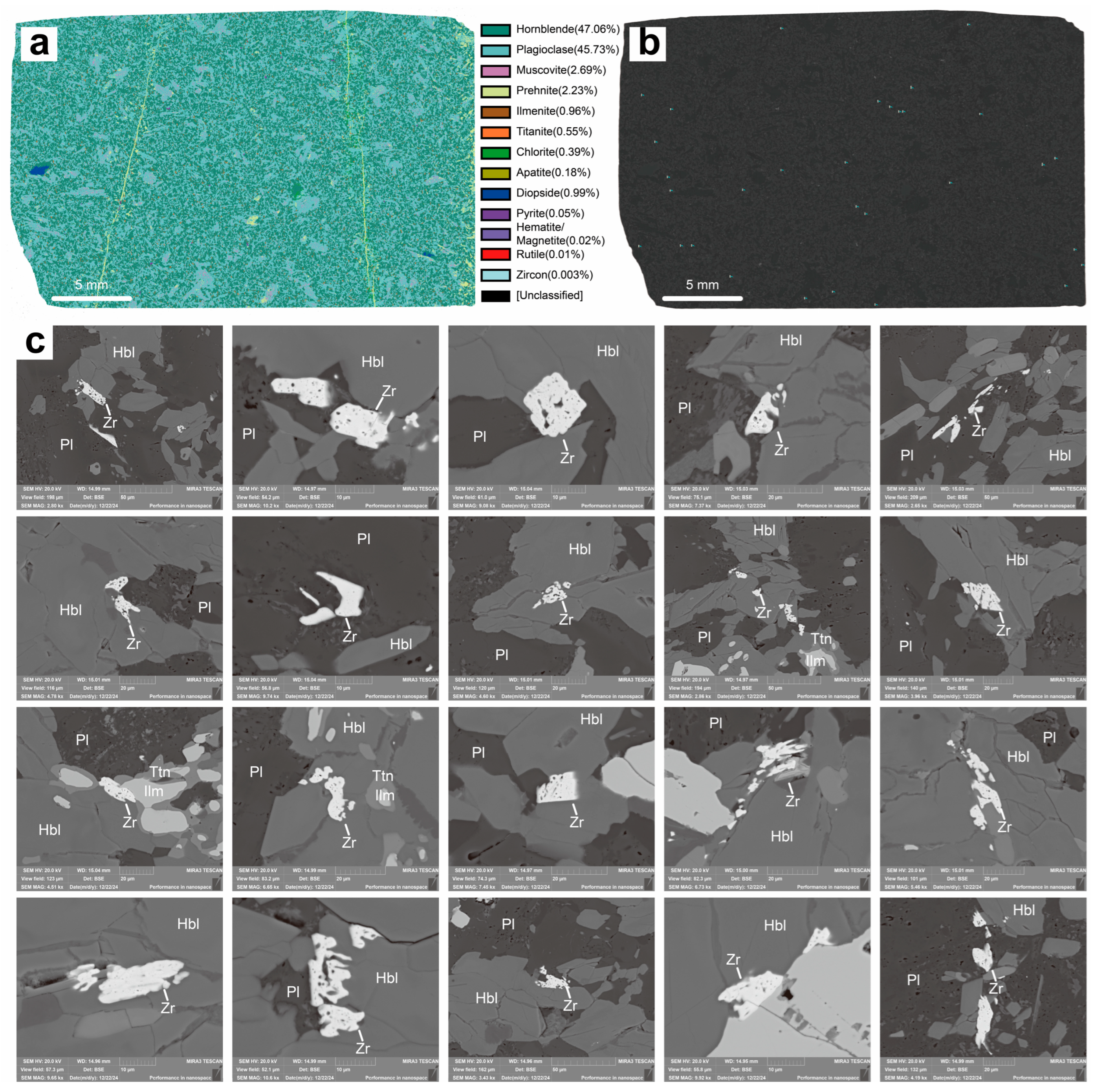
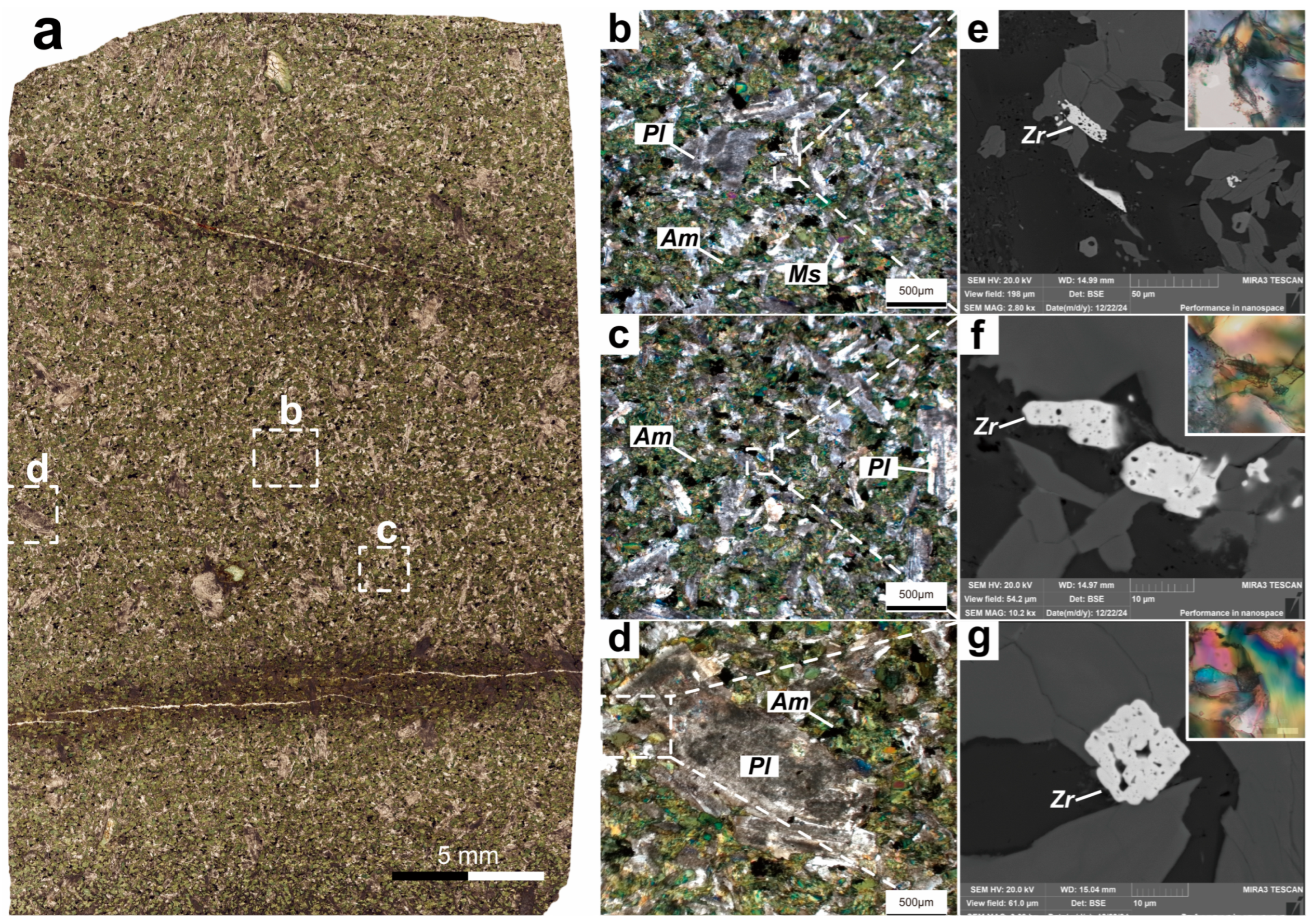
The samples used in this study were collected from diabase outcrops within the Xiugugabu ophiolite, located in the western segment of the YTSZ, Tibet (Figure 1b). In hand specimen, the diabase samples are generally grayish-black with a massive structure; in thin section, the rock is brownish-green (Figure 2a). For petrographic characterization, TIMA mineral mapping assisted in acquiring the modal mineralogy (vol.%), which supplements the petrographic analysis: amphibole (47.06%), plagioclase (45.73%), muscovite (2.69%), prehnite (2.23%), ilmenite (0.96%), titanite (0.55%), chlorite (0.39%), apatite (0.18%), and zircon (0.003%) (Figure 2b–d and Figure 3a,b).
Microscopic observation reveals that pyroxene occurs as short prismatic or granular relict grains, partially replaced by amphibole along grain boundaries and fractures to form pseudomorphs. The samples have blastoporphyritic and blastodiabasic textures, retaining the framework of diabase. Plagioclase forms euhedral to subhedral laths that create an interlocking framework; the original interstitial pyroxene has been replaced by amphibole (Figure 2b–d). Zircon grains are usually euhedral to subhedral short prisms with relatively complete crystal forms, and their grain sizes range from 5 to 30 μm. They are colorless to pale yellow and have smooth crystal faces (Figure 2e,f and Figure 3c).

3. Materials and Methods

3.1. Research Materials

The research materials were collected from diabase outcrops of the Xiugugabu ophiolite in the western segment of the YTSZ, southern Tibet (Figure 1b). The modal mineral composition (vol.%) of the samples is determined by TIMA mineral mapping: amphibole (47.06%), plagioclase (45.73%), muscovite (2.69%), prehnite (2.23%), ilmenite (0.96%), titanite (0.55%), chlorite (0.39%), apatite (0.18%), and zircon (0.003%). Zircon grains are euhedral to subhedral short prisms with grain sizes ranging from 5 to 30 μm, presenting as colorless to pale yellow with smooth crystal faces (Figure 2b–g and Figure 3c).

3.2. Traditional Zircon Separation-Mount Preparation-Dating Workflow

The traditional workflow for zircon separation, mount preparation, and dating relies on mechanical crushing, physical separation, and manual picking. This approach is cumbersome and limited by technical principles, with problems such as low efficiency, energy costs for a mechanical crushing and high contamination risk. The specific workflow is detailed in Table 1.
The traditional workflow has several core limitations.
(1) Long cycle and extremely low efficiency: The whole process requires 30–50 days to complete. Steps like roll crushing and panning must be repeated 5–8 times (taking 10–15 days), while manual picking alone takes an additional 2–3 days per sample. This low throughput renders the workflow unsuitable for large–scale batch geochronological studies. (2) Large sample consumption and severe loss: A single analysis requires 100–500 g of sample. For scarce samples (e.g., small field outcrops, drill cores), the workflow may be interrupted due to insufficient sample quantity. Furthermore, abrasion of stainless-steel components during crushing can cause 5%–10% zircon loss, and an additional 15%–20% of fine-grained zircon (<20 μm) is lost hydrodynamically during panning with light minerals. (3) High contamination risk and low data reliability: Metallic components from the roll crusher may introduce impurities such as Fe and Cr. The use of insufficiently pure water during panning can lead to isotopic contamination (e.g., trace U and Pb). Moreover, residual magnetic minerals in the separator may be mixed with the zircon concentrate, increasing the probability of including contaminants in the final separate, which affects the accuracy of dating results. (4) Incomplete mineral dissociation and picking bias: Mechanical crushing struggles to fully dissociate zircons enclosed in pyroxene and plagioclase, with a dissociation rate of <70%, leaving some zircons unable to proceed to the subsequent workflow. Manual picking is limited by optical microscope resolution, leading to a miss-selection rate exceeding 50% for zircons < 20 μm [27,31,32]. Operators also exhibit a bias toward selecting medium- to coarse-grained crystals (>50 μm) with complete crystal forms. This leads to sample bias, failing to reflect the complete chronological sequence of magma crystallization.
Traditional physical separation methods (heavy liquid, magnetic separation) are classic for zircon separation, but they face critical limitations in mafic rocks with low zircon content [6,7]. The small density and magnetism differences between zircon and matrix minerals (e.g., pyroxene) lead to high zircon loss, while manual picking relies on operator experience—resulting in a miss-selection rate exceeding 50% for zircons < 20 μm [27]. Although recent studies have optimized shaking table parameters or adopted single acid leaching [5,7], most lack automated identification steps, leading to persistent screening bias. Some automated mineral identification technologies (e.g., QEMSCAN) have been applied for zircon localization [9,15], but their integration with acid leaching enrichment remains unexplored, limiting efficiency. Thus, this study addresses these gaps by combining multi-stage acid leaching with TIMA-based automated identification.

3.3. Integrated High-Efficiency Zircon Separation and Analysis Workflow

3.3.1. Separation Steps

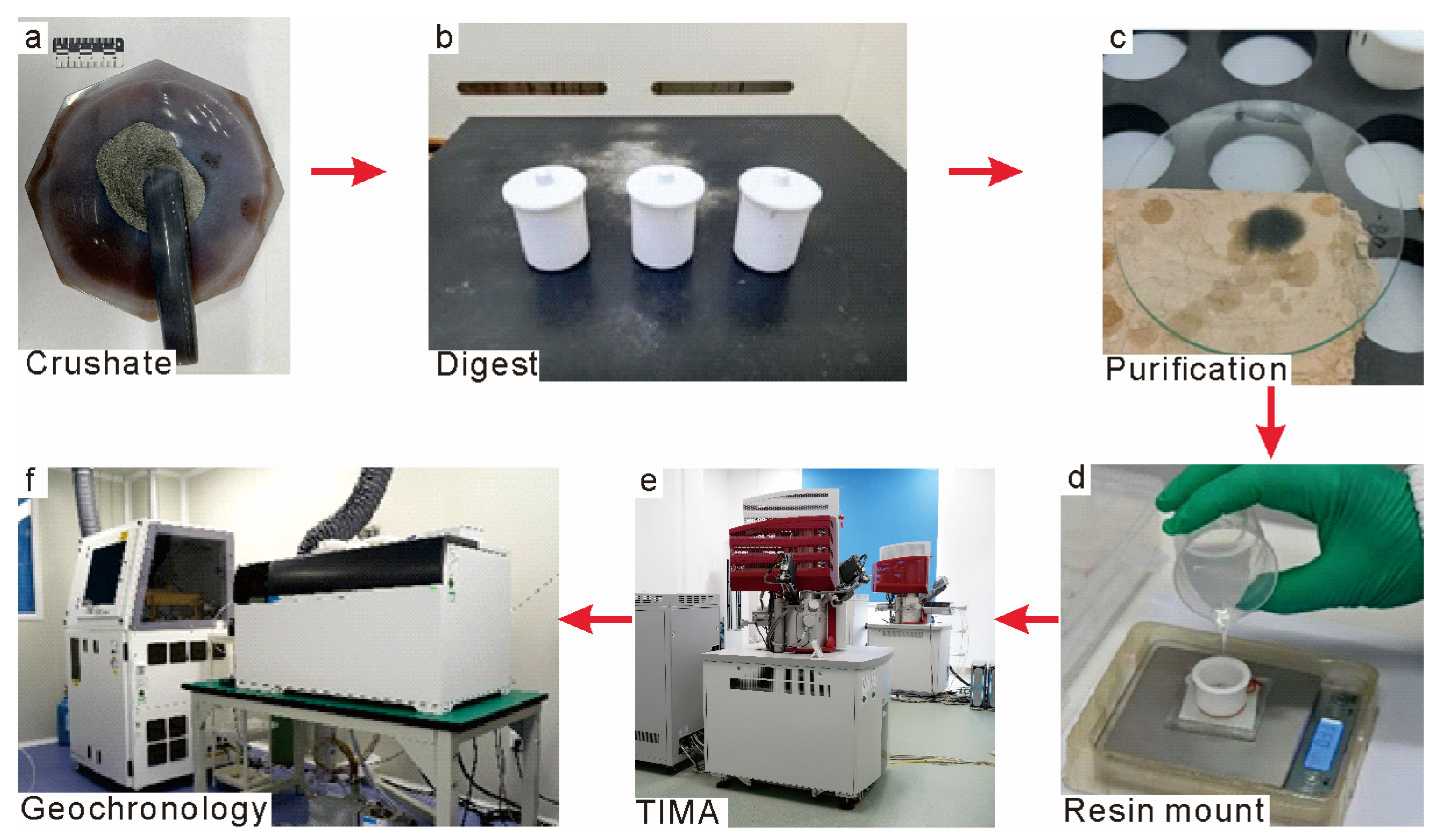
The diabase samples were initially cleaned to expose fresh rock by removing any oxidized or stained surface material. These samples were then cut into small cube-shaped pieces using a cutting machine, followed by crushing in a jaw crusher. The crushed material was ground in a mortar grinder to a fine powder with a particle size of 80 mesh (0.18 mm) (Figure 4a).
A chemical digestion process was employed to dissolve the primary silicate minerals. A 1.0 g portion of the powdered sample was placed into a 50 mL Teflon beaker, and a mixture of 6.0 mL concentrated hydrofluoric acid (approximately 40%) and 2.0 mL concentrated aqua regia was added. The beaker was covered and heated to 120 °C to dissolve the silicate minerals (primarily pyroxene, olivine, plagioclase, and amphibole). During digestion, silica gel formation was minimal because the acid proportions and heating duration were optimized to suppress polymerization of dissolved silica. After the dark–colored minerals were largely dissolved, the supernatant was removed, and the residual material was transferred to a 50 mL centrifuge tube. Subsequently, 3 mL of aqua regia and 1.0 g of boric acid were added to the tube, which was then placed in a water bath and heated with stirring for 2 h. The sample then underwent repeated rinsing with ultrapure water and centrifugation, with the supernatant poured off after each centrifugation. Finally, the sample was rinsed into a watch glass using ethanol and heated to dryness for later use (Figure 4b).

3.3.2. Mount Preparation

A mold with a diameter of 2.5 cm and a thickness of 0.8 cm was used. First, 2 g of Buehler epoxy resin was poured into the mold. The dried mineral extract was then added to the Buehler epoxy resin, with stirring during the pouring process. The mold was evacuated for 1 h to ensure no air bubbles remained, then placed in an oven and baked at 60 °C for 2–3 h to cure the resin. The cured resin mount was then polished using a fully automatic polisher set to 400 rpm. The polishing sequence involved sequential applications of 100-mesh sandpaper for 8–20 s, 200–mesh sandpaper for 8–20 s, 400–mesh sandpaper for 3–5 min, and 800–mesh sandpaper for 3–5 min. A final manual polish was performed on a glass plate using 4000–mesh sandpaper to achieve a bright surface, which was further refined for 10–15 min using a 0.25 μm micropowder (Figure 4c).

3.3.3. Zircon Localization

The operating parameters were set as follows: accelerating voltage 25 kV, beam current 9 nA, working distance 15 mm, BSE image unit pixel size 3 μm, and energy-dispersive X-ray spectroscopy (EDS) measurement step size 9 μm (Figure 4d). After automatic measurement, a stitched, high–resolution BSE image of the entire mount was created, with the total acquisition time amounting to 30 min. Zircon grains were automatically identified based on their characteristic EDS spectra. Grains larger than 16 μm were subsequently manually marked, and high-resolution BSE images of these marked zircons were captured.

3.3.4. LA-ICP-MS Zircon U-Pb Dating

Laser ablation–inductively coupled plasma mass spectrometry (LA–ICP–MS) was used to conduct U–Pb dating on the selected zircon grains (Figure 4e). The experiments employed a Resolution SE 193 nm deep ultraviolet (DUV) laser ablation system equipped with an S155 dual-volume sample cell, coupled to an Agilent 8900 ICP-MS (Agilent Technologies Inc., Santa Clara, CA, USA).
Ablation was performed with a spot diameter of 16 μm, a frequency of 5 Hz, and an energy density of 3 J/cm2. Zircon standard 91,500 was used for external calibration, and GJ–1 was analyzed as a secondary standard to monitor data quality. Data processing was performed using the Iolite program [33].

4. Result and Discussion

4.1. An Automated Workflow for Rapid and Unbiased Zircon Screening

Despite multi-step acid dissolution (HF→HNO3 + HCl→aqua regia + H3BO3) for heavy mineral concentration, zircon abundance remains low in the Xiugugabu diabase from the YTSZ. Traditional manual picking for such samples is prone to significant “particle size bias”: operators tend to prioritize medium- to coarse-grained zircons (>50 μm) with well-developed crystal forms, while overlooking fine-grained grains or those with residual matrix at their edges. Consequently, the selected zircon populations fail to accurately reflect the complete chronological sequence of diabase magma crystallization [27,31].
To address this limitation, we developed an integrated workflow combining powder-stirring mount preparation with TIMA–based automated identification, aiming to eliminate spatial and particle-size bias while enhancing efficiency.
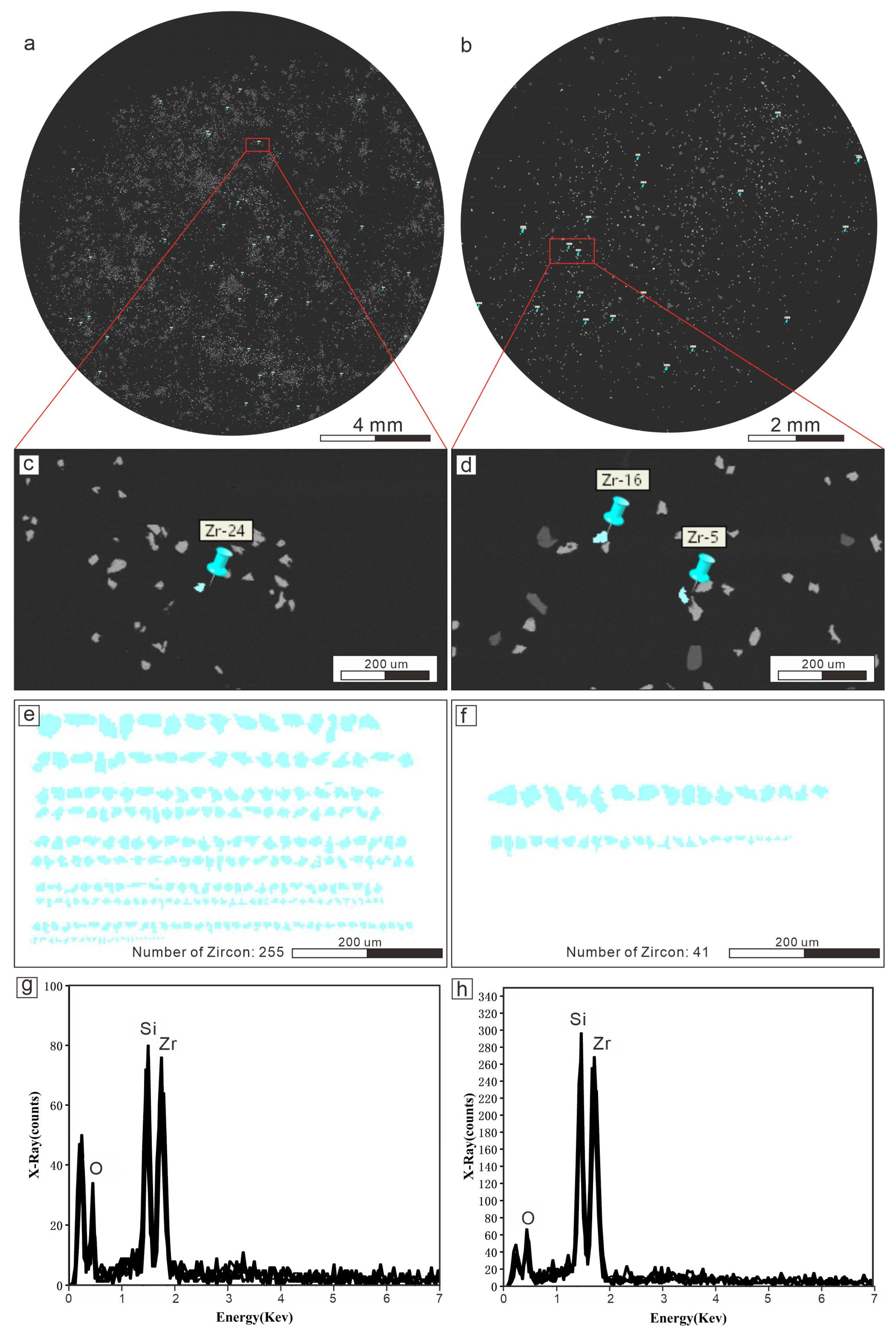
Experimental results show that the total number of mineral grains on mount DQ11-6-1 is 38,782 (Table 2). In descending order of abundance, they are ilmenite (37,137 grains), quartz (635 grains), rutile (494 grains), zircon (255 grains), barite (51 grains), hematite/magnetite (50 grains), calcite (32 grains), almandine (29 grains), diopside (21 grains), dolomite (15 grains), muscovite (14 grains), plagioclase (14 grains), and other mineral grains (35 grains) (Table 2). All zircon grains are smaller than 36.39 μm, among which grains ranging from 15.03 to 36.39 μm account for 62.28%, and those smaller than 15.03 μm account for 37.72% (Table 3).
The total number of mineral grains on mount DQ11-6-2 is 4048 (Table 2). In descending order of abundance, they are ilmenite (2706 grains), quartz (1048 grains), plagioclase (62 grains), rutile (38 grains), zircon (41 grains), calcite (40 grains), hematite/magnetite (24 grains), diopside (20 grains), almandine (7 grains), muscovite (19 grains), and other mineral grains (43 grains) (Table 2). All zircon grains are smaller than 32.07 μm, among which grains ranging from 15.03 to 32.07 μm account for 85.47%, and those smaller than 15.03 μm account for 14.53% (Table 3).
Results validate that this workflow possesses three key advantages.
(1) Uniform zircon dispersion: The powder-stirring mount preparation, engineered for uniform dispersion, ensures discrete distribution of zircon grains within the epoxy matrix with no evident agglomeration, as confirmed by BSE images (Figure 5).
(2) High efficiency: TIMA enables automated identification and localization of zircons across two full mounts in only 30 min, achieving an efficiency 12 to 18 times higher than traditional manual picking. For zircon–poor mafic–ultramafic rocks, this manual approach usually requires no less than two to three hours per sample [6]. This marked reduction in analysis cycle time renders the workflow suitable for regional-scale batch processing of mafic-ultramafic samples.
(3) Unbiased grain coverage: The workflow mitigates particle size bias inherent to manual picking, ensuring comprehensive coverage of all grain sizes present in the sample. This establishes a robust and objective foundation for subsequent geochronological analyses, with particular significance for identifying multi-stage magmatic activities as it enables effective capture of zircons from distinct crystallization stages.

4.2. A High-Purity, Low-Loss Mineral Separation Protocol

By streamlining the mineral separation process, our workflow achieves two critical goals simultaneously: ensuring high sample purity and minimizing sample loss. This optimized protocol provides an effective solution for zircon analysis in low-abundance or mass-limited samples, such as those typical of mafic rocks.
Contamination control is a major challenge in traditional mineral separation workflows. Metallic impurities (e.g., Fe, Cr) can be introduced by abrasion from stainless-steel components during roll crushing. Isotopic contaminants, particularly trace U and Pb, may originate from insufficiently purified water used in density-based separation steps like panning. The residual magnetic minerals in the magnetic separation equipment from previous samples may increase the probability of misjudgment of “contaminated zircon”, directly affecting the reliability of dating data. In contrast, the workflow developed in this study mitigates these risks by retaining only three core steps: initial jaw crushing, grinding in an agate mortar, and dissolution in analytical-grade acid. Jaw crushing provides only coarse sample disaggregation without excessive contact with metal components. The excellent chemical inertness of the agate mortar can avoid the introduction of external contaminants during grinding. Finally, the exclusive use of analytical-grade acids (HF, HNO3, HCl) eliminates concerns about contamination, capture, or secondary alteration of the zircon grains, ensuring the integrity of the subsequent geochronological data.
In terms of sample loss and consumption control, the traditional workflow relies on repeated mechanical crushing (roll crushing requires repeated sieving) and physical separation (panning requires sufficient powder volumes to ensure heavy mineral enrichment), necessitating the use of over 5 kg of massive samples per analysis. This not only imposes strict quantity requirements but also leads to significant zircon loss: 5%–10% of zircon is lost from abrasion during mechanical crushing, and another 15%–20% of fine-grained (<20 μm) zircons are washed away during panning. In contrast, our optimized workflow requires a total sample mass of only ~20 g, which is only 0.4% of the traditional requirement. Of this, only 1.0 g of 80-mesh powder is needed for the final acid dissolution step, eliminating the need for large samples to support repetitive operations. This minimal consumption allows for flexible application to scarce field samples, such as small-volume drill cores (<5 g) and outcrop detrital samples. The process not only avoids excessive consumption of precious samples but also greatly expands the applicable scope of analysis for low-abundance zircon samples.

4.3. U-Pb Dating and Tectonic Implications

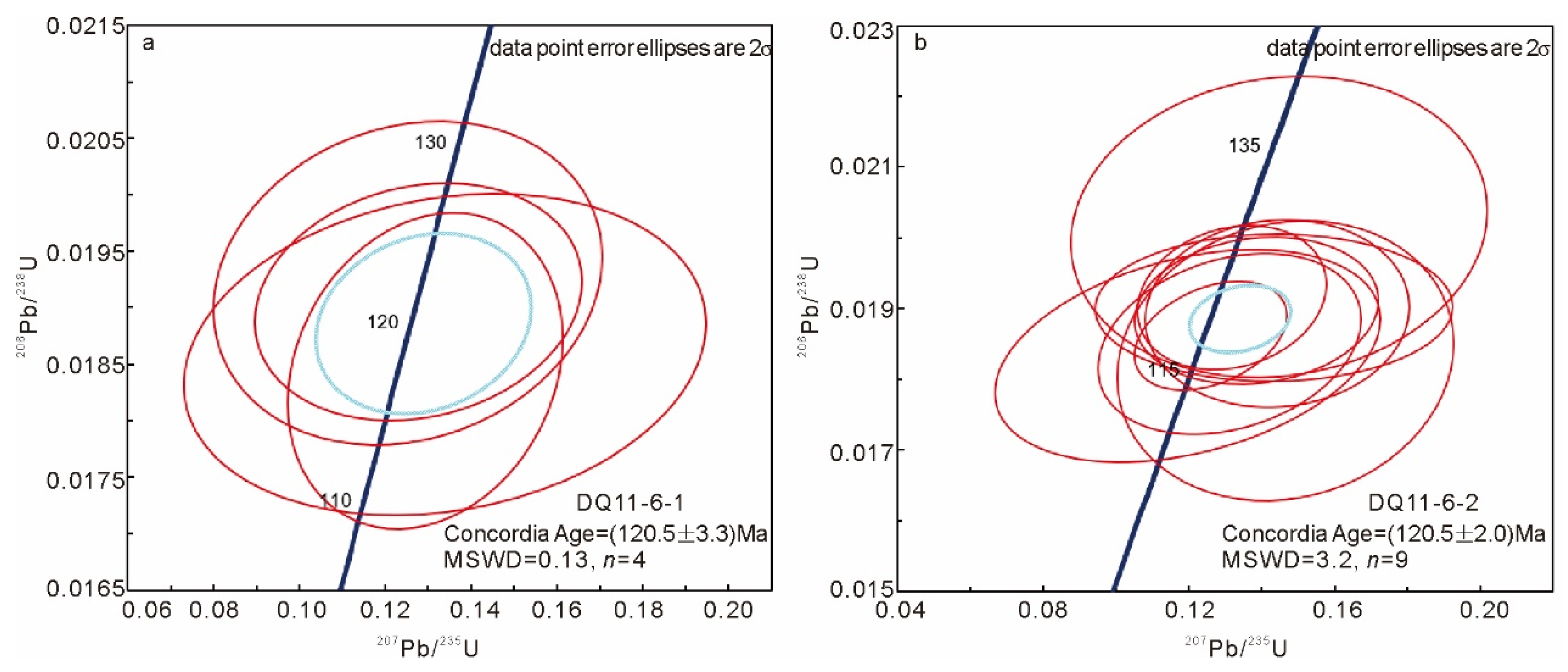
LA–ICP–MS U–Pb dating was performed on zircon grains previously identified by TIMA in two Xiugugabu diabase samples. The complete dataset is presented in Table 1, with concordia diagrams shown in Figure 6. In sample DQ11-6-1, zircon grains exhibit U contents ranging from 108.05 to 442.41 pp m and Th/U ratios of 0.48 to 1.37. Four spot analyses yielded a weighted mean 206Pb/238U age of 120.5 ± 3.3 Ma (MSWD = 0.13; Figure 6a). For sample DQ11-6-2, zircon U contents range from 237.99 to 851.08 ppm, with Th/U ratios of 0.56–1.95. Nine spot analyses from this sample produced a concordant weighted mean 206Pb/238U age of 120.5 ± 2.0 Ma (MSWD = 3.2; Figure 6b). These ages are interpreted as the magmatic crystallization age of the Xiugugabu diabase, directly reflecting the formation age of the Neo–Tethys oceanic lithosphere from which it was derived. Previous studies show that traditional separation workflows generally recover only coarse zircon grains (>50 μm) from samples with whole–rock Zr contents above ~100 ppm [26,27,28,29,31,32]. In contrast, our workflow is capable of isolating much finer zircon grains (~10–15 μm) from diabase containing approximately ~65 ppm Zr.
Our new age aligns perfectly with the established geochronological framework for the region. Previous studies have documented that mafic magmatism associated with the YTSZ ophiolites occurred mainly between 130 and 110 Ma [33,34,35,36,37]. The ca. 120 Ma crystallization age of the Xiugugabu diabase obtained in this study aligns precisely with this range, indicating that the Xiugugabu diabase, along with other diabase bodies in the suture zone, represents a remnant of the Cretaceous Neo-Tethys lithosphere and that these rocks collectively record a mid-ocean ridge or forearc spreading event of the Neo–Tethys Ocean.

4.4. Advantages and Application Prospects of the Technical Workflow

This study developed an integrated workflow for the geochronology of mafic rocks with low zircon content, such as the Xiugugabu diabase. The methodology comprises a series of steps: enrichment of zircon through a multi-stage acid dissolution process (HF → HNO3 + HCl → aqua regia + H3BO3); powder stirring for mount preparation; automated mineral identification via TIMA; and in situ dating by LA–ICP–MS. This integrated approach is designed to overcome the dual challenges of “sample bias” and “low analytical efficiency” associated with conventional methods.
The technical advantages of this workflow are threefold. First, the powder mount preparation ensures physical dispersion, which more than doubles the proportion of fine-grained zircon identified by TIMA compared to that from traditional manual picking [6]. This effectively covers zircon grains from different magma crystallization stages and avoids age misinterpretation caused by sample bias. Second, the overall analysis cycle for a single sample is shortened from 3–5 days (including manual picking) using traditional methods to one day. The automated TIMA identification step is the main driver of this efficiency, as it is 12–18 times faster than conventional manual localization. This acceleration makes large-scale geochronological surveys of mafic terranes, which were previously logistically prohibitive, entirely feasible. Third, the protocol improves the quality and reliability of the resulting data. The acid dissolution step effectively removes >90% of common matrix minerals (e.g., pyroxene and plagioclase), eliminating the risk of matrix–related signal interference during LA–ICP–MS analysis. The resulting mount surface, prepared using the powder step, is sufficiently flat for high-precision in situ dating. Furthermore, the final dating results are consistent with the regional geological background, confirming the method’s reliability. Notably, this workflow is also applicable to rutile. Our mineral identification results confirm the abundant occurrence of rutile in the samples, and rutile is also a reliable geochronological mineral. Furthermore, building on this technical workflow, combined analysis of zircon Hf isotopes and trace elements can be further conducted, achieving multi-dimensional “chronological-geochemical” constraints.
Despite these advantages, this workflow also has several limitations that should be acknowledged. First, the multi-stage acid digestion process requires larger volumes of HF-, HCl-, HNO3- and H3BO3- bearing reagents compared with traditional mechanical separation, resulting in higher chemical consumption and stricter laboratory safety requirements. Second, the procedure relies on access to automated mineralogical equipment such as TIMA, which may not be available in all laboratories and could limit broader application. These factors should be considered when evaluating the scalability and accessibility of the method.

5. Conclusions

  • This study successfully establishes and validates an integrated technical workflow that combines multi-stage acid digestion (HF + HNO3 + HCl → aqua regia + H3BO3), powder stirring for mount preparation, automated mineral identification (TIMA), and in situ LA–ICP–MS dating. This approach effectively overcomes the sample bias and low analytical efficiency that exist in traditional zircon separation methods, particularly when applied to mafic-ultramafic rocks with low zircon abundance (>65 ppm).
  • The new workflow achieves high-purity separation with minimal sample loss. In terms of cleanliness, it eliminates contamination-prone steps found in traditional methods by employing only a jaw crusher, agate mortar grinding, and analytical-grade acid dissolution, thereby avoiding U–Pb isotopic and metallic impurity contamination. In terms of sample loss, it only requires a small amount of powder, making it applicable to scarce samples such as drill cores and small outcrop samples.
  • Applying this workflow to the Xiugugabu diabase from the western segment of the Yarlung–Tsangpo Suture Zone in southern Tibet yielded weighted mean 206Pb/238U ages of 120.5 ± 3.3 Ma (MSWD = 0.13) and 120.5 ± 2.0 Ma (MSWD = 3.2) for two samples. This result is highly consistent with the known formation ages (130–110 Ma) of other diabases in the suture zone, confirming the feasibility of the technical workflow.
  • This technical workflow exhibits excellent stability and expandability. It meets the needs of large-scale geochronological surveys of mafic–ultramafic rocks and also supports combined analysis of zircon Hf isotopes and trace elements. This protocol provides multi-dimensional “chronological–geochemical” constraints for studies on rock formation ages, material sources, and tectonic evolution processes, representing a significant advancement for the geochronological research of low-abundance accessory minerals.

Author Contributions

Conceptualization, Q.Y. and H.L.; methodology, Q.Y.; formal analysis, Y.W., J.Z., W.Y., F.H., R.W., Z.C., A.W. and A.E.M.; investigation, Q.Y., P.C.; writing—original draft, Q.Y., writing—review and editing, H.L.; founding acquisition, H.L., P.C. and J.Z. All authors have read and agreed to the published version of the manuscript.

Funding

This research was funded by China Geological Survey Program, grant number DD20242516, Natural Science Foundation of Inner Mongolia in China, grant number 2025FX008, “The 14th Five-Year Plan” Education Science Research Project of Inner Mongolia Autonomous Region (Grant No. NZJGH2024234) and Key Laboratory of Marine Mineral Resources, Ministry of Natural Resources, Guangzhou, grant number KLMMR-2024-G10.

Data Availability Statement

Data are contained within the article.

Acknowledgments

We are grateful to the editors and anonymous reviewers for their constructive reviews and comments that substantially improved this work.

Conflicts of Interest

Authors Qiuyun Yuan, Yue Wu, Weihao Yan, Ferdon Hamit, Ruotong Wang, Zhiqi Chen and Aihua Wang were employed by the company Nanjing Hongchuang Geological Exploration Technology Service Co., Ltd. The remaining authors declare that the research was conducted in the absence of any commercial or financial relationships that could be construed as a potential conflict of interest.

References

  1. Li, X.F.; Li, Y.; Li, Q.L.; Wu, L.G.; Wang, H.; Yang, C.; Wei, G.J.; Zhang, W.F. Progress and prospects of radiometric geocheonology. Acta Petrol. Sin. 2022, 96, 104–122. [Google Scholar] [CrossRef]
  2. Compston, W.; Williams, I.S.; Meyer, C. U–Pb geochronology of zircons from lunar breccia 73217 using a sensitive high mass-resolution ion microprobe. J. Geophys. Res. Solid Earth 1984, 89, B525–B534. [Google Scholar] [CrossRef]
  3. Watson, E.B.; Harrison, T.M. Zircon saturation revisited: Temperature and composition effects in a variety of crustal magma types. Earth Planet. Sci. Lett. 1983, 64, 295–304. [Google Scholar] [CrossRef]
  4. Li, W. A Method for Separating and Purifying Zircon from Mafic Rocks. CN 100336731C, 12 September 2007. [Google Scholar]
  5. Guo, Q.; Li, Q.L.; Chu, Z.Y.; Ling, X.X.; Guo, S.; Xue, D.S.; Yin, Q.Z. An Acid-Based Method for Highly Effective Baddeleyite Separation from Gram-Sized Mafic Rocks. ACS Omega 2022, 7, 3634–3638. [Google Scholar] [CrossRef] [PubMed]
  6. Söderlund, U.; Johansson, L. A simple way to extract baddeleyite (ZrO2). Geochem. Geophys. Geosyst. 2002, 3, 1014. [Google Scholar] [CrossRef]
  7. Guo, Q.; Liu, T.; Fei, C.H.; Guo, S.; Li, Q.L. Progress in techniques and methods for uncontaminated and highly efficient separation of zircon from geological samples. Acta Petrol. Sin. 2023, 39, 2857–2866. [Google Scholar] [CrossRef]
  8. Li, L.; Li, H.L.; Wang, G.G.; Sun, J.D. Geochronology of the Baishi W-Cu Deposit in Jiangxi Province and Its Geological Significance. Minerals 2022, 12, 1387. [Google Scholar] [CrossRef]
  9. Chen, Q.; Song, W.L.; Yang, J.K.; Hu, Y.; Huang, J.; Zhang, T.; Zheng, G.S. Principle of automated mineral quantitative analysis system and its application in petrology and mineralogy: An example from TESCAN TIMA. Miner. Depos. 2021, 40, 345–368. [Google Scholar] [CrossRef]
  10. Wang, Y.; Li, J.Y.; Wang, D.H.; Luo, X.; Yuan, W.; Cai, H.G.; Zhang, H.; Feng, X.D.; Guo, S.; Li, W.H.; et al. Enrichment of Al-Li-Ga-Nb(Ta)-Zr(Hf) in the Permo-Carboniferous coal-bearing sequences of the Jungar Coalfield, northern China. Int. J. Coal Geol. 2025, 303, 104752. [Google Scholar] [CrossRef]
  11. Chen, W.W.; Li, L.F.; Liu, P.R.; Wang, L.; Xia, Q.; Luo, J.C. An assessment of weathering in sandstone masonry built with earthen mortars: The case of the ancient rope Bridge Ferry, China. Bull. Eng. Geol. Environ. 2024, 84, 16. [Google Scholar] [CrossRef]
  12. Nilay, G.; Kuşcu, L.; Danišík, M. Application of (U-Th)/He hematite geochronology to the Çaldağ lateritic Ni-Co deposit, Western Anatolia: Implications for multi-stage weathering events during interglacial periods/segments. Ore Geol. Rev. 2024, 172, 106203. [Google Scholar] [CrossRef]
  13. Fan, Y.; Shu, Q.H.; Lentz, D.R.; Wang, Q.F.; Zhang, R.Z.; Niu, X.D.; Zeng, Q.W.; Xing, K.; Deng, J. Scheelite texture and composition fingerprint skarn mineralization of the giant Yuku Mo-W deposit, Central China. Ore Geol. Rev. 2024, 175, 106361. [Google Scholar] [CrossRef]
  14. Yan, W.H.; Xu, Y.; Chen, Z.F.; Jin, T.K. A Safe and Efficient Method for Separation and Identification of Heavy Minerals. CN 115598159 B, 28 January 2025. [Google Scholar]
  15. Hrstka, T.; Gottlieb, P.; Skala, R.; Breiter, K. Automated mineralogy and petrology-applications of TESCAN Integrated Mineral Analyzer (TIMA). J. Geosci. 2018, 63, 47–63. [Google Scholar] [CrossRef]
  16. Bea, F.; Bortnikov, N.; Cambeses, A.; Chakraborty, S.; Molina, J.F.; Montero, P.; Morales, I.; Silantiev, S.; Zinger, T. Zircon crystallization in low-Zr mafic magmas: Possible or impossible? Chem. Geol. 2022, 602, 120898. [Google Scholar] [CrossRef]
  17. Yang, J.S.; Wu, W.W.; Lian, D.Y.; Rui, H.C. Peridotites, chromitites and diamonds in ophiolites. Nat. Rev. Earth Environ. 2021, 2, 198–212. [Google Scholar] [CrossRef]
  18. Niu, X.L.; Yang, J.S.; Castro, A.I.L.; Feng, G.Y.; Li, Z.L.; Liu, F. Zircon ages, mineralogy, and geochemistry of ophiolitic mafic and island-arc rocks from central Cuba: Implications for Cretaceous tectonics in the Caribbean region. Lithos 2022, 434–435, 106924. [Google Scholar] [CrossRef]
  19. Zhang, Z.Y.; Liu, C.Z.; Liang, Y.; Zhang, C.; Liu, T.; Zhang, W.Q.; Ji, W.B. Decoupled Trace Element and Isotope Compositions Recorded in Orthopyroxene and Clinopyroxene in Composite Pyroxenite Veins from the Xiugugabu Ophiolite (SW Tibet). J. Petrol. 2022, 63, egac046. [Google Scholar] [CrossRef]
  20. Cai, P.J.; Majka, J.; Lian, D.Y.; Yang, J.S.; Wang, L.; Ma, H.T.; Rui, H.C.; Bo, R.Z.; Masoud, A.E. Large-scale impregnation of oceanic and continental slab-derived adakitic melts into the mantle wedge. Commun. Earth Environ. 2025, 6, 557. [Google Scholar] [CrossRef]
  21. Lian, D.Y.; Liu, F.; Cai, P.J.; Wu, W.W.; Li, J.; Majka, J.; Xu, Z.Q.; Yang, J.S. Osmium and zinc isotope constraints on the origin of chromitites from the Yarlung-Zangbo ophiolites, Tibet, China. Miner. Depos. 2024, 59, 1089–1107. [Google Scholar] [CrossRef]
  22. Lian, D.Y.; Liu, F.; Yang, J.S.; Xu, Z.Q.; Wu, W.W. Fingerprints of the Kerguelen Mantle Plume in Southern Tibet: Evidence from Early Cretaceous Magmatism in the Tethyan Himalaya. J. Geol. 2021, 129, 207–231. [Google Scholar] [CrossRef]
  23. Lian, D.Y.; Yang, J.S.; Liu, F.; Wu, W.W.; Zhang, L.; Zhao, H.; Huang, J. Geochemistry and tectonic significance of the Gongzhu peridotites in the northern branch of the western Yarlung Zangbo ophiolitic belt, western Tibet. Mineral. Petrol. 2017, 111, 729–746. [Google Scholar] [CrossRef]
  24. Yin, A.; Harrison, T.M. Geologic evolution of the Himalayan-Tibetan orogen. Annu. Rev. Earth Planet. Sci. 2000, 28, 211–280. [Google Scholar] [CrossRef]
  25. Zhang, C.; Liu, C.Z.; Bénard, A.; Müntener, O.; Ji, W.B.; Liu, T.; Zhang, Z.Y.; Zhang, W.Q.; Wu, F.Y. Heterogeneous mantle beneath the Neo-Tethys Ocean revealed by ultramafic rocks from the Xiugugabu Ophiolite in the Yarlung-Tsangpo Suture Zone, southwestern Tibet. Contrib. Mineral. Petrol. 2023, 178, 54. [Google Scholar] [CrossRef]
  26. Zhao, C.X. Experimental Study on Single Mineral Separation of Granulite from Laoniugou, Huadian. Jilin Geol. 1983, 4, 76–81. [Google Scholar]
  27. Li, L.; Shi, Y.; Anderson, J.L.; Ubide, T.; Nemchin, A.A.; Caulfield, J.; Wang, X.C.; Zhao, J.X. Dating mafic magmatism by integrating baddeleyite, zircon and apatite U–Pb geochronology: A case study of Proterozoic mafic dykes/sills in the North China Craton. Lithos 2020, 380–381, 105820. [Google Scholar] [CrossRef]
  28. Liang, X.Q. Study on the Problems of Single Mineral Separation Science. Miner. Depos. Geol. 1990, 1, 81–85. [Google Scholar]
  29. Li, W.; Tan, K.X. Signal mineral separate method and its significance in geotectonics-taking apatite and zircon as examples. Geotecton. Metallog. 1998, 22, 83–86. [Google Scholar] [CrossRef]
  30. Chamberlain, K.R.; Schmitt, A.K.; Swapp, S.M.; Harrison, T.M.; Swoboda-Colberg, N.; Bleeker, W.; Peterson, T.D.; Jefferson, C.W.; Khudoley, A.K. In situ U–Pb SIMS (IN-SIMS) micro-baddeleyite dating of mafic rocks: Method with examples. Precambrian Res. 2010, 183, 379–387. [Google Scholar] [CrossRef]
  31. Su, H.M.; Jiang, S.Y.; Shao, J.B.; Zhang, D.Y.; Wu, X.K.; Huang, X.Q. New identification and significance of Early Cretaceous mafic rocks in the interior South China Block. Sci. Rep. 2021, 11, 11396. [Google Scholar] [CrossRef] [PubMed]
  32. Wang, M.X.; Wang, C.Y.; Zhao, J.H. Zircon U/Pb dating and Hf-O isotopes of the Zhouan ultramafic intrusion in the northern margin of the Yangtze Block, SW China: Constraints on the nature of mantle source and timing of the supercontinent Rodinia breakup. Sci. China Earth Sci. 2013, 58, 777–787. [Google Scholar] [CrossRef]
  33. Paton, C.; Woodhead, J.D.; Hellstrom, J.C.; Hergt, J.M.; Greig, A.; Maas, R. Improved laser ablation U-Pb zircon geochronology through robust downhole fractionation correction. Geochem. Geophys. Geosystems 2010, 11, Q0AA06. [Google Scholar] [CrossRef]
  34. Lee, S.J.; Cho, H.C.; Kwon, J.H. Beneficiation of coal pond ash by physical separation techniques. J. Environ. Manag. 2012, 104, 77–84. [Google Scholar] [CrossRef] [PubMed]
  35. Xiong, F.H.; Yang, J.S.; Liang, F.H.; Ba, D.Z.; Zhang, J.; Xu, X.Z.; Li, Y.; Liu, Z. Zircon U-Pb ages of the Dongbo ophiolite in the western Yarlung Zangbo suture zone and their geological significances. Acta Petrol. Sin. 2011, 27, 3223–3238. [Google Scholar]
  36. Wang, C.S.; Liu, Z.F.; Hébert, R. The Yarlung-Zangbo paleo-ophiolite, southern Tibet: Implications for the dynamic evolution of the Yarlung-Zangbo Suture Zone. J. Asian Earth Sci. 2000, 18, 651–661. [Google Scholar] [CrossRef]
  37. Zheng, H.; Huang, Q.T.; Kapsiotis, A.; Xia, B.; Yin, Z.X.; Zhong, Y.; Lu, Y.; Shi, X.L. Early cretaceous ophiolites of the Yarlung Zangbo Suture Zone: Insights from dolerites and peridotites from the Baer upper mantle suite, SW Tibet (China). Int. Geol. Rev. 2017, 59, 1471–1489. [Google Scholar] [CrossRef]
Figure 1. (a) Map showing ophiolite distribution in the western segment of the Yarlung-Tsangpo Suture Zone, with the inset of Tibetan Plateau showing the location of the western YTSZ, (b) Simplified geological map of the Xiugugabu ophiolite showing the sample location (modified after [25]).
Minerals 16 00020 g001
Figure 2. Photographs of the Xiugugabu diabase (sample DQ11-6): (a) photomosaic overview of the thin section; (bd) higher-magnification photomicrographs showing detailed petrography; (eg) Backscattered Electrons (BSE) images of zircon grains. Pl = Plagioclase; Am = Amphibole; Ms = Muscovite; Zr = Zircon.
Minerals 16 00020 g002
Figure 3. TIMA analysis of the Xiugugabu diabase (sample DQ11-6): (a) automated mineralogy map; (b) BSE image of zircon distribution; (c) BSE image of zircon occurrence form. Pl = Plagioclase; Hbl = Hornblende; Ilm = Ilmenite; Zr = Zircon; Ttn = Titanite.
Minerals 16 00020 g003
Figure 4. Integrated high-throughput zircon separation and analysis workflow. (a) step 1: crushate; (b) step2: Digest; (c) step3: purification; (d) step4: resin mount; (e) step5: TIMA; (f) step6: geochronology.
Minerals 16 00020 g004
Figure 5. BSE panoramic view (a,b), local BSE micrograph of zircon (c,d), zircon grains (e,f) and EDS spectrum of target zircon (g,h) in resin mount for samples DQ11-6-1 and DQ11-6-2. The marked positions indicate zircon grains. Zr = Zircon.
Minerals 16 00020 g005
Figure 6. LA-ICP-MS U-Pb concordia diagrams for zircons from the Xiugugabu diabase, analyzed in situ within the prepared TIMA mounts. (a) Sample DQ11-6-1 and (b) Sample DQ11-6-2.
Minerals 16 00020 g006
Table 1. Traditional Zircon Separation-Mount Preparation-Dating Workflow.
StepMain OperationPurposeReferences
1. Jaw crushingCrush bulk rock samples into coarse fragments (<5 mm) using a jaw crusher, avoiding over-crushing that can fracture zircon grains.Reduce sample particle size for subsequent fine crushing.[6,7,26]
2. Roll crushingFurther reduce the jaw-crushed fragments using a stainless-steel roll crusher; sieve the material through an 80–mesh nylon sieve (0.16 mm aperture), returning oversize particles for repeated crushing to ensure uniform particle size.Refine sample to below 80 mesh for heavy mineral enrichment.[6,26,27]
3. PanningUse a brass pan with ultrapure water (flow rate: 1–2 L/min) at a pan angle of 15–20°. Repeat the process 5–8 times.Enrich heavy minerals (density > 2.9 g/cm3), including zircon, and remove light minerals (e.g., quartz and feldspar).[5,6,7]
4. Magnetic separationDry the enriched heavy minerals and pass them through a magnetic separator.Remove strongly magnetic minerals (e.g., magnetite, pyrrhotite) and retain non-magnetic/weakly magnetic zircon.[6,28,29]
5. PurificationHand-pick zircon grains under a stereomicroscope using a tungsten needle, selecting grains based on adamantine luster, short prismatic crystal habit, and high hardness, remove impurities (e.g., monazite, apatite)Obtain high purity zircon grains (>95%).[5,7,27,30]
6. Mount preparation and imagingArrange zircon grains evenly in a mold (diameter: 1.5 cm), inject epoxy resin, and cure at 60 °C for 4–6 h. Capture morphological images using a transmitted–reflected microscope, and then take CL images using a scanning electron microscope (SEM).Observe the external morphology and internal structure of zircon grains to select optimal locations for dating.[7,27,31,32]
7. DatingPerform U–Pb dating using LA–ICP–MS.Obtain zircon U–Pb age.[27,31,32,33]
Table 2. Number of phase grain in resin mount for samples DQ11-6-1 and DQ11-6-2.
PhaseDQ11-6-1DQ11-6-2
Ilmenite37,1372706
Quartz6351048
Rutile49438
Zircon25541
Calcite3240
Hematite/Magnetite5024
Barite510
Diopside2120
Almandine297
Muscovite1419
Plagioclase1462
Dolomite153
Actinolite89
Hornblende96
Chlorite210
Pyrite29
Apatite52
Illite60
Biotite23
Titanite10
Monazite01
Total38,7824048
Table 3. Grain size distribution of phase in resin mount for samples DQ11-6-1 and DQ11-6-2.
ZirconRutileIlmeniteDolomiteHematite/
Magnetite
PyriteQuartzApatite
Grain size/μmDQ11-6-1 (%)
3.30~15.0337.7262.5514.8941.0620.1330.3010.8629.35
15.03~17.0516.835.008.2922.225.2869.705.0723.91
17.05~19.3515.566.599.210.007.310.004.560.00
19.35~21.958.934.2810.9436.715.840.004.920.00
21.95~24.9113.515.4013.010.003.570.005.6946.74
24.91~28.265.440.0011.980.000.000.005.360.00
28.26~32.070.000.0010.830.006.570.003.820.00
32.07~36.392.010.008.510.007.390.004.910.00
36.39~41.280.000.005.780.009.740.0010.280.00
41.28~46.840.000.003.560.000.000.006.670.00
46.84~113.420.0016.193.010.0034.170.0037.880.00
113.42~188.000.000.000.000.000.000.000.000.00
Grain size/μmDQ11-6-2 (%)
3.30~15.0314.5379.3910.150.0020.5323.814.710.00
15.03~17.0512.270.006.290.008.5427.382.1615.04
17.05~19.359.830.008.200.000.000.002.770.00
19.35~21.959.490.0011.540.000.0048.812.990.00
21.95~24.9115.8420.6113.5925.480.000.003.970.00
24.91~28.2631.160.0013.6731.7311.180.005.070.00
28.26~32.076.880.0014.5842.7931.910.004.600.00
32.07~36.390.000.008.400.000.000.005.6784.96
36.39~41.280.000.006.270.0027.850.008.060.00
41.28~46.840.000.003.280.000.000.004.750.00
46.84~113.420.000.004.020.000.000.0043.130.00
113.42~188.000.000.000.000.000.000.0012.110.00
Disclaimer/Publisher’s Note: The statements, opinions and data contained in all publications are solely those of the individual author(s) and contributor(s) and not of MDPI and/or the editor(s). MDPI and/or the editor(s) disclaim responsibility for any injury to people or property resulting from any ideas, methods, instructions or products referred to in the content.