Article

Key Factors Impacting the Decomposition Rate of REE Silicates During Sulfuric Acid Treatment

Natural Resources Canada, CanmetMINING, 555 Booth Street, Ottawa, ON K1A 0G1, Canada
*
Author to whom correspondence should be addressed.
Minerals 2026, 16(1), 31; https://doi.org/10.3390/min16010031 (registering DOI)
Submission received: 26 November 2025 / Revised: 22 December 2025 / Accepted: 24 December 2025 / Published: 27 December 2025

Abstract

The decomposition of silicates in sulfuric acid to extract rare earth elements (REE) is typically characterized by the formation of an amorphous silica layer surrounding the receding crystal that may act as a passivation barrier limiting the rate of mineral dissolution. In this context, sulfuric acid treatment experiments coupled with detailed characterization of the evolution of the decomposition reaction were performed on natural allanite (CaREEAl2Fe2+Si3O11O[OH]), as well as synthetic neodymium disilicate (Nd2Si2O7), orthosilicate (Ca2Nd8(SiO4)6O2), and orthophosphate (NdPO4) phases in order to investigate if there are key factors, operating on a wide range of silicates, that negatively impact REE recovery. While, as expected, the acid strength is the driver in promoting the decomposition of the orthophosphate, for the silicates investigated, no matter their crystalline structure and chemical resistance, there is a severe passivation mechanism at play in concentrated H2SO4. However, in all cases, this effect can be minimized by water dilution, which strongly enhances sulfate-forming cation transfer across the produced amorphous silica layer. Taking into consideration this distinct characteristic of the mode of decomposition of silicates in sulfuric acid should help in defining optimal extraction strategies.

1. Introduction

One of the major processes to extract rare earth elements (REE), in particular from the orthophosphates (e.g., monazite, xenotime) and fluorocarbonates (e.g., bastnaesite), is through a sulfuric acid (H2SO4) route. In an initial stage, commonly referred to as “acid baking” or “roasting”, mineral decomposition is achieved in concentrated H2SO4 (93–98 wt%), at temperatures typically exceeding 200 °C, leading to the formation of water-soluble REE sulfates (sulfation). After this acid treatment step, the REEs can then be recovered during a subsequent low-temperature water leach [1,2]. The use of sulfuric acid is advantageous due to its moderate cost and low vapor pressure, and although its room-temperature viscosity is ≈23.8 mPa⸱s, it drops rapidly to ≈4.1 mPa⸱s at 100 °C. The application of such concentrated sulfuric acid treatment to silicates is of interest [2,3,4] considering that they represent important REE carriers in many deposits, such as peralkaline complexes. However, during decomposition of silicates, the release of sulfate-forming cations, including the REEs, is accompanied by the formation of amorphous silica, which, depending on its nature, can lead to distinct hydrometallurgical challenges. For certain crystalline structures, in particular silicates with a low degree of SiO4 tetrahedra linkage, the formation of a gel produced from polymerization of dissolved silica [5,6] will result in poor downstream solid–liquid separation (e.g., filtration, sedimentation). Proposed strategies to prevent silica gel formation mainly focus on limiting the water content during acid treatment [7,8], a “dry digestion” process, originally developed for the zinc industry [7], that has been successfully applied to access REEs from eudialyte [9,10,11,12,13]. On the other hand, a more upstream problem, which is the focus of the current study, is that sulfuric acid treatment of many silicate structures will lead to the development of an amorphous silica layer surrounding the residual crystals [6,8] that, under certain conditions, may negatively impact their decomposition rate. Evidence that an amorphous silica layer can act as a passivation barrier limiting metal recovery has been documented, such as, for example, nickel and magnesium from reduction roasted serpentine [14] or copper from chrysocolla [15].
There have been numerous studies on the characteristics of amorphous silica layers produced during natural weathering of silicate minerals and glasses that can be relevant to the mode of decomposition of REE silicates in sulfuric acid. The replacement is often pseudomorphic, meaning that the silica layer closely preserves the morphology and outline of the original silicate [16]. Moreover, although amorphous, at the short-range order, the produced silica phase can inherit characteristics of the parent silicate structure [16,17], especially the degree of polymerization of the SiO4 tetrahedra (Ref. [18]). Additionally, considering that the molar volume of the amorphous silica layer will typically be lower than that of the parent mineral, it should remain permeable to solutions, as a pseudomorphic replacement will require generation of porosity to account for the volume deficit [19,20]. However, under certain conditions, subsequent pore closure, induced by densification of the amorphous silica, can result in passivation [21,22].
In a previous investigation focusing on allanite-(Ce), a mineral of the epidote group, where the REEs are accommodated through the coupled substitution [Ca2+][Fe3+] ↔ [REE3+][Fe2+] resulting in the ideal endmember formula CaREEAl2Fe2+Si3O11O(OH), we identified important passivation effects after treatment using concentrated H2SO4 at temperatures ≥175 °C, where the extent of mineral decomposition was very low and characterized by the formation of a thin continuous amorphous silica layer that seems to act as a barrier preventing efficient exchange between the acidic solution and the crystal dissolution front [23]. In contrast, dilution of the sulfuric acid with water down to 55 wt% drastically enhanced the decomposition rate at temperatures down to 100 °C, suggesting that water addition can strongly minimize the impact of passivation. Nevertheless, the allanite-(Ce) studied showed evidence of partial amorphization due to structural damage associated with prolonged exposure to α-decay from thorium, a process known as metamictization [24]. Consequently, considering that the resulting radiation-induced crystal defects are known to lower the mineral stability [25], the extent of allanite metamictization also contributes to the observed high REE extraction efficiency in diluted sulfuric acid at low temperature (Refs. [26,27,28]).
In this context, the objective of this study was to investigate if there is a common passivation mechanism at play during sulfuric acid treatment that negatively impacts decomposition of a wide range of silicate structures irrespective of their degree of reactivity, and to confirm the role of water dilution in minimizing its effect. A better understanding of the conditions that promote silicate decomposition would provide valuable information to define optimal REE extraction strategies. The approach taken was to perform experiments on natural allanite-(Ce), as well as synthetic REE silicates with distinct degrees of silica polymerization, coupled with detailed characterization of the extent of decomposition observed at the initial acid treatment stage and the resulting REE recovery after the water leach. The advantage of these simpler systems is that variables that can significantly influence the reaction mechanisms, such as metamictization, common not only in allanite but in most REE minerals, as well as the presence of elements that may change the oxidation state, such as Fe and Mn, can be eliminated.

2. Materials and Methods

2.1. Analytical Techniques

2.1.1. X-Ray Diffraction

Powder X-ray diffraction (XRD) analyses were performed to confirm the crystalline structure of the starting materials. The X-ray diffractograms were obtained on finely ground powder (<45 μm) with a Rigaku D/MAX 2500 rotating anode system (Rigaku Americas, The Woodlands, TX, USA) using monochromatic Cu Kα radiation (λ = 0.15406 nm) at 40 kV and 200 mA. Collection was done with a step scan of 0.02° in 2θ and a dwell time of 1 s per step. Phase identification was achieved using JADE version 9 interfaced with the current International Centre for Diffraction Data (ICDD) database.

2.1.2. Electron Probe X-Ray Microanalysis

To characterize the textural and compositional nature of the starting materials and residual products of the acid treatment experiments, secondary (SE) and backscattered electron (BSE) imaging as well as quantitative X-ray microanalyses by wavelength-dispersive spectrometry (WDS), in discrete and mapping modes, were performed on epoxy-impregnated polished cross-sections using a JEOL JXA 8230 Electron Probe Microanalyzer (EPMA; JEOL Canada, Saint-Hubert, QC, Canada) operated with an accelerating voltage of 20 kV and a probe current from 5 to 35 nA. Counting times for discrete analyses ranged from 20 to 50 s, with a beam defocused at 5 to 20 μm to prevent sample damage. Quantitative elemental maps were collected using a focused beam with 0.2 to 1.0 μm steps and dwell time of 35 ms. The characteristic X-ray lines and standards used for the analyses were Al Kα (orthoclase), Mg Kα (forsterite), Si Kα (orthoclase, wollastonite, zircon), Ca Kα (wollastonite), Ti Kα (ilmenite), Mn Kα (rhodocrosite), Fe Kα (hematite), Y Lα (YPO4), La Lα (LaAlO3), Ce Lα (Ce2O3), Pr Lβ (PrPO4), Nd Lα and Lβ (NdPO4), Sm Lβ (SmPO4), Gd Lβ (GdPO4), Dy Lβ (DyPO4), and Th Mα (ThO2). Matrix corrections were made using the CalcZAF utility [29] interfaced within the “Probe for EPMA v.14” software (Probe Software, Eugene, OR, USA).

2.1.3. Automated Mineralogy

A Tescan Integrated Mineral Analyzer (Tescan USA, Warrendale, PA, USA) equipped with four silicon drift X-ray energy-dispersive spectrometers (EDS) was used to obtain particle size distributions and modal phase abundances within the starting materials. Data were collected on the polished cross-sections using an accelerating voltage of 25 kV and a beam current of 5.5 nA with a step size 3 μm. The BSE signal and EDS spectra were acquired simultaneously at all steps and were both used to discriminate phases based on their compositional differences.

2.1.4. Solution Chemistry

The chemical composition of all recovered solutions was measured by inductively coupled plasma optical emission spectroscopy (ICP-OES) using an Agilent 5110 Synchronous Dual View instrument (Agilent Technologies Canada, Mississauga, ON, Canada) with traceable standards. Dilution to bring the concentration within the linear calibrated range was done using a 2% vol HNO3 aqueous solution.

2.2. Materials

2.2.1. Pristine Allanite-(Ce)

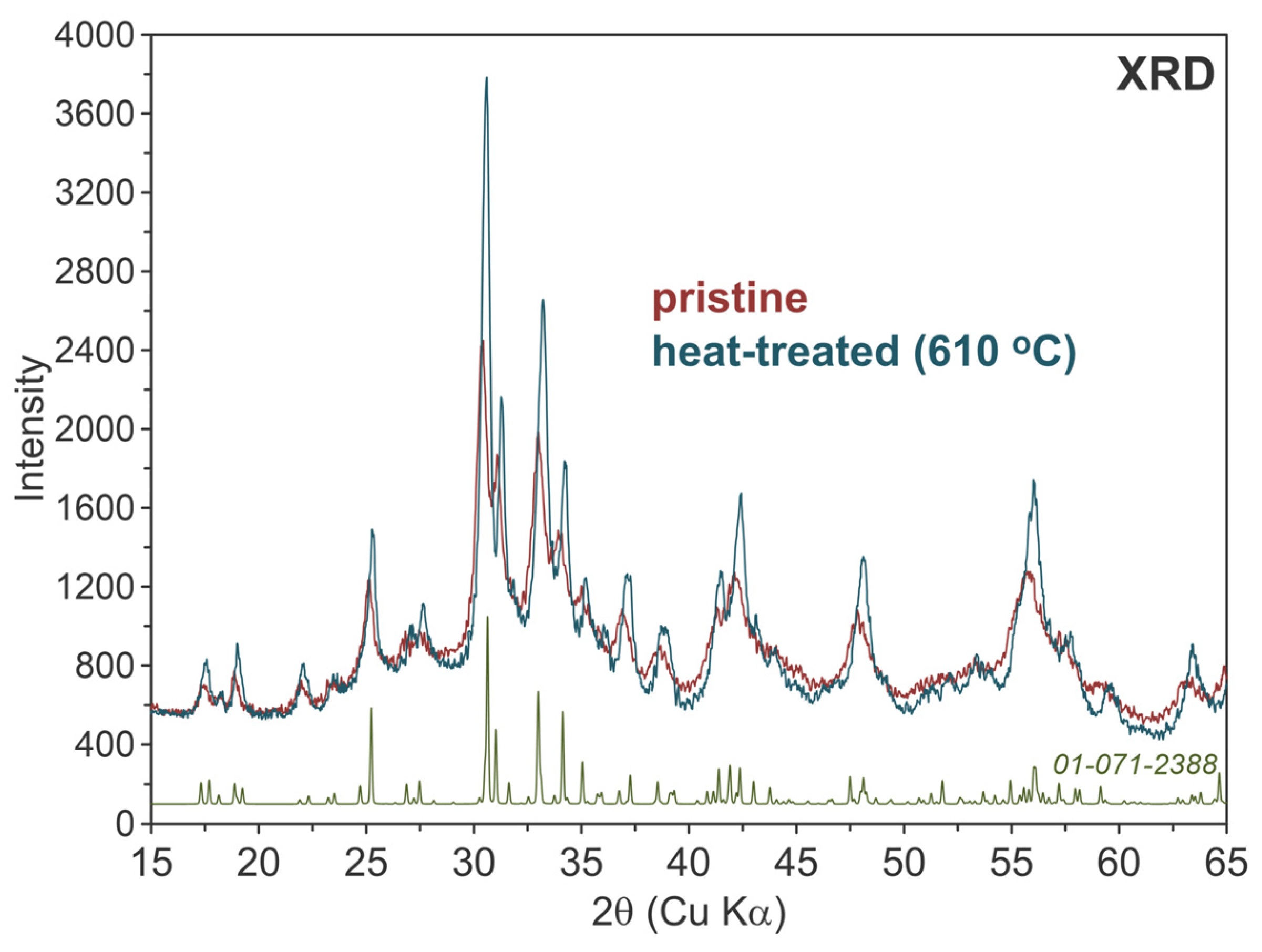
Centimeter-size allanite-(Ce) crystals from the Burroughs pegmatite, Colorado, were ground to a +45 µm/−300 µm size fraction (P80: 202 µm; P20: 91 µm) and concentrated by elutriation to a modal abundance of 94 wt%, associated with minor chlorite, apatite, quartz, and thorite. The peaks characteristic of allanite, observed in the XRD pattern (Figure 1), are well-developed, although broad, and associated with an amorphous metamict component, consistent with concentrations of around 1.3 wt% ThO2 (Table 1). The chemical composition, as determined by EPMA (Table 1), is consistent with a classification as allanite-(Ce) [30], while the low oxide total, likely reflecting a significant amount of incorporated H2O, supports that the mineral is indeed partially metamict [31].

2.2.2. Heat-Treated Allanite-(Ce)

A portion of the allanite-(Ce) feed (see Section 2.2.1), loaded in a Pt boat, was heat treated at 610 °C for 2 h in a horizontal tube furnace. At these conditions, allanite, CaREEAl2Fe2+Si3O11O(OH), should be partially transformed to oxyallanite with ideal endmember formula CaREEAl2Fe3+Si3O11O(O), through the coupled substitution [Fe2+][OH] ↔ [Fe3+][O2−], resulting from the iron oxidation charge balanced by dehydrogenation of the hydroxide anion [32,33]. In the XRD pattern shown in Figure 1, the shift of the diffraction peaks to higher 2θ compared to the pristine allanite-(Ce) is consistent with a unit cell contraction that would be expected from this process. However, the narrowing of the peaks and their higher intensities suggest that annealing of the thorium-induced defects, through recrystallization of the metamict allanite-(Ce), is also contributing to the transformation [31,34]. This is further supported by an increase in the oxide total of the heat-treated allanite-(Ce) chemical composition, as determined by EPMA (Table 1), that would result from the loss of excess H2O. Although heat treatment at higher temperature may have resulted in a higher degree of annealing, a moderate temperature (610 °C) was chosen in order to minimize the potential increase in surface area that would impact reactivity. As mentioned by Reissner et al. [34], interior stress caused by heterogeneous crystallization and hydrogen loss can lead to internal and surface cracking.
Table 1. Mean chemical compositions, obtained by WDS-EPMA, and calculated mineral formulae of the allanite-(Ce) in its pristine form and after heat treatment at 610 °C.
Allanite-(Ce)
PristineHeat-Treated (610 °C)
Mean (N = 30)1 σ * Mean (N = 25)1 σ
Oxides (wt%)
SiO230.370.5230.820.47
TiO20.350.070.390.05
Al2O314.640.9314.730.23
Fe2O3 **14.801.1415.661.24
MgO0.210.110.180.09
MnO1.560.581.530.59
CaO9.681.0810.060.66
La2O34.480.374.600.25
Ce2O310.820.8411.230.31
Pr2O31.240.111.270.05
Nd2O34.230.334.410.12
Sm2O30.660.060.690.03
Gd2O30.350.030.360.02
Dy2O30.130.030.140.03
Y2O30.490.090.490.04
ThO21.320.231.380.24
Total95.33 97.93
apfu ***
Si3.054 3.029
Ti0.027 0.029
Al1.735 1.706
Fe3+ ****0.218 1.158
Fe2+ ****0.902 0.000
Mg 0.032 0.026
Mn3+ ****0.000 0.125
Mn2+ ****0.133 0.003
Ca1.043 1.059
La0.166 0.167
Ce0.398 0.404
Pr0.046 0.045
Nd0.152 0.155
Sm0.023 0.023
Gd0.012 0.012
Dy0.004 0.004
Y0.026 0.026
Th0.030 0.031
Σcations ***8.000 8.000
O ****12.5 13.0
Note: * number of analyses (N) and standard deviation (1 σ); ** total Fe in wt% expressed as Fe2O3; *** atoms per formula unit (apfu) normalized on a total of 8 cations [30]; **** Fe3+/Fe2+ and Mn3+/Mn2+ in the formulae have been adjusted to balance the charge of the cations on the basis of 12.5 and 13 oxygens (O) for the pristine and heat-treated allanite-(Ce), respectively.

2.2.3. Synthetic REE Silicates and Phosphates

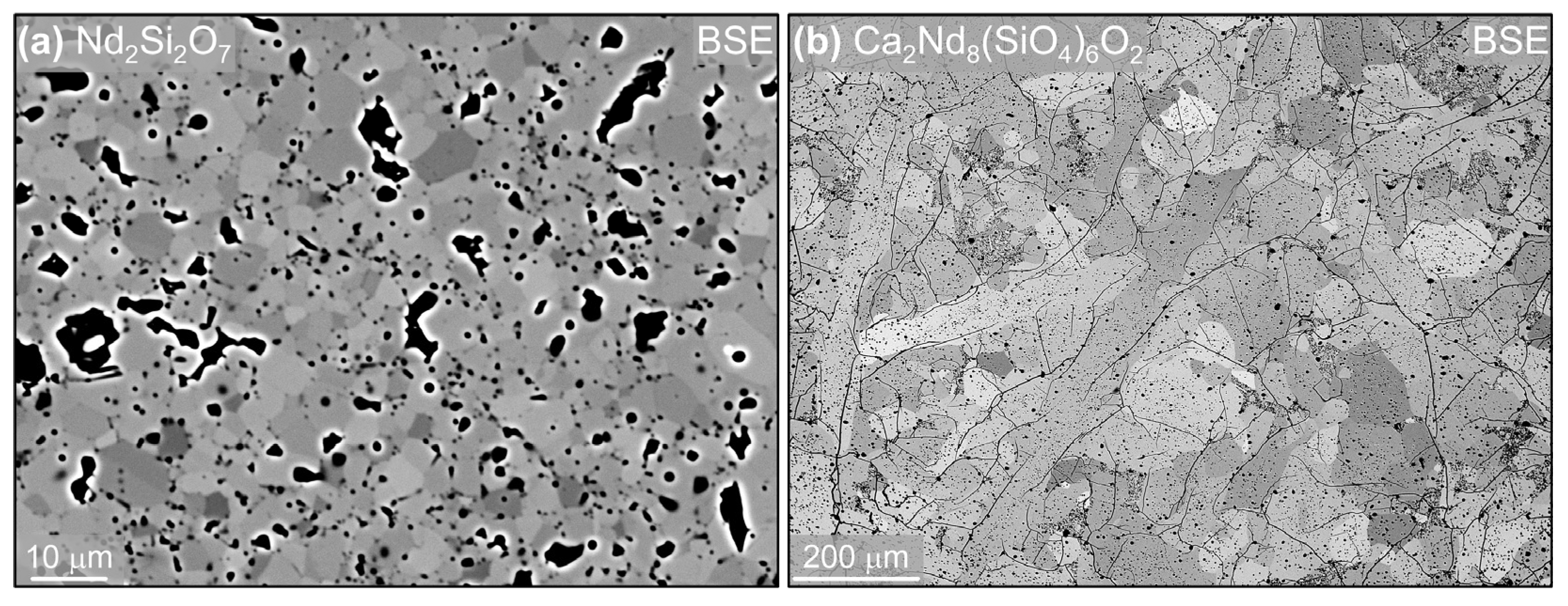
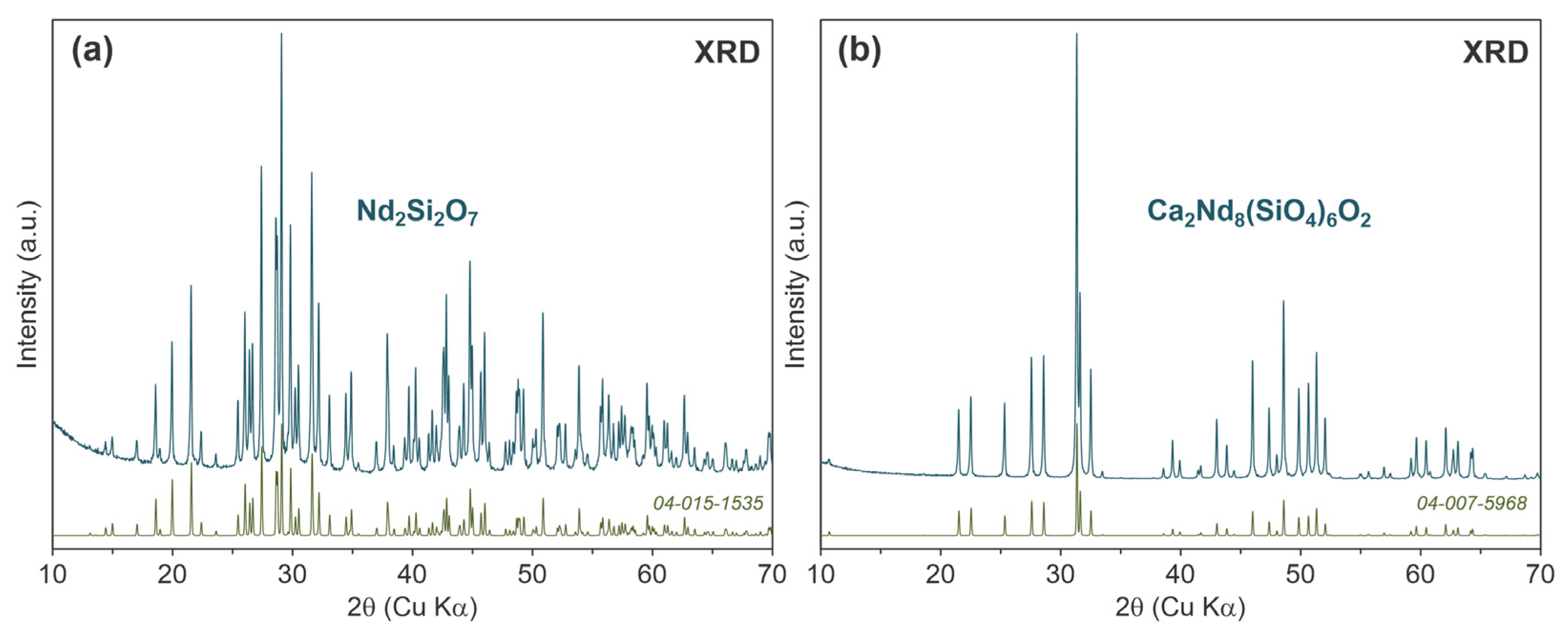
Neodymium disilicate and orthosilicate phases, with Nd2Si2O7 and Ca2Nd8(SiO4)6O2 compositions respectively (Table 2), were synthesized using a solid-state route. Appropriate stoichiometric proportions of calcium carbonate (CaCO3), neodymium nitrate hexahydrate (Nd2[NO3]3∙6H2O), and silica glass (SiO2), all with purity of ≥99.9%, were mixed and pressed into pellets that were loaded in Pt crucibles for an initial firing at 1375 °C for 24 h. The recovered material was finely ground with a micronizing mill, re-pelletized and fired for 72 h at 1475 °C to produce single-phase polycrystalline disks. High-contrast BSE imaging reveals small equigranular crystals (≈2 to 20 μm) for the disilicate (Figure 2a) and larger tabular crystals ranging up to ≈500 μm in size in the case of the orthosilicate (Figure 2b). The disks were then lightly ground and sieved to a +45/−500 μm size fraction leading to particle size distributions characterized by a P80/P20 of 287/90 μm for the disilicate and 234/103 μm for the orthosilicate. The XRD patterns shown in Figure 3 indicate that both materials are indeed single-phase with the expected structures, tetragonal P41 for Nd2Si2O7 and hexagonal P63/m for Ca2Nd8(SiO4)6O2.
Table 2. Mean chemical compositions, obtained by WDS-EPMA, and calculated mineral formulae of the synthetic silicates and phosphates.
Nd-DisilicateCa-Nd-OrthosilicateNd-Orthophosphate
N = 201 σ *N = 201 σN = 201 σ
Oxides (wt%)
SiO226.350.1019.750.06
CaO 6.250.03
Nd2O373.230.3573.510.2870.170.24
Gd2O3
Y2O3
P2O5 29.830.24
Total99.58 99.50 100.00
apfu **
Si2.006 6.000
Ca 2.033
Nd1.992 7.977 0.995
Gd
Y
P 1.003
O *7.000 26.000 4.000
Note: * number of analyses (N) and standard deviation (1 σ); ** atoms per formula unit (apfu) normalized on the number of oxygens specified as O *.
Figure 2. High-contrast BSE images obtained on the synthesized (a) polycrystalline Nd2Si2O7 disilicate, and (b) Ca2Nd8(SiO4)6O2 orthosilicate.
Minerals 16 00031 g002
Figure 3. Powder-XRD patterns collected on the synthesized (a) Nd2Si2O7 disilicate, and (b) Ca2Nd8(SiO4)6O2 orthosilicate starting materials. Simulated ICDD reference spectra for tetragonal Nd2Si2O7 (04-015-1535) and hexagonal Ca2Nd8(SiO4)6O2 (04-007-5968) are shown for comparison.
Minerals 16 00031 g003
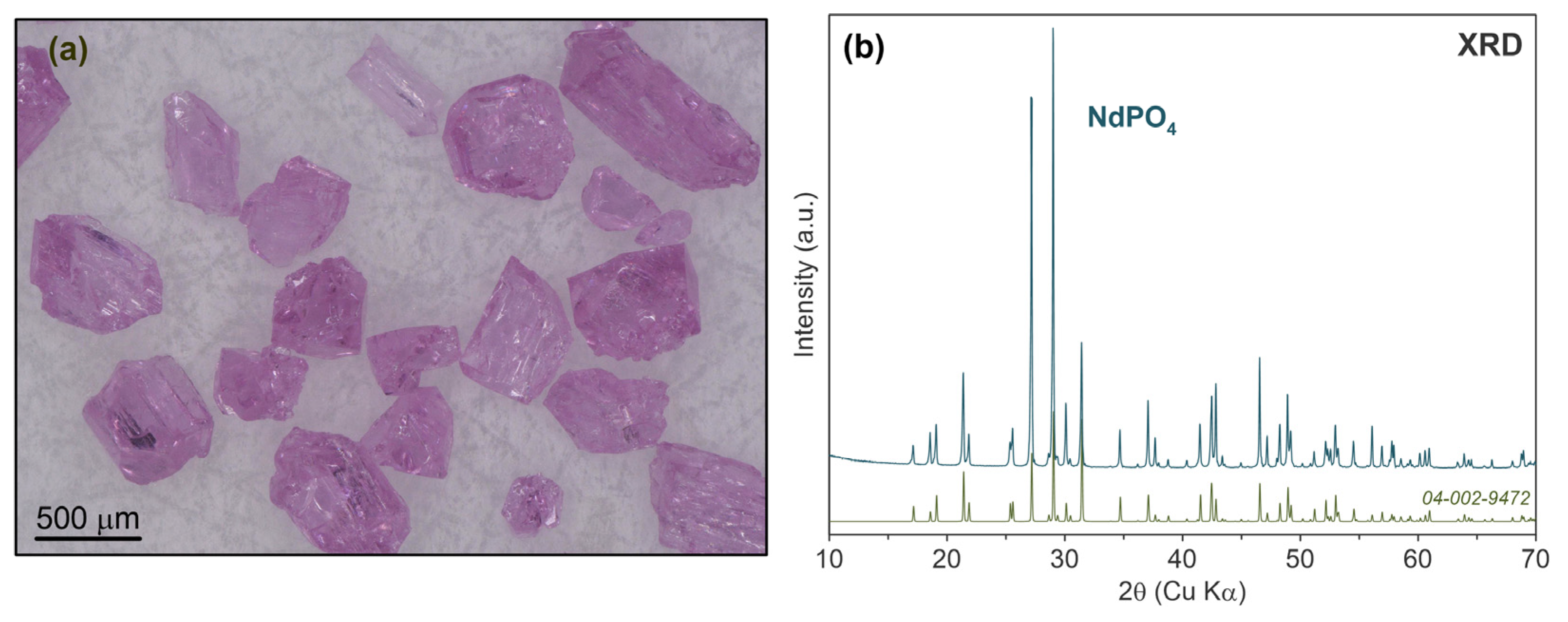
Synthetic crystals of monoclinic neodymium orthophosphate (NdPO4) ranging in size from 10s of micrometers up to 1 mm were produced by a flux method adapted from the approach used by Talla [35] and Lenz et al. [36]. A mixture of sodium trimetaphosphate (Na3P3O9) and the neodymium nitrate hexahydrates (≥99.9% purity), keeping a molar Na:REE proportion of 88:12, was loaded in a Pt crucible and heated to 1170 °C. To promote crystal growth, the temperature was then slowly decreased down to 900 °C, at a rate of 1 °C/h, after which the furnace was shut off and left to cool. As the coexisting sodium phosphate phase is water-soluble, the orthophosphate crystals could be recovered through rinsing (Figure 4a). After grinding the crystals to less than 75 μm, they were pelletized and fired at 1525 °C for 72 h to obtain sintered polycrystalline disks, which were then lightly ground and sieved to a +45/−500 μm size fraction (P80: 302 µm; P20: 93 µm). The crystal structure as single-phase monazite analogue was confirmed by XRD analysis (Figure 4b), with a composition, determined by WDS-EPMA, consistent with NdPO4 stoichiometry (Table 2).

2.3. Sulfuric Acid Treatment and Water Leach

Details of the acid treatment conditions for all the experiments conducted in this study can be found in Table 3. ACS-grade H2SO4 and deionized water were used to prepare the reagent, the characteristics of which are defined by two parameters: the concentration of H2SO4 added relative to the feed (H2SO4: feed weight ratio) and the extent of dilution with water, expressed as the relative weight percent of sulfuric acid in solution (H2SO4x%). Considering that the main objective was to investigate if there is a common passivation mechanism at play during sulfuric acid treatment that negatively impacts the decomposition of silicates, the concentration of H2SO4 was kept in significant excess of stoichiometric requirements to ensure that acid deficiency was not a variable. The solid feed and the appropriate amount of reagent were contained in a fused quartz (SiO2) crucible covered with a lid of similar material. All experiments were conducted isothermally, where the load was directly exposed to a peak temperature of 90 or 120 °C for durations ranging from 90 to 120 min. The acid treatments at 90 °C were performed in a drying oven, where the capped crucible was fixed to a clamp held horizontally at 10 cm of a vertical stirrer rotating at 40 rpm. At 120 °C, the loaded crucible was inserted into a pre-heated oil bath over a hot plate using magnetic stirring at 250 rpm. The temperature was continuously monitored with a K-type thermocouple held at sample height in the drying oven or inserted directly in the oil bath. At the end of all acid treatments, the crucible was recovered and left to cool in a desiccator for 10 min.
For some experiments, in order to better visualize the evolution of the decomposition reaction, the cooled product was thoroughly rinsed in isopropanol through vacuum filtration (0.45 μm PTFE membrane) allowing for preservation of the water-soluble sulfates. In all other cases, after cooling, DI water was added to the residues of the acid treatment at a liquid to solid weight ratio of 10 to 1. The resulting solution was then stirred at room temperature, with the crucible covered, for durations of 60 to 90 min, after which it was vacuum-filtered using a 0.45 μm PTFE membrane. The filtrate was stabilized with 5 vol% of a 2 vol% HNO3 solution and kept for bulk chemical analysis. The solid residues recovered from the isopropanol rinsing or the water leaching were vacuum-impregnated with epoxy resin in 2.5-cm cups, cured at room temperature, then polished on diamond lapping film using isopropanol or water as a lubricant, respectively.
Table 3. Experimental conditions for the acid treatments conducted in this study.
FeedExperiment #Acid Treatment Water Leach *
H2SO4 conc. (wt%)H2SO4:feed (wt ratio)T (°C)Duration (min)Duration (min)
Pristine
allanite-(Ce)
Al-PR-55-1551.5:19012090
Al-PR-55-2551.5:190120none **
Al-PR-75-1751.5:19012090
Al-PR-97-1971.5:19012090
Heat-treated
allanite-(Ce)
Al-HT-55-1551.5:19012090
Nd2Si2O7NdSi-55-1552.5:190120none **
NdSi-55-2552.5:19012090
NdSi-55-3552.5:11209060
NdSi-75-1752.5:11209060
NdSi-97-1972.5:11209060
Ca2Nd8(SiO4)6O2CaNdSi-55-1552.5:190120none **
CaNdSi-55-2552.5:19012090
CaNdSi-55-3552.5:11209060
CaNdSi-75-1752.5:11209060
CaNdSi-97-1972.5:11209060
CaNdSi-97-2972.5:112090none **
NdPO4NdP-55-1552.5:11209060
NdP-75-1752.5:11209060
NdP-97-1972.5:112090none **
NdP-97-2972.5:11209060
Note: # refers to the experiment number; * water leach always performed at a 10:1 liquid:solid wt ratio; ** “none” refers to experiments where the acid treatment product was rinsed and polished with isopropanol to preserve the sulfates instead of being water leached.

3. Results and Discussion

3.1. Acid Treatment of Allanite-(Ce)

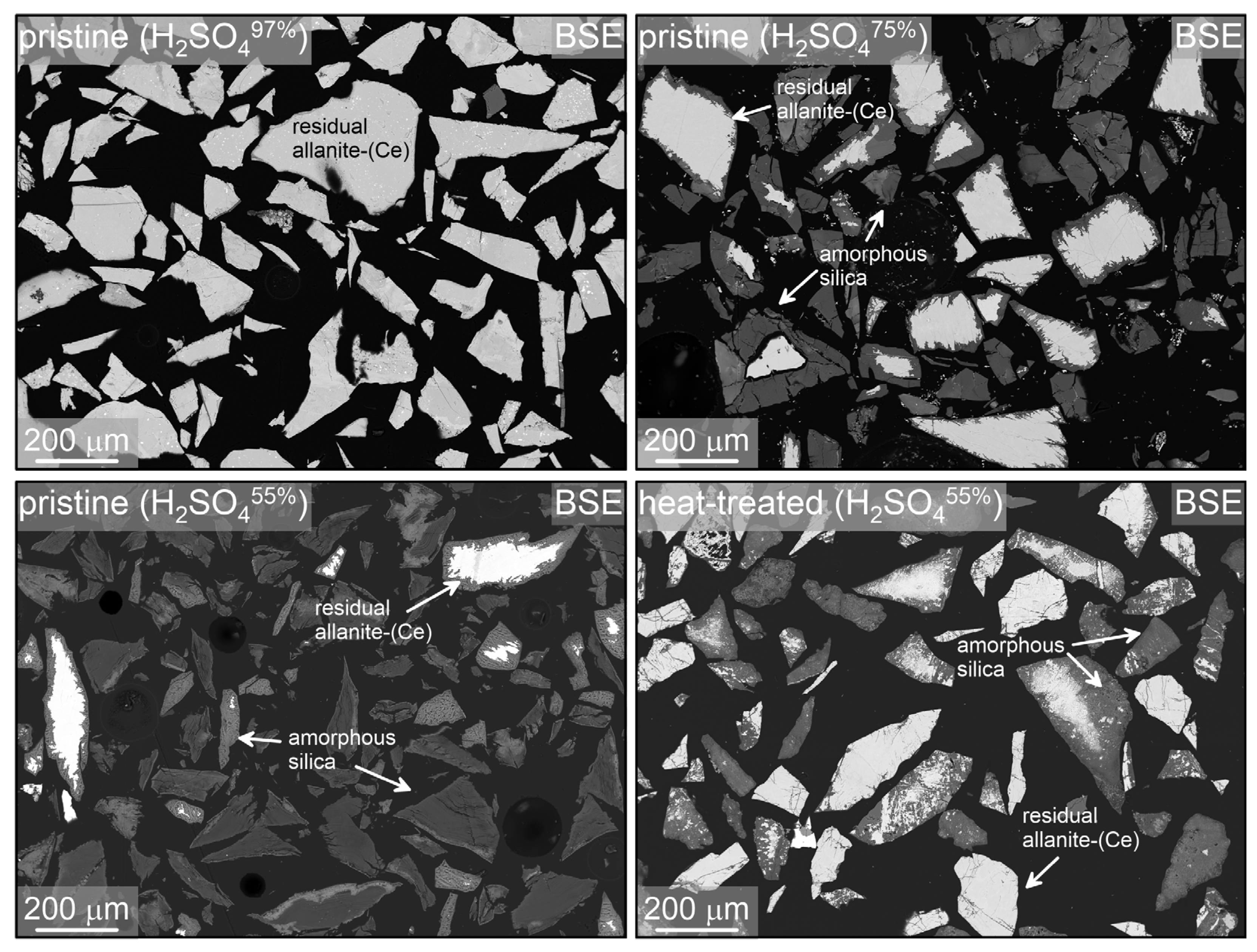
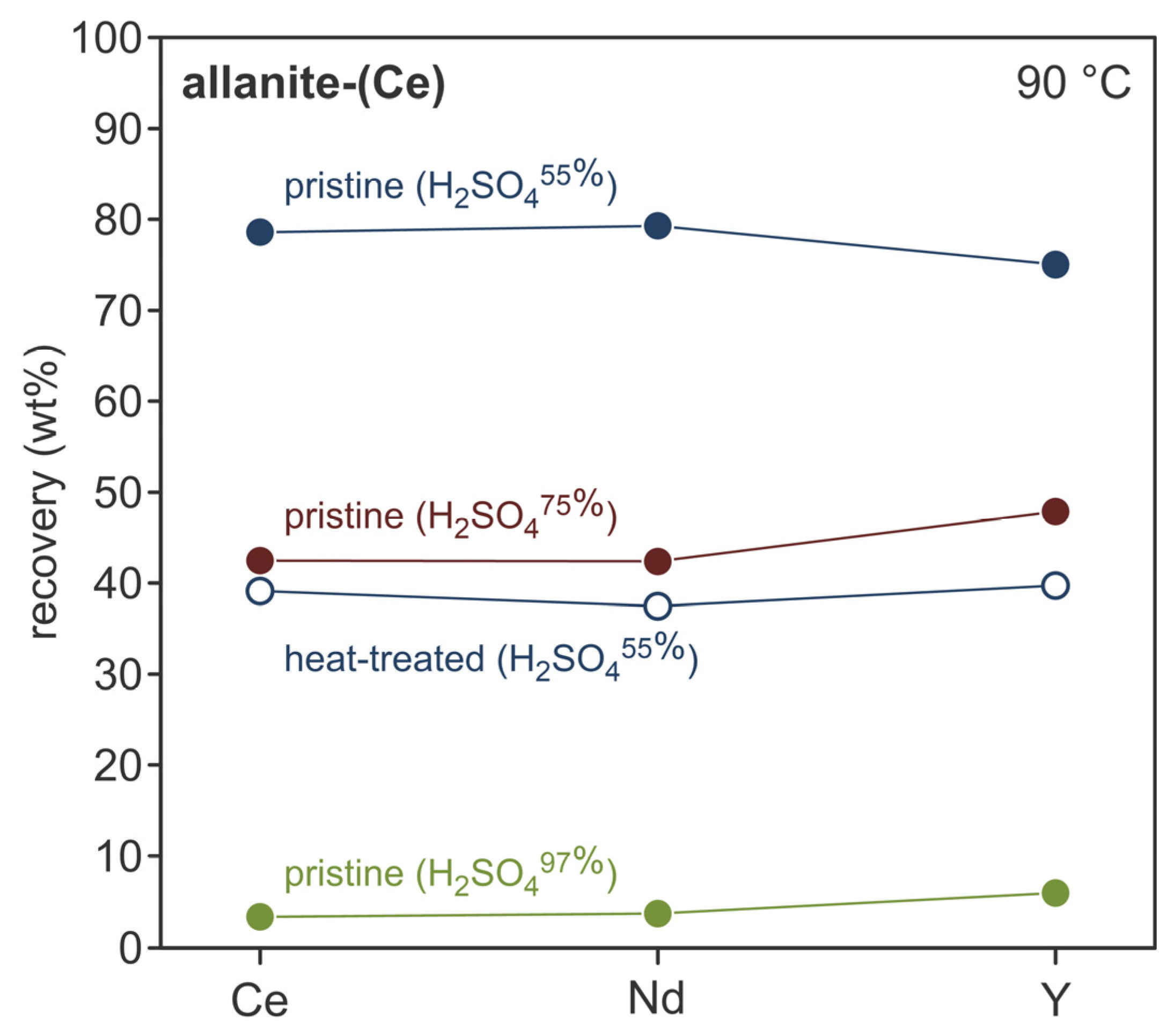
The acid treatment experiments on the pristine allanite-(Ce) feed were all performed at 90 °C using either the H2SO497%, H2SO475%, or the H2SO455% acid solutions (Al-PR-97-1, Al-PR-75-1 and Al-PR-55-1 in Table 3). BSE imaging of the solid reacted products recovered after the water leach (Figure 5) reveals a sharp contrast in the extent of decomposition. Whereas the vast majority of allanite-(Ce) grains are unreacted after treatment with concentrated H2SO497% (Al-PR-97-1), a progressive replacement by amorphous silica is observed with increasing acid dilution, with only minor residual allanite-(Ce) cores remaining at H2SO455% (Al-PR-55-1). This strong variation in the decomposition rate evidently has a major impact on REE recovery, which ranges from ≈5 wt% for H2SO497% up to ≈80 wt% with H2SO455% (Figure 6). These results are consistent with important passivation effects limiting the decomposition of allanite-(Ce) in concentrated sulfuric acid and the role of water addition in minimizing its impact [23].
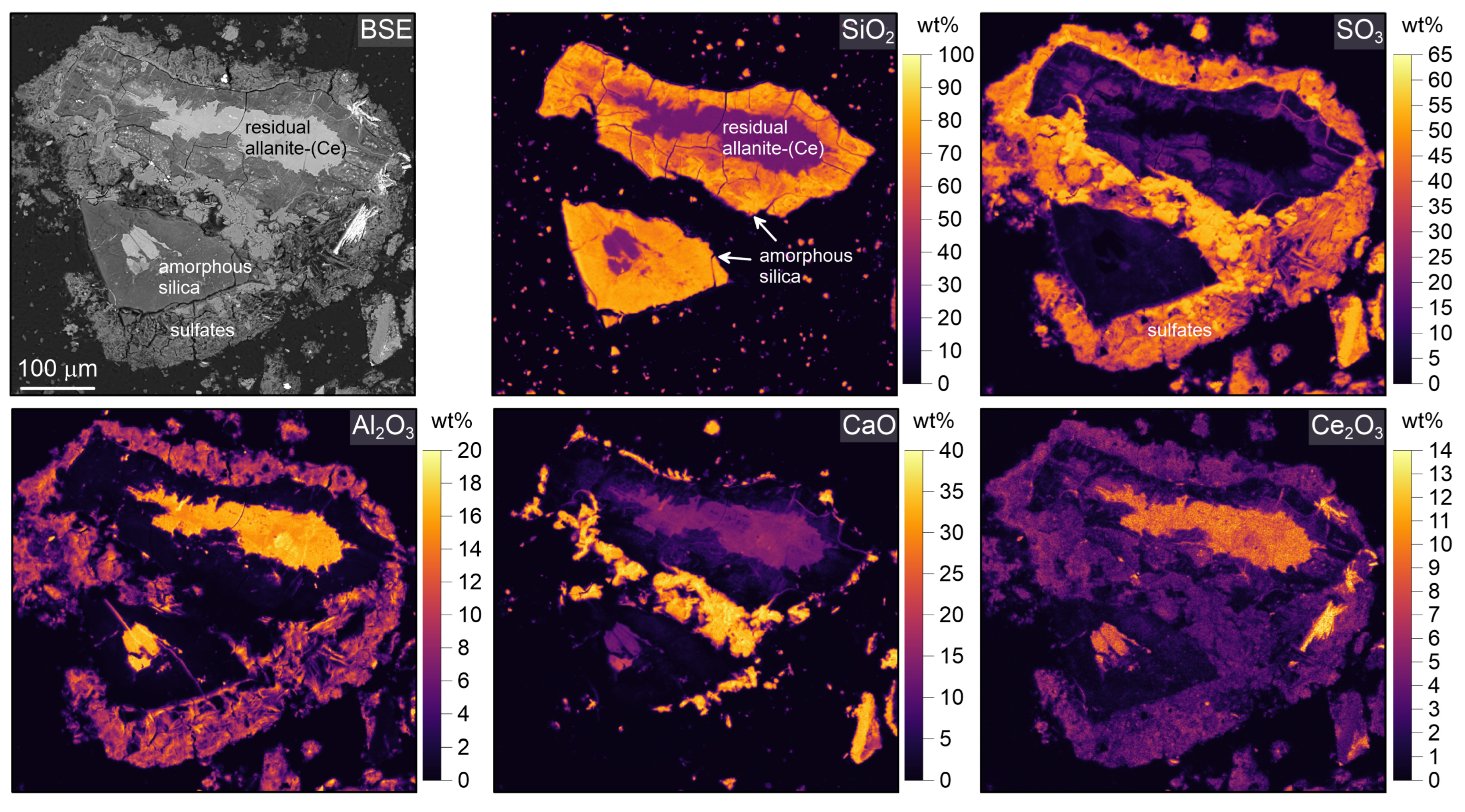
To better visualize the textural relationship between the amorphous silica layer and the water-soluble sulfates produced during mineral decomposition, quantitative elemental mapping by WDS-EPMA around residual allanite cores was performed on the product directly recovered after a H2SO455% acid treatment and preserved through rinsing and polishing with isopropanol (Al-PR-55-2). The efficient crystallization of sulfates against the outer rim of a well-developed silica layer (Figure 7) confirms that, at this level of water dilution, efficient transfer between the bulk acidic solution and the crystal dissolution front is maintained.
Figure 5. BSE images obtained on polished cross-sections of the solid products recovered after the water leach from the acid treatment experiments performed at 90 °C on the pristine and heat-treated allanite-(Ce). Detailed conditions for these experiments can be found in Table 3 as Al-PR-97-1, Al-PR-75-1, Al-PR-55-1, and Al-HT-55-1.
Minerals 16 00031 g005
Figure 6. REE (Ce, Nd, Y) recoveries obtained after the water leach from the acid treatment experiments performed at 90 °C on the pristine and heat-treated allanite-(Ce). The REE recoveries in wt% were calculated following the expression: (REEsolution masssolution)/(REEfeed massfeed) 100.
Minerals 16 00031 g006
Figure 7. BSE image and quantitative WDS-based elemental maps across a partially reacted allanite-(Ce) grain in the solid residue recovered from an acid treatment experiment conducted on the pristine feed using H2SO455%, and rinsed in isopropanol to preserve the produced sulfates (Al-PR-55-2; Table 3). The elemental abundances in the quantitative maps are expressed as oxide wt% (SiO2, SO3, Al2O3, CaO, Ce2O3).
Minerals 16 00031 g007
The metamict nature of the allanite-(Ce) suggests that contribution of the actinide-induced defects may also influence the extent of its decomposition [26,27,28]. Clearly, comparing the BSE images (Figure 5) of the product recovered after the water leach for H2SO455% experiments performed with the heat-treated (Al-HT-55-1) and pristine (Al-PR-55-1) allanite-(Ce) indicates that recrystallization has rendered the mineral significantly more refractory. Nevertheless, the detrimental impact of the heat treatment on REE recovery (Figure 6) when reacted at optimal acid dilution (H2SO455%) is significantly less than that of the passivation induced by the silica layer in concentrated H2SO4 (H2SO497%).

3.2. Acid Treatment of Neodymium Disilicate and Orthosilicate

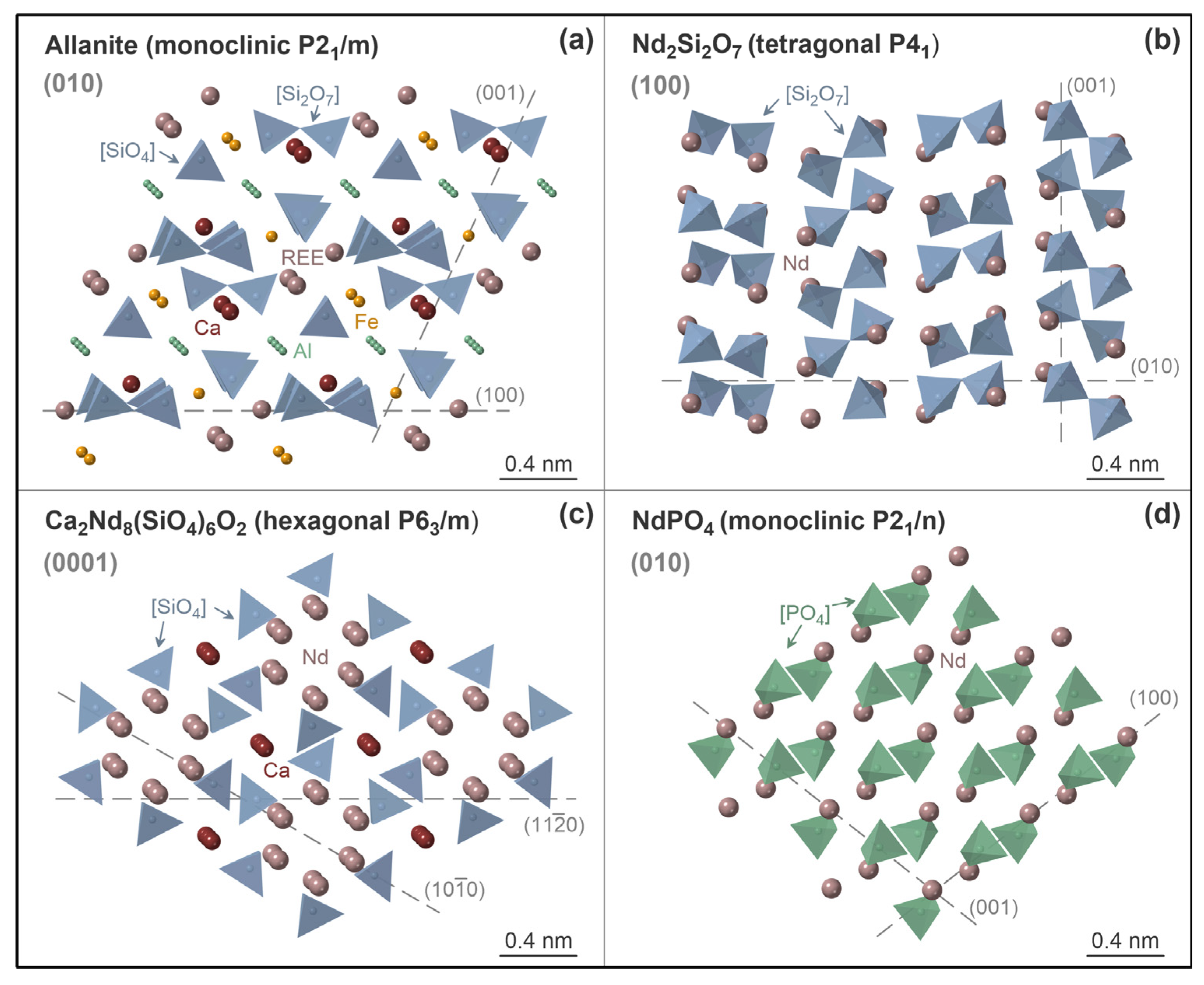
Although having different crystal structures, which will impact their relative reactivity, the REE silicates that were synthesized present some analogy with allanite when visualized in terms of polymerization of the SiO4 tetrahedra (Figure 8), a property that can impact the nature of the produced amorphous silica layer [6,16,18]. Monoclinic allanite is characterized by two types of tetrahedral groups, pairs of tetrahedra bridged by a single apical oxygen forming [Si2O7]−6 dimers, as well as isolated [SiO4]−4 units (Figure 8a). On the other hand, the synthetic tetragonal Nd2Si2O7 is a true disilicate consisting only of [Si2O7]−6 groups associated with Nd in higher coordination (Figure 8b). Finally, hexagonal Ca2Nd8(SiO4)6O2, a synthetic analogue of the mineral britholite, Ca4REE6(SiO4)6(OH)2, with the exception that the hydroxide anions are replaced by oxygen through the mass-balanced substitution: [2 Ca2+ + 2 OH] ↔ [2 REE3+ + 2 O2−], is an orthosilicate where there is no direct linkage between each isolated [SiO4]−4 tetrahedra (Figure 8c). Simplified decomposition reactions for these synthetic neodymium silicates in sulfuric acid can be expressed as:
Nd2Si2O7 + 3 H2SO4 → Nd2(SO4)3 + 2 SiO2(amorphous) + 3 H2O.
Ca2Nd8(SiO4)6O2 + 14 H2SO4 → 2 CaSO4 + 4 Nd2(SO4)3 + 6 SiO2(amorphous) + 14 H2O.

3.2.1. Neodymium Disilicate: Nd2Si2O7

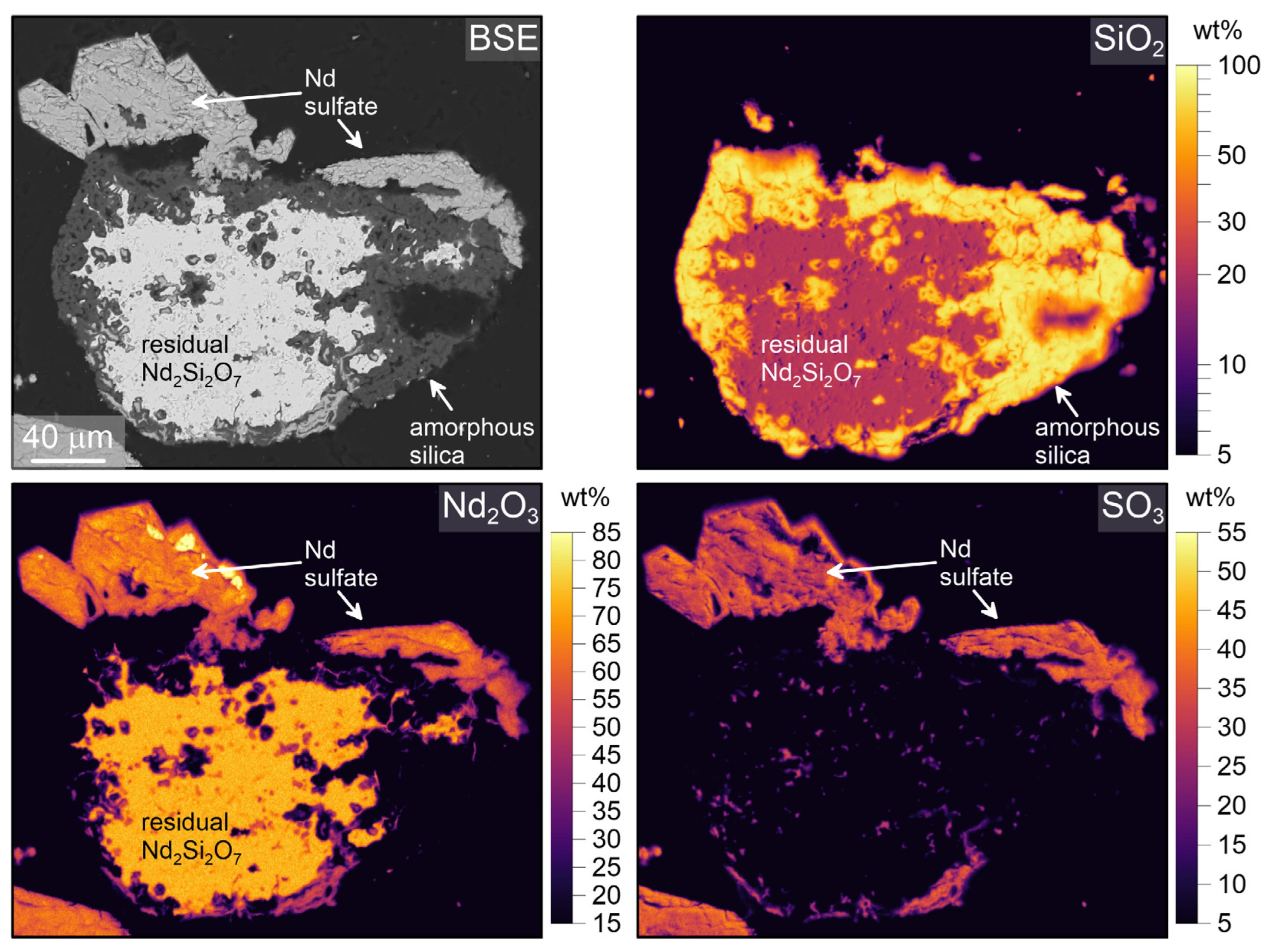
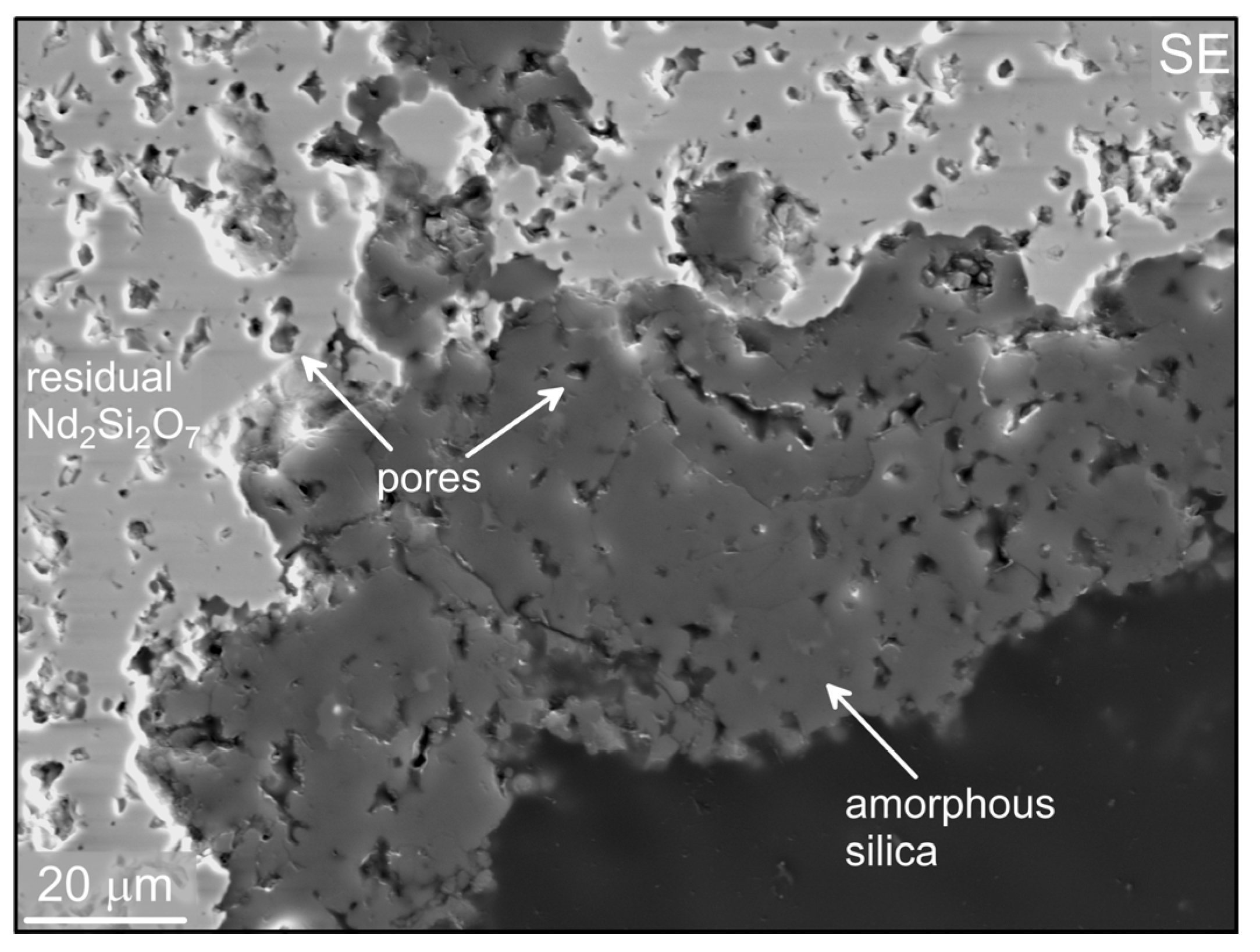
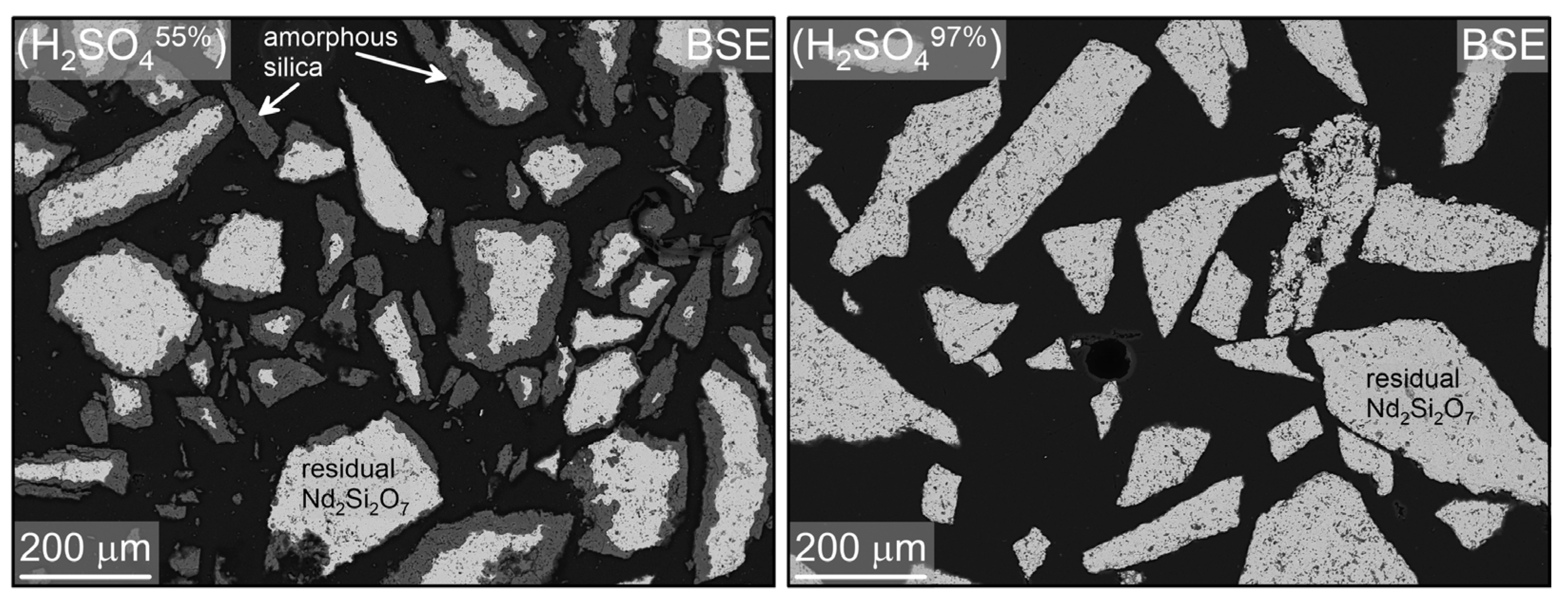
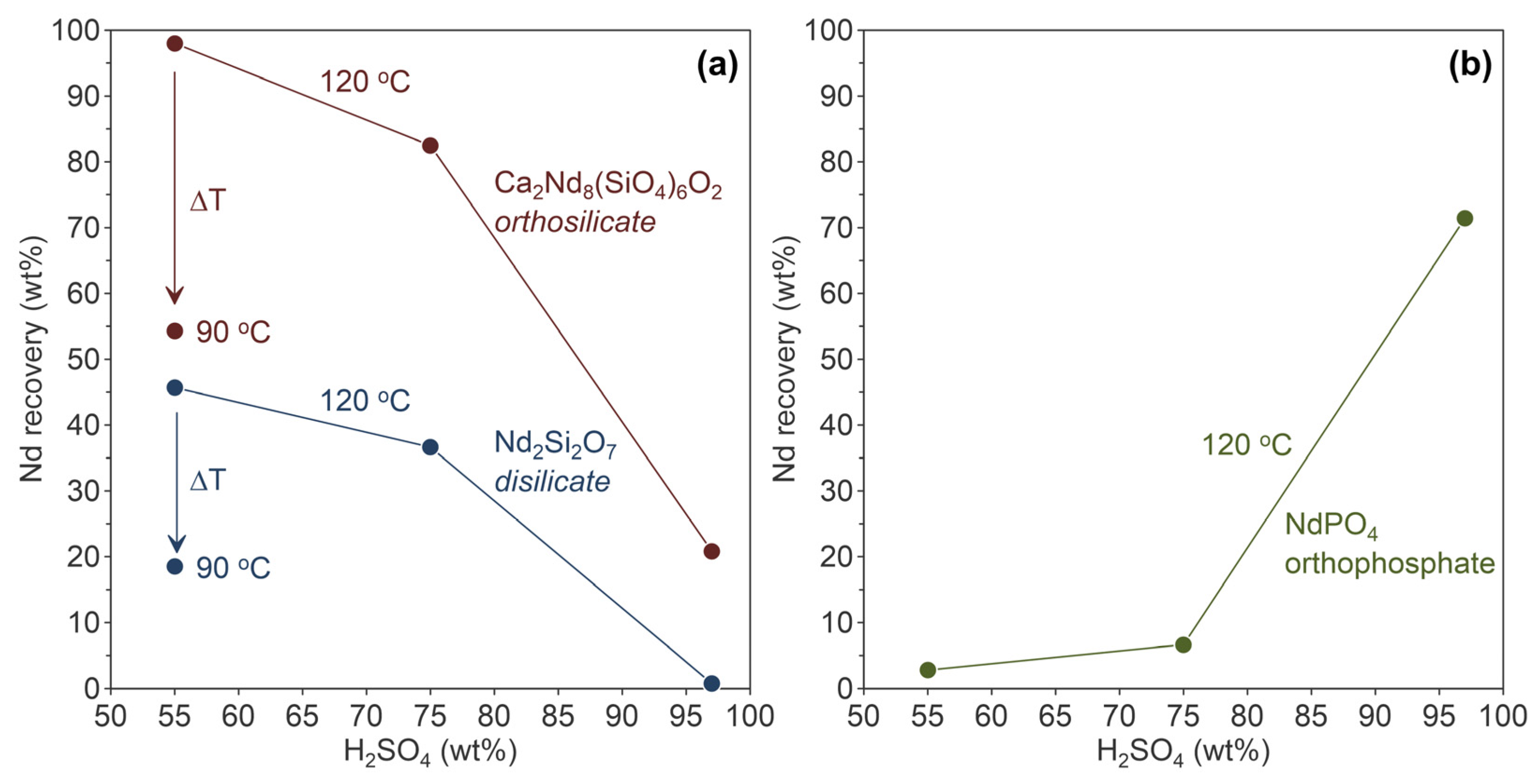
In an acid treatment with the H2SO455% solution at 90 °C, the mode of decomposition of the neodymium disilicate shows similarities with that of allanite-(Ce), where a well-defined amorphous silica layer formed around the residual Nd2Si2O7 particle is associated with outwards crystallization of neodymium sulfate that can be observed in the residue preserved with isopropanol (NdSi-55-1; Figure 9). However, considering the polycrystalline nature of the starting material (Figure 2a), the Nd2Si2O7-silica interface is irregular, due to pseudomorphic replacement of the individual µm-sized crystals, which even preserves the original porosity (Figure 10). At these conditions, only 18 wt% of neodymium was recovered after the water leach (NdSi-55-2), increasing up to 46% at 120 °C (NdSi-55-3), indicating that the Nd2Si2O7 is significantly more refractory than allanite-(Ce). Nevertheless, similar to what was observed for allanite-(Ce), there is a marked decrease in the extent of decomposition (Figure 11) and REE recovery (Figure 12a) with increasing acid concentration (H2SO455% → H2SO475% → H2SO497%) for experiments performed on the Nd2Si2O7 feed at 120 °C (NdSi-55-3, NdSi-75-1, NdSi-97-1). This confirms once again the severity of silica passivation in concentrated H2SO4, the effect of which on recovery loss is more important than a reduction in temperature from 120 °C down to 90 °C at diluted acid concentrations (H2SO455%).

3.2.2. Neodymium Orthosilicate: Ca2Nd8(SiO4)6O2

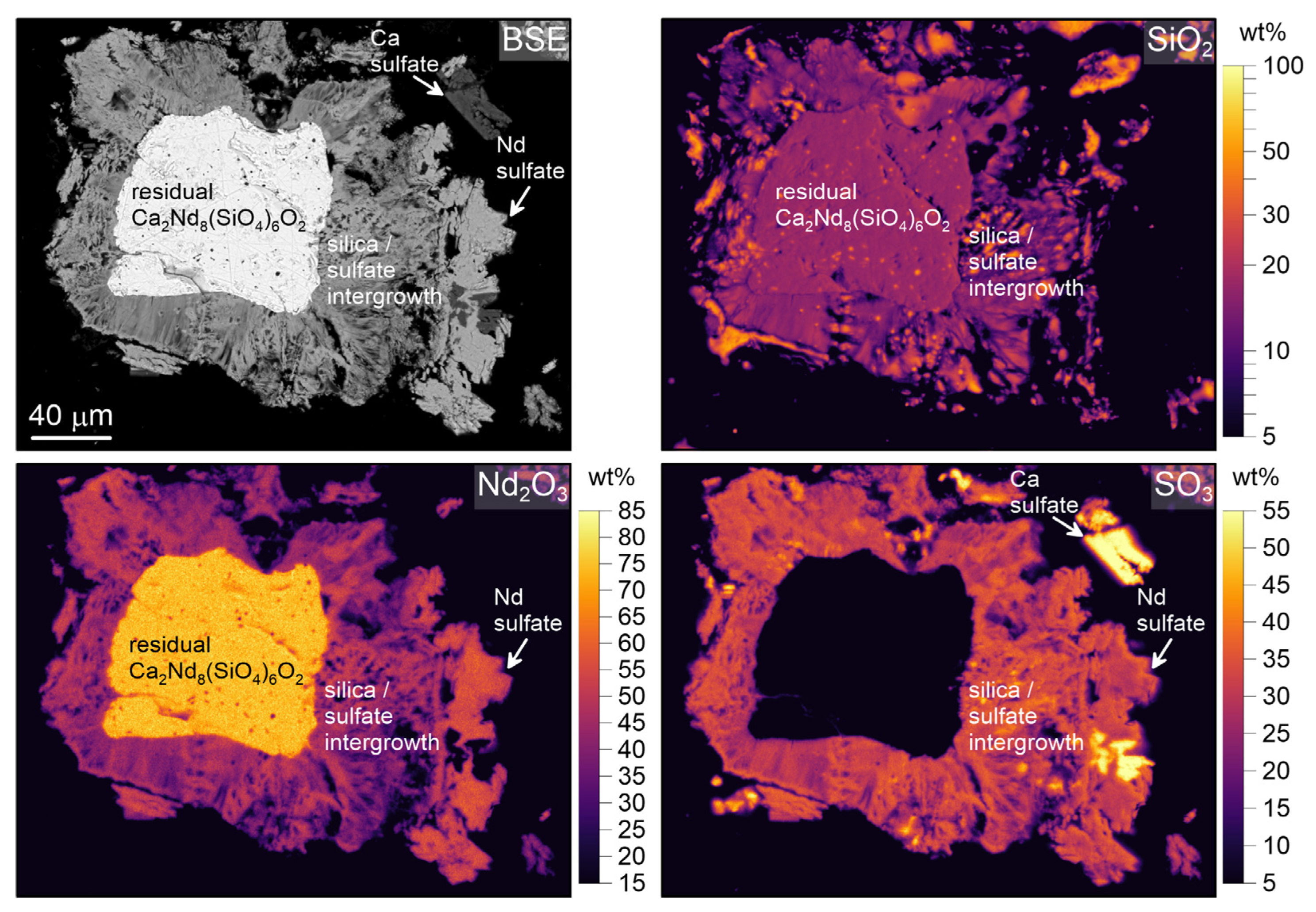
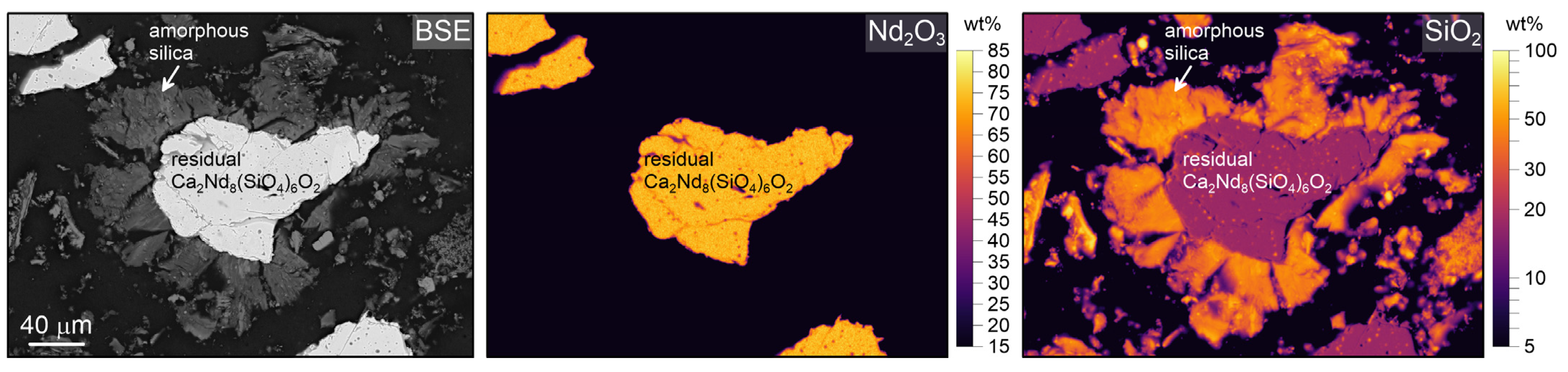
The complete depolymerization of the SiO4 tetrahedra in orthosilicates is expected to significantly influence the nature or even the ability to maintain the growth of an amorphous silica layer during decomposition in acidic media [6,8]. In this context, characterization of the isopropanol-preserved product for an acid treatment performed on the synthetic neodymium orthosilicate at 90 °C with the H2SO455% solution (CaNdSi-55-1) reveals a distinct evolution of the decomposition reaction, where the Ca2Nd8(SiO4)6O2 particles are progressively replaced by a tight intergrowth of sulfate and silica (Figure 13). The outline of this replacement layer seems to preserve the morphology of the original orthosilicate particle, against which well-developed neodymium and calcium sulfate crystals can be observed. After an acid treatment at similar conditions followed by a water leach that dissolves the sulfates (CaNdSi-55-2), an underlying amorphous silica framework representing the relic of the replacement layer can be identified (Figure 14), although the higher SiO2 concentration suggests its densification during leaching. With such diluted acidic conditions (H2SO455%), neodymium recoveries from 54 up to 98 wt% (Figure 12a) can be achieved at temperatures of 90 and 120 °C, respectively (CaNdSi-55-2, CaNdSi-55-3). On the other hand, in progressively more concentrated acid (CaNdSi-75-1, CaNdSi-97-1) the neodymium recovery eventually drops to 21 wt% at H2SO497% (Figure 12a).
Figure 13. BSE image and quantitative WDS-based elemental maps across a partially reacted Ca2Nd8(SiO4)6O2 grain in the solid residue recovered from an acid treatment experiment using H2SO455%, and rinsed in isopropanol to preserve the produced sulfates (CaNdSi-55-1; Table 3). The elemental abundances in the quantitative maps are expressed as wt% of the oxides (SiO2, Nd2O3, SO3). To facilitate comparison, the concentration scale for each specific oxide is kept within the same range in Figure 9, Figure 13, Figure 14, Figure 15 and Figure 16.
Minerals 16 00031 g013
Figure 14. BSE image and quantitative WDS-based elemental maps across a partially reacted Ca2Nd8(SiO4)6O2 grain in the solid residue recovered from the water leach after an acid treatment experiment using H2SO455% (CaNdSi-55-2; Table 3). The elemental abundances in the quantitative maps are expressed as wt% of the oxides (Nd2O3, SiO2). To facilitate comparison, the concentration scale for each specific oxide is kept within the same range in Figure 9, Figure 13, Figure 14, Figure 15 and Figure 16.
Minerals 16 00031 g014
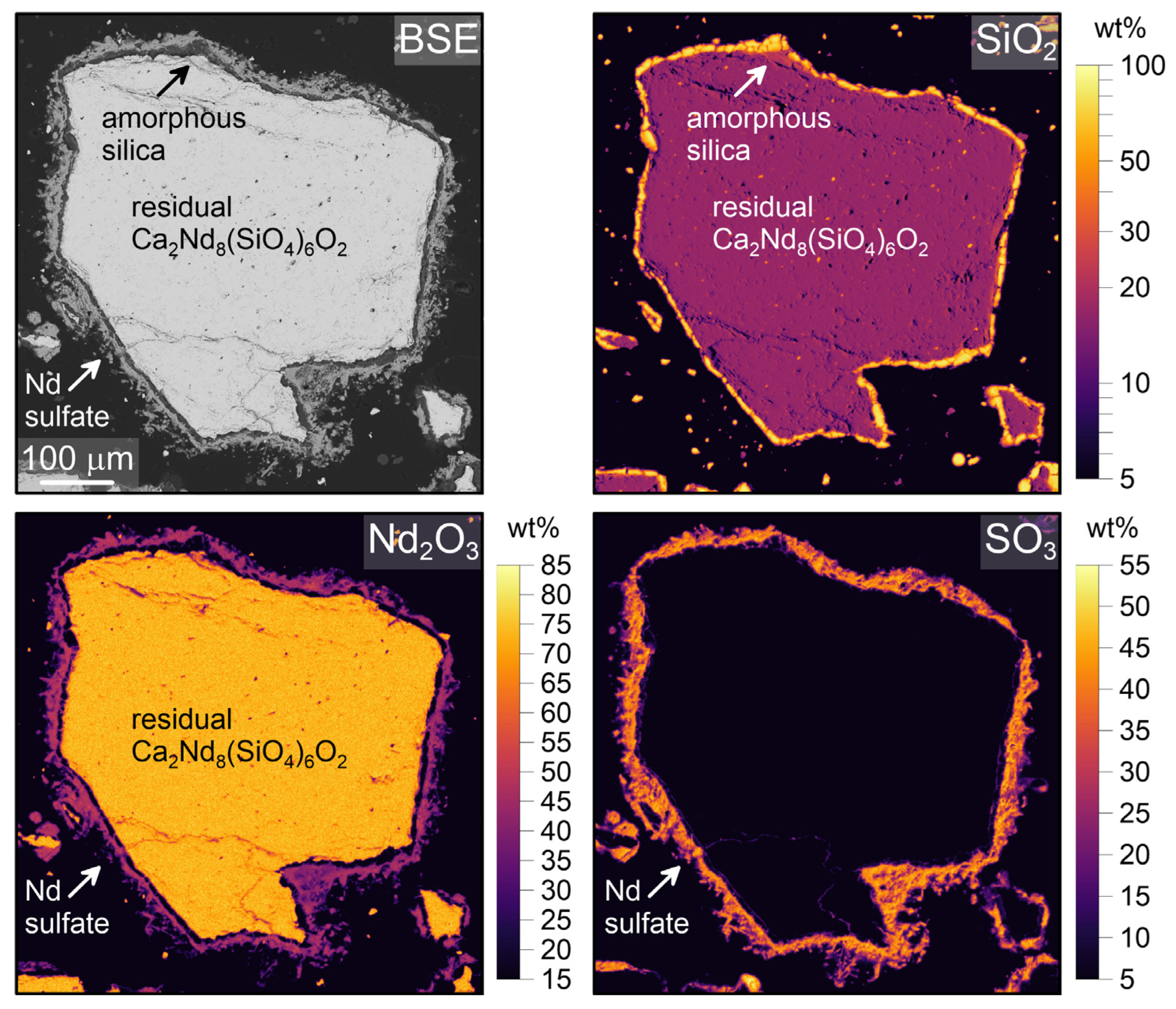
Characterization of the distribution of silicon, neodymium, and sulfur by quantitative WDS-EPMA mapping across a residual Ca2Nd8(SiO4)6O2 particle from the isopropanol-preserved product of an acid treatment performed with the concentrated H2SO497% solution (CaNdSi-97-2) is shown in Figure 15. Only minor neodymium sulfate crystallization can be identified, suggesting that the decomposition reaction was initiated, but that the growth of a narrow continuous silica layer was sufficient to halt its progression.
Figure 15. BSE image and quantitative WDS-based elemental maps across a partially reacted Ca2Nd8(SiO4)6O2 grain in the solid residue recovered from an acid treatment experiment using H2SO497%, and rinsed in isopropanol to preserve the produced sulfates (CaNdSi-97-2; Table 3). The elemental abundances in the quantitative maps are expressed as wt% of the oxides (SiO2, Nd2O3, SO3). To facilitate comparison, the concentration scale for each specific oxide is kept within the same range in Figure 9, Figure 13, Figure 14, Figure 15 and Figure 16.
Minerals 16 00031 g015
These observations strongly suggest that, even in fully depolymerized silicate structures, a silica layer can be maintained and can still induce passivation during acid treatment in concentrated H2SO4. Similar to the trend observed for the disilicate, the negative impact on Nd recovery resulting from an increase in H2SO4 concentration to 97% is significantly more pronounced than a reduction in temperature by 30 °C (120 → 90 °C) in diluted H2SO455% acidic solution. However, in the case of Ca2Nd8(SiO4)6O2, by inheriting, at the short-range order, the depolymerized SiO4 arrangement from the parent orthosilicate, the amorphous silica layer may grow as a more open framework where the sulfates can crystallize. Consequently, the observed pseudomorphic replacement is in the form of a tight intergrowth that can potentially act as an efficient physical barrier.

3.3. Acid Treatment of Neodymium Orthophosphate

Similar to the [SiO4] group in the orthosilicates, the [PO4] tetrahedra in the orthophosphate are isolated, sharing each apical oxygen with REEs (Nd) in ninefold coordination (Figure 8d). However, as P2O5 is known to react with sulfuric acid to produce phosphoric acid, no amorphous layer that can induce passivation should be produced during monoclinic NdPO4 decomposition, a synthetic analogue of monazite [1,2]:
2 NdPO4 + 3 H2SO4 → Nd2(SO4)3 + 2 H3PO4(soluble).
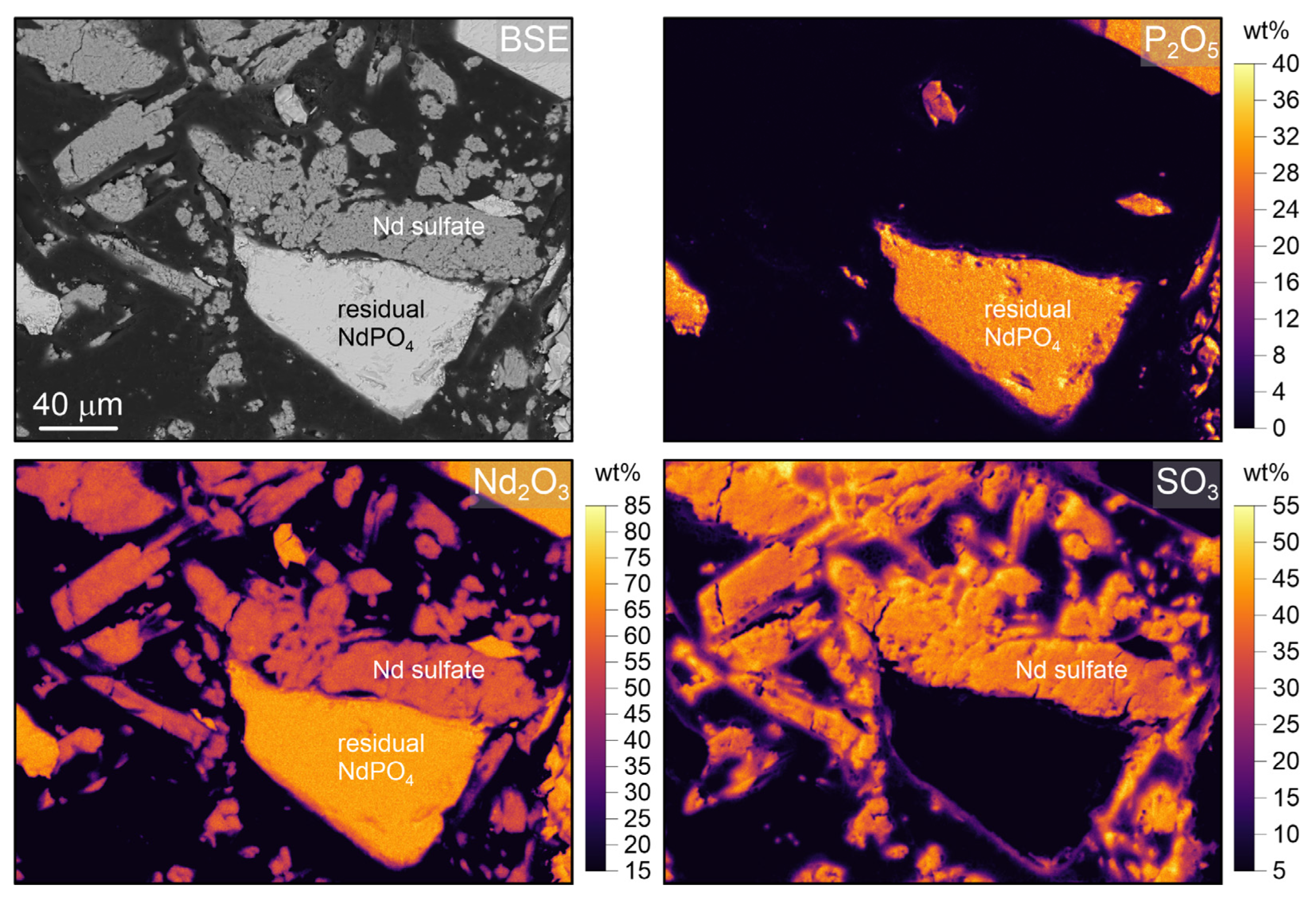
Consequently, contrary to what was observed for the silicates, concentrated sulfuric acid (H2SO497%) promotes decomposition leading to significantly improved recovery (Figure 12b), considering that neodymium sulfate can crystallize freely around the receding NdPO4 particle, as the dissolution front remains in direct contact with the bulk acidic solution (Figure 16).
Figure 16. BSE image and quantitative WDS-based elemental maps across a partially reacted NdPO4 grain in the solid residue recovered from an acid treatment experiment using H2SO497%, and rinsed in isopropanol to preserve the produced sulfates (NdP-97-1; Table 3). The elemental abundances in the quantitative maps are expressed as wt% of the oxides (P2O5, Nd2O3, SO3). To facilitate comparison, the concentration scale for each specific oxide is kept within the same range in Figure 9, Figure 13, Figure 14, Figure 15 and Figure 16.
Minerals 16 00031 g016

4. Implications and Conclusions

The results obtained from this study provide a number of constraints about the mode of decomposition of silicates in sulfuric acid:
  • Although the acid strength is expected to be the driver in promoting mineral decomposition, as clearly observed in NdPO4 (Section 3.3), for the silicates investigated (Section 3.1 and Section 3.2), no matter their crystalline structure and their relative chemical resistance, we observe an inverse trend with a sharp decrease in reactivity with the strongest acidic solution (H2SO497%). Consequently, there is a passivation mechanism at play that prevents efficient interaction between sulfuric acid and silicates which effect can be strongly minimized by water dilution.
  • During decomposition, there is evidence of pseudomorphic replacement by a silica layer, which can even be maintained in the case of the most depolymerized silicate structure (Figure 13) where it is tightly intergrown with the produced sulfates.
  • In all the H2SO455% acid treatment products preserved in isopropanol, the sulfates can be observed, often with well-defined crystalline shapes on the outer rim of the produced silica layer. This implies efficient transfer of the sulfate-forming cations across the silica layer, although their solubility limit has been exceeded in the acidic solution, even at this level of water dilution.
In this context, as proposed in our previous study on allanite-(Ce) [23], a passivation mechanism governed by the decrease in solubility of the produced sulfates with increasing acid concentration due to the “common ion effect” [37,38,39,40] may be applicable to a wide range of silicates hosting REE or any other critical elements. In essence, in concentrated H2SO4, as sulfate saturation is rapidly reached at the crystal dissolution front, the presence of a silica layer, even if permeable to the solution, will act as a physical barrier that prevents efficient cation transfer leading to a slow decomposition rate. In contrast, with increasing dilution, H2SO4 consumption at the crystal dissolution front will raise the water concentration, and hence the solubility of the sulfate-forming cations, allowing their efficient transport across the permeable silica layer until they finally crystallize in the more acidic bulk solution.
This distinct characteristic of silicates, where a compromise needs to be made between the acid contribution required to decompose the mineral and that of water to minimize passivation, can have an impact on extraction strategy. For example, in the context of an ore where the REEs are distributed between silicates and other minerals such as phosphates, a sequential approach may be considered where an initially diluted acid solution, which will ensure the efficient decomposition of the silicates, is subsequently concentrated through water evaporation using a dynamic heating path, or by simple H2SO4 injection. In contrast, for nonsilicate REE carriers associated with gangue silicates, the use of concentrated H2SO4 would optimize REE recovery, minimize acid consumption, and improve the purity of the resulting leach solution, considering that it will promote decomposition of the REE minerals; yet, at the same time, it will induce passivation of the unwanted silicates.

Author Contributions

Conceptualization, Y.T. and J.G.M.; methodology, Y.T. and J.G.M.; validation, Y.T. and J.G.M.; investigation, Y.T., J.G.M. and D.D.; data curation, Y.T., J.G.M. and D.D.; writing—original draft preparation, Y.T. and J.G.M.; writing—review and editing, Y.T., J.G.M. and D.D. All authors have read and agreed to the published version of the manuscript.

Funding

Financial support for this project was provided by Natural Resources Canada through a special fund for the Critical Minerals R&D Program.

Data Availability Statement

The data are contained within the article.

Acknowledgments

Technical support for XRD analyses by Derek Smith, sample preparation by Talia Beckwith and Seung Hoon Kang, and assistance with solution chemistry by Fahim Meziane, all from CanmetMINING (Ottawa, ON, Canada), are gratefully acknowledged. The authors also thank Nail Zagrtdenov for his assistance with automated mineralogy and helpful suggestions during the course of this study.

Conflicts of Interest

The authors declare no conflict of interest.

References

  1. Sadri, F.; Nazari, A.M.; Ghahreman, A. A review on the cracking, baking and leaching process of rare earth elements concentrates. J. Rare Earths 2017, 35, 739–752. [Google Scholar] [CrossRef]
  2. Demol, J.; Ho, E.; Soldenhoff, K.; Senanayake, G. The sulfuric acid bake and leach route for processing rare earth ores and concentrates: A review. Hydrometallurgy 2019, 188, 123–139. [Google Scholar] [CrossRef]
  3. Notzl, H.; Khan, S.; Verbaan, N. Hydrometallurgical plant design parameters for the Avalon rare earth process. In Proceedings of the 52nd Conference of Metallurgists (COM 2013); London, I.M., Goode, J.R., Moldoveanu, G., Rayat, M.S., Eds.; Canadian Institute of Mining, Metallurgy and Petroleum: Montreal, QC, Canada, 2013; pp. 201–214. [Google Scholar]
  4. Dreisinger, D.; Verbaan, N.; Johnson, M. The search minerals direct extraction process for rare earth element recovery. In Rare Metals Technology 2016; Alam, S., Kim, H., Neelameggham, N.R., Ouchi, T., Oosterhof, H., Eds.; Springer: Cham, Switzerland, 2016; pp. 3–16. [Google Scholar] [CrossRef]
  5. Murata, K.H. Internal structure of silicate minerals that gelatinize with acid. Am. Mineral. 1943, 28, 545–562. [Google Scholar]
  6. Terry, B. The acid decomposition of silicate minerals part I. Reactivities and modes of dissolution of silicates. Hydrometallurgy 1983, 10, 135–150. [Google Scholar] [CrossRef]
  7. Dufresne, R.E. Quick leach of siliceous zinc ores. JOM 1976, 28, 8–12. [Google Scholar] [CrossRef]
  8. Terry, B. The acid decomposition of silicate minerals part II. Hydrometallurgical applications. Hydrometallurgy 1983, 10, 151–171. [Google Scholar] [CrossRef]
  9. Lebedev, V.N. Sulfuric acid technology for processing of eudialyte concentrate. Russ. J. Appl. Chem. 2003, 76, 1559–1563. [Google Scholar] [CrossRef]
  10. Voßenkaul, D.; Birich, A.; Müller, N.; Stoltz, N.; Friedrich, B. Hydrometallurgical processing of eudialyte bearing concentrates to recover rare earth elements via low-temperature dry digestion to prevent the silica gel formation. J. Sustain. Metall. 2017, 3, 79–89. [Google Scholar] [CrossRef]
  11. Davris, P.; Stopic, S.; Bolomen’s, E.; Panias, D.; Paspaliaris, I.; Friedrich, B. Leaching of rare earth elements from eudialyte concentrate by suppressing silica gel formation. Miner. Eng. 2017, 1, 115–122. [Google Scholar] [CrossRef]
  12. Ma, Y.; Stopic, S.; Gronen, L.; Friedrich, B. Recovery of Zr, Hf, Nb from eudialyte residue by sulfuric acid dry digestion and water leaching with H2O2 as a promoter. Hydrometallurgy 2018, 181, 206–214. [Google Scholar] [CrossRef]
  13. Balinski, A.; Atanasova, P.; Wiche, O.; Kelly, N.; Reuter, M.A.; Scharf, C. Recovery of REEs, Zr(+Hf), Mn, and Nb by H2SO4 leaching of eudialyte concentrate. Hydrometallurgy 2019, 186, 176–186. [Google Scholar] [CrossRef]
  14. Apostolidis, C.I.; Distin, P.A. The kinetics of the sulphuric acid leaching of nickel and magnesium from reduction roasted serpentine. Hydrometallurgy 1978, 3, 181–196. [Google Scholar] [CrossRef]
  15. Nicol, M.J.; Akilan, C. The kinetics of the dissolution of chrysocolla in acid solutions. Hydrometallurgy 2018, 178, 7–11. [Google Scholar] [CrossRef]
  16. Putnis, A. Mineral replacement reactions. Rev. Mineral. Geochem. 2009, 70, 87–124. [Google Scholar] [CrossRef]
  17. Müller, W.F.; Pentinghaus, B.; Kronimus, B. Lamellar microstructure of amorphous silica from leached labradorite feldspar. Neues Jb. Mineral. Abh. 1998, 172, 145–159. [Google Scholar] [CrossRef]
  18. Hellmann, R.; Wirth, R.; Daval, D.; Barnes, J.-P.; Penisson, J.-M.; Tisserand, D.; Epicier, T.; Florin, B.; Hervig, R.L. Unifying natural and laboratory chemical weathering with interfacial dissolution–reprecipitation: A study based on the nanometer-scale chemistry of fluid–silicate interfaces. Chem. Geol. 2012, 294–295, 203–216. [Google Scholar] [CrossRef]
  19. Putnis, C.V.; Tsukamoto, K.; Nishimura, Y. Direct observations of pseudomorphism: Compositional and textural evolution at a fluid-solid interface. Am. Mineral. 2005, 90, 1909–1912. [Google Scholar] [CrossRef]
  20. Daval, D.; Martinez, I.; Guigner, J.-M.; Hellman, R.; Corvisier, J.; Findling, N.; Dominici, C.; Goffé, B.; Guyot, F. Mechanism of wollastonite carbonation deduced from micro- to nanometer length scale observations. Am. Mineral. 2009, 94, 1707–1726. [Google Scholar] [CrossRef]
  21. Cailleteau, C.; Angeli, F.; Devreux, F.; Gin, S.; Jestin, J.; Jollivet, P.; Spalla, O. Insight into silicate-glass corrosion mechanisms. Nat. Mater. 2008, 7, 978–983. [Google Scholar] [CrossRef]
  22. Daval, D.; Sissmann, O.; Menguy, N.; Saldi, G.D.; Guyot, F.; Martinez, I.; Corvisier, J.; Garcia, B.; Machouk, I.; Knauss, K.G.; et al. Influence of amorphous silica layer formation on the dissolution rate of olivine at 90 °C and elevated pCO2. Chem. Geol. 2011, 284, 193–209. [Google Scholar] [CrossRef]
  23. Thibault, Y.; Gamage McEvoy, J. Minimizing the impact of passivation during allanite-(Ce) decomposition in sulfuric acid media for rare earth recovery. Miner. Petrol. 2020, 11, 559–571. [Google Scholar] [CrossRef]
  24. Ewing, R.C.; Meldrum, A.; Wang, L.M.; Wang, S.X. Radiation-induced amorphization. In Reviews in Mineralogy & Geochemistry, Transformation Processes in Minerals; Redfern, S., Carpenter, M., Eds.; Mineralogical Society of America: Washington, DC, USA, 2000; Volume 39, pp. 319–361. [Google Scholar] [CrossRef]
  25. Deer, W.A.; Howie, R.A.; Zussman, J. Rock-Forming Minerals Volume 1B: Disilicates and Ring Silicates; The Geological Society: London, UK, 1997; p. 629. [Google Scholar]
  26. Kӓrenlampi, K.; Vӓӓnӓnen, E.; Roivainen, T.; Perӓmӓki, P. Low temperature leaching behaviour of allanite-(Ce) in treating an allanite-concentrate by sulfuric acid. J. Sustain. Metall. 2024, 10, 1–9. [Google Scholar] [CrossRef]
  27. Liu, W.; Xiao, Z.; Das, S.; Zhang, W. Mechanism and kinetic study of rare earth extraction from allanite by direct acid leaching. Miner. Eng. 2024, 205, 108489. [Google Scholar] [CrossRef]
  28. Xiao, Z.; Zhang, W. Review of allanite: Properties, occurrence and mineral processing technologies. Green Smart Min. Eng. 2024, 1, 40–52. [Google Scholar] [CrossRef]
  29. Armstrong, J.T.; Donovan, J.J.; Carpenter, P. CALCZAF, TRYZAF and CITZAF: The use of multi-correction algorithm programs for estimating uncertainties and improving quantitative X-ray analysis of difficult specimens. Microsc. Microanal. 2013, 19, 812–813. [Google Scholar] [CrossRef]
  30. Ambruster, T.; Bonazzi, P.; Akasaka, M.; Bermanec, V.; Chopin, C.; Giéré, R.; Heuss-Assbichler, S.; Liebscher, X.; Mencheti, S.; Pan, Y.; et al. Recommended nomenclature of epidote-group minerals. Eur. J. Mineral. 2006, 18, 551–567. [Google Scholar] [CrossRef]
  31. Giéré, R.; Sorensen, S.S. Allanite and other REE-rich epidote-group minerals. In Reviews in Mineralogy & Geochemistry, Epidotes; Liebscher, A., Franz, G., Eds.; Mineralogical Society of America: Washington, DC, USA, 2004; Volume 56, pp. 431–493. [Google Scholar] [CrossRef]
  32. Dollase, W.A. Mossbauer spectra and iron distribution in the epidote-group minerals. Z. Kristallogr.-Cryst. Mater. 1973, 138, 41–63. [Google Scholar] [CrossRef]
  33. Bonazzi, P.; Menchetti, S. Structural variations induced by heat treatment in allanite and REE-bearing piemontite. Am. Mineral. 1994, 79, 1176–1184. [Google Scholar]
  34. Reissner, C.E.; Bismayer, U.; Kern, D.; Reissner, M.; Park, S.; Zhang, J.; Ewing, R.E.; Shelyug, A.; Navrotsky, A.; Paulmann, C.; et al. Mechanical and structural properties of radiation-damaged allanite-(Ce) and the effects of thermal annealing. Phys. Chem. Mineral. 2019, 46, 921–933. [Google Scholar] [CrossRef]
  35. Talla, D.; Beran, A.; Škoda, R.; Losos, Z. On the presence of OH defects in the zircon-type mineral xenotime, (Y, REE)PO4. Am. Mineral. 2011, 96, 1799–1808. [Google Scholar] [CrossRef]
  36. Lenz, C.; Talla, D.; Ruschel, K.; Škoda, R.; Götze, J.; Nasdala, L. Factors affecting the Nd3+ (REE3+) luminescence of mineral. Miner. Petrol. 2013, 107, 415–428. [Google Scholar] [CrossRef]
  37. Linke, W.F.; Seidell, A. Solubilities, Inorganic and Metal-Organic Compounds: A Compilation of Solubility Data from the Periodical Literature; Van Nostrand: New York, NY, USA, 1965; p. 1914. [Google Scholar]
  38. Wise, M.E.; Brooks, S.D.; Garland, R.M.; Cziczo, D.J.; Martin, S.T.; Tolbert, M.A. Solubility and freezing effects of Fe2+ and Mg2+ in H2SO4 solutions representative of upper tropospheric and lower stratospheric sulfate particles. J. Geophys. Res. 2003, 1108, AAC15-1–AAC15-11. [Google Scholar] [CrossRef]
  39. Kobylin, P.; Kaskiala, T.; Salmien, J. Modeling of H2SO4-FeSO4-H2O and H2SO4-Fe2(SO4)3 systems for metallurgical applications. Ind. Eng. Chem. Res. 2007, 46, 2601–2608. [Google Scholar] [CrossRef]
  40. Um, N.; Hirato, T. Dissolution behaviour of La2O3, Pr2O3, Nd2O3, CaO and Al2O3 in sulfuric acid solutions and study of cerium recovery from rare earth polishing powder waste via two-stage sulfuric acid leaching. Mater. Trans. 2013, 54, 713–719. [Google Scholar] [CrossRef]
Figure 1. Powder-XRD pattern obtained for the allanite-(Ce) feed before and after heat treatment at 610 °C. A simulated ICDD reference spectrum for allanite-(Ce) (01-071-2388) is shown for comparison.
Minerals 16 00031 g001
Figure 4. Optical image (a) and powder-XRD pattern (b) for synthesized neodymium phosphate NdPO4. A simulated ICDD reference spectrum for monoclinic NdPO4 (04-002-9472) is shown for comparison.
Minerals 16 00031 g004
Figure 8. Model structures for (a) monoclinic allanite, (b) tetragonal Nd2Si2O7, (c) hexagonal Ca2Nd8(SiO4)6O2, and (d) monoclinic NdPO4 projected on the (010), (100), (0001), and (010) lattice planes, respectively. The trace of other relevant lattice planes are shown as dashed lines. The model structures were constructed with CrystalMaker 11 using the crystal chemistry data (crystallographic information files) from ICDD reference entries 01-071-2388 (allanite-Ce), 04-015-1535 (Nd2Si2O7), 04-007-5968 (Ca2Nd8(SiO4)6O2), and 04-002-9472 (NdPO4).
Minerals 16 00031 g008
Figure 9. BSE image and quantitative WDS-based elemental maps across a partially reacted Nd2Si2O7 grain in the solid residue recovered from an acid treatment experiment using H2SO455%, and rinsed in isopropanol to preserve the produced sulfates (NdSi-55-1; Table 3). The elemental abundances in the quantitative maps are expressed as oxide wt% (SiO2, Nd2O3, SO3). To facilitate comparison, the concentration scale for each specific oxide is kept within the same range in Figure 9, Figure 13, Figure 14, Figure 15 and Figure 16.
Minerals 16 00031 g009
Figure 10. SE image of a partially reacted Nd2Si2O7 grain in the solid residue recovered after the water leach from an acid treatment experiment using H2SO455% (NdSi-55-2; Table 3), emphasizing the irregular interface against the amorphous silica layer, which suggests pseudomorphic replacement of the individual µm-sized crystals, even with the preservation of the original porosity.
Minerals 16 00031 g010
Figure 11. BSE images obtained on a polished cross-section of the solid products recovered after the water leach from acid treatment experiments NdSi-55-3 and NdSi-97-1 performed on the synthetic Nd2Si2O7 feed at 120 °C using H2SO455% and H2SO497% acidic solutions, respectively.
Minerals 16 00031 g011
Figure 12. Nd recoveries obtained after the water leach from the acid treatment experiments performed on the (a) silicate, and (b) phosphate synthetic phases. The Nd recoveries in wt% were calculated following the expression: (Ndsolution masssolution)/(Ndfeed massfeed) 100.
Minerals 16 00031 g012
Disclaimer/Publisher’s Note: The statements, opinions and data contained in all publications are solely those of the individual author(s) and contributor(s) and not of MDPI and/or the editor(s). MDPI and/or the editor(s) disclaim responsibility for any injury to people or property resulting from any ideas, methods, instructions or products referred to in the content.