Article

Provenance Tracing of Uranium-Bearing Sandstone of Saihan Formation in Naomugeng Sag, Erlian Basin, China

1
Research Institute of Exploration and Development, PetroChina Changqing Oilfield Company, Xi’an 710018, China
2
National Engineering Laboratory of Exploration and Development of Low Permeability Oil and Gas Fields, Xi’an 710018, China
3
School of Earth Sciences, Northeast Petroleum University, Daqing 163318, China
4
Northeast Geological S&T Innovation Center of China Geological Survey, Shenyang 110034, China
5
Exploration Department of Changqing Oilfield Co., Ltd., PetroChina, Xi’an 710018, China
6
PetroChina Huabei Oilfield Company, Renqiu 062550, China
7
National Energy Baoqing Coal Electrification Co., Ltd., Shuangyashan 155600, China
*
Author to whom correspondence should be addressed.
Minerals 2026, 16(1), 76; https://doi.org/10.3390/min16010076
Submission received: 2 December 2025 / Revised: 31 December 2025 / Accepted: 9 January 2026 / Published: 13 January 2026
(This article belongs to the Special Issue Selected Papers from the 7th National Youth Geological Congress)

Abstract

The northern part of the Naomugeng Sag in the Erlian Basin shows favorable sandstone-type uranium mineralization in the lower member of the Saihan Formation. The sandstone thickness ranges from 39.67 to 140.36 m, with an average sand content ratio of 76.33%, indicating broad prospecting potential. This study focuses on samples from uranium ore holes and uranium-mineralized holes in the area, conducting grain-size analysis of uranium-bearing sandstones, heavy mineral assemblage analysis, and detrital zircon U-Pb dating to systematically investigate provenance characteristics. The results indicate that the uranium-bearing sandstones in the lower member of the Saihan Formation were primarily transported by rolling and suspension, characteristic of braided river channel deposits. The heavy mineral assemblage is dominated by zircon + limonite + garnet + ilmenite, suggesting that the sedimentary provenance is mainly composed of intermediate-acid magmatic rocks with minor metamorphic components. Detrital zircon U-Pb ages are mainly concentrated in the ranges of 294–217 Ma (Early Permian to Late Triassic), 146–112 Ma (Middle Jurassic to Early Cretaceous), 434–304 Ma (Late Carboniferous to Early Permian), and 495–445 Ma (Middle–Late Ordovician to Early Silurian). Combined with comparisons of the ages of surrounding rock masses, the provenance of the uranium-bearing sandstones is mainly derived from intermediate-acid granites of the Early Permian–Late Triassic and Middle Jurassic–Early Cretaceous periods in the southern part of the Sonid Uplift, with minor contributions from metamorphic and volcanic rock fragments. The average zircon uranium content is 520.53 ppm, with a Th/U ratio of 0.73, indicating that the provenance not only supplied detrital materials but also provided uranium-rich rock bodies that contributed essential metallogenic materials for uranium mineralization. This study offers critical insights for regional prospecting and exploration deployment.

1. Introduction

Uranium is a strategic critical mineral guaranteeing nuclear energy security. Its resource supply capacity directly influences the process of global energy structure transformation under the background of the “dual carbon” goals [1,2,3,4,5,6,7,8]. Sandstone-type uranium deposits, owing to their large resource scale, low exploration cost, and mature mining technology, have become the core focus of uranium exploration in China at present [9,10,11,12,13,14,15]. Moreover, the promotion of the synergistic exploration concept of “joint exploration of oil, uranium, and coal” has further driven the prospecting breakthroughs of sandstone-type uranium deposits in continental multi-energy basins [16,17,18]. The Erlian Basin, as a typical representative of Mesozoic intracontinental extensional basins in northern China, constitutes a core part of the sandstone-type uranium metallogenic belt in northern China [19,20]. A number of large paleovalley-type sandstone uranium deposits, such as Bayanwula, Saihangaobi, and Hadatu, have been discovered successively in the basin. Among them, the Lower Cretaceous Saihan Formation has become the universally recognized core ore-bearing horizon in the basin due to the development of thick and extensively connected sand bodies, excellent porosity and permeability conditions, and sufficient reducing media [21,22,23,24,25].
Provenance tracing is a key link in revealing the “source-sink” metallogenic process of sandstone-type uranium deposits, and directly guides the optimization of regional prospecting directions [26,27,28,29]. As critical carriers in provenance studies, fluvial facies and associated sandstones not only record provenance distance and paleocurrent trends via clastic texture and distribution, but also regulate uranium-bearing fluid migration and enrichment through compositional and diagenetic traits. The case studies of major uranium-producing basins in northern China confirm that such sandstone-based tracing clarifies “source–reservoir” matching and links uranium ore-forming materials to magmatic sources, effectively guiding regional prospecting [29,30,31,32,33,34,35].
Previous studies on the provenance of the Saihan Formation in the Erlian Basin have achieved partial research results. Through detrital zircon U-Pb dating of the upper member of the Saihan Formation in the Hadatu area, it was found that the zircon ages are concentrated in the ranges of 220~290 Ma and 120~170 Ma, and the Sonid Uplift is considered to be the main provenance area [22,35,36]. Paleocurrent data reveal that the intermediate-acidic granites in the southern part of the Sonid Uplift are the core clastic supply source of the braided river channel sand bodies of the Saihan Formation [37]. Zircon Hf isotope analysis of the Saihan Formation in the Durimu area of the Tengger Depression shows that the uranium content of magmatic rocks in the Sonid Uplift ranges from 4.00 × 10⁻⁶ to 8.03 × 10⁻⁶, with a U/Th ratio of 2.50 to 4.68. These magmatic rocks not only provide clastic materials, but also, their uranium-rich characteristics supply key ore-forming materials for uranium mineralization [22].
In recent years, when oilfield enterprises carried out the work of “joint exploration of oil and uranium” in the northern part of the Naomugeng Sag, high-grade uranium ore bodies were discovered in the lower member of the Saihan Formation: The industrial ore bed has an average thickness of 7.20 m, with the maximum grade being 18 times the cut-off grade (0.01%), and the maximum uranium content per square meter being 13 times the cut-off uranium content per square meter (2 kg/m2). The sand body thickness ranges from 39.67 m to 140.36 m, with an average sand content rate of 76.33%, demonstrating excellent prospecting potential [38,39]. However, there are still obvious gaps in the current research on uranium-bearing sandstones of the Saihan Formation in this sag. The provenance system of the main reservoirs in this area is not yet clear; existing studies have not clarified whether there are other potential provenances, besides the contribution from the Sonid Uplift, and there is a lack of systematic analysis on the impacts of weathering degree and sedimentary dynamic conditions during the provenance transportation process on the sand body reservoir properties. Moreover, the uranium source supply mechanism needs to be further elaborated, and the uranium-rich rock mass remains unclear.
This paper focuses on the uranium-bearing sandstones of the lower member of the Saihan Formation, located in the northern part of the Naomugeng Sag. It systematically collects samples from uranium mineralized drill holes and comprehensively applies grain size analysis, heavy mineral assemblage identification, and detrital zircon U-Pb dating. It aims to clarify the parent rock types, provenance directions, and weathering characteristics of the provenance area, reveal the dual contribution of the provenance area to uranium mineralization, and provide a geological basis for the deployment of regional “joint exploration of oil and uranium” and the optimization of prospecting target areas.

2. Regional Geological Setting

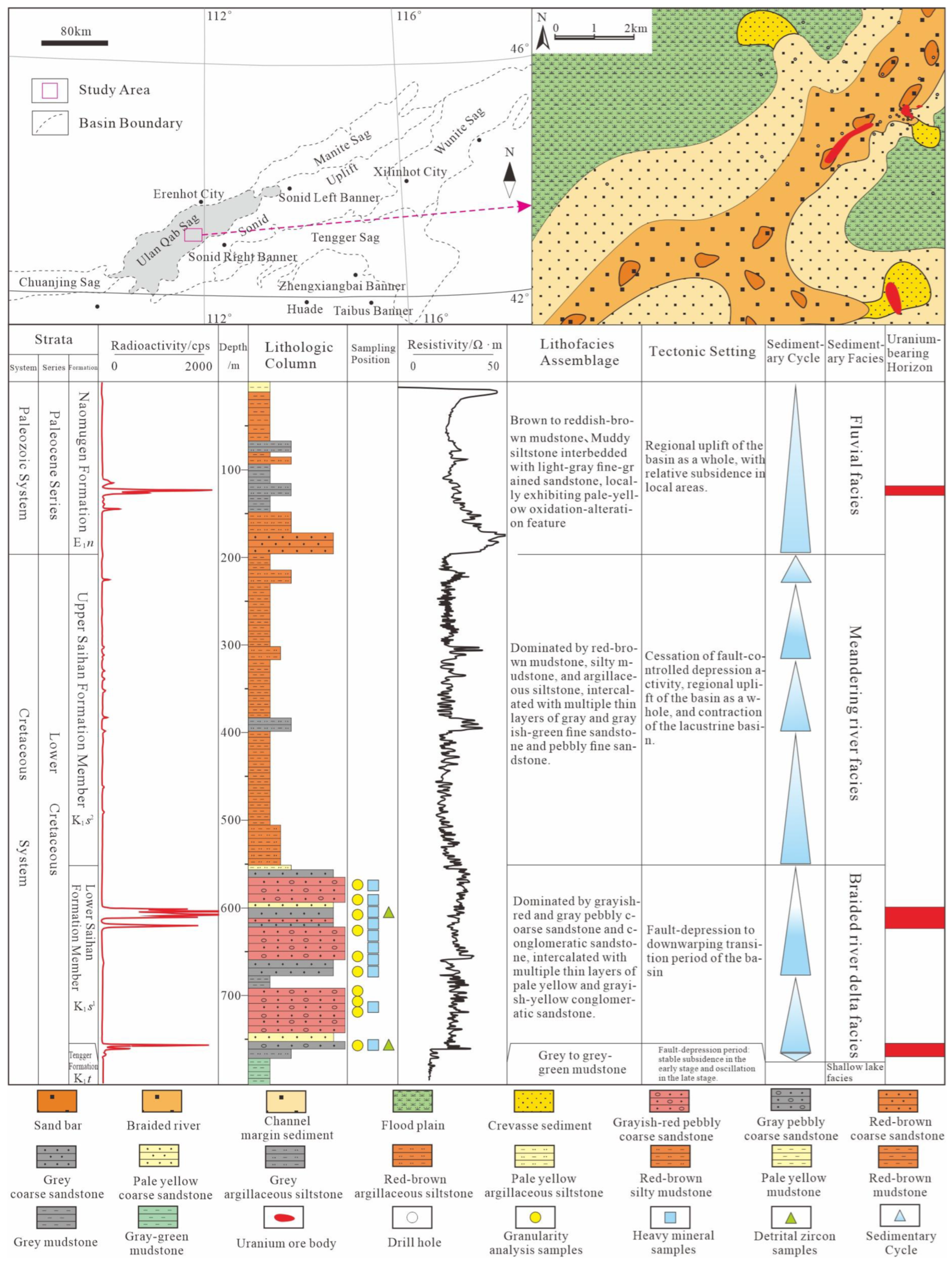
The Erlian Basin is located at the key position of the suture zone between the Siberian Plate and the Sino-Korean Plate, and is a group of Mesozoic intracontinental faulted basins developed on the Hercynian fold basement. It trends northeastward, covering a total area of 10 × 104 km2. It features a tectonic pattern of “five depressions and one uplift”, and the Sonid Uplift in the central part serves as the core provenance area of the basin [40,41,42] (Figure 1). The tectonic evolution of the basin is controlled by the remote effect of the Pacific Plate subduction, and it has experienced five stages: crustal uplift, early rifting, intense faulting, isostatic adjustment, and compressive uplift. In the late Early Cretaceous, it entered the fault-depression transition stage, laying a tectonic foundation for the sedimentation of the Saihan Formation.
The Naomugeng Sag is located in the southwestern part of the Ulanqab Depression. It abuts the Sonid Uplift to the north, is bounded by the Hegen Mountain Superlithospheric Fault, and trends northeastward overall (Figure 1). The basement of the sag comprises the Ordovician-Permian Hercynian fold belt, with localized exposures of Indosinian granite. As clearly illustrated in the lithologic column of Figure 1, the sedimentary cover of this sag is predominated by the Cretaceous succession, which comprises the Arshan Formation, Tengger Formation, Saihan Formation, and Paleogene Naomugeng Formation (in ascending order; the Upper Cretaceous is absent) [21,25]. Among them, the Saihan Formation is a “filling and leveling”-type sediment formed during the fault-depression transition period, with a thickness ranging from 91.43 to 214.50 m, which makes it the most important uranium-rich horizon in the Erlian Basin [43].
The paleoclimate during the sedimentary period of the Saihan Formation was of an arid-semiarid type, and the basin as a whole was in the stage of lacustrine basin shrinkage. The sedimentary system was dominated by a braided river-fan delta, with sand bodies distributing in a northeast-trending direction along paleovalleys and featuring a vertical structure of “mud-sand-mud” (Figure 1). The study area is located in the dominant provenance supply belt in the northern part of the sag, with the sand body thickness ranging from 39.67 to 140.36 m, an average sand content rate of 76.33%, and excellent porosity and permeability conditions. Moreover, it is adjacent to the uranium-rich magmatic rock belt of the Sonid Uplift, which provides the “source–reservoir” coupling conditions for uranium ore enrichment. The erosional windows formed by tectonic inversion in the Late Cretaceous further promoted the infiltration and migration of uranium-bearing fluids and enhanced the degree of uranium mineralization enrichment.

3. Sample Collection and Testing

3.1. Sample Collection

To systematically clarify the provenance characteristics of uranium-bearing sandstones in the lower member of the Saihan Formation in the northern part of the Naomugeng Sag, this study collected core samples from uranium mineralized drill holes in the area, which were used for grain size analysis, heavy mineral analysis, and detrital zircon U-Pb dating, respectively. All samples were taken from fresh drill cores in the study area. Among them, 41 sandstone samples were collected from 12 drill holes for grain size analysis, and 31 sandstone samples were collected from 9 drill holes including NY1-A and NY1-B for heavy mineral analysis, with sampling depths ranging from 580.10 to 784.6 m. The lithologies include red, gray, and grayish-yellow coarse sandstone, pebbly coarse sandstone, and others; in addition, sandstone samples were selected from the lower member of the Saihan Formation in two drill holes, NY3-C and NY1-D, for detrital zircon U-Pb dating.

3.2. Analytical Methods

3.2.1. Grain Size Analysis

Grain size analysis was completed at Langfang Yuheng Mineral and Rock Technical Service Co., Ltd. (Langfang, China). First, the samples were prepared into standard rock thin sections, followed by grain counting under a binocular microscope and classification according to grain size intervals. Finally, grain size parameters such as mean grain size, standard deviation, skewness, and kurtosis were calculated using Excel (OFFICE16) and Origin software (Origin2021), and genetic diagrams including probability cumulative curves and C-M plots were drawn to distinguish the sedimentary environment and hydrodynamic conditions.

3.2.2. Heavy Mineral Analysis

Heavy mineral analysis was undertaken by Hebei Langfang Yuneng Mineral and Rock Technical Service Co., Ltd. (Langfang, China). The identification of heavy minerals adopted the traditional provenance analysis method of the multi-mineral method. The analytical process includes sample crushing, separation, and purification of heavy minerals, followed by mineral identification and counting under a microscope to obtain the relative contents of various heavy minerals. Firstly, the samples were coarsely and finely crushed, and the heavy minerals in the sediments were separated and extracted to obtain a sufficient amount for content analysis. Then, based on different types of heavy minerals, their optical characteristics such as color, shape, size, and luster were identified under the microscope, and the relative content of heavy minerals was quantified by a mathematical statistical counting method. On this basis, a series of characteristic indices such as ATi, GZi, and ZTR were calculated to determine the parent rock types, the nature of the provenance area, and the sediment maturity.

3.2.3. Detrital Zircon U-Pb Dating

The selection, target preparation, and U-Pb isotope testing of detrital zircons were completed by Langfang Chengxin Geology Chengpu Testing Technology Co., Ltd. (Langfang, China). First, zircon monominerals were separated by the conventional heavy mineral separation method, then epoxy resin targets were prepared. After polishing, cathodoluminescence (CL) images were taken to observe the internal structure. LA-ICP-MS analysis was performed using a NewWave NWR193 laser ablation system coupled with an Analytik Jena (Jena, Germany) PlasmaQuant MS elite ICP-MS. The laser spot diameter was 32 μm, the frequency was 13 Hz, and high-purity helium (He) gas was used as the carrier gas. The international standard zircon Plesovice was used for fractionation correction, and Qinghu zircon was employed as the monitoring standard sample to ensure data quality. The contents of uranium, thorium, and lead, and their isotope data, can be obtained. Raw data were processed with the GLITTER (ver4.0) program, and age spectra and diagrams were plotted using Isoplot (ver4.15)

3.2.4. Porosity and Permeability Detection

Porosity and permeability testing was conducted by the Analysis and Testing Center of the China Nuclear Industry Group 203 Research Institute (Xi’an, China). Porosity was measured using an AR224 CN analytical balance (Ohhaus Instruments (Shanghai) Co., Ltd., Shanghai, China), while permeability was assessed with a GDS-90 F permeability meter (Huiao Instrument Manufacturing Co., Ltd., Wuxi, China).

4. Test Results

4.1. Stratigraphy and Lithofacies Characteristics

The Saihan Formation of the Lower Cretaceous in the study area can be divided into upper and lower members. The upper member (K1s2) is dominated by reddish-brown mudstone, silty mudstone, and argillaceous siltstone, intercalated with thin layers of gray and grayish-green fine sandstone and pebbly fine sandstone, and overall, represents flood plain deposits formed under arid climatic conditions.
The lower member (K1s1), as the target interval, has a sandstone top surface burial depth ranging from 199.00 to 650.50 m and a formation thickness of 91.43 to 214.50 m (with an average of 135.16 m). Sand bodies are well-developed in this member, with a thickness of 39.67 to 140.36 m and an average sand content of 76.33%. The lithology is dominated by grayish-red and light gray glutenite and pebbly coarse sandstone, intercalated with light yellow and grayish-yellow glutenite and a small amount of gray mudstone. Physical property tests show that the porosity of the sandstone in this member is 24.44% to 28.97% (with an average of 26.71%), and the permeability is (2.51–2.91) μm2 (with an average of 2.65 μm2). Reducing media such as carbonaceous debris and pyrite are commonly present in the rocks.
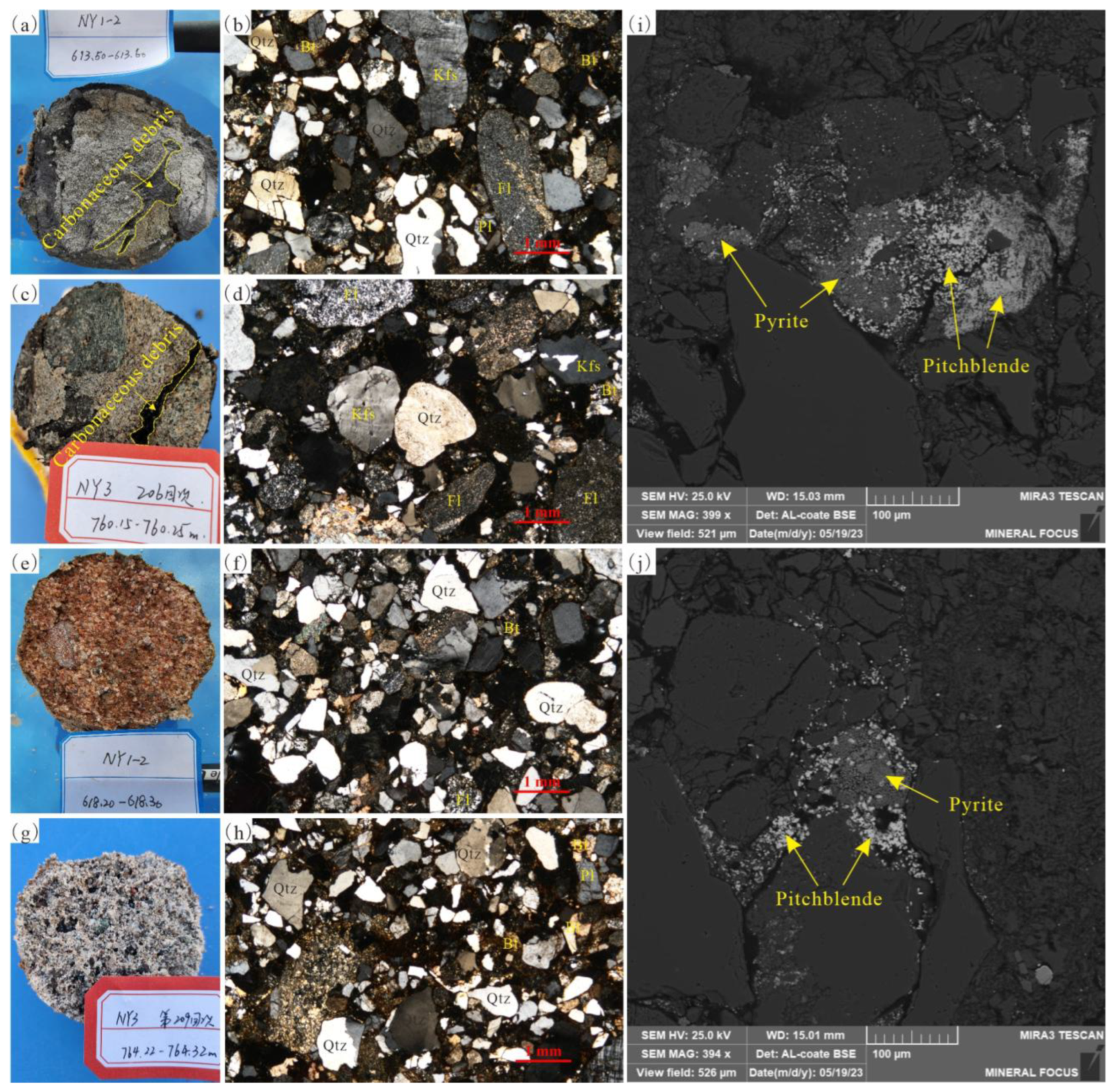
Petrographic analysis shows that the content of clastic grains in the sandstone of the lower member is 87%–91%, and the content of interstitial materials is 6%–11% (including 2%–5% of detrital matrix and 5%–8% of cement). Among the clastic components of the sandstone, quartz accounts for 40%–49%, feldspar 13%–49%, and lithic fragments 2%–28%, with a small amount of mica. Ore-bearing sandstones are light gray to gray, with a medium-coarse grained sandy texture. The clastic components include plagioclase, potassium feldspar, quartz, and lithic fragments, where lithic fragments are dominated by mudstone fragments and chert. Accessory minerals include opaque metallic minerals and zircon (Figure 2a–d). The grains are poorly to moderately sorted with poor roundness; the support type is grain-supported, the contact relationship is line-concavo-convex contact, the cementation type is dominated by contact cementation, and the cement is mainly argillaceous material. Non-ore-bearing sandstones are light reddish-brown to grayish-brown, dominated by coarse-grained texture, with cement mainly composed of calcareous material (Figure 2e–h).
Carbonaceous clasts can be seen in the ore as a banded and infectious distribution in sandstone (Figure 2a,c). Under the electron microscope, it can be seen that pitchblende is distributed around pyrite (Figure 2i,j).

4.2. Characteristics of Clastic Grain Size Parameters

Based on the grain size parameter system of Folk and Ward [44], a systematic grain size analysis was conducted on 41 sets of clastic rock samples from the lower member of the Saihan Formation in the study area, and the statistical results of various grain size parameters are summarized in Supplementary Materials Table S1.

4.2.1. Mean Grain Size

Mean grain size (MZ) reflects the central tendency of sediment grain size distribution [44,45]. The clastic rocks of the lower member of the Saihan Formation in the study area have a wide variation range of mean grain size, from −2.24φ to 2.59φ, with an average value of 0.71φ. This average value corresponds to the medium to coarse sand grain size range, indicating that the clastic materials in the study area are dominated by coarse-grained components overall.

4.2.2. Standard Deviation

Standard deviation (σ1) characterizes the sorting degree of sediments [44,45]. The standard deviation values of the samples in this study range from 0.63 to 3.22, with an average value of 1.32. This numerical range indicates that the sorting of clastic rocks in the study area is generally moderate to poor.

4.2.3. Skewness

Skewness (SK1) is used to measure the symmetry of grain size distribution [44,45]. The skewness values of the studied samples range from −0.32 to 0.34, with an average value of 0.02. The data distribution shows that the samples are dominated by nearly symmetric to positive skewness.

4.2.4. Kurtosis

Kurtosis (KG) characterizes the sharpness of the grain size frequency curve [44,45]. The kurtosis values of the samples in this study range from 0.89 to 1.55, with an average value of 1.08. This result indicates that the shape of the frequency curves of the samples is dominated by moderate (near-normal) to sharp types.
Based on the above characteristics of grain size parameters, the ore-bearing sandstones have a relatively coarse mean grain size (0.71φ), moderate to poor sorting (with an average σ1 of 1.32), nearly symmetric to positive skewed distribution (with an average SK1 of 0.02), and moderate to sharp kurtosis (with an average KG of 1.08).

4.3. Characteristics of Heavy Mineral Assemblages

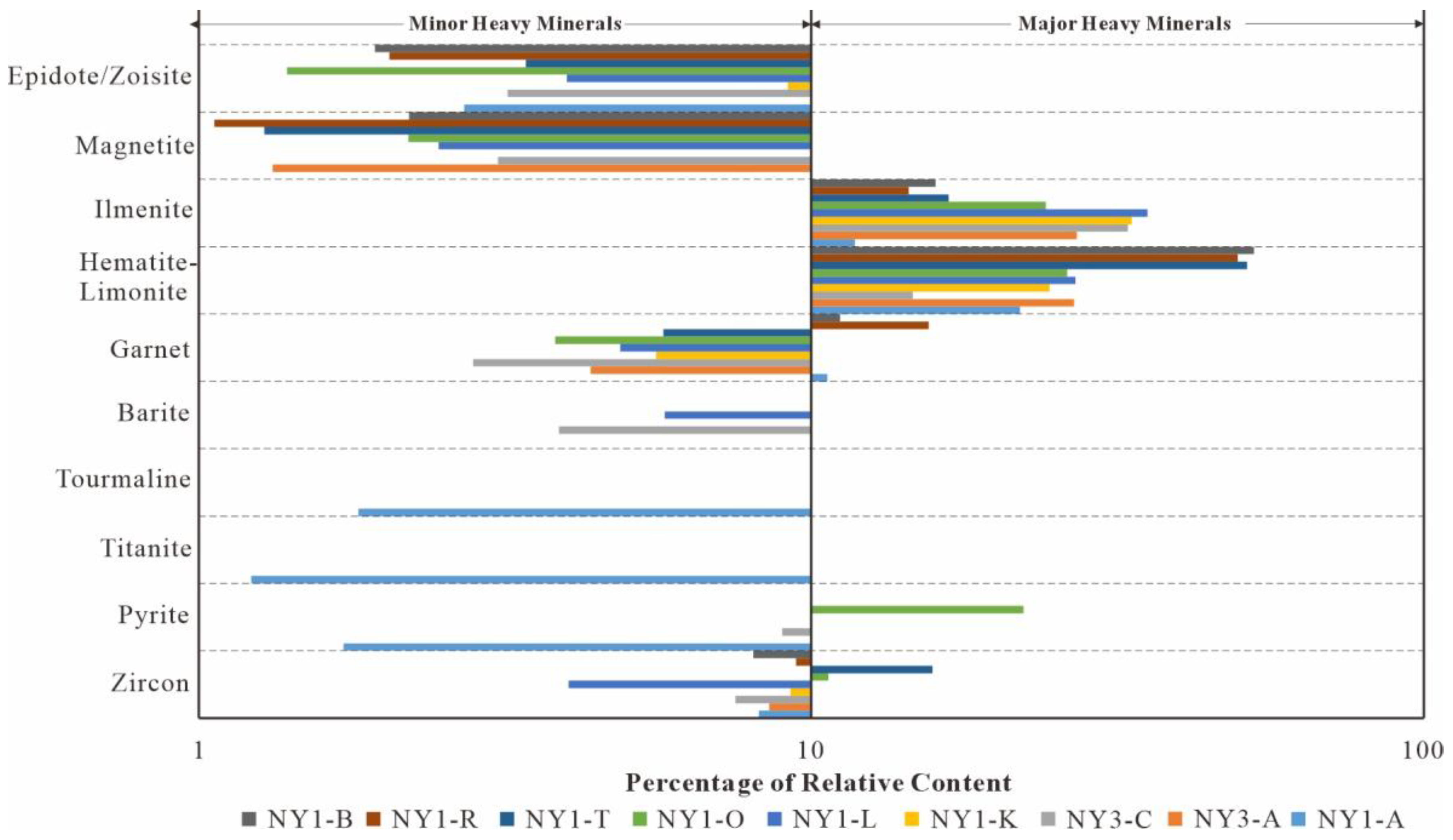
Through heavy mineral analysis of 31 sandstone samples from the target interval of the lower member of the Saihan Formation, a total of 25 heavy mineral species were identified. According to the statistics of relative contents, the major minerals (>10%) include zircon, garnet, limonite, and ilmenite; the minor minerals (1%–10%) comprise apatite, pyrite, sphene (titanite), tourmaline, barite, staurolite, epidote, and magnetite (Figure 3). Other minerals such as galena and chalcopyrite only occur in a few samples with low contents.
From the perspective of genetic assemblages, two types of characteristic assemblages are identified: (1) the zircon + limonite + ilmenite + sphene (titanite) + apatite assemblage, indicating a provenance of intermediate-acidic magmatic rocks; and (2) the garnet + tourmaline + staurolite + zircon (metamorphic origin) assemblage, reflecting the provenance contribution of metamorphic rocks. The content distribution of major and minor minerals in each sample shows heterogeneity, indicating that the provenance composition has a polysource nature.
Dividing the identified heavy minerals according to their stability, the average ratio of stable minerals (such as zircon, garnet, tourmaline, etc.) to unstable minerals (such as apatite, barite, amphibole, etc.) is 1.46. This indicates that stable heavy minerals are slightly dominant, but the dominance is not significant.

4.4. Detrital Zircon U-Pb Geochronology

4.4.1. Zircon Morphology and Genetic Types

The results of heavy mineral identification show that there are two types of zircon from the lower member of the Saihan Formation sandstone, pink-type zircon (more than 85% content) and rose-red-type zircon. The former is mainly in subhedral shapes, followed by sub-angular to sub-rounded shapes, with minor cylindrical and very few euhedral shapes. The latter is darker in color, and its shapes are mainly cylindrical, with minor sub-angular to sub-rounded and few subhedral. The two types of zircons with overall poor psephicity indicate that the heavy minerals underwent a weathering and transportation process over a relatively short time and limited distance. The differences in the color between them suggest the diversity of the parent rock. The rose-color zircon originates from the older-age parent rock and underwent transportation across a relatively long distance. The pink-type zircon originates from the younger-age parent rock and underwent short-distance transportation. Therefore, the proximal deposit is dominated in the research area.
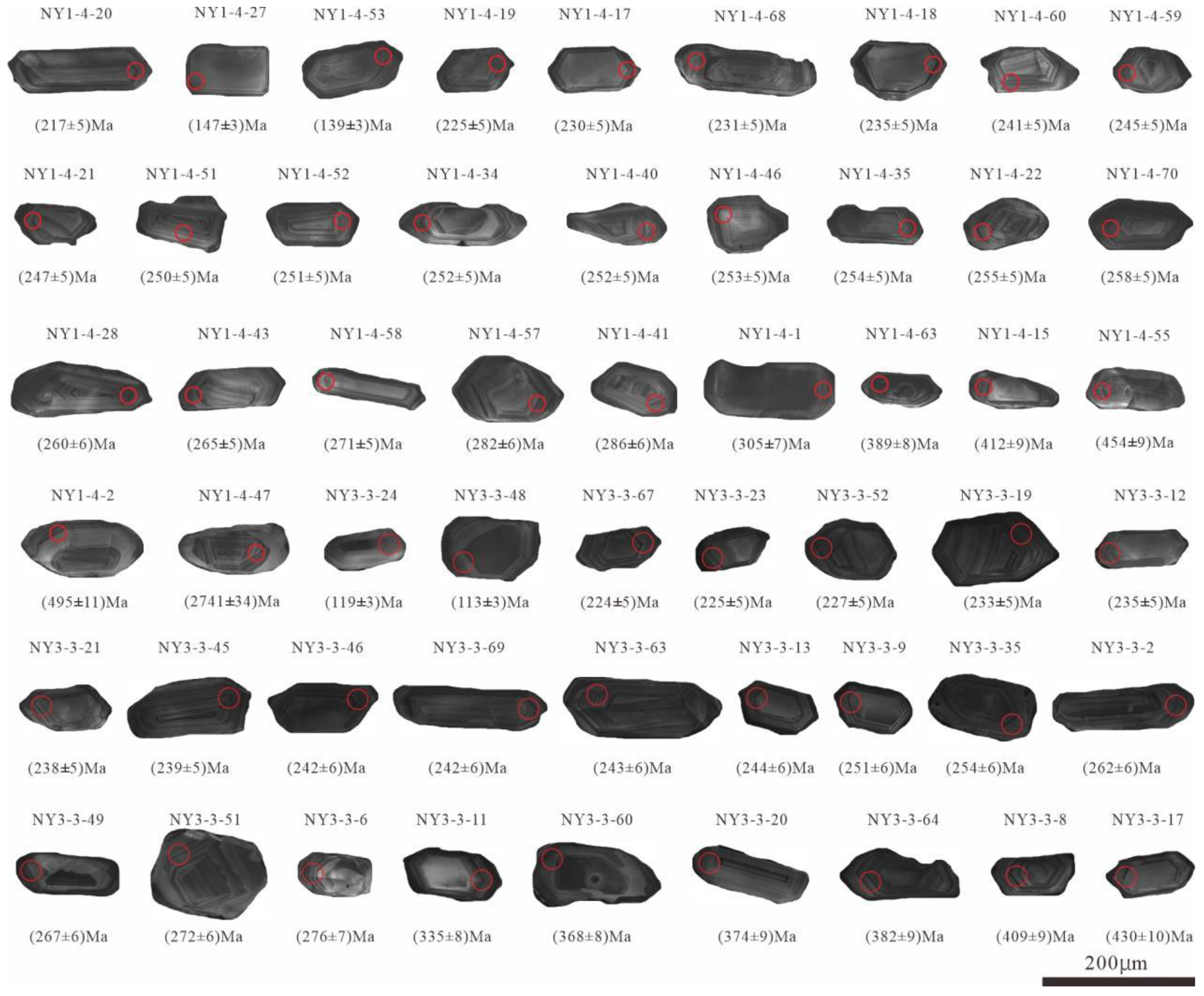
A total of 139 valid measurement points were obtained from the detrital zircon analysis of two sandstone samples (NY3-C, NY1-D) from the lower member of the Saihan Formation in the study area. The particle sizes of zircon grains are mainly distributed in the range of 90–150 μm, with a maximum of up to 220 μm, and the roundness is dominated by subangular-subrounded shapes. Cathodoluminescence (CL) images show that the vast majority of zircons have complete crystal forms and develop clear magmatic oscillatory zoning, indicating their magmatic origin (Figure 4). Some zircons (e.g., NY1-D-47) exhibit a core-rim structure, which is characteristic of inherited/captured zircons; individual grains (e.g., NY3-C-49) show obvious differences in rim structure, belonging to metamorphic overgrowth zircons.
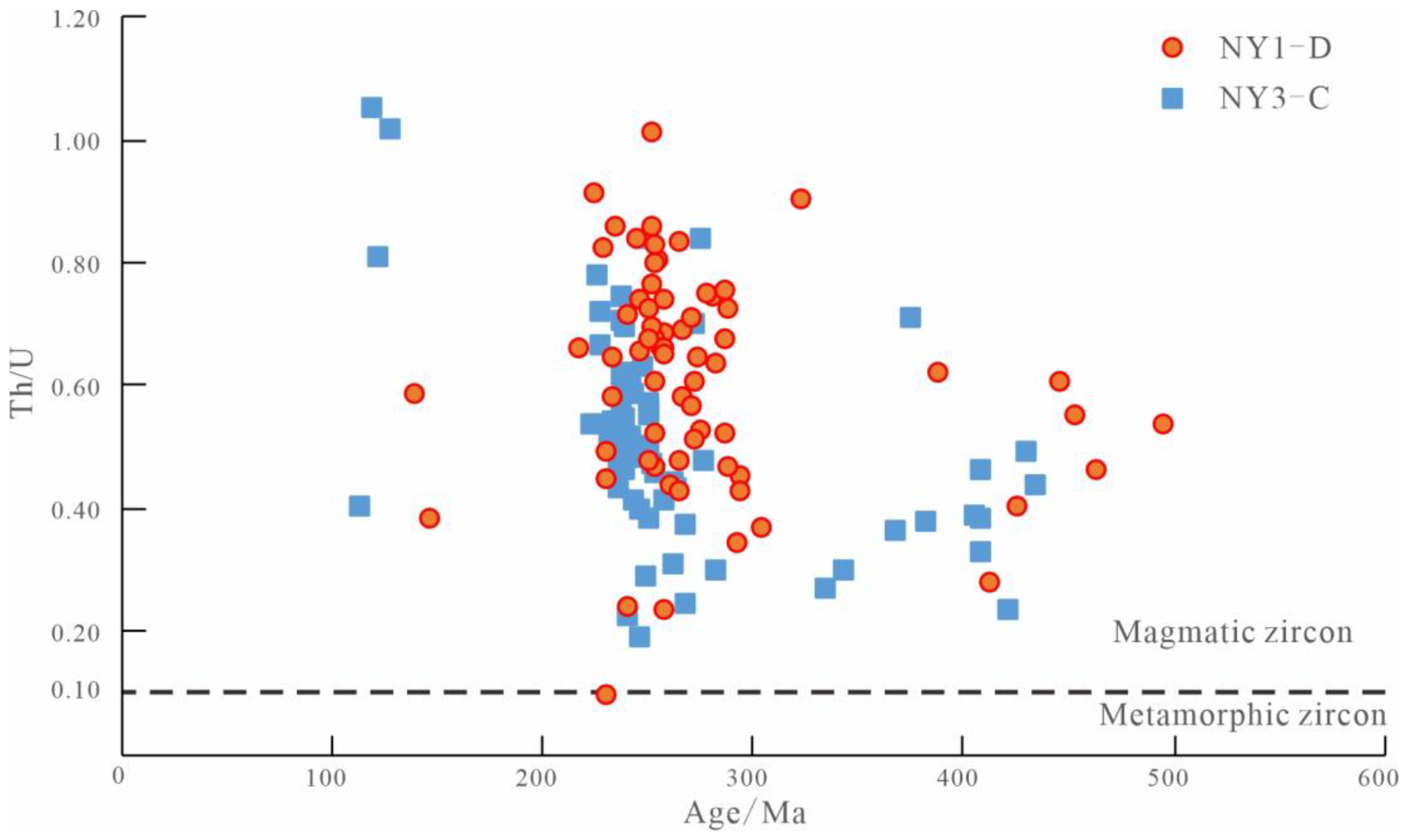
Analysis of Th/U ratios further corroborates the division of genetic types (Figure 5). Among them, 116 zircons (83.45%) have Th/U > 0.4, belonging to a typical magmatic origin; 22 zircons (15.83%) have Th/U ranging from 0.1 to 0.4, representing zircons subjected to metamorphic modification; only 1 zircon (0.72%) has Th/U < 0.1, belonging to typical metamorphic zircons.

4.4.2. Zircon Age Spectrum

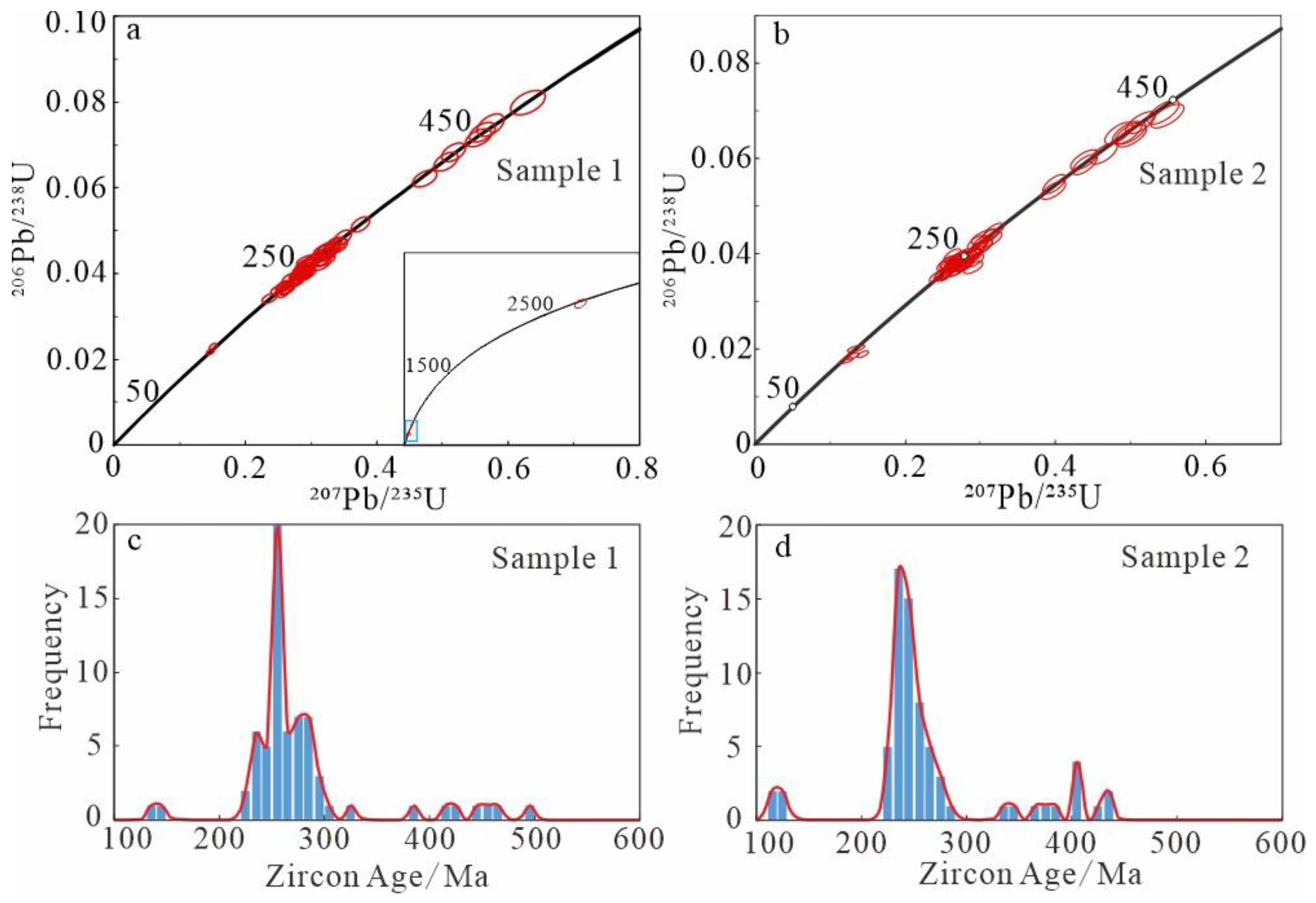
All analytical points have a concordance degree greater than 90%, indicating reliable data (Figure 6a–d) (Tables S2 and S3). The zircon U-Pb age spectrum shows a multimodal distribution characteristic, with ages ranging from (112.8 ± 2.71) Ma to (2741 ± 34.4) Ma.
The age spectrum of sample NY1-D includes seven peak groups: 146.5–139.2 Ma (Late Jurassic, 2.9%); 246.8–217 Ma (Triassic, 20.29%); 294.5–250.1 Ma (Permian, 62.32%); 323.5–304.7 Ma (Late Carboniferous, 2.9%); 425.3–388.5 Ma (Late Silurian–Early Devonian, 4.3%); 495–445.9 Ma (Late Cambrian–Middle Ordovician, 5.8%); and 2741.3 Ma (Neoarchean, 1.4%). The age spectrum of sample NY3-C shows six peak groups: 128.4–112.8 Ma (Early Cretaceous, 5.7%); 248.5–223.5 Ma (Triassic, 52.9%); 282.8–250.6 Ma (Permian, 24.3%); 343.2–334.8 Ma (Early Carboniferous, 2.9%); 408.8–368.1 Ma (Devonian, 10.0%); and 434.5–421.4 Ma (Early–Middle Silurian, 4.3%).
Overall, the detrital zircon age spectrum is dominated by a main peak at 217–294 Ma (Late Permian–Middle Triassic) and a secondary peak at 112–146 Ma (Late Jurassic-Early Cretaceous), and also includes several minor age intervals such as 304–434 Ma (Carboniferous–Silurian), 445–495 Ma (Ordovician-Cambrian), and the Neoarchean. The consistency of the main age peaks in the two samples reflects the stability of provenance supply, while the differences in the proportions of each age group may be related to sampling locations or minor changes in the sedimentary period.

5. Discussion

5.1. Sedimentary Environment and Transport Mechanisms

Grain-size distribution characteristics constitute a key indicator for identifying depositional environments and hydrodynamic conditions [46,47]. In this study, multiple sedimentological analytical approaches—including probability cumulative curves, C–M diagrams, scatter plots of sedimentary textural parameters, and Sahu’s discriminant functions—are integrated to systematically elucidate the depositional environment and clastic transport mechanisms of the Lower Member of the Saihan Formation sandstones in the northern Baimugen Depression.
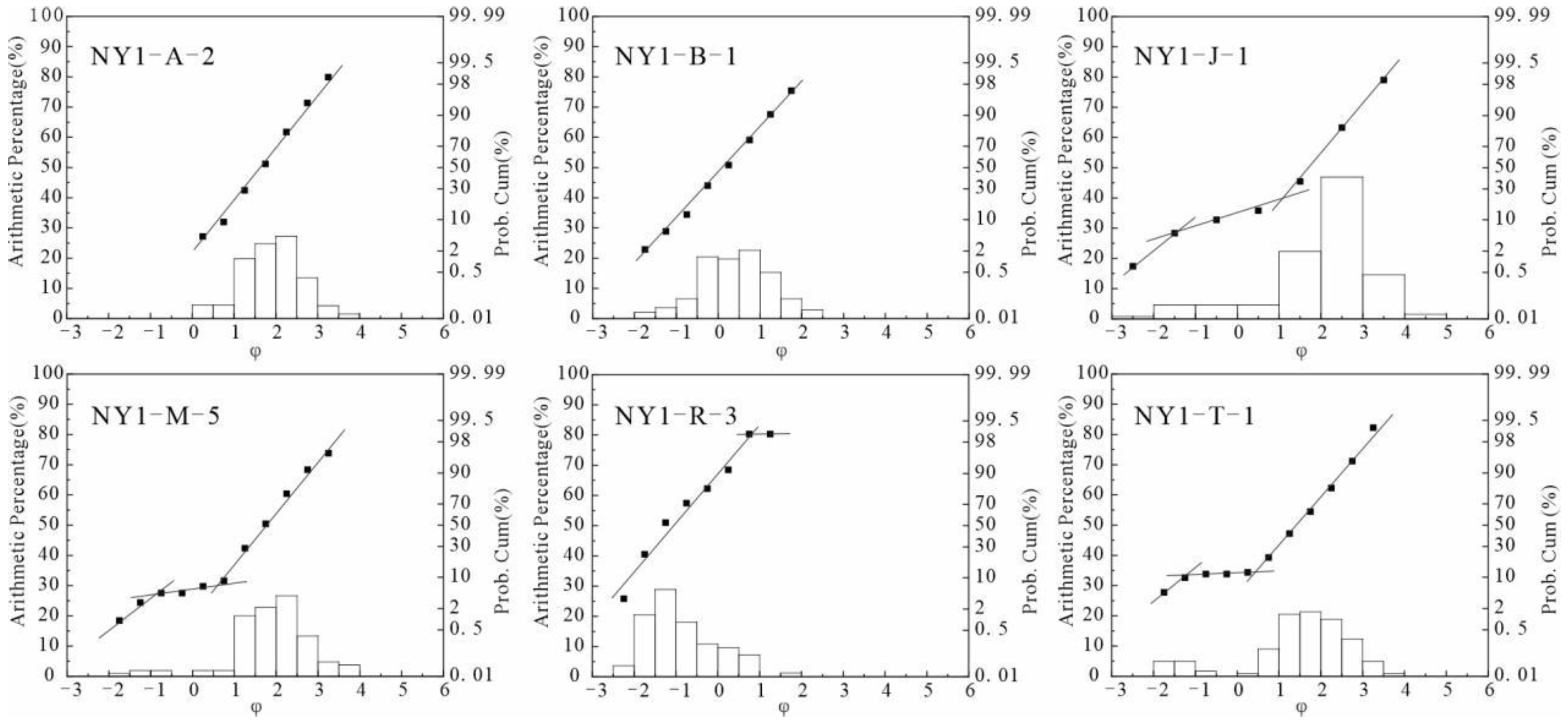
Probability cumulative curve analysis indicates that the samples from the study area are predominantly characterized by a saltation population, with slopes ranging from 50° to 60°, reflecting moderately poor sorting and a relatively broad grain-size distribution spanning −2.5φ to 3φ (Figure 7). Notably, several samples exhibit a typical two-segment pattern, represented by two saltation sub-populations with distinctly different slopes (approximately 5°–25° and 50°–60°), with the break (coarse truncation point) occurring between −1.5φ and −1φ. The traction population remains relatively stable, accounting for 20%–30% of the total, with slopes of approximately 30°–40°. These characteristics collectively point to poorly sorted sediments with relatively coarse grain sizes. Overall, the deposits are dominated by rolling and saltation components, whereas the suspension fraction is extremely low, clearly indicating coarse clastic deposition under a high-energy fluvial regime.
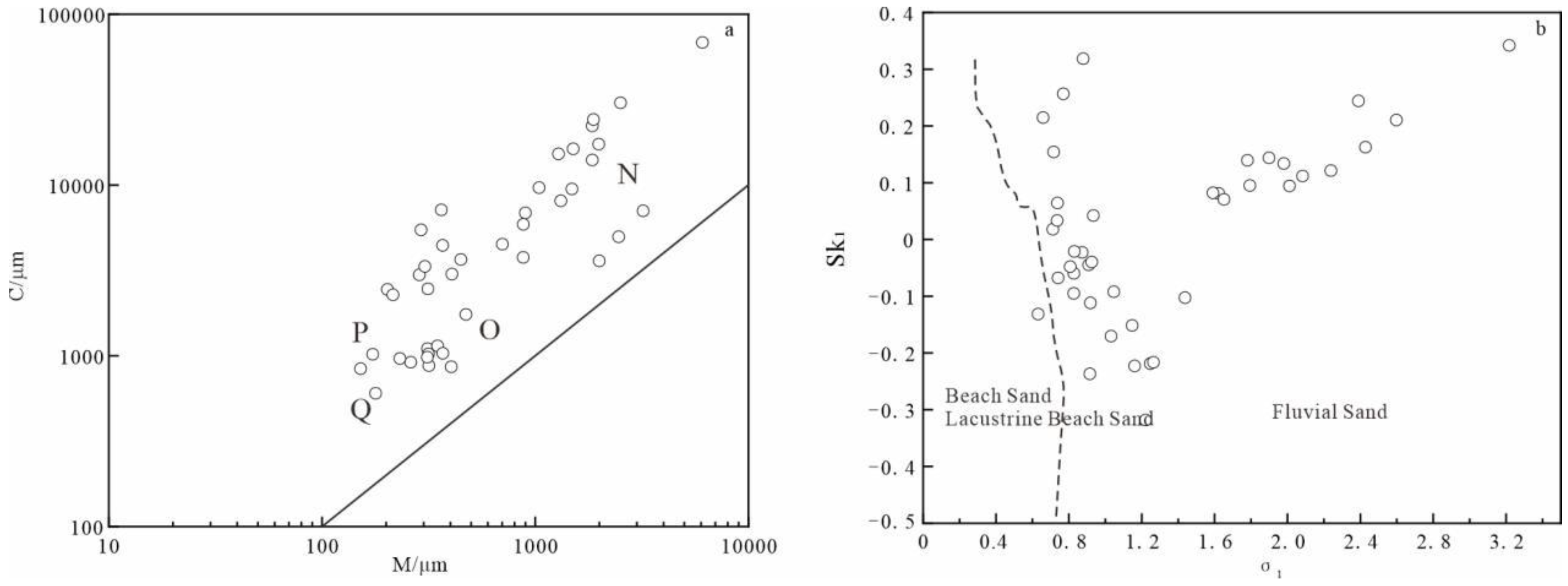
The C–M diagram provides further confirmation that traction-flow deposition dominates the study area (Figure 8a). The NO section in the figure represents rolling transport, and its sediments are rolling at the bottom of the river. The OP section is still dominated by rolling, but there is a very small amount of suspension handling; the PQ section is mainly suspended transport, with a small amount of rolling transport particles. Most sample points cluster within the OP and NO sectors, with a few occurring in the PQ sector. The overall distribution pattern is essentially parallel to the C = M baseline, clearly indicating that clastic materials were transported primarily through rolling and suspension modes. These characteristics are consistent with the typical sedimentary signature of a braided-river system [48].
The scatter-plot analysis of textural parameters shows that the vast majority of sample points fall within the fluvial sand field (Figure 8b), with only a single sample plotting within the beach–lakeshore sand domain, further confirming that the studied interval represents fluvial deposition [49]. Application of Sahu’s discriminant functions provides a more refined environmental interpretation: values of the Y3 function predominantly indicate an alluvial setting (fluvial or deltaic), with a few samples suggesting shallow-lake deposition; meanwhile, all Y4 values are lower than 9.8433, which is indicative of turbidite-type deposition. Integrating all these analytical results, the Lower Member of the Saihan Formation in the study area can be confidently interpreted as braided-channel deposits developed within a braided-river delta–lake system under high-energy hydrodynamic conditions (Table 1).
These sedimentary characteristics exert significant control on uranium mineralization. The braided-channel sand bodies offer excellent permeability and connectivity, creating favorable pathways for the subsequent migration and concentration of uranium. Meanwhile, the rapid deposition associated with high-energy conditions promotes the preservation of reducing media, thereby establishing geochemical barriers conducive to the precipitation of uranium.

5.2. Tracing by Heavy-Mineral Assemblages and Diagnostic Indices

Heavy-mineral assemblages and their diagnostic indices constitute effective tools for constraining provenance characteristics and the lithology of source rocks [50,51,52,53,54,55]. Systematic analysis of 31 samples reveals two typical heavy-mineral assemblages in the study area. The first assemblage—zircon + hematite–limonite + ilmenite + sphene (titanite) + apatite—clearly indicates intermediate to acidic igneous rocks as the dominant source lithologies. The second assemblage—garnet + tourmaline + staurolite + zircon—contains zircons displaying metamorphic signatures, reflecting the incorporation of metamorphic detritus. This observation is consistent with the findings of the Hadatu uranium deposit, further confirming the significant role of the Sonid Uplift as a shared regional provenance area [37].
Systematic calculation of heavy-mineral indices provides a quantitative basis for provenance interpretation (Table S4). The GZi index (100 × garnet/(garnet + zircon)) is generally high, with an average value of 45.3, indicating that the source rocks are dominated by granitic and metamorphic lithologies. The ZTR index (100 × (zircon + tourmaline + rutile)/transparent heavy minerals) ranges from 24.1 to 85.7, further confirming the significant contribution of granitic sources. The ATi index (100 × apatite/(apatite + tourmaline)) exhibits a wide variation (1.5–83.5), reflecting pronounced spatial differences in the contribution of volcanic rocks. The MZi index (100 × monazite/(monazite + zircon)) remains consistently low, approaching zero, suggesting a relatively minor input from deep-seated intrusive bodies [56].
The average ratio of stable to unstable heavy minerals is 1.46, indicating a slight predominance of stable species and reflecting a moderately mature sandstone that experienced transport over an intermediate distance. The variation trends of the %Op index (100 × opaque heavy minerals/total heavy minerals) and the %ZR index (100 × (zircon + rutile)/(zircon + rutile + tourmaline)) are broadly consistent, suggesting that the samples underwent similar hydrodynamic sorting processes. Notably, the ZTR index shows a positive correlation with reservoir porosity (24.44%–28.97%) and permeability (2.51–2.91 μm2), as stable mineral enrichment implies enhanced grain sorting and reduced interstitial clogging, while the ATi index correlates negatively with these physical properties due to volcanic apatite’s susceptibility to diagenetic alteration. This correlation underscores the control of provenance transport: longer transport distances and stronger hydrodynamic sorting not only refine heavy mineral stability but also optimize the sandstone’s grain arrangement and pore-throat connectivity, laying a foundation for high-quality reservoirs. This characteristic is comparable to the findings from the Durimu area of the Tenger Depression, further supporting the stability of the Sonid Uplift as a persistent regional provenance source [22].
Integrating the characteristics of heavy-mineral assemblages with the various diagnostic indices, it can be concluded that the sandstones of the Lower Member of the Saihan Formation in the study area are primarily derived from granitic and metamorphic source rocks, with subordinate volcanic contributions, closely matching the lithological composition of the southern Sonid Uplift. This provenance signature not only provides the material basis for sandstone deposition but also constitutes an important uranium source for subsequent mineralization.

5.3. Zircon U–Pb Provenance Tracing

Detrital zircon U–Pb geochronology is a key technique for tracing provenance areas and constraining tectono-magmatic events [30,57,58]. The zircon U–Pb age spectra from the study area reveal that detrital zircon ages are primarily concentrated within seven major intervals, exhibiting a pronounced multi-modal distribution.
The most prominent age peak occurs in the Early Permian to Late Triassic interval (294–217 Ma), comprising 62.3% of the total zircons and representing the primary provenance contribution. A secondary peak is observed in the Middle Jurassic to Early Cretaceous interval (146–112 Ma), accounting for 20.3% of the zircons and corresponding to another significant tectono-magmatic event. In addition, several subordinate age peaks are identified, including the Late Carboniferous to Early Permian (434–304 Ma), Late Silurian to Early Devonian (425–388 Ma), Late Cambrian to Middle Ordovician (495–445 Ma), and Neoarchean (2741 Ma) intervals.
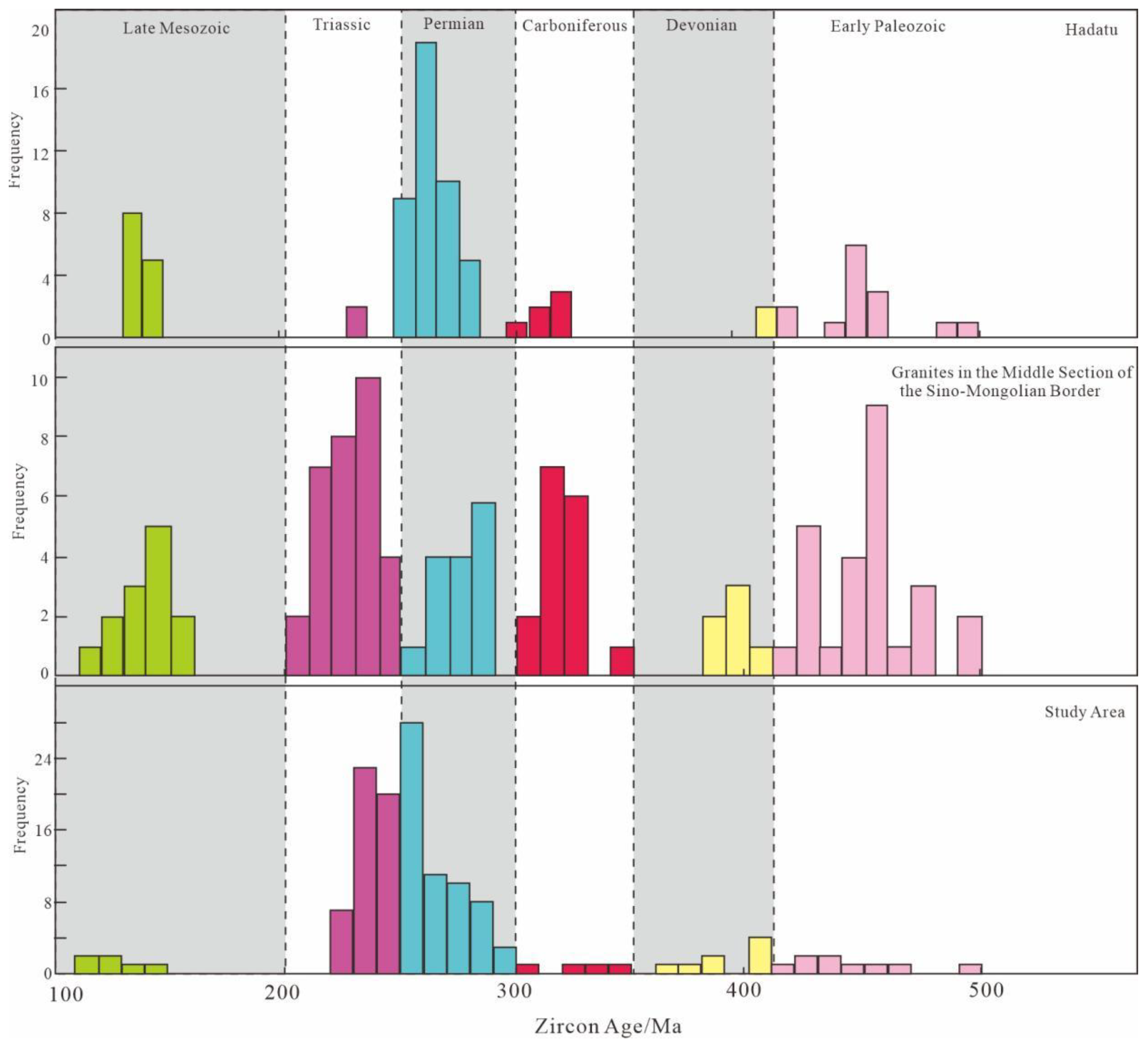
Detailed comparison with zircon age spectra from adjacent areas reveals that the age structure of the study area closely resembles that of the Upper Member of the Saihan Formation in the Hadatu region [36], both dominated by Late Paleozoic to Early Mesozoic magmatic events (Figure 9). This pattern also aligns with the age distribution of granitic bodies in the central segment of the Sino-Mongolian border [59], indicating that these granitoids provided a significant provenance contribution to the study area.
Further comparison with the regional plutonic age database shows that the detrital zircon age peaks in the study area closely correspond to the Early Permian–Late Triassic and Middle Jurassic–Early Cretaceous intermediate-acidic granitoids of the southern Sonid Uplift. In particular, the Permian–Triassic peak (294–217 Ma) corresponds to widespread post-collisional magmatism in the region [59,60,61,62], whereas the Jurassic–Cretaceous peak (146–112 Ma) is associated with extensional magmatic activity related to subduction of the Paleo-Pacific Plate [63,64] (Table 2).
It is noteworthy that a minor population of Carboniferous–Early Paleozoic and Neoarchean zircons occurs within the study area, which may have been derived from recycled strata within the uplift or locally exposed metamorphic units. This observation is consistent with the research results of the southern margin of the Manite Depression, further confirming the significance of the Sonid Uplift as the primary provenance source along the southern margin of the basin [65].
Zircon provenance analysis indicates that the vast majority of zircons in the study area (83.5%) display typical magmatic oscillatory zoning with Th/U ratios greater than 0.4, confirming their magmatic origin. Only a minor population of metamorphic zircons (Th/U < 0.1) and weakly metamorphosed zircons (Th/U = 0.1–0.4) are present, suggesting that the source area underwent multiple episodes of tectono-thermal overprinting [66].
Integrating zircon U–Pb age spectra, zircon typology, and regional comparative analysis, it can be concluded that the provenance of the Lower Member of the Saihan Formation in the northern Naomugeng Depression primarily derives from granitic and metamorphic rocks of the southern Sonid Uplift, with subordinate input from volcanic detritus in the east, reflecting a distinct multi-source mixing signature. This provenance framework not only controls the compositional characteristics of the sediments but also provides a critical material basis for the pre-enrichment of uranium.

5.4. Uranium Mineralization Model

(1)
Sedimentary Pre-Concentration Stage
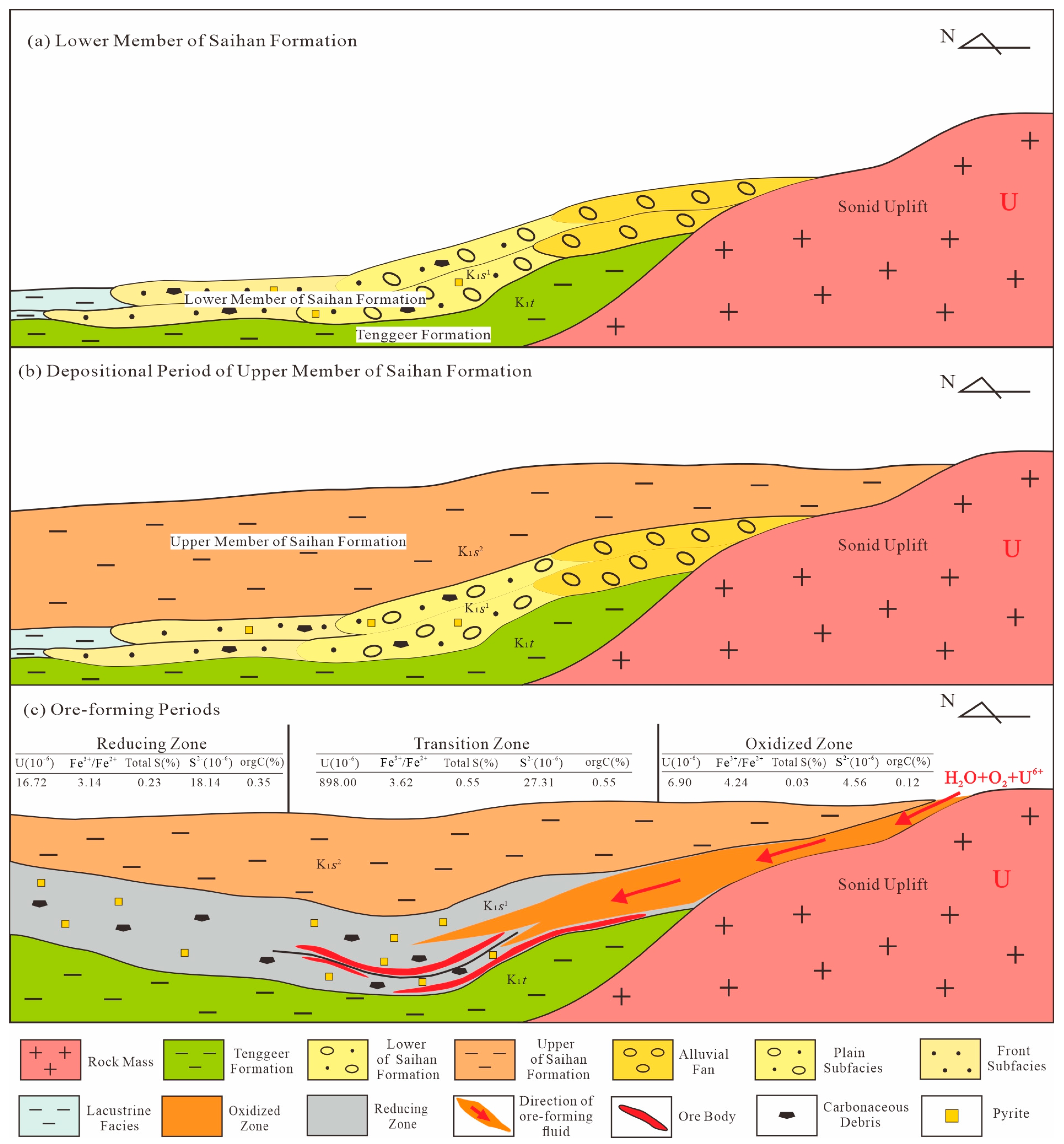
During the deposition of the Saihan Formation, a large-scale braided-river delta system developed in the study area. Braided-channel sand bodies reached thicknesses of 39.67–140.36 m, with an average sand content of 76.33%, porosity ranging from 24.44% to 28.97%, and permeability between 2.51 and 2.91 μm2, providing excellent reservoir space and migration pathways for uranium mineralization (Figure 10a).
During this period, uranium-rich plutons of the Sonid Uplift continuously supplied uranium to the basin. These plutons exhibit high uranium concentrations ranging from 4.00 ppm to 8.03 ppm and U/Th ratios of 2.50–4.68, indicating a strong potential for uranium mobilization. Zircons from the study area show an average U content of 520.53 ppm and Th/U ratios of 0.73, further confirming the uranium-enriched nature of the source region [36,37,39]. During sedimentation, these uranium elements underwent initial enrichment, establishing the material basis for uranium mineralization. Favorable sedimentary frameworks combined with primary uranium supply constitute the prerequisite conditions for uranium ore formation [4,17,67].
Meanwhile, reductants such as carbonaceous material and pyrite, abundant in the braided-channel depositional environment, were effectively preserved, forming a natural “reductive geochemical barrier” (Figure 10b). The Fe3+/Fe2+ values of uranium-bearing sandstone in the redox transition zone range from 0.09 to 24.8, with an average of 3.62; the total sulfur (S) content is (0.016–3.73)%, with an average of 0.554%; the reduced state sulfur (S2−) content is (1.45–205) × 10−6, with an average of 27.31 × 10⁻⁶; and the organic carbon (orgC) content is (0.01–2.69)%, with an average of 0.55%. These reductants play a critical role in controlling uranium precipitation and enrichment during subsequent mineralization [68,69,70,71,72,73,74,75]. The control of sedimentary facies on uranium pre-concentration is manifested as follows: sand bodies in the main parts of the braided channels are thick and well-connected, facilitating uranium migration; whereas in channel margins and overbank plain areas, higher concentrations of reductants create favorable reducing conditions for uranium precipitation.
(2)
Redox Mineralization Stage
Since the Late Cretaceous, the regional tectonic regime underwent a significant transition from an extensional to a compressional setting, resulting in pronounced structural inversion in the study area [76]. This inversion is a critical process for uranium mineralization, marking the transition from the preparatory stage during sedimentation to the enrichment stage of ore formation [17,29,77,78,79,80,81,82,83,84]. The tectonic events generated multiple buried uplifts and erosion windows, providing essential pathways for downward infiltration and lateral migration of uranium-bearing fluids. The study area is located in the upper reaches of the Basaiqi ancient river valley. The metallogenic conditions are similar to the metallogenic conditions of large-scale uranium deposits (such as Bayanwula and Saihangaobi) found in the basin, but they are special. It is mainly reflected in the development of gravel braided river deposits in the lower part of the Saihan Formation in the study area, with an average sand body thickness of 95 m, mainly in the form of interlayer oxidation. A sandy braided river is developed in the Bayanwula Saihan Formation, the thickness of the sand body is generally 40–80 m, and the oxidation mode is phreatic-interlayer. Meandering river deposits are developed in the Saihan Formation of Saihangaobi. The thickness of the sand bodies is less than 10 m, and phreatic oxidation is mainly developed.
During the Paleogene, the climate in the study area gradually shifted to arid–semiarid conditions, promoting the development of surface oxidation [85,86]. Driven by meteoric waters, oxygenated uranium-bearing fluids migrated along permeable sand bodies toward the basin interior, forming extensive interlayer oxidation zones. The spatial distribution of the oxidation front was jointly controlled by sand body heterogeneity, structural configuration, and paleohydrological conditions [87,88]. In this process, uranium migrated as U6+ under oxidizing conditions and precipitated and concentrated upon encountering reducing environments near the redox transition zone (Figure 10c).

6. Conclusions

(1)
Grain-size analysis and sedimentary facies characterization indicate that the uranium-bearing sandstones of the Lower Member of the Saihan Formation are dominated by rolling–hopping components, with negligible suspended load, representing high-energy braided-channel deposits. The sand bodies reach thicknesses of 39.67–140.36 m, with an average sand content of 76.33%, porosity ranging from 24.44% to 28.97%, and permeability between 2.51 and 2.91 μm2, providing favorable pathways for uranium migration and ample reservoir space for subsequent enrichment.
(2)
Heavy mineral assemblages are dominated by zircon + limonite + ilmenite + garnet, indicating a mixed provenance of intermediate–acidic igneous and metamorphic rocks. Detrital zircon U–Pb age spectra show a main peak at 294–217 Ma (Early Permian–Late Triassic) and a subordinate peak at 146–112 Ma (Middle Jurassic–Early Cretaceous), which closely correspond to the ages of granitic plutons in the southern Sonid Uplift, confirming this uplift as the primary provenance area.
(3)
Zircons exhibit an average U content of 520.53 ppm and a Th/U ratio of 0.73. Combined with the uranium characteristics of regional plutons, this indicates that the uranium-rich bodies of the Sonid Uplift supplied significant amounts of uranium to the basin during the sedimentary stage, providing a critical uranium source for subsequent interlayer redox-controlled mineralization.

Supplementary Materials

The following supporting information can be downloaded at: https://www.mdpi.com/article/10.3390/min16010076/s1, Table S1: Statistical results table of grain size parameter of the lower member of Saihan Formation; Table S2: LA-ICP-MS U-Pb dating results for the lower member of the Saihan Formation sampled from the borehole NY1-D (sample number: NY1-D-RZ1); Table S3: LA-ICP-MS U-Pb dating results for the lower member of the Saihan Formation sampled from the borehole NY3-C (sample number: NY3-C-RZ1); Table S4: Statistical table of heavy mineral characteristic index/%.

Author Contributions

C.Z.: Conceptualization, methodology, writing—original draft, and writing—review and editing; Z.L.: conceptualization, formal analysis, and funding acquisition; H.P.: conceptualization, formal analysis, writing—original draft, supervision, and funding acquisition; Y.W.: conceptualization and writing—review and editing; N.L.: validation, formal analysis, and funding acquisition; K.P.: validation and formal analysis; Z.Q.: data curation and supervision; X.Y., H.Q. and M.W.: data curation and supervision; Q.L.: visualization and project administration; Y.L.: formal analysis; Y.Z.: visualization and project administration; and C.J.: visualization and project administration. All authors have read and agreed to the published version of the manuscript.

Funding

This research was financially supported by the National Key Research and Development Program of China (Grant No. 2023YFC2906705), CNPC Critical Technology Research and Application Special Project on Development and Utilization of Strategic Emerging Resources in Oil and Gas Fields (No. 2023ZZ31YJ05), the funding project of the Northeast Geological S&T Innovation Center of China Geological Survey (No. QCJJ2024-08), and the Open Fund of the Key Laboratory of Tectonics and Petroleum Resources, Ministry of Education, China University of Geosciences (Wuhan) (No. TPR-2024-04).

Data Availability Statement

Data is contained within the article or Supplementary Materials.

Conflicts of Interest

Yue Wu is an employee of Exploration Department of Changqing Oilfield Co., Ltd. Ning Luo and Xiaolin Yu are employees of PetroChina Huabei Oilfield Company. Yongjiu Liu is an employee of National Energy Baoqing Coal Electrification Co., Ltd. The remaining authors declare that the research was conducted in the absence of any commercial or financial relationships that could be construed as a potential conflict of interest.

References

  1. Jiao, Y.Q.; Wu, L.Q.; Rong, H.; Zhang, F. Review of Basin Uranium Resources in China. Earth Sci. 2021, 46, 2675–2696, (In Chinese with English Abstract). [Google Scholar]
  2. Jiao, Y.Q.; Wu, L.Q.; Rong, H.; Zhang, F.; Le, L.; Song, H.; Tao, Z.P.; Peng, H.; Sun, Y.H.; Xiang, Y. Sedimentation, Diagenesis and Uranium Mineralization: Innovative Discoveries and Cognitive Challenges in Study of Sandstone-Type Uranium Deposits in China. Earth Sci. 2022, 47, 3580–3602, (In Chinese with English Abstract). [Google Scholar]
  3. Xue, C.J.; Chi, G.X.; Xue, W. Interaction of two fluid systems in the formation of sandstone-hosted uranium deposits in the Ordos Basin: Geochemical evidence and hydrodynamic modeling. J. Geochem. Explor. 2009, 106, 226–235. [Google Scholar] [CrossRef]
  4. Yan, Z.B.; Zhang, W.W.; Xia, F.; Yin, S.; Fu, J.L.; Ning, J.; Zhang, X.N.; Zang, Y.H.; Duan, J.B. Uranium pre-concentration in sandstone-hosted U deposits: A case study from the Hailijin ore field, SW Songliao Basin, NE China. Ore Geol. Rev. 2023, 161, 105661. [Google Scholar] [CrossRef]
  5. Tong, Q.L.; Qin, M.K.; Ye, F.W. The Early Cretaceous hydrothermal sedimentation and its influence on sandstone-type uranium mineralization in the Xinniwusu Sag, Bayingobi Basin, NW China. Sediment. Geol. 2024, 462, 106588. [Google Scholar] [CrossRef]
  6. Yang, S.L.; Liu, X.Z.; Shan, Z.B.; Lei, A.G.; Liu, Y.; Wei, D.; Zhu, S.J.; Fu, Y.; Zhang, L. Occurrence State and Enrichment Mechanism of Rhenium in the Qianjiadian Uranium Deposit in the Southwestern Songliao Basin, Northeast China. Minerals 2024, 14, 67. [Google Scholar] [CrossRef]
  7. Huang, S.H.; Liu, Z.Y.; Qin, M.K.; Zhang, L.L.; Zhong, F.J.; Ning, J.; Liu, N.; He, Z.B.; Jiang, W.J. Magmatic-hydrothermal events and their implications for sandstone uranium mineralization in the Qianjiadian area, southwestern Songliao basin. Ore Geol. Rev. 2025, 184, 106756. [Google Scholar] [CrossRef]
  8. Rong, H.; Zhou, J.; Zhou, Y.; Zhang, Y.C.; Liu, M.; Chang, K.Y. Metallogenic constraints of sandstone-hosted uranium deposits in arid red beds: A case study from the northwestern Santanghu Basin. J. Geochem. Explor. 2026, 280, 107923. [Google Scholar] [CrossRef]
  9. Ding, B.; Liu, H.X.; Xu, D.R.; Qiu, L.F.; Zhang, Z.L.; He, F. Uranium metallogenic effect of hydrothermal fluid transformation in sandstone-type uranium deposits in Northern Ordos Basin: Constraints from the study of biotite chloritization process. Earth Sci. 2024, 49, 625–638, (In Chinese with English Abstract). [Google Scholar]
  10. Cheng, Y.H.; Jin, R.S.; Miao, P.S.; Wang, S.Y.; Teng, X.M. Two Metallogenic Models of Sedimentary-Hosted Uranium Deposit: Jingchuan and Tale Types. Earth Sci. 2025, 50, 46–57, (In Chinese with English Abstract). [Google Scholar]
  11. Cheng, Y.H.; Petrov, V.A.; Jin, R.S.; Miao, P.S. Neotectonic controls on large-scale uranium mineralization in the Meso-Cenozioc basins, Northern China. Ore Geol. Rev. 2025, 176, 106393. [Google Scholar] [CrossRef]
  12. Ding, B.; Liu, H.X.; Xu, D.R.; Qiu, L.F.; Liu, W.H. Mineralogical Evidence for Hydrothermal Uranium Mineralization: Discovery and Genesis of the Uranyl Carbonate Minerals in the BLS U Deposit, SW Songliao Basin, Northeast China. Minerals 2023, 13, 339. [Google Scholar] [CrossRef]
  13. Geng, Y.Y.; Liu, Z.Y.; He, Z.B.; Zhu, P.F.; Huang, S.H.; Ji, H.L. 3D Geological Modeling and Metallogenic Prediction of Kamust Sandstone-Type Uranium Deposit in the Eastern Junggar Basin, NW China. Minerals 2024, 14, 988. [Google Scholar] [CrossRef]
  14. Zhang, C.Y.; Xia, F.; Deng, W.; Liu, X.; Zhang, Q.X.; Shi, B.B.; Li, H.X.; Fu, Y.K. The migration pattern of oxidation fluids and its constraints on uranium mineralization in the Tamusu sandstone type uranium deposit of the Bayingobi Basin, China. Sediment. Geol. 2025, 478, 106823. [Google Scholar] [CrossRef]
  15. Tian, M.M.; Li, Z.Y.; Jia, L.C.; Liu, J.G.; Ning, J.; Li, J.M. Epigenetic Alteration of the Hailijin Sandstone-Hosted Uranium Deposit and Its Indications on Uranium Metallogenesis in the Songliao Basin, NE China. Minerals 2025, 15, 393. [Google Scholar] [CrossRef]
  16. Jin, R.S.; Liu, H.J.; Li, X.G. Theoretical System of Sandstone-Type Uranium Deposits in Northern China. J. Earth Sci. 2022, 33, 257–277. [Google Scholar] [CrossRef]
  17. Peng, H.; Jiao, Y.Q.; Rong, H.; Pang, B.; Lv, D.L.; Guo, X.D.; Wang, Q.S.; Yuwen, X.Y. Spatial-Temporal Coupling of Key Ore-Controlling Factors for Sandstone-Type Uranium Deposits in Tiefa Area, Songliao Basin. Earth Sci. 2024, 49, 3182–3198, (In Chinese with English Abstract). [Google Scholar]
  18. Cheng, Y.H.; Jin, R.S.; Cuney, M.; Petrov, V.A.; Miao, P.S. The strata constraint on large scale sandstone-type uranium mineraliiation in Mesco-Cenozoic basins, northern China. Acta Geol. Sin. 2024, 98, 1953–1976, (In Chinese with English Abstract). [Google Scholar]
  19. Kang, H.; Chen, Y.L.; Li, D.P.; Zhao, J.X.; Cui, F.R.; Xu, Y.L. Deep-penetrating geochemistry for concealed sandstone-type uranium deposits: A case study of Hadatu uranium deposit in the Erenhot Basin, North China. J. Geochem. Explor. 2020, 211, 106464. [Google Scholar] [CrossRef]
  20. Lu, M.; Ye, R.; Zhang, B.M. Source identification of the geochemical anomaly from the fine-grained soil survey in the Nuheting sandstone-type uranium deposit, Erlian Basin, North China. J. Geochem. Explor. 2021, 227, 106797. [Google Scholar] [CrossRef]
  21. Bonnetti, C.; Cuney, I.; Michels, R.; Truche, L.; Malartre, F.; Liu, X.D.; Yang, J.X. The Multiple Roles of Sulfate-Reducing Bacteria and Fe-Ti Oxides in the Genesis of the Bayinwula Roll Front-Type Uranium Deposit, Erlian Basin, NE China. Econ. Geol. 2015, 110, 1059–1081. [Google Scholar] [CrossRef]
  22. Yang, Y.; Song, Z.J.; Wang, G.; Lv, Y.H.; Li, T.Y.; Li, J.Y.; Gao, D.F. U-Pb chronology and Hf isotope characteristics of detrital zircons from sandstones of the Lower Cretaceous Saihan Formation within the Durimu area in the Tengger depression of the Erlian basin and their constraints to the uranium source. Bull. Mineral. Petrol. Geochem. 2023, 42, 1344–1358, (In Chinese with English Abstract). [Google Scholar]
  23. Chen, N.N.; Li, M.G.; Song, Z.J.; Guan, B.W.; Duan, J.B.; Li, X.D.; Liu, W.S.; Fan, P.F.; Liu, Y. Relationships between inverted structures and sandstone-hosted uranium deposits in the Tabei Sag, Erlian Basin. Geophys. Geochem. Explor. 2025, 49, 22–31, (In Chinese with English Abstract). [Google Scholar]
  24. Li, Z.; Yu, X.L.; Zhang, L.; Quan, H.Q.; Liu, X. Provenance characteristics of uranium-bearing sandstone in Saihan Formation of Naomugeng Sag, Erlian Basin. Geol. Rev. 2025, 71, 156–158, (In Chinese with English Abstract). [Google Scholar]
  25. Liu, Y.; Peng, H.; Luo, N.; Yu, X.L.; Li, M.; Ji, B. The Key Controlling Factors and Mechanisms for the Formation of Sandstone-Type Uranium Deposits in the Central Part of the Ulanqab Depression, Erlian Basin. Minerals 2025, 15, 688. [Google Scholar] [CrossRef]
  26. Jiao, Y.Q.; Wu, L.Q.; Peng, Y.B.; Rong, H.; Ji, D.M.; Miao, A.S.; Li, H.L. Sedimentary-tectonic setting of the deposition-type uranium deposits forming in the Paleo-Asian tectonic domain, North China. Earth Sci. Front. 2015, 22, 189–205, (In Chinese with English Abstract). [Google Scholar]
  27. Nie, F.J.; Xia, F.; Yan, Z.B.; Jiang, M.Z.; He, J.F.; Yang, D.G.; Feng, Z.B.; Zhang, C.Y.; Zhang, X.; Lv, Y.H.; et al. Study on Uranium Loss of Weijing Granite and Sandstone-type Uranium Mineralization in Erlian Basin. Acta Geosci. Sin. 2022, 43, 616–632, (In Chinese with English Abstract). [Google Scholar]
  28. Zhang, Y.Y.; Chen, Y.L.; Li, D.P.; Kang, H.; Fang, M.L.; Xu, Y.L. Tracing Sources of Geochemical Anomalies in a Deeply Buried Volcanic-Related Hydrothermal Uranium Deposit: The Daguanchang Deposit, Northern Hebei Province, North China Craton. J. Earth Sci. 2024, 35, 1186–1195. [Google Scholar] [CrossRef]
  29. Peng, H.; Jiao, Y.Q.; Fu, X.F.; Wu, L.Q.; Guo, X.D.; Wang, Q.S.; Liu, C. Provenance and uranium source tracing for uranium-bearing series in the south of Songliao Basin: Evidence from zircon U–Pb chronology and lithogeochemistry. J. Geochem. Explor. 2025, 272, 107703. [Google Scholar] [CrossRef]
  30. Huang, G.W.; Wu, D.H.; Huang, G.N.; Xue, W.W.; Min, Z.; Fan, P.F. Provenance of Jurassic Sediments from Yuqia Sandstone-Type Uranium Deposits in the Northern Margin of Qaidam Basin, China and Its Implications for Uranium Mineralization. Minerals 2022, 12, 82. [Google Scholar] [CrossRef]
  31. Zhou, Y.; Liu, Z.L.; Mänd, K.; Li, F.J.; Peng, N.; Kuang, H.W.; Liu, Y.Q.; Liu, Y.X.; Zhang, M.H. Geochemical characteristics of Jurassic sandstones on the southern margin of the Junggar Basin: Constraints on provenance and sandstone-type uranium mineralization. Ore Geol. Rev. 2022, 146, 104922. [Google Scholar] [CrossRef]
  32. Liu, Y.; Liu, H.; Jiao, Y.Q.; Zhao, J.H. Evolution and uranium mineralization of the northern Ordos Basin revealed by detrital zircons of the Jurassic strata. GSA Bull. 2025, 137, 575–593. [Google Scholar] [CrossRef]
  33. Liu, Y.; Huang, K.; Rong, H.; Sun, T.; Yin, Y.P. Relationship between provenance-deposition lobes and uranium mineralization: A case study from the northern Songliao basin. J. Geochem. Explor. 2026, 280, 107907. [Google Scholar] [CrossRef]
  34. Tao, R.; Song, Y.; Duan, L.; Li, M.T. Provenance analysis signposts for sedimentary uranium exploration in aeolian sandstone systems: Insights from the Luohe Formation, Western Ordos Basin. J. Geochem. Explor. 2025, 271, 107672. [Google Scholar] [CrossRef]
  35. Yu, R.A.; Li, T.; Zhu, Q.; Si, Q.H.; Tu, J.R.; Peng, S.L.; Tang, Y.X. Geochemistry and Detrital Zircon U-Pb Chronology of Late Mesozoic Strata in the Western Erlian Basin and Their Indication to Provenance and Uranium Metallization. J. Earth Sci. 2025, 36, 2058–2074. [Google Scholar] [CrossRef]
  36. Liu, J.L.; Liu, W.S.; Yu, H.; Zhang, Z.M. U-Pb Geochronology of Detrital Zircons From the Upper Member of Saihan Formation and its Geological Implications in Hadatu Area, Erlian Basin. Uranium Geol. 2020, 36, 14–19, (In Chinese with English Abstract). [Google Scholar]
  37. Yan, X.B.; Li, H.M.; Kang, S.H.; Zhang, F.; Du, P.F.; Peng, R.Q. Sediment Source Analysis for the Upper Member of Saihan Formation of Hadatu Uranium Deposit in the Erlian Basin. Uranium Geol. 2022, 38, 867–878, (In Chinese with English Abstract). [Google Scholar]
  38. Liu, H.J.; Xu, Z.L.; Tang, C.; Jin, R.S.; Duan, M.; Wei, J.L.; Zeng, H.; Zhang, C. Provenance Characteristics of Uranium-Bearing Sediments of Upper Saihan Formation and Its Implications for Sandstone-Type Uranium Mineralization in Manite Depression, Erlian Basin. Earth Sci. 2024, 49, 3589–3609, (In Chinese with English Abstract). [Google Scholar]
  39. Luo, N.; Chen, L.L.; Yu, R.A.; Li, J.M.; Zang, Y.L.; Yu, X.L.; Liu, Y. Metallogenic Geologic Condition of Beiciwa Sandstone-hosted Uranium Deposit in Naomugen Depression, Central Erlian Basin. J. Henan Polytech. Univ. (Nat. Sci.) 2025. (In Chinese with English Abstract). [Google Scholar] [CrossRef]
  40. Li, K.; Wang, Z.G.; Zhang, Z.C.; Tang, J.Z. Geochronology and geochemistry of Early Cretaceous volcanic rocks in the Erlian Basin, NE China: Implications for the late Mesozoic tectonic transformation of East Asia. Int. Geol. Rev. 2023, 65, 3500–3522. [Google Scholar] [CrossRef]
  41. Tang, J.Z.; Zhang, Z.C.; Allen, M.B.; Song, S.G.; Ding, C.; Li, K.; Chen, Y. Origin of Early Cretaceous mafic volcanic rocks from the Erlian Basin west of the Great Xing’an Range of North China: Implications for the tectono-magmatic evolution of East Asia. GSA Bull. 2023, 136, 3085–3102. [Google Scholar] [CrossRef]
  42. Xu, W.; Zhou, Y.S.; Zhang, J.; Li, Y. Thermo-tectonic evolution of the northern Erlian Basin (NE China): Evidence from fission track and (U–Th)/He thermochronology. J. Asian Earth Sci. 2023, 248, 105620. [Google Scholar] [CrossRef]
  43. Nie, F.J.; Yan, Z.B.; Feng, Z.B.; Li, M.G.; Xia, F.; Zhang, C.Y.; Wang, Y.G.; Yang, J.X.; Kang, S.H.; Shen, K.F. Genetic models and exploration implication of the paleochannel sandstone-type uranium deposits in the Erlian Basin, North China—A review and comparative study. Ore Geol. Rev. 2020, 127, 103821. [Google Scholar] [CrossRef]
  44. Folk, R.L.; Ward, W.C. Brazos river bar: A study in the signification of grain size paramenters. J. Sedim. Petrol. 1957, 27, 3–27. [Google Scholar] [CrossRef]
  45. Folk, R.L. A review of grain-size parameters. Sedimentology 1966, 6, 73–93. [Google Scholar] [CrossRef]
  46. Xiao, C.X.; Li, Z.Z. The Research Summary of Grain Size Analysis and its Application in the Sedimentation. J. Xinjiang Norm. Univ. (Nat. Sci. Ed.) 2006, 25, 118–123, (In Chinese with English Abstract). [Google Scholar]
  47. Pszonka, J.; Schulz, B.; Sala, D. Application of mineral liberation analysis (MLA) for investigations of grain size distribution in submarine density flow deposits. Mar. Pet. Geol. 2021, 129, 105109. [Google Scholar] [CrossRef]
  48. Liu, K.F.; Feng, C.R.; Xu, L.; Qi, X.P.; Cai, Z.F. Grain-size Characteristics and Sedimentary Environment Analysis of the Lower Member of the Anju’an Formation, A Copper-bearing Rock Series at the Shalu Copper Deposit, Wuhe, Xinjiang. Geoscience 2024, 38, 1134–1146, (In Chinese with English Abstract). [Google Scholar]
  49. Liu, H.J.; Jin, R.S.; Xiao, P.; Tang, C.; Xu, Z.L.; Li, J.G.; Wang, T.J.; Chen, L.L.; Wei, J.L. Grain-size characteristics of the Sifangtai Formation of uranium-bearing series in Guqia area, northern Songliao basin and its sedimentary environmental implications. Geol. Surv. Res. 2018, 41, 40–50, (In Chinese with English Abstract). [Google Scholar]
  50. Zhao, H.G.; Liu, C.Y. Approaches and Prospects of Provenance Analysis. Acta Sedimentol. Sin. 2003, 21, 409–415, (In Chinese with English Abstract). [Google Scholar]
  51. Yang, R.C.; Li, J.B.; Fan, A.P.; Zong, M.; Zhang, T. Research Progress and Development Tendency of Provenance Analysis on Terrigenous Sedimentary Rocks. Acta Sedimentol. Sin. 2013, 31, 99–107, (In Chinese with English Abstract). [Google Scholar]
  52. Liu, T.; Chen, G.; Xu, X.G.; Kang, Y.; Yan, F. Methods and Development Trend of Provenance Analysis. Northwestern Geol. 2016, 49, 121–128, (In Chinese with English Abstract). [Google Scholar]
  53. Yan, D.; Shen, T.Y.; Wang, G.C.; Ji, J.L. Sedimentary and Heavy Mineral Records for the Oligocene-Miocene Exhumation of the Easternmost Tianshan. J. Earth Sci. 2024, 35, 449–461. [Google Scholar]
  54. Fu, C.; Fan, X.; Li, S.L.; Li, S.L. Effect of the Tectonic Inversion on the Source-to-Sink System Evolution in a Lacustrine Rift Basin, a Case Study of South Yellow Sea Basin, East China. J. Earth Sci. 2025, 36, 562–583. [Google Scholar] [CrossRef]
  55. Zhang, A.M.; Ma, L.Y.; Li, H.D.; Asis, J.; Fang, X.D.; Fang, Q.; Chen, M.; Ren, M.; Dong, X.Y. Detrital Zircon U-Pb Dating and Hf Isotopes of the Crocker Fan Sandstones in Sabah, North Borneo: Constraints on Their Provenance and the Tectonic Evolution of Borneo. J. Earth Sci. 2025, 36, 894–909. [Google Scholar] [CrossRef]
  56. Xu, M.M.; Wei, X.C.; Yang, R.; Wang, P.; Cheng, X.G. Research Progress of Provenance Tracing Method for Heavy Mineral Analysis. Adv. Earth Sci. 2021, 36, 154–171, (In Chinese with English Abstract). [Google Scholar]
  57. Liu, J.Y.; Lin, C.S.; Li, S.T.; Cai, Z.Z.; Xia, S.Q.; Fu, C.; Liu, Y.Q. Detrital Zircon U-Pb Geochronology and Its Provenance Implications on Silurian Tarim Basin. J. Earth Sci. 2012, 23, 455–475+20–22. [Google Scholar] [CrossRef]
  58. Peng, H.; Xie, C.M.; Li, C.; Zhang, Z.Y. Provenance and palaeogeographic implications of detrital zircons from the lower Carboniferous Riwanchaka Formation of the central Tibetan Plateau. Geol. Mag. 2019, 156, 2031–2042. [Google Scholar] [CrossRef]
  59. Tong, Y.; Hong, D.W.; Wang, T.; Shi, X.J.; Zhang, J.J.; Zeng, T. Spatial and Temporal Distribution of Granitoids in the Middle Segment of the Sino-Mongolian Border and Its Tectonic and Metallogenic Implications. Acta Geosci. Sin. 2010, 31, 395–412, (In Chinese with English Abstract). [Google Scholar]
  60. Tao, J.X.; Hu, F.X.; Chen, Z.Y. Characteristics and tectonic setting of Indosinian S-type granites in the northern margin of North China landmass. Acta Petrol. Mineral. 2023, 22, 112–118, (In Chinese with English Abstract). [Google Scholar]
  61. Shi, Y.R.; Liu, D.Y.; Zhang, Q.; Jian, P.; Zhang, F.Q.; Miao, L.C.; Zhang, L.Q. SHRIMP U-Pb zircon dating of Triassic A-type granites in Sonid Zuoqi, central Inner Mongolia, China and its tectonic implications. Geol. Bull. China 2007, 26, 183–189, (In Chinese with English Abstract). [Google Scholar]
  62. Liu, C.F.; Zhou, Z.G.; Zhang, H.F.; Liu, W.C.; Zhang, L. Petrochemical characteristics and timing of wuertagalemiao granitoids, siziwangqi, Inner Mongolia. J. Mineral. Petrol. 2011, 31, 34–43, (In Chinese with English Abstract). [Google Scholar]
  63. Nie, F.J.; Xu, D.Q.; Jiang, S.H.; Hu, P. Zircon SHRIMP U-Pb Dating of K-Feldspar Granite Samples from the Aobaotu Granite Stock in the Su-Cha (Sumoqagan Obo) Fluorite Ore District, Inner Mongolia. Acta Geosci. Sin. 2009, 30, 803–811, (In Chinese with English Abstract). [Google Scholar]
  64. Chen, Z.G.; Zhang, L.C.; Wu, H.Y.; Zhou, X.H.; Liu, Q. Ar-Ar age, geochemistry and petrogenesis of Late Mesozoic volcanic rocks in the northern marginal region of Erlian basin, Inner-Mongolia. Acta Petrol. Sin. 2009, 25, 297–310, (In Chinese with English Abstract). [Google Scholar]
  65. Yu, R.A.; Wu, Z.J.; Sima, X.Z.; Han, X.Z.; Li, Z.N.; Wen, S.B.; Tu, J.R. Geochronology and Geological Significance of Sandstone Detrital Zircons from Saihantala Formation in Southern Manite Depression, Erlian Basin. Earth Science 2020, 45, 1609–1620, (In Chinese with English Abstract). [Google Scholar]
  66. Wu, Y.B.; Zheng, Y.F. Zircon Genetic Mineralogy and Its Constraints on U-Pb Age Interpretation. Chin. Sci. Bull. 2024, 49, 1589–1604, (In Chinese with English Abstract). [Google Scholar]
  67. Xia, Y.L.; Zheng, J.W.; Li, Z.Y.; Li, L.Q.; Tian, S.F. Metallogenic characteristics and metallogenic model of the Qianjiadian uranium deposit in the Songliao Basin. Miner. Depos. 2010, 29, 154–155, (In Chinese with English Abstract). [Google Scholar]
  68. Zhang, F.; Jiao, Y.Q.; Wu, L.Q.; Rong, H.; Wang, L.H.; Zhang, Z.C. In-situ analyses of organic matter maturation heterogeneity of uranium-bearing carbonaceous debris within sandstones: A case study from the Ordos Basin in China. Ore Geol. Rev. 2019, 107, 117–129. [Google Scholar] [CrossRef]
  69. Zhang, F.; Jiao, Y.Q.; Wu, L.Q.; Rong, H. Roles of dispersed organic matters in sandstone-type uranium mineralization: A review of geological and geochemical processes. Ore Geol. Rev. 2021, 139, 104485. [Google Scholar] [CrossRef]
  70. Zhang, F.; Jiao, Y.Q.; Liu, Y.; Wu, L.Q.; Rong, H. Relations between pyrite morphologies and uranium mineralization in the Shuanglong region, northern China. Ore Geol. Rev. 2022, 141, 104637. [Google Scholar] [CrossRef]
  71. Zhang, F.; Jiao, Y.Q.; Wu, L.Q.; Rong, H.; Wang, J.Y.; Zhang, C.C. Geochemical characteristics of uranium-rich dispersed organic matter and their geological significance for uranium mineralization: A case study from the Ordos Basin. J. Geochem. Explor. 2024, 264, 107528. [Google Scholar] [CrossRef]
  72. Yue, L.; Jiao, Y.Q.; Wu, L.Q.; Rong, H.; Fayek, M.; Xie, H.L. Evolution and origins of pyrite in sandstone-type uranium deposits, northern Ordos Basin, north-central China, based on micromorphological and compositional analysis. Ore Geol. Rev. 2020, 118, 103334. [Google Scholar] [CrossRef]
  73. Yue, L.; Jiao, Y.Q.; Fayek, M.; Wu, L.Q.; Rong, H. Micromorphologies and sulfur isotopic compositions of pyrite in sandstone-hosted uranium deposits: A review and implications for ore genesis. Ore Geol. Rev. 2021, 139, 104512. [Google Scholar] [CrossRef]
  74. Yue, L.; Jiao, Y.Q.; Fayek, M.; Wu, L.Q.; Rong, H.; Xie, H.L. Transformation of Fe-bearing minerals from Dongsheng sandstone-type uranium deposit, Ordos Basin, north-central China: Implications for ore genesis. Am. Mineral. 2022, 107, 1396–1409. [Google Scholar] [CrossRef]
  75. Yue, L.; Jiao, Y.Q.; Wu, L.Q.; Rong, H. Quantitative characterization on multistage formation of sedimentary pyrite driven by H2S derived from biogenic process in the northeastern Ordos Basin, China. Sediment. Geol. 2024, 473, 106768. [Google Scholar] [CrossRef]
  76. Lu, C. Study on the Basic Features of Fault-Depression Transition Phase and Structural Paleogeomorphology Model of Uranium Bearing Paleo-valley in Erlian Basin. Uranium Geol. 2025, 41, 537–550, (In Chinese with English Abstract). [Google Scholar]
  77. Cuney, M. Evolution of uranium fractionation processes through time: Driving the secular variation of uranium deposit types. Econ. Geol. 2010, 105, 553–569. [Google Scholar] [CrossRef]
  78. Wang, S.Y.; Cheng, Y.H.; Zeng, L.; Miao, P.S.; Jin, R.S.; Zhang, T.F.; Li, C.H.; Zhang, X.W. Thermal imprints of Cenozoic tectonic evolution in the Songliao Basin, NE China: Evidence from apatite fission-track (AFT) of CCSD-SK1 borehole. J. Asian Earth Sci. 2020, 195, 104353. [Google Scholar] [CrossRef]
  79. Wang, S.Y.; Cheng, Y.H.; Jin, R.S.; Miao, P.S.; Zhang, T.F.; Xu, Z.L.; Ao, C.; Teng, X.M.; Cheng, X.Y. Detrital zircon U-Pb ages of the cretaceous strata in the southern Songliao Basin, NE China: Constraints on basin-and-range evolution. Sediment. Geol. 2022, 433, 106133. [Google Scholar] [CrossRef]
  80. Cheng, Y.H.; Wang, S.Y.; Li, Y.; Ao, C.; Li, Y.F.; Li, J.G.; Li, H.L.; Zhang, T.F. Late Cretaceous–Cenozoic thermochronology in the southern Songliao Basin, NE China: New insights from apatite and zircon fission track analysis. J. Asian Earth Sci. 2018, 160, 95–106. [Google Scholar] [CrossRef]
  81. Cheng, Y.H.; Wang, S.Y.; Jin, R.S.; Li, J.G.; Ao, C.; Teng, X.M. Global miocene tectonics and regional sandstone-style uranium mineralization. Ore Geol. Rev. 2019, 106, 238–250. [Google Scholar] [CrossRef]
  82. Cheng, Y.H.; Wang, S.Y.; Zhang, T.F.; Teng, X.M.; Ao, C.; Jin, R.S.; Li, H.L. Regional sandstone-type uranium mineralization rooted in Oligo–Miocene tectonic inversion in the Songliao Basin, NE China. Gondwana Res. 2020, 88, 88–105. [Google Scholar] [CrossRef]
  83. Zhao, K.; Zhou, Y.P.; Chen, K.Y.; Bao, Z.A.; Zhang, Y.; An, F.; Wu, B.L.; Li, G.R.; Yuan, H.L. Compositions of in-situ trace elements, S and Pb isotopes of pyrite in Mengqiguer deposit, Yili basin, NW China:implications for uranium mineralization processes of sandstone − type uranium deposit. Ore Geol. Rev. 2025, 179, 106503. [Google Scholar] [CrossRef]
  84. Tang, C.; Xu, Z.; Duan, M.; Meng, L.; Liu, H.; Wei, J.; Zhang, C.; Zhao, L. Genetic Model of the Luhai Sandstone-Type Uranium Deposit in the Erlian Basin, Inner Mongolia. Minerals 2025, 15, 294. [Google Scholar] [CrossRef]
  85. Wu, C.H.; Rodríguez-López, J.P.; Santosh, M. Plateau archives of lithosphere dynamics, cryosphere and paleoclimate: The formation of Cretaceous desert basins in east Asia. Geosci. Front. 2022, 13, 101454. [Google Scholar] [CrossRef]
  86. Zhang, C. Episodic sandstone-type uranium mineralization in Asia during the Late Mesozoic-Cenozoic. Sci. China Earth Sci. 2023, 66, 2034–2044. [Google Scholar] [CrossRef]
  87. Xiao, J.; Qin, M.K.; Guo, Q.; Yan, Z.L.; Jia, L.C.; Liu, X.; Xing, Z.C. Red-colored uranium target horizon reclassification and its significance in Qianjiadian uranium deposit and surrounding areas. Earth Sci. 2024, 49, 1277–1291. [Google Scholar]
  88. Zhang, Y.C.; Rong, H.; Jiao, Y.Q.; Cao, M.Q.; Li, Q.C.; Guo, L.L.; Guo, C.Q.; Zhou, M.W. Occurrence State of Fe-Ti Oxides and Its Response to Uranium Mineralization Process in Interlayer Oxidation Zone of Qianjiadian Uranium Deposit. Earth Sci. 2024, 49, 2024–2043, (In Chinese with English Abstract). [Google Scholar]
Figure 1. Geological sketch and borehole comprehensive histogram of the study area.
Minerals 16 00076 g001
Figure 2. Sandstone core and microscopic photos of the lower member of the Saihan Formation. (a,b)—Gray uranium-bearing sandstone rich in carbonaceous debris at 613.50 m of borehole NY1-2 and its microscopic characteristics; (c,d)—The dark gray uranium-bearing sandstone rich in carbonaceous debris at 760.15 m of borehole NY3 and its microscopic characteristics; (e,f)—Brownish red pebbly coarse sandstone at 618.20 m of borehole NY1-2 and its microscopic characteristics; (g,h)—Gray glutenite at 764.22 m of borehole NY3 and its microscopic characteristics; and (i,j)—Micrograph of uranium ore occurrence. Qtz—Quartz; Bt—Biotite; Kfs—Potassium Feldspar; Pl—Plagioclase; and Fl—Flint.
Minerals 16 00076 g002
Figure 3. The distribution map of heavy mineral percentage content of sandstone.
Minerals 16 00076 g003
Figure 4. CL images of typical detrital zircons in sandstone samples.
Minerals 16 00076 g004
Figure 5. Detrital zircon age and Th/U relationship diagram.
Minerals 16 00076 g005
Figure 6. Detrital zircon U-Pb age harmonic diagrams and histograms. (a) Sample NY1-D detrital zircon U-Pb age harmonic diagram. (b) Sample NY3-C detrital zircon U-Pb age harmonic diagram. (c) Sample NY1-D detrital zircon U-Pb age histogram. (d) Sample NY3-C detrital zircon U-Pb age histogram.
Minerals 16 00076 g006
Figure 7. Characteristics of the probability cumulative curve of sandstone in the lower member of the Saihan Formation. The squares represent the cumulative percentage of granularity probability.
Minerals 16 00076 g007
Figure 8. C-M diagram and scatter diagram of structural parameters of sandstone in the lower member of the Saihan Formation. (a) Sediment C-M diagram of the lower member of the Saihan Formation. The NO section represents rolling handling; the OP section represents rolling handling, accompanied by a very small amount of suspension handling; the PQ section represents suspension handling, accompanied by a small amount of rolling handling. The circles represent the sample points; (b) Scatter plot of sediment structure parameters in the lower member of the Saihan Formation. The circles represent the sample points.
Minerals 16 00076 g008
Figure 9. Comparison of age spectra between the study area and the adjacent area. The different colors in the figure are used to distinguish the zircon age frequency of each geological age.
Minerals 16 00076 g009
Figure 10. Uranium metallogenic model diagram of lower member of the Saihan formation in the northern Naomugeng sag. (a) The sedimentary period of the lower member of the Saihan Formation; (b) The sedimentary period of the upper member of the Saihan Formation; (c) Ore-forming periods. The study area is divided into oxidation zone, transition zone and reducing zone from south to north, and there are differences in geochemical indicators.
Minerals 16 00076 g010
Table 1. Comprehensive identification formula of grain size parameters of the sedimentary environment.
Sediment TypeIdentification FormulaIdentification Index
Eolian and
beach
Y1 eolian: beach
= −3.5688MZ + 3.7016σ2 − 2.0766SK + 3.1135KG
Eolian Y < −2.7411
Beach Y > −2.7411
Beach and
shallow lake
Y2 beach: shallow lake
= 15.6634MZ + 65.7091σ2 − 18.1071SK + 18.5043KG
Beach Y < 65.3650
Shallow lake Y > 65.3650
Shallow lake and
alluviation
Y3 shallow lake: alluviation
= 0.2852MZ − 8.7604σ2 − 4.8932SK + 0.0482KG
Shallow lake Y > −7.4190
Alluviation Y < −7.4190
Alluviation and
turbidity current
Y4 alluviation: turbidity current
= 0.7215MZ − 0.4030σ2 + 6.7322SK + 5.2927KG
Alluviation Y > 9.8433
Turbidity current Y < 9.8433
Table 2. The isotope dating results of representative geological bodies in the central Margin of Erlian Basin.
Serial NumberGeological BodyDating MethodsDating Results (Ma) Data SourceArea
1K-feldspar graniteU-Pb Isochron227–217Tao et al. (2003) [60]Baiyun Obo-Siziwangqi area
2Hornblende syeniteLA-ICP-MS271Liu et al. (2011) [62]
3Monzonitic graniteLA-ICP-MS256
4Syenite graniteLA-ICP-MS261
5Biotite quartz dioriteU-Pb Isochron277Tong et al. (2010) [59] Sonid Right Banner-Shangdu area
6Amphibolite biotite granodioriteU-Pb Isochron262
7Monzonitic graniteU-Pb Isochron263
8K-feldspar graniteSHRIMP138Nie et al. (2009) [63]Erenhot-Sonid Left Banner area
9Granite and Monzonitic graniteSHRIMP222–204Shi et al. (2007) [61]
10Monzonitic graniteU-Pb Isochron217Tong et al. (2010) [59]
11Rhyolite40Ar/39Ar142Chen et al. (2009) [64]
12Basalt and Basaltic andesite40Ar/39Ar129
Disclaimer/Publisher’s Note: The statements, opinions and data contained in all publications are solely those of the individual author(s) and contributor(s) and not of MDPI and/or the editor(s). MDPI and/or the editor(s) disclaim responsibility for any injury to people or property resulting from any ideas, methods, instructions or products referred to in the content.