
Article

Numerical Simulation of the Mineralization Process of the Axi Low-Sulfidation Epithermal Gold Deposit, Western Tianshan, China: Implications for Mineral Exploration

1
School of Software, Changsha Social Work College, Changsha 410004, China
2
Key Laboratory of Metallogenic Prediction of Nonferrous Metals and Geological Environment Monitoring, School of Geosciences and Info-Physics, Central South University, Changsha 410083, China
3
School of Digital Business, Changsha Nanfang Professional College, Changsha 410019, China
*
Author to whom correspondence should be addressed.
Minerals 2026, 16(1), 41; https://doi.org/10.3390/min16010041
Submission received: 27 October 2025 / Revised: 23 December 2025 / Accepted: 24 December 2025 / Published: 29 December 2025
(This article belongs to the Special Issue 3D Mineral Prospectivity Modeling Applied to Mineral Deposits)

Abstract

The Axi gold deposit, a low-sulfidation epithermal deposit in the Western Tianshan, China, hosts over 50 t of gold resources and is widely regarded as the result of coupled processes of rock deformation, heat transfer, pore fluid flow, and chemical reactions. However, research on the ore-forming processes of this gold deposit from a coupled perspective remains limited, resulting in its ore-forming mechanisms being incompletely understood. In this paper, we use the concept of mineralization rate based on computational modeling to indicate the 3D spatial distribution of mineralization. The simulation results reveal the following: (1) temperature gradients play a key role in influencing mineral precipitation, whereas the effect of pore fluid pressure gradients is relatively negligible; (2) gold precipitation, characterized by a negative mineralization rate, predominantly took place along fault zones that exhibit vertical transitions from steep to gentle slopes or lateral bends, which are further distinguished by the accumulation of fluids and the presence of significant temperature gradients. Notably, this particular distribution pattern of gold precipitation closely mirrors the spatial arrangement of known gold orebodies. These findings suggest that the coupling of multiple physical and chemical processes at specific fault sites plays a critical role in ore formation, providing new insights into the mechanisms governing the development of the Axi gold deposit. Furthermore, based on these observations, it can be inferred that the deeper regions of the Axi gold deposit hold considerable mineralization potential.

1. Introduction

The Tulusu Basin in Western Tianshan, NW China (Figure 1), hosts significant epithermal gold deposits, with the Axi gold deposit being the largest (Figure 2a), containing more than 50 t gold resources. The mineralization at the Axi deposit is linked to volcanic structural activities that enhance permeability and create ore-forming fluid conduits, which effectively concentrate ore-forming fluids in favorable locations, such as fault bends, dip variations, and structural intersections, thus facilitating critical fluid–rock interactions for gold deposition [1,2,3,4]. The ore-forming fluids are largely typified by magmatic-hydrothermal attributes, intricately connected to the post-volcanic stage [5,6,7,8], and present a composite assemblage predominantly composed of meteoric water [8,9], with magmatic fluids contributing in a subsidiary capacity [10,11,12]. However, the ore-forming mechanisms of the Axi gold deposit have not been thoroughly examined in terms of the coupled processes of rock deformation, heat transfer, pore fluid flow, and chemical reactions.
Hydrothermal mineralization is the result of complex physical and chemical reaction processes coupled nonlinearly in a certain spatial and temporal domain [14,15,16,17,18]. From a physical standpoint, thermodynamic instability can trigger convective pore fluid flow within the hydrothermal system [19,20], facilitating the upward transport of minerals from the lower crust, contributing to orebody formation. From a chemical perspective, chemical dissolution-front instability [21,22] can alter the mechanical properties of wall rock through porosity evolution during fluid–rock interactions [23,24,25,26,27], thereby affecting the permeability and distribution of ore-forming fluids. Thus, the coupling of physical and chemical processes in the mineralization process can provide a more accurate reflection of the ore-forming mechanisms, which has triggered the emergence of the mineralization rate concept. The mineralization rate concept refers to the weight of minerals dissolved or precipitated per unit time per unit volume within a mineralization system [19,28]. This value can be either positive, indicating mineral dissolution, or negative, indicating mineral precipitation. Previous studies, based on the FLAC2D simulation results, have calculated the mineralization rate and further revealed the associated ore-forming mechanisms [29,30,31]. Meanwhile, FLAC3D 5.0 also fails to account for chemical reaction processes. Moreover, owing to the more intricate nodal topology inherent in FLAC3D 5.0 computational models as compared to those of FLAC2D [32], there has been a relatively limited number of studies focusing on the calculation of the mineralization rate using this numerical platform.
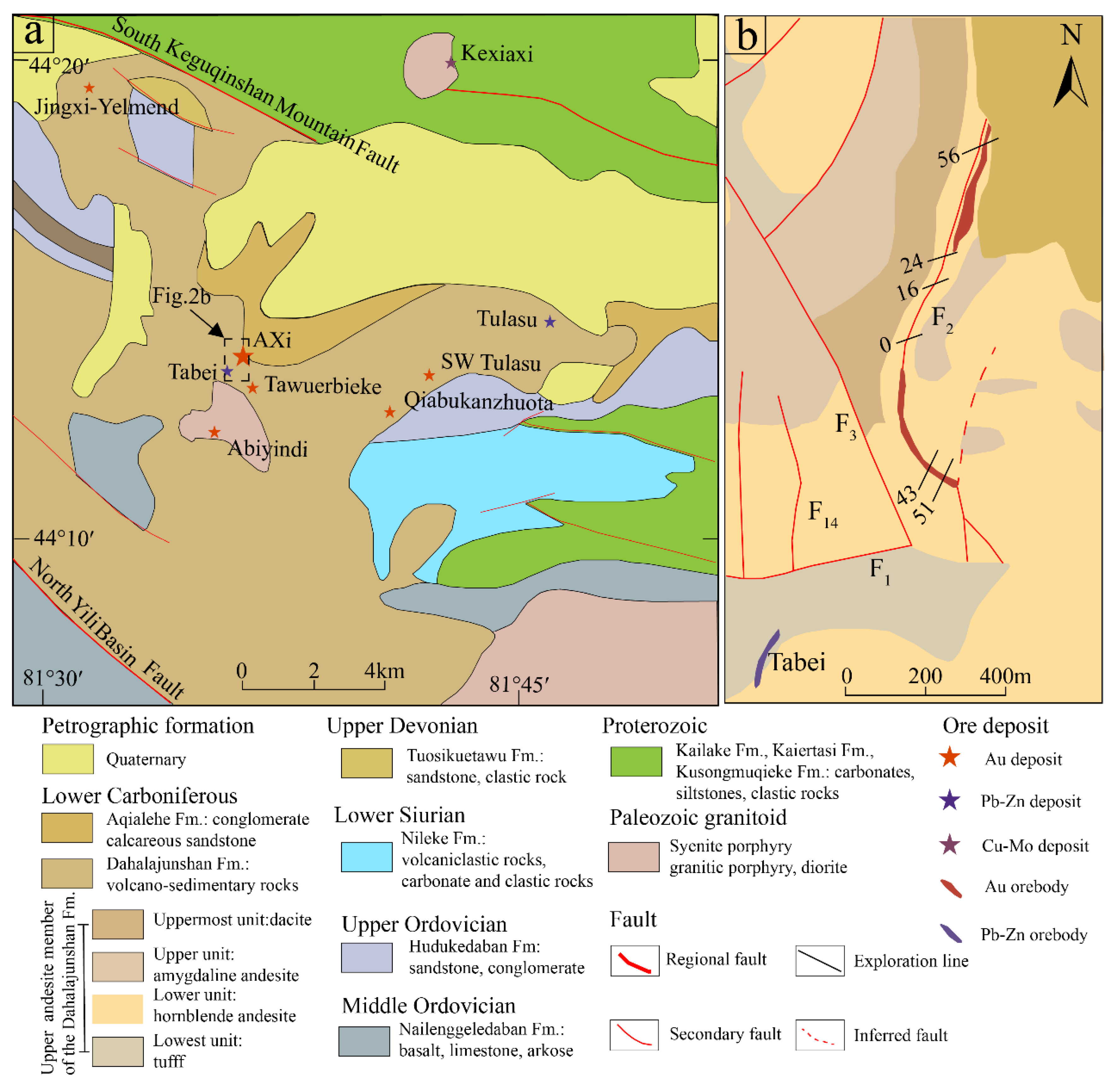
Figure 2. A geological map showing (a) the distribution of porphyry and epithermal deposits in the Tulasu Basin [6,10] and (b) the Axi district [5,33,34].
Minerals 16 00041 g002
Given the aforementioned considerations, this study focuses on the Axi gold deposit as a case study of the gold deposits in the Tulasu basin, utilizing computational simulation methods to explore the ore-forming processes. The computational modeling in this study is conducted in two primary stages: First, a coupled thermo-hydro-mechanical simulation is performed using FLAC3D, from which fluid temperature, velocity, and spatial coordinates are extracted to calculate the temperature gradient. Subsequently, this gradient is used to estimate the mineralization rate and to indicate the 3D spatial distribution of mineralization. This study may provide valuable insights into the mineralization mechanisms and offer new perspectives for deep exploration in the Axi gold deposit and Tulasu basin.

2. Geological Background

2.1. Regional Geology

The Tulasu Basin is bounded by the South Keguqin Mountain and the north Yili Basin thrust fault zones in the Borohoro region (Figure 2a). These two fault systems exhibit NNE strikes with dips ranging from 50° to 70°, and each persists for >10 km. Their orientation aligns with the tectonic boundary separating the Yili and Kazakhstan terranes [13]. The secondary structures in the Tulasu basin are dissected by steeply dipping, NW- to N-striking strike–slip faults that influence the distribution of Paleozoic rock units (Figure 2). Around volcanic edifices in the Jingxi, Axi, and Abiyindi areas, concentric and radial fracture systems are well developed [13,35].
The deposits in the Tulasu Basin are hosted within a Late Paleozoic continental volcanic–sedimentary sequence dominated by andesite, dacite, and volcaniclastic rocks. They exhibit a distinct spatio-temporal concentration, with their genesis being fundamentally controlled by NWW-trending fault systems and coeval magmatic-hydrothermal activity [36]. This is exemplified by representative low-sulfidation epithermal gold deposits, including the Axi, Jingxi-Yermand, and Abiyindi deposits, which collectively define a major epithermal-porphyry metallogenic belt (Figure 2).

2.2. Ore Deposit Geology

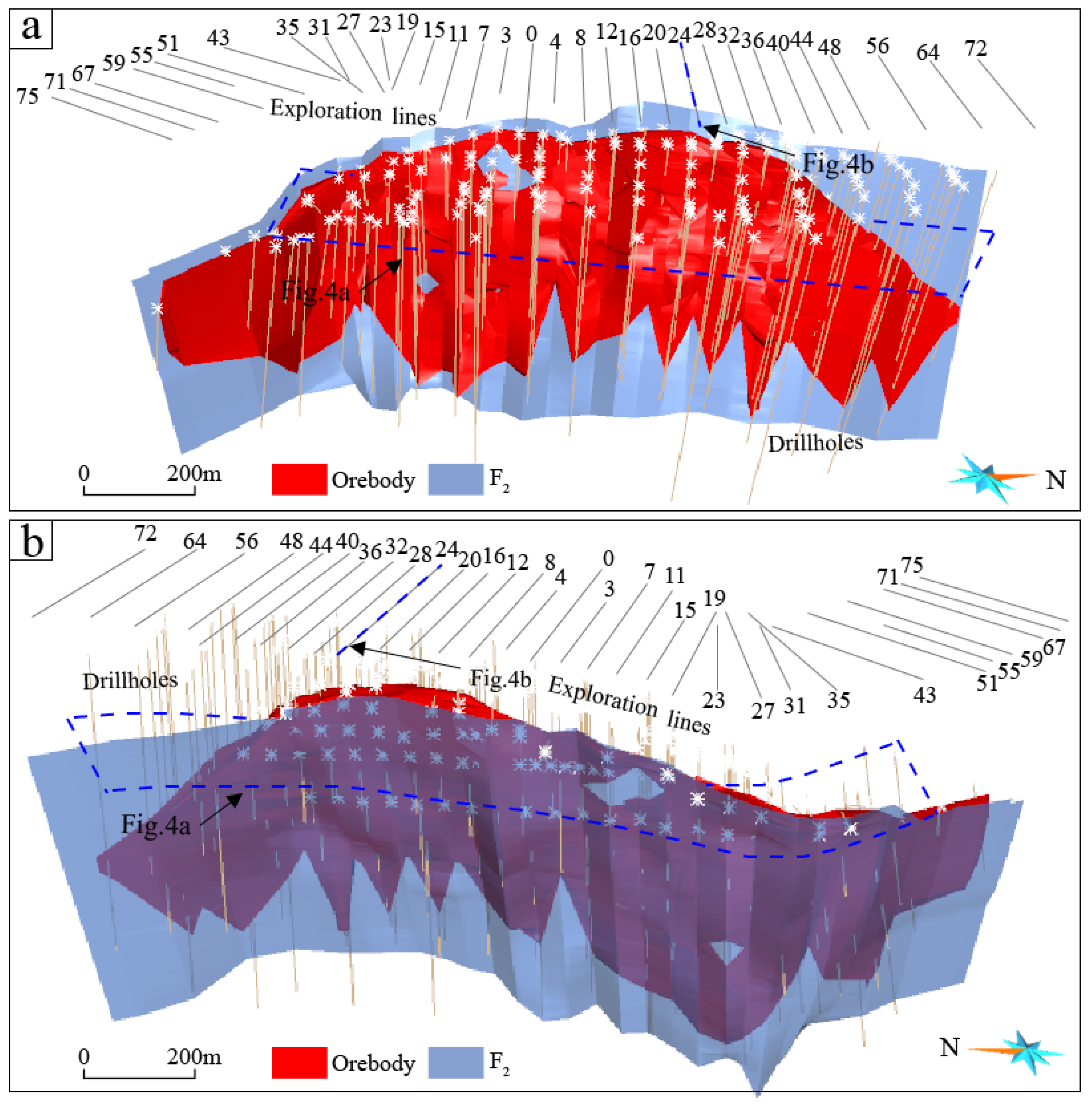
The fault F2, which governs the Axi ore deposit, extends in directions of NW 340°, NE 25°, and NW 325°, while its inclination varies from 60° to 70° in the northern segment (No. 44), 50–80° in the middle segment (No. 44~No. 27), and 55–85° in the southern segment (No. 27), respectively (Figure 2b and Figure 3). F2 not only serves as a primary structure for ore hosting structure but also acts as a major conduit for the large-scale pore fluid flow and accumulation of mineralizing fluids (Figure 3). The hanging wall of F2 comprises dacitic C1d5−2(breccia lava) and C1d5−1 (andesitic tuff, tuffaceous volcanic breccia, and andesite), whereas the footwall rock consists of andesitic C1d5−2 and C1d5−4 (volcanic agglomerate, andesitic dacite, and dacite) (Figure 2b).
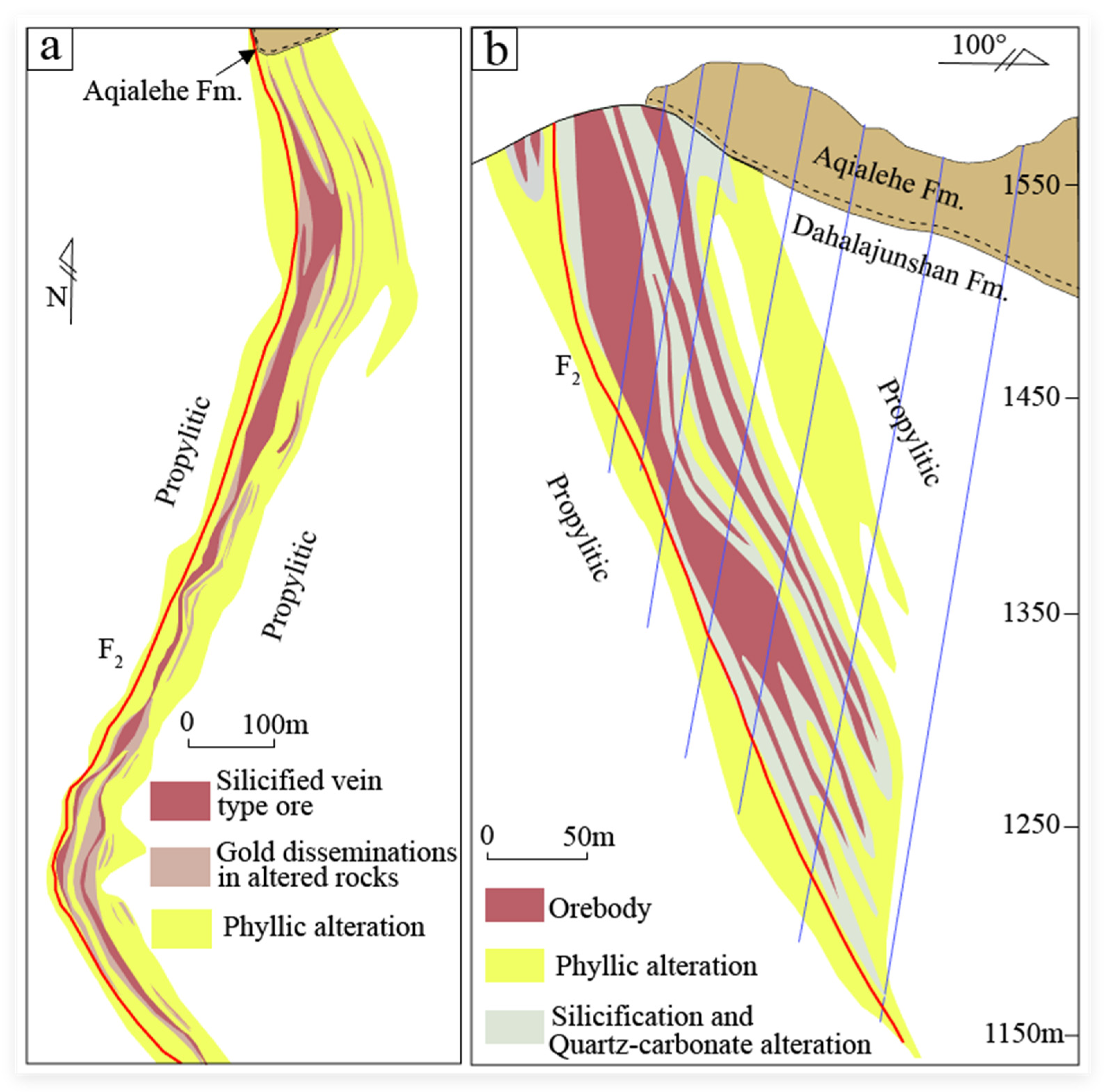
In the Axi gold deposit, thick orebodies generally are located in the gently dipping and curvilinear parts of the F2 fault, with a progressive thinning observed as distance from these parts increases. Orebodies stretch approximately 1 km along the strike direction (Figure 3) and exhibit variable thickness (11–15 m), grade (2–16 g/t and mean 5.6 g/t) and dip (46–78°) [10]. The ore primarily consists of silicified vein-type mineralization, which constitutes the main economically valuable ore. Gold-bearing minerals within this type of ore are predominantly native gold, electrum, and sulfide that are commonly hosted within quartz-sulfide aggregates and intensely altered breccias (Figure 4). Notably, the strong positive correlation between gold grade and sulfide abundance underscores the essential role of sulfidation and related chemical processes, particularly through the reduction of gold bisulfide complexes A u H S 2 and sulfide-driven precipitation, in controlling gold concentration and deposition [10,37,38].
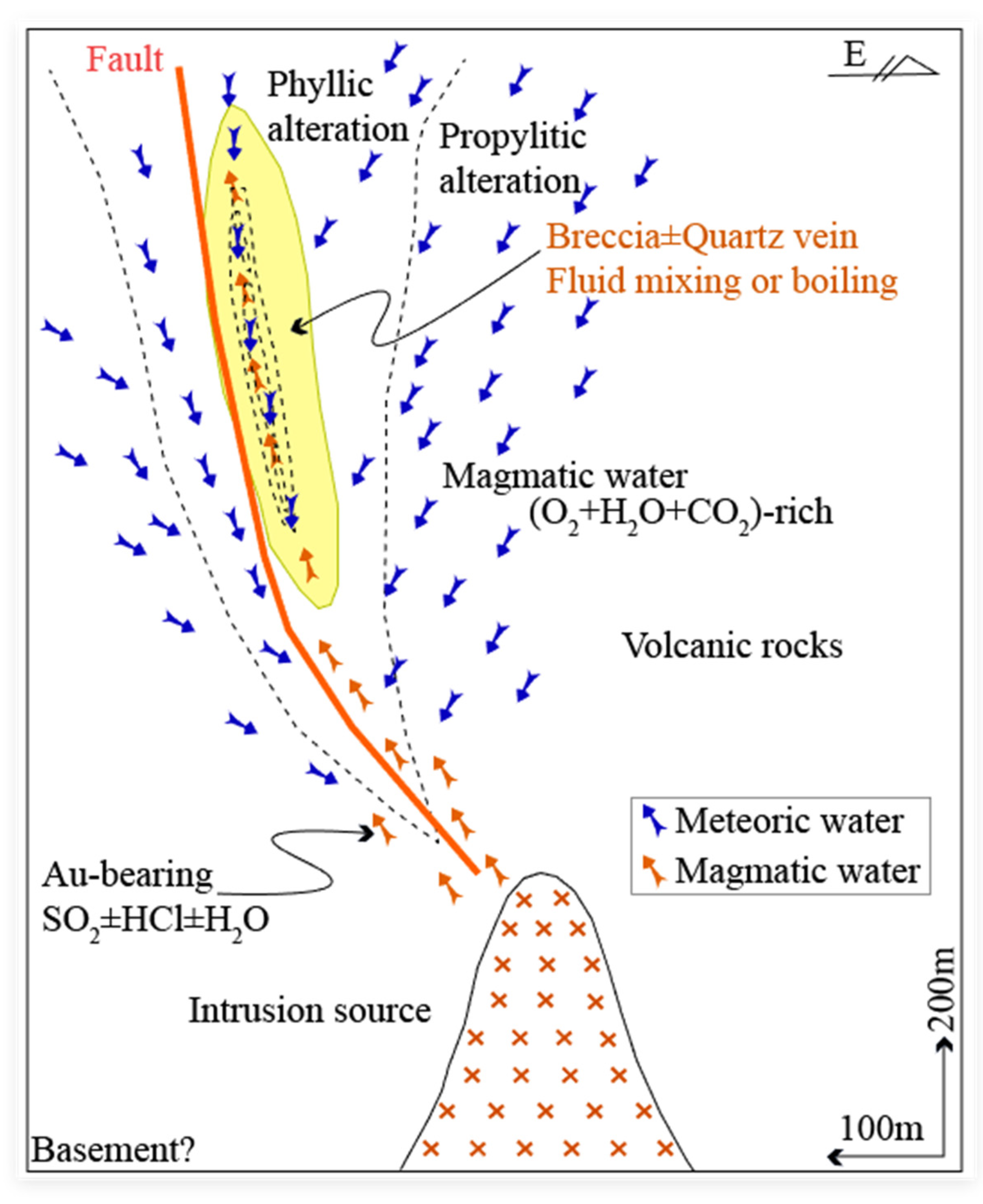
The mineralization of the deposit is subdivided into two principal stages [10,39]. The initial stage was driven by a dominantly magmatic-hydrothermal fluid system, manifesting as sericite–quartz–pyrite alteration. During this phase, ascending deep magmatic fluids, channeled along fault structures, underwent water-rock interaction with the basement series. Concurrently, a downward percolation of meteoric fluids along fractures initiated propylitic alteration in the wall rocks. Within this mixed but magmatic-dominated fluid system, gold transport occurred predominantly as chloride–sulfur complexes [40], with precipitation localized around fluid conduits within the phyllic alteration zone [6,33,34,41]. The late stage records a fundamental shift in fluid composition, marked by extensive silicification and a major influx of meteoric water (Figure 5). A sustained deep thermal engine drove vigorous hydrothermal convection [10], enabling the circulating fluids to act as an efficient leaching medium. These fluids progressively extracted metals, sulfur, and carbon from the basement and wall rocks. This process culminated in the concentration of multi-sourced gold into the evolving hydrothermal fluid, ultimately forming the deposit [42].

3. Methodology

3.1. Mathematical Model of Mineralization Rate

The mineralization rate of a given mineral refers to the variation in its mass per unit volume of rock in unit time during the mineralization process [19,28]. The mineralization rate can be positive, indicating the decomposition of mineralizing materials from the rock, or negative, signifying their precipitation from pore fluid. The mineralization rate can be derived from the perspective of mass conservation. To achieve this, a specific metal species (e.g., species q) is assumed under equilibrium conditions within a pore fluid flow system. The transport equation of this species mass is expressed as follows:
u C q e x + v C q e y + w C q e z = D 0 2 C q e x 2 + 2 C q e y 2 + 2 C q e z 2 + R q
where u , v and w are the velocities of pore flow in the x-direction, y-direction and z-direction, respectively; C q e is the equilibrium concentration of species q in the specific chemical reactions; is the porosity of the porous rock; D 0 is the diffusivity of the chemical species; R q is the source/sink term.
During the process of orebodies formation, the diffusion term on the right-hand side of Equation (1) is generally much smaller than the advection term and can be considered negligible. Consequently, Equation (1) can be simplified as follows:
M R q = R q = u C q e x + v C q e y + w C q e z
where M R q is the mineralization rate linked to species q .
In general, the equilibrium concentration of a specific metal species depends on temperature, pressure, and the presence of other relevant chemical species, as expressed by the following:
C q e = f T , P , C 1 , C 2 , C n
where T is temperature; P is pore fluid pressure; C is the concentration of a certain chemical substance; n is total count of relevant chemical species. Then substituting Equation (3) into Equation (2), we obtain the following expression:
M R q = C q e T u T x + v T y + w T z + C q e P u P x + v P y + w P z     + r = 1 n C q e C r u C r x + v C r y + w C r z

3.2. Numerical Simulation Workflow

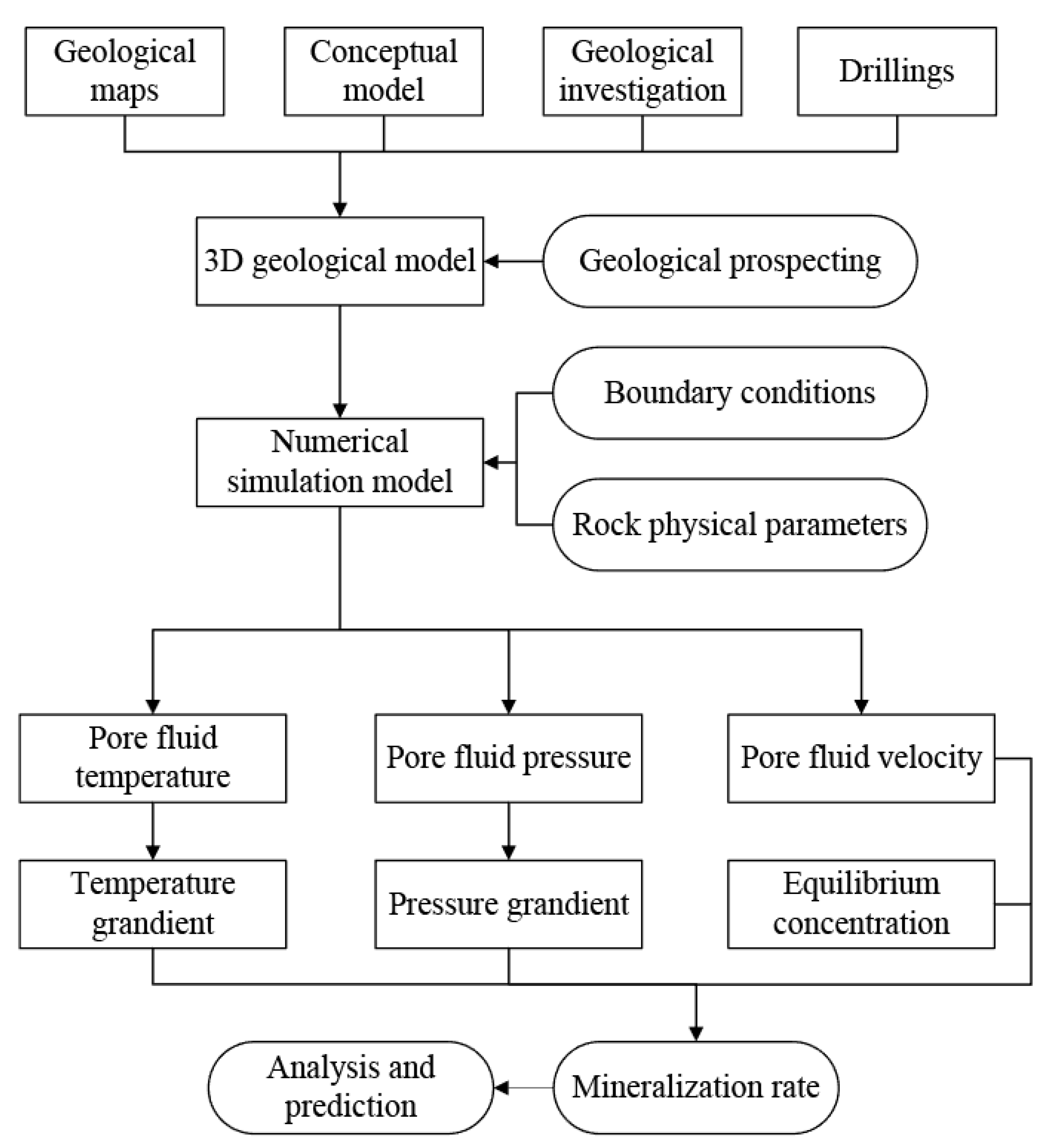
The numerical simulation model is a structural translation of the 3D geological model (Figure 6), which was initially built on the premise of a conceptual model and subsequently refined with data from geological maps, drillings, and geophysical prospecting [2,43,44], and its accuracy was further guaranteed by supplementary geological investigations aimed at resolving ambiguities in original geological maps and cross-sections. In this study, a 3D geological modeling approach [45,46,47] was employed, which integrated diverse data for the Axi gold deposit, including one topographic map, 22 cross-sections and level plans, and 132 drillholes. Based on these data, the 3D geological model (a closed-surface model) was constructed using the GOCAD 17, followed by the discretization of its spatial domain into regularly shaped tetrahedral elements to form a solid model. This solid model was then converted from the GOCAD to the FLAC3D 5.0 format via a custom program bridging the structural differences in their data schemas. Following its import into FLAC3D 5.0 and the configuration of parameters (e.g., boundary conditions and rock properties), thermo-hydro-mechanical coupled simulations were conducted. Subsequently, from these simulation results, the nodal pore fluid pressure and temperature were extracted. Their respective spatial gradients were subsequently calculated using the central difference method. Simultaneously, the chemical equilibrium concentrations of key reactions in the pore fluid were determined, leading to the development of a mathematical model that describes how the first-order partial derivatives of mineralizing substance concentrations vary with temperature and pressure under evolving conditions. Mineralization rates were then computed using the data obtained from the above steps. Finally, the results, including temperature gradients, fluid migration dynamics, and mineralization rates, were cross-referenced with verified geological data (e.g., known ore body distributions) to assess their coherence. The analysis revealed key controls on the localization of gold mineralization and helped delineate prospective targets for further exploration.

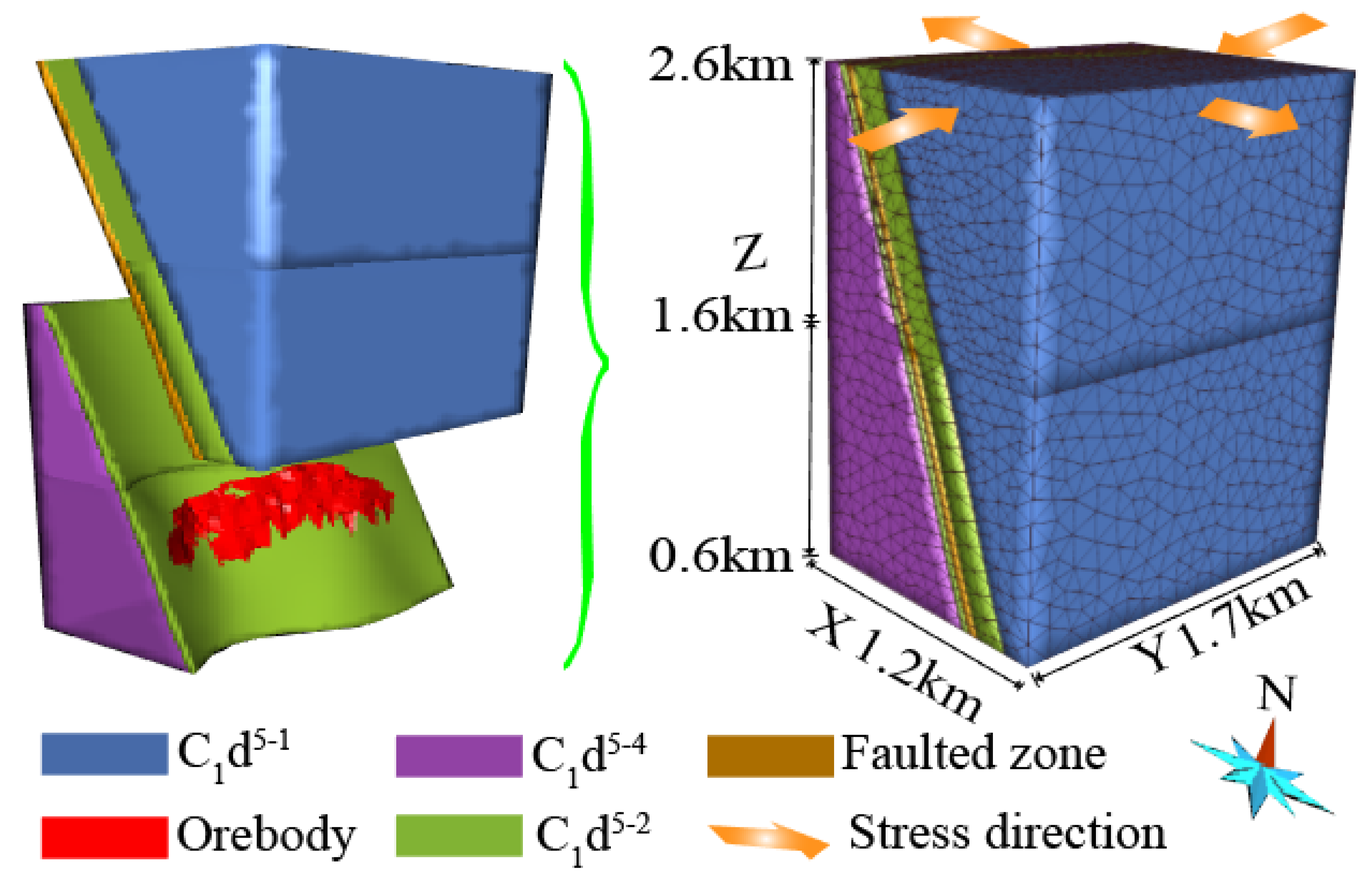
3.3. Model Setup and Related Parameters

The aforementioned 3D geological modeling approach [45,46,47] integrates established data from well-constrained regions with inference in poorly constrained domains. The latter include deep unexplored areas, modeled using multi-source geophysical data and extrapolated structural trends, and denuded strata, reconstructed by projecting trends from adjacent known regions. Moreover, following previous studies [5,6], the model is constructed with a metallogenic depth of 1 km and a 1 km thick erosion layer, within a domain that extends 1.7 km north–south and 1.2 km east–west (Figure 7). The geological units in the domain comprise stratigraphic units (C1d5−1 and C1d5−4), volcanic pipe facies (C1d5−2), faults, and gold orebodies, which were delineated primarily by integrating similar lithological characteristics obtained from drillholes. These units are further discretized into approximately regular tetrahedra.
Mechanical, thermal, and hydrological properties were assigned to all units in the computational models based on published studies [10,41,48,49,50]. Some properties in the geological environment varied significantly with burial depth, so these property assignments used in our model were derived from extensive comparative experiments within the general range of physical parameters for rock lithological [48], rather than from specific, fixed values. Subsequently, a parameter sensitivity analysis was conducted to systematically evaluate the influence of parameter variations on simulation outcomes, thereby minimizing the discrepancy between modeled results and field observations. On this basis, the most reasonable parameter combination was ultimately determined (Table 1). In addition, the initial and boundary conditions are specified as follows:
The initial temperature at the top of the model, excluding the fault zone, was fixed at 20 °C, with a geothermal gradient of 20 °C/km increasing with depth. Additionally, the temperature at the base of the fault was set to 400 °C, decreasing upwards at a gradient of 20 °C/km. All porous spaces were initially saturated with fluids. The four-sided boundaries of the model were configured to be impermeable and thermally insulating. Conversely, the top boundary was specifically designed to allow for unrestricted fluid flow, while the bottom boundary maintained a constant pore pressure gradient to facilitate steady upward fluid influx from deeper regions.
Based on previous studies of the tectonic stress field during the mineralization period of the Axi gold deposit [51,52], the stress conditions applied to the computational model in this study are as follows:
The model is subjected to east–west (X-axis) extensional stress. At the top of the model, the extensional stress is set to 8.0 × 10⁷ N/m2, and it decreases along the negative Z-axis at a gradient of 1.0 × 10⁴ N/m2 per meter (Figure 7).
Simultaneously, the model experiences north–south (Y-axis) compressive stress. At the top of the model, the compressive stress is set to 8.0 × 10⁶ N/m2, and it decreases along the negative Z-axis at a gradient of 1 × 10³ N/m2 per meter (Figure 7).

3.4. Chemical Reaction Equilibrium Concentrations of A u H S 2

The ore-forming process at the Axi low-sulfidation epithermal deposit comprises two distinct stages: an early stage with slightly acidic and reducing conditions, and a subsequent later stage characterized by the input of low-salinity meteoric water [10,53,54]. This specific fluid regime, characterized by its distinct pH and redox state, established a geologically favorable setting for the stabilization of gold-transporting complexes. Under these physicochemical conditions, gold was predominantly transported as bisulfide complexes, specifically A u H S 2 , rather than chloride complexes [37,38]. The formation of the predominant A u H S 2 complex can be represented by the following reaction:
A u H S 2 + 0.5 H 2 R A u + H 2 S + H S
where R represents the reaction rate of the chemical process.
The ore-forming fluids may contain carbonate ions, which may play a significant role in the transport and concentration of gold. Due to the presence of CO2 in the fluids, the pH is buffered through the reactions C O 2 + H 2 O H 2 C O 3 , H 2 C O 3 H C O 3 + H + , and H C O 3 C O 3 2 + H + . This buffering effect enhances the stability of A u H S 2 and increases the solubility of gold in the fluid [55,56,57].
The homogenization temperatures of fluid inclusions in the Axi gold deposit range from 198.7 °C to 384.9 °C, with salinities between 2.2% and 2.6% N a C l e q , and mineralization pressures ranging from 15 to 25 MPa [6,51]. In this study, the CHNOSZ 2.2.0 was used to calculate the equilibrium concentrations of the chemical reactions (Equation (5)) by setting the mineralizing chemical environment based on the preceding analysis.
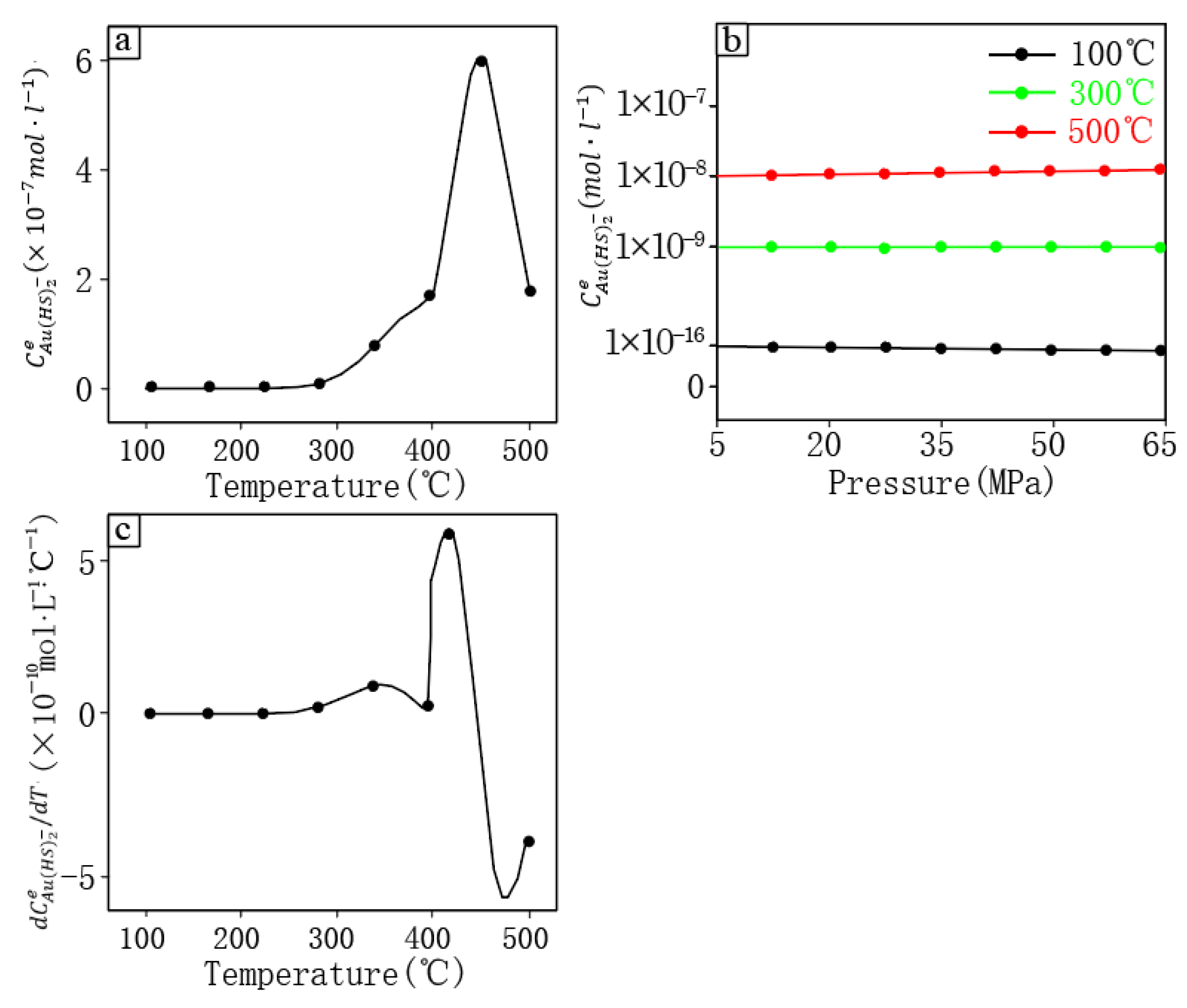
The simulation results (Figure 8a) reveal that the equilibrium concentration of the chemical reaction involving A u H S 2 follows an approximately parabolic relationship with temperature, from 100 °C to 400 °C and from 400 °C to 500 °C. The equation for the fitting curve can be determined using the equations below:
log T i = a T i 2 + b T i + c i = 1 , 2 , . . . , n
f T = m i n i = 0 n w i log ( T i ) e i 2 i = 1 , 2 , . . . , n
where log T i is the logarithm of the equilibrium concentration of the chemical reaction; T i and e i are the horizontal and vertical coordinates of the point i chosen from the curve displayed in Figure 8a. a , b and c are the three coefficients that need to be determined; w i is the weight of the chosen point i .
Ultimately, the mathematical model that describes how the equilibrium concentration varies with temperature is expressed as follows:
l o g C A u ( H S ) 2 e = 9.5 × 1 0 5 T 2 + 0.0755 T 22.8 100   ° C T 400   ° C
l o g C A u ( H S ) 2 e = 2.4 × 1 0 4 T 2 + 0.216 T 55.8 400   ° C T 500   ° C
The equilibrium concentration of A u H S 2 exhibits a clear correlation with temperature variation. Within the temperature range of 100–450 °C, the equilibrium concentration of A u H S 2 increases with temperature, showing a strong positive correlation. However, as the temperature reaches 450–500 °C, this relationship reverses, becoming negatively correlated. Furthermore, by observing the trend of the first-order partial derivative of A u H S 2 equilibrium concentration with respect to temperature (Figure 8c), it is evident that around 350 °C and 400 °C, the rate of change in A u H S 2 equilibrium concentration reaches local maxima. This indicates that the equilibrium concentration is highly sensitive to temperature variations near these points.
Figure 8b illustrates that at the fixed temperature points of 100 °C, 300 °C, and 500 °C, the equilibrium concentration of A u ( H S ) 2 does not exhibit significant changes with increasing pore fluid pressure, remaining relatively stable. This indicates that during the mineralization process of the Axi gold deposit, pore fluid pressure variations are not the primary factor controlling changes in the chemical reaction equilibrium concentration of A u ( H S ) 2 .
Therefore, the equilibrium concentration of A u ( H S ) 2 during the mineralization of the Axi gold deposit is predominantly controlled by temperature, whereas the influence of pore fluid pressure variations is negligible. As deep ore-bearing hydrothermal fluids (~400 °C) migrate toward shallower areas, the pronounced decrease in temperature leads to a substantial reduction in the equilibrium concentration of A u ( H S ) 2 , thereby driving efficient gold precipitation. However, once the fluid temperature falls below 200 °C, the impact of the temperature change on the equilibrium concentration of A u ( H S ) 2 chemical reaction gradually diminishes.

4. Simulation Results and Discussion

4.1. Temperature Gradient

In ore-forming systems, the temperature gradient not only influences the flow pathways of hydrothermal fluids but also significantly enhances the mineralization potential of specific geological regions [19,57,58]. Furthermore, the temperature gradient significantly affects ore grade and scale, serving as a critical parameter for calculating mineralization rates. This study estimates the temperature gradient in the X, Y, and Z directions using the central difference method, based on pore fluid temperature data obtained from numerical simulation results.
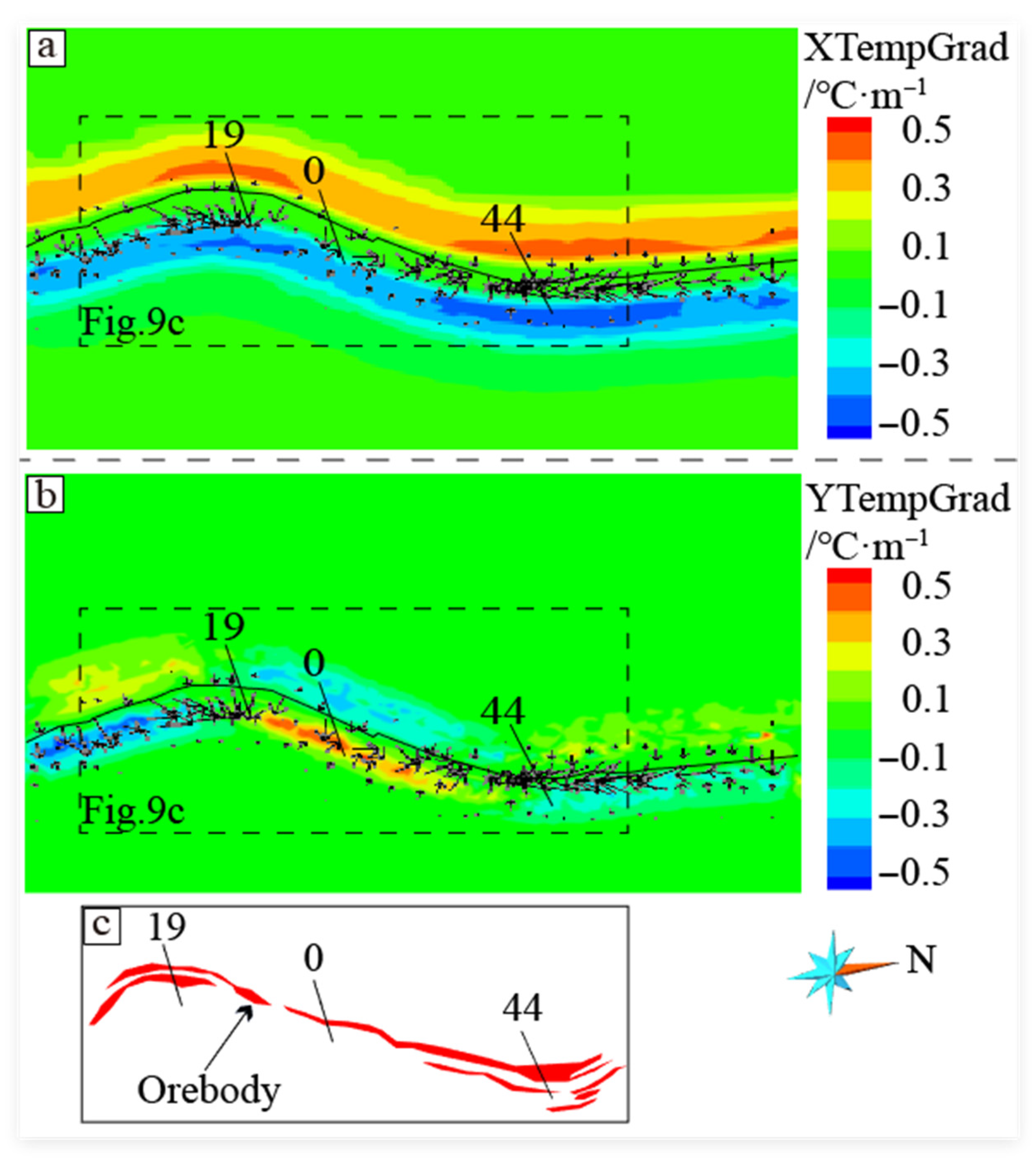
On the horizontal planes, the distribution characteristics of the X and Y temperature gradients exhibit significant differences (Figure 9). Specifically, the X temperature gradient shows a symmetrical distribution of positive and negative bands on both sides of the fault, with local maxima, shown in red, and corresponding minima, shown in blue, forming at the fault bends. In contrast, at locations where the fault is not obviously bent, the variations in the positive and negative bands of the X temperature gradient are modest, with no pronounced local extrema formed. In contrast, the Y temperature gradient, although generally symmetrical like the X temperature gradient, shows two intersections of positive and negative bands along the fault, occurring precisely at the fault bends. At these intersections, the colors gradually shift from red/blue to blue/red, reflecting a reversal of values from positive/negative to negative/positive, whereas in regions without significant curvature, the Y temperature gradient retains its symmetrical pattern. This distinctive distribution suggests that heat transfer along the Y temperature direction at the fault bends is particularly sensitive to multiple factors, including local stress variations, fault dip steepness, and changes in fault inclination.
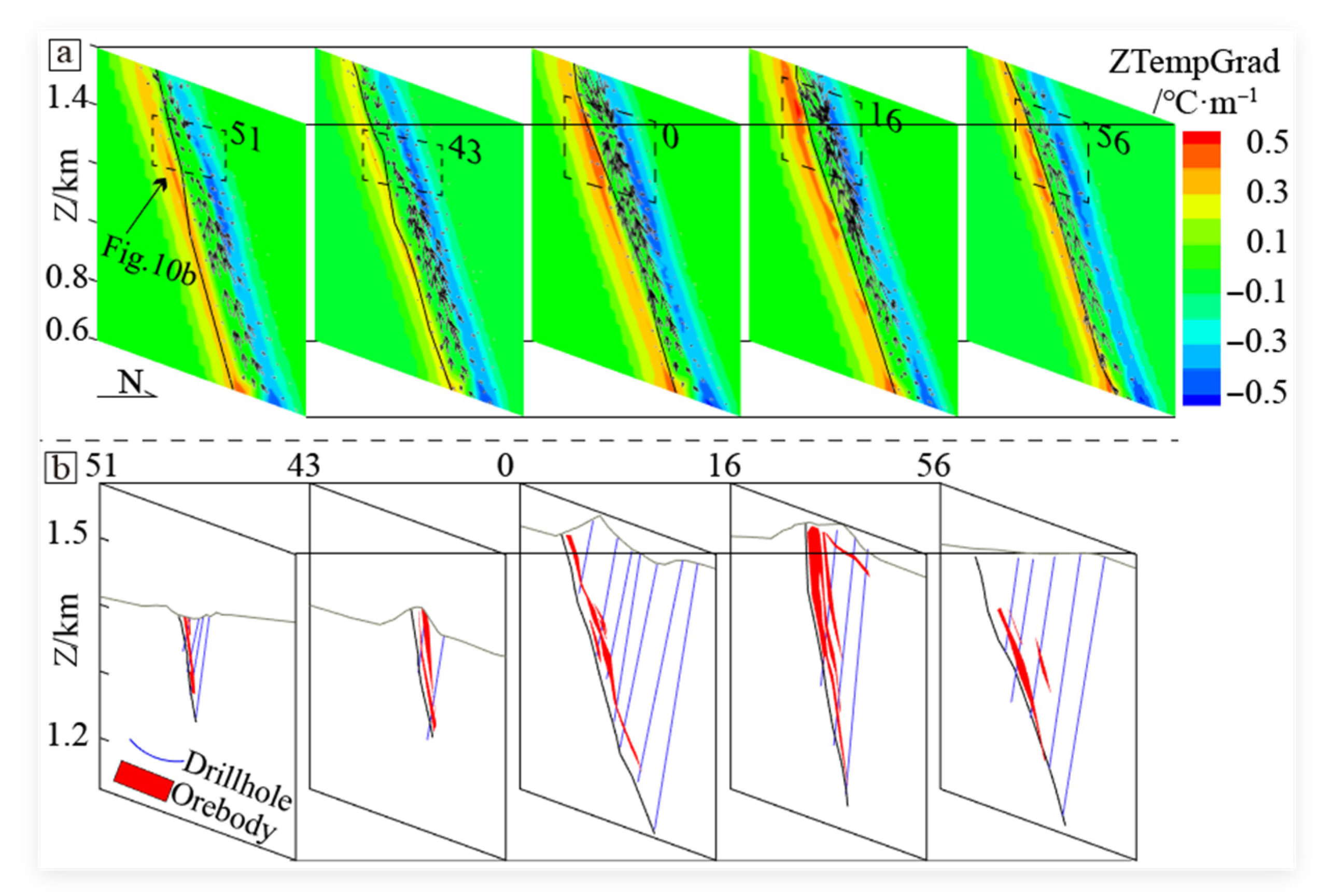
On the cross-section, the local maxima and minima of the Z-temperature gradient exhibit a symmetrical distribution on both sides of the fault, transitioning from steep to gentle inclinations (Figure 10). However, as the elevation decreases below 1.2 km, the curvature of the fault gradually diminishes, and correspondingly, the bands of the Z temperature gradient also decrease. Overall, the temperature gradient field closely aligns with the transitions from steep to gentle fault segments, potentially indicating a potential connection between localized temperature gradient anomalies and the migration, accumulation, and intensification of thermal fluids.
The ore-forming fluids of the Axi gold deposit, a mixture of low-temperature meteoric water and high-temperature magmatic fluids, accumulated, filled, and ultimately precipitated to form orebodies [6]. Numerical simulations reveal that fluids from depths greater than 1.4 km flow downward along the fault, whereas those from depths of less than 1.2 km flow upward, converging and mixing at approximately 1.3 km depth. Subsequently, these mixing fluids continue to migrate laterally along the fault, and reaccumulate in regions characterized by complex geometries (e.g., bends and irregularities) (Figure 9). These phenomena may be related to the influence of the stress field and temperature gradient. The shallow fluids flow downward along the fault under the influence of the stress field, while the deep ore-forming fluid, with higher temperatures and a continuous influx of deep heat, are likely driven upward by these thermodynamic conditions. The mixing of these fluids can reduce the overall flow velocity, thus prolonging the residence time of the ore-forming fluids and facilitating the decomposition of gold complexes (e.g., A u ( H S ) 2 ) and subsequent gold precipitation.

4.2. Metallogenic and Exploration Implications

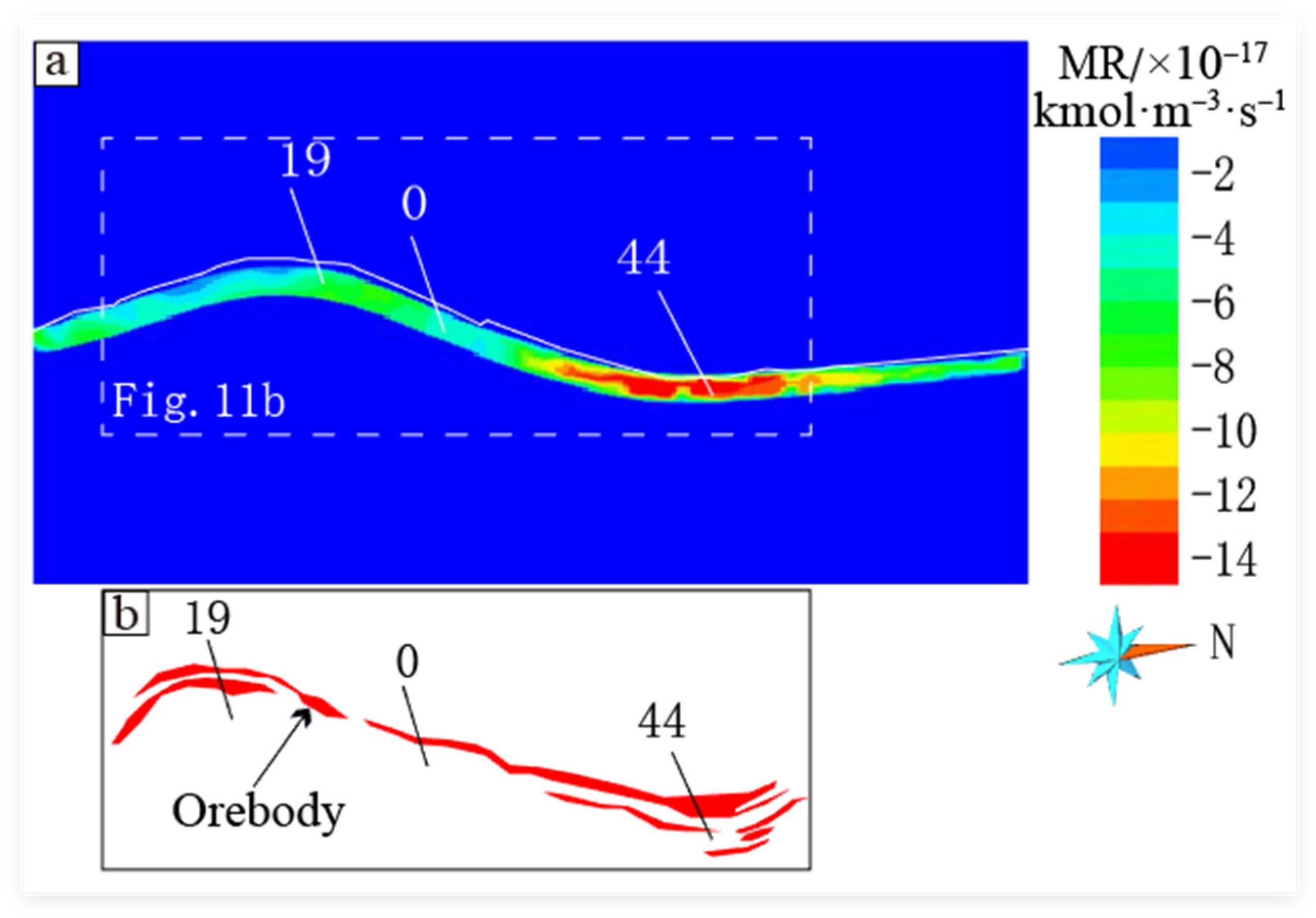
On the horizontal planes, the negative mineralization rate of the Axi gold deposit is primarily located in the hanging wall, consistent with the distribution characteristics of the known ore bodies, and its spatial distribution clearly demonstrates significant control by the orientation of the fault (Figure 11). The negative mineralization rate increases with the degree of curvature of the fault, and its intensity shows a significant high–weak intermittent distribution. For instance, in the areas along exploration lines 19 and 44, which feature pronounced bends, locally elevated values of negative mineralization rates are observed (Figure 11a). Notably, the negative mineralization rate in the area corresponding to line 44 surpasses that of line 19, suggesting a greater precipitation of gold. This observation is consistent with the actual distribution pattern of gold ore bodies along these two exploration lines. Meanwhile, the negative mineralization rate exhibits relatively weaker intensity in the areas where fault bends are not significant and, with the higher negative mineralization rate in the fault bending areas, results in a high-weak interval distribution (Figure 11b).
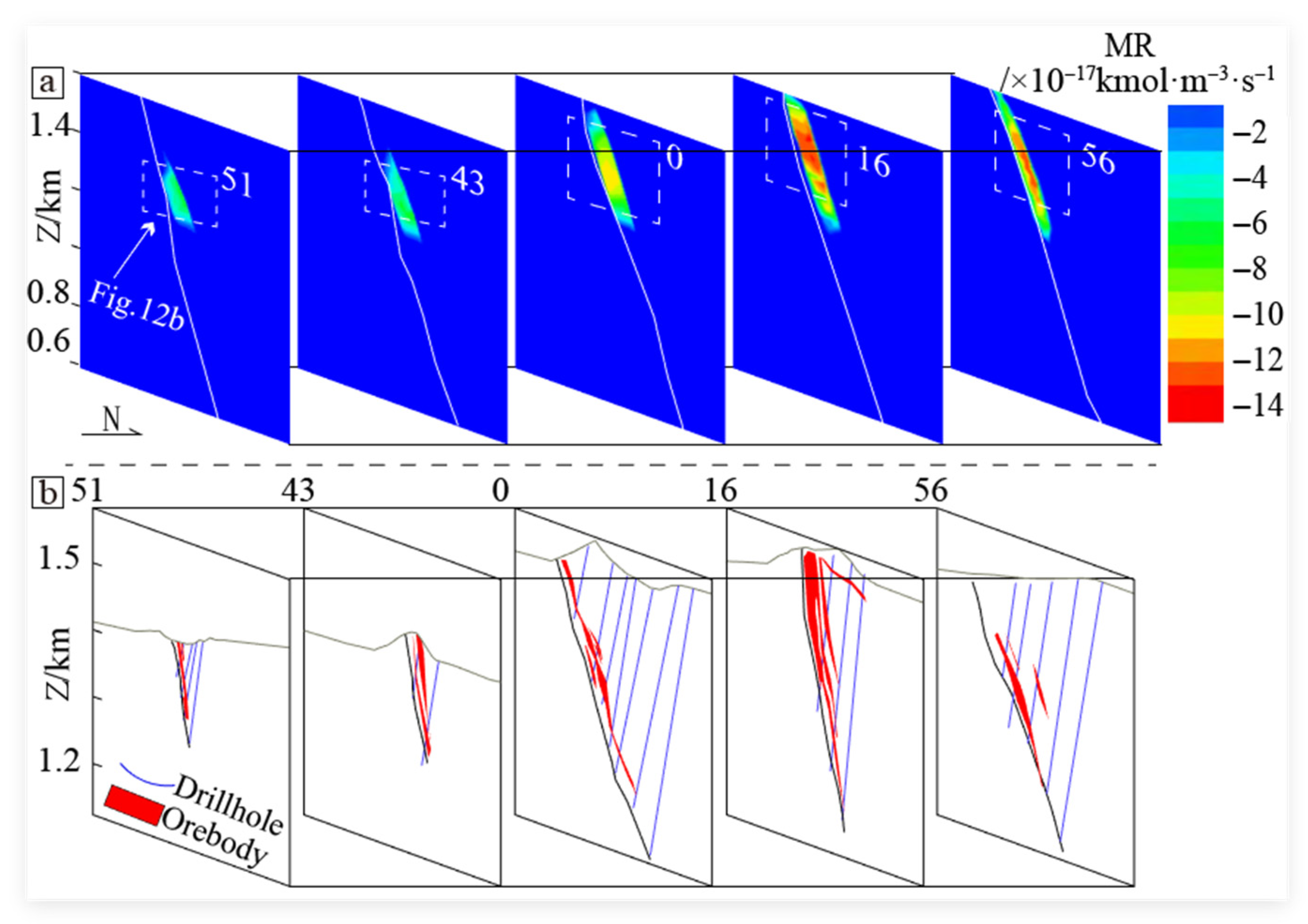
On the cross-section, negative mineralization rates are primarily concentrated in the fault breccia zone above an elevation of 1.2 km, with their orientation roughly parallel to the main fault plane (Figure 12). The intensity of negative metallogenic rates exhibits a significant positive correlation with the angle of transition from steep to gentle faulting and their lengths. For instance, in exploration lines 43, 0, and 16, as the length of gently dipping fault segments progressively increases, the scope of negative mineralization rate gradually intensifies. Notably, the negative mineralization rates show a progressively increasing trend in the deeper regions of the profiles from exploration line 16 to 56, with a particularly pronounced enhancement near exploration line 56.
Overall, the mineralization process of the Axi gold deposit is the result of coupled processes such as geological structure, heat transfer, fluid flow, and hydrothermal reactions. As the temperature decreases and sulfide reactions occur, causing the gold-bearing fluid to become unstable, previous studies have shown that temperature gradient variations in the Axi gold deposit significantly influence the equilibrium concentration of A u H S 2 [10,37,38,58], playing a critical role in the ore precipitation process. Numerical simulation results further confirm that a substantial concentration of known orebodies is distributed in areas where mineralization occurs (mineralization rate < 0). These areas are distinctly characterized by the overlap of significant temperature gradients and fluid accumulation, strongly suggesting that such overlapping patterns are critical indicators for identifying potential exploration targets.
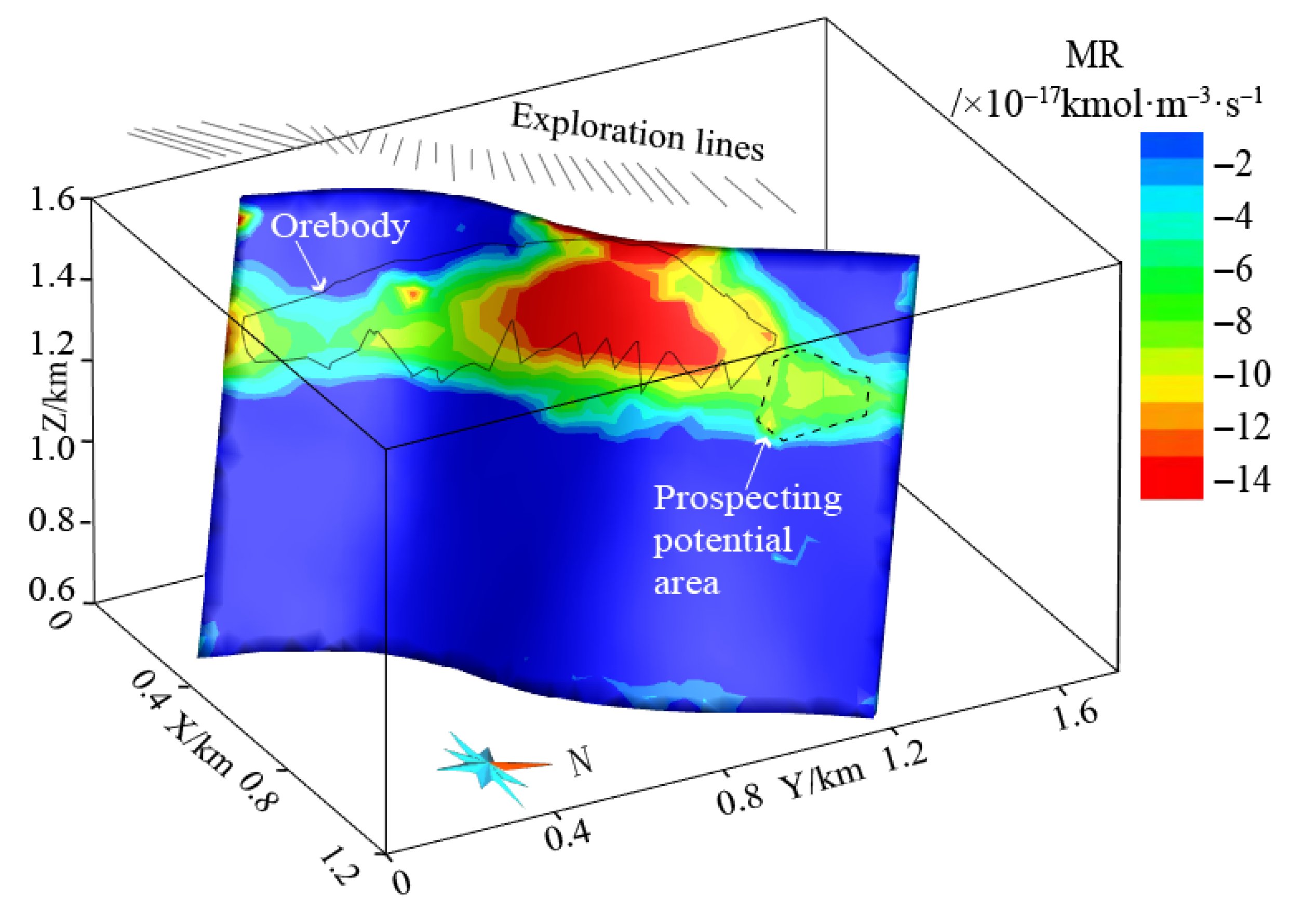
Insights from the spatial correlation model, integrated with previous studies [10,49], were used to delineate a prospective target with significant mineralization potential at depth north of the known orebodies (Figure 13). This target is aligned with the NE-trending downward extension of the mineralization, suggesting it may represent a conduit for paleo-fluid flow or a structurally controlled branch from the main orebody. In conclusion, the combination of favorable geological conditions, predictive basis, and presence of mineralized indicators underscores the considerable exploration potential of this area, which should be considered a high-priority target for anomaly verification.

5. Conclusions

This paper establishes a thermal–fluid–mechanical–chemical (THMC) coupling model for the Axi gold deposit and reveals through numerical simulation the patterns of favorable structural features for gold mineralization and precipitation. However, due to the limitations inherent in the existing FLAC3D 5.0, certain physical processes such as mass transport, magma solidification, and hydrothermal boiling were not incorporated into the model. Furthermore, only equilibrium chemical reaction processes were considered, while non-equilibrium chemical reaction processes were overlooked. The main conclusions are as follows:
(1)
Chemical reaction equilibrium concentrations of A u H S 2 indicate that temperature gradients are crucial factors influencing the precipitation of ore-forming fluids, whereas pressure gradients play a negligible role.
(2)
The precipitation of mixing ore-forming fluids is preferentially localized in zones with sharp temperature gradients. Following the mixing of meteoric and magmatic fluids, pronounced temperature gradients are generated at locations with relatively large fault dips and gentle undulations. These gradients destabilize the A u H S 2 complexes, thereby initiating efficient gold deposition.
(3)
The coupling of multiple physical–chemical processes at the same location of the fault is likely to be the key factor controlling the formation of the Axi gold deposit, as quantitatively expressed by the negative mineralization rate. Based on this metallogenic regularity, it is inferred that a potential mineralization zone has been delineated in the deep northern extension of the known ore bodies.

Author Contributions

Conceptualization, W.S. and X.M.; methodology, W.S., X.M., W.S. and Z.L.; software, W.S. and H.D.; investigation, W.S. and H.D.; resources, Z.F.; data curation, H.D. and Z.F.; writing—original draft preparation, W.S., X.M. and Z.L.; writing—review and editing, H.D. and Q.Y.; supervision, Q.Y. and X.M.; project administration, W.S. and X.M. All authors have read and agreed to the published version of the manuscript.

Funding

This study is supported by projects from the National Major Science and Technology Projects of China (2024ZD1001904), the National Key R&D Program of China (No. 2023YFC2906403), the National Natural Science Foundation of China (No. 42272344), Funded by Open Research Fund Program of Key Laboratory of Metallogenic Prediction of Nonferrous Metals and Geological Environment Monitoring (Ministry of Education), Central South University (No. 2025YSJS02), and Hunan Provincial Social Science Foundation Project (24YBA354).

Data Availability Statement

The authors do not have permission to share data.

Acknowledgments

We thank Chongbin Zhao for his assistance during the field work.

Conflicts of Interest

The authors declare no conflicts of interest.

References

  1. Cao, W.; Liu, L.M.; Liu, H.S.; Lai, F. Investigating the Irregular Localization of Skarn Orebodies by Computational Modeling in the Fenghuangshan Ore Field, Tongling District, Anhui Province, China. Nat. Resour. Res. 2020, 29, 2967–2988. [Google Scholar] [CrossRef]
  2. Liu, X.C.; Xiao, C.H.; Zhang, S.H.; Chen, B. Numerical Modeling of Deformation at the Baiyun Gold Deposit, Northeastern China:Insights into the Structural Controls on Mineralization. J. Earth Sci. 2021, 32, 174–184. [Google Scholar] [CrossRef]
  3. Fan, X.; Hu, Z.W.; Xu, S.F.; Chen, C.; Yi, N. Numerical simulation study on ore-forming factors of the Gejiu ore deposit, China. Ore Geol. Rev. 2021, 135, 104209. [Google Scholar] [CrossRef]
  4. Xie, S.F.; Mao, X.C.; Liu, Z.K.; Deng, H.; Chen, J.; Xiao, K.Y. Determining the Paleostress Regime during the Mineralization Period in the Dayingezhuang Orogenic Gold Deposit, Jiaodong Peninsula, Eastern China: Insights from 3D Numerical Modeling. Minerals 2022, 12, 505. [Google Scholar] [CrossRef]
  5. Zhai, W.; Sun, X.M.; Gao, J.; He, X.P.; Liang, J.L.; Miao, L.C.; Wu, Y.L. SHRIMP dating of zircons from volcanic host rocks of Dahalajunshan formation in Axi gold deposit, Xinjiang, China, and its geological implication. Acta Petrol. Sin. 2006, 22, 1399–1404. [Google Scholar]
  6. Zhai, W.; Sun, X.M.; Sun, W.D.; Sun, W.D.; Su, L.W.; He, X.P.; Wu, Y.L. Geology, geochemistry, and genesis of Axi: A Paleozoic low-sulfidation type epithermal gold deposit in Xinjiang, China. Ore Geol. Rev. 2009, 36, 265–281. [Google Scholar] [CrossRef]
  7. Dong, L.H. The main alteration type of Axi gold deposit and its relationship to gold mineralization. Geol. Resour. 2001, 10, 129–132. [Google Scholar]
  8. Liu, H.L.; Dong, L.H. Geologic characteristics and preliminary study on genesis of Axi gold deposit. Xinjiang Geol. 1992, 10, 110–119. [Google Scholar]
  9. Zhai, W.; Sun, X.; Su, L. Axi gold deposit:A Paleozoic low-sulfidation type of epithermal gold deposit in Xin-jiang, China. Earth Sci. Front. 2010, 17, 266–285. [Google Scholar]
  10. Liu, Z.K.; Mao, X.C.; Deng, H.; Li, B.; Zhang, S.G. Hydrothermal processes at the Axi epithermal Au deposit, western Tianshan: Insights from geochemical effects of alteration, mineralization and trace elements in pyrite. Ore Geol. Rev. 2018, 102, 368–385. [Google Scholar] [CrossRef]
  11. Feng, J.; Wang, J.; Ouyang, Z. A discussion on gold mineralization styles of Axi Jingxi-Yelm end gold deposits in western Tianshan Xinjiang: Evidence from Fluid inchusions. J. Northwest Univ. 2007, 1, 99–102. [Google Scholar]
  12. Jia, B.; Wu, R.S.; Tian, C.L.; Sha, D.M. The characters of the mineralization fluid of Axi gold deposit in Xinjiang. Gold Geol. 2001, 1, 39–46. [Google Scholar]
  13. Zhang, D.Y.; Zhang, Z.C.; Encarnación, J.; Xue, C.J.; Duan, S.G.; Zhao, Z.D.; Liu, J.L. Petrogenesis of the Kekesai composite intrusion, western Tianshan, NW China: Implications for tectonic evolution during late Paleozoic time. Lithos 2012, 146–147, 65–79. [Google Scholar] [CrossRef]
  14. Phillips, O.M. Flow and Reactions in Permeable Rocks; Cambridge University Press: Cambridge, UK, 1991; pp. 1–36. [Google Scholar]
  15. Zhao, C.B.; Hobbs, B.E.; Ord, A. Modeling of mountain topography effects on hydrothermal Pb-Zn mineralization patterns: Generic model approach. J. Geochem. Explor. 2018, 190, 400–410. [Google Scholar] [CrossRef]
  16. Hu, X.Y.; Li, X.H.; Yuan, F.; Ord, A.; Jowitt, S.M.; Li, Y.; Dai, W.; Zhou, T. Numerical modeling of ore-forming processes within the Chating Cu-Au porphyry-type deposit, China: Implications for the longevity of hydrothermal systems and potential uses in mineral exploration. Ore Geol. Rev. 2020, 116, 103230. [Google Scholar] [CrossRef]
  17. Zhao, C.B.; Hobbs, B.E.; Ord, A. Simulating dual solutions of coupled pore-fluid flow and chemical dissolution problems in fluid-saturated heterogeneous porous media. Eng. Comput. 2023, 40, 973–996. [Google Scholar] [CrossRef]
  18. Shan, W.F.; Mao, X.C.; Liu, Z.K.; Deng, H.; Lei, T.; Wang, D.T.; Pan, Y.; Liu, Y. Computational simulation of the ore-forming processes associated with the Sanshandao-Haiyu gold belt, Jiaodong Peninsula, eastern China: Implications for the duration of ore formation. Front. Earth Sci. 2023, 11, 1154945. [Google Scholar] [CrossRef]
  19. Zhao, C.B.; Hobbs, B.E.; Ord, A. Convective and Advective Heat Transfer in Geological Systems; Springer: Berlin/Heidelberg, Germany, 2008. [Google Scholar]
  20. Nield, D.A.; Bejan, A. Convection in Porous Media; Springer: New York, NY, USA, 2013; pp. 1–988. [Google Scholar]
  21. Zhao, C.B.; Hbbs, B.E.; Alt-Epping, P. Modelling of ore-forming and geoenvironmental systems: Roles of fluid flow and chemical reaction processes. J. Geochem. Explor. 2014, 144, 3–11. [Google Scholar] [CrossRef]
  22. Zhao, C.B. Advances in numerical algorithms and methods in computational geosciences with modeling characteristics of multiple physical and chemical processes. Sci. China Technol. Sci. 2015, 58, 783–789. [Google Scholar] [CrossRef]
  23. Lin, Y.; Gao, F.; Zhou, K.P.; Gao, R.; Guo, H.Q. Mechanical properties and statistical damage constitutive model of rock under a coupled chemical-mechanical condition. Geofluids 2019, 2019, 7349584. [Google Scholar] [CrossRef]
  24. Zhao, C.B.; Hobbs, B.E.; Ord, A. An accurate porosity-velocity-concentration approach for solving reactive mass transport problems involving chemical dissolution in fluid-saturated porous media with arbitrarily initial porosity distributions. Int. J. Numer. Methods Eng. 2021, 122, 7354–7377. [Google Scholar] [CrossRef]
  25. Zhao, C.B.; Hobbs, B.E.; Ord, A. Two different mathematical schemes for solving chemical dissolution-front instability problems in fluid-saturated rocks. Sci. China Technol. Sci. 2022, 65, 147–156. [Google Scholar] [CrossRef]
  26. Zhao, C.B.; Hobbs, B.E.; Ord, A. Semi-analytical finite element method for simulating chemical dissolution-front instability problems in fluid-saturated porous media. Eng. Comput. 2022, 39, 1781–1801. [Google Scholar] [CrossRef]
  27. Prakash, R.; Nguene, P.C.K.; Noshadravan, A.; Abedi, S. Chemical reactions of carbonate-rich mudstones with aqueous CO2 and their impacts on rock’s local microstructural and chemo-mechanical properties. J. Nat. Gas Sci. Eng. 2022, 103, 104587. [Google Scholar] [CrossRef]
  28. Zhao, C.B.; Lin, G.; Hobbs, B.E.; Wang, Y.; Mühlhaus, H.B.; Ord, A. Finite element modelling of reactive fluids mixing and mineralization in pore-fluid saturated hydrothermal/sedimentary basins. Eng. Comput. 2002, 19, 364–387. [Google Scholar] [CrossRef]
  29. Liu, Y.; Dai, T.G. Numerical modeling of pore-fluid flow and heat transfer in the Fushan iron ore district, Hebei, China: Implications for hydrothermal mineralization. J. Geochem. Explor. 2014, 144, 115–127. [Google Scholar] [CrossRef]
  30. Liu, Y.; Dai, T.G.; Xia, S.H.; Tian, H.L. Computational simulation of iron ore-forming processes in the Caiyuanzi siderite ore district, Guizhou, China. J. Geochem. Explor. 2015, 158, 155–167. [Google Scholar] [CrossRef]
  31. Zou, Y.H.; Liu, Y.; Dai, T.G.; Mao, X.C.; Lei, Y.B.; Lai, J.Q.; Tian, H.L. Finite difference modeling of metallogenic processes in the Hutouya Pb-Zn deposit, Qinghai, China: Implications for hydrothermal mineralization. Ore Geol. Rev. 2017, 91, 463–476. [Google Scholar] [CrossRef]
  32. Itasca. FLAC3D 5.0 (Fast Lagrangian Analysis of Continua in 3 Dimensions) Manual; Itasca Consulting Group Inc.: Minneapolis, MN, USA, 2012. [Google Scholar]
  33. An, F.; Zhu, Y.F.; Wei, S.N.; Lai, S.C. An early Devonian to early Carboniferous volcanic arc in North Tianshan, NW China: Geochronological and geochemical evidence from volcanic rocks. J. Asian Earth Sci. 2013, 78, 100–113. [Google Scholar] [CrossRef]
  34. Dong, L.L.; Wan, B.; Deng, C.; Cai, K.D.; Xiao, W.J. An early Permian epithermal gold system in the Tulasu Basin in North Xinjiang, NW China: Constraints from in situ oxygen-sulfur isotopes and geochronology. J. Asian Earth Sci. 2018, 153, 412–424. [Google Scholar] [CrossRef]
  35. Chen, Y.J.; Pirajno, F.; Wu, G.; Qi, J.P.; Xiong, X.L. Epithermal deposits in North Xinjiang, NW China. Int. J. Earth Sci. 2012, 101, 889–917. [Google Scholar] [CrossRef]
  36. Gu, X.X.; Dong, L.H.; Peng, Y.W.; Wang, X.L.; Zhu, B.Y. Formation and evolution of the epithermal-porphyry Au polymetallic mineralization system in the Tulasu volcanic basin of the West Tianshan, Xinjiang. Acta Petrol. Sin. 2016, 32, 1283–1300. [Google Scholar]
  37. Benning, L.G.; Seward, T.M. Hydrosulphide complexing of Au(I) in hydrothermal solutions from 150–400 °C and 500–1500 bar. Geochim. Cosmochim. Acta 1996, 60, 1849–1871. [Google Scholar] [CrossRef]
  38. Williams-Jones, A.E.; Bowell, R.J.; Migdisov, A.A. Gold in Solution. Elements 2009, 5, 281–287. [Google Scholar] [CrossRef]
  39. Fan, X.L.; Huang, W.; Yuan, E.Q. Processes of gold enrichment in Axi region of western Tianshan. Xinjiang Geol. 2002, 3, 224–228. [Google Scholar]
  40. An, F.; Zhu, Y. Geology and geochemistry of the early Permian Axi low-sulfidation epithermal gold deposit in North Tianshan (NW China). Ore Geol. Rev. 2018, 100, 12–30. [Google Scholar] [CrossRef]
  41. Peng, Y.W.; Gu, X.X.; Cheng, W.B.; Zhao, X.B.; Wang, G.N.; Lu, L.T. Metallogenesis of the Late Palaeozoic Axi–Tawuerbieke Au–Pb–Zn district in the Tulasu Basin, Western Tianshan, China: Constraints from geological characteristics and isotope geochemistry. Geol. J. 2018, 53, 3030–3050. [Google Scholar] [CrossRef]
  42. Large, R.R.; Maslennikov, V.V.; Robert, F.; Danyushevsky, L.V.; Chang, Z.S. Multistage Sedimentary and Metamorphic Origin of Pyrite and Gold in the Giant Sukhoi Log Deposit, Lena Gold Province, Russia. Econ. Geol. 2007, 102, 1233–1267. [Google Scholar] [CrossRef]
  43. Liu, L.M.; Li, J.F.; Zhou, R.C.; Sun, T. 3D modeling of the porphyry-related Dawangding gold deposit in South China: Implications for ore genesis and resources evaluation. J. Geochem. Explor. 2016, 164, 164–185. [Google Scholar] [CrossRef]
  44. Hu, X.Y.; Jowitt, S.; Yuan, F.; Liu, G.X.; Luo, J.H.; Chen, Y.H. Numerical modeling of mineralizing processes during the formation of the Yangzhuang Kiruna-type iron deposit, Middle and lower Yangtze River Metallogenic Belt, China: Implications for the genesis and longevity of Kiruna-type iron oxide-apatite systems. Solid Earth Sci. 2022, 7, 23–37. [Google Scholar]
  45. Mao, X.C.; Zhao, Y.; Deng, H.; Zhang, B.; Liu, Z.K.; Chen, J.; Zou, Y.H.; Lai, J.Q. Quantitative analysis of intrusive body morphology and its relationship with skarn mineralization-a case study of Fenghuangshan copper deposit, Tongling, Anhui, China. Trans. Nonferrous Met. Soc. China 2018, 28, 151–162. [Google Scholar] [CrossRef]
  46. Mao, X.C.; Ren, J.; Liu, Z.K.; Chen, J.; Tang, L.H.; Deng, H.; Bayless, R.C.; Yang, B.C.; Wang, M.J.; Liu, C.L. Three-dimensional prospectivity modeling of the Jiaojia-type gold deposit, Jiaodong Peninsula, Eastern China: A case study of the Dayingezhuang deposit. J. Geochem. Explor. 2019, 203, 27–44. [Google Scholar]
  47. Mao, X.C.; Wang, Q.; Chen, J.; Deng, H.; Liu, Z.K.; Wang, J.L.; Chen, J.P.; Xiao, K.Y. Three-dimensional Modeling of Deep Metallogenic Structure in Northwestern Jiaodong Peninsula and Its Gold Prospecting Significance. Acta Geoscient. Sin. 2020, 41, 166–178. [Google Scholar]
  48. Schön, J.H. Physical Properties of Rocks: Fundamentals and Principles of Petrophysics, 2nd ed.; Elsevier: Amsterdam, The Netherlands, 2015; pp. 1–360. [Google Scholar]
  49. Mao, X.C.; Zhang, W.; Liu, Z.K.; Ren, J.; C.B, R.; Deng, H. 3D mineral prospectivity modeling for the low-sulfidation epithermal gold deposit: A case study of the Axi gold deposit, Western Tianshan, NW China. Minerals 2020, 10, 233. [Google Scholar] [CrossRef]
  50. Liu, Z.K.; Mao, X.C.; Ackerman, L.; Li, B.; Shahzad, M. Two-stage gold mineralization of the Axi epithermal Au deposit, Western Tianshan, NW China: Evidence from Re-Os dating, S isotope, and trace elements of pyrite. Miner. Depos. 2020, 55, 863–880. [Google Scholar] [CrossRef]
  51. Wei, J.L. Study of Orebody Space Location Regularity and Prospecting Direction of Axi Gold Deposit in Xinjiang Province. Ph.D. Thesis, China University of Geosciences, Beijing, China, 2013. [Google Scholar]
  52. Wang, B.G.; Zhang, X.B.; Zhang, M. Geology and ore prospecting of Axil gold deposit in XinJiang. Geol. Shanxi 2018, 36, 20–25. [Google Scholar]
  53. Simmons, S.F.; White, N.C.; John, D.A. Geological Characteristics of Epithermal Precious and Base Metal Deposits; Economic Geology 100th Anniversary Volume; Society of Economic Geologists: Littleton, CO, USA, 2005; pp. 485–522. [Google Scholar]
  54. Cooke, D.R.; Deyell, C.L.; Waters, P.J.; Gonzales, R.I.; Zaw, K. Evidence for magmatic-hydrothermal fluids and ore-forming processes in epithermal and porphyry deposits of the Baguio district, Philippines. Econ. Geol. 2011, 106, 1399–1424. [Google Scholar]
  55. Phillips, G.N.; Evans, K.A. Role of CO2 in the formation of gold deposits. Nature 2004, 429, 860–863. [Google Scholar] [CrossRef]
  56. Brugge, J.; Etschmann, B.; Pownceby, M.; Liu, W.; Grundler, P.; Brewe, D. Oxidation state of europium in scheelite: Tracking fluid-rock interaction in gold deposits. Chem. Geol. 2008, 257, 26–33. [Google Scholar]
  57. Chi, G.X.; Liu, Y.X.; Dubé, B. Relationship between CO2-dominated fluids, hydrothermal alterations and gold mineralization in the Red Lake greenstone belt, Canada. Appl. Geochem. 2009, 24, 504–516. [Google Scholar] [CrossRef]
  58. Zhao, C.B.; Hobbs, B.E.; Ord, A. Fundamentals of Computational Geoscience: Numerical Methods and Algorithms; Springer: Berlin/Heidelberg, Germany, 2009. [Google Scholar]
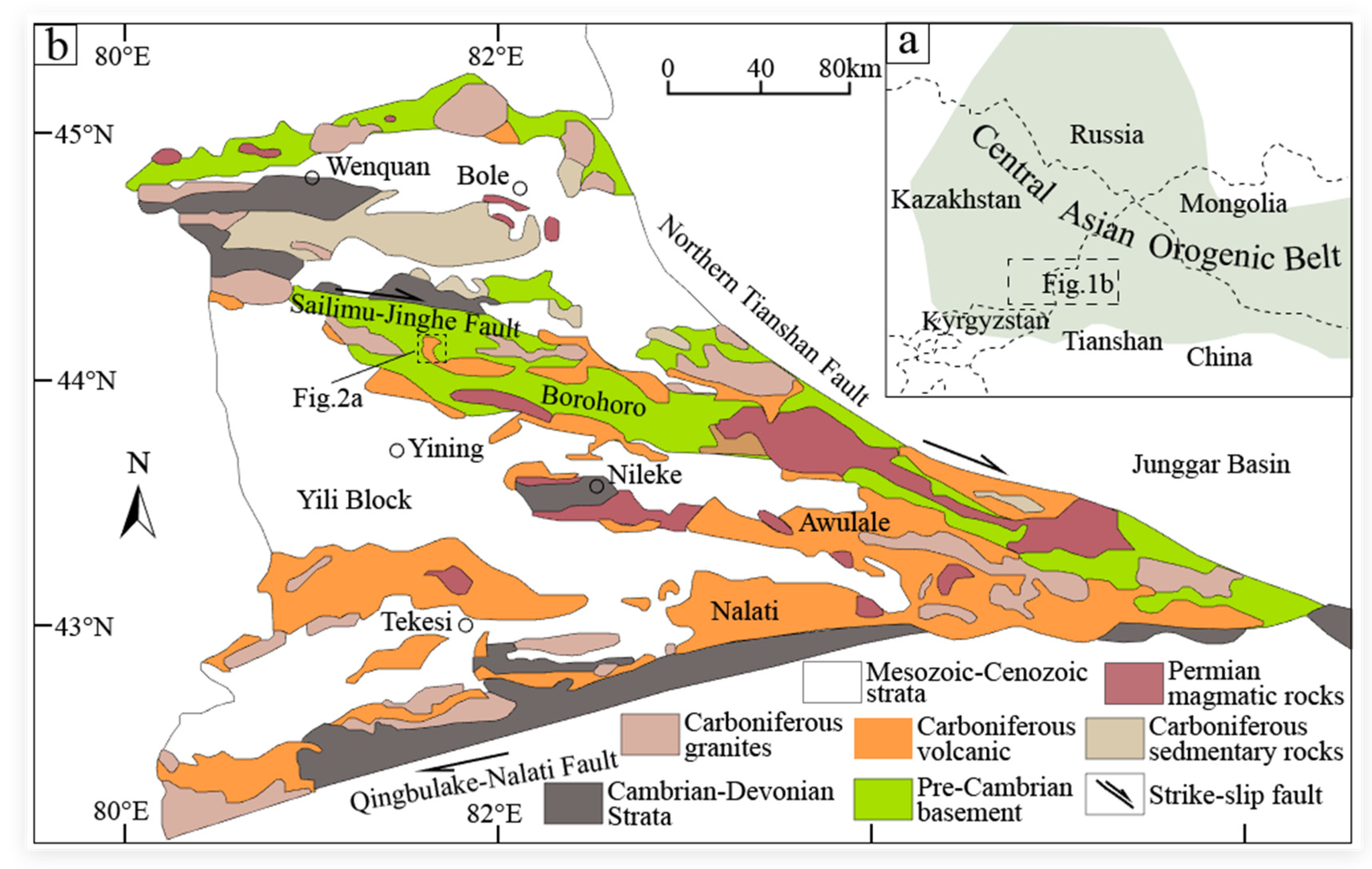
Figure 1. (a) A schematic map illustrating the location of the Central Asian Orogenic Belt [10,13]. (b) Geological map of the Chinese Western Tianshan Belt [13].
Minerals 16 00041 g001
Figure 3. Three-dimensional models of the orebody and fault shown from different perspectives (a,b).
Minerals 16 00041 g003
Figure 4. Orebody and alteration distribution at the 1370 m level (a) and along section No. 24 (b).
Minerals 16 00041 g004
Figure 5. A conceptual diagram illustrating the hydrothermal evolution of the Axi epithermal system [10].
Minerals 16 00041 g005
Figure 6. Numerical simulation workflow associated with Axi gold deposit.
Minerals 16 00041 g006
Figure 7. Dynamic computational model and kinematic states in the Axi gold deposit.
Minerals 16 00041 g007
Figure 8. Variations in C A u ( H S ) 2 e (a) with temperature; (b) with pore fluid pressure; (c) the first derivative of C A u ( H S ) 2 e with respect to temperature.
Minerals 16 00041 g008
Figure 9. Temperature gradients at elevation 1370 m of the Axi gold deposit in the (a) x-direction; (b) y-direction; (c) geological horizontal planes.
Minerals 16 00041 g009
Figure 10. Z-direction thermal gradient profiles for exploration lines 51, 43, 0, 16, and 56 (a), and their corresponding geological cross-sections (b).
Minerals 16 00041 g010
Figure 11. The Axi gold deposit at elevation 1370 m: (a) gold precipitation distribution and (b) geological horizontal planes.
Minerals 16 00041 g011
Figure 12. Gold precipitation distribution profiles for exploration lines 51, 43, 0, 16, and 56 (a), and their corresponding geological cross-sections (b).
Minerals 16 00041 g012
Figure 13. Deep mineralization potential area of Axi gold deposit.
Minerals 16 00041 g013
Table 1. Initial parameters for numerical modeling of the Axi gold deposit.
PropertyC1d5−1C1d5−2Faulted ZoneC1d5−4
Density (kg·m−3)2580260025002590
Bulk modulus (1010 Pa)1.63.00.61.7
Shear modulus (1010 Pa)2.65.00.43.1
Cohesion (106 Pa)4.93.55.04.0
Tensile strength (106 Pa)8.34.02.03.0
Dilation angle (°)3.05.03.25.3
Friction angle (°)28301531
Porosity (%)20243122
Permeability (10−15)2.094102.81
Viscosity (10−3 N s m−2)1.01.01.01.0
Thermal conductivity (Wm−1K−1)3.632.752.0
Disclaimer/Publisher’s Note: The statements, opinions and data contained in all publications are solely those of the individual author(s) and contributor(s) and not of MDPI and/or the editor(s). MDPI and/or the editor(s) disclaim responsibility for any injury to people or property resulting from any ideas, methods, instructions or products referred to in the content.