This is an early access version, the complete PDF, HTML, and XML versions will be available soon.
Article

Uranium Isotopic Fractionation and Hydrogeochemical Controls in Groundwater of the Jabal Sayid–Mahd Adhab Region, Western Saudi Arabia


by
Hamdy Hamed Abd El-Naby
1,*,
Yehia Hassan Dawood
2 and
Abduallah Abdel Aziz Sabtan
1
1
Faculty of Earth Sciences, King Abdulaziz University, P.O. Box 80206, Jeddah 21589, Saudi Arabia
2
Department of Geology, Faculty of Science, Ain Shams University, Cairo 11566, Egypt
*
Author to whom correspondence should be addressed.
Minerals 2026, 16(1), 25; https://doi.org/10.3390/min16010025
Submission received: 21 October 2025 / Revised: 22 December 2025 / Accepted: 23 December 2025 / Published: 24 December 2025

Abstract

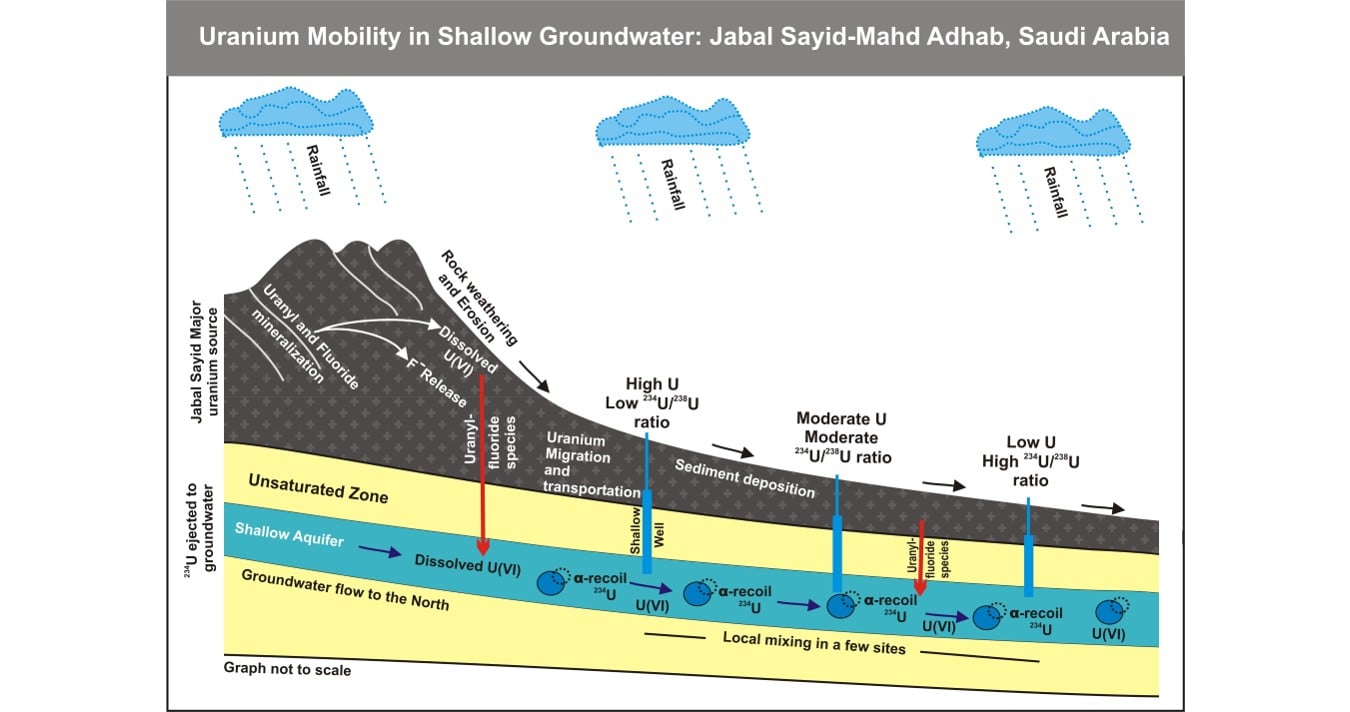
Uranium isotopic composition of shallow groundwater in the Jabal Sayid-Mahd Adhab area of western Saudi Arabia was investigated to evaluate geochemical changes resulting from water-rock interactions. The wide range of uranium concentrations (0.75–29.3 ppb) and 234U/238U activity ratios (1.11–3.11) reflect variable redox and uranium dissolution conditions across the aquifer. Samples with high uranium concentrations but low activity ratios suggest a recent release of uranium from mineral phases, which is further enhanced by the presence of fluoride ions. Fluoride’s strong reactivity aids in uranium dissolution by forming stable uranyl-fluoride complexes under open-system leaching conditions. Conversely, higher isotopic ratios in low-uranium samples suggest longer water-rock interaction and preferential leaching of 234U by alpha-recoil processes. The positive correlation between uranium and salinity parameters further indicates that uranium enrichment is linked to increased ionic strength and the abundance of complex ligands. The relationship between activity ratio 234U/238U (AR) and 1/U in the studied samples indicates that uranium behavior in the shallow aquifer is dominated by open-system leaching, with local binary mixing superimposed in a few sites. The findings emphasize that uranium isotopic composition is a valuable tool for identifying localized groundwater mixing and assessing the hydrogeochemical impacts of nearby mineralized areas on the aquifer system. These results represent an essential baseline for future environmental monitoring and for evaluating potential temporal changes in uranium behavior.
Keywords: Jabal Sayid-Mahd Adhab; groundwater; alpha spectrometry; uranium isotopes; activity ratio 234U/238U Jabal Sayid-Mahd Adhab; groundwater; alpha spectrometry; uranium isotopes; activity ratio 234U/238U
Graphical Abstract