3.1. OLI Studio Reconciliations
The reconciliations used in the subsequent sections are generated using OLI Studio. The input data are first converted to the appropriate anions and cations (shown in detail in
Supplementary Section S1).
For landfill leachate, OLI Studio reconciliation adds 64.4 mg/L of sulfate to the leachate, increasing the total sulfate from 1600 to 1664.4 mg/L. The reconciled TDS returns only 2723 mg/L (as compared to the median TDS of 4335 mg/L). This TDS is between the 20th percentile (2186 mg/L) and the 30th percentile (3181 mg/L); however, the resultant electrical conductivity is 3353.4 μmho/cm, between the 30th percentile (3080 μmho/cm) and the 40th percentile (3540 μmho/cm). TDS is typically measured as the sum of dissolved solids (regardless of whether a sample is complete or not) and may use proxy calculations (such as chloride or conductivity); thus, it is believed that the electrical conductivity may ultimately provide a more consistent result. The reconciliation predicts that calcium, barium, and aluminum will precipitate from solution (as CaCO3, BaSO4, and Al(OH)3).
For impoundment leachate, OLI Studio reconciliation adds 192.9 mg/L of sulfate, increasing this value from 109.7 mg/L to 302.6 mg/L. This is still well within the range of impoundment sulfate values, below the 70th percentile (422.9 mg/L). The reconciled TDS is 485.7 mg/L, less than half of the median TDS value (1010 mg/L) and between the 10th percentile (369.5 mg/L) and the 20th percentile (511 mg/L). However, the resultant electrical conductivity is 762.6 μmho/cm, between the median (742.5 μmho/cm) and the 60th percentile (763.8 μmho/cm). The reconciliation predicts that barium, phosphate, and aluminum will precipitate out of solution (as BaSO4, Ca5F(PO4)3 and Al(OH)3).
For produced water, the reconciliation adds 2245 mg/L of sodium to balance the charge, increasing the sodium from 31,275 mg/L to 33,519 mg/L. This is still below the 60th percentile value (39,360 mg/L). The reconciled TDS is 99,304 mg/L, still very close to the median (101,336 mg/L). The reconciliation predicts that calcium, iron, and barium will precipitate from solutions (as CaCO3, FeCO3, and BaSO4).
3.3. Cost Results
Using the aforementioned PrOMMiS costing method (
Section 2.2.2), the following results are presented for both leachate treatment and produced water treatment.
3.3.1. Leachate Treatment Cost Results
Using the base case values, the outlet cost parameters for the performance metrics articulated in
Section 3.2.1 are presented in
Table 6.
The cost in both cases is dominated by the fixed operating cost, the majority of which is the operating labor. This value is more than double the total as-spent capital cost for landfill leachate, and for a larger system it is still dominant (around 59 percent of the total as-spent cost for impoundment leachate). Liquid waste disposal also scales in a linear fashion with flow rate. Solid waste disposal for this system is negligible, as few solids are created in this step of treatment.
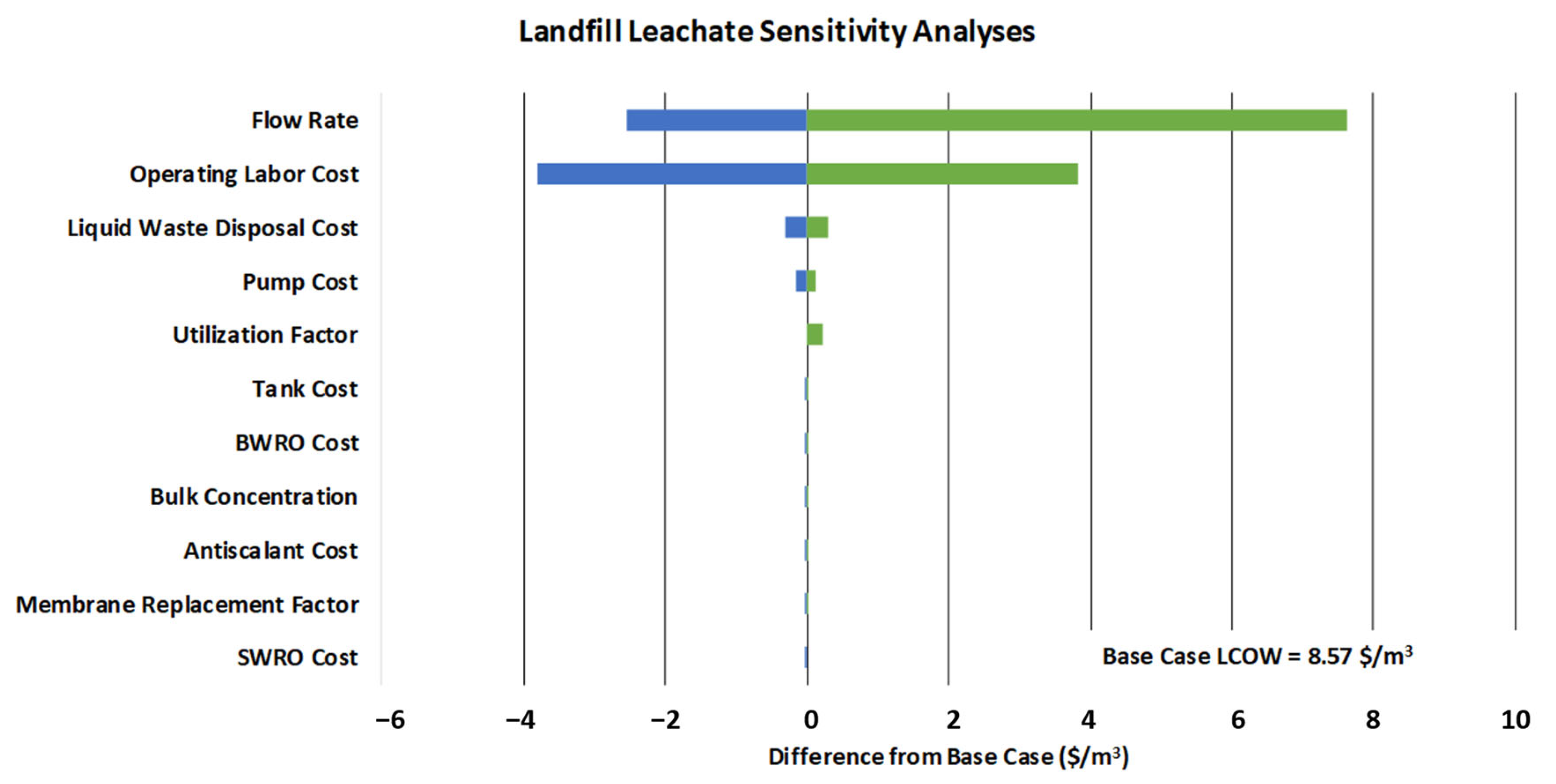
Sensitivity analyses for landfill leachate are shown in
Table 7 and
Figure 3. The impact of flow rate and operating labor are by far the largest on LCOW. As described in
Supplementary Section S2.1, the system flow rates for this case study were determined using earlier work on national landfill and impoundment leachate volumes [
8]. This study was a national aggregation, and flow rates may vary subject to local conditions. Operating labor is also subject to change dependent on the siting location and system automation. Therefore, we expect these parameters could vary significantly depending on the siting location. Using the full range of variables, the expanded LCOW range would be USD 3.00–USD 24.73 (USD 2023/m
3)—this would use the minimum or maximum cost impacts from all variables (rather than single variable analyses)
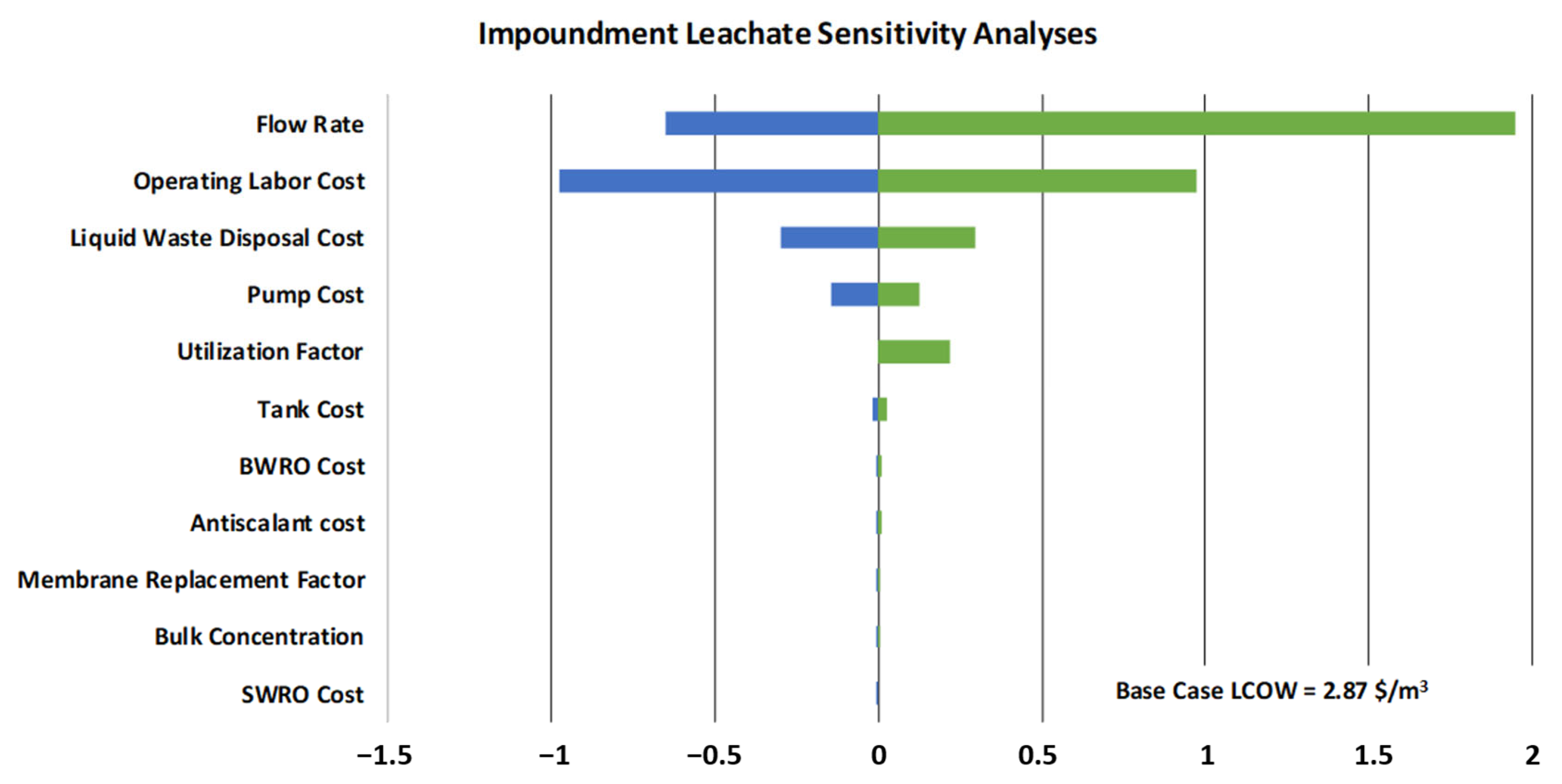
For impoundment leachate, the sensitivity analyses are shown in
Table 8 and
Figure 4. As before, flow rate and operating labor costs are dominant; however, liquid waste disposal cost becomes a larger cost category for a larger system. Using the full range of variables, the expanded LCOW range would be USD 1.10–USD 7.63 (USD 2023/m
3)—this would use the minimum or maximum cost impacts from all variables (rather than single variable analyses).
Based on these results, it is suggested to maximize flow rate when possible (so long as operating labor is not impacted) and to minimize the cost of waste disposal as flow rate scales. This may promote a zero-liquid discharge system if waste disposal costs are too high.
3.3.2. Produced Water Cost Results
The cost results for the produced water simulations are shown in
Table 9. The capital cost is more significant for the MVC system than for leachate treatment. In addition, there is a greater volume of liquid brine that requires disposal; liquid waste is far larger than the required operating labor in this case.
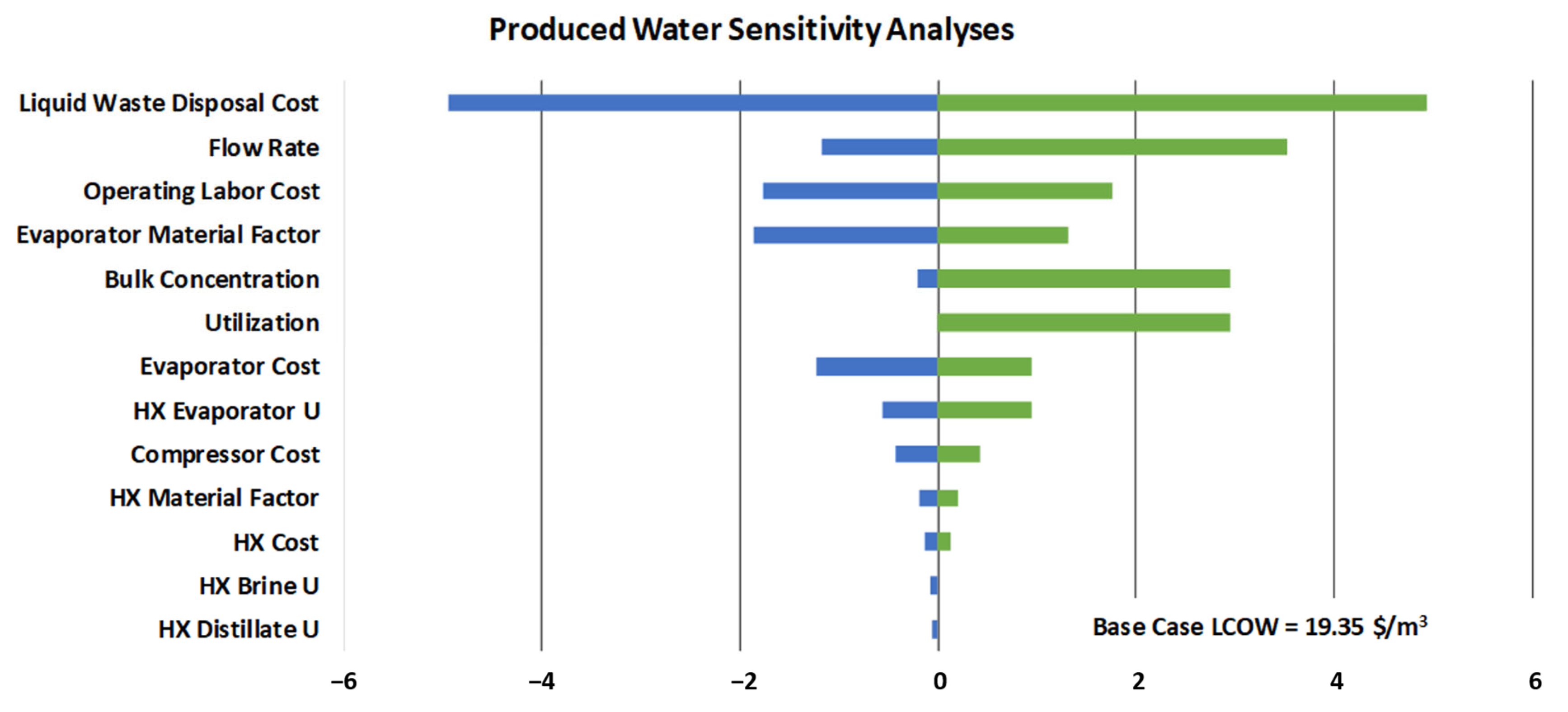
The sensitivity analyses for produced water are shown in
Table 10 and
Figure 5. The liquid waste disposal cost dominates; however, there are multiple large-cost categories, such as flow rate, labor, bulk concentration parameters, and evaporator parameters that have a significant impact on the LCOW as well. Note here that the bulk concentration is only increased to the 60th percentile value from the USGS data. Beyond this, 50 percent recovery by mass does not converge in the WaterTAP simulation due to solubility constraints. Using the full range of values, the LCOW varies from USD 8.60 to USD 43.60 (USD 2023/m
3)—as with leachate, this would use the minimum or maximum cost impacts rather than the single variable analyses shown below.
Additional analyses are recommended to determine how the treatment cost varies by technologies by developing assessments for alternative treatment train configurations (e.g., additional thermal technologies, membrane technologies, ion exchange, electrodialysis).
3.4. Brine Recovery Values
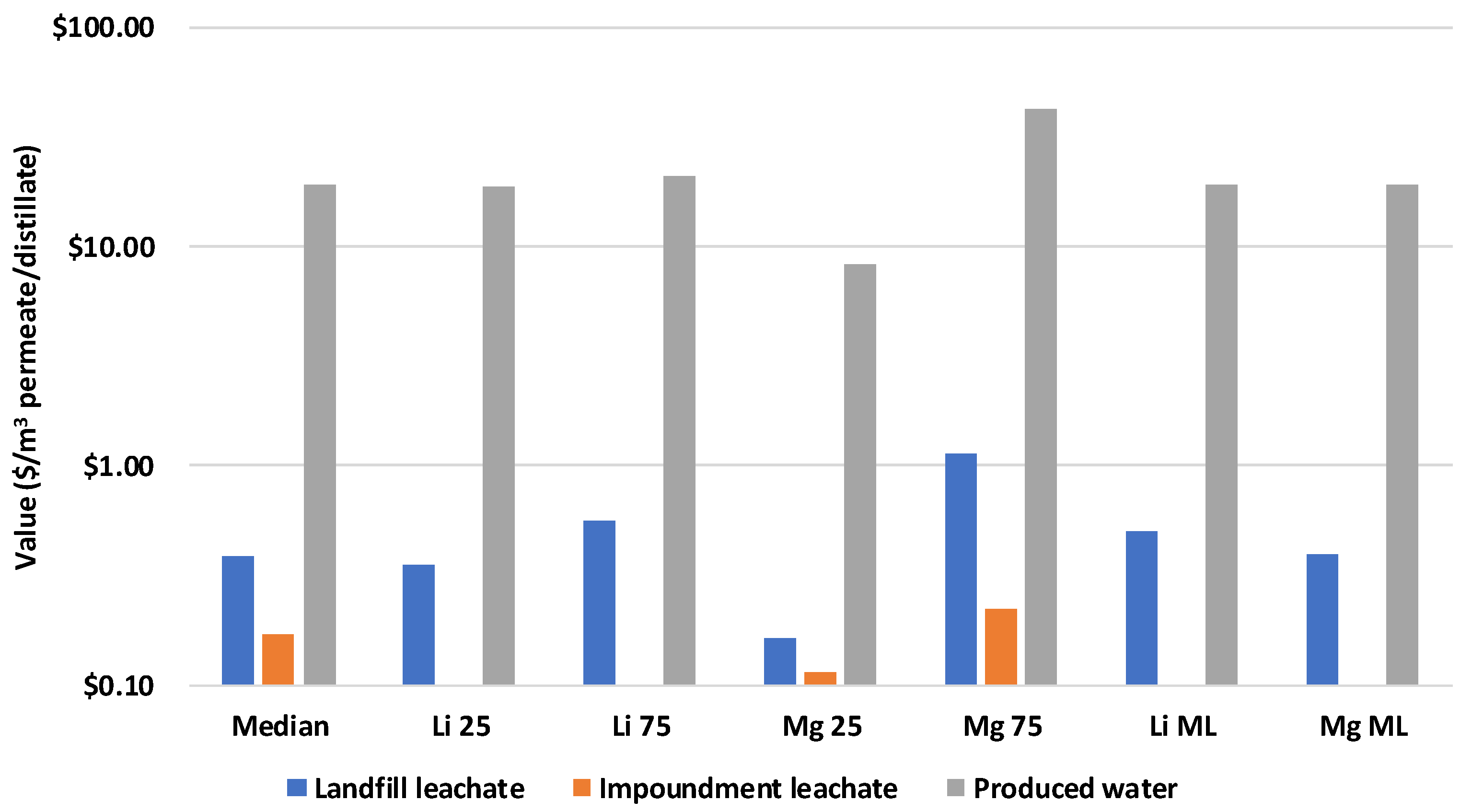
The value of the different brines (in terms of USD/m
3 permeate or distillate) is shown in
Figure 6. A summary comparing the value of the brines and the levelized cost is presented in
Table 11. The landfill and impoundment leachate medians are USD 0.39/m
3 permeate and USD 0.17/m
3 permeate, respectively, far below the respective LCOW values for the treatment systems (USD 8.57/m
3 permeate and USD 2.87/m
3 permeate); thus, the cost of treatment is not likely to be offset by the value of critical minerals in these brines. The value of these brines is comprised primarily of lithium and magnesium—the sensitivity analyses range from USD 0.17 to USD 1.13/m
3 permeate for landfill leachate and from USD 0.11 to USD 0.22/m
3 for impoundment leachate. The CoDaRT median values for lithium and magnesium do not vary landfill leachate brine values considerably—USD 0.50/m
3 permeate for Li and USD 0.39/m
3 permeate for Mg. The full breakdown of the brine recovery values is featured in
Supplementary Section S5.
For produced water, the value of the brine for the median case is USD 19.18/m
3 distillate, which is comparable to the LCOW of treatment (USD 19.40/m
3 distillate). This could warrant further investigation into treatment for the sake of mineral recovery. There is significant regional variation in the composition of produced water in the Permian Basin. The value of this brine is primarily lithium and magnesium, so in order to capture the impact of some of this variation, the 25th–75th percentile values from the NEWTS USGS produced water database are used to estimate a range of values from USD 8.28 to USD 42.14/m
3 distillate. The CoDaRT median values do not have a significant impact on the brine’s value—USD 19.10/m
3 distillate for Li and USD 19.37/m
3 distillate for Mg. As with leachate, the full breakdown of the brine recovery values is featured in
Supplementary Section S5.
It is critical to define technology performance to separate Li and Mg from this concentrated brine to meet purity requirements of raw material inputs for batteries and other critical energy technologies. There are many factors that may influence the efficacy of achieving these purity levels for produced water or leachate desalination brines that have not been quantified. Future work is recommended to evaluate these factors using detailed process chemistry simulation and experimental validation.
Magnesium hydroxide (Mg(OH)
2) is typically produced from brines by precipitation with an alkaline reagent. The most common reagents used to precipitate Mg are NaOH, quicklime, or ammonia [
31]. In prior studies using retentate from seawater nanofiltration, Mg(OH)
2 that was precipitated using NaOH has a product purity of at least 90 percent [
32]. Studies examining Mg(OH)
2 precipitation from sea water reverse osmosis brine using lime as a reagent found that direct lime addition yielded low product purity, but if the lime slurry was pre-screened by a 100 um screen before addition to the brine, the process yields a final product purity of 91 percent [
31]. These results are summarized in
Table 12 to establish a path forward for Mg recovery from produced water and leachate treatment brines.
Precipitation of Mg(OH)2 is also often included as an impurity removal stage in Li recovery. In addition to producing saleable, high-purity Mg(OH)2, precipitation of Mg will aid downstream Li recovery.
Conventional Li processing from brine typically involves an evaporation step, Mg removal using lime followed by filtration and washing, calcium removal followed by filtration, precipitation of lithium carbonate (Li
2CO
3) using sodium carbonate, and filtration and washing to achieve a final Li
2CO
3 product [
33]. Many alternative technologies have been applied to Li recovery that do not require the evaporation step, including ion exchange resins (i.e., sorbents), solvent or liquid–liquid extraction, membrane processes, electrochemical processes, selective precipitation using phosphate, and thermal-assisted methods [
34,
35]. Numerous literature reviews have successfully characterized these technology developments in Li separations. This study summarizes the processes that reported ending purity for Li
2CO
3 recovery from various synthetic and real-world brines in
Table 13.