Review

The Role of OM in the Formation of Sandstone-Type Uranium Ore—A Review

1
Research Institute of Exploration and Development of Daqing Oilfield Company Ltd., Daqing 163318, China
2
Key Laboratory of Continental Shale Hydrocarbon Accumulation and Efficient Development, Ministry of Education, Northeast Petroleum University, Daqing 163318, China
3
Shenyang Geological Survey Center, China Geological Survey (Northeast Geological Science and Technology Innovation Center), Shenyang 110000, China
4
Petrochina Oil, Gas and New Energies Company, Beijing 100000, China
*
Author to whom correspondence should be addressed.
Minerals 2025, 15(12), 1326; https://doi.org/10.3390/min15121326
Submission received: 14 October 2025 / Revised: 30 November 2025 / Accepted: 6 December 2025 / Published: 18 December 2025
(This article belongs to the Special Issue Selected Papers from the 7th National Youth Geological Congress)

Abstract

Sandstone-hosted uranium deposits represent one of the most critical global uranium resources suitable for in situ recovery, with their formation closely associated with organic matter (OM). We conducted a systematic literature review to synthesize over 100 published studies sourced from authoritative databases (Elsevier, Google Scholar, Web of Science, Scopus, CNKI, etc.). This study systematically summarizes the types and geological characteristics of OM in sandstone reservoirs and thoroughly analyzes the geochemical mechanisms by which OM regulates the transport and precipitation of aqueous uranium. By integrating case studies of representative sandstone uranium deposits globally, three major OM-related metallogenic models are proposed with distinct core characteristics: the humic-dominated model is driven by the complexation and direct reduction of uranium by humic substances/coal-derived OM; the roll-front model relies on reactions between oxidized uranium-bearing fluids and scattered OM, as well as microbially generated sulfides at the migration front; and the seepage-related model is fueled by upward-migrating deep hydrocarbon fluids (petroleum, methane) that act as both uranium carriers and reductants. Furthermore, this review explores the spatial coupling relationships between OM distribution and uranium mineralization in typical geological settings, evaluates the guiding significance of OM for uranium exploration, and outlines key unresolved scientific issues. The findings refine the genetic theoretical framework of sandstone-hosted uranium deposits and provide important technical support and theoretical guidance for future uranium exploration deployment and resource potential evaluation.

1. Introduction

Sandstone-hosted uranium deposits are epigenetic–diagenetic systems developed in clastic sedimentary rocks such as sandstone and conglomerate [1]. Globally, about 39.6% of identified uranium deposits fall into this category [2]. Owing to their shallow burial depth, large tonnage, and suitability for in situ recovery, they are widely regarded as an economically attractive and comparatively low-impact source of uranium, accounting for nearly 30% of global uranium resources [3,4].
Organic matter (OM) has long been recognized as a key regulator of the mobilization, transport, and precipitation of uranium in these systems [5,6,7,8]. The interactions between uranium and OM are multifaceted, involving adsorption, complexation, and redox processes [9]. These interactions are modulated by the type and functional group chemistry of OM, as well as environmental factors, including pH, redox potential (Eh), and associated ions [10]. Importantly, the manner in which OM participates in uranium mineralization varies across regions [11,12]: North American deposits often feature abundant humic plant detritus; European examples commonly record the influx of petroleum-derived hydrocarbons; Asian deposits reflect the combined influence of indigenous sedimentary organics and deeper hydrocarbon seepage; and Australian and African cases provide classic instances of long-term radiation-driven OM modification [9]. These differences in the type, source, and occurrence of OM across regions directly lead to regional variations in uranium metallogenic mechanisms, thereby requiring targeted adaptation of exploration strategies [13]. Focusing on characteristic OM markers in different geological contexts can effectively facilitate the precise delineation of favorable mineralization zones.
This study examines the role of OM in the genesis of sandstone-hosted uranium deposits. Specifically, we address four key objectives: (1) identify common types of OM in uranium-bearing sandstones; (2) elucidate the geochemical mechanisms of OM that affect uranium migration and precipitation; (3) summarize ore-forming models and typical examples related to OM; (4) and define key directions for future research and their prospecting implications.

2. Methodology

This review employed a systematic bibliographic selection methodology. Key databases, including Elsevier, Google Scholar, Web of Science, Springer, Scopus, and CNKI, were utilized. The literature published between 2000 and 2024 was prioritized, with a focus on peer-reviewed journals, geological survey reports, and high-impact conference proceedings. Irrelevant studies lacking direct links to OM–uranium interactions were excluded. Data on OM characteristics, geochemical mechanisms, and deposit case studies were extracted and cross-validated to ensure comprehensiveness and authority [14].

3. Types and Geological Characteristics of OM in Strata

From a mobility perspective, OM in sandstone-hosted uranium reservoirs can be divided into two broad categories: sedimentary OM and mobile OM. Sedimentary OM refers to primary residues preserved in the sediments, such as plant detritus, coal fragments, and humic substances. Mobile OM denotes hydrocarbon fluids generated by the degradation of OM that can migrate within the basin.

3.1. Sedimentary OM

In sandstone-hosted uranium reservoirs, sedimentary OM typically occurs as carbonaceous debris, thin coal streaks, or humic material. Its abundance varies significantly with paleoclimate. Humid paleoclimates promote vigorous vegetation growth and enhanced OM preservation, resulting in relatively high total organic carbon (TOC) contents in sandstones. For example, the gray fluvial–lacustrine sandstones of the Early Jurassic Zhiluo Formation in the Ordos Basin can reach TOC values of 0.3–1.1 wt% [15,16]. In contrast, sandstones deposited under arid, oxidizing conditions usually contain little OM (<0.1 wt%), which is insufficient to maintain a persistent reducing barrier [17].
At the pore scale, sedimentary OM occurs as carbonized plant fragments or charcoal, lens-like streaks, and humic films or gels that line intergranular pores, grain rims, and cement contacts [18]. It commonly coexists with fine-grained pyrite and minor clay minerals, forming a microscale “OM–sulfide–clay” composite reducing system [8]. Maceral composition is dominated by vitrinite and inertinite and is rich in oxygen-bearing functional groups—carboxyl (-COOH/-COO-), phenolic (Ar-OH), and quinone/semiquinone groups—which supply complexation/adsorption sites and can act as electron donors or acceptors [19,20].
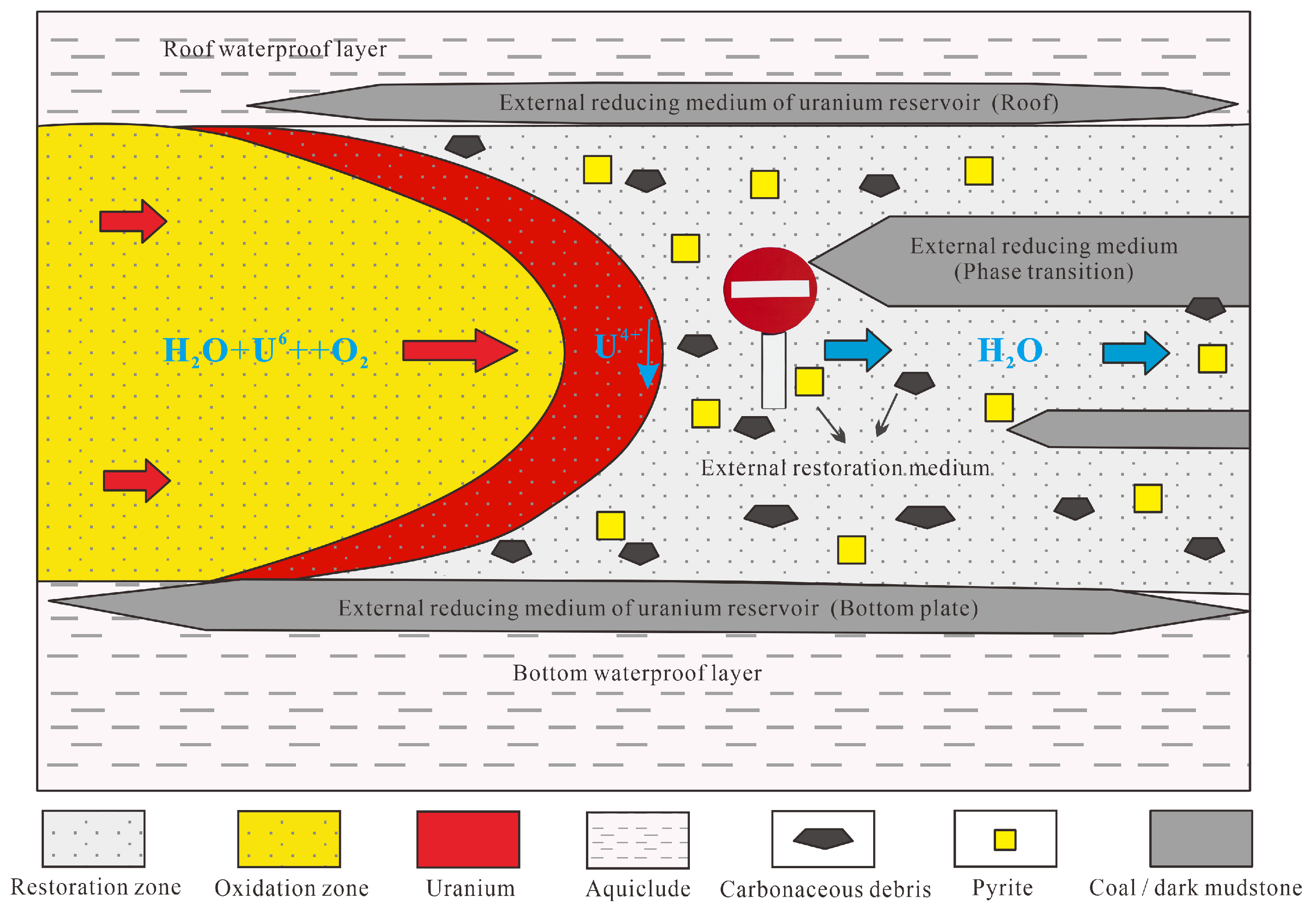
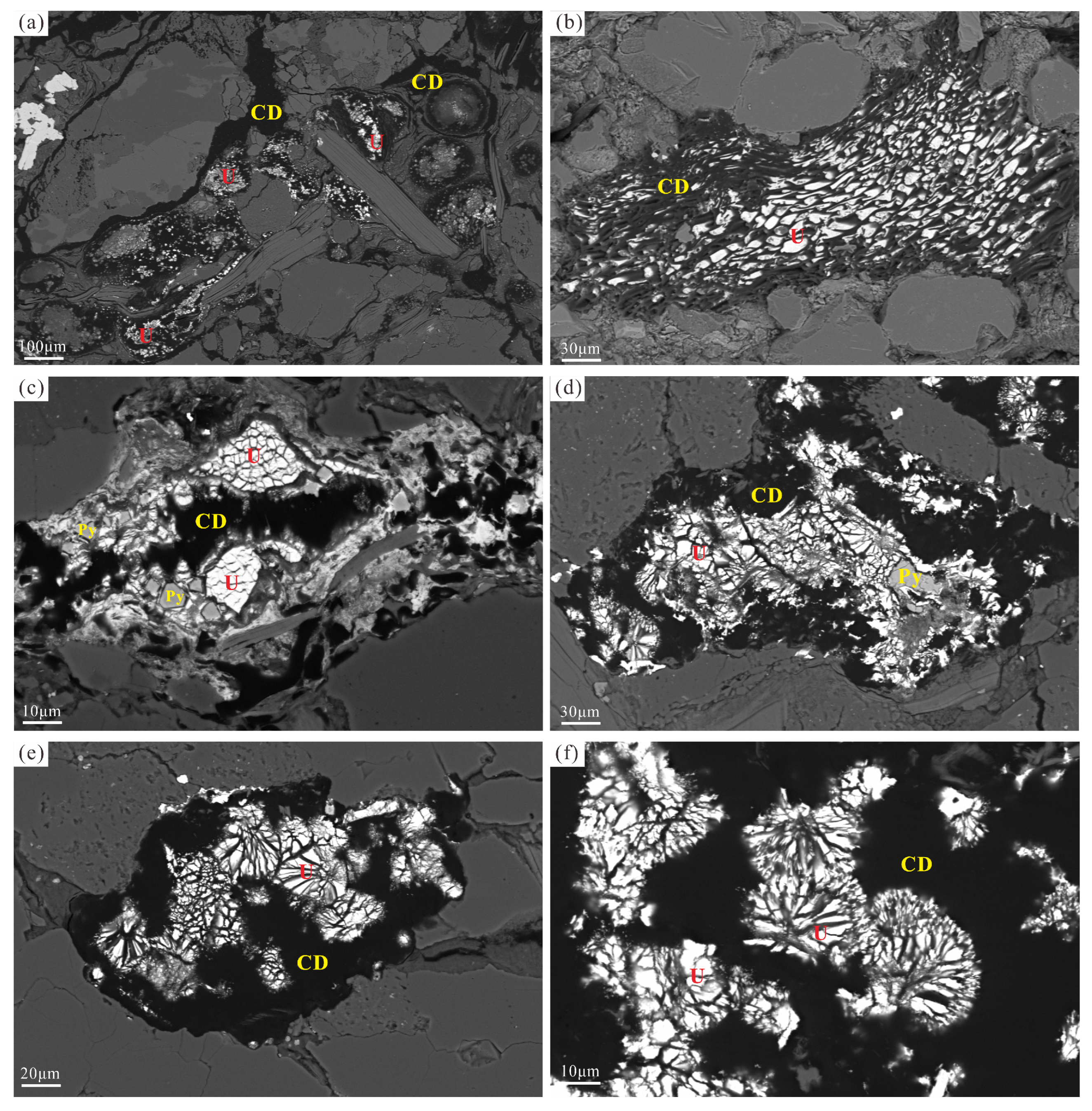
For example, Peng et al. (2022) documented multiple occurrences of pitchblende (uraninite) within carbonaceous debris in the uranium reservoirs of the Fuxin Formation on the southeastern margin of the Songliao Basin—clustered aggregates, cavity fillings, granular–gelatinous forms, and radiating forms—frequently intergrown with pyrite, providing direct microscale evidence that carbonaceous debris serves as principal host for uranium minerals (Figure 1) [21,22,23]. In the Fuxin reservoirs, carbonaceous debris and pyrite are pervasive, whereas external reductants (e.g., thick coal seams or hydrocarbon accumulations) are scarce. Under these conditions, oxidized uranium-bearing waters migrating from the basin margin advanced only a short distance before being intercepted by abundant in situ reductants. Consequently, the redox front—and thus, uranium mineralization—remained localized near the basin margin, strictly tracking the redox transition zone (Figure 2) [24].

3.2. Mobile OM

Compared with sedimentary OM, mobile OM can migrate over long distances through the stratigraphic sequence, introducing deep-sourced materials and reductants into uranium mineralizing systems. It is primarily derived from hydrocarbon expulsion from deep, organic-rich source rocks and is enriched in saturates, aromatics, and resins/bitumen. In the rock record, it commonly appears as oil seeps, bitumen veins, oil stains, and as hydrocarbons in adsorbed gases or fluid inclusions [25,26].
Across Europe, many sandstone-hosted uranium deposits are closely associated with the migration of petroleum [9,27]. Classic examples include the Lodève district in France, where large volumes of solid bitumen occur in sandstones and are intergrown with uranium minerals—providing evidence that ancient oil migrated along faults into the sandstones and induced the precipitation of uranium [28]. Likewise, in Precambrian unconformity-type systems (e.g., Canada’s Athabasca Basin and the Francevillian Basin in Gabon), uranium minerals are widely associated with black bitumen. This bitumen is generally interpreted as insoluble OM formed by the polymerization of ancient oil in a high-radiation environment [29]. Near the Oklo natural fission reactors, bitumen within uranium ore contains abundant radiogenic fission products, supporting a radiolysis-driven polymerization origin [30]. Together, these observations indicate that deep liquid hydrocarbons not only act as carriers and reductants for uranium, but that their solid residues (e.g., bitumen veins) are valuable indicators of otherwise concealed deposits.
Beyond liquids, hydrocarbon gases (such as methane) can also influence sandstone-hosted uranium systems [31]. Because of seepage and leakage, methane is widespread in petroliferous basins. Although relatively inert under anoxic conditions, methane can be “activated” by microbial consortia to produce strongly reducing products that promote uranium precipitation. Under sulfate-bearing, anaerobic groundwater conditions, certain archaeal–bacteria consortia mediate anaerobic oxidation of methane (AOM); sulfate-reducing bacteria (SRB) utilize methane as the electron donor and sulfate as the acceptor, producing CO2 and H2S [32,33]. The resulting H2S is a strong reductant that converts dissolved U(VI) (as UO22+) to insoluble U(IV) (as UO2), commonly with co-precipitation of sulfides, such as U-bearing pyrite [34]. In many roll-front systems, uranium precipitates alongside sulfides at the advancing front. Sulfur isotope data from these pyrites often show strong light-sulfur enrichment (δ34S less than < −20‰), which indicates sulfate-reducing bacterial activity [7,35].
This implies that in organic-poor sandstone aquifers, deeply sourced methane and its microbially mediated transformation to H2S can provide the effective reductants that “indirectly” drive uranium reduction and deposition. In arid basins hosting sandstone-type uranium deposits, such as parts of Kazakhstan and Mongolia, this mechanism may be particularly common because indigenous solid organic carbon is scarce, and deep natural gas plus AOM-linked microbial processes become the dominant reductant sources [13].
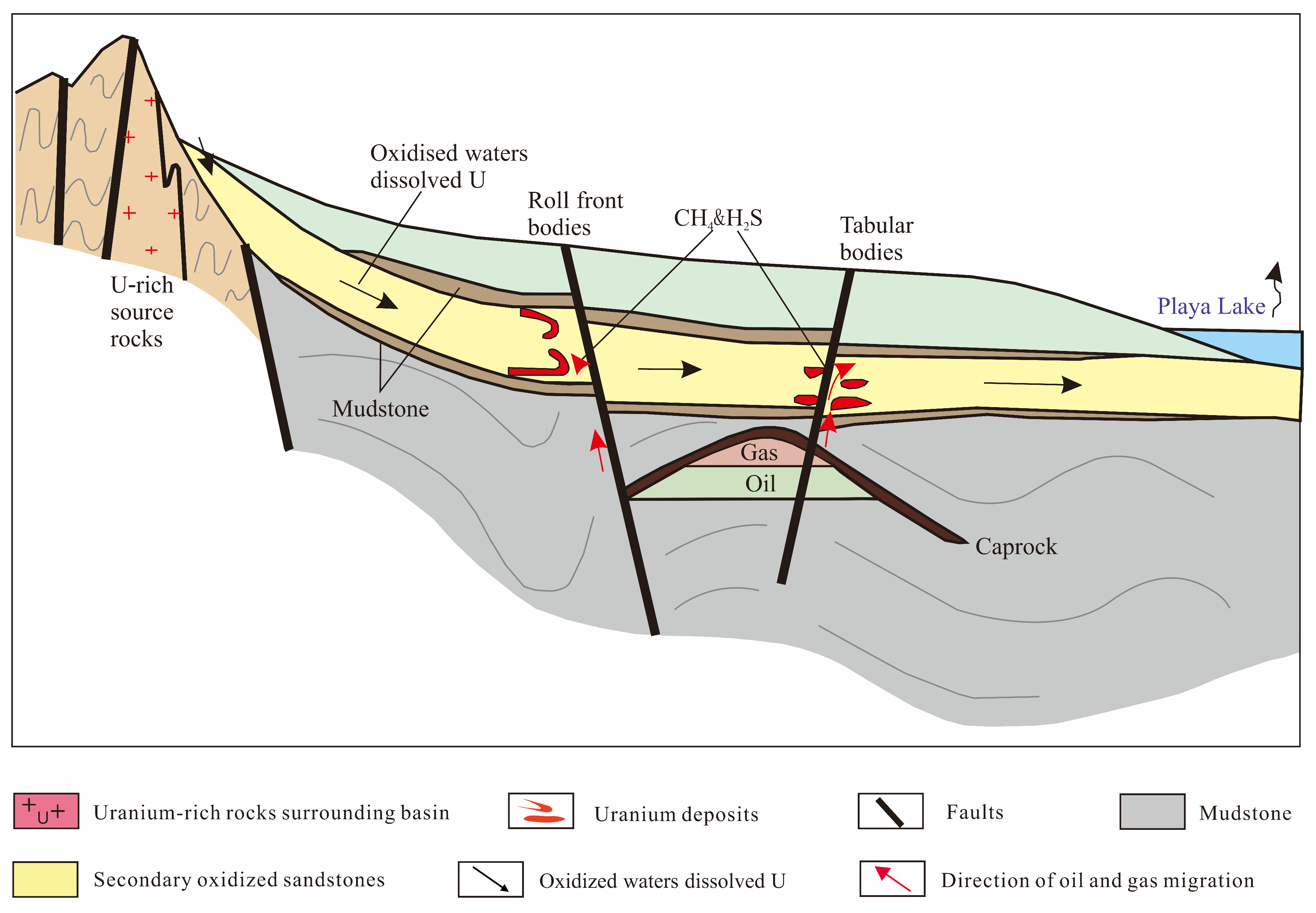
As one example, Jaireth et al. argued that uranium precipitation in the Beverley uranium deposit was triggered by petroleum-driven reduction [36]. They proposed two hydrocarbon sources: (1) accumulations in the Eromanga and Arrowie basins and (2) thermal degradation of OM within the sediments. Reactivation of faults in the Lake Frome region likely facilitated reductants from the underlying basins to migrate upward into the host sandstones (Figure 3) [37].
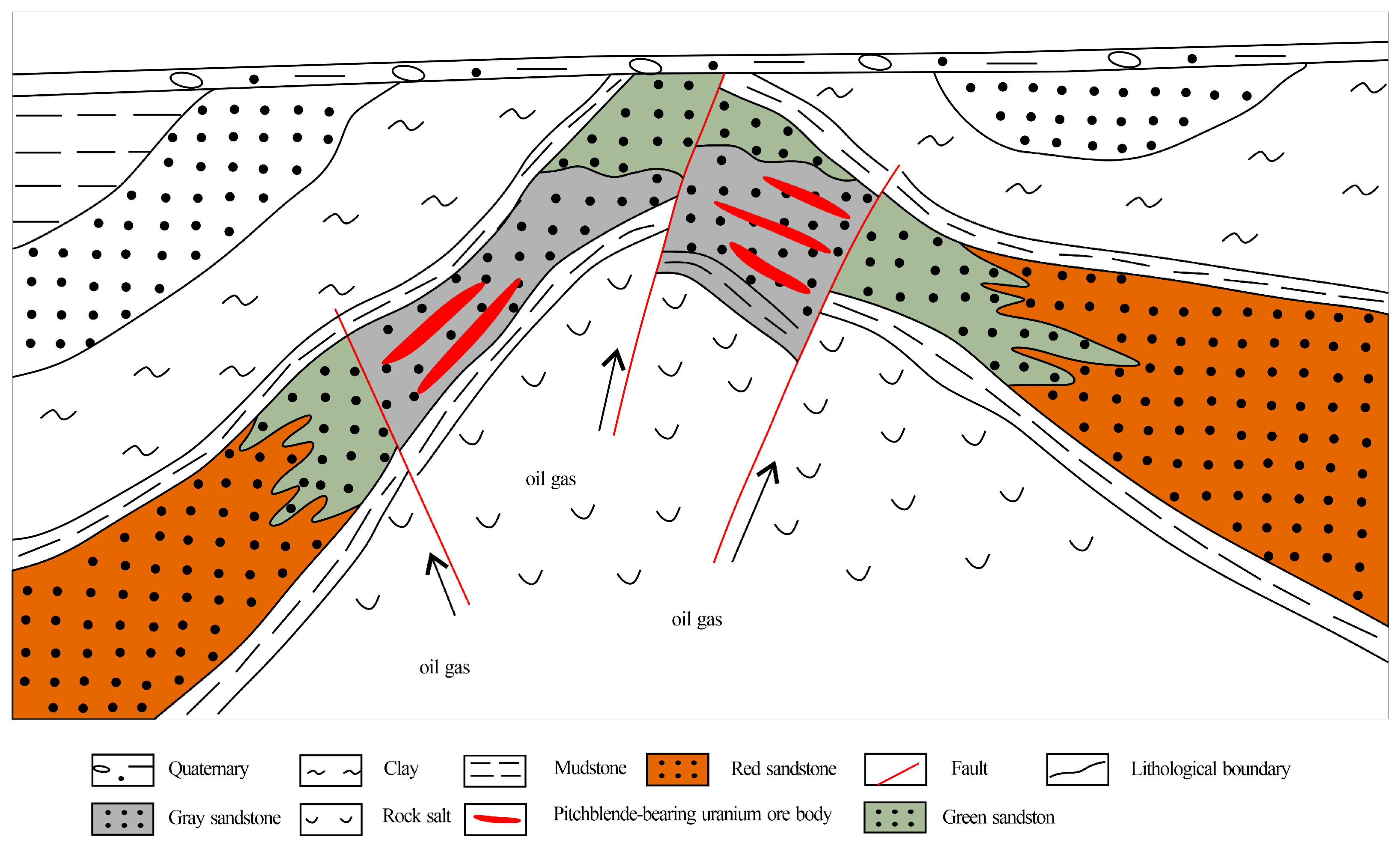
In Precambrian unconformity-related uranium systems (e.g., Canada’s Athabasca Basin and Gabon’s Francevillian Basin) and in Ukraine’s uraniferous bitumen-type deposits (such as Adamovskoye, Berekskoye, and Krasnookolskoye), uranium minerals are pervasively intergrown with black bitumen [38]. Migration pathways controlled by salt diapirism, paleochannel architecture, faulting, and zones of post-depositional reduction allowed deep petroleum to migrate upward along fractures. These reductants secondarily reduced the overlying primary redbeds and, simultaneously, reduced infiltrating oxidized U-bearing fluids, thereby precipitating uranium ore (Figure 4).
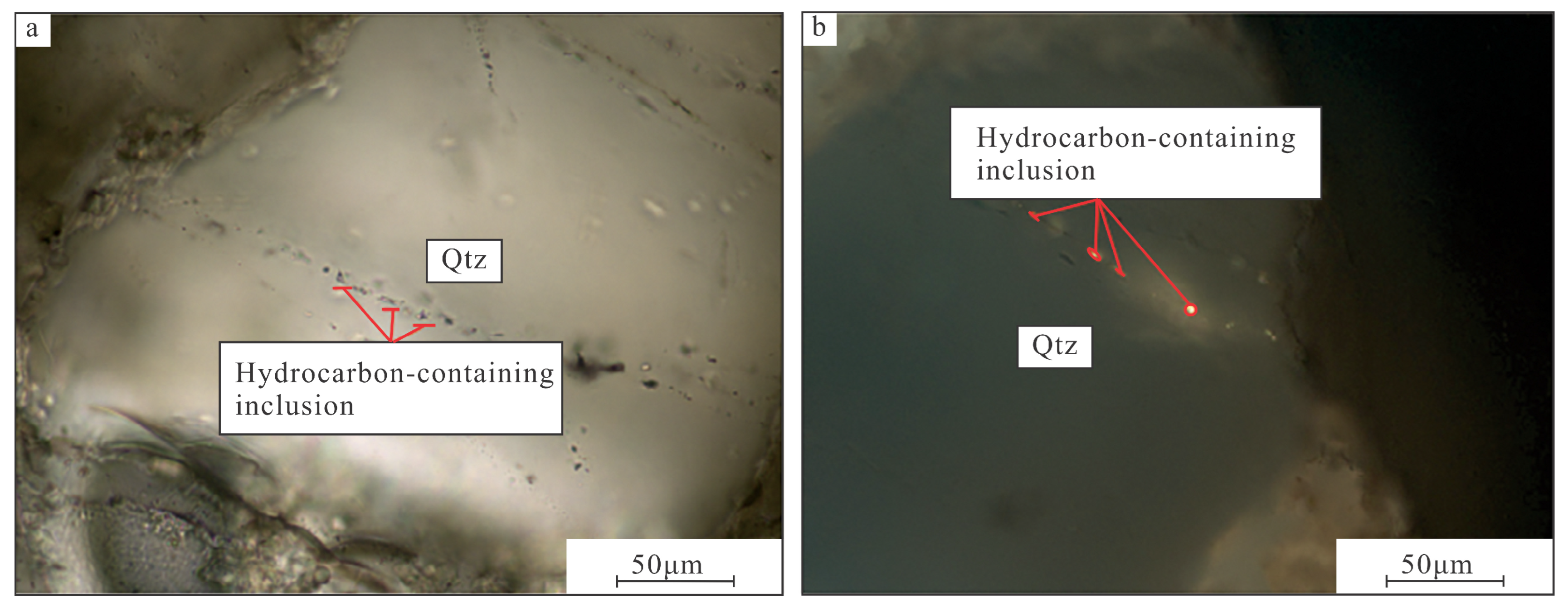
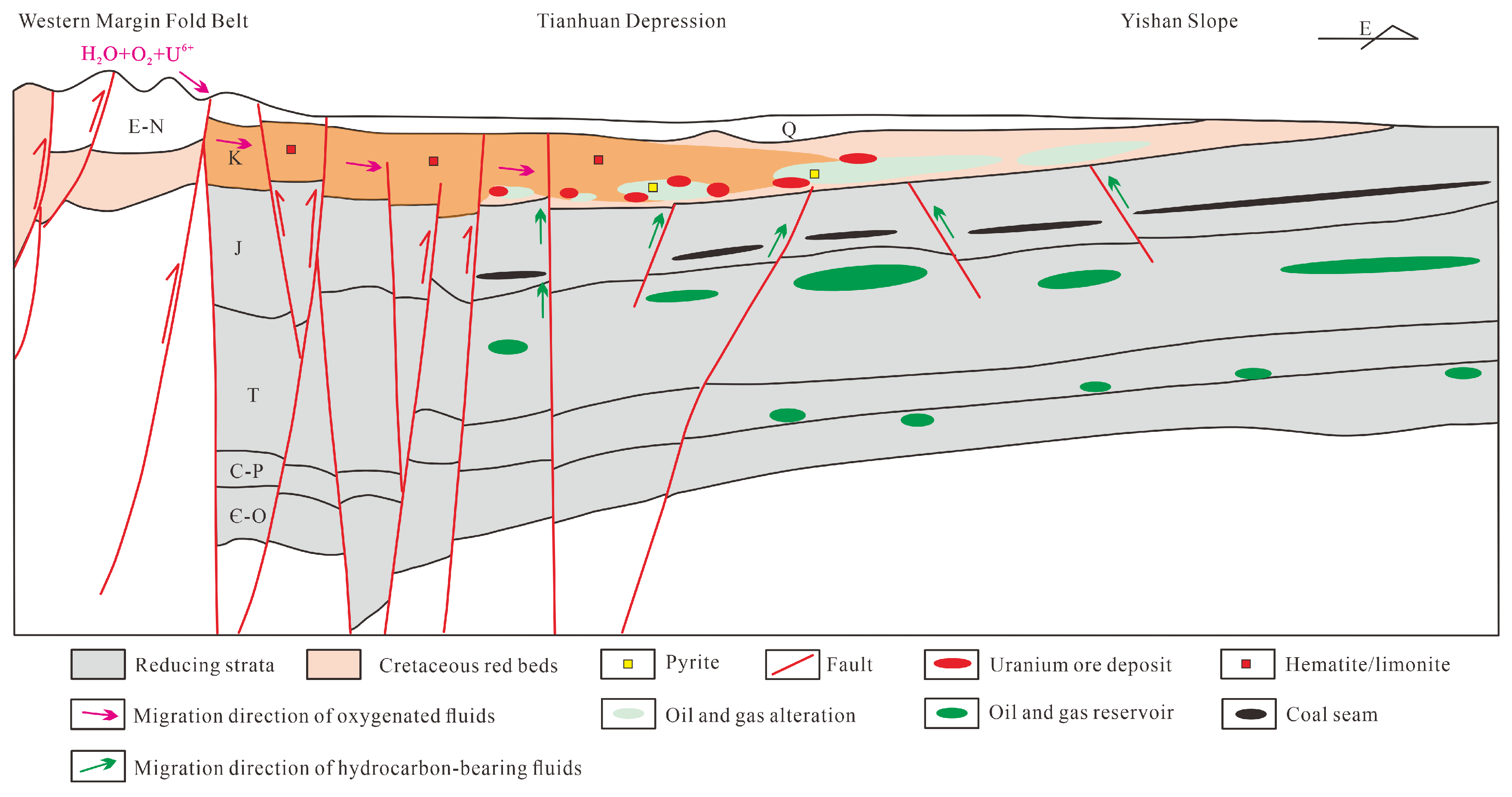
A representative Chinese example is the Jingchuan deposit (southwestern Ordos Basin), formed in eolian sandstone belts with petroleum as the main reductant [40]. Its uranium reservoir is dominated by desert facies sandstones and conglomerates, characteristically low in carbonaceous debris, pyrite, and even clay minerals [41,42], with residual oil stains [43]. Microscopic observations confirm hydrocarbon activity as banded hydrocarbon inclusions (elliptical, yellow-green fluorescence, 4–15 μm) are observed along secondary fractures adjacent to quartz (Qtz) (Figure 5a,b). Since the Late Cretaceous, compressional tectonics in the Jingchuan area have triggered folding and fault reactivation, forming a recharge–flow–discharge ore–fluid system [44]. These faults connected deep hydrocarbon reservoirs, promoting the upward migration of reducing fluids that mixed with oxidized uranium-bearing meteoric waters. Redox reactions at hydrocarbon pool margins and within favorable sand bodies led to uranium enrichment, with ore zones predominantly distributed near faults or small-scale uplifts (Figure 6).

4. Influencing Mechanisms of OM on Sandstone-Hosted Uranium Mineralization

During the formation of sandstone-hosted uranium deposits, OM affects uranium occurrence and enrichment primarily through two pathways: (1) enhancing the solubility and transport of uranium in groundwater and (2) promoting uranium precipitation from solution under suitable conditions.

4.1. Promotion of U Transport by Dissolved Organic Complexation

In oxidizing groundwater, hexavalent uranium occurs as the uranyl ion (UO22+) and predominantly forms carbonate complexes, such as UO2(CO3)22− and UO2(CO3)34−. When humic acids or dissolved OM (DOM) rich in carboxyl and phenolic groups are present, UO22+ can form even more stable organo-complexes [45,46]. Representative complexation reactions can be schematically expressed as:
UO22+ + 2RCOO- → UO2(RCOO)2
where RCOO- denotes carboxylate groups on humic acids or humic substances.
Early experiments by Nakashima and co-workers showed that aromatic humic acids can bind UO22+ through carboxylate oxygens to form multidentate chelates under mildly acidic to mildly alkaline conditions, thereby holding uranium stably in solution [9]. Around pH = 7, U(VI) forms complexes such as UO2(OH)HA(I) (logβ = 14.7–15.3) and UO2HA(II) (logβ = 5.8–6.3). In neutral to slightly alkaline and carbonate-bearing waters, it can also form x UO2(Cternary compleO3)2HA(II)4−, with a cumulative stability constant of logβ0 = 24.5. These stability constants indicate that organo–carbonate ternary complexes can become the dominant aqueous species in natural carbonate-rich groundwaters, significantly increasing U solubility and mobility.
In the oxidized zones of sandstone-type uranium systems, coal-derived humic substances within the sand bodies weather to release humic acids [46]. Once these acids encounter percolating U(VI)-bearing recharge water, mobile U–humic complexes form and are transported down-gradient toward the roll front [43]. For example, studies in the Dongsheng district (Ordos Basin) show that Jurassic Zhiluo Formation strata adjacent to coal seams released abundant humic matter during oxidation, which complexed uranyl and enabled the long-distance groundwater transport of uranium [47]. At the ore-field scale, lacustrine mudstone–sandstone couplets commonly record humic acids being flushed by compaction waters or laterally through aquifers into adjacent or underlying sandstones, where uranium is subsequently concentrated (e.g., the Grants mineral belt). These observations support long-distance, interformational, and along-strata transport of uranium via DOM complexes and colloidal carriers.

4.2. Enrichment of Uranium by Sedimentary OM

When migrating uranium encounters strata containing solid OM (e.g., coal fragments, humus, woody debris), the first step involves a capture-and-concentrate phase dominated by complexation or adsorption. Under sufficiently reducing conditions, a subsequent valence-change step can convert adsorbed U(VI) to reduced U(IV)-bearing solids. The key is the surface chemistry of OM: carboxyl (-COOH/-COO-), phenolic (Ar-OH), and quinone/semiquinone moieties not only coordinate UO22+ at the surface but also, in some cases, provide electrons [48,49]. A schematic surface-complexation representation is:
RCOO- + UO22+ → RCOO-UO2+
where RCOO- denotes surface functional groups on OM. Multidentate complexes formed under mildly acidic to neutral conditions are relatively stable, extending local residence time and enhancing the concentration of U(VI). This is consistent with classic humic–uranyl experiments showing that aromatic humic acids significantly stabilize and mobilize U(VI) in mildly acidic to mildly alkaline waters while simultaneously enabling its recapture onto organic phases when conditions favor sorption.
A large body of work indicates that the porous texture of humic substances and their abundant reactive groups provide highly effective adsorption sites for uranium [8,48]. Canonical experiments demonstrate that peat, lignite, or plant humus exhibit high capacity and selectivity for U(VI), with U(VI) uptake increasing steeply with pH between 3 and 7, even at low dissolved humic concentrations (µg·L−1–mg·L−1).
Field examples mirror these mechanisms. In the Daying sandstone uranium deposit, coal-derived detritus is closely associated with uranium; in some samples, uranium occurs as amorphous organo-U complexes, a textbook signature of adsorption-driven enrichment [28]. Lignite-hosted uranium deposits in North America show analogous behavior: groundwater U(VI) is efficiently trapped by coal OM, yielding average uranium contents of tens to hundreds of ppm, with uranium present chiefly in adsorbed rather than crystalline mineral forms [50]. At Western Australia’s Mulga Rock deposit, uranium is likewise fixed within Paleocene peat–lignite horizons, largely as bitumen-bound organo-complexes [50].

4.3. Reduction of Uranium by OM

Economic uranium grades ultimately require the reduction of U(VI) to U(IV). OM can serve as the electron donor directly or indirectly by fueling microbial processes that generate reductants [51].
A growing body of work shows that within diagenetic, low-temperature windows (100–200 °C, and, in some cases, down to ambient conditions), hydrocarbons and sedimentary OM can abiotically reduce dissolved U(VI) to insoluble U(IV) (predominantly uraninite). For example, methane, hydrogen, and graphite efficiently drive the U(VI) to U(IV) reduction in acidic chloride brines at 100–200 °C, with −1 mM U(VI) reduced to uraninite by CH in 3 days at 200 °C [52]; U-rich lignite or gyttja can yield uraninite via dehydrogenation at 150–200 °C [9]; in a 200 °C, 500 bar water–uranium–n-alkane system, the reaction initiates synergistically with uranium reduction and hydrocarbons oxidation [53]; and at room temperature, humic acids on mineral surfaces can also abiotically reduce U(VI), forming thermodynamically more stable U(IV) products [54].
UO22+ + 2e → UO2
In China’s Ordos and Junggar basins, uraniferous fossil wood is widespread; its formation is most plausibly explained by the direct reduction of uranyl by buried woody debris [55,56,57,58,59,60,61].
More commonly, reduction proceeds indirectly: microbes (such as sulfate-reducing bacteria, methanogens, iron-reducing bacteria, etc.) metabolize organic substrates to produce reductants that induce uranium precipitation [49]. In reduced zones, the dominant biogenic reductants are hydrogen sulfide (H2S) and ferrous iron (Fe2+). H2S is derived from the sulfate-reducing metabolism of OM: under anaerobic conditions with sulfate-rich groundwater, certain microorganisms can mediate the anaerobic oxidation of OM, using organic compounds (including hydrocarbons, lactic acid, acetic acid, etc.) as electron donors and sulfate as electron acceptors to oxidize OM into CO2 while producing H2S [62]. The generated H2S reduces free UO22+ to insoluble UO2. Simultaneously, SO42− is reduced to S2−, which combines with Fe2+ to form pyrite [63,64]
SO42− + 2 CH2O → H2S + 2 CO2 + 2 H2O
UO22+ + H2S → UO2 + S + 2H+
Fe2+ + 2 H2S → FeS2 + 2 H2
Fe2+ originates from the microbial reduction of Fe(III) oxides and/or the reaction of H2S with Fe2+ to form iron sulfides. In either case, these products react with aqueous UO22+ to yield insoluble U(IV) phases [65].
UO22+ + H2S → UO2 + S + H+
UO22+ + 2Fe2+ + 2H2O → UO2 + 2Fe3+ + 4H+
UO22+ + H2S + 2Fe2+ → UO2 + 2FeS2 + 2H+
In the Chu-Sarysu Basin (southern Kazakhstan), a classic roll-front setting, pyrite grains are enveloped and replaced by uranium minerals. This texture supports a scenario in which H2S generated by OM and sulfate-reducing bacteria (SRB) reduced U(VI), with the co-precipitation of pyrite, and parts of the pyrite were subsequently replaced by uranium minerals [66]. Similarly, at the Shihongtan deposit (Turpan–Hami Basin, China), isotopic and mineralogical evidence indicate a dual microbial role: direct microbial reduction of U(VI) and the generation of abundant H2S that promoted sulfide-associated uranium precipitation [67].
Recent in situ/micro-spectroscopic studies further show that in anoxic, organic-rich sediments, OM-bound U(IV (via adsorption or inner-sphere complexation) can be a predominant host phase [63]. This “organically anchored” U(IV) suppresses the nucleation and growth of crystalline UO2, allowing adsorbed U(VI) to transform partially and progressively into amorphous U(IV) that remains tethered to the organic matrix rather than precipitating as crystalline uraninite (pitchblende). This framework helps explain why coal- and humus-rich intervals can be uranium-rich yet poor in crystalline uranium minerals [68].

5. Mineralization Models Involving OM and Their Exploration Significance

5.1. Representative Models

The presence of OM not only governs the way uranium is transported and precipitated, but it also shapes the spatial architecture of sandstone-hosted ores and their associated mineral assemblages, giving rise to distinct mineralization styles (Table 1).

5.1.1. Humic-Type Model

Abundant humic OM establishes a pre-existing reducing layer—effectively an organic “mat” draped through the sand body. When oxidized, uraniferous groundwater invades, and uranium precipitates broadly and fairly uniformly along this layer, producing stratiform, tabular sheets [69]. Classic examples include the Late Cretaceous Dakota Sandstone “tabular” uranium deposits in the United States and the Dongsheng deposit in the Ordos Basin, China. In both settings, the OM occurs mainly as lignite seams or sapropelic/gyttja horizons, and ore geometry closely mirrors the organic bed (Figure 7).
The humic-dominated model applies to areas where thick accumulations of peat/coal were deposited. Key elements include surface-to-shallow subsurface peat or coal seams, periodic infiltration of oxidizing meteoric water, and a laterally continuous, humic-rich reducing layer in the subsurface [70]. The model implies that broad uranium sheets can develop in paleo-lake–marsh settings, making the mapping of coal measure distributions a primary exploration task.

5.1.2. Roll-Front Model

Oxidized, uraniferous groundwater advances down an aquifer as a migrating oxidation front. Where this front encounters local reductants—such as scattered carbonaceous debris or H2S generated by sulfate-reducing bacteria (SRB)—uranium precipitates locally. Because groundwater flow persists, portions of previously precipitated U can be re-oxidized and transported forward, causing the mineralized zone to migrate down-gradient and develop the classic crescentic “roll” geometry [29]. In this dynamic setting, OM acts as a localized reductant: small pockets of OM (or SRB-derived H2S) continually remove U from solution while the oxidized plume skirts around them and continues advancing. Repetition of this process builds a stable, arcuate roll-front belt.
Many deposits in Kazakhstan exemplify this type: host rocks display sharp redox color zoning, orebodies trace roll-shaped margins along the aquifer, and pyrite of clear biogenic origin is abundant with minor carbonaceous debris. A well-documented case is the Shirley Basin (Wyoming), where orebodies occur in conglomeratic arkosic sandstones of the Eocene Wind River Formation at depths of 100–500 ft. Mineralization forms tongue-like envelopes along the boundary between altered and unaltered strata, and the main ore accumulations exhibit characteristic roll geometries at the flanks and terminations of these envelopes. The system was formed by weakly acidic (pH 4–4.5), relatively reducing (Eh = +0.10 V) uraniferous groundwater that penetrated alkaline host rocks, underwent neutralization, and precipitated uranium preferentially in the neutralization zone; pitchblende is documented to form at pH 4–5 [71].
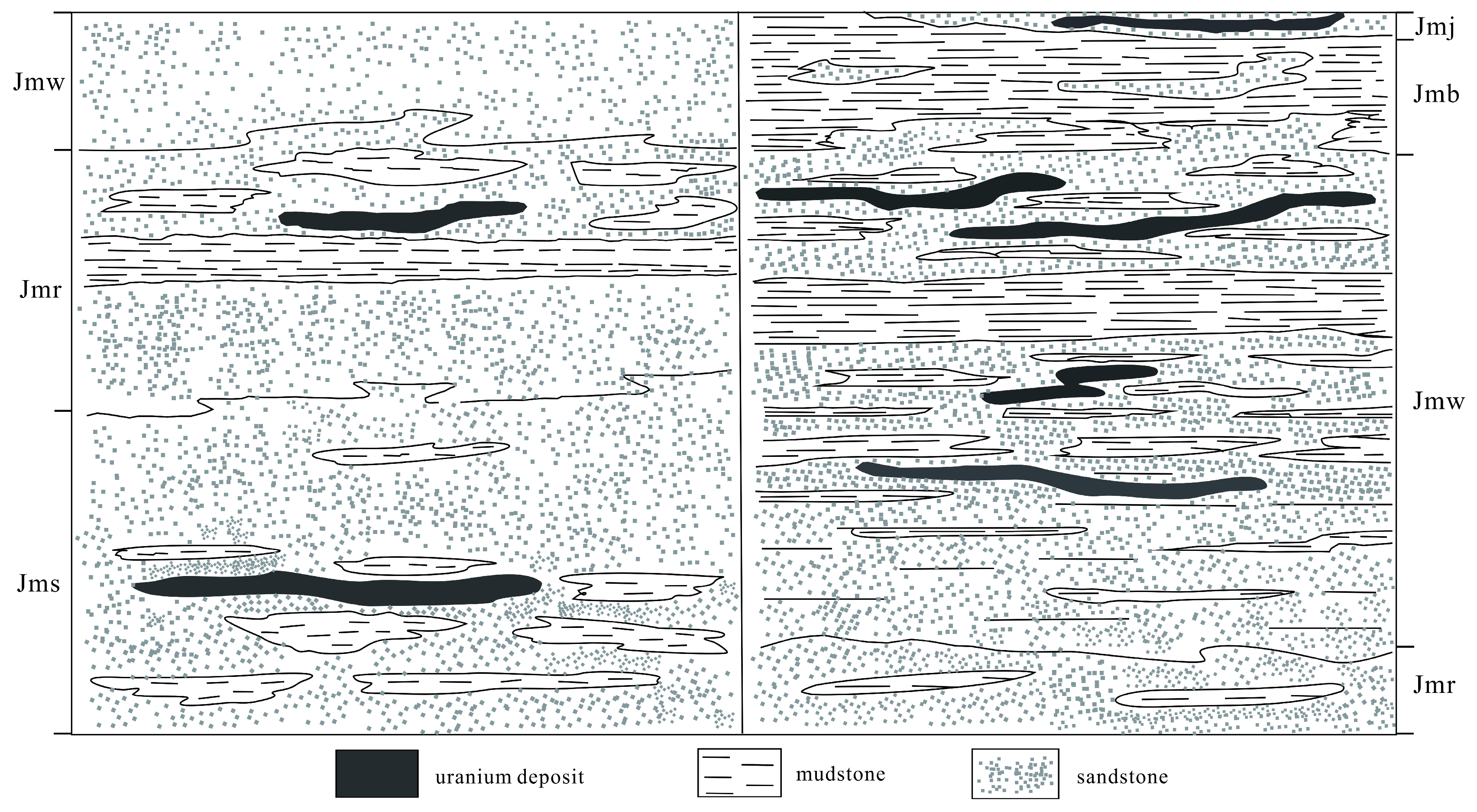
The core exploration insight for the roll-front model centers on tracking the redox transition and OM/sulfide micro-zones along modern or paleo-flow directions within large, well-connected sand bodies. First, integrate hydrochemical, mineralogical, and well-logging criteria to delineate the roll margins; then, systematically trace these margins down the hydraulic gradient. This stepwise approach enables efficient delineation of orebodies and assessment of in situ leaching potential (Figure 8).

5.1.3. Seepage-Driven Model

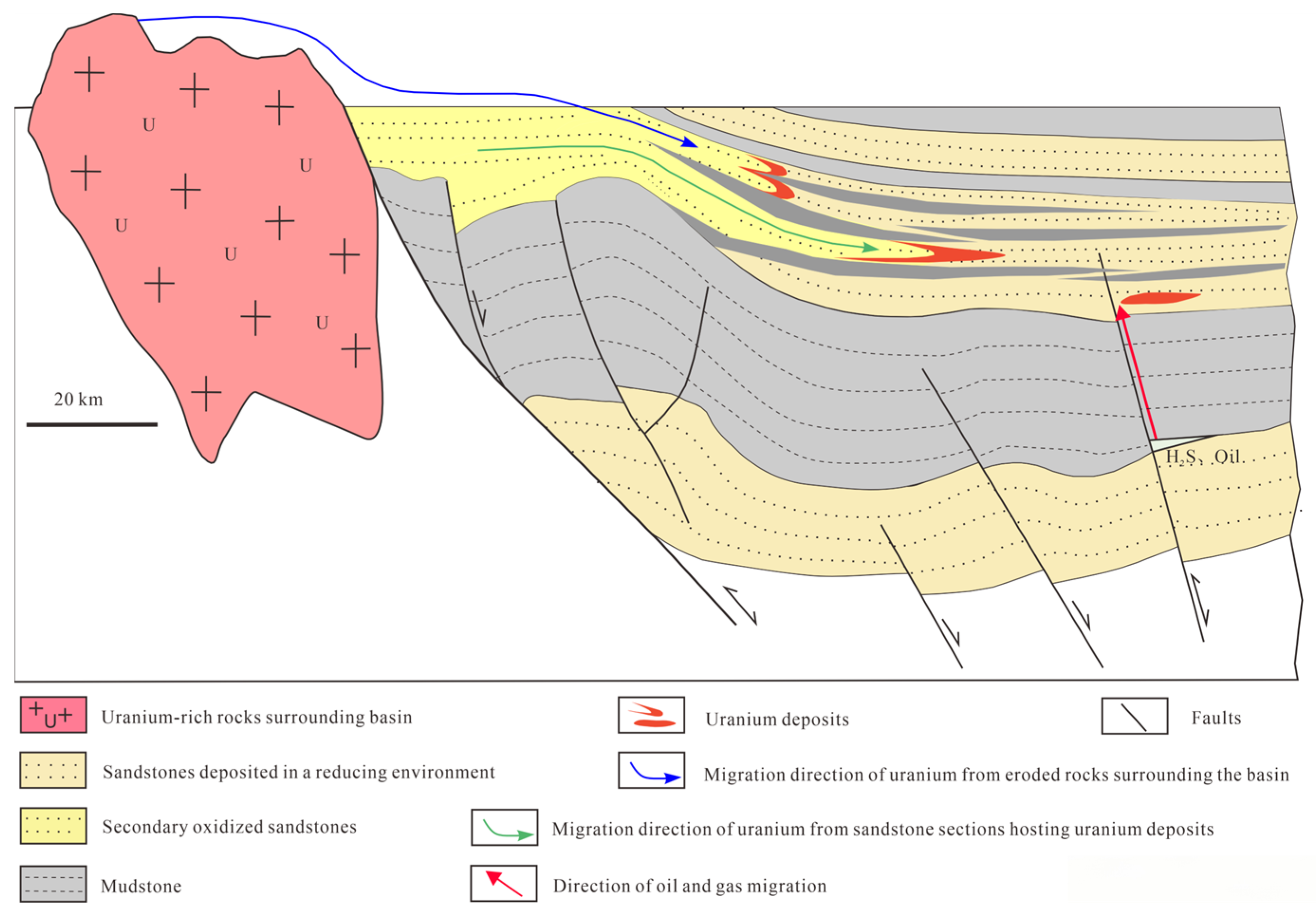
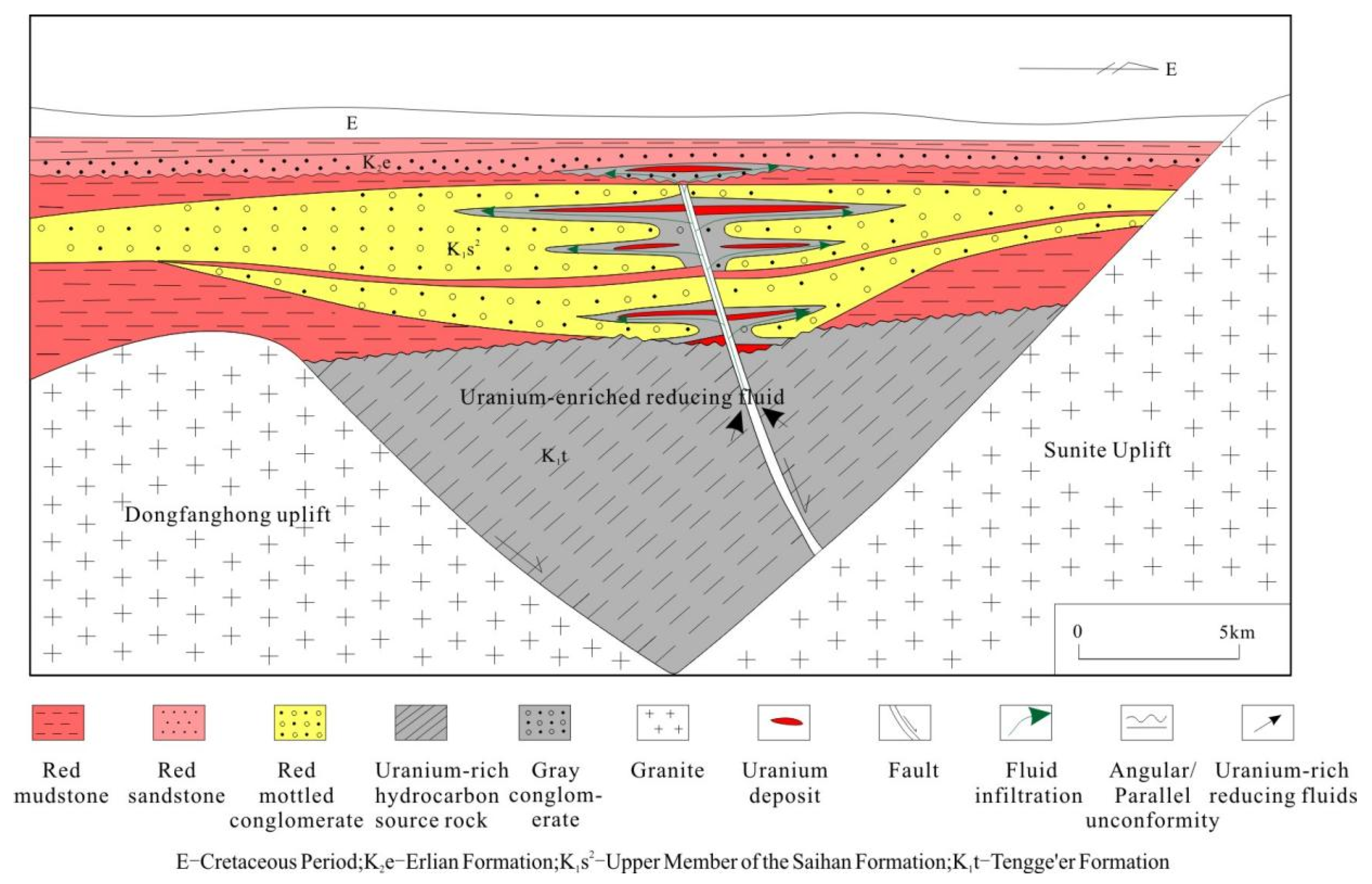
The seepage-driven mode—a recently proposed concept—envisions deep, organic-rich fluids (e.g., petroleum, bitumen, hydrocarbon gases) transporting uranium upward and causing it to seep into shallow redox transition zones where rapid precipitation occurs. A diagnostic feature is the presence of deep-origin OM that is unmistakably associated with uranium minerals in otherwise organic-poor sandstones. Orebodies typically form within gray, reducing sandstone lenses that are overlain by red, oxidized sands, indicating an upward migration of mineralizing fluids into a locally reducing trap (Figure 9) [73,74]. By emphasizing deep sources for both uranium and organic reductants, the seepage model challenges traditional exploration strategies that concentrate solely on near-surface redox interfaces [75,76,77,78].
The deep-seepage concept underscores the co-supply of ore components and reductants from the depths of basins. It links uranium ore formation with the evolution of petroleum systems, prompting an integrated assessment of mineralization controlled by oil, gas, and uranium. In basins rich in petroleum, particularly where uranium-bearing source rocks are well developed, this model holds exploration significance [76].

5.2. Regional Case Studies

Sandstone-hosted uranium deposits are found in numerous sedimentary basins around the world, and the specific role of OM varies depending on the geological setting and OM type. This section examines representative districts to compare how different OM types function under contrasting mineralization backgrounds.

5.2.1. Ordos Basin (China)

Representative sandstone-hosted uranium deposits in the northeastern Ordos Basin are primarily hosted in the Middle Jurassic Zhiluo Formation, which is typical of fluvial sandstones, and mainly form tabular orebodies. An unconformable contact with the underlying Yan’an Formation coal measures acts as a preferential conduit for both OM and oxidized U-bearing groundwater, serving as a critical geological condition for uranium mineralization. The OM assemblage is dominated by solid organic matter, and the host sandstones are widely intermingled with coal-derived detritus and plant fragments. Ore grade exhibits a strong positive correlation with total organic carbon (TOC) [3], while petrographic studies confirm intimate co-occurrence of carbonaceous debris with U minerals [79]. Additionally, sapropelinite is conspicuous in some high-grade samples, and coal OM exhibits strong fluorescence [45,80], highlighting the genetic link between OM and uranium mineralization.
The mineralization mechanism is dominated by a coal-sourced humic acid pathway: specifically, humic acids complex with and transport U(VI) in the oxidized zone; when the U-bearing fluid reaches the redox transition zone, U(VI) is reduced to U(IV) by organic reductants. Carbonaceous debris and sapropelinite play a dual role in adsorbing and immobilizing U(IV), effectively promoting the concentration of uranium to form orebodies.
Regarding exploration implications: (i) The coal-bearing Yan’an–basal Zhiluo contact and associated unconformities should be prioritized as integrated OM–fluid migration and ore-forming corridors and (ii) UV fluorescence anomalies in cores or thin sections (bright bands, fluorescent spores) combined with carbonaceous debris concentrations can serve as practical ore guides.

5.2.2. United States

Uranium deposits in the United States include examples that conform to both the humic-dominated (tabular) model and the classical roll-front model. The former is typified by the Grants uranium district, New Mexico, where mineralization is hosted by Upper Jurassic Morrison Formation fluvial sandstones and forms tabular to banded ore aligned with paleoflow [43].
During the Late Jurassic–Cretaceous, lacustrine–palustrine waters enriched in humic acids infiltrated permeable sandstone aquifers. Humic acid uranyl gels formed near the water table and, with compaction during diagenesis, yielded high-grade tabular ores. Uranium occurs mainly as pitchblende/uraninite and OM-bound adsorbed U(IV) [59].
By contrast, Wyoming and adjacent Cenozoic basins host widely developed roll-front deposits [29] whose crescentic fronts track groundwater flow paths. The mineralized sandstones typically have low primary TOC with only minor carbonaceous debris and clays, yet framboidal pyrite concentrates along OM-filled fracture arrays. Reduction is predominantly inorganic, driven by H2S/FeS2. In this case, minor OM and its associated sulfate-reducing bacteria (SRB) generate H2S at the advancing front, triggering U(VI) to U(IV) reduction with co-precipitation of pyrite. Sulfur-isotope data display a distinct biogenic signature [35,81]. For exploration, beyond simply mapping carbonaceous horizons, emphasis should be placed on strong sulfidation–re-oxidation indicators. Examples include alteration halos of marcasite/pyrite and Fe oxide overprints, which effectively delineate the migration pathways and remobilization history of roll-front orebodies [82,83,84,85].

5.2.3. Kazakhstan

The Chu-Sarysu Basin in Kazakhstan is characterized by classic roll-front uranium deposits, the majority of which are mined using in situ recovery techniques. The Muyunkum deposit exemplifies this type, with mineralization occurring in Lower Cretaceous fluvial sandstones that generally exhibit a pale gray to gray-green color indicative of reducing conditions. Locally developed roll-front ore zones are darker gray and rich in pyrite. Stratigraphically, the orebodies are found within channel-fill sand bodies containing carbonaceous plant debris, although the overall organic carbon content is low (typically < less than 0.1%) [10].
Stable isotope and hydrogeochemical data suggest that the ore fluid was oxidized, uranium-bearing groundwater circulating on a basin-wide scale. As it flowed, oxygen was progressively depleted, CO2 increased, and the system evolved towards self-generated reducing conditions [9]. In the downstream reduced zone, residual dissolved organics—likely originating from the degradation of plant detritus upstream—served as substrates for anaerobic bacteria, promoting SRB activity. The resulting H2S reduced U(VI) at the advancing front and co-precipitated pyrite [67,86]. Pyrite δ34S values of around −20‰ to −30‰ support a biogenic origin [35]. Notably, due to the scarcity of primary OM, much of the uranium exists as labile, non-crystalline U(IV), which is favorable for ISR but also increases the likelihood of natural re-oxidation and leaching. Consequently, ISR operations and environmental management should adjust oxidant injection and rehabilitation strategies according to the abundance of OM and the speciation/host of U(IV) [87,88].

5.2.4. Australia

The Mulga Rock uranium deposit in Australia is a large U–polymetallic system hosted within Paleocene paleochannel lignite [13]. It consists of several orebodies, including Ambassador, where mineralization is concentrated in near-surface woody peat (lignite) that is rich in OM and co-enriched in Ni, Co, Sc—indicative of a reducing depositional environment. The lignite serves two roles: supplying fulvic acids that complex and retain U(VI) and providing a reducing environment that converts U(VI) to precipitated UO2 [13]. As a result, uranium is present both as dark oxide minerals and, to a large extent, as colloidal “uraniferous lignite” adsorbed to the coal matrix [57]. Mineralization also extends into the sandstones beneath and lateral to the lignite, interpreted as precipitation at redox boundaries where upwelling, U-bearing groundwater interacted with the peat [58].
Mulga Rock is widely recognized as the archetype of a wood–peat (lignite)-hosted sandstone uranium system, reflecting uranium concentration in large peat redox environments. Another characteristic is the strong post-ore alteration of radioactivity on the organic host: radiation-induced aromatization and cross-linking of biopolymers produced insoluble, inert bitumen [59]. The close association between highly matured OM and uranium in the ore highlights that U–organic interactions can continue to modify the organic phase well after mineralization.

5.2.5. Niger and Argentina

In the Tim Mersoi Basin of Niger (Arlit, Akouta), sandstone-hosted uranium deposits are primarily hosted by fluvial channel-fill alluvial sandstones (e.g., the Tarat Formation) that have undergone multistage redox overprinting [89,90]. Beyond the traditionally recognized terrigenous OM (carbonaceous debris, plant fossils), notably, allochthonous petroleum-derived OM—solid bitumen—plays a pivotal role in ore formation. This bitumen fills pores and fractures in the Tarat channel sands, within which uranium minerals (uraninite and U–Ti oxides, e.g., brannerite) occur as submicrometer intergrowths [91].
The system follows a deep-seated seepage model: when ascending U-bearing fluids enter the channel sandstones, they are reduced by solid bitumen, leading to the precipitation of uraninite and U–Ti oxides. Organic–geochemical indicators, including a bimodal n-alkane distribution pattern, Pr/Ph ratios of 0.315–3.530, and C35 hopane dominance, indicate a reducing, alkaline environment, consistent with the hydrocarbon migration driven by Atlantic rifting-related thermal events. Regional source-rock distributions suggest the bitumen was sourced from Silurian “hot shales” or Precambrian strata. This insight revises models that relied solely on terrigenous OM and opens new organic–geochemical targets for exploration.
In the San Jorge Gulf Basin of Argentina, the Cerro Solo uranium deposit is hosted in Lower Cretaceous Los Adobes Formation sandstones, with orebodies that are lens-shaped to tabular. The dominant OM is dispersed detrital organic matter (e.g., carbonaceous debris) occurring as fine particles or fragments within sandstone and conglomerate matrices, rather than as thick, massive layers, such as coal or oil shale. Notably, this carbonaceous debris is closely associated with sulfides (e.g., pyrite), and coffinite commonly occurs in intimate intergrowth with OM and sulfides. This assemblage provides key geological criteria for delineating mineralized horizons and identifying favorable mineralization zones [92,93].
Fundamentally, detrital OM provides abundant sorption sites and reductive nucleation centers for uranium mineral precipitation, thereby facilitating the concentration of uranium within the mineralized intervals. For exploration practices, priority should be given to overlapping zones of paleochannels and carbonaceous horizons. Additionally, mapping redox interfaces together with pyrite–OM anomalies provides practical and effective guidance for targeting mineralization, as these features directly reflect the favorable geochemical conditions for uranium accumulation [94,95,96,97,98,99,100].

5.3. Exploration Significance of OM

Firstly, OM is widely recognized as a key geochemical indicator for uranium exploration: strata and facies with moderate organic enrichment are more likely to host uranium deposits. In China, typical primary exploration targets include Jurassic coal-bearing sandstones, paleochannel peat deposits, and sandstones overlying organic-rich source rocks. Consequently, this has led to the proposal of “coal–uranium co-prospecting” in coal-bearing basins. In contrast, for petroliferous basins, the focus should shift to anomalies at the intersections of hydrocarbon migration pathways and aquifers [22], as migrating hydrocarbons can provide both reducing conditions and sorption sites for uranium accumulation [47]. Secondly, various surface geochemical anomalies derived from organic processes can act as prospecting markers. In sandstone-hosted uranium districts, local gray-to-black reducing lenses within otherwise red oxidized sandstones—particularly those containing plant debris or bitumen stains—may indicate hidden mineralization and warrant radiometric surveys and sampling. Meanwhile, intense silicification and carbonate alteration in the surrounding rocks are commonly associated with leaching and precipitation by organic acids during ore formation [23]. Furthermore, radiation from uranium decay (α-particles and radiogenic heating) can “overprint” nearby OM, increasing its maturity, enhancing vitrinite reflectance, and promoting aromatic structures that yield inert bitumen [57]. In parts of the Ordos Basin, carbonaceous clasts adjacent to ore deposits exhibit significantly higher maturities than the background and display anisotropic, graphite-like fabrics [57,58,59,60,61].
Thirdly, at the ore-field scale, the spatial distribution of OM can assist in reconstructing paleo-redox fronts, thereby enabling the prediction of the ore deposit geometry [101]. Mapping gradients in organic carbon across an aquifer can reveal the former flow paths of oxidized, U-bearing groundwater and the locations of halted reduction fronts—information that is valuable for delineating prospective enrichment zones [35].

6. Conclusions

OM exerts multiple, essential controls on sandstone-hosted uranium systems: it complexes U(VI), thereby extending transport distances; it acts as a precipitating agent through both direct and microbially mediated reduction; and it drives wall-rock alteration and bitumen formation while leaving diagnostic organic–geochemical fingerprints. Several points of consensus have emerged over the past decade: (1) Sedimentary humic substances—particularly coal-derived humic acids—are the most common and potent drivers of sandstone uranium mineralization, with their coupled complexation–reduction processes supported by extensive experimental results and numerous field examples. (2) Microbially mediated reduction is pivotal in many deposits. In roll-front systems, H2S generated by sulfate-reducing bacteria (SRB) is widely regarded as the dominant reductant, consistent with the prevalence of biogenic pyrite in ores. (3) Liquid and gaseous hydrocarbons provide an alternative pathway in petroliferous basins, where deep hydrocarbon fluids may potentially both transport uranium and trigger its reduction and precipitation. (4) Uranium mineralization commonly coincides with pronounced transformation of OM itself, including elevated maturity, anomalous asphaltene/bitumen residues, and related textures, which indirectly attest to intense U-OM interactions.
Despite this progress, several issues remain unresolved and materially affect genetic interpretation and prediction: (1) In any given deposit, the quantitative contributions of sedimentary OM, hydrocarbon fluids, Fe2+, and other reductants, as well as their hierarchy of influence, demand quantification via multi-isotope tracing and reaction network modeling. (2) Whether OM concentrated first and subsequently trapped uranium, whether U precipitation induced OM polymerization, or whether both processes were broadly synchronous appears to vary by deposit type (humic-type systems often favor “OM first,” whereas roll-front occurrences of uraniferous bitumen imply U-driven polymerization). (3) The speciation by which hydrocarbons carry U, the geometry and permeability hierarchy of conduits, and the staging of enrichment remain poorly constrained and tightly linked to basin plumbing. (4) Regarding radiation overprints on coalification and hydrocarbon generation, emerging evidence indicates that uranium radiation can accelerate OM maturation, stimulate hydrocarbon generation, and yield diagnostic gaseous products, with implications for unconventional resources in uranium provinces.
Future advancements will likely hinge on three complementary directions: (1) Greater interdisciplinarity that integrates organic geochemistry, geomicrobiology, and isotope geoscience across molecular, pore-scale, and basin-scale observations to resolve U-OM mechanisms. (2) Greater reliance on in situ/operando analyses and modeling. For instance, using in situ/operando spectroscopy and spectromicroscopy and synchrotron X-ray imaging to directly observe the nanoscale co-localization of uranium and OM in ore and distinguish non-crystalline U(IV)–OM from uranium minerals (uraninite/coffinite). Alternatively, numerical modeling can quantify the role of organic complexation in uranium transport, while real-time redox kinetics can be tracked under controlled anoxic conditions with variable pH–Eh. In reactive transport modeling, a dissolved OM (DOM) speciation framework should be integrated, coupled with surface complexation and Monod-type kinetics for bacterial sulfate reduction (BSR), anaerobic oxidation of methane (AOM), and iron reduction. (3) Multi-indicator exploration models that incorporate total organic carbon (TOC), sulfur-isotope signals, microbial biosignatures, and related metrics into predictive frameworks for targeting, evaluation, and in situ recovery (ISR) design. Pursued collectively, these lines of inquiry will refine process-based genetic models and provide a stronger scientific basis for efficient exploration and production of sandstone-hosted uranium deposits.

Funding

This work was supported by the Northeast Geological Science and Technology Innovation Center Regional Innovation Fund (No. QCJJ2024-08).

Acknowledgments

We acknowledge the Northeast Geological Science and Technology Innovation Center, China Geological Survey (Grant No. QCJJ2024-08) for its support in literature retrieval, experimental analysis, and manuscript revision. We express our sincere gratitude to Academic Editor for the professional guidance throughout the review process and the anonymous reviewers for their insightful and constructive comments that significantly improved the quality of this manuscript. We also thank the Research Institute of Exploration and Development of Daqing Oilfield Company Ltd., Northeast Petroleum University, Shenyang Geological Survey Center, and Petrochina Oil, Gas and New Energies Company for their generous provision of research platforms, sample resources, and technical assistance during the study.

Conflicts of Interest

Authors Zhiyang Nie, Shefeng Gu, Aihong Zhou, Changqi Guo were employed by the company Research Institute of Exploration and Development of Daqing Oilfield Company Ltd. Author Hongyu Wang was employed by the Petrochina Oil, Gas and New Energies Company. The remaining authors declare that the research was conducted in the absence of any commercial or financial relationships that could be construed as a potential conflict of interest.

References

  1. Dahlkamp, F.J. Uranium Ore Deposits; Springer: Berlin/Heidelberg, Germany, 1993; pp. 1–460. [Google Scholar]
  2. IAEA. Uranium 2022: Resources, Production and Demand; International Atomic Energy Agency: Vienna, Austria, 2023. [Google Scholar]
  3. Jin, R.S.; Teng, X.M.; Li, X.G.; Si, Q.H.; Wang, W. Genesis of sandstone-type uranium deposits along the northern margin of the Ordos Basin, China. Geosci. Front. 2020, 11, 215–227. [Google Scholar] [CrossRef]
  4. Yang, D.Z.; Chen, Z.Y. The Fulvic Acids and Uranium Deposit Formationin Turfanhami Basin. Geol. Prospect. Forum 2002. [Google Scholar]
  5. Bonnetti, C.; Liu, X.D.; Yan, Z.B.; Liu, Z.; Yang, H. Coupled uranium mineralisation and bacterial sulphate reduction for the genesis of the Baxingtu sandstone-hosted U deposit, SW Songliao Basin, NE China. Ore Geol. Rev. 2017, 82, 108–129. [Google Scholar] [CrossRef]
  6. Bonnetti, C.; Liu, X.D.; Cuney, M.; Mercadier, J.; Riegler, T.; Yu, C.-D. Evolution of the uranium mineralisation in the Zoujiashan deposit, Xiangshan ore field: Implications for the genesis of volcanic-related hydrothermal U deposits in South China. Ore Geol. Rev. 2020, 122, 103514. [Google Scholar] [CrossRef]
  7. Wang, Y.M.; Xiong, Y.Q. Application of Organic Geochemistry in Reconstructing the Formation Environment of Sandstone-type Uranium Deposits. Bull. Mineral. Petrol. Geochem. 2006, 25, 217–221. [Google Scholar]
  8. Spirakis, C.S. The roles of organic matter in the formation of uranium deposits in sedimentary rocks. Ore Geol. Rev. 1996, 11, 53–69. [Google Scholar] [CrossRef]
  9. Nakashima, S.; Disnar, J.R.; Perruchot, A.; Trichet, J. Experimental study of mechanisms of fixation and reduction of uranium by sedimentary organic matter under diagenetic or hydrothermal conditions. Geochim. Cosmochim. Acta 1984, 48, 2321–2329. [Google Scholar] [CrossRef]
  10. Dahlkamp, F.J. Uranium Deposits of the World; Springer: Berlin/Heidelberg, Germany, 2010; Volume I–IV. [Google Scholar]
  11. Yang, X.Y.; Ling, M.X.; Sun, W.D.; Luo, X.D.; Lai, X.D.; Liu, C.Y.; Miao, J.Y.; Sun, W. The genesis of sandstone-type uranium deposits in the Ordos Basin, NW China: Constraints provided by fluid inclusions and stable isotopes. Int. Geol. Rev. 2009, 51, 422–455. [Google Scholar] [CrossRef]
  12. Yue, L.; Jiao, Y.Q.; Wu, L.Q.; Liu, Y.; Rong, H. Selective crystallization and precipitation of authigenic pyrite during diagenesis in uranium reservoir sandbodies in Ordos Basin. Ore Geol. Rev. 2019, 107, 532–545. [Google Scholar] [CrossRef]
  13. Hou, B.; Keeling, J.; Li, Z. Paleovalley-related uranium deposits in Australia and China: A review of geological and exploration models and methods. Ore Geol. Rev. 2017, 88, 201–232. [Google Scholar] [CrossRef]
  14. Liu, Z.Y.; Jiang, M.L.; Zhou, F.M.; Selby, D.; Qiu, Z. Role of Terrestrial Organic Matter in Re and Os Uptake: Insights for Re-Os Dating of Organic-Bearing Sedimentary Rocks and Weathering of Organic Carbon. J. Earth Sci. 2025, 36, 2109–2116. [Google Scholar] [CrossRef]
  15. Li, Q.; Wu, B.L.; Luo, J.J.; Yang, S.; Wang, M.; Liu, M.; Zhang, H.S.; Yang, M. Characters and metallogenetic significance of organic matter in coal from the Daying sandstone-hosted uranium deposit in the northern Ordos Basin, China. Minerals 2023, 13, 1002. [Google Scholar] [CrossRef]
  16. Liu, H.L.; Zou, C.N.; Zhu, R.K.; Wu, S.T.; Cui, J.W.; Qiu, Z.; Liu, G.L.; Zhang, M.Z. Accumulation Mechanism of Organic Matters in Paleogene Qaidam Basin, Northwestern China. J. Earth Sci. 2025, 36, 2117–2137. [Google Scholar] [CrossRef]
  17. Qiu, L.F.; Li, Z.Y.; He, F.; Wu, Z.; Liu, K.; Zhang, L.; Mao, N.; Wang, T.; Wang, L. Contribution of deep organic fluids to uranium mineralization in Cretaceous sandstones of the southwestern Ordos Basin, China. Hydrogeol. J. 2025, 33, 925–944. [Google Scholar] [CrossRef]
  18. Zhang, A.; Chen, S.; Tang, D.; Tao, S.; Tang, S.; Pu, Y.; Zhang, T. Coal Measure Gas System of the Middle Jurassic Xishanyao Formation, Southern Margin of the Junggar Basin, China. J. Earth Sci. 2025, 36, 2138–2160. [Google Scholar] [CrossRef]
  19. Cheng, Y.H.; Wang, S.Y.; Jin, R.S.; Li, J.G.; Ao, C.; Teng, X.M. Global iocene tectonics and regional sandstone-style uranium mineralization. Ore Geol. Rev. 2019, 106, 238–250. [Google Scholar] [CrossRef]
  20. Cheng, Y.H.; Jin, R.S.; Cuney, M.; Petrov, V.A.; Miao, P. The strata constraint on large scale sandstone-type uranium mineralization in Meso-Cenozoic basins, northern China. Acta Geol. Sin. 2024, 98, 1953–1976. [Google Scholar]
  21. Peng, H.; Jiao, Y.Q.; Dong, F.S.; Guo, X.D. Relationships between uranium occurrence, pyrite and carbonaceous debris in Fuxin Formation in the Songliao Basin: Evidenced by mineralogy and sulfur isotopes. Ore Geol. Rev. 2022, 140, 104580. [Google Scholar] [CrossRef]
  22. Peng, H.; Jiao, Y.Q.; Fu, X.F.; Wu, L.Q.; Guo, X.D.; Wang, Q.S.; Liu, C. Provenance and uranium source tracing for uranium-bearing series in the south of Songliao Basin: Evidence from zircon U–Pb chronology and lithogeochemistry. J. Geochem. Explor. 2025, 272, 107703. [Google Scholar] [CrossRef]
  23. Feng, Z.B.; Zhang, B.C.; Nie, F.J.; Xia, F.; Ning, J.; Zhang, L.L. Characteristics of rock fissure fillings and their relationship with the accumulation of uranium and associated elements in the Kailu Sag of southern Songliao Basin, Northeast China. Ore Geol. Rev. 2024, 169, 106079. [Google Scholar] [CrossRef]
  24. Wang, Q.S.; Peng, H.; Liu, C.; Zhang, Z.Y.; Zhou, Y.H.; Guo, X.D.; Fu, Q.L.; Hao, Y. Constraints of reducing media on uranium mineralization in the uranium-bearing rock systems of the southern Songliao basin. Ore Geol. Rev. 2025, 176, 106406. [Google Scholar] [CrossRef]
  25. Cheng, Y.H.; Wang, S.Y.; Zhang, T.F.; Teng, X.M.; Ao, C.; Jin, R.S.; Li, H.L. Regional sandstone-type uranium mineralization rooted in Oligo-Miocene tectonic inversion in the Songliao Basin, NE China. Gondwana Res. 2020, 88, 88–105. [Google Scholar] [CrossRef]
  26. Si, Q.H.; Teng, X.M.; Zhu, Q.; Li, J.G.; Zhao, H.L.; Wang, G.M.; Tong, H.K.; Dang, H.L. The origin and migration laws of hydrocarbons in uranium-bearing Luohe Formation, Pengyang area, SW Ordos Basin. Geol. J. 2024, 59, 2703–2719. [Google Scholar] [CrossRef]
  27. Feng, Z.B.; Nie, F.J.; Jiang, L.; Xia, F.; Cai, J.F.; Zhang, B.C.; Lu, Y.Y.; Zhang, L.L. Roles of multisourced fluids in the formation of sandstone-hosted uranium deposits in the SW Songliao Basin, NE China. J. Earth Sci. 2023, 34, 54–69. [Google Scholar] [CrossRef]
  28. Jiao, Y.Q.; Wu, L.Q.; Rong, H. Model of Inner and Outer Reductive Media Within Uranium Reservoir Sandstone of Sandstone-Type Uranium Deposits and Its Ore Controlling Mechanism: Case Studies in Daying and Qianjiadian Uranium Deposits. Earth Sci. 2018, 43, 459–474. [Google Scholar]
  29. Rackley, R.I. Environment of Wyoming Tertiary uranium deposits. AAPG Bull. 1972, 56, 755–774. [Google Scholar] [CrossRef]
  30. Liu, Q.Y.; Wu, X.Q.; Huang, X.W.; Zhu, D.; Meng, Q.Q.; Zhu, D.Y.; Xu, H.Y.; Liu, J.Y.; Li, P.P.; Zhou, Z.; et al. Occurrence of global natural hydrogen and profitable preservation. J. Earth Sci. 2025, 36, 1525–1554. [Google Scholar] [CrossRef]
  31. Cun, X.N.; Wu, B.L.; Zhang, H.S.; Sun, L.; Luo, J.J.; Li, Y.Q.; Pang, K.; Zhang, Q. Study on Uranium Occurrence State of Daying Sandstone-Type Uranium Deposits in Ordos Basin. Northwestern Geol. 2016, 49, 198–212. [Google Scholar]
  32. Zhang, C.L.L.; Li, Y.L.; Wall, J.D.; Larsen, L.; Sassen, R.; Huang, Y.S.; Wang, Y.; Peacock, A.; White, D.C.; Horita, J.; et al. Lipid and carbon isotopic evidence of methane-oxidizing and sulfate-reducing bacteria in association with gas hydrates from the Gulf of Mexico. Geology 2002, 30, 239–242. [Google Scholar] [CrossRef]
  33. Kaplan, I.R.; Rittenberg, S.C. Microbiological fractionation of sulphur isotopes. J. Gen. Microbiol. 1964, 34, 195. [Google Scholar] [CrossRef] [PubMed]
  34. Jensen, M.L. Sulfur isotopes and the origin of sandstone-type uranium ore deposits. Econ. Geol. 1958, 53, 598–618. [Google Scholar] [CrossRef]
  35. Curiale, J.A.; Bloch, S.; Rafalska-Bloch, J.; Harrison, W.E. Petroleum-related origin for uraniferous organic-rich nodules of southwestern Oklahoma. AAPG Bull. 1983, 67, 588–608. [Google Scholar]
  36. Jaireth, S.; Mckay, A.; Lambert, I. Association of large sandstone uranium deposits with hydrocarbons. AUSGEO News 2008, 89, 8–12. [Google Scholar]
  37. Finch, W.I.; McLemore, V.T. Uranium geology and resources of the San Juan Basin. In Coal, Uranium, and Oil and Gas in Mesozoic Rocks of the San Juan Basin: Anatomy of a Giant Energy-Rich Basin: Sandia Mountains to Mesita, New Mexico, 30 June–7 July 1989; U.S. Geological Survey: Reston, VA, USA, 1989; pp. 27–32. [Google Scholar]
  38. Yue, L.; Jiao, Y.Q.; Wu, L.Q.; Liu, Y.; Rong, H. Evolution and origins of pyrite in sandstone-type uranium deposits, northern Ordos Basin, north-central China, based on micromorphological and compositional analysis. Ore Geol. Rev. 2020, 118, 103334. [Google Scholar] [CrossRef]
  39. Li, Z.Y.; Cai, Y.Q.; Leonid, S.; Ni, S.Q.; Quan, X.H.; He, S.; Yu, H.; Han, M.Z. Metallogenic Characteristics and Models of Uranium Deposits in Ukrainian Sedimentary Basin. Uranium Geol. 2020, 36, 477–490. [Google Scholar]
  40. Zhao, X.C.; Yan, S.; Niu, H.C.; Zhang, Q.B.; Zhao, X.; Wu, J.; Yang, W.B. Isotopic fingerprints of recycled eclogite facies sediments in the generation of the Huanglongpu carbonatite, central China. Ore Geol. Rev. 2021, 139, 104534. [Google Scholar] [CrossRef]
  41. Zhang, T.; Lei, J.; Hu, C.; Zhou, X.; Liu, C.; Li, L.; Wang, Q.; Hao, Y.; Guo, L. The Uranium Enrichment Mechanism of Hydrocarbon-Bearing Fluids in Aeolian Sedimentary Background Uranium Reservoirs of the Ordos Basin. Minerals 2025, 15, 716. [Google Scholar] [CrossRef]
  42. Li, J.G.; Chen, Y.; Miao, P.S.; Chen, L.L.; Zhao, H.L.; Zhu, Q.; Si, Q.H.; Zhang, B.; Zhang, T. Characteristics and Mineralization Patterns of Pengyang Uranium Deposit in the Southwest of the Ordos Basin, China; Geological Survey Tianjin Geological Survey Center: Tianjin, China, 2020; pp. 25–27. [Google Scholar]
  43. Xia, P.; Hao, F.; Tian, J.Q.; Fu, Y.; Mou, Y.L.; Guo, C.; Yang, Z.; Wang, K. Organic matter occurrence and its effects on pore structure and methane adsorption capacity: A case study of the Niutitang black shale in Guizhou, China. J. Earth Sci. 2025, 36, 597–610. [Google Scholar] [CrossRef]
  44. Hinrichs, K.U.; Boetius, A. The Anaerobic Oxidation of Methane: New Insights in Microbial Ecology and Biogeochemistry; Springer: Berlin/Heidelberg, Germany, 2002. [Google Scholar]
  45. Cao, Z.C.; Yun, L.; Ping, H.W.; Li, H.Y.; Geng, F.; Han, J.; Huang, C.; Yang, X.; Chen, H.H. Quantitative Evaluation of Gas Injection Contribution Using Fluid Inclusion Data: A Case Study of the Condensate Gas Reservoirs of the Eastern Shunbei Area in the Tarim Basin. J. Earth Sci. 2025, 36, 2819–2824. [Google Scholar] [CrossRef]
  46. Hostetler, P.B.; Garrels, R.M. Transportation and precipitation of uranium and vanadium at low temperatures, with special reference to sandstone-type uranium deposits. Econ. Geol. 1962, 57, 137–167. [Google Scholar] [CrossRef]
  47. Feng, Z.B.; Nie, F.J.; Deng, J.Z.; Zhang, H.J.; Liu, B.H. Spatio-temporal collocation and genetic relationship of oil, gas, coal and uranium and its significance for uranium prospecting: A case from Mesozoic-Cenozoic U-bearing basins, North China. Russ. Geol. Geophys. 2017, 58, 611–623. [Google Scholar] [CrossRef]
  48. Bone, S.E.; Dynes, J.J.; Cliff, J.; Bargar, J.R. Uranium(IV) adsorption by natural organic matter in anoxic sediments. Proc. Natl. Acad. Sci. USA 2017, 114, 711–716. [Google Scholar] [CrossRef]
  49. Borch, T.; Kretzschmar, R.; Kappler, A.; Van Cappellen, P.; Ginder-Vogel, M.; Voegelin, A.; Campbell, K. Biogeochemical redox processes and their impact on contaminant dynamics. Environ. Sci. Technol. 2010, 44, 15–23. [Google Scholar] [CrossRef] [PubMed]
  50. Zhang, F.; Jiao, Y.Q.; Liu, Y.; Wu, L.Q.; Rong, H. Traces of hydrocarbon-bearing fluid and microbial activities and their implications for uranium mineralization in southern Ordos basin, China. Ore Geol. Rev. 2021, 139, 104525. [Google Scholar] [CrossRef]
  51. Lovley, D.R.; Phillips, E.J.P.; Gorby, Y.A.; Landa, E.R. Microbial reduction of uranium. Nature 1991, 350, 413–416. [Google Scholar] [CrossRef]
  52. Salze, D.; Belcourt, O.; Lannuzel, F. Experimental study of interactions between uranium and n-alkanes in hydrothermal conditions (500 bar, 200 °C). J. Anal. Appl. Pyrolysis 2019, 138, 29–40. [Google Scholar] [CrossRef]
  53. Qiu, L.F.; Li, Z.Y.; Zhang, Z.L.; Wang, L.H.; Li, Z.C.; Han, M.Z.; Wang, T.T. Characteristics of organic matter organic matter in Lower Cretaceous ore-bearing sandstones and its relationship with uranium mineralization in the northern Ordos basin. Earth Sci. Front. 2024, 31, 281–296. [Google Scholar]
  54. Bonnetti, C.; Cuney, M.; Malartre, F.; Michels, R.; Liu, X.; Peng, Y. The Nuheting deposit, Erlian Basin, NE China: Synsedimentary to diagenetic uranium mineralization. Ore Geol. Rev. 2015, 69, 118–139. [Google Scholar] [CrossRef]
  55. Yue, L.; Jiao, Y.Q.; Fayek, M.; Liu, Y.; Rong, H. Transformation of Fe-bearing minerals from Dongsheng sandstone-type uranium deposit, Ordos Basin, north-central China: Implications for ore genesis. Am. Mineral. 2022, 107, 1396–1409. [Google Scholar] [CrossRef]
  56. Huang, S.H.; Qin, M.K.; Xu, Q.; He, Z.B.; Guo, Q. Hydrocarbon Fluid Geological characteristics of the xishanyao formation and its uranium metallogenic significance, Northwest Junggar Basin. Earth Sci. 2019, 44, 3060–3073. [Google Scholar]
  57. Zhang, F.; Jiao, Y.; Wu, L.; Rong, H.; Wang, L.; Zhang, Z. In-situ analyses of organic matter maturation heterogeneity of uranium-bearing carbonaceous debris within sandstones: A case study from the Ordos Basin in China. Ore Geol. Rev. 2019, 109, 117–129. [Google Scholar] [CrossRef]
  58. Zhang, F.; Jiao, Y.; Wu, L.; Rong, H.; Wang, L. Relations of uranium enrichment and carbonaceous debris within the Daying uranium deposit, northern Ordos Basin. J. Earth Sci. 2019, 30, 142–157. [Google Scholar] [CrossRef]
  59. Zhang, F.; Jiao, Y.; Wu, L.; Rong, H.; Wang, J.; Zhang, C. Geochemical characteristics of uranium-rich dispersed organic matter and their geological significance for uranium mineralization: A case study from the Ordos Basin. J. Geochem. Explor. 2024, 264, 107528. [Google Scholar] [CrossRef]
  60. Zhang, F.; Wang, J.; Jiao, Y.; Yang, S.; Wu, L.; Rong, H.; Luobu, Q. Geochemical characteristics and uranium occurrence state of carbonaceous-siliceous slates and their geological significance for uranium mineralization: A case study from the Tichong black shale-type uranium deposit. J. Geochem. Explor. 2025, 280, 107927. [Google Scholar] [CrossRef]
  61. Zhang, F.; Michels, R.; Jiao, Y.; Wu, L.; Rong, H.; Liu, Y.; Wang, J. Roles of natural organic matter in fixing uranium: Evidences from uranium oxidation state and functional groups of organic matter. Appl. Geochem. 2025, 193, 106575. [Google Scholar] [CrossRef]
  62. Bonnetti, C.; Cuney, M.; Bourlange, S.; Deloule, E.; Poujol, M.; Liu, X.D.; Peng, Y.B.; Yang, J.X. Primary Uranium Sources for Sedimentary-Hosted Uranium Deposits in Ne China: Insight from Basement Igneous Rocks of the Erlian Basin. Miner. Depos. 2016, 52, 297–315. [Google Scholar] [CrossRef]
  63. Bonnetti, C.; Malartre, F.; Huault, V.; Cuney, M.; Bourlange, S.; Liu, X.D.; Peng, Y.B. Sedimentology, Stratigraphy and Palynological Occurrences of the Late Cretaceous Erlian Formation, Erlian Basin, Inner Mongolia, People’s Republic of China. Cretac. Res. 2014, 48, 177–192. [Google Scholar] [CrossRef]
  64. Fu, J.L.; He, X.Q.; Hu, Z.C.; Yin, S.; Ma, J.; Chen, K.Y.; Zhang, W. New Potential Barite Reference Materials for LA-MC-ICP-MS Sulfur Isotope Analysis with Application to Hydrothermal Barite in the Huayangchuan Deposit, Western China. J. Earth Sci. 2025, 36, 1–10. [Google Scholar] [CrossRef]
  65. Yuan, J.-G.; Zhang, H.-F.; Tong, Y.; Gao, J.-F.; Xiao, R.-G. Sources of metals and fluids for the Taijiying gold deposit on the northern margin of the North China Craton. Ore Geol. Rev. 2021, 139, 104593. [Google Scholar] [CrossRef]
  66. Si, Q.H.; Li, J.G.; Miao, P.S.; Zhang, C.; Zhu, Q.; Zhao, H.L. Characteristics and mechanism of hydrocarbon alteration of faded sandstone in the uranium-bearing Luohe Formation, Pengyang area, southwestern Ordos Basin. Ore Geol. Rev. 2021, 139, 104500. [Google Scholar] [CrossRef]
  67. Sun, Y.H.; Jiao, Y.Q.; Cuney, M.; Wu, L.Q.; Mercadier, J.; Rong, H.; Liu, Y.; Tao, Z.P. Sulfur isotope and trace element constraints on the conditions of pyrite formation from the Diantou-Shuanglong sandstone-hosted uranium deposit, Ordos Basin, China: Implications for uranium mineralization. Ore Geol. Rev. 2024, 165, 105921. [Google Scholar] [CrossRef]
  68. Sun, Q.J.; Zhang, W.H.; Zhang, W.P.; Zhao, J.P.; Miao, J.Y.; Sun, W.; Liu, C.Y. Experimental simulation study of the role of organic matter organic matter in the formation of uranium deposits. Geol. China 2007, 134, 463–469. [Google Scholar]
  69. Granger, H.C.; Warren, C.G. Unstable sulfur compounds and the origin of roll-type uranium deposits. Econ. Geol. 1969, 64, 160–171. [Google Scholar] [CrossRef]
  70. Xiao, K.; Xu, Y.; Yang, Y.; Hu, X.; Luo, Q.; Duan, Z.; Jiao, C.; Chen, M.; Yin, D. Study on Logging Identification of Sandstone-Type Uranium Deposits Based on Ensemble Learning in the Songliao Basin in Northeast China. Nucl. Sci. Eng. 2025, 199, 1246–1262. [Google Scholar] [CrossRef]
  71. Yue, L.; Jiao, Y.Q.; Fayek, M.; Wu, L.Q.; Rong, H. Micromorphologies and sulfur isotopic compositions of pyrite in sandstone-hosted uranium deposits: A review and implications for ore genesis. Ore Geol. Rev. 2021, 139, 104512. [Google Scholar] [CrossRef]
  72. Ren, Y.; Yang, X.; Hu, X.; Wei, J.; Tang, C. Mineralogical and geochemical evidence for biogenic uranium mineralization in Northern Songliao Basin, NE China. Ore Geol. Rev. 2022, 141, 104556. [Google Scholar] [CrossRef]
  73. Zhao, K.; Zhou, Y.P.; Chen, K.Y.; Bao, Z.A.; Zhang, Y.; An, F.; Wu, B.L.; Li, G.R.; Yuan, H.L. Compositions of in-situ trace elements, S and Pb isotopes of pyrite in Mengqiguer deposit, Yili basin, NW China: Implications for uranium mineralization processes of sandstone-type uranium deposit. Ore Geol. Rev. 2025, 179, 106503. [Google Scholar] [CrossRef]
  74. Li, Z.Y.; Liu, W.S.; Li, W.T.; Li, X.D.; Qin, M.K.; Cai, Y.Q.; Zhang, Y.L.; He, S.; Wu, Q.B.; Qiu, L.F.; et al. Exudative metallogeny of the Hadatu sandstone-type uranium deposit in the Erlian Basin, Inner Mongolia. Geol. China 2022, 49, 1009–1047. [Google Scholar]
  75. Liu, C.; Hao, Y.; Liu, X.Z.; Peng, H.; Fu, X.F.; Gu, S.F.; Nie, Z.Q.; Zhou, A.H. Can uranium in shale matrix be released into fluids? Insights from experimental simulations and chemical extraction. ACS Omega 2025, 10, 39791–39798. [Google Scholar] [CrossRef] [PubMed]
  76. Liu, C.Y.; Zhang, L.; Huang, L.; Wu, B.L.; Wang, J.Q.; Zhang, D.D.; Tan, C.Q.; Ma, Y.P.; Zhao, J.S. Novel metallogenic model of sandstone-type uranium deposits: Mineralization by deep organic fluids. Earth Sci. Front. 2024, 31, 368–383. [Google Scholar]
  77. Liu, C.; Fu, X.F.; Li, Y.C.; Wang, H.X.; Sun, B.; Hao, Y.; Hu, H.T.; Yang, Z.C.; Li, Y.L.; Gu, S.F.; et al. Can hydrocarbon source rock be uranium source rock?—A review and perspectives. Earth Sci. Front. 2024, 31, 284–298. [Google Scholar]
  78. Hao, Y.; Liu, C.; Peng, H.; Li, L.; Liu, H.Z.; Li, Y.L.; Gu, S.F.; Nie, Z.Y.; Zhou, A.H. Simulation Study of Uranium Discharging Potential in Poor Organic Matter Mudstone and Its Geological Significance. Uranium Geol. 2025, 31, 497–508. [Google Scholar]
  79. Crawford, E.S.; Liber, K. Effects of clay minerals and organic matter in formulated sediments on the bioavailability of sediment-associated uranium to the freshwater midge, Chironomus dilutus. Sci. Total Environ. 2015, 532, 821–830. [Google Scholar] [CrossRef]
  80. Xu, Y.X.; Yang, B.; Wu, S.C.; Shi, Y.; Bao, X.W.; Liu, Y.; Zhang, Y.; Yang, Y.J.; Wang, Q.Y.; Xia, Q.K. Metal preconcentration for gold mineralization in arcs: Geophysical observations from Western Junggar, NW China. Ore Geol. Rev. 2021, 139, 104562. [Google Scholar] [CrossRef]
  81. Lin, Y.H.; Fan, M.S.; Ni, P.; Pan, J.Y.; Jin, R.S.; Cheng, Y.H.; Cui, J.M.; Cheng, Z.L.; Li, W.S.; Zhu, Q.; et al. New Insights into Uranium Source and Mineralization Process of the World-Class Jingchuan Sandstone-Hosted Uranium Deposit, Ordos Basin, China: Evidence from Geology, Carbonate Textures and Geochemistry. Ore Geol. Rev. 2025, 185, 106795. [Google Scholar] [CrossRef]
  82. Jiao, Y.Q.; Wu, L.Q.; Rong, H.; Peng, Y.B.; Miao, A.S.; Wang, X.M. The relationship between Jurassic coal measures and sandstone-type uranium deposits in the northeastern Ordos Basin, China. Acta Geol. Sin.-Engl. Ed. 2016, 90, 2117–2132. [Google Scholar] [CrossRef]
  83. Zhao, H.L.; Li, J.G.; Xiao, Z.B.; Miao, P.S.; Si, Q.H.; Chen, L.L.; Yu, R.A.; Chen, Y. Determination of formation age of the pengyang sandstone-type uranium deposit in the Ordos Basin, China: Using in situ femtosecond LA-MC-ICP-MS method. China Geol. 2021, 4, 747–748. [Google Scholar] [CrossRef]
  84. Zhao, H.L.; Li, J.G.; Si, Q.H.; Yu, R.G.; Miao, P.S.; Chen, L.L.; Chen, Y.; Zhang, B. Characteristics of fluid inclusions and fluid coupling mineralization of the Pengyang uranium deposit, Ordos Basin. Ore Geol. Rev. 2022, 148, 105043. [Google Scholar] [CrossRef]
  85. Liu, Y.; Peng, H.; Luo, N.; Yu, X.; Li, M.; Ji, B. The key controlling factors and mechanisms for the formation of sandstone-type uranium deposits in the central part of the Ulanqab Depression, Erlian Basin. Minerals 2025, 15, 688. [Google Scholar] [CrossRef]
  86. Zhong, W.H.; Wu, L.Q.; Wang, L.H.; Jiao, Y.Q.; Zhang, F.; Yue, L.; Xiang, Y.; Zheng, Y.H. The distinctiveness of carbonaceous debris in uranium reservoirs under arid sedimentary backgrounds and its implication for uranium mineralization: A case study of northern Ordos Basin. Ore Geol. Rev. 2025, 179, 106526. [Google Scholar] [CrossRef]
  87. Wu, B.L. Geology and Metallogeny of Sandstone-Type Uranium Deposits in Mesozoic-Cenozoic Basins of Northwestern China; Northwest University: Xi’an, China, 2005. [Google Scholar]
  88. Granger, H.C.; Santos, E.S. Geology and Ore Deposits of the Section 23 Mine, Ambrosia Lake District, New Mexico; U.S. Geological Survey Open-File Report; U.S. Geological Survey: Reston, VA, USA, 1982; pp. 82–207. [Google Scholar]
  89. Qiao, J.Q.; Li, H.; Luo, Q.Y.; Liu, L.F.; Wang, D.D.; Shang, X.Q.; Xiao, F.; Zhang, T. Development conditions and factors controlling the formation of the Permian Pingdiquan source rocks in the Wucaiwan Sag, Junggar Basin, China: A comprehensively elemental, biomarker and isotopic perspective. J. Earth Sci. 2025, 36, 627–643. [Google Scholar] [CrossRef]
  90. Jiang, W.J.; Qin, M.K.; Wang, W.K.; Huang, S.H. Genesis of gray sandstone within the red beds in HLJ-DL uranium deposit, southwest Songliao Basin and its relationship with uranium mineralization. Ore Geol. Rev. 2024, 168, 106035. [Google Scholar] [CrossRef]
  91. Zhang, C.; Wang, S.B.; Yu, R.A.; Cheng, Y.H.; Tu, J.R.; Ao, C.; Teng, X.M.; Feng, P.; Yu, H. Occurrence of uranium minerals in the Xiaomeigou Formation in northern Qaidam Basin, Northwest China. Ore Geol. Rev. 2022, 142, 104692. [Google Scholar] [CrossRef]
  92. Cao, J.J.; Gang, W.Z.; Yang, S.R. Biological sources, paleoenvironment, and organic matter enrichment in source rocks of the Ordovician Majiagou Formation, Ordos Basin, China: Evidence from biomarkers, microfossils, and inorganic geochemical analyses. J. Palaeogeogr. 2024, 13, 92–115. [Google Scholar] [CrossRef]
  93. Guo, X.J.; Yang, L.J.; Du, Z.X.; Zhou, H.Q.; Li, L.; Zhu, W.K.; Dai, L.C. Co-effects from inorganic and organic fractions in dissolved components of biochar on its adsorption behavior: Taking uranium adsorption as an example. Colloids Surf. A Physicochem. Eng. Asp. 2025, 713, 136546. [Google Scholar] [CrossRef]
  94. Dargent, M.; Truche, L.; Dubessy, J.; Bessaque, G.; Marmier, H. Reduction kinetics of aqueous U (VI) in acidic chloride brines to uraninite by methane, hydrogen or C-graphite under hydrothermal conditions: Implications for the genesis of unconformity-related uranium ore deposits. Geochim. Cosmochim. Acta 2015, 167, 11–26. [Google Scholar] [CrossRef]
  95. Zhang, L.; Liu, C.Y.; Fayek, M.; Wu, B.L.; Lei, K.Y.; Cun, X.N.; Sun, L. Hydrothermal Mineralization in the Sandstone–Hosted Hangjinqi Uranium Deposit, North Ordos Basin, China. Ore Geol. Rev. 2017, 80, 103–115. [Google Scholar] [CrossRef]
  96. Liu, Z.; Lu, Y.; Wei, Z.; Zhou, Y.; Liu, L.; Zhao, M. Research on the Relationship between pH and Uranium Concentration in Leachate of Sandstone Uranium Deposit in-Situ Leaching Area Based on TCN-Transformer Hybrid Model. J. Radioanal. Nucl. Chem. 2025, 334, 5565–5578. [Google Scholar] [CrossRef]
  97. Zhao, H.L.; Ao, C.; Li, J.G.; Chen, L.L.; Zhang, B.; Miao, P.S.; Si, Q.H.; Zhu, Q.; Yu, R.; Chen, Y. Occurrence and Mechanism of Uranium Enrichment with a Unique Eolian Sedimental Environment in the Pengyang Uranium Deposit, Ordos Basin. Ore Geol. Rev. 2022, 141, 104641. [Google Scholar] [CrossRef]
  98. Hu, X.W.; Ling, M.X.; Xu, J.B.; Wei, Q.; Yang, X.Y.; Lu, C.; Zhao, Z. Petrological and Geochemical Research on the Telaaobao Sandstone–Hosted Uranium Deposit in the Northwestern Ordos Basin, China: Implications of Multiple Sources. Geol. J. 2025, 60, 1909–1927. [Google Scholar] [CrossRef]
  99. Sun, D.; Xia, F.; Meng, F.; Nie, F.; Liu, X.; Zhang, W.; Wang, Q. Petrology of the Sandstone-Type Uranium Target Layer and Its Uranium Existence Form in the Telaaobao Mineral Area, Ordos Basin. ACS Omega 2025, 10, 912–928. [Google Scholar] [CrossRef] [PubMed]
  100. Zhao, L.; Cai, C.F.; Jin, R.S.; Li, J.G.; Li, H.L.; Wei, J.L.; Guo, H.; Zhang, B. Mineralogical and Geochemical Evidence for Biogenic and Petroleum-Related Uranium Mineralization in the Qianjiadian Deposit, NE China. Ore Geol. Rev. 2018, 101, 273–292. [Google Scholar] [CrossRef]
  101. Jroundi, F.; Povedano-Priego, C.; Pinel-Cabello, M.; Descostes, M.; Grizard, P.; Purevsan, B.; Merroun, M.L. Evidence of microbial activity in a uranium roll-front deposit: Unlocking their potential role as bioenhancers of the ore genesis. Sci. Total Environ. 2023, 861, 160636. [Google Scholar] [CrossRef] [PubMed]
Figure 1. BSE image of uranium minerals closely related to carbonaceous debris. (a). Distributed in carbonaceous debris like colonies. (b). Filling in cavities of carbonaceous debris. (c,d). Distributed in carbonaceous debris in granular and colloidal forms. (e,f). Distributed in carbonaceous debris in radial form. CD—carbonaceous debris; P—pyrite; U—pitchblende (after [21]).
Minerals 15 01326 g001
Figure 2. Metallogenic model of a sandstone-type uranium deposit in Songliao Basin [24].
Minerals 15 01326 g002
Figure 3. Diagram showing a two-fluid uranium deposition model [35].
Minerals 15 01326 g003
Figure 4. Uraniferous bitumen-type metallogenic pattern of the Ukrainian shield [39].
Minerals 15 01326 g004
Figure 5. (a) Hydrocarbon-containing inclusions distribute uniformly in secondary fractures adjacent to quartz (Qtz), elliptical, yellow-green fluorescence, 4–15 μm; (b) Banded hydrocarbon inclusions align along secondary fractures near quartz (Qtz), elliptical, yellow-green fluorescence, 4–15 μm (after [26]).
Minerals 15 01326 g005
Figure 6. Map of uranium mineralization model in the uranium reservoir of the Ordos Basin (after [42]).
Minerals 15 01326 g006
Figure 7. Distribution and character of tabular, peneconcordant uranium deposits in the Morrison Formation [69].
Minerals 15 01326 g007
Figure 8. Schematic section of a sedimentary basin illustrating the metallogenic models of roll front-type uranium deposits (modified after [72]).
Minerals 15 01326 g008
Figure 9. Seepage-type mineralization model for the Hadatu deposit [74].
Minerals 15 01326 g009
Table 1. Types of organic matter, metallogenic models, and exploration criteria in typical sandstone-hosted uranium deposits.
Mineralization ModelDominant/Typical OM (OM)Key ProcessesTypical Geological SettingExploration IndicatorsTypical Deposit Examples (Authoritative Sources)
Humic-typeHumic acids/coal-derived OM; wood fragments/carbonaceous debris; commonly co-existing authigenic pyriteOM complexes or adsorbs U to extend transport; direct reduction of U(VI) by OM and/or indirect reduction via BSR-generated H2SOM-rich intervals within deltaic–meandering/braided fluvial sand bodies on gentle basin slopes or platform margins; locally associated with low-rank coal interbeds(1) Light δ34S in pyrite (BSR); (2) Petrography: U–OM intergrowthsDongsheng–Daying (Ordos Basin, China);
Stráž–Hamr (North Bohemian Cretaceous Basin, Czech Rep.)
Roll-frontDispersed OM with authigenic sulfides as synergistic reducers (OM usually secondary)Oxidized, bicarbonate-bearing groundwater advances along permeable sandGently dipping paleochannel/valley-fill sand bodies (fine–medium sand) with mudstone seals; basin margins or dome flanks; common in coastal plain or intracontinental basins(1) Three-zone color banding + directional high gamma/low resistivity Alta Mesa/Kingsville Dome (Texas Gulf Coastal Plain, USA); Smith Ranch–Highland (Powder River Basin, USA); Beverley–Four Mile (Lake Frome Basin, South Australia)
Deep-seated seepage/upward exfiltrationHydrocarbons (methane/wet gas/bitumen), organic-acid-bearing deep basin fluids; commonly with BSR-H2SLow- to moderate-temperature organic fluids or reduced brines rise from U-bearing source rocks along faults/steps into shallow sandstonesFaulted basin margins/step zones plus fluvial–deltaic sands; bitumen/”tar” veins, calcite veins, and hydrocarbon shows; frequent evidence for two mineralization episodes(1) Bitumen/solid hydrocarbon intergrown with U minerals (microscopy/Raman/GC–MS); (2) Fluid inclusions with elevated salinity, CO2/hydrocarbon signatures; (3) light δ13C in calcite, very light δ34S in pyrite (BSR)Arlit–Akouta (Tim Mersoi Basin, Niger); DASA (Tim Mersoi Basin, Niger); Sierra Pintada/Don Otto (Argentina)
Disclaimer/Publisher’s Note: The statements, opinions and data contained in all publications are solely those of the individual author(s) and contributor(s) and not of MDPI and/or the editor(s). MDPI and/or the editor(s) disclaim responsibility for any injury to people or property resulting from any ideas, methods, instructions or products referred to in the content.