Article

Garnet Geochemistry of the Makeng-Yangshan Fe Skarn Belt, Southeast China: Implications for Contrasting Hydrothermal Systems and Metal Endowment

1
Zijin School of Geology and Mining, Fuzhou University, Fuzhou 350108, China
2
Key Laboratory of Ionic Rare Earth Resources and Environment, Ministry of Natural Resources, Ganzhou 341499, China
*
Authors to whom correspondence should be addressed.
Minerals 2025, 15(12), 1325; https://doi.org/10.3390/min15121325
Submission received: 13 November 2025 / Revised: 7 December 2025 / Accepted: 16 December 2025 / Published: 18 December 2025
(This article belongs to the Special Issue Mineralization and Metallogeny of Iron Deposits)

Abstract

The Southwestern Fujian Region is one of the important Fe polymetallic metallogenic belts in China. The Makeng-Yangshan Fe skarn sub-belt within it contains several deposits that share a similar geological setting, mineralization age, and genetic type, yet exhibit significant differences in metal endowment. To investigate the poorly constrained factors responsible for these differences, this paper focused on the mineral chemistry of garnets associated with magnetite from the Makeng, Luoyang, and Yangshan Fe deposits within the sub-belt, employing in situ laser ablation-inductively coupled plasma-mass spectrometry (LA-ICP-MS) for trace element analysis. Our results reveal that garnet from all three deposits are andradite-dominated and features a chondrite-normalized REE fractionation pattern exhibiting enrichment in LREE relative to HREE, indicating crystallization from unified, mildly acidic fluids under high oxygen fugacity (fO2) conditions. However, both the Makeng and Luoyang garnets showed a strong positive Eu anomaly, whereas the Yangshan garnets displayed the weakest Eu anomaly among the three deposits, which can likely be attributed to the highest fO2 environment of the Yangshan deposit. Furthermore, garnet Y/Ho ratios and Y-ΣREE correlations demonstrate that the Makeng and Luoyang garnets crystallized in an open fluid system that were primarily of magmatic-hydrothermal origin with substantial external fluid (e.g., meteoric water) involvement, whereas the Yangshan garnet reflects a relatively closed fluid system that was predominantly of magmatic-hydrothermal origin with limited external fluid input. These geochemical differences have direct implications for exploration: the open-system Makeng deposit holds promise for Mo-W-Sn mineralization, as does the Luoyang deposit for W-Sn, whereas the closed-system Yangshan shows little potential for these metals. In addition, this study reveals that Pb and Zn concentrations in garnet are not reliable exploration indicators. Overall, these findings provide important mineralogical constraints on the factors controlling deposit scale and metal associations, thereby enhancing the understanding of regional metallogeny and guiding future mineral exploration.

1. Introduction

Skarn deposits are one of the most common deposit types in the Earth’s crust, provide important sources of Fe, Au, Cu, Zn, W, Mo, and Sn, as well as primary sources of W and Sn in the world [1,2,3]. Garnet, a diagnostic mineral in skarn deposits [1], can accommodate diverse major and trace elements, making it a powerful tool for elucidating the physicochemical conditions (e.g., oxygen fugacity, pH, and water/rock ratios), sources, and evolution of ore-forming fluids, as well as for assessing mineralization potential [4,5,6,7,8].
The Southwestern Fujian Region, located in the southeastern part of the Cathaysia Block, South China (Figure 1a), represents a significant Fe polymetallic metallogenic belt [9]. This belt trends NE–SW and hosts over 120 Fe polymetallic deposits and occurrences with varying sizes [10,11] (Figure 1b). Zheng and Mao [11] further recognized a ∼130 Ma Makeng-Yangshan iron skarn sub-belt within this metallogenic belt, based on garnet U-Pb geochronological evidence. This sub-belt includes several notable deposits: the Makeng Fe-Mo deposit (430 Mt @ 41.6% Fe and 0.08Mt Mo), the Luoyang Fe (14.4 Mt @ 42.44% Fe, with minor Mo and Zn), and Yangshan Fe deposits (37.1 Mt @ 42.82% Fe) (Figure 1b). The Fe skarn deposits in this sub-belt share a similar geological setting, mineralization age, and genetic type, and are all closely associated with Early Cretaceous felsic intrusions [11,12,13,14,15]. However, these deposits exhibit significant differences in scale and ore-forming element associations, and the controlling factors remain unclear. Therefore, this study focused on the Makeng, Luoyang, and Yangshan Fe skarn deposits within this sub-belt. By applying in situ LA-ICP-MS trace element analysis to the ubiquitous, Fe mineralization-related garnet, we aim to decode the physicochemical conditions and sources of the ore-forming fluids, as well as the mineralization potential differences among these deposits. The results are expected to provide important mineralogical constraints on the factors controlling deposit scale and metal associations, ultimately enhancing the understanding of regional metallogeny and guiding mineral exploration.

2. Geological Setting

The South China block has been divided into the Yangtze craton to the northwest and the Cathaysia block in the southeast, which collided along the Qinhang suture in the Neoproterozoic [3,18]. The southwestern Fujian iron polymetallic metallogenic belt (hereafter referred to as SFIPMB) is situated on the southwestern part of the Cathaysia Block, bounded by the Zhenghe-Dapu fault zone (Figure 1a). The oldest outcropping rocks in the region form a pre-Devonian basement, which is predominantly composed of greenschist- to amphibolite-facies metamorphic rocks [16,19,20]. These basement strata are unconformably overlain by late Paleozoic (excluding the Lower Devonian) to Mesozoic sedimentary, volcanic-sedimentary, and volcanic rocks [3,7,10,21,22] (Figure 1b).
The SFIPMB has undergone a complex geological evolution, including the formation and rifting of the South China Block during the Proterozoic, development of Late Devonian to Permian sedimentary basins, Early–Middle Triassic Indosinian orogeny, a transition from compression to extension from the Late Triassic to Middle Jurassic, and a Late Jurassic to Early Cretaceous extensional phase [10,23,24,25]. The belt is characterized by two major fault systems oriented NE and NW (Figure 1b). The NE-trending faults exert significant control on magmatic activity and Fe–Mo polymetallic mineralization in the region [12], whereas the NW-trending faults primarily influence the distribution of Cu–Au–Ag polymetallic deposits [26].
The SFIPMB records magmatic activity spanning the Paleozoic to the Mesozoic (Figure 1b). While Paleozoic magmatism is not widespread across the belt, Mesozoic magmatism was extensive and can be divided into distinct Triassic, Jurassic, and Cretaceous episodes [27,28] (Figure 1b). Among these, the Early Cretaceous (~130 Ma) felsic magmatic rocks are abundant and are genetically linked to the Fe-Mo-Zn mineralization in the region [11,12,14] (Figure 1b). Furthermore, the belt hosts diverse dikes, including diabase, diorite porphyry, felsic porphyries, and fine-grained granites [29]. More than 120 Fe(Mo) deposits and occurrences have been recognized in the SFIPMB, including the representative Makeng, Dapai, Luoyang, Pantian, and Yangshan deposits (Figure 1b).

3. Deposit Geology

3.1. Makeng Fe-Mo Skarn Deposit

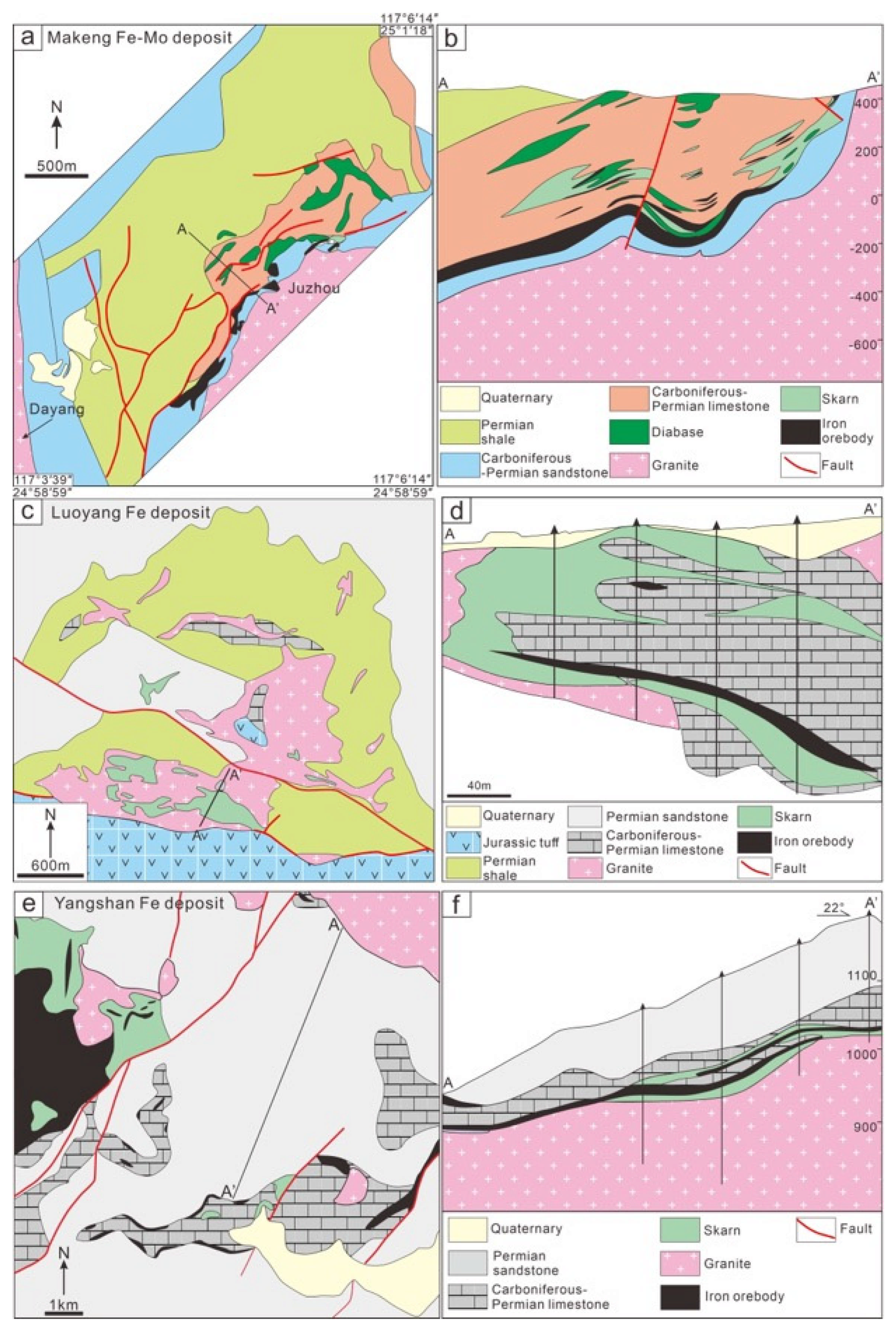
Located in the southwestern Makeng-Yangshan iron metallogenic belt (Figure 1b), the Makeng Fe-Mo skarn deposit is the largest magnetite skarn deposit in South China, with reported reserves of 430 Mt at 41.60% Fe and 0.08 Mt Mo [11,12]. Outcropping rocks in the mining area comprise three main units: a minor Ordovician-Silurian metamorphic basement, unconformably overlain by Carboniferous to Middle Permian cover sequences (e.g., quartz sandstone and sandy conglomerate of the Lower Carboniferous Lindi Formation, limestone and siliceous rock of the Upper Carboniferous Jingshe Formation to Middle Permian Qixia Formation), and subsequently by Upper Permian marine-continental transitional coal-bearing fine clastic rocks and shallow marine calcium-bearing fine clastic rocks of the Wenbishan and Tongziyan Formations [16] (Figure 2a). The mining area exhibits complex structures, dominated by the NE-trending Makeng anticline. Fault systems with NE, NW, and near-NS trends are well developed, among which the NE-trending set exerts primary control on the morphology and occurrence of the magnetite orebodies (Figure 2a). Outcropped intrusive rocks are dominated by the eastern Dayang granite and the western Juzhou granite in the mining area, with LA-ICP-MS U-Pb zircon ages of 132.6 ± 1.3 Ma and 130.5 ± 1 Ma, respectively [12]. Given their similar lithology, mineral composition, age, and geochemical characteristics, the two intrusions are considered to be derived from the same pluton [12,29]. Additionally, several intermediate-mafic dikes have been identified in the mining area (Figure 2a), which can be divided into at least three distinct phases from early to late: the early diabase emplaced at 315.5 ± 1.2 to 303 ± 2 Ma; the intermediate dioritic diabase at 141.33 ± 0.96 Ma; and the late diabase at 64 ± 1 Ma [12,30]. The mineralization age at Makeng is constrained by combined garnet U-Pb and molybdenite Re-Os geochronology: magnetite-associated garnet yields U-Pb ages of 132.9 ± 0.9 Ma and 131.4 ± 1.2 Ma [11], while molybdenite provides Re-Os model ages ranging from 131.9 ± 1.9 Ma to 133.3 ± 2.3 Ma [12]. These results collectively bracket the mineralization at ~130 Ma, which is consistent with the previously reported zircon U-Pb ages of the Dayang and Juzhou granites.
The main magnetite orebodies are thick, layered structures hosted in an interformational brecciated zone of carbonate rocks and sandy conglomerates, adjacent to the Early Cretaceous Dayang-Juzhou granite [17] (Figure 2a,b). It strikes NE–SW, is conformable with the country rock, and dips NW. The orebodies plunge at 25–45°, extends for 3800 m, and persist down-dip for 400–1500 m. Its thickness is highly variable (80–600 m), typically measuring 20–165 m, and is greatest along fold axes, thinning on the limbs. Magnetite and molybdenite constitute the principal ore minerals, with accessory scheelite, hematite, galena, and sphalerite (Figure 3a,b and Figure 4a,b).

3.2. Luoyang Fe Skarn Deposit

Located in the middle part of the Makeng-Yangshan Fe skarn metallogenic belt (Figure 1b), the Luoyang Fe skarn deposit hosts ore reserves of 14.4 Mt at an average grade of 42.44% total Fe, accompanied by economic Zn and minor Mo resources. Outcropped rocks at Luoyang include Carboniferous-Permian limestone, Permian sandstone and shale, and Jurassic tuff (Figure 2c). The structural framework of the mining area is defined by an NNE-trending anticline, together with NWW- and NE-trending faults and interlayer fracture zones (Figure 2c). The anticline was subsequently disrupted by later granite intrusion and fault activity. Exposed intrusive rocks in the area are predominantly granites occurring as stocks, apophyses, dikes, and veins, whose distribution is largely controlled by the NWW- and NE-trending fault systems as well as detachment faults along stratigraphic boundaries (Figure 2c,d). The intrusions genetically linked to Fe mineralization are medium- to fine-grained porphyritic granite and granite porphyry, which yielded zircon U–Pb ages of 131.64 ± 0.62 Ma and 131 ± 1 Ma, respectively [13].
The Luoyang Fe orebodies predominantly trend NW–SE, dip NE at 10–30°, and exhibit stratiform, lenticular, and pod-like morphologies (Figure 2d). They are primarily hosted in the interlayer fracture zone between the Lower Carboniferous to Permian limestone, as well as along the contacts between granite porphyry and these carbonate rocks (Figure 2d). A Si/Ca lithological interface controls the main orebodies, separating a footwall of Lower Carboniferous siliceous quartz sandstone and granite porphyry from a hanging wall of the aforementioned carbonate units (Figure 2d). The Fe ores are mainly disseminated and massive, with subordinate banded varieties (Figure 3c,d). Magnetite is the dominant ore mineral, accompanied by subordinate hematite, pyrite, sphalerite, and molybdenite (Figure 3c,d). The gangue assemblage is chiefly composed of garnet and pyroxene, with lesser amounts of calcite, quartz, actinolite, tremolite, chlorite, phlogopite, and fluorite (Figure 3c,d and Figure 4c,d).

3.3. Yangshan Fe Skarn Deposit

The Yangshan Fe skarn deposit is located in the northeastern segment of the Makeng–Yangshan iron skarn metallogenic belt (Figure 1b). The strata exposed in the mining area consist primarily of a suite of the Carboniferous-Permian shallow-marine clastic-carbonate sedimentary formation, with Quaternary sediments occurring locally. Ore-controlling structures are mainly bedding-detachment faults within the carbonate sequences, which played a critical role in localizing the orebodies. Intrusive rocks are well-developed and dominated by granitoids, including porphyritic monzogranite, K-feldspar granite, biotite granite, and medium- to coarse-grained as well as fine-grained granites [31]. Zircon U-Pb geochronology indicates that these granitoids were emplaced at 130.12 ± 1.24 Ma [14].
The Yangshan deposit contains estimated ore reserves of 37.1 Mt at an average grade of 42.82% Fe [32]. In addition to iron, the deposit hosts economically significant concentrations of Zn and Cu, along with trace elements including Pb, Mo, Mn, and P [31]. A total of 44 Fe orebodies have been recognized in the deposit [11], which are generally characterized by their large number, small size, scattered distribution, and a predominant NNE-trend (Figure 2e). The principal Fe orebodies occur as stratiform and stratoid layers hosted in the Carboniferous–Permian limestone and skarn along the contact zones between ~130 Ma granite and the carbonate rocks (Figure 2f). Additional orebodies form lenticular or, rarely, pod-like shapes near the interfaces between limestone and Permian clastic rocks, or within the granite-limestone contact zones (Figure 2e). The dominant ore mineral is magnetite (Figure 3e), with subordinate hematite and limonite, along with minor amounts of goethite, pyrite, pyrrhotite, chalcopyrite, sphalerite, galena, and molybdenite. Trace minerals such as chalcocite, bornite, tetrahedrite, and covellite are occasionally observed [31]. Gangue minerals are dominated by garnet, with subordinate pyroxene and ilvaite, and minor quartz, fluorite, tremolite, actinolite, calcite, and chlorite [31] (Figure 3e,f and Figure 4e,f).

4. Analytical Methodology

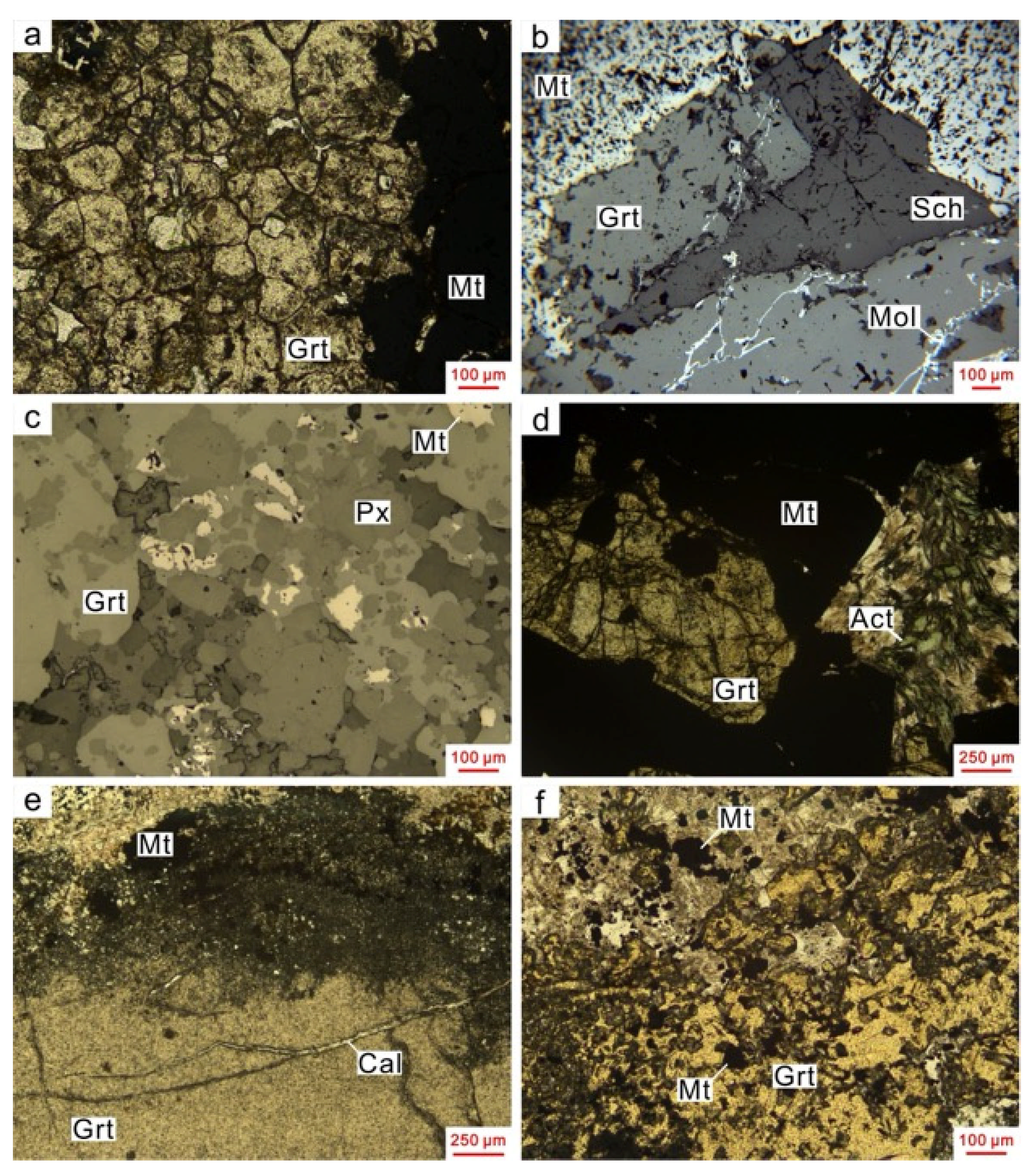
Garnet samples for in situ LA-ICP-MS analysis were collected from the Makeng, Luoyang, and Yangshan Fe skarn deposits (Figure 3a–f). We specifically selected representative thin sections of disseminated and massive ores exhibiting varied garnet textures and mineral associations from Makeng (Figure 4a,b), Luoyang (Figure 4c,d), and Yangshan (Figure 4e,f). These carefully selected garnet grains, showing minimal alteration and representing different generations where identifiable, were targeted for LA-ICP-MS analysis to investigate trace element compositions among three Fe skarn deposits.
The in situ trace element composition of garnet was determined by laser ablation-inductively coupled plasma-mass spectrometry (LA-ICP-MS) at Guangzhou Tuoyan Analytical Technology Co., Ltd., Guangzhou, China. The analysis utilized a NWR 193 nm ArF excimer laser ablation system coupled to a Thermo iCap RQ ICP-MS. Laser ablation was conducted with a spot size of 50 μm, a repetition rate of 6 Hz, and a fluence of 5 J/cm2 for 40s per analysis. The aerosol generated was transported by helium as the carrier gas and mixed with argon as the make-up gas before introduction into the plasma.
Quantification of trace elements was achieved by external calibration against reference materials NIST SRM 610 and BCR-2G [33], with Si serving as the internal standard. Analyses followed a sequence where a block of 8–10 unknown points was bracketed by standard measurements. Each measurement cycle comprised approximately 45 s of background acquisition followed by 40 s of sample ablation. Raw data processing, including background subtraction, signal integration, time-drift correction, and quantitative calculation for trace elements, was performed using Iolite 4.0 software [34]. The data reduction employed the “VizualAge UcomPbine” procedure, an updated data reduction scheme adapted from the “VizualAge” method of Petrus and Kamber [35], which is designed to handle variable common Pb in standard materials. Final concordia diagram plotting and age calculations were carried out using Isoplot R version 6.8 [36].

5. Results

Trace element concentrations in the Makeng, Luoyang, and Yangshan garnets are given in Tables S1–S3 and illustrated in Figure 5a–p and Figure 6a–f.

5.1. Ore-Forming Elements

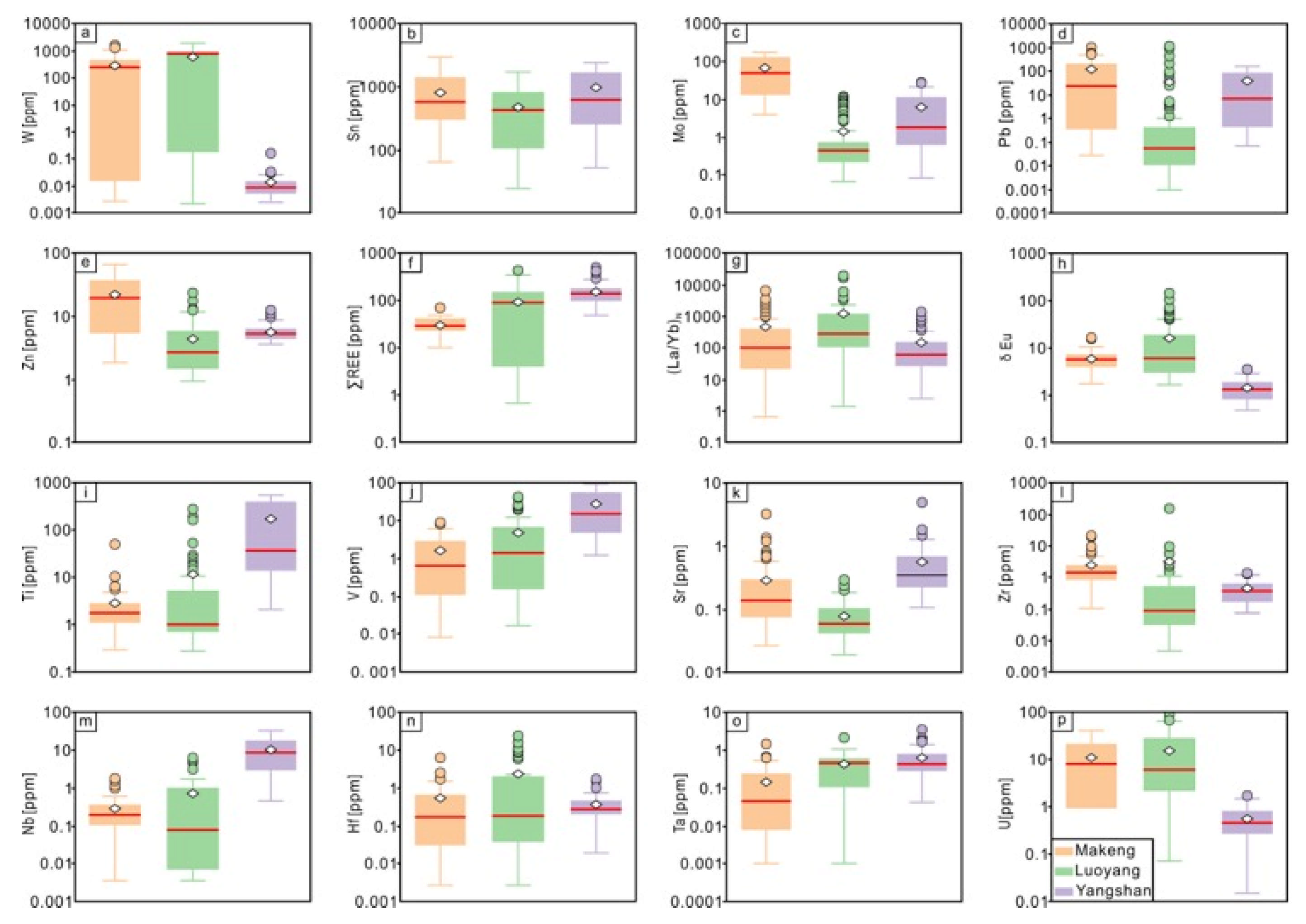
This study analyzed the contents of ore-forming elements (including W, Sn, Mo, Pb, and Zn) in the garnets from the Makeng, Luoyang, and Yangshan deposits (Tables S1–S3). The results reveal the following distribution patterns of these five ore-forming elements across the different deposits: (1) W exhibits similar and relatively high concentrations in Makeng (321 ppm) and Luoyang (mean 673 ppm), but is significantly lower in the Yangshan samples (mean 0.02 ppm) (Figure 5a); (2) Sn is generally enriched in garnets from all three deposits, with similar concentration ranges (Makeng: mean 829 ppm; Luoyang: mean 465 ppm; Yangshan: mean 1001 ppm; Figure 5b); (3) Mo shows significant enrichment in the Makeng garnets (mean 78 ppm), whereas the contents in the Luoyang and Yangshan deposits are relatively similar and generally lower (Luoyang: mean 1.5 ppm; Yangshan: mean 6.8 ppm) (Figure 5c); (4) Pb and Zn show similar but not identical variation trends. Pb exhibits the highest values in Makeng (mean 130 ppm), intermediate in Luoyang (mean 44 ppm), and the lowest in Yangshan (mean 42 ppm). In contrast, Zn is also highest in Makeng (mean 23 ppm), but shows higher values in Yangshan (mean 5.6 ppm) than in Luoyang (mean 4.5 ppm) (Figure 5d,e).

5.2. Rare Earth Elements (REE)

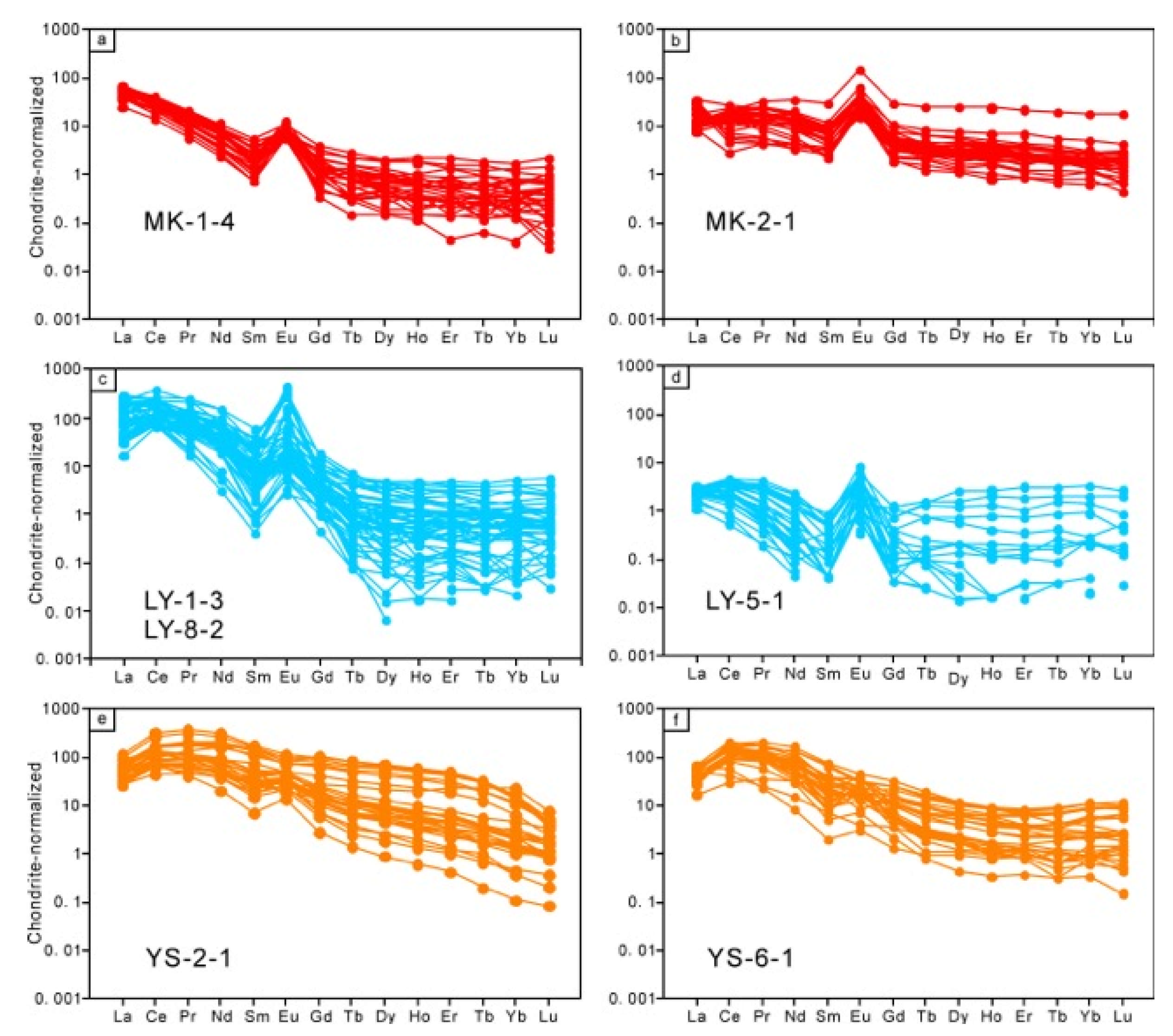
Garnets from the Makeng deposit are characterized by low to moderate total REE concentrations (∑REE = 10–71 ppm; mean 32 ppm), with LREE (7.5–49 ppm; mean 30 ppm) significantly dominating over heavy HREE (0.13–22 ppm; mean 2.2 ppm). This strong fractionation results in high (La/Yb)N ratios (0.66–1009; median 33) and is accompanied by a pronounced positive Eu anomaly (δEu = 1.7–17; mean 6.1), defining a steep, LREE-enriched pattern (Table S1; Figure 5f–h and Figure 6a,b).
The Luoyang garnets exhibit REE signatures that are broadly similar in overall pattern to those of the Makeng garnets, yet show distinct quantitative differences. They displayed the highest ∑REE values in this study (0.69–352 ppm), almost entirely constituted by LREEs (up to 350 ppm), whereas HREE contents remained exceptionally low (≤5.7 ppm). Consequently, they showed the most elevated (La/Yb)N ratios (up to ~4025) and the strongest positive Eu anomalies (δEu up to 109) (Table S2; Figure 5f–h and Figure 6c,d).
In contrast, garnets from the Yangshan deposit are distinguished by a subdued Eu anomaly. Although they shared the overall LREE-enriched and HREE-depleted pattern (∑REE = 50–501 ppm; (La/Yb)N = 1.6–362), their Eu systematics were markedly different. The Eu anomalies were weak to absent (δEu = 0.49–3.6; mean 1.5), a key feature that clearly differentiates them from the strongly anomalous Makeng and Luoyang garnets (Table S3; Figure 5f–h and Figure 6a–f).

5.3. Other Trace Elements

In addition to REE and ore-forming elements, this study also analyzed trace elements such as Ti, V, Sr, Zr, Nb, Hf, and Ta in the garnets from the three deposits (Tables S1–S3). The results show that, except for Sr and Zr, the trace element concentrations in the Makeng and Luoyang garnets were relatively similar, whereas both differed significantly from the Yangshan garnet (Figure 5i–o).

6. Discussion

6.1. Ore-Forming Conditions

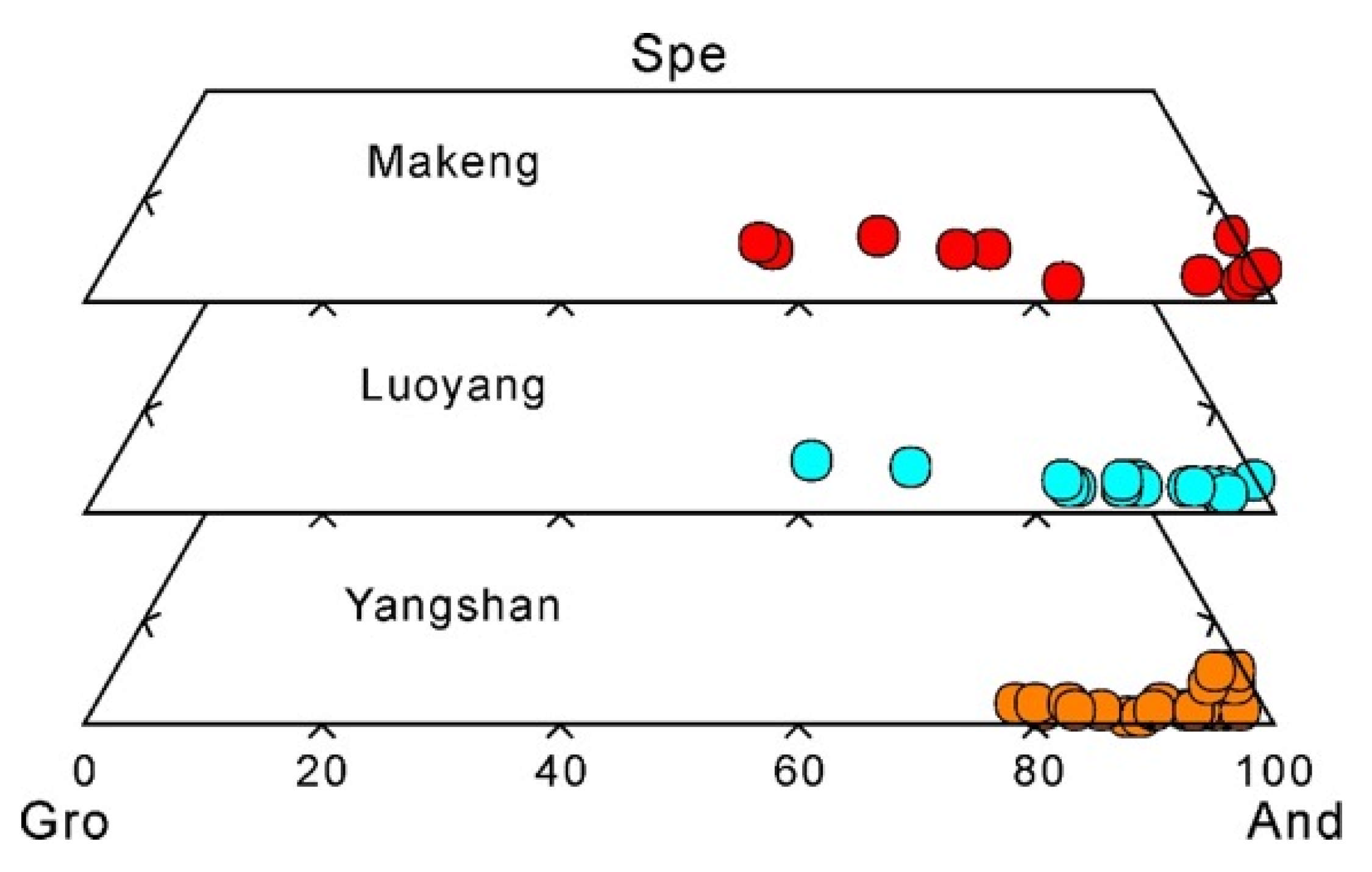
Extensive studies demonstrate that major and trace element concentrations of garnet reflect physicochemical parameters such as fO2, salinity, pH, and water/rock ratios in ore-forming fluids [4,7,8,38,39,40]. It is well established that under relatively oxidizing conditions, Fe predominantly exists in the trivalent state, leading to the crystallization of andradite and diopside, whereas under relatively reducing conditions, hedenbergite and grossular are formed [38,41]. Overall, garnets from the Makeng, Luoyang, and Yangshan deposits exhibit compositional characteristics similar to those of iron skarn deposits worldwide [1]. Specially, electron probe microanalyses (EPMA) of magnetite-associated garnets from the Makeng, Luoyang, and Yangshan deposits revealed distinct compositional ranges: from And57Gro43 to >99 mol% andradite at Makeng, And61Gro39 to >99 mol% andradite at Luoyang, and And78Gro22 to nearly pure andradite (And98Gro2) at Yangshan [11] (Figure 7). Moreover, pyroxene compositions in these deposits are characterized by diopside-hedenbergite solid solutions at Makeng and are predominantly diopside at Luoyang and Yangshan [15,29,42,43]. These andradite and diopside-dominated assemblages collectively record a progressively increasing oxygen fugacity from Makeng through Luoyang to Yangshan. This interpretation is further supported by the U content in garnet, as U4+ and U6+ are preferentially incorporated into the garnet structure [40]. As shown in Figure 5p, the notably higher U concentrations in Makeng and Luoyang garnets compared to those from Yangshan indicate that the Makeng and Luoyang skarns crystallized under more oxidizing conditions.
The pH of hydrothermal fluids serves as a primary control on the REEs’ fractionation during garnet crystallization in skarn deposits [44]. In general, mildly acidic conditions (pH < 6–7) yield garnets with enrichment in LREE relative to HREE chondrite-normalized fractionation patterns and a positive Eu anomaly, whereas near-neutral conditions (pH = 6–7) produce garnets showing relative LREE depletion, HREE enrichment patterns with a negative Eu anomaly [44,45]. Garnets in the Makeng, Luoyang, and Yangshan Fe skarn deposits are predominantly andradite in composition (Figure 7). Similar to garnets from many skarn deposits worldwide, they feature a chondrite-normalized REE fractionation pattern exhibiting enrichment in LREE relative to HREE (mean (La/Yb)N = 106, 348, and 39, respectively; Tables S1–S3) and a positive Eu anomaly [4,7,8,46] (Figure 6a–f), suggesting formation in a mildly acidic environment.
Notably, Makeng and Luoyang garnets displayed strong positive Eu anomalies (mean δEu: 6.1 and 11; Table S1; Figure 6a–d), whereas Yangshan garnets exhibited weak positive to slightly negative Eu anomalies (δEu = 0.49–3.6, mean 1.5; Tables S1–S3; Figure 6e,f). The weak Eu anomaly in Yangshan garnets can be attributed to three potential factors. (1) fO2: Yangshan experienced the most oxidizing conditions among the three deposits, where the predominance of Eu3+ over Eu2+ suppresses the development of a positive Eu anomaly. (2) Temperature: Although Eu can be stabilized as Eu2+ at temperatures above 250 °C even under high fO2 [44,47], fluid inclusion analyses show comparable early stage mineralization temperatures across all deposits: 448–594 °C at Makeng [43], 488–536 °C at Luoyang [42], and 450–550 °C at Yangshan [15], suggesting temperature is not the primary control. (3) Salinity: Fluid salinity, commonly approximated by Cl concentration, is also a key parameter influencing the Eu anomaly [9]. In Cl-rich fluids, the complex EuCl42−, formed between Eu2+ and Cl, exhibits higher solubility than chloride complexes of other REEs, thereby enhancing positive Eu anomalies [48]. Nevertheless, the presence of halite-bearing fluid inclusions in garnets from all three deposits consistently indicates high salinity fluid systems [15,42,44], implying that Cl concentration is also not the primary control on the weak Eu anomaly at Yangshan. In summary, we propose that the weak Eu anomaly in Yangshan garnets is primarily governed by high fO2 rather than by temperature or salinity variations.

6.2. The Sources of Ore-Forming Fluids

Yttrium (Y) and holmium (Ho), both trivalent cations, possess nearly identical ionic radii in octahedral coordination (Y3+: 1.019 Å, Ho3+: 1.015 Å; [49]), resulting in coherent geochemical behavior and a generally constant Y/Ho ratio during most geological processes [50,51,52]. Consequently, the Y/Ho ratio serves as a robust tracer for fluid sources and evolution pathways [7,8,50].
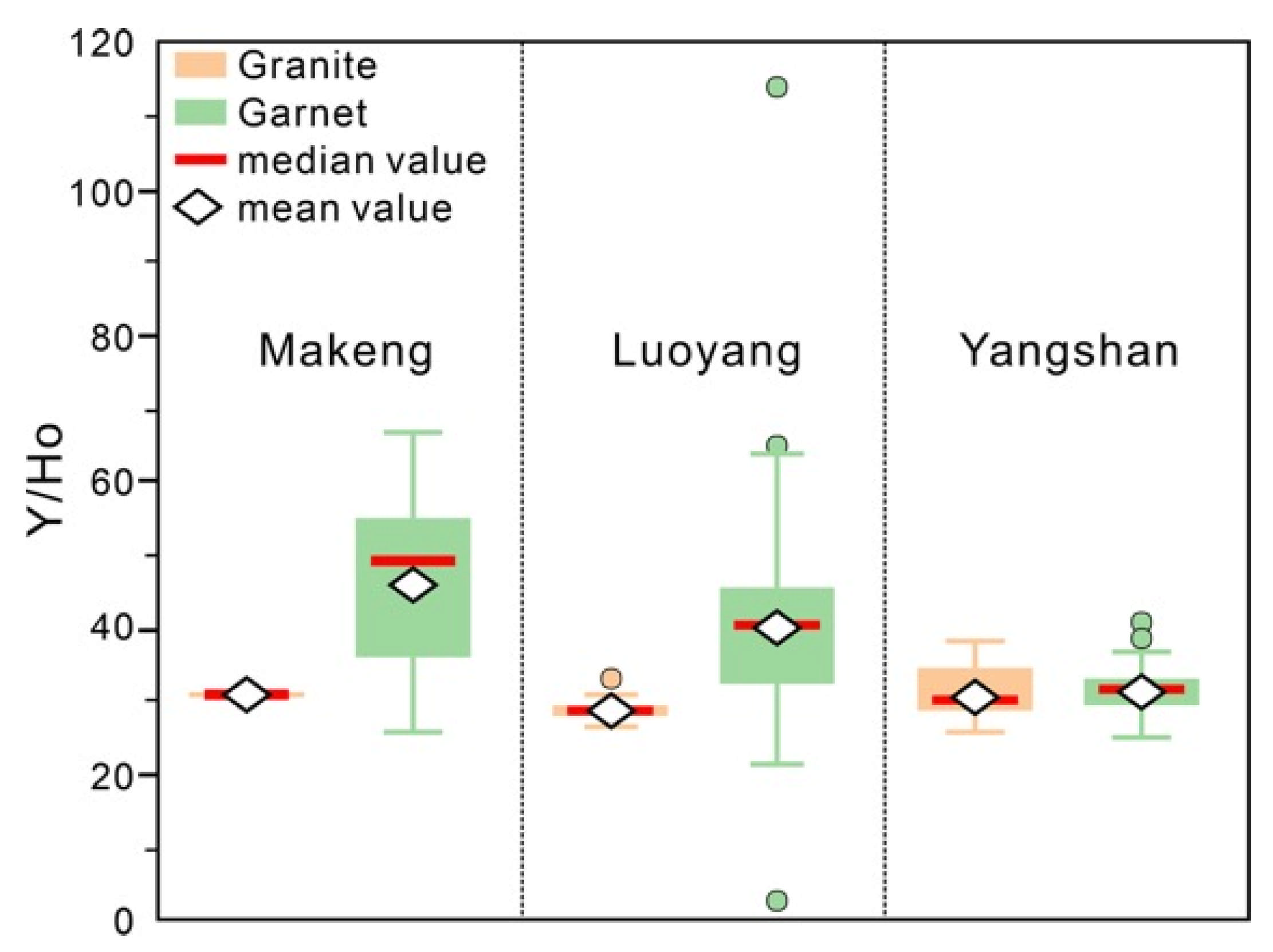
Garnets from the Makeng, Luoyang, and Yangshan Fe skarn deposits have divergent Y/Ho ratios (Makeng: 26–67, mean 47; Luoyang: 2.7–114, mean 40; Yangshan: 25–41, mean 32; Tables S1–S3; Figure 8). Notably, the Y/Ho ratios of Makeng and Luoyang garnets exhibit similarly wide ranges (excluding two outliers in Luoyang at 2.7 and 114; Figure 8), in contrast to the markedly narrower variation observed in Yangshan garnets (25–41, mean 32; Tables S1–S3; Figure 8). However, these Y/Ho ranges differ markedly from those of the proposed ore-forming granite intrusions (Makeng: 26–39, mean 31; Luoyang: 27–33, mean 29; Yangshan: 30.8–31.1, mean 31; [12,14]; Figure 8), implying that the garnet-forming fluids were not solely derived from the granitic parental magma but likely incorporated external fluids such as meteoric water. This interpretation aligns with in situ oxygen isotope studies of garnet, which demonstrate that skarn-forming fluids often include significant proportions of non-magmatic water (e.g., meteoric, lake, or metamorphic fluids), sometimes even dominating the hydrothermal system [53,54,55,56]. Further evidence comes from the correlation between Y and ΣREE in garnet. The three deposits exhibit distinct Y–ΣREE correlations: Makeng garnets show no correlation (R2 = 0.08), indicative of crystallization in a highly open fluid system; Luoyang garnets display a weak positive correlation (R2 = 0.20), consistent with a relatively open system; and Yangshan garnets exhibit a strong positive correlation (R2 = 0.68), suggesting crystallization under relatively closed fluid systems [7,8]. The more open environments at Makeng and Luoyang allowed for ingress of externally derived fluids, whereas the closed system at Yangshan limited fluid mixing. Combined with the notable divergence in Y/Ho ratios between garnet and the granite (Figure 8), these correlations support substantial fluid mixing, possibly including meteoric water, during garnet formation at Makeng and Luoyang [45,53,55]. In contrast, Y/Ho variations at Yangshan were likely controlled predominantly by internal fluid evolution in a nearly closed hydrothermal environment.

6.3. Mineralization Potential

A growing number of studies indicate that garnet crystallized during the early, high-temperature stage of skarn deposits can pre-enrich ore-forming metals such as Cu, Pb-Zn, W, Sn, and Mo [6,57]. The content of these metals has increasingly been recognized as a valuable mineralogical fingerprint that can provide indications for mineralization processes and metallogenic potentials [6,7,8,46,57,58,59,60,61]. Given that Mo, W, Sn, and Pb-Zn mineralization are commonly associated with the Fe(Mo) metallogenic belt in southwestern Fujian, the following discussion will focus specifically on the mineralization potential of these metals in the Makeng, Luoyang, and Yangshan deposits.

6.3.1. Molybdenum

The validity of Mo content in garnet as an indicator for skarn deposit metallogenic potential remains ambiguous. This uncertainty is exemplified by contrasting evidence in the literature. Some studies consider that high Mo concentrations in garnet can signal subsequent Mo mineralization. As demonstrated by the Zhibula Cu skarn deposit, where garnets contain up to 730 ppm Mo, suggesting a genetic link and shared ore-forming fluids with the nearby Qulong porphyry Cu–Mo deposit [58]. Conversely, the reliability of this proxy is challenged by direct evidence from economically Mo-mineralized deposits that contain garnets with remarkably low Mo concentrations, as exemplified by the Shilu Cu–Mo skarn deposit in western Guangdong, where the average garnet Mo content is merely 1.99 ppm [8]. Furthermore, in situ compositional studies of garnet-hosted fluid inclusions argue against systematic Mo pre-enrichment, as they reveal no significant difference in Mo concentrations between mineralized and barren fluid systems [6,57]. Thus, the Mo content in garnet presents inconsistent and complex indicative significance across different types of Mo-rich skarn deposits.
In this study, an intra-regional comparison of the Makeng, Luoyang, and Yangshan Fe skarn deposits revealed a clear correlation: the Makeng deposit, which is only one enriched in Mo with substantial ore reserves (~0.08 Mt; [12]), is also characterized by garnets with significantly higher Mo contents (mean: 77.51 ppm) compared to the Mo-barren Luoyang (mean: 1.5 ppm) and Yangshan (mean: 6.7 ppm) deposits (Figure 5c). This consistent spatial coupling between high garnet Mo content and known Mo mineralization indicates its potential utility as a practical geochemical indicator for Mo exploration in the Fe skarn metallogenic belt of southwestern Fujian, SE China.

6.3.2. Tungsten

The W content in garnet is widely regarded as an effective exploration indicator for tungsten mineralization [6,8,57,58]. Early support comes from the Oslo Rift, Norway, where garnets were found to contain up to 600 ppm W, highlighting their capacity to record W enrichment in skarn systems [38]. Subsequently, numerous studies have reported high W concentrations in garnet from Cu-W-Sn skarns, which consistently correlate with developed W mineralization in these systems [8,58,59,62].
In the Makeng deposit, the significant W enrichment in garnet (up to 1613 ppm; Table S1) is supported by petrographic observation of scheelite-magnetite intergrowth (Figure 3a and Figure 4b). Moreover, the mean W concentrations (mean 321 ppm; Table S1) in Makeng garnet are comparable to those reported from Fe-Cu-W-Sn skarn deposits such as Weondong (mean 218 ppm), Huangshaping (mean 437 ppm), Huanggangliang (mean 346 ppm), and Zhibula (mean 131 ppm) [8,58,59,62,63,64]. This similarity indicates that tungsten could serve as an effective indicator for W exploration in the Makeng Fe skarn deposit. Similarly, the W concentrations in Luoyang garnet (0–1889 ppm, mean: 673 ppm; Table S2) are comparable to that in Makeng (Figure 5a), indicating a potential for W mineralization. In contrast, the exceptionally low W content in Yangshan garnet (mean: 0.02 ppm; Table S3, Figure 5a) highlights the absence of an economic W mineralization prospect.

6.3.3. Tin

Like tungsten, tin is also considered a critical metal capable of pre-concentration prior to mineralization, as evidenced by in situ fluid inclusion studies that revealed marked differences in Sn content between Sn-poor and Sn-rich fluids [6,57]. Consequently, the Sn content in garnet can serve as an effective indicator of Sn mineralization potential. This is well demonstrated by reported garnet compositions from diverse skarn types. For example, Zhao et al. [62] reported distinct high-Sn signatures (mean: 2746 ppm) in garnets associated with W–Sn mineralization at the Huangshaping Cu-W-Sn polymetallic deposit. Liu et al. [45] also measured high Sn contents (53 to 2507 ppm) in garnets from the Haobugao Zn-Fe-Sn skarn deposit. Similarly, Xu et al. [46] and Liu et al. [65] documented significant Sn enrichment (436 to 26,445 ppm) in early stage garnet from the Dulong Sn-Zn deposit, which effectively indicated subsequent large-scale cassiterite precipitation. Li et al. [66] also reported elevated Sn (65 to 6532 ppm) in garnet from the Huanggangliang Fe-Sn skarn deposit.
Tin distribution is characterized by consistently high concentrations in all three deposits, reaching peaks of 2967 ppm (Makeng), 1710 ppm (Luoyang), and 2464 ppm (Yangshan) (Figure 5b; Table S1). The mean Sn contents of these garnets (829 ppm for Makeng, 465 ppm for Luoyang, and 1001 ppm for Yangshan,) are comparable to those in Fe(Cu-Sn-Zn) skarns (e.g., Huangshaping Cu skarns, mean 898 ppm; Huanggangliang Fe-Sn skarns, mean 1817 ppm; Haobugao Zn-Fe-Sn skarns, mean 831 ppm; [45,62,66]) but significantly lower than those in Sn-dominated skarns (e.g., Huangshaping W-Sn skarns, mean 3051 ppm; Dulong Sn-Zn skarns, mean 6620 ppm; Xianghualing Sn skarns, mean 4295 ppm; [46,62,67]). This feature indicates that the Makeng, Luoyang, and Yangshan deposits all experienced significant Sn pre-enrichment and may possess certain potential for Sn mineralization.

6.3.4. Lead-Zinc

Garnets in the Makeng, Luoyang, and Yangshan Fe deposits showed similar Pb and Zn distribution patterns (Figure 5d,e). Specifically, Makeng garnets showed the highest mean Pb and Zn concentrations (130 ppm Pb and 23 ppm Zn). The Pb content decreased to intermediate levels in Luoyang (44 ppm) and was lowest in Yangshan (42 ppm). In contrast, the Zn content was slightly higher in Yangshan (5.6 ppm) than in Luoyang (4.5 ppm) (Table S1; Figure 5d,e). Despite these notable differences, the Pb and Zn abundances in all analyzed samples remained low, a feature also observed in garnets from many skarn deposits that host significant Pb-Zn resources (e.g., mean Zn: 8.6 ppm in Haobugao Zn–Fe–Sn skarn; mean Zn: 5.4 ppm in Niukutou Pb-Zn-(Fe) skarns; [45,68]). This geochemical decoupling arises because Pb and Zn, although commonly enriched in hydrothermal fluids [1,2,6], are not readily incorporated into the garnet lattice. Consequently, we conclude that Pb and Zn contents in garnet cannot be used as a reliable indicator for evaluating Pb-Zn mineralization potential in these deposits.

7. Conclusions

(1) The mineral assemblages (dominantly andradite-diopside) and geochemical characteristics (e.g., U contents and Eu anomalies in garnet) from the Makeng, Luoyang, and Yangshan deposits collectively reveal that they formed in a unified, mildly acidic ore-forming fluid system. However, the fO2 increased significantly from Makeng through Luoyang to Yangshan. This fO2 gradient is considered as the primary controlling factor for the weak Eu anomaly observed in the Yangshan garnets.
(2) Garnet Y/Ho ratios and Y-ΣREE correlations from the three deposits jointly indicate multiple sources for the ore-forming fluids. The Makeng and Luoyang garnets formed in open systems with significant meteoric water mixing, whereas the Yangshan garnet developed in a closed system dominated by internal fluid evolution.
(3) Garnet geochemistry provides a useful guide for mineral exploration in the Makeng-Yangshan sub-belt: the Makeng deposit holds promise for Mo-W-Sn mineralization; the Luoyang deposit for W-Sn; and the Yangshan deposit shows little potential for these metals. In addition, Pb and Zn concentrations in garnet do not provide reliable guidance for mineral exploration.

Supplementary Materials

The following supporting information can be downloaded at: https://www.mdpi.com/article/10.3390/min15121325/s1, Table S1: Trace element concentrations (ppm) for garnet in the Makeng Fe-Mo deposit; Table S2: Trace element concentrations (ppm) for garnet in the Luoyang Fe(Mo) deposit; Table S3: Trace element concentrations (ppm) for garnet in the Yangshan Fe deposit.

Author Contributions

W.F., S.L. and B.X. conceived this contribution and conducted all analytical work. The manuscript was written by W.F., S.L. and B.X., with contributions from J.X. and H.Y. All authors have read and agreed to the published version of the manuscript.

Funding

This research was financially supported by grants from the National Natural Science Foundation of China (No. 42502056), the Open Fund Project of the Key Laboratory of Ionic Rare Earth Resources and Environment, Ministry of Natural Resources (Grant no. 2022IREE101), the Natural Science Foundation of Fujian Province (No. 2024J08144) and the Natural Science Foundation of Fujian Province (No. XRC-24021).

Data Availability Statement

The original contributions presented in this study are included in the article/Supplementary Materials. Further inquiries can be directed to the corresponding authors.

Acknowledgments

We gratefully acknowledge the staff of Makeng Mining Group Co., Ltd. for their hospitality and assistance during fieldwork. We are grateful to Jiahao Zheng for his guidance and assistance in sample collection and manuscript preparation. We also extend our sincere thanks to the four anonymous reviewers and editors for their constructive comments, which have greatly enhanced the quality of this paper.

Conflicts of Interest

The authors declare no conflicts of interest.

References

  1. Meinert, L.D.; Dipple, G.M.; Nicolescu, S. World Skarn Deposits. In 100 Anniversary Volume; Society of Economic Geologists: Littleton, CO, USA, 2005; pp. 299–336. [Google Scholar]
  2. Chang, Z.S.; Shu, Q.H.; Meinert, L.D. Chapter 6 Skarn Deposits of China. In Mineral Deposits of China; Chang, Z., Goldfarb, R.J., Eds.; Society of Economic Geologists: Littleton, CO, USA, 2019; pp. 189–234. [Google Scholar]
  3. Mao, J.; Ouyang, H.; Song, S.; Santosh, M.; Yuan, S.; Zhou, Z.; Zheng, W.; Liu, H.; Liu, P.; Cheng, Y.; et al. Chapter 10 Geology and Metallogeny of Tungsten and Tin Deposits in China. In Mineral Deposits of China; Chang, Z., Goldfarb, R.J., Eds.; Society of Economic Geologists: Littleton, CO, USA, 2019; pp. 411–482. [Google Scholar]
  4. Gaspar, M.; Knaack, C.; Meinert, L.D.; Moretti, R. REE in Skarn Systems: A LA-ICP-MS Study of Garnets from the Crown Jewel Gold Deposit. Geochim. Cosmochim. Acta 2008, 72, 185–205. [Google Scholar] [CrossRef]
  5. Shu, Q.; Chang, Z.; Mavrogenes, J. Fluid Compositions Reveal Fluid Nature, Metal Deposition Mechanisms, and Mineralization Potential: An Example at the Haobugao Zn-Pb Skarn, China. Geology 2021, 49, 473–477. [Google Scholar] [CrossRef]
  6. Shu, Q.; Deng, J. The Composition of Magmatic-Hydrothermal Fluids and Their Related Metal Mineralization. Sci. China Earth Sci. 2025, 68, 208–225. [Google Scholar] [CrossRef]
  7. Xing, B.; Liu, W.; Xie, G.; Xu, J.; Zheng, W.; Chen, L.; Rao, D.; Wang, H. Garnet Geochronology and Mineral Geochemistry of the Veliki Krivelj Porphyry-Skarn Cu Deposit, Eastern Serbia: Implications for Skarn Formation and Hydrothermal Fluid Evolution. Ore Geol. Rev. 2025, 186, 106841. [Google Scholar] [CrossRef]
  8. Zheng, W.; Liu, D.; Wu, X.; Sun, Y.; Xing, B. Geochemical Characteristics of Garnet and Vesuvianite in Shilu Cu-Mo Deposit in Western Guangdong and Their Constraints on the Evolution of Ore-Forming Fluids. J. Jilin Univ. 2025, 55, 1481–1505. [Google Scholar]
  9. Wang, Y.; Duan, D. REE Distribution Character in Skarn Garnet and Its Geological Implication. Acta Sci. Nat. Univ. Pekin. 2021, 57, 446–458. [Google Scholar]
  10. Mao, J.; Cheng, Y.; Chen, M.; Franco, P. Major Types and Time–Space Distribution of Mesozoic Ore Deposits in South China and Their Geodynamic Settings. Miner. Depos. 2013, 48, 267–294. [Google Scholar]
  11. Zheng, J.; Mao, J. Recognition of a ca. 130 Ma Makeng-Yangshan Iron Skarn Belt in the Southeastern China: Evidence from Garnet in Situ U–Pb Geochronology. Min. Depos. 2023, 58, 925–937. [Google Scholar] [CrossRef]
  12. Zhang, C. Geology and Geochemistry of Makeng Fe-Mo Deposit. Fujian. Ph.D. Thesis, China University of Geosciences, Beijing, China, 2012; pp. 1–188. (In Chinese). [Google Scholar]
  13. Zhang, D.; Wu, G.; Di, Y.; Wang, C.; Yao, J.; Zhang, Y.; Lu, L.; Yuan, Y.; Shi, J. Geochronology of Diagenesis and Mineralization of the Luoyang Iron Deposit in Zhangping City, Fujian Province and Its Geological Significanc. Earth Sci. 2012, 37, 1217–1231. [Google Scholar]
  14. Wang, S.; Vatuva, A.; Yi, J.; Zhang, D.; Yuan, Y.; Zhang, Y. Genetic Link between Mesozoic Magmatism and Makeng-Type Iron Polymetallic Deposits in the Central Cathaysia Block, Southeast China. J. Asian Earth Sci. 2024, 260, 105941. [Google Scholar] [CrossRef]
  15. Li, Z.; Zheng, J. Mineralogy, Fluid Evolution, and Ore-Forming Mechanism of the Early Cretaceous Yangshan Iron Skarn Deposit in the Makeng-Yangshan Region, SE China. J. Asian Earth Sci. 2025, 293, 106746. [Google Scholar] [CrossRef]
  16. Zhang, D.; Wu, G.; Di, Y.; Lü, L.; Yao, J. Evolution of tectonic stress field in southwestern Wuyishan Mountain area and relationship with mineralization. Geol. Bull. China 2011, 30, 505–513. [Google Scholar]
  17. Vatuva, A.; He, X.; Zhang, X.; Zhang, D.; Feng, H.; Yuan, Y.; Wang, S.; Yi, J.; Di, Y. Genesis of Makeng-Type Fe-Polymetallic Deposits in SE China: New Constraints by Geochronological and Isotopic Data from the Dapai–Makeng Metallogenic System. Geosci. Front. 2023, 14, 101614. [Google Scholar] [CrossRef]
  18. Charvet, J.; Shu, L.; Shi, Y.; Guo, L.; Faure, M. The Building of South China: Collision of Yangzi and Cathaysia Blocks, Problems and Tentative Answers. J. Southeast Asian Earth Sci. 1996, 13, 223–235. [Google Scholar] [CrossRef]
  19. Zhao, G.; Cawood, P.A. Precambrian Geology of China. Precambrian Res. 2012, 222–223, 13–54. [Google Scholar] [CrossRef]
  20. Xing, B. Genesis of the Zn-Pb Polymetallic Deposits in Central Fujian, SE China: Examples from the Dingjiashan and Fengyan Deposits. Ph.D. Thesis, China University of Geosciences, Beijing, China, 2022; pp. 1–155. (In Chinese). [Google Scholar]
  21. Xing, B.; Mao, J.; Liu, H.; Xiao, X.; Jia, F.; Li, H.; Guo, S.; Li, H.; Huang, W. Porphyry Mo and Distal Zn-Pb Mineral System: An Example of the Fengyan Zn–Pb–Mo Deposit in Central Fujian, SE China. Ore Geol. Rev. 2022, 144, 104821. [Google Scholar] [CrossRef]
  22. Shang, Y.; Xing, B.; Xiao, X.; Li, H.; Zheng, W. Mineralization Process of the Fengyan Zn-Pb Skarn Deposit in the Fujian Province, Southeastern China: Insights from LA-ICP-MS Analysis of Fluid Inclusion. Ore Geol. Rev. 2025, 186, 106944. [Google Scholar] [CrossRef]
  23. Li, X. Cretaceous Magmatism and Lithospheric Extension in Southeast China. J. Asian Earth Sci. 2000, 18, 293–305. [Google Scholar] [CrossRef]
  24. Wang, J.; Li, Z. History of Neoproterozoic Rift Basins in South China: Implications for Rodinia Break-Up. Precambrian Res. 2003, 122, 141–158. [Google Scholar] [CrossRef]
  25. Mao, J.; Liu, P.; Goldfarb, R.J.; Goryachev, N.A.; Pirajno, F.; Zheng, W.; Zhou, M.; Zhao, C.; Xie, G.; Yuan, S.; et al. Cretaceous Large-Scale Metal Accumulation Triggered by Post-Subductional Large-Scale Extension, East Asia. Ore Geol. Rev. 2021, 136, 104270. [Google Scholar] [CrossRef]
  26. Liu, W.; Nigel, J.C.; Cristiana, L.C.; Liu, Y.; Qiu, X.; Chen, Y. Mineralogy of Tin-Sulfides in the Zijinshan Porphyry–Epithermal System, Fujian Province, China. Ore Geol. Rev. 2016, 72, 682–698. [Google Scholar] [CrossRef]
  27. Zhou, X.; Sun, T.; Shen, W.; Shu, L.; Niu, Y. Petrogenesis of Mesozoic Granitoids and Volcanic Rocks in South China: A Response to Tectonic Evolution. Episodes 2006, 29, 26–33. [Google Scholar] [CrossRef]
  28. Chu, Y.; Lin, W.; Faure, M.; Xue, Z.; Ji, W.; Feng, Z. Cretaceous Episodic Extension in the South China Block, East Asia: Evidence From the Yuechengling Massif of Central South China. Tectonics 2019, 38, 3675–3702. [Google Scholar] [CrossRef]
  29. Zhang, Z.; Zhang, C. Skarn mineral characteristics and zonation of the Makeng Fe-Mo deposit in Fujian Province. Acta Petrol. Sin. 2014, 30, 1339–1354. [Google Scholar]
  30. Wang, S.; Zhang, D.; Wu, G.; Vatuva, A.; Di, Y.; Yan, P.; Feng, H.; Ma, S. Late Paleozoic to Mesozoic Extension in Southwestern Fujian Province, South China: Geochemical, Geochronological and Hf Isotopic Constraints from Basic-Intermediate Dykes. Geosci. Front. 2017, 8, 529–540. [Google Scholar] [CrossRef]
  31. Hong, L.P. The Geological Features and Genesis of Yangshan Iron Deposit, Dehua County, Fujian Province. Master’s Thesis, China University of Geosciences, Beijing, China, 2015; pp. 1–75. (In Chinese). [Google Scholar]
  32. Li, Z. Reserve Calculation of Deep Orebody in East Section of Yangshan Mine Area. Met. Mine 2003, 07, 6–8. (In Chinese) [Google Scholar]
  33. Jochum, K.P.; Weis, U.; Stoll, B.; Kuzmin, D.; Yang, Q.; Raczek, I.; Jacob, D.E.; Stracke, A.; Birbaum, K.; Frick, D.A.; et al. Determination of Reference Values for NIST SRM 610–617 Glasses Following ISO Guidelines. Geostand. Geoanal. Res. 2011, 35, 397–429. [Google Scholar] [CrossRef]
  34. Paton, C.; Hellstrom, J.; Paul, B.; Woodhead, J.; Hergt, J. Iolite: Freeware for the Visualisation and Processing of Mass Spectrometric Data. J. Anal. At. Spectrom. 2011, 26, 2508. [Google Scholar] [CrossRef]
  35. Petrus, J.A.; Joseph, A. VizualAge: A Novel Approach to Laser Ablation ICP–MS U–Pb Geochronology Data Reduction. Geostand. Geoanal. Res. 2012, 36, 247–270. [Google Scholar] [CrossRef]
  36. Vermeesch, P. IsoplotR: A Free and Open Toolbox for Geochronology. Geosci. Front. 2018, 9, 1479–1493. [Google Scholar] [CrossRef]
  37. Sun, S.; McDonough, W.F. Chemical and Isotopic Systematics of Oceanic Basalts: Implications for Mantle Composition and Processes. Geol. Soc. Spec. Publ. 1989, 42, 313–345. [Google Scholar] [CrossRef]
  38. Jamtveit, B.; Wogelius, R.A.; Fraser, D.G. Zonation Patterns of Skarn Garnets: Records of Hydrothermal System Evolution. Geology 1993, 21, 113. [Google Scholar] [CrossRef]
  39. Dziggel, A.; Wulff, K.; Kolb, J.; Meyer, F.M.; Lahaye, Y. Significance of Oscillatory and Bell-Shaped Growth Zoning in Hydrothermal Garnet: Evidence from the Navachab Gold Deposit, Namibia. Chem. Geol. 2009, 262, 262–276. [Google Scholar] [CrossRef]
  40. Zhai, D.; Liu, J.; Zhang, H.; Wang, J.; Su, L.; Yang, X.; Wu, S. Origin of Oscillatory Zoned Garnets from the Xieertala Fe–Zn Skarn Deposit, Northern China: In Situ LA–ICP-MS Evidence. Lithos 2014, 190–191, 279–291. [Google Scholar] [CrossRef]
  41. Smith, M.P.; Henderson, P.; Jeffries, T.E.R.; Long, J.; Williams, C.T. The Rare Earth Elements and Uranium in Garnets from the Beinn an Dubhaich Aureole, Skye, Scotland, UK: Constraints on Processes in a Dynamic Hydrothermal System. J. Petrol. 2004, 45, 457–484. [Google Scholar] [CrossRef]
  42. Yang, Y.-L.; Ni, P.; Pan, J.-Y.; Chi, Z.; Ding, J.-Y.; Wang, Q. Episodic Fluid Evolution in the Formation of the Large Scale Luoyang Fe Deposit, Fujian, Eastern China. Ore Geol. Rev. 2020, 120, 103412. [Google Scholar] [CrossRef]
  43. Yang, Y.-L.; Ni, P.; Pan, J.-Y.; Wang, G.-G.; Xu, Y.-F. Constraints on the Mineralization Processes of the Makeng Iron Deposit, Eastern China: Fluid Inclusion, H–O Isotope and Magnetite Trace Element Analysis. Ore Geol. Rev. 2017, 88, 791–808. [Google Scholar] [CrossRef]
  44. Bau, M. Rare-Earth Element Mobility during Hydrothermal and Metamorphic Fluid-Rock Interaction and the Significance of the Oxidation State of Europium. Chem. Geol. 1991, 93, 219–230. [Google Scholar] [CrossRef]
  45. Liu, L.; Zhou, T.; Zhang, D.; Liu, G.; Zhao, Z.; Sun, J.; White, N.C. Major and Trace Elements Analyses of Garnet from the Haobugao Zn-Fe-Sn Polymetallic Deposit, Northeast China: Implications for Skarn Formation and Hydrothermal Fluid Evolution. Ore Geol. Rev. 2021, 138, 104337. [Google Scholar] [CrossRef]
  46. Xu, J.; Cook, N.J.; Ciobanu, C.L.; Li, X.; Kontonikas-Charos, A.; Gilbert, S.; Lv, Y. Indium Distribution in Sphalerite from Sulfide–Oxide–Silicate Skarn Assemblages: A Case Study of the Dulong Zn–Sn–In Deposit, Southwest China. Miner. Depos. 2021, 56, 307–324. [Google Scholar] [CrossRef]
  47. Sverjensky, D.A. Europium Redox Equilibria in Aqueous Solution. Earth Planet. Sci. Lett. 1984, 67, 70–78. [Google Scholar] [CrossRef]
  48. Allen, D.E.; Seyfried, W.E. REE Controls in Ultramafic Hosted MOR Hydrothermal Systems: An Experimental Study at Elevated Temperature and Pressure. Geochim. Cosmochim. Acta 2005, 69, 675–683. [Google Scholar] [CrossRef]
  49. Shannon, R.D. Revised Effective Ionic Radii and Systematic Studies of Interatomic Distances in Halides and Chalcogenides. Acta Cryst. A 1976, 32, 751–767. [Google Scholar] [CrossRef]
  50. Douville, E.; Bienvenu, P.; Charlou, J.L.; Donval, J.P.; Fouquet, Y.; Appriou, P.; Gamo, T. Yttrium and Rare Earth Elements in Fluids from Various Deep-Sea Hydrothermal Systems. Geochim. Cosmochim. Acta 1999, 63, 627–643. [Google Scholar] [CrossRef]
  51. Bau, M.; Dulski, P. Comparing Yttrium and Rare Earths in Hydrothermal Fluids from the Mid-Atlantic Ridge: Implications for Y and REE Behaviour during near-Vent Mixing and for the YrHo Ratio of Proterozoic Seawater. Chem. Geol. 1999, 155, 77–90. [Google Scholar] [CrossRef]
  52. Bau, M.; Dulski, P. Comparative Study of Yttrium and Rare-Earth Element Behaviours in Fluorine-Rich Hydrothermal Fluids. Contrib. Mineral. Petrol. 1995, 119, 213–223. [Google Scholar] [CrossRef]
  53. Crowe, D.E.; Riciputi, L.R.; Bezenek, S.; Ignatiev, A. Oxygen Isotope and Trace Element Zoning in Hydrothermal Garnets: Windows into Large-Scale Fluid-Flow Behavior. Geology 2001, 29, 479. [Google Scholar] [CrossRef]
  54. D’Errico, M.E.; Lackey, J.S.; Surpless, B.E.; Loewy, S.L.; Wooden, J.L.; Barnes, J.D.; Strickland, A.; Valley, J.W. A Detailed Record of Shallow Hydrothermal Fluid Flow in the Sierra Nevada Magmatic Arc from Low-δ18O Skarn Garnets. Geology 2012, 40, 763–766. [Google Scholar] [CrossRef]
  55. Ryan-Davis, J.; Lackey, J.S.; Gevedon, M.; Barnes, J.D.; Lee, C.-T.A.; Kitajima, K.; Valley, J.W. Andradite Skarn Garnet Records of Exceptionally Low δ18O Values within an Early Cretaceous Hydrothermal System, Sierra Nevada, CA. Contrib. Miner. Petrol. 2019, 174, 68. [Google Scholar] [CrossRef]
  56. Ji, Y.; Xie, G.; Romer, R.L.; Li, W.; Zhu, Q.; Fu, B. Scheelite Composition Fingerprints Pulsed Flow of Magmatic Fluid in the Fujiashan W Skarn Deposit, Eastern China. Am. Mineral. 2024, 109, 747–763. [Google Scholar] [CrossRef]
  57. Audétat, A. The Metal Content of Magmatic-Hydrothermal Fluids and Its Relationship to Mineralization Potential. Econ. Geol. 2019, 114, 1033–1056. [Google Scholar] [CrossRef]
  58. Xu, J.; Ciobanu, C.L.; Cook, N.J.; Zheng, Y.; Sun, X.; Wade, B.P. Skarn Formation and Trace Elements in Garnet and Associated Minerals from Zhibula Copper Deposit, Gangdese Belt, Southern Tibet. Lithos 2016, 262, 213–231. [Google Scholar] [CrossRef]
  59. Park, C.; Song, Y.; Kang, I.M.; Shim, J.; Chung, D.; Park, C.S. Metasomatic Changes during Periodic Fluid Flux Recorded in Grandite Garnet from the Weondong W-Skarn Deposit, South Korea. Chem. Geol. 2017, 451, 135–153. [Google Scholar] [CrossRef]
  60. Pan, J.-Y.; Ni, P.; Wang, R.-C. Comparison of Fluid Processes in Coexisting Wolframite and Quartz from a Giant Vein-Type Tungsten Deposit, South China: Insights from Detailed Petrography and LA-ICP-MS Analysis of Fluid Inclusions. Am. Mineral. 2019, 104, 1092–1116. [Google Scholar] [CrossRef]
  61. Chen, Y.-K.; Ni, P.; Pan, J.-Y.; Cui, J.-M. Tracing the Magmatic-Hydrothermal Evolution of the Xianghualing Tin-Polymetallic Skarn Deposit, South China: Insights from LA-ICP-MS Analysis of Fluid Inclusions. Miner. Depos. 2024, 59, 1553–1578. [Google Scholar] [CrossRef]
  62. Zhao, P.; Yuan, S.; Yuan, Y. Geochemical characteristics of garnet in the Huangshaping polymetallic deposit, southern Hunan: Implications for the genesis of Cu and W-Sn mineralization. Acta Petrol. Sin. 2018, 34, 2581–2597. [Google Scholar]
  63. Ding, T.; Ma, D.; Lu, J.; Zhang, R. Garnet and Scheelite as Indicators of Multi-Stage Tungsten Mineralization in the Huangshaping Deposit, Southern Hunan Province, China. Ore Geol. Rev. 2018, 94, 193–211. [Google Scholar] [CrossRef]
  64. Zhu, D.-P.; Li, H.; Algeo, T.J.; Jiang, W.-C.; Wang, C. The Prograde-to-Retrograde Evolution of the Huangshaping Skarn Deposit (Nanling Range, South China). Miner. Depos. 2021, 56, 1087–1110. [Google Scholar] [CrossRef]
  65. Liu, S.; Ye, L.; Liu, Y.; Long, H.; Wei, C.; Xiang, Z. Growth history of garnet from the Dulong Sn-Zn-In polymetallic deposit: Geochemical and U–Pb age constraints and their metallogenic significance. J. Geochem. Explor. 2025, 271, 107699. [Google Scholar] [CrossRef]
  66. Li, Y.; Liu, Z.; Shao, Y.; Liu, L.; Chen, K.; Zhao, H.; You, S.; He, M. Garnet Geochronology, Major and Trace Element Geochemistry of the Huanggangliang Fe-Sn Polymetallic Deposit, NE China. Ore Geol. Rev. 2024, 168, 106048. [Google Scholar] [CrossRef]
  67. Yu, F.; Shu, Q.; Niu, X.; Xing, K.; Li, L.; Lentz, D.R.; Zeng, Q.; Yang, W. Composition of Garnet from the Xianghualing Skarn Sn Deposit, South China: Its Petrogenetic Significance and Exploration Potential. Minerals 2020, 10, 456. [Google Scholar] [CrossRef]
  68. Su, H.-M.; Che, Y.-Y.; Liu, T.; Li, H.; Liu, L.; Jin, T.; He, S.-Y. Multiple Generations of Garnet and Their Genetic Significance in the Niukutou Cobalt-Rich Pb-Zn-(Fe) Skarn Deposit, East Kunlun Orogenic Belt, Western China. Ore Geol. Rev. 2024, 174, 106308. [Google Scholar] [CrossRef]
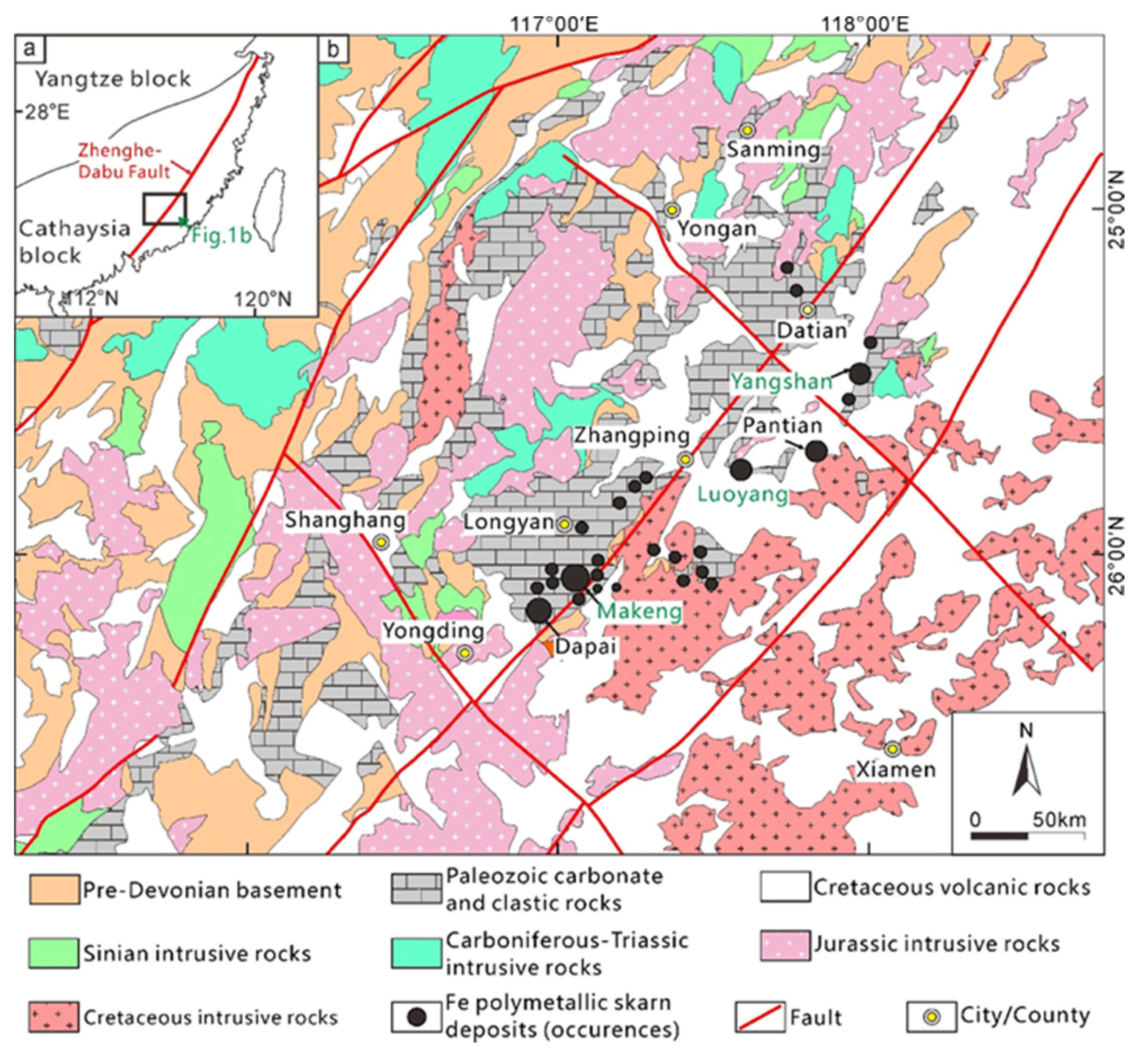
Figure 1. (a) A simplified map showing the location of the study area in the South China block. (b) Geological map of the Southwestern Fujian Region showing the distribution of Fe polymetallic skarn deposits (modified after [16,17]).
Minerals 15 01325 g001
Figure 2. (a): Simplified geological map of the Makeng Fe-Mo skarn deposit. (b): A representative geological cross-section of the Makeng Fe-Mo skarn deposit. (c): Simplified geological map of the Luoyang Fe skarn deposit. (d): A representative geological cross-section of the Luoyang Fe skarn deposit. (e): Simplified geological map of the Yangshan Fe skarn deposit. (f): A representative geological cross-section of the Yangshan Fe skarn deposit (modified after [11]).
Minerals 15 01325 g002
Figure 3. Representative hand specimen photos in the Makeng, Luoyang, and Yangshan Fe skarn deposits. (a): Disseminated scheelite and molybdenite mineralization in massive Fe ores at Makeng; (b): An actinolite-molybdenite assemblage in massive Fe ores at Makeng; (c,d): Massive and disseminated Fe ores at Luoyang, showing a close association between magnetite and garnet. (e,f): A close magnetite-garnet association in disseminated Fe ores at Yangshan. Abbreviations: Grt—Garnet; Act—Actinolite; Mt—Magnetite; Sch—Scheelite; Mot—Molybdenite; Py—Pyrite.
Minerals 15 01325 g003
Figure 4. Representative photomicrographs of garnet from the Makeng (a,b), Luoyang (c,d), and Yangshan (e,f) iron skarn deposits. (a,df): Plane-polarized transmitted light images; b, c-reflected images; a-Magnetite-associated garnet at Makeng; (b): (Magnetite-molybdenite-scheelite)-associated garnet coexisting with pyroxene at Makeng; (c): Magnetite-associated garnet at Luoyang; (d): Magnetite and actinolite intergrown with garnet at Luoyang; (e): Magnetite-associated fine-grained garnet aggregates cut by calcite veinlet at Yangshan; (f): Magnetite-associated garnet at Yangshan; Abbreviations: Grt—Garnet; Px—Pyroxene; Cal—Calcite; Act—Actinolite; Mt—Magnetite; Sch—Scheelite; Mol—Molybdenite.
Minerals 15 01325 g004
Figure 5. Box-whisker plots of trace elements in garnet from the Makeng (orange), Luoyang (green), and Yangshan (purple) Fe skarn deposits. In these box-whisker plots, the top and bottom of boxes represent, respectively the 25th to 75th percentile of the data, i.e., the interquartile range (IQR). The bold horizontal line in a box represents the median. The horizontal lines at the end of each whisker represent the ends of the 1.5 IQR range beyond the IQR. The diamonds represent the means of the data. Circles beyond the whiskers are outliers that exceed the IQR. (a) W; (b) Sn; (c) Mo; (d) Pb; (e) Zn; (f) ∑REE; (g) (La/Yb)N ratio; (h) δEu; (i) Ti; (j) V; (k) Sr; (l) Zr; (m) Nb; (n) Hf; (o) Ta; (p) U concentrations.
Minerals 15 01325 g005
Figure 6. Chondrite normalized REE fractionation patterns for garnets from Makeng (a,b; red), Luoyang (c,d; blue), and Yangshan (e,f; orange) Fe skarn deposits (normalizing values from [37]).
Minerals 15 01325 g006
Figure 7. Major elements in garnets from Makeng (red), Luoyang (blue), and Yangshan (orange) Fe skarn deposits. The EPMA data of Makeng and Luoyang garnet are from Zheng and Mao [11], and those of Yangshan garnet are from Zheng and Mao [11] and Li and Zheng [15].
Minerals 15 01325 g007
Figure 8. Box-whisker plots of Y/Ho ratios in granites and garnets from the Makeng, Luoyang, and Yangshan Fe skarn deposits. Data for the Makeng, Luoyang, and Yangshan granites are from [12,14]. In these box-whisker plots, the top and bottom of boxes represent, respectively the 25th to 75th percentile of the data, i.e., the interquartile range (IQR). The bold horizontal line in a box represents the median. The horizontal lines at the end of each whisker represent the ends of the 1.5 IQR range beyond the IQR. The diamonds represent the means of the data. Circles beyond the whiskers are outliers that exceed the IQR.
Minerals 15 01325 g008
Disclaimer/Publisher’s Note: The statements, opinions and data contained in all publications are solely those of the individual author(s) and contributor(s) and not of MDPI and/or the editor(s). MDPI and/or the editor(s) disclaim responsibility for any injury to people or property resulting from any ideas, methods, instructions or products referred to in the content.