Article

Mineralogy and Geochemistry Characteristics of Nephrite from Jingbaoer Grassland Jade Mine Site in Mazongshan Town, Gansu Province, China: Implications for the Provenance of Excavated Jade Artifacts

1
Gemological Institute, China University of Geosciences, Wuhan 430074, China
2
Center for Jewelry Heritage and Innovation, Hubei Key Research Base of Humanities and Social Sciences, Wuhan 430074, China
3
College of Humanity, Henan University of Science and Technology, Luoyang 471023, China
*
Author to whom correspondence should be addressed.
Minerals 2025, 15(11), 1186; https://doi.org/10.3390/min15111186
Submission received: 25 September 2025 / Revised: 3 November 2025 / Accepted: 8 November 2025 / Published: 11 November 2025
(This article belongs to the Special Issue Formation Study of Gem Deposits)

Abstract

The Jingbaoer Grassland Jade Mine situated approximately 20 km northwest of Mazongshan Town in Gansu Province, China, represents an important source of nephrite dating back to the pre-Qin period. In this study, 58 representative nephrite samples were analyzed to investigate their mineralogical and geochemical characteristics using polarized light microscopy, scanning electron microscopy (SEM), electron probe microanalysis (EPMA), and laser ablation inductively coupled plasma mass spectrometry (LA-ICP-MS). The mine is situated near the contact zone between the Silurian Gongpoquan Group and Devonian granite, with surrounding rocks primarily consisting of Precambrian dolomitic marble. The nephrite displays diverse colors—white, bluish-white, sugar-white, and cyan—with darker tones and abundant manganese-stained dendritic and flocculent inclusions. It shows a relative density of 2.82–2.99, a refractive index of 1.60–1.62, and a vitreous to greasy luster. Texturally, the jade is predominantly composed of micro-fibrous interwoven tremolite, occasionally exhibiting oriented recrystallization textures. Minor minerals include diopside, apatite, titanite, chlorite, epidote, allanite, rutile, and graphite. Chemically, the samples are rich in SiO2, MgO, and CaO, with trace amounts of FeO, MnO, Al2O3, and Na2O. Notably, Sr and Sm are enriched, Nb is slightly depleted, and Eu shows a distinct negative anomaly. The average total rare earth content is 4.25 µg/g. The study suggests that the deposits in the research area are typical of the contact-metasomatic type, formed through multi-stage hydrothermal metasomatism between acidic granitic intrusions and dolomitic marble, creating favorable conditions for the formation of high-quality tremolite jade. Comparative analysis with jade artifacts excavated from the Tomb of Marquis Yi of Zeng suggests a possible provenance link to the Jingbaoer deposit, providing valuable evidence for the historical mining and distribution of nephrite during the Warring States period.

1. Introduction

Jade occupies a unique position in Chinese culture as both a symbolic and material representation of ancient civilization. Unlike in other cultures, jade in China serves not only as a historical testament to the spiritual beliefs of pre-literate societies but also as tangible evidence of interaction and exchange between different cultural regions. Since the late Neolithic period, jade artifacts have played a pivotal role as highly valued objects, significantly influencing the development of China’s ritual and musical systems and the broader trajectory of early civilization. Within the field of archaeology, sustained attention has been devoted to the exploitation and distribution of ancient Chinese jade resources, with provenance studies remaining one of the most challenging and central areas of jade research. In recent years, notable progress has been made in the study of modern nephrite sources in China. The application of large-scale, advanced non-destructive analytical techniques has enabled the establishment of a nephrite provenance database, laying a solid foundation for the scientific tracing of excavated jade artifacts.
Nephrite, a magnesium–iron–calcium amphibole aggregate, is primarily composed of tremolite (Ca2Mg5Si8O22(OH)2) or actinolite (Ca2(Mg,Fe)5Si8O22(OH)2), characterized by a fine fibrous interwoven structure. Over decades of research, both domestic and international scholars have achieved substantial progress in understanding nephrite. Major deposits are found in China, South Korea, Russia, Canada, New Zealand, and so on [1,2,3,4,5]. Based on host rock types and geological occurrences, nephrite is broadly classified into two genetic types: carbonate-related and serpentinite-related [6,7,8,9]. Nephrite of the serpentinite type is typically composed of green jade [10,11], whereas nephrite from sources such as Xinjiang, Golmud (Qinghai), Luodian (Guizhou), Dahua (Guangxi), Liyang (Jiangsu), Gansu, Xiuyan (Liaoning), Longxi (Sichuan), and Chuncheon (South Korea) belongs to the carbonate rock type [12]. These types can be differentiated based on macroscopic features, inclusions, microstructure, crystallinity, and geochemical characteristics [9,13,14,15,16,17]. These two types of nephrite are primarily formed through metasomatic reactions at the contact zones between Mg-rich rocks (such as serpentinite or dolomitic marble) and silica-saturated rocks, including granitic intrusions, altered plagiogranite veins, and, in some cases, metamorphosed sedimentary rocks [5,7,18,19]. Understanding the genetic types of nephrite is of great significance for predicting the formation environments and potential distribution zones of jade deposits. Moreover, it serves as an important basis for identifying high-value products in modern economic activities and for tracing the provenance of raw materials in studies of ancient civilizations.
The northwestern region of Gansu has emerged in recent years as one of the ancient jade material sources receiving increasing scholarly attention [20,21]. The Jingbaoer Grassland nephrite deposit, in particular, is notable for its preserved traces of prehistoric or historical mining activity. Despite this, the deposit’s mineralogical, geochemical, and Raman spectroscopic properties remain largely unexamined, limiting its correlation with unearthed jade artifacts.
This paper conducts a comprehensive analysis of jade samples from the Jingbaoer Grassland using scanning electron microscopy (SEM), electron probe microanalysis (EPMA), and laser ablation inductively coupled plasma mass spectrometry (LA-ICP-MS). By constructing a parameter system for provenance determination, this research offers a comparative framework for identifying the geological sources of excavated nephrite artifacts across China. The findings contribute to a deeper understanding of the geology and formation of the Mazongshan jade deposit and provide valuable geochemical evidence for archaeological provenance studies. Ultimately, this work promotes interdisciplinary collaboration between geology and cultural heritage preservation.

2. Geological Setting

Located approximately 20 km northwest of Mazongshan Town, the Jingbaoer Grassland Jade Mine lies at a key node within the Hexi Corridor. This corridor facilitated the transport of high-quality nephrite from northwestern China to the eastern regions. Since the mine’s initial discovery in 2006, the Gansu Provincial Institute of Cultural Relics and Archaeology has conducted several archaeological surveys and excavations between 2006 and 2016. These efforts uncovered an early jade mining complex comprising defensive structures, mining zones, and material processing workshops. Systematic dating of unearthed artifacts suggests that the site was active from the Warring States period to the Han Dynasty [20,22].
As a vital segment of the “West-to-East Jade Transmission Route,” the Hexi Corridor is rich in nephrite resources and played a critical role in the formation and expansion of the so-called “Jade Road” [23]. The geographical location of the Jingbaoer site is thus uniquely situated for jade trading. Its discovery and subsequent research offer direct evidence for understanding the scale and methods of ancient jade mining, the sources and distribution of jade materials, and the broader development of jade trade networks in ancient China. These findings are of considerable academic value.
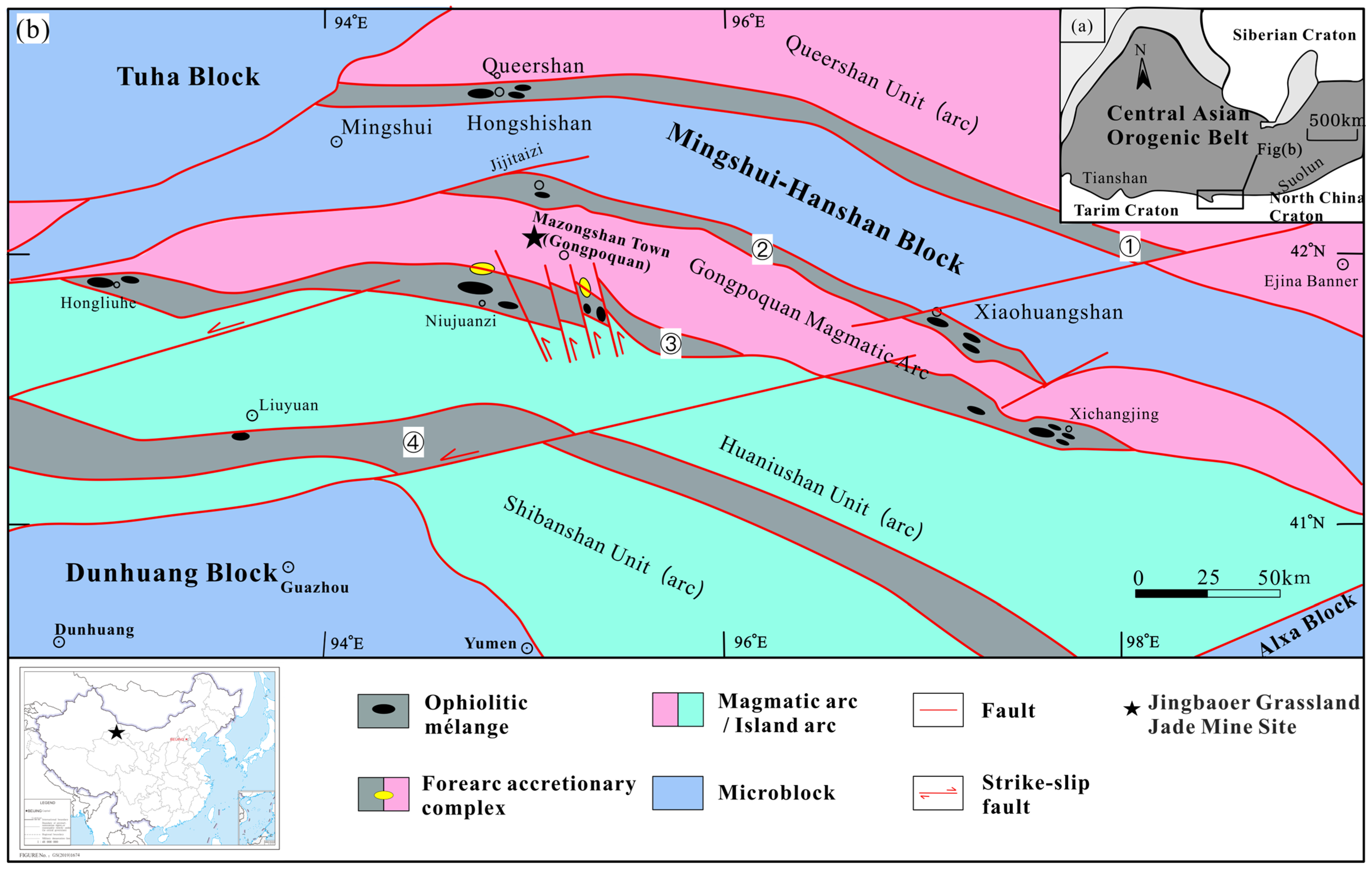
Geologically, the mine is located within the Beishan orogenic belt, which lies in the central segment of the southern margin of the Central Asian Orogenic Belt—an important tectonic junction connecting east–west structural units (Figure 1a). The region comprises various tectonic assemblages, including serpentinite mélange belts, island arcs, microcontinental blocks, and continental margin sediments, reflecting a complex geological evolution. The mine is specifically situated within the Gongpoquan magmatic arc unit, which consists mainly of volcanic, metamorphic, and clastic sedimentary rocks dating to the Middle–Late Ordovician and Silurian periods. The Ordovician strata are characterized by intermediate-basic volcanic rocks, turbidites, and siliceous rocks, while the Silurian layers include interbedded basic volcanic rocks, sandstone, marble, and siliceous deposits. Metamorphic rock dating indicates the presence of a Precambrian basement within these strata (Figure 1b) [24,25,26].
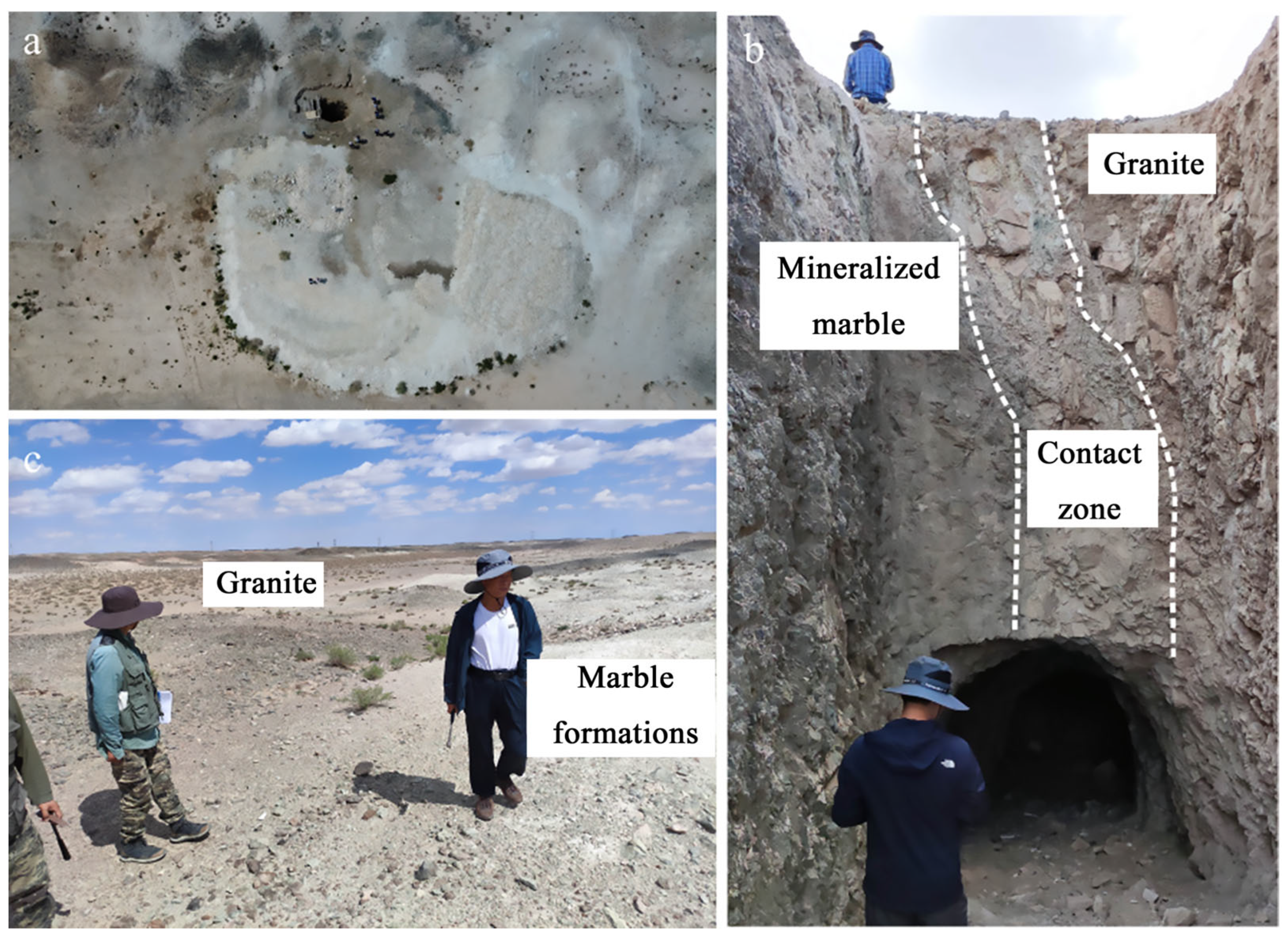
The magmatic zone associated with the deposit belongs to the Ejina Banner–Beishan tectono-magmatic belt, active during the Late Silurian to Early Devonian period. The region has experienced frequent magmatic activity, primarily yielding Early Devonian intermediate to acidic intrusions. The igneous rocks at the Jingbaoer site are mainly composed of syenogranite and granodiorite, intruding into the Silurian Gongpoquan Group. The surrounding rocks relevant to mineralization are chiefly Precambrian magnesian marble and Early Paleozoic granite [30,31]. The tremolite jade veins are distributed along the NW–SE trend within the Gobi grassland. The jade-bearing veins are approximately 0.5–1 m thick and are controlled by NE–SW-trending faults. The mining area exhibits intense structural deformation and severe weathering and erosion, with extensive exposures of acidic magmatic rocks. The wall rocks within the mineralized zone show distinct Mg-rich skarn alteration characteristics. Alteration phenomena such as diopsidization, serpentinization, and tremolitization are commonly observed within the contact zones. The tremolite jade orebodies occur in vein-like or bedded forms (Figure 2).

3. Materials and Methods

3.1. Materials

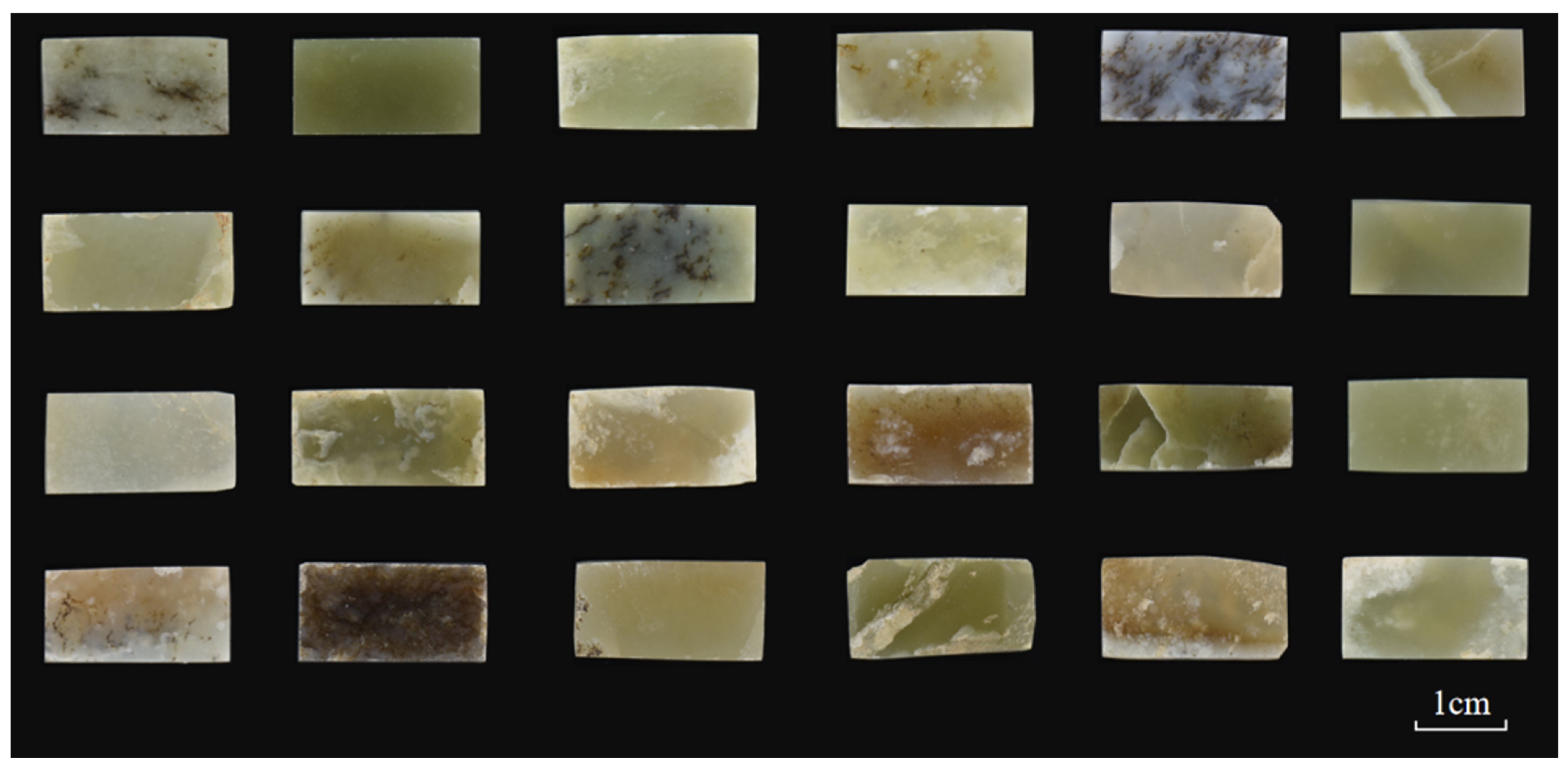
All research samples used in this study were collected from the Jingbaoer Grassland Jade Mine Site in Mazongshan Town, Subei County, Gansu Province. A total of 80 raw stone samples were obtained, all identified as nephrite, exhibiting dense textures and varying sizes. From these, 58 representative specimens were selected for experimental analysis. To ensure consistency in subsequent analysis, the selected samples were processed into standardized dimensions of 2 × 1 × 0.5 cm. Representative samples are shown in Figure 3. Observations and measurements were conducted to assess the basic gemological properties of the nephrite from Jingbaoer Grassland, including color, transparency, luster, refractive index, relative density, luminescence, and inclusions.

3.2. Methods

Polarizing microscope observations were conducted at the Laboratory of the Gemological Institute, China University of Geosciences (Wuhan). Ten probe thin sections, each approximately 30 μm thick, were examined and photographed using a Zeiss Axio Imager (Carl Zeiss AG, Oberkochen, Germany) polarizing microscope.
The micro-morphological features of the samples were observed using a scanning electron microscope (SEM) at the Laboratory of the Gemmological Institute, China University of Geosciences (Wuhan). A Thermo Fisher Apreo 2S SEM (Thermo Fisher Scientific, Waltham, MA, USA) was used under imaging conditions with an accelerating voltage of 2.0 kV and a beam current of 0.1 nA.
Chemical compositions of nephrite and backscattered electron (BSE) images were acquired at the Sample Solution Analytical Technology Co., Ltd. in Wuhan, China, using a JXA-8230 Electron Microprobe Analyzer (EMPA) (JEOL Ltd., Tokyo, Japan). A total of 35 analytical points were measured on seven mineral thin sections. The selection of analytical points was based on petrographic observations under the microscope, targeting homogeneous areas free of weathering, inclusions, and cracks. For each mineral phase, 3–7 EPMA point analyses were conducted on different grains within the same thin section to ensure statistical reliability. Analysis conditions included 15 kV acceleration voltage, 20 nA beam current, and 1 µm spot size. Matrix corrections were carried out using the ZAF correction program supplied by the EMPA manufacturer. The EMPA standards included: andradite for Si and Ca, rutile for Ti, corundum for Al, hematite for Fe, eskolaite for Cr, rhodonite for Mn, bunsenite for Ni, periclase for Mg, albite for Na, K-feldspar for K and barite for Ba.
The laser ablation inductively coupled plasma mass spectrometry (LA-ICP-MS) analyses were performed at Sample Solution Analytical Technology Co., Ltd., Wuhan, China. The Agilent 7700e (Agilent Technologies Inc., Santa Clara, CA, USA) laser ablation inductively coupled plasma mass spectrometer was used to analyze the chemical element content of the main and trace elements in the sample. In situ analysis was conducted on 58 samples, with analysis points selected based on petrographic identification of the tremolite mineral phase to ensure representativeness. Analytical conditions: The laser energy was 80 mJ, the energy density was 5.5 J/cm2, the laser ablation beam spot diameter was 44 μm, the repetition rate was 5 Hz, and the number of laser ablation pulses was 250. Each analysis incorporated approximately 20 s background signals (gas blank) followed by a 50 s ablation time of data acquisition and a 20 s delay for washout from the sample. Synthetic glass standards NIST 610, BCR-2G, BHVO-2G, and BIR-1G (USGS series) were used as external standards during the analyses. Afterward, the data were processed offline using ICPMSDataCal version 10.7, with 29Si selected as the internal normalization element [32].

4. Results

4.1. Gemological

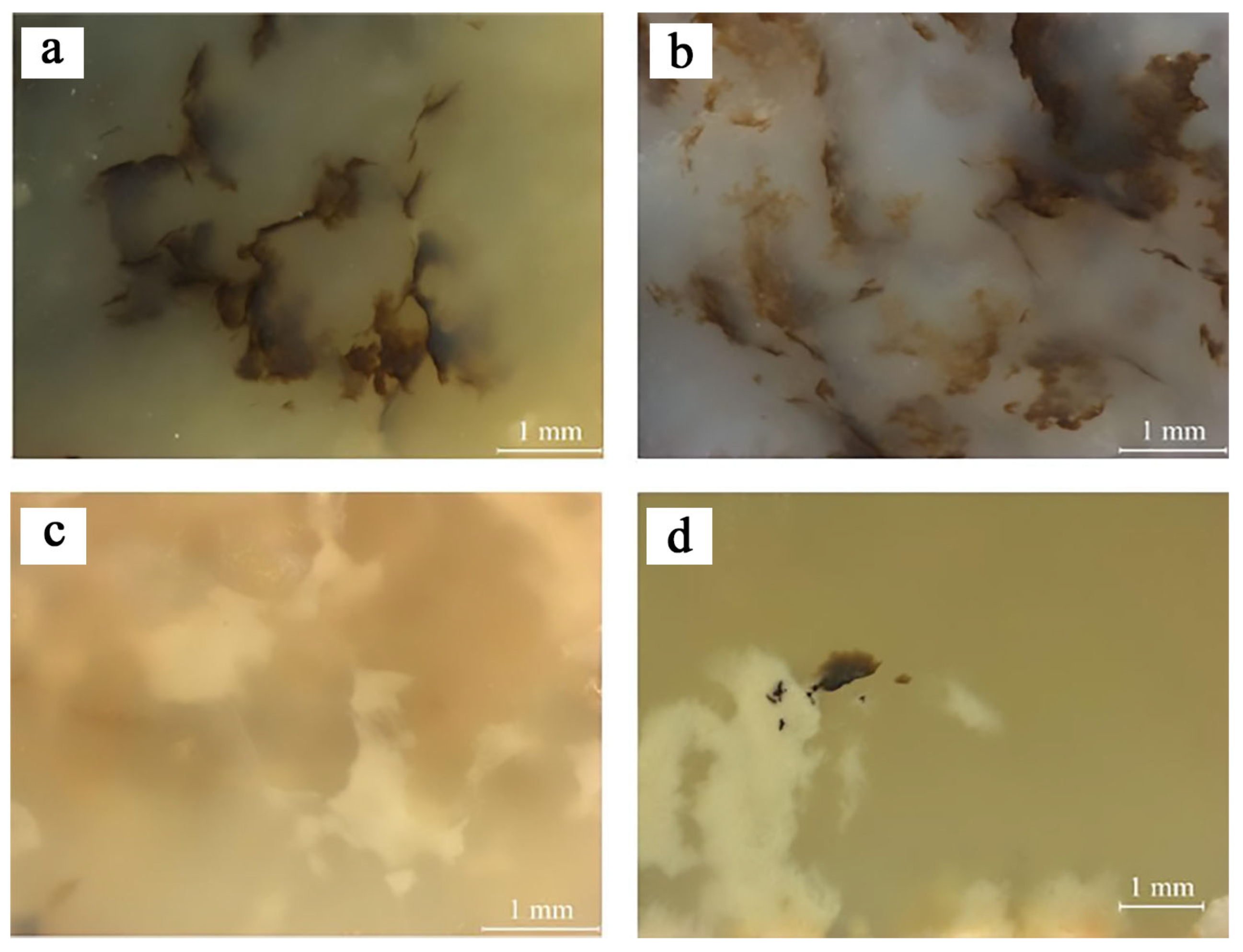
The nephrite from the Jingbaoer Grassland exhibits a wide range of colors, from white and bluish-white to sugar-white and cyan, often displaying darker tones. Observing one by one under a gemstone microscope, most of the samples contain obvious inclusions, mainly manganese-rich dendritic inclusions (Figure 4a,b), as well as white cloudy inclusions (Figure 4c,d). The relative density of nephrite in Jingbaoer Grassland measured by static water weighing is 2.82–2.99, with an average density of 2.92. The samples exhibit a vitreous to greasy luster, with transparency ranging from slightly translucent to translucent, with most samples being translucent. Refractive index measurements were conducted using a refractometer, and the results show that the refractive index of nephrite from Jingbaoer Grassland (measured at specific points) ranges from 1.60 to 1.62, with an average value of 1.61.

4.2. Micromorphology

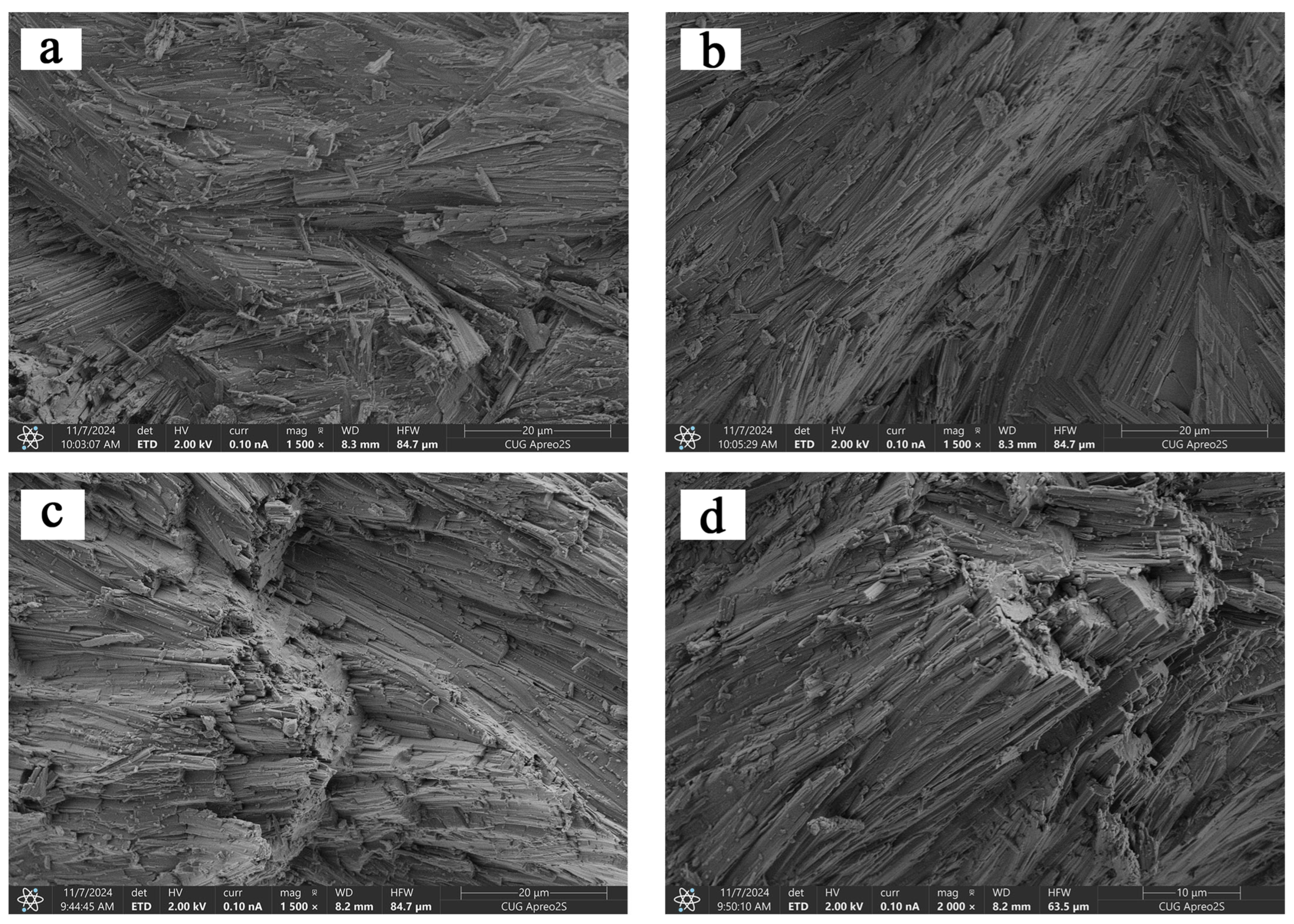
To investigate the micromorphological features of nephrite from the Jingbaoer Grassland, five representative samples—including green-white jade, green jade, and “sugar jade”—were selected for analysis. Fresh fracture surfaces were obtained by gently striking the samples. Scanning electron microscopy revealed that the nephrite exhibits a micro-fibrous interlocking texture, with some areas showing a more orderly, oriented micro-fibrous granoblastic structure. The fibrous morphology appears relatively regular and well-defined.

4.2.1. Micro-Fibrous Interwoven Structure

Samples JBE23004 and JBE23038 are both composed of light greenish-white jade, featuring a fine and uniform texture with high transparency. The tremolite crystals are interwoven in the form of slender fibers (Figure 5a,b). The crystals are approximately 20 μm in length and 0.5–1 μm in width. The particles are tightly packed and exhibit localized directional alignment.

4.2.2. Micro-Fibrous Recrystallized Structure

Sample JBE23054 is light greenish-white jade with high transparency. The slender fibrous tremolite crystals are approximately 30 μm in length and 1–2 μm in width, with relatively large particle sizes. These crystals are arranged parallel to each other in a specific direction and aggregated into bundles, exhibiting clear directional alignment (Figure 5c). The fracture surface of the tremolite crystals is uneven, and the crystals are densely packed (Figure 5d).

4.3. Mineral Composition

For the chemical composition of the nephrite from Jingbaoer Grassland, 35 probe points were analyzed across seven nephrite samples. The results indicate that tremolite is the major mineral component, while minor minerals include diopside, apatite, titanite, chlorite, epidote, allanite, rutile, and graphite. By combining backscattered electron images with polarizing microscope observations and electron probe composition data, the texture between different mineral phases in the Jingbaoer Grassland nephrite samples were examined.

4.3.1. Tremolite

The chemical composition of tremolite shows SiO2 contents ranging from 58.84 wt% to 61.64 wt%, with an average of 60.18 wt%. MgO content ranges from 23.05 wt% to 24.54 wt%, averaging 23.95 wt%, while CaO ranges from 12.22 wt% to 13.03 wt%, with an average of 12.68 wt%. The SiO2 content is slightly higher than the theoretical value, while the MgO and CaO contents are lower than expected. This discrepancy may be related to the presence of 2% to 3% water in the pyroxene group minerals, which could potentially lead to lower concentrations of MgO and CaO due to the incorporation of water or hydroxyl groups into the mineral structure.
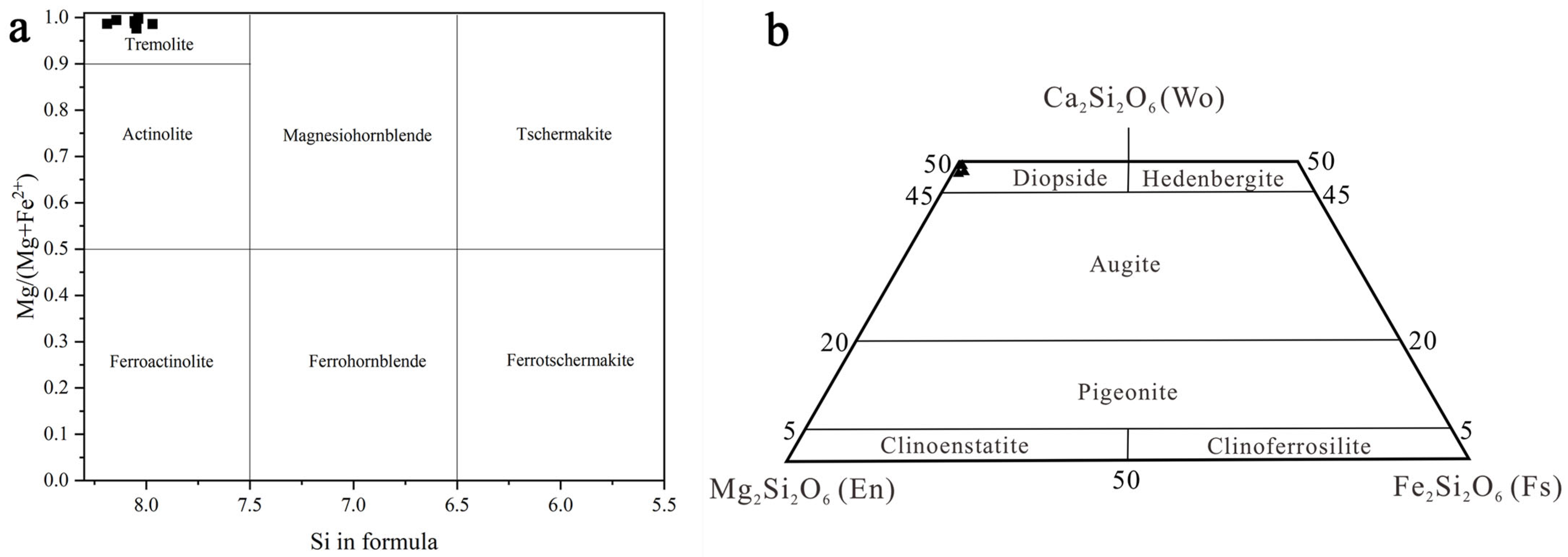
The analytical results were recalculated using the anion method based on O2− = 23, yielding the cation coefficients (Table 1). Since the electron microprobe cannot distinguish between different valence states of the same element, and because the chemical composition and site occupancy of elements in natural tremolite often deviate from the ideal stoichiometric formula, the estimated results may carry some uncertainties. Therefore, in this study, all Fe was assumed to occur as Fe2+ in the cation site calculations. Based on these results, the Mg/(Mg + Fe2+) ratios were plotted on the Si–Mg/(Mg + Fe2+) classification diagram for the amphibole group (Figure 6) [33]. All data points fall within the tremolite–actinolite compositional field, with Mg/(Mg + Fe2+) values exceeding 0.99, indicating that the samples are classified as tremolite.
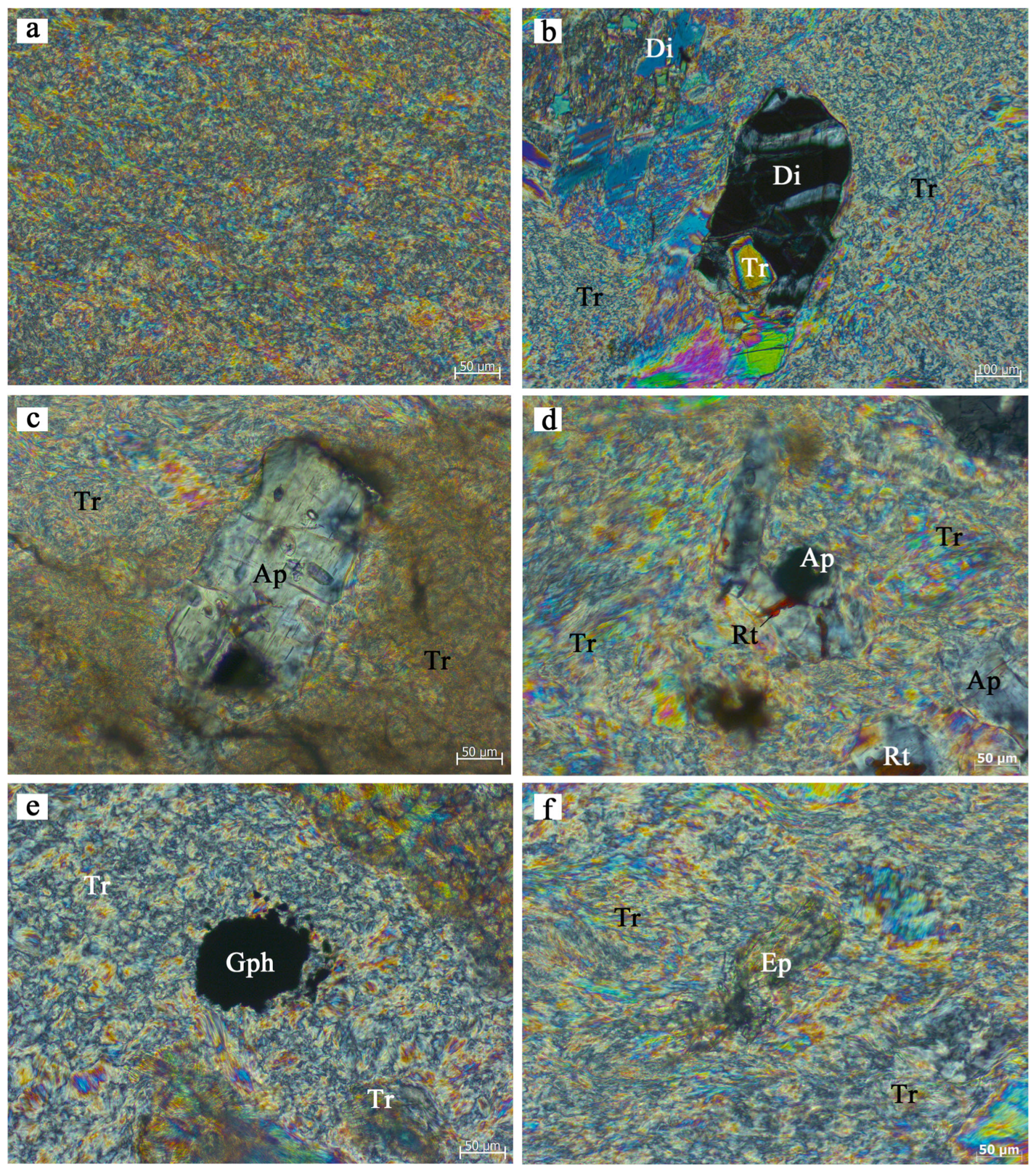
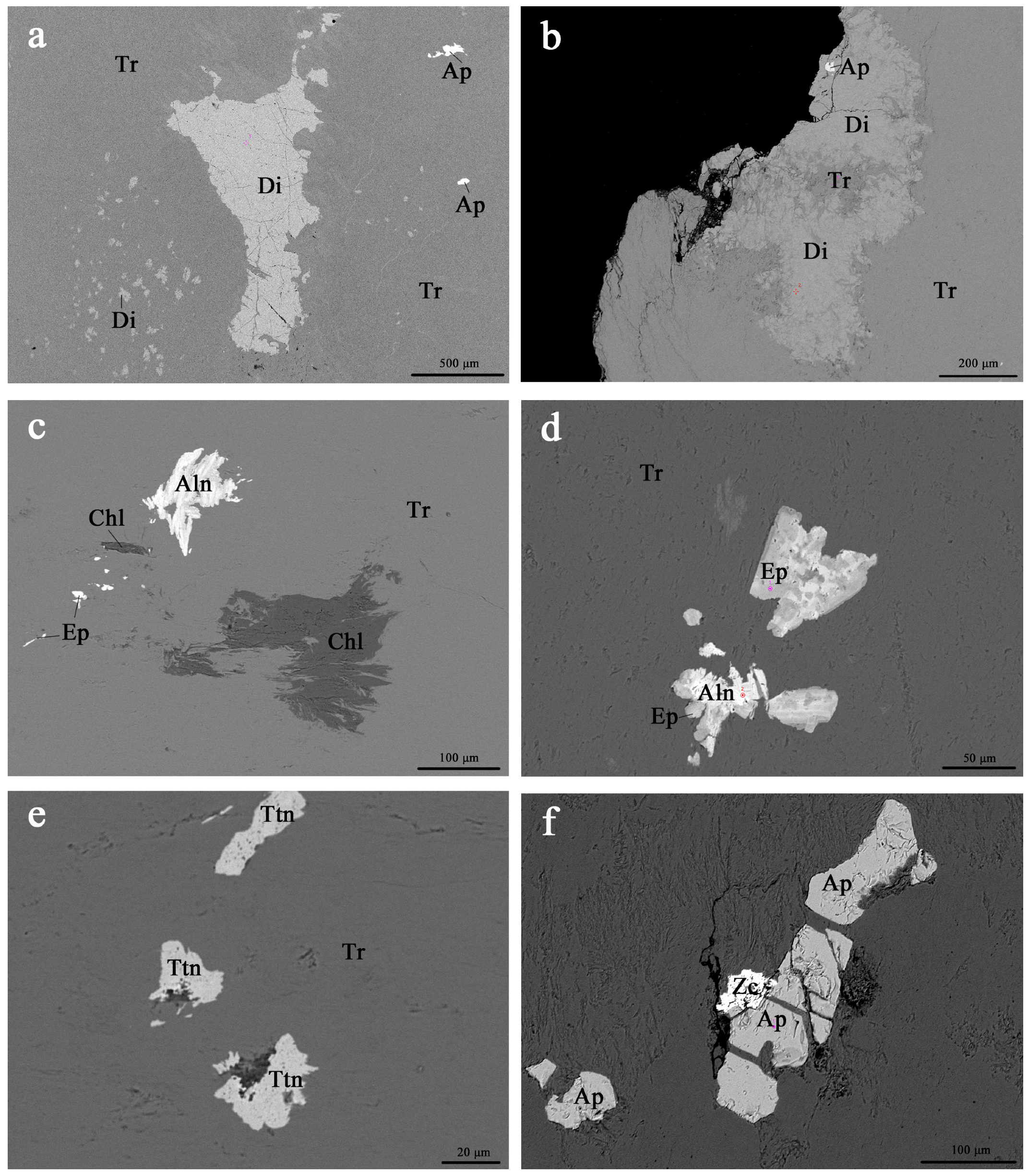
The matrix of the nephrite is mainly composed of tremolite, with both tremolite and apatite distributed throughout the tremolite-rich groundmass. The crystal morphology of both minerals is generally incomplete; in some areas, tremolite crystals are indistinct or entirely replaced by newly formed tremolite. The apatite crystals also exhibit poorly defined shapes (Figure 7a,b). As shown in Figure 7b, the relative timing of mineralization between tremolite and diopside is clearly observable. Diopside appears to have been corroded externally by tremolite, leading to partial dissolution and replacement along the crystal boundaries. The peripheral outlines of diopside remain only as partially replaced remnants, indicating that diopside mineralization predates that of tremolite.

4.3.2. Diopside

The SiO2 content of diopside ranges from 53.52 wt% to 56.35 wt%, with an average of 55.23 wt%. MgO content varies between 17.48 wt% and 18.70 wt%, averaging 18.10 wt%, while CaO content ranges from 24.38 wt% to 25.53 wt%, with an average of 25.21 wt% (Table 2). In the Ca–Mg–Fe pyroxene quadrilateral (Figure 6b), all analyzed samples plot within the diopside compositional field. The end-member components were recalculated on the basis of 100 mol% (Wo + En + Fs) prior to plotting [34]. The samples are characterized by high Ca and Mg contents, with relatively low Fe contents, indicating a compositional dominance of the Wo (Ca2Si2O6) and En (Mg2Si2O6) components.

4.3.3. Apatite

The CaO content in apatite ranges from 56.90 wt% to 57.46 wt%, with an average of 57.13 wt%. The P2O5 content varies from 40.00 wt% to 40.48 wt%, averaging 40.29 wt%. The F content ranges from 2.24 wt% to 3.18 wt%, with an average of 2.73 wt% (Table 2).

4.3.4. Titanite

Titanite is distributed within the tremolite matrix, exhibiting incomplete crystal forms and indistinct boundaries, and is partially replaced by tremolite (Figure 8e). In titanite, the average CaO content is 27.95 wt%, TiO2 averages 34.28 wt%, and SiO2 averages 32.10 wt% (Table 2).

4.3.5. Chlorite

Chlorite is distributed as small scaly aggregates within the tremolite matrix, with indistinct boundaries at the contact zones between chlorite and tremolite (Figure 8c). According to the analyses (Table 2), the average Al2O3, SiO2, and MgO contents in chlorite are 20.29 wt%, 30.39 wt%, and 32.79 wt%, respectively.

4.3.6. Epidote and Allanite

Epidote and allanite occur as coexisting minerals within the tremolite matrix, exhibiting a radial distribution pattern. Allanite occupies the core region, whereas epidote is distributed along the margins (Figure 8d). The crystals are incomplete and have been partially replaced by tremolite, leaving only residual fragments. According to the analytical results (Table 2), epidote contains 23.16 wt% CaO, 30.99 wt% Al2O3, and 40.03 wt% SiO2. The average composition of allanite includes 13.62 wt% CaO, 19.67 wt% Al2O3, 34.17 wt% SiO2, and 10.53 wt% Ce2O3.

4.4. Geochemical Characteristics

LA-ICP-MS analysis was conducted on 58 samples of nephrite to analyze their rare earth element and trace element characteristics.

4.4.1. Rare Earth Elements

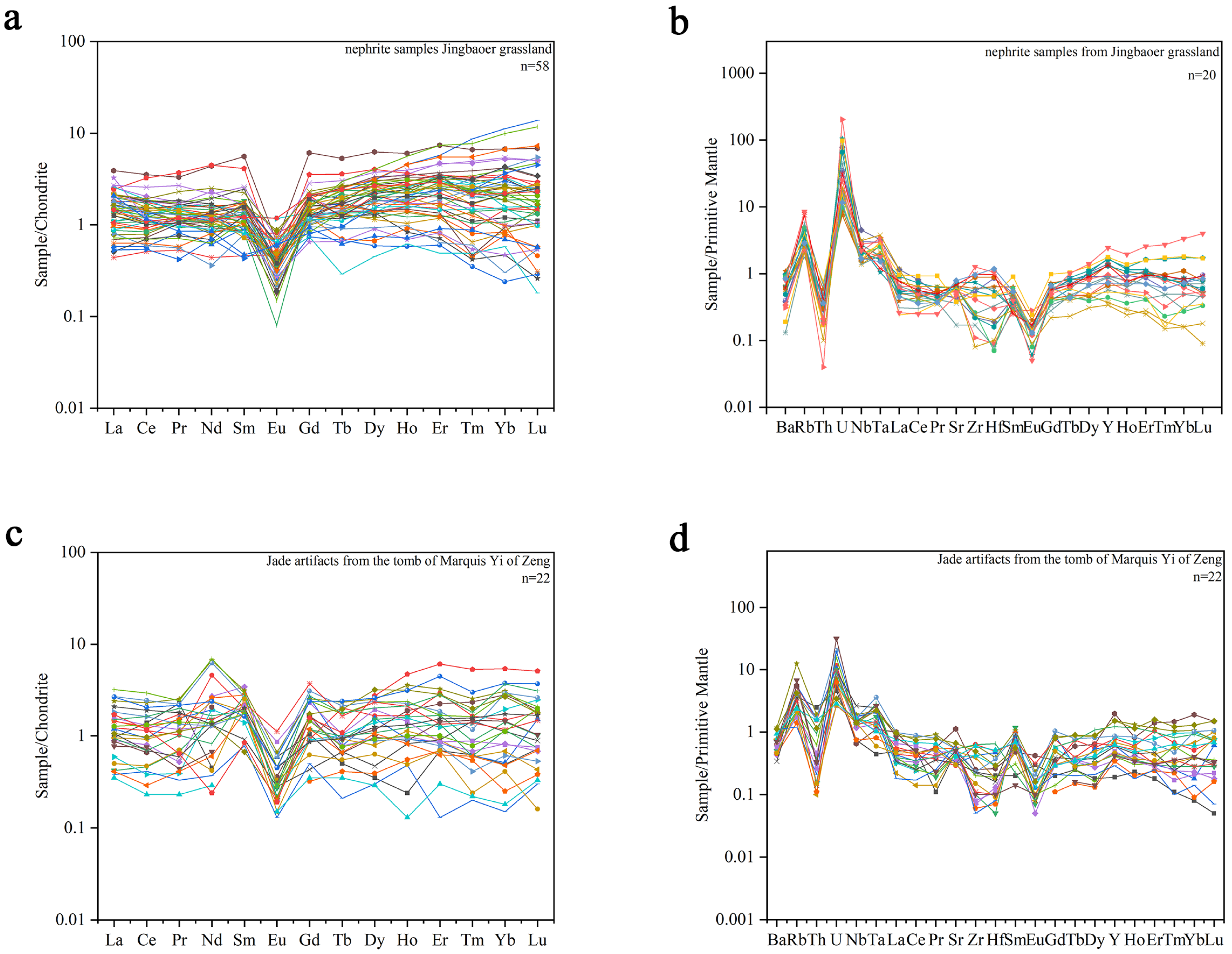
The rare earth element (REE) contents of the analyzed nephrite samples from the Jingbaoer Grassland are presented in Table 3. The results indicate that the overall rare earth element (REE) contents in the samples are relatively low. Among the REEs, Ce exhibits the highest concentration, with an average of 0.85 μg/g, while Eu shows the lowest, with an average of 0.03 μg/g. The total REE content (∑REE) ranges from 1.61 to 12.54 μg/g, with an average value of 4.25 μg/g. The LREE/HREE ratio varies from 0.33 to 4.99, averaging 1.40. The europium anomaly (δEu) ranges from 0.07 to 1.00, with an average of 0.37, while the cerium anomaly (δCe) ranges from 0.73 to 1.26, with an average of 0.95. The average (La/Sm)N ratio is 1.43, and the average (Gd/Lu)N ratio is 8.32. These values reflect a pronounced negative Eu anomaly, a slight negative Ce anomaly, and minimal fractionation between light and heavy REEs.
The REE data were normalized to chondrite values based on the standard proposed by Sun and McDonough (1989), with δEu calculated as 2EuN/(SmN + GdN) and δCe as 2CeN/(LaN + PrN) [35]. A chondrite-normalized REE distribution pattern was constructed based on these results (Figure 9a). The REE distribution pattern of the Jingbaoer nephrite is characterized by a horizontal, slightly left-leaning “seagull-shaped” curve, indicating minor enrichment in heavy REEs and a slight depletion in light REEs. A clear negative Eu anomaly is present, while Ce displays no significant anomaly.

4.4.2. Trace Elements

The trace element data for nephrite samples from the Jingbaoer Grassland are presented in Table 3. The analyzed trace elements include Ba, Rb, Th, U, Nb, Ta, La, Ce, Pr, Sr, Zr, among others. Among these, strontium (Sr) exhibits the highest overall concentration, ranging from 7.92 to 14.11 μg/g, with an average of 11.92 μg/g. Zirconium (Zr) follows, showing a wide range from 0.60 to 9.84 μg/g, and an average concentration of 9.20 μg/g. Based on these results, a trace element spider diagram (Figure 9b) was constructed using the MORB-normalized values from Sun and McDonough (1989) as the reference for the primitive mantle [35].
The trace elements in nephrite from the Jingbaoer Grassland exhibit moderate depletion in Ba, moderate enrichment in Rb, extreme enrichment in U, slight depletion in Nb, slight enrichment in Ta, significant enrichment in Sr and Sm, moderate depletion in Eu, and slight enrichment in Y. The samples exhibit a trace-element pattern characterized by enrichment in Rb and U, along with depletion in Ba, Th, and Eu. (Figure 9b).

5. Discussion

5.1. Ore Genesis

The genesis of tremolite jade deposits can be categorized into four main types based on metallogenic geological processes: contact metasomatic, hydrothermal metasomatic, regional metamorphic, and dynamothermal metamorphic types [8]. Among these, contact metasomatic deposits are characterized by the development of ore bodies at the contact zones between granite and dolomitic marble, with Si derived from acidic magmatic rocks and Mg and Ca sourced from the surrounding rocks. Field studies of jade deposits indicate that alteration zones formed by intermediate-acidic intrusions can extend for tens of meters, exhibiting clear zoning and mineral assemblages. The inner zone is formed by the alteration of intermediate-acidic magmatic rocks, while the outer zone results from the alteration of dolomitic marble, with the ore body primarily hosted in the outer zone [36]. The genesis of the Jingbaoer Jade Deposit is fundamentally contact metasomatic in nature: first, the ore body is strictly controlled by the contact zone between acidic granite and dolomitic marble, displaying a spatial transition from “marble-tremolitized contact zone-tremolite jade”; second, the ore-forming elements Mg and Ca are provided by the surrounding rocks, and Si is sourced from the granite, in accordance with the contact metasomatic model of material origin; third, the rare earth element (REE) distribution pattern of the Jingbaoer Grassland jade exhibits a significant negative Eu anomaly, weak or absent negative Ce anomalies, with an enrichment in light rare earth elements (LREEs) and a distribution of heavy rare earth elements (HREEs). Although the HREE and middle REE segments may appear visually similar to chondrite-normalized flat patterns, this resemblance does not imply a primitive or unaltered geochemical source. Instead, the observed REE signatures are indicative of fluid-mediated metasomatic processes under open-system conditions, typical of contact metamorphism [37]. The overall REE content remains relatively low, yet the combination of LREE enrichment and distinct negative Eu anomalies aligns well with the geochemical features of magnesium skarn-type jade deposits, such as those in Pishan, Xinjiang. In contrast, serpentinite-type nephrite typically lacks Eu anomalies and exhibits distinctly different REE patterns [38]. Therefore, the REE distribution in the Jingbaoer Grassland jade strongly supports a formation mechanism involving interaction with externally derived, REE-bearing metamorphic or hydrothermal fluids, rather than inheritance from unmodified protolith or sedimentary sources.
The Jingbaoer Jade Deposit formed through multiple stages of hydrothermal metasomatism between late Paleozoic acidic granite and dolomitic marble in a subduction-related setting of the Central Asian orogenic belt. Field investigations reveal significant alteration of surrounding rocks, where the SiO2 carried by magmatic fluids reacts with MgO and CaO in the surrounding rocks to form skarn zones. Petrographic evidence suggests that the early skarn stage is dominated by diopside (grain size 0.6–8.0 mm) and coarse-grained tremolite, with diopside often replaced by cryptocrystalline tremolite, resulting in a relic structure. During the primary jade-forming stage, tremolite further replaces diopside and dolomite, forming a fibrous interwoven structure (grain size 0.01–0.50 mm), accompanied by ductile deformation induced by dynamothermal metamorphism [38,39]. Meanwhile, the pyroxenes are classified as calcic clinopyroxenes, with chemically homogeneous compositions and no significant evidence of Fe–Mg substitution or compositional zoning. The stability and uniformity of the pyroxene chemistry suggest crystallization from a relatively homogeneous magmatic source, likely representing an early and stable phase in the crystallization sequence. Throughout the evolution of the deposit, metasomatic alteration played a significant role, as evidenced by widespread chloritization and actinolite alteration in the surrounding rocks, particularly in the Jingbaoer Grassland area.
A statistical analysis of the metallogenic geological background and ages of tremolite jade deposits in regions such as Xinjiang, Qinghai, and Gansu in northwestern China reveals that the deposits can be classified into five metallogenic belts: the Western Kunlun Metallogenic Belt, Eastern Kunlun Metallogenic Belt, Altun Metallogenic Belt, Qilian Metallogenic Belt, and the Dunhuang–Beishan Metallogenic Belt [16,40,41]. Metallogenic conditions for carbonate rock-type jade deposits across these belts exhibit distinct commonalities: first, the primary metallogenic parent rock is calcium-magnesium carbonate rock, with the associated strata primarily comprising magnesium-rich dolomitic marble from Proterozoic metamorphic rocks, particularly dolomitic marble layers containing >50% dolomite. These strata provide an essential material basis for the formation of carbonate rock-type deposits. Second, magmatic conditions are characterized by the widespread development of intermediate-acidic intrusions, predominantly granitic, which, during their intrusion, differentiate large quantities of magmatic aqueous fluids, providing necessary fluid media and ore-forming materials for mineralization. Furthermore, the chemical composition of intermediate-acidic magmatic rocks (e.g., higher contents of Al2O3, MgO, K2O, Na2O) favors hydrothermal fluid activity and metasomatic processes. Third, northwestern China lies within a tectonically complex region, characterized by multiple land blocks and orogenic belts. Phanerozoic orogenic events have provided a critical tectonic framework for metallogenesis. The Caledonian and Hercynian orogenies resulted in extensive magmatic activity and hydrothermal circulation, which promoted mineralization. Additionally, tectonic backgrounds control the distribution of metallogenic parent rocks and the patterns of magmatic activity. Secondary faults formed during the Paleozoic are the primary mineralization structures during the metallogenic period, further facilitating the movement of metallogenic fluids and the concentration of ore minerals. Ultimately, under the combined effects of regional metamorphism and hydrothermal processes, high-quality jade deposits with dense structures and controllable impurities were formed.

5.2. Mineral Source Characteristics

A comparative analysis is conducted between nephrite from the Jingbaoer Grassland and that from other known production areas. Differences in provenance are examined across several dimensions, including basic gemological properties, mineralogical composition, microstructural features, rare earth element (REE) distribution patterns, REE-related geochemical parameters, trace element spider diagram characteristics, and provenance discrimination models based on trace element data. This analysis provides a comprehensive basis for characterizing the distinctive geological and gemological features of nephrite from the Jingbaoer Grassland.
In terms of basic gemological characteristics, nephrite from Jingbaoer Grassland exhibits a wide range of colors, typically with a darker tone. Tree-like “water grass flower” patterns and white flocculent inclusions are commonly observed. Properties such as transparency, luster, refractive index, and specific gravity are generally consistent with nephrite from other sources. With regard to microstructure, Jingbaoer nephrite is primarily characterized by a micro-fibrous interwoven texture and micro-fibrous transgranular structures, which are broadly comparable to those found in other nephrite-producing regions.
In terms of mineral composition, the major mineral in nephrite from the Jingbaoer Grassland is tremolite, consistent with nephrite from other known sources. However, its minor minerals assemblage includes diopside, apatite, titanite, chlorite, epidote, and allanite. Notably, minerals commonly found in other nephrite deposits—such as serpentinite, barite, magnetite, and carbonates—are absent from the Jingbaoer samples (Table 4).
In terms of major elemental composition, there is little variation in nephrite from different production areas. However, notable differences are observed in the distribution patterns and related parameters of rare earth elements (REEs), as well as in the trace element spider diagrams. REEs can be used to differentiate sources based on parameters such as Ce content, total REE (∑REE), LREE/HREE ratios, and LaN/YbN values. Additionally, the trace element spider diagrams reflect provenance-related characteristics through distinct patterns of element enrichment and depletion (Table 5).
Relatively high concentrations of Zr and Hf have been detected in the nephrite from the Jingbaoer Grassland (Figure 9b). The enrichment of Zr and Hf is likely related to the crystallization and partial replacement of accessory minerals such as zircon and titanite during metamorphic recrystallization. These elements tend to be immobile under such metamorphic conditions, leading to their local accumulation within the tremolite matrix. Furthermore, the distinctive Zr–Hf enrichment may serve as a potential geochemical fingerprint for tracing the provenance of jade artifacts from this deposit.

5.3. Significance of Mineral Source Indication

A large number of translucent jade artifacts have been unearthed in the Yellow River Basin and even the middle reaches of the Yangtze River in China. During the Neolithic period, high-quality jade materials began to appear in major cultural regions such as the Qijia, Shimao, Taosi, and Longshan cultures. By the Zhou period, with the increasing centralization of political power, the stylistic characteristics of excavated nephrite artifacts evolved, marked by the widespread use of high-quality white jade. As a highly valued resource, the provenance and acquisition of such fine nephrite have long attracted scholarly attention. Numerous comparative studies have confirmed the existence of a “West-to-East Jade Transmission Route,” which explains the presence of high-quality jade materials in the Yellow River and Yangtze River basins.
The development and utilization of jade resources in northwestern China appear to follow a logical geographical progression. Initially, jade deposits located in low-altitude and flat terrain in Gansu were the first to be exploited. This was followed by the utilization of jade from low-lying riverbeds and desert regions in Xinjiang. Mining activities then extended to higher-altitude but relatively level terrain in Qinghai, and eventually to mountainous and steep jade-bearing regions of Xinjiang. The pattern of earlier mining in the east and later mining in the west, as seen in deposits across the Hexi Corridor, reflects this sequence [56].
The Zhou dynasty was a pivotal period for the eastward movement of jade resources through the Hexi Corridor. The Jingbaoer Grassland Jade Mine, inferred to have been active from the Warring States period to the Han dynasty, is an important example. In previous research, the author examined the provenance of nephrite artifacts excavated from the tomb of Marquis Yi of Zeng and suggested that some of these artifacts may have originated from the Gobi Desert region in northwestern China [57]. To further investigate whether nephrite from the Jingbaoer Grassland was mined and utilized during the Zhou period, this study re-analyzed the mineralogical and geochemical characteristics of jade artifacts from the tomb of Marquis Yi of Zeng. The aim is twofold: to assess the likelihood of jade exploitation at Jingbaoer during the Warring States period, and to contribute to provenance research of excavated jade artifacts.
The Tomb of Marquis Yi of Zeng, dating back to the early Warring States period (around 400 BCE), is the tomb of the ruler of the State of Zeng. It is located in the suburbs of Suizhou, Hubei Province, China, and is one of the most significant archaeological discoveries of the 20th century. Over 500 jade artifacts were unearthed from the tomb, with a complete range of types and exquisite craftsmanship. The jade artifacts from the tomb of Marquis Yi of Zeng consist primarily of white jade and light greenish-white jade. Most specimens are relatively pure and translucent, with few visible inclusions. Some artifacts exhibit a yellowish-brown weathered surface, characterized by low luster and rough texture. These visual features are reminiscent of Gobi-type materials, closely resembling nephrite sourced from the Gobi Desert regions of Xinjiang and Gansu.
Previous studies have demonstrated that REE distribution patterns and related parameters vary among nephrite sources (Table 4) [58]. Analysis of REE patterns in jade from the tomb of Marquis Yi of Zeng reveals weak LREE-HREE differentiation, a pronounced negative Eu anomaly, and a slight negative Ce anomaly (Figure 9c). The REE distribution curve is generally flat and “seagull-shaped,” similar to those of nephrite deposits in modern northwestern Chinese metallogenic belts, including the West Kunlun, East Kunlun, Altai, Beishan, and East Qilian–Qinling belts. Quantitatively, the jade exhibits an average ∑REE of 4.65 μg/g, LREE/HREE of 2.58, δEu of 0.49, δCe of 0.87, and LaN/YbN of 1.69. These values are closely aligned with nephrite from the West Kunlun and Beishan metallogenic belts.
In terms of trace elements, the jade artifacts from the tomb of Marquis Yi of Zeng exhibit enrichment in Rb and U, along with depletion in Ba, Th, and Eu. This pattern is consistent with nephrite from the northwestern mining regions, particularly the Jingbaoer Grassland (Figure 9d). The trace element spider diagram further reinforces this correlation.
Based on the mineralogical and geochemical signatures of the jade from the tomb of Marquis Yi of Zeng—together with the known mining chronology of the Jingbaoer Grassland—it is highly plausible that some of the unearthed jade originated from this site. This finding supports the hypothesis of an active “West-to-East Jade Transmission Route” during the Warring States period. Overall, the Jingbaoer Grassland Jade Mine and related research provide critical physical evidence and analytical insights into the exploitation and exchange of ancient Chinese jade resources. Continued interdisciplinary research is expected to enhance our understanding of jade provenance and circulation routes, offering a solid scientific basis for future exploration and sustainable utilization of jade resources.

6. Conclusions

This study systematically investigates the mineralogical and geochemical characteristics of nephrite from the Jingbaoer Grassland jade deposit site. By analyzing its mineralogical composition, geochemical features, and provenance, this work contributes to the modernization of China’s nephrite deposit database. Furthermore, through provenance analysis of jade artifacts unearthed from the tomb of Marquis Yi of Zeng, it is proposed that nephrite resources from the Jingbaoer Grassland were likely utilized during the Warring States period as part of the “West-to-East Jade Transmission Route” trade network, providing essential data support for understanding the ancient sources and distribution of nephrite in China.
The nephrite samples are dominated by tremolite, with crystals exhibiting fibrous, granular, and prismatic morphologies, and locally displaying radiating textures. Minor minerals include diopside, apatite, titanite, chlorite, epidote, allanite, rutile, and graphite. Scanning electron microscopy (SEM) observations show that the microstructure of the Jingbaoer Grassland nephrite is composed of an interwoven network of microfibers, with portions displaying oriented micro-fibrous recrystallization and well-developed, regular textures.
The major chemical composition of the Jingbaoer Grassland nephrite is consistent with electron microprobe analyses and comparable to nephrite from other deposits. However, trace element analysis reveals distinct features: significant enrichment in Sr and Sm, slight depletion in Nb, a pronounced negative Eu anomaly, no evident Ce anomaly, and an average total rare earth element (ΣREE) concentration of 4.25 μg/g. The average LREE/HREE ratio is 1.40, with mean δEu and δCe values of 0.37 and 0.95, respectively. These distinctive geochemical parameters can serve as key provenance indicators for distinguishing this deposit from other nephrite sources.
The nephrite ore body at the Jingbaoer Grassland jade deposit site is classified as a typical contact metasomatic type, formed through multiple stages of hydrothermal metasomatism between acidic granite and dolomitic marble. Field investigations reveal significant wall-rock alteration, where SiO2 carried by magmatic–hydrothermal fluids reacted with MgO and CaO from the surrounding rocks to form a skarn zone, marking the characteristic mineralization environment of this deposit.

Author Contributions

Conceptualization, M.Y. and J.L.; methodology, J.L. and Y.S.; experiment, J.L., Y.C. (Yi Cao) and X.Y.; software, Y.C. (Yuan Chang); investigation, Y.C. (Yuan Chang) and X.Y.; writing—original draft preparation, J.L. and Y.C. (Yi Cao); writing—review and editing, M.Y. All authors have read and agreed to the published version of the manuscript.

Funding

This research was supported by a grant from the Major Programs of the National Cultural Heritage Administration of China “The study of civilizational processes in the middle reaches of the Yangtze River (Xia, Shang and Zhou periods)”, Heritage Protection Letter [2020] No. 444. This research was also funded by China University of Geosciences (Wuhan), grant number CIGTXM-04-S202303. This research was also funded by 76th Batch of General Projects of China Postdoctoral Science Foundation, grant number 2024M763059.

Data Availability Statement

The data presented in this study are available in the article.

Acknowledgments

We would like to express our gratitude to engineers Gong Quansheng, Chen Yaoyu, and Nan Yincang from the Third Institute of Geological and Mineral Exploration of the Gansu Provincial Bureau of Geology and Mineral Exploration and Development for their assistance with the geological survey work.

Conflicts of Interest

The authors declare no conflicts of interest.

References

  1. Simandl, G.J.; Riveros, C.P.; Schiarizza, P. Nephrite (jade) deposits, mount Ogden area, central British Columbia (NTS 093N 13W). In British Columbia Geological Survey Geological Fieldwork; British Columbia Geological Survey: Victoria, BC, Canada, 1999; pp. 339–348. [Google Scholar]
  2. Yui, T.F.; Kwon, S.T. Origin of a dolomite-related jade deposit at Chuncheon, Korea. Econ. Geol. 2002, 97, 593–601. [Google Scholar] [CrossRef]
  3. Grapes, R.H.; Yun, S.T. Geochemistry of a New Zealand nephrite weathering rind. N. Z. J. Geol. Geophys. 2010, 53, 413–426. [Google Scholar] [CrossRef]
  4. Kislov, E.V. Kavokta deposit, Middle Vitim mountain country, Russia: Composition and genesis of dolomite type nephrite. Geosciences 2024, 14, 303. [Google Scholar] [CrossRef]
  5. Liu, Y.; Deng, J.; Shi, G.; Yui, T.-F.; Zhang, G.; Abuduwayiti, M.; Yang, L.; Sun, X. Geochemistry and petrology of nephrite from Alamas, Xinjiang, NW China. J. Asian Earth Sci. 2011, 42, 440–451. [Google Scholar] [CrossRef]
  6. Leaming, S.F. Jade in British Columbia and Yukon Territory. Geol. Surv. Can. 1984, 29, 270–273. [Google Scholar]
  7. Harlow, G.E.; Sorensen, S.S. Jade (Nephrite and Jadeitite) and Serpentinite: Metasomatic connections. Int. Geol. Rev. 2005, 47, 113–146. [Google Scholar] [CrossRef]
  8. Yu, Q.W.; Li, S.C. Nephrite and Serpentine Jade in China; Geological Publishing House: Beijing, China, 2017; pp. 3–4. (In Chinese) [Google Scholar]
  9. Zhang, C.; Yang, F.; Yu, X.Y.; Liu, J.H.; Carranza, E.J.M.; Chi, J.; Zhang, P. Spatial-temporal distribution, metallogenic mechanisms and genetic types of nephrite jade deposits in China. Front. Earth Sci. 2023, 11, 1047707. [Google Scholar] [CrossRef]
  10. Wang, S.Q.; Yun, X.M. Characteristics of Material Compositions and Geological Origin of Green Hetian Nephrite. J. Gems Gemol. 2008, 10, 4–7, 38, (In Chinese with English Abstract). [Google Scholar]
  11. Liu, X.F.; Zhang, H.Q.; Liu, Y.; Zhang, Y. Mineralogical Characteristics and Genesis of Green Nephrite from the World. Rock Miner. Anal. 2018, 37, 479–489, (In Chinese with English Abstract). [Google Scholar]
  12. Jing, Y.T.; Liu, Y.; Zhang, Y.; Maituohuti, A. Metallogenic age, formation process and prospecting direction of marble-related nephrite deposit in China. Acta Petrol. Mineral. 2022, 41, 651–667, (In Chinese with English Abstract). [Google Scholar]
  13. Luo, Z.M.; Yang, M.X.; Shen, A.H. Origin Determination of Dolomite-Related White Nephrite through Iterative-Binary Linear Discriminant Analysis. Gems Gemol. 2015, 51, 300–311. [Google Scholar] [CrossRef]
  14. Jiang, B.H.; Bai, F.; Zhao, J.K. Mineralogical and geochemical characteristics of green nephrite from Kutcho, northern British Columbia, Canada. Lithos 2021, 388–389, 106030. [Google Scholar] [CrossRef]
  15. Xu, H.S.; Bai, F. Origin of the subduction-related Tieli nephrite deposit in Northeast China: Constraints from halogens, trace elements, and Sr isotopes in apatite group minerals. Ore Geol. Rev. 2022, 142, 104702. [Google Scholar] [CrossRef]
  16. Zhang, X.C.; Shi, G.H.; Zhang, X.M.; Gao, K. Formation of the Nephrite Deposit with Five Mineral Assemblage Zones in the Central Western Kunlun Mountains, China. J. Petrol. 2022, 63, egac117. [Google Scholar] [CrossRef]
  17. Zhang, Y.Y.; Yu, H.Y.; Lan, Y.; Ruan, Q.F. Mineralogy and Sr Isotope Characteristics of Dahua Stratified Tremolite Nephrite and Host Rocks, Guangxi Province, China. Minerals 2024, 14, 257. [Google Scholar] [CrossRef]
  18. Harlow, G.E.; Sorensen, S.S.; Sisson, V.B.; Shi, G.H. The geology of jade deposits. In Geology of Gem Deposits, 2nd ed.; Mineralogical Association of Canada: Ottawa, ON, Canada, 2014; pp. 305–374. [Google Scholar]
  19. Gil, G.; Barnes, J.D.; Boschi, C.; Gunia, P.; Raczyński, P.; Szakmány, G.; Bendő, Z.; Péterdi, B. Nephrite from Złoty Stok (Sudetes, SW Poland): Petrological, Geochemical, and Isotopic Evidence for a Dolomite-Related Origin. Can. Miner. 2015, 53, 533–556. [Google Scholar] [CrossRef]
  20. Chen, G.K.; Wang, H.; Yang, Y.G.; Yang, Y.S. The Excavation of Mazongshan Jade Mine Site in Subei County, Gansu Province in 2012. Archaeology 2016, 71, 40–53+2, (In Chinese with English Abstract). [Google Scholar]
  21. Qiu, Z.L.; Zhang, Y.; Yang, J.; Hui, W.; Chen, G.K.; Li, Y.D.; Zong, S.Z.; Guo, Z.Y.; Yang, Y.S.; Gu, X.Z. The ancient jade mine discovered in dunhuang Hanxia of northern Gansu province: A potential important source of jade material in early stage of China. J. Gems Gemol. 2020, 22, 1–12, (In Chinese with English Abstract). [Google Scholar]
  22. Miao, P.; Han, F.; Sun, M.X.; Zheng, T.T.; Chen, G.K.; Wang, H. The Excavation of the Jade Mining Site at Jingbaoer Pasture of Mazongshan Town in Subei County, Gansu in 2016. Cult. Relics 2020, 76, 31–45+1, (In Chinese with English Abstract). [Google Scholar]
  23. Gan, F.X. The glass and jade road—The cultural and technical exchange of silicate based artefacts with foreign countries before qin dynasty. J. Chin. Ceram. Soc. 2013, 41, 458–466, (In Chinese with English Abstract). [Google Scholar]
  24. Zuo, G.C.; Jin, S.Q.; Feng, T.Q. The Discovery of Precambrian Basement in Arc-Basin System of Silurian and its Significance for Prospecting in Gongpoquan Area, Gansu. Northwest Geosci. 1995, 16, 104–114, (In Chinese with English Abstract). [Google Scholar]
  25. Zhang, Z.P.; Duan, B.X.; Meng, Q.T.; Xu, C.; Dong, H.K.; Liu, G.; Ti, Z.H. LA-ICP-MS zircon U-Pb dating of amphibolites of the Beishan group in the Beishan area, Inner Mongolia and its geological significance. Geol. Explor. 2017, 53, 1129–1139, (In Chinese with English Abstract). [Google Scholar]
  26. Xin, H.T.; Niu, W.C.; Tian, J.; Teng, X.J.; Duan, X.L. Spatio-temporal structure of Beishan orogenic belt and evolution of Paleo-Asian Ocean, Inner Mongolia. Geol. Bull. China 2020, 39, 1297–1316, (In Chinese with English Abstract). [Google Scholar]
  27. Xiao, W.J.; Mao, Q.G.; Windley, B.F.; Han, C.M.; Qu, J.F.; Zhang, J.E.; Ao, S.J.; Guo, Q.Q.; Cleven, N.R.; Lin, S.F. Paleozoic multiple accretionary and collisional processes of the Beishan orogenic collage. Am. J. Sci. 2010, 310, 1553–1594. [Google Scholar] [CrossRef]
  28. Wang, J.X.; Zhang, K.X.; Windley, B.F.; Song, B.W.; Kou, X.H.; Wang, S.D.; Wang, L.J. A mid-Palaeozoic ocean–continent transition in the Mazongshan subduction–accretion complex, Beishan, NW China: New structural, chemical and age data constrain the petrogenesis and tectonic evolution. Geol. Mag. 2020, 157, 1877–1897. [Google Scholar] [CrossRef]
  29. Yu, J.Y.; Guo, L.; Li, J.X.; Li, Y.G.; Smithies, R.H.; Wingate, M.T.; Meng, Y.; Chen, S.F. The petrogenesis of sodic granites in the Niujuanzi area and constraints on the Paleozoic tectonic evolution of the Beishan region, NW China. Lithos 2016, 256, 250–268. [Google Scholar] [CrossRef]
  30. Zheng, R.; Wu, T.; Zhang, W.; Xu, C.; Meng, Q. Early Devonian tectono-magmatic events in the Middle Beishan, Gansu Province: Evidence from chronology and geochemistry of Gongpoquan Granite. Acta Sci. Nat. Univ. Pekin. 2012, 48, 603–616. [Google Scholar]
  31. Song, D.F.; Xiao, W.J.; Windley, B.F.; Han, C.M.; Tian, Z.H. A Paleozoic Japan-type subduction-accretion system in the Beishan orogenic collage, southern Central Asian Orogenic Belt. Lithos 2015, 224, 195–213. [Google Scholar] [CrossRef]
  32. Liu, Y.S.; Hu, Z.C.; Gao, S.; Günther, D.; Xu, J.; Gao, C.G.; Chen, H.H. In situ analysis of major and trace elements of anhydrous minerals by LA-ICP-MS without applying an internal standard. Chem. Geol. 2008, 257, 34–43. [Google Scholar] [CrossRef]
  33. Leake, B.E.; Woolley, A.R.; Arps, C.E.; Birch, W.D.; Gilbert, M.C.; Grice, J.D.; Hawthorne, F.C.; Kato, A.; Kisch, H.J.; Krivovichev, V.G. Nomenclature of amphiboles; report of the subcommittee on amphiboles of the International Mineralogical Association, Commission on New Minerals and Mineral Names. Can. Miner. 1997, 35, 219–246. [Google Scholar]
  34. Morimoto, N. Nomenclature of Pyroxenes. Mineral. Petrol. 1988, 39, 55–76. [Google Scholar] [CrossRef]
  35. Sun, S.S.; McDonough, W.F. Chemical and isotopic systematics of oceanic basalts: Implications for mantle composition and processes. Geol. Soc. Lond. Spec. Publ. 1989, 42, 313–345. [Google Scholar] [CrossRef]
  36. Liu, Y.; Zhang, R.Q.; Abuduwayiti, M.; Wang, C.; Zhang, S.; Shen, C.; Zhang, Z.; He, M.; Zhang, Y.; Yang, X. SHRIMP U–Pb zircon ages, mineral compositions and geochemistry of placer nephrite in the Yurungkash and Karakash River deposits, West Kunlun, Xinjiang, northwest China: Implication for a Magnesium Skarn. Ore Geol. Rev. 2016, 72, 699–727. [Google Scholar] [CrossRef]
  37. Boulvais, P.; Fourcade, S.; Moine, B.; Gruau, G.; Cuney, M. Rare-earth elements distribution in granulite-facies marbles: A witness of fluid–rock interaction. Lithos 2000, 53, 117–126. [Google Scholar] [CrossRef]
  38. Liu, X.F.; Gil, G.; Liu, Y.; He, X.M.; Syczewski, M.; Baginski, B.; Fang, T.; Shu, X.C. Timing of formation and cause of coloration of brown nephrite from the Tiantai Deposit, South Altyn Tagh, northwestern China. Ore Geol. Rev. 2021, 131, 103972. [Google Scholar] [CrossRef]
  39. Liu, Y.; Zhang, R.; Zhang, Z.; Shi, G.; Zhang, Q.; Abuduwayiti, M.; Liu, J. Mineral inclusions and SHRIMP U–Pb dating of zircons from the Alamas nephrite and granodiorite: Implications for the genesis of a magnesian skarn deposit. Lithos 2015, 212, 128–144. [Google Scholar] [CrossRef]
  40. Zhang, Y.F.; Yang, J.; Qiu, Z.L.; Gu, X.Z.; Luo, H.; Zhong, L.F.; Li, F.C.; Wang, H.; Chen, G.; Qin, S.C. A new tectonic-geochemical approach using LA-ICP-MS to constrain the provenance of East Asian carbonate-related nephrite. J. Anal. At. Spectrom. 2025, 40, 2702–2715. [Google Scholar] [CrossRef]
  41. Gao, K.; Shi, G.H.; Wang, M.L.; Xie, G.; Wang, J.; Zhang, X.C.; Fang, T.; Lei, W.Y.; Liu, Y. The Tashisayi nephrite deposit from South Altyn Tagh, Xinjiang, northwest China. Geosci. Front. 2019, 10, 1597–1612. [Google Scholar] [CrossRef]
  42. Jiang, Y.; Shi, G.H.; Xu, L.G.; Li, X.L. Mineralogy and Geochemistry of Nephrite Jade from Yinggelike Deposit, Altyn Tagh (Xinjiang, NW China). Minerals 2020, 10, 418. [Google Scholar] [CrossRef]
  43. Tao, L.F.; Hao, N.N.; Jin, C.L.; Shi, M.; Han, X.L. Mineralogical and Spectroscopy Characteristics of the Nephrite in Yeniugou, Qinghai. Spectrosc. Spectr. Anal. 2024, 44, 3165–3171. [Google Scholar]
  44. Nong, P.Z.; Zhou, Z.Y.; Lai, M.; Zhong, Q.; Wang, H.; GUo, K.P.; Li, Y.B.; Qiao, X.; Zhang, L.M. Gemological and Mineralogical Characteristics of Nephrite from the Maxianshan area in Gansu Province, China. Acta Mineral. Sin. 2019, 39, 327–333, (In Chinese with English Abstract). [Google Scholar]
  45. Xu, L.G.; Yu, X.J.; Wang, S.Q. The gemological characteristics and origin of Donggang Village tremolite jade in Dahua, Guangxi. Acta Petrol. Mineral. 2014, 33, 55–60, (In Chinese with English Abstract). [Google Scholar]
  46. Li, N.; Bai, F.; Xu, L.L.; Che, Y.D. Geochemical characteristics and ore-forming mechanism of Luodian nephrite deposit, Southwest China and comparison with other nephrite deposits in Asia. Ore Geol. Rev. 2023, 160, 105604. [Google Scholar] [CrossRef]
  47. Zhou, Z.Y.; Chen, Y.; Liao, Z.T.; Yuan, Y. A petrological and mineralogical study of Liyang nephrite. Acta Petrol. Mineral. 2009, 28, 490–494, (In Chinese with English Abstract). [Google Scholar]
  48. Li, J.; Gao, J.; Tong, X.R.; Pi, B.L.; Yang, M.X. Comparative Study of Characteristics of Nephrites from Liyang, Jiangsu Province, and Zhuangqiaofen Site, Zhejiang Province. J. Gems Gemol. 2010, 12, 19–25, 33. [Google Scholar]
  49. Zhou, Z.H.; Feng, J.R. A petrological and mineralogical comparison between Xinjiang nephrite and Xiuyan nephrite. Acta Petrol. Mineral. 2010, 29, 331–340. [Google Scholar]
  50. Wang, S.Q.; Zhao, C.H.; Yu, G. Chinese Xiuyan Jade; Science Press: Beijing, China, 2007; pp. 33–37. (In Chinese) [Google Scholar]
  51. Li, N.; Bai, F.; Peng, Q.; Liu, M. Geochemical characteristics of nephrite from Chuncheon, South Korea: Implications for geographic origin determination of nephrite from dolomite-related deposits. Crystals 2023, 13, 1468. [Google Scholar] [CrossRef]
  52. He, Y.; Su, Y.; Yang, M.X. Study on Spectroscopy and Locality Characteristics of the Nephrites in Yutian, Xinjiang. Spectrosc. Spectr. Anal. 2022, 42, 3851–3857. [Google Scholar]
  53. Yu, H.Y.; Wang, R.C.; Guo, J.C.; Li, J.G.; Yang, X.W. Study of the minerogenetic mechanism and origin of Qinghai nephrite from Golmud, Qinghai, Northwest China. Sci. China Earth Sci. 2016, 59, 1597–1609. [Google Scholar] [CrossRef]
  54. Dai, L.L.; Yang, M.X.; Wen, H.L. Study on Chemical Compositions and Origin Discriminations of Hetian Yu From Maxianshan, Gansu Province. Spectrosc. Spectr. Anal. 2022, 42, 1451–1458. [Google Scholar]
  55. Jiang, C.; Peng, F.; Wang, W.W.; Yin, Z.W. Comparative Study on Spectroscopic Characteristics and Coloration Mechanism of Nephrite From Dahua and Luodian. Spectrosc. Spectr. Anal. 2021, 41, 1294–1299. [Google Scholar]
  56. Chen, G.K.; Yang, Y.S. Preliminary archaeological observations on early mining activities of the tremolite deposits in the Hexi Corridor. Dunhuang Res. 2021, 5, 85–94, (In Chinese with English Abstract). [Google Scholar]
  57. Liu, J.F.; Yang, M.X.; Su, Y.; Liu, Y. Analysis of Material and Source of Archaic Jade From the Tomb of Marquis Yi of Zeng in Suizhou, Hubei Province. Spectrosc. Spectr. Anal. 2022, 42, 215–221. [Google Scholar]
  58. Su, Y.; Yang, M.X. Combining Rare Earth Element Analysis and Chemometric Method to Determine the Geographical Origin of Nephrite. Minerals 2022, 12, 1399. [Google Scholar] [CrossRef]
Figure 1. Tectonic Location and Structural Subdivision of the Beishan Orogenic Belt (modified after [27,28]). (a) Schematic diagram of the regional tectonic setting (modified after [29]); (b) Tectonic subdivision map of the Beishan Orogenic Belt; ① Hongshishan–Baiheshan ophiolitic mélange belt; ② Jijitaizi–Xiaohuangshan ophiolitic mélange belt; ③ Hongliuhe–Niujuanzi–Xichangjing ophiolitic suture zone; ④ Liuyuan ophiolitic mélange belt.
Minerals 15 01186 g001
Figure 2. Field Geological Photograph of the Jingbaoer Grassland Jade Mine Site, Mazongshan Town, Gansu Province, China (Photographs provided by Liu Jifu and Chang Yuan). (a) UAV aerial view of the jade mine site; (b) Ancient mining tunnel: The contact zone between the granite and the mineralized marble is approximately 0.5–1 m thick; (c) Stratigraphic distribution of the mining area.
Minerals 15 01186 g002
Figure 3. Nephrite samples from Jingbaoer Grassland in Mazongshan town, Subei County, Gansu Province, China.
Minerals 15 01186 g003
Figure 4. Inclusion types in nephrite from the Jingbaoer Grassland Jade Mine Site in Mazongshan town, Subei County, Gansu Province: (a,b) Manganese-rich dendritic inclusions; (c,d) White cloudy inclusions.
Minerals 15 01186 g004
Figure 5. SEM micrographs showing the microstructural features of nephrite samples from the Jingbaoer Grassland. (a) Micro-fibrous interwoven texture in sample JBE23004; (b) Similar structure in sample JBE23038 with aligned fibrous tremolite; (c,d) Directionally recrystallized fibrous texture in sample JBE23054.
Minerals 15 01186 g005
Figure 6. Mineral classification plot of samples from the Jingbaoer Grassland, Mazongshan Town, Gansu Province, China. (a) Distribution of tremolite samples in the amphibole mineral classification diagram [33]; (b) Distribution of diopside samples in the pyroxene quadrilateral diagram [34].
Minerals 15 01186 g006
Figure 7. Photomicrographs of the Jingbaoer Grassland nephrite samples (crossed-polarized light). (a) Felted microgranoblastic texture of tremolite; (b) Distribution of diopside crystals within the tremolite matrix; (c) Contact relationship between apatite crystals and tremolite; (d) Contact relationship of rutile crystals with apatite and tremolite; (e) Distribution of graphite crystals within the tremolite matrix; (f) Contact relationship between epidote crystals and tremolite. (Tr—Tremolite; Di—Diopside; Ap—Apatite; Rt—Rutile; Gph—Graphite; Ep—Epidote).
Minerals 15 01186 g007
Figure 8. Backscattered electron image of the Jingbaoer Grassland nephrite samples. (a,b) Diopside and apatite are distributed within the tremolite matrix, with diopside being replaced by tremolite; (c,d) Chlorite, allanite, and epidote are distributed within the tremolite matrix; (e) Titanite is distributed within the tremolite matrix; (f) Apatite is distributed within the tremolite matrix and is replaced by tremolite (Tr—Tremolite; Di—Diopside; Ap—Apatite; Chl—Chlorite; Aln—Allanite; Ep—Epidote; Ttn—Titanite; Zc—Zircon).
Minerals 15 01186 g008
Figure 9. Characteristics of rare earth elements and trace elements in nephrite samples (Colored lines represent different test samples). (a) Chondrite-normalized REE patterns from nephrite samples in the Jingbaoer Grassland; (b) Primitive mantle-normalized incompatible and trace element concentrations from nephrite samples in the Jingbaoer Grassland; (c) Chondrite-normalized REE patterns from jade artifacts in the tomb of Marquis Yi of Zeng; (d) Primitive mantle-normalized incompatible and trace element concentrations from jade artifacts in the tomb of Marquis Yi of Zeng.
Minerals 15 01186 g009
Table 1. Chemical composition of tremolite from Jingbao Grassland jade mine (wt%).
SamplesJBE23002JBE23003JBE23004JBE23005JBE23040JBE23047JBE23049
SiO260.4658.8459.4760.4760.8359.5861.64
MgO24.1323.9523.9824.2923.7224.5423.05
CaO12.9713.0312.2212.7812.2712.5812.90
Al2O30.690.820.500.600.620.470.52
FeO0.350.641.070.560.240.130.57
MnO0.010.180.060.030.050.040.04
Na2O0.070.090.100.060.080.070.04
TiO20.030.030.050.000.010.000.01
Total98.7097.5897.4598.7997.8197.4198.88
TSi8.067.978.058.058.148.048.19
TAl0.110.130.080.090.100.080.08
SumT8.168.108.138.158.248.118.27
CMg4.824.874.874.854.764.974.59
CFe0.040.070.120.060.030.010.06
CMn0.000.020.010.000.010.000.00
SumC4.864.964.994.924.804.994.66
BNa0.020.020.030.020.020.020.01
BCa1.851.891.771.821.761.821.84
SumB1.871.911.801.841.781.841.85
Toal14.8914.9714.9214.9114.8214.9314.77
Mg/(Mg + Fe2+)0.990.990.980.990.991.000.99
Tremolite formulae recalculated on the basis of 23 oxygen atoms; 0.00—concentration below the detection limit; T, C, and B represent the occupation of cations in tremolite.
Table 2. Chemical compositions of diopside, apatite, titanite, chlorite, epidote, and allanite in the Jingbaoer Grassland nephrite, Mazongshan Town, Gansu Province, China (wt%).
SamplesJBE23003-3JBE23004-5JBE23005-8JBE23005-14JBE23049-3JBE23040-4
MineralsDiopsideApatiteTitaniteChloriteEpidoteAllanite
SiO255.180.4132.0730.4641.0334.62
MgO17.320.050.5632.260.343.90
CaO24.4856.9027.930.0223.1613.68
Al2O31.87n.d.2.7120.5330.9920.28
FeO0.590.050.840.842.643.38
Na2O0.200.00n.d.n.d.0.00n.d.
K2On.d.0.000.04n.d.0.00n.d.
Cr2O30.00n.d.n.d.0.02n.d.n.d.
MnO0.100.000.01n.d.0.06n.d.
TiO20.00n.d.34.130.020.020.00
P2O5n.d.40.01n.d.n.d.n.d.n.d.
La2O3n.d.n.d.n.d.n.d.n.d.5.92
Ce2O3n.d.n.d.n.d.n.d.n.d.10.21
Nd2O3n.d.n.d.n.d.n.d.n.d.2.89
Cln.d.0.04n.d.n.d.n.d.n.d.
Fn.d.2.760.36n.d.n.d.n.d.
Total99.7498.5998.6484.1498.2494.88
Si2.000.071.052.913.123.12
Mg0.930.010.034.630.040.53
Ca0.9510.670.980.001.891.32
Al0.08n.d.0.102.312.772.15
Fe0.020.010.020.070.170.25
Na0.010.00n.d.0.000.00n.d.
Kn.d.0.000.000.000.00n.d.
Cr0.00n.d.n.d.0.00n.d.n.d.
Mn0.000.000.00n.d.0.000.00
Ti0.00n.d.0.840.000.000.00
Pn.d.5.93n.d.n.d.n.d.n.d.
Lan.d.n.d.n.d.n.d.n.d.0.20
Cen.d.n.d.n.d.n.d.n.d.0.34
Ndn.d.n.d.n.d.n.d.n.d.0.09
Cln.d.0.01n.d.n.d.n.d.n.d.
Fn.d.1.530.04n.d.n.d.n.d.
Sum3.9918.233.069.937.997.99
Diopside formulae recalculated on the basis of 6 oxygen atoms. Apatite formulae recalculated on the basis of T (P + Si) = 6 apfu; the X site was constrained to F + Cl + OH = 2 apfu, with OH obtained by difference. Hydrogen was not directly measured. Titanite formulae recalculated on the basis of 5 oxygen atoms. Chlorite formulae recalculated on the ba Tsis of 14 oxygen atoms. Epidote formulae recalculated on the basis of 12.5 oxygen atoms. Allanite formulae recalculated on the basis of 12.5 oxygen atoms. 0.00—concentration below the detection limit. n.d.—not detected.
Table 3. Trace element compositions nephrite samples from the Jingbaoer Grassland nephrite, Mazongshan Town, Gansu Province, China (μg/g).
ElementJBE23001JBE23006JBE23012JBE23015JBE23027JBE23030JBE23042JBE23044
Ba1.802.647.591.932.954.271.681.35
Rb1.991.522.061.302.081.630.731.38
Th0.230.020.050.110.240.030.020.01
U2.251.640.161.660.770.191.462.06
Nb3.863.201.153.151.151.120.891.41
Ta0.400.130.080.090.080.110.080.11
Sr14.119.2213.988.9411.6612.0713.187.92
Zr1.272.436.773.165.749.840.605.23
Hf0.010.060.200.040.160.270.020.15
Y4.166.366.185.555.453.051.028.03
La0.270.790.270.270.260.350.400.66
Ce0.621.430.770.830.690.810.851.64
Pr0.080.140.150.140.090.150.130.26
Nd0.390.760.690.570.460.780.581.03
Sm0.070.190.280.200.130.200.140.40
Eu0.020.030.030.070.000.030.020.04
Gd0.190.330.430.280.340.260.150.58
Tb0.050.070.090.050.060.050.030.11
Dy0.360.760.600.460.590.350.150.95
Ho0.130.150.150.140.130.110.030.23
Er0.430.520.510.570.580.500.100.76
Tm0.060.070.060.070.050.070.010.13
Yb0.580.390.370.260.310.540.040.89
Lu0.080.040.040.040.050.060.010.13
ΣREE3.305.684.433.953.734.252.637.80
LREE/HREE0.771.430.981.110.781.204.101.07
(La/Sm)N2.422.590.600.861.271.071.841.04
(Gd/Lu)N1.866.719.175.685.773.5516.963.75
(La/Yb)N0.311.370.480.700.560.436.860.50
δEu *0.410.310.300.890.070.340.320.25
δCe **0.990.960.931.011.100.840.900.96
* δEu = 2EuN/(SmN + GdN), ** δCe = 2CeN/(LaN + PrN).
Table 4. Textural and Mineralogical Characteristics of Tremolite Jade from Major Carbonate-Type Sources Worldwide.
LocalityMajor MineralMinor MineralsMain Microstructures
Jingbaoer
Grassland
TremoliteDiopside, graphite, epidote, apatite, titanite, allanite, chlorite, zirconMicro-fibrous interlocking texture; micro-fibrous metamorphic texture
Hetian
Xinjiang [5]
TremoliteDiopside, graphite, epidote, apatite, titanite, allanite, chlorite, zirconFelted fibrous interlocking texture; felted cryptocrystalline metamorphic texture
Qiemo,
Xinjiang [38]
TremoliteDiopside, dolomite, magnetite, apatite, titanite, epidote, chlorite, biotite, forsterite, prehnite, zoisite, limoniteFelted fibrous interlocking texture; micro-cryptocrystalline metamorphic texture
Ruoqiang,
Xinjiang [42]
TremoliteDiopside, epidote, allanite, prehnite, plagioclase, titanite, zircon, calcite, chlorite, rutileFelted fibrous interlocking texture; micro-fibrous metamorphic texture
Golmud,
Qinghai [43]
TremoliteDiopside, apatite, titanite, epidote, calcite, feldspar, bariteFelted micro-interlocking texture; micro-fibrous metamorphic texture
Maxianshan, gansu [44]TremoliteDiopside, epidote, apatite, titanite, clinozoisite, prehniteMicro-fibrous metamorphic texture; micro-fibrous interlocking texture
Dahua, Guangxi [17,45]TremoliteDiopside, calcite, albite, allanite, chlorite, quartzMicro-fibrous interlocking texture; micro-fibrous metamorphic texture
Luodian,
Guizhou [46]
TremoliteDiopside, calcite, dolomite, quartz, wollastonite, plagioclase, apatite, talcMicro-fibrous/lamellar interlocking metamorphic texture; micro-fibrous–cryptocrystalline metamorphic texture
Liyang, Jiangsu [47,48]TremoliteMagnetite, carbonate minerals, apatite, biotite, calciteMicro-fibrous metamorphic texture; micro-granular metamorphic texture
Xiuyan,
Liaoning [49,50]
TremoliteCarbonates, apatite, epidote, serpentine, chlorite, talc, graphite, sphalerite, pyrite, magnetite, limoniteFelted fibrous interlocking texture; micro-fibrous metamorphic texture; micro-bundle broom-like texture
Baikal,
Russia [4]
TremoliteChlorite, illite, quartz, dolomite, apatite, magnetite, epidote-group mineralsMicro-fibrous metamorphic texture; felted micro-interlocking metamorphic texture
Chuncheon, South Korea [51]TremoliteSerpentine, talc, quartz, dolomite, calciteMicro-fibrous metamorphic texture; micro-lamellar and porphyroblastic metamorphic texture
Table 5. Rare earth element parameters of nephrite from major carbonate-type deposits in China.
DepositNumberΣREE (μg/g)LREE/HREEδEuδCeLaN/YbN
RangeMeanRangeMeanRangeMeanRangeMeanRangeMean
Jingbaoer, Gansu571.61–12.544.250.33–4.991.400.07–1.000.370.73–1.260.950.11–6.951.25
Yutian,
Xinjiang [52]
480.41–18.773.140.01–3.370.680.00–8.830.340.07–3.901.060.02–15.471.79
Altyn Tagh,
Xinjiang [42]
750.63–16.265.010.15–13.452.840.03–4.480.350.55–2.871.000.03–16.552.69
Golmud, Qinghai [53]210.29–40.726.540.51–7.574.840.13–3.190.510.47–1.730.940.23–9.064.22
Maxianshan, Gansu [54]571.69–22.045.600.17–4.941.690.04–0.600.280.30–2.910.950.04–5.711.24
Sanweishan, Gansu *900.78–13.894.200.16–10.732.500.06–1.590.390.48–2.040.840.03–28.052.76
Xiuyan,
Liaoning [50]
1011.79–98.4743.913.62–29.4614.540.21–2.610.710.08–1.040.856.82–32.5315.41
Liyang, Jiangsu [48]152.48–10.105.362.35–11.285.900–0.950.850.66–1.170.821.76–11.723.79
Luodian, Guizhou [46]510.10–49.0628.984.81–10.746.980.53–1.340.720.21–0.630.265.85–40.1120.46
Dahua, Guangxi [55]92.88–10.045.320.18–6.112.600.21–0.910.470.12–2.010.711.31–11.163.74
* The data have not been published yet.
Disclaimer/Publisher’s Note: The statements, opinions and data contained in all publications are solely those of the individual author(s) and contributor(s) and not of MDPI and/or the editor(s). MDPI and/or the editor(s) disclaim responsibility for any injury to people or property resulting from any ideas, methods, instructions or products referred to in the content.