


Abstract
The Weishan REE deposit is located in the southwest of the Luxi Terrane of the North China Craton (NCC), where a large number of lamprophyre dikes are spatially exposed with the deposit. Here, we report petrology, geochemistry and zircon U-Pb geochronology data for the lamprophyre of the Weishan REE deposit in order to develop constraints for the determination of the petrogenesis, magma source and evolution of the lamprophyre and the tectonic environment. LA-LCP-MS zircon U-Pb dating shows that the crystallization age of the lamprophyre is 125 ± 0.86 Ma. The geochemical data suggest that these lamprophyres have high levels of Al2O3, K2O, MgO and alkalis, moderate level of Na2O and low levels of SiO2, Fe2O3 and TiO2, and that they are enriched with LREEs (La, Ce) and LILEs (Rb, Ba) and depleted with regard to HREEs and HFSEs (Nb, Ta, Ti). They displayed negative εHf(t) values of −14.98 to −9.03, TDM1 ages of 1.1–1.4 Ga and TDM2 ages of 1.7–2.1 Ga, which suggest that the magma source originates from an enriched mantle. Low Rb/Sr and high Dy/Yb ratios suggest that the enriched mantle source was partially melted at the amphibole-bearing lherzolite garnet-facies. The high Ba/Th and Sr/Th ratios indicate that the enriched source was derived from subduction dehydration fluids of the oceanic crust. We propose that the mafic dike intrusions are consistent with an Early Cretaceous alkaline magma emplacement in an extensional setting, in which the magma was not contaminated by crustal material during its emplacement.
1. Introduction
Lamprophyre is a melanocratic hypabyssal igneous rock characterized by porphyritic textures and containing mafic phenocrysts [1] that forms dikes in various tectonic environments. Lamprophyre can be divided into ultramafic lamprophyre, alkaline lamprophyre and calc-alkaline lamprophyre [1]. However, multiple petrogenetic models have been proposed for the formation of lamprophyre, including mafic magma differentiation [2], magma miscibility [3] and partial melting of an enriched mantle [4,5,6]. Thus, investigation of lamprophyre has significance for exploring magma sources, mantle signatures and tectonic evolution [7,8,9].
Rare earth elements (REEs) are indispensable raw materials for modern science and technology and play significant roles in international resource strategy [10,11,12]. The Weishan REE deposit is located in Weishan Village, Weishan County, Zaozhuang City, Shandong Province. The deposit is a typical LREE deposit and is genetically related to the host alkaline complex. There are abundant lamprophyre dikes exposed in the mining area and its periphery. Extensive previous studies have been carried out on deposit geology, metallogenic age, geochemistry, ore-forming fluid, ore-forming environment and the genesis of ore deposit [13,14,15,16,17,18,19,20]. The deposit mainly takes the form of NW-trending REE veins. Previous studies reported muscovite Rb-Sr and zircon U-Pb ages of ca. 120 Ma from the REE vein [17], which is consistent with the crystallization age of 123–130 Ma for the alkaline complex [21]. The alkaline rocks are genetically related to the REE deposit, and the magma source originates from the enriched mantle [21]. Lamprophyre primarily consists of mantle-derived rock through which the nature of the mantle source can be traced. However, the lamprophyre is widely distributed in the Weishan area, and thus the petrogenesis and the timing of the magma emplacement remain ambiguous.
In this study, we present results concerning the petrography, whole-rock geochemistry, zircon U-Pb geochronology and Lu-Hf isotope of the lamprophyre from the Weishan area in order to develop constraints for the determination of the petrogenesis and the magma source of the lamprophyre and the tectonic environment.
2. Geological Setting
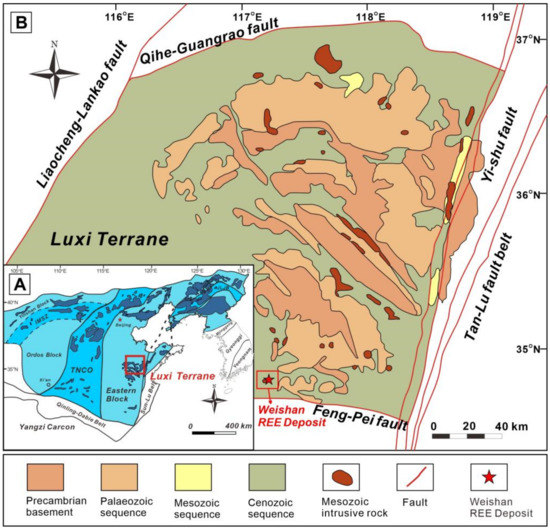
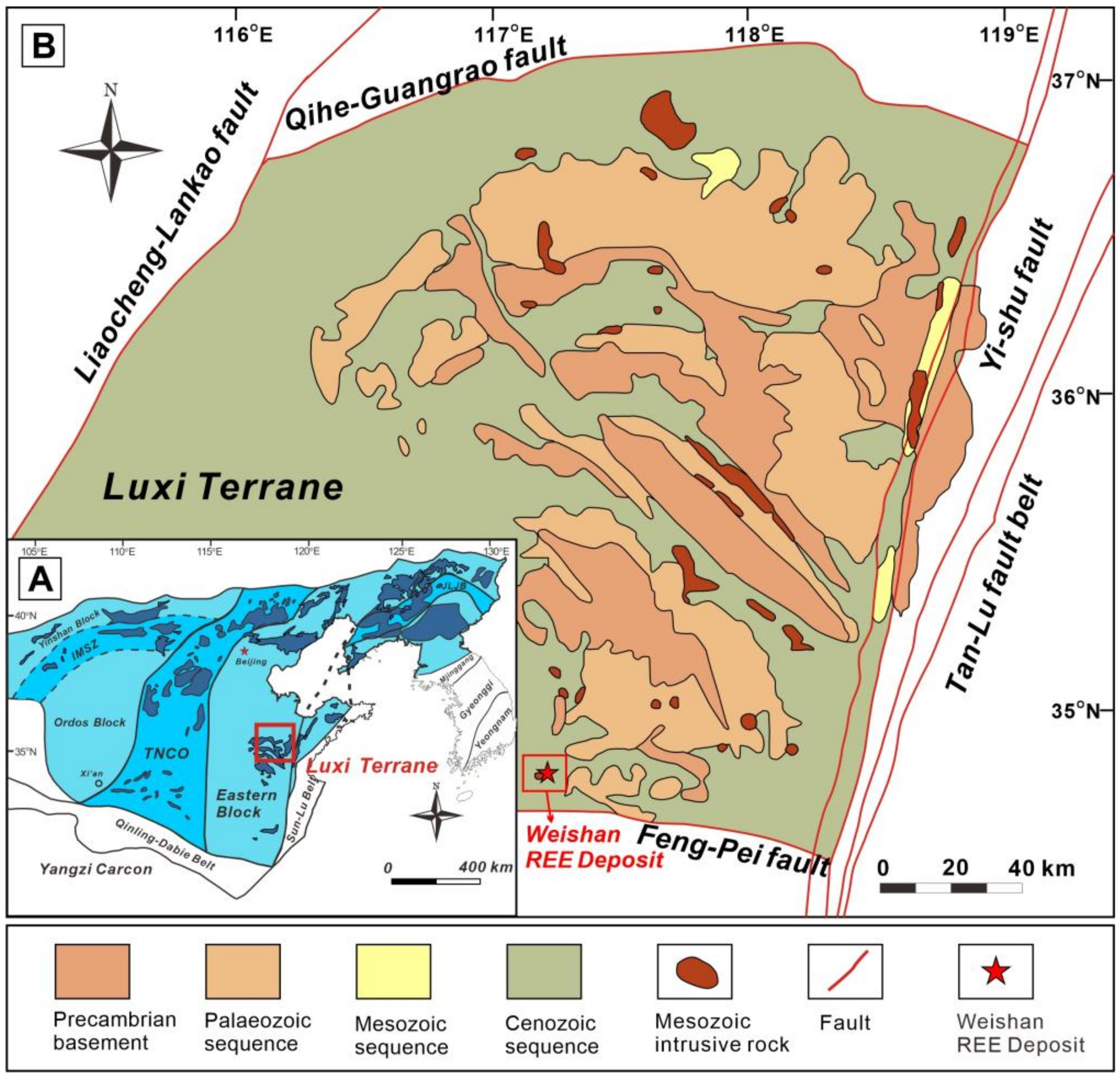
The Luxi Terrane is located in the eastern part of the NCC (Figure 1A) and intersects to the north with the Qihe-Guanggrao fault, to the south with the Feng-Pei fault, to the west with the Liaocheng-Lankao fault and to the east with the Yi-Shu fault [21] (Figure 1B). The exposed formations include Late Archean amphibolites and TTG gneisses, Paleoproterozoic granitoids, Cambrian to Permian carbonates and clastic rocks, Triassic to Cretaceous clastic rocks, volcanic rocks, lamprophyre and dioritic porphyrite dikes, carbonatites and alkaline rocks and Cenozoic clastic rocks [22]. The area underwent a long period of tectonic activity, which formed abundant fold and fault structures. The folds include closed synclinal and anticlinal folds [23]. The fault is comprised of the NW Nishan and Dujiaoganlin faults and the NWW Zaozhuang, Caowangmu and Changlong faults [24]. There were frequent magmatic activities in the Luxi Terrane during the early Precambrian to Mesozoic. Among them, the Mesozoic Yanshanian magmatic activity was relatively strong and formed serpentinite, hornblende, gabbro, diabase, diorite, granodiorite and granite [25]. Abundant mineral resources are exposed in the Luxi Terrane, mainly REE, gold, iron and coal deposits [15,26,27,28,29].
Figure 1.
(A) Geological sketch map of the North China Craton [30]. (B) Geological sketch map of the Luxi Terrane [16].
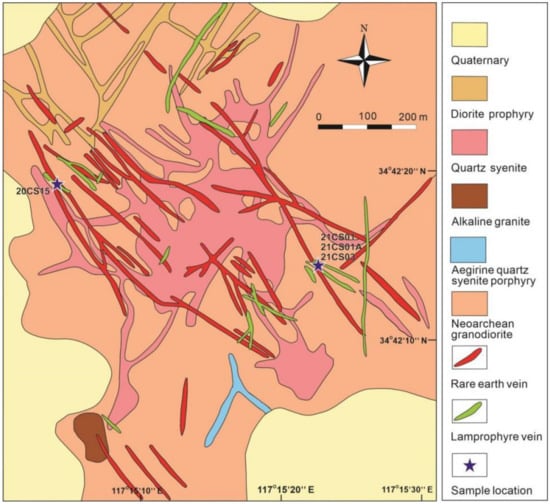
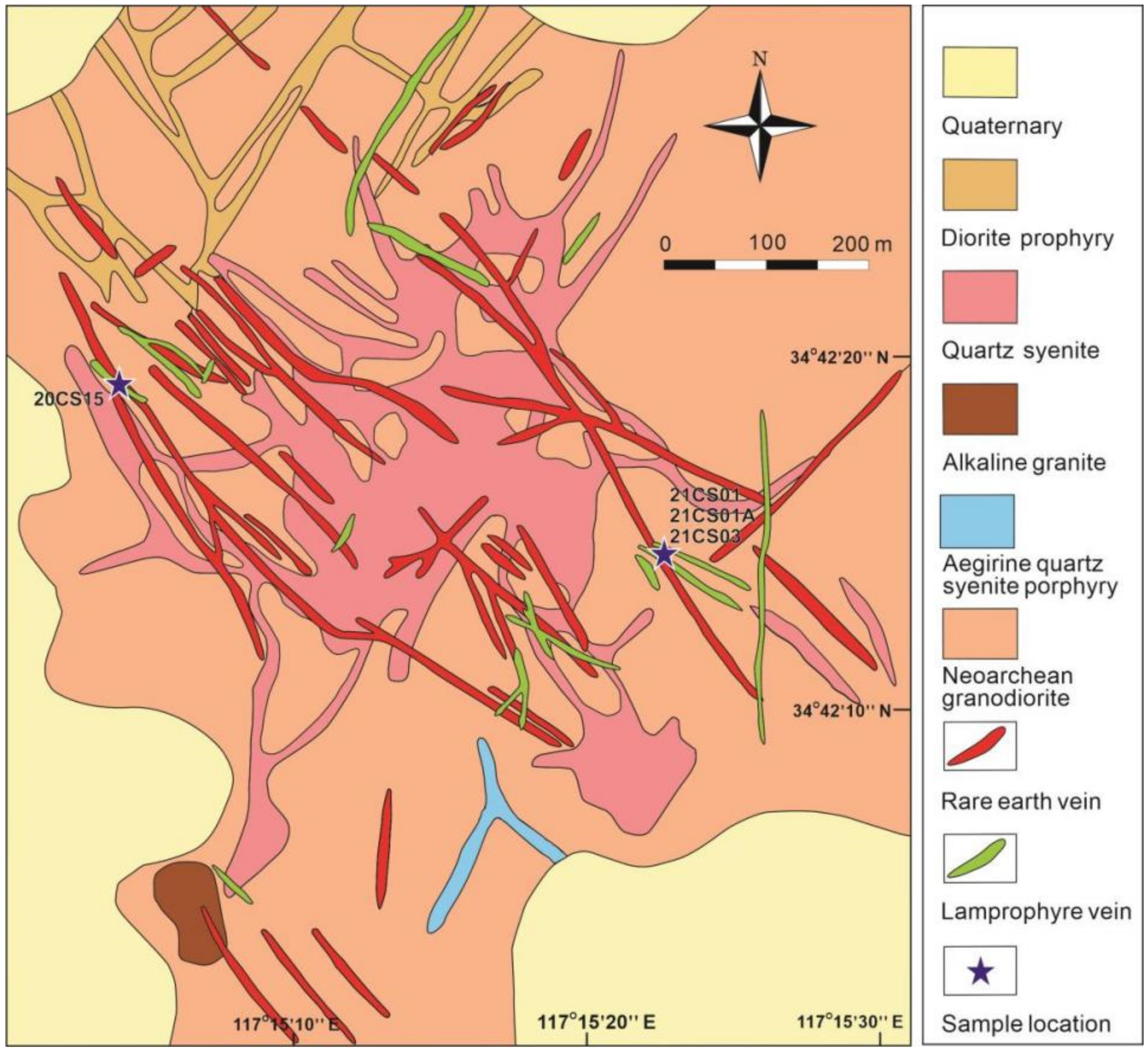
The Weishan REE deposit is located in the southwestern Yicheng uplift of the western Luxi Terrane (Figure 1). The major strata include Neoarchean granodiorite and Quaternary sedimentary cover. The structure is dominated by NW and NE faults. The majority of the magmatic rock is comprised of Mesozoic quartz syenite, aegirine quartz syenite and alkali granite, which constitute the Weishan alkali complex. The alkaline magma intrudes into the Neoarchean granodiorites and takes the form of irregular branches. The proven resources in Weishan REE deposit amount to 44 t, with an average grade of 4.6% [31]. Most of the REE veins are distributed as NW trending, which is determined by the NW fault structure (Figure 2).
Figure 2.
Geological sketch map of the Weishan REE deposit [16].
There are abundant lamprophyre dikes exposed in the Weishan REE deposit and its periphery. The lamprophyre takes the form of dikes intruded into the Neoarchean granodiorite, biotite plagioclase gneiss and Mesozoic alkaline complex. These lamprophyre dikes are mainly exposed as NE and NW trending and show size variations of 20 to 200 m in length and 2.0 to 5.0 m in width (Figure 2). The rock is mostly characterized by porphyritic or non-porphyritic lamprophyre textures and massive structures. The main lithological types of lamprophyre are kersantite, spessartite and alkaline lamprophyre.
3. Petrography
3.1. Kersantite
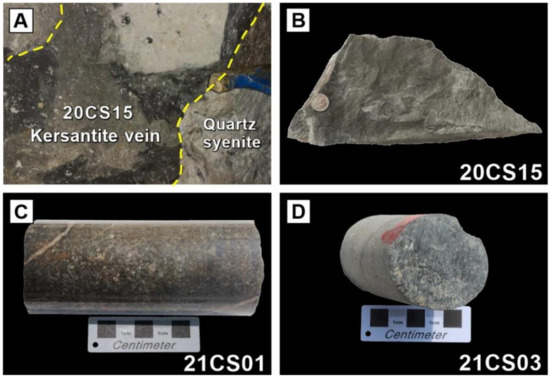
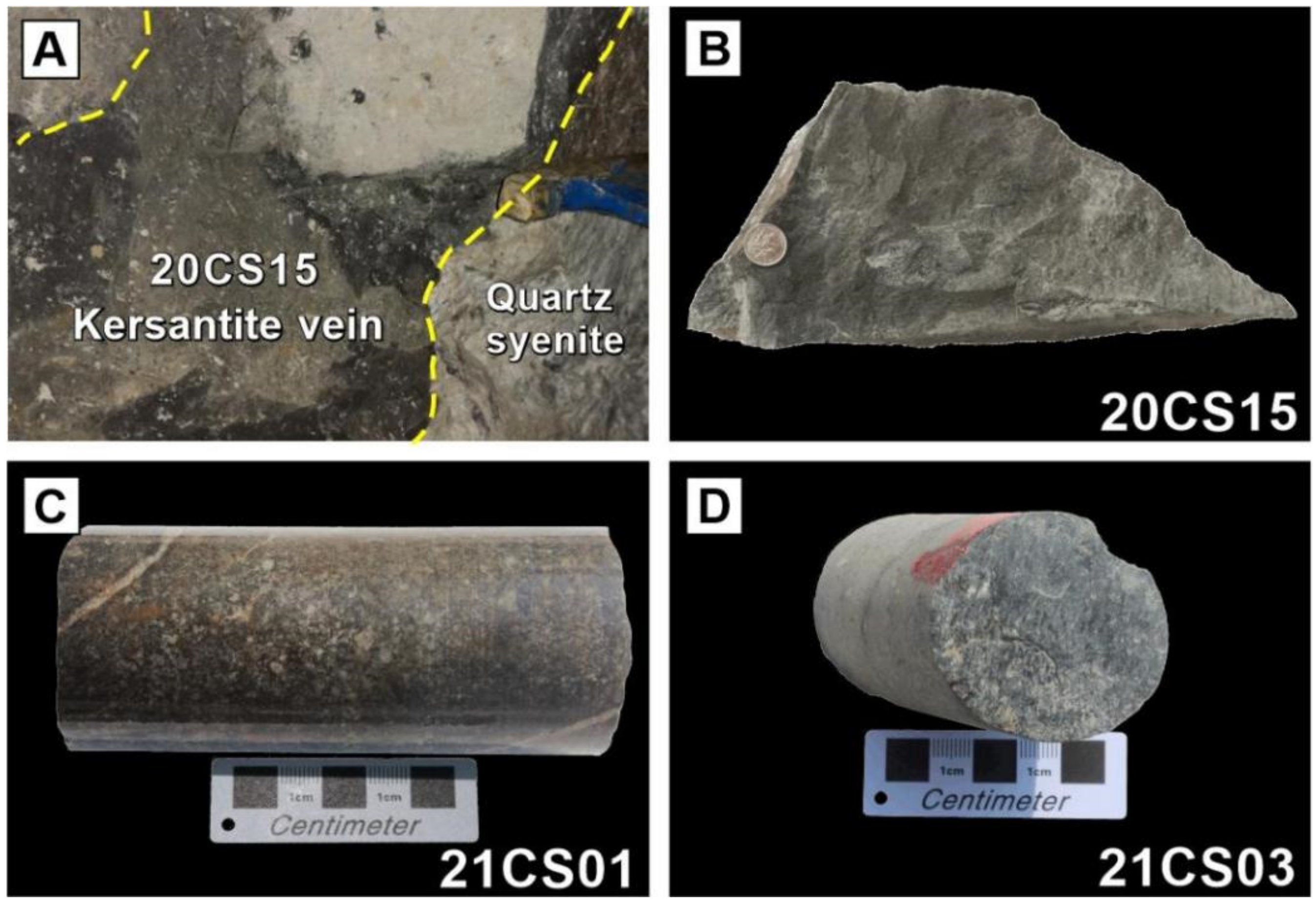
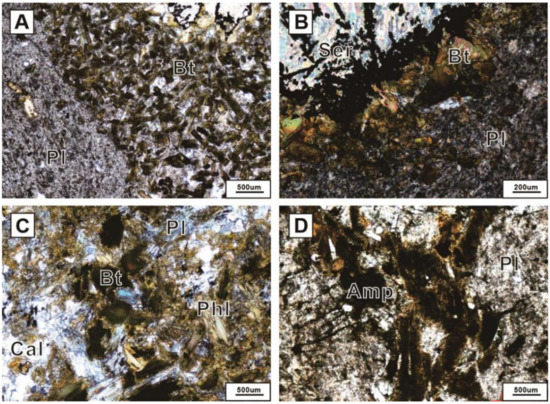
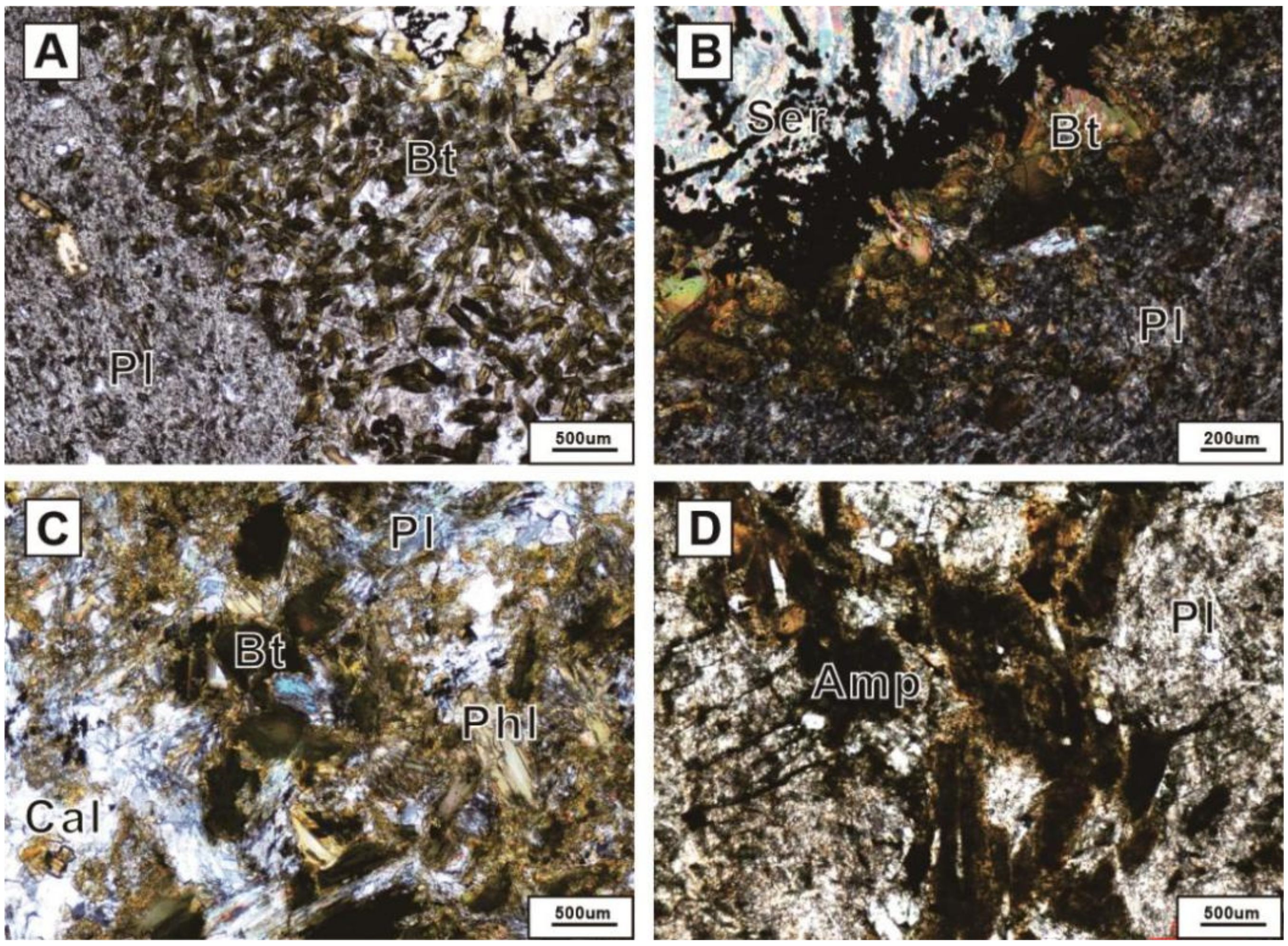
The kersantite (20CS15) is collected from REE vein No. 12 (−160 m) (34°42′13″ N, 117°15′24″ W) and is characterized by a greenish color, porphyritic lamprophyre texture and massive structure (Figure 3A,B). The rock consists of 15% phenocrysts, which are dominated by biotite (1~3 mm). The matrix is composed of fine- to medium-grained plagioclase (60–65%), biotite (25–30%), hornblende (<5%) and minor calcite (Figure 4A,B). Accessory minerals include zircon, apatite and sphene. The biotite is brown in color, euhedral to subhedral and tabular, with a size of 120–1000 μm. The plagioclase is subhedral and columnar, with a size of 20–150 μm, and it exhibits lamellar and polysynthetic twinning. Some plagioclase grains show saussurite alteration.
Figure 3.
Field and hand-specimen photographs of the lamprophyres. (A) Kersantite vein; (B) kersantite; (C) damkjernite; (D) spessartite.
Figure 4.
Photomicrographs of the lamprophyres. (A) kersantite; (B) biotite phenocryst in kersantite; (C) damkjernite; (D) spessartite. Mineral abbreviations: Amp—amphibole; Bt—biotite; Cal—calcite; Pl—plagioclase; Phl—phlogopite; Ser—sericite.
3.2. Damkjernite
The damkjernites (21CS01, 21CS01A) are collected from drill hole ZK5 (34°42′17″ N, 117°15′04″ W) and are characterized by a brownish color, porphyritic lamprophyre texture and massive structure (Figure 3C). The rock is composed of 15% phenocrysts, which are dominated by biotite, phlogopite and calcite, with a grain size of 0.5–5 mm. The matrix of the damkjernite is dominated by plagioclase (25–30%), phlogopite (20–25%), biotite (25–30%), calcite (15–18%), diopside (<5%), olivine (<5%) and minor amphibole (Figure 4C). Accessory minerals include zircon, sphene and apatite. The biotite is a brown to green color and subhedral, with a grain size of 0.5–2 mm. The phlogopite is a yellow color and euhedral tabular, with a grain size of 0.3–2 mm. The plagioclase is subhedral columnar, with a size of 50–500 μm. Some plagioclase grains exhibit obvious lamellar twinning, polysynthetic twinning and partial saussurite alteration. The calcite is colorless, flashed with diamond cleavage.
3.3. Spessartite
The spessartite (21CS03) is collected from drill hole ZK5 (34°42′17″ N, 117°15′04″ W) and is characterized by a greenish color and a massive, non-porphyritic lamprophyre structure (Figure 3D). The rock is composed of amphibole (40–45%), plagioclase (20–25%), biotite (8–10%), orthoclase (6–9%), chlorite (<5%), quartz (<5%) and pyrite (Figure 4D). Accessory minerals include zircon, sphene and apatite. The amphibole is yellow to brownish in color, with an anhedral or columnar morphology and a size of 500–1000 μm. The plagioclase is subhedral columnar, and some grains exhibit polysynthetic twinning, chloritization and sericitization. Some of the plagioclase shows large grain sizes up to 5 mm. The biotite is brown to green in color, subhedral to anhedral. The orthoclase is subhedral and some grains show obvious parallel cleavage. The quartz is fine-grained and anhedral.
4. Analytical Methods
4.1. Whole-Rock Major and Trace Element Analyses
Geochemical data for the major and trace elements of the studied samples were obtained at the testing center of the Shandong Lunan Geological Engineering Investigation Institute, China. First, the samples were crushed and powdered to 200 mesh in an agate bowl. The ferrous oxide content was determined with the potassium dichromate volumetric method, and other major elements were analyzed with X-ray fluorescence spectrometry using a Rigaku RIX 2100 spectrometer (Rigaku Corporation, Tokyo, Japan)with uncertainties of less than 5%. Trace and rare earth elements were analyzed using a PEE 6000 ICP-MS instrument with uncertainties of less than 5%.
4.2. Zircon LA-ICP-MS U-Pb Dating
Zircon separation was completed at the Langfang Geological Survey, Hebei Province, China. The samples were crushed to 40–60 mesh, and the zircon grains were separated through coarse and fine crushing, panning, magnetic separation and other methods. Transmission, reflection and cathodoluminescence (CL) imaging were completed at the Guangzhou Institute of Geochemistry, Chinese Academy of Sciences. The relatively complete and transparent zircon crystals were carefully handpicked under a binocular microscope and mounted in the epoxy, polished to nearly half-section to expose the internal structure and cleaned in an ultrasonic cleaner containing a 5% HNO3 solution. Zircon grains were carefully examined under microscopes and electron microscopes to identify internal structures and textures.
LA-ICP-MS Zircon U-Pb isotope analysis was completed at the Isotopic Laboratory, Tianjin Center, China Geological Survey. The laser analysis was performed using a Neptune double-focusing multiple-collector ICP-MS (Thermo Fisher Scientific, Waltham, MA, USA) attached to a NEW WAVE 193 nm-FX ArF Excimer laser ablation system (Express Scripts Inc., Saint Louis, MI, USA). All zircon analysis was completed with a beam diameter of 35 μm, 8 Hz repetition rate and an energy density of 11 J/cm2. Zircon 91,500 is used as an internal standard for U-Pb chronology analysis. In order to ensure the accuracy of the test, the zircon 91,500 standard sample was tested twice, before and after every eight samples were tested. An SRM 610 glass standard sample was used as an external standard to calculate the U, Th and Pb concentrations of zircon. Data were calculated using ICPMS DataCal 8.4 at the China University of Geosciences, Wuhan, China [32], and zircon age concordant plots were obtained using the Isoplot 4.0 program [33]. Common Pb corrections were undertaken using the method described by Anderson [34].
4.3. Zircon Lu-Hf Isotope
The zircon Lu-Hf isotope analysis was completed in the Isotopic Laboratory at Tianjin Center, China Geological Survey, using a Neptune MC-ICP-MS (Thermo Fisher Scientific, Waltham, MA, USA) equipped with a NEW WAVE 193 nm-FX ArF Excimer laser ablation system (Express Scripts Inc., Saint Louis, MI, USA). The laser ablation beam diameter was 42 μm, the energy density was 14 J/cm2 and the repetition rate was 10 Hz. A GJ-1 standard sample was used as an external standard for in situ zircon Hf isotopic analyses.
5. Results
5.1. Major and Trace Element Geochemistry
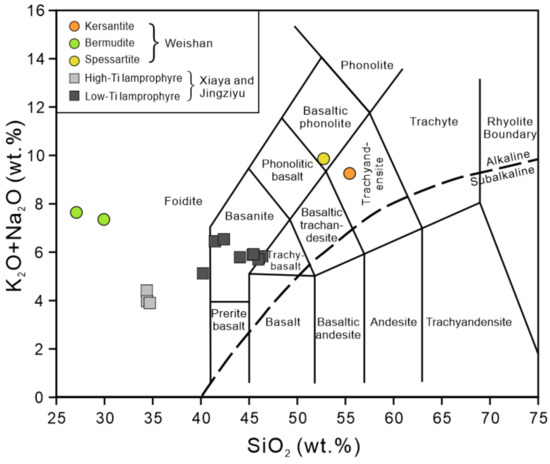
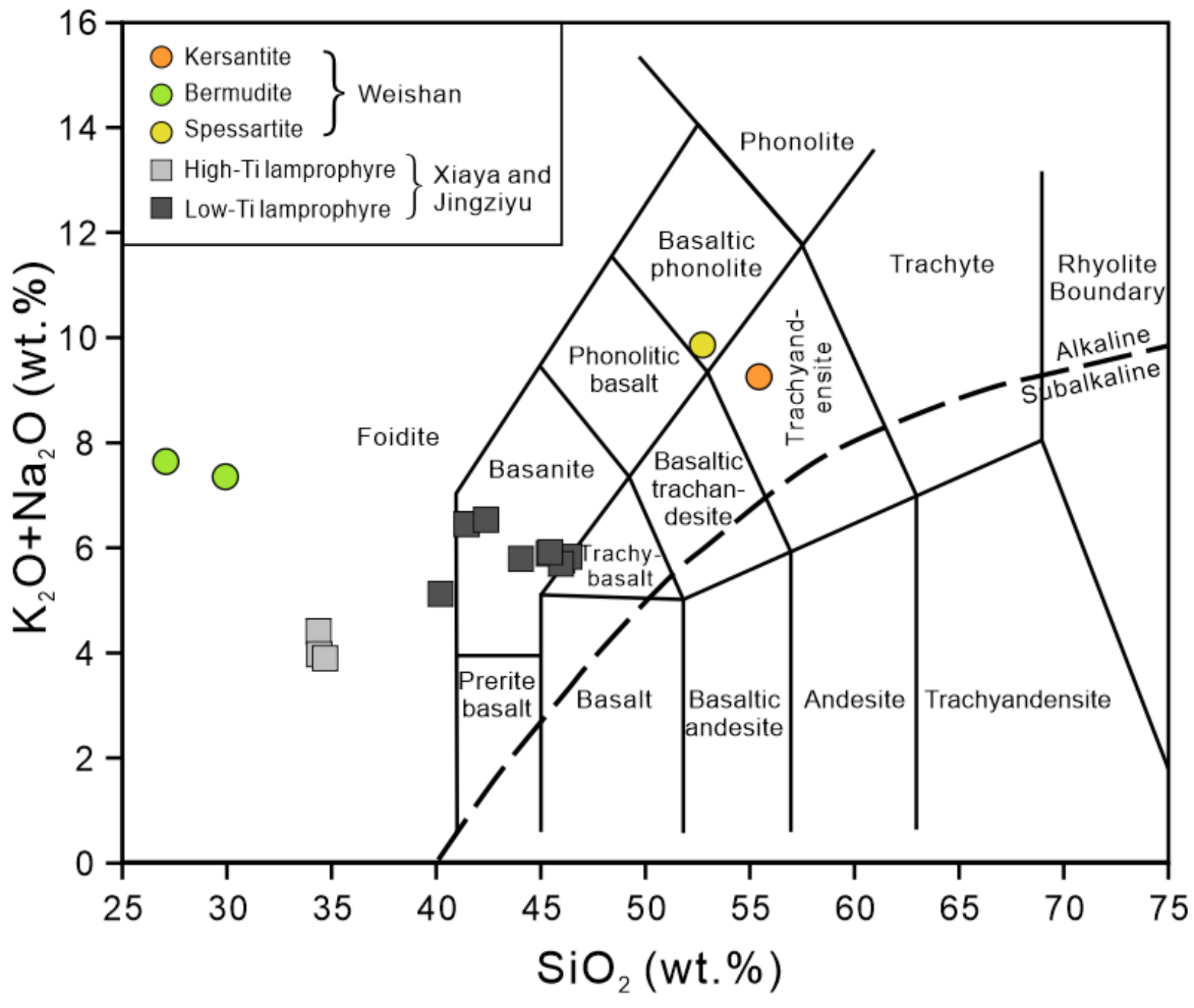
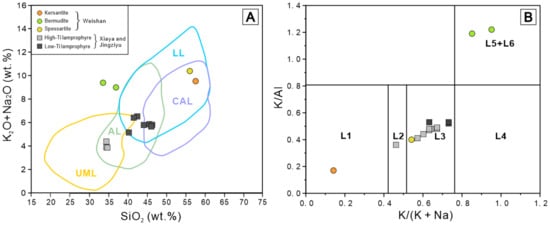
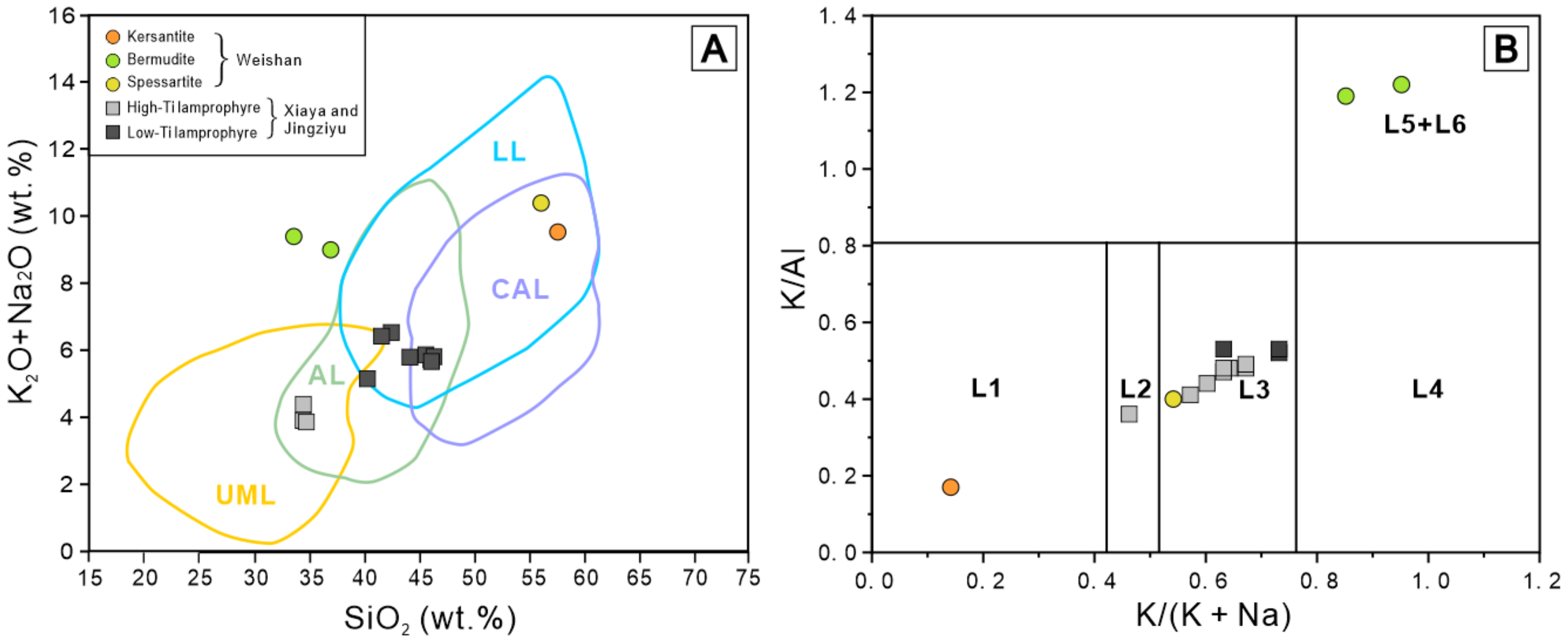
The major elements of spessartite (20CS15) and kersantite (21CS03) are similar (Figure 5), showing high concentrations of SiO2 (52.74–55.44 wt.%), K2O (1.80–6.33 wt.%), Al2O3 (12.31–18.80 wt.%) and Na2O (3.53–7.45 wt.%); moderate concentrations of MgO (1.79–4.55 wt.%) and CaO (2.05–5.20 wt.%); and low concentrations of TiO2 (0.52–0.59 wt.%) and P2O5 (0.23–0.68 wt.%). The kersantite and spessartite show high alkali concentrations of 9.25 and 9.86 wt.%, respectively. Their K/Al and K/(K + Na) ratios are 0.17–0.40 and 0.14–0.54, respectively. In the TAS diagram, the samples fall into the basaltic phonolite and trachyandesite fields and belong to the alkaline series. In the (K2O + Na2O) vs. SiO2 classification diagram (Figure 6A), the samples fall into the calc-alkaline lamprophyre fields, while in the K/Al vs. K/(K + Na) diagram (Figure 6B), the samples fall into the altyl lamprophyre and potassic lamprophyre fields, respectively.
Figure 5.
TAS classification diagram of the lamprophyre from the Weishan area and data previously compiled for the Jingziyu and Xiaya area of the Luxi Terrane [35]. Data are given in Table 1.
Figure 6.
Geochemical classification plots of the lamprophyres. (A) (K2O + Na2O) vs. SiO2 classification diagram [1]. (B) K/Al vs. K/(K + Na) diagram [36]. Data are given in Table 1. CAL—cal-alkaline lamprophyre; AL—alkaline lamprophyre; UML—ultrabasic lamprophyre; LL—potassium-magnesium lamprophyre. L1—altyl lamprophyre; L2—weakly potassic lamprophyre; L3—potassic lamprophyre; L4—ultralithic lamprophyre; L5—peraluminite lamprophyre; L6—potassium- magnesium lamprophyre.
The major element of damkjernite (21CS01 and 21CS01A) show high concentrations of MgO (12.16–13.07 wt.%), K2O (6.56–7.39 wt.%), Al2O3 (6.59–7.21 wt.%), Na2O (0.25–0.79 wt.%) and CaO (14.76–16.17 wt.%) and low concentrations of SiO2 (27.08–29.93 wt.%), TiO2 (0.72–0.80 wt.%) and P2O5 (2.13–2.46 wt.%) (Figure 5). The damkjernites are classified as low-titanium lamprophyre (TiO2 < 1.5%) and show high alkali concentrations of 7.35–7.64 wt.%. Their K/Al and K/(K + Na) ratios are 1.19–1.22 and 0.85–0.95, respectively. In the TAS diagram, the samples fall into the foidite field and belong to the alkaline series. In the (K2O + Na2O) vs. SiO2 classification diagram (Figure 6A), the samples are close to the ultrabasic lamprophyre fields, while in the K/Al vs. K/(K + Na) diagram (Figure 6B), the samples fall into the peraluminite lamprophyre and potassium-magnesium lamprophyre fields.
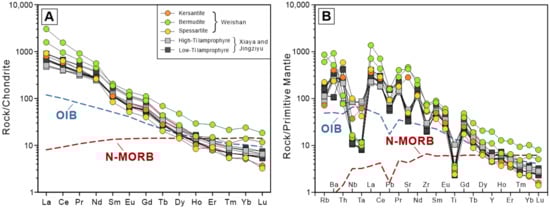
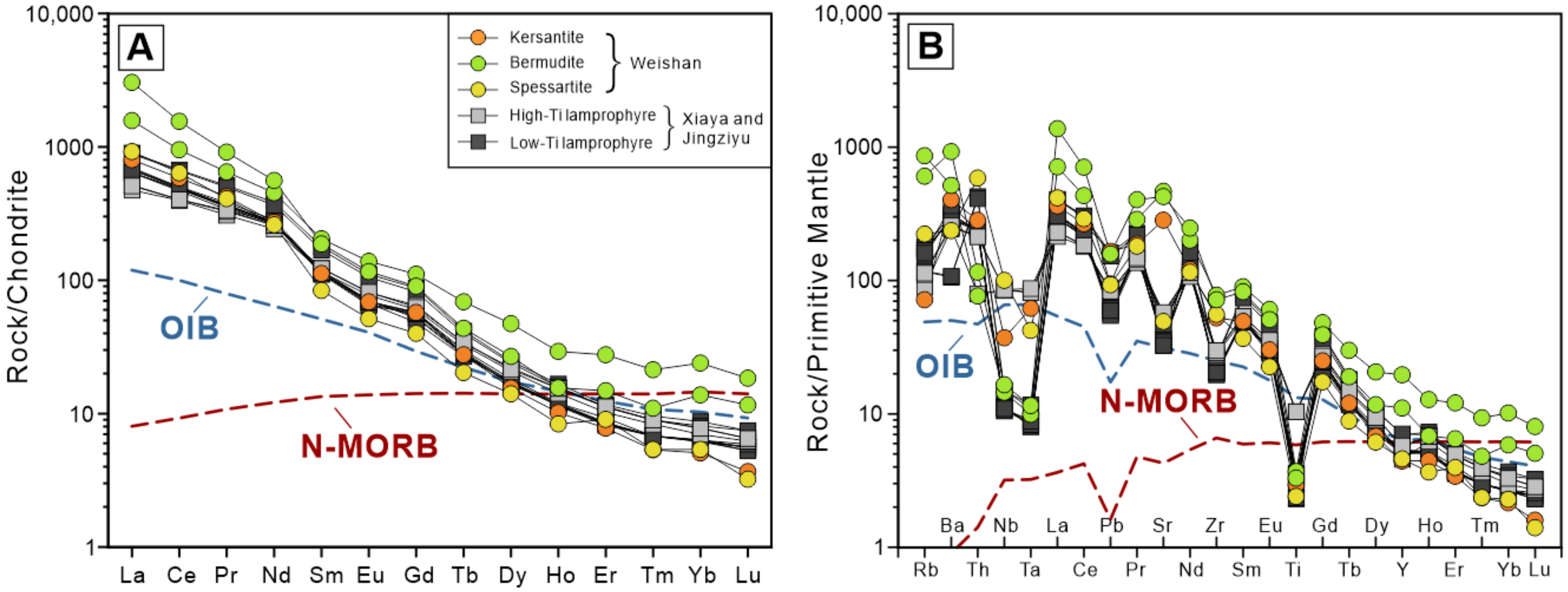
The chondrite-normalized REE patterns of the lamprophyres show right-inclined characters (Figure 7A and Table 1). The high (La/Lu)N (85–286) and (La/Yb)N (66–220) ratios indicated strong fractionation between light rare earth elements (LREEs) and heavy rare earth elements (HREEs). High (La/Sm)N (7.13–16.26), (Gd/Yb)N (4.64–11.30) and LREEs/HREEs (12–32) ratios indicated high fractionation from LREEs to HREEs. There were high concentrations of total REEs ranging from 1012 to 2793 ppm. LREE content ranged from 976 to 2793 ppm and the HREE content ranged from 32 to 135 ppm. In the primitive mantle-normalized trace element patterns (Figure 7B), all samples showed relative enrichment of large ion lithophile element (LILEs, Rb and Ba) and LREEs (La and Ce) and strong depletion of high field strength element (HFSEs, Nb, Ta, Ti and Zr) and HREEs, among which Nb, Ta and Ti showed significantly negative “TNT” anomalies.
Figure 7.
(A) Chondrite-normalized REE patterns for lamprophyres. (B) Primitive mantle-normalized trace element patterns for lamprophyres. Data sources: chondrite [37], primitive mantle [38], N-MORB and OIB [39].
5.2. Zircon U-Pb Geochronology
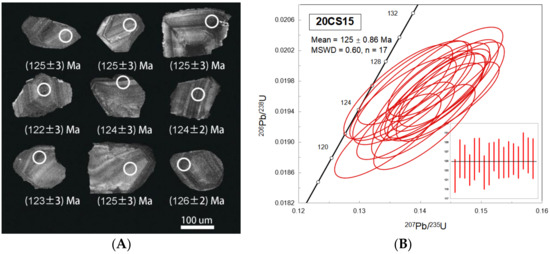
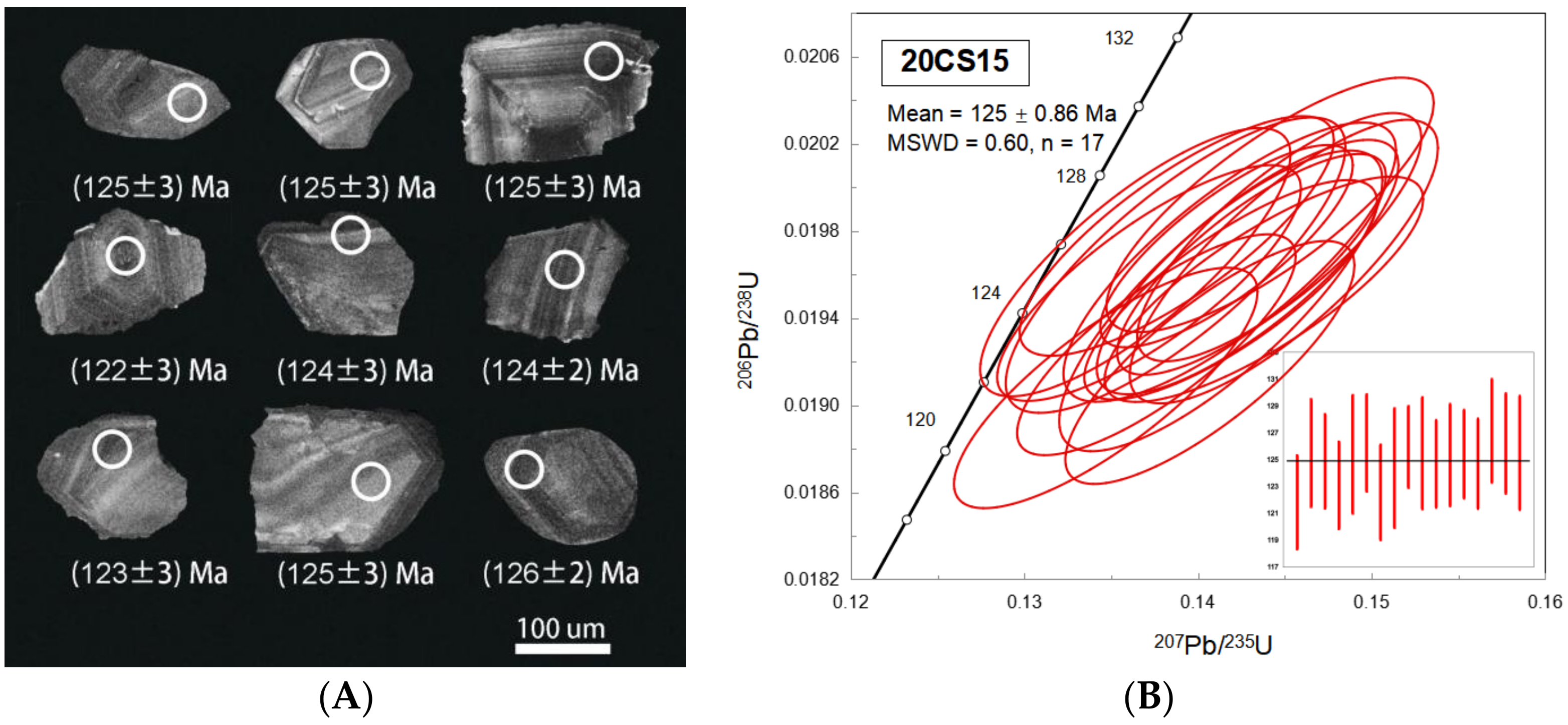
Most of the zircons from the lamprophyre (20CS15) are colorless, transparent, subhedral to anhedral and had rounded or irregular morphology. The zircon grains show grain sizes of 50–300 μm and aspect ratios of 1:1–2.5:1. In the cathodoluminescence (CL) image, the zircons show obvious patchy, banded and sector zoning (Figure 8A), indicating a magmatic origin [40].
Figure 8.
(A) CL image of zircon grains from lamprophyre sample 20CS15. (B) Zircon U-Pb concordant plot for the lamprophyre sample 20CS15.
Seventeen zircons from the lamprophyre (20CS15) were analyzed (Table 2). To obtain an accurate and reliable age, most of the analyzed spots were selected from the large grains of the magmatic oscillatory zoning domain. The measured concentrations of U and Th in these zircons are 545–1999 ppm and 14–3290 ppm, respectively. Th/U ratios ranged from 0.38 to 0.61, similar to magmatic zircon (Th/U > 0.1) [41]. The sample yield a weighted mean age of 125 ± 0.86 Ma (2σ, n = 17, MSWD = 0.60) (Figure 8B), representing the crystallization age of lamprophyre.
Table 2.
LA-ICP-MS zircon U-Pb isotope data for kersantite (20CS15) from the Weishan area.
Table 1.
Major, trace and rare earth element (REE) compositions for the lamprophyres.
5.3. Zircon Lu-Hf Isotope
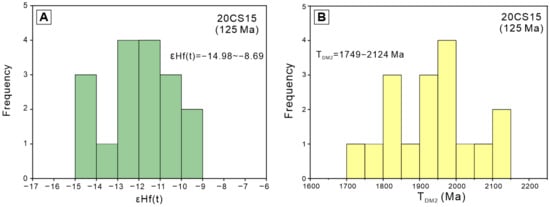
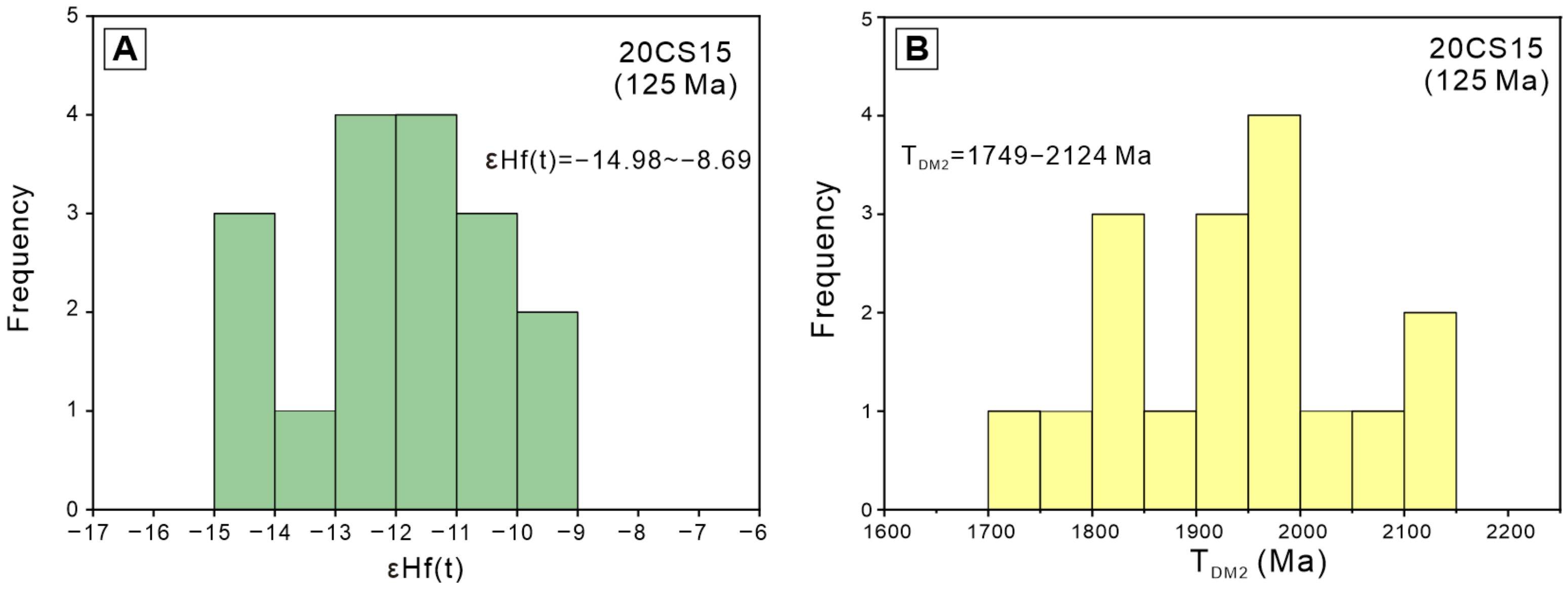
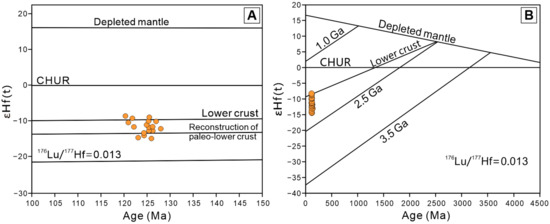
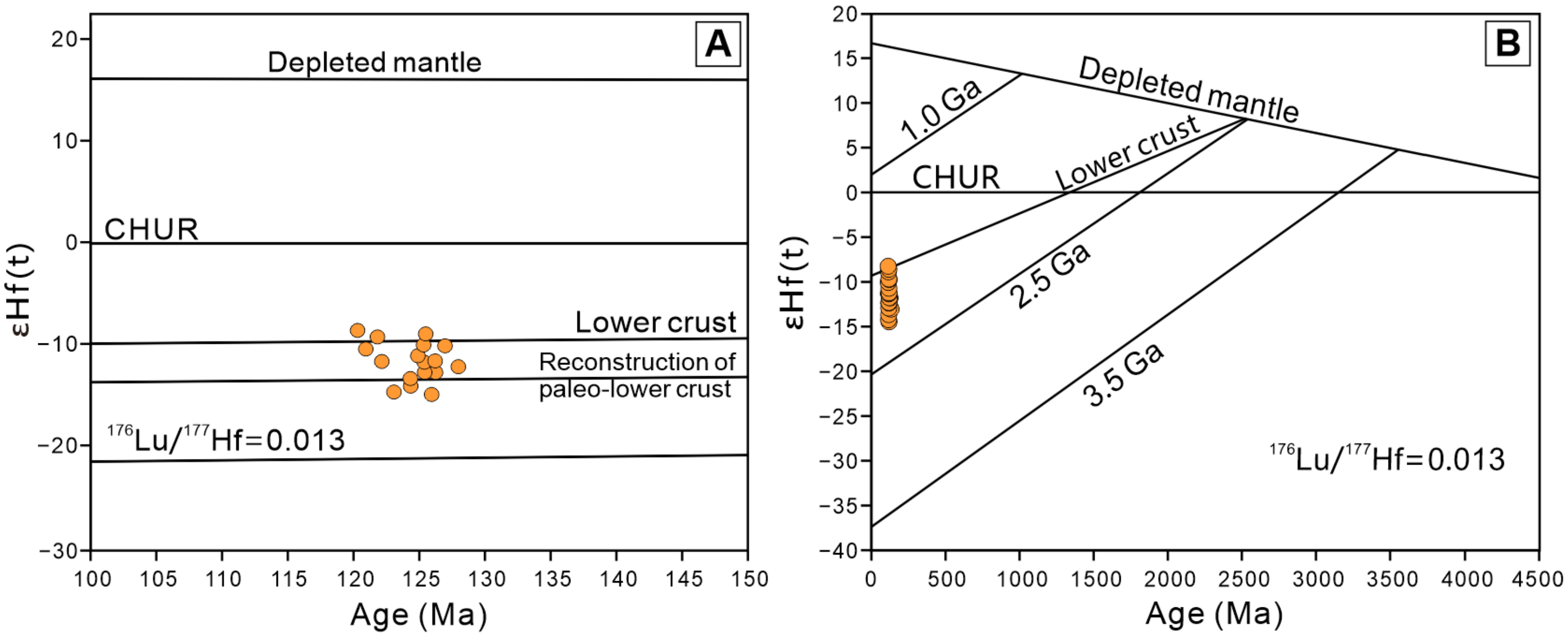
The Lu-Hf isotopic analysis of zircons from the lamprophyre (20CS15) (Table 3) show that the 176Lu/177Hf ratios for all measured results ranged from 0.0011 to 0.0015. The 176Hf/177Hf ratios of 17 zircons ranged from 0.282274 to 0.282442, with an average of 0.282359. Zircon εHf(t) values were all in the negative range, from −14.98 to −9.03 (Figure 9A) with an average of −11.98, and they were plotted between the lower crust and paleo-lower crust reconstruction lines (Figure 10). The single-stage-model and two-stage-model ages were 1.1–1.4 Ga and 1.7–2.1 Ga, respectively (Figure 9B).
Table 3.
Zircon Lu-Hf isotope data for kersantite (20CS15) from the Weishan area.
Figure 9.
(A) Histogram of zircon εHf(t) values for the lamprophyre (20CS15). (B) Histogram of two-stage-model age for the lamprophyre.
Figure 10.
(A,B) are εHf(t) vs. age (Ma) diagrams for lamprophyre (20CS15) from the Weishan area. (A) is enlarged from (B) to show the data variations.
6. Discussion
6.1. Early Cretaceous Intrusion of Lamprophyre Dike
Zircons from the lamprophyre of the Weishan area show obvious patchy, banded and sector zoning and high Th/U ratios of 0.38–0.61, indicating magmatic zircon. The analyzed spots yielded a weighted mean age of 125 Ma, which can be interpreted as the crystallization age of the lamprophyre. Qiu et al. [43] reported a K-Ar age of 120 Ma from the phlogopite of the lamprophyre in the Jingziyu area. Yang et al. [42] reported a zircon LA-ICP-MS U-Pb age of 126–132 Ma from the lamprophyre in the Xiaya and Jingziyu areas. The magma source of the lamprophyre from the Weishan, Jingziyu and Xiaya areas of the Luxi Terrane was an emplaced simultaneous source. Therefore, the mafic dike intrusions in the Luxi area were formed from 132–120 Ma, which is consistent with peak Early Cretaceous magmatic events in the eastern NCC.
Liang et al. [21] discussed the zircon LA-ICP-MS U-Pb age of Weishan alkaline rocks and showed that the crystallization age of the quartz syenite was 122 Ma and that of the aegirine quartz syenite porphyry was 130 Ma. Wei et al. [25] obtained zircon U-Pb ages of 127–126 Ma for the quartz syenite and alkali granite. Therefore, the alkaline and mafic magma were emplaced simultaneously during the Early Cretaceous.
6.2. Crustal Contamination
The lamprophyre from the Weishan area show low concentrations of SiO2 (27.08–55.44 wt.%) and TiO2 (0.52–0.80 wt.%); high concentrations of K2O (1.80–7.39 wt.%), MgO (1.79–13.07 wt.%) and alkali (7.35–9.86 wt.%); and a high Mg# (29.49–79.83), which are characteristic of a deep mantle source [44]. Although crustal contamination shows only a limited influence on rapid upwelling and low viscosity magma [45,46], it is necessary to evaluate the effects of crustal contamination.
The crust-like trace element features included enrichment in LILEs (Rb, Ba) and LREEs, depleted HREEs and HFSEs (Nb, Ta, Ti, Zr), negative Nb-Ta and Ti anomalies, which may indicate continental crust material contamination from assimilation or a fractional crystallization process during the magma intrusion [47,48,49]. However, the lamprophyres show higher concentrations of Ba (1651–6457 ppm) and Sr (1037–9809 ppm) than the average continental crust (390 ppm Ba; 325 ppm Sr) [50], implying that the crust contamination had limited influence on the trace elements during the magma emplacement [51]. In addition, the low Lu/Yb ratios of 0.09–0.13 were close to the mantle-derived magmas (Lu/Yb, 0.14–0.15) rather than the continental crust (Lu/Yb, 0.16–0.18) [39], indicating the absence of crustal contamination. The geochemical evidence was consistent with the absence of inherited zircons within the lamprophyre. Previous studies have also suggested that crustal contamination has limited influence during mafic dike intrusion [52,53,54,55]. Therefore, the crust-like trace element features are not the result of crustal contamination from when the magma was ascending.
6.3. Nature of the Magma Source
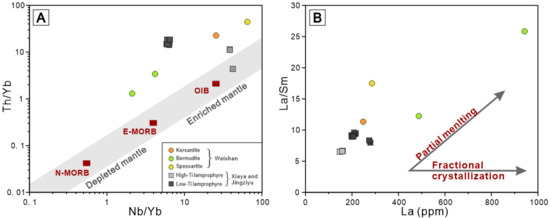
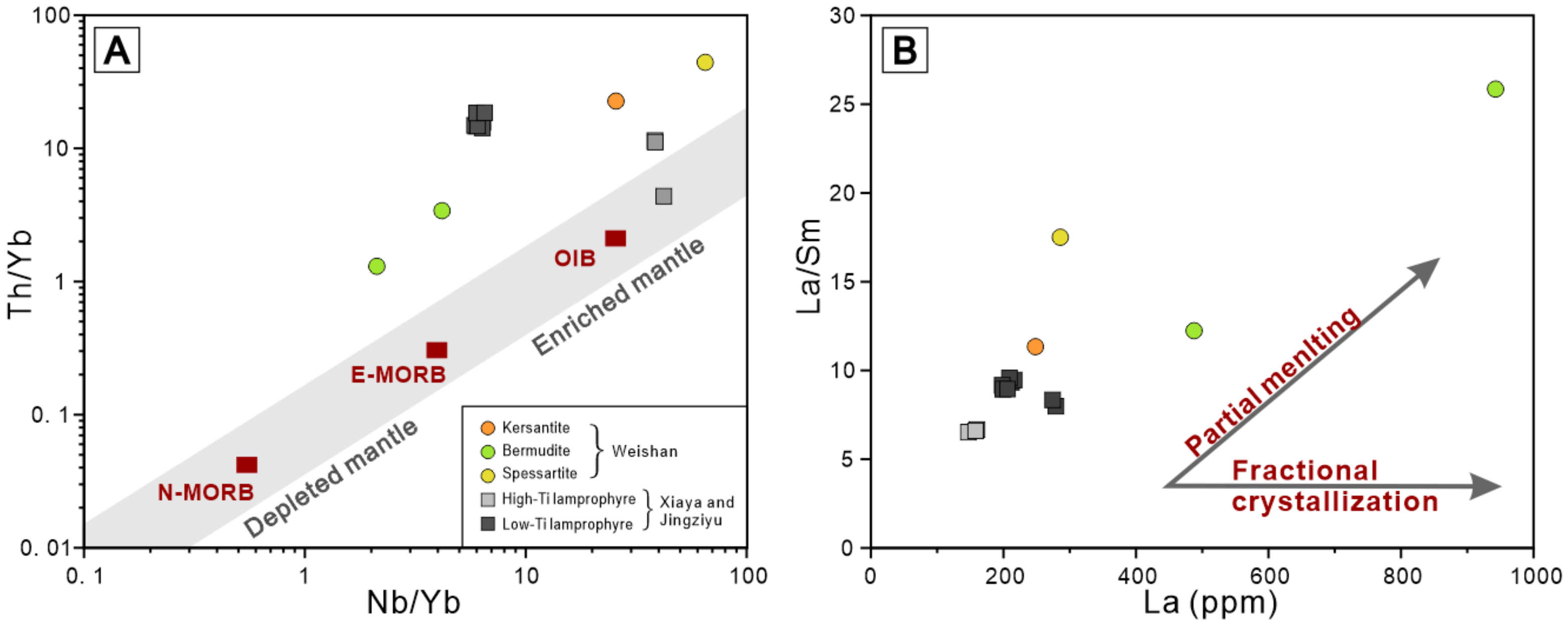
The abundance of K2O, alkali enrichment and low εHf(t) values (−14.98 to −8.69) suggest that the magma source of the lamprophyres was derived from an enriched mantle [56]. In the Th/Yb vs. Nb/Yb diagram, the lamprophyres also fell into the enriched mantle field (Figure 11A). The high LREE/HREE ratios of those alkaline lamprophyres imply that the enriched source was the lithospheric mantle [57]. Moreover, in the La/Sm vs. La diagram, the lamprophyres show an obvious positive correlation between La/Sm and La, suggesting that the main petrogenetic mechanism was controlled by partial melting rather than fractional crystallization (Figure 11B).
Figure 11.
(A) Th/Yb vs. Nb/Yb diagram of the lamprophyre from the Weishan area [58]. (B) La/Sm vs. La diagram [59].
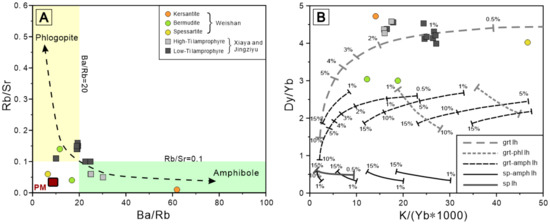
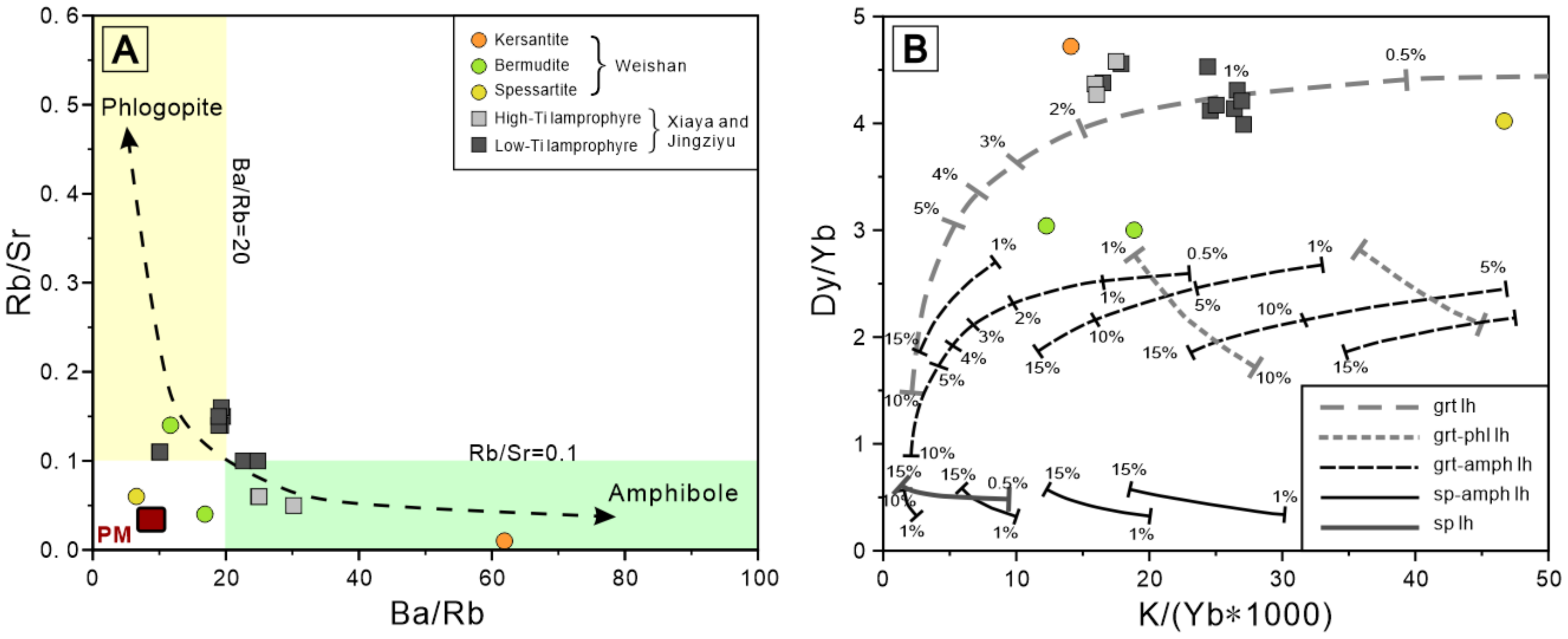
The lamprophyres exhibited high concentrations of K2O and were enriched with LILEs and LREEs, which consistently indicate an enriched mantle source. Experimental petrology studies suggest that the volatile-rich minerals phlogopite and amphibole are the major host phases for a LILE-rich lithospheric mantle [60,61]. The compatible elements Rb, Sr and Ba are useful proxies for distinguishing phlogopite from amphibole [62]. The MELTS equilibria with phlogopite show higher Rb/Sr (>0.1) and lower Ba/Rb (<20) ratios. Comparatively, the MELTS equilibria with amphibole show a high Ba concentration and Ba/Rb (>20) ratio [63]. Therefore, there were low Rb/Sr (0.01–0.14) and high Ba/Rb (7–69) ratios in the lamprophyres from the Weishan area (Figure 12A), indicating that the magma source for the lamprophyre was formed by the partial melting of an amphibole-bearing lherzolite mantle. The Dy/Yb vs. K/(Yb*1000) diagram (Figure 12B) is a useful plot to distinguish the spinel-facies (low Dy/Yb ratio; <1.5) and garnet-facies (high Dy/Yb ratio; >2.5) of partial melting [64]. The lamprophyres show high Dy/Yb (3.00–4.72) ratios and K/(Yb*1000) (12.3–46.7) values and were plotted along the garnet-facies and garnet-facies amphibole-bearing lherzolite curve, which implies a low degree of partial melting (0.1–2%) in the garnet-facies. Experimental studies have suggested that the depth of the garnet transition zone is ~85 km [65]. In summary, the magma source of the lamprophyre from Weishan area originated in an enriched mantle through low-degree partial melting of an amphibole-bearing lherzolite mantle at garnet-facies of 85 km depth.
Figure 12.
(A) Rb/Sr vs. Ba/Rb diagram. (B) Dy/Yb vs. K/(Yb*1000) diagram for the lamprophyres from the Weishan area [64].
6.4. Modification of the Mantle Source by Metasomatism
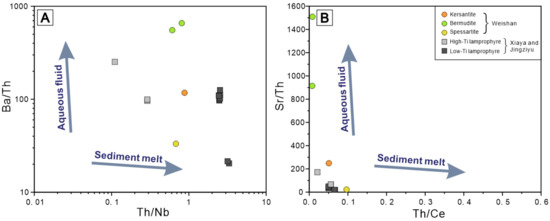
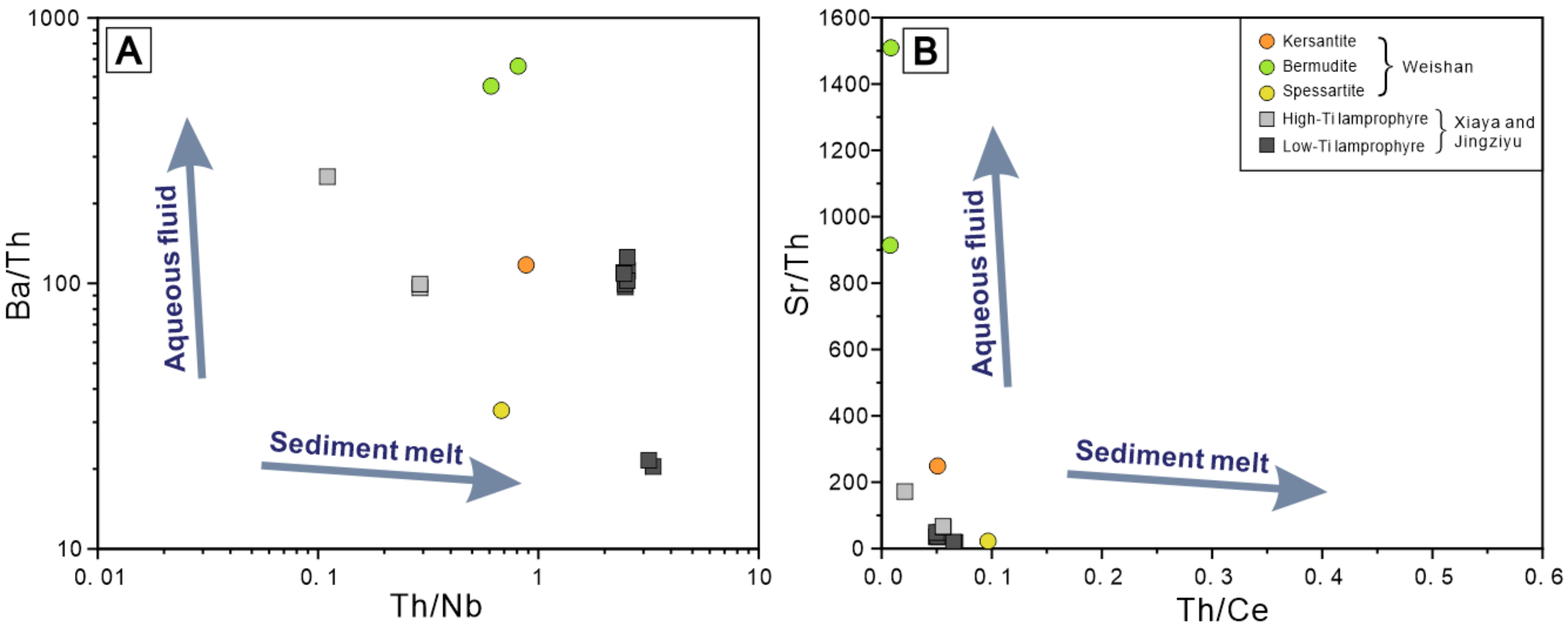
The lamprophyres exhibited higher Th/Yb ratios than MORBs and OIBs [66] (Figure 11A), implying that the mantle magma was enriched. High La/Ta ratios (>30) indicate that the lithospheric mantle enrichment is related to subduction [67]. The Nb/U ratio (3.38) of lamprophyre was lower than the typical MORB and OIB compositions (Nb/U = 47 [68]; lower (Nb/U = 25) and upper (Nb/U = 4.5) crust [69]), which, together with the high Ba/Th (33.20–658.29) values, suggest that the enriched source was derived from slab dehydration fluids [70,71]. Previous studies have proposed that Early Cretaceous mafic rocks are characterized by high concentrations of H2O (2–4 wt.%) [72] and suggest that the oceanic crust is the primary source [73]. In the Ba/Th vs. Th/Nb and Sr/Th vs. Th/Ce diagrams, the lamprophyre show large variations in the Ba/Th and Sr/Th ratios, indicating that the mantle source was metasomatized by a fluid source rather than melting [53] (Figure 13A,B). In addition, the new geochemical data from this study show a similar composition as that found for the Xiaya and Jingziyu, indicating that the magma source of the mafic dike in the Luxi Terrane was derived from an enriched mantle source.
Figure 13.
(A) Ba/Th vs. Th/Nb diagram [53]. (B) Sr/Th vs. Th/Ce diagram [74].
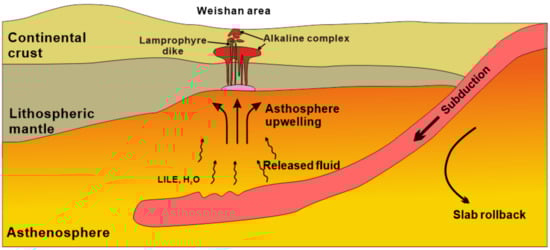
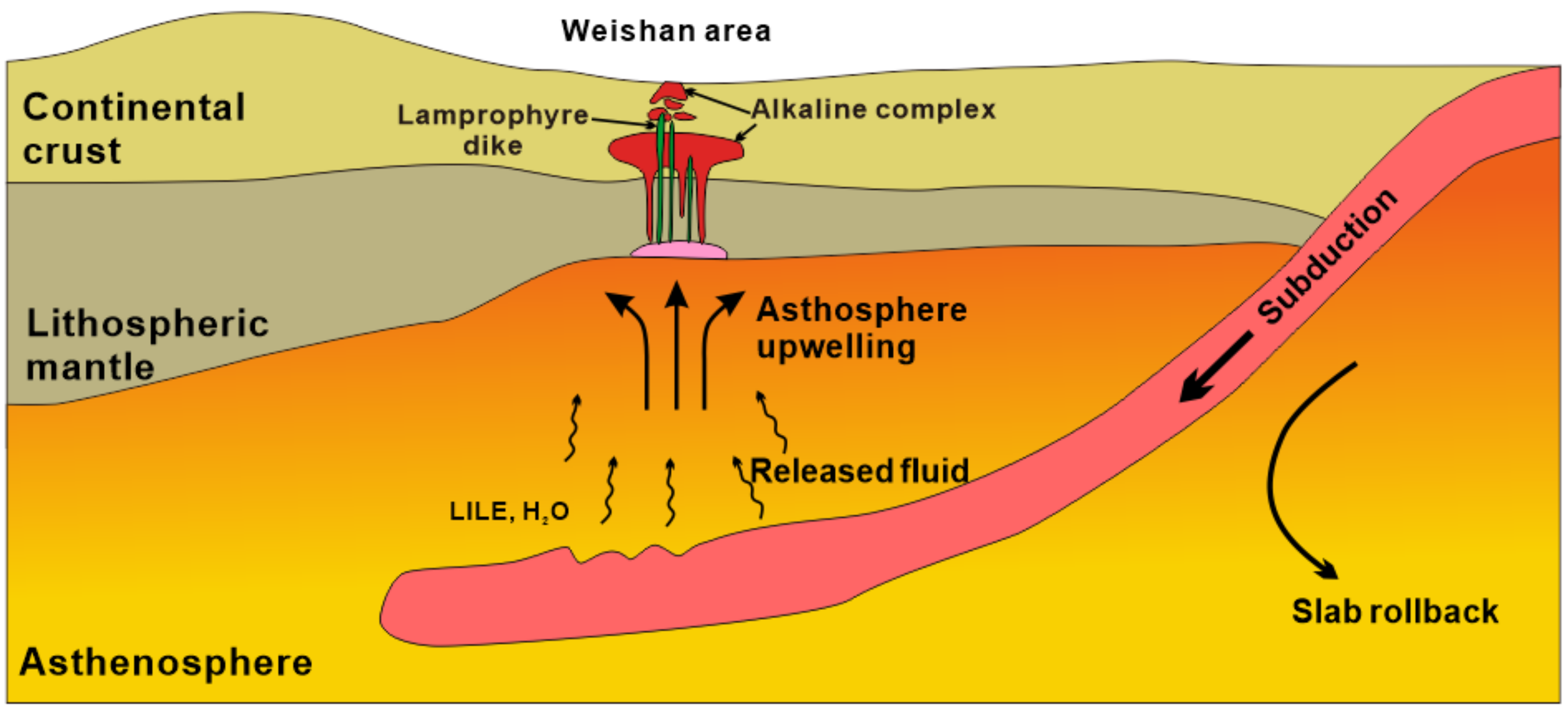
We therefore propose that the magma emplacement of the 125 Ma lamprophyres from the Weishan area is consistent with Early Cretaceous (120–132 Ma) mafic dike intrusion in the Luxi Terrane [19,75]. The 120–110 Ma compression to extension tectonic transition regime in the eastern NCC triggered large-scale extension and lithosphere thinning [75,76,77,78,79] (Figure 14). The lithospheric mantle was metasomatized by dehydration fluids during the subduction process, and the magma source of the lamprophyre was emplaced during the subsequent extension process in the Early Cretaceous.
Figure 14.
Tectonic schematism showing the formation of the lamprophyres in the Weishan area of Luxi Terrane [46,53,80].
7. Conclusions
(1) The parent magma of the lamprophyres in the Weishan area was formed by low-degree partial melting of the amphibole-bearing lherzolite mantle at garnet-facies without crustal assimilation during its emplacement. The enriched mantle source of the parent magma was derived from the subducted slab dehydration fluids.
(2) The lamprophyre from the Weishan area was formed in an extensional tectonic setting and the mantle source was metasomatized during the subduction process in the Early Cretaceous.
Author Contributions
Conceptualization: K.-F.Q.; writing: Y.-Z.S.; review and editing: M.-G.A. and Z.S.; formal analysis: S.-S.L. and Y.W. All authors have read and agreed to the published version of the manuscript.
Funding
This research was funded by Open Funding of Shandong Provincial Lunan Geology and Exploration Institute (LNY2020-Z02, LNYS202101), the Fundamental Research Funds for the Central Universities (2-9-2021-102), the Open Research Project from the Key Laboratory of Metallogeny and Mineral Assessment, Institute of Mineral Resources, CAGS (ZS2010), the Innovation and Entrepreneurship Training Program of China University of Geosciences, Beijing (S202111415020), the Beijing Nova Program (Z201100006820097), the 111 Project of the Ministry of Science and Technology (BP0719021) and Chinese Postdoctoral Science Foundation (2021M692995).
Acknowledgments
We thank Yvaine Wei and two anonymous referees for their constructive and insightful comments that greatly improved this manuscript. The authors thank Chenglong Zhi and Zeyu Yang for their help in experiments analysis.
Conflicts of Interest
The authors declare no conflict of interest.
References
- Rock, N.M.S. The nature and origin of the lamprophyres: An overview. Geol. Soc. Lond. Spec. Publ. 1987, 30, 191–226. [Google Scholar] [CrossRef] [Scilit]
- Currie, K.L.; Williams, P.R. An Archean calc-alkaline lamprophyre suite, northeastern Yilgarn Block, western Australia. Lithos 1993, 31, 33–50. [Google Scholar] [CrossRef] [Scilit]
- Ivanov, A.V.; Levitskii, V.I.; Corfu, F.; Demonterova, E.I.; Reznitski, L.Z. Shoshonitic magmatism in the paleoproterozoic of the south-western Siberian craton: An analogue of the modern post-collision setting. Lithos 2019, 328, 88–100. [Google Scholar] [CrossRef] [Scilit]
- Pandey, A.; Rao, N.V.C.; Chakrabarti, R.; Pandit, D.; Pankaij, P.; Kumar, A.; Sahoo, S. Petrogenesis of Mesoproterozoic shoshonitic lamprophyre dyke from the Wajrakarur kimberlite field, eastern Dharwar craton, southern India: Geochemical and Sr-Nd isotopic evidence for a modified sub-continental lithospheric mantle source. Lithos 2017, 292, 218–233. [Google Scholar] [CrossRef] [Scilit]
- Soder, C.; Altherr, R.; Romer, R.L. Mantle metasomatism at the edge of a retreating subduction zone: Late Neogene lamprophyres from the Island of Kos, Greece. J. Petrol. 2016, 57, 1705–1728. [Google Scholar] [CrossRef] [Scilit]
- Choi, E.; Fiorentini, M.L.; Giuliani, A.; Foley, S.F.; Maas, R.; Taylor, W.R. Subductionrelated petrogenesis of Late Archean calc-alkaline lamprophyres in the Yilgarn Craton (Western Australia). Precambrian Res. 2019, 338, 105550. [Google Scholar] [CrossRef] [Scilit]
- Jia, L.Q.; Mo, X.X.; Dong, G.C.; Xu, W.Y.; Wang, L.; Guo, X.D.; Wang, Z.H.; Wei, S.G. Genesis of lamprophyres from Machangqing, western Yunnan: Constraints from geochemistry, geochronology and Sr-Nd-Pb-Hf isotopes. Acta Petrol. Sin. 2013, 29, 1247–1260. [Google Scholar]
- Qiu, K.-F.; Yu, H.-C.; Hetherington, C.; Huang, Y.-Q.; Yang, T.; Deng, J. Tourmaline composition and boron isotope signature as a tracer of magmatic-hydrothermal processes. Am. Mineral. 2021, 106, 1033–1044. [Google Scholar] [CrossRef] [Scilit]
- Yu, H.C.; Qiu, K.F.; Hetherington, C.J.; Chew, D.; Huang, Y.Q.; He, D.Y.; Geng, J.Z.; Xian, H.Y. Apatite as an alternative petrochronometer to trace the evolution of magmatic systems containing metamict zircon. Contrib. Mineral. Petrol. 2021, 176, 68. [Google Scholar] [CrossRef] [Scilit]
- Xie, Y.L.; Xia, J.M.; Cui, K.; Qu, Y.W.; Liang, P.; Zhong, R.C. Rare earth elements deposits in China Spatio-temporal distiboution and ore foming processes (in Chinese). Chin. Sci. Bull. 2020, 65, 3794–3808. [Google Scholar] [CrossRef] [Scilit]
- Wu, M.Q.; Samon, I.M.; Qiu, K.F.; Zhang, D.H. Multi-stage metasomatic Zr mineralization in the world-class Baerzhe Rare earth element-Nb-Zr-Be deposit. Am. Mineral. 2022, in press. [Google Scholar] [CrossRef] [Scilit]
- Wu, M.Q.; Samson, I.M.; Qiu, K.F.; Zhang, D.H. Concentration mechanisms of REE-Nb-Zr-Be mineralization in the Baerzhe deposit, NE China: Insights from textural and chemical features of amphibole and rare-metal minerals. Econ. Geol. 2021, 116, 651–679. [Google Scholar] [CrossRef] [Scilit]
- Tian, J.X.; Zhang, R.T.; Fan, Y.C.; Li, X.Z.; Xu, H.Y.; Wang, B.Y. Geological Characteristics and Relation with Rare Earth Elements of Alkalic Complex in Chishan of Shandong Province. Shandong Geol. 2002, 18, 21–25. [Google Scholar]
- Li, J.K.; Yuan, Z.X.; Bai, G.; Chen, Y.C.; Wang, D.H.; Ying, L.J.; Zhang, J. Ore-forming Fluid Eovlvement and its Controlling to REE (AG) Mineralizing in the Weuishan Deposit, Shandong. Mineral. Petrol. 2009, 29, 60–68. [Google Scholar]
- Yu, X.F.; Tang, H.S.; Han, Z.Z.; Li, C.Y. Geological Characteristics and Origin of Rare Earth Elements Deposits Related with Alkaline Rock in the Chishan-Longbaoshan Area, Shandong Province. Acta Geol. Sin. 2010, 84, 407–417. [Google Scholar]
- Lan, T.G.; Fan, H.R.; Hu, F.F.; Yang, K.F.; Wang, Y. Genesis of the Weishan REE deposit, Shandong Province:Evidences from Rb-Sr isochron age, LA-MC-ICPMS Nd isotopic compositions and fluid inclusions. Geochimica 2011, 40, 428–442. [Google Scholar]
- Zhang, P.; Lan, J. Metallogenic Model and Genesis of Rare Earth Deposits in Western Shandong. Shandong Land Res. 2020, 36, 15–19. [Google Scholar]
- Wang, Y.; Qiu, K.F.; Müller, A.; Hou, Z.L.; Zhu, Z.H.; Yu, H.C. Machine learning prediction of quartz forming-environments. J. Geophys. Res. Solid Earth 2021, 126, e2021JB021925. [Google Scholar] [CrossRef] [Scilit]
- Lan, J. Study on Metallogenic Regularities of Rare Earth Deposit in Xishan Area of Weishan County in Shandong Province. Shandong Land Res. 2019, 35, 39–43. [Google Scholar]
- Long, Z.Y.; Qiu, K.F.; Santosh, M.; Yu, H.C.; Jiang, X.Y.; Zou, L.Q.; Tang, D.W. Fingerprinting the metal source and cycling of the world’s largest antimony deposit in Xikuangshan, China. Geol. Soc. Am. Bull. 2022. [Google Scholar] [CrossRef] [Scilit]
- Liang, Y.W.; Lai, Y.; Hu, H.; Zhang, F. Zircon U-Pb Ages and Geochemical Characteristics Study of Syenite from Weishan REE Deposit, Western Shandong. J. Peking Univ. 2017, 53, 652–666. [Google Scholar]
- Li, S.J.; Hong, M.; Xu, Y.M.; Rui, Z.F.; Wang, J.X. An Opinion on Employment of the Jurassic and Cretaceous Lithostratigraphic Units in the West Shandong Area. Geol. Rev. 2007, 53, 6–10. [Google Scholar]
- Wang, J.F.; Sun, M.T.; Du, X.B.; Gan, Y.J.; Zhang, G.Q.; Wang, Z.L. Geological Characteristics and Prospecting Potentiality of Xishan Rare Earth Deposit in Shandong Province. Shandong Land Res. 2016, 32, 32–40. [Google Scholar]
- Hu, Q.Y.; Li, L.; Tang, Z.B.; Shi, X.P. Characteristics and mechanism of Late Mesozoic extensional faults in West Shandong Uplift. Geol. China 2009, 36, 1233–1244. [Google Scholar]
- Wei, P.F.; Yu, X.F.; Li, D.P.; Liu, Q.; Yu, L.D.; Li, Z.S.; Geng, K.; Zhang, Y.; Sun, Y.Q.; Chi, N.J. Geochemistry, Zircon U-Pb Geochronology, and Lu-Hf Isotopes of the Weishan Alkaline Complex, Western Shandong, China. Minerals 2019, 9, 293. [Google Scholar] [CrossRef] [Scilit]
- Qiu, K.F.; Yu, H.C.; Deng, J.; Mclntire, D.; Gou, Z.Y.; Geng, J.Z.; Chang, Z.S.; Zhu, R.; Li, K.N.; Goldfarb, R. The giant Zaozigou Au-Sb deposit in West Qinling, China: Magmatic- or metamorphic-hydrothermal origin? Miner. Depos. 2020, 18, 345–362. [Google Scholar] [CrossRef] [Scilit]
- Qiu, K.F.; Goldfarb, R.J.; Deng, J.; Yu, H.C.; Gou, Z.Y.; Ding, C.J.; Wang, Z.K.; Li, D.P. Gold deposits of the Jiaodong Peninsula, eastern China. Soc. Econ. Geol. Spec. Publ. 2020, 23, 753–773. [Google Scholar]
- Qiu, K.F.; Yu, H.C.; Wu, M.Q.; Geng, J.Z.; Ge, X.K.; Gou, Z.Y.; Taylor, R.D. Discrete Zr and REE mineralization of the Baerzhe rare-metal deposit, China. Am. Mineral. 2019, 104, 1487–1502. [Google Scholar] [CrossRef] [Scilit]
- Huang, Y.Q.; Wu, M.Q.; Germain, B.; Yu, H.C.; Qiao, B.X.; Zhao, Z.G.; Qiu, K.F. Geodynamic setting and ore formation of the Younusisayi thorium deposit in the Altyn orogenic belt, NW China. Ore Geol. Rev. 2021, 140, 104552. [Google Scholar] [CrossRef] [Scilit]
- Zhao, G.C.; Wilde, S.A.; Cawood, P.A.; Sun, M. Archeanblocks and theirboundariesin the North China Craton: Lithological, geochemical, structuraland p-T path consfaintsandtectonic evolution. Precamb. Res. 2001, 107, 45–73. [Google Scholar] [CrossRef] [Scilit]
- Yang, Y.H.; Wu, F.Y.; Li, Q.L.; Rohas-Agramonte, Y.; Yang, J.H.; Li, Y.; Xu, C. In situ U-Th-Pb dating and Sr-Nd isotope analysis of Bastnäsite by LA-(MC)-ICP-MS. Geostand. Geoanal. Res. 2019, 43, 543–565. [Google Scholar] [CrossRef] [Scilit]
- Liu, Y.S.; Gao, S.; Hu, Z.C.; Gao, C.G.; Zong, K.Q.; Wang, D.B. Continental and oceanic crust recycling-induced melt-peridotite interactions in the Trans-North China Orogen: U-Pb dating, Hf isotopes and trace elements in zircons from mantle xenoliths. J. Petrol. 2010, 51, 537–571. [Google Scholar] [CrossRef] [Scilit]
- Ludwig, K.R. Isoplot v. 3.0: A Geochronological Toolkit for Microsoft Excel; Berkeley Geochronology Center Special Publication: Berkeley, CA, USA, 2003. [Google Scholar]
- Anderson, T. Correction of common lead in U-Pb analyses that do not report 204Pb. Chem. Geol. 2002, 192, 59–79. [Google Scholar] [CrossRef] [Scilit]
- Middlemost, E.A.K. Naming materials in the magma/igneous rock system. EarthSci. Rev. 1996, 37, 215–224. [Google Scholar] [CrossRef] [Scilit]
- Lu, F.X.; Shu, X.X.; Zhao, C.H. Suggestions on classification of lamprophyre. Geol. Sci. Technol. Inf. 1991, 10, 55–62. [Google Scholar]
- Boynton, W.V. Geochemistry of the rare earth elements: Meteorite studies. In Rare Earth Element Geochemistry; Henderson, P., Ed.; Elsevier: New York, NY, USA, 1984; pp. 63–114. [Google Scholar]
- McDonough, W.F.; Sun, S.S. The composition of the Earth. Chem. Geol. 1995, 120, 223–253. [Google Scholar] [CrossRef] [Scilit]
- Sun, S.S.; McDonough, W.F. Chemical and isotopic systematics of oceanic basalts: Implications for mantle composition and processes. Geol. Soc. Lond. Spec. Publ. 1989, 42, 313–345. [Google Scholar] [CrossRef] [Scilit]
- Hoskin, P.W.O.; Schaltegger, U. The composition of zircon and igneous and metamorphic petrogenesis. Rev. Mineral. Geochem. 2003, 53, 27–62. [Google Scholar] [CrossRef] [Scilit]
- Griffin, W.L.; Belousova, E.A.; Shee, S.R.; Pearson, N.J.; O’Reilly, S.Y. Archean crustal evolution in the northern Yilgarn Craton: U-Pb and Hf-isotope evidence from detrital zircons. Precambrian Res. 2004, 131, 231–282. [Google Scholar] [CrossRef] [Scilit]
- Yang, H.T.; Yang, D.B.; Mu, M.S.; Wang, A.Q.; Quan, Y.K.; Hao, L.R.; Xu, W.L.; Yang, D.H. Sr-Nd-Hf isotopic compositions of lamprophyres in western Shandong, China: Implications for the nature of the early cretaceous lithospheric mantle beneath the eastern North China Craton. Lithos 2019, 336, 1–13. [Google Scholar] [CrossRef] [Scilit]
- Qiu, J.S.; Xu, X.S.; Luo, Q.H. Potash-rich volcanic rocks and lamprophyres in the western Shandong Province: 40Ar-39Ar dating and source tracing. Chin. Sci. Bull. 2002, 47, 91–99. [Google Scholar]
- Rapp, R.P.; Watson, E.B. Dehydration Melting of Metabasalt at 8–32 kbar: Implications for Continental Growth and Crust-Mantle Recycling. J. Petrol. 1995, 36, 891–931. [Google Scholar] [CrossRef] [Scilit]
- Wang, X.; Wang, Z.C.; Cheng, H.; Foley, S.; Xiong, L.; Hu, Z.C. Early cretaceous lamprophyre dyke swarms in Jiaodong Peninsula, eastern North China Craton, and implications for mantle metasomatism related to subduction. Lithos 2020, 368–369, 105593. [Google Scholar] [CrossRef] [Scilit]
- Xue, F.; Santosh, M.; Tsunogae, T.; Yang, F. Geochemical and isotopic imprints of early cretaceous mafic and felsic dyke suites track lithosphere-asthenosphere interaction and craton destruction in the North China Craton. Lithos 2019, 326, 174–199. [Google Scholar] [CrossRef] [Scilit]
- Ma, C.Q.; Li, Z.C.; Ehlers, C.; Wang, R.J. A post-collisional magmatic plumbing system: Mesozoic granitoid plutons from the Dabieshan high-pressure and ultrahigh-pressure metamorphic zone, east-central China. Lithos 1998, 45, 431–456. [Google Scholar] [CrossRef] [Scilit]
- Fan, W.; Guo, F.; Wang, Y.; Zhang, H. Late Mesozoic mafic magmatism from the North China Block: Constraints on chemical and isotopic heterogeneity of the subcontinental lithospheric mantle. Geol. Soc. Lond. Spec. Publ. 2007, 280, 77–100. [Google Scholar] [CrossRef] [Scilit]
- Jiang, Y.; Jiang, S.; Ling, H.; Ni, P. Petrogenesis and tectonic implications of Late Jurassic shoshonitic lamprophyre dikes from the Liaodong Peninsula, NE China. Mineral. Petrol. 2010, 100, 127–151. [Google Scholar] [CrossRef] [Scilit]
- Rudnick, R.L.; Fountain, D.M. Nature and composition of the continental crust: A lower crustal perspective. Rev. Geophys. 1995, 33, 267–309. [Google Scholar] [CrossRef] [Scilit]
- Ma, L.; Jiang, S.Y.; Hou, M.L.; Dai, B.Z.; Jiang, Y.H.; Yang, T.; Zhao, K.D.; Pu, W.; Zhu, Z.Y.; Xu, B. Geochemistry of Early Cretaceous calc-alkaline lamprophyres in the Jiaodong Peninsula: Implication for lithospheric evolution of the eastern North China Craton. Gondwana Res. 2014, 25, 859–872. [Google Scholar] [CrossRef] [Scilit]
- Yang, J.H.; Chung, S.L.; Zhai, M.G.; Zhou, X.H. Geochemical and Sr-Nd-Pb isotopic compositions of mafic dikes from the Jiaodong Peninsula, China: Evidence for vein-plus-peridotite melting in the lithospheric mantle. Lithos 2004, 73, 145–160. [Google Scholar] [CrossRef] [Scilit]
- Wan, L.; Zeng, Z.; Kusky, T.; Asimow, P.H.; He, C.; Liu, Y.E.; Yang, S.I.; Xu, S. Geochemistry of middle-late Mesozoic mafic intrusions in the eastern North China Craton: New insights on lithospheric thinning and decratonization. Gondwana Res. 2019, 73, 153–174. [Google Scholar] [CrossRef] [Scilit]
- Liu, S.; Hu, R.Z.; Gao, S.; Feng, C.X.; Yu, B.B.; Feng, G.Y.; Qi, Y.Q.; Wang, T.; Coulson, I.M. Petrogenesis of Late Mesozoic mafic dykes in the Jiaodong Peninsula, eastern North China Craton and implications for the foundering of lower crust. Lithos 2009, 113, 621–639. [Google Scholar] [CrossRef] [Scilit]
- Guo, F.; Fan, W.M.; Wang, Y.J.; Zhang, M. Origin of early Cretaceous calc-alkaline lamprophyres from the Sulu orogen in eastern China: Implications for enrichment processes beneath continental collisional belt. Lithos 2004, 78, 291–305. [Google Scholar] [CrossRef] [Scilit]
- Wu, F.Y.; Li, X.H.; Zheng, Y.F.; Gao, S. Petrogenesis and Petrogenesis of lu-Hf isotopes and their applications. Acta Petrol. Sin. 2007, 23, 185–220. [Google Scholar]
- Zhang, F.; Wang, Y.; Cawood, P.A.; Dong, Y. Geochemistry, 40Ar/39Ar geochronology, and geodynamic implications of Early Cretaceous basalts from the western Qinling orogenic belt, China. J. Asian Earth Sci. 2018, 151, 62–72. [Google Scholar] [CrossRef] [Scilit]
- Wilson, M. Igneous Petrolgenesis: A Global Tectonic Approach; Unwin Hyman: London, UK, 1989; p. 466. [Google Scholar]
- Turner, S.; Caulfield, J.; Turner, M.; Van Keken, P.; Maury, R.; Sandiford, M.; Prouteau, G. Recent contribution of sediments and fluids to the mantle’s volatile budget. Nat. Geosci. 2012, 5, 50–54. [Google Scholar] [CrossRef] [Scilit]
- Foley, S.F.; Jackson, S.E.; Fryer, B.J.; Greenough, J.D.; Jenner, G.A. Trace element partition coefficients for clinopyroxene and phlogopite in an alkaline lamprophyre from Newfoundland by LAM-ICP-MS. Geochim. Cosmochim. Acta 1996, 60, 629–638. [Google Scholar] [CrossRef] [Scilit]
- Ionov, D.A.; Griffin, W.L.; Oreilly, S.Y. Volatile-bearing minerals and lithophile trace elements in the upper mantle. Chem. Geol. 1997, 141, 153–184. [Google Scholar] [CrossRef] [Scilit]
- Latourrette, T.; Hervig, R.L.; Holloway, J.R. Trace element partitioning between amphibole, phlogopite, and basanite melt. Earth Planet. Sci. Lett. 1995, 135, 13–30. [Google Scholar] [CrossRef] [Scilit]
- Furman, T.; Graham, D. Erosion of lithospheric mantle beneath the East African Rift system: Geochemical evidence from the Kivu volcanic province. Dev. Geotecton. 1999, 24, 237–262. [Google Scholar]
- Duggen, S.; Hoernle, K.; Bogaard, P.; Garbe-Schonberg, D. Post-collisional transition from subduction- to intraplate-type magmatism in the westernmost Mediterranean: Evidence for continental-edge delamination of subcontinental lithosphere. J. Petrol. 2005, 46, 1155–1201. [Google Scholar] [CrossRef] [Scilit]
- Robinson, J.A.C.; Wood, B.J. The depth of the spinel to garnet transition at the peridotite solidus. Earth Planet. Sci. Lett. 1998, 164, 277–284. [Google Scholar] [CrossRef] [Scilit]
- Pearce, J.A.; Stern, R.J.; Bloomer, S.H.; Fryer, P. Geochemical mapping of the Mariana arc-basin system: Implications for the nature and distribution of subduction components. Geochem. Geophys. Geosyst. 2005, 6. [Google Scholar] [CrossRef] [Scilit]
- Thompson, R.N.; Morrison, M.A. Asthenospheric and lower-lithospheric mantle contributions to continental extensional magmatism: An example from the British Tertiary Province. Chem. Geol. 1988, 68, 1–15. [Google Scholar] [CrossRef] [Scilit]
- Hofmann, A.W. Chemical differentiation of the Earth: The relationship between mantle, continental crust, and oceanic crust. Earth Planet. Sci. Lett. 1988, 90, 297–314. [Google Scholar] [CrossRef] [Scilit]
- Rudnick, R.L.; Gao, S.; Holland, H.D.; Turekian, K.K. Composition of the continental crust. Treatise Geochem. 2003, 4, 1–51. [Google Scholar]
- Ayers, J. Trace element modeling of aqueous fluid-peridotite interaction in the mantle wedge of subduction zones. Contrib. Mineral. Petrol. 1998, 132, 390–404. [Google Scholar] [CrossRef] [Scilit]
- Devine, J.D. Petrogenesis of the basalt-andesite-dacite association of Grenada, Lesser Antillesisland arc, revisite. J. Volcanol. Geotherm. Res. 1995, 69, 1–33. [Google Scholar] [CrossRef] [Scilit]
- Liang, Y.; Deng, J.; Liu, X.F.; Wang, Q.F.; Ma, Y.; Gao, T.X.; Zhao, L.H. Water Contents of early cretaceous Mafic Dikes in the Jiaodong Peninsula, Eastern North China Craton: Insights into an Enriched Lithospheric Mantle Source Metasomatized by Paleo-Pacific Plate Subduction–Related Fluids. J. Geol. 2019, 127, 343–362. [Google Scholar] [CrossRef] [Scilit]
- Wu, F.Y.; Yang, J.H.; Xu, Y.G.; Wilde, S.A.; Walker, R.J. Destruction of the North China Craton in the Mesozoic. Annu. Rev. Earth Planet. Sci. 2019, 47, 173–195. [Google Scholar] [CrossRef] [Scilit]
- Jenner, F.E.; O’Neill, H.S.C. Analysis of 60 elements in 616 ocean floor basaltic glasses. Geochem. Geophys. Geosyst. 2012, 13, Q02005. [Google Scholar] [CrossRef] [Scilit]
- Li, L.; Zhong, D.L.; Chen, X.F.; Chen, Y. Characteristics of NW-Trending Faults and Evidence of Fission Track in the Luxi Block. Acta Geol. Sin. 2018, 92, 413–436. [Google Scholar]
- Goldfarb, R.J.; Mao, J.W.; Qiu, K.F.; Goryachev, N. The great Yanshanian metallogenic event of eastern Asia: Consequences from one hundred million years of plate margin geodynamics. Gondwana Res. 2021, 100, 223–250. [Google Scholar] [CrossRef] [Scilit]
- Li, S.R.; Santosh, M. Metallogeny and craton destruction: Records from the North China Craton. Ore Geol. Rev. 2014, 56, 376–414. [Google Scholar] [CrossRef] [Scilit]
- Huan, W.L.; Shi, Z.L.; Yan, J.Q. Meso-Cenozoic tectonic evolution of eastern China and adjacent area and movement of the pacific plate. Sci. Geol. Sin. 1982, 17, 179–190. [Google Scholar]
- Zhu, R.X.; Yang, J.H.; Wu, F.Y. Timing of destruction of the North China Craton. Lithos 2012, 149, 51–60. [Google Scholar] [CrossRef] [Scilit]
- Zhu, R.; Zhang, H.; Zhu, G.; Meng, Q.; Fan, H.; Yang, J.-H.; Wu, F.; Zhang, Z.; Zheng, T. Craton destruction and related resources. Int. J. Earth Sci. 2017, 106, 2233–2257. [Google Scholar] [CrossRef] [Scilit]

Publisher’s Note: MDPI stays neutral with regard to jurisdictional claims in published maps and institutional affiliations. |
© 2022 by the authors. Licensee MDPI, Basel, Switzerland. This article is an open access article distributed under the terms and conditions of the Creative Commons Attribution (CC BY) license (https://creativecommons.org/licenses/by/4.0/).