


Crystallization Conditions and Petrogenetic Characterization of Metaluminous to Peraluminous Calc-Alkaline Orogenic Granitoids from Mineralogical Systematics: The Case of the Cambrian Magmatism from the Sierra de Guasayán (Argentina)
 , , , , , , and
Abstract
1. Introduction
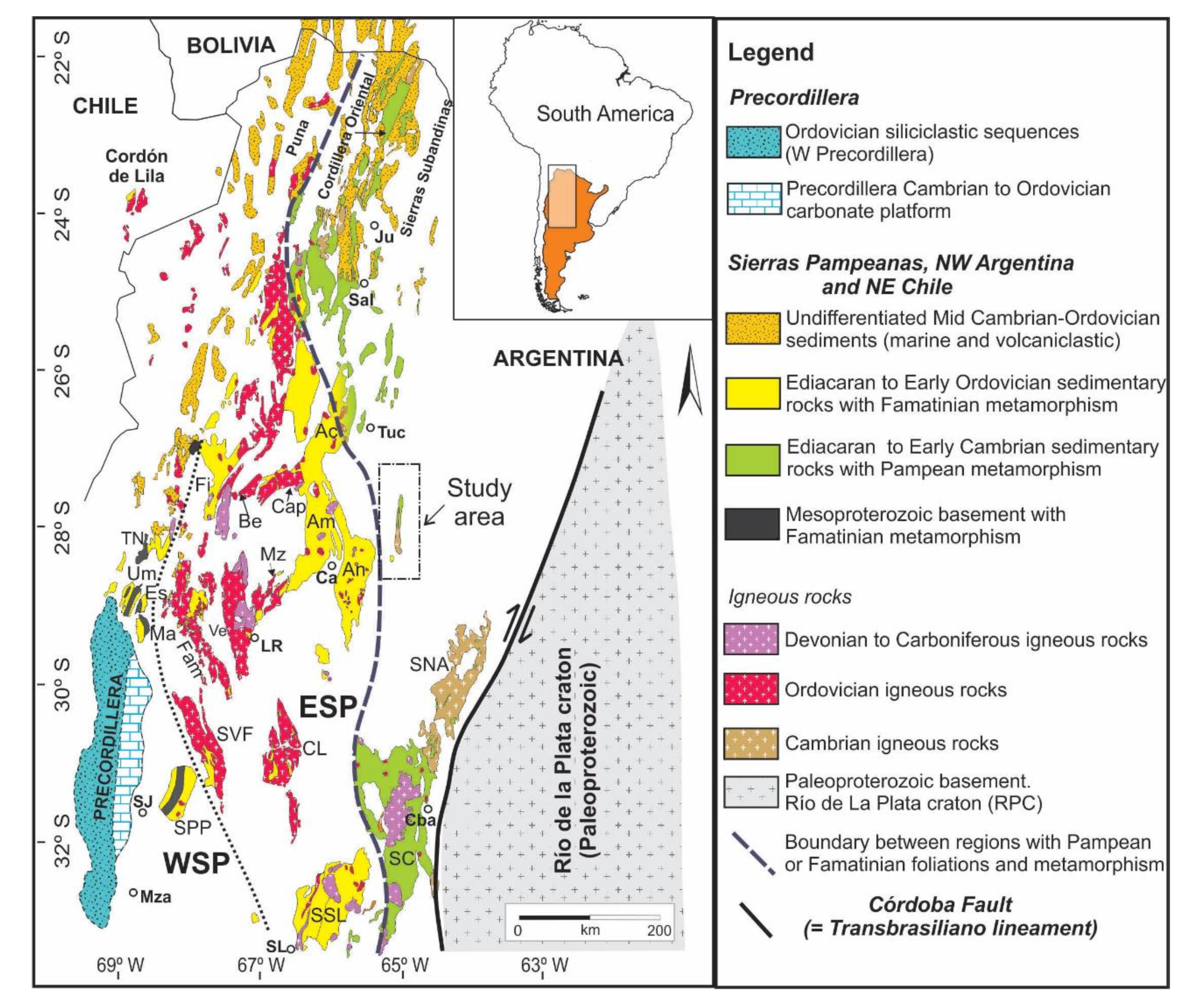
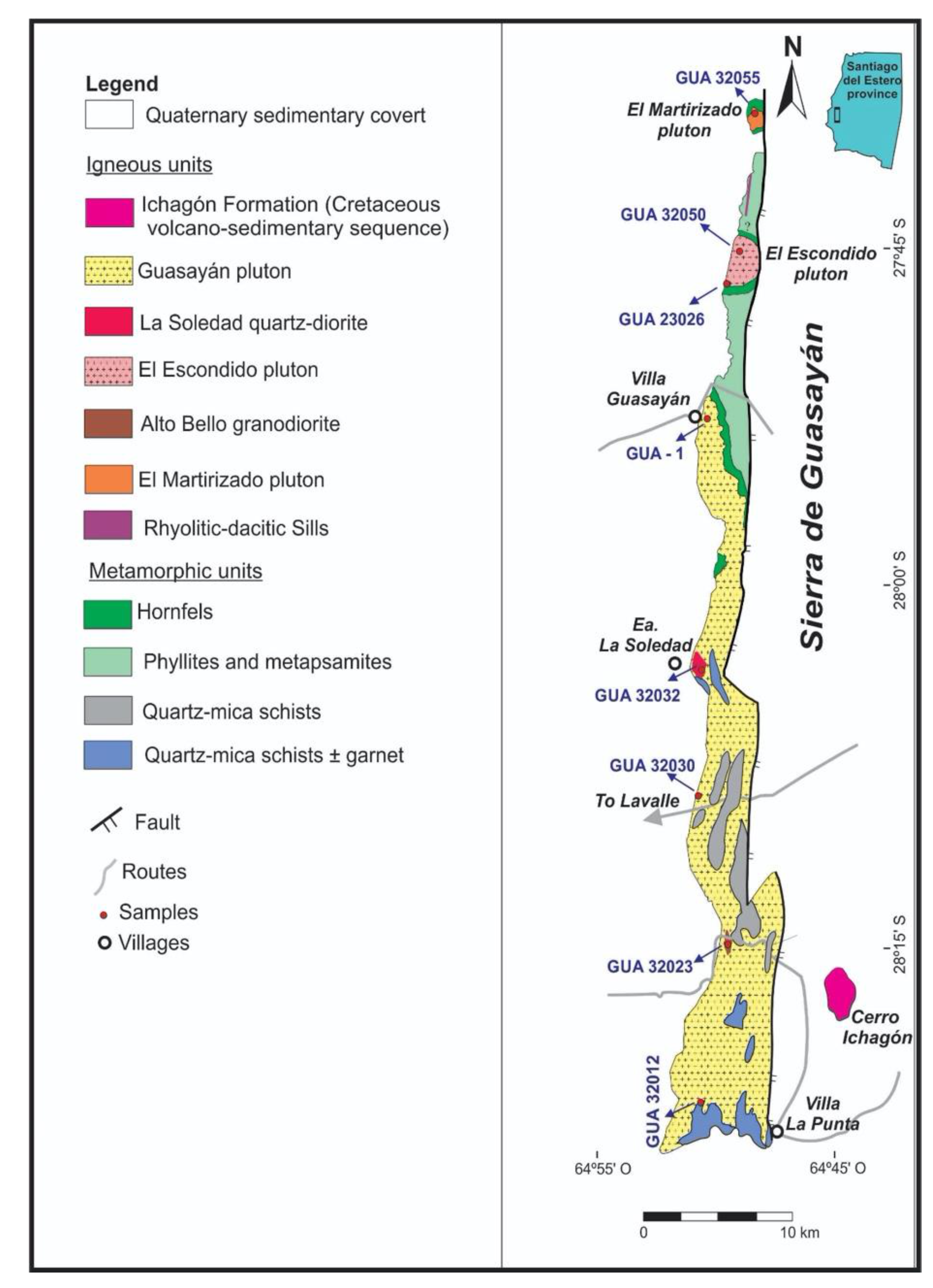
2. Geological Setting and Geology of the Sierra de Guasayán
Geochemical Considerations
3. Samples and Methods
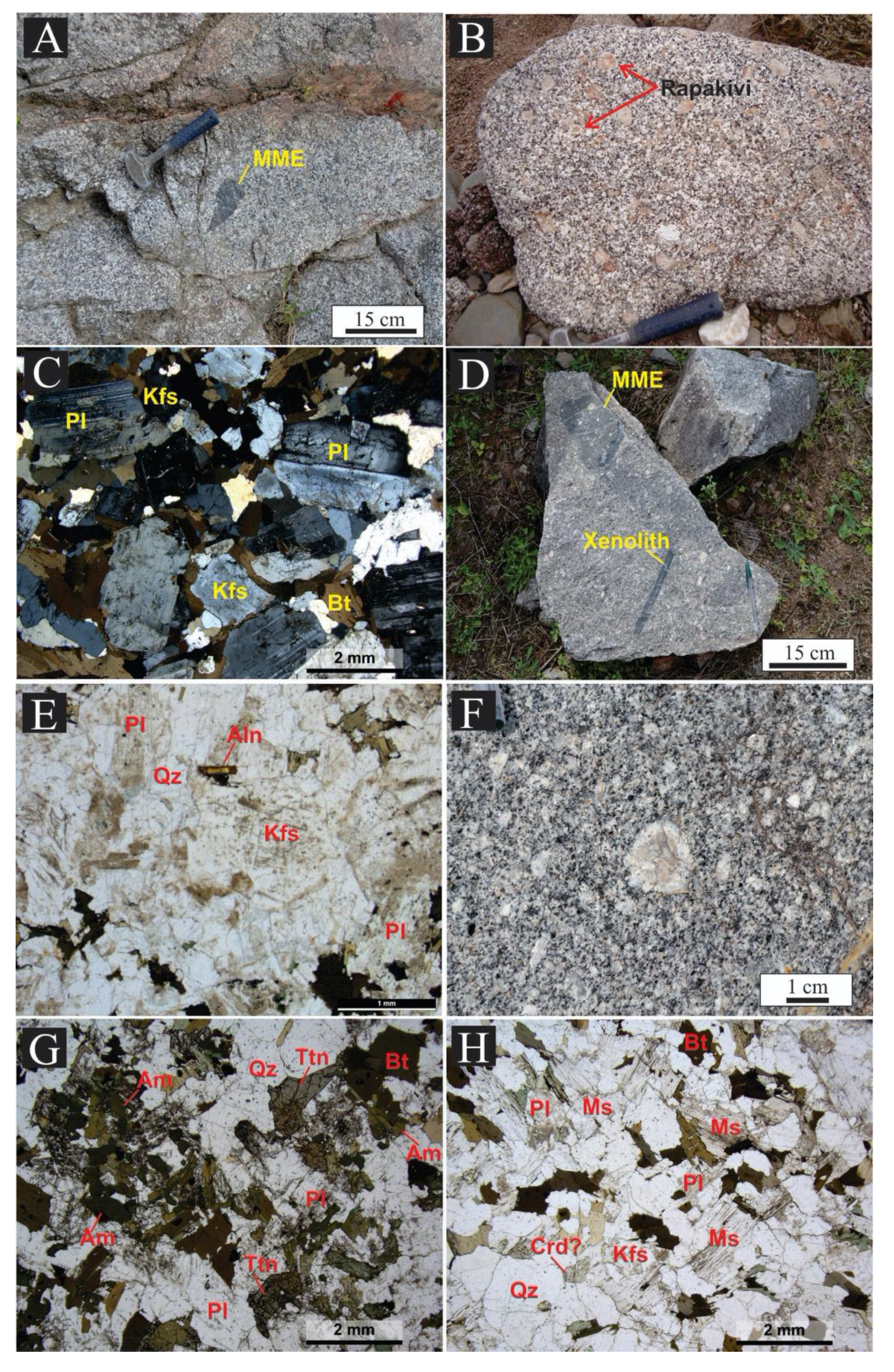
4. Field Relations and Petrography
4.1. The Guasayán Pluton
4.2. The El Escondido Pluton
4.3. The El Martirizado Pluton
4.4. The La Soledad Quartz-Diorite
4.5. The Alto Bello Granodiorite
5. Mineral Chemistry
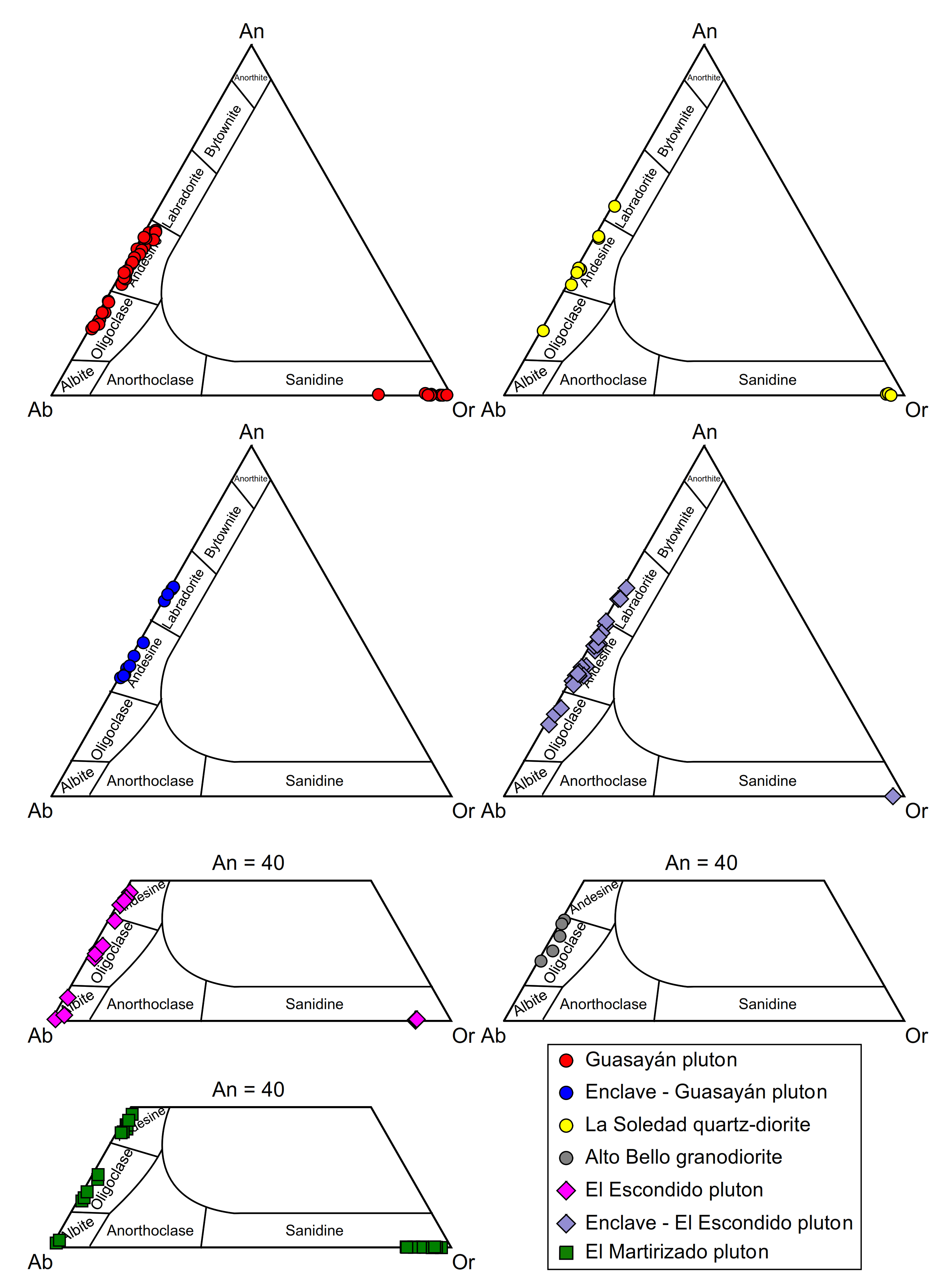
5.1. Plagioclase
5.2. Alkali Feldspar
5.3. Amphibole
5.4. Trioctahedral Mica
5.5. Dioctahedral White Mica
5.6. Titanite
6. P-T and fO2 Estimations
6.1. Pressure Estimations
6.2. Temperature Estimations
6.3. fO2 Estimations
7. Discussion
7.1. Crystallization Conditions
7.2. Mineralogical Characterization and Petrogenetic Implications
8. Conclusions
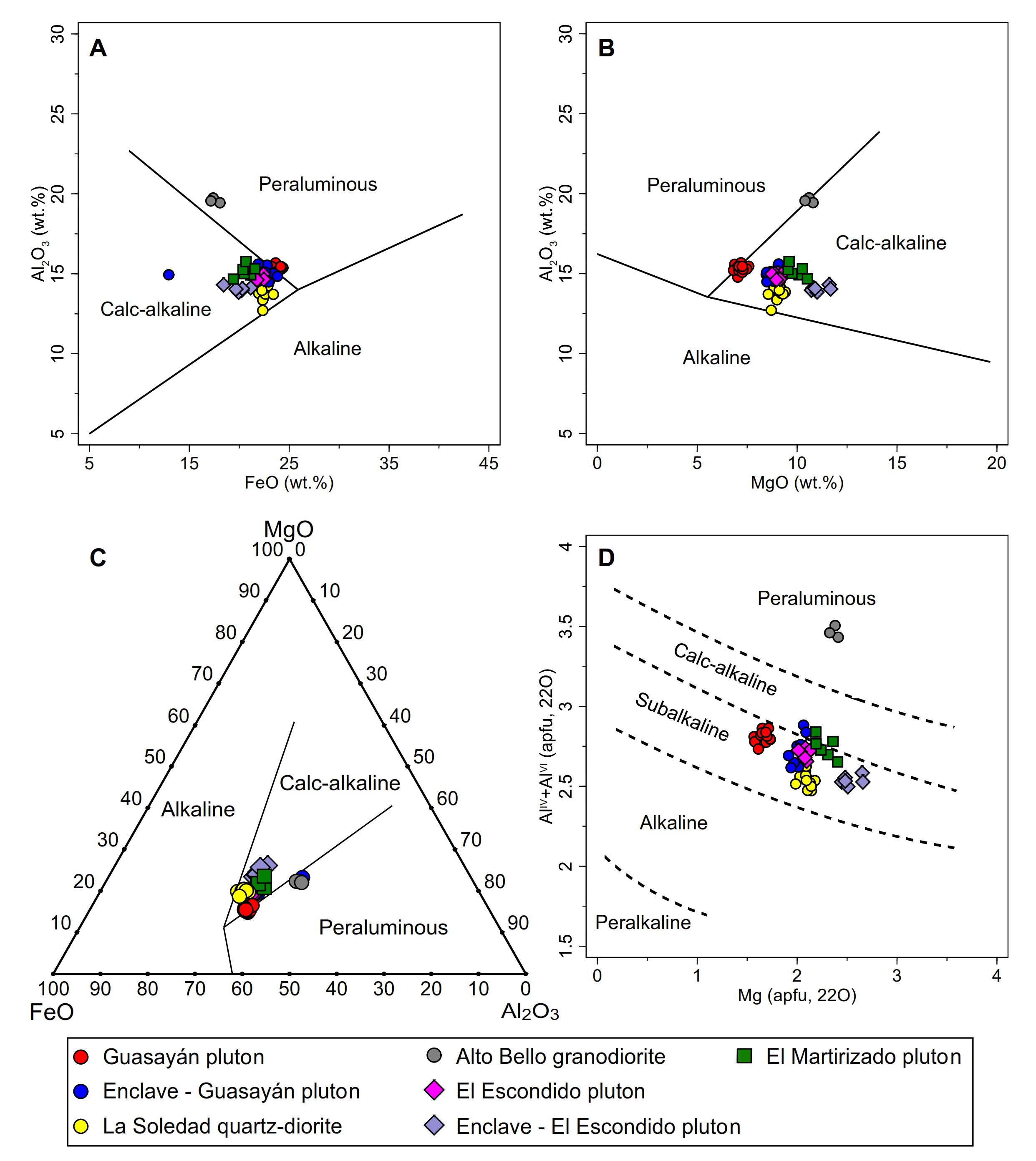
- I-type granitoids: La Soledad quartz-diorite, the mafic enclaves from the Guasayán and El Escondido plutons and likely the El Martirizado pluton.
- S-type granitoid: The Alto Bello granodiorite.
- Hybrid or transitional I-S-type granitoids that represent the most voluminous magmatism in the region: The Guasayán and El Escondido plutons.
Supplementary Materials
Author Contributions
Funding
Institutional Review Board Statement
Informed Consent Statement
Data Availability Statement
Acknowledgments
Conflicts of Interest
References
- Frost, B.R.; Barnes, C.G.; Collins, W.J.; Arculus, R.J.; Ellis, D.J.; Frost, C.D. A geochemical classification for granitic rocks. J. Petrol. 2001, 42, 2033–2048. [Google Scholar] [CrossRef] [Scilit]
- Kemp, A.I.S.; Hawkesworth, C.J. Granitic perspective on the generation and secular evolution of continental crust. Treatise Geochem. 2003, 3, 349–410. [Google Scholar] [CrossRef] [Scilit]
- Castro, A. The off-crust origin of granite batholiths. Geosci. Front. 2014, 5, 63–75. [Google Scholar] [CrossRef] [Scilit]
- Bonin, B.; Janoušek, V.; Moyen, J.F. Chemical variation, modal composition and classification of granitoids. Geol. Soc. Lond. Spec. 2020, 491, 9–51. [Google Scholar] [CrossRef] [Scilit]
- Chappell, B.W.; White, A.J.R. Two contrasting granite types: 25 years later. Aust. J. Earth Sci. 2001, 48, 489–499. [Google Scholar] [CrossRef] [Scilit]
- Bea, F. Residence of REE, Y, Th and U in granites and crustal protoliths: Implications for the chemistry of crustal melts. J. Petrol. 1996, 37, 521–552. [Google Scholar] [CrossRef] [Scilit]
- Chappell, B.W. Aluminium saturation in I- and S-type granites and the characterization of fractionated haplogranites. Lithos 1999, 46, 535–551. [Google Scholar] [CrossRef] [Scilit]
- Miller, C.F. Are strongly peraluminous magmas derived from pelitic sedimentary sources? J. Geol. 1985, 93, 673–689. [Google Scholar] [CrossRef] [Scilit]
- Neiva, A.M.R. Geochemistry of hybrid granitoid rocks and of their biotites from central northern Portugal and their petrogenesis. Lithos 1981, 14, 149–163. [Google Scholar] [CrossRef] [Scilit]
- Leterrier, J.; Maury, R.C.; Thonon, P.; Girard, D.; Marchal, M. Clinopyroxene composition as a method of identification of the magmatic affinities of paleo-volcanic series. Earth Planet Sci. Lett. 1982, 59, 139–154. [Google Scholar] [CrossRef] [Scilit]
- Nachit, H.; Razafimahefa, N.; Stussi, J.M.; Carron, J.P. Composition chimique des biotites et typologie magmatique des granites. C.R. Acad. Sci. Paris 1985, 301, 813–818. [Google Scholar]
- Abdel-Rahman, A.M. Nature of biotites from alkaline, calc-alkaline, and peraluminous magmas. J. Petrol. 1994, 35, 525–541. [Google Scholar] [CrossRef] [Scilit]
- Shabani, A.A.T.; Lalonde, A.E.; Whalen, J.B. Composition of biotite from granitic rocks of the Canadian Appalachian orogen: A potential tectonomagmatic indicator? Can. Min. 2003, 41, 1381–1396. [Google Scholar] [CrossRef] [Scilit]
- Molina, J.F.; Scarrow, J.H.; Montero, P.; Bea, F. High-Ti amphibole as a petrogenetic indicator of magma chemistry: Evidence for mildly alkalic-hybrid melts during evolution of Variscan basic–ultrabasic magmatism of Central Iberia. Contrib. Mineral. Petr. 2009, 158, 69–98. [Google Scholar] [CrossRef] [Scilit]
- Schmidt, M.W. Amphibole composition in tonalite as a function of pressure: An experimental calibration of the aluminium-in-hornblende. Contrib. Mineral. Petr. 1992, 110, 304–310. [Google Scholar] [CrossRef] [Scilit]
- Holland, T.; Blundy, J. Non-ideal interactions in calcic amphiboles and their bearing on amphibole–plagioclase thermometry. Contrib. Mineral. Petr. 1994, 116, 433–447. [Google Scholar] [CrossRef] [Scilit]
- Uchida, E.; Endo, S.; Makino, M. Relationship between solidification depth of granitic rocks and formation of hydrothermal ore deposits. Resour. Geol. 2007, 57, 47–56. [Google Scholar] [CrossRef] [Scilit]
- Ridolfi, F.; Renzulli, A. Calcic amphiboles in calc-alkaline and alkaline magmas: Thermobarometric and chemometric empirical equations valid up to 1130 °C and 2.2 GPa. Contrib. Mineral. Petr. 2012, 163, 877–895. [Google Scholar] [CrossRef] [Scilit]
- Erdmann, S.; Martel, C.; Pichavant, M.; Kushnir, A. Amphibole as an archivist of magmatic crystallization conditions: Problems, potential, and implications for inferring magma storage prior to the paroxismal 2010 eruption of Mount Merapi, Indonesia. Contrib. Mineral. Petrol. 2014, 167, 1016–1038. [Google Scholar] [CrossRef] [Scilit]
- Erdmann, S.; Wang, R.C.; Huang, F.F.; Scaillet, B.; Zhao, K.; Liu, H.S.; Chen, Y.; Faure, M. Titanite: A potential solidus barometer for granitic magma systems. Compt. Rendus Geosci. 2019, 351, 551–561. [Google Scholar] [CrossRef] [Scilit]
- Molina, J.F.; Moreno, J.A.; Castro, A.; Rodríguez, C.; Fershtater, G.B. Calcic amphibole thermobarometry in metamorphic and igneous rocks: New calibrations based on plagioclase/amphibole Al–Si partitioning and amphibole/liquid Mg partitioning. Lithos 2015, 232, 286–305. [Google Scholar] [CrossRef] [Scilit]
- Molina, J.F.; Cambeses, A.; Moreno, J.A.; Morales, I.; Montero, P.; Bea, F. A reassessment of the amphibole-plagioclase NaSi–CaAl exchange thermometer with applications to igneous rocks. Am. Mineral. 2021, in press. [Google Scholar] [CrossRef] [Scilit]
- Mutch, E.J.F.; Blundy, J.D.; Tattitch, B.C.; Cooper, F.J.; Brooker, R.A. An experimental study of amphibole stability in low-pressure granitic magmas and a revised Al-in-hornblende geobarometer. Contrib. Mineral. Petr. 2016, 171, 85. [Google Scholar] [CrossRef] [Scilit]
- Liao, Y.; Wei, C.; Rehman, H.U. Titanium in calcium amphibole: Behavior and thermometry. Am. Mineral. 2021, in press. [Google Scholar] [CrossRef] [Scilit]
- Anderson, J.L.; Smith, D.R. The effects of temperature and fO2 on the Al-in-hornblende barometer. Am. Mineral. 1995, 80, 549–559. [Google Scholar] [CrossRef] [Scilit]
- Dall’Agnol, R.; Oliveira, D.C. Oxidized, magnetite series, rapakivi-type granites of Carajás, Brazil: Implications for classification and petrogenesis of A-type granites. Lithos 2007, 93, 215–233. [Google Scholar] [CrossRef] [Scilit]
- Anderson, J.L.; Barth, A.P.; Wooden, J.L.; Mazdab, F. Thermometers and thermobarometers in granitic systems. Rev. Mineral. Geochem. 2008, 69, 121–142. [Google Scholar] [CrossRef] [Scilit]
- Ramos, V.A.; Cristallini, E.O.; Pérez, D.J. The Pampean flat-slab of the Central Andes. J. S. Am. Earth Sci. 2002, 15, 59–78. [Google Scholar] [CrossRef] [Scilit]
- Caminos, R. Sierras Pampeanas de Catamarca, Tucumán, La Rioja y San Juan. In Simposio de Geología Regional Argentina, No. 2; Leanza, A.F., Ed.; Academia Nacional de Ciencias de Córdoba: Córdoba, Argentina, 1972; Volume 1, pp. 41–79. [Google Scholar]
- Casquet, C.; Baldo, E.G.; Pankhurst, R.J.; Rapela, C.W.; Galindo, C.; Fanning, C.M.; Saavedra, J. Involvement of the Argentine Precordillera terrane in the Famatinian mobile belt: U-Pb SHRIMP and metamorphic evidence from the Sierra de Pie de Palo. Geology 2001, 29, 703–706. [Google Scholar] [CrossRef] [Scilit]
- Sato, A.M.; González, P.D.; Llambías, E.J. Evolución del Orógeno Famatiniano en la Sierra de San Luis: Magmatismo de arco, deformación y metamorfismo de bajo a alto grado. Rev. Asoc. Geológica Argent. 2003, 58, 487–504. [Google Scholar]
- Rapela, C.W.; Pankhurst, R.J.; Casquet, C.; Baldo, E.; Galindo, C.; Fanning, C.M.; Dahlquist, J.A. The Western Sierras Pampeanas: Protracted Grenvilleage history (1330–1030 Ma) of intra-oceanic arcs, subduction-accretion at continental-edge and AMCG intraplate magmastism. J. S. Am. Earth Sci. 2010, 29, 105–127. [Google Scholar] [CrossRef] [Scilit]
- Varela, R.; Basei, M.A.S.; González, P.D.; Sato, A.M.; Naipauer, M.; Campos Neto, M.C.A.; Meira, V.T. Accretion of Grenvillian terranes to the southwestern border of the Río de La Plata craton, western Argentina. Int. J. Earth Sci. 2011, 100, 243–272. [Google Scholar] [CrossRef] [Scilit]
- Dahlquist, J.A.; Alasino, P.H.; Basei, M.A.S.; Morales Cámera, M.; Macchioli Grandre, M.; Campos Neto, M.C. Petrological, geochemical, isotopic, and geochronological constraints for the Late Devonian–Early Carboniferous magmatism in SW Gondwana (27–32° LS): An example of geodynamic switching. Int. J. Earth Sci. 2018, 107, 2575–2603. [Google Scholar] [CrossRef] [Scilit]
- Rapela, C.W.; Verdecchia, S.O.; Casquet, C.; Pankhurst, R.J.; Baldo, E.G.; Galindo, C.; Murra, J.A.; Dahlquist, C.; Mark Fanninge, C. Identifying Laurentian and SW Gondwana sources in the Neoproterozoic to Early Paleozoic metasedimentary rocks of the Sierras Pampeanas: Paleogeographic and tectonic implications. Gondwana Res. 2016, 32, 193–212. [Google Scholar] [CrossRef] [Scilit]
- Dahlquist, J.A.; Morales Cámera, M.M.; Alasino, P.; Tickyj, H.; Basei, M.A.S.; Galindo, C.; Moreno, J.A.; Rocher, S. Geochronology and geochemistry of Devonian magmatism in the Frontal Cordillera (Argentina): Geodynamic implications for the pre-Andean SW Gondwana margin. Int. Geol. Rev. 2020, 177, 455–474. [Google Scholar] [CrossRef] [Scilit]
- Rapela, C.W.; Pankhurst, R.J.; Casquet, C.; Dahlquist, J.A.; Fanning, C.M.; Baldo, E.G.; Galindo, C.; Alasino, P.H.; Ramacciotti, C.D.; Verdecchia, S.O.; et al. A review of the Famatinian Ordovician magmatism in southern South America: Evidence of lithosphere reworking and continental subduction in the early proto-Andean margin of Gondwana. Earth Sci. Rev. 2018, 187, 259–285. [Google Scholar] [CrossRef] [Scilit]
- Rapela, C.W.; Pankhurst, R.J.; Casquet, C.; Baldo, E.; Saavedra, J.; Galindo, C.; Fanning, C.M. The Pampean orogeny of the south proto-Andes: Evidence for Cambrian continental collision in the Sierras de Cordoba. In The Proto-Andean Margin of Gondwana; Pankhurst, R.J., Rapela, C.W., Eds.; Geological Society, London, Special Publications: London, UK, 1998; Volume 142, pp. 181–217. [Google Scholar] [CrossRef] [Scilit]
- Omarini, R.H.; Sureda, R.J.; López de Azarevich, V.L.; Hauser, N. El basamento Neoproterozoico- Cámbrico inferior en la provincia de Jujuy. In Relatorio del Congreso Geológico Argentino. Geología y Recursos Naturales de la Provincia de Jujuy, No. 17; Coira, B., Zappettini, E., Eds.; Buenos Aires Asociación Geológica Argentina: San Salvador de Jujuy, Argentina, 2008; pp. 17–28. [Google Scholar]
- Hauser, N.; Matteini, M.; Omarini, R.; Pimentel, M. Combined U-Pb and Lu-Hf isotope data on turbidites of the Paleozoic basement of NW Argentina and petrology of associated igneous rocks: Implications for the tectonic evolution of western Gondwana between 560 and 460 Ma. Gondwana Res. 2011, 19, 100–127. [Google Scholar] [CrossRef] [Scilit]
- Iannizzotto, N.F.; Rapela, C.W.; Baldo, E.G.A.; Galindo, C.; Fanning, C.M.; Pankhurst, R.J. The Sierra Norte-Ambargasta batholith: Late Ediacaran-Early Cambrian magmatism associated with Pampean transpressional tectonics. J. S. Am. Earth Sci. 2013, 42, 127–143. [Google Scholar] [CrossRef] [Scilit]
- Von Gosen, W.; McClelland, W.C.; Loske, W.; Martínez, J.C.; Prozzi, C. Geochronology of igneous rocks in the Sierra Norte de Córdoba (Argentina): Implications for the Pampean evolution at the western Gondwana margin. Lithosphere 2014, 6, 277–300. [Google Scholar] [CrossRef] [Scilit]
- Dahlquist, J.A.; Verdecchia, S.O.; Baldo, E.G.; Basei, M.A.S.; Alasino, P.H.; Uran, G.A.; Rapela, C.W.; Da Costa Campos Neto, M.; Zandomeni, P.S. Early Cambrian U-Pb zircon age and Hf-isotope data from the Guasayán pluton, Sierras Pampeanas, Argentina: Implications for the northwestern boundary of the Pampean arc. Andean Geol. 2016, 43, 137–150. [Google Scholar] [CrossRef] [Scilit]
- Casquet, C.; Dahlquist, J.A.; Verdecchia, S.O.; Baldo, E.G.; Galindo, C.; Rapela, C.W.; Pankhurst, R.J.; Morales, M.M.; Murra, J.A.; Fanning, C.M. Review of the Cambrian Pampean orogeny of Argentina; a displaced orogeny formerly attached to the Saldania Belt of South Africa? Earth Sci. Rev. 2018, 177, 209–225. [Google Scholar] [CrossRef] [Scilit]
- Cawood, P.A. Terra Australis Orogen: Rodinia breakup and development of the Pacific and Iapetus margins of Gondwana during the Neoproterozoic and Paleozoic. Earth Sci. Rev. 2005, 69, 249–279. [Google Scholar] [CrossRef] [Scilit]
- Beder, R. La Sierra de Guasayán y sus alrededores. Dir. Gen. Minas Geol. Hidrogeol. 1928, 39, 171. [Google Scholar]
- González, R.R.; Toselli, A.J. Radimetric dating of igneous rocks from Sierras Pampeanas, Argentina. Rev. Bras. Geocienc. 1974, 4, 137–141. [Google Scholar] [CrossRef] [Scilit]
- Battaglia, A. Descripción geológica de las Hojas 13f, Río Hondo 13g Santiago del, Estero; 14g, El Alto; 14h, Villa San Martín; 15g, Frías (provincias de Santiago del Estero, Catamarca y Tucumán); Boletín 186; Instituto de Geología y Recursos Minerales, Servicio Geológico Minero Argentino: Buenos Aires, Argentina, 1982; p. 80.
- Omil, M. Geología y Geomorfología del Basamento de la Sierra de Guasayán, Provincia de Santiago del Estero. Ph.D. Thesis, Universidad Nacional de Tucumán, Tucumám, Argentina, 1992. [Google Scholar]
- Blasco, G.; Caminos, R.L.; Lapido, O.; Lizuaín, A.; Martinez, H.; Nullo, F.; Panza, J.L.; Sacomani, L. Hoja Geológica 2966-II, San Fernando del Valle de Catamarca, Provincias de Catamarca, Santiago del Estero y Tucumán; Boletín 212; Instituto de Geología y Recursos Minerales, Servicio Geológico Minero Argentino: Buenos Aires, Argentina, 1994; p. 50.
- Dal Molin, C.; Fernández, D.; Escosteguy, L.; Villegas, D.; González, O.; Martínez, L. Hoja geológica 2766-IV, Concepción, Provincias de Tucumán, Catamarca y Santiago del Estero; Boletín 324; Instituto de Geología y Recursos Minerales, Servicio Geológico Minero Argentino: Buenos Aires, Argentina, 2003; p. 41.
- Von Gosen, W.; Buggisch, W.Y.; Prozzi, C. Provenance and geotectonic setting of Late Proterozoic—Early Cambrian metasediments in the Sierras de Córdoba and Guasayán (western Argentina): A geochemical approach. Neues Jahrb. Geol. Palaontol. Abh. 2009, 251, 257–284. [Google Scholar] [CrossRef] [Scilit]
- Turner, J.C.M. Estratigrafía de la Sierra de Santa Victoria y Adyacencias; Boletín 41; Academia Nacional de Ciencias Córdoba: Córdoba, Argentina, 1960; pp. 163–196. [Google Scholar]
- Omarini, R.H.; Sureda, R.; Toselli, A.J.; Rossi, J.N. Ciclo Pampeano-Proterozoico superior-Eocámbrico: Magmatismo. In Relatorio del Congreso Geológico Argentino, No. 14; González Bonorino, G., Omarini, R., Viramonate, J., Eds.; Actas Tomo I: Salta, Argentina, 1999; pp. 29–40. [Google Scholar]
- Escayola, M.P.; van Staal, C.R.; Davis, W.J. The age and tectonic setting of the Puncoviscana Formation in northwestern Argentina: An accretionary complex related to Early Cambrian closure of the Puncoviscana Ocean and accretion of the Arequipa-Antofalla block. J. S. Am. Earth Sci. 2011, 32, 438–459. [Google Scholar] [CrossRef] [Scilit]
- Zandomeni, P.S.; Verdecchia, S.O.; Baldo, E.G.; Dahlquist, J.A.; Uran, G.M.; Alasino, P.H. El magmatismo Cámbrico de la Sierra de Guasayán (Provincia de Santiago del Estero) y su Vinculación a la Orogenia Pampeana; Capítulo del Relatorio del XX Congreso Geológico Argentino: Tucumán, Argentina, 2017; pp. 308–322. [Google Scholar]
- Lira, R.; Millone, H.A.; Kirschbaum, A.M.; Moreno, R.S. Calc-alkaline arc granitoid activity in the Sierra Norte-Ambargasta Ranges, Central Argentina. J. S. Am. Earth Sci. 1997, 10, 157–177. [Google Scholar] [CrossRef] [Scilit]
- Whitney, D.L.; Evans, B.W. Abbreviations for names of rock-forming minerals. Am. Mineral. 2010, 95, 185–187. [Google Scholar] [CrossRef] [Scilit]
- Papike, J.J. Chemistry of the rock-forming silicates: Ortho, ring, and single-chain structures. Rev. Geophys. 1987, 25, 1483–1526. [Google Scholar] [CrossRef] [Scilit]
- Papike, J.J. Chemistry of the rock-forming silicates: Multiple-chain, sheet, and framework structures. Rev. Geophs. 1988, 26, 407–444. [Google Scholar] [CrossRef] [Scilit]
- Deer, W.A.; Howie, R.A.; Zussman, J. An Introduction to the Rock-Forming Minerals, 3rd ed.; The Mineralogical Society: London, UK, 2013; pp. 474–475. [Google Scholar] [CrossRef] [Scilit]
- Rieder, M.; Cavazzini, G.; D’yakonov, Y.; Frank-Kamenetskii, V.; Gottardi, G.; Guggenheim, S.; Koval, P.; Muller, G.; Neiva, A.; Radoslovich, E.; et al. Nomenclature of the micas. Mineral. Mag. 1999, 63, 267–279. [Google Scholar] [CrossRef]
- Smith, J.V.; Brown, W.L. Feldspar Minerals. In Feldspar Minerals; Springer: Berlin/Heidelberg, Germany, 1988; Volume 1, pp. 1–646. [Google Scholar]
- Locock, A.J. An Excel spreadsheet 869 to classify chemical analyses of amphiboles following the IMA 2012 recommendations. Comput. Geosci. 2014, 62, 1–11. [Google Scholar] [CrossRef] [Scilit]
- Hawthorne, F.C.; Oberti, R.; Harlow, G.E.; Maresch, W.V.; Martin, R.F.; Schumacher, J.C.; Welch, M.D. Nomenclature of the amphibole supergroup. Am. Mineral. 2012, 97, 2031–2048. [Google Scholar] [CrossRef] [Scilit]
- Robinson, P.; Spear, F.S.; Schumacher, J.C.; Laird, J.; Klein, C.; Evans, B.W.; Doolan, B.L. Phase relations of metamorphic amphiboles: Natural occurrence and theory. Rev. Mineral. 1982, 9B, 1–227. [Google Scholar]
- Dale, J.; Powell, R.; White, L.; Elmer, F.L.; Holland, T.J.B. A thermodynamic model for Ca–Na–amphiboles in Na2O–CaO–FeO–MgO– Al2O3–SiO2–H2O–O for petrological calculations. J. Metamorph. Geol. 2005, 23, 771–791. [Google Scholar] [CrossRef] [Scilit]
- Pe-Piper, G. Calcic amphiboles of mafic rocks of the Jefferes Brooks plutonic complex, Nova Scotia, Canada. Am. Mineral. 1988, 73, 993–1006. [Google Scholar]
- Campos, T.F.C.; Neiva, A.M.R.; Naredi, L.V.S.; Pereira, L.S.; Bonzanini, L.F.; Petta, R.A.; Meyer, F.M. Magmatic Epidote and Amphibole from the Rio Espinharas Hybrid Complex, Northeastern Brazil. Pesqui. Geociências 2005, 32, 41–55. [Google Scholar] [CrossRef] [Scilit]
- Tischendorf, G.; Rieder, M.; Förster, H.-J.; Gottesmann, B.; Guidotti, C.V. A new graphical presentation and subdivision of potassium micas. Mineral. Mag. 2004, 68, 649–667. [Google Scholar] [CrossRef] [Scilit]
- Tischendorf, G.; Förster, H.-J.; Gottesmann, B.; Rieder, M. True and brittle micas: Composition and solid-solution series. Mineral. Mag. 2007, 71, 285–320. [Google Scholar] [CrossRef] [Scilit]
- Nachit, H.; Ibhi, A.; Abia, E.H.; Ohoud, M.B. Discrimination between primary magmatic biotites, reequilibrated biotites and neoformed biotites. Comptes Rendus Geosci. 2005, 337, 1415–1420. [Google Scholar] [CrossRef] [Scilit]
- Miller, C.F.; Stoddard, E.F.; Bradfish, L.J.; Dollase, W.A. Composition of plutonic muscovite: Genetic implications. Can. Mineral. 1981, 19, 25–34. [Google Scholar]
- Kowallis, B.J.; Christiansen, E.H.; Griffen, D.T. Compositional variations in titanite. Geol. Soc. Am. Abstr. Programs 1997, 29, 402. [Google Scholar]
- Brown, M. Unpairing metamorphic belts: P–T paths and a tectonic model for the Ryoke Belt, southwest Japan. J. Metamorph. Geol. 1998, 16, 3–12. [Google Scholar] [CrossRef] [Scilit]
- Poklepovic, M.F.; Lira, R.; Dorais, M.; Millone, H.A. Consideraciones Geobarométricas de los Granitoides Calco-Alcalinos del Batolito de Sierra Norte-Ambargasta, Córdoba, Argentina; 16° Congreso Geológico Argentino: La Plata, Argentina, 2005; Volume 1, pp. 619–626. [Google Scholar]
- Lira, R.; Poklepovic, M.F.; O’LEary, M.S. El magmatismo cámbrico en el batolito de Sierra Norte-Ambargasta. In Geología y Recursos Naturales de la Provincia de Córdoba; Martino, R., Guereschi, A., Eds.; Asociación Geológica Argentina: Córdoba, Argentina, 2014; pp. 183–216. [Google Scholar]
- Guereschi, A.B.; Martino, R.D. Evolución textural de las corneanas de La Clemira, Sierra de Ambargasta, Santiago del Estero, Argentina; Actas 2; 15° Congreso Geológico Argentino: El Calafate (Santa Cruz), Argentina, 2002; pp. 180–183. [Google Scholar]
- O’Leary, M.S. Petrología, Geoquímica y Metalogénesis de los Diques Dacítico-Riolíticos del Arco Magmático Cambro-Ordovícico de la Sierra Norte-Ambargasta, Provincias de Córdoba y Santiago del Estero. Ph.D. Thesis, Facultad de Ciencias Exactas, Físicas y Naturales, Universidad Nacional de Córdoba, Córdoba, Argentina, 2004. [Google Scholar]
- Chappell, B.W.; Bryant, C.J.; Wyborn, D. Peraluminous I-type granites. Lithos 2012, 153, 142–153. [Google Scholar] [CrossRef] [Scilit]
- Molina, J.F.; Montero, P.; Bea, F.; Scarrow, J.H. Anomalous xenocryst dispersion during tonalite–granodiorite crystal mush hybridization in the midcrust: Mineralogical and geochemical evidence from Variscan appinites (Avila Batholith, Central Iberia). Lithos 2012, 153, 224–242. [Google Scholar] [CrossRef] [Scilit]
- Rapela, C.W.; Pankhurst, R.J. The Continental crust of Northeastern Patagonia. Ameghiniana 2020, 57, 480–498. [Google Scholar] [CrossRef] [Scilit]
Publisher’s Note: MDPI stays neutral with regard to jurisdictional claims in published maps and institutional affiliations. |
© 2021 by the authors. Licensee MDPI, Basel, Switzerland. This article is an open access article distributed under the terms and conditions of the Creative Commons Attribution (CC BY) license (http://creativecommons.org/licenses/by/4.0/).
Share and Cite
Zandomeni, P.S.; Moreno, J.A.; Verdecchia, S.O.; Baldo, E.G.; Dahlquist, J.A.; Morales Cámera, M.M.; Balbis, C.; Benítez, M.; Serra-Varela, S.; Lembo Wuest, C.I. Crystallization Conditions and Petrogenetic Characterization of Metaluminous to Peraluminous Calc-Alkaline Orogenic Granitoids from Mineralogical Systematics: The Case of the Cambrian Magmatism from the Sierra de Guasayán (Argentina). Minerals 2021, 11, 166. https://doi.org/10.3390/min11020166
Zandomeni PS, Moreno JA, Verdecchia SO, Baldo EG, Dahlquist JA, Morales Cámera MM, Balbis C, Benítez M, Serra-Varela S, Lembo Wuest CI. Crystallization Conditions and Petrogenetic Characterization of Metaluminous to Peraluminous Calc-Alkaline Orogenic Granitoids from Mineralogical Systematics: The Case of the Cambrian Magmatism from the Sierra de Guasayán (Argentina). Minerals. 2021; 11(2):166. https://doi.org/10.3390/min11020166
Chicago/Turabian StyleZandomeni, Priscila S., Juan A. Moreno, Sebastián O. Verdecchia, Edgardo G. Baldo, Juan A. Dahlquist, Matías M. Morales Cámera, Catalina Balbis, Manuela Benítez, Samanta Serra-Varela, and Carlos I. Lembo Wuest. 2021. "Crystallization Conditions and Petrogenetic Characterization of Metaluminous to Peraluminous Calc-Alkaline Orogenic Granitoids from Mineralogical Systematics: The Case of the Cambrian Magmatism from the Sierra de Guasayán (Argentina)" Minerals 11, no. 2: 166. https://doi.org/10.3390/min11020166
APA StyleZandomeni, P. S., Moreno, J. A., Verdecchia, S. O., Baldo, E. G., Dahlquist, J. A., Morales Cámera, M. M., Balbis, C., Benítez, M., Serra-Varela, S., & Lembo Wuest, C. I. (2021). Crystallization Conditions and Petrogenetic Characterization of Metaluminous to Peraluminous Calc-Alkaline Orogenic Granitoids from Mineralogical Systematics: The Case of the Cambrian Magmatism from the Sierra de Guasayán (Argentina). Minerals, 11(2), 166. https://doi.org/10.3390/min11020166


