Article

Tailoring the Electronic Structure of High-Entropy Carbides Through Lattice Strain Engineering for Accelerated Alkaline Hydrogen Evolution

1
Marine Engineering College, Dalian Maritime University, Dalian 116026, China
2
State Key Laboratory of Maritime Technology and Safety, Dalian Maritime University, Dalian 116026, China
3
Petrochemical Research Institute, PetroChina, Beijing 102206, China
*
Authors to whom correspondence should be addressed.
Symmetry 2026, 18(9), 1483; https://doi.org/10.3390/sym18091483
Submission received: 31 July 2026 / Revised: 24 August 2026 / Accepted: 1 September 2026 / Published: 4 September 2026

Abstract

Lattice strain engineering, rooted in symmetry-breaking lattice distortion, is an effective strategy for modulating the electronic structure and catalytic performance of electrocatalysts. Herein, non-noble metal CuCoNiCrMox high-entropy carbides with tunable Mo content (HECMo-x) were rapidly synthesized within seconds via a high-temperature shock method. By leveraging composition-dependent lattice distortion engineering to deliberately break local translational symmetry, these catalysts were developed to optimize the alkaline hydrogen evolution reaction (HER). Density functional theory calculations reveal that lattice distortion optimizes the d-band center and regulates the electronic configuration. Concurrently, kinetic isotope effect tests and variable-potential electrochemical impedance spectroscopy measurements verify that this modulation balances the reaction kinetics of water dissociation and hydrogen adsorption, thereby accelerating the alkaline HER process. Consequently, the optimized HECMo-15% electrocatalyst exhibits outstanding activity, requiring an overpotential of only 34 mV at 10 mA cm−2. Furthermore, it exposes abundant active sites and maintains long-term operational stability with negligible attenuation over 23 h. This work provides a feasible design strategy and a practical paradigm for developing non-noble metal high-entropy carbides as highly efficient electrocatalysts for energy conversion applications.

1. Introduction

Water electrolysis powered by renewable electricity is a pivotal strategy for sustainable green hydrogen production [1]. Alkaline water electrolysis (AWE) remains the industrial benchmark due to its superior scalability and cost-efficiency, compared with acidic water electrolysis. However, the hydrogen evolution reaction (HER) is fundamentally limited by sluggish kinetics in alkaline media, which are typically 2–3 orders of magnitude lower than in acidic environments—even on benchmark Pt electrocatalysts [2,3]. Unlike acidic HER, which is governed primarily by hydrogen adsorption free energy, the alkaline HER pathway is bottlenecked by an additional energy-intensive water dissociation step [4,5,6]. Overcoming this kinetic barrier necessitates a bifunctional electrocatalyst design that synergistically accelerates both O–H bond cleavage and hydrogen intermediate adsorption.
To synergistically optimize water dissociation and hydrogen adsorption, the alkaline HER electrocatalyst design paradigm has transitioned from simple single-component systems toward complex multi-component architectures, as multiple elements not only provide diverse adsorption sites for reaction intermediates but also allow the electronic structures of active sites to be easily modulated by neighboring atoms [7,8,9,10,11,12]. Within this landscape, high-entropy alloys (HEAs) have emerged as premier candidates, owing to their inherently heterogeneous and electronically tailorable active sites [13,14,15,16]. In these single-phase solid solutions, the stochastic distribution of elements with disparate atomic radii and electronegativities induces significant atomic displacement from the ideal and symmetric local coordination structure, manifesting as a lattice distortion effect which serves as an effective approach for introducing symmetry breaking. Symmetry breaking induced by strain from atomic-size mismatch and compositional disorder can trigger crystal-field effects, leading to the splitting of degenerate d-orbitals and charge redistribution. This phenomenon further modulates interaction strength and orbital hybridization and exposes more active sites [17,18]. Interestingly, the resulting tensile strain generally down-shifts the metal d-band center, while compressive strain shifts it upward [19,20]. By shifting the d-band center, this distortion tunes the adsorption energetics of reaction intermediates toward the thermochemical optimum [21]. However, realizing these strained states is critically dependent on the synthetic protocol. Unlike traditional strategies [22,23,24], high-temperature shock (HTS) utilizes millisecond-scale thermal pulses followed by rapid quenching to “trap” these metastable, distorted structures within uniformly dispersed nanoparticles. This kinetically-driven, non-equilibrium approach suppresses grain growth and phase segregation while circumventing common pitfalls such as oxidation and impurity incorporation, thereby preserving the intrinsic high-entropy state required for superior alkaline HER activity [25].
Herein, we successfully synthesized CuCoNiCrMox high-entropy carbides via a HTS method, a non-equilibrium process reaching 1000 °C in just 7 s. This “thermal shock” approach ensures uniform nanoparticle dispersion while preserving the distorted high-entropy phase. The incorporation of large-radius Mo atoms serves as a tuning knob for lattice distortion, which directly modulates the electrocatalyst’s electronic environment. Different high-entropy carbides (HECMo-x) were systematically prepared with varying Mo contents (e.g., HECMo-17%, HECMo-15%, HECMo-8%) to identify the electronic configuration that maximizes catalytic performances. Theoretical and experimental results reveal that lattice distortion optimizes the d-band center, thereby regulating the electronic configuration and balancing the reaction kinetics of water dissociation and hydrogen adsorption, which accelerates the alkaline HER process. As a result, the optimized HECMo-15% electrocatalyst exhibits outstanding activity, requiring an overpotential of only 34 mV at 10 mA cm−2, outperforming current state-of-the-art non-noble metal catalysts while maintaining superior electrochemical stability.

2. Materials and Methods

2.1. Materials

Chemical reagents used in the experiments were as follows: Copper (II) chloride dihydrate (CuCl2·2H2O), Cobalt chloride hexahydrate (CoCl2·6H2O), Nickel chloride hexahydrate (NiCl2·6H2O), Chromium chloride hexahydrate (CrCl3·6H2O), Ammonium molybdate tetrahydrate (H24Mo7N6O24·4H2O), which were purchased from Aladdin Industrial Corporation, Shanghai, China. Hydrochloric acid (HCl, 36 wt%) was obtained from Xilong Scientific Co., Ltd., Shantou, China. All chemicals were used as received without further purification.

2.2. Synthesis of HECMo-x

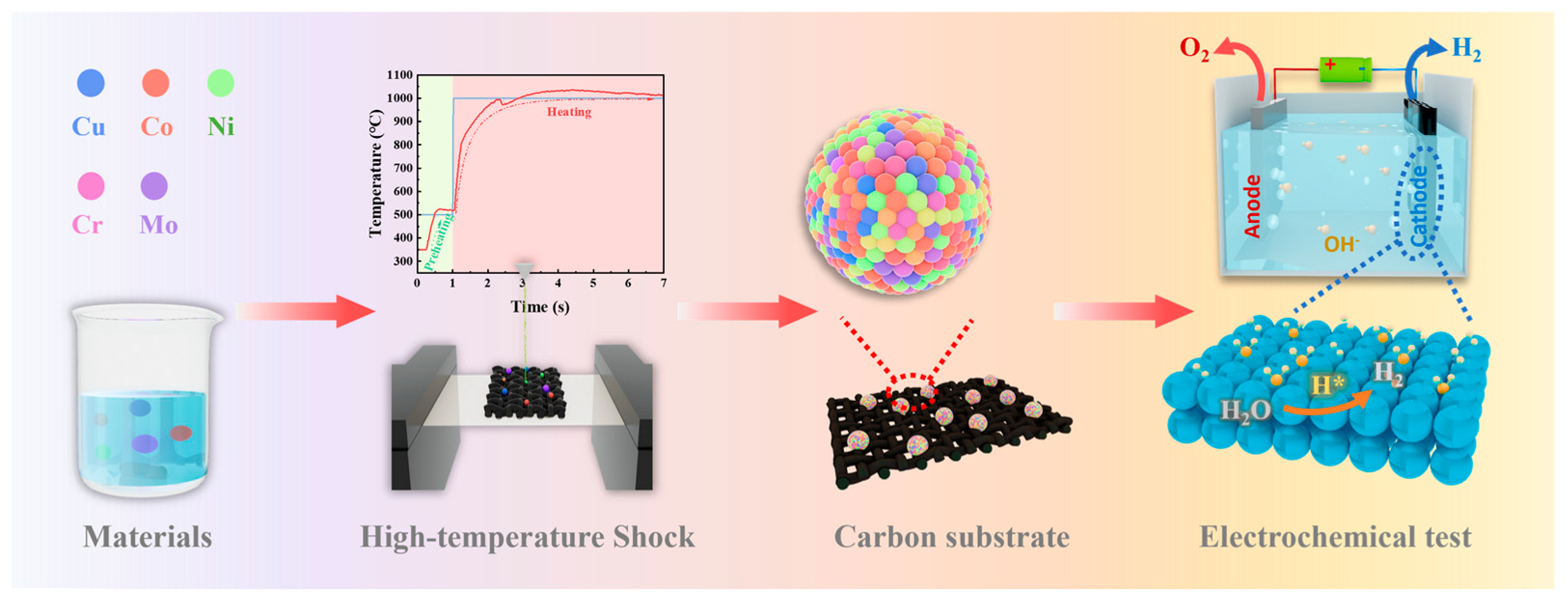
HECMo-x samples were synthesized with the procedure schematically shown in Figure 1. The designed atomic ratios of each element are listed in Table S1, and the actual weighed amounts are given in Table S2. First, 36 wt% hydrochloric acid was diluted with deionized water to form 1 M HCl solution. The diluted HCl solution and deionized water were mixed at a volume ratio of 1.5:15 under magnetic stirring at 300 rpm. Elements were added sequentially under continuous stirring until fully dissolved to obtain a homogeneous precursor solution. Subsequently, 40 μL of the precursor solution was loaded onto a 1 cm2 hydrophilic carbon cloth and dried under an infrared lamp. The carbon cloth was then transferred into the joule heating furnace. After evacuation and purging with inert gas, the sample was preheated at 500 °C for 1 s, followed by rapid heating at 1000 °C for 6 s to obtain HECMo-x (Figure S1).

2.3. Materials Characterization

The as-prepared samples were characterized by X-ray powder diffraction (XRD) using a Rigaku Miniflex 600 diffractometer (Rigaku, Tokyo, Japan). The sample powder was scanned with Cu-Kα radiation at an operating voltage of 40 kV and a current of 15 mA. Data were collected in the 2θ range of 20° to 80° at a scanning rate of 10° min−1. Energy-dispersive X-ray spectroscopy (EDS) measurements were performed on a scanning electron microscope (SEM, FEI Company, Hillsboro, OR, USA) equipped with an EDS detector at an accelerating voltage of 15 kV. X-ray photoelectron spectroscopy (XPS) measurements were carried out on an ESCALAB 250xi spectrometer (Thermo Fisher Scientific, Waltham, MA, USA). All binding energies were calibrated using the C 1s peak at 284.8 eV for charge correction. The elemental content of Mo in high-entropy carbides was determined by inductively coupled plasma-optical emission spectrometry (ICP-OES, Thermo ICAP PRO, Thermo Fisher Scientific GmbH, Bremen, Germany).

2.4. Electrochemical Measurements

Electrochemical measurements were performed in a typical three-electrode system. The working electrode was HECMo-x loaded on carbon cloth (1 × 1 cm2). A carbon rod and a saturated calomel electrode (SCE) were used as the counter electrode and reference electrode, respectively. All tests were carried out in 1.0 M KOH electrolyte using a CHI660E electrochemical workstation (Shanghai Chenhua Instrument Co., Shanghai, China). All potentials were converted to the reversible hydrogen electrode (RHE) scale according to the Nernst equation: ERHE = ESCE + 0.241 + 0.059·pH. Linear sweep voltammetry (LSV) polarization curves were recorded from 0.267 V to −0.533 V (vs. RHE) at a scan rate of 10 mV s−1 with a sensitivity of 0.01 A/V, and 90% iR compensation was applied. Electrochemical double-layer capacitance (Cdl) was measured by cyclic voltammetry (CV) in the non-Faradaic potential region from −0.033 to 0.267 V at scan rates of 5, 10, 25, 50 and 100 mV s−1, with 20 scan cycles for each rate. The electrochemically active surface area (ECSA) was then evaluated using the equation: ECSA = Cdl/Cs, where Cs is the double-layer capacitance of a planar surface. Electrochemical impedance spectroscopy (EIS) was conducted at an initial potential corresponding to a given overpotential δ, with a frequency range of 0.1 Hz to 105 Hz. Tafel slopes were derived from LSV data according to the equation: η = a + b log|j|, where b is the Tafel slope and j is the current density. Variable-potential electrochemical impedance spectroscopy measurements were carried out at overpotentials of 0, 20, 40, 60 and 80 mV over a frequency range of 0.1–105 Hz. Furthermore, kinetic isotope effect (KIE) tests were conducted sequentially in 1.0 M KOH and 1.0 M KOD solutions, while keeping other parameters the same as those used in the LSV measurements.

2.5. Density Functional Theory (DFT) Calculations

All DFT calculations in this work were performed using the Vienna Ab initio Simulation Package (VASP, version 6.4.2) [26]. The calculations were carried out within the generalized gradient approximation (GGA) using the Perdew–Burke–Ernzerhof (PBE) functional [27]. The projector augmented wave (PAW) method was employed to describe the ionic cores, while valence electrons were expanded in a plane-wave basis set with a kinetic energy cutoff of 450 eV [28]. Partial occupancies of the Kohn–Sham orbitals were allowed via Gaussian smearing with a width of 0.05 eV. For geometric and lattice optimization, Brillouin-zone integration was carried out using Γ-centered k-point sampling with a spacing of 0.04 2π/Å, and a finer mesh of 0.02 2π/Å for density of states (DOS) calculations. The self-consistent convergence threshold for total energy was set to 10−6 eV. The equilibrium geometry and lattice parameters were fully optimized until the maximum force on each atom was less than 0.02 eV·Å−1. In addition, weak interaction was described by the DFT + D3 method using empirical correction according to Grimme’s scheme [29]. Spin polarization was adopted to account for magnetic systems.

3. Results and Discussion

3.1. Structural and Morphological Characterization

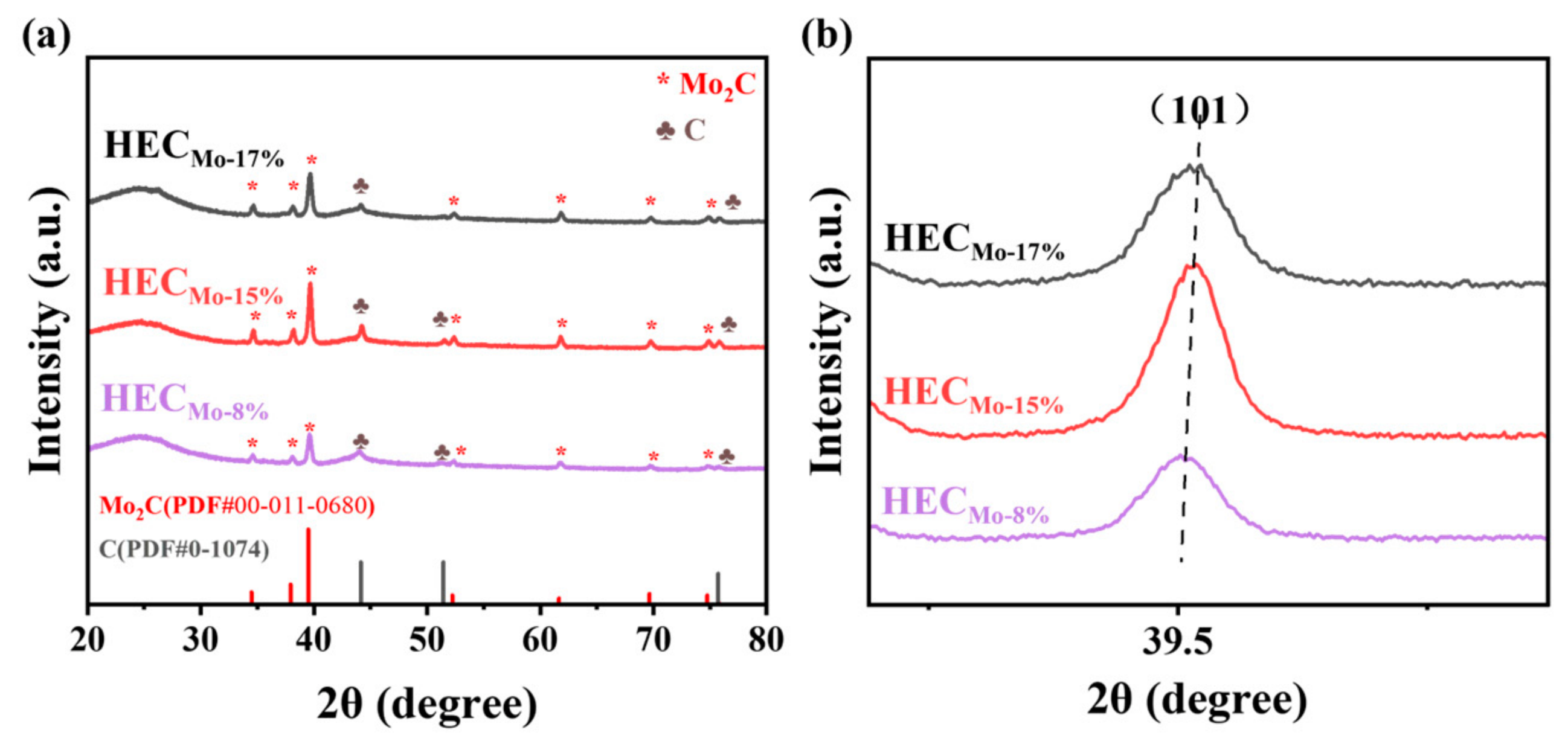
To verify the phase composition and crystal structure of HECMo-x, XRD analysis was performed (Figure 2a). The XRD patterns reveal that all samples exhibit characteristic diffraction peaks at 34.47°, 37.93°, 39.49°, 52.23°, 61.66°, 69.64° and 74.75°, corresponding to the (100), (002), (101), (102), (110), (103) and (112) crystal planes of β-Mo2C, and no impurity peaks are detected. As observed in Figure 2b, the diffraction peak of the (101) plane gradually shifts to larger angles with increasing Mo content. The actual incorporated Mo content is available from the ICP-OES measurements (Table S3). Given the atomic size differences among the constituent elements (Cu: 256 pm, Co: 250 pm, Ni: 248 pm, Cr: 256 pm, Mo: 278 pm), according to Bragg’s law (2d sin θ = n λ), increased diffraction angle points to lattice contraction. Despite the large atomic radius of molybdenum, atomic-size mismatch of multi-metal components and strong symmetry-breaking-derived intermetallic interactions in high-entropy carbides jointly dominate the lattice evolution and result in lattice contraction. Furthermore, we also performed quantitative Williamson–Hall analysis on the XRD data, and the results are summarized in Tables S4–S7. It reveals that the crystallite size gradually decreases alongside a continuous reduction in bulk-averaged microstrain with increasing dopant content. This trend is also consistent with the shift of XRD peaks toward higher diffraction angles. Notably, the preservation of the β-Mo2C phase even at high Mo concentrations suggests that excess Mo further distorts the lattice, a structural modification that effectively modulates the catalyst’s electronic structure. These results highlight the efficacy of HTS in yielding a pure, highly distorted phase HECMo-x.
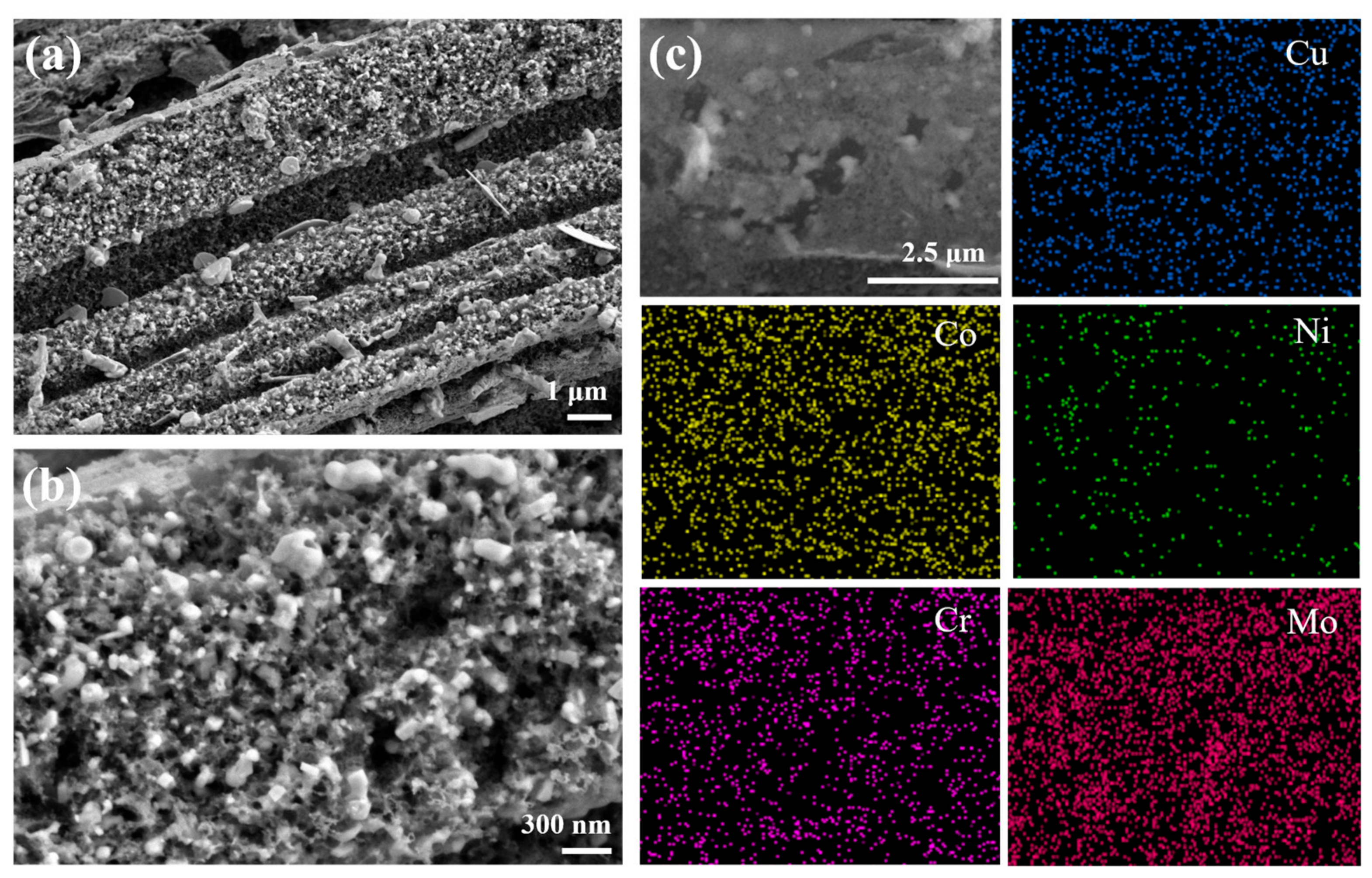
The surface morphology of the as-synthesized catalysts was further characterized via SEM. As illustrated in Figure 3a, the substrate is uniformly decorated with HECMo-15% nanoparticles that assemble into one-dimensional, strip-like arrays. These arrays are partitioned by distinct inter-strip voids, resulting in a three-dimensional interconnected porous framework. As shown in Figure 3b, this hierarchical architecture exhibits a highly porous, sponge-like morphology that is critical for electrochemical performance. Elemental mapping (Figure 3c) further confirms a homogeneous distribution of Cu, Co, Ni, Cr and Mo, indicating that the other four elements are atomically dissolved into the Mo2C lattice without elemental segregation, confirming the successful synthesis of HECMo-x as a single-phase solid solution.
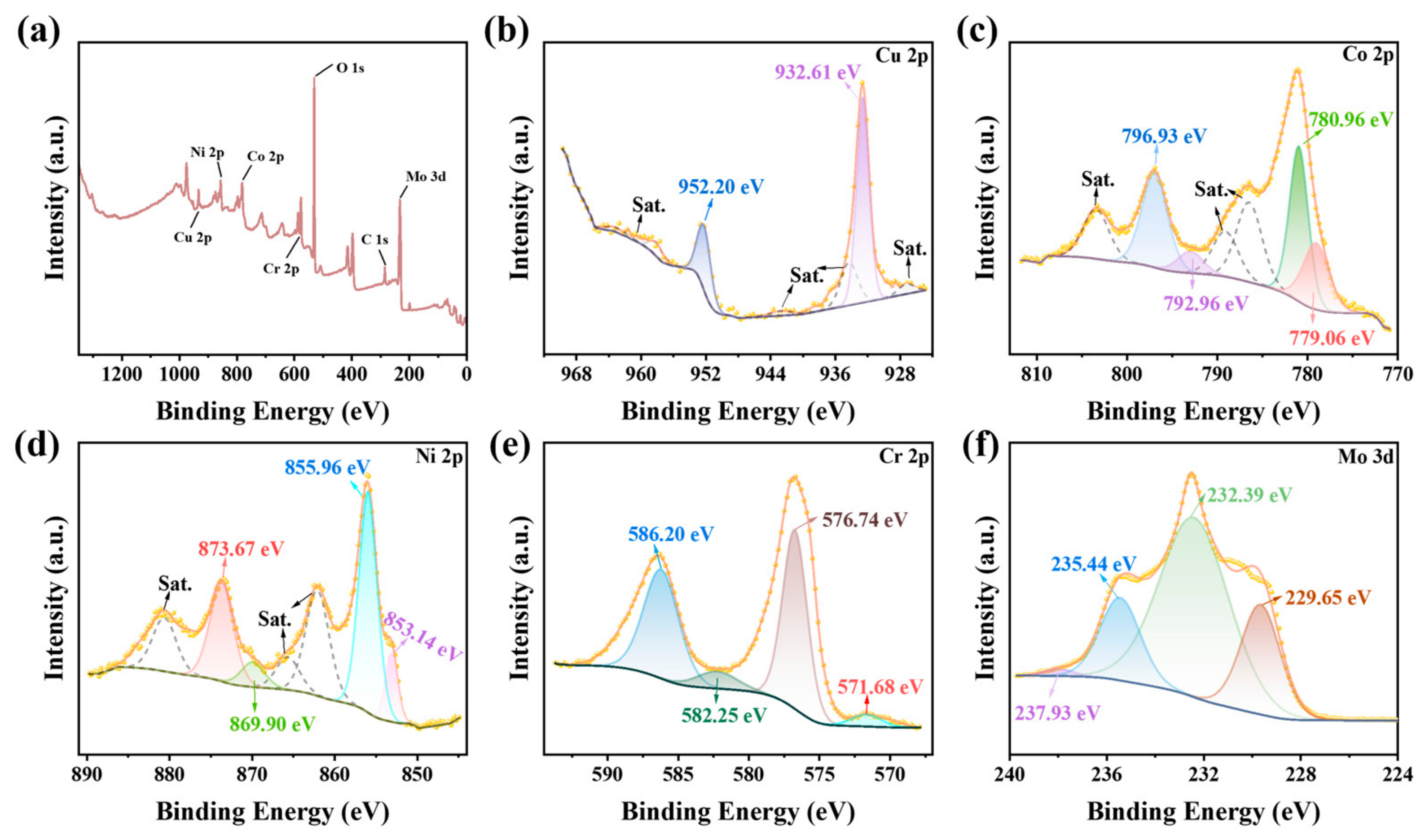
The chemical composition of the electrocatalyst was finally analyzed by XPS. The XPS survey spectrum (Figure 4a) shows the presence of Cu, Co, Ni, Cr and Mo, which is consistent with the elemental mapping results, further confirming the successful synthesis of the HECMo-15%. The presence of O may originate from surface oxidation of the catalyst. All binding energies were calibrated using the C 1s peak at 284.8 eV, and the fitted C 1s spectrum is displayed in Figure S2. As shown in Figure 4b, the binding energies of Cu0 2p3/2 and Cu0 2p1/2 are located at 932.61 eV and 952.20 eV, respectively. A weak satellite peak at 942.68 eV suggests the presence of trace Cu2+ arising from slight surface oxidation [30]. The existence of low-valence Cu0 optimizes the electronic structure and electrical conductivity of the catalyst. The Co 2p and Ni 2p regions (Figure 4c,d) reveal the coexistence of metallic (Co0, Ni0) and oxidized (Co2+, Ni2+) states; notably, both elements exhibit slight positive binding energy shifts relative to their pure metallic counterparts, indicating electron donation to neighboring atoms [31,32,33,34]. Similarly, the Cr 2p XPS spectrum (Figure 4e) displays characteristic peaks of Cr3+ at 576.74 eV (Cr3+ 2p3/2) and 586.20 eV (Cr3+ 2p1/2), together with peaks assigned to Cr0 2p3/2 at 571.68 eV and 2p1/2 at 582.25 eV [35,36]. The Mo 3d spectrum (Figure 4f) consists of four peaks, assigned to Mo4+ (3d5/2 at 229.65 eV, 3d3/2 at 232.39 eV) and Mo6+ (3d5/2 at 235.44 eV, 3d3/2 at 237.93 eV) [37]. Their presence is attributed to the oxidation of Mo2C phase observed in XRD. In summary, the collective results from XRD, SEM and XPS demonstrate the successful synthesis of HECMo-x and confirm that their electronic structure can be precisely regulated via rational Mo content modulation.

3.2. Electrochemical Hydrogen Evolution Performance

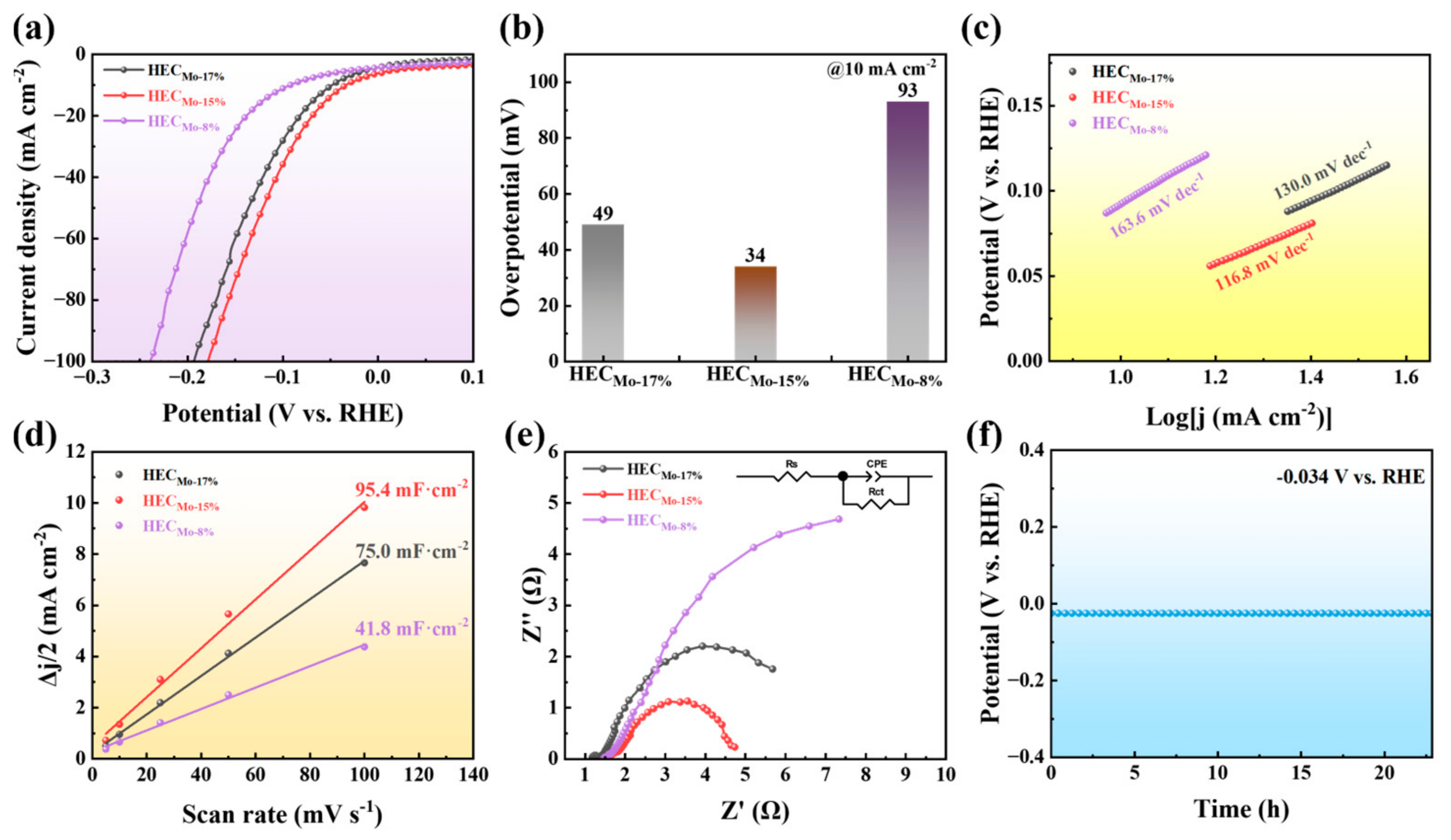
Electrochemical performance was evaluated using a standard three-electrode configuration in 1.0 M KOH. As shown in Figure 5a, the HER polarization curves for electrocatalysts with varying Mo content reveal a clear correlation between Mo concentration and catalytic activity. HECMo-15% exhibits the superior performance, requiring an overpotential of only 34 mV to reach 10 mA cm−2. This value is significantly lower than those of HECMo-17% (49 mV) and HECMo-8% (93 mV) (Figure 5b), outperforming benchmark non-noble catalysts with performance comparable to noble metals (as shown in Table 1). To elucidate the reaction kinetics, Tafel plots were derived from the LSV curves data (Figure 5c). HECMo-15% yields a Tafel slope of 116.8 mV dec−1, which is notably lower than those of HECMo-17% (130.0 mV dec−1) and HECMo-8% (163.6 mV dec−1). This value closely aligns with the theoretical slope for the Volmer-limited mechanism (120.0 mV dec−1), identifying the water dissociation/proton adsorption step as the rate-determining step (RDS) [38]. The ECSA was further quantified via Cdl measurements (Figure 5d and Figure S3). The Cdl values follow the order of HECMo-15% (95.4 mF cm−2) > HECMo-17% (75.0 mF cm−2) > HECMo-8% (41.8 mF cm−2), confirming that HECMo-15% provides the highest density of accessible active sites. As shown in Figure S4 and Table S8, the intrinsic current density jECSA collected at the same overpotential (−0.08 V vs. RHE) also follows this trend. Furthermore, EIS was utilized to probe the charge-transfer kinetics (Figure 5e). The Nyquist plots show that HECMo-15% possesses the smallest semicircle diameter, corresponding to the minimum transfer resistance (Rct) and the most rapid electron-transfer rate among the series. Finally, the durability of HECMo-15% was assessed via chronopotentiometry (Figure 5f); the catalyst maintained a stable potential with negligible degradation over 23 h of continuous operation. Post-stability XRD showed no evident peak loss or emergent impurity phases (Figure S5), preliminarily confirming its good stability and corrosion resistance in alkaline media. Notably, owing to the inherent objective factors, certain fluctuations exist between the stable potential and the overpotential acquired from LSV measurements.

3.3. Theoretical Calculations

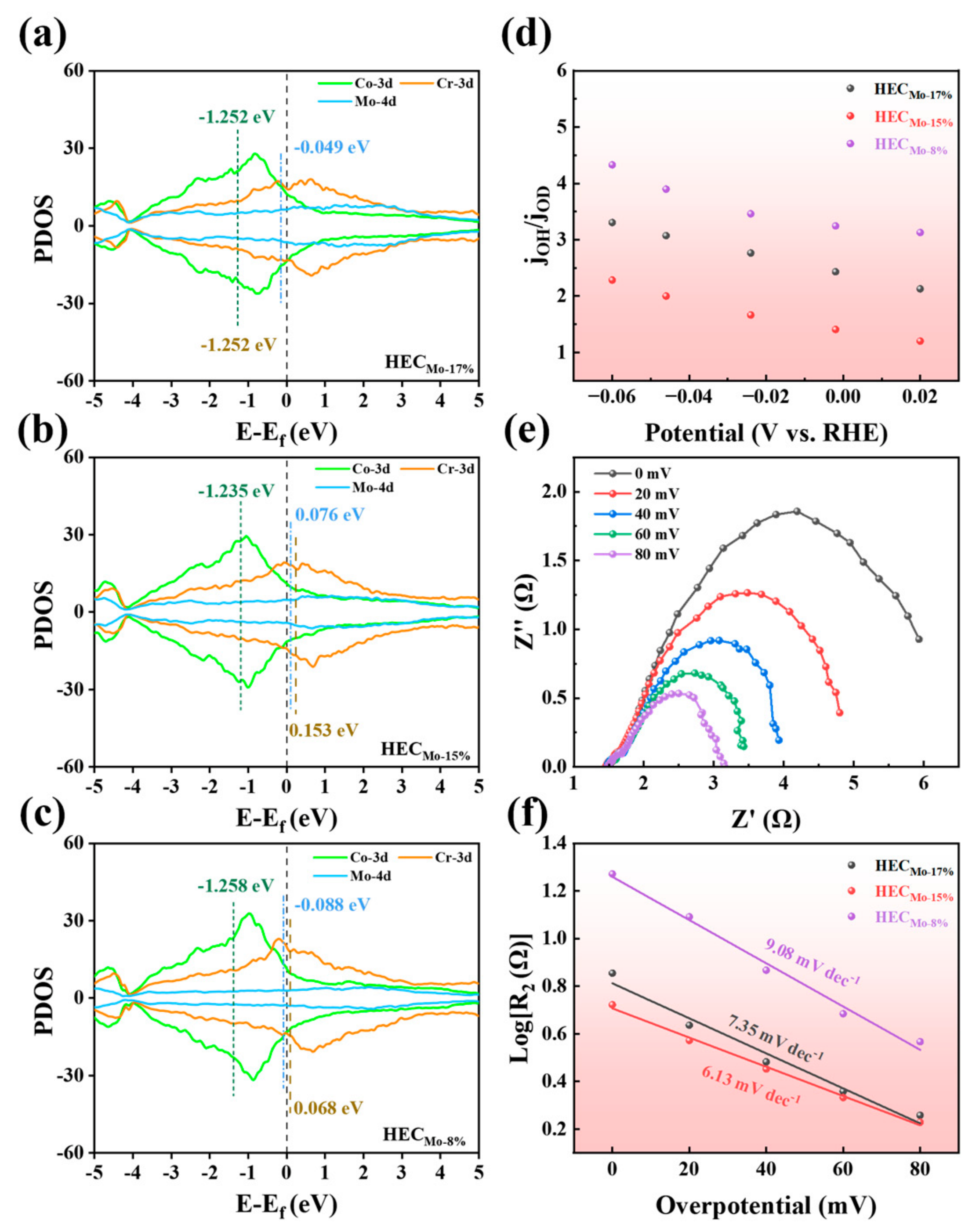
To gain deeper insight into the mechanism underlying the excellent HER performance of HECMo-x, first-principles density functional theory calculations were performed, with optimized and stable theoretical models of HECMo-17%, HECMo-15% and HECMo-8% presented in Figure S6. As shown in Figure 6a–c, the partial density of states (PDOS) of Co 3d, Cr 3d and Mo 4d orbitals were comparatively analyzed to determine their corresponding d-band centers, a vital indicator for intermediate adsorption/desorption kinetics and overall HER activity [44]. While Co is a recognized active site for alkaline water electrolysis [45], pure Co-based catalysts often suffer from excessively strong interactions with the H* intermediate; however, DFT results demonstrate that the Co-orbital d-band center follow the order of HECMo-15% (−1.235 eV) > HECMo-17% (−1.252 eV) > HECMo-8% (−1.258 eV), representing a remarkable upward shift that optimizes the electronic structure to facilitate H* desorption. This effect is augmented by the synergistic roles of Mo and Cr, which accelerate the water dissociation step; specifically, Cr and Mo species can facilitate the initial H2O activation [46,47]. The calculations reveal that elemental tuning allows HECMo-15% to achieve the maximum d-band centers at both Cr and Mo sites, indicating superior H2O adsorption and activation capabilities. Overall, the electronic synergy among Co, Cr and Mo, combined with the precise regulation of the d-band centers, effectively optimizes the electronic structure of the electrocatalyst, achieving a moderate Gibbs free energy of hydrogen adsorption and consequently boosting alkaline HER activity.

3.4. Water Dissociation and Hydrogen Adsorption Kinetics

To validate the proposed mechanism above and further elucidate the mechanistic pathways of enhanced catalytic activity, we conducted a series of kinetic investigations on these samples. First, the hydrogen/deuterium kinetic isotope effect (H/D KIE) was employed to probe the water-dissociation kinetics [48]. Polarization curves were recorded in 1.0 M KOH and 1.0 M KOD electrolytes, with the resulting current density ratios (jOH/jOD) presented in Figure 6d. Despite the inherently more sluggish kinetics associated with the higher dissociation energy of O-D bonds, HECMo-15% consistently maintained the highest current densities and the lowest jOH/jOD ratio across the measured overpotential range. This minimal KIE value indicates that HECMo-15% effectively lowers the activation barrier for O-H cleavage, thereby achieving the most rapid water-dissociation kinetics among the samples. Meanwhile, we also investigated the electrochemical performance of the HECMo-15% catalyst in electrolytes with different concentrations. The results reveal that its catalytic performance is dependent on electrolyte concentration, as illustrated in Figure S7.
Subsequently, variable-potential electrochemical impedance spectroscopy measurements were performed to evaluate the hydrogen adsorption behaviours [49]. As shown in Figure 6e, the Rct for HECMo-15%—represented by the Nyquist arc diameter—decreases monotonically with increasing overpotential, signifying that accelerated electron-transfer kinetics are maintained even under high polarization. The corresponding equivalent-circuit diagram and the discussion on impedance responses at different overpotentials are presented in Figures S8 and S9. To further quantify this, we plotted the relationship between log R2 and overpotential, where R2 denotes the hydrogen-adsorption resistance [4], and calculated the Tafel slopes using Ohm’s law (Figure 6f; Tables S9–S11). HECMo-15% exhibits the smallest slope, indicating significantly lower charge-transfer resistance compared to HECMo-17% and HECMo-8% at identical overpotentials. This facilitates the rapid transformation and removal of adsorbed H*, which in turn liberates active surface sites for subsequent water adsorption. This synergistic effect effectively prevents site poisoning by adsorbed H* and further promotes the continuous water-dissociation process, driving the superior alkaline HER performance of the high-entropy carbide system.

4. Conclusions

In summary, we have successfully synthesized the high-purity and atomically soluble CuCoNiCrMox high-entropy carbides using a HTS method. Among all samples, HECMo-15% exhibited outstanding electrocatalytic performance toward the hydrogen evolution reaction, with a low overpotential of 34 mV at 10 mA cm−2, a large electrochemical active surface area (95.4 mF cm−2) and remarkable stability by maintaining steady activity for 23 h. The outstanding performance was attributed to the significant lattice distortion effect induced by differences in atomic size and electronegativity, which shifts the d-band center and creates a unique electronic structure, thereby optimizing the adsorption–desorption balance of reaction intermediates with H* and H2O. Unfortunately, several limitations still exist: the varied Mo fractions (8%, 15%, 17%) are precursor-feeding atomic ratios serving as synthetic tuning parameters, not the real stoichiometry of resulting high-entropy carbides. This study establishes a robust design principle for evaluating lattice distortion guided catalysis in carbide systems and provides a versatile synthetic paradigm for engineering high-performance, non-noble metal electrocatalysts.

Supplementary Materials

The following supporting information can be downloaded at: https://www.mdpi.com/article/10.3390/sym18091483/s1, Figure S1: Temperature control curve of the HTS process; Figure S2: High resolution XPS spectra of C1s [50,51]; Figure S3: Cyclic voltammetry curves of HECMo-x (x = 17%, 15%, 8%) were measured in a potential window with a non-Faradaic region at different scan rates: 5, 10, 25, 50 and 100 mV s−1; Figure S4: ECSA-normalized current density of the as-prepared catalysts; Figure S5: Post-stability-test XRD pattern of the HECMo-15% catalyst; Figure S6: Optimized structure schematic of the DFT models: HECMo-17%, HECMo-15% and HECMo-8%; Figure S7: LSV curves and derived Tafel slopes collected from measurements with different electrolyte concentrations; Figure S8: Equivalent circuit used for EIS fitting analysis; Figure S9: Nyquist plots collected at overpotentials of 20 mV and 40 mV, respectively; Table S1: Atomic Ratios of Each Element; Table S2: Actual Weighed Amounts; Table S3: Actual Mo content for samples at different nominal ratios; Table S4: Average crystallite size and microstrain calculated by Williamson-Hall analysis from XRD data; Tables S5–S7: Williamson-Hall analysis of XRD data for the HECMo-17%, HECMo-15% and HECMo-8% sample; Table S8: ECSA-normalized current density of various catalysts at −0.08 V vs. RHE; Tables S9–S11: EIS fitting results of HECMo-17%, HECMo-15% and HECMo-8%.

Author Contributions

Conceptualization, W.M. and C.S.; methodology, X.J. and Z.Y.; software, X.J. and J.Z.; investigation, X.J. and Z.Y.; data curation, J.Z. writing—original draft preparation, X.J. and W.M.; writing—review and editing, W.M., F.F. and C.S.; supervision, W.M. All authors have read and agreed to the published version of the manuscript.

Funding

This research was funded by the CNPC Innovation Fund (2024DQ02-0207), the Liaoning provincial Natural Science Foundation of China (2025-MSLH-078), PetroChina Youth Science and Technology Special Project (Grant No. 2024DQ03189).

Data Availability Statement

The data presented in this study are available on request from the corresponding authors.

Acknowledgments

We used DeepSeek (https://www.deepseek.com/en/) solely for English language polishing and proofreading purposes. No AI-generated content was used for scientific writing, data analysis, interpretation, or any other substantive aspects of the research. All authors have thoroughly reviewed and edited the AI-polished output, and we take full responsibility for the final content of this publication.

Conflicts of Interest

Author Feifei Fang was employed by the company Petrochemical Research Institute. Author Chenyi Shao was employed by the company Petrochemical Research Institute. The remaining authors declare that the research was conducted in the absence of any commercial or financial relationships that could be construed as a potential conflict of interest. The authors declare that this study received funding from Petrochemical Research Institute. The funder was not involved in the study design, collection, analysis, interpretation of data, the writing of this article or the decision to submit it for publication.

References

  1. Yu, Z.Y.; Duan, Y.; Feng, X.Y.; Yu, X.X.; Gao, M.R.; Yu, S.H. Clean and Affordable Hydrogen Fuel from Alkaline Water Splitting: Past, Recent Progress, and Future Prospects. Adv. Mater. 2021, 33, 2007100. [Google Scholar] [CrossRef] [Scilit] [PubMed]
  2. Wang, H.D.; Jiao, Y.X.; Zhang, G.H.; Zhang, Z.X.; Ma, W.G.; Sun, C.H.; Zong, X. Superaerophobic Ni3N/Ni@W2N3 multi-heterointerfacial nanoarrays for efficient alkaline electrocatalytic hydrogen evolution reaction. Chem. Eng. J. 2024, 497, 154776. [Google Scholar] [CrossRef] [Scilit]
  3. Zheng, Y.; Jiao, Y.; Vasileff, A.; Qiao, S.Z. The Hydrogen Evolution Reaction in Alkaline Solution: From Theory, Single Crystal Models, to Practical Electrocatalysts. Angew. Chem. Int. Ed. 2018, 57, 7568–7579. [Google Scholar] [CrossRef] [Scilit] [PubMed]
  4. Wang, H.D.; Jiao, Y.X.; Zhang, G.H.; Ma, W.C.; Fan, W.J.; Liu, X.Y.; Zhao, Y.; Xie, H.J.; Ma, W.G.; Zong, X. Stabilizing Electron-Deficient Ru Nanoclusters via Strong Electronic Metal-Support Interaction for Practical Anion-Exchange Membrane Electrolyzer. Adv. Funct. Mater. 2025, 35, 2418617. [Google Scholar] [CrossRef] [Scilit]
  5. Zhao, S.; Han, G.Q.; Wang, C.Y.; Bian, H.W.; Xie, G.W.; Liu, X.; Jiang, L.H. Ni-Fe-P/Fe-Si electrocatalysts on iron sheets: Regulating surface structure to amorphous heterojunction for excellent oxygen evolution reaction. Int. J. Hydrogen Energy 2024, 49, 580–590. [Google Scholar] [CrossRef] [Scilit]
  6. Yang, W.X.; Zhang, W.Y.; Liu, R.; Lv, F.; Chao, Y.G.; Wang, Z.C.; Guo, S.J. Amorphous Ru nanoclusters onto Co-doped 1D carbon nanocages enables efficient hydrogen evolution catalysis. Chin. J. Catal. 2022, 43, 110–115. [Google Scholar] [CrossRef] [Scilit]
  7. Chen, L.; Jian, X.Y.; Gao, Q.S.; Cao, Z.J.; Chen, Z.B.; Lin, H.J. Towards robust hydrogen evolution electrocatalysts in immiscible copper-molybdenum alloys by amorphization. J. Mater. Chem. A 2025, 13, 12523–12533. [Google Scholar] [CrossRef] [Scilit]
  8. Ganesan, P.; Sivanantham, A.; Shanmugam, S. Nanostructured Nickel-Cobalt-Titanium Alloy Grown on Titanium Substrate as Efficient Electrocatalyst for Alkaline Water Electrolysis. ACS Appl. Mater. Inter. 2017, 9, 12416–12426. [Google Scholar] [CrossRef] [Scilit] [PubMed]
  9. Huo, L.X.; Jin, C.Q.; Tang, J.L.; Xu, X.H.; Jiang, K.; Shang, L.Y.; Li, Y.W.; Zhang, J.Z.; Zhu, L.Q.; Chu, J.H.; et al. Ultrathin NiPt Single-Atom Alloy for Synergistically Accelerating Alkaline Hydrogen Evolution. ACS Appl. Energy Mater. 2022, 5, 15136–15145. [Google Scholar] [CrossRef] [Scilit]
  10. Umar, A.A.; Oyama, M. Mechanistic modulation of electronic structure and interface chemistry in Ni-based alloys for electrochemical energy conversion. RSC Adv. 2026, 16, 20464–20488. [Google Scholar] [CrossRef] [Scilit] [PubMed]
  11. Luo, Y.; Chen, H.R.; Gao, W.J.; Li, Y.; Zhao, Y.Z.; Fang, H.; Wang, M.M.; Ren, Z.D.; Zhu, Y.C. A low crystallinity tungsten-supported palladium catalyst and its electrochemical hydrogen evolution activity. New J. Chem. 2026, 50, 9019–9027. [Google Scholar] [CrossRef] [Scilit]
  12. Adak, M.K.; Vaishampayan, V.; Gopinathan, N.; Gumfekar, S.P. Synergistic Interactions in Nanostructured CuNi2 Bimetallic Alloy for Superior Hydrogen Evolution Reaction Kinetics and Stability. ACS Appl. Energy Mater. 2026, 9, 3806–3817. [Google Scholar] [CrossRef] [Scilit]
  13. He, Y.Z.; Tan, R.R.; Li, L.F.; Behmadi, R.; Sun, S.Y.; Zhu, C.S.; Davar, F.; Hojjati-Najafabadi, A. Electrospinning-Derived FeCrNiZrMn High-Entropy Alloy on Carbon Nanofibers for Hydrogen Evolution. ChemCatChem 2026, 18, e01811. [Google Scholar] [CrossRef] [Scilit]
  14. Li, Z.J.; Zhang, A.; Chen, C.S.; Yang, H.; Sun, M.Z.; Zhang, Q.H.; Xi, S.B.; Zhai, L.; Long, X.Y.; Li, L.J.; et al. Synthesis of 4H-phase high-entropy alloys for electrocatalysis. Nat. Mater. 2026, 25, 972–981. [Google Scholar] [CrossRef] [Scilit] [PubMed]
  15. Zhang, C.; Wang, Z.L.; Liu, C.; Bai, Y.; Liang, C.H.; Low, J.; Xiong, Y.J. Rapid synthesis of subnanoscale high-entropy alloys with ultrahigh durability. Nat. Mater. 2026, 25, 26–34. [Google Scholar] [CrossRef] [Scilit] [PubMed]
  16. Li, C.; Zhang, Z.; Zhu, K.; Liu, M.; Chen, J.; Zhou, L.; Zhang, Q.; Wu, Y.; Guo, J.; Shi, R.; et al. Nanoconfined impulse synthesis of high-entropy nanocarbides for active and stable electrocatalysis. Nat. Synth. 2025, 4, 1422–1434. [Google Scholar] [CrossRef] [Scilit]
  17. Mu, X.Q.; Gu, X.Y.; Dai, S.P.; Chen, J.B.; Cui, Y.J.; Chen, Q.; Yu, M.; Chen, C.Y.; Liu, S.L.; Mu, S.C. Breaking the symmetry of single-atom catalysts enables an extremely low energy barrier and high stability for large-current-density water splitting. Energy Environ. Sci. 2022, 15, 4048–4057. [Google Scholar] [CrossRef] [Scilit]
  18. Cheng, X.F.; He, J.H.; Ji, H.Q.; Zhang, H.Y.; Cao, Q.; Sun, W.J.; Yan, C.L.; Lu, J.M. Coordination Symmetry Breaking of Single-Atom Catalysts for Robust and Efficient Nitrate Electroreduction to Ammonia. Adv. Mater. 2022, 34, 2205767. [Google Scholar] [CrossRef] [Scilit] [PubMed]
  19. Lv, L.Y.; Tan, H.; Kong, Y.; Tang, B.; Ji, Q.Q.; Liu, Y.Y.; Wang, C.; Zhuang, Z.C.; Wang, H.J.; Ge, M.; et al. Breaking the Scaling Relationship in C-N Coupling via the Doping Effects for Efficient Urea Electrosynthesis. Angew. Chem. Int. Ed. 2024, 63, e202401943. [Google Scholar] [CrossRef] [Scilit] [PubMed]
  20. Zhuang, Z.C.; Li, Y.; Li, Y.H.; Huang, J.Z.; Wei, B.; Sun, R.; Ren, Y.J.; Ding, J.; Zhu, J.X.; Lang, Z.Q.; et al. Atomically dispersed nonmagnetic electron traps improve oxygen reduction activity of perovskite oxides. Energy Environ. Sci. 2021, 14, 1016–1028. [Google Scholar] [CrossRef] [Scilit]
  21. Xia, Z.H.; Guo, S.J. Strain engineering of metal-based nanomaterials for energy electrocatalysis. Chem. Soc. Rev. 2019, 48, 3265–3278. [Google Scholar] [CrossRef] [Scilit] [PubMed]
  22. Guo, W.X.; Chai, D.F.; Li, J.L.; Yang, X.; Fu, S.S.; Sui, G.Z.; Zhuang, Y.; Guo, D.X. Strain Engineering for Electrocatalytic Overall Water Splitting. ChemPlusChem 2024, 89, 2300605. [Google Scholar] [CrossRef] [Scilit] [PubMed]
  23. Chen, Q.; Han, X.; Xu, Z.Y.; Chen, Q.X.; Wu, Q.F.; Zheng, T.; Wang, P.; Wang, Z.J.; Wang, J.C.; Li, H.J.; et al. Atomic phosphorus induces tunable lattice strain in high entropy alloys and boosts alkaline water splitting. Nano Energy 2023, 110, 108380. [Google Scholar] [CrossRef] [Scilit]
  24. Maiti, S.; Maiti, K.; Curnan, M.T.; Kim, K.; Noh, K.J.; Han, J.W. Engineering electrocatalyst nanosurfaces to enrich the activity by inducing lattice strain. Energy Environ. Sci. 2021, 14, 3717–3756. [Google Scholar] [CrossRef] [Scilit]
  25. Zhao, J.H.; Wang, Z.Y.; Fang, X.Y.; Yang, L.; Wu, C.Q.; Gan, W.; Zhou, Y.; Shan, L.; Lin, Y.X. Fast joule heating synthesis of NiCoFeCrMo high-entropy alloy embedded in graphene for water oxidation. J. Alloy Compd. 2023, 966, 171535. [Google Scholar] [CrossRef] [Scilit]
  26. Kresse, G.; Furthmuller, J. Efficiency of ab-initio total energy calculations for metals and semiconductors using a plane-wave basis set. Comput. Mater. Sci. 1996, 6, 15–50. [Google Scholar] [CrossRef] [Scilit]
  27. Perdew, J.P.; Burke, K.; Ernzerhof, M. Generalized gradient approximation made simple. Phys. Rev. Lett. 1996, 77, 3865–3868. [Google Scholar] [CrossRef] [Scilit] [PubMed]
  28. Kresse, G.; Joubert, D. From ultrasoft pseudopotentials to the projector augmented-wave method. Phys. Rev. B 1999, 59, 1758–1775. [Google Scholar] [CrossRef] [Scilit]
  29. Grimme, S.; Ehrlich, S.; Goerigk, L. Effect of the Damping Function in Dispersion Corrected Density Functional Theory. J. Comput. Chem. 2011, 32, 1456–1465. [Google Scholar] [CrossRef] [Scilit] [PubMed]
  30. Bencherifa, I.; Belkhettab, I.; Derkaoui, K.; Dabou, O.; Chetoui, A.; Latreche, S.; Daoud, I. Unveiling the impact of Al and Cr alloying on structure and HER performance of CoCuZnMnNiFe high-entropy alloy nanoparticles. J. Mater. Sci. 2025, 60, 22443–22467. [Google Scholar] [CrossRef] [Scilit]
  31. Li, F.S.; Li, Q.Y.; Kimura, H.; Xie, X.B.; Zhang, X.Y.; Wu, N.N.; Sun, X.Q.; Bin Xu, B.; Algadi, H.; Pashameah, R.A.; et al. Morphology controllable urchin-shaped bimetallic nickel-cobalt oxide/carbon composites with enhanced electromagnetic wave absorption performance. J. Mater. Sci. Technol. 2023, 148, 250–259. [Google Scholar] [CrossRef] [Scilit]
  32. Yu, J.; Zhong, Y.J.; Wu, X.H.; Sunarso, J.; Ni, M.; Zhou, W.; Shao, Z.P. Bifunctionality from Synergy: CoP Nanoparticles Embedded in Amorphous CoOx Nanoplates with Heterostructures for Highly Efficient Water Electrolysis. Adv. Sci. 2018, 5, 1800514. [Google Scholar] [CrossRef] [Scilit] [PubMed]
  33. Feng, T.L.; Zeng, Q.S.; Lu, S.Y.; Yang, M.X.; Tao, S.Y.; Chen, Y.X.; Zhao, Y.; Yang, B. Morphological and Interfacial Engineering of Cobalt-Based Electrocatalysts by Carbon Dots for Enhanced Water Splitting. ACS Sustain. Chem. Eng. 2019, 7, 7047–7057. [Google Scholar] [CrossRef] [Scilit]
  34. Ma, H.X.; Liu, Z.J.; Chu, M.Z.; Kang, N.; Jiang, X.Y.; Zhang, J.Y.; Xie, G.W.; Liu, X. Electrochemical self-construction to fabricate NiFeCoMnSn electrocatalysts: Enhanced lattice distortion effect induced by Sn incorporation for superior hydrogen evolution performance. Appl. Mater. Today 2024, 41, 102525. [Google Scholar] [CrossRef] [Scilit]
  35. Huo, X.R.; Zhang, Y.W.; Yu, H.S.; Nie, S.N.; Zuo, X.J.; Xu, X.L.; Zhang, N.N. Bulk CoCrFeNiAlMo high entropy alloy as high-efficient electrocatalyst in alkaline environment. Int. J. Hydrogen Energy 2024, 87, 505–514. [Google Scholar] [CrossRef] [Scilit]
  36. Tang, J.; Xu, J.L.; Ye, Z.G.; Li, X.B.; Luo, J.M. Microwave sintered porous CoCrFeNiMo high entropy alloy as an efficient electrocatalyst for alkaline oxygen evolution reaction. J. Mater. Sci. Technol. 2021, 79, 171–177. [Google Scholar] [CrossRef] [Scilit]
  37. Kim, J.; Yang, C.Q.; Yun, T.H.Y.; Woo, S.; Kim, H.; Lee, M.G.; Jeong, M.; Ryu, H.; Kim, N.; Park, S.; et al. Surface-Embedding of Mo Microparticles for Robust and Conductive Biodegradable Fiber Electrodes: Toward 1D Flexible Transient Electronics. Adv. Sci. 2023, 10, 2206186. [Google Scholar] [CrossRef] [Scilit] [PubMed]
  38. Wang, J.; Xu, F.; Jin, H.Y.; Chen, Y.Q.; Wang, Y. Non-Noble Metal-based Carbon Composites in Hydrogen Evolution Reaction: Fundamentals to Applications. Adv. Mater. 2017, 29, 1605838. [Google Scholar] [CrossRef] [Scilit] [PubMed]
  39. Jiang, P.; Yang, Y.; Shi, R.H.; Xia, G.L.; Chen, J.T.; Su, J.W.; Chen, Q.W. Pt-like electrocatalytic behavior of Ru-MoO2 nanocomposites for the hydrogen evolution reaction. J. Mater. Chem. A 2017, 5, 5475–5485. [Google Scholar] [CrossRef] [Scilit]
  40. Luo, F.; Guo, L.; Xie, Y.H.; Xu, J.X.; Qu, K.G.; Yang, Z.H. Iridium nanorods as a robust and stable bifunctional electrocatalyst for pH-universal water splitting. Appl. Catal. B Environ. Energy 2020, 279, 119394. [Google Scholar] [CrossRef] [Scilit]
  41. Lu, C.B.; Tranca, D.; Zhang, J.; Hernandez, F.R.; Su, Y.Z.; Zhuang, X.D.; Zhang, F.; Seifert, G.; Feng, X.L. Molybdenum Carbide-Embedded Nitrogen-Doped Porous Carbon Nanosheets as Electrocatalysts for Water Splitting in Alkaline Media. ACS Nano 2017, 11, 3933–3942. [Google Scholar] [CrossRef] [Scilit] [PubMed]
  42. Shi, C.W.; Li, X.T.; Yang, W.; Liu, X.; An, Y.K.; Zhou, L.; Mai, L.Q. Anchoring ultra-small Mo2C nanocrystals on honeycomb-structured N-doped carbon spheres for efficient hydrogen evolution. Chem. Commun. 2022, 58, 5269–5272. [Google Scholar] [CrossRef] [Scilit] [PubMed]
  43. Alamdari, A.A.; Jahangiri, H.; Yagci, M.B.; Igarashi, K.; Matsumoto, H.; Motallebzadeh, A.; Unal, U. Exploring the Role of Mo and Mn in Improving the OER and HER Performance of CoCuFeNi-Based High-Entropy Alloys. Acs Appl. Energy Mater. 2024, 7, 2423–2435. [Google Scholar] [CrossRef] [Scilit]
  44. Wang, Z.P.; Lin, Z.P.; Deng, J.; Shen, S.J.; Meng, F.Q.; Zhang, J.T.; Zhang, Q.H.; Zhong, W.W.; Gu, L. Elevating the d-Band Center of Six-Coordinated Octahedrons in Co9S8 through Fe-Incorporated Topochemical Deintercalation. Adv. Energy Mater. 2021, 11, 2003023. [Google Scholar] [CrossRef] [Scilit]
  45. Subbaraman, R.; Tripkovic, D.; Chang, K.C.; Strmcnik, D.; Paulikas, A.P.; Hirunsit, P.; Chan, M.; Greeley, J.; Stamenkovic, V.; Markovic, N.M. Trends in activity for the water electrolyser reactions on 3d M(Ni,Co,Fe,Mn) hydr(oxy)oxide catalysts. Nat. Mater. 2012, 11, 550–557. [Google Scholar] [CrossRef] [Scilit] [PubMed]
  46. Yang, X.; Qiu, L.K.; Zhang, Y.; Dong, A.; Guo, C.Y.; Zhang, S.; Song, Y.J.; Gao, H.T.; Zhan, T.R. Boosting P-CoMoO3/MoO2 hydrogen evolution via water molecule dissociation by MoO2 and H2 desorption by CoMoO3. Chem. Commun. 2025, 61, 6490–6493. [Google Scholar] [CrossRef] [Scilit] [PubMed]
  47. Jin, D.Y.; Zhai, Y.R.; Wang, L.X.; Li, G.Q. Hydrogen spillover in Ru/Cr2O3 enhances alkaline hydrogen evolution reaction activity. Chem. Eng. J. 2025, 524, 169546. [Google Scholar] [CrossRef] [Scilit]
  48. Zhang, G.H.; Qi, S.L.; Wang, H.D.; Lei, X.F.; Zhang, Z.X.; Liu, W.; Liu, X.Y.; Zhao, Y.; Yang, L.; Ma, W.G.; et al. Simultaneous Tuning of the Microenvironment and Dissociation Kinetics of Interfacial Water on Electrocatalyst Toward Enhanced Alkaline Water Electrolysis. Adv. Funct. Mater. 2026, 36, 2517113. [Google Scholar] [CrossRef] [Scilit]
  49. Zhang, B.X.; Wang, J.M.; Liu, G.M.; Weiss, C.M.; Liu, D.Q.; Chen, Y.P.; Xia, L.X.; Zhou, P.; Gao, M.X.; Liu, Y.F.; et al. A strongly coupled Ru-CrOx cluster-cluster heterostructure for efficient alkaline hydrogen electrocatalysis. Nat. Catal. 2024, 7, 441–451. [Google Scholar] [CrossRef] [Scilit]
  50. Fang, R.J.; He, H.X.; Wang, Z.Y.; Han, Y.C.; Fan, F.R. Rapid synthesis of high-purity molybdenum carbide with controlled crystal phases. Mater. Horiz. 2024, 11, 3595–3603. [Google Scholar] [CrossRef] [Scilit] [PubMed]
  51. Yang, J.; Shen, Y.; Sun, Y.M.; Xian, J.H.; Long, Y.J.; Li, G.Q. Ir Nanoparticles Anchored on Metal-Organic Frameworks for Efficient Overall Water Splitting under pH-Universal Conditions. Angew. Chem. Int. Ed. 2023, 62, 2302220. [Google Scholar] [CrossRef] [Scilit] [PubMed]
Figure 1. Schematic illustration of preparing HECMo-x.
Symmetry 18 01483 g001
Figure 2. (a) XRD patterns of HECMo-x samples with different Mo contents. (b) Magnified view of lattice shift on the (101) crystal plane.
Symmetry 18 01483 g002
Figure 3. (a,b) SEM images of HECMo-15%. (c) Elemental mapping of the optimal HECMo-15% sample.
Symmetry 18 01483 g003
Figure 4. High-resolution XPS spectra of (a) XPS survey spectrum. (b) Cu 2p, (c) Co 2p, (d) Ni 2p, (e) Cr 2p and (f) Mo 3d for HECMo-15%.
Symmetry 18 01483 g004
Figure 5. Electrochemical HER performance of HECMo-x catalysts in 1.0 M KOH. (a) iR-corrected LSV curves. (b) Overpotentials at 10 mA cm−2. (c) Tafel plots. (d) Double-layer capacitance (Cdl) values. (e) Nyquist plots from EIS measurements. (f) Chronopotentiometry curve of HECMo-15% at 10 mA cm−2 for 23 h.
Symmetry 18 01483 g005
Figure 6. PDOS plots of the Co 3d, Cr 3d and Mo 4d orbital for (a) HECMo-17%, (b) HECMo-15%, (c) HECMo-8%. (d) The KIE values vs. potential for HECMo-17%, HECMo-15% and HECMo-8% in 1.0 M KOH and KOD. (e) Operando EIS plots of three Mo-based electrocatalysts. Measured at various overpotentials in 1.0 M KOH with 20 mV amplitude over 0.1 Hz–100 kHz. (f) EIS-derived Tafel plots of electrocatalysts.
Symmetry 18 01483 g006
Table 1. HER performance of the ever-reported non-precious and precious metal-based catalysts in alkaline condition.
CatalystElectrolyteη10Ref.
Ru-MoO21.0 M KOH29 mV[39]
HECMo-15%1.0 M KOH34 mVThis work
Ir-NR/C1.0 M KOH42 mV[40]
Mo2C@NPC1.0 M KOH72 mV[41]
Mo2C-HNCs1.0 M KOH128 mV[42]
CoCuFeNiMnMo1.51.0 M KOH287 mV[43]
Disclaimer/Publisher’s Note: The statements, opinions and data contained in all publications are solely those of the individual author(s) and contributor(s) and not of MDPI and/or the editor(s). MDPI and/or the editor(s) disclaim responsibility for any injury to people or property resulting from any ideas, methods, instructions or products referred to in the content.