2. Overview
The general scheme of investigations within the limits of low-concentration solution models under low external impact is constructed as follows:
The low-stability region of the ordered system state is identified. The order–disorder transition in a homogeneous solution is studied (the region of system symmetry change is identified), the phase transition temperature (i.e., boundary of stability of the ordered condition of the system) is identified, and the temperature interval of low-stability ordered solution states is defined.
Long-period system states are considered in the low-stability region at a fixed final temperature and different values of the parameter M of the antiphase domain in statistically pure system states with respect to M (the corresponding solution states include domains of only one size).
The results obtained are generalized to the case when the solution temperature changes in some interval (in the region of changing the system symmetry).
To substantiate the adequacy of the proposed model of the low-concentration solution state in the vicinity of the stability boundary, the Cu3Au type alloy with one long period direction was considered in works [
1,
2] as an example of a solid solution. This choice is caused by the fact that the overwhelming majority of other alloys (solid solutions) with a long-period structure (LPS) have an analogous base superstructure, L12, and a composition close to A3B. Calculations were performed, and good agreement of the data obtained with results of experiments was established. Having replaced the long-range order parameter with the near-order parameter in the examined model, this model can be used to describe the low-stability state of the aqueous solution.
However, it should be noted that such replacement and transition to the aqueous solution required elimination of some computing problems. The main problems and ways of their solution are indicated below:
- -
First, to calculate the free energy f1, which is represented as an alternating lattice sum, it is necessary to mitigate the loss of precision caused by catastrophic cancellation (where significant digits are lost in the mantissa). To address this, we implemented the original computer-aided procedure developed based on work [
6] to handle the series evaluation.
- -
Secondly, when finding a global extremum in the space of independent, very different heterogeneous variables (i.e., the equilibrium state of the system), the assumption should be made that the extremum is located fairly close to the initial values of the variables. In the algorithm, 4n type variables xik, xM (their values change in the range from 0 to 50) and 4n + 3 probabilities Pjk are used (their values change in the range from 0 to 1.0).
- -
Thirdly, when choosing a method for finding the minimum, it should be kept in mind that due to the high-dimensional system of equations and heterogeneous variables, traditional matrix methods are inapplicable. Instead of them, a variant of the gradient method can be used. A problem here is that the gradients are very small even for significant changes in the variables (the difference in free energies of different low-stability structural states is very small). Therefore, choosing the step size in the gradient method is in itself far from being trivial. Since the minimum extremum is very weakly expressed, it is necessary to provide a procedure for controlling the solution by locally changing the variables and re-finding the solution.
- -
Fourthly, a non-trivial challenge within the framework of the applied calculation model for an aqueous solution is the problem of studying the stability of the obtained solutions according to Lyapunov. It is necessary to show that such stability exists, and small deviations of the initial conditions correspond to small deviations of the trajectory in time of the minimization process.
When constructing an original model of the formation and behavior of a low-stability system near the boundary of symmetry change (loss of stability during an order–disorder transition close to the second kind), the authors managed to solve all the problems listed above. When adapting existing models of solid solutions to liquid solutions, it was necessary to keep the following in mind.
The physics of liquids has traditionally attracted a lot of attention from researchers (for example, see [
7,
8]). In modern representation, water is a mixture of single (monohydrates), double (dihydrates), and triple molecules (trihydrates) and their associates. Their ratios affect its state, and their relative numbers are defined by temperature and other factors. The presence of ionized hydrogen and oxygen atoms in the solution causes the formation of associates due to the formation of hydrogen bonds between water molecules. The bipolar structure of the water molecules favors the formation of hydrogen bonds; therefore, many water molecules in the liquid state are linked by hydrogen bridges (bonds); moreover, the associates are in dynamic equilibrium. The forms of associates and their complexes are quite diverse. Tetrahedral structures, so-called water “clusters” and fairly stable swarms [
9,
10], are often formed, the space between which is filled with monomeric water molecules. A certain portion of the molecules are associated into linear ring associations, and the rings, grouped together, form complex associates.
Since water is a complex associated liquid, it can be described only by means of a large number of models; for example, see works [
11,
12,
13,
14,
15,
16,
17]. There are data from quantum-chemical calculations confirming the possibility of the existence of stable water clusters that combine with each other and can reach enormous sizes [
17]. After mechanical, chemical, or electromagnetic impact, water molecules form certain structures, the so-called clusters or cells. It is considered that the cluster form is formed and kept unchanged due to mutual attraction of solution molecules, and their mutual arrangement is provided by many different factors, for example, the temperature [
18]. Recently, an attempt has been undertaken in work [
18] to supplement the existing water structure models with its concept as a physical system that consists of a constantly changing mixture of clusters. In works [
19,
20], the matrix supramolecular concept of water was proposed.
In works [
21,
22,
23,
24], the concept of water as a physically and thermodynamically structured system with low stability to external impacts was proposed (including taking into account the impact of temperature on the structure and properties of water). In such a system, the thermodynamic barrier to transition from one structural-phase state to another is very small, so even a low external impact (for example, shaking or vibration, as in the Epstein effect) can transfer the system to a new state.
The supramolecular matrix concept of water proposed in works [
19,
20] provides an overview of various manifestations of the structural features of water with various diluted substances (so-called catalysts) under the impact of vibration. It was claimed that, as a result of the process carried out, not only new structural nanoassociates are formed, but also new physical properties of the resulting solutions are observed. In this case, the technology of sequential dilution (1 part of the catalyst + 99 parts of water) is considered, with a stepwise reduction in substance concentration. A new hypothesis was proposed that the basis of the modification is a structural transformation resulting from the addition of a catalyst and external mechanical rhythmic impact in the form of vibration. However, a number of conceptual issues remain unaddressed:
- -
The thermodynamic state of a physical system: a solution, in which the system can move to a new structural-phase state under a low external impact;
- -
The extent to which the extremely low catalyst concentration can cause a 1,000,000-fold dilution;
- -
How big is the difference between thermodynamic and structural physical system states?
- -
The thermodynamic (energy) difference between different structural states of the physical system, water;
- -
What is the character of intermolecular interaction that can provide the basis for understanding ultra-high dilution?
Here we consider homogeneous systems, which include molecules (or their aggregates) of two or more types (the proportion of particles of each type can continuously change provided that one particle type prevails and is the main one). The molecules that make up the main part of the system in the solid state of aggregation form the crystal lattice, the spatial symmetry of which is determined by the intrinsic symmetry of the constituent molecules. We call this system a solid solution if, in the temperature range under study, the spatial symmetry is preserved in some form, forming a long-range order. If the spatial symmetry is preserved only locally, forming short-range order, the corresponding system is called an aqueous solution. In both solutions, in the vicinity of points of symmetry change in the system—unstable equilibrium—the low-stability states are formed under low-stability external impacts driven by the order–disorder transitions.
To describe the liquid solutions at these states adequately, the models initially intended for solid solutions can be used by replacing the long-range order parameter with the short-range order parameter.
Such work was performed. The preliminary analysis of models for solid solutions in various structures, within the framework of low-stability states in the vicinity of the structural phase order–disorder transitions in works [
1,
2,
3,
4,
5], showed that the liquid solutions are prone to the realization of weakly stable states by their nature [
21,
22,
23,
24]. Unlike them, the order-disorder transition in solid solutions in low-stability states is carried out as a first-order phase transition close to the second-order one.
It should be noted that the behavior characteristic of liquids is also observed in solid solutions. Thus, the recent literature indicates that solid bodies and liquids exhibit a dual nature [
25].
Previously in works [
1,
2,
3,
4,
5], special features of low-stability solid solutions (ordering alloys) were demonstrated in the vicinity of the order–disorder transition, i.e., the points of change in the system symmetry. It is natural that low-concentration solutions and liquids are low-stability systems by their nature. Therefore, both solid and liquid solutions and liquids behave in a low-stability state in a similar way. In relation to liquids and low-concentration solutions, this means that a very low external impact (for example, a change in temperature or external load under shaking or hitting) can lead to a local change in the symmetry of the structural-phase state of the low-concentration solution or liquid. Since the properties of the solid or liquid solutions are primarily determined by the structural-phase system state, when it changes, the properties of the system (including physicochemical ones) also change.
In works [
19,
20], the supramolecular matrix concept of water was proposed. The articles provide an overview of various manifestations of the structural features of water when diluting various substances (so-called catalysts) under the impact of vibration. It was stated that not only new structural nanoassociates, but also new physical properties are acquired by the obtained solutions as a result of this process. In this case, the technology of sequential dilution (1 part of catalyst + 99 parts of water) is considered, in which dilution is carried out several times. A new hypothesis was proposed that the structural transformation is the result of catalyst addition and mechanical rhythmic impact in the form of vibration, i.e., an external impact. However, in this case, a number of conceptual problems remained unaddressed, for example:
- -
The thermodynamic state of the physical system: the solution in which the system could pass to a new structural phase state under a low external impact;
- -
The degree of impact of the negligibly low catalyst concentration after 1,000,000-fold dilution;
- -
The thermodynamic and structural values that differentiate the physical system states;
- -
The thermodynamic (energy) difference between various structural states of the physical system and water;
- -
The characteristics of intermolecular interaction, which can provide the basis for representations about the ultra-low concentration solutions.
The subject of our consideration is a homogeneous system including molecules (or their aggregates) of two or more types (the relative fractions of particles of each type can continuously change provided that one of these fractions obviously prevails and is the main one). The molecules forming the main part of the system in the solid aggregate state form the crystal lattice, the spatial symmetry of which is set by the symmetry of the molecule. We call this system a solid solution if, in the examined range of temperatures, the spatial symmetry is preserved in any kind, forming the long-range order. If the spatial symmetry is preserved only locally, forming the short-range order, we call this system a liquid solution. In both solutions, the states with low stability to external low impacts are formed in the vicinity of points of change in the system symmetry—the unstable equilibrium—defined by order–disorder transitions.
To describe the liquid solutions in these states, the models initially intended for solid solutions can be used, replacing in them the long-range order parameter with the short-range order one.
Such work has been performed. The preliminary analysis of the previously obtained models for solid solutions with various structures within the limits of the concept of low-stability states in the vicinity of structural-phase order–disorder transitions [
21,
22,
23,
24] showed that liquid solutions are inclined to realization of low-stability states by their nature. Unlike them, the order–disorder transition in low-stability states is carried out as a phase transition of the first order close to the second order.
It should be noted that the behavior characteristic of liquids is also observed in solid solutions. Thus, in the recent literature it was indicated that solid bodies and liquids have a dual nature [
26]. Previously, in works [
1,
2,
3,
4,
5], the peculiarities in the behavior of low-stability solid solutions (ordering alloys) in the vicinity of points of order–disorder transition, that is, points of change in the system symmetry, were demonstrated. It is natural that low-concentration solutions and liquids are low-stability systems by their nature. Therefore, solid and liquid solutions and liquids in the low-stability state behave in a similar way. For liquids and low-concentration solutions, this means that a very low external impact (for example, a change in temperature or external load in the form of stirring or hitting) can lead to a local symmetry change in the form of a change in the structural phase state of the low-concentration solution or liquid. Since the properties of solid or liquid solutions are primarily determined by the structural phase system state, its change is accompanied by the change in the system properties (including physical and chemical ones).
The discovery of the Epstein effect increased interest in the investigation of the state of water and water solutions. Note that according to the currently available interpretation of the Epstein effect, the low-concentration solutions remember the impact of (mechanical) vibration on them (for example, see [
19,
20]). The physical justification for such an interpretation requires the development of a new understanding and new concepts about the physics of water, solutions, and ultra-high dilutions, both in terms of the structural properties and the thermodynamics of physical systems, which include not only the liquid solutions under consideration but liquids in general. The concept we are developing is intended, in particular, to facilitate this justification.
A huge number of works (for example, see works [
26,
27,
28,
29,
30,
31,
32,
33]) attract close attention due to the development of new understanding and new ideas about the physics of water, solutions, and ultra-high dilutions. A special role is played by the Epstein effect, according to which ultra-low concentration solutions remember the impact of (mechanical) vibration on them (for example, see [
19,
20]). To provide a better understanding of the physics of this effect, the idea of supramolecules was developed, which reflects the peculiarity of water (any liquid) both in terms of structural features and thermodynamics of this physical system.
As shown below, one of the important directions of application of the given concept is the construction of physical models for a description of the phenomenon known in the literature as the Epstein effect (for example, see works [
19,
20,
26]) at the intersection of physics and biology [
16,
26,
33,
34,
35,
36,
37,
38,
39,
40]. In this regard, this work reviews the physical concepts of thermodynamic states of a physical system as applied to solutions (water) with low stability to changes in the symmetry under low external impact and, based on the thermodynamic analogy of the solution and condensed state of a physical system, demonstrates the possibility of achieving low-stability states of a liquid. In order to avoid unnecessary repetitions, we shall use the solid–liquid analogy and the general concept of low-stability states we introduced above, without the need for repeating the full definitions. In the following sections, we shall focus on their physical consequences and their applications.
3. Behavior Model of Low-Stability Solution States at Low External Impacts
As already indicated above, the characteristic behavior for liquids is also observed in solid solutions. Thus, in recent work [
26], it has been stated that solids and liquids have a dual nature. Based on the results of these studies, we were able to propose realistic models of ultra-low-concentration solutions that respond appropriately to ultralow external impacts. It is obvious that the study of the thermodynamics of solid solutions that undergo a change in symmetry in the form of order–disorder transitions is of methodological interest for liquid solutions as well.
Let us consider the construction of the liquid solution model as a structured system with low stability to low external impacts [
21,
22,
23,
24] based on the construction of a solid solution model (an ordering alloy that has low-stability states in the vicinity of the point of change in the system symmetry: the order–disorder transition) and its analysis [
1]. Let us construct a model of a low-stability solid solution (alloy), highlighting, in the course of the presentation, special features of the liquid solution.
To construct the model of solid solution behavior, we take advantage of the crystal symmetry within domain boundaries: the solution (alloy) structure in the vicinity of the order–disorder transition. As a demonstration example, we consider the FCC alloy of composition A3B extensively studied theoretically and experimentally.
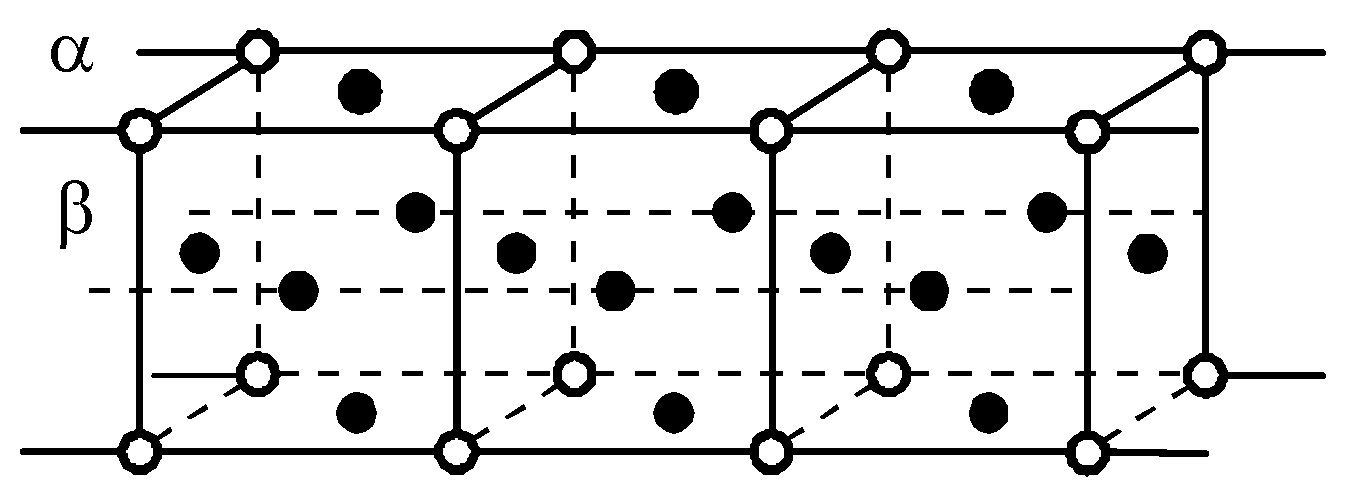
From the lattice geometry of the FCC alloy of composition A3B in a completely ordered state with the
L1
2 superstructure shown in
Figure 1, it can be seen that two types of nodal planes can be distinguished in the lattice: α-type nodes, in which atoms of type A and B can be located, and β-type nodes, in which only atoms of type A are located.
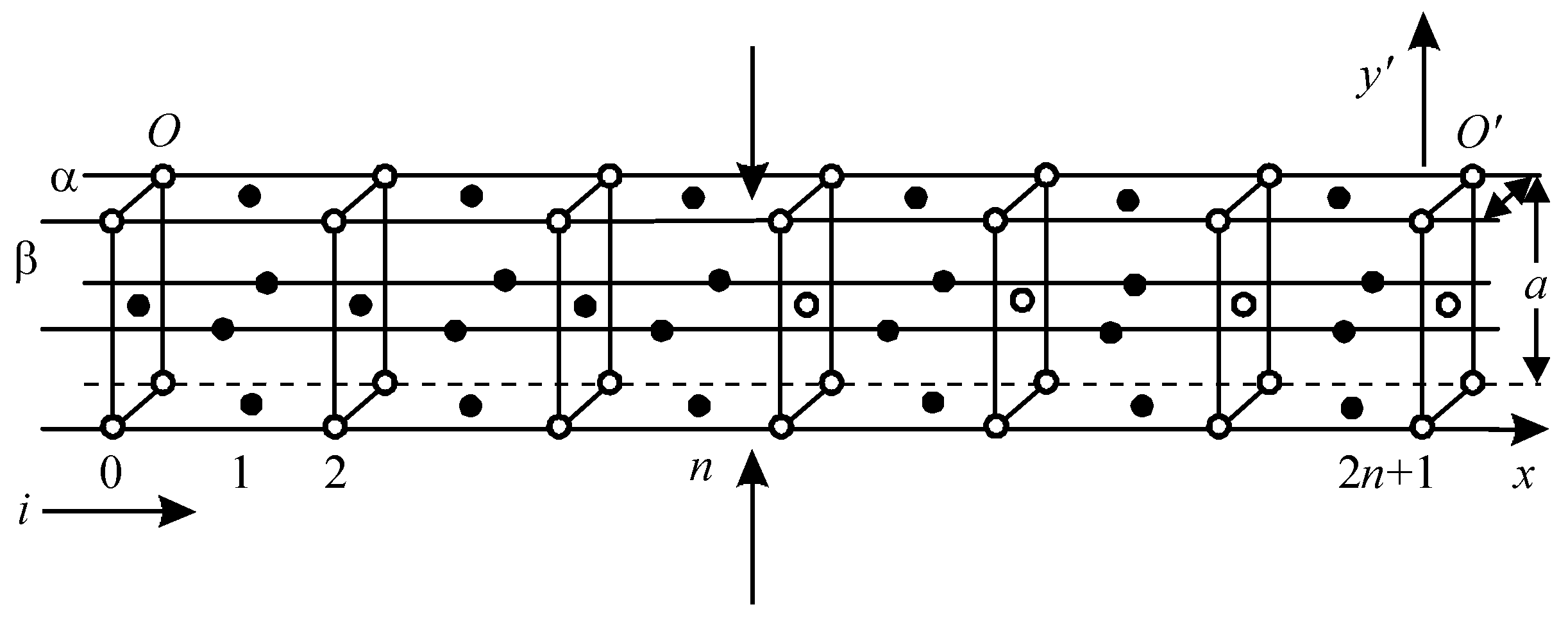
In the alloy with periodic antiphase boundaries (APBs) limiting the domain, fragments of nodal planes α and β alternate in one crystallographic plane (
Figure 2).
First of all, note the following. The formation of the AFB leads to an increase in the binding energy of the system (ΔE1), and as a result of relaxation processes, the elastic energy of the crystal (ΔE2) decreases; then the energetic advantage of the long-period structure (LPS) requires ΔE1 < ΔE2. This means that the long-period states of the relaxation type will be thermodynamically achieved in the system only when the decrease in the energy of relaxation processes will prevail over the increase in the energy of the long-period domain alternation. In a real system, both competing factors ΔE2 and ΔE1 depend on temperature; therefore, the temperature dependence of the long period is determined by temperature dependences ΔE1 = ΔE1(T) and ΔE2 = ΔE2(T).
In a liquid solution, the analog of the APB is the planar boundary between the elements of the solution structure, i.e., single (monohydrates), double (dihydrates), and triple (trihydrates) molecules and their associates.
At the first stage, it is necessary to study the order–disorder transition in the initial L12 structure for each temperature, using the equilibrium homogeneous state of the alloy without antiphase boundaries. The initial equilibrium state of the liquid solution model corresponds to the homogeneous non-structured (without structural elements of the solution) liquid state.
For this purpose, the free energy of the cubic alloy with FCC lattice was written in the Gorsky–Bragg–Williams approximation [
41,
42]. Considering the condition of minimization of free energy by the lattice parameter and the probability of atom replacement in lattice nodes, an equilibrium state was found at the given temperature together with free energy values
f0 corresponding to it, lattice parameters
ah, and long-range order parameter η
h.
In this case, within the limits of the first approximation, it was assumed that the alloy consists of antiphase domains of the same size with an odd number of atomic planes normal to the long period.
Figure 2 shows the halves of two adjacent antiphase domains. The central atomic planes of these domains are designated by
O and
O′. The arrows indicate the APB positions. Different atomic planes are located in the domain centers; therefore, all sets of planes located between
O and
O′ should be considered. Setting
n (see
Figure 2), that is, the number of atomic planes in the domain half, we can find the size of the corresponding antiphase domain
M = (2
n + l)/2 measured in the parameters of the initial FCC lattice.
In the work in [
1], special features of calculations and expected results were indicated when moving to liquid solution models. In particular, the system state in the presence of one element of the solution structure, including single (monohydrates), double (dihydrates), or triple (trihydrates) molecules or their associates, should be considered.
For simplicity, below we consider that in the direction of the long period
x, each node from the chosen complex is characterized by the probability
or
of the replacement of the given node by the atom A; each atom has the coordinate
or
, and the corresponding atomic planes are shifted in two other directions (see
Figure 2).
From the symmetry of the considered complex, the boundary conditions for the coordinates and probabilities have the following forms:
where
k = α, β and
l,
m = 1, …,
n.
The free energy of the alloy with periodic APB per atom can be written as
where
is the energy of interaction of the atom located in the
kth node of the
ith plane with surrounding neighbors.
The atoms or molecules located at nodes
k and
d of the
ith and
jth planes can be described as
where
are the numbers of atoms filling nodes in the
ith plane.
The energy of interaction of the atom or molecule located in the
kth node of the
ith plane with surrounding neighbors up to the Z neighborhood is expressed as
Summation was carried out so that the interacting atoms or molecules were in the Z neighborhood and their self-action was excluded.
In the calculation of other symmetries of the crystal lattice within the limits of the domain, the interaction of atoms in two coordination spheres, approximated by the Morse function, should be considered. For the pair of atoms A, it has the following form:
where
DAA characterizes the energy of dissociation of the pair of atoms A, α
AA is the bond rigidity,
R is the distance between the atoms, and
R0AA is the equilibrium
R value for the pair. It is obvious that the potential is not long-range. However, it helps to reveal and to reflect the possibility of forming equilibrium APB in the solution.
In the liquid solution model, the same Morse interaction potential is often used; therefore, the same description of the internal energy
E is used (see [
1,
2,
3,
4,
5]).
To reflect the ionicity [
1], the anisotropy of interatomic interaction is specified using potential (7). The anisotropic system is actually considered in which the interparticle interaction is considered to be anisotropic, which is far from being trivial, since it required overcoming major technical problems.
Then the free energy of the periodic APB per one alloy atom is
The equilibrium (relaxed) value of the free APB energy per atom
f at for the given
n value was determined by minimization of
f′ over all independent 8
n + 3 variables, taking into account preservation of a constancy of structure in the chosen complex, which can be written down as
where
c is the average concentration of atoms of the component A in the alloy. As independent 8
n + 3 variables, the following variables were used: 4
n type variables
xik,
xM and 4
n + 3 probabilities
Pjk. As the dependent variable, the probability of replacement of the node from the set
Pik was chosen from the atomic plane nearest to the APB legal for atom B. In this approximation, the possibility of redistribution of atoms of alloy components only within the considered complex was assumed, and the average structure of the alloy remained unchanged.
In the process of relaxation, each atom of the computational complex can be displaced along the direction of the long period x so that a decrease in the free energy f′ occurs. In a normal x–a direction, the nuclear planes can be displaced so that f′ decreases.
The sign of the equilibrium APB obtained as a result of relaxation of the free energy will characterize, similarly to f′, the energetic possibility of realizing the LPS with relaxed APB.
In this case, the anisotropy of interparticle interaction is combined with the symmetry of the superstructure geometry of the ordered system state. By analogy with work [
1], we consider that for the atoms located in the nodes of the same types (α-α or β-β), the
rigidity of bond α1 differs from that of α2 of the same atoms located in polytypic nodes (α-β or β-α).
First of all, note that of interest is the case in which the newly introduced APB increases the alloy energy (f′ > 0); as a result, the state with the LPS (f′ < 0) became energetically favorable.
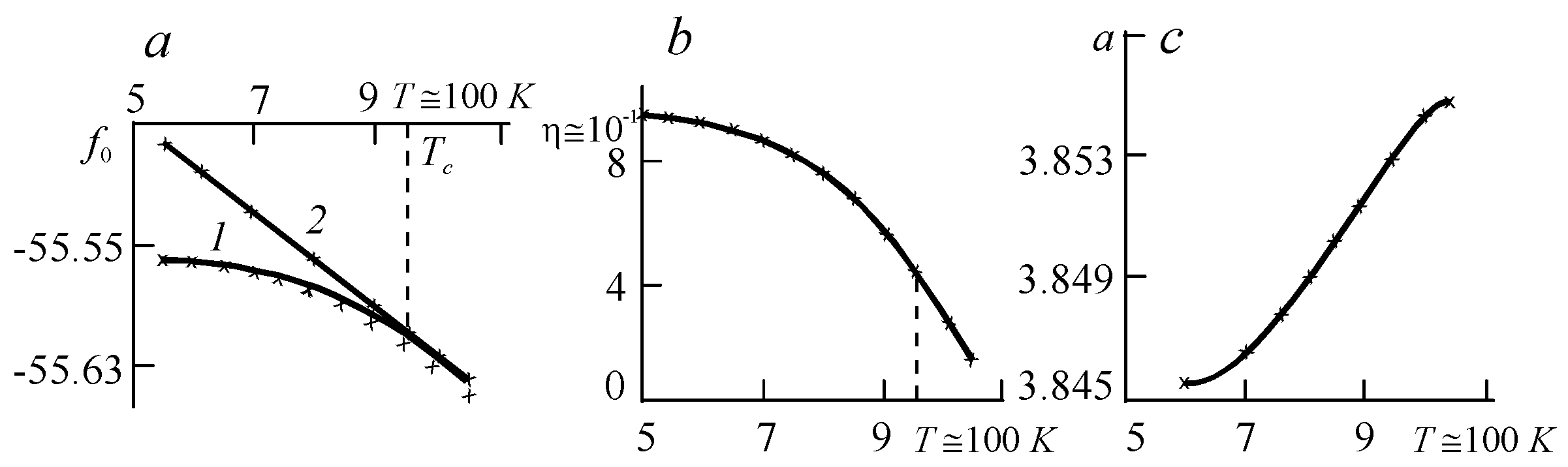
Figure 3 shows the calculated order–disorder transition in the alloy with the A
3B structure of the FCC lattice (of Cu
3Au type). As can be seen from
Figure 3a, the order–disorder transition temperature
Tc lies in the range of the model temperature of 950 K. The energy stimulus of the phase transition in the vicinity of
Tc is very low, which makes it possible for ordered and disordered phases to coexist within a certain temperature range. Thus, the temperature range of low-stability alloy states lies in the vicinity of
Tc (for definiteness, it is possible to assume that this temperature range extends approximately from 850 to 950 K). From
Figure 3a, it can be seen that in this temperature range, the thermodynamic stimuli of the alloy transition to the ordered state are very low, i.e., the simultaneous coexistence of ordered and disordered phases is possible, and in this sense, the transition is close to the second order.
In the model of liquid solution, the system itself is low-stability by its nature; therefore, the change in the system symmetry: the order–disorder transition; that is, the transition from homogeneous to structured liquid state (in the presence of elements of the solution structure) curs under very low external impacts, for example, a very small temperature change or very small load in the form of stirring or hitting.
Figure 3 shows the temperature dependence of the long-range order parameter of the equilibrium ordered homogeneous phase with superstructure
L1
2, introduced by analogy with works [
41,
42]. The lattice parameter as a function of the temperature is shown in
Figure 3c.
Since the ordered structure with the long period is formed, as a rule, in the ordered phase in the vicinity of Tc, calculations were performed in the model temperature range of 850–950 K below Tc.
In the liquid solution model, this temperature range corresponds to a certain temperature interval in the vicinity of the point of change in the system (such change is accompanied by the order–disorder transition under very low external impacts on the solution, for example, at a very small change in temperature or load in the form of stirring, hitting, or rotation).
For example, consider results of calculations at the modeling temperature
T = 900 K and indicate special features for other temperatures (including room temperature for aqueous solution models). Results of calculations at
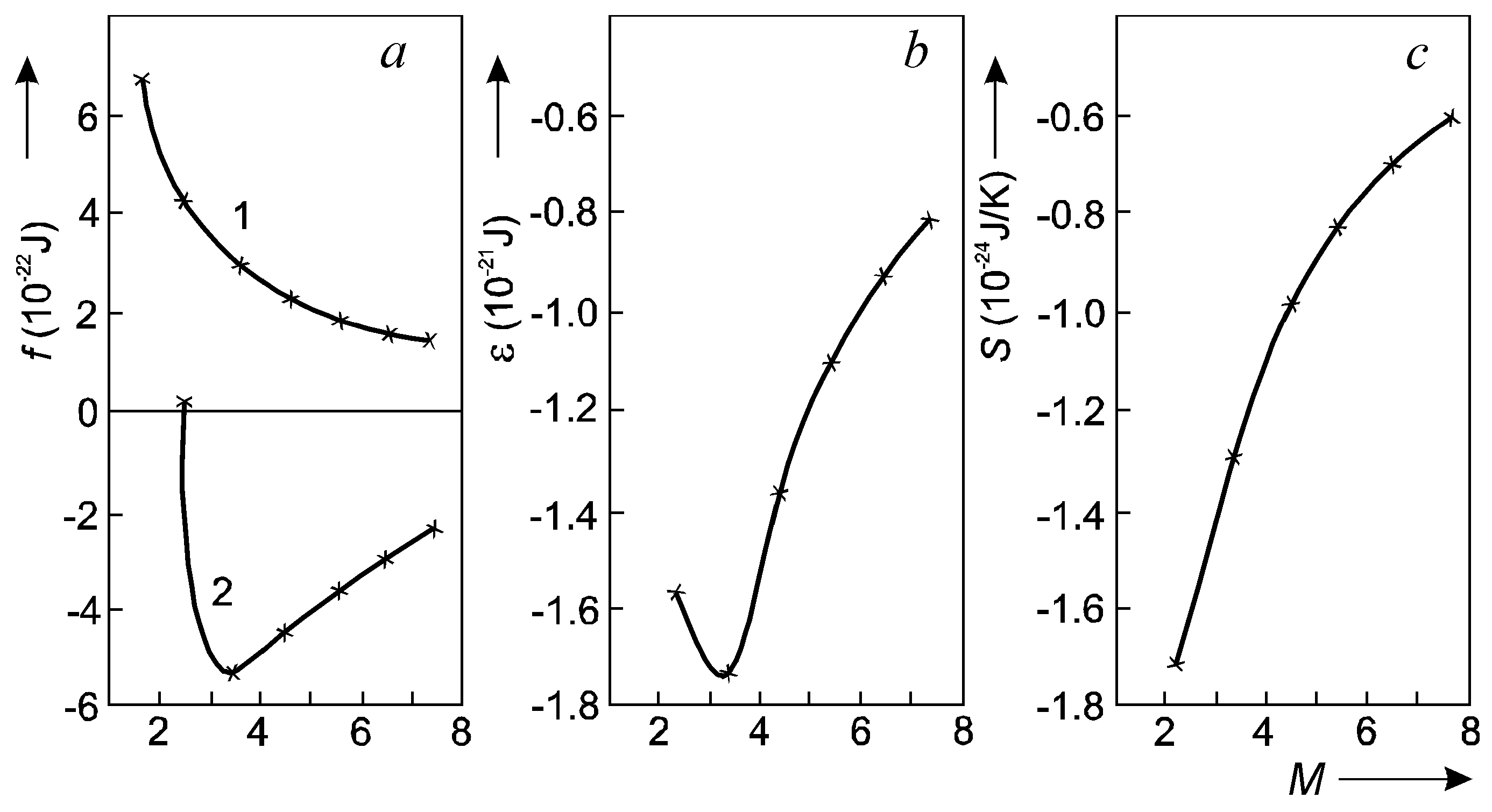
T = 900 K are shown in
Figure 4. The dependence of the free energy of the periodic APB per one atom of the alloy on the antiphase domain size is shown in
Figure 4a. Here, curve 1 illustrates a newly introduced unrelaxed APB. Such an APB appears disadvantageous for the alloy irrespective of the domain size
M.
The equilibrium relaxed APB (curve 2) at
M = (2
n + 1)/2 = 2.5 increased the free energy of the alloy; however, with further increase in
M, the free energy of the long-period structure decreased compared to the state without APB. The presence of the minimum in curve 2 testifies to the advantage of the domain with
M = 3.5 when forming the mixed-state in
M.
Figure 4b shows the dependence on
M of the internal energy of the relaxed antiphase boundary per one alloy atom. If we take into account the dependence on
M of the configuration entropy of the equilibrium APB (
Figure 4c), we can conclude that a prevailing role in the LPS stabilization has the energy factor. The considered entropy provides only redistribution of alloy components. When going from the initial superstructure
L1
2 to the long-period ordered phase, no significant redistribution occurs.
For the liquid solution model, the analogous order–disorder transition occurs, that is, the transition from the homogeneous-structured liquid state (in the presence of the structure elements of the solution) under very low external impacts, for example, a very small change in temperature or loading in the form of stirring or hitting.
Thus, at the final temperature, the introduction of the periodic APB leads to an increase in the system bond energy because of forming wrong interatomic bonds, and the relaxation processes in the form of lattice modulation and redistribution of components decrease the free energy of the alloy.
However, when the domain sizes are small, the liberated elastic energy appears insufficient for stabilization of the long-period state; that is, the increase in the free energy of the formation of the long period is greater than its decrease as a result of relaxation processes. With an increase in the long period (P = 2M), the relaxation energy becomes higher than the bond energy forming the periodic equilibrium APB and provides the profitability of the state with the APB compared to the initial state; that is, the thermodynamic stabilization of the long-period system state is observed.
The employed physical representations and the model allow one to track the dependence of the microscopic solution characteristics on the antiphase domain size. Thus, the atomic planes split over the coordinates
xik into three to four atomic planes closest to the APB. Comparing with the case of
T = 0 K [
1], it is simple to establish that the dimensions of the region of lattice modulation also remain at finite temperatures. The modulation zone is observed at 3–4 interatomic distances from the antiphase boundary.
Let domain
D have a one-component central plane. Its bonds in
Figure 2 are located to the left of the APB with small numbers
j. The domain
D′ has a two-component central plane. The interatomic bonds of this domain are displayed to the right of the APB. It is found, especially at large
M values, that the internal regions of the domain
D are compressed. At the same time, the internal regions of the domain
D′ undergo stretching. With increasing antiphase domain size, the region of lattice distortion tends to be preserved; the largest deviations are observed exactly in the vicinity of the APB and amount to about 0.6% of the average value. The structure of the long-period state of Au
3Cd alloy with FCC lattice was calculated in work [
43] based on the obtained experimental results. It was noted that in the atomic planes perpendicular to the long-period axis, no splitting in the position of the atoms or in the probability of node substitution occurs even in the vicinity of the APB if the nodes in this region are legitimate for atoms of the same type. Our model calculation gave qualitatively similar results.
In the case of liquid solutions, the largest displacements of molecules from their normal positions should also be expected in small local regions near the inhomogeneity.
Let us consider the effects associated with the redistribution of components within the long period when introducing the periodic APBs. In the initial state, the probabilities of substitution of atoms A for their legal nodes are 0.8896, and for the nodes legal for atoms B, they are 0.3312. In the equilibrium long-period phase, a complex distribution pattern of component A is observed. Within the domain, the probabilities of replacing the legal nodes by atoms A increase due to such a transition. At the same time, the probability of encountering atom A inside the domain on a foreign node decreases. In other words, the transition increases the degree of ordering of the domains. In this case, the probability of encountering atom B in its legal node at the APB increases, and the probability of atom A replacing the node legal for atom B is close to zero. Thus, a wall of atoms B is formed at the APB.
If the nodes legal to atoms A and B lie in atomic planes nearest to the APB, splitting both in probabilities and positions of atoms is observed; moreover, larger atom B is displaced from the APB, and small atom A is displaced toward the APB. This situation is in qualitative agreement with the pattern experimentally observed for Au
3Cd [
43].
Thus, the character of lattice distortions in these regions is preserved at finite temperatures. The basic features observed in the distortion regions of the single antiphase boundary are transferred to the periodic APB.
The maximum deviations from the average lattice positions are observed exactly in the vicinity of the APBs and are of the order of 0.6%. According to experimental data obtained in work [
43], they are about 1% of the interatomic distance. Thus, the results of model calculations are in agreement with the available experimental data.
For liquid solutions, the maximum displacements of molecules from their legal positions should also be expected in local regions in the vicinity of inhomogeneities.
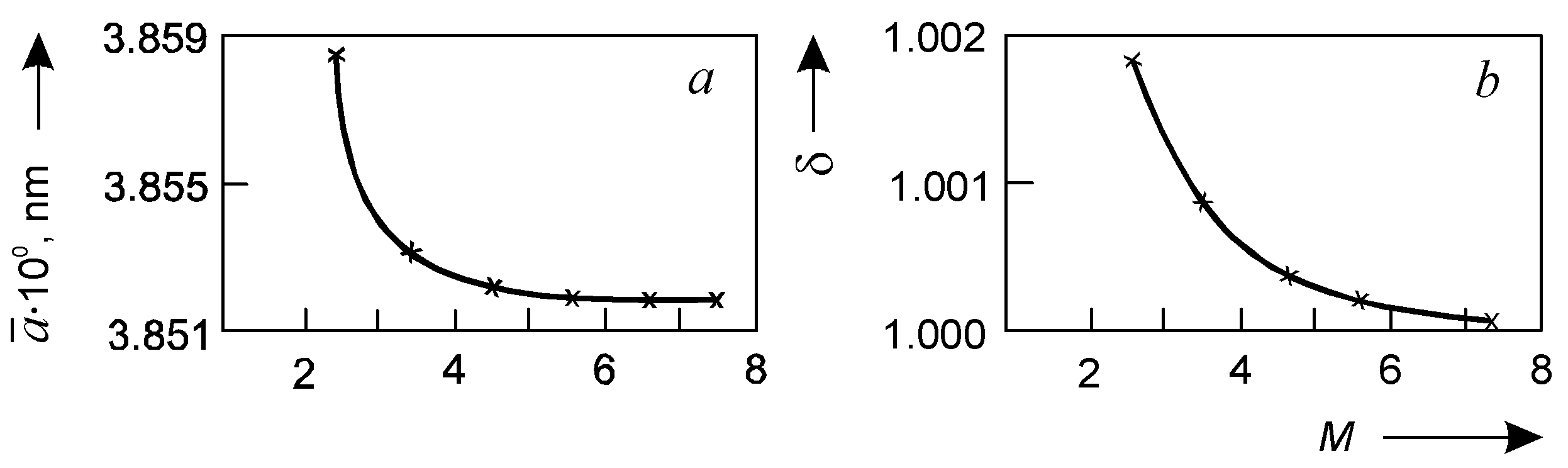
In the long-period phase, expansion of the alloy in the direction of the long period is observed. It amounts to 0.2% at
M = 2.5 and gradually decreases with increasing
M.
Figure 5a shows the dependence of the average lattice parameter along the long period on the antiphase domain size
. The dependence of the tetragonality value δ =
/
a of the long-period lattice on
M is illustrated by
Figure 5b, where
a is the lattice parameter in directions
y and
z. With an increase in the size of the antiphase domain, the degree of tetragonality decreases, and the lattice approaches the cubic one. It can be seen from
Figure 5a that when
M ⟶ ∞, the
value approaches
ah, that is, the lattice tends to its initial condition for
M ⟶ ∞.
Transition to the long-period phase is accompanied by a certain change in the solution volume. For the chosen interaction, the alloy volume increases. Its maximum value is observed at M = 2.5 and amounts to V/VH = 1.002.
To find the equilibrium solution state, a set of 4
n + 4 probabilities for the substitution of atom A into specific crystal or complex nodes is determined (see
Figure 2). However, it is rather inconvenient to work with this set and to compare it with experimentally obtained regularities. For this reason, we introduced an effective domain size
M = (2
n + 1)/2, maintaining the long-period phase (
P = 2
M). This premise describes the mathematical foundation for modeling long-period superstructures in ordered alloys. By treating domain pairs as an
effective domain through probability averaging, the calculation of long-range order parameters and atomic distribution functions along the long period significantly simplifies. Let the solution consist of identical antiphase domains in which the
jth normal long-period atomic plane is characterized by the probabilities of the
ith and [(2
n + 1) −
i]th atomic planes of the complex under consideration; that is, instead of two structurally different domains, we introduce one effective one. By analogy with works [
41,
42], we consider the concentration of component A in the
jth domain plane:
and the long-order parameter
where
is the average probability of substitution by atom A of nodes legal for it in the
ith and [(2
n + 1) −
i]th planes, and ν = 3/4 is the concentration of such nodes in the
jth plane of the effective domain.
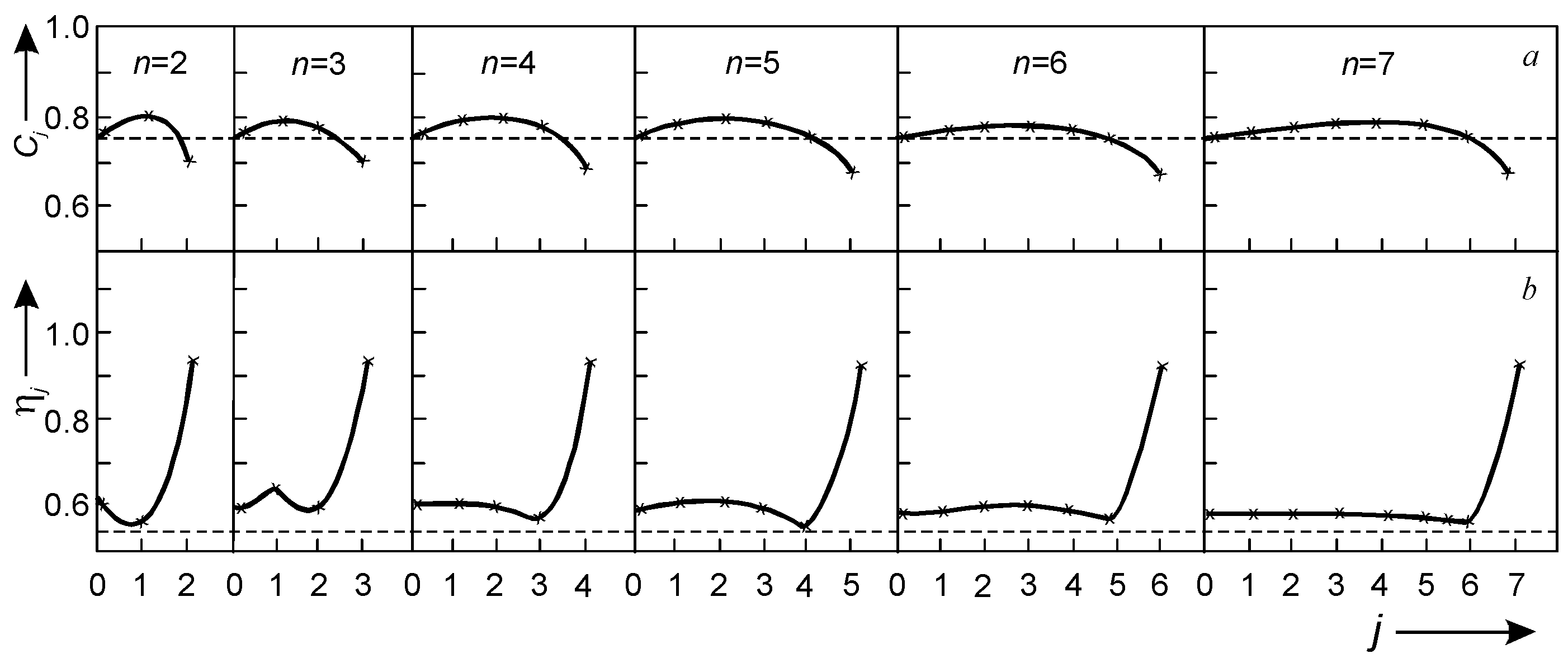
Figure 6 shows the dynamics of
cj and η
j with increasing
n. The dashed straight lines illustrate the average concentration of component A,
c = 0.75, in the alloy, and the long-range order parameter η = 0.588 corresponds to the alloy without periodic APB.
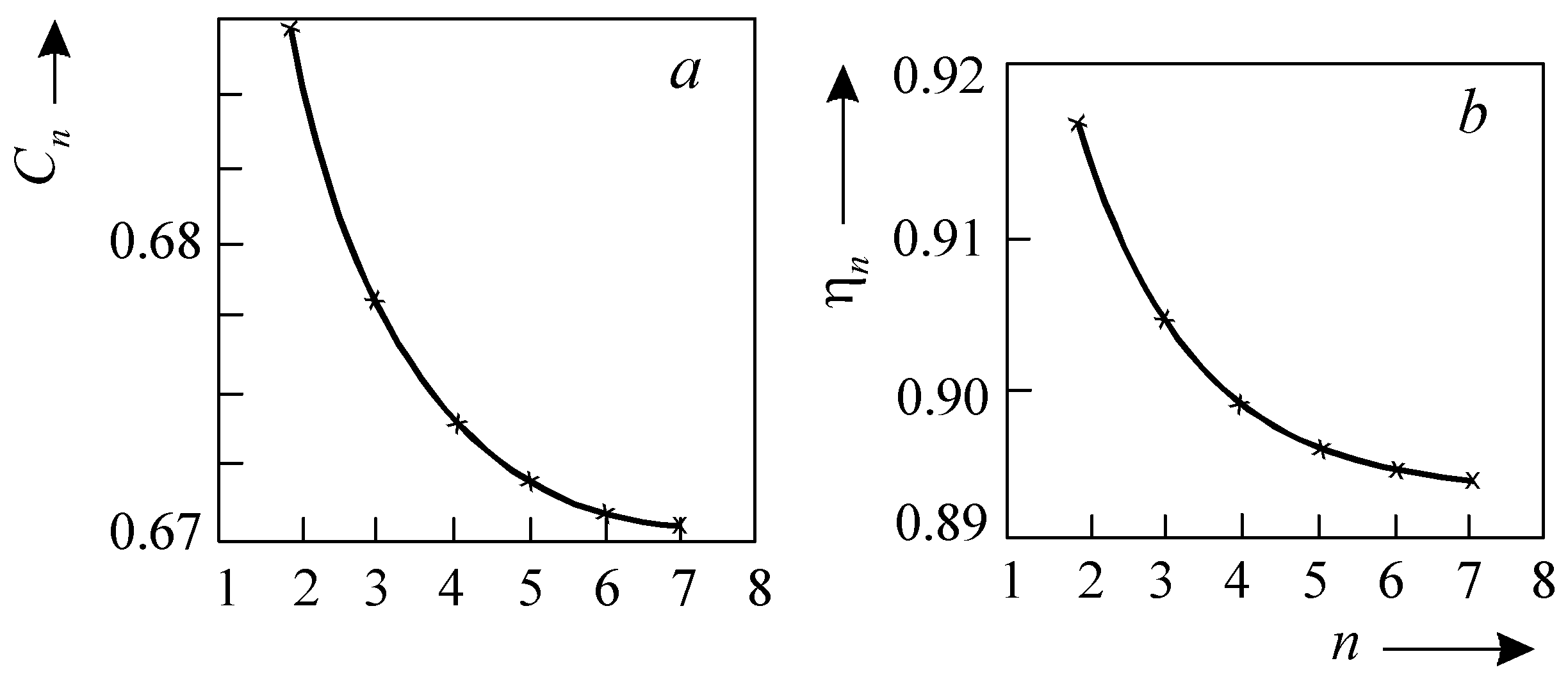
Thus, the formation of the long-period phase is accompanied by the formation of a wall of atoms A with a thickness of one atomic plane. At the same time, smaller atoms A migrate deeper into the domain. With increasing domain size
M = (2
n + 1)/2, the concentration of component A (
Cn) in the plane nearest to the APB changes. This dependence is illustrated by
Figure 7a. In work [
44], it was experimentally detected that in the CuAu alloyed with Ag, the atoms of the alloying component segregate in the atomic plane in the vicinity of the APB.
The dynamics of η
j (see
Figure 6) demonstrate that the transition into the long-period phase leads to some additional ordering in the domain along with the segregation of one of the components at the APB, and an increase in the long-range order; that is, η
n is observed in the vicinity of the APB. The dependence of η
n on the domain size
M = (2
n + 1)/2 is shown in
Figure 7. From
Figure 6 and
Figure 7, it can be seen that the greatest changes occur in the atomic plane nearest to the APB. These changes quickly decrease with increasing distance from the boundary.
In the case of liquid solutions, it should be expected that while maintaining the qualitative pattern characteristic of the solid solution, the greatest local changes in the microscopic characteristics of the solution will occur in local regions in the vicinity of the inhomogeneity, and these changes will extend to the nearest and second neighbors.
4. Development of the Solution Models
Let us emphasize that the results we discussed above related to ordered alloys, which include Cu3Au-type systems and antiphase-boundary structures, are based on comparisons with experimental data and on established theoretical models. Thus, the extension to highly diluted liquids is an extrapolation which is model-based, and it is motivated by thermodynamic and structural analogies. Therefore, the predictions made with regard to liquid and ultra-dilute systems should be viewed as merely theoretical hypotheses, and not as stemming from direct experimental evidence.
This reported analogy between ordered solids and liquid solutions has limitations which we need to discuss. Specifically, the long-range periodic ordering and the well-defined antiphase boundaries of an alloy do not have a direct counterpart example in liquids, because in the latter, the correlations are localized and these are dynamically fluctuating. Hence, the models we shall consider here have only a handful of selected thermodynamic and symmetry-related features, and these should not be viewed as an integrated overall microscopic description of the liquid structure.
First of all, we emphasize once again that a solution is a homogeneous system, which includes molecules (or their aggregates) of two or more types, and the proportion of particles of each type can continuously change. Solid, liquid, and gaseous solutions are conventionally considered, with solid solutions characterized by the long-range order parameter, and liquid and gaseous solutions by the short-range order parameter. However, what unites both solutions is that the order–disorder transitions occur in them.
For solid solutions in various structures, located in different external conditions, a number of models were constructed within the framework of the concept of low-stability states in the vicinity of the structural-phase order–disorder transitions (for example, see works [
1,
2,
3,
4,
5]). From here it follows that to proceed from the solid to liquid solution model, it is sufficient to consider the long-range order parameter instead of the short-range order parameter for the solid solution model. Having carried out this transition, we obtained a number of liquid solution models based on the solid solution ones [
21,
22,
23,
24,
45,
46].
A comparison of models [
1,
2,
3,
4,
5,
21,
22,
23,
24,
45,
46] has shown that low-stability states are achieved in solid solutions that undergo first-order–disorder transitions close to the second-order one. At the same time, the liquid solutions by their nature are initially prone to the realization of the low-stability states [
21,
22,
23,
24,
45,
46] because of their inherent molecular disorder.
Consideration of models of firm solutions in various structures has shown that the relaxation of pressure in the ordered structures in some cases contributes to the realization of the low-stability structurally phase states. Stress relaxations lead to a decrease in the internal system energy during the transition from a homogeneous to a complex structured state [
1,
2,
3,
4,
5]. In this case, an important role is played by the fact that the system contains anisotropy in the form of either a specific atomic distribution, anisotropic interatomic interaction, or some other factors.
The analysis of models of liquid solutions (see [
21,
22,
23,
24,
45,
46]) has shown that liquid solutions are low-stability systems by their nature. Recent studies [
11,
12,
13,
14,
15,
16,
17,
18] established that liquids such as water in its natural state contain single (monohydrates), double (dihydrates), and triple (trihydrates) molecules. Their ratios and amounts are determined by the temperature, which determines one of the three states (solid, liquid, or gas) in which water exists at the current moment. The presence of excess charges on the hydrogen H and oxygen O atoms, as well as unshared electron pairs on the O atoms, causes the formation of hydrogen bonds between the water molecules, as a result of which they combine into associates. The bipolar structure of water molecules favors the formation of hydrogen bonds; therefore, in liquid water, many molecules are linked to each other by hydrogen
bridges (bonds), and the resulting associates are in dynamic equilibrium. The tetrahedral structures, so-called water
clusters, are often formed. Therefore, the assertion is justified that the liquid solution (or water) in the low-stability state consists of the associates, i.e., certain structural system units.
The next logical step is to construct models that take into account various external conditions in which the system under consideration is located.
An analysis of these models showed that the low-stability states are achieved in a certain pretransition temperature range above absolute zero, but below the temperature of the change in the system symmetry: the order–disorder transition (see [
1]). In these states, the system is a mixture of different structural units (call them macromolecules), the size distribution function of which changes with temperature. Since the free energy values of different structural units differ very little from each other, even a very small change in external conditions (for example, in the temperature) leads to a noticeable change in the set of structural system units and hence, to a change in the distribution function of the structural units and an adequate change in the properties of the system itself [
46]. Therefore, it is natural that solutions of various natures have distribution functions of different types.
It is important to study models under the combined impact of temperature and pressure (which is exactly observed in reality). When examining solid solutions in work [
45], it was established that static pressure increases the order–disorder transition temperature, reduces the temperature interval for the realization of low-stability solution states, and limits the number of coexisting structures.
When considering the liquid solution models in work [
45], it was established that the static and dynamic loads have fundamentally different effects on the behavior and properties of the solution. The static loads yield the same results for solid and liquid solutions. However, the principal difference is revealed by the dynamic loading of liquid solutions (in the form of shaking, hitting, etc.), which should lead to a decrease in the energy barrier for the transition to another structural-phase state [
45] and hence, to a change in the liquid solution properties. In this case, the external impact itself that triggers a solution transition to another structural-phase state can be very low due to the low energy barrier.
When setting up natural experiments in liquid solutions, special attention should be paid to the fact that the distribution function of the structural units of the solution has a unimodal form and a very weakly expressed maximum. Hence, it is very difficult to achieve repeatability of data on a structurally phase set of structural units. An analogous situation is also observed for the solid solutions (see [
2]). Hence, obtaining a representative sample of a liquid solution is indeed fundamental to determining its true average characteristics.
As a result, the behavioral features of low-stability solid solutions (ordering alloys) in the vicinity of the point of change in the system symmetry, i.e., the order–disorder transition, were demonstrated. Liquids and low-concentration solutions are low-stability systems by their nature. Therefore, the solid and liquid solutions, and liquids themselves in a low-stability state, behave in a similar way. As applied to liquids and low-concentration solutions, this means that a very low external impact (for example, a change in temperature or an external load in the form of shaking or hitting) can change the structural-phase state of the low-concentration solution or liquid. Since the properties of the solid or liquid solutions are primarily determined by the structural-phase system state, when it changes, the system properties (including physicochemical ones) also change.
Ideas about the structure of water in works by I.A. Shcherbakov available to the authors (for example, see [
36,
37,
38]) do not differ significantly from generally accepted scientific views. However, the following aspects of his approach can be enumerated:
- -
Structure of the water molecule. The molecule is considered a stable system in which hydrogen and oxygen atoms are linked by a covalent bond. The molecule has an asymmetrical structure: two hydrogen nuclei and two unshared electron pairs of oxygen are located at the vertices of a conditional tetrahedron. This leads to a high polarity of the molecule, which determines its unique properties, including its high dielectric constant, dissolving capacity, and tendency to electrolytic dissociation.
- -
Intermolecular structure and hydrogen bonds. In bulk water, molecules form a complex three-dimensional network of hydrogen bonds. Each molecule can be linked with four neighboring molecules. In liquid water, individual (monomeric) molecules and ice-like associates (clusters), which are constantly formed and disintegrate, exist simultaneously. The ratios of these forms depend on the temperature and pressure. It is exactly the dynamic equilibrium between clusters and free molecules that drives the anomalous behavior of water.
- -
Influence of external factors. The structure of water and aqueous solutions can be affected by external impacts: magnetic and electric fields, ultrasound, and radiation. Under their impact, the processes of coagulation, crystallization, dissolution, and concentration of dissolved gases change, although the physical nature of these changes is not completely clear.
- -
Water solutions. Natural water always contains dissolved substances; therefore, aqueous solutions can be considered as mixtures of isotypic structural-energy positions of water molecules and dissolved substances, which affect their physicochemical properties and natural solution formation.
Thus, I.A. Scherbak adheres to modern physical and chemical representations about the structure of water, focusing on its anomalous properties, the role of hydrogen bonds, and the impact of external factors on the dynamic structure of aqueous systems.
In work [
15], the impact of mechanical, optical, and plasma effects on the macroscopic properties of water solutions was considered. The important role of nano objects, spontaneously formed in the liquid or generated by external distortion sources, is indicated in the formation of these properties. It is assumed that the presence of nano objects in aqueous solutions defines the behavior of the majority of various processes. One of the reasons is the aggregation of the active centers. Specific models of the thermodynamic condition of water and aqueous solutions are considered. The key moment is the consideration of short-lived hydrogen bonds between water molecules and dissolved substances. To describe these flickering hydrogen bonds, the formalism of dichotomous noise theory is used.
When considering the phenomenon of post-vibrational interactions in highly diluted solutions, repeated external vibration (shaking) was particularly emphasized; therefore, in works [
47,
48], it was assumed that exactly the vibrational treatment rather than the insignificant content of the initial substance underlies the activity of highly diluted preparations. To verify the assumption, the vibration was separated from the dilution process. It was found that vibration treatment of various substances (powder or aqueous solution) alters their properties and gives them the ability to interact post-vibrationally. Post-vibrational interactions may be based on the desire to maintain the structural symmetry of substances subjected to vibrational treatment. The obtained products possess various physical, chemical, and biological properties. At the nanoscale level, aqueous solutions and the original substance are structurally symmetrical, which suggests that the preservation of symmetry of substances subjected to vibrational treatment underlies the phenomenon of post-vibration interaction.
In work [
31], it was emphasized that high dilutions can have a modifying effect (ME) on the original substance or complementary molecule, which is manifested through the change in their physicochemical properties [
21,
47,
48,
49,
50,
51]. Thus, it was hypothesized that such high dilutions modify by transforming the target molecules into a more harmonious (symmetrical) state. The facts revealed allowed the authors to conclude that the activity of high dilutions is based on the dilution technology rather than on the supposedly low concentration of the dissolved substance and, in addition, on the impact of external vibrations. This assumption was confirmed by a simple experiment: with
delicate dilution, without external rhythmic impact, high dilutions had no specific modifying activity. In this connection, the high dilution
concept should represent the accumulator of vibrational effects rather than small doses of the original substance.




 ,
,