Lie Symmetries as a Mathematical Methodology to Identify Conservation Laws in Physiological Systems



Abstract
1. Introduction
2. Materials and Methods
2.1. Definition of the Baker Model
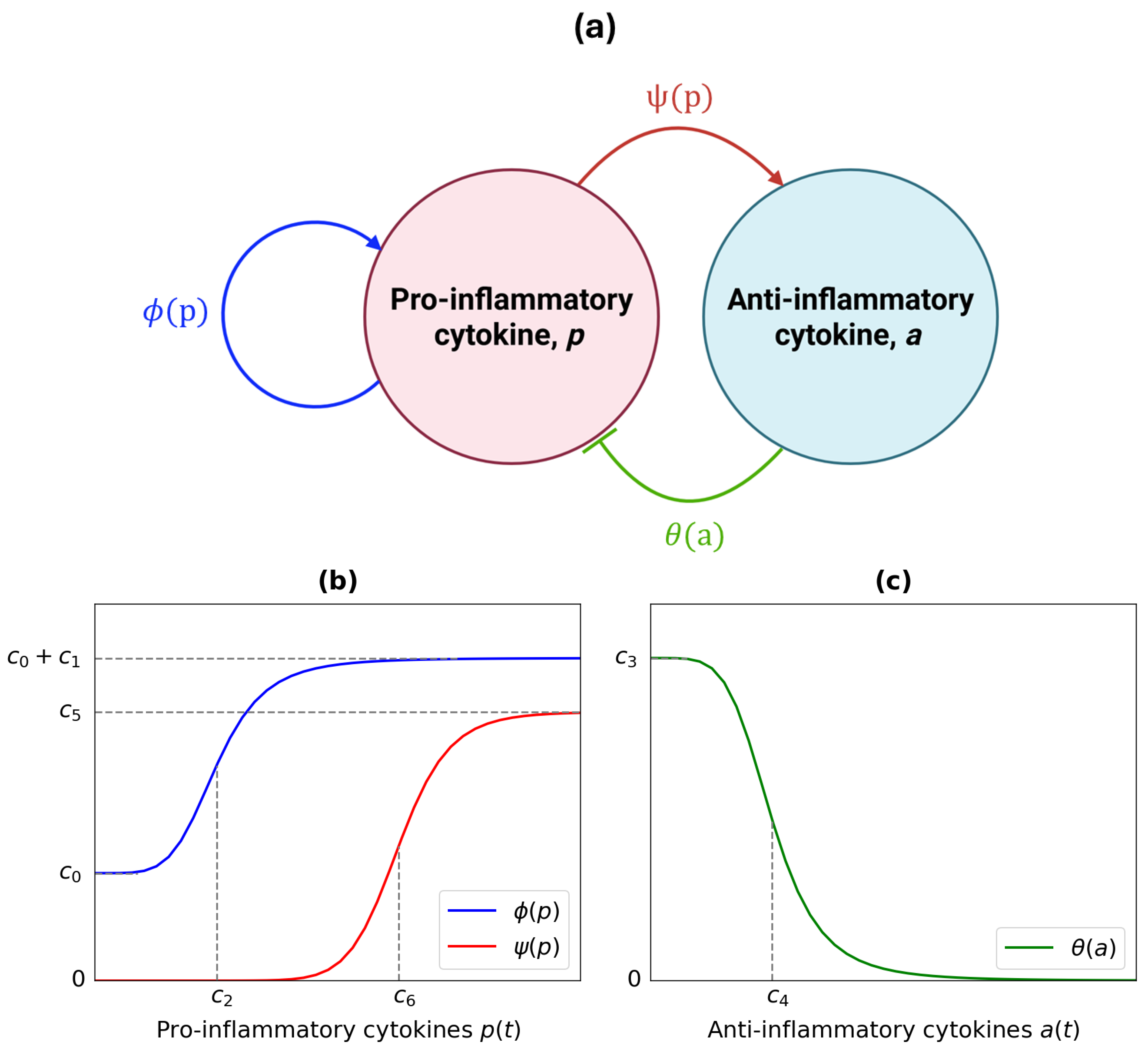
- The linear, natural degradation terms of both cytokines, scaled by the two pro- and anti-inflammatory cytokine-specific factors and , respectively;
- The interaction terms between cytokines, modulated by the functions , and , which can be chosen depending on the specific type of cytokines’ dynamics and cytokine–cytokine interactions of interest.
- are some constant parameters. is the basal pro-inflammation cytokines’ production rate. The 2013 Baker et al. [16] model assumes some level of inflammation to always be present in the synovium system. Therefore, allows for a basal concentration of inflammation-inducing pro-inflammatory cytokines to always be active in the system, and thus inflammation to always be included; describes the additional pro-inflammatory cytokines’ production rate due to their self-upregulation at the p saturation maximum concentration; is the half-maximal concentration point for the self-upregulation in pro-inflammatory cytokines’ dynamics; describes the basal inhibitory effect in the absence of anti-inflammatory cytokines; is the half-minimal concentration point for the pro-inflammatory cytokines’ downregulation due to the anti-inflammatory cytokines; describes the maximal activator effect of pro-inflammatory cytokines on anti-inflammatory cytokines within anti-inflammatory cytokines’ dynamics; and is the half-maximal concentration point for the upregulation of anti-inflammatory cytokines by pro-inflammatory cytokines within anti-inflammatory cytokines’ dynamics.
- are the Hill coefficients modulating the strength of the activator/repressor responses within the pro- and anti-inflammatory cytokines’ interactions. Graphically, a larger Hill coefficient will correspond to a steeper Hill function curve in Figure 2 and vice versa.
- is the basal pro-inflammatory cytokines’ production rate;
- is the additional pro-inflammatory cytokines’ production rate thanks to their self-upregulation;
- is the pro-inflammatory cytokines’ concentration for half-maximal anti-inflammatory cytokines’ production;
- is the anti-inflammatory cytokines’ production rate;
- is the ratio between the pro-inflammatory cytokines’ degradation rate and the anti-inflammatory cytokines’ degradation .
- restricts the range of behaviours allowed by the model. In particular, prevents bifurcations and bistability from arising.
- The two cases where (here for simplicity), or both allow a wider range of qualitatively equivalent behaviours to show compared to . However, for , the equilibria tend to arise for larger concentrations of p and a, and are thus deemed less favourable for computational ease.
- For , the shapes of the Hill functions do not change, but only their steepness does. Consequently, adopting does not widen the range of possible behaviours while formally complicating the model.
2.2. Lie Symmetries and Conservation Laws
2.3. Computational Materials
3. Results
3.1. Lie Symmetries and Conservation Law Analysis Preparation
- Consider the two-variable first-order ODE model to be of the form
- Using , find an expression for p in terms of a and only, which will be labelled for ease.
- Differentiate with respect to time t in order to derive an expression for , which will be labelled for ease.
- Input and into and manipulate the equation in order to derive an expression for —i.e., .
3.1.1. Baker2013 Change-of-Order Manipulation
- Consider the Baker2013 modelin Equation (5), where its dimensionless parameters are interpreted as discussed in Section 2.1 [16]:
- (a)
- is the basal pro-inflammatory cytokines’ production rate;
- (b)
- is the additional pro-inflammatory cytokines’ production rate thanks to their self-upregulation;
- (c)
- is the pro-inflammatory cytokines’ concentration for half-maximal anti-inflammatory cytokines’ production;
- (d)
- is the anti-inflammatory cytokines’ production rate;
- (e)
- is the ratio between the pro-inflammatory cytokines’ degradation rate and the anti-inflammatory cytokines’ .
- Use the ODE , i.e.,and algebraically manipulate it to get the expressionfor p in terms of a and only, given for the existence of biologically reasonable solutions.
- Differentiate with respect to t in order to derive the expression forgiven for the existence of biologically reasonable solutions, once again.
- Input and into such thatand rearrange to derive the second-order ODEgiven for the existence of biologically reasonable solutions, once again.
3.1.2. Baker2013 Non-Transcendental Functions Manipulation
3.2. Computation of the Fluxes of Conservation Laws
- Prepare the Maple environment for GeM analysis. Specifically, input the second-order ODE (Equation (20)) for the Baker2013 model—with conditions on the arbitrary functions—derived in Section 3.1 and initialise GeM.
- Generate the determining equations for the conservation laws. An overdetermined Differential Equations (DEs) system will be returned, possibly in terms of the conservation law multipliers which are specifically taken as factors in the linear combination of equations in the DE system.
- Simplify and reduce the overdetermined DE system of conservation law-determining equations, while performing a conservation law classification analysis.
- Solve the determining equations case-by-case. If any conservation law multipliers are present, their forms will be recovered.
- Generate the conservation law fluxes by choosing one of the available methods, which have been briefly discussed in Section 2.2, Table 1.
4. Discussion
4.1. Lie Symmetry Robustness Analysis Towards Sustained Drug-Free Remission in RA
4.2. Lie Symmetry Analysis for Model Evaluation
4.3. Modelling Perspectives
4.4. Limitations and Advances
5. Conclusions
Supplementary Materials
Author Contributions
Funding
Data Availability Statement
Acknowledgments
Conflicts of Interest
Abbreviations
| SLE | Systemic Lupus Erythematosus |
| DE | Differential Equation |
| ODE | Ordinary Differential Equation |
| SIR | Susceptible–Infected–Recovered |
| RA | Rheumatoid Arthritis |
| IL-1 | Interleukin-1 |
| TNF- | Tumour Necrosis Factor- |
| IL-1Ra | Interleukin-1 Receptor Antagonist |
| IL-10 | Interleukin-10 |
| IL-1R | IL-1 Receptor |
| COVID-19 | Coronavirus Disease 2019 |
| PDE | Partial Differential Equation |
| LSA | Linear Stability Analysis |
Appendix A. Change-of-Order Manipulation
- Consider the two-variable first-order ODE model to be of the form
- Using , find an expression for p in terms of a and only, which will be labelled for ease.
- Differentiate with respect to time t in order to derive an expression for , which will be labelled for ease.
- Input and into and manipulate the equation in order to derive an expression for —4 .
- Consider the Baker2013 modelin Equation (5), where its dimensionless parameters are interpreted as discussed in Section 2.1 [16]:
- (a)
- is the basal pro-inflammatory cytokines’ production rate;
- (b)
- is the additional pro-inflammatory cytokines’ production rate thanks to their self-upregulation;
- (c)
- is the pro-inflammatory cytokines’ concentration for half-maximal anti-inflammatory cytokines’ production;
- (d)
- is the anti-inflammatory cytokines’ production rate;
- (e)
- is the ratio between the pro-inflammatory cytokines’ degradation rate and the anti-inflammatory cytokines’ .
- Use the ODE and algebraically manipulate it asTo get biologically reasonable solutions, we want to be real and greater than or equal to zero. Therefore, we restrict the range of values for to by setting . Then, we can write the biologically reasonable expression for p in terms of a and only, given , as:
- Differentiate with respect to t asin order to derive the expression for , once again given for the existence of biologically reasonable solutions.
- Input and into and rearrange such that it is possible to derive
References
- Masel, J.; Siegal, M.L. Robustness: Mechanisms and consequences. Trends Genet. 2009, 25, 395–403. [Google Scholar] [CrossRef] [PubMed]
- Lesne, A. Robustness: Confronting lessons from physics and biology. Biol. Rev. Camb. Philos. Soc. 2008, 83, 509–532. [Google Scholar] [CrossRef] [PubMed]
- Kitano, H. Biological robustness. Nat. Rev. Genet. 2004, 5, 826–837. [Google Scholar] [CrossRef] [PubMed]
- Mondeel, T.D.G.A.; Ivanov, O.; Westerhoff, H.V.; Liebermeister, W.; Barberis, M. Clb3-centered regulations are recurrent across distinct parameter regions in minimal autonomous cell cycle oscillator designs. npj Syst. Biol. Appl. 2020, 6, 8. [Google Scholar] [CrossRef] [PubMed]
- Kaizu, K.; Ghosh, S.; Matsuoka, Y.; Moriya, H.; Shimizu-Yoshida, Y.; Kitano, H. A comprehensive molecular interaction map of the budding yeast cell cycle. Mol. Syst. Biol. 2010, 6, 415. [Google Scholar] [CrossRef] [PubMed]
- Casey, M.J.; Stumpf, P.S.; MacArthur, B.D. Theory of cell fate. Wiley Interdiscip. Rev. Syst. Biol. Med. 2020, 12, e1471. [Google Scholar] [CrossRef] [PubMed]
- Ugolkov, Y.; Nikitich, A.; Leon, C.; Helmlinger, G.; Peskov, K.; Sokolov, V.; Volkova, A. Mathematical modeling in autoimmune diseases: From theory to clinical application. Front. Immunol. 2024, 15, 1371620. [Google Scholar] [CrossRef] [PubMed]
- Ma, C.; Gurkan-Cavusoglu, E. A comprehensive review of computational cell cycle models in guiding cancer treatment strategies. npj Syst. Biol. Appl. 2024, 10, 71. [Google Scholar] [CrossRef] [PubMed]
- Coelho, P.M.B.M.; Salvador, A.; Savageau, M.A. Quantifying global tolerance of biochemical systems: Design implications for moiety-transfer cycles. PLoS Comput. Biol. 2009, 5, e1000319. [Google Scholar] [CrossRef] [PubMed]
- Schultz, A.; Mehta, S.; Hu, C.W.; Hoff, F.W.; Horton, T.M.; Kornblau, S.M.; Qutub, A.A. Identifying Cancer Specific Metabolic Signatures Using Constraint-Based Models. Pac. Symp. Biocomput. 2017, 22, 485–496. [Google Scholar] [CrossRef] [PubMed]
- Brady, R.; Enderling, H. Mathematical Models of Cancer: When to Predict Novel Therapies, and When Not to. Bull. Math. Biol. 2019, 81, 3722–3731. [Google Scholar] [CrossRef] [PubMed]
- Perche, F.; Torchilin, V.P. Cancer cell spheroids as a model to evaluate chemotherapy protocols. Cancer Biol. Ther. 2012, 13, 1205–1213. [Google Scholar] [CrossRef] [PubMed]
- Hamis, S.J.; Kapelyukh, Y.; McLaren, A.; Henderson, C.J.; Wolf, C.R.; Chaplain, M.A.J. Quantifying ERK activity in response to inhibition of the BRAF600E-MEK-ERK cascade using mathematical modelling. Br. J. Cancer 2021, 125, 1552–1560. [Google Scholar] [CrossRef] [PubMed]
- Yazdani, A.; Bahrami, F.; Pourgholaminejad, A.; Moghadasali, R. A biological and a mathematical model of SLE treated by mesenchymal stem cells covering all the stages of the disease. Theory Biosci. 2023, 142, 167–179. [Google Scholar] [CrossRef] [PubMed]
- Fernández Massó, J.R. Systems Medicine of Autoimmune Diseases: From Understanding Complexity to Precision Treatments. In Immune Rebalancing; Boraschi, D., Penton-Rol, G., Eds.; Academic Press: Cambridge, MA, USA, 2016; Chapter 9; pp. 173–189. [Google Scholar] [CrossRef]
- Baker, M.; Denman-Johnson, S.; Brook, B.S.; Gaywood, I.; Owen, M.R. Mathematical modelling of cytokine-mediated inflammation in rheumatoid arthritis. Math. Med. Biol. 2013, 30, 311–337. [Google Scholar] [CrossRef] [PubMed]
- Kaur, G.; Ahmad, N. On Study of Immune Response to Tumor Cells in Prey-Predator System. Int. Sch. Res. Not. 2014, 2014, 346597. [Google Scholar] [CrossRef] [PubMed]
- Kareva, I.; Luddy, K.A.; O’Farrelly, C.; Gatenby, R.A.; Brown, J.S. Predator-Prey in Tumor-Immune Interactions: A Wrong Model or Just an Incomplete One? Front. Immunol. 2021, 12, 668221. [Google Scholar] [CrossRef] [PubMed]
- Gonzalez, H.; Hagerling, C.; Werb, Z. Roles of the immune system in cancer: From tumor initiation to metastatic progression. Genes Dev. 2018, 32, 1267–1284. [Google Scholar] [CrossRef] [PubMed]
- Jahid, M.; Khan, K.U.; Rehan-Ul-Haq; Ahmed, R.S. Overview of Rheumatoid Arthritis and Scientific Understanding of the Disease. Mediterr. J. Rheumatol. 2023, 34, 284–291. [Google Scholar] [CrossRef] [PubMed]
- Coyle, C.; Ma, M.; Abraham, Y.; Mahony, C.B.; Steel, K.; Simpson, C.; Guerra, N.; Croft, A.P.; Rapecki, S.; Cope, A.; et al. NK cell subsets define sustained remission in rheumatoid arthritis. JCI Insight 2024, 9, e182390. [Google Scholar] [CrossRef] [PubMed]
- Neri, I.; Metz, F.L. Linear stability analysis of large dynamical systems on random directed graphs. Phys. Rev. Res. 2020, 2, 033313. [Google Scholar] [CrossRef]
- Bicker, J.; Alves, G.; Falcão, A.; Fortuna, A. Timing in drug absorption and disposition: The past, present, and future of chronopharmacokinetics. Br. J. Pharmacol. 2020, 177, 2215–2239. [Google Scholar] [CrossRef] [PubMed]
- Ohlsson, F.; Borgqvist, J.; Cvijovic, M. Symmetry structures in dynamic models of biochemical systems. J. R. Soc. Interface 2020, 17, 20200204. [Google Scholar] [CrossRef] [PubMed]
- Morohashi, M.; Winn, A.E.; Borisuk, M.T.; Bolouri, H.; Doyle, J.; Kitano, H. Robustness as a measure of plausibility in models of biochemical networks. J. Theor. Biol. 2002, 216, 19–30. [Google Scholar] [CrossRef] [PubMed]
- Borgqvist, J.; Ohlsson, F.; Baker, R.E. Symmetries of systems of first order ODEs: Symbolic symmetry computations, mechanistic model construction and applications in biology. arXiv 2022, arXiv:2202.04935. [Google Scholar] [CrossRef]
- Yue, R.; Dutta, A. Computational systems biology in disease modeling and control, review and perspectives. npj Syst. Biol. Appl. 2022, 8, 37. [Google Scholar] [CrossRef] [PubMed]
- Daun, S.; Rubin, J.; Vodovotz, Y.; Clermont, G. Equation-based models of dynamic biological systems. J. Crit. Care 2008, 23, 585–594. [Google Scholar] [CrossRef] [PubMed]
- Lu, P.Y.; Dangovski, R.; Soljačić, M. Discovering conservation laws using optimal transport and manifold learning. Nat. Commun. 2023, 14, 4744. [Google Scholar] [CrossRef] [PubMed]
- Mebratie, M.A.; Nather, R.; von Rudorff, G.F.; Seiler, W.M. Machine learning conservation laws of dynamical systems. Phys. Rev. 2025, 111, 025305. [Google Scholar] [CrossRef] [PubMed]
- Podobnik, B.; Jusup, M.; Tiganj, Z.; Wang, W.X.; Buldú, J.M.; Stanley, H.E. Biological conservation law as an emerging functionality in dynamical neuronal networks. Proc. Natl. Acad. Sci. USA 2017, 114, 11826–11831. [Google Scholar] [CrossRef] [PubMed]
- Nucci, M.C. In search of hidden symmetries. J. Phys. Conf. Ser. 2024, 2877, 012103. [Google Scholar] [CrossRef]
- Villaverde, A.F. Symmetries in Dynamic Models of Biological Systems: Mathematical Foundations and Implications. Symmetry 2022, 14, 467. [Google Scholar] [CrossRef]
- Noether, E. Invariant variation problems. Transp. Theory Stat. Phys. 1971, 1, 235–257. [Google Scholar] [CrossRef]
- Halder, A.K.; Paliathanasis, A.; Leach, P.G.L. Noether’s Theorem and Symmetry. Symmetry 2018, 10, 744. [Google Scholar] [CrossRef]
- Almirantis, Y.; Provata, A.; Li, W. Noether’s Theorem as a Metaphor for Chargaff’s 2nd Parity Rule in Genomics. J. Mol. Evol. 2022, 90, 231–238. [Google Scholar] [CrossRef] [PubMed]
- Nucci, M.C.; Sanchini, G. Symmetries, Lagrangians and Conservation Laws of an Easter Island Population Model. Symmetry 2015, 7, 1613–1632. [Google Scholar] [CrossRef]
- Liu, C.; Chu, D.; Kalantar-Zadeh, K.; George, J.; Young, H.A.; Liu, G. Cytokines: From Clinical Significance to Quantification. Adv. Sci. 2021, 8, e2004433. [Google Scholar] [CrossRef] [PubMed]
- Conrad, N.; Misra, S.; Verbakel, J.Y.; Verbeke, G.; Molenberghs, G.; Taylor, P.N.; Mason, J.; Sattar, N.; McMurray, J.J.V.; McInnes, I.B.; et al. Incidence, prevalence, and co-occurrence of autoimmune disorders over time and by age, sex, and socioeconomic status: A population-based cohort study of 22 million individuals in the UK. Lancet 2023, 401, 1878–1890. [Google Scholar] [CrossRef] [PubMed]
- Verstappen, M.; van Mulligen, E.; de Jong, P.H.P.; van der Helm-Van Mil, A.H.M. DMARD-free remission as novel treatment target in rheumatoid arthritis: A systematic literature review of achievability and sustainability. RMD Open 2020, 6, e001220. [Google Scholar] [CrossRef] [PubMed]
- Macfarlane, F.R.; Chaplain, M.A.J.; Eftimie, R. Quantitative Predictive Modelling Approaches to Understanding Rheumatoid Arthritis: A Brief Review. Cells 2019, 9, 74. [Google Scholar] [CrossRef] [PubMed]
- Guo, Q.; Wang, Y.; Xu, D.; Nossent, J.; Pavlos, N.J.; Xu, J. Rheumatoid Arthritis: Pathological mechanisms and modern pharmacologic therapies. Bone Res. 2018, 6, 15. [Google Scholar] [CrossRef] [PubMed]
- Marshall, J.S.; Warrington, R.; Watson, W.; Kim, H.L. An introduction to immunology and immunopathology. Allergy Asthma Clin. Immunol. 2018, 14, 49. [Google Scholar] [CrossRef] [PubMed]
- Choy, E.H.; Panayi, G.S. Cytokine pathways and joint inflammation in rheumatoid arthritis. N. Engl. J. Med. 2001, 344, 907–916. [Google Scholar] [CrossRef] [PubMed]
- Isomäki, P.; Punnonen, J. Pro- and anti-inflammatory cytokines in rheumatoid arthritis. Ann. Med. 1997, 29, 499–507. [Google Scholar] [CrossRef] [PubMed]
- Zhang, J.M.; An, J. Cytokines, inflammation and pain. Int. Anesthesiol. Clin. 2007, 45, 27–37. [Google Scholar] [CrossRef] [PubMed]
- Fujimoto, S.; Niiro, H. Pathogenic Role of Cytokines in Rheumatoid Arthritis. J. Clin. Med. 2025, 14, 6409. [Google Scholar] [CrossRef] [PubMed]
- Firestein, G.S.; McInnes, I.B. Immunopathogenesis of Rheumatoid Arthritis. Immunity 2017, 46, 183–196. [Google Scholar] [CrossRef] [PubMed]
- Kokkonen, H.; Söderström, I.; Rocklöv, J.; Hallmans, G.; Lejon, K.; Rantapää Dahlqvist, S. Up-regulation of cytokines and chemokines predates the onset of Rheumatoid Arthritis. Arthritis Rheum. 2010, 62, 283–291. [Google Scholar] [CrossRef] [PubMed]
- Mellado, M.; Martínez-Muñoz, L.; Cascio, G.; Lucas, P.; Pablos, J.L.; Rodríguez-Frade, J.M. T Cell Migration in Rheumatoid Arthritis. Front. Immunol. 2015, 6, 384. [Google Scholar] [CrossRef] [PubMed]
- Chimenti, M.S.; Triggianese, P.; Conigliaro, P.; Candi, E.; Melino, G.; Perricone, R. The interplay between inflammation and metabolism in Rheumatoid Arthritis. Cell Death Dis. 2015, 6, e1887. [Google Scholar] [CrossRef] [PubMed]
- Emerson, D.; Merriman, E.; Yachi, P.P. Rheumatoid Arthritis associated cytokines and therapeutics modulate immune checkpoint receptor expression on T cells. Front. Immunol. 2025, 16, 1534462. [Google Scholar] [CrossRef] [PubMed]
- Wautier, J.K.; Wautier, M.P. Pro- and Anti-Inflammatory Prostaglandins and Cytokines in Humans: A Mini Review. Int. J. Mol. Sci. 2023, 24, 9647. [Google Scholar] [CrossRef] [PubMed]
- Mühl, G.; Pfeilschifter, J. Anti-inflammatory properties of pro-inflammatory interferon-gamma. Int. Immunopharmacol. 2003, 3, 1247–1255. [Google Scholar] [CrossRef] [PubMed]
- Brennan, F.M.; Maini, R.N.; Feldmann, M. TNF alpha—A pivotal role in rheumatoid arthritis? Br. J. Rheumatol. 1992, 31, 293–298. [Google Scholar] [CrossRef] [PubMed]
- Hill, A.V. The possible effects of the aggregation of the molecules of haemoglobin on its dissociation curves. J. Physiol. 1910, 40, 4–7. [Google Scholar]
- Goutelle, S.; Maurin, M.; Rougier, F.; Barbaut, X.; Bourguignon, L.; Ducher, M.; Maire, P. The Hill equation: A review of its capabilities in pharmacological modelling. Fundam. Clin. Pharmacol. 2008, 22, 633–648. [Google Scholar] [CrossRef] [PubMed]
- Chavas, J.P. On the conservation of energy: Noether’s theorem revisited. Heliyon 2024, 10, e27476. [Google Scholar] [CrossRef] [PubMed]
- McWilliams, D.F.; Rahman, S.; James, R.J.E.; Ferguson, E.; Kiely, P.D.W.; Young, A.; Walsh, D.A. Disease activity flares and pain flares in an early rheumatoid arthritis inception cohort; characteristics, antecedents and sequelae. BMC Rheumatol. 2019, 3, 49. [Google Scholar] [CrossRef] [PubMed]
- Bykerk, V.P.; Shadick, N.; Frits, M.; Bingham, C.O., 3rd; Jeffery, I.; Iannaccone, C.; Weinblatt, M.; Solomon, D.H. Flares in rheumatoid arthritis: Frequency and management. A report from the BRASS registry. J. Rheumatol. 2014, 41, 227–234. [Google Scholar] [CrossRef] [PubMed]
- Mena-Vázquez, N.; Ortiz-Márquez, F.; Ramírez-García, T.; Cabeduzo-García, P.; García-Studer, A.; Mucientes-Ruiz, A.; Lisbona-Montañez, J.M.; Borregón-Garrido, P.; Ruiz-Limón, P.; Redondo-Rodríguez, R.; et al. Impact of inflammation on cognitive function in patients with highly inflammatory Rheumatoid Arthritis. RMD Open 2024, 10, e004422. [Google Scholar] [CrossRef] [PubMed]
- Sánchez-Pérez, J.F.; Jorde-Cerezo, G.; Fernández-Roiz, A.; Moreno-Nicolás, J.A. Mathematical Modeling and Analysis Using Nondimensionalization Technique of the Solidification of a Splat of Variable Section. Mathematics 2023, 11, 3174. [Google Scholar] [CrossRef]
- Valderrama-Gómez, M.A.; Parales, R.E.; Savageau, M.A. Phenotype-centric modeling for elucidation of biological design principles. J. Theor. Biol. 2018, 455, 281–292. [Google Scholar] [CrossRef] [PubMed]
- Segel, L.A. Simplification and Scaling. SIAM Rev. 1972, 14, 547–571. Available online: https://www.jstor.org/stable/2028428?seq=1 (accessed on 15 July 2025). [CrossRef]
- Oliveri, F. Lie Symmetries of Differential Equations: Classical Results and Recent Contributions. Symmetry 2010, 2, 658–706. [Google Scholar] [CrossRef]
- Zanoni, M.; Piccinini, F.; Arienti, C.; Zamagni, A.; Santi, S.; Polico, R.; Bevilacqua, A.; Tesei, A. 3D tumor spheroid models for in vitro therapeutic screening: A systematic approach to enhance the biological relevance of data obtained. Sci. Rep. 2016, 6, 19103. [Google Scholar] [CrossRef] [PubMed]
- Nucci, M.C. What symmetries can do for you. Int. J. Mod. Phys. Conf. Ser. 2015, 38, 1560076. [Google Scholar] [CrossRef]
- Merker, J. Theory of Transformation Groups, by S. Lie and F. Engel (Vol. I, 1888). Modern Presentation and English Translation. arXiv 2010, arXiv:1003.3202. [Google Scholar] [CrossRef]
- Cerniha, R.M. (Ed.) Lie and Non-Lie Symmetries: Theory and Applications for Solving Nonlinear Models; MDPI: Basel, Switzerland, 2017. [Google Scholar]
- Karasaridis, A.; Chalupa, A. Comparative SIR/SEIR modeling of the Antonine Plague in Rome. PLoS ONE 2025, 20, e0313684. [Google Scholar] [CrossRef] [PubMed]
- Marinov, T.T.; Marinova, R.S. Adaptive SIR model with vaccination: Simultaneous identification of rates and functions illustrated with COVID-19. Sci. Rep. 2022, 12, 15688. [Google Scholar] [CrossRef] [PubMed]
- Cheviakov, A.F. GeM software package for computation of symmetries and conservation laws of differential equations. Comput. Phys. Commun. 2007, 176, 48–61. [Google Scholar] [CrossRef]
- Cheviakov, A.F. Computation of fluxes of conservation laws. J. Eng. Math. 2010, 66, 153–173. [Google Scholar] [CrossRef]
- Cheviakov, A.F. Symbolic Computation of Nonlocal Symmetries and Nonlocal Conservation Laws of Partial Differential Equations Using the GeM Package for Maple. In Similarity and Symmetry Methods; Ganghoffer, J.F., Mladenov, I., Eds.; Lecture Notes in Applied and Computational Mechanics; Springer: Cham, Switzerland, 2014; Volume 73, pp. 165–184. [Google Scholar] [CrossRef]
- Ferry, J.G.; House, C.H. The stepwise evolution of early life driven by energy conservation. Mol. Biol. Evol. 2006, 23, 1286–1292. [Google Scholar] [CrossRef] [PubMed]
- Kooijman, S.A.L.M.; Kooi, B.W.; Hallam, T.G. The application of mass and energy conservation laws in physiologically structured population models of heterotrophic organisms. J. Theor. Biol. 1999, 197, 371–392. [Google Scholar] [CrossRef] [PubMed]
- Schoelmerich, M.C.; Katsyv, A.; Dönig, J.; Hackmann, T.J.; Müller, V. Energy conservation involving 2 respiratory circuits. Proc. Natl. Acad. Sci. USA 2020, 117, 1167–1173. [Google Scholar] [CrossRef] [PubMed]
- Cheviakov, A.F. GeM Symbolic Software Package. 2022. Available online: https://researchers.usask.ca/alexey-shevyakov/gem/ (accessed on 15 July 2025).
- Cheviakov, A.F. Symbolic Computation of Local Symmetries of Nonlinear and Linear Partial and Ordinary Differential Equations. Math. Comput. Sci. 2010, 4, 203–222. [Google Scholar] [CrossRef][Green Version]
- Bernardin, L.; Chin, P.; DeMarco, P.; Geddes, K.O.; Hare, D.E.G.; Heal, K.M.; Labahn, G.; May, J.P.; McCarron, J.; Monagan, M.B.; et al. Maple Programming Guide. 1996–2025. Available online: https://www.maplesoft.com/documentation_center/Maple2024/ProgrammingGuide.pdf (accessed on 15 July 2025).
- Maplesoft, A Division of Waterloo Maple Inc. Maple User Manual. 1996–2025. Available online: https://www.maplesoft.com/documentation_center/maple18/usermanual.pdf (accessed on 15 July 2025).
- Cheviakov, A.F. GeM Symbolic Software Package (Version 32.12 and Higher) for General Symmetry and Conservation Law Analysis of Differential Equations. 2015. Available online: https://researchers.usask.ca/alexey-shevyakov/gemfiles/gem32desc_v01.pdf (accessed on 15 July 2025).
- Nguyen, T.D.; Ngo, L.X.C. Liouvillian Solutions of First-Order Algebraic Ordinary Differential Equations. J. Syst. Sci. Complex. 2025. [Google Scholar] [CrossRef]
- Nucci, M.C.; Leach, P.G.L. The Determination of Nonlocal Symmetries by the Technique of Reduction of Order. J. Math. Anal. Appl. 2000, 251, 871–884. [Google Scholar] [CrossRef]
- Maplesoft, A Division of Waterloo Maple Inc. Online Help—DEtools: rifsimp. 2025. Available online: https://www.maplesoft.com/support/help/maple/view.aspx?path=DEtools%2Frifsimp (accessed on 15 July 2025).
- Millar-Wilson, A.; Ward, O.; Duffy, E.; Hardiman, G. Multiscale modeling in the framework of biological systems and its potential for spaceflight biology studies. iScience 2022, 25, 105421. [Google Scholar] [CrossRef] [PubMed]
- Berlin, R.; Gruen, R.; Best, J. Systems Medicine-Complexity Within, Simplicity Without. J. Healthc. Inform. Res. 2017, 1, 119–137. [Google Scholar] [CrossRef] [PubMed]
- Gustafsson, M.; Nestor, C.E.; Zhang, H.; Barabási, A.L.; Baranzini, S.; Brunak, S.; Chung, K.F.; Federoff, H.J.; Gavin, A.C.; Meehan, R.R.; et al. Modules, networks and systems medicine for understanding disease and aiding diagnosis. Genome Med. 2014, 6, 82. [Google Scholar] [CrossRef] [PubMed]
- Moise, N.; Friedman, A. Rheumatoid Arthritis—A mathematical model. J. Theor. Biol. 2018, 461, 17–33. [Google Scholar] [CrossRef] [PubMed]
- Odisharia, K.; Odisharia, V.; Tsereteli, P.; Janikashvili, N. On the Mathematical Model of Drug Treatment of Rheumatoid Arthritis. In Mathematics, Informatics, and Their Applications in Natural Sciences and Engineering; AMINSE 2017; Springer Proceedings in Mathematics & Statistics; Jaiani, G., Natroshvili, D., Eds.; Springer: Cham, Switzerland, 2019; Volume 276. [Google Scholar] [CrossRef]
- Matteucci, N.; Nucci, M.C. Solution of a mathematical model for the treatment of Rheumatoid Arthritis. Commun. Appl. Ind. Math. 2019, 10, 12–24. [Google Scholar] [CrossRef]
- Jit, M.; Henderson, B.; Stevens, M.; Seymour, R.M. TNF-alpha neutralization in cytokine-driven diseases: A mathematical model to account for therapeutic success in rheumatoid arthritis but therapeutic failure in systemic inflammatory response syndrome. Rheumatology 2005, 44, 323–331. [Google Scholar] [CrossRef] [PubMed]
- Sardar, S.; Andersson, Å. Old and new therapeutics for Rheumatoid Arthritis: In vivo models and drug development. Immunopharmacol. Immunotoxicol. 2016, 38, 2–13. [Google Scholar] [CrossRef] [PubMed]
- Mina-Osorio, P. Review: Basics of drug development in rheumatology. Arthritis Rheumatol. 2015, 67, 2581–2590. [Google Scholar] [CrossRef] [PubMed]
- Peck, Y.; Leom, L.T.; Low, P.F.P.; Wang, D.A. Establishment of an in vitro three-dimensional model for cartilage damage in Rheumatoid Arthritis. J. Tissue Eng. Regen. Med. 2017, 12, e237–e249. [Google Scholar] [CrossRef] [PubMed]
- Shapiro, S.C. Biomarkers in Rheumatoid Arthritis. Cureus 2021, 13, e15063. [Google Scholar] [CrossRef] [PubMed]
- Duarte-Delgado, N.P.; Segura, K.; Gómez, O.; Pulido, S.; Tovar-Sánchez, C.; Bello-Gualtero, J.M.; Fernández-Ávila, D.G.; Amado-Garzón, S.B.; Romero-Sanchez, C.; Cacciatore, S.; et al. Cytokine profiles and their correlation with clinical and blood parameters in rheumatoid arthritis and systemic lupus erythematosus. Sci. Rep. 2024, 14, 23475. [Google Scholar] [CrossRef] [PubMed]
- Burska, A.; Boissinot, M.; Ponchel, F. Cytokines as biomarkers in rheumatoid arthritis. Mediat. Inflamm. 2014, 2014, 545493. [Google Scholar] [CrossRef] [PubMed]
- Nakada, T.; Mager, D.E. Systems model identifies baseline cytokine concentrations as potential predictors of Rheumatoid Arthritis inflammatory response to biologics. Br. J. Pharmacol. 2022, 179, 4063–4077. [Google Scholar] [CrossRef] [PubMed]
- Hanahan, D.; Weinberg, R.A. Hallmarks of Cancer: The Next Generation. Cell 2011, 144, 636–674. [Google Scholar] [CrossRef] [PubMed]
- Zorzan, I.; Rojas López, A.; Malyshava, A.; Ellis, T.; Barberis, M. Synthetic designs regulating cellular transitions: Fine-tuning of switches and oscillators. Curr. Opin. Syst. Biol. 2021, 25, 11–26. [Google Scholar] [CrossRef]
- Blinkov, Y.; Cid, C.; Gerdt, V.; Plesken, W.; Robertz, D. The MAPLE Package Janet: II. Linear Partial Differential Equations. In Proceedings of the 6th International Workshop on Computer Algebra in Scientific Computing; Springer: Berlin/Heidelberg, Germany, 2003. [Google Scholar]
- SymPy Development Team. SymPy 1.14.0 Documentation. 2025. Available online: https://docs.sympy.org/latest/index.html (accessed on 15 July 2025).
- Xia, Y.; Geng, J.; Yao, R. Nonlocal symmetry and group invariant solutions of dissipative (2+1)-dimensional AKNS equation. Appl. Math. Lett. 2024, 152, 109028. [Google Scholar] [CrossRef]



| Method | Brief Description |
|---|---|
| Direct | Method available for simpler multipliers and DE systems, possibly involving arbitrary functions. Its computational complexity lies in resolving an overdetermined Partial Differential Equations (PDEs) system to derive the fluxes of conservation laws. |
| Homotopy 1 | Method available for complicated multipliers and DE systems, not involving arbitrary functions, rather one-dimensional integration to compute the fluxes of conservation laws. |
| Homotopy 2 | Method available for complicated multipliers and DE systems, not involving arbitrary functions, rather one-dimensional integration to compute the fluxes of conservation laws. Compared to Homotopy 1, Homotopy 2 is more general and may give more complicated flux expressions. |
| Scaling symmetry | Method available for complicated multipliers and DE systems, possibly involving arbitrary functions. Only method involving repeated differentiations. |
| Case | Conditions | Solution Method | Multipliers | Fluxes of Conservation Law |
|---|---|---|---|---|
| 1 | Direct | 0 | ||
| 2 | Scaling | |||
| 3 | Scaling | |||
| 4 | Scaling | |||
| 5 | Scaling | |||
| 6 (as 1) | Direct | 0 | ||
| 7 | Scaling | |||
| 8 | Scaling |
Disclaimer/Publisher’s Note: The statements, opinions and data contained in all publications are solely those of the individual author(s) and contributor(s) and not of MDPI and/or the editor(s). MDPI and/or the editor(s) disclaim responsibility for any injury to people or property resulting from any ideas, methods, instructions or products referred to in the content. |
© 2026 by the authors. Licensee MDPI, Basel, Switzerland. This article is an open access article distributed under the terms and conditions of the Creative Commons Attribution (CC BY) license.
Share and Cite
De Carli, A.; Barberis, M. Lie Symmetries as a Mathematical Methodology to Identify Conservation Laws in Physiological Systems. Symmetry 2026, 18, 1143. https://doi.org/10.3390/sym18071143
De Carli A, Barberis M. Lie Symmetries as a Mathematical Methodology to Identify Conservation Laws in Physiological Systems. Symmetry. 2026; 18(7):1143. https://doi.org/10.3390/sym18071143
Chicago/Turabian StyleDe Carli, Alice, and Matteo Barberis. 2026. "Lie Symmetries as a Mathematical Methodology to Identify Conservation Laws in Physiological Systems" Symmetry 18, no. 7: 1143. https://doi.org/10.3390/sym18071143
APA StyleDe Carli, A., & Barberis, M. (2026). Lie Symmetries as a Mathematical Methodology to Identify Conservation Laws in Physiological Systems. Symmetry, 18(7), 1143. https://doi.org/10.3390/sym18071143