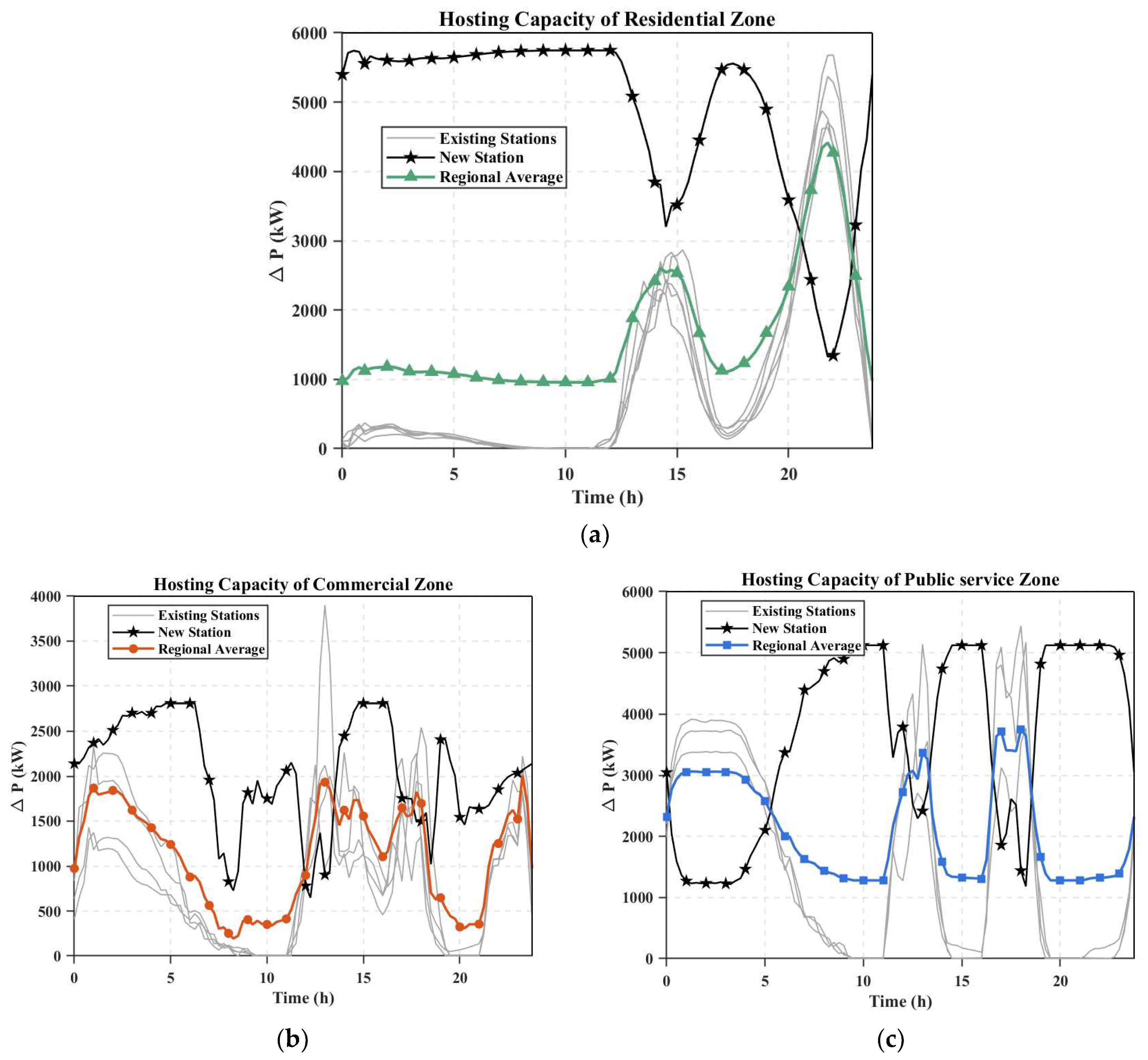
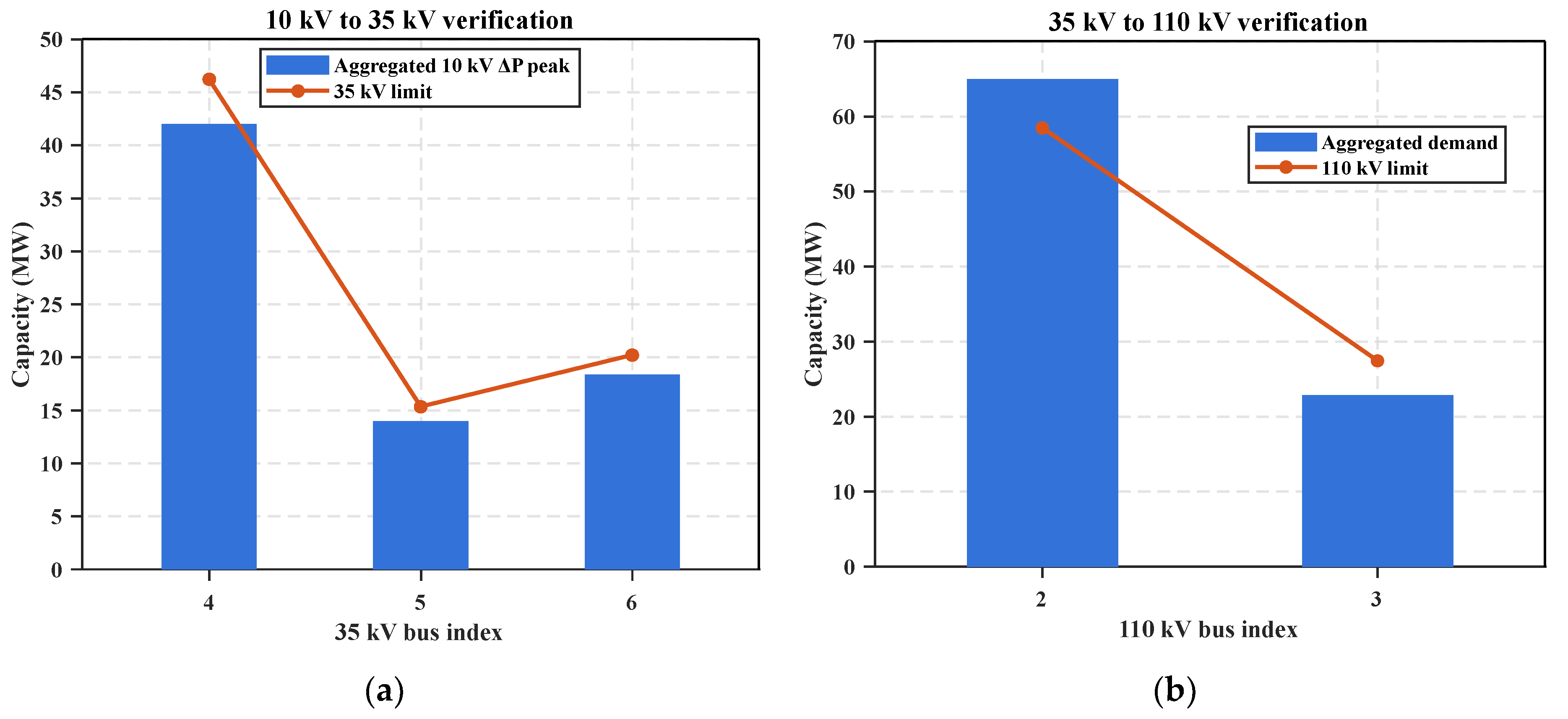
Distribution Network Hosting Capacity Assessment Method of Electric Vehicle Charging Stations Based on Multi-Zone Load Profiling
Abstract
1. Introduction
2. Materials and Methods
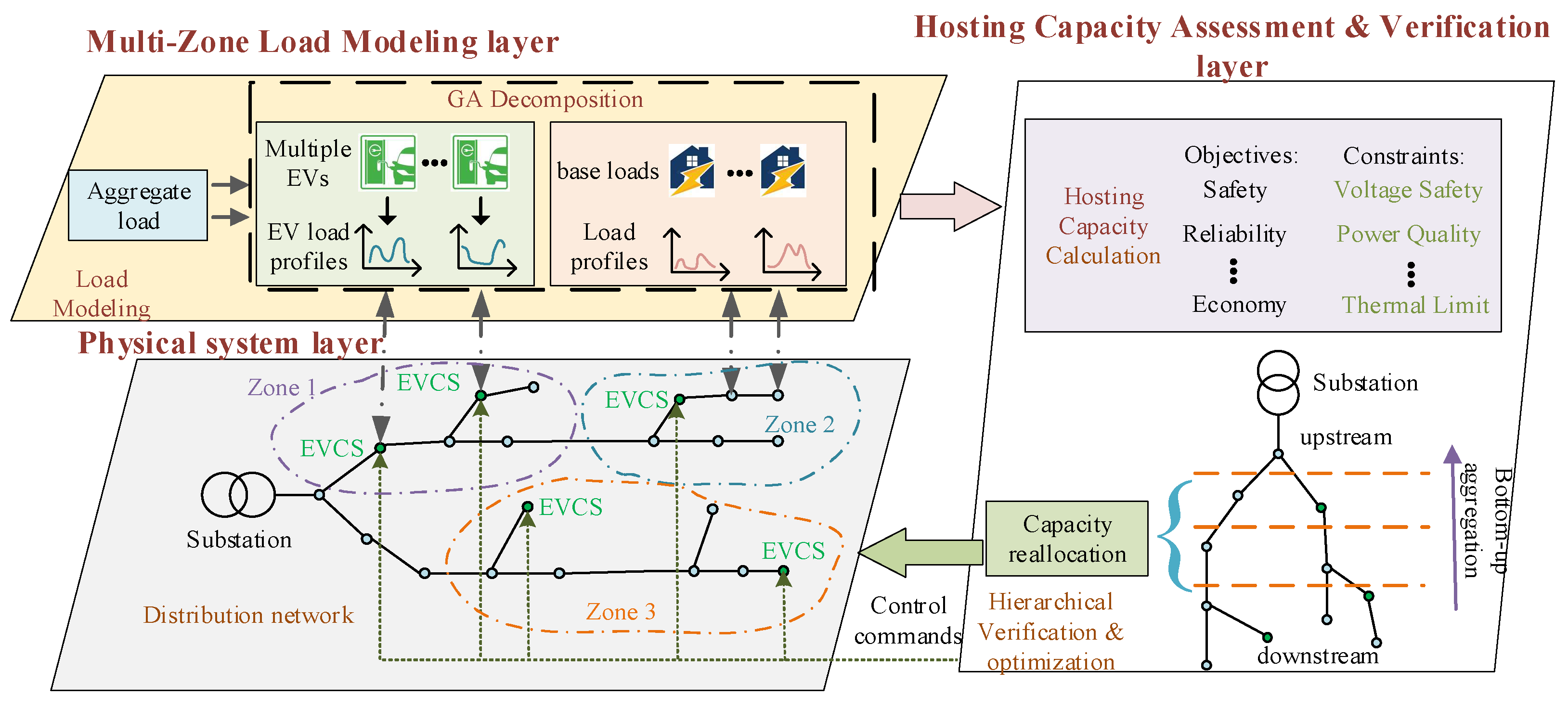
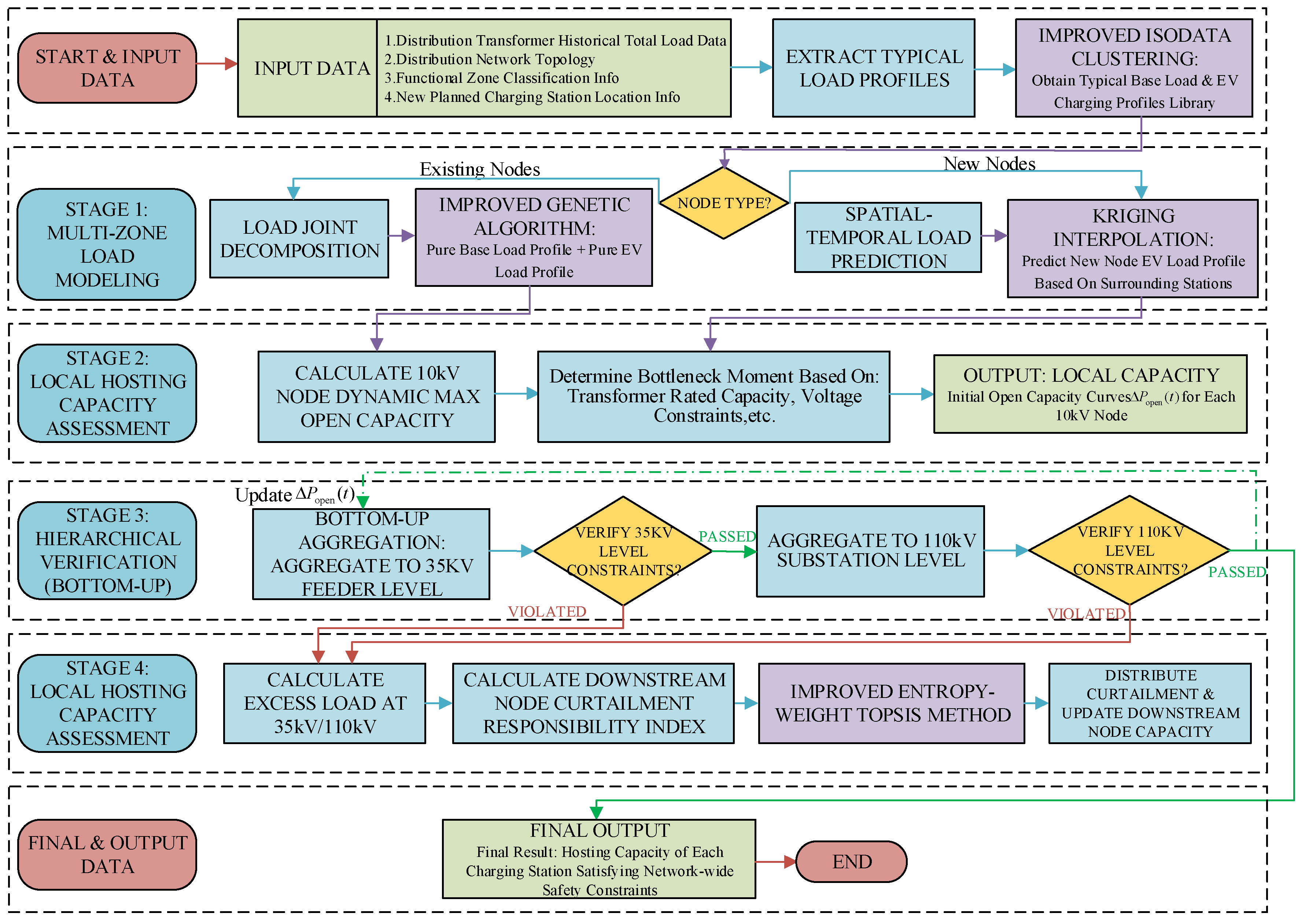
2.1. Framework Overview
2.2. Multi-Zone Load Profiling and Joint Decomposition
2.2.1. Improved ISODATA-Based Typical Load Profile Clustering
2.2.2. Improved GA-Based Load Decomposition Model
| Pseudocode: Improved GA with Levy Flight |
| Input:; Output:;
|
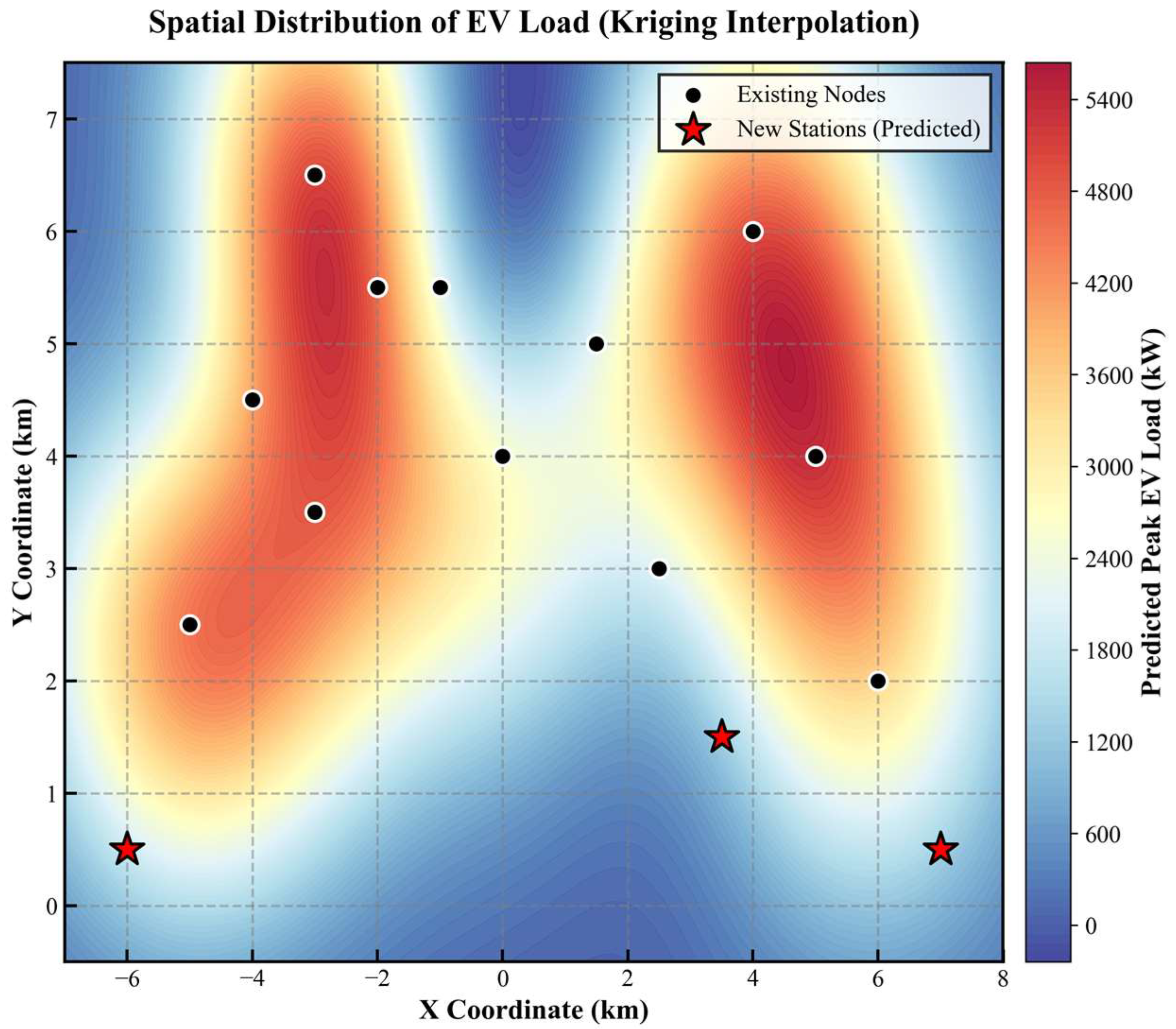
2.2.3. Spatial-Temporal Prediction of Charging Load for New Stations
2.3. Calculation Method of Distribution Network Hosting Capacity
2.3.1. Definition of Hosting Capacity and Operational Constraints
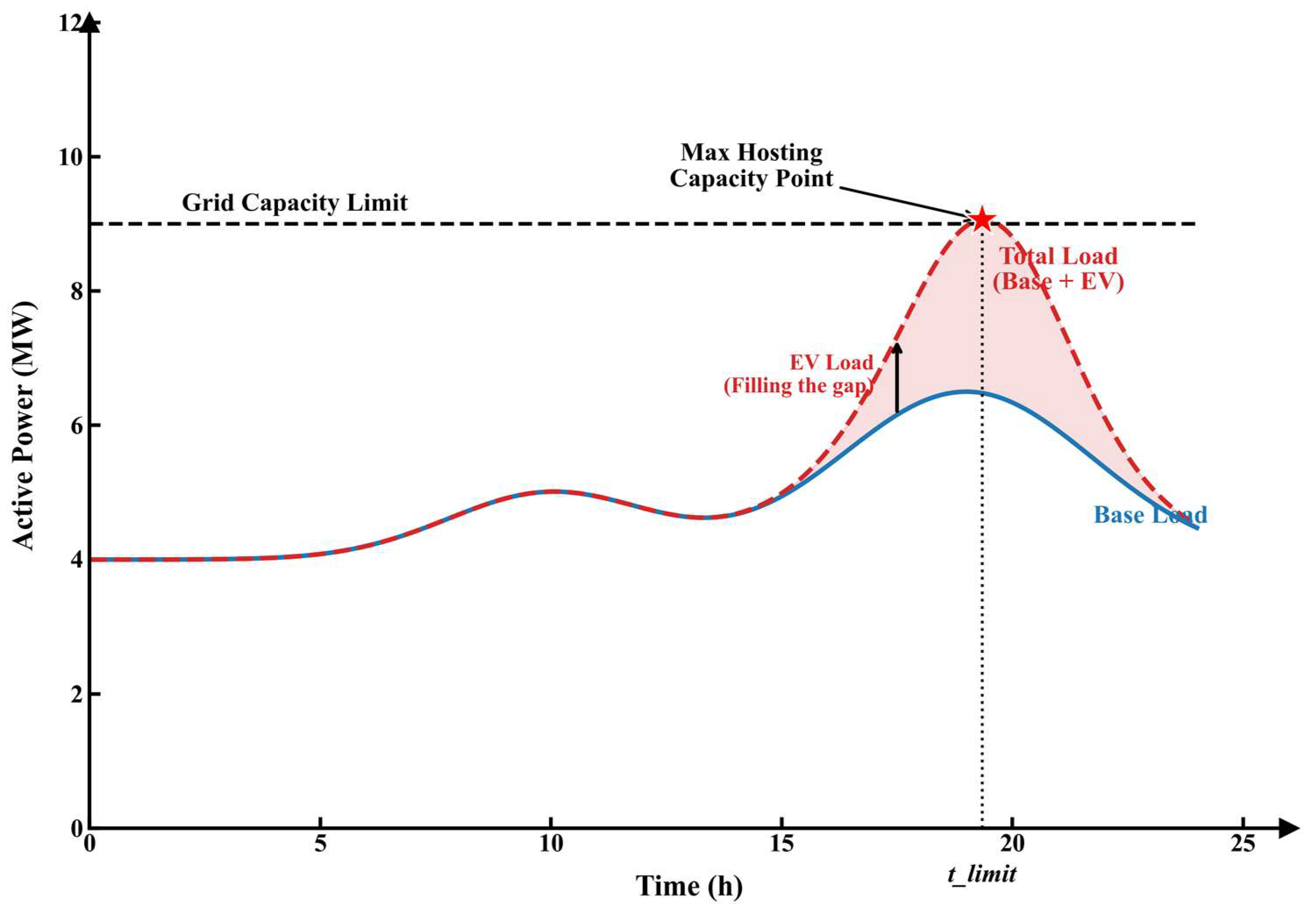
2.3.2. Calculation Algorithm of Hosting Capacity
2.4. Hierarchical Verification and Capacity Reallocation
2.4.1. Bottom-Up Aggregation Strategy
2.4.2. Constraint Verification
2.4.3. Capacity Reallocation Strategy Based on Improved EW-TOPSIS
- Functional Zone Priority : This indicator reflects the social importance and demand rigidity of the served zone. Residential zones, which correspond more closely to basic livelihood needs and usually have lower elasticity, are assigned higher protection priority. Commercial zones, which generally have stronger regulation potential and demand-response capability, can tolerate larger curtailment ratios under capacity constraints.
- Load Fluctuation Coefficient (): This indicator measures the stability of the node HC profile and is calculated as the ratio of the standard deviation to the mean of the capacity curve. Smaller fluctuation indicates a more stable and predictable load resource.
- Regional Industrial Load Peak (): This indicator represents the peak industrial demand of the 35 kV region where the node is located. Nodes in regions with heavier industrial loading may receive stronger curtailment pressure to relieve regional stress.
3. Case Studies
4. Conclusions
Author Contributions
Funding
Data Availability Statement
Conflicts of Interest
References
- Mastoi, M.S.; Zhuang, S.; Munir, H.M.; Haris, M.; Hassan, M.; Usman, M.; Bukhari, S.S.H.; Ro, J.-S. An in-depth analysis of electric vehicle charging station infrastructure, policy implications, and future trends. Energy Rep. 2022, 8, 11504–11529. [Google Scholar] [CrossRef]
- Veldman, E.; Verzijlbergh, R.A. Distribution grid impacts of smart electric vehicle charging from different perspectives. IEEE Trans. Smart Grid 2014, 6, 333–342. [Google Scholar] [CrossRef]
- Imtiaz, S.; Yang, L.; Naz, M.N.; Munir, H.M.; Altaf, M.W.; Mohammed, M.S.A. Enhanced TD3 multi-agent reinforcement learning approach for distributed energy resources coordination in active distribution network. Appl. Soft Comput. 2026, 199, 115348. [Google Scholar] [CrossRef]
- Satarworn, S.; Hoonchareon, N. Impact of EV home charger on distribution transformer overloading in an urban area. In Proceedings of the 2017 14th International Conference on Electrical Engineering/Electronics, Computer, Telecommunications and Information Technology (ECTI-CON); IEEE: Piscataway, NJ, USA, 2017. [Google Scholar]
- Ismael, S.M.; Abdel Aleem, S.H.E.; Abdelaziz, A.Y.; Zobaa, A.F. State-of-the-art of hosting capacity in modern power systems with distributed generation. Renew. Energy 2019, 130, 1002–1020. [Google Scholar] [CrossRef]
- Zain ul Abideen, M.; Ellabban, O.; Al-Fagih, L. A review of the tools and methods for distribution networks’ hosting capacity calculation. Energies 2020, 13, 2758. [Google Scholar] [CrossRef]
- Shafiee, S.; Fotuhi-Firuzabad, M.; Rastegar, M. Investigating the impacts of plug-in hybrid electric vehicles on power distribution systems. IEEE Trans. Smart Grid 2013, 4, 1351–1360. [Google Scholar] [CrossRef]
- Crozier, C.; Morstyn, T.; McCulloch, M. Capturing diversity in electric vehicle charging behaviour for network capacity estimation. Transp. Res. Part D Transp. Environ. 2021, 93, 102762. [Google Scholar] [CrossRef]
- Pradhan, P.; Ahmad, I.; Habibi, D.; Kothapalli, G.; Masoum, M.A.S. Reducing the impacts of electric vehicle charging on power distribution transformers. IEEE Access 2020, 8, 210183–210193. [Google Scholar] [CrossRef]
- Jia, H.; Zhang, C.; He, L.; Li, J.; Zhu, L.; Zhou, Q.; Shuai, Z.; Sun, X. A novel fault location method for unbalanced active distribution networks with sparse hybrid measurements. IEEE Trans. Smart Grid 2025, 17, 1056–1068. [Google Scholar] [CrossRef]
- Wang, X.; Wu, H.; Diao, G.; Fang, C.; Li, C.; Gong, K.; Jiang, C.; Huang, W.; Zhang, S. Bidding method for EV aggregators in flexible ramping product trading market considering charging and swapping flexibility aggregation. J. Mod. Power Syst. Clean Energy 2026, 14, 682–694. [Google Scholar]
- Alturki, M.; Khodaei, A. Marginal hosting capacity calculation for electric vehicle integration in active distribution networks. In Proceedings of the 2018 IEEE/PES Transmission and Distribution Conference and Exposition (T&D); IEEE: Piscataway, NJ, USA, 2018. [Google Scholar]
- Wang, M.; Yang, Y.; Jiang, Q. Quantitative evaluation method on electric vehicle accommodation capability of urban distribution network. In Proceedings of the 2021 IEEE/IAS Industrial and Commercial Power System Asia (I&CPS Asia); IEEE: Piscataway, NJ, USA, 2021. [Google Scholar]
- Wang, S.; Li, C.; Pan, Z.; Wang, J. Probabilistic method for distribution network electric vehicle hosting capacity assessment based on combined cumulants and gram-charlier expansion. Energy Procedia 2019, 158, 5067–5072. [Google Scholar] [CrossRef]
- Kim, T.-H.; Kim, D.; Moon, S.-I. Evaluation of electric vehicles hosting capacity based on interval undervoltage probability in a distribution network. IEEE Access 2021, 9, 140147–140155. [Google Scholar] [CrossRef]
- Zhao, J.; Wang, J.; Xu, Z.; Wang, C.; Wan, C.; Chen, C. Distribution network electric vehicle hosting capacity maximization: A chargeable region optimization model. IEEE Trans. Power Syst. 2017, 32, 4119–4130. [Google Scholar] [CrossRef]
- Zhu, J.; Nacmanson, W.J.; Ochoa, L.F.; Hellyer, B. Assessing the ev hosting capacity of australian urban and rural mv-lv networks. Electr. Power Syst. Res. 2022, 212, 108399. [Google Scholar] [CrossRef]
- Yang, D.; Yuan, X.; Gao, H.; Ma, J.; Chen, Z. FFRLS-based data-driven voltage security assessment for active distribution networks. IEEE Trans. Smart Grid 2025, 16, 5685–5688. [Google Scholar] [CrossRef]
- Rabiee, A.; Keane, A.; Soroudi, A. Enhanced transmission and distribution network coordination to host more electric vehicles and PV. IEEE Syst. J. 2021, 16, 2705–2716. [Google Scholar] [CrossRef]
- Mastoi, M.S.; Zhuang, S.; Munir, H.M.; Haris, M.; Hassan, M.; Alqarni, M.; Alamri, B. A study of charging-dispatch strategies and vehicle-to-grid technologies for electric vehicles in distribution networks. Energy Rep. 2023, 9, 1777–1806. [Google Scholar] [CrossRef]
- Richardson, P.; Flynn, D.; Keane, A. Optimal charging of electric vehicles in low-voltage distribution systems. IEEE Trans. Power Syst. 2011, 27, 268–279. [Google Scholar] [CrossRef]
- De Hoog, J.; Alpcan, T.; Brazil, M.; Thomas, D.A.; Mareels, I. Optimal charging of electric vehicles taking distribution network constraints into account. IEEE Trans. Power Syst. 2014, 30, 365–375. [Google Scholar] [CrossRef]
- Quiros-Tortos, J.; Ochoa, L.F.; Alnaser, S.W.; Butler, T. Control of EV charging points for thermal and voltage management of LV networks. IEEE Trans. Power Syst. 2015, 31, 3028–3039. [Google Scholar] [CrossRef]
- Barbosa, T.; Andrade, J.; Torquato, R.; Freitas, W.; Trindade, F.C. Use of EV hosting capacity for management of low-voltage distribution systems. IET Gener. Transm. Distrib. 2020, 14, 2620–2629. [Google Scholar] [CrossRef]
- Faddel, S.G.; Mohammed, O.A. Automated distributed electric vehicle controller for residential demand side management. IEEE Trans. Ind. Appl. 2018, 55, 16–25. [Google Scholar] [CrossRef]
- Heymann, F.; Pereira, C.; Miranda, V.; Soares, F.J. Spatial load forecasting of electric vehicle charging using GIS and diffusion theory. In Proceedings of the 2017 IEEE PES Innovative Smart Grid Technologies Conference Europe (ISGT-Europe); IEEE: Piscataway, NJ, USA, 2017. [Google Scholar]
- Rahman, M.T.; Hasan, K.N.; Rosengarten, G.; McTaggart, P. A probabilistic framework for the estimation of EV hosting capacity of a low voltage distribution network considering spatio-temporal uncertainty. In Proceedings of the 2022 IEEE PES 14th Asia-Pacific Power and Energy Engineering Conference (APPEEC); IEEE: Piscataway, NJ, USA, 2022. [Google Scholar]
- Zhao, Z.; Zhang, Y.; Zhang, Y.; Ji, K.; Qi, H. Neural-network-based dynamic distribution model of parking space under sharing and non-sharing modes. Sustainability 2020, 12, 4864. [Google Scholar] [CrossRef]
- Avila-Rojas, A.E.; De Oliveira-De Jesus, P.M.; Alvarez, M. Distribution network electric vehicle hosting capacity enhancement using an optimal power flow formulation. Electr. Eng. 2021, 104, 1337–1348. [Google Scholar] [CrossRef]
- Rana, J.; Zaman, F.; Ray, T.; Sarker, R. EV hosting capacity enhancement in a community microgrid through dynamic price optimization-based demand response. IEEE Trans. Cybern. 2022, 53, 7431–7442. [Google Scholar] [CrossRef] [PubMed]
- Dimas, C.; Ramos, G.; Caro, L.M.; Luna, A.C. Parallel computing and multicore platform to assess electric vehicle hosting capacity. IEEE Trans. Ind. Appl. 2020, 56, 4709–4717. [Google Scholar] [CrossRef]



| Types of the Methods | Advantages | Disadvantages |
|---|---|---|
| Methods based on Local Components (e.g., [7,12,13]) | Simple to implement; Requires minimal data (mostly rated parameters). | Ignores topological constraints; Fails to capture power flow coupling between nodes; Cannot assess system-wide impact. |
| Single-Voltage Level Assessment (e.g., [16,17,29]) | Considers network topology; accurate for local voltage deviations. | Neglects upstream transmission constraints; Misses bottleneck at 110 kV/35 kV substations. |
| Regression-based and conventional data-driven methods (e.g., [9,26,27]) | Can learn nonlinear relations when paired training data are available; useful for data-rich planning cases. | Depend on paired labels and sufficient observability; do not directly extract EV load from transformer aggregate curves; require extra treatment for planned stations and upstream constraints. |
| Proposed Method | Zone-level temporal granularity; non-intrusive load decomposition; hierarchical HC verification; priority-aware capacity reallocation. | More modeling steps than deterministic calculations; requires historical aggregate load and station sample data. |
| Symbol | Value |
|---|---|
| 2 | |
| 4 | |
| 10 | |
| 50 | |
| 2.0 | |
| 1.5 | |
| 0.001 | |
| 60 | |
| 150 | |
| 0.85 | |
| 0.02 | |
| 1.5 | |
| 0.05 | |
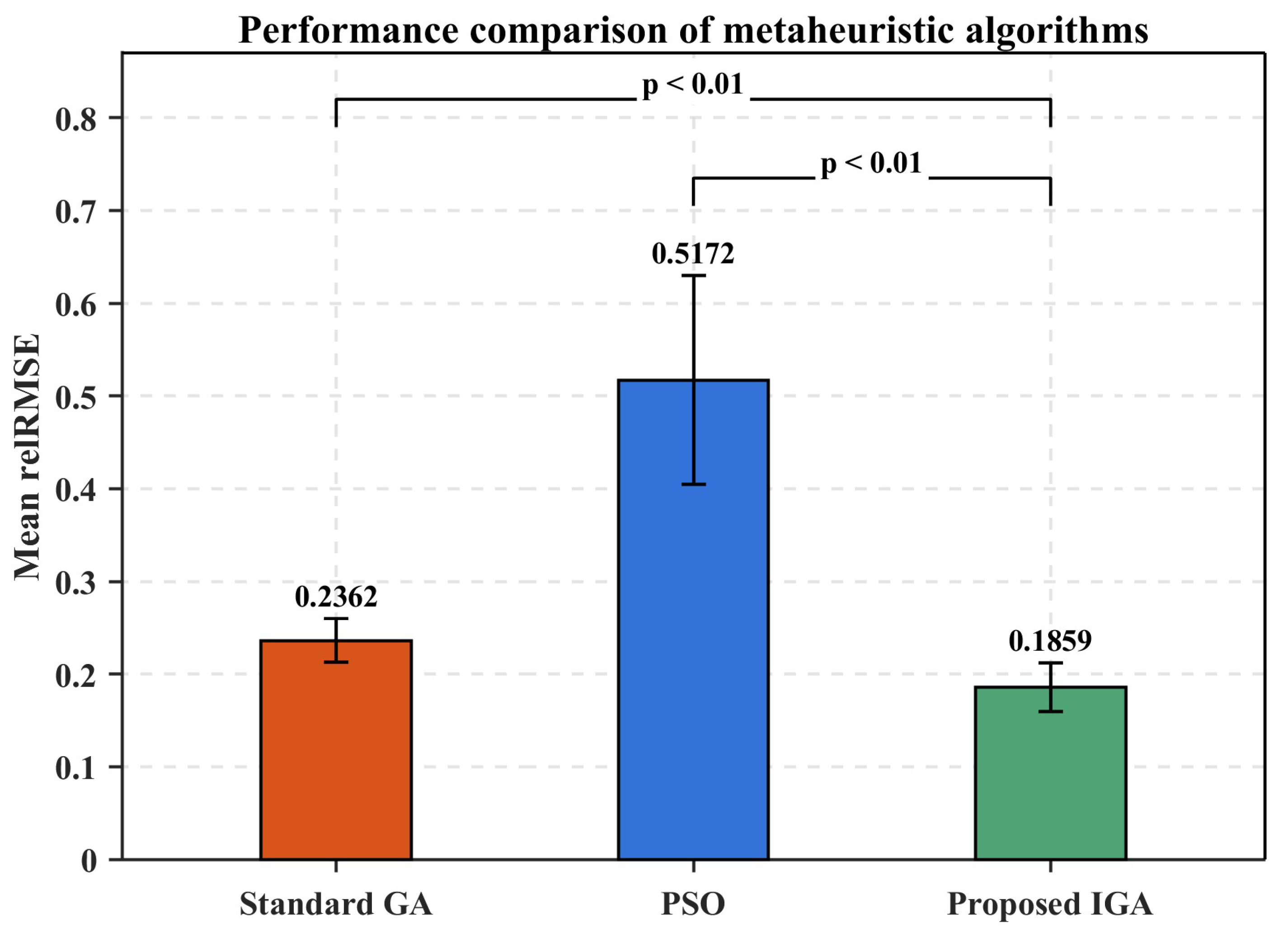
| Algorithm | Mean relRMSE | Min relRMSE | Max relRMSE | Std relRMSE | t-Statistic | p-Value |
|---|---|---|---|---|---|---|
| Standard GA | 0.2362 | 0.0795 | 0.4261 | 0.1045 | t = 4.9826 | p < 0.01 |
| PSO | 0.5172 | 0.0659 | 4.5036 | 0.5036 | t = 9.9322 | p < 0.01 |
| Proposed IGA | 0.1859 | 0.0645 | 0.3854 | 0.1164 | Reference | -- |
| Node ID | Functional Zone | Initial Capacity (kW) | Responsibility Index () | Reduction Amount (kW) | Final Capacity (kW) | Reduction Ratio (%) |
|---|---|---|---|---|---|---|
| 9 | Residential | 5371.5 | 0.175 | 218.3 | 5153.3 | 4.1 |
| 11 | Residential | 4874.8 | 0.158 | 197.3 | 4677.5 | 4.0 |
| 12 | Residential | 4717.0 | 0.163 | 203.4 | 4513.7 | 4.3 |
| 13 | Residential | 5680.3 | 0.159 | 197.5 | 5482.8 | 3.5 |
| 14 | Residential | 4632.8 | 0.155 | 193.2 | 4439.7 | 4.2 |
| 15 | Residential | 5746.9 | 0.000 | 0.0 | 5746.9 | 0.0 |
| 18 | Commercial | 2335.1 | 0.895 | 1114.7 | 1220.3 | 47.7 |
| 19 | Commercial | 3899.7 | 0.896 | 1115.7 | 2784.0 | 28.6 |
| 21 | Commercial | 2251.4 | 0.894 | 1112.5 | 1138.9 | 49.4 |
| 22 | Commercial | 2200.5 | 0.894 | 1112.5 | 1088.0 | 50.6 |
| 23 | Commercial | 2808.9 | 0.830 | 1032.8 | 1776.0 | 36.8 |
Disclaimer/Publisher’s Note: The statements, opinions and data contained in all publications are solely those of the individual author(s) and contributor(s) and not of MDPI and/or the editor(s). MDPI and/or the editor(s) disclaim responsibility for any injury to people or property resulting from any ideas, methods, instructions or products referred to in the content. |
© 2026 by the authors. Licensee MDPI, Basel, Switzerland. This article is an open access article distributed under the terms and conditions of the Creative Commons Attribution (CC BY) license.
Share and Cite
Guo, N.; Chen, J.; Zhang, X.; Chen, Y.; Liu, J.; Zhou, Z. Distribution Network Hosting Capacity Assessment Method of Electric Vehicle Charging Stations Based on Multi-Zone Load Profiling. Symmetry 2026, 18, 990. https://doi.org/10.3390/sym18060990
Guo N, Chen J, Zhang X, Chen Y, Liu J, Zhou Z. Distribution Network Hosting Capacity Assessment Method of Electric Vehicle Charging Stations Based on Multi-Zone Load Profiling. Symmetry. 2026; 18(6):990. https://doi.org/10.3390/sym18060990
Chicago/Turabian StyleGuo, Ning, Jinming Chen, Xing Zhang, Ye Chen, Jian Liu, and Zhijun Zhou. 2026. "Distribution Network Hosting Capacity Assessment Method of Electric Vehicle Charging Stations Based on Multi-Zone Load Profiling" Symmetry 18, no. 6: 990. https://doi.org/10.3390/sym18060990
APA StyleGuo, N., Chen, J., Zhang, X., Chen, Y., Liu, J., & Zhou, Z. (2026). Distribution Network Hosting Capacity Assessment Method of Electric Vehicle Charging Stations Based on Multi-Zone Load Profiling. Symmetry, 18(6), 990. https://doi.org/10.3390/sym18060990