Substitution Driven Local Symmetry Effect in Halogen–π Complexes of Alkenes and Alkynes: A Quantum Chemical Study

 ,
,  ,
,  and
and 
Abstract
1. Introduction
2. Methodology
3. Results and Discussion
3.1. Quantum-Chemical Calculations
3.2. QTAIM Analysis
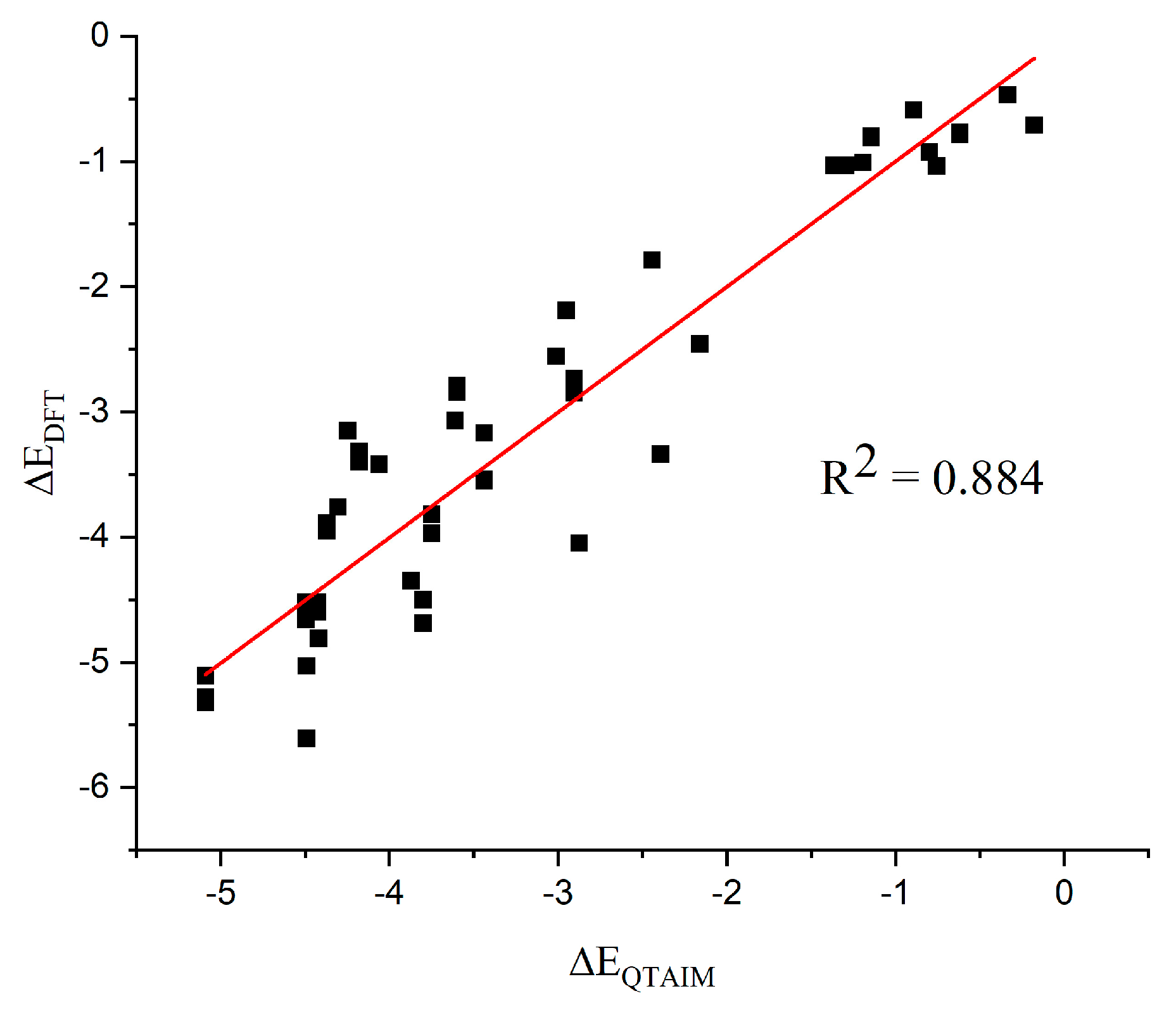
3.3. Correlation Between Quantum-Chemical and QTAIM Parameters
4. Conclusions
Supplementary Materials
Author Contributions
Funding
Data Availability Statement
Conflicts of Interest
Abbreviations
| DFT | Density Functional Theory |
| CCSD(T) | Coupled Cluster with Single, Double and perturbative Triple excitations |
| CBS | Complete Basis Set |
| SAPT | Symmetry-Adapted Perturbation Theory |
| QTAIM | Quantum Theory of Atoms in Molecules |
| ESP | Electrostatic Potential |
| BSSE | Basis Set Superposition Error |
| BCP | Bond Critical Point |
References
- Malenov, D.P.; Zarić, S.D. Recognizing New Types of Stacking Interactions by Analyzing Data in the Cambridge Structural Database. Chemistry 2023, 5, 2513–2541. [Google Scholar] [CrossRef]
- Zarić, S.D. Metal–Ligand Aromatic Cation–π Interactions. Eur. J. Inorg. Chem. 2003, 2003, 2197–2201. [Google Scholar] [CrossRef]
- Bauzá, A.; Mooibroek, T.J.; Frontera, A. Halogen Bonding versus Chalcogen and Pnicogen Bonding: A Combined Cambridge Structural Database and Theoretical Study. CrystEngComm 2013, 15, 3137–3144. [Google Scholar] [CrossRef]
- Escudero, D.; Frontera, A.; Quiñonero, D.; Deyà, P.M. Interplay between Anion–π and Hydrogen Bonding Interactions. J. Comput. Chem. 2009, 30, 75–82. [Google Scholar] [CrossRef]
- Estarellas, C.; Frontera, A.; Quiñonero, D.; Deyà, P.M. Theoretical Study on Cooperativity Effects between Anion–π and Halogen-Bonding Interactions. ChemPhysChem 2011, 12, 2742–2750. [Google Scholar] [CrossRef]
- Politzer, P.; Murray, J.S.; Clark, T. Halogen Bonding and Other σ-Hole Interactions: A Perspective. Phys. Chem. Chem. Phys. 2013, 15, 11178–11189. [Google Scholar] [CrossRef] [PubMed]
- Murray, J.S.; Lane, P.; Politzer, P. σ-Hole Bonding: Molecules Containing Group VI Atoms. J. Mol. Model. 2007, 13, 1033–1038. [Google Scholar] [CrossRef]
- Politzer, P.; Murray, J.S.; Lane, P. σ-Hole Bonding and Hydrogen Bonding: Competitive Interactions. Int. J. Quantum Chem. 2007, 107, 3046–3052. [Google Scholar] [CrossRef]
- Cavallo, G.; Metrangolo, P.; Milani, R.; Pilati, T.; Priimagi, A.; Resnati, G.; Terraneo, G. The Halogen Bond. Chem. Rev. 2016, 116, 2478–2601. [Google Scholar] [CrossRef] [PubMed]
- Metrangolo, P.; Resnati, G. Halogen Bonding in Supramolecular Chemistry. Chem. Eur. J. 2001, 7, 2511–2519. [Google Scholar] [CrossRef]
- Mukherjee, A.; Tothadi, S.; Desiraju, G.R. Halogen Bonds in Crystal Engineering: Like Hydrogen Bonds yet Different. Acc. Chem. Res. 2014, 47, 2514–2524. [Google Scholar] [CrossRef] [PubMed]
- Saraogi, I.; Vijay, V.G.; Das, S.; Sekar, K.; Guru Row, T.N. C–Halogen⋯π Interactions in Proteins: A Database Study. J. Mol. Biol. 2013, 425, 2881–2893. [Google Scholar] [CrossRef]
- Shah, M.B.; Liu, J.; Zhang, Q.; Stout, C.D.; Halpert, J.R. Halogen–π Interactions in the Cytochrome P450 Active Site: Structural Insights into Human CYP2B6 Substrate Selectivity. J. Biol. Chem. 2012, 287, 21962–21973. [Google Scholar] [CrossRef] [PubMed]
- Wilcken, R.; Zimmermann, M.O.; Lange, A.; Joerger, A.C.; Boeckler, F.M. Halogen Bonding in Medicinal Chemistry. J. Med. Chem. 2013, 56, 1363–1388. [Google Scholar] [CrossRef]
- Lieffrig, J.; Jeannin, O.; Fourmigué, M. Expanded halogen-bonded anion organic networks with star-shaped iodoethynyl-substituted molecules: From corrugated 2D hexagonal lattices to pyrite-type 2-fold interpenetrated cubic lattices. J. Am. Chem. Soc. 2013, 135, 6200–6210. [Google Scholar] [CrossRef]
- Prasanna, M.D.; Guru Row, T.N. C–Halogen⋯π Interactions and Their Influence on Molecular Conformation and Crystal Packing: A Database Study. CrystEngComm 2000, 2, 135–140. [Google Scholar] [CrossRef]
- Forni, A.; Pieraccini, S.; Rendine, S.; Sironi, M. Halogen Bonds with Benzene: An Assessment of DFT Functionals. J. Comput. Chem. 2012, 33, 1417–1425. [Google Scholar] [CrossRef]
- Engelhard, M.U.; Zimmermann, M.O.; Mier, F.; Boeckler, F.M. Comparison of QM Methods for the Evaluation of Halogen–π Interactions for Large-Scale Data Generation. J. Chem. Inf. Model. 2018, 58, 1376–1385. [Google Scholar] [CrossRef]
- Wallnoefer, H.G.; Fox, T.; Liedl, K.R.; Tautermann, C.S. Dispersion-Dominated Halogen–π Interactions: Energies and Locations of Minima. Phys. Chem. Chem. Phys. 2010, 12, 14941–14949. [Google Scholar] [CrossRef]
- Nagels, N.; Hauchecorne, D.; Herrebout, W.A. Exploring the C–X⋯π Halogen Bonding Motif: An Infrared and Raman Study of the Complexes of CF3X (X = Cl, Br and I) with the Aromatic Model Compounds Benzene and Toluene. Molecules 2013, 18, 6829–6851. [Google Scholar] [CrossRef] [PubMed]
- Hauchecorne, D.; Nagels, N.; van der Veken, B.J.; Herrebout, W.A. C–X⋯π Halogen and C–H⋯π Hydrogen Bonding: Interactions of CF3X (X = Cl, Br, I or H) with Ethene and Propene. J. Phys. Chem. A 2012, 116, 13031–13042. [Google Scholar] [CrossRef]
- Nagels, N.; Herrebout, W.A. A Cryospectroscopic Infrared and Raman Study of the C–X⋯π Halogen Bonding Motif: Complexes of CF3Cl, CF3Br and CF3I with Ethyne, Propyne and 2-Butyne. J. Phys. Chem. A 2013, 117, 2753–2762. [Google Scholar] [CrossRef]
- Neese, F. The ORCA program system. WIREs Comput. Mol. Sci. 2012, 2, 73–78. [Google Scholar] [CrossRef]
- Neese, F. Software update: The ORCA program system—Version 5.0. WIREs Comput. Mol. Sci. 2022, 12, e1606. [Google Scholar] [CrossRef]
- Becke, A.D. Density-functional thermochemistry. V. Systematic optimization of exchange-correlation functionals. J. Chem. Phys. 1997, 107, 8554–8560. [Google Scholar] [CrossRef]
- Grimme, S. Semiempirical GGA-type density functional constructed with a long-range dispersion correction. J. Comput. Chem. 2006, 27, 1787–1799. [Google Scholar] [CrossRef] [PubMed]
- Weigend, F.; Ahlrichs, R. Balanced basis sets of split valence, triple zeta valence and quadruple zeta valence quality for H to Rn: Design and assessment of accuracy. Phys. Chem. Chem. Phys. 2005, 7, 3297–3305. [Google Scholar] [CrossRef]
- Grimme, S.; Ehrlich, S.; Goerigk, L. Effect of the damping function in dispersion corrected density functional theory. J. Comput. Chem. 2011, 32, 1456–1465. [Google Scholar] [CrossRef]
- Caldeweyher, E.; Bannwarth, C.; Grimme, S. Extension of the D3 dispersion coefficient model. J. Chem. Phys. 2017, 147, 034112. [Google Scholar] [CrossRef]
- Helgaker, T.; Klopper, W.; Koch, H.; Noga, J. Basis-set convergence of correlated calculations on water. J. Chem. Phys. 1997, 106, 9639–9646. [Google Scholar] [CrossRef]
- Watts, J.D.; Gauss, J.; Bartlett, R.J. Coupled-cluster methods with noniterative triple excitations for restricted open-shell Hartree–Fock and other general single determinant reference functions. Energies and analytical gradients. J. Chem. Phys. 1993, 98, 8718–8733. [Google Scholar] [CrossRef]
- Chai, J.D.; Head-Gordon, M. Systematic optimization of long-range corrected hybrid density functionals. J. Chem. Phys. J. Chem. Phys. 2008, 128, 084106. [Google Scholar] [CrossRef]
- Boys, S.F.; Bernardi, F. The Calculation of Small Molecular Interactions by the Differences of Separate Total Energies. Some Procedures for Reducing Errors. Mol. Phys. 1970, 19, 553–566. [Google Scholar] [CrossRef]
- Jeziorski, B.; Moszynski, R.; Szalewicz, K. Perturbation Theory Approach to Intermolecular Potential Energy Surfaces of van der Waals Complexes. Chem. Rev. 1994, 94, 1887–1930. [Google Scholar] [CrossRef]
- Parrish, R.M.; Burns, L.A.; Smith, D.G.A.; Simmonett, A.C.; DePrince, A.E.; Hohenstein, E.G.; Bozkaya, U.; Sokolov, A.Y.; Di Remigio, R.; Richard, R.M.; et al. Psi4 1.1: An Open-Source Electronic Structure Program Emphasizing Automation, Advanced Libraries, and Interoperability. J. Chem. Theory Comput. 2017, 13, 3185–3197. [Google Scholar] [CrossRef] [PubMed]
- Bader, R.F.W.; Carroll, M.T.; Cheeseman, J.R.; Chang, C. Properties of Atoms in Molecules: Atomic Volumes. J. Am. Chem. Soc. 1987, 109, 7968–7979. [Google Scholar] [CrossRef]
- Bader, R.F.W. A Bond Path: A Universal Indicator of Bonded Interactions. J. Phys. Chem. A 1998, 102, 7314–7323. [Google Scholar] [CrossRef]
- Bader, R.F.W.; Slee, T.S.; Cremer, D.; Kraka, E. Description of Conjugation and Hyperconjugation in Terms of Electron Distributions. J. Am. Chem. Soc. 1983, 105, 5061–5068. [Google Scholar] [CrossRef]
- Keith, T.A. AIMAll, version 16.05.18; TK Gristmill Software: Overland Park, KS, USA, 2016.
- Grabowski, S.J. QTAIM Characteristics of Halogen Bond and Related Interactions. J. Phys. Chem. A 2012, 116, 1838–1845. [Google Scholar] [CrossRef] [PubMed]
- Soliman, S.M.; Albering, J.; Abu-Youssef, M.A.M. Structural Analyses of Two New Highly Distorted Octahedral Copper(II) Complexes with Quinoline-Type Ligands: Hirshfeld, AIM and NBO Studies. Polyhedron 2017, 127, 36–50. [Google Scholar] [CrossRef]
- Lepetit, C.; Vabre, B.; Canac, Y.; Alikhani, M.E.; Zargarian, D. Pentacoordinated, Square Pyramidal Cationic PCP Ni(II) Pincer Complexes: ELF and QTAIM Topological Analyses of Nickel–Triflate Interactions. Theor. Chem. Acc. 2018, 137, 141. [Google Scholar] [CrossRef]
- O’Brien, S.E.; Popelier, P.L.A. Quantum Molecular Similarity. Part 2: The Relation between Properties in BCP Space and Bond Length. Can. J. Chem. 1999, 77, 28–36. [Google Scholar] [CrossRef]
- Bader, R.F.W. Atoms in Molecules: A Quantum Theory; Oxford University Press: Oxford, UK, 1990. [Google Scholar]
- Bianchi, R.; Gervasio, G.; Marabello, D. Experimental Electron Density Analysis of Mn2(CO)10: Metal–Metal and Metal–Ligand Bond Characterization. Inorg. Chem. 2000, 39, 2360–2366. [Google Scholar] [CrossRef]
- Jenkins, S.; Blancafort, L.; Kirk, S.R.; Bearpark, M.J. The Response of the Electronic Structure to Electronic Excitation and Double Bond Torsion in Fulvene: A Combined QTAIM, Stress Tensor and MO Perspective. Phys. Chem. Chem. Phys. 2014, 16, 7115–7126. [Google Scholar] [CrossRef] [PubMed]
- Kraka, E.; Cremer, D. Description of Chemical Reactions in Terms of the Properties of the Electron Density. J. Mol. Struct. THEOCHEM 1992, 255, 189–206. [Google Scholar] [CrossRef]
- Espinosa, E.; Alkorta, I.; Elguero, J.; Molins, E. From Weak to Strong Interactions: A Comprehensive Analysis of the Topological and Energetic Properties of the Electron Density Distribution Involving X–H⋯F–Y Systems. J. Chem. Phys. 2002, 117, 5529–5542. [Google Scholar] [CrossRef]
- Espinosa, E.; Molins, E.; Lecomte, C. Hydrogen Bond Strengths Revealed by Topological Analyses of Experimentally Observed Electron Densities. Chem. Phys. Lett. 1998, 285, 170–173. [Google Scholar] [CrossRef]
- Popelier, P.L.A. Atoms in Molecules: An Introduction; Prentice Hall: Harlow, UK, 2000. [Google Scholar]



| F2 | Cl2 | Br2 | I2 | |||||||||
|---|---|---|---|---|---|---|---|---|---|---|---|---|
| System | d | ΔEDFT | Vs | d | ΔEDFT | Vs | d | ΔEDFT | Vs | d | ΔEDFT | Vs |
| free | 13.8 | 25.6 | 30.3 | 33.6 | ||||||||
| benzene | 3.2 | −0.71 | 10.5 | 3.2 | −2.46 | 20.3 | 3.3 | −3.34 | 23.8 | 3.4 | −4.05 | 26.0 |
| ethene | 3.1 | −0.59 | 10.9 | 3.2 | −2.19 | 20.9 | 3.1 | −3.15 | 22.1 | 3.3 | −3.76 | 25.4 |
| 1-butene | 3.0 | −0.80 | 10.4 | 3.1 | −2.79 | 19.8 | 3.1 | −3.89 | 21.5 | 3.3 | −4.52 | 24.9 |
| 2-butene | 2.9 | −1.01 | 10.4 | 3.0 | −3.32 | 18.5 | 3.1 | −4.52 | 21.3 | 3.2 | −5.11 | 23.3 |
| 1-hexene | 3.0 | −0.81 | 10.2 | 3.1 | −2.84 | 19.5 | 3.1 | −3.95 | 21.3 | 3.3 | −4.60 | 24.7 |
| 2-hexene | 2.9 | −1.03 | 9.7 | 3.0 | −3.40 | 18.3 | 3.1 | −4.64 | 21.1 | 3.2 | −5.28 | 23.1 |
| 3-hexene | 2.9 | −1.03 | 9.7 | 3.0 | −3.42 | 18.3 | 3.1 | −4.66 | 21.0 | 3.2 | −5.32 | 23.0 |
| F2 | Cl2 | Br2 | I2 | |||||||||
|---|---|---|---|---|---|---|---|---|---|---|---|---|
| System | d | ΔEDFT | Vs | d | ΔEDFT | Vs | d | ΔEDFT | Vs | d | ΔEDFT | Vs |
| ethyne | 3.2 | −0.47 | 11.4 | 3.2 | −1.79 | 21.4 | 3.2 | −2.56 | 24.2 | 3.3 | −3.07 | 26.4 |
| 1-butyne | 3.1 | −0.77 | 10.8 | 3.1 | −2.74 | 20.0 | 3.1 | −3.82 | 22.1 | 3.3 | −4.50 | 25.5 |
| 2-butyne | 3.0 | −0.93 | 10.2 | 3.0 | −3.17 | 18.6 | 3.1 | −4.35 | 21.6 | 3.2 | −5.03 | 23.6 |
| 1-hexyne | 3.1 | −0.79 | 10.7 | 3.1 | −2.85 | 19.8 | 3.1 | −3.97 | 21.9 | 3.3 | −4.69 | 25.3 |
| 2-hexyne | 3.0 | −1.04 | 10.1 | 3.0 | −3.54 | 18.5 | 3.0 | −4.81 | 19.8 | 3.2 | −5.61 | 23.4 |
| 3-hexyne | 3.0 | −1.04 | 10.0 | 3.0 | −3.55 | 18.3 | 3.0 | −4.81 | 19.8 | 3.2 | −5.61 | 23.2 |
| System | ELST | IND | DISP | TOTAL |
|---|---|---|---|---|
| F2/benzene | −0.62 | −0.25 | −1.26 | −0.88 |
| Cl2/benzene | −2.70 | −1.17 | −4.15 | −3.12 |
| Br2/benzene | −3.31 | −1.47 | −4.96 | −4.18 |
| I2/benzene | −4.01 | −2.06 | −6.41 | −5.58 |
| F2/ethene | −1.21 | −0.45 | −1.03 | −0.51 |
| Cl2/ethene | −3.63 | −1.27 | −2.69 | −2.24 |
| Br2/ethene | −6.88 | −2.38 | −4.45 | −2.98 |
| I2/ethene | −5.77 | −2.85 | −4.68 | −4.47 |
| F2/2-hexene | −2.06 | −0.85 | −1.96 | −0.89 |
| Cl2/2-hexene | −6.05 | −2.38 | −5.30 | −3.79 |
| Br2/2-hexene | −7.07 | −2.75 | −6.18 | −5.05 |
| I2/2-hexene | −7.72 | −3.96 | −7.85 | −6.98 |
| F2/2-hexyne | −1.40 | −0.54 | −1.51 | −1.01 |
| Cl2/2-hexyne | −5.71 | −2.18 | −4.92 | −3.99 |
| Br2/2-hexyne | −8.60 | −3.25 | −6.82 | −5.37 |
| I2/2-hexyne | −7.64 | −3.53 | −7.45 | −7.17 |
| Bond | ρ(r) [a.u.] | ∇2ρ(r) [a.u.] | G(r) [kcal/mol] | V(r) [kcal/mol] | H(r) [kcal/mol] | −G(r)/V(r) | Ebond [kcal/mol] |
|---|---|---|---|---|---|---|---|
| F2 | |||||||
| benzene | 0.0039 | 0.018 | 2.11 | −1.32 | 0.79 | 0.38 | −0.67 |
| ethene | 0.0056 | 0.025 | 2.87 | −1.89 | 1.00 | 0.36 | −0.93 |
| 1-butene | 0.0070 | 0.030 | 3.64 | −2.51 | 1.12 | 0.36 | −1.24 |
| 2-butene | 0.0071 | 0.030 | 3.66 | −2.54 | 1.12 | 0.33 | −1.27 |
| 1-hexene | 0.0070 | 0.030 | 3.66 | −2.51 | 1.12 | 0.36 | −1.27 |
| 2-hexene | 0.0087 | 0.037 | 4.59 | −3.33 | 1.27 | 0.33 | −1.65 |
| 3-hexene | 0.0087 | 0.037 | 4.57 | −3.30 | 1.27 | 0.33 | −1.65 |
| ethyne | 0.0043 | 0.020 | 2.32 | −1.46 | 0.86 | 0.38 | −0.74 |
| 1-butyne | 0.0055 | 0.025 | 2.97 | −1.96 | 1.00 | 0.36 | −0.98 |
| 2-butyne | 0.0069 | 0.031 | 3.76 | −2.61 | 1.15 | 0.33 | −1.32 |
| 1-hexyne | 0.0055 | 0.025 | 2.97 | −1.96 | 1.00 | 0.36 | −0.98 |
| 2-hexyne | 0.0069 | 0.031 | 3.76 | −2.63 | 1.15 | 0.33 | −1.32 |
| 3-hexyne | 0.0069 | 0.031 | 3.76 | −2.63 | 1.15 | 0.33 | −1.32 |
Disclaimer/Publisher’s Note: The statements, opinions and data contained in all publications are solely those of the individual author(s) and contributor(s) and not of MDPI and/or the editor(s). MDPI and/or the editor(s) disclaim responsibility for any injury to people or property resulting from any ideas, methods, instructions or products referred to in the content. |
© 2026 by the authors. Licensee MDPI, Basel, Switzerland. This article is an open access article distributed under the terms and conditions of the Creative Commons Attribution (CC BY) license.
Share and Cite
Živković, J.M.; Zrilić, S.S.; Zarić, S.D.; Pantelić, N.Đ.; Dimić, D.S. Substitution Driven Local Symmetry Effect in Halogen–π Complexes of Alkenes and Alkynes: A Quantum Chemical Study. Symmetry 2026, 18, 974. https://doi.org/10.3390/sym18060974
Živković JM, Zrilić SS, Zarić SD, Pantelić NĐ, Dimić DS. Substitution Driven Local Symmetry Effect in Halogen–π Complexes of Alkenes and Alkynes: A Quantum Chemical Study. Symmetry. 2026; 18(6):974. https://doi.org/10.3390/sym18060974
Chicago/Turabian StyleŽivković, Jelena M., Sonja S. Zrilić, Snežana D. Zarić, Nebojša Đ. Pantelić, and Dušan S. Dimić. 2026. "Substitution Driven Local Symmetry Effect in Halogen–π Complexes of Alkenes and Alkynes: A Quantum Chemical Study" Symmetry 18, no. 6: 974. https://doi.org/10.3390/sym18060974
APA StyleŽivković, J. M., Zrilić, S. S., Zarić, S. D., Pantelić, N. Đ., & Dimić, D. S. (2026). Substitution Driven Local Symmetry Effect in Halogen–π Complexes of Alkenes and Alkynes: A Quantum Chemical Study. Symmetry, 18(6), 974. https://doi.org/10.3390/sym18060974