Article

Substitution Driven Local Symmetry Effect in Halogen–π Complexes of Alkenes and Alkynes: A Quantum Chemical Study


by
Jelena M. Živković
1,*,
Sonja S. Zrilić
1,
Snežana D. Zarić
2,
Nebojša Đ. Pantelić
3 and
Dušan S. Dimić
4
1
Innovative Centre Faculty of Chemistry Belgrade, Studentski trg 12-16, 11000 Belgrade, Serbia
2
Faculty of Chemistry, University of Belgrade, Studentski trg 12-16, 11000 Belgrade, Serbia
3
Department of Chemistry and Biochemistry, Faculty of Agriculture, University of Belgrade, Nemanjina 6, 11080 Belgrade, Serbia
4
Faculty of Physical Chemistry, University of Belgrade, Studentski trg 12-16, 11000 Belgrade, Serbia
*
Author to whom correspondence should be addressed.
Symmetry 2026, 18(6), 974; https://doi.org/10.3390/sym18060974 (registering DOI)
Submission received: 25 April 2026 / Revised: 28 May 2026 / Accepted: 2 June 2026 / Published: 4 June 2026

Abstract

This study presents a quantum chemical investigation of halogen–π interactions involving halogen molecules (F2, Cl2, Br2, and I2) and a series of π-systems, including benzene, alkenes, and alkynes. Special emphasis is placed on the role of the position of the unsaturated bond (terminal vs. internal) in determining the strength and nature of these interactions. Geometry optimizations and interaction energies were calculated at the wB97X-D3/def2-TZVPP level of theory, with additional validation against CCSD(T)/CBS data. Energy decomposition analysis using SAPT0 and QTAIM analysis were also performed. The results show a clear increase in interaction strength from F2 to I2, with interaction energies ranging from −0.47 to −5.61 kcal/mol. The position of the double or triple bond and the local symmetry of the π-system significantly influence interaction energies, with internal and more substituted alkenes and alkynes forming stronger interactions than terminal analogs. SAPT analysis shows that halogen–π interactions are governed by a balance of electrostatic and dispersion contributions, with electrostatics representing the largest attractive term in most cases, whereas dispersion becomes increasingly important for heavier halogens and more extended π-systems and benzene. QTAIM analysis confirms the noncovalent nature of these interactions, with increasing electron density at bond critical points correlating with stronger binding.

1. Introduction

Noncovalent interactions play a crucial role in determining the structure, stability, and reactivity of molecular systems, with π–electron systems being particularly important in supramolecular chemistry, biological recognition, and materials science [1,2,3,4,5]. In addition to well-established interactions such as hydrogen bonding and π–π stacking, halogen bonding has gained increasing attention due to the anisotropic distribution of electron density around covalently bound halogen atoms. This leads to the formation of a region of positive electrostatic potential (σ-hole), enabling halogen atoms to interact with electron-rich species, including both aromatic and aliphatic π systems [6,7,8,9].
Halogen–π interactions are widely observed in crystal structures [10,11], supramolecular assemblies [1], and protein–ligand complexes [12,13], where they contribute to molecular recognition and influence the stability and geometry of molecular arrangements. These interactions are also relevant in medicinal chemistry, where strategic halogen substitution is used to optimize drug–target interactions and improve pharmacological properties [9,14]. Furthermore, C–X/π interactions contribute to the design of functional materials, including porous systems [15], where they assist in directing self-assembly and stabilizing frameworks with defined geometries [11,14]. Structural database analyses indicate that these interactions are highly directional and consistently observed across different halogens. Interestingly, fluorine is also observed in such interactions, despite its weaker σ-hole character [16].
The strength of halogen–π interactions depends on several factors, including the nature of the halogen atom, the electronic properties of the π system, and the surrounding environment. Heavier halogens such as bromine and iodine generally form stronger interactions due to their higher polarizability and more pronounced σ-holes. Both electrostatic and dispersion forces contribute significantly to the stabilization of these complexes, while induction plays a smaller role [17]. Computational studies report interaction energies typically ranging from −6.5 to −8.9 kcal/mol, with the most favorable geometry corresponding to a halogen positioned approximately 3.3 Å above the π system, while lateral displacement has only a minor effect on interaction strength [18,19].
Experimental studies further confirm the formation of C–X/π complexes with both aromatic and aliphatic π donors. Infrared and Raman spectroscopic measurements in liquid krypton have demonstrated the formation of complexes between CF3Br/CF3I and aromatic molecules such as benzene and toluene, confirming the stability of these interactions under cryogenic conditions [20]. In parallel, analogous studies on aliphatic systems (e.g., ethene, propene, and alkynes) show that interaction strength depends on the nature of the π donor, with stronger complexes typically formed with more substituted or electron-rich systems [21,22]. In all cases, CF3I forms more stable complexes than CF3Br, and both 1:1 and 2:1 complexes can be observed, with only weak anti-cooperative effects.
Previous computational and experimental studies have provided important insight into halogen–π interactions, particularly in aromatic systems and simple aliphatic π-donors [18,19,20,21,22]. However, most of these studies focused on selected halogens or selected π-systems. In contrast, the present work provides a consistent quantum-chemical analysis of a broader set of alkene and alkyne π-systems interacting with all four halogens, F2, Cl2, Br2, and I2, using the same computational method. A benchmark study was also performed to identify the most suitable method for describing this type of interaction. This enables a direct comparison of the effects of halogen type, terminal versus internal position of the unsaturated bond, and alkyl substitution. In addition, interaction energies are analyzed together with electrostatic potentials, SAPT energy decomposition, and QTAIM descriptors. The change in electrostatic potential on the halogen atom upon complex formation was quantified for each system, providing insight into σ-hole modification and its relationship with interaction strength.

2. Methodology

Geometry optimizations and interaction energy calculations were performed using ORCA 6.0.1 program [23,24].
Initially, B97-D2/def2-TZVPP [25,26,27] was used to optimize the monomers and find the strongest halogen- π interactions between benzene, ethene, or ethyne and an X2 molecule (X = F, Cl, Br, I). Using these geometries, we performed a benchmark study to determine the method that best describes interactions of all four halogens. In the benchmark study, we examined 10 different DFT functionals combined with D3 and D4 dispersion corrections [28,29] and paired with four triple-zeta Karlsruhe basis sets (def2-TZVP, def2-TZVPD, def2-TZVPP, and def2-TZVPPD) (Table S1). The investigated functionals included GGA (PBE, B97), meta-GGA (TPSS, M06L, r2SCAN3c), hybrid GGA (B3LYP, PBE0), range-separated hybrid GGA (CAM-B3LYP, wB97X, wB97X-3c), hybrid meta-GGA (TPSSh, M06-2X), and the double-hybrid functional B2PLYP. The mean deviations from the CCSD(T)/CBS [27,30,31] reference values were calculated separately for each of the four halogens, as well as for all systems. We observed that most methods did not perform consistently well across all four halogens. Interestingly, the D4 dispersion correction did not yield more accurate results than D3, while in some cases D3 even performed better. The choice of basis set did not lead to significant differences in accuracy. The wB97X-D3/def2-TZVPP [27,28,32] method was identified as the most accurate, with mean deviations of −0.04, −0.03, −0.20, and −0.07 kcal/mol for systems containing F2, Cl2, Br2, and I2, respectively, and an overall mean deviation of −0.08 kcal/mol. In contrast, the corresponding wB97X-D4 method performed substantially worse, with mean deviations varying significantly among the different halogens.
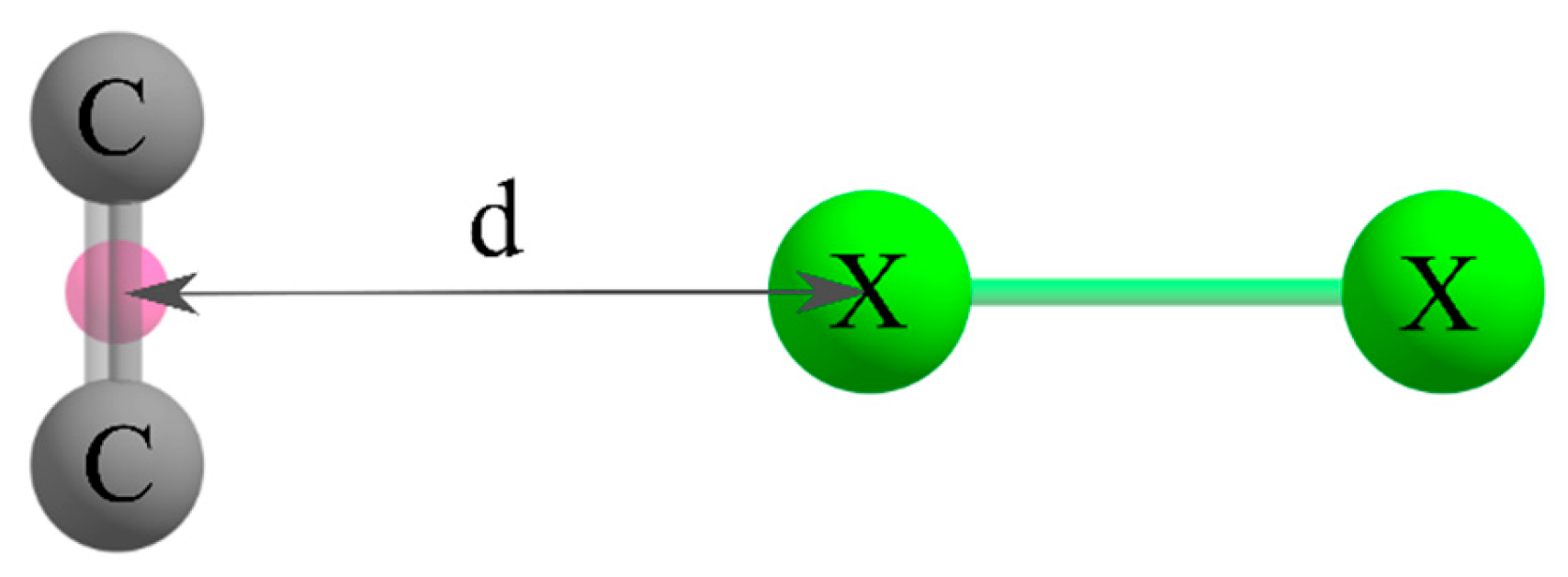
All monomers were optimized separately at the wB97X-D3/def2-TZVPP [27,28,30] level of theory. Where applicable, both cis and trans isomers were optimized. The cis isomers were selected not only due to their higher stability compared to the corresponding trans forms, but also to minimize steric hindrance. The interaction energies of the halogen–π dimers were then calculated at the same level of theory. To determine the most stable geometry, the distance between the center of the π-system (defined as the midpoint of the double or triple bond) (Figure 1) and the halogen molecule was systematically varied, and the minimum on the potential energy surface was identified. The interaction energies were corrected for basis set superposition error (BSSE) using the counterpoise method [33].
Additionally, symmetry-adapted perturbation theory (SAPT) calculations were performed at the SAPT0/def2-TZVPP [34] level of theory in the Psi4 program [35] in order to decompose the interaction energies into electrostatic, exchange, induction, and dispersion contributions.
Across entire work, the term symmetry is used primarily in the sense of local structural symmetry around the double (C=C) or triple (C≡C) bond. In this context, local symmetry describes how the substituents are distributed on both sides of the π-bond. Terminal alkenes and alkynes have a less balanced local electronic environment, whereas internal alkenes and alkynes possess a more symmetric local arrangement around the unsaturated bond (Table S2). Therefore, the effects of symmetry and substitution cannot be completely separated and should be interpreted as cooperative.
The electrostatic potential (ESP) was calculated at the wB97X-D3/def2-TZVPP level of theory on an electron density isosurface of 0.001 a.u. [36]. Special attention was given to the value of the electrostatic potential on the halogen atom located opposite to the interacting region (i.e., the σ-hole site, not facing the π-system).
The interactions were further examined through the Quantum Theory of Atoms in Molecules (QTAIM) approach, as proposed by Bader [37,38]. These calculations were performed using the AIMAll program package [39].

3. Results and Discussion

3.1. Quantum-Chemical Calculations

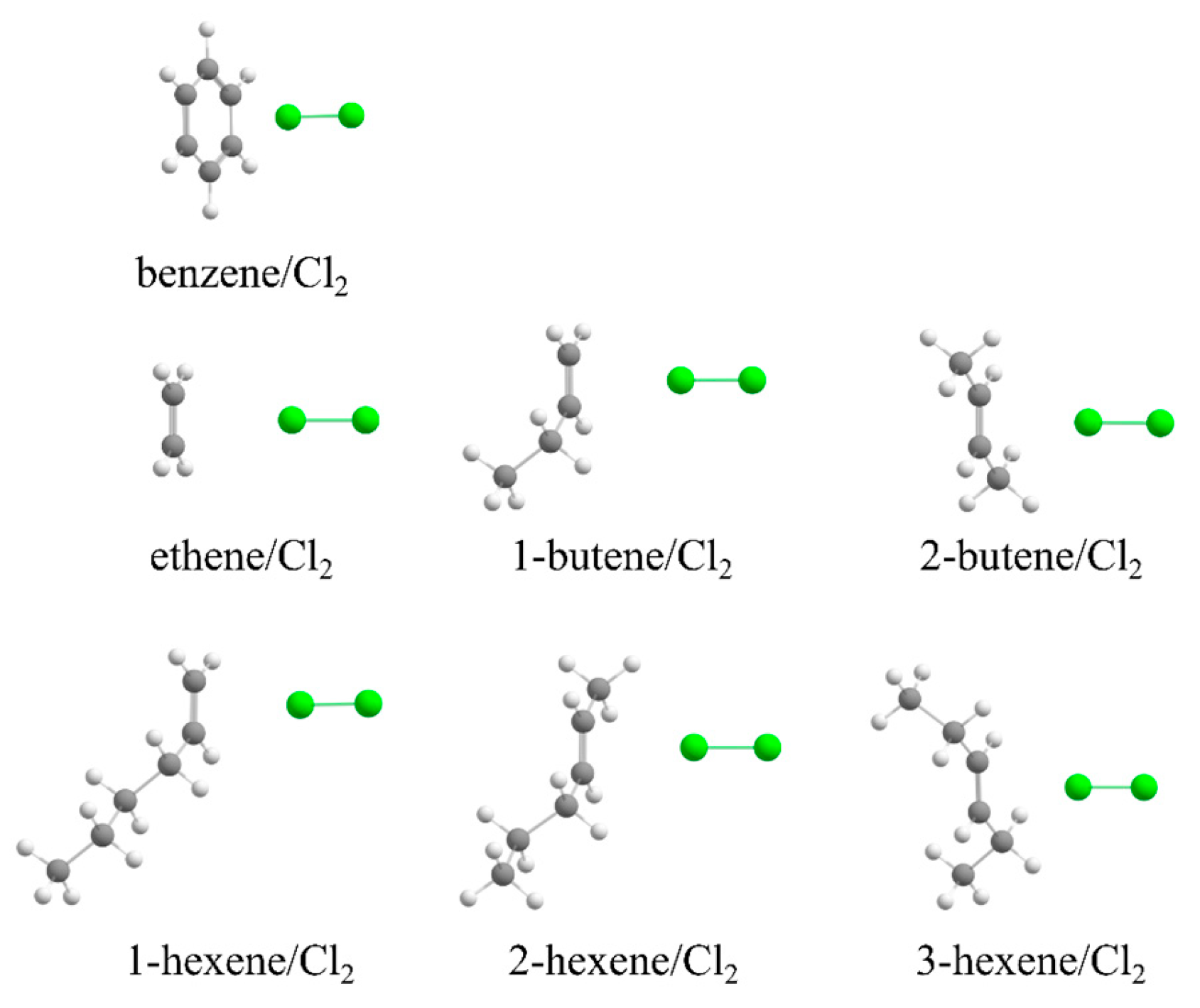
The interaction energies show a clear dependence on the nature of the halogen, increasing in magnitude from F2 to I2. This trend is first evident for benzene, where the interaction energy changes from −0.71 kcal/mol (F2) to −4.05 kcal/mol (I2), accompanied by an increase in the electrostatic potential (Vs) from 10.5 to 26.0 kcal/mol (Figure 2, Table 1). These results indicate that stronger halogen–π interactions are associated with larger σ-holes and higher positive electrostatic potentials on the interacting halogen.
A similar halogen-dependent trend is observed for alkenes. For example, in ethene the interaction energy ranges from −0.59 (F2) to −3.76 kcal/mol (I2), with Vs values increasing from 10.9 to 25.4 kcal/mol (Figure 2, Table 1). In addition to the halogen effect, the substitution pattern and the symmetry of the double bond also play important roles. Internal and more symmetrical alkenes exhibit stronger interactions than terminal ones. For instance, 2-butene shows more negative interaction energies than 1-butene (−1.01 vs. −0.80 kcal/mol for F2 and −5.11 vs. −4.52 kcal/mol for I2) (Figure 2, Table 1). A similar behavior is observed for hexenes, where 2-hexene and 3-hexene display comparable interaction strengths (−1.03 kcal/mol for F2 and −5.28 to −5.32 kcal/mol for I2), while the terminal 1-hexene exhibits weaker interactions (−0.81 and −4.60 kcal/mol for F2 and I2, respectively) (Figure 2, Table 1). This trend reflects the greater number and more balanced distribution of electron-donating alkyl groups in internal alkenes, which enhances the electron density of the π-system and stabilizes halogen–π interactions. Consistent with this, Vs values on interacting halogens are slightly lower for internal alkenes compared to terminal ones, indicating more efficient electrostatic stabilization.
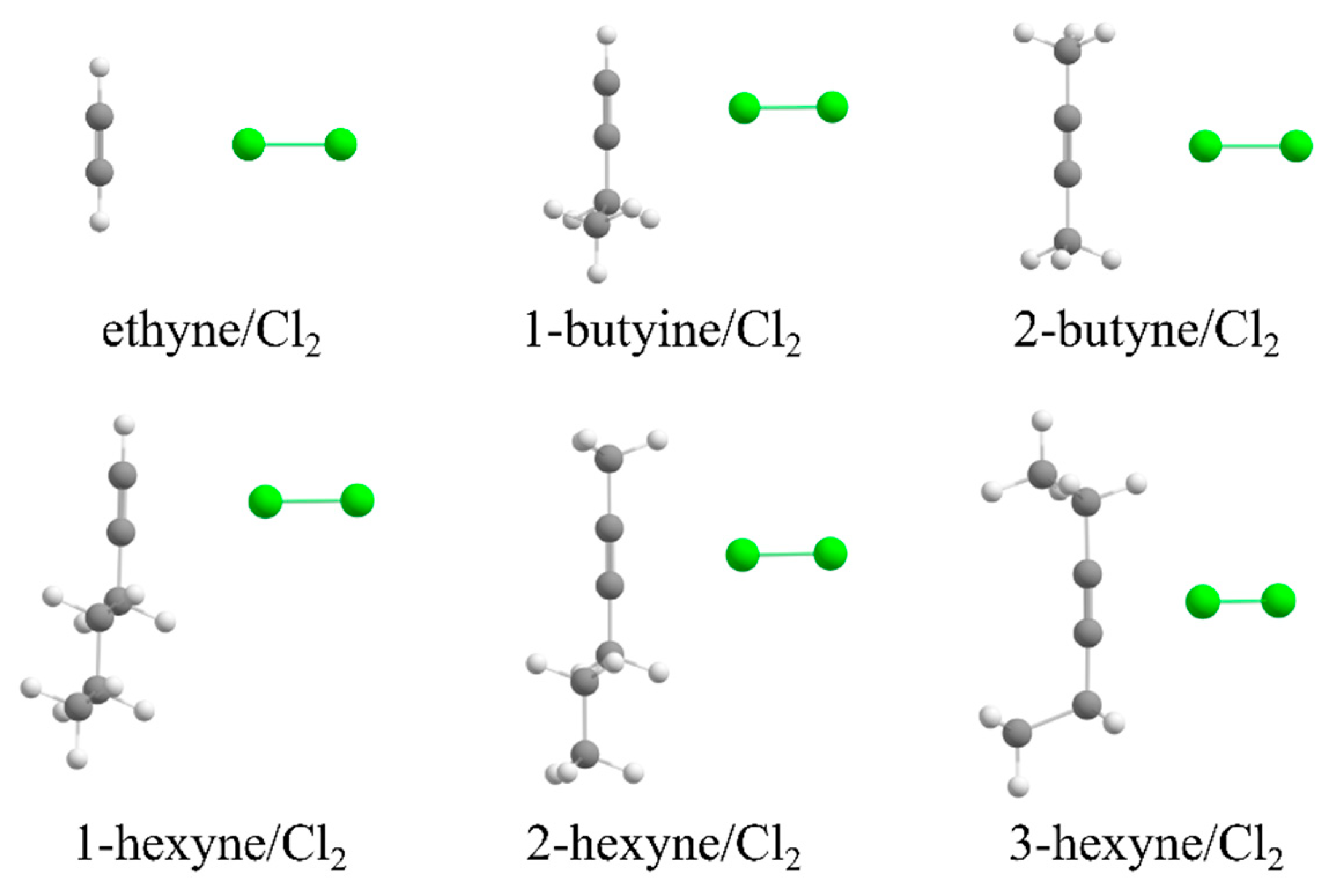
For alkynes, the same trends are observed, but the effect of substitution is even more pronounced (Figure 3, Table 2). In ethyne, the interaction energy ranges from −0.47 (F2) to −3.07 kcal/mol (I2), while in internal alkynes such as 2-hexyne and 3-hexyne, the interaction energies reach up to −1.04 and −5.61 kcal/mol, respectively. As in the case of alkenes, internal and more symmetrical alkynes consistently show stronger interactions than terminal ones (e.g., −5.61 vs. −4.69 kcal/mol for I2 in 2-hexyne vs. 1-hexyne) (Figure 3, Table 2). The corresponding Vs values, calculated for the halogen atom in the complexes, increase from 10.0 (F2) to 23.2–23.4 kcal/mol (I2), following the same halogen-dependent trend.
Across the series from F2 to I2, the d distance systematically increases by approximately 0.2–0.3 Å, reflecting the increasing size and van der Waals radii of the halogen atoms (Table 1 and Table 2). For example, in benzene complexes, the distance increases from about 3.2 Å for F2 and Cl2 to 3.4 Å for I2, while in alkenes and alkynes, similar trends are observed, with distances typically ranging from 2.9–3.1 Å for F2 to 3.2–3.3 Å for I2. This gradual elongation of the interaction distance is accompanied by a significant increase in interaction strength. Within each halogen series, a consistent trend is observed across the π-systems: more substituted and internal alkenes and alkynes exhibit shorter d distances than benzene, ethene, and terminal analogues. For example, in the F2 series, the d distance decreases from 3.1 Å for ethene to 2.9 Å for 2-butene and 2-hexyne, while terminal systems such as 1-hexene and 1-hexyne show slightly longer distances (3.0–3.1 Å). A similar trend is observed for heavier halogens; for instance, in the I2 series, the d distance decreases from 3.3 Å for ethene to 3.2 Å for internal systems, while terminal analogues again exhibit slightly longer distances. The change in electrostatic potential (ΔVs) upon dimer formation follows a consistent pattern. For benzene, the decrease in Vs is moderate, for example, from 13.8 to 10.5 kcal/mol (ΔVs = 3.3 kcal/mol) for F2 and from 33.6 to 26.0 kcal/mol (ΔVs = 7.6 kcal/mol) for I2. Alkenes show a comparable decrease (e.g., ΔVs = 2.9 kcal mol−1 for F2 and 8.2 kcal/mol for I2 in ethene), while in alkynes the reduction is slightly smaller for lighter halogens (ΔVs = 2.4 kcal/mol for F2) but remains significant for heavier ones (ΔVs = 7.2 kcal/mol for I2) (Figure 4, Table 1 and Table 2). This indicates that all π-systems induce a change in the halogen σ-hole, with aromatic systems showing a slightly stronger effect.
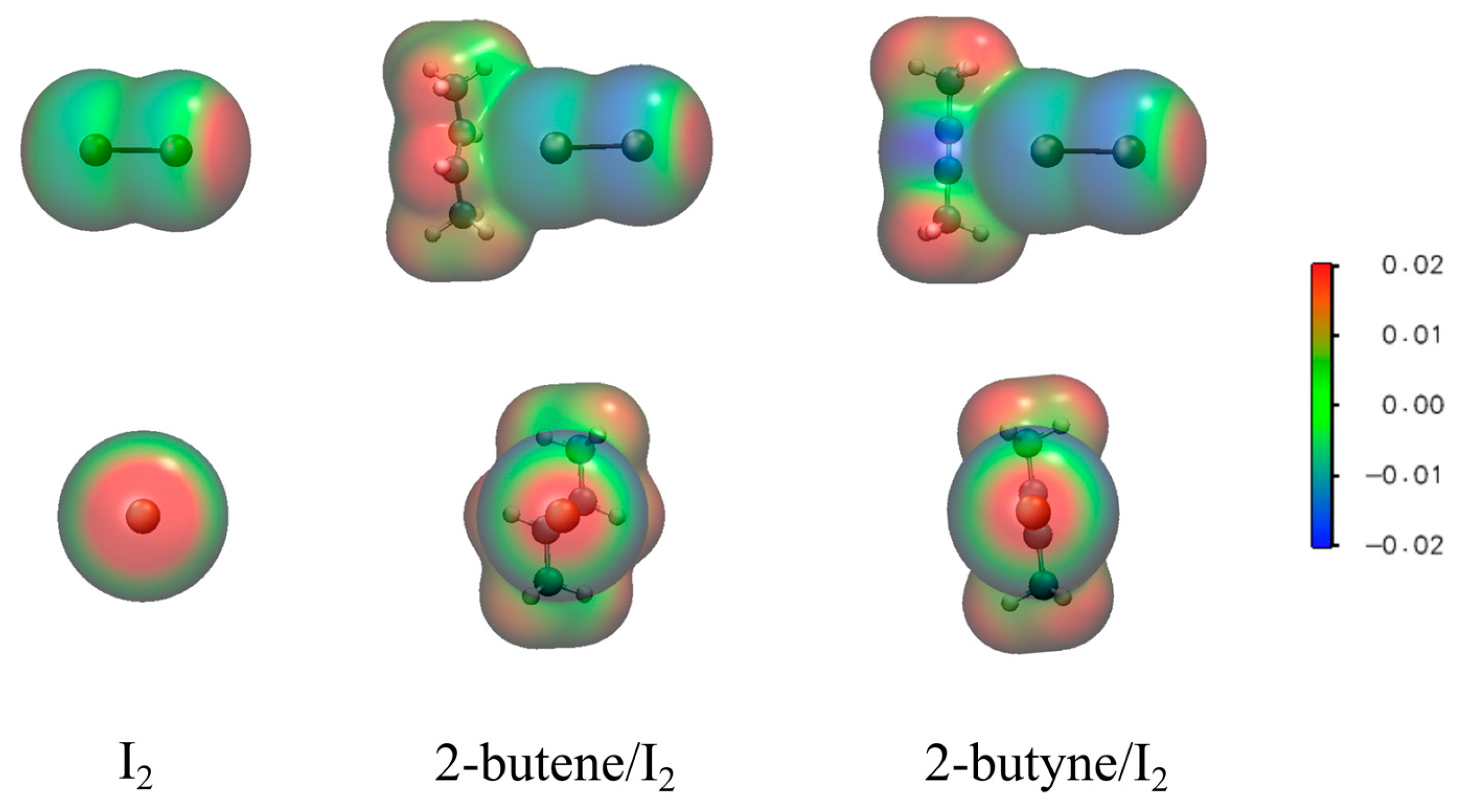
It can be observed that upon iodine binding to the double and triple bonds, the electron density on the iodine atom increases (Figure 4). This is evident by looking at the red region which becomes smaller after binding, indicating that iodine acquires a more negative partial charge.
Overall, the results demonstrate that the interaction strength is governed by the electrostatic potential on halogen and the nature of the π-system. Benzene exhibits somewhat stronger interactions than ethene and ethyne due to its delocalized electron density, while internal alkenes and alkynes show stronger interactions than their terminal counterparts. Between alkenes and alkynes, the interaction energies are comparable, with a slight tendency toward stronger interactions in more substituted and symmetric systems.
The SAPT0/def2-TZVPP decomposition reveals a systematic change in the balance of attractive interaction components across the halogen series and different π-systems (Table 3 and Table S3).
For benzene complexes, SAPT0/def2-TZVPP analysis shows that both dispersion and electrostatic contributions increase in magnitude from F2 to I2. The dispersion term changes from −1.26 kcal/mol for F2/benzene to −6.41 kcal/mol for I2/benzene, while the electrostatic contribution increases from −0.62 to −4.01 kcal/mol. According to Table S3, the dispersion contribution is the largest attractive term for all benzene complexes, amounting to 143%, 133%, 119%, and 115% of the total SAPT interaction energy for F2, Cl2, Br2, and I2 complexes, respectively. However, the electrostatic contribution is less dominant, with corresponding values of 70%, 87%, 79%, and 72%.
For alkene complexes, both dispersion and electrostatic interactions increase in magnitude from F2 to I2. In ethene complexes, the dispersion term increases from −1.03 kcal/mol for F2/ethene to −4.68 kcal/mol for I2/ethene, while the electrostatic interactions term increases from −1.21 to −5.77 kcal/mol. According to Table S3, dispersion contributes 202%, 120%, 149%, and 105% of the total SAPT interaction energy for F2, Cl2, Br2, and I2 ethene complexes, respectively, whereas the corresponding electrostatic contributions are 237%, 162%, 231%, and 129%. For substituted alkenes, the dispersion contribution generally increases with alkyl substitution and with internal positioning of the double bond, reflecting the larger contact surface and higher polarizability of the π-system. This trend is particularly evident for Cl2 and I2 complexes. In the I2 series, dispersion increases from −4.68 kcal mol−1 for ethene to −5.80 and −5.90 kcal/mol for terminal 1-butene and 1-hexene, respectively, and further to −7.60–−7.96 kcal/mol for internal 2-butene, 2-hexene, and 3-hexene. A similar trend is observed for Cl2 complexes, where dispersion increases from −2.69 kcal/mol for ethene to −3.91 and −3.97 kcal/mol for terminal alkenes, and to −5.14–−5.38 kcal/mol for internal alkenes.
For alkyne complexes, both dispersion and electrostatic contributions also increase in magnitude from F2 to I2. In ethyne complexes, the dispersion term changes from −0.73 kcal/mol for F2/ethyne to −4.09 kcal/mol for I2/ethyne, while the electrostatic contribution increases from −0.75 to −5.08 kcal/mol. According to Table S3, dispersion contributes 149%, 118%, 118%, and 108% of the total SAPT interaction energy for F2, Cl2, Br2, and I2 ethyne complexes, respectively, whereas the corresponding electrostatic contributions are 153%, 156%, 164%, and 134%. For substituted alkynes, the dispersion contribution generally increases with increasing alkyl substitution. This trend is evident for Cl2 and I2 complexes. For example, in the I2 series, the dispersion contribution increases from −4.09 kcal/mol for ethyne to −5.43/−5.61 kcal/mol for terminal 1-butyne and 1-hexyne, and further to −6.79–−7.50 kcal/mol for internal 2-butyne, 2-hexyne, and 3-hexyne. A similar increase is observed for Cl2 complexes, where dispersion changes from −2.32 kcal/mol for ethyne to −3.59/−3.70 kcal/mol for terminal alkynes and to −4.54–−4.96 kcal/mol for internal alkynes.

3.2. QTAIM Analysis

The QTAIM analysis of interactions between halogen molecules and selected species was performed as described in the literature. The properties of BCPs formed between these molecules include electron density (ρ(r)), Laplacian of the electron density (∇2ρ(r)), Lagrangian kinetic energy density (G(r)), potential energy density (V(r)), total electron energy density (H(r) = G(r) + V(r)), and the interatomic bond energy (Ebond = V(r)/2), and delocalization index [40]. Electron density is the first value that is used to classify bonds into shared (covalent bonds) with ρ(r) > 0.1 a.u. and closed-shell (ionic bonds, hydrogen bonds, van der Waals forces) with ρ(r) of around 0.01 a.u., according to the study by Bader and Essen [41,42]. The positive values of the Laplacian are also characteristic of the closed-shell interactions [43,44]. A more detailed classification includes the ratio of −G(r) and V(r), as described by Bianchi and coworkers in reference [45]. The ratio −G(r)/V(r) below 1 is characteristic of the covalent interactions, while the intermediate region includes interactions with the value of this parameter between 1 and 2. The ionic interactions have the value of −G(r)/V(r) above 2. The total energy density, defined as the sum of potential and kinetic energy density, can be applied to distinguish two classes of interactions [46,47]. If the total energy density is negative, the interactions are considered covalent. The interatomic energy (Ebond) was calculated as the half value of the potential energy density, as proposed by Espinosa [48,49]. Table 4 presents the properties of some notable examples of interactions.
The QTAIM analysis provides a detailed real-space description of halogen–π interactions and reveals trends largely consistent with quantum-chemical and SAPT results, while also offering additional insight into their nature. Across all investigated systems, the electron density at the bond critical points (ρ(r)) remains low, ranging from 0.0039 a.u. for the weakest interaction (F2–benzene, Table 4) up to 0.0164 a.u. for the strongest cases (e.g., Br2–2-hexyne and 3-hexyne, Table S4). These values are well within the typical range for closed-shell interactions. They are far below those characteristic of covalent bonds (>0.1 a.u.), confirming that halogen–π interactions are noncovalent in nature. For instance, in the F2 series, ρ(r) increases from 0.0039 a.u. (benzene, ΔEDFT = −0.71 kcal/mol) to 0.0087 a.u. (2-hexene, ΔEDFT = −1.03 kcal/mol), while in the Cl2 series, it increases from 0.0080 a.u. (benzene, −2.46 kcal/mol) to 0.0138 a.u. (2-hexene, −3.40 kcal/mol). A similar trend is observed for Br2 and I2 systems, where the highest ρ(r) values (0.0164 a.u. for Br2–2-hexyne and ~0.0145 a.u. for I2–2-hexene) correspond to the strongest interactions (up to −5.61 kcal/mol), as shown in Table S4. The conclusion about the nature of interactions is further supported by the positive values of the Laplacian ∇2ρ(r), which increase from 0.018 a.u. (F2–benzene) to as high as 0.045 a.u. (Br2–2-hexyne), indicating electron density depletion in the interatomic region [50]. Importantly, the systematic increase in ρ(r) and ∇2ρ(r) from F2 to I2 mirrors the trend observed in the interaction energies (e.g., −0.71 to −4.05 kcal/mol for benzene and −0.47 to −3.07 kcal/mol for ethyne), demonstrating that stronger interactions are associated with a greater accumulation of electron density in the interaction region.
A more detailed energetic picture is obtained from the analysis of the energy density components. Within each halogen series, increasingly negative V(r) values correspond directly to stronger interaction energies. For example, in the Cl2 complexes, V(r) changes from −2.58 kcal/mol (benzene) to −4.71 kcal/mol (2-hexene) (Table S4), paralleling the change in ΔEDFT from −2.46 to −3.40 kcal/mol (Table 1). In Br2 systems, V(r) spans a wider range, from −2.58 kcal/mol (benzene) to −5.96 kcal/mol (2-hexyne), again reflecting the increase in interaction strength (−3.34 to −4.81 kcal/mol, Table 1). This trend closely follows the increase in interaction energies and reflects the growing stabilizing contribution as the halogen becomes more polarizable. However, the total energy density H(r) remains positive in all cases (e.g., 0.79 kcal/mol for F2–benzene, decreasing to 0.38–0.62 kcal/mol for iodine complexes), indicating that these interactions remain within the closed-shell regime despite the increasing strength. The ratio −G(r)/V(r) falls within the range of 1.1–1.6 across all systems, further confirming their intermediate character between purely electrostatic and partially covalent interactions. Notably, this ratio decreases systematically from F2 (≈1.5–1.6) to I2 (≈1.1–1.2), suggesting a gradual increase in partial covalent character for the heavier halogens, in agreement with the observed increases in delocalization indices and interaction energies.
The effects of the π-system and the substitution pattern are also clearly reflected in the QTAIM parameters. For a given halogen, more substituted systems consistently exhibit higher electron densities and more negative V(r) values. For instance, in the F2 series, ρ(r) increases from 0.0056 a.u. in ethene to 0.0087 a.u. in 2-hexene, accompanied by a change in V(r) from −1.89 to −3.33 kcal/mol. A similar trend is observed for Cl2, where ρ(r) rises from 0.0090 a.u. (ethene) to 0.0138 a.u. (2-hexene), and V(r) becomes more negative from −2.75 to −4.71 kcal/mol (Table S4). These changes parallel the increase in interaction energies reported earlier (e.g., −2.19 to −3.40 kcal/mol for Cl2), confirming that substitution enhances the electron-donating ability of the π-system and strengthens the interaction. The same behavior is observed in alkynes, where internal systems such as 2-hexyne show higher ρ(r) (0.0164 a.u. for Br2) and more negative V(r) (−5.96 kcal/mol) compared to terminal analogues (0.0107 a.u. and −3.61 kcal/mol for ethyne), consistent with their stronger interaction energies (−5.61 vs. −3.07 kcal/mol for I2 systems). These results confirm that the QTAIM descriptors are highly sensitive to subtle electronic effects within the π-system.
The comparison between QTAIM-derived interaction energies (Ebond = V(r)/2) and the quantum-chemical interaction energies reveals notable discrepancies, particularly in the trends across different halogens. For example, in the benzene complexes, Ebond values range from −0.67 kcal/mol (F2) to −1.34 kcal/mol (I2) (Table 2 and Table S4), whereas the corresponding quantum-chemical interaction energies vary more significantly (−0.71 to −4.05 kcal/mol). While both approaches predict stronger interactions for heavier halogens, the QTAIM-based energies underestimate the relative increase and compress the energy scale. This discrepancy becomes even more pronounced in substituted systems, where, for instance, the Ebond values for Cl2 and Br2 complexes (−2.34 to −2.97 kcal/mol) do not fully reflect the differences observed in the DFT interaction energies. This behavior can be attributed to the inherent limitation of the Espinosa relationship, which relies on local properties at a single bond critical point and therefore cannot fully capture the nonlocal and dispersion nature of halogen–π interactions, as demonstrated by the SAPT analysis. Consequently, while QTAIM provides valuable qualitative and semi-quantitative insight into the interaction mechanism, it should be used in conjunction with energy decomposition methods to obtain a complete and accurate description of these systems.

3.3. Correlation Between Quantum-Chemical and QTAIM Parameters

A systematic comparison of quantum-chemical interaction energies (ΔEDFT) with QTAIM descriptors reveals clear but non-uniform relationships, reflecting the complex, partially nonlocal nature of halogen–π interactions. In previous studies involving halogen elements, interaction energies were correlated with other parameters, such as delocalization indices, atomic volumes, and s-character in C hybrid orbitals [40]. The electron density at the bond critical point (ρ(r)) shows a consistent positive correlation (R2 = 0.791) with the magnitude of interaction energies across all systems, as previously discussed. This indicates that ρ(r) can serve as a semi-quantitative descriptor of interaction strength. However, the correlation is not strictly linear across different halogens due to differences in dispersion.
A correlation is also observed for the potential energy density V(r), although the correlation coefficient is lower (0.663) than that for the electron density. When all halogens are considered together, the correlation between V(r) and ΔE becomes less uniform, as heavier halogens (Br2, I2) exhibit disproportionately stronger interaction energies relative to their V(r) values. This deviation is consistent with the SAPT results, which indicate a dominant dispersion contribution, although it should be emphasized that this effect is not fully captured by local QTAIM descriptors.
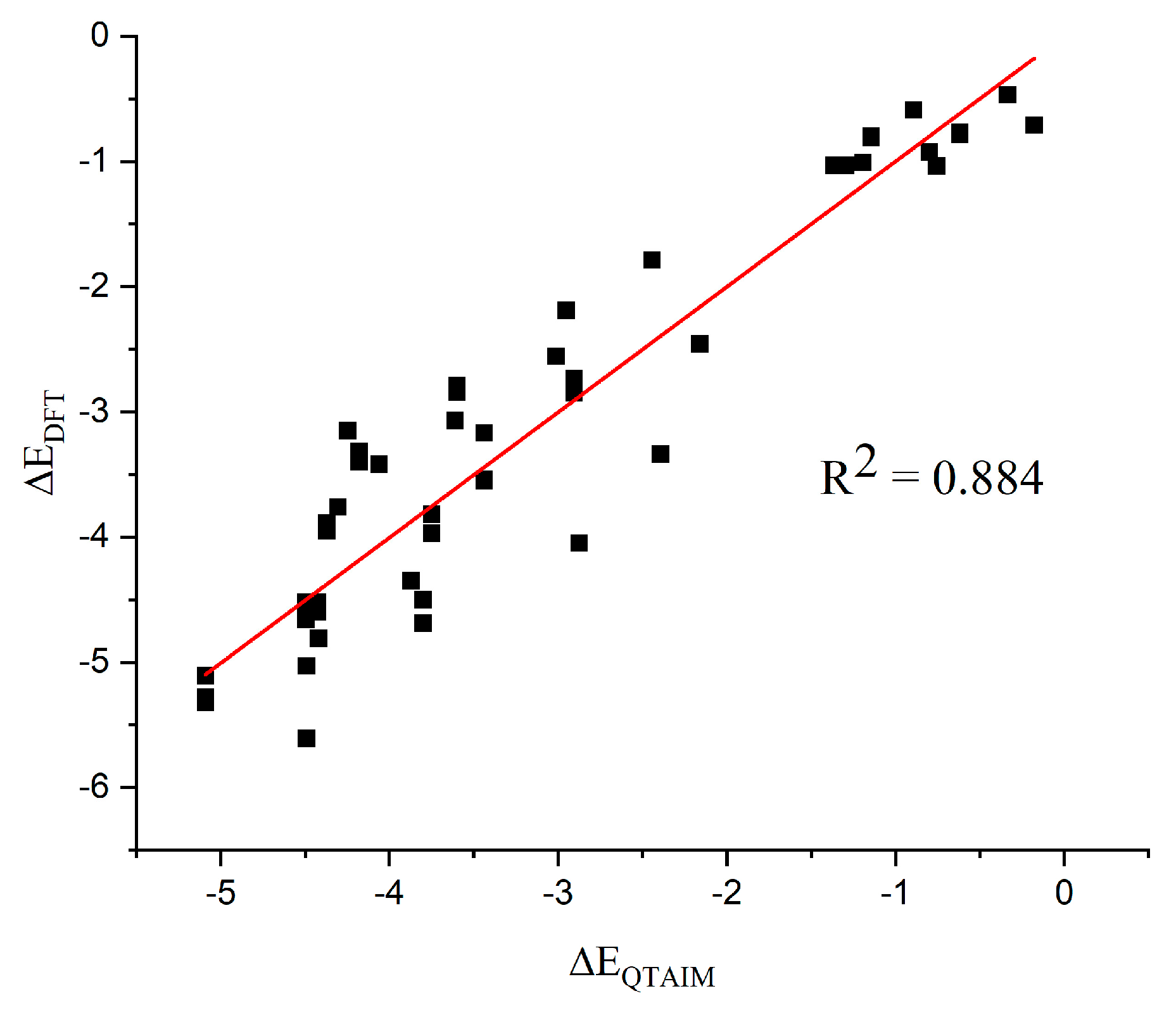
A multiple linear regression analysis using the full dataset yielded the relationship ΔEQTAIM = −1174.3·ρ(r) − 2.25·V(r) + 1.43 (R2 = 0.884, adjusted R2 = 0.879), where ΔEQTAIM represents the interaction energy estimated from QTAIM descriptors in the regression model. The coefficients associated with both descriptors were statistically significant, with p-values below 10−7. The standard errors of the coefficients were ±121.6 for ρ(r) and ±0.36 for V(r), confirming the robustness of the fitted parameters. Leave-one-out cross-validation yielded Q2 = 0.872 and RMSE = 0.561 kcal/mol, indicating good predictive consistency and low susceptibility to overfitting. Residual analysis did not reveal systematic deviations across the investigated systems, although somewhat larger deviations were observed for heavier halogens, consistent with the increasing contribution of dispersion interactions identified by SAPT analysis.
The correlation of quantum-chemical interaction energies (ΔEDFT) and calculated interaction energies from the previous equation (ΔEQTAIM) is shown in Figure 5. Both parameters contribute significantly: the electron density captures the extent of interaction, and the potential energy density reflects local stabilization at the bond critical point. The high coefficient associated with ρ(r) indicates that even small variations in electron density strongly influence interaction strength. These results confirm that a multi-parameter approach is necessary for an accurate description of halogen–π interactions.

4. Conclusions

In this work, halogen–π interactions between halogen molecules (F2, Cl2, Br2, and I2) and a series of π-systems, including benzene, alkenes, and alkynes, were systematically studied using DFT calculations, SAPT analysis, and QTAIM methodology. The results demonstrate that the strength of these interactions is primarily governed by the nature of the halogen atom, the degree of substitution, and the symmetry of the π-system.
A clear trend of increasing interaction strength from F2 to I2 was observed, reflecting the growing polarizability and the enhancement of the σ-hole. Symmetry and substitution were found to play a significant role, with internal and more symmetrical alkenes and alkynes consistently forming stronger interactions than their terminal analogues. These effects can be attributed to a more favorable distribution of electron density within the π-system, which enhances its interaction with the electrophilic region of the halogen molecule.
Energy decomposition analysis revealed that dispersion interactions increase for heavier halogens, while electrostatic contributions remain important across all systems. The analysis of the electrostatic potential further showed that the σ-hole on the halogen atom is significantly modified upon complex formation, with the changes correlating with the interaction strength. QTAIM results confirm the noncovalent, nature of these interactions, while also indicating a gradual increase in covalent character from lighter to heavier halogens.
This study highlights the importance of molecular symmetry and substitution in modulating halogen–π interactions and provides a more comprehensive understanding of the factors governing their strength and nature. These findings may contribute to the rational design of supramolecular systems, functional materials, and molecular recognition processes involving halogen bonding.

Supplementary Materials

The following supporting information can be downloaded at: https://www.mdpi.com/article/10.3390/sym18060974/s1, Table S1: The results of the benchmark study. Mean deviation (Δ) was calculated for each halogen separately (ΔF, ΔCl, ΔBr, and ΔI) as well as for results of all four halogens (Δtot); Table S2: Symmetry point groups, electrostatic potentials (Vs) of the π-systems above unsaturated bond at 0.001 a.u., and interaction energies ΔE (kcal/mol) of halogen–π complexes with F2, Cl2, Br2, and I2. Table S3: SAPT0/def2-TZVPP energy decomposition (kcal/mol) for halogen/π interactions for benzene, alkenes, and alkynes. Total interaction energy (TOTAL) is decomposed into electrostatic (ELST), exchange (EXCH), induction (IND), and dispersion interaction (DISP). The percentage is given with the respect to the TOTAL energy; Table S4: The calculated Bond Critical Points (BCP) properties of complexes with the chlorine/bromine/iodine molecules.

Author Contributions

Conceptualization, J.M.Ž. and D.S.D.; methodology, J.M.Ž., S.S.Z. and D.S.D.; software, J.M.Ž., S.S.Z. and D.S.D.; validation, J.M.Ž. and D.S.D.; formal analysis, J.M.Ž., S.S.Z. and D.S.D.; investigation, J.M.Ž., S.S.Z. and D.S.D.; resources, J.M.Ž. and D.S.D.; data curation, J.M.Ž., S.S.Z. and D.S.D.; writing—original draft preparation, J.M.Ž., S.S.Z., S.D.Z., N.Đ.P. and D.S.D.; writing—review and editing, J.M.Ž., S.S.Z., S.D.Z., N.Đ.P. and D.S.D.; visualization, J.M.Ž., S.D.Z., N.Đ.P. and D.S.D.; supervision, J.M.Ž. and D.S.D.; funding acquisition, J.M.Ž. and D.S.D. All authors have read and agreed to the published version of the manuscript.

Funding

This research was funded by the Ministry of Science, Technological Development and Innovation, Republic of Serbia (Contract numbers: 451-03-24/2026-03/200116, 451-03-33/2026-03/200168, 451-03-33/2026-03/200288, 451-03-34/2026-03/200146).

Data Availability Statement

The original contributions presented in this study are included in the article/Supplementary Materials. Further inquiries can be directed to the corresponding authors.

Conflicts of Interest

The authors declare no conflicts of interest.

Abbreviations

The following abbreviations are used in this manuscript:
DFTDensity Functional Theory
CCSD(T)Coupled Cluster with Single, Double and perturbative Triple excitations
CBSComplete Basis Set
SAPTSymmetry-Adapted Perturbation Theory
QTAIMQuantum Theory of Atoms in Molecules
ESPElectrostatic Potential
BSSEBasis Set Superposition Error
BCPBond Critical Point

References

  1. Malenov, D.P.; Zarić, S.D. Recognizing New Types of Stacking Interactions by Analyzing Data in the Cambridge Structural Database. Chemistry 2023, 5, 2513–2541. [Google Scholar] [CrossRef]
  2. Zarić, S.D. Metal–Ligand Aromatic Cation–π Interactions. Eur. J. Inorg. Chem. 2003, 2003, 2197–2201. [Google Scholar] [CrossRef]
  3. Bauzá, A.; Mooibroek, T.J.; Frontera, A. Halogen Bonding versus Chalcogen and Pnicogen Bonding: A Combined Cambridge Structural Database and Theoretical Study. CrystEngComm 2013, 15, 3137–3144. [Google Scholar] [CrossRef]
  4. Escudero, D.; Frontera, A.; Quiñonero, D.; Deyà, P.M. Interplay between Anion–π and Hydrogen Bonding Interactions. J. Comput. Chem. 2009, 30, 75–82. [Google Scholar] [CrossRef]
  5. Estarellas, C.; Frontera, A.; Quiñonero, D.; Deyà, P.M. Theoretical Study on Cooperativity Effects between Anion–π and Halogen-Bonding Interactions. ChemPhysChem 2011, 12, 2742–2750. [Google Scholar] [CrossRef]
  6. Politzer, P.; Murray, J.S.; Clark, T. Halogen Bonding and Other σ-Hole Interactions: A Perspective. Phys. Chem. Chem. Phys. 2013, 15, 11178–11189. [Google Scholar] [CrossRef] [PubMed]
  7. Murray, J.S.; Lane, P.; Politzer, P. σ-Hole Bonding: Molecules Containing Group VI Atoms. J. Mol. Model. 2007, 13, 1033–1038. [Google Scholar] [CrossRef]
  8. Politzer, P.; Murray, J.S.; Lane, P. σ-Hole Bonding and Hydrogen Bonding: Competitive Interactions. Int. J. Quantum Chem. 2007, 107, 3046–3052. [Google Scholar] [CrossRef]
  9. Cavallo, G.; Metrangolo, P.; Milani, R.; Pilati, T.; Priimagi, A.; Resnati, G.; Terraneo, G. The Halogen Bond. Chem. Rev. 2016, 116, 2478–2601. [Google Scholar] [CrossRef] [PubMed]
  10. Metrangolo, P.; Resnati, G. Halogen Bonding in Supramolecular Chemistry. Chem. Eur. J. 2001, 7, 2511–2519. [Google Scholar] [CrossRef]
  11. Mukherjee, A.; Tothadi, S.; Desiraju, G.R. Halogen Bonds in Crystal Engineering: Like Hydrogen Bonds yet Different. Acc. Chem. Res. 2014, 47, 2514–2524. [Google Scholar] [CrossRef] [PubMed]
  12. Saraogi, I.; Vijay, V.G.; Das, S.; Sekar, K.; Guru Row, T.N. C–Halogen⋯π Interactions in Proteins: A Database Study. J. Mol. Biol. 2013, 425, 2881–2893. [Google Scholar] [CrossRef]
  13. Shah, M.B.; Liu, J.; Zhang, Q.; Stout, C.D.; Halpert, J.R. Halogen–π Interactions in the Cytochrome P450 Active Site: Structural Insights into Human CYP2B6 Substrate Selectivity. J. Biol. Chem. 2012, 287, 21962–21973. [Google Scholar] [CrossRef] [PubMed]
  14. Wilcken, R.; Zimmermann, M.O.; Lange, A.; Joerger, A.C.; Boeckler, F.M. Halogen Bonding in Medicinal Chemistry. J. Med. Chem. 2013, 56, 1363–1388. [Google Scholar] [CrossRef]
  15. Lieffrig, J.; Jeannin, O.; Fourmigué, M. Expanded halogen-bonded anion organic networks with star-shaped iodoethynyl-substituted molecules: From corrugated 2D hexagonal lattices to pyrite-type 2-fold interpenetrated cubic lattices. J. Am. Chem. Soc. 2013, 135, 6200–6210. [Google Scholar] [CrossRef]
  16. Prasanna, M.D.; Guru Row, T.N. C–Halogen⋯π Interactions and Their Influence on Molecular Conformation and Crystal Packing: A Database Study. CrystEngComm 2000, 2, 135–140. [Google Scholar] [CrossRef]
  17. Forni, A.; Pieraccini, S.; Rendine, S.; Sironi, M. Halogen Bonds with Benzene: An Assessment of DFT Functionals. J. Comput. Chem. 2012, 33, 1417–1425. [Google Scholar] [CrossRef]
  18. Engelhard, M.U.; Zimmermann, M.O.; Mier, F.; Boeckler, F.M. Comparison of QM Methods for the Evaluation of Halogen–π Interactions for Large-Scale Data Generation. J. Chem. Inf. Model. 2018, 58, 1376–1385. [Google Scholar] [CrossRef]
  19. Wallnoefer, H.G.; Fox, T.; Liedl, K.R.; Tautermann, C.S. Dispersion-Dominated Halogen–π Interactions: Energies and Locations of Minima. Phys. Chem. Chem. Phys. 2010, 12, 14941–14949. [Google Scholar] [CrossRef]
  20. Nagels, N.; Hauchecorne, D.; Herrebout, W.A. Exploring the C–X⋯π Halogen Bonding Motif: An Infrared and Raman Study of the Complexes of CF3X (X = Cl, Br and I) with the Aromatic Model Compounds Benzene and Toluene. Molecules 2013, 18, 6829–6851. [Google Scholar] [CrossRef] [PubMed]
  21. Hauchecorne, D.; Nagels, N.; van der Veken, B.J.; Herrebout, W.A. C–X⋯π Halogen and C–H⋯π Hydrogen Bonding: Interactions of CF3X (X = Cl, Br, I or H) with Ethene and Propene. J. Phys. Chem. A 2012, 116, 13031–13042. [Google Scholar] [CrossRef]
  22. Nagels, N.; Herrebout, W.A. A Cryospectroscopic Infrared and Raman Study of the C–X⋯π Halogen Bonding Motif: Complexes of CF3Cl, CF3Br and CF3I with Ethyne, Propyne and 2-Butyne. J. Phys. Chem. A 2013, 117, 2753–2762. [Google Scholar] [CrossRef]
  23. Neese, F. The ORCA program system. WIREs Comput. Mol. Sci. 2012, 2, 73–78. [Google Scholar] [CrossRef]
  24. Neese, F. Software update: The ORCA program system—Version 5.0. WIREs Comput. Mol. Sci. 2022, 12, e1606. [Google Scholar] [CrossRef]
  25. Becke, A.D. Density-functional thermochemistry. V. Systematic optimization of exchange-correlation functionals. J. Chem. Phys. 1997, 107, 8554–8560. [Google Scholar] [CrossRef]
  26. Grimme, S. Semiempirical GGA-type density functional constructed with a long-range dispersion correction. J. Comput. Chem. 2006, 27, 1787–1799. [Google Scholar] [CrossRef] [PubMed]
  27. Weigend, F.; Ahlrichs, R. Balanced basis sets of split valence, triple zeta valence and quadruple zeta valence quality for H to Rn: Design and assessment of accuracy. Phys. Chem. Chem. Phys. 2005, 7, 3297–3305. [Google Scholar] [CrossRef]
  28. Grimme, S.; Ehrlich, S.; Goerigk, L. Effect of the damping function in dispersion corrected density functional theory. J. Comput. Chem. 2011, 32, 1456–1465. [Google Scholar] [CrossRef]
  29. Caldeweyher, E.; Bannwarth, C.; Grimme, S. Extension of the D3 dispersion coefficient model. J. Chem. Phys. 2017, 147, 034112. [Google Scholar] [CrossRef]
  30. Helgaker, T.; Klopper, W.; Koch, H.; Noga, J. Basis-set convergence of correlated calculations on water. J. Chem. Phys. 1997, 106, 9639–9646. [Google Scholar] [CrossRef]
  31. Watts, J.D.; Gauss, J.; Bartlett, R.J. Coupled-cluster methods with noniterative triple excitations for restricted open-shell Hartree–Fock and other general single determinant reference functions. Energies and analytical gradients. J. Chem. Phys. 1993, 98, 8718–8733. [Google Scholar] [CrossRef]
  32. Chai, J.D.; Head-Gordon, M. Systematic optimization of long-range corrected hybrid density functionals. J. Chem. Phys. J. Chem. Phys. 2008, 128, 084106. [Google Scholar] [CrossRef]
  33. Boys, S.F.; Bernardi, F. The Calculation of Small Molecular Interactions by the Differences of Separate Total Energies. Some Procedures for Reducing Errors. Mol. Phys. 1970, 19, 553–566. [Google Scholar] [CrossRef]
  34. Jeziorski, B.; Moszynski, R.; Szalewicz, K. Perturbation Theory Approach to Intermolecular Potential Energy Surfaces of van der Waals Complexes. Chem. Rev. 1994, 94, 1887–1930. [Google Scholar] [CrossRef]
  35. Parrish, R.M.; Burns, L.A.; Smith, D.G.A.; Simmonett, A.C.; DePrince, A.E.; Hohenstein, E.G.; Bozkaya, U.; Sokolov, A.Y.; Di Remigio, R.; Richard, R.M.; et al. Psi4 1.1: An Open-Source Electronic Structure Program Emphasizing Automation, Advanced Libraries, and Interoperability. J. Chem. Theory Comput. 2017, 13, 3185–3197. [Google Scholar] [CrossRef] [PubMed]
  36. Bader, R.F.W.; Carroll, M.T.; Cheeseman, J.R.; Chang, C. Properties of Atoms in Molecules: Atomic Volumes. J. Am. Chem. Soc. 1987, 109, 7968–7979. [Google Scholar] [CrossRef]
  37. Bader, R.F.W. A Bond Path: A Universal Indicator of Bonded Interactions. J. Phys. Chem. A 1998, 102, 7314–7323. [Google Scholar] [CrossRef]
  38. Bader, R.F.W.; Slee, T.S.; Cremer, D.; Kraka, E. Description of Conjugation and Hyperconjugation in Terms of Electron Distributions. J. Am. Chem. Soc. 1983, 105, 5061–5068. [Google Scholar] [CrossRef]
  39. Keith, T.A. AIMAll, version 16.05.18; TK Gristmill Software: Overland Park, KS, USA, 2016.
  40. Grabowski, S.J. QTAIM Characteristics of Halogen Bond and Related Interactions. J. Phys. Chem. A 2012, 116, 1838–1845. [Google Scholar] [CrossRef] [PubMed]
  41. Soliman, S.M.; Albering, J.; Abu-Youssef, M.A.M. Structural Analyses of Two New Highly Distorted Octahedral Copper(II) Complexes with Quinoline-Type Ligands: Hirshfeld, AIM and NBO Studies. Polyhedron 2017, 127, 36–50. [Google Scholar] [CrossRef]
  42. Lepetit, C.; Vabre, B.; Canac, Y.; Alikhani, M.E.; Zargarian, D. Pentacoordinated, Square Pyramidal Cationic PCP Ni(II) Pincer Complexes: ELF and QTAIM Topological Analyses of Nickel–Triflate Interactions. Theor. Chem. Acc. 2018, 137, 141. [Google Scholar] [CrossRef]
  43. O’Brien, S.E.; Popelier, P.L.A. Quantum Molecular Similarity. Part 2: The Relation between Properties in BCP Space and Bond Length. Can. J. Chem. 1999, 77, 28–36. [Google Scholar] [CrossRef]
  44. Bader, R.F.W. Atoms in Molecules: A Quantum Theory; Oxford University Press: Oxford, UK, 1990. [Google Scholar]
  45. Bianchi, R.; Gervasio, G.; Marabello, D. Experimental Electron Density Analysis of Mn2(CO)10: Metal–Metal and Metal–Ligand Bond Characterization. Inorg. Chem. 2000, 39, 2360–2366. [Google Scholar] [CrossRef]
  46. Jenkins, S.; Blancafort, L.; Kirk, S.R.; Bearpark, M.J. The Response of the Electronic Structure to Electronic Excitation and Double Bond Torsion in Fulvene: A Combined QTAIM, Stress Tensor and MO Perspective. Phys. Chem. Chem. Phys. 2014, 16, 7115–7126. [Google Scholar] [CrossRef] [PubMed]
  47. Kraka, E.; Cremer, D. Description of Chemical Reactions in Terms of the Properties of the Electron Density. J. Mol. Struct. THEOCHEM 1992, 255, 189–206. [Google Scholar] [CrossRef]
  48. Espinosa, E.; Alkorta, I.; Elguero, J.; Molins, E. From Weak to Strong Interactions: A Comprehensive Analysis of the Topological and Energetic Properties of the Electron Density Distribution Involving X–H⋯F–Y Systems. J. Chem. Phys. 2002, 117, 5529–5542. [Google Scholar] [CrossRef]
  49. Espinosa, E.; Molins, E.; Lecomte, C. Hydrogen Bond Strengths Revealed by Topological Analyses of Experimentally Observed Electron Densities. Chem. Phys. Lett. 1998, 285, 170–173. [Google Scholar] [CrossRef]
  50. Popelier, P.L.A. Atoms in Molecules: An Introduction; Prentice Hall: Harlow, UK, 2000. [Google Scholar]
Figure 1. Graphical representations of geometrical parameter used for calculations. The d distance is the distance from halogen atom (X) and centre of double or triple bond.
Symmetry 18 00974 g001
Figure 2. Graphical representations of the model systems used for calculations, showing benzene, alkenes (ethene, 1-butene, 2-butene, 1-, 2-, and 3-hexene) with Cl2. Molecules are depicted using ball-and-stick models, with carbon in gray, hydrogen in white, and chlorine in green.
Symmetry 18 00974 g002
Figure 3. Graphical representations of the model systems used for calculations, showing alkynes (ethyne, 1-butyne, 2-butyne, 1-, 2-, and 3-hexyne) in interaction with Cl2. Molecules are depicted using ball-and-stick models, with carbon in gray, hydrogen in white, and chlorine in green.
Symmetry 18 00974 g003
Figure 4. Electrostatic potential mapped onto the 0.001 a.u. electron density surface for I2 and its complexes with 2-butene and 2-butyne. The color scale ranges from red (electron-rich regions, negative potential) to blue (electron-deficient regions, positive potential), as shown on the right side, illustrating the charge distribution and interaction sites within the systems.
Symmetry 18 00974 g004
Figure 5. The dependency between the interaction energies obtained in DFT calculations (ΔEDFT) and calculated based on QTAIM parameters (ΔEQTAIM).
Symmetry 18 00974 g005
Table 1. Interaction distances (d, Å), interaction energies (ΔEDFT, kcal/mol), and maximum electrostatic potentials (Vs, kcal/mol) for halogen–π complexes formed between X2 (X = F, Cl, Br, I) and selected π-systems (benzene, alkenes, and alkynes). The values of vs. are given for both free halogen molecules and corresponding complexes. Calculations were performed at the wB97X-D3 level of theory with the def2-TZVPP basis set.
F2 Cl2 Br2 I2
SystemdΔEDFTVsdΔEDFTVsdΔEDFTVsdΔEDFTVs
free 13.8 25.6 30.3 33.6
benzene3.2−0.7110.53.2−2.4620.33.3−3.3423.83.4−4.0526.0
ethene3.1−0.5910.93.2−2.1920.93.1−3.1522.13.3−3.7625.4
1-butene3.0−0.8010.43.1−2.7919.83.1−3.8921.53.3−4.5224.9
2-butene2.9−1.0110.43.0−3.3218.53.1−4.5221.33.2−5.1123.3
1-hexene3.0−0.8110.23.1−2.8419.53.1−3.9521.33.3−4.6024.7
2-hexene2.9−1.039.73.0−3.4018.33.1−4.6421.13.2−5.2823.1
3-hexene2.9−1.039.73.0−3.4218.33.1−4.6621.03.2−5.3223.0
Table 2. Interaction distances (d, Å), interaction energies (ΔEDFT, kcal/mol), and maximum electrostatic potentials (Vs, kcal/mol) for halogen–π complexes formed between X2 (X = F, Cl, Br, I) and selected π-systems (alkynes). The values of Vs are given for both free halogen molecules and corresponding complexes. Calculations were performed at the wB97X-D3 level of theory with the def2-TZVPP basis set.
F2 Cl2 Br2 I2
SystemdΔEDFTVsdΔEDFTVsdΔEDFTVsdΔEDFTVs
ethyne3.2−0.4711.43.2−1.7921.43.2−2.5624.23.3−3.0726.4
1-butyne3.1−0.7710.83.1−2.7420.03.1−3.8222.13.3−4.5025.5
2-butyne3.0−0.9310.23.0−3.1718.63.1−4.3521.63.2−5.0323.6
1-hexyne3.1−0.7910.73.1−2.8519.83.1−3.9721.93.3−4.6925.3
2-hexyne3.0−1.0410.13.0−3.5418.53.0−4.8119.83.2−5.6123.4
3-hexyne3.0−1.0410.03.0−3.5518.33.0−4.8119.83.2−5.6123.2
Table 3. SAPT0/def2-TZVPP energy decomposition (kcal/mol) for selected halogen–π complexes. Values correspond to electrostatic (ELST), induction (IND), dispersion (DISP), and total interaction energy (TOTAL).
SystemELSTINDDISPTOTAL
F2/benzene−0.62−0.25−1.26−0.88
Cl2/benzene−2.70−1.17−4.15−3.12
Br2/benzene−3.31−1.47−4.96−4.18
I2/benzene−4.01−2.06−6.41−5.58
F2/ethene−1.21−0.45−1.03−0.51
Cl2/ethene−3.63−1.27−2.69−2.24
Br2/ethene−6.88−2.38−4.45−2.98
I2/ethene−5.77−2.85−4.68−4.47
F2/2-hexene−2.06−0.85−1.96−0.89
Cl2/2-hexene−6.05−2.38−5.30−3.79
Br2/2-hexene−7.07−2.75−6.18−5.05
I2/2-hexene−7.72−3.96−7.85−6.98
F2/2-hexyne−1.40−0.54−1.51−1.01
Cl2/2-hexyne−5.71−2.18−4.92−3.99
Br2/2-hexyne−8.60−3.25−6.82−5.37
I2/2-hexyne−7.64−3.53−7.45−7.17
Table 4. The calculated Bond Critical Points (BCP) properties of complexes with the F2 molecule.
Bondρ(r)
[a.u.]
2ρ(r)
[a.u.]
G(r)
[kcal/mol]
V(r)
[kcal/mol]
H(r)
[kcal/mol]
−G(r)/V(r)Ebond
[kcal/mol]
F2
benzene0.00390.0182.11−1.320.790.38−0.67
ethene0.00560.0252.87−1.891.000.36−0.93
1-butene0.00700.0303.64−2.511.120.36−1.24
2-butene0.00710.0303.66−2.541.120.33−1.27
1-hexene0.00700.0303.66−2.511.120.36−1.27
2-hexene0.00870.0374.59−3.331.270.33−1.65
3-hexene0.00870.0374.57−3.301.270.33−1.65
ethyne0.00430.0202.32−1.460.860.38−0.74
1-butyne0.00550.0252.97−1.961.000.36−0.98
2-butyne0.00690.0313.76−2.611.150.33−1.32
1-hexyne0.00550.0252.97−1.961.000.36−0.98
2-hexyne0.00690.0313.76−2.631.150.33−1.32
3-hexyne0.00690.0313.76−2.631.150.33−1.32
Disclaimer/Publisher’s Note: The statements, opinions and data contained in all publications are solely those of the individual author(s) and contributor(s) and not of MDPI and/or the editor(s). MDPI and/or the editor(s) disclaim responsibility for any injury to people or property resulting from any ideas, methods, instructions or products referred to in the content.