1. Introduction
The teleparallel formulation of gravity provides an alternative geometrical description of gravitation in which torsion, rather than curvature, encodes the gravitational interaction. In this framework, gravity is described by the tetrad (coframe) field and a flat spin–connection (SC), leading to the Teleparallel Equivalent of General Relativity (TEGR), which is dynamically equivalent to Einstein’s theory [
1,
2,
3,
4]. The torsion scalar
T plays the role of the Lagrangian density, replacing the Ricci scalar
R of standard General Relativity (GR).
A natural extension of TEGR is obtained by promoting the torsion scalar to an arbitrary function
, giving rise to modified teleparallel theories of gravity [
5,
6,
7]. These theories have attracted considerable attention as viable alternatives to GR, particularly in the context of cosmology, where they can account for the late-time acceleration of the Universe without invoking dark energy [
8,
9]. In addition,
models have been extensively studied in relation to cosmography, large-scale structure formation, and observational constraints [
10,
11,
12,
13,
14,
15].
Despite their phenomenological success, early formulations of teleparallel
gravity suffered from a lack of local Lorentz invariance, which raised fundamental concerns about their physical consistency [
13]. This issue was later resolved through the development of a fully covariant formulation based on the inclusion of a non-trivial SC [
16,
17,
18]. In this covariant approach, the pair
ensures both local Lorentz invariance and a consistent geometric interpretation of torsion. This formulation has become the standard framework for modern investigations in teleparallel gravity. In this context, physically meaningful solutions must be constructed within the covariant coframe/spin-connection (CSC) pair framework to avoid spurious constraints arising from non-invariant tetrad choices. In non-covariant formulations of teleparallel gravity, the choice of frame may artificially constrain the admissible solution space through frame-dependent antisymmetric field equations. Such formulations may generate spurious restrictions on spherically symmetric (SS) configurations and obscure the physical interpretation of torsion degrees of freedom.
The covariant formulation resolves this issue by consistently separating inertial and gravitational contributions through the introduction of a flat SC. In Einstein–Maxwell systems, this distinction becomes particularly important since improper tetrad choices may generate inconsistent electromagnetic sectors or spurious torsion constraints. Consequently, the CSC formalism provides the natural covariant framework for constructing physically admissible static SS solutions in nonlinear gravity.
Beyond cosmology, an important line of research concerns the construction and classification of exact solutions in
gravity. In contrast to GR, in which Birkhoff’s theorem strongly constrains SS solutions, modified teleparallel theories exhibit an enlarged class of solution space [
19,
20,
21]. In particular, static and SS configurations have been extensively investigated, including relativistic stars, anisotropic fluids, and black hole (BH) solutions [
22,
23].
A key development in this direction is the invariant classification program of teleparallel geometries, which was initiated in analogy with the Cartan–Karlhede algorithm in GR. Recent works by Coley, McNutt, and collaborators have demonstrated that teleparallel spacetimes can be classified using torsion invariants and Cartan scalars, thus providing a powerful tool to distinguish inequivalent geometries [
24,
25,
26]. This approach has been further extended to
gravity, where the role of symmetry and invariant structures becomes even more subtle due to the nonlinearity of the field equations. In this context, recent studies have explored SS and cosmological solutions using invariant methods and covariant formulations [
27,
28,
29,
30,
31].
An additional layer of complexity arises when matter fields are included, particularly electromagnetic fields. The coupling between teleparallel gravity and Maxwell theory leads to an enlarged class of charged solutions that generalize the Reissner–Nordström spacetime of GR. Several works have investigated charged BHs and electromagnetic configurations in
gravity [
32,
33,
34], revealing novel features such as modified horizon structures, deviations from standard asymptotics, and potential violations of no-go theorems known in GR. However, a systematic and covariant treatment of Einstein–Maxwell systems in
gravity, especially within the CSC formalism, remains incomplete.
From a theoretical perspective, the interplay between torsion and electromagnetism raises fundamental questions regarding the role of gauge symmetries, conservation laws, and invariant structures. While Maxwell’s equations retain their standard form in curved spacetime, their coupling to torsion can induce nontrivial modifications in the gravitational sector, affecting both the field equations and their solutions. Furthermore, the presence of electromagnetic sources provides a natural arena to test the consistency and predictive power of modified teleparallel theories beyond vacuum configurations.
Despite significant progress on exact solutions in modified teleparallel gravity, several important aspects remain incompletely understood. In particular, a unified covariant treatment simultaneously incorporating electromagnetic sources, conservation laws, invariant classification methods, and reconstruction procedures has not yet been systematically developed.
While charged solutions and SS geometries have been investigated in several particular contexts, the interplay between torsion invariants, Maxwell fields, and admissible nonlinear
sectors remains largely unexplored. Moreover, the role played by antisymmetric field equations in constraining electromagnetic configurations and reconstructed teleparallel models has not been fully clarified within the invariant classification program. Motivated by these considerations, the goal of this work is to develop a systematic and covariant analysis of SS solutions in
gravity with electromagnetic sources. We adopt the CSC formalism to ensure full local Lorentz invariance and construct the corresponding field equations in the presence of a Maxwell field, as done for other types of sources in Refs. [
27,
28,
29,
30]. Particular attention is devoted to the role of symmetry, invariant classification, and the structure of solution space.
In addition, we aim to bridge the gap between formal developments and physically relevant models by deriving explicit classes of solutions and analyzing their properties. This includes the investigation of power-law (PL) ansätze, charged configurations, and the behavior of conservation laws in the absence or presence of electric charge. In particular, the reconstruction procedure allows the reduced field equations to be transformed into ordinary differential equations for the unknown function . We also discuss the implications of our results for observational signatures and possible deviations from GR.
To summarize concretely, the main contributions of the present work are:
We derive the covariant Einstein–Maxwell field equations for static SS teleparallel geometries using the CSC formalism.
We obtain explicit conservation law solutions for radial electric, magnetic, and mixed electromagnetic sectors compatible with spherical symmetry.
We construct a closed-form reconstruction procedure that allows for the determination of admissible nonlinear models for PL coframe ansätze.
We extend the Coley–Landry invariant classification program to electromagnetic sectors in covariant gravity.
We analyze the corresponding horizon structures, torsion singularities, and stability conditions associated with reconstructed solution branches.
We investigate wormhole-like (WH-like) sectors and discuss how nonlinear torsion contributions may effectively support WH-like geometries by shifting the NEC-violating contribution to the effective torsion sector rather than imposing it directly on the physical Maxwell source.
From a physical perspective, these solutions provide a unified framework to investigate modified compact objects, generalized Reissner–Nordström (RN) geometries, effective cosmological sectors, and WH-like configurations within nonlinear teleparallel gravity. In addition, the reconstructed models may lead to observable deviations from GR through modifications of horizon structures, strong-field lensing, BH shadows, and quasi-normal mode spectra.
The paper is organized as follows. In
Section 2, we review the covariant formulation of teleparallel
gravity, introduce the CSC formalism, and derive the Einstein–Maxwell field equations together with the associated conservation laws. In
Section 3,
Section 4 and
Section 5, we specialize to static SS configurations and investigate constant-radius, BH-like, and WH-like sectors using reconstruction and invariant classification techniques. We then analyze the corresponding stability conditions, horizon structures, and singularity properties. Finally, in
Section 6, we summarize our results, discuss the physical limitations of the present approach, and outline possible future developments.
3. Exact Solutions for in the Vacuum
In this section, we investigate the first class of exact reconstructed teleparallel functions generated by static SS coframe configurations. The objective is to determine how nonlinear torsion corrections modify the horizon structure, singularity behavior, invariant classification, and dynamical stability of charged Einstein–Maxwell solutions in covariant gravity.
3.1. Vacuum Solutions
In this first step, we consider the vacuum electromagnetic case defined by and , corresponding to static configurations. This regime is particularly relevant for near-horizon geometries and effective vacuum states in modified teleparallel gravity.
The simplest class of solutions corresponds to TEGR-like models of the form
which always admit consistent solutions. In this case, the constant
effectively absorbs the electromagnetic vacuum energy, leading to a theory equivalent to GR with an effective cosmological constant.
Constant-torsion configurations, defined by , similarly reduce to GR-like solutions. These correspond to vacuum branches where torsion behaves as an effective cosmological sector.
Beyond these trivial configurations, nonlinear teleparallel models give rise to richer structures. PL models of the form
generate scale-invariant solutions and introduce nontrivial modifications to the gravitational sector. LOG extensions,
provide mild corrections and are typically associated with quantum-inspired modifications. EXP models,
lead to strong-field corrections and may admit constant-torsion vacuum configurations, although they are generally more sensitive to perturbations.
More generally, COMP models combining these contributions allow for multi-branch structures and richer phenomenology, interpolating between different invariant classes of teleparallel geometries. A typical example is:
Unlike GR, nonlinear torsion corrections allow several inequivalent vacuum branches for the same symmetry sector. The corresponding analytical branches and their geometric interpretations are summarized in
Table 1.
Table 1 also indicates that stability is closely tied to the behavior of
.
3.2. Closed-Form Power-Law Reconstruction, Classification and Stability
We consider the constant
sector and adopt the PL ansatz
and
with constants
. We also consider a non-vacuum solution by adding a
electromagnetic contribution. From Equation (
40), the torsion scalar reads
where
and
.
The Equation (
53) is valid provided
remains monotonic in the domain of interest, ensuring a well-defined mapping between the radial coordinate and the torsion scalar. This condition restricts the admissible parameter space
and guarantees the consistency of the reconstruction procedure.
To obtain explicit reconstructed teleparallel solutions, we specialize to PL coframe configurations characterized by two independent scaling parameters . These parameters control both the asymptotic behavior of the lapse function and the scaling structure of the torsion scalar .
Substituting the PL coframe ansatz into the reduced field equations and expressing the radial coordinate as a function of the torsion scalar allows the reconstruction equations to be reduced to an ordinary differential equation for the unknown function
. This procedure provides a systematic mechanism to identify admissible nonlinear teleparallel models compatible with the assumed symmetry structure. Using the inversion relation (
53), all radial powers appearing in the reduced field equations can be rewritten as powers of
. Substituting this result into Equations (
37)–(
40) gives
where
and
. Equation (
54) has the structure of a generalized Euler-type differential equation in the shifted variable
, whose coefficients depend only on the scaling parameters
and the electromagnetic source sector. The reconstruction equation should be interpreted as a consistency condition selecting admissible effective teleparallel sectors within the assumed symmetry ansatz. This structure explains why PL, LOG, and COMP solutions naturally emerge within the reconstruction scheme.
The reconstruction equation shows that nonlinear torsion corrections are directly controlled by the interplay between the scaling parameters and the electromagnetic source term encoded in . This highlights the role of symmetry and conservation laws in selecting admissible teleparallel models.
The homogeneous part of Equation (
54) leads to
For a generic source term
, we set
,
and then Equation (
54) becomes:
Solving Equation (
56) with the integrating factor
, we obtain
where
. Equation (
57) explicitly demonstrates that the reconstructed function
inherits the scaling properties of both the torsion scalar and the electromagnetic sector, leading to a hierarchy of admissible nonlinear models. This gives three representative cases:
(
):
(
constant):
Physically, the parameter
a in Equations (
57)–(
60) primarily governs the horizon structure through the scaling behavior of the lapse function, while the parameter
b controls the near-core behavior of torsion invariants and therefore the singularity structure of the reconstructed geometry.
The classification of reconstructed solutions follows directly from Equations (
57)–(
60). TEGR-like configurations arise when
or
, corresponding to constant-torsion sectors or effective cosmological branches. PL models are obtained for generic values of
with
, leading to scale-invariant modifications of the gravitational sector.
LOG regimes emerge when or , where nonlinear torsion corrections introduce LOG scaling behavior. EXP sectors correspond formally to the limit or , and are associated with strongly nonlinear torsion dynamics. Finally, COMP models arise from superpositions of these contributions and lead to multi-scale teleparallel geometries.
More physically, the scaling parameters therefore encode the competition between horizon formation and torsion regularization. While the parameter a primarily controls the redshift structure and the existence of compact trapped regions, the parameter b governs the ultraviolet behavior of torsion invariants near the geometric core. From a broader perspective, these reconstructed solutions may be interpreted as effective geometric phases of teleparallel gravity. Each class corresponds to a distinct balance between torsion dynamics, electromagnetic contributions, and symmetry constraints, leading to qualitatively different compact-object configurations. This mechanism explains the emergence of scale-invariant and multi-branch teleparallel models.
3.3. Critical Points and Singular Structures
The reconstructed teleparallel sectors may develop critical behavior either through geometric divergences near or through degeneracies associated with the nonlinear torsion sector. In particular, singular configurations may arise whenever torsion invariants diverge or when the effective coupling factor approaches zero.
Thus, the singularity analysis is performed at the level of torsion invariants rather than only through the metric functions. For , the torsion scalar generally diverges near the origin, leading to BH-like geometries with central singularities. The critical branch corresponds to softer LOG behavior, while configurations with may regularize the torsion sector and generate nonsingular compact cores.
Configurations satisfying formally require special attention, as they correspond to a vanishing effective gravitational coupling, potentially signaling strong-coupling regimes or a breakdown of the effective teleparallel description.
Additional degeneracies may occur when , signaling the transition between dynamically distinct teleparallel branches.
These singular behaviors can be systematically characterized using the torsion invariants introduced in
Section 2.5, which provide a coordinate-independent diagnostic of the geometric structure of the solutions.
3.4. Stability Analysis and Physical Interpretation
The stability properties of the reconstructed teleparallel models can be analyzed by considering linear perturbations around a background torsion configuration
. In this framework, the effective scalar degree of freedom is characterized by the ratio
which provides a leading-order diagnostic for ghost and tachyonic instabilities up to model-dependent normalization factors. This expression should be interpreted as a leading-order scalar-sector diagnostic rather than a complete perturbative stability criterion.
Stable configurations correspond to and , ensuring a positive effective mass and the absence of pathological modes. Conversely, negative values of signal the presence of tachyonic instabilities and dynamical instability of the torsion sector.
Although this criterion captures the leading-order behavior, a complete stability analysis would require the study of coupled perturbations involving both torsion and metric degrees of freedom.
In the constant-radius regime, the reconstructed solutions correspond to limiting geometries such as Nariai-type spacetimes, near-horizon configurations of charged BHs, and effective cosmological vacua. Although not BHs themselves, these solutions describe limiting geometries of generalized Reissner–Nordström spacetimes [
33,
34].
For the PL reconstructed branch, substituting Equation (
55) into the definitions of
and
gives
The absence of ghost and tachyonic instabilities also requires
and
. The ghost-free condition is therefore
while the absence of tachyonic modes requires
These inequalities can be recast in terms of the effective exponent
, which provides a more transparent classification of stability regimes. Configurations with
correspond to potentially stable modified-gravity regimes, provided Equations (
64) and (
65) hold on the physical branch considered. The critical case
reproduces the TEGR limit. Values in the range
lead to infrared instabilities, and negative values of
n indicate pathological strong-coupling behavior. More concretely:
Thus, the effective exponent controls both the invariant class and the leading scalar-torsion stability properties.
In summary, the reconstructed teleparallel solutions exhibit a rich interplay between torsion dynamics, electromagnetic contributions, and geometric structure. Depending on the choice of parameters, the solutions may interpolate between GR-like vacuum configurations, modified compact objects, and potentially regularized geometries supported by nonlinear torsion effects. These results emphasize that teleparallel gravity provides a unified framework in which geometry, matter coupling, and stability properties are intrinsically linked through the torsion sector.
4. Exact Solutions for in the Vacuum
We now consider the physically most relevant sector
, which corresponds to the standard areal-radius gauge for static SS geometries. In contrast with the constant-radius sector of
Section 3, this class contains BH-like configurations, charged compact objects, and their nonlinear teleparallel generalizations [
8,
9]. In vacuum, the Maxwell sector reduces to the usual Coulomb scaling,
and
, while the nonlinear dependence of
modifies the gravitational field equations through torsion corrections.
4.1. BH-like Solutions
In the TEGR limit
, the standard RN-type geometry is recovered,
with horizon radii
This solution provides the reference GR branch against which nonlinear teleparallel corrections can be compared.
For PL models of the form
the lapse function acquires short-distance corrections of the schematic form
The exponent
n controls the strength of torsion correction near the compact core, while the sign and magnitude of
determine whether the correction enhances or weakens the effective gravitational potential, as in Refs. [
23,
33,
34].
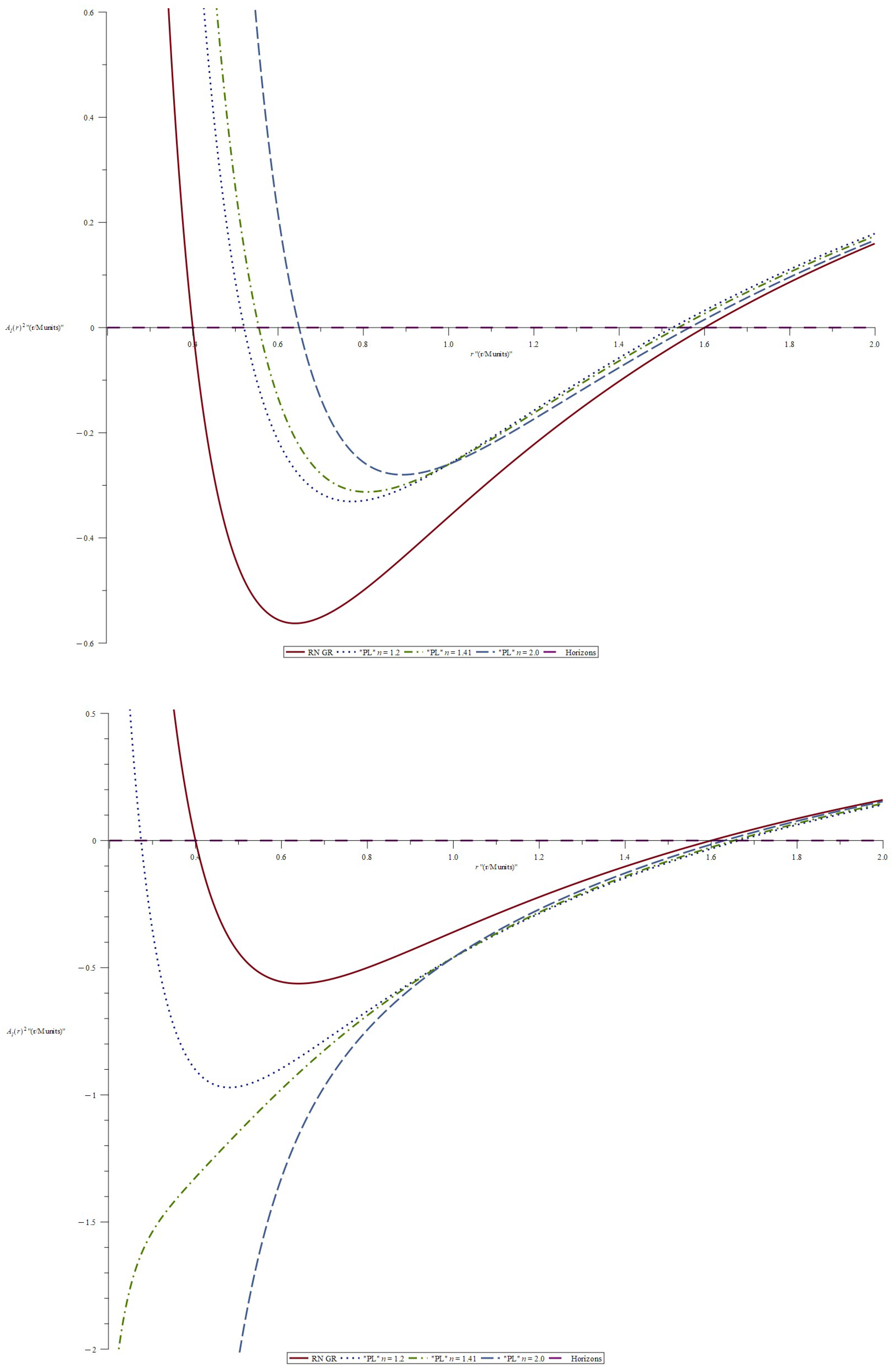
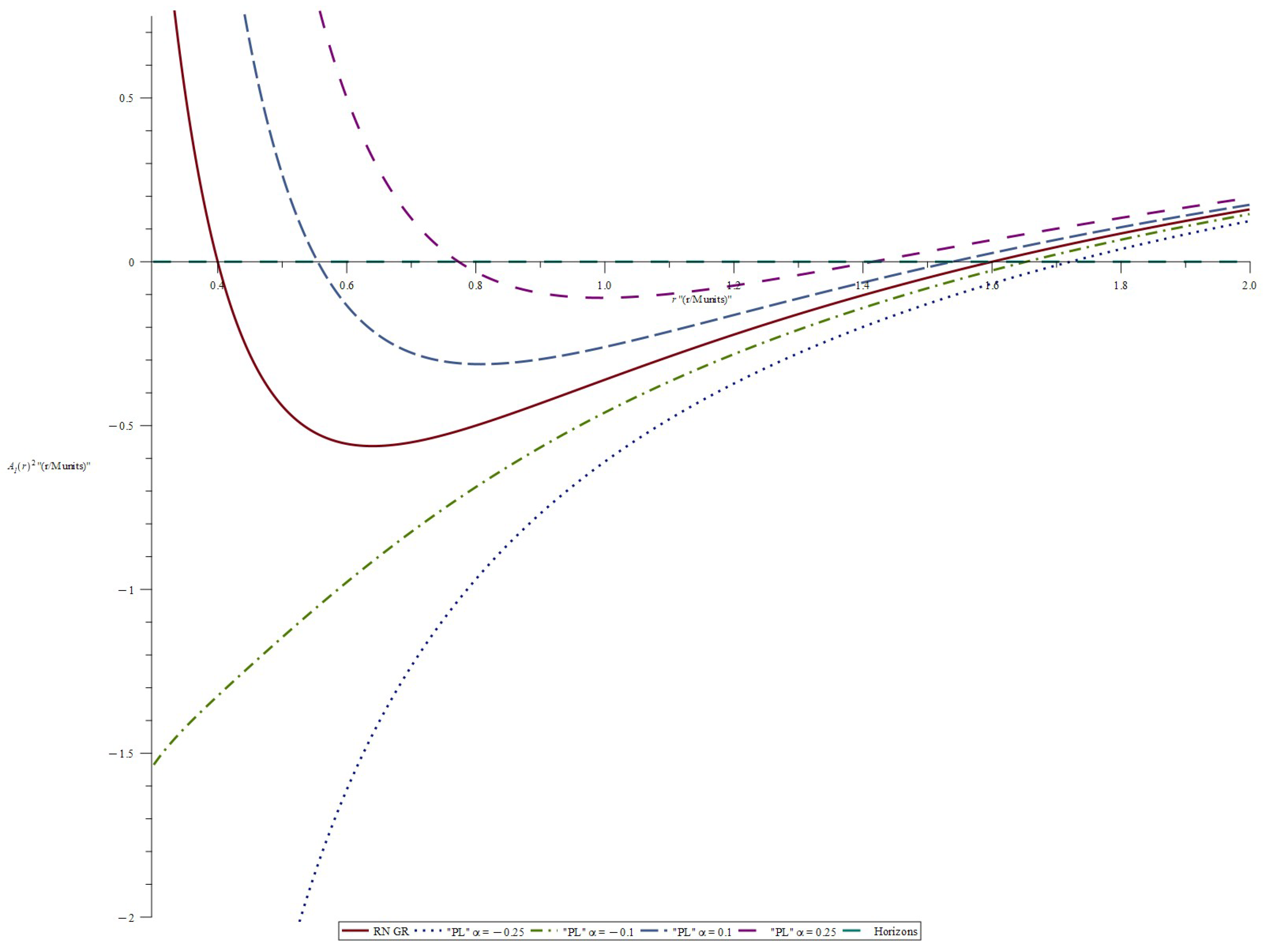
Figure 1 illustrates the effect of the PL exponent
n on the lapse function
for fixed
, while
Figure 2 shows how varying
shifts the horizon structure for fixed
. The solid curve corresponds to the GR/RN limit
.
LOG models,
generate mild infrared or asymptotic corrections, whereas EXP models,
can produce stronger nonlinear modifications in the high-torsion regime. These branches may modify the horizon structure, effective energy conditions (ECs), and strong-field observables relative to the RN geometry.
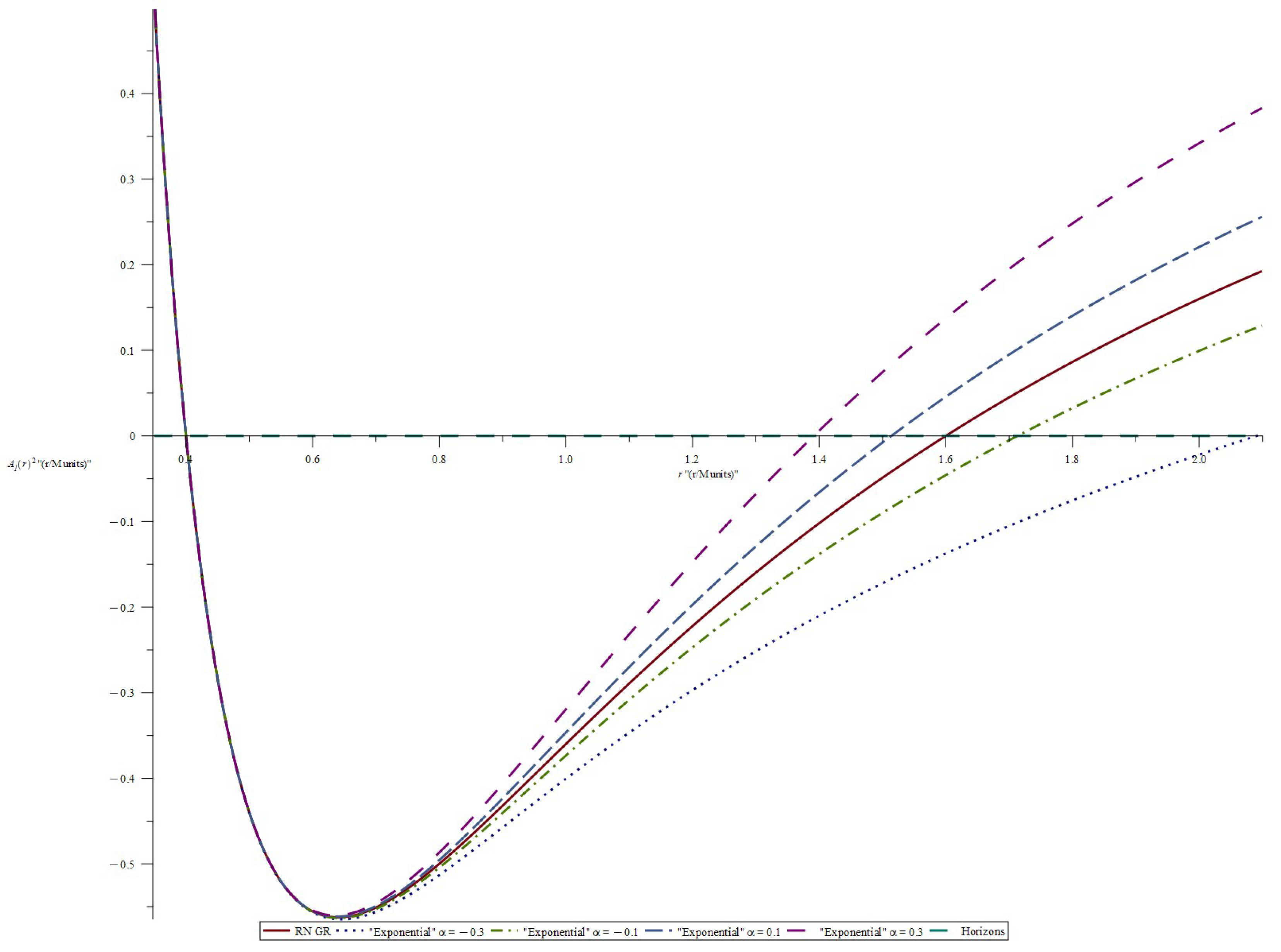
Figure 3 displays the corresponding EXP correction, showing how the parameter
modifies the near-core behavior while preserving the RN branch as a reference solution.
The resulting invariant classes are summarized in
Table 2, which organizes the
sector according to the reconstructed
model, geometric interpretation, horizon structure, and stability behavior. Physically,
Table 2 highlights that nonlinear torsion corrections can either preserve, deform, or entirely remove horizon structures. In particular, EXP and COMP models provide natural candidates for torsion-regularized BH-like configurations within the present framework. The zeros of the plotted lapse functions indicate candidate horizon locations, while changes in the number and position of these zeros illustrate how nonlinear torsion corrections deform the RN horizon structure.
At a more structural level, the nonlinear function does not modify the Maxwell sector directly but instead deforms the effective gravitational potential through torsion-induced corrections in the field equations. As a consequence, different functional forms of map to distinct geometric deformations of the lapse function , which control horizon formation, photon sphere structure, and strong-field observables.
In contrast with GR, where Birkhoff’s theorem enforces the uniqueness of static SS vacuum solutions, the nonlinear structure of gravity allows multiple inequivalent branches for the same symmetry class. This non-uniqueness is directly reflected in the variety of reconstructed solutions presented in this section.
4.2. Extended Power-Law Reconstruction, Coley–Landry Classification, Horizons and Singularities for
While the previous subsection focused on specific functional forms of
, we now generalize the analysis by performing a systematic reconstruction based on the PL coframe ansatz, allowing for a unified treatment of multi-scale torsion effects. For the PL coframe ansatz
and
, the torsion scalar obtained from Equations (
41)–(
44) takes the multi-scale form
where
Unlike the
sector, the areal-radius case contains several competing radial scalings. This multi-scale torsion structure naturally leads to COMP reconstruction branches and richer invariant classes.
Beyond simple PL reconstructions, the multi-scale structure of
allows several COMP nonlinear models. A representative double PL branch is
with
Log-corrected branches may be written as
while EXP-power hybrid models take the form
More general rational and running-index models can also be constructed, for example
and
These branches correspond to generalized Coley–Landry COMP invariant classes and encode multi-scale torsion corrections.
The lapse function associated with the PL ansatz is
It should be emphasized that this expression corresponds to the leading behavior of the lapse function within the PL ansatz and must be supplemented by the full reconstructed solution to determine the exact causal structure. Candidate horizon locations are determined by the zeros of the full lapse function. The leading PL expression
does not by itself generate a finite-radius horizon. Horizon formation therefore requires the full reconstructed lapse function, where the leading PL behavior is supplemented by RN-like and torsion-induced corrections:
The interplay between these terms determines the number and nature of horizons. More generally, the horizon structure is controlled by the competition between the GR-like term and the nonlinear torsion corrections.
The vanishing or divergence of determines the qualitative causal behavior of the geometry. The exponent a controls the redshift structure of the geometry. In particular, leads to a decreasing lapse function toward the origin, which is a necessary (but not sufficient) condition for BH horizon formation. The existence of actual horizons requires matching with subleading terms in the full reconstructed solution. For , no finite-radius zero of the lapse function appears within this simple PL ansatz, and the geometry is better interpreted as horizonless or naked, depending on the behavior of the torsion invariants. The case reproduces the scaling behavior associated with TEGR/RN-type sectors.
The singularity structure is controlled primarily by the exponent
b, which determines the ultraviolet behavior of the torsion invariants. Near the origin, the leading scalings are
The asymptotic structure further constrains the physical admissibility of the solutions. As
, the torsion scalar behaves as
, ensuring asymptotic flatness for admissible
models. Near the core (
), the dominant contribution depends on
b:
, leading to divergent, critical, or regularized behavior depending on the sign of
.
For
, the torsion invariants generically diverge as
, indicating a central singularity analogous to the RN core. The critical case
corresponds to a softer singular branch, while
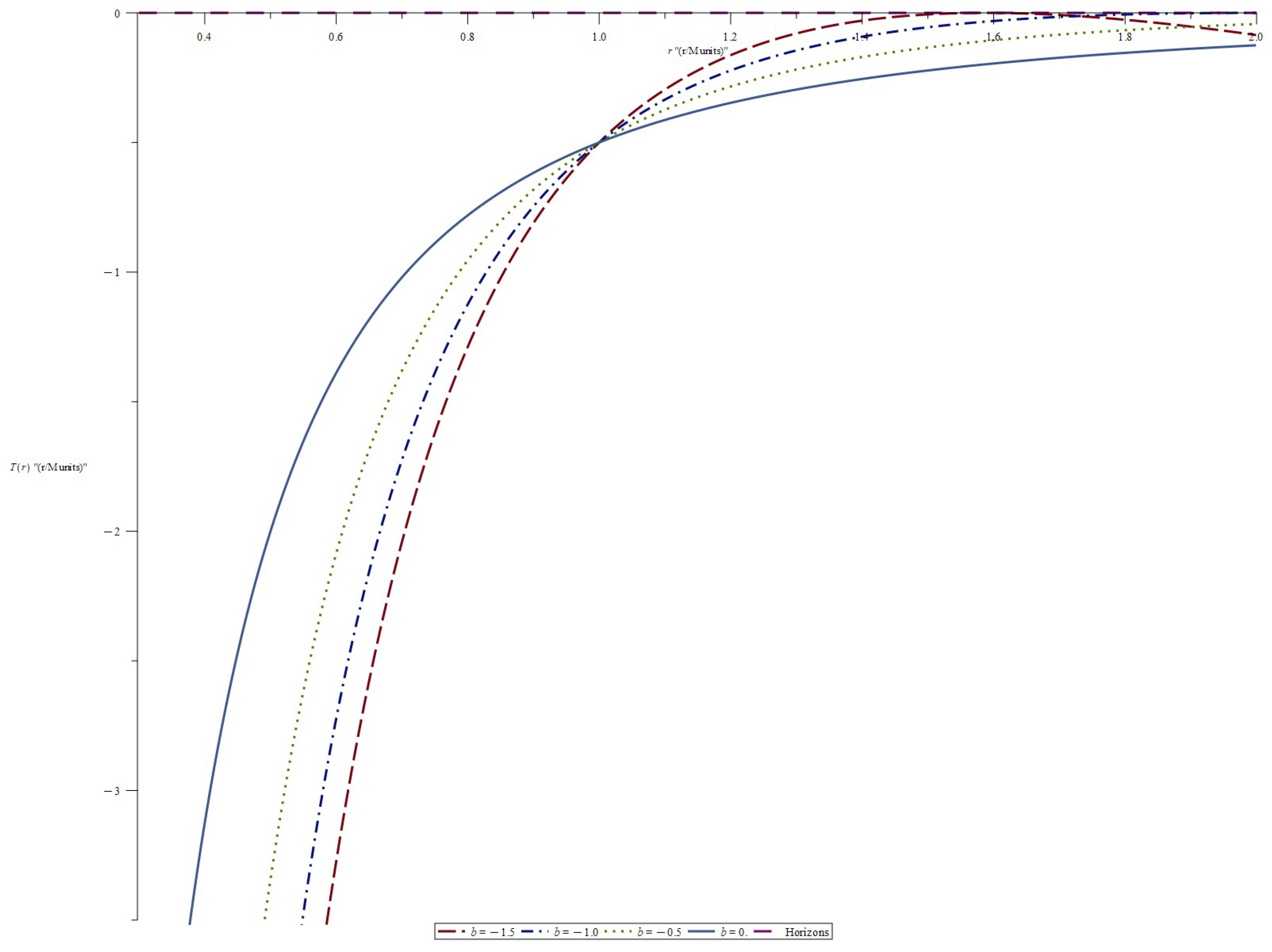
may regularize the torsion sector and generate regular BH-like cores. These critical and divergence points directly address the singularity structure of the lapse and torsion invariants as illustrated in
Figure 4. The torsion profiles can be correlated with the lapse deformations shown in
Figure 1,
Figure 2 and
Figure 3: divergent torsion for
corresponds to stronger short-distance corrections, whereas softened torsion behavior for
supports milder near-core modifications. From an observational perspective, these torsion-induced deformations may affect strong-field signatures such as photon sphere radii, BH shadows, and quasi-normal mode spectra, providing potential avenues to constrain the parameter
b through astrophysical observations.
Within the invariant classification scheme, the TEGR branch reproduces the usual charged BH singularity at . PL models preserve this singular behavior whenever , whereas EXP and COMP branches may soften or regularize the torsion invariants depending on the dominant nonlinear contribution. Thus, regularization is not automatic in nonlinear gravity; it occurs only in restricted regions of parameter space where the torsion invariants remain finite.
The effective energy-momentum tensor induced by nonlinear torsion can be defined through the modified field equations, allowing one to test ECs. In particular, regularized branches () may effectively violate classical ECs through the torsion sector, thereby mimicking exotic-matter contributions.
As in the constant-radius sector, a leading-order stability diagnostic is obtained from
For COMP models,
and
Stable branches require
and
, which typically selects exponents
together with positive EXP contribution
. The marginal case
corresponds to the TEGR-like limit, while
leads to infrared instabilities. The most physically interesting regularizing stable regime is obtained when
and
, since this simultaneously softens the torsion core and avoids tachyonic scalar-torsion modes.
The parameter space
can therefore be interpreted as defining a phase diagram of teleparallel compact objects, separating singular, critical, and regularized geometries. The space
separates naturally into four geometric regimes. When
and
, the solutions describe BH-like geometries with central torsion singularities. When
and
, nonlinear torsion effects may soften the core and produce torsion-regularized BH-like configurations. For
and
, the absence of horizons together with divergent torsion invariants leads to naked singular geometries. Finally,
and
corresponds to regular horizonless sectors. Therefore, the pair
controls the interplay between horizon formation, torsion singularities, invariant classification, and dynamical stability. Taken together,
Figure 1,
Figure 2,
Figure 3 and
Figure 4 illustrate how the parameters
and the functional form of
jointly control both the causal structure (via
) and the torsion sector (via
), providing a unified picture of teleparallel BH geometries.
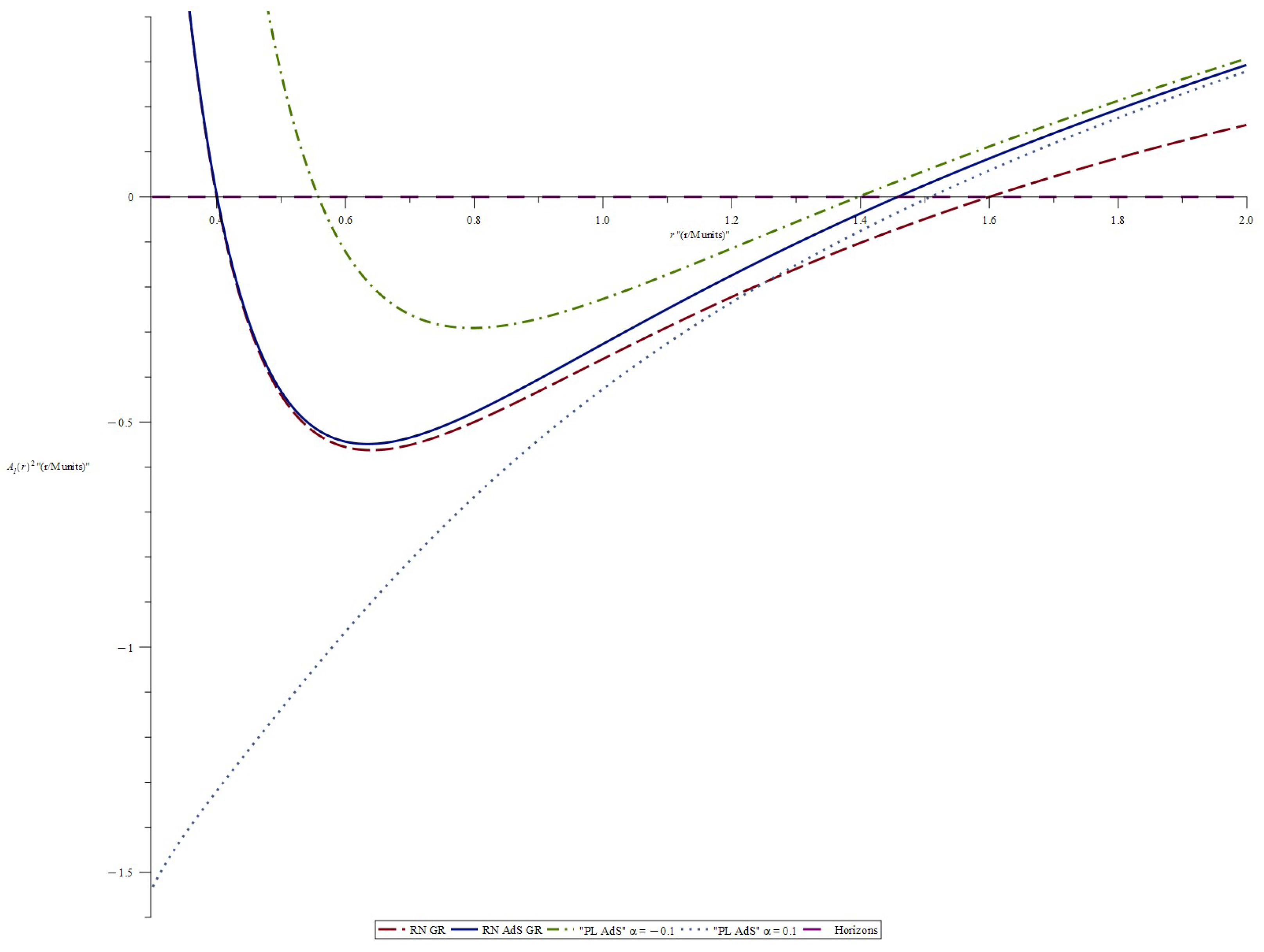
For a negative effective cosmological constant, the reconstructed charged solutions asymptotically approach RN–AdS geometries modified by nonlinear torsion corrections. In this regime, the lapse function behaves as
where
denotes nonlinear torsion corrections. This asymptotic structure shows that nonlinear torsion corrections act as an effective radial-dependent deformation of the cosmological term, potentially leading to deviations from standard AdS asymptotics at intermediate scales. This explicitly displays the AdS branch and clarifies how the effective cosmological constant enters the charged teleparallel BH sector. The comparison with the GR and RN–AdS lapse functions is illustrated in
Figure 5 for representative PL teleparallel corrections.
4.3. Stability Analysis and Physical Interpretation
The stability properties of the
sector are governed by the same leading-order scalar-torsion criterion used in
Section 3,
Stable reconstructed solutions require
corresponding respectively to the absence of ghost-like and tachyonic modes. In this sense, TEGR remains stable because it does not introduce additional nonlinear torsion degrees of freedom. PL models are stable in the regime
, LOG corrections are typically marginal or stable near the reference scale
, while EXP models are more sensitive to perturbations due to their strong nonlinear dependence on
T. These deviations may, in principle, be probed through observational signatures such as shadow size distortions, deviations in light deflection, or shifts in quasi-normal mode spectra relative to GR predictions.
Physically, stable reconstructed contributions correspond to nonlinear torsion sectors capable of supporting compact charged geometries without developing runaway scalar-torsion instabilities. Unstable branches, by contrast, may generate infrared pathologies or tachyonic growth of effective torsional modes.
The sector is therefore the most relevant one for compact-object phenomenology. It contains charged teleparallel BHs, deformed RN geometries, possible torsion-regularized BH-like configurations, and AdS-like charged solutions. The interplay between torsion and electromagnetic fields may lead to observable deviations in horizon structure, photon spheres, gravitational lensing, BH shadows, and quasi-normal mode spectra.
Overall, the sector reveals a rich landscape of teleparallel compact-object solutions, where horizon structure, singularity resolution, and stability are governed by the interplay between torsion scaling and electromagnetic contributions. This highlights the potential of nonlinear teleparallel gravity to extend the classical BH paradigm beyond GR.
6. Discussion and Conclusions
In this work, we have presented a covariant analysis of static SS configurations in
gravity coupled to Maxwell fields, covering both the constant-radius sector
and the areal-radius sector
. Starting from the CSC formalism and the associated symmetric and antisymmetric field equations, we showed that the electromagnetic sector remains strongly constrained by the covariant teleparallel structure. In particular, the antisymmetric field equations restrict admissible CSC pairs and favor radial electric and magnetic configurations compatible with the standard Maxwell scaling [
17,
32]. In the constant-radius regime, the electromagnetic sector behaves effectively as a cosmological source, leading to Nariai-type and vacuum-dominated branches [
8,
9]. By contrast, the
sector contains the physically relevant charged compact-object configurations, including RN-like geometries and nonlinear
deformations, where torsion corrections modify the horizon structure, near-core behavior, and asymptotic properties [
33,
34].
A central result of the present analysis is that nonlinear teleparallel gravity enlarges the space of admissible charged solutions while preserving the standard gauge structure of the Maxwell sector. The reconstruction procedure developed for PL coframes provides explicit
branches, including PL, LOG, EXP, and COMP models, which can be organized within the invariant Coley–Landry classification framework [
27,
28,
29,
30]. The lapse-function profiles and torsion-scalar analysis show that the parameters controlling the reconstructed models determine horizon formation, singularity behavior, and possible regularization. In particular, the critical regimes
,
, and
respectively distinguish singular, critical, and regularized torsion-core behavior. The AdS-like charged branches further demonstrate how an effective cosmological term can be incorporated into the teleparallel compact-object sector.
The WH-like sector complements the BH-like solutions by replacing horizon formation with throat formation. Nonlinear torsion contributions may effectively support the flaring-out condition and shift the NEC balance into the geometric sector, while the physical electromagnetic stress-energy tensor remains standard [
9,
41]. However, this mechanism is branch-dependent and does not imply that all nonlinear
models generate physically viable traversable WHs. Full viability requires throat regularity, finite torsion invariants, compatibility with the antisymmetric field equations, positive effective coupling, absence of tachyonic modes, and dynamical stability of the throat under radial perturbations. Thus, the WH-like branches should be interpreted as admissible local geometric sectors rather than automatically globally traversable solutions. This perspective is further supported by recent work in covariant teleparallel gravity, where explicit solutions of the field equations have been used to reconstruct viable
models describing weak-massive WH configurations. This further illustrates how torsion contributions can act as effective geometric sources in compact-object and WH-like sectors [
42].
Finally, the stability analysis indicates that physically viable reconstructed models must satisfy
and
, ensuring the absence of ghost-like and tachyonic scalar-torsion modes. LOG and selected PL branches appear to be the most robust, while EXP and COMP models remain more sensitive to perturbations. From an observational perspective, nonlinear torsion corrections may lead to deviations in BH shadows, gravitational lensing, photon-sphere structure, and quasi-normal mode spectra [
8,
33,
34]. Future work should address coupled perturbations, geodesic completeness, global WH traversability, and strong-field observational constraints in order to constrain possible torsion signatures in the gravitational sector.