Article

Analysis of a Mixed Dispersion Nonlinear Hydrodynamic Model Exhibiting Single and Periodic Solitary Wave Modes with Its Invariance Under Infinitesimal Transformation


1
Center for High Energy Physics, University of the Punjab, Lahore 54590, Pakistan
2
Department of Mathematics and Statistics, College of Science, Imam Mohammad Ibn Saud Islamic University (IMSIU), Riyadh 11564, Saudi Arabia
3
Department of Electrical and Electronic Engineering, College of Engineering and Computer Science, Jazan University, P.O. Box 706, Jazan 45142, Saudi Arabia
*
Author to whom correspondence should be addressed.
Symmetry 2026, 18(6), 1065; https://doi.org/10.3390/sym18061065 (registering DOI)
Submission received: 26 April 2026 / Revised: 9 June 2026 / Accepted: 12 June 2026 / Published: 22 June 2026

Abstract

Here, we consider a nonlinear hydrodynamic model with mixed dispersion–temporal evolution as the scalar version of the generalized shallow-water wave equation, which specifically provides a comprehensive and versatile framework for studying energy propagation in nonlinear fluids of constrained depth. This equation is acknowledged as an integrable model in the analysis of tidal wave dynamics and in simulations of weather variations, tsunami prediction, and irrigation flows. We also investigate a few of its singular and periodic solitary wave solutions by employing various Riccati-based ansatzes. These results highlight the necessity of studying various nonlinear wave phenomena, which may have potential applications in various domains of physics and applied mathematics. These results extend the variety of its solutions and also enrich the existing knowledge about its solutions with various profiles. To improve visual clarity and to facilitate structural understanding, the solution profiles are represented graphically using Maple software (version 2023.2) in 3D, 2D, and contour plots.We also discuss its invariance under infinitesimal transformations, which yields a one-dimensional Hamilton–Jacobi-like equation.

1. Introduction

Most natural physical phenomenon are commonly described by nonlinear differential equations, which are known as integrable systems, and a few of them with specific solutions are named soliton equations. The soliton equations are acknowledged as essential tools for exploring mathematical structures and provide physical insight into the propagation of energy through nonlinear-dispersive media, as in nonlinear optical fibers, hydro fluids, and in the plasma of osculating charged particles. A variety of effective techniques for deriving precise solutions to such nonlinear differential equations have been proposed, including the extended trial equation method [1], sine-Gordon expansion method [2], homogeneous balance method [3], Riccati–Bernoulli’s sub-ODE method [4], first integral method [5], and extended ( G G 2 ) expansion method [6]. In this context, more efficient integrable methods such as the simplified Hirota bilinear method [7], analytical solitary wave methods [8,9], inverse scattering transformations [10], modified direct algebraic–geometrical methods [11,12,13,14,15,16,17], and many others [18,19,20] have been applied to explore a few singular and solitary wave solutions.
With the implementation of these methods, a large variety of soliton solutions have been presented in the literature [21,22,23,24,25], such as breather wave solutions, rogue wave solutions, solitary wave solutions, and, particularly, soliton solutions, multi-soliton solutions with bright–dark kink profiles, and a few lump soliton solutions.The unified method is recognized as a powerful and effective approach for deriving exact analytical solutions and has recently been utilized by numerous researchers to produce various soliton solutions for various nonlinear partial differential equations (NLPDEs). The analysis of the generalized shallow-water wave equation (scalar GSWW) equation provides a framework for exploring complex nonlinear phenomena seen in the physical world. The scalar GSWW equation has been the subject of recent research by several researchers. Mustafa et al. applied an improved Jacobi elliptic function method to obtain periodic wave solutions of the scalar GSWW equation [26]. Dumitru et al. studied the optimal systems, Lie symmetry analysis, and conservation laws [27]. Gomez obtained the exact solutions using the general projective Riccati equation method [28]. Moreover, various traveling wave solutions with different profiles have been discussed in [29,30,31], which explore their importance from the point of view of applications. This paper seeks to determine the precise analytical solutions of the scalar GSWW equation. The scalar GSWW equation can be expressed as follows
v x x x t + α v x v x t + β v t v x x v x t v x x = 0 .
where v = v ( x , t ) represents the wave amplitude as a function of space and time. α 0 , β 0 are undetermined constants. That scalar GSWW equation is acknowledged as an integrable model in tidal wave analysis, weather simulations, tsunami prediction, and river and irrigation flows [32,33]. The dispersive term v x x x t with a time derivative in the presence of nonlinearity makes its solution unique with a permanent profile, which is sometimes called a soliton, which propagates in constant shape. Such solutions play very important roles as energy and information carriers, which never lets them become deformed while propagating in dispersive media. In this context, to have such kinds of solutions, various analytical methods [31,34,35] have been implemented with different ansatzes. Further, under the Boussinesq approximation [36], various localized solutions are explored that are associated with the shallow-water wave equation. The scalar GSWW equation provides an extended mathematical framework for modeling nonlinear wave propagation in shallow-water conditions. Further, more interesting solutions of the shallow-water wave system are reported in [37], in which the formation and breaking of its solutions in the background of interactions with the implementation of modified expansion methods can be read about.These results also reveal the physical significance of this equation for understanding the differences between deep- and shallow-water waves and their transitions, with provide motivation to study more of its features. In this direction, we can find its more substantial solutions for its time-fractional shallow-water wave equation system [38] by using complex hyperbolic and complex trigonometric function methods. In this context, the integrability of a higher-order analog [39] connected with the Camassa–Holm equation has also been investigated with various types of solutions. In addition to these applications, its appearance as an integrable model in optical systems [27] enriches its significance in soliton theory. This equation further extended the exploration of dispersion effects [40] in fluid under long- and short-wave approximation with weak and strong nonlinearities. The scalar GSWW equation holds considerable importance across multiple domains, including oceanography, geophysical fluid dynamics, and the study of nonlinear wave theory. Its mathematical richness enables the employment of advanced analytical techniques to derive precise solutions. These solutions enable significant understanding of the dynamics of nonlinear wave propagation and hold practical importance in areas including plasma physics, for the study of idealized dispersive traveling waves and soliton-type solutions and atmospheric sciences. The solutions we present here, especially in the case of singular solutions, may be considered solitons and anti-solitons, and reveal some additional geometrical profiles of solutions that exist in the literature as a balancing effect between nonlinearity and dispersion. These singular solutions may be acknowledged as permanent profile solutions while propagating in dispersive media in the background of interactions in the form of nonlinearity.
This paper is organized into six sections, where Section 2 includes the application of a wave transformation to convert the scalar GSWW equation into an ordinary differential equation (ODE), together with a comprehensive explanation of the methods employed. Section 3 presents the application of the proposed methods to the scalar GSWW equation to derive precise analytical solutions. Section 4 provides a detailed examination and analysis of the obtained solutions for governing models. Section 5 presents the results and discussion. Section 6 presents the conclusion and significant observations derived from the study.

2. General Description of Unified and Riccati Methods

Consider a general partial differential equation (PDE) expressed as below:
Ω ( v , v x , v t , v x x , v x t , v t t , ) = 0 ,
Under the following transformation v ( x , t ) = V ( ζ ) , ζ = x + σ t above, Equation (2) can be reduced to the ordinary differentia equation as below:
Ψ ( V , V , V , V , ) = 0 ,
where σ is the real constant which denotes the wave speed and prime represents the ordinary derivative with of V ( ζ ) with respect to ζ .

2.1. Unified Method

The solution to Equation (3) in accordance with this strategy can be expressed as [41]
V ( ζ ) = M o + i = 1 N M i ϕ i ( ζ ) + i = 1 N N i ϕ i ( ζ ) ,
where M o , M i , and N i are undetermined arbitrary parameters. The following equation is satisfied by an explicit invariant solution ϕ ( ζ ) .
ϕ ( ζ ) = ϕ 2 ( ζ ) + A .
Equation (5) validates the nine categories of exact solutions in the following three cases.
Case 1: 
Hyperbolic function solutions (when A is negative):
( i ) ϕ ( ζ ) = ( J 2 + K 2 ) A J A cosh ( 2 A ( ζ + Φ ) ) J sinh ( 2 A ( ζ + Φ ) ) + K , ( i i ) ϕ ( ζ ) = ( J 2 + K 2 ) A J A cosh ( 2 A ( ζ + Φ ) ) J sinh ( 2 A ( ζ + Φ ) ) + K , ( i i i ) ϕ ( ζ ) = A + 2 J A J + cosh ( 2 A ( ζ + Φ ) ) sinh ( 2 A ( ζ + Φ ) ) .
Case 2: 
Trigonometric function solutions (when A is positive):
( v ) ϕ ( ζ ) = ( J 2 + K 2 ) A J A cos ( 2 A ( ζ + Φ ) ) J sin ( 2 A ( ζ + Φ ) ) + K , ( v i ) ϕ ( ζ ) = ( J 2 + K 2 ) A J A cos ( 2 A ( ζ + Φ ) ) J sin ( 2 A ( ζ + Φ ) ) + K , ( v i i ) ϕ ( ζ ) = i A + 2 i J A J + cos ( 2 A ( ζ + Φ ) ) i sin ( 2 A ( ζ + Φ ) ) , ( v i i i ) ϕ ( ζ ) = i A + 2 i J A J + cos ( 2 A ( ζ + Φ ) ) i sin ( 2 A ( ζ + Φ ) ) .
Case 3: 
Rational function solutions (when A = 0):
( i x ) ϕ ( ζ ) = 1 ( ζ + Φ ) ,
when J 0 , K and Φ are arbitrary parameters.

2.2. Riccati Equation Method

The solution to Equation (3) in accordance with this strategy can be expressed as follows:
V ( ζ ) = i = 1 N C i T i ( ζ ) ,
Here, C i , ( i = 0 , 1 , , N ) are the coefficients associated with T i ( ζ ) for C N 0 . The Riccati equation is satisfied by the function T ( ζ ) :
T ( ζ ) = D o + D 1 T ( ζ ) + D 2 T ( ζ ) 2 ,
where B i , ( i = 0 , 1 , , N ) are real constants. The solutions for Equation (10) are as follows:
( i ) T ( ζ ) = F 1 2 F 2 ϕ 2 F 2 tanh ϕ 2 ( ζ ζ 0 ) , ϕ > 0 , ( i i ) T ( ζ ) = F 1 2 F 2 ϕ 2 F 2 coth ϕ 2 ( ζ ζ 0 ) , ϕ > 0 , ( i i i ) T ( ζ ) = F 1 2 F 2 + ϕ 2 F 2 tan ϕ 2 ( ζ ζ 0 ) , ϕ < 0 , ( i v ) T ( ζ ) = F 1 2 F 2 ϕ 2 F 2 cot ϕ 2 ( ζ ζ 0 ) , ϕ < 0 , ( v ) T ( ζ ) = F 1 2 F 2 1 F 2 , ϕ = 0 .
where ϕ = F 1 2 4 F o F 2 .

3. Application of Mathematical Methods

It is essential to assume that Equation (1) allows for traveling wave transformation in order to identify the exact solution of the Equation (1) through the application of the unified method and the Riccati equation method. Now, after direct substitution of transformation
v ( x , t ) = V ( ζ ) , ζ = x + σ t
into Equation (1) and after integrating the resulting equation once with respect to ζ , taking the constant of integration as equal to zero, we obtain
σ V + 1 2 ( α + β ) σ V 2 ( 1 + σ ) V = 0 .

3.1. Implementation of Unified Method

Before using the unified method to get the precise solution of Equation (1), the value of N must be determined using the homogeneous balancing principle. The highest-order nonlinear term V 2 is set as equal to the highest-order derivative V in Equation (13). Once we have obtained this number N = 1 , we can proceed to the subsequent step:
V ( ζ ) = M o + M 1 ϕ ( ζ ) + N 1 ϕ ( ζ ) .
Substituting Equation (14) and Equation (5) into Equation (13) and equating the different powers of ϕ ( ζ ) to zero yields the system of equations.
6 σ M 1 + 1 2 σ α M 1 2 + 1 2 σ β M 1 2 = 0 , σ A α M 1 2 + σ β A M 1 2 α σ M 1 N 1 β σ M 1 N 1 + 8 A σ M 1 σ M 1 M 1 = 0 , σ A 2 α M 1 N 1 σ A 2 β M 1 N 1 + σ A α N 1 2 + σ A β N 1 2 8 A 2 σ N 1 + σ N 1 A + N 1 A = 0 , 1 2 σ A 2 α N 1 2 + 1 2 σ A 2 β N 1 2 6 σ A 3 N 1 = 0 , 1 2 σ α N 1 2 + 1 2 σ β N 1 2 σ A M 1 + σ N 1 M 1 A 2 σ α M 1 N 1 A 2 σ β M 1 N 1 A + N 1 + 1 2 σ α M 1 2 A 2 + 1 2 σ β M 1 2 A 2 + 2 σ M 1 A 2 2 σ N 1 A = 0 .
We can calculate the following values of parameters by solving the above system of equations simultaneously of equations.
Set 1: 
σ = 1 4 A + 1 , M o = M o , M 1 = 0 , N 1 = 12 A α + β .
Set 2: 
σ = 1 4 A + 1 , M o = M o , M 1 = 12 α + β , N 1 = 0 .
Set 3: 
σ = 1 16 A + 1 , M o = M o , M 1 = 12 α + β , N 1 = 12 A α + β .
The following exact analytical solutions of the scalar GSWW Equation (1) are obtained by using Equation (12), Equations (6)–(8), and Equation (16):
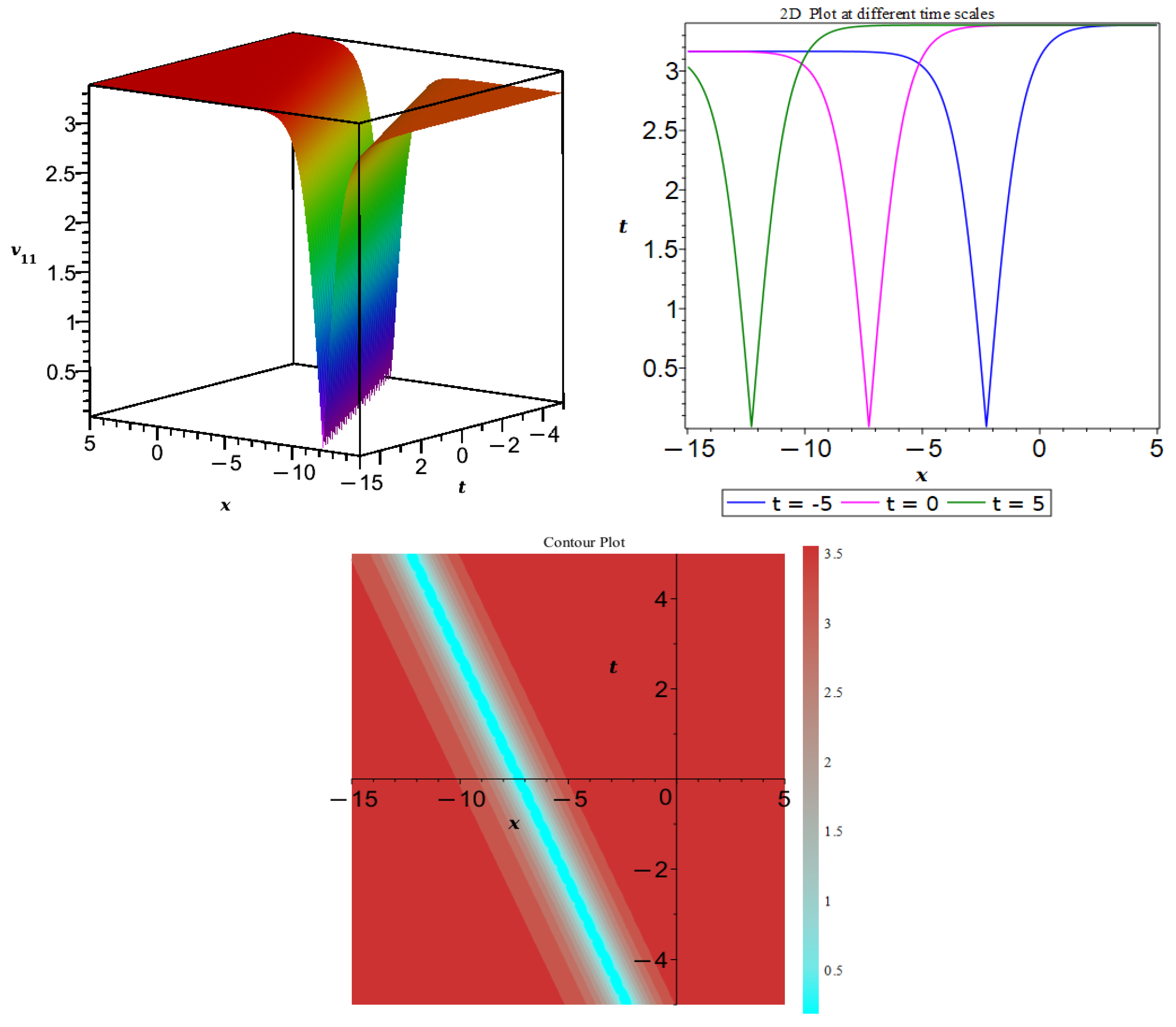
v 11 ( x , t ) = M o + 12 A ( J sinh ( 2 A ϵ ) + K ) ( α + β ) ( ( J 2 + K 2 ) S A A cosh ( 2 A ϵ ) ) ,
Figure 1 illustrates the anti-bell-shaped soliton profile in 3D for Equation (19).
v 12 ( x , t ) = M o + 12 A ( J sinh ( 2 A ϵ ) + K ) ( α + β ) ( ( J 2 + K 2 ) A J A cosh ( 2 A ϵ ) ) ,
v 13 ( x , t ) = M o + 12 A ( α + β ) A + 2 J A J + cosh ( 2 A ϵ ) sinh ( 2 A ϵ ) ,
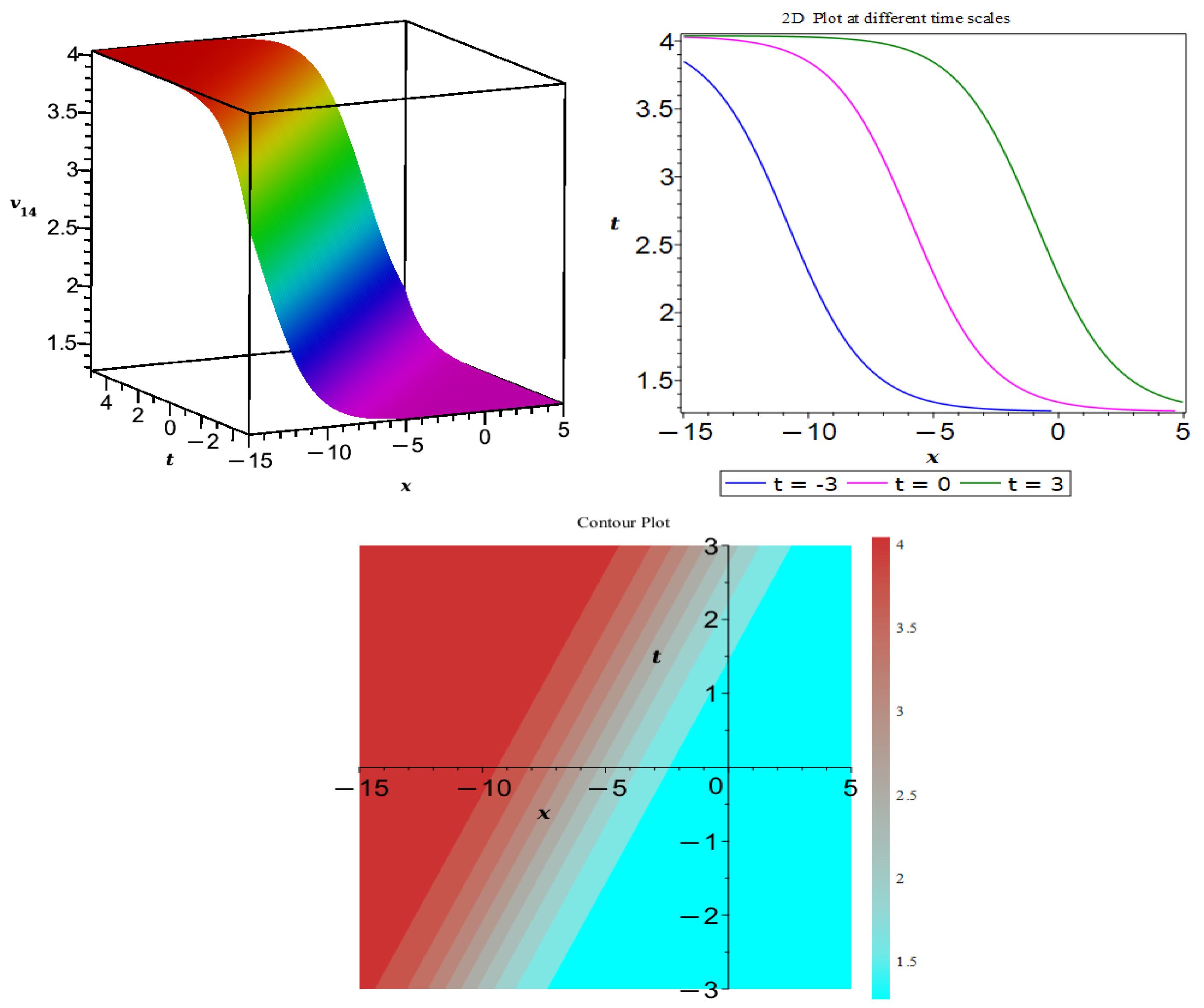
v 14 ( x , t ) = M o + 12 A ( α + β ) A + 2 J A J + cosh ( 2 A ϵ ) sinh ( 2 A ϵ ) ,
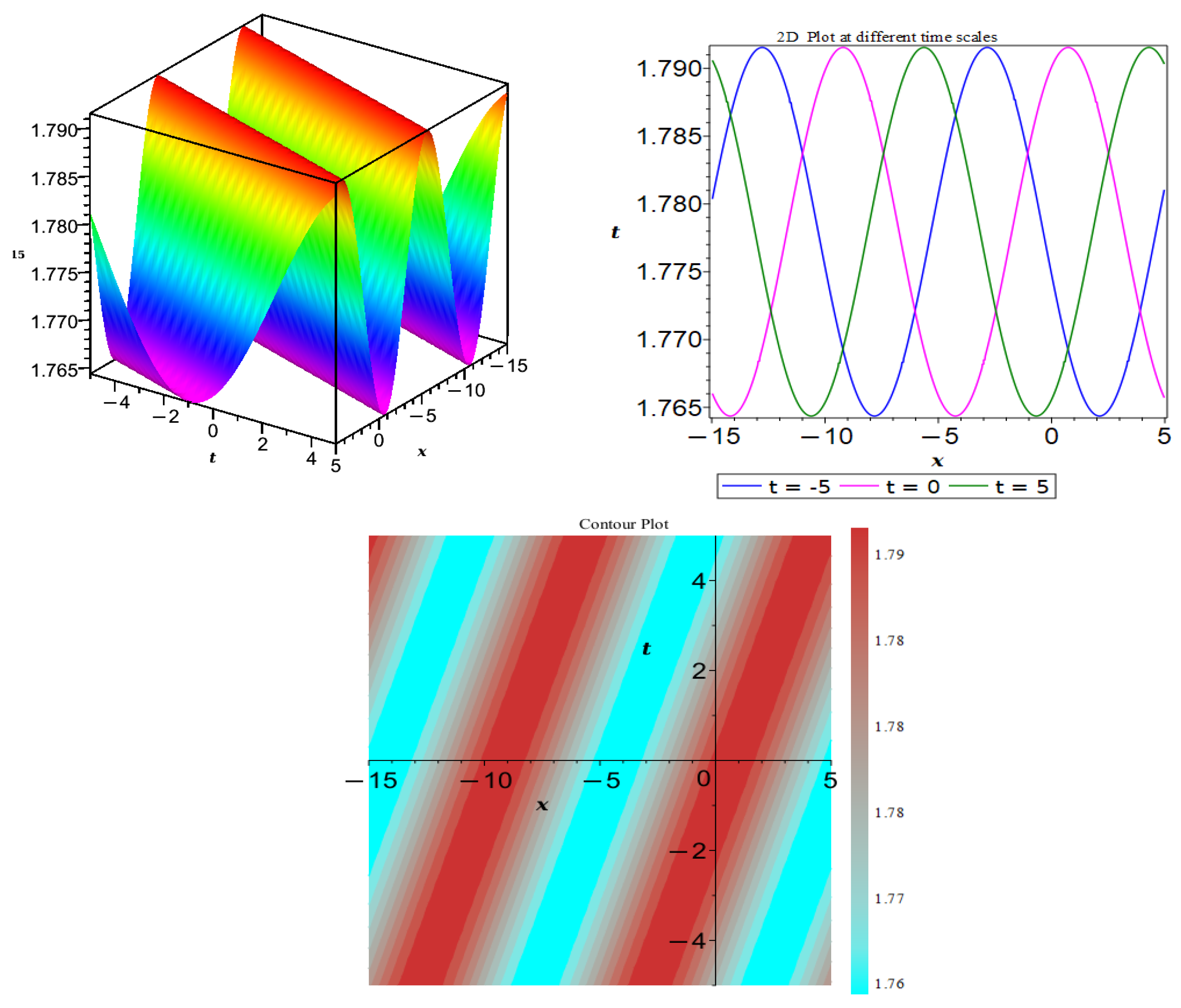
v 15 ( x , t ) = M o + 12 A ( J sin ( 2 A ϵ ) + K ) ( α + β ) ( ( J 2 + K 2 ) A J A cos ( 2 A ϵ ) ) .
Figure 2 illustrates the kink soliton profile in 3D for Equation (22) and Figure 3 illustrates the periodic wave profile in 3D for Equation (23).
v 16 ( x , t ) = M o + 12 A ( J sin ( 2 A ϵ ) + K ) ( α + β ) ( ( J 2 + K 2 ) A J A cos ( 2 A ϵ ) ) ,
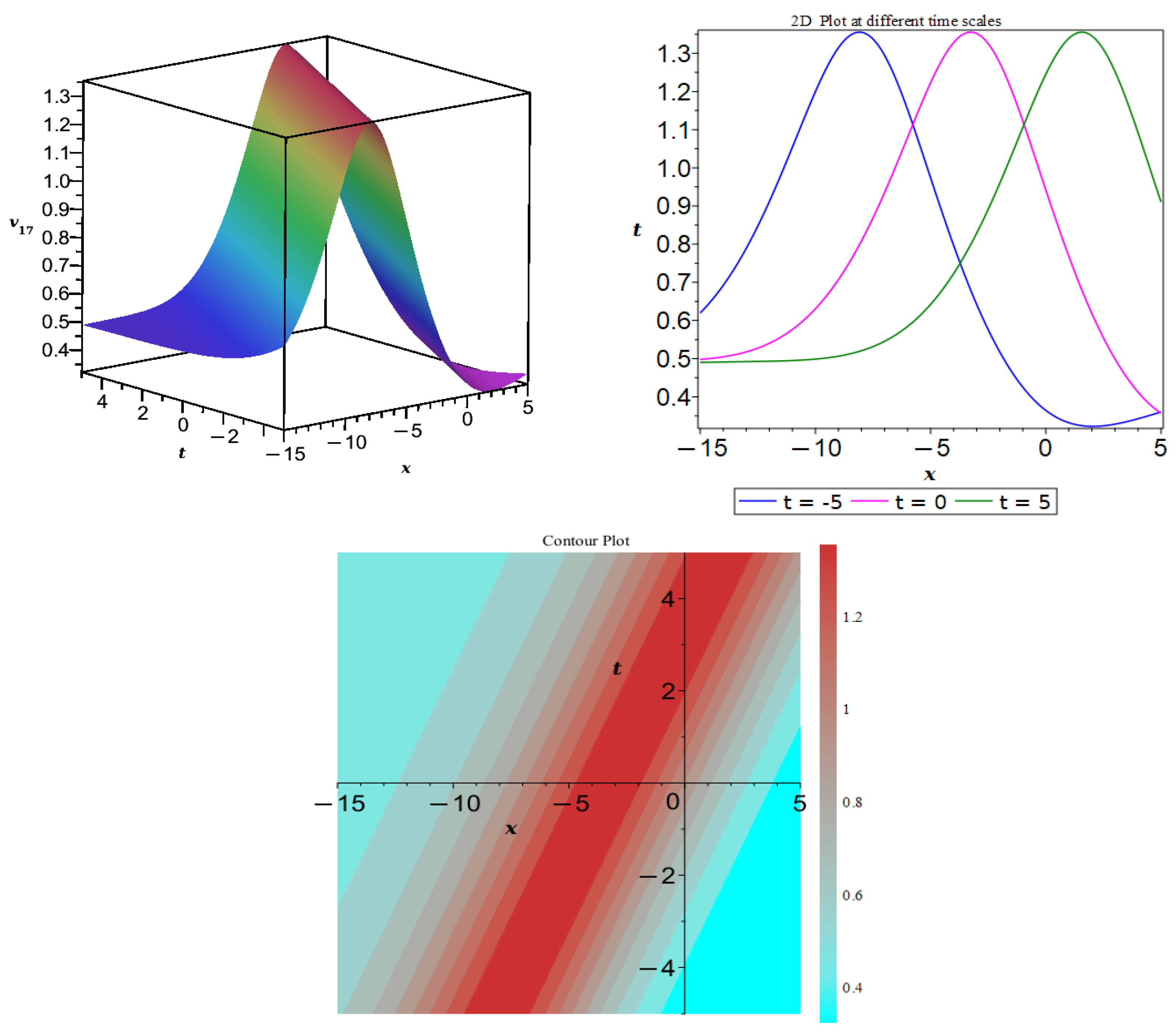
v 17 ( x , t ) = M o + 12 A ( α + β ) i A + 2 J i A J + cos ( 2 A ϵ ) i sinh ( 2 A ϵ ) ,
Figure 4 illustrates the bright soliton profile in 3D for of Equation (25).
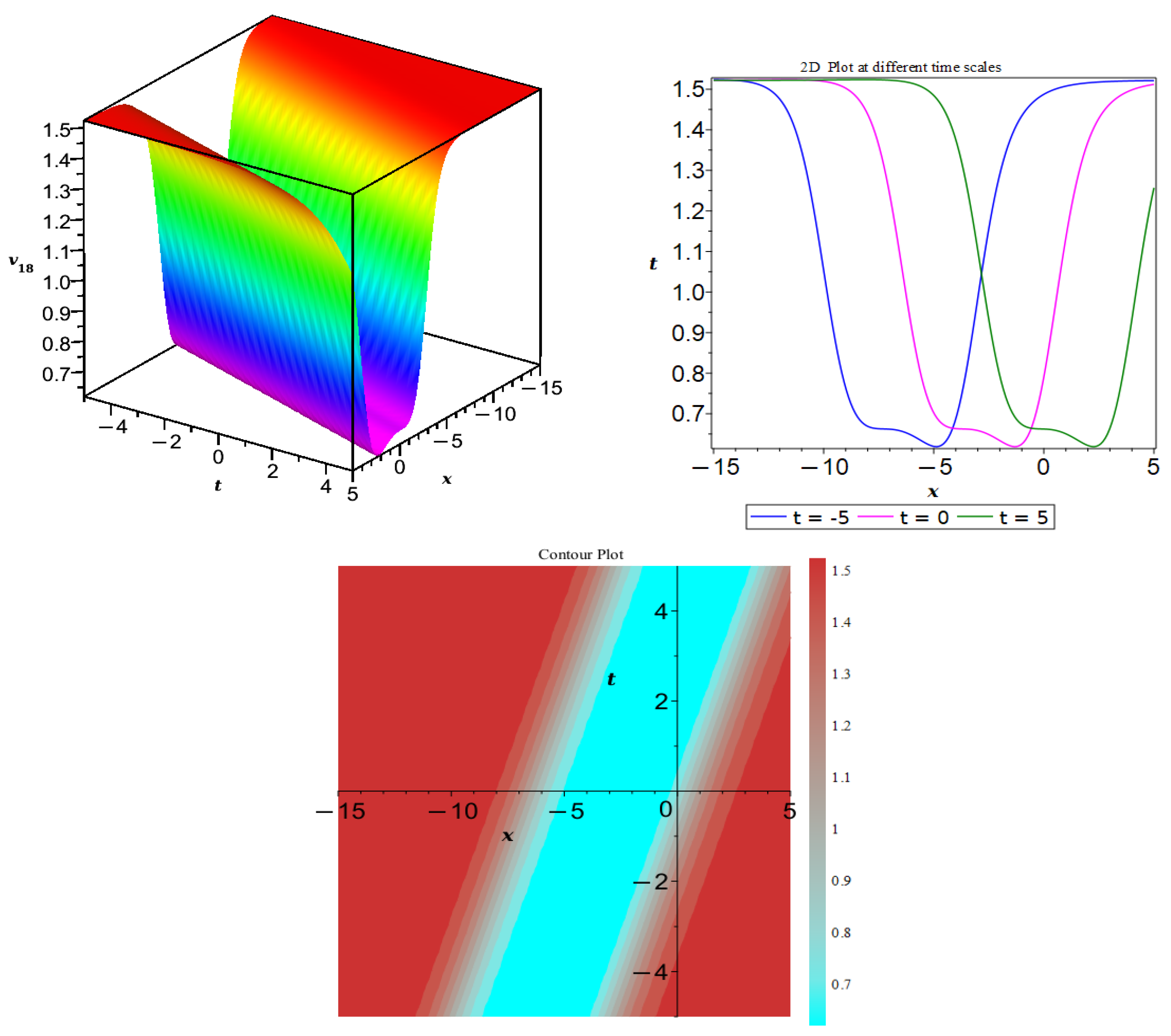
v 18 ( x , t ) = M o + 12 A ( α + β ) i A + 2 J i A J + cos ( 2 A ϵ ) i sinh ( 2 A ϵ ) ,
Figure 5 illustrates the dark soliton profile in 3D for modulus of Equation (26).
v 19 ( x , t ) = M o 12 A ϵ ( α + β ) ,
where ϵ = ( t 4 A + 1 + x + ϕ ) .
The following exact analytical solutions of the scalar GSWW Equation (1) are obtained by using Equation (12), Equations (6)–(8), and Equation (17):
v 21 ( x , t ) = M o 12 ( ( J 2 + K 2 ) A J A cosh ( 2 A ϵ ) ) ( α + β ) ( J sinh ( 2 A ϵ ) + K ) ,
v 22 ( x , t ) = M o 12 ( ( J 2 + K 2 ) A J A cosh ( 2 A ϵ ) ) ( α + β ) ( J sinh ( 2 A ϵ ) + K ) ,
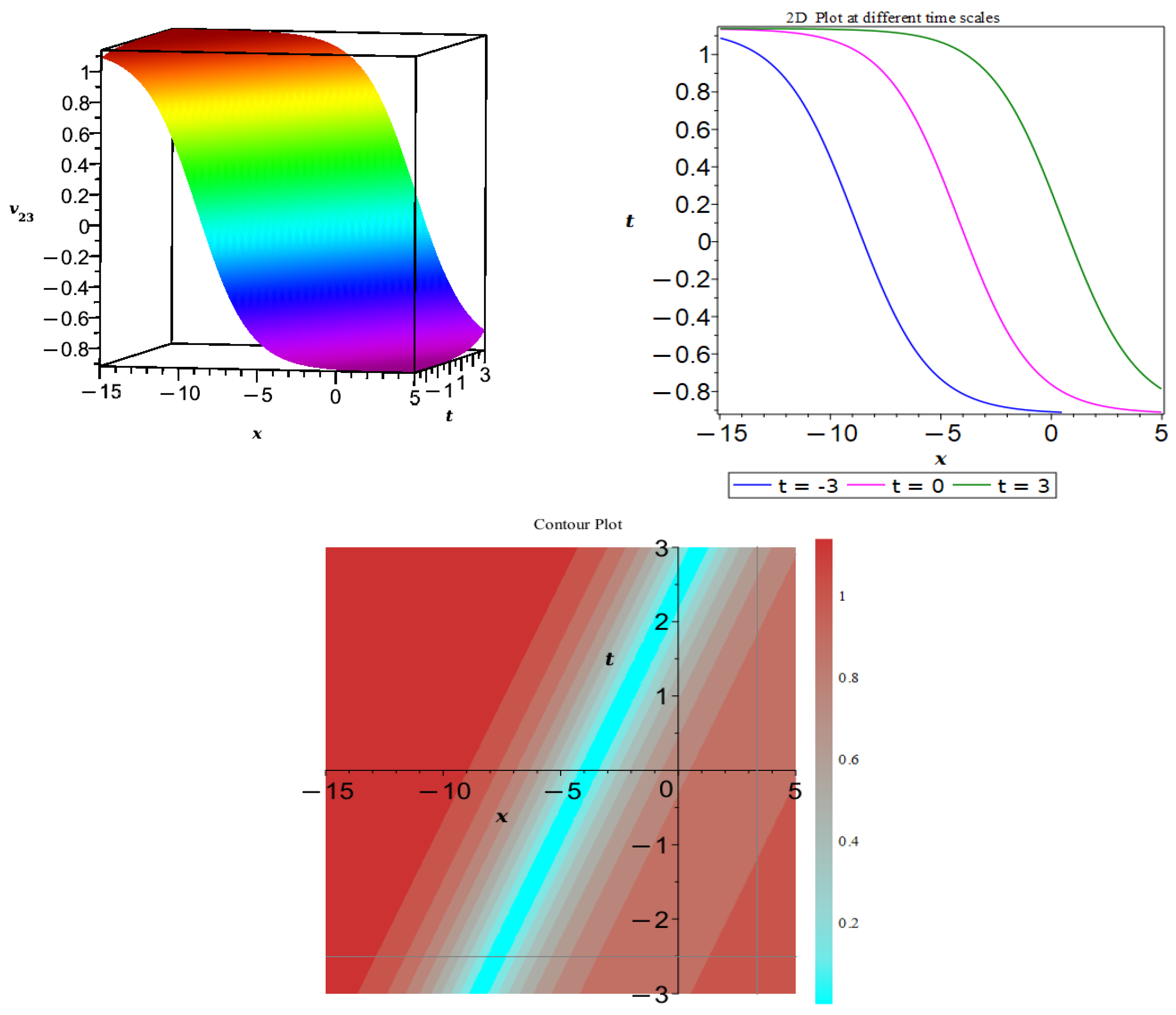
v 23 ( x , t ) = M o 12 A + 2 J A J + cosh ( 2 A ϵ ) sinh ( 2 A ϵ ) α + β ,
Figure 6 illustrates the kink soliton profile in 3D for Equation (30).
v 24 ( x , t ) = M o 12 A + 2 J A J + cosh ( 2 A ϵ ) sinh ( 2 A ϵ ) α + β ,
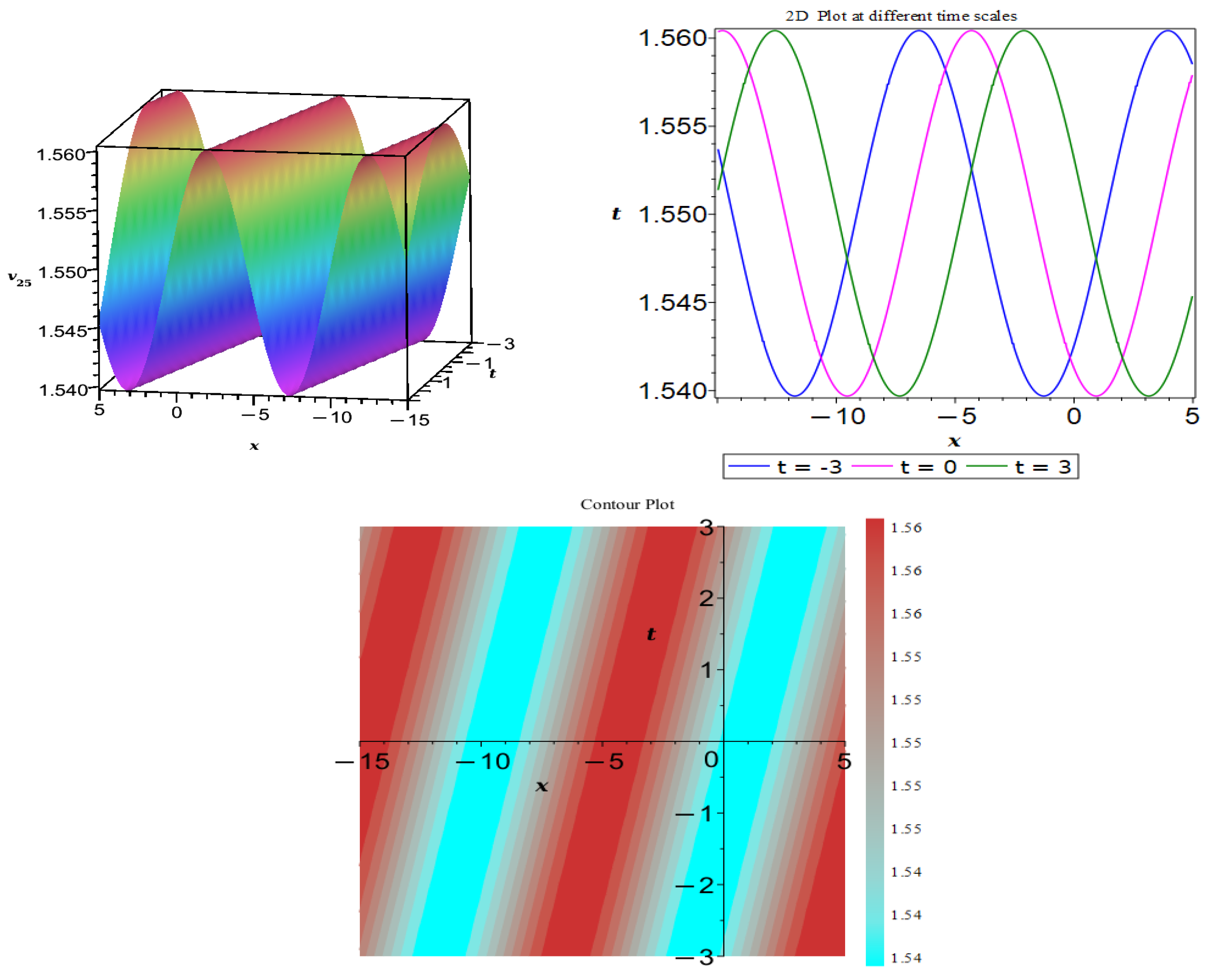
v 25 ( x , t ) = M o 12 ( ( J 2 + K 2 ) A J A cos ( 2 A ϵ ) ) ( α + β ) ( J sin ( 2 A ϵ ) + K ) ,
v 26 ( x , t ) = M o 12 ( ( J 2 + K 2 ) S J A cos ( 2 A ϵ ) ) ( α + β ) ( J sin ( 2 A ϵ ) + K ) ,
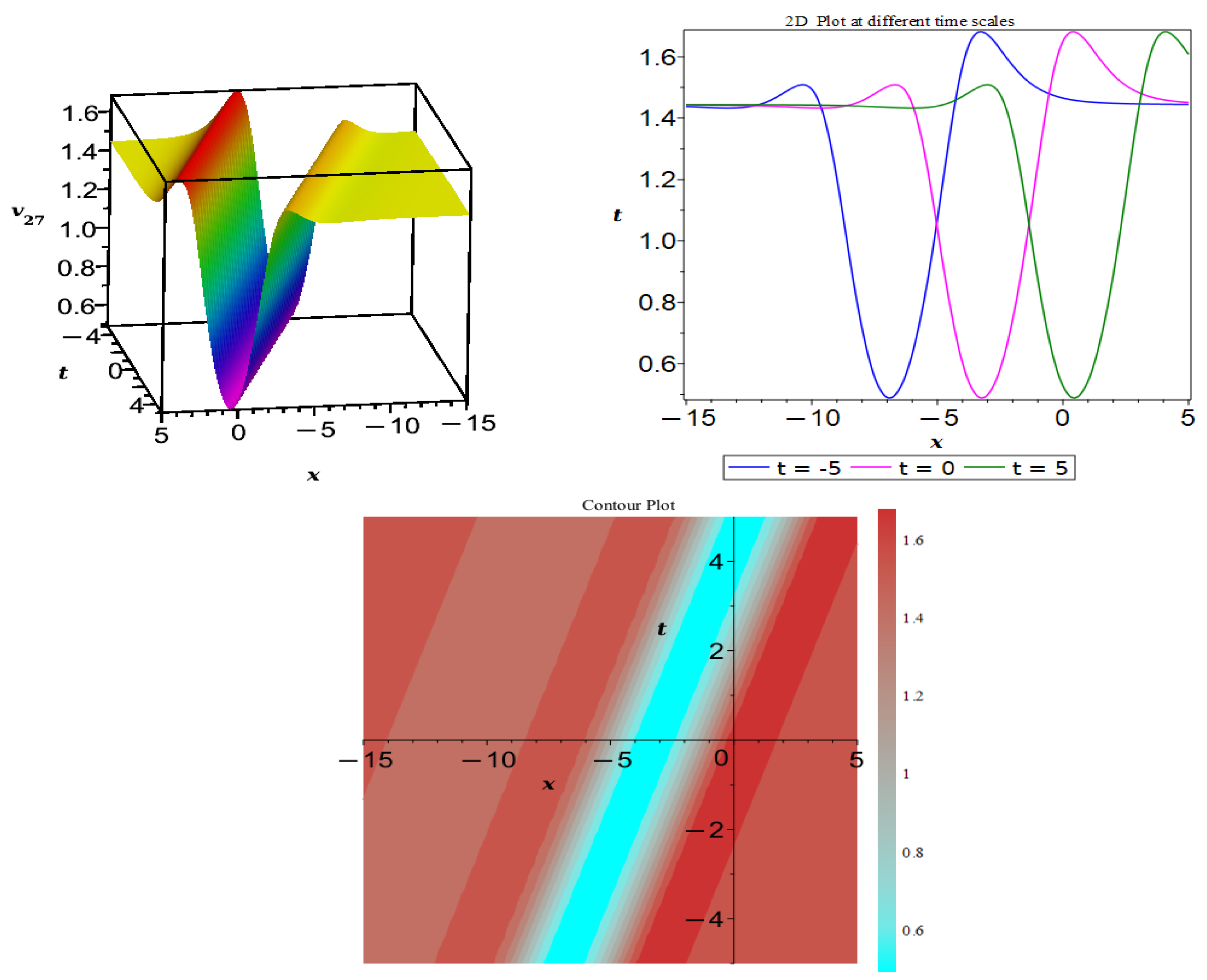
v 27 ( x , t ) = M o 12 i A + 2 J i A J + cos ( 2 A ϵ ) i sinh ( 2 A ϵ ) α + β ,
v 28 ( x , t ) = M o 12 i A + 2 J i A J + cos ( 2 A ϵ ) i sinh ( 2 A ϵ ) α + β .
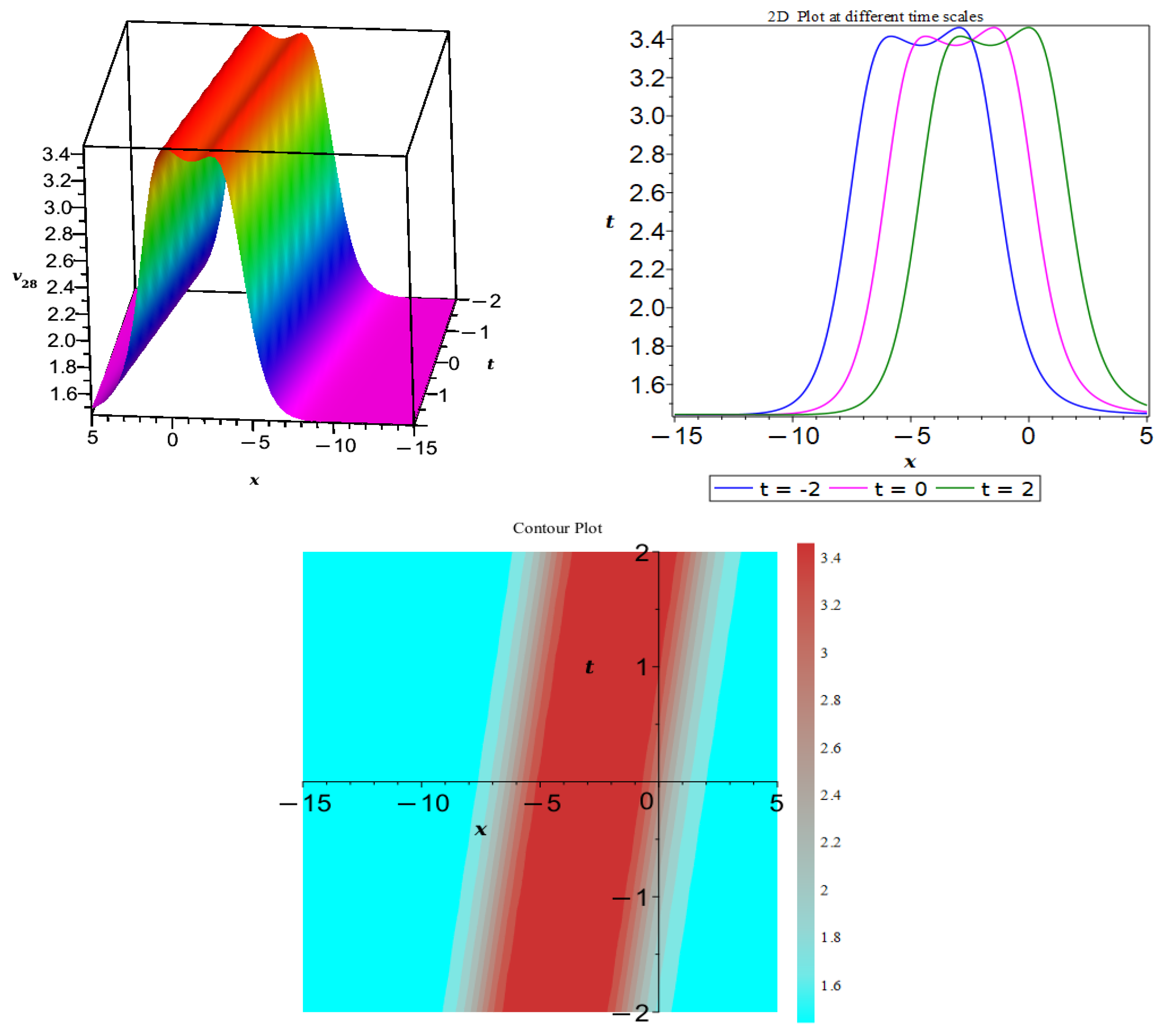
Figure 7 illustrates the periodic wave profile in 3D for Equation (32).
Figure 8 illustrates the periodic wave profile in 3D for the modulus of Equation (32).
Figure 9 illustrates the bright soliton profile in 3D for the modulus of Equation (35).
v 29 ( x , t ) = M o + 12 ( α + β ) ϵ ,
where ϵ = ( t 4 A + 1 + x + ϕ ) .
The following exact analytical solutions of the scalar GSWW Equation (1) are obtained by using Equation (12), Equations (6)–(8), and Equation (18):
v 31 ( x , t ) = M o 12 ( ( J 2 + K 2 ) S J A cosh ( 2 A ϵ ) ) ( α + β ) ( J sinh ( 2 A ϵ ) + K ) + 12 A ( J sinh ( 2 A ϵ ) + K ) ( α + β ) ( ( J 2 + K 2 ) A J A cosh ( 2 A ϵ ) ) ,
v 32 ( x , t ) = M o 12 ( ( J 2 + K 2 ) A J A cosh ( 2 A ϵ ) ) ( α + β ) ( J sinh ( 2 A ϵ ) + K ) + 12 A ( J sinh ( 2 A ϵ ) + K ) ( α + β ) ( ( J 2 + K 2 ) A J A cosh ( 2 A ϵ ) ) ,
v 33 ( x , t ) = M o 12 A + 2 J A J + cosh ( 2 A ϵ ) sinh ( 2 A ϵ ) α + β + 12 A ( α + β ) A + 2 J A J + cosh ( 2 A ϵ ) sinh ( 2 A ϵ ) ,
v 34 ( x , t ) = M o 12 A + 2 J A J + cosh ( 2 A ϵ ) sinh ( 2 A ϵ ) α + β + 12 A ( α + β ) A + 2 J A J + cosh ( 2 A ϵ ) sinh ( 2 A ϵ ) .
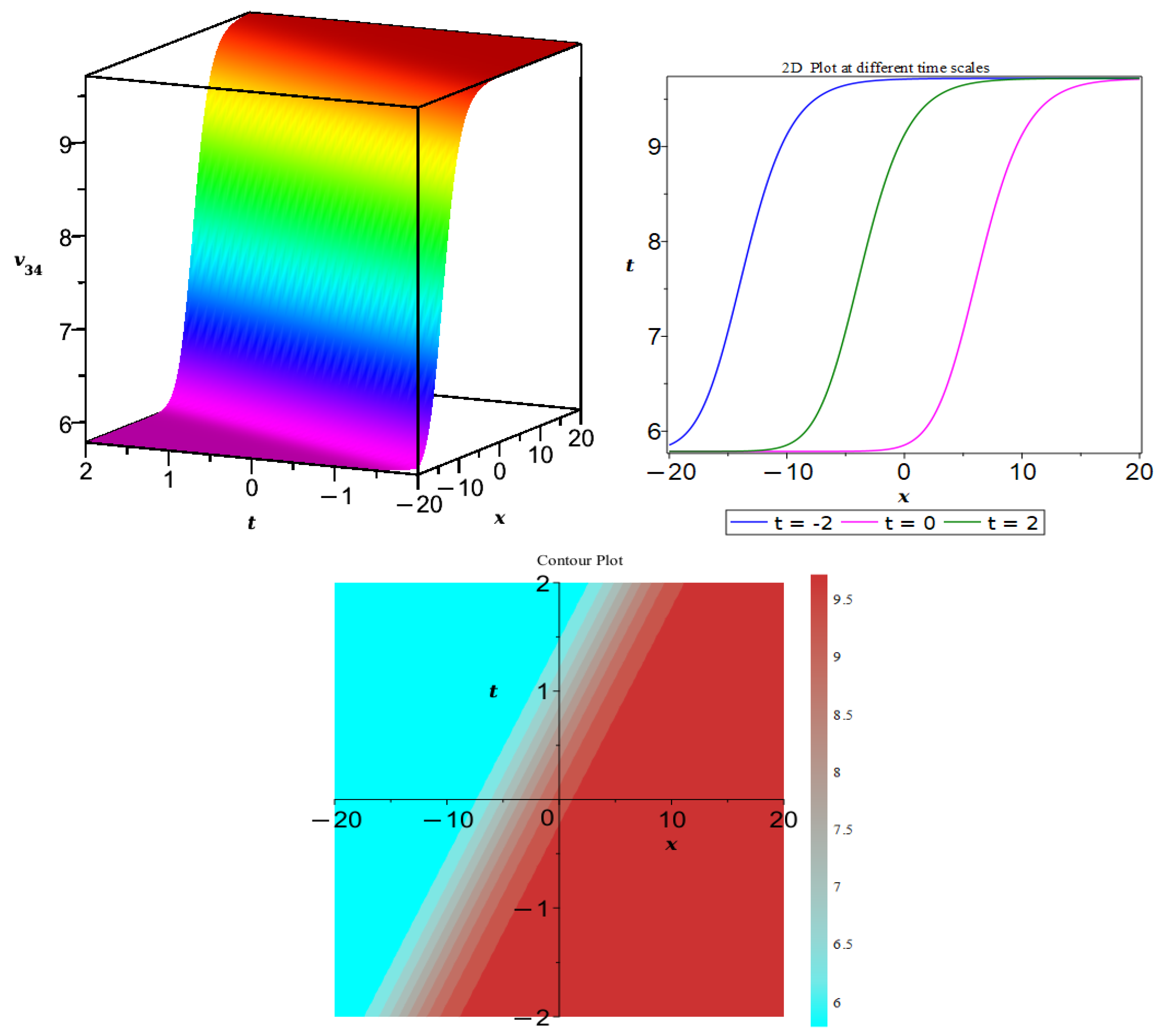
Figure 10 illustrates the kink soliton profile in 3D for Equation (40).
v 35 ( x , t ) = M o 12 ( ( J 2 + K 2 ) A J A cos ( 2 A ϵ ) ) ( α + β ) ( J sin ( 2 A ϵ ) + K ) + 12 A ( J sin ( 2 A ϵ ) + K ) ( α + β ) ( ( J 2 + K 2 ) A J A cos ( 2 A ϵ ) ) .
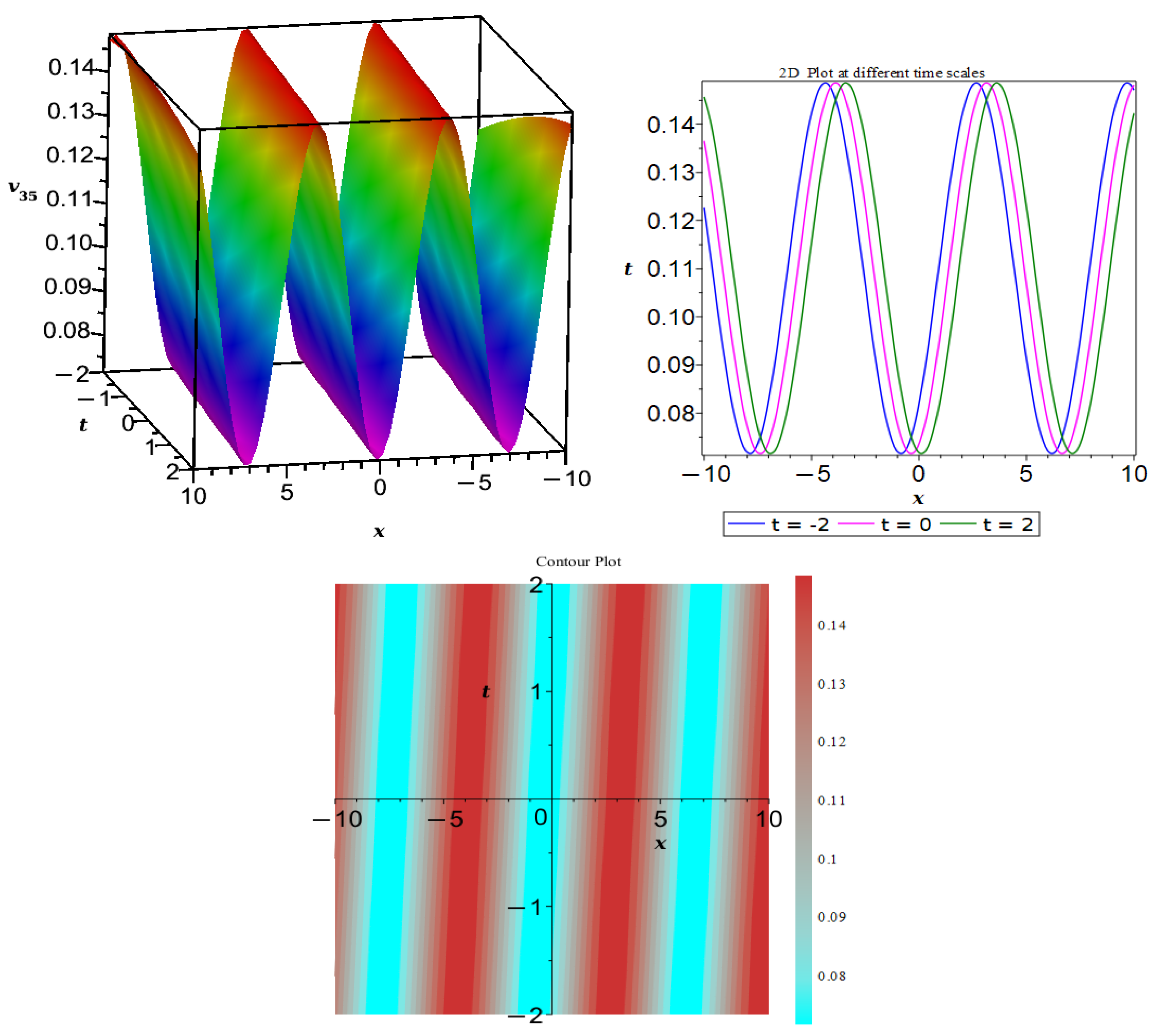
Figure 11 illustrates the periodic wave profile in 3D for Equation (41).
v 36 ( x , t ) = M o 12 ( ( J 2 + K 2 ) A J A cos ( 2 A ϵ ) ) ( α + β ) ( J sin ( 2 A ϵ + K ) + 12 A ( J sin ( 2 A ϵ ) + K ) ( α + β ) ( ( J 2 + K 2 ) A J A cos ( 2 A ϵ ) ) ) ,
v 37 ( x , t ) = M o 12 i A + 2 J i A J + cos ( 2 A ϵ ) i sinh ( 2 A ϵ ) α + β + 12 A ( α + β ) i A + 2 J i A J + cos ( 2 A ϵ ) i sinh ( 2 A ϵ ) ,
v 38 ( x , t ) = M o 12 i A + 2 J i A J + cos ( 2 A ϵ ) i sinh ( 2 A ϵ ) α + β + 12 A ( α + β ) i A + 2 J i A J + cos ( 2 A ϵ ) i sinh ( 2 A ϵ ) ,
v 39 ( x , t ) = M o + 12 ( α + β ) ϵ 12 A ϵ ( α + β ) ,
where ϵ = ( t 16 A + 1 + x + ϕ ) .

3.2. Implementation of Riccati Equation Method

In accordance with the Riccati equation method, the solution to Equation (13) for N = 1 is expressed in the following manner:
V ( ζ ) = C o + C 1 T ( ζ ) ,
where C o and C 1 are unspecified real parameters, and the function T ( ζ ) satisfies the Riccati equation.
T ( ζ ) = D o + D 1 T ( ζ ) + D 2 T ( ζ ) 2 ,
where D o and D 1 are real constants. Substituting Equations (46) and (47) into Equation (13) and equating the different powers of T ( ζ ) to zero yields the system of equations.
6 σ C 1 D 2 3 + 1 2 σ α C 1 2 D 2 2 + 1 2 σ β C 1 2 D 2 2 = 0 , σ α C 1 2 D 1 D 2 + σ β C 1 2 D 1 D 2 + 12 σ C 1 D 1 D 2 2 = 0 , σ α C 1 2 D 2 D o + σ β C 1 2 D 2 D o σ C 1 D 2 C 1 D 2 + 1 2 β σ C 1 2 D 1 2 + 7 σ C 1 D 2 D 1 2 + 8 σ C 1 D o D 2 2 + 1 2 α σ C 1 2 D 1 2 = 0 , σ α C 1 2 D 1 D o + σ β C 1 2 D 1 D o σ C 1 D 1 3 + 8 σ C 1 D o D 1 D 2 σ C 1 D 1 C 1 D 1 = 0 , C 1 D o σ C 1 D o + σ C 1 D o D 1 2 + 2 σ C 1 D 2 D o 2 + 1 2 σ α C 1 2 D O 2 + 1 2 σ β C 1 2 D O 2
We can find the following set of solutions by simultaneously solving the above system of equations.
  • Set 1:
    σ = 1 D 1 2 4 D 2 D o 1 , C 1 = 12 D 2 α + β , C o = C o .
    The following exact analytical solutions of shallow-water wave Equation (1) are obtained by using Equations (11), (12), and (49).
    v 1 ( x , t ) = 6 ϕ tanh ( ( F 1 2 4 F 2 F o 1 ) x + t ) ϕ 2 F 1 2 8 F o F 2 2 + ( α + β ) C o + 6 F 1 α + β .
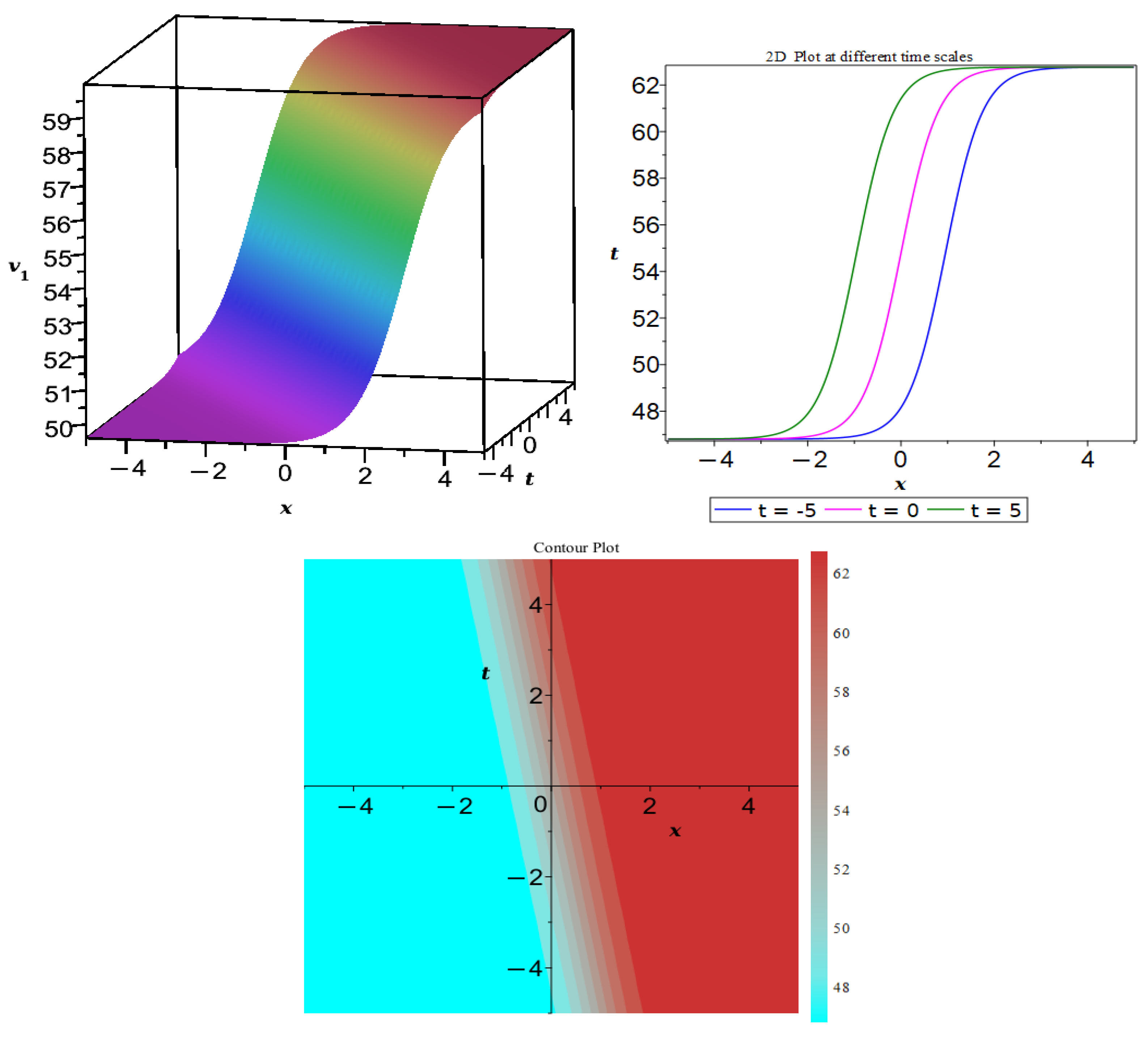
Figure 12 illustrates the kink soliton profile in 3D for Equation (50).
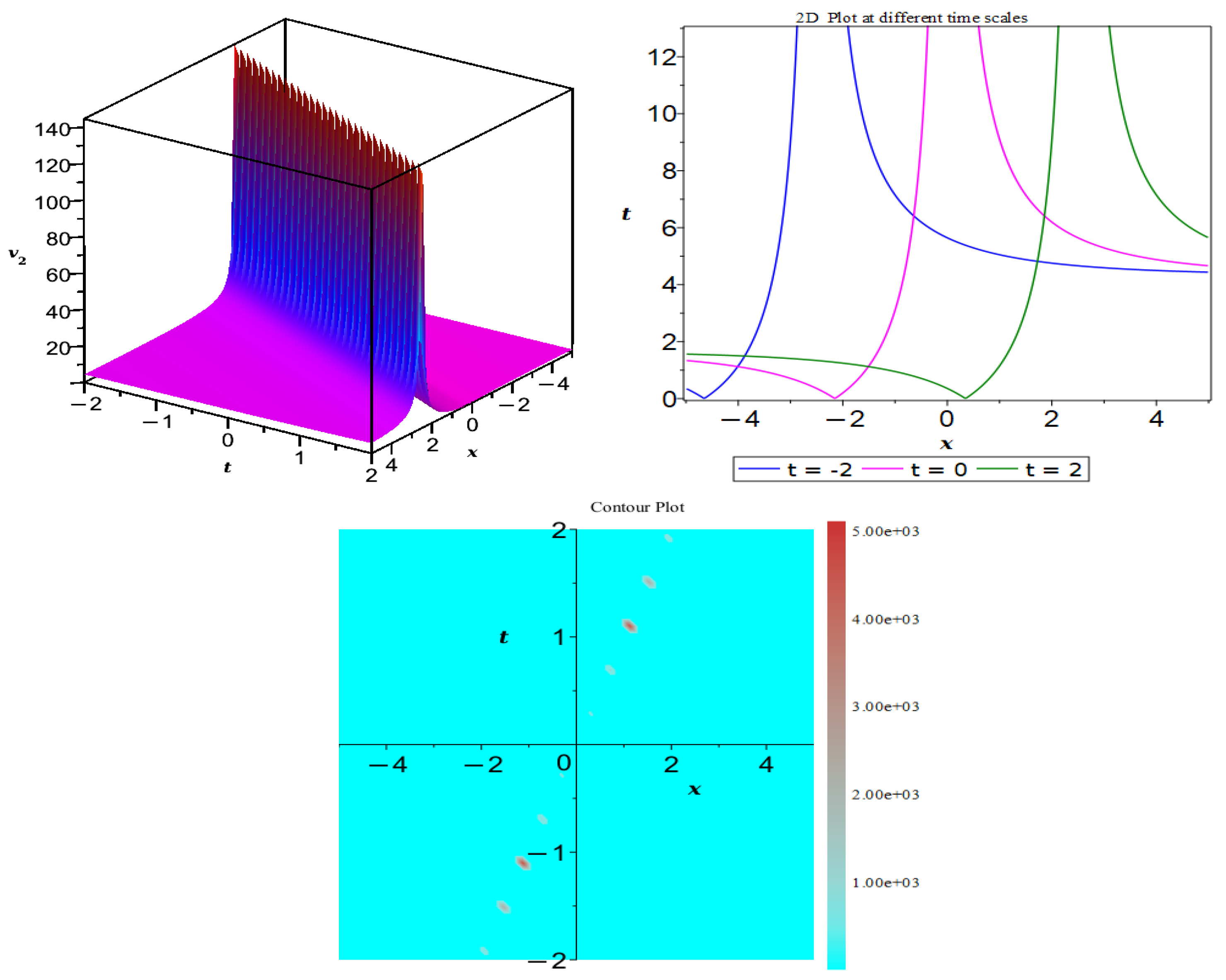
v 2 ( x , t ) = 6 ϕ coth ( ( F 1 2 4 F 2 F o 1 ) x + t ) ϕ 2 F 1 2 8 F o F 2 2 + ( α + β ) C o + 6 F 1 α + β ,
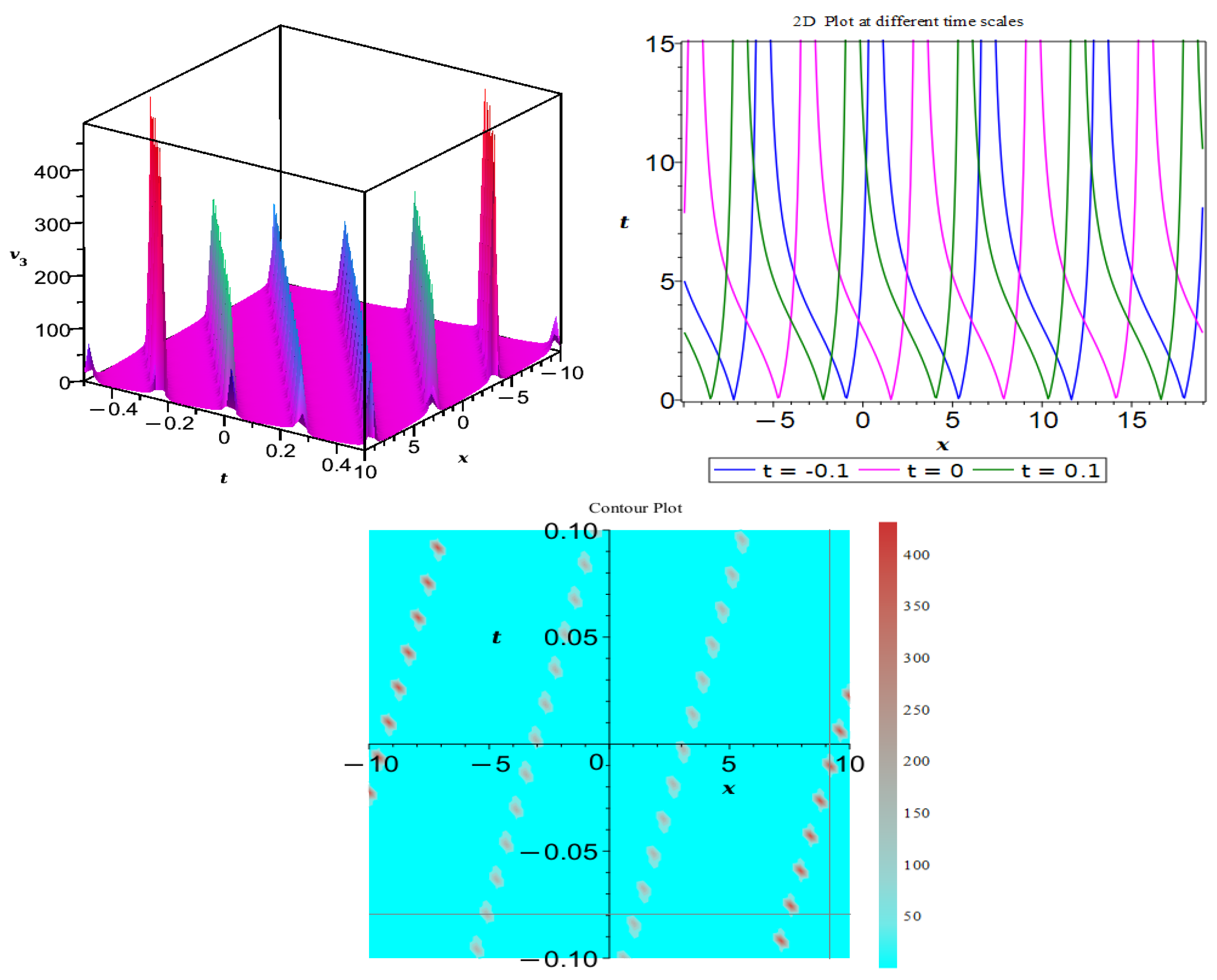
v 3 ( x , t ) = 6 ϕ tan ( ( F 1 2 4 F 2 F o 1 ) x + t ) ϕ 2 F 1 2 8 F o F 2 2 + ( α + β ) C o + 6 F 1 α + β .
Figure 13 illustrates the singular soliton profile in 3D for Equation (51) and Figure 14 illustrates the periodic singular wave profile in 3D for Equation (52).
v 4 ( x , t ) = 6 ϕ cot ( ( F 1 2 4 F 2 F o 1 ) x + t ) ϕ 2 F 1 2 8 F o F 2 2 + ( α + β ) C o + 6 F 1 α + β ,
v 5 ( x , t ) = ( ( α + β ) C o + 6 F 1 ) F 2 ( F 1 2 4 F 2 F o 1 ) x + t F 1 2 4 F 2 F o 1 + 12 F 2 ( α + β ) F 2 ( F 1 2 4 F 2 F o 1 ) x + t F 1 2 4 F 2 F o 1 ,
where ϕ = F 1 2 4 F o F 2 .

4. Invariance Under the Infinitesimal Transformation

Proposition 1.
The invariance of the field Equation (1) under the infinitesimal global transformation v ˜ = v + i ç v implies that v also satisfies the one-dimensional Hamilton–Jacobi equation; here, ç is a mall constant parameter and i = 1 .
Proof. 
Consider the above field Equation (1) under the infinitesimal global transformation v ˜ = v + i ç v close to the identity
v ˜ x x x t + α v ˜ x v ˜ x t + β v ˜ t v ˜ x x v ˜ x t v ˜ x x = 0 .
In the resulting expression after comparing the coefficients ç 0 , ç 1 , and ç 2 , we get two equations with the original Equation (1) as below:
v x x x t + 2 α v x v x t + 2 β v t v x x v x t v x x = 0
and the one-dimensional Hamilton–Jacobi equation
v t = H ( x , v x , t ) .
Here, H ( x , v x , t ) = ( u x ) β α . One of the above equations, Equation (56), can be reduced to the original Equation (1) under the scale transformation as v = 1 2 u , t = t ˜ , and x = x ˜ . □

5. Results and Discussion

Here, we have calculated a diverse array of analytical solutions, including traveling wave solutions, singular solutions, and periodic solitary wave solutions, for the shallow-water wave equation. As a result, the solutions we obtained have been validated through the use of Maple software. We obtained several types of solutions, such as singular soliton and anti-soliton solutions, and solitary waves with periodic amplitudes.The results obtained here for Equation (1) revealed deep insights with a large number of solutions for different values of parameters from those calculated in the literature [31,34,35]. Here, solutions with different orientations are also plotted in an anti-bell-shaped wave pattern for the solution, as shown in Figure 1, and the anti-soliton, which is presented in Figure 2. Our results incorporated the group of solitary waves composed of periodically varying amplitudes, which make these solutions different from those presented previously in the literature [31,32,36] for limited profiles and parameters. We have also plotted the modulus solutions containing i in Figure 4, Figure 5, Figure 8 and Figure 9. The structure and dynamics of these solutions are illustrated in Figure 7 and Figure 9 for Equation (1). Where as Figure 13 represents singular solution and Figure 14 shows periodic wave of singular solutions for that equation.

6. Conclusions

This study has successfully achieved several precise solutions for Equation (1) through the application of the unified method and the Riccati equation method. We have presented graphical illustrations to explore the dynamical behavior of the solutions. To highlight the physical relevance of the analytical solitary wave solutions, their behaviors have been visualized through 3D, 2D, and contour plots. The results derived here enrich the generalized shallow-water wave equation with some more solutions, which include anti-soliton and solitary waves with variant amplitudes that can be attenuated with parametric values. Our findings may provide motivation for further exploration in multiple domains of research into the association of the one-dimensional Hamilton–Jacobi equation. Further, we are investigating the Darboux representation of its Hirota bilinear solutions in the framework discussed in [42]. It may be quite interesting to construct their noncommutative analog by using the procedure presented in [43,44].

Author Contributions

Conceptualization, A.H.T. and I.M.; Methodology, S.A., A.H.T., I.M. and S.H.; Formal analysis, I.M.; Investigation, S.A.; Writing—original draft, S.A. and I.M.; Writing—review & editing, S.A., A.H.T., I.M. and S.H.; Supervision, A.H.T. and I.M.; Funding acquisition, S.H. All authors have read and agreed to the published version of the manuscript.

Funding

This work was supported and funded by the Deanship of Scientific Research at Imam Mohammad Ibn Saud Islamic University (IMSIU) (grant number IMSIU-DDRSP2602).

Data Availability Statement

The data will be made accessible on request.

Acknowledgments

We are thankful to Imam Mohammad Ibn Saud Islamic University providing facilities to complete this project. This work was supported and funded by the Deanship of Scientific Research at Imam Mohammad Ibn Saud Islamic University (IMSIU) (grant number IMSIU-DDRSP2602).

Conflicts of Interest

On behalf of all the authors, we affirm that there are no conflicting interests in publishing this paper.

References

  1. Akram, G.; Sadaf, M.; Arshed, S.; Latif, R.; Inc, M.; Alzaidi, A. Exact traveling wave solutions of (2+1)-dimensional extended Calogero–Bogoyavlenskii–Schiff equation using extended trial equation method and modified auxiliary equation method. Opt. Quantum Electron. 2024, 56, 424. [Google Scholar]
  2. Kundu, P.; Fahim, M.R.A.; Islam, M.E.; Akbar, M. The sine-Gordon expansion method for higher-dimensional NLEEs and parametric analysis. Heliyon 2021, 7, e06459. [Google Scholar] [PubMed]
  3. Wang, X.; Yang, Y.; Kou, W.; Wang, R.; Chen, X. Analytical solution of Balitsky-Kovchegov equation with homogeneous balance method. Phys. Rev. D 2021, 103, 056008. [Google Scholar] [CrossRef]
  4. Mirzazadeh, M.; Yıldırım, Y.; Yaşar, E.; Triki, H.; Zhou, Q.; Moshokoa, S.; Ullah, M.; Seadawy, A.; Biswas, A.; Belic, M. Optical solitons and conservation law of Kundu–Eckhaus equation. Optik 2018, 154, 551–557. [Google Scholar] [CrossRef]
  5. Feng, Z. The first-integral method to study the Burgers–Korteweg–de Vries equation. J. Phys. A Math. Gen. 2002, 35, 343. [Google Scholar]
  6. Mahmood, I.; Hussain, E.; Mahmood, A.; Anjum, A.; Shah, S. Optical soliton propagation in the Benjamin–Bona–Mahoney–Peregrine equation using two analytical schemes. Optik 2023, 287, 171099. [Google Scholar]
  7. Ma, W.; Zhang, Y.; Tang, Y.; Tu, J. Hirota bilinear equations with linear subspaces of solutions. Appl. Math. Comput. 2012, 218, 7174–7183. [Google Scholar] [CrossRef]
  8. Gepreel, K.; Nofal, T.; Alasmari, A. Exact solutions for nonlinear integro-partial differential equations using the generalized Kudryashov method. J. Egypt. Math. Soc. 2017, 25, 438–444. [Google Scholar] [CrossRef]
  9. Aksoy, E.; Kaplan, M.; Bekir, A. Exponential rational function method for space–time fractional differential equations. Waves Random Complex Media 2016, 26, 142–151. [Google Scholar]
  10. Cakoni, F.; Colton, D. A Qualitative Approach to Inverse Scattering Theory; Springer: New York, NY, USA, 2014; Volume 767. [Google Scholar]
  11. Hussain, A.; Ali, H.; Zaman, F.; Abbas, N. New closed form solutions of some nonlinear pseudo-parabolic models via a new extended direct algebraic method. Int. J. Math. Comput. Eng. 2023, 2, 35–58. [Google Scholar] [CrossRef]
  12. Bekir, A.; Aksoy, E.; Cevikel, A. Exact solutions of nonlinear time fractional partial differential equations by sub-equation method. Math. Methods Appl. Sci. 2015, 38, 2779–2784. [Google Scholar]
  13. Mirzazadeh, M. Modified simple equation method and its applications to nonlinear partial differential equations. Inf. Sci. Lett. 2014, 3, 1–9. [Google Scholar] [CrossRef]
  14. Chen, Y.; Wang, Q. Extended Jacobi elliptic function rational expansion method and abundant families of Jacobi elliptic function solutions to (1+1)-dimensional dispersive long wave equation. Chaos Solitons Fractals 2005, 24, 745–757. [Google Scholar]
  15. Mirhosseini-Alizamini, S.; Rezazadeh, H.; Eslami, M.; Mirzazadeh, M.; Korkmaz, A. New extended direct algebraic method for the Tzitzica type evolution equations arising in nonlinear optics. Comput. Methods Differ. Equ. 2020, 8, 28–53. [Google Scholar]
  16. Yusufoğlu, E.; Bekir, A. Solitons and periodic solutions of coupled nonlinear evolution equations by using the sine–cosine method. Int. J. Comput. Math. 2006, 83, 915–924. [Google Scholar] [CrossRef]
  17. Jhangeer, A.; Almusawa, H.; Hussain, Z. Bifurcation study and pattern formation analysis of a nonlinear dynamical system for chaotic behavior in traveling wave solution. Results Phys. 2022, 37, 105492. [Google Scholar] [CrossRef]
  18. Uzair, M.; Tedjani, A.M.; Mahmood, I.; Hussain, E. Exact Solutions and Soliton Transmission in Relativistic Wave Phenomena of Klein–Fock–Gordon Equation via Subsequent Sine-Gordon Equation Method. Axioms 2025, 14, 590. [Google Scholar]
  19. Raees, N.; Tedjani, A.M.; Mahmood, I.; Hussain, E. Diversity of Optical Soliton Solutions of Akbota Models in the Application of Heisenberg Ferromagnet. Symmetry 2025, 17, 2149. [Google Scholar] [CrossRef]
  20. Aljethi, R.A.; Raees, N.; Mahmood, I.; Hussain, E. Multi-Soliton Solutions for the Combined KdV–mKdV Equation in Terms of Wronskian with Multi-Wave and Periodic Cross-Kink Dynamics. Mathematics 2026, 14, 1488. [Google Scholar]
  21. Raza, N.; Kaplan, M.; Javid, A.; Inc, M. Complexiton and resonant multi-solitons of a (4+1)-dimensional Boiti–Leon–Manna–Pempinelli equation. Opt. Quantum Electron. 2022, 54, 95. [Google Scholar]
  22. Wazwaz, A. Two B-type Kadomtsev–Petviashvili equations of (2+1) and (3+1) dimensions: Multiple soliton solutions, rational solutions and periodic solutions. Comput. Fluids 2013, 86, 357–362. [Google Scholar]
  23. Feng, L.L.; Zhang, T.T. Breather wave, rogue wave and solitary wave solutions of a coupled nonlinear schrödinger equation. Appl. Math. Lett. 2018, 78, 133–140. [Google Scholar] [CrossRef]
  24. Wazwaz, A.M. Multiple kink solutions for two coupled integrable (2+ 1)-dimensional systems. Appl. Math. Lett. 2016, 58, 1–6. [Google Scholar]
  25. Ismael, H.F.; Sulaiman, T.A.; Nabi, H.R.; Shah, N.A.; Botmart, T. Multiple soliton, m-lump and interaction solutions to the (3+1)-dimensional soliton equation. Results Phys. 2023, 45, 106220. [Google Scholar] [CrossRef]
  26. Inc, M.; Ergüt, M. Periodic wave solutions for the generalized shallow water wave equation by the improved Jacobi elliptic function method. Appl. Math.-E-Notes [Electron. Only] 2005, 5, 89–96. [Google Scholar]
  27. Baleanu, D.; İnç, M.; Yusuf, A.; Aliyu, A. Optimal system, nonlinear self-adjointness and conservation laws for generalized shallow water wave equation. Open Phys. 2018, 16, 364–370. [Google Scholar] [CrossRef]
  28. López, C.; Salas, A. Exact solutions for the generalized shallow water wave equation by the general projective Riccati equations method. Boletín Matemáticas 2006, 13, 50–56. [Google Scholar]
  29. Elwakil, S.; El-Labany, S.; Zahran, M.; Sabry, R. Exact travelling wave solutions for the generalized shallow water wave equation. Chaos Solitons Fractals 2003, 17, 121–126. [Google Scholar] [CrossRef]
  30. Bagchi, B.; Das, S.; Ganguly, A. New exact solutions of a generalized shallow water wave equation. Phys. Scr. 2010, 82, 025003. [Google Scholar] [CrossRef]
  31. Mia, R.; Paul, A. New exact solutions to the generalized shallow water wave equation. Mod. Phys. Lett. B 2024, 38, 2450301. [Google Scholar] [CrossRef]
  32. Liu, J.G.; Zhu, W.-H. Breather wave solutions for the generalized shallow water wave equation with variable coefficients in the atmosphere, rivers, lakes and oceans. Comput. Math. Appl. 2019, 78, 848–856. [Google Scholar] [CrossRef]
  33. Liu, J.G.; Zhu, W.-H.; He, Y.; Lei, Z.-Q. Characteristics of lump solutions to a (3+1)-dimensional variable-coefficient generalized shallow water wave equation in oceanography and atmospheric science. Eur. Phys. J. Plus 2019, 134, 385. [Google Scholar]
  34. Liu, J.-G.; Zhu, W.-H. Multiple rogue wave, breather wave and interaction solutions of a generalized (3+1)-dimensional variable-coefficient nonlinear wave equation. Nonlinear Dyn. 2021, 103, 1841–1851. [Google Scholar]
  35. Dawod, L.A.; Lakestani, M.; Manafian, J. Breather Wave Solutions for the (3+1)-D Generalized Shallow Water Wave Equation with Variable Coefficients. Qual. Theory Dyn. Syst. 2023, 22, 00826. [Google Scholar] [CrossRef]
  36. Yang, Z.; Zhong, W.P.; Belić, M. Dark Localized Waves in Shallow Waters: Analysis within an Extended Boussinesq System. Chin. Phys. Lett. 2024, 41, 044201. [Google Scholar] [CrossRef]
  37. Duran, S.; Kaya, D. Breaking analysis of solitary waves for the shallow water wave system in fluid dynamics. Eur. Phys. J. Plus 2021, 136, 2450301. [Google Scholar] [CrossRef]
  38. Duran, S. Dynamic interaction of behaviors of time-fractional shallow water wave equation system. Mod. Phys. Lett. B 2021, 32, 2150353. [Google Scholar]
  39. Parker, D.F. Higher-order shallow water equations and the Camassa–Holm equation. Discret. Contin. Dyn.-Syst.-Ser. B 2007, 7, 629–641. [Google Scholar]
  40. Horikis, T.P.; Frantzeskakis, D.J.; Smyth, N.F. Extended shallow water wave equations. Wave Motion 2022, 112, 102934. [Google Scholar] [CrossRef]
  41. Kumar, A.; Kumar, S. Dynamic nature of analytical soliton solutions of the (1+1)-dimensional Mikhailov-Novikov-Wang equation using the unified approach. Int. J. Math. Comput. Eng. 2023, 1, 217–228. [Google Scholar]
  42. Raees, N.; Mahmood, I. Wronskian generalization of N soliton solutions of the Kaup–Kupershmidt Equation supported with Breather and Rational Solutions with Conservation Laws. Eur. Phys. J. Plus 2025, 140, 1017. [Google Scholar] [CrossRef]
  43. Mahmood, I. Lax pair representation and Darboux transformation of noncommutative Painlevé’s second equation. J. Geom. Phys. 2012, 62, 1575–1582. [Google Scholar] [CrossRef]
  44. Mahmood, I. Quasideterminant solutions of NC Painlevé II equation with the Toda solution at n=1 as a seed solution in its Darboux transformation. J. Geom. Phys. 2015, 95, 127–136. [Google Scholar]
Figure 1. Equation (19) with parameters set as M o = 0.11 , A = 0.5 , Φ = 3 , J = 2.021 , K = 397 , α = 2 , β = 0.5 , and the wave propagation with 15 x 5 for various values of t is shown in the 2D plot.
Symmetry 18 01065 g001
Figure 2. Equation (22) with parameters set as M o = 0.11 , A = 0.09 , Φ = 3 , J = 2.021 , K = 397 , α = 2 , β = 0.59 , and the wave propagation with 15 x 5 for various values of t is shown in the 2D plot.
Symmetry 18 01065 g002
Figure 3. Equation (23) with parameters set as M o = 0.11 , A = 0.1 , Φ = 3 , J = 2.021 , K = 397 , α = 2 , β = 0.01 , and the wave propagation with the range 15 x 5 for various values of t is shown in the 2D plot.
Symmetry 18 01065 g003
Figure 4. Equation (25) with parameters set as M o = 0.11 , A = 0.009 , Φ = 3 , J = 2.021 , K = 397 , α = 2 , β = 0.5 , and the wave propagation with the range 15 x 5 for various values of t is shown in the 2D plot.
Symmetry 18 01065 g004
Figure 5. Equation (26) with parameters set as M o = 0.11 , A = 0.1 , Φ = 3 , J = 2.021 , K = 397 , α = 2 , β = 0.5 , and the wave propagation with the range 15 x 5 for various values of t is shown in the 2D plot.
Symmetry 18 01065 g005
Figure 6. Equation (30) with parameters set as M o = 0.11 , A = 0.09 , Φ = 3 , J = 2.021 , K = 397 , α = 2 , β = 1.5 , and the wave propagation with 15 x 5 for various values of t is shown in the 2D plot.
Symmetry 18 01065 g006
Figure 7. Equation (32) with parameters set as M o = 0.11 , A = 0.09 , Φ = 3 , J = 2.021 , K = 397 , α = 2 , β = 0.5 , and the wave propagation with 15 x 15 for various values of t is shown in the 2D plot.
Symmetry 18 01065 g007
Figure 8. Equation (32) with parameters set as M o = 0.11 , A = 0.09 , Φ = 3 , J = 2.021 , K = 397 , α = 2 , β = 0.5 , and the wave propagation with 15 x 5 for various values of t is shown in the 2D plot.
Symmetry 18 01065 g008
Figure 9. Equation (35) with parameters set as M o = 0.11 , A = 0.09 , Φ = 3 , J = 2.021 , K = 397 , α = 2 , β = 0.5 , and the wave propagation with 15 x 5 for various values of t is shown in the 2D plot.
Symmetry 18 01065 g009
Figure 10. Equation (40) with parameters set as M o = 0.11 , A = 0.05 , Φ = 3 , J = 2.021 , K = 397 , α = 2 , β = 0.9 , and the wave propagation with 20 x 20 for various values of t is shown in the 2D plot.
Symmetry 18 01065 g010
Figure 11. Equation (41) with parameters set as M o = 0.11 , A = 0.2 , Φ = 3 , J = 2.021 , K = 397 , α = 2 , β = 0.01 , and the wave propagation with 10 x 10 for various values of t is shown in the 2D plot.
Symmetry 18 01065 g011
Figure 12. Equation (50) with parameters set as F o = 0.5 , F 1 = 1.5 , F 2 = 2 , C o = 5 , α = 0.98 , β = 0.9 , and the wave propagation with 5 x 5 for various values of t is shown in the 2D plot.
Symmetry 18 01065 g012
Figure 13. Equation (51) with parameters set as F o = 0.2 , F 1 = 1 , F 2 = 1 , C o = 0 , α = 1 , β = 1 , and the wave propagation with 5 x 5 for various values of t is shown in the 2D plot.
Symmetry 18 01065 g013
Figure 14. Equation (52) with parameters set as F o = 0.1 , F 1 = 1 , F 2 = 0.1 , C o = 0 , α = 1 , β = 1 , and the wave propagation with 10 x 10 for various values of t is shown in the 2D plot.
Symmetry 18 01065 g014
Disclaimer/Publisher’s Note: The statements, opinions and data contained in all publications are solely those of the individual author(s) and contributor(s) and not of MDPI and/or the editor(s). MDPI and/or the editor(s) disclaim responsibility for any injury to people or property resulting from any ideas, methods, instructions or products referred to in the content.