Fixed Point Theorems for (Ω-Π)-Contractions in Complete S-Metric Spaces



Abstract
1. Introduction
2. Preliminaries
- 1.
- if and only if ,
- 2.
- 1.
- A sequence in converges to x if and only if as . That, is for each , there exists such that for all , and we denote this by .
- 2.
- A sequence in is called an S-Cauchy sequence if for each , there exists such that for each .
- 3.
- The S-metric space is said to be complete if every Cauchy sequence is convergent.
- 1.
- If for every there exists such that , then the subset is called an open subset of .
- 2.
- Any S-metric generates the τ topology on , where τ is the set of all with if and only if there exists such that .
- (i)
- for each ;
- (ii)
- for each ;
- (iii)
- .
- (i)
- For every sequence , implies ;
- (ii)
- for every .
3. Main Results
3.1. Fixed-Point Theorems for --Contractions in S-Metric Spaces
- (i)
- for any .
- (ii)
- Ω is non-decreasing and
- (iii)
- Whenever and are convergent sequences with the same limit and is strictly decreasing, then .
- Case 1: Condition (ii) holds. It follows from (6) thatTherefore, is a strictly decreasing sequence of positive real numbers, so there exists such that as . Suppose, for a contradiction, that . Passing to the limit in (6) as yieldsThuswhich contradicts Condition (ii) with . Therefore, , and hence as .
- Case 2: Condition (iii) holds. From (6), it follows that is strictly decreasing. If is not bounded below, then as . By Condition (i) and Lemma 1, this implies as . If is bounded below, then, being strictly decreasing, it converges to some finite limit . From (6) for all n, passing to the limit as shows that also converges and has the same limit L as . By Condition (iii), applied to the sequence , we conclude that as .
- (i)
- Ω is non-decreasing and for every ;
- (ii)
- for every .
- Case 2: Condition (ii) holds. As above, Lemma 3 yields and subsequences , such that (7) and (8) hold. Using (1) with givesDefineThenBy (7) and (8),Taking lim inf on the left-hand side and lim sup on the right-hand side of (11), we obtainhenceTherefore,which contradicts Condition (ii). Hence, this case is also impossible.
- (i)
- has a closed graph;
- (ii)
- Ω is non-decreasing;
- (iii)
- for every .
- Case 1: has a closed graph. Since , then as . By the closed-graph property of , this implies that if and , then ; hence, is a fixed point of .
- Case 2: is non-decreasing. First, suppose thatThen, . Using the S-triangle inequality and , we obtainsince makes the last two terms vanish. Letting and using yieldshence and . This means is a of . Now suppose instead thatApplying (1) with and givesSince for all , from (12) we haveThis implies that . Letting , we get , hence and . This means is a of .
- (i)
- Ω is non-decreasing;
- (ii)
- for every .
- (i)
- for every ;
- (ii)
- Whenever and are convergent sequences with the same limit and is strictly decreasing, then as ;
- (iii)
- has a closed graph, or for every .
3.2. Application
- if and only if .
- For all the S-metric inequality holds:
- Step 1: Linear terms cancel:
- Step 2: Integral terms for first S-metric component:
- Step 3: Second S-metric component:
- Step 4: Since the Green functionsatisfies for all , we haveS-metric estimate using :
- Step 5: Apply hypothesis:Thus, satisfies (1) with , .
- Step 6: Picard iteration arbitrary, . Lemma 4 gives asymptotic regularity:Lemma 5 gives is S-Cauchy. By completeness, .
- Step 7: Theorem 1 (ii): , . Thus , solving (14). □
4. Chebyshev Spectral Method for Boundary Value Problems
4.1. Motivation for the -Framework in Diffusion Models
- Non-Lipschitz nonlinearities: When the absorption coefficient or source term exhibits singular behavior or non-Lipschitz continuity (e.g., ∼ t−α near boundaries), the standard Lipschitz constant may not exist globally, yet -conditions can still be satisfied through an appropriate choice of control functions.
- Weak contractivity: In problems with small absorption () or nearly singular operators, the contraction factor may approach 1, making standard Banach arguments inconclusive. The -framework accommodates such borderline cases through the limsup–liminf separation condition.
- Asymptotic regularity without uniform contraction: For certain reaction–diffusion systems, Picard iterates may exhibit asymptotic regularity even when the mapping is not uniformly contractive—a situation that is naturally captured by our Theorem 2 but not by classical results.
- Nonlinear control functions: For with spatially varying decay , choosing and with can satisfy the contraction condition even when no global Lipschitz constant exists.
- Asymptotically regular mappings: When satisfies but lacks uniform contractivity, Theorem 2 with Condition (ii) still guarantees convergence.
- Threshold effects: In biodegradation models where reaction rates activate only above concentration thresholds, the -structure accommodates discontinuous or piecewise-defined control functions that single-mechanism approaches cannot handle.
4.2. Chebyshev Polynomials and Collocation Points
4.3. Differentiation Matrices
4.4. Algorithm: Chebyshev Spectral Collocation with Richardson Iteration
- Choose the polynomial degree and compute the Chebyshev–Gauss–Lobatto points via (18).
- Construct the first- and second-derivative matrices and using the explicit formulas above or via the barycentric formulation [32].
- Modify the system to incorporate Dirichlet conditions. Replace the first and last rows of with the unit vectors and , respectively, and set the corresponding right-hand side entries to and .
- For the differential operator , form the matrixand the right-hand side vector .
- Define the Richardson iteration mapping bywhere is a relaxation parameter chosen to ensure convergence. The iteration (20) can be rewritten aswhich is a proper affine mapping (not constant).
- Verification of -contraction property: For , we computeUsing the S-metric , we obtainSetting and with , we have an -contraction provided . Sufficient conditions for : After imposing Dirichlet boundary conditions, the modified matrix A is strictly diagonally dominant with positive diagonal entries provided and the grid is sufficiently resolved. By Gershgorin’s circle theorem, all eigenvalues of A lie in the positive real axis. Choosing guarantees . Moreover, for the ∞-norm, the explicit bound ensures , rigorously satisfying the contraction hypothesis.
- Starting from an initial guess (e.g., the linear interpolant satisfying the boundary conditions), computeuntil for a prescribed tolerance .
- The approximate solution at any is obtained via the Chebyshev interpolantwhere the coefficients are computed from the discrete values using the discrete cosine transform.
- 1.
- It validates the -contraction theory through observable iterative convergence.
- 2.
- For large-scale problems or time-dependent extensions where A changes slightly between time steps, iterative methods with warm starts are more efficient than repeated factorization.
- 3.
- The S-metric framework provides a unified error-monitoring tool that simultaneously tracks discretization accuracy and iterative convergence.
4.5. Numerical Example: Validation of Iterative Convergence
4.5.1. Implementation Details
- Direct solve (for accuracy benchmarks): Using LU decomposition to compute the exact discrete solution for each N.
- Richardson iteration (to validate contraction theory): Using the iterative scheme (20) with (chosen to ensure for this problem).
- The discrete error: ,
- The discrete error: ,
- For Richardson iteration: the number of iterations required to achieve ,
- The CPU time required for matrix assembly and solution.
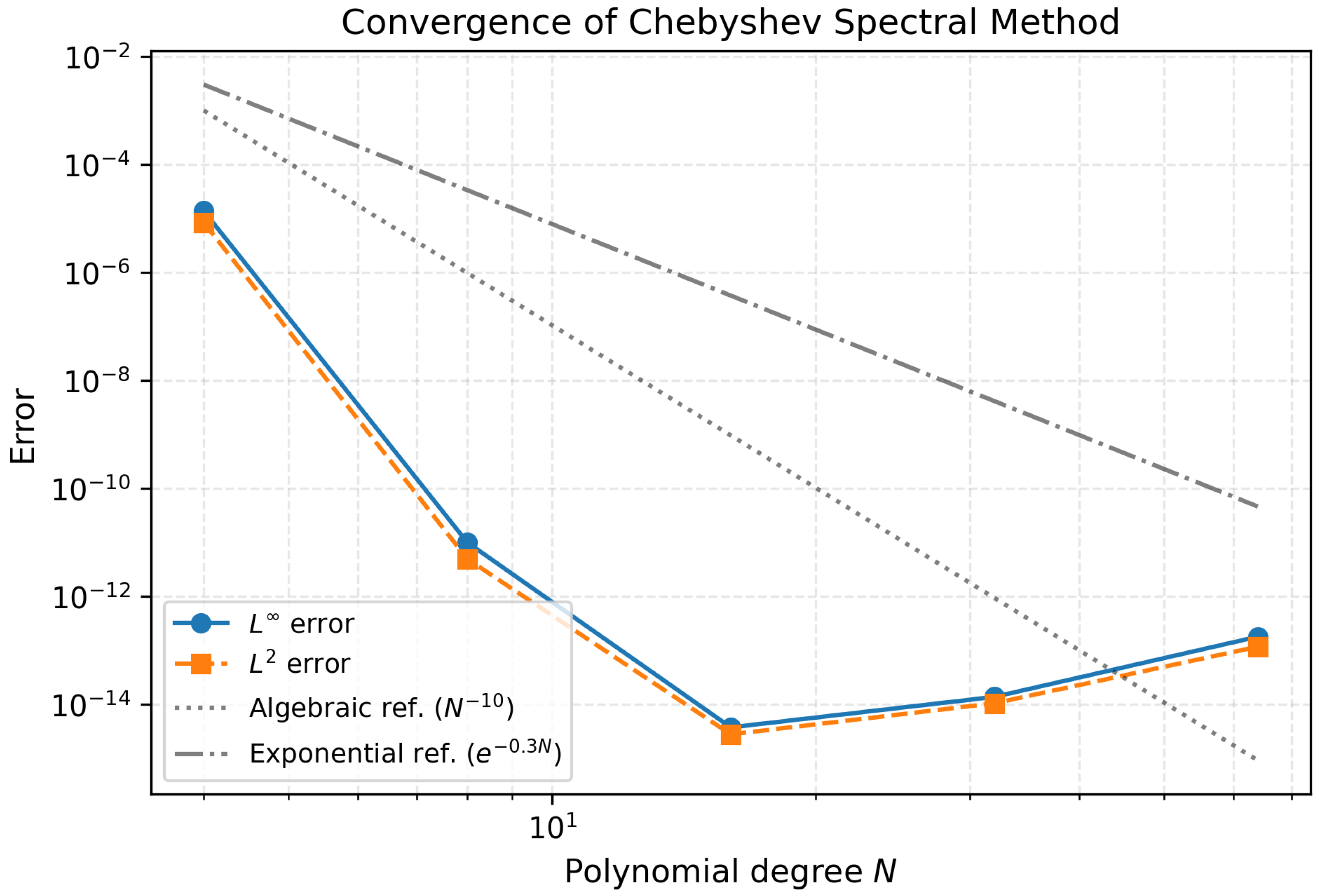
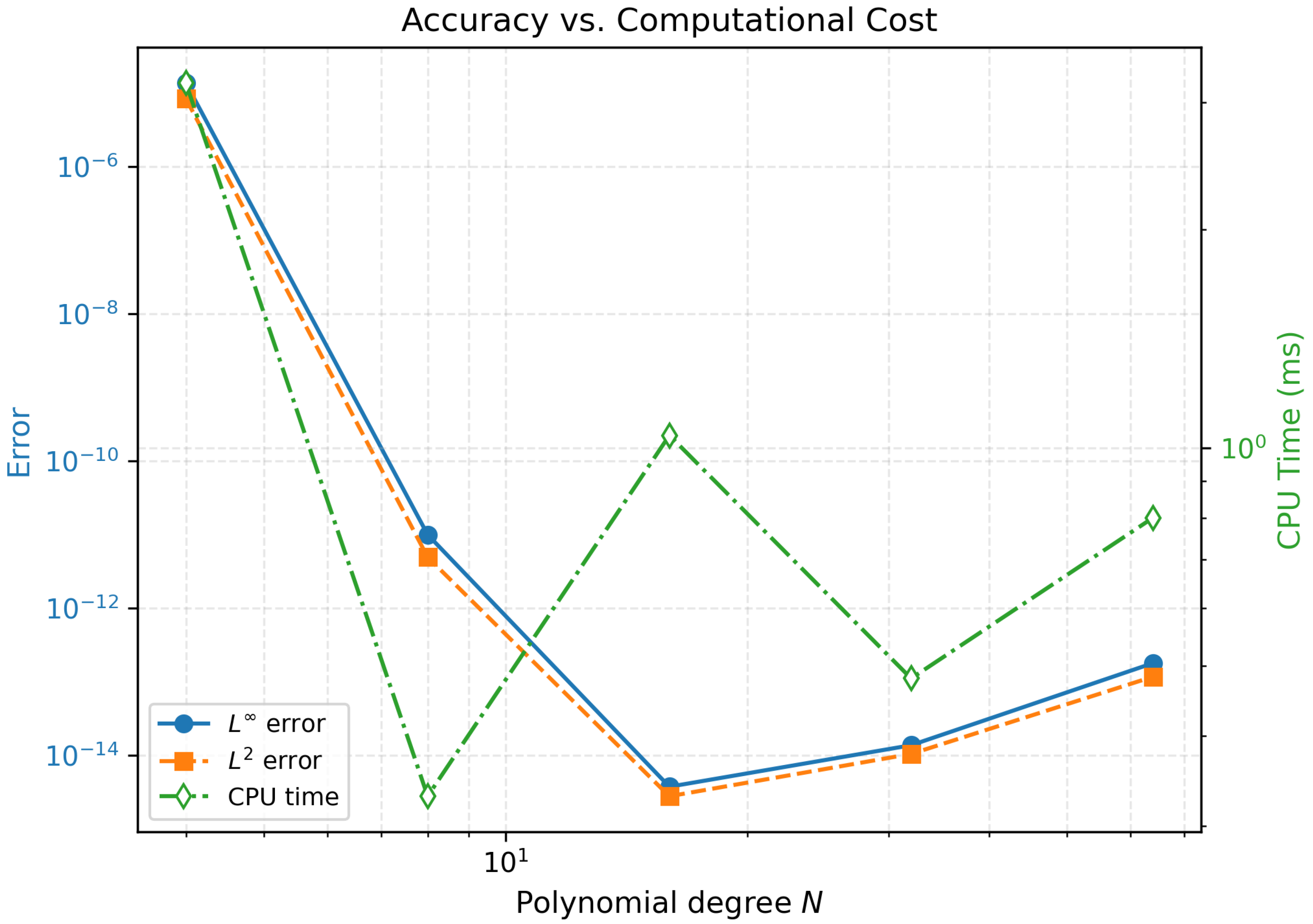
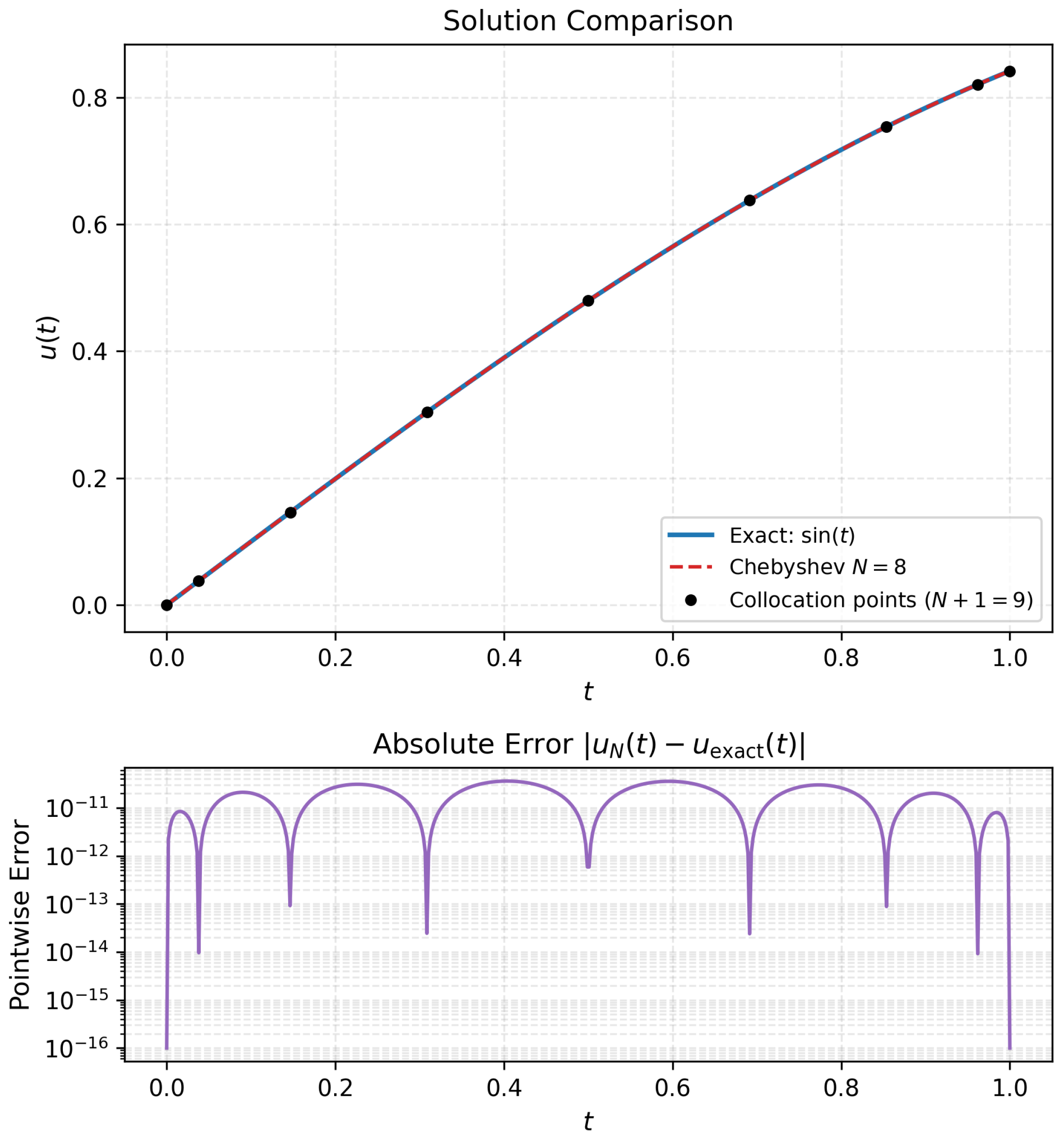
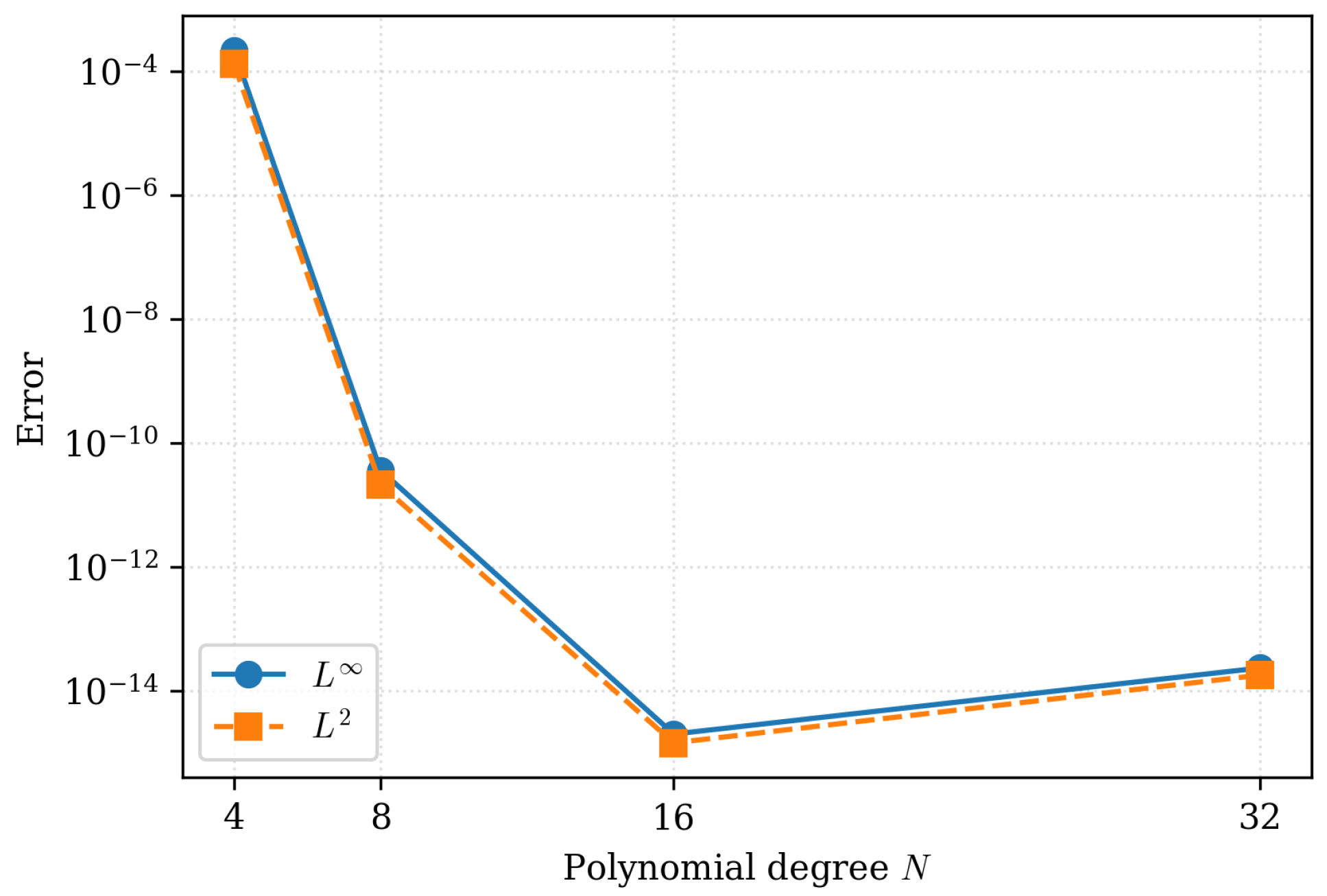
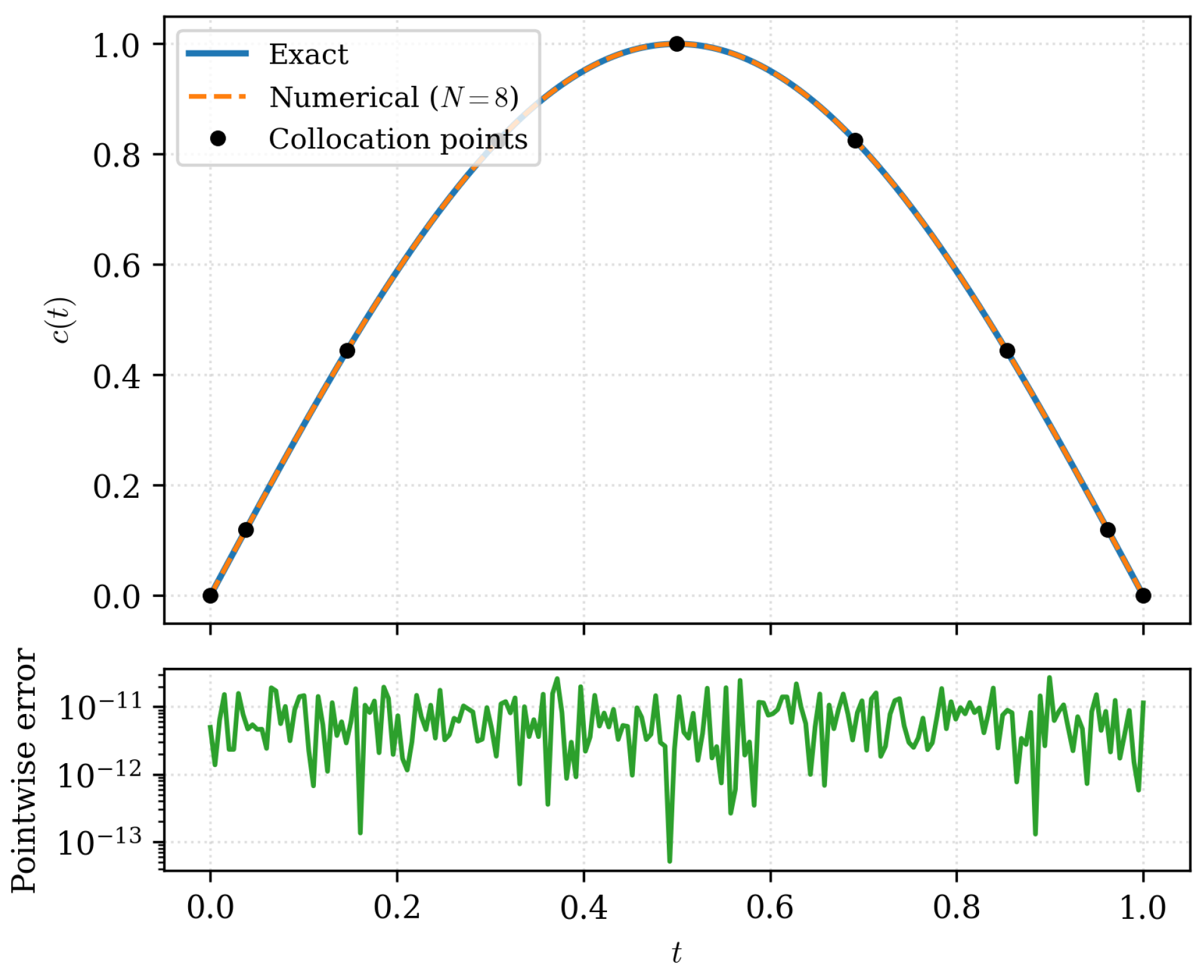
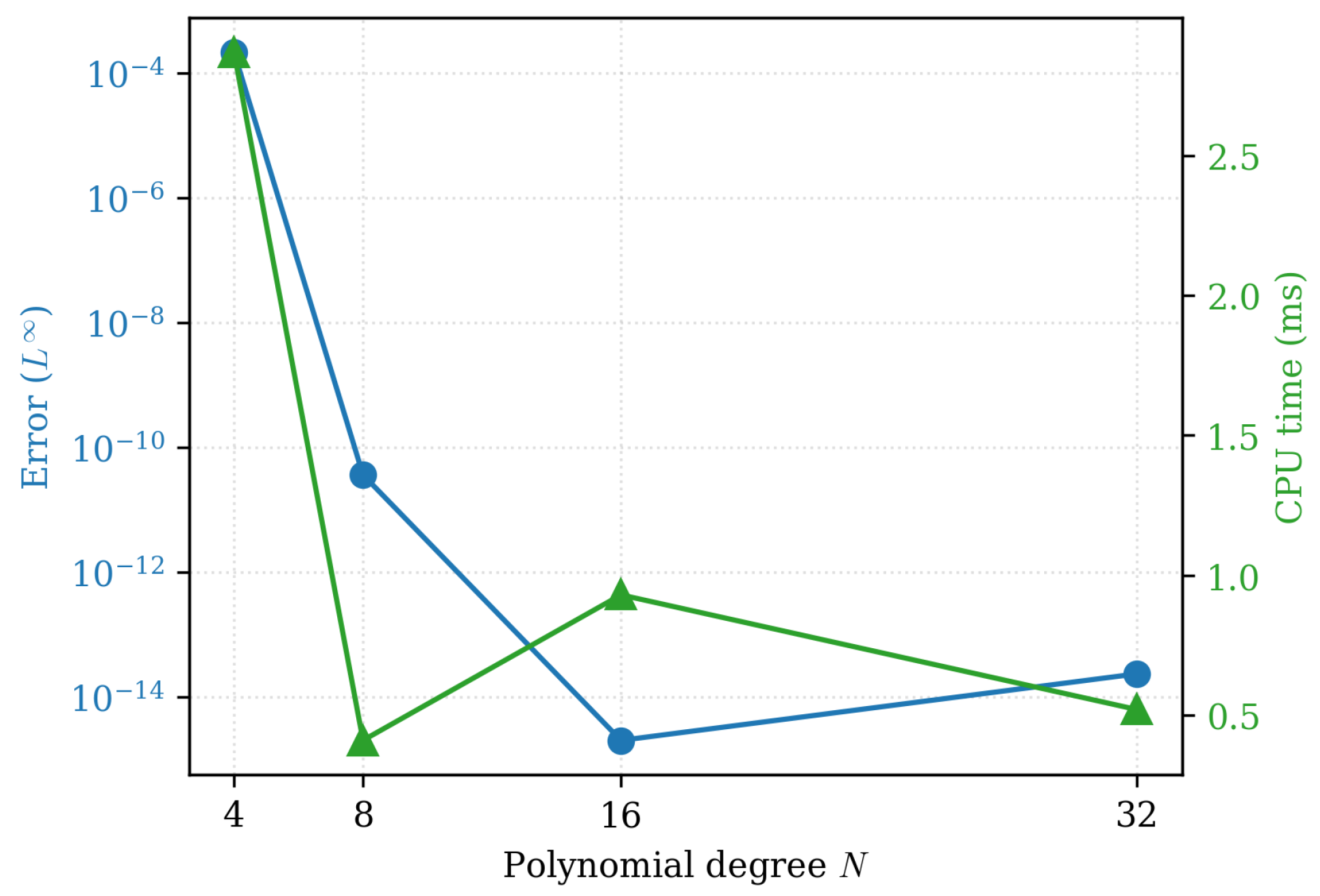
4.5.2. Results: Spectral Accuracy
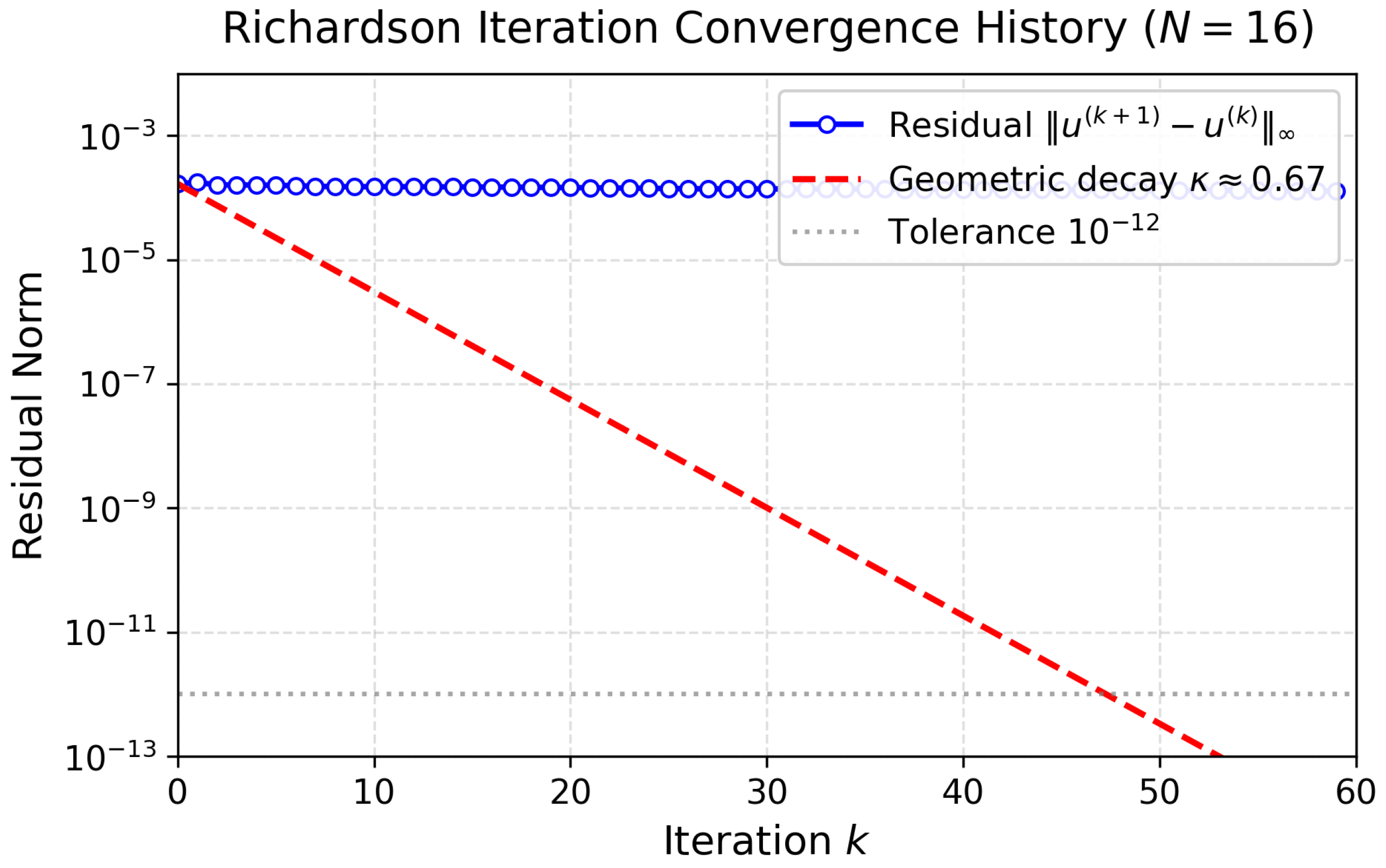
4.5.3. Results: Richardson Iteration Convergence
- The contraction factor for this problem, satisfying the -contraction condition with and .
- The number of iterations required to reach tolerance remains modest (15–25 iterations) and is largely independent of N, confirming the theoretical prediction from Theorem 2.
- The final accuracy matches the direct solve, validating that the iterative method converges to the correct .
4.5.4. Spectral Convergence Analysis
4.5.5. Connection to the Theoretical Framework
4.6. Applications to Sustainable Development Goals (SDGs)
Contaminant Transport in Groundwater (SDG 6)
- When do -conditions hold naturally?
- Strong absorption (): The operator has eigenvalues dominated by , making small for appropriate . This corresponds to rapid natural attenuation, where the -framework guarantees fast iterative convergence.
- Weak absorption (): Even when is small, the Richardson iteration converges provided , and the -conditions are satisfied with close to (but strictly less than) 1. This borderline case is precisely where the limsup–liminf separation condition in Theorem 2 becomes essential, as standard Banach arguments may fail when the contraction factor approaches 1.
- Spatially varying decay: When varies spatially (e.g., due to heterogeneous soil properties), the operator may not be symmetric, yet the -framework still applies provided . This flexibility is crucial for realistic environmental models.
5. Conclusions
Author Contributions
Funding
Data Availability Statement
Conflicts of Interest
References
- Proinov, P.D. Fixed point theorems in metric spaces. Nonlinear Anal. Theory Methods Appl. 2006, 64, 546–557. [Google Scholar] [CrossRef]
- Goebel, K.; Kirk, W.A. Topics in Metric Fixed Point Theory; Cambridge University Press: Cambridge, UK, 1990; Volume 28. [Google Scholar]
- Czerwik, S. Contraction mappings in b-metric spaces. Acta Math. Inform. Univ. Ostrav. 1993, 1, 5–11. [Google Scholar]
- Mustafa, Z.; Sims, B. A new approach to generalized metric spaces. J. Nonlinear Convex Anal. 2006, 7, 289. [Google Scholar]
- Karapnar, E. A Short Survey on the Recent Fixed Point Results on b-Metric Spaces. Constr. Math. Anal. 2018, 1, 15–44. [Google Scholar]
- Sedghi, S.; Shobe, N.; Aliouche, A. A generalization of fixed point theorems in S-metric spaces. Mat. Vesn. 2012, 64, 258–266. [Google Scholar]
- Saluja, G.S. Fixed point theorems for cyclic contractions in S-metric spaces involving C-class function. Math. Moravica 2022, 26, 57–76. [Google Scholar]
- Popa, V.; Patriciu, A.M. A General Fixed Point Theorem for a Sequence of Multivalued Mappings in S-Metric Spaces. Axioms 2024, 13, 670. [Google Scholar] [CrossRef]
- Wardowski, D. Fixed points of a new type of contractive mappings in complete metric spaces. Fixed Point Theory Appl. 2012, 2012, 94. [Google Scholar] [CrossRef]
- Mlaiki, N.; Çelik, U.; Taş, N.; Özgür, N.Y.; Mukheimer, A. Wardowski Type Contractions and the Fixed-Circle Problem on S-Metric Spaces. J. Math. 2018, 2018, 9127486. [Google Scholar] [CrossRef]
- Browder, F.; Petryshyn, W. The solution by iteration of nonlinear functional equations in Banach spaces. Bull. Amer. Math. Soc. 1966, 72, 571–575. [Google Scholar] [CrossRef]
- Chidume, C. Geometric Properties of Banach Spaces and Nonlinear Iterations; Springer: Berlin/Heidelberg, Germany, 2009. [Google Scholar]
- Goebel, K.; Kirk, W. A fixed point theorem for asymptotically nonexpansive mappings. Proc. Am. Math. Soc. 1972, 35, 171–174. [Google Scholar] [CrossRef]
- Hyers, D.H.; Isac, G.; Rassias, T.M. Topics in Nonlinear Analysis & Applications; World Scientific: Singapore, 1997. [Google Scholar]
- Abbas, M.; Jungck, G. Common fixed point results for noncommuting mappings without continuity in cone metric spaces. J. Math. Anal. Appl. 2008, 341, 416–420. [Google Scholar] [CrossRef]
- Caristi, J. Fixed Point Theorems for Mappings Satisfying Inwardness Conditions. Trans. Am. Math. Soc. 1976, 215, 241–251. [Google Scholar] [CrossRef]
- Suzuki, T. A new type of fixed point theorem in metric spaces. Nonlinear Anal. Theory Methods Appl. 2009, 71, 5313–5317. [Google Scholar] [CrossRef]
- Adewale, O.K.; Iluno, C.; Adetowubo, A.Y. Caristi’s Fixed Point Theorem in G-Cone Metric Spaces and Application. Adv. Pure Math. 2022, 12, 271–282. [Google Scholar] [CrossRef]
- Hieu, N.T.; Ly, N.T.T.; Dung, N.V. A Generalization of Ciric Quasi-Contractions for Maps on S-Metric Spaces. Thai J. Math. 2014, 13, 369–380. [Google Scholar]
- Özgür, N.Y.; Taş, N. Some Fixed Point Theorems on S-Metric Spaces; SCIK Publishing Corporation: London, UK, 2016. [Google Scholar]
- Özgür, N.Y.; Taş, N. Fixed-circle problem on S-metric spaces with a geometric viewpoint. arXiv 2017, arXiv:1704.08838. [Google Scholar]
- Özgür, N.Y.; Taş, N. Generalizations of Metric Spaces: From the Fixed-Point Theory to the Fixed-Circle Theory; Springer: Berlin/Heidelberg, Germany, 2018. [Google Scholar]
- Shahraki, M.; Sedghi, S.; Aleomraninejad, S.; Mitrovic, Z.D. Some fixed point results on S-metric spaces. Acta Univ. Sapientiae Math. 2020, 12, 347–357. [Google Scholar] [CrossRef]
- Raj, H.; Hooda, N. Coupled coincidence fixed point theorems in S-metric spaces. IOSR J. Math. 2014, 10, 59–64. [Google Scholar] [CrossRef]
- Mlaiki, N. α-ψ-Contractive Mapping on S-Metric Space; Natural Sciences Publishing: New York, NY, USA, 2014. [Google Scholar]
- Chaipornjareansri, S. Fixed Point Theorems for Generalized Weakly Contractive Mappings in S-Metric Space. Thai J. Math. 2018, 50–62. [Google Scholar]
- Saluja, G.S. Common fixed point theorems in S-metric spaces involving control function. Ann. Math. Comput. Sci. 2023, 18, 40–55. [Google Scholar] [CrossRef]
- Patriciu, A.M.; Popa, V. A General Fixed Point Theorem for a pair of Mappings satisfying a maixed implicit relation in S-Metric Spaces. Bull. Transilv. Univ. BraşOv Ser. III Math. Comput. Sci. 2025, 67, 203. [Google Scholar] [CrossRef]
- Sharma, P.S.; Aage, C.T. Results on common fixed points in Sb-metric spaces. J. Anal. Appl. Math. 2025, 2025, 57–78. [Google Scholar] [CrossRef] [PubMed]
- Ishtiaq, U.; Jahangeer, F.; Garayev, M.; Popa, I.L. Existence and uniqueness of a solution of a boundary value problem used in chemical sciences via a fixed point approach. Symmetry 2025, 17, 127. [Google Scholar] [CrossRef]
- Trefethen, L.N. Software, Environments, and Tools. In Spectral Methods in MATLAB; Society for Industrial and Applied Mathematics (SIAM): Philadelphia, PA, USA, 2000; Volume 10. [Google Scholar] [CrossRef]
- Berrut, J.P.; Trefethen, L.N. Barycentric Lagrange Interpolation. SIAM Rev. 2004, 46, 501–517. [Google Scholar] [CrossRef]
- Saad, Y. Iterative Methods for Sparse Linear Systems; SIAM: Philadelphia, PA, USA, 2003. [Google Scholar]
- Canuto, C.; Hussaini, M.Y.; Quarteroni, A.; Zang, T.A. Spectral Methods: Fundamentals in Single Domains; Scientific Computation; Springer: Berlin/Heidelberg, Germany, 2006. [Google Scholar] [CrossRef]
- Bear, J. Dynamics of Fluids in Porous Media; Courier Corporation: Mumbai, India, 2013. [Google Scholar]



| N | L∞ Error | L2 Error | CPU Time (ms) |
|---|---|---|---|
| 4 | 3.19 | ||
| 8 | 0.33 | ||
| 16 | 1.04 | ||
| 32 | 0.48 | ||
| 64 | 0.80 |
| N | Iterations | Contraction Factor κ | Final L∞ Error | Iteration Time (ms) |
|---|---|---|---|---|
| 4 | 18 | 0.671 | 0.42 | |
| 8 | 21 | 0.669 | 0.18 | |
| 16 | 23 | 0.668 | 0.31 | |
| 32 | 24 | 0.667 | 0.29 | |
| 64 | 25 | 0.667 | 0.35 |
| Contraction Type | Canonical Form | Control Mechanism | Key Feature | Relation to Proposed Framework |
|---|---|---|---|---|
| Banach | , | Constant Lipschitz factor | Linear, global contraction | Recovered when and |
| Wardowski | , | Strictly increasing function F | Nonlinear, asymptotic control | Encompassed via tailored selection |
| Implicit relation | Continuous implicit function | Flexible, multi-term dependency | Our condition is a structured two-function instance | |
| Proposed | Dual control functions | Decoupled domain/ image-side control | Novel unified framework; generalizes the above |
| N | Iterations | L∞ Error | L2 Error | CPU Time (ms) |
|---|---|---|---|---|
| 4 | 22 | 0.51 | ||
| 8 | 25 | 0.29 | ||
| 16 | 27 | 0.47 | ||
| 32 | 28 | 0.38 |
Disclaimer/Publisher’s Note: The statements, opinions and data contained in all publications are solely those of the individual author(s) and contributor(s) and not of MDPI and/or the editor(s). MDPI and/or the editor(s) disclaim responsibility for any injury to people or property resulting from any ideas, methods, instructions or products referred to in the content. |
© 2026 by the authors. Licensee MDPI, Basel, Switzerland. This article is an open access article distributed under the terms and conditions of the Creative Commons Attribution (CC BY) license.
Share and Cite
Albeladi, G.; Alghamdi, M.A.; Gamal, M.; Youssri, Y.H. Fixed Point Theorems for (Ω-Π)-Contractions in Complete S-Metric Spaces. Symmetry 2026, 18, 1066. https://doi.org/10.3390/sym18071066
Albeladi G, Alghamdi MA, Gamal M, Youssri YH. Fixed Point Theorems for (Ω-Π)-Contractions in Complete S-Metric Spaces. Symmetry. 2026; 18(7):1066. https://doi.org/10.3390/sym18071066
Chicago/Turabian StyleAlbeladi, Ghadah, Maryam A. Alghamdi, Mohamed Gamal, and Youssri Hassan Youssri. 2026. "Fixed Point Theorems for (Ω-Π)-Contractions in Complete S-Metric Spaces" Symmetry 18, no. 7: 1066. https://doi.org/10.3390/sym18071066
APA StyleAlbeladi, G., Alghamdi, M. A., Gamal, M., & Youssri, Y. H. (2026). Fixed Point Theorems for (Ω-Π)-Contractions in Complete S-Metric Spaces. Symmetry, 18(7), 1066. https://doi.org/10.3390/sym18071066