


Abstract
A class of index-cyclic symmetric positive tensors is defined, and a diagonal similarity algorithm is proposed to compute the H-spectral radius of such tensors. The linear convergence of the algorithm is rigorously proven. The computational efficiency of the proposed method is compared with that of the classical power method by numerical examples. The results indicate that the proposed algorithm achieves reliable linear convergence and offers competitive computational performance for index-cyclic symmetric positive tensors.
1. Introduction
Tensors are natural generalizations of matrices with a broad spectrum of applications. In particular, nonnegative tensors have emerged as powerful tools in the era of big data, drawing growing attention and rigorous study from mathematicians [1,2,3]. Sharing many desirable properties with nonnegative matrices, nonnegative tensors have found widespread practical use. Among these, the eigenvalue problem of nonnegative tensors has been systematically studied, yielding a wealth of influential results [4,5,6,7,8,9,10,11,12,13,14,15,16,17].
In 2005, Qin and Lim [4,5] respectively defined the eigenvalues of tensors. Assuming is an m-order n-dimensional real tensor, if and satisfy
where
then is called the H-eigenvalue of tensor , and is called the H-eigenpair of tensor . Let be the set of H-eigenvalues of tensor , and be the H-spectral radius of tensor .
In 2009, Ng, Qi and Zhou [6] proposed the NQZ algorithm for computing the H-spectral radius of irreducible nonnegative tensors, which is a natural extension of the power method for computing the maximum eigenvalue of matrices (see Algorithm 1).
| Algorithm 1: NQZ algorithm |
| Step 0. Choose Let and set . |
|
Step 1. Compute |
| Step 2. If , stop. Otherwise, replace k by and go to Step 1. |
Subsequently, scholars have studied the convergence of the NQZ algorithm for computing the H-spectral radius of nonnegative tensors [6,7,8,9,10,11,12,13]. Among them, in 2014, Hu, Huang and Qi [12] provided more general convergence conditions and proved the R-linear convergence of the NQZ algorithm for weak primitive tensors. In 2012, Zhang and Qi [8] proved the linear convergence of the NQZ algorithm on essentially positive tensors. In 2021, Zhang and Bu [10] defined a generalized weakly positive tensor and provided a diagonal similarity algorithm for the H-spectral radius, proving the linear convergence of the algorithm. In 2023, Liu and Lv [13] defined the s-index positive tensor and provided a linear convergence algorithm for the H-spectral radius of the s-index positive tensor. In 2025, Lyu and Chen [18] first introduced the directed hypergraph of tensors into the study of the convergence of algorithms for the H-spectral radius of nonnegative tensors. They applied the directed hypergraph of tensors to investigate the R-linear convergence of the NQZ algorithm and derived general conditions for its linear convergence using the representation matrix of nonnegative tensors. The NQZ algorithm works well for computing the H-spectral radius of weakly primitive tensors, but it fails to converge for some weakly irreducible nonnegative tensors. Therefore, we propose a shifted algorithm for the H-spectral radius of nonnegative tensors, which is applicable to general weakly irreducible nonnegative tensors. An appropriate choice of the shift parameter can further improve the computational efficiency.
Building on these advances, this work extends the existing classes of essentially positive tensors [7], weakly positive tensors [19], generalized weakly positive tensors [10], and s-index positive tensors [13], and introduces the novel class of index-cyclic symmetric positive tensors. A diagonal similarity algorithm is proposed for computing the H-spectral radius of these tensors, and its linear convergence is rigorously established. The computational performance of the proposed algorithm is then compared with that of the NQZ algorithm via comprehensive numerical examples.
This paper is structured as follows. Section 1 outlines the NQZ algorithm and relevant research findings. Section 2 provides relevant definitions and preliminary results. In Section 3, we introduce the class of index-cyclic symmetric positive tensors, present our algorithm for computing the H-spectral radius, and establish its linear convergence. Section 4 contains examples that compare our proposed algorithm with the NQZ one. Finally, Section 5 concludes the paper and discusses potential future work.
2. Related Definitions and Preliminary Results
In this paper, let denote the set of all real mth-order n-dimensional tensors, and denote the set of all real mth-order n-dimensional nonnegative tensors. Let be the set of all real matrices. Furthermore, , , and denote, respectively, the set of all real vectors, the set of all nonnegative nonzero vectors, and the set of all positive vectors in the n-dimensional Euclidean space.
In 2008, Chang et al. [14] generalized the concept of irreducible matrices to irreducible tensors.
Definition 1
([14]). An mth-order n-dimensional tensor is said to be reducible if there exists a nonempty proper index subset such that
If is not reducible, then is irreducible.
In order to further discuss the algorithm for the H-spectral radius of nonnegative tensors, the concepts of essentially positive tensors and generalized weakly positive tensors were introduced in [7,10], respectively.
Definition 2.
Let
- (1)
- ([7]) A tensor is called essentially positive if .
- (2)
- ([10]) A tensor is called generalized weakly positive if there exists such that , for all .
In 2011, Chang et al. [11] defined primitive tensors, and in 2014, Hu et al. [12] generalized this concept by proposing weakly primitive tensors and weakly irreducible tensors.
Definition 3
([12]). Let ; define a matrix with
We call weakly reducible if M is a reducible matrix, and weakly primitive if M is a primitive matrix. If is not weakly reducible, then it is called weakly irreducible.
In 2008, Chang et al. [14] generalized the Perron–Frobenius Theorem of nonnegative matrices to nonnegative tensors. In 2013, Friedland S. et al. [15] extended it to the class of weakly irreducible nonnegative tensors.
Theorem 1
([14,15]). Let be a weakly irreducible nonnegative tensor. Then is an eigenvalue of with a positive eigenvector x corresponding to it. Moreover, if λ is an eigenvalue with a nonnegative eigenvector, then . If λ is an eigenvalue of , then .
In 2010, Yang et al. [16] generalized the classical result of upper and lower bound results for the spectral radius of nonnegative matrices to nonnegative tensors.
Theorem 2
([16]). Let , be the H-spectral radius of . Then
In 2013, Shao [17] gave the diagonal similarity transformation of tensors and discussed the nature of eigenvalues.
Definition 4
([17]). Let , . We say that and are diagonally similar, if there exists some invertible diagonal matrix of order n such that , where .
Theorem 3
([17]). If the two mth-order n-dimensional tensors and are diagonally similar, then .
In 1985, Hron [20] introduced the definition of a directed graph of a matrix, where the directed graph of matrix is denoted as and its directed edges are denoted as .
Definition 5
([20]). If , then is called strongly connected, if for any pair of ordered nodes where of , there exists a directed path to connect them.
Theorem 4
([20]). If , then A is irreducible if and only if the directed graph of A is strongly connected.
3. Algorithm and Its Convergence
In this section, we first define a class of index-cyclic symmetric positive tensors.
Definition 6.
Let . If there are r different integers such that , , , and if contains exactly integers , then and are called index-cyclic symmetric positive, and each is said to lie on an index-cyclic symmetric positive element chain.
Example 1.
Let , where , and all other entries are nonnegative. Then , form an index-cyclic symmetric positive element chain, with index subsets
Let , and denote , where
Definition 7.
Let . If there exists , such that , and is strongly connected, then is called an index-cyclic symmetric positive tensor.
Example 2.
Let , where , and all other entries are zero, then is an index-cyclic symmetric positive tensor.
Remark 1.
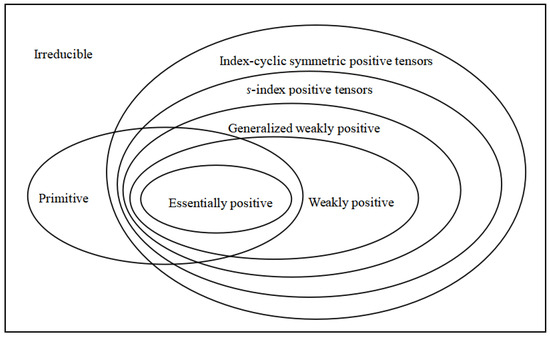
Obviously, essentially positive tensors, weakly positive tensors, generalized weakly positive tensors, and s-index positive tensors are all special classes of index-cyclic symmetric positive tensors.
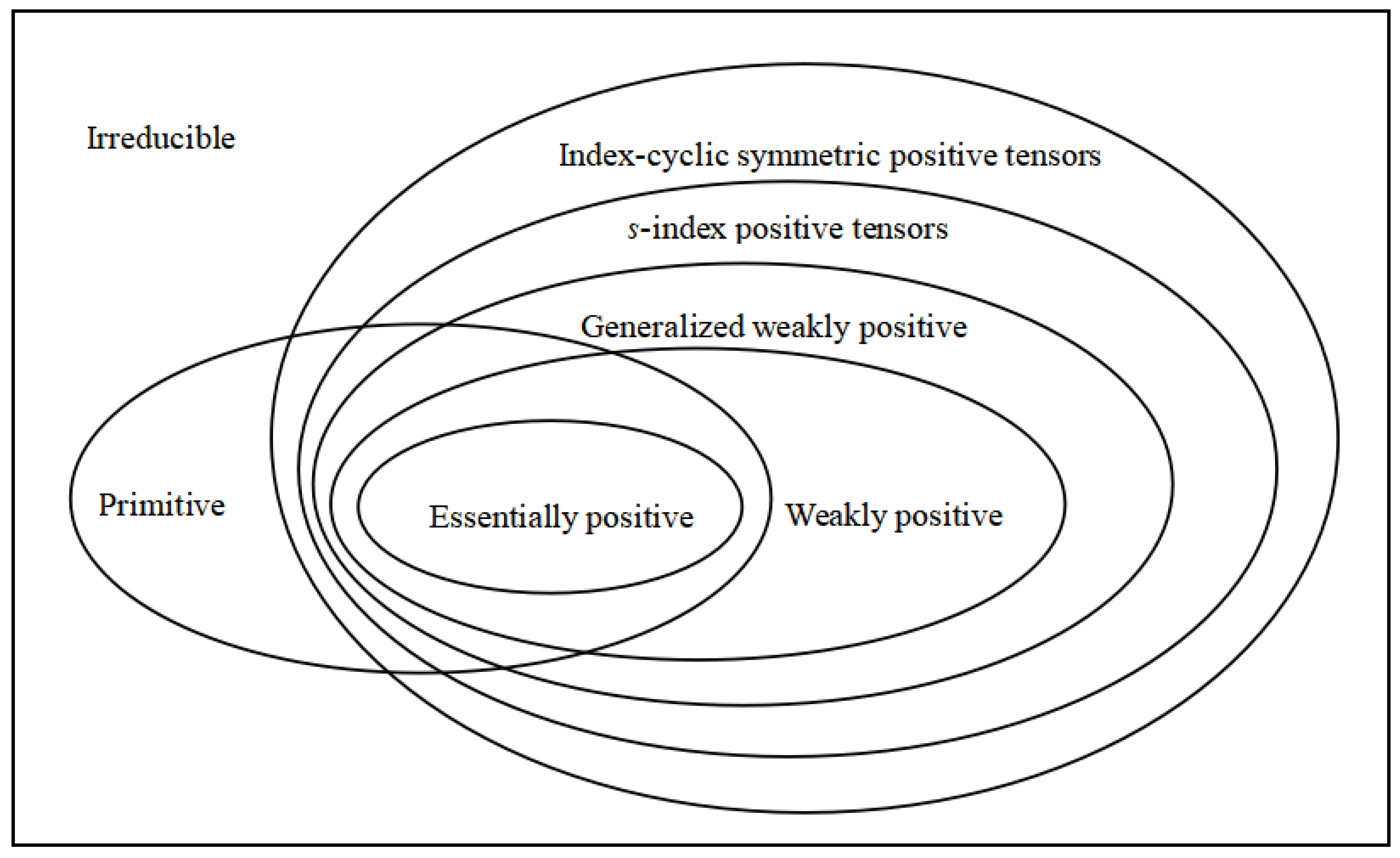
From Remark 1, index-cyclic symmetric positive tensors constitute a broader family of tensors than essentially positive tensors [7], weakly positive tensors [19], generalized weakly positive tensors [10], and s-index positive tensors [13]. The inclusion relationships among these families of nonnegative tensors are illustrated in Figure 1.
Figure 1.
Inclusion relationships of several families of nonnegative tensors.
Applying Theorem 3, we provide a diagonal similarity algorithm for the H-spectral radius of index-cyclic symmetric positive tensors.
Denote , then , for any .
Lemma 1.
Let be an index-cyclic symmetric positive tensor. In the two sequences defined by Algorithm 2, monotonically decreases with a lower bound, and monotonically increases with an upper bound.
| Algorithm 2: Diagonal similarity Algorithm 1 |
| Step 0. Given , , . Set . |
|
Step 1. Compute |
| Step 2. If , then and stop. |
|
Step 3. Set |
| and replace k by , go to Step 1. |
Proof.
Since , from Algorithm 2, we have
thus,
Similarly, we get
From Theorems 2 and 3, we obtain that
□
Lemma 2.
Let be an index-cyclic symmetric positive tensor. Thus, for any element that lies on an index-cyclic symmetric positive element chain, there exists a positive number , such that
Proof.
Consider the elements that lie on an index-cyclic symmetric positive element chain. By applying Lemma 2, we get
where lies on an index-cyclic symmetric positive element chain, so
By Definition 7, the union contains exactly indices for . Hence we obtain
From Equation (3), it can be concluded that
From Equation (2), we can obtain
Denote ; for any , can be obtained, and can be obtained for any . □
Below we present the convergence results of Algorithm 2 for computing the H-spectral radius of an index-cyclic symmetric positive tensor.
Theorem 5.
Let be an index-cyclic symmetric positive tensor, and let denote its H-spectral radius. By applying Algorithm 2, we have
where . Moreover,
It thus follows from Equation (4) that Algorithm 2 converges linearly for index-cyclic symmetric positive tensors.
Proof.
Given that is an index-cyclic symmetric positive tensor and Definition 7, there exists , and for any , can be obtained, i.e., exists such that .
(I) Let . We discuss two cases:
(i) If , we have
For any we can obtain that
(ii) If , we have . Similarly, we can obtain
and for any ,
Thus, from Lemma 1 and Equations (5)–(8), we conclude that
or
Combining the above discussions, we obtain
(II) Using a proof technique similar to Case (I), for any , we have
Combining Case (I) and Case (II), for any , we obtain
Since , it follows that
From Theorem 2 and Lemma 1, we have
By Equation (8), Algorithm 2 is linearly convergent.
If or , the same convergence result holds, and Algorithm 2 is linearly convergent. □
In Algorithm 2, the tensor requires storage at every iteration. To cut down redundant memory consumption, Algorithm 2 can be revised as stated below.
Remark 2.
If is an mth-order n-dimensional positive tensor, Algorithm 2 performs more division operations per iteration than Algorithm 3, so Algorithm 3 possesses far superior stability and computational efficiency.
| Algorithm 3: Diagonal similarity Algorithm 2 |
| Step 0. Given , , . Set . |
|
Step 1. Compute |
| Step 2. If , then and stop. |
|
Step 3. Set |
| and replace k by , go to Step 1. |
Below we provide the calculation method for the eigenvector of corresponding to its spectral radius .
Theorem 6.
Let be an index-cyclic symmetric positive tensor. Denote
where Then from Algorithm 2 we have , and
Proof.
By the construction of , the sequence of positive diagonal matrices converges as , which implies . From Algorithm 2, we have
then
where .
According to Theorem 1, as , we obtain
which yields
By Theorem 1, , and thus x is the eigenvector of corresponding to the eigenvalue . □
4. Numerical Examples
In this section, numerical experiments are conducted to compare the performance of the NQZ algorithm, and Algorithms 2 and 3. All experiments are conducted on a laptop equipped with an Intel Core i5-9500 CPU (3.0 GHz) and 8 GB of RAM, using the Matlab R2018b environment. The tolerance is set to . Let denote the H-spectral radius of , ‘’ the number of iterations, and ‘’ the CPU time (in seconds).
Example 3.
Consider the tensor , where , , for all , and all other entries are zero. Then is a basic weakly positive tensor. For Algorithms 2 and 3, if the shift parameter is set as the comparison results with the NQZ algorithm are listed in Table 1. As can be observed from Table 1, both Algorithms 2 and 3 require only one-third of the iteration steps needed by the NQZ algorithm, and the CPU runtime is reduced by approximately 60%.
Table 1.
Comparison of H-spectral radii calculated by our algorithms and the NQZ algorithm for Example 1.
Example 4.
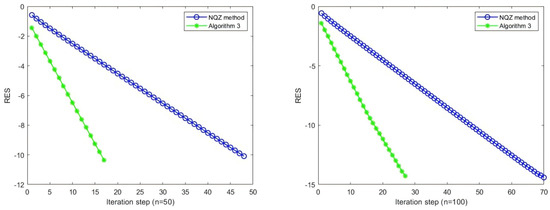
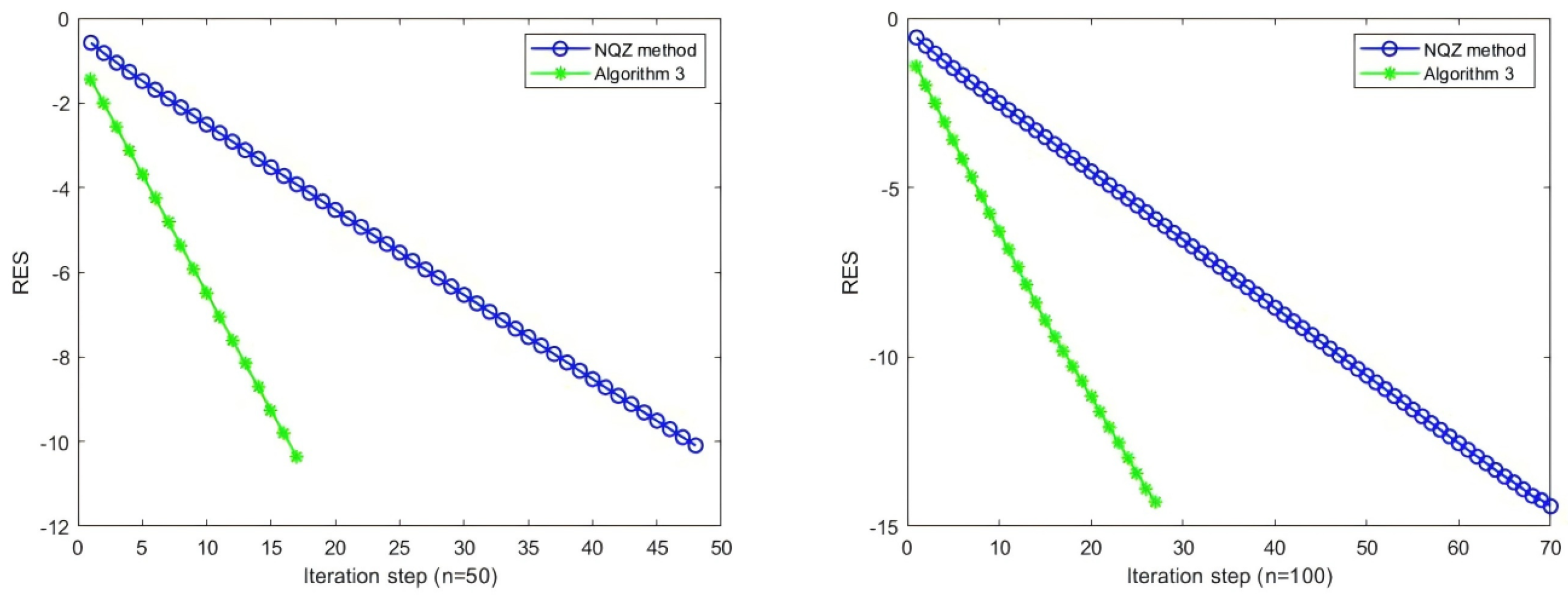
Consider the tensor , where , for all , and all other entries are zero. Then is a basic weakly positive tensor. For Algorithms 2 and 3, if the shift parameter is set as , numerical comparisons with the NQZ algorithm are listed in Table 2. As shown in Table 2, both Algorithms 2 and 3 require roughly half the number of iterations of the NQZ algorithm, and Algorithm 3 saves nearly 60% CPU runtime compared with the NQZ scheme. Meanwhile, we plot the logarithmic residual error (denoted as RES) on the vertical axis against the iteration index k on the horizontal axis, where . This plot compares the performance of the NQZ algorithm and Algorithm 3, as illustrated in Figure 2. It can be clearly observed from Figure 2 that Algorithm 3 substantially outperforms the NQZ algorithm.
Table 2.
Comparison of H-spectral radii calculated by our algorithms and the NQZ algorithm for Example 2.
Figure 2.
Comparison of residual errors between the NQZ algorithm and Algorithm 3.
Numerical examples show that Algorithm 3 outperforms the NQZ algorithm, while the relative merits of Algorithm 2 compared with the NQZ algorithm differ across cases. Here, we cannot theoretically derive a reasonable optimal range for the selection of parameter γ in Algorithms 2 and 3. In Examples 1 and 2 of this paper, we set and Algorithm 3 achieves high computational efficiency under this setting.
5. Conclusions
The basic weakly positive tensor defined in this paper generalizes the essential positive tensor, weakly positive tensor and generalized weakly positive tensor. We prove that Algorithms 2 and 3 converge linearly when computing the H-spectral radius of basic weakly positive tensors. Numerical examples demonstrate that Algorithm 3 outperforms the NQZ algorithm, while the relative performance between Algorithm 2 and the NQZ scheme varies across different test cases. A worthy research issue is how to select the shift parameter to improve computational efficiency.
Author Contributions
Conceptualization, X.W.; project administration, H.L.; algorithm analysis, X.W.; validation, H.L.; writing—original draft preparation, X.W.; writing—review and editing, H.L. All authors have read and agreed to the published version of the manuscript.
Funding
This research was funded by the Natural Science Foundation of Fujian Province [No. 2026J0011063].
Data Availability Statement
Data is contained within the article.
Acknowledgments
The authors are very grateful to the reviewers for their valuable comments that improved the manuscript.
Conflicts of Interest
The authors declare no conficts of interest.
References
- Cichocki, N.; Rafal, Z.; Anh, H.; Amari, S. Nonnegative Matrix and Tensor Factorizaations: Applications to Exploratory Multi-Way Data Analysis and Blind Source Separation; John Wiley Sons: New York, NY, USA, 2009. [Google Scholar]
- Qi, L.; Luo, Z. Tensor Analysis: Spectral Theory and Special Tensors; Society for Industrial and Applied Mathematics (SIAM): Philadelphia, PA, USA, 2017. [Google Scholar]
- Qi, L.; Chen, H.; Chen, Y. Tensor Eigenvalues and Their Applications; Springer: Singapore, 2018. [Google Scholar]
- Qi, L. Eigenvalues of a real supersymmetric tensor. J. Symb. Comput. 2005, 40, 1302–1324. [Google Scholar] [CrossRef] [Scilit]
- Lim, L. Singular values and eigenvalues of tensors: A variational approach. In Proceedings of the 1st IEEE International Workshop on Computational Advances in Multi-Sensor Adaptive Processing, Puerto Vallarta, Mexico, 13–15 December 2005; pp. 129–132. [Google Scholar]
- Ng, M.; Qi, L.; Zhou, G. Finding the largest eigenvalue of a nonnegative tensor. SIAM J. Matrix Anal. Appl. 2010, 31, 1090–1099. [Google Scholar] [CrossRef] [Scilit]
- Pearson, K. Essentially positive tensors. Int. J. Algebra 2010, 4, 421–427. [Google Scholar]
- Zhang, L.; Qi, L. Linear convergence of an algorithm for computing the largest eigenvalue of a nonnegative tensor. Numer. Linear Algebra Appl. 2011, 19, 830–841. [Google Scholar] [CrossRef] [Scilit]
- Liu, Y.; Zhou, G.; Ibrahim, N.F. An always convergent algorithm for the largest eigenvalue of an irreducible nonnegative tensor. J. Comput. Appl. Math. 2010, 235, 286–292. [Google Scholar] [CrossRef] [Scilit]
- Zhang, J.; Bu, C. An iterative method for finding the spectral radius of an irreducible nonnegative tensor. Comp. Appl. Math. 2021, 40, 1–14. [Google Scholar] [CrossRef] [Scilit]
- Chang, K.C.; Pearson, K.J.; Zhang, T. Primitivity, the convergence of the NQZ method, and the largest eigenvalue for nonnegative tensors. SIAM J. Matrix Anal. Appl. 2011, 32, 806–819. [Google Scholar] [CrossRef] [Scilit]
- Hu, S.; Huang, Z.; Qi, L. Strictly nonnegative tensors and nonnegative tensor partition. Sci. China Math. 2013, 57, 181–195. [Google Scholar] [CrossRef] [Scilit]
- Liu, P.; Lv, H. An algorithm for calculating spectral radius of s-index weakly positive tensors. AIMS Math. 2024, 9, 205–217. [Google Scholar]
- Chang, K.C.; Pearson, K.; Zhang, T. Perron-Frobenius theorem for nonnegative tensors. Commun. Math. Sci. 2008, 6, 507–520. [Google Scholar] [CrossRef] [Scilit]
- Friedland, S.; Gaubert, S.; Han, L. Perron–Frobenius theorem for nonnegative multilinear forms and extensions. Linear Algebra Appl. 2013, 438, 738–749. [Google Scholar] [CrossRef] [Scilit]
- Yang, Y.; Yang, Q. Further results for Perron-Frobenius theorem for nonnegative tensors. SIAM J. Matrix Anal. Appl. 2010, 31, 2517–2530. [Google Scholar]
- Shao, J. A general product of tensors with applications. Linear Algebra Appl. 2013, 439, 2350–2366. [Google Scholar] [CrossRef] [Scilit]
- Lv, H.; Chen, M. Linear convergence of the NQZ algorithm for finding the H-spectral radius of nonnegative tensors. PLoS ONE 2026, 21, e0338496. [Google Scholar] [CrossRef] [Scilit] [PubMed]
- Zhang, L.; Qi, L.; Xu, Y. Linear convergence of the LZI algorithm for weakly positive tensors. J. Comput. Math. 2012, 30, 24–33. [Google Scholar] [CrossRef] [Scilit]
- Horn, R.A.; Johnson, C.R. Matrix Analysis; Cambridge University Press: Cambridge, MA, USA, 1985. [Google Scholar]

Disclaimer/Publisher’s Note: The statements, opinions and data contained in all publications are solely those of the individual author(s) and contributor(s) and not of MDPI and/or the editor(s). MDPI and/or the editor(s) disclaim responsibility for any injury to people or property resulting from any ideas, methods, instructions or products referred to in the content. |
© 2026 by the authors. Licensee MDPI, Basel, Switzerland. This article is an open access article distributed under the terms and conditions of the Creative Commons Attribution (CC BY) license.