Approximate Analytical Solution of the Time-Fractional Sharma–Tasso–Olver Equations Under Singular and Non-Singular Kernel Operators



Abstract
1. Introduction
2. Preliminaries
3. Procedure of the GTDM
4. Convergence Analysis of the GTDM
5. Implementation of GTDM
6. Results and Discussion
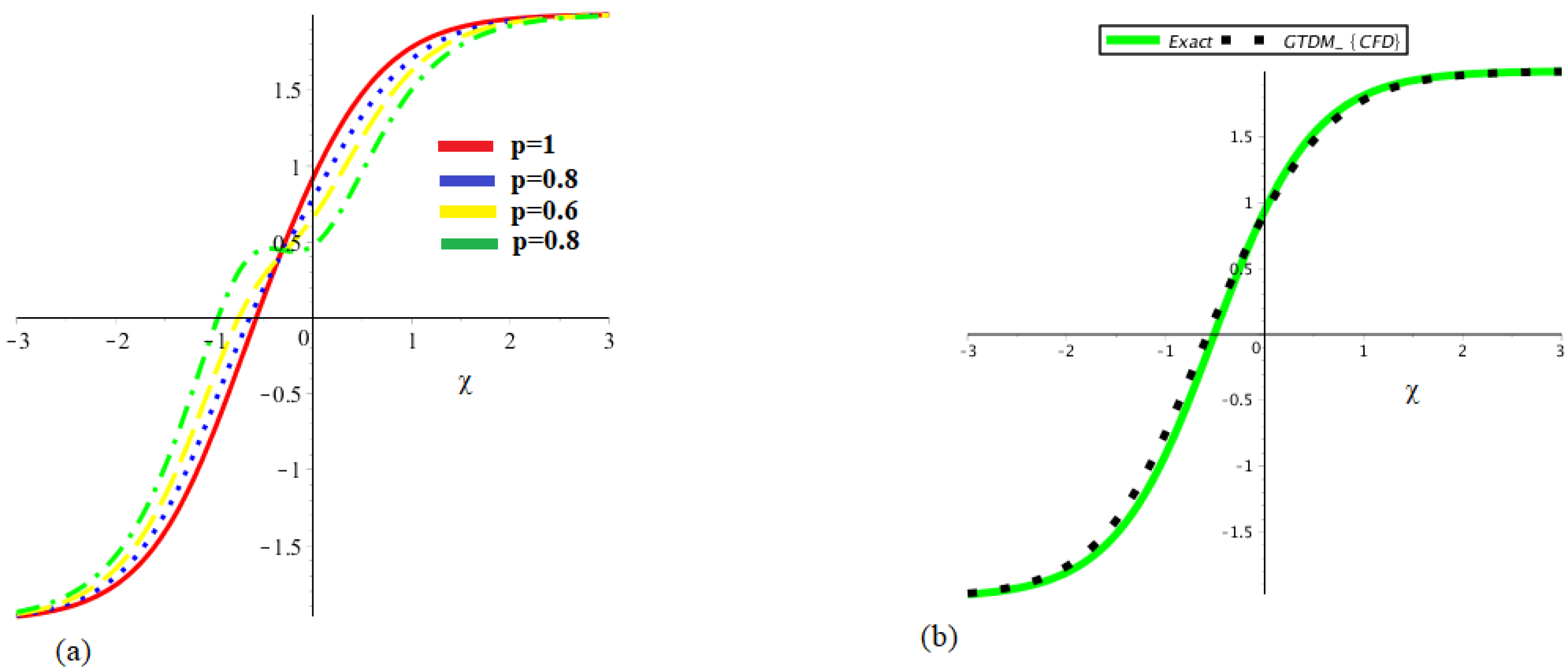
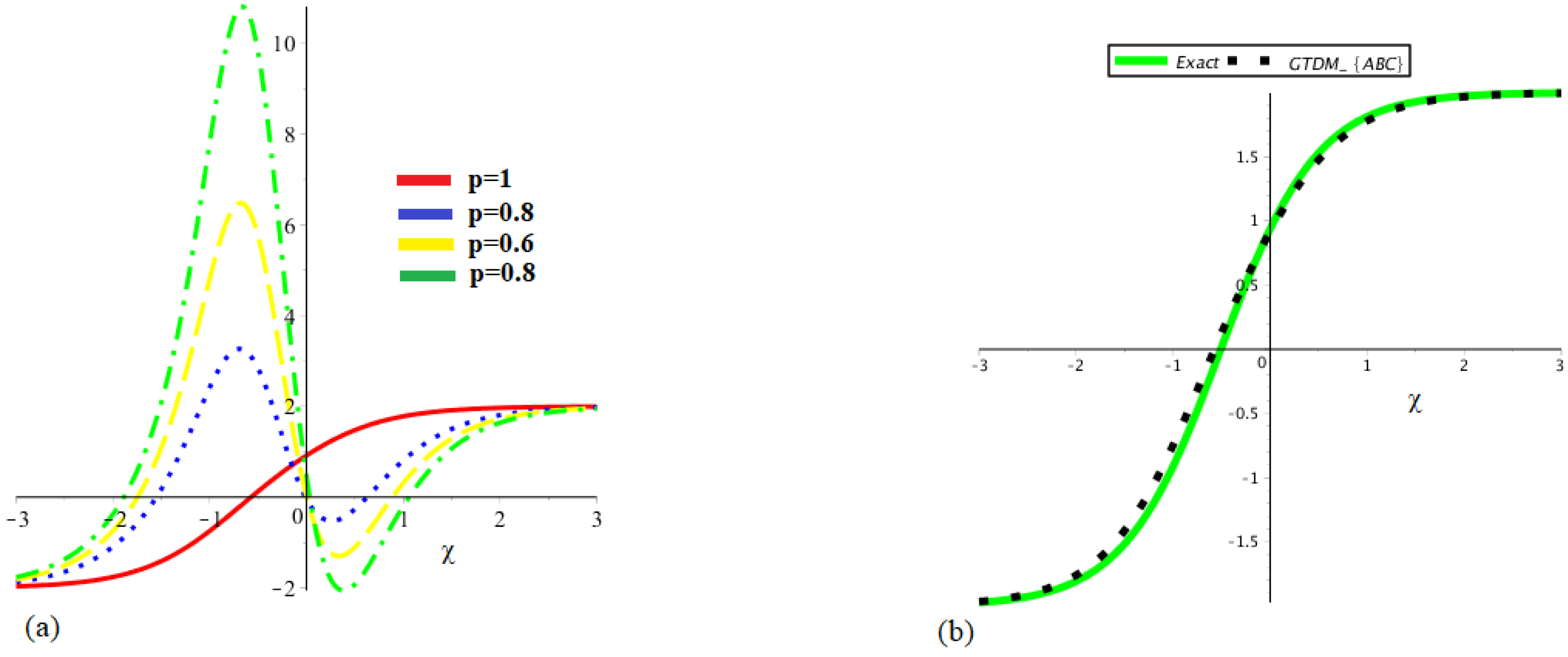
6.1. Significance of the Fractional Operators
6.2. Sensitivity Analysis in Terms of Fractional Order
6.3. Physical Insights
6.4. Accuracy and Convergence Validation
6.5. Error Analysis
6.6. Convergence Analysis
6.7. Stability Analysis
6.8. Computational Efficiency
6.9. Limitations and Future Work Directions
7. Conclusions
Author Contributions
Funding
Data Availability Statement
Conflicts of Interest
References
- Kilbas, A.A.; Srivastava, H.M.; Trujillo, J.J. Theory and Applications of Fractional Differential Equations; North-Holland Mathematics Studies; Elsevier Science: Amsterdam, The Netherlands, 2006. [Google Scholar]
- Podlubny, I. Fractional Differential Equations; Academic Press: San Diego, CA, USA, 1999. [Google Scholar]
- Cruz-Duarte, J.M.; Rosales-Garcia, J.; Correa-Cely, C.R.; Garcia-Perez, A.; Avina-Cervantes, J.G. A closed form expression for the Gaussian-based Caputo-Fabrizio fractional derivative for signal processing applications. Commun. Nonlinear Sci. Numer. Simul. 2018, 61, 138–148. [Google Scholar] [CrossRef]
- Baleanu, D.; Wu, G.C.; Zeng, S.D. Chaos analysis and asymptotic stability of generalized Caputo fractional differential equations. Chaos Solitons Fractals 2017, 102, 99–105. [Google Scholar] [CrossRef]
- Drapaca, C.S.; Sivaloganathan, S. A fractional model of continuum mechanics. J. Elast. 2012, 107, 105–123. [Google Scholar] [CrossRef]
- Jajarmi, A.; Baleanu, D. On the fractional optimal control problems with a general derivative operator. Asian J. Control 2021, 23, 1062–1071. [Google Scholar] [CrossRef]
- Turalska, M.; West, B.J. Fractional dynamics of individuals in complex networks. Front. Phys. 2018, 6, 110. [Google Scholar] [CrossRef]
- AlBaidani, M.M. Comparative study of the nonlinear fractional generalized Burger-Fisher equations using the homotopy perturbation transform method and new iterative transform method. Fractal Fract. 2025, 9, 390. [Google Scholar] [CrossRef]
- Chauhan, J.P.; Khirsariya, S.R.; Hathiwala, M.B. A caputo-type fractional-order model for the transmission of chlamydia disease. Contemp. Math. 2024, 5, 2134–2157. [Google Scholar]
- Jassim, H.K.; Khafif, S.A. SVIM for solving Burger’s and coupled Burger’s equations of fractional order. Prog. Fract. Differ. Appl. 2021, 7, 73–78. [Google Scholar]
- Khirsariya, S.; Rao, S.; Chauhan, J. Solution of fractional modified Kawahara equation: A semi-analytic approach. Math. Appl. Sci. Eng. 2023, 4, 264–284. [Google Scholar] [CrossRef]
- Zada, L.; Nawaz, R.; Jamshed, W.; Ibrahim, R.W.; Tag El Din, E.S.M.; Raizah, Z.; Amjad, A. New optimum solutions of nonlinear fractional acoustic wave equations via optimal homotopy asymptotic method-2 (OHAM-2). Sci. Rep. 2022, 12, 18838. [Google Scholar] [CrossRef]
- Khirsariya, S.R.; Rao, S.B.; Hathiwala, G.S. Investigation of fractional diabetes model involving glucose-insulin alliance scheme. Int. J. Dyn. Control 2024, 12, 1–14. [Google Scholar] [CrossRef]
- Huang, G.; Qin, H.Y.; Chen, Q.; Shi, Z.; Jiang, S.; Huang, C. Research on application of fractional calculus operator in image underlying processing. Fractal Fract. 2024, 8, 37. [Google Scholar] [CrossRef]
- Xin, Z.; Jing, Z.; Wenru, L.; Wenbo, X. Research on fractional sliding mode synchronous control of robotic arms under uncertain disturbance. At. Control Comput. Sci. 2021, 55, 26–37. [Google Scholar]
- Wang, X.; Petru, M.; Xia, L. Modelling the dynamical behaviour of the flax fibre rainforced composite after water using a modified Huet-Sayegh viscoelastic model with fractional derivatives. Constr. Build. Mater. 2021, 290, 122879. [Google Scholar] [CrossRef]
- AlBaidani, M.M.; Alzahrani, R. A Computational Analysis of Nonlinear Fractional Coupled System of Boussinesq–Burger Equations with the Non-Singular Kernel. Axioms 2026, 15, 172. [Google Scholar] [CrossRef]
- Veeresha, P.; Prakasha, D.G.; Baskonus, H.M. New numerical surfaces to the mathematical model of cancer chemotherapy effect in Caputo fractional derivatives. Chaos 2019, 29, 013119. [Google Scholar] [CrossRef] [PubMed]
- El Mfadel, A.; Melliani, S.; Elomari, M.H. A note on the stability analysis of fuzzy nonlinear fractional differential equations involving the Caputo fractional derivative. Int. J. Math. Math. Sci. 2021, 2021, 7488524. [Google Scholar] [CrossRef]
- AlBaidani, M.M.; Alzahrani, R. Insights into the time-fractional nonlinear KdV-type equations under non-singular Kernel operators. Symmetry 2026, 18, 391. [Google Scholar] [CrossRef]
- AlBaidani, M.M. Mathematical analysis of fractional-order convection–reaction–diffusion equations under the Caputo fractional derivative. Front. Phys. 2026, 14, 1762827. [Google Scholar] [CrossRef]
- Podlubny, I. Fractional Differential Equations: An Introduction to Fractional Derivatives, Fractional Differential Equations, to Methods of Their Solution and Some of Their Applications; Elsevier: Amsterdam, The Netherlands, 1998; Volume 198. [Google Scholar]
- Caputo, M.; Fabrizio, M. A new definition of fractional derivative without singular kernel, Progress in Fractional Differentiation. Applications 2015, 1, 73–85. [Google Scholar]
- Goufo, E.F.D.; Pene, M.K.; Mwambakana, J.N. Duplication in a model of rock fracture with fractional derivative without singular kernel. Open Math. 2015, 13, 000010151520150078. [Google Scholar] [CrossRef]
- Hristov, J. Transient heat diffusion with a non-singular fading memory: From the Cattaneo constitutive equation with Jeffrey’s kernel to the Caputo-Fabrizio time-fractional derivative. Therm. Sci. 2016, 20, 757–762. [Google Scholar] [CrossRef]
- Moore, E.J.; Sirisubtawee, S.; Koonprasert, S.; Caputo-Fabrizio, A. Fractional differential equation model for HIV/AIDS with treatment compartment. Adv. Differ. Equ. 2019, 2019, 1–20. [Google Scholar] [CrossRef]
- Atangana, A.; Baleanu, D. New fractional derivatives with nonlocal and non-singular kernel: Theory and application to heat transfer model. arXiv 2016, arXiv:1602.03408. [Google Scholar] [CrossRef]
- Ghanbari, B.; Atangana, A. A new application of fractional Atangana–Baleanu derivatives: Designing ABC-fractional masks in image processing. Phys. A Stat. Mech. Its Appl. 2020, 542, 123516. [Google Scholar] [CrossRef]
- Meena, M.; Purohit, M.; Purohit, S.D.; Nisar, K.S. A novel investigation of the hepatitis B virus using a fractional operator with a non-local kernel. Partial Differ. Equ. Appl. Math. 2023, 8, 100577. [Google Scholar] [CrossRef]
- Le, Q.H.; Ali, Q.; Al-Khaled, K.; Amir, M.; Riaz, S.; Khan, S.U.; Abdelmalek, Z.; Tlili, I. Study of hybrid nanofluid containing graphene oxide and molybdenum disulfide nanoparticles with engine oil base fluid: A non-singular fractional approach. Ain Shams Eng. J. 2024, 15, 102317. [Google Scholar] [CrossRef]
- Shehadeh, A.; El-Ajou, A.; Burqan, A.; Eriqat, T. Wave Soliton Solutions for Conformable-Fractional Partial Differential Equations. Fractals 2026, 2650044. [Google Scholar] [CrossRef]
- El-Ajou, A.; Burqan, A. An innovative analytical method for solving the fractional caudrey dodd gibbon equation. Fractals 2025, 33, 2550058. [Google Scholar] [CrossRef]
- Eltayeb, H.; Abdalla, Y.T.; Bachar, I.; Khabir, M.H. Fractional telegraph equation and its solution by natural transform decomposition method. Symmetry 2019, 11, 334. [Google Scholar] [CrossRef]
- Mahgoub, M.; Sedeeg, A. A comparative study for solving nonlinear fractional heat-like equations via Elzaki transform. Br. J. Math. Comput. Sci. 2016, 19, 1–12. [Google Scholar] [CrossRef]
- Jena, R.M.; Chakraverty, S. Solving time-fractional Navier-Stokes equations using homotopy perturbation Elzaki transform. SN Appl. Sci. 2019, 1, 16. [Google Scholar] [CrossRef]
- AlBaidani, M.M.; Alzahrani, R. A novel approach to solving generalised nonlinear dynamical systems within the Caputo operator. Fractal Fract. 2025, 9, 503. [Google Scholar] [CrossRef]
- Oqielat, M.A.N.; Eriqat, T.; Al-Zhour, Z.; Ogilat, O.; El-Ajou, A.; Hashim, I. Construction of fractional series solutions to nonlinear fractional reaction-diffusion for bacteria growth model via Laplace residual power series method. Int. J. Dyn. Control 2023, 11, 520–527. [Google Scholar] [CrossRef]
- AlBaidani, M.M.; Alzahrani, R. Novel approximations to the non-linear fractional Belousov-Zhabotinsky reaction in the frame of Caputo operator. Bound. Value Probl. 2026, 2026, 36. [Google Scholar] [CrossRef]
- AlBaidani, M.M. Analytical insight into some fractional nonlinear dynamical systems involving the Caputo fractional derivative operator. Fractal Fract. 2025, 9, 320. [Google Scholar] [CrossRef]
- Bishehniasar, M.; Salahshour, S.; Ahmadian, A.; Ismail, F.; Baleanu, D. An accurate approximate-analytical technique for solving time-fractional partial differential equations. Complexity 2017, 2017, 8718209. [Google Scholar] [CrossRef]
- Odibat, Z.; Momani, S.; Xu, H. A reliable algorithm of homotopy analysis method for solving nonlinear fractional differential equations. Appl. Math. Model. 2010, 34, 593–600. [Google Scholar] [CrossRef]
- El-Ajou, A.; Shqair, M.; Ghabar, I.; Burqan, A.; Saadeh, R. A solution for the neutron diffusion equation in the spherical and hemispherical reactors using the residual power series. Front. Phys. 2023, 11, 1229142. [Google Scholar] [CrossRef]
- Zayed, E.M.; Amer, Y.A.; Shohib, R.M. The fractional complex transformation for nonlinear fractional partial differential equations in the mathematical physics. J. Assoc. Arab Univ. Basic Appl. Sci. 2016, 19, 59–69. [Google Scholar] [CrossRef]
- El-Ajou, A.; Arqub, O.A.; Momani, S. Approximate analytical solution of the nonlinear fractional KdV-Burgers equation: A new iterative algorithm. J. Comput. Phys. 2015, 293, 81–95. [Google Scholar] [CrossRef]
- Wu, G.Z.; Yu, L.J.; Wang, Y.Y. Fractional optical solitons of the space-time fractional nonlinear Schrödinger equation. Optik 2020, 207, 164405. [Google Scholar] [CrossRef]
- Moumen, A.; Shafqat, R.; Alsinai, A.; Boulares, H.; Cancan, M.; Jeelani, M.B. Analysis of fractional stochastic evolution equations by using Hilfer derivative of finite approximate controllability. AIMS Math. 2023, 8, 16094–16114. [Google Scholar] [CrossRef]
- Chen, A. Multi-kink solutions and soliton fission and fusion of Sharma-Tasso-Olver equation. Phys. Lett. A 2010, 374, 2340–2345. [Google Scholar] [CrossRef]
- Hamdi, M.S.; Yaseen, S.R.; Al-Saphory, R.A.; Zerrik, E.H. A New Technique for Solving A Fractional Sharma-Tasso-Olever Equation. Iraqi J. Sci. 2024, 3378–3394. [Google Scholar] [CrossRef]
- Butt, A.R.; Zaka, J.; Akgül, A.; El Din, S.M. New structures for exact solution of nonlinear fractional Sharma–Tasso–Olver equation by conformable fractional derivative. Results Phys. 2023, 50, 106541. [Google Scholar] [CrossRef]
- Kumar, A. An efficient analytical method for the fractional order Sharma–Tasso–Olever equation by means of the Caputo–Fabrizio derivative. In Computation and Modeling for Fractional Order Systems; Academic Press: Cambridge, MA, USA, 2024; pp. 29–39. [Google Scholar]
- Jafari, H. A new general integral transform for solving integral equations. J. Adv. Res. 2020, 32, 133–138. [Google Scholar] [CrossRef]
- Adomian, G. A review of the decomposition method in applied mathematics. J. Math. Anal. Appl. 1988, 135, 501–544. [Google Scholar] [CrossRef]
- Adomian, G. Solving Frontier Problems of Physics: The Decomposition Method; Springer Science & Business Media: Berlin/Heidelberg, Germany, 2013; Volume 60. [Google Scholar]
- Molliq, Y.; Noorani, M.S.M.; Hashim, I. Variational iteration method for fractional heat-and wave-like equations. Nonlinear Anal. Real. World Appl. 2009, 10, 1854–1869. [Google Scholar] [CrossRef]
- Debnath, L.; Bhatta, D. Integral Transforms and Their Applications; CRC Press: Boca Raton, FL, USA, 2014. [Google Scholar]
- Jarad, F.; Abdeljawad, T. A modified Laplace transform for certain generalized fractional operators. Results Nonlin. Anal. 2018, 1, 88–98. [Google Scholar]
- Belgacem, F.B.M.; Karaballi, A.A. Sumudu transform fundamental properties investigations and applications. Int. J. Stoch. Anal. 2006, 2006, 091083. [Google Scholar]
- Aboodh, K.S. The new integral transform Aboodh transform. Glob. J. Pure Appl. Math. 2013, 9, 35–43. [Google Scholar]
- Ahmadi, S.A.P.; Hosseinzadeh, H.; Cherati, A.Y. A new integral transform for solving higher order linear ordinary differential equations. Nonlinear Dyn. Syst. Theory 2019, 19, 243–252. [Google Scholar] [CrossRef]
- Ahmadi, S.A.P.; Hosseinzadeh, H.; Cherati, A.Y. A new integral transform for solving higher order linear ordinary Laguerre and Hermite differential equations. Int. J. Appl. Comput Math. 2019, 5, 142. [Google Scholar] [CrossRef]
- Elzaki, T.M. The new integral transform Elzaki Transform. Glob. J. Pure Appl. Math. 2011, 7, 57–64. [Google Scholar]
- Khan, Z.H.; Khan, W.A. N-transform properties and applications. NUST J. Eng. Sci. 2008, 1, 127–133. [Google Scholar]
- Abdelrahim Mahgoub, M.M. The new integral transform mohand transform. Adv. Theor. Appl. Math. 2017, 12, 11320. [Google Scholar]
- Abdelrahim Mahgoub, M.M. The new integral transform sawi transform. Adv. Theor. Appl. Math. 2019, 14, 81–87. [Google Scholar]
- Kamal, H.; Sedeeg, A. The new integral transform Kamal transform. Adv. Theor. Appl. Math. 2016, 11, 451–458. [Google Scholar]
- Kim, H. On the form and properties of an integral transform with strength in integral transforms. Far East J. Math. Sci. 2017, 102, 2831–2844. [Google Scholar] [CrossRef]
- Kim, H. The intrinsic structure and properties of Laplace-typed integral transforms. Math. Prob. Eng. 2017, 2017, 1762729. [Google Scholar] [CrossRef]
- Meddahi, M.; Jafari, H.; Ncube, M.N. New general integral transform via Atangana-Baleanu derivatives. Adv. Diff. Equ. 2021, 2021, 2021385. [Google Scholar] [CrossRef]
- Atangana, A.; Koca, I. Chaos in a simple nonlinear system with Atangana–Baleanu derivatives with fractional order. Chaos Solit. Fract. 2016, 89, 447–454. [Google Scholar] [CrossRef]
- Yavuz, M.; Abdeljawad, T. Nonlinear regularized long-wave models with a new integral transformation applied to the fractional derivative with power and Mittag-Leffler kernel. Adv. Differ. Equ. 2020, 2020, 367. [Google Scholar] [CrossRef]
- Bokhari, A.; Baleanu, D.; Belgacema, R. Application of Shehu transform to Atangana-Baleanu derivatives. J. Math. Comput. Sci. 2020, 20, 101–107. [Google Scholar] [CrossRef]
- Haubold, H.J.; Mathai, A.M.; Saxena, R.K. Mittag-Leffler functions and their applications. J. Appl. Math. 2011, 2011, 298628. [Google Scholar] [CrossRef]
- El-Kalla, I. Convergence of the Adomian method applied to a class of nonlinear integral equations. Appl. Math. Lett. 2008, 21, 372–376. [Google Scholar] [CrossRef]
- Adomian, G.; Rach, R. Modified adomian polynomials. Math. Comput. Model. 1996, 24, 39–46. [Google Scholar] [CrossRef]



| GTDMABC | GTDMCFD | GTDMABC | GTDMCFD | |||||
|---|---|---|---|---|---|---|---|---|
| 2 | 0.3684991487 | 0.3790641259 | 0.3797462198 | 0.3797462198 | 0.3797431376 | 8.11637 | 0.0006382115567 | |
| 4 | 0.4792094218 | 0.4817138409 | 0.4818363090 | 0.4818363090 | 0.4818341977 | 4.38159 | −0.0004259050907 | |
| 0.01 | 6 | 0.4971178932 | 0.4974852858 | 0.4975025886 | 0.4975025886 | 0.4975022294 | 7.22327 | |
| 8 | 0.4996086573 | 0.4996589251 | 0.4996612807 | 0.4996612807 | 0.4996612306 | 1.00079 | ||
| 10 | 0.4999470138 | 0.4999538269 | 0.4999541459 | 0.4999541459 | 0.4999541391 | 1.40519 | ||
| 2 | 0.3632114116 | 0.3733821099 | 0.3755243424 | 0.3755243424 | 0.3754466418 | 2.06955 | ||
| 4 | 0.4776602156 | 0.4806138198 | 0.4810565252 | 0.4810565252 | 0.4811090380 | 1.09149 | ||
| 0.05 | 6 | 0.4968855297 | 0.4973281715 | 0.4973919930 | 0.4973919930 | 0.4974009322 | 1.79714 | |
| 8 | 0.4995767729 | 0.4996375047 | 0.4996462168 | 0.4996462168 | 0.4996474622 | 2.49293 | ||
| 10 | 0.4999426907 | 0.4999509251 | 0.4999521055 | 0.4999521055 | 0.4999522746 | 3.37830 | ||
| 2 | 0.3595447103 | 0.3694375880 | 0.3723385670 | 0.3723385670 | 0.3721384337 | 5.37792 | ||
| 4 | 0.4765053338 | 0.4797472714 | 0.4804110021 | 0.4804110021 | 0.4805449154 | 2.78669 | ||
| 0.08 | 6 | 0.4967111860 | 0.4972022317 | 0.4972991868 | 0.4972991868 | 0.4973219908 | 4.58537 | |
| 8 | 0.4995528302 | 0.4996202944 | 0.4996335527 | 0.4996335527 | 0.4996367297 | 6.35843 | ||
| 10 | 0.499939444 | 0.4999485929 | 0.4999503897 | 0.4999503897 | 0.4999508212 | 8.62815 | ||
| 2 | 0.3571683955 | 0.3668793294 | 0.3702054942 | 0.3702054942 | 0.3698915256 | 8.48812 | ||
| 4 | 0.4757222875 | 0.4791411553 | 0.4799510015 | 0.4799510015 | 0.4801596942 | 4.34630 | ||
| 0.1 | 6 | 0.4965925267 | 0.4971133213 | 0.4972324925 | 0.4972324925 | 0.4972680392 | 7.14836 | |
| 8 | 0.4995365267 | 0.4996081295 | 0.4996244415 | 0.4996244415 | 0.4996293938 | 9.91202 | ||
| 10 | 0.4999372330 | 0.4999469441 | 0.4999491551 | 0.4999491551 | 0.4999498278 | 1.34634 |
| GTDMCFD | GTDMABC | |||
|---|---|---|---|---|
| 5 | 2.8246 | 9.2538753400 | 9.2538753400 | |
| 4 | 4.2905 | 2.1158007320 | 2.1158007320 | |
| 0.001 | 3 | 8.7092 | 3.2425764750 | 3.2425764750 |
| 2 | 5.7987 | 3.0792074770 | 3.0792074770 | |
| 1 | 1.9745 | 2.5578805190 | 2.5578805190 | |
| 5 | 8.1686 | 5.0956382560 | 5.0956382560 | |
| 4 | 6.5000 | 4.0144459660 | 4.0144459660 | |
| 0.002 | 3 | 1.9479 | 2.9585519280 | 2.9585519280 |
| 2 | 1.2665 | 2.0876796060 | 2.0876796060 | |
| 1 | 3.6421 | 3.5897472240 | 3.5897472240 |
| GTDMABC | GTDMCFD | GTDMABC | GTDMCFD | |||||
|---|---|---|---|---|---|---|---|---|
| 2 | 1.8886865680 | 1.9632362680 | 1.9681473390 | 1.9681473390 | 1.9737190220 | 2.82293 | ||
| 4 | 1.9979101000 | 1.9993170340 | 1.9994097160 | 1.9994097160 | 1.9995155210 | 5.29156 | ||
| 0.01 | 6 | 1.9999617050 | 1.9999874880 | 1.9999891860 | 1.9999891860 | 1.9999911250 | 9.68757 | |
| 8 | 1.9999993000 | 1.9999997720 | 1.9999998030 | 1.9999998030 | 1.9999998370 | 1.70075 | ||
| 10 | 1.9999999870 | 1.9999999960 | 1.9999999960 | 1.9999999960 | 1.9999999970 | 5.60287 | ||
| 2 | 1.8520759530 | 1.9225568060 | 1.9378274350 | 1.9378274350 | 1.9638971920 | 1.32745 | ||
| 4 | 1.9972191590 | 1.9985493220 | 1.9988375130 | 1.9988375130 | 1.9993328430 | 2.47747 | ||
| 0.05 | 6 | 1.9999490430 | 1.9999734190 | 1.9999787000 | 1.9999787000 | 1.9999877790 | 4.53879 | |
| 8 | 1.9999990680 | 1.9999995140 | 1.9999996110 | 1.9999996110 | 1.9999997760 | 8.30375 | ||
| 10 | 1.9999999830 | 1.9999999910 | 1.9999999930 | 1.9999999930 | 1.9999999960 | 1.19856 | ||
| 2 | 1.8268800090 | 1.8945606410 | 1.9150876090 | 1.9150876090 | 1.9542164220 | 2.00227 | ||
| 4 | 1.9967436410 | 1.9980209680 | 1.9984083610 | 1.9984083610 | 1.9991519150 | 3.71935 | ||
| 0.08 | 6 | 1.9999403290 | 1.9999637370 | 1.9999708360 | 1.9999708360 | 1.9999844640 | 6.81399 | |
| 8 | 1.9999989080 | 1.9999993370 | 1.9999994670 | 1.9999994670 | 1.9999997150 | 1.24960 | ||
| 10 | 1.9999999800 | 1.9999999880 | 1.9999999900 | 1.9999999900 | 1.9999999950 | 2.41770 | ||
| 2 | 1.8106330470 | 1.8765080370 | 1.8999277720 | 1.8999277720 | 1.9463789650 | 2.38654 | ||
| 4 | 1.9964370140 | 1.9976802720 | 1.9981222600 | 1.9981222600 | 1.9990048000 | 4.41489 | ||
| 0.1 | 6 | 1.9999347100 | 1.9999574930 | 1.9999655930 | 1.9999655930 | 1.9999817680 | 8.08753 | |
| 8 | 1.9999988050 | 1.9999992220 | 1.9999993710 | 1.9999993710 | 1.9999996650 | 1.47075 | ||
| 10 | 1.9999999780 | 1.9999999850 | 1.9999999880 | 1.9999999880 | 1.9999999950 | 3.29712 |
| GTDMCFD | GTDMABC | ||
|---|---|---|---|
| 2 | 7.2096 | 5.5716836560 | 5.5716836560 |
| 3 | 5.3361 | 7.7845043750 | 7.7845043750 |
| 4 | 2.3942 | 1.0580472040 | 1.0580472040 |
| 5 | 9.4126 | 1.4327171050 | 1.4327171050 |
| 6 | 3.5453 | 1.9385037590 | 1.9385037590 |
| 7 | 1.3154 | 2.6178509530 | 2.6178509530 |
| 8 | 4.8545 | 3.4014998880 | 3.4014998880 |
| 9 | 1.7879 | 3.4981245280 | 3.4981245280 |
| 10 | 6.5802 | 8.7942554240 | 8.7942554240 |
| Metric | Value | |
|---|---|---|
| 0.01 | CPU Time | 0.14 ms |
| Max Relative Error | 1.40519 | |
| Max Absolute Error | 7.13206 | |
| Mean Relative Error | 2.66688 | |
| Root Mean Square Error | 3.75359 | |
| 0.05 | CPU Time | 0.14 ms |
| Max Relative Error | 3.37830 | |
| Max Absolute Error | 9.58390 | |
| Mean Relative Error | 6.73814 | |
| Root Mean Square Error | 9.42150 | |
| 0.08 | CPU Time | 0.14 ms |
| Max Relative Error | 8.62815 | |
| Max Absolute Error | 1.13772 | |
| Mean Relative Error | 1.73907 | |
| Root Mean Square Error | 2.41901 | |
| 0.1 | CPU Time | 0.14 ms |
| Max Relative Error | 1.34634 | |
| Max Absolute Error | 1.25947 | |
| Mean Relative Error | 2.73237 | |
| Root Mean Square Error | 3.78704 |
| Metric | Value | |
|---|---|---|
| 0.01 | CPU Time | 0.15 ms |
| Max Relative Error | 5.60287 | |
| Max Absolute Error | 1.00985 | |
| Mean Relative Error | 5.75367 | |
| Root Mean Square Error | 5.57268 | |
| 0.05 | CPU Time | 0.15 ms |
| Max Relative Error | 1.19856 | |
| Max Absolute Error | 1.33462 | |
| Mean Relative Error | 27053 | |
| Root Mean Square Error | 2.6074 | |
| 0.08 | CPU Time | 0.15 ms |
| Max Relative Error | 2.41770 | |
| Max Absolute Error | 1.52695 | |
| Mean Relative Error | 4.08032 | |
| Root Mean Square Error | 3.91358 | |
| 0.1 | CPU Time | 0.15 ms |
| Max Relative Error | 3.29712 | |
| Max Absolute Error | 1.71545 | |
| Mean Relative Error | 4.86303 | |
| Root Mean Square Error | 4.64595 |
Disclaimer/Publisher’s Note: The statements, opinions and data contained in all publications are solely those of the individual author(s) and contributor(s) and not of MDPI and/or the editor(s). MDPI and/or the editor(s) disclaim responsibility for any injury to people or property resulting from any ideas, methods, instructions or products referred to in the content. |
© 2026 by the authors. Licensee MDPI, Basel, Switzerland. This article is an open access article distributed under the terms and conditions of the Creative Commons Attribution (CC BY) license.
Share and Cite
AlBaidani, M.M.; Alzahrani, R. Approximate Analytical Solution of the Time-Fractional Sharma–Tasso–Olver Equations Under Singular and Non-Singular Kernel Operators. Symmetry 2026, 18, 1005. https://doi.org/10.3390/sym18061005
AlBaidani MM, Alzahrani R. Approximate Analytical Solution of the Time-Fractional Sharma–Tasso–Olver Equations Under Singular and Non-Singular Kernel Operators. Symmetry. 2026; 18(6):1005. https://doi.org/10.3390/sym18061005
Chicago/Turabian StyleAlBaidani, Mashael M., and Rabab Alzahrani. 2026. "Approximate Analytical Solution of the Time-Fractional Sharma–Tasso–Olver Equations Under Singular and Non-Singular Kernel Operators" Symmetry 18, no. 6: 1005. https://doi.org/10.3390/sym18061005
APA StyleAlBaidani, M. M., & Alzahrani, R. (2026). Approximate Analytical Solution of the Time-Fractional Sharma–Tasso–Olver Equations Under Singular and Non-Singular Kernel Operators. Symmetry, 18(6), 1005. https://doi.org/10.3390/sym18061005