A Review of Symmetrical and Asymmetrical Research Outputs on Wastewater Treatment and Water Purification Through Sorption-Based Technologies

 ,
, 

Abstract
1. Introduction
2. Materials and Methods
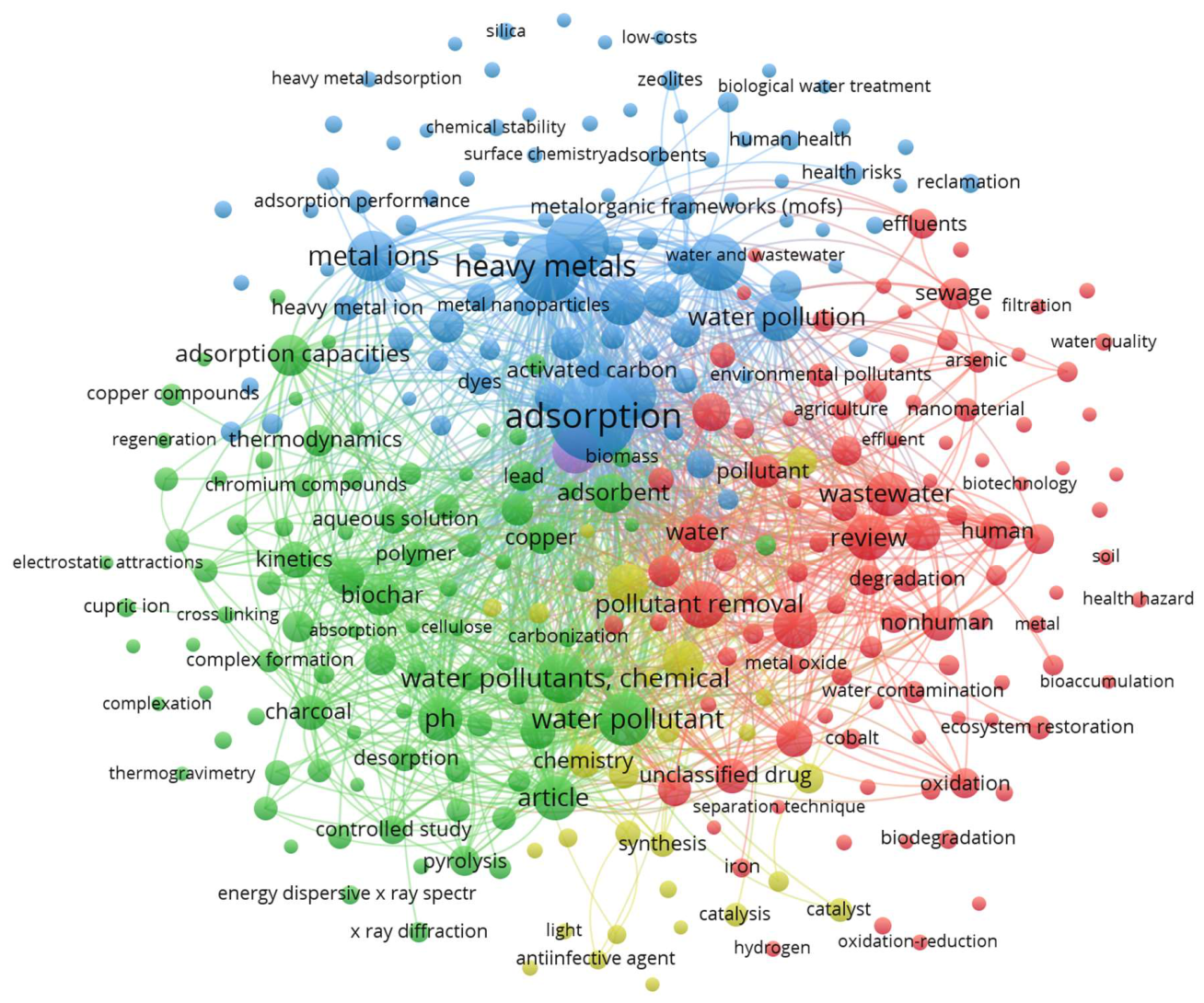
| Scopus Database (search keywords; limit to 2010–2025) | Results |
| metal AND water AND removal AND adsorption | 29,598 [25] |
| water AND purification AND metal | 17,905 [26] |
| water AND purification AND treatment AND | 4576 [27] |
| metal AND adsorption | |
| metal AND removal AND drinking AND water | 3280 [28] |
| drinking AND water AND metal AND adsorption | 2231 [29] |
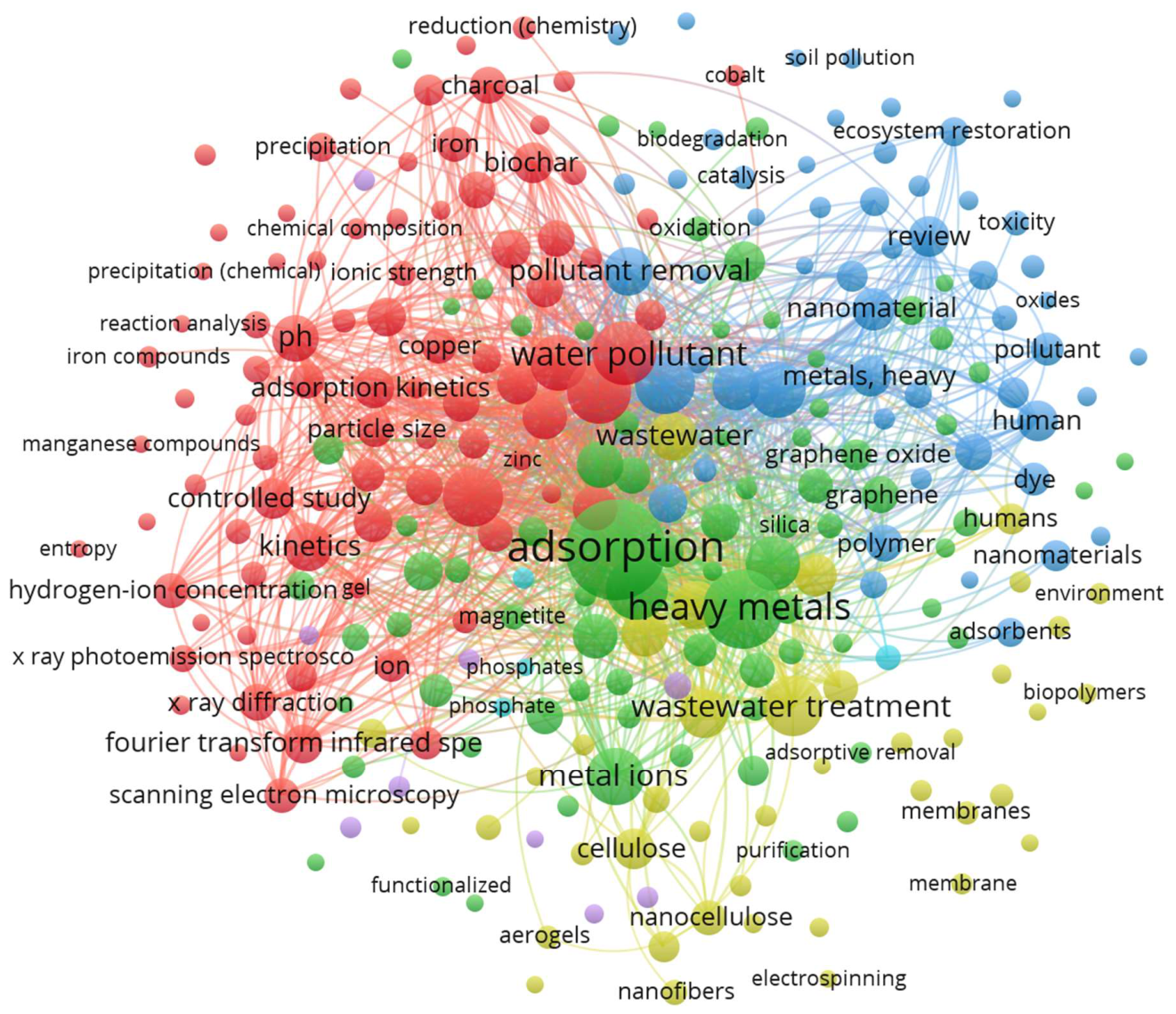
| Scopus Database (search keywords; limit to 2010–2025) | Results |
| nano adsorbent AND metal AND removal | 2066 [30] |
| nano adsorbent AND water AND removal AND metal | 1484 [31] |
3. Results and Discussion
4. Conclusions
Supplementary Materials
Author Contributions
Funding
Data Availability Statement
Acknowledgments
Conflicts of Interest
References
- Gavrilescu, M.; Demnerová, K.; Aamand, J.; Agathos, S.; Fava, F. Emerging Pollutants in the Environment: Present and Future Challenges in Biomonitoring, Ecological Risks and Bioremediation. New Biotechnol. 2015, 32, 147–156. [Google Scholar] [CrossRef] [PubMed]
- Kesari, K.K.; Soni, R.; Jamal, Q.M.S.; Tripathi, P.; Lal, J.A.; Jha, N.K.; Siddiqui, M.H.; Kumar, P.; Tripathi, V.; Ruokolainen, J. Wastewater Treatment and Reuse: A Review of Its Applications and Health Implications. Water Air Soil Pollut. 2021, 232, 208. [Google Scholar] [CrossRef]
- Hargreaves, A.J.; Constantino, C.; Dotro, G.; Cartmell, E.; Campo, P. Fate and Removal of Metals in Municipal Wastewater Treatment: A Review. Environ. Technol. Rev. 2018, 7, 1–18. [Google Scholar] [CrossRef]
- Akhtar, N.; Syakir Ishak, M.I.; Bhawani, S.A.; Umar, K. Various Natural and Anthropogenic Factors Responsible for Water Quality Degradation: A Review. Water 2021, 13, 2660. [Google Scholar] [CrossRef]
- Rathi, B.S.; Kumar, P.S.; Vo, D.-V.N. Critical Review on Hazardous Pollutants in Water Environment: Occurrence, Monitoring, Fate, Removal Technologies and Risk Assessment. Sci. Total Environ. 2021, 797, 149134. [Google Scholar] [CrossRef]
- Zamora-Ledezma, C.; Negrete-Bolagay, D.; Figueroa, F.; Zamora-Ledezma, E.; Ni, M.; Alexis, F.; Guerrero, V.H. Heavy Metal Water Pollution: A Fresh Look about Hazards, Novel and Conventional Remediation Methods. Environ. Technol. Innov. 2021, 22, 101504. [Google Scholar] [CrossRef]
- Briffa, J.; Sinagra, E.; Blundell, R. Heavy Metal Pollution in the Environment and Their Toxicological Effects on Humans. Heliyon 2020, 6, e04691. [Google Scholar] [CrossRef] [PubMed]
- Huang, W.; Song, B.; Liang, J.; Niu, Q.; Zeng, G.; Shen, M.; Deng, J.; Luo, Y.; Wen, X.; Zhang, Y. Microplastics and Associated Contaminants in the Aquatic Environment: A Review on Their Ecotoxicological Effects, Trophic Transfer, and Potential Impacts to Human Health. J. Hazard. Mater. 2021, 405, 124187. [Google Scholar] [CrossRef]
- Maurya, P.K.; Malik, D.S.; Yadav, K.K.; Kumar, A.; Kumar, S.; Kamyab, H. Bioaccumulation and Potential Sources of Heavy Metal Contamination in Fish Species in River Ganga Basin: Possible Human Health Risks Evaluation. Toxicol. Rep. 2019, 6, 472–481. [Google Scholar] [CrossRef]
- Sharma, S.; Bhattacharya, A. Drinking Water Contamination and Treatment Techniques. Appl. Water Sci. 2017, 7, 1043–1067. [Google Scholar] [CrossRef]
- Carolin, C.F.; Kumar, P.S.; Saravanan, A.; Joshiba, G.J.; Naushad, M. Efficient Techniques for the Removal of Toxic Heavy Metals from Aquatic Environment: A Review. J. Environ. Chem. Eng. 2017, 5, 2782–2799. [Google Scholar] [CrossRef]
- Rashid, R.; Shafiq, I.; Akhter, P.; Iqbal, M.J.; Hussain, M. A State-of-the-Art Review on Wastewater Treatment Techniques: The Effectiveness of Adsorption Method. Environ. Sci. Pollut. Res. 2021, 28, 9050–9066. [Google Scholar] [CrossRef] [PubMed]
- Saravanan, A.; Senthil Kumar, P.; Jeevanantham, S.; Karishma, S.; Tajsabreen, B.; Yaashikaa, P.R.; Reshma, B. Effective Water/Wastewater Treatment Methodologies for Toxic Pollutants Removal: Processes and Applications towards Sustainable Development. Chemosphere 2021, 280, 130595. [Google Scholar] [CrossRef] [PubMed]
- Chai, W.S.; Cheun, J.Y.; Kumar, P.S.; Mubashir, M.; Majeed, Z.; Banat, F.; Ho, S.-H.; Show, P.L. A Review on Conventional and Novel Materials towards Heavy Metal Adsorption in Wastewater Treatment Application. J. Clean. Prod. 2021, 296, 126589. [Google Scholar] [CrossRef]
- Cheng, T.W.; Lee, M.L.; Ko, M.S.; Ueng, T.H.; Yang, S.F. The Heavy Metal Adsorption Characteristics on Metakaolin-Based Geopolymer. Appl. Clay Sci. 2012, 56, 90–96. [Google Scholar] [CrossRef]
- Jiang, C.; Wang, X.; Wang, G.; Hao, C.; Li, X.; Li, T. Adsorption Performance of a Polysaccharide Composite Hydrogel Based on Crosslinked Glucan/Chitosan for Heavy Metal Ions. Compos. Part B Eng. 2019, 169, 45–54. [Google Scholar] [CrossRef]
- Choi, H.-J.; Yu, S.-W.; Kim, K.H. Efficient Use of Mg-Modified Zeolite in the Treatment of Aqueous Solution Contaminated with Heavy Metal Toxic Ions. J. Taiwan Inst. Chem. Eng. 2016, 63, 482–489. [Google Scholar] [CrossRef]
- Hokkanen, S.; Repo, E.; Sillanpää, M. Removal of Heavy Metals from Aqueous Solutions by Succinic Anhydride Modified Mercerized Nanocellulose. Chem. Eng. J. 2013, 223, 40–47. [Google Scholar] [CrossRef]
- Alghamdi, A.A.; Al-Odayni, A.-B.; Saeed, W.S.; Al-Kahtani, A.; Alharthi, F.A.; Aouak, T. Efficient Adsorption of Lead (II) from Aqueous Phase Solutions Using Polypyrrole-Based Activated Carbon. Materials 2019, 12, 2020. [Google Scholar] [CrossRef]
- Ihsanullah, I.; Sajid, M.; Khan, S.; Bilal, M. Aerogel-Based Adsorbents as Emerging Materials for the Removal of Heavy Metals from Water: Progress, Challenges, and Prospects. Sep. Purif. Technol. 2022, 291, 120923. [Google Scholar] [CrossRef]
- Tohdee, K.; Kaewsichan, L. Asadullah Enhancement of Adsorption Efficiency of Heavy Metal Cu(II) and Zn(II) onto Cationic Surfactant Modified Bentonite. J. Environ. Chem. Eng. 2018, 6, 2821–2828. [Google Scholar] [CrossRef]
- Feng, M.; Zhang, P.; Zhou, H.-C.; Sharma, V.K. Water-Stable Metal-Organic Frameworks for Aqueous Removal of Heavy Metals and Radionuclides: A Review. Chemosphere 2018, 209, 783–800. [Google Scholar] [CrossRef]
- Zhang, L.; Zeng, Y.; Cheng, Z. Removal of Heavy Metal Ions Using Chitosan and Modified Chitosan: A Review. J. Mol. Liq. 2016, 214, 175–191. [Google Scholar] [CrossRef]
- Wallin, J.A. Bibliometric Methods: Pitfalls and Possibilities. Basic Clin. Pharmacol. Toxicol. 2005, 97, 261–275. [Google Scholar] [CrossRef]
- Scopus Metal and Water and Removal and Adsorption. Available online: https://www.scopus.com/results/results.uri?st1=metal&st2=water&yearFrom=2010&yearTo=2025&s=%28TITLE-ABS-KEY%28metal%29+AND+TITLE-ABS-KEY%28water%29+AND+TITLE-ABS-KEY%28removal%29+AND+TITLE-ABS-KEY%28adsorption%29%29&limit=200&origin=searchbasic&sort=plf-f (accessed on 17 April 2026).
- Scopus Water and Purification and Metal. Available online: https://www.scopus.com/results/results.uri?st1=water&st2=purification&yearFrom=2010&yearTo=2025&s=%28TITLE-ABS-KEY%28water%29+AND+TITLE-ABS-KEY%28purification%29+AND+TITLE-ABS-KEY%28metal%29%29&limit=200&origin=searchbasic&sort=plf-f&src=s&sot=b&sdt=b&ses (accessed on 9 April 2026).
- Scopus Water and Purification and Treatment and Metal and Adsorption. Available online: https://www.scopus.com/results/results.uri?st1=water&st2=purification&yearFrom=2010&yearTo=2025&s=%2528TITLE-ABS-KEY%2528water%2529+AND+TITLE-ABS-KEY%2528purification%2529+AND+TITLE-ABS-KEY%2528treatment%2529+AND+TITLE-ABS-KEY%2528metal%2529+AND+TITLE-ABS-KEY%2528adsorption%25 (accessed on 9 April 2026).
- Scopus Metal and Removal and Drinking and Water. Available online: https://www.scopus.com/results/results.uri?st1=water&st2=purification&yearFrom=2010&yearTo=2025&s=%28TITLE-ABS-KEY%28metal%29+AND+TITLE-ABS-KEY%28removal%29+AND+TITLE-ABS-KEY%28drinking%29+AND+TITLE-ABS-KEY%28water%29%29&limit=200&origin=searchbasic&sort= (accessed on 17 April 2026).
- Scopus Drinking and Water and Metal and Adsorption. Available online: https://www.scopus.com/results/results.uri?st1=water&st2=purification&yearFrom=2010&yearTo=2025&s=%28TITLE-ABS-KEY%28drinking%29+AND+TITLE-ABS-KEY%28water%29+AND+TITLE-ABS-KEY%28metal%29+AND+TITLE-ABS-KEY%28adsorption%29%29&limit=200&origin=searchbasic&so (accessed on 17 April 2026).
- Scopus Nano Adsorbent and Metal and Removal. Available online: https://www.scopus.com/results/results.uri?st1=nano+adsorbent&st2=metal&yearFrom=2010&yearTo=2025&s=%28TITLE-ABS-KEY%28nano+adsorbent%29+AND+TITLE-ABS-KEY%28metal%29+AND+TITLE-ABS-KEY%28removal%29%29&limit=200&origin=searchbasic&sort=plf-f&src=s&sot=b&sdt (accessed on 17 April 2026).
- Scopus Nano Adsorbent and Water and Removal and Metal. Available online: https://www.scopus.com/results/results.uri?st1=metal&st2=nano+adsorbent&yearFrom=2010&yearTo=2025&s=%2528TITLE-ABS-KEY%2528metal%2529+AND+TITLE-ABS-KEY%2528nano+adsorbent%2529+AND+TITLE-ABS-KEY%2528water%2529+AND+TITLE-ABS-KEY%2528removal%2529+AND+TITLE-ABS-KEY%2528metal%2529%25 (accessed on 17 April 2026).
- Jiang, M.; Jin, X.; Lu, X.-Q.; Chen, Z. Adsorption of Pb(II), Cd(II), Ni(II) and Cu(II) onto Natural Kaolinite Clay. Desalination 2010, 252, 33–39. [Google Scholar] [CrossRef]
- Ngah, W.S.W.; Fatinathan, S. Adsorption Characterization of Pb(II) and Cu(II) Ions onto Chitosan-Tripolyphosphate Beads: Kinetic, Equilibrium and Thermodynamic Studies. J. Environ. Manag. 2010, 91, 958–969. [Google Scholar] [CrossRef]
- Wang, S.; Peng, Y. Natural Zeolites as Effective Adsorbents in Water and Wastewater Treatment. Chem. Eng. J. 2010, 156, 11–24. [Google Scholar] [CrossRef]
- Farooq, U.; Khan, M.A.; Athar, M.; Kozinski, J.A. Effect of Modification of Environmentally Friendly Biosorbent Wheat (Triticum Aestivum) on the Biosorptive Removal of Cadmium(II) Ions from Aqueous Solution. Chem. Eng. J. 2011, 171, 400–410. [Google Scholar] [CrossRef]
- Ozdes, D.; Duran, C.; Senturk, H.B. Adsorptive Removal of Cd(II) and Pb(II) Ions from Aqueous Solutions by Using Turkish Illitic Clay. J. Environ. Manag. 2011, 92, 3082–3090. [Google Scholar] [CrossRef]
- Phuengprasop, T.; Sittiwong, J.; Unob, F. Removal of Heavy Metal Ions by Iron Oxide Coated Sewage Sludge. J. Hazard. Mater. 2011, 186, 502–507. [Google Scholar] [CrossRef] [PubMed]
- Witek-Krowiak, A.; Szafran, R.G.; Modelski, S. Biosorption of Heavy Metals from Aqueous Solutions onto Peanut Shell as a Low-Cost Biosorbent. Desalination 2011, 265, 126–134. [Google Scholar] [CrossRef]
- Albadarin, A.B.; Mangwandi, C.; Al-Muhtaseb, A.H.; Walker, G.M.; Allen, S.J.; Ahmad, M.N.M. Kinetic and Thermodynamics of Chromium Ions Adsorption onto Low-Cost Dolomite Adsorbent. Chem. Eng. J. 2012, 179, 193–202. [Google Scholar] [CrossRef]
- Lu, H.; Zhang, W.; Yang, Y.; Huang, X.; Wang, S.; Qiu, R. Relative Distribution of Pb2+ Sorption Mechanisms by Sludge-Derived Biochar. Water Res. 2012, 46, 854–862. [Google Scholar] [CrossRef] [PubMed]
- Regmi, P.; Garcia Moscoso, J.L.; Kumar, S.; Cao, X.; Mao, J.; Schafran, G. Removal of Copper and Cadmium from Aqueous Solution Using Switchgrass Biochar Produced via Hydrothermal Carbonization Process. J. Environ. Manag. 2012, 109, 61–69. [Google Scholar] [CrossRef] [PubMed]
- Ismaiel, A.A.; Aroua, M.K.; Yusoff, R. Palm Shell Activated Carbon Impregnated with Task-Specific Ionic-Liquids as a Novel Adsorbent for the Removal of Mercury from Contaminated Water. Chem. Eng. J. 2013, 225, 306–314. [Google Scholar] [CrossRef]
- Malamis, S.; Katsou, E. A Review on Zinc and Nickel Adsorption on Natural and Modified Zeolite, Bentonite and Vermiculite: Examination of Process Parameters, Kinetics and Isotherms. J. Hazard. Mater. 2013, 252–253, 428–461. [Google Scholar] [CrossRef]
- Yuan, X.; Wang, Y.; Wang, J.; Zhou, C.; Tang, Q.; Rao, X. Calcined Graphene/MgAl-Layered Double Hydroxides for Enhanced Cr(VI) Removal. Chem. Eng. J. 2013, 221, 204–213. [Google Scholar] [CrossRef]
- Al-Homaidan, A.A.; Al-Houri, H.J.; Al-Hazzani, A.A.; Elgaaly, G.; Moubayed, N.M.S. Biosorption of Copper Ions from Aqueous Solutions by Spirulina Platensis Biomass. Arab. J. Chem. 2014, 7, 57–62. [Google Scholar] [CrossRef]
- Remenárová, L.; Pipíška, M.; Florková, E.; Horník, M.; Rozložník, M.; Augustín, J. Zeolites from Coal Fly Ash as Efficient Sorbents for Cadmium Ions. Clean Technol. Environ. Policy 2014, 16, 1551–1564. [Google Scholar] [CrossRef]
- Saha, R.; Saha, B. Removal of Hexavalent Chromium from Contaminated Water by Adsorption Using Mango Leaves (Mangifera Indica). Desalin. Water Treat. 2014, 52, 1928–1936. [Google Scholar] [CrossRef]
- Nguyen, T.C.; Loganathan, P.; Nguyen, T.V.; Vigneswaran, S.; Kandasamy, J.; Naidu, R. Simultaneous Adsorption of Cd, Cr, Cu, Pb, and Zn by an Iron-Coated Australian Zeolite in Batch and Fixed-Bed Column Studies. Chem. Eng. J. 2015, 270, 393–404. [Google Scholar] [CrossRef]
- Wang, H.; Gao, B.; Wang, S.; Fang, J.; Xue, Y.; Yang, K. Removal of Pb(II), Cu(II), and Cd(II) from Aqueous Solutions by Biochar Derived from KMnO4 Treated Hickory Wood. Bioresour. Technol. 2015, 197, 356–362. [Google Scholar] [CrossRef]
- He, K.; Chen, Y.; Tang, Z.; Hu, Y. Removal of Heavy Metal Ions from Aqueous Solution by Zeolite Synthesized from Fly Ash. Environ. Sci. Pollut. Res. 2016, 23, 2778–2788. [Google Scholar] [CrossRef]
- Lu, Y.; Jiang, B.; Fang, L.; Ling, F.; Gao, J.; Wu, F.; Zhang, X. High Performance NiFe Layered Double Hydroxide for Methyl Orange Dye and Cr(VI) Adsorption. Chemosphere 2016, 152, 415–422. [Google Scholar] [CrossRef] [PubMed]
- Ge, Y.; Cui, X.; Liao, C.; Li, Z. Facile Fabrication of Green Geopolymer/Alginate Hybrid Spheres for Efficient Removal of Cu(II) in Water: Batch and Column Studies. Chem. Eng. J. 2017, 311, 126–134. [Google Scholar] [CrossRef]
- Sani, H.A.; Ahmad, M.B.; Hussein, M.Z.; Ibrahim, N.A.; Musa, A.; Saleh, T.A. Nanocomposite of ZnO with Montmorillonite for Removal of Lead and Copper Ions from Aqueous Solutions. Process Saf. Environ. Prot. 2017, 109, 97–105. [Google Scholar] [CrossRef]
- Demey, H.; Vincent, T.; Guibal, E. A Novel Algal-Based Sorbent for Heavy Metal Removal. Chem. Eng. J. 2018, 332, 582–595. [Google Scholar] [CrossRef]
- Enniya, I.; Rghioui, L.; Jourani, A. Adsorption of Hexavalent Chromium in Aqueous Solution on Activated Carbon Prepared from Apple Peels. Sustain. Chem. Pharm. 2018, 7, 9–16. [Google Scholar] [CrossRef]
- Sajid, M.; Nazal, M.K.; Ihsanullah; Baig, N.; Osman, A.M. Removal of Heavy Metals and Organic Pollutants from Water Using Dendritic Polymers Based Adsorbents: A Critical Review. Sep. Purif. Technol. 2018, 191, 400–423. [Google Scholar] [CrossRef]
- Yu, L.; Cao, W.; Wu, S.; Yang, C.; Cheng, J. Removal of Tetracycline from Aqueous Solution by MOF/Graphite Oxide Pellets: Preparation, Characteristic, Adsorption Performance and Mechanism. Ecotoxicol. Environ. Saf. 2018, 164, 289–296. [Google Scholar] [CrossRef]
- Braghiroli, F.L.; Bouafif, H.; Neculita, C.M.; Koubaa, A. Activated Biochar as an Effective Sorbent for Organic and Inorganic Contaminants in Water. Water Air Soil Pollut. 2018, 229, 230. [Google Scholar] [CrossRef]
- Mao, X.; Wang, L.; Wang, C.; Lichtfouse, E. Glutathione-Functionalized Melamine Sponge, a Mimic of a Natural Antidote, as a Quick Responsive Adsorbent for Efficient Removal of Hg(II) from Aqueous Solutions. Environ. Chem. Lett. 2018, 16, 1429–1434. [Google Scholar] [CrossRef]
- Patel, S.B.; Panda, A.P.; Swain, S.K.; Patnaik, T.; Muller, F.; Delpeux-Ouldriane, S.; Duclaux, L.; Dey, R.K. Development of Aluminum and Zirconium Based Xerogel for Defluoridation of Drinking Water: Study of Material Properties, Solution Kinetics and Thermodynamics. J. Environ. Chem. Eng. 2018, 6, 6231–6242. [Google Scholar] [CrossRef]
- Xie, Y.; Yuan, X.; Wu, Z.; Zeng, G.; Jiang, L.; Peng, X.; Li, H. Adsorption Behavior and Mechanism of Mg/Fe Layered Double Hydroxide with Fe3O4-Carbon Spheres on the Removal of Pb(II) and Cu(II). J. Colloid Interface Sci. 2019, 536, 440–455. [Google Scholar] [CrossRef]
- Barlokova, D.; Ilavsky, J.; Marton, M.; Kunstek, M. Removal of Heavy Metals in Drinking Water by Iron-Based Sorption Materials. IOP Conf. Ser. Earth Environ. Sci. 2019, 362, 012109. [Google Scholar] [CrossRef]
- Singh Solanki, Y.; Agarwal, M.; Gupta, S.; Shukla, P.; Maheshwari, K.; Midda, M.O. Application of Synthesized Fe/Al/Ca Based Adsorbent for Defluoridation of Drinking Water and Its Significant Parameters Optimization Using Response Surface Methodology. J. Environ. Chem. Eng. 2019, 7, 103465. [Google Scholar] [CrossRef]
- Qu, J.; Meng, X.; Zhang, Y.; Meng, Q.; Tao, Y.; Hu, Q.; Jiang, X.; You, H.; Shoemaker, C.A. A Combined System of Microwave-Functionalized Rice Husk and Poly-Aluminium Chloride for Trace Cadmium-Contaminated Source Water Purification: Exploration of Removal Efficiency and Mechanism. J. Hazard. Mater. 2019, 379, 120804. [Google Scholar] [CrossRef] [PubMed]
- Chen, H.; Lin, T.; Zhang, S.; Chen, W.; Xu, H.; Tao, H. Covalent Organic Frameworks as an Efficient Adsorbent for Controlling the Formation of Disinfection By-Products (DBPs) in Chlorinated Drinking Water. Sci. Total Environ. 2020, 746, 141138. [Google Scholar] [CrossRef] [PubMed]
- Jiang, H.; Yang, Y.; Lin, Z.; Zhao, B.; Wang, J.; Xie, J.; Zhang, A. Preparation of a Novel Bio-Adsorbent of Sodium Alginate Grafted Polyacrylamide/Graphene Oxide Hydrogel for the Adsorption of Heavy Metal Ion. Sci. Total Environ. 2020, 744, 140653. [Google Scholar] [CrossRef]
- Liu, Q.; Li, Y.; Chen, H.; Lu, J.; Yu, G.; Möslang, M.; Zhou, Y. Superior Adsorption Capacity of Functionalised Straw Adsorbent for Dyes and Heavy-Metal Ions. J. Hazard. Mater. 2020, 382, 121040. [Google Scholar] [CrossRef] [PubMed]
- Sha, L.; Zou, Z.; Qu, J.; Li, X.; Huang, Y.; Wu, C.; Xu, Z. As(III) Removal from Aqueous Solution by Katoite (Ca3Al2(OH)12). Chemosphere 2020, 260, 127555. [Google Scholar] [CrossRef] [PubMed]
- Yin, G.; Song, X.; Tao, L.; Sarkar, B.; Sarmah, A.K.; Zhang, W.; Lin, Q.; Xiao, R.; Liu, Q.; Wang, H. Novel Fe-Mn Binary Oxide-Biochar as an Adsorbent for Removing Cd(II) from Aqueous Solutions. Chem. Eng. J. 2020, 389, 124465. [Google Scholar] [CrossRef]
- He, X.; Zhang, T.; Xue, Q.; Zhou, Y.; Wang, H.; Bolan, N.S.; Jiang, R.; Tsang, D.C.W. Enhanced Adsorption of Cu(II) and Zn(II) from Aqueous Solution by Polyethyleneimine Modified Straw Hydrochar. Sci. Total Environ. 2021, 778, 146116. [Google Scholar] [CrossRef]
- Qu, J.; Wang, Y.; Tian, X.; Jiang, Z.; Deng, F.; Tao, Y.; Jiang, Q.; Wang, L.; Zhang, Y. KOH-Activated Porous Biochar with High Specific Surface Area for Adsorptive Removal of Chromium (VI) and Naphthalene from Water: Affecting Factors, Mechanisms and Reusability Exploration. J. Hazard. Mater. 2021, 401, 123292. [Google Scholar] [CrossRef]
- Verma, M.; Lee, I.; Sharma, S.; Kumar, R.; Kumar, V.; Kim, H. Simultaneous Removal of Heavy Metals and Ciprofloxacin Micropollutants from Wastewater Using Ethylenediaminetetraacetic Acid-Functionalized β-Cyclodextrin-Chitosan Adsorbent. ACS Omega 2021, 6, 34624–34634. [Google Scholar] [CrossRef]
- Li, L.; Li, Y.; Liu, Y.; Ding, L.; Jin, X.; Lian, H.; Zheng, J. Preparation of a Novel Activated Carbon from Cassava Sludge for the High-Efficiency Adsorption of Hexavalent Chromium in Potable Water: Adsorption Performance and Mechanism Insight. Water 2021, 13, 3602. [Google Scholar] [CrossRef]
- Celik, A.; Baker, D.R.; Arslan, Z.; Zhu, X.; Blanton, A.; Nie, J.; Yang, S.; Ma, S.; Han, F.X.; Islam, S.M. Highly Efficient, Rapid, and Concurrent Removal of Toxic Heavy Metals by the Novel 2D Hybrid LDH–[Sn2S6]. Chem. Eng. J. 2021, 426, 131696. [Google Scholar] [CrossRef]
- Taneja, L.; Raghav, S.; Kochar, C.; Yadav, P.K.; Swarupa Tripathy, S. Effective Remediation of Fluoride from Drinking Water Using Cerium-Silver Oxide Composite Incorporated with Reduced Graphene Oxide. J. Water Process Eng. 2021, 44, 102369. [Google Scholar] [CrossRef]
- Lv, B.; Zhao, Z.; Deng, X.; Fang, C.; Xing, B.; Dong, B. Hydrodynamics and Adsorption Performance of Liquid–Solid Fluidized Bed with Granular Activated Carbon for Removal of Copper Ions from Wastewater. J. Clean. Prod. 2021, 328, 129627. [Google Scholar] [CrossRef]
- Li, R.; Adarsh, N.N.; Lu, H.; Wriedt, M. Metal-Organic Frameworks as Platforms for the Removal of per- and Polyfluoroalkyl Substances from Contaminated Waters. Matter 2022, 5, 3161–3193. [Google Scholar] [CrossRef]
- Boughanmi, R.; Borchert, K.B.L.; Steinbach, C.; Mayer, M.; Schwarz, S.; Svirepa, A.; Schwarz, J.; Mertig, M.; Schwarz, D. Native and Oxidized Starch for Adsorption of Nickel, Iron, and Manganese Ions from Water. Polysaccharides 2022, 3, 556–573. [Google Scholar] [CrossRef]
- Pourrahmati-Shiraz, M.; Mohagheghian, A.; Shirzad-Siboni, M. Synthesis of ZnO Immobilized on Recycled Polyethylene Terephtalate for Sonocatalytic Removal of Cr(VI) from Synthetic, Drinking Waters and Electroplating Wastewater. J. Environ. Manag. 2022, 324, 116395. [Google Scholar] [CrossRef] [PubMed]
- Luo, J.; Luo, X.; Xie, M.; Li, H.-Z.; Duan, H.; Zhou, H.-G.; Wei, R.-J.; Ning, G.-H.; Li, D. Selective and Rapid Extraction of Trace Amount of Gold from Complex Liquids with Silver(I)-Organic Frameworks. Nat. Commun. 2022, 13, 7771. [Google Scholar] [CrossRef] [PubMed]
- Liu, L.; Zhang, M.; Suib, S.L.; Qiu, G. Rapid Photooxidation and Removal of As(III) from Drinking Water Using Fe-Mn Composite Oxide. Water Res. 2022, 226, 119297. [Google Scholar] [CrossRef]
- Zhou, G.; Meng, Q.; Li, S.; Song, R.; Wang, Q.; Xu, Z.; Xing, Z. Novel Magnetic Metal-Organic Framework Derivative: An Adsorbent for Efficient Removal of Fluorine-Containing Wastewater in Mines. J. Environ. Chem. Eng. 2022, 10, 108421. [Google Scholar] [CrossRef]
- Zuo, Q.; Zheng, H.; Zhang, P.; Zhang, Y.; Zhang, B. Preparation of Activated Carbon Fibers Rich in S/N/O Adsorption Sites for Selective and Efficient Trace Pb(II) Removal from Drinking Water. Process Saf. Environ. Prot. 2022, 166, 113–122. [Google Scholar] [CrossRef]
- Valadez-Renteria, E.; Oliva, J.; Navarro-Garcia, N.; Rodriguez-Gonzalez, V. An Eco-Friendly Cellulose Support Functionalized with Tin Titanate Nanoparticles for the Fast Removal of Clonazepam Drug from the Drinking Water: Adsorption Mechanisms. Environ. Sci. Pollut. Res. 2023, 30, 58156–58168. [Google Scholar] [CrossRef]
- Yi, M.; Wang, K.; Wei, H.; Wei, D.; Wei, X.; Wei, B.; Shao, L.; Fujita, T.; Cui, X. Efficient Preparation of Red Mud-Based Geopolymer Microspheres (RM@GMs) and Adsorption of Fluoride Ions in Wastewater. J. Hazard. Mater. 2023, 442, 130027. [Google Scholar] [CrossRef] [PubMed]
- Javed, K.; Mahmood, S.; Ammar, M.; Abbas, N.; Shah, M.Y.; Ahmed, T.; Mustafa, G. Rice Husk Ash Adsorbent Modified by Iron Oxide with Excellent Adsorption Capacity for Arsenic Removal from Water. Int. J. Environ. Sci. Technol. 2023, 20, 2819–2828. [Google Scholar] [CrossRef]
- Arabkhani, P.; Asfaram, A.; Sadegh, F. Green and Low-Temperature Synthesis of the Magnetic Modified Biochar under the Air Atmosphere for the Adsorptive Removal of Heavy Metal Ions from Wastewater: CCD-RSM Experimental Design with Isotherm, Kinetic, and Thermodynamic Studies. Environ. Sci. Pollut. Res. 2023, 30, 120085–120102. [Google Scholar] [CrossRef]
- Saod, W.M.; Oliver, I.W.; Thompson, D.F.; Holborn, S.; Contini, A.; Zholobenko, V. Magnesium Oxide Loaded Mesoporous Silica: Synthesis, Characterisation and Use in Removing Lead and Cadmium from Water Supplies. Environ. Nanotechnol. Monit. Manag. 2023, 20, 100817. [Google Scholar] [CrossRef]
- Adamu, D.B.; Tufa, L.T.; Lee, J.; Zereffa, E.; Segne, T.A.; Razali, M.H. Facile Synthesis of Bismuth and Iron Co-Doped Hydroxyapatite Nanomaterials for High-Performance Fluoride Ions Adsorption. J. Environ. Chem. Eng. 2023, 11, 111196. [Google Scholar] [CrossRef]
- Han, G.; Oh, S.; Yeo, S.J.; Lee, J.; Lim, H. Eco-Friendly Polycaprolactone-Bound Diatomite Filter for the Removal of Metal Ions and Micro/Nanoplastics from Water. Sci. Total Environ. 2023, 905, 166956. [Google Scholar] [CrossRef]
- Paranjape, P.; Sadgir, P. Biomass-Based Iron Removal: Adsorption Kinetics, Isotherm and Machine Learning Modelling with Ocimum Sanctum And Syzygium Cumini. KSCE J. Civ. Eng. 2023, 27, 5090–5108. [Google Scholar] [CrossRef]
- Kumar, N.; Pandey, A.; Rosy; Sharma, Y.C. A Review on Sustainable Mesoporous Activated Carbon as Adsorbent for Efficient Removal of Hazardous Dyes from Industrial Wastewater. J. Water Process Eng. 2023, 54, 104054. [Google Scholar] [CrossRef]
- Awual, M.E.; Salman, M.S.; Hasan, M.M.; Hasan, M.N.; Kubra, K.T.; Sheikh, M.C.; Rasee, A.I.; Rehan, A.I.; Waliullah, R.M.; Hossain, M.S.; et al. Ligand Imprinted Composite Adsorbent for Effective Ni(II) Ion Monitoring and Removal from Contaminated Water. J. Ind. Eng. Chem. 2024, 131, 585–592. [Google Scholar] [CrossRef]
- Bin-Dahman, O.A.; Saleh, T.A. Synthesis of Polyamide Grafted on Biosupport as Polymeric Adsorbents for the Removal of Dye and Metal Ions. Biomass Convers. Biorefinery 2024, 14, 2439–2452. [Google Scholar] [CrossRef]
- Saleh, T.A.; Sarı, A.; Tuzen, M. Simultaneous Removal of Polyaromatic Hydrocarbons from Water Using Polymer Modified Carbon. Biomass Convers. Biorefinery 2024, 14, 567–576. [Google Scholar] [CrossRef]
- El-Nemr, M.A.; Aigbe, U.O.; Hassaan, M.A.; Ukhurebor, K.E.; Ragab, S.; Onyancha, R.B.; Osibote, O.A.; El Nemr, A. The Use of Biochar-NH2 Produced from Watermelon Peels as a Natural Adsorbent for the Removal of Cu(II) Ion from Water. Biomass Convers. Biorefinery 2024, 14, 1975–1991. [Google Scholar] [CrossRef]
- Hassan, S.S.M.; El-Aziz, M.E.A.; Fayez, A.E.-S.; Kamel, A.H.; Youssef, A.M. Synthesis and Characterization of Bio-Nanocomposite Based on Chitosan and CaCO3 Nanoparticles for Heavy Metals Removal. Int. J. Biol. Macromol. 2024, 255, 128007. [Google Scholar] [CrossRef]
- Khan, S.; Ajmal, S.; Hussain, T.; Rahman, M.U. Clay-Based Materials for Enhanced Water Treatment: Adsorption Mechanisms, Challenges, and Future Directions. J. Umm Al-Qura Univ. Appl. Sci. 2025, 11, 219–234. [Google Scholar] [CrossRef]
- Huang, Y.; Wang, Q.; Xin, Q.; Lei, Z.; Hu, E.; Li, L.; Liang, F.; Wang, H. Enhancement Mechanism of Chitosan/Tannic Acid Curing and Functional Group Modification on Uranium Adsorption in Five Types of Wastewater by Cu-MOF. J. Hazard. Mater. 2025, 492, 138185. [Google Scholar] [CrossRef]
- Aziz, K.H.H.; Mustafa, F.S.; Hamarawf, R.F.; Omer, K.M. Adsorptive Removal of Toxic Heavy Metals from Aquatic Environment by Metal Organic Framework (MOF): A Review. J. Water Process Eng. 2025, 70, 106867. [Google Scholar] [CrossRef]
- Zhu, S.; Xu, H.; Khan, M.S.; Xia, M.; Wang, F.; Chen, Y. Enhanced Removal of Ni2+ and Co2+ from Wastewater Using a Novel 2-Hydroxyphosphonoacetic Acid Modified Mg/Fe-LDH Composite Adsorbent. Water Res. 2025, 272, 122997. [Google Scholar] [CrossRef]
- Laishram, D.; Kim, S.; Lee, S.; Park, S. Advancements in Biochar as a Sustainable Adsorbent for Water Pollution Mitigation. Adv. Sci. 2025, 12, 2410383. [Google Scholar] [CrossRef]
- Afkhami, A.; Saber-Tehrani, M.; Bagheri, H. Simultaneous Removal of Heavy-Metal Ions in Wastewater Samples Using Nano-Alumina Modified with 2,4-Dinitrophenylhydrazine. J. Hazard. Mater. 2010, 181, 836–844. [Google Scholar] [CrossRef]
- Hao, Y.-M.; Man, C.; Hu, Z.-B. Effective Removal of Cu (II) Ions from Aqueous Solution by Amino-Functionalized Magnetic Nanoparticles. J. Hazard. Mater. 2010, 184, 392–399. [Google Scholar] [CrossRef] [PubMed]
- Wang, J.; Zheng, S.; Shao, Y.; Liu, J.; Xu, Z.; Zhu, D. Amino-Functionalized Fe3O4@SiO2 Core–Shell Magnetic Nanomaterial as a Novel Adsorbent for Aqueous Heavy Metals Removal. J. Colloid Interface Sci. 2010, 349, 293–299. [Google Scholar] [CrossRef] [PubMed]
- Boparai, H.K.; Joseph, M.; O’Carroll, D.M. Kinetics and Thermodynamics of Cadmium Ion Removal by Adsorption onto Nano Zerovalent Iron Particles. J. Hazard. Mater. 2011, 186, 458–465. [Google Scholar] [CrossRef] [PubMed]
- Rostamian, R.; Najafi, M.; Rafati, A.A. Synthesis and Characterization of Thiol-Functionalized Silica Nano Hollow Sphere as a Novel Adsorbent for Removal of Poisonous Heavy Metal Ions from Water: Kinetics, Isotherms and Error Analysis. Chem. Eng. J. 2011, 171, 1004–1011. [Google Scholar] [CrossRef]
- Kulpa-Koterwa, A.; Ryl, J.; Górnicka, K.; Niedziałkowski, P. New Nanoadsorbent Based on Magnetic Iron Oxide Containing 1,4,7,10-Tetraazacyclododecane in Outer Chain (Fe3O4@SiO2-Cyclen) for Adsorption and Removal of Selected Heavy Metal Ions Cd2+, Pb2+, Cu2+. J. Mol. Liq. 2022, 368, 120710. [Google Scholar] [CrossRef]
- Pandey, A.; Kalamdhad, A.; Chandra Sharma, Y. Recent Advances of Nanocellulose as Biobased Adsorbent for Heavy Metal Ions Removal: A Sustainable Approach Integrating with Waste Management. Environ. Nanotechnol. Monit. Manag. 2023, 20, 100791. [Google Scholar] [CrossRef]
- Song, J.; Kong, H.; Jang, J. Adsorption of Heavy Metal Ions from Aqueous Solution by Polyrhodanine-Encapsulated Magnetic Nanoparticles. J. Colloid Interface Sci. 2011, 359, 505–511. [Google Scholar] [CrossRef]
- Ghorai, S.; Sinhamahpatra, A.; Sarkar, A.; Panda, A.B.; Pal, S. Novel Biodegradable Nanocomposite Based on XG-g-PAM/SiO2: Application of an Efficient Adsorbent for Pb2+ Ions from Aqueous Solution. Bioresour. Technol. 2012, 119, 181–190. [Google Scholar] [CrossRef]
- Gupta, V.K.; Nayak, A. Cadmium Removal and Recovery from Aqueous Solutions by Novel Adsorbents Prepared from Orange Peel and Fe2O3 Nanoparticles. Chem. Eng. J. 2012, 180, 81–90. [Google Scholar] [CrossRef]
- Roy, A.; Bhattacharya, J. Removal of Cu(II), Zn(II) and Pb(II) from Water Using Microwave-Assisted Synthesized Maghemite Nanotubes. Chem. Eng. J. 2012, 211–212, 493–500. [Google Scholar] [CrossRef]
- Saha, S.; Sarkar, P. Arsenic Remediation from Drinking Water by Synthesized Nano-Alumina Dispersed in Chitosan-Grafted Polyacrylamide. J. Hazard. Mater. 2012, 227–228, 68–78. [Google Scholar] [CrossRef]
- Karami, H. Heavy Metal Removal from Water by Magnetite Nanorods. Chem. Eng. J. 2013, 219, 209–216. [Google Scholar] [CrossRef]
- Li, Y.; Zhu, S.; Liu, Q.; Chen, Z.; Gu, J.; Zhu, C.; Lu, T.; Zhang, D.; Ma, J. N-Doped Porous Carbon with Magnetic Particles Formed in Situ for Enhanced Cr(VI) Removal. Water Res. 2013, 47, 4188–4197. [Google Scholar] [CrossRef]
- Li, B.; Zhang, Y.; Ma, D.; Shi, Z.; Ma, S. Mercury Nano-Trap for Effective and Efficient Removal of Mercury(II) from Aqueous Solution. Nat. Commun. 2014, 5, 5537. [Google Scholar] [CrossRef]
- Pan, B.; Li, Z.; Zhang, Y.; Xu, J.; Chen, L.; Dong, H.; Zhang, W. Acid and Organic Resistant Nano-Hydrated Zirconium Oxide (HZO)/Polystyrene Hybrid Adsorbent for Arsenic Removal from Water. Chem. Eng. J. 2014, 248, 290–296. [Google Scholar] [CrossRef]
- Visa, M.; Chelaru, A.-M. Hydrothermally Modified Fly Ash for Heavy Metals and Dyes Removal in Advanced Wastewater Treatment. Appl. Surf. Sci. 2014, 303, 14–22. [Google Scholar] [CrossRef]
- Mahmoud, A.M.; Ibrahim, F.A.; Shaban, S.A.; Youssef, N.A. Adsorption of Heavy Metal Ion from Aqueous Solution by Nickel Oxide Nano Catalyst Prepared by Different Methods. Egypt. J. Pet. 2015, 24, 27–35. [Google Scholar] [CrossRef]
- Shan, C.; Ma, Z.; Tong, M.; Ni, J. Removal of Hg(II) by Poly(1-Vinylimidazole)-Grafted Fe3O4@SiO2 Magnetic Nanoparticles. Water Res. 2015, 69, 252–260. [Google Scholar] [CrossRef]
- Wang, P.; Du, M.; Zhu, H.; Bao, S.; Yang, T.; Zou, M. Structure Regulation of Silica Nanotubes and Their Adsorption Behaviors for Heavy Metal Ions: PH Effect, Kinetics, Isotherms and Mechanism. J. Hazard. Mater. 2015, 286, 533–544. [Google Scholar] [CrossRef]
- Arancibia-Miranda, N.; Baltazar, S.E.; García, A.; Muñoz-Lira, D.; Sepúlveda, P.; Rubio, M.A.; Altbir, D. Nanoscale Zero Valent Supported by Zeolite and Montmorillonite: Template Effect of the Removal of Lead Ion from an Aqueous Solution. J. Hazard. Mater. 2016, 301, 371–380. [Google Scholar] [CrossRef]
- Fan, H.-L.; Li, L.; Zhou, S.-F.; Liu, Y.-Z. Continuous Preparation of Fe3O4 Nanoparticles Combined with Surface Modification by L-Cysteine and Their Application in Heavy Metal Adsorption. Ceram. Int. 2016, 42, 4228–4237. [Google Scholar] [CrossRef]
- Li, J.; Chen, C.; Zhu, K.; Wang, X. Nanoscale Zero-Valent Iron Particles Modified on Reduced Graphene Oxides Using a Plasma Technique for Cd(II) Removal. J. Taiwan Inst. Chem. Eng. 2016, 59, 389–394. [Google Scholar] [CrossRef]
- Yu, F.; Ma, J.; Wang, J.; Zhang, M.; Zheng, J. Magnetic Iron Oxide Nanoparticles Functionalized Multi-Walled Carbon Nanotubes for Toluene, Ethylbenzene and Xylene Removal from Aqueous Solution. Chemosphere 2016, 146, 162–172. [Google Scholar] [CrossRef]
- Bao, S.; Li, K.; Ning, P.; Peng, J.; Jin, X.; Tang, L. Highly Effective Removal of Mercury and Lead Ions from Wastewater by Mercaptoamine-Functionalised Silica-Coated Magnetic Nano-Adsorbents: Behaviours and Mechanisms. Appl. Surf. Sci. 2017, 393, 457–466. [Google Scholar] [CrossRef]
- Chen, K.; He, J.; Li, Y.; Cai, X.; Zhang, K.; Liu, T.; Hu, Y.; Lin, D.; Kong, L.; Liu, J. Removal of Cadmium and Lead Ions from Water by Sulfonated Magnetic Nanoparticle Adsorbents. J. Colloid Interface Sci. 2017, 494, 307–316. [Google Scholar] [CrossRef]
- Khan, T.A.; Nazir, M.; Ali, I.; Kumar, A. Removal of Chromium(VI) from Aqueous Solution Using Guar Gum–Nano Zinc Oxide Biocomposite Adsorbent. Arab. J. Chem. 2017, 10, S2388–S2398. [Google Scholar] [CrossRef]
- Lu, W.; Li, J.; Sheng, Y.; Zhang, X.; You, J.; Chen, L. One-Pot Synthesis of Magnetic Iron Oxide Nanoparticle-Multiwalled Carbon Nanotube Composites for Enhanced Removal of Cr(VI) from Aqueous Solution. J. Colloid Interface Sci. 2017, 505, 1134–1146. [Google Scholar] [CrossRef] [PubMed]
- Diao, Z.H.; Du, J.J.; Jiang, D.; Kong, L.J.; Huo, W.Y.; Liu, C.M.; Wu, Q.H.; Xu, X.R. Insights into the Simultaneous Removal of Cr 6+ and Pb 2+ by a Novel Sewage Sludge-Derived Biochar Immobilized Nanoscale Zero Valent Iron: Coexistence Effect and Mechanism. Sci. Total Environ. 2018, 642, 505–515. [Google Scholar] [CrossRef] [PubMed]
- Huang, L.; He, M.; Chen, B.; Hu, B. Magnetic Zr-MOFs Nanocomposites for Rapid Removal of Heavy Metal Ions and Dyes from Water. Chemosphere 2018, 199, 435–444. [Google Scholar] [CrossRef]
- Lingamdinne, L.P.; Koduru, J.R.; Chang, Y.-Y.; Karri, R.R. Process Optimization and Adsorption Modeling of Pb(II) on Nickel Ferrite-Reduced Graphene Oxide Nano-Composite. J. Mol. Liq. 2018, 250, 202–211. [Google Scholar] [CrossRef]
- Wei, M.; Chai, H.; Cao, Y.; Jia, D. Sulfonated Graphene Oxide as an Adsorbent for Removal of Pb2+ and Methylene Blue. J. Colloid Interface Sci. 2018, 524, 297–305. [Google Scholar] [CrossRef]
- Ali, I.; Basheer, A.A.; Mbianda, X.Y.; Burakov, A.; Galunin, E.; Burakova, I.; Mkrtchyan, E.; Tkachev, A.; Grachev, V. Graphene Based Adsorbents for Remediation of Noxious Pollutants from Wastewater. Environ. Int. 2019, 127, 160–180. [Google Scholar] [CrossRef]
- Fan, G.; Chen, Z.; Wang, B.; Wu, S.; Luo, J.; Zheng, X.; Zhan, J.; You, Y.; Zhang, Z. Photocatalytic Removal of Harmful Algae in Natural Waters by Ag/AgCl@ZIF-8 Coating under Sunlight. Catalysts 2019, 9, 698. [Google Scholar] [CrossRef]
- Huang, D.; Liu, C.; Zhang, C.; Deng, R.; Wang, R.; Xue, W.; Luo, H.; Zeng, G.; Zhang, Q.; Guo, X. Cr(VI) Removal from Aqueous Solution Using Biochar Modified with Mg/Al-Layered Double Hydroxide Intercalated with Ethylenediaminetetraacetic Acid. Bioresour. Technol. 2019, 276, 127–132. [Google Scholar] [CrossRef]
- Ahmad, I.; Siddiqui, W.A.; Ahmad, T. Synthesis and Characterization of Molecularly Imprinted Magnetite Nanomaterials as a Novel Adsorbent for the Removal of Heavy Metals from Aqueous Solution. J. Mater. Res. Technol. 2019, 8, 4239–4252. [Google Scholar] [CrossRef]
- Chen, B.; Chen, S.; Zhao, H.; Liu, Y.; Long, F.; Pan, X. A Versatile Β-Cyclodextrin and Polyethyleneimine Bi-Functionalized Magnetic Nanoadsorbent for Simultaneous Capture of Methyl Orange and Pb(II) from Complex Wastewater. Chemosphere 2019, 216, 605–616. [Google Scholar] [CrossRef]
- Izanloo, M.; Esrafili, A.; Jafari, A.J.; Farzadkia, M.; Behbahani, M.; Sobhi, H.R. Application of a Novel Bi-Functional Nanoadsorbent for the Simultaneous Removal of Inorganic and Organic Compounds: Equilibrium, Kinetic and Thermodynamic Studies. J. Mol. Liq. 2019, 273, 543–550. [Google Scholar] [CrossRef]
- Nehra, M.; Dilbaghi, N.; Singhal, N.K.; Hassan, A.A.; Kim, K.H.; Kumar, S. Metal Organic Frameworks MIL-100(Fe) as an Efficient Adsorptive Material for Phosphate Management. Environ. Res. 2019, 169, 229–236. [Google Scholar] [CrossRef]
- Nehra, S.; Raghav, S.; Kumar, D. Rod–Shaped Ca–Zn@Chitin Composite for Fluoride Removal Studies by Adsorption and Statistical Experiments. Environ. Nanotechnol. Monit. Manag. 2019, 12, 100264. [Google Scholar] [CrossRef]
- Bakhshi Nejad, S.; Mohammadi, A. Epoxy-Triazinetrione-Functionalized Magnetic Nanoparticles as an Efficient Magnetic Nanoadsorbent for the Removal of Malachite Green and Pb(II) from Aqueous Solutions. J. Chem. Eng. Data 2020, 65, 2731–2742. [Google Scholar] [CrossRef]
- Barik, B.; Kumar, A.; Nayak, P.S.; Achary, L.S.K.; Rout, L.; Dash, P. Ionic Liquid Assisted Mesoporous Silica-Graphene Oxide Nanocomposite Synthesis and Its Application for Removal of Heavy Metal Ions from Water. Mater. Chem. Phys. 2020, 239, 122028. [Google Scholar] [CrossRef]
- Shahzad, A.; Jang, J.; Lim, S.-R.; Lee, D.S. Unique Selectivity and Rapid Uptake of Molybdenum-Disulfide-Functionalized MXene Nanocomposite for Mercury Adsorption. Environ. Res. 2020, 182, 109005. [Google Scholar] [CrossRef]
- Wang, X.; Liu, X.; Xiao, C.; Zhao, H.; Zhang, M.; Zheng, N.; Kong, W.; Zhang, L.; Yuan, H.; Zhang, L.; et al. Triethylenetetramine-Modified Hollow Fe3O4/SiO2/Chitosan Magnetic Nanocomposites for Removal of Cr(VI) Ions with High Adsorption Capacity and Rapid Rate. Microporous Mesoporous Mater. 2020, 297, 110041. [Google Scholar] [CrossRef]
- Xiao, J.; Hu, R.; Chen, G.; Xing, B. Facile Synthesis of Multifunctional Bone Biochar Composites Decorated with Fe/Mn Oxide Micro-Nanoparticles: Physicochemical Properties, Heavy Metals Sorption Behavior and Mechanism. J. Hazard. Mater. 2020, 399, 123067. [Google Scholar] [CrossRef] [PubMed]
- Xu, R.; Jian, M.; Ji, Q.; Hu, C.; Tang, C.; Liu, R.; Zhang, X.; Qu, J. 2D Water-Stable Zinc-Benzimidazole Framework Nanosheets for Ultrafast and Selective Removal of Heavy Metals. Chem. Eng. J. 2020, 382, 122658. [Google Scholar] [CrossRef]
- Zhang, Y.; Jiao, X.; Liu, N.; Lv, J.; Yang, Y. Enhanced Removal of Aqueous Cr(VI) by a Green Synthesized Nanoscale Zero-Valent Iron Supported on Oak Wood Biochar. Chemosphere 2020, 245, 125542. [Google Scholar] [CrossRef]
- Zhang, X.; Wang, X.; Qiu, H.; Kong, D.; Han, M.; Guo, Y. Poly(Methacrylate Citric Acid) with Good Biosafety as Nanoadsorbents of Heavy Metal Ions. Colloids Surf. B Biointerfaces 2020, 187, 110656. [Google Scholar] [CrossRef]
- Chen, Y.; Ma, X.; Peng, J. Highly Selective Removal and Recovery of Ni(II) from Aqueous Solution Using Magnetic Ion-Imprinted Chitosan Nanoparticles. Carbohydr. Polym. 2021, 271, 118435. [Google Scholar] [CrossRef]
- Xu, G.-R.; An, Z.-H.; Xu, K.; Liu, Q.; Das, R.; Zhao, H.-L. Metal Organic Framework (MOF)-Based Micro/Nanoscaled Materials for Heavy Metal Ions Removal: The Cutting-Edge Study on Designs, Synthesis, and Applications. Coord. Chem. Rev. 2021, 427, 213554. [Google Scholar] [CrossRef]
- Zhang, T.; Wang, W.; Zhao, Y.; Bai, H.; Wen, T.; Kang, S.; Song, G.; Song, S.; Komarneni, S. Removal of Heavy Metals and Dyes by Clay-Based Adsorbents: From Natural Clays to 1D and 2D Nano-Composites. Chem. Eng. J. 2021, 420, 127574. [Google Scholar] [CrossRef]
- Yuan, N.; Gong, X.R.; Han, B.H. Hydrophobic Fluorous Metal-Organic Framework Nanoadsorbent for Removal of Hazardous Wastes from Water. ACS Appl. Nano Mater. 2021, 4, 1576–1585. [Google Scholar] [CrossRef]
- Egbosiuba, T.C.; Abdulkareem, A.S.; Tijani, J.O.; Ani, J.I.; Krikstolaityte, V.; Srinivasan, M.; Veksha, A.; Lisak, G. Taguchi Optimization Design of Diameter-Controlled Synthesis of Multi Walled Carbon Nanotubes for the Adsorption of Pb(II) and Ni(II) from Chemical Industry Wastewater. Chemosphere 2021, 266, 128937. [Google Scholar] [CrossRef] [PubMed]
- Bagheri, M.; Jafari, S.M.; Eikani, M.H. Ultrasonic-Assisted Production of Zero-Valent Iron-Decorated Graphene Oxide/Activated Carbon Nanocomposites: Chemical Transformation and Structural Evolution. Mater. Sci. Eng. C 2021, 118, 111362. [Google Scholar] [CrossRef] [PubMed]
- Gamal, R.; Rizk, S.E.; El-Hefny, N.E. The Adsorptive Removal of Mo(VI) from Aqueous Solution by a Synthetic Magnetic Chromium Ferrite Nanocomposite Using a Nonionic Surfactant. J. Alloys Compd. 2021, 853, 157039. [Google Scholar] [CrossRef]
- He, L.; Yang, L.; Zhang, L.; Wang, Z.; Cheng, H.; Wang, X.; Lv, J.; Zhang, J.; Mo, H.; Shen, J. Removal of Ca2+ and Mg2+ from Oilfield Wastewater Using Reusable PEG/Fe3O4/GO-NH2 Nanoadsorbents and Its Efficiency for Oil Recovery. J. Environ. Chem. Eng. 2021, 9, 104653. [Google Scholar] [CrossRef]
- Alsaiari, N.S.; Amari, A.; Katubi, K.M.; Alzahrani, F.M.; Rebah, F.B.; Tahoon, M.A. Innovative Magnetite Based Polymeric Nanocomposite for Simultaneous Removal of Methyl Orange and Hexavalent Chromium from Water. Processes 2021, 9, 576. [Google Scholar] [CrossRef]
- Hassanzadeh-Afruzi, F.; Esmailzadeh, F.; Asgharnasl, S.; Ganjali, F.; Taheri-Ledari, R.; Maleki, A. Efficient Removal of Pb(II)/Cu(II) from Aqueous Samples by a Guanidine-Functionalized SBA-15/Fe3O4. Sep. Purif. Technol. 2022, 291, 120956. [Google Scholar] [CrossRef]
- Karimi, M.; Hassanisadi, M.; Poursaberi, T. Mercapto Grafted Magnetic Graphene Oxide: Synthesis, Characterization, and Application as a Highly Efficient and Recoverable Adsorbent for the Mercury Removal from Contaminated Waters. J. Iran. Chem. Soc. 2022, 19, 3501–3511. [Google Scholar] [CrossRef]
- Selvaraj, R.; Murugesan, G.; Rangasamy, G.; Bhole, R.; Dave, N.; Pai, S.; Balakrishna, K.; Vinayagam, R.; Varadavenkatesan, T. As (III) Removal Using Superparamagnetic Magnetite Nanoparticles Synthesized Using Ulva Prolifera—Optimization, Isotherm, Kinetic and Equilibrium Studies. Chemosphere 2022, 308, 136271. [Google Scholar] [CrossRef]
- Shi, X.; Wang, Y.; Deng, X.; Wu, W.; Hua, W.; Zhou, Z.; Xin, K.; Tang, L.; Ning, Z. Excellent Capture of Pb(II) and Cu(II) by Hierarchical Nanoadsorbent Fe3O4@SiO2@PAA-SO3H: A Combined Experimental and Theoretical Study. Chemosphere 2022, 309, 136791. [Google Scholar] [CrossRef]
- Si, Y.; Li, J.; Cui, B.; Tang, D.; Yang, L.; Murugadoss, V.; Maganti, S.; Huang, M.; Guo, Z. Janus Phenol–Formaldehyde Resin and Periodic Mesoporous Organic Silica Nanoadsorbent for the Removal of Heavy Metal Ions and Organic Dyes from Polluted Water. Adv. Compos. Hybrid Mater. 2022, 5, 1180–1195. [Google Scholar] [CrossRef]
- Gusain, D.; Verma, V.; Uma; Bux, F.; Sharma, Y.C. A Novel Approach for the Removal of Chromium (VI) from Aqueous Solutions Using Nano Iron Oxide. Int. J. Environ. Anal. Chem. 2022, 102, 2950–2965. [Google Scholar] [CrossRef]
- Zhao, X.; Zhang, J.; Dai, Z.; Lei, Y.; Liu, X.; Liu, G. Simple Preparation and Efficient Fluoride Removal of La Anchored Zr-Based Metal–Organic Framework Adsorbent. J. Environ. Chem. Eng. 2022, 10, 108807. [Google Scholar] [CrossRef]
- Ebrahimpour, E.; Kazemi, A. Mercury(II) and Lead(II) Ions Removal Using a Novel Thiol-Rich Hydrogel Adsorbent; PHPAm/Fe3O4@SiO2-SH Polymer Nanocomposite. Environ. Sci. Pollut. Res. 2023, 30, 13605–13623. [Google Scholar] [CrossRef]
- Alex Mbachu, C.; Kamoru Babayemi, A.; Chinedu Egbosiuba, T.; Ifeanyichukwu Ike, J.; Jacinta Ani, I.; Mustapha, S. Green Synthesis of Iron Oxide Nanoparticles by Taguchi Design of Experiment Method for Effective Adsorption of Methylene Blue and Methyl Orange from Textile Wastewater. Results Eng. 2023, 19, 101198. [Google Scholar] [CrossRef]
- Kothavale, V.P.; Sharma, A.; Dhavale, R.P.; Chavan, V.D.; Shingte, S.R.; Selyshchev, O.; Dongale, T.D.; Park, H.H.; Zahn, D.R.T.; Salvan, G.; et al. Carboxyl and Thiol-Functionalized Magnetic Nanoadsorbents for Efficient and Simultaneous Removal of Pb(II), Cd(II), and Ni(II) Heavy Metal Ions from Aqueous Solutions: Studies of Adsorption, Kinetics, and Isotherms. J. Phys. Chem. Solids 2023, 172, 111089. [Google Scholar] [CrossRef]
- El Mouden, A.; El Messaoudi, N.; El Guerraf, A.; Bouich, A.; Mehmeti, V.; Lacherai, A.; Jada, A.; Pinê Américo-Pinheiro, J.H. Removal of Cadmium and Lead Ions from Aqueous Solutions by Novel Dolomite-Quartz@Fe3O4 Nanocomposite Fabricated as Nanoadsorbent. Environ. Res. 2023, 225, 115606. [Google Scholar] [CrossRef]
- Verma, V.; Sharma, Y.C. Facile Preparation, Characterization and Application of Novel Sugarcane Bagasse-Derived Nanoceria-Biochar for Defluoridation of Drinking Water: Kinetics, Thermodynamics, Reusability and Mechanism. Environ. Sci. Pollut. Res. Int. 2024, 31, 494–508. [Google Scholar] [CrossRef]
- Sun, Q.; Zhang, L.; Wang, C.; Liu, X.; Lou, C.; Yang, Y. High Nitrogen Content Bimolecular Co-Functionalized Graphene Nanoflakes for Hypertoxic Cr(VI) Removal: Insights into Adsorption Behavior and Mechanisms. Chemosphere 2023, 340, 139804. [Google Scholar] [CrossRef]
- Rahman, O.; Rahman, M.M.; Maniruzzaman, M. Removal of Dye and Heavy Metals from Industrial Wastewater by Activated Charcoal-Banana Rachis Cellulose Nanocrystal Composites Filter. Int. J. Environ. Anal. Chem. 2024, 104, 1478–1496. [Google Scholar] [CrossRef]
- Chen, Y.-X.; Yuan, Y.-M.; Yang, H.-Y.; Wang, Q.; Ren, Y.; Guo, X.-H.; Zhang, P.; Zhang, M.-J.; Wang, W.; Chu, L.-Y. Hierarchical Porous Tannic-Acid-Modified MOFs/Alginate Particles with Synergized Adsorption-Photocatalysis for Water Remediation. Sep. Purif. Technol. 2024, 330, 125435. [Google Scholar] [CrossRef]
- Al-Hazmi, G.A.A.M.; Alayyafi, A.A.; El-Desouky, M.G.; El-Bindary, A.A. Chitosan-Nano CuO Composite for Removal of Mercury (II): Box-Behnken Design Optimization and Adsorption Mechanism. Int. J. Biol. Macromol. 2024, 261, 129769. [Google Scholar] [CrossRef] [PubMed]
- Jafaar Ghafil, A.; Mazloom, G.; Abdi, J.; Tamtaji, M.; Banisharif, F. Ti3C2Tx/ZIF-67 Hybrid Nanocomposite as a Highly Effective Adsorbent for Pb (II) Removal from Water: Synthesis and DFT Calculations. Appl. Surf. Sci. 2024, 643, 158642. [Google Scholar] [CrossRef]
- He, J.; Zhang, S.; Cheng, X. Fluorescent Dendritic Fibrous Nanosilica/Polyurethane Composite Membranes for Selective and Sensitive Recognition and Removal of Hg2+/Hg+ Ions. Chem. Eng. J. 2023, 476, 146707. [Google Scholar] [CrossRef]
- Kotnala, S.; Bhushan, B.; Nayak, A. Hydroxyapatite@cellulose@nZVI Composite: Fabrication and Adsorptive Removal of Doxycycline, Cr(VI) and As(III) from Wastewater. Chem. Eng. Sci. 2024, 288, 119796. [Google Scholar] [CrossRef]
- Kagalkar, A.; Dharaskar, S.; Chaudhari, N.; Vakharia, V.; Karri, R.R. Enhanced Metal Ion Adsorption Using ZnO-MXene Nanocomposites with Machine Learning-Based Performance Prediction. Sci. Rep. 2025, 15, 15563. [Google Scholar] [CrossRef]
- Pan, M.; Liu, J.; Yang, H.; Zhang, W.; Huang, K. One-Pot Synthesis of N-Doped Porous Carbon Supported Zero-Valent Iron Nanomaterials for Efficient Removal of U(VI). Chem. Eng. J. 2025, 505, 159870. [Google Scholar] [CrossRef]
- Shemy, M.H.; Mohamed, R.A.; Abdel-Khalek, A.A.; Alqhtani, H.A.; Al Zoubi, W.; Abukhadra, M.R. Engineering High-Performance CTAB-Functionalized Magnesium Silicate Nano-Adsorbent for Efficient Removal of Cd2+, Co2+, and Cu2+ from Single-Metal Aqueous Solutions. Front. Chem. 2025, 13, 1583305. [Google Scholar] [CrossRef]
- Farid, A.M.; Abdelkhalek, A.; Allam, A.A.; Alfassam, H.E.; Mahmoud, R.; Mohamed, F. Synthesis of Mixed Metal Nano-Oxides (MMNOs) for Cu (II) Adsorption with Remarkable Removal Efficiency: Isothermal, Kinetics, and Thermodynamics Studies. J. Mater. Res. Technol. 2025, 36, 7963–7979. [Google Scholar] [CrossRef]
- Chen, M.; Liu, J.; Kong, Y.; Zheng, W.; Wang, Y.; Zou, X.; Wang, Y.; Wang, Y. Facile Synthesis of Surface-Etched Functionalized Porous Nanosilica Microspheres for the Simultaneous Removal of Cadmium and Malachite Green: Experimental and DFT Studies. Sep. Purif. Technol. 2025, 353, 128585. [Google Scholar] [CrossRef]
- Zhao, C.; Zhang, M.; Tao, J.; Wen, J. Glycosylated Activated Clay Carbon Spheres Based on Chemical Bonding and Synergistic Coordination to Enhance Electrostatic Interactions for Efficient Heavy Metal Ion Removal. J. Environ. Chem. Eng. 2025, 13, 118892. [Google Scholar] [CrossRef]
- Yang, Q.; Wang, H.; Zhong, Y.; Lu, G.; Dang, Z.; Zhang, L. Co-Adsorption Behaviors and Mechanisms of Cd(II), Pb(II), and Cr(VI) on Sodium Dodecyl Sulfate Modified Attapulgite Clay-Supported Nano Zero-Valent Iron: Competitive or Synergistic Effect? Environ. Res. 2025, 271, 121107. [Google Scholar] [CrossRef] [PubMed]
- Zhu, W.; Han, M.; Kim, D.; Zhang, Y.; Kwon, G.; You, J.; Jia, C.; Kim, J. Facile Preparation of Nanocellulose/Zn-MOF-Based Catalytic Filter for Water Purification by Oxidation Process. Environ. Res. 2022, 205, 112417. [Google Scholar] [CrossRef]
- Nguyen, H.V.D.; de Vries, R.; Stoyanov, S.D. Chitin Nanowhiskers with Improved Properties Obtained Using Natural Deep Eutectic Solvent and Mild Mechanical Processing. Green Chem. 2022, 24, 3834–3844. [Google Scholar] [CrossRef]
- Sahoo, T.R.; Prelot, B. Adsorption Processes for the Removal of Contaminants from Wastewater. In Nanomaterials for the Detection and Removal of Wastewater Pollutants; Elsevier: Amsterdam, The Netherlands, 2020; pp. 161–222. ISBN 9780128184899. [Google Scholar]



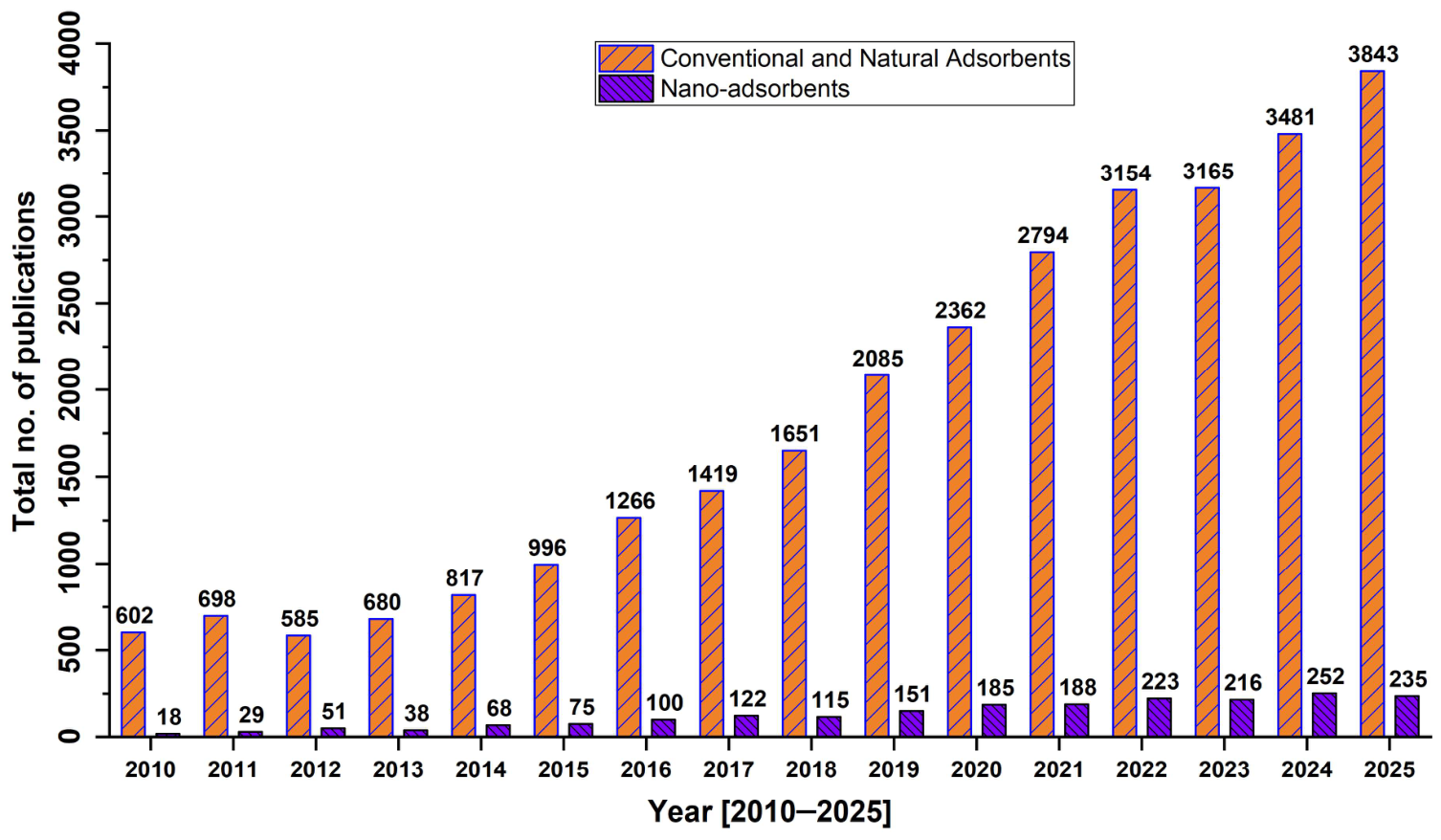
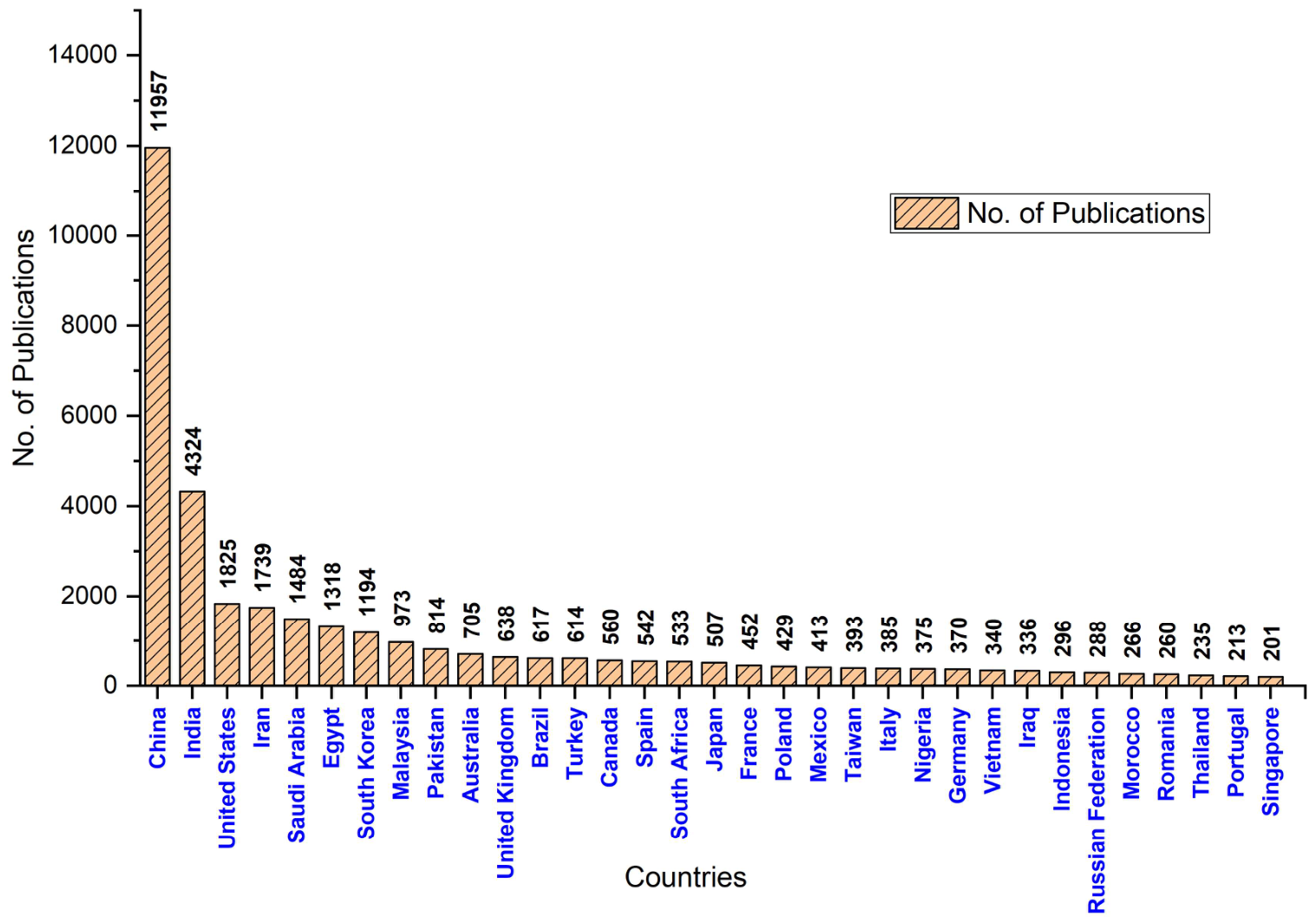
| Year | Adsorbents Used in Cited Studies | TP/Year | Country-Wise Highest Number of Publications | References |
|---|---|---|---|---|
| 2010 | Zeolite, kaolinite clay, chitosan-tripolyphosphate beads | 602 | China (154), India (94), USA (46) | [32,33,34] |
| 2011 | Wheat, Turkish illitic clay, FeO-coated sludge, peanut shell | 698 | China (199), India (111), USA (64) | [35,36,37,38] |
| 2012 | Dolomite adsorbent, switchgrass biochar, sludge biochar | 585 | China (171), India (94), USA (36) | [39,40,41] |
| 2013 | Zeolite, bentonite, palm shell AC, Mg-Al layered hydroxide | 680 | China (200), India (79), USA (58) | [42,43,44] |
| 2014 | Oak wood AC, zeolite, mango leaves | 817 | China (237), India (136), USA (66) | [45,46,47] |
| 2015 | Iron-coated zeolite, KMnO4-treated wood | 996 | China (323), India (138), USA (87) | [48,49] |
| 2016 | Fly ash, Ni-Fe layered double hydroxide, Mg-modified zeolite | 1266 | China (415), India (162), USA (96) | [17,50,51] |
| 2017 | Bentonite materials, ZnO-based montmorillonite, green polymer, biochar | 1419 | China (480), India (189), USA (116), Iran (99) | [52,53] |
| 2018 | Algal sorbent, apple peels, dendritic polymer, graphite oxide pellets, aluminum and zirconium-based xerogel, glutathione-functionalized melamine sponge, activated biochar | 1651 | China (665), India (171), Iran (121), USA (112) | [54,55,56,57,58,59,60] |
| 2019 | MgAl-layered hydroxide, iron–biochar composite, polypyrrole-based AC, Fe/Al/Ca-based adsorbent, microwave-functionalized rice husk and poly-aluminum chloride, iron-based sorption materials | 2085 | China (879), India (254), Iran (144), USA (132) | [19,61,62,63,64] |
| 2020 | Sodium alginate, Fe-Mn binary oxide biochar, functionalized straw absorbent, katoite (Ca3Al2(OH)12) | 2362 | China (1007), India (278), USA (167), Iran (135), Egypt (100), Republic of Korea (99) | [65,66,67,68,69] |
| 2021 | Modified biochars, polyethyleneimine modified straw hydrochar, OH-activated porous biochar, granular activated carbon, cerium–silver oxide composite incorporated with reduced graphene oxide, 2D hybrid LDH, activated carbon from cassava sludge | 2794 | China (1139), India (406), USA (165), Iran (158), Saudi Arabia (138), Republic of Korea (135), Egypt (124), Malaysia (104) | [70,71,72,73,74,75,76] |
| 2022 | Activated carbon fibers, magnetic metal–organic framework derivatives, metal composite oxide, ZnO immobilized on recycled polyethylene terephthalate | 3154 | China (1444), India (502), USA (189), Saudi Arabia (186), Iran (155), Egypt (146), Republic of Korea (145), Malaysia (126), Pakistan (104) | [77,78,79,80,81,82,83] |
| 2023 | Magnetic modified biochar, magnesium oxide-loaded mesoporous silica, bismuth and iron co-doped hydroxyapatite materials, polycaprolactone-bound diatomite filter, biomass-based removal, rice husk ash adsorbent, red mud-based geopolymer microspheres, functionalized cellulose, mesoporous activated carbon | 3165 | China (1413), India (522), Saudi Arabia (203), Egypt (170), Iran (167), USA (1603), Republic of Korea (131), Pakistan (117), Malaysia (116) | [84,85,86,87,88,89,90,91,92] |
| 2024 | Ligand-imprinted composite adsorbent, polyamide grafted eggshell, polymer-modified carbon, modified biochar, metal–organic framework, chitosan composite | 3481 | China (1549), India (550), Saudi Arabia (255), Iran (204), Egypt (200), USA (168), Republic of Korea (135), Pakistan (133) | [93,94,95,96,97] |
| 2025 | Chitosan, metal–organic frameworks, clay, biochar, zeolites, composites, alginate hydrogels, graphene-based aerogels | 3843 | China (1673), India (616), Saudi Arabia (279), Egypt (214), Iran (209), USA (171), Pakistan (121), Republic of Korea (120) | [98,99,100,101,102] |
| Year | Selected Nano-Adsorbents Used | TP/Year | Country-Wise Number of Publications | References |
|---|---|---|---|---|
| 2010 | Amino-functionalized Fe3O4 @SiO2, n-alumina, n-TiO2, iron-doped AC, n-HMO, n-HFO | 18 | China (8), Iran (4) | [103,104,105] |
| 2011 | nZVI, polyrhodanine-encapsulated magnetic NPs, thiol-functionalized silica nano hollow sphere | 29 | China (10), Iran (7), India (2) | [106,107,111] |
| 2012 | Fe2O3 NPs, nanocomposite-based XG-g-PAM/SiO2, maghemite NTs, chitosan-grafted polyacrylamide | 51 | China (15), India (15), Iran (6) | [112,113,114,115] |
| 2013 | N-doped porous carbon, magnetite nanorods | 38 | Iran (9), China (8), India (8) | [116,117] |
| 2014 | Mercury nano-trap, hydrated zirconium oxide (HZO)/polystyrene hybrid adsorbent | 68 | India (16), China (15), Iran (9) | [118,119,120] |
| 2015 | Silica NTs, SiO2 magnetic NPs, nickel oxide nano catalyst | 75 | Iran (21), China (17), India (14) | [121,122,123] |
| 2016 | FeO NPs, nZVI, Fe2O3 NPs, nZV-Zeolite and Montmorillonite | 100 | China (31), Iran (23), India (19) | [124,125,126,127] |
| 2017 | Sulfonated magnetic NPs, mercaptoamine-functionalized silica-coated magnetic NAs, magnetic FeO NP–multiwalled carbon NT composites, guar gum–nano-ZnO | 122 | China (24), Iran (22), India (21) | [128,129,130,131] |
| 2018 | Graphene oxide NCs, biochar-immobilized nZVI, sulfonated graphene oxide NA, magnetic Zr-MOF NCs | 115 | China (41), Iran (24), India (16) | [132,133,134,135] |
| 2019 | nZVI composite, biochar-modified Mg/Al layered double hydroxide, graphene-based NAs, bi-functional nano-adsorbent, β-cyclodextrin and polyethyleneimine bi-functionalized magnetic NA, rod-shaped Ca–Zn@Chitin composite, metal–organic frameworks, molecularly imprinted magnetite nanomaterials | 151 | China (50), India (30), Iran (30), Egypt (12) | [136,137,138,139,140,141,142,143] |
| 2020 | Fe/Mn oxide micro NPs, metal oxide chitosan magnetic nanocomposites, bimetallic NCs, epoxy-triazinetrione-functionalized magnetic NPs, 2D water-stable zinc-benzimidazole framework nanosheets, poly (methacrylate citric acid) NA, ionic liquid-assisted mesoporous silica-graphene oxide NC, molybdenum-disulfide-functionalized MXene NC, nano iron oxide | 185 | China (47), India (46), Iran (26), Egypt (11), USA (11) | [144,145,146,147,148,149,150,151] |
| 2021 | Functional mesoporous silica NPs, 1D and 2D NCs, magnetic ion-imprinted chitosan NPs, magnetite-based polymeric NC, PEG/ Fe3O4/GO-NH2 NAs, magnetic chromium ferrite NC, zero-valent iron-decorated graphene oxide/activated carbon NC, multi-walled carbon NTs, hydrophobic fluorous metal−organic framework NA | 188 | China (60), India (38), Iran (31), Egypt (20) | [108,152,153,154,155,156,157,158,159] |
| 2022 | Magnetic iron oxide NA, mercapto-grafted magnetic graphene oxide, rutile phased titania NPs–acid-modified kaolinite clay, mesoporous guanidine functionalized Santa Barbara amorphous magnetic NA, superparamagnetic magnetite NA, mesoporous organic silica NA, La-anchored Zr-based metal–organic frameworks | 223 | China (76), India (55), Iran (26), Egypt (19), Saudi Arabia (18) | [109,160,161,162,163,164,165,166] |
| 2023 | Dolomite-quartz@Fe3O4 NC, carboxyl and thiol-functionalized magnetic NAs, graphene nanoflakes, iron oxide NPs, thiol-rich hydrogel adsorbent; PHPAm/Fe O @SiO-SH polymer NC, nanocellulose-based NA, nano-ceria biochar NC | 216 | China (64), India (50), Iran (27), Saudi Arabia (17), Egypt (17) | [110,167,168,169,170,171,172] |
| 2024 | AC–nanocrystal composites, MOF–alginate particles, chitosan-nano CuO composite, zeolitic imidazolate framework nanohybrid, nanosilica–chitosan porous microbeads, cellulose–nZVI composite | 252 | China (72), India (57), Saudi Arabia (30), Egypt (28), Iran (26) | [173,174,175,176,177,178] |
| 2025 | Carbon nanomaterials, nanocellulose-based aerogels, ZnO-MXene nanocomposites, nanosilica microspheres, cellulose nanofibers, magnetic silica nanoparticles, glycosylated activated clay carbon spheres, Mixed Metal Nano-Oxides (MMNOs) | 235 | China (69), India (61), Iran (30), Egypt (25), Saudi Arabia (25) | [179,180,181,182,183,184,185] |
Disclaimer/Publisher’s Note: The statements, opinions and data contained in all publications are solely those of the individual author(s) and contributor(s) and not of MDPI and/or the editor(s). MDPI and/or the editor(s) disclaim responsibility for any injury to people or property resulting from any ideas, methods, instructions or products referred to in the content. |
© 2026 by the authors. Licensee MDPI, Basel, Switzerland. This article is an open access article distributed under the terms and conditions of the Creative Commons Attribution (CC BY) license.
Share and Cite
Debnath, A.; Mishra, A.; Pandey, A.; Singh, P.K.; Sharma, Y.C.; Calay, R.K. A Review of Symmetrical and Asymmetrical Research Outputs on Wastewater Treatment and Water Purification Through Sorption-Based Technologies. Symmetry 2026, 18, 865. https://doi.org/10.3390/sym18050865
Debnath A, Mishra A, Pandey A, Singh PK, Sharma YC, Calay RK. A Review of Symmetrical and Asymmetrical Research Outputs on Wastewater Treatment and Water Purification Through Sorption-Based Technologies. Symmetry. 2026; 18(5):865. https://doi.org/10.3390/sym18050865
Chicago/Turabian StyleDebnath, Abhijit, Anurag Mishra, Archana Pandey, Prabhat Kumar Singh, Yogesh Chandra Sharma, and Rajnish Kaur Calay. 2026. "A Review of Symmetrical and Asymmetrical Research Outputs on Wastewater Treatment and Water Purification Through Sorption-Based Technologies" Symmetry 18, no. 5: 865. https://doi.org/10.3390/sym18050865
APA StyleDebnath, A., Mishra, A., Pandey, A., Singh, P. K., Sharma, Y. C., & Calay, R. K. (2026). A Review of Symmetrical and Asymmetrical Research Outputs on Wastewater Treatment and Water Purification Through Sorption-Based Technologies. Symmetry, 18(5), 865. https://doi.org/10.3390/sym18050865