


Abstract
The safe operation of power battery systems relies on the dynamic symmetric equilibrium of electrochemical distribution and thermal management states, whereas fault occurrence is often accompanied by symmetry breaking. To achieve accurate fault diagnosis and symmetry restoration, this study proposes a symmetrical closed-loop framework (DBP-KG-FBN) that integrates digital battery passport (DBP) text mining, knowledge graph (KG), and fuzzy Bayesian network (FBN). Power battery fault diagnosis is critical to new energy vehicle (NEV) safety; however, conventional methods face two key limitations: (1) they inadequately exploit multi-source heterogeneous textual data in DBPs; and (2) they fail to handle uncertainty in fault propagation. The methodology proceeds as follows. First, a BERT-BiLSTM-CRF model extracts fault-related entities and relations from unstructured DBP text, which are structured into a Neo4j-based knowledge graph. Second, via rule-based topological mapping, the KG topology is transformed into a Bayesian network through structurally symmetric transformation between the semantic and probabilistic layers, with cyclic dependencies resolved by introducing latent variables. Third, network parameters are determined by integrating fuzzy set theory with game theory-based weighting to quantify uncertainty and subjectivity in expert evaluations, thereby achieving symmetric utilization of subjective and objective information. This enables bidirectional symmetric reasoning for forward fault prediction and backward fault traceability. Experimental results demonstrate that while maintaining symmetric stability of the diagnostic knowledge topology, the proposed DBP-KG-FBN method achieves a diagnostic accuracy of 0.92 (Top-3). This symmetrical closed-loop framework significantly outperforms fault tree analysis (FTA) and event tree analysis (ETA) in diagnostic accuracy and reasoning efficiency. It transforms unstructured DBP data into computable knowledge for intelligent battery diagnosis. Future work will expand the corpus via transfer learning and optimize adaptive weighting algorithms for expert evaluations.
1. Introduction
With the rapid development of the global new energy vehicle industry, the safety and reliability of its core power system―the power battery―have become a focus of attention for both academia and industry [1]. Statistics show that most electric vehicle safety incidents are related to power battery faults [2]. These faults are often triggered by the coupling of multiple factors, such as material aging, manufacturing defects, and complex operating conditions, and are characterized by strong uncertainty and complexity. However, conventional unidirectional diagnosis methods lack symmetric bidirectional reasoning capability to simultaneously support fault prediction and traceability. Therefore, developing efficient and accurate fault diagnosis technologies to achieve proactive management and early warning of battery health is key to ensuring the safe operation of new energy vehicles.
Current mainstream fault diagnosis methods mainly fall into three categories. Model-based methods, while having clear physical significance, rely heavily on model accuracy and struggle to characterize complex nonlinear relationships. Data-driven methods can mine features from data but require large amounts of high-quality labeled data and suffer from poor interpretability. Knowledge-based methods offer strong interpretability and do not rely on precise mathematical models, yet face challenges in knowledge acquisition and dynamic updating.
In recent years, the digital battery passport (DBP), serving as a core digital carrier recording the full life-cycle information of lithium batteries, has provided a data foundation for addressing key issues such as battery traceability, reuse evaluation, and recycling optimization [3,4,5]. The DBP contains not only manufacturing information, performance parameters, and usage history but also a large amount of unstructured textual data, such as fault reports, maintenance logs, and engineering experience records. These data may contain critical information related to the degradation mechanisms and failure modes of power lithium batteries. Existing knowledge-based fault diagnosis methods, limited by their reliance on structured inputs and insufficient domain priors, struggle to fully exploit the deep knowledge within such textual data. Moreover, the absence of symmetric mapping between knowledge topology and probabilistic structure limits model transformation consistency. Consequently, how to automatically extract interpretable fault knowledge from unstructured DBP text and construct a computable diagnostic model possessing both uncertainty modeling capability and intelligent reasoning ability has become a key scientific challenge in the field of sustainable power battery management.
To address this challenge, this paper proposes a power battery fault diagnosis framework (DBP-KG-FBN) based on the DBP. Its core innovation lies in combining the semantic organization capability of KG with the probabilistic reasoning capability of FBN through symmetric topological mapping and bidirectional inference. The main contributions of this paper are as follows:
- (1)
- A domain knowledge graph for power battery fault diagnosis was constructed, achieving automated extraction and structured representation of fault knowledge from unstructured DBP text with symmetric structural correspondence to Bayesian networks;
- (2)
- A method for constructing a Bayesian network based on knowledge graph mapping was proposed, and fuzzy set theory and a symmetric combined weighting method were introduced to balance the fuzziness and subjective uncertainty in expert evaluations and determine the network parameters;
- (3)
- Bidirectional probabilistic reasoning for both forward prediction and backward diagnosis was realized through a symmetric reasoning mechanism, and case experiments were conducted to validate the significant advantages of the proposed method over traditional methods (FTA, ETA) in terms of accuracy, efficiency, and interpretability.
The structure of this paper is as follows. Section 2 reviews related research work; Section 3 elaborates on the overall framework and implementation steps of the DBP-KG-FBN method; Section 4 verifies the effectiveness of the method through case experiments; and Section 5 summarizes the full text and outlines future research directions.
2. Literature Review
2.1. Digital Battery Passport (DBP) and Its Applications
The DBP serves as a core carrier for data transparency throughout the battery life cycle. Current research primarily focuses on data modeling and value scenario mining. Standardized data models have been proposed to support cross-system interoperability [6] and end-of-life recycling optimization [7]. Value-oriented studies emphasize remaining useful life indicators for resale and repurposing [8], life cycle assessment for environmental impact quantification [9], conceptual frameworks for sustainable product management [10], supply-chain carbon responsibility allocation [11], and AI-driven sustainability assessment for greener batteries [12]. However, existing research predominantly concentrates on macro frameworks and structured data, generally neglecting the diagnostic value of massive unstructured textual data (e.g., fault reports, maintenance logs) contained within DBPs. The failure modes and degradation mechanisms latent in such text remain unexploited as computable diagnostic knowledge. To address this “text–knowledge–model” transformation bottleneck, this study proposes a modeling paradigm integrating natural language processing, knowledge representation, and uncertainty reasoning.
2.2. Power Battery Fault Diagnosis Methods
Existing fault diagnosis methods mainly fall into three paradigms: model-based, data-driven, and knowledge-based. Model-based methods construct equivalent circuit or electrochemical models for residual analysis and state estimation [13,14,15], offering clear physical significance. However, their performance strictly depends on model accuracy, struggling to characterize the strong nonlinearity and time-varying characteristics of power batteries [16,17]. Data-driven methods mine fault features directly from historical data using neural networks and statistical approaches [18,19,20,21,22,23], or advanced architectures such as spatio-temporal transformers [24,25,26,27]. While reducing reliance on physical models, these approaches require large-scale, high-quality labeled data and suffer from poor interpretability due to their “black-box” nature. Knowledge-based methods rely on domain expert experience and historical cases to construct knowledge bases and reasoning rules, offering strong interpretability without dependence on precise mathematical models or massive labeled data. Nevertheless, research on knowledge-based battery diagnosis remains limited, facing critical bottlenecks in automated knowledge acquisition and dynamic updating. The systematic recording of unstructured textual fault data in DBPs provides a novel foundation to overcome these limitations.
2.3. Diagnostic Modeling Methods Integrating NLP, Knowledge Representation, and Uncertainty Reasoning
To achieve the transformation from unstructured DBP text to computable diagnostic models, this study integrated named entity recognition (NER), knowledge graphs (KGs), and fuzzy Bayesian networks (FBNs) to construct the technical chain of “information extraction, knowledge representation, uncertainty modeling”.
NER constitutes the primary step for structured knowledge extraction from free text. Deep learning-based NER methods have been successfully applied in specialized domains, including pathology reports [28], construction safety [29], engineering geology [30], landslide disasters [31], and traditional Chinese medicine [32]. Specifically, the BERT-BiLSTM-CRF architecture has demonstrated significant advantages in domain-specific applications such as citrus pest identification [33], educational text analysis [34], biochemical NER [35], lithium deposit knowledge graphs [36], and waterway transport accidents [37], providing reliable technical assurance for automated fault knowledge extraction.
KG provides a structured semantic representation framework for multi-source heterogeneous knowledge, supporting knowledge integration and associative reasoning. Applicability in fault diagnosis has been explored through semi-supervised industrial adaptive methods [38], large language model-assisted construction for CNC systems [39] and robotic fault diagnosis [40], as well as integration with graph attention networks [41] and temporal knowledge graphs [42].
BN is widely used in fault diagnosis and risk analysis due to its capability to express probabilistic relationships and handle uncertainty in fault propagation through bidirectional reasoning [43,44,45]. Applications include hydrogen safety risk assessment [43], construction robot safety analysis [45], human factor assessment [46], and sensor configuration optimization [47].
While existing research has advanced independently in DBP frameworks, diagnostic paradigms, and enabling technologies, a critical limitation persists: the lack of a systematic solution to automatically transform unstructured textual fault knowledge embedded in DBPs into computable diagnostic models supporting uncertainty reasoning. This study proposes the DBP-KG-FBN framework to address this gap, automating knowledge extraction from unstructured DBP text and enabling dynamic, uncertainty-aware fault diagnosis. Currently, existing KG-BN frameworks [48,49,50] predominantly rely on historical accident or defect records, and adopt either pure data-driven estimation or simplified fuzzy expert evaluation with rigid structural mapping assumptions. In contrast, DBP-KG-FBN leverages the full life-cycle unstructured text of the digital battery passport for knowledge graph construction, introduces a structurally symmetric KG-to-BN transformation that preserves semantic integrity via latent variables, and employs fuzzy set theory coupled with game-theoretic combination weighting to systematically calibrate network parameters under uncertainty. Furthermore, these methods rarely consider the symmetric structural correspondence between knowledge representation and probabilistic inference, nor the symmetric bidirectional reasoning capability for both prediction and diagnosis, leaving a gap for integrated fault diagnosis frameworks.
3. DBP-KG-FBN Fault Diagnosis Methodology
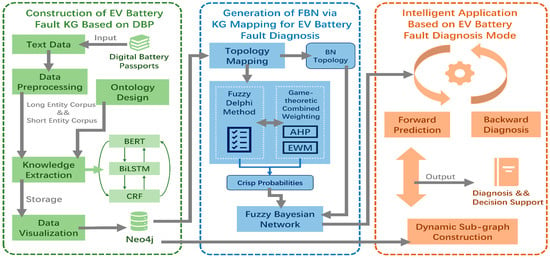
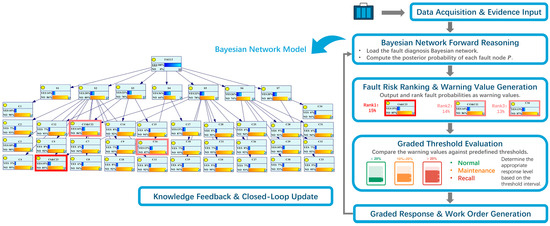
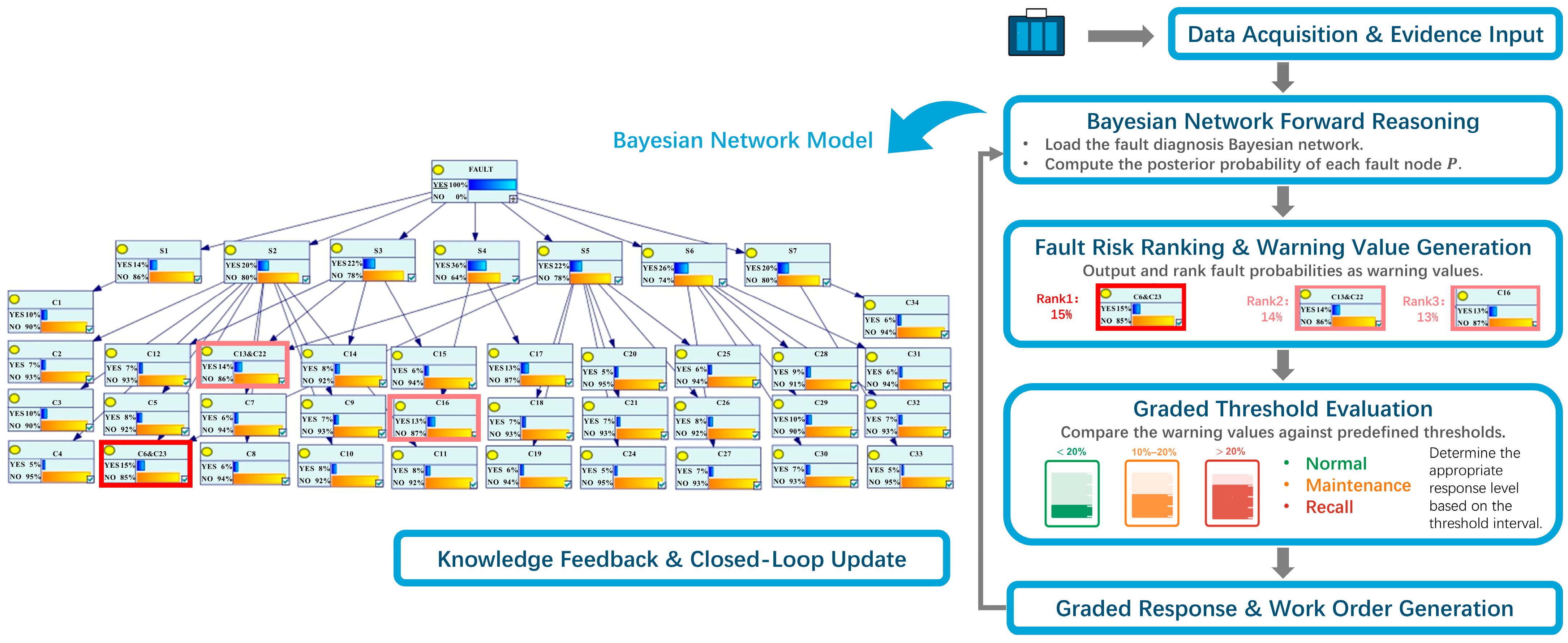
This study proposes a power battery fault diagnosis method (DBP-KG-FBN) that integrates digital battery passport, knowledge graph, and fuzzy Bayesian network to address the bottlenecks of traditional methods in utilizing unstructured text and handling uncertainty. This framework automates the construction of a computable knowledge system from text and establishes a diagnostic model supporting uncertainty reasoning, thereby achieving a closed loop from data to decision. As shown in Figure 1, the overall framework consists of three core stages: (1) construction of the power battery fault knowledge graph based on DBP; (2) generation of the power battery fault diagnosis FBN via KG mapping; and (3) intelligent applications based on the diagnosis model.
Figure 1.
DBP-KG-FBN overall workflow.
3.1. Construction of Power Battery Fault KG Based on DBP
KG construction is the primary step of the DBP-KG-FBN fault diagnosis method, aiming to transform the unstructured fault text in DBP into a structured, computable semantic network. The specific process encompasses four key steps: corpus preparation, ontology design, knowledge extraction, and knowledge storage.
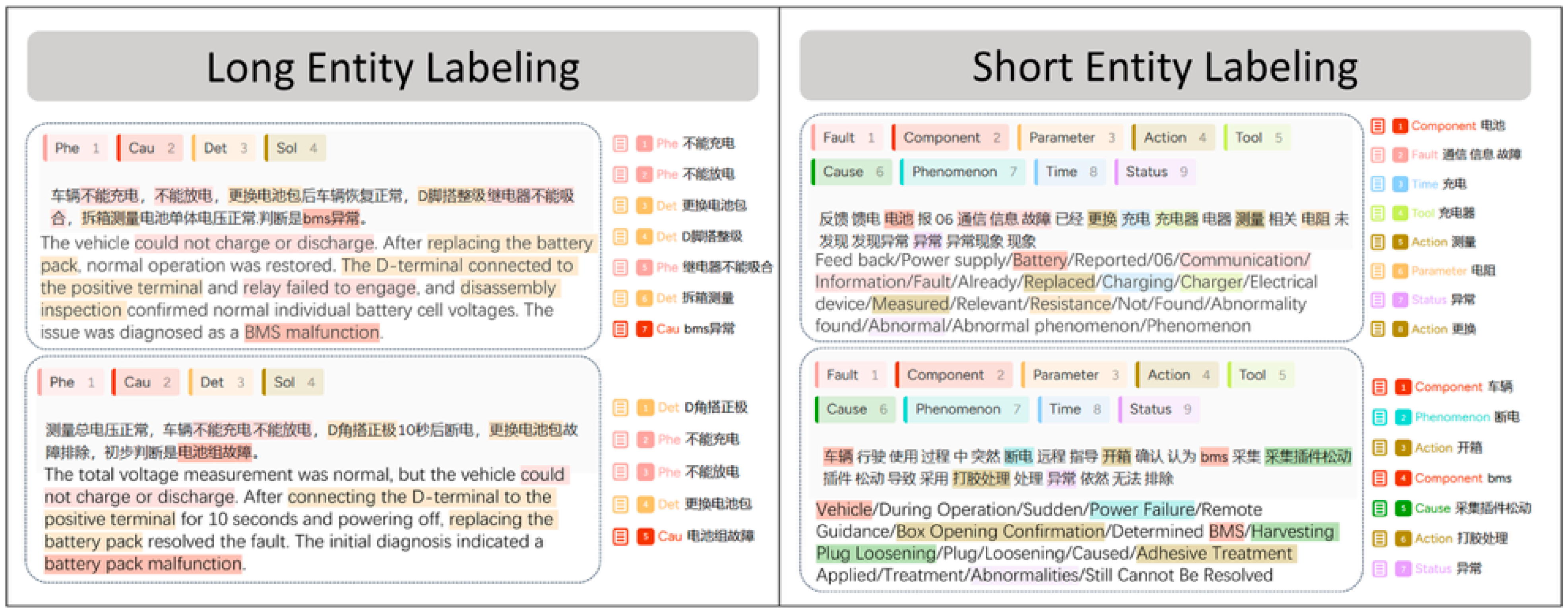
In the corpus preparation stage, to simulate the unstructured fault text data contained in real DBPs, this study integrated internal after-sales text data from Chinese power battery enterprises, supplemented by industry white papers and authoritative maintenance manuals obtained from the CNKI platform, to construct a substitute corpus covering comprehensive fault modes. Entity annotation was performed based on LabelStudio, including two methods: long-entity and short-entity annotation. Long entities were annotated directly on the original sentence, with labels corresponding to long segments spanning multiple words, used to test the model’s contextual understanding and boundary recognition capability. Short entities were first segmented using Jieba, then annotated with labels corresponding to words or short segments, and used to test the model’s local feature capture and noise resistance performance; the comparison is shown in Figure 2. The inter-annotator agreement between the primary annotator and the reviewer, measured by Cohen’s Kappa coefficient, reached 0.85 (indicating substantial consistency), and the annotated data were subsequently converted to BIO format for model training.
Figure 2.
Comparison of long- and short-entity annotation strategies for DBP text.
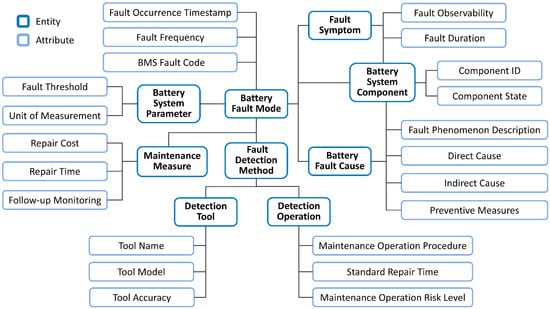
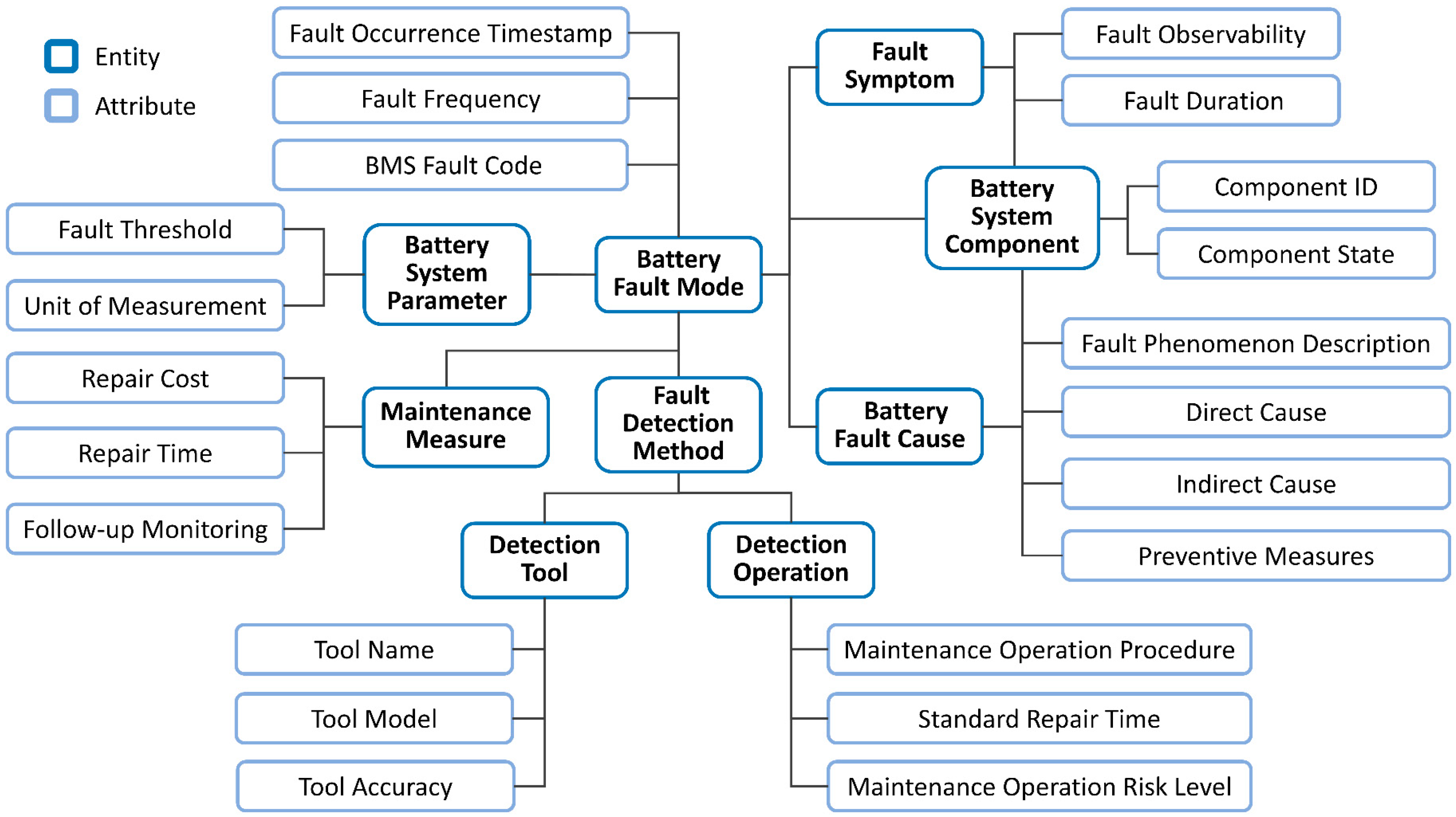
In the ontology design phase, considering the strong domain specificity and complex entity relationships, this study adopted a top-down approach to design the power battery fault diagnosis ontology to achieve a standardized representation of fault knowledge. This ontology is formally described using OWL-DL language, and its structure is shown in Figure 3. This ontology passed consistency verification using the Pellet reasoner, providing a solid semantic framework for knowledge extraction.
Figure 3.
Power battery fault diagnosis KG ontology structure.
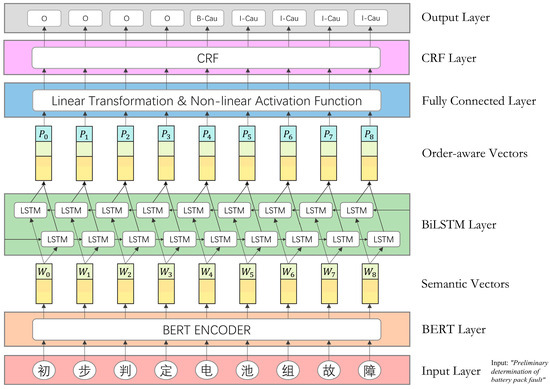
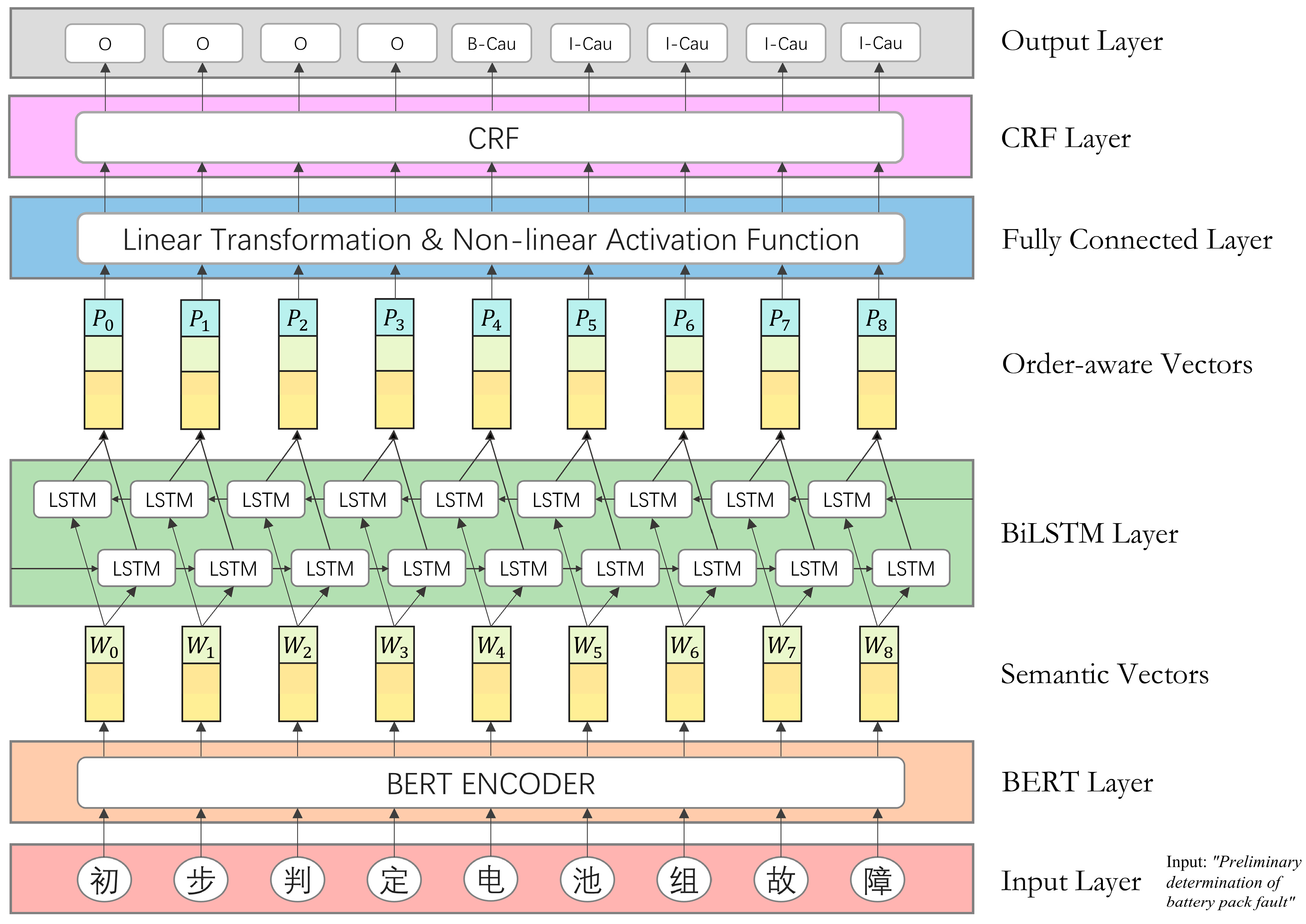
In the knowledge extraction stage, the BERT-BiLSTM-CRF model is employed to achieve the transformation from text to structured knowledge. The overall architecture of this model consists of three stages: the input text passes through the BERT model, generating contextual embedding vectors for each word. The embedding vectors output by BERT, containing rich semantic information, serve as the input to the BiLSTM. The BiLSTM captures forward and backward dependencies in the sequence through bidirectional processing, outputting an enhanced feature sequence that better represents the context in the text. The output of the BiLSTM serves as the input to the CRF layer. The CRF layer performs global optimization on the label sequence. By learning the dependencies between labels, CRF ensures that the output label sequence is globally optimal, thereby improving the accuracy of the NER task. Figure 4 illustrates the implementation process of this framework.
Figure 4.
BERT-BiLSTM-CRF model architecture for fault knowledge extraction.
In the knowledge storage phase, the extracted triple data are imported into the Neo4j graph database, completing the persistent storage and visualization of knowledge. Neo4j’s powerful graph structure query and traversal capabilities provide efficient support for subsequent graph querying, subgraph extraction, and topological mapping to Bayesian networks.
3.2. Generation of Power Battery Fault Diagnosis FBN Based on KG Mapping
To achieve uncertainty reasoning, the core task of this stage is to transform the constructed structured fault knowledge graph into a Bayesian network probabilistic graphical model, primarily achieved through two steps: topological structure mapping and probability parameter estimation.
3.2.1. Topological Structure Mapping
The study employs KG mapping to form the Bayesian network topological structure, defining mapping rules: (1) Fault-related entities in the knowledge graph are mapped to nodes in the Bayesian network; (2) Fault association relationships between entities are mapped to directed edges between nodes. When the directionality of the edge is unclear, domain knowledge of power battery fault propagation is combined for direction judgment; (3) When cyclic associations exist in the knowledge graph, the cycles are broken by node merging or introducing latent variables, ensuring that the Bayesian network satisfies the directed acyclic graph property. For example, if a cycle A-B, B-C, C-A exists among entities A, B, C, a latent variable L is introduced, transforming the cycle into L-A, L-B, L-C. The state and conditional probability table of the latent variable are defined by experts based on battery fault mechanisms. This latent-variable augmentation is theoretically grounded in the standard technique for cyclic causal structures in probabilistic graphical models, where the latent L represents an unobserved confounding mechanism (e.g., system-level thermal runaway propensity) that simultaneously influences the cyclic entities, thereby converting the cyclic dependency into a polytree without loss of generative semantics; (4) Redundant or highly similar fault association edges are merged, ensuring that the network structure aligns with the practical application scenarios of power battery fault diagnosis. The mapping procedure described in rules (1)–(4) is formalized as Algorithm 1.
| Algorithm 1. KG-to-BN Topological Mapping. |
| Input: Knowledge graph |
| Output: |
| 1. |
| 2. do |
| 3. Map to a corresponding BN node, with states defined by Ontology |
| 4. end for |
| 5. for each relation do |
| 6. using battery fault propagation rules |
| 7. |
| 8. end for |
| 9. then |
| 10. if cyclic nodes are semantically equivalent then |
| 11. Merge cyclic nodes into a single composite node |
| 12. else |
| 13. Introduce latent variable L; |
| 14. Replace cycle with edges from L to all cycle nodes |
| 15. end if |
| 16. end if |
| 17. |
| 18. |
Thus, the semantic topology of the KG is transformed into a probabilistic dependency topology structure of a Bayesian network suitable for fault diagnosis. This mapping establishes a structural symmetry between the semantic topology of the knowledge graph and the probabilistic dependency topology of the Bayesian network. Formally, let the knowledge graph be and the Bayesian network be . The mapping preserves adjacency such that , i.e., each KG entity maps to a unique BN node and each KG relation maps to a unique directed edge.
3.2.2. Probability Parameter Estimation
This study employed the fuzzy Delphi method to obtain the prior probabilities of symptom nodes (S) and the conditional probabilities of cause nodes (C).
To handle the uncertainty in fault probabilities and the subjectivity in expert evaluations, this study introduces fuzzy set theory for parameter estimation. Proposed by Zadeh in 1965 [51], this theory describes the degree to which an element belongs to a set via membership functions, breaking through the limitations of traditional binary logic. This study selects the triangular fuzzy number (TFN), known for its high flexibility, strong compatibility, and computational simplicity, to calculate fault node probabilities. A TFN is typically defined by three parameters , where is the left endpoint, is the peak value (location of maximum membership), and is the right endpoint. The membership function is defined as follows:
This study used a seven-level expert evaluation scale to set up a questionnaire, inviting 5 experts to provide fuzzy evaluations for the prior probabilities and conditional probabilities of fault nodes. The seven-level expert evaluation scale and corresponding TFNs are shown in Table 1. The selection of Triangular fuzzy numbers (TFNs) over alternative fuzzy representations is grounded in three key considerations: (1) Interpretability: the triplet directly matches expert cognitive heuristics―pessimistic bound, most-likely estimate, and optimistic bound―thus minimizing cognitive load during probability elicitation. (2) Domain suitability: fault probabilities in power battery systems rarely approach extreme values (near 0 or 1), so the compact support of TFN avoids over-allocating belief to distribution tails. (3) Computational efficiency: TFNs support closed-form defuzzification via the center-of-gravity method, whereas Gaussian or trapezoidal alternatives require numerical integration or extra shape parameters. Given that the expert ratings in this study are concentrated in mid-range intervals and historical fault frequencies are scarce, the additional fourth parameter of a trapezoidal fuzzy number would not yield a measurably different defuzzified outcome; TFN thus offers a parsimonious and sufficiently expressive representation for this application.
Table 1.
Seven-level expert evaluation scale and corresponding TFNs.
In the context of power battery fault diagnosis, the TFN parameters encode the physical bounds of expert uncertainty. The lower bound represents the conservative floor of fault probability, reflecting the expert’s judgment based on historical maintenance logs and normal operating conditions. The modal value represents the most probable estimate, corresponding to the dominant degradation pattern observed in field experience. The upper bound represents the prudent ceiling, accounting for unobserved stress factors, measurement noise, and rare but non-negligible degradation pathways. Taking the “Medium (M)” rating in Table 1 as an illustrative example, the TFN (0.3, 0.5, 0.7) physically means that the expert judges the fault to have a minimum 30% chance of occurrence under routine conditions, a most likely 50% chance based on typical empirical evidence, and a maximum 70% chance when latent stressors not fully captured by historical data are taken into account. This three-point encoding therefore captures both epistemic uncertainty and aleatory variability within a single fuzzy set.
To balance subjective and objective information, this study uses the analytic hierarchy process (AHP) to calculate subjective weights and the entropy weight method (EWM) to calculate objective weights. Then, a game theory model is used to solve for the optimal combination coefficients, obtaining the comprehensive weights:
After aggregating the fuzzy evaluations from all experts, the center of gravity method is used for defuzzification, converting the fuzzy numbers into precise probability values to fill the conditional probability tables (CPT) of the Bayesian network. The center of gravity method converts the triangular fuzzy number into a crisp probability value by calculating the weighted average over its support interval . The specific formula is as follows:
3.3. Intelligent Applications Based on the Power Battery Fault Diagnosis Model
The DBP-KG-FBN diagnostic model, constructed based on the aforementioned methods, is not a static analysis tool but a dynamic decision support system for power battery full life-cycle fault diagnosis, possessing three key intelligent operation and maintenance capabilities.
The model supports both fault warning and diagnosis through bidirectional probabilistic reasoning. This constitutes an inferential symmetry: forward prediction estimates the likelihood of symptoms given causes, , whereas backward diagnosis recovers the posterior probability of causes given symptoms, . These two directions form a dual pair linked by Bayes’ theorem:
This duality enables the same model to perform both proactive warning and retrospective traceability. Forward reasoning dynamically calculates the posterior probability of each node based on prior probabilities and real-time inputs, quantifying fault risk. By setting probability thresholds, the system automatically triggers graded alarms and generates maintenance work orders. Backward diagnosis inputs observed phenomena as evidence, calculates the probability distribution of cause nodes through Bayesian updating, and outputs a list of possible faults sorted by probability, guiding on-site troubleshooting.
The model supports a scenario-adaptive configuration based on subgraph extraction. For different operation and maintenance needs, predefined Cypher queries are used to extract relevant entity and relationship subgraphs from the Neo4j knowledge graph, which are then converted into dedicated Bayesian sub-networks according to the rules in Section 3.2.1, achieving rapid and precise scenario adaptation. From a computational perspective, the core operations of the proposed framework exhibit efficient complexity. The KG-to-BN topological mapping adopts graph traversal with linear complexity , where and denote the number of fault entities and relations. For FBN probabilistic reasoning, junction tree propagation is employed with complexity , where is the number of network nodes and refers to the treewidth. The overall computational overhead is low and scalable, which supports the real-time requirements of online battery fault diagnosis applications.
The model achieves closed-loop evolution based on knowledge increments. When new fault cases or expert experience emerge, the new unstructured text is processed through the BERT-BiLSTM-CRF model and rules described in Section 3.1 to extract entities and relationships, which are transformed into structured triples and incrementally imported into the Neo4j graph database. Knowledge base updates automatically trigger synchronous adjustments of the Bayesian network, including topology expansion and parameter updates, ensuring that the model continuously adapts to new environments.
4. Case Validation and Result Analysis
4.1. Experimental Setup
The original dataset used in the experiment came from the internal after-sales records of a specific battery model from a Chinese power battery recycling company, supplemented by relevant academic papers and professional fault repair manuals obtained from the CNKI platform to cover a wider range of fault modes. To overcome the challenge of scarce high-quality public data in this field, this study employed targeted text data augmentation strategies based on 640 original data entries. By performing rule-based entity replacement, semantic paraphrasing, and contextual perturbation on the original corpus, the effective data size was expanded to 3219 entries. The augmented dataset did not show significant overfitting during training, with the validation set loss decreasing steadily.
The current corpus was derived from Chinese enterprise records and CNKI technical literature. While the fault mechanisms (e.g., relay damage, BMS connector looseness) are generic to lithium-ion battery systems across regions, we recognize that regional regulatory DBP schemas may differ in data fields. The proposed NLP-to-KG pipeline is adaptable to different DBP schemas and can be re-targeted to any textual DBP format by retraining the NER model and refining the ontology on a local corpus aligned with regional standards.
After data preprocessing, the augmented dataset was randomly split into a 70% training set, 15% validation set, and 15% test set using the scikit-learn library. Regarding the experimental environment, the GeNIe 2.4 tool was chosen for constructing the Bayesian network, parameter learning, and probabilistic reasoning. Meanwhile, this study selected traditional knowledge-based fault diagnosis methods, fault tree analysis (FTA) and event tree analysis (ETA), as benchmark models for comparison. For a fair comparison, the fault corpus and domain knowledge used to build the baseline FTA and ETA models were sourced from the same origin as those used in this paper’s method and were established by the same expert panel (Section 3.2.2). This design locks the root cause of performance differences to the methodology itself, rather than knowledge quality.
4.2. DBP-KG-FBN Construction Validation
Knowledge extraction is the foundation for building the diagnostic model. To validate the knowledge extraction effectiveness, the performance of 7 NER models on the long- and short-entity annotated datasets was compared. Although CRF can function as a standalone NER model, it requires manually crafted feature templates. Given the limited dataset size and relatively simple text structure in this study, designing such templates would introduce subjective bias and likely result in poor generalization to new fault descriptions. Therefore, it was not included separately in the comparison. The training epochs were uniformly set to 100, and other parameters were adjusted to their optimal values. The performance comparison of each model on the two entity annotation datasets is shown in Table 2.
Table 2.
Evaluation scores of different NER models on long- and short-entity labeling sets.
Experimental results show that models based on Softmax decoding performed significantly worse than those with CRF decoding across all compared models, validating the irreplaceable role of the CRF layer in ensuring the structural integrity of the output sequence by introducing label transition constraints in professional domain NER tasks. The BERT-BiLSTM-CRF model demonstrated significantly superior comprehensive performance in the short-entity labeling task (F1-score: 0.9199). This performance improvement is primarily attributed to the deep semantic understanding capability provided by the BERT pre-trained language model. Power battery fault text contains a large number of professional terms and specific expressions. BERT, through its pre-training on large-scale corpora, can better understand the contextual semantics of these professional terms, providing a high-quality lexical representation foundation for sequence labeling. In the long-entity labeling task, although the performance of the BERT-BiLSTM-CRF model decreased compared to the short-entity task, it remained relatively high, indicating that BiLSTM’s sequence modeling capability can still effectively capture contextual dependencies for entities spanning multiple words. Meanwhile, benefiting from the pure sequence modeling capability that effectively captures long-range dependencies, the BiLSTM-CRF model also performed excellently in the long-entity labeling task (F1-score: 0.9182).
The performance gap between short-entity (F1 = 0.9199) and long-entity (F1 = 0.8324) labeling in the BERT-BiLSTM-CRF model arises from annotation granularity. Short entities are segmented by Jieba prior to annotation, providing explicit boundary cues that assist CRF transition learning. Long entities, annotated directly on raw sentences, span multiple words with ambiguous boundaries (e.g., “severe module over-discharge”), demanding stronger long-range dependency capture. Although BiLSTM mitigates this, the absence of explicit word boundaries in long-entity labeling increases boundary-detection error. This trade-off is acceptable because the downstream KG construction primarily relies on short-entity precision, while long entities are subsequently disambiguated via ontology constraints.
To quantitatively validate the impact of the augmentation strategy, we conducted a controlled ablation using the already-determined optimal model (BERT-BiLSTM-CRF) under identical configurations and a fixed random seed. Training solely on the 640 raw records yielded a short-entity F1 of 0.8743 and a long-entity F1 of 0.7856, whereas the augmented 3219 entry dataset achieved 0.9199 and 0.8324, respectively. The absolute F1 improvements of 0.0456 (short) and 0.0468 (long) confirm that the augmentation effectively mitigates data scarcity beyond mere scale expansion.
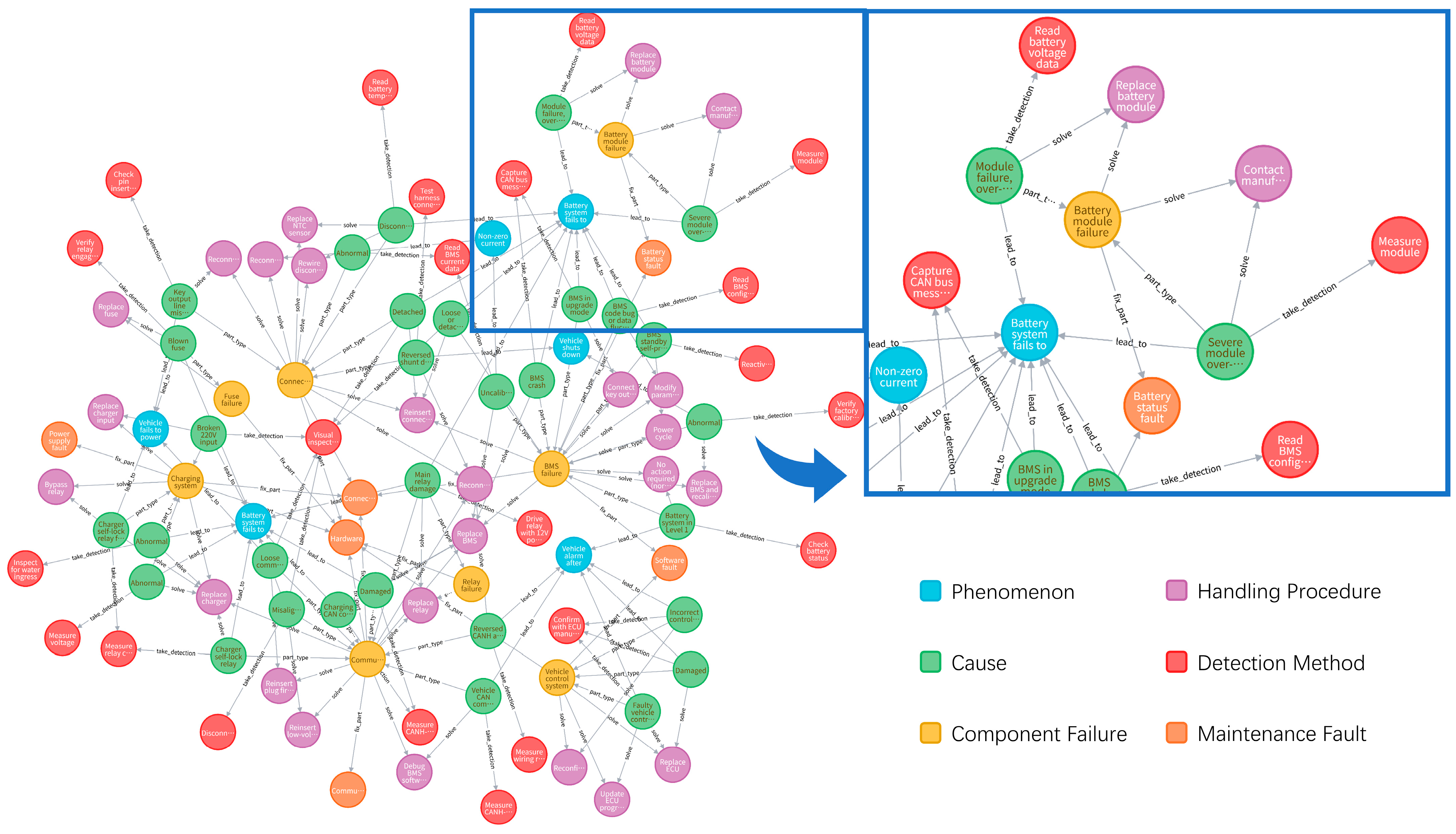
However, considering the practical need to handle entities of different lengths simultaneously, the BERT-BiLSTM-CRF model offers a more balanced guarantee in overall performance and generalization ability. This study employed the BERT-BiLSTM-CRF model to complete knowledge extraction, effectively accomplishing the construction of the structured knowledge graph from DBP text. The visualization result of the knowledge graph is shown in Figure 5.
Figure 5.
Visualized power battery fault KG.
Based on the knowledge graph, the Bayesian network topological structure was constructed through rule-based mapping. To address uncertainty in expert evaluations, fuzzy set theory and the combined weighting method were used to determine probability parameters. The weight allocation results in Table 3 show that Expert E received the highest weight (0.5074) due to high evaluation stability and rich professional experience, while Expert B received a relatively low weight (0.0293) due to large evaluation divergence, fully demonstrating the effectiveness of this method in balancing subjective and objective information.
Table 3.
Expert comprehensive weights.
To validate the combined weighting approach, we compared the game-theoretic solution against single-method alternatives using the same expert questionnaire data. (1) Pure AHP (subjective weights) assigns Expert B a weight of 0.1002 despite its low evaluation consistency, risking amplification of subjective bias. (2) Pure EWM (objective weights) compresses Expert C to 0.0131, potentially over-penalizing low variance caused by small-sample fluctuations and undervaluing domain expertise. (3) The game-theoretic combination solves Nash-equilibrium coefficients that balance both information sources, yielding a dominant weight for Expert E (0.5074), who exhibits both high subjective stability and high objective consistency while appropriately suppressing outlier experts (B and C). This comparison confirms that the combined method outperforms single-criterion weighting in reconciling experiential knowledge with data-driven evidence.
To assess robustness against individual bias, we conducted a sensitivity analysis by sequentially excluding each expert and renormalizing the remaining comprehensive weights. Excluding the lowest-weighted expert (C, 0.0131) altered the defuzzified probabilities of key nodes by less than 1.5%: C6 shifted from 0.4113 to 0.4175 (+1.5%), C3 from 0.4414 to 0.4453 (+0.9%), and S2 from 0.1971 to 0.1978 (+0.4%). Simultaneously excluding the two lowest-weighted experts (B: 0.0293 and C: 0.0131) changed these probabilities by less than 2.5%. The negligible impact of discordant evaluations is attributable to the game-theoretic weighting mechanism, which inherently suppresses outlier opinions.
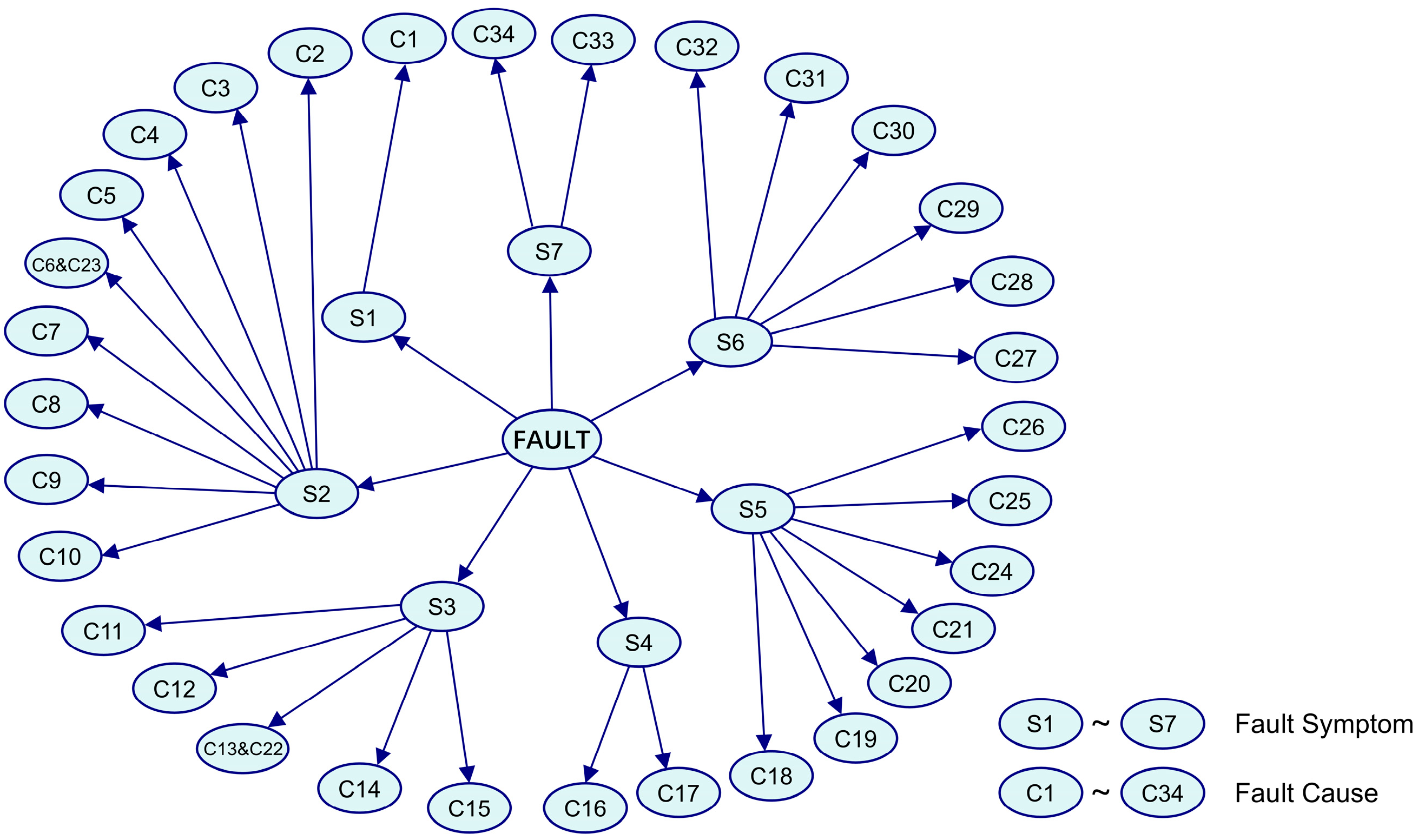
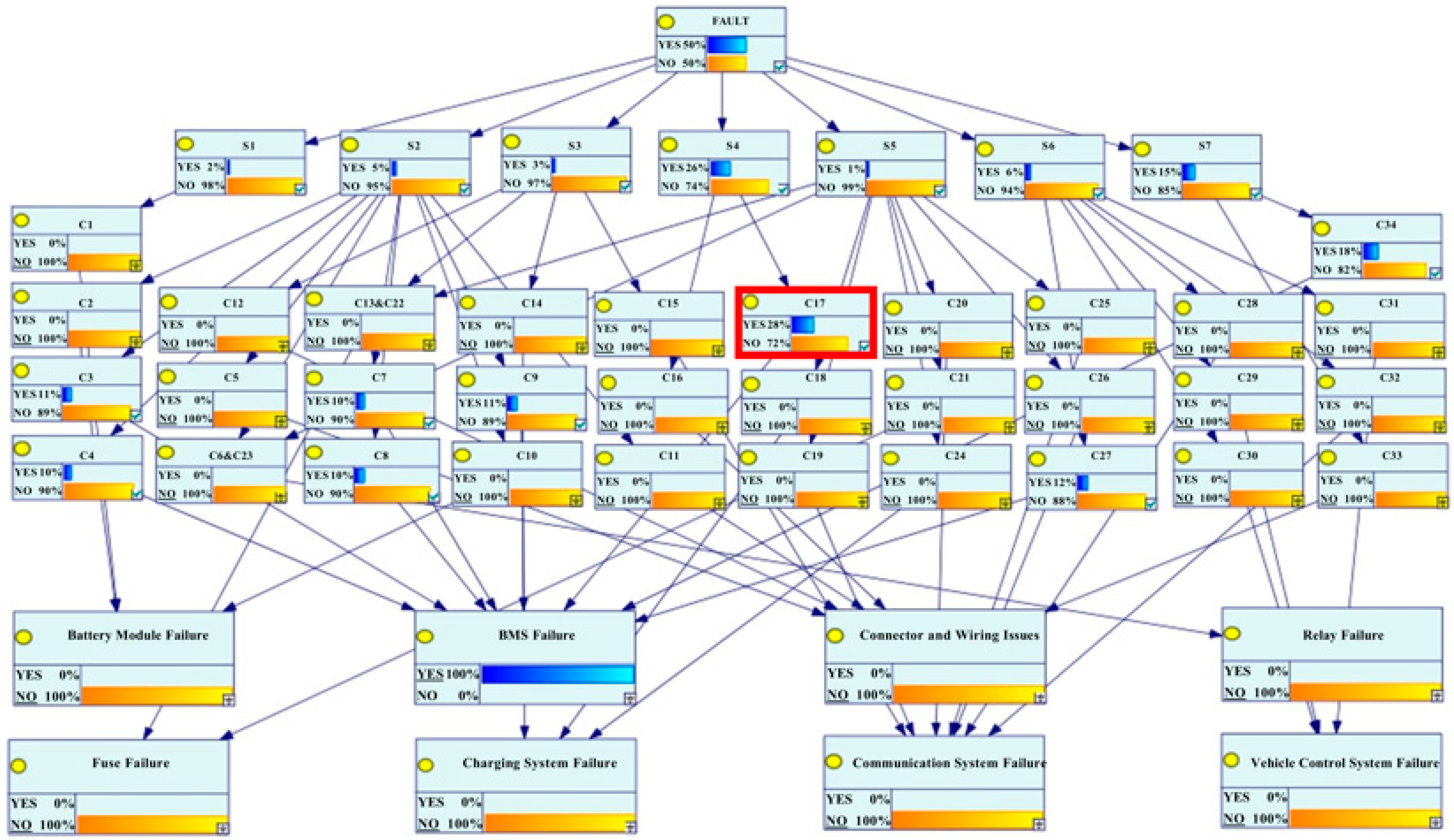
This study collected questionnaire survey results. Table A1 (Appendix A) shows the fuzzy evaluations for each node entity, and Table A2 (Appendix B) shows the specific probability values for each node entity. Based on the topology structure mapped from the knowledge graph and the probability parameters calculated by the fuzzy Delphi method, the final power battery fault diagnosis Bayesian network was constructed, as shown in Figure 6.
Figure 6.
Power battery fault diagnosis Bayesian network.
To validate the practical diagnostic performance of the constructed model, the system was tested against objective fault ground truth from historical maintenance records. From the original 640 after-sales logs, 50 cases were randomly selected where the actual fault causes had been documented by field technicians. In a blind test scenario where only observed symptoms (S1–S7) were input, the model correctly identified the actual root cause within the top-3 predictions in 46 cases (92.0% accuracy), and within the top-1 prediction in 38 cases (76.0% accuracy). This independent validation confirms that the probabilistic reasoning aligns with practical fault diagnosis scenarios.
The diagnostic results reported above were based on a dataset of 640 original after-sales records. We acknowledge that this scale is modest; however, in the power battery fault diagnosis domain, large-scale public datasets are inherently scarce due to commercial confidentiality and safety regulations. The augmentation-driven expansion to 3219 entries, combined with stable training dynamics and 92.0% top-3 accuracy on 50 held-out blind-test cases, provides pragmatic evidence that the model generalizes to unseen fault descriptions within the same technical domain. We explicitly recognize that this does not validate cross-enterprise or cross-platform generalization, which remains future work.
4.3. Intelligent Diagnostic Application Case and Comparative Analysis
This section qualitatively evaluates the DBP-KG-FBN model against traditional safety analysis methods. In accordance with the conventional methodological paradigm classification in the field of fault diagnosis, this study selected the classic benchmark methods fault tree analysis (FTA) and event tree analysis (ETA), which belong to the knowledge-based paradigm and are widely adopted in both industry and academia, for comparative analysis. FTA excels at backward tracing from top events to basic causes via Boolean logic, while ETA excels at forward projection from initiating events to consequences. However, both are static, offline tools requiring complete manual reconstruction when fault knowledge updates.
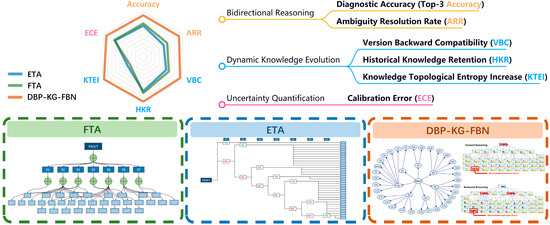
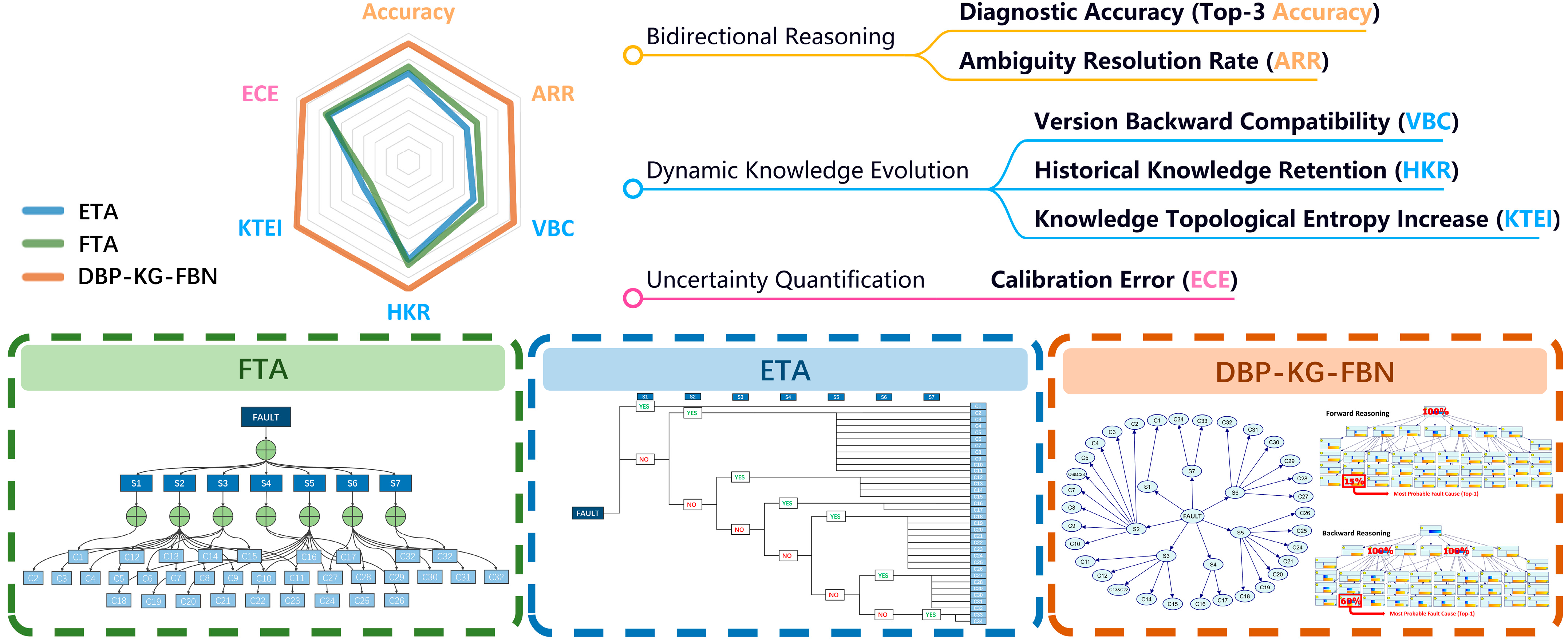
Appendix C elaborates the definitions and computational methodologies of the six quantitative metrics, and Table A3 presents the comparative results. As shown in Figure 7, DBP-KG-FBN transcends these limitations through three core differentiators:
Figure 7.
Performance comparison between DBP-KG-FBN and traditional diagnostic methods. Detailed definitions and computational methodologies of the metrics are elaborated in Appendix C.
- (1)
- Bidirectional Reasoning: Unlike FTA (purely backward) or ETA (purely forward), the Bayesian network supports both predictive forward inference and diagnostic backward inference within a unified framework.
- (2)
- Dynamic Knowledge Evolution: When new fault cases emerge, FTA/ETA require 4–6 h of manual remodeling by safety engineers. In contrast, DBP-KG-FBN achieves sub-second auto-synchronization via KG incremental updates (Section 3.3).
- (3)
- Uncertainty Quantification: Traditional FTA relies on crisp probability importance measures that cannot capture expert evaluation fuzziness. The integration of fuzzy numbers and game-theoretic weighting in DBP-KG-FBN enables nuanced uncertainty modeling during parameter elicitation.
4.3.1. Bidirectional Probabilistic Reasoning Capability
This model overcomes the limitation of traditional diagnostic methods that only support unidirectional analysis by implementing a bidirectional probabilistic reasoning mechanism, providing effective technical support for full-cycle management of fault diagnosis.
- (1)
- Forward Reasoning and Predictive Maintenance
The forward reasoning results based on the general fault diagnosis network are shown in Figure 8. The fault with the highest probability of occurrence for this type of power battery is “Main relay damage (C6&C23)”, which requires key maintenance attention. Based on the forward reasoning results of the Bayesian network, relevant warning thresholds can be set to classify fault causes. For example, if the warning value for a certain cause is less than 10%, it is considered normal; between 10% and 20%, it requires key maintenance, where relevant maintenance measures can be designed to improve maintenance efficiency and enhance user experience, such as designing easily replaceable compatible main relays; greater than 20% requires recalling the relevant battery type for overall optimization and upgrade, such as optimizing the battery structure design or trying new materials.
Figure 8.
Forward reasoning result of the general fault diagnosis network.
The forward reasoning capability of this model can systematically identify weak links in the operating system. The data-driven warning mechanism built upon this effectively promotes the transformation of the operation and maintenance mode from passive response to active prevention. This mechanism can significantly reduce the risk of sudden downtime caused by high-frequency faults, optimize the priority of maintenance resource allocation, thereby improving fault troubleshooting efficiency while systematically optimizing the overall utilization rate of operation and maintenance resources.
- (2)
- Backward Reasoning and Fault Traceability
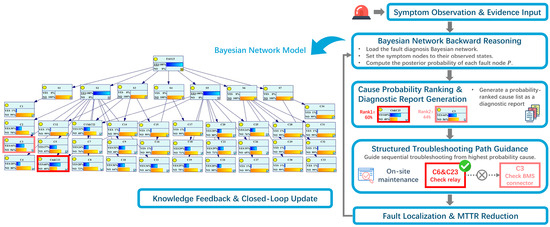
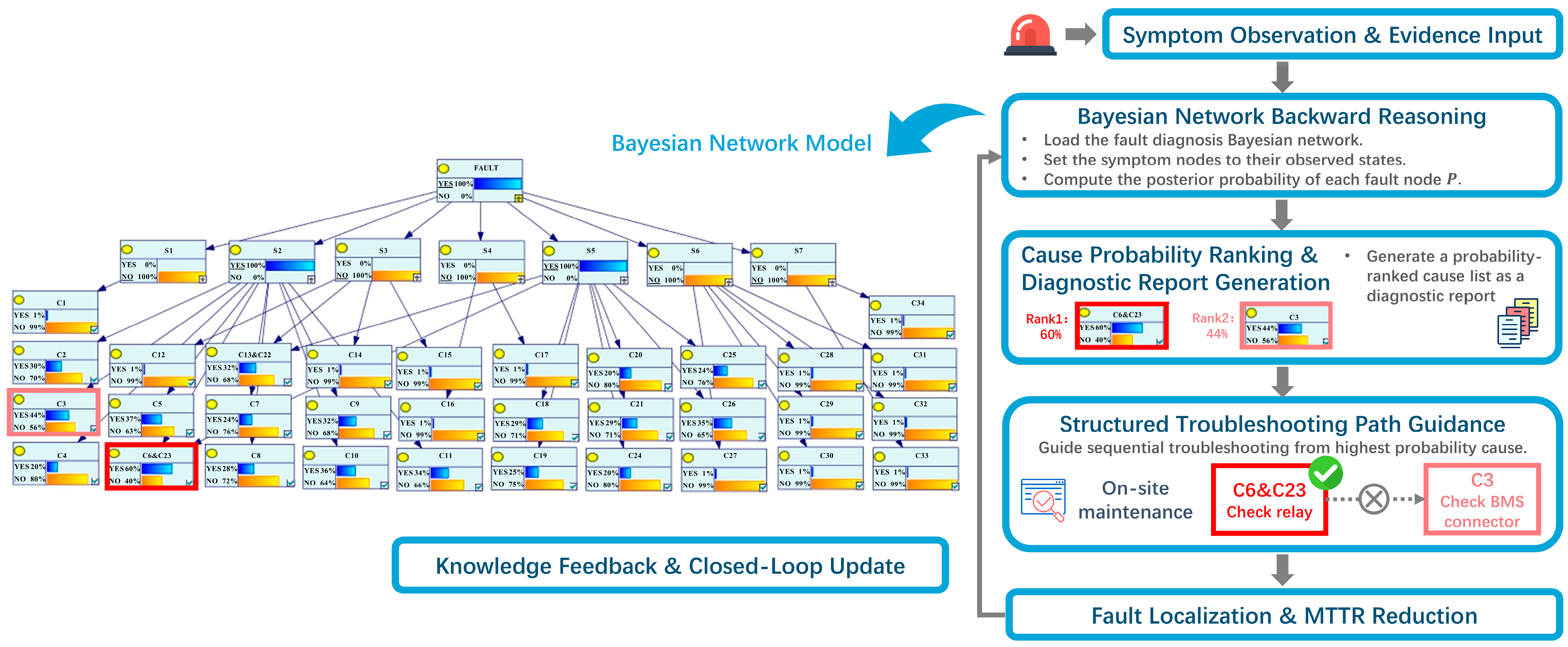
The backward reasoning results based on the general fault diagnosis network are shown in Figure 9. Assuming that the battery exhibits the phenomena “Battery system fails to discharge (S2) and charge (S5)”, the more likely fault causes are “Main relay damage (C6&C23)”, “Loose or detached BMS connector (C3)”, etc. Based on the backward reasoning results of the Bayesian network, fault troubleshooting can be carried out sequentially according to the probability ranking of the fault causes, improving troubleshooting efficiency.
Figure 9.
Backward reasoning result of the general fault diagnosis network.
When the system exhibits specific fault symptoms, the model generates a probability ranking of possible causes through backward reasoning, providing a structured troubleshooting path for on-site maintenance. This strategy changes the traditional experience-based item-by-item troubleshooting mode, significantly compressing the diagnostic path length and the number of operations required for fault localization, thereby greatly reducing the mean time to repair (MTTR). The significant improvement in diagnostic efficiency effectively reduces labor input and operation and maintenance costs.
4.3.2. Dynamic Configurability Based on Scenarios
This framework, based on a unified knowledge graph, achieves the capability to generate diagnostic sub-networks on demand, supporting the construction of dedicated diagnostic models for different application scenarios, significantly enhancing the applicability and practicality of the diagnostic system.
- (1)
- Maintenance-Oriented Diagnostic Sub-network
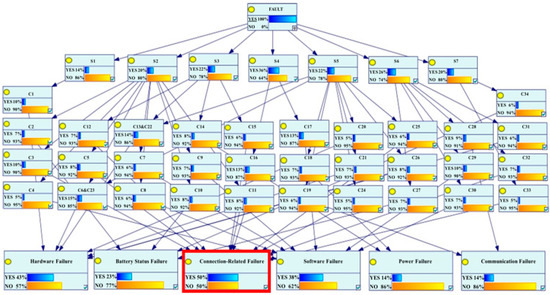
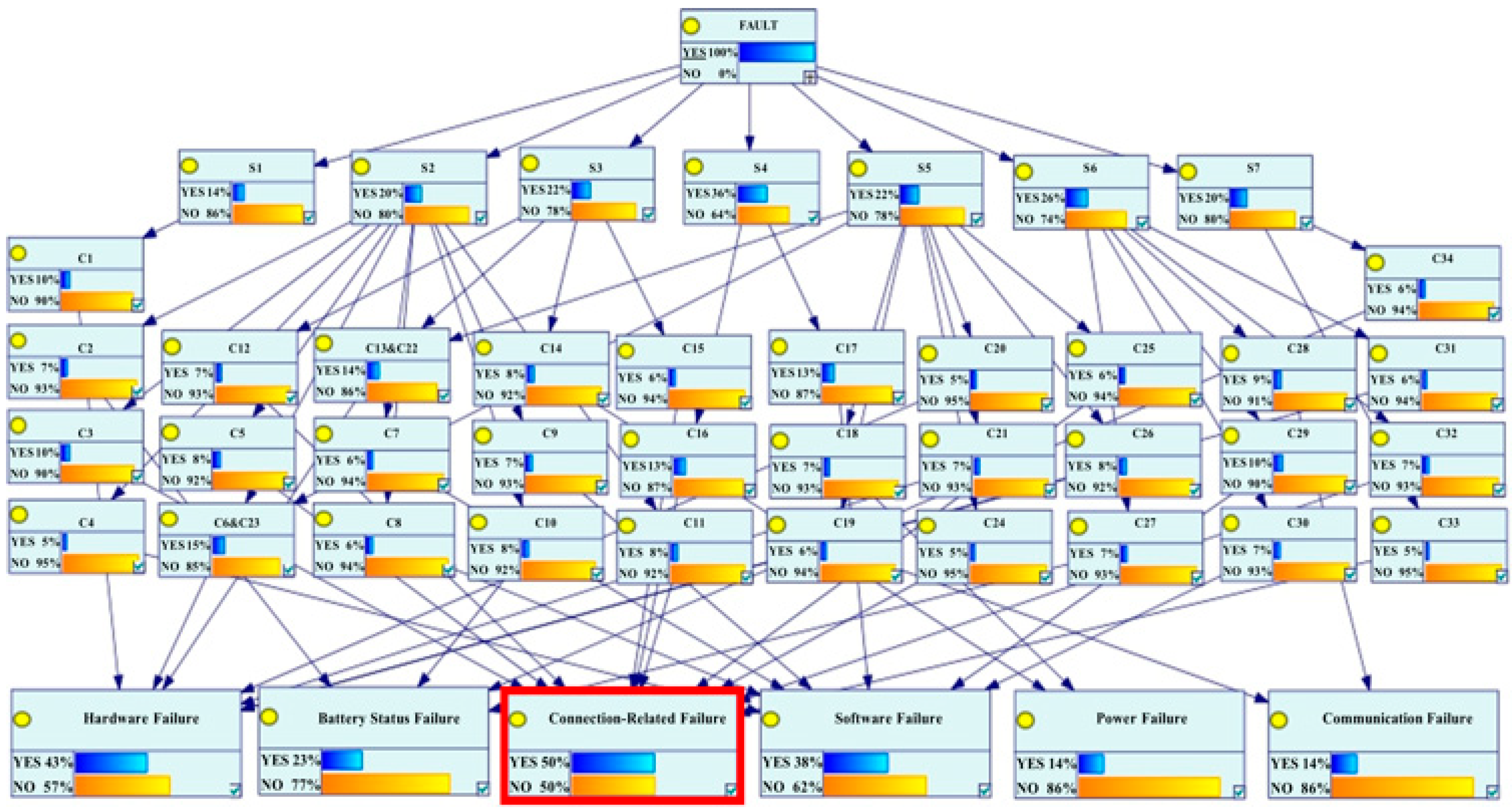
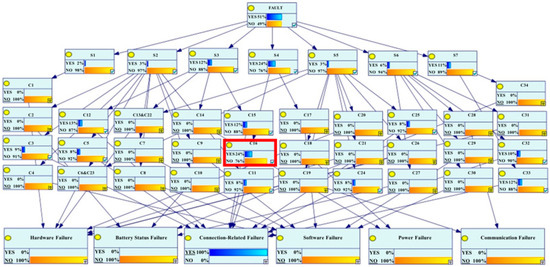
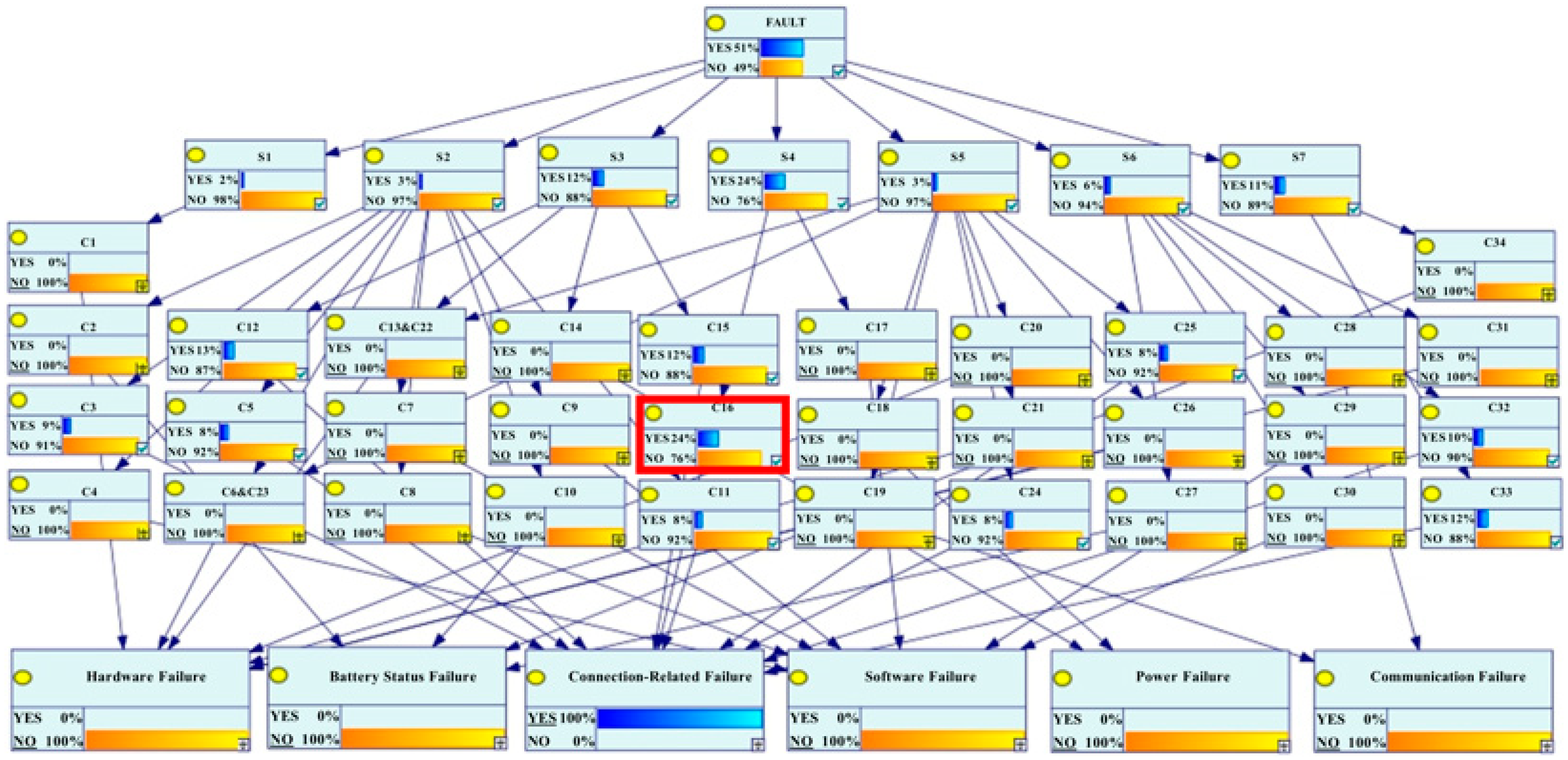
The diagnostic sub-network constructed for on-site maintenance needs can effectively identify high-frequency fault types and their dominant causes. Figure 10 and Figure 11 exemplify the forward and backward reasoning processes of a Bayesian network focused on maintenance. According to the results shown in Figure 10, connection-related faults have the highest probability of occurrence. This can be emphasized during maintenance personnel training, or specialized tools for easier troubleshooting of connection issues can be developed for this battery type. According to the results shown in Figure 11, among the connection faults, abnormal current sensing lines have the highest probability. The connection structure and working environment of current sensing lines can be prioritized for optimization and upgrade.
Figure 10.
Forward reasoning result of the maintenance-oriented diagnostic sub-network. The red frame highlights the fault type with the highest probability of occurrence in this sub-network.
Figure 11.
Backward reasoning result of the maintenance-oriented diagnostic sub-network. The red frame highlights the fault type with the highest probability of occurrence in this sub-network.
Integrating identified high-probability fault items into standard operating procedures can significantly reduce the risk of missed detections during routine inspections. Developing specialized maintenance tools based on this model is expected to further improve work efficiency, effectively reduce on-site workload, and achieve systematic optimization of the maintenance process.
- (2)
- Component-Level Decision Support Sub-network
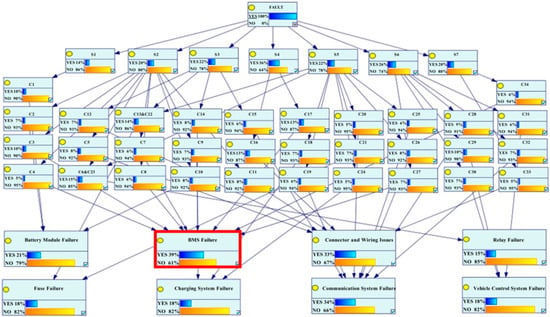
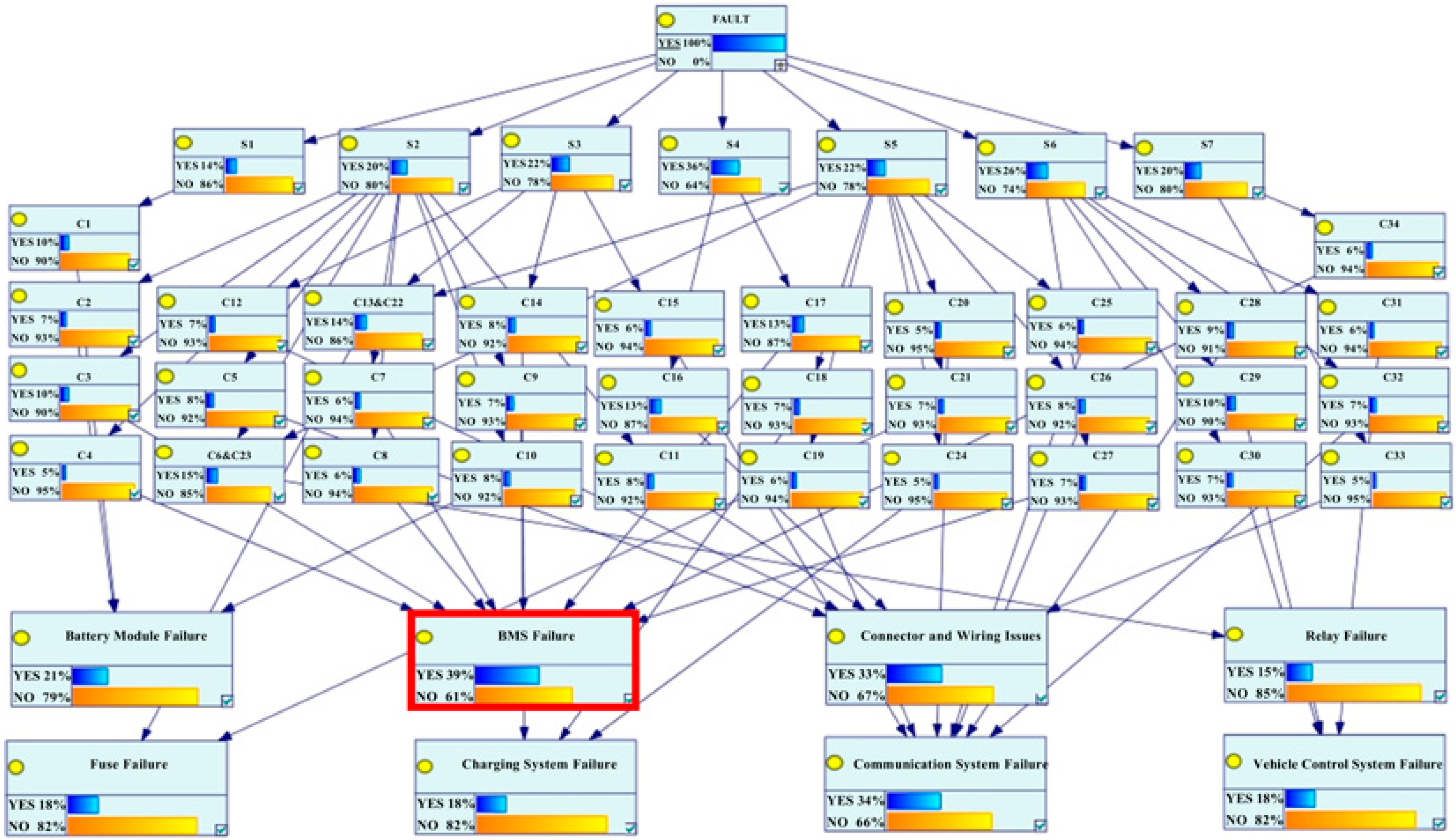
The sub-network constructed for R&D and decision-making needs can accurately pinpoint key components affecting system reliability and their root causes. Figure 12 and Figure 13 exemplify the forward and backward reasoning processes of a Bayesian network focused on components. According to the results shown in Figure 12, operational costs can be calculated, such as procurement and assembly costs for hardware faults, upgrade and debugging costs for software faults, etc., helping decision-makers make comprehensive considerations. For this battery type, BMS faults have the highest probability and can be a key R&D focus. According to the results shown in Figure 13, among the BMS faults, uncalibrated current sensors have the highest probability of occurrence. Relevant software vulnerabilities can be prioritized for fixes.
Figure 12.
Forward reasoning result of the component-level decision support sub-network. The red frame highlights the fault type with the highest probability of occurrence in this sub-network.
Figure 13.
Backward reasoning result of the component-level decision support sub-network. The red frame highlights the fault type with the highest probability of occurrence in this sub-network.
This functionality supports the concentration of testing resources on key modules, thereby significantly improving R&D efficiency. The cost–benefit analysis module integrated into the model can systematically evaluate the impact of various faults on total cost, providing a quantitative basis for decisions such as software upgrades and component improvements, effectively avoiding the misallocation of resources.
The flexible configuration capability of this framework ensures excellent system responsiveness. Experiments show that when new fault modes emerge, the system can automatically complete the construction and update of the relevant diagnostic sub-network within seconds, whereas traditional methods require engineers to invest 4–6 h in manual remodeling under the same scenario, representing an order of magnitude difference in response efficiency. For quantitative real-time validation, runtime tests were conducted on a standard workstation (Intel i7-12700, 32 GB RAM). For the constructed power battery fault diagnosis network ( nodes, treewidth ), the theoretical complexity ) translates to negligible computational overhead. The full subgraph-to-sub-network conversion takes 45 ms on average (12 ms for Cypher subgraph extraction, 33 ms for BN compilation and propagation), validating the high real-time performance of the scenario-adaptive configuration mechanism.
4.3.3. Probability Parameter Estimation
This framework overcomes the rigidity and update limitations inherent in traditional diagnostic models. By constructing a knowledge system that supports continuous evolution, it enables the diagnostic system to self-optimize through data accumulation and business development.
- (1)
- Continuous Expansion and Structured Integration of the Knowledge Base
The knowledge representation architecture, centered on the knowledge graph, continuously transforms new fault cases, maintenance records, and expert experience into structured triples, thereby achieving seamless integration with the existing knowledge system. This mechanism fundamentally shifts diagnostic knowledge from scattered and heterogeneous states to systematic and computable forms. It drives continuous expansion in both scale and quality of the knowledge base, providing an ever-expanding foundation for diagnostic reasoning.
- (2)
- Automatic Synchronization Mechanism of the Diagnostic Model
When the knowledge graph is updated based on predefined rules, such updates automatically trigger synchronous adjustments to the topology and parameters of the fuzzy Bayesian network. When new fault entities and relationships are integrated into the graph, the system autonomously reconstructs diagnostic sub-networks within seconds without manual intervention. This capability ensures rapid adaptation of the diagnostic model to battery technology evolution and new fault modes, thereby maintaining its technological advancement.
4.3.4. Ablation Study and Component Analysis
To quantitatively evaluate the contribution of each core component, we conducted an ablation study on the same 50 blind test cases used in Section 4.2. As shown in Table 4, removing any single component degrades diagnostic performance, confirming that the proposed framework is an integrated system rather than a simple stacking of techniques.
Table 4.
Ablation study on blind test cases.
When DBP text mining was replaced by manual KG construction (w/o DBP), top-3 accuracy dropped from 0.92 to 0.84. This 8% gap indicates that automated knowledge extraction from unstructured text significantly expands fault coverage beyond expert memory. Removing KG mapping and letting experts directly build the BN topology (w/o KG mapping) caused an 11% top-3 accuracy drop (to 0.81), demonstrating that the systematic semantic topology captured by the KG prevents the omission of latent dependencies. Replacing the FBN with a crisp Bayesian network using only defuzzified point values (w/o FBN) reduced the top-3 accuracy to 0.82, proving that fuzzy uncertainty quantification and game-theoretic weighting are essential for model calibration.
5. Conclusions and Outlook
To address the challenges of insufficient knowledge utilization and difficulty in handling uncertainty in power battery fault diagnosis, this paper proposed a symmetrical closed-loop fault diagnosis method combining digital battery passport, knowledge graph, and fuzzy Bayesian network (DBP-KG-FBN). This method establishes symmetric structural correspondence between knowledge topology and probabilistic networks, achieving automated construction of a power battery fault knowledge graph from unstructured DBP text. Through fuzzy set theory and a symmetric combined weighting method balancing subjective and objective information, effective quantification of expert evaluations and determination of Bayesian network parameters were achieved. Furthermore, a diagnostic model with symmetric bidirectional reasoning capability for both forward prediction and backward diagnosis was developed. Empirical results demonstrated that the proposed method significantly outperformed traditional fault tree analysis (FTA) and event tree analysis (ETA) in accuracy, efficiency, and flexibility, validating the effectiveness of symmetric modeling in battery fault diagnosis.
Despite the promising diagnostic performance, this study acknowledges several limitations and practical constraints that warrant transparent discussion. (1) The dataset scale remained modest: the original 640 after-sales records, although augmented to 3219 entries, were still confined to a single Chinese enterprise and battery model. Cross-enterprise and cross-platform generalization was not statistically validated, and the current corpus was predominantly Chinese-text, leaving multilingual DBP adaptation as future work. (2) The framework relies on subjective fuzzy evaluations from domain experts. While the game-theoretic weighting mitigates individual bias, the limited expert sample and the a priori selection of triangular fuzzy numbers (TFNs) introduce inherent subjectivity that cannot be fully eliminated without large-scale empirical calibration. (3) Although the framework supports automated BN synchronization driven by KG incremental updates (Section 3.3), the experimental validation in this study was based on a static corpus snapshot; the temporal evolution capability under continuous, real-time battery life cycle data streams remains to be empirically validated in future work. (4) Regarding practical deployment, real-time subgraph extraction and probabilistic inference on resource-constrained edge devices (e.g., onboard BMS microcontrollers) pose unresolved latency and memory challenges. (5) The framework’s applicability to multilingual, cross-border battery passport ecosystems has not been empirically tested. (6) Integrating the DBP-KG-FBN pipeline with existing enterprise maintenance systems requires standardized API design, data-privacy compliance (especially for cross-border battery passports), and sustained investment in technician training to interpret fuzzy-probability outputs. These limitations delineate the current applicability boundary and motivate the future research directions outlined below.
Future work will proceed in two directions: (1) introducing transfer learning and active learning strategies to expand corpus scale and diversity, thereby enhancing knowledge graph coverage and quality; and (2) developing adaptive probability parameter learning algorithms with symmetric regularization constraints to reduce reliance on subjective expert evaluations and maintain the symmetric equilibrium between data-driven and knowledge-driven components, thereby improving model objectivity and robustness; (3) cross-paradigm validation against sensor-based data-driven models (e.g., LSTM, Transformer) will be pursued as a priority, pending acquisition of aligned sensor time-series data-text paired datasets. Such paired data would enable a rigorous comparison between knowledge-driven probabilistic reasoning and end-to-end deep learning under identical fault scenarios, clarifying the comparative advantages of each paradigm in battery fault diagnosis. Additionally, the exploration of dynamic symmetric weighting mechanisms under multi-source heterogeneous data fusion will be investigated to further enhance the adaptability of the diagnostic framework.
Author Contributions
Conceptualization, T.J. and J.L.; methodology, T.J.; software, T.J.; validation, T.J.; formal analysis, T.J.; investigation, T.J.; resources, J.L.; data curation, T.J.; writing—original draft preparation, T.J.; writing—review and editing, J.L.; visualization, T.J.; supervision, J.L.; project administration, J.L.; funding acquisition, J.L. All authors have read and agreed to the published version of the manuscript.
Funding
This study was supported by the Fundamental Research Funds for the Central Universities (No. 2232025G-09) and the National Natural Science Foundation of China (No. 52475248).
Data Availability Statement
The data and materials used to support the findings of this study are available from the corresponding author upon reasonable request.
Acknowledgments
The authors would like to thank the editors and the anonymous reviewers for their constructive comments and suggestions, which significantly improved the quality of this manuscript. The authors are also grateful to the enterprises for providing the experimental battery datasets. Special thanks are extended to the experts in the battery field who completed the questionnaire for the methodology study.
Conflicts of Interest
The authors declare no conflicts of interest. The funders had no role in the design of the study; in the collection, analyses, or interpretation of data; in the writing of the manuscript; or in the decision to publish the results.
Abbreviations
The following abbreviations are used in this manuscript:
| DBP | Digital Battery Passport |
| KG | Knowledge Graph |
| FBN | Fuzzy Bayesian Network |
| NEV | New Energy Vehicle |
| NER | Named Entity Recognition |
| BERT | Bidirectional Encoder Representations from Transformers |
| BiLSTM | Bidirectional Long Short-Term Memory |
| CRF | Conditional Random Field |
| OWL | Web Ontology Language |
| TFN | Triangular Fuzzy Number |
| AHP | Analytic Hierarchy Process |
| EWM | Entropy Weight Method |
| CPT | Conditional Probability Table |
| FTA | Fault Tree Analysis |
| ETA | Event Tree Analysis |
| BMS | Battery Management System |
Appendix A
Table A1.
Overview of fuzzy assessments for node entities.
Appendix B
Table A2.
Overview of node entity probability values.
Appendix C
Table A3.
Quantitative metrics results for comparative evaluation.
- (1)
- Diagnostic Accuracy (Top-3 Hit Rate)
Definition: Proportion of test cases where the ground truth fault cause is ranked within the top 3 candidate causes.
Calculation formula:
where (blind test cases from anonymized industrial maintenance records), is the indicator function, and denotes the position in the model’s ranked candidate list.
Experimental Protocol: Models output fully ranked lists of potential fault causes in descending order of confidence. A valid hit is recorded if the ground truth falls within positions 1–3. All cases are excluded from training sets to avoid overfitting bias.
Experimental Results: ETA: 0.69, FTA: 0.74, DBP-KG-FBN: 0.92.
- (2)
- Ambiguity Resolution Rate (ARR)
Definition: Measures the model’s ability to resolve diagnostic ambiguity in high-ambiguity scenarios where a single symptom triggers () potential fault causes.
Calculation formula:
where is the exact ranking position of the ground truth, and is the total number of candidates for that symptom.
Experimental Setup: From the 50 blind test cases, 18 high-ambiguity scenarios were manually identified by domain experts (e.g., “Battery system fails to discharge” triggering causes , , , etc.). DBP-KG-FBN uses posterior probability ranking; FTA and ETA rely on static cut-set analysis and sequence probability analysis, respectively.
Experimental Results: ETA: 0.52, FTA: 0.61, DBP-KG-FBN: 0.91.
- (3)
- Version Backward Compatibility (VBC)
Definition: Evaluates the stability of diagnostic conclusions for validated historical cases after incremental knowledge base updates. Measures whether integration of new fault knowledge disrupts previously reliable diagnostic paths―a critical capability for long-term industrial deployment.
Calculation formula:
where (pre-validated historical cases –), is the absolute ranking shift of the ground truth for case before and after update, and (tolerance threshold allowing maximum rank degradation of 1 position).
Experimental Setup: Initial models were built using 640 historical records and achieved 95% top-1 accuracy on – (baseline). Subsequently, 50 new fault cases were added incrementally. FTA and ETA require manual tree structure extension (averaging 2 h per update), whereas DBP-KG-FBN supports automated knowledge graph update (Section 3.3). VBC is calculated as the proportion of baseline cases maintaining top-3 status with .
Experimental Results: ETA: 0.58, FTA: 0.65, DBP-KG-FBN: 0.94.
- (4)
- Historical Knowledge Retention (HKR)
Definition: Quantifies resistance to catastrophic forgetting―the model’s ability to retain diagnostic performance on previously learned fault types after acquiring new knowledge. Critical for evaluating lifelong learning capability.
Calculation formula:
where is the top-1 accuracy on 20 test cases of Fault Type A (e.g., “Main relay damage”) before learning Fault Type B, and is accuracy on the same 20 cases after incremental learning of 50 distinct Fault Type B cases.
Experimental Setup: All models initially achieved >85% top-1 accuracy on Fault Type A. After incremental training (manual logic branch addition for FTA/ETA; automated node insertion for DBP-KG-FBN), models were re-tested on the original Type A cases without retraining. Values closer to 1 indicate minimal catastrophic forgetting.
Experimental Results: ETA: 0.76, FTA: 0.80, DBP-KG-FBN: 0.99.
- (5)
- Knowledge Topological Entropy Increase (KTEI)
Definition: Structural scalability metric measuring the growth rate of model complexity relative to training data volume increase during incremental updates. Lower values indicate better scalability (sub-linear growth).
Calculation formula:
where ; is the initial complexity with historical cases; is the complexity increase after adding new cases; and denote the core nodes and logical edges, respectively.
Experimental Setup: Fifty new training cases were added in 5 equal batches (10 cases per batch). After each batch, is calculated from the Neo4j graph topology (DBP-KG-FBN) or logic gate/event node counts (FTA/ETA). KTEI is the slope of linear regression between the normalized data increment and normalized complexity increment.
Experimental Results: ETA: 1.02, FTA: 1.18, DBP-KG-FBN: 0.41.
- (6)
- Expected Calibration Error (ECE)
Definition: Reliability metric quantifying the average absolute gap between the predicted confidence scores and actual empirical accuracy across confidence intervals. Lower ECE indicates better calibration (predicted confidence aligns with real performance).
Calculation formula:
where equal-width confidence bins: [0, 0.2), [0.2, 0.4), [0.4, 0.6), [0.6, 0.8), [0.8, 1.0]; is the number of predictions in bin (); and are average predicted confidence and actual accuracy in bin , respectively.
Experimental Setup: For all 50 blind test cases, record the model’s predicted confidence for the ground truth cause: DBP-KG-FBN outputs posterior probability ; FTA uses minimal cut set importance scores or binary labels; ETA uses path probability or binary labels. Predictions are binned by confidence score to compute ECE.
Experimental Results: ETA: 0.28, FTA: 0.26, DBP-KG-FBN: 0.06.
References
- Tian, J.; Wang, P.; Zhu, D. Overview of Chinese New Energy Vehicle Industry and Policy Development. Green Energy Resour. 2024, 2, 100075. [Google Scholar] [CrossRef] [Scilit]
- Abdolrasol, M.G.; Ayob, A.; Lipu, M.H.; Ansari, S.; Kiong, T.S.; Saad, M.H.M.; Ustun, T.S.; Kalam, A. Advanced Data-Driven Fault Diagnosis in Lithium-Ion Battery Management Systems for Electric Vehicles: Progress, Challenges, and Future Perspectives. eTransportation 2024, 22, 100374. [Google Scholar] [CrossRef] [Scilit]
- Bai, Y.; Muralidharan, N.; Sun, Y.-K.; Passerini, S.; Whittingham, M.S.; Belharouak, I. Energy and Environmental Aspects in Recycling Lithium-Ion Batteries: Concept of Battery Identity Global Passport. Mater. Today 2020, 41, 304–315. [Google Scholar] [CrossRef] [Scilit]
- European Commission. Proposal for a Regulation of the European Parliament and of the Council Concerning Batteries and Waste Batteries, Repealing Directive 2006/66/EC and Amending Regulation (EU) No 2019/1020. 2020. Available online: https://eur-lex.europa.eu/legal-content/EN/TXT/?uri=CELEX%3A52020PC0798 (accessed on 8 April 2026).
- Zhan, W.; Liu, Z.; Yu, Y.; Xue, B.; Yan, H.; Li, X.; Wang, B.; Hu, Y.; Yu, J.; Liu, L.; et al. Life cycle carbon footprint of battery electric bus: Coupling effects of mileage, energy mix and recycling processes. Carbon Footpr. 2025, 4, 19. [Google Scholar] [CrossRef] [Scilit]
- Ott, J.; Schoeggl, J.-P.; Baumgartner, R.J. End of Life Focused Data Model for a Digital Battery Passport. Procedia CIRP 2024, 122, 277–281. [Google Scholar] [CrossRef] [Scilit]
- Weng, A.; Dufek, E.; Stefanopoulou, A. Battery Passports for Promoting Electric Vehicle Resale and Repurposing. Joule 2023, 7, 831–842. [Google Scholar] [CrossRef] [Scilit]
- Gianvincenzi, M.; Marconi, M.; Mosconi, E.M.; Tola, F. A Standardized Data Model for the Battery Passport: Paving the Way for Sustainable Battery Management. Procedia CIRP 2024, 122, 103–108. [Google Scholar] [CrossRef] [Scilit]
- Haupt, J.; Cerdas, F.; Herrmann, C. Derivation of Requirements for Life Cycle Assessment-Related Information to Be Integrated in Digital Battery Passports. Procedia CIRP 2024, 122, 300–305. [Google Scholar] [CrossRef] [Scilit]
- Berger, K.; Schöggl, J.-P.; Baumgartner, R.J. Digital Battery Passports to Enable Circular and Sustainable Value Chains: Conceptualization and Use Cases. J. Clean. Prod. 2022, 353, 131492. [Google Scholar] [CrossRef] [Scilit]
- Liu, G.; Gao, Y.; Agostinho, F.; Almeida, C.M.V.B.; Giannetti, B.F.; Zhou, X.; Chen, C.; Gao, H. Integrated carbon responsibility allocation in the electric vehicle battery supply chain: A comprehensive approach to emission reduction. Carbon Footpr. 2025, 4, 7. [Google Scholar] [CrossRef] [Scilit]
- Chen, Q.; Lai, X.; Zhang, Y.; Chen, J.; Zheng, Y.; Song, X.; Han, X.; Ouyang, M. AI-driven sustainability assessment for greener lithium-ion batteries. Carbon Footpr. 2025, 4, 12. [Google Scholar] [CrossRef] [Scilit]
- Hong, Z.; Wang, Y.; Jin, Z. Diagnosis of Battery External Short Circuits Based on an Improved Second-Order RC Fault Model and Recursive Least Squares Identification Method. Energy 2025, 319, 134880. [Google Scholar] [CrossRef] [Scilit]
- Park, S.; Song, Y.; Kim, S.W. Simultaneous Diagnosis of Cell Aging and Internal Short Circuit Faults in Lithium-Ion Batteries Using Average Leakage Interval. Energy 2024, 290, 130220. [Google Scholar] [CrossRef] [Scilit]
- Yang, Q.; Yu, Z.; Liu, Y.; Kang, Y. High-Reliability Multi-Fault Diagnosis of Lithium-Ion Batteries Based on Low-Redundancy Cross-Measurement and Affine Transformation. Energy 2025, 318, 134881. [Google Scholar] [CrossRef] [Scilit]
- Mitra, D.; Mukhopadhyay, S. Detection and Isolation of Faults in a Lithium-Ion Battery Pack Using a Switched Architecture of Equivalent Cell Diagnosers. J. Energy Storage 2024, 90, 111811. [Google Scholar] [CrossRef] [Scilit]
- Hou, E.; Xu, Y.; Qiao, X.; Liu, G.; Wang, Z. Research on State of Power Estimation of Echelon-Use Battery Based on Adaptive Unscented Kalman Filter. Symmetry 2022, 14, 919. [Google Scholar] [CrossRef] [Scilit]
- Zhao, H.; Zhang, C.; Xu, L.; Liao, C.; Wang, L.; Wang, L. A Deep Neural Network for Multi-Fault Diagnosis of Battery Packs Based on an Incremental Voltage Measurement Topology. Energy 2025, 316, 134590. [Google Scholar] [CrossRef] [Scilit]
- Shen, D.; Lyu, C.; Yang, D.; Hinds, G.; Ma, K.; Xu, S.; Bai, M. Concurrent Multi-Fault Diagnosis of Lithium-Ion Battery Packs Using Random Convolution Kernel Transformation and Gaussian Process Classifier. Energy 2024, 306, 132467. [Google Scholar] [CrossRef] [Scilit]
- Qiu, Y.; Sun, J.; Shang, Y.; Wang, D. A Fault Diagnosis and Prognosis Method for Lithium-Ion Batteries Based on a Nonlinear Autoregressive Exogenous Neural Network and Boxplot. Symmetry 2021, 13, 1714. [Google Scholar] [CrossRef] [Scilit]
- Karkuzhali, V.; Swaroopan, N.J.; Shanker, N.R.; Senthilraj, S. Symmetry-Aware Bayesian-Optimized Gaussian Process Regression for Remaining Useful Life Prediction of Lithium-Ion Batteries Under Real-World Conditions. Symmetry 2025, 17, 2039. [Google Scholar] [CrossRef] [Scilit]
- Cui, X.; Zhang, J.; Zhang, D.; Wei, Y.; Qi, H. Joint Prediction of Li-Ion Battery Cycle Life and Knee Point Based on Early Charging Performance. Symmetry 2025, 17, 351. [Google Scholar] [CrossRef] [Scilit]
- Oyucu, S.; Dümen, S.; Duru, I.; Aksöz, A.; Biçer, E. Discharge Capacity Estimation for Li-Ion Batteries: A Comparative Study. Symmetry 2024, 16, 436. [Google Scholar] [CrossRef] [Scilit]
- Zhang, H.; Wang, J. Research on State of Health Assessment of Lithium-Ion Batteries Using Actual Measurement Data Based on Hybrid LSTM--Transformer Model. Symmetry 2026, 18, 169. [Google Scholar] [CrossRef] [Scilit]
- Zhang, L.; Xia, B.; Zhang, F. Adaptive Fault Detection for Lithium-Ion Battery Combining Physical Model-Based Observer and BiLSTMNN Learning Approach. J. Energy Storage 2024, 91, 112067. [Google Scholar] [CrossRef] [Scilit]
- Zhao, J.; Feng, X.; Wang, J.; Lian, Y.; Ouyang, M.; Burke, A.F. Battery Fault Diagnosis and Failure Prognosis for Electric Vehicles Using Spatio-Temporal Transformer Networks. Appl. Energy 2023, 352, 121949. [Google Scholar] [CrossRef] [Scilit]
- Liu, H.; Xiao, Q.; Jin, Y.; Mu, Y.; Meng, J.; Zhang, T.; Jia, H.; Teodorescu, R. Improved LightGBM-Based Framework for Electric Vehicle Lithium-Ion Battery Remaining Useful Life Prediction Using Multi Health Indicators. Symmetry 2022, 14, 1584. [Google Scholar] [CrossRef] [Scilit]
- Zhou, Z.; Wei, L.; Luan, H. Deep Learning for Named Entity Recognition in Extracting Critical Information from Struck-by Accidents in Construction. Autom. Constr. 2025, 173, 106106. [Google Scholar] [CrossRef] [Scilit]
- Luo, Z.; Feng, J.; Cai, N.; Wang, X.; Liao, J.; Li, Q.; Peng, F.; Chen, C. Relation Extraction for Colorectal Cancer via Deep Learning with Entity-Aware Feature Orthogonal Decomposition. Expert Syst. Appl. 2024, 258, 125188. [Google Scholar] [CrossRef] [Scilit]
- Qiu, Q.; Tian, M.; Huang, Z.; Xie, Z.; Ma, K.; Tao, L.; Xu, D. Chinese Engineering Geological Named Entity Recognition by Fusing Multi-Features and Data Enhancement Using Deep Learning. Expert Syst. Appl. 2024, 238, 121925. [Google Scholar] [CrossRef] [Scilit]
- Yang, B.; Zhou, C.; Li, S.; Wang, Y. A Chinese Named Entity Recognition Method for Landslide Geological Disasters Based on Deep Learning. Eng. Appl. Artif. Intell. 2025, 139, 109537. [Google Scholar] [CrossRef] [Scilit]
- Zhang, H.; Lyu, L.; Chang, W.; Zhao, Y.; Peng, X. A Chinese Medical Named Entity Recognition Method Considering Length Diversity of Entities. Eng. Appl. Artif. Intell. 2025, 150, 110649. [Google Scholar] [CrossRef] [Scilit]
- Liu, Y.; Wei, S.; Huang, H.; Lai, Q.; Li, M.; Guan, L. Naming Entity Recognition of Citrus Pests and Diseases Based on the BERT-BiLSTM-CRF Model. Expert Syst. Appl. 2023, 234, 121103. [Google Scholar] [CrossRef] [Scilit]
- Li, W.; Du, Y.; Li, X.; Chen, X.; Xie, C.; Li, H.; Li, X. UD_BBC: Named Entity Recognition in Social Network Combined BERT-BiLSTM-CRF with Active Learning. Eng. Appl. Artif. Intell. 2022, 116, 105460. [Google Scholar] [CrossRef] [Scilit]
- Liu, J.; Gao, L.; Guo, S.; Ding, R.; Huang, X.; Ye, L.; Meng, Q.; Nazari, A.; Thiruvady, D. A Hybrid Deep-Learning Approach for Complex Biochemical Named Entity Recognition. Knowl.-Based Syst. 2021, 221, 106958. [Google Scholar] [CrossRef] [Scilit]
- Xin, Y.; Li, S.; Meiling, L.; Keyan, X.; Cheng, L.; Xuchao, D. Knowledge Graph Construction with BERT-BiLSTM-IDCNN-CRF and Graph Algorithms for Metallogenic Pattern Discovery: A Case Study of Pegmatite-Type Lithium Deposits in China. Ore Geol. Rev. 2025, 179, 106514. [Google Scholar] [CrossRef] [Scilit]
- Huang, X.; Wen, Y.; Zhang, F.; Li, H.; Sui, Z.; Cheng, X. Accident Analysis of Waterway Dangerous Goods Transport: Building an Evolution Network with Text Knowledge Extraction. Ocean Eng. 2025, 318, 120176. [Google Scholar] [CrossRef] [Scilit]
- Xu, J.; Mo, S.; Xu, Z.; Chen, Z.; Yang, C.; Jiang, Z. Semi-Supervised ISA: A Novel Industrial Knowledge Graph Construction Method Enhanced by the Fault Log Corpus Analysis and Semi-Supervised Learning. Reliab. Eng. Syst. Saf. 2025, 260, 111021. [Google Scholar] [CrossRef] [Scilit]
- Liu, Y.; Zhou, Y.; Liu, Y.; Xu, Z.; He, Y. Intelligent Fault Diagnosis for CNC Through the Integration of Large Language Models and Domain Knowledge Graphs. Engineering 2025, 53, 311–322. [Google Scholar] [CrossRef] [Scilit]
- Liao, X.; Chen, C.; Wang, Z.; Liu, Y.; Wang, T.; Cheng, L. Large Language Model Assisted Fine-Grained Knowledge Graph Construction for Robotic Fault Diagnosis. Adv. Eng. Inform. 2025, 65, 103134. [Google Scholar] [CrossRef] [Scilit]
- Li, Q.; Wang, Y.; Dong, J.; Zhang, C.; Peng, K. Multi-Node Knowledge Graph Assisted Distributed Fault Detection for Large-Scale Industrial Processes Based on Graph Attention Network and Bidirectional LSTMs. Neural Netw. 2024, 173, 106210. [Google Scholar] [CrossRef] [Scilit] [PubMed]
- Lu, J.; Chen, H.; Chen, J.; Xiao, Z.; Li, R.; Xiao, G.; Wang, Q. Temporal Knowledge Graph Fusion with Neural Ordinary Differential Equations for the Predictive Maintenance of Electromechanical Equipment. Knowl.-Based Syst. 2025, 317, 113450. [Google Scholar] [CrossRef] [Scilit]
- Luan, T.; Li, H.; Wang, K.; Zhang, X.; Li, X. Knowledge Graph-Based Bayesian Network Risk Assessment Model for Hydrogen Accidents. Int. J. Hydrogen Energy 2024, 81, 927–941. [Google Scholar] [CrossRef] [Scilit]
- Wang, L.; Huang, Y.; Wang, Y.; Gu, B.; Li, B.; Fang, D. Comprehensive Lifecycle Safety Risk Assessment for Construction Robotics Using T-S Fault Tree Analysis and Bayesian Network. Autom. Constr. 2025, 172, 106041. [Google Scholar] [CrossRef] [Scilit]
- Feng, M.; Shao, H.; Shao, M.; Xiao, Y.; Wang, J.; Liu, B. Utilizing Bayesian Generalization Network for Reliable Fault Diagnosis of Machinery with Limited Data. Knowl.-Based Syst. 2024, 305, 112628. [Google Scholar] [CrossRef] [Scilit]
- Jovanović, I.; Perčić, M.; Vladimir, N. Assessment of Human Contribution to Cargo Ship Accidents Using Fault Tree Analysis and Bayesian Network Analysis. Ocean Eng. 2025, 323, 120628. [Google Scholar] [CrossRef] [Scilit]
- Lee, D.; Lee, I.; Kim, Y.; Joo, S.C.; Choi, J.-H. Sensor Set Optimization by Functional Model and Bayesian Network for Fault Diagnosis of Turbine Generator Lubrication System. Eng. Appl. Artif. Intell. 2024, 138, 109416. [Google Scholar] [CrossRef] [Scilit]
- Zhu, L.; Liu, S.; Huang, Y.-C.; Wang, F.-S.; Liu, Z.-G. Constructing Bayesian Networks from Knowledge Graphs for Risk Assessment and Causal Inference of Urban Rail Transit Equipment. Accid. Anal. Prev. 2026, 233, 108555. [Google Scholar] [CrossRef] [Scilit]
- Wu, P.; Huang, J.; Li, W.; Huang, Y.; Li, Q.; Xu, Y. Knowledge-Graph-Based Bayesian Analysis Framework for Construction Safety Analysis: Taking Collapse Accident as an Example. Reliab. Eng. Syst. Saf. 2026, 275, 112780. [Google Scholar] [CrossRef] [Scilit]
- Xiong, J.; Yang, P.; Chen, B.; Chen, Z. Defect Identification Method of Power Grid Secondary Equipment Based on Coordination of Knowledge Graph and Bayesian Network Fusion. Energy Eng. 2026, 123, 1–18. [Google Scholar] [CrossRef] [Scilit]
- Zadeh, L.A. Fuzzy Sets. Inf. Control 1965, 8, 338–353. [Google Scholar] [CrossRef] [Scilit]
- Zhou, X.; Lu, M. Risk Evaluation of Dynamic Alliance Based on Fuzzy Analytic Network Process and Fuzzy TOPSIS. J. Serv. Sci. Manag. 2012, 5, 230–240. [Google Scholar] [CrossRef]

Disclaimer/Publisher’s Note: The statements, opinions and data contained in all publications are solely those of the individual author(s) and contributor(s) and not of MDPI and/or the editor(s). MDPI and/or the editor(s) disclaim responsibility for any injury to people or property resulting from any ideas, methods, instructions or products referred to in the content. |
© 2026 by the authors. Licensee MDPI, Basel, Switzerland. This article is an open access article distributed under the terms and conditions of the Creative Commons Attribution (CC BY) license.