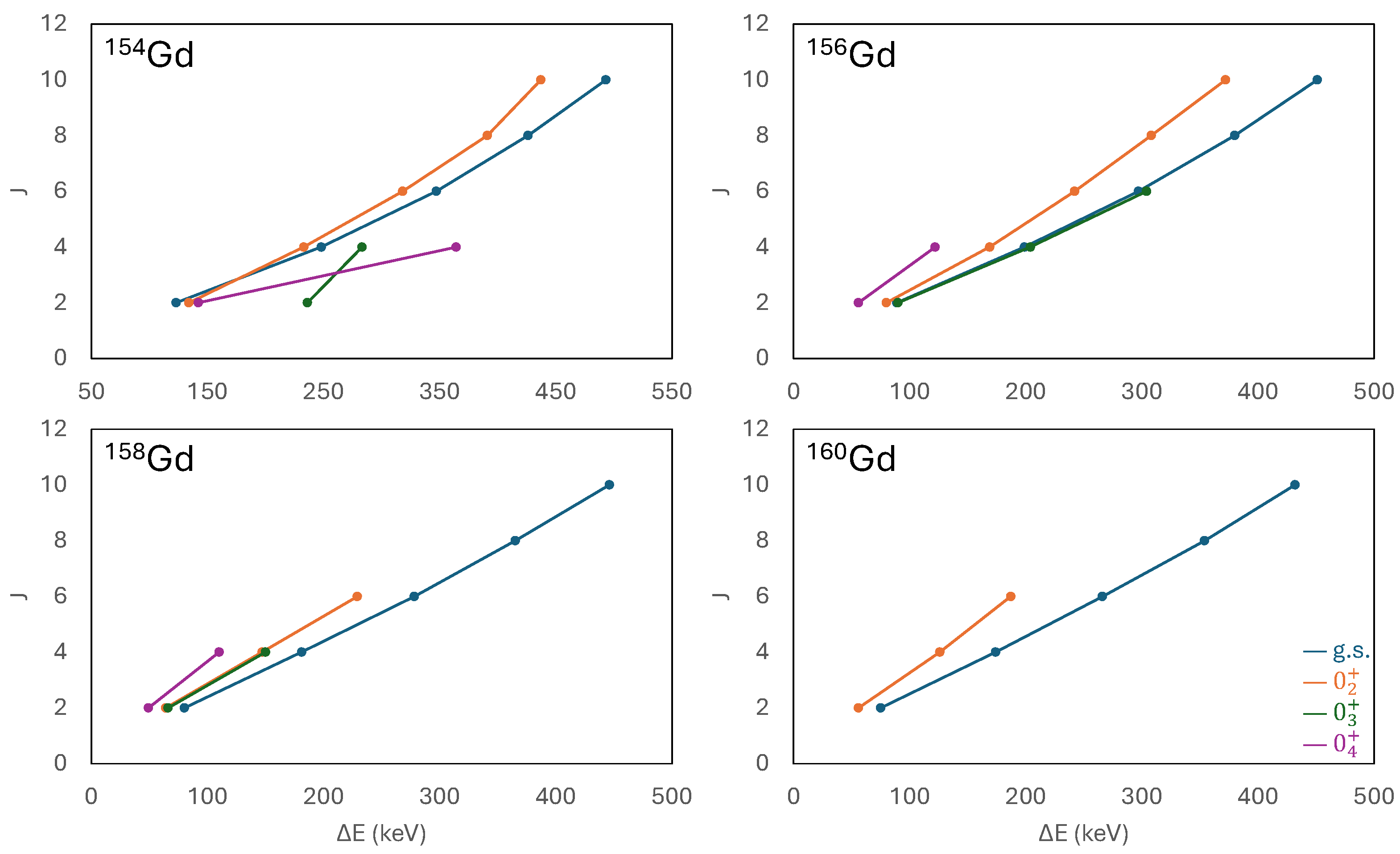
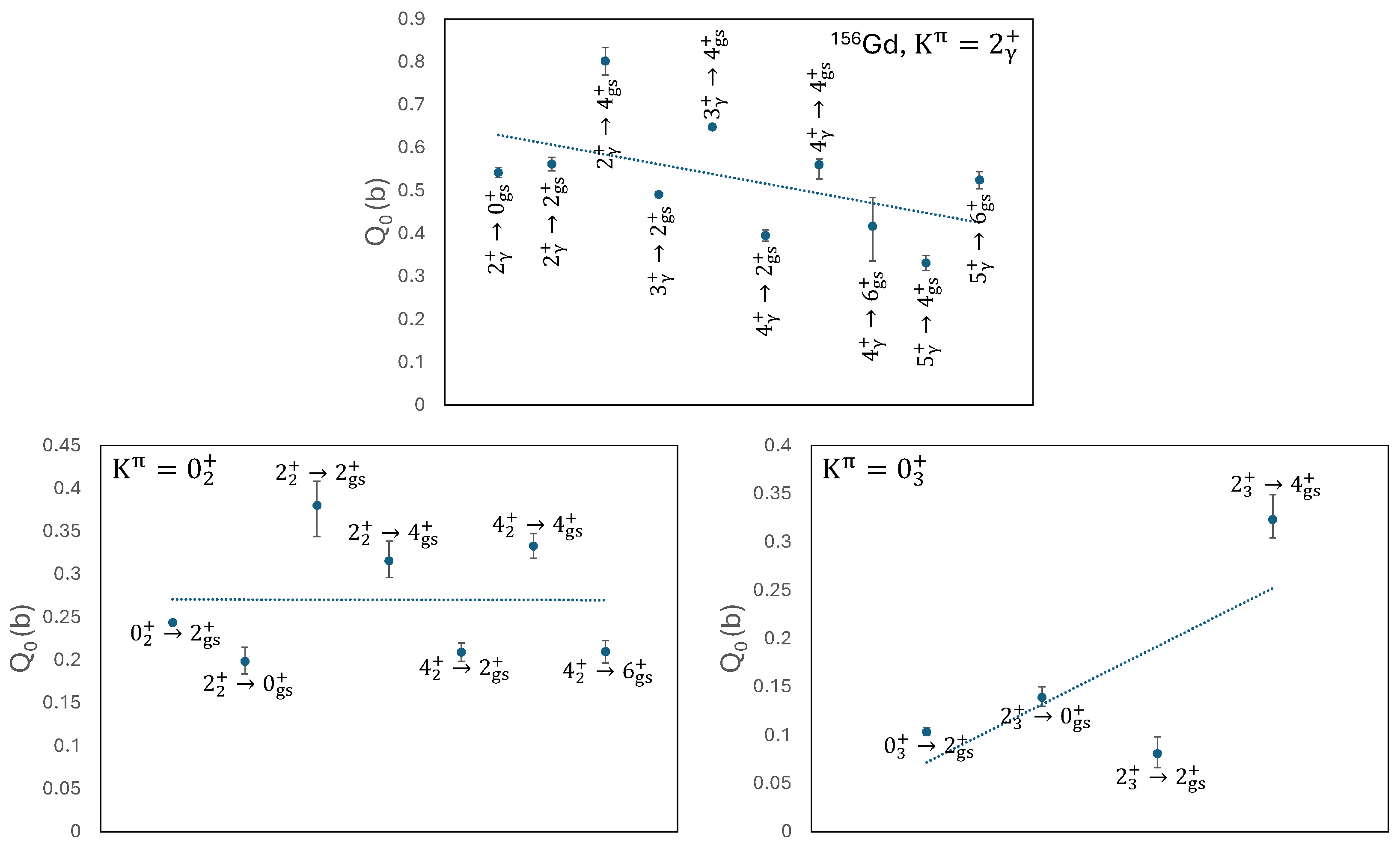
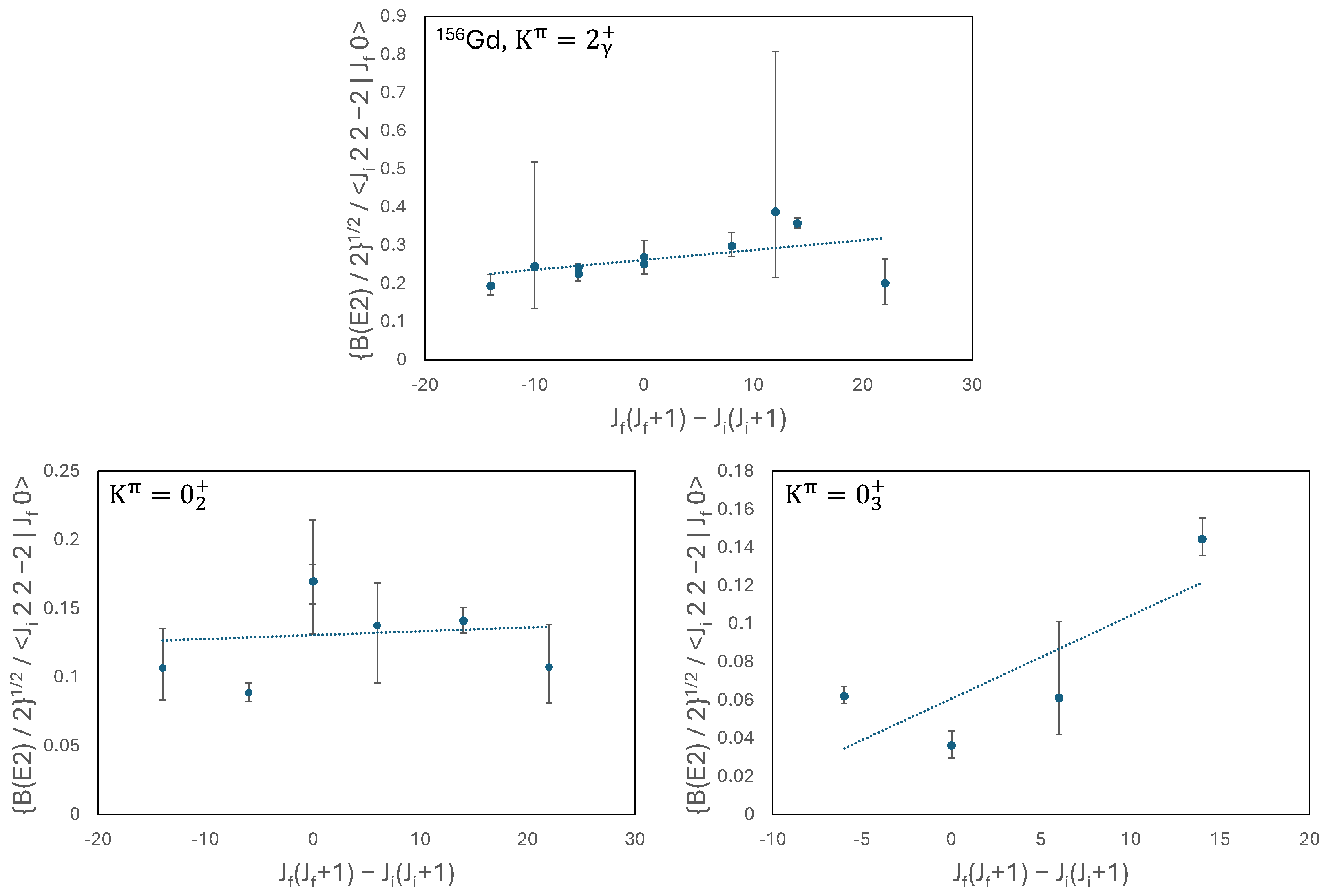
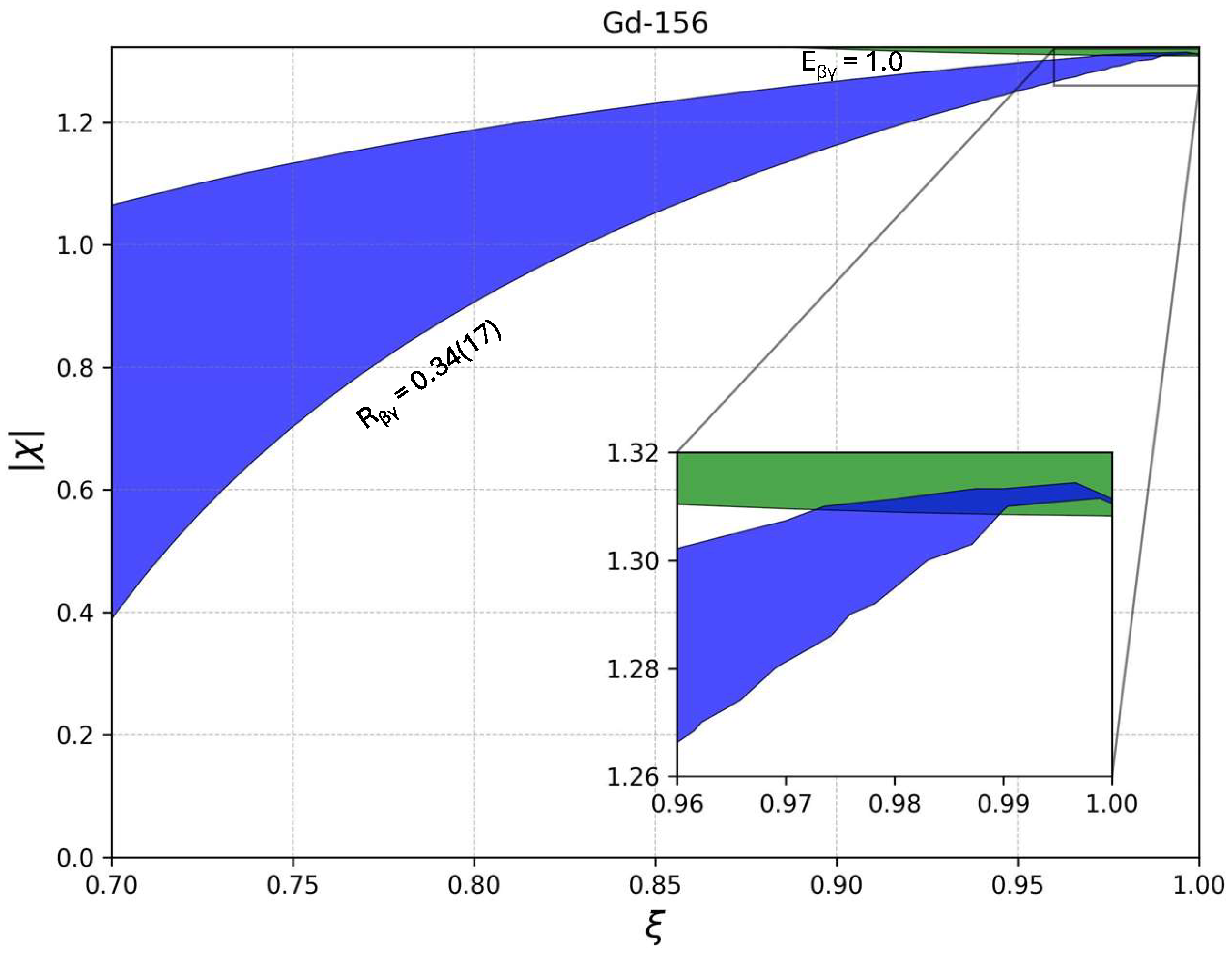
Quantum Choreography of the Nucleus: Rotations, Vibrations, and Emergent Structure


Abstract
1. Introduction
2. Nuclear Models
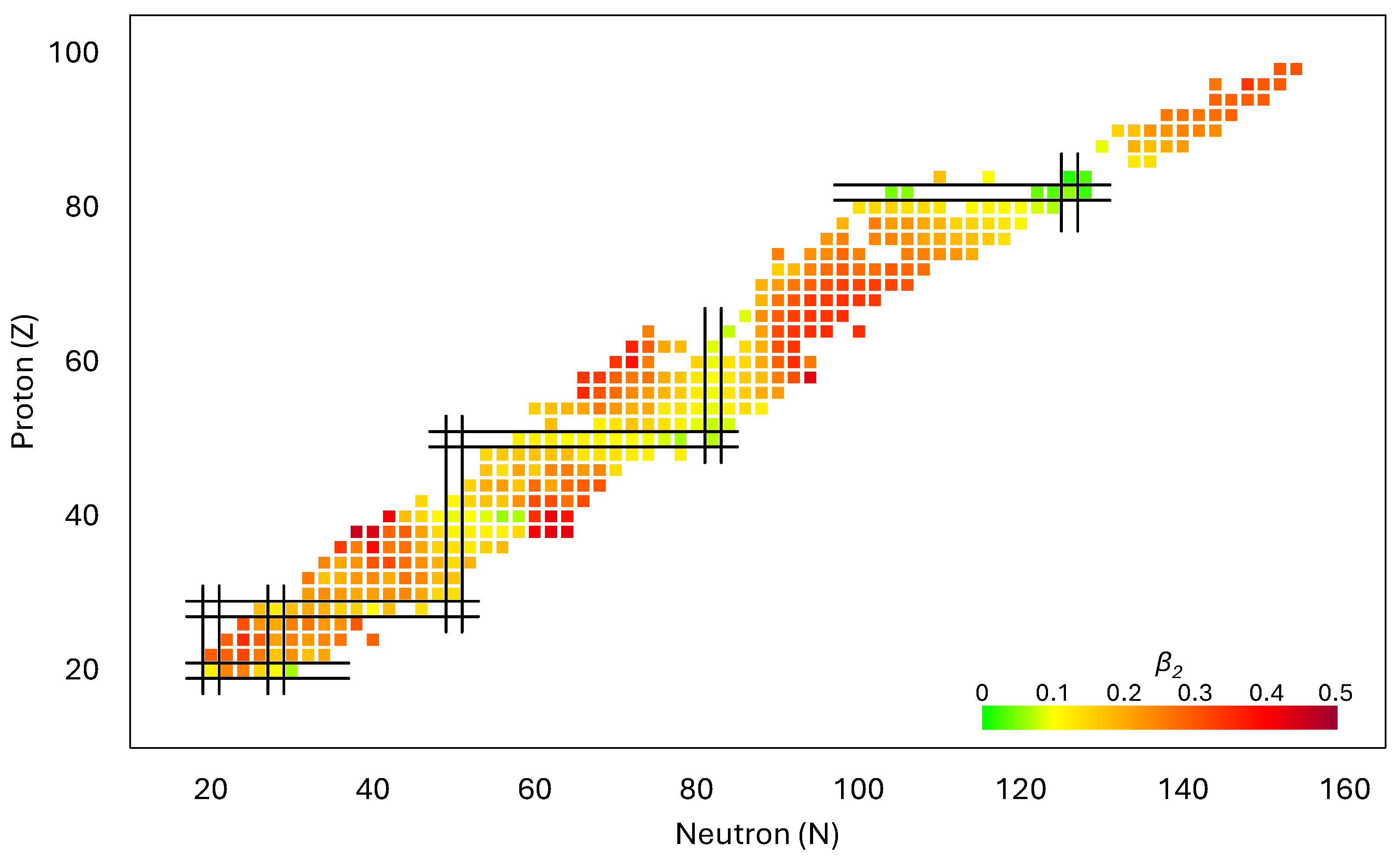
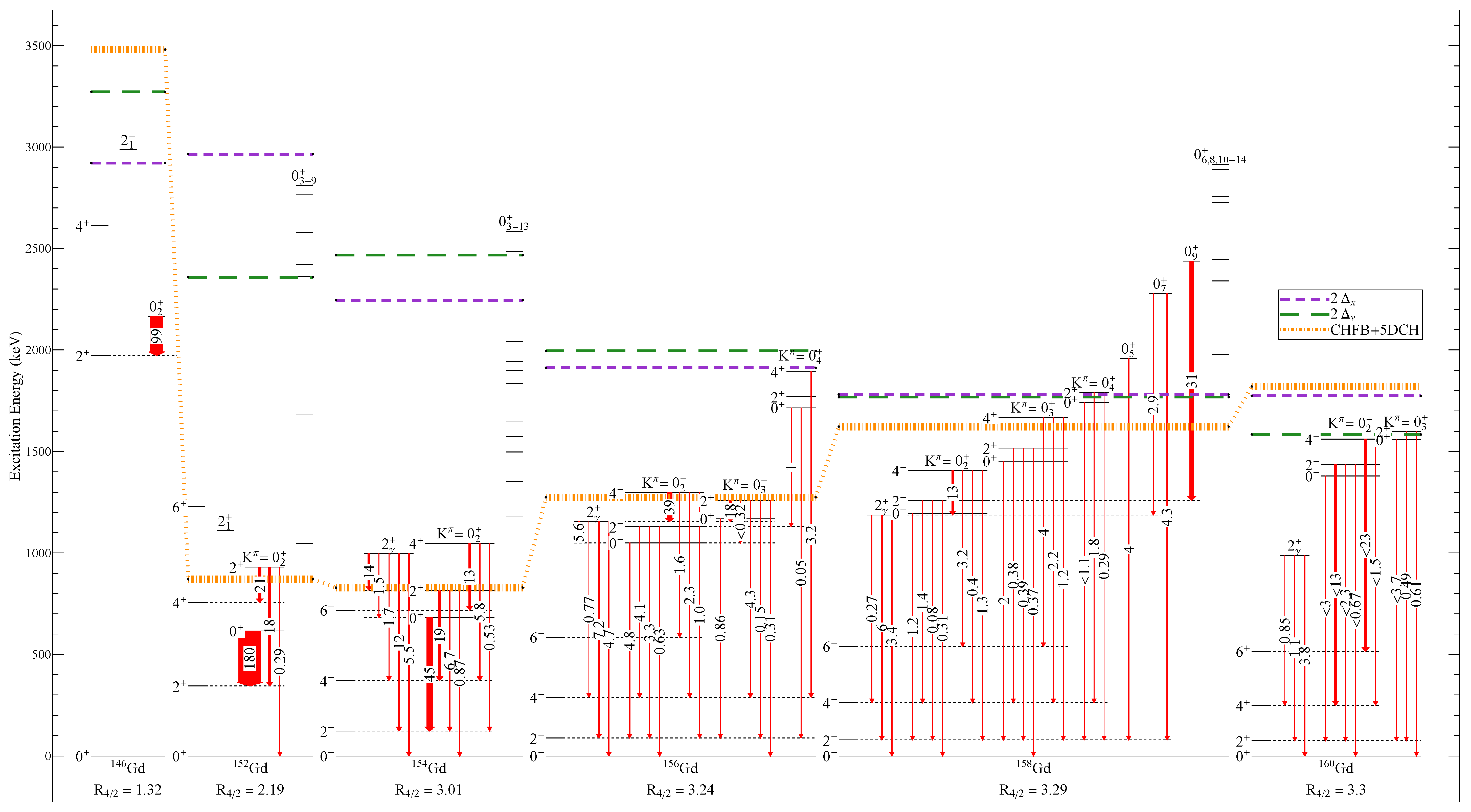
2.1. CHFB+5DCH: Structure of Even-Even Nuclei with the D1S Gogny Interaction
2.2. Interacting Boson Approximation (IBA)

2.3. IBA with Partial Dynamical Symmetries (PDS)
- Type I—some states preserve the full dynamical symmetry
- Type II—all states preserve part of the symmetry
- Type III—some states preserve part of the symmetry
- PDS provides analytic insight into complex spectra while retaining flexibility for realistic modeling. It offers a useful intermediate description between exact symmetry and complete symmetry breaking, often enabling improved reproduction of observables in deformed nuclei.
2.4. Pseudo-SU(3) Shell Model
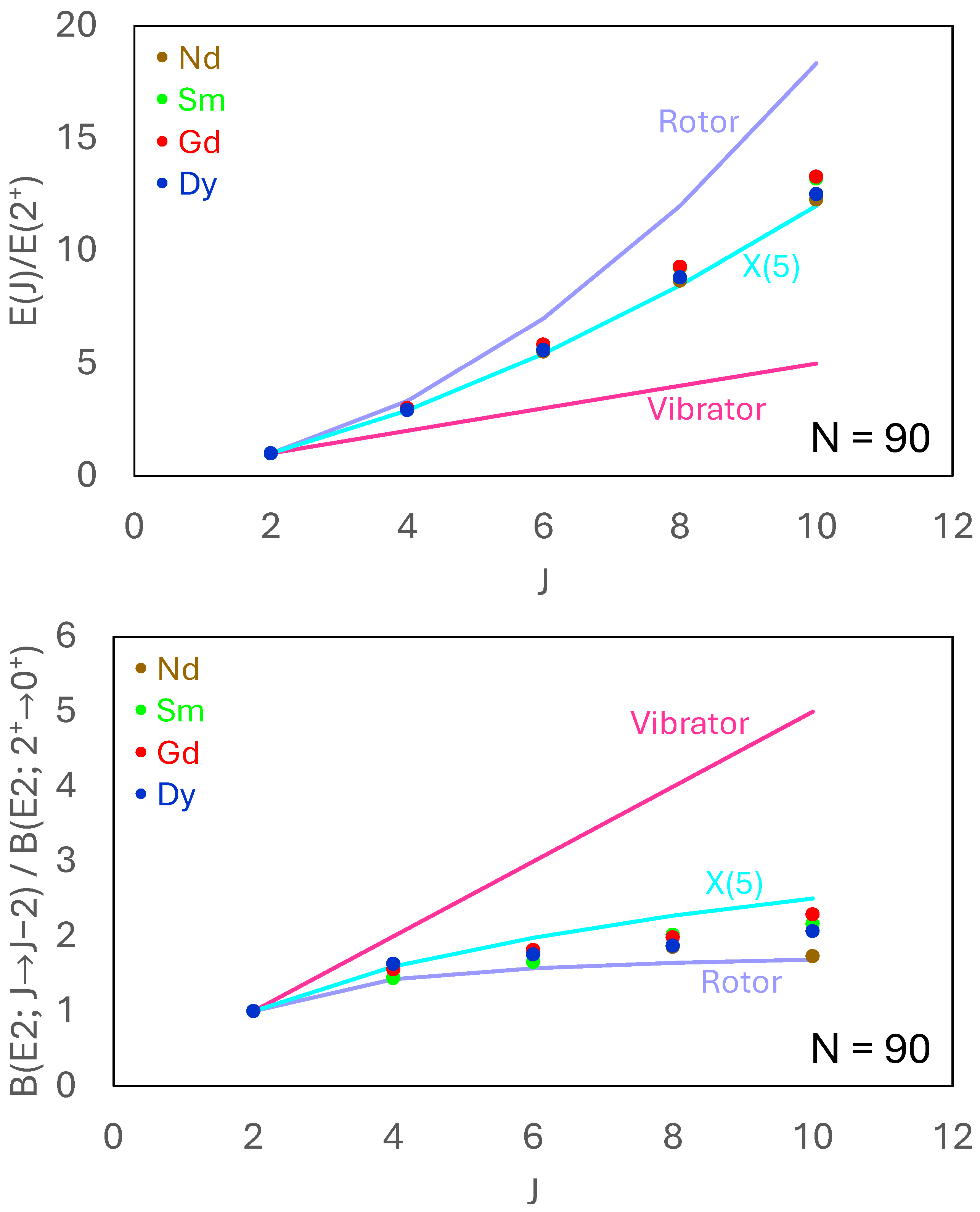
2.5. Proxy-SU(3) and Coexistence
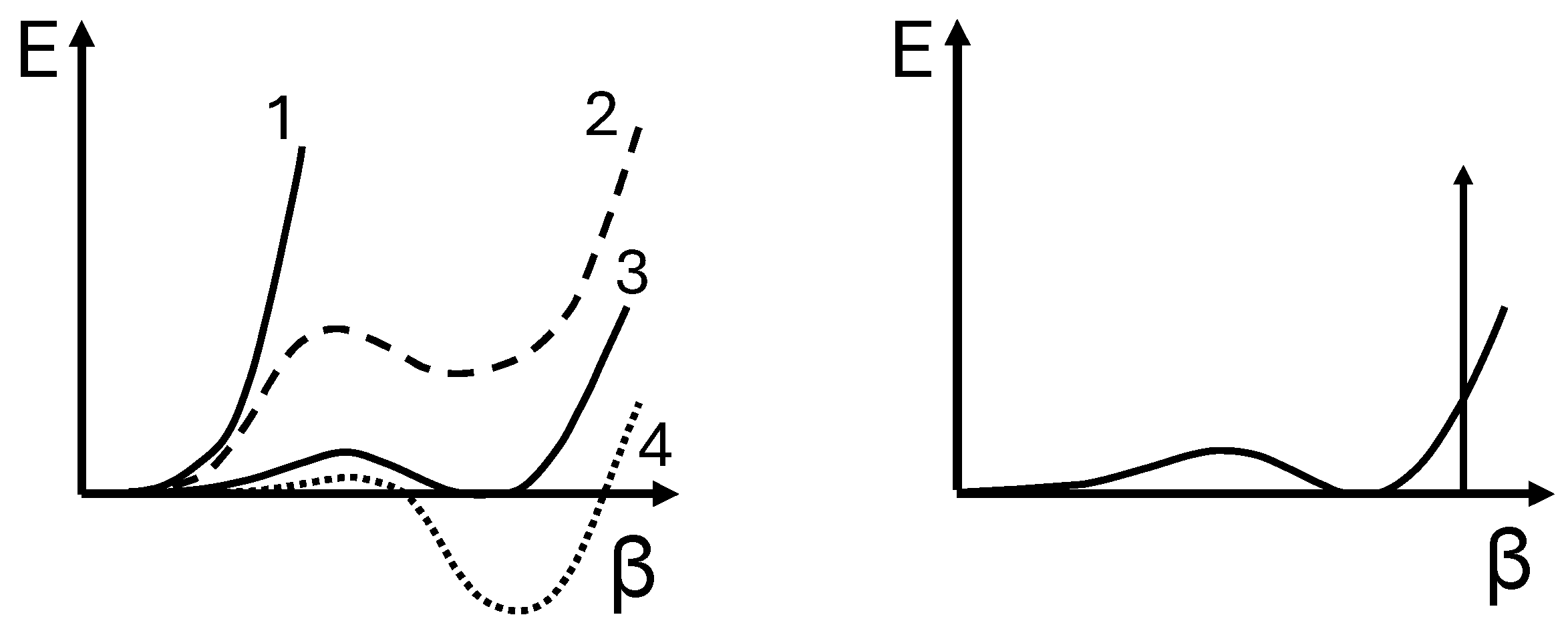
2.6. First-Order Quantum Phase Transitions and Coexistence
2.7. Monte Carlo Shell Model and Shape Coexistence
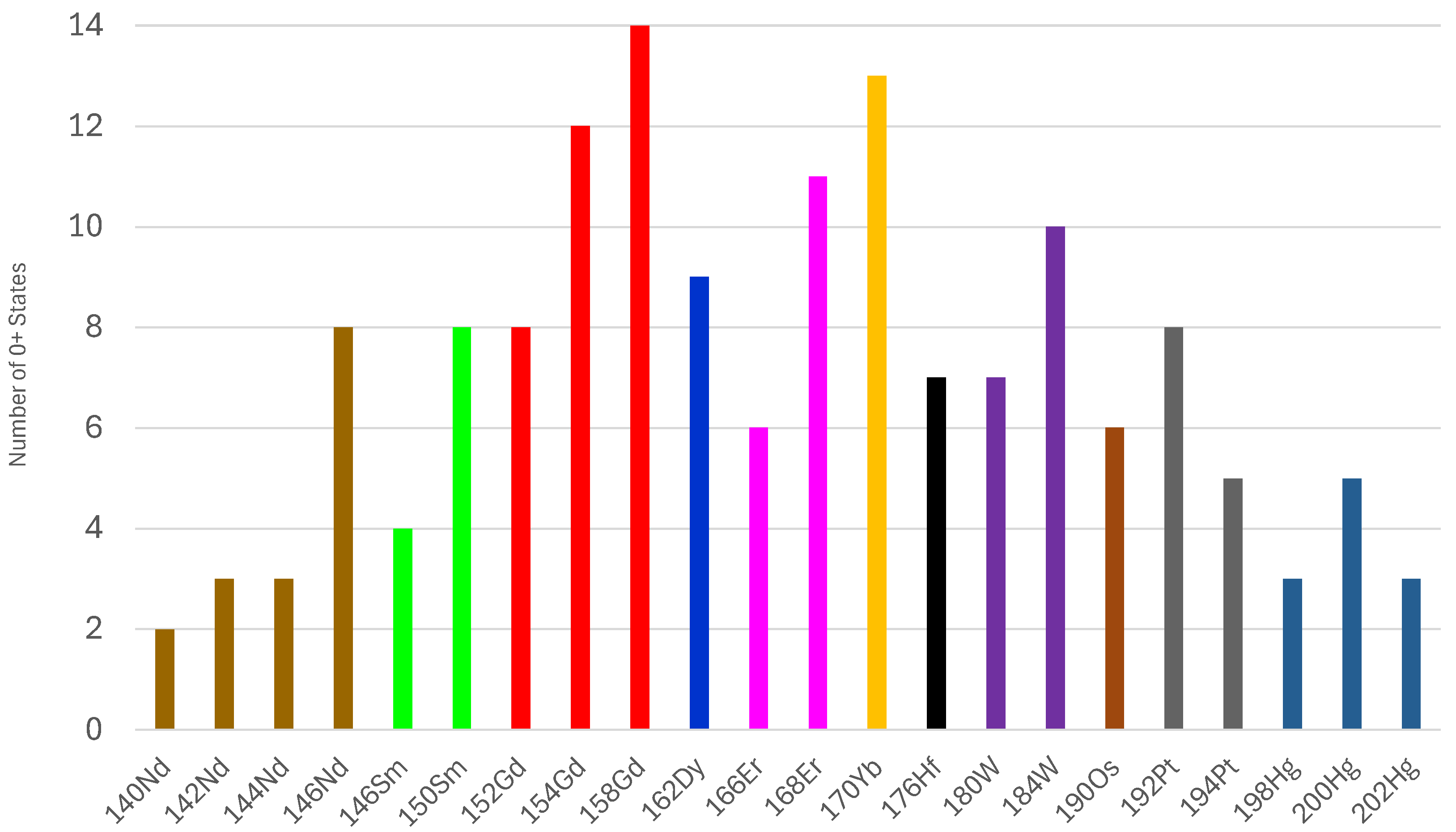
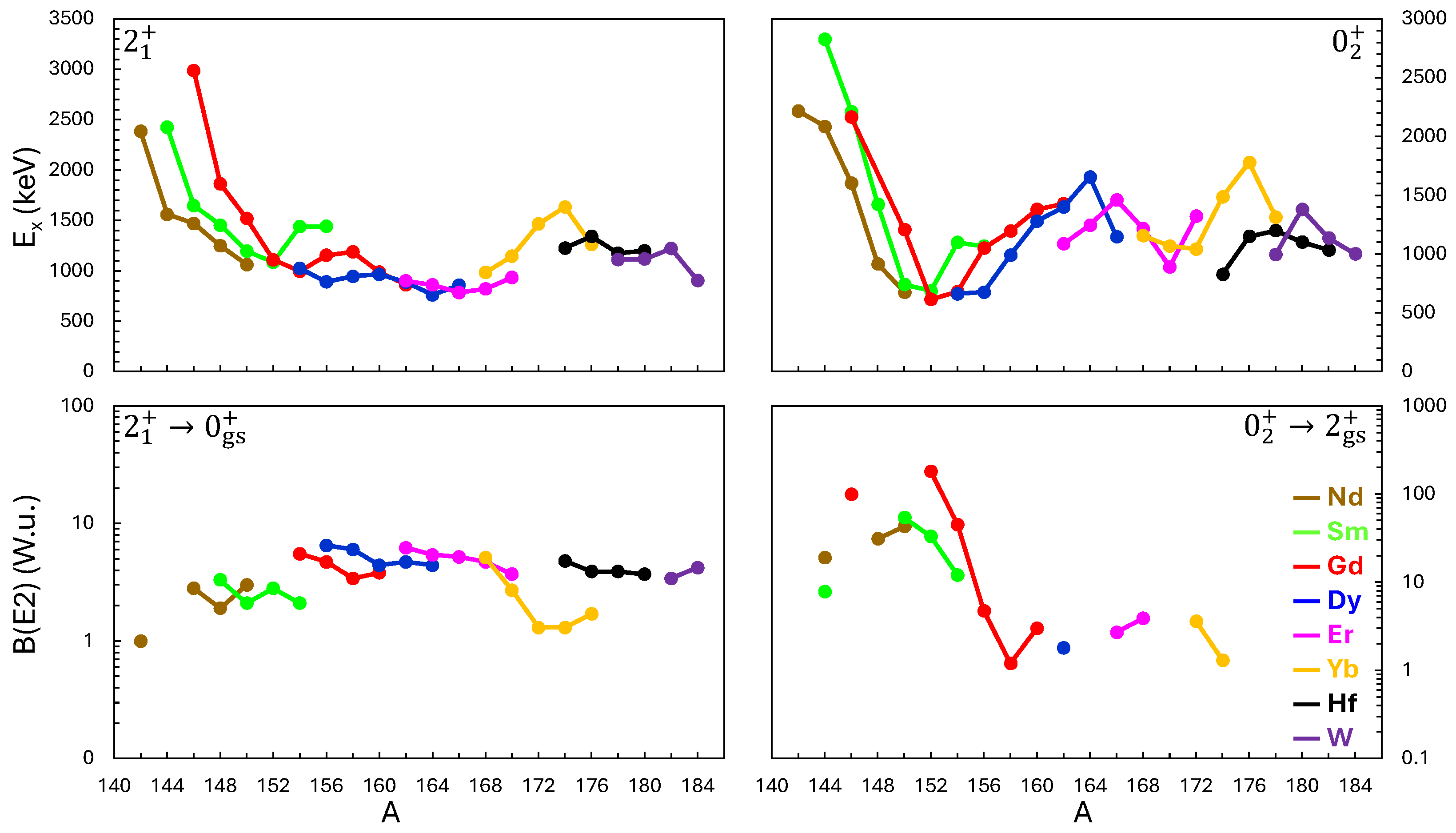
3. Experimental Evidence
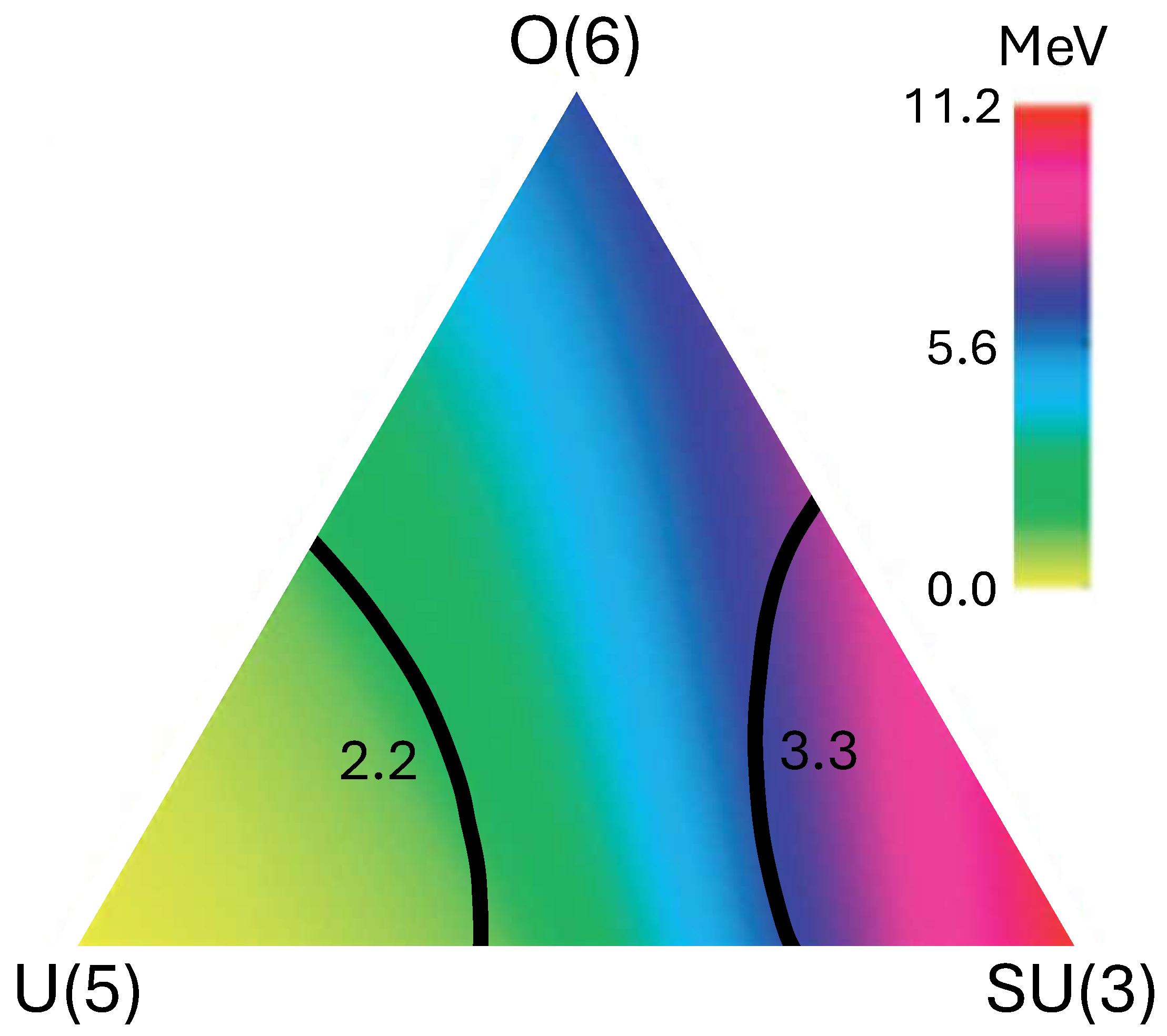
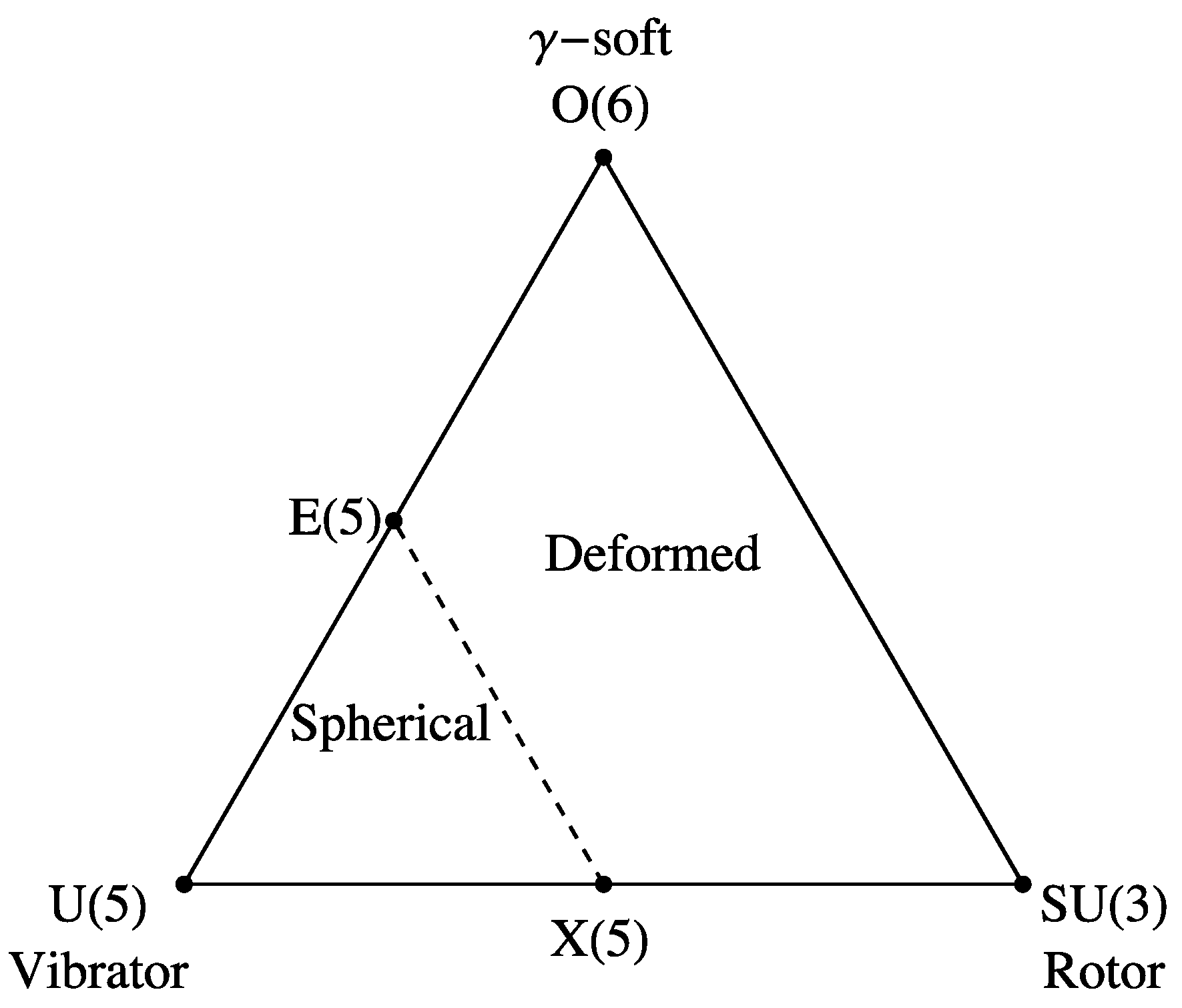
4. Interacting Boson Approximation (IBM) Framework
- (i)
- : the U(5) (or vibrational) limit where the Hamiltonian reduces to that of a quadrupole oscillator
- (ii)
- and : the SO(6) (or unstable) limit
- (iii)
- and : the SU(3) (or rotational) limit
- Axially deformed nuclei with prolate/oblate symmetry have the variable ∓ sign. The solutions can be obtained in closed, analytic form for these cases. In general, numerical diagonalization of the Hamiltonian matrix yields the eigenvalues. The results show that the weaker B() values from the -bands arise naturally.
5. Discussion
6. Results and Conclusions
Author Contributions
Funding
Data Availability Statement
Conflicts of Interest
Appendix A. 156 Gd Transition Probability Table

| , | (keV) | (fs) | (keV) | , | (rel.) | or | B() (W.u.) | |
|---|---|---|---|---|---|---|---|---|
| , | 1154.15 | 0.82(3) ps | 104.55(4) | , | 0.0007(4) | – | 5. | |
| 865.968(21) | , | 3.78(12) | 0.00374 | 0.77(6) | ||||
| 1065.1781(2) | , | 100.0(5) | 0.00242 | −16(5) | 7.2(4) | |||
| 1154.1467(2) | , | 96.2(6) | 0.00205 | 4.7(2) | ||||
| , | 1248.006 | 0.89 ps | 118.56(4) | , | 0.004 | – | 24.6(2) | |
| 959.820(9) | , | 27.1(3) | 0.00301 | 4.8(1) | ||||
| 1159.031(8) | , | 100.0(5) | 0.00204 | −11. | 6.9(1) | |||
| , | 1355.422 | 0.9 ps | 57.62(2) | , | 0.003(2) | – | ||
| 107.41(1) | , | 0.022(4) | – | |||||
| 201.269(4) | , | 0.27(2) | – | |||||
| 225.88(4) | , | 0.017(4) | 0.1485 | 3. | ||||
| 770.2(3) | , | 0.9(3) | – | 0.43(15) | ||||
| 1067.2325(2) | , | 100(1) | 0.00249 | −4. | 8. | |||
| 1266.446(12) | , | 39(1) | 0.00172 | 1.5(1) | ||||
| , | 1506.863 | 1.6 ps | 151.43(1) | , | 0.08(2) | – | ||
| 258.860(4) | , | 1.34(7) | 0.0957 | |||||
| 922.183(10) | , | 35.6(10) | 0.00327 | 4.0(3) | ||||
| 1218.708(13) | , | 100(6) | 0.00185 | 2.8(3) | ||||
| , | 1049.48 | 4.2 ps | 960.50771(25) | , | 100 | 0.003 | 4.8(1) | |
| , | 1129.44 | 2.3(2) ps | 79.878(9) | , | 0.0040(17) | 5.83 | ||
| 841.241(7) | , | 40.8(15) | 0.00399 | 4. | ||||
| 1040.470(8) | , | 100(3) | 0.0143 | -5. | 3. | |||
| 1129.419(9) | , | 27.4(15) | 0.00214 | 0. | ||||
| , | 1297.82 | 3 ps | 143.672(11) | , | 0.09(3) | – | ||
| 168.382(3) | , | 1.11(9) | 0.397 | |||||
| 713.102(8) | , | 11.3(10) | 0.0058 | 1.6(2) | ||||
| 1009.619(11) | , | 90(5) | 0.017 | 2.3(2) | ||||
| 1208.87(10) | , | 100(3) | 0.00187 | 1.0(1) | ||||
| , | 1168.19 | 13 ps | 1079.226(8) | , | 100(4) | 0.00235 | 0.86(7) | |
| , | 1258.075 | 2.2(2) ps | 103.89(2) | , | 0.006(2) | – | ||
| 208.54 | , | <0.003 | – | <0.32 | ||||
| 969.865(8) | , | 100(2) | 0.00294 | 4. | ||||
| 1169.087(10) | , | 71(1) | 0.0031(8) | 0.38(6) | 0. | |||
| 1258.087(14) | , | 26(1) | 0.00174 | 0. | ||||
| , | 1715.211 | 6.2 ps | 348.726(7) | , | 10.3(5) | 0.01097 | 8. | |
| 472.699(5) | , | 100(5) | 0.00535 | 3. | ||||
| 585.830(15) | , | 4.0(11) | 0.0093 | 1. | ||||
| 1625.19(21) | , | 33(4) | – | 5. | ||||
| , | 1771.09 | 0.64 ps | 232.255(12) | , | 0.11(1) | – | 4.1(6) | |
| 404.634(16) | , | 1.1(1) | 0.00768 | 7. | ||||
| 494.941(6) | , | 7.3(3) | 0.00482 | 2. | ||||
| 513.020(13) | , | 2.4(3) | 0.0237 | 7. | ||||
| 528.626(22) | , | 0.83(7) | 0.00416 | 2. | ||||
| 1682.174(15) | , | 100(5) | 0.00152 | 9. | ||||
| , | 1893.40 | 0.40 ps | 431.122(13) | , | 1.0(1) | 0.037 | 8. | |
| 485.273(11) | , | 4.1(7) | 0.00504 | 2. | ||||
| 537.953(15) | , | 10.2(5) | 0.016(5) | 78(7) | ||||
| 595.58(4) | , | 1.16(14) | 0.01626 | 3.7(6) | ||||
| 617.24(3) | , | 2.4(5) | – | 7. | ||||
| 1605.208(19) | , | 100(3) | 0.00141(23) | 3.2(2) |
References
- Zanotti, E.; Bisenberger, M.; Hertenberger, R.; Kader, H.; Graw, G. A long position angle resolving light ion detector for the Munich Q3D magnetic spectrograph. Nucl. Instrum. Methods Phys. Res. A 1991, 310, 706–707. [Google Scholar] [CrossRef]
- Aprahamian, A.; Lee, K.; Lesher, S.R.; Bijker, R. The nature of 0+ excitations in deformed nuclei. Prog. Part. Nucl. Phys. 2025, 143, 104173. [Google Scholar] [CrossRef]
- Leoni, S.; Fornal, B.; Bracco, A.; Tsunoda, Y.; Otsuka, T. Multifaceted character of shape coexistence phenomena in atomic nuclei. Prog. Part. Nucl. Phys. 2024, 139, 104119. [Google Scholar] [CrossRef]
- Garrett, P.E.; Zielińska, M.; Clément, E. An experimental view on shape coexistence in nuclei. Prog. Part. Nucl. Phys. 2022, 124, 103931. [Google Scholar] [CrossRef]
- Sharpey-Schafer, J.F. The Subtleties of Pairing and Collective Structures in Deformed Nuclei. In Exotic Nuclei; World Scientific: Singapore, 2015; Chapter 6. [Google Scholar] [CrossRef]
- Sharpey-Schafer, J.F.; Bark, R.A.; Bvumbi, S.P.; Dinoko, T.R.S.; Majola, S.N.T. “Stiff” deformed nuclei, configuration dependent pairing and the β and γ degrees of freedom. Eur. Phys. J. A 2019, 55, 15. [Google Scholar] [CrossRef]
- Delaroche, J.P.; Girod, M.; Libert, J.; Goutte, H.; Hilaire, S.; Péru, S.; Pillet, N.; Bertsch, G.F. Structure of even-even nuclei using a mapped collective Hamiltonian and the D1S Gogny interaction. Phys. Rev. C 2010, 81, 014303. [Google Scholar] [CrossRef]
- Bonatsos, D.; Martinou, A.; Peroulis, S.K.; Mertzimekis, T.J.; Minkov, N. Shape Coexistence in Even-Even Nuclei: A Theoretical Overview. Atoms 2023, 11, 117. [Google Scholar] [CrossRef]
- Heyde, K.; Wood, J.L. Shape coexistence in atomic nuclei. Rev. Mod. Phys. 2011, 83, 1467–1521. [Google Scholar] [CrossRef]
- Popa, G.; Georgieva, A.; Draayer, J. Microscopic Interrpretaton of the Kπ= and Bands of deformed nuclei within the framework of the pseudo-SU(3) shell model. In Computational and Group-Theoretical Methods in Nuclear Physics; World Scientific: Singapore, 2004; pp. 239–241. [Google Scholar] [CrossRef]
- Martinou, A.; Bonatsos, D.; Minkov, N.; Assimakis, I.E.; Peroulis, S.K.; Sarantopoulou, S.; Cseh, J. Proxy-SU(3) symmetry in the shell model basis. Eur. Phys. J. A 2020, 56, 239. [Google Scholar] [CrossRef]
- Gerçeklioglu, M.; Kuliev, A.A.; Erbil, H.H. The effect of the neutron-proton pairing interaction on the excited 0+ states in some deformed nuclei of the rare-earth region. Europhys. Lett. 1999, 47, 25–29. [Google Scholar] [CrossRef]
- Gerçeklioğlu, M. The spin-quadrupole interactino and the 0+ excitations in 158Gd. Eur. Phys. J. A 2005, 25, 185–191. [Google Scholar] [CrossRef]
- Gerçeklioğlu, M. Transfer strengths to the 0+ states excited by (p, t) reactions in 130,132,134Ba. Phys. Rev. C 2010, 82, 024306. [Google Scholar] [CrossRef]
- Gerçeklioğlu, M. The 0+ states excited by (p, t) reaction in 170Yb. Eur. Phys. J. A 2012, 48, 141. [Google Scholar] [CrossRef]
- Lo Iudice, N.; Sushkov, A.V.; Shirikova, N.Y. Microscopic structure of low-lying 0+ states in the deformed 158Gd. Phys. Rev. C 2004, 70, 064316. [Google Scholar] [CrossRef]
- Lo Iudice, N.; Sushkov, A.V.; Shirikova, N.Y. Microscopic structure of low-lying 0+ states in deformed nuclei. Phys. Rev. C 2005, 72, 034303. [Google Scholar] [CrossRef]
- Iudice, N.L.; Sushkov, A.V. Microscopic structure of low-lying states in 188,190,192Os. Phys. Rev. C 2008, 78, 054304. [Google Scholar] [CrossRef]
- Lo Iudice, N.; Ponomarev, V.Y.; Stoyanov, C.; Sushkov, A.V.; Voronov, V.V. Low-energy nuclear spectroscopy in a microscopic multiphonon approach. J. Phys. G Nucl. Part. Phys. 2012, 39, 043101. [Google Scholar] [CrossRef]
- Bender, M.; Heenen, P.H. Beyond mean-field description of the low-lying spectrum of 16O. Nucl. Phys. A 2003, 713, 390–401. [Google Scholar] [CrossRef]
- Bender, M.; Flocard, H.; Heenen, P.H. Beyond-mean-field-model analysis of low-spin normal-deformed and superdeformed collective states of 32S, 36Ar, 38Ar, and 40Ca. Phys. Rev. C 2003, 68, 044321. [Google Scholar] [CrossRef]
- Delaroche, J.P.; Girod, M.; Goutte, H.; Libert, J. Structure properties of even–even actinides at normal and super deformed shapes analysed using the Gogny force. Nucl. Phys. A 2006, 771, 103–168. [Google Scholar] [CrossRef]
- Krieger, S.; Bonche, P.; Weiss, M.; Meyer, J.; Flocard, H.; Heenen, P.H. Super-deformation and shape isomerism: Mapping the isthmus. Nucl. Phys. A 1992, 542, 43–52. [Google Scholar] [CrossRef]
- Takahara, S.; Takima, N.; Onishi, N. Study of superdeformation in non-rotating states using the Skyrme-Hartree-Fock method. Nucl. Phys. A 1998, 642, 461–479. [Google Scholar] [CrossRef]
- Arima, A.; Iachello, F. Collective Nuclear States as Representations of a SU(6) Group. Phys. Rev. Lett. 1975, 35, 1069–1072. [Google Scholar] [CrossRef]
- Iachello, F.; Arima, A. The Interacting Boson Model; Cambridge University Press: Cambridge, UK, 1987. [Google Scholar] [CrossRef]
- Iachello, F.; Kuyucak, S. Interacting boson-fermion model of collective states I. The Spin (6) limit. Ann. Phys. 1981, 136, 19–61. [Google Scholar] [CrossRef]
- Bijker, R.; Dieperink, A.E.L. Properties of the intrinsic matrix elements of the interacting-boson-approximation E2 operator in the rotational limit. Phys. Rev. C 1982, 26, 2688–2689. [Google Scholar] [CrossRef]
- Cakirli, R.B. Shell structure, emerging collectivity, and valence p-n interactions. EPJ Web Conf. 2014, 66, 01019. [Google Scholar] [CrossRef]
- Casten, R.F.; Cakirli, R.B. The evolution of collectivity in nuclei and the proton–neutron interaction. Phys. Scr. 2016, 91, 033004. [Google Scholar] [CrossRef]
- Leviatan, A.; Sinai, I. Partial dynamical SU(3) symmetry and the nature of the lowest K = 0 collective excitation in deformed nuclei. Phys. Rev. C 1999, 60, 061301. [Google Scholar] [CrossRef]
- Elliott, J. Collective motion in the nuclear shell model. I. Classification schemes for states of mixed configurations. Proc. R. Soc. A 1958, 245, 128–145. [Google Scholar] [CrossRef]
- Draayer, J.P.; Weeks, K.J. Shell-Model Description of the Low-Energy Structure of Strongly Deformed Nuclei. Phys. Rev. Lett. 1983, 51, 1422–1425. [Google Scholar] [CrossRef]
- Draayer, J.; Weeks, K. Towards a shell model description of the low-energy structure of deformed nuclei I. Even-even systems. Ann. Phys. 1984, 156, 41–67. [Google Scholar] [CrossRef]
- Popa, G.; Hirsch, J.G.; Draayer, J.P. Shell model description of normal parity bands in even-even heavy deformed nuclei. Phys. Rev. C 2000, 62, 064313. [Google Scholar] [CrossRef]
- Hirsch, J.G.; Popa, G.; Lesher, S.R.; Aprahamian, A.; Vargas, C.E.; Draayer, J.P. Low energy 0+ excitations in 158Gd. Rev. Mex. Fís. 2006, 52, 69–74. [Google Scholar]
- Popa, G.; Georgieva, A.; Draayer, J.P. Systematics in the structure of low-lying, nonyrast bandhead configurations of strongly deformed nuclei. Phys. Rev. C 2004, 69, 064307. [Google Scholar] [CrossRef]
- Popa, G.; Aprahamian, A.; Georgieva, A.; Draayer, J. Systematics in the structure of low-lying, non-yrast band-head configurations of strongly deformed nuclei. Eur. Phys. J. A-Hadron. Nucl. 2005, 25, 451–452. [Google Scholar] [CrossRef]
- Popa, G.; Georgieva, A. Description of heavy deformed nuclei within the pseudo-SU(3) shell model. J. Phys. Conf. Ser. 2012, 403, 012009. [Google Scholar] [CrossRef]
- Bonatsos, D.; Martinou, A.; Peroulis, S.K.; Mertzimekis, T.J.; Minkov, N. Signatures for shape coexistence and shape/pase transitions in even-even nuclei. J. Phys. G Nucl. Part. Phys. 2023, 50, 075105. [Google Scholar] [CrossRef]
- Bonatsos, D.; Assimakis, I.E.; Minkov, N.; Martinou, A.; Sarantopoulou, S.; Cakirli, R.B.; Casten, R.F.; Blaum, K. Analytic prediction for nuclear shapes, prolate dominance, and the prolate-oblate shape transition in the proxy-SU(3) model. Phys. Rev. C 2017, 95, 064326. [Google Scholar] [CrossRef]
- Bonatsos, D.; Martinou, A.; Sarantopoulou, S.; Assimakis, I.E.; Peroulis, S.; Minkov, N. Parameter-free predictions for the collective deformation variables β and γ within the pseudo-SU(3) scheme. Eur. Phys. J. Spec. Top. 2020, 229, 2367–2387. [Google Scholar] [CrossRef]
- Bonatsos, D.; Martinou, A.; Peroulis, S.; Petrellis, D.; Vasileiou, P.; Mertzimekis, T.J.; Minkov, N. Preponderance of triaxial shapes in atomic nuclei predicted by the proxy-SU(3) symmetry. J. Phys. G Nucl. Part. Phys. 2024, 52, 015102. [Google Scholar] [CrossRef]
- Iachello, F. Dynamical Symmetries at the Critical Point. Phys. Rev. Lett. 2000, 85, 3580–3583. [Google Scholar] [CrossRef]
- Iachello, F. Analytic Description of Critical Point Nuclei in a Spherical-Axially Deformed Shape Phase Transition. Phys. Rev. Lett. 2001, 87, 052502. [Google Scholar] [CrossRef]
- Casten, R.F.; Zamfir, N.V. Evidence for a Possible E(5) Symmetry in 134Ba. Phys. Rev. Lett. 2000, 85, 3584–3586. [Google Scholar] [CrossRef] [PubMed]
- Casten, R.; Zamfir, N. Empirical Realization of a Critical Point Description in Atomic Nuclei. Phys. Rev. Lett. 2001, 87, 052503. [Google Scholar] [CrossRef]
- Casten, R.F. Phase Transitional Behavior in Spherical-Deformed Transition Regions. In Science and Culture Series: Proceedings of Special Symposium on Symmetries in Nuclear Structure: An Occasion to Celebrate the 60th Birthday of Franco Iachello; World Scientific Publishing Co. Pte. Ltd.: Singapore, 2003; pp. 172–181. [Google Scholar] [CrossRef]
- Pietralla, N.; Gorbachenko, O.M. Evolution of the “β excitation” in axially symmetric transitional nuclei. Phys. Rev. C 2004, 70, 011304(R). [Google Scholar] [CrossRef]
- Casten, R.; Brenner, D.; Haustein, P. Valence p-n interactions and the development of collectivity in heavy nuclei. Phys. Rev. Lett. 1987, 58, 658–661. [Google Scholar] [CrossRef] [PubMed]
- Tsunoda, Y.; Otsuka, T. Triaxial rigidity of 166Er and its Bohr-model realization. Phys. Rev. C 2021, 103, L021303. [Google Scholar] [CrossRef]
- Otsuka, T.; Tsunoda, Y.; Shimizu, N.; Utsuno, Y.; Abe, T.; Ueno, H. Prevailing triaxial shapes in atomic nuclei and a quantum theory of rotation of composite objects. Eur. Phys. J. A 2025, 61, 126. [Google Scholar] [CrossRef]
- Robledo, L.M.; Rodríguez, T.R.; Rodríguez-Guzmán, R.R. Mean field and beyond description of nuclear structure with the Gogny force: A review. J. Phys. G Nucl. Part. Phys. 2018, 46, 013001. [Google Scholar] [CrossRef]
- Rouoof, S.P.; Nazir, N.; Jehangir, S.; Bhat, G.H.; Sheikh, J.A.; Rather, N.; Frauendorf, S. Fingerprints of the triaxial deformation from energies and B(E2) transition probabilities of γ-bands in transitional and deformed nuclei. Eur. Phys. J. A 2024, 60, 40. [Google Scholar] [CrossRef]
- Möller, P.; Bengtsson, R.; Carlsson, B.G.; Olivius, P.; Ichikawa, T. Global Calculations of Ground-State Axial Shape Asymmetry of Nuclei. Phys. Rev. Lett. 2006, 97, 162502. [Google Scholar] [CrossRef]
- Wirth, H.F. Construction of a High Resolution Focal Plane Detector for the Q3D Magnetic Spectrograph. Ph.D. Thesis, Technische Universität München, München, Germany, 2001. [Google Scholar]
- Wirth, H.F.; Graw, G.; Christen, S.; Cutoiu, D.; Esiermann, Y.; Günther, C.; Hertenberger, R.; Jolie, J.; Levon, A.I.; Möller, O.; et al. 0+ states in deformed actinide nuclei by the (p, t) reaction. Phys. Rev. C 2004, 69, 044310. [Google Scholar] [CrossRef]
- Lesher, S.R.; Aprahamian, A.; Trache, L.; Oros-Peusquens, A.; Deyliz, S.; Gollwitzer, A.; Hertenberger, R.; Valnion, B.D.; Graw, G. New Kπ = 0+ bands in 158Gd. Phys. Rev. C 2002, 66, 051305(R). [Google Scholar] [CrossRef]
- Meyer, D.A.; Wood, V.; Casten, R.F.; Fitzpatrick, C.R.; Graw, G.; Bucurescu, D.; Jolie, J.; von Brentano, P.; Hertenberger, R.; Wirth, H.F.; et al. Extensive investigation of 0+ states in rare earth region nuclei. Phys. Rev. C 2006, 74, 044309. [Google Scholar] [CrossRef]
- Bucurescu, D.; Graw, G.; Hertenberger, R.; Wirth, H.F.; Iudice, N.L.; Sushkov, A.V.; Shirikova, N.Y.; Sun, Y.; Faestermann, T.; Krücken, R.; et al. High-resolution study of 0+ and 2+ excitations in 168Er with the (p, t) reaction. Phys. Rev. C 2006, 73, 064309. [Google Scholar] [CrossRef]
- Suliman, G.; Bucurescu, D.; Hertenberger, R.; Wirth, H.F.; Faestermann, T.; Krücken, R.; Behrens, T.; Bildstein, V.; Eppinger, K.; Hinke, C.; et al. Study of the 130Ba nucleus with the (p, t) reaction. Eur. Phys. J. A 2008, 36, 243–250. [Google Scholar] [CrossRef]
- Bettermann, L.; Heinze, S.; Jolie, J.; Mücher, D.; Möller, O.; Scholl, C.; Casten, R.F.; Meyer, D.A.; Graw, G.; Hertenberger, R.; et al. High-resolution study of 0+ states in 170Yb. Phys. Rev. C 2009, 80, 044333. [Google Scholar] [CrossRef]
- Bernards, C.; Casten, R.F.; Werner, V.; von Brentano, P.; Bucurescu, D.; Graw, G.; Heinze, S.; Hertenberger, R.; Jolie, J.; Lalkovski, S.; et al. High-resolution study of excited 0+ states in 200Hg and 202Hg. Phys. Rev. C 2013, 87, 064321. [Google Scholar] [CrossRef]
- Bernards, C.; Casten, R.F.; Werner, V.; von Brentano, P.; Bucurescu, D.; Graw, G.; Heinze, S.; Hertenberger, R.; Jolie, J.; Lalkovski, S.; et al. Investigation of 0+ states in 198Hg after two-neutron pickup. Phys. Rev. C 2013, 87, 024318. [Google Scholar] [CrossRef]
- Levon, A.I.; Graw, G.; Hertenberger, R.; Pascu, S.; Thirolf, P.G.; Wirth, H.F.; Alexa, P. 0+ states and collective bands in 228Th studied by the (p, t) reaction. Phys. Rev. C 2013, 88, 014310. [Google Scholar] [CrossRef]
- Levon, A.I.; Alexa, P.; Graw, G.; Hertenberger, R.; Pascu, S.; Thirolf, P.G.; Wirth, H.F. Spectroscopy of 232U in the (p, t) reaction: More information on 0+ excitations. Phys. Rev. C 2015, 92, 064319. [Google Scholar] [CrossRef]
- Spieker, M.; Pascu, S.; Bucurescu, D.; Shneidman, T.M.; Faestermann, T.; Hertenberger, R.; Wirth, H.F.; Zamfir, N.V.; Zilges, A. High-resolution (p, t) studies of low-spin states in 240Pu: Octupole excitations, α clustering, and other structure features. Phys. Rev. C 2018, 97, 064319. [Google Scholar] [CrossRef]
- Bucurescu, D.; Pascu, S.; Suliman, G.; Wirth, H.F.; Hertenberger, R.; Faestermann, T.; Krücken, R.; Grawe, G. High-resolution study of 166Er with the (p, t) reaction. Phys. Rev. C 2019, 100, 044316. [Google Scholar] [CrossRef]
- Levon, A.I.; Bucurescu, D.; Costache, C.; Faestermann, T.; Hertenberger, R.; Ionescu, A.; Lica, R.; Magner, A.G.; Mihai, C.; Mihai, R.; et al. New data on 0+ states in 158Gd. Phys. Rev. C 2019, 100, 034307. [Google Scholar] [CrossRef]
- Nzobadila Ondze, J.C.; Rebeiro, B.M.; Triambak, S.; Atar, L.; Ball, G.C.; Bildstein, V.; Burbadge, C.; Diaz Varela, A.; Faestermann, T.; Garrett, P.E.; et al. Investigation of pair-correlated 0+ states in 134Ba via the 136Ba(p, t) reaction. Phys. Rev. C 2021, 103, 034329. [Google Scholar] [CrossRef]
- Bucurescu, D.; Pascu, S.; Graw, G.; Hertenberger, R.; Wirth, H.F.; Faestermann, T.; Krücken, R.; Mahgoub, M.; Jolie, J.; von Brentano, P.; et al. Updated analysis of the 170Er(p, t)168Er reaction data. Phys. Rev. C 2023, 108, 014310. [Google Scholar] [CrossRef]
- Baktash, C.; Garrett, J.D.; Winchell, D.F.; Smith, A. Low-spin indentical bands in neighboring odd-A and even-even nuclei: A challenge to mean-field theories. Phys. Rev. Lett. 1992, 69, 1500–1503. [Google Scholar] [CrossRef]
- Baktash, C.; Haas, B.; Nazarewicz, W. Identical Bands in Deformed and Superdeformed Nuclei. Ann. Rev. Nucl. Part. Sci. 1995, 45, 485–541. [Google Scholar] [CrossRef]
- Haas, B. Identical superdeformed bands. Prog. Part. Nucl. Phys. 1997, 38, 1–14. [Google Scholar] [CrossRef]
- Aprahamian, A.; de Haan, R.C.; Lesher, S.R.; Casarella, C.; Stratman, A.; Börner, H.G.; Lehmann, H.; Jentschel, M.; Bruce, A.M. Lifetime measurements in 156Gd. Phys. Rev. C 2018, 98, 034303. [Google Scholar] [CrossRef]
- Bijker, R.; Mas Ruiz, J. β and γ vibrations in the IBM. EPJ Web Conf. 2024, 301, 02001. [Google Scholar] [CrossRef]
- Dieperink, A.; Scholten, O.; Iachello, F. Classical Limit of the Interacting-Boson Model. Phys. Rev. Lett. 1980, 44, 1747–1750. [Google Scholar] [CrossRef]
- Ginocchio, J.N.; Kirson, M.W. Relationship between the Bohr Collective Hamiltonian and the Interacting-Boson Model. Phys. Rev. Lett. 1980, 44, 1744–1747. [Google Scholar] [CrossRef]
- Ginocchio, J.; Kirson, M. An intrinsic state for the interacting boson model and its relationship to the Bohr-Mottelson model. Nucl. Phys. A 1980, 350, 31–60. [Google Scholar] [CrossRef]
- Bohr, A.; Mottelson, B.R. On the spectrum of 168Er. Phys. Scr. 1982, 25, 28–36. [Google Scholar] [CrossRef]
- Leviatan, A. Intrinsic and collective structure in the interacting boson model. Ann. Phys. 1987, 179, 201–271. [Google Scholar] [CrossRef]
- Warner, D.D.; Casten, R.F. Revised Formulation of the Phenomenological Interacting Boson Approximation. Phys. Rev. Lett. 1982, 48, 1385–1389. [Google Scholar] [CrossRef]
- Lipas, P.; Toivonen, P.; Warner, D. IBA consistent-Q formalism extended to the vibrational region. Phys. Lett. B 1985, 155, 295–298. [Google Scholar] [CrossRef]
- Evaluated Nuclear Structure Data File. 2026. Available online: https://www.nndc.bnl.gov/ensdf/ (accessed on 1 April 2026).
- Lee, K.; Stratman, A.; Casarella, C.; Aprahamian, A.; Lesher, S. TROPIC: A program for calculating reduced transition probabilities. Comput. Phys. Commun. 2025, 306, 109383. [Google Scholar] [CrossRef]


| gs | ||||
|---|---|---|---|---|
| 154Gd | 0.021 | 0.026 | 0.043 | 0.009 |
| 156Gd | 0.022 | 0.028 | 0.019 | 0.030 |
| 158Gd | 0.022 | 0.024 | 0.024 | 0.033 |
| 160Gd | 0.022 | 0.030 |
| Limit | Shape | ||||
|---|---|---|---|---|---|
| 0 | − | 0 | − | Spherical | |
| 1 | 0 | 1 | − | unstable | |
| 1 | Prolate deformed | ||||
| 1 | Oblate deformed |
Disclaimer/Publisher’s Note: The statements, opinions and data contained in all publications are solely those of the individual author(s) and contributor(s) and not of MDPI and/or the editor(s). MDPI and/or the editor(s) disclaim responsibility for any injury to people or property resulting from any ideas, methods, instructions or products referred to in the content. |
© 2026 by the authors. Licensee MDPI, Basel, Switzerland. This article is an open access article distributed under the terms and conditions of the Creative Commons Attribution (CC BY) license.
Share and Cite
Aprahamian, A.; Lee, K.; Lesher, S.; Bijker, R. Quantum Choreography of the Nucleus: Rotations, Vibrations, and Emergent Structure. Symmetry 2026, 18, 812. https://doi.org/10.3390/sym18050812
Aprahamian A, Lee K, Lesher S, Bijker R. Quantum Choreography of the Nucleus: Rotations, Vibrations, and Emergent Structure. Symmetry. 2026; 18(5):812. https://doi.org/10.3390/sym18050812
Chicago/Turabian StyleAprahamian, Ani, Kevin Lee, Shelly Lesher, and Roelof Bijker. 2026. "Quantum Choreography of the Nucleus: Rotations, Vibrations, and Emergent Structure" Symmetry 18, no. 5: 812. https://doi.org/10.3390/sym18050812
APA StyleAprahamian, A., Lee, K., Lesher, S., & Bijker, R. (2026). Quantum Choreography of the Nucleus: Rotations, Vibrations, and Emergent Structure. Symmetry, 18(5), 812. https://doi.org/10.3390/sym18050812