1. Introduction
The major problem in the big data era is the secure management of digital information. Large amounts of sensitive binary information, such as QR codes, documents, medical reports, and access credentials, need to be shared between trusted parties through open networks. In many cases, it is also necessary to share multiple image-based secrets gradually over time rather than as a single one-time exchange. Thus, cryptographic solutions need to be both secure and efficient, so they can run in real time even on devices with limited resources.
Conventional cryptographic methods often require heavy computation and are becoming more vulnerable as technology advances. The rise in quantum computing, particularly with algorithms like Shor’s [
1], threatens widely used Elliptic Curve Cryptography (ECC) systems and the Rivest–Shamir–Adleman (RSA) algorithm. This happens by weakening the mathematical problems that make them secure. As a result, there is growing concern about whether these conventional techniques can continue to protect digital communications in the long term.
The rapid proliferation of digital communication has made secure image and data transmission a critical concern in modern information systems. The OWASP (Open Web Application Security Project) Top 10:2025 report [
2] ranks Cryptographic Failures at position #4, recording 1,665,348 total occurrences across 32 Common Weakness Enumerations (CWEs), driven predominantly by the use of broken or risky cryptographic algorithms (CWE-327), insufficient entropy (CWE-331), predictable random number generators (CWE-1241), and weak pseudo-random number generators (CWE-338). These alarming statistics highlight the urgent necessity for stronger and more secure frameworks in image transmission, motivating this study.
These challenges necessitate a shift toward cryptographic systems that provide strong practical security guarantees without relying solely on computational hardness assumptions. One such approach is visual cryptography (VC), presented by Naor and Shamir [
3]. Here, a secret image is decomposed, and noise-like shares are produced that individually do not disclose any information. The original secret is discovered only when all required shares are combined [
4].
Multiple Secret Sharing Visual Cryptography Schemes (MSSVCSs) are an extension of VC. These schemes address scenarios that involve the repeated and progressive exchange of secrets [
5,
6,
7,
8,
9]. They are particularly relevant when two authenticated parties need to securely exchange multiple secrets across several sessions. However, many existing MSSVCSs are based on fixed, predefined structures that support only a fixed number of secrets. This limits their suitability for dynamic and long-term communication scenarios.
Even with considerable progress, existing MSSVCS frameworks still face several unresolved limitations. First, most schemes exhibit a static coupling amongst the count of secrets and shares, resulting in a quadratic growth in storage requirements and requiring complete regeneration of shares when new secrets are introduced [
7,
8]. This static binding significantly restricts scalability and flexibility in environments where secrets are generated and transmitted incrementally over time. Second, although reusable or universal shares have been introduced, there is no rigorous formal definition specifying the statistical properties, structural constraints, and security guarantees required for their safe reuse across multiple secrets [
10,
11,
12,
13]. Third, transmission-layer security has received limited attention in the literature. Although XOR-based constructions provide strong secrecy at the share-generation stage, potential information leakage arising from the repeated transmission of related shares has not been analyzed systematically.
Motivated by these gaps, this study proposes a symmetric (2,2) XOR-based Dynamic Multiple Secret Sharing Visual Cryptography Scheme (XDMSSVCS) that enables the secure and scalable sharing of multiple binary secrets using a single reusable base share. The main contributions are:
A novel base share creation algorithm is proposed to generate statistically independent base shares while preserving the reconstruction property required for secure multi-secret visual cryptography.
A dynamic XOR-based multiple secret sharing framework is developed to enable efficient and secure transmission of multiple image secrets using lightweight symmetric operations.
A session-dependent permutation using a lightweight chaotic scrambling technique is introduced to prevent inter-session correlation when the base share is reused, thereby mitigating statistical information leakage.
The proposed framework exploits the symmetric properties of XOR transformations, enabling identical operations for share generation and secret reconstruction while maintaining practical secrecy.
Extensive experiments demonstrate pixel-perfect reconstruction, near-ideal entropy, and negligible inter-session correlation, validating the effectiveness and efficiency of the proposed scheme.
The proposed framework exploits the structural symmetry of XOR operations, where identical operations are used during share generation and secret reconstruction, ensuring consistent and reversible transformations.
This paper is organized as follows:
Section 2 reviews the related work in VC and analyzes the existing limitations of multiple secret sharing.
Section 3 presents the proposed XDMSSVCS framework, including its formal definitions, algorithms, and security analyses.
Section 4 reports the results and performs a comparative performance evaluation. It also discusses their inferences. Finally,
Section 5 summarizes and proposes the future scope.
3. Methodology
The proposed symmetric XOR-based Dynamic Multiple Secret Sharing Visual Cryptography Scheme (XDMSSVCS) is a (2,2) threshold RG model. This study addresses the gaps mentioned earlier by (i) introducing a novel well-defined universal share framework with explicit uniqueness, (ii) enabling scalability by dynamic share generation, and (iii) integrating chaos-assisted scrambling to decorrelate pixels.
3.1. System Model and Notation
In this study, square secret images in binary format were used. The proposed XDMSSVCS framework, illustrated in
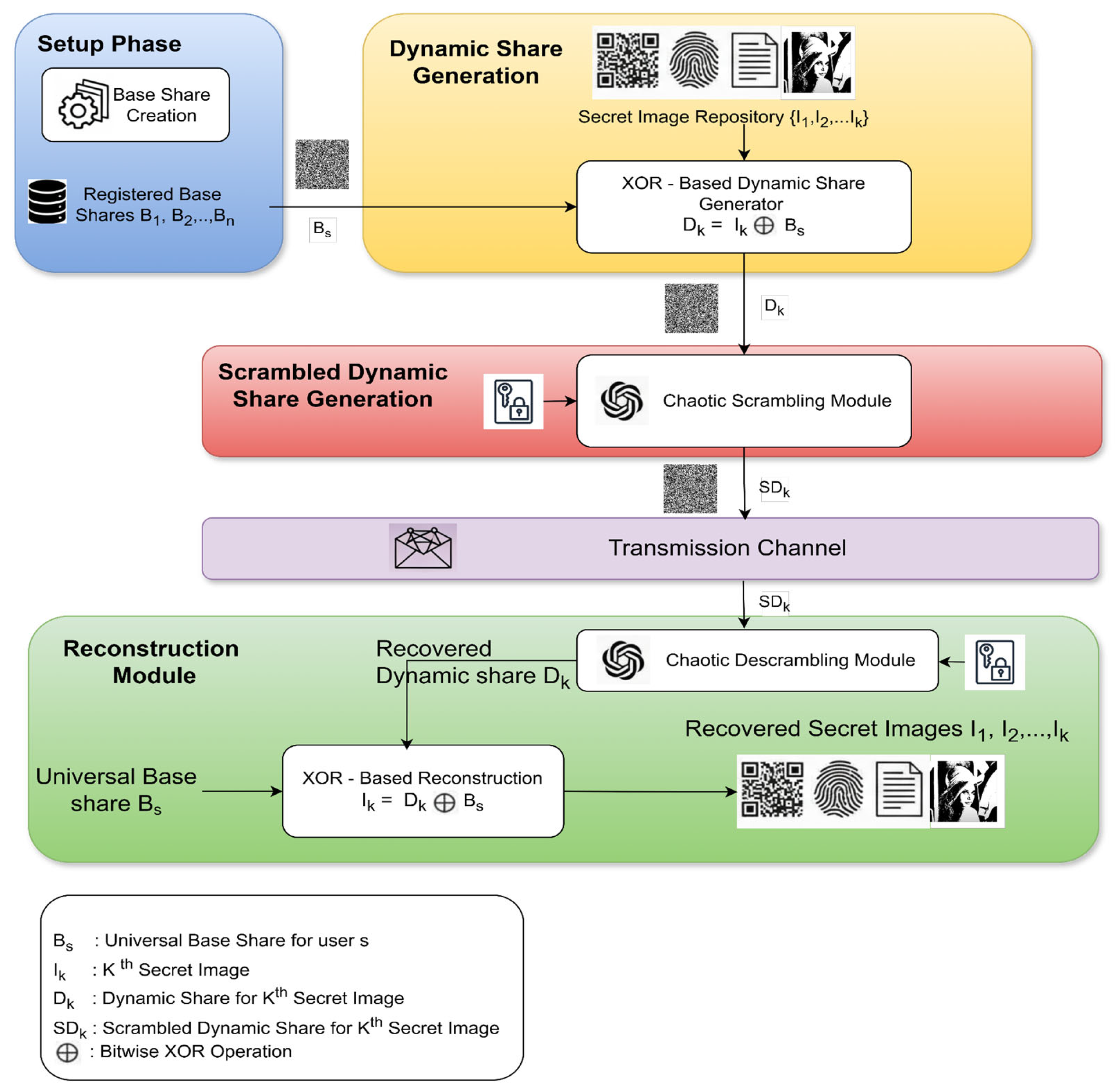
Figure 1, operates through a multiphase process for securely transmitting multiple secret images by sending a single share at a time. The system considers a registered set of users, each associated with a universal base share B
s{0, 1}, where s denotes the user index. The size of the base share is taken as the secret image size. In the Setup Phase, a set of statistically random unique universal base shares B
1, B
2, …, B
n is generated for each user and stored securely. This is done using the proposed novel base share creation (BSC) algorithm. The encryption process comprises selecting the corresponding base share B
s for a particular user and computing the dynamic share and the scrambled dynamic share for the user. During dynamic share generation, a selected secret image I
k from the repository is XORed with B
s to produce a noisy dynamic share D
k. The Chaotic Scrambling Module then applies a logistic map permutation to generate the scrambled dynamic share SD
k, which is transmitted through an insecure channel. At the receiver, chaotic descrambling recovers D
k, and XORing with the available B
s reconstructs the original I
k losslessly.
3.2. Unique Universal Base Share Creation Algorithm
The key novelty lies in defining the BSC algorithm such that it satisfies certain properties. Constraints are explicitly enforced to satisfy uniqueness and statistical independence of universal base shares across different users, whereas the existing MSS-VC schemes generally assume that base shares are unique without formally analyzing region-based similarities that may arise among users. If two users’ base shares have correlated regions, then one user could potentially infer partial information about another’s secret during multi-session exchanges. This leads to cross-user interception and hence is a serious concern. In order to remove this risk, the proposed BSC algorithm introduces region-based similarity constraints. This ensures controlled uniqueness, and hence, the scheme is resistant to inter-user correlation or inference attacks (Algorithm 1).
| Algorithm 1. Unique Region-Constrained Base Share Creation Algorithm |
| Input: Image size: H × W (Height H, Width W), Number of regions: R, Similarity threshold: T∈(0, 1), Number of users: n. |
| Output: Base shares: B1, B2, …, Bn. |
- 1.
Divide Base Share into Regions
The base share is split into R non-overlapping regions of the same size. Each region is assigned a unique identifier r∈{1, 2, …, R}, and the region layout remains fixed for all the base shares. - 2.
Generate Initial Base Share
i ∈ [1, H], j ∈ [1, W] - 3.
Generate Subsequent Base Shares
For each base share Bs, where s = 2, 3, …, n:
Initialize Bs as a random binary matrix of size H × W. For each region r, the region-wise similarity constraints are enforced as follows:
- ○
Compare region r of Bs with the corresponding region r of all previously generated set of base shares By = {B1, B2, …, Bs−1}. - ○
For each share in B y, the similarity ratio is computed as in Equation (1). This denotes the proportion of the matching pixel values. where 1 [.] is the indicator function that equals 1 if the condition is true and 0 otherwise. - ○
If the similarity value exceeds the given threshold T, the pixel value within the region r of Bs is randomly flipped. This is done until the similarity becomes less than T.
- 4.
Store Validated Base Share
The newly generated share Bs is stored and is a valid universal base share. Continue the process in Step 3 until all n base shares are generated. |
The algorithm creates the required number of base shares even dynamically as new users arrive and hence is scalable. It is also unique and resistant to correlation-based attacks.
3.3. Dynamic Share Generation
Equation (2) illustrates that the secret image I
k is Xored with the corresponding user’s base share B
s to create a corresponding dynamic share D
k.The resulting dynamic share looks like a random set of black and white pixels and nothing could be deduced from intercepting the dynamic share.
3.4. Chaotic Scrambling for Transmission-Layer Security
The chaotic module is not used as a standalone encryption primitive but as a lightweight permutation generator to enforce session-wise statistical independence between transmitted shares. Each dynamic share is scrambled using a one-dimensional logistic map-based chaos permutation. This is done to prevent inter-session correlation and enhance the transmission-layer security. The logistic map is defined as in Equation (3),
where x
0 is an initial seed value and subsequent x
n+1 values are calculated based on the previous x
n value. Also, 0 < x
n< 1, and since the system operates in the chaotic range, the control parameter r lies in the range of 3.57 to 4. The logistic map produces unpredictable pseudo-random sequences which are suitable for pixel permutation. This system is highly sensitive because even a tiny change in the initial value x
0 produces a completely different sequence. Security does not depend on secrecy of the chaotic map itself but on the non-reuse of permutation instances. The scrambling seeds are assigned uniquely to each session and are not reused. Their security role is to ensure permutation diversity rather than to function as secret keys.
Each dynamic share was first converted into a one-dimensional sequence of pixel values. The logistic map in this study uses a session-specific seed chosen from a predefined seed pool and a control parameter in the chaotic range. This generates a chaotic sequence of values of the same length as that of the dynamic share. This sequence is sorted and a permutation index is obtained which is used to rearrange the pixel positions of the dynamic share sequence. This is subsequently converted back into its original two-dimensional form yielding a scrambled dynamic share. The usage of the seed pool ensures that in every transmission, a unique scrambling pattern is used. Hence only authorized users can reliably decrypt the secret by unscrambling the share. Since the scrambling patterns are different in each session, the repeated interception of the shares does not reveal any statistical pattern. Hence, correlation-based attacks can be prevented. At the same time, the simplicity of the logistic map makes the scrambling process less computationally complex. Hence, this is suitable even in real-time applications where the available computational power is less.
3.5. Secret Reconstruction
Reverse scrambling is performed on the received scrambled dynamic share SD
k to yield the dynamic share D
k. As in Equation (4), the dynamic share D
k is XORed with base share B
s to recover the secret I
k.This symmetric transformation enables identical operations to be used during share generation and reconstruction, ensuring reversible and consistent secret recovery.
3.6. Theoretical Security Analysis
Two theorems are proposed to (i) clarify the security limitations while reusing the base share and (ii) prove the practical secrecy property of the proposed system.
Theorem 1. Conditional Secrecy and Multi-Session Limitation.
For a uniformly random universal base share Bs, the dynamic share Dk = Ik ⊕Bs achieves information-theoretic secrecy for a single instance, as defined in Equation (5). This only applies to a single session. However, across multiple sessions, the property of information-theoretic secrecy does not hold due to the residual correlations introduced by reuse, as seen in Equation (6). Proof of Theorem 1. Repeated XOR with a fixed Bs induces linear dependencies that can be exploited via statistical averaging. The relation Di ⊕ Dj = Ii ⊕ Ij exposes inter-secret correlations, thereby violating perfect secrecy. Hence, perfect secrecy is conditional and does not extend to multi-session adversarial-attack scenarios.□
Theorem 2. Practical Secrecy with Session-Specific Chaotic Scrambling.
Let s be a session-specific permutation over pixel positions derived from a non-repeating predefined seed pool of initial values. Let SDk = s(Dk) denote the scrambled dynamic share obtained by applying a chaotic permutation Πs, where is selected from a predefined seed pool of chaotic initial values. If the seed pool is such that each sharing instance uses a distinct chaotic seed, then for any adversary observing an arbitrary number of scrambled shares {SDk}, Equations (7) and (8) hold:The conditional distribution remains approximately unchanged even under multi-session observations, indicating that no exploitable information is revealed across sessions and the scheme exhibits practical secrecy through statistical decorrelation across sessions. Proof of Theorem 2. The chaotic permutation generated from logistic map-based sorting guarantees bijective randomization of pixel positions. The usage of seeds from the predefined pool ensures that each session applies a different permutation, so two intercepted shares cannot be aligned or averaged to reveal structural similarities. For two sessions: SD1 = s1(I1 ⊕ Bs), SD2 = s2(I2 ⊕ Bs). Since s1 ≠ s2, the pixel positions of the underlying XOR results are rearranged differently across sessions. Therefore, the attacker cannot align corresponding pixels between SD1 and SD2, and SD1 ⊕ SD2 ≠ I1 ⊕ I2 in general. Thus, inter-session correlation leakage is removed operationally. As a result, SDk becomes statistically independent of both Ik and the previously transmitted shares. In visual cryptography, reconstruction depends critically on the spatial alignment of pixel positions. The permutation s disrupts this alignment, effectively acting as a session-specific key. Since the permutations are independent, the joint distribution of (SD1, SD2) does not reveal exploitable correlation between I1 and I2, thereby restoring practical secrecy even under repeated transmissions and proving Equations (7) and (8).□
3.7. Security Model and Threat Assumptions
The security of the proposed XDMSSVCS framework is analyzed under a passive adversarial model. The adversary is assumed to be capable of intercepting all transmitted scrambled dynamic shares across multiple sessions and over extended periods of time. The adversary may perform statistical, correlation-based, entropy-based, and pattern-matching analyses, including machine learning-assisted inference. However, the adversary does not have access to the securely stored universal base shares Bn or the session-specific permutation parameters used for scrambling. Active attacks such as share modification, injection, impersonation, or denial-of-service are outside the scope of this study.
The primary objective of the adversary is to infer secret images, recover the universal base share, or exploit inter-session correlations arising from repeated reuse of Bn. In this context, security is achieved through three key components: (i) randomness of the base share, (ii) XOR-based masking of secret images, and (iii) session-specific permutation that disrupts spatial alignment across transmissions. Since visual cryptography relies on correct pixel alignment for meaningful reconstruction, the use of distinct permutations across sessions prevents consistent alignment of intercepted shares, thereby limiting structural inference.
The proposed framework achieves practical secrecy by minimizing exploitable statistical dependencies across sessions. The incorporation of session-specific permutation ensures that repeated observations do not reveal consistent spatial or statistical patterns, while the large effective key space makes exhaustive search computationally infeasible.
4. Experimental Results and Evaluation
For the proposed XDMSSVCS framework, the evaluation focuses on base share uniqueness, multi-session robustness, statistical security, reconstruction fidelity, resistance to attack models, and comparison with existing universal share-based multi-secret visual cryptography (MSS-VC) schemes. The proposed framework was implemented in Python (Google Colab environment, Python 3.12 runtime). The binary secret images of size 512 × 512 were used in the experiments and processed using Python. They were derived from widely recognized benchmarks from the USC–SIPI image database [
29]. Also, other binary images were generated and used for evaluation. The reported results represent the average of multiple independent runs conducted under the same configuration.
4.1. Universal Base Share Uniqueness
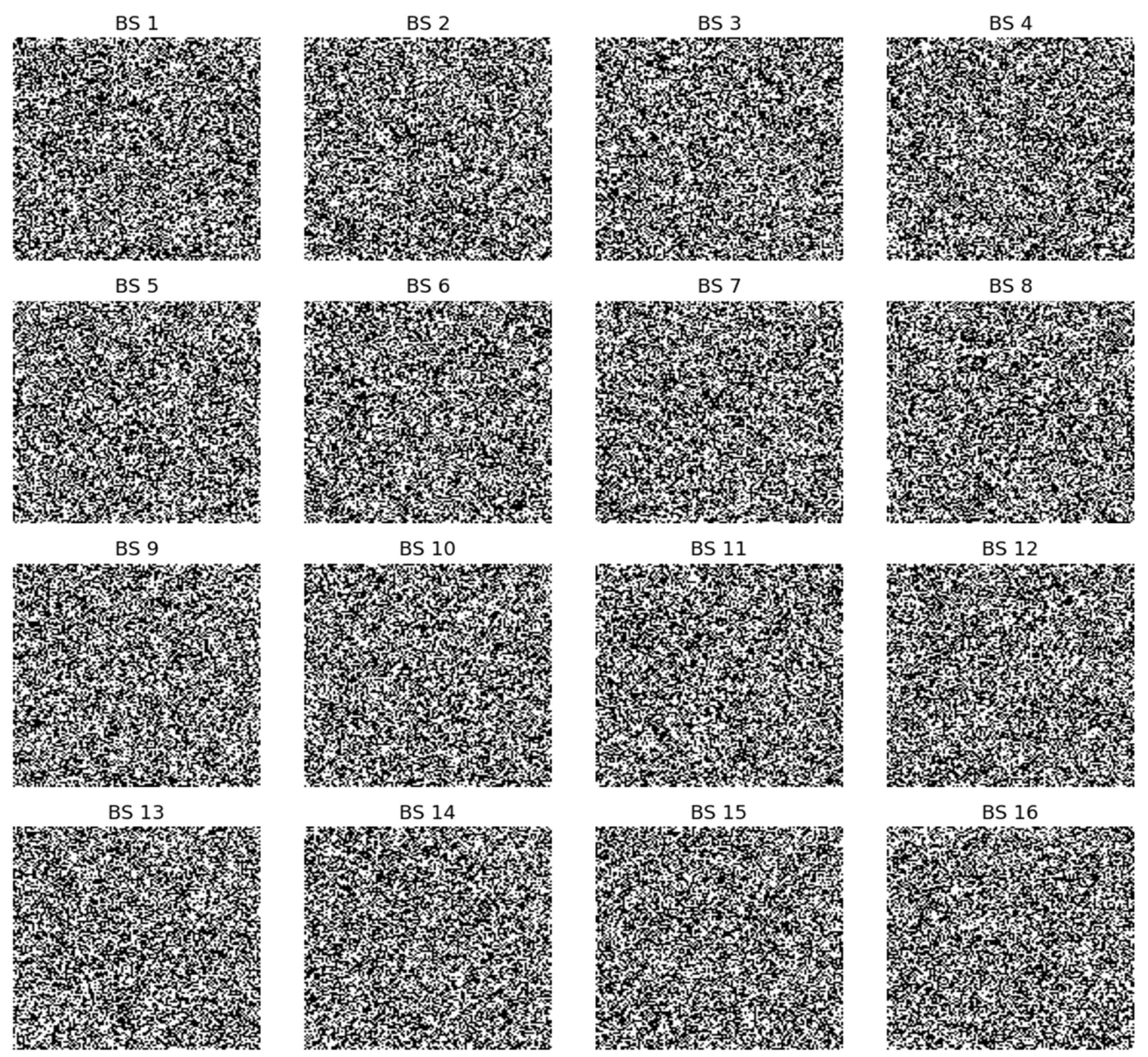
A basic requirement of the proposed framework is that all the universal base shares generated must be statistically independent. This prevents cross-user inference or information leakage. To assess this property, universal base shares were generated for many users. A sample of 16 user base shares is shown in
Figure 2. Each share displays a visually random appearance and has no noticeable patterns. It also indicates a well-balanced pixel distribution.
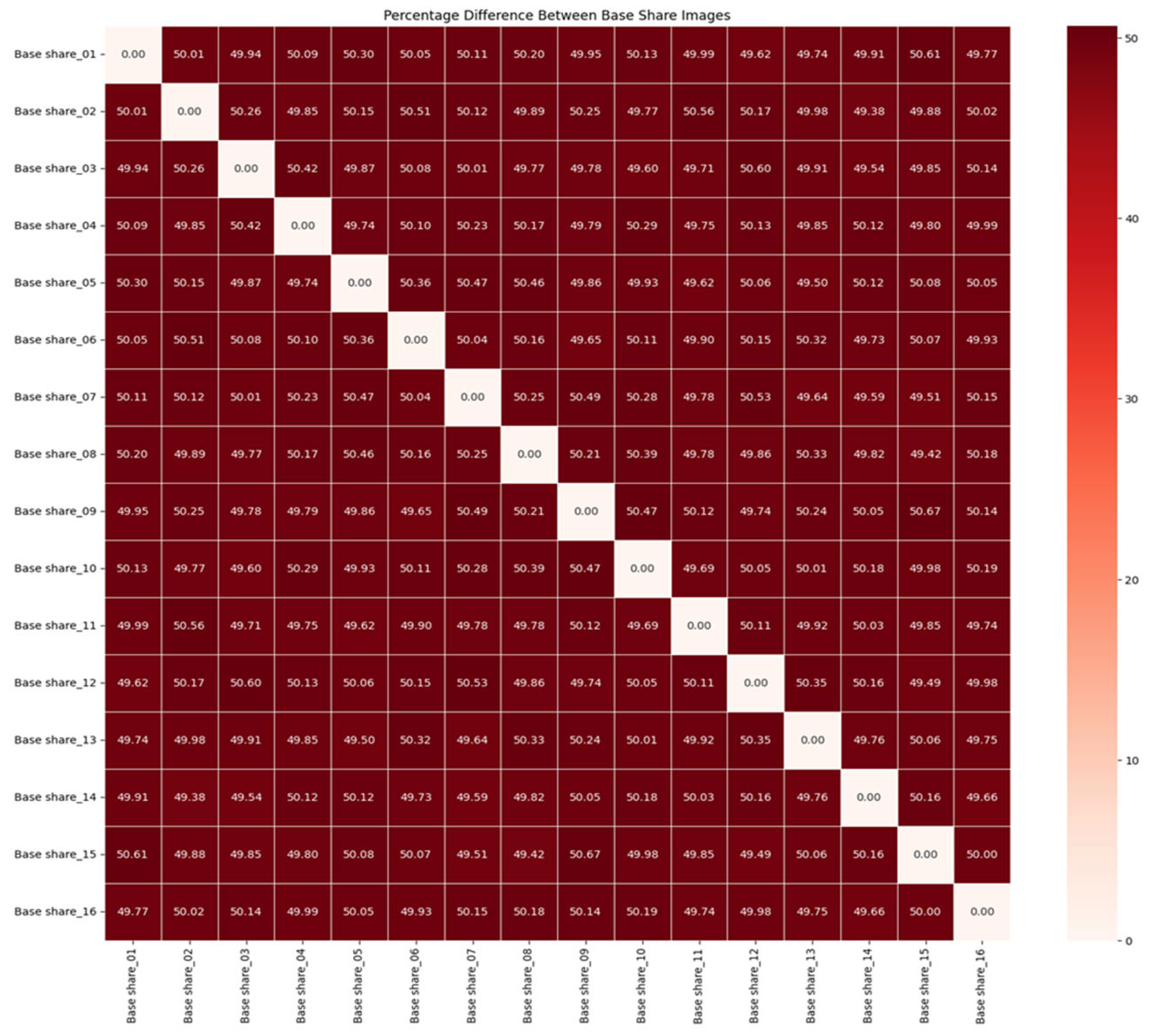
A pairwise, pixel-wise Hamming distance analysis was carried out for the 16 base shares to quantitatively evaluate the uniqueness.
Figure 3 presents a heatmap of the normalized Hamming distances between every pair of shares. All diagonal values were zero, as expected, and the off-diagonal dissimilarity values are around 50%. This distribution matches that of independent Bernoulli (0.5) random matrices. This shows that there are no pairs of base shares that have abnormal correlation. This also proves that the suggested region-based similarity constraints enforce uniqueness.
The base share-generation process was applied to a higher number of users. The individual shares have a unique and random pixel pattern with no repetitive or shared patterns among users. The base shares were still diverse, indicating strong inter-share independence.
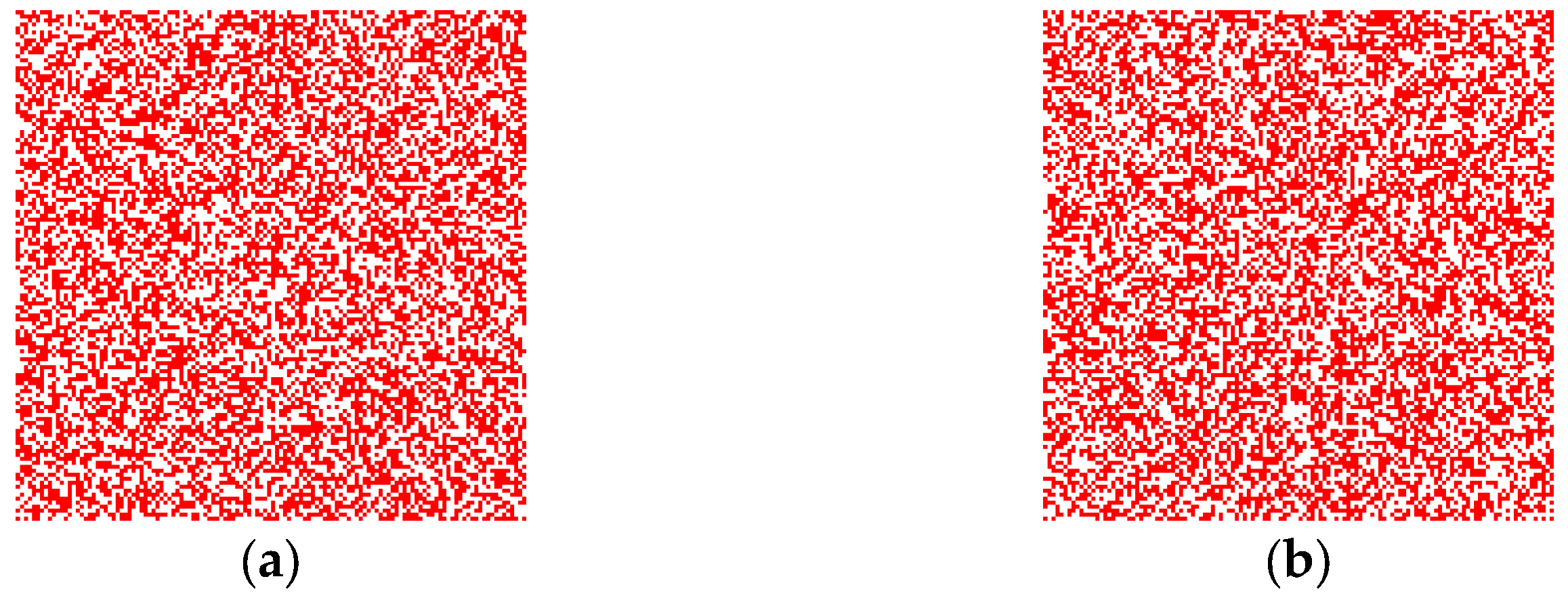
Figure 4 shows the representative pixel-wise pairwise mismatch maps of the two pairs of selected base shares. In these visualizations, the mismatches are represented as red pixels and the matching regions are represented as white pixels.
The mismatched pixels are evenly spread all over the image, without any clusters or directional bias, which also proves the statistical independence between shares. These observations are further supported by the absence of any dominant correlation patterns across all evaluated share pairs. Consequently, the independence of base shares ensures that the compromise of a single user’s share does not undermine the confidentiality of other users’ shares within the system. It is worth noting that this evaluation explicitly addresses inter-user independence, a property often assumed but not experimentally verified in prior universal share-based schemes [
10,
12,
13]. In contrast, the XDMSSVCS is the first scheme to empirically validate base share independence, thereby bridging a long-standing conceptual gap in the literature on universal share-based multi-secret sharing visual cryptography.
4.2. Experimental Validation of Theorem 1: Conditional Secrecy and Functional Correctness
Theorem 1 Equation (5) establishes that dynamic shares generated via XOR achieve information-theoretic secrecy when observed individually. To validate this property and demonstrate functional correctness, multiple secret images were processed using a single universal base share.
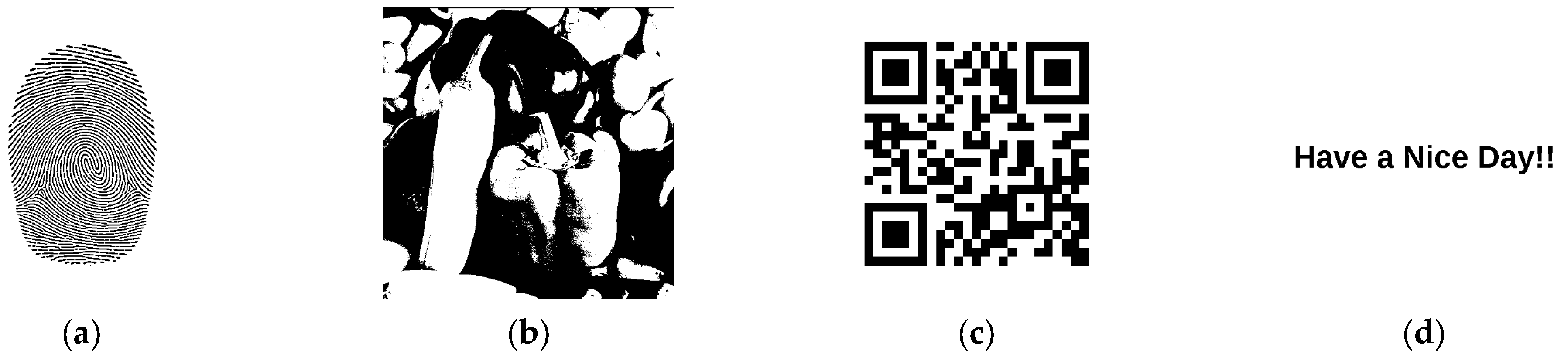
Figure 5 shows four representative secret images, including highly structured patterns such as the Fingerprint image, standard Peppers image, QR code image, and Text image.
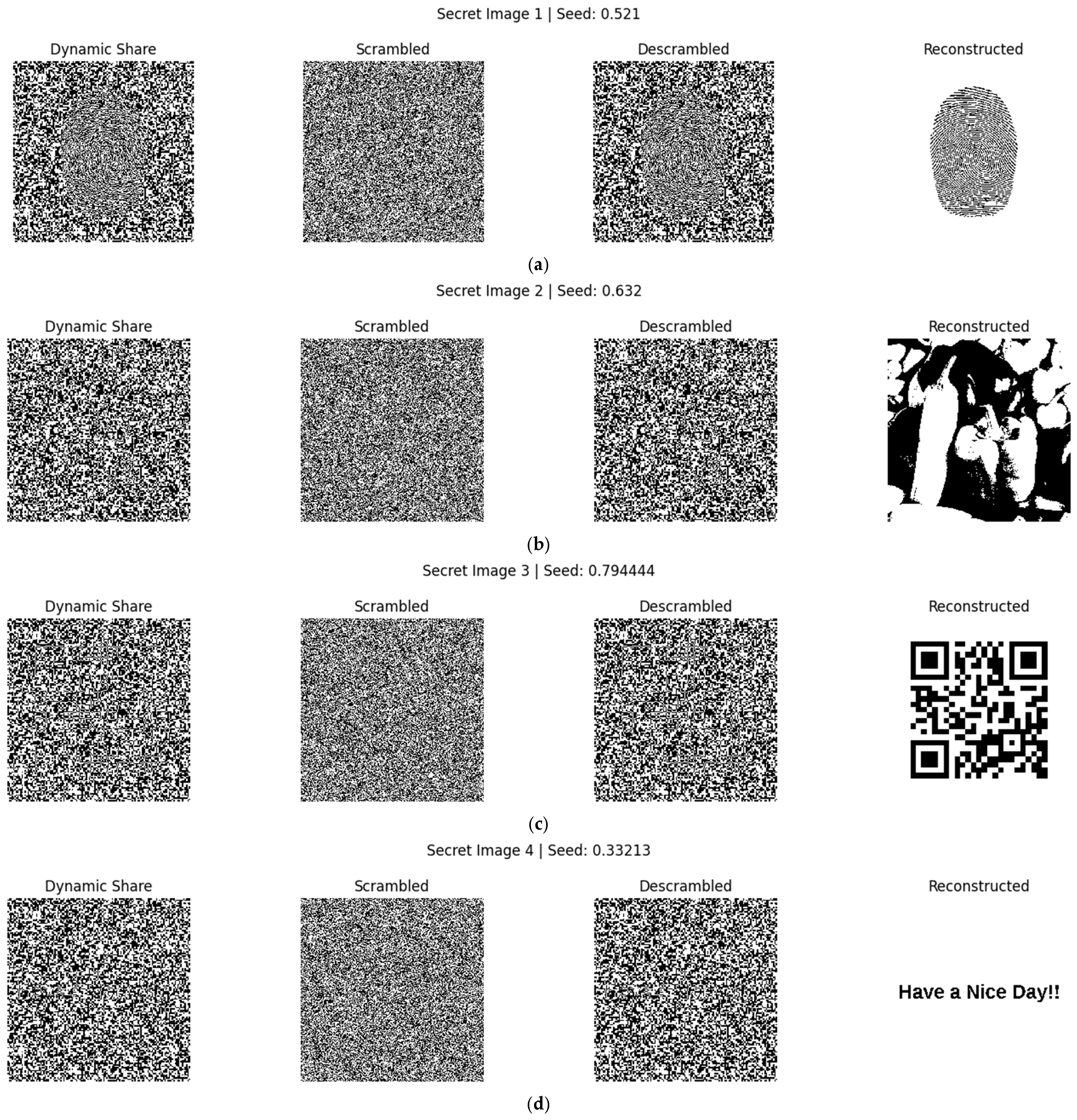
For each secret, the corresponding dynamic share, scrambled dynamic share, descrambled dynamic share, and reconstructed secret are shown in
Figure 6.
The descrambled dynamic shares are pixel-wise identical to the originally generated dynamic shares, confirming the correctness and reversibility of the scrambling process. It is evident that the reconstructed secret images are visually and pixel-wise identical to the original secrets, demonstrating lossless reconstruction and functional correctness. Also, the individual dynamic share, when observed in isolation, is totally random, and nothing can be deduced about the secret. This is consistent with the conditional secrecy guarantee of Theorem 1 Equation (5).
4.3. Experimental Evidence of Secrecy Breakdown Under Multi-Session Reuse (Theorem 1 Limitation)
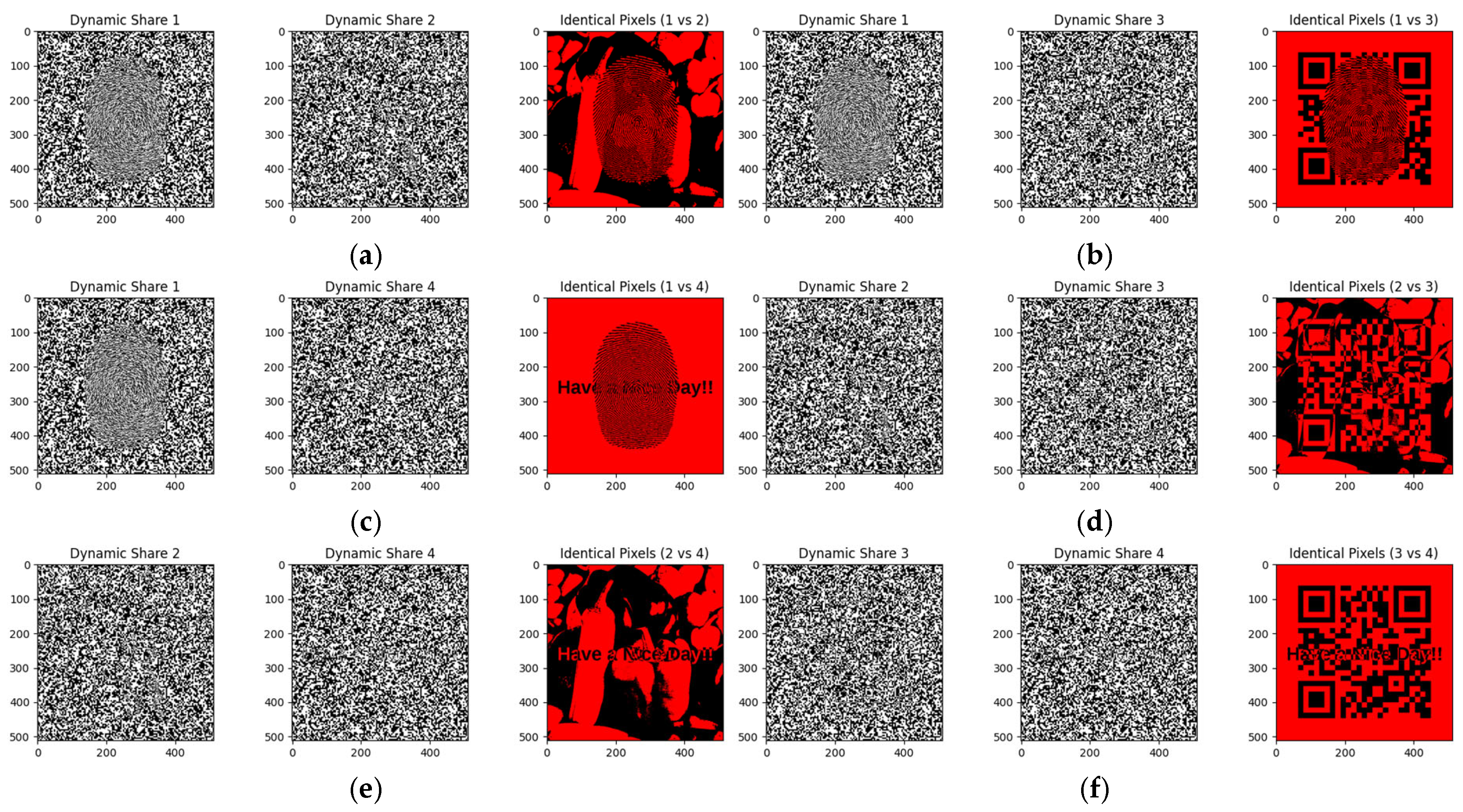
While Theorem 1 Equation (5) guarantees secrecy for a single dynamic share, it explicitly does not extend to adversarial models where multiple dynamic shares generated using the same universal base share are observed. To experimentally demonstrate this limitation, dynamic shares were generated across multiple sessions using the same universal base share.
Figure 7 presents pairwise comparisons of dynamic shares, along with corresponding identical-pixel maps, where red pixels denote positions at which two dynamic shares are identical and black pixels denote differing positions. These maps reveal large red regions where pixels are identical across different dynamic-share pairs, demonstrating a clear violation of Shannon’s perfect-secrecy criterion under multi-session reuse.
More critically, when multiple dynamic shares are jointly analyzed, observable similarities persist across sessions. This confirms the reuse limitation predicted by Theorem 1, demonstrating that XOR-based dynamic sharing alone is insufficient for secure multi-session transmission. These findings necessitate the need for a session-specific chaotic scrambling. This decorrelates dynamic shares across sessions.
4.4. Statistical Security and Randomness Analysis
The statistical properties of scrambled dynamic shares were evaluated using entropy, correlation coefficients, and standardized randomness tests to quantitatively assess transmission-layer security.
Entropy is a measure of how random or unpredictable the data is. The entropy for a binary image is defined as in Equation (9)
where P
i is the probability of the occurrence of the ith value. The entropy of scrambled shares is 0.999986 bits, extremely close to the expected theoretical maximum of 1 bit for binary images.
Correlation analysis further confirms the effectiveness of scrambling. Pearson’s correlation coefficient is widely used in image analysis. It is defined in Equation (10)
where, considering any two images, the intensity is represented as x
i and y
i for the ith pixel and mean intensity values are represented as x
m and y
m of image 1 and image 2, respectively. The average correlation coefficient between universal base share B
s and dynamic share D
k before scrambling is −0.8853, reflecting the inherent linear dependency introduced by XOR operations. After chaotic scrambling, the correlation between D
k and SD
k reduces to −0.00076, effectively eliminating exploitable statistical relationships, and hence is resistant to information leakage.
Randomness validation using the χ
2 test and the NIST monobit test yields
p-values of 0.5568 and 0.5609, respectively. As both values significantly exceed the standard threshold, the null hypothesis of randomness cannot be rejected, confirming the statistical randomness of the scrambled dynamic share. All these metrics and their implications are consolidated in
Table 2.
These results collectively demonstrate that scrambled dynamic shares are statistically indistinguishable from ideal random noise.
4.5. Experimental Validation of Theorem 2: Security Under Multi-Session Base Share Reuse
Theorem 2 states that session-specific permutation enhances practical secrecy under repeated reuse of the universal base share by reducing inter-session correlations among dynamic shares. To experimentally validate this, scrambled dynamic shares generated across multiple sessions using the same base share but different permutation seeds were jointly analyzed.
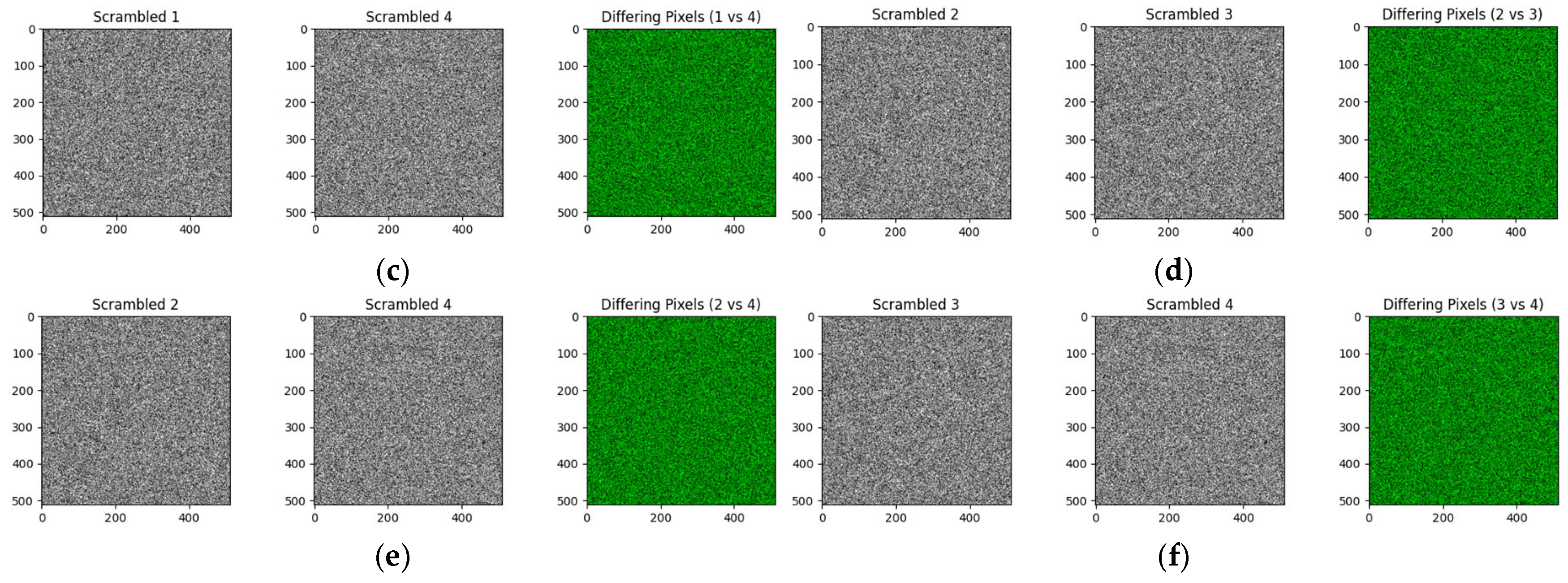
Figure 8 presents representative pairwise comparisons of scrambled dynamic shares, along with corresponding differing-pixel maps, where green pixels denote positions at which two scrambled shares differ and black pixels denote identical positions. In contrast to the identical-pixel maps observed for unscrambled dynamic shares (
Section 4.3), the scrambled-share comparisons exhibit a dominant presence of differing pixels with no visible structured regions.
This behavior indicates that session-specific permutation effectively disrupts the linear dependencies introduced by XOR-based share generation. Since each session applies a distinct permutation, joint observation of multiple scrambled dynamic shares does not reveal consistent spatial or statistical correlations. In the context of visual cryptography, where reconstruction depends on precise pixel alignment, this disruption prevents alignment-based inference across sessions. Consequently, even under multi-session observation, the relationship in Equation (8) is satisfied in a statistical sense, indicating that exploitable dependencies are minimized.
These experimental results demonstrate that permutation-based scrambling significantly reduces information leakage arising from universal base share reuse and empirically supports Theorem 2. Together with the identical-pixel analysis of unscrambled dynamic shares, the results confirm that the security degradation observed in Theorem 1 is effectively mitigated in practice through session-specific permutation.
4.6. Receiver-Side Reconstruction Accuracy and End-to-End Performance
Reconstruction accuracy of the proposed XDMSSVCS framework was assessed by calculating the mean squared error (MSE), peak signal-to-noise ratio (PSNR), and Structural Similarity Index Metrics (SSIMs). These metrics use reconstructed image R and the original secret image I. Their corresponding pixel values’ average squared differences are calculated as MSE. In Equation (11), h refers to the height and w to the width of the image.
PSNR (in dB) is defined as in Equation (12).
where MAX
I = 1, since a binary image has only two possible values, 0 and 1. In the absence of noise, both images I and R are identical, and hence, the obtained value of MSE is 0 and PSNR is infinite.
SSIM assesses the visual fidelity of R by comparing the luminance, contrast, and structural information between I and R as in Equation (13).
where
refers to the mean (average intensity) of images I and R, respectively,
,
refers to the variance,
refers to the covariance between I and R, and C
1 and C
2 are small constants.
Across all experiments, the reconstructed secret images achieved MSE = 0, PSNR = ∞, and SSIM = 1.000, indicating pixel-perfect reconstruction. These results confirm that the proposed scrambling and dynamic sharing mechanisms do not introduce any reconstruction distortion and that the framework achieves exact, lossless recovery while maintaining strong security guarantees.
4.7. Resistance to Attack Models
The security of the proposed XDMSSVCS framework is evaluated under multiple practical attack scenarios, including known-plaintext, chosen-plaintext, adaptive, and multi-session correlation attacks. The objective is to assess whether exploitable relationships can be derived from intercepted shares under different adversarial capabilities.
4.7.1. Known-Plaintext Attack (KPA)
To evaluate resistance against known-plaintext attacks, an adversarial setting is considered where both the plaintext image and the corresponding scrambled share are available to the attacker. Due to the absence of knowledge of the session-specific scrambling permutation, direct recovery of the base share is not feasible. Furthermore, the system exhibits strong diffusion characteristics, where minor changes in the input propagate to a large portion of the output, preventing predictable relationships. The use of session-dependent scrambling ensures that even with access to multiple plaintext–ciphertext pairs, no consistent structural mapping can be established. These properties collectively limit the effectiveness of known-plaintext attacks in practical scenarios.
4.7.2. Chosen-Plaintext Attack (CPA)
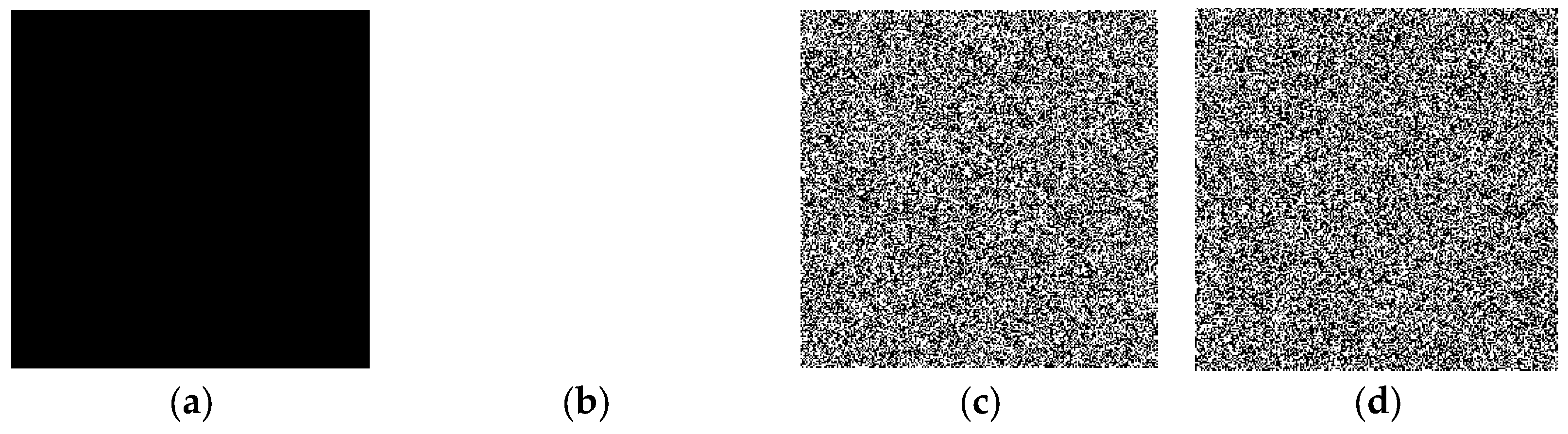
To analyze resistance against chosen-plaintext attacks, structured inputs such as all-black and all-white images were used, and the corresponding scrambled shares were generated. The outputs appear noise-like and do not reveal any visible or statistical relationship despite the linearity of the XOR operation. This is due to the application of session-specific scrambling, which disrupts spatial alignment between inputs and outputs. As illustrated in
Figure 9, the generated shares exhibit no discernible structure, confirming that chosen-plaintext inputs do not provide any exploitable advantage to the attacker.
4.7.3. Adaptive Attack Analysis
An adaptive attack scenario was considered in which the attacker iteratively modifies the input based on previously observed outputs. Experimental analysis shows that even minimal perturbations in the input result in widespread and non-localized changes in the scrambled output. This behavior indicates strong diffusion and high sensitivity to input variations. Consequently, the system does not exhibit predictable input–output relationships, thereby limiting the effectiveness of adaptive attack strategies.
4.7.4. Multi-Session Correlation Attack
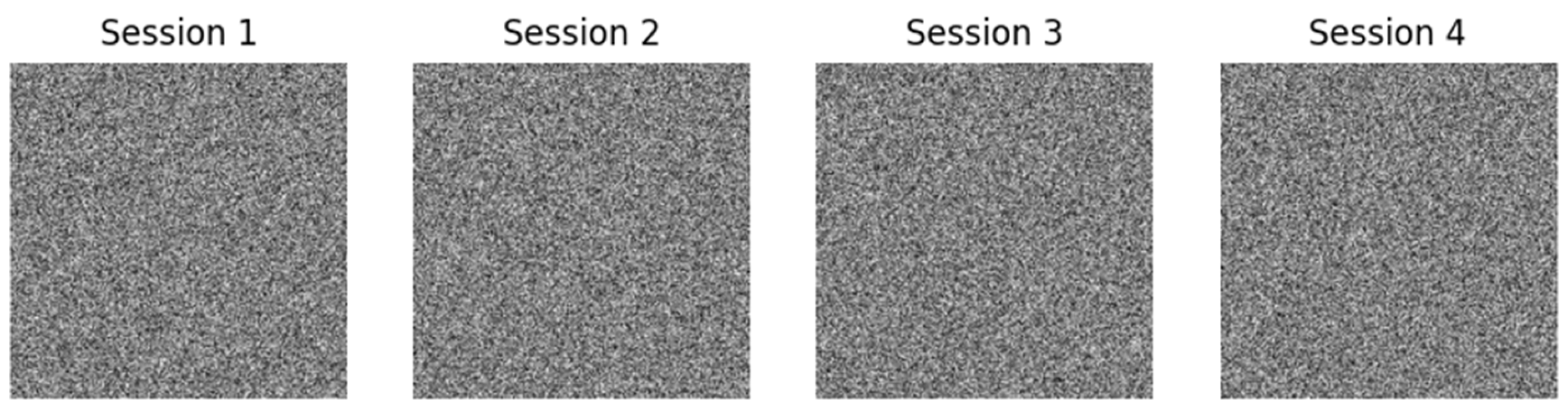
To evaluate resistance against multi-session correlation attacks, the same secret image was processed across multiple sessions using different scrambling parameters. The resulting scrambled shares, as seen in
Figure 10, were analyzed pairwise using correlation metrics. The observed correlation values are consistently close to zero (within ±0.006), indicating the absence of linear dependency across sessions.
Since visual cryptography relies on spatial pixel alignment, the session-specific permutations effectively disrupt cross-session alignment and prevent inference through repeated observations. The quantitative results are summarized in
Table 3, confirming strong resistance to multi-session correlation attacks.
4.7.5. Brute-Force Attack Resistance
The framework benefits from a large effective key space derived from the base share and permutation parameters, making exhaustive search computationally infeasible. Furthermore, the use of distinct permutations across sessions prevents reuse of attack strategies, thereby strengthening resistance against brute-force attempts.
Overall, the proposed XDMSSVCS framework achieves practical security through a combination of XOR-based masking, session-specific permutation, and statistical decorrelation, providing strong resistance against inference-based and computational attacks.
4.8. Keyspace Analysis
The security of the proposed framework depends on the secrecy of the base share and the parameters governing the session-specific permutation process. The base share Bs, being a binary image of size n, contributes a key space of 2n. For a 512 × 512 image, this results in 22262144 possible combinations, which is already computationally infeasible to exhaustively search.
In addition, the permutation process is controlled by a seed Sk and a control parameter r of the logistic map. Assuming a floating-point precision of 10−14, each parameter contributes approximately 1014 possible values. Therefore, the combined contribution of the chaotic parameters is 1014 × 1014 = 1028.
To express this in binary form, using ≈ 3.32, we obtain 1028 ≈ 293.
Hence, the overall key space of the proposed system can be approximated as 2n × 1028
For a 512 × 512 image, this becomes 2262144+93 ≈ 2262237, which is significantly larger than the commonly accepted 2128 threshold for resistance against brute-force attacks.
4.9. Key Sensitivity Analysis
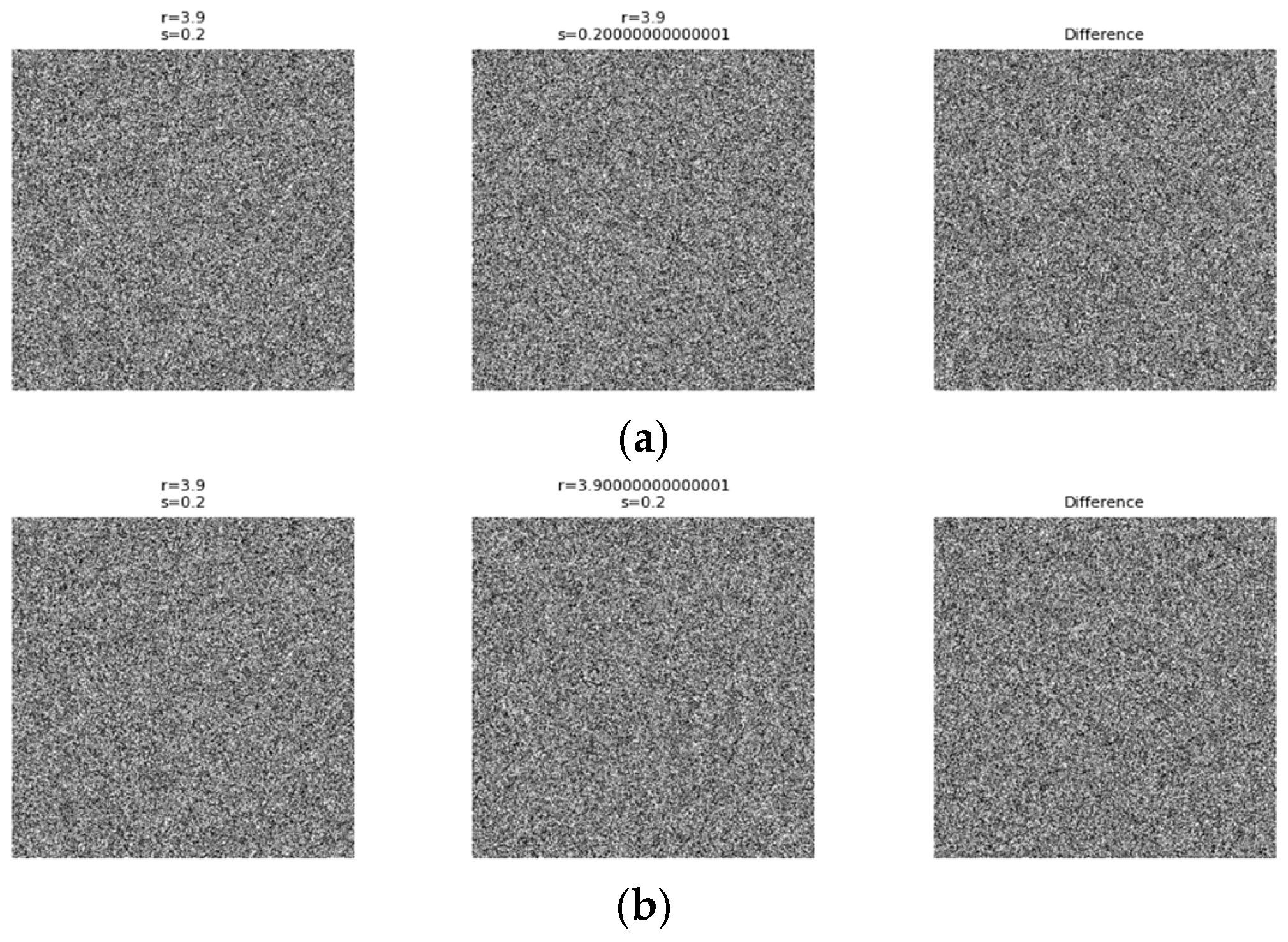
To evaluate the sensitivity of the proposed framework, both the control parameter r and the initial seed were varied with very small perturbations (on the order of 10−14). Specifically, 16 combinations were generated using r = {3.9, 3.90000000000001, 3.90000000000002, 3.90000000000003} and seed values s = {0.2, 0.20000000000001, 0.20000000000002, 0.20000000000003}. For each combination, scrambled dynamic shares were produced, and pairwise correlation analysis was performed across all generated shares. The resulting correlation values were consistently observed to be very close to zero, indicating negligible statistical dependence.
These findings demonstrate that the proposed scheme exhibits high sensitivity to parameter variations, which is a fundamental characteristic of chaotic systems. Furthermore, visual inspection of representative cases (e.g., Pair 1 and Pair 4) in
Figure 11 shows that even minimal perturbations in the parameters lead to completely different noise-like scrambled shares. The corresponding difference (XOR) images display random patterns without any discernible structure, further confirming the absence of correlation. This behavior indicates that no exploitable relationship exists between shares generated using slightly different parameters. Consequently, the proposed framework ensures strong resistance against parameter estimation and brute-force approximation attacks, thereby validating that the security of the system remains robust and consistent under parameter perturbations.
4.10. Robustness
To further evaluate the reliability of the proposed framework, robustness analysis is performed under common perturbations such as noise addition and image cropping.
4.10.1. Noise Attack Analysis
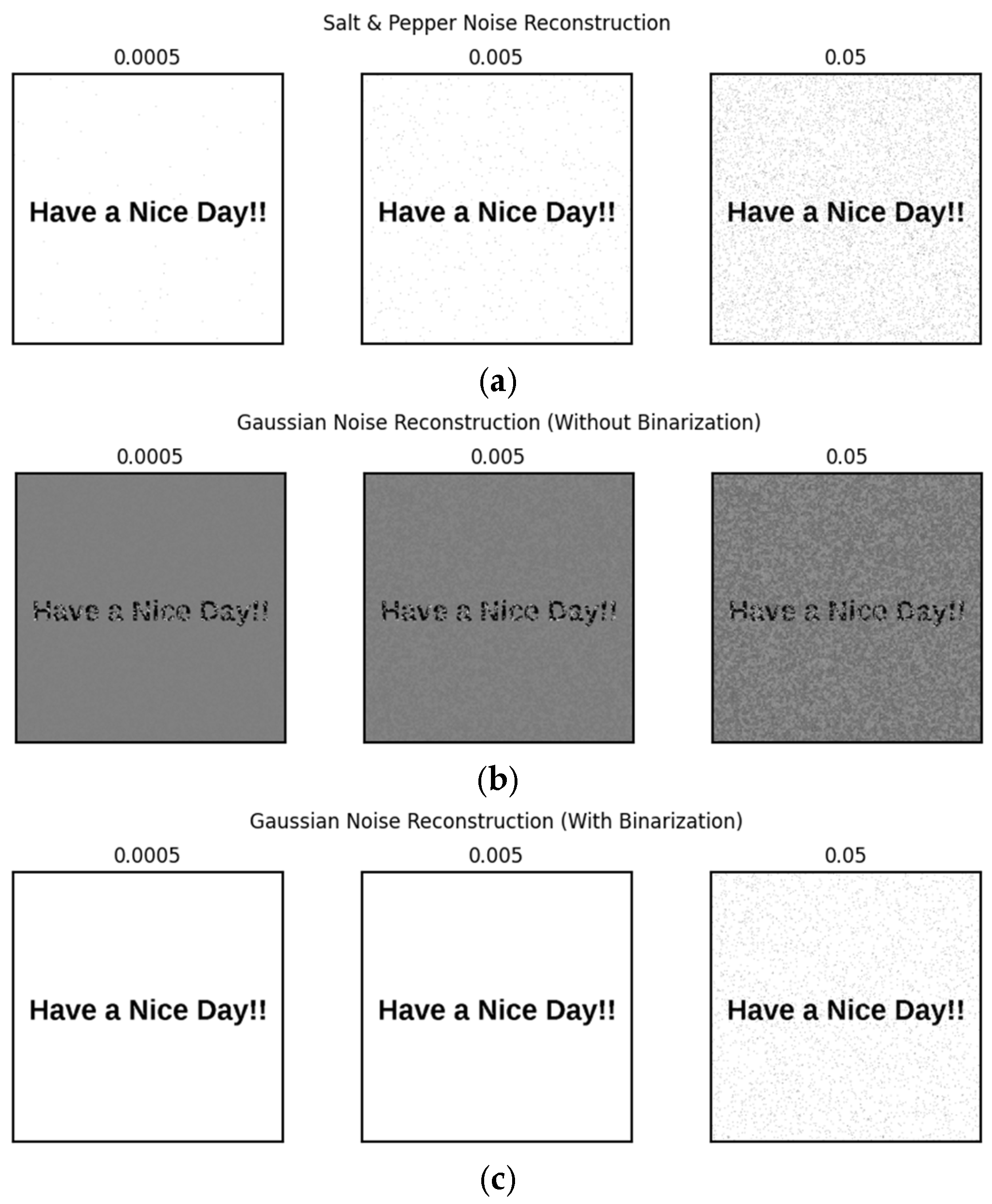
The robustness of the proposed framework was evaluated under salt-and-pepper noise and Gaussian noise at different intensity levels. As observed in
Table 4, the reconstruction under salt-and-pepper noise exhibits a gradual and consistent decrease in PSNR (35.32 dB to 16.04 dB) with increasing noise intensity, indicating stable and predictable degradation behavior. In contrast, Gaussian noise without binarization results in lower PSNR values (approximately 13–16 dB) due to the continuous perturbation of pixel values, which is less compatible with the binary XOR-based reconstruction process. However, when a binarization (thresholding) step is applied after Gaussian noise, the reconstruction quality improves significantly. At lower noise levels, perfect reconstruction is achieved (PSNR = ∞), while at higher noise levels, the PSNR remains higher than that of the non-binarized case. This demonstrates that the effect of continuous noise can be effectively mitigated through a simple digitization step at the receiver.
Figure 12 illustrates the impact of different noise models on the transmitted shares. While Gaussian noise introduces continuous intensity variations, salt-and-pepper noise causes impulse disturbances, and binarization helps restore structural consistency. The results demonstrate that the proposed framework maintains acceptable reconstruction quality under varying noise conditions.
Overall, the results confirm that the proposed scheme supports reliable reconstruction under moderate noise conditions, thereby validating its practical applicability in noisy transmission environments.
4.10.2. Cropped Attack Analysis
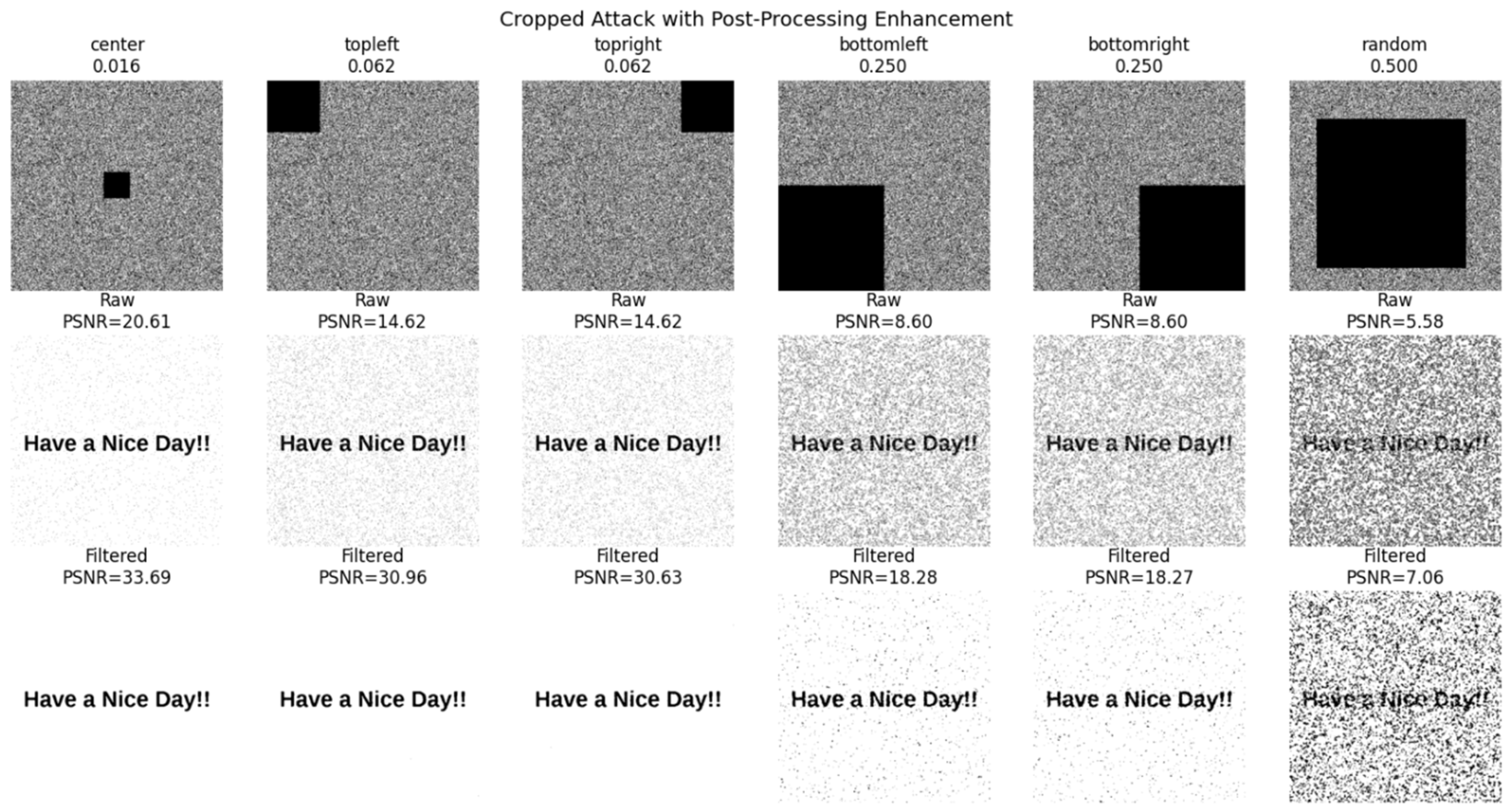
The robustness of the proposed framework against data loss was evaluated using region-based cropping at varying occlusion levels. The results demonstrate that the proposed system is capable of handling cropped attacks effectively, as the reconstructed images retain recognizable structural information even under significant data loss. Although the reconstruction quality decreases with increasing occlusion (from 20.61 dB at 1/64 to 5.58 dB at 1/2), the degradation is gradual rather than abrupt, indicating stable behavior. To further enhance reconstruction quality, a median filtering-based post-processing step (3 × 3 kernel) was applied, which effectively suppresses isolated noise and restores local structural consistency. This leads to substantial improvements in PSNR, increasing from 20.61 dB to 33.69 dB for minimal cropping and from 8.60 dB to approximately 18.27 dB under higher occlusion levels (1/4). Even in extreme cases of ½ random cropping, measurable improvement is observed, as seen in
Table 5. These findings confirm that the proposed scheme not only tolerates partial data loss but can also recover meaningful visual information, thereby demonstrating strong robustness against cropped attacks in practical transmission environments.
Figure 13 visually demonstrates how the system responds to cropped attacks. The top row shows the scrambled shares after portions of the data have been removed, while the middle row presents the corresponding reconstructed images, where the effect of data loss becomes increasingly visible as occlusion grows. The bottom row shows the same reconstructions after applying median filtering, where the images appear noticeably clearer and more coherent. Even when large portions of the data are missing, the overall structure of the original image can still be recognized, and the improvement after filtering is evident. This visual comparison reinforces the quantitative results and highlights the ability of the proposed method to handle partial data loss effectively.
4.11. Computational Performance Analysis
To validate the practical efficiency of the proposed framework, computational time and memory usage were measured on a local system (Intel i5, 8 GB RAM, Windows 10 OS) using multiple runs for a 512 × 512 image.
Table 6 shows the computational time analysis of the proposed framework. The XOR operation exhibits negligible computational overhead, with an average execution time of approximately 0.90 ms, confirming its linear-time efficiency. The scrambling process constitutes the dominant computational component, with an average execution time of approximately 383.72 ms and minimal variation across runs, indicating stable and consistent performance in a controlled offline environment. The descrambling operation is significantly faster, with an average execution time of approximately 10.40 ms. The low variation between minimum and maximum values across all operations demonstrates the reliability of the measurements when executed on a dedicated system. In terms of memory usage, the peak memory requirement was approximately 15.58 MB, indicating a modest and manageable memory footprint. These results confirm that the proposed scheme is computationally efficient, exhibits stable execution characteristics, and is suitable for practical secure image transmission applications. The observed results are consistent with the theoretical complexity, where the permutation-based scrambling dominates the computational cost, while XOR and descrambling operations remain lightweight.
4.12. Storage and Communication Overhead Analysis
Traditional MSSVCSs require multiple shares per secret. This results in higher storage and communication costs. Even though universal share schemes reduce this cost, many of them use static share sets and require that the shares be stored permanently. In contrast, XDMSSVCS does not store the dynamic share and its transmission happens only once per secret. Dynamic shares are generated on demand and discarded after reconstruction, thereby reducing the cumulative storage cost and enabling efficient and scalable long-term multi-secret sharing.
4.13. Scalability
The proposed XDMSSVCS framework is inherently scalable, supporting an arbitrary number of secrets and sharing sessions using a single universal base share. Unlike static multi-secret schemes, it enables on-demand generation. Experimental results show that increasing the number of sessions does not affect reconstruction accuracy, statistical security, or inter-session independence. Session-specific chaotic scrambling preserves security guarantees over time, making the XDMSSVCS well suited for long-term, progressive secret exchange.
4.14. Comparative Analysis with Universal Share-Based MSS Schemes
Table 7 summarizes a comparative evaluation of the proposed XDMSSVCS framework against representative universal share-based MSSVC schemes.
Early approaches such as Fang and Lin [
10] rely on polynomial interpolation, leading to higher computational complexity and lossy reconstruction. Later Boolean-based schemes [
12] achieve lossless recovery but remain statically bound to the number of secrets, limiting scalability. Random grid-based constructions [
11,
13] further reduce computational cost and support XOR-based reconstruction. But the pie-shaped shares [
13] used introduce alignment issues and also limit the scalability as the rotation can be done only to 360 degrees. In contrast, the XDMSSVCS combines lightweight XOR operations with chaotic scrambling to achieve lossless reconstruction, dynamic share–secret decoupling, and scalable multi-session operation. The computational complexity per secret-sharing session is O(n), where n is the image size (H × W), since both XOR-based share generation and reconstruction operate as single-pass pixel-wise operations, with only a lightweight permutation step introducing a modest O(n log n) preprocessing cost. Also, since setup is amortized, the per-secret cost remains linear in image size, and the scheme is suitable for real-time lightweight environments. Unlike existing schemes, the proposed framework enables on-demand generation of independent dynamic shares without reliance on previously generated shares, while explicitly addressing reuse security under repeated sessions. The proposed scheme reduces per-secret share storage by approximately 50–70% compared with conventional MSS approaches. These results show that a good balance can be achieved between computational efficiency, scalability, and security with the XDMSSVCS. This makes the XDMSSVCS suitable for dynamic and long-term multi-secret sharing applications.