1. Introduction
Natural disasters, infrastructure failures, and emergency situations confront public institutions and private-sector organizations with urgent, multidimensional, and complex decision-making processes. Disruptions in communication networks within disaster regions, delays in information flow, and the lack of coordination among technical team workforces significantly degrade the effectiveness of responsive tasks. This issue is particularly critical in tactical field operations where numerous variables must be managed simultaneously, often resulting in the misallocation of resources and increased losses. Within this context, the core focus addressed by this study is the presentation of an automated assignment system. The presented system is a test bed for evaluating and testing assignment algorithms to be deployed to respond to an earthquake disaster. It processes data from various sources, especially location-based information of alarms and technical teams, along with the derived priority of alarms, which is leveraged to improve the overall response impact. The presented procedure replaces or supports the human decision-making process to ensure fast and optimum allocation of resources where urgently needed.
Natural disaster management consists of four fundamental phases: mitigation, preparedness, response, and recovery. The mitigation phase encompasses long-term management activities aimed at preventing or minimizing the consequences of possible emergencies caused by a natural disaster. The preparedness phase involves planning, training, and infrastructure development to assure resilience to possible natural disasters. The response phase refers to immediate actions taken during the occurrence of a disaster to minimize loss of life and property. Finally, the recovery phase includes reconstruction and rehabilitation efforts carried out to restore normal living conditions after a disaster. The effective implementation of natural disaster management processes plays a critical role in reducing the impact of catastrophic events [
1]. In the survey [
1], for each phase of disaster management, the applied artificial intelligence (AI) methods are listed. The availability of the data is presented as a concern about accurate predictions and the computation complexity subject to data size, and data variety is presented as a challenge for processing, managing, and making decisions during a crisis. And it is concluded that the methods and procedures presented for natural disaster management need to be explainable and repeatable.
A conceptual Decision Support System (DSS) framework is presented in order to integrate volunteers effectively into emergency response planning. The framework has four layers: a data management layer for integrating inputs; an analytical layer that serves as the processing core; a user interface layer; and a decision-making layer. The analytical layer includes optimization models for task allocation and resource distribution as a functional service. But use cases and optimization methodologies for emergency response planning are not presented, highlighting a gap in the existing approaches [
2].
In [
3], the usage of machine learning (ML) algorithms during natural disasters and pandemics is reviewed in order to operate emergency services efficiently while using existing resources at maximum level. After a natural disaster, ML algorithms are applied to determine an evacuation route, classify crowd situations, and prevent crowd disasters using Internet of Things (IoT) sensors, Android-based smartphone integrated sensors, and unmanned aerial vehicle (UAV) sensors. In [
4], AI applications using a geographic information system (GIS) and remote sensing (RS) are surveyed for natural disaster management. Classification and mapping of damaged buildings and regions by using a convolutional neural network (CNN) are shown. The telecom infrastructure and telecom services are mentioned as application areas.
In [
5], for crisis management and emergency coordination, social media platforms and posts are also used by ML algorithms. Social media posts can be useful for coordination and support. Responding to a crisis using social media data is presented as a need, but existing results use only the social media dataset of X, formerly known as Twitter, and the number of original posts needs to be augmented for better understanding disaster situations and achieving more successful prediction results. In [
6], social media data including time and position information are used to analyze and classify emergencies for the coordination of resources. Keywords related to emergencies are extracted, and spatio-temporal information provided by posts is used to determine time and position of an emergency disaster. Deep learning and BERT models reach levels of 0.8972 and 0.9808 in recall, considering the detection of rescue and non-rescue classes, respectively. Social media data involving spatio-temporal information are used to analyze sentiments of the natural disaster-affected public and their needs. AI is adapted by integrating reinforcement learning, natural language processing, and gamification in a platform; some resources such as water, food, medical aid, shelter, and electricity are distributed as a response to a natural disaster while refining policies and considering sentiments of the public [
7]. But using social media information for disaster management is very challenging because social media users can spread misinformation, and such information can not be trusted. The quality of information, or more specifically, contents of posts can be poor and not usable because of emojis, irrelevant characters, etc. They are presented as the main challenges to rendering the information extracted from social media useful in disaster management [
8].
In [
9], a comprehensive review of methods for modeling interdependencies among critical infrastructure systems is presented. This review highlights that when an extreme disaster occurs, those interdependencies cause vulnerabilities that can spur cascading failures and significantly delay or prevent response activities. In [
10], the proliferation of big data sources and rapid advancements in data analytics have paved the way for the broader adoption of AI applications in estimating disaster-related losses and recovery costs. However, the lack of standardization in data collection and recording processes can lead to significant discrepancies in the prediction of economic impacts. A Seismic Risk Digital Twin (SRDT) was developed to practice earthquake management in [
11]. All phases of disaster management can be developed by the presented SRDT platform fed by a large variety of data, including geospatial, structural, demographic, and real-time sensor data. AI is integrated into SRDT disaster management in a similar way to [
12].
The organization and coordination of volunteers in emergency management are often critically important during response and recovery operations [
13]. Effective and timely management of volunteer resources can enhance the capacity of communities and organizations to cope with crises such as natural disasters, pandemics, and other emergency scenarios [
14,
15]. However, while the influx of volunteers can be beneficial, it also presents significant management challenges and requires well-structured planning models to ensure their potential is utilized effectively [
16,
17]. The dynamic integration of volunteers, technical field teams, and public institutions into the system data necessitates operation of the DSS on a quasi-real-time basis. An integrated DSS architecture is presented by incorporating AI-based event detection, data fusion, and task-matching modules in [
18].
A bi-criteria integer programming model is adapted to a volunteer management model in humanitarian organizations. To assign an individual or a group of volunteers to tasks, the cost function is introduced to represent total shortage costs and the number of undesired assignments specifying task preferences of volunteers in [
19]. Considering disaster rescue and recovery tasks, volunteers’ parameters such as self-satisfaction, experience, peer recognition, and cooperation are classified by an expert. A satisfaction evaluation model was constructed following bilateral matching between rescue recovery tasks and volunteers based on the Extended Belief Rule-Based (EBRB) method. Aiming to enhance the effectiveness of disaster response efforts provided by volunteers, the matching process is validated and optimized using Data Envelopment Analysis (DEA) and Differential Evolution (DE) algorithms [
20].
In [
21], priority levels of relief supplies are determined by crowdsourcing. A cost function is presented while taking into account the constraints related to the priority levels of emergency needs and maximum usage of resources. Needs are prioritized on the basis of the severity of injuries within a few hours of the natural disaster’s occurrence. The genetic algorithm is applied to find the optimal solution. The numerical data are used under the assumption of a small hilly land in which location of local support agencies is defined. Eleven instances are considered to improve the efficacy in real-life situations. In [
22], the game theory is presented to allocate and distribute resources during natural disaster management. Disaster locations are the players who compete for limited resources. The cost function is introduced, and the resource allocation strategy is determined by the pure strategy Nash equilibrium (PSNE). Case studies are used to validate the presented methodology.
The distribution and optimal use of resources as a response to a natural disaster play crucial roles in sustaining survivors and making the infrastructure functional again. Resource planning, organizational management capability, resource support capability, and information processing capability constitute the operational capabilities [
23]. The Analytic Hierarchy Process is used to present an evaluation index to assess the operational capability factors and indicators in China and Korea. Global weights are also calculated, and the fast response and resource allocation capabilities are identified as the factors with the most impact on operational capability.
For natural disaster management, when core nodes in the telecom infrastructure are not functional due to destructive effects of the disaster or congested due to heavy communication traffic, a high-throughput satellite system is presented as an alternative to cellular communication for a wide area [
24]. In [
25], impacts of possible natural disasters including floods, hurricanes, winter storms, tsunami, earthquakes, fires, and thunderstorms on telecommunication networks are categorized. Earthquakes have a severe impact without warning, cause failures of electrical power, and damage the core nodes by vibration. Wireless traffic and short message service (SMS) patterns are analyzed during and after a severe winter storm by applying a mixed-design analysis of variance (ANOVA) design. Voice minutes by day and text messages by day are shown to be increased during the storm period, then reduced back to their daily usage levels after the storm.
This study is motivated by the earthquake disaster that occurred on 6 February 2023. Eleven cities were affected by that earthquake disaster. This was a highly destructive earthquake whose moment magnitude was (Mw) 7.8. The earthquake hit southern and central Turkiye and northern and western Syria, an overall area of about 350.000 km
2, almost the size of Germany, and affected 14 million people, about 16% of Turkiye’s population. Sustainability in all aspects of living needs was heavily affected; for instance, severe effects of the earthquake on the agriculture and food sectors were analyzed in [
26]. Mobile network data from a telecom operator revealed that technical teams, manually dispatched, reached the natural disaster area only by the end of the second day in order to repair base station alarms and to re-deploy cellular communication. And operational effectiveness was assured by the third day. This delay highlights the limitations of manual coordination and the need for automated and data-driven systems. The presented approach addresses the gap in the literature and presents an automated natural disaster response system along with a comprehensive analysis of algorithms. The presented algorithms have either a multi-objective cost function subject to time-varying constraints or a heuristic. Multi-objectives with constraints are hard to solve because of the increasing number of alarms and the limited number of available technical teams affected by the destructive effects of the disaster. A systematic evaluation of assignment algorithms is conducted, and their disaster response performance is compared using a real alarm dataset logged under the extreme operational conditions of a natural disaster. This study fills specific gaps in comparison to prior studies (e.g., [
2,
5,
18]) by using the real alarm data logged after a destructive earthquake, adopting a multi-objective optimization along with the performance metrics used by telecom operators. Overall, it presents a top–bottom architecture well suited for field operation in an autonomous, efficient and effective manner. Furthermore, the presented methodology is tested using the real dataset, with the preliminary results validated by an expert technical operator.
In this study, a large variety of algorithms, including Adaptive Hungarian Algorithm, Mixed-Integer Linear Programming (MILP), Minimum-Cost Flow Problem (MCFP), Constraint Programming–Satisfiability (CP-SAT), Regret Heuristic, Genetic Algorithm, and Greedy Nearest-Neighbor Algorithm, are evaluated and tested on their performance in task assignment to technical teams for the repair of base station alarms that are malfunctioning due to the earthquake. Data from multiple sources on a spatio-temporal basis, including cellular network analytics, application workflows, and base station alarms, along with the availability of technical teams, are used. The system is automated in order to reduce the response time to a natural disaster and assign technical teams subject to minimum travel distance to alarm coordinates by taking into account the priority constraints defined in terms of base station locations and the number of connected subscribers. A multi-objective optimization is conducted to maximize the assignment rate of alarms while selecting technical teams whose relative travel distance to the alarm coordinates is minimum in comparison to other available teams’ travel distance, and also to assure that higher-priority alarms are assigned first. In consequence, responsiveness to the earthquake disaster is enhanced by re-deploying mobile communication services in a fast and efficient manner.
The contributions of this study are as follows:
- (i)
The selected algorithms span a spectrum from exact optimization to fast heuristics. They are adopted for responding to a natural disaster and compared by key performance indexes such as the assignment rate of alarms subject to priority, the relative travel distance between the technical team and alarm, and the response time of algorithms. A real-world procedure is implemented, and when the number of alarms is higher than the number of technical teams, a rollover mechanism ensures alarm assignment continuity by transferring unassigned alarm repair tasks to the next time window.
- (ii)
Domain-informed function: A weighted cost function integrates geodesic distance, alarm priority, and geographic cluster integrity to minimize both response time and total travel distance.
- (iii)
Site prioritization and intervention optimization in earthquake-affected regions: This study leverages comprehensive data from the telecommunications operator’s infrastructure in the Hatay region in conjunction with the 2023 earthquake. The dataset includes alarm data logged for all sites, their designation as emergency gathering centers, their role in serving critical infrastructure sites, and their operational criticality levels. A heatmap or a change in the number of connected mobile phone users is generated based on the number of mobile phone users connected to each individual base station. And the location data of technical teams to be deployed to the natural disaster-affected regions are known and collected by their mobile phones. Using this multi-dimensional dataset, alarms are systematically categorized, sorted according to computed priority levels, and matched with the available resources of technical field teams. Experimental scenarios demonstrate that this presented procedure enables timely and effective assignment to base station alarms as an alternative to the legacy procedure of manual monitoring and decision-making.
This paper is organized as follows: In the Introduction section, motivation, literature review, and contributions of the paper are presented. In the second section, the dataset of the natural disaster is explained in detail, and the flowchart and methodologies are elaborated. The flowchart of fusing both alarms and technical teams using location information and priority of alarms is presented. Assignment algorithms are adopted for responding to a natural disaster. Their formulations are given, including the formulation of natural response multi-objectives and constraints. In the third section, an experimental study is presented. Assignment algorithms are evaluated and tested. Algorithm performance is evaluated and tested subject to a varying number of technical teams. Experimental results are compared using performance metrics in order to analyze improvements in assignment responses to the earthquake disaster. The performance of methods is evaluated and tested by using a telecom operator’s data logged after a natural disaster. Finally, some conclusions are given.
2. Technical Team’s Assignment to Base Station Alarms as a Response to Earthquake Disaster
To respond to the earthquake disaster and ensure cellular communication provided by base stations in disaster regions, technical teams are assigned in order to repair base stations that are not functional and causing alarm signals. Alarm signals are collected by the control and command (C&C) center, and then, alarms are assigned to the technical teams in order to respond to those alarms and make functional again base stations harmed or congested by abnormal operational conditions in conjunction with the destructive effects of the earthquake. Since local technical teams in the regions affected by the earthquake can not be reached due to communication failure or being themselves injured, technical teams outside the earthquake region, such as teams deployed in the neighboring cities, are assigned to repair alarms of base stations. These rescue technical teams are commanded to travel to these earthquake-disaster-hit regions.
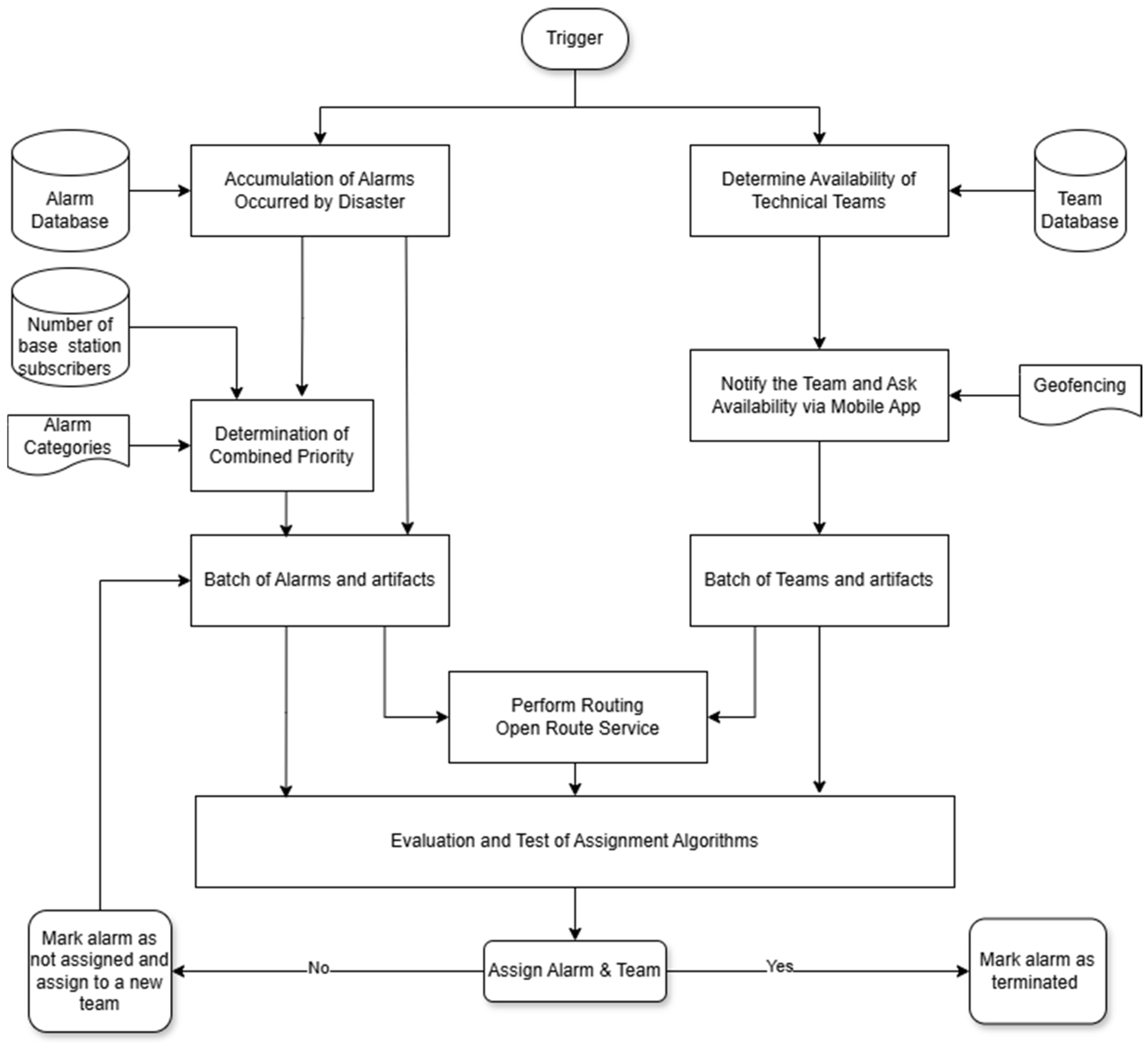
The presented system processes data from different sources, especially location-based information of alarms and technical teams. The priority level of alarms is leveraged to improve the overall assignment performance. Test scenarios use the technical teams’ location information logged and updated in the other dataset. The flowchart of the presented automated assignment system is presented in
Figure 1. The process of allocating technical teams to alarms is triggered upon the occurrence of the earthquake. For instance, the trigger signal may be retrieved from the Regional Earthquake-Tsunami Monitoring Center in order to start this disaster response procedure. Then, the flowchart has two branches: the first branch collects the base station alarms occurring because of the destructive effect of the earthquake, determines the alarm priority and batches alarms in 5-min time interval along with the type of alarm, its location, and the number of subscribers in order to compute its priority. These alarms are cached until they are assigned to a technical team. The second branch is for extracting technical teams’ locations and their availability via the database. The availability of a technical team is determined by sending a notification via the mobile application or other internet messaging tools. The technical teams are selected in the perimeter of the earthquake, and this coverage can be extended in order to allocate a higher number of technical teams. Then, Open Route Service (ORS) is used in the back-end server and the road digital map data, and routing provided by the ORS is applied to calculate the relative distance between the pair (team
i, alarm
j). The multi-objective optimization algorithms are evaluated to allocate a technical team to an alarm while minimizing their cost functions subject to constraints. When the alarm is not assigned to a technical team, it is backlogged and kept in the oncoming 5-min time intervals until it is assigned.
2.1. Dataset
The dataset is constituted by alarms logged from cellular communication base stations reporting malfunctions and causes of operational failure, starting with the earthquake that occurred on 6 February 2023, in Turkiye. This dataset covers 11 affected cities, including urban and suburban areas. It represents a large-scale disaster scenario, involving simultaneous alarms from numerous base stations across a wide geographical area. Within a 24-h period, the dataset includes 5500 alarms originating from various provinces and field locations. The dataset captures alarms generated throughout a single day, and the 24-h period is divided into 5-min time intervals (resulting in 288 time groups) to simulate temporal flow, i.e., 00:00 to 00:05, 23:55 to 23:59 h:min. The rationale for using a 5-min time interval is related to some alarms caused by a base station’s site outage or partial site outage. These types of transient alarms are observed to be healed in 5 min, and they do not require assignment of a technical team due to their transient and parasitic behavior. Of the overall total of 10,570 alarms within a 24-h period, 5070 alarms are self-repaired in 5 min. Therefore, a 5-min time interval is used to accumulate alarms.
2.2. Implementation of Algorithms for Response Improvement During Disaster Scenarios
For evaluation and test purposes, a large set of algorithms is chosen, spanning a spectrum from exact optimization to fast heuristics. The Adaptive Hungarian algorithm is chosen for its optimality on dynamic snapshots of a 5-min time interval allocated for assigning technical teams to alarms. Its priority weighting capability includes priority as a large weight in the cost matrix, which is periodically computed [
27,
28]. And the Adaptive Hungarian algorithm generates dynamic responses. Mixed-Integer Linear Programming (MILP) is chosen to establish a performance baseline for benchmarking purposes. MILP presents multi-objectives and constraints by assuring binary assignment decisions with a linear objective subject to linear constraints. The MILP algorithm is well suited for planning and simulation purposes, i.e., off-line [
29,
30]. The Minimum-Cost Flow Problem (MCFP) is like MILP, but it has a network flow structure. MCFP flow models compute optimal solutions efficiently for linear assignment structures and are well-suited to large-scale instances with limited constraints [
31,
32]. The Constraint Programming–Satisfiability (CP-SAT) model is constructed using the binary variables and assignment constraints. CP-SAT is particularly effective when the assignment problem must be combined with complex logical or combinatorial constraints and satisfies constraints within a given time limit on highly discrete decision problems. But during crisis management as a response to a natural disaster, CP-SAT may fail at generating a solution, subject to the varying number of technical teams, alarms, and constraints [
33,
34]. The Regret Heuristic Algorithm is acceptable when computational resources are extremely limited, and the complexity of the problem is low [
35,
36]. It presents a significant improvement over the basic Greedy Nearest-Neighbor. The Genetic Algorithm presents a robust metaheuristic for complex, nonconvex objectives. It is an alternative when exact models are too slow, but it needs tuning and does not guarantee an optimum solution [
37,
38]. The Greedy Nearest-Neighbor algorithm is a real-time baseline approach. A greedy heuristic repeatedly assigns the technical team–alarm pair subject to the minimum cost among all feasible pairs. Although it is computationally inexpensive and suitable for real-time dispatch, this method can be poor globally [
39,
40].
In this study, algorithms are adopted in order to evaluate their performance at assigning technical teams to alarms as a multi-objective optimization problem subject to constraints. Objectives are to assign a technical team to an alarm subject to minimum relative travel distance in the set of available teams and alarms, maximize assignment rate of alarms such that the algorithm assures all alarms are assigned to technical teams, and as the last objective, alarms having a higher priority are assigned first versus lower-priority alarms. The cost functions and constraints of the algorithms are adopted in order to satisfy multi-objective requirements. A set of technical teams must be assigned to a set of alarms with priorities and spatial location. denotes the set of technical teams available in the 5-min time interval used for assignment, and is the set of alarms that occurred in the previous time intervals. Since alarms are caused by the earthquake effects, the number of alarms to be assigned is higher than the number of available teams to be deployed simultaneously; .
- (1)
The Adaptive Hungarian Algorithm is an extension of the classic Hungarian algorithm that dynamically adjusts the cost matrix to perform multi-objective and time-varying constraints. The cost function for assignment of the pair (team
i, alarm
j) is derived by
where
denotes the relative distance between the pair (team
i, alarm
j),
is the combined priority,
is assignment rate, and
,
and
are adaptive and positive value weights adjusted iteratively based on minimizing travel distance, maximizing the assignment rate of technical teams to alarms with a higher priority [
41]. The algorithm solves the standard assignment cost function:
Binary decision variables are defined as
- (2)
MILP is a precise mathematical model where the multi-objective problem is formulated as a single objective using positive value weights denoted by
,
,
:
where each technical team can be assigned at most to one alarm, and each alarm can be assigned by at most one technical team:
where
is the binary decision variable given by (3).
- (3)
MCFP models the assignment problem on a flow network. This algorithm creates a bipartite graph: source node
connected to all technical team nodes
with capacity = 1, cost = 0, technical teams connected to alarm nodes
with capacity = 1, and the cost function is given by
task nodes that are connected to sink node
with capacity = 1 and cost = 0. The total from
to
is subject to flow conservation and capacity constraints where
is a binary decision variable. The binary assignment is
given by (3).
- (4)
The CP-SAT model is a declarative approach using Boolean logic and finite domain variables. CP-SAT is a modern complete solver combining constraint programming with satisfiability-based search and linear programming (LP) ideas. It is mainly introduced for scheduling and assignment with discrete constraints. Its objective is to maximize the function constituted by the weighted sum of
denoting the combined priority,
the assignment rate, and
relative distance between for all pairs of technical teams and alarms (team
i, alarm
j):
where
,
and
are adaptive weights. Constraints are the same as in the MILP definition given by (5) as follows:
where
is the binary decision variable given by (3).
- (5)
The Regret Heuristic Algorithm is a constructive, greedy-like heuristic that considers the cost of not making the best assignment. For each unassigned technical team, it calculates
This formulation represents the opportunity cost of not assigning the highest priority alarm task. The algorithm assigns the technical team with the maximum regret to the highest-priority alarm first, then updates and repeats. Priority is integrated by defining
- (6)
The Genetic Algorithm is a population-based metaheuristic inspired by natural selection. It is a population-based metaheuristic that evolves candidate assignments via selection, crossover, and mutation. Typical assignment encoding, fitness function and selection, crossover, mutation and evolution phase of population-based metaheuristic for response to the earthquake and assignment of technical teams to alarms is presented as follows:
A chromosome is defined as
. Each gene
represents the assigned team for alarm
i. The algorithm evolves these variables to minimize the fitness function:
where
denotes the total of assignment rate,
denotes the total of travelling distance,
is the total priority, and
,
,
are positive value weights.
The population-based metaheuristic is executed as follows:
Selection: Choose parent chromosomes (e.g., tournament selection).
Crossover: Combine parents to produce offspring (e.g., Ordered Crossover—OX—to maintain permutation validity).
Mutation: Randomly swap two genes or mutate a segment.
Evolution: Iteratively select, crossover, and mutate to create new generations, retaining the fittest individuals.
- (7)
The Greedy Nearest-Neighbor Algorithm is a simple heuristic that assigns based on nearest distance (or lowest “effective cost”). For natural disaster response, it is adopted to prefer high priority, and not only relative distance. For alarm–technical team assignment, a score is defined by
Algorithm steps are applied as follows:
Repeatedly select all alarms until they are assigned to a technical team.
Find the unassigned pair of the technical team and alarm giving the highest score .
Assign the technical team to the alarm .
Mark both assigned.
The selected algorithms span a spectrum from exact optimization to fast heuristics. Greedy nearest-neighbor and regret heuristics offer rapid solutions suitable for time-critical response, but can not guarantee optimality. The Hungarian algorithm computes optimal solutions efficiently for linear assignment structures and is well-suited to large-scale instances with limited constraints. MILP and MCFP models offer the greatest modeling flexibility and can capture realistic disaster-response requirements, at the expense of increased computational effort. CP-SAT offers a feasible solution quickly, and it is applied to test its replicability from scheduling with complex rules and side constraints to an emergency response use case. Genetic algorithms provide a flexible alternative when the problem structure or scale renders exact methods impractical. Together, these approaches enable a systematic evaluation of disaster-response performance using a real alarm dataset logged under a natural disaster’s extreme operational conditions.
3. Experimental Study
The dataset of 11 February 2023 was used for experiments. Simultaneous alarms from numerous base stations across a very wide geographical area occurred. The dataset comprises 5500 alarms. In addition to the real alarm and field dataset, the test scenarios use the technical teams’ location data.
The dataset contains alarms occurring throughout a day. The timeline is simulated by dividing the 24-h day into 5-min subgroups (288 groups), such as 00:00 and 00:05, 23:55 and 23:59 h:min. The location data include 642 technical teams distributed at randomly selected locations within the country in order to evaluate and test the performance of technical teams’ assignment methodologies. Technical teams are selected from outside of the earthquake zones and asked to repair base station alarms in the earthquake affected regions. The Open Route Service (ORS) is used in the back-end server to compute the relative distance between a given alarm’s location and the available technical team’s location [
42]. The relative distance between the pair (team
i, alarm
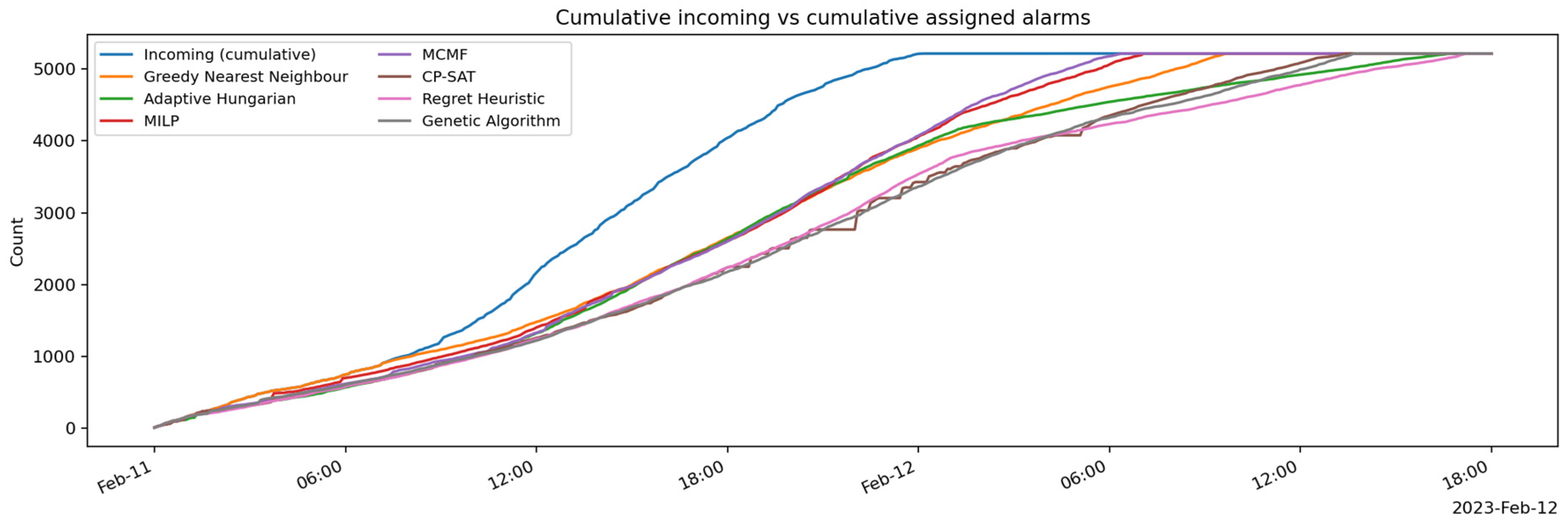
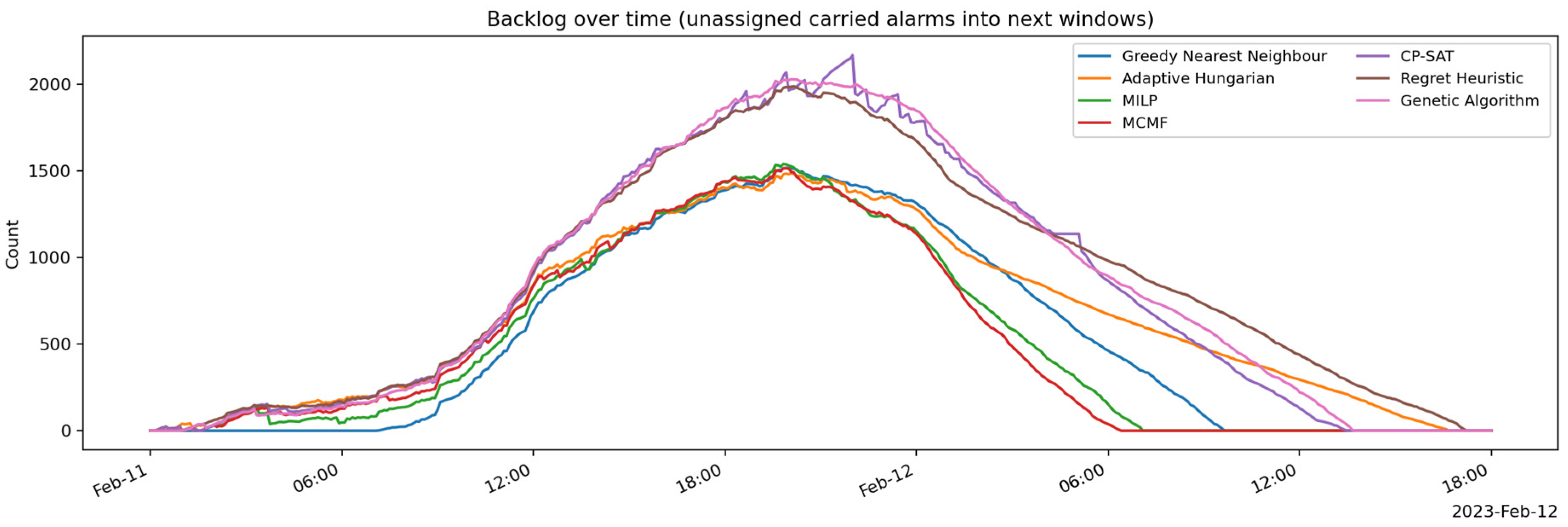
j) is the digital road map matched distance, and it presents the road distance to be traveled by the candidate technical team to reach the given alarm’s location provided by ORS, assuring optimum routing for navigation purposes. Assignment rate is defined as the ratio of the number of alarms assigned to a technical team versus the total number of alarms to be assigned. An alarm is considered as assigned until the technical team repairs it, and an alarm is considered unassigned until it is assigned to a technical team. An alarm can be assigned in the first 5-min subgroup upon its occurrence, or that alarm can be backlogged to the oncoming 5-min subgroup. The sum of alarms is equal to the number of assigned alarms and the number of unassigned alarms constituted by the new arrivals whose responses are plotted in
Figure 2 and backlogged alarms in
Figure 3. The assignment rate takes a value between [0, 1].
The priority is computed, and it is added in the overall cost as a multi-objective cost given by (1) through (12) in order to reward the selection of base station and alarms having a higher priority versus other alarms. The first prioritization term is related to the location of the base station. The location of the base station is prioritized to sort alarms. A base station is prioritized when its cellular base station whose antenna range covers liability-critical and safety-critical points of interest, such as disaster and emergency management rescue and relief effort units, airports, hospitals, government buildings, etc. Obviously, these prioritized base stations have to be functional in the first stage of disaster and crisis management. A priority is assigned to the base station as a configuration parameter in the dataset. The second prioritization term is related to the number of subscribers connected to a base station. Assignment of technical teams is prioritized to ensure that the base station with a higher number of mobile communication subscribers is functional. It is calculated at the end of the day, i.e., 00:00 h:min, as the difference between the number of subscribers connected to the same base station one day ago and on the same day, i.e., a heatmap as the difference in the number of connected subscribers considering all base stations in the region.
This priority value is a weighted average of base station location and the number of subscribers for each base station, as follows:
where
x denotes the priority value given for each base station location,
z denotes the difference between the number of subscribers, and α is the weight value between [0, 1], and it is chosen by an expert technical operator as α = 0.7.
The cumulative number of occurring alarms with respect to time is plotted with blue color in
Figure 2. The number of alarms is increasing by 11 February, 00:00. Alarms are assigned to technical teams by using Adaptive Hungarian Algorithm, MILP, MCFP, CP-SAT, Regret Heuristic, Genetic Algorithm, and Greedy Nearest-Neighbor Algorithm. The performance in assigning technical teams to alarms is evaluated and compared. All algorithms assign alarms to technical teams, and the number of alarms is reached at the total number of alarms, that is 5500.
The number of unassigned alarms, illustrating the algorithms’ capability of assignment of technical teams to an oncoming alarm, is plotted and compared in
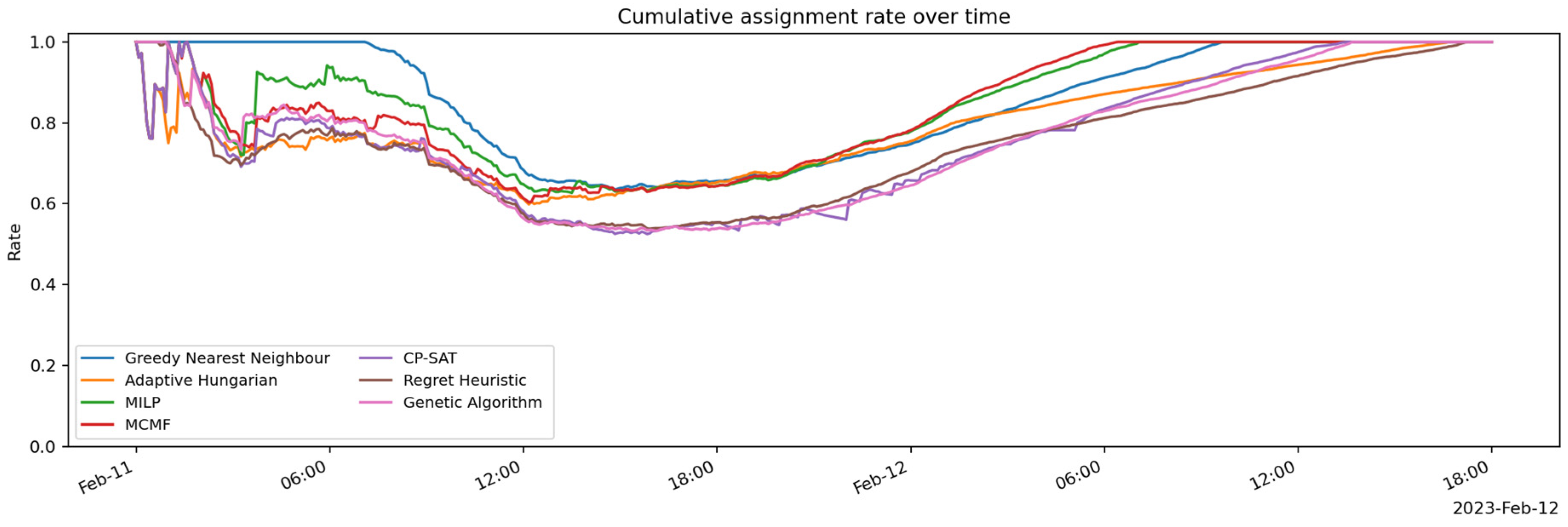
Figure 3. The number of unassigned alarms is zero at the initial time, i.e., 00:00, because there is a higher number of available technical teams in comparison to the number of alarms in the initial 5-min time window. Algorithm results for alarms unassigned and backlogged to the oncoming 5-min intervals are compared. In line with assignment rate responses plotted in
Figure 4, the MILP and MCMF algorithms optimize the assignment rate objective and minimize the number of unassigned alarms more successfully in comparison to other algorithms. The Adaptive Hungarian Algorithm leverages its weighting capability and minimizes unassigned alarms adequately. The Greedy Nearest-Neighbor Algorithm, as a real-time algorithm, minimizes costs simultaneously at the initial stage. Along with the arrival of new alarms, increasing highly the total number of alarms to be assigned, the greedy-basis approach can not minimize the number of unassigned alarms due to its inability to optimize team distribution in comparison to optimized MILP and MCMF. But its performance is adequate at minimizing unassigned alarms. CP-SAT, Regret Heuristic, and Genetic Algorithm reach the highest level in an unassigned number of alarms. They do not guarantee optimality and cost minimization, but they assign all accumulated alarms by the end of the second day, 12 February, noon by spatial indexing and optimal solution of the cost function given by (8), (9) and (11), respectively.
The cumulative assignment ratio over time is plotted and compared in
Figure 4. MILP and MCMF, whose time responses are plotted in green and red color, respectively, perform with a high assignment rate using their multi-objective solution subject to constraints. Assignment rate responses are maximized by their optimal solutions throughout the assignment process. At the initial stage and along with the accumulated alarms, the cumulative rate responses are lowered, but in comparison to other algorithms, their optimal solution guarantees an improved solution versus other algorithms while increasing the assignment rate. The Greedy Nearest-Neighbor Algorithm, whose responses are plotted with blue color, as a fast baseline algorithm, presents the highest assignment rate using its capability of selecting the minimum cost between the technical teams and alarms faster than other algorithms at the initial stage of the assignment process. Along with the arrival of new alarms and accumulation of alarms, it can not guarantee optimality in comparison to MILP and MCMF. The Adaptive Hungarian Algorithm, plotted with orange color, weights assignment rate maximization and responds to oncoming alarms. Its cumulative assignment rate response shows an undershoot, causing a drop in performance due to the increasing number of alarms and computational cost at the initial stage. CP-SAT improves cumulative rate responses, plotted with purple color, as an objective to be maximized, but its assignment response performance underperforms in comparison to MILP, MCMF, Adaptive Hungarian Algorithm and Greedy Nearest-Neighbor Algorithm. The Regret Heuristic algorithm achieves the lowest assignment rate performance versus other algorithms because of the complexity of technical team–alarm assignment between available pairs. The Regret Heuristic methodology suffers from response conditions becoming more complicated during disaster response, subject to the increased number of oncoming and accumulated alarms and the decreasing number of available technical teams to be assigned. The Genetic Algorithm, as a robust metaheuristic solution, achieves lower assignment rate performance because it can not guarantee an optimal solution, assuring maximization of alarm assignment rate as one of the multi-objectives.
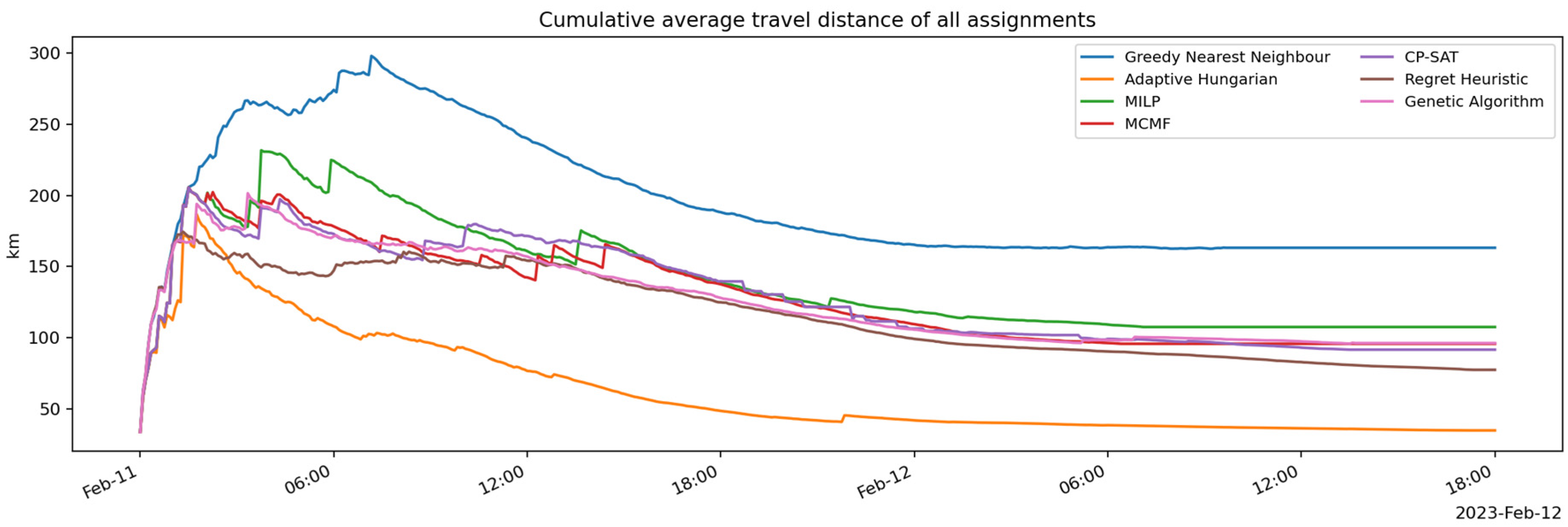
The other cost objective is to minimize the relative distance between the location of the technical team and the alarm. The time responses for the average distance computed per alarm are compared in
Figure 5. The Adaptive Hungarian Algorithm demonstrates its priority weighting by penalizing significantly the cost of travel distance defined in its multi-objective cost matrix in (1) with respect to other algorithms. On the contrary, the Greedy Nearest-Neighbor’s global optimization is poor despite its successful assignment rate responses; it can not perform multi-objective optimization and minimize travel cost, and it assigns technical teams even at a higher cost of traveling distance. Using the greedy approach, along with time, more alarms are transferred to the next time windows for possible assignment because all technical teams have already been assigned and occupied by the repair task of an alarm at the expense of longer travel distance and time. The greedy nearest-neighbor approach can not optimize team distribution. MILP and MCMF perform travel distance cost minimization by using multi-objective and assignment constraints (4) through (7), but both of them can assign at the expense of double relative distance in comparison with the Adaptive Hungarian Algorithm. CP-SAT, Regret Heuristic, and Genetic Algorithm also minimize travel distance cost at assignment, at the same level as MILP and MCMF. Priority calculation by the Regret Algorithm in (10) improves the assignment performance slightly.
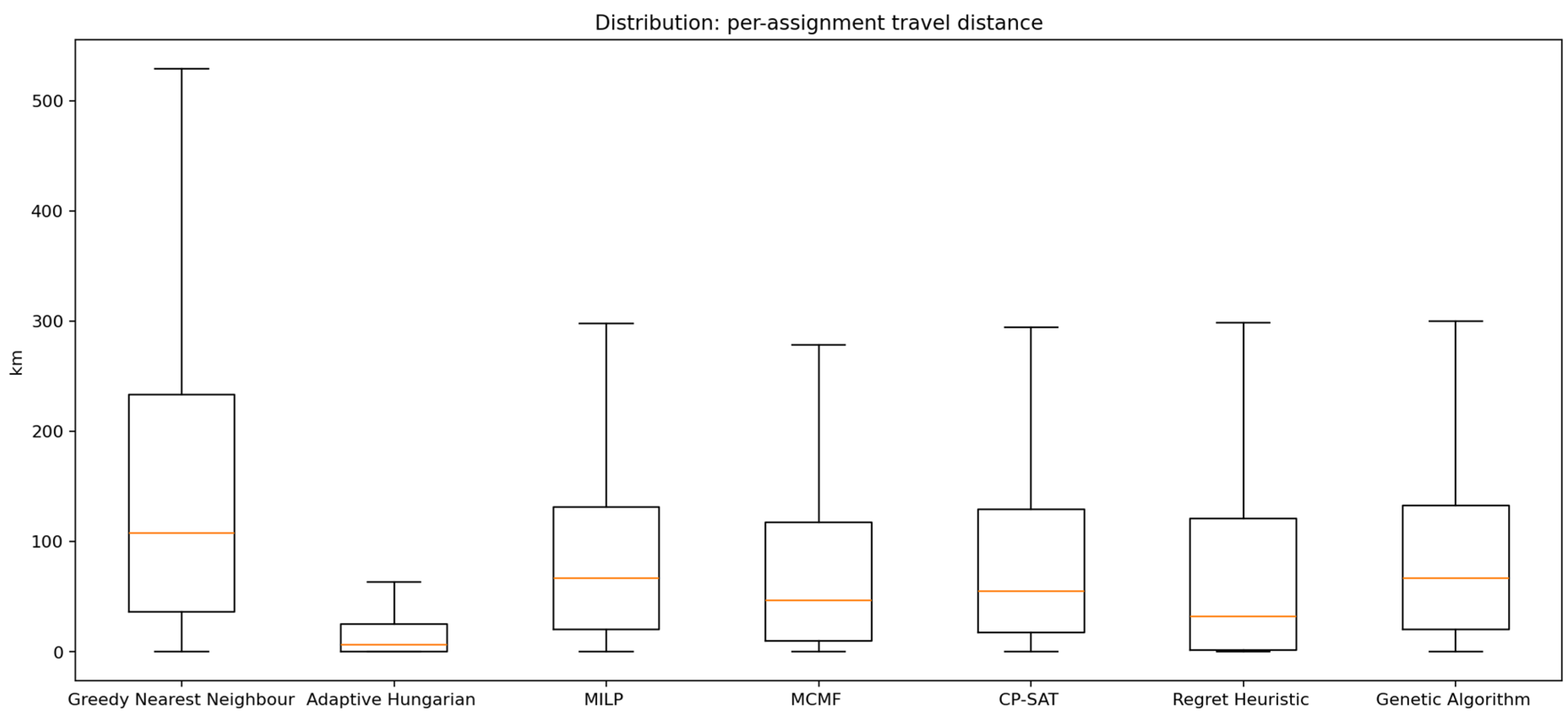
The data of assigned travel distance between available technical teams and alarms for each algorithm are plotted and compared in
Figure 6. Adaptive Hungarian assigns an average distance that is the lowest in comparison to other algorithms’ data medians. Its maximum travel distance value is also the lowest in comparison to other algorithms’ data. Nearest-neighbor selection on a greedy basis causes the longest travel distance and maximum travel distance data. Although it presents the lowest, i.e., minimum travel distance data, it has also the longest travel distance in comparison to other algorithms’ data. This is because of a lack of multi-objective optimization ability. The median of the lower half of the travel distance data is higher than the median of the upper half of the Adaptive Hungarian data, which shows that travel team assignment on a greedy basis does not involve travel distance minimization. The boxplots of MILP, MCMF, CP-SAT, Regret Heuristic and Genetic Algorithm data illustrate median travel distance at the same level. Minimum value in the Regret Heuristic dataset is very near the median of the lower half of the travel distance data, which shows that its priority integration in (10) for minimization of constraints assures minimization of travel distance. Maximum travel distance is at the same level in the data of MILP, MCMF, CP-SAT, Regret Heuristic, and Genetic Algorithm. CP-SAT and Regret Heuristic penalize the cost of relative distance at the same level of multi-objective optimization algorithms such as MILP and MCMF.
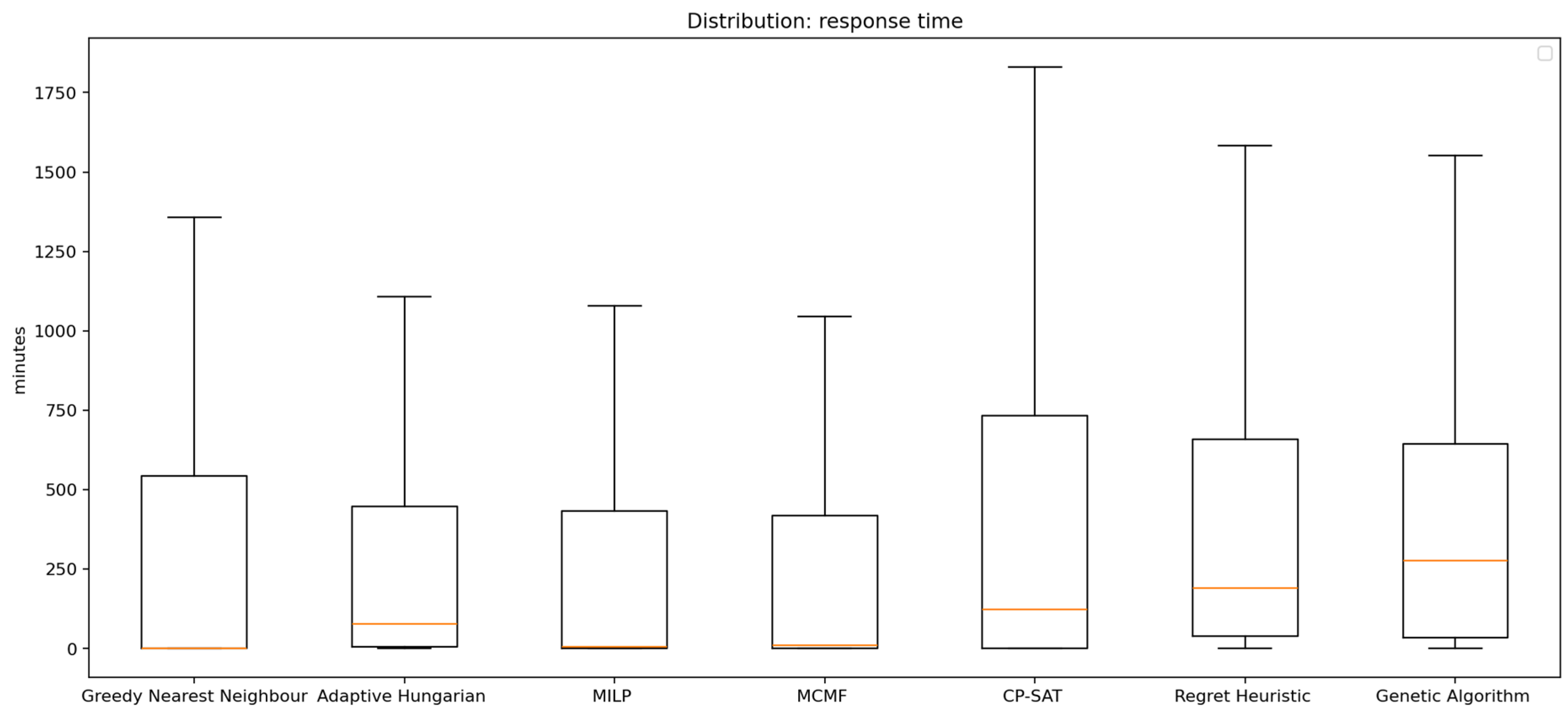
Response time is defined as the time duration between the occurrence of an alarm and its assignment to a technical team. During a natural disaster scenario, the response time of assignment algorithms needs to be evaluated and tested. In
Figure 7, a boxplot of response time for each algorithm is plotted in order to compare the mean response time, and also the minimum and maximum response time in the response time data distribution. For the MILP and MCMF algorithms, the median value of response time is very near the median of the lower half of the response data, namely in the first Quartile (Q1), but the median is also significantly lower than the median of the upper half of the data, namely in the third Quartile (Q3), which shows both these algorithms may also cause higher response times subject to increasing complexity of the assignment problem because of the decreasing number of available teams and increasing number of newly arriving and accumulated (backlogged) alarms. Although its travel distance cost minimization is at the same level as that of MILP and MCMF, CP-SAT’s response time varies largely considering its data distribution. The data of the Regret Heuristic and Genetic Algorithm illustrate a very similar response data distribution. The response data of the Greedy Nearest-Neighbor algorithm demonstrate its real-time baseline scheduling, but along with time due to the increasing rate of new alarm arrivals and alarm accumulation, reduce the number of available technical teams. The population-based metaheuristic causes a maximum response time higher in comparison to multi-objective algorithms such as Adaptive Hungarian, MILP and MCMF. Adaptive Hungarian data show that the minimum value in its response data is almost near the median of the lower half, while the median of the upper half of the data and the maximum value are at the same level as those of MILP and MCMF data. Its median is slightly higher, which illustrates that the Adaptive Hungarian algorithm requires more time for assignment.
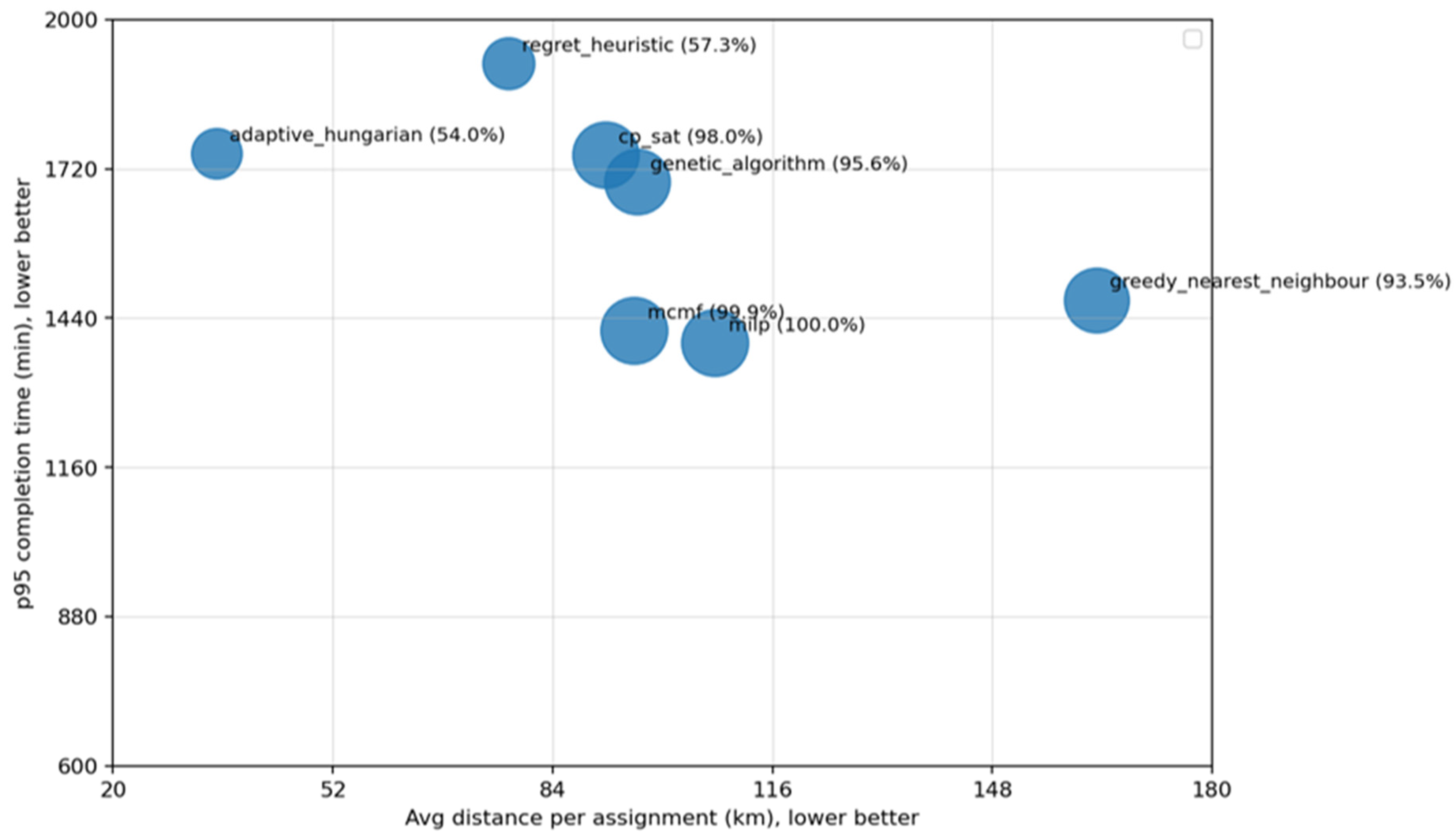
To respond to a natural disaster, alarms with a higher priority need to be assigned to technical teams subject to a minimum relative distance and the minimum response time of the algorithm. The assignment algorithm must be fast and is expected to assign alarms with higher priority first and foremost in comparison to lower-priority alarms. As a test scenario, algorithms are tested via their assignment results, including alarms having a combined priority higher than 75% in less than 60 min. The number of total alarms having a combined priority higher than 75% is 1195 in a dataset of 5500 alarms. For emergency response evaluations, the performance of assignment algorithms is evaluated for alarms having a priority higher than 75% and an algorithm response time of less than 60 min. In
Figure 8, average relative distance between the assigned technical team’s location and alarm’s location is plotted versus 95% of completion time. Completion time is calculated by taking the sum of the response time of the assignment algorithm, travel time and the average time used by the technical teams to repair the alarm after reaching the base station. The 95% of alarm repair time versus the average distance per assignment is compared in
Figure 8. Assignment results whose response times are less than 60 min are selected. If the response time is more than 60 min, these assignment responses are not included and not compared.
Adaptive Hungarian Algorithm assigns 54% of high-priority alarms within 60 min. Among these alarms, 95% of alarms are reached within the completion duration of 1725 min, and the distance from the assigned alarm to the technical team’s initial location is 36 km. MILP and MCMF algorithms fulfill high-priority assignment in 60 min while responding to 100% of alarms in this priority level. Ninety-five percent of alarms are reached within the completion duration of 1400 min, but the distance between the assigned alarm and the technical team’s initial location is increased more than two times, which is 100 km versus 36 km, in comparison to the Adaptive Hungarian Algorithm. MILP and MCMF perform multi-objective optimization subject to given constraints. More clearly, the Adaptive Hungarian Algorithm assigns half of the alarms subject to half the travel distance in comparison to MILP and MCMF. The Adaptive Hungarian Algorithm has more multi-objective ability, but it is not efficient in comparison to MLIP and MCMF in this extreme emergency response scenario. CP-SAT and Genetic Algorithm assign 98% and 95.6% of alarms in this priority level, respectively. Ninety-five percent of alarms are reached in a longer time in comparison to MILP and MCMF. Regret Heuristic assigns 57.3% of alarms in this category, but 95% of alarms are reached within the highest service duration in comparison to other algorithms. Greedy Nearest-Neighbor Algorithm’s assignment performance is poor due to its inability to optimize subject to constraints, causing assignments with longer relative distance. Additionally, it assigns teams to 93.5% of alarms in this priority level within less than 60 min, and the repair completion time for alarms is as fast as achieved with the MILP and MCMF algorithms. Fewer alarms are responded to, but the greedy choice assures a lower repair time.
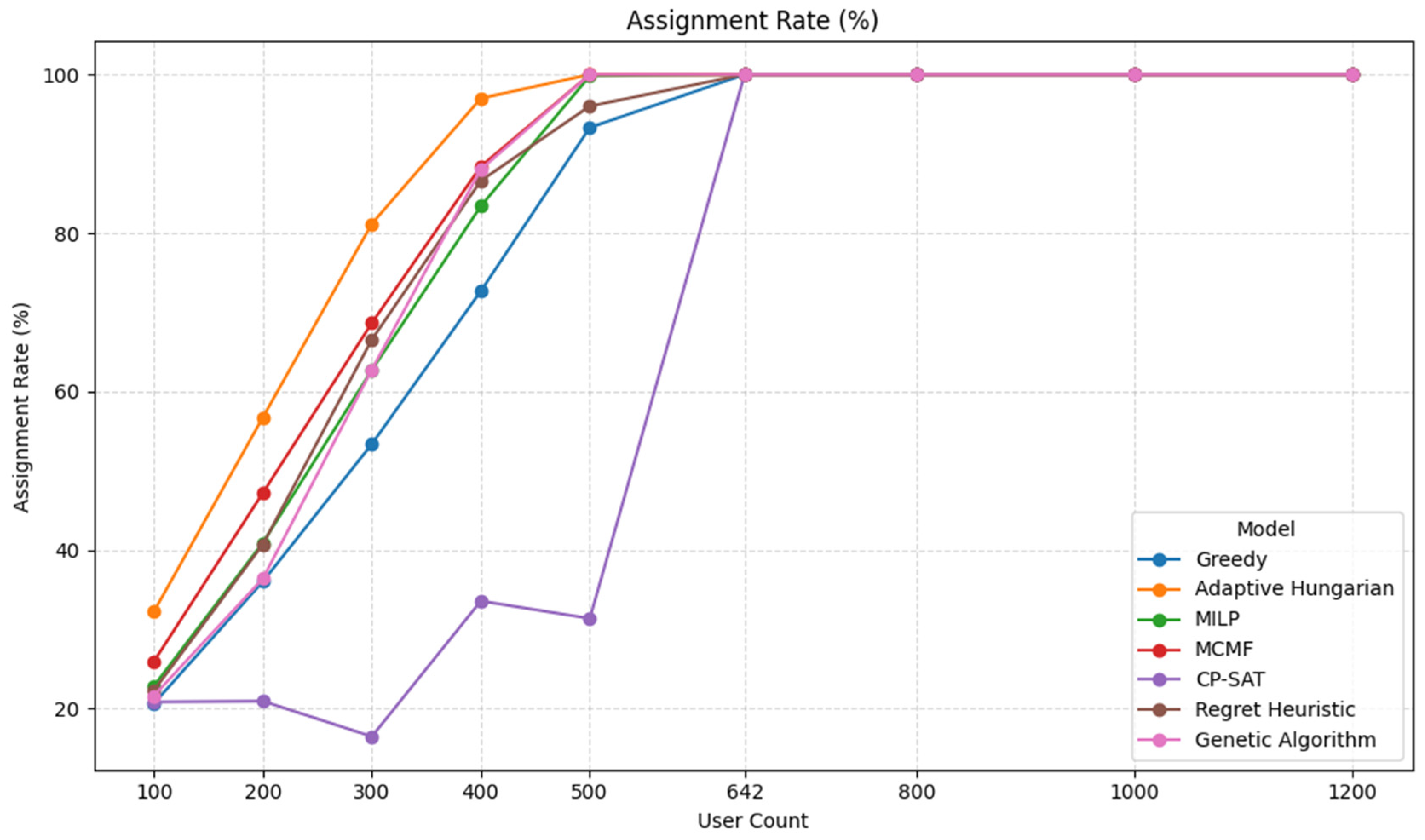
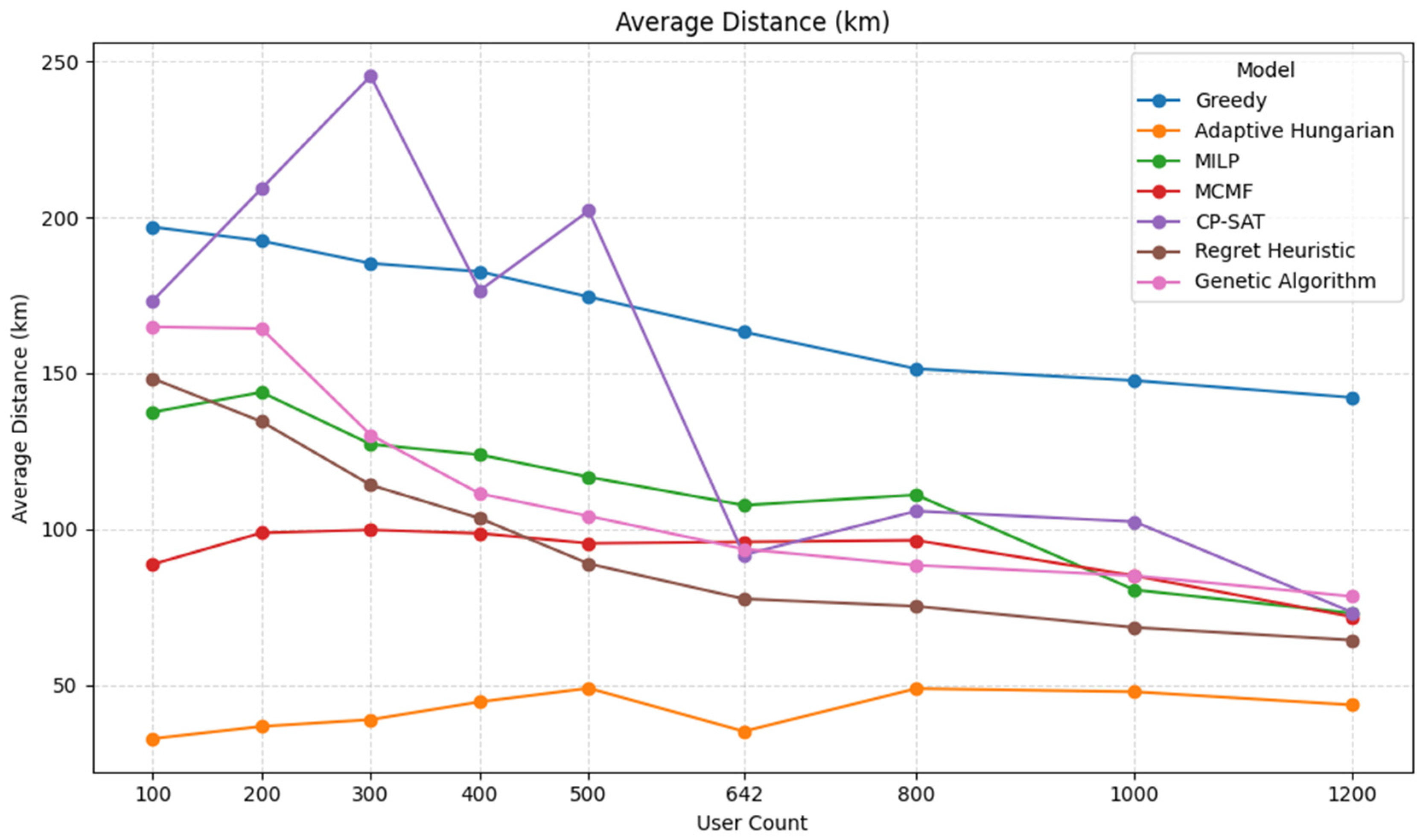
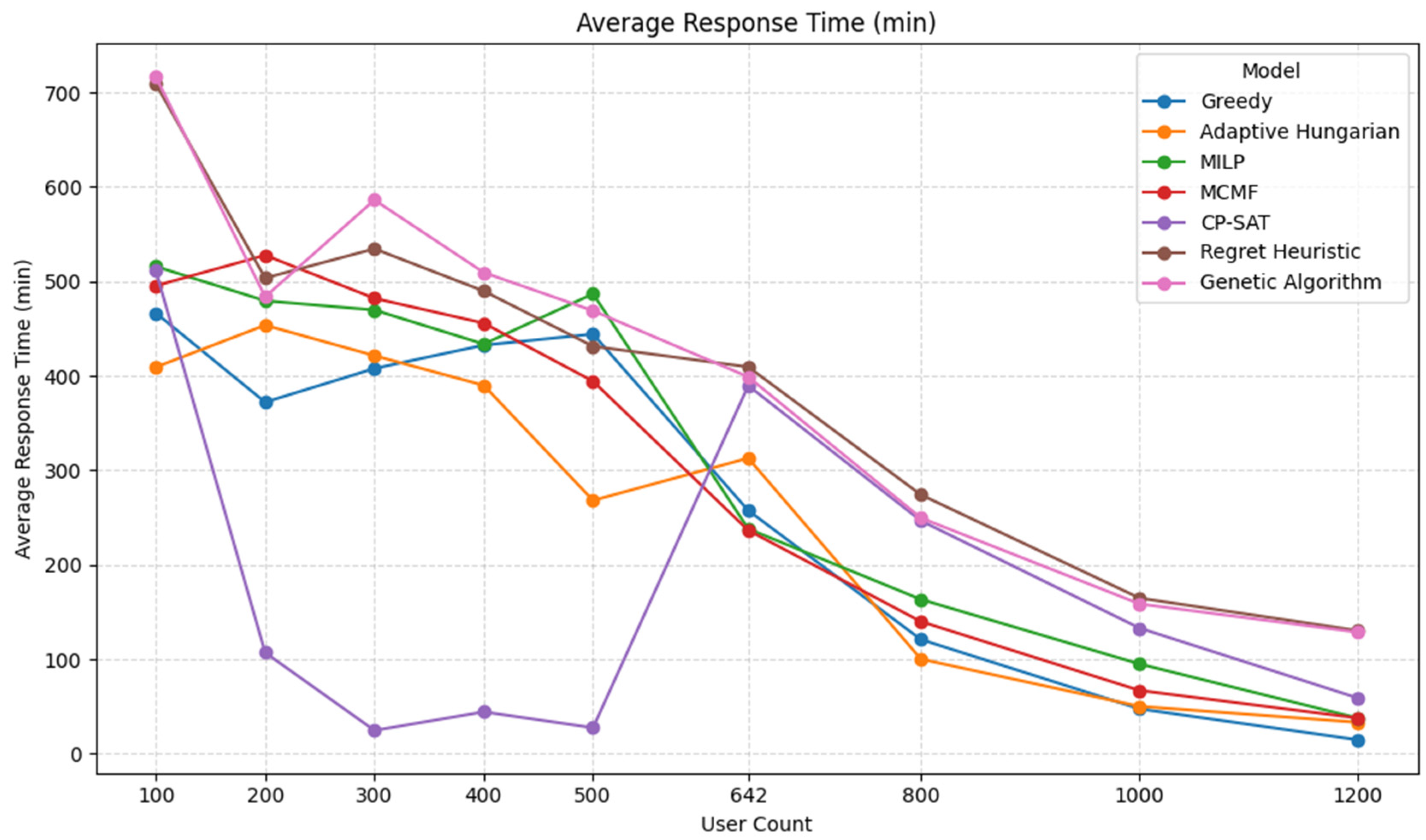
The number of technical teams is varied, and the performance of selected assignment algorithms is evaluated in comparison to the real-world number of 642 technical teams on the day of the earthquake disaster. Seven different numbers of teams, i.e., 100, 200, 400, 642 (default), 800, 1000, and 1200 teams, are used, and the location of individual teams is randomly generated and tested. Due to randomization, simulation scenarios are repeated 10 times for each team number.
Adaptive Hungarian Algorithm assigns technical teams to alarms at a higher rate in comparison to other algorithms for the different numbers of teams in
Figure 9. MILP, MCMF, Regret Heuristic and Genetic Algorithm increase their assignment rate performance with the increasing number of teams. Greedy Nearest-Neighbor Algorithm increases its assignment rate linearly with the increasing number of teams. CP-SAT’s assignment rate is poor with lower numbers of teams below 500. All algorithms perform with a 100% assignment rate when the team number is higher than 642.
While assigning alarms, the second objective is to minimize the relative distance between the technical team’s initial location and the alarm’s location. Different numbers of teams are evaluated in
Figure 10. Adaptive Hungarian Algorithm is insensitive to the varying number of technical teams and assigns technical teams to alarms while minimizing relative distance. MILP, Regret Heuristic, Genetic Algorithm, and Greedy Nearest-Neighbor Algorithm minimize relative distance while using the positive contribution of the increasing number of teams. Improvement is assured by the increased team number. Greedy Nearest-Neighbor Algorithm assigns at the highest cost of relative distance in comparison to other algorithms due to its inability of optimization. Its travel distance minimization objective is poor for all team numbers, from the lowest number of teams to the highest. CP-SAT does not present the ability of multi-objective optimization since its response varies largely and independently of the number of teams. MCMF is also insensitive to an increasing number of technical teams and assigns technical teams to alarms with a higher relative distance in comparison to the Adaptive Hungarian Algorithm, but it presents the ability of multi-objective optimization subject to varying constraints, and it assigns technical teams to alarms assuring lower travel distance independently of the number of teams.
For each algorithm, response time to an alarm is tested and compared with the increasing number of technical teams in
Figure 11. Adaptive Hungarian Algorithm has a lower response time in comparison to the two multi-objective optimization algorithms MILP and MCMF, when the number of teams is below 500. CP-SAT algorithm’s response time varies largely and independently of the number of technical teams. The increasing number of teams shows its impact when it is higher than 642. The Greedy Nearest-Neighbor Algorithm is not affected by the increasing number of technical teams until the team number exceeds 500. When the team number is more than 500, the greedy heuristic leverages the higher number of technical teams while assigning alarms within a shorter response time. While increasing the team number, MILP, MCMF, Adaptive Hungarian Algorithm, and Regret Heuristic achieve minimized response times that are inversely proportional to the increasing number of teams, illustrating the positive impact of a larger number of teams available to be assigned to alarms. Regret Heuristic is consistently the fastest, and Adaptive Hungarian becomes extremely fast when the number of technical teams exceeds 800.
Overall, in line with responses plotted in
Figure 2 through
Figure 8, performance of 7 alarm-team assignment methods on earthquake disaster response with 3-objective optimization is qualitatively compared in
Table 1. Data distribution of responses for relative distance and response time is summarized and qualitatively compared. Scalability test results plotted in
Figure 9 through
Figure 11 are compared as scalability performance of each assignment method in
Table 1.
The experiments are conducted by using a laptop with an Intel i7 13620H CPU running at 4.6 GHz, with 32 GB of memory. The open source Ubuntu 22.04 operating system and Python 3.14 programming language are used. The Python Linear Programming API is used for MILP, and the CP-SAT solver is used for the CP-SAT algorithm. The sklearn.neighbors module in Scikit-learn is used for the nearest-neighbors algorithm. The scipy.optimize package is used for the optimization algorithm, and its scipy.optimize.linear_sum_assignment function is used to match the minimum weight in bipartite graphs for the Adaptive Hungarian algorithm.
4. Conclusions
This paper evaluates and tests assignment algorithms spanning a spectrum from exact optimization to fast heuristics for their response performance in an earthquake disaster. A comprehensive evaluation study is conducted to analyze the response performance of the assignment algorithms using performance metrics, aiming to automate a system that eliminates human errors, increases speed, and lowers operational costs.
To respond to an earthquake disaster, firstly and urgently, cellular communication must be assured. Telecom operators have to reach and respond to their damaged base station infrastructure at the first step. But human operators may be delayed and make erroneous decisions when assigning technical teams, rescuers, and volunteers immediately due to the large scale of the affected disaster zones and the underlying complexity of the location distribution of teams to be assigned to an increasing number of alarms. A legacy method relies on manual work.
The automated system is presented to remove human error, increase speed, and lower operational costs. A fairly large set of assignment algorithms spanning a spectrum from exact optimization to fast heuristics is evaluated. They are adopted for responding to a natural disaster and compared by key performance indexes such as the assignment rate of alarms subject to priority, the relative travel distance between the technical team’s initial position and alarm position, and the response time of algorithms. A real-world procedure is implemented by using alarm data logged during the response to the earthquake disaster.
In disaster response, alarms must be assigned immediately on a priority basis. Technical teams must reach alarms in the shortest travel distance and time, which is another objective in assigning technical teams whose relative distance to the alarm is closer compared to other available teams. Under urgent assignment conditions, such as alarms with a priority level that is high and an immediate response of algorithms that is required to be less than 60 min, the Adaptive Hungarian Algorithm, MILP and MCFP assign technical teams to alarms by assuring lower travel distances and response times. Their multi-objective optimization subject to constraints, adopted for responsiveness to a natural disaster, assures fast and closest relative distance with a higher rate of alarm assignment. CP-SAT and Genetic Algorithm assign with a higher relative distance and an acceptable response time and assignment rate in comparison to the Adaptive Hungarian Algorithm, MILP, and MCFP. The Regret Heuristic algorithm integrates the priority of alarms to penalize high relative distance, but its response performance can not minimize the cost, and it underperforms in comparison to the Adaptive Hungarian Algorithm, MILP, and MCFP. Greedy Nearest-Neighbor Algorithm assigns alarms to technical teams on a real-time basis at the initial stage due to its greedy choice, but along with time, subject to the arrival of new alarms and the decreasing number of technical teams, its long-term performance is poor, and it can not optimize the given multi-objectives simultaneously. As a use case, Adaptive Hungarian Algorithm assigns 54% of high-priority alarms within 60 min. The distance between the assigned alarm and the technical team’s initial location is 36 km. MILP and MCMF algorithms fulfill high-priority assignment in 60 min, while responding to 100% of alarms in this priority level, but the distance between the assigned alarm and the technical team’s initial location is increased more than two times, namely 100 km versus 36 km, in comparison to the Adaptive Hungarian Algorithm. CP-SAT and Genetic Algorithm assign 98% and 95.6% of alarms in this priority level, respectively. Regret Heuristic assigns 57.3% of alarms in this category, but 95% of the alarms are reached within the highest service duration in comparison to other algorithms. Greedy Nearest-Neighbor Algorithm’s assignment performance is poor due to its inability to optimize subject to constraints, causing assignments with longer relative distances. Also, 93.5% of alarms in this priority level are responded to and assigned within less than 60 min, and the completion time of alarm repairs is as fast as with the MILP and MCMF algorithms. Fewer alarms are responded to, but the greedy choice assures a shorter repair time.
The presented automated system and the assignment algorithm at its core are transferable and scalable to other natural disaster scenarios. The emergency needs are to assign a limited amount of resources, which are technical teams in the cellular communication sector, to the alarm locations. Prioritization of alarms plays a crucial role in serving firstly and emergently liability-critical and safety-critical points of interest, such as the disaster and emergency management rescue and relief units, airports, hospitals, government buildings, etc. Natural disasters such as floods, hurricanes, winter storms, tsunami, earthquakes, fires, and thunderstorms damage infrastructure and residential buildings; therefore, a location-based data-driven procedure can use the presented approach. The presented approach eliminates the limitations of manual coordination, and it is an alternative to the legacy procedure of manual monitoring and decision-making.
The Open Route Service is used in the back-end server to compute the relative distance between a given alarm’s location and the available technical teams’ locations. The road digital map data and routing provided by the Open Route Service (ORS) are applied to calculate realistic travel time. Future research and development directions could include feedback from technical teams and volunteers about damaged buildings, closed roads, and the location of crowds to be rescued. This information discovery can be assured by a disaster response mobile application on smartphones capturing and sharing images along with time and position information. This information can be used for routing and improving the assignment of all rescue teams.