1. Introduction
As a variant of proper coloring, equitable coloring has attracted sustained attention due to both its theoretical significance and practical relevance. This concept was first introduced by Meyer [
1]. A graph
is said to be equitably
m-colorable if its vertex set can be partitioned into
m independent sets
such that
for all
. The minimum such
m is called the equitable chromatic number and is denoted by
. When
for all
, the coloring is referred to as a strong equitable coloring. Determining
is generally NP-hard, which motivates research into special graph classes that admit structural characterizations or polynomial-time algorithms.
Equitable coloring naturally models scheduling and resource-allocation problems where tasks must be assigned to nearly balanced conflict-free groups. Applications arise in examination scheduling, register allocation, and related combinatorial optimization problems [
2,
3,
4,
5,
6]. Circulant graphs constitute an important and highly symmetric class of graphs. They appear in coding theory and communication systems, particularly in the structural analysis of quasi-cyclic LDPC codes. In 5th Generation (5G) Mobile Network systems, parallel decoding is essential for improving throughput and reducing latency. When applied to parallel decoding, the division of a row in the base graph for multi-edge QC-LDPC codes can be modeled as an equitable coloring problem on
. While the chromatic number of circulant graphs has been extensively investigated [
7], their equitable chromatic number
remains less understood. In Reference [
8],
was analyzed for circulant graphs with
. However, this work did not investigate
or equitable coloring schemes for circulant graphs with more general degree distributions. Building on this line of research, the present study continues to exploit the structural properties of circulant graphs and further investigates upper bounds for
, together with corresponding equitable coloring schemes, for a broader class of circulant graphs.
The graph
G supports an equitable
m-coloring if
[
9]. Meyer [
1] further conjectured that, with the exceptions of
and
, any graph
G satisfies the inequality
. Substantial progress has been made for specific graph classes [
10,
11,
12,
13]. For instance, Chen and Lih computed
for trees
G, while Chen [
14] characterized
for graphs with
and chromatic number 3. Meyer’s conjecture was confirmed for bipartite graphs by Lih and Wu [
15], and additional results concerning equitable coloring in
-colorable graphs were achieved by Kierstead and Kostochka [
16].
From an algorithmic perspective, Kierstead [
17] showed that for any
, an equitable
k-coloring of an
n-vertex graph can be computed in
time. However, for structured graph classes such as circulant graphs, sharper bounds on
and more efficient coloring algorithms are still desirable. Below, we give the definition of circulant graphs and the properties of their adjacency matrices.
Definition 1. Let denote a circulant graph, where the vertex set is and the set of edges is defined as with referred to as the connection set. Let , where is the largest element in D. Its adjacency matrix is a circulant matrix.
Let A be an circulant matrix whose first row is and The circulant matrix
A satisfies
. Except for the first row, each row is derived by cyclically shifting the preceding row to the right. Specifically, we have
Therefore, for the circulant matrix
A, its first row satisfies
.
The matrix A can be expressed as a polynomial of the basic cyclic shift matrix L, where
In this paper, we investigate the equitable coloring of circulant graphs, focusing on establishing upper bounds for the equitable chromatic number and developing efficient algorithms. The paper is organized into three parts. In the first part, we review the research background and summarize relevant results on equitable coloring, including the definition of circulant graphs. The second part describes structural properties and periodic equitable coloring patterns, and illustrates several equitable coloring schemes. Finally, the third part presents the equitable coloring algorithm based on steps.
2. Equitable Pattern Periodic Coloring for Circulant Graphs
For circulant graphs, we aim to leverage their intrinsic structural properties to achieve an equitable coloring. Specifically, we select a representative subgraph of the graph and determine the coloring based on the properties of this subgraph, rather than processing the entire graph.
Theorem 1. For a graph , if , then is bounded above by .
Proof. The matrix
A can be expressed as a polynomial of
L,
and
.
where
,
denotes the transpose of
.
Therefore, the graph G can be determined solely by the nonzero elements of . Assuming that , the following example illustrates the matrices A, , and .
Under the conditions
and
, the matrix
A admits the following representation.
If , then there exists an equitable -coloring. One explicit coloring scheme is defined as follows. For each vertex labeled i, assign where the set of colors is indexed by .
For any nonzero position
in
, we have
and
Because
and
, we have
. Therefore,
, and this scheme is a proper coloring. Moreover, the condition
guarantees that each color class has size exactly
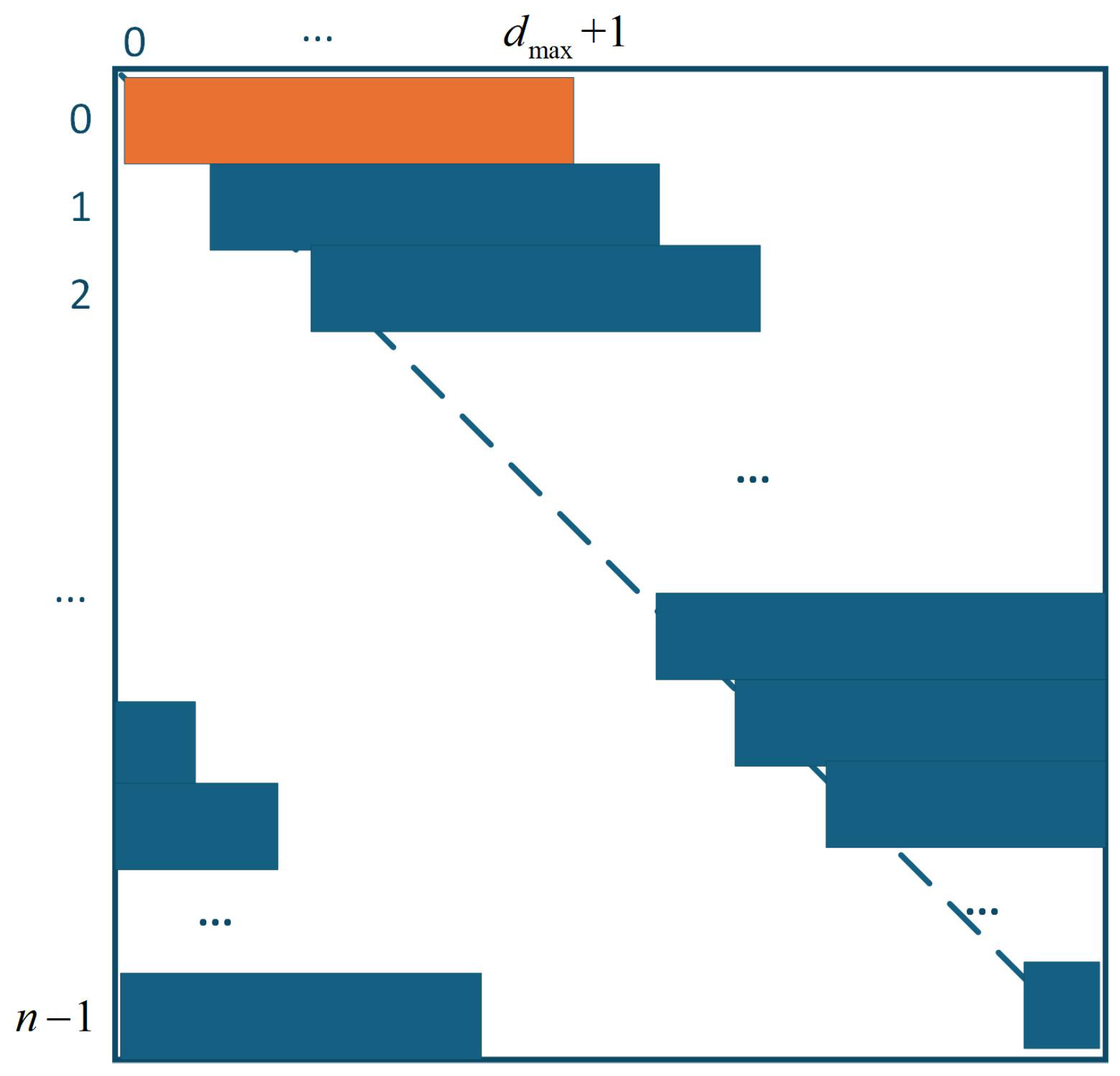
, so the coloring is equitable. The idea above is to treat the subgraph corresponding to the orange region of
Figure 1 as the coloring unit. For example,
and
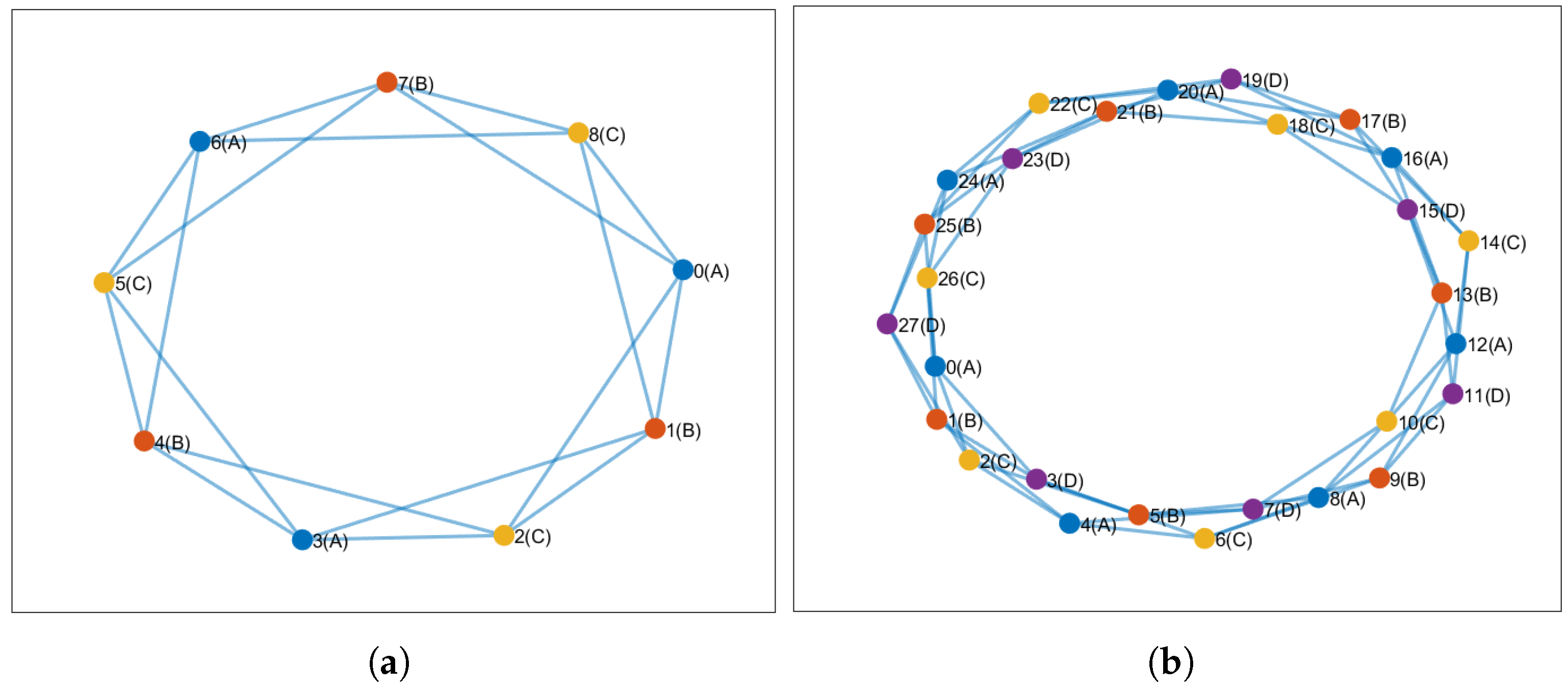
are shown in
Figure 2. □
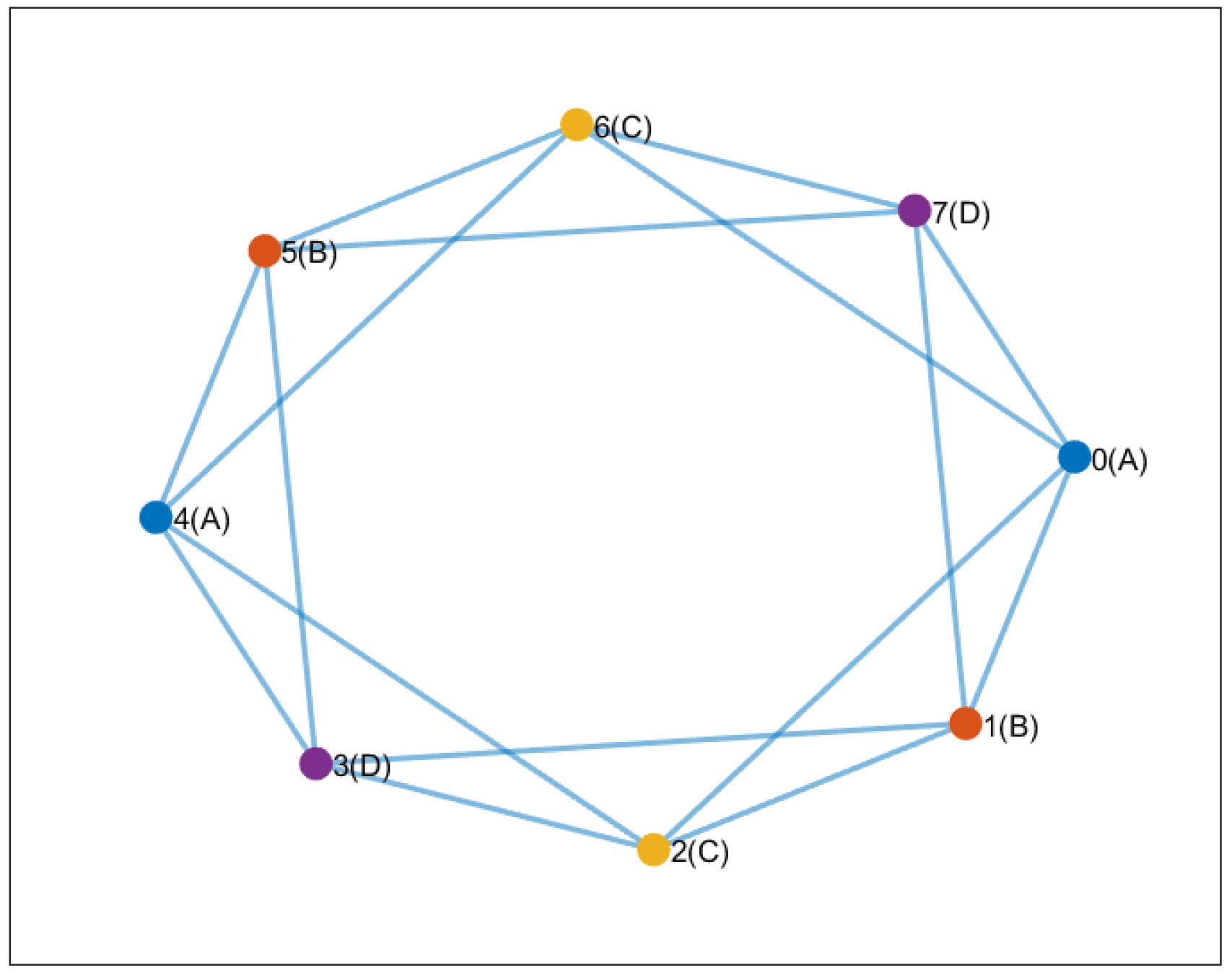
Corollary 1. Consider a graph , and let . Then, The equitable coloring scheme is given by for the vertex with label i, as shown in Figure 3. For the case where , we follow a similar approach to find an equitable k-coloring with , as shown in Algorithm 1. We can enumerate all feasible assignments of the k colors to the vertices , under the constraint that each of the k colors is used at most once in the current assignment. To carry out this enumeration, we employ a DSATUR-based algorithm. At each step, the algorithm gives priority to the uncolored vertex with the highest saturation degree. Specifically, for each uncolored vertex v, we first compute its saturation degree , namely the number of distinct colors appearing in its already colored neighbors. An uncolored vertex with the maximum saturation degree is then selected. If several vertices attain the same saturation degree, the vertex with the maximum degree in the subgraph induced by the remaining uncolored vertices is chosen. If multiple vertices attain the maximum degree in the subgraph induced by the remaining uncolored vertices, the vertex with the smallest index is selected. After that, an admissible color is assigned to the selected vertex, and all possible choices are recursively enumerated. Once the vertex is colored, the saturation degrees of its uncolored neighbors are updated accordingly.
For a fixed
k, let
. The initial periodic coloring of the first
vertices takes
time. The subsequent DSATUR-based backtracking only processes the remaining
r vertices. Since each of the
k colors can be used at most once on these
r vertices, the search tree has depth
r and at most
leaves. With incremental maintenance of saturation and forbidden color sets, each search node can be processed in
time, where
is the maximum degree of
. Hence, for a fixed
k, the time complexity is
Therefore, the overall worst case complexity of Algorithm 1 is
In particular, the algorithm is exponential in the worst case. Since the equitable coloring problem is NP-hard, it is acceptable for the algorithm to have an exponential worst case running time.
After computing a coloring scheme for a symmetric unit, this scheme can be periodically replicated across other symmetric units, thereby achieving equitable coloring over the entire graph. This method is particularly suitable for graphs with complete symmetry or cyclic symmetry.
| Algorithm 1: Equitable Coloring by Enumeration |
 |
Theorem 2. Let , where , and assume that Let be the induced subgraph on the first vertices. Suppose that admits a strong equitable coloring such that Define for all Then c is a strong equitable coloring of G.
Proof. Set For each , define and Then
We first prove that c is a proper coloring.
For each t, consider the translation Since is circulant, is an isomorphism from to , as adjacency depends only on differences modulo n, which are preserved under translation. Moreover, by the definition of c, Hence, the coloring of is exactly a copy of the coloring of .
Let with and , where , . Since with , the distance between any two adjacent vertices is at most . Therefore , because any two vertices in and with are separated by distance greater than . By symmetry, it suffices to consider an edge with Since , we must have and . By the periodic definition of c, all vertices in every receive colors from while all vertices in every receive colors from By definition, these two color sets are disjoint. Hence, for every edge with and , we have
We conclude that c is a proper coloring of G.
Next, we prove that c is a strong equitable coloring. Since is a strong equitable coloring of , each color used in appears the same number of times in the set . Because c is obtained by repeating this coloring on each of the Q sets , every color class in G has size exactly Q times its size in . Hence, all color classes in G have equal cardinality.
Therefore, c is a strong equitable coloring of G. □
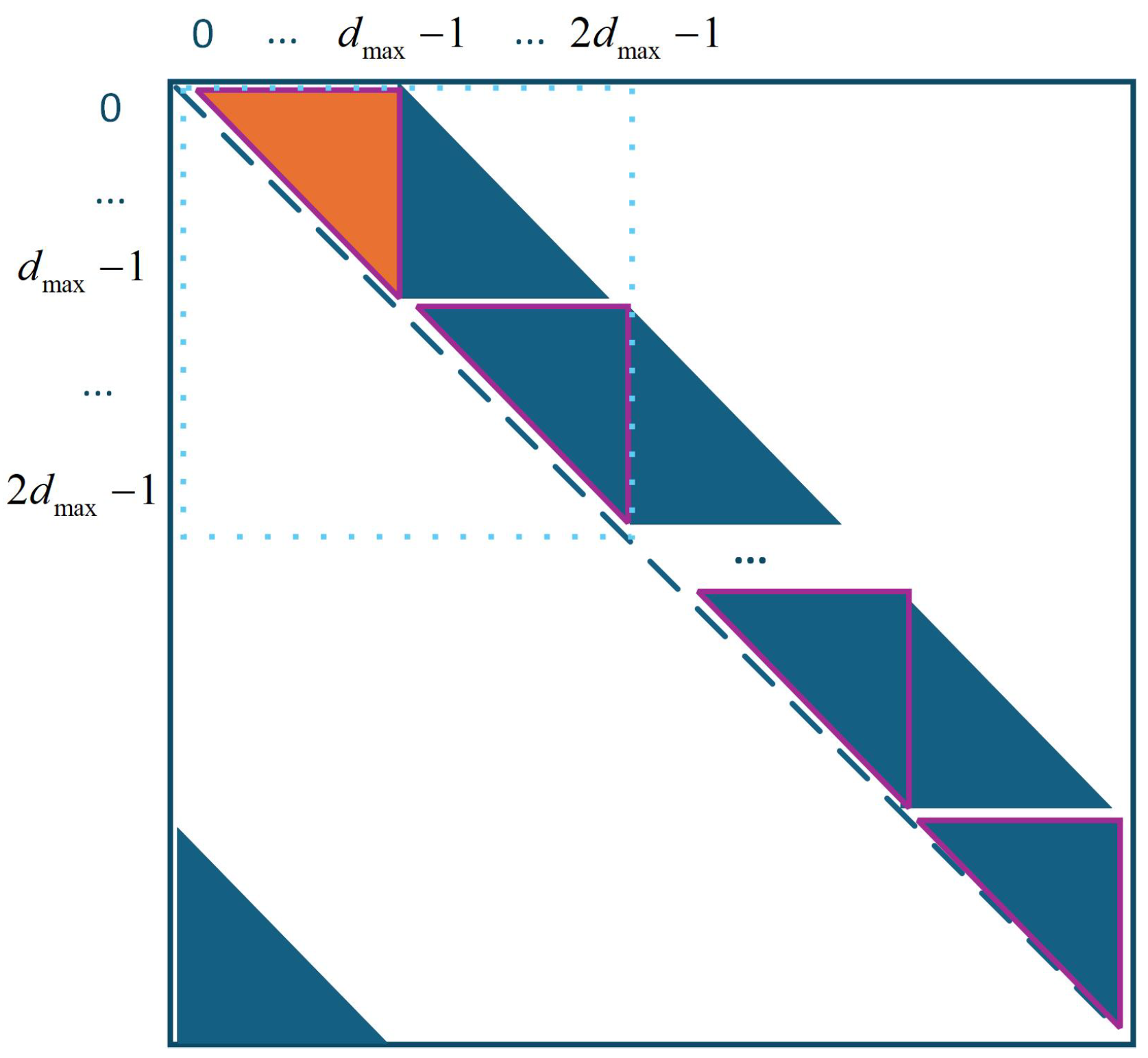
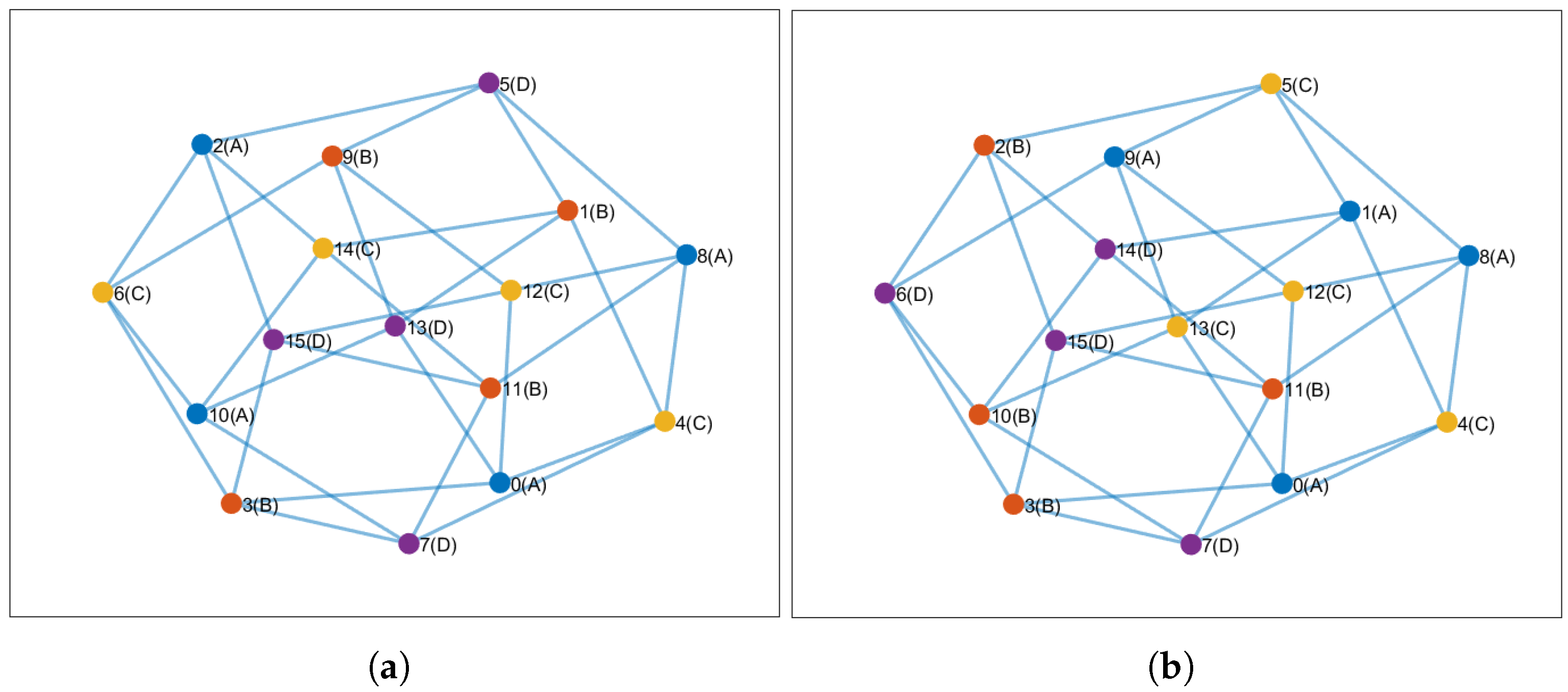
An illustration of a coloring unit based on
is shown in
Figure 4. Consider the subgraph
and the coloring
. Since
, the coloring unit can essentially be defined as the set of all edges induced by the nonzero elements in the orange triangular region, together with their associated vertices.
Definition 2. Let be two color sequences of the same length k, where and are two sets of colors. We say that X and Y are coloring-pattern isomorphic if there exists a bijection such that
Equivalently, In this case, we also say that X and Y have the same coloring pattern.
Moreover, if , then X and Y are said to be pattern-isomorphic over disjoint color sets, also called disjoint-pattern isomorphic.
Remark 1. For a graph H, a strong equitable k-coloring coincides with an equitable k-coloring under the divisibility condition . Therefore, it suffices to test only those values of k satisfying , and then decide whether H admits an equitable k-coloring. There exist many algorithms for equitable coloring, including the exact DSATUR-based algorithm of [18], the ILP-based algorithm of [19], and the polynomial-time algorithm of [17] for equitable k-coloring of graphs with maximum degree Δ
when . Let and . To construct a strong equitable coloring of , one may directly color and with disjoint color sets. The most intuitive approach is to require that the two color sequences and are pattern-isomorphic over disjoint color sets. In this case, it suffices to consider only divisors , find a strong equitable k-coloring of , and then assign an isomorphic coloring pattern to using a disjoint set of k colors. In the following corollary, we use the algorithm of [17] as a concrete method for finding a strong equitable k-coloring of H. As an example, different isomorphic coloring patterns of strong equitable colorings are illustrated for the induced subgraph
of the circulant graph
—see
Figure 5.
Corollary 2. Given the circulant graph , we can find the smallest integer such that . The equitable coloring algorithm is given in Algorithm 2. Let ; then,
| Algorithm 2: Strong Equitable Coloring by Symmetric Subgraph |
 |
In Algorithm 2, the graph is first colored by an equitable k-coloring algorithm, where k is chosen such that Since , the resulting coloring is actually a strong equitable coloring. The coloring on is then obtained by a bijective relabeling of the colors, namely for . Hence, the two color sequences are pattern-isomorphic, and their color sets are disjoint. Finally, extend periodically to all vertices of G with period . By Theorem 2, the same argument shows that admits a strong equitable coloring.
Assume that arithmetic operations on indices are performed in constant time. The time complexity of Algorithm 2 is dominated by the equitable coloring step on the graph
. Recovering
D, searching for the smallest integer
such that
, computing
, choosing
k, and performing the periodic extension take
time. Constructing the adjacency matrix of
H and computing all degrees in
H take
time. Therefore, these preprocessing and extension steps together require
time. If the equitable
k-coloring of
H is computed by the algorithm from [
17], its running time is
. Therefore, the overall complexity is
which is
in the worst case.
When , let . For any even number with , the same construction can be applied to the induced subgraph . More precisely, the vertex set is divided into two equal halves, and a strong equitable coloring is constructed on these two halves using disjoint color sets. The resulting coloring pattern is then extended to the first vertices of . For the remaining vertices, the colors are assigned by enumeration, where each color is used at most once among the residual vertices. This enumeration can be implemented in the same way as Algorithm 1.
Theorem 3. Let be a circulant graph with , and let . Define and . Then the equitable chromatic number of G satisfies .
In particular, if , then implies , whereas implies . Consequently, for , if , then ; if , then .
Proof. By Corollaries 1 and 2, the graph admits an equitable coloring with T colors and also admits an equitable coloring with F colors. Therefore, .
Now consider the special case . For any , the set contains vertices, and for any two distinct vertices in this set, . Hence this set induces a complete graph . Therefore, every proper coloring of G requires at least colors, that is, .
If , then is an admissible divisor in the definition of T, since . Thus , and by the first part of the theorem, . Combining this with , we obtain .
It remains to show that if , then no proper -coloring exists. Suppose, to the contrary, that G admits a proper coloring with exactly colors. Since every set of consecutive vertices induces a clique , the vertices must receive all colors. The next set also induces a clique and must again receive all colors. Since these two sets share the m vertices , the only possible color for is the color assigned to j. Hence the coloring must satisfy for all . Thus the coloring is -periodic.
Such a periodic coloring is compatible with the cyclic vertex set only if . If , the periodicity condition cannot be maintained consistently. Equivalently, it would force two vertices in some set of consecutive vertices to receive the same color, contradicting the fact that every such set induces a clique . Therefore, when , no proper -coloring exists, and hence .
For , we have . Therefore, if , then . If , then . This completes the proof. □
3. Equitable Coloring Based on Steps for Circulant Graphs
The following section outlines an algorithm based on steps for finding an equitable coloring of the circulant graph G and analyzes the effectiveness of the algorithm.
A 2-regular circulant graph where can be represented as a collection of cycles, each of which has length . Therefore, the equitable chromatic number of is 2 or 3. Based on the above property, we propose the following coloring algorithm.
Lemma 1. Let , and for each , let , , and let be the smallest prime factor of . For each vertex , uniquely write , where , , and . Define the i-th component coloring by , and define the integrated coloring by . Then Φ is a proper coloring of .
Proof. For each , put . Since and , we have . Hence is invertible modulo .
For any , the residue with is uniquely determined. Since is divisible by , there exists an integer such that . The congruence is equivalent to . Since is invertible modulo , the value of is uniquely determined modulo . Taking the representative , and using , we can write uniquely with and . Therefore is uniquely determined by x, and the component coloring is well defined.
It remains to prove that is proper. Let be adjacent in . Then there exist and such that . Write . Since , adding does not change the residue modulo . Hence the corresponding residue for y is still . Moreover, . Therefore, in the j-th component, the parameter is replaced by modulo . Hence , while . Consequently, . Since is a prime factor of , we have . Thus , and so . Hence the j-th coordinates of and are different, which implies . Therefore every pair of adjacent vertices receives distinct integrated colors, and is a proper coloring of .
This Lemma can be understood from the structural viewpoint of circulant graphs. For each fixed i, the coloring is a strong equitable coloring of the circulant graph . Since , the graph consists of disjoint cycles, each of length . On every such cycle, is fixed, while moving from a vertex x to an adjacent vertex y, then . Thus, the parameter changes to modulo , whereas is fixed. Consequently, . Since , this implies . Hence is a proper coloring. Since , the coloring pattern on each cycle of length is -periodic. More precisely, the vertices in each component of can be written as with , where . Writing with , the coloring assigns colors periodically with period along the cycle. Moreover, since is divisible by , each color appears exactly times on every cycle. Since consists of disjoint cycles of length , each color appears exactly times in the whole graph. Therefore is a strong equitable coloring of the circulant graph with exactly colors.
Now let be adjacent in . By the definition of a circulant graph, there exists some such that . Hence x and y are adjacent in the subgraph , and it follows that . Therefore the two integrated color vectors differ in their rth coordinate, that is, . Thus is a proper coloring of . □
Lemma 2. Set . Then L is a period of Φ, that is, for all . Consequently, if K denotes the number of colors used by Φ, then , and in particular .
Proof. For each , write and . Then . We first prove that is a period of . Let ; since , we have . Moreover, if , then after dividing by , we obtain . Since is invertible modulo , it is also invertible modulo , and hence . For , we have . Therefore, . Thus . Together with , this gives . Hence is a period of .
Since , we have for every i. Therefore for all . Consequently, . Hence L is a period of the integrated coloring .
Since is periodic with period L, all colors used by appear within one period. Therefore , and . On the other hand, each component takes values in , so . Hence . Therefore, the number of colors satisfies . □
Remark 2. Two sufficient conditions under which Φ can yield an equitable coloring are given as follows.
- 1.
If for every , then . Writing , one has , and each color class has size .
- 2.
If satisfies for all , then every vector color occurs, , and each color class has size .
Proof. By the definition of the stepwise coloring, every can be written as , where , , and . Since , reducing modulo gives , hence . Therefore . Thus is a homomorphism, , and so , where . By the first isomorphism theorem for finite groups, . Since every fiber of a homomorphism is a coset of the kernel, every color class has size . Hence the integrated coloring is strictly equitable.
Since , for every i. Under for , it follows that , hence . For fixed i and , the stepwise coloring modulo consists of cycles of length , so the color occurs exactly times modulo . Denote by the corresponding residue set, then . Now let . For any choice , the Chinese Remainder Theorem yields a unique satisfying for all i. Hence, in one period modulo M, the color occurs exactly times. Since , each residue class modulo M is repeated times in . Therefore each final color class has size . Thus the integrated coloring is strictly equitable. Moreover, every vector color occurs, so . □
Theorem 4. For a circulant graph , the equitable coloring algorithm-based steps are described as follows, as shown in Algorithm 3.
- 1.
Input: D, .
- 2.
Stepwise Coloring: For each , compute coloring independently.
For each , where , compute and , and let denote the smallest prime factor of . Define a -coloring as follows. For each vertex satisfying assign
- 3.
Integration: Save an m-dimensional color vector for each vertex x, assign final colors by vector comparison. - 4.
Verification: Check whether the coloring is equitable and whether the number of colors is less than or equal to . If satisfied, output the coloring scheme, otherwise, apply the algorithm from [17] to obtain an equitable -coloring. - 5.
Output: Equitable coloring scheme.
Proof. For each , the coloring is computed independently. An m-dimensional color vector is stored for each vertex x, and the final colors are assigned through vector comparison. According to Lemma 1, this construction ensures a proper coloring of G. The verification guarantees the equitable property. □
| Algorithm 3: Equitable Coloring Based on Steps for Circulant Graphs |
 |
Complexity analysis: Let . We analyze the complexity of the algorithm in four parts.
First, the preprocessing stage computes , , and the smallest prime factor of for each . The values can be computed by the Euclidean algorithm, and each gcd computation takes time. Hence all gcd computations take time. For the computation of , only the m integers are used. If is computed directly by trial division for each , then the worst case cost for one is . Therefore, the total cost of computing all ’s is in the worst case. Thus the preprocessing cost is .
Next, consider the pattern-coloring stage for a fixed
. The step
decomposes the block into
residue classes, each of length
For each
and
, the vertices
are pairwise distinct for
Therefore, the innermost loop executes exactly
times for each pair
. Summing over all
and
, the total number of assignments for this fixed
is
Thus the total cost of the pattern-coloring stage over all is
For the integration stage, each vertex x has an m dimensional color vector Forming all coordinates over all vertices already accounts for work. To merge equal vectors deterministically, we lexicographically sort the n vectors by stable counting sort, processing the coordinates from right to left. Since the i-th coordinate takes values in , one pass costs . Therefore, the total sorting cost is because for every i. A final linear scan of the sorted list assigns one merged color to each distinct vector, which costs . Hence the integration stage is .
The verification stage consists of two checks. First, equitability is checked by counting the sizes of all color classes, which costs , where K is the number of colors produced. Second, verifying the bound takes time once K is known. Therefore, the overall verification cost is .
Combining the above bounds, the deterministic running time of the construction, integration and verification parts is
If the fallback algorithm is invoked, then the total running time becomes
where
denotes the running time of the general equitable coloring subroutine used in the fallback step. In particular, when the equitable coloring algorithm from [
17] is used as the subroutine and implemented in
time, the worst case running time is dominated by this subroutine. Therefore, the overall running time is
.
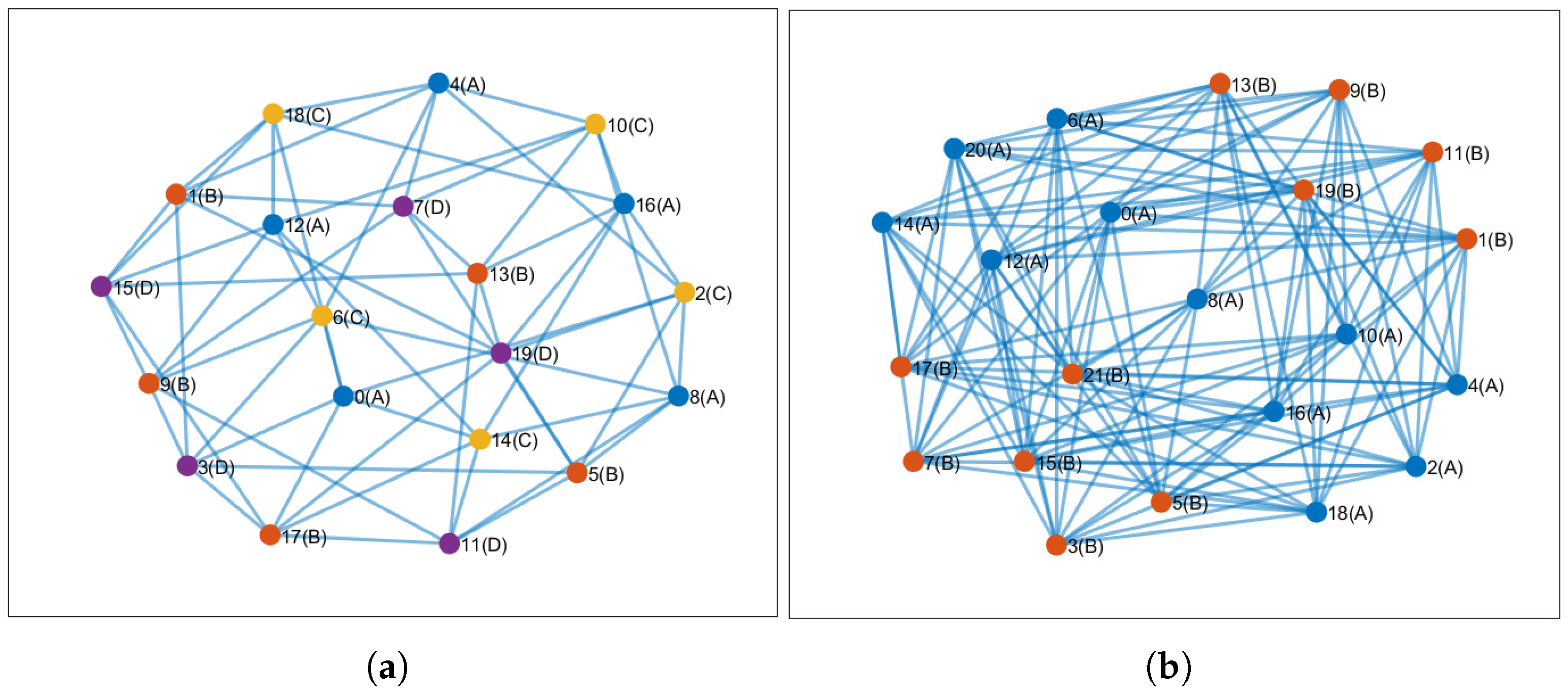
We first present two illustrative examples. The circulant graph
admits an equitable 4-coloring, and the circulant graph
admits an equitable 2—see
Figure 6. These examples show that the step-based construction can produce equitable colorings with relatively few color classes for some instances.
To evaluate the proposed method on circulant graphs, we conducted two groups of random experiments. In each parameter configuration, twenty independent circulant graphs were generated, where the step set D was sampled uniformly at random from without repetition. For each instance, we recorded the number of colors produced by the step-based phase, whether this coloring was already equitable, the final number of colors returned by the complete step-based equitable coloring algorithm, and the MATLAB R2023a running time. In the first setting, either or was fixed. In the second setting, both n and were varied, and twenty random instances were generated for each pair.
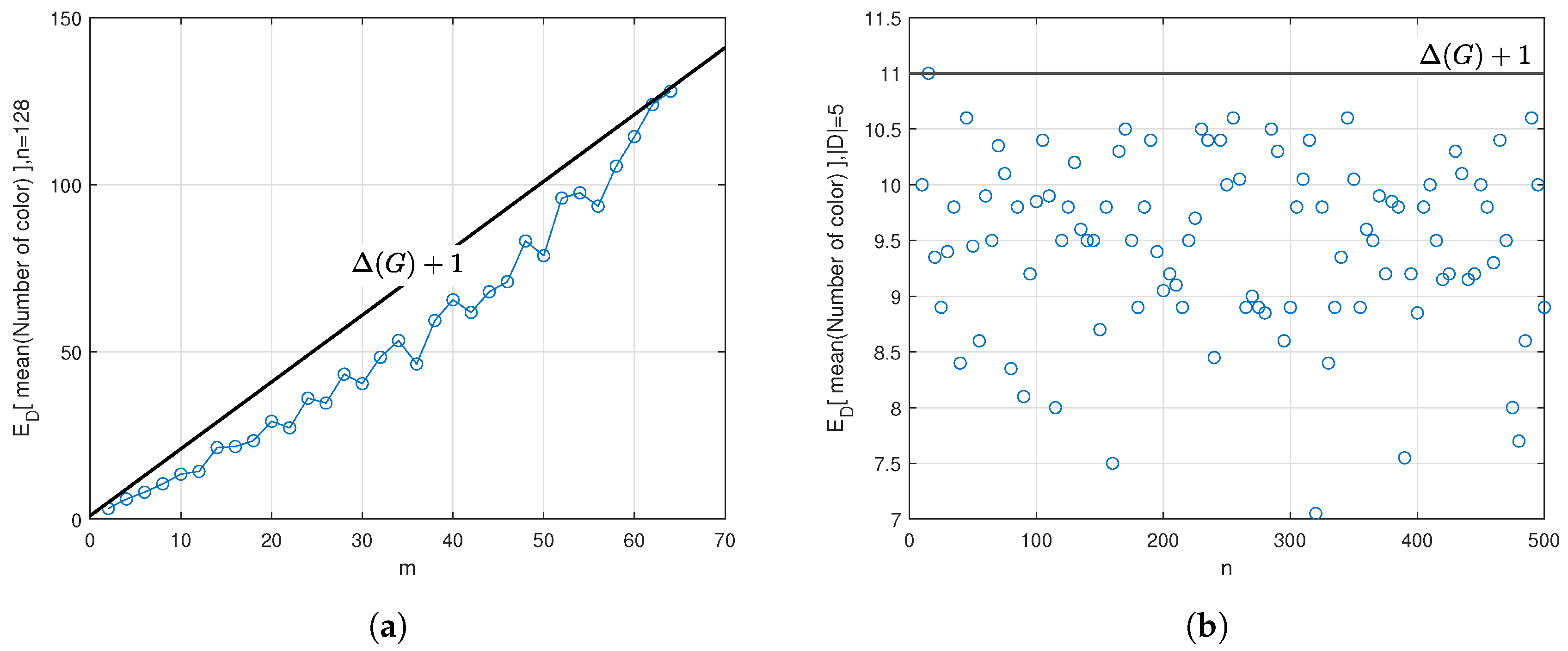
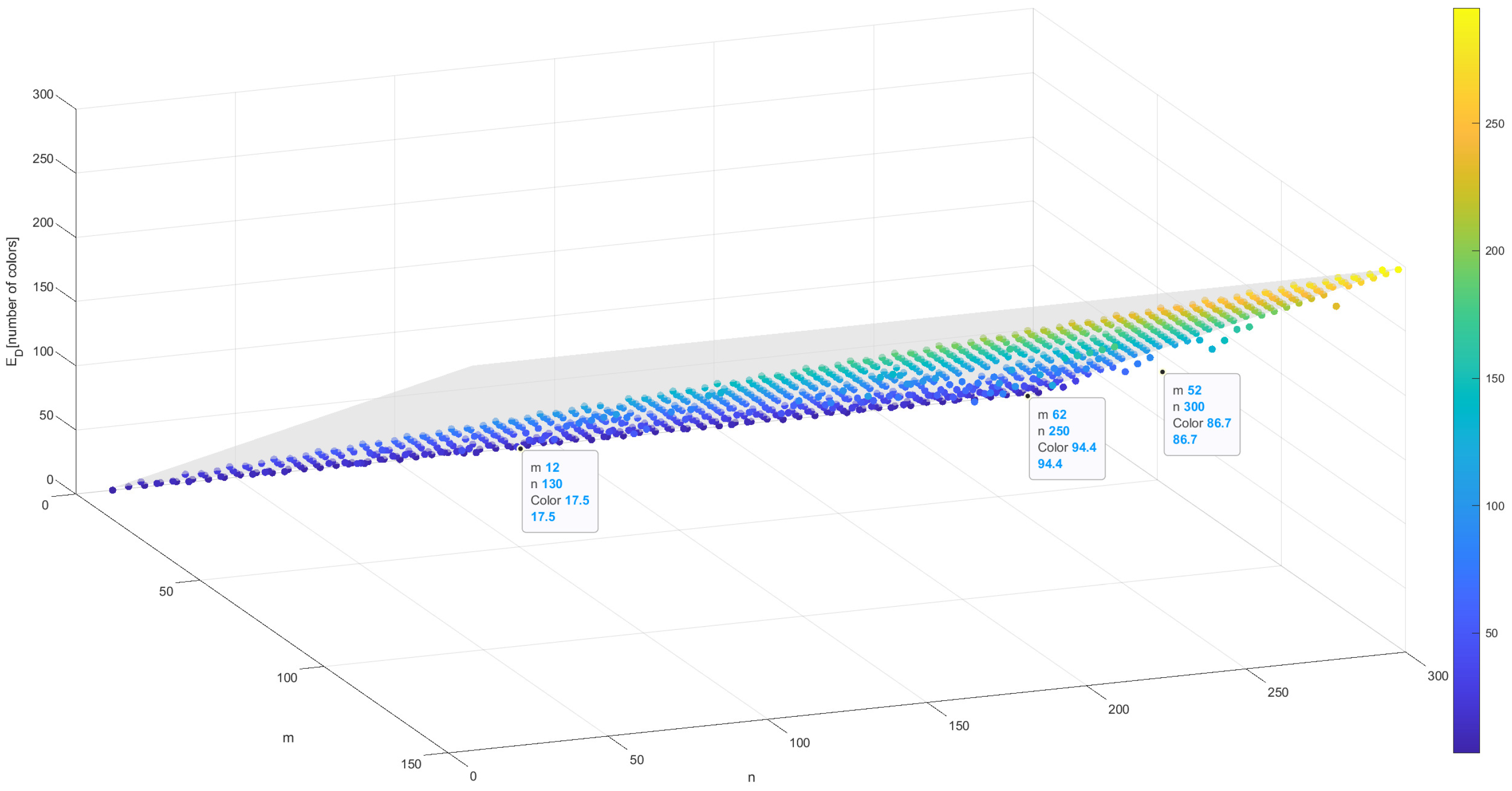
The results are reported in
Figure 7 and
Figure 8.
Figure 7 shows the average number of color classes under the fixed-parameter setting
or
. The results indicate that the proposed method often returns colorings using fewer colors than the benchmark
. Moreover, in many tested cases, the step-based phase already produces an equitable coloring, so the fallback procedure is not required.
Figure 8 presents the results for randomly selected
pairs. The gray plane represents the benchmark value
. Scatter points below this plane indicate instances where the computed coloring uses fewer than
colors.
We compare the obtained number of colors with because it is a classical universal upper bound benchmark for graph equitable coloring. Therefore, this comparison provides a simple reference for measuring how far the computed coloring lies below a general worst case guarantee.
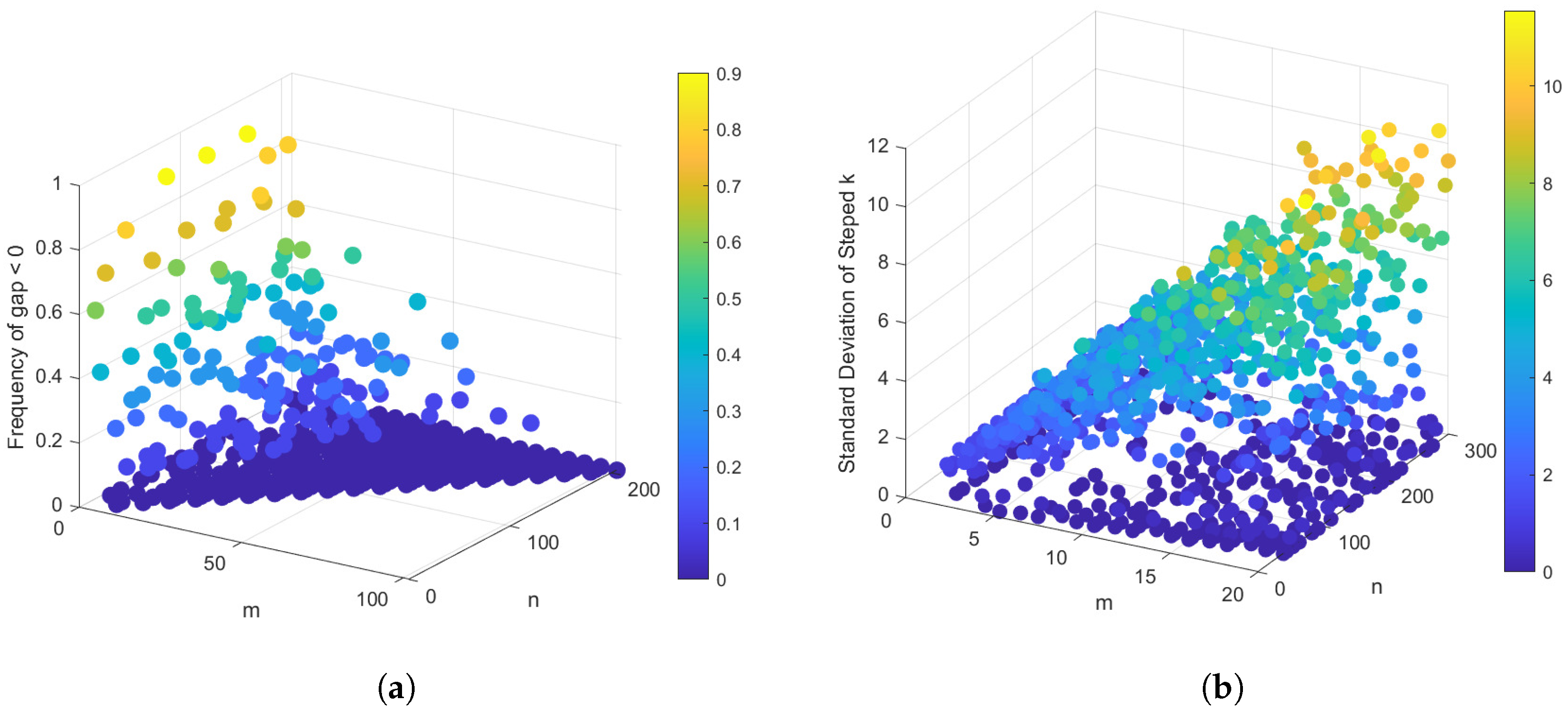
However,
is used only as a benchmark, not as the sole criterion for validating the proposed algorithm. For this reason, we also report the performance of the step-based phase as shown in
Figure 9. The gap is defined as the difference between the number of colors obtained by the step-coloring stage alone and
. A positive frequency of
indicates that the step-coloring component has an advantage, since it can produce a coloring using fewer than
colors in some cases. In contrast, if the frequency of
tends to zero, then the fallback algorithm is generally required to guarantee a smaller equitable coloring. As shown in
Figure 9a, the proposed algorithm is more effective when
m is relatively small. The standard deviation of the coloring numbers in the step-based equitable coloring is also evaluated.
Figure 9b shows that the proposed method is relatively stable when
m and
n are small.
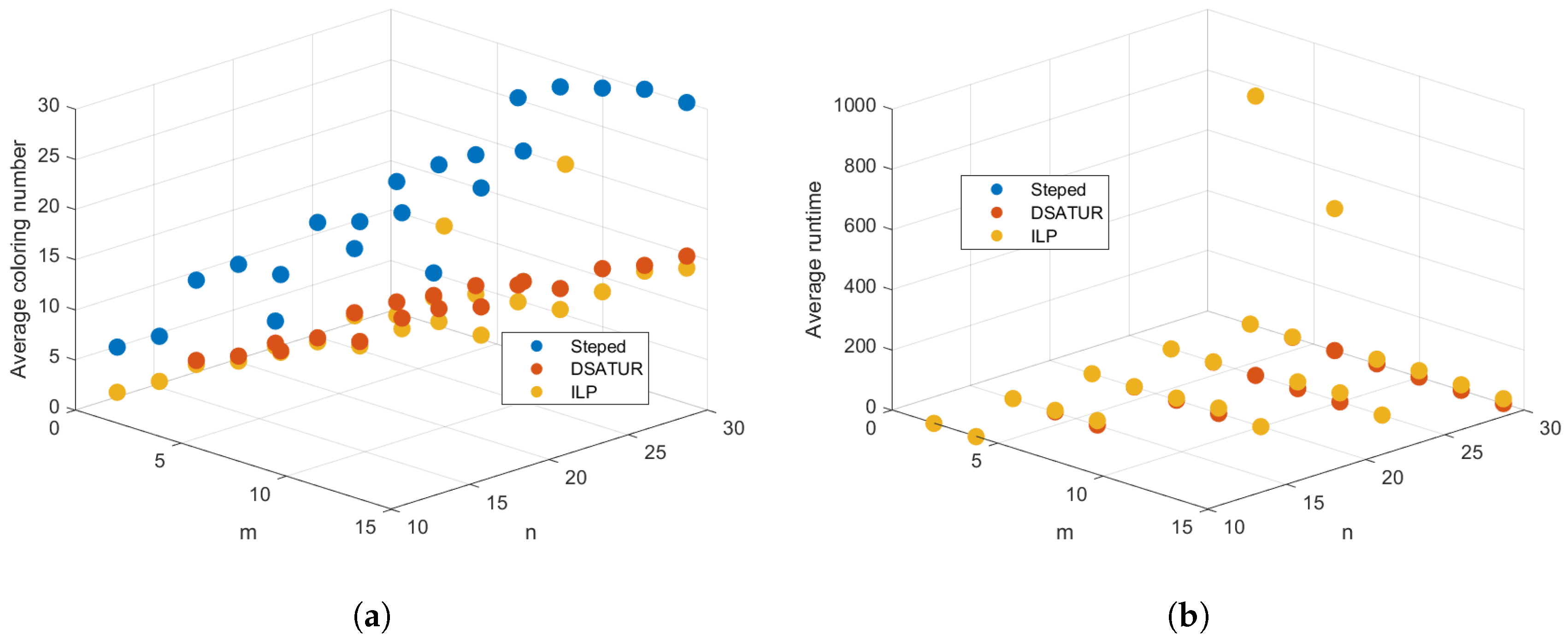
To provide detailed computational evidence and strengthen the empirical evaluation, we compare three equitable coloring algorithms on the same set of test instances: the proposed step-based equitable coloring algorithm, the exact DSATUR-based algorithm of [
18], the ILP-based algorithm of [
19]. Specifically, we set
. For each fixed
n, the parameter
m is selected as
. For each fixed pair
, 20 random subsets
with
are independently generated. In each trial, the three algorithms are applied to exactly the same
D, which ensures an equitable and reproducible comparison.
The DSATUR-based algorithm is implemented as an exact feasibility search over k, starting from a lower bound and increasing up to . For each fixed k, the search uses the saturation-degree rule for vertex selection and enforces the equitable size constraints that every color class must have cardinality either or . The ILP algorithm introduces binary variables , where indicates that vertex v is assigned color c. The formulation includes constraints requiring that each vertex receives exactly one color, adjacent vertices receive different colors, and all color classes satisfy the equitable cardinality bounds.
For each trial, we record the coloring number, the coloring assignment, the running time, and the gaps between the step-based equitable coloring and the two exact benchmark algorithms. These trial-level results are then summarized by the average coloring number and the average running time for each fixed pair
—see
Figure 10. In terms of computational complexity, the step-based equitable coloring algorithm has a time complexity of
if no fallback correction is performed. Otherwise, the fallback correction step dominates the running time, leading to a worst case complexity of
. In contrast, the DSATUR-based exact search is an exponential time backtracking algorithm, with worst case complexity on the order of
. The ILP formulation contains
binary variables and approximately
main constraints, and its solution process relies on branch and bound, which is also exponential in the worst case. Therefore, the DSATUR-based and ILP algorithms are used as exact benchmarks for small scale instances, whereas the proposed step-based equitable coloring algorithm is evaluated for its ability to obtain competitive equitable coloring numbers with substantially lower computational burden.
Table 1 reports the comparison of coloring numbers and coloring gaps for
and
.
Table 2 reports the comparison of running times for
over the same range of
n.
Table 3 reports the average coloring numbers of the three algorithms for
and
.
Table 4 presents the corresponding average running times of the three algorithms under the same parameter settings.
The results show that, although the proposed step-based equitable coloring algorithm still has a gap from the optimal equitable coloring number obtained by exhaustive search, it requires much less running time. As shown in the tables and
Figure 10, the proposed step-based equitable coloring algorithm already exhibits a clear advantage in running time when
n is small, and this advantage can become more pronounced as
n increases. Therefore, despite the gap between the equitable coloring number produced by our algorithm and the optimum, the proposed algorithm remains a meaningful and practical choice in parallel scenarios where low latency is required. For example, equitable coloring of circulant graphs is equivalent to the parallel partitioning problem in the decoding of multi-edge QC-LDPC codes for 5G communications, where fast execution and low latency are crucial.