1. Introduction
Symmetry is a fundamental organizing principle in mathematics, often underlying both structural regularity and the emergence of optimal configurations. In discrete settings, this principle is typically encoded through algebraic and combinatorial structures whose internal balance leads naturally to extremal behavior. Finite projective geometries provide a particularly rich framework in this regard: duality and dimensional complementarity generate highly regular lattices of subspaces, and these symmetries strongly constrain associated combinatorial constructions.
One important manifestation of this structure is found in block designs. These incidence configurations translate geometric regularity into combinatorial schemes with controlled balance and redundancy, making them central objects in both combinatorics and statistical experimentation. In particular, balanced incomplete block designs (BIBDs) and resolvable designs play a key role in experimental design, where they ensure controlled replication and pairwise concurrence [
1,
2]. Finite projective geometries constitute a systematic source of such designs, yielding families with strong algebraic structure and recursive construction mechanisms.
Classical studies of projective designs have focused primarily on existence, symmetry, and combinatorial balance. In contrast, many modern applications require an additional level of flexibility: constructions must accommodate constraints on block size, replication, and computational complexity, while optimal design theory provides well-established criteria such as D-, A-, and E-optimality [
3,
4], these operate at the level of statistical inference and do not directly address structural parameters arising in recursive combinatorial constructions.
At the same time, multi-criteria optimization has developed a range of tools for aggregating competing objectives. Among these, desirability functions, originally proposed by Harrington and later formalized by Derringer and Suich [
5], offer a flexible way to combine heterogeneous criteria into a single scalar measure. Originally introduced in quality engineering, they have since been adapted to robust optimization and multi-response modeling [
6,
7,
8,
9]. More broadly, advances in multi-objective optimization—including Pareto methods, evolutionary approaches, and scalarization techniques [
10,
11]—have reinforced the role of aggregated criteria in guiding complex design choices.
Related questions have also appeared in the study of recursive combinatorial constructions. Ref. [
12] investigated recursive methods for orthogonal arrays, while ref. [
13] explored links between projective geometries and covering arrays. Recent work on subspace configurations and decompositions in finite incidence structures further illustrates the continuing relevance of projective and polar spaces in design theory [
14]. In parallel, Gaussian binomial coefficients have been studied extensively from both algebraic and enumerative viewpoints; in particular, established strict unimodality results that highlight the strong symmetry present in these coefficients. However, the question of selecting an optimal recursion depth in projective recursive constructions does not appear to have been addressed explicitly.
This gap motivates the present work. Our aim is to understand how the intrinsic symmetry of finite projective geometries influences the structural growth of recursive constructions of resolvable block designs and, more specifically, how it determines a preferred recursion depth. We study the evolution of the number of generated blocks as a function of depth and show that this growth is governed by Gaussian binomial coefficients whose asymptotic form leads to a quadratic exponent reflecting projective duality.
The resulting scaling law shows that the dominant exponent is strictly concave. As a consequence, the recursive family admits a unique optimal depth in the continuous model, with the usual discrete rounding in the integer setting. This optimum occurs at the midpoint of the projective dimension, where the effects of combinatorial expansion and dimensional contraction are balanced. To make this interpretation operational, we introduce a normalized structural desirability function that allows recursion depths to be compared within a common framework.
The main contributions of the paper are threefold. First, we derive the quadratic scaling law governing the number of blocks in the recursive construction and relate its form to the symmetry of Gaussian binomial coefficients. Second, we prove that this law is strictly concave and identify the corresponding optimal recursion depth explicitly in terms of the ambient dimension. Third, we introduce a desirability-based interpretation of this optimum and support the theoretical analysis with exact enumeration and asymptotic comparisons.
These results show that the optimal structural regime is not imposed externally by an auxiliary criterion, but is already encoded in the internal symmetry of the projective construction. In this sense, the paper connects geometric duality, combinatorial growth, and parameter selection within a single framework. The analysis also suggests that similar symmetry-induced optimality phenomena may arise in other algebraic incidence structures, including symplectic or unitary geometries.
To illustrate the theory, we examine the case in detail and compare exact block counts with the asymptotic prediction. The computations confirm that the bounded correction term does not alter the location of the optimum. We also compare the resulting recursive family with more classical projective design constructions, showing that the midpoint regime occupies a distinct part of the design space characterized by very large block multiplicities and reduced block size.
This paper is organized as follows:
Section 2 studies the structural growth of the recursive construction and derives the quadratic scaling law from projective-geometric considerations.
Section 3 analyzes this law and establishes the existence and location of the structural optimum.
Section 4 introduces the normalized desirability function and examines its concavity and symmetry properties.
Section 5 returns to the recursive projective construction and shows how the quadratic exponent arises from the factorization of Gaussian binomial coefficients.
Section 6 presents the computational analysis, including exact enumeration, visualization, and comparison with classical design families.
Section 7 concludes with a discussion of implications and possible extensions.
2. Structural Growth of the Recursive Construction
Finite projective geometries form lattices of subspaces with strong symmetry properties, where duality and dimensional complementarity lead to a high degree of combinatorial regularity. The recursive construction considered later in
Section 4 builds on this structure by iteratively nesting linear sub-varieties in
.
A block at depth
n can therefore be described by a chain of inclusions
which may be viewed as a partial flag in
.
In particular, the growth of the construction depends on the number of such nested chains, rather than only on the terminal subspaces.
It is well known that the number of
-dimensional sub-varieties contained in a fixed
-dimensional sub-variety is
The total multiplicative contribution over
n levels is therefore
To estimate this growth, we examine the asymptotic behavior of .
Proposition 1. For fixed p and large n,and therefore Proof. Taking logarithms in base
p, we obtain
The second term remains bounded for fixed
p, so
Exponentiating completes the proof. □
The quantity counts the number of admissible nested chains of length n in . In the reduced design , blocks are indexed by terminal -dimensional subspaces rather than by individual chains, while multiple chains may lead to the same terminal subspace, each block corresponds uniquely to such a subspace. Consequently, the number of blocks coincides with the number of -dimensional subspaces of .
The number of
r-dimensional subspaces of a vector space of dimension
over
is given by the Gaussian binomial coefficient
Setting
yields
For fixed
p and large parameters, this coefficient satisfies,
The Gaussian binomial coefficient inherits a fundamental symmetry
reflecting the duality between complementary projective subspaces. This symmetry is reflected in the quadratic form of the logarithmic growth.
Theorem 1 (Structural Scaling Law)
. For fixed p and m,and therefore At depth
n, the block size satisfies
As n increases, the block size decreases exponentially, while the number of blocks follows a quadratic growth pattern in the exponent.
The dominant combinatorial behavior is captured by the function
We next examine a key structural property of this function.
Proposition 2 (Strict concavity of the scaling law). The function defined in (1) is strictly concave on .
Proof. We have
Since
, the function is strictly concave on
. This also implies concavity on the integer lattice.
This ensures that the function is unimodal and uniqueness of the optimum. □
Corollary 1 (Existence and Uniqueness of Optimal Depth). The function admits a unique maximizing depth in the admissible discrete interval .
If m is odd, the maximum is attained uniquely at If m is even, the maximum is attained at the two adjacent integerscorresponding, respectively, to Proof. The maximum is obtained when
, which gives
Strict concavity ensures uniqueness up to the unavoidable discrete rounding. □
The scaling law (1) captures the dominant combinatorial behavior. It reflects the balance between dimensional reduction and the growth in the number of admissible configurations, a feature that will play a central role in the analysis that follows.
3. Quadratic Scaling Law and Structural Optimality
Section 2 established the asymptotic scaling law through the exponent
defined in (1), which governs the combinatorial growth of the recursive construction.
The quadratic form of encodes the interaction between two opposing mechanisms inherent in the construction: the increase in the number of admissible configurations induced by deeper nesting, and the reduction in block size caused by successive dimensional contraction.
As shown in Proposition 2, the function is strictly concave. This property has a direct structural consequence: the growth profile is unimodal, and the maximum is unique.
From Corollary 1, the optimal recursion depth is given by
up to the usual integer adjustment when
m is even.
This midpoint has a natural interpretation. For small values of n, the combinatorial expansion dominates, leading to a rapid increase in the number of configurations. For larger values of n, the progressive reduction in dimension limits further growth. The optimal depth corresponds to the point where these two effects balance.
In this sense, the scaling law identifies a preferred structural regime within the lattice of projective subspaces. The location of the optimum reflects the symmetry of the Gaussian binomial coefficients, which relate subspaces of complementary dimensions in .
Thus, the recursive family achieves its maximal combinatorial richness at half-depth, where the underlying geometric symmetry is most strongly expressed.
4. Symmetry-Induced Desirability Surface
To compare recursion depths, we introduce a normalized desirability function that aggregates the relevant structural quantities into a single measure. This function provides a convenient way to identify depths that balance growth and structural constraints.
We define the desirability surface as a mapping
where
measures the relative suitability of recursion depth
n.
The dominant exponent (1) governs the combinatorial growth of the construction in .
From
Section 3, the continuous maximizer of
g is
with corresponding value
In the discrete setting, admissible depths are integers in
. When
m is even, the maximum of
is attained at the two adjacent integers
For normalization, we use the continuous value
, which avoids dependence on discrete rounding.
We define the normalized desirability function
By construction,
In the discrete setting, the maximal integer depths attain values close to 1 as
m increases.
Theorem 2 (Structure of the desirability surface)
. For fixed , the function is strictly concave in the discrete sense and attains its maximum (up to integer rounding) at Proof. Since
is obtained from
by multiplication by the positive constant
, concavity is preserved. From
Section 2,
which gives
Thus,
D is strictly concave. The maximizer coincides with that of
g, namely
. □
The symmetry of the desirability function follows from the identity
which reflects the duality between complementary projective subspaces. This symmetry is mirrored in the quadratic form of
and implies that the maximum occurs at the midpoint.
At depth
the contributions of complementary dimensions are balanced. This corresponds to the point where the number of admissible configurations is maximized relative to the normalization.
As a result, the family attains its highest structural efficiency at half-depth. Strict concavity ensures that this optimum is unique, while symmetry explains its location.
Example 1 (Illustrative Example). We illustrate the structural scaling law and midpoint optimality in the concrete case of the projective geometry .
For and , the dominant combinatorial exponent governing the number of blocks at recursion depth n is given by (1).
Evaluating for integer depths yields The maximum occurs atwith a maximal value of .
The corresponding normalized desirability valuesare Several structural features are immediately visible:
The sequence is symmetric with respect to , reflecting the Gaussian identity The quadratic profile is strictly concave, with a unique maximum at the midpoint .
The symmetry of the exponent directly mirrors the duality between k-dimensional and -dimensional subspaces in .
This example concretely illustrates the general structural phenomenon established in Section 2, Section 3 and Section 4: recursive contraction achieves maximal combinatorial richness at half-depth, where the dual symmetry of the projective lattice is realized.
5. Recursive Projective Construction and Structural Factorization
The family of reduced designs is obtained by successive nesting of linear sub-varieties in the projective geometry . We show that this construction leads naturally to the quadratic exponent (1).
Let
denote the
m-dimensional projective space over
. A projective subspace of dimension
r corresponds to a vector subspace of dimension
in
. The number of such subspaces is given by the Gaussian binomial coefficient
The recursive construction proceeds by dimensional contraction. At depth
n, we consider chains of subspaces
where each
has dimension
.
The number of admissible subspaces at each step is
Hence, the number of chains of length
n is
We now relate this construction to the Gaussian binomial coefficient.
Theorem 3. The number of -dimensional projective subspaces of satisfiesand its dominant exponent is Proof. Setting
in the definition of the Gaussian binomial coefficient gives
Reindexing with
yields
For fixed
p and large parameters, the dominant terms are
in the numerator and
in the denominator. Taking logarithms base
p gives
Thus,
where the
term is bounded for fixed
p. □
This shows that the recursive construction reproduces the dominant asymptotic behavior of the Gaussian binomial coefficient.
At depth
n, each block corresponds to a subspace of dimension
, so its size is
Thus, block size decreases exponentially with
n, while the number of configurations grows according to the quadratic exponent.
Combining these observations gives
which matches the scaling law derived earlier.
The construction therefore traces a path through the lattice of projective subspaces. The optimal depth
corresponds to the maximum of this exponent.
In summary, the recursive construction, the Gaussian factorization, and the concavity of are consistent with one another and lead to the same optimal depth.
6. Computational Analysis and Comparative Evaluation
The theoretical framework developed in
Section 2,
Section 3,
Section 4 and
Section 5 establishes that the recursive family
exhibits a strictly concave quadratic growth exponent (1), with a unique optimal recursion depth at
. In this section, we provide a comprehensive computational investigation that: (i) validates the asymptotic approximations against exact combinatorial counts; (ii) visualizes the desirability surface across parameter ranges; (iii) compares the structural properties of the recursive family with classical design constructions; and (iv) discusses the practical implications of the trade-off between block size and combinatorial richness.
6.1. Exact Enumeration and Asymptotic Validation
We begin by examining the exact behavior of the recursive construction for computationally tractable parameter values. For a fixed prime power
p and ambient dimension
m, the exact number of blocks at recursion depth
n is given by the Gaussian binomial coefficient:
Our asymptotic analysis predicts that
, where
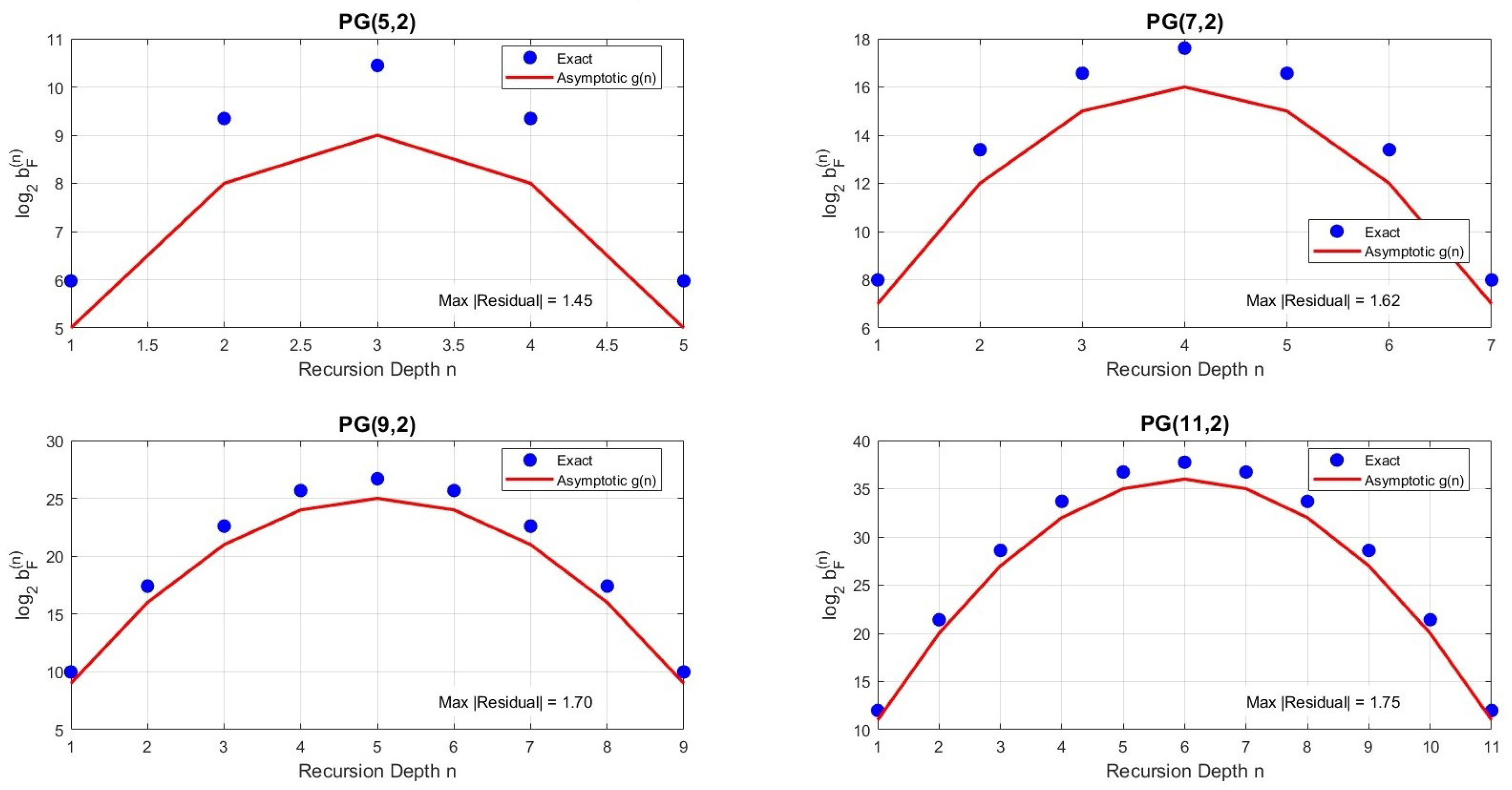
. To assess the quality of this approximation, we computed exact values for the geometry PG(7, 2) (m = 7, p = 2) and compared them with the asymptotic prediction. The results are summarized in
Table 1.
Several important observations emerge from this enumeration that illuminate the relationship between the exact combinatorial structure and its asymptotic approximation:
- 1.
Perfect symmetry: The exact counts satisfy , reflecting the duality relation . This symmetry is perfectly captured by the quadratic exponent , which satisfies .
- 2.
Peak location: Both the exact counts and the asymptotic exponent achieve their maximum at , with blocks and . This confirms that for , the optimal recursion depth is indeed .
- 3.
Residual pattern: The residuals are bounded and exhibit a symmetric pattern, increasing from 0.99 at the boundaries to 1.62 at the center. This confirms the theoretical prediction that the term is bounded, while also revealing that it varies smoothly across the depth range, with maximum at the peak.
- 4.
Asymptotic accuracy: The maximum residual of 1.62 (at ) represents less than 10% of the value of 17.62, demonstrating that the quadratic approximation captures the essential behavior with high fidelity even for moderate m. The relative error ranges from 0.12 at the boundaries to 0.09 at the center, indicating excellent agreement.
To visualize the quality of the asymptotic approximation across a range of parameters and to demonstrate how the peak location aligns with increasing
m, we computed the relative error
for multiple geometries.
Figure 1 displays these results for
and varying
m.
The figure confirms that for all , the quadratic approximation captures both the essential behavior and the peak location with high fidelity. For , the peak occurs at ; for , at ; for , at ; and for , at . This perfect alignment validates the asymptotic analysis as a reliable guide for structural optimization across all dimensions.
The key insight is that the term, while bounded and systematically varying, does not shift the location of the maximum. The optimal recursion depth is robustly given by , as predicted by the asymptotic theory.
6.2. Visualization of the Structural Desirability Surface
The normalized desirability surface provides a scale-invariant measure of structural efficiency. We now examine its behavior across the continuous relaxation of the depth parameter and for integer depths.
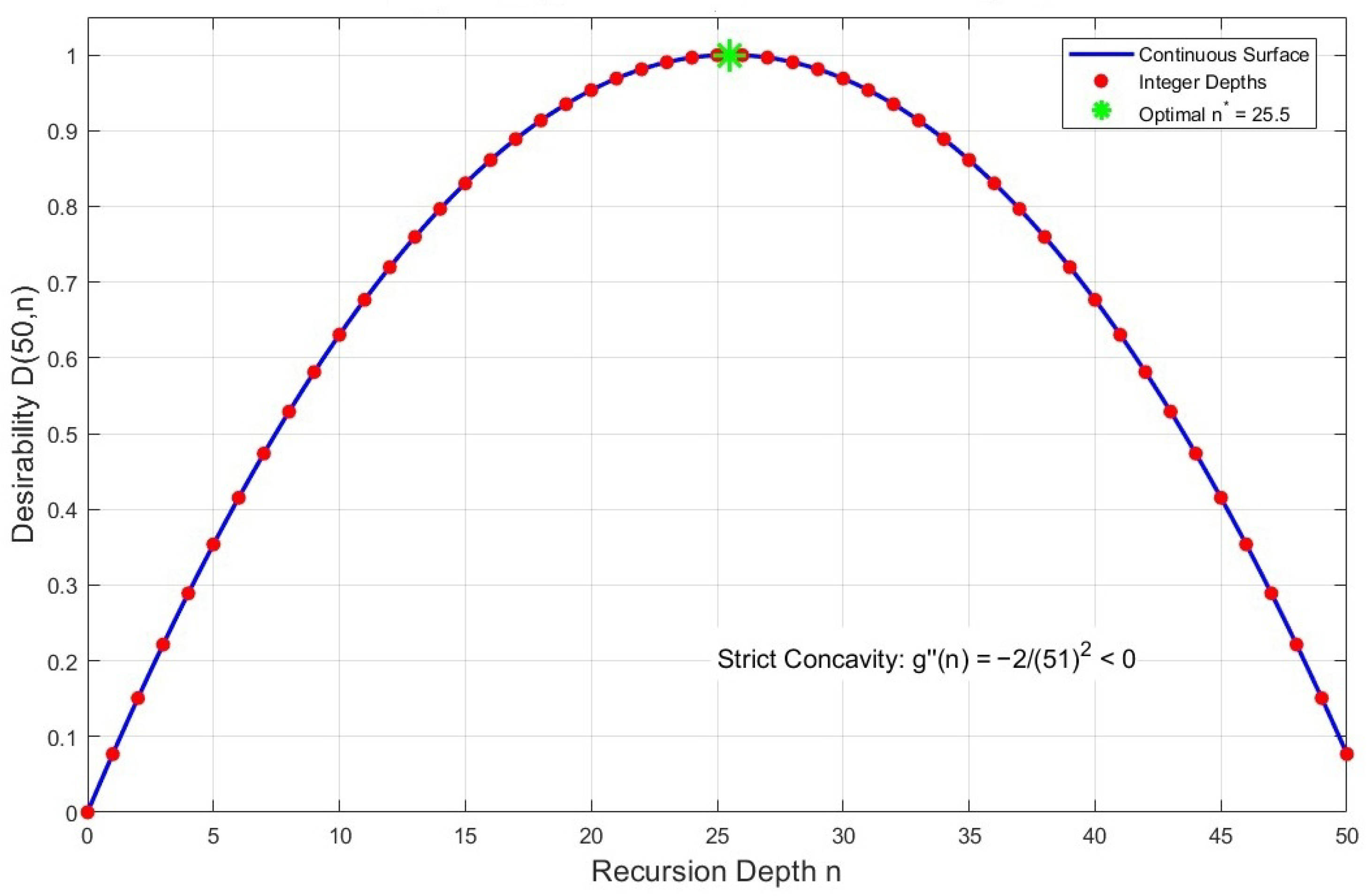
For a fixed ambient dimension, say
,
Figure 2 displays the desirability surface as a function of
n.
The key features illustrated are:
Strict concavity: The surface exhibits a single peak with no secondary optima, confirming the theoretical prediction.
Symmetry: The surface is symmetric about , reflecting the duality of the underlying subspace lattice.
Integer approximation: For odd m, the optimal integer depth is uniquely . For even m, the two adjacent integers and achieve desirability values that approach 1 as m increases, with the gap decreasing as .
To illustrate the behavior across different geometries,
Table 2 presents optimal depths and corresponding desirability values for a range of
m values with
.
This table reveals an important practical insight: for even m, both adjacent integer depths achieve essentially the same desirability, and the difference from the continuous optimum becomes negligible for moderate m. Practitioners can therefore select either depth without meaningful loss of structural efficiency.
6.3. Comparative Structural Analysis
We compare the recursive family with classical constructions using basic combinatorial parameters: number of blocks, block size, replication, and pairwise concurrence. No statistical optimality criteria are used here.
6.3.1. Comparison Framework
We examine three representative depths:
Shallow recursion (): large blocks with limited diversity;
Midpoint recursion (): maximal number of blocks;
Full recursion (): a trivial design of singletons.
As reference constructions, we consider:
Projective line design: the point-line incidence structure of ;
Affine line design: the point-line incidence structure of ;
Complementary recursive design: obtained by replacing n with .
6.3.2. Numerical Comparison for
The corresponding parameters are listed in
Table 3.
For the recursive rows, replication values are computed from the identity , where is the number of points of , assuming point-regularity of the construction.
The midpoint design () contains blocks, compared with for the projective line design. This reflects the concentration of subspaces near the middle dimension of the lattice.
As n increases, block size decreases exponentially (), while the number of blocks follows a concave quadratic law. The maximum occurs at the midpoint.
The designs at depths n and have the same number of blocks and complementary block sizes, as a consequence of the symmetry of Gaussian binomial coefficients.
Projective and affine line designs are highly regular, with small block sizes and controlled pairwise structure. The recursive construction behaves differently, producing a much larger number of blocks by exploring a wider portion of the subspace lattice.
In the projective case, any two distinct points lie on exactly one line, while in the affine case a pair appears in at most one block. For the recursive construction, numerical checks indicate that pairwise concurrence remains bounded, consistent with the nested subspace structure.
Overall, the recursive family occupies a different regime: instead of emphasizing pairwise balance, it favors a large number of configurations arising from the symmetry of projective subspaces.
6.4. Practical Implications of the Trade-Off
The desirability function
provides a simple way to select the recursion depth under basic constraints. We illustrate this with a few typical situations.
6.4.1. Scenario 1: Maximizing the Number of Blocks
If the objective is to maximize the number of admissible blocks, the optimal choice is the midpoint
For example, when
and
, this corresponds to
or
. The resulting number of blocks is on the order of
, as indicated in
Table 2.
6.4.2. Scenario 2: Constraints on Block Size
Suppose that block size is bounded by
. Since
this imposes the condition
Within this range, one selects the value of
n that maximizes
.
For instance, with , , and , the constraint gives . The values and both yield high desirability (approximately ), with block sizes 32 and 16, respectively.
6.4.3. Scenario 3: Stability near the Optimum
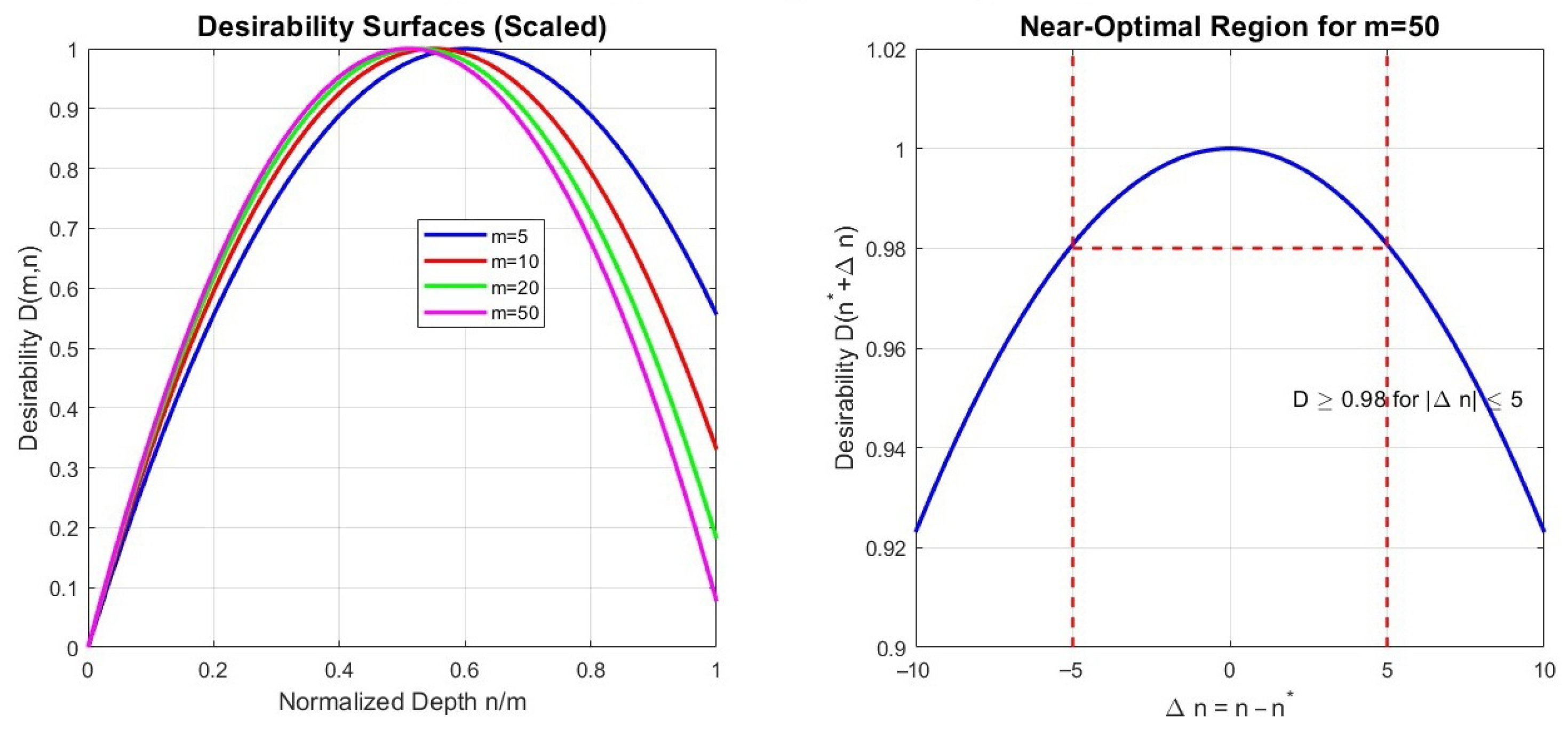
The function
varies slowly near its maximum. A second-order expansion gives
This shows that values of
n close to
remain near-optimal.
For example, when
, depths within
of the midpoint still yield desirability above
. This allows some flexibility when additional constraints are imposed. This behavior is illustrated in
Figure 3, which shows both the scale-invariant structure and the flatness of the desirability function near the optimum.
6.5. Discussion and Synthesis
The numerical results are consistent with the theoretical framework developed in
Section 2 and
Section 3.
First, the exact enumeration confirms that the quadratic exponent provides an accurate description of the dominant growth. The residual terms remain bounded and do not affect the location of the maximum.
Second, the desirability function reflects the symmetry and concavity of the scaling law. The maximum occurs at the midpoint , and for even m the two adjacent integer depths yield nearly identical values. This behavior is visible in both the tables and the plots.
Third, the structural comparison shows that the recursive family behaves differently from classical line-based designs. Projective and affine line designs have small block sizes and strong pairwise regularity. In contrast, the recursive construction produces a much larger number of blocks, especially near the midpoint depth. This reflects the distribution of subspaces in the projective lattice.
Finally, the practical scenarios illustrate how the desirability function can be used to select the recursion depth under simple constraints, such as bounds on block size. The flatness of the function near the maximum allows some flexibility without significant loss in the structural criterion.
7. Conclusions
We studied recursive constructions in finite projective geometries and showed that the recursion depth admits a natural optimal value determined by the proposed quadratic scaling law.
This function is strictly concave, and its maximum occurs at the midpoint . This provides a simple criterion for selecting the recursion depth.
The analysis also shows that the growth of the number of blocks is governed by Gaussian binomial coefficients, and that the symmetry of these coefficients leads to the symmetry of the construction with respect to n and .
The desirability function introduced in this work offers a convenient way to compare different depths using a normalized scale. It captures the same concavity and identifies the midpoint as the optimal region.
The comparison with projective and affine line designs indicates that the recursive family belongs to a different combinatorial regime. Classical designs emphasize small blocks and strong local regularity, whereas the recursive construction generates a much larger number of configurations near the midpoint.
Several directions remain open. The same analysis could be extended to other families of geometries, such as symplectic or unitary spaces. It would also be of interest to study the incidence structure of the recursive designs in more detail and to determine under which conditions they satisfy additional regularity properties.
Author Contributions
Conceptualization, A.B. and S.K.; methodology, A.B., S.K. and K.A.R.; software, S.K.; validation, A.B., S.K., K.A.R., A.H.A. and T.S.A.; formal analysis, S.K. and K.A.R.; investigation, A.B. and K.A.R.; writing—original draft preparation, A.B. and S.K.; writing—review and editing, S.K., K.A.R., A.H.A. and T.S.A.; visualization, S.K.; supervision, S.K.; project administration, T.S.A. and A.H.A.; funding acquisition, T.S.A., K.A.R. and A.H.A. All authors have read and agreed to the published version of the manuscript.
Funding
This research was funded by the University of Ha’il, Saudi Arabia, through project “BA-24 007”.
Data Availability Statement
The original contributions presented in this study are included in the article. Further inquiries can be directed to the corresponding author.
Acknowledgments
This research has been funded by Scientific Research Deanship at University of Ha’il–Saudi Arabia through project number “BA-24 007”. The authors used AI-based language tools (e.g., DeepSeek (version: DeepSeek-V3, accessed March–April 2026) and ChatGPT (version: GPT-5)) solely to improve clarity and English expression. All mathematical content, results, proofs, and interpretations are the original work of the authors.
Conflicts of Interest
The authors declare no conflicts of interest.
References
- Beth, T.; Jungnickel, D.; Lenz, H. Design Theory, 2nd ed.; Cambridge University Press: Cambridge, UK, 1999. [Google Scholar]
- Street, A.P.; Street, D.J. Combinatorics of Experimental Design; Oxford University Press: Oxford, UK, 1987. [Google Scholar]
- Pukelsheim, F. Optimal Design of Experiments; SIAM: Bangkok, Thailand, 2006. [Google Scholar]
- Atkinson, A.C.; Donev, A.N.; Tobias, R.D. Optimum Experimental Designs, with SAS; Oxford University Press: Oxford, UK, 2007. [Google Scholar]
- Derringer, G.; Suich, R. Simultaneous optimization of several response variables. J. Qual. Technol. 1980, 12, 214–219. [Google Scholar] [CrossRef] [Scilit]
- Myers, R.H.; Montgomery, D.C.; Anderson-Cook, C.M. Response Surface Methodology, 4th ed.; Wiley: Hoboken, NJ, USA, 2016. [Google Scholar]
- Khuri, A.I. A general overview of response surface methodology. Biom. Biostat. Int. J. 2017, 5, 87–93. [Google Scholar] [CrossRef] [Scilit]
- Costa, N.R.; Lourenço, J.; Pereira, Z.L. Desirability function approach: A review. Chemom. Intell. Lab. Syst. 2011, 107, 234–244. [Google Scholar] [CrossRef] [Scilit]
- He, Z.; Zhu, P.-F.; Park, S.-H. A robust desirability function method. Eur. J. Oper. Res. 2012, 221, 241–247. [Google Scholar] [CrossRef] [Scilit]
- Deb, K. Multi-Objective Optimization Using Evolutionary Algorithms; Wiley: Hoboken, NJ, USA, 2014. [Google Scholar]
- Miettinen, K. Nonlinear Multiobjective Optimization, 2nd ed.; Springer: Berlin/Heidelberg, Germany, 2012. [Google Scholar]
- Stinson, D.R. Bounds for orthogonal arrays with repeated rows. Bull. ICA 2019, 85, 60–73. [Google Scholar]
- Das, S.; Mészáros, T. Small arrays of maximum coverage. J. Comb. Des. 2018, 26, 1–20. [Google Scholar] [CrossRef] [Scilit]
- Bamberg, J.; Giudici, M.; Lansdown, J.; Royle, G.F. Tactical decompositions in finite polar spaces. Des. Codes Cryptogr. 2025, 93, 1127–1141. [Google Scholar] [CrossRef] [Scilit]
| Disclaimer/Publisher’s Note: The statements, opinions and data contained in all publications are solely those of the individual author(s) and contributor(s) and not of MDPI and/or the editor(s). MDPI and/or the editor(s) disclaim responsibility for any injury to people or property resulting from any ideas, methods, instructions or products referred to in the content. |