1. Introduction
Vector-borne diseases account for more than 17% of all infectious diseases worldwide, causing more than 700,000 deaths annually. The mosquitoes
Aedes aegypti and
Aedes albopictus (According to taxonomic rules in Biology, when mentioning the species
Aedes aegypti and
Aedes albopictus for the first time, their full names should be used. In subsequent occurrences, they should be abbreviated as
A. aegypti and
A. albopictus for conciseness and readability) are the main vectors of the viruses dengue, chikungunya, Zika, and yellow fever [
1]. Climate factors such as temperature, rainfall, and humidity favor the geographic expansion of these vectors, with socioeconomic conditions that influence vulnerability to local outbreaks [
2].
A. aegypti evolved in close association with humans, developing a high degree of adaptation to urban environments. This complex interplay of social, ecological, and environmental factors makes eradication unfeasible without disproportionate impacts. Consequently, health agencies recommend maintaining vector populations below transmission thresholds through integrated control strategies, which combine monitoring and chemical, biological, genetic, and environmental management, in addition to vaccination [
2,
3,
4]. Reliable monitoring is essential for such efforts. MosquiTRAP
®, which uses a synthetic oviposition attractant (AtrAedes) to capture primarily gravid females [
5], provides a key entomological indicator: the Mean Female
Aedes Index (MFAI). Calculated weekly as the ratio of captured
A. aegypti females to the number of monitored traps, the MFAI enables continuous tracking of adult population dynamics.
The life cycle of
A. aegypti comprises four developmental stages: egg, larva, pupa (aquatic forms), and adult (winged forms). Temperature and rainfall modulate transition rates between stages, affecting reproduction, oviposition, fitness, and egg hatching [
6]. Consequently, mosquito population dynamics and disease transmission follow seasonal patterns associated with dry and cold or wet and hot seasons [
7].
The relationship between the
Aedes life cycle and temperature has been extensively documented through experiments with consistent results [
8,
9,
10,
11]. Temperature affects mosquito physiology, altering hatching rates, development time, longevity, and fitness [
12]. Mathematical formulations describing development rates as temperature-dependent are well established [
13].
Rainfall has a more complex influence on the life cycle and population dynamics, as it is spatially heterogeneous and temporally impulsive, making controlled experiments and monitoring challenging. The most evident relationship between rainfall and mosquito abundance lies in the accumulation of water in artificial containers that support aquatic development. While moderate rainfall favors population growth, intense and continuous rainfall may reduce abundance due to container overflow and larval loss [
14]. Moreover, the desiccation resistance of mosquito eggs allows them to remain viable for months under dry and hot conditions, creating a reservoir of quiescent eggs. When the rainy season begins, these eggs hatch simultaneously, leading to abrupt increases in mosquito populations [
3,
15]. Because humidity, which is strongly correlated with rainfall, also influences mosquito fitness, the overall dependence of population dynamics on rainfall is highly nonlinear and difficult to quantify experimentally [
3].
Several mathematical models with parameters dependent on meteorological variables have been developed to describe the seasonal behavior of mosquito populations, with the aim of predicting both population dynamics and disease transmission [
11,
13,
16,
17,
18,
19]. A dynamical model with temperature-dependent mosquito life-cycle rates was developed to estimate
A. aegypti population size [
11]. Other studies introduced models that include oviposition in both dry and wet environments, driven by sinusoidal temperature or rainfall functions to simulate seasonality [
16,
18]. A deterministic model capturing the population dynamics of immature and mature mosquitoes was developed to assess how temperature and rainfall influence mosquito abundance, identifying weather conditions that favor population peaks [
19]. A mathematical model considers four egg compartments to address successive stages of quiescence and investigates, through the basic offspring number, whether adverse egg conditions can increase the reproductive capacity of mosquitoes [
20]. Temperature and precipitation data, field observations of female captures, and integrated monitoring records were incorporated into an entomological model to evaluate the dependence of mosquito development rates on precipitation. The authors used the known temperature dependence of metamorphosis rates to calibrate the model and proposed a general nonlinear monotonic relationship with precipitation. The model presented a good fit to the data with strong correlation (
), although it underestimated population peaks at the beginning of the rainy season [
13]. Despite these advances, most models assume smooth seasonal forcing and fail to capture the impulsive population peaks observed at the onset of the rainy season, which may result from the sudden hatching of eggs accumulated during dry periods.
In this study, we developed an entomological mathematical model using nonlinear ordinary differential equations with temperature- and rainfall-dependent development rates to reproduce weekly female capture data (MFAI) from MosquiTRAP traps in the city of Sete Lagoas, Minas Gerais, Brazil. The model has two objectives: (i) to test whether egg accumulation during dry periods explains population increases in the rainy season; and (ii) to explore the well-established dependence of development rates on temperature, simultaneously optimizing the function representing the influence of rainfall.
Qualitative analysis of the autonomous version of the model reveals an imperfect pitchfork bifurcation associated with the basic offspring number,
. The imperfection in the pitchfork bifurcation stems from the symmetry-breaking effect introduced by the dual oviposition strategy. It leads to a phenomenon that we term basin-mediated hysteresis, in which the progressive collapse of the basin boundary of the extinction state leads to an abrupt, irreversible transition once the critical threshold is exceeded. The analysis indicates that returning to a controlled state becomes considerably more difficult after the transition, mirroring the population persistence conferred by the dual oviposition strategy. To calibrate the model, the dependence of mosquito development rates on rainfall and temperature was optimized using the Differential Evolution (DE) algorithm [
21], minimizing a least-squares cost function to best fit the field data. Model validation was performed using female capture data from traps deployed in Sete Lagoas, Minas Gerais, Brazil, showing strong agreement with observed seasonal patterns. A very strong positive correlation between model outputs and empirical data reinforces the reliability of the proposed system. Furthermore, the results demonstrate that the dual oviposition strategy, which enables egg accumulation during dry periods and mass hatching with rainfall, is the biological mechanism behind both the basin-mediated hysteresis and observed population peaks.
This paper is organized as follows.
Section 2 describes the weekly MFAI, rainfall, and temperature data. The model formulation and parameter estimation are presented in
Section 3.
Section 4 provides the qualitative analysis of the autonomous system, including equilibrium, stability, bifurcation, and sensitivity analyses.
Section 5 discusses in silico experiments, where the mathematical model is integrated with rainfall dependence and optimized to fit the data. Finally,
Section 6 presents the concluding remarks.
2. Data Collected from the City of Sete Lagoas
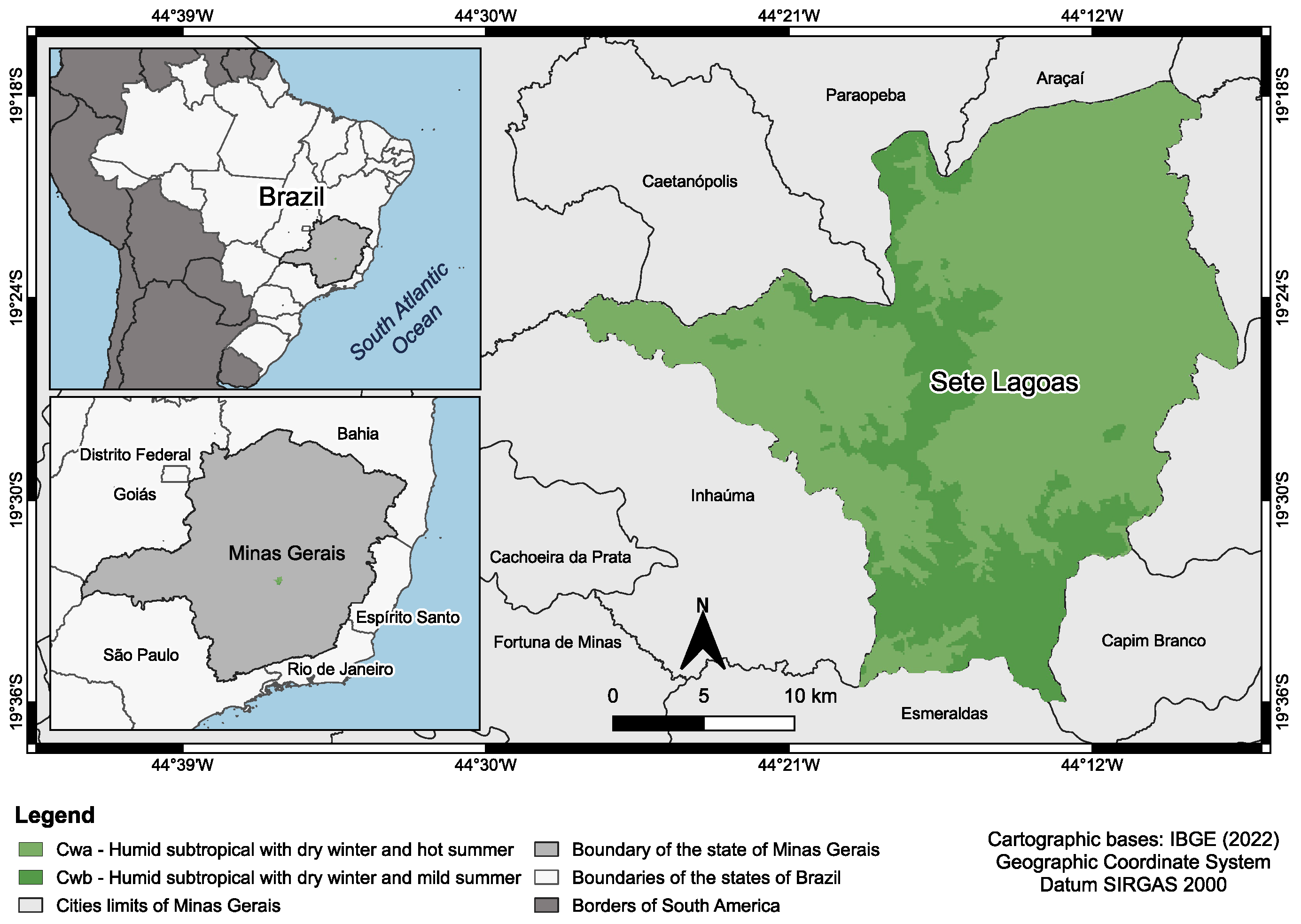
The study area corresponds to the city of Sete Lagoas, located at latitude 19°28′4″ S and longitude 44°14′52″ W, at an altitude of 751 m, in the state of Minas Gerais, Brazil. The predominant climate in the region is classified as humid subtropical, according to the Köppen–Geiger classification (Cwa), characterized by dry winters and hot and rainy summers. This climatic condition is illustrated in
Figure 1, which was produced using freely available map layers from the Brazilian Institute of Geography and Statistics (IBGE) Map Portal [
22], along with Köppen climate classification data provided by the Institute for Forest and Agricultural Research (IPEF) [
23]. Sete Lagoas is located within the Cerrado biome, a savanna-like ecosystem. The average annual temperature ranges between 20 to 22 °C, and the average annual rainfall varies from 1300 to 1600 mm [
24,
25].
The climatic conditions of Sete Lagoas are favorable to the development of the mosquito
A. aegypti, due to the high frequency and intensity of rainfall and suitable temperatures during the summer. In contrast, the prolonged dry period during winter, along with a sharp reduction in humidity, creates unfavorable conditions for larval hatching, inducing a quiescent state. With the onset of the rainy season, even dormant larvae respond to rainwater stimuli, resulting in mass hatching and a potential increase in vector infestation [
26].
The Integrated Control Program implemented in the municipality provides sample data on the number of captured females, used to calculate the Mean Female
Aedes Index (MFAI). The captures were performed using the MosquiTRAP
® trap, developed by Eiras and Resende [
5], which simulates oviposition sites to attract and capture female
Aedes mosquitoes near residences. The MFAI is defined as the ratio between the number of ovipositing females captured and the total number of installed traps, which amounted to 497 units [
27].
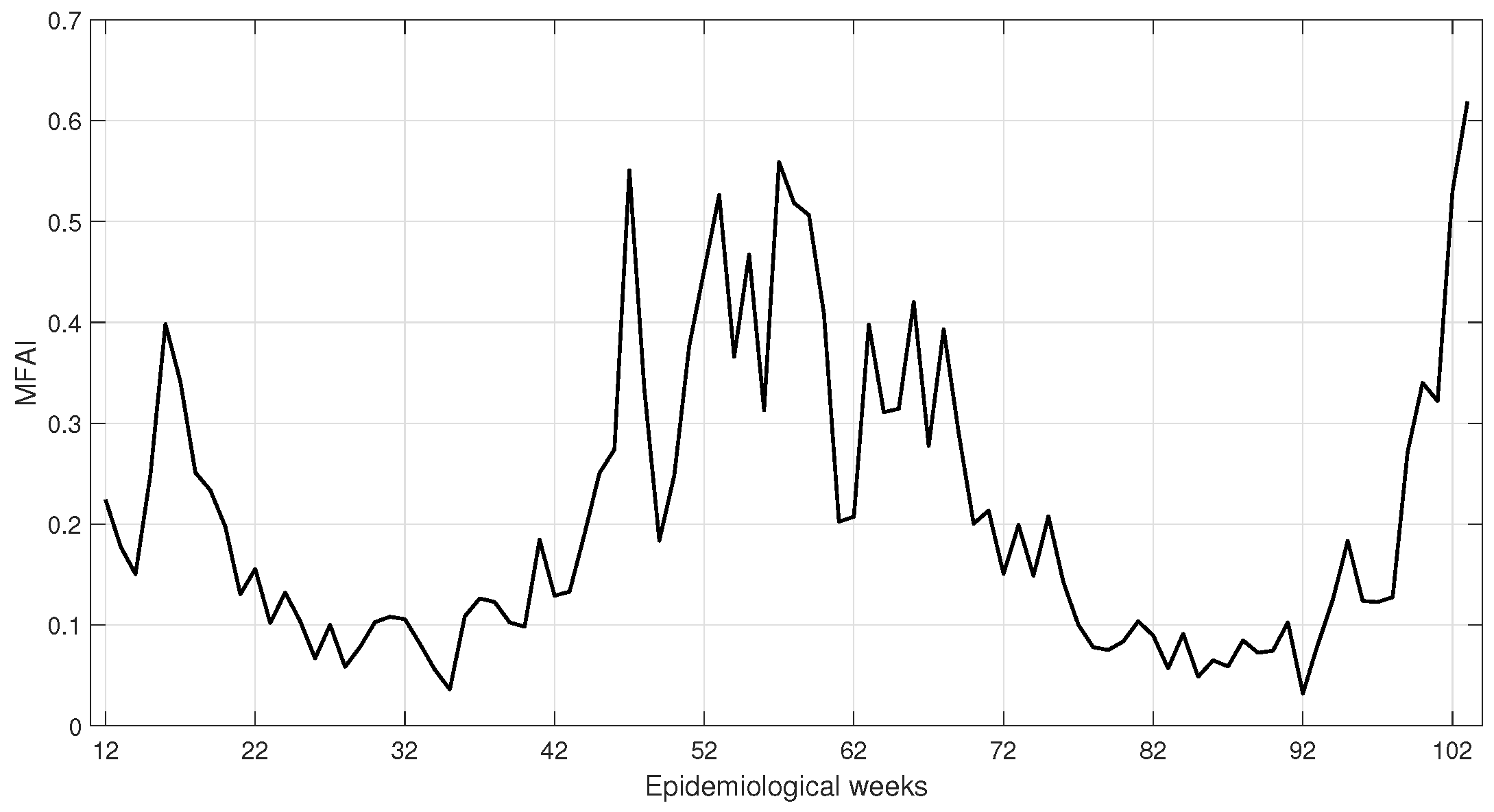
Figure 2 presents the MFAI time series over 92 epidemiological weeks, exhibiting pronounced seasonal peaks that reflect significant population fluctuations. This temporal pattern supports the development of a model that associates meteorological variables with mosquito population dynamics.
Daily meteorological data for Sete Lagoas were obtained from the BDMEP (Meteorological Database for Teaching and Research), provided by the National Institute of Meteorology (INMET) [
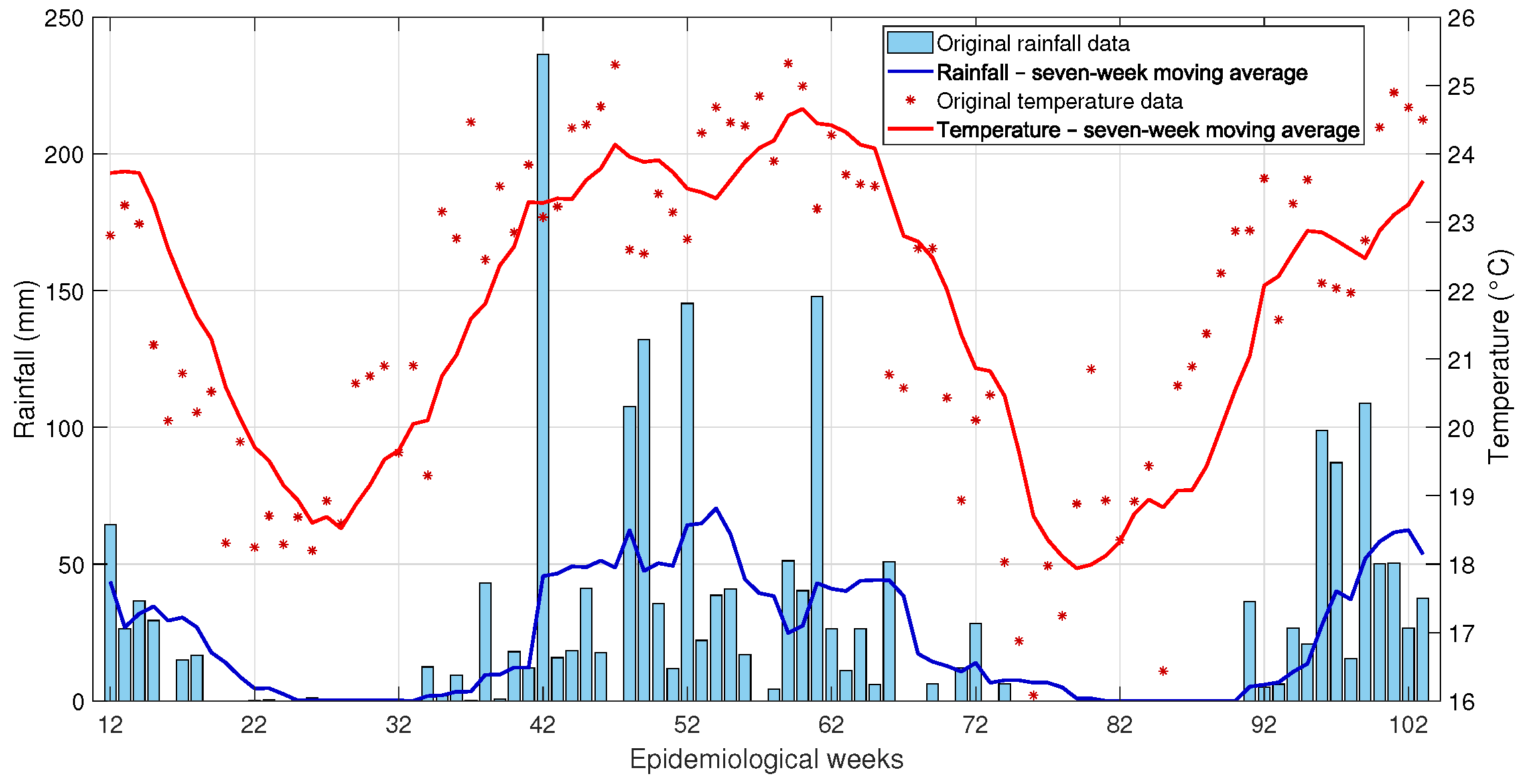
28], and converted into weekly series for the years 2009 and 2010. The analyzed period spans epidemiological weeks (EW) 12 to 52 of 2009 and EW 1 to 52 of 2010. Meteorological variables can fluctuate significantly from week to week due to specific weather events, especially under extreme or atypical conditions, introducing noise into the time series. To enhance the accuracy of the proposed model, a seven-week simple moving average (SMA) was applied to the weekly average temperature and accumulated rainfall data.
Figure 3 displays the original meteorological time series alongside the smoothed series obtained through the seven-week SMA. The seven-week window produced the best model performance, balancing noise reduction and responsiveness to rainfall events. Therefore, this value was adopted in the simulations.
Model validation was performed by fitting the simulated female population data to the sampled entomological index (MFAI). Parameter estimation was conducted using the Differential Evolution algorithm, whose implementation details are provided in
Section 5.2.
3. Mathematical Model Formulation
The population dynamics of
A. aegypti, encompassing the immature and adult developmental stages, is modeled in this section using a system of nonlinear ordinary differential equations. For simplification, the larval and pupal phases were incorporated into the compartments of eggs laid in wet (
) and dry (
) environments. The adult stage is represented exclusively by females (
F). Male mosquitoes were not explicitly considered, except for their average effect on development rate, since females require only one copulation to store all of their lifetime egg-producing material in their spermathecae. After mating, females are capable of oviposition within 72 h [
29].
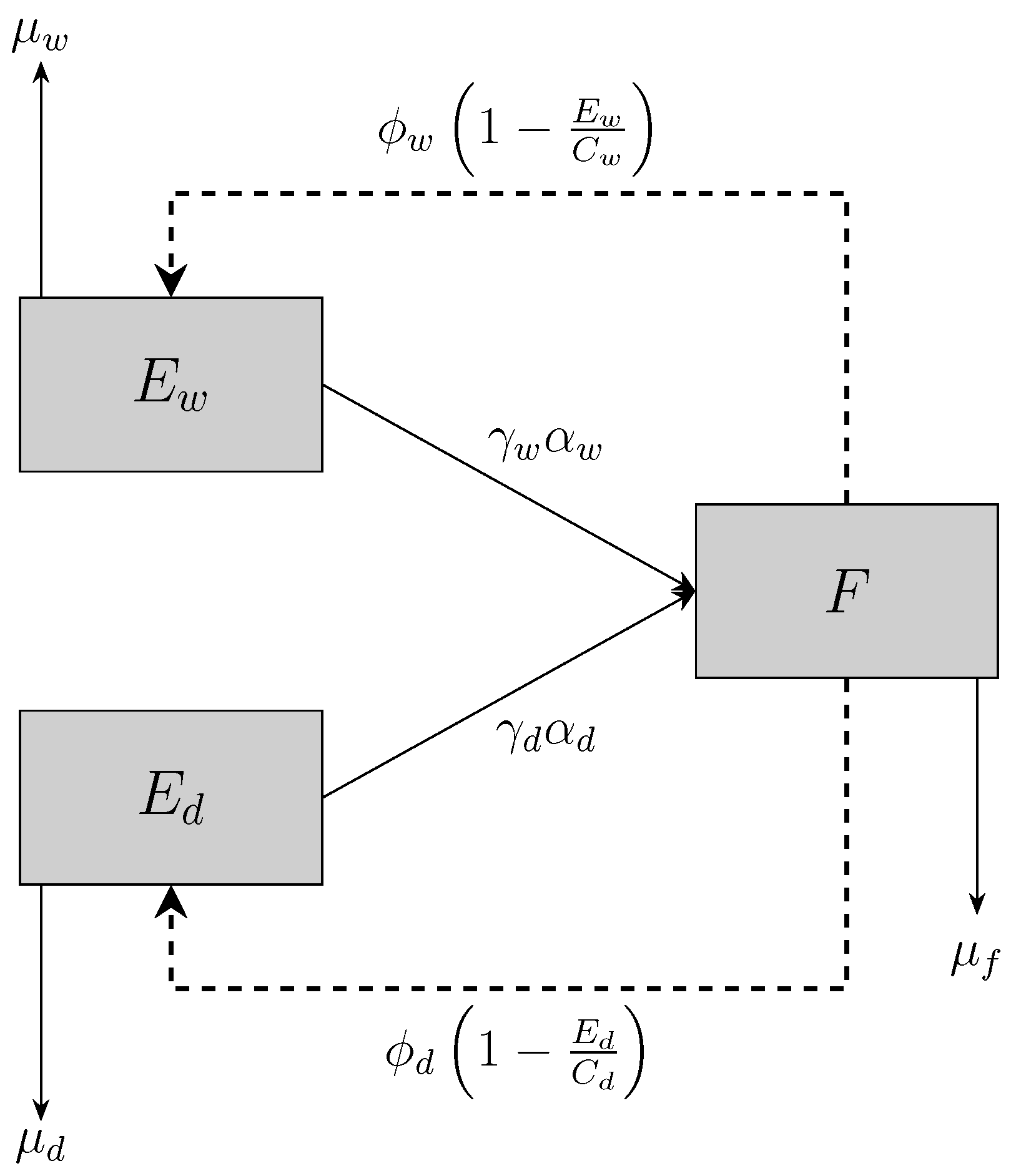
The population dynamics described by the model start with the oviposition process. Adult females (F) lay eggs in two distinct environments: the wet () and dry () compartments. The oviposition rates are given by and , respectively, where are the mean oviposition rates and the environmental carrying capacities. The factor introduces a logistic-type regulation into the model. Its main function is not to simulate competition for resources, but rather to model an inhibition of oviposition, naturally restricting the growth of the egg population as it approaches the environment’s maximum capacity . Eggs in each compartment are subject to two main outflows: natural mortality, represented by , and development into adults at rate . A fraction of the emerging adults are females, contributing to the recruitment of new adults at a total rate of . Adult females die at rate per unit time.
This balance of inflows and outflows among life stages defines the autonomous deterministic system illustrated in
Figure 4, given by
The state variables are non-negative, and all parameters are assumed to be positive. System (
1) can be analyzed within the biologically meaningful invariant region:
where populations are non-negative and egg populations do not exceed the environmental carrying capacity.
3.1. Parameterization Based on Rainfall and Temperature
The influence of temperature on entomological parameters is well established, directly affecting key aspects of the
A. aegypti life cycle such as longevity, fecundity, development, survival, and vector competence, which are essential for disease transmission dynamics [
30]. Rainfall, in turn, has a more complex and less understood role, simultaneously creating breeding sites and contributing to larval mortality. These effects depend on rainfall patterns, surface water dynamics, and temporal lags, thereby shaping local vector abundance. Despite its recognized importance, the magnitude and mechanisms of rainfall’s impact on
A. aegypti biology, particularly oviposition site selection, larval development, and adult emergence, remain insufficiently understood [
31].
In this section, we incorporate the influence of temperature and rainfall into specific model parameters to realistically represent environmental effects while preserving structural simplicity and predictive robustness. The dependence of these parameters on climatic variables is formalized through parametric functions. Since the climatic variables are time series, the parameters evolve dynamically in time according to these environmental dependencies.
Let
denote the set of model rates that depend on meteorological variables. We assume that each rate
(with
) depends separately on rainfall
r and temperature
T through smooth parametric functions
and
, respectively. The functional forms of
and
are the same for all rates, but the coefficients are specific to each
. Hence, the joint dependence of
on both environmental variables can be represented locally by a bivariate Taylor expansion:
where
and
denote the rainfall- and temperature-dependent components of each rate.
For simplicity, we set the constant term
, since the rates should vanish in the absence of environmental effects (i.e., when
). The linear coefficients
and
express the sensitivity to the climatic variables and, for simplicity, are normalized to 1, assuming that rainfall and temperature contribute additively with equal weights. The higher-order terms
, which would represent nonlinear effects or more complex interactions, are neglected because the daily rates are typically small (<1). Thus, we retain only the linear terms, obtaining the additive dependence for each rate:
Under this simplification, the effects of rainfall and temperature act as parallel contributions, reducing the number of free parameters and making the model more tractable.
A power-law function is used to represent the dependence of the entomological parameters on the rainfall index
r, because it can represent a wide range of increasing monotonic behaviors (concave up or concave down) with few additional parameters, preserving simplicity [
13,
32,
33]:
where
denotes the rainfall-dependent entomological parameters of system (
1). The values
and
represent the minimum and maximum values of the parameter
, respectively, according to literature data (
Table 1);
r represents the accumulated weekly rainfall; the values
and
correspond, on a weekly basis, to the rainfall threshold between subtropical and tropical forest biomes (approximately
) [
34]. In this study, we restrict
, allowing for both increasing and decreasing dependencies depending on the values of
and
. This assumption reflects the dominant effect of increasing rainfall in creating breeding sites, and is adopted as a first-order approximation, although more complex nonlinear effects such as flushing are not explicitly modeled. Each exponent
must be optimized to best fit the parameter to the rainfall data. These optimization approaches take into account real data of
A. aegypti females and are described in detail in
Section 5.2.
Although several studies have explored the influence of temperature on mosquito biology, we adopt two simplifying assumptions:
- (1)
A small number of free parameters;
- (2)
The existence of an optimal temperature for metabolic processes.
To meet these criteria, we adopt polynomial functions to represent temperature-dependent rates. We emphasize that these functions describe the dependence of biological rates on temperature, and not temperature as a function of time. Following the approach of Yang et al. [
11] and Yang et al. [
43], for each temperature-dependent rate
we use a polynomial of degree
n:
where
T is the temperature (in °C), and the coefficients
(with
) are fitted by the ordinary least squares method using the
polyfit function in MATLAB R2022b. This method minimizes the sum of squared residuals. The degree of the polynomial must be chosen carefully. Higher-degree polynomials can fit the data better, but they may also introduce unwanted wiggles or negative values. Additionally, very high-degree polynomials tend to fit random errors in the data rather than the true biological relationship. Therefore, we limited the degree to quadratic and quartic functions, which capture the essential temperature dependence without overfitting.
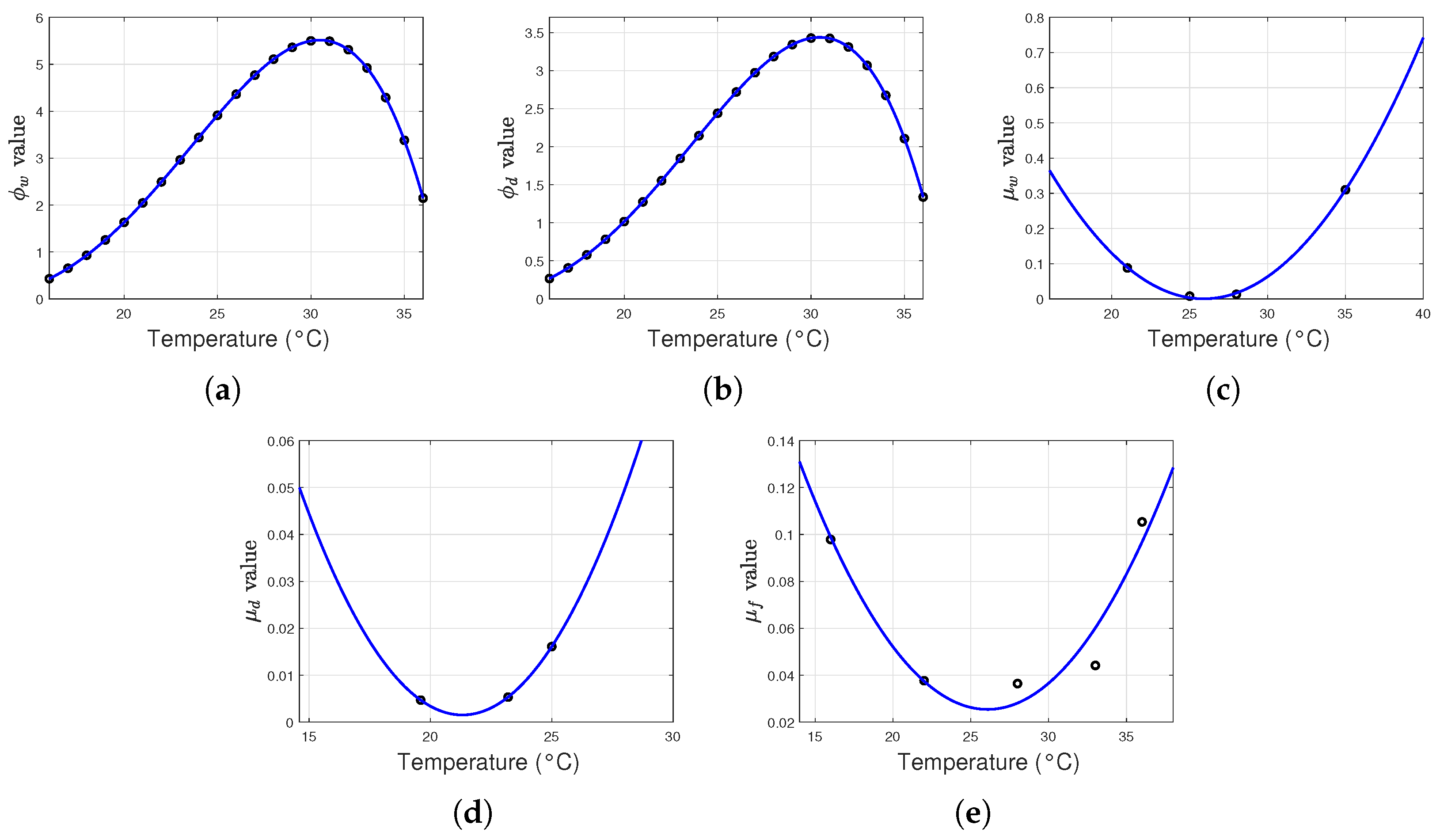
Based on experimental data from the literature, which use temperature ranges compatible with the city under study, we adjusted the temperature-dependent parameters shown in
Table 2. These data correspond to controlled laboratory conditions, where rates are measured as functions of temperature.
Figure 5 displays the fitting of the rates as a function of temperature.
As observed in the literature, the temperature-dependent patterns reveal important biological features. Oviposition rates (
,
) increase with temperature up to an optimum (approximately
), then decline at higher temperatures (
Figure 5a,b). This reflects the thermal constraint on reproductive activity. Thongsripong and Casas [
44] independently demonstrated that biting persistence in
A. aegypti also peaks at approximately
, providing behavioral evidence that supports this thermal optimum. Mortality rates (
,
,
) are lowest at intermediate temperatures, with minimum values in the range
to
, and increase at both low and high temperatures (
Figure 5c–e). This indicates that temperature extremes reduce survival.
Table 2.
Coefficients of the temperature-dependent entomological parameters.
Table 2.
Coefficients of the temperature-dependent entomological parameters.
| Parameters | | | | | | References |
|---|
| | | | | | [35] |
| | | | | | [35] |
| | | | - | - | [37,45] |
| | | | - | - | [36,37] |
| | | | - | - | [9] |
3.2. Description of Lifecycle Parameters
This section describes the derivation of each entomological parameter, which may be represented as a constant value or as a function dependent on temperature and/or rainfall, for each parameter in the model.
3.2.1. Oviposition Rates and
Oviposition rates are determined by the proportion of females that lay eggs in wet (
) and dry (
) environments after a blood meal required for egg maturation. Field studies indicate that 61.6% of
A. aegypti females oviposit in water, while 38.4% choose dry edges [
4]. These proportions were used to define the initial values of
and
.
The average number of eggs laid per female ranges from 1.060 to 7.741 eggs per day, as reported by Esteva and Yang [
35] under different environmental conditions. Based on these data, a proportional range of values was defined for
and
, which served as the basis for parameterizing the rainfall function
, modeled by a power law. This function allows oviposition rates to adjust in response to weekly rainfall variation, capturing the nonlinear effects of rainfall on female reproductive behavior. In particular, increasing rainfall enhances the availability of breeding sites, which promotes oviposition activity and justifies the assumed increasing dependence on rainfall. In addition, oviposition rates were adjusted to temperature using fourth-degree polynomial functions fitted by the least squares method. The adjusted values are presented in
Table 2 and illustrated in
Figure 5a,b.
3.2.2. Development Rates and
Development rates represent the time required for mosquitoes to complete the cycle from hatching to adult emergence. This process occurs more rapidly when eggs are laid directly in water, represented by
. In dry environments, eggs enter a quiescent state under unfavorable conditions, remaining dormant until inundation, a process represented by
[
46]. Under favorable temperature and humidity conditions, the aquatic development period ranges from 7 to 13 days [
9,
11]. In contrast, eggs laid in dry environments may remain viable in quiescence for up to approximately 147 days before hatching, requiring an additional 7–13 days to complete the larval and pupal stages after inundation, resulting in a total development time of about 154 days or more [
42]. In this model,
and
are treated as constant parameters, with values defined from the literature and presented in
Table 1.
Although development rates are known to depend on environmental conditions, particularly temperature, in this model and are treated as constant parameters. This choice is motivated by two considerations. First, these rates represent average development times aggregated over the life cycle stages (larval and pupal), as reported in the literature under typical environmental conditions. Second, incorporating additional climatic dependence in these parameters would increase model complexity and introduce further uncertainty, without significantly improving the predictive performance in comparison to the dominant effects already captured through oviposition and mortality rates. Therefore, and are assumed constant as a first-order approximation.
3.2.3. Egg Mortality Rates and
Egg mortality in
A. aegypti is influenced by environmental factors, especially temperature and humidity. Studies such as Sota and Mogi [
37] and Faull and Williams [
36] report average survival times ranging from 62.1 to 187.4 days in dry environments, and from 101.9 to 229.3 days in wet environments. Based on these data, egg mortality rates in wet (
) and dry (
) environments were estimated and modeled as functions of both temperature and rainfall. Temperature dependence was represented by second-degree polynomial functions fitted by the least squares method
Table 2, while rainfall effects were incorporated through a power law function (
Table 1). The temperature-based fitted curves are shown in
Figure 5c,d. For mortality parameters, the rainfall dependence should be interpreted as an effective rate, which may include both direct mortality and indirect processes such as removal from the compartment (e.g., rainfall-induced hatching or displacement). Specifically, experimental evidence indicates that higher relative humidity reduces egg mortality in dry environments, as humidity mitigates desiccation stress [
47].
3.2.4. Female Mortality Rate
The longevity of adult
A. aegypti females varies with temperature, ranging from 10 to 35 days under constant conditions of
,
, and
[
38]. The optimal temperature range for adult survival is between
and
, while survival decreases sharply above
, with total mortality observed at
[
48]. Based on these data, the female mortality rate (
) was modeled as a second-degree polynomial function of temperature, with coefficients fitted by the least squares method using data from the study by Marinho et al. [
9]. This function is illustrated in
Figure 5e. In addition to temperature dependence,
was also parameterized using a power law. The values used are presented in
Table 1 and
Table 2. The rainfall dependence of
should be interpreted as an effective mortality rate, which may include both direct and indirect environmental effects. In particular, increased rainfall may reduce desiccation stress and improve humidity conditions, thereby enhancing adult female survival [
49,
50].
3.2.5. Environmental Carrying Capacities and
The environmental carrying capacities in wet (
) and dry (
) environments represent the maximum population density that can be sustained by available resources, such as breeding sites and developmental conditions [
51]. During the rainy season,
tends to increase due to greater water availability, while in the dry season,
decreases due to the scarcity of suitable breeding sites [
15,
52,
53]. In this study, both parameters were considered constant in the simulations, with values defined as
and
. These values are presented in
Table 1.
3.2.6. Sex Ratio Parameters and
The proportion of new adults emerging as females is approximately 50.3% in both environments, as reported by Silva et al. [
41]. This proportion was used to define the sex ratio parameters in the model, which were treated as constant in the simulations. The adopted value is presented in
Table 1. While laboratory studies have shown that the sex ratio of
A. aegypti remains close to 1:1 under controlled conditions [
54], recent field research suggests that it can vary seasonally, potentially due to environmental stressors [
55]. Our model assumes a constant sex ratio, as this is a widely adopted simplification in population dynamics modeling and falls within the range observed in the field.
4. Analysis of the Autonomous Model
The non-autonomous nature of the model arises from its dependence on time series of meteorological variables. A key fact is the separation of temporal scales between the model population dynamics, which evolves rapidly on a daily basis, whereas the driving meteorological parameters vary more slowly, on a weekly temporal scale. To make the mathematical analysis achievable, we exploit this separation by treating the non-autonomous system as a sequence of weekly autonomous systems. Thus, considering the invariant entomological parameters in time, we perform an analysis of the system (
1).
4.1. Existence and Uniqueness of Solutions
We establish the local well-posedness of the initial value problem (IVP) associated with system (
1).
Proposition 1. For any initial condition , the system (1) admits a unique local solution. Proof. Writing system (
1) in vector form
, with
, the vector field
is of class
, since each component
has continuous partial derivatives
,
, on
. Hence,
f is locally Lipschitz continuous on
, and the result follows from the Fundamental Theorem of Existence and Uniqueness [
56]. □
4.2. Non-Negativity of Solutions
To ensure that the system is mathematically well posed and biologically meaningful, we verify that all state variables remain non-negative for all
. The proof relies on the classical Nagumo’s theorem on the invariance of convex sets [
57].
Proposition 2. For any initial condition , every solution of system (1) remains in for all . Proof. Let
and write the system (
1) compactly as
, where
f is a vector field
associated with system (
1).
We must verify that
From system (
1), we explicitly obtain the following:
Since
is a closed and convex set, Nagumo’s theorem implies that it is positively invariant under the flow of system (
1). Therefore, all solutions that starting in
remain in
for all
. □
4.3. Boundedness of Solutions
We now show that the solutions of the system, in addition to remaining non-negative, are uniformly bounded. More precisely, the system is dissipative in the sense that all solutions are uniformly bounded and eventually approach a compact subset as . This reflects environmental resource limitations and ensures biological feasibility by excluding unrealistic unbounded growth.
Proposition 3. All solutions of system (1) with initial conditions in are uniformly bounded. Moreover, the setis compact and attracts all the solutions as . Proof. From Proposition 2, the solutions are non-negative. The first two equations satisfy
If
, then
and
; similarly for
. Hence
Using these bounds in the equation for
F, we obtain
By comparison with the corresponding linear equation, it follows that
and consequently
To obtain a uniform bound for the entire system, define the auxiliary function
and then, calculating the time derivatives of the system (
1) along the solution trajectories, we have the following:
Let
. Then
Using (
8) and setting
, we obtain
By Grönwall’s inequality [
58],
Hence,
From (
7)–(
9), all solutions are uniformly bounded. Moreover,
attracts all solutions as
. □
4.4. Existence of Equilibrium Points and Basic Offspring Number
In this subsection, we investigate the existence of equilibrium points of system (
1) associated with the basic offspring number.
Proposition 4. The system (1) always admits a trivial equilibrium point in given by . Proof. Substituting
into the right-hand side of the system (
1) shows that all derivatives vanish, confirming that
is indeed an equilibrium point. To show that
is the only equilibrium point located on the boundary
, we consider the system to be in a steady state, i.e.,
. If we assume that the adult female population is zero (
), the first two equations of the system reduce to
and
, since all the parameters involved are strictly positive. Conversely, if any one of the state variables takes the value zero at equilibrium, the feedback structure of the model forces the remaining variables to also take the value zero. Thus, we conclude that
is the only equilibrium point that belongs to the boundary of the biologically admissible domain. □
In epidemiological models, the basic reproduction number
is defined as the number of new infections produced by a single infected individual during their entire infectious period [
59]. The most widely used method for its calculation is the next-generation matrix approach [
60,
61]. We apply this approach to the entomological model to compute the analog quantity of
: the basic offspring number,
. This quantifies the average number of female offspring produced by a single female during its mean lifetime in the absence of density-dependent effects [
51]. This quantity is suitable for expressing the model nontrivial equilibrium points.
To apply the next-generation matrix method, let
denote the state variables. We decompose the system (
1) into sources and transition terms
, where
The Jacobian matrices of
and
, evaluated at the trivial equilibrium point
, are
The next-generation matrix of the system (
1) is given by
:
The basic offspring number
corresponds to the spectral radius of the next-generation operator. Since female production results from the combined contribution of eggs laid in wet and dry environments (
),
can be interpreted as the sum of contributions from each environment:
The absence of carrying capacities and shows that quantifies population growth without density-dependent regulation. The positivity , and follows from the positivity of all underlying parameters.
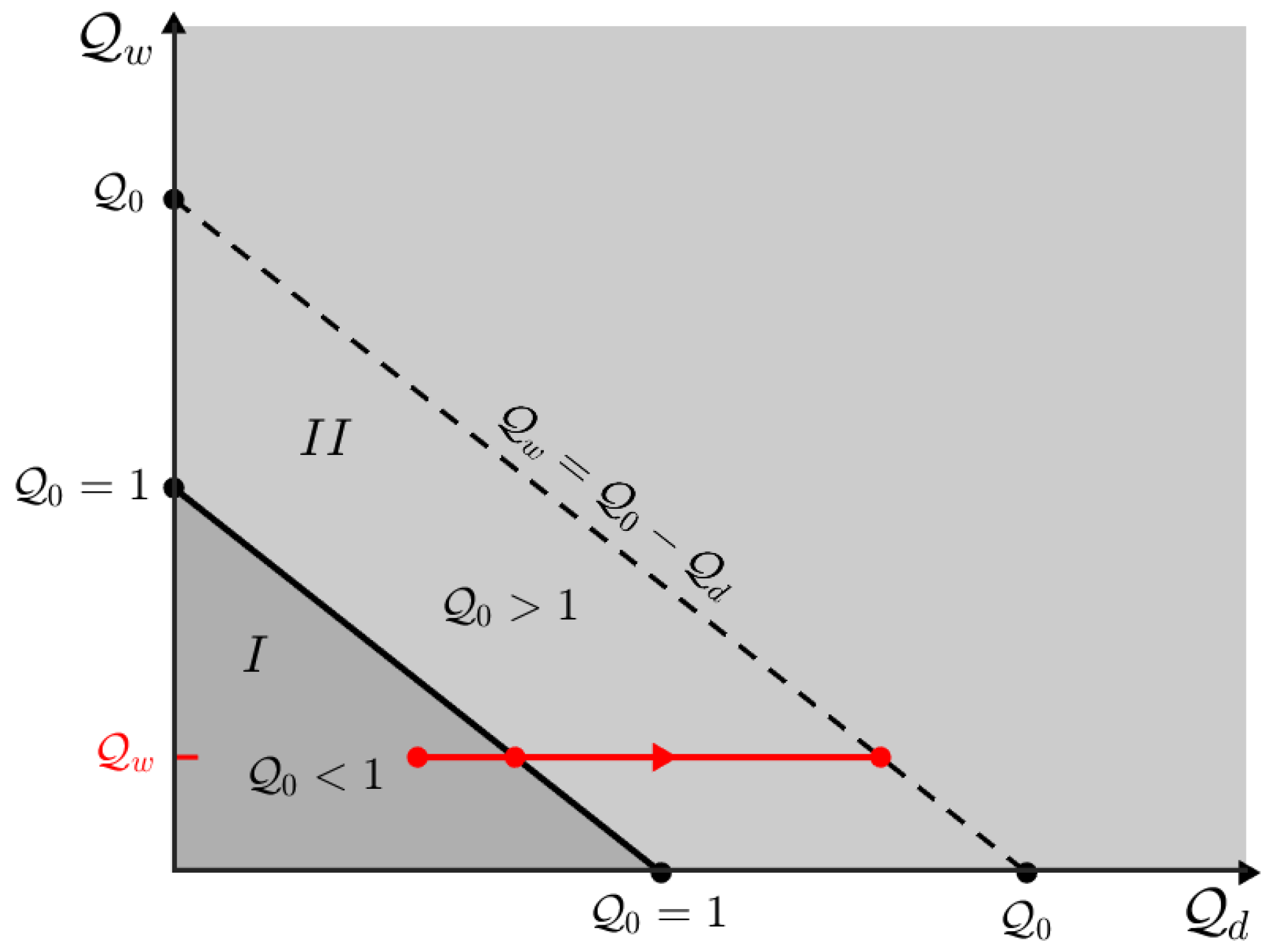
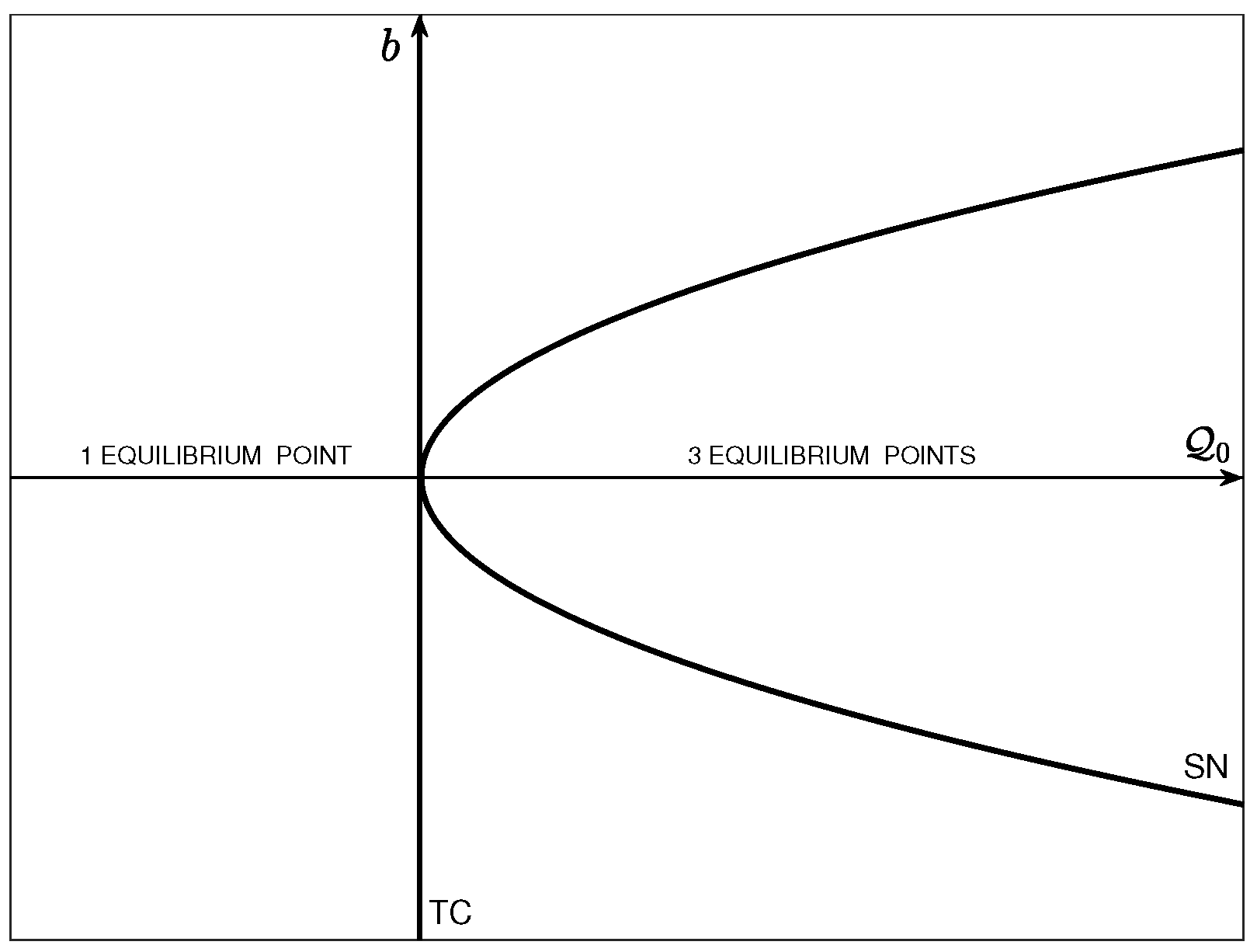
We consider the two-dimensional parameter space
, where Equation (
10) defines a line. The critical threshold
corresponds to the boundary
, which separates extinction (
) from persistence (
).
As environmental conditions change due to temperature and rainfall, the model parameters change accordingly. Consequently, the system moves through the
plane (see
Figure 6). A natural class of processes is obtained by keeping one of the parameters fixed while varying the other, causing
to cross the critical threshold
. The main biological assumption of this work is that the population increases as rainfall fills containers, triggering the hatching of dry eggs and, thus, increasing
. Nevertheless, due to the symmetry of the model between the dry and wet compartments, there is no loss of generality in restricting the analysis to a process in which one parameter remains constant below 1 while the other increases, leading the system to cross the boundary
. Symmetrical results would be obtained by interchanging the roles of
and
, and any other crossing scenario can be represented as a combination of these two fundamental cases.
We now analyze the existence of non-trivial equilibria. The equilibrium conditions are reduced to a cubic equation for , whose nonzero roots (obtained from the quadratic factor) correspond to nontrivial equilibria. The following proposition characterizes these roots in terms of and the sign of the coefficients.
Proposition 5. If the roots of the quadratic polynomial (14) are real, the system admits up to two nontrivial equilibria and , with . Their existence in the biologically admissible interval , is characterized as follows: - (i)
If and :
for , no nontrivial equilibrium belongs to ;
for , only belongs to .
- (ii)
If and , only belongs to .
- (iii)
If and , only belongs to .
- (iv)
If and :
for , only belongs to ;
for , no nontrivial equilibrium belongs to .
Proof. Upon imposing the equilibrium conditions
, the steady states
satisfy
From (
11), biologically admissible equilibria must satisfy
. Additionally, condition
requires
We therefore define
so that admissible equilibria must satisfy
. Values below
yield
and are inadmissible.
The equilibrium values of
are obtained from the solutions of
with coefficients
The nontrivial equilibria correspond to the roots of the associated quadratic factor. To simplify the notation, we set
Then
Evaluating
at the endpoints of the admissible interval gives
According to the Bolzano theorem, at least one root lies in
. Roots outside this interval or negative are biologically irrelevant.
The discriminant
determines the number of real roots. If
, only the trivial equilibrium
exists. If
, a double root occurs, producing a single nontrivial equilibrium
. If
, there are two distinct real roots:
with
. Their signs follow from Viète’s relations, namely
and
.
To determine the biological admissibility of the nontrivial equilibria, we now examine how the signs of the coefficients influence the location of the roots relative to the admissible interval . The analysis is naturally divided into two regimes depending on the value of , which dictates the sign of the constant term c. We summarize the result for each case below.
- (i)
If , then , and both roots share the same sign, determined by
If , then and both roots are positive. Evaluating at the endpoints yields and . By continuity, one root lies in and the other in . The smaller root lies in , and hence is biologically inadmissible. In contrast, the larger root lies in , satisfies , and is thus a candidate for a biologically admissible equilibrium (its stability will be examined later).
If , then and both roots are negative. Consequently, there is no positive root and no nontrivial equilibrium belongs to biologically admissible range.
- (ii)
If , then , and therefore the roots have opposite signs. Since and , by continuity there exists exactly one root in , which must be positive. The negative root is biologically irrelevant, and the positive root lies in and corresponds to a candidate equilibrium.
- (i)
If , then , and the roots have opposite signs. Since and , by continuity there exists exactly one positive root in . This root corresponds to the admissible equilibrium , while the other root is negative and biologically irrelevant.
- (ii)
If , then , and therefore both roots share the same sign, determined by .
If , then and both roots are positive. With and , the smaller root lies. in (equilibrium ), while the larger root exceeds (since and ) and is therefore inadmissible.
If , then and both roots are negative. Hence, there is no positive root and no nontrivial equilibrium belongs to biologically admissible range.
Proposition 3 guaranties that all solutions approach the compact set , but does not rule out the existence of equilibria outside . The next proposition shows that every non-negative equilibrium, and hence any asymptotically stable equilibrium, must lie in .
Proposition 6. Under the hypotheses of Proposition 3 and considering the equilibrium relations (11) and (12), any non-negative equilibrium necessarily satisfiesThat is, . Proof. Assume, by contradiction, that there exists a non-negative equilibrium such that
. From the equilibrium relation (
11), since
and
, the denominator
is negative, and therefore
Hence, the term in brackets is strictly less than , which implies , contradicting the nonnegativity of the equilibrium (Proposition 2). Thus, must hold.
Similarly, analyzing the equilibrium equation associated with the dynamics of , one observes that if , the corresponding oviposition term becomes negative, which forces and again contradicts the non-negativity of the equilibrium. Therefore, it is necessary that . Consequently, every non-negative equilibrium satisfies and .
Now, define
. From the proof of Proposition 3, the differential inequality
holds for all solutions of the system. At equilibrium,
; hence,
Therefore, every non-negative equilibrium belongs to the compact set . In particular, any asymptotically stable equilibrium (which, by definition, has a basin of attraction in ) is contained in . □
We analyze the parametric robustness of the nontrivial equilibrium
associated with the smaller positive root of the equilibrium Equation (
16). We consider the parametric regime characterized by
,
and
, in which the equilibrium Equation (
16) admits two positive roots. We show that, although mathematically admissible, this equilibrium occurs only in a restricted and non-generic region of the parameter space. This result highlights the structural fragility of
under biologically plausible parametric variations.
Proposition 7 (Non-genericity of equilibrium
in parameter space).
Consider system (1) with parameters , where , and positive biological constants that satisfy , , and . DefineSuppose further that the parameter is bounded above by a constant , so that the admissible region is nonempty and compatible with the ranges of biologically admissible parameters. Consider the set of parameters for which equilibrium is admissible,whereThen the equilibrium is non-generic in the parameter space in the sense of a two-dimensional Lebesgue measure. More precisely, the set has the Lebesgue measure Proof. Since
condition
is equivalent to
. On the other hand, condition
is equivalent to
. Therefore, the set
can be described geometrically as
The lines
and
intersect at the point
For
, we have
, so that the lower boundary of the region is given by
. For
, we have
, and the lower boundary becomes
. Thus, the two-dimensional Lebesgue measure of
is given by
Computing the integrals, we obtain
This concludes the proof. □
Corollary 1 (Small admissible region under biological assumptions).
Under biologically realistic assumptions and , the parameter m is typically large. In this case,That is, the parameter space region in which the equilibrium is admissible occupies a small and non-generic fraction of the biologically plausible parameter set. Although equilibrium
is mathematically admissible in certain parametric regimes, its occurrence depends on a highly restricted and weakly robust combination of entomological parameters. Small variations in these parameters may remove the system from the region
, indicating that the equilibrium
is neither structurally robust nor dynamically relevant under generic parametric perturbations. In contrast, the equilibrium
associated with the larger admissible root of the polynomial (
16) exhibits greater dynamical relevance under biologically realistic parametric variations. The best behavior of the model occurs for the case
. Hence, its application can be recommended, provided that appropriate restrictions on the relationships among parameters are considered.
Proposition 7 shows that the equilibrium exists only in a very restricted region of the parameter space (the set ). The small Lebesgue measure indicates that, under biologically realistic variations in the entomological parameters (e.g., oviposition rates, mortality, development), the conditions required for are rarely met. Consequently, is not structurally robust: small changes in the parameters remove the system from this region. In contrast, the equilibrium is stable and dynamically relevant under typical biological conditions. Thus, from a biological perspective, is the relevant attractor for mosquito population dynamics.
4.5. Stability Analysis
To analyze the local stability of the equilibrium points of the system (
1), we consider the Jacobian matrix given by
The stability of the trivial equilibrium is stated in the following proposition.
Proposition 8. The trivial equilibrium of system (1) is locally asymptotically stable if and unstable if . Proof. The Jacobian matrix
J evaluated at
can be expressed as
The cubic characteristic equation associated with
is given by
where
According to the Routh–Hurwitz criteria [
62], the roots of the cubic characteristic Equation (
19) have negative real parts if and only if
,
,
, and
. After some algebraic manipulation, we obtain
Since all biological parameters are positive, we have . The signs of , , and depend on . If , then , and all terms in , , and are strictly positive, since . If , then , and the Routh–Hurwitz conditions are not satisfied. Therefore, all Routh–Hurwitz conditions are satisfied if and only if . Consequently, the trivial equilibrium is locally asymptotically stable for and unstable for . This completes the proof. □
The biological interpretation of Proposition 8 is that initial conditions lying in the basin of attraction of lead to the collapse of the mosquito population whenever . To investigate whether this conclusion holds regardless of the initial condition, we examine the global stability of the trivial equilibrium.
Proposition 9. In any parameter region where there are no nontrivial equilibria, the trivial equilibrium is globally asymptotically stable in whenever .
Proof. Consider the Lyapunov function
defined by
Clearly,
V is positive definite in
and vanishes only at
. Moreover,
V is radially unbounded. The orbital derivative of
V along the trajectories of the system (
1) is
which satisfies
for all
whenever
. Define the set
From the expression of
, it follows that
if and only if
or
and
. In the absence of nontrivial equilibria, the system equations imply that every trajectory contained in
converges to the origin. Hence, the maximal invariant set contained in
reduces to
. Therefore, by LaSalle’s Invariance Principle, the trivial equilibrium
is globally asymptotically stable in
whenever
and no nontrivial equilibria exist [
58]. □
The stability of the non-trivial equilibrium point is established below.
Proposition 10. Suppose that and that exist in the biologically admissible region. Then is locally asymptotically stable if and unstable if .
Proof. After suitable manipulation of the equilibrium conditions, the Jacobian matrix of the system (
1) calculated at the equilibrium point
can be rewritten as
Define
Using the definitions of
and
from (
10) and the equilibrium relations (
11) and (
12), we obtain
The eigenvalues of (
20) are the roots of the characteristic polynomial
with coefficients
Verifying the Routh-Hurwitz conditions for and , the coefficient is clearly positive.
To analyze
, define
which can be seen as a convex combination of
and
. Hence,
since
and
. Therefore, we conclude that
.
For
, define
Normalizing the weights
and
, we write
Applying Jensen’s inequality to the convex function
with weights
and
[
63], we obtain the following:
with equality if
. Thus,
If
, then
. Moreover, since
for
, it follows that
in the biologically admissible domain. Hence,
and, therefore,
. If
, then
and, by (
26), we have
, which implies
and renders equilibrium
unstable.
We now verify the condition
. After some algebraic manipulations, we obtain
Since
and
, it follows that
Substituting (
28) into (
27) yields
and therefore
. Hence, all Routh–Hurwitz conditions are satisfied, and
is locally asymptotically stable when
and
. This completes the proof. □
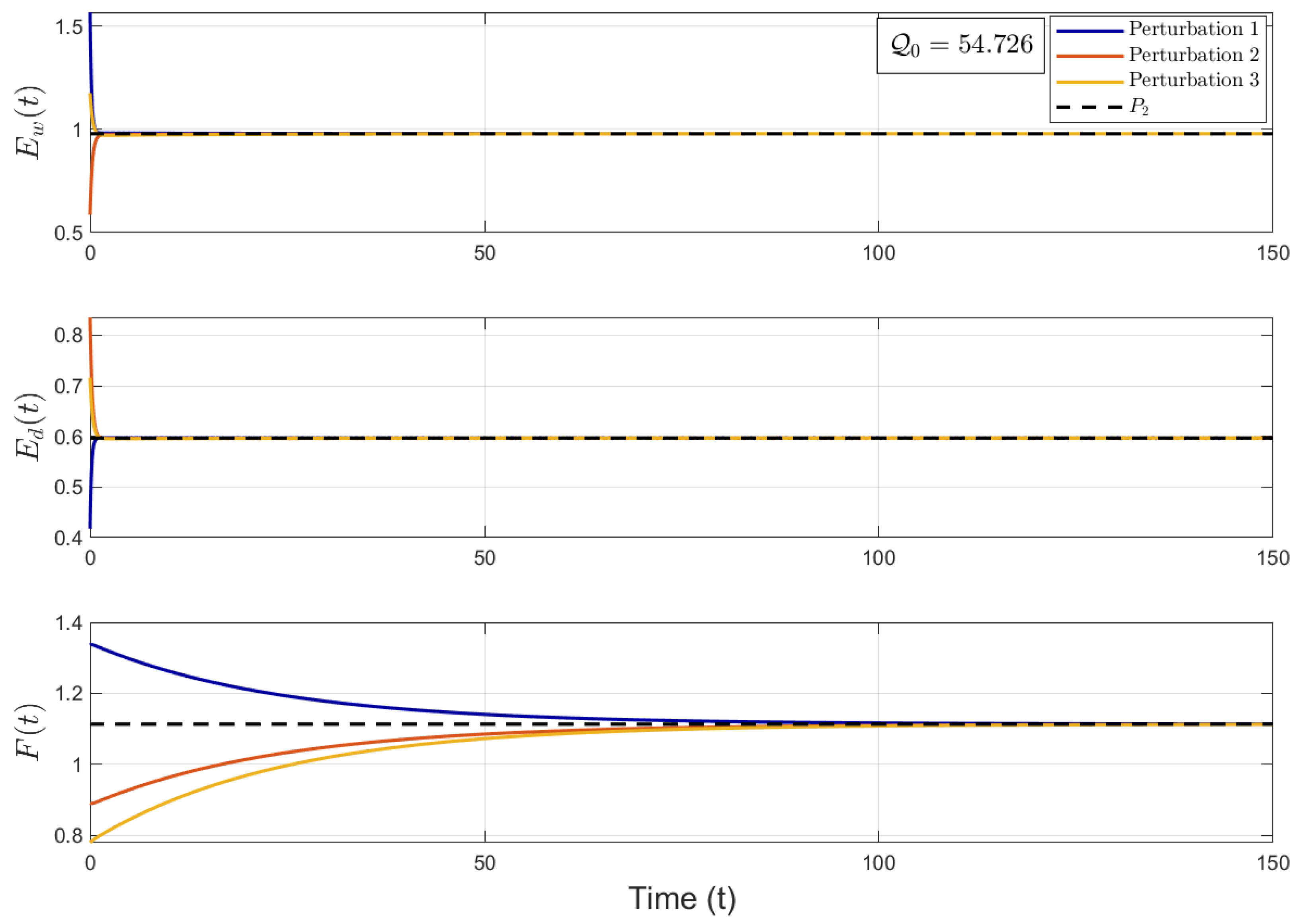
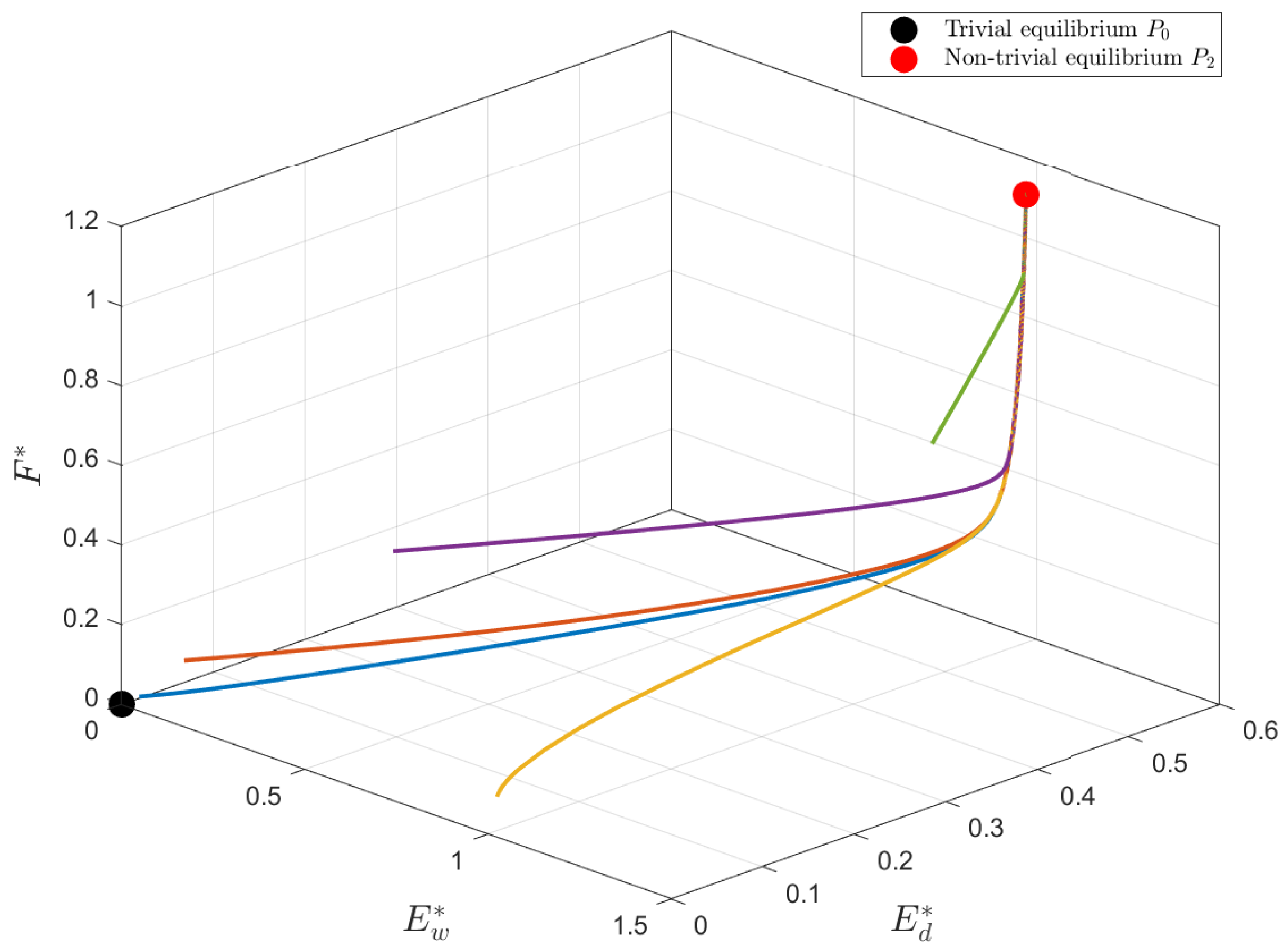
To complement the analytical results, we present numerical simulations that illustrate the stability properties of the equilibria of system (
1). For the baseline parameter set, we have
, and thus the trivial equilibrium
is unstable, while a unique non-trivial equilibrium
exists.
Figure 7 illustrates that solutions starting in a neighborhood of the non-trivial equilibrium converge to it, confirming its local asymptotic stability.
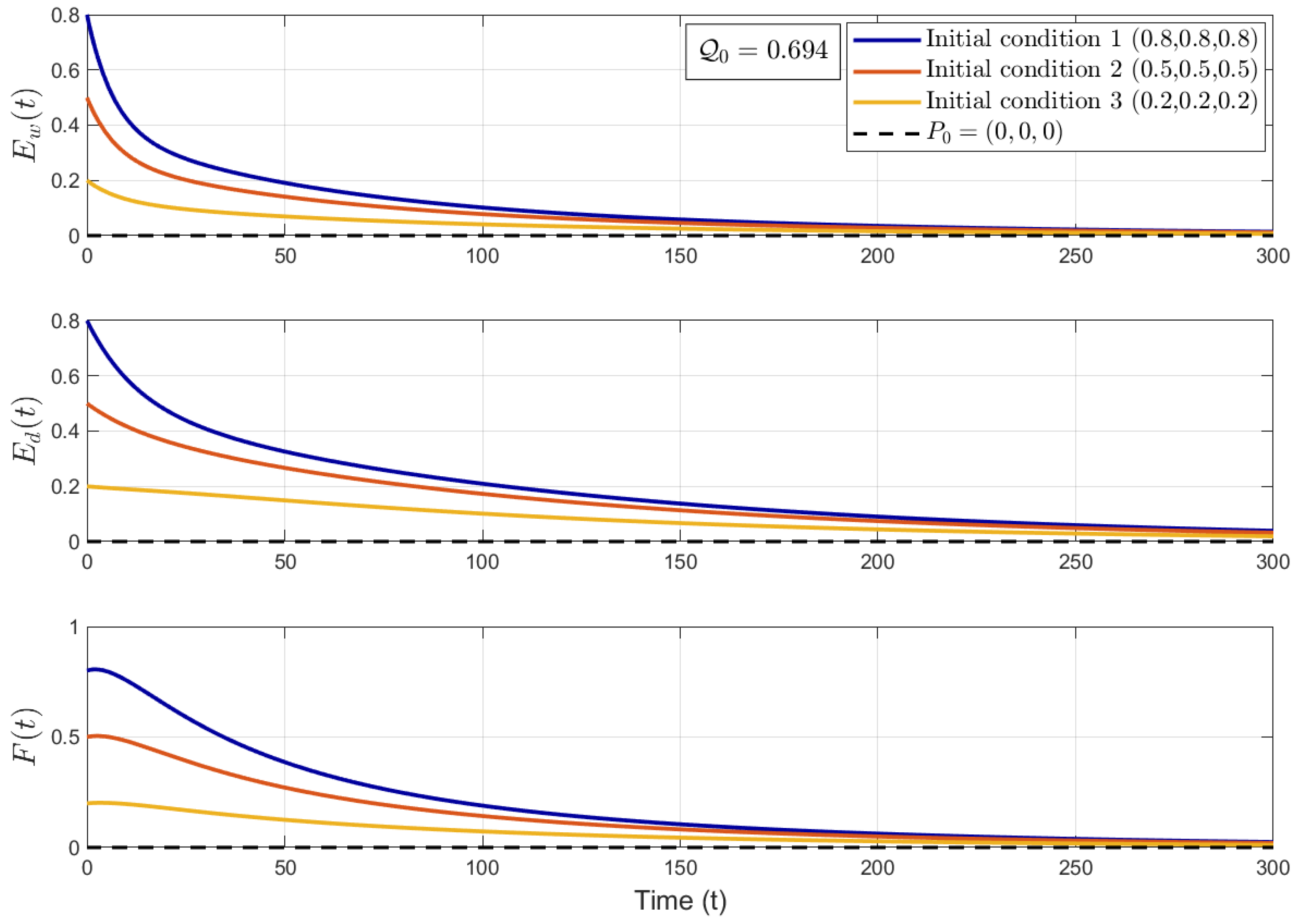
In addition, to illustrate the global asymptotic stability of the trivial equilibrium, we consider a hypothetical scenario with
. As shown in
Figure 8, all trajectories converge to the trivial equilibrium, in agreement with the analytical result established via a Lyapunov function.
The phase portrait presented in
Figure 9 corresponds to the case
and provides a geometric illustration of the system dynamics. It shows that trajectories starting from different initial conditions are attracted to the non-trivial equilibrium, while the trivial equilibrium is repelling, in agreement with the analytical stability results.
4.6. Bifurcation Analysis
We now investigate how the qualitative behavior of the system changes as the parameters vary. In particular, we analyze the bifurcation structure associated with the threshold , as this quantity determines the existence and stability of the equilibria. Our goal is to characterize the loss of global stability of the trivial equilibrium as the control parameter approaches its critical value, and to identify the geometric mechanism underlying the resulting abrupt transition.
The cubic equilibrium Equation (
29) represents a universal unfolding of the normal form of the pitchfork bifurcation,
, under generic perturbations that break its symmetry [
64]. In this case, the quadratic term
, present in
breaks the reflection symmetry
of the pitchfork bifurcation. As a result, the bifurcation diagram becomes asymmetric; for
, the nontrivial branches are shifted toward negative values of
, while for
, they are shifted toward positive values. This asymmetry characterizes an imperfect pitchfork bifurcation.
This symmetry breaking gives rise to two codimension-one bifurcation manifolds in the parameter space
, termed the transcritical bifurcation manifold (
) and the saddle-node bifurcation manifold (
), defined by
The variety
is defined by the zero-discriminant condition of the quadratic polynomial
where the non-trivial equilibria
and
collide at
. To verify that this saddle-node bifurcation is non-degenerate, we calculate the partial derivatives at the critical point [
65]:
which are valid for
. The first condition ensures transversality with respect to the parameter
, while the second guarantees that the quadratic term in the normal form does not vanish; together, they imply the saddle-node is non-degenerate.
The transcritical bifurcation, in turn, occurs at the origin (
) when the linear term vanishes at
. The non-degeneracy conditions at
are
Therefore, in the parameter plane , a saddle-node bifurcation occurs along the curve and a transcritical bifurcation along the line . The intersection of these two curves at indicates a codimension-two degenerate bifurcation point. At this point, the symmetry of the pitchfork bifurcation is restored, and the conditions for both bifurcations degenerate, resulting in a single equilibrium.
Figure 10 illustrates the regions in the parameter plane
corresponding to qualitatively different classes of vector fields. The boundaries of these regions are exactly the transcritical (
) and saddle-node (
) bifurcation curves.
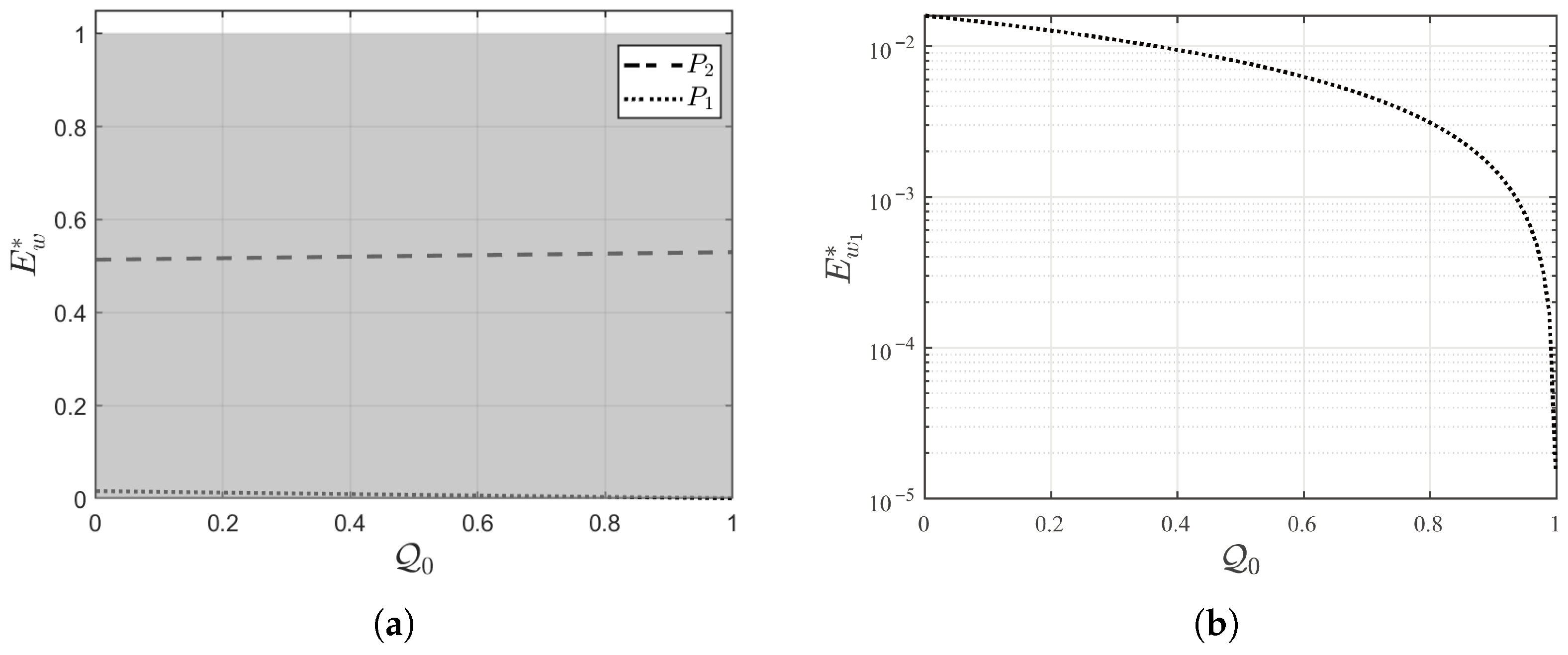
To better understand the geometric structure of the equilibrium set near the critical threshold , we analyze the behavior of the nontrivial equilibrium branch , which lies outside the biologically feasible region for .
Proposition 11. Under the parameter regime considered, the nontrivial equilibrium branch satisfies Proof. For
, the smallest root is
As
,
, so
(since
). Hence,
By the continuity of
and
with respect to
, it follows that
and
, resulting in
. □
Proposition 11 shows that, although
is unstable for
, it approaches the trivial equilibrium as the control parameter tends to its critical value. This asymptotic convergence is illustrated in
Figure 11, where the smallest equilibrium branch progressively collapses towards the origin as
. Consequently, the boundary of the basin of attraction of
moves towards the origin, leading to a progressive loss of resilience of the extinction state.
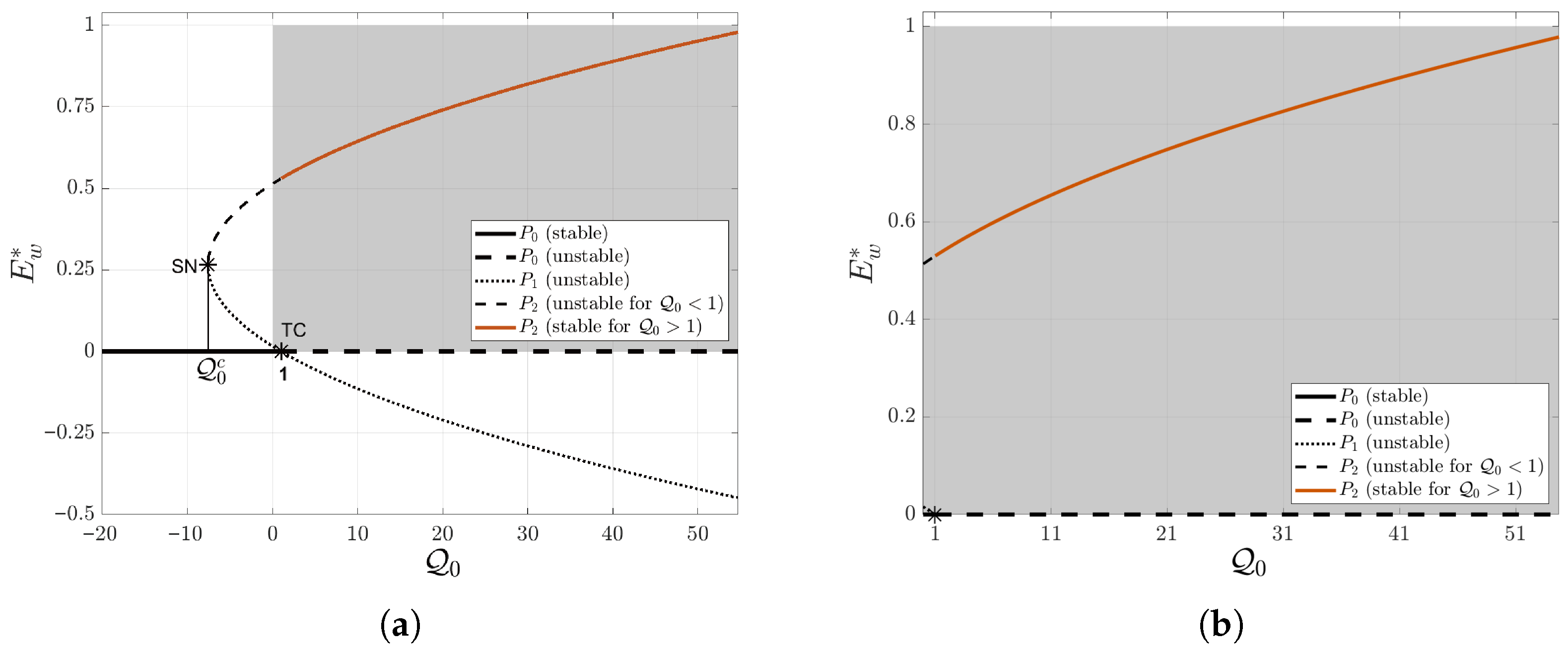
In contrast with the classical transcritical bifurcation typically observed in population models governed by threshold parameters, the transition occurring at in the present system does not involve a direct exchange of stability between the trivial equilibrium and a biologically admissible positive state. Indeed, at , the reduced equilibrium equation degenerates to , making a double root. Consequently, the branch that collides with remains unstable for all and does not participate in the stability transfer. Instead, the positive equilibrium that becomes stable for emerges through a global geometric mechanism associated with the degeneracy and the approach of toward the origin.
Although a saddle-node bifurcation occurs in the extended phase space at
Figure 12a, the corresponding equilibria lie outside the biologically feasible region
. As a consequence, for all
, the trivial equilibrium remains globally asymptotically stable in
, and no coexistence of attractors occurs within the admissible range (
Figure 12b).
However, the unstable equilibrium
, which lies outside
for
, acts as an effective geometric threshold. As
, this boundary moves toward the origin, progressively shrinking the basin of attraction of the extinction state (
Figure 12b). This geometric mechanism leads to an abrupt transition at
.
Once trajectories are driven toward the positive regime for , returning the parameter below unity does not immediately restore extinction if the system state lies outside the basin of attraction of , whose boundary is determined by . This behavior is consistent with a hysteresis induced by the shrinking basin of attraction, in which memory arises from the progressive collapse of the basin of attraction of the trivial equilibrium, rather than from the coexistence of multiple stable states in the admissible region.
The transition observed at is not a classical bistable hysteresis, since no pair of stable equilibria coexists within the admissible region for . Instead, the system exhibits a phenomenon we term basin-mediated hysteresis. In this mechanism, the unstable equilibrium , although lying outside the biologically feasible set , acts as the boundary of the basin of attraction of the trivial state . As , this boundary collapses towards the origin, progressively shrinking the basin of . Once the system is driven to the stable branch for , returning the parameter below unity does not restore extinction because the basin of has become too narrow to recapture trajectories that have moved away. The hysteresis is thus mediated by the geometry of the basin, not by the coexistence of multiple attractors.
4.7. Sensitivity Analysis of
Sensitivity analysis aims to identify which parameters exert a greater or lesser relative influence on the results of a model. This approach can be applied to static measures, such as the basic offspring number
. Local sensitivity analysis evaluates how variations in a single parameter affect the output of the model [
66]. To perform a local sensitivity analysis of
with respect to the model parameters, we employ a method in which the sensitivity indices quantify the relative change in
resulting from perturbations in a generic parameter
p associated with the model (
1). The normalized sensitivity index is computed using partial derivatives, assuming that
is a differentiable function of
p. It is defined as [
61,
66,
67]
Based on Equation (
10), we derived analytical expressions for the sensitivity of
with respect to the parameters involved in its formulation, as shown in
Table 3. Parameters
and
were excluded since they do not affect
. Sensitivity indices may appear as constant values or as expressions depending on other parameters.
Table 3 presents the analytical expressions for the sensitivity indices, while
Figure 13 shows their numerical evaluation at the values of the baseline parameter given in
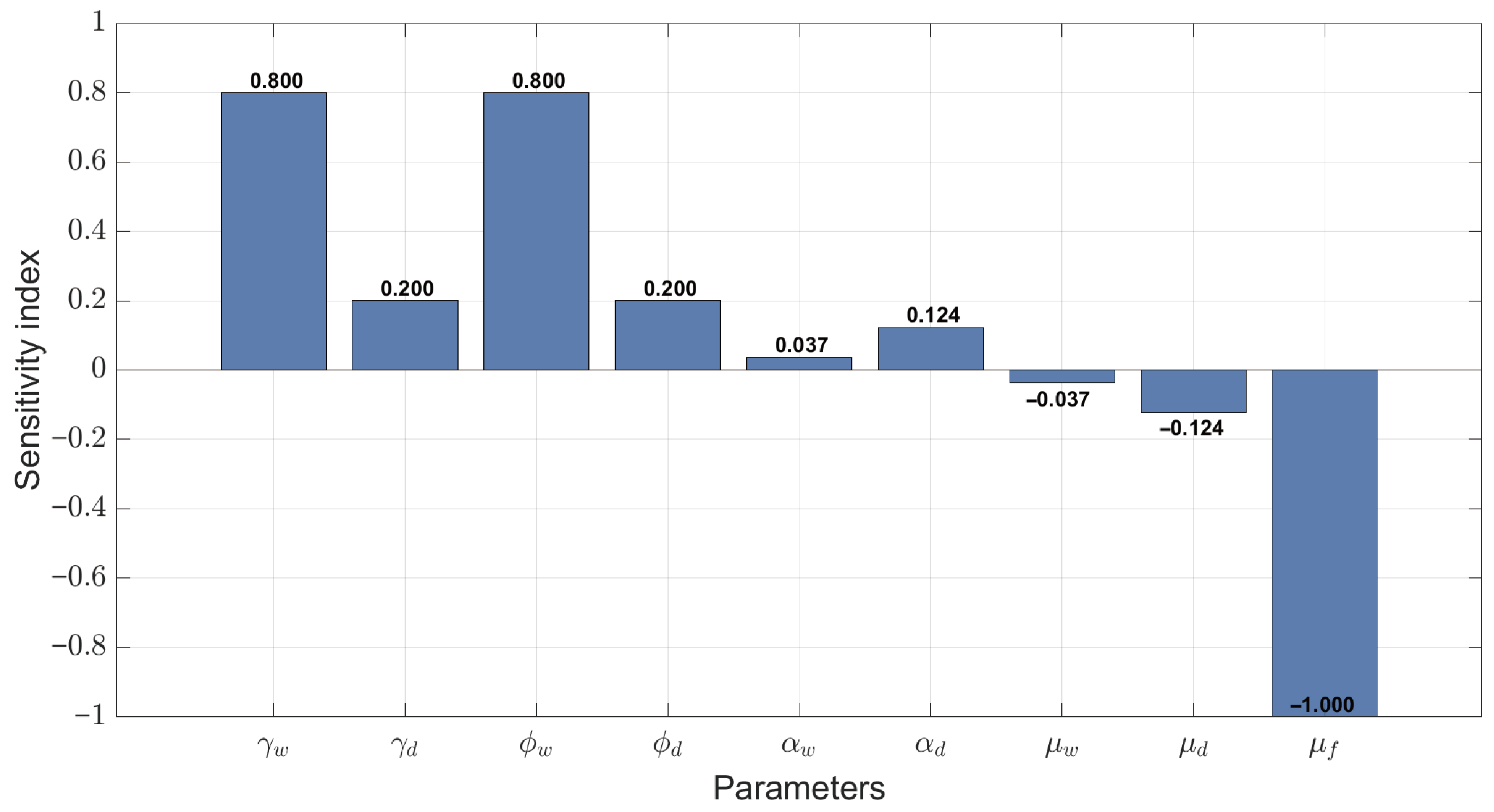
Section 3.2. Parameters with positive indices include
,
,
,
,
, and
, while
,
, and
exhibit negative indices. Among all parameters, the natural mortality rate per capita of females (
) is the most influential, showing the strongest negative correlation with
(
). This implies that a 10% increase in
directly leads to a 10% reduction in
, underscoring its critical role in population suppression.
Other parameters with high sensitivity indices include and , which exert the same influence on , as do and . In contrast, and have equal but opposing effects; that is, an increase in (development rate in wet environments) corresponds to a proportional decrease in (natural egg mortality in wet environments), and vise versa. A similar antagonistic relationship is observed between and . Local sensitivity analysis confirms that is most sensitive to , reinforcing the strategic importance of targeting this parameter in vector control efforts. Increasing can lead to significant reductions in mosquito infestation levels in endemic areas.
Control strategies aimed at increasing
can include mechanical interventions, such as eliminating potential egg-laying sites (e.g., quiescent reservoirs); biological approaches, such as introducing
Wolbachia-infected mosquitoes; and chemical methods, including adulticide applications (e.g., ULV spraying) or the release of genetically modified mosquitoes. These measures can effectively raise
, suppress female mosquito populations, and mitigate the risk of outbreaks in affected regions [
68,
69].
5. Numerical Experiments
In this section, we perform in silico experiments to fit the model to the data and obtain realistic parameter values. We perform the fitting through an evolutionary algorithm (EA) called Differential Evolution (DE), which stochastically searches for the minimum of an objective function, while the system of differential equations is solved by the Runge–Kutta method.
5.1. Optimization Problem and Algorithm
Computational simulations were performed using system (
1). The system was numerically solved using the fourth-order Runge–Kutta method [
70], widely used and well-suitable for implementation in the MATLAB
® environment. As initial conditions, we adopted the coordinates of the biologically significant non-trivial equilibrium point corresponding to the first epidemiological week. This choice allowed the system to accurately capture the initial dynamics of the vector population while respecting the biological constraint defined by Equation (
2).
We compared the simulated female population,
, with field data from MFAI over 92 epidemiological weeks. The objective function was the mean squared error (MSE), denoted
, defined as
where
N is the total number of weeks,
is the MFAI data,
l is the time lag maximizing the cross-correlation between
and
, and
is a scaling factor to align the simulated and observed magnitudes. The MSE is also used to calculate the scaling factor
, which vertically adjusts the simulated data
to match the MFAI observations by maximizing the alignment of the peak. Because the scale of the model is arbitrarily related to the environmental carrying capacity,
is introduced to align the simulated outputs with the scale of the field data. The scaling factor
is obtained by imposing the condition
, which produces the following equation:
Equation (
34) describes a general formulation of the objective function, subject to the constraints of the system of Equations (
35). Therefore, the optimization problem to be addressed here is defined as follows:
To fit the model to data and optimize model parameters, we resorted to the well-known evolutionary algorithm called Differential Evolution (DE), utilized here to solve the problem (
34). It randomly generates an initial set of model parameters and evolves it by applying standard EA methods such as selection, mutation, and crossover to qualify the solutions, mimicking the natural adaptation of a species to its environment. Its choice is warranted since DE and its variants have proven to be among the most powerful and widely used algorithms for solving complex optimization problems, including those based on real-world scenarios, besides winning several algorithm competitions [
71,
72]. The DE code used in this study was implemented in MATLAB
® utilizing the PlatEMO framework [
73].
Each candidate solution is composed of the exponents
associated with the parameters
,
,
,
, and
. To avoid linearity, the exponents’ lower and upper limits are set to
and
, respectively. The objective function is
, measured using the MSE (Equation (
32)). The algorithm used candidate solutions rounded to two decimal places to enhance search space exploration, as preliminary tests indicated that using more had an insignificant effect on improving the value of
.
We conducted 36 independent runs with a computational budget of objective function evaluations, corresponding to a population of 100 individuals (candidate solutions) over 100 generations. DE operates with two user-defined parameters: the scaling factor and the crossover probability (CR). We retained the default value of set by PlatEMO for the scaling factor parameter. To achieve a balance between exploration (discovering new areas of the search space) and exploitation (refining promising candidate solutions), the crossover probability CR was adjusted as follows: CR = for generations 1 to 30, CR = for generations 31 to 60, and CR = for generations 61 to 100.
5.2. Population Dynamics and Model Validation
As a result of the previously described numerical experiment with DE,
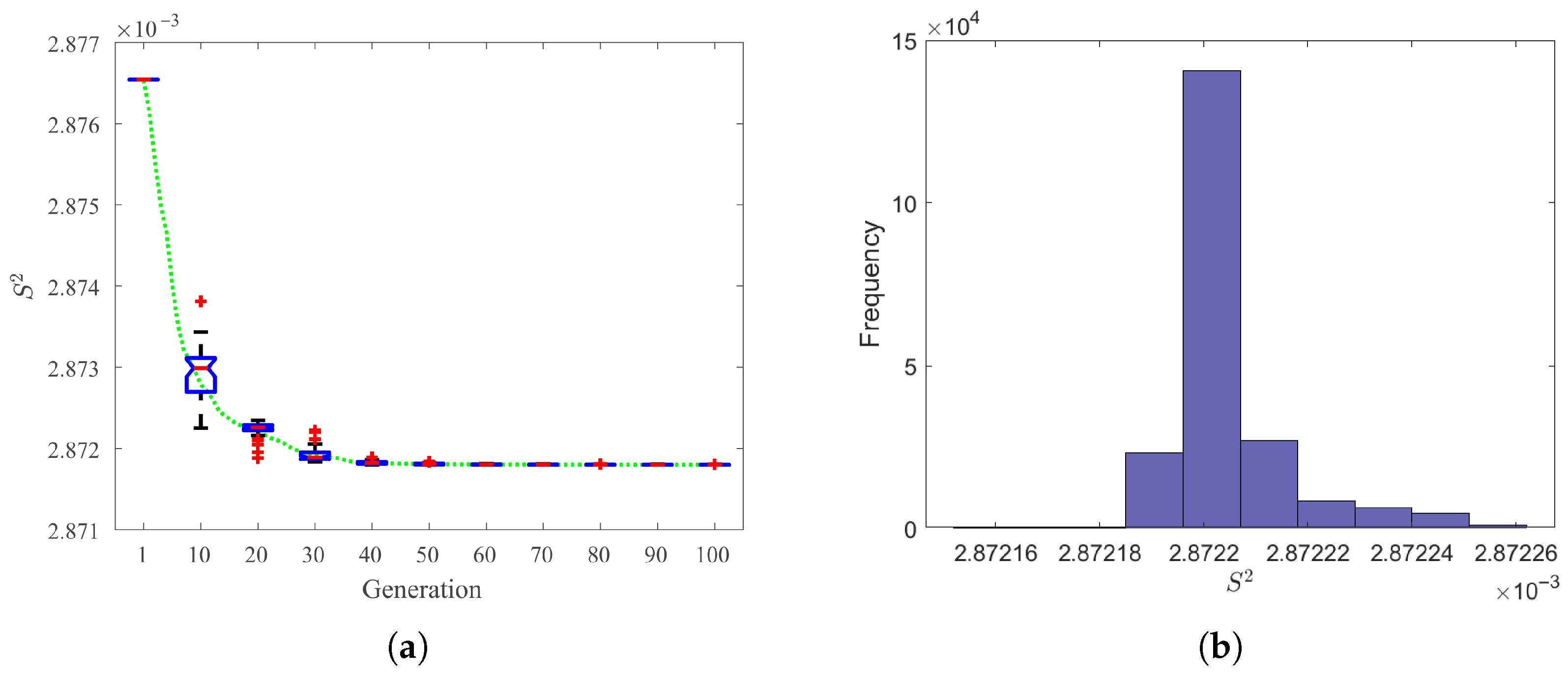
Figure 14a presents boxplots showing the progression of the best
values from each of these 36 independent runs, measured at intervals of 10 generations, while the green points indicate the mean of these values at each generation.
Figure 14b displays the histogram representing these values, excluding outliers.
Table 4 presents the statistics of the best results achieved in each of the 36 independent runs, while
Table 5 displays the best solution obtained throughout the experiment.
As shown in
Figure 14 and
Table 4, the DE algorithm showed excellent performance in addressing the optimization problem, with a standard deviation of the order of
. The optimized values in
Table 5 are entirely satisfactory, resulting in a value
of the order of
and a high correlation coefficient of
. Therefore, the following analysis examines the model defined in system (
1) using the parameters listed in
Table 5.
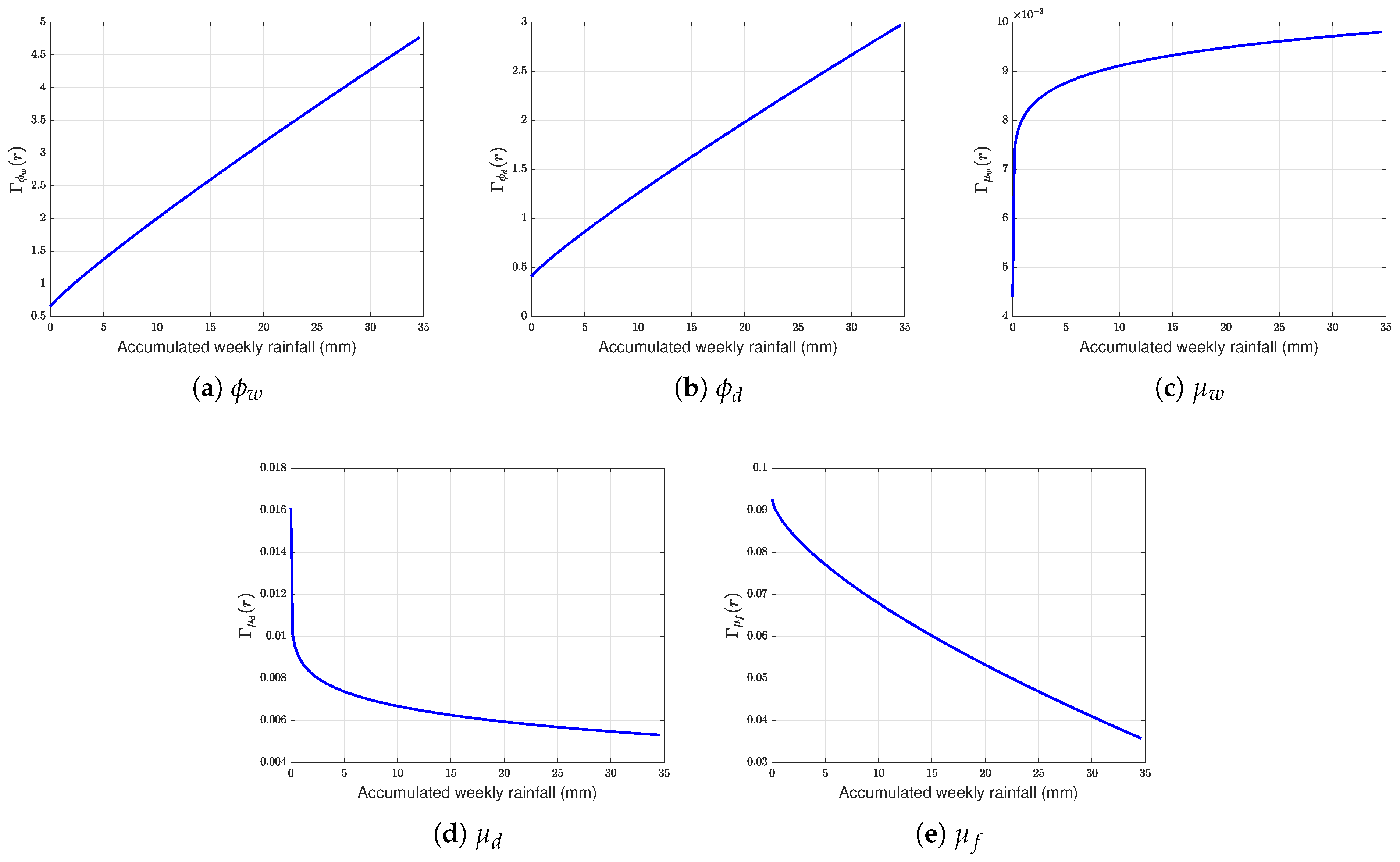
The rainfall-dependent functions
obtained from the calibrated exponents are illustrated in
Figure 15. These curves describe how each entomological parameter responds to variations in accumulated weekly rainfall.
Overall, the results indicate distinct sensitivities among the parameters. The function for oviposition in wet environments () increases strongly with rainfall throughout the observed range, reflecting the direct effect of rainfall on the availability of breeding sites. No saturation level is reached within the study range, indicating that oviposition continues to respond positively to rainfall up to . In contrast, the function for oviposition in dry environments () increases more gradually, suggesting that oviposition in such environments is less directly controlled by rainfall and may be more influenced by behavioral and environmental factors.
Regarding mortality rates, the parameters , , and display different responses to rainfall. The function for decreases as rainfall increases, indicating that higher rainfall (and associated humidity) reduces egg mortality in dry environments, likely by mitigating desiccation. A similar decreasing trend is observed for , suggesting that more humid conditions improve adult survival. In contrast, the function for increases with rainfall, showing a saturating pattern: mortality rises with increasing rainfall but stabilizes after a certain point.
Together, these patterns show that rainfall affects mosquito survival in different ways depending on the environment and life stage.
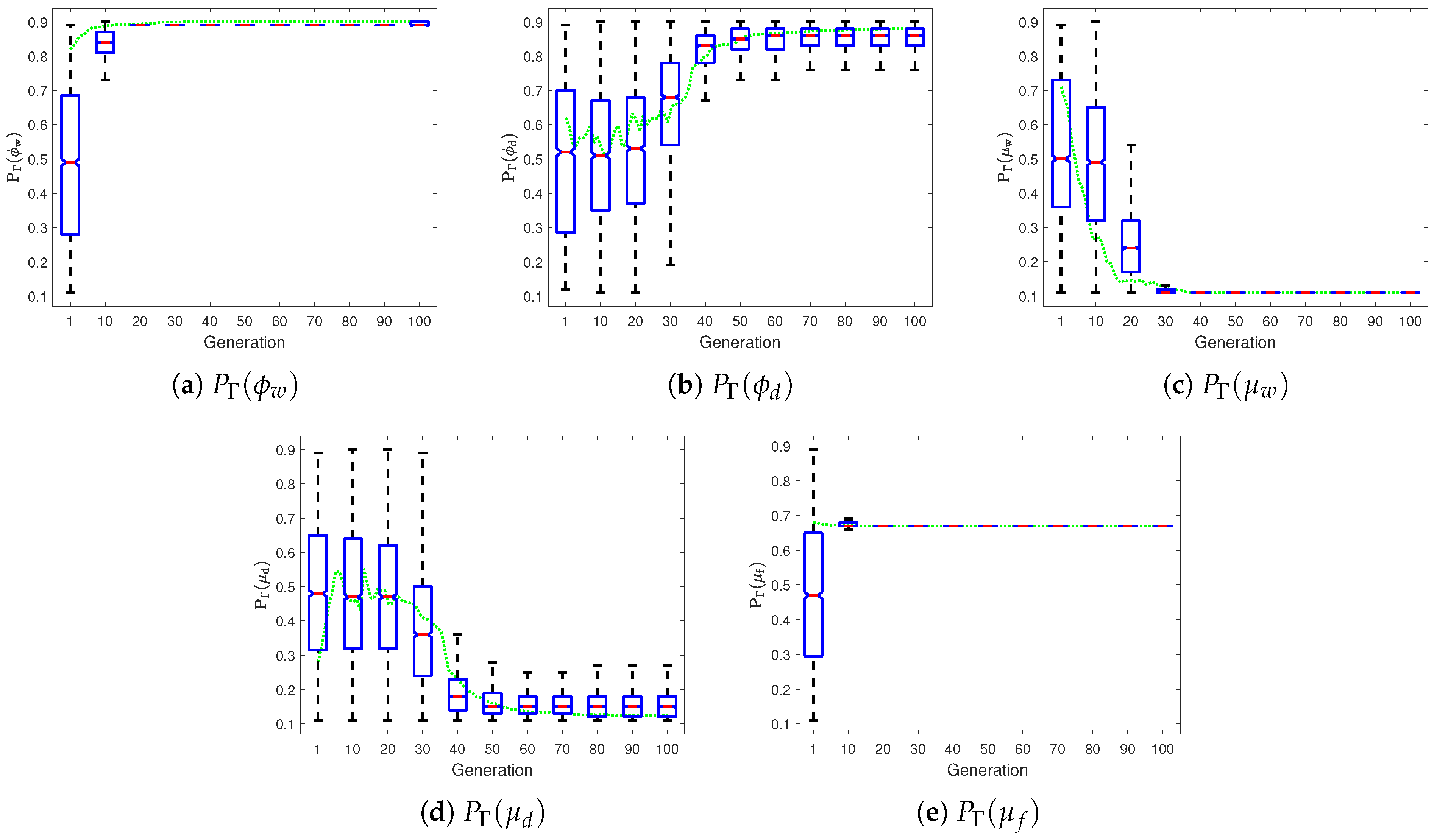
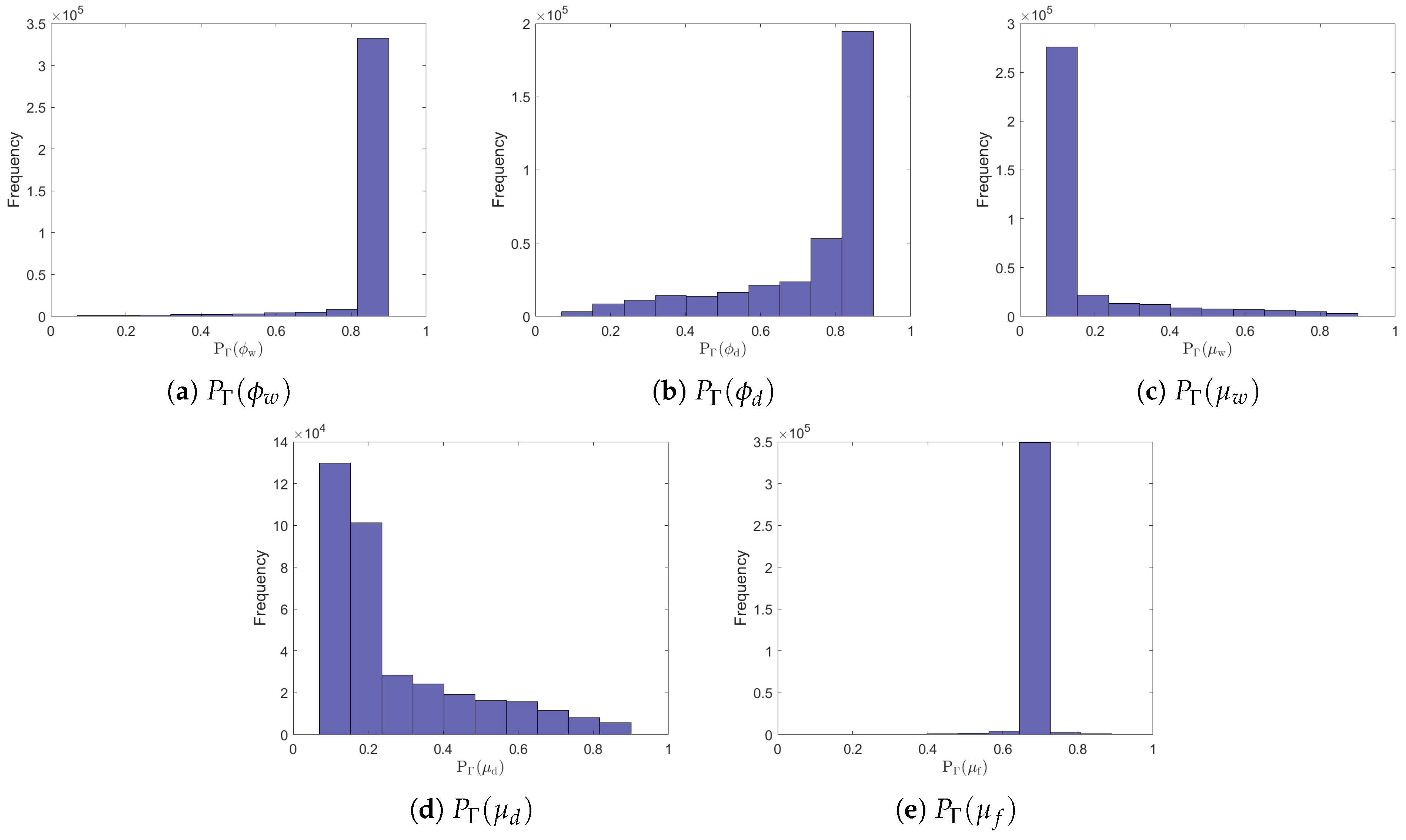
Figure 16 and
Figure 17 present boxplots and histograms to illustrate the distribution of the five decision variables throughout the search process. The green line represents the mean value of each parameter for the best solution in each generation, averaged over the 36 independent runs. It can be seen that
and
converged near the upper and lower bounds of the search interval, respectively. The parameter
stabilized rapidly around
, suggesting that the problem may be sensitive to this parameter. In contrast,
and
showed wide dispersion at the end of the DE runs, suggesting that the problem may be less sensitive to these parameters within the considered range, although their optimal values are very close to the upper and lower bounds, respectively.
To validate model (
1), which incorporates meteorological variables, we compared the simulated female population
with MFAI trap data from Sete Lagoas, Minas Gerais, Brazil. Validation focuses on females because most individuals captured by the traps are in or near the oviposition phase, corresponding to the adult female stage represented by
.
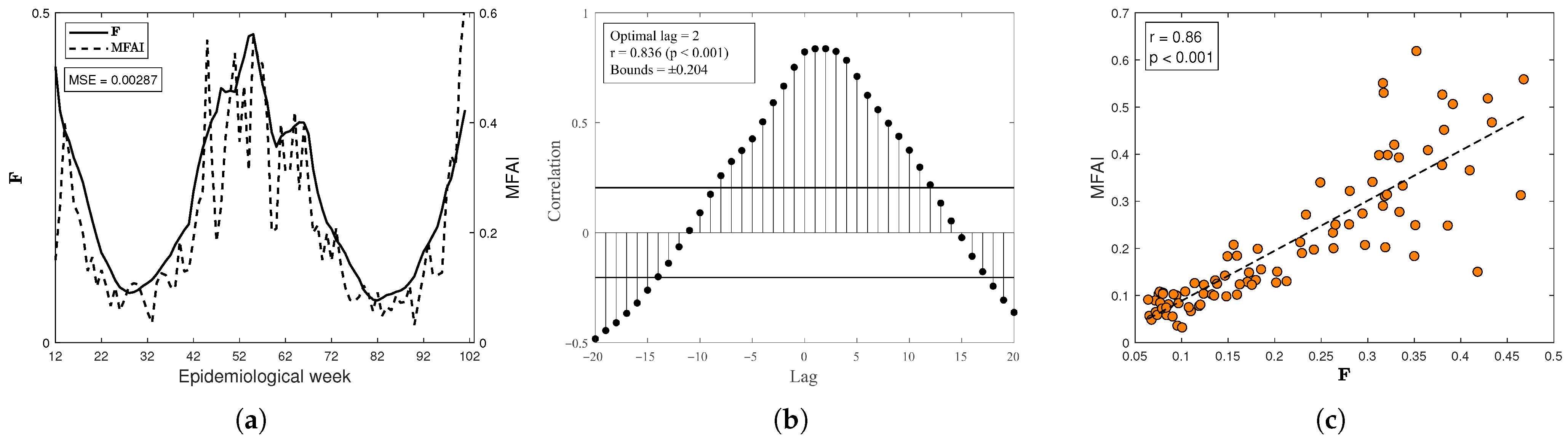
Figure 18a shows a visual comparison between the MFAI time series and the scaled simulation
. The mean squared error between the series is
(computed over
epidemiological weeks), indicating a close approximation between the simulated and observed values. In addition to the correlation coefficient, error-based metrics were computed to assess the model fit. The root mean squared error (RMSE) and mean absolute error (MAE) were equal to
and
, respectively. These values indicate a good agreement between the simulated and observed data, with relatively small deviations. The consistency between RMSE and MAE suggests the absence of large outliers, reinforcing the robustness of the model adjustment.
The cross-correlation analysis found a maximum Pearson correlation
(
) with a positive lag of two epidemiological weeks, with confidence bounds
of approximately
for
, indicating that the simulated series leads the captures of MFAI by two weeks and thus may provide a useful two-weeks predictive indication (see
Figure 18b). The scatter plot shown in
Figure 18c) illustrates the direct relationship between the number of females
and MFAI, using data synchronized to the same epidemiological week. Each data point represents a weekly observation, and the dashed linear regression line indicates a clear positive trend between the variables. The correlation coefficient obtained was
(
), demonstrating a strong and statistically significant association. The results indicate that increases in the MFAI data are accompanied by increases in the female population.
This validation is satisfactory given the model structure, which explicitly accounts for oviposition in dry environments through a quiescent egg compartment and aggregates larval and pupal development within the egg compartments under the assumption that their dynamics are implicitly represented. Sample data are subject to measurement variability arising from technological, operational, and climatic sources, which can introduce discrepancies between modeled and observed series.
Despite these limitations, the model reproduces the observed temporal pattern, revealing a trend of increase in the female population beginning around epidemiological week 42 (end of the dry season under Cwa climate), followed by a rise in rainfall and a population peak between weeks 52 and 57, consistent with elevated egg hatching and development during warm, wet months. Abundance declines during the colder and drier months (e.g., June and July), in agreement with the expected seasonal dynamics of A. aegypti.
5.3. Temporal Variation of
To assess how the reproductive potential of the mosquito population varies with seasonal climate, we computed the basic offspring number
weekly using the calibrated model.
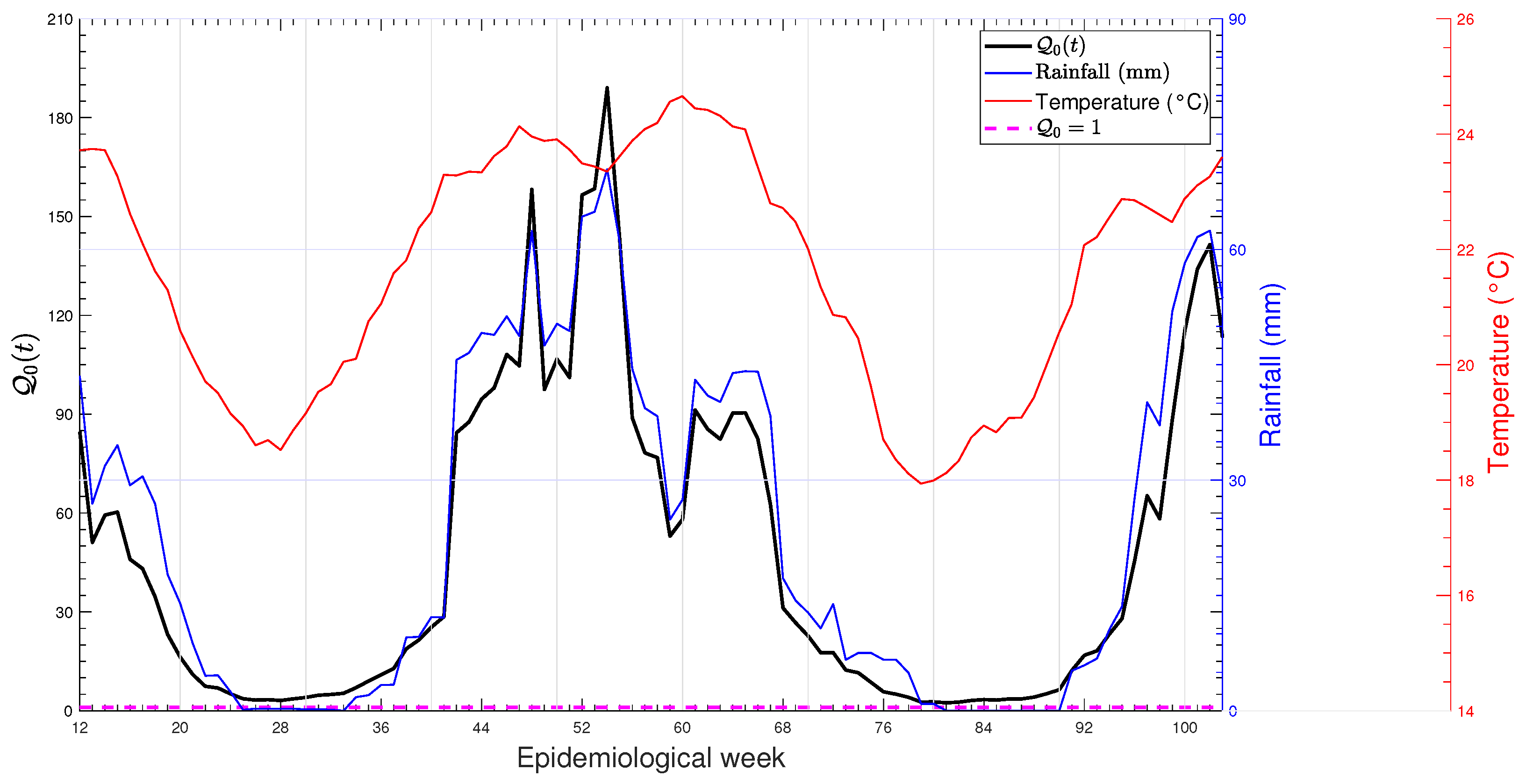
Figure 19 shows
together with weekly accumulated rainfall and average temperature.
The results reveal a clear seasonal pattern. ranges from a minimum of to a maximum of , with a mean value of . The critical threshold is exceeded throughout the entire study period, indicating persistent population viability. Peak values above 180 occur during the warm and rainy season (epidemiological weeks 50–60), reflecting the high reproductive potential of A. aegypti under optimal climatic conditions.
These high values of explain the basin-mediated hysteresis phenomenon identified in our model. When exceeds the critical threshold, the system undergoes an abrupt transition to a high-infestation state. Once established, even if returns to values below unity, the system does not revert to extinction because the basin of attraction of the trivial equilibrium has collapsed. This explains why, after an outbreak, even aggressive control measures may fail to restore low infestation levels without drastic interventions.
From a practical perspective, the approach to the critical threshold can be monitored using the MFAI and the computed . A sustained increase in MFAI above baseline levels, particularly when accompanied by values exceeding 10, indicates that the system is approaching the irreversible transition described by basin-mediated hysteresis. This provides a practical early warning criterion for vector control programs.
6. Conclusions
In this study, we developed and applied a mathematical model to investigate how the oviposition strategy of A. aegypti, distinguishing between egg laying in wet environments and on dry surfaces, responds to temperature and rainfall, shaping the abundance of adult females. The model incorporates both immature and adult stages and explicitly accounts for these two oviposition behaviors. The primary objective was to examine how these strategies shape the seasonal dynamics of mosquito populations and enhance the predictive capacity of population models. To this end, two complementary approaches were considered: an autonomous version, for theoretical analysis of equilibria, stability, and bifurcation structure, and a version dependent on meteorological variables, for seasonal simulation and validation against field data.
In the autonomous system, the basic offspring number , derived from the next-generation matrix, acts as a threshold parameter determining population persistence or extinction. Analysis using Routh–Hurwitz criteria and Lyapunov functions revealed that the trivial equilibrium is locally and globally stable when , provided there are no other equilibria. For , a positive equilibrium emerges and becomes stable, ensuring the persistence of the population.
A detailed bifurcation analysis revealed an imperfect pitchfork bifurcation with a distinctive feature. For , the smaller nontrivial equilibrium lies outside the biologically admissible region , yet it acts as a geometric threshold, progressively approaching the origin as . This movement shrinks the basin of attraction of the extinction state , leading to a progressive loss of resilience. Once the system is driven to the stable branch for , returning the parameter below unity does not restore extinction because the basin of has become too narrow. We term this phenomenon basin-mediated hysteresis. It differs from classical hysteresis in that it does not arise from the coexistence of multiple stable states, but rather from the geometric collapse of the basin boundary.
A critical finding with direct implications for public health is that the saddle-node bifurcation occurs at , i.e., outside the biologically feasible range. This means that no attainable value of guaranties global eradication once the population is established. Consequently, the goal of vector control should shift from elimination to maintaining the population below a critical threshold. Even reducing below unity is insufficient to restore the controlled state after an outbreak, reinforcing the need for continuous preventive actions rather than reactive measures.
The prediction that the system remains in a high-infestation regime once
exceeds unity is consistent with our empirical results. The basic offspring number
was computed weekly using the calibrated model (
Figure 19). The results show that
ranges from a minimum of
to a maximum of
(mean
), remaining above the critical threshold
throughout the study period. This confirms that the system operates in a regime where the basin of attraction of the extinction state is narrow or already collapsed, consistent with the basin-mediated hysteresis mechanism.
The dry-egg compartment, , acts as a persistent reservoir that allows rapid reestablishment of populations even after control efforts or during unfavorable climatic conditions. This finding underscores that control strategies that focus solely on larvae and adults are incomplete; they must also target quiescent eggs through mechanical removal of dry containers or treatment of oviposition surfaces.
Local sensitivity analysis identified the female natural mortality rate , as the most influential parameter in . This result highlights that interventions aimed at increasing adult female mortality, such as adulticide spraying, the release of Wolbachia-infected mosquitoes, or genetic control, are the most effective in reducing population reproductive potential.
The validation of the model based on field data from the MFAI showed strong agreement, with correlation coefficients of and , a mean squared error of , and error metrics of RMSE and MAE , surpassing previous models (). In particular, the simulated female population anticipates observed MFAI peaks by two weeks, offering a practical early warning tool. This lag allows health authorities to intensify preventive measures before outbreaks occur, optimize resource allocation, and reduce disease transmission.
Collectively, these results point to a necessary shift in public policy from reactive eradication-focused campaigns to predictive, prevention-oriented strategies. Sustained monitoring, early detection of increased , and interventions that increase or target quiescent eggs are essential to keep populations below critical thresholds. The basin-mediated hysteresis mechanism explains why, once an outbreak occurs, even aggressive measures may fail to restore control, reinforcing that prevention is not only more effective, but also more economical.
The model provided a good representation of the temporal patterns of mosquito abundance using data from Sete Lagoas, Minas Gerais, Brazil. The dependence of development rates on rainfall was represented by power law functions with variable curvatures, whose parameters were optimized using the Differential Evolution algorithm. The inclusion of the quiescent egg compartment was essential to capture the observed seasonal patterns, driven by climate variation.
This work presented a perspective on the dynamics of A. aegypti that has been little explored in the literature by explicitly distinguishing oviposition strategies and their climatic dependencies. The discovery of basin-mediated hysteresis constitutes a distinctive theoretical contribution, revealing a mechanism of population persistence that operates even in the absence of multiple stable attractors. Despite data limitations and environmental uncertainties, the model demonstrated strong reliability in reproducing field observations, reinforcing its usefulness as a predictive tool.
In the present work, parameter estimation was performed using only the available field data on captured females. This leads to an issue of partial observability of the state variables, which may result in parameter compensations and dispersed solutions in the parameter space. If data on the other dynamic variables ( and ) were available, the parameter determination could be more accurate.
Future research will extend the model to include larval and pupal compartments and refine the dependence on rainfall through advanced optimization techniques. In addition, the model will be validated using data from different locations with distinct climatic profiles, in order to assess its generalizability. The incorporation of human-related control measures, such as insecticide use, will also be explored to enhance the model’s applicability in public health contexts. Such developments are expected to improve predictive performance and facilitate model adaptation to different climatic regions. Furthermore, the model contributes to a deeper understanding of the interplay between climate and mosquito ecology, offering a practical and theoretically grounded framework for simple and effective vector-control strategies. Ultimately, a systematic performance comparison between DE and other established evolutionary algorithms, such as Genetic Algorithms (GA) and Particle Swarm Optimization (PSO), is planned for future research.