1. Introduction
Unmanned aerial vehicles (UAVs) have rapidly evolved over the past decade, driven by their low cost, ease of deployment, and high operational flexibility. These advantages have enabled UAVs to play an increasingly important role in civilian domains such as logistics [
1], environmental monitoring [
2], emergency response [
3], and infrastructure inspection [
4]. As UAV technologies mature, the focus of research has gradually shifted from single-platform autonomy to the coordinated operation of UAV swarms. Compared with individual UAVs, swarm systems offer superior spatial coverage, enhanced robustness, and emergent collective intelligence, making them suitable for demanding applications such as wide-area surveillance [
5], cooperative search and rescue [
6], and distributed sensing [
7]. In military contexts, UAV swarms have demonstrated transformative potential by enabling rapid situational awareness, resilient distributed strike capabilities, and high-density penetration of contested airspace [
8].
Parallel to the development of UAV swarms, transport aircraft have long served as strategic assets for rapid delivery of personnel, equipment, and humanitarian supplies [
9]. Airdrop operations have been widely adopted due to their ability to bypass damaged or inaccessible ground infrastructure [
10]. Inspired by these advantages, this research began to explore the concept of deploying UAV swarms directly from transport aircraft. This operational paradigm integrates the long-range projection capability of transport aircraft with the distributed intelligence of UAV swarms, enabling rapid force insertion beyond enemy defensive perimeters, improved survivability through stand-off deployment, and flexible mission execution across large-scale, threat-intensive environments. In such missions, multiple transport aircraft must cooperatively visit dispersed airdrop areas while avoiding air-defense threats, satisfying strict time windows, and maximizing the overall mission effectiveness. These characteristics naturally lead to a complex multi-agent planning problem that couples heterogeneous aircraft performance, spatial–temporal constraints, and dynamic battlefield uncertainties.
Motivated by these challenges, this work investigates the coordinated airdrop of UAV swarms using multiple transport aircraft and develops a unified framework for both static global planning and dynamic online replanning. The main contributions of this paper are summarized as follows:
- 1.
A comprehensive mission modeling framework is established for multi-transport-aircraft swarm airdrop operations. The model captures heterogeneous aircraft capabilities, multi-visit mission areas, time-window constraints, and threat-aware flight paths, forming a realistic and high-fidelity representation of contested operational environments.
- 2.
A Hybrid-encoding Constrained Black-winged Kite Algorithm is proposed to solve the allocation problem of multi-objective airdrop transportation tasks. By jointly optimizing task allocation and execution sequences through mixed discrete-continuous encoding, constraint-driven repair, and hybrid attack–migration search dynamics, HCBKA achieves high-quality global planning under complex operational constraints.
- 3.
A Time-window aware Dynamic Auction Algorithm is developed to address real-time mission disturbances such as aircraft attrition, emergent tasks, and newly appearing mission areas. Through two-level aircraft screening and a composite bid function, TDAA enables rapid, minimally disruptive task reallocation while preserving time-window feasibility and mission continuity.
Beyond these specific contributions, the proposed framework is intrinsically connected to symmetry principles that permeate both the problem structure and the solution methodology. First, load-balancing symmetry is explicitly encoded in the objective function, where we seek to achieve a balanced distribution of tasks among heterogeneous transport aircraft—a form of equitable resource allocation that prevents any single asset from becoming a bottleneck or a point of failure. Second, structural symmetry appears in the hybrid encoding scheme: the discrete assignment variables and continuous sequencing variables form a complementary pair that together define a complete solution space, reflecting a duality between task-to-agent mapping and temporal ordering. Third, behavioral symmetry is embedded in the HCBKA algorithm through its attack–migration dual-mode search strategy, where exploitation and exploration are balanced in a symmetric manner to navigate complex constrained landscapes. Fourth, the TDAA algorithm exhibits operational symmetry through its two-level screening mechanism, which treats spatial proximity and temporal feasibility as symmetric filters for candidate aircraft selection. Together, these symmetry considerations not only enhance the interpretability of our framework but also contribute to its efficiency and robustness, making the work naturally aligned with the thematic scope of symmetry.
2. Related Works
The coordinated airdrop of swarm UAVs by multiple transport aircraft represents a complex multi-agent mission planning problem that integrates heterogeneous platform capabilities, spatial–temporal constraints, and dynamic operational environments. From a modeling perspective, this problem can be naturally abstracted as a variant of the Multiple Traveling Salesman Problem (MTSP), where multiple agents depart from a common base, visit a set of mission points under various constraints, and jointly optimize global mission performance. Consequently, existing research on MTSP and its variants provides an important theoretical foundation for multi-aircraft cooperative airdrop task allocation.
Early studies primarily focused on analytical and exact optimization methods. Mixed-integer programming (MIP/MILP) formulations have been widely adopted to capture the structural properties of MTSP with strict mathematical rigor. Murray et al. developed a MILP framework for multi-agent coordination and demonstrated its effectiveness on small-scale instances using commercial solvers [
11]. Kitjacharoenchai et al. introduced the MTSPD model, a variant incorporating UAV operations, and solved it using IBM-CPLEX [
12]. Bérczi et al. further advanced the theoretical frontier by proposing a unified approximation framework for multi-visit MTSP variants, achieving constant-factor guarantees through constrained forest construction and transportation-based lower bounds [
13]. Park et al. extended MILP modeling to heterogeneous UAV systems, integrating platform performance parameters and multi-resource constraints into a unified optimization structure [
14]. Although analytical methods provide globally optimal or theoretically bounded solutions, their computational cost grows exponentially with problem size, limiting their applicability in large-scale or real-time airdrop missions.
To address scalability limitations, research attention has shifted toward metaheuristic algorithms, which offer strong global search capabilities and flexibility in handling complex constraints. Murray proposed the Adaptive Insertion (ADI) heuristic, which iteratively improves initial solutions through removal-insertion operators combined with evolutionary updates [
11]. Lim et al. introduced a hybrid search strategy with neighborhood reduction, significantly improving efficiency on large benchmark instances [
15]. Zheng et al. developed an iterative two-stage heuristic combining fuzzy clustering, greedy initialization, and variable neighborhood search, achieving state-of-the-art performance on both minsum and minmax MTSP variants [
16]. He and Hao proposed a memetic search algorithm capable of solving both single-depot and multi-depot minmax MTSP with high-quality solutions [
17]. Ergüven et al. presented the Relative Distances Approach (RDA), which constructs solutions based on relative insertion costs and improves them through task exchange and path reversal [
18]. Additional metaheuristic frameworks, such as two-stage iterative local search [
19], heuristic MEC-aware routing [
20], multi-start tabu search [
21], and clustering-based multi-strategy search [
22], further demonstrate the versatility of metaheuristics in solving large-scale MTSP variants with heterogeneous agents, multi-visit requirements, and time windows. Despite their strong performance, metaheuristics often rely on manually designed operators and require parameter tuning, which limits their adaptability to rapidly changing mission environments.
With the rise of data-driven optimization, learning-based MTSP solvers have emerged as a promising direction. Reinforcement learning (RL) and graph neural networks (GNNs) have been applied to learn task allocation and route construction strategies directly from data. Nayak and Rathinam proposed an RL-based solver for Dubins MinMax MTSP using distributed GNN policies [
23]. Hu et al. modeled MTSP route construction as a sequential decision process and applied Q-learning to learn node selection strategies [
24]. Liang et al. introduced a Learn-to-Branch framework using bipartite GNNs to accelerate MILP solving for MTSP and its variants [
25]. Gao et al. proposed an attention-based multi-agent RL method with Transformer-based feature extraction and coordinated action selection, achieving strong generalization across different problem sizes [
26]. Ma et al. developed an end-to-end DRL framework that jointly learns task assignment and route generation through modular agents and pointer-network-based solvers [
27]. While learning-based methods offer high inference speed and potential generalization, they require extensive training data and still face challenges when constraints or mission scales deviate significantly from the training distribution.
In real-world airdrop operations, mission environments are highly dynamic, with evolving threat zones, changing task requirements, and potential platform failures. This has motivated research on dynamic MTSP and online replanning. Garn proposed an online balanced replanning method using incremental insertion and local exchange to maintain load balance under dynamic task updates [
28]. Groba et al. integrated trajectory prediction into evolutionary search, enabling GA-based solvers to anticipate future target motion and reduce replanning oscillations [
29]. Huang et al. introduced a hierarchical online planning framework combining block-level TSP decomposition with distributed multi-agent RL for large-scale dynamic coverage tasks [
30]. Sariel Talay et al. developed a distributed dynamic task allocation framework using incremental task selection, heuristic evaluation, and contract-net-based coordination, enabling robust operation under uncertainty and agent failures [
31]. These dynamic approaches highlight the importance of fast, incremental, and robust replanning mechanisms for time-critical missions such as coordinated airdrop.
Existing methods for MTSP and its variants fall into four categories: analytical optimization, metaheuristics, learning-based approaches, and dynamic replanning. Each category has notable limitations. Analytical methods are not scalable to large problems. Metaheuristics rely on manually designed operators and lack adaptability. Learning-based methods require extensive training and fail under unseen constraints. Dynamic replanning methods often sacrifice global optimality and ignore heterogeneous platform capabilities or strict time windows. None of these categories simultaneously address heterogeneous aircraft, multi-visit task areas, strict time windows, threat avoidance, and real-time contingency handling.
The proposed framework directly fills this gap. Its novelty and importance are fourfold. First, the problem formulation models a heterogeneous fleet of transport aircraft with different range, payload, altitude, and speed limits. It also captures multi-visit requirements for each mission area, differentiated task priorities, and hard time windows that become soft during static planning but hard during dynamic replanning. Second, the Hybrid-encoding Constrained Black-winged Kite Algorithm (HCBKA) introduces a mixed discrete-continuous encoding that decouples task assignment from task sequencing. A constraint-driven hierarchical repair mechanism ensures feasibility, while an attack–migration dual-mode search balances exploration and exploitation. This design outperforms classical metaheuristics in both solution quality and convergence, as shown in our simulations. Third, the Time-window aware Dynamic Auction Algorithm (TDAA) provides rapid online replanning under three types of disturbances: aircraft loss, new tasks in existing areas, and entirely new mission areas. Unlike most dynamic methods, TDAA enforces time windows as hard constraints during replanning, reflecting the tight time margins after a disturbance. Its two-level screening and composite bid function jointly optimize task priority, schedule disruption, and route cost. Fourth, the framework integrates offline global planning with online reactive replanning in a unified architecture, offering both high-quality initial solutions and robust adaptability to unforeseen events.
The importance of this research lies in its potential to enable real-world multi-transport-aircraft swarm airdrop missions. By providing a scalable, constraint-aware, and dynamically responsive solution, the proposed framework can help military operators plan and execute complex airdrop operations more effectively. Thus, this work not only advances the state of the art in MTSP research but also offers a practical tool for coordinated swarm deployment.
3. Modeling of the Airdrop Task Assignment Problem
3.1. Modeling of the Airdrop Mission Scenario
The multi-transport-aircraft-coordinated swarm airdrop mission investigated in this section occurs within a three-dimensional battlespace containing air defense threats. For the purpose of this study, the mission is confined to a three-dimensional airspace measuring
X km
km
km. This airspace contains a base located at
, multiple dispersed mission areas, and several enemy air defense threat zones, as illustrated in
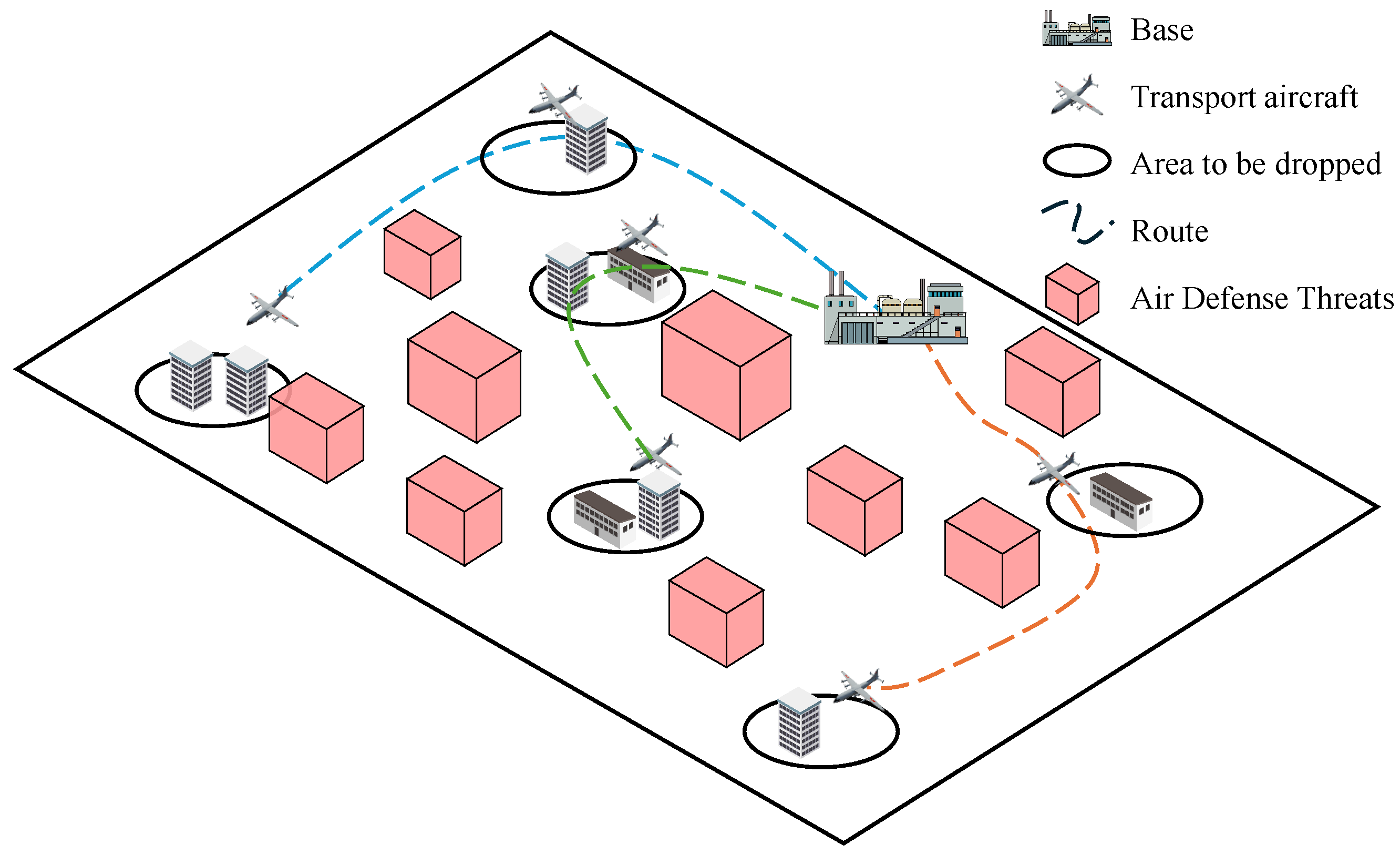
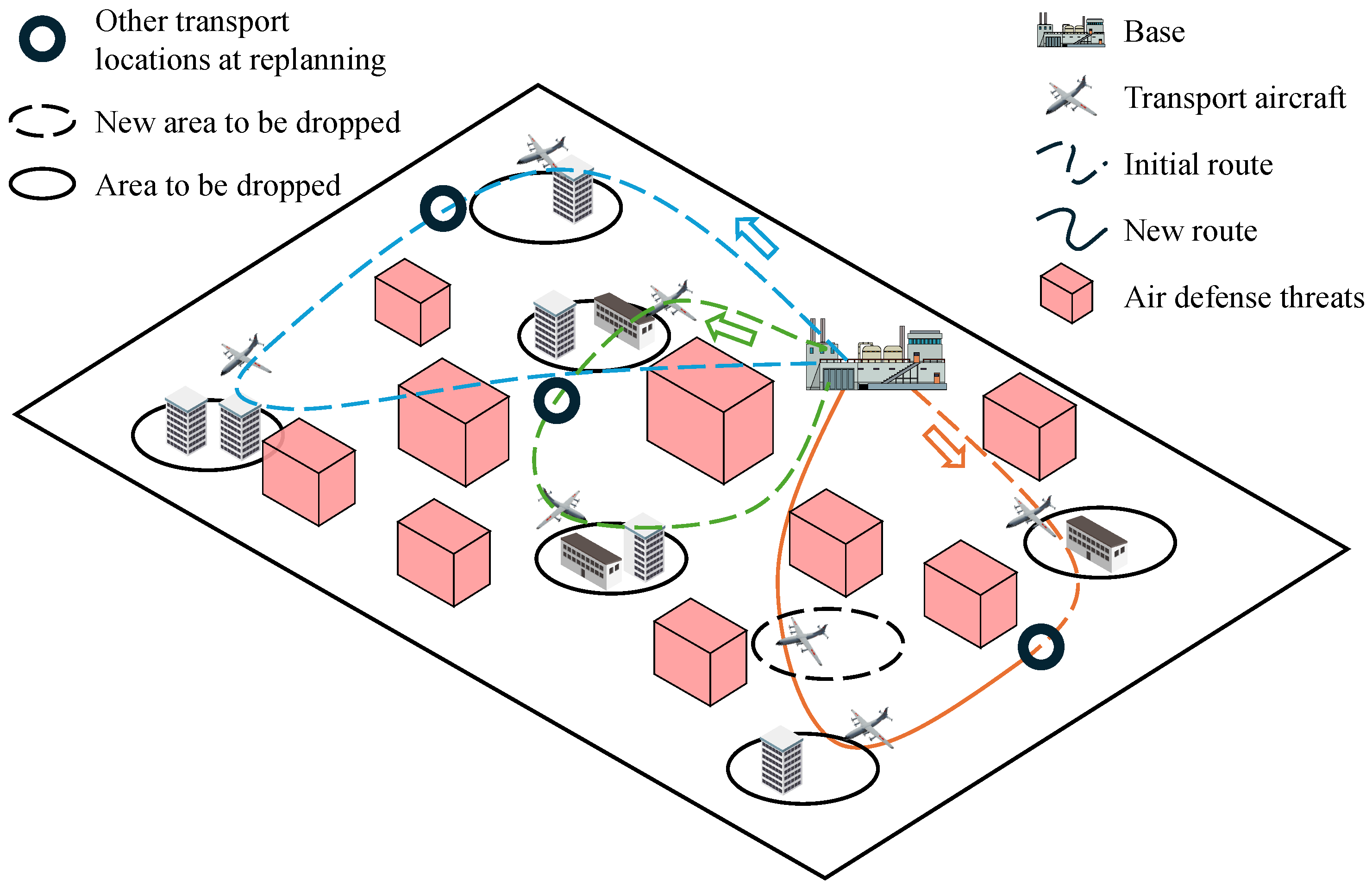
Figure 1. The dashed lines with different colors in the figure represent the routes of different aircraft. The transport aircraft, all departing from the base, aim to visit the various mission areas to deploy drone swarms while avoiding threat zones and minimizing cost.
Mathematically, the mission scenario is formally defined as a quintuple . Here, denotes the base location vector, is the set of transport aircraft, is the set of mission areas, represents the set of enemy air defense threat areas, and is the set of airdrop task instances. The base acts as the hub for all transport aircraft operations. Its spatial coordinates are fixed at , serving as both the origin and terminus for all mission execution. The transport aircraft set is defined as , consisting of heterogeneous aircraft. Each aircraft (for ) is characterized by specific performance constraints, including its maximum range , maximum payload capacity , cruise speed , and permissible flight altitude range. These parameters collectively define the operational capabilities of each transport aircraft. The set of mission areas is , containing discretely located points. Each mission point (for ) is associated with a unique coordinate within the three-dimensional airspace. The enemy air defense threats are modeled as a set of regular cuboids, denoted by . Each threat zone is defined by the coordinates of its geometric center and its spatial dimensions , which represent the effective coverage volume of the air defense system. To account for the necessity of maintaining a safe stand-off distance in actual operations, each threat cuboid is inflated by a safety buffer distance around its original boundaries, forming an expanded threat set . Mathematically, this inflation corresponds to increasing each dimension of the cuboid, resulting in new dimensions of . This ensures that a minimum safe separation is maintained between the transport aircraft’s flight path and the actual threat boundary.
Furthermore, to simulate complex operational requirements, each mission area (for ) may require multiple airdrops. This is formalized through the task instance set . Each instance (for ) is associated with a specific mission point and inherits its spatial coordinates. However, each has its own required access time window and is assigned a distinct priority weight based on operational demands. This modeling approach accurately captures the practical combat paradigm where a single geographical area may necessitate multiple, sequential deployments of drone swarms, thereby enhancing the model’s fidelity to real-world military scenarios.
3.2. Design of Decision Variables for Airdrop Tasks
The design of decision variables for the coordinated swarm airdrop task assignment optimization model aims to fully capture both the assignment of task instances to transport aircraft and the resulting task execution schedule. To this end, two core types of decision variables are introduced: task assignment variables and task sequencing variables. Together, they define the solution space. The underlying rationale is to decompose the complex combinatorial optimization problem into two interconnected yet distinct sub-problems, which facilitates the design of efficient optimization algorithms.
The task assignment variables employ a discrete integer encoding scheme to establish the mapping between task instances and transport aircraft. Specifically, for each task instance (where ) in the set , we define an assignment variable . Here, denotes that instance is assigned to transport aircraft , while indicates that is unassigned. This representation provides an intuitive mapping between tasks and aircraft. Crucially, it accommodates scenarios where not all tasks can be assigned due to resource limitations, reflecting real-world operational constraints where demand may exceed available capacity.
The task sequencing variables utilize a continuous real-number encoding to determine the execution order of tasks allocated to the same aircraft. For each task instance , a sequencing variable is defined. This variable does not represent an absolute execution time or position, but rather encodes the relative order. During decoding, for all tasks assigned to a specific aircraft , their execution sequence is determined by sorting their corresponding values in ascending order. This continuous encoding strategy circumvents the combinatorial explosion inherent in discrete sequencing representations, thereby significantly reducing the search complexity for the optimizer.
The two variable sets are strongly coupled: the assignment variable determines which aircraft executes a task, while the sequencing variable specifies its order within that aircraft’s schedule. The design ensures that the values of are constrained to the half-open interval and must be distinct for all tasks assigned to the same aircraft. This ensures a unique, unambiguous execution sequence for each aircraft’s assigned tasks. Based on this design, the solution space of the optimization problem is formally defined as , where is the vector of assignment variables and is the vector of sequencing variables.
3.3. Modeling of Transport Aircraft Performance Constraints
In coordinated airdrop mission planning, transport aircraft act as the deployment platforms for drone swarms. Their performance characteristics directly influence the feasibility and efficiency of task assignment. The fleet of transport aircraft, denoted by the set , comprises heterogeneous units. This heterogeneity is reflected in the distinct configurations of key performance parameters across aircraft, including maximum range, payload capacity, flight speed, and operational altitude limits.
The performance constraints for each transport aircraft
(where
) are characterized by the tuple
. The parameter
defines the maximum range, limiting the total spatial coverage for aircraft
in a single mission. Therefore, the total distance traveled by aircraft
, denoted
, must satisfy the range constraint:
As each aircraft can carry a limited number of swarm drones, the number of task instances it can execute is bounded. This leads to a payload capacity constraint for aircraft
:
where
is the count of task instances assigned to aircraft
, and
represents its maximum payload capacity.
To satisfy operational requirements at various drop zones, transport aircraft must release drones from specified altitudes. Each aircraft has a feasible flight altitude interval, defined by a minimum safe altitude
and a maximum service ceiling
. Since some aircraft may be incapable of reaching the altitude required for a specific task, the model must incorporate altitude constraints. The instantaneous flight altitude
of aircraft
must remain within its permissible interval for the entire mission duration:
where
denotes the total mission completion time.
For motion modeling, we adopt a simplified constant-velocity assumption, where each aircraft is assumed to travel at a constant cruise speed between waypoints. This simplification is justified for the cruise phase within the mission airspace, where aircraft typically maintain a stable flight state with minimal speed variation. Furthermore, to accommodate potential time window constraints at task points, the model allows aircraft to enter a holding pattern upon arrival in the vicinity of a target. During holding, an aircraft is still assumed to fly at a constant speed, defined as a fraction (where ) of its cruise speed .
Through this modeling, the transport aircraft set constitutes a heterogeneous fleet subject to multiple physical constraints. The variation in performance parameters reflects the diverse and complementary operational capabilities present in real-world scenarios, thereby expanding the solution space for complex task assignment.
3.4. Modeling of Task Constraints
In multi-transport aircraft airdrop missions, accurately modeling mission areas and task instances is crucial for capturing operational demands. The set of task instances, , is linked to the set of mission areas, , through a mapping that creates a hierarchical task requirement structure.
A single mission area (for ) may correspond to multiple airdrop task instances, reflecting the common operational need for multiple deployments of drone swarms to the same location. The required number of visits to area is modeled as a discrete variable with a range , where is the maximum allowable visits per area. This captures tactical requirements such as sustained operations or multi-wave deployments.
Each task instance (for ) inherits the spatial coordinates of its associated mission area but is defined by its own independent parameters.
A key parameter is the task priority weight , an integer where a higher value denotes greater importance. This discrete scale aligns with military command practice and establishes a clear hierarchy for the optimizer.
The time window constraint
defines the preferred execution interval for
. It imposes a constraint on its actual start time
:
In the static global planning phase, this constraint is treated as a soft constraint. A task can be scheduled outside its time window, but any deviation reduces its contribution to the overall objective through a penalty mechanism. For tasks that do not have a specified time window, no temporal preference is applied. In the dynamic replanning phase, however, time windows are enforced as hard constraints because the remaining mission time is limited and schedule flexibility is severely reduced. Tasks without a specified time window are treated as having a soft temporal constraint, allowing schedule flexibility as long as they are completed.
To ensure efficient resource allocation, we impose a single-visit constraint: no transport aircraft
may be assigned more than one task instance associated with the same mission area
. This prevents inefficient revisits, which would increase total travel distance and time, lower asset utilization, and potentially create route conflicts. If a mission area requires subsequent visits, they must be performed by different aircraft. Mathematically, this is expressed as:
where
is the set of all task instances for area
, and
is an indicator function equal to 1 if aircraft
is assigned to
, and 0 otherwise. This constraint prevents resource wastage and promotes cooperative load balancing within the fleet.
Through this modeling, the task instance set represents a complex demand network defined by spatial associations, temporal (hard and soft) constraints, and differentiated priorities. This provides a precise and rich basis for the subsequent cooperative task assignment algorithm, ensuring generated plans are both tactically sound and operationally feasible.
3.5. Modeling of Airdrop Task Assignment Optimization Problem
This work formulates the coordinated swarm airdrop task assignment as a multi-objective optimization problem. The objective function is designed to balance key, often conflicting, operational goals while adhering to physical and tactical constraints. Based on operational analysis, mission performance is evaluated along three primary dimensions: (1) minimizing the total flight distance to enhance resource efficiency and reduce risk; (2) maximizing the degree of task completion to ensure high-priority tasks are fulfilled, thereby boosting overall effectiveness; and (3) maximizing the satisfaction of time window requirements to guarantee precise timing and tactical coordination. These dimensions represent the core criteria of the optimization problem.
3.5.1. Minimization of Total Flight Distance
Minimizing the total flight distance directly improves resource efficiency. In contested airspace, shorter distances reduce exposure to enemy air defenses, increasing survivability while lowering fuel consumption and cost. The total distance
is the sum of distances flown by all aircraft, calculated using a model that incorporates both cruise and loitering segments:
where
is the total distance for aircraft
. It is computed as the sum of several components derived from A* path planning and loitering:
Here,
is the distance from the base to the first task point,
is the total distance between consecutive task points, and
is the distance from the last task point back to the base. These three components are collision-free paths calculated by the A* algorithm applied to a discretized map with grid size
. The term
represents additional distance flown while holding to meet a task’s time window, calculated as:
where
is the arrival time at task point
,
is the task’s window start time, and
is the loitering speed factor.
3.5.2. Maximization of Task Completion
Maximizing task completion focuses on accomplishing high-priority tasks. This is quantified by a weighted sum of assigned tasks. The task completion metric
is defined as:
where
equals 1 if task
is assigned. For tasks with time windows, a penalty reduces the priority weight
if the task starts late:
where
is the discounted weight,
is the actual start time, and
is the window’s end time. Together, the late penalty in the task completion metric and the reward in the time-window satisfaction metric implement a soft constraint formulation for time windows. A task that starts after its window closes is not discarded; instead, its effective priority is reduced. Similarly, a task that starts early receives a bonus. This design allows the optimizer to explore solutions where minor time-window violations may be traded for significant gains in other objectives, such as higher overall task completion or lower flight distance. Such flexibility is essential in static planning, where the goal is to find a globally efficient schedule even when demand exceeds capacity.
3.5.3. Maximization of Time Window Satisfaction
Maximizing time window satisfaction ensures tasks are executed within their required time frames, which is critical for coordination. The satisfaction degree
is defined as the fraction of time-constrained tasks that start within their window, with a bonus for early completion:
where
is the number of tasks with time windows. The second indicator function grants a 10% bonus for tasks completed in the first half of their window, incentivizing early execution.
3.5.4. Composite Objective Function
The three objectives are combined into a single weighted aggregate function for optimization:
The weight coefficients
and
sum to 1. The terms
and
are normalization constants defined as:
The normalization constants are chosen as the sum of the maximum ranges across all aircraft and the sum of all task priorities, respectively. This design ensures that each objective term is dimensionless and scaled to a value between 0 and 1. The weight coefficients are set according to mission priorities: task completion is the primary objective; flight distance and time-window satisfaction are secondary but still important. Because all terms are normalized to the same scale, the influence of each weight is consistent and transparent. Mission planners may adjust these weights for different operational scenarios without affecting the validity of the normalization.
The constraints in Equation (
12) can be interpreted as follows. The first and second constraint define the domains of decision variables
and
. The third constraint enforces the payload-capacity limit of each aircraft, ensuring that the number of tasks assigned to aircraft
i satisfies
. The fourth constraint guarantees that each area is visited only once, where
denotes the set of tasks associated with area
. The composite objective function is designed to embody a clear symmetry principle. It combines three objectives that include minimizing total flight distance, maximizing task completion, and maximizing the degree of time-window satisfaction. These objectives are treated as complementary and symmetric components of the overall mission design. None of them is assigned inherent priority, and their relative importance can be adjusted through the weight coefficients
,
and
. This structure ensures that the formulation remains balanced and that efficiency, effectiveness, and punctuality are jointly emphasized in a coherent manner. The model also incorporates a distributive symmetry across all aircraft. This feature prevents any single platform from carrying a disproportionate workload or from repeatedly visiting the same area. Such balanced task allocation is crucial in practical operations because it enhances robustness against unexpected losses and reduces the risk of creating a single point of failure that may arise from uneven distribution of responsibilities.
4. Multi-Transport-Aircraft-Coordinated Airdrop Task Assignment Method
4.1. Population Initialization Mechanism
In the HCBKA algorithm, the population initialization mechanism critically influences overall performance. A well-designed, problem-specific initialization strategy can significantly enhance the quality and diversity of the initial population compared to purely random initialization, providing a better starting point for the optimizer. For the multi-transport-aircraft-coordinated airdrop task assignment problem, which involves numerous complex constraints, purely random initial solutions often exhibit very low feasibility, leading to slow convergence and a high risk of becoming trapped in local optima.
The algorithm initializes a population of individuals. Each individual represents a complete candidate solution, encoded as a pair of vectors , where is the task assignment vector and is the task sequencing vector. HCBKA employs a heuristic initialization strategy that incorporates prior knowledge about the problem, considering factors such as task spatial distribution, priority weights, and heterogeneous aircraft capabilities.
4.1.1. Initialization of Assignment Variables ()
A probabilistic model guides the assignment. The probability
of assigning task
is determined by its normalized distance from the base
, its normalized altitude
, and its normalized priority
:
where
are tuning coefficients,
,
, and
. This model increases the likelihood of assigning tasks that are closer to the base, at lower altitudes, and of higher priority, reflecting practical operational logic. Once a task
is selected for assignment, a specific aircraft
is chosen based on a matching score
:
where
is an indicator ensuring the aircraft can reach the required altitude, and
is its current assigned task load. This score favors aircraft that satisfy the altitude constraint and have greater remaining capacity, promoting load balance.
4.1.2. Initialization of Sequencing Variables ()
The sequencing variables are initialized uniformly at random: . This provides a broad, unbiased search space for the sequence optimization. To ensure a valid, unambiguous execution order for the tasks assigned to each aircraft, the values for tasks belonging to the same aircraft are normalized post-initialization to be distinct and uniformly spread within .
Despite this heuristic approach, the complexity of the problem constraints means the initial population will still contain many infeasible individuals. Common violations include exceeding aircraft range () or payload capacity (), failing altitude constraints, and having the same aircraft assigned multiple tasks in the same geographic area. Therefore, a constraint-driven repair mechanism is applied after initialization to correct these violations, transforming infeasible solutions into feasible ones and ensuring the subsequent search operates within the feasible region.
4.2. Constraint-Driven Population Repair Mechanism
The constraint-driven repair mechanism is essential for ensuring the feasibility of solutions. Given the complex constraints in the multi-transport-aircraft-coordinated airdrop problem, even a heuristic initialization yields many infeasible individuals. This mechanism systematically corrects such individuals, transforming them into feasible solutions while preserving their beneficial traits as much as possible, thereby providing a high-quality initial population for optimization.
A key innovation is the hierarchical repair framework, which processes constraints sequentially according to their importance and repair complexity: the single-visit constraint, the payload capacity constraint, the range constraint, and the altitude constraint. Finally, a global lightweight backfilling mechanism reassigns high-value tasks removed during earlier steps. This layered approach ensures systematic and efficient repair, avoiding conflicts between different repair actions. The framework consists of five key steps, detailed below.
4.2.1. Single-Visit Constraint Repair
This first step enforces that no aircraft visits the same mission area more than once. For each aircraft (for ), if multiple assigned tasks belong to the same area (for ), only the task with the smallest sequencing variable is kept. This preserves the intended order from the encoding.
To choose which tasks to remove among duplicates, we evaluate the geometric path impact. The distance increment
for removing task
is:
where
,
, and
are the positions of the predecessor, the task itself, and the successor. Tasks with smaller
are removed first to minimize disruption to the path geometry.
4.2.2. Payload Capacity Constraint Repair
This step handles cases where an aircraft’s assigned task count
exceeds its capacity
. Tasks are removed based on their range contribution per unit priority. For task
on aircraft
, the contribution
is:
where
is the reduction in total distance if
is removed. A lower
indicates that removing the task saves little distance relative to its priority. Therefore, tasks with the smallest
are removed iteratively until the capacity constraint (Equation (
2)) is met, thus preserving high-benefit, high-priority tasks.
4.2.3. Range Constraint Repair
This step corrects violations where an aircraft’s total range
exceeds
. An iterative removal strategy is used, where each iteration computes a removal benefit
for each task
on the overloaded aircraft:
Here,
is the range after removing
(calculated via Equation (
1)). A higher
means greater range savings per priority unit. The task with the highest
is removed each iteration until the range constraint is satisfied, thereby efficiently reducing range while prioritizing high-priority tasks.
4.2.4. Altitude Constraint Repair
This step addresses mismatches between a task’s required altitude
and an aircraft’s maximum altitude
. If
for a task assigned to
, the task is reassigned. Reassignment uses the matching score
from Equation (
15), selecting the feasible aircraft with the highest score.
4.2.5. Global Lightweight Backfilling Mechanism
The final step attempts to reassign high-value tasks removed during the above repairs. A backfilling value
for a removed task
is calculated:
where
are weight priority, distance, and altitude factors. Tasks with higher
are considered first.
To maintain efficiency, a restricted candidate strategy is used. For each task, we consider at most
candidate aircraft, chosen based on the highest matching scores
. For each candidate aircraft, we consider at most
insertion positions: the start, the end, and the position that minimizes the resulting path length increase
. Formally:
where
is the current number of tasks assigned to the candidate aircraft. This strategy balances reassignment quality with computational cost.
The proposed two-stage approach—initialization followed by repair—ensures both population diversity and solution feasibility, furnishing a high-quality initial population for the subsequent hybrid iterative update process.
4.3. Hybrid Black-Winged Kite Population Update Mechanism
The HCBKA algorithm incorporates a hybrid population update mechanism. It retains the core dual-mode search strategy (attack and migration) of the original Black-winged Kite Algorithm (BKA) while introducing key enhancements to handle mixed-variable types and multiple constraints effectively. This mechanism decouples the update processes for continuous and discrete variables, employs constraint-aware perturbations, and utilizes elite-guided search to navigate the complex constrained solution space efficiently.
Specifically, for the continuous sequencing variables, HCBKA adopts the continuous update strategy of BKA but with adaptive parameter tuning tailored to the task sequencing context. For the discrete assignment variables, a novel probabilistic perturbation model is designed, driven by aircraft performance matching and task priorities, ensuring all updates respect the problem constraints. This hybrid approach preserves the original algorithm’s exploratory strengths while leveraging problem-specific structure, offering an effective method for multi-objective optimization under complex constraints.
4.3.1. Attack Behavior
For the sequential variable
, HCBKA adopts the same attack behavior update pattern as the original BKA. The update formula is:
where
and
are the sequencing values for task
in generations
i and
,
is a uniform random number, and
p is the attack selection threshold. The parameter
is a nonlinear decay weight:
, with
i being the current iteration and
the maximum iterations. This weight promotes global exploration early on and shifts focus to local exploitation later. The convergence control factor
n is:
. It creates strong initial perturbations for exploration, which diminish smoothly for refined local search.
A probabilistic perturbation model governs the attack updates for assignment variables
, involving two main operations: changing a task’s assignment state and reassigning it. The base probability for perturbing a task’s assignment is:
where
and
are constants, and
is the population’s exploration rate, adjusted adaptively.
If task
is unassigned and selected for perturbation, it is assigned to a candidate aircraft. The candidate set
includes aircraft that meet the altitude requirement, have available capacity, and have not visited
’s mission area:
An aircraft
is chosen with probability proportional to its remaining capacity:
If task is already assigned and selected for perturbation, it is reassigned. With probability , it adopts the assignment from the current elite solution; otherwise (with probability ), it is randomly reassigned to another feasible aircraft. This elite guidance accelerates the spread of beneficial assignment patterns.
Parameter adaptation in attack behavior represents a key innovation of HCBKA. The exploration rate
is dynamically adjusted throughout the iterative process:
where
,
, and
are constants. This ensures a shift from broad exploration to intensive exploitation, balancing global and local search.
4.3.2. Migration Behavior
The migration behavior in HCBKA is inspired by the long-distance seasonal migration of black-winged kites, serving as the primary mechanism for global exploration and escaping local optima. To enhance its effectiveness for the airdrop task assignment problem, this behavior incorporates an elite-guided reference system and an adaptive mutation strategy, significantly improving search efficiency within the complex solution space.
The update of the continuous sequencing variables employs an elite-guided hybrid mutation strategy. For each individual, a reference solution is selected: with probability , the global best individual is chosen; otherwise, a random individual from an elite pool serves as the reference. The update formula is bifurcated based on the relationship between an individual’s fitness and the population’s average fitness .
When
, a Cauchy mutation-driven update promotes exploration:
where
is the sequencing variable from the reference individual,
is the mutation intensity coefficient, and
is a random number from the standard Cauchy distribution. The heavy-tailed property of the Cauchy distribution provides a strong capability to escape local optima, particularly beneficial for global exploration when solution quality is low.
When
, a Lévy flight-guided update facilitates refined local search with global potential:
where
is the step size scaling factor,
is the random step length from a Lévy flight, and
is the Lévy exponent. The long-jump characteristic of Lévy flight allows high-quality solutions to be finely tuned while maintaining exploratory capacity. The factor
decays exponentially to sharpen convergence:
where
is the initial step size. This decay ensures increasing convergence precision in later iterations.
For the discrete assignment variables
, an intelligent, constraint-aware perturbation strategy is designed. Updates are based on a reference individual but are constrained by aircraft performance and task matching. For each task instance
, its assignment is updated to the reference value
with probability
, conditional on the assigned aircraft’s altitude capability:
where
is the maximum flight altitude of the aircraft corresponding to
. If the altitude constraint is violated, the algorithm defaults to a probabilistic reassignment strategy based on aircraft matching degree, guaranteeing all operations satisfy problem constraints.
The elite reference mechanism is pivotal for convergence. Reference individuals are selected from an elite pool based on fitness ranking. The size of this pool,
, adapts during the iterative process:
where
is the population size, and
and
are the lower and upper bounds of the elite proportion. This adaptive mechanism maintains a larger pool early on to foster diversity and progressively shrinks it to focus selection pressure and accelerate convergence.
4.4. HCBKA Algorithm Flow
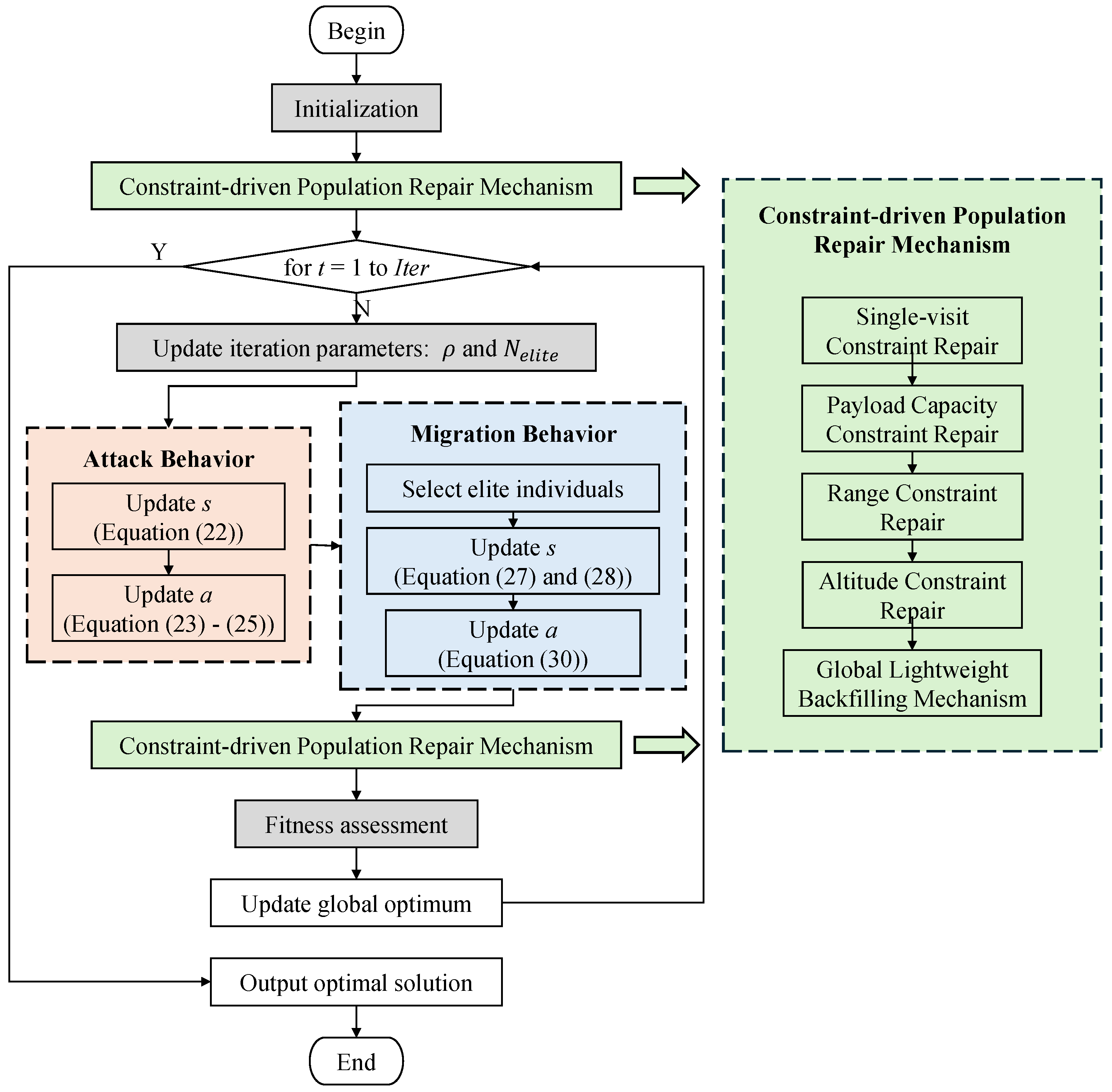
Integrating the population initialization mechanism, the constraint-driven repair mechanism, and the hybrid update mechanism, the HCBKA algorithm establishes a complete framework for solving the multi-transport-aircraft-coordinated airdrop task assignment problem. By simulating the foraging and migratory behaviors of black-winged kites, the framework efficiently navigates the complex, constrained solution space. The overall workflow is illustrated in the flowchart of
Figure 2. A detailed step-by-step description is also provided in the pseudocode of Algorithm 1.
The HCBKA algorithm proceeds according to the following steps.
Step 1: Input and parameter initialization. The algorithm receives the task set , aircraft set , base location , threat zones , maximum iterations , population size , and weight coefficients .
Step 2: Population initialization. A population of
individuals is generated using the heuristic strategy defined in Equations (
14) and (
15). This strategy considers task spatial distribution, priority, and aircraft capabilities to produce diverse and high-quality candidate solutions.
Step 3: Constraint repair. Each individual is processed by the constraint-driven repair mechanism described in
Section 4.2. This ensures that all hard constraints are satisfied before further optimization.
Step 4: Fitness evaluation and elite selection. The fitness of each individual is computed using the scalarized objective function in Equation (
12), which combines the three normalized objectives. The individual with the highest fitness is stored as the global best solution
with fitness
.
Step 5: Main optimization loop. For each generation to , the following substeps are performed for every individual i in the population.
Step 5.1: Update adaptive parameters. The exploration rate
(Equation (
26)) and the elite pool size
(Equation (
31)) are recalculated based on the current generation number.
Step 5.2: Attack behavior. The sequencing variables
s are updated using Equation (
22). The assignment variables
a are perturbed probabilistically according to Equations (
23)–(
25), with elite guidance.
Step 5.3: Migration behavior. A reference solution is selected from the elite pool. If the individual’s fitness is below the population average, a Cauchy mutation (Equation (
27)) is applied to the sequencing variables. Otherwise, a Lévy flight update (Equation (
28)) is used. The assignment variables are updated by copying from the reference solution if altitude constraints permit (Equation (
30)).
Step 5.4: Constraint repair after update. The newly generated candidate solution is passed through the same repair mechanism as in Step 3 to guarantee feasibility.
Step 5.5: Fitness evaluation and greedy selection. The fitness of the candidate solution is computed. If it exceeds the current individual’s fitness, the individual is replaced. After processing all individuals, the global best solution is updated if a better fitness is found.
Step 6: Output. After completing all generations, the algorithm returns the optimal task assignment
, optimal task sequence
, and the corresponding fitness
.
| Algorithm 1 HCBKA Algorithm Pseudocode |
- Require:
Task instance set , transport aircraft set , base location , threat zones , max iterations , population size , weight coefficients - Ensure:
Optimal task assignment , optimal task sequence , optimal fitness - 1:
Initialize population: via heuristic rules (Equations ( 14) and ( 15)) - 2:
for to do - 3:
Repair ( Section 4.2) - 4:
Fitness (Equation ( 12)) - 5:
end for - 6:
Identify elite and best fitness - 7:
for to do - 8:
Update exploration rate (Equation ( 26)) - 9:
Update elite pool size (Equation ( 31)) - 10:
for to do - 11:
{Attack Behavior} - 12:
Update s (Equation ( 22)) - 13:
Update a (Equation ( 23)–( 25)) - 14:
{Migration Behavior} - 15:
if then - 16:
Elite individual - 17:
else - 18:
Random elite - 19:
end if - 20:
if then - 21:
Cauchy mutation (Equation ( 27)) - 22:
else - 23:
Lévy flight (Equation ( 28)) - 24:
end if - 25:
Perturb a (Equation ( 30)) - 26:
Repair - 27:
Fitness - 28:
{Selection} - 29:
if then - 30:
- 31:
end if - 32:
end for - 33:
Update global best - 34:
Output iteration statistics - 35:
end for - 36:
return
|
5. Dynamic Reallocation Method for Coordinated Airdrop Missions
The static task allocation method based on HCBKA provides a high-quality initial plan for multi-transport-aircraft-coordinated airdrop operations. However, real-world combat environments are highly uncertain and dynamic. During execution, unforeseen events—such as emergent threats, equipment failures, or changing mission requirements—can degrade or even invalidate the pre-computed static plan. Such disruptions may not only interrupt specific tasks but also compromise the entire scheduled mission sequence, leading to cascading negative effects on overall effectiveness.
To address these challenges, this section proposes a Time-window aware Dynamic Auction Algorithm (TDAA). Building upon the efficient sequential auction framework, TDAA accurately models and solves the coordinated airdrop reallocation problem through a coordinated structure that integrates a two-level screening mechanism and a two-phase auction process. The algorithm’s core innovations are systematic: (1) a two-level transport aircraft screening mechanism combining spatial proximity and temporal feasibility to ensure solution quality while boosting computational efficiency; (2) an intelligent task ordering strategy that prioritizes tasks based on both their priority and the urgency of their time windows, ensuring critical tasks are allocated first; and (3) a composite bid function balancing task priority, time window satisfaction, and route resource cost, enabling multi-objective optimization. Through intelligent task ordering, precise aircraft filtering, and utility-optimal assignment, TDAA establishes a responsive and practical reallocation solution for dynamic settings.
The following discussion first systematically analyzes typical reallocation trigger scenarios and their impact on the mission system. It then details the core mechanics and complete workflow of the TDAA algorithm, providing both theoretical foundation and a practical methodology for sustaining effective coordinated airdrop operations in dynamic environments.
5.1. Analysis of Reallocation Scenarios for Coordinated Swarm Airdrop Missions
Dynamic reallocation is triggered by unpredictable changes that undermine the optimality or feasibility of the initial HCBKA-based plan. To preserve mission effectiveness, these trigger scenarios must be precisely identified and formalized. Based on operational analysis, we categorize dynamic triggers into three typical scenarios: sudden loss of a transport aircraft, emergence of new task instances within existing mission areas, and appearance of new mission areas. Each event is defined formally below.
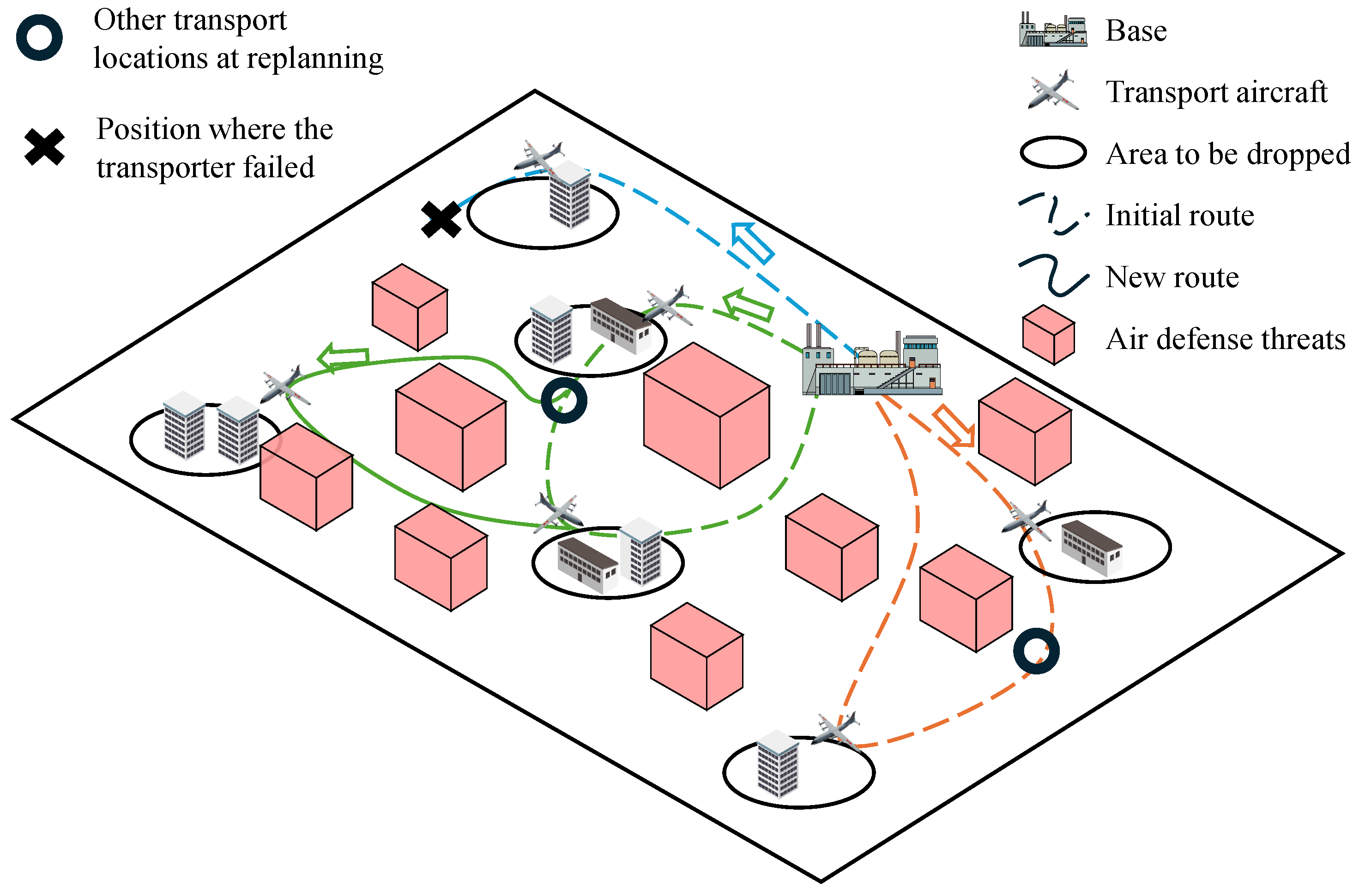
5.1.1. Sudden Attrition of a Transport Aircraft
An aircraft
(with
) becomes unable to continue its mission due to factors such as enemy fire, mechanical failure, or severe weather. The current time is denoted
. The set of tasks that are affected and require reassignment is
, where
is the planned start time of task
.
Figure 3 illustrates this scenario.
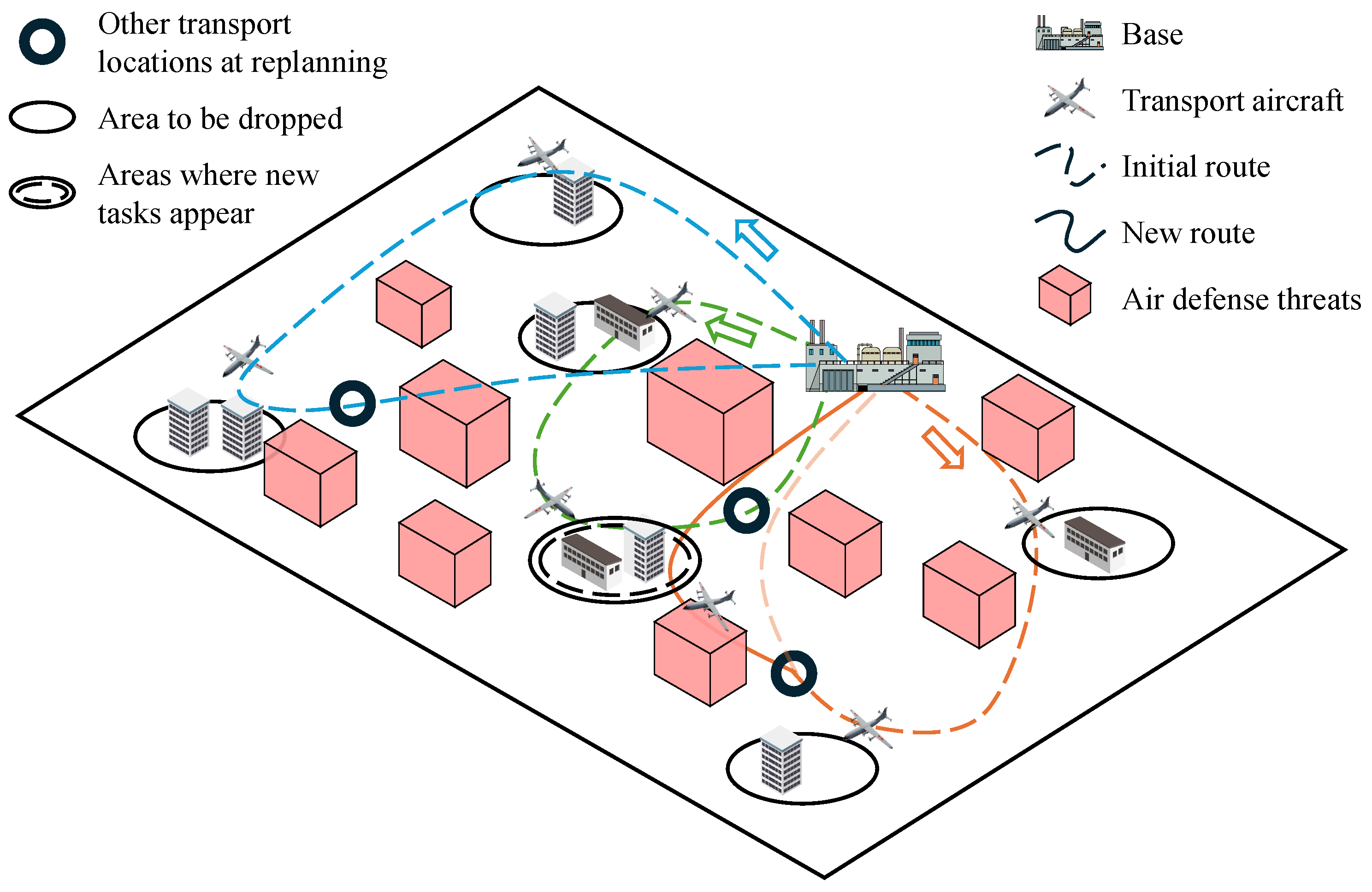
5.1.2. New Task Instances in an Existing Area
For an existing mission area
that originally required
visits, a command decision may add an extra airdrop, creating a new instance
. This task shares the spatial coordinates of
but has its own priority
and time window
.
Figure 4 shows this scenario.
5.1.3. Emergence of a New Mission Area
A completely new area
appears at coordinates
with a set of task instances
. Each task in
has its own priority and may have a time window. This event typically corresponds to an emergent threat that demands rapid response.
Figure 5 illustrates this case.
5.1.4. Formal Definition of Event-Trigger Conditions
The TDAA algorithm is invoked immediately upon the occurrence of any of the above events. The trigger conditions are event-based, not periodic or time-based, ensuring prompt response without unnecessary computations during steady operation.
- 1.
Event type 1 (aircraft attrition). Let be the failed aircraft and the current time. The event is triggered when becomes unable to continue. The affected tasks are .
- 2.
Event type 2 (new task instance). For an existing area , a new instance is added by command decision. The event is triggered at the moment the decision is made. The new task inherits the location of and carries its own priority and time window.
- 3.
Event type 3 (new mission area). A new area appears with a set of tasks . The event is triggered when the area is detected and deemed operationally urgent.
In all three cases, the reallocation process starts immediately after the event is recognized. The composition of the new task set varies by scenario: for aircraft attrition, ; for a new instance in an existing area, ; for a new mission area, contains all tasks of that area. This unified formulation provides a consistent basis for the TDAA algorithm across different dynamic disturbances.
5.2. Coordinated Airdrop Task Reallocation Method Based on the TDAA Algorithm
Addressing the specific demands of the dynamic reallocation scenarios outlined above, this section presents a Time-window aware Dynamic Auction Algorithm (TDAA). TDAA employs a cooperative optimization framework featuring two-level screening and a two-phase auction. Its sequential approach—spatial proximity pre-screening followed by temporal feasibility assessment—ensures solution feasibility while minimizing disruption to existing task schedules. A key strength of TDAA is its efficient resource matching, which rapidly identifies the most suitable aircraft and optimal insertion points for new tasks, enabling swift reallocation in dynamic settings. Furthermore, through intelligent task prioritization and a composite bid function, TDAA prioritizes high-value tasks for the best available resources while maintaining overall mission efficiency.
Underlying this design is a critical distinction between the static planning and dynamic replanning phases in how time-window constraints are enforced. In static planning, time windows are treated as soft constraints, allowing the algorithm to trade off small schedule deviations for better overall mission performance. In dynamic replanning, however, the situation is different. When an unexpected event occurs, the remaining time margin is often tight, and any further delay may cause critical tasks to miss their windows. Therefore, in the TDAA algorithm, time windows are enforced as hard constraints. Only aircraft that can reach a new task before the window closes are considered feasible candidates. This two-phase design reflects practical operational priorities: global efficiency in planning and strict temporal compliance in reactive adjustments.
5.2.1. Transport Aircraft Screening Mechanism
Efficient reallocation in the TDAA algorithm relies critically on its transport aircraft screening mechanism. Designed to balance solution quality with computational efficiency, this mechanism employs a two-tiered hierarchical filter. The first tier pre-screens candidates based on spatial proximity, leveraging the operational efficiency gained from geographic continuity in task execution. The second tier then assesses temporal feasibility to ensure all time constraints can be met. This structured approach drastically narrows the search space. Furthermore, to maximize overall assignment success, tasks that remain unassigned after this primary process enter a secondary, more relaxed screening round involving the entire available fleet.
The spatial proximity screening identifies aircraft that are naturally positioned to incorporate a new task with minimal additional travel. The underlying principle is that assigning geographically proximate tasks to the same aircraft reduces wasteful deadhead distance. For a given new task
, the algorithm computes its distance to every scheduled task point across all aircraft. The distance from
to the
j-th task
in the sequence of aircraft
is defined as:
where
accounts for potential detours required to avoid known threats. The spatial proximity index
for aircraft
is then the minimum of these distances:
with
being the number of tasks currently assigned to
. The
M aircraft with the smallest
values form the initial candidate set
. This pre-filtering step significantly reduces the pool of contenders for subsequent, more expensive computations.
The subsequent temporal feasibility screening evaluates whether candidates in
can physically reach the new task within its required timeframe. For tasks possessing a time window
, the algorithm calculates for each candidate aircraft
the direct flight time
from its current position
to the task location
:
Aircraft are retained only if they can arrive before the window closes, allowing for a small planning tolerance
:
The aircraft satisfying this inequality constitute the refined, feasible candidate set . For tasks without a specified time window, all spatially proximate candidates are considered feasible, i.e., .
This two-stage screening produces a shortlist of aircraft that are both geographically convenient and temporally capable of executing the new task. However, if is empty—meaning no candidate from the initial spatial filter can meet the time constraint—the task is flagged for secondary allocation. In this fallback phase, the spatial screening criteria are relaxed, and the algorithm attempts to assign the task from the broader set of aircraft not initially considered, thereby striving to maximize the final allocation rate.
5.2.2. Task Auction Priority Sorting Mechanism
Before initiating the auction process, the TDAA algorithm intelligently orders the set of tasks awaiting assignment (
). This pre-auction sorting ensures that critical and time-sensitive tasks receive bidding priority. The ordering is determined by an auction priority index
, which balances a task’s inherent priority against the urgency of its time window:
Here, is the task’s priority weight, is an indicator function (equal to 1 if has a time window, or 0 otherwise), and and are configurable weighting coefficients. Tasks are then ranked in descending order of to produce a sorted sequence for the auction. This prioritization scheme mirrors real-world operational decision-making by ensuring that the most important and most urgent tasks are addressed first in the resource allocation process.
5.2.3. Bid Function Design
A core innovation of the TDAA algorithm is its bid function, designed to accurately quantify the marginal cost for a transport aircraft to execute a newly assigned task. It provides an objective metric for auction decisions by synthesizing key factors: the additional route distance required, the disruption caused to the existing schedule, and the inherent value of the task itself.
For a candidate aircraft
and task
, the bid
is defined as:
where
is the task’s priority weight;
is the additional flight distance required to insert
into the existing route of aircraft
;
is the total delay imposed on other time-constrained tasks due to the insertion; and
is a user-defined weight that balances the importance of flight distance against schedule disruption.
The bid function yields a higher value when the task has high priority and when the combined cost is low. The combined cost consists of the flight distance plus the weighted disruption. Therefore, the aircraft with the maximum bid is the most efficient choice.
Let the current task sequence of aircraft
be
. Here
N is the number of tasks already assigned. The total route distance of this sequence is denoted by
. Consider each possible insertion position
i with
. The position
means inserting before the first task, and
means inserting after the last task. For a given position
i, define a new sequence
that includes
at position
i. The distance increase for this position is
The incremental distance is the minimal increase over all positions. The position that achieves this minimum is selected for insertion. This is written as
The schedule disruption term measures how much the insertion delays other tasks that have time window constraints. Let
be the subset of tasks in
that possess a time window. For each such task
, the time window is denoted by
. Let
be its originally planned start time and
be its new start time after inserting
. The disruption term is then defined as
This sum penalizes any task that would miss its deadline due to the insertion. Tasks without time windows are not affected by this term.
5.2.4. TDAA Algorithm Flow
The TDAA algorithm employs a two-phase auction process to achieve rapid task reallocation. The first phase focuses on efficiency, performing preprocessing (task prioritization and aircraft screening) followed by a restricted auction that considers only spatially proximate and temporally feasible aircraft. The second phase ensures robustness by re-attempting the allocation of any tasks left unassigned in the first phase, this time considering a broader set of aircraft from across the entire fleet. This structured approach is detailed in Algorithm 2.
| Algorithm 2 TDAA Algorithm Pseudocode |
- Require:
Current transport aircraft state , new task set , base location , threat areas , current time - Ensure:
Updated task assignment scheme , updated task sequencing scheme - 1:
{Phase I: Preprocessing and Constrained Auction} - 2:
Priority sort based on Equation ( 36) - 3:
Initialize task sequence state - 4:
Initialize set of unassigned tasks - 5:
{First-Round Auction} - 6:
for to do - 7:
- 8:
Spatial proximity pre-screening (Equation ( 33)) - 9:
Temporal feasibility screening (Equation ( 35)) - 10:
if then - 11:
- 12:
continue - 13:
end if - 14:
{Using Equation ( 37)} - 15:
Insert at optimal position in sequence of - 16:
Update state for - 17:
end for - 18:
{Phase II: Secondary Auction for Unassigned Tasks} - 19:
for
do - 20:
Screen feasible aircraft from entire fleet (Equation ( 35)) - 21:
{Exclude first-round candidates} - 22:
if then - 23:
Mark as permanently unassigned - 24:
continue - 25:
end if - 26:
{Using Equation ( 37)} - 27:
Insert at optimal position in sequence of - 28:
Update state for - 29:
end for - 30:
return
|
The TDAA algorithm can be summarized in the following steps.
Step 1: Task prioritization. All new tasks in
are sorted in descending order of the auction priority index
defined in Equation (
36).
Step 2: First-round auction. For each task in the sorted list, the algorithm performs spatial proximity pre-screening using Equation (
33) to obtain a candidate set
. This set is then filtered by temporal feasibility using Equation (
35) to obtain
. If
is empty, the task is added to a failed set
; otherwise, the aircraft
that maximizes the bid function
(Equation (
37)) is selected, and the task is inserted at the position that minimizes additional flight distance.
Step 3: Second-round auction. For each task in , the algorithm searches the entire fleet for aircraft that can meet the time window constraint, excluding those already considered in the first round. The aircraft with the highest bid is chosen, and the task is inserted similarly.
The updated task assignment and sequencing are returned.
6. Simulation Result
6.1. Comparative Evaluation of the HCBKA Algorithm via Simulation
To thoroughly assess the performance of the HCBKA algorithm in solving the task assignment problem for cooperative airdrop missions involving multiple transport aircraft, this subsection presents a series of systematic comparative simulations. The experiments are conducted using a fixed random seed to ensure reproducibility. By comparing the HCBKA algorithm with several classical optimization algorithms under identical task scenarios, we quantitatively evaluate their overall performance in terms of solution quality, convergence speed, and robustness.
A three-dimensional operational airspace measuring 100 km × 100 km × 50 km is first constructed. Within this space, 35 task areas are defined, encompassing a total of 80 task instances to be executed collaboratively by five heterogeneous transport aircraft. Fifteen enemy air defense threat zones are present, each expanded according to the method described in
Section 3.5 to incorporate a safety buffer of 2.0 km. After discretization, each grid cell measures 2.0 km. The base is located at the center of the airspace (50, 50, 0) to enable omnidirectional deployment of the aircraft.
The heterogeneous configuration of the transport aircraft fleet is detailed in
Table 1. The aircraft differ in key performance parameters such as maximum range, task capacity, operational altitude range, and cruising speed. This configuration emulates realistic cooperative operations involving diverse aircraft types in combat scenarios.
The parameter settings of the HCBKA algorithm are summarized in
Table 2. The detailed attributes of the task instances, including their spatiotemporal distribution and priority levels, are listed in
Table 3.
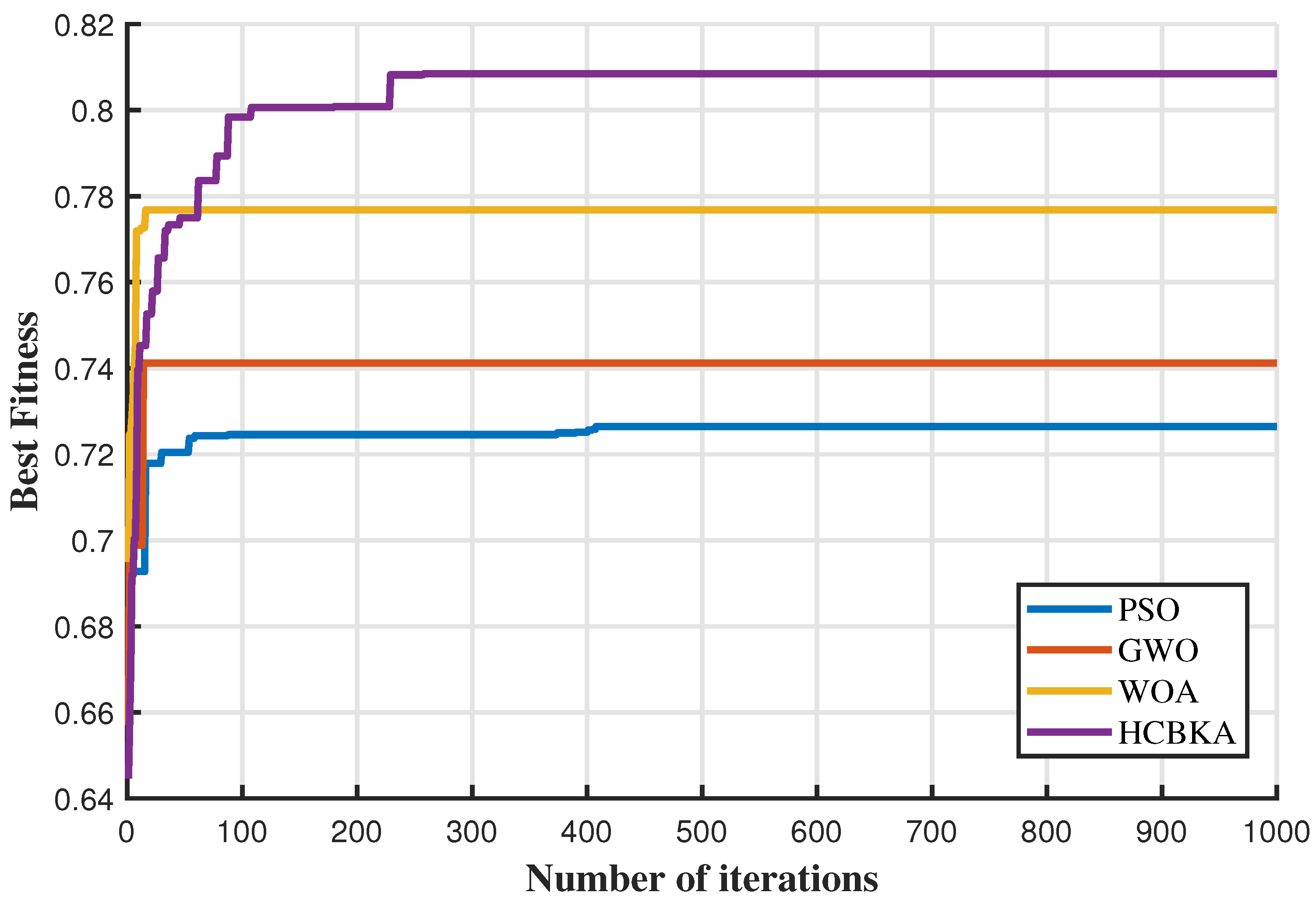
Figure 6 compares the fitness convergence performance of the proposed HCBKA algorithm with three representative metaheuristic algorithms: Particle Swarm Optimization (PSO), Grey Wolf Optimizer (GWO), and the Whale Optimization Algorithm (WOA). The convergence trajectories and final fitness values reveal distinct optimization behaviors among the four methods. PSO exhibits the slowest convergence, stabilizing only after approximately 400 iterations and yielding the lowest final fitness, which remains within the range of 0.72 to 0.73. Although GWO demonstrates a relatively fast initial convergence, its fitness value plateaus around 0.74 midway through the iterations, with minimal improvement thereafter. This indicates that the algorithm has limited ability to escape local optima. WOA performs comparably to HCBKA in the early stages but lacks sufficient convergence depth in later iterations, resulting in a final fitness inferior to that of HCBKA. In contrast, the proposed HCBKA algorithm, despite a slower convergence rate during the initial tens of generations compared to GWO and WOA, surpasses all competitors by achieving the best solution after approximately 60 generations. It enters a stable convergence phase around generation 200, ultimately reaching a fitness value consistently above 0.80. These results highlight HCBKA’s robust global search capability and stable convergence behavior. The comparative results provide strong evidence that the HCBKA algorithm outperforms the benchmark metaheuristics in both solution quality and convergence efficiency, validating its effectiveness and superiority for solving this class of optimization problems.
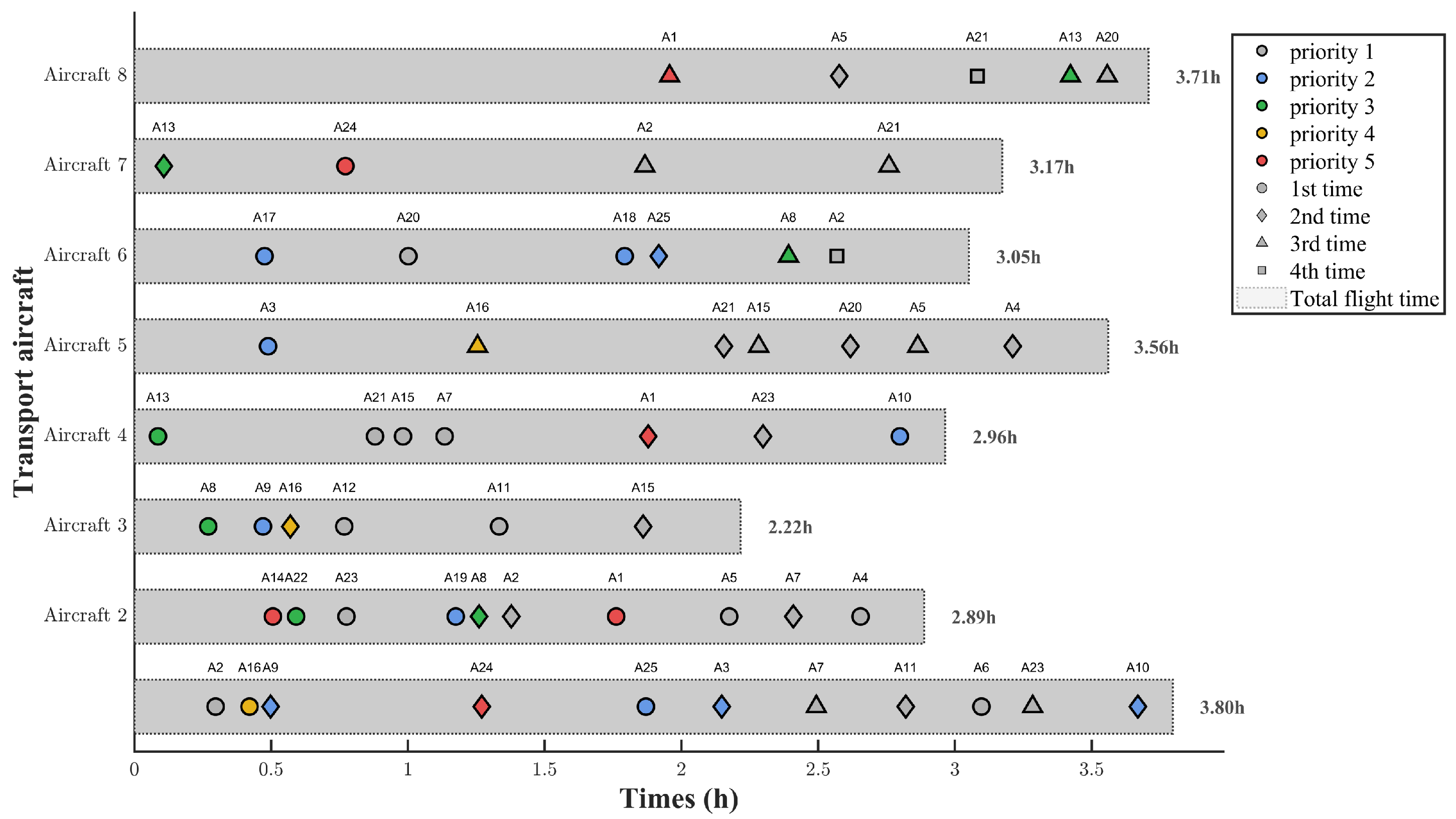
A detailed examination of the task assignment results generated by the HCBKA algorithm is presented in the Gantt chart in
Figure 7, which clearly depicts the temporal execution sequences of tasks for each transport aircraft. In the chart, red bars denote tasks with the highest priority, while gray bars indicate those with the lowest. As shown in
Figure 7, all top-priority tasks are completed within the first two hours. Although most medium- and low-priority tasks are scheduled in the early stages of the mission timeline, a few are deferred to later periods. Notably, a significant number of low-priority tasks are deliberately scheduled toward the end of the execution sequence. Importantly, all task schedules strictly adhere to their respective time window constraints. These results demonstrate that the algorithm not only ensures temporal feasibility but also effectively prioritizes tasks based on their urgency and time sensitivity.
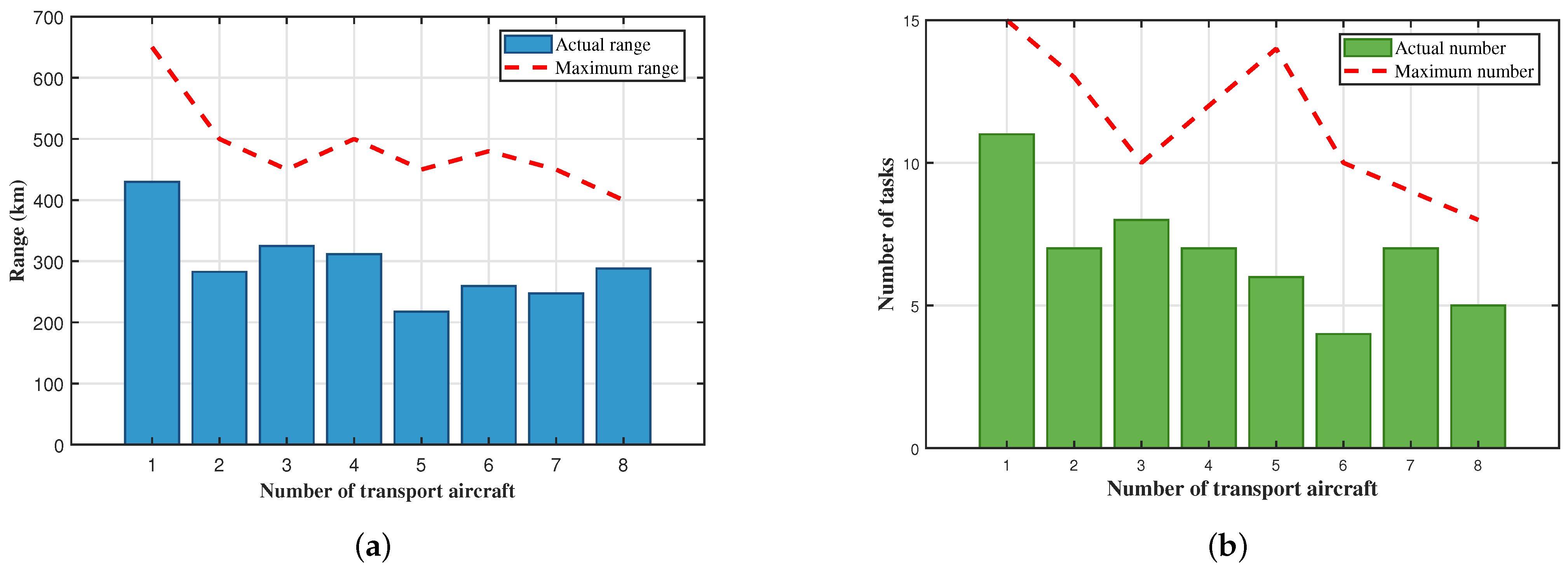
Figure 8 illustrates the performance load distribution across the transport aircraft fleet. The task loads are relatively balanced among the aircraft. Aircraft 1, possessing the highest endurance and task capacity, undertakes the largest number of tasks and covers the longest flight distance. Interestingly, despite its limited range, Aircraft 5 assumes a substantial portion of medium and low priority tasks located near the base, leveraging its superior task capacity. This highlights the effectiveness of capability complementarity within the heterogeneous fleet.
The two-dimensional scenario projection in
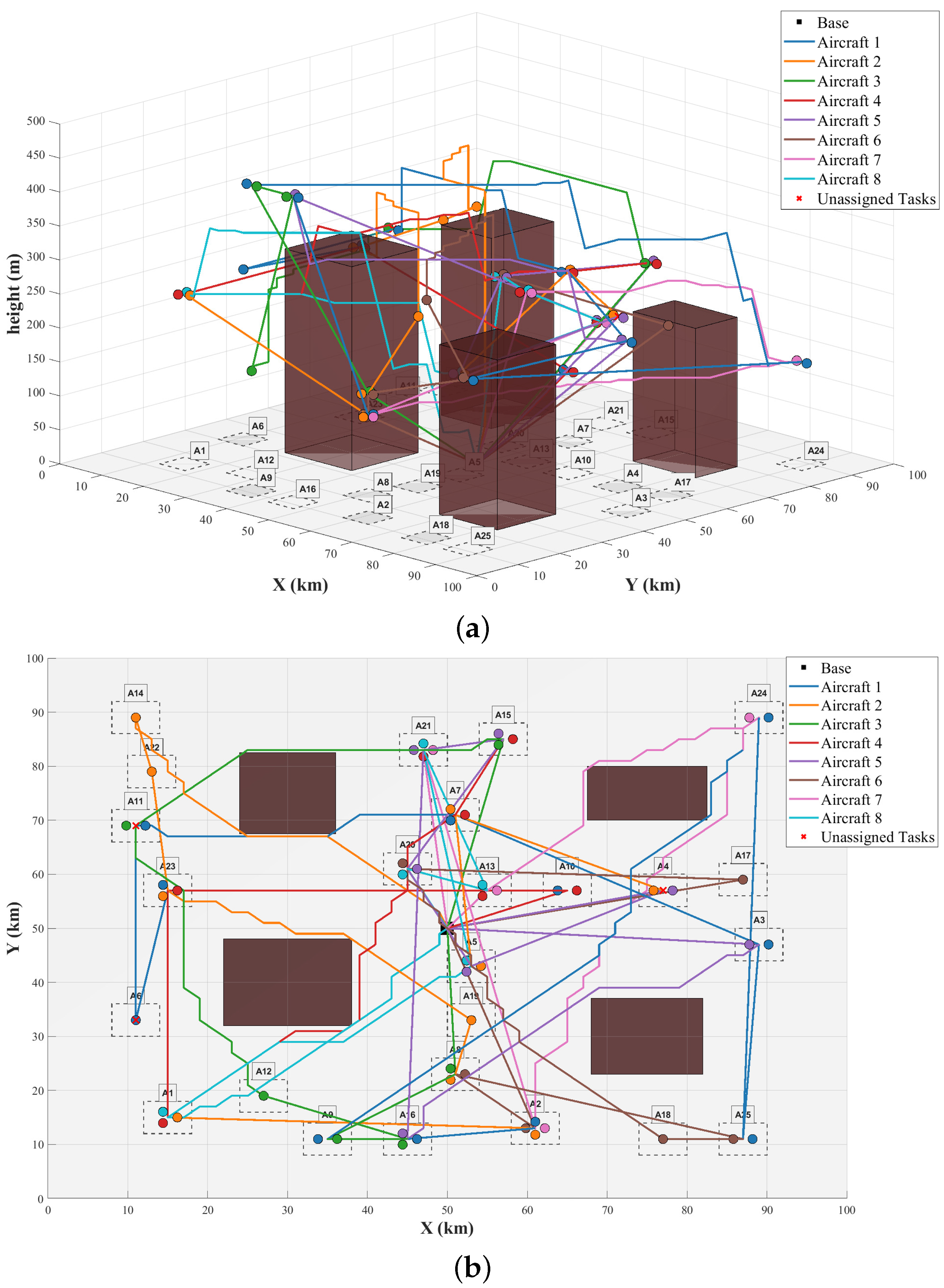
Figure 9 visually reveals the spatial characteristics of the final route planning. The circular markers sharing the same color as the corresponding flight path in the Figure denote the airdrop points of each aircraft. The task visitation sequences exhibit clear spatial clustering, with neighboring task areas assigned to the same aircraft in contiguous sequences, thereby minimizing redundant flight distances. Tasks located near the base are primarily assigned to Aircraft 4 and 5, which have shorter operational ranges, while long-range tasks are allocated to Aircraft 1, which offers superior endurance. Such a capability-aware task allocation strategy significantly enhances overall mission efficiency.
A comprehensive analysis of the offline comparative simulation results confirms that the HCBKA algorithm exhibits notable advantages in solution quality, convergence behavior, and constraint-handling capability, thereby validating the effectiveness of its overall design framework. These strengths primarily arise from the algorithm’s problem-specific initialization strategy and its exploration-enhanced update mechanism—features absent in the baseline algorithms. The hybrid update strategy of HCBKA achieves a balanced trade-off between global exploration and local exploitation, while its constraint-driven repair mechanism ensures that all solutions remain within the feasible region. Together, these mechanisms provide a reliable and efficient solution for multi-transport aircraft cooperative airdrop missions in complex operational environments.
6.2. Ablation Study of the HCBKA Algorithm
To gain deeper insights into the individual contributions and collaborative mechanisms of the core components within the HCBKA algorithm, this subsection presents a systematic ablation study. By conducting controlled experiments, we decouple and independently analyze the heuristic initialization strategy and the constraint repair mechanism employed during population initialization. This quantitative evaluation of each module’s impact on overall performance provides empirical support for algorithmic design decisions.
Figure 9.
Scenario visualization generated by the HCBKA algorithm: (a) 3D view. (b) Top-down view.
Figure 9.
Scenario visualization generated by the HCBKA algorithm: (a) 3D view. (b) Top-down view.
To assess the standalone effects and joint benefits of the heuristic initialization strategy and the constraint repair mechanism, four algorithm variants are constructed for comparative analysis: Random Initialization without Repair (RI-NR), Random Initialization with Repair (RI-R), Heuristic Initialization without Repair (HI-NR), and the full version combining both components (HCBKA). Specifically, random initialization generates the initial population using a uniform distribution, resulting in entirely random initial solutions—a standard practice in many heuristic algorithms. In contrast, the heuristic initialization leverages the probabilistic models defined in Equations (
14) and (
15), incorporating prior knowledge such as task spatial distribution, priority weights, and transport aircraft performance compatibility. The repair mechanism refers to the hierarchical constraint repair process described in
Section 4.2, whereas in the absence of this mechanism, infeasible task sequences are simply discarded.
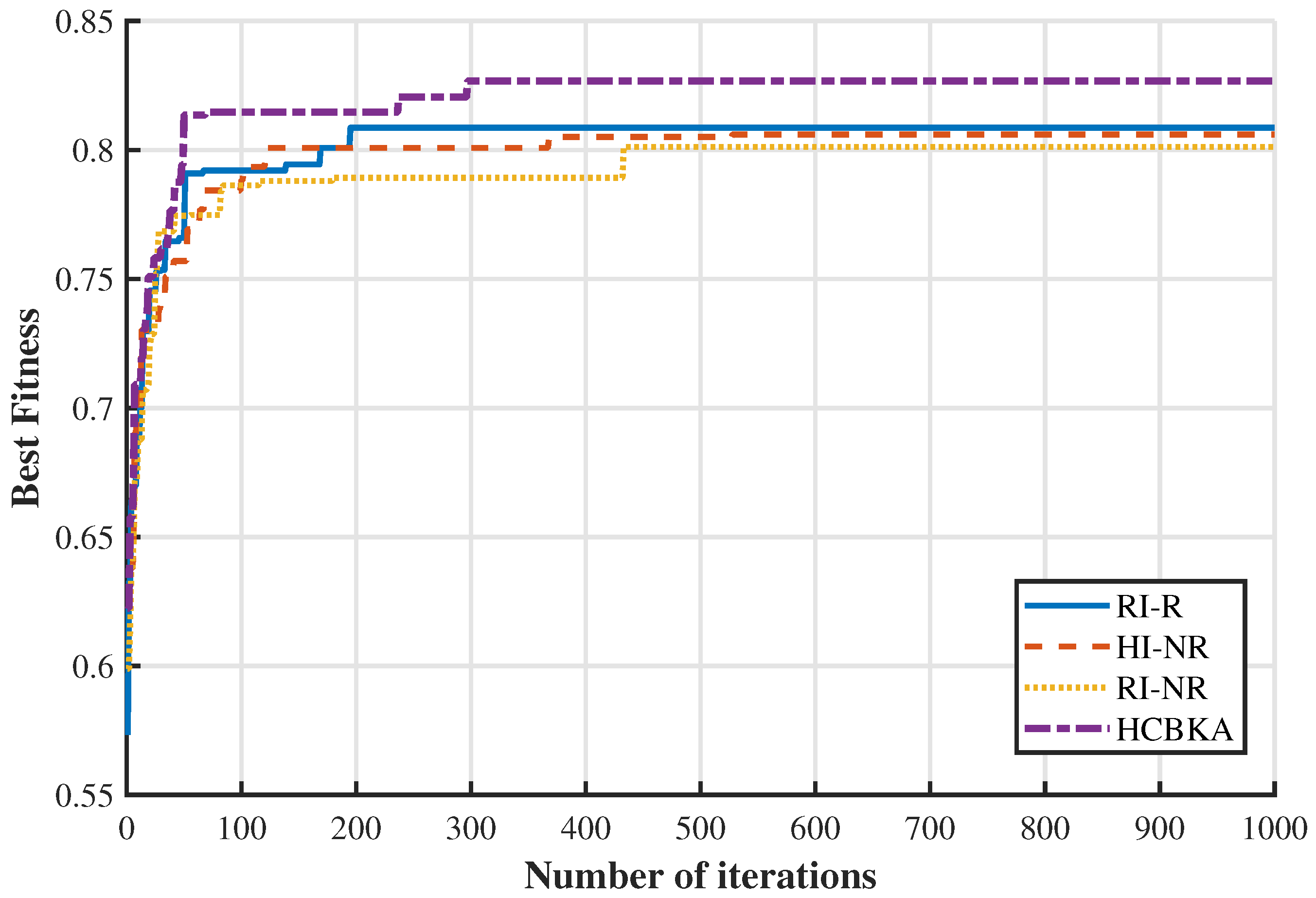
Figure 10 presents the fitness convergence curves of the four algorithm variants. The results show that HCBKA achieves superior performance in both convergence speed and final solution quality. It demonstrates rapid early convergence, stabilizing around generation 300, and ultimately reaches a fitness value of 0.85. In comparison, although HI-NR benefits from a high-quality initial population—achieving an initial best fitness of approximately 0.64, higher than the 0.60 of RI-NR and 0.62 of RI-R—its lack of a repair mechanism hampers search efficiency in the early stages, resulting in a final fitness of 0.81. RI-R, despite starting with a lower-quality population, benefits from the repair mechanism during iterations and outperforms both variants without repair. However, due to its inferior initial population, its final fitness remains slightly below that of HCBKA, reaching just above 0.80.
In summary, the ablation results confirm that both the heuristic initialization and the constraint repair mechanisms are critical components contributing to the superior performance of the HCBKA algorithm. The heuristic initialization offers a high-quality starting point for the search, while the constraint repair mechanism ensures sustained feasibility and solution quality throughout the optimization process. Their combined effect enables the algorithm to efficiently solve complex, multi-constraint optimization problems.
6.3. Simulation of the TDAA Algorithm in Dynamic Environments
To comprehensively evaluate the replanning capability and robustness of the Time-window aware Dynamic Auction Algorithm (TDAA) in dynamic environments, this subsection presents simulation experiments across three representative dynamic replanning scenarios: (i) sudden loss of a transport aircraft, (ii) emergence of new task instances within existing task areas, and (iii) addition of new task areas. The experiments are conducted within the simulation environment established in
Section 3.5, using the same parameter settings as in
Section 6.1. By introducing different types of dynamic disturbances during task execution, the TDAA algorithm is assessed in terms of its ability to maintain task continuity, respond promptly to unexpected events, and optimize resource reallocation.
6.3.1. Sudden Aircraft Loss Scenario
In this scenario, a sudden failure forces transport aircraft
to withdraw from the mission at time
h. At the moment of failure,
has five pending tasks that are interrupted: task T10 in area A4, T15 in A5, T39 in A15, T47 in A20, and T52 in A21. Details of these tasks are provided in
Table 4.
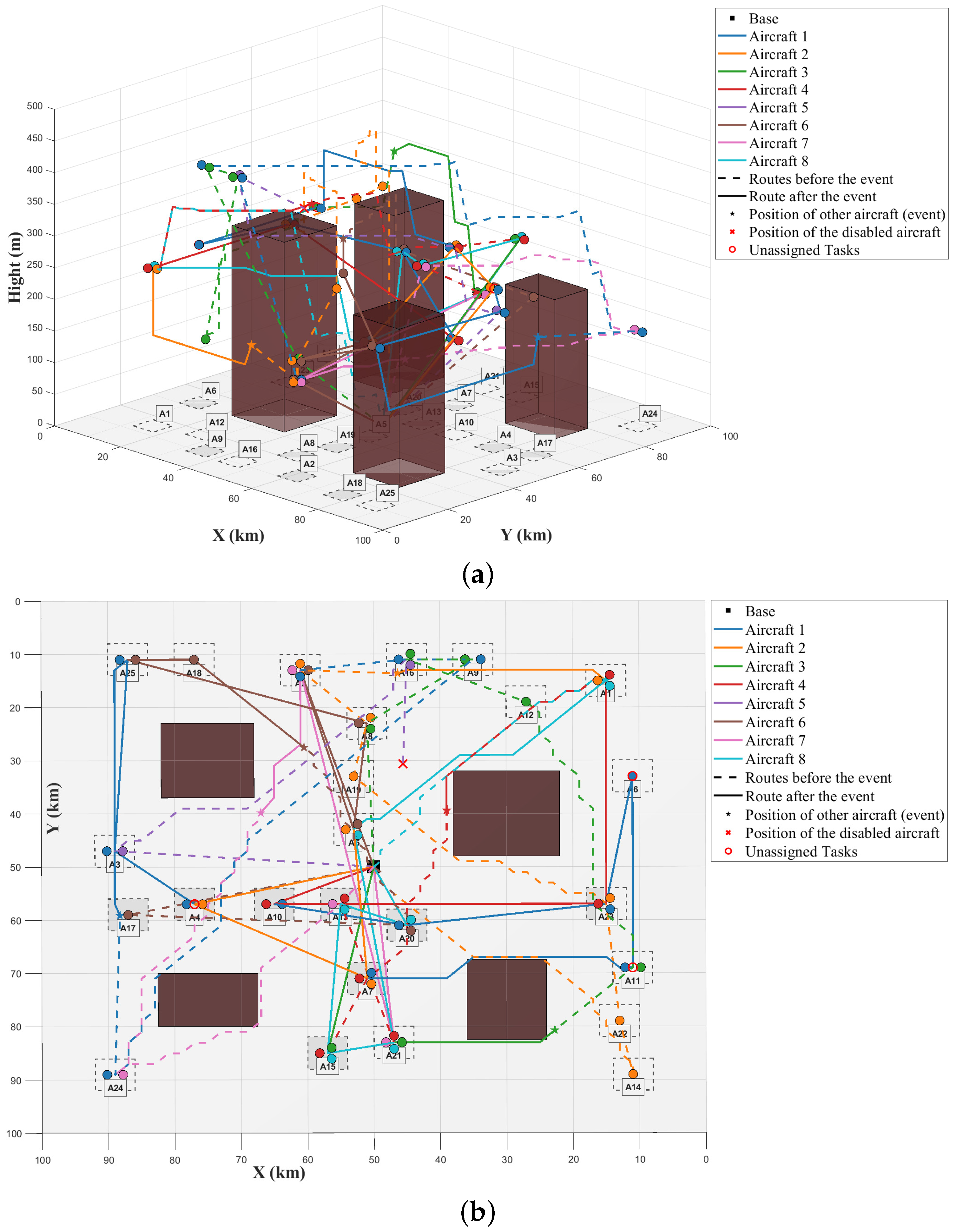
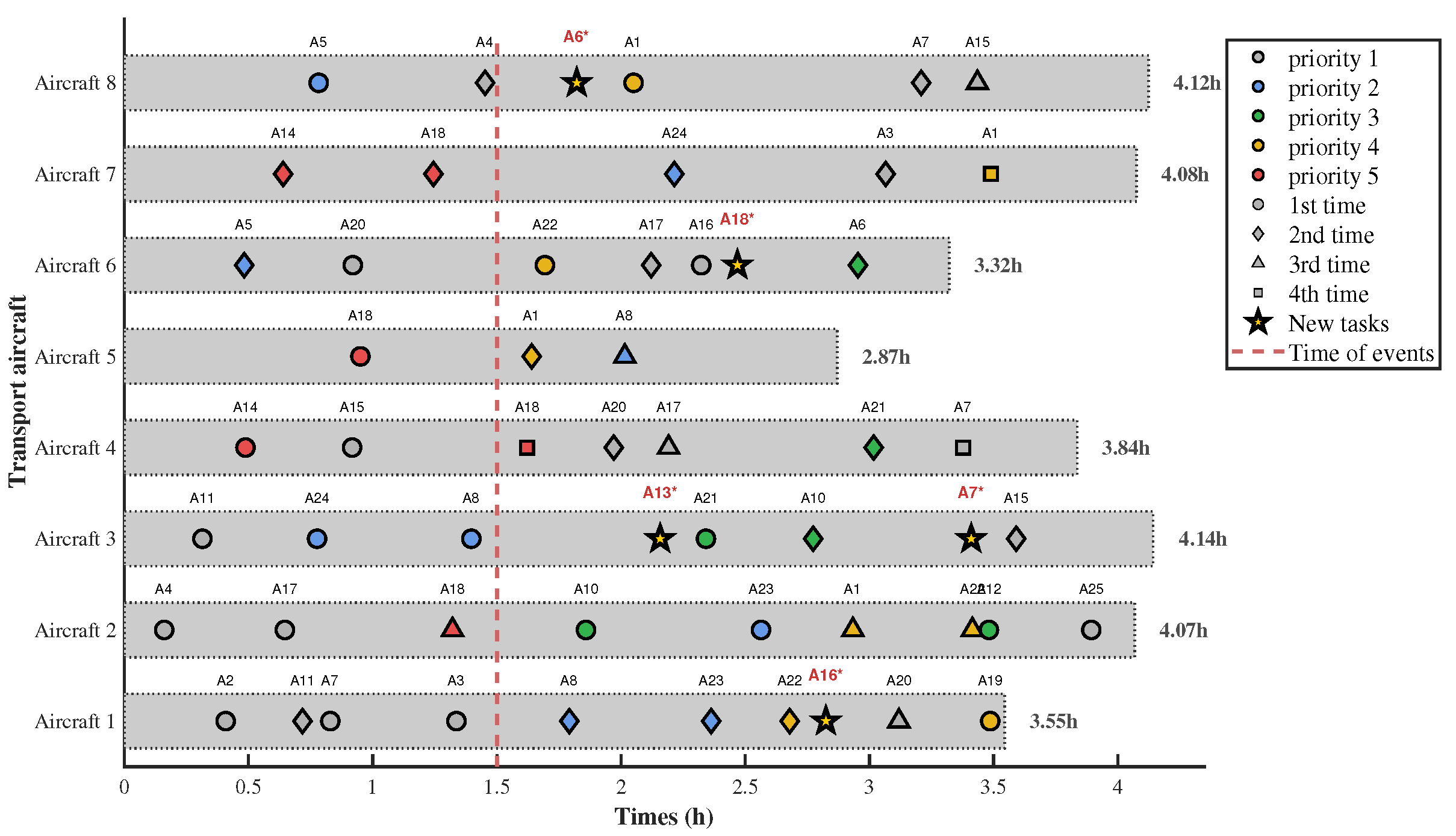
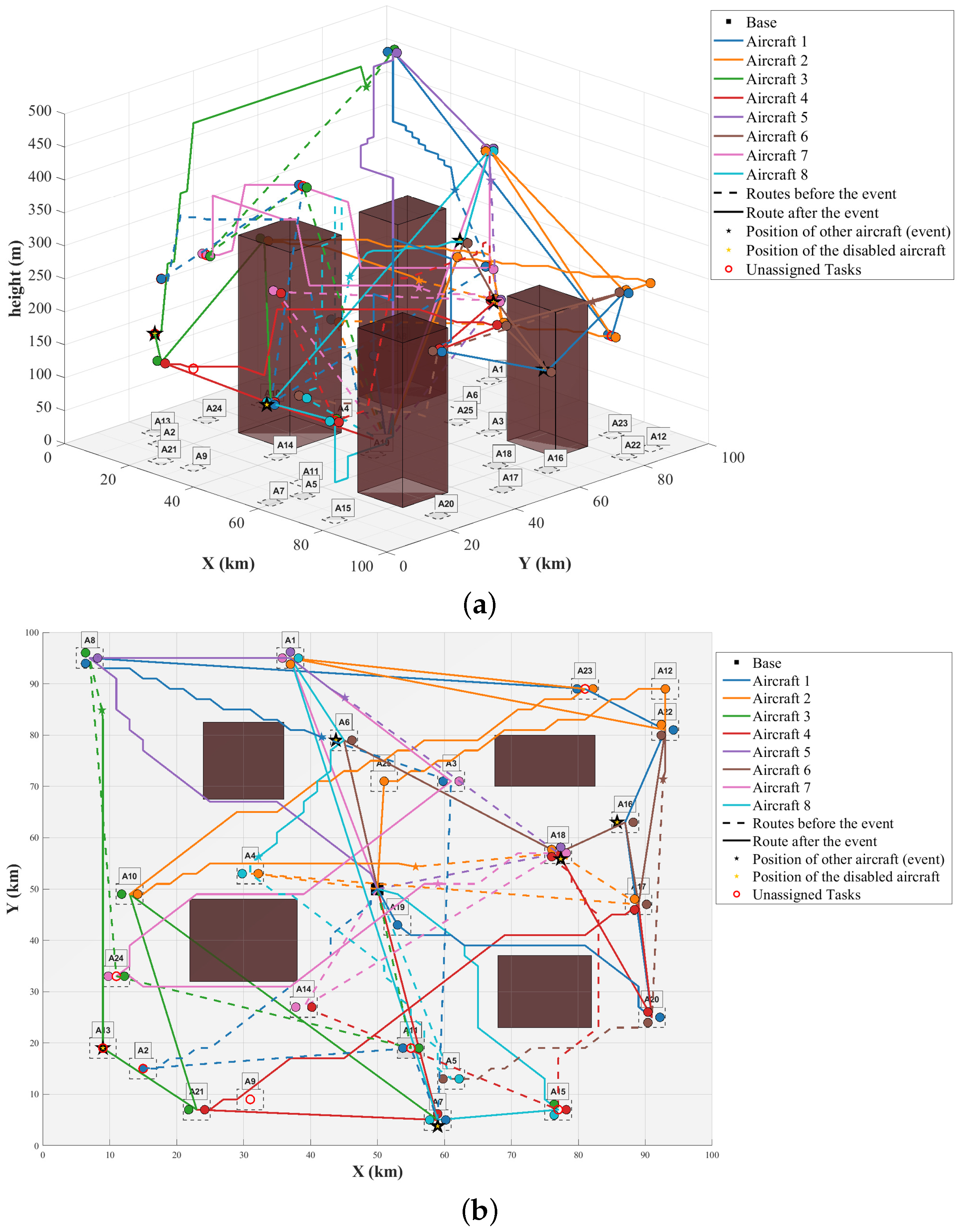
Figure 11 compares the task allocation before and after replanning. The red cross indicates the location where
withdrew from the mission. Dashed lines represent the original flight paths of the transport aircraft, while solid lines depict the updated task sequences following reallocation. Leveraging the decision-making capabilities of the TDAA algorithm, the five interrupted tasks are reassigned to the remaining four aircraft:
,
,
, and
take over 2, 1, 1, and 1 tasks, respectively. The replanning process accounts for each aircraft’s remaining capacity, spatial proximity to the affected tasks, and task priority levels. High-priority tasks are preferentially assigned to nearby aircraft with lower current loads. Spatially, most of the newly inserted tasks are located adjacent to the original flight paths, effectively minimizing additional travel distance induced by the reallocation.
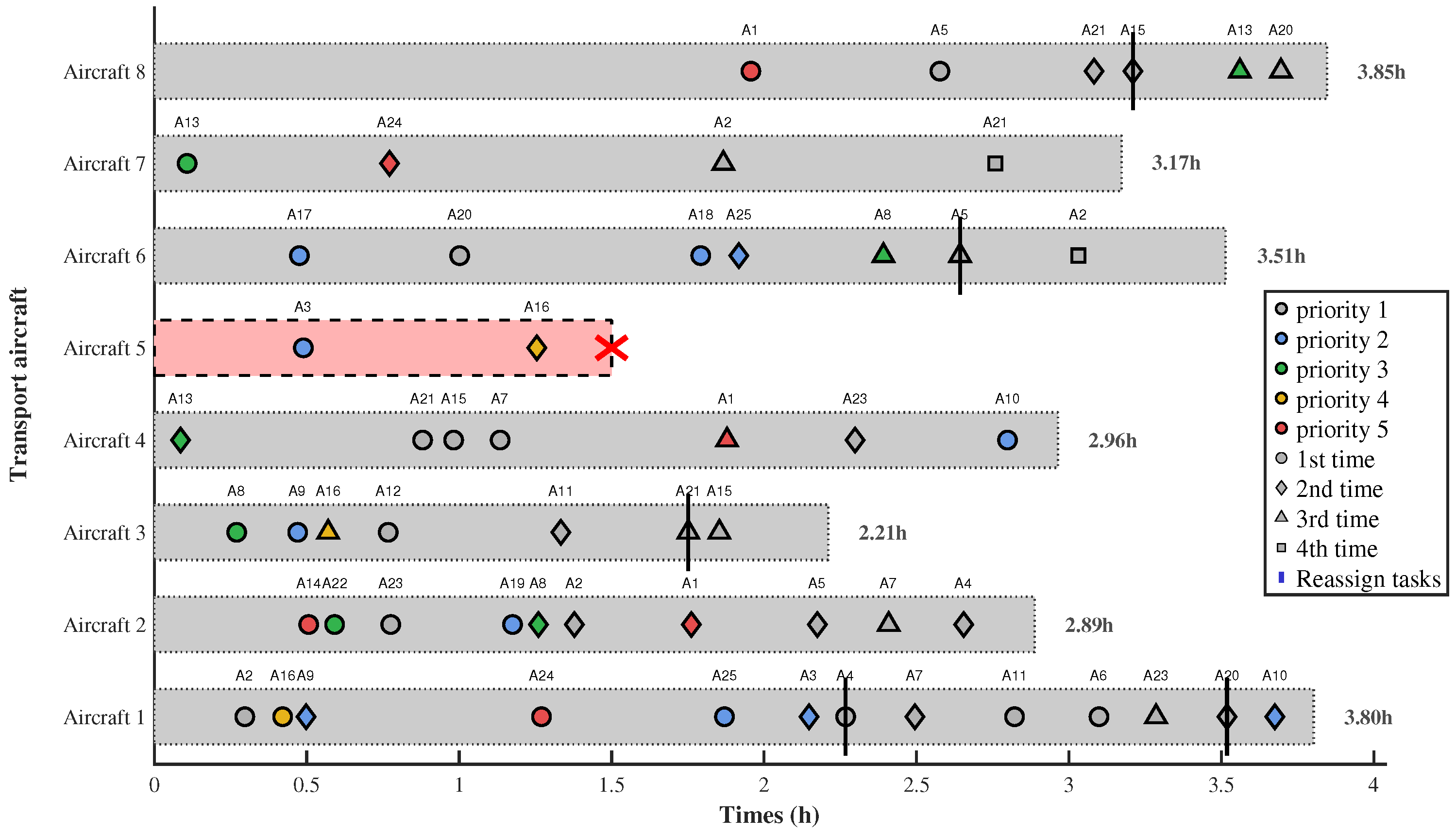
The Gantt chart in
Figure 12 depicts the temporal impact of task reallocation. The red cross marks the moment when replanning is triggered, while tasks annotated with vertical lines indicate newly assigned tasks relative to the original schedule, and the graphical markers denote the number of times each aircraft arrives at a task area, with their colors representing the priority level of the corresponding tasks. The results show that the task sequences of all aircraft preserve temporal continuity, with only minor adjustments made to the execution times of certain tasks. Notably, all tasks with strict time window constraints are completed within their designated intervals, highlighting TDAA’s effectiveness in maintaining temporal feasibility. Although
assumes a larger share of the reassigned tasks, its total workload remains within acceptable limits, without introducing notable load imbalance.
6.3.2. Emerging Tasks Within Existing Areas
In this scenario, at
h, the command center, responding to evolving battlefield conditions, issues an additional swarm UAV airdrop in task areas A6, A7, A13, A16, and A18. The details of the newly introduced task instances are provided in
Table 5.
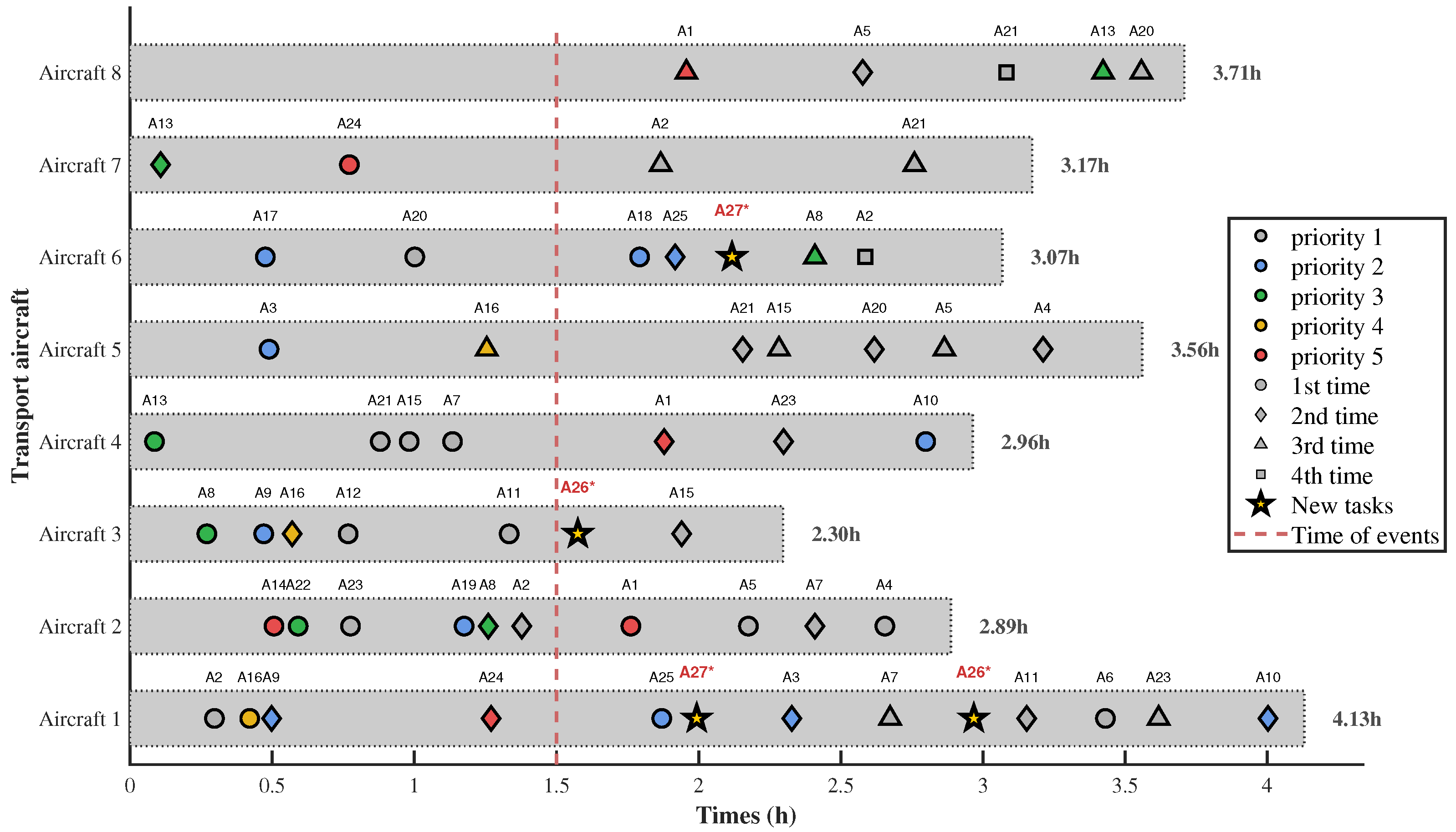
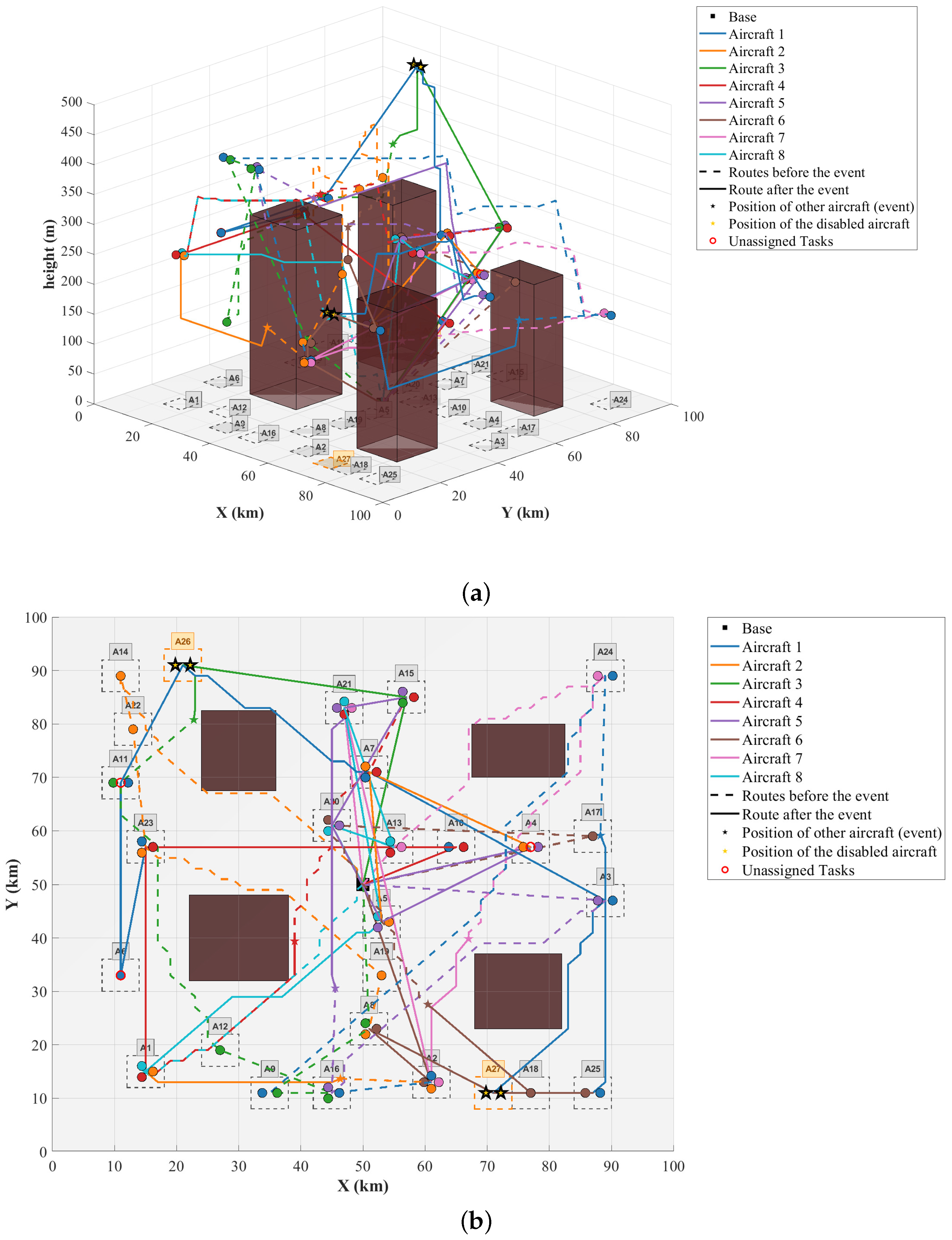
The Gantt chart in
Figure 13 illustrates the impact of task reallocation on the timeline of transport aircraft
. The red dashed line marks the replanning trigger time, while yellow stars denote the newly added tasks. The results show that all five tasks are effectively integrated into the existing schedule, with their time window constraints fully satisfied. This low-disruption reallocation strategy highlights the TDAA algorithm’s strength in maintaining system stability, ensuring that localized task updates do not propagate into widespread sequence disruptions.
Figure 14 presents the spatial layout after reallocation. Utilizing a two-stage selection mechanism, the TDAA algorithm identifies transport aircraft
as the optimal platform to execute the new task in area A16. According to its original schedule,
was en route from area A20 to A22. As shown in the figure, this trajectory passes near A16, and a feasible time window exists in its schedule, rendering it a suitable candidate for task insertion.
6.3.3. Scenario Involving New Task Areas
In this scenario, at
h, two new task areas emerge:
near the northwest coordinate
and
near the southeast coordinate
. Each area contains two task instances, all with the highest priority (
), and one task in each area is constrained by a strict time window of [1.5 h, 2.0 h]. Detailed parameters are listed in
Table 6. This scenario simulates the sudden appearance of tactical opportunities or threats, posing a demand for rapid integration of new operational zones.
The Gantt chart in
Figure 15 illustrates the scheduling impact of the newly introduced tasks. The red dashed line marks the replanning trigger time, and yellow stars indicate the new tasks. The task sequences of
and
are adjusted to accommodate the high-priority insertions. Tasks with time window constraints are precisely scheduled within their valid intervals, demonstrating the TDAA algorithm’s strict compliance with temporal requirements. Although the insertion of new tasks causes slight delays in some subsequent executions, all adjustments remain within acceptable bounds, with no violations of deadlines or time windows.
Figure 16 presents the full scenario view incorporating the new task areas. Yellow dashed boxes highlight the spatial extent of the newly introduced areas, yellow stars mark the additional airdrop points, and solid lines indicate the new trajectory segments added to accommodate the tasks.
The TDAA algorithm, through global optimization, assigns the two task instances in to transport aircraft and . This decision is based on multiple factors: , being closer to the new area and lightly loaded, is selected for the time-constrained urgent task; , with greater flexibility in route adjustment, is assigned the task without a time window constraint. From a path planning perspective, both newly added trajectory segments are seamlessly integrated into the original flight paths, avoiding unnecessary detours and minimizing resource consumption. Notably, the algorithm successfully avoids nearby enemy air defense threats during route planning, demonstrating its capability to ensure operational safety in complex environments.
A comprehensive analysis of the simulation results across the three dynamic scenarios confirms the TDAA algorithm’s strong responsiveness and robustness. In the sudden aircraft loss scenario, the algorithm effectively mitigates mission disruption through adaptive task reallocation. In the emerging task scenario, it achieves seamless integration of new tasks into the existing system. In the new task area scenario, it demonstrates high adaptability to novel operational demands.
6.4. Multi-Run Statistical Analysis of Dynamic Replanning
To provide a rigorous quantitative evaluation of the TDAA algorithm under different initial conditions, we conducted multi-run experiments for each of the three dynamic replanning scenarios. For every scenario we performed twenty independent simulation runs with different random seeds. This setup allows us to assess the consistency and the robustness of the TDAA algorithm across varying initial conditions.
Table 7 summarizes the statistical results for all three scenarios.
,
, and
respectively refer to three scenarios: Aircraft loss, New task instances, and New mission areas. Each entry reports the mean value and the maximum absolute deviation from that mean across the twenty runs. The key performance metrics include the task completion rate, the time window satisfaction rate, the total flight distance, the total mission time, and the average replanning time per task. The latter metric measures the computational efficiency of the TDAA algorithm during online reallocation.
The statistical results lead to three main conclusions. First, the TDAA algorithm achieves high task completion rates in all scenarios, with average values above 94.6 percent and a maximum absolute deviation below 3.4 percentage points. The time window satisfaction rate remains 100 percent across every run, which demonstrates that the algorithm strictly respects temporal constraints during dynamic replanning. Second, the total flight distance and the total mission time exhibit moderate variations across seeds. These variations are expected because different initial schedules affect the spatial and temporal opportunities for inserting new tasks. However, the algorithm never leaves any task unassigned, and all three scenarios show zero unassigned tasks in every run. Third, the average replanning time is consistently below 0.03 s and often below 0.02 s. This low computational overhead confirms that the TDAA algorithm is suitable for real time contingency response.
7. Conclusions
This paper presents a systematic investigation into the dynamic task allocation problem for coordinated swarm airdrop missions involving multiple transport aircraft in contested airspace with air defense threats. A formal quintuple scenario model is first constructed, encompassing the base, aircraft, mission areas, threat zones, and task instances. This underpins a multi-objective optimization model that accurately captures the collaborative decision-making challenge for a heterogeneous fleet, with objectives including total flight distance, task completion rate and time window satisfaction. To solve this complex problem, an offline task allocation method based on the HCBKA is proposed. It employs a hybrid encoding scheme to separately manage discrete assignment and continuous sequencing variables. Solution feasibility is enforced through a constraint-driven, hierarchical repair strategy, while the algorithm’s search capability is enhanced by an attack–migration dual-mode mechanism that balances global exploration and local exploitation. Furthermore, to maintain operational effectiveness amidst dynamic disruptions during execution, an online reallocation mechanism utilizing the Time-window aware Dynamic Auction Algorithm is developed. TDAA achieves rapid response to contingencies through a two-stage aircraft screening process and a composite bid function that intelligently evaluates allocation costs. Comprehensive simulation experiments demonstrate the superiority of the proposed integrated approach in terms of solution quality, convergence behavior, and dynamic adaptability. The results confirm that the method effectively addresses the mission planning challenges in complex combat environments, thereby providing a robust technical foundation for multi-transport aircraft coordinated swarm operations. Throughout this study, symmetry principles have played a foundational role: from the load-balancing symmetry embedded in the objective function and constraints, to the structural symmetry between discrete assignment and continuous sequencing variables, to the behavioral symmetry of attack–migration dual-mode search in HCBKA, and finally to the operational symmetry of the two-stage screening mechanism in TDAA. These symmetry-aware design choices are not merely incidental but are central to the efficiency, scalability, and robustness of the proposed framework. Thus, beyond its engineering contributions, this work also illustrates how symmetry concepts can guide the design of optimization algorithms for complex multi-agent coordination problems.