Article

Developmental-Stage-Dependent Changes in Basil Essential Oil Composition: Implications for NO Inhibitory Activity, Estragole Exposure, and Compositional Symmetry


1
Center for High Technology Research and Development, Vietnam Academy of Science and Technology, 18 Hoang Quoc Viet Street, Nghia Do Ward, Hanoi 100000, Vietnam
2
Department of Environment, Hanoi University of Natural Resources and Environment, 41A Phu Dien Street, Phu Dien Ward, Hanoi 100000, Vietnam
3
Institute of Environmental Science and Public Health, 50, Alley 165/23, Duong Quang Ham Street, Cau Giay Ward, Hanoi 100000, Vietnam
*
Author to whom correspondence should be addressed.
Symmetry 2026, 18(5), 703; https://doi.org/10.3390/sym18050703
Submission received: 16 March 2026 / Revised: 17 April 2026 / Accepted: 21 April 2026 / Published: 22 April 2026
(This article belongs to the Section E: Life Sciences)

Abstract

The chemical composition of basil essential oil is influenced by plant developmental stage, which alters the relative distribution of volatile constituents and their functional properties. In this study, we investigated developmental-stage-dependent changes in the essential oil composition of Ocimum basilicum and evaluated their relationship with nitric oxide (NO) inhibitory activity and estragole exposure. Essential oils were obtained by hydrodistillation and analyzed by gas chromatography–tandem mass spectrometry (GC–MS/MS), resulting in the identification of 54 volatile compounds representing 98.13–98.97% of the total composition. Estragole remained the dominant constituent, ranging from 70.58% to 85.55%, with the lowest proportion at the flowering stage (Day 85). In contrast, minor constituents, including eucalyptol (2.41–3.77%), β-ocimene (0.52–1.98%), and methyleugenol (~2.00%), increased during flowering. NO inhibitory activity in lipopolysaccharide (LPS)-stimulated RAW 264.7 macrophages was strongest at Day 85. Estimated Daily Intake (EDI) ranged from 0.4215 to 1.1005 µg kg−1 bw day−1, and Margin of Exposure (MOE) ranged from 2999 to 7830. These findings indicate that developmental stage influences composition, activity, and exposure. From a compositional perspective, the observed redistribution among major chemical groups reflects a structured balance that can be interpreted within a symmetry-related framework in multicomponent systems.

1. Introduction

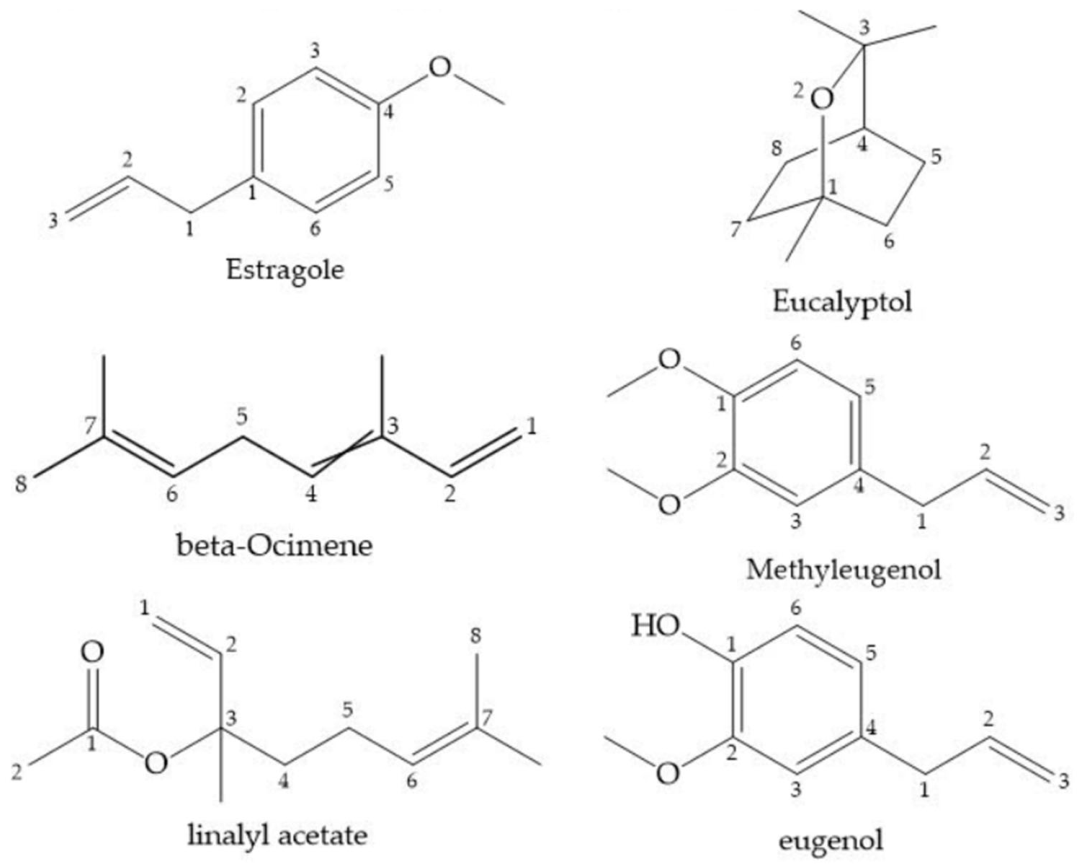
Aromatic plants represent an important source of bioactive compounds that are widely used in food, traditional medicine, and pharmaceutical applications [1,2,3]. Among these, Ocimum basilicum L. (sweet basil) is one of the most extensively cultivated culinary herbs worldwide and is valued for its characteristic aroma, nutritional properties, and biological activities [4,5]. Basil essential oil contains a complex mixture of volatile compounds that contribute to its sensory properties and functional effects [6,7]. These volatile constituents are primarily derived from two major biosynthetic groups, namely phenylpropanoids and terpenoids, which differ in their chemical structures and biological functions [8]. Major compounds frequently reported in basil essential oil include estragole, eugenol, methyleugenol, and eucalyptol, which have been associated with antimicrobial, antioxidant, and anti-inflammatory activities [9]. Due to these properties, basil essential oil has attracted increasing interest for applications in functional foods, natural preservatives, and plant-based therapeutic products [10]. As shown in Figure 1, the molecular structures of representative volatile compounds identified in Ocimum basilicum essential oil are presented.
However, the chemical composition of essential oils is not constant. It varies depending on multiple factors, including plant genotype, environmental conditions, cultivation practices, and developmental stage [11]. Among these factors, plant developmental stage plays a central role in regulating the biosynthesis and accumulation of secondary metabolites. During plant growth, metabolic pathways are dynamically adjusted in response to physiological demands associated with vegetative growth, flowering, and reproduction [12]. These regulatory processes can lead to substantial changes in the relative abundance of volatile compounds within essential oils [13]. In basil, phenylpropanoid compounds such as estragole are synthesized primarily through the phenylpropanoid pathway, whereas monoterpenes such as eucalyptol and β-ocimene originate from terpene biosynthetic pathways [7,8,14]. As plants transition between developmental stages, shifts in metabolic flux between these pathways may alter the balance of volatile constituents, resulting in stage-dependent variation in essential oil composition [15,16].
Extensive studies have characterized the chemical composition of basil essential oil and have reported considerable variability among cultivars and growing conditions [17,18]. Different chemotypes have been identified based on the dominance of specific compounds such as estragole, linalool, or eugenol [19]. In particular, estragole-rich chemotypes are commonly observed in cultivated basil and may account for more than 70% of the total oil composition [20,21]. In addition to estragole, minor constituents such as eucalyptol, β-ocimene, methyleugenol, and eugenol contribute to the overall chemical profile and may influence biological activity [22,23]. Despite these advances, most studies have focused on variability related to genotype, geographic origin, or extraction methods, whereas fewer studies have systematically examined compositional changes across clearly defined developmental stages [24,25]. A detailed understanding of how essential oil composition evolves during plant development remains limited.
This knowledge gap is important because developmental-stage-dependent variation in composition may influence both functional properties and safety-related considerations. From a functional perspective, changes in the relative abundance of volatile compounds may affect biological activities such as anti-inflammatory effects. Essential oils are complex mixtures in which bioactivity often depends on the combined action of multiple constituents rather than a single dominant compound [26]. Compounds such as eucalyptol and other monoterpenes have been reported to modulate inflammatory responses, including nitric oxide production, through interactions with cellular signaling pathways [27]. Therefore, variation in the relative contribution of phenylpropanoids and terpenoids during plant development may result in measurable differences in biological activity.
From a safety perspective, the presence of estragole is of particular interest. Estragole is a naturally occurring phenylpropanoid compound that has attracted toxicological attention due to evidence of genotoxic and carcinogenic effects in experimental systems, especially under conditions of high or repeated exposure [28]. For this reason, dietary exposure to estragole is typically evaluated using risk assessment frameworks such as the Margin of Exposure (MOE) approach, rather than being interpreted as direct evidence of human health risk [29]. The MOE approach compares estimated human exposure with reference toxicological thresholds and provides a screening-level indication of potential concern. In this context, variations in estragole content across developmental stages or processing conditions may influence exposure estimates and associated safety considerations. This aspect is particularly relevant for populations with frequent consumption of basil-containing products or lower body weight, although population-specific exposure data remain limited [29,30].
In addition to developmental factors, post-harvest processing such as drying may further influence the composition of essential oils and the resulting exposure to volatile compounds. Drying can lead to partial loss or transformation of thermolabile and highly volatile constituents, thereby altering both the chemical profile and the relative abundance of compounds such as estragole [28,31]. As a result, both developmental stage and processing conditions should be considered when evaluating the composition, biological activity, and exposure-related properties of basil essential oil.
In multicomponent systems, symmetry can be interpreted as a principle of organization that reflects balance and structured relationships among components rather than strict geometric equivalence [32]. This broader interpretation has been applied across diverse fields, including symbolic and graphical systems, where structural arrangements encode relational meaning and transformation [33]. By analogy, the chemical composition of essential oils can be considered a structured distribution of constituents, in which developmental-stage-dependent changes represent a systematic redistribution within an organized system. Within this framework, shifts in the relative dominance of phenylpropanoid and terpenoid fractions may be interpreted as changes in compositional balance, reflecting symmetry-related patterns in complex biochemical systems [34]. Given this perspective, there is a need for integrated studies that examine the relationships among developmental stage, essential oil composition, biological activity, and exposure-related safety. Previous studies have typically addressed these aspects independently, without systematically linking compositional variation to both functional outcomes and exposure assessments within a unified framework [35]. A comprehensive approach is therefore required to clarify how stage-dependent changes in volatile composition influence both the biological properties and safety profile of basil essential oil.
In multicomponent biological systems such as essential oils, the relative distribution of chemical constituents can be viewed as a structured compositional arrangement [36,37]. Variations in this distribution across developmental stages may reflect changes in system balance, which can be interpreted within a symmetry-related framework [38,39]. In this context, symmetry does not imply strict equivalence but rather the organization and redistribution of components within a complex system. In this work, we aim to investigate developmental-stage-dependent changes in the essential oil composition of Ocimum basilicum and evaluate their relationship with nitric oxide inhibitory activity and estragole exposure. Essential oils extracted from basil leaves collected at five defined developmental stages were analyzed using gas chromatography–tandem mass spectrometry (GC-MS/MS) to identify and quantify volatile compounds. Furthermore, NO inhibitory activity was assessed in LPS-stimulated RAW 264.7 macrophages as an indicator of anti-inflammatory potential, and dietary exposure to estragole was evaluated using Estimated Daily Intake (EDI) and Margin of Exposure (MOE) approaches. By integrating phytochemical analysis, biological evaluation, and exposure assessment, this study provides a systematic characterization of how developmental stage influences basil essential oil’s composition, functional properties, and exposure-related considerations.

2. Materials and Methods

2.1. Plant Material and Experimental Design

Ocimum basilicum plants were cultivated under controlled field conditions at two cultivation sites, Hong Thai (HT) and Vong Xuyen (VX). Leaves were collected at five defined developmental stages (Day 20, Day 60, Day 85, Day 105, and Day 120), corresponding to early vegetative, vegetative, flowering, post-flowering, and mature stages, respectively. These stages were selected to systematically capture developmental-stage-dependent variation in essential oil composition. After harvesting, plant material was subjected to a standardized post-harvest treatment prior to essential oil extraction.

2.2. Preparation of Plant Material and Essential Oil Extraction

Fresh basil leaves were used for essential oil extraction. To ensure consistency in moisture content and to reduce variability during extraction, the plant material was air-dried at 45 °C under controlled conditions prior to hydrodistillation. This temperature was selected to balance moisture removal and preservation of volatile constituents, as reported in previous studies [40]. Essential oils were then extracted using a Clevenger-type apparatus (Witeg Labortechnik GmbH, Wertheim, Germany) according to standard hydrodistillation procedures [40]. Approximately 1 kg of plant material was used for each extraction. The obtained essential oils were collected, dried over anhydrous sodium sulfate (Sigma-Aldrich, St. Louis, MO, USA), and stored at 4 °C in sealed amber vials until analysis. Essential oil yield was calculated as % (w/w) relative to fresh leaf mass.

2.3. GC-MS/MS Analysis of Essential Oil Composition

The detailed GC-MS/MS operating conditions used for volatile compound analysis are summarized in Table 1. Essential oil samples were analyzed using a TSQ 8000 Evo gas chromatography–tandem mass spectrometry system (Thermo Fisher Scientific, Waltham, MA, USA) equipped with a DB-5MS capillary column (30 m × 0.25 mm × 0.25 μm). Helium (purity 99.999%) was used as the carrier gas at a constant flow rate of 1.0 mL min−1. Samples were injected in split mode (200:1) at an injector temperature of 230 °C. The oven temperature program was set from 50 °C to 250 °C at a rate of 4 °C min−1 and held for 10 min. The ion source, transfer line, and quadrupole temperatures were maintained at 230 °C, 250 °C, and 150 °C, respectively. Mass spectrometric detection was performed in electron impact (EI) mode over a mass range of 50–500 Da, with a solvent delay of 3 min.
Volatile compounds were identified by comparison of mass spectra with reference libraries and retention indices (RIs). Relative composition was calculated as the percentage of total ion chromatogram peak area.

2.4. Classification of Volatile Compounds

Identified compounds were classified into major chemical groups to facilitate compositional interpretation. These groups included phenylpropanoids, monoterpene hydrocarbons, oxygenated monoterpenes, and other minor constituents. Classification was based on chemical structure and biosynthetic origin, consistent with established approaches for essential oil analysis.

2.5. Estimation of Estragole Exposure (EDI and MOE)

Dietary exposure to estragole was evaluated using the Estimated Daily Intake (EDI) approach based on the estragole concentration in basil samples and assumed basil consumption. Because national consumption data for Vietnam are unavailable, consumption estimates recommended by the European Food Safety Authority (EFSA) for fresh basil intake (1.5–2.5 g day−1) were used as reference values.
The EDI was calculated according to the equation:
EDI = (W × L)/BW,
where W represents the maximum daily intake of estragole (72 µg), L is the estragole concentration in basil (µg kg−1), and BW represents the average adult body weight (61.5 kg). Potential health risks were evaluated using the Margin of Exposure (MOE), calculated as:
MOE = BMDL10/EDI,
where BMDL10 (3300 µg kg−1 bw day−1) corresponds to the benchmark dose associated with a 10% tumor incidence. According to EFSA guidelines, MOE values below 10,000 may indicate a potential health concern requiring further evaluation.

2.6. Nitric Oxide Inhibitory Activity Assay

The NO inhibitory activity of basil essential oil samples was evaluated using LPS-stimulated RAW 264.7 macrophages, following previously reported methods [41]. Cells were cultured under standard conditions and seeded in 96-well plates. Essential oils were dissolved in dimethyl sulfoxide (DMSO) and diluted in culture medium to obtain a range of test concentrations (e.g., 5–100 µg mL−1). The final DMSO concentration did not exceed 0.5% (v/v).
Cells were pre-treated with essential oil samples for 1 h, followed by stimulation with lipopolysaccharide (LPS). After incubation, nitric oxide production was quantified by measuring nitrite levels in the culture supernatant using the Griess reaction. Absorbance was measured at 540 nm, and NO inhibition was calculated relative to the LPS-treated control. IC50 values were determined from dose–response curves. No parallel cell viability assay was performed; therefore, potential cytotoxic effects cannot be fully excluded and should be considered when interpreting the results.

3. Results

3.1. Chemical Composition of Ocimum basilicum Essential Oil

The chemical composition of Ocimum basilicum essential oil was analyzed across five developmental stages using GC-MS/MS. A total of 54 volatile compounds were identified, representing 98.13–98.97% of the total oil composition across all samples (Table 2). These compounds were classified into major chemical groups, including phenylpropanoids, monoterpene hydrocarbons, and oxygenated monoterpenes.
Estragole, a phenylpropanoid compound, was consistently the dominant constituent throughout plant development. Its relative abundance ranged from 70.58% to 85.55%, depending on developmental stage and cultivation site. The lowest estragole content was observed during the flowering stage (Day 85), whereas the highest value was recorded at the mature stage (Day 120). In addition to estragole, minor constituents such as eucalyptol, β-ocimene, methyleugenol, and eugenol were detected at lower relative concentrations. Eucalyptol ranged from 2.41% to 3.77%, while β-ocimene varied between 0.52% and 1.98% across developmental stages.
Essential oil yield also varied with developmental stage, ranging from 0.41% to 1.29% (w/w) of fresh leaf mass. The highest yield was observed during the flowering stage (Day 85), indicating that both composition and total oil production were influenced by plant development.

3.2. Developmental-Stage-Dependent Variation in Volatile Composition

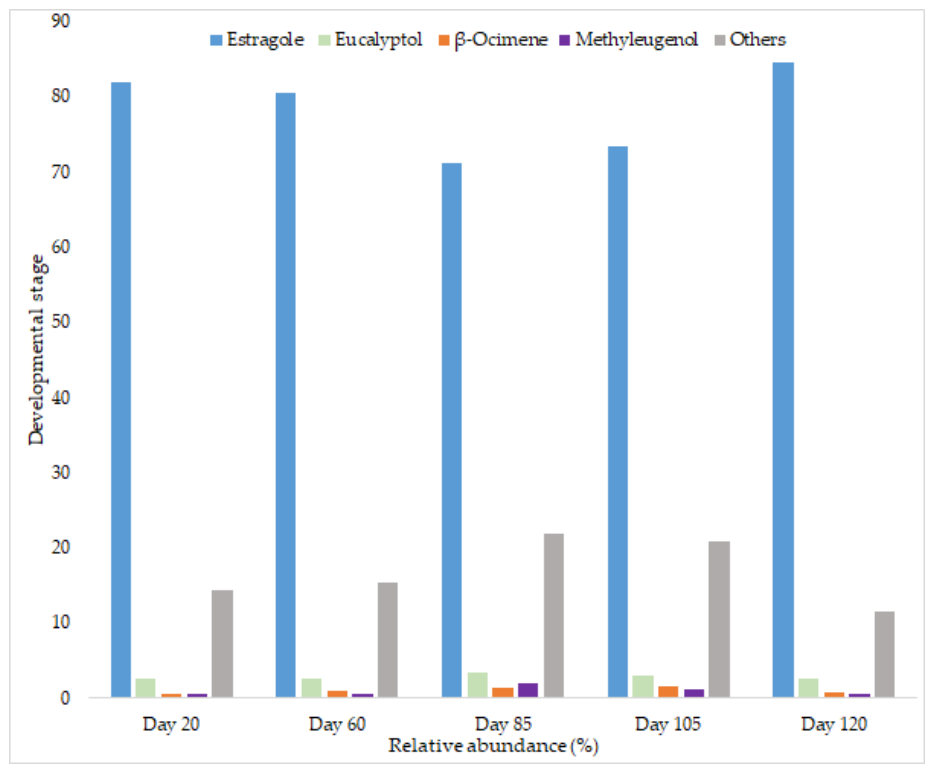
Clear stage-dependent variation in volatile composition was observed (Table 2 and Figure 2). Estragole remained the predominant compound at all stages; however, its relative abundance decreased from approximately 81.9% at Day 20 to 70.58–71.72% at the flowering stage (Day 85), followed by an increase to 85.55% at Day 120.
In contrast, several minor constituents showed increased relative abundance during the flowering stage. Eucalyptol, an oxygenated monoterpene, reached its highest proportion (3.77%) at Day 85. Similarly, β-ocimene, a monoterpene hydrocarbon, exhibited elevated levels during this stage, with values up to 1.59%. Methyleugenol also increased to approximately 2.00% at Day 85 before decreasing at later stages. Other compounds, including β-pinene and caryophyllene, were present at lower concentrations but showed measurable variation across developmental stages.
These results indicate a redistribution of volatile constituents during plant development, characterized by a reduction in the dominant phenylpropanoid estragole and a relative increase in monoterpene-related compounds during the flowering stage. Figure 2 illustrates the temporal variation in major volatile constituents across developmental stages.

3.3. Nitric Oxide Inhibitory Activity

The NO inhibitory activity of basil essential oil samples was evaluated in LPS-stimulated RAW 264.7 macrophages (Table 3). The activity varied across developmental stages, with the strongest inhibition observed during the flowering stage (Day 85). At this stage, IC50 values were 9.51 ± 0.83 µg mL−1 and 13.4 ± 0.92 µg mL−1 for samples from the two cultivation sites.
Samples collected at earlier vegetative stages (Day 20 and Day 60) and at the mature stage (Day 120) exhibited higher IC50 values, indicating lower inhibitory activity. These results demonstrate that NO inhibitory activity is influenced by developmental stage and varies in parallel with changes in essential oil composition.

3.4. Estragole Exposure Assessment

Dietary exposure to estragole was estimated using the Estimated Daily Intake (EDI) and Margin of Exposure (MOE) framework (Table 4 and Table 5). Estragole concentrations in basil samples ranged from 360 to 940 µg kg−1 depending on developmental stage. Based on these values, EDI ranged from 0.4215 to 1.1005 µg kg−1 body weight day−1.
Corresponding MOE values ranged from 2999 to 7830. Lower MOE values were associated with higher estragole concentrations, particularly at later developmental stages. In contrast, higher MOE values were observed when estragole content was lower, such as during the flowering stage.

3.5. Influence of Leaf Type and Processing on Estragole Exposure

Estragole exposure was further evaluated for different leaf types and processing conditions (Table 6). Fresh basil leaves showed higher estragole content compared to dried leaves, resulting in higher estimated exposure. In contrast, drying reduced estragole levels and increased MOE values, indicating lower exposure.
In addition, differences were observed between younger leaves (Day 60) and mature leaves (Day 120), with mature leaves generally exhibiting higher estragole content. These results indicate that both developmental stage and processing conditions influence estragole exposure and should be considered in exposure assessment.

4. Discussion

In this work, we systematically investigated developmental-stage-dependent variation in the essential oil composition of Ocimum basilicum and examined its relationship with NO inhibitory activity and estragole exposure. GC-MS/MS analysis identified 54 volatile compounds representing more than 98% of the total oil composition, with estragole consistently observed as the dominant constituent across all developmental stages [42]. However, the relative abundance of estragole was not constant, as it decreased during the flowering stage and increased again in mature leaves. In contrast, several minor constituents, including eucalyptol, β-ocimene, and methyleugenol, showed increased relative abundance during flowering. These findings indicate that essential oil composition in basil is not static but varies systematically with plant development. Similar variability has been reported in previous studies, although most have focused on cultivar or environmental effects rather than clearly defined developmental stages [43,44]. The present results extend these observations by demonstrating a consistent pattern of compositional redistribution across growth stages.
From a compositional perspective, the observed variation reflects a redistribution between phenylpropanoid-dominated and monoterpene-related fractions of the essential oil. From this perspective, the essential oil’s composition can be described as a two-component system dominated by phenylpropanoids and monoterpenes [45,46]. The transition observed at the flowering stage reflects a redistribution between these groups, resulting in a more balanced compositional state [47]. This shift can be interpreted as a symmetry-related transformation, in which the system evolves from a more asymmetric state toward a comparatively balanced distribution of major components. Such behavior is consistent with symmetry-based interpretations in complex systems, where functional properties emerge from the relative organization of components rather than their absolute dominance. Estragole, eugenol, and methyleugenol belong to the phenylpropanoid group, whereas compounds such as eucalyptol and β-ocimene are derived from terpene biosynthesis pathways [22,23,48]. During vegetative growth, metabolic flux may favor the accumulation of phenylpropanoid compounds, resulting in an essential oil profile dominated by estragole [49]. As the plant transitions to the flowering stage, metabolic activity may shift toward increased production of monoterpene-related constituents [50]. This shift is consistent with the observed decrease in estragole and the enrichment of eucalyptol and β-ocimene at Day 85. In addition, essential oil yield reached its maximum at the flowering stage, suggesting that this developmental phase may be associated with enhanced secondary metabolite production. The concurrent increase in oil yield and compositional diversification indicates a coordinated regulation of both the quantity and distribution of volatile compounds. However, because the present study did not include enzyme-level or transcriptomic analysis, this interpretation should be considered as a pathway-level inference rather than direct mechanistic evidence.
From a functional perspective, the compositional changes observed in this study were associated with variation in NO inhibitory activity. The strongest activity was recorded during the flowering stage, which coincided with the relative enrichment of several minor constituents, particularly eucalyptol and β-ocimene. Previous studies have reported that monoterpenes, including eucalyptol, can modulate inflammatory responses through interactions with signaling pathways such as NF-κB and MAPK, leading to reduced nitric oxide production and regulation of inflammatory mediators [51]. In addition, both monoterpenes and phenylpropanoids have been shown to influence inflammatory processes through multiple mechanisms, including modulation of iNOS expression and cytokine production [52,53]. The present results suggest that the enhanced NO inhibitory activity observed at the flowering stage may be associated with the combined contribution of multiple constituents rather than the dominant phenylpropanoid estragole alone. This interpretation is consistent with the concept that essential oil bioactivity is determined by the overall compositional balance and potential interactions among constituents. However, because cytokine expression and signaling pathways were not directly evaluated in this study, the results should be interpreted as functional evidence of NO inhibition rather than a comprehensive mechanistic characterization of anti-inflammatory activity.
In addition to biological activity, the results provide insight into estragole exposure and associated safety considerations. Estragole is a phenylpropanoid compound that has attracted toxicological attention due to evidence of genotoxic and carcinogenic effects in experimental models under conditions of high or repeated exposure [28,54,55,56]. For this reason, dietary exposure to estragole is commonly evaluated using the Margin of Exposure (MOE) framework as a screening-level approach [57]. In the present study, MOE values ranged from approximately 2999 to 7830 depending on developmental stage and estragole concentration. These values reflect variation in estragole content across growth stages, with lower MOE values associated with higher estragole levels in mature leaves. It should be noted that MOE values below 10,000 may indicate a potential need for further evaluation but do not represent direct evidence of risk. The results therefore provide a comparative assessment of exposure across developmental stages rather than a definitive risk characterization. In addition, the analysis of different leaf types and processing conditions indicated that dried basil leaves exhibited lower estragole levels compared to fresh leaves, resulting in reduced estimated exposure. This observation is consistent with previous studies showing that drying can reduce the concentration of volatile compounds due to evaporation or thermal degradation [58,59,60]. At the same time, processing may alter the overall composition of the essential oil, which can influence both exposure and functional properties.
Despite these findings, several limitations should be considered. The study was conducted using a single basil cultivar cultivated at two locations, which may limit the generalizability of the results. Environmental factors such as soil composition, climate, and agricultural practices can influence secondary metabolite biosynthesis and contribute to variability in essential oil composition. In addition, estragole levels were estimated based on relative peak area rather than absolute quantification, which may affect the accuracy of exposure assessment. The biological evaluation was limited to NO inhibition in RAW 264.7 macrophages, without parallel assessment of cell viability, inflammatory cytokines, or signaling pathways. Therefore, the observed activity should be interpreted as NO inhibitory activity rather than a comprehensive evaluation of anti-inflammatory mechanisms. A further limitation is that no formal statistical correlation analysis was performed to quantify the relationship between individual compounds and biological activity. Future studies should incorporate quantitative analytical approaches, including absolute compound quantification, correlation analysis, and mechanistic evaluation of bioactivity. In addition, expanding the analysis to multiple basil cultivars and environmental conditions would provide a more comprehensive understanding of the factors influencing essential oil composition and its functional and exposure-related properties.

5. Conclusions

This study demonstrates that the essential oil composition of Ocimum basilicum varies systematically across developmental stages, resulting in measurable changes in chemical profile, biological activity, and exposure-related parameters. A total of 54 volatile compounds were identified, with estragole as the dominant constituent; however, its relative abundance decreased during the flowering stage. This stage was characterized by an increased proportion of minor constituents, such as eucalyptol and β-ocimene, and corresponded to the strongest NO inhibitory activity. These results indicate that biological activity depends on the overall compositional balance rather than on a single dominant compound.
Estragole exposure, estimated using EDI and MOE approaches, also varied with developmental stage and processing conditions, with lower exposure observed in dried samples. These findings highlight that both plant development and post-harvest processing influence essential oil properties and should be considered in evaluation. Overall, this study establishes a framework linking composition, activity, and exposure. The observed redistribution of chemical constituents reflects a structured compositional balance, which can be interpreted within a symmetry-related framework in multicomponent biological systems.

Author Contributions

Conceptualization, N.Q.T., L.Q.H. and N.T.D.; methodology, N.Q.T. and L.Q.H.; software, H.L.T.A.; validation, N.B.N., N.T.D. and T.N.M.; formal analysis, H.L.T.A. and N.B.N.A.; investigation, T.N.M.; resources, H.L.T.A. and L.Q.H.; data curation, N.B.N., N.B.N.A. and T.N.M.; writing—original draft preparation, T.N.M. and N.T.D.; writing—review and editing, T.N.M. and N.T.D.; visualization, N.B.N.A. and N.B.N.; supervision, N.Q.T.; project administration, N.Q.T.; funding acquisition, N.T.D. All authors have read and agreed to the published version of the manuscript.

Funding

This research was funded by the Vietnam Academy of Science and Technology under grant number NCXS 01.02/23-25.

Data Availability Statement

The data presented in this study are available within the article. Additional datasets generated or analyzed during the current study are available from the corresponding author upon reasonable request.

Acknowledgments

The authors would like to thank the Vietnam Academy of Science and Technology for financial support for this research. The authors also acknowledge the technical assistance provided by laboratory staff involved in plant sampling, essential oil extraction, and analytical measurements.

Conflicts of Interest

The authors declare no conflicts of interest.

Abbreviations

The following abbreviations are used in this manuscript:
AbbreviationFull Term
GC-MS/MSGas Chromatography–Tandem Mass Spectrometry
RIRetention Index
HTHong Thai
VXVong Xuyen
EDIEstimated Daily Intake
MOEMargin of Exposure
BMDL10Benchmark Dose Lower Confidence Limit for a 10% Response
LPSLipopolysaccharide
NONitric Oxide
IC50Half Maximal Inhibitory Concentration
TICTotal Ion Chromatogram
EFSAEuropean Food Safety Authority

References

  1. Fierascu, R.C.; Fierascu, I.; Baroi, A.M.; Ortan, A. Selected aspects related to medicinal and aromatic plants as alternative sources of bioactive compounds. Int. J. Mol. Sci. 2021, 22, 1521. [Google Scholar] [CrossRef] [Scilit] [PubMed]
  2. Kumari, N.; Prakash, S.; Sharma, N.; Puri, S.; Thakur, M.; Singh, J.; Kumar, M. Medicinal and aromatic plants as potential sources of bioactives along with health-promoting activities. Curr. Food Sci. Technol. Rep. 2024, 2, 359–376. [Google Scholar] [CrossRef] [Scilit]
  3. Pinto, T.; Aires, A.; Cosme, F.; Bacelar, E.; Morais, M.C.; Oliveira, I.; Ferreira-Cardoso, J.; Anjos, R.; Vilela, A.; Gonçalves, B. Bioactive (poly)phenols and volatile compounds from vegetables, medicinal and aromatic plants. Foods 2021, 10, 106. [Google Scholar] [CrossRef] [Scilit]
  4. Azizah, N.S.; Irawan, B.; Kusmoro, J.; Safriansyah, W.; Farabi, K.; Oktavia, D.; Doni, F.; Miranti, M. Sweet basil (Ocimum basilicum L.)—A review of its botany, phytochemistry, pharmacological activities, and biotechnological development. Plants 2023, 12, 4148. [Google Scholar] [CrossRef] [Scilit]
  5. Egata, D.F. Benefit and use of sweet basil (Ocimum basilicum L.) in Ethiopia: A review. J. Nutr. Food Proces. 2021, 4, 57–59. [Google Scholar] [CrossRef] [Scilit]
  6. da Silva, W.M.F.; Kringel, D.H.; de Souza, E.J.D.; da Rosa Zavareze, E.; Dias, A.R.G. Basil essential oil: Methods of extraction, chemical composition, biological activities, and food applications. Food Bioprocess Technol. 2022, 15, 1–27. [Google Scholar] [CrossRef] [Scilit]
  7. Tangpao, T.; Charoimek, N.; Teerakitchotikan, P.; Leksawasdi, N.; Jantanasakulwong, K.; Rachtanapun, P.; Seesuriyachan, P.; Phimolsiripol, Y.; Chaiyaso, T.; Ruksiriwanich, W.; et al. Volatile organic compounds from basil essential oils: Plant taxonomy, biological activities, and their applications in tropical fruit productions. Horticulturae 2022, 8, 144. [Google Scholar] [CrossRef] [Scilit]
  8. Shirokova, A.V.; Dzhatdoeva, S.A.; Ruzhitskiy, A.O.; Belopukhov, S.L.; Dmitrieva, V.L.; Luneva, V.E.; Dmitriev, L.B.; Kharchenko, V.A.; Kochkarov, A.A.; Sadykhov, E.G. Treasures induced by narrow-spectrum: Volatile phenylpropanoid and terpene compounds in leaves of lemon basil (Ocimum × citriodorum Vis.), sweet basil (O. basilicum L.) and bush basil (O. minimum L.) under artificial light city farm conditions. Plants 2025, 14, 403. [Google Scholar] [CrossRef] [Scilit] [PubMed]
  9. Bozyel, M.E.; Altinoz, E.; Senturan, M.; Merdamert-Bozyel, E.; Altuner, E.M. Ocimum basilicum (Basil): A medicinal plant with proven ethnomedicinal uses, chemical composition, bioactivities, and pharmacological properties. In Ethnomedicinal Plants for Drug Discovery: Current Developments; Springer Nature Singapore: Singapore, 2024; pp. 217–236. [Google Scholar]
  10. Al-Maqtari, Q.A.; Rehman, A.; Mahdi, A.A.; Al-Ansi, W.; Wei, M.; Yanyu, Z.; Phyo, H.M.; Galeboe, O.; Yao, W. Application of essential oils as preservatives in food systems: Challenges and future prospectives—A review. Phytochem. Rev. 2022, 21, 1209–1246. [Google Scholar] [CrossRef] [Scilit]
  11. Stefanakis, M.K.; Papaioannou, C.; Lianopoulou, V.; Philotheou-Panou, E.; Giannakoula, A.E.; Lazari, D.M. Seasonal variation of aromatic plants under cultivation conditions. Plants 2022, 11, 2083. [Google Scholar] [CrossRef] [Scilit] [PubMed]
  12. Hassiotis, C.N.; Vlachonasios, K.E. How biological and environmental factors affect the quality of lavender essential oils. Physiologia 2025, 5, 11. [Google Scholar] [CrossRef] [Scilit]
  13. Wang, X.; Du, Z.; Xu, L.; Hu, J.; Xiong, T.; Chen, C.; Ye, L.; Shi, Z. GC×GC-TOF MS and sensory profiling of aroma compounds in Magnolia species: Effects of processing methods on volatile retention in M. wufengensis. Flavour Fragr. J. 2026; in press. [CrossRef] [Scilit]
  14. Kalaitzidis, A.; Sarrou, E.; Katsantonis, D.; Koutroubas, S.D.; Kougias, P.G.; Korres, N.E. Investigating the effect of anaerobic digestion residue on basil growth, secondary metabolite synthesis, and growing substrate properties. Crops 2026, 6, 22. [Google Scholar] [CrossRef] [Scilit]
  15. Saha, P.; Singh, S.; Kumari, S.; Rai, N.; Pandey-Rai, S. Salinity drives key shifts in the volatile metabolome of Artemisia annua. Environ. Sci. Pollut. Res. 2026, 33, 3437–3458. [Google Scholar] [CrossRef] [Scilit]
  16. Singh, D.P.; Bisen, M.S.; Shukla, R.; Prabha, R.; Maurya, S.; Reddy, Y.S.; Singh, P.M.; Rai, N.; Chaubey, T.; Chaturvedi, K.K.; et al. Metabolomics-driven mining of metabolite resources: Applications and prospects for improving vegetable crops. Int. J. Mol. Sci. 2022, 23, 12062. [Google Scholar] [CrossRef] [Scilit]
  17. Mulugeta, S.M.; Pluhár, Z.; Radácsi, P. Phenotypic variations and bioactive constituents among selected Ocimum species. Plants 2023, 13, 64. [Google Scholar] [CrossRef] [Scilit]
  18. Srivastava, S.; Lal, R.K.; Maurya, R.; Mishra, A.; Yadav, A.K.; Pandey, G.; Rout, P.K.; Chanotiya, C.S. Chemical diversity of essential oil among basil genotypes (Ocimum viride Willd.) across the years. Ind. Crops Prod. 2021, 173, 114153. [Google Scholar] [CrossRef] [Scilit]
  19. Pandey, G.; Solanki, D.; Manhswita, A.; Tan, Q.Y.; Prakash, S. Basil (Ocimum basilicum). In Medicinal Plants of Himalayas; CRC Press: Boca Raton, FL, USA, 2025; pp. 93–114. [Google Scholar]
  20. Afolabi, H.I. Antimicrobial Evaluation of Volatile Oil Obtained from Ocimum basilicum. 2025, unpublished work. Available online: https://repository.uniben.edu/sites/default/files/2026-03/NEW%20Hephzibah%20Iteoluwa%20AFOLABI%20%28Miss%29.pdf (accessed on 1 April 2026).
  21. Jaiswal, R.P.; Pasrija, A.; Mishra, B.; Gupta, P.K.; Mitra, R. Untargeted metabolomics and targeted approach of essential oils to differentiate five Ocimum species using gas chromatography coupled with mass spectrometry. J. Phytopharmacol. 2024, 13, 424–436. [Google Scholar] [CrossRef] [Scilit]
  22. Nistor, A.L.; Pop, C.R.; Mitrea, L.; Cătunescu, G.M.; Vârban, R.; Lipșa, F.D.; Rusu, C.C.; Rotar, A.M. Antimicrobial potential of Hyssopus officinalis L. and Agastache foeniculum (Pursh) Kuntze essential oils for food applications: A review of their chemical compositions and antimicrobial efficacy. Appl. Sci. 2025, 15, 4772. [Google Scholar] [CrossRef] [Scilit]
  23. Darrag, H.M.; Alhajhoj, M.R.; Khalil, H.E. Bio-insecticide of Thymus vulgaris and Ocimum basilicum extract from cell suspensions and their inhibitory effect against serine, cysteine, and metalloproteinases of the red palm weevil (Rhynchophorus ferrugineus). Insects 2021, 12, 405. [Google Scholar] [CrossRef] [Scilit]
  24. DiFrisco, J. Integrating composition and process in levels of developmental evolution. In Levels of Organization in the Biological Sciences; MIT Press: Cambridge, MA, USA, 2021; pp. 111–134. [Google Scholar]
  25. Santos-Medellín, C.; Liechty, Z.; Edwards, J.; Nguyen, B.; Huang, B.; Weimer, B.C.; Sundaresan, V. Prolonged drought imparts lasting compositional changes to the rice root microbiome. Nat. Plants 2021, 7, 1065–1077. [Google Scholar] [CrossRef] [Scilit] [PubMed]
  26. Stamova, S.; Ermenlieva, N.; Hasan, M.; Erol, D.; Georgieva, E. Essential oils as multi-target bioactive systems: A review of chemical diversity, GC–MS profiling and antimicrobial, antioxidant, and antitumor potential. Scr. Sci. Pharm. 2026, 10, 2. [Google Scholar]
  27. Yang, J.; Zhong, C.; Yu, J. Natural monoterpenes as potential therapeutic agents against atherosclerosis. Int. J. Mol. Sci. 2023, 24, 2429. [Google Scholar] [CrossRef] [Scilit]
  28. Afifi, S.M.; El-Mahis, A.; Heiss, A.G.; Farag, M.A. Gas chromatography–mass spectrometry-based classification of 12 fennel (Foeniculum vulgare Miller) varieties based on their aroma profiles and estragole levels as analyzed using chemometric tools. ACS Omega 2021, 6, 5775–5785. [Google Scholar] [CrossRef] [Scilit]
  29. Pauzi, N.A.M.; Arif, A.; Mirad, R.; Aziz, M.Y.; Abdullah, R. Assessing the risk of estragole consumption from natural products in the Malaysian market by using the margin of exposure approach. Malays. J. Med. Health Sci. 2023, 19 (Suppl. 11), 26–35. [Google Scholar]
  30. Arsenijević, J.; Jovanović, A.; Kovačević, N.; Drobac, M. Basil essential oil: Estragole content and chemical profiles. Acta Aliment. 2025, 54, 133–144. [Google Scholar] [CrossRef] [Scilit]
  31. Abbas, F.; Zhou, Y.; O’Neill Rothenberg, D.; Alam, I.; Ke, Y.; Wang, H.C. Aroma components in horticultural crops: Chemical diversity and usage of metabolic engineering for industrial applications. Plants 2023, 12, 1748. [Google Scholar] [CrossRef] [Scilit]
  32. Cao, W.; Mai, N.T.; Liu, W. Adaptive knowledge assessment via symmetric hierarchical Bayesian neural networks with graph symmetry-aware concept dependencies. Symmetry 2025, 17, 1332. [Google Scholar] [CrossRef] [Scilit]
  33. Wang, H.; Fu, T.; Du, Y.; Gao, W.; Huang, K.; Liu, Z.; Van Katwyk, P.; Deac, A.; Anandkumar, A.; Bergen, K.; et al. Scientific discovery in the age of artificial intelligence. Nature 2023, 620, 47–60. [Google Scholar] [CrossRef] [Scilit] [PubMed]
  34. Lewis, J.A.; Zhang, B.; Harza, R.; Palmer, N.; Sarath, G.; Sattler, S.E.; Twigg, P.; Vermerris, W.; Kang, C. Structural similarities and overlapping activities among dihydroflavonol 4-reductase, flavanone 4-reductase, and anthocyanidin reductase offer metabolic flexibility in the flavonoid pathway. Int. J. Mol. Sci. 2023, 24, 13901. [Google Scholar] [CrossRef] [Scilit]
  35. Gu, C.; Zhang, W.; Huang, Z.; Kou, J.; Liu, Z.; Zhao, C.; Liu, C.; Lin, W.; Wang, Z.; Deng, J. LENS: Layers of evaluation of hallucination in GenAI systems. In Proceedings of the 2024 7th International Conference on Universal Village (UV), Boston, MA, USA, 19–22 October 2024; IEEE: New York, NY, USA, 2024; pp. 1–85. [Google Scholar]
  36. Ghosh, S.; Das, S.; Banerjee, D.; Jarzębski, M.; Elumalai, S.; Maji, S.; Kim, H.; Neelapu, B.C.; Jayaraman, S.; Pal, K. A Review on Engineering Oleogels for Conventional Fat Replacement in Bakery Systems. J. Am. Oil Chem. Soc. 2026. [Google Scholar] [CrossRef] [Scilit]
  37. Ben Miri, Y. Essential oils: Chemical composition and diverse biological activities: A comprehensive review. Nat. Prod. Commun. 2025, 20, 1934578X241311790. [Google Scholar] [CrossRef] [Scilit]
  38. Wu, Y.; Wang, J.; Chen, J.; Wang, Y.; You, B.; Liu, J. An unsupervised learning-based multidimensional scaling approach for placement and routing of monolithic microwave integrated circuit. IEEE Trans. Comput. Aided Des. Integr. Circuits Syst. 2025. [Google Scholar]
  39. Zhao, L.; Zong, H. AI-driven decoding of material dynamics: From machine learning potentials and interpretability to generative prediction. Adv. Mater. 2025, e14626. [Google Scholar] [CrossRef] [Scilit]
  40. Ackermann, G.; Abel-Beckmann, M.; Quarz, C.; Halaczkiewicz, M.; Stegmüller, S.; Richling, E.; Manolikakes, G.; Christmann, M.; Küpper, J.H.; Schrenk, D.; et al. Formation and persistence of estragole-derived DNA adducts in human liver cells and tissue. Arch. Toxicol. 2026; in press. [CrossRef] [Scilit]
  41. Eisenreich, A.; Wittek, L.; Sagmeister, M.; Kruse, M.; Krüger, J.; Sachse, B.; Menz, J.; Götz, M.E.; Schäfer, B. Comparative analysis of estragole, methyleugenol, myristicin, and elemicin regarding micronucleus formation in V79 cells. Molecules 2025, 30, 806. [Google Scholar] [CrossRef] [Scilit]
  42. Hao, Y.; Kang, J.; Guo, X.; Yang, R.; Chen, Y.; Li, J.; Shi, L. Comparison of nutritional compositions and essential oil profiles of different parts of a dill and two fennel cultivars. Foods 2021, 10, 1784. [Google Scholar] [CrossRef] [Scilit]
  43. Rusu, T.; Cowden, R.J.; Moraru, P.I.; Maxim, M.A.; Ghaley, B.B. Overview of multiple applications of basil species and cultivars and the effects of production environmental parameters on yields and secondary metabolites in hydroponic systems. Sustainability 2021, 13, 11332. [Google Scholar] [CrossRef] [Scilit]
  44. Camlica, M.; Yaldiz, G. Basil (Ocimum basilicum L.): Botany, genetic resource, cultivation, conservation, and stress factors. In Sustainable Agriculture in the Era of the OMICs Revolution; Springer International Publishing: Cham, Switzerland, 2023; pp. 135–163. [Google Scholar]
  45. Khwaza, V.; Oyedeji, O.O. Polymer-based scaffolds incorporating selected essential oil components for wound healing: A review. Pharmaceutics 2025, 17, 1313. [Google Scholar] [CrossRef] [Scilit]
  46. Putri, S.A.; Julaeha, E.; Kagawa, N.; Kurnia, D. The potential of secondary metabolites in medicinal plants as anti–quorum sensing in biofilms: A comprehensive review. J. Chem. 2025, 2025, 8838140. [Google Scholar] [CrossRef] [Scilit]
  47. Sha, F.; Yao, X.; Wu, Y.; Wu, R.; Yan, H.; Xu, W.; Zhan, S.; Bao, Z. Temporal and demographic influences on floral colour preferences in urban landscapes: A free-combination experiment. Landsc. Res. 2026, 1–23. [Google Scholar] [CrossRef] [Scilit]
  48. Ciriello, M.; Cirillo, V.; Formisano, L.; De Pascale, S.; Romano, R.; Fusco, G.M.; Nicastro, R.; Carillo, P.; Kyriacou, M.C.; Soteriou, G.A.; et al. Salt-induced stress impacts the phytochemical composition and aromatic profile of three types of basil in a genotype-dependent mode. Plants 2023, 12, 2167. [Google Scholar] [CrossRef] [Scilit]
  49. Zayed, A.; Sobeh, M.; Farag, M.A. Dissecting dietary and semisynthetic volatile phenylpropenes: A compile of their distribution, food properties, health effects, metabolism and toxicities. Crit. Rev. Food Sci. Nutr. 2023, 63, 11105–11124. [Google Scholar] [CrossRef] [Scilit]
  50. Qiao, Z.; Hu, H.; Shi, S.; Yuan, X.; Yan, B.; Chen, L. An update on the function, biosynthesis and regulation of floral volatile terpenoids. Horticulturae 2021, 7, 451. [Google Scholar] [CrossRef] [Scilit]
  51. Khan, T.; Shahbaz-Ul-Haq, K.A.; Kharl, R.B.; Usmani, M.W. Anti-inflammatory effect of essential oils. In Complementary and Alternative Medicine: Essential Oils; Unique Scientific Publishers: Faisalabad, Pakistan, 2021; p. 162. [Google Scholar]
  52. De Sousa, D.P.; Damasceno, R.O.S.; Amorati, R.; Elshabrawy, H.A.; De Castro, R.D.; Bezerra, D.P.; Nunes, V.R.V.; Gomes, R.C.; Lima, T.C. Essential oils: Chemistry and pharmacological activities. Biomolecules 2023, 13, 1144. [Google Scholar] [CrossRef] [Scilit]
  53. Gonçalves, T.; Almeida, A.; Pontes, L.; Oliveira, J.; Feitosa, M.; Júnior, J.; Veras, R.; Medeiros, I. Monoterpenes in vascular function: A review of bioactivity and mechanisms of action. Int. J. Mol. Sci. 2025, 26, 9243. [Google Scholar] [CrossRef] [Scilit]
  54. Mahendra, M.Y.; Purba, R.A.; Dadi, T.B.; Pertiwi, H. Estragole: A review of its pharmacology, effect on animal health and performance, toxicology, and market regulatory issues. Iraqi J. Veter-Sci. 2023; unpublished work. [CrossRef] [Scilit]
  55. Zhu, R.; Beshoy, M.; Liu, L. Therapeutic potentials and encapsulation strategies of essential oils. Processes 2026, 14, 335. [Google Scholar] [CrossRef] [Scilit]
  56. Baloghová, J.; Michalková, R.; Baranová, Z.; Mojžišová, G.; Fedáková, Z.; Mojžiš, J. Spice-derived phenolic compounds: Potential for skin cancer prevention and therapy. Molecules 2023, 28, 6251. [Google Scholar] [CrossRef] [Scilit]
  57. Api, A.M.; Belsito, D.; Botelho, D.; Bruze, M.; Burton, G.A.; Cancellieri, M.A.; Chon, H.; Dagli, M.L.; Dekant, W.; Tokura, Y.; et al. RIFM fragrance ingredient safety assessment, estragole, CAS Registry Number 140-67-0. Food Chem. Toxicol. 2023, 182, 114143. [Google Scholar] [CrossRef] [Scilit]
  58. ElGamal, R.; Song, C.; Rayan, A.M.; Liu, C.; Al-Rejaie, S.; ElMasry, G. Thermal degradation of bioactive compounds during drying process of horticultural and agronomic products: A comprehensive overview. Agronomy 2023, 13, 1580. [Google Scholar] [CrossRef] [Scilit]
  59. Wang, Y.; Chen, Z.; Ma, J.; Wang, J.; Li, L. Migration and transformation of main components during perishable waste bio-drying process. J. Environ. Manag. 2022, 319, 115720. [Google Scholar] [CrossRef] [Scilit]
  60. Yang, B.; Huang, J.; Jin, W.; Sun, S.; Hu, K.; Li, J. Effects of drying methods on the physicochemical aspects and volatile compounds of Lyophyllum decastes. Foods 2022, 11, 3249. [Google Scholar] [CrossRef] [Scilit] [PubMed]
Figure 1. Molecular structures of representative volatile compounds identified in Ocimum basilicum essential oil. The numbers indicate the positions of atoms in each molecular structure.
Symmetry 18 00703 g001
Figure 2. Temporal variation in volatile composition across growth stages.
Symmetry 18 00703 g002
Table 1. GC-MS/MS analytical parameters used for the characterization of Ocimum basilicum essential oil.
ParameterSpecification
ColumnDB-5MS (Agilent), 5% phenyl methyl siloxane,
30 m × 0.25 mm × 0.25 μm
Injection modeSplit (200:1)
Injector temperature230 °C
Carrier gasHelium (purity 99.999%)
Flow rate1.0 mL min−1
Oven temperature program50 °C to 250 °C at 4 °C min−1
Final hold time10 min
Total run time81 min
Ion source temperature230 °C
Transfer line temperature250 °C
Quadrupole temperature150 °C
Ionization modeElectron impact (EI)
Mass range50–500 Da
Solvent delay3 min
Table 2. Chemical composition of basil essential oil across developmental stages.
ConstituentsRIDay 20 HTDay 20 VXDay 60 HTDay 60 VXDay 85 HTDay 85 VXDay 105 HTDay 105 VXDay 120 HTDay 120 VX
α-Pinene9290.060.210.260.260.350.060.270.210.230.02
Camphene9400.060.06-0.150.220.160.130.070.020.07
β-Pinene9810.9310.590.921.271.251.20.850.40.99
3-Carene981--0.14--0.010.01--0.14
β-Myrcene9880.030.030.110.05-0.01--0.020.05
α-Phellandrene989----0.260.110.01---
Eucalyptol9922.672.412.682.633.773.252.843.052.492.6
β-Ocimene10340.610.60.521.261.591.311.981.380.540.97
Terpinen-4-ol11740.10.10.090.120.030.020.020.010.120.09
Estragole118181.9981.9379.7681.1770.5871.7272.9474.0385.5583.56
Eugenol13560.910.710.510.621.040.731.020.910.520.4
Methyleugenol14030.520.460.510.6121.91.440.80.540.53
Total identified (%)Essential oil yield (%)
StageHTVXStageHTVX
Day 2098.498.97Day 200.410.53
Day 6098.698.82Day 600.50.46
Day 8598.898.13Day 851.21.29
Day 10598.998.71Day 1050.961
Day 12098.698.16Day 1200.510.5
RI, retention index; HT, Hong Thai; VX, Vong Xuyen. Values are expressed as relative percentages (%) of total ion chromatogram peak area. Estragole content is presented as relative abundance (% of total identified compounds). Essential oil yield is expressed as % (w/w) of fresh leaf mass.
Table 3. Nitric oxide inhibition by Ocimum basilicum essential oils (IC50).
Growth StageSampleIC50 (µg/mL)
Day 20HT17.2 ± 2.35
VX21.7 ± 2.62
Day 60HT18.3 ± 1.08
VX16.6 ± 1.34
Day 85HT9.51 ± 0.83
VX13.4 ± 0.92
Day 105HT14.1 ± 1.60
VX12.7 ± 0.97
Day 120HT14.8 ± 1.86
VX16.2 ± 2.05
Table 4. Estimated Daily Intake (EDI) of estragole from basil consumption.
Growth StageW (g)L (µg/kg)BW (kg)EDI (µg/kg bw/Day)
Day 200.0746561.50.544
Day 600.0756561.50.662
Day 850.0779061.50.925
Day 1050.0758761.50.687
Day 1200.0794061.51.101
W, maximum daily intake of estragole (g); L, estragole concentration in basil (µg kg−1); BW, average body weight (kg); EDI, estimated daily intake (µg kg−1 bw day−1).
Table 5. Margin of Exposure (MOE) for estragole across developmental stages.
Growth StageEDI (µg/kg bw/Day)BMDL10 (µg/kg bw/Day)MOE
Day 200.5433006062
Day 600.6633004989
Day 850.9233003568
Day 1050.6933004802
Day 1201.133002999
EDI, estimated daily intake (µg kg−1 bw day−1); BMDL10, benchmark dose lower confidence limit for a 10% response (µg kg−1 bw day−1); MOE, margin of exposure.
Table 6. Estragole exposure by basil leaf type and processing condition.
Basil TypeW (g)L (µg/Leaf)BW (kg)EDI
(µg kg−1 bw Day−1)
MOE
Young basil leaves (Day 60)0.070.35620.00048,053,571
0.070.42620.00056,711,310
Old basil leaves (Day 120)0.070.59620.00074,777,542
0.070.71620.00083,970,070
Fresh basil leaves0.070.44620.00056,406,250
0.070.59620.00074,777,542
Dried basil leaves0.070.27620.000310,439,815
0.070.33620.00048,541,667
W, daily intake of basil (g); L, estragole content per leaf (µg leaf−1); BW, body weight (kg); EDI, estimated daily intake expressed as µg kg−1 body weight day−1; MOE, margin of exposure (dimensionless).
Disclaimer/Publisher’s Note: The statements, opinions and data contained in all publications are solely those of the individual author(s) and contributor(s) and not of MDPI and/or the editor(s). MDPI and/or the editor(s) disclaim responsibility for any injury to people or property resulting from any ideas, methods, instructions or products referred to in the content.