1. Introduction
We study scalar-charge fracton electrodynamics in a manifestly covariant setting based on a symmetric rank-2 gauge field and the scalar gauge symmetry . One motivation is to place the theory in a relativistic setting in which the stress–energy tensor, the coupling to external sources, and the origin of the mobility constraints can be analyzed within a single framework, without importing nonrelativistic restrictions by hand. A key outcome is a universal, dimension-dependent trace structure for the stress–energy tensor: in the trace reduces to a total derivative, signalling classical scale invariance in flat space. This does not automatically imply the existence of a local, manifestly gauge-invariant traceless representative at the level of the stress–energy tensor within the usual class of local gauge-invariant trace improvements this is obstructed, although a traceless representative can be found upon imposing the equations of motion. The interest of the six-dimensional setting is not that it should be taken as a direct model of observed spacetime physics. Rather, it identifies the dimension in which the present tensor gauge structure acquires its simplest local Wilsonian realization: the basic two-derivative action is marginal, and the scaling assignment of the gauge parameter matches the standard field-theoretic expectation for a gauge symmetry.
From this viewpoint, covariance is useful not because fracton phases are intrinsically relativistic, but because it isolates the symmetry principle responsible for the restricted-mobility sector. In particular, it cleanly separates what follows directly from the local gauge symmetry itself—admissible source couplings, conserved multipole moments, and the associated mobility rules—from what instead depends on specific nonrelativistic realizations. This is the sense in which the present construction should be read as a complementary field-theoretic framework, rather than as a replacement for the standard condensed-matter descriptions.
The gauge symmetry also constrains the admissible sources
: consistency requires
, implying conservation of charge and dipole moment and providing a minimal entry point to higher-moment generalized global symmetries. A characteristic feature of fracton phases is the presence of excitations whose mobility is constrained by multipole conservation laws, most notably the coexistence of conserved charge and conserved dipole moment. In many effective descriptions these constraints are imposed directly in a nonrelativistic setting [
1], or encoded in higher-rank gauge structures where the gauge potential is a spatial symmetric tensor [
2,
3]. A covariant formulation is attractive because it makes both the symmetry origin and the domain of validity of the fractonic constraints manifest: it specifies which source/background couplings are compatible with a consistent fractonic sector, rather than appealing to nonrelativistic intuition only
a posteriori. It also provides a compact organization of the allowed deformations.
Early examples of constrained dynamics and “fractonic” behavior appeared both in lattice models of topological overprotection and in stabilizer-code constructions, including Chamon’s quantum glassiness model [
4] and later fractal codes such as Haah’s cubic code [
5] and its descendants [
6,
7]. Related microscopic realizations and duality constructions include two-spin Hamiltonians and generalized lattice gauge theories [
8,
9].
A particularly influential continuum perspective is provided by rank-two
gauge theories and their generalized electromagnetism, which capture subdimensional particle mobility and multipole conservation directly at the level of gauge symmetry [
2,
3,
10]. Related continuum constructions and symmetry-based formulations were developed in [
11,
12,
13] and further elaborated in [
14,
15]. These structures organize fracton phases and their field-theoretic deformations, including Higgs/partial confinement mechanisms and fractonic criticality [
16,
17,
18].
Another complementary viewpoint emphasizes subsystem and fractal symmetries and their gauging, leading to foliated fracton order and corresponding continuum foliated field theory descriptions [
19,
20,
21,
22]. Algebraic approaches based on multipole symmetry and the associated operator algebras have also been developed [
23]. For broader context and additional perspectives on fracton phases, see the reviews and primers [
24,
25]. Additional discussions of lattice models, numerics, and phenomenology, including circuit and disorder phenomena, can be found in [
26,
27]. For earlier general discussions of gauge procedures involving rank-two and higher-rank gauge fields beyond the specific fracton setting, see for example Ref. [
28].
To our knowledge, a covariant scalar-charge fracton gauge theory in six spacetime dimensions has not been studied previously. The six-dimensional setting is nevertheless of broader theoretical interest. In relativistic field theory, six dimensions are well known to provide a distinguished arena for scale and conformal structures, as illustrated for example by six-dimensional superconformal theories [
29,
30,
31,
32]. We do not suggest that the present symmetric-tensor fracton theory belongs to those classes. Rather, these examples indicate more generally that
often plays a structurally special role when locality, gauge symmetry, and scaling are tightly constrained. In the present case, this role is tied to the fact that, under the standard assignment
, the local two-derivative Maxwell-like action is marginal precisely in six dimensions. This six-dimensional setting may therefore be viewed as a natural Wilsonian reference point for the present tensor gauge structure.
Covariant treatments closely related in spirit have been developed in other dimensions, in particular in
for the Maxwell-like theory and its relation to linearized gravity [
33,
34,
35]. The present work focuses instead on
, which is the unique dimension in which power counting makes a local two-derivative kinetic term marginal while allowing the scalar gauge parameter to remain dimensionless. This makes
the natural dimension in which the covariant tensor gauge theory can be examined at its most economical local fixed point, rather than as an effective theory already dressed by a dimensionful coupling. For this reason, the six-dimensional setting will be our preferred reference point throughout. Throughout, whenever we say that
is singled out, this statement is understood under the standard assignment
. In this qualified sense, the role of six spacetime dimensions is Wilsonian and structural: it identifies the simplest local covariant fixed point of the tensor gauge symmetry, rather than a phenomenological claim about physical spacetime.
We therefore consider a covariant tensor gauge theory based on a symmetric rank-2 field
with gauge symmetry
where
is a scalar local gauge parameter. The transformation (
1) can be obtained by the ordinary infinitesimal diffeomorphism
by requiring the vector parameter
to be the gradient of a scalar
For this reason the transformation (
1) is sometimes referred to as “longitudinal diffeomorphism”. We adopt the standard field-theory convention of a dimensionless gauge parameter,
which fixes
With this assignment, a local two-derivative kinetic action of schematic form
has mass dimension
, and is therefore marginal only at
. In this sense
occupies for the present tensor gauge symmetry the same structural position that
occupies for ordinary Maxwell theory.
We develop the corresponding theory in
and make explicit several structures that are particularly transparent in this setting. First, we classify the leading gauge-invariant deformations and reduce them to an independent set using integrations by parts, Bianchi identities, and equation-of-motion equivalences. Second, we construct the symmetric stress–energy tensor and analyze its trace: the universal
structure implies that at
the generalized rank-3 field-strength term drops out and the trace reduces to a total derivative. We then ask how far trace improvement can be pushed at the level of a local, manifestly gauge-invariant stress–energy tensor, and we isolate the corresponding obstruction, while showing that a traceless representative nevertheless exists upon imposing the equations of motion, in the spirit of the standard analysis of Callan–Coleman–Jackiw (CCJ) [
36]. Third, we present a
decomposition that yields a compact generalized Maxwell-like system for gauge-invariant electric and magnetic variables, both in vacuum and in the presence of sources, reproducing the hallmark mobility constraints in a covariant framework.
Our results in
complement existing treatments in other dimensions, where the same gauge symmetry is naturally viewed as defining an effective field theory with a dimensionful coupling. For background on scalar-charge fracton theories and their continuum realizations we refer to the gauge-principle construction [
37], the elasticity duality [
38], and continuum QFT approaches highlighting higher-moment global structures [
12,
39]. For a broader perspective on generalized global symmetries we point to Refs. [
27,
40,
41].
In this work, we emphasize the following points within a unified covariant treatment:
- (i)
A six-dimensional naturalness perspective with a dimensionless scalar gauge parameter, which singles out as the unique dimension in which power counting makes a local two-derivative kinetic term marginal while keeping the gauge parameter dimensionless;
- (ii)
A systematic construction of the stress–energy tensor, including the universal trace structure and a gauge-invariant obstruction to a local, manifestly gauge-invariant traceless improvement;
- (iii)
An explicit constraint analysis and degree-of-freedom count for the covariant theory, together with a compact Maxwell-like system and its coupling to sources.
The paper is organized as follows. In
Section 2 we introduce the generalized higher-rank field strength
and construct the most general invariant action compatible with the power counting. The Wilsonian operator classification and the basis relations among gauge-invariant deformations are discussed in
Section 3.
Section 4 develops the
decomposition in terms of gauge-invariant electric and magnetic variables, derives the generalized Maxwell system, and shows how coupling to sources enforces the mobility constraints via conservation of charge and dipole moment. The construction of the stress–energy tensor, together with the analysis of its trace and the question of possible improvements, is carried out in
Section 5.
Section 6 collects our conclusions and outlook. The appendices contain complementary technical details.
2. Covariant Theory: Field Strength and Minimal Action
A strictly invariant field-strength-like tensor is obtained by antisymmetrizing a derivative,
It is antisymmetric in
and obeys the cyclic identity
as a direct consequence of the symmetry of the tensor gauge field
. Moreover, a Bianchi-type identity holds identically:
Throughout, we use the mixed-symmetry invariant rank-3 tensor (
6), which provides the most direct Maxwell-style construction. It is also possible to formulate the theory covariantly using a symmetric three-index invariant
built from three terms; the two formulations are equivalent, since
is an algebraic projection of
F. We collect the dictionary in
Appendix A and formulate our main results in terms of gauge-invariant electric/magnetic variables, where both descriptions coincide.
We consider the Maxwell-like action
in
(the overall normalization can be absorbed by a field rescaling). Under the strict requirement
in six dimensions and locality, gauge invariance restricts the leading action to contain exactly two derivatives: terms with fewer derivatives are not gauge-invariant, while higher-derivative terms have
and are therefore excluded by the power counting. Accordingly, the most general invariant functional respecting power counting is necessarily spanned by two independent structures. Besides
one can form the gauge-invariant trace vector
and its square
. A second contraction
is not independent for a symmetric
: one finds the exact identity
which follows immediately from the symmetry
and from the antisymmetry of
F in its first two indices.
Therefore the most general action compatible with the power counting reads
with a single dimensionless parameter
. A particularly relevant choice is the linearized Einstein–Hilbert action, which in our notation reads
corresponding to
in (
12). At the level of the quadratic Lagrangian, this identifies the unique value of
for which the action matches the Einstein–Hilbert kinetic term. By itself, however, this coincidence does not enlarge the scalar gauge symmetry (
1) to full linearized diffeomorphism invariance (
2); the latter must be imposed separately. We will use the simplest Maxwell-like representative (
9) as a convenient reference action, and treat the remaining quadratic structure encoded in
as an allowed two-derivative deformation.
We work in Minkowski signature
. With this choice and the overall sign in (
9), the free Hamiltonian is positive for the physical degrees of freedom. We explicitly verify the sign by computing
in
Section 5 and again in
Appendix B. Our scope is correspondingly limited: all statements below refer to the Maxwell-like theory defined entirely by the gauge-invariant field strength
, corresponding to
in the general family (
12). In the general family, the instability identified in [
42] arises for kinetic structures involving the
term with values of
that generate ghost-like modes. At
, the action contains no
contribution, and the Hamiltonian density is positive semi-definite as established directly in
Section 5 and
Appendix B. We do not assume that this positivity extends to the broader family; for related stability analyses see also [
43]. Varying (
9) with respect to
yields the Maxwell-type field equations
The Bianchi identity (
8) supplies the complementary kinematic relations, in direct analogy with electromagnetism. Here and in the following, “Maxwell-like” refers only to the two-derivative structure built from a gauge-invariant field strength together with its Bianchi identity; it does not imply equality of gauge content or propagating spectrum with ordinary electrodynamics.
With the mass dimension assignment (
5), the kinetic term (
9) is marginal. Equivalently,
and
. This statement should be understood under the standard field-theoretic assignment of a dimensionless scalar gauge parameter, namely
. In this sense
is a natural Wilsonian reference point: with
and
, the two-derivative kinetic term is marginal, so higher-derivative local gauge-invariant deformations are naturally ordered by their mass dimension relative to the two-derivative theory. Moreover, within locality and power counting, there are no nontrivial local gauge-invariant interaction terms at the leading two-derivative order (cubic, quartic, etc.); the leading theory is therefore Gaussian, much as in linearized gravity.
Section 3 makes this organization concrete by classifying local invariants and isolating a minimal independent set, using integrations by parts, Bianchi identities, and equations of motion.
It is instructive to relate the Maxwell-like scalar-gauge theory developed here to the better-known linearized Einstein theory in six dimensions (see, e.g., Ref. [
44] for a general discussion of linearized Einstein gravity in arbitrary dimension).
As already noted, the gauge transformation (
1) can be viewed as the longitudinal subset of linearized diffeomorphisms (
2). For the specific value
in the general quadratic action (
12), the quadratic Lagrangian coincides with the linearized Einstein–Hilbert kinetic term. This should not, however, be read as full equivalence of the two theories: the present model still retains only the scalar gauge symmetry (
1), whereas ordinary linearized gravity is characterized by the full vector gauge invariance (
2). Only after enlarging the gauge symmetry from (
1) to (
2) does one recover standard six-dimensional linearized gravity.
The six-dimensional setting emphasizes the conceptual distinction between the two theories. Ordinary linearized gravity possesses no propagating scalar trace mode: this follows from the full linearized diffeomorphism invariance together with the associated constraints. By contrast, in the present Maxwell-like theory the trace
is physical: it survives all gauge redundancies and contributes a scalar polarization absent in linearized gravity. This difference is directly reflected in the 5 + 1 decomposition of
Section 4, where the transverse tensor sector matches the nine polarizations of a six-dimensional graviton, while the additional scalar mode is characteristic of the fractonic gauge structure.
This comparison clarifies that the fracton-like Maxwell theory should not be interpreted as a simple linearized gravitational system, but as a distinct covariant gauge structure whose physical content and mobility constraints differ qualitatively from those of spin-2 dynamics.
As we will see shortly, invariance of the theory under (
1) implies the covariant constraint for a symmetric source,
, which in turn yields conservation of the total charge and of the total dipole moment in
, as reviewed in
Section 4. This is the hallmark of fracton kinematics. These constraints can be organized as higher-moment (“multipole”) global symmetries, as emphasized in continuum QFT treatments of fractons and related systems. Our covariant formulation provides a compact way to encode the same conservation laws while keeping Poincaré covariance manifest. We do not attempt a systematic classification of the corresponding generalized symmetries here, but we will occasionally use this language when interpreting sources and conservation laws.
3. Wilsonian Structure: Operator Classification and Basis Relations
The basic gauge-invariant building block is the generalized field strength
(
6), with
. Local scalar densities are built from
F and derivatives, with indices contracted by
and, when needed, by
. We classify local gauge-invariant operators up to mass dimension eight, i.e., including the leading four-derivative corrections to the two-derivative theory, and summarize the basis relations induced by total-derivative equivalences, Bianchi identities, and equations of motion. For earlier general analyses of gauge procedures involving tensor gauge fields of rank higher than one, see also Ref. [
28].
At mass dimension six, locality and the strict power counting
allow no gauge-invariant operators beyond the two quadratic structures already displayed in (
12), namely
and
with
. This two-parameter quadratic sector is a key difference from ordinary Maxwell theory, where the two-derivative invariant is essentially unique, up to a
-term. Accordingly, the leading nontrivial local deformations in the parity-even sector arise at mass dimension eight. Concerning the parity-odd sector, the only odd local scalar density that can be built solely from the minimal gauge-invariant field strength is, up to an overall coefficient,
which is a total derivative. As such, it is the higher-rank generalization of the ordinary topological
-term. Consequently, the parity-odd sector does not furnish a nontrivial bulk deformation within the minimal field content.
A convenient set of dimension-eight parity-even derivative operators is
They are not all independent. Up to total derivatives, which do not affect the action, the Bianchi identity (
8) implies that
can be reduced to a linear combination of
and
. We provide a compact derivation and a set of useful reduction identities in
Appendix C. Moreover,
is proportional to the squared equation of motion
by varying (
9) and using (
14). Accordingly,
can be removed without affecting on-shell observables. In a minimal derivative basis one may therefore retain
as the leading higher-derivative correction. The removal of operators proportional to the equations of motion is standard in EFT, but in the present context it is important to verify that this basis choice is compatible with the mobility constraints once the theory is coupled to generic external sources. We therefore keep the external source coupling
which is gauge-invariant provided the source satisfies
A local field redefinition used to eliminate an EOM-squared operator in the bulk generates higher-derivative contact terms involving
, but it does not alter the gauge-invariance condition above and hence does not modify the associated charge/dipole constraints discussed in
Section 4.
A natural question is whether the restriction that
derives from a symmetric potential,
imposes additional
algebraic identities beyond antisymmetry in
and the cyclic identity (
7), potentially reducing the dimension of the quartic invariant space. The answer is negative for purely algebraic invariants (such as
): the potential origin (
21) does not impose further local identities beyond antisymmetry in
and the cyclic identity (
7).
We also note a useful local surjectivity statement for the mixed-symmetry tensor
: any tensor obeying
together with the cyclic identity (
7) can locally be realized as an antisymmetrized derivative of a symmetric rank-2 potential. To justify this, it suffices to exhibit an explicit construction for constant
. Define
which is manifestly symmetric in
. Using antisymmetry in
together with (
7), one verifies that
The symmetric potential
then reproduces (
21):
In particular, for invariants built solely from contractions of
with no derivatives acting on
F, the potential origin (
21) imposes no additional local algebraic identities beyond (
7). Extra reductions can only arise once derivatives are included, where the Bianchi identity, total-derivative equivalences, and equation-of-motion relations become effective.
4. Decomposition: Generalized Maxwell Equations and Mobility Constraints
Our six-dimensional covariant formulation admits a transparent
split in terms of gauge-invariant electric and magnetic variables. This makes the vacuum equations of motion (
14) and the source constraints (
20) particularly explicit, and provides a direct covariant route to charge and dipole conservation.
We now perform the split
with
, under which the gauge transformation (
1) becomes
In complete analogy with ordinary electrodynamics, we define the generalized electric tensor as the time–space component of the field strength,
This definition mirrors the standard identification of the electric field with the time–space components of the Maxwell field strength. Indeed, in ordinary electrodynamics one has
so that (
26) is the natural rank-two generalization.
The purely spatial components of the field strength,
carry
algebraic components before constraints. Imposing antisymmetry in
is already built in; the cyclic identity (
7) provides
additional independent constraints (one for each choice of three distinct spatial indices), leaving
independent components in
. Its Hodge dual in five Euclidean dimensions is an antisymmetric two-form
with
independent components. As clarified in
Appendix A,
is a compact notational variable for the magnetic sector of the equations; the remaining components of
that are not captured by the Hodge projection enter the Ampère law directly through
, and the full spatial field strength is the fundamental object. It can be Hodge-dualized in five Euclidean dimensions to an antisymmetric two-form,
so that
provides a compact magnetic variable on
.
In the absence of sources, the covariant equations of motion (
14) decompose into the following vacuum system. Choosing
gives the electric Gauss law
while choosing
yields the Ampère law,
From the Bianchi identity (
8) one obtains, in turn, the Faraday law,
together with the magnetic Gauss law,
Equations (
30)–(
33) form the complete generalized Maxwell system in five spatial dimensions.
4.1. Constraints and Propagating Modes
The
split also clarifies the constrained nature of the theory. For recent general discussions of systematic methods for counting degrees of freedom, see, e.g., Ref. [
45]. For the Maxwell-like representative (
9) (
), the constrained structure can be stated in a fully explicit way:
does not appear in the action,
is nondynamical, and variation with respect to
imposes the Gauss-type constraint (
35). This is the starting point for the degree-of-freedom count given below. For the Maxwell-like representative (
9) (
),
does not appear in the action and completely decouples. The canonical momentum conjugate to
is proportional to
,
and variation with respect to
yields the Gauss law (
30), which in Hamiltonian language gives the Gauss-type constraint
Thus
is nondynamical and acts as a Lagrange multiplier enforcing (
35). All physical statements in this section are gauge-independent: the generalized fields
and
are gauge-invariant under (
1), and the generalized Maxwell system is written entirely in terms of these invariant quantities. It is important, however, to distinguish this vector set of local relations from the actual gauge redundancy of the model. The Lagrangian gauge symmetry is scalar,
. We therefore do not interpret the family
as providing five independent gauge generators in one-to-one correspondence with gauge parameters. Rather, only the longitudinally smeared combination of
is associated with the scalar gauge parameter, while the transverse combinations constrain the physical sector without enlarging the gauge orbit.
Appendix B now also makes this point fully explicit by decomposing a generic smearing into longitudinal and transverse parts. For a comparison with the canonical constraint structure of related rank-two theories with scalar gauge symmetry, see [
42]; the difference in physical content reflects the different kinetic structures, as discussed in
Section 2.
The vacuum equations imply relativistic dispersion. Eliminating
B between (
31) and (
32) yields the wave equation
together with the constraint
. Plane waves for the generalized electric field may be written as
, with
and
.
Many continuum treatments of scalar-charge fracton phases in the condensed-matter literature adopt a nonrelativistic scaling in which the magnetic sector carries extra spatial derivatives, yielding a dynamical exponent and . Here we instead adopt, by construction, a two-derivative Lorentz-covariant action in dimensions, so the propagating gauge modes obey the relativistic dispersion . This choice does not affect the fractonic mobility restrictions, which are kinematical and follow from gauge invariance together with the source constraint derived below.
In momentum space, it is also useful to record the action of the residual scalar gauge symmetry on the spatial potential polarization
:
This condition removes only the scalar longitudinal piece of
, namely the component of the form
. It does not constrain the trace
, so the isotropic trace component proportional to
(the “trace mode”) remains.
Moreover, the Gauss law (
30) implies, in momentum space,
which enforces transversality of the physical polarizations. Choosing coordinates such that
points along the 5th axis,
, Equation (
38) gives
so all components with one index along
vanish. The remaining independent components are the symmetric tensor
with
, i.e., a rank-2 symmetric tensor in the four-dimensional transverse space.
A symmetric
tensor has 10 independent components. Summarizing, for nonzero momentum modes the five relations
enforce transversality of the gauge-invariant electric polarization, while the potential polarization is identified only under the scalar shift
. After imposing these transversality conditions and quotienting by this single scalar gauge redundancy, one is left with a symmetric transverse tensor in the four-dimensional little-group space. The remaining polarizations transform under the little group
and decompose into trace and traceless parts,
corresponding to a
decomposition under
.
It is instructive to compare the propagating content of our rank-two gauge field with that of a massless graviton in six dimensions. The traceless sector carries 9 polarizations, matching the physical degrees of freedom of a 6D massless spin-2 field. In addition, our theory contains one extra scalar polarization, namely the trace
, which cannot be removed by the scalar gauge symmetry (
37). This reflects the fact that
is only the longitudinal subset of the linearized diffeomorphisms (
2). Accordingly, unlike in ordinary linearized gravity, the trace mode is not removed and remains part of the physical spectrum. In this work we instead focus on the Maxwell-like representative (
9), where the symmetry remains scalar and the extra scalar mode is part of the physical spectrum. A complementary Hamiltonian constraint analysis confirming the same propagating content and positivity on the physical subspace is presented in
Appendix B. Altogether, the theory propagates ten local degrees of freedom in six dimensions.
4.2. Sources and Mobility Constraints
Coupling the theory to a symmetric external source
via (
19) modifies the field equations to
while gauge invariance under (
1) imposes the covariant constraint
In
form, defining
, Equation (
43) reads
Integrating over
and assuming standard falloff conditions yields conservation of total charge
and, multiplying by
and integrating by parts, conservation of dipole moment
In the covariant setting, the source constraint
has a further consequence that has no direct analogue in the non-relativistic case. Multiplying by
and integrating, one finds that conservation holds not only for the spatial components
but also constrains the temporal sector. Specifically, integrating by parts and using standard falloff conditions, one obtains that
is independently conserved:
Together with the conservation of
Q and
, this implies that an isolated charged excitation is constrained to be immobile in the full spacetime sense: it cannot propagate as a worldline but is instead localized in both space and time. In this sense it is more accurately described as instanton-like rather than as a particle with restricted mobility.
Section 6 records this as the appropriate covariant restatement of the fractonic mobility constraint.
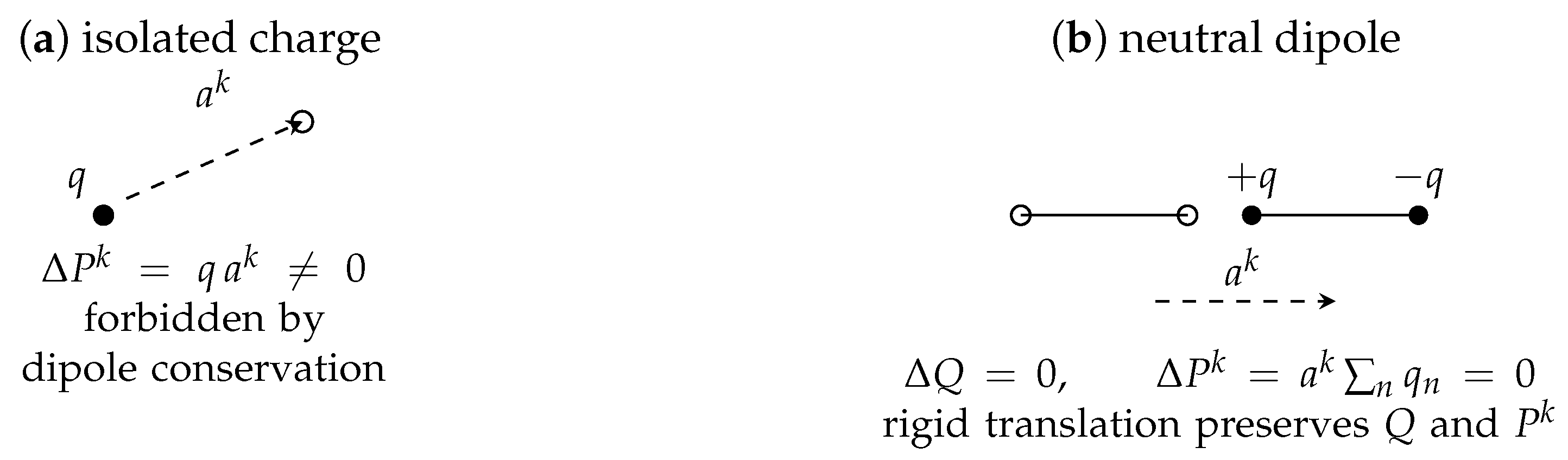
A useful way to read these conservation laws is the following. If an isolated charge q was translated by a displacement , its contribution to the dipole moment would shift by . Unless , even a rigid translation therefore changes the conserved quantity , so isolated charged excitations cannot move as single particles. By contrast, a neutral dipolar bound state can translate without changing the total charge and with a fixed total dipole moment, because the opposite charges contribute compensating shifts.
Therefore isolated charges cannot move without changing
, while neutral composites can. This immobility of isolated charges—together with the possibility of motion only for charge-neutral bound states—is the defining kinematical hallmark of fractonic behavior. For visual orientation,
Figure 1 summarizes this contrast between an isolated charge, whose rigid translation would shift the conserved dipole moment, and a neutral dipole, whose rigid translation leaves it unchanged.
As a simple illustration, consider a localized point-charge trajectory , for which and . Dipole conservation then implies for , i.e., an isolated charge is immobile, while a neutral dipole with total can move consistently with fixed . In the covariant language, this means that an isolated charged excitation is not described by a freely propagating worldline degree of freedom; rather, it is localized in spacetime in an instanton-like manner. We use this terminology only as an interpretation of the relativistic mobility constraint derived above. This makes precise, within the covariant field-theoretic setting, the standard schematic intuition that a single fractonic charge is pinned whereas a neutral dipole may propagate.
In terms of
E and
B, the sourced Maxwell system becomes
5. Stress–Energy Tensor in : Trace, Improvement and the Off-Shell Question
We define the stress–energy tensor by coupling the theory to a background metric and varying the action:
This background-metric variation is used here only as a flat-space device to define the symmetric stress tensor and analyze its trace properties in the relativistic Maxwell-like theory. We do not assume, or need, a fully general curved-background completion preserving the scalar gauge symmetry on arbitrary geometries; for detailed discussions of the subtleties of coupling fracton gauge theories to curved backgrounds, see [
46,
47,
48,
49]. For the Maxwell-like action (
9), one may compute
by replacing
in
(treating
as a rank-2 tensor), varying the explicit contractions with
, and integrating by parts. The result can be organized as a Maxwell-like bilinear in
F plus a superpotential term,
where
has the algebraic symmetries of a Riemann tensor and parametrizes the standard ambiguity associated with adding identically conserved superpotentials.
Using the definitions (
26) and (
29) of the generalized electric and magnetic tensor fields, we have
With the overall sign choice in (
9), this implies
A complementary canonical constraint analysis leading to the same positivity statement is given in
Appendix B.
It is also useful to rewrite the conservation law in terms of the generalized electric and magnetic fields. Defining the energy density
and using the sourced generalized Maxwell system (
47)–(
50), one finds
The first two terms combine into a spatial divergence, so that
with generalized Poynting vector
Thus, in vacuum,
Equation (
57) is the natural tensorial analogue of Poynting’s theorem:
u is the local energy density,
is the corresponding energy flux, and
measures the local power transferred to external sources.
Contracting (
52) and using the equations of motion to remove terms proportional to
yields the following trace identity, which depends only on the Maxwell-like
structure, up to a total derivative:
where
can be written in terms of the superpotential
as
Hence in
,
Notice that the disappearance of the
term at
is fixed by mass dimensions and does not rely on a gauge choice.
The distinction between scale invariance and conformal invariance is well known. In a local QFT, scale invariance allows the trace to be a total derivative,
, where
is often referred to as a virial current. Conformal invariance is more restrictive: it requires that this virial current be removable by a local improvement, i.e., that
can be written as
for some local scalar
, so that an improved stress–energy tensor can be made traceless off-shell; see, e.g., Refs. [
50,
51,
52,
53,
54] for general discussions.
In the present theory, Equation (
62) realizes the scale-invariant pattern in
under standard boundary conditions. However, (
62) is obtained using the field equations, whereas the improvement problem asks a sharper, genuinely off-shell question: can the trace be removed by a
local identity at the level of the stress–energy tensor? Concretely, we consider local CCJ improvements [
36] of the form (
63), with a local scalar operator
. Unless stated otherwise, we further restrict to
that are manifestly gauge-invariant and built within the minimal field content, so that any obstruction is an off-shell statement intrinsic to the theory rather than an artifact of gauge-variant representatives.
The standard local improvement in flat space takes the form
with some local scalar
, under which
In
, off-shell tracelessness would require
as a local identity for some local
, where the coefficient
follows from (
64) evaluated at
.
In
one has
. To keep locality and manifest gauge invariance,
must be a local scalar polynomial in
,
, and derivatives. Power counting then severely restricts the possibilities: any scalar containing at least two factors of
F and/or
K has mass dimension
, while a dimension-4 scalar can only be
linear in the gauge-invariant data and must carry derivatives. Up to total derivatives, the only Lorentz scalar of dimension 4 is
However,
is itself a total derivative and is linear in the fields. By contrast, as shown explicitly in (
A23), a representative virial divergence
is bilinear in the fields, up to terms proportional to the equations of motion. Therefore, the identity (
65) cannot be satisfied off-shell within the minimal local polynomial, manifestly gauge-invariant operator algebra generated by
,
, and derivatives. Equivalently, removing a quadratic virial term by a CCJ improvement would require a dimension-4 scalar
that is quadratic in the basic field, but the only such local candidate is
, which is gauge variant. The obstruction is therefore an off-shell statement about the nonexistence of a local manifestly gauge-invariant improvement within the minimal field content, and should not be conflated with quantum anomalies. A compact derivation of a convenient explicit choice of
, together with a detailed check that the gauge-invariant candidate (
66) cannot solve (
65), is given in
Appendix D (see in particular (
A22)–(
A24)).
Although the manifestly gauge-invariant off-shell improvement is obstructed, in
we still have (
62), and one can construct an on-shell traceless representative by allowing
to be gauge variant or by using EOM-proportional identities. A simple explicit choice is
which is the simplest local scalar of dimension 4 built from
; it is not gauge-invariant, but this is admissible for an on-shell representative. This yields
Thus
vanishes on-shell (up to a total derivative), making precise the sense in which the
reference theory is classically scale-invariant in flat space under standard boundary conditions.
6. Conclusions and Outlook
In this work we developed a six-dimensional covariant formulation of scalar-charge fracton electrodynamics based on a symmetric rank-2 tensor gauge field
with scalar gauge symmetry
Our main motivation was to identify a relativistic setting in which the characteristic kinematics of fracton systems can be expressed in a local and manifestly covariant language, while at the same time keeping under control the stress–energy tensor and the organization of gauge-invariant deformations. In this sense,
is singled out as the natural reference dimension for the Maxwell-like theory: the two-derivative kinetic term is marginal, the gauge parameter can be taken dimensionless, and the resulting model provides a natural scale-invariant starting point for this tensor gauge structure. The role of six spacetime dimensions in our discussion is not meant to be directly phenomenological. Rather,
plays the role of a natural covariant reference point, in which locality, gauge symmetry and scaling are simultaneously most transparent, while lower-dimensional realizations are more naturally interpreted as effective descriptions away from the critical dimension.
Although the present six-dimensional formulation is primarily motivated by its structural simplicity and by the marginality of the two-derivative kinetic term, it is worth noting several broader contexts in which this gauge structure may naturally appear.
First, rank-two symmetric tensor fields play a central role in string theory, where the massless excitations of the closed string include both the graviton and additional mixed-symmetry tensor fields. Even though the present scalar-charge gauge symmetry does not coincide with linearized diffeomorphisms, it fits naturally within the general taxonomy of higher-rank gauge fields that arise in effective descriptions of compactified or constrained string backgrounds.
Second, in effective field theories with spontaneously broken higher-form symmetries or in non-Lorentzian limits relevant for elasticity dualities, symmetric tensor fields frequently emerge as low-energy degrees of freedom. In such contexts the conservation of multipole moments may appear either as an emergent constraint or as a remnant of microscopic subsystem symmetries.
Finally, tensor gauge structures similar to the one analyzed here arise in continuum limits of lattice models with restricted mobility, generalized elasticity theories, and higher-moment hydrodynamics. Although the six-dimensional model developed in this work is not intended as a direct phenomenological theory, its covariance and locality make it a useful reference point for constructing effective theories in lower dimensions or for interpreting higher-moment generalized global symmetries within a relativistic field-theoretic framework.
A central physical outcome of the analysis is that the characteristic mobility constraints of scalar-charge fracton theories arise here directly from gauge invariance. Coupling the theory to a symmetric external source
enforces the covariant constraint
and in the
decomposition this becomes the conservation of total charge and dipole moment. As a consequence, isolated charges are immobile, whereas neutral dipolar composites can propagate. In this way, the defining fractonic behavior is not imposed as an additional nonrelativistic rule, but follows from the covariant gauge principle itself. In the relativistic setting, the additional conservation of
means that an isolated charged excitation is localized in spacetime rather than carried by a propagating worldline; this is the precise sense in which the covariant mobility constraint is more appropriately described as instanton-like. The same
split also reorganizes the equations of motion into a generalized Maxwell system for gauge-invariant electric and magnetic variables, making the physical content of the theory especially transparent.
A second result concerns the stress–energy tensor. For the Maxwell-like representative, its trace takes the universal form
Accordingly, in
the explicit
contribution disappears and the trace reduces to a total derivative, implying classical scale invariance in flat space under standard boundary conditions. At the same time, our analysis shows that this statement is more rigid than in ordinary Maxwell theory. Within the minimal local gauge-invariant operator algebra, the available dimension-four scalar candidates are not sufficient to remove the virial term by a local, manifestly gauge-invariant improvement. Thus, although an on-shell traceless representative can still be constructed, the off-shell problem exhibits a genuine obstruction within the minimal field content. This points to a nontrivial interplay between gauge symmetry, locality and scale invariance which appears to be intrinsic to the six-dimensional theory rather than an artifact of a particular stress–tensor representative.
From a Wilsonian viewpoint, the six-dimensional model also provides a clean organizing center for covariant fracton-like gauge dynamics. The marginal sector is highly constrained, while the leading irrelevant deformations can be reduced to a small set of independent structures once Bianchi identities, integrations by parts and equations of motion are taken into account. Although we have not addressed here the quantum -function or possible interacting UV completions, the present construction offers a concrete local framework in which such questions can be posed systematically.
Several directions merit further investigation. A first question is whether the obstruction to a local manifestly gauge-invariant traceless representative persists in BRST-based formulations or in enlarged field contents. A second issue concerns boundary conditions and defects, where the
formulation may help clarify the realization of generalized symmetries and the associated physical observables. Related boundary-induced structures in covariant rank-two theories were analyzed in [
55]. More broadly, it would be interesting to understand whether the six-dimensional model discussed here should be viewed simply as a distinguished Gaussian reference point, or rather as the starting point for a wider relativistic formulation of fracton quantum field theory. In this broader perspective, the present model adds a symmetric-tensor fracton example to the wider six-dimensional landscape in which scale and conformal structures often acquire a particularly rigid form, even though the field content and symmetry principles differ substantially from those of six-dimensional SCFTs.