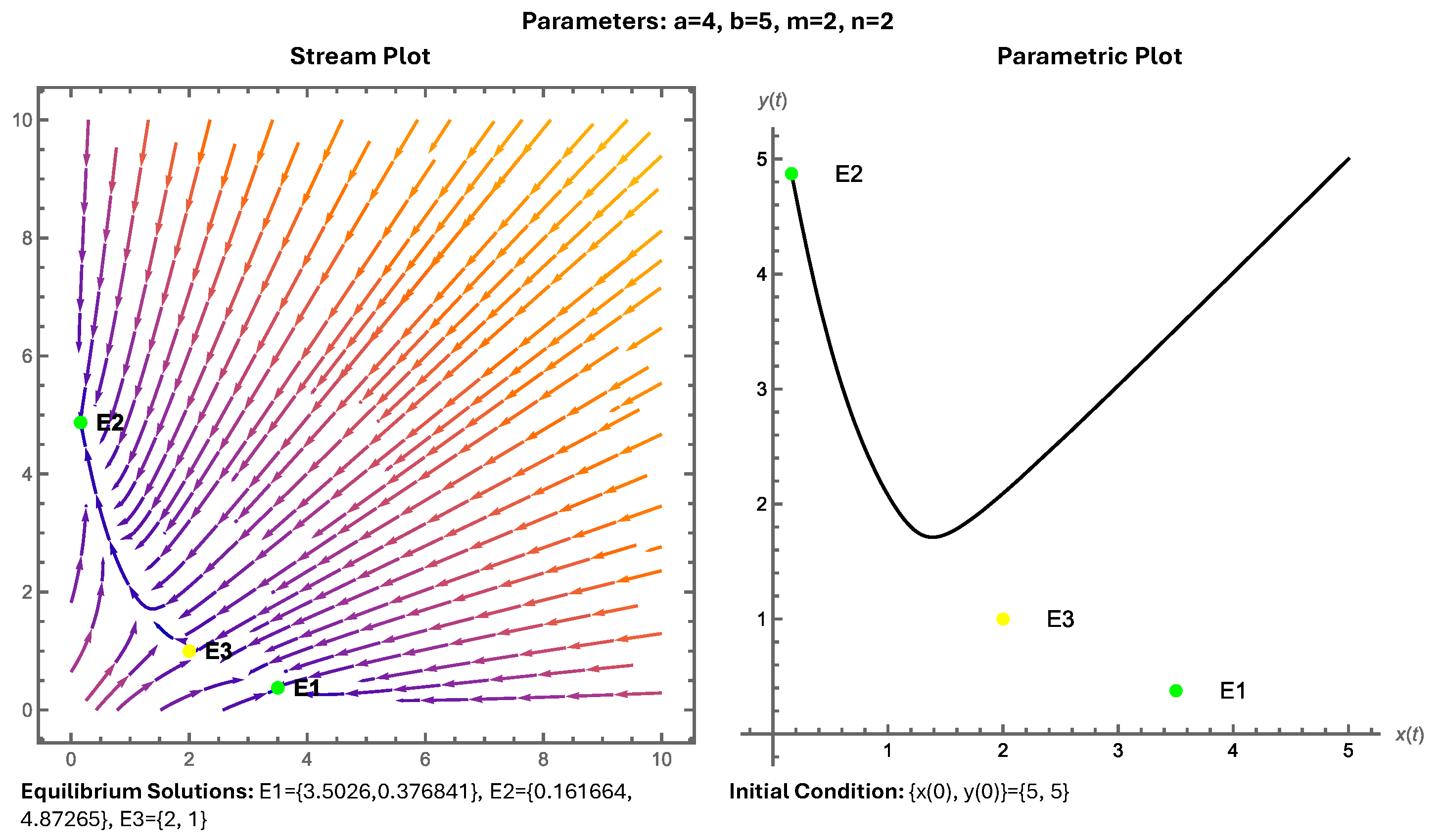
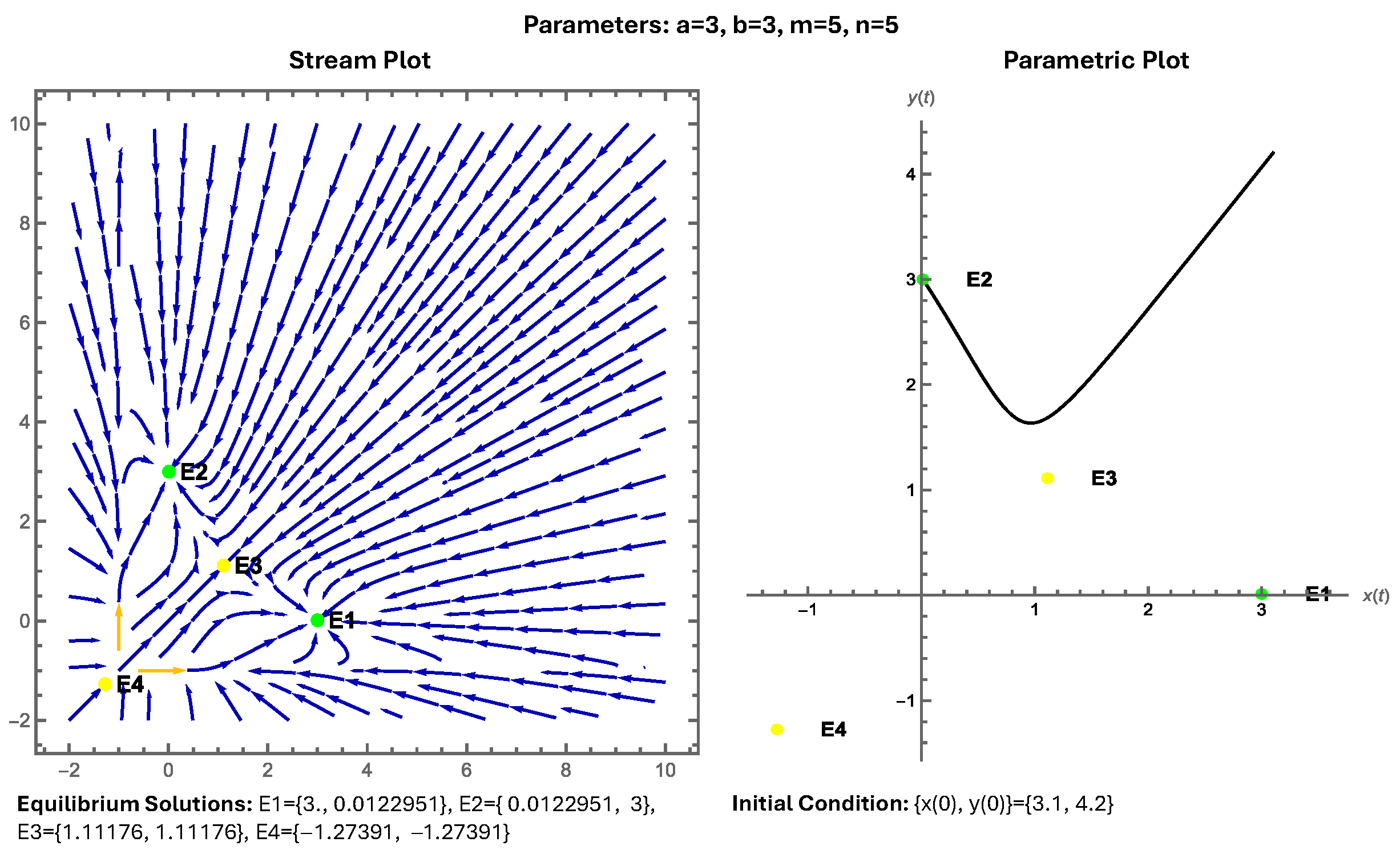
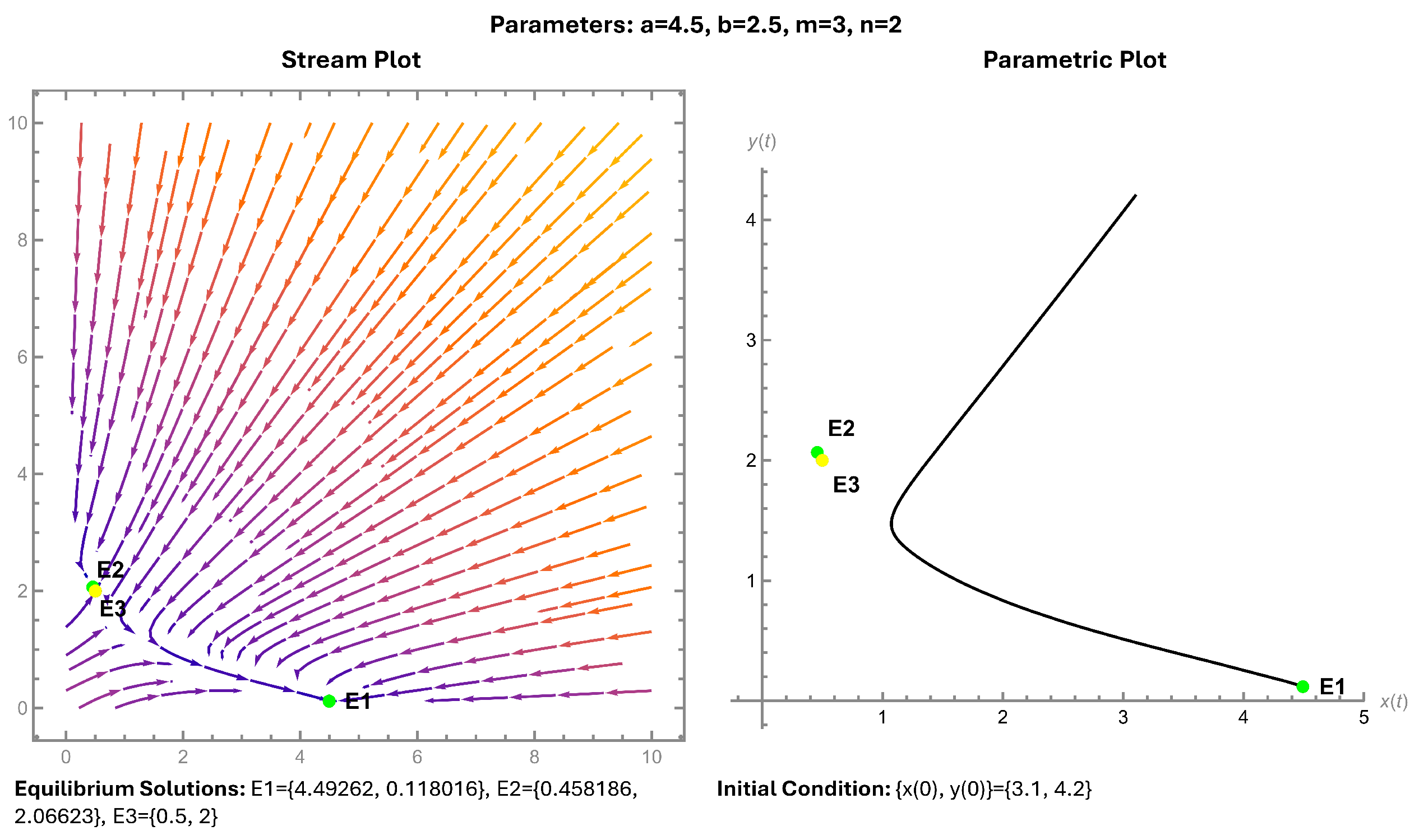
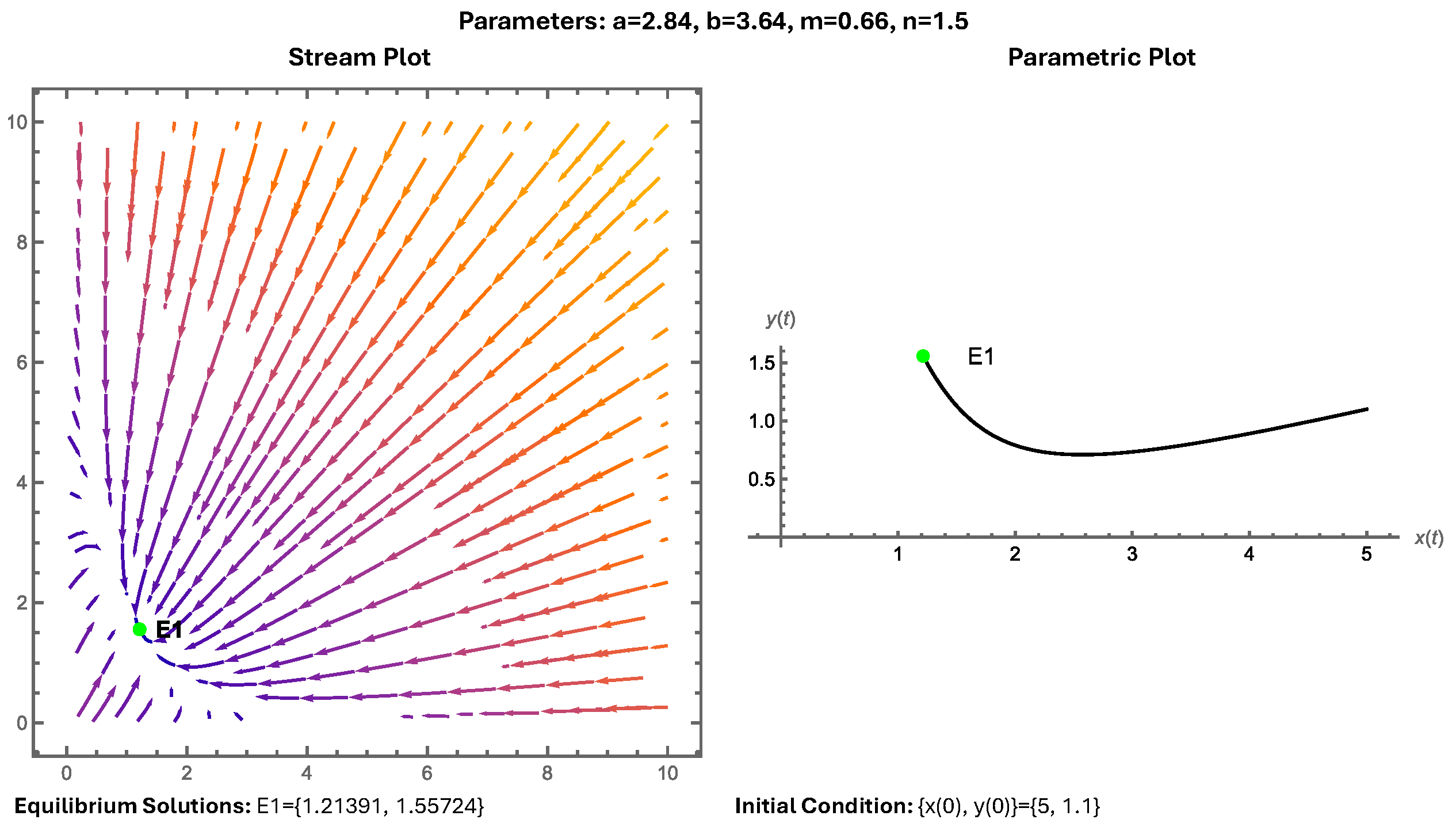
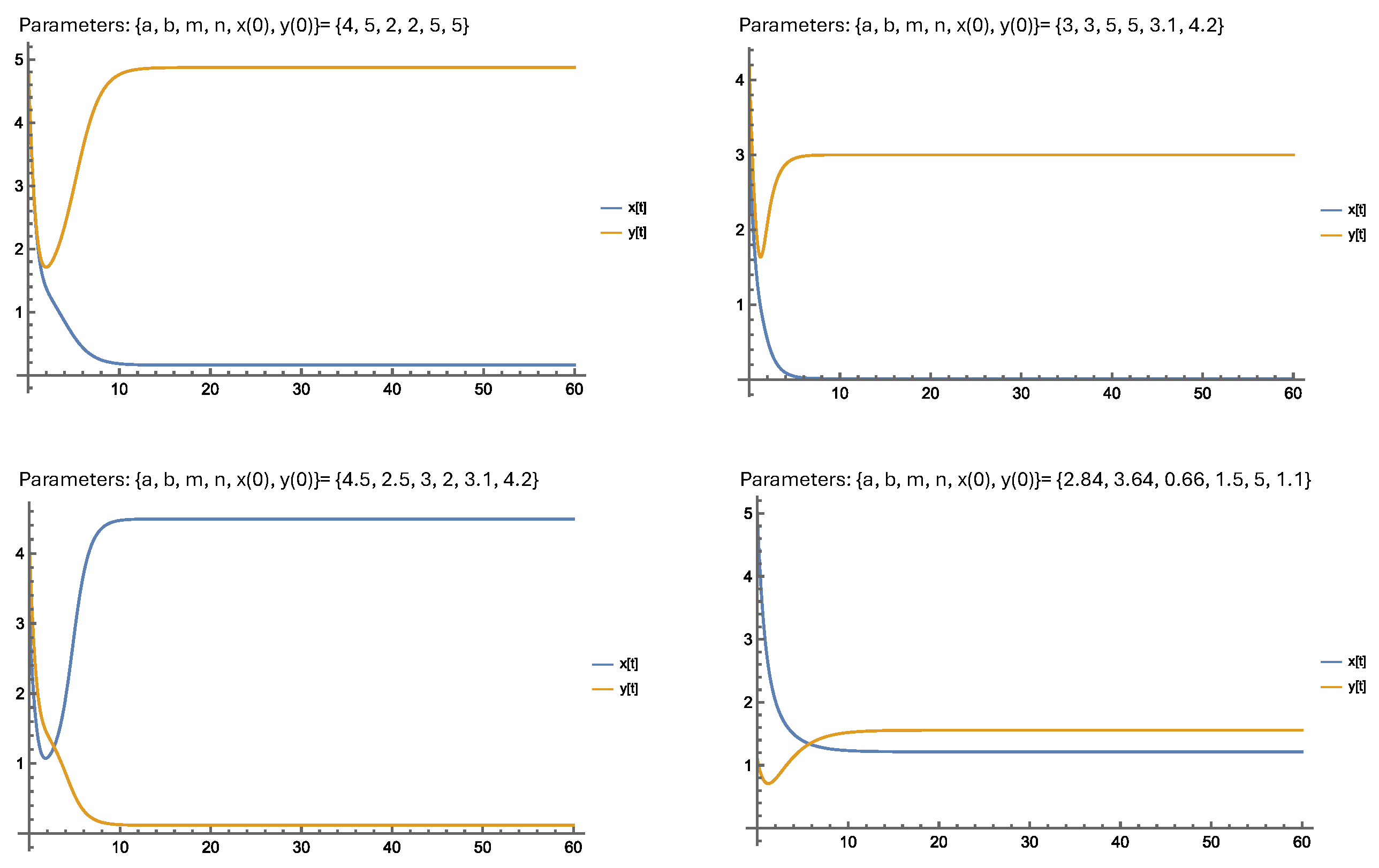
Simulations for both ODE Genetic Toggle Switch (
5) and the difference equation Genetic Toggle Switch (
13) are shown below. For the ODE system in
Figure 1,
Figure 2,
Figure 3 and
Figure 4, we use
NDSolve of
Mathematica 13.2 and for various
and
are positive integers with the exception of
Figure 4.
Figure 5 details the time series of each system for
Figure 1,
Figure 2,
Figure 3 and
Figure 4. Then, for the difference equations system in
Figure 6,
Figure 7,
Figure 8,
Figure 9,
Figure 10,
Figure 11,
Figure 12,
Figure 13,
Figure 14 and
Figure 15, we observed basins of attraction using
Mathematica 13.2 package
Dynamica from [
24].
5.2. Model
In this part we provide the numerical and visual evidence for Theorems 2 and 3. We show different equilibrium solutions and period-two solutions together with their basins of attractions. More precisely, in every case we will see the immediate basin of attraction as well as parts of the preimages of the immediate basin of attraction that form a complete basin of attraction. The biologically relevant basins of attractions are those in the first quadrant and the pre-images in other qudrants are of mathematical interest. The structure of the complete basin of attraction for competitive map given in [
13] could be very complex, yet the immediate basins of attraction are, in most cases, simple and belong to the first quadrant of the initial conditions
. Let us recall that two points in
are in south-east ordering
, if
. The structure of a basin of attraction for a non-competitive map is even more complicated and is given in several papers by J. A. Yorke and his collaborators; see [
27,
28,
29,
30,
31]. In many cases the boundaries of the basins of attractions of non-competitive maps are fractals, which certainly is not the case for competitive maps, where the boundaries of the basins of attraction are continuous non-decreasing curves.
Remark 7. When the middle equilibrium in the south-east ordering (SE ordering) is a repeller then it is observed that there exists period-two solutions and when it is a saddle point then there is no emergence of period-two solutions; see [15]. This shows that there is a relationship between the appearance of period-two solutions and the local stability analysis for the middle equilibrium point in SE ordering. Theorem 2. - (a)
Assume that system (13) has a single equilibrium point E. Then E is globally asymptotically stable. - (b)
Assume that system (13) has equilibrium points in south-east ordering such that and that are locally asymptotically stable and are either saddle points or repellers that belong to an invariant set C, which is the graph of a continuous non-decreasing function. Assume that system (13) has no period-two solutions. When is a saddle point for any , then there exists the global stable manifold , which is a graph of a continuous and non-decreasing function passing through , which separates the first quadrant into two regions and for some point . The set is an immediate basin of attraction of while the set is an immediate basin of attraction of . When is a repeller, then the set C plays a role of .
Proof. The statements about the global stable and unstable manifolds follows from Theorems 3.1 and 3.2 in [
15]. The results describing the basins of attraction follow from the results in [
13]. If the system (
13) is symmetric then the global stable manifold mentioned in the result is a bisector of the first quadrant; see Remark 8. See
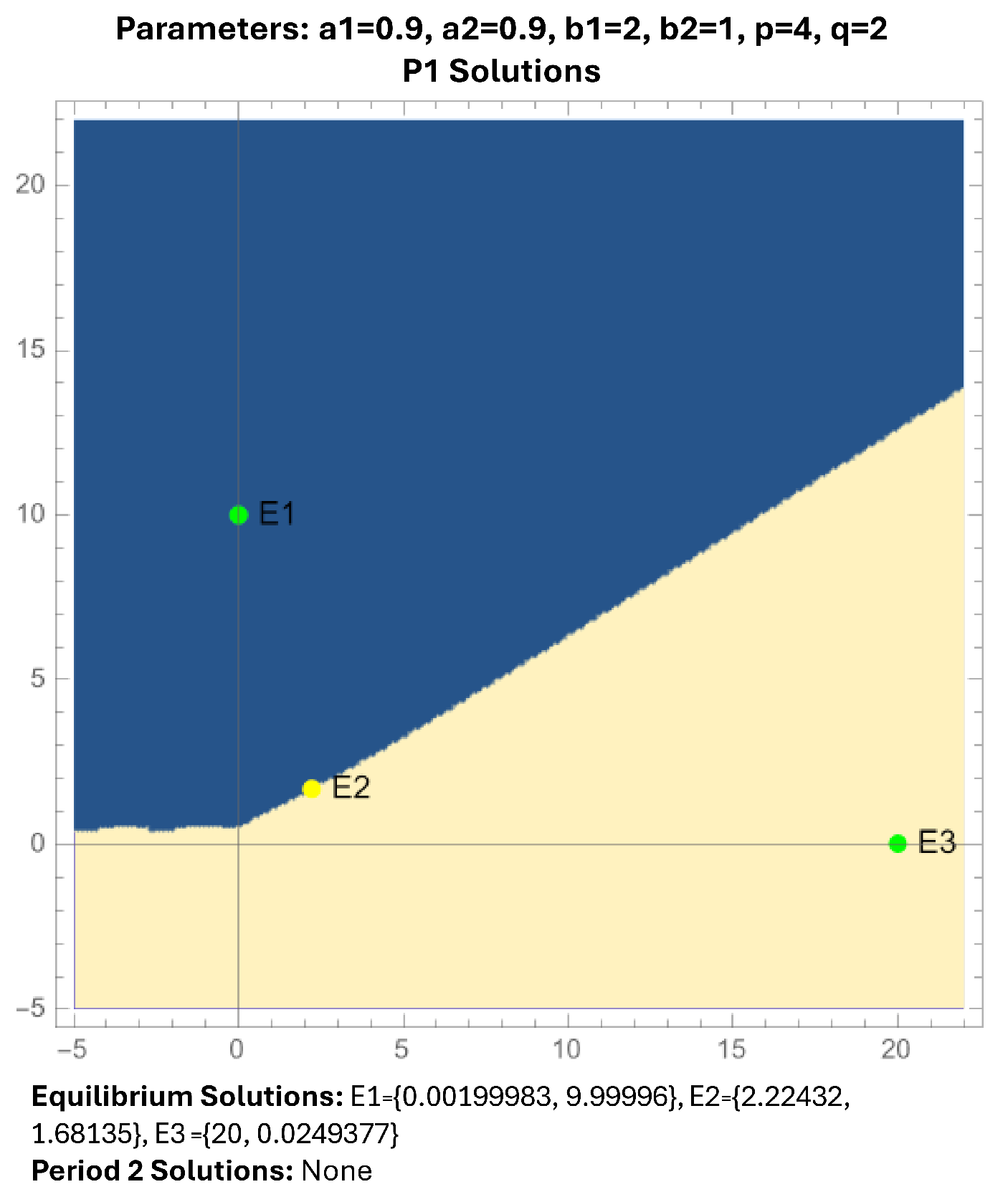
Figure 6 and
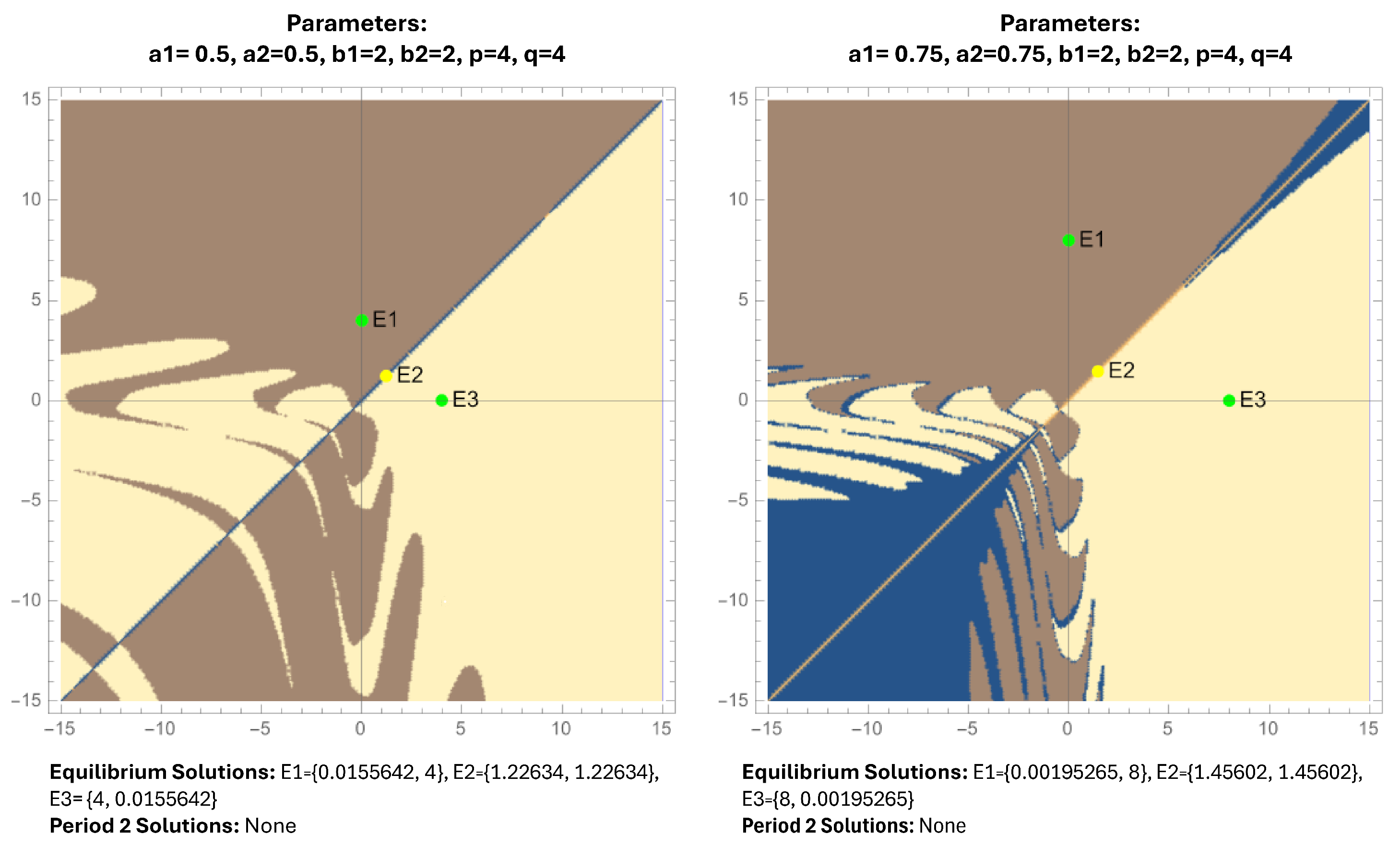
Figure 7. The special case
is interesting and easy to comprehend. □
Remark 8. In view of the symmetric nature of system (13), all Figure 7, Figure 8, Figure 9, Figure 10, Figure 11 and Figure 12 are perfectly symmetric for the symmetric choice of parameters. Figure 6 and Figure 13, Figure 14 and Figure 15 are asymmetric due to the asymmetric choice of parameters. Similar results for cooperative systems have been proved in [23]; however, their biological implications are different since, in the cooperative case, 0 is a locally asymptotically stable equilibrium which implies the presence of Allee’s effect. Theorem 3. - (a)
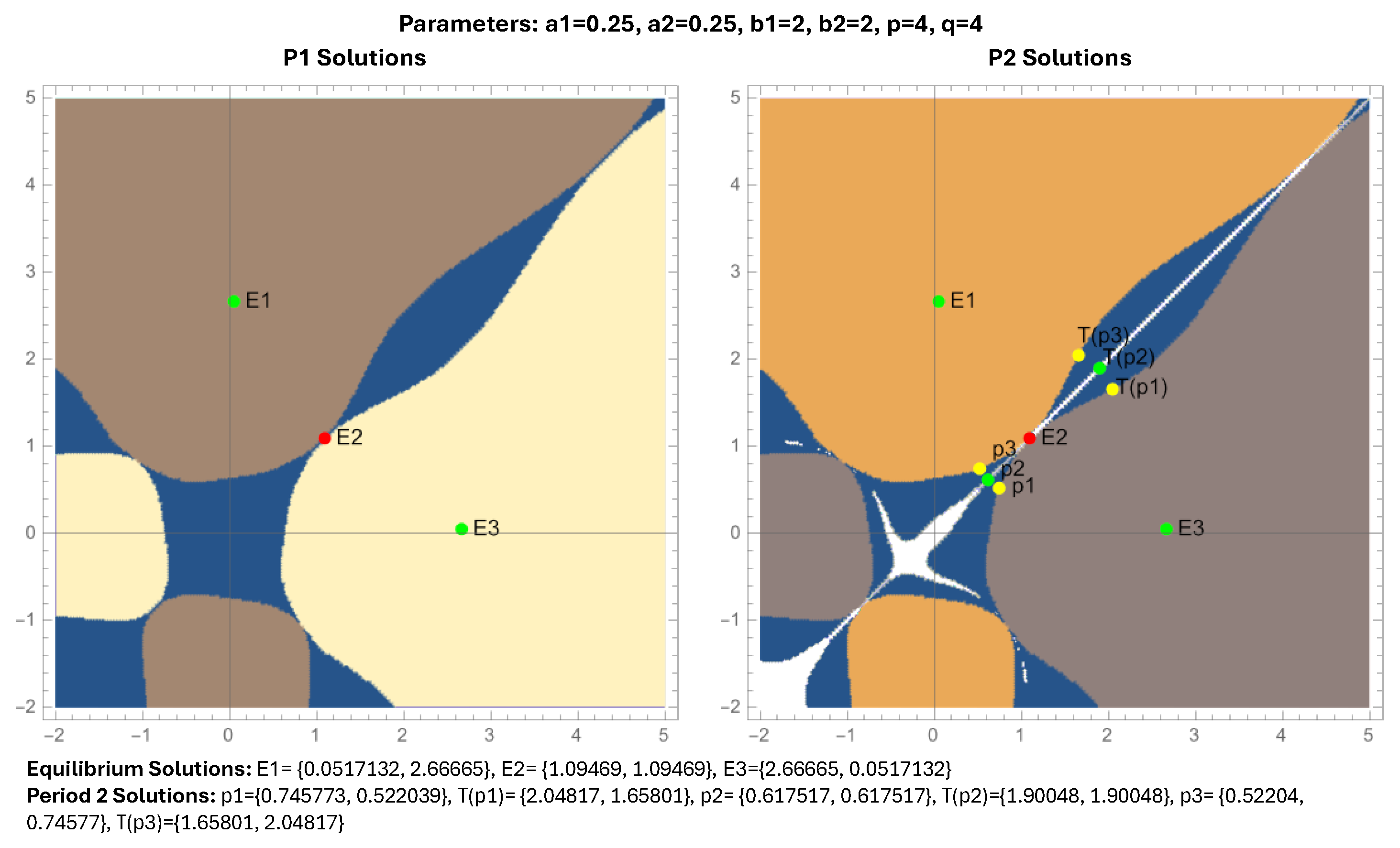
Assume that system (13) has three equilibrium points in south-east ordering such that and that and are locally asymptotically stable and is a repeller. Further, assume that there is a period-two solution , which is a repeller. Assume that system (13) has no period-four solutions. Then, there exists a continuous, non-decreasing curve C passing through , which separates the first quadrant into two sets, which are the immediate basins of attraction of and . If the system is a symmetric set, C is a bisector of the first quadrant. See Figure 8. - (b)
Assume that system (13) has three equilibrium points in south-east ordering such that and that and are locally asymptotically stable and is a repeller. Further, assume that there are three period-two solutions such that and that are saddle points and is locally stable. Assume that system (13) has no period-four solutions. Then there exist the global stable manifolds , , which are the graphs of continuous and non-decreasing functions passing through , which separates the first quadrant into three regions: and for some point , for some point and the region between two stable manifolds, precisely the set between and . The last set is the immediate basin of attraction of the period-two solution . The sets and are the immediate basins of attraction of the equilibrium points and .
Proof. The statements about the global stable and unstable manifolds follows from Theorems 3.2 and 3.3 in [
15]. The statements about the immediate basins of attraction follow from the results in [
13]. The structure of the complete basin of attraction is described in [
13]. See
Figure 8,
Figure 9,
Figure 10,
Figure 11,
Figure 12,
Figure 13 and
Figure 14. □
Remark 9. Theorems 2 and 3 continue to hold for most general competitive systems (8). In fact, the more general global dynamics with many equilibrium solutions with local stability alternate between locally stable and saddle points, according to the results from [13,15]. In fact, the global dynamics described in Theorems 2 and 3 replicate in the case of a large number of equilibrium solutions with described local dynamics. Similarly, Theorem 3 hold for situations when there are more than three equilibrium solutions and three period-two solutions, when the local stability of neighboring solutions and period-two solutions alternates between local stability and saddle point. For illustration, see Figure 11. Similar results for cooperative systems have been proved in [23]. In all the figures that are following the locally stable equilibrium points or period-two points are colored in green, the saddle point equilibium and period-two points are colored in yellow and the repelling equilibrium points or period-two points are colored in red.
Figure 6.
This figure illustrates Theorem 2. There are two locally stable fixed points on the axis and one saddle point on the bisector. The dark blue region is the immediate basin of attraction of and the tan region is the immediate basin of attraction of .
Figure 6.
This figure illustrates Theorem 2. There are two locally stable fixed points on the axis and one saddle point on the bisector. The dark blue region is the immediate basin of attraction of and the tan region is the immediate basin of attraction of .
Figure 7.
This figure illustrates Theorem 2. There are two locally stable fixed points on the axis and one saddle point on the bisector. For P1 and P2 Solutions: The brown region is the basin of attraction of and the tan region is the basin of attraction of .
Figure 7.
This figure illustrates Theorem 2. There are two locally stable fixed points on the axis and one saddle point on the bisector. For P1 and P2 Solutions: The brown region is the basin of attraction of and the tan region is the basin of attraction of .
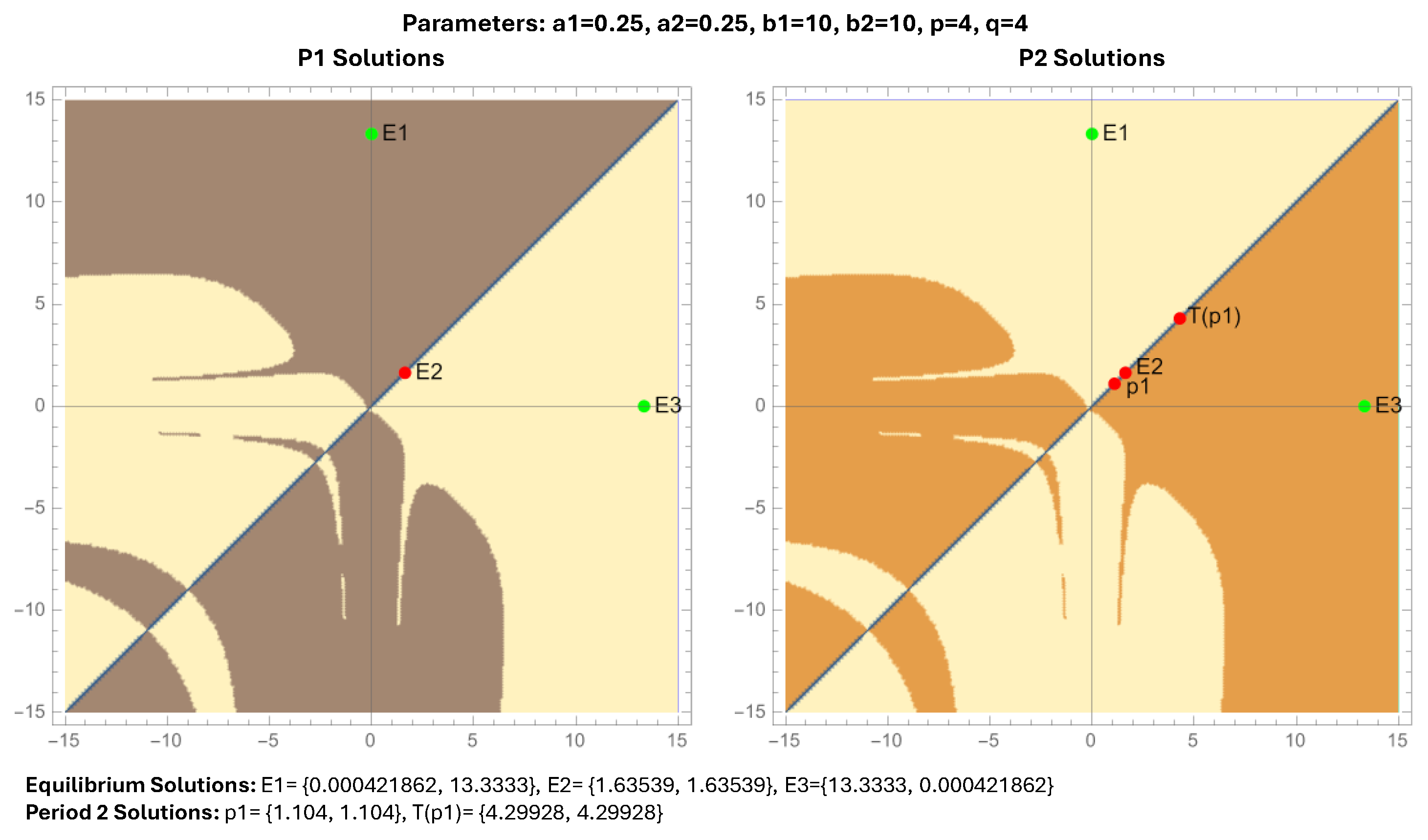
Figure 8.
This figure illustrates Theorem 3. There are three equilibrium points on the left figure and a single period-two solution on the bisector. The full basin of attractions of two equilibrium points are visualized as preimages of the immediate basins of attractions. For P1 Solutions: The brown region is the basin of attraction of and the tan region is the basin of attraction of . For P2 Solutions: The tan region is the basin of attraction of and the orange region is the basin of attraction of .
Figure 8.
This figure illustrates Theorem 3. There are three equilibrium points on the left figure and a single period-two solution on the bisector. The full basin of attractions of two equilibrium points are visualized as preimages of the immediate basins of attractions. For P1 Solutions: The brown region is the basin of attraction of and the tan region is the basin of attraction of . For P2 Solutions: The tan region is the basin of attraction of and the orange region is the basin of attraction of .
Figure 9.
This figure illustrates Theorem 3. There are three equilibrium points in the left figure and two period-two solutions in the right figure. The full basins of attractions of the equilibrium points are visualized as preimages of the immediate basins of attractions. For P1 Solutions: The brown region is the basin of attraction of and the tan region is the basin of attraction of . For P2 Solutions: The orange region is the basin of attraction of , the brown region is the basin of attraction of , and the white region is the basin of attraction for .
Figure 9.
This figure illustrates Theorem 3. There are three equilibrium points in the left figure and two period-two solutions in the right figure. The full basins of attractions of the equilibrium points are visualized as preimages of the immediate basins of attractions. For P1 Solutions: The brown region is the basin of attraction of and the tan region is the basin of attraction of . For P2 Solutions: The orange region is the basin of attraction of , the brown region is the basin of attraction of , and the white region is the basin of attraction for .
Figure 10.
This figure illustrates Theorem 3. There are three feasible fixed points and one feasible period-two solution, which is a saddle point. In addition, there are four nonfeasible period-two solutions. For P1 Solutions: The orange region is the basin of attraction of and the tan region is the basin of attraction of . For P2 Solutions: The orange region is the basin of attraction of and the brown region is the basin of attraction of .
Figure 10.
This figure illustrates Theorem 3. There are three feasible fixed points and one feasible period-two solution, which is a saddle point. In addition, there are four nonfeasible period-two solutions. For P1 Solutions: The orange region is the basin of attraction of and the tan region is the basin of attraction of . For P2 Solutions: The orange region is the basin of attraction of and the brown region is the basin of attraction of .
Figure 11.
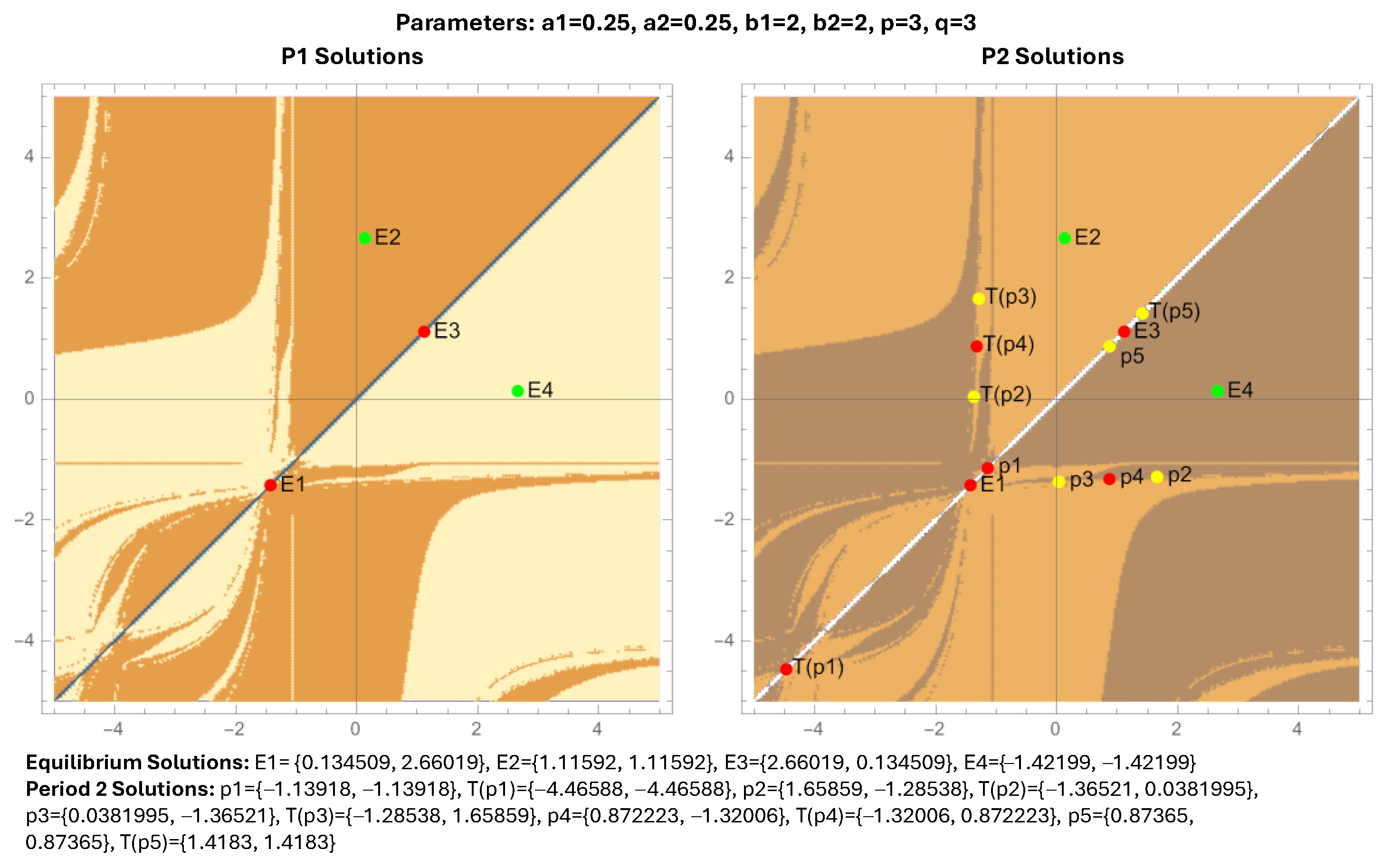
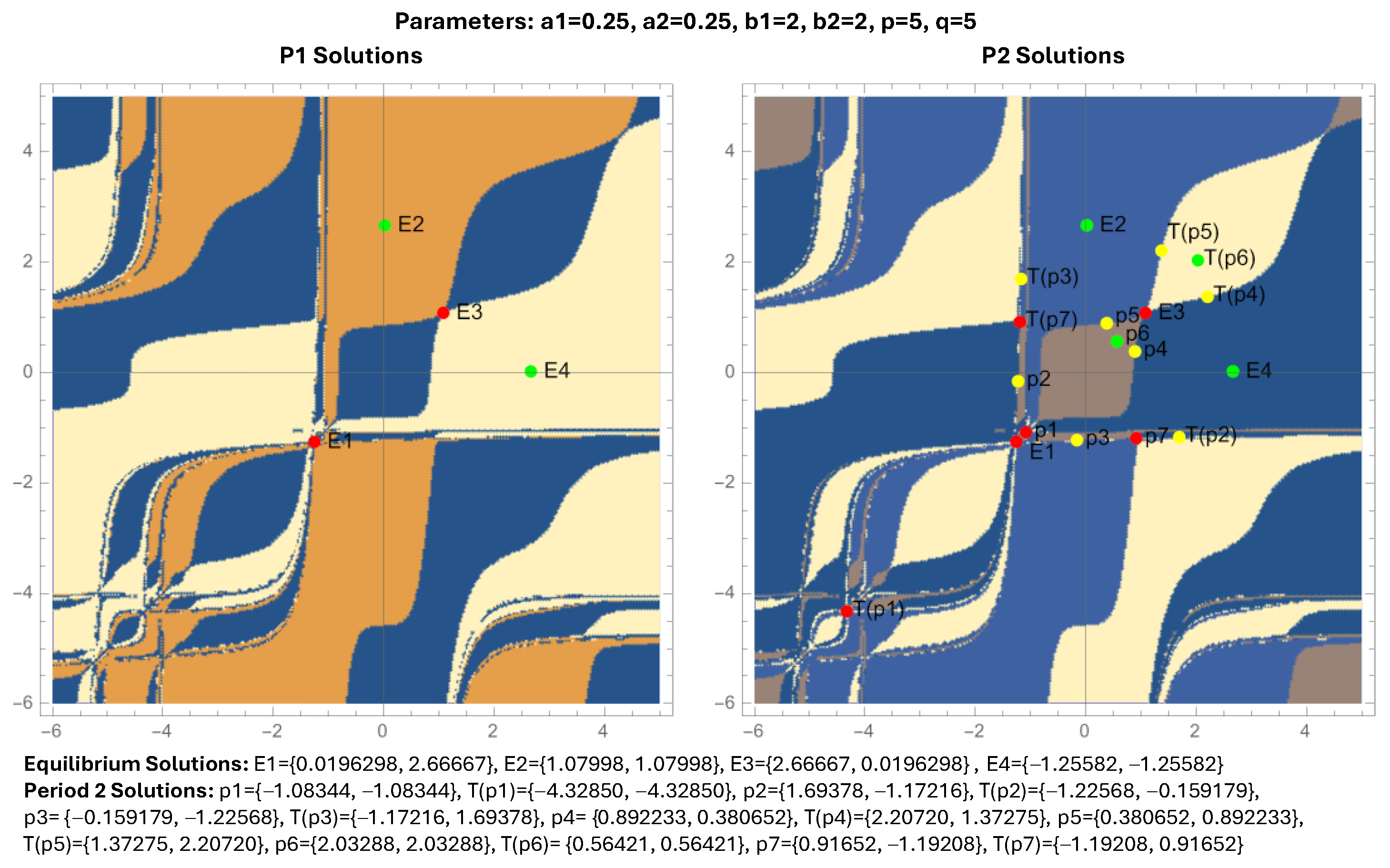
This figure illustrates both Theorems 2 and 3. There are two locally stable fixed points on the axis and one saddle point on the bisector in the first quadrant with corresponding basins of attractions, which represent the biologically feasible solutions. There is also one non-feasible equilibrium solution in the third quadrant and five non-feasible period-two solutions. All solutions are given with the corresponding basins of attractions. For P1 Solutions: The oragne region is the basin of attraction of and the tan region is the basin of attraction of . For P2 Solutions: The light blue region is the basin of attraction of , the dark blue region is the basin of attraction of , the brown region is the basin of attraction of , and the tan region is the basin of attraction for .
Figure 11.
This figure illustrates both Theorems 2 and 3. There are two locally stable fixed points on the axis and one saddle point on the bisector in the first quadrant with corresponding basins of attractions, which represent the biologically feasible solutions. There is also one non-feasible equilibrium solution in the third quadrant and five non-feasible period-two solutions. All solutions are given with the corresponding basins of attractions. For P1 Solutions: The oragne region is the basin of attraction of and the tan region is the basin of attraction of . For P2 Solutions: The light blue region is the basin of attraction of , the dark blue region is the basin of attraction of , the brown region is the basin of attraction of , and the tan region is the basin of attraction for .
Figure 12.
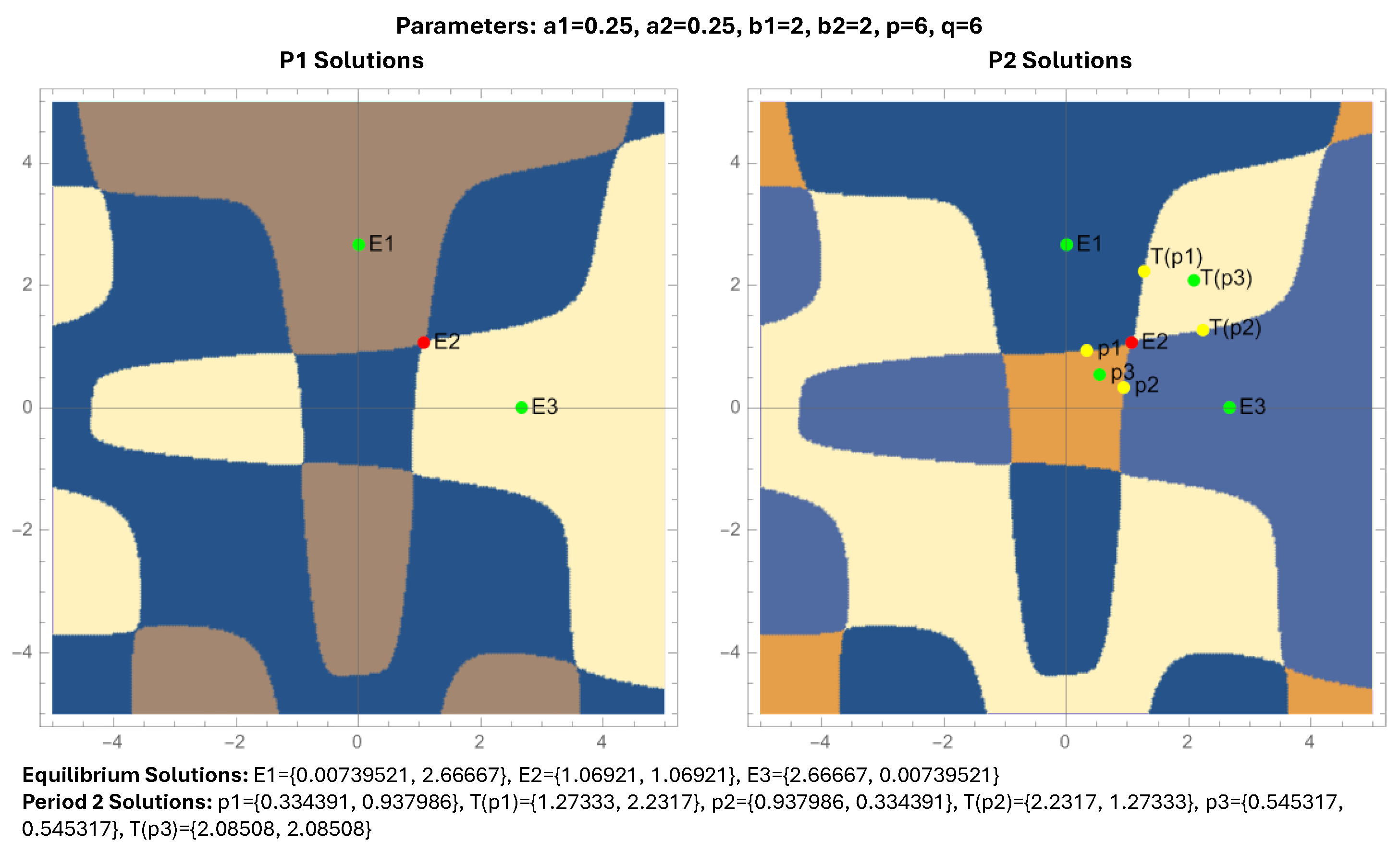
This figure illustrates Theorem 3. There are two locally stable fixed points on the axis and one saddle point on the bisector in the first quadrant with corresponding basins of attractions, which represent the biologically feasible solutions. There are also three feasible period-two solutions. All solutions are given with the corresponding basins of attractions. For P1 Solutions: The brown region is the basin of attraction of and the tan region is the basin of attraction of . For P2 Solutions: The dark blue region is the basin of attraction of , the light blue region is the basin of attraction of , the orange region is the basin of attraction to , and the tan region is the basin of attraction to .
Figure 12.
This figure illustrates Theorem 3. There are two locally stable fixed points on the axis and one saddle point on the bisector in the first quadrant with corresponding basins of attractions, which represent the biologically feasible solutions. There are also three feasible period-two solutions. All solutions are given with the corresponding basins of attractions. For P1 Solutions: The brown region is the basin of attraction of and the tan region is the basin of attraction of . For P2 Solutions: The dark blue region is the basin of attraction of , the light blue region is the basin of attraction of , the orange region is the basin of attraction to , and the tan region is the basin of attraction to .
Figure 13.
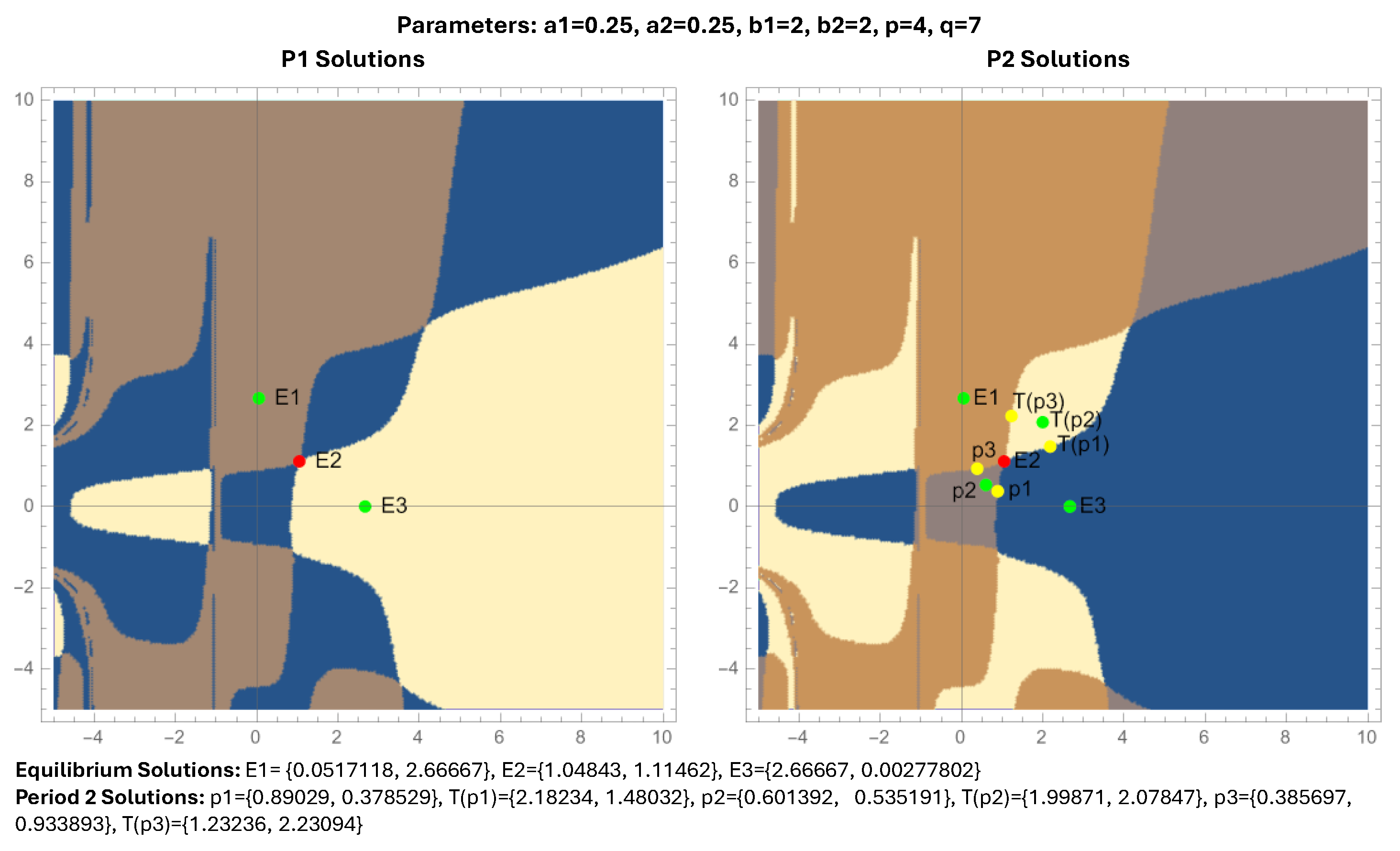
This figure illustrates Theorem 3. There are two locally stable fixed points on the axis and one saddle point on the bisector in the first quadrant with corresponding basins of attractions, which represent the biologically feasible solutions. There are also three feasible period-two solutions. All solutions are given with the corresponding basins of attractions. For P1 Solutions: The brown region is the basin of attraction of and the tan region is the basin of attraction of . For P2 Solutions: The light brown region is the basin of attraction of , the dark blue region is the basin of attraction of , the brown region is the basin of attraction for , and the tan region is the bain of attraction for .
Figure 13.
This figure illustrates Theorem 3. There are two locally stable fixed points on the axis and one saddle point on the bisector in the first quadrant with corresponding basins of attractions, which represent the biologically feasible solutions. There are also three feasible period-two solutions. All solutions are given with the corresponding basins of attractions. For P1 Solutions: The brown region is the basin of attraction of and the tan region is the basin of attraction of . For P2 Solutions: The light brown region is the basin of attraction of , the dark blue region is the basin of attraction of , the brown region is the basin of attraction for , and the tan region is the bain of attraction for .
Figure 14.
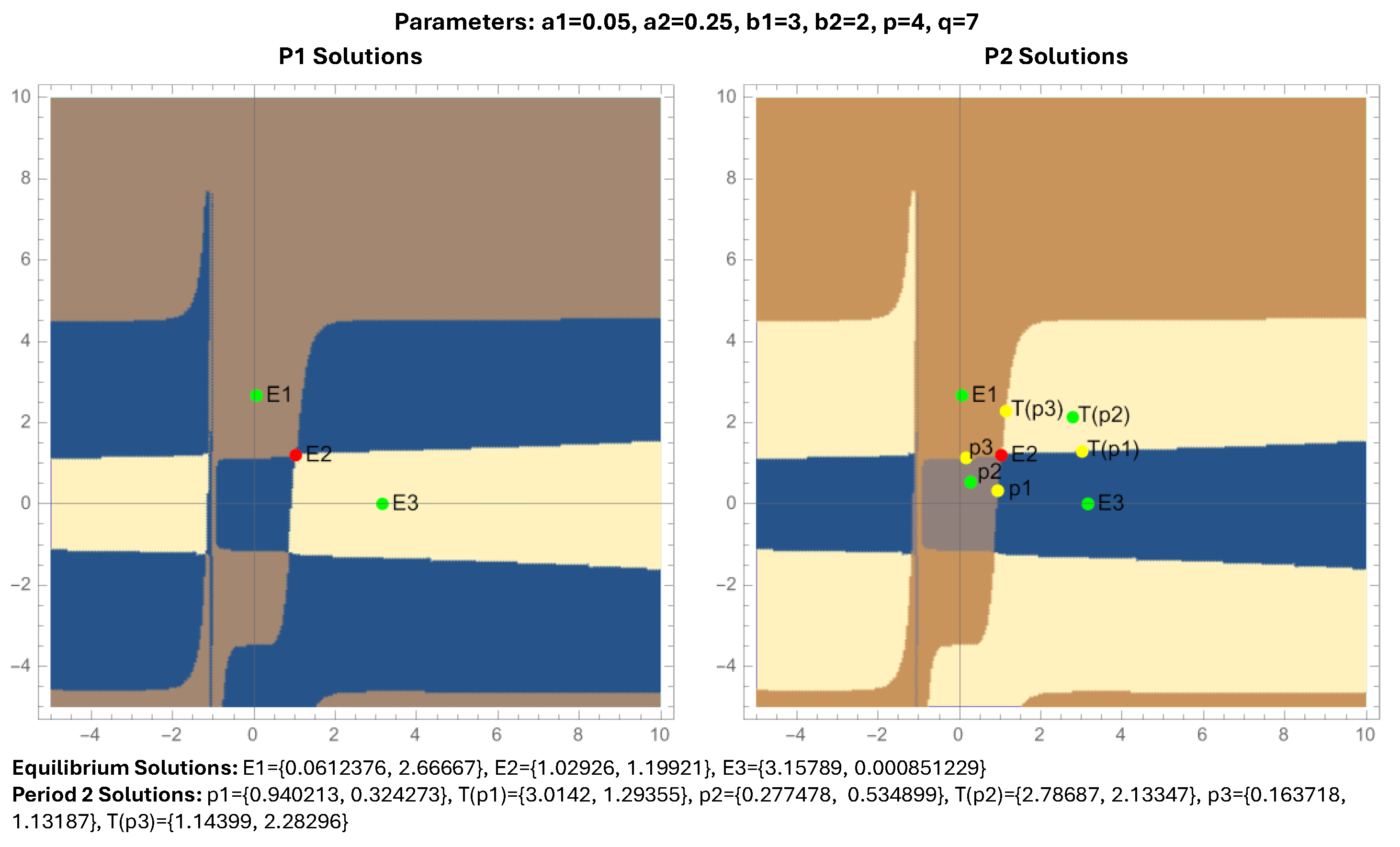
This figure illustrates Theorem 3. The case of asymmetric parameters. There are two locally stable fixed points and one repeller between them in the first quadrant with corresponding basins of attractions, which represent the biologically feasible solutions. There are also three feasible period-two solutions, which must exist to generate the boundaries of the basins of attractions [
13]. The blue region of the picture on the left is an immediate basin of attraction of locally stable period-two solution. For P1 Solutions: The brown region is the basin of attraction of
and the tan region is the basin of attraction of
. For P2 Solutions: The light brown region is the basin of attraction of
, the dark blue region is the basin of attraction of
, the brown region is the basin of attraction for
, and the tan region is the bain of attraction for
.
Figure 14.
This figure illustrates Theorem 3. The case of asymmetric parameters. There are two locally stable fixed points and one repeller between them in the first quadrant with corresponding basins of attractions, which represent the biologically feasible solutions. There are also three feasible period-two solutions, which must exist to generate the boundaries of the basins of attractions [
13]. The blue region of the picture on the left is an immediate basin of attraction of locally stable period-two solution. For P1 Solutions: The brown region is the basin of attraction of
and the tan region is the basin of attraction of
. For P2 Solutions: The light brown region is the basin of attraction of
, the dark blue region is the basin of attraction of
, the brown region is the basin of attraction for
, and the tan region is the bain of attraction for
.
Figure 15.
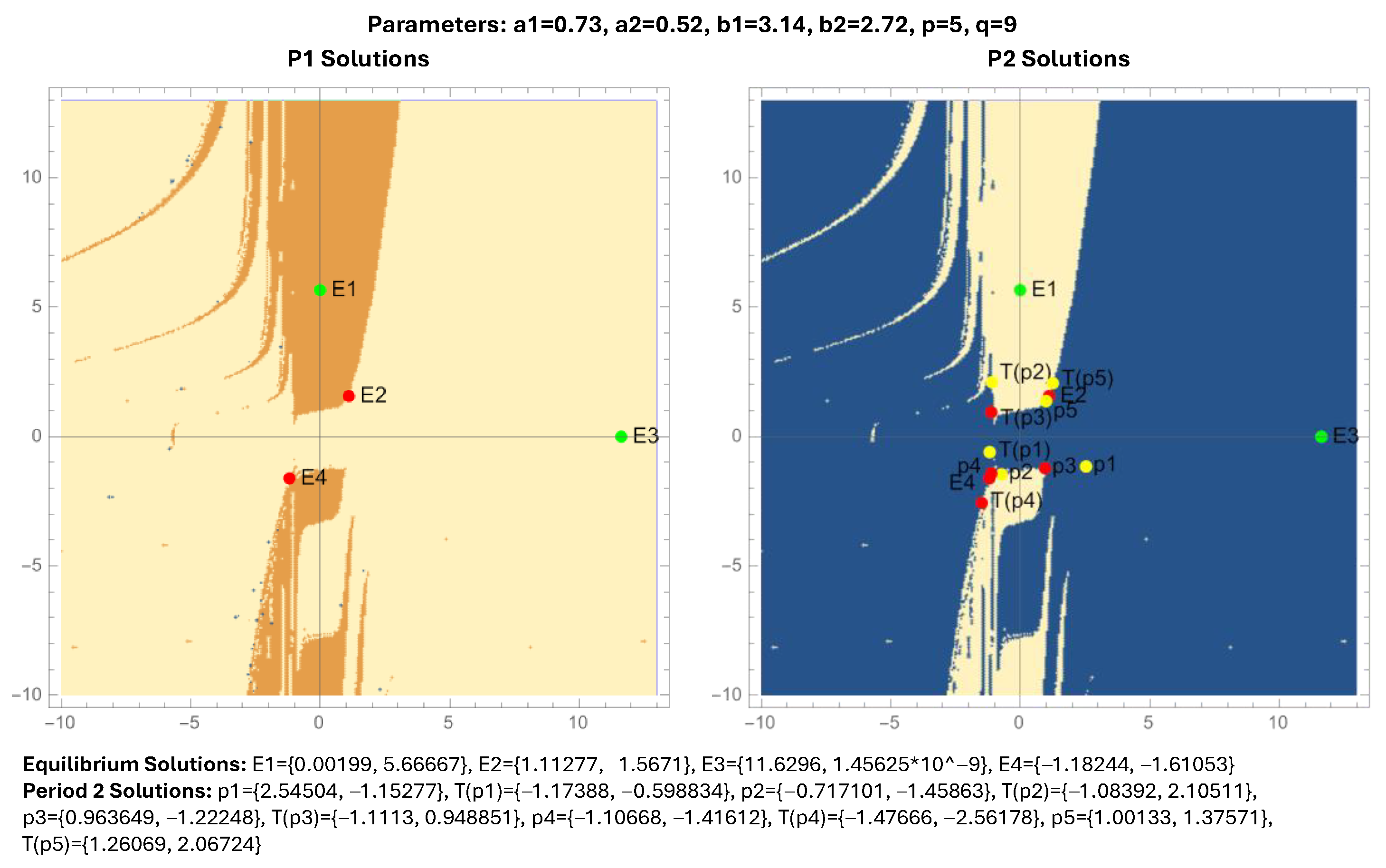
This figure illustrates Theorem 3. The case of asymmetric parameters. There are two locally stable fixed points and one repeller between them in the first quadrant with corresponding basins of attractions. There are also five feasible period-two solutions, which must exist to generate the boundaries of the basins of attractions [
13]. For P1 Solutions: The orange region is the basin of attraction of
and the tan region is the basin of attraction of
. For P2 Solutions: The tan region is the basin of attraction of
and the dark blue region is the basin of attraction of
.
Figure 15.
This figure illustrates Theorem 3. The case of asymmetric parameters. There are two locally stable fixed points and one repeller between them in the first quadrant with corresponding basins of attractions. There are also five feasible period-two solutions, which must exist to generate the boundaries of the basins of attractions [
13]. For P1 Solutions: The orange region is the basin of attraction of
and the tan region is the basin of attraction of
. For P2 Solutions: The tan region is the basin of attraction of
and the dark blue region is the basin of attraction of
.